ELECTRICAL ELECTRONICS COMMUNICATION INSTRUMENTATION
Electrical Science: 2021-22
Lecture 1
Power Sources
By Dr. Sanjay Vidhyadharan
ELECTRICAL ELECTRONICS COMMUNICATION INSTRUMENTATION
2
Ideal vs. Practical Voltage Sources
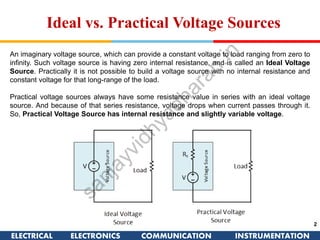
An imaginary voltage source, which can provide a constant voltage to load ranging from zero to
infinity. Such voltage source is having zero internal resistance, and is called an Ideal Voltage
Source. Practically it is not possible to build a voltage source with no internal resistance and
constant voltage for that long-range of the load.
Practical voltage sources always have some resistance value in series with an ideal voltage
source. And because of that series resistance, voltage drops when current passes through it.
So, Practical Voltage Source has internal resistance and slightly variable voltage.
ELECTRICAL ELECTRONICS COMMUNICATION INSTRUMENTATION
3
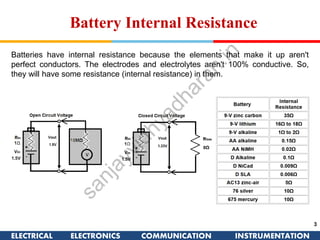
Battery Internal Resistance
Batteries have internal resistance because the elements that make it up aren't
perfect conductors. The electrodes and electrolytes aren't 100% conductive. So,
they will have some resistance (internal resistance) in them.
ELECTRICAL ELECTRONICS COMMUNICATION INSTRUMENTATION
4
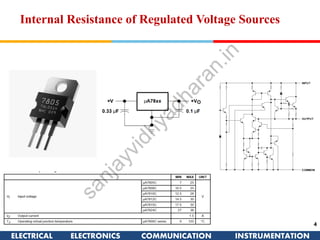
Internal Resistance of Regulated Voltage Sources
ELECTRICAL ELECTRONICS COMMUNICATION INSTRUMENTATION
5
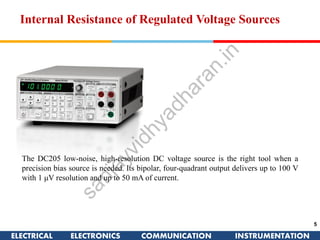
Internal Resistance of Regulated Voltage Sources
The DC205 low-noise, high-resolution DC voltage source is the right tool when a
precision bias source is needed. Its bipolar, four-quadrant output delivers up to 100 V
with 1 μV resolution and up to 50 mA of current.
ELECTRICAL ELECTRONICS COMMUNICATION INSTRUMENTATION
6
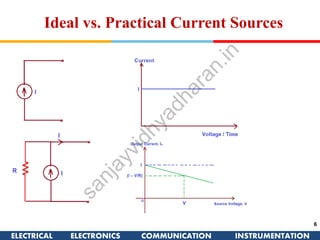
Ideal vs. Practical Current Sources
ELECTRICAL ELECTRONICS COMMUNICATION INSTRUMENTATION
7
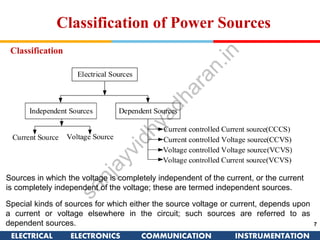
Classification of Power Sources
Sources in which the voltage is completely independent of the current, or the current
is completely independent of the voltage; these are termed independent sources.
Special kinds of sources for which either the source voltage or current, depends upon
a current or voltage elsewhere in the circuit; such sources are referred to as
dependent sources.
ELECTRICAL ELECTRONICS COMMUNICATION INSTRUMENTATION
8
Classification of Power Sources
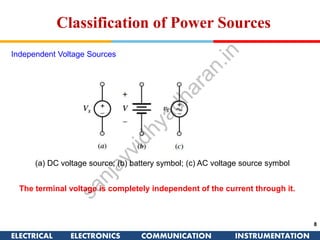
Independent Voltage Sources
(a) DC voltage source; (b) battery symbol; (c) AC voltage source symbol
The terminal voltage is completely independent of the current through it.
ELECTRICAL ELECTRONICS COMMUNICATION INSTRUMENTATION
9
Classification of Power Sources
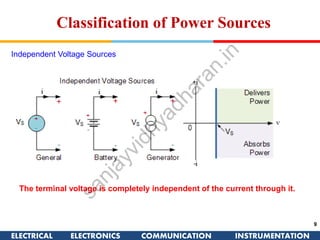
Independent Voltage Sources
The terminal voltage is completely independent of the current through it.
ELECTRICAL ELECTRONICS COMMUNICATION INSTRUMENTATION
10
Classification of Power Sources
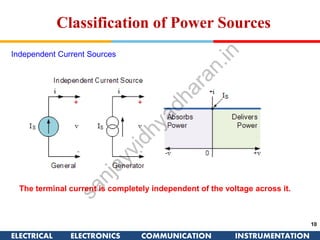
Independent Current Sources
The terminal current is completely independent of the voltage across it.
ELECTRICAL ELECTRONICS COMMUNICATION INSTRUMENTATION
11
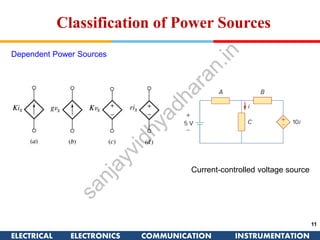
Classification of Power Sources
Dependent Power Sources
Current-controlled voltage source
ELECTRICAL ELECTRONICS COMMUNICATION INSTRUMENTATION
12
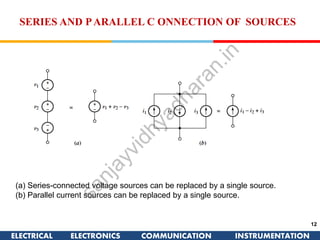
SERIES AND PARALLEL C ONNECTION OF SOURCES
(a) Series-connected voltage sources can be replaced by a single source.
(b) Parallel current sources can be replaced by a single source.
ELECTRICAL ELECTRONICS COMMUNICATION INSTRUMENTATION
13
SERIES AND PARALLEL C ONNECTION OF SOURCES
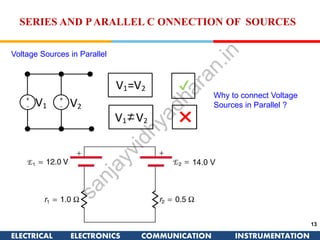
Voltage Sources in Parallel
Why to connect Voltage
Sources in Parallel ?
14.0 V
ELECTRICAL ELECTRONICS COMMUNICATION INSTRUMENTATION
14
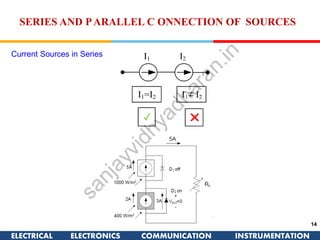
SERIES AND PARALLEL C ONNECTION OF SOURCES
Current Sources in Series
ELECTRICAL ELECTRONICS COMMUNICATION INSTRUMENTATION
15
SOURCE TRANSFORMATION
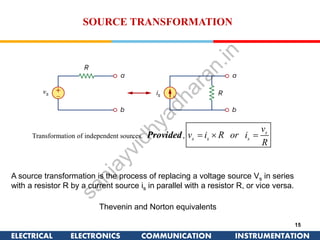
A source transformation is the process of replacing a voltage source Vs in series
with a resistor R by a current source is in parallel with a resistor R, or vice versa.
Thevenin and Norton equivalents
ELECTRICAL ELECTRONICS COMMUNICATION INSTRUMENTATION
16
Thank you

Lec-1_Power Sources.pdf

  • 1.
    ELECTRICAL ELECTRONICS COMMUNICATIONINSTRUMENTATION Electrical Science: 2021-22 Lecture 1 Power Sources By Dr. Sanjay Vidhyadharan
  • 2.
    ELECTRICAL ELECTRONICS COMMUNICATIONINSTRUMENTATION 2 Ideal vs. Practical Voltage Sources An imaginary voltage source, which can provide a constant voltage to load ranging from zero to infinity. Such voltage source is having zero internal resistance, and is called an Ideal Voltage Source. Practically it is not possible to build a voltage source with no internal resistance and constant voltage for that long-range of the load. Practical voltage sources always have some resistance value in series with an ideal voltage source. And because of that series resistance, voltage drops when current passes through it. So, Practical Voltage Source has internal resistance and slightly variable voltage.
  • 3.
    ELECTRICAL ELECTRONICS COMMUNICATIONINSTRUMENTATION 3 Battery Internal Resistance Batteries have internal resistance because the elements that make it up aren't perfect conductors. The electrodes and electrolytes aren't 100% conductive. So, they will have some resistance (internal resistance) in them.
  • 4.
    ELECTRICAL ELECTRONICS COMMUNICATIONINSTRUMENTATION 4 Internal Resistance of Regulated Voltage Sources
  • 5.
    ELECTRICAL ELECTRONICS COMMUNICATIONINSTRUMENTATION 5 Internal Resistance of Regulated Voltage Sources The DC205 low-noise, high-resolution DC voltage source is the right tool when a precision bias source is needed. Its bipolar, four-quadrant output delivers up to 100 V with 1 μV resolution and up to 50 mA of current.
  • 6.
    ELECTRICAL ELECTRONICS COMMUNICATIONINSTRUMENTATION 6 Ideal vs. Practical Current Sources
  • 7.
    ELECTRICAL ELECTRONICS COMMUNICATIONINSTRUMENTATION 7 Classification of Power Sources Sources in which the voltage is completely independent of the current, or the current is completely independent of the voltage; these are termed independent sources. Special kinds of sources for which either the source voltage or current, depends upon a current or voltage elsewhere in the circuit; such sources are referred to as dependent sources.
  • 8.
    ELECTRICAL ELECTRONICS COMMUNICATIONINSTRUMENTATION 8 Classification of Power Sources Independent Voltage Sources (a) DC voltage source; (b) battery symbol; (c) AC voltage source symbol The terminal voltage is completely independent of the current through it.
  • 9.
    ELECTRICAL ELECTRONICS COMMUNICATIONINSTRUMENTATION 9 Classification of Power Sources Independent Voltage Sources The terminal voltage is completely independent of the current through it.
  • 10.
    ELECTRICAL ELECTRONICS COMMUNICATIONINSTRUMENTATION 10 Classification of Power Sources Independent Current Sources The terminal current is completely independent of the voltage across it.
  • 11.
    ELECTRICAL ELECTRONICS COMMUNICATIONINSTRUMENTATION 11 Classification of Power Sources Dependent Power Sources Current-controlled voltage source
  • 12.
    ELECTRICAL ELECTRONICS COMMUNICATIONINSTRUMENTATION 12 SERIES AND PARALLEL C ONNECTION OF SOURCES (a) Series-connected voltage sources can be replaced by a single source. (b) Parallel current sources can be replaced by a single source.
  • 13.
    ELECTRICAL ELECTRONICS COMMUNICATIONINSTRUMENTATION 13 SERIES AND PARALLEL C ONNECTION OF SOURCES Voltage Sources in Parallel Why to connect Voltage Sources in Parallel ? 14.0 V
  • 14.
    ELECTRICAL ELECTRONICS COMMUNICATIONINSTRUMENTATION 14 SERIES AND PARALLEL C ONNECTION OF SOURCES Current Sources in Series
  • 15.
    ELECTRICAL ELECTRONICS COMMUNICATIONINSTRUMENTATION 15 SOURCE TRANSFORMATION A source transformation is the process of replacing a voltage source Vs in series with a resistor R by a current source is in parallel with a resistor R, or vice versa. Thevenin and Norton equivalents
  • 16.
    ELECTRICAL ELECTRONICS COMMUNICATIONINSTRUMENTATION 16 Thank you