Chapter 13
MANAGING
CHANGE AND
INNOVATION
© Prentice Hall, 2002

13-1
Learning Objectives
You should learn to:
– Contrast the calm waters and white-water rapids
metaphors of change
– Describe what managers can change in
organizations
– Explain why people are likely to resist change
– List techniques for reducing resistance to change
– Describe the situational factors that facilitate
cultural change
© Prentice Hall, 2002

13-2
Learning Objectives (cont.)
You should learn to:
– Explain how process reengineering is related to
change
– Describe techniques for reducing employee stress
– Differentiate between creativity and innovation
– Explain how organizations can stimulate and
nurture innovation

© Prentice Hall, 2002

13-3
What Is Change?
Change
– alterations in people, structure, or technology
– change is an organizational reality
– managing change is an integral part of every
manager’s job
• complicates the jobs of managers

© Prentice Hall, 2002

13-4
Forces For Change
External Forces
– marketplace - adapt to changing consumer
desires
– governmental laws and regulations - frequent
impetus for change
– technology - source of change in almost all
industries
– labor markets - HRM activities must change to
attract and retain skilled employees in the areas of
greatest need
– economic - uncertainties about interest rates,
budget deficits, and currency exchange rates
© Prentice Hall, 2002

13-5
Forces For Change (cont.)
Internal Forces
– originate from the operations of the organization
– forces may include strategy, workforce, new equipment,
or employee attitudes

Manager as Change Agent
– change agents - act as catalysts and assume
responsibility for change
• manager may serve as change agent
– may be more thoughtful, overcautious
• outside consultant - used for systemwide changes
– produce more drastic changes than insiders
© Prentice Hall, 2002

13-6
Two Views Of The Change Process
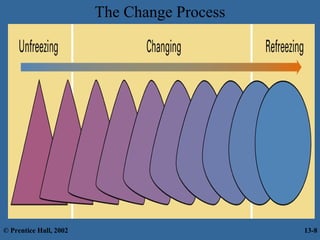
The Calm Waters Metaphor
– Lewin’s three-step model
• unfreezing - preparing for the needed change by:
– increasing the driving forces that direct behavior
away from the status quo
– decreasing the restraining forces that push
behavior towards the status quo
» status quo - conceived to be an equilibrium
• changing - move to another equilibrium level
• refreezing - make change permanent
– objective is to stabilize the new situation
– change is a break in the organization’s equilibrium state
© Prentice Hall, 2002

13-7
The Change Process

© Prentice Hall, 2002

13-8
Two Views Of The Change Process (cont.)
White-Water Rapids Metaphor
– consistent with uncertain and dynamic
environments
– consistent with a world increasingly dominated
by information, ideas, and knowledge
– managers must continually maneuver in
uninterrupted rapids
• managers face constant change
– today, managers must be ready to efficiently and
effectively manage the changes facing their
organizations or their work areas
© Prentice Hall, 2002

13-9
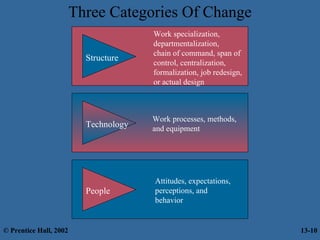
Three Categories Of Change
Structure

Work specialization,
departmentalization,
chain of command, span of
control, centralization,
formalization, job redesign,
or actual design

Technology

Work processes, methods,
and equipment

People

© Prentice Hall, 2002

Attitudes, expectations,
perceptions, and
behavior

13-10
Managing Change
Initiating Change:
– identifying what organizational areas might need
to be changed
– putting the change process in motion
– managing employee resistance to change
Types of Change
– changing structure - organization’s formal
design, centralization, degree of formalization,
and work specialization
• structural components and structural design
© Prentice Hall, 2002

13-11
Managing Change (cont.)
Types of Change (cont.)
– changing technology - modifications in the way work is
performed
• alterations in the methods and equipment used
– consequence of competitive factors or innovations
within an industry
– automation - replaces tasks done by people with
machines
– computerization - recent visible changes in
information systems

© Prentice Hall, 2002

13-12
Managing Change (cont.)
Type of Change (cont.)
– changing people - changes in employee attitudes,
expectations, perceptions, and behavior
• organizational development (OD) - techniques
or programs to change people and the nature
and quality of interpersonal work relationships
– intended to help individuals and groups
work together more effectively

© Prentice Hall, 2002

13-13
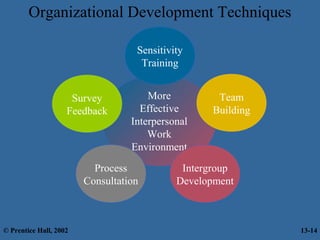
Organizational Development Techniques
Sensitivity
Training
Survey
Feedback

More
Effective
Interpersonal
Work
Environment

Process
Consultation

© Prentice Hall, 2002

Team
Building

Intergroup
Development

13-14
Managing Change (cont.)
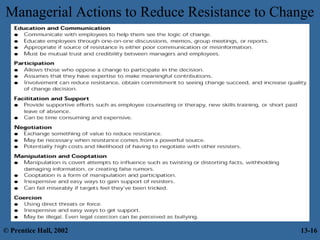
Dealing with Resistance to Change
– Why people resist change
• change replaces the known with ambiguity and
uncertainty
• change threatens investments in the status quo
• belief that change is incompatible with the
goals and interests of the organization
– Techniques for reducing resistance
• a variety of actions available to managers to
deal with dysfunctional resistance
© Prentice Hall, 2002

13-15
Managerial Actions to Reduce Resistance to Change

© Prentice Hall, 2002

13-16
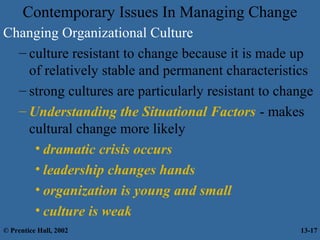
Contemporary Issues In Managing Change
Changing Organizational Culture
– culture resistant to change because it is made up
of relatively stable and permanent characteristics
– strong cultures are particularly resistant to change
– Understanding the Situational Factors - makes
cultural change more likely
• dramatic crisis occurs
• leadership changes hands
• organization is young and small
• culture is weak
© Prentice Hall, 2002

13-17
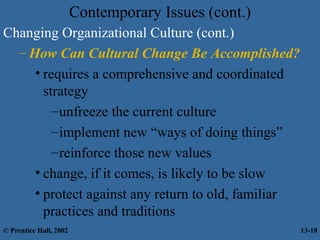
Contemporary Issues (cont.)
Changing Organizational Culture (cont.)
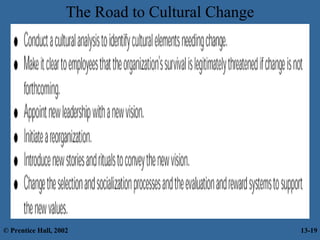
– How Can Cultural Change Be Accomplished?
• requires a comprehensive and coordinated
strategy
– unfreeze the current culture
– implement new “ways of doing things”
– reinforce those new values
• change, if it comes, is likely to be slow
• protect against any return to old, familiar
practices and traditions
© Prentice Hall, 2002

13-18
The Road to Cultural Change

© Prentice Hall, 2002

13-19
Contemporary Issues (cont.)
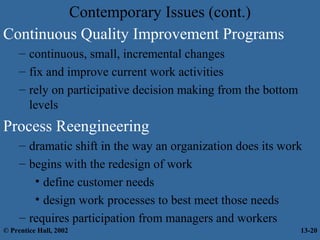
Continuous Quality Improvement Programs
– continuous, small, incremental changes
– fix and improve current work activities
– rely on participative decision making from the bottom
levels

Process Reengineering
– dramatic shift in the way an organization does its work
– begins with the redesign of work
• define customer needs
• design work processes to best meet those needs
– requires participation from managers and workers
© Prentice Hall, 2002

13-20
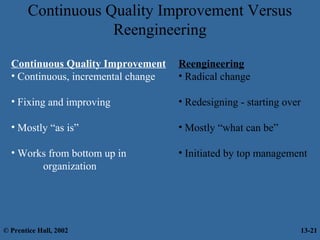
Continuous Quality Improvement Versus
Reengineering
Continuous Quality Improvement
• Continuous, incremental change

Reengineering
• Radical change

• Fixing and improving

• Redesigning - starting over

• Mostly “as is”

• Mostly “what can be”

• Works from bottom up in
organization

• Initiated by top management

© Prentice Hall, 2002

13-21
Contemporary Issues (cont.)
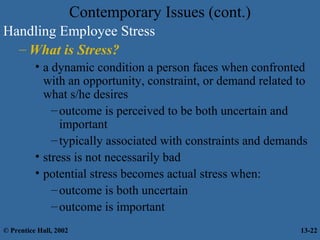
Handling Employee Stress
– What is Stress?
• a dynamic condition a person faces when confronted
with an opportunity, constraint, or demand related to
what s/he desires
– outcome is perceived to be both uncertain and
important
– typically associated with constraints and demands
• stress is not necessarily bad
• potential stress becomes actual stress when:
– outcome is both uncertain
– outcome is important
© Prentice Hall, 2002

13-22
Contemporary Issues (cont.)
Handling Employee Stress (cont.)
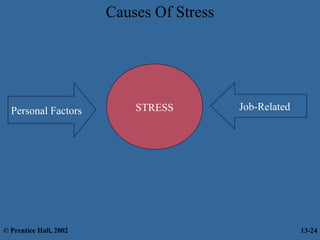
– Causes of Stress
• found in organizational and personal factors
• change of any kind is potentially stressful
• uncertainty around important matters

© Prentice Hall, 2002

13-23
Causes Of Stress

Personal Factors

© Prentice Hall, 2002

STRESS

Job-Related

13-24
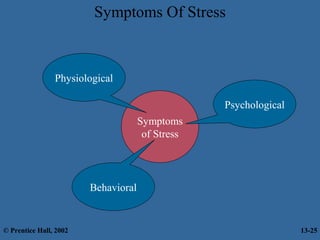
Symptoms Of Stress

Physiological
Psychological
Symptoms
of Stress

Behavioral

© Prentice Hall, 2002

13-25
Contemporary Issues (cont.)
Handling Employee Stress (cont.)
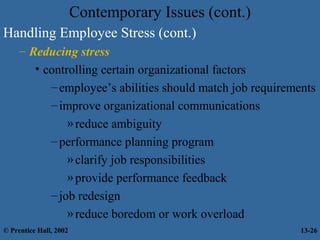
– Reducing stress
• controlling certain organizational factors
– employee’s abilities should match job requirements
– improve organizational communications
» reduce ambiguity
– performance planning program
» clarify job responsibilities
» provide performance feedback
– job redesign
» reduce boredom or work overload
© Prentice Hall, 2002

13-26
Contemporary Issues (cont.)
Handling Employees Stress (cont.)
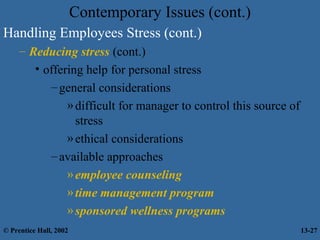
– Reducing stress (cont.)
• offering help for personal stress
– general considerations
» difficult for manager to control this source of
stress
» ethical considerations
– available approaches
» employee counseling
» time management program
» sponsored wellness programs
© Prentice Hall, 2002

13-27
Stimulating Innovation
Creativity versus Innovation
– creativity - ability to combine ideas in a unique
way or to make unusual associations between
ideas
– innovation - process of transforming creative
ideas into a useful product, service, or method of
operation

© Prentice Hall, 2002

13-28
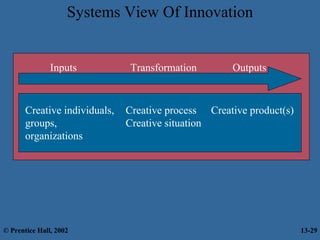
Systems View Of Innovation

Inputs

Creative individuals,
groups,
organizations

© Prentice Hall, 2002

Transformation

Outputs

Creative process Creative product(s)
Creative situation

13-29
Stimulating Innovation (cont.)
Stimulating and Nurturing Innovation
– must focus on inputs
• creative people and groups within the organization
– requires appropriate environment

• structural variables
– organic design
– plentiful resources
– frequent inter-unit communication

© Prentice Hall, 2002

13-30
Stimulating Innovation (cont.)
Stimulating and Nurturing Innovation (cont.)
– requires appropriate environment (cont.)
• cultural variables
– encourage experimentation
– reward success and failures
– celebrate mistakes
• human resource variables
– promote training and development of employees
– offer high job security
– encourage individuals to become idea champions
» self-confident, persistent, risk taking
» energize others with visions of innovation
© Prentice Hall, 2002

13-31
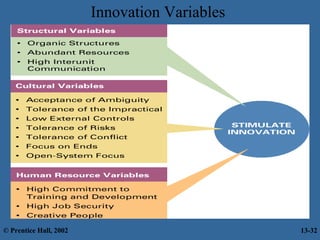
Innovation Variables

© Prentice Hall, 2002

13-32

Chap13

  • 1.
  • 2.
    Learning Objectives You shouldlearn to: – Contrast the calm waters and white-water rapids metaphors of change – Describe what managers can change in organizations – Explain why people are likely to resist change – List techniques for reducing resistance to change – Describe the situational factors that facilitate cultural change © Prentice Hall, 2002 13-2
  • 3.
    Learning Objectives (cont.) Youshould learn to: – Explain how process reengineering is related to change – Describe techniques for reducing employee stress – Differentiate between creativity and innovation – Explain how organizations can stimulate and nurture innovation © Prentice Hall, 2002 13-3
  • 4.
    What Is Change? Change –alterations in people, structure, or technology – change is an organizational reality – managing change is an integral part of every manager’s job • complicates the jobs of managers © Prentice Hall, 2002 13-4
  • 5.
    Forces For Change ExternalForces – marketplace - adapt to changing consumer desires – governmental laws and regulations - frequent impetus for change – technology - source of change in almost all industries – labor markets - HRM activities must change to attract and retain skilled employees in the areas of greatest need – economic - uncertainties about interest rates, budget deficits, and currency exchange rates © Prentice Hall, 2002 13-5
  • 6.
    Forces For Change(cont.) Internal Forces – originate from the operations of the organization – forces may include strategy, workforce, new equipment, or employee attitudes Manager as Change Agent – change agents - act as catalysts and assume responsibility for change • manager may serve as change agent – may be more thoughtful, overcautious • outside consultant - used for systemwide changes – produce more drastic changes than insiders © Prentice Hall, 2002 13-6
  • 7.
    Two Views OfThe Change Process The Calm Waters Metaphor – Lewin’s three-step model • unfreezing - preparing for the needed change by: – increasing the driving forces that direct behavior away from the status quo – decreasing the restraining forces that push behavior towards the status quo » status quo - conceived to be an equilibrium • changing - move to another equilibrium level • refreezing - make change permanent – objective is to stabilize the new situation – change is a break in the organization’s equilibrium state © Prentice Hall, 2002 13-7
  • 8.
    The Change Process ©Prentice Hall, 2002 13-8
  • 9.
    Two Views OfThe Change Process (cont.) White-Water Rapids Metaphor – consistent with uncertain and dynamic environments – consistent with a world increasingly dominated by information, ideas, and knowledge – managers must continually maneuver in uninterrupted rapids • managers face constant change – today, managers must be ready to efficiently and effectively manage the changes facing their organizations or their work areas © Prentice Hall, 2002 13-9
  • 10.
    Three Categories OfChange Structure Work specialization, departmentalization, chain of command, span of control, centralization, formalization, job redesign, or actual design Technology Work processes, methods, and equipment People © Prentice Hall, 2002 Attitudes, expectations, perceptions, and behavior 13-10
  • 11.
    Managing Change Initiating Change: –identifying what organizational areas might need to be changed – putting the change process in motion – managing employee resistance to change Types of Change – changing structure - organization’s formal design, centralization, degree of formalization, and work specialization • structural components and structural design © Prentice Hall, 2002 13-11
  • 12.
    Managing Change (cont.) Typesof Change (cont.) – changing technology - modifications in the way work is performed • alterations in the methods and equipment used – consequence of competitive factors or innovations within an industry – automation - replaces tasks done by people with machines – computerization - recent visible changes in information systems © Prentice Hall, 2002 13-12
  • 13.
    Managing Change (cont.) Typeof Change (cont.) – changing people - changes in employee attitudes, expectations, perceptions, and behavior • organizational development (OD) - techniques or programs to change people and the nature and quality of interpersonal work relationships – intended to help individuals and groups work together more effectively © Prentice Hall, 2002 13-13
  • 14.
  • 15.
    Managing Change (cont.) Dealingwith Resistance to Change – Why people resist change • change replaces the known with ambiguity and uncertainty • change threatens investments in the status quo • belief that change is incompatible with the goals and interests of the organization – Techniques for reducing resistance • a variety of actions available to managers to deal with dysfunctional resistance © Prentice Hall, 2002 13-15
  • 16.
    Managerial Actions toReduce Resistance to Change © Prentice Hall, 2002 13-16
  • 17.
    Contemporary Issues InManaging Change Changing Organizational Culture – culture resistant to change because it is made up of relatively stable and permanent characteristics – strong cultures are particularly resistant to change – Understanding the Situational Factors - makes cultural change more likely • dramatic crisis occurs • leadership changes hands • organization is young and small • culture is weak © Prentice Hall, 2002 13-17
  • 18.
    Contemporary Issues (cont.) ChangingOrganizational Culture (cont.) – How Can Cultural Change Be Accomplished? • requires a comprehensive and coordinated strategy – unfreeze the current culture – implement new “ways of doing things” – reinforce those new values • change, if it comes, is likely to be slow • protect against any return to old, familiar practices and traditions © Prentice Hall, 2002 13-18
  • 19.
    The Road toCultural Change © Prentice Hall, 2002 13-19
  • 20.
    Contemporary Issues (cont.) ContinuousQuality Improvement Programs – continuous, small, incremental changes – fix and improve current work activities – rely on participative decision making from the bottom levels Process Reengineering – dramatic shift in the way an organization does its work – begins with the redesign of work • define customer needs • design work processes to best meet those needs – requires participation from managers and workers © Prentice Hall, 2002 13-20
  • 21.
    Continuous Quality ImprovementVersus Reengineering Continuous Quality Improvement • Continuous, incremental change Reengineering • Radical change • Fixing and improving • Redesigning - starting over • Mostly “as is” • Mostly “what can be” • Works from bottom up in organization • Initiated by top management © Prentice Hall, 2002 13-21
  • 22.
    Contemporary Issues (cont.) HandlingEmployee Stress – What is Stress? • a dynamic condition a person faces when confronted with an opportunity, constraint, or demand related to what s/he desires – outcome is perceived to be both uncertain and important – typically associated with constraints and demands • stress is not necessarily bad • potential stress becomes actual stress when: – outcome is both uncertain – outcome is important © Prentice Hall, 2002 13-22
  • 23.
    Contemporary Issues (cont.) HandlingEmployee Stress (cont.) – Causes of Stress • found in organizational and personal factors • change of any kind is potentially stressful • uncertainty around important matters © Prentice Hall, 2002 13-23
  • 24.
    Causes Of Stress PersonalFactors © Prentice Hall, 2002 STRESS Job-Related 13-24
  • 25.
    Symptoms Of Stress Physiological Psychological Symptoms ofStress Behavioral © Prentice Hall, 2002 13-25
  • 26.
    Contemporary Issues (cont.) HandlingEmployee Stress (cont.) – Reducing stress • controlling certain organizational factors – employee’s abilities should match job requirements – improve organizational communications » reduce ambiguity – performance planning program » clarify job responsibilities » provide performance feedback – job redesign » reduce boredom or work overload © Prentice Hall, 2002 13-26
  • 27.
    Contemporary Issues (cont.) HandlingEmployees Stress (cont.) – Reducing stress (cont.) • offering help for personal stress – general considerations » difficult for manager to control this source of stress » ethical considerations – available approaches » employee counseling » time management program » sponsored wellness programs © Prentice Hall, 2002 13-27
  • 28.
    Stimulating Innovation Creativity versusInnovation – creativity - ability to combine ideas in a unique way or to make unusual associations between ideas – innovation - process of transforming creative ideas into a useful product, service, or method of operation © Prentice Hall, 2002 13-28
  • 29.
    Systems View OfInnovation Inputs Creative individuals, groups, organizations © Prentice Hall, 2002 Transformation Outputs Creative process Creative product(s) Creative situation 13-29
  • 30.
    Stimulating Innovation (cont.) Stimulatingand Nurturing Innovation – must focus on inputs • creative people and groups within the organization – requires appropriate environment • structural variables – organic design – plentiful resources – frequent inter-unit communication © Prentice Hall, 2002 13-30
  • 31.
    Stimulating Innovation (cont.) Stimulatingand Nurturing Innovation (cont.) – requires appropriate environment (cont.) • cultural variables – encourage experimentation – reward success and failures – celebrate mistakes • human resource variables – promote training and development of employees – offer high job security – encourage individuals to become idea champions » self-confident, persistent, risk taking » energize others with visions of innovation © Prentice Hall, 2002 13-31
  • 32.