DISTRIBUTED PROCESSING
Md. Mahadi Hassan Rakib
Lecturer, Department of Computer Science and Engineering
North Western University, Khulna
OUTLINE
 Distributed Processing
 Distributed System
 Architecture
 Form of D.P
 Techniques
 Challenges
 Advantage/Disadvantage
What is Distributed Processing
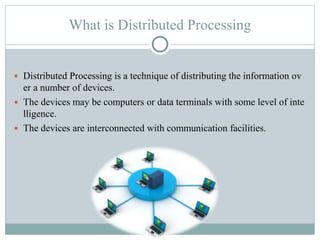
 Distributed Processing is a technique of distributing the information ov
er a number of devices.
 The devices may be computers or data terminals with some level of inte
lligence.
 The devices are interconnected with communication facilities.
What is Distributed System
 A distributed system is one in which components l
ocated at networked computers communicate and
coordinate their actions only by passing messages.
 Examples
 The internet
 An intranet which is a portion of the internet managed by
an organization
Architecture
 Software layers
 System architectures
 Interfaces and objects
 Design requirements for distributed architectures
Software layers
 Applications, services
 Middleware
 Operating system
 Computer and network hardware
System architectures
 Client-server model
 Services provided by multiple servers
 Proxy servers and caches
 Peer processes
Design requirements for distributed architectures
 Performance issues
 Use of caching and replication
 Dependability issues
Design requirements for distributed architectures
 Performance issues
o Responsiveness
o Balancing computer loads
o Quality of services
 Caching and replication
o The performance issues often appear to be major obstacles to the successful deploy
ment of DS, but much progress has been made in the design of systems that overcom
e them by the use of data replication and caching.
 Dependability issues
o Correctness
o Security
o Fault tolerance
Form of Distributed Processing
 Distributed Applications
 Distributed Devices
 Network Management and Control
 Distributed Data
Distributed Applications
 One application splits up into components that are
dispersed among a number of machines
 One application replicated on a number of machines
 A number of different applications distributed among a
number of machines
 Can be characterized by vertical or horizontal
partitioning
Distributed Devices
 Support a distributed set of devices that can be controlle
d by processors, e.g. ATMs or laboratory interface equi
pments
 Distribution of processing technology to various locatio
ns of the manufacturing process in factory automation
Techniques of Distributed Processing
 Centralized
 Decentralized
 Parallel
 Open Distributed Processing
 Clustering
Centralized
 Centralized Processing is done at a central location, using termi
nals that are attached to a central computer
 The central computer performs the computing functions and contr
ols the remote terminals. This type of system relies totally on the
central computer.
Centralized
 Example: Client/server is the most common example of centrali
zed processing, where server is controlling all the activities on th
e network.
Decentralized
 Computer systems in different locations. Although data may be tr
ansmitted between the computers periodically
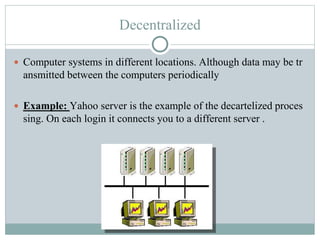
 Example: Yahoo server is the example of the decartelized proces
sing. On each login it connects you to a different server .
Clustering
 A cluster is a group of individual computer systems that can be
made to appear as one computer system.
 Clustering is just one form of parallel computing.
 key points that distinguishes clustering from other is the ability to
view the cluster as either a single entity or a collection of stand-al
one systems
 For example: a cluster of web servers can appear as one large w
eb server, but at the same time, individual systems within the clus
ter can be accessed as individual systems,
Clustering
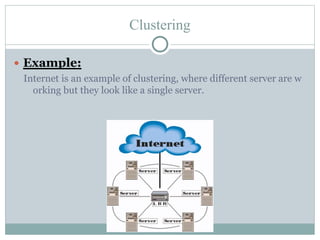
 Example:
Internet is an example of clustering, where different server are w
orking but they look like a single server.
Challenges
 Heterogeneity
 Security
 Scalability
 Failure handling
 Concurrency
Advantages
 Quicker response time
 By locating processing power close to user, response time is typically impro
ved. This means that the system responds rapidly to commands entered by u
sers.
 Lower costs
 Long-distance communication costs are declining at a slower rate than the c
ost of computer power
 Distributed processing can reduce the volume of data that must be transmitte
d over long-distances and thereby reduce long-distance costs.
 Improved data integrity
 High degrees of accuracy and correctness may be achieved by giving users c
ontrol over data entry and storage.
Advantages
 Reduced host processor costs
 The productive life of a costly mainframe can be extended by off-loading s
ome its processing tasks to other, less expensive machines
 Resource sharing
 One of the main advantages of developing microcomputer networks is beca
use they make it possible to share expensive resources such as high-speed,
color laser printers, fast data storage devices, and high-priced software pack
ages.
Disadvantage
 Complexities
 A lot of extra programming is required to set up a distributed system
 Network failure
 Since distributed system will be connected through network and in case of n
etwork failure non of the systems will work
 Security
 The information need to be passed between the network. And it can be track
ed and can be used for illegal purpose.
 Costly software
 Not all situations are suitable for distributed computing
Lec 6 (distributed processing )

Lec 6 (distributed processing )

  • 1.
    DISTRIBUTED PROCESSING Md. MahadiHassan Rakib Lecturer, Department of Computer Science and Engineering North Western University, Khulna
  • 2.
    OUTLINE  Distributed Processing Distributed System  Architecture  Form of D.P  Techniques  Challenges  Advantage/Disadvantage
  • 3.
    What is DistributedProcessing  Distributed Processing is a technique of distributing the information ov er a number of devices.  The devices may be computers or data terminals with some level of inte lligence.  The devices are interconnected with communication facilities.
  • 4.
    What is DistributedSystem  A distributed system is one in which components l ocated at networked computers communicate and coordinate their actions only by passing messages.  Examples  The internet  An intranet which is a portion of the internet managed by an organization
  • 5.
    Architecture  Software layers System architectures  Interfaces and objects  Design requirements for distributed architectures
  • 6.
    Software layers  Applications,services  Middleware  Operating system  Computer and network hardware
  • 7.
    System architectures  Client-servermodel  Services provided by multiple servers  Proxy servers and caches  Peer processes
  • 8.
    Design requirements fordistributed architectures  Performance issues  Use of caching and replication  Dependability issues
  • 9.
    Design requirements fordistributed architectures  Performance issues o Responsiveness o Balancing computer loads o Quality of services  Caching and replication o The performance issues often appear to be major obstacles to the successful deploy ment of DS, but much progress has been made in the design of systems that overcom e them by the use of data replication and caching.  Dependability issues o Correctness o Security o Fault tolerance
  • 10.
    Form of DistributedProcessing  Distributed Applications  Distributed Devices  Network Management and Control  Distributed Data
  • 11.
    Distributed Applications  Oneapplication splits up into components that are dispersed among a number of machines  One application replicated on a number of machines  A number of different applications distributed among a number of machines  Can be characterized by vertical or horizontal partitioning
  • 12.
    Distributed Devices  Supporta distributed set of devices that can be controlle d by processors, e.g. ATMs or laboratory interface equi pments  Distribution of processing technology to various locatio ns of the manufacturing process in factory automation
  • 13.
    Techniques of DistributedProcessing  Centralized  Decentralized  Parallel  Open Distributed Processing  Clustering
  • 14.
    Centralized  Centralized Processingis done at a central location, using termi nals that are attached to a central computer  The central computer performs the computing functions and contr ols the remote terminals. This type of system relies totally on the central computer.
  • 15.
    Centralized  Example: Client/serveris the most common example of centrali zed processing, where server is controlling all the activities on th e network.
  • 16.
    Decentralized  Computer systemsin different locations. Although data may be tr ansmitted between the computers periodically  Example: Yahoo server is the example of the decartelized proces sing. On each login it connects you to a different server .
  • 17.
    Clustering  A clusteris a group of individual computer systems that can be made to appear as one computer system.  Clustering is just one form of parallel computing.  key points that distinguishes clustering from other is the ability to view the cluster as either a single entity or a collection of stand-al one systems  For example: a cluster of web servers can appear as one large w eb server, but at the same time, individual systems within the clus ter can be accessed as individual systems,
  • 18.
    Clustering  Example: Internet isan example of clustering, where different server are w orking but they look like a single server.
  • 19.
    Challenges  Heterogeneity  Security Scalability  Failure handling  Concurrency
  • 20.
    Advantages  Quicker responsetime  By locating processing power close to user, response time is typically impro ved. This means that the system responds rapidly to commands entered by u sers.  Lower costs  Long-distance communication costs are declining at a slower rate than the c ost of computer power  Distributed processing can reduce the volume of data that must be transmitte d over long-distances and thereby reduce long-distance costs.  Improved data integrity  High degrees of accuracy and correctness may be achieved by giving users c ontrol over data entry and storage.
  • 21.
    Advantages  Reduced hostprocessor costs  The productive life of a costly mainframe can be extended by off-loading s ome its processing tasks to other, less expensive machines  Resource sharing  One of the main advantages of developing microcomputer networks is beca use they make it possible to share expensive resources such as high-speed, color laser printers, fast data storage devices, and high-priced software pack ages.
  • 22.
    Disadvantage  Complexities  Alot of extra programming is required to set up a distributed system  Network failure  Since distributed system will be connected through network and in case of n etwork failure non of the systems will work  Security  The information need to be passed between the network. And it can be track ed and can be used for illegal purpose.  Costly software  Not all situations are suitable for distributed computing

Editor's Notes

  • #2 Designed by: IMTIAZ HUSSAIN