Microbiology Lab
Prepared by: Kazhaleh Mohammadi
Knowledge University
2022-2023
1
Equipment used for sterilization
• Autoclave: The autoclave is an example of moist heat sterilization. The primary
purpose of the autoclave is sterilizing culture media and laboratory supplies.
Saturated steam under pressure above 100℃ is used for sterilization in
autoclaves.
• Hot Air Oven: A hot air oven applies dry heat for sterilization. Its main application
is sterilizing glassware like pipettes, flasks, metallic instruments, and scissors.
• Incinerator: A clinical microbiology laboratory produces hazardous wastes that
need to be destroyed appropriately.
Instruments for Culture and Identification
• Analytical Balance: An analytical balance measures
the precision in determining the mass of solid objects,
liquids, powders, and granular substances.
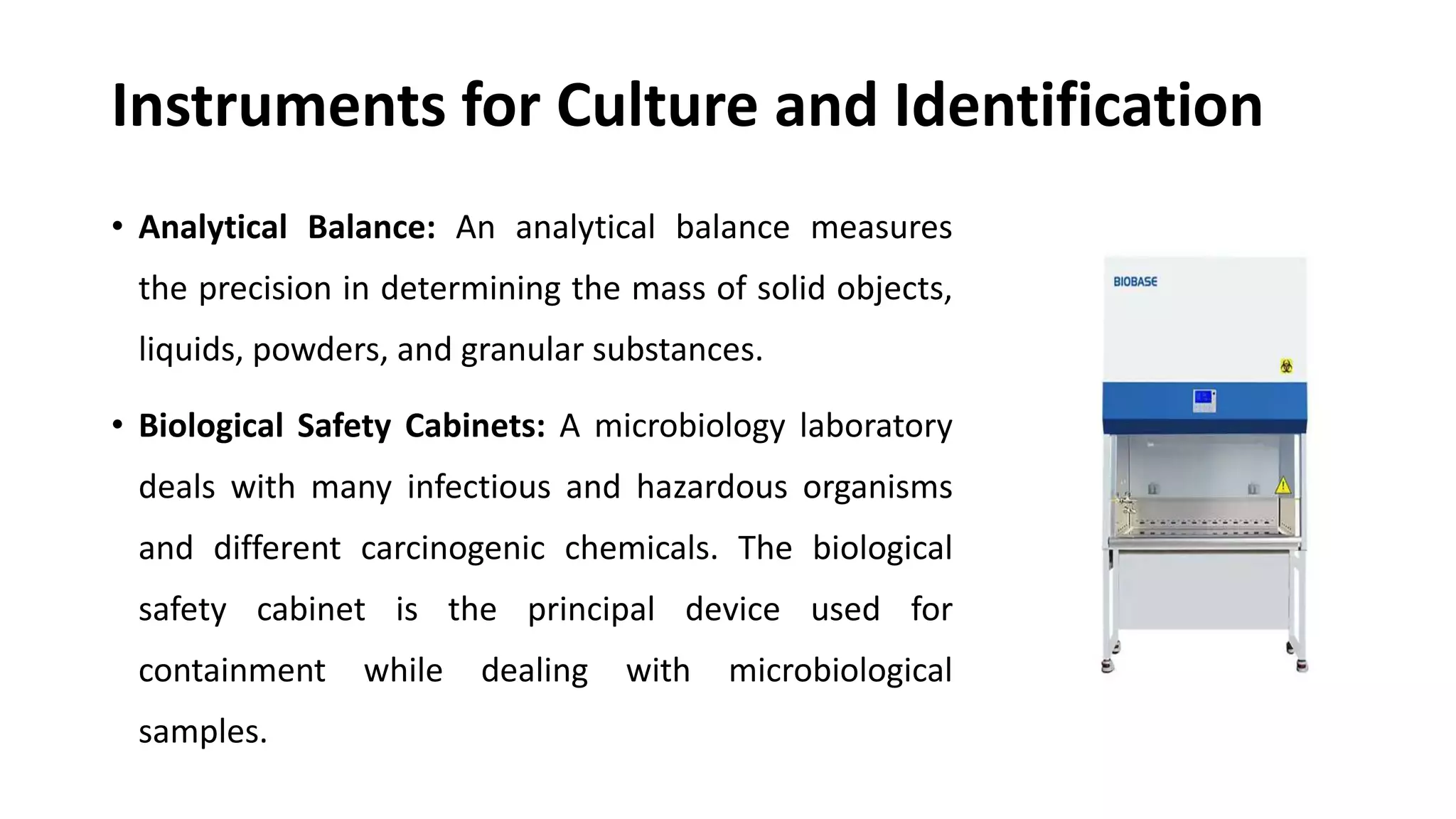
• Biological Safety Cabinets: A microbiology laboratory
deals with many infectious and hazardous organisms
and different carcinogenic chemicals. The biological
safety cabinet is the principal device used for
containment while dealing with microbiological
samples.
Instruments for Culture and Identification
• Bunsen Burner: The Bunsen burner is a gas burner that uses dry heat to
sterilize materials. The use of the Bunsen burner is sterilizing the materials
like inoculating loop needles, the tip of forceps, and spatula.
• Centrifuge: A centrifuge is a laboratory device that helps separate fluids,
gas, or liquid-based on their density. The spinning of a vessel containing
material at high speed helps achieve the separation. The application of this
equipment in many laboratories is in purifying cells, subcellular organelles,
viruses, proteins, and nucleic acids.
• Colony Counter: A colony counter is a machine that automatically
counts colonies in the agar plate in the microbiology laboratory. It
uses fluorescent labels or the contrast between light and dark areas
on the plate to measure the colonies. It has replaced the conventional
counting method in most laboratories, manual counting.
• Gel Electrophoresis Apparatus: Electrophoresis is a process that
separates nucleic acid and protein-based on their size and charge.
Instruments for Culture and Identification
• Incubator: An incubator is an instrument that provides the desired
temperature for in vitro culture of microorganisms.
• Laboratory Freezer: A Laboratory freezer is used to store samples,
specimens, and other materials at -10℃ to -30℃. A general purpose
laboratory freezer can typically store samples up to -25℃ whereas
ultra low-temperature freezer can freeze samples to almost -80℃.
Instruments for Culture and Identification
• Laminar Flow Cabinet: A laminar flow chamber is a safety cabinet. A
laminar flow cabinet can be used in laboratories where the risk of handling
hazardous organisms is significantly low. HEPA (high-efficiency particulate
air) filter removes particles, including microorganisms, from the air.
• Microscope: Most microorganisms are not visible under the naked eye. A
microscope is an optical instrument that consists of a lens or combination
of lenses that makes an enlarged image of minute objects.
Instruments for Culture and Identification
• Micropipette: Micropipettes are semi-automatic instruments that use
disposable pipette tips to withdraw and dispense the liquid sample. This
helps to avoid the risk of human contamination in the laboratory and also
get a precise measurement of the reagent and sample.
• PCR Thermocycler: Thermocyclers are instrument that helps in amplifying
DNA and RNA samples by the process of polymerase chain reaction (PCR).
Instruments for Culture and Identification
• pH Meter: A pH meter measures the acidity/alkalinity of the solution. It
detects the activity of hydrogen ions in the solution. The degree of activity
of hydrogen ions in the solution is the pH level of the solution, i.e., the
higher the activity of hydrogen ions, the higher the pH level of the solution.
• Refrigerator: The refrigerator provides a low-temperature environment.
The use of refrigerators is to store cultures, media prepared, blood, serum,
antibiotics, and other chemicals.
Instruments for Culture and Identification
• Vortex Mixers: A vortex mixer mixes laboratory samples in test tubes,
well plates, or flasks. Its advantage is the mixing of samples in a
sealed container, and the mixing of at least two specimens at a time is
possible.
• Water Bath: A water bath is an instrument that provides constant
temperature to a sample. Its uses in microbiology are in incubation,
media preparation, and maintaining temperature.
Instruments for Culture and Identification
Glassware
Glassware
Beaker Conical flask Glass Rods Measuring Cylinder
Petri Dish
Glass Pipette Test Tube Eppendorf Tubes

Lec 4 Microbiology (Practic).pptx

  • 1.
    Microbiology Lab Prepared by:Kazhaleh Mohammadi Knowledge University 2022-2023 1
  • 3.
    Equipment used forsterilization
  • 4.
    Equipment used forsterilization • Autoclave: The autoclave is an example of moist heat sterilization. The primary purpose of the autoclave is sterilizing culture media and laboratory supplies. Saturated steam under pressure above 100℃ is used for sterilization in autoclaves. • Hot Air Oven: A hot air oven applies dry heat for sterilization. Its main application is sterilizing glassware like pipettes, flasks, metallic instruments, and scissors. • Incinerator: A clinical microbiology laboratory produces hazardous wastes that need to be destroyed appropriately.
  • 5.
    Instruments for Cultureand Identification
  • 6.
    Instruments for Cultureand Identification • Analytical Balance: An analytical balance measures the precision in determining the mass of solid objects, liquids, powders, and granular substances. • Biological Safety Cabinets: A microbiology laboratory deals with many infectious and hazardous organisms and different carcinogenic chemicals. The biological safety cabinet is the principal device used for containment while dealing with microbiological samples.
  • 7.
    Instruments for Cultureand Identification • Bunsen Burner: The Bunsen burner is a gas burner that uses dry heat to sterilize materials. The use of the Bunsen burner is sterilizing the materials like inoculating loop needles, the tip of forceps, and spatula. • Centrifuge: A centrifuge is a laboratory device that helps separate fluids, gas, or liquid-based on their density. The spinning of a vessel containing material at high speed helps achieve the separation. The application of this equipment in many laboratories is in purifying cells, subcellular organelles, viruses, proteins, and nucleic acids.
  • 8.
    • Colony Counter:A colony counter is a machine that automatically counts colonies in the agar plate in the microbiology laboratory. It uses fluorescent labels or the contrast between light and dark areas on the plate to measure the colonies. It has replaced the conventional counting method in most laboratories, manual counting. • Gel Electrophoresis Apparatus: Electrophoresis is a process that separates nucleic acid and protein-based on their size and charge. Instruments for Culture and Identification
  • 9.
    • Incubator: Anincubator is an instrument that provides the desired temperature for in vitro culture of microorganisms. • Laboratory Freezer: A Laboratory freezer is used to store samples, specimens, and other materials at -10℃ to -30℃. A general purpose laboratory freezer can typically store samples up to -25℃ whereas ultra low-temperature freezer can freeze samples to almost -80℃. Instruments for Culture and Identification
  • 10.
    • Laminar FlowCabinet: A laminar flow chamber is a safety cabinet. A laminar flow cabinet can be used in laboratories where the risk of handling hazardous organisms is significantly low. HEPA (high-efficiency particulate air) filter removes particles, including microorganisms, from the air. • Microscope: Most microorganisms are not visible under the naked eye. A microscope is an optical instrument that consists of a lens or combination of lenses that makes an enlarged image of minute objects. Instruments for Culture and Identification
  • 11.
    • Micropipette: Micropipettesare semi-automatic instruments that use disposable pipette tips to withdraw and dispense the liquid sample. This helps to avoid the risk of human contamination in the laboratory and also get a precise measurement of the reagent and sample. • PCR Thermocycler: Thermocyclers are instrument that helps in amplifying DNA and RNA samples by the process of polymerase chain reaction (PCR). Instruments for Culture and Identification
  • 12.
    • pH Meter:A pH meter measures the acidity/alkalinity of the solution. It detects the activity of hydrogen ions in the solution. The degree of activity of hydrogen ions in the solution is the pH level of the solution, i.e., the higher the activity of hydrogen ions, the higher the pH level of the solution. • Refrigerator: The refrigerator provides a low-temperature environment. The use of refrigerators is to store cultures, media prepared, blood, serum, antibiotics, and other chemicals. Instruments for Culture and Identification
  • 13.
    • Vortex Mixers:A vortex mixer mixes laboratory samples in test tubes, well plates, or flasks. Its advantage is the mixing of samples in a sealed container, and the mixing of at least two specimens at a time is possible. • Water Bath: A water bath is an instrument that provides constant temperature to a sample. Its uses in microbiology are in incubation, media preparation, and maintaining temperature. Instruments for Culture and Identification
  • 14.
  • 15.
    Glassware Beaker Conical flaskGlass Rods Measuring Cylinder Petri Dish Glass Pipette Test Tube Eppendorf Tubes