CIV369: URBAN PLANNING
AND DEVELOPMENT
UNIT 1
BY: HARKAMAL SINGH
18266
URBAN PLANNING AND
DEVELOPMENT
• Urban planning, also known as:-
• regional planning,
• town planning,
• city planning, or
• rural planning, is a technical and
political process that is focused on the
development and design of land use and
the built environment, including air,
water, and the infrastructure passing
into and out of urban areas, such
as transportation, communications,
and distribution networks and
their accessibility.
GENERAL INTRODUCTION
• Town Planning – arrangement of various components or units of a
town in such a way that the town as such attains the significance of a
living organism.
• Knowledge of town planning helps in achieving the best possible
advantages of the situation of town with respect to its land and the
surrounding environments.
• The town planning is a Science as well as Art too.
• The art lies in arranging the components of a town in such a way that
the final result is in the form of a beautiful, convenient, economical
and efficient unit.
Objects of Town Planning
1. Beauty
2. Convenience
3. Environment
4. Health
Why growth of Towns???
• To facilitates defense against
outsiders
• Man is a social animal and love
to live with fellows
• Can develop contacts and retain
privacy
• Urban areas provides facilities
like water, sewerage etc
Economic justification of Town Planning
1. Change in quantity of resources
2. Demand for G and S
3. Production techniques
4. Redistribution of Land values
Principles of Town Planning
• Green Belt
• Housing
• Public Buildings
• Recreation centers
• Road system
• Transport facilities
• Zoning
Principles of Town Planning
1. Zoning :
• The town should be divided into suitable zones such as commercial zone, industrial zone, residential
zone, etc. and suitable rules and regulations should be formed for the development of each zone.
2. Green belt :
• Green belt is non-development zone on the periphery of the town.
• It prevents the haphazard sprawl of the town restricting its size. In essence, a green belt is an
invisible line designating a border around a certain area, preventing development of the area and
allowing wildlife to return and be established. Greenways and green wedges have a linear character
and may run across the town and not around the town.
3. Housing
Housing has to be carefully studied and designed to suit the local population. Care should be
taken to see that there is no development of slums since it would be responsible for degrading the life
of the citizens. There are various types of housing styles. When a land use plan is made, zones for
independent housing, midrise buildings, high rise buildings are allocated.
Principles of Town Planning
4. Public buildings
• Public buildings should be well grouped and distributed throughout
the town.
• Unnecessary concentration of public buildings should be avoided.
Factors such as parking facilities, road widths have to be taken into
consideration while allocating the space for public buildings.
5. Recreation centers
• Recreation centers have to be given importance while designing a
town. They are necessary for the recreational activities of the general
public. They include parks for walking and cycling, amusement parks
etc.
Principles of Town Planning
6. Road systems
• Road network hierarchy is very important. The efficiency of any town is measured by the
layout of its roads.
• A nicely designed road system puts a great impression in the minds of people, especially the
visitors to the town. The provision of a faulty road system in the initial stages of town
formation proves to be too difficult and costly to repair or to re-arrange in future.
7. Transport facilities
• The town should be provided with suitable transport facilities so that there is minimum loss of
time from place of work to the place of residence. Efficiency in transport facilities includes
both public and private networks.
• Public transportation network includes access to buses, trains, trams and trolleybuses.
Efficiency in using the public transport will determine the success of that town in terms of
design.
Necessity of Town Planning ????
• To avoid evil situations within the town
1. Defective roads
2. Slums
3. Traffic
4. Parks-playgrounds
5. Lack of essentials amenities
6. Noise pollution
7. Unhealthy living
8. Uncontrolled growth of town
Origin of towns:-
TOPOGRAPHICALASPECTS FUNCTIONALASPECTS
Development of Towns as per the origin
consist of :-
1. Natural
1. Concentric
2. Ribbon development
3. Satellite
4. Scattered growth
According to the origin:-
Natural
Concentric growth
Natural tendency of people to
be as near as possible to
town, hence town develops in
concentric rings
• Many complicated problems such
as:-
• Traffic congestion
• Narrow streets
• Concentration of population
Satellite town
• A satellite town or satellite city is
a concept in urban planning that
refers essentially to miniature
metropolitan areas on the fringe
of larger ones
• Eg. NaviMumbai,
• New Delhi
Satellite Town
Satellite Town
• Connectivity?
• Dependency?
• Activities?
• Features?
• Market?
Ribbon town spread
• Everyone like to build as near as
possible to main road
• Buildings develop along side of main
road
• Long fingers or ribbons of
houses/shops develop
Characteristics:-
• In the beginning this growth is very small along the road side but soon it
occupies whole of the area.
• It happens especially in newly developing towns where rule and zoning
regulations have not been strictly enforced.
• Ribbon development has become a regular feature where we find
overcrowding of all types of buildings such as schools, factories, petrol
pumps etc.
• This type of development is more dangerous from traffic point of view.
Disadvantages
• Everybody wants to take advantage of the frontage of main road.
• The interior is therefor left underdeveloped, causing wastage of valuable land.
• Overcrowding on the roadside. Streets become narrow and give rise to
accidents.
• All types of buildings creep in at the frontage, such as schools, factories, bus
stops, petrol pumps, theatres, commercial complexes etc. with no regard to
zoning regulations.
• All these affect health conditions of the residents.
• The town spreads far and wide which is costly to maintain.
• Future improvements become very costly.
• Ribbon development is the inverse of planning and is not desirable
Planned growth
• Planned growth of town consist of:-
• Horizontal growth
• Vertical growth
Vertical development
Horizontal development
Ancient Town Classification
• Dandaka
• Sarvathobhadra
• Nandyavarta
• Padmaka
• Swastika
• Prastara
• Karmuka
• Chaturmukha
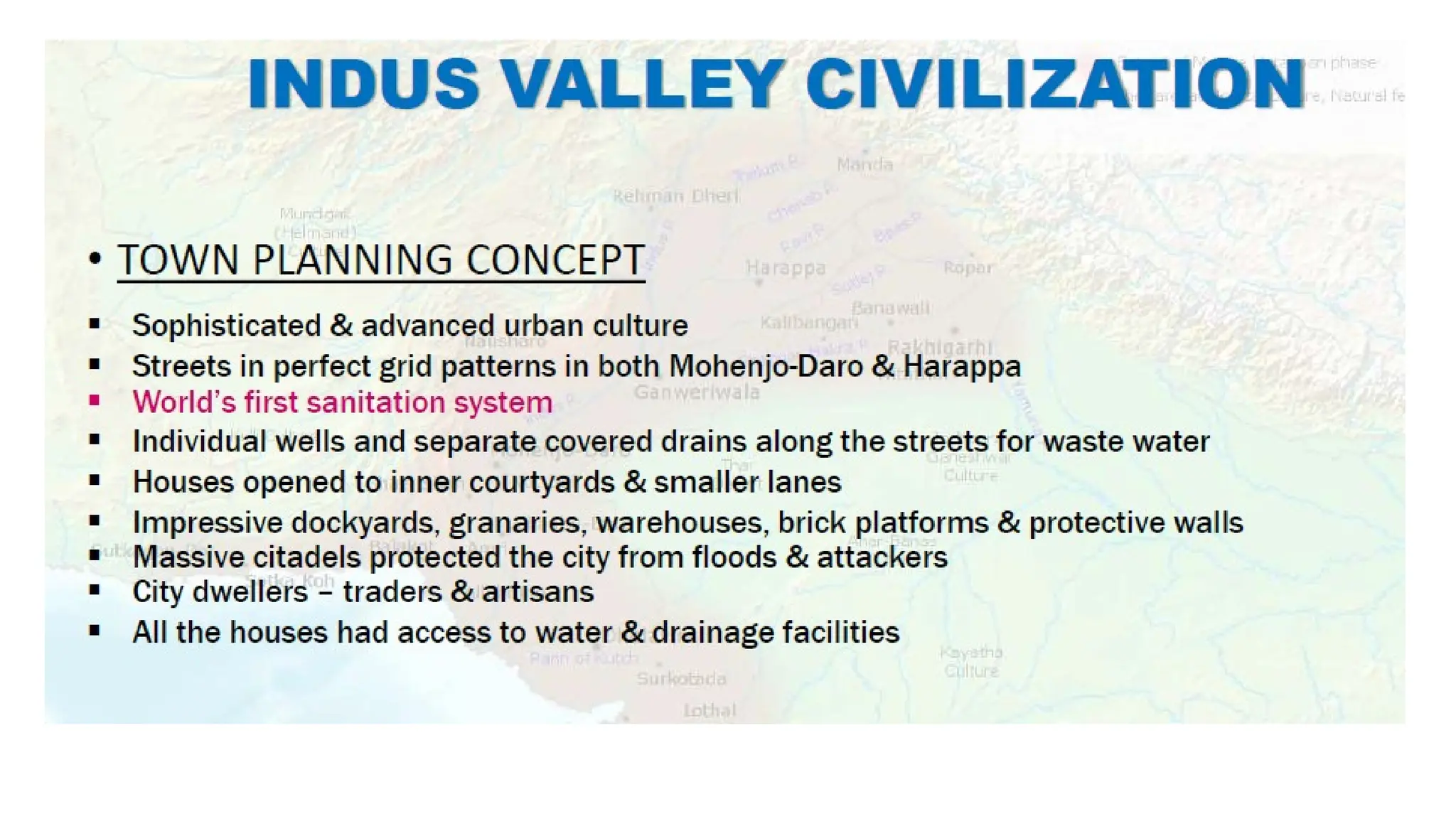
Indus valley civilization
The most important feature is town planning.
The main features of town planning were
1. use of baked as well as sundried bricks,
2. well planned straight roads
3. a system of drainage.
4. A fortified citadel at most of the cities.
The number of the citadels varies.
5. Houses with kitchens and wells, tanks or
water reservoirs.
6. Use of standard weights and
measurement throughout the civilization.
7. Presence of wheel made pottery.
8. The Practice of burying the dead.
Salient Features of Harappa and Mohen Jo-dero
• Harappa and Mohenjo-Daro are 500 kms apart from each other.
These, along with Dholavira, are called the nucleus cities of the
civilization. Harappa, the first discovered site of this civilization
was on bank of river Ravi, while Mohenjo-Daro was on banks of
Indus River. Each of them has two prominent mounds where
excavations took place. Notable findings at Harappa are rows of
granaries, Citadels, Furnaces and a crucible to melt the bronze.
Notable findings at Mohenjo-Daro are the magnum opus Great
Bath, uniform buildings and weights, hidden drains and other
hallmarks of the civilization. This is the site where most unicorn
seals have been found. Mohenjo-Daro is also sometimes known as
largest urban centre of the civilization.
Great Bath
• The most famous building found at Mohenjo-Daro is a great bath.
It is a 6×12 meter specimen of beautiful brick work. The water for
the bath was provided from a well in an adjacent room. The floor
was made up of bricks. Floor and outer walls were bituminized so
that there is no leakage of water. There are open porch’s on four
sides of the bath. There is use of Burnt bricks, Mortar and Gypsum
in the Great bath but NO use of stone is there.
Urban development expansions view
points!!!
1. As it is fully recognized, rapid urbanization of the world has pushed governments, politicians,
planners, private developers, civil society and many other actors to face significant challenges
that are impacting everyone’s lives.
2. Growing population and reduced living spaces are clearly leading to the deterioration of living
conditions in urban centers
3. It is well known that urban centers continue to grow rapidly with much of it in an unplanned
fashion. Moreover, policies, strategies, plans and implementation have not kept up with the
speed of urban transformation.
• What makes a successful inclusive city?
• What makes a city effective?
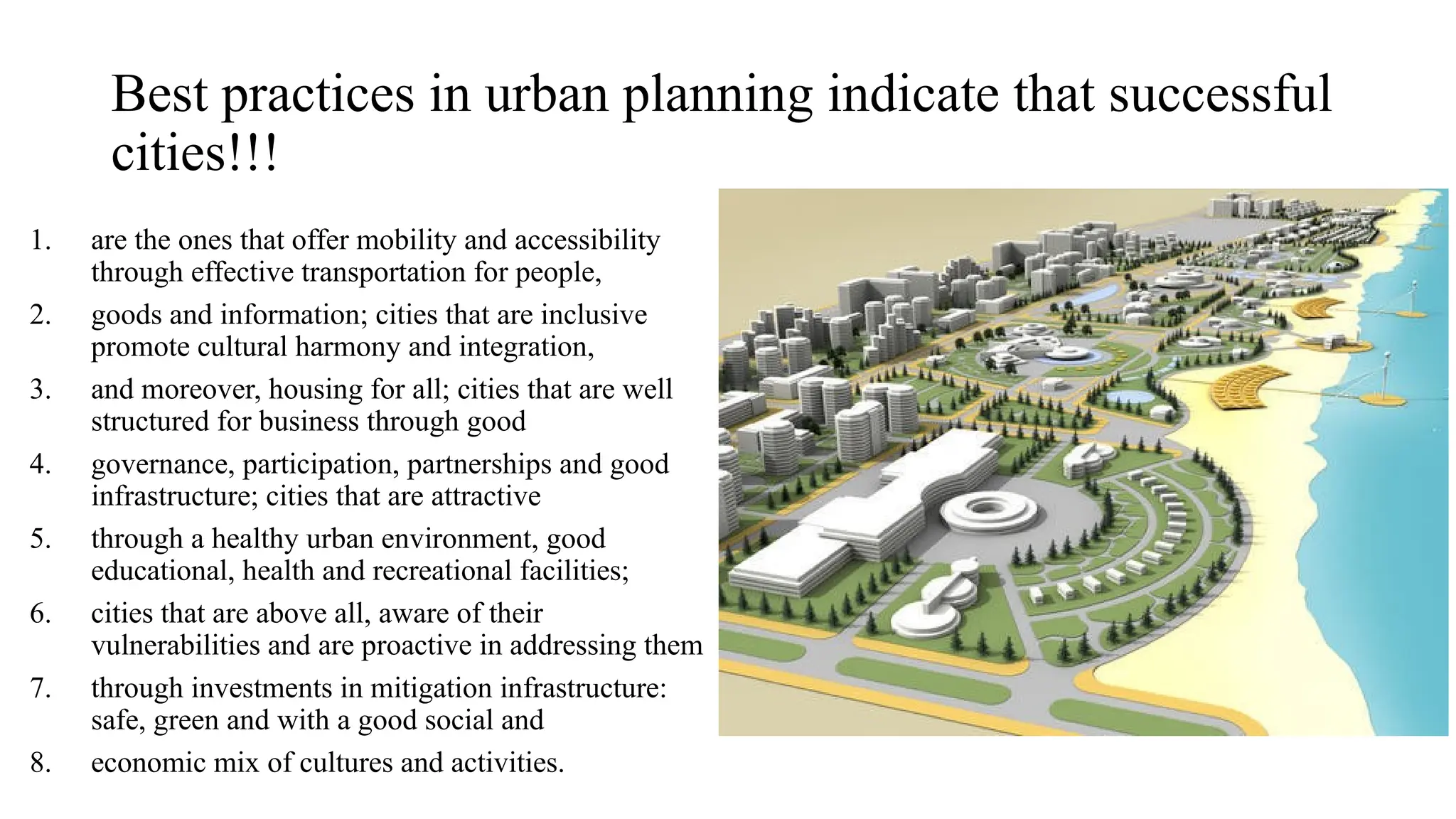
Best practices in urban planning indicate that successful
cities!!!
1. are the ones that offer mobility and accessibility
through effective transportation for people,
2. goods and information; cities that are inclusive
promote cultural harmony and integration,
3. and moreover, housing for all; cities that are well
structured for business through good
4. governance, participation, partnerships and good
infrastructure; cities that are attractive
5. through a healthy urban environment, good
educational, health and recreational facilities;
6. cities that are above all, aware of their
vulnerabilities and are proactive in addressing them
7. through investments in mitigation infrastructure:
safe, green and with a good social and
8. economic mix of cultures and activities.

urban planning town city country planning

  • 1.
    CIV369: URBAN PLANNING ANDDEVELOPMENT UNIT 1 BY: HARKAMAL SINGH 18266
  • 2.
    URBAN PLANNING AND DEVELOPMENT •Urban planning, also known as:- • regional planning, • town planning, • city planning, or • rural planning, is a technical and political process that is focused on the development and design of land use and the built environment, including air, water, and the infrastructure passing into and out of urban areas, such as transportation, communications, and distribution networks and their accessibility.
  • 3.
    GENERAL INTRODUCTION • TownPlanning – arrangement of various components or units of a town in such a way that the town as such attains the significance of a living organism. • Knowledge of town planning helps in achieving the best possible advantages of the situation of town with respect to its land and the surrounding environments. • The town planning is a Science as well as Art too. • The art lies in arranging the components of a town in such a way that the final result is in the form of a beautiful, convenient, economical and efficient unit.
  • 4.
    Objects of TownPlanning 1. Beauty 2. Convenience 3. Environment 4. Health
  • 5.
    Why growth ofTowns??? • To facilitates defense against outsiders • Man is a social animal and love to live with fellows • Can develop contacts and retain privacy • Urban areas provides facilities like water, sewerage etc
  • 6.
    Economic justification ofTown Planning 1. Change in quantity of resources 2. Demand for G and S 3. Production techniques 4. Redistribution of Land values
  • 7.
    Principles of TownPlanning • Green Belt • Housing • Public Buildings • Recreation centers • Road system • Transport facilities • Zoning
  • 8.
    Principles of TownPlanning 1. Zoning : • The town should be divided into suitable zones such as commercial zone, industrial zone, residential zone, etc. and suitable rules and regulations should be formed for the development of each zone. 2. Green belt : • Green belt is non-development zone on the periphery of the town. • It prevents the haphazard sprawl of the town restricting its size. In essence, a green belt is an invisible line designating a border around a certain area, preventing development of the area and allowing wildlife to return and be established. Greenways and green wedges have a linear character and may run across the town and not around the town. 3. Housing Housing has to be carefully studied and designed to suit the local population. Care should be taken to see that there is no development of slums since it would be responsible for degrading the life of the citizens. There are various types of housing styles. When a land use plan is made, zones for independent housing, midrise buildings, high rise buildings are allocated.
  • 9.
    Principles of TownPlanning 4. Public buildings • Public buildings should be well grouped and distributed throughout the town. • Unnecessary concentration of public buildings should be avoided. Factors such as parking facilities, road widths have to be taken into consideration while allocating the space for public buildings. 5. Recreation centers • Recreation centers have to be given importance while designing a town. They are necessary for the recreational activities of the general public. They include parks for walking and cycling, amusement parks etc.
  • 10.
    Principles of TownPlanning 6. Road systems • Road network hierarchy is very important. The efficiency of any town is measured by the layout of its roads. • A nicely designed road system puts a great impression in the minds of people, especially the visitors to the town. The provision of a faulty road system in the initial stages of town formation proves to be too difficult and costly to repair or to re-arrange in future. 7. Transport facilities • The town should be provided with suitable transport facilities so that there is minimum loss of time from place of work to the place of residence. Efficiency in transport facilities includes both public and private networks. • Public transportation network includes access to buses, trains, trams and trolleybuses. Efficiency in using the public transport will determine the success of that town in terms of design.
  • 11.
    Necessity of TownPlanning ???? • To avoid evil situations within the town 1. Defective roads 2. Slums 3. Traffic 4. Parks-playgrounds 5. Lack of essentials amenities 6. Noise pollution 7. Unhealthy living 8. Uncontrolled growth of town
  • 12.
  • 13.
    Development of Townsas per the origin consist of :- 1. Natural 1. Concentric 2. Ribbon development 3. Satellite 4. Scattered growth
  • 14.
    According to theorigin:- Natural Concentric growth Natural tendency of people to be as near as possible to town, hence town develops in concentric rings • Many complicated problems such as:- • Traffic congestion • Narrow streets • Concentration of population
  • 17.
    Satellite town • Asatellite town or satellite city is a concept in urban planning that refers essentially to miniature metropolitan areas on the fringe of larger ones • Eg. NaviMumbai, • New Delhi
  • 18.
  • 19.
    Satellite Town • Connectivity? •Dependency? • Activities? • Features? • Market?
  • 20.
    Ribbon town spread •Everyone like to build as near as possible to main road • Buildings develop along side of main road • Long fingers or ribbons of houses/shops develop
  • 23.
    Characteristics:- • In thebeginning this growth is very small along the road side but soon it occupies whole of the area. • It happens especially in newly developing towns where rule and zoning regulations have not been strictly enforced. • Ribbon development has become a regular feature where we find overcrowding of all types of buildings such as schools, factories, petrol pumps etc. • This type of development is more dangerous from traffic point of view.
  • 24.
    Disadvantages • Everybody wantsto take advantage of the frontage of main road. • The interior is therefor left underdeveloped, causing wastage of valuable land. • Overcrowding on the roadside. Streets become narrow and give rise to accidents. • All types of buildings creep in at the frontage, such as schools, factories, bus stops, petrol pumps, theatres, commercial complexes etc. with no regard to zoning regulations. • All these affect health conditions of the residents. • The town spreads far and wide which is costly to maintain. • Future improvements become very costly. • Ribbon development is the inverse of planning and is not desirable
  • 25.
    Planned growth • Plannedgrowth of town consist of:- • Horizontal growth • Vertical growth
  • 26.
  • 27.
  • 28.
    Ancient Town Classification •Dandaka • Sarvathobhadra • Nandyavarta • Padmaka • Swastika • Prastara • Karmuka • Chaturmukha
  • 39.
    Indus valley civilization Themost important feature is town planning. The main features of town planning were 1. use of baked as well as sundried bricks, 2. well planned straight roads 3. a system of drainage. 4. A fortified citadel at most of the cities. The number of the citadels varies. 5. Houses with kitchens and wells, tanks or water reservoirs. 6. Use of standard weights and measurement throughout the civilization. 7. Presence of wheel made pottery. 8. The Practice of burying the dead.
  • 40.
    Salient Features ofHarappa and Mohen Jo-dero • Harappa and Mohenjo-Daro are 500 kms apart from each other. These, along with Dholavira, are called the nucleus cities of the civilization. Harappa, the first discovered site of this civilization was on bank of river Ravi, while Mohenjo-Daro was on banks of Indus River. Each of them has two prominent mounds where excavations took place. Notable findings at Harappa are rows of granaries, Citadels, Furnaces and a crucible to melt the bronze. Notable findings at Mohenjo-Daro are the magnum opus Great Bath, uniform buildings and weights, hidden drains and other hallmarks of the civilization. This is the site where most unicorn seals have been found. Mohenjo-Daro is also sometimes known as largest urban centre of the civilization. Great Bath • The most famous building found at Mohenjo-Daro is a great bath. It is a 6×12 meter specimen of beautiful brick work. The water for the bath was provided from a well in an adjacent room. The floor was made up of bricks. Floor and outer walls were bituminized so that there is no leakage of water. There are open porch’s on four sides of the bath. There is use of Burnt bricks, Mortar and Gypsum in the Great bath but NO use of stone is there.
  • 41.
    Urban development expansionsview points!!! 1. As it is fully recognized, rapid urbanization of the world has pushed governments, politicians, planners, private developers, civil society and many other actors to face significant challenges that are impacting everyone’s lives. 2. Growing population and reduced living spaces are clearly leading to the deterioration of living conditions in urban centers 3. It is well known that urban centers continue to grow rapidly with much of it in an unplanned fashion. Moreover, policies, strategies, plans and implementation have not kept up with the speed of urban transformation. • What makes a successful inclusive city? • What makes a city effective?
  • 42.
    Best practices inurban planning indicate that successful cities!!! 1. are the ones that offer mobility and accessibility through effective transportation for people, 2. goods and information; cities that are inclusive promote cultural harmony and integration, 3. and moreover, housing for all; cities that are well structured for business through good 4. governance, participation, partnerships and good infrastructure; cities that are attractive 5. through a healthy urban environment, good educational, health and recreational facilities; 6. cities that are above all, aware of their vulnerabilities and are proactive in addressing them 7. through investments in mitigation infrastructure: safe, green and with a good social and 8. economic mix of cultures and activities.