MIT OpenCourseWare
http://ocw.mit.edu
15.912 Technology Strategy
Fall 2008

For information about citing these materials or our Terms of Use, visit: http://ocw.mit.edu/terms.
15.912

Technology Strategy

Professor Jason Davis
MIT Sloan School of Management
“Seamless Mobility” What is it?

According to the Article:
•	 “Brings simplicity to complexity” by tying everything to mobile
handsets
•	 Focuses on “ease of use”
•	 A rationale for staying in many markets:
–	 automotive electronics
–	 home‐theatres
–	 emergency‐radios
–	 base‐stations
•	 A way to justify new “transition” products:
–	 high‐speed internet access on trains
–	 email in cars
–	 Videophones
–	 Cellular plane‐coverage
Organizational Context: Why they

devised “seamless mobility”

According to the Article:
• Resolve “internal strife” and “strategic paralysis”

• Make decisions:
– Spin off smaller divisions / concentrate on phones ?

– Retreat from handsets / focus network equipment ?

– Focus on communications & entertainment markets ?
• …that is, be like Nokia, Ericsson, or Samsung?
Who am I?
•	 New strategy professor in the MIT Sloan School
•	 Studied Computers & Brains at MIT (SB) and Caltech
(MS)
–	 Genetic Engineering @ MIT
–	 Neural Network Algorithms @ Caltech
•	 Worked at McKinsey, Intel, and IBM doing tech
strategy related work
•	 PhD in Management Science from Stanford
University
–	 Research Focus on Collaborative Innovation: how do pairs of firms manage joint
technology development?
–	 Compared relationships between 10 large IT firms in Silicon Valley, Seattle, and
Portland that co‐developed new Web2.0, mobility, and security technologies
–	 Case research based on ~100 interviews with execs, managers, and engineers,
supplemented with computational modeling
Who are you, and why did you come?

•	 Need to know how to do tech strategy when you
graduate: work in consulting, big tech‐firms, or new
ventures....
•	 Realize that technology will shape management in your
non‐technology‐centric industry – i.e., retail, banking,
government, etc.
•	 You’re a scientist/technologist thinking about
technology entrepreneurship…
•	 Fun set of cases (Google, Apple, RedHat, etc.) and
fascinating concepts (innovator’s dilemma, network
effects, co‐opetition, complexity theory, simple rules)
•	 Others?
What is a “strategy” anyway?
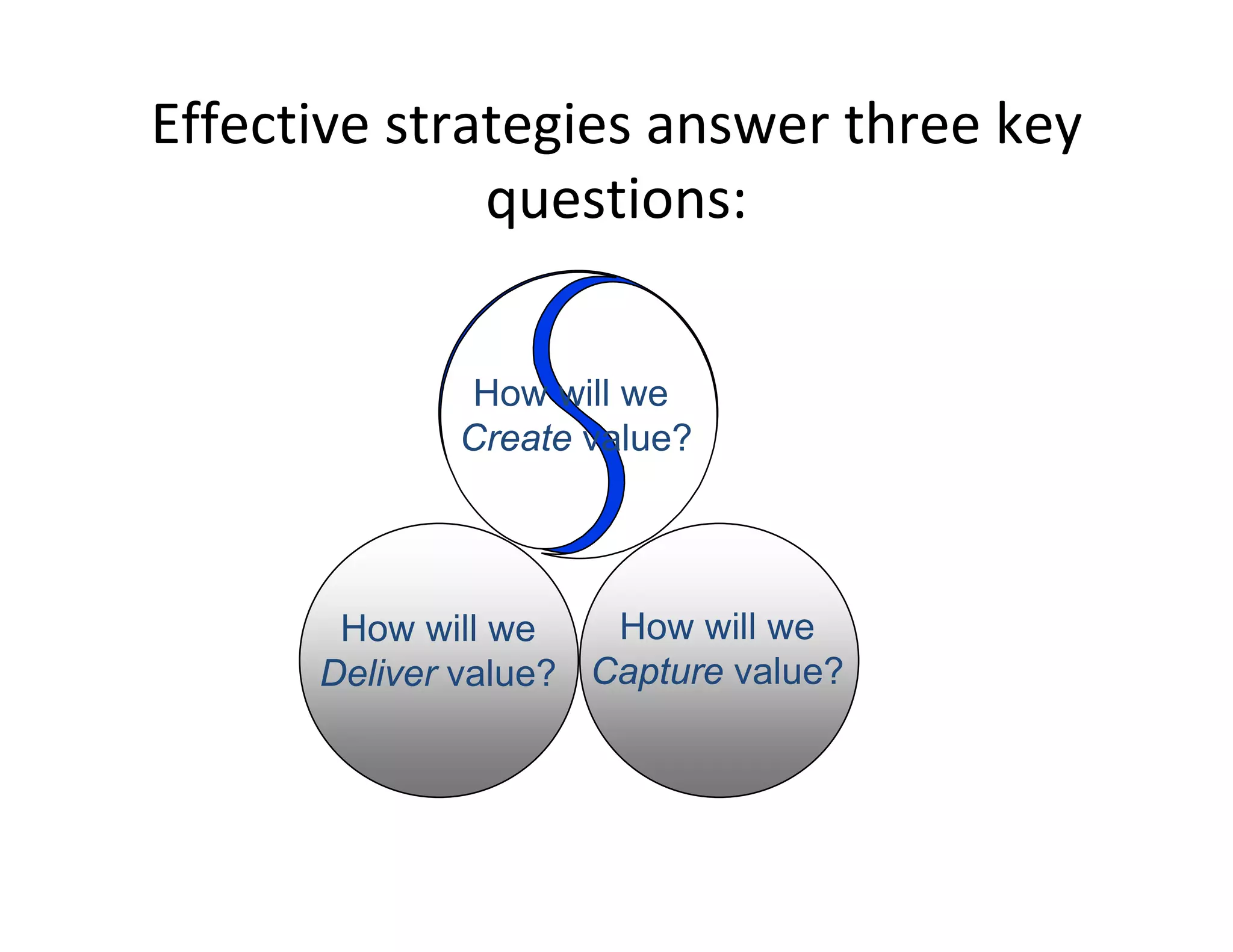
Effective strategies answer three key

questions:

How will we
Create value?
How will we
Capture value?
How will we
Deliver value?
Effective strategies tackle 3 key questions:

• How will we create value?
– How will the technology evolve?
– How will the market change?
– How do we organize effectively?
• How will we capture value?
– How do we compete to gain sustainable competitive advantage?
– How should we compete if standards are important?
– How to manage technology platforms?
• How will we deliver value?
– How should we execute the strategy?
– How do we make strategic decisions and take decisive action?
Why have a strategy?

1. To make choices and take actions
Is This Your Project Pipeline? (A Log Jam)
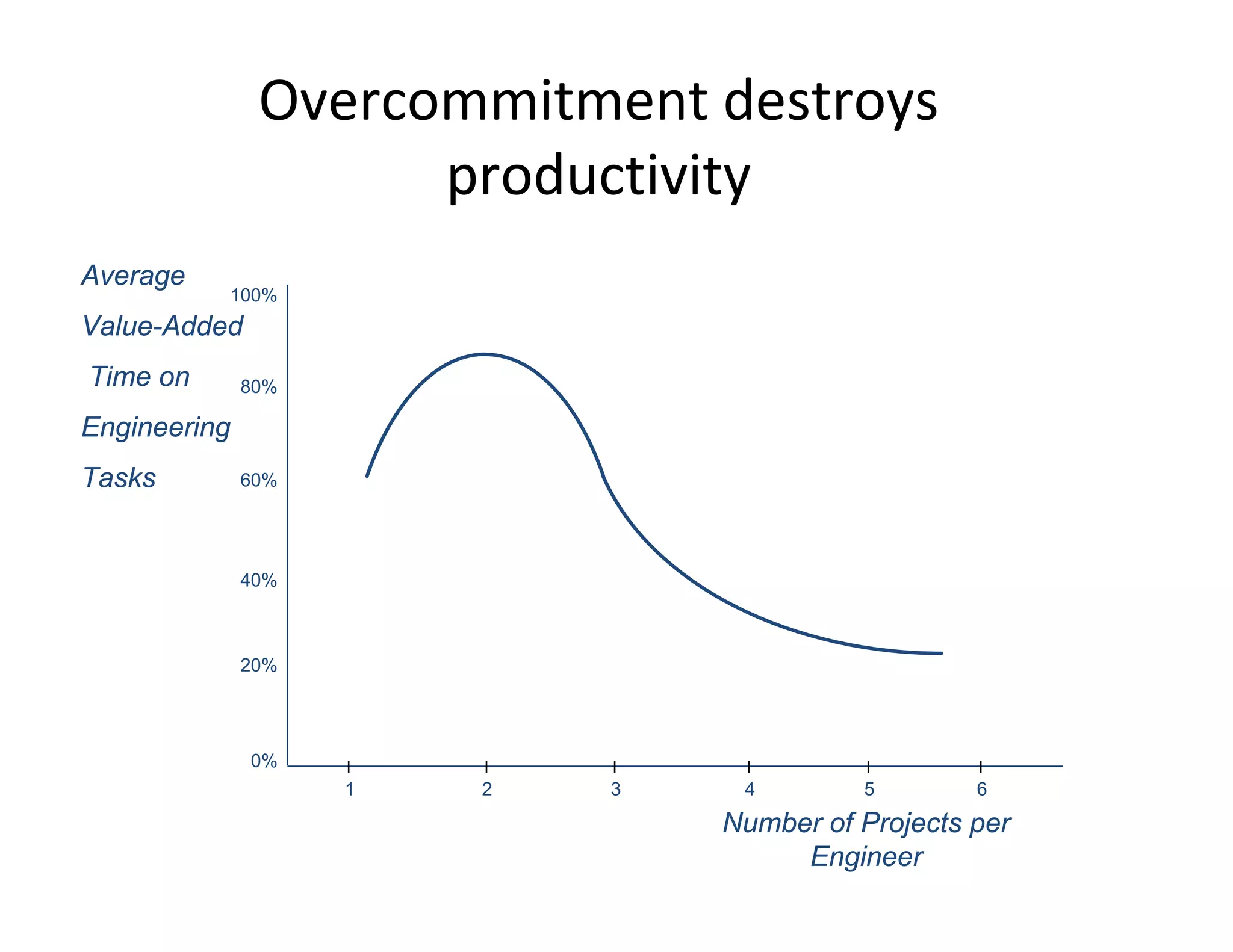
Overcommitment destroys

Average
100%
Value-Added
Time on 80%
Engineering
Tasks 60%
40%
20%
0%
productivity

1 2 3 4 5 6
Number of Projects per
Engineer
The Timing and Impact of

Management Attention

Phases
Knowledge Concept Basic Prototype Pilot Manufacturing
Acquisition Investigation Design Building Production Ramp-Up
High
ABILITY
TO INFLUENCE
OUTCOME
Index of

Attention and

Influence

Low
ACTUAL
ACTIVITY
MANAGEMENT
PROFILE
Why is it so hard to kill

project #26?

• It’s a “good” project!
•	 Good managers can meet stretch goals
(and I’m a good manager)
• Making difficult decisions takes time & energy

It’s very hard to kill projects without a strategy
Reasons to have a strategy:

2. To be able to change it
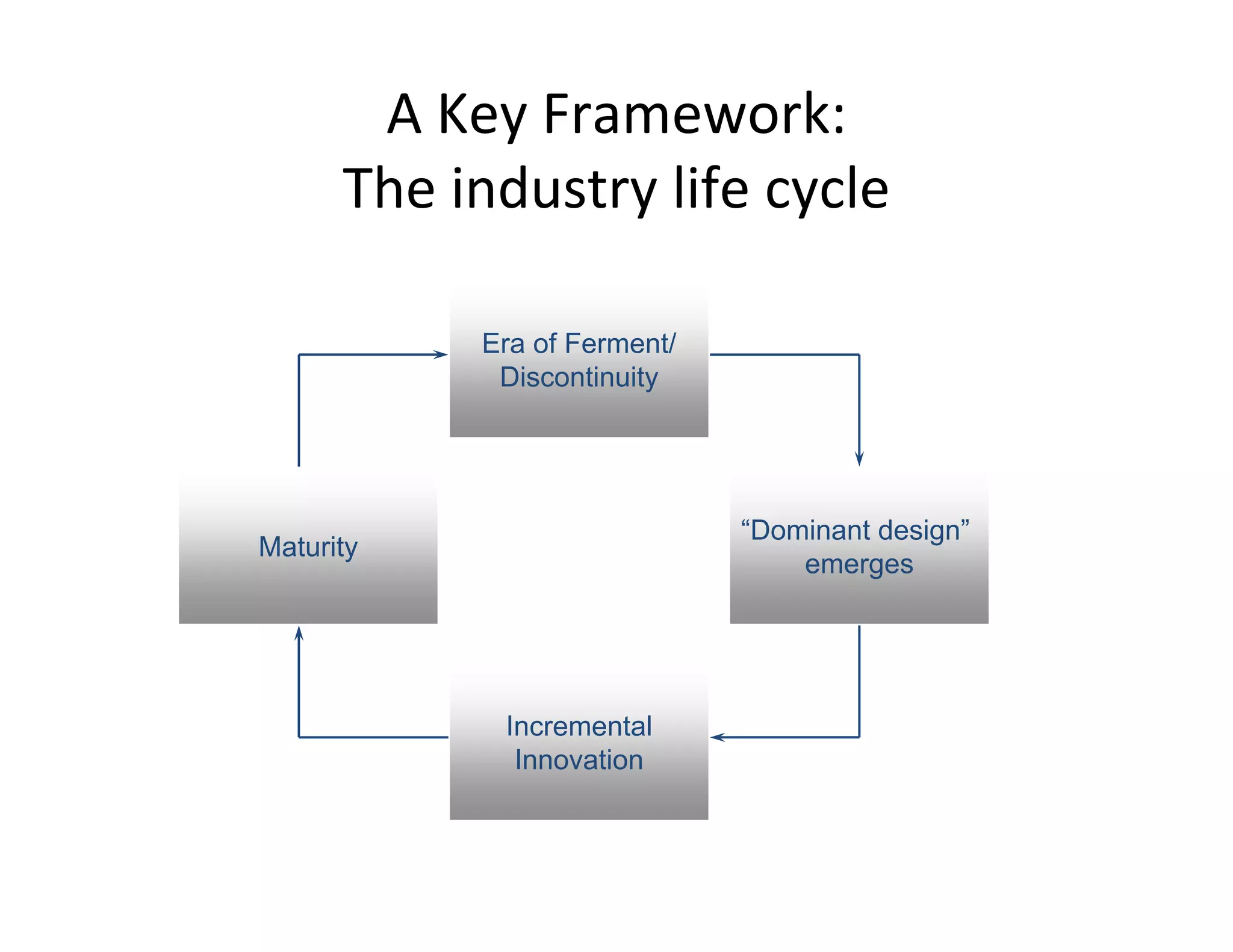
A Key Framework:

The industry life cycle

Era of Ferment/
Discontinuity
Maturity
“Dominant design”
emerges
Incremental
Innovation
Maturity

The Industry Life Cycle as an S curve
Performance
Discontinuity
Takeoff
Ferment

Time
The S‐curve Maps Major Transitions
Performance
Ferment
Takeoff
Maturity
Discontinuity
Time
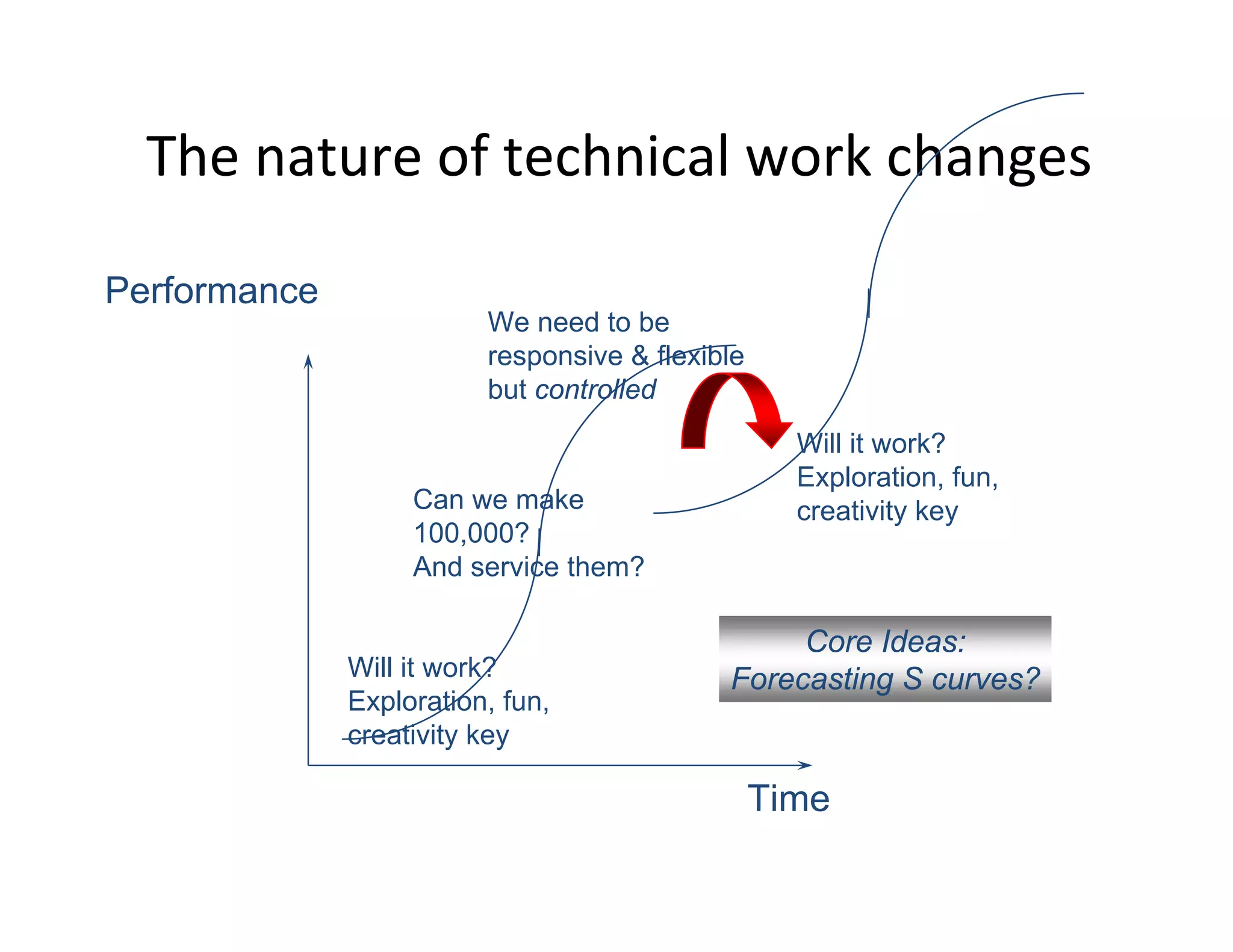
The nature of technical work changes
Performance
We need to be
responsive & flexible
but controlled
Will it work?
Exploration, fun,
Can we make creativity key
100,000?
And service them?
Core Ideas:
Will it work? Forecasting S curves?
Exploration, fun, 

creativity key

Time
The marketing challenge evolves
Performance
Stay close to your
customer – really close
Who
Do we have
needs this?
any reference
customers?
Core Ideas:
Market segmentation
Who The Innovator’s
Dilemma
Time
needs this?
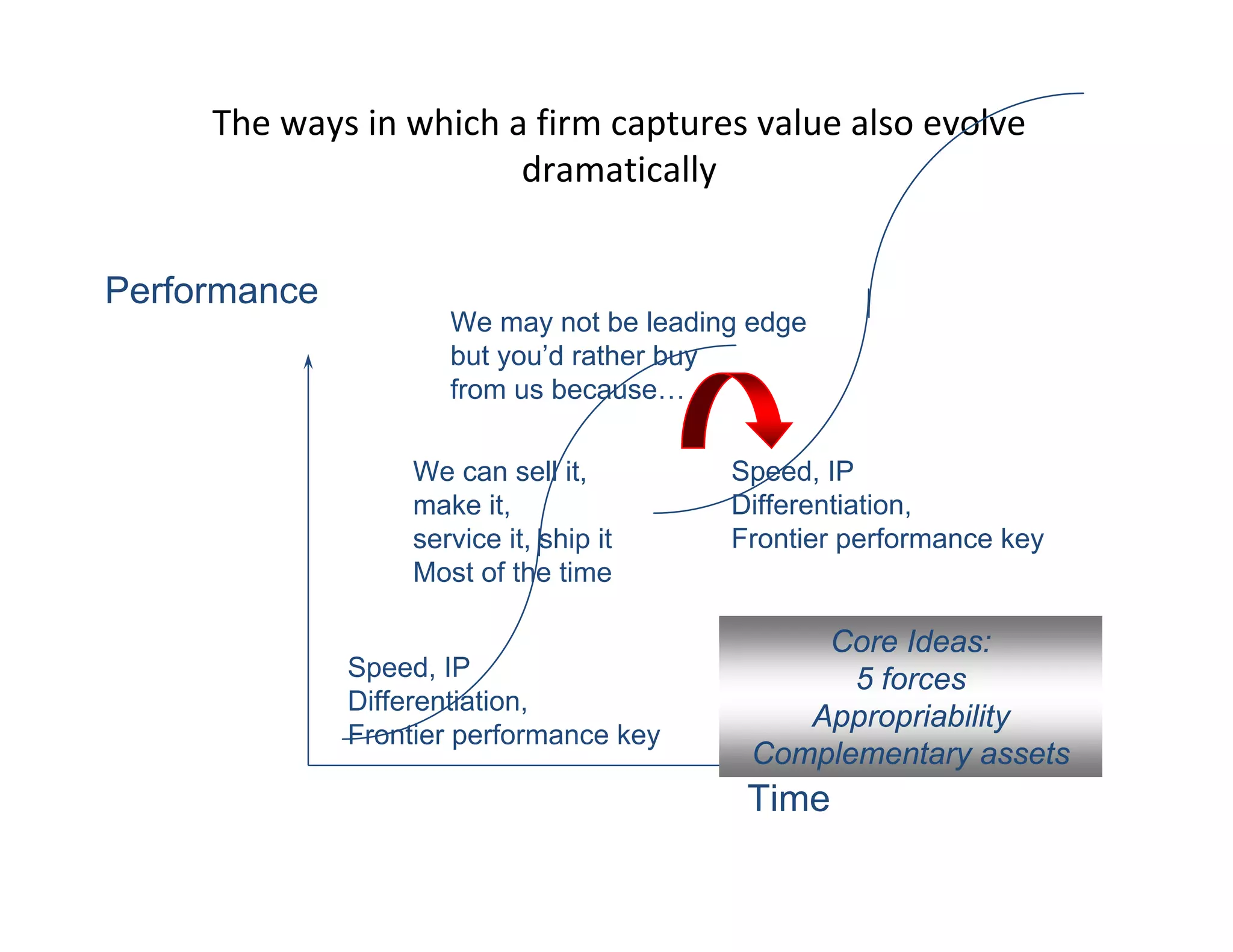
The ways in which a firm captures value also evolve

dramatically

Performance
We may not be leading edge
but you’d rather buy
from us because…
We can sell it,
make it,
service it, ship it
Most of the time
Speed, IP
Differentiation,
Frontier performance key
Time
Speed, IP
Differentiation,
Frontier performance key
Core Ideas:
5 forces
Appropriability
Complementary assets
The organizational challenge changes
significantly
Performance
“Entrepreneurial
Energy” critical
“Coordination &
control” critical
“Entrepreneurial
Energy” critical
Core Ideas:
Managing the
organizational
dynamics of discontinuity
Time
15.912: Technology Strategy Course Outline

• How will we create value?
– How will the technology evolve?
– How will the market change?
– How do we organize effectively?
• How will we capture value?
– How do we compete to gain sustainable competitive advantage?
– How should we compete if standards are important?
– How to manage technology platforms?
• How will we deliver value?
– How should we execute the strategy?
– How do we make strategic decisions and take decisive action?
Logistics
• The Waitlist
• Grading:
– Class attendance and participation 50%
– Four “Two pagers” 20%
– Final paper 30%
• Case Method + Readings & Lectures
Professional Standards
• Attendance
• Coming on Time
• Being Prepared to Discuss Cases
– I encourage you to form discussion groups; focus on syllabus questions
– I prefer you not use laptops
• Teamwork
– Aim for 3 people teams
For Session 2:

•	 eInk
–	 What should eInk do next? Which applications should they target?
Why?
•	 First “two pager” due Session 3
–	 Find a couple of teammates, choose an industry, sketch out the
relevant S curves
–	 Only 2 pages!

Lec 01

  • 1.
    MIT OpenCourseWare http://ocw.mit.edu 15.912 TechnologyStrategy Fall 2008 For information about citing these materials or our Terms of Use, visit: http://ocw.mit.edu/terms.
  • 2.
    15.912 Technology Strategy Professor JasonDavis MIT Sloan School of Management
  • 3.
    “Seamless Mobility” Whatis it? According to the Article: • “Brings simplicity to complexity” by tying everything to mobile handsets • Focuses on “ease of use” • A rationale for staying in many markets: – automotive electronics – home‐theatres – emergency‐radios – base‐stations • A way to justify new “transition” products: – high‐speed internet access on trains – email in cars – Videophones – Cellular plane‐coverage
  • 4.
    Organizational Context: Whythey devised “seamless mobility” According to the Article: • Resolve “internal strife” and “strategic paralysis” • Make decisions: – Spin off smaller divisions / concentrate on phones ? – Retreat from handsets / focus network equipment ? – Focus on communications & entertainment markets ? • …that is, be like Nokia, Ericsson, or Samsung?
  • 5.
    Who am I? • New strategy professor in the MIT Sloan School • Studied Computers & Brains at MIT (SB) and Caltech (MS) – Genetic Engineering @ MIT – Neural Network Algorithms @ Caltech • Worked at McKinsey, Intel, and IBM doing tech strategy related work • PhD in Management Science from Stanford University – Research Focus on Collaborative Innovation: how do pairs of firms manage joint technology development? – Compared relationships between 10 large IT firms in Silicon Valley, Seattle, and Portland that co‐developed new Web2.0, mobility, and security technologies – Case research based on ~100 interviews with execs, managers, and engineers, supplemented with computational modeling
  • 6.
    Who are you,and why did you come? • Need to know how to do tech strategy when you graduate: work in consulting, big tech‐firms, or new ventures.... • Realize that technology will shape management in your non‐technology‐centric industry – i.e., retail, banking, government, etc. • You’re a scientist/technologist thinking about technology entrepreneurship… • Fun set of cases (Google, Apple, RedHat, etc.) and fascinating concepts (innovator’s dilemma, network effects, co‐opetition, complexity theory, simple rules) • Others?
  • 7.
    What is a“strategy” anyway?
  • 8.
    Effective strategies answerthree key questions: How will we Create value? How will we Capture value? How will we Deliver value?
  • 9.
    Effective strategies tackle3 key questions: • How will we create value? – How will the technology evolve? – How will the market change? – How do we organize effectively? • How will we capture value? – How do we compete to gain sustainable competitive advantage? – How should we compete if standards are important? – How to manage technology platforms? • How will we deliver value? – How should we execute the strategy? – How do we make strategic decisions and take decisive action?
  • 10.
    Why have astrategy?
  • 11.
    Why have astrategy? 1. To make choices and take actions
  • 12.
    Is This YourProject Pipeline? (A Log Jam)
  • 13.
    Overcommitment destroys Average 100% Value-Added Time on80% Engineering Tasks 60% 40% 20% 0% productivity 1 2 3 4 5 6 Number of Projects per Engineer
  • 14.
    The Timing andImpact of Management Attention Phases Knowledge Concept Basic Prototype Pilot Manufacturing Acquisition Investigation Design Building Production Ramp-Up High ABILITY TO INFLUENCE OUTCOME Index of Attention and Influence Low ACTUAL ACTIVITY MANAGEMENT PROFILE
  • 15.
    Why is itso hard to kill project #26? • It’s a “good” project! • Good managers can meet stretch goals (and I’m a good manager) • Making difficult decisions takes time & energy It’s very hard to kill projects without a strategy
  • 16.
    Reasons to havea strategy: 2. To be able to change it
  • 17.
    A Key Framework: Theindustry life cycle Era of Ferment/ Discontinuity Maturity “Dominant design” emerges Incremental Innovation
  • 18.
    Maturity The Industry LifeCycle as an S curve Performance Discontinuity Takeoff Ferment Time
  • 19.
    The S‐curve MapsMajor Transitions Performance Ferment Takeoff Maturity Discontinuity Time
  • 20.
    The nature oftechnical work changes Performance We need to be responsive & flexible but controlled Will it work? Exploration, fun, Can we make creativity key 100,000? And service them? Core Ideas: Will it work? Forecasting S curves? Exploration, fun, creativity key Time
  • 21.
    The marketing challengeevolves Performance Stay close to your customer – really close Who Do we have needs this? any reference customers? Core Ideas: Market segmentation Who The Innovator’s Dilemma Time needs this?
  • 22.
    The ways inwhich a firm captures value also evolve dramatically Performance We may not be leading edge but you’d rather buy from us because… We can sell it, make it, service it, ship it Most of the time Speed, IP Differentiation, Frontier performance key Time Speed, IP Differentiation, Frontier performance key Core Ideas: 5 forces Appropriability Complementary assets
  • 23.
    The organizational challengechanges significantly Performance “Entrepreneurial Energy” critical “Coordination & control” critical “Entrepreneurial Energy” critical Core Ideas: Managing the organizational dynamics of discontinuity Time
  • 24.
    15.912: Technology StrategyCourse Outline • How will we create value? – How will the technology evolve? – How will the market change? – How do we organize effectively? • How will we capture value? – How do we compete to gain sustainable competitive advantage? – How should we compete if standards are important? – How to manage technology platforms? • How will we deliver value? – How should we execute the strategy? – How do we make strategic decisions and take decisive action?
  • 25.
    Logistics • The Waitlist •Grading: – Class attendance and participation 50% – Four “Two pagers” 20% – Final paper 30% • Case Method + Readings & Lectures
  • 26.
    Professional Standards • Attendance •Coming on Time • Being Prepared to Discuss Cases – I encourage you to form discussion groups; focus on syllabus questions – I prefer you not use laptops • Teamwork – Aim for 3 people teams
  • 27.
    For Session 2: • eInk – What should eInk do next? Which applications should they target? Why? • First “two pager” due Session 3 – Find a couple of teammates, choose an industry, sketch out the relevant S curves – Only 2 pages!