LEAVE ENCASHMENT


     GROUP NO: 1

      MEMBERS: Aashima kapil
               Manish thakur
               Anupam aditya
               Anand singh negi
               Hargovind sahu
               Hemlata yadav
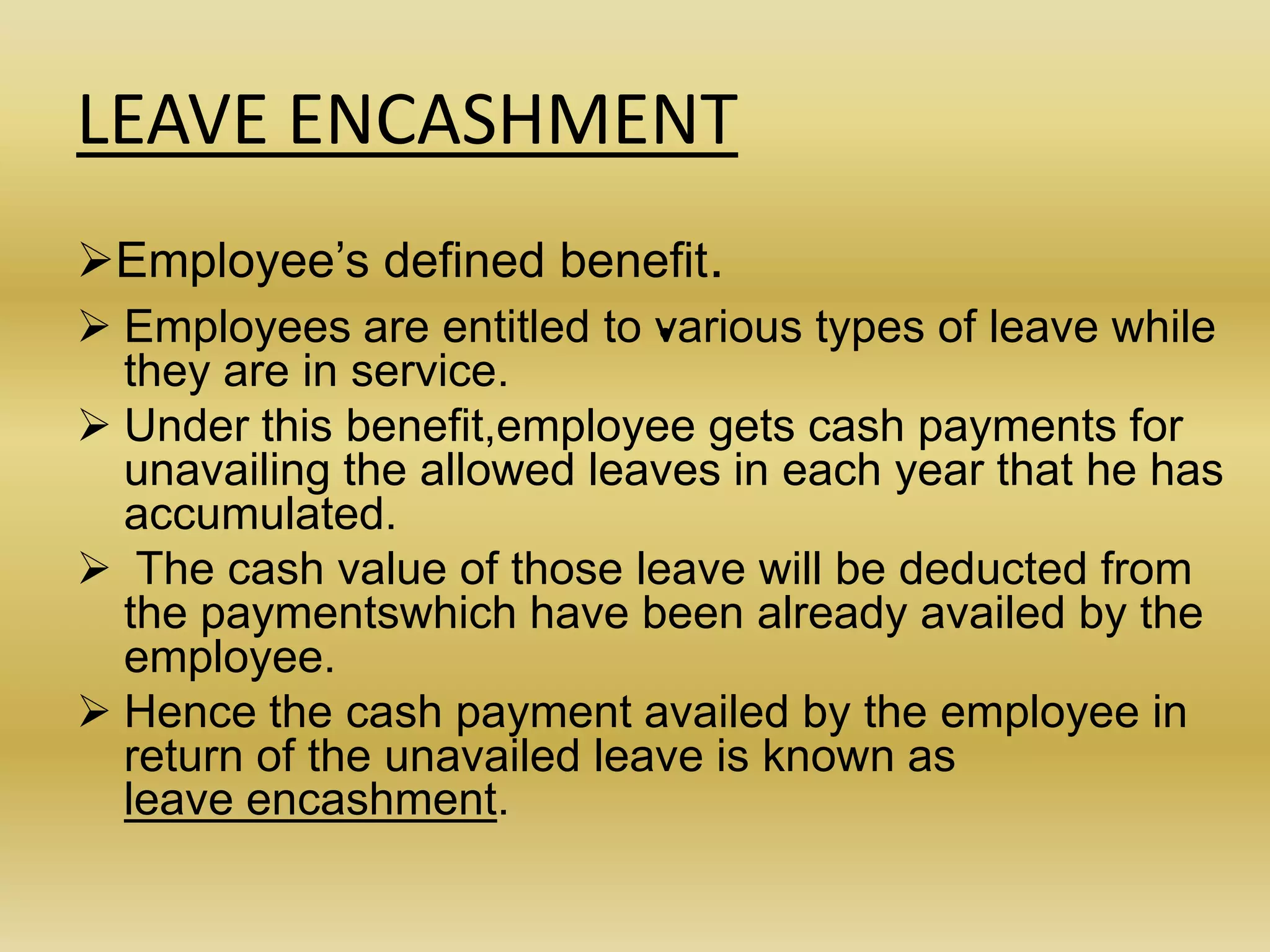
LEAVE ENCASHMENT
Employee’s defined benefit.
 Employees are entitled to various types of leave while
                             •
  they are in service.
 Under this benefit,employee gets cash payments for
  unavailing the allowed leaves in each year that he has
  accumulated.
 The cash value of those leave will be deducted from
  the paymentswhich have been already availed by the
  employee.
 Hence the cash payment availed by the employee in
  return of the unavailed leave is known as
  leave encashment.
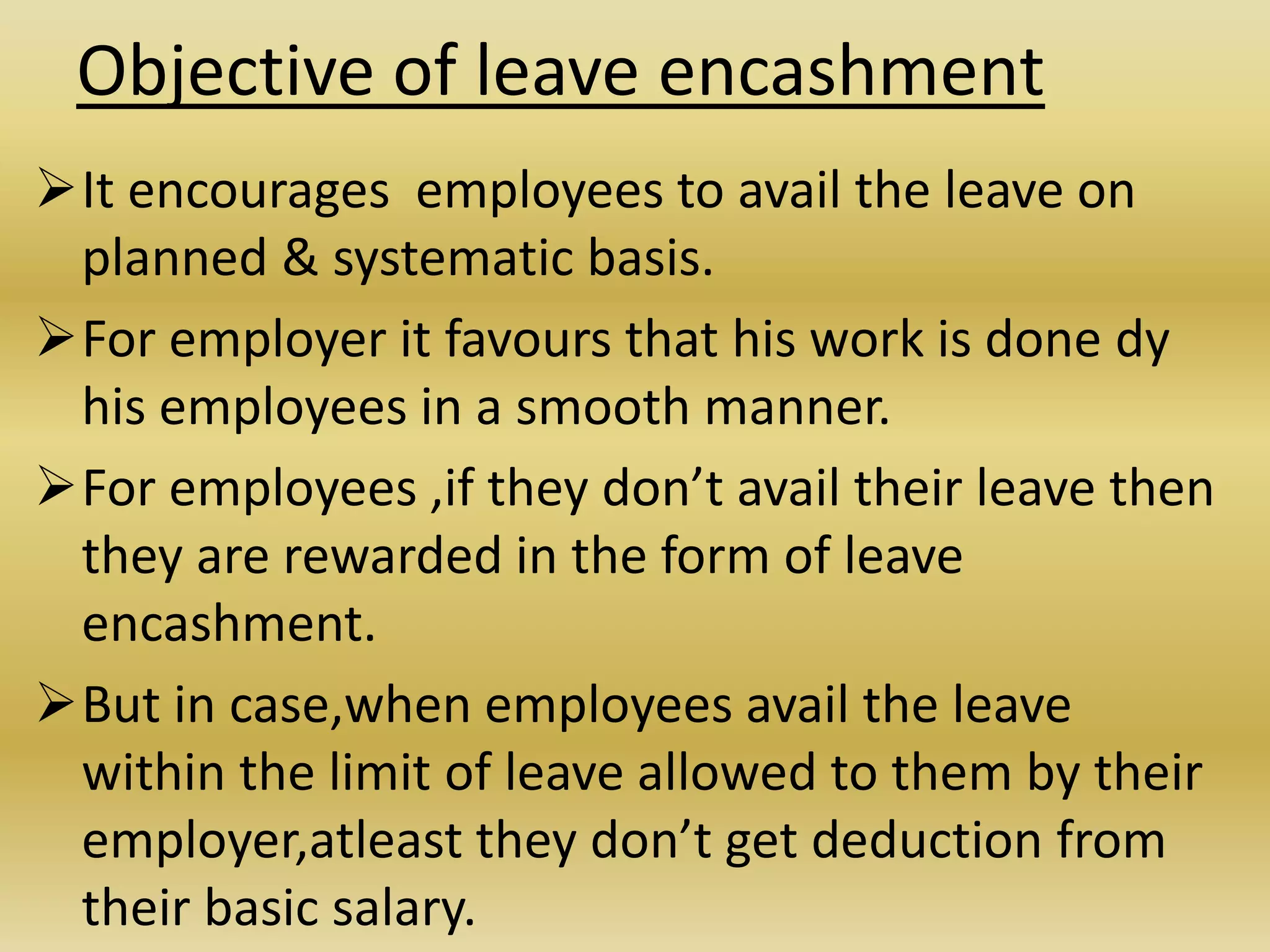
Objective of leave encashment
It encourages employees to avail the leave on
 planned & systematic basis.
For employer it favours that his work is done dy
 his employees in a smooth manner.
For employees ,if they don’t avail their leave then
 they are rewarded in the form of leave
 encashment.
But in case,when employees avail the leave
 within the limit of leave allowed to them by their
 employer,atleast they don’t get deduction from
 their basic salary.
Types of leaves
                      For emergency purposes.
                      No accumulation.
   Casual leave       Have to avail within the year
                       only.
                      For sickness.
                      Accumulation allowed as
   Medical leave       per service rules.

                      For general purposes.
                      Carry forward is allowed.
  Privileged leave    Non-statutory benefit to
                       employee on exit from
                       service.
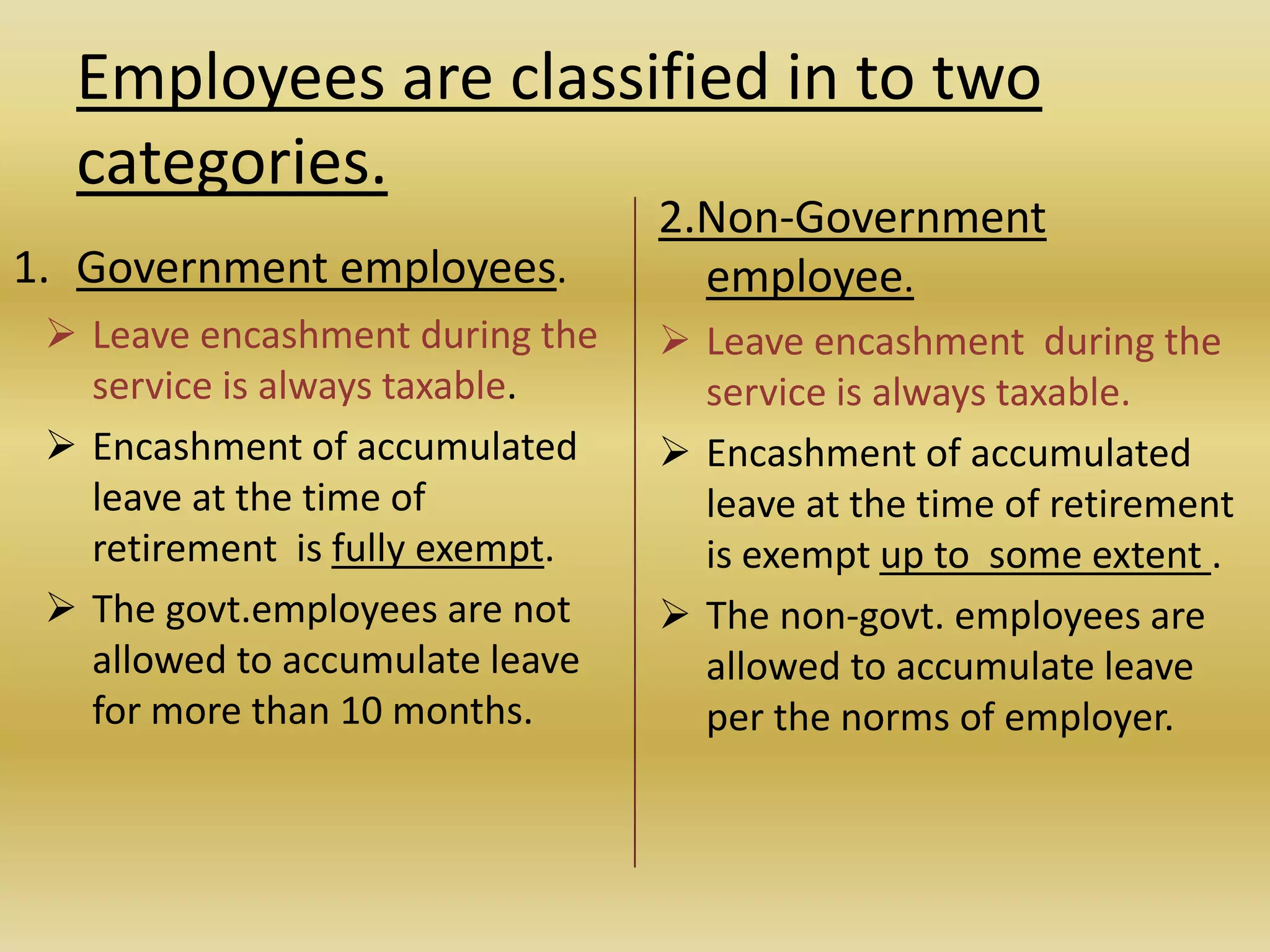
Employees are classified in to two
  categories.
                                 2.Non-Government
1. Government employees.           employee.
  Leave encashment during the    Leave encashment during the
   service is always taxable.      service is always taxable.
  Encashment of accumulated      Encashment of accumulated
   leave at the time of            leave at the time of retirement
   retirement is fully exempt.     is exempt up to some extent .
  The govt.employees are not     The non-govt. employees are
   allowed to accumulate leave     allowed to accumulate leave
   for more than 10 months.        per the norms of employer.
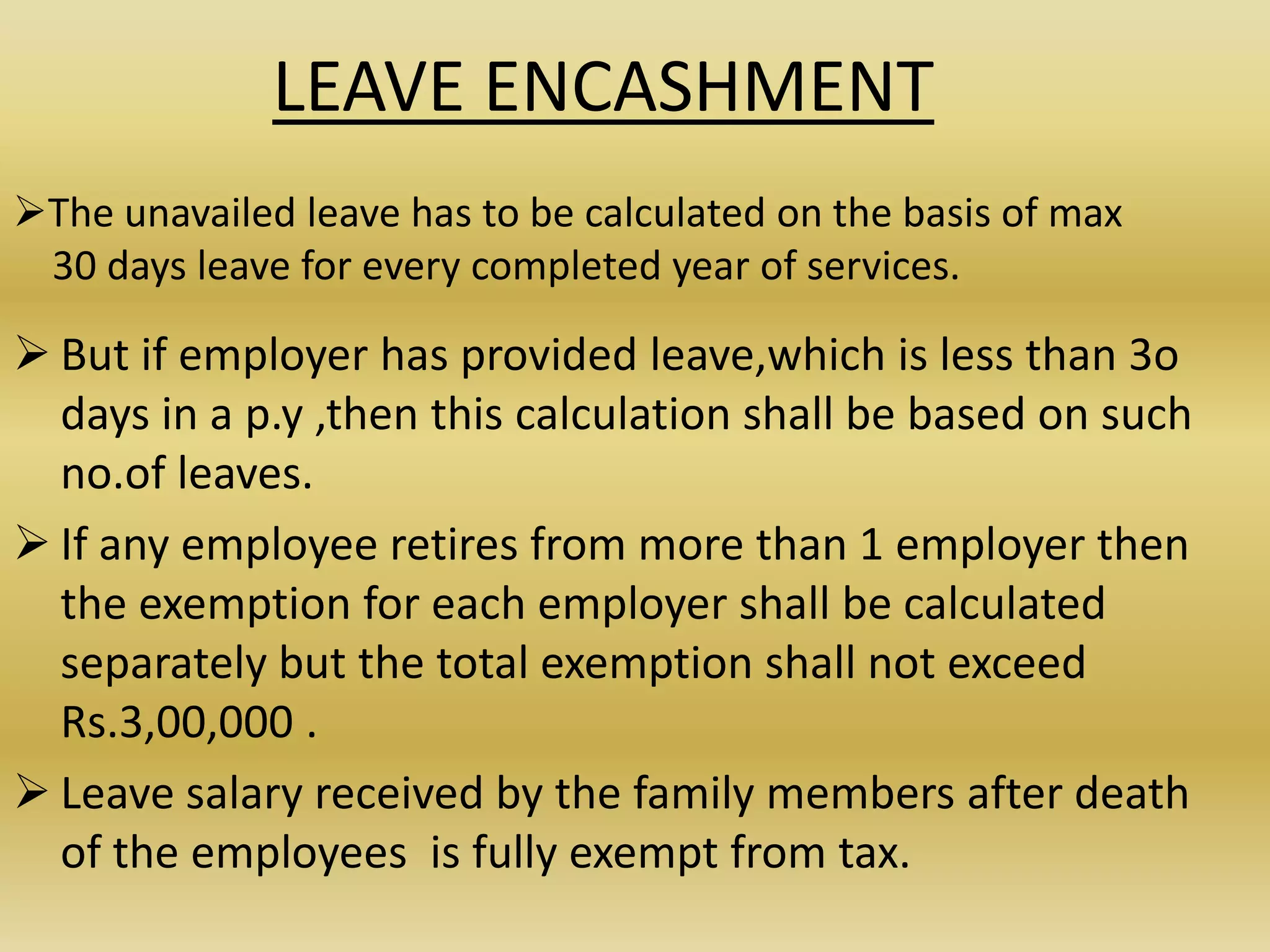
LEAVE ENCASHMENT
The unavailed leave has to be calculated on the basis of max
 30 days leave for every completed year of services.

 But if employer has provided leave,which is less than 3o
  days in a p.y ,then this calculation shall be based on such
  no.of leaves.
 If any employee retires from more than 1 employer then
  the exemption for each employer shall be calculated
  separately but the total exemption shall not exceed
  Rs.3,00,000 .
 Leave salary received by the family members after death
  of the employees is fully exempt from tax.
LEAVE ENCASHMENT
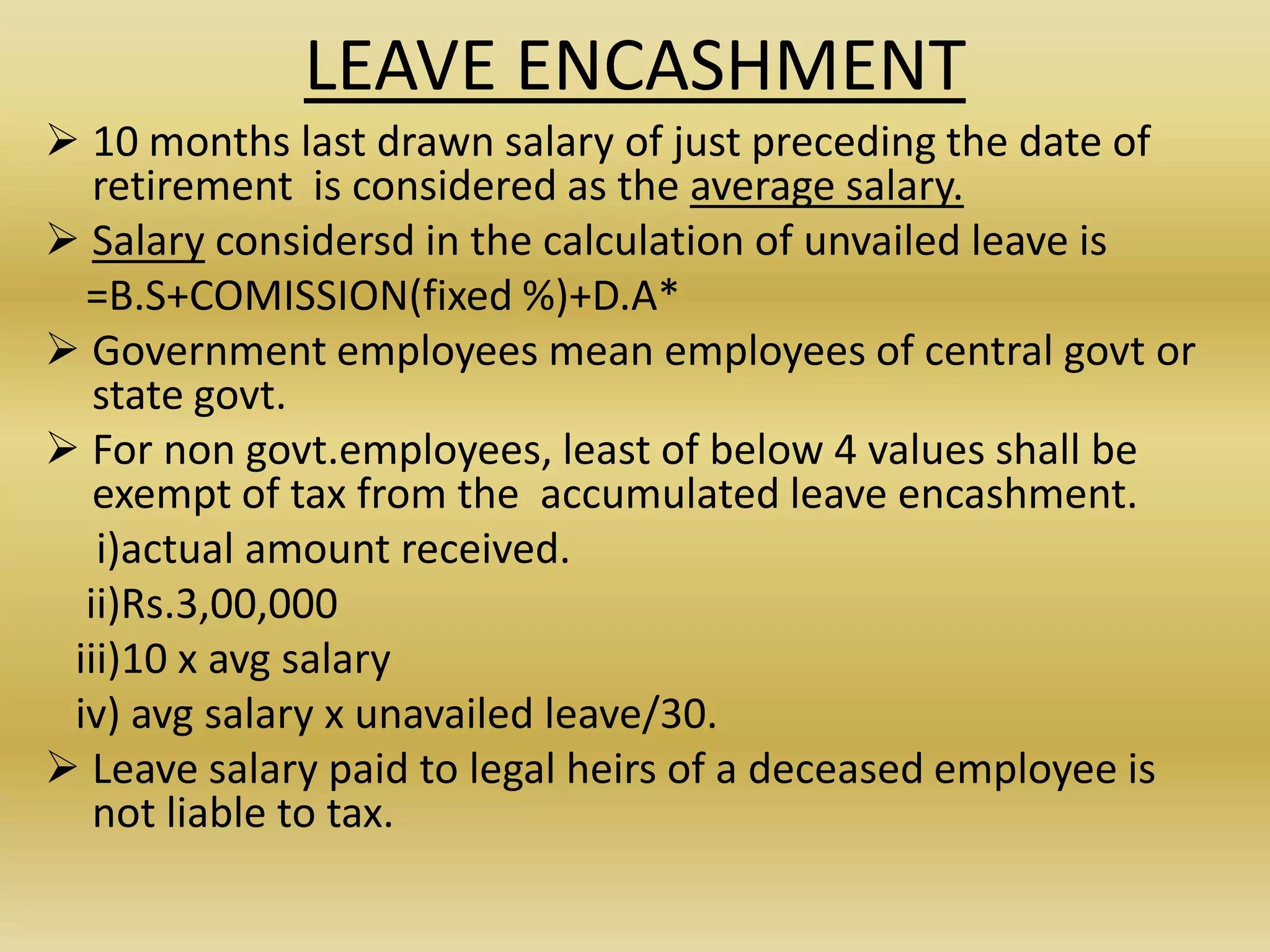
 10 months last drawn salary of just preceding the date of
   retirement is considered as the average salary.
 Salary considersd in the calculation of unvailed leave is
  =B.S+COMISSION(fixed %)+D.A*
 Government employees mean employees of central govt or
   state govt.
 For non govt.employees, least of below 4 values shall be
   exempt of tax from the accumulated leave encashment.
   i)actual amount received.
  ii)Rs.3,00,000
 iii)10 x avg salary
 iv) avg salary x unavailed leave/30.
 Leave salary paid to legal heirs of a deceased employee is
   not liable to tax.
Several case study
1. Rohit’s employer has credited him the leave of 40 days per
   year………..then also the maximum permissible unavailed
   leave under the IT act,1967 for the 26 yrs of service is
   _________=26 x 30 = 780.
2. If in case, 25 days are credited to rohit being a non govt
   employee ……..then the permissible unavailed leave will be
   _______= 26 x 25 = 650.(as less than 30 days is considered).
3. Mr.j is an govt employee & got Rs. 50,000 as leave
   encashment at the time of retirement.
   then______complete amount will be exempt as Mr.j is an
   govt employee.
4. Mr.j gets the same amount as leave encashment during his
   continue service then_____his income will be added in the
   gross total income & will be taxed according to the slab rate
   in which he falls in to.
Case study
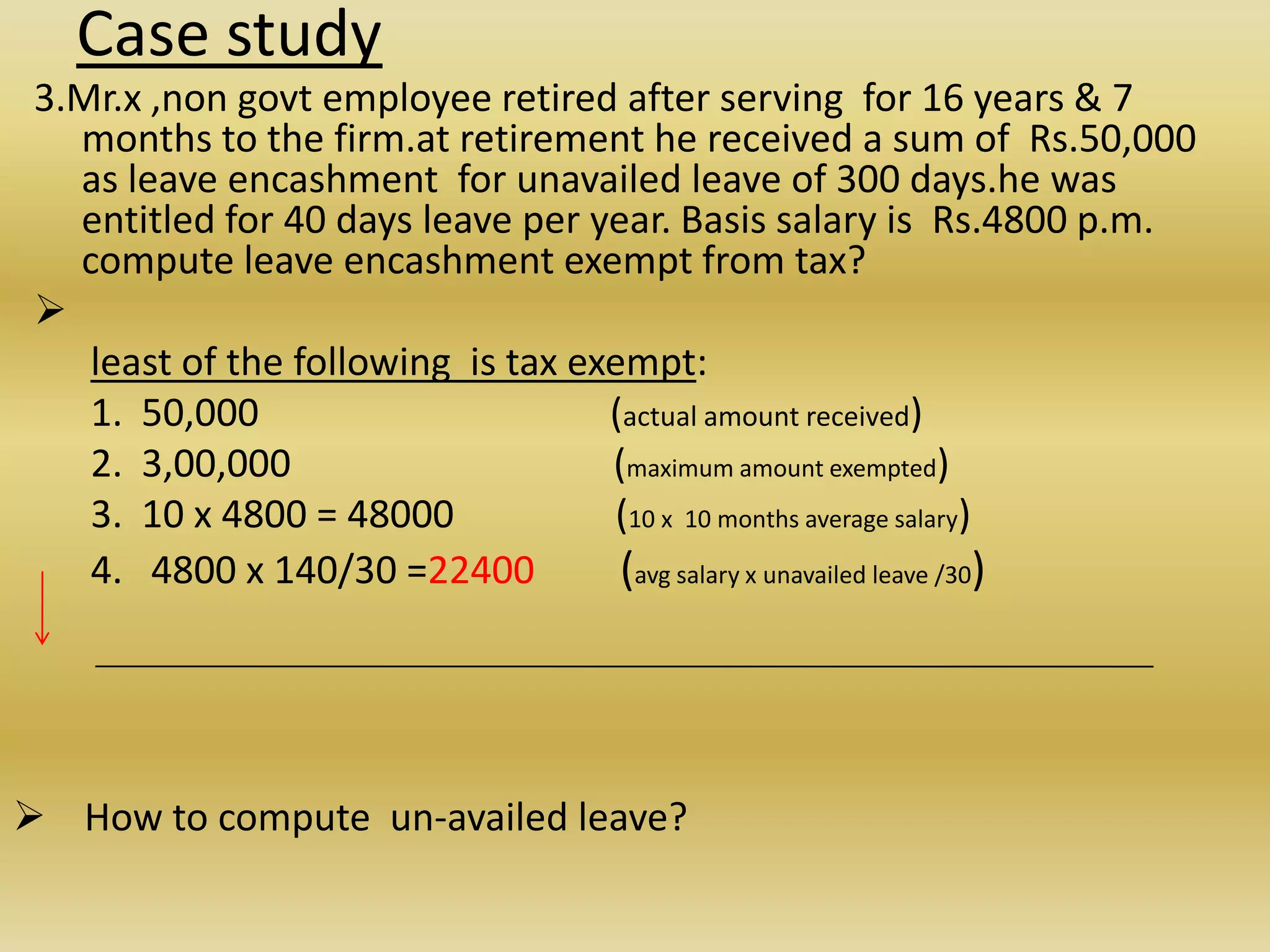
 3.Mr.x ,non govt employee retired after serving for 16 years & 7
   months to the firm.at retirement he received a sum of Rs.50,000
   as leave encashment for unavailed leave of 300 days.he was
   entitled for 40 days leave per year. Basis salary is Rs.4800 p.m.
   compute leave encashment exempt from tax?
 
    least of the following is tax exempt:
    1. 50,000                       (actual amount received)
    2. 3,00,000                     (maximum amount exempted)
    3. 10 x 4800 = 48000            (10 x 10 months average salary)
    4. 4800 x 140/30 =22400          (avg salary x unavailed leave /30)


 How to compute un-availed leave?
How to compute unavailed leave?
Calculation of        company                    Tax law
unavailed leave:
Leave allowed         40 days per year           30 days per year

Completed years       16 years                   16 years

Total leave allowed   16 x 40 =640 days during   16 x 30 =480 days during
                      the whole service.         the whole service.
Unavailed leave       300 (given)

Availed leave         640—300 = 340              340

Unavailed leave       300 (given)                480—340 = 140
If any queries?
Leave encashment

Leave encashment

  • 1.
    LEAVE ENCASHMENT GROUP NO: 1 MEMBERS: Aashima kapil Manish thakur Anupam aditya Anand singh negi Hargovind sahu Hemlata yadav
  • 2.
    LEAVE ENCASHMENT Employee’s definedbenefit.  Employees are entitled to various types of leave while • they are in service.  Under this benefit,employee gets cash payments for unavailing the allowed leaves in each year that he has accumulated.  The cash value of those leave will be deducted from the paymentswhich have been already availed by the employee.  Hence the cash payment availed by the employee in return of the unavailed leave is known as leave encashment.
  • 3.
    Objective of leaveencashment It encourages employees to avail the leave on planned & systematic basis. For employer it favours that his work is done dy his employees in a smooth manner. For employees ,if they don’t avail their leave then they are rewarded in the form of leave encashment. But in case,when employees avail the leave within the limit of leave allowed to them by their employer,atleast they don’t get deduction from their basic salary.
  • 4.
    Types of leaves  For emergency purposes.  No accumulation. Casual leave  Have to avail within the year only.  For sickness.  Accumulation allowed as Medical leave per service rules.  For general purposes.  Carry forward is allowed. Privileged leave  Non-statutory benefit to employee on exit from service.
  • 5.
    Employees are classifiedin to two categories. 2.Non-Government 1. Government employees. employee.  Leave encashment during the  Leave encashment during the service is always taxable. service is always taxable.  Encashment of accumulated  Encashment of accumulated leave at the time of leave at the time of retirement retirement is fully exempt. is exempt up to some extent .  The govt.employees are not  The non-govt. employees are allowed to accumulate leave allowed to accumulate leave for more than 10 months. per the norms of employer.
  • 6.
    LEAVE ENCASHMENT The unavailedleave has to be calculated on the basis of max 30 days leave for every completed year of services.  But if employer has provided leave,which is less than 3o days in a p.y ,then this calculation shall be based on such no.of leaves.  If any employee retires from more than 1 employer then the exemption for each employer shall be calculated separately but the total exemption shall not exceed Rs.3,00,000 .  Leave salary received by the family members after death of the employees is fully exempt from tax.
  • 7.
    LEAVE ENCASHMENT  10months last drawn salary of just preceding the date of retirement is considered as the average salary.  Salary considersd in the calculation of unvailed leave is =B.S+COMISSION(fixed %)+D.A*  Government employees mean employees of central govt or state govt.  For non govt.employees, least of below 4 values shall be exempt of tax from the accumulated leave encashment. i)actual amount received. ii)Rs.3,00,000 iii)10 x avg salary iv) avg salary x unavailed leave/30.  Leave salary paid to legal heirs of a deceased employee is not liable to tax.
  • 8.
    Several case study 1.Rohit’s employer has credited him the leave of 40 days per year………..then also the maximum permissible unavailed leave under the IT act,1967 for the 26 yrs of service is _________=26 x 30 = 780. 2. If in case, 25 days are credited to rohit being a non govt employee ……..then the permissible unavailed leave will be _______= 26 x 25 = 650.(as less than 30 days is considered). 3. Mr.j is an govt employee & got Rs. 50,000 as leave encashment at the time of retirement. then______complete amount will be exempt as Mr.j is an govt employee. 4. Mr.j gets the same amount as leave encashment during his continue service then_____his income will be added in the gross total income & will be taxed according to the slab rate in which he falls in to.
  • 9.
    Case study 3.Mr.x,non govt employee retired after serving for 16 years & 7 months to the firm.at retirement he received a sum of Rs.50,000 as leave encashment for unavailed leave of 300 days.he was entitled for 40 days leave per year. Basis salary is Rs.4800 p.m. compute leave encashment exempt from tax?  least of the following is tax exempt: 1. 50,000 (actual amount received) 2. 3,00,000 (maximum amount exempted) 3. 10 x 4800 = 48000 (10 x 10 months average salary) 4. 4800 x 140/30 =22400 (avg salary x unavailed leave /30)  How to compute un-availed leave?
  • 10.
    How to computeunavailed leave? Calculation of company Tax law unavailed leave: Leave allowed 40 days per year 30 days per year Completed years 16 years 16 years Total leave allowed 16 x 40 =640 days during 16 x 30 =480 days during the whole service. the whole service. Unavailed leave 300 (given) Availed leave 640—300 = 340 340 Unavailed leave 300 (given) 480—340 = 140
  • 11.