CCS Conduct Rules-Do's &
 Dont's For Government
       Employees

         Shankar Bose
    Inspector of Income-tax
          MSTU, Puri
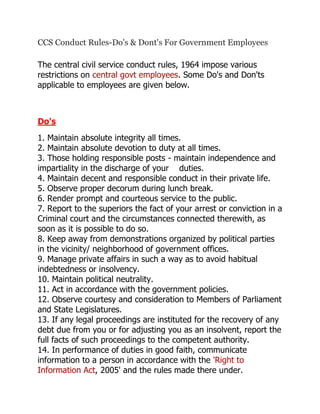
CCS Conduct Rules-Do's & Dont's For Government Employees

The central civil service conduct rules, 1964 impose various
restrictions on central govt employees. Some Do's and Don'ts
applicable to employees are given below.


Do's
1. Maintain absolute integrity all times.
2. Maintain absolute devotion to duty at all times.
3. Those holding responsible posts - maintain independence and
impartiality in the discharge of your duties.
4. Maintain decent and responsible conduct in their private life.
5. Observe proper decorum during lunch break.
6. Render prompt and courteous service to the public.
7. Report to the superiors the fact of your arrest or conviction in a
Criminal court and the circumstances connected therewith, as
soon as it is possible to do so.
8. Keep away from demonstrations organized by political parties
in the vicinity/ neighborhood of government offices.
9. Manage private affairs in such a way as to avoid habitual
indebtedness or insolvency.
10. Maintain political neutrality.
11. Act in accordance with the government policies.
12. Observe courtesy and consideration to Members of Parliament
and State Legislatures.
13. If any legal proceedings are instituted for the recovery of any
debt due from you or for adjusting you as an insolvent, report the
full facts of such proceedings to the competent authority.
14. In performance of duties in good faith, communicate
information to a person in accordance with the 'Right to
Information Act, 2005' and the rules made there under.
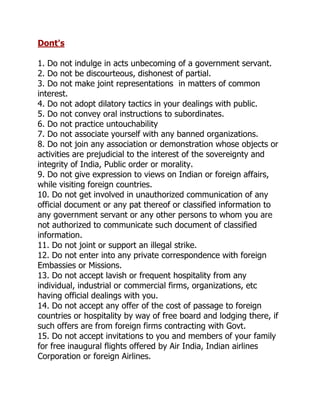
Dont's

1. Do not indulge in acts unbecoming of a government servant.
2. Do not be discourteous, dishonest of partial.
3. Do not make joint representations in matters of common
interest.
4. Do not adopt dilatory tactics in your dealings with public.
5. Do not convey oral instructions to subordinates.
6. Do not practice untouchability
7. Do not associate yourself with any banned organizations.
8. Do not join any association or demonstration whose objects or
activities are prejudicial to the interest of the sovereignty and
integrity of India, Public order or morality.
9. Do not give expression to views on Indian or foreign affairs,
while visiting foreign countries.
10. Do not get involved in unauthorized communication of any
official document or any pat thereof or classified information to
any government servant or any other persons to whom you are
not authorized to communicate such document of classified
information.
11. Do not joint or support an illegal strike.
12. Do not enter into any private correspondence with foreign
Embassies or Missions.
13. Do not accept lavish or frequent hospitality from any
individual, industrial or commercial firms, organizations, etc
having official dealings with you.
14. Do not accept any offer of the cost of passage to foreign
countries or hospitality by way of free board and lodging there, if
such offers are from foreign firms contracting with Govt.
15. Do not accept invitations to you and members of your family
for free inaugural flights offered by Air India, Indian airlines
Corporation or foreign Airlines.
16. Do not give or take or abet giving or taking of dowry or
demand any dowry directly or indirectly from the parent or
guardian of a bride or bridegroom.
17. Do not accept any gift from any foreign firm which is having
official dealings.
18. Do not engage yourself in canvassing business of life
insurance Agency, commission agency or advertising agency
owned or managed by the members of your family.
19. Do not lend or borrow money from or deposit money as a
member or agent, with any person, firm or private company with
whom you likely to have official dealings. Do not otherwise place
yourself under pecuniary obligation with such person, firm or
private company.
20. Do not approach your subordinates for standing surety for
loans taken from private sources either by your / your relations /
friends.
21. Do not undertake private consultancy work.
22. Do not speculate in any stock, share or other investment.
23. Do not purchase shares out of the quota reserved for friends
and associates of Directors of companies.
24. Do not bid at any auction of property where such auction is
arranged by your own officers.
25. Do not stay as guest with foreign diplomats or foreign
national in India.
26. Do not invite any foreign diplomat to stay with you as a guest
in India.
27. Do not accept or permit your wife or dependants to accept
passage money or free air transport from a foreign Mission/
Government or Organization.
28. Do not bring any political influence in matters pertaining to
your service.
29. Do not consume any intoxicating drinks or drugs while on
duty.
30. Do not appear in public place in a state of intoxication.
31. Do not indulge in any act of sexual harassment of any woman
at her work place.
32. Do not employee children below 14 years of age.
33. Do not accept award of monetary benefits instituted by
private trusts/ Foundations, etc.

                     ASPECTS OF VIGILANCE


The dictionary meaning of “Vigilance” is “watchfulness and” its
enforcement necessarily means maintenance of order or tackling
unacceptable misconduct in an imperfectly organized community.
In a revenue department, administering Direct Taxes, Standard
behavior has direct bearing on revenue collection and in turn on
the welfare of the nation.
Rules and Regulations:
  i)     CCS(Conduct) Rules, 1964
  ii) Other Service Rules
  iii) Prevention of Corruption Act, 1988
  A. Structure in the department:
      For all Gr.C & D employees, the Chief Vigilance Officer
      (CVO) is the Cadre Controlling Chief Commissioner of
      Income Tax. This is to say he is the final authority to
      investigate a vigilance case, i.e. first examine whether
      vigilance angle(see below) lies and then investigate to bring
      it to a logical conclusion. He may either drop the
      proceedings or recommend issue of chargesheet and
      subsequently recommend pernalty and its quantum. The
chargesheet is issued by the Disciplinary authority
    (depending upon rank and posting of the charged
    officer(CO)) and well as the pernalty.
The following constitutes Vigilance angle :
  1. Demanding and/or accepting illegal gratification in respect of
     an official act or for using infuence with any other official.
  2. Obtaining a valuable thing without consideration/inadequate
     consideration from a person ;having official dealings or likely
     to have official dealing.
  3. Obtaining pecuniary advance by misusing offcial position.
  4. Possession of assets disproportionate to the known sources
     of income.
  5. Cases of misappropriation,forgery, cheating or other similar
     criminal offences (most commonly s.498A)
  6. Lapses involving :
     a) Gross or willful negligence.
     b) Recklessness in decision making.
     c) Blantant violation of systems & procedures.
     d) Failure to keep the supervisory authority informed in time.
     e) Excess of discretionaly power in excess of furisdiction.


    For Gr.B officicers the Director of Vigilance(Zonal) is the
    CVO and for Gr.A employees, the Director General of
    Vigilance, New Delhi, is the CVO. The approval of the
    CVD(Central Vigilance Commission) at various stages are
    required in this situation. Penalty is finally imposed on behalf
    of the President of India, by the Finance Minister, on
    recommendation of the UPSC.
Penalty for all retired employees is imposable only by the
    President of India.
    Any vigilance proceedings against a retired employee can be
    initiated with four years of his doing so.
    A proceeding abvates on the expiry of an employee.
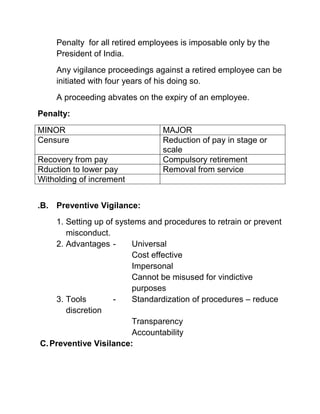
Penalty:
MINOR                            MAJOR
Censure                          Reduction of pay in stage or
                                 scale
Recovery from pay                Compulsory retirement
Rduction to lower pay            Removal from service
Witholding of increment


.B. Preventive Vigilance:
    1. Setting up of systems and procedures to retrain or prevent
       misconduct.
    2. Advantages -      Universal
                         Cost effective
                         Impersonal
                         Cannot be misused for vindictive
                         purposes
    3. Tools        -    Standardization of procedures – reduce
       discretion
                         Transparency
                         Accountability
C. Preventive Visilance:
Examining a specific case on the basis of some information
    with the objective of unearthing evidences so that
    disciplinary proceedings may be initiated.
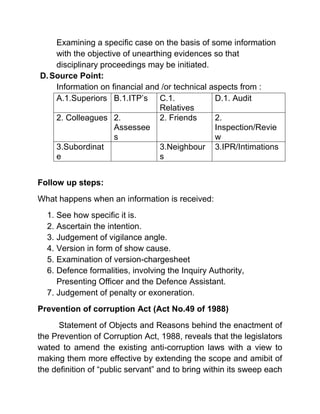
D. Source Point:
    Information on financial and /or technical aspects from :
    A.1.Superiors B.1.ITP’s C.1.                D.1. Audit
                                 Relatives
    2. Colleagues 2.             2. Friends     2.
                     Assessee                   Inspection/Revie
                     s                          w
    3.Subordinat                 3.Neighbour 3.IPR/Intimations
    e                            s


Follow up steps:
What happens when an information is received:
  1. See how specific it is.
  2. Ascertain the intention.
  3. Judgement of vigilance angle.
  4. Version in form of show cause.
  5. Examination of version-chargesheet
  6. Defence formalities, involving the Inquiry Authority,
     Presenting Officer and the Defence Assistant.
  7. Judgement of penalty or exoneration.
Prevention of corruption Act (Act No.49 of 1988)
      Statement of Objects and Reasons behind the enactment of
the Prevention of Corruption Act, 1988, reveals that the legislators
wated to amend the existing anti-corruption laws with a view to
making them more effective by extending the scope and amibit of
the definition of “public servant” and to bring within its sweep each
and every person who held an office by virtue of which he was
required to perform any public duty.
      It is well known that when the words of a statute are wide
and clear then a restricive meaning cannot be given to them. The
purpose of the Act is clear and unambiguous, i.e. the eratiction of
corruption. Hence a construction which would enhance the object
of the Act and curb the mischief is to be put.
     A purposive interpretation should be put on the relevant
provisions of law so as to fulfill the intention of the Legislature and
eschew an interpretation which defeats the object of the Act.
     Parliament is presumed to intend that in construing an Act
the court, by advancing the remedy which is indicated by the
workds of the Act for the mischief being dealth with, and the
implications arising from those words, should aim to further every
aspect of the ligislative purpose. A construction which promotes
the remedy Parliament has provided to sure a particular mischief
is now known as a purposive construction.
     Where a public interest is affected an interpretation is
preferred which favours the public. A narrow construction should
not be permitted to under mine the public policy sought to be
served. This is especially so where a narrow construction
discourages rather than encourages the specific action the
Legislature has sought to foster and promulgate. The founding
fathers of the Constitution envisioned the legislators as men of
character, rectitude and moral uprightness whose sole object was
to serve the purlic with dedication, to be open, truthfull and legal.
     The CBI mainly acts on this.
Other agencies:
  1. Central Bureau of Investigation (CBI) – Anti Corruption
     Whing:
     1. Mainly works under Prevention of Corruption Act.
     2. Follows CVC’s Manual
     3. Cordination with Department
        - Time to time meeting
        - Exchange of information
        - Investigation for autual benefit
  2. Central Vigilance Commission (CVC):
     In pursuance of recommendations made by the Committee
     on Prevention of Corruption (popularly known as Santhanam
     Committee), the CVC was set up by the Government of India
     by a Resulution. The Central Vigilance Commission Bill was
     passed by both the Houses of Parliament in 2003 and the
     President gave its assent on 11th September, 2003, thus, the
     Central Vigilance Commission Act, 2003(No.45 of 2003)
     came into effect from that date.
     Check Points:
     1. Display decency in lifestyle
     2. Display decency in behaviour
     3. Maintain arms length distance with superiors,
        subordinates, members of public.
     4. Updating self on procedures, changing scenario in the
        department, introduction and use of technology.
     5. Follow rules of business
     6. Consistency in decision making
     7. Proper record maintenance
     8. Diarised planning of work
     9. Alerts on time bound actions
10. Linding visible expenditure or investment, in name of
       self or others, with sources of income.
CC’s office:
    Apart from the functions mentioned above, the vigilance
wing of the CCIT(CCA) also deals with no objection for the
purpose of granting of promotions, retirement benefits and
acquiring international passport. The no objection to travel abroad
has now been vested with the leave sanctioing authority of the
employee concerned.


                  Thank you

Ccs conduct rules.do and donot.vigilance aspect.bose

  • 1.
    CCS Conduct Rules-Do's& Dont's For Government Employees Shankar Bose Inspector of Income-tax MSTU, Puri
  • 2.
    CCS Conduct Rules-Do's& Dont's For Government Employees The central civil service conduct rules, 1964 impose various restrictions on central govt employees. Some Do's and Don'ts applicable to employees are given below. Do's 1. Maintain absolute integrity all times. 2. Maintain absolute devotion to duty at all times. 3. Those holding responsible posts - maintain independence and impartiality in the discharge of your duties. 4. Maintain decent and responsible conduct in their private life. 5. Observe proper decorum during lunch break. 6. Render prompt and courteous service to the public. 7. Report to the superiors the fact of your arrest or conviction in a Criminal court and the circumstances connected therewith, as soon as it is possible to do so. 8. Keep away from demonstrations organized by political parties in the vicinity/ neighborhood of government offices. 9. Manage private affairs in such a way as to avoid habitual indebtedness or insolvency. 10. Maintain political neutrality. 11. Act in accordance with the government policies. 12. Observe courtesy and consideration to Members of Parliament and State Legislatures. 13. If any legal proceedings are instituted for the recovery of any debt due from you or for adjusting you as an insolvent, report the full facts of such proceedings to the competent authority. 14. In performance of duties in good faith, communicate information to a person in accordance with the 'Right to Information Act, 2005' and the rules made there under.
  • 3.
    Dont's 1. Do notindulge in acts unbecoming of a government servant. 2. Do not be discourteous, dishonest of partial. 3. Do not make joint representations in matters of common interest. 4. Do not adopt dilatory tactics in your dealings with public. 5. Do not convey oral instructions to subordinates. 6. Do not practice untouchability 7. Do not associate yourself with any banned organizations. 8. Do not join any association or demonstration whose objects or activities are prejudicial to the interest of the sovereignty and integrity of India, Public order or morality. 9. Do not give expression to views on Indian or foreign affairs, while visiting foreign countries. 10. Do not get involved in unauthorized communication of any official document or any pat thereof or classified information to any government servant or any other persons to whom you are not authorized to communicate such document of classified information. 11. Do not joint or support an illegal strike. 12. Do not enter into any private correspondence with foreign Embassies or Missions. 13. Do not accept lavish or frequent hospitality from any individual, industrial or commercial firms, organizations, etc having official dealings with you. 14. Do not accept any offer of the cost of passage to foreign countries or hospitality by way of free board and lodging there, if such offers are from foreign firms contracting with Govt. 15. Do not accept invitations to you and members of your family for free inaugural flights offered by Air India, Indian airlines Corporation or foreign Airlines.
  • 4.
    16. Do notgive or take or abet giving or taking of dowry or demand any dowry directly or indirectly from the parent or guardian of a bride or bridegroom. 17. Do not accept any gift from any foreign firm which is having official dealings. 18. Do not engage yourself in canvassing business of life insurance Agency, commission agency or advertising agency owned or managed by the members of your family. 19. Do not lend or borrow money from or deposit money as a member or agent, with any person, firm or private company with whom you likely to have official dealings. Do not otherwise place yourself under pecuniary obligation with such person, firm or private company. 20. Do not approach your subordinates for standing surety for loans taken from private sources either by your / your relations / friends. 21. Do not undertake private consultancy work. 22. Do not speculate in any stock, share or other investment. 23. Do not purchase shares out of the quota reserved for friends and associates of Directors of companies. 24. Do not bid at any auction of property where such auction is arranged by your own officers. 25. Do not stay as guest with foreign diplomats or foreign national in India. 26. Do not invite any foreign diplomat to stay with you as a guest in India. 27. Do not accept or permit your wife or dependants to accept passage money or free air transport from a foreign Mission/ Government or Organization. 28. Do not bring any political influence in matters pertaining to your service. 29. Do not consume any intoxicating drinks or drugs while on duty.
  • 5.
    30. Do notappear in public place in a state of intoxication. 31. Do not indulge in any act of sexual harassment of any woman at her work place. 32. Do not employee children below 14 years of age. 33. Do not accept award of monetary benefits instituted by private trusts/ Foundations, etc. ASPECTS OF VIGILANCE The dictionary meaning of “Vigilance” is “watchfulness and” its enforcement necessarily means maintenance of order or tackling unacceptable misconduct in an imperfectly organized community. In a revenue department, administering Direct Taxes, Standard behavior has direct bearing on revenue collection and in turn on the welfare of the nation. Rules and Regulations: i) CCS(Conduct) Rules, 1964 ii) Other Service Rules iii) Prevention of Corruption Act, 1988 A. Structure in the department: For all Gr.C & D employees, the Chief Vigilance Officer (CVO) is the Cadre Controlling Chief Commissioner of Income Tax. This is to say he is the final authority to investigate a vigilance case, i.e. first examine whether vigilance angle(see below) lies and then investigate to bring it to a logical conclusion. He may either drop the proceedings or recommend issue of chargesheet and subsequently recommend pernalty and its quantum. The
  • 6.
    chargesheet is issuedby the Disciplinary authority (depending upon rank and posting of the charged officer(CO)) and well as the pernalty. The following constitutes Vigilance angle : 1. Demanding and/or accepting illegal gratification in respect of an official act or for using infuence with any other official. 2. Obtaining a valuable thing without consideration/inadequate consideration from a person ;having official dealings or likely to have official dealing. 3. Obtaining pecuniary advance by misusing offcial position. 4. Possession of assets disproportionate to the known sources of income. 5. Cases of misappropriation,forgery, cheating or other similar criminal offences (most commonly s.498A) 6. Lapses involving : a) Gross or willful negligence. b) Recklessness in decision making. c) Blantant violation of systems & procedures. d) Failure to keep the supervisory authority informed in time. e) Excess of discretionaly power in excess of furisdiction. For Gr.B officicers the Director of Vigilance(Zonal) is the CVO and for Gr.A employees, the Director General of Vigilance, New Delhi, is the CVO. The approval of the CVD(Central Vigilance Commission) at various stages are required in this situation. Penalty is finally imposed on behalf of the President of India, by the Finance Minister, on recommendation of the UPSC.
  • 7.
    Penalty for allretired employees is imposable only by the President of India. Any vigilance proceedings against a retired employee can be initiated with four years of his doing so. A proceeding abvates on the expiry of an employee. Penalty: MINOR MAJOR Censure Reduction of pay in stage or scale Recovery from pay Compulsory retirement Rduction to lower pay Removal from service Witholding of increment .B. Preventive Vigilance: 1. Setting up of systems and procedures to retrain or prevent misconduct. 2. Advantages - Universal Cost effective Impersonal Cannot be misused for vindictive purposes 3. Tools - Standardization of procedures – reduce discretion Transparency Accountability C. Preventive Visilance:
  • 8.
    Examining a specificcase on the basis of some information with the objective of unearthing evidences so that disciplinary proceedings may be initiated. D. Source Point: Information on financial and /or technical aspects from : A.1.Superiors B.1.ITP’s C.1. D.1. Audit Relatives 2. Colleagues 2. 2. Friends 2. Assessee Inspection/Revie s w 3.Subordinat 3.Neighbour 3.IPR/Intimations e s Follow up steps: What happens when an information is received: 1. See how specific it is. 2. Ascertain the intention. 3. Judgement of vigilance angle. 4. Version in form of show cause. 5. Examination of version-chargesheet 6. Defence formalities, involving the Inquiry Authority, Presenting Officer and the Defence Assistant. 7. Judgement of penalty or exoneration. Prevention of corruption Act (Act No.49 of 1988) Statement of Objects and Reasons behind the enactment of the Prevention of Corruption Act, 1988, reveals that the legislators wated to amend the existing anti-corruption laws with a view to making them more effective by extending the scope and amibit of the definition of “public servant” and to bring within its sweep each
  • 9.
    and every personwho held an office by virtue of which he was required to perform any public duty. It is well known that when the words of a statute are wide and clear then a restricive meaning cannot be given to them. The purpose of the Act is clear and unambiguous, i.e. the eratiction of corruption. Hence a construction which would enhance the object of the Act and curb the mischief is to be put. A purposive interpretation should be put on the relevant provisions of law so as to fulfill the intention of the Legislature and eschew an interpretation which defeats the object of the Act. Parliament is presumed to intend that in construing an Act the court, by advancing the remedy which is indicated by the workds of the Act for the mischief being dealth with, and the implications arising from those words, should aim to further every aspect of the ligislative purpose. A construction which promotes the remedy Parliament has provided to sure a particular mischief is now known as a purposive construction. Where a public interest is affected an interpretation is preferred which favours the public. A narrow construction should not be permitted to under mine the public policy sought to be served. This is especially so where a narrow construction discourages rather than encourages the specific action the Legislature has sought to foster and promulgate. The founding fathers of the Constitution envisioned the legislators as men of character, rectitude and moral uprightness whose sole object was to serve the purlic with dedication, to be open, truthfull and legal. The CBI mainly acts on this.
  • 10.
    Other agencies: 1. Central Bureau of Investigation (CBI) – Anti Corruption Whing: 1. Mainly works under Prevention of Corruption Act. 2. Follows CVC’s Manual 3. Cordination with Department - Time to time meeting - Exchange of information - Investigation for autual benefit 2. Central Vigilance Commission (CVC): In pursuance of recommendations made by the Committee on Prevention of Corruption (popularly known as Santhanam Committee), the CVC was set up by the Government of India by a Resulution. The Central Vigilance Commission Bill was passed by both the Houses of Parliament in 2003 and the President gave its assent on 11th September, 2003, thus, the Central Vigilance Commission Act, 2003(No.45 of 2003) came into effect from that date. Check Points: 1. Display decency in lifestyle 2. Display decency in behaviour 3. Maintain arms length distance with superiors, subordinates, members of public. 4. Updating self on procedures, changing scenario in the department, introduction and use of technology. 5. Follow rules of business 6. Consistency in decision making 7. Proper record maintenance 8. Diarised planning of work 9. Alerts on time bound actions
  • 11.
    10. Linding visibleexpenditure or investment, in name of self or others, with sources of income. CC’s office: Apart from the functions mentioned above, the vigilance wing of the CCIT(CCA) also deals with no objection for the purpose of granting of promotions, retirement benefits and acquiring international passport. The no objection to travel abroad has now been vested with the leave sanctioing authority of the employee concerned. Thank you