The Apprentices Act 1961

       By group no 1
THE OBJECT
¤ To meet the increasing demand for skill
    craftsmen.
¤   To utilize facilities available for training
    apprentices.
¤   To ensure their training in accordance with plan
    programme.
¤   Promotion of new man power skill.
¤   Improvement & refinement of old skill.
STANDARD OF EDUCATION FOR
   APPRENTICES

¤ He shall satisfy the minimum educational
 qualifications as specified in schedule 1.

¤ A person shall be eligible for been engaged as
 graduate or technician or technician vocational
 apprentices.
PERIOD OF APPRENTICESHIP
   TRAINING

¤ who undergone institutional training in a school or
 other institution recognised by national council
 period of apprenticeship training shall be such as
 determine by council or institution recognise by that
 council.

¤ Who undergoes institutional training in a school or
 other institution recognised by board or authority
 notified in official gazette period of apprenticeship
 training shall be as may be prescribed.
¤ Other trade apprentices, the period of training shall
 be prescribed.

¤ Graduate or technician apprentices period of training
 as may be prescribed.
Sairaj
OBLIGATIONS OF AN APPRENTICE TO
ACCEPT EMPLOYMENT FROM
EMPLOYER
 it is not obligatory on the part of the employer
 to offer any apprentice who has completed his
 period of apprenticeship
OBLIGATIONS OF THE APPRENTICE
Every trade apprentice undergoing apprenticeship
training shall have the following obligations, namely:-
1) To learn his trade conscientiously and diligently and
     Endeavour to qualify himself as a skilled craftsmen
     before the expiry of the period of training;
2) To attend practical and instructional classes
     regularly;
3) To carry out all lawful orders of his employer and
     superiors in the establishment and
4) To carry out his obligations under the contract of
     apprenticeship.
Every graduate or technician apprentice undergoing
apprenticeship training shall have the following
obligations, namely:-
1) To learn his subject field in engineering or
    technology conscientiously and diligently at his
    place of training
2) To attend the practical and instructional classes
    regularly
3) To carry out all lawful orders of his employer and
    superiors in the establishment, and
4) To carry out his obligations under the contract of
    apprenticeship which shall include the maintenance
    of such records of his work as may be prescribe
OBLIGATIONS OF EMPLOYERS
TOWARS APPRENTICES
Without prejudice to the other provisions of the
Act, every employer shall have the following obligations
in relation to an apprentice, namely:-
1) To provide the apprentice with the training in his
     trade in accordance with the provisions of the
     Act, and the rules made there under
2) If the employer is not himself qualified in the
     trade, to ensure that a person who possesses the
     prescribe qualifications is place in charge of the
     training of the apprentice; and
3) To carry out his obligations under the contract of
     apprenticeship
APPRENTICES AN BONUS
 By the very definition of the ‘employee’, the
  apprentices are not eligible for bonus as per section 2
  (13) of the payment of bonus Act.
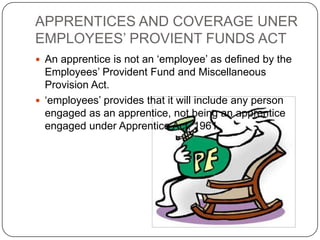
APPRENTICES AND COVERAGE UNER
EMPLOYEES’ PROVIENT FUNDS ACT
 An apprentice is not an ‘employee’ as defined by the
  Employees’ Provident Fund and Miscellaneous
  Provision Act.
 ‘employees’ provides that it will include any person
  engaged as an apprentice, not being an apprentice
  engaged under Apprentice Act, 1961
APPRENTICES AND COVERAGE UNDER
EMPLOYEES STATE INSURANCE ACT
 The Amending Act 29 of employees’ State Insurance
 Act, 1989 while defining an employee under the ESI
 Act has provided that it goes not include any person
 engaged as an apprentice under the Apprentices Act
 1961 or under the Standing Orders of the
 establishment.
Hours of work
   The daily hours of work of an apprentice shall
    not be more than 8 hours per day and weekly
    hours not less than 40 hours but not more than
    45 hours.

   A short term apprentice may however be
    engaged to work up to a maximum limit of 48
    hours per week.

   The hours of training of the apprentice should
    not be between 10pm and 6am except with the
    prior approval of the apprenticeship adviser.
   An apprentice is entitled to leave in accordance
    with the leave rules which exist for the workers
    of that establishment provided every apprentice
    must put in a minimum attendance of 264 days
    in a year of training,

   of which1/6th should be devoted to related
    instructions and 220 days to practical training.
Grant of leave to apprentice
(a) Casual leave :
 Casual leave shall be admissible for a maximum
 period of twelve days in a year ;

 Any holidays intervening during the period of
 casual leave shall not be counted for purpose of
 the limit of twelve days ;

 Casual leave not utilised during any year shall
 stand lapsed at the end of the year ;
 Casual leave shall not be combined with medical
 leave .

 if casual leave is preceded or followed by medical
 leave, the entire leave taken shall be treated either
 as medical or casual leave provided that it shall not
 be allowed to exceed the maximum period
 prescribed in respect of medical or casual leave, as
 the case may be;

 Except in case of extreme urgency applications for
 such leave shall be made to appropriate authority
 and sanction obtained prior to the availing of leave.
(b) medical leave :

 Medical leave up to fifteen days of each year of
 training may be granted to the apprentice who is
 unable to attend duty owing to illness.

 The unused leaves shall be allowed to
 accumulate up to a maximum of forty days;
 Any holidays intervening during the period of
 medical leave shall be treated as medical leave
 and accounted for in the limits prescribed under
 clause(i)

 The employer may call upon the apprentice to
 produce a medical certificate from a registered
 medical practitioner in support of his medical
 leave.
 A medical certificate shall, however , be
 necessary , if the leave exceeds six days;

 It shall be open to the employer to arrange a
 special medical examination of an apprentice if
 he has reason to believe that the apprentice is
 not really ill or the illness is not of such a nature
 as to prevent his attendance.
( c) extraordinary leave :
 Extraordinary leave up to a maximum of ten days
  in a year may be granted to the apprentice, after
  he has exhausted the entire casual leave and
  medical leave ,

 if the employer is satisfied with the genuineness
 of the ground on which the leave is applied for .
Violation of the act by an employer –
consequences OF

1.The apprentices act provides that if any employer
 (a) engages as an apprentice a person who is not
  qualified for being so engaged or

 (b) fails to carry out the terms and conditions of a
 contract of apprenticeship; or
 (c) contravene the provisions of the act relating to
 the number of apprentices which he is required to
 engage under those provisions, he shall be
 punishable with imprisonment for a term which
 may extend to six months or with fine or with
 both.
2.If any employer or any other person
 (a) requires an apprentice to work over-time
  without the approval of the apprenticeship adviser
  ;or

 (b) employs an apprentice on any work which is
 not connected with his training; or
 (c) makes payment to an apprentice on the basis
 of piece- work or ;

 (d)requires an apprentice to take part in any
 output bonus or incentive scheme, he shall be
 punishable with imprisonment for a term which
 may extend to six months or with fine or with
 both.
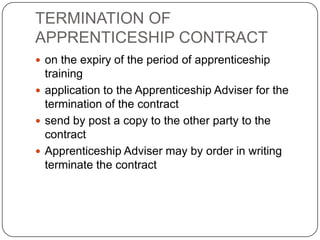
TERMINATION OF
APPRENTICESHIP CONTRACT
 on the expiry of the period of apprenticeship
  training
 application to the Apprenticeship Adviser for the
  termination of the contract
 send by post a copy to the other party to the
  contract
 Apprenticeship Adviser may by order in writing
  terminate the contract
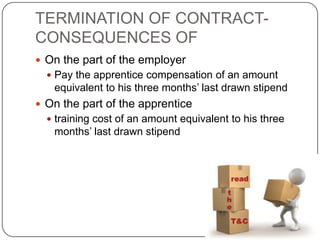
TERMINATION OF CONTRACT-
CONSEQUENCES OF
 On the part of the employer
   Pay the apprentice compensation of an amount
   equivalent to his three months’ last drawn stipend
 On the part of the apprentice
   training cost of an amount equivalent to his three
   months’ last drawn stipend
STIPEND TO THE APPRENTICE
 rates of stipend for different categories be asked
 from the Apprenticeship Adviser in particular
 state, wherein the factory or the establishment is
 located
EMPLOYMENT EXCHANGE
SPONSORING NOT NECESSARY
 Eligible to be considered for any future
 appointment, without being sponsored by any
 employment exchange
SETTLEMENT OF DISPUTES
 Any disagreement shall be referred to
  Apprenticeship adviser
 aggrieved by the decision of the said
  Authority, may within 30 days, prefer an
  appeal against such decision to the
  Apprenticeship Council
 shall be heard and determined by a
  Committee of that Council appointed for the
  purpose
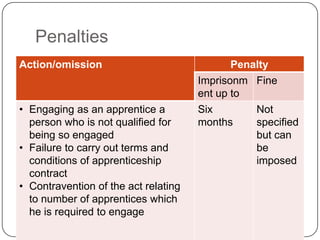
Penalties
Action/omission                             Penalty
                                      Imprisonm Fine
                                      ent up to
• Engaging as an apprentice a         Six       Not
  person who is not qualified for     months    specified
  being so engaged                              but can
• Failure to carry out terms and                be
  conditions of apprenticeship                  imposed
  contract
• Contravention of the act relating
  to number of apprentices which
  he is required to engage
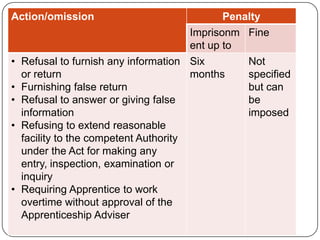
Action/omission                              Penalty
                                        Imprisonm Fine
                                        ent up to
•   Refusal to furnish any information Six        Not
    or return                           months    specified
•   Furnishing false return                       but can
•   Refusal to answer or giving false             be
    information                                   imposed
•   Refusing to extend reasonable
    facility to the competent Authority
    under the Act for making any
    entry, inspection, examination or
    inquiry
•   Requiring Apprentice to work
    overtime without approval of the
    Apprenticeship Adviser
Action/omission                            Penalty
                                     Imprisonm Fine
                                     ent up to
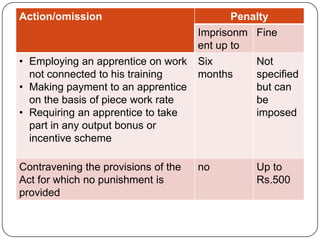
• Employing an apprentice on work    Six       Not
  not connected to his training      months    specified
• Making payment to an apprentice              but can
  on the basis of piece work rate              be
• Requiring an apprentice to take              imposed
  part in any output bonus or
  incentive scheme

Contravening the provisions of the   no         Up to
Act for which no punishment is                  Rs.500
provided
The apprentices act 1961

The apprentices act 1961

  • 1.
    The Apprentices Act1961 By group no 1
  • 2.
    THE OBJECT ¤ Tomeet the increasing demand for skill craftsmen. ¤ To utilize facilities available for training apprentices. ¤ To ensure their training in accordance with plan programme. ¤ Promotion of new man power skill. ¤ Improvement & refinement of old skill.
  • 3.
    STANDARD OF EDUCATIONFOR APPRENTICES ¤ He shall satisfy the minimum educational qualifications as specified in schedule 1. ¤ A person shall be eligible for been engaged as graduate or technician or technician vocational apprentices.
  • 4.
    PERIOD OF APPRENTICESHIP TRAINING ¤ who undergone institutional training in a school or other institution recognised by national council period of apprenticeship training shall be such as determine by council or institution recognise by that council. ¤ Who undergoes institutional training in a school or other institution recognised by board or authority notified in official gazette period of apprenticeship training shall be as may be prescribed.
  • 5.
    ¤ Other tradeapprentices, the period of training shall be prescribed. ¤ Graduate or technician apprentices period of training as may be prescribed.
  • 6.
  • 7.
    OBLIGATIONS OF ANAPPRENTICE TO ACCEPT EMPLOYMENT FROM EMPLOYER  it is not obligatory on the part of the employer to offer any apprentice who has completed his period of apprenticeship
  • 8.
    OBLIGATIONS OF THEAPPRENTICE Every trade apprentice undergoing apprenticeship training shall have the following obligations, namely:- 1) To learn his trade conscientiously and diligently and Endeavour to qualify himself as a skilled craftsmen before the expiry of the period of training; 2) To attend practical and instructional classes regularly; 3) To carry out all lawful orders of his employer and superiors in the establishment and 4) To carry out his obligations under the contract of apprenticeship.
  • 9.
    Every graduate ortechnician apprentice undergoing apprenticeship training shall have the following obligations, namely:- 1) To learn his subject field in engineering or technology conscientiously and diligently at his place of training 2) To attend the practical and instructional classes regularly 3) To carry out all lawful orders of his employer and superiors in the establishment, and 4) To carry out his obligations under the contract of apprenticeship which shall include the maintenance of such records of his work as may be prescribe
  • 10.
    OBLIGATIONS OF EMPLOYERS TOWARSAPPRENTICES Without prejudice to the other provisions of the Act, every employer shall have the following obligations in relation to an apprentice, namely:- 1) To provide the apprentice with the training in his trade in accordance with the provisions of the Act, and the rules made there under 2) If the employer is not himself qualified in the trade, to ensure that a person who possesses the prescribe qualifications is place in charge of the training of the apprentice; and 3) To carry out his obligations under the contract of apprenticeship
  • 11.
    APPRENTICES AN BONUS By the very definition of the ‘employee’, the apprentices are not eligible for bonus as per section 2 (13) of the payment of bonus Act.
  • 12.
    APPRENTICES AND COVERAGEUNER EMPLOYEES’ PROVIENT FUNDS ACT  An apprentice is not an ‘employee’ as defined by the Employees’ Provident Fund and Miscellaneous Provision Act.  ‘employees’ provides that it will include any person engaged as an apprentice, not being an apprentice engaged under Apprentice Act, 1961
  • 13.
    APPRENTICES AND COVERAGEUNDER EMPLOYEES STATE INSURANCE ACT  The Amending Act 29 of employees’ State Insurance Act, 1989 while defining an employee under the ESI Act has provided that it goes not include any person engaged as an apprentice under the Apprentices Act 1961 or under the Standing Orders of the establishment.
  • 14.
    Hours of work  The daily hours of work of an apprentice shall not be more than 8 hours per day and weekly hours not less than 40 hours but not more than 45 hours.  A short term apprentice may however be engaged to work up to a maximum limit of 48 hours per week.  The hours of training of the apprentice should not be between 10pm and 6am except with the prior approval of the apprenticeship adviser.
  • 15.
    An apprentice is entitled to leave in accordance with the leave rules which exist for the workers of that establishment provided every apprentice must put in a minimum attendance of 264 days in a year of training,  of which1/6th should be devoted to related instructions and 220 days to practical training.
  • 16.
    Grant of leaveto apprentice (a) Casual leave :  Casual leave shall be admissible for a maximum period of twelve days in a year ;  Any holidays intervening during the period of casual leave shall not be counted for purpose of the limit of twelve days ;  Casual leave not utilised during any year shall stand lapsed at the end of the year ;
  • 17.
     Casual leaveshall not be combined with medical leave .  if casual leave is preceded or followed by medical leave, the entire leave taken shall be treated either as medical or casual leave provided that it shall not be allowed to exceed the maximum period prescribed in respect of medical or casual leave, as the case may be;  Except in case of extreme urgency applications for such leave shall be made to appropriate authority and sanction obtained prior to the availing of leave.
  • 18.
    (b) medical leave:  Medical leave up to fifteen days of each year of training may be granted to the apprentice who is unable to attend duty owing to illness.  The unused leaves shall be allowed to accumulate up to a maximum of forty days;
  • 19.
     Any holidaysintervening during the period of medical leave shall be treated as medical leave and accounted for in the limits prescribed under clause(i)  The employer may call upon the apprentice to produce a medical certificate from a registered medical practitioner in support of his medical leave.
  • 20.
     A medicalcertificate shall, however , be necessary , if the leave exceeds six days;  It shall be open to the employer to arrange a special medical examination of an apprentice if he has reason to believe that the apprentice is not really ill or the illness is not of such a nature as to prevent his attendance.
  • 21.
    ( c) extraordinaryleave :  Extraordinary leave up to a maximum of ten days in a year may be granted to the apprentice, after he has exhausted the entire casual leave and medical leave ,  if the employer is satisfied with the genuineness of the ground on which the leave is applied for .
  • 22.
    Violation of theact by an employer – consequences OF 1.The apprentices act provides that if any employer  (a) engages as an apprentice a person who is not qualified for being so engaged or  (b) fails to carry out the terms and conditions of a contract of apprenticeship; or
  • 23.
     (c) contravenethe provisions of the act relating to the number of apprentices which he is required to engage under those provisions, he shall be punishable with imprisonment for a term which may extend to six months or with fine or with both.
  • 24.
    2.If any employeror any other person  (a) requires an apprentice to work over-time without the approval of the apprenticeship adviser ;or  (b) employs an apprentice on any work which is not connected with his training; or
  • 25.
     (c) makespayment to an apprentice on the basis of piece- work or ;  (d)requires an apprentice to take part in any output bonus or incentive scheme, he shall be punishable with imprisonment for a term which may extend to six months or with fine or with both.
  • 27.
    TERMINATION OF APPRENTICESHIP CONTRACT on the expiry of the period of apprenticeship training  application to the Apprenticeship Adviser for the termination of the contract  send by post a copy to the other party to the contract  Apprenticeship Adviser may by order in writing terminate the contract
  • 28.
    TERMINATION OF CONTRACT- CONSEQUENCESOF  On the part of the employer  Pay the apprentice compensation of an amount equivalent to his three months’ last drawn stipend  On the part of the apprentice  training cost of an amount equivalent to his three months’ last drawn stipend
  • 29.
    STIPEND TO THEAPPRENTICE  rates of stipend for different categories be asked from the Apprenticeship Adviser in particular state, wherein the factory or the establishment is located
  • 30.
    EMPLOYMENT EXCHANGE SPONSORING NOTNECESSARY  Eligible to be considered for any future appointment, without being sponsored by any employment exchange
  • 31.
    SETTLEMENT OF DISPUTES Any disagreement shall be referred to Apprenticeship adviser  aggrieved by the decision of the said Authority, may within 30 days, prefer an appeal against such decision to the Apprenticeship Council  shall be heard and determined by a Committee of that Council appointed for the purpose
  • 32.
    Penalties Action/omission Penalty Imprisonm Fine ent up to • Engaging as an apprentice a Six Not person who is not qualified for months specified being so engaged but can • Failure to carry out terms and be conditions of apprenticeship imposed contract • Contravention of the act relating to number of apprentices which he is required to engage
  • 33.
    Action/omission Penalty Imprisonm Fine ent up to • Refusal to furnish any information Six Not or return months specified • Furnishing false return but can • Refusal to answer or giving false be information imposed • Refusing to extend reasonable facility to the competent Authority under the Act for making any entry, inspection, examination or inquiry • Requiring Apprentice to work overtime without approval of the Apprenticeship Adviser
  • 34.
    Action/omission Penalty Imprisonm Fine ent up to • Employing an apprentice on work Six Not not connected to his training months specified • Making payment to an apprentice but can on the basis of piece work rate be • Requiring an apprentice to take imposed part in any output bonus or incentive scheme Contravening the provisions of the no Up to Act for which no punishment is Rs.500 provided