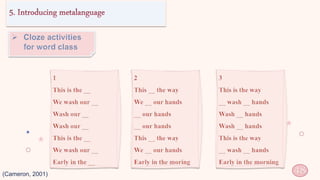
cooperation
Friendship
Peace
Family
Beauty
Health
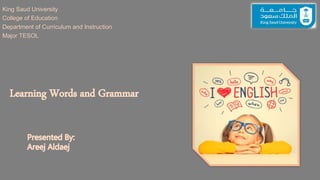
King Saud University
College of Education
Department of Curriculum and Instruction
Major TESOL
1
What is vocabulary.
Types of vocabulary.
Vocabulary development in children's language
learning.
Organisation of words in a language.
Learning vocabulary.
Controversial effect of Translation as a method for
teaching or learning vocabulary as a foreign language.
2
Grammar & young learners.
Types of Grammar.
From words to Grammar
Principals for teaching Grammar for young
learners.
Teaching techniques for supporting Grammar
learning.
 Hornby (1995) defines vocabulary as ”the total number of words in a
language; vocabulary is a list of words with their meanings”. (p. 133).
 vocabulary takes an important role for young learners in learning the
target language. (Astuti, Wijaya & Bunau, 2013: 2)
 According to Cameron (2001: 73) “Vocabulary is about learning words,
children are not only expected to know the word but also they have to know
what the meaning of that word.”
3
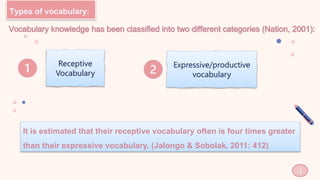
Receptive
Vocabulary
Expressive/productive
vocabulary
Types of vocabulary:
4
It is estimated that their receptive vocabulary often is four times greater
than their expressive vocabulary. (Jalongo & Sobolak, 2011: 412)
5
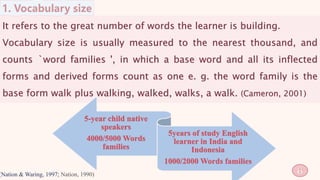
It refers to the great number of words the learner is building.
Vocabulary size is usually measured to the nearest thousand, and
counts `word families ', in which a base word and all its inflected
forms and derived forms count as one e. g. the word family is the
base form walk plus walking, walked, walks, a walk. (Cameron, 2001)
(Nation & Waring, 1997; Nation, 1990) 6
5-year child native
speakers
4000/5000 Words
families
5years of study English
learner in India and
Indonesia
1000/2000 Words families
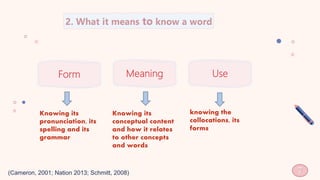
(Cameron, 2001; Nation 2013; Schmitt, 2008)
Form Meaning Use
Knowing its
pronunciation, its
spelling and its
grammar
Knowing its
conceptual content
and how it relates
to other concepts
and words
knowing the
collocations, its
forms
7
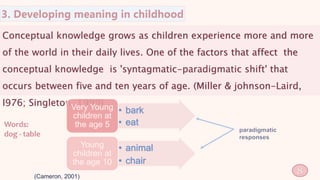
Words:
dog - table
(Cameron, 2001)
8
Conceptual knowledge grows as children experience more and more
of the world in their daily lives. One of the factors that affect the
conceptual knowledge is 'syntagmatic-paradigmatic shift' that
occurs between five and ten years of age. (Miller & johnson-Laird,
I976; Singleton, 1999)
Very Young
children at
the age 5
Young
children at
the age 10
• bark
• eat
• animal
• chair
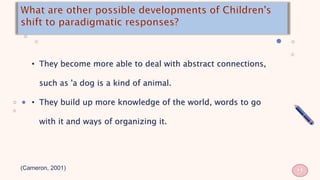
• They become more able to deal with abstract connections,
such as 'a dog is a kind of animal.
• They build up more knowledge of the world, words to go
with it and ways of organizing it.
(Cameron, 2001)
9
10
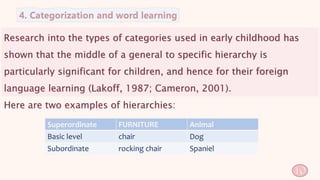
Research into the types of categories used in early childhood has
shown that the middle of a general to specific hierarchy is
particularly significant for children, and hence for their foreign
language learning (Lakoff, 1987; Cameron, 2001).
Here are two examples of hierarchies:
Superordinate FURNITURE Animal
Basic level chair Dog
Subordinate rocking chair Spaniel
11
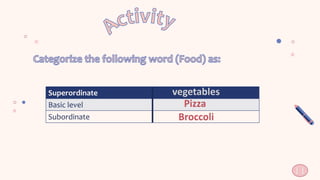
Superordinate
Basic level
Subordinate
12
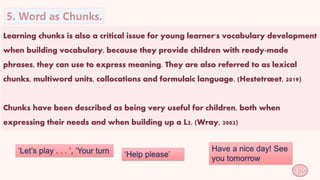
Learning chunks is also a critical issue for young learner's vocabulary development
when building vocabulary, because they provide children with ready-made
phrases, they can use to express meaning. They are also referred to as lexical
chunks, multiword units, collocations and formulaic language. (Hestetræet, 2019)
Chunks have been described as being very useful for children, both when
expressing their needs and when building up a L2. (Wray, 2002)
13
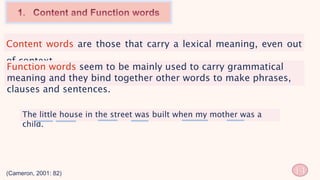
Content words are those that carry a lexical meaning, even out
of context.
The little house in the street was built when my mother was a
child.
(Cameron, 2001: 82) 14
Function words seem to be mainly used to carry grammatical
meaning and they bind together other words to make phrases,
clauses and sentences.
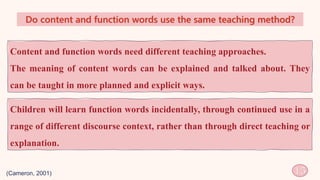
Do content and function words use the same teaching method?
15
Content and function words need different teaching approaches.
The meaning of content words can be explained and talked about. They
can be taught in more planned and explicit ways.
(Cameron, 2001)
Children will learn function words incidentally, through continued use in a
range of different discourse context, rather than through direct teaching or
explanation.
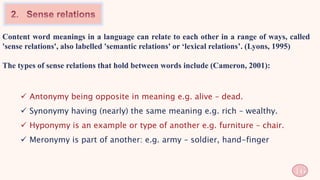
Content word meanings in a language can relate to each other in a range of ways, called
'sense relations', also labelled 'semantic relations' or ‘lexical relations’. (Lyons, 1995)
The types of sense relations that hold between words include (Cameron, 2001):
 Antonymy being opposite in meaning e.g. alive – dead.
 Synonymy having (nearly) the same meaning e.g. rich – wealthy.
 Hyponymy is an example or type of another e.g. furniture – chair.
 Meronymy is part of another: e.g. army – soldier, hand-finger
16
17
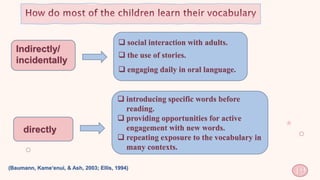
What are the best ways
for young learners to
learn vocabulary ?
18
Indirectly/
incidentally
(Baumann, Kame‘enui, & Ash, 2003; Ellis, 1994)
directly
19
 social interaction with adults.
 the use of stories.
 engaging daily in oral language.
 introducing specific words before
reading.
 providing opportunities for active
engagement with new words.
 repeating exposure to the vocabulary in
many contexts.
Hatch and Brown (1995: 372) describe five 'essential steps' in vocabulary
learning based on research into learners' strategies:
20
1. Having sources for encountering new words.
Young learners should be exposed to vocabulary items repeatedly in rich contexts.
Although the idea regarding the number of encounters ranges from five to sixteen (Nation,
1990), six (Rott, 1999) or more (Thornbury, 2004), at least eight (Waring & Takaki, 2003),
and more than ten (Pigada & Schmitt, 2006) in a textbook unit before it has any chance of
being learnt.
Hatch and Brown (1995: 372) describe five 'essential steps' in vocabulary
learning based on research into learners' strategies:
21
(2) getting a clear image, whether visual or auditory or both, for
the forms of the new words.
(3) learning the meaning of the words either:
Do you think that
using translation as a
teaching method will
be effective for
vocabulary learning?
22
23
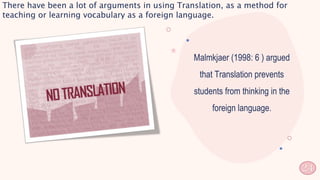
Malmkjaer (1998: 6 ) argued
that Translation prevents
students from thinking in the
foreign language.
There have been a lot of arguments in using Translation, as a method for
teaching or learning vocabulary as a foreign language.
24
Nation (2001: 304) claimed that
student may think ‘there is a one-
to-one correspondence between
words in the second language and
words in the first language’.
25
There have been a lot of arguments in using Translation, as a method for
teaching or learning vocabulary as a foreign language.
However, Carreres (2006: 1) summarizes the current
situation in the field as follows: “much valuable work
has been done in the past decade in the field of
translation pedagogy, but we still lack a strong
empirical foundation on which to base our practice”.
Most of the debate regarding the use of translation in
foreign-language teaching tend to ensue from the
individual beliefs of the researchers rather than
scientific research.( Artar, 2017: 4)
26
Translation could be effective
for teachers, such as when
dealing with incidental
vocabulary.
(Thornbury, 2004: 13)
27
There have been a lot of arguments in using Translation, as a method for
teaching or learning vocabulary as a foreign language.
(Camó & Ballester, 2015: 111)
point out that using the L1
translation as an instructional
tool has a positive effect on
young learners’ vocabulary
learning.
28
There have been a lot of arguments in using Translation, as a method for
teaching or learning vocabulary as a foreign language.
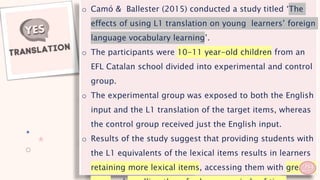
o Camó & Ballester (2015) conducted a study titled ‘The
effects of using L1 translation on young learners’ foreign
language vocabulary learning’.
o The participants were 10-11 year-old children from an
EFL Catalan school divided into experimental and control
group.
o The experimental group was exposed to both the English
input and the L1 translation of the target items, whereas
the control group received just the English input.
o Results of the study suggest that providing students with
the L1 equivalents of the lexical items results in learners
retaining more lexical items, accessing them with greater
29
Hatch and Brown (1995: 372) describe five 'essential steps' in vocabulary
learning based on research into learners' strategies:
30
(4) making a strong memory connection between the forms and meanings of
the words:
a. Thematic organization of vocabulary
(Cameron, 2001)
b. Organization of vocabulary through relations of wholes to
parts
c. Organization of vocabulary in general to specific hierarchies
(5) Using the words:
New vocabulary must be regularly recycled/revised for learner to learn it and remember it.
Schmitt (2008) claimed “most forgetting occurs after the learning sessions… so the first
recycling [is] important and need[s] to occur quickly” (p. 343)
Schmitt (1997) suggests introducing children to a range of strategies
so that these are available for learners to choose from as suits their
individual learning styles.
According to Cameron (2001), teaching vocabulary to young learners
really needs an extra efforts and strategies.
31
Learning
Grammar
32
“ Grammar is of course an integral part of a language encounters, but for young
learners it is not a part they are aware of ”. (Puchta 2019, p. 203)
“Grammar is the sound, structure, and meaning system of language. All
languages have grammar, and each language has its own grammar” (Beverly,
2007, p.1)
Grammar and young learners
When it comes to teaching younger children, we need to look at grammar from
the perspective of the learner, bearing in mind that children tend to ‘grow their
grammar’. (Nunan 2011, p. 45)
33
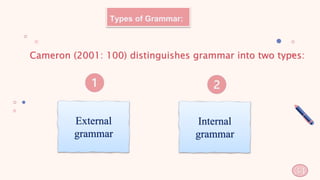
Cameron (2001: 100) distinguishes grammar into two types:
External
grammar
Internal
grammar
Types of Grammar:
34
35
36
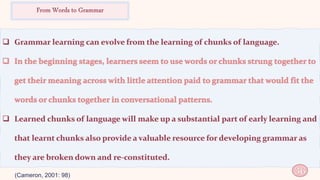
(Cameron, 2001: 98)
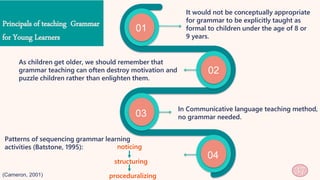
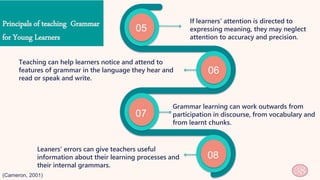
Principals of teaching Grammar
for Young Learners
01
02
03
04
It would not be conceptually appropriate
for grammar to be explicitly taught as
formal to children under the age of 8 or
9 years.
As children get older, we should remember that
grammar teaching can often destroy motivation and
puzzle children rather than enlighten them.
In Communicative language teaching method,
no grammar needed.
Patterns of sequencing grammar learning
activities (Batstone, 1995): noticing
structuring
proceduralizing
(Cameron, 2001) 37
05
06
07
08
If learners' attention is directed to
expressing meaning, they may neglect
attention to accuracy and precision.
Teaching can help learners notice and attend to
features of grammar in the language they hear and
read or speak and write.
Grammar learning can work outwards from
participation in discourse, from vocabulary and
from learnt chunks.
Leaners' errors can give teachers useful
information about their learning processes and
their internal grammars.
(Cameron, 2001) 38
Principals of teaching Grammar
for Young Learners
It’s not important for students
to use correct grammar when
they are talking, as long as they
are getting their message
across.
39
Pinter (2017) pointed out that teaching grammar to
young learners requires an extensive knowledge of a
great number of issues such as teaching techniques,
the difficulty of contents, and learners’
requirements.
40
41
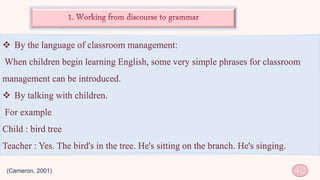
 By the language of classroom management:
When children begin learning English, some very simple phrases for classroom
management can be introduced.
 By talking with children.
For example
Child : bird tree
Teacher : Yes. The bird's in the tree. He's sitting on the branch. He's singing.
(Cameron, 2001) 42
43
 By listen and notice.
Students listen to sentences or to connected piece or talk.
 By presentation of new language with puppets.
The teacher can construct a dialogue with a story-line.
(Cameron, 2001)
44
(Cameron, 2001)
45
 By questionnaires, surveys and quizzes.
e.g. Children are asked to interview their friend to find out their favorite food.
 Information gap activities.
 Helping hand.
Children may give 2 or 3 sentences about activities at home.
 Drills and chants.
(Cameron, 2001)
46
(Cameron, 2001) 47
(Cameron, 2001) 48
49
As a teacher, do you
think that grammar and
vocabulary need to be
taught separately?
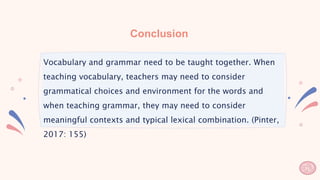
Vocabulary and grammar need to be taught together. When
teaching vocabulary, teachers may need to consider
grammatical choices and environment for the words and
when teaching grammar, they may need to consider
meaningful contexts and typical lexical combination. (Pinter,
2017: 155)
Conclusion
50
References:
 Artar, P. (2017). The role of translation in foreign-language-teaching (Doctoral dissertation) Universitat Rovira I
Virgili, Tarragona, Spain. 1-229.
 Astuti, S. R., Wijaya, B., & Bunau, E. (2013). Teaching Vocabulary to Young Learner Through Cops and Soldiers
Game. Journal Pendidikan dan Pembelajaran Khatulistiwa, 4(4), 1-11.
 Batstone, R. (1995). Grammar. Oxford: Oxford University Press.
 Baumann, J. F., Kame'enui, E. J., & Ash, G. E. (2003). Research on vocabulary instruction: voltaire redux. In: J.
Flood, D. Lapp, J. R. Squire, & J. M. Jensen (Eds.). Handbook on research on teaching the English language arts,
752–785. Mahwah, NJ: Erlbaum.
 Beverly, A. H. (2007). The role of grammar in improving student’s writing. New York: Sadlier school.
 Camó, A. C., & Ballester, E. P. (2015). ‘The Effects of Using L1 Translation on Young Learners’ Foreign
Language Vocabulary Learning’. Elia, 15, 109-134. 51
References:
 Cameron, L. (2001). Teaching languages to young learners. Cambridge: Cambridge University Press.
 Carreres, A. (2006.) Strange bedfellows: Translation and Language Teaching, the teaching of Translation into L2
in modern languages degree; uses and limitations. In Sixth Symposium on Translation, Terminology and
Interpretation in Cuba and Canada, 1-21.
 Ellis, N. C. (1994). Implicit and explicit learning of languages. London: Academic Press.
 Jalongo, M. R., & Sobolak, M. J. (2011). Supporting young children’s vocabulary growth: The challenges, the
benefits, and evidence-based strategies. Early childhood education journal, 38, 421-429.
 Hatch, E., & Brown, C. (1995). Vocabulary, Semantics, and Language Education. Cambridge: Cambridge
University Press.
 Hestetræet, T. I. (2019). Vocabulary teaching for young learners. In S. Garton, & F. Copland. (Eds.), The
routledge handbook of teaching English to young Learners (pp. 220-233). New York: Routledge. 52
References:
 Hornby, A. S., (1995). Oxford advanced learners' dictionary of current English. Oxford: Oxford University Press.
 Lyons, J. (1995). Linguistic Semantics: An introduction. Cambridge: Cambridge University Press.
 Lakoff, G. (1987). Women, Eire, and Dangerous Things. Chicago: University of Chicago Press.
 Linse, C. T., & Nunan, D. (2005). Practical English Language Teaching: Young Learners. New York: McGraw-
Hill.
 Malmkjaer, K. (1998). Translation and Language Teaching: Language Teaching and Translation. Manchester: St.
Jerome.
 Miller, G., & Johnson-Laird P. (1976). Language and Perception. Cambridge: Cambridge University Press.
 Nation, P. (2001). Learning Vocabulary In Another Language. Cambridge: Cambridge University Press.
 Nation, P. (1990). Teaching and Learning Vocabulary. New York: Heinle and Heinle.
53
References:
 Nation, I. S. P., & Waring, R. (1997). Vocabulary size, text coverage and word lists. In Schmitt, N., & McCarthy,
M. (Eds.),Vocabulary: description, acquisition and pedagogy. Cambridge: Cambridge University Press.
 Nation, I. S. P. (2013). Learning Vocabulary in Another Language. Cambridge: Cambridge University Press.
 Nunan, D. (2011). Teaching English to Young Learners. Anaheim, CA: Anaheim University Press.
 Pigada, M., & Schmitt, N. (2006). Vocabulary acquisition from extensive reading: A case study. Reading in a
foreign language, 18(1),1-28.
 Pinter, A. (2017). Teaching young language learners. Oxford: Oxford university press.
 Puchta, H. (2019), Teaching grammar to young learners. In S. Garton, & F. Copland. (Eds.), The routledge
handbook of teaching English to young Learners (pp. 203-219). New York: Routledge.
 Rott, S. (1999). The effect of exposure frequency on intermediate language learners’ incidental vocabulary
acquisition through reading. Studies in Second Language Acquisition, 21(1), 589-619. 54
References:
55
 Thornbury, S. (2004). How to teach vocabulary. (3rd Ed). England, UK: Pearson Education Limited.
 Schmitt, N.(1997), Vocabulary learning strategies. In Schmitt, N. and McCarthy (Eds.). Vocabulary: description,
acquisition and pedagogy (pp. 199-227). . Cambridge: Cambridge University Press.
 Schmitt, N. (2008). Review article: Instructed second language vocabulary learning. Language Teaching
Research, 12, 329–363.
 Singleton, D. (1999). Exploring the second language mental lexicon. Cambridge: Cambridge University Press.
 Waring, R., & Takaki, M. (2003). At what rate do learners learn and retain new vocabulary from reading a
graded reader? Reading in a Foreign Language, 15(2), 130-163.
 Wray, A. (2002). Formulaic Language and the Lexicon. Cambridge: Cambridge University Press.
29

Learning Words & Grammar (Areej).pptx

  • 2.
  • 3.
    King Saud University Collegeof Education Department of Curriculum and Instruction Major TESOL
  • 4.
    1 What is vocabulary. Typesof vocabulary. Vocabulary development in children's language learning. Organisation of words in a language. Learning vocabulary. Controversial effect of Translation as a method for teaching or learning vocabulary as a foreign language.
  • 5.
    2 Grammar & younglearners. Types of Grammar. From words to Grammar Principals for teaching Grammar for young learners. Teaching techniques for supporting Grammar learning.
  • 6.
     Hornby (1995)defines vocabulary as ”the total number of words in a language; vocabulary is a list of words with their meanings”. (p. 133).  vocabulary takes an important role for young learners in learning the target language. (Astuti, Wijaya & Bunau, 2013: 2)  According to Cameron (2001: 73) “Vocabulary is about learning words, children are not only expected to know the word but also they have to know what the meaning of that word.” 3
  • 7.
    Receptive Vocabulary Expressive/productive vocabulary Types of vocabulary: 4 Itis estimated that their receptive vocabulary often is four times greater than their expressive vocabulary. (Jalongo & Sobolak, 2011: 412)
  • 8.
  • 9.
    It refers tothe great number of words the learner is building. Vocabulary size is usually measured to the nearest thousand, and counts `word families ', in which a base word and all its inflected forms and derived forms count as one e. g. the word family is the base form walk plus walking, walked, walks, a walk. (Cameron, 2001) (Nation & Waring, 1997; Nation, 1990) 6 5-year child native speakers 4000/5000 Words families 5years of study English learner in India and Indonesia 1000/2000 Words families
  • 10.
    (Cameron, 2001; Nation2013; Schmitt, 2008) Form Meaning Use Knowing its pronunciation, its spelling and its grammar Knowing its conceptual content and how it relates to other concepts and words knowing the collocations, its forms 7
  • 11.
    Words: dog - table (Cameron,2001) 8 Conceptual knowledge grows as children experience more and more of the world in their daily lives. One of the factors that affect the conceptual knowledge is 'syntagmatic-paradigmatic shift' that occurs between five and ten years of age. (Miller & johnson-Laird, I976; Singleton, 1999) Very Young children at the age 5 Young children at the age 10 • bark • eat • animal • chair
  • 12.
    • They becomemore able to deal with abstract connections, such as 'a dog is a kind of animal. • They build up more knowledge of the world, words to go with it and ways of organizing it. (Cameron, 2001) 9
  • 13.
    10 Research into thetypes of categories used in early childhood has shown that the middle of a general to specific hierarchy is particularly significant for children, and hence for their foreign language learning (Lakoff, 1987; Cameron, 2001). Here are two examples of hierarchies: Superordinate FURNITURE Animal Basic level chair Dog Subordinate rocking chair Spaniel
  • 14.
  • 15.
    12 Learning chunks isalso a critical issue for young learner's vocabulary development when building vocabulary, because they provide children with ready-made phrases, they can use to express meaning. They are also referred to as lexical chunks, multiword units, collocations and formulaic language. (Hestetræet, 2019) Chunks have been described as being very useful for children, both when expressing their needs and when building up a L2. (Wray, 2002)
  • 16.
  • 17.
    Content words arethose that carry a lexical meaning, even out of context. The little house in the street was built when my mother was a child. (Cameron, 2001: 82) 14 Function words seem to be mainly used to carry grammatical meaning and they bind together other words to make phrases, clauses and sentences.
  • 18.
    Do content andfunction words use the same teaching method? 15 Content and function words need different teaching approaches. The meaning of content words can be explained and talked about. They can be taught in more planned and explicit ways. (Cameron, 2001) Children will learn function words incidentally, through continued use in a range of different discourse context, rather than through direct teaching or explanation.
  • 19.
    Content word meaningsin a language can relate to each other in a range of ways, called 'sense relations', also labelled 'semantic relations' or ‘lexical relations’. (Lyons, 1995) The types of sense relations that hold between words include (Cameron, 2001):  Antonymy being opposite in meaning e.g. alive – dead.  Synonymy having (nearly) the same meaning e.g. rich – wealthy.  Hyponymy is an example or type of another e.g. furniture – chair.  Meronymy is part of another: e.g. army – soldier, hand-finger 16
  • 20.
    17 What are thebest ways for young learners to learn vocabulary ?
  • 21.
  • 22.
    Indirectly/ incidentally (Baumann, Kame‘enui, &Ash, 2003; Ellis, 1994) directly 19  social interaction with adults.  the use of stories.  engaging daily in oral language.  introducing specific words before reading.  providing opportunities for active engagement with new words.  repeating exposure to the vocabulary in many contexts.
  • 23.
    Hatch and Brown(1995: 372) describe five 'essential steps' in vocabulary learning based on research into learners' strategies: 20 1. Having sources for encountering new words. Young learners should be exposed to vocabulary items repeatedly in rich contexts. Although the idea regarding the number of encounters ranges from five to sixteen (Nation, 1990), six (Rott, 1999) or more (Thornbury, 2004), at least eight (Waring & Takaki, 2003), and more than ten (Pigada & Schmitt, 2006) in a textbook unit before it has any chance of being learnt.
  • 24.
    Hatch and Brown(1995: 372) describe five 'essential steps' in vocabulary learning based on research into learners' strategies: 21 (2) getting a clear image, whether visual or auditory or both, for the forms of the new words. (3) learning the meaning of the words either:
  • 25.
    Do you thinkthat using translation as a teaching method will be effective for vocabulary learning? 22
  • 26.
  • 27.
    Malmkjaer (1998: 6) argued that Translation prevents students from thinking in the foreign language. There have been a lot of arguments in using Translation, as a method for teaching or learning vocabulary as a foreign language. 24
  • 28.
    Nation (2001: 304)claimed that student may think ‘there is a one- to-one correspondence between words in the second language and words in the first language’. 25 There have been a lot of arguments in using Translation, as a method for teaching or learning vocabulary as a foreign language.
  • 29.
    However, Carreres (2006:1) summarizes the current situation in the field as follows: “much valuable work has been done in the past decade in the field of translation pedagogy, but we still lack a strong empirical foundation on which to base our practice”. Most of the debate regarding the use of translation in foreign-language teaching tend to ensue from the individual beliefs of the researchers rather than scientific research.( Artar, 2017: 4) 26
  • 30.
    Translation could beeffective for teachers, such as when dealing with incidental vocabulary. (Thornbury, 2004: 13) 27 There have been a lot of arguments in using Translation, as a method for teaching or learning vocabulary as a foreign language.
  • 31.
    (Camó & Ballester,2015: 111) point out that using the L1 translation as an instructional tool has a positive effect on young learners’ vocabulary learning. 28 There have been a lot of arguments in using Translation, as a method for teaching or learning vocabulary as a foreign language.
  • 32.
    o Camó &Ballester (2015) conducted a study titled ‘The effects of using L1 translation on young learners’ foreign language vocabulary learning’. o The participants were 10-11 year-old children from an EFL Catalan school divided into experimental and control group. o The experimental group was exposed to both the English input and the L1 translation of the target items, whereas the control group received just the English input. o Results of the study suggest that providing students with the L1 equivalents of the lexical items results in learners retaining more lexical items, accessing them with greater 29
  • 33.
    Hatch and Brown(1995: 372) describe five 'essential steps' in vocabulary learning based on research into learners' strategies: 30 (4) making a strong memory connection between the forms and meanings of the words: a. Thematic organization of vocabulary (Cameron, 2001) b. Organization of vocabulary through relations of wholes to parts c. Organization of vocabulary in general to specific hierarchies (5) Using the words: New vocabulary must be regularly recycled/revised for learner to learn it and remember it. Schmitt (2008) claimed “most forgetting occurs after the learning sessions… so the first recycling [is] important and need[s] to occur quickly” (p. 343)
  • 34.
    Schmitt (1997) suggestsintroducing children to a range of strategies so that these are available for learners to choose from as suits their individual learning styles. According to Cameron (2001), teaching vocabulary to young learners really needs an extra efforts and strategies. 31
  • 35.
  • 36.
    “ Grammar isof course an integral part of a language encounters, but for young learners it is not a part they are aware of ”. (Puchta 2019, p. 203) “Grammar is the sound, structure, and meaning system of language. All languages have grammar, and each language has its own grammar” (Beverly, 2007, p.1) Grammar and young learners When it comes to teaching younger children, we need to look at grammar from the perspective of the learner, bearing in mind that children tend to ‘grow their grammar’. (Nunan 2011, p. 45) 33
  • 37.
    Cameron (2001: 100)distinguishes grammar into two types: External grammar Internal grammar Types of Grammar: 34
  • 38.
  • 39.
  • 40.
    Principals of teachingGrammar for Young Learners 01 02 03 04 It would not be conceptually appropriate for grammar to be explicitly taught as formal to children under the age of 8 or 9 years. As children get older, we should remember that grammar teaching can often destroy motivation and puzzle children rather than enlighten them. In Communicative language teaching method, no grammar needed. Patterns of sequencing grammar learning activities (Batstone, 1995): noticing structuring proceduralizing (Cameron, 2001) 37
  • 41.
    05 06 07 08 If learners' attentionis directed to expressing meaning, they may neglect attention to accuracy and precision. Teaching can help learners notice and attend to features of grammar in the language they hear and read or speak and write. Grammar learning can work outwards from participation in discourse, from vocabulary and from learnt chunks. Leaners' errors can give teachers useful information about their learning processes and their internal grammars. (Cameron, 2001) 38 Principals of teaching Grammar for Young Learners
  • 42.
    It’s not importantfor students to use correct grammar when they are talking, as long as they are getting their message across. 39
  • 43.
    Pinter (2017) pointedout that teaching grammar to young learners requires an extensive knowledge of a great number of issues such as teaching techniques, the difficulty of contents, and learners’ requirements. 40
  • 44.
  • 45.
     By thelanguage of classroom management: When children begin learning English, some very simple phrases for classroom management can be introduced.  By talking with children. For example Child : bird tree Teacher : Yes. The bird's in the tree. He's sitting on the branch. He's singing. (Cameron, 2001) 42
  • 46.
  • 47.
     By listenand notice. Students listen to sentences or to connected piece or talk.  By presentation of new language with puppets. The teacher can construct a dialogue with a story-line. (Cameron, 2001) 44
  • 48.
    (Cameron, 2001) 45  Byquestionnaires, surveys and quizzes. e.g. Children are asked to interview their friend to find out their favorite food.  Information gap activities.  Helping hand. Children may give 2 or 3 sentences about activities at home.  Drills and chants.
  • 49.
  • 50.
  • 51.
  • 52.
    49 As a teacher,do you think that grammar and vocabulary need to be taught separately?
  • 53.
    Vocabulary and grammarneed to be taught together. When teaching vocabulary, teachers may need to consider grammatical choices and environment for the words and when teaching grammar, they may need to consider meaningful contexts and typical lexical combination. (Pinter, 2017: 155) Conclusion 50
  • 54.
    References:  Artar, P.(2017). The role of translation in foreign-language-teaching (Doctoral dissertation) Universitat Rovira I Virgili, Tarragona, Spain. 1-229.  Astuti, S. R., Wijaya, B., & Bunau, E. (2013). Teaching Vocabulary to Young Learner Through Cops and Soldiers Game. Journal Pendidikan dan Pembelajaran Khatulistiwa, 4(4), 1-11.  Batstone, R. (1995). Grammar. Oxford: Oxford University Press.  Baumann, J. F., Kame'enui, E. J., & Ash, G. E. (2003). Research on vocabulary instruction: voltaire redux. In: J. Flood, D. Lapp, J. R. Squire, & J. M. Jensen (Eds.). Handbook on research on teaching the English language arts, 752–785. Mahwah, NJ: Erlbaum.  Beverly, A. H. (2007). The role of grammar in improving student’s writing. New York: Sadlier school.  Camó, A. C., & Ballester, E. P. (2015). ‘The Effects of Using L1 Translation on Young Learners’ Foreign Language Vocabulary Learning’. Elia, 15, 109-134. 51
  • 55.
    References:  Cameron, L.(2001). Teaching languages to young learners. Cambridge: Cambridge University Press.  Carreres, A. (2006.) Strange bedfellows: Translation and Language Teaching, the teaching of Translation into L2 in modern languages degree; uses and limitations. In Sixth Symposium on Translation, Terminology and Interpretation in Cuba and Canada, 1-21.  Ellis, N. C. (1994). Implicit and explicit learning of languages. London: Academic Press.  Jalongo, M. R., & Sobolak, M. J. (2011). Supporting young children’s vocabulary growth: The challenges, the benefits, and evidence-based strategies. Early childhood education journal, 38, 421-429.  Hatch, E., & Brown, C. (1995). Vocabulary, Semantics, and Language Education. Cambridge: Cambridge University Press.  Hestetræet, T. I. (2019). Vocabulary teaching for young learners. In S. Garton, & F. Copland. (Eds.), The routledge handbook of teaching English to young Learners (pp. 220-233). New York: Routledge. 52
  • 56.
    References:  Hornby, A.S., (1995). Oxford advanced learners' dictionary of current English. Oxford: Oxford University Press.  Lyons, J. (1995). Linguistic Semantics: An introduction. Cambridge: Cambridge University Press.  Lakoff, G. (1987). Women, Eire, and Dangerous Things. Chicago: University of Chicago Press.  Linse, C. T., & Nunan, D. (2005). Practical English Language Teaching: Young Learners. New York: McGraw- Hill.  Malmkjaer, K. (1998). Translation and Language Teaching: Language Teaching and Translation. Manchester: St. Jerome.  Miller, G., & Johnson-Laird P. (1976). Language and Perception. Cambridge: Cambridge University Press.  Nation, P. (2001). Learning Vocabulary In Another Language. Cambridge: Cambridge University Press.  Nation, P. (1990). Teaching and Learning Vocabulary. New York: Heinle and Heinle. 53
  • 57.
    References:  Nation, I.S. P., & Waring, R. (1997). Vocabulary size, text coverage and word lists. In Schmitt, N., & McCarthy, M. (Eds.),Vocabulary: description, acquisition and pedagogy. Cambridge: Cambridge University Press.  Nation, I. S. P. (2013). Learning Vocabulary in Another Language. Cambridge: Cambridge University Press.  Nunan, D. (2011). Teaching English to Young Learners. Anaheim, CA: Anaheim University Press.  Pigada, M., & Schmitt, N. (2006). Vocabulary acquisition from extensive reading: A case study. Reading in a foreign language, 18(1),1-28.  Pinter, A. (2017). Teaching young language learners. Oxford: Oxford university press.  Puchta, H. (2019), Teaching grammar to young learners. In S. Garton, & F. Copland. (Eds.), The routledge handbook of teaching English to young Learners (pp. 203-219). New York: Routledge.  Rott, S. (1999). The effect of exposure frequency on intermediate language learners’ incidental vocabulary acquisition through reading. Studies in Second Language Acquisition, 21(1), 589-619. 54
  • 58.
    References: 55  Thornbury, S.(2004). How to teach vocabulary. (3rd Ed). England, UK: Pearson Education Limited.  Schmitt, N.(1997), Vocabulary learning strategies. In Schmitt, N. and McCarthy (Eds.). Vocabulary: description, acquisition and pedagogy (pp. 199-227). . Cambridge: Cambridge University Press.  Schmitt, N. (2008). Review article: Instructed second language vocabulary learning. Language Teaching Research, 12, 329–363.  Singleton, D. (1999). Exploring the second language mental lexicon. Cambridge: Cambridge University Press.  Waring, R., & Takaki, M. (2003). At what rate do learners learn and retain new vocabulary from reading a graded reader? Reading in a Foreign Language, 15(2), 130-163.  Wray, A. (2002). Formulaic Language and the Lexicon. Cambridge: Cambridge University Press.
  • 59.

Editor's Notes

  • #7 اضيفي معلومات عن productive من عرضك لروشسيتا