LEARNING THEORIES
BASED ON SOCIAL
PERSPECTIVE
BY
PETERUS BALAN SING
LEARNING THEORIES
BASED ON SOCIAL
PERSPECTIVE

INTRODUCTION
TO SOCIAL
PERSPECTIVE

SOCIAL
LEARNING
THEORY

BANDURA’ S
MODELLING
THEORY

Neobehaviourism

Individual
process

Attention

Environment

Normal class

Retention
Reproduction

Behaviour

IMPLICATIONS
OF
BANDURA’S
MODELLING
THEORY

Reinforcement/
motivation

Class/children
with special
needs
INTRODUCTION
COGNITIVIST
APPROACH
(PIAGET &
VYGOTSKY)

BEHAVIORIST
APPROACH
(SKINNER, PAVLOV,
THORNDIKE &
WATSON

NEOBEHAVIORIST
APPROACH
(BANDURA &
WALTERS)

LEARNING
THEORIES
BASED ON
SOCIAL
PERSPECTIVE

• According to Bandura (1986, 1997, 2001) –
learning takes place through the processes of
modeling and imitation.
• Other social psychologists agree that learning
theory should incorporate cognitive aspect.
SOCIAL LEARNING THEORY
•
•

•

I

3 basic elements
Learning is the
interaction between an
individual’s intrinsic
motivation and behavior
with the environment
IxBxE

(ENVIRONMENT)
External stimulus

(INDIVIDUAL)

Intrinsic
motivation

E
TRIARCHIC RECIPROCAL CAUSALITY
SYSTEM

B (BEHAVIOR)
Individual’s
actions
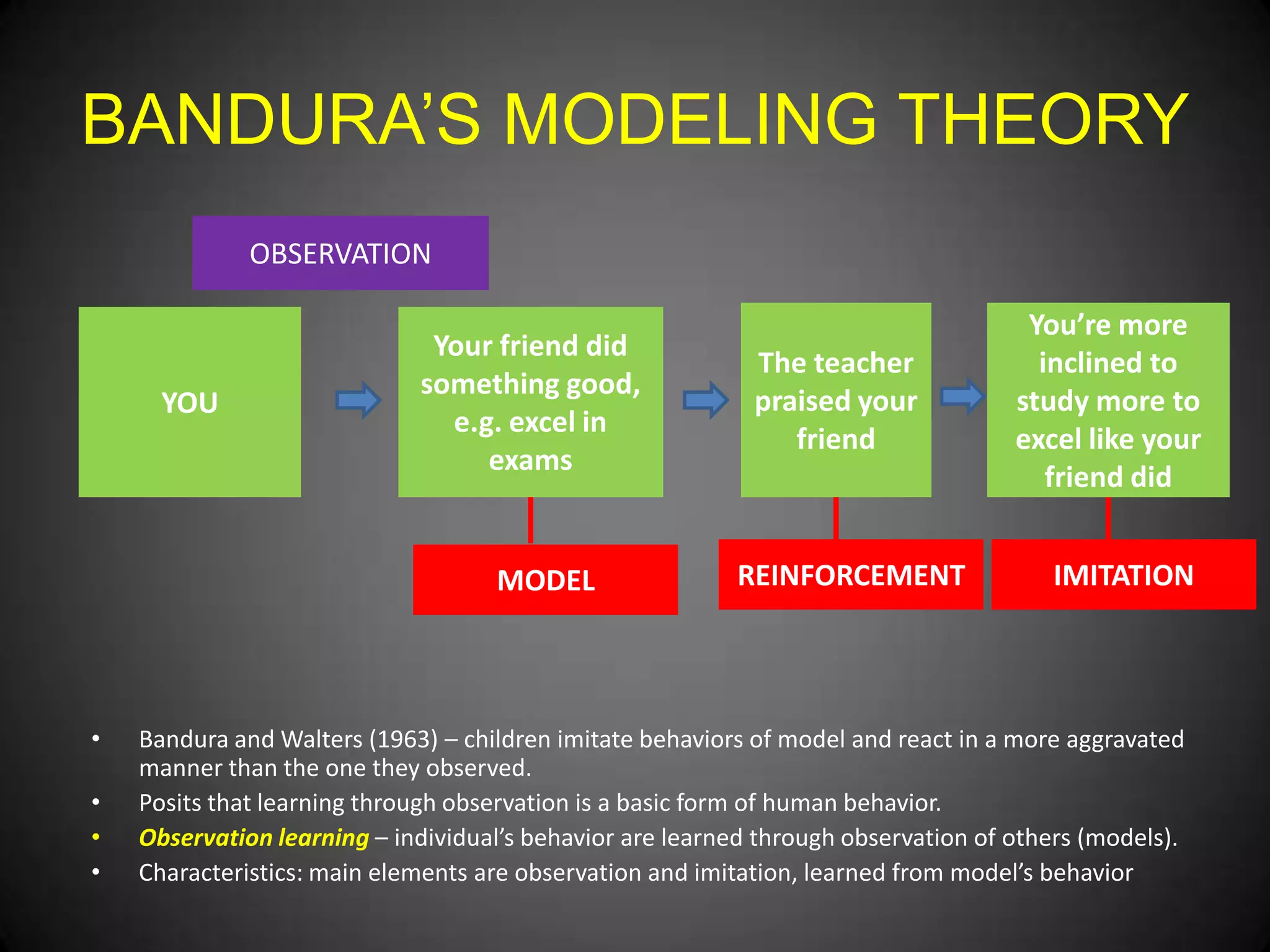
BANDURA’S MODELING THEORY
OBSERVATION
?

YOU

Your friend did
something good,
e.g. excel in
exams

MODEL
?

•
•
•
•

The teacher
praised your
friend

REINFORCEMENT
?

You’re more
inclined to
study more to
excel like your
friend did
IMITATION
?

Bandura and Walters (1963) – children imitate behaviors of model and react in a more aggravated
manner than the one they observed.
Posits that learning through observation is a basic form of human behavior.
Observation learning – individual’s behavior are learned through observation of others (models).
Characteristics: main elements are observation and imitation, learned from model’s behavior
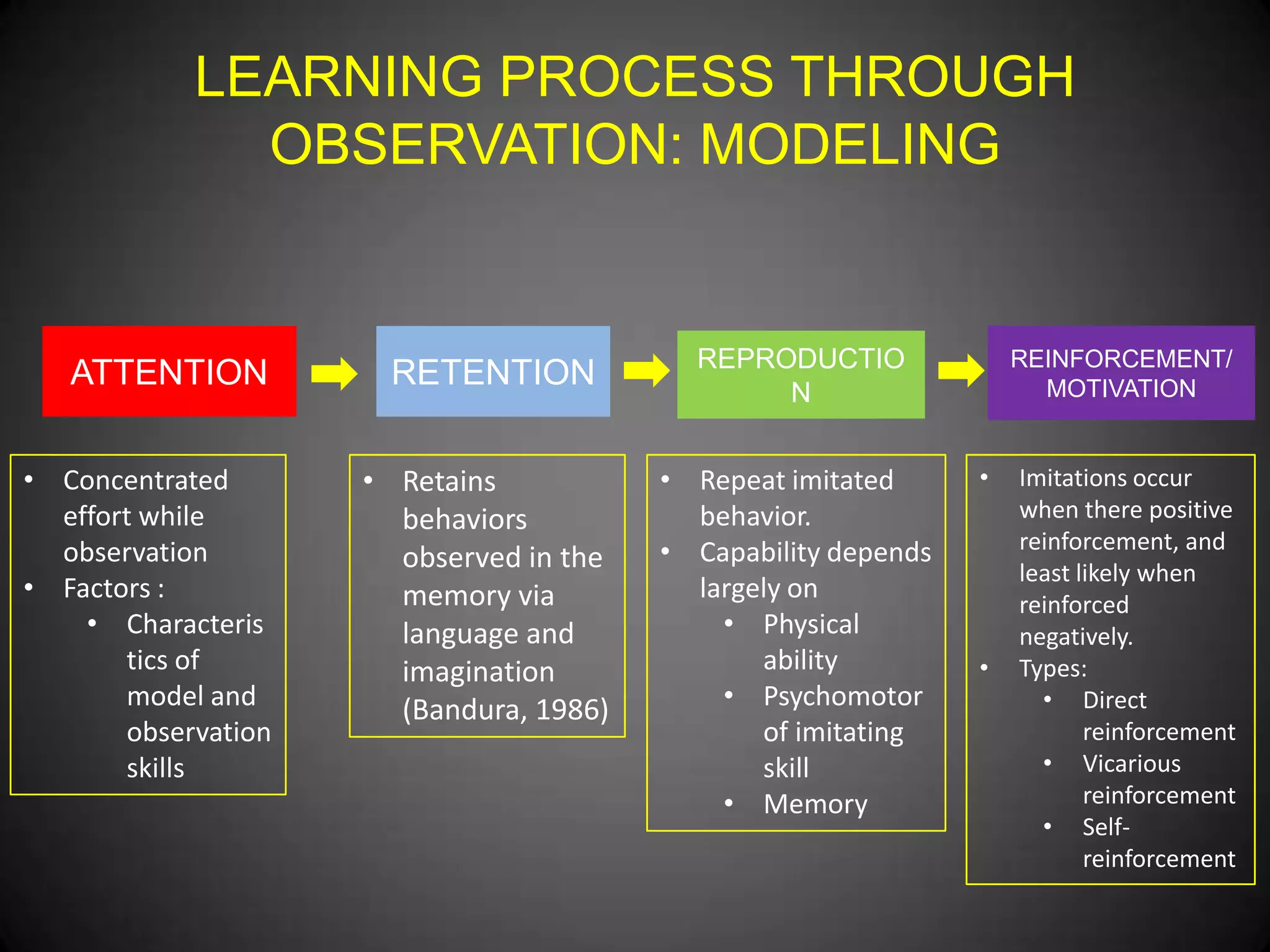
LEARNING PROCESS THROUGH
OBSERVATION: MODELING

ATTENTION
• Concentrated
effort while
observation
• Factors :
• Characteris
tics of
model and
observation
skills

RETENTION

REPRODUCTIO
N

• Retains
behaviors
observed in the
memory via
language and
imagination
(Bandura, 1986)

• Repeat imitated
behavior.
• Capability depends
largely on
• Physical
ability
• Psychomotor
of imitating
skill
• Memory

REINFORCEMENT/
MOTIVATION

•

•

Imitations occur
when there positive
reinforcement, and
least likely when
reinforced
negatively.
Types:
• Direct
reinforcement
• Vicarious
reinforcement
• Selfreinforcement
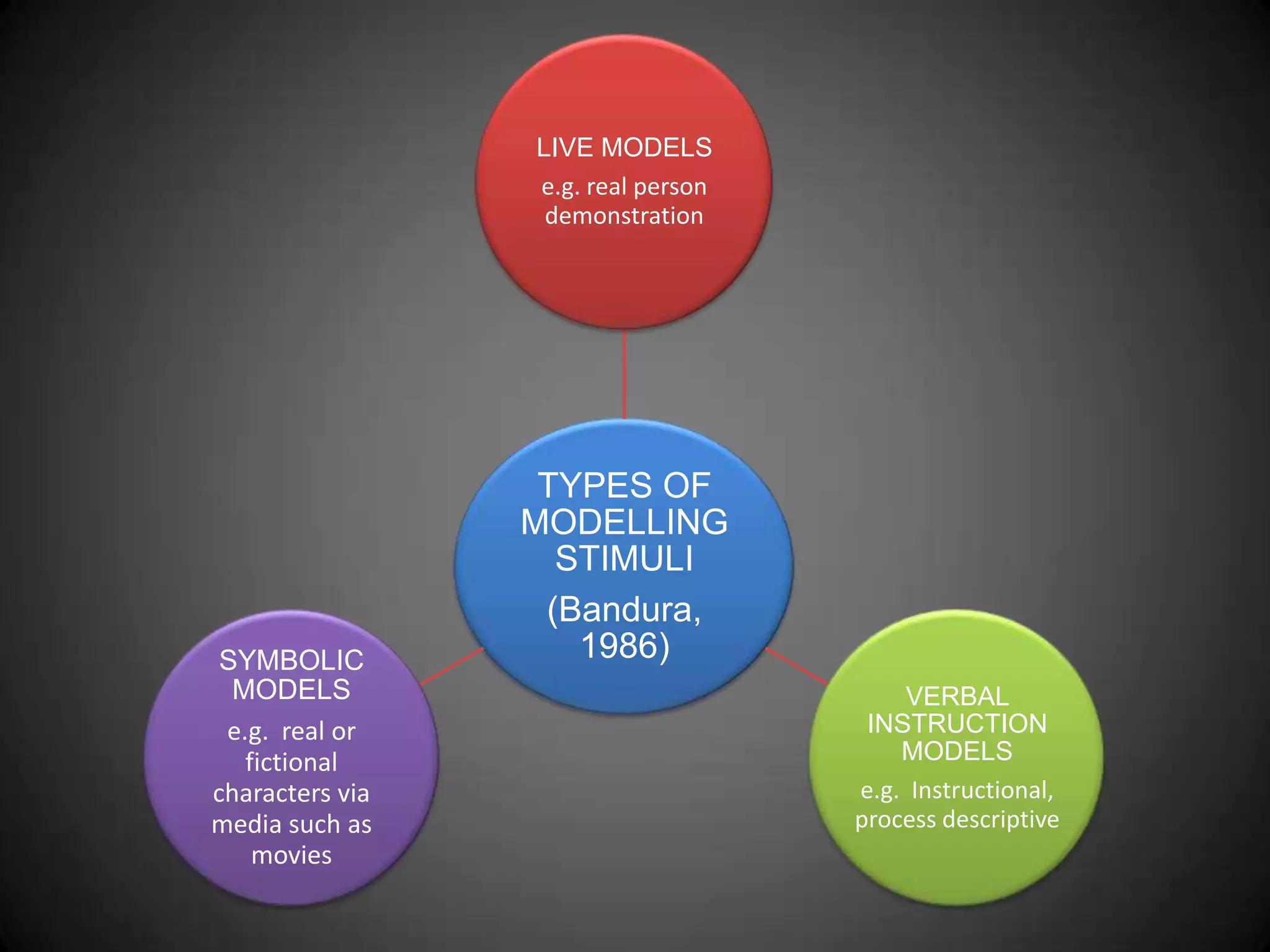
LIVE MODELS
e.g. real person
demonstration

SYMBOLIC
MODELS
e.g. real or
fictional
characters via
media such as
movies

TYPES OF
MODELLING
STIMULI
(Bandura,
1986)
VERBAL
INSTRUCTION
MODELS
e.g. Instructional,
process descriptive
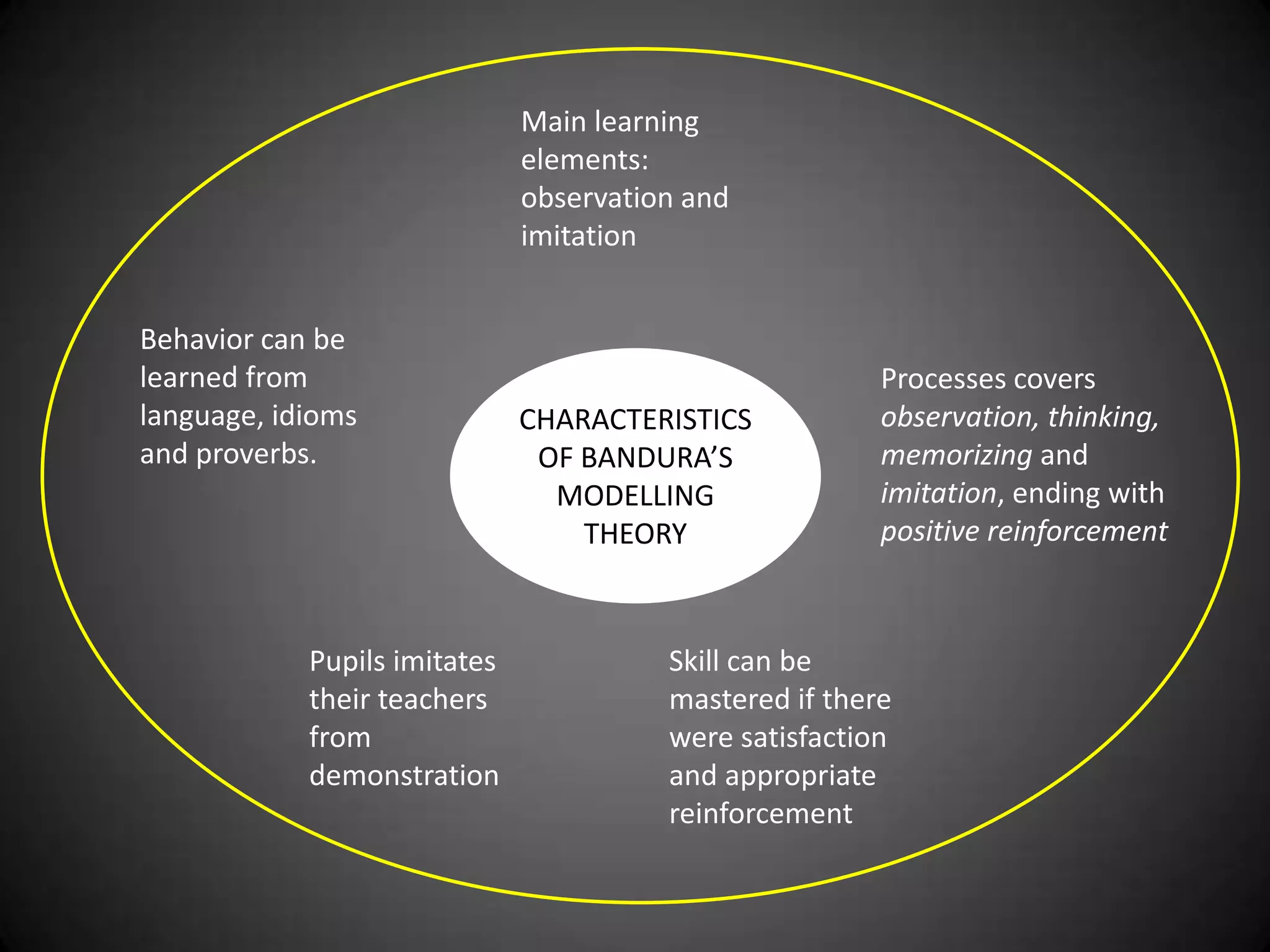
Main learning
elements:
observation and
imitation
Behavior can be
learned from
language, idioms
and proverbs.

Pupils imitates
their teachers
from
demonstration

CHARACTERISTICS
OF BANDURA’S
MODELLING
THEORY

Processes covers
observation, thinking,
memorizing and
imitation, ending with
positive reinforcement

Skill can be
mastered if there
were satisfaction
and appropriate
reinforcement
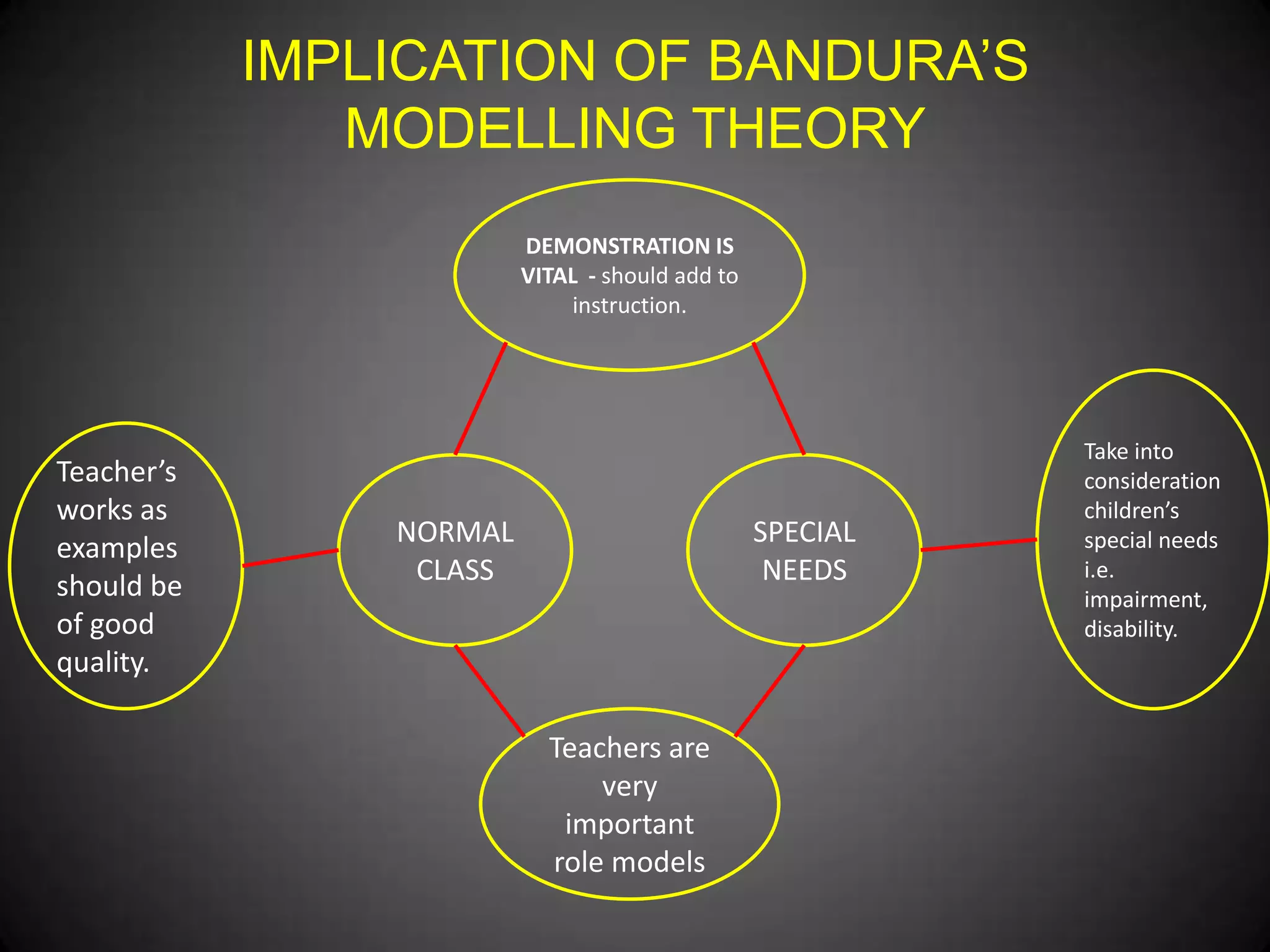
IMPLICATION OF BANDURA’S
MODELLING THEORY
DEMONSTRATION IS
VITAL - should add to
instruction.

Teacher’s
works as
examples
should be
of good
quality.

NORMAL
CLASS

SPECIAL
NEEDS

Teachers are
very
important
role models

Take into
consideration
children’s
special needs
i.e.
impairment,
disability.
REFERENCES
• Childs, D. (2007, January 5). Kids Imitate Saddam's Televised Hanging
Death. ABC News. Retrieved July 1, 2012
• Foster, C. (2006). Confidence Man. Stanford Magazine. Retrieved July 1,
2012
• http://www.psy.cmu.edu/~siegler/35grusec92.pdf
• http://www.gatherthepeople.org/Downloads/SOCIAL_LEARNING.pdf
• http://socialscientist.us/nphs/psychIB/psychpdfs/Social_learning_Theory.
pdf
• Mok Soon Sang. (2008). Learning and the learner. Perak, Malaysia:
Penerbitan
Multimedia Sdn. Bhd.
• Smith, M., & Berge, Z. L. (2009, June). Social Learning Theory in Second
Life. MERLOT Journal of Online Learning and Teaching, 5(2).
Retrieved July 1, 2012
• Woolfolk, A. (2011). Educational psychology
(11th ed.).
Pearson Education
International:
Columbus, OH.
ACTIVITY
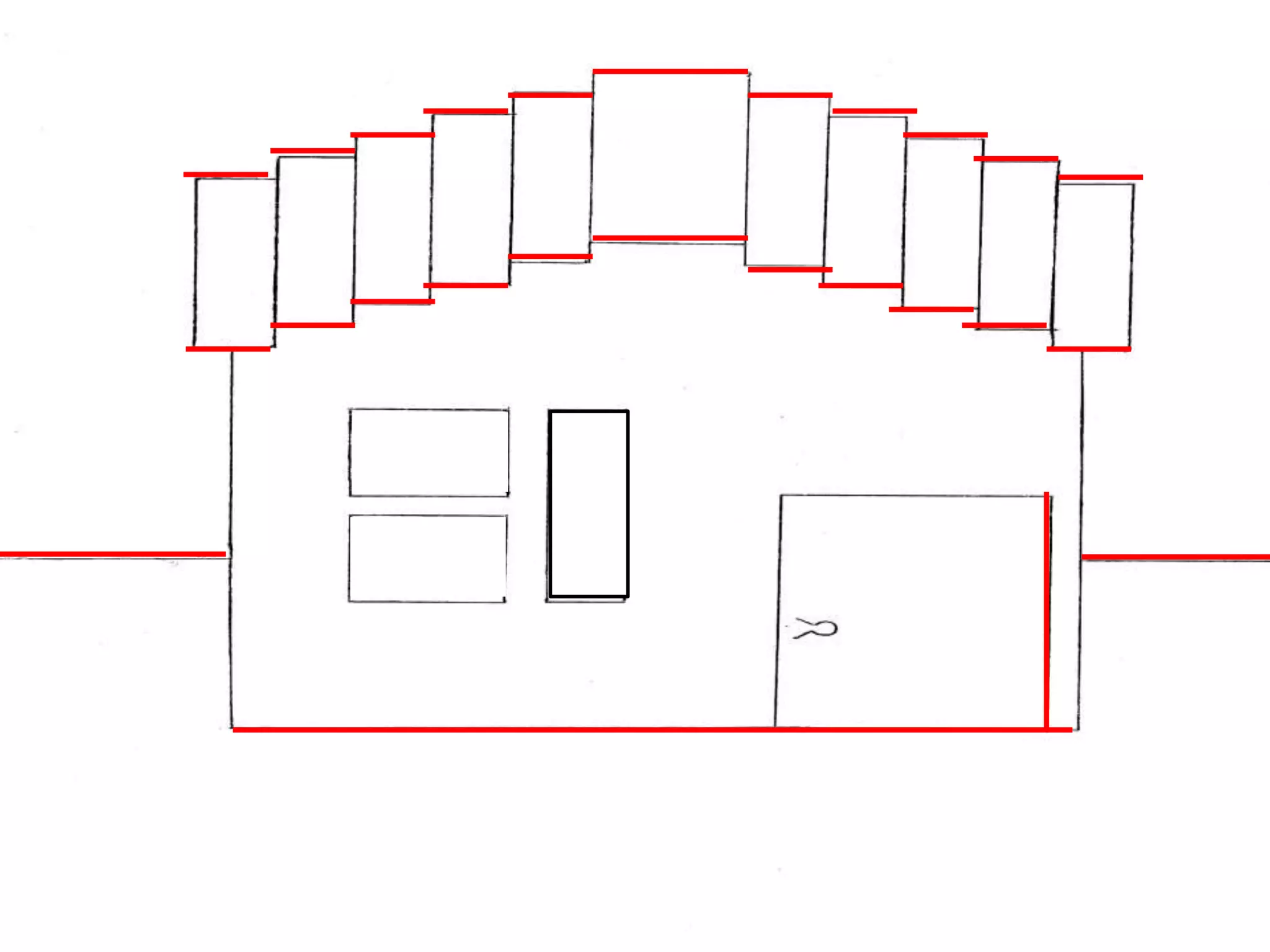
ARCHITECTURAL KIRIGAMI 
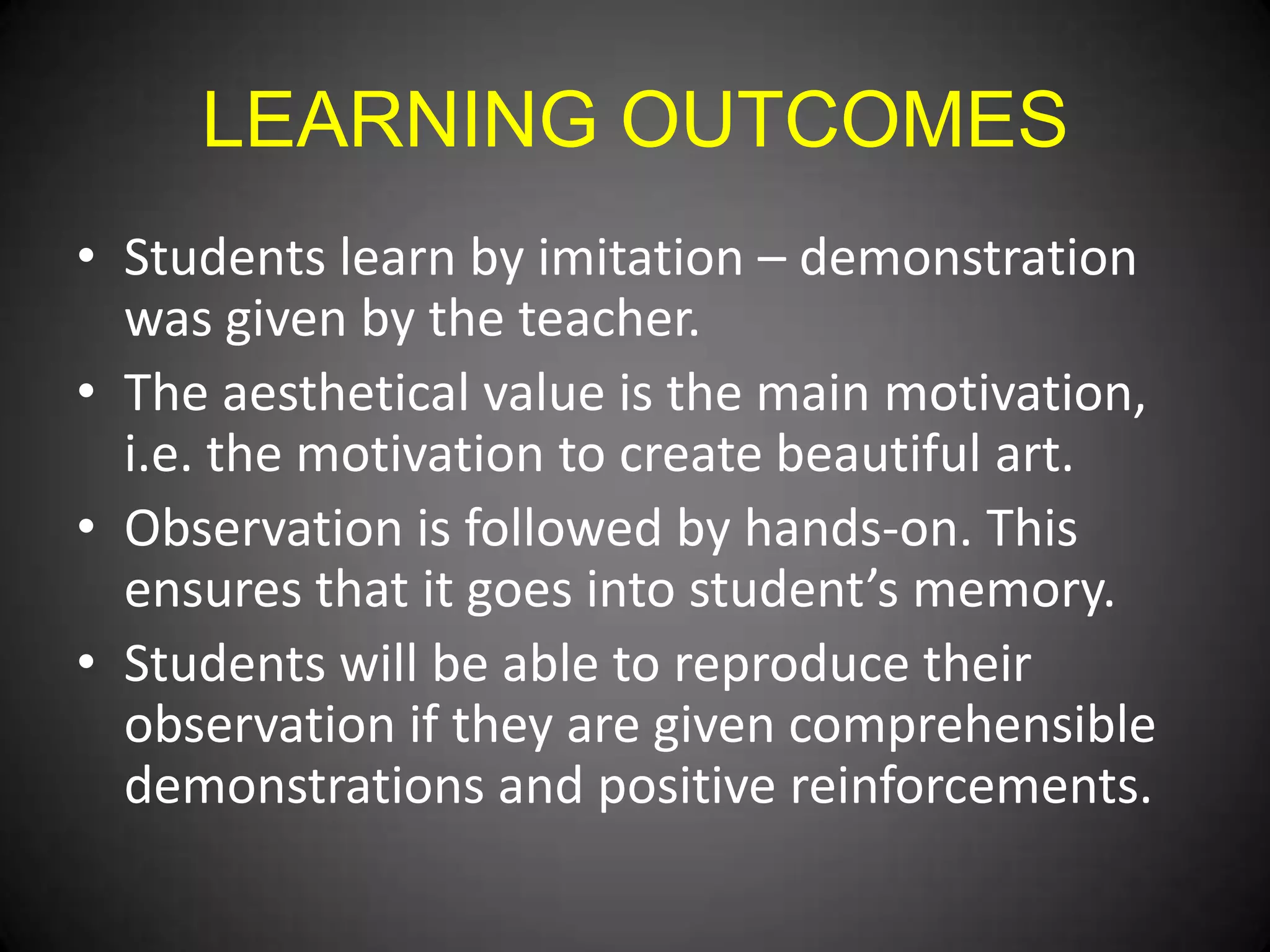
LEARNING OUTCOMES
• Students learn by imitation – demonstration
was given by the teacher.
• The aesthetical value is the main motivation,
i.e. the motivation to create beautiful art.
• Observation is followed by hands-on. This
ensures that it goes into student’s memory.
• Students will be able to reproduce their
observation if they are given comprehensible
demonstrations and positive reinforcements.
INSTRUCTIONS
• Students will be given a kirigami template.
• Teacher or instructor will demonstrate step by
step the process of building the kirigami.
• ATTENTION: This activity requires the use of
crafting knife. Use with utmost care.
Learning theories based on social perspective

Learning theories based on social perspective

  • 1.
    LEARNING THEORIES BASED ONSOCIAL PERSPECTIVE BY PETERUS BALAN SING
  • 2.
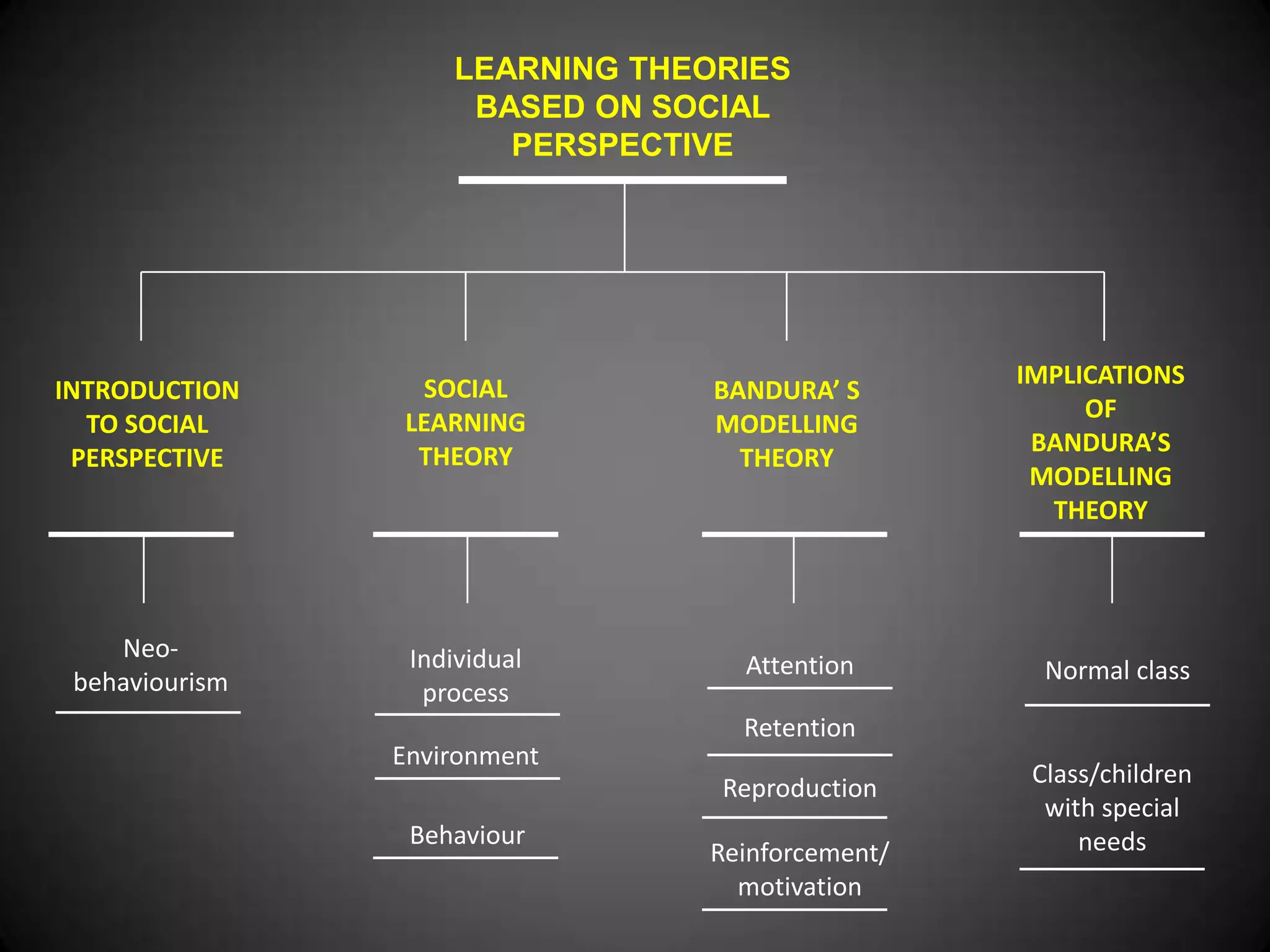
    LEARNING THEORIES BASED ONSOCIAL PERSPECTIVE INTRODUCTION TO SOCIAL PERSPECTIVE SOCIAL LEARNING THEORY BANDURA’ S MODELLING THEORY Neobehaviourism Individual process Attention Environment Normal class Retention Reproduction Behaviour IMPLICATIONS OF BANDURA’S MODELLING THEORY Reinforcement/ motivation Class/children with special needs
  • 3.
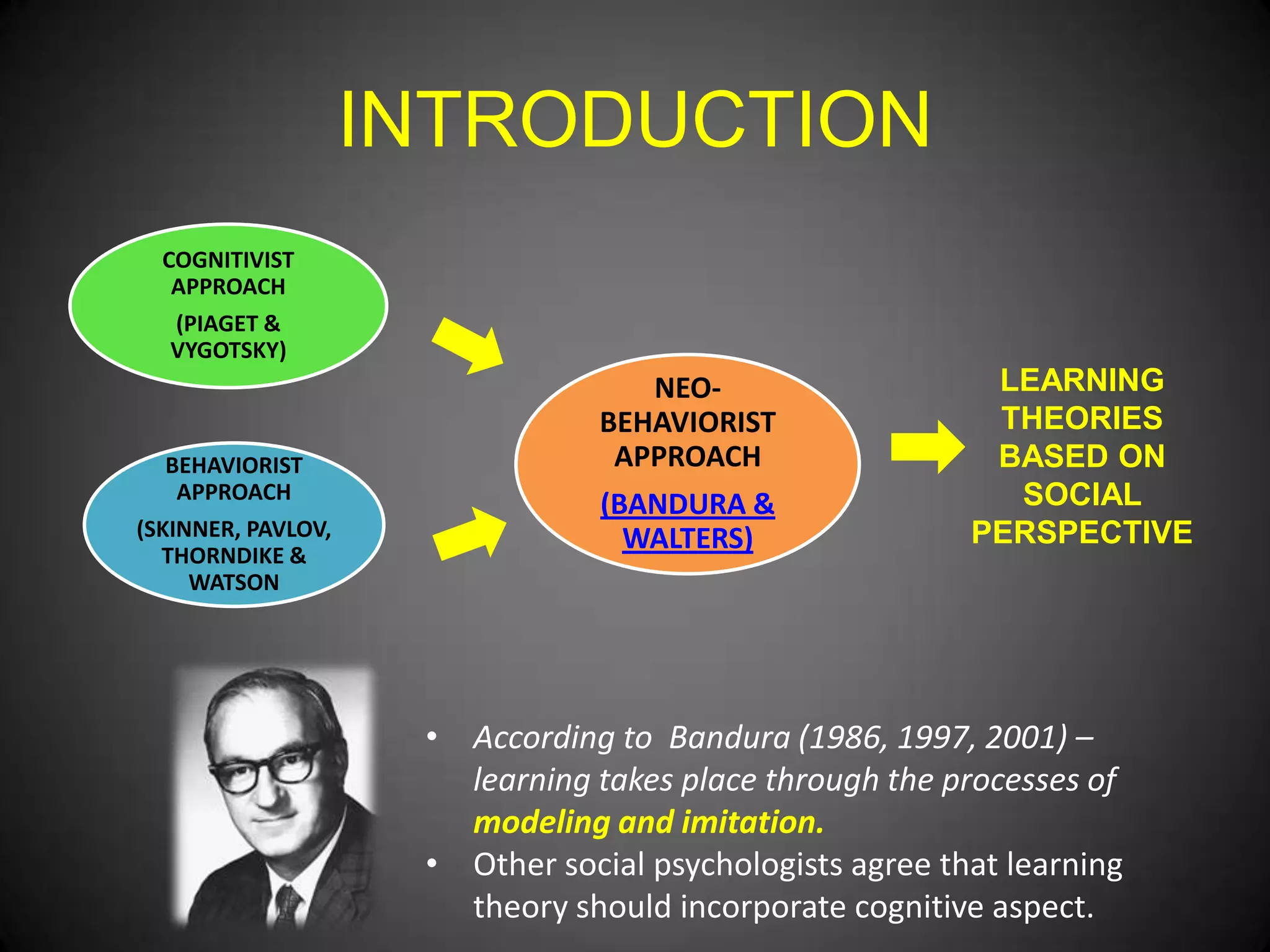
    INTRODUCTION COGNITIVIST APPROACH (PIAGET & VYGOTSKY) BEHAVIORIST APPROACH (SKINNER, PAVLOV, THORNDIKE& WATSON NEOBEHAVIORIST APPROACH (BANDURA & WALTERS) LEARNING THEORIES BASED ON SOCIAL PERSPECTIVE • According to Bandura (1986, 1997, 2001) – learning takes place through the processes of modeling and imitation. • Other social psychologists agree that learning theory should incorporate cognitive aspect.
  • 4.
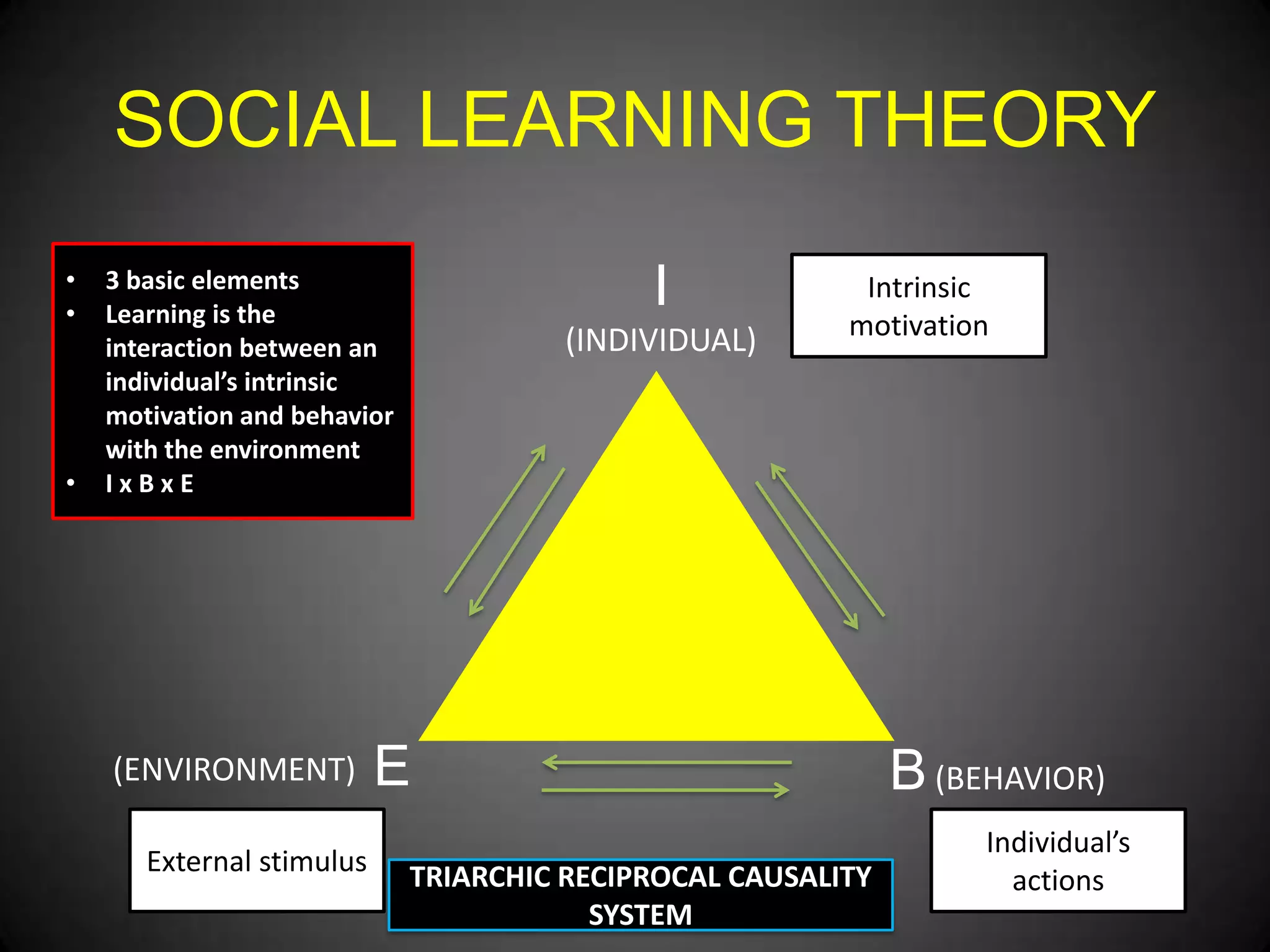
    SOCIAL LEARNING THEORY • • • I 3basic elements Learning is the interaction between an individual’s intrinsic motivation and behavior with the environment IxBxE (ENVIRONMENT) External stimulus (INDIVIDUAL) Intrinsic motivation E TRIARCHIC RECIPROCAL CAUSALITY SYSTEM B (BEHAVIOR) Individual’s actions
  • 5.
    BANDURA’S MODELING THEORY OBSERVATION ? YOU Yourfriend did something good, e.g. excel in exams MODEL ? • • • • The teacher praised your friend REINFORCEMENT ? You’re more inclined to study more to excel like your friend did IMITATION ? Bandura and Walters (1963) – children imitate behaviors of model and react in a more aggravated manner than the one they observed. Posits that learning through observation is a basic form of human behavior. Observation learning – individual’s behavior are learned through observation of others (models). Characteristics: main elements are observation and imitation, learned from model’s behavior
  • 6.
    LEARNING PROCESS THROUGH OBSERVATION:MODELING ATTENTION • Concentrated effort while observation • Factors : • Characteris tics of model and observation skills RETENTION REPRODUCTIO N • Retains behaviors observed in the memory via language and imagination (Bandura, 1986) • Repeat imitated behavior. • Capability depends largely on • Physical ability • Psychomotor of imitating skill • Memory REINFORCEMENT/ MOTIVATION • • Imitations occur when there positive reinforcement, and least likely when reinforced negatively. Types: • Direct reinforcement • Vicarious reinforcement • Selfreinforcement
  • 7.
    LIVE MODELS e.g. realperson demonstration SYMBOLIC MODELS e.g. real or fictional characters via media such as movies TYPES OF MODELLING STIMULI (Bandura, 1986) VERBAL INSTRUCTION MODELS e.g. Instructional, process descriptive
  • 8.
    Main learning elements: observation and imitation Behaviorcan be learned from language, idioms and proverbs. Pupils imitates their teachers from demonstration CHARACTERISTICS OF BANDURA’S MODELLING THEORY Processes covers observation, thinking, memorizing and imitation, ending with positive reinforcement Skill can be mastered if there were satisfaction and appropriate reinforcement
  • 9.
    IMPLICATION OF BANDURA’S MODELLINGTHEORY DEMONSTRATION IS VITAL - should add to instruction. Teacher’s works as examples should be of good quality. NORMAL CLASS SPECIAL NEEDS Teachers are very important role models Take into consideration children’s special needs i.e. impairment, disability.
  • 10.
    REFERENCES • Childs, D.(2007, January 5). Kids Imitate Saddam's Televised Hanging Death. ABC News. Retrieved July 1, 2012 • Foster, C. (2006). Confidence Man. Stanford Magazine. Retrieved July 1, 2012 • http://www.psy.cmu.edu/~siegler/35grusec92.pdf • http://www.gatherthepeople.org/Downloads/SOCIAL_LEARNING.pdf • http://socialscientist.us/nphs/psychIB/psychpdfs/Social_learning_Theory. pdf • Mok Soon Sang. (2008). Learning and the learner. Perak, Malaysia: Penerbitan Multimedia Sdn. Bhd. • Smith, M., & Berge, Z. L. (2009, June). Social Learning Theory in Second Life. MERLOT Journal of Online Learning and Teaching, 5(2). Retrieved July 1, 2012 • Woolfolk, A. (2011). Educational psychology (11th ed.). Pearson Education International: Columbus, OH.
  • 11.
  • 12.
    LEARNING OUTCOMES • Studentslearn by imitation – demonstration was given by the teacher. • The aesthetical value is the main motivation, i.e. the motivation to create beautiful art. • Observation is followed by hands-on. This ensures that it goes into student’s memory. • Students will be able to reproduce their observation if they are given comprehensible demonstrations and positive reinforcements.
  • 13.
    INSTRUCTIONS • Students willbe given a kirigami template. • Teacher or instructor will demonstrate step by step the process of building the kirigami. • ATTENTION: This activity requires the use of crafting knife. Use with utmost care.