Learning Styles

By Horasis Toro Vargas
   JosĂŠ Ayala Chico
      Omar Cruz
Main aspects


1. Learning Styles: What Are They

2. Learning Styles Strategies

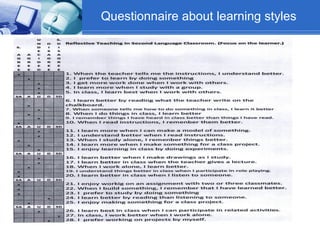
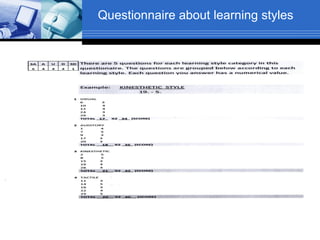
3. Questionnaire about learning styles

4. Conclusions
What is learning?


 Learning is acquiring new, or modifying existing, knowledge,
    behaviors, skills, values, or preferences and may involve
          synthesizing different types of information..
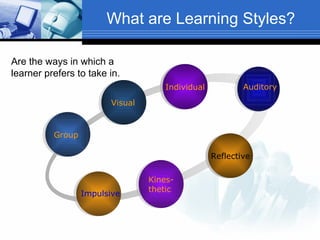
What are Learning Styles?

Are the ways in which a
learner prefers to take in.
                                       Visual
                                     Individual           Auditory
                        Visual


          Group

                                                  Reflective
                                                   Visual

                                 Kines-
                                 thetic
                  Impulsive
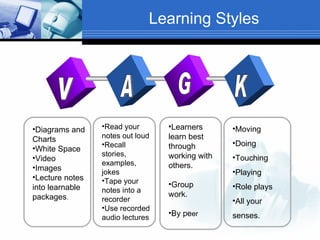
Learning Styles


•Diagrams and    •Read your       •Learners      •Moving
Charts           notes out loud   learn best
                 •Recall          through        •Doing
•White Space
                 stories,         working with
•Video                                           •Touching
                 examples,        others.
•Images
                 jokes                           •Playing
•Lecture notes   •Tape your
into learnable                    •Group         •Role plays
                 notes into a
packages.                         work.
                 recorder                        •All your
                 •Use recorded
                                  •By peer       senses.
                 audio lectures
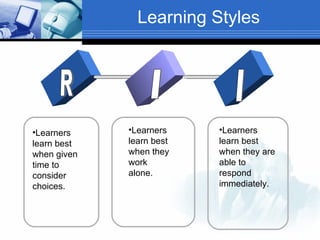
Learning Styles


•Learners    •Learners    •Learners
learn best   learn best   learn best
when given   when they    when they are
time to      work         able to
consider     alone.       respond
choices.                  immediately.
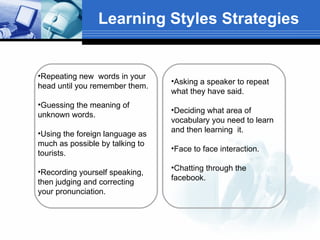
Learning Styles Strategies


 Are the ways chosen and used by learners to learn
  language. They include ways to help ourselves identify
  what we need to learn.
Learning Styles Strategies


•Repeating new words in your
                                 •Asking a speaker to repeat
                                 Read/           Kines-
head until you remember them.
    Visual          Aural        what they have said.
                                 Write           thetic
•Guessing the meaning of
                                 •Deciding what area of
unknown words.
                                 vocabulary you need to learn
•Using the foreign language as   and then learning it.
much as possible by talking to
                                 •Face to face interaction.
tourists.
                                 •Chatting through the
•Recording yourself speaking,
                                 facebook.
then judging and correcting
your pronunciation.
Questionnaire about learning styles
Conclusions


 There are a lot of techniques that a teacher can use in order to
  stimulate the learners learning proccess.

 Eases the teaching proccess with different aids and provides
  each lesson with the proper tool.

 Using different learning styles catches the students motivation
  and increases the teaching effectiveness.
Sources

Learning Styles
Felder & Silverman
   http://www.ncsu.edu/felder-public/Learning_Styles.html
Fleming, Neil
   http://www.vark-learn.com
Kolb, David A.
   http://www.learningfromexperience.com
Bibliography of works:
   http://learningfromexperience.com/research-library/

Learning styles

  • 1.
    Learning Styles By HorasisToro Vargas JosĂŠ Ayala Chico Omar Cruz
  • 2.
    Main aspects 1. LearningStyles: What Are They 2. Learning Styles Strategies 3. Questionnaire about learning styles 4. Conclusions
  • 3.
    What is learning? Learning is acquiring new, or modifying existing, knowledge, behaviors, skills, values, or preferences and may involve synthesizing different types of information..
  • 4.
    What are LearningStyles? Are the ways in which a learner prefers to take in. Visual Individual Auditory Visual Group Reflective Visual Kines- thetic Impulsive
  • 5.
    Learning Styles •Diagrams and •Read your •Learners •Moving Charts notes out loud learn best •Recall through •Doing •White Space stories, working with •Video •Touching examples, others. •Images jokes •Playing •Lecture notes •Tape your into learnable •Group •Role plays notes into a packages. work. recorder •All your •Use recorded •By peer senses. audio lectures
  • 6.
    Learning Styles •Learners •Learners •Learners learn best learn best learn best when given when they when they are time to work able to consider alone. respond choices. immediately.
  • 7.
    Learning Styles Strategies Are the ways chosen and used by learners to learn language. They include ways to help ourselves identify what we need to learn.
  • 8.
    Learning Styles Strategies •Repeatingnew words in your •Asking a speaker to repeat Read/ Kines- head until you remember them. Visual Aural what they have said. Write thetic •Guessing the meaning of •Deciding what area of unknown words. vocabulary you need to learn •Using the foreign language as and then learning it. much as possible by talking to •Face to face interaction. tourists. •Chatting through the •Recording yourself speaking, facebook. then judging and correcting your pronunciation.
  • 9.
  • 10.
  • 11.
    Conclusions  There area lot of techniques that a teacher can use in order to stimulate the learners learning proccess.  Eases the teaching proccess with different aids and provides each lesson with the proper tool.  Using different learning styles catches the students motivation and increases the teaching effectiveness.
  • 12.
    Sources Learning Styles Felder &Silverman http://www.ncsu.edu/felder-public/Learning_Styles.html Fleming, Neil http://www.vark-learn.com Kolb, David A. http://www.learningfromexperience.com Bibliography of works: http://learningfromexperience.com/research-library/