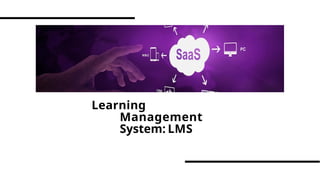
Learning
Management
System: LMS
In this presentation, we will
explore how to build an efficient
Learning Management System
(LMS) using the MERN stack. The
MERN stack, which includes
MongoDB, Express, React, and
Node.js, provides a powerful
framework for developing
modern web applications
tailored for educational purposes.
Introduction
What is a Learning Management
System?
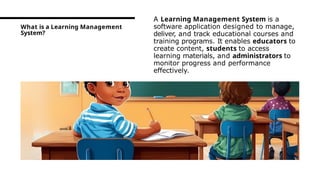
A Learning Management System is a
software application designed to manage,
deliver, and track educational courses and
training programs. It enables educators to
create content, students to access
learning materials, and administrators to
monitor progress and performance
effectively.
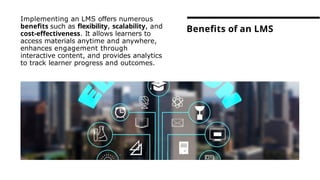
Implementing an LMS offers numerous
benefits such as flexibility, scalability, and
cost-effectiveness. It allows learners to
access materials anytime and anywhere,
enhances engagement through
interactive content, and provides analytics
to track learner progress and outcomes.
Benefits of an LMS
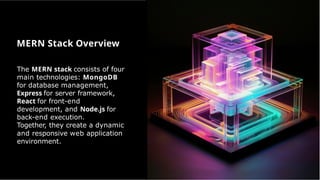
The MERN stack consists of four
main technologies: MongoDB
for database management,
Express for server framework,
React for front-end
development, and Node.js for
back-end execution.
Together, they create a dynamic
and responsive web application
environment.
MERN Stack Overview
Setting Up MongoDB
To start building our LMS, we first set
up MongoDB to store user data, course
content, and assessments. It allows for
flexible data structures and efficient
querying, which is essential for
handling diverse educational materials
and user interactions.
Using Express, we can create a robust
server that handles API requests and
manages user authentication. This
framework simplifies development with
its middleware capabilities, enabling
seamless integration of various
functionalities needed for our LMS.
Creating the Server with Express
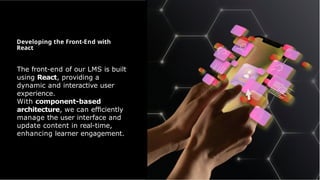
The front-end of our LMS is built
using React, providing a
dynamic and interactive user
experience.
With component-based
architecture, we can efficiently
manage the user interface and
update content in real-time,
enhancing learner engagement.
Developing the Front-End with
React
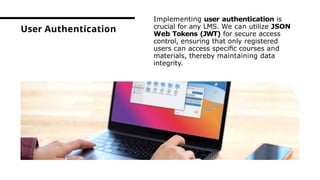
User Authentication
Implementing user authentication is
crucial for any LMS. We can utilize JSON
Web Tokens (JWT) for secure access
control, ensuring that only registered
users can access specific courses and
materials, thereby maintaining data
integrity.
Analytics and Reporting
An efficient LMS should provide analytics
and reporting features. By tracking user
engagement, course completion rates,
and assessment scores, educators can
gain valuable insights into learner
performance and improve course
offerings.
In conclusion, building an
efficient Learning Management
System using the MERN stack
allows for a flexible, scalable,
and user-friendly platform. By
leveraging these technologies,
we can enhance the learning
experience and provide valuable
insights for educators and
learners alike.
Conclusion
Thanks!
Prabhat
Mishra Sujal
Sahu Gulshan
Ajay
Vohra
Amit
Project Lab
Submitted To-
Prof. Manoj Pal

Learning Management System PPT on LMS Project

  • 1.
  • 2.
    In this presentation,we will explore how to build an efficient Learning Management System (LMS) using the MERN stack. The MERN stack, which includes MongoDB, Express, React, and Node.js, provides a powerful framework for developing modern web applications tailored for educational purposes. Introduction
  • 3.
    What is aLearning Management System? A Learning Management System is a software application designed to manage, deliver, and track educational courses and training programs. It enables educators to create content, students to access learning materials, and administrators to monitor progress and performance effectively.
  • 4.
    Implementing an LMSoffers numerous benefits such as flexibility, scalability, and cost-effectiveness. It allows learners to access materials anytime and anywhere, enhances engagement through interactive content, and provides analytics to track learner progress and outcomes. Benefits of an LMS
  • 5.
    The MERN stackconsists of four main technologies: MongoDB for database management, Express for server framework, React for front-end development, and Node.js for back-end execution. Together, they create a dynamic and responsive web application environment. MERN Stack Overview
  • 6.
    Setting Up MongoDB Tostart building our LMS, we first set up MongoDB to store user data, course content, and assessments. It allows for flexible data structures and efficient querying, which is essential for handling diverse educational materials and user interactions.
  • 7.
    Using Express, wecan create a robust server that handles API requests and manages user authentication. This framework simplifies development with its middleware capabilities, enabling seamless integration of various functionalities needed for our LMS. Creating the Server with Express
  • 8.
    The front-end ofour LMS is built using React, providing a dynamic and interactive user experience. With component-based architecture, we can efficiently manage the user interface and update content in real-time, enhancing learner engagement. Developing the Front-End with React
  • 9.
    User Authentication Implementing userauthentication is crucial for any LMS. We can utilize JSON Web Tokens (JWT) for secure access control, ensuring that only registered users can access specific courses and materials, thereby maintaining data integrity.
  • 10.
    Analytics and Reporting Anefficient LMS should provide analytics and reporting features. By tracking user engagement, course completion rates, and assessment scores, educators can gain valuable insights into learner performance and improve course offerings.
  • 11.
    In conclusion, buildingan efficient Learning Management System using the MERN stack allows for a flexible, scalable, and user-friendly platform. By leveraging these technologies, we can enhance the learning experience and provide valuable insights for educators and learners alike. Conclusion
  • 12.