INTERNATIONAL ACADEMY
OF EDUCATION
INTERNATIONAL BUREAU
OF EDUCATION
Effective
pedagogy
in
mathematics
by Glenda Anthony
and Margaret Walshaw
EDUCATIONALPRACTICESSERIES–19
BIE Educational Practices Series 19_OK:Mise en page 1 20/10/09 9:1
The International Academy
of Education
The International Academy of Education (IAE) is a not-for-profit
scientific association that promotes educational research, and its
dissemination and implementation. Founded in 1986, the Academy
is dedicated to strengthening the contributions of research, solving
critical educational problems throughout the world, and providing
better communication among policy makers, researchers, and
practitioners.
The seat of the Academy is at the Royal Academy of Science,
Literature, and Arts in Brussels, Belgium, and its co-ordinating centre
is at Curtin University of Technology in Perth, Australia.
The general aim of the IAE is to foster scholarly excellence in all
fields of education. Towards this end, the Academy provides timely
syntheses of research-based evidence of international importance. The
Academy also provides critiques of research and of its evidentiary basis
and its application to policy.
The current members of the Board of Directors of the Academy
are:
• Monique Boekaerts, University of Leiden, The Netherlands
(President);
• Erik De Corte, University of Leuven, Belgium (Past President);
• Barry Fraser, Curtin University of Technology, Australia
(Executive Director);
• Jere Brophy, Michigan State University, United States of America;
• Erik Hanushek, Hoover Institute, Stanford University, United
States of America;
• Maria de Ibarrola, National Polytechnical Institute, Mexico;
• Denis Phillips, Stanford University, United States of America.
For more information, see the IAE’s website at:
http://www.iaoed.org
2
BIE Educational Practices Series 19_OK:Mise en page 1 20/10/09 9:1
Series Preface
This booklet about effective mathematics teaching has been prepared for
inclusion in the Educational Practices Series developed by the
International Academy of Education and distributed by the International
Bureau of Education and the Academy. As part of its mission, the
Academy provides timely syntheses of research on educational topics of
international importance. This is the nineteenth in a series of booklets on
educational practices that generally improve learning. It complements an
earlier booklet, Improving Student Achievement in Mathematics, by
Douglas A. Grouws and Kristin J. Cebulla.
This booklet is based on a synthesis of research evidence produced for
the New Zealand Ministry of Education’s Iterative Best Evidence
Synthesis (BES) Programme by Glenda Anthony and Margaret Walshaw.
This synthesis, like the others in the series, is intended to be a catalyst for
systemic improvement and sustainable development in education. It is
electronically available at www.educationcounts.govt.nz/goto/BES. All
the BESs have been written using a collaborative approach that involves
the writers, teacher unions, principal groups, teacher educators,
academics, researchers, policy advisers and other interested groups. To
ensure rigour and usefulness, each BES has followed national guidelines
developed by the Ministry of Education. Professor Paul Cobb has
provided quality assurance for the original synthesis.
Glenda and Margaret are associate professors at Massey University.
As directors of the Centre of Excellence for Research in Mathematics
Education, they are involved in a wide range of research projects relating
to both classroom and teacher education. They are currently engaged in
research that focuses on equitable participation practices in classrooms,
communication practices, numeracy practices, and teachers as learners.
Their research is widely published in peer reviewed journals including
Mathematics Education Research Journal, Review of Educational Research,
Pedagogies: An International Journal, and Contemporary Issues in Early
Childhood.
Suggestions or guidelines for practice must always be responsive to
the educational and cultural context, and open to continuing
evaluation. No. 19 in this Educational Practices Series presents an
inquiry model that teachers and teacher educators can use as a tool for
adapting and building on the findings of this synthesis in their own
particular contexts.
JERE BROPHY
Editor, Michigan State University
United States of America
3
BIE Educational Practices Series 19_OK:Mise en page 1 20/10/09 9:1
Previous titles in the “Educational practices” series:
1. Teaching by Jere Brophy. 36 p.
2. Parents and learning by Sam Redding. 36 p.
3. Effective educational practices by Herbert J. Walberg and Susan J. Paik.
24 p.
4. Improving student achievement in mathematics by Douglas A. Grouws and
Kristin J. Cebulla. 48 p.
5. Tutoring by Keith Topping. 36 p.
6. Teaching additional languages by Elliot L. Judd, Lihua Tan and Herbert
J. Walberg. 24 p.
7. How children learn by Stella Vosniadou. 32 p.
8. Preventing behaviour problems: what works by Sharon L. Foster, Patricia
Brennan, Anthony Biglan, Linna Wang and Suad al-Ghaith. 30 p.
9. Preventing HIV/AIDS in schools by Inon I. Schenker and Jenny M.
Nyirenda. 32 p.
10. Motivation to learn by Monique Boekaerts. 28 p.
11. Academic and social emotional learning by Maurice J. Elias. 31 p.
12. Teaching reading by Elizabeth S. Pang, Angaluki Muaka, Elizabeth B.
Bernhardt and Michael L. Kamil. 23 p.
13. Promoting pre-school language by John Lybolt and Catherine Gottfred.
27 p.
14. Teaching speaking, listening and writing by Trudy Wallace, Winifred E.
Stariha and Herbert J. Walberg. 19 p.
15. Using new media by Clara Chung-wai Shih and David E. Weekly. 23 p.
16. Creating a safe and welcoming school by John E. Mayer. 27 p.
17. Teaching science by John R. Staver. 26 p.
18. Teacher professional learning and development by Helen Timperley. 31 p.
These titles can be downloaded from the websites of the IEA
(http://www.iaoed.org) or of the IBE (http://www.ibe.unesco.org/
publications.htm) or paper copies can be requested from: IBE,
Publications Unit, P.O. Box 199, 1211 Geneva 20, Switzerland.
Please note that several titles are out of print, but can be
downloaded from the IEA and IBE websites.
4
BIE Educational Practices Series 19_OK:Mise en page 1 20/10/09 9:1
Table of Contents
The International Academy of Education, page 2
Series Preface, page 3
Introduction, page 6
1. An ethic of care, page 7
2. Arranging for learning, page 9
3. Building on students’ thinking, page 11
4. Worthwhile mathematical tasks, page 13
5. Making connections, page 15
6. Assessment for learning, page 17
7. Mathematical Communication, page 19
8. Mathematical language, page 21
9. Tools and representations, page 23
10. Teacher knowledge, page 25
Conclusion, page 27
References, page 28
Printed in 2009 by Gonnet Imprimeur, 01300 Belley, France.
This publication was produced in 2009 by the International
Academy of Education (IAE), Palais des AcadÈmies, 1, rue
Ducale, 1000 Brussels, Belgium, and the International Bureau of
Education (IBE), P.O. Box 199, 1211 Geneva 20, Switzerland. It
is available free of charge and may be freely reproduced and
translated into other languages. Please send a copy of any
publication that reproduces this text in whole or in part to the
IAE and the IBE. This publication is also available on the
Internet. See the “Publications” section, “Educational Practices
Series” page at:
http://www.ibe.unesco.org
The authors are responsible for the choice and presentation of the
facts contained in this publication and for the opinions expressed
therein, which are not necessarily those of UNESCO/IBE and do
not commit the organization. The designations employed and the
presentation of the material in this publication do not imply the
expression of any opinion whatsoever on the part of
UNESCO/IBE concerning the legal status of any country,
territory, city or area, or of its authorities, or concerning the
delimitation of its frontiers or boundaries.
5
BIE Educational Practices Series 19_OK:Mise en page 1 20/10/09 9:1
Introduction
This booklet focuses on effective mathematics teaching. Drawing on a
wide range of research, it describes the kinds of pedagogical approaches
that engage learners and lead to desirable outcomes.The aim of the booklet
is to deepen the understanding of practitioners, teacher educators, and
policy makers and assist them to optimize opportunities for mathematics
learners.
Mathematics is the most international of all curriculum subjects, and
mathematical understanding influences decision making in all areas of
life—private, social, and civil. Mathematics education is a key to increasing
the post-school and citizenship opportunities of young people, but today,
as in the past, many students struggle with mathematics and become
disaffected as they continually encounter obstacles to engagement. It is
imperative, therefore, that we understand what effective mathematics
teaching looks like—and what teachers can do to break this pattern.
The principles outlined in this booklet are not stand-alone indicators
of best practice: any practice must be understood as
nested within a larger network that includes the school, home, community,
and wider education system. Teachers will find that
some practices are more applicable to their local circumstances than others.
Collectively, the principles found in this booklet are informed by a
belief that mathematics pedagogy must:
• be grounded in the general premise that all students have the right to
access education and the specific premise that all have the right to
access mathematical culture;
• acknowledge that all students, irrespective of age, can develop positive
mathematical identities and become powerful mathematical learners;
• be based on interpersonal respect and sensitivity and be responsive to
the multiplicity of cultural heritages, thinking processes, and realities
typically found in our classrooms;
• be focused on optimising a range of desirable academic outcomes that
include conceptual understanding, procedural fluency, strategic
competence, and adaptive reasoning;
• be committed to enhancing a range of social outcomes within the
mathematics classroom that will contribute to the holistic
development of students for productive citizenship.
Suggested Readings: Anthony & Walshaw, 2007; Martin, 2007;
National Research Council, 2001.
6
BIE Educational Practices Series 19_OK:Mise en page 1 20/10/09 9:1
1. An ethic of care
Research findings
Teachers who truly care about their students work hard at developing
trusting classroom communities. Equally importantly, they ensure that
their classrooms have a strong mathematical focus and that they have
high yet realistic expectations about what their students can achieve. In
such a climate, students find they are able to think, reason,
communicate, reflect upon, and critique the mathematics they
encounter; their classroom relationships become a resource for
developing their mathematical competencies and identities.
Caring about the development of students’ mathematical
proficiency
Students want to learn in a harmonious environment. Teachers can help
create such an environment by respecting and valuing the mathematics
and the cultures that students bring to the classroom. By ensuring
safety, teachers make it easier for all their students to get involved. It is
important, however, that they avoid the kind of caring relationships that
encourage dependency. Rather, they need to promote classroom
relationships that allow students to think for themselves, ask questions,
and take intellectual risks.
Classroom routines play an important role in developing students’
mathematical thinking and reasoning. For example, the everyday
practice of inviting students to contribute responses to a mathematical
question or problem may do little more than promote cooperation.
Teachers need to go further and clarify their expectations about how
students can and should contribute, when and in what form, and how
others might respond. Teachers who truly care about the development
of their students’ mathematical proficiency show interest in the ideas
they construct and express, no matter how unexpected or unorthodox.
By modelling the practice of evaluating ideas, they encourage their
students to make thoughtful judgments about the mathematical
soundness of the ideas voiced by their classmates. Ideas that are shown
to be sound contribute to the shaping of further instruction.
Caring classroom communities that are
focused on mathematical goals help develop
students’ mathematical identities and
proficiencies.
7
BIE Educational Practices Series 19_OK:Mise en page 1 20/10/09 9:1
Caring about the development of students’ mathematical
identities
Teachers are the single most important resource for developing
students’ mathematical identities. By attending to the differing needs
that derive from home environments, languages, capabilities, and
perspectives, teachers allow students to develop a positive attitude to
mathematics. A positive attitude raises comfort levels and gives
students greater confidence in their capacity to learn and to make
sense of mathematics.
In the following transcript, students talk about their teacher and
the inclusive classroom she has developed—a classroom in which they
feel responsibility for themselves and for their own learning.
Through her inclusive practices, this particular teacher influenced the
way in which students thought of themselves. Confident in their own
understandings, they were willing to entertain and assess the validity
of new ideas and approaches, including those put forward by their
peers. They had developed a belief in themselves as mathematical
learners and, as a result, were more inclined to persevere in the face of
mathematical challenges.
Suggested Readings: Angier & Povey, 1999; Watson, 2002.
She treats you as though you are like … not just a kid. If you say
look this is wrong she’ll listen to you. If you challenge her she will
try and see it your way.
She doesn’t regard herself as higher.
She’s not bothered about being proven wrong. Most teachers hate
being wrong … being proven wrong by students.
It’s more like a discussion … you can give answers and say what
you think.
We all felt like a family in maths. Does that make sense? Even if
we weren’t always sending out brotherly/sisterly vibes. Well we
got used to each other … so we all worked … We all knew how
to work with each other … it was a big group … more like a
neighbourhood with loads of different houses.
Angier & Povey (1999, pp. 153, 157)
8
BIE Educational Practices Series 19_OK:Mise en page 1 20/10/09 9:1
2. Arranging for learning
Research findings
When making sense of ideas, students need opportunities to work
both independently and collaboratively. At times they need to be able
to think and work quietly, away from the demands of the whole class.
At times they need to be in pairs or small groups so that they can share
ideas and learn with and from others. And at other times they need to
be active participants in purposeful, whole-class discussion, where
they have the opportunity to clarify their understanding and be
exposed to broader interpretations of the mathematical ideas that are
the present focus.
Independent thinking time
It can be difficult to grasp a new concept or solve a problem when
distracted by the views of others. For this reason, teachers should
ensure that all students are given opportunities to think and work
quietly by themselves, where they are not required to process the
varied, sometimes conflicting perspectives of others.
Whole-class discussion
In whole-class discussion, teachers are the primary resource for
nurturing patterns of mathematical reasoning. Teachers manage,
facilitate, and monitor student participation and they record students’
solutions, emphasising efficient ways of doing this. While ensuring
that discussion retains its focus, teachers invite students to explain
their solutions to others; they also encourage students to listen to and
respect one another, accept and evaluate different viewpoints, and
engage in an exchange of thinking and perspectives.
Partners and small groups
Working with partners and in small groups can help students to see
themselves as mathematical learners. Such arrangements can often
provide the emotional and practical support that students need to
clarify the nature of a task and identify possible ways forward. Pairs
and small groups are not only useful for enhancing engagement; they
Effective teachers provide students with
opportunities to work both independently
and collaboratively to make sense of ideas.
9
BIE Educational Practices Series 19_OK:Mise en page 1 20/10/09 9:1
also facilitate the exchange and testing of ideas and encourage higher-
level thinking. In small, supportive groups, students learn how to
make conjectures and engage in mathematical argumentation and
validation.
As participants in a group, students require freedom from
distraction and space for easy interactions. They need to be reasonably
familiar with the focus activity and to be held accountable for the
group’s work. The teacher is responsible for ensuring that students
understand and adhere to the participant roles, which include
listening, writing, answering, questioning, and critically assessing.
Note how the teacher in the following transcript clarifies expectations:
For maximum effectiveness groups should be small—no more than
four or five members. When groups include students of varying
mathematical achievement, insights come at different levels; these
insights will tend to enhance overall understandings.
Suggested Readings: Hunter, 2005; Sfard & Kieran, 2001; Wood,
2002.
I want you to explain to the people in your group how you think
you are going to go about working it out. Then I want you to ask
if they understand what you are on about and let them ask you
questions. Remember in the end you all need to be able to explain
how your group did it so think of questions you might be asked
and try them out.
Now this group is going to explain and you are going to look at
what they do and how they came up with the rule for their
pattern. Then as they go along if you are not sure please ask them
questions. If you can’t make sense of each step remember ask
those questions.
Hunter (2005, pp. 454–455)
10
BIE Educational Practices Series 19_OK:Mise en page 1 20/10/09 9:1
3. Building on students’ thinking
Research findings
In planning for learning, effective teachers put students’ current
knowledge and interests at the centre of their instructional decision
making. Instead of trying to fix weaknesses and fill gaps, they build on
existing proficiencies, adjusting their instruction to meet students’
learning needs. Because they view thinking as “understanding in
progress”, they are able to use their students’ thinking as a resource for
further learning. Such teachers are responsive both to their students
and to the discipline of mathematics.
Connecting learning to what students are thinking
Effective teachers take student competencies as starting points for
their planning and their moment-by-moment decision making.
Existing competencies, including language, reading and listening
skills, ability to cope with complexity, and mathematical reasoning,
become resources to build upon. Experientially real tasks are also
valuable for advancing understanding. When students can envisage
the situations or events in which a problem is embedded, they can use
their own experiences and knowledge as a basis for developing
context-related strategies that they can later refine into generalized
strategies. For example, young children trying to work out how to
share three pies among four family members will typically use
informal methods that pre-empt formal division procedures.
Because they focus on the thinking that goes on when their
students are engaged in tasks, effective teachers are able to pose new
questions or design new tasks that will challenge and extend thinking.
Consider this problem: It takes a dragonfly about 2 seconds to fly 18
metres. How long should it take it to fly 110 metres? Knowing that a
student has solved this problem using additive thinking, a teacher
might adapt the task so that it is more likely to invite multiplicative
reasoning: How long should it take the dragonfly to fly 1100 metres? or
How long should it take a dragonfly to fly 110 metres if it flies about 9
metres in 1 second?
Effective teachers plan mathematics learning
experiences that enable students to build on
their existing proficiencies, interests, and
experiences.
11
BIE Educational Practices Series 19_OK:Mise en page 1 20/10/09 9:1
Using students’ misconceptions and errors as building blocks
Learners make mistakes for many reasons, including insufficient time
or care. But errors also arise from consistent, alternative
interpretations of mathematical ideas that represent the learner’s
attempts to create meaning. Rather than dismiss such ideas as “wrong
thinking”, effective teachers view them as a natural and often
necessary stage in a learner’s conceptual development. For example,
young children often transfer the belief that dividing something
always makes it smaller to their initial attempts to understand decimal
fractions. Effective teachers take such misconceptions and use them as
building blocks for developing deeper understandings.
There are many ways in which teachers can provide opportunities
for students to learn from their errors. One is to organize discussion
that focuses student attention on difficulties that have surfaced.
Another is to ask students to share their interpretations or solution
strategies so that they can compare and re-evaluate their thinking. Yet
another is to pose questions that create tensions that need to be
resolved. For example, confronted with the division misconception
just referred to, a teacher could ask students to investigate the
difference between 10 :– 2, 2 :– 10, and 10 :– 0.2 using diagrams,
pictures, or number stories.
Appropriate challenge
By providing appropriate challenge, effective teachers signal their high
but realistic expectations. This means building on students’ existing
thinking and, more often than not, modifying tasks to provide
alternative pathways to understanding. For low-achieving students,
teachers find ways to reduce the complexity of tasks without falling
back on repetition and busywork and without compromising the
mathematical integrity of the activity. Modifications include using
prompts, reducing the number of steps or variables, simplifying how
results are to be represented, reducing the amount of written
recording, and using extra thinking tools. Similarly, by putting
obstacles in the way of solutions, removing some information,
requiring the use of particular representations, or asking for
generalizations, teachers can increase the challenge for academically
advanced students.
Suggested readings: Carpenter, Fennema, & Franke, 1996; Houssart,
2002; Sullivan, Mousley, & Zevenbergen, 2006.
12
BIE Educational Practices Series 19_OK:Mise en page 1 20/10/09 9:1
4. Worthwhile mathematical tasks
Research findings
It is by engaging with tasks that students develop ideas about the
nature of mathematics and discover that they have the capacity to
make sense of mathematics. Tasks and learning experiences that allow
for original thinking about important concepts and relationships
encourage students to become proficient doers and learners of
mathematics. Tasks should not have a single-minded focus on right
answers; they should provide opportunities for students to struggle
with ideas and to develop and use an increasingly sophisticated range
of mathematical processes (for example, justification, abstraction, and
generalization).
Mathematical Focus
Effective teachers design learning experiences and tasks that are based
on sound and significant mathematics; they ensure that all students
are given tasks that help them improve their understanding in the
domain that is currently the focus. Students should not expect that
tasks will always involve practising algorithms they have just been
taught; rather, they should expect that the tasks they are given will
require them to think with and about important mathematical ideas.
High-level mathematical thinking involves making use of formulas,
algorithms, and procedures in ways that connect to concepts,
understandings, and meaning. Tasks that require students to think
deeply about mathematical ideas and connections encourage them to
think for themselves instead of always relying on their teacher to lead
the way. Given such opportunities, students find that mathematics
becomes enjoyable and relevant.
Problematic tasks
Through the tasks they pose, teachers send important messages about
what doing mathematics involves. Effective teachers set tasks that
require students to make and test conjectures, pose problems, look for
patterns, and explore alternative solution paths. Open-ended and
Effective teachers understand that the tasks
and examples they select influence how
students come to view, develop, use, and
make sense of mathematics.
13
BIE Educational Practices Series 19_OK:Mise en page 1 20/10/09 9:1
modelling tasks, in particular, require students to interpret a context
and then to make sense of the embedded mathematics. For example,
if asked to design a schedule for producing a family meal, students
need to interpret information, speculate and present arguments, apply
previous learning, and make connections within mathematics and
between mathematics and other bodies of knowledge. When working
with real-life, complex systems, students learn that doing mathematics
consists of more than producing right answers.
Open-ended tasks are ideal for fostering the creative thinking and
experimentation that characterize mathematical “play”. For example,
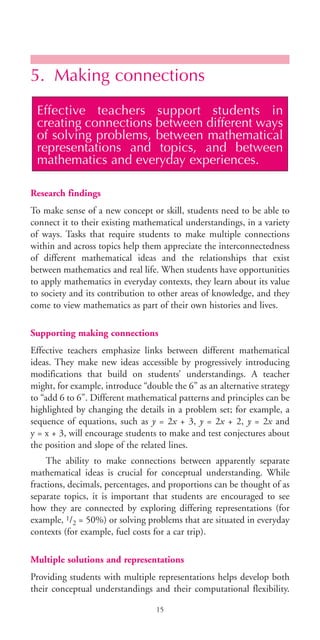
if asked to explore different ways of showing 2/3, students must engage
in such fundamental mathematical practices as investigating, creating,
reasoning, and communicating.
Practice activity
Students need opportunities to practice what they are learning,
whether it be to improve their computational fluency, problem-
solving skills, or conceptual understanding. Skill development can
often be incorporated into “doing” mathematics; for example,
learning about perimeter and area offers opportunities for students to
practice multiplication and fractions. Games can also be a means of
developing fluency and automaticity. Instead of using them as time
fillers, effective teachers choose and use games because they meet
specific mathematical purposes and because they provide appropriate
feedback and challenge for all participants.
Suggested readings: Henningsen & Stein, 1997; Watson & De Geest,
2005.
14
BIE Educational Practices Series 19_OK:Mise en page 1 20/10/09 9:1
5. Making connections
Research findings
To make sense of a new concept or skill, students need to be able to
connect it to their existing mathematical understandings, in a variety
of ways. Tasks that require students to make multiple connections
within and across topics help them appreciate the interconnectedness
of different mathematical ideas and the relationships that exist
between mathematics and real life. When students have opportunities
to apply mathematics in everyday contexts, they learn about its value
to society and its contribution to other areas of knowledge, and they
come to view mathematics as part of their own histories and lives.
Supporting making connections
Effective teachers emphasize links between different mathematical
ideas. They make new ideas accessible by progressively introducing
modifications that build on students’ understandings. A teacher
might, for example, introduce “double the 6” as an alternative strategy
to “add 6 to 6”. Different mathematical patterns and principles can be
highlighted by changing the details in a problem set; for example, a
sequence of equations, such as y = 2x + 3, y = 2x + 2, y = 2x and
y = x + 3, will encourage students to make and test conjectures about
the position and slope of the related lines.
The ability to make connections between apparently separate
mathematical ideas is crucial for conceptual understanding. While
fractions, decimals, percentages, and proportions can be thought of as
separate topics, it is important that students are encouraged to see
how they are connected by exploring differing representations (for
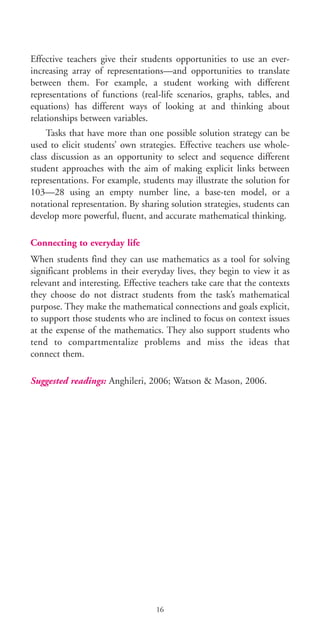
example, 1/2 = 50%) or solving problems that are situated in everyday
contexts (for example, fuel costs for a car trip).
Multiple solutions and representations
Providing students with multiple representations helps develop both
their conceptual understandings and their computational flexibility.
Effective teachers support students in
creating connections between different ways
of solving problems, between mathematical
representations and topics, and between
mathematics and everyday experiences.
15
BIE Educational Practices Series 19_OK:Mise en page 1 20/10/09 9:1
Effective teachers give their students opportunities to use an ever-
increasing array of representations—and opportunities to translate
between them. For example, a student working with different
representations of functions (real-life scenarios, graphs, tables, and
equations) has different ways of looking at and thinking about
relationships between variables.
Tasks that have more than one possible solution strategy can be
used to elicit students’ own strategies. Effective teachers use whole-
class discussion as an opportunity to select and sequence different
student approaches with the aim of making explicit links between
representations. For example, students may illustrate the solution for
103—28 using an empty number line, a base-ten model, or a
notational representation. By sharing solution strategies, students can
develop more powerful, fluent, and accurate mathematical thinking.
Connecting to everyday life
When students find they can use mathematics as a tool for solving
significant problems in their everyday lives, they begin to view it as
relevant and interesting. Effective teachers take care that the contexts
they choose do not distract students from the task’s mathematical
purpose. They make the mathematical connections and goals explicit,
to support those students who are inclined to focus on context issues
at the expense of the mathematics. They also support students who
tend to compartmentalize problems and miss the ideas that
connect them.
Suggested readings: Anghileri, 2006; Watson & Mason, 2006.
16
BIE Educational Practices Series 19_OK:Mise en page 1 20/10/09 9:1
6. Assessment for learning
Research findings
Effective teachers make use of a wide range of formal and informal
assessments to monitor learning progress, diagnose learning issues,
and determine what they need to do next to further learning. In the
course of regular classroom activity, they collect information about
how students learn, what they seem to know and be able to do, and
what interests them. In this way, they know what is working and what
is not, and are able to make informed teaching and learning decisions.
Exploring students’ reasoning and probing their understanding
During every lesson, teachers make countless instructional decisions.
Moment-by-moment assessment of student progress helps them
decide what questions to ask, when to intervene, and how to respond
to questions. They can gain a lot from observing students as they work
and by talking with them: they can gauge students’ understanding, see
what strategies they prefer, and listen to the language they use.
Effective teachers use this information as a basis for deciding what
examples and explanations they will focus on in class discussion.
One-on-one interviews can also provide important insights: a
thinking-aloud problem-solving interview will often reveal more
about what is going on in a student’s mind than a written test.
Teachers using interviews for the first time are often surprized with
what students know and don’t know. Because they challenge their
expectations and assumptions, interviews can make teachers more
responsive to their students’ diverse learning needs.
Teacher Questioning
By asking questions, effective teachers require students to participate
in mathematical thinking and problem solving. By allowing sufficient
time for students to explore responses in depth and by pressing for
explanation and understanding, teachers can ensure that students are
productively engaged. Questions are also a powerful means of
assessing students’ knowledge and exploring their thinking. A key
indicator of good questioning is how teachers listen to student
Effective teachers use a range of assessment
practices to make students’ thinking visible
and to support students’ learning.
17
BIE Educational Practices Series 19_OK:Mise en page 1 20/10/09 9:1
responses. Effective teachers pay attention not only to whether an
answer is correct, but also to the student’s mathematical thinking.
They know that a wrong answer might indicate unexpected thinking
rather than lack of understanding; equally, a correct answer may be
arrived at via faulty thinking.
To explore students’ thinking and encourage them to engage at a
higher level, teachers can use questions that start at the solution; for
example, If the area of a rectangle is 24 cm2 and the perimeter is 22 cm,
what are its dimensions? Questions that have a variety of solutions or
can be solved in more than one way have the potential to provide
valuable insight into student thinking and reasoning.
Feedback
Helpful feedback focuses on the task, not on marks or grades; it
explains why something is right or wrong and describes what to do
next or suggests strategies for improvement. For example, the
feedback, I want you to go over all of them and write an equals sign in
each one gives a student information that she can use to improve her
performance. Effective teachers support students when they are stuck,
not by giving full solutions, but by prompting them to search for
more information, try another method, or discuss the problem with
classmates. In response to a student who says he doesn’t understand, a
teacher might say: Well, the first part is just like the last problem. Then
we add one more variable. See if you can find out what it is. I’ll be back
in a few minutes. This teacher challenges the student to do further
thinking before she returns to check on progress.
Self and peer assessment
Effective teachers provide opportunities for students to evaluate their
own work. These may include having students design their own test
questions, share success criteria, write mathematical journals, or
present portfolio evidence of growing understanding. When feedback
is used to encourage continued student–student and student–teacher
dialogue, self-evaluation becomes a regular part of the learning process
and students develop greater self-awareness.
Suggested readings: Steinberg, Empson, & Carpenter, 2004; Wiliam,
2007.
18
BIE Educational Practices Series 19_OK:Mise en page 1 20/10/09 9:1
7. Mathematical Communication
Research findings
Effective teachers encourage their students to explain and justify
their solutions. They ask them to take and defend positions against
the contrary mathematical claims of other students. They scaffold
student attempts to examine conjectures, disagreements, and
counterarguments. With their guidance, students learn how to use
mathematical ideas, language, and methods. As attention shifts from
procedural rules to making sense of mathematics, students become less
preoccupied with finding the answers and more with the thinking that
leads to the answers.
Scaffolding attempts at mathematical ways of speaking and
thinking
Students need to be taught how to communicate mathematically, give
sound mathematical explanations, and justify their solutions.
Effective teachers encourage their students to communicate their ideas
orally, in writing, and by using a variety of representations.
Revoicing is one way of guiding students in the use of
mathematical conventions. Revoicing involves repeating, rephrasing,
or expanding on student talk. Teachers can use it (i) to highlight ideas
that have come directly from students, (ii) to help develop students’
understandings that are implicit in those ideas, (iii) to negotiate
meaning with their students, and (iv) to add new ideas, or move
discussion in another direction.
Developing skills of mathematical argumentation
To guide students in the ways of mathematical argumentation,
effective teachers encourage them to take and defend positions against
alternative views; their students become accustomed to listening to
the ideas of others and using debate to resolve conflict and arrive at
common understandings.
In the following episode, a class has been discussing the claim that
fractions can be converted into decimals. Bruno and Gina have been
Effective teachers are able to facilitate
classroom dialogue that is focused on
mathematical argumentation.
19
BIE Educational Practices Series 19_OK:Mise en page 1 20/10/09 9:1
developing the skills of mathematical argumentation during this
discussion. The teacher then speaks to the class:
This teacher sustained the flow of student ideas, knowing when to
step in and out of the discussion, when to press for understanding,
when to resolve competing student claims, and when to address
misunderstandings or confusion. While the students were learning
mathematical argumentation and discovering what makes an
argument convincing, she was listening attentively to student ideas
and information. Importantly, she withheld her own explanations
until they were needed.
Suggested readings: Lobato, Clarke, & Ellis, 2005; O’Connor, 2001;
Yackel, Cobb, & Wood, 1998.
Teacher: Great, now I hope you’re listening because what Gina
and Bruno said was very important. Bruno made a conjecture and
Gina tested it for him. And based on her tests he revised his
conjecture because that’s what a conjecture is. It means that you
think that you’re seeing a pattern so you’re gonna come up with a
statement that you think is true, but you’re not convinced yet.
But based on her further evidence, Bruno revised his conjecture.
Then he might go back to revise it again, back to what he
originally said or to something totally new. But they’re doing
something important. They’re looking for patterns and they’re
trying to come up with generalizations.
O’Connor (2001, pp. 155–156)
20
BIE Educational Practices Series 19_OK:Mise en page 1 20/10/09 9:1
8. Mathematical language
Research findings
Effective teachers foster students’ use and understanding of the
terminology that is endorsed by the wider mathematical community.
They do this by making links between mathematical language,
students’ intuitive understandings, and the home language. Concepts
and technical terms need to be explained and modelled in ways that
make sense to students yet are true to the underlying meaning. By
carefully distinguishing between terms, teachers make students aware
of the variations and subtleties to be found in mathematical language.
Explicit language instruction
Students learn the meaning of mathematical language through
explicit “telling” and through modelling. Sometimes, they can be
helped to grasp the meaning of a concept through the use of words or
symbols that have the same mathematical meaning, for example, “x”,
“multiply”, and “times”. Particular care is needed when using words
such as “less than”, “more”, “maybe”, and “half”, which can have
somewhat different meanings in the home. In the following
transcript, a teacher holds up two cereal packets, one large and one
small, and asks students to describe the difference between them in
mathematical terms.
Effective teachers shape mathematical
language by modelling appropriate terms
and communicating their meaning in ways
that students understand.
21
T: Would you say that those two are different shapes?
R: They’re similar.
T: What does similar mean?
R: Same shape, different sizes.
T: Same shape but different sizes. That’s going around in circles
isn’t it?—We still don’t know what you mean by shape. What
do you mean by shape?
[She gathers three objects: the two cereal packets and the meter
ruler. She places the ruler alongside the small cereal packet.]
BIE Educational Practices Series 19_OK:Mise en page 1 20/10/09 9:1
Multilingual contexts and home language
The teacher should model and use specialized mathematical language
in ways that let students grasp it easily. Terms such as “absolute value”,
“standard deviation”, and “very likely” typically do not have
equivalents in the language a child uses at home. Where the medium
of instruction is different from the home language, children can
encounter considerable difficulties with prepositions, word order,
logical structures, and conditionals—and the unfamiliar contexts in
which problems are situated. Teachers of mathematics are often
unaware of the barriers to understanding that students from a
different language and culture must overcome. Language (or code)
switching, in which the teacher substitutes a home language word,
phrase, or sentence for a mathematical concept, can be a useful
strategy for helping students grasp underlying meaning.
Suggested readings: Runesson, 2005; Setati & Adler, 2001.
22
T: This and this are different shapes, but they’re both cuboids.
[She now puts the cereal packets side by side.]
T: This and this are the same shape and different sizes. What
makes them the same shape?
[One girl refers to a scaled-down version. Another to measuring the
sides—to see if they’re in the same ratio. Claire picks up their
words and emphasizes them.
T: Right. So it’s about ratio and about scale.
Runesson (2005, pp. 75–76)
BIE Educational Practices Series 19_OK:Mise en page 1 20/10/09 9:1
9. Tools and representations
Research findings
Effective teachers draw on a range of representations and tools to
support their students’ mathematical development. These include the
number system itself, algebraic symbolism, graphs, diagrams, models,
equations, notations, images, analogies, metaphors, stories, textbooks,
and technology. Such tools provide vehicles for representation,
communication, reflection, and argumentation. They are most
effective when they cease to be external aids, instead becoming
integral parts of students’ mathematical reasoning. As tools become
increasingly invested with meaning, they become increasingly useful
for furthering learning.
Thinking with tools
If tools are to offer students “thinking spaces”, helping them to
organize their mathematical reasoning and support their sense-
making, teachers must ensure that the tools they select are used
effectively. With the help of an appropriate tool, students can think
through a problem or test an idea that their teacher has modelled. For
example, ten-frame activities can be used to help students visualize
number relationships (e.g., how far a number is from 10) or how a
number can be partitioned.
Effective teachers take care when using tools, particularly pre-
designed, “concrete” materials such as number lines or ten-frames, to
ensure that all students make the intended mathematical sense of
them. They do this by explaining how the model is being used, how
it represents the ideas under discussion, and how it links to
operations, concepts, and symbolic representations.
Communicating with tools
Tools, both representations and virtual manipulatives, are helpful for
communicating ideas and thinking that are otherwise difficult to
describe, talk about, or write about. Tools do not have to be ready-
made; effective teachers acknowledge the value of students generating
and using their own representations, whether these be invented
Effective teachers carefully select tools and
representations to provide support for
students’ thinking.
23
BIE Educational Practices Series 19_OK:Mise en page 1 20/10/09 9:1
notations or graphical, pictorial, tabular, or geometric representations.
For example, students can take statistical data and create their own
pictorial representations to tell stories well before they acquire formal
graphing tools. As they use tools to communicate their ideas, students
develop and clarify their own thinking at the same time that they
provide their teachers with insight into that thinking.
New technologies
An increasing array of technological tools is available for use in
mathematics classrooms. These include calculator and computer
applications, presentation technologies such as the interactive
whiteboard, mobile technologies such as clickers and data loggers, and
the Internet. These dynamic graphical, numerical, and visual
applications provide new opportunities for teachers and students to
explore and represent mathematical concepts.
With guidance from teachers, technology can support
independent inquiry and shared knowledge building. When used for
mathematical investigations and modelling activities, technological
tools can link the student with the real world, making mathematics
more accessible and relevant.
Teachers need to make informed decisions about when and how
they use technology to support learning. Effective teachers take time
to share with their students the reasoning behind these decisions; they
also require them to monitor their own use (including overuse or
underuse) of technology. Given the pace of change, teachers need
ongoing professional development so that they can use new
technologies in ways that advance the mathematical thinking of their
students.
Suggested readings: Thomas & Chinnappan, 2008; Zevenbergen &
Lerman, 2008.
24
BIE Educational Practices Series 19_OK:Mise en page 1 20/10/09 9:1
10. Teacher knowledge
Research findings
How teachers organize classroom instruction is very much dependent
on what they know and believe about mathematics and on what they
understand about mathematics teaching and learning. They need
knowledge to help them recognize, and then act upon, the teaching
opportunities that come up without warning. If they understand the
big ideas of mathematics, they can represent mathematics as a
coherent and connected system and they can make sense of and
manage multiple student viewpoints. Only with substantial content
and pedagogical content knowledge can teachers assist students in
developing mathematically grounded understandings.
Teacher content knowledge
Effective teachers have a sound grasp of relevant content and how to
teach it. They know what the big ideas are that they need to teach.
They can think of, model, and use examples and metaphors in ways
that advance student thinking. They can critically evaluate students’
processes, solutions, and understanding and give appropriate and
helpful feedback. They can see the potential in the tasks they set; this,
in turn, contributes to sound instructional decision making.
Teacher pedagogical content knowledge
Pedagogical content knowledge is crucial at all levels of mathematics
and with all groups of students. Teachers with in-depth knowledge
have clear ideas about how to build procedural proficiency and how
to extend and challenge student ideas. They use their knowledge to
make the multiple decisions about tasks, classroom resources, talk,
and actions that feed into or arise out of the learning process. Teachers
with limited knowledge tend to structure teaching and learning
around discrete concepts instead of creating wider connections
between facts, concepts, structures, and practices.
To teach mathematical content effectively, teachers need a
grounded understanding of students as learners. With such
Effective teachers develop and use sound
knowledge as a basis for initiating learning
and responding to the mathematical needs
of all their students.
25
BIE Educational Practices Series 19_OK:Mise en page 1 20/10/09 9:1
understanding, they are aware of likely conceptions and
misconceptions. They use this awareness to make instructional
decisions that strengthen conceptual understanding.
Teacher knowledge in action
As the following transcript illustrates, sound knowledge enables the
teacher to listen and question more perceptively, effectively informing
her on-the-spot classroom decision making.
Like this teacher, those with sound knowledge are more apt to notice
the critical moments when choices or opportunities present
themselves. Importantly, given their grasp of mathematical ideas and
how to teach, they can adapt and modify their routines to fit the need.
Enhancing teacher knowledge
The development of teacher knowledge is greatly enhanced by efforts
within the wider educational community. Teachers need the support
of others—particularly material, systems, and human and emotional
support. While teachers can learn a great deal by working together
with a group of supportive mathematics colleagues, professional
development initiatives are often a necessary catalyst for major
change.
Suggested readings: Askew, Brown, Rhodes, Johnson, & Wiliam,
1997; Hill, Rowan, & Ball, 2005; Schifter, 2001
The teacher challenged her year 1–2 class to investigate negative
integers.
S: Negative five plus negative five should be negative five.
Teacher: No, because you’re adding negative five and negative
five, so you start at negative five and how many jumps
do you take?
S: Five.
Teacher: Well, you’re not going to end up on negative five
[points to the negative five on the number line]. So,
then negative five. How many jumps do you take?
S: Five.
Teacher: So where are you going to end up?
Fraivillig, Murphy & Fuson (1999, p. 161)
26
BIE Educational Practices Series 19_OK:Mise en page 1 20/10/09 9:1
Conclusion
Current research findings show that the nature of mathematics
teaching significantly affects the nature and outcomes of student
learning. This highlights the huge responsibility teachers have for
their students’ mathematical well-being. In this booklet, we offer ten
principles as a starting point for discussing change, innovation, and
reform. These principles should be viewed as a whole, not in isolation:
teaching is complex, and many interrelated factors have an impact on
student learning. The booklet offers ways to address that complexity,
and to make mathematics teaching more effective.
Major innovation and genuine reform require aligning the efforts
of all those involved in students’ mathematical development: teachers,
principals, teacher educators, researchers, parents, specialist support
services, school boards, policy makers, and the students themselves.
Changes need to be negotiated and carried through in classrooms,
teams, departments, and faculties, and in teacher education
programmes. Innovation and reform must be provided with adequate
resources. Schools, communities, and nations need to ensure that
their teachers have the knowledge, skills, resources, and incentives to
provide students with the very best of learning opportunities. In this
way, all students will develop their mathematical proficiency. In this
way, too, all students will have the opportunity to view themselves as
powerful learners of mathematics.
27
BIE Educational Practices Series 19_OK:Mise en page 1 20/10/09 9:1
References
Anghileri, J. 2006. Scaffolding practices that enhance mathematics
learning. Journal of Mathematics Teacher Education, no. 9, pp.
33–52.
Angier, C.; Povey, H. 1999. One teacher and a class of school
students: Their perception of the culture of their mathematics
classroom and its construction. Educational Review, vol. 51, no. 2,
pp. 147–160.
Anthony, G.; Walshaw, M. 2007. Effective pedagogy in
mathematics/p‚ngarau: Best evidence synthesis iteration [BES].
Wellington: Ministry of Education.
Askew, M. et al. 1997. Effective teachers of numeracy. London: Kings
College.
Carpenter, T.; Fennema, E.; Franke, M. 1996. Cognitively guided
instruction: A knowledge base for reform in primary mathematics
instruction. The Elementary School Journal, vol. 97, no. 1, pp.
3–20.
Fraivillig, J.; Murphy, L.; Fuson, K. 1999. Advancing children’s
mathematical thinking in Everyday Mathematics classrooms.
Journal for Research in Mathematics Education, vol. 30, no. 2, pp.
148–170.
Henningsen, M.; Stein, M. 1997. Mathematical tasks and student
cognition: Classroom-based factors that support and inhibit high-
level mathematical thinking and reasoning. Journal for Research in
Mathematics Education, vol. 28, no. 5, pp. 524–549.
Hill, H.; Rowan, B.; Ball, D. 2005. Effects of teachers’ mathematical
knowledge for teaching on student achievement. American
Education Research Journal, no. 42, pp. 371–406.
Houssart, J. 2002. Simplification and repetition of mathematical
tasks: A recipe for success or failure? The Journal of Mathematical
Behavior, vol. 21, no. 2, pp. 191–202.
Hunter, R. 2005. Reforming communication in the classroom: One
teacher’s journey of change. In: Clarkson, P. et al., eds. Building
connections: Research, theory and practice (Proceedings of the 28th
annual conference of the Mathematics Education Research Group
of Australasia, pp. 451–458). Sydney: MERGA.
Lobato, J.; Clarke, D.; Ellis, A. B. 2005. Initiating and eliciting in
teaching: A reformulation of telling. Journal for Research in
Mathematics Education, vol. 36, no. 2, pp. 101–136.
28
BIE Educational Practices Series 19_OK:Mise en page 1 20/10/09 9:1
Martin, T. S., ed. 2007. Mathematics teaching today: Improving
practice, improving student learning, 2nd ed. Reston, VA: National
Council of Teachers of Mathematics.
National Research Council. 2001. Adding it up: Helping children learn
mathematics. Washington, DC: National Academy Press.
O’Connor, M.C. 2001. “Can any fraction be turned into a decimal?”
A case study of a mathematical group discussion. Educational
Studies in Mathematics, no. 46, pp. 143–185.
Runesson, U. 2005. Beyond discourse and interaction. Variation: A
critical aspect for teaching and learning mathematics. Cambridge
Journal of Education, vol. 35, no. 1, pp. 69–87.
Schifter, D. 2001. Learning to see the invisible. In: Wood, T.; Scott-
Nelson, B.; Warfield, J., eds. Beyond classical pedagogy: Teaching
elementary school mathematics (pp. 109–134). Mahwah, NJ:
Lawrence Erlbaum Associates.
Setati, M.; Adler, J. 2001. Code-switching in a senior primary class of
secondary-language mathematics learners. For the Learning of
Mathematics, no. 18, pp. 34–42.
Sfard, A.; Keiran, C. 2001. Cognition as communication: Rethinking
learning-by-talking through multi-faceted analysis of students’
mathematical interactions. Mind, Culture, and Activity, vol. 8,
no. 1, pp. 42–76.
Steinberg, R. M.; Empson, S.B.; Carpenter, T.P. 2004. Inquiry into
children’s mathematical thinking as a means to teacher change.
Journal of Mathematics Teacher Education, no. 7, pp. 237–267.
Sullivan, P.; Mousley, J.; Zevenbergen, R. 2006. Teacher actions to
maximize mathematics learning opportunities in heterogeneous
classrooms. International Journal of Science and Mathematics
Education, vol. 4, no. 1, pp. 117–143.
Thomas, M.; Chinnappan, M. 2008. Teaching and learning with
technology: Realising the potential. In: Forgasz, H. et al., eds.
Research in Mathematics Education in Australasia 2004–2007
(pp. 165–193). Rotterdam: Sense Publishers.
Watson, A. 2002. Instances of mathematical thinking among low
attaining students in an ordinary secondary classroom. Journal of
Mathematical Behavior, no. 20, pp. 461–475.
Watson, A.; De Geest, E. 2005. Principled teaching for deep progress:
Improving mathematical learning beyond methods and material.
Educational Studies in Mathematics, no. 58, pp. 209–234.
Watson, A.; Mason, J. 2006. Seeing an exercise as a single
mathematical object: Using variation to structure sense-making.
Mathematical Thinking and Learning, no. 8, pp. 91–111.
29
BIE Educational Practices Series 19_OK:Mise en page 1 20/10/09 9:1
Wiliam, D. 2007. Keeping learning on track. In: Lester, F.K., ed.
Second handbook of research on mathematics teaching and learning
(pp. 1053–1098). Charlotte, NC: NCTM & Information Age
Publishing.
Wood, T. 2002. What does it mean to teach mathematics differently?
In: Barton, B. et al., eds. Mathematics Education in the South
Pacific (Proceedings of the 25th annual conference of the
Mathematics Education Research Group of Australasia, pp.
61–67). Sydney: MERGA.
Yackel, E.; Cobb, P.; Wood, T. 1998. The interactive constitution of
mathematical meaning in one second grade classroom: An
illustrative example. Journal of Mathematical Behaviour, vol. 17,
no. 4, pp. 469–488.
Zevenbergen, R.; Lerman, S. 2008. Learning environments using
interactive whiteboards: New learning spaces or reproduction of
old technologies. Mathematics Education Research Journal, vol. 20,
no. 1, pp. 107–125.
30
BIE Educational Practices Series 19_OK:Mise en page 1 20/10/09 9:1
31
BIE Educational Practices Series 19_OK:Mise en page 1 20/10/09 9:1
The International
Bureau of
Education–IBE
The IBE was founded in Geneva, Switzerland, as a
private, non-governmental organization in 1925. In
1929, under new statutes, it became the first
intergovernmental organization in the field of
education. Since 1969 the Institute has been an
integral part of UNESCO while retaining wide
intellectual and functional autonomy.
The mission of the IBE is to function as an
international centre for the development of
contents and methods of education. It builds
networks to share expertise on, and foster national
capacities for curriculum change and development
in all the regions of the world. It aims to introduce
modern approaches in curriculum design and
implementation, improve practical skills, and foster
international dialogue on educational policies.
The IBE contributes to the attainment of quality
Education for All (EFA) mainly through: (a)
developing and facilitating a worldwide network
and a Community of Practice of curriculum
specialists; (b) providing advisory services and
technical assistance in response to specific demands
for curriculum reform or development; (c)
collecting, producing and giving access to a wide
range of information resources and materials on
education systems, curricula and curriculum
development processes from around the world,
including online databases (such as World Data on
Education), thematic studies, publications (such as
Prospects, the quarterly review of education),
national reports, as well as curriculum materials and
approaches for HIV & AIDS education at primary
and secondary levels through the HIV & AIDS
Clearinghouse; and (d) facilitating and fostering
international dialogue on educational policies,
strategies and reforms among decision-makers and
other stakeholders, in particular through the
International Conference on Education—organized
by the IBE since 1934—, which can be considered
one of the main forums for developing world-level
policy dialogue between Ministers of Education.
The IBE is governed by a Council composed of
representatives of twenty-eight Member States
elected by the General Conference of UNESCO.
The IBE is proud to be associated with the work of
the International Academy of Education and
publishes this material in its capacity as a
Clearinghouse promoting the exchange of
information on educational practices.
Visit the IBE website at: http://www.ibe.unesco.org
EDUCATIONALPRACTICESSERIES–19
BIE Educational Practices Series 19_OK:Mise en page 1 20/10/09 9:1

EdPractices_19

  • 1.
    INTERNATIONAL ACADEMY OF EDUCATION INTERNATIONALBUREAU OF EDUCATION Effective pedagogy in mathematics by Glenda Anthony and Margaret Walshaw EDUCATIONALPRACTICESSERIES–19 BIE Educational Practices Series 19_OK:Mise en page 1 20/10/09 9:1
  • 2.
    The International Academy ofEducation The International Academy of Education (IAE) is a not-for-profit scientific association that promotes educational research, and its dissemination and implementation. Founded in 1986, the Academy is dedicated to strengthening the contributions of research, solving critical educational problems throughout the world, and providing better communication among policy makers, researchers, and practitioners. The seat of the Academy is at the Royal Academy of Science, Literature, and Arts in Brussels, Belgium, and its co-ordinating centre is at Curtin University of Technology in Perth, Australia. The general aim of the IAE is to foster scholarly excellence in all fields of education. Towards this end, the Academy provides timely syntheses of research-based evidence of international importance. The Academy also provides critiques of research and of its evidentiary basis and its application to policy. The current members of the Board of Directors of the Academy are: • Monique Boekaerts, University of Leiden, The Netherlands (President); • Erik De Corte, University of Leuven, Belgium (Past President); • Barry Fraser, Curtin University of Technology, Australia (Executive Director); • Jere Brophy, Michigan State University, United States of America; • Erik Hanushek, Hoover Institute, Stanford University, United States of America; • Maria de Ibarrola, National Polytechnical Institute, Mexico; • Denis Phillips, Stanford University, United States of America. For more information, see the IAE’s website at: http://www.iaoed.org 2 BIE Educational Practices Series 19_OK:Mise en page 1 20/10/09 9:1
  • 3.
    Series Preface This bookletabout effective mathematics teaching has been prepared for inclusion in the Educational Practices Series developed by the International Academy of Education and distributed by the International Bureau of Education and the Academy. As part of its mission, the Academy provides timely syntheses of research on educational topics of international importance. This is the nineteenth in a series of booklets on educational practices that generally improve learning. It complements an earlier booklet, Improving Student Achievement in Mathematics, by Douglas A. Grouws and Kristin J. Cebulla. This booklet is based on a synthesis of research evidence produced for the New Zealand Ministry of Education’s Iterative Best Evidence Synthesis (BES) Programme by Glenda Anthony and Margaret Walshaw. This synthesis, like the others in the series, is intended to be a catalyst for systemic improvement and sustainable development in education. It is electronically available at www.educationcounts.govt.nz/goto/BES. All the BESs have been written using a collaborative approach that involves the writers, teacher unions, principal groups, teacher educators, academics, researchers, policy advisers and other interested groups. To ensure rigour and usefulness, each BES has followed national guidelines developed by the Ministry of Education. Professor Paul Cobb has provided quality assurance for the original synthesis. Glenda and Margaret are associate professors at Massey University. As directors of the Centre of Excellence for Research in Mathematics Education, they are involved in a wide range of research projects relating to both classroom and teacher education. They are currently engaged in research that focuses on equitable participation practices in classrooms, communication practices, numeracy practices, and teachers as learners. Their research is widely published in peer reviewed journals including Mathematics Education Research Journal, Review of Educational Research, Pedagogies: An International Journal, and Contemporary Issues in Early Childhood. Suggestions or guidelines for practice must always be responsive to the educational and cultural context, and open to continuing evaluation. No. 19 in this Educational Practices Series presents an inquiry model that teachers and teacher educators can use as a tool for adapting and building on the findings of this synthesis in their own particular contexts. JERE BROPHY Editor, Michigan State University United States of America 3 BIE Educational Practices Series 19_OK:Mise en page 1 20/10/09 9:1
  • 4.
    Previous titles inthe “Educational practices” series: 1. Teaching by Jere Brophy. 36 p. 2. Parents and learning by Sam Redding. 36 p. 3. Effective educational practices by Herbert J. Walberg and Susan J. Paik. 24 p. 4. Improving student achievement in mathematics by Douglas A. Grouws and Kristin J. Cebulla. 48 p. 5. Tutoring by Keith Topping. 36 p. 6. Teaching additional languages by Elliot L. Judd, Lihua Tan and Herbert J. Walberg. 24 p. 7. How children learn by Stella Vosniadou. 32 p. 8. Preventing behaviour problems: what works by Sharon L. Foster, Patricia Brennan, Anthony Biglan, Linna Wang and Suad al-Ghaith. 30 p. 9. Preventing HIV/AIDS in schools by Inon I. Schenker and Jenny M. Nyirenda. 32 p. 10. Motivation to learn by Monique Boekaerts. 28 p. 11. Academic and social emotional learning by Maurice J. Elias. 31 p. 12. Teaching reading by Elizabeth S. Pang, Angaluki Muaka, Elizabeth B. Bernhardt and Michael L. Kamil. 23 p. 13. Promoting pre-school language by John Lybolt and Catherine Gottfred. 27 p. 14. Teaching speaking, listening and writing by Trudy Wallace, Winifred E. Stariha and Herbert J. Walberg. 19 p. 15. Using new media by Clara Chung-wai Shih and David E. Weekly. 23 p. 16. Creating a safe and welcoming school by John E. Mayer. 27 p. 17. Teaching science by John R. Staver. 26 p. 18. Teacher professional learning and development by Helen Timperley. 31 p. These titles can be downloaded from the websites of the IEA (http://www.iaoed.org) or of the IBE (http://www.ibe.unesco.org/ publications.htm) or paper copies can be requested from: IBE, Publications Unit, P.O. Box 199, 1211 Geneva 20, Switzerland. Please note that several titles are out of print, but can be downloaded from the IEA and IBE websites. 4 BIE Educational Practices Series 19_OK:Mise en page 1 20/10/09 9:1
  • 5.
    Table of Contents TheInternational Academy of Education, page 2 Series Preface, page 3 Introduction, page 6 1. An ethic of care, page 7 2. Arranging for learning, page 9 3. Building on students’ thinking, page 11 4. Worthwhile mathematical tasks, page 13 5. Making connections, page 15 6. Assessment for learning, page 17 7. Mathematical Communication, page 19 8. Mathematical language, page 21 9. Tools and representations, page 23 10. Teacher knowledge, page 25 Conclusion, page 27 References, page 28 Printed in 2009 by Gonnet Imprimeur, 01300 Belley, France. This publication was produced in 2009 by the International Academy of Education (IAE), Palais des AcadÈmies, 1, rue Ducale, 1000 Brussels, Belgium, and the International Bureau of Education (IBE), P.O. Box 199, 1211 Geneva 20, Switzerland. It is available free of charge and may be freely reproduced and translated into other languages. Please send a copy of any publication that reproduces this text in whole or in part to the IAE and the IBE. This publication is also available on the Internet. See the “Publications” section, “Educational Practices Series” page at: http://www.ibe.unesco.org The authors are responsible for the choice and presentation of the facts contained in this publication and for the opinions expressed therein, which are not necessarily those of UNESCO/IBE and do not commit the organization. The designations employed and the presentation of the material in this publication do not imply the expression of any opinion whatsoever on the part of UNESCO/IBE concerning the legal status of any country, territory, city or area, or of its authorities, or concerning the delimitation of its frontiers or boundaries. 5 BIE Educational Practices Series 19_OK:Mise en page 1 20/10/09 9:1
  • 6.
    Introduction This booklet focuseson effective mathematics teaching. Drawing on a wide range of research, it describes the kinds of pedagogical approaches that engage learners and lead to desirable outcomes.The aim of the booklet is to deepen the understanding of practitioners, teacher educators, and policy makers and assist them to optimize opportunities for mathematics learners. Mathematics is the most international of all curriculum subjects, and mathematical understanding influences decision making in all areas of life—private, social, and civil. Mathematics education is a key to increasing the post-school and citizenship opportunities of young people, but today, as in the past, many students struggle with mathematics and become disaffected as they continually encounter obstacles to engagement. It is imperative, therefore, that we understand what effective mathematics teaching looks like—and what teachers can do to break this pattern. The principles outlined in this booklet are not stand-alone indicators of best practice: any practice must be understood as nested within a larger network that includes the school, home, community, and wider education system. Teachers will find that some practices are more applicable to their local circumstances than others. Collectively, the principles found in this booklet are informed by a belief that mathematics pedagogy must: • be grounded in the general premise that all students have the right to access education and the specific premise that all have the right to access mathematical culture; • acknowledge that all students, irrespective of age, can develop positive mathematical identities and become powerful mathematical learners; • be based on interpersonal respect and sensitivity and be responsive to the multiplicity of cultural heritages, thinking processes, and realities typically found in our classrooms; • be focused on optimising a range of desirable academic outcomes that include conceptual understanding, procedural fluency, strategic competence, and adaptive reasoning; • be committed to enhancing a range of social outcomes within the mathematics classroom that will contribute to the holistic development of students for productive citizenship. Suggested Readings: Anthony & Walshaw, 2007; Martin, 2007; National Research Council, 2001. 6 BIE Educational Practices Series 19_OK:Mise en page 1 20/10/09 9:1
  • 7.
    1. An ethicof care Research findings Teachers who truly care about their students work hard at developing trusting classroom communities. Equally importantly, they ensure that their classrooms have a strong mathematical focus and that they have high yet realistic expectations about what their students can achieve. In such a climate, students find they are able to think, reason, communicate, reflect upon, and critique the mathematics they encounter; their classroom relationships become a resource for developing their mathematical competencies and identities. Caring about the development of students’ mathematical proficiency Students want to learn in a harmonious environment. Teachers can help create such an environment by respecting and valuing the mathematics and the cultures that students bring to the classroom. By ensuring safety, teachers make it easier for all their students to get involved. It is important, however, that they avoid the kind of caring relationships that encourage dependency. Rather, they need to promote classroom relationships that allow students to think for themselves, ask questions, and take intellectual risks. Classroom routines play an important role in developing students’ mathematical thinking and reasoning. For example, the everyday practice of inviting students to contribute responses to a mathematical question or problem may do little more than promote cooperation. Teachers need to go further and clarify their expectations about how students can and should contribute, when and in what form, and how others might respond. Teachers who truly care about the development of their students’ mathematical proficiency show interest in the ideas they construct and express, no matter how unexpected or unorthodox. By modelling the practice of evaluating ideas, they encourage their students to make thoughtful judgments about the mathematical soundness of the ideas voiced by their classmates. Ideas that are shown to be sound contribute to the shaping of further instruction. Caring classroom communities that are focused on mathematical goals help develop students’ mathematical identities and proficiencies. 7 BIE Educational Practices Series 19_OK:Mise en page 1 20/10/09 9:1
  • 8.
    Caring about thedevelopment of students’ mathematical identities Teachers are the single most important resource for developing students’ mathematical identities. By attending to the differing needs that derive from home environments, languages, capabilities, and perspectives, teachers allow students to develop a positive attitude to mathematics. A positive attitude raises comfort levels and gives students greater confidence in their capacity to learn and to make sense of mathematics. In the following transcript, students talk about their teacher and the inclusive classroom she has developed—a classroom in which they feel responsibility for themselves and for their own learning. Through her inclusive practices, this particular teacher influenced the way in which students thought of themselves. Confident in their own understandings, they were willing to entertain and assess the validity of new ideas and approaches, including those put forward by their peers. They had developed a belief in themselves as mathematical learners and, as a result, were more inclined to persevere in the face of mathematical challenges. Suggested Readings: Angier & Povey, 1999; Watson, 2002. She treats you as though you are like … not just a kid. If you say look this is wrong she’ll listen to you. If you challenge her she will try and see it your way. She doesn’t regard herself as higher. She’s not bothered about being proven wrong. Most teachers hate being wrong … being proven wrong by students. It’s more like a discussion … you can give answers and say what you think. We all felt like a family in maths. Does that make sense? Even if we weren’t always sending out brotherly/sisterly vibes. Well we got used to each other … so we all worked … We all knew how to work with each other … it was a big group … more like a neighbourhood with loads of different houses. Angier & Povey (1999, pp. 153, 157) 8 BIE Educational Practices Series 19_OK:Mise en page 1 20/10/09 9:1
  • 9.
    2. Arranging forlearning Research findings When making sense of ideas, students need opportunities to work both independently and collaboratively. At times they need to be able to think and work quietly, away from the demands of the whole class. At times they need to be in pairs or small groups so that they can share ideas and learn with and from others. And at other times they need to be active participants in purposeful, whole-class discussion, where they have the opportunity to clarify their understanding and be exposed to broader interpretations of the mathematical ideas that are the present focus. Independent thinking time It can be difficult to grasp a new concept or solve a problem when distracted by the views of others. For this reason, teachers should ensure that all students are given opportunities to think and work quietly by themselves, where they are not required to process the varied, sometimes conflicting perspectives of others. Whole-class discussion In whole-class discussion, teachers are the primary resource for nurturing patterns of mathematical reasoning. Teachers manage, facilitate, and monitor student participation and they record students’ solutions, emphasising efficient ways of doing this. While ensuring that discussion retains its focus, teachers invite students to explain their solutions to others; they also encourage students to listen to and respect one another, accept and evaluate different viewpoints, and engage in an exchange of thinking and perspectives. Partners and small groups Working with partners and in small groups can help students to see themselves as mathematical learners. Such arrangements can often provide the emotional and practical support that students need to clarify the nature of a task and identify possible ways forward. Pairs and small groups are not only useful for enhancing engagement; they Effective teachers provide students with opportunities to work both independently and collaboratively to make sense of ideas. 9 BIE Educational Practices Series 19_OK:Mise en page 1 20/10/09 9:1
  • 10.
    also facilitate theexchange and testing of ideas and encourage higher- level thinking. In small, supportive groups, students learn how to make conjectures and engage in mathematical argumentation and validation. As participants in a group, students require freedom from distraction and space for easy interactions. They need to be reasonably familiar with the focus activity and to be held accountable for the group’s work. The teacher is responsible for ensuring that students understand and adhere to the participant roles, which include listening, writing, answering, questioning, and critically assessing. Note how the teacher in the following transcript clarifies expectations: For maximum effectiveness groups should be small—no more than four or five members. When groups include students of varying mathematical achievement, insights come at different levels; these insights will tend to enhance overall understandings. Suggested Readings: Hunter, 2005; Sfard & Kieran, 2001; Wood, 2002. I want you to explain to the people in your group how you think you are going to go about working it out. Then I want you to ask if they understand what you are on about and let them ask you questions. Remember in the end you all need to be able to explain how your group did it so think of questions you might be asked and try them out. Now this group is going to explain and you are going to look at what they do and how they came up with the rule for their pattern. Then as they go along if you are not sure please ask them questions. If you can’t make sense of each step remember ask those questions. Hunter (2005, pp. 454–455) 10 BIE Educational Practices Series 19_OK:Mise en page 1 20/10/09 9:1
  • 11.
    3. Building onstudents’ thinking Research findings In planning for learning, effective teachers put students’ current knowledge and interests at the centre of their instructional decision making. Instead of trying to fix weaknesses and fill gaps, they build on existing proficiencies, adjusting their instruction to meet students’ learning needs. Because they view thinking as “understanding in progress”, they are able to use their students’ thinking as a resource for further learning. Such teachers are responsive both to their students and to the discipline of mathematics. Connecting learning to what students are thinking Effective teachers take student competencies as starting points for their planning and their moment-by-moment decision making. Existing competencies, including language, reading and listening skills, ability to cope with complexity, and mathematical reasoning, become resources to build upon. Experientially real tasks are also valuable for advancing understanding. When students can envisage the situations or events in which a problem is embedded, they can use their own experiences and knowledge as a basis for developing context-related strategies that they can later refine into generalized strategies. For example, young children trying to work out how to share three pies among four family members will typically use informal methods that pre-empt formal division procedures. Because they focus on the thinking that goes on when their students are engaged in tasks, effective teachers are able to pose new questions or design new tasks that will challenge and extend thinking. Consider this problem: It takes a dragonfly about 2 seconds to fly 18 metres. How long should it take it to fly 110 metres? Knowing that a student has solved this problem using additive thinking, a teacher might adapt the task so that it is more likely to invite multiplicative reasoning: How long should it take the dragonfly to fly 1100 metres? or How long should it take a dragonfly to fly 110 metres if it flies about 9 metres in 1 second? Effective teachers plan mathematics learning experiences that enable students to build on their existing proficiencies, interests, and experiences. 11 BIE Educational Practices Series 19_OK:Mise en page 1 20/10/09 9:1
  • 12.
    Using students’ misconceptionsand errors as building blocks Learners make mistakes for many reasons, including insufficient time or care. But errors also arise from consistent, alternative interpretations of mathematical ideas that represent the learner’s attempts to create meaning. Rather than dismiss such ideas as “wrong thinking”, effective teachers view them as a natural and often necessary stage in a learner’s conceptual development. For example, young children often transfer the belief that dividing something always makes it smaller to their initial attempts to understand decimal fractions. Effective teachers take such misconceptions and use them as building blocks for developing deeper understandings. There are many ways in which teachers can provide opportunities for students to learn from their errors. One is to organize discussion that focuses student attention on difficulties that have surfaced. Another is to ask students to share their interpretations or solution strategies so that they can compare and re-evaluate their thinking. Yet another is to pose questions that create tensions that need to be resolved. For example, confronted with the division misconception just referred to, a teacher could ask students to investigate the difference between 10 :– 2, 2 :– 10, and 10 :– 0.2 using diagrams, pictures, or number stories. Appropriate challenge By providing appropriate challenge, effective teachers signal their high but realistic expectations. This means building on students’ existing thinking and, more often than not, modifying tasks to provide alternative pathways to understanding. For low-achieving students, teachers find ways to reduce the complexity of tasks without falling back on repetition and busywork and without compromising the mathematical integrity of the activity. Modifications include using prompts, reducing the number of steps or variables, simplifying how results are to be represented, reducing the amount of written recording, and using extra thinking tools. Similarly, by putting obstacles in the way of solutions, removing some information, requiring the use of particular representations, or asking for generalizations, teachers can increase the challenge for academically advanced students. Suggested readings: Carpenter, Fennema, & Franke, 1996; Houssart, 2002; Sullivan, Mousley, & Zevenbergen, 2006. 12 BIE Educational Practices Series 19_OK:Mise en page 1 20/10/09 9:1
  • 13.
    4. Worthwhile mathematicaltasks Research findings It is by engaging with tasks that students develop ideas about the nature of mathematics and discover that they have the capacity to make sense of mathematics. Tasks and learning experiences that allow for original thinking about important concepts and relationships encourage students to become proficient doers and learners of mathematics. Tasks should not have a single-minded focus on right answers; they should provide opportunities for students to struggle with ideas and to develop and use an increasingly sophisticated range of mathematical processes (for example, justification, abstraction, and generalization). Mathematical Focus Effective teachers design learning experiences and tasks that are based on sound and significant mathematics; they ensure that all students are given tasks that help them improve their understanding in the domain that is currently the focus. Students should not expect that tasks will always involve practising algorithms they have just been taught; rather, they should expect that the tasks they are given will require them to think with and about important mathematical ideas. High-level mathematical thinking involves making use of formulas, algorithms, and procedures in ways that connect to concepts, understandings, and meaning. Tasks that require students to think deeply about mathematical ideas and connections encourage them to think for themselves instead of always relying on their teacher to lead the way. Given such opportunities, students find that mathematics becomes enjoyable and relevant. Problematic tasks Through the tasks they pose, teachers send important messages about what doing mathematics involves. Effective teachers set tasks that require students to make and test conjectures, pose problems, look for patterns, and explore alternative solution paths. Open-ended and Effective teachers understand that the tasks and examples they select influence how students come to view, develop, use, and make sense of mathematics. 13 BIE Educational Practices Series 19_OK:Mise en page 1 20/10/09 9:1
  • 14.
    modelling tasks, inparticular, require students to interpret a context and then to make sense of the embedded mathematics. For example, if asked to design a schedule for producing a family meal, students need to interpret information, speculate and present arguments, apply previous learning, and make connections within mathematics and between mathematics and other bodies of knowledge. When working with real-life, complex systems, students learn that doing mathematics consists of more than producing right answers. Open-ended tasks are ideal for fostering the creative thinking and experimentation that characterize mathematical “play”. For example, if asked to explore different ways of showing 2/3, students must engage in such fundamental mathematical practices as investigating, creating, reasoning, and communicating. Practice activity Students need opportunities to practice what they are learning, whether it be to improve their computational fluency, problem- solving skills, or conceptual understanding. Skill development can often be incorporated into “doing” mathematics; for example, learning about perimeter and area offers opportunities for students to practice multiplication and fractions. Games can also be a means of developing fluency and automaticity. Instead of using them as time fillers, effective teachers choose and use games because they meet specific mathematical purposes and because they provide appropriate feedback and challenge for all participants. Suggested readings: Henningsen & Stein, 1997; Watson & De Geest, 2005. 14 BIE Educational Practices Series 19_OK:Mise en page 1 20/10/09 9:1
  • 15.
    5. Making connections Researchfindings To make sense of a new concept or skill, students need to be able to connect it to their existing mathematical understandings, in a variety of ways. Tasks that require students to make multiple connections within and across topics help them appreciate the interconnectedness of different mathematical ideas and the relationships that exist between mathematics and real life. When students have opportunities to apply mathematics in everyday contexts, they learn about its value to society and its contribution to other areas of knowledge, and they come to view mathematics as part of their own histories and lives. Supporting making connections Effective teachers emphasize links between different mathematical ideas. They make new ideas accessible by progressively introducing modifications that build on students’ understandings. A teacher might, for example, introduce “double the 6” as an alternative strategy to “add 6 to 6”. Different mathematical patterns and principles can be highlighted by changing the details in a problem set; for example, a sequence of equations, such as y = 2x + 3, y = 2x + 2, y = 2x and y = x + 3, will encourage students to make and test conjectures about the position and slope of the related lines. The ability to make connections between apparently separate mathematical ideas is crucial for conceptual understanding. While fractions, decimals, percentages, and proportions can be thought of as separate topics, it is important that students are encouraged to see how they are connected by exploring differing representations (for example, 1/2 = 50%) or solving problems that are situated in everyday contexts (for example, fuel costs for a car trip). Multiple solutions and representations Providing students with multiple representations helps develop both their conceptual understandings and their computational flexibility. Effective teachers support students in creating connections between different ways of solving problems, between mathematical representations and topics, and between mathematics and everyday experiences. 15 BIE Educational Practices Series 19_OK:Mise en page 1 20/10/09 9:1
  • 16.
    Effective teachers givetheir students opportunities to use an ever- increasing array of representations—and opportunities to translate between them. For example, a student working with different representations of functions (real-life scenarios, graphs, tables, and equations) has different ways of looking at and thinking about relationships between variables. Tasks that have more than one possible solution strategy can be used to elicit students’ own strategies. Effective teachers use whole- class discussion as an opportunity to select and sequence different student approaches with the aim of making explicit links between representations. For example, students may illustrate the solution for 103—28 using an empty number line, a base-ten model, or a notational representation. By sharing solution strategies, students can develop more powerful, fluent, and accurate mathematical thinking. Connecting to everyday life When students find they can use mathematics as a tool for solving significant problems in their everyday lives, they begin to view it as relevant and interesting. Effective teachers take care that the contexts they choose do not distract students from the task’s mathematical purpose. They make the mathematical connections and goals explicit, to support those students who are inclined to focus on context issues at the expense of the mathematics. They also support students who tend to compartmentalize problems and miss the ideas that connect them. Suggested readings: Anghileri, 2006; Watson & Mason, 2006. 16 BIE Educational Practices Series 19_OK:Mise en page 1 20/10/09 9:1
  • 17.
    6. Assessment forlearning Research findings Effective teachers make use of a wide range of formal and informal assessments to monitor learning progress, diagnose learning issues, and determine what they need to do next to further learning. In the course of regular classroom activity, they collect information about how students learn, what they seem to know and be able to do, and what interests them. In this way, they know what is working and what is not, and are able to make informed teaching and learning decisions. Exploring students’ reasoning and probing their understanding During every lesson, teachers make countless instructional decisions. Moment-by-moment assessment of student progress helps them decide what questions to ask, when to intervene, and how to respond to questions. They can gain a lot from observing students as they work and by talking with them: they can gauge students’ understanding, see what strategies they prefer, and listen to the language they use. Effective teachers use this information as a basis for deciding what examples and explanations they will focus on in class discussion. One-on-one interviews can also provide important insights: a thinking-aloud problem-solving interview will often reveal more about what is going on in a student’s mind than a written test. Teachers using interviews for the first time are often surprized with what students know and don’t know. Because they challenge their expectations and assumptions, interviews can make teachers more responsive to their students’ diverse learning needs. Teacher Questioning By asking questions, effective teachers require students to participate in mathematical thinking and problem solving. By allowing sufficient time for students to explore responses in depth and by pressing for explanation and understanding, teachers can ensure that students are productively engaged. Questions are also a powerful means of assessing students’ knowledge and exploring their thinking. A key indicator of good questioning is how teachers listen to student Effective teachers use a range of assessment practices to make students’ thinking visible and to support students’ learning. 17 BIE Educational Practices Series 19_OK:Mise en page 1 20/10/09 9:1
  • 18.
    responses. Effective teacherspay attention not only to whether an answer is correct, but also to the student’s mathematical thinking. They know that a wrong answer might indicate unexpected thinking rather than lack of understanding; equally, a correct answer may be arrived at via faulty thinking. To explore students’ thinking and encourage them to engage at a higher level, teachers can use questions that start at the solution; for example, If the area of a rectangle is 24 cm2 and the perimeter is 22 cm, what are its dimensions? Questions that have a variety of solutions or can be solved in more than one way have the potential to provide valuable insight into student thinking and reasoning. Feedback Helpful feedback focuses on the task, not on marks or grades; it explains why something is right or wrong and describes what to do next or suggests strategies for improvement. For example, the feedback, I want you to go over all of them and write an equals sign in each one gives a student information that she can use to improve her performance. Effective teachers support students when they are stuck, not by giving full solutions, but by prompting them to search for more information, try another method, or discuss the problem with classmates. In response to a student who says he doesn’t understand, a teacher might say: Well, the first part is just like the last problem. Then we add one more variable. See if you can find out what it is. I’ll be back in a few minutes. This teacher challenges the student to do further thinking before she returns to check on progress. Self and peer assessment Effective teachers provide opportunities for students to evaluate their own work. These may include having students design their own test questions, share success criteria, write mathematical journals, or present portfolio evidence of growing understanding. When feedback is used to encourage continued student–student and student–teacher dialogue, self-evaluation becomes a regular part of the learning process and students develop greater self-awareness. Suggested readings: Steinberg, Empson, & Carpenter, 2004; Wiliam, 2007. 18 BIE Educational Practices Series 19_OK:Mise en page 1 20/10/09 9:1
  • 19.
    7. Mathematical Communication Researchfindings Effective teachers encourage their students to explain and justify their solutions. They ask them to take and defend positions against the contrary mathematical claims of other students. They scaffold student attempts to examine conjectures, disagreements, and counterarguments. With their guidance, students learn how to use mathematical ideas, language, and methods. As attention shifts from procedural rules to making sense of mathematics, students become less preoccupied with finding the answers and more with the thinking that leads to the answers. Scaffolding attempts at mathematical ways of speaking and thinking Students need to be taught how to communicate mathematically, give sound mathematical explanations, and justify their solutions. Effective teachers encourage their students to communicate their ideas orally, in writing, and by using a variety of representations. Revoicing is one way of guiding students in the use of mathematical conventions. Revoicing involves repeating, rephrasing, or expanding on student talk. Teachers can use it (i) to highlight ideas that have come directly from students, (ii) to help develop students’ understandings that are implicit in those ideas, (iii) to negotiate meaning with their students, and (iv) to add new ideas, or move discussion in another direction. Developing skills of mathematical argumentation To guide students in the ways of mathematical argumentation, effective teachers encourage them to take and defend positions against alternative views; their students become accustomed to listening to the ideas of others and using debate to resolve conflict and arrive at common understandings. In the following episode, a class has been discussing the claim that fractions can be converted into decimals. Bruno and Gina have been Effective teachers are able to facilitate classroom dialogue that is focused on mathematical argumentation. 19 BIE Educational Practices Series 19_OK:Mise en page 1 20/10/09 9:1
  • 20.
    developing the skillsof mathematical argumentation during this discussion. The teacher then speaks to the class: This teacher sustained the flow of student ideas, knowing when to step in and out of the discussion, when to press for understanding, when to resolve competing student claims, and when to address misunderstandings or confusion. While the students were learning mathematical argumentation and discovering what makes an argument convincing, she was listening attentively to student ideas and information. Importantly, she withheld her own explanations until they were needed. Suggested readings: Lobato, Clarke, & Ellis, 2005; O’Connor, 2001; Yackel, Cobb, & Wood, 1998. Teacher: Great, now I hope you’re listening because what Gina and Bruno said was very important. Bruno made a conjecture and Gina tested it for him. And based on her tests he revised his conjecture because that’s what a conjecture is. It means that you think that you’re seeing a pattern so you’re gonna come up with a statement that you think is true, but you’re not convinced yet. But based on her further evidence, Bruno revised his conjecture. Then he might go back to revise it again, back to what he originally said or to something totally new. But they’re doing something important. They’re looking for patterns and they’re trying to come up with generalizations. O’Connor (2001, pp. 155–156) 20 BIE Educational Practices Series 19_OK:Mise en page 1 20/10/09 9:1
  • 21.
    8. Mathematical language Researchfindings Effective teachers foster students’ use and understanding of the terminology that is endorsed by the wider mathematical community. They do this by making links between mathematical language, students’ intuitive understandings, and the home language. Concepts and technical terms need to be explained and modelled in ways that make sense to students yet are true to the underlying meaning. By carefully distinguishing between terms, teachers make students aware of the variations and subtleties to be found in mathematical language. Explicit language instruction Students learn the meaning of mathematical language through explicit “telling” and through modelling. Sometimes, they can be helped to grasp the meaning of a concept through the use of words or symbols that have the same mathematical meaning, for example, “x”, “multiply”, and “times”. Particular care is needed when using words such as “less than”, “more”, “maybe”, and “half”, which can have somewhat different meanings in the home. In the following transcript, a teacher holds up two cereal packets, one large and one small, and asks students to describe the difference between them in mathematical terms. Effective teachers shape mathematical language by modelling appropriate terms and communicating their meaning in ways that students understand. 21 T: Would you say that those two are different shapes? R: They’re similar. T: What does similar mean? R: Same shape, different sizes. T: Same shape but different sizes. That’s going around in circles isn’t it?—We still don’t know what you mean by shape. What do you mean by shape? [She gathers three objects: the two cereal packets and the meter ruler. She places the ruler alongside the small cereal packet.] BIE Educational Practices Series 19_OK:Mise en page 1 20/10/09 9:1
  • 22.
    Multilingual contexts andhome language The teacher should model and use specialized mathematical language in ways that let students grasp it easily. Terms such as “absolute value”, “standard deviation”, and “very likely” typically do not have equivalents in the language a child uses at home. Where the medium of instruction is different from the home language, children can encounter considerable difficulties with prepositions, word order, logical structures, and conditionals—and the unfamiliar contexts in which problems are situated. Teachers of mathematics are often unaware of the barriers to understanding that students from a different language and culture must overcome. Language (or code) switching, in which the teacher substitutes a home language word, phrase, or sentence for a mathematical concept, can be a useful strategy for helping students grasp underlying meaning. Suggested readings: Runesson, 2005; Setati & Adler, 2001. 22 T: This and this are different shapes, but they’re both cuboids. [She now puts the cereal packets side by side.] T: This and this are the same shape and different sizes. What makes them the same shape? [One girl refers to a scaled-down version. Another to measuring the sides—to see if they’re in the same ratio. Claire picks up their words and emphasizes them. T: Right. So it’s about ratio and about scale. Runesson (2005, pp. 75–76) BIE Educational Practices Series 19_OK:Mise en page 1 20/10/09 9:1
  • 23.
    9. Tools andrepresentations Research findings Effective teachers draw on a range of representations and tools to support their students’ mathematical development. These include the number system itself, algebraic symbolism, graphs, diagrams, models, equations, notations, images, analogies, metaphors, stories, textbooks, and technology. Such tools provide vehicles for representation, communication, reflection, and argumentation. They are most effective when they cease to be external aids, instead becoming integral parts of students’ mathematical reasoning. As tools become increasingly invested with meaning, they become increasingly useful for furthering learning. Thinking with tools If tools are to offer students “thinking spaces”, helping them to organize their mathematical reasoning and support their sense- making, teachers must ensure that the tools they select are used effectively. With the help of an appropriate tool, students can think through a problem or test an idea that their teacher has modelled. For example, ten-frame activities can be used to help students visualize number relationships (e.g., how far a number is from 10) or how a number can be partitioned. Effective teachers take care when using tools, particularly pre- designed, “concrete” materials such as number lines or ten-frames, to ensure that all students make the intended mathematical sense of them. They do this by explaining how the model is being used, how it represents the ideas under discussion, and how it links to operations, concepts, and symbolic representations. Communicating with tools Tools, both representations and virtual manipulatives, are helpful for communicating ideas and thinking that are otherwise difficult to describe, talk about, or write about. Tools do not have to be ready- made; effective teachers acknowledge the value of students generating and using their own representations, whether these be invented Effective teachers carefully select tools and representations to provide support for students’ thinking. 23 BIE Educational Practices Series 19_OK:Mise en page 1 20/10/09 9:1
  • 24.
    notations or graphical,pictorial, tabular, or geometric representations. For example, students can take statistical data and create their own pictorial representations to tell stories well before they acquire formal graphing tools. As they use tools to communicate their ideas, students develop and clarify their own thinking at the same time that they provide their teachers with insight into that thinking. New technologies An increasing array of technological tools is available for use in mathematics classrooms. These include calculator and computer applications, presentation technologies such as the interactive whiteboard, mobile technologies such as clickers and data loggers, and the Internet. These dynamic graphical, numerical, and visual applications provide new opportunities for teachers and students to explore and represent mathematical concepts. With guidance from teachers, technology can support independent inquiry and shared knowledge building. When used for mathematical investigations and modelling activities, technological tools can link the student with the real world, making mathematics more accessible and relevant. Teachers need to make informed decisions about when and how they use technology to support learning. Effective teachers take time to share with their students the reasoning behind these decisions; they also require them to monitor their own use (including overuse or underuse) of technology. Given the pace of change, teachers need ongoing professional development so that they can use new technologies in ways that advance the mathematical thinking of their students. Suggested readings: Thomas & Chinnappan, 2008; Zevenbergen & Lerman, 2008. 24 BIE Educational Practices Series 19_OK:Mise en page 1 20/10/09 9:1
  • 25.
    10. Teacher knowledge Researchfindings How teachers organize classroom instruction is very much dependent on what they know and believe about mathematics and on what they understand about mathematics teaching and learning. They need knowledge to help them recognize, and then act upon, the teaching opportunities that come up without warning. If they understand the big ideas of mathematics, they can represent mathematics as a coherent and connected system and they can make sense of and manage multiple student viewpoints. Only with substantial content and pedagogical content knowledge can teachers assist students in developing mathematically grounded understandings. Teacher content knowledge Effective teachers have a sound grasp of relevant content and how to teach it. They know what the big ideas are that they need to teach. They can think of, model, and use examples and metaphors in ways that advance student thinking. They can critically evaluate students’ processes, solutions, and understanding and give appropriate and helpful feedback. They can see the potential in the tasks they set; this, in turn, contributes to sound instructional decision making. Teacher pedagogical content knowledge Pedagogical content knowledge is crucial at all levels of mathematics and with all groups of students. Teachers with in-depth knowledge have clear ideas about how to build procedural proficiency and how to extend and challenge student ideas. They use their knowledge to make the multiple decisions about tasks, classroom resources, talk, and actions that feed into or arise out of the learning process. Teachers with limited knowledge tend to structure teaching and learning around discrete concepts instead of creating wider connections between facts, concepts, structures, and practices. To teach mathematical content effectively, teachers need a grounded understanding of students as learners. With such Effective teachers develop and use sound knowledge as a basis for initiating learning and responding to the mathematical needs of all their students. 25 BIE Educational Practices Series 19_OK:Mise en page 1 20/10/09 9:1
  • 26.
    understanding, they areaware of likely conceptions and misconceptions. They use this awareness to make instructional decisions that strengthen conceptual understanding. Teacher knowledge in action As the following transcript illustrates, sound knowledge enables the teacher to listen and question more perceptively, effectively informing her on-the-spot classroom decision making. Like this teacher, those with sound knowledge are more apt to notice the critical moments when choices or opportunities present themselves. Importantly, given their grasp of mathematical ideas and how to teach, they can adapt and modify their routines to fit the need. Enhancing teacher knowledge The development of teacher knowledge is greatly enhanced by efforts within the wider educational community. Teachers need the support of others—particularly material, systems, and human and emotional support. While teachers can learn a great deal by working together with a group of supportive mathematics colleagues, professional development initiatives are often a necessary catalyst for major change. Suggested readings: Askew, Brown, Rhodes, Johnson, & Wiliam, 1997; Hill, Rowan, & Ball, 2005; Schifter, 2001 The teacher challenged her year 1–2 class to investigate negative integers. S: Negative five plus negative five should be negative five. Teacher: No, because you’re adding negative five and negative five, so you start at negative five and how many jumps do you take? S: Five. Teacher: Well, you’re not going to end up on negative five [points to the negative five on the number line]. So, then negative five. How many jumps do you take? S: Five. Teacher: So where are you going to end up? Fraivillig, Murphy & Fuson (1999, p. 161) 26 BIE Educational Practices Series 19_OK:Mise en page 1 20/10/09 9:1
  • 27.
    Conclusion Current research findingsshow that the nature of mathematics teaching significantly affects the nature and outcomes of student learning. This highlights the huge responsibility teachers have for their students’ mathematical well-being. In this booklet, we offer ten principles as a starting point for discussing change, innovation, and reform. These principles should be viewed as a whole, not in isolation: teaching is complex, and many interrelated factors have an impact on student learning. The booklet offers ways to address that complexity, and to make mathematics teaching more effective. Major innovation and genuine reform require aligning the efforts of all those involved in students’ mathematical development: teachers, principals, teacher educators, researchers, parents, specialist support services, school boards, policy makers, and the students themselves. Changes need to be negotiated and carried through in classrooms, teams, departments, and faculties, and in teacher education programmes. Innovation and reform must be provided with adequate resources. Schools, communities, and nations need to ensure that their teachers have the knowledge, skills, resources, and incentives to provide students with the very best of learning opportunities. In this way, all students will develop their mathematical proficiency. In this way, too, all students will have the opportunity to view themselves as powerful learners of mathematics. 27 BIE Educational Practices Series 19_OK:Mise en page 1 20/10/09 9:1
  • 28.
    References Anghileri, J. 2006.Scaffolding practices that enhance mathematics learning. Journal of Mathematics Teacher Education, no. 9, pp. 33–52. Angier, C.; Povey, H. 1999. One teacher and a class of school students: Their perception of the culture of their mathematics classroom and its construction. Educational Review, vol. 51, no. 2, pp. 147–160. Anthony, G.; Walshaw, M. 2007. Effective pedagogy in mathematics/p‚ngarau: Best evidence synthesis iteration [BES]. Wellington: Ministry of Education. Askew, M. et al. 1997. Effective teachers of numeracy. London: Kings College. Carpenter, T.; Fennema, E.; Franke, M. 1996. Cognitively guided instruction: A knowledge base for reform in primary mathematics instruction. The Elementary School Journal, vol. 97, no. 1, pp. 3–20. Fraivillig, J.; Murphy, L.; Fuson, K. 1999. Advancing children’s mathematical thinking in Everyday Mathematics classrooms. Journal for Research in Mathematics Education, vol. 30, no. 2, pp. 148–170. Henningsen, M.; Stein, M. 1997. Mathematical tasks and student cognition: Classroom-based factors that support and inhibit high- level mathematical thinking and reasoning. Journal for Research in Mathematics Education, vol. 28, no. 5, pp. 524–549. Hill, H.; Rowan, B.; Ball, D. 2005. Effects of teachers’ mathematical knowledge for teaching on student achievement. American Education Research Journal, no. 42, pp. 371–406. Houssart, J. 2002. Simplification and repetition of mathematical tasks: A recipe for success or failure? The Journal of Mathematical Behavior, vol. 21, no. 2, pp. 191–202. Hunter, R. 2005. Reforming communication in the classroom: One teacher’s journey of change. In: Clarkson, P. et al., eds. Building connections: Research, theory and practice (Proceedings of the 28th annual conference of the Mathematics Education Research Group of Australasia, pp. 451–458). Sydney: MERGA. Lobato, J.; Clarke, D.; Ellis, A. B. 2005. Initiating and eliciting in teaching: A reformulation of telling. Journal for Research in Mathematics Education, vol. 36, no. 2, pp. 101–136. 28 BIE Educational Practices Series 19_OK:Mise en page 1 20/10/09 9:1
  • 29.
    Martin, T. S.,ed. 2007. Mathematics teaching today: Improving practice, improving student learning, 2nd ed. Reston, VA: National Council of Teachers of Mathematics. National Research Council. 2001. Adding it up: Helping children learn mathematics. Washington, DC: National Academy Press. O’Connor, M.C. 2001. “Can any fraction be turned into a decimal?” A case study of a mathematical group discussion. Educational Studies in Mathematics, no. 46, pp. 143–185. Runesson, U. 2005. Beyond discourse and interaction. Variation: A critical aspect for teaching and learning mathematics. Cambridge Journal of Education, vol. 35, no. 1, pp. 69–87. Schifter, D. 2001. Learning to see the invisible. In: Wood, T.; Scott- Nelson, B.; Warfield, J., eds. Beyond classical pedagogy: Teaching elementary school mathematics (pp. 109–134). Mahwah, NJ: Lawrence Erlbaum Associates. Setati, M.; Adler, J. 2001. Code-switching in a senior primary class of secondary-language mathematics learners. For the Learning of Mathematics, no. 18, pp. 34–42. Sfard, A.; Keiran, C. 2001. Cognition as communication: Rethinking learning-by-talking through multi-faceted analysis of students’ mathematical interactions. Mind, Culture, and Activity, vol. 8, no. 1, pp. 42–76. Steinberg, R. M.; Empson, S.B.; Carpenter, T.P. 2004. Inquiry into children’s mathematical thinking as a means to teacher change. Journal of Mathematics Teacher Education, no. 7, pp. 237–267. Sullivan, P.; Mousley, J.; Zevenbergen, R. 2006. Teacher actions to maximize mathematics learning opportunities in heterogeneous classrooms. International Journal of Science and Mathematics Education, vol. 4, no. 1, pp. 117–143. Thomas, M.; Chinnappan, M. 2008. Teaching and learning with technology: Realising the potential. In: Forgasz, H. et al., eds. Research in Mathematics Education in Australasia 2004–2007 (pp. 165–193). Rotterdam: Sense Publishers. Watson, A. 2002. Instances of mathematical thinking among low attaining students in an ordinary secondary classroom. Journal of Mathematical Behavior, no. 20, pp. 461–475. Watson, A.; De Geest, E. 2005. Principled teaching for deep progress: Improving mathematical learning beyond methods and material. Educational Studies in Mathematics, no. 58, pp. 209–234. Watson, A.; Mason, J. 2006. Seeing an exercise as a single mathematical object: Using variation to structure sense-making. Mathematical Thinking and Learning, no. 8, pp. 91–111. 29 BIE Educational Practices Series 19_OK:Mise en page 1 20/10/09 9:1
  • 30.
    Wiliam, D. 2007.Keeping learning on track. In: Lester, F.K., ed. Second handbook of research on mathematics teaching and learning (pp. 1053–1098). Charlotte, NC: NCTM & Information Age Publishing. Wood, T. 2002. What does it mean to teach mathematics differently? In: Barton, B. et al., eds. Mathematics Education in the South Pacific (Proceedings of the 25th annual conference of the Mathematics Education Research Group of Australasia, pp. 61–67). Sydney: MERGA. Yackel, E.; Cobb, P.; Wood, T. 1998. The interactive constitution of mathematical meaning in one second grade classroom: An illustrative example. Journal of Mathematical Behaviour, vol. 17, no. 4, pp. 469–488. Zevenbergen, R.; Lerman, S. 2008. Learning environments using interactive whiteboards: New learning spaces or reproduction of old technologies. Mathematics Education Research Journal, vol. 20, no. 1, pp. 107–125. 30 BIE Educational Practices Series 19_OK:Mise en page 1 20/10/09 9:1
  • 31.
    31 BIE Educational PracticesSeries 19_OK:Mise en page 1 20/10/09 9:1
  • 32.
    The International Bureau of Education–IBE TheIBE was founded in Geneva, Switzerland, as a private, non-governmental organization in 1925. In 1929, under new statutes, it became the first intergovernmental organization in the field of education. Since 1969 the Institute has been an integral part of UNESCO while retaining wide intellectual and functional autonomy. The mission of the IBE is to function as an international centre for the development of contents and methods of education. It builds networks to share expertise on, and foster national capacities for curriculum change and development in all the regions of the world. It aims to introduce modern approaches in curriculum design and implementation, improve practical skills, and foster international dialogue on educational policies. The IBE contributes to the attainment of quality Education for All (EFA) mainly through: (a) developing and facilitating a worldwide network and a Community of Practice of curriculum specialists; (b) providing advisory services and technical assistance in response to specific demands for curriculum reform or development; (c) collecting, producing and giving access to a wide range of information resources and materials on education systems, curricula and curriculum development processes from around the world, including online databases (such as World Data on Education), thematic studies, publications (such as Prospects, the quarterly review of education), national reports, as well as curriculum materials and approaches for HIV & AIDS education at primary and secondary levels through the HIV & AIDS Clearinghouse; and (d) facilitating and fostering international dialogue on educational policies, strategies and reforms among decision-makers and other stakeholders, in particular through the International Conference on Education—organized by the IBE since 1934—, which can be considered one of the main forums for developing world-level policy dialogue between Ministers of Education. The IBE is governed by a Council composed of representatives of twenty-eight Member States elected by the General Conference of UNESCO. The IBE is proud to be associated with the work of the International Academy of Education and publishes this material in its capacity as a Clearinghouse promoting the exchange of information on educational practices. Visit the IBE website at: http://www.ibe.unesco.org EDUCATIONALPRACTICESSERIES–19 BIE Educational Practices Series 19_OK:Mise en page 1 20/10/09 9:1