Learning about Language Learning on
a MOOC: How Massive? How Open?
How Online? How “Course”?
Marina Orsini-Jones, Laura Pibworth-Dolinski, Mike Cribb, Billy
Brick, Zoe Gazeley-Eke, Hannah Leinster and Elwyn Lloyd
Department of English and Languages, Faculty of Business, Environment
and Society, Coventry University
A metareflective staff/student investigation
into innovative blended e-learning practice
EuroCALL 2015 – Critical CALL
Padova, 26-29 August 2015
Overview
• Pedagogical rationale
• The experience of blended learning with a MOOC (students + staff)
• Staff reflections
• Student reflections
• Provisional evaluation/recommendations
EuroCALL 2015 – Critical CALL
Padova, 26-29 August 2015
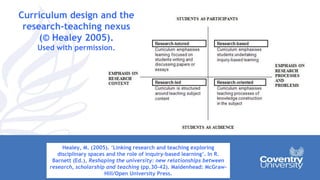
Healey, M. (2005). ‘Linking research and teaching exploring
disciplinary spaces and the role of inquiry-based learning’. In R.
Barnett (Ed.), Reshaping the university: new relationships between
research, scholarship and teaching (pp.30-42). Maidenhead: McGraw-
Hill/Open University Press.
Curriculum design and the
research-teaching nexus
(© Healey 2005).
Used with permission.
Project - features
6 members of staff (4 teaching on the MA in ELT and 2 alumnae)
2 ‘expert students’ registered on the MA
All involved in TEFL
MOOC blend implemented in both Semester 1 & 2 2014-2015
Will to explore new blended learning ‘avenues’
Pre-MOOC questions (see page 5 proceedings)
Weekly ‘post-MOOC unit’ reflective/knowledge sharing focus groups (see page 6
proceeding)
Final BOS (Bristol Online Survey) (see end conference proceedings)
Participants agreed to: see page 3
OERs and HE
Study by Bone and McNichol (2014), commissioned to the
National Union of Students/National Union Services by the
Higher Education Academy (UK):
students have a positive attitude towards the
integration of OERs (Open Educational Resources) into
their learning experience at university
MA module at CU: Aims
[…] to give students an in-depth understanding of the
theories of second language acquisition and illustrate their
links to approaches and methods of language teaching
which they inform. The theories examined will look at
second language acquisition and learning from linguistic,
psychological and sociological perspectives
Learning Outcomes
Critically appraise the major theories of second language acquisition.
Discuss the relevance of SLA theories to the development of teaching
approaches and methodology.
Discuss and appraise the implications of sociocultural theories for the
development of second language learning and teaching approaches and
methodology.
Analyse the suitability of needs of specific English language learners in
specific English language learning contexts and discuss the teaching and
learning approaches most appropriate to their situation.
Assessment: 1 essay + 1 ‘seen’ exam
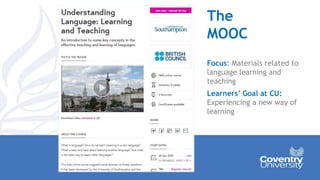
The
MOOC
Focus: Materials related to
language learning and
teaching
Learners’ Goal at CU:
Experiencing a new way of
learning
Topics on the MOOC
Week 1 – Learning Language: Theory
Week 2 - Language Teaching in the Classroom
Week 3 – Technology in Language Learning and Teaching: A New
Environment
Week 4 – Language in Use: Global English
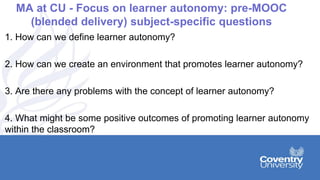
MA at CU - Focus on learner autonomy: pre-MOOC
(blended delivery) subject-specific questions
1. How can we define learner autonomy?
2. How can we create an environment that promotes learner autonomy?
3. Are there any problems with the concept of learner autonomy?
4. What might be some positive outcomes of promoting learner autonomy
within the classroom?
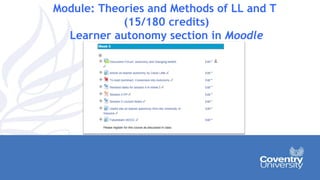
Module: Theories and Methods of LL and T
(15/180 credits)
Learner autonomy section in Moodle
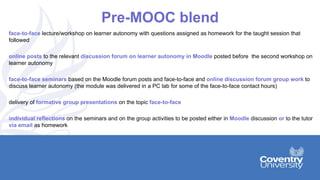
Pre-MOOC blend
face-to-face lecture/workshop on learner autonomy with questions assigned as homework for the taught session that
followed
online posts to the relevant discussion forum on learner autonomy in Moodle posted before the second workshop on
learner autonomy
face-to-face seminars based on the Moodle forum posts and face-to-face and online discussion forum group work to
discuss learner autonomy (the module was delivered in a PC lab for some of the face-to-face contact hours)
delivery of formative group presentations on the topic face-to-face
individual reflections on the seminars and on the group activities to be posted either in Moodle discussion or to the tutor
via email as homework
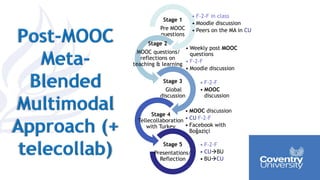
• F-2-F in class
• Moodle discussion
• Peers on the MA in CU
Stage 1
Pre MOOC
questions
• Weekly post MOOC
questions
• F-2-F
• Moodle discussion
Stage 2
MOOC questions/
reflections on
teaching & learning
• F-2-F
• MOOC
discussion
Stage 3
Global
discussion
• MOOC discussion
• CU F-2-F
• Facebook with
Boğaziçi
Stage 4
Tellecollaboration
with Turkey
• F-2-F
• CUBU
• BUCU
Stage 5
Presentations/
Reflection
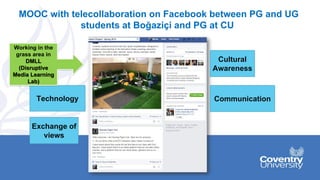
MOOC with telecollaboration on Facebook between PG and UG
students at Boğaziçi and PG at CU
Cultural
Awareness
Communication
Exchange of
views
Technology
Working in the
grass area in
DMLL
(Disruptive
Media Learning
Lab)
Relevant summative question at CU
(seen exam, one of the 3 questions set)
3Question
Answer BOTH parts.
3.1 In the course of module M01ENL we have discussed the concept of ‘learner autonomy’ and
read the article by Lacey: ‘Autonomy, never, never, never’ (2007). Summarise the article and discuss
how and why Lacey adopted Dam’s views after his initial resistance.
(30 marks)
3.2 During the course of the module you were encouraged to enrol on the Southampton
University/British Council MOOC on Language Learning and Teaching. Reflect on the experience of
taking part in the MOOC and discuss:
1. If and how it reflects the principles relating to learner autonomy;
2. What topics you would like to cover if you were given the opportunity to teach English with a MOOC to
intermediate (B2/IELTS 6.5) students;
3. Which of the 4 units your found most useful and why.
(20 marks)
Benefits - students’ reflections on the
‘blended MOOC’ experience
 Anyone, anywhere, any time
 Felt part of a global community
 Exposed to global perspectives on the topics covered
 The MOOC suited different approaches to learning
 Free
 It consolidated learning from the MA
Comments - Students’ Reflections
 Accessibility: Requires computers and Internet
 Could put some people at a disadvantage (Digital Divide)
 Simplification/Repetitiveness
 “In your face” hard marketing
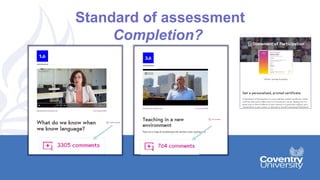
 Lack of summative assessment
Standard of assessment
Completion?
Hannah’s Reflection – the ‘expert student’
• In class and on Moodle discussion: teacher-scaffolded and
guided reflective questions
• On the MOOC: some reflective prompts; benefit of peer
scaffolding on a global scale; dependent on participation and
personal views.
• On Facebook: productive discussion difficult; assessment as
motivation; better on a VLE?
How did you find communication on the
forum? The forum ‘limbo’ - staff viewpoint:
•Impossible. I am not sure how you are supposed to have
a meaningful discussion with over 50,000 people. I just
read a few comments and moved on. I felt that it was too
time-consuming to try to respond to comments that on the
whole lacked any substance. It seemed to be people just
stating how they were enjoying the course and not really
engaging with the topics/subject.
(refer to page 4) How?....
Massive? 
Open? Yes and No
Online? 
Course? Matter of semantics, but more
crucially, lack of teacher’s scaffolding
Final reflections
• Proprietary systems are best-suited for e-learning in academic
settings (Orsini-Jones 2010)
• Summative assessment is a motivating factor
• Structured MOOC blend can work (Kim 2015)
• Online International Learning (OIL) extra blend could work, but…
• MOOCs are seen as “disruptive technologies”, but are they really?
• Need for teacher’s support/scaffolding
The pedagogy will create the disruption,
not the technology
ANY QUESTIONS?
Further information?
Higher Education Academic Report (forthcoming 2015)
m.orsini@coventry.ac.uk
Thank you

Learning about Language Learning on a MOOC: How Massive? How Open? How Online? How “Course”?

  • 1.
    Learning about LanguageLearning on a MOOC: How Massive? How Open? How Online? How “Course”? Marina Orsini-Jones, Laura Pibworth-Dolinski, Mike Cribb, Billy Brick, Zoe Gazeley-Eke, Hannah Leinster and Elwyn Lloyd Department of English and Languages, Faculty of Business, Environment and Society, Coventry University A metareflective staff/student investigation into innovative blended e-learning practice EuroCALL 2015 – Critical CALL Padova, 26-29 August 2015
  • 3.
    Overview • Pedagogical rationale •The experience of blended learning with a MOOC (students + staff) • Staff reflections • Student reflections • Provisional evaluation/recommendations EuroCALL 2015 – Critical CALL Padova, 26-29 August 2015
  • 4.
    Healey, M. (2005).‘Linking research and teaching exploring disciplinary spaces and the role of inquiry-based learning’. In R. Barnett (Ed.), Reshaping the university: new relationships between research, scholarship and teaching (pp.30-42). Maidenhead: McGraw- Hill/Open University Press. Curriculum design and the research-teaching nexus (© Healey 2005). Used with permission.
  • 5.
    Project - features 6members of staff (4 teaching on the MA in ELT and 2 alumnae) 2 ‘expert students’ registered on the MA All involved in TEFL MOOC blend implemented in both Semester 1 & 2 2014-2015 Will to explore new blended learning ‘avenues’ Pre-MOOC questions (see page 5 proceedings) Weekly ‘post-MOOC unit’ reflective/knowledge sharing focus groups (see page 6 proceeding) Final BOS (Bristol Online Survey) (see end conference proceedings) Participants agreed to: see page 3
  • 6.
    OERs and HE Studyby Bone and McNichol (2014), commissioned to the National Union of Students/National Union Services by the Higher Education Academy (UK): students have a positive attitude towards the integration of OERs (Open Educational Resources) into their learning experience at university
  • 7.
    MA module atCU: Aims […] to give students an in-depth understanding of the theories of second language acquisition and illustrate their links to approaches and methods of language teaching which they inform. The theories examined will look at second language acquisition and learning from linguistic, psychological and sociological perspectives
  • 8.
    Learning Outcomes Critically appraisethe major theories of second language acquisition. Discuss the relevance of SLA theories to the development of teaching approaches and methodology. Discuss and appraise the implications of sociocultural theories for the development of second language learning and teaching approaches and methodology. Analyse the suitability of needs of specific English language learners in specific English language learning contexts and discuss the teaching and learning approaches most appropriate to their situation. Assessment: 1 essay + 1 ‘seen’ exam
  • 9.
    The MOOC Focus: Materials relatedto language learning and teaching Learners’ Goal at CU: Experiencing a new way of learning
  • 10.
    Topics on theMOOC Week 1 – Learning Language: Theory Week 2 - Language Teaching in the Classroom Week 3 – Technology in Language Learning and Teaching: A New Environment Week 4 – Language in Use: Global English
  • 11.
    MA at CU- Focus on learner autonomy: pre-MOOC (blended delivery) subject-specific questions 1. How can we define learner autonomy? 2. How can we create an environment that promotes learner autonomy? 3. Are there any problems with the concept of learner autonomy? 4. What might be some positive outcomes of promoting learner autonomy within the classroom?
  • 12.
    Module: Theories andMethods of LL and T (15/180 credits) Learner autonomy section in Moodle
  • 13.
    Pre-MOOC blend face-to-face lecture/workshopon learner autonomy with questions assigned as homework for the taught session that followed online posts to the relevant discussion forum on learner autonomy in Moodle posted before the second workshop on learner autonomy face-to-face seminars based on the Moodle forum posts and face-to-face and online discussion forum group work to discuss learner autonomy (the module was delivered in a PC lab for some of the face-to-face contact hours) delivery of formative group presentations on the topic face-to-face individual reflections on the seminars and on the group activities to be posted either in Moodle discussion or to the tutor via email as homework
  • 14.
    • F-2-F inclass • Moodle discussion • Peers on the MA in CU Stage 1 Pre MOOC questions • Weekly post MOOC questions • F-2-F • Moodle discussion Stage 2 MOOC questions/ reflections on teaching & learning • F-2-F • MOOC discussion Stage 3 Global discussion • MOOC discussion • CU F-2-F • Facebook with Boğaziçi Stage 4 Tellecollaboration with Turkey • F-2-F • CUBU • BUCU Stage 5 Presentations/ Reflection
  • 15.
    MOOC with telecollaborationon Facebook between PG and UG students at Boğaziçi and PG at CU Cultural Awareness Communication Exchange of views Technology Working in the grass area in DMLL (Disruptive Media Learning Lab)
  • 16.
    Relevant summative questionat CU (seen exam, one of the 3 questions set) 3Question Answer BOTH parts. 3.1 In the course of module M01ENL we have discussed the concept of ‘learner autonomy’ and read the article by Lacey: ‘Autonomy, never, never, never’ (2007). Summarise the article and discuss how and why Lacey adopted Dam’s views after his initial resistance. (30 marks) 3.2 During the course of the module you were encouraged to enrol on the Southampton University/British Council MOOC on Language Learning and Teaching. Reflect on the experience of taking part in the MOOC and discuss: 1. If and how it reflects the principles relating to learner autonomy; 2. What topics you would like to cover if you were given the opportunity to teach English with a MOOC to intermediate (B2/IELTS 6.5) students; 3. Which of the 4 units your found most useful and why. (20 marks)
  • 17.
    Benefits - students’reflections on the ‘blended MOOC’ experience  Anyone, anywhere, any time  Felt part of a global community  Exposed to global perspectives on the topics covered  The MOOC suited different approaches to learning  Free  It consolidated learning from the MA
  • 18.
    Comments - Students’Reflections  Accessibility: Requires computers and Internet  Could put some people at a disadvantage (Digital Divide)  Simplification/Repetitiveness  “In your face” hard marketing  Lack of summative assessment
  • 19.
  • 20.
    Hannah’s Reflection –the ‘expert student’ • In class and on Moodle discussion: teacher-scaffolded and guided reflective questions • On the MOOC: some reflective prompts; benefit of peer scaffolding on a global scale; dependent on participation and personal views. • On Facebook: productive discussion difficult; assessment as motivation; better on a VLE?
  • 21.
    How did youfind communication on the forum? The forum ‘limbo’ - staff viewpoint: •Impossible. I am not sure how you are supposed to have a meaningful discussion with over 50,000 people. I just read a few comments and moved on. I felt that it was too time-consuming to try to respond to comments that on the whole lacked any substance. It seemed to be people just stating how they were enjoying the course and not really engaging with the topics/subject.
  • 23.
    (refer to page4) How?.... Massive?  Open? Yes and No Online?  Course? Matter of semantics, but more crucially, lack of teacher’s scaffolding
  • 24.
    Final reflections • Proprietarysystems are best-suited for e-learning in academic settings (Orsini-Jones 2010) • Summative assessment is a motivating factor • Structured MOOC blend can work (Kim 2015) • Online International Learning (OIL) extra blend could work, but… • MOOCs are seen as “disruptive technologies”, but are they really? • Need for teacher’s support/scaffolding The pedagogy will create the disruption, not the technology
  • 25.
  • 26.
    Further information? Higher EducationAcademic Report (forthcoming 2015) m.orsini@coventry.ac.uk Thank you