Lean Startup: WTF?
massdistraction
Justin Pirie
@justinpirie
blog.mimecast.com
www.justinpirie.com
jpirie@mimecast.com
The Next Web, Amsterdam
April 29th 2011
Entrepreneur: 10+ Years
on2wheelz
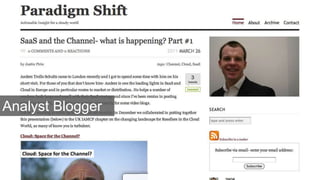
Analyst Blogger
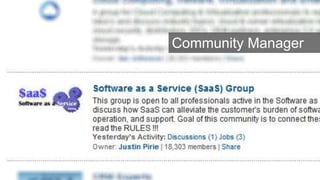
Community Manager
Where I work
tipiro
Cloud Services for Microsoft Exchange
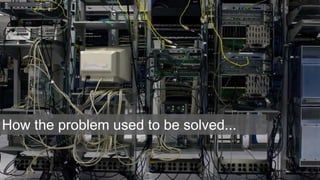
How the problem used to be solved...
minifig
What do users get?
Nearly 1m users can’t be wrong!
Lean Startup: WTF?
massdistraction
Ronan_C
Where do Startups Come From?
Daniel Mohr
Founders Ideas
Gueorgui Tcherednitchenko
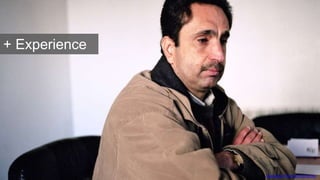
+ Experience
Will Scullin
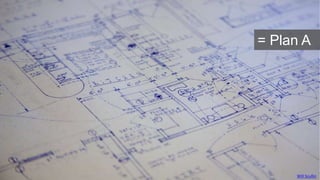
= Plan A
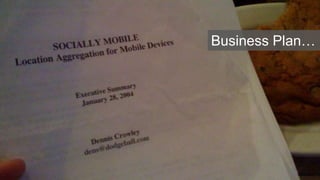
Business Plan…
dpstyles™
jeffc5000
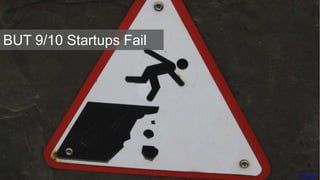
BUT 9/10 Startups Fail
Houston, We Have A Problem…
nasa
bcymet
58 Ideas = 1 Success
annethelibrarian
66% of Successful Changed Plans
jeffc5000
WHY???
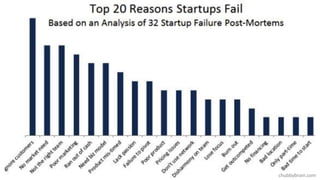
chubbybrain.com
Matthew Burpee
Lack of Customers
Fallacy #1: Problem is known
Fallacy #2: Solution is known
wwarby
Result: Costs Are Front Loaded
jeffc5000
#FAIL
army.arch
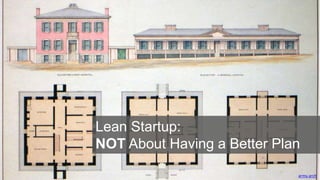
Lean Startup:
NOT About Having a Better Plan
er1danus
It’s Finding a Better Path to a Plan
THAT WORKS
THAT is Lean Startup
Joi
paurian
Until Now… It’s Been Intuition
EOI Escuela de Organización Industrial
So People Looked For “Experience”
NASA's Marshall Space Flight Center
Lean Startup = Stress Testing Process
Lean Startup is a
rigorous process for
iterating from Plan A to
a Plan that works
Ah Ha! Idea = Hypotheses
niznoz
trochim
Lean Startup Tests Your Vision
(read hypotheses)
Nevada Tumbleweed
So You Can Focus on the Right Actions
(and at the right time)
Annie Mole
Lean is a MIX of Techniques
Russians: MiG 15
Destinys Agent
US: F-86 Technically Inferior
andrusdevelopment
Yet F-86 Winning. WHY?
Boyd: Maverick Pilot, Investigates
OODA Loop:
# of Iterations BEATS Quality of Cycles
Annie Mole
Next Technique to Add
ckowalik
Mix in Lean Manufacturing
Lean Manufacturing = Remove Waste
Bake
yvettemn
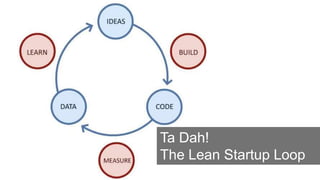
Ta Dah!
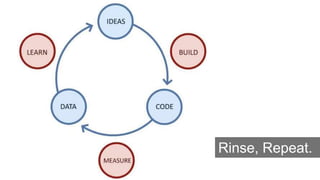
The Lean Startup Loop
David Wulff
Build
Measure
wwarby
surlygirl
Learn
Rinse, Repeat.
andrusdevelopment
We Know: # of Iterations beats quality
ckowalik
We Know: Lean Makes Better Cars
Matthew Burpee
We Know:
Businesses Fail Because of No Customers
Objective: Find the most effective
way to validate your hypothesis
sasha
RaeA
Minimum Viable Product
If You’re Not Embarassed:
You’ve Waited Too Long
LostInInaka
In a Great Market:
The Market Pulls the Product Out
toffehoff
originallittlehellraiser
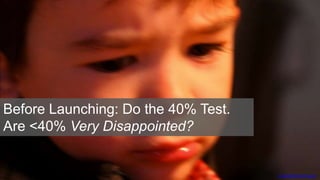
Before Launching: Do the 40% Test.
Are <40% Very Disappointed?
Pivoting?
lovely fig rolls
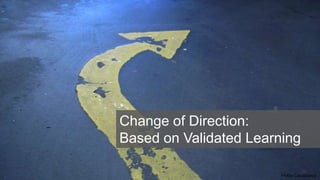
Change of Direction:
Based on Validated Learning
Phillie Casablanca
http://startup-marketing.com
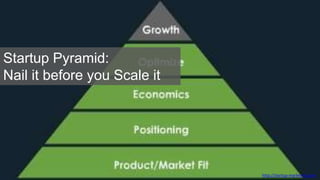
Startup Pyramid:
Nail it before you Scale it
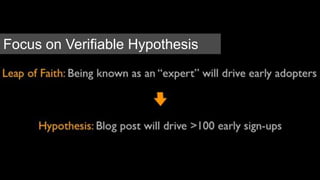
Focus on Verifiable Hypothesis
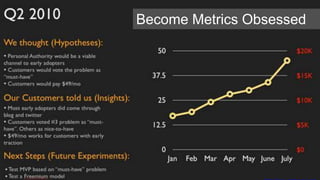
Become Metrics Obsessed
Some Myths:
wwarby
Lean Startup is Not Cheap…
jeffc5000
Lean is Not About Failing
Warren D
It is Iterating FAST
Build on Solid Foundations
David Wulff
Thanks!
Feel free to connect
massdistraction
Justin Pirie
@justinpirie
blog.mimecast.com
www.justinpirie.com
jpirie@mimecast.com

Lean Startup - A Primer for Entrepreneurs

Editor's Notes

  • #2 Hi, My name is Justin Pirie- thanks for letting me talk to you today. I want to start off with an intro about me and where I work, then give you an intro to Lean Startup, which my fellow speakers are going to build out during the track.
  • #3 So I’ve been an entrepreneur since I worked out people would give you money for you doing stuff. Car washing was my most lucrative, but as a “proper” entrepreneur I’ve started 4 companies and sold 3.
  • #4 Some of you might know me better as an analyst blogger on Software as a Service
  • #5 Or as a SaaS community guy.
  • #6 And I work for a company called Mimecast. We’re proving that Europe can make Enterprise Software! We have about 250 people Globally with our HQ in Kings Cross London Last year we raised a $23m series B- with Index ventures and it was the tech largest VC raise in Europe last year.
  • #7 Anyone have Exchange Server at work? Would you rather be using Gmail? We make Exchange work better like Gmail with Email Archiving, Continuity and Security
  • #8 The reason people hate their corporate email is because of this- companies have tried to solve the problem like this.
  • #9 Uptime, Fast Search and Unlimited mailboxes in Microsoft Exchange
  • #10 And nearly a million users can’t be wrong
  • #11 WTF is Lean Startup? Before we address that- we need to look at what we’re doing with Startups.
  • #12 So where do startups come from?
  • #13 Typically it’s founders ideas
  • #14 Add in experience
  • #15 Gives a plan. What does that normally look like?
  • #16 Yup. Or otherwise know as a Business Plan. Who has written a business plan? Who’s got funding off a business plan?
  • #18 Houston- we have a problem!
  • #24 There are two startup fallacies that cause that. 1- it is assumed the problem is known
  • #25 And it assumes the solution is know.
  • #26 The consequence is that costs are front loaded- launch is the goal. Not learning how to solve those issues. Startups have traditionally measured by users and revenue. “traction”
  • #27 #fail.
  • #30 That is lean startup. But why is it important?
  • #31 Because until now, it’s been down to intuition
  • #32 This usually came out when you were pitching- investors would say “we’re looking for experienced entrepreneurs”. They’re looking for people who’ve made mistakes on other peoples money and can execute.

  • #34 Lean Startup is a rigiorous process for iterating from plan a to a plan that works
  • #35 The AH HA Moment for me was that your ideas- especially the brilliant ones are JUST hypothesis
  • #36 How do you know whether they are right or wrong? And lean startup is a methodology for testing these hypothesis
  • #43 Observe, Orient, Decide, Act. Remember- the number of cycles through the loop is key to success, not the quality of each iteration. Then apply lean manufacturing and you create the lean startup loop. OODA loop From Wikipedia, the free encyclopedia   (Redirected from OODA Loop) The OODA loop (for observe, orient, decide, and act) is a concept originally applied to the combat operations process, often at the strategic level in both the military operations. It is now also often applied to understand commercial operations and learning processes. The concept was developed by military strategist and USAF Colonel John Boyd. Contents  [hide] 1 Overview 2 Application of the OODA loop 3 See also 4 References 4.1 Notes 4.2 Bibliography [edit]Overview Diagram[1] of a decision cycle known as the Boyd cycle, or the OODA loop. The OODA loop has become an important concept in both business and military strategy. According to Boyd, decision-making occurs in a recurring cycle of observe-orient-decide-act. An entity (whether an individual or an organization) that can process this cycle quickly, observing and reacting to unfolding events more rapidly than an opponent, can thereby "get inside" the opponent's decision cycle and gain the advantage. Frans Osinga argues that Boyd's own views on the OODA loop are much deeper, richer, and more comprehensive than the common interpretation of the 'rapid OODA loop' idea.[2] Boyd developed the concept to explain how to direct one's energies to defeat an adversary and survive. Boyd emphasized that "the loop" is actually a set of interacting loops that are to be kept in continuous operation during combat. He also indicated that the phase of the battle has an important bearing on the ideal allocation of one's energies. Boyd’s diagram shows that all decisions are based on observations of the evolving situation tempered with implicit filtering of the problem being addressed. These observations are the raw information on which decisions and actions are based. The observed information must be processed to orient it for further making a decision. In notes from his talk “Organic Design for Command and Control”, Boyd said, The second O, orientation – as the repository of our genetic heritage, cultural tradition, and previous experiences – is the most important part of the O-O-D-A loop since it shapes the way we observe, the way we decide, the way we act.[3] As stated by Boyd and shown in the “Orient” box, there is much filtering of the information through our culture, genetics, ability to analyze and synthesize, and previous experience. Since the OODA Loop was designed to describe a single decision maker, the situation is usually much worse than shown as most business and technical decisions have a team of people observing and orienting, each bringing their own cultural traditions, genetics, experience and other information. It is here that decisions often get stuck,[4] which does not lead to winning, since In order to win, we should operate at a faster tempo or rhythm than our adversaries--or, better yet, get inside [the] adversary's Observation-Orientation-Decision-Action time cycle or loop. ... Such activity will make us appear ambiguous (unpredictable) thereby generate confusion and disorder among our adversaries--since our adversaries will be unable to generate mental images or pictures that agree with the menacing as well as faster transient rhythm or patterns they are competing against.[3] The OODA loop, which focuses on strategic military requirements, was adapted for business and public sector operational continuity planning. Compare it with the Plan Do Check Act (PDCA) cycle or Shewhart cycle, which focuses on the operational or tactical level of projects. [5] As one of Boyd's colleagues, Harry Hillaker, put it in "John Boyd, USAF Retired, Father of the F16" [6]: The key is to obscure your intentions and make them unpredictable to your opponent while you simultaneously clarify his intentions. That is, operate at a faster tempo to generate rapidly changing conditions that inhibit your opponent from adapting or reacting to those changes and that suppress or destroy his awareness. Thus, a hodgepodge of confusion and disorder occur to cause him to over- or under-react to conditions or activities that appear to be uncertain, ambiguous, or incomprehensible. Writer Robert Greene wrote in an article called OODA and You [7] that the proper mindset is to let go a little, to allow some of the chaos to become part of his mental system, and to use it to his advantage by simply creating more chaos and confusion for the opponent. He funnels the inevitable chaos of the battlefield in the direction of the enemy. [edit]Application of the OODA loop Consider a fighter pilot being scrambled to shoot down an enemy aircraft. Before the enemy airplane is even within visual contact range, the pilot will consider any available information about the likely identity of the enemy pilot: his nationality, level of training, and cultural traditions that may come into play. When the enemy aircraft comes into radar contact, more direct information about the speed, size, and maneuverability, of the enemy plane becomes available; unfolding circumstances take priority over radio chatter. A first decision is made based on the available information so far: the pilot decides to "get into the sun" above his opponent, and acts by applying control inputs to climb. Back to observation: is the attacker reacting to the change of altitude? Then to orient: is the enemy reacting characteristically, or perhaps acting like a noncombatant? Is his plane exhibiting better-than-expected performance? As the dogfight begins, little time is devoted to orienting unless some new information pertaining to the actual identity or intent of the attacker comes into play. Information cascades in real time, and the pilot does not have time to process it consciously; the pilot reacts as he is trained to, and conscious thought is directed to supervising the flow of action and reaction, continuously repeating the OODA cycle. Simultaneously, the opponent is going through the same cycle. How does one interfere with an opponent's OODA cycle? One of John Boyd's primary insights in fighter combat was that it is vital to change speed and direction faster than the opponent. This is not necessarily a function of the plane's ability to maneuver, rather the pilot must think and act faster than the opponent can think and act. Getting "inside" the cycle—short-circuiting the opponent's thinking processes—produces opportunities for the opponent to react inappropriately. Another tactical-level example can be found on the basketball court, where a player takes possession of the ball and must get past an opponent who is taller or faster. A straight dribble or pass is unlikely to succeed. Instead the player may engage in a rapid and elaborate series of body movements designed to befuddle the opponent and deny him the ability to take advantage of his superior size or speed. At a basic level of play, this may be merely a series of fakes, with the hope that the opponent will make a mistake or an opening will occur, but practice and mental focus may allow one to reduce the time scale, get inside the opponent's OODA loop and take control of the situation—to cause the opponent to move in a particular way, and generate an advantage rather than merely react to an accident. The same cycle operates over a longer timescale in a competitive business landscape, and the same logic applies. Decision makers gather information (observe), form hypotheses about customer activity and the intentions of competitors (orient), make decisions, and act on them. The cycle is repeated continuously. The aggressive and conscious application of the process gives a business advantage over a competitor who is merely reacting to conditions as they occur, or has poor awareness of the situation. The approach favors agility over raw power in dealing with human opponents in any endeavor. John Boyd put this ethos into practice with his work for the USAF. He was an advocate of maneuverable fighter aircraft, in contrast to the heavy, powerful jet fighters that were prevalent in the 1960s, such as the F-4 Phantom II and General Dynamics F-111. Boyd inspired the Light Weight Fighter Project that produced the successfulF-16 Fighting Falcon and F/A-18 Hornet, which are still in use by the United States and several other military powers into the twenty-first century. [edit]See also United States Air Force portal John Boyd (military strategist)            Control theory Decision cycle Maneuver warfare Nursing process Problem solving Strategy SWOT analysis Systempunkt [edit]References [edit]Notes ^ Boyd (1995) ^ Osinga, passim ^ a b Boyd ^ Ullman ^ Kotnour ^ Hillaker ^ Greene [edit]Bibliography Boyd, John, R., The Essence of Winning and Losing, 28 June 1995 a five slide set by Boyd. Greene, Robert, OODA and You Hillaker, Harry, Code one magazine, "John Boyd, USAF Retired, Father of the F16", July 1997, Kotnour, Jim, "Leadership Mechanisms for Enabling Learning Within Project Teams" in Proceedings from the Third European Conference on Organizational Knowledge, Learning and Capabilities, Proceedings OKLC 2002 Linger, Henry, Constructing The Infrastructure For The Knowledge Economy: Methods and Tools, Theory and Practice, p. 449 Osinga, Frans, Science Strategy and War, The Strategic Theory of John Boyd, Abingdon, UK: Routledge, ISBN 0-415-37103-1. Richards, Chet, Certain to Win: the Strategy of John Boyd, Applied to Business (2004) ISBN 1-4134-5377-5 Ullman, David G., “OO-OO-OO!” The Sound of a Broken OODA Loop, Crosstalk, April 2007, Ullman, David G., Making Robust Decisions: Decision Management For Technical, Business, and Service Teams. Victoria: Trafford ISBN 1-4251-0956-X Categories: Military terminology | Military acronyms | United States Air Force | Intelligence analysis | Strategy
  • #46 Lean Manufacturing is a technique for constantly removing waste
  • #47 When you bake them together you get:
  • #48 Build, Measure, Learn. OK, great. You’ve put up a pretty diagram. How is it going to help me not fail?
  • #52 Build your business on solid foundations
  • #55 We know that number of iterations beat quality of iterations. We know that lean manufacturing makes better quality cars- how can we apply this to software? And we also know that we don’t know what customers want or will buy. We need to test them.
  • #56 We need to find the least expensive way to test your hypotheses.
  • #57 That’s a Minimum Viable Product. The smallest version of something that can test your hypothesis. That could be google adwords to a lander. It’s all about validation.
  • #58 If you’re not embarrassed by it- you’ve waited too long. Don’t worry- be crappy.
  • #59 MVP’s test your hypothesis for Product market fit. Marc Andressen said: MVP - In a great market -- a market with lots of real potential customers -- the market pulls product out of the startup.
  • #61 What about Pivoting? It’s what you do when you’ve proved or disproved your hypothesis.
  • #64 And focus on verifiable hypothesis
  • #65 Some myths
  • #66 Some myths:
  • #68 Lean is not about failing
  • #70 And building on verifiable hypothesis