416style
Cloud?
Swindon
February 7th 2011
Justin Pirie
@justinpirie
blog.mimecast.com
jpirie@mimecast.com
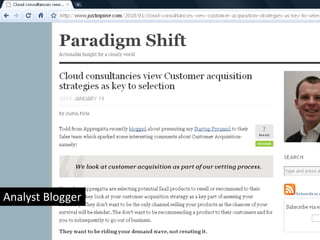
Analyst Blogger
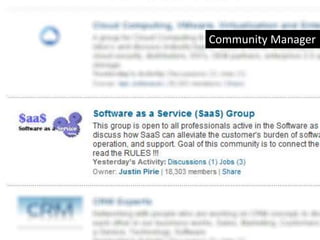
Community Manager
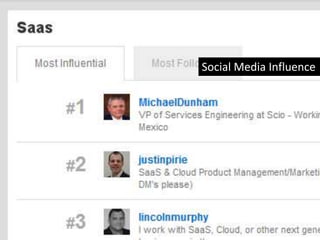
Social Media Influence
Where I work
Cloud Services for Microsoft Exchange
tipiro
Cloud Wrapper
For Microsoft Exchange
matthewbradley
Email Security
neilalderney123
Email Continuity
dolescum
Email Archive
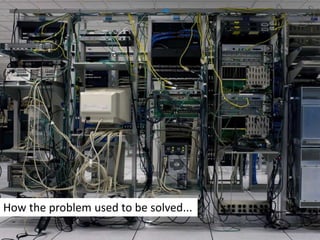
How the problem used to be solved...
Benefits of Google Apps
For Microsoft Exchange
What do users get?
minifig
mescon
Unlimited Storage
Ronan_C
Fast Search
Uptime
szeke
Over 600,000 users can’t be wrong!
416style
Cloud?
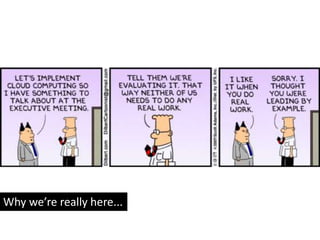
Why we’re really here...
Which Cloud?
tipiro
William Vambenepe
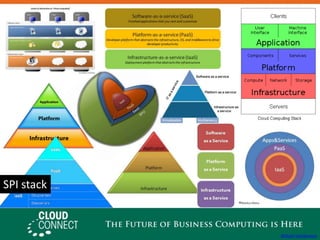
SPI stack
IaaS- Infrastructure as a Service
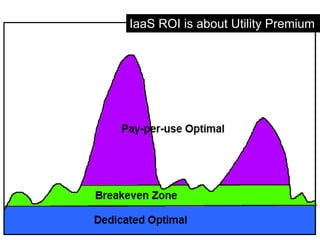
IaaS ROI is about Utility Premium
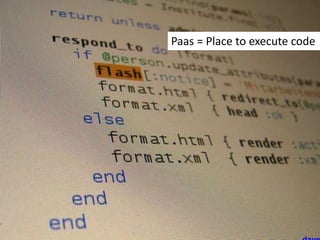
PaaS- Platform as a Service
Paas = Place to execute code
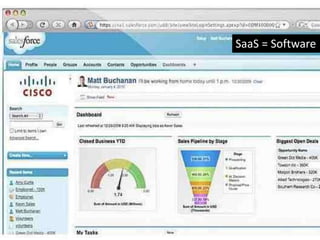
SaaS- Software as a Service
SaaS = Software
Current Cloud Landscape
zoutedrop
bionicteaching
Lets have some data
russelldavies
To Understand
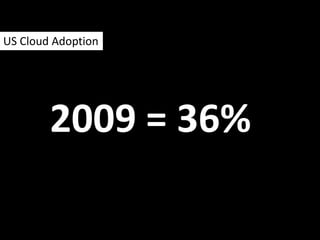
2009 = 36%
US Cloud Adoption
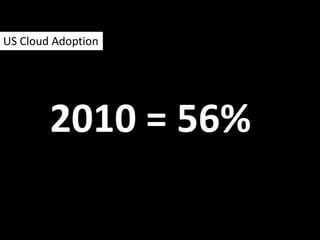
2010 = 56%
US Cloud Adoption
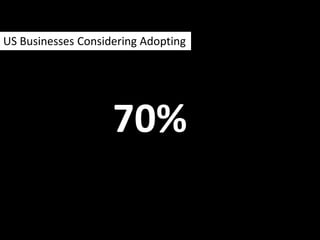
70%
US Businesses Considering Adopting
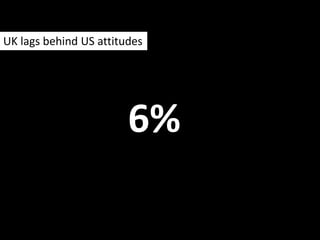
6%
UK lags behind US attitudes
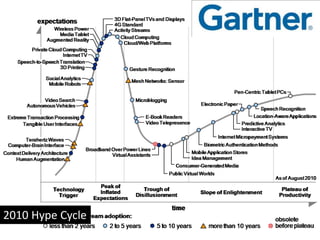
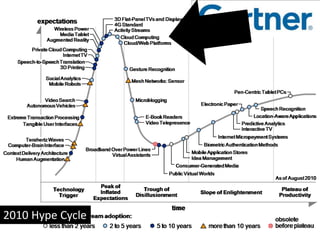
2010 Hype Cycle
2010 Hype Cycle
What are the secrets?
aturkus
Paul Wicks
How did I get here?
Not the train
Andrew®
Or my Brompton
Ben Cooper
nep
It was...
ParaScubaSailor
and...
To understanding Cloud
Wen Nag (aliasgrace)
LIVING_BY_THE_MOMENT
At the beginning...
It was about money...
wwarby
Ian Muttoo
From CapEx
To OpEx
It’s not about money...
wwarby
What is IT for?
le niners
What do we do?
Daniel Mohr
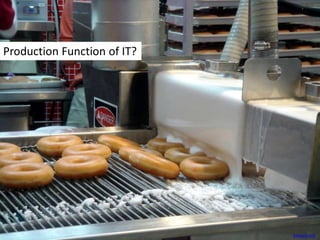
Production Function of IT?
bewarenerd
Sound Academic?
a_sorense
Combination of Inputs
edwin.11
To produce Outputs
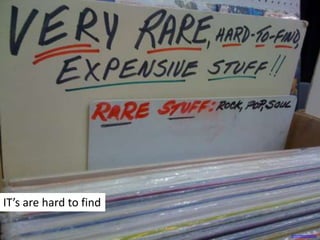
IT’s are hard to find
ilovememphis
labanex.com
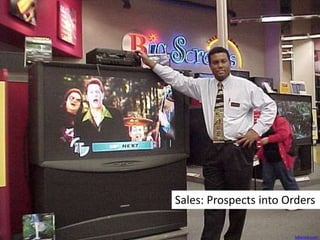
Sales: Prospects into Orders
jamesjyu
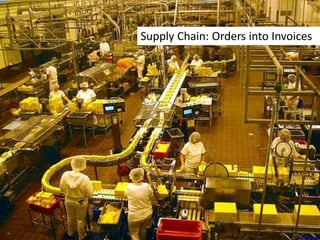
Supply Chain: Orders into Invoices
Finance: Invoices into Cash
alancleaver_2000
What does IT do?
Daniel Mohr
IT Production Value #1 = Speed
TexasEagle
Jeffrey Barke
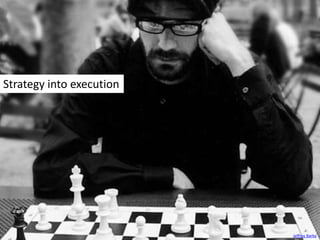
Strategy into execution
Fast as Possible
Warren D
IT needs to be Responsive
Chris Devers
Domingos Soares Neto
Not a bottleneck
IT Production Value #2 = Scale
....Tim
Take Operations
Detroit Public Library
Increase Capacity, Reduce Cost
ABB
IT Should Equal Agility
Picture Taker 2
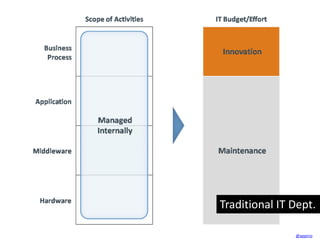
Traditional IT Dept.
@appirio
Idea = Agile
Picture Taker 2
Reality for IT = Quicksand
sasamaster
xetark
What users got...
Business feeling about IT
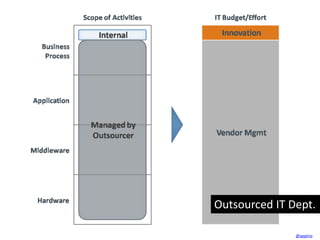
Outsourced IT Dept.
@appirio
Cheaper Labour...
stev.ie
Contracts, Change Requests
Kevin H.
Business feeling about IT
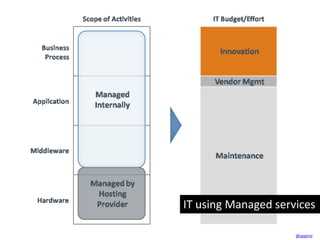
IT using Managed services
@appirio
CarbonNYC
In Control?
Getting on better...
Arno & Louise
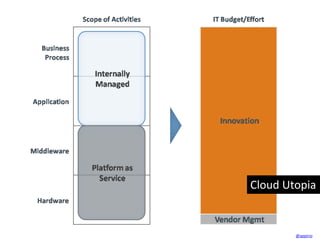
Cloud Utopia
@appirio
Reality
Picture Taker 2
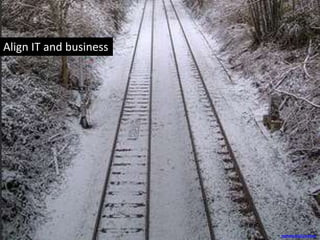
Align IT and business
technicallyCreative
How can Cloud Help?
tipiro
Don’t worry about Scale
Dru!
Less Meetings
thinkpanama
Less Technical Detail
Rev. Xanatos Satanicos Bombasticos (ClintJCL)
Continuous Updates
The Doctr
No More Upgrades or Migrations
Bert Kommerij
More functionality- same cost
Seven Morris
Loosely Coupled Systems
ElenahNeshcuet
Separated Config and Code
sadashotit
Fewer Dependencies
Dave ®
Phillie Casablanca
Reconfigure Faster
Faster Gratification
lisatozzi
viralbus
BUT Cloud is embryonic
Standards just emerging
mayakamina
jeffc5000
So.... Caveat Emptor
But proportional to Risk
gxdoyle
Judge Cloud by FACETS
Swamibu
Flexibility
khalid almasoud
Availability
*Sally M*
Cost
shareski
(user) Experience
Timeliness
Yukon White Light
Security
ROI Frameworks lack agility measures
Ruddington Photos
IXQUICK
Judge the cloud with old frameworks...
jeffc5000
It will probably fail...
redteam
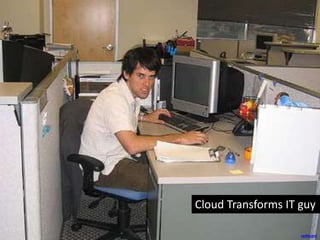
Cloud Transforms IT guy
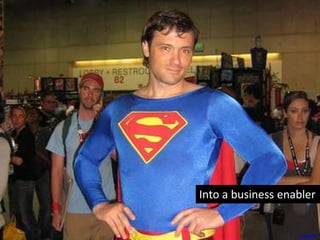
Into a business enabler
shindohd
416style
Questions?
Justin Pirie
@justinpirie
blog.mimecast.com
jpirie@mimecast.com
Swindon
February 7th 2011

Swindon- Talk on Cloud

Editor's Notes

  • #2 The Secrets of Successful Cloud Adoption: what they don’t tell you Cloud has a seemingly unstoppable momentum behind it- but is it clear at the outset what the benefits of Cloud are beyond the shift from cap-ex to op-ex? What exactly are these benefits and how do we access them to adopt Cloud successfully?
  • #9 To Microsoft Exchange
  • #10 Security
  • #11 Continutity
  • #12 Archive
  • #14 Bringing all the benefits of Google apps- horizontal scalability, reliability, etc
  • #15 To Microsoft Exchange
  • #34 From the Mimecast Cloud Adoption Survey http://www.mimecast.com/events-press/press-releases/article/view/cloud-computing-delivering-on-its-promise-but-doubts-still-hold-back-adoption/462/
  • #35 From the Mimecast Cloud Adoption Survey http://www.mimecast.com/events-press/press-releases/article/view/cloud-computing-delivering-on-its-promise-but-doubts-still-hold-back-adoption/462/
  • #36 From the Mimecast Cloud Adoption Survey http://www.mimecast.com/events-press/press-releases/article/view/cloud-computing-delivering-on-its-promise-but-doubts-still-hold-back-adoption/462/
  • #37 From the Mimecast Cloud Adoption Survey http://www.mimecast.com/events-press/press-releases/article/view/cloud-computing-delivering-on-its-promise-but-doubts-still-hold-back-adoption/462/
  • #38 2010 Gartner Hype Cycle for emerging technologies
  • #39 2010 Gartner Hype Cycle for emerging technologies
  • #40 What’s the problem?
  • #41 How did I get here to be presenting in front of you about building the case for cloud?
  • #42 Not by first great western
  • #43 Or my brompton
  • #44 It was many years crawling under desks
  • #45 And fixing issues running a medium sized value added reseller. A VAR
  • #46 To my understanding of the cloud and the benefits it brings
  • #47 At the beginning of my journey I’m almost ashamed to say my attraction to Cloud was
  • #48 About money. The shift from
  • #49 Capital Expenditure, where the buyer took all the risk as to whether the software would work and fund the purchase, to
  • #50 Operational Expenditure, where you paid for what you used, and if it didn’t work you stopped paying- or sometimes didn’t even pay at all. But that only the first and probably the least important benefit of cloud- the real benefits are hidden
  • #51 About money. The shift from
  • #52 At a time of reinvention- it is really important to ask what IT is for?
  • #53 What do we do for the business? Or more specifically- what is the production function of IT??? http://blogs.gartner.com/mark_mcdonald/2010/06/27/what-is-the-production-function-of-it/ What is the Production Function of IT? by Mark McDonald  |  June 27, 2010  |  1 Comment Understanding IT’s role in the enterprise is complex and incomplete.  IT is the subject of great debate as some see it as the source of competitive advantage and others see it as an enabling function.  CIOs and IT professionals themselves have a tough time answering the question about IT’s role. Why?  because I believe we are asking the question in the wrong way. We need to ask, “What is the production function of IT?” Production function, sounds kind of academic right, but its simply the output you get for all the combination of inputs.   Its what you take and what you make. Every part of your enterprise has a production function.  So, when you ask different parts of the enterprise what they take and make you get answers like: SALES TOP LINE REVENUE: We take prospects and turn them into orders SUPPLY CHAIN PROFIT: We take orders and turn them into invoices FINANCE CASH: We take invoices and turn them into cash IT ?????? Silence  ?????? I know its silence because I have asked the question to dozens of IT leadership teams.  They look at each other and cannot put IT’s contribution in a simple answer.  It is not because IT is more complex than these other functions.  No its more that IT professionals have thought of themselves as something apart for the enterprise, something special and therefore not falling under the same rules. There are two production functions for IT that can be summarized in two words SPEED and SCALE. SPEED:  We take strategy plans and turn them into operational performance IT’s production function is to deliver speed of execution against the company’s strategy and plans.  Strategy execution involves change and change requires IT participation.  The faster IT is able to execute its processes, deliver results and accelerate strategy execution the better. IT drives speed when it concentrates on reducing its own internal cycle times for providing IT services, solution development and governance.  Concentrating internal operations on speed of execution makes IT more responsive and innovative.  IT organizations operating at speed give their business a steady stream of value that actually expands ITs role and enterprise flexibility. Without speed, IT is a bottleneck to strategic execution and operational performance.  It is the reason we cannot go faster.  This is the reason why change is expensive.  The reason why I have to control IT costs, because if they cannot go fast enough for me, then I had better make sure that they do not cost too much. SCALE:  We take operations and increase their capacity and reduce their average cost IT’s other production function is to create scale of operation across the enterprise.  Scale in this sense is the ability to IT to aggregate activities and deliver greater capacity at a lower average cost.  IT creates scale through its infrastructure and operations activities that make the modern enterprise possible.  IT is one of two scale functions in the enterprise.  The supply chain is the other scale function. IT drives scale through the infrastructure by constantly aggregating operations, virtualization and active contract management to gain the benefits of being bigger.  Without this scale, growing transaction volumes and the cost of operating disparate infrastructures would literally consume the company’s profit. Without scale, operations drown in a combination of complexity, duplicate cost and faltering service levels.  You see this with high growth companies that are heroes that suddenly fail – because they do not have scale. *** What is IT’s production function?  To deliver speed and scale to the enterprise. Speed and scale can seem as two different things, and that can be part of the reason why they are difficult for CIOs and IT leaders to articulate.  Most go “ah ha” when they think about their role in speed and scale. But, when you boil it down, we know why an enterprise has a sales function, a supply chain, a finance function, etc.  We had thought that IT existed to manage the technologies that these functions depend on. That is true in terms of the activities IT provides, but ‘to what end’ Speed of execution and Scale of operation.
  • #54 But it’s a question I didn’t ask myself seriously enough until recently- sounds academic though doesn’t it?
  • #55 It is a bit- but hopefully it’ll help you understand what we’re here for, just like it helped me. What does production function mean?
  • #56 It’s the combination of all the inputs
  • #57 Which create the outputs.
  • #58 The problem is, that in IT, they’re hidden. Hard to find. Let me contextualise it for you- What do Sales do?
  • #59 They turn prospects into orders. What does the supply chain do?
  • #60 They turn orders into invoices. What does finance do?
  • #61 The turn invoices into cash. So what does IT do?
  • #62 What do we do for the business? Or more specifically- what is the production function of IT??? http://blogs.gartner.com/mark_mcdonald/2010/06/27/what-is-the-production-function-of-it/ What is the Production Function of IT? by Mark McDonald  |  June 27, 2010  |  1 Comment Understanding IT’s role in the enterprise is complex and incomplete.  IT is the subject of great debate as some see it as the source of competitive advantage and others see it as an enabling function.  CIOs and IT professionals themselves have a tough time answering the question about IT’s role. Why?  because I believe we are asking the question in the wrong way. We need to ask, “What is the production function of IT?” Production function, sounds kind of academic right, but its simply the output you get for all the combination of inputs.   Its what you take and what you make. Every part of your enterprise has a production function.  So, when you ask different parts of the enterprise what they take and make you get answers like: SALES TOP LINE REVENUE: We take prospects and turn them into orders SUPPLY CHAIN PROFIT: We take orders and turn them into invoices FINANCE CASH: We take invoices and turn them into cash IT ?????? Silence  ?????? I know its silence because I have asked the question to dozens of IT leadership teams.  They look at each other and cannot put IT’s contribution in a simple answer.  It is not because IT is more complex than these other functions.  No its more that IT professionals have thought of themselves as something apart for the enterprise, something special and therefore not falling under the same rules. There are two production functions for IT that can be summarized in two words SPEED and SCALE. SPEED:  We take strategy plans and turn them into operational performance IT’s production function is to deliver speed of execution against the company’s strategy and plans.  Strategy execution involves change and change requires IT participation.  The faster IT is able to execute its processes, deliver results and accelerate strategy execution the better. IT drives speed when it concentrates on reducing its own internal cycle times for providing IT services, solution development and governance.  Concentrating internal operations on speed of execution makes IT more responsive and innovative.  IT organizations operating at speed give their business a steady stream of value that actually expands ITs role and enterprise flexibility. Without speed, IT is a bottleneck to strategic execution and operational performance.  It is the reason we cannot go faster.  This is the reason why change is expensive.  The reason why I have to control IT costs, because if they cannot go fast enough for me, then I had better make sure that they do not cost too much. SCALE:  We take operations and increase their capacity and reduce their average cost IT’s other production function is to create scale of operation across the enterprise.  Scale in this sense is the ability to IT to aggregate activities and deliver greater capacity at a lower average cost.  IT creates scale through its infrastructure and operations activities that make the modern enterprise possible.  IT is one of two scale functions in the enterprise.  The supply chain is the other scale function. IT drives scale through the infrastructure by constantly aggregating operations, virtualization and active contract management to gain the benefits of being bigger.  Without this scale, growing transaction volumes and the cost of operating disparate infrastructures would literally consume the company’s profit. Without scale, operations drown in a combination of complexity, duplicate cost and faltering service levels.  You see this with high growth companies that are heroes that suddenly fail – because they do not have scale. *** What is IT’s production function?  To deliver speed and scale to the enterprise. Speed and scale can seem as two different things, and that can be part of the reason why they are difficult for CIOs and IT leaders to articulate.  Most go “ah ha” when they think about their role in speed and scale. But, when you boil it down, we know why an enterprise has a sales function, a supply chain, a finance function, etc.  We had thought that IT existed to manage the technologies that these functions depend on. That is true in terms of the activities IT provides, but ‘to what end’ Speed of execution and Scale of operation.
  • #63 IT’s production value number 1 is Speed.
  • #64 Turning organisational strategy into execution
  • #65 As Fast as possible- to deliver results to the business
  • #66 And to do that IT has to be as responsive as possible
  • #67 Because without speed IT is a bottleneck to operational performance.
  • #69 Take operations
  • #70 increase their capacity and reduce their average cost to again deliver operational performance.
  • #71 IT should equal agility. Yet when we’re purchasing systems, rarely does agility factor heavily enough.
  • #72 Traditional IT department In the past, the only way for a company to maintain control of their business process was to completely own the technology supporting the process.  The rationale was that a company's most strategic, differentiating processes are unique and therefore have to built by the company either from scratch or by heavily customizing packaged applications.  This also meant owning the entire technology stack supporting the process and the application.  So, while the intent was to create differentiated processes that were agile and differentiating, the reality has become that the technology stack is an albatross around the IT team's neck that prevents them from moving as quickly and as efficiently as they would like to. The result is that while IT organizations are keen to support the business, they are unable to go much beyond providing basic services.  The solution to the problem of managing the entire stack was traditionally either hosted/managed server services or outsourcing, but each introduces its own problems. http://blog.appirio.com/2009/05/do-your-most-strategic-apps-belong-in.html
  • #77 Outsourcing In the case of outsourcing, the enterprise gains cost savings but relinquishes control of their business process and has to adhere to the provider's "best-practice" process.  This clearly means that outsourcing can only be applied to commodity processes rather than any differentiating processes or processes where innovation is needed.  The IT team's role shifts to primarily vendor management with little ability to innovate or drive the business.
  • #81 Hosted/Managed Servers Hosting gets a bit closer to solving the problem because it reduces some of the IT team's pain in terms of managing infrastructure.  However, the IT team still needs to spend a lot of their time maintaining the application and the middleware stack, i.e., applying patches and bug fixes, implementing upgrades, maintaining integrations, etc.  In addition, the team also needs to manage their relationship with the hosting vendor.  So, again, the main impact is some cost savings but no real gains in terms of agility or ability to innovate or support the business.
  • #84 IT department in the cloud Cloud computing changes the decision process completely.  No longer do companies face a choice between relinquishing all control of their business process for cost savings or dealing with the high costs and complexity of supporting an entire software stack. Platforms like Force.com and Google App Engine give companies a way to control the parts of the stack that matter most, the application and business process layer and abstract away the management of the infrastructure.  This means that the IT team can focus their energies on driving innovation and supporting the business.
  • #88 #1 Not having to worry about scaling- the provider does
  • #89 Less meetings
  • #91 . #3 The provider is constantly updating its software,
  • #92 No more upgrades or migrations
  • #93 which means you get Richer functionality- for very little effort
  • #94 #4 Creating Loosely coupled systems enables greater integration for less cost and dependency
  • #95 . #2 By separating configuration and code, it enables IT to rapidly reconfigure operations
  • #96 Less dependencies
  • #97 Means you can Reconfigure faster
  • #98 Aligns cost to value- Which means time to value is much quicker
  • #100 Standards are only just emerging
  • #101 Buyer Beware- http://en.wikipedia.org/wiki/Caveat_emptor Under the doctrine of caveat emptor, the buyer could not recover from the seller for defects on the property that rendered the property unfit for ordinary purposes. The only exception was if the seller actively concealed latent defects or otherwise made material misrepresentations amounting to fraud. Before statutory law, the buyer had no warranty of the quality of goods. In many jurisdictions now, the law requires that goods must be of "merchantable quality". However, this implied warranty can be difficult to enforce and may not apply to all products. Hence, buyers are still advised to be cautious.
  • #102 But make it proportional to risk- especially to CURRENT RISKS
  • #103 http://gigaom.com/2009/06/17/how-clouds-can-complement-consolidation/ As businesses struggle to remain viable, much less grow, cost management is an imperative. Massive data center consolidation, automation and virtualization can drastically reduce costs — reportedly up to a billion dollars annually, in at least one case. However, money isn’t everything: CIOs need to balance what I’ll call the six FACETS of IT: Flexibility, Availability, Cost, Experience, Timeliness and Security. However, money isn’t everything: CIOs need to balance what I’ll call the six FACETS of IT: Flexibility, Availability, Cost, Experience, Timeliness and Security. These goals are often in conflict with each other. For example, consolidation alone can negatively impact availability — by putting all your server and storage eggs into one data center basket. And creating engaging user experiences for interactive applications demands geographic dispersion, the antithesis of consolidation. A hybrid approach that uses cloud services to complement consolidated enterprise data centers can holistically address these six FACETS:
  • #104 Flexibility — CIOs constantly face the challenges of new technologies, shifting application mixes, and changing market conditions. Unlike fixed-capacity enterprise data centers, cloud services promise “near-infinite” scalability to meet variable or unpredictable demand. But flexibility is more than scalability, e.g., it might entail the ability to shift resources from voice to video, or change data retention policies. This is where virtualization, converged multiprotocol networks, and cloud platforms can help.
  • #105 Availability -– Today’s global IT users — customers, employees and partners — demand instant gratification 24/7. High availability of applications and infrastructure benefits from reliable components and from rapid detection, diagnosis and repair processes, but fundamentally is enabled via increased redundancy, which drives up cost. However, the cost of outages usually substantially outweighs the cost of mitigation. Unfortunately, since availability can never exceed 100 percent, there are exponentially diminishing returns on redundancy investments. The good news: Flexible, on-demand cloud resources can be provisioned only in the event of a disaster, reducing the cost of enhanced availability.
  • #106 Cost — Nick Carr has argued that there will be a “big switch” to pure reliance on pervasive clouds to service enterprise IT needs, in the same way that electric utilities — which are also clouds — meet enterprise power needs. McKinsey & Co. has argued the opposite, complaining that cloud services are too expensive. However, for most businesses, the truth is somewhere in between; whenever demand is variable or unpredictable, total cost can be minimized through a combination of enterprise data centers and cloud resources.
  • #107 Experience — The user experience has become a key competitive battleground; think how much the success of Google search or Apple’s iPhone owe to usability and responsiveness. Unfortunately, global network latencies are greater than the threshold of human delay perception and reaction times (about 150 ms), so data center consolidation can aggravate response time issues as sites close to end-users are shuttered and interactive applications and functions — SaaS, AJAX, keystroke and mouse move processing via remote virtual desktops, interactive gaming — are moved to more remote sites. Therefore, consolidation of enterprise data centers must be complemented by dispersed cloud-based services such as content and application delivery if the user experience is to be positive.
  • #108 Timeliness — Accelerating time-to-value to meet ever-shorter product lifecycle windows is more important than ever. Cloud-based applications, infrastructure and platforms-as-services can compress time by replacing ponderous requirements, development, testing and/or provisioning processes with template configuration and agile assembly of component services.
  • #109 Security — Security, in all its dimensions — authorization, authentication, protection, privacy, compliance, etc. — is as critical, if not more so, than the other FACETS. Cloud services have had occasional issues, but the real question is not whether cloud services are perfectly secure, but whether they are more secure than their enterprise counterparts. Just like banks are more secure than homes — because they must be to remain in business — cloud services either are or will be more secure than enterprise data centers. Security can often be maximized either by leveraging pure cloud services, or by complementing enterprise IT with cloud-based security services such as network-based firewalls, anti-DDoS, cloud-based anti-spam and anti-virus, and web filtering.
  • #110 In fact none of the major ROI evaluation frameworks have a good measure of this. How are you supposed to select a system when the most important factor is undervalued?
  • #112 Buyer Beware- http://en.wikipedia.org/wiki/Caveat_emptor Under the doctrine of caveat emptor, the buyer could not recover from the seller for defects on the property that rendered the property unfit for ordinary purposes. The only exception was if the seller actively concealed latent defects or otherwise made material misrepresentations amounting to fraud. Before statutory law, the buyer had no warranty of the quality of goods. In many jurisdictions now, the law requires that goods must be of "merchantable quality". However, this implied warranty can be difficult to enforce and may not apply to all products. Hence, buyers are still advised to be cautious.