1
Lean Development Overview
2
Overview
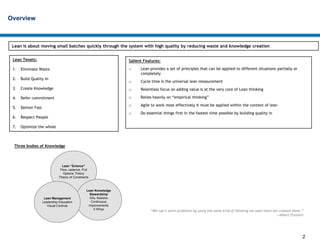
Lean is about moving small batches quickly through the system with high quality by reducing waste and knowledge creation
Lean Tenets:
1. Eliminate Waste
2. Build Quality In
3. Create Knowledge
4. Defer commitment
5. Deliver Fast
6. Respect People
7. Optimize the whole
“We can’t solve problems by using the same kind of thinking we used when we created them.”
—Albert Einstein
Lean “Science”
Flow, cadence, Pull
Options Theory
Theory of Constraints
Lean Knowledge
Stewardship
A3s, Kaizens
Continuous
Improvements
5 Whys
Lean Management
Leadership Education
Visual Controls
Salient Features:
o Lean provides a set of principles that can be applied to different situations partially or
completely
o Cycle time is the universal lean measurement
o Relentless focus on adding value is at the very core of Lean thinking
o Relies heavily on “empirical thinking”
o Agile to work most effectively it must be applied within the context of lean
o Do essential things first in the fastest time possible by building quality in
Three bodies of Knowledge
3
Eliminate Waste
Highlights:
• Identifying waste is a critical exercise, thumb rule is anything that does not add value to customer is a waste
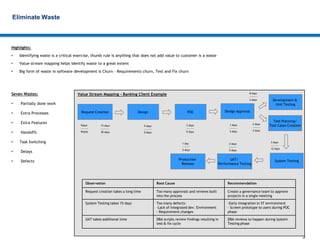
• Value stream mapping helps identify waste to a great extent
• Big form of waste in software development is Churn – Requirements churn, Test and Fix churn
Seven Wastes:
• Partially done work
• Extra Processes
• Extra Features
• Handoffs
• Task Switching
• Delays
• Defects
Value Stream Mapping – Banking Client Example
Request Creation Design POC Design Approval
Test Planning/
Test Cases Creation
Development &
Unit Testing
UAT/
Performance Testing
System TestingProduction
Release
Value
--------
Waste
15 days
--------
30 days
5 days
--------
0 days
2 days
--------
0 days
1 days
--------
5 days
8 days
--------
2 days
2 days
--------
2 days
3 days
--------
12 days
2 days
--------
5 days
1 day
--------
2 days
Observation Root Cause Recommendation
Request creation takes a long time Too many approvals and reviews built
into the process
Create a governance team to approve
projects in a single meeting
System Testing takes 15 days Too many defects:
-Lack of integrated dev. Environment
- Requirement changes
-Early integration in ST environment
- Screen prototype to users during POC
phase
UAT takes additional time DBA scripts review findings resulting in
test & fix cycle
DBA reviews to happen during System
Testing phase
4
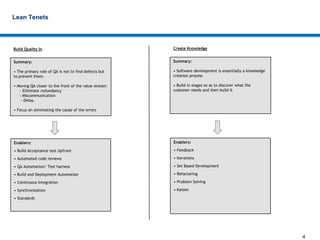
Lean Tenets
Summary:
• The primary role of QA is not to find defects but
to prevent them.
• Moving QA closer to the front of the value stream:
- Eliminate redundancy
- Miscommunication
- Delay.
• Focus on eliminating the cause of the errors
Enablers:
• Build Acceptance test Upfront
• Automated code reviews
• QA Automation/ Test harness
• Build and Deployment Automation
• Continuous Integration
• Synchronization
• Standards
Build Quality In
Summary:
• Software development is essentially a knowledge
creation process
• Build in stages so as to discover what the
customer needs and then build it
Enablers:
• Feedback
• Iterations
• Set Based Development
• Refactoring
• Problem Solving
• Kaizen
Create Knowledge
5
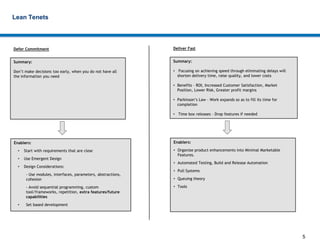
Lean Tenets
Summary:
Don’t make decisions too early, when you do not have all
the information you need
Enablers:
• Start with requirements that are clear
• Use Emergent Design
• Design Considerations:
- Use modules, interfaces, parameters, abstractions,
cohesion
- Avoid sequential programming, custom
tool/frameworks, repetition, extra features/future
capabilities
• Set based development
Defer Commitment
Summary:
• Focusing on achieving speed through eliminating delays will
shorten delivery time, raise quality, and lower costs
• Benefits – ROI, Increased Customer Satisfaction, Market
Position, Lower Risk, Greater profit margins
• Parkinson’s Law – Work expands so as to fill its time for
completion
• Time box releases – Drop features if needed
Enablers:
• Organize product enhancements into Minimal Marketable
Features.
• Automated Testing, Build and Release Automation
• Pull Systems
• Queuing theory
• Tools
Deliver Fast
6
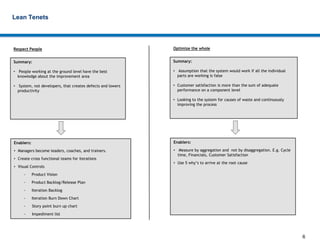
Lean Tenets
Summary:
• People working at the ground level have the best
knowledge about the improvement area
• System, not developers, that creates defects and lowers
productivity
Enablers:
• Managers become leaders, coaches, and trainers.
• Create cross functional teams for iterations
• Visual Controls
- Product Vision
- Product Backlog/Release Plan
- Iteration Backlog
- Iteration Burn Down Chart
- Story point burn up chart
- Impediment list
Respect People
Summary:
• Assumption that the system would work if all the individual
parts are working is false
• Customer satisfaction is more than the sum of adequate
performance on a component level
• Looking to the system for causes of waste and continuously
improving the process
Enablers:
• Measure by aggregation and not by disaggregation. E.g. Cycle
time, Financials, Customer Satisfaction
• Use 5 why’s to arrive at the root cause
Optimize the whole
7
Thank You

Lean Development Overview

  • 1.
  • 2.
    2 Overview Lean is aboutmoving small batches quickly through the system with high quality by reducing waste and knowledge creation Lean Tenets: 1. Eliminate Waste 2. Build Quality In 3. Create Knowledge 4. Defer commitment 5. Deliver Fast 6. Respect People 7. Optimize the whole “We can’t solve problems by using the same kind of thinking we used when we created them.” —Albert Einstein Lean “Science” Flow, cadence, Pull Options Theory Theory of Constraints Lean Knowledge Stewardship A3s, Kaizens Continuous Improvements 5 Whys Lean Management Leadership Education Visual Controls Salient Features: o Lean provides a set of principles that can be applied to different situations partially or completely o Cycle time is the universal lean measurement o Relentless focus on adding value is at the very core of Lean thinking o Relies heavily on “empirical thinking” o Agile to work most effectively it must be applied within the context of lean o Do essential things first in the fastest time possible by building quality in Three bodies of Knowledge
  • 3.
    3 Eliminate Waste Highlights: • Identifyingwaste is a critical exercise, thumb rule is anything that does not add value to customer is a waste • Value stream mapping helps identify waste to a great extent • Big form of waste in software development is Churn – Requirements churn, Test and Fix churn Seven Wastes: • Partially done work • Extra Processes • Extra Features • Handoffs • Task Switching • Delays • Defects Value Stream Mapping – Banking Client Example Request Creation Design POC Design Approval Test Planning/ Test Cases Creation Development & Unit Testing UAT/ Performance Testing System TestingProduction Release Value -------- Waste 15 days -------- 30 days 5 days -------- 0 days 2 days -------- 0 days 1 days -------- 5 days 8 days -------- 2 days 2 days -------- 2 days 3 days -------- 12 days 2 days -------- 5 days 1 day -------- 2 days Observation Root Cause Recommendation Request creation takes a long time Too many approvals and reviews built into the process Create a governance team to approve projects in a single meeting System Testing takes 15 days Too many defects: -Lack of integrated dev. Environment - Requirement changes -Early integration in ST environment - Screen prototype to users during POC phase UAT takes additional time DBA scripts review findings resulting in test & fix cycle DBA reviews to happen during System Testing phase
  • 4.
    4 Lean Tenets Summary: • Theprimary role of QA is not to find defects but to prevent them. • Moving QA closer to the front of the value stream: - Eliminate redundancy - Miscommunication - Delay. • Focus on eliminating the cause of the errors Enablers: • Build Acceptance test Upfront • Automated code reviews • QA Automation/ Test harness • Build and Deployment Automation • Continuous Integration • Synchronization • Standards Build Quality In Summary: • Software development is essentially a knowledge creation process • Build in stages so as to discover what the customer needs and then build it Enablers: • Feedback • Iterations • Set Based Development • Refactoring • Problem Solving • Kaizen Create Knowledge
  • 5.
    5 Lean Tenets Summary: Don’t makedecisions too early, when you do not have all the information you need Enablers: • Start with requirements that are clear • Use Emergent Design • Design Considerations: - Use modules, interfaces, parameters, abstractions, cohesion - Avoid sequential programming, custom tool/frameworks, repetition, extra features/future capabilities • Set based development Defer Commitment Summary: • Focusing on achieving speed through eliminating delays will shorten delivery time, raise quality, and lower costs • Benefits – ROI, Increased Customer Satisfaction, Market Position, Lower Risk, Greater profit margins • Parkinson’s Law – Work expands so as to fill its time for completion • Time box releases – Drop features if needed Enablers: • Organize product enhancements into Minimal Marketable Features. • Automated Testing, Build and Release Automation • Pull Systems • Queuing theory • Tools Deliver Fast
  • 6.
    6 Lean Tenets Summary: • Peopleworking at the ground level have the best knowledge about the improvement area • System, not developers, that creates defects and lowers productivity Enablers: • Managers become leaders, coaches, and trainers. • Create cross functional teams for iterations • Visual Controls - Product Vision - Product Backlog/Release Plan - Iteration Backlog - Iteration Burn Down Chart - Story point burn up chart - Impediment list Respect People Summary: • Assumption that the system would work if all the individual parts are working is false • Customer satisfaction is more than the sum of adequate performance on a component level • Looking to the system for causes of waste and continuously improving the process Enablers: • Measure by aggregation and not by disaggregation. E.g. Cycle time, Financials, Customer Satisfaction • Use 5 why’s to arrive at the root cause Optimize the whole
  • 7.