Agile Software Development
(Lean Software Development Method)
HAIRINA BINTI HAMDZAH
September 15, 2015
Introduction Agile Software
Development
• Agile – able to move quickly and easily
• Agile software development – process that support the agile
philosophy
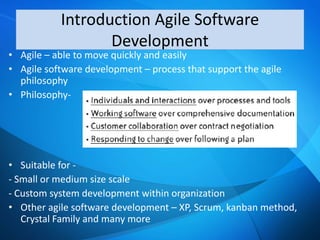
• Philosophy-
• Suitable for -
- Small or medium size scale
- Custom system development within organization
• Other agile software development – XP, Scrum, kanban method,
Crystal Family and many more
Lean Software Development
• Implementation of a lean manufacturing
principles into a software development model
• Lean manufacturing principle originated from
Toyota production system in Japan
• Main objective: Reduce waste in a system and
produce a higher value for the customer
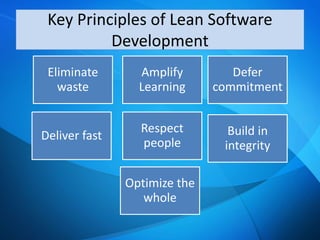
Key Principles of Lean Software
Development
Eliminate
waste
Build in
integrity
Amplify
Learning
Defer
commitment
Deliver fast
Respect
people
Optimize the
whole
Principal 1: Eliminate waste
– Waste: anything that didn’t improve quality of code,
didn’t reduce time and effort in development
process and didn’t provide real value too customer
(tools:VSP mapping)
– Three types of waste
Waste in code development
Waste in project management
Waste in workforce potential
Principal 2: Amplify Learning
– Softw. Development is a continuous learning
process (need to learn as project develop)
– Predictable performance is driven by feedback
Principal 3: Defer Commitment
– Deciding irreversible decision as late as possible to
keep option open for as long as practical
– Why? ->The later the decision are made, the more
information we will have to make the right decision.
*important of timeboxs
– >adaptable, change is manageable
– >avoid/ delay cost of change
Principal 4: Deliver Fast
– Customer like a rapid deliver
– Less time for a customer to change their mind
– Avoid over-enginered solution
– Complement defer commitment
Principal 5: Respect People
– Empower those who add value: letting people who
add value use their full potential
– To get individual to be motivated and take
responsibility -> be responsible for the outcome
and authorized to make it happen
Principal 6: Build in Integrity /Quality
– perceived integrity and conceptual integrity
– Making sure customers expectation are met
– Key is early and often communication , feedback, testing
Principal 7: Optimize the whole
– Sub-optimization: Tendency to solve problem by
breaking system into parts and optimize each and
individual part
– Usually will be leading to “tragedy of the commons”
– Look at the entire value stream
– Continuously review product and process
development.
Success story
• BT Adastral,
50% sooner than expected.
80% ROI in the first year.
• Timberline Software (now part of The Sage
Group),
estimates that improvements in quality, costs,
and time to market were all greater than 25%
-On time delivery
-Scrap reduction
-Space utilization
-Total project work reduce
-Project rework reduce
-Project costs reduce
-Improve productivity
- Success depend on
discipline,
commitment and
technical skills
- Role of a business
analyst is crucial
- Flexibility in
requirement
Conclusion
• Effective principals in terms of cost-related
• Effective principals in terms of quality-related
• Need a strong team work and discipline from
all party involved including customer/client
~Q&A~
Thank you for listening

Agile lean software development principles

  • 1.
    Agile Software Development (LeanSoftware Development Method) HAIRINA BINTI HAMDZAH September 15, 2015
  • 2.
    Introduction Agile Software Development •Agile – able to move quickly and easily • Agile software development – process that support the agile philosophy • Philosophy- • Suitable for - - Small or medium size scale - Custom system development within organization • Other agile software development – XP, Scrum, kanban method, Crystal Family and many more
  • 3.
    Lean Software Development •Implementation of a lean manufacturing principles into a software development model • Lean manufacturing principle originated from Toyota production system in Japan • Main objective: Reduce waste in a system and produce a higher value for the customer
  • 4.
    Key Principles ofLean Software Development Eliminate waste Build in integrity Amplify Learning Defer commitment Deliver fast Respect people Optimize the whole
  • 5.
    Principal 1: Eliminatewaste – Waste: anything that didn’t improve quality of code, didn’t reduce time and effort in development process and didn’t provide real value too customer (tools:VSP mapping) – Three types of waste Waste in code development Waste in project management Waste in workforce potential Principal 2: Amplify Learning – Softw. Development is a continuous learning process (need to learn as project develop) – Predictable performance is driven by feedback
  • 6.
    Principal 3: DeferCommitment – Deciding irreversible decision as late as possible to keep option open for as long as practical – Why? ->The later the decision are made, the more information we will have to make the right decision. *important of timeboxs – >adaptable, change is manageable – >avoid/ delay cost of change Principal 4: Deliver Fast – Customer like a rapid deliver – Less time for a customer to change their mind – Avoid over-enginered solution – Complement defer commitment
  • 7.
    Principal 5: RespectPeople – Empower those who add value: letting people who add value use their full potential – To get individual to be motivated and take responsibility -> be responsible for the outcome and authorized to make it happen Principal 6: Build in Integrity /Quality – perceived integrity and conceptual integrity – Making sure customers expectation are met – Key is early and often communication , feedback, testing
  • 8.
    Principal 7: Optimizethe whole – Sub-optimization: Tendency to solve problem by breaking system into parts and optimize each and individual part – Usually will be leading to “tragedy of the commons” – Look at the entire value stream – Continuously review product and process development.
  • 9.
    Success story • BTAdastral, 50% sooner than expected. 80% ROI in the first year. • Timberline Software (now part of The Sage Group), estimates that improvements in quality, costs, and time to market were all greater than 25%
  • 10.
    -On time delivery -Scrapreduction -Space utilization -Total project work reduce -Project rework reduce -Project costs reduce -Improve productivity - Success depend on discipline, commitment and technical skills - Role of a business analyst is crucial - Flexibility in requirement
  • 11.
    Conclusion • Effective principalsin terms of cost-related • Effective principals in terms of quality-related • Need a strong team work and discipline from all party involved including customer/client
  • 12.