Superfactory ®  Lean Enterprise Series Lean & Six Sigma Design
Outline Lean Design Key Principles of Lean Design Characteristics of the Toyota Product Development System The Impact of Variation Waste in Product Development Optimal Lean Design Team Cycle Time Issues Product Cost Issues Quality Issues Design for Manufacturing Design for Six Sigma Goals Tools Process Design and ISO 9001:2000 (Section by section discussion)
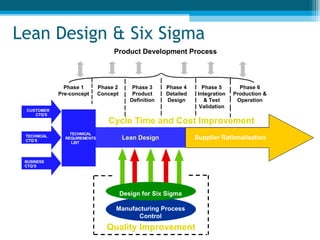
Lean Design & Six Sigma Phase 2 Concept Phase 1 Pre-concept Phase 3 Product Definition Phase 4 Detailed Design Phase 5 Integration & Test Validation Phase 6 Production & Operation CUSTOMER C T Q ’ S B U S I N E S S C T Q ’ S T E C H N I C A L C T Q ’ S T E C H N I C A L R E Q U I R E M E N T S L I S T Manufacturing Process Control Design for Six Sigma Product Development Process Lean Design Supplier Rationalization Quality Improvement Cycle Time and Cost Improvement
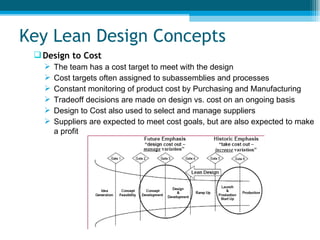
Key Lean Design Concepts Design to Cost The team has a cost target to meet with the design Cost targets often assigned to subassemblies and processes Constant monitoring of product cost by Purchasing and Manufacturing Tradeoff decisions are made on design vs. cost on an ongoing basis Design to Cost also used to select and manage suppliers Suppliers are expected to meet cost goals, but are also expected to make a profit
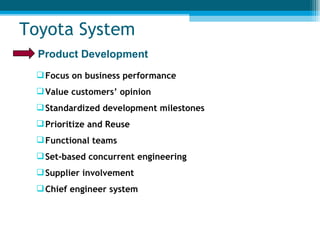
Toyota System Focus on business performance Value customers’ opinion Standardized development milestones Prioritize and Reuse Functional teams Set-based concurrent engineering Supplier involvement Chief engineer system Product Development
Waste in Product Development Waste Category Example Implication Defective Products Excessive Inventories Excessive Motion Excessive Processing Transportation Waiting Over Production excessive engineering changes requirements change impact design moving info from one person/group to another projects    desired future business work-in-process exceeds capacity partially done work working w/ incomplete requirements not using standard parts and subs extra software features drawing or code errors work does not match customer needs unnecessary items specified too many approvals required too much “paperwork” excessive approvals and controls process monuments task switching on multiple projects workload    capacity excessive multi-tasking delays due to reviews/approvals/testing   deployment/staffing/workload project sits for next ‘event’ not cost effective  inefficiencies built-in queue time, work-arounds batch processing, no flow ineffective use of skills no decision rules drives rework and inflexibility barriers to adding value capacity consumed by rework long lead-time, rework investment not realized queue time drives lead-time no re-use of knowledge drives supply chain variation excessive changes, scrap rework, scrap, warranty
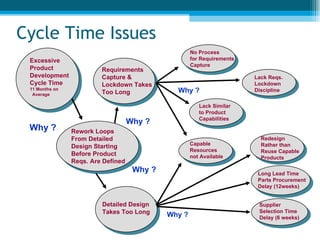
Cycle Time Issues Excessive  Product Development Cycle Time  11 Months on  Average Why ? Rework Loops From Detailed Design Starting Before Product Reqs. Are Defined Detailed Design  Takes Too Long Requirements Capture & Lockdown Takes Too Long Why ? Why ? No Process for Requirements Capture Lack Reqs. Lockdown  Discipline Lack Similar  to Product  Capabilities Capable  Resources  not Available Redesign  Rather than  Reuse Capable  Products Supplier  Selection Time  Delay (6 weeks) Long Lead Time  Parts Procurement Delay (12weeks) Why ? Why ?
Resource Efficient – LEAN Capable of very high yields regardless of volume Not affected by process variation; Robust Lead to a “flawless launch” Meets Performance Targets (Quality) Meets Delivery Targets (On Time) Meets Financial Targets (Target Cost) Design for Six Sigma Goals

Lean Design Sample

  • 1.
    Superfactory ® Lean Enterprise Series Lean & Six Sigma Design
  • 2.
    Outline Lean DesignKey Principles of Lean Design Characteristics of the Toyota Product Development System The Impact of Variation Waste in Product Development Optimal Lean Design Team Cycle Time Issues Product Cost Issues Quality Issues Design for Manufacturing Design for Six Sigma Goals Tools Process Design and ISO 9001:2000 (Section by section discussion)
  • 3.
    Lean Design &Six Sigma Phase 2 Concept Phase 1 Pre-concept Phase 3 Product Definition Phase 4 Detailed Design Phase 5 Integration & Test Validation Phase 6 Production & Operation CUSTOMER C T Q ’ S B U S I N E S S C T Q ’ S T E C H N I C A L C T Q ’ S T E C H N I C A L R E Q U I R E M E N T S L I S T Manufacturing Process Control Design for Six Sigma Product Development Process Lean Design Supplier Rationalization Quality Improvement Cycle Time and Cost Improvement
  • 4.
    Key Lean DesignConcepts Design to Cost The team has a cost target to meet with the design Cost targets often assigned to subassemblies and processes Constant monitoring of product cost by Purchasing and Manufacturing Tradeoff decisions are made on design vs. cost on an ongoing basis Design to Cost also used to select and manage suppliers Suppliers are expected to meet cost goals, but are also expected to make a profit
  • 5.
    Toyota System Focuson business performance Value customers’ opinion Standardized development milestones Prioritize and Reuse Functional teams Set-based concurrent engineering Supplier involvement Chief engineer system Product Development
  • 6.
    Waste in ProductDevelopment Waste Category Example Implication Defective Products Excessive Inventories Excessive Motion Excessive Processing Transportation Waiting Over Production excessive engineering changes requirements change impact design moving info from one person/group to another projects  desired future business work-in-process exceeds capacity partially done work working w/ incomplete requirements not using standard parts and subs extra software features drawing or code errors work does not match customer needs unnecessary items specified too many approvals required too much “paperwork” excessive approvals and controls process monuments task switching on multiple projects workload  capacity excessive multi-tasking delays due to reviews/approvals/testing deployment/staffing/workload project sits for next ‘event’ not cost effective inefficiencies built-in queue time, work-arounds batch processing, no flow ineffective use of skills no decision rules drives rework and inflexibility barriers to adding value capacity consumed by rework long lead-time, rework investment not realized queue time drives lead-time no re-use of knowledge drives supply chain variation excessive changes, scrap rework, scrap, warranty
  • 7.
    Cycle Time IssuesExcessive Product Development Cycle Time 11 Months on Average Why ? Rework Loops From Detailed Design Starting Before Product Reqs. Are Defined Detailed Design Takes Too Long Requirements Capture & Lockdown Takes Too Long Why ? Why ? No Process for Requirements Capture Lack Reqs. Lockdown Discipline Lack Similar to Product Capabilities Capable Resources not Available Redesign Rather than Reuse Capable Products Supplier Selection Time Delay (6 weeks) Long Lead Time Parts Procurement Delay (12weeks) Why ? Why ?
  • 8.
    Resource Efficient –LEAN Capable of very high yields regardless of volume Not affected by process variation; Robust Lead to a “flawless launch” Meets Performance Targets (Quality) Meets Delivery Targets (On Time) Meets Financial Targets (Target Cost) Design for Six Sigma Goals