Social media and patient
engagement
Leah S. Millheiser,MD,FACOG,IF
Clinical Assistant Professor
Director, Female Sexual Medicine Program
Department of Obstetrics and Gynecology
Stanford University School of Medicine
Social media and health
promotion
• Promote healthy habits and lifestyles
• Prevention of chronic illnesses
• Transform health communication
• Potential to reach and engage women for
sexual health promotion
• Major source of advice regarding illnesses,
treatment options, dietary advice and
disease prevention
Health information accuracy
on the internet
• Chung et al. Safe Infant Sleep
Recommendations on the Internet: Let’s Google
It. J Peds 2012:
– Identify websites that accurately reflect the
American Academy of Pediatrics
recommendations for infant sleep safety.
– 1300 web sites reviewed
– 43.5% accurate information
– 28.1% inaccurate information
Pew Internet & American
Life Project
• 59% of American internet users go online for health
information
– 80% of searches begin at search engine
• 35% US adults are “online diagnosers”
– Women >>> Men
– 41% had diagnosis confirmed by MD
• 72% of adults believe most or all of the health
information found on the internet
• 75% do not consistently check source or date of
health information
Fox S, Duggan M. Health Online 2013
The case of Suzanne Somers &
Bioidentical Hormone Therapy
(BIH)
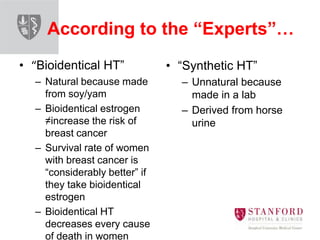
According to the “Experts”…
• “Bioidentical HT”
– Natural because made
from soy/yam
– Bioidentical estrogen
≠increase the risk of
breast cancer
– Survival rate of women
with breast cancer is
“considerably better” if
they take bioidentical
estrogen
– Bioidentical HT
decreases every cause
of death in women
• “Synthetic HT”
– Unnatural because
made in a lab
– Derived from horse
urine
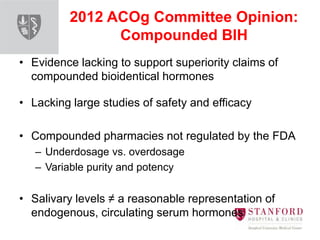
2012 ACOg Committee Opinion:
Compounded BIH
• Evidence lacking to support superiority claims of
compounded bioidentical hormones
• Lacking large studies of safety and efficacy
• Compounded pharmacies not regulated by the FDA
– Underdosage vs. overdosage
– Variable purity and potency
• Salivary levels ≠ a reasonable representation of
endogenous, circulating serum hormones
health education on the
internet
• Discretely obtained information
• Potential to affect sexual attitudes and behaviors
• Seek useful information from a wide range of
resources
• Low cost
• Provide health information to individuals who
may not be able to seek care through
conventional means
What’s The Downside?
• Inaccurate information/non-evidence
based
• False identities – claims to be expert
• Increased vulnerability of individuals with
less education
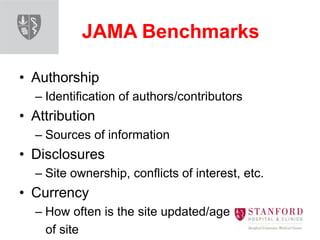
JAMA Benchmarks
• Authorship
– Identification of authors/contributors
• Attribution
– Sources of information
• Disclosures
– Site ownership, conflicts of interest, etc.
• Currency
– How often is the site updated/age
of site
Thank You!
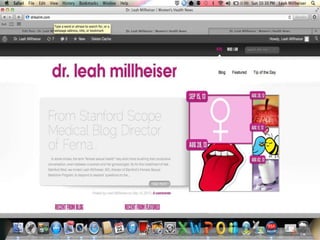
Drleahm.com

Leah Millheiser: Social media and patient engagement

  • 1.
    Social media andpatient engagement Leah S. Millheiser,MD,FACOG,IF Clinical Assistant Professor Director, Female Sexual Medicine Program Department of Obstetrics and Gynecology Stanford University School of Medicine
  • 2.
    Social media andhealth promotion • Promote healthy habits and lifestyles • Prevention of chronic illnesses • Transform health communication • Potential to reach and engage women for sexual health promotion • Major source of advice regarding illnesses, treatment options, dietary advice and disease prevention
  • 3.
    Health information accuracy onthe internet • Chung et al. Safe Infant Sleep Recommendations on the Internet: Let’s Google It. J Peds 2012: – Identify websites that accurately reflect the American Academy of Pediatrics recommendations for infant sleep safety. – 1300 web sites reviewed – 43.5% accurate information – 28.1% inaccurate information
  • 4.
    Pew Internet &American Life Project • 59% of American internet users go online for health information – 80% of searches begin at search engine • 35% US adults are “online diagnosers” – Women >>> Men – 41% had diagnosis confirmed by MD • 72% of adults believe most or all of the health information found on the internet • 75% do not consistently check source or date of health information Fox S, Duggan M. Health Online 2013
  • 5.
    The case ofSuzanne Somers & Bioidentical Hormone Therapy (BIH)
  • 6.
    According to the“Experts”… • “Bioidentical HT” – Natural because made from soy/yam – Bioidentical estrogen ≠increase the risk of breast cancer – Survival rate of women with breast cancer is “considerably better” if they take bioidentical estrogen – Bioidentical HT decreases every cause of death in women • “Synthetic HT” – Unnatural because made in a lab – Derived from horse urine
  • 7.
    2012 ACOg CommitteeOpinion: Compounded BIH • Evidence lacking to support superiority claims of compounded bioidentical hormones • Lacking large studies of safety and efficacy • Compounded pharmacies not regulated by the FDA – Underdosage vs. overdosage – Variable purity and potency • Salivary levels ≠ a reasonable representation of endogenous, circulating serum hormones
  • 8.
    health education onthe internet • Discretely obtained information • Potential to affect sexual attitudes and behaviors • Seek useful information from a wide range of resources • Low cost • Provide health information to individuals who may not be able to seek care through conventional means
  • 9.
    What’s The Downside? •Inaccurate information/non-evidence based • False identities – claims to be expert • Increased vulnerability of individuals with less education
  • 10.
    JAMA Benchmarks • Authorship –Identification of authors/contributors • Attribution – Sources of information • Disclosures – Site ownership, conflicts of interest, etc. • Currency – How often is the site updated/age of site
  • 12.