Meaning and objectives of legal
research
• Advancement of knowledge
• Testing knowledge
• Testing existing theory
• Exploring new facts
• Fact finding
• Throwing light on legal issues
• To explain and explore social and legal
phenomena
• To establish relationship between two factors/
variables (dependent, independent)
• To study cause- effect relationship
• To verify the facts
• To make suggestions and recommendations
Types of Research
Types of Research
1. Basic Research
2. Applied Research
Basic Research
1. Fundamental research
2. Theoretical Research
3. Pure Research
4. To expand knowledge
5. No commercial purpose
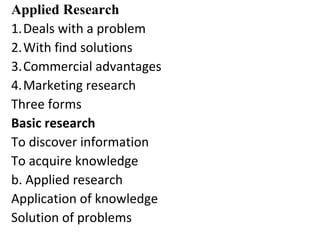
Applied Research
1.Deals with a problem
2.With find solutions
3.Commercial advantages
4.Marketing research
Three forms
Basic research
To discover information
To acquire knowledge
b. Applied research
Application of knowledge
Solution of problems
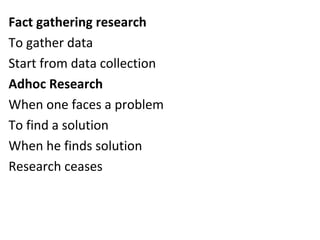
Fact gathering research
To gather data
Start from data collection
Adhoc Research
When one faces a problem
To find a solution
When he finds solution
Research ceases
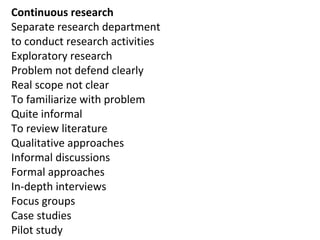
Continuous research
Separate research department
to conduct research activities
Exploratory research
Problem not defend clearly
Real scope not clear
To familiarize with problem
Quite informal
To review literature
Qualitative approaches
Informal discussions
Formal approaches
In-depth interviews
Focus groups
Case studies
Pilot study
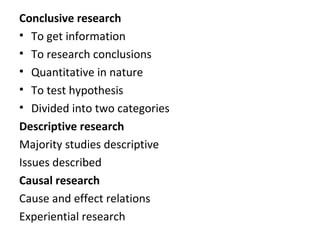
Conclusive research
• To get information
• To research conclusions
• Quantitative in nature
• To test hypothesis
• Divided into two categories
Descriptive research
Majority studies descriptive
Issues described
Causal research
Cause and effect relations
Experiential research
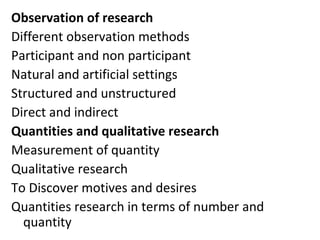
Observation of research
Different observation methods
Participant and non participant
Natural and artificial settings
Structured and unstructured
Direct and indirect
Quantities and qualitative research
Measurement of quantity
Qualitative research
To Discover motives and desires
Quantities research in terms of number and
quantity
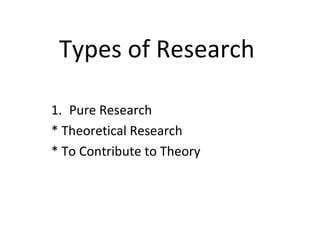
Types of Research
1. Pure Research
* Theoretical Research
* To Contribute to Theory
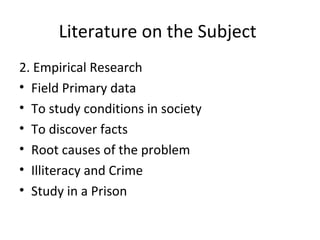
Literature on the Subject
2. Empirical Research
• Field Primary data
• To study conditions in society
• To discover facts
• Root causes of the problem
• Illiteracy and Crime
• Study in a Prison
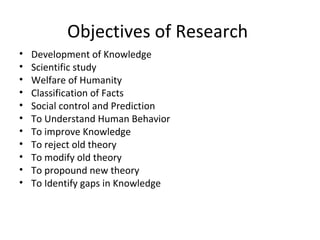
Objectives of Research
• Development of Knowledge
• Scientific study
• Welfare of Humanity
• Classification of Facts
• Social control and Prediction
• To Understand Human Behavior
• To improve Knowledge
• To reject old theory
• To modify old theory
• To propound new theory
• To Identify gaps in Knowledge
Research Design
• Plan of Research Study
• Logical strategy to answer a question
• Blue print for House construction
Types of Design
1. Exploratory or Formulate design
• Studies of a new field
• Experience survey
• To study practical cases
2. Descriptive Studies
• To describe characteristics
3. Diagnostic Studies
• For Discovering a problem
4. Analytical Studies
• How and Why
• To ascertain causality
• Basic to all scientific analysis
5. Experimental design
• Experimental Groups
• Control Group
• Stimulus Groups
• Non -Stimulus Groups
• To conduct experiment Under controlled
conditions
Research process and Steps in Research
1. selection of the topic
2. Problem formulation
3. Identification of variables
4. dependent variable
5. independent variable
6. Hypothesis
7. Testing Hypothesis
8. Selection of the sample
9. collection of data
10. tools of data collection
11. interview schedule
12. Analysis of data
13 Interpretation of data
14. Major findings
15. Conclusions and recommendations

Leagal research methods

  • 2.
    Meaning and objectivesof legal research • Advancement of knowledge • Testing knowledge • Testing existing theory • Exploring new facts • Fact finding • Throwing light on legal issues • To explain and explore social and legal phenomena • To establish relationship between two factors/ variables (dependent, independent)
  • 3.
    • To studycause- effect relationship • To verify the facts • To make suggestions and recommendations
  • 4.
  • 5.
    Types of Research 1.Basic Research 2. Applied Research Basic Research 1. Fundamental research 2. Theoretical Research 3. Pure Research 4. To expand knowledge 5. No commercial purpose
  • 6.
    Applied Research 1.Deals witha problem 2.With find solutions 3.Commercial advantages 4.Marketing research Three forms Basic research To discover information To acquire knowledge b. Applied research Application of knowledge Solution of problems
  • 7.
    Fact gathering research Togather data Start from data collection Adhoc Research When one faces a problem To find a solution When he finds solution Research ceases
  • 8.
    Continuous research Separate researchdepartment to conduct research activities Exploratory research Problem not defend clearly Real scope not clear To familiarize with problem Quite informal To review literature Qualitative approaches Informal discussions Formal approaches In-depth interviews Focus groups Case studies Pilot study
  • 9.
    Conclusive research • Toget information • To research conclusions • Quantitative in nature • To test hypothesis • Divided into two categories Descriptive research Majority studies descriptive Issues described Causal research Cause and effect relations Experiential research
  • 10.
    Observation of research Differentobservation methods Participant and non participant Natural and artificial settings Structured and unstructured Direct and indirect Quantities and qualitative research Measurement of quantity Qualitative research To Discover motives and desires Quantities research in terms of number and quantity
  • 11.
    Types of Research 1.Pure Research * Theoretical Research * To Contribute to Theory
  • 12.
    Literature on theSubject 2. Empirical Research • Field Primary data • To study conditions in society • To discover facts • Root causes of the problem • Illiteracy and Crime • Study in a Prison
  • 13.
    Objectives of Research •Development of Knowledge • Scientific study • Welfare of Humanity • Classification of Facts • Social control and Prediction • To Understand Human Behavior • To improve Knowledge • To reject old theory • To modify old theory • To propound new theory • To Identify gaps in Knowledge
  • 14.
    Research Design • Planof Research Study • Logical strategy to answer a question • Blue print for House construction
  • 15.
    Types of Design 1.Exploratory or Formulate design • Studies of a new field • Experience survey • To study practical cases 2. Descriptive Studies • To describe characteristics 3. Diagnostic Studies • For Discovering a problem
  • 16.
    4. Analytical Studies •How and Why • To ascertain causality • Basic to all scientific analysis 5. Experimental design • Experimental Groups • Control Group • Stimulus Groups • Non -Stimulus Groups • To conduct experiment Under controlled conditions
  • 17.
    Research process andSteps in Research 1. selection of the topic 2. Problem formulation 3. Identification of variables 4. dependent variable 5. independent variable 6. Hypothesis 7. Testing Hypothesis 8. Selection of the sample
  • 18.
    9. collection ofdata 10. tools of data collection 11. interview schedule 12. Analysis of data 13 Interpretation of data 14. Major findings 15. Conclusions and recommendations