Focus Question: How can
leaves be classified?
Living Systems 2-2
Focus on Leaves
Vascular plants are composed of
millions of living cells
Every cell needs water, minerals,
and food (sugar)
Vascular system of plants is really
two systems
Xylem transports water and minerals
to the cells
Phloem transports sugar to the cells
Most xylem tubes begin in the
roots and end in the leaves.
Most phloem tubes start in the
leaves and end in the roots.
Find out about the place where the
xylem ends and the phloem
begins, the leaf.
Leaf Collection
Stay with your group
Collect ONE leaf from as many
different plants as you can find in
5 minutes. Get leaves of all sizes.
Keep sample in the bag.
Sorting Leaves
Look closely at each leaf
Sort into those that show evidence
of xylem and phloem and those
that don’t.
How many of your leaves have
veins?
Are the veins all the same size?
Do the veins branch?
Sort your leaves in a new way.
Classification
Scientists organize, or classify, things
so they can think about them more
efficiently
A group of things that go together based
on a property or behavior is a class.
5th
graders form a class based on age. 4th
graders are a different class, etc… In
schools we classify students by age.
 Geology – classify crystals by shapes and
angles of surfaces. Classify sand by
particle size.
Leaf Classification
Based on basic pattern of the
veins.
Botanists have developed a
systems that uses three patterns.
Palmate
Pinnate
Parallel
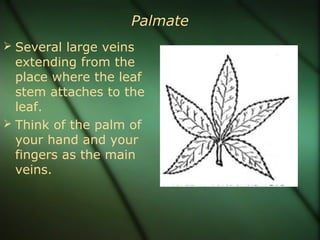
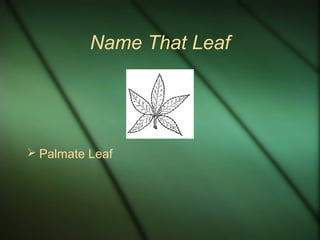
Palmate
 Several large veins
extending from the
place where the leaf
stem attaches to the
leaf.
 Think of the palm of
your hand and your
fingers as the main
veins.
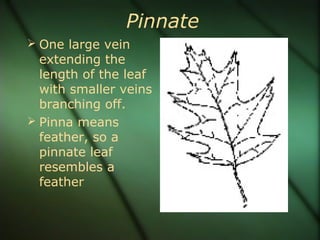
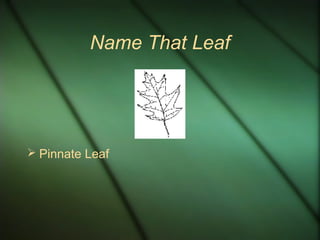
Pinnate
 One large vein
extending the
length of the leaf
with smaller veins
branching off.
 Pinna means
feather, so a
pinnate leaf
resembles a
feather
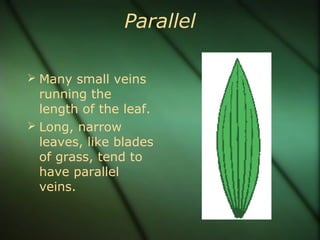
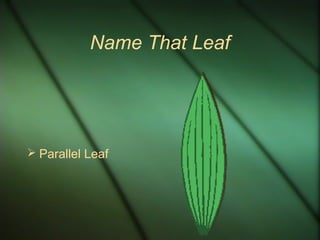
Parallel
 Many small veins
running the
length of the leaf.
 Long, narrow
leaves, like blades
of grass, tend to
have parallel
veins.
Leaf Classification
Classify your leaves based on
venation pattern.
Are there other ways to classify
your leaf collections?
Leaf Shape (Blade)
Kind of edge (Margin)
Kind of attachment (Petiole)
Vocabulary
 Classify
 To organize by similar properties or
behavior
 Palmate
 Several large veins extending from the
place where the leaf stem attaches to the
leaf (Palm)
 Pinnate
 One large vein extending the length of the
leaf with smaller veins branching off
(Feather)
 Parallel
 Many small veins running the length of the
leaf (Grass)
Content
Venation
Classifying leaves by their vein
pattern
How do scientists organize objects
and information?
Scientists classify things by
putting them in groups (classes)
based on similar properties and
behaviors.
Homework
Read Classification, pg. 105-106,
and Summary: Vascular Plants,
pg. 107-109
Answer questions for both articles
I-check 2 quiz on Friday, 10/11
Classification
What is classification?
What are three different ways leaves
can be classified?
If you had a collection of insects, what
ways might you classify them?
Summary: Vascular Plants
Describe how all the cells in a vascular
plant get sugar.
Describe how all the cells in a vascular
plant get water and minerals.
Why do its leaves turn pink when a
celery stalk is placed in red water?
In what way are blood and sap the
same?
Name That Leaf
 Palmate Leaf
Name That Leaf
 Parallel Leaf
Name That Leaf
 Pinnate Leaf
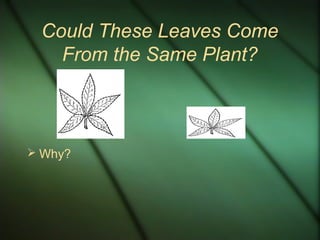
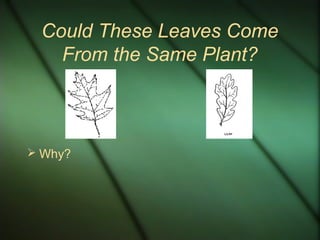
Could These Leaves Come
From the Same Plant?
 Why?
Could These Leaves Come
From the Same Plant?
 Why?

Leaf classification combined

  • 1.
    Focus Question: Howcan leaves be classified? Living Systems 2-2
  • 2.
    Focus on Leaves Vascularplants are composed of millions of living cells Every cell needs water, minerals, and food (sugar) Vascular system of plants is really two systems Xylem transports water and minerals to the cells Phloem transports sugar to the cells
  • 3.
    Most xylem tubesbegin in the roots and end in the leaves. Most phloem tubes start in the leaves and end in the roots. Find out about the place where the xylem ends and the phloem begins, the leaf.
  • 4.
    Leaf Collection Stay withyour group Collect ONE leaf from as many different plants as you can find in 5 minutes. Get leaves of all sizes. Keep sample in the bag.
  • 5.
    Sorting Leaves Look closelyat each leaf Sort into those that show evidence of xylem and phloem and those that don’t. How many of your leaves have veins? Are the veins all the same size? Do the veins branch? Sort your leaves in a new way.
  • 6.
    Classification Scientists organize, orclassify, things so they can think about them more efficiently A group of things that go together based on a property or behavior is a class. 5th graders form a class based on age. 4th graders are a different class, etc… In schools we classify students by age.  Geology – classify crystals by shapes and angles of surfaces. Classify sand by particle size.
  • 7.
    Leaf Classification Based onbasic pattern of the veins. Botanists have developed a systems that uses three patterns. Palmate Pinnate Parallel
  • 8.
    Palmate  Several largeveins extending from the place where the leaf stem attaches to the leaf.  Think of the palm of your hand and your fingers as the main veins.
  • 9.
    Pinnate  One largevein extending the length of the leaf with smaller veins branching off.  Pinna means feather, so a pinnate leaf resembles a feather
  • 10.
    Parallel  Many smallveins running the length of the leaf.  Long, narrow leaves, like blades of grass, tend to have parallel veins.
  • 11.
    Leaf Classification Classify yourleaves based on venation pattern. Are there other ways to classify your leaf collections? Leaf Shape (Blade) Kind of edge (Margin) Kind of attachment (Petiole)
  • 12.
    Vocabulary  Classify  Toorganize by similar properties or behavior  Palmate  Several large veins extending from the place where the leaf stem attaches to the leaf (Palm)  Pinnate  One large vein extending the length of the leaf with smaller veins branching off (Feather)  Parallel  Many small veins running the length of the leaf (Grass)
  • 13.
    Content Venation Classifying leaves bytheir vein pattern How do scientists organize objects and information? Scientists classify things by putting them in groups (classes) based on similar properties and behaviors.
  • 14.
    Homework Read Classification, pg.105-106, and Summary: Vascular Plants, pg. 107-109 Answer questions for both articles I-check 2 quiz on Friday, 10/11
  • 15.
    Classification What is classification? Whatare three different ways leaves can be classified? If you had a collection of insects, what ways might you classify them?
  • 16.
    Summary: Vascular Plants Describehow all the cells in a vascular plant get sugar. Describe how all the cells in a vascular plant get water and minerals. Why do its leaves turn pink when a celery stalk is placed in red water? In what way are blood and sap the same?
  • 17.
    Name That Leaf Palmate Leaf
  • 18.
    Name That Leaf Parallel Leaf
  • 19.
    Name That Leaf Pinnate Leaf
  • 20.
    Could These LeavesCome From the Same Plant?  Why?
  • 21.
    Could These LeavesCome From the Same Plant?  Why?