LEADING CHANGE
                                    Nursing 408
Debbie-Jo Bubela, Chona Dick & Lora-Lee Pacheco
Introduction
 Evidence based practice is the way of
 nursing, in order to keep up with
 advancing healthcare and healthcare
 issues nurses and organizations seem
 to be in a continuous state of change.
 For this reason, and the effects of
 nursing shortage, change is often the
 last thing an individual or organization
 feels ready to tackle.
Leading Change
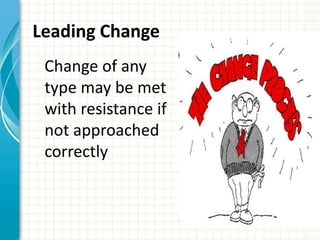
 Change of any
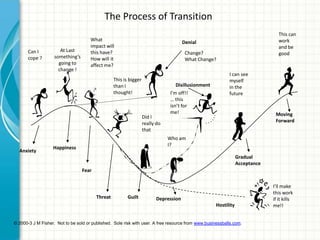
 type may be met
 with resistance if
 not approached
 correctly
Weber outlines 8 key elements to
 successful organizational change in
 the article “Effecting and Leading
 Change in Healthcare Organizations”
 (2000). These elements are
 summarized in eight crucial
 strategies or principles.
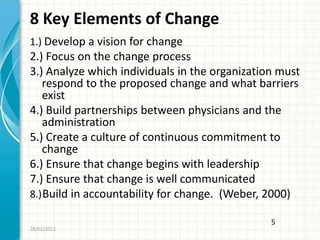
8 Key Elements of Change
1.) Develop a vision for change
2.) Focus on the change process
3.) Analyze which individuals in the organization must
   respond to the proposed change and what barriers
   exist
4.) Build partnerships between physicians and the
   administration
5.) Create a culture of continuous commitment to
   change
6.) Ensure that change begins with leadership
7.) Ensure that change is well communicated
8.) Build in accountability for change. (Weber, 2000)

                                                5
28/02/2012
1. Develop A Vision For Change


     Absolute identity with one's cause is the first and
         great condition of successful leadership.
                    -Woodrow Wilson-
• The vision should be easily understood
• Able to be quickly communicated
• Consistent with accepted organizational
  values
• Intellectually solid
• Understood by All within the
  organization
2. Focus on the change process

   Great changes may not happen right away, but with
       effort even the difficult may become easy.
                     -Bill Blackman-
• Evidence based research shows
      effectiveness in healthcare.
    • Why have we not been able to translate
      all those robust findings into action?
    • Leaders and policy makers in the
      healthcare system generally haven’t
      been very good at creating and
      managing change.
                           McIntyre 2010


28/02/2012                                 9
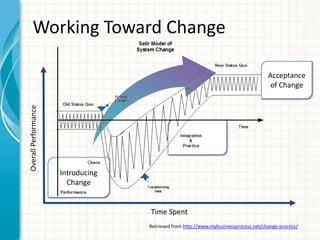
Working Toward Change

                                                                                      Acceptance
                                                                                       of Change
Overall Performance


                      Introducing
                        Change


                                    Time Spent
                                    Retrieved from http://www.mybusinessprocess.net/change-process/
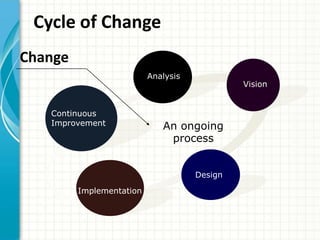
Cycle of Change
Change
                          Analysis
                                              Vision


   Continuous
   Improvement               An ongoing
                              process


                                     Design

         Implementation
3. Analyze which individuals in
the organization must respond
to the proposed change and
what barriers exist
    Some change their ways when they see the light,
           others when they feel the heat.
                 -Caroline Schoeder-
Barriers to change include:
• Those who resist change
  – People resist change if they are not prepared for
    it, informed of it, or have not had time to
    understand it
• Nursing shortage
  – Nurses are fatigued from overtime shifts and do
    not have the energy to think about change
   http://freepdfhosting.com/4c7b0a4fc3.pdf


                                                  13
                                           28/02/2012
“People often resist change for reasons that
make good sense to them, even if those
reasons don't correspond to organizational
goals. So it is crucial to recognize, reward, and
celebrate accomplishments.”
                       -Rosabeth Moss Kanter
To some change is more of a difficult
       transition and in fact an actual grieving
       process
HTTP://WWW.YOUTUBE.COM/WATCH?V=UD95SNWCAKS
The Process of Transition
                                                                                                                                 This can
                                      What                                                                                       work
                                                                                      Denial
                                      impact will                                                                                and be
       Can I           At Last        this have?                                       Change?                                   good
       cope ?       something’s       How will it                                      What Change?
                      going to        affect me?
                      change !
                                                                                                           I can see
                                                  This is bigger                                           myself
                                                  than I                          Disillusionment          in the
                                                  thought!                     I’m off!!                   future
                                                                               … this
                                                                               isn’t for
                                                                               me!                                             Moving
                                                                   Did I
                                                                                                                               Forward
                                                                   really do
                                                                   that
                                                                               Who am
                                                                               I?
                   Happiness
  Anxiety
                                                                                                                 Gradual
                                                                                                                 Acceptance
                                  Fear


                                                                                                                              I’ll make
                                                                                                                              this work
                                         Threat          Guilt           Depression                                           if it kills
                                                                                                     Hostility                me!!


© 2000-3 J M Fisher. Not to be sold or published. Sole risk with user. A free resource from www.businessballs.com.
4. Build partnerships between
Physicians and the administration

   ALONE WE CAN DO SO LITTLE; TOGETHER WE CAN DO SO MUCH.
                       -HELEN KELLER-
• For a true partnership to develop and last
  between hospital administrators and
  physicians , they need to have open and
  honest dialogue— listening to and addressing
  each other’s concerns.
• Through programs such as MoreOB, the
  whole hierarchy concept is eliminated and
  nurses and physicians work on the same
  levels.
• This concept can be attempted for all levels
  of hierarchy in the healthcare system.


28/02/2012                             18
5. Create a culture of continuous
     commitment to change
     NOT EVERYTHING THAT IS FACED CAN BE CHANGED.
     BUT NOTHING CAN BE CHANGED UNTIL IT IS FACED.
                  - JAMES BALDWIN-
• To have the commitment to
      change, employees need to be provided
      the tools to perform their jobs.
    • EMRs
    • Telehealth
    • Nurse Practitioners
    • Education


28/02/2012                        20
EMRs (electronic
medical records)

www.youtube.com/watch?v=Uhb1SeBL00s
Education
Ongoing education is necessary to both implement and support change.
Nurse Practitioners
A Nurse Practitioner (NP) “is an advanced practice
nurse whose practice is focused on providing
services to manage the healthcare needs of
individuals, families, and communities. The NP
role is grounded in the nursing profession’s
values, knowledge, theories, and practice and is a
role that complements rather than replaces other
healthcare providers. NPs have the potential to
contribute significantly to new models of
healthcare based on the principles of primary
healthcare” (p. 177).
                      McIntyre and McDonald (2010)
Telehealth
http://www.nursingchann
el.ca/programs/daniels_st
ory/index.html
(This link is also available on the main
Blog page)
"Commitment is what transforms a promise
into reality. It is the words that speak boldly
of your intentions. And the actions which
speak louder than the words. It is making the
time when there is none. Coming through
time after time after time, year after year
after year. Commitment is the stuff character
is made of: the power to change the face of
things. It is the daily triumph of integrity over
scepticism."
                                    Shearson Lehman
6. Ensure that change begins
               with leadership
A GOOD OBJECTIVE OF LEADERSHIP IS TO HELP THOSE WHO ARE DOING POORLY TO DO WELL AND
               TO HELP THOSE WHO ARE DOING WELL TO DO EVEN BETTER.
                                      -JIM ROHN-
Nurse Leaders
 "It may seem a strange principle to enunciate as the very first requirement in a
                  Hospital that it should do the sick no harm."
                             - Florence Nightengale-

• Dr. Moyra Allen
  http://freepdfhosting.com/241d42bfce.pdf
• Mary Breckinridge
  http://freepdfhosting.com/6d8a164da9.pdf
• Ethel Johns
  http://freepdfhosting.com/a78649c1a0.pdf
                                                                    27
28/02/2012
7. Ensure that change is well
       communicated
 THE ART OF COMMUNICATION IS THE LANGUAGE OF LEADERSHIP.
                    -JAMES HUMES-
•   EMR’s
•   CAIS
•   Communication systems
•   Gallup poll


                            Reference


28/02/2012                              29
8. Build in accountability for change

 Coming together is a beginning; keeping together is progress; working
                          together is success.
                             -Henry Ford-
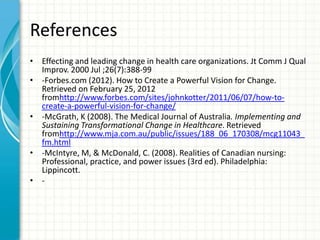
Summary
In today's world we are in
constant change.
Implementing long term
change is neither swift nor
easy. It requires
patience, persistence, and
sometimes a little creativity.
The way these change efforts
are introduced will directly
effect the end result of either
success or failure. Leadership
plays a key role in ensuring
this success. As cited in
McIntyre and
McDonald, “each of us as a
professional nurse has the
potential and perhaps the
responsibility to provide
leadership” (p.57).
References
• Effecting and leading change in health care organizations. Jt Comm J Qual
  Improv. 2000 Jul ;26(7):388-99
• -Forbes.com (2012). How to Create a Powerful Vision for Change.
  Retrieved on February 25, 2012
  fromhttp://www.forbes.com/sites/johnkotter/2011/06/07/how-to-
  create-a-powerful-vision-for-change/
• -McGrath, K (2008). The Medical Journal of Australia. Implementing and
  Sustaining Transformational Change in Healthcare. Retrieved
  fromhttp://www.mja.com.au/public/issues/188_06_170308/mcg11043_
  fm.html
• -McIntyre, M, & McDonald, C. (2008). Realities of Canadian nursing:
  Professional, practice, and power issues (3rd ed). Philadelphia:
  Lippincott.
• -
QUESTIONS?

1. Is Telehealth available in your community and if so
   to what extent?

2. Have you ever played a role in initiating change in
your place of work?

3. What has your experience with Nursing leadership
been through a change process?
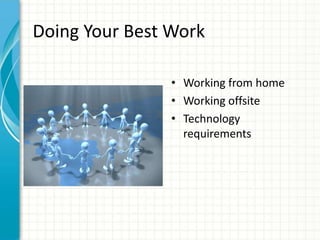
Doing Your Best Work

                • Working from home
                • Working offsite
                • Technology
                  requirements

Leading change

  • 1.
    LEADING CHANGE Nursing 408 Debbie-Jo Bubela, Chona Dick & Lora-Lee Pacheco
  • 2.
    Introduction Evidence basedpractice is the way of nursing, in order to keep up with advancing healthcare and healthcare issues nurses and organizations seem to be in a continuous state of change. For this reason, and the effects of nursing shortage, change is often the last thing an individual or organization feels ready to tackle.
  • 3.
    Leading Change Changeof any type may be met with resistance if not approached correctly
  • 4.
    Weber outlines 8key elements to successful organizational change in the article “Effecting and Leading Change in Healthcare Organizations” (2000). These elements are summarized in eight crucial strategies or principles.
  • 5.
    8 Key Elementsof Change 1.) Develop a vision for change 2.) Focus on the change process 3.) Analyze which individuals in the organization must respond to the proposed change and what barriers exist 4.) Build partnerships between physicians and the administration 5.) Create a culture of continuous commitment to change 6.) Ensure that change begins with leadership 7.) Ensure that change is well communicated 8.) Build in accountability for change. (Weber, 2000) 5 28/02/2012
  • 6.
    1. Develop AVision For Change Absolute identity with one's cause is the first and great condition of successful leadership. -Woodrow Wilson-
  • 7.
    • The visionshould be easily understood • Able to be quickly communicated • Consistent with accepted organizational values • Intellectually solid • Understood by All within the organization
  • 8.
    2. Focus onthe change process Great changes may not happen right away, but with effort even the difficult may become easy. -Bill Blackman-
  • 9.
    • Evidence basedresearch shows effectiveness in healthcare. • Why have we not been able to translate all those robust findings into action? • Leaders and policy makers in the healthcare system generally haven’t been very good at creating and managing change. McIntyre 2010 28/02/2012 9
  • 10.
    Working Toward Change Acceptance of Change Overall Performance Introducing Change Time Spent Retrieved from http://www.mybusinessprocess.net/change-process/
  • 11.
    Cycle of Change Change Analysis Vision Continuous Improvement An ongoing process Design Implementation
  • 12.
    3. Analyze whichindividuals in the organization must respond to the proposed change and what barriers exist Some change their ways when they see the light, others when they feel the heat. -Caroline Schoeder-
  • 13.
    Barriers to changeinclude: • Those who resist change – People resist change if they are not prepared for it, informed of it, or have not had time to understand it • Nursing shortage – Nurses are fatigued from overtime shifts and do not have the energy to think about change http://freepdfhosting.com/4c7b0a4fc3.pdf 13 28/02/2012
  • 14.
    “People often resistchange for reasons that make good sense to them, even if those reasons don't correspond to organizational goals. So it is crucial to recognize, reward, and celebrate accomplishments.” -Rosabeth Moss Kanter
  • 15.
    To some changeis more of a difficult transition and in fact an actual grieving process HTTP://WWW.YOUTUBE.COM/WATCH?V=UD95SNWCAKS
  • 16.
    The Process ofTransition This can What work Denial impact will and be Can I At Last this have? Change? good cope ? something’s How will it What Change? going to affect me? change ! I can see This is bigger myself than I Disillusionment in the thought! I’m off!! future … this isn’t for me! Moving Did I Forward really do that Who am I? Happiness Anxiety Gradual Acceptance Fear I’ll make this work Threat Guilt Depression if it kills Hostility me!! © 2000-3 J M Fisher. Not to be sold or published. Sole risk with user. A free resource from www.businessballs.com.
  • 17.
    4. Build partnershipsbetween Physicians and the administration ALONE WE CAN DO SO LITTLE; TOGETHER WE CAN DO SO MUCH. -HELEN KELLER-
  • 18.
    • For atrue partnership to develop and last between hospital administrators and physicians , they need to have open and honest dialogue— listening to and addressing each other’s concerns. • Through programs such as MoreOB, the whole hierarchy concept is eliminated and nurses and physicians work on the same levels. • This concept can be attempted for all levels of hierarchy in the healthcare system. 28/02/2012 18
  • 19.
    5. Create aculture of continuous commitment to change NOT EVERYTHING THAT IS FACED CAN BE CHANGED. BUT NOTHING CAN BE CHANGED UNTIL IT IS FACED. - JAMES BALDWIN-
  • 20.
    • To havethe commitment to change, employees need to be provided the tools to perform their jobs. • EMRs • Telehealth • Nurse Practitioners • Education 28/02/2012 20
  • 21.
  • 22.
    Education Ongoing education isnecessary to both implement and support change.
  • 23.
    Nurse Practitioners A NursePractitioner (NP) “is an advanced practice nurse whose practice is focused on providing services to manage the healthcare needs of individuals, families, and communities. The NP role is grounded in the nursing profession’s values, knowledge, theories, and practice and is a role that complements rather than replaces other healthcare providers. NPs have the potential to contribute significantly to new models of healthcare based on the principles of primary healthcare” (p. 177). McIntyre and McDonald (2010)
  • 24.
  • 25.
    "Commitment is whattransforms a promise into reality. It is the words that speak boldly of your intentions. And the actions which speak louder than the words. It is making the time when there is none. Coming through time after time after time, year after year after year. Commitment is the stuff character is made of: the power to change the face of things. It is the daily triumph of integrity over scepticism." Shearson Lehman
  • 26.
    6. Ensure thatchange begins with leadership A GOOD OBJECTIVE OF LEADERSHIP IS TO HELP THOSE WHO ARE DOING POORLY TO DO WELL AND TO HELP THOSE WHO ARE DOING WELL TO DO EVEN BETTER. -JIM ROHN-
  • 27.
    Nurse Leaders "Itmay seem a strange principle to enunciate as the very first requirement in a Hospital that it should do the sick no harm." - Florence Nightengale- • Dr. Moyra Allen http://freepdfhosting.com/241d42bfce.pdf • Mary Breckinridge http://freepdfhosting.com/6d8a164da9.pdf • Ethel Johns http://freepdfhosting.com/a78649c1a0.pdf 27 28/02/2012
  • 28.
    7. Ensure thatchange is well communicated THE ART OF COMMUNICATION IS THE LANGUAGE OF LEADERSHIP. -JAMES HUMES-
  • 29.
    EMR’s • CAIS • Communication systems • Gallup poll Reference 28/02/2012 29
  • 30.
    8. Build inaccountability for change Coming together is a beginning; keeping together is progress; working together is success. -Henry Ford-
  • 31.
    Summary In today's worldwe are in constant change. Implementing long term change is neither swift nor easy. It requires patience, persistence, and sometimes a little creativity. The way these change efforts are introduced will directly effect the end result of either success or failure. Leadership plays a key role in ensuring this success. As cited in McIntyre and McDonald, “each of us as a professional nurse has the potential and perhaps the responsibility to provide leadership” (p.57).
  • 32.
    References • Effecting andleading change in health care organizations. Jt Comm J Qual Improv. 2000 Jul ;26(7):388-99 • -Forbes.com (2012). How to Create a Powerful Vision for Change. Retrieved on February 25, 2012 fromhttp://www.forbes.com/sites/johnkotter/2011/06/07/how-to- create-a-powerful-vision-for-change/ • -McGrath, K (2008). The Medical Journal of Australia. Implementing and Sustaining Transformational Change in Healthcare. Retrieved fromhttp://www.mja.com.au/public/issues/188_06_170308/mcg11043_ fm.html • -McIntyre, M, & McDonald, C. (2008). Realities of Canadian nursing: Professional, practice, and power issues (3rd ed). Philadelphia: Lippincott. • -
  • 33.
    QUESTIONS? 1. Is Telehealthavailable in your community and if so to what extent? 2. Have you ever played a role in initiating change in your place of work? 3. What has your experience with Nursing leadership been through a change process?
  • 34.
    Doing Your BestWork • Working from home • Working offsite • Technology requirements