LEADERSHIP
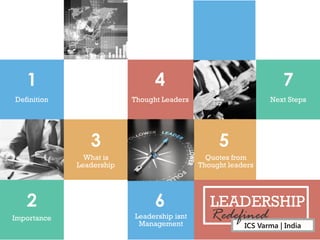
1
Definition
2
Importance
4
Thought Leaders
7
Next Steps
3
What is
Leadership
5
6
Quotes from
Thought leaders
Leadership isnt
Management ICS Varma | India
Redefined
Define leadership
Leadership is both a research area and a
practical skill encompassing the ability
of an individual or organizations to
"lead" or guide other individuals, teams,
or entire organizations.
Leadership plays an important part in
the success of any organization. In the
absence of effective leadership no
organization can work efficiently.
Importance of Leadership
Leadership has nothing to do with seniority
or one’s position in the hierarchy of a
company. Too many talk about a company’s
leadership referring to the senior most
executives in the organization.They are just
that, senior executives. Leadership doesn’t
automatically happen when you reach a
certain pay grade.
What is Leadership any way
Leadership and management are not
synonymous. You have 15 people in your
down line and P&L responsibility? Good for
you, hopefully you are a good manager.
Good management is needed. Managers
need to plan, measure, monitor, coordinate,
solve, hire, fire, and so many other things.
Typically, managers
manage things. Leaders lead people.
Leadership isn’t Management
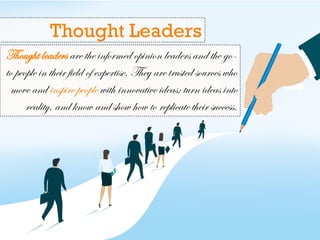
Thought leaders are the informed opinion leaders and the go-
to people in their field of expertise. They are trusted sources who
move and inspire people with innovative ideas; turn ideas into
reality, and know and show how to replicate their success.
Thought Leaders
varmaics
NEXT
STEPS
Actions speak
louder
Leading in the
digital age
Actions speak louder
than words
When it comes to leadership there is no
one size fits all. Every leader has
his/her own personality, style, and
approach to leading teams, and leaders
understand their own limitations and
always keep their teams informed.
Good Leaders know that success is a
team effort.They realize that it takes a
diverse team to truly innovate.They
search for passionate people in diverse
areas of expertise and bring them
together.
Great leaders empower their teams to
do more, they are very protective, and
they are clever in applying their
knowledge and experience in order to
move forward and avoid mistakes
either they themselves or others made
in the past.
Leading in the digital age
The technological advances of the digital age
have allowed the global workforce to be better
connected, more collaborative, and have
greater personal impact than ever before.
More information is immediately available,
through more channels, than at any time in
history. Clearly, workplaces are now optimized
for high levels of workforce engagement
Leading in the Digital Age
The rise of the global economy and the
coming of the digital age have made the
engagement question much more complex
for the leaders.
Organizations everywhere are coping with
unprecedented levels of competition and
pressure to perform.
Managing Engagement
These organizations are facing a legion of
issues that include the need to become more
global, the need to simultaneously become
more frugal and more innovative, the need to
manage new and different stakeholders, and
the need to cope with political uncertainty,
energy issues, and other factors over which
they have no control
Managing Engagement
Put yourself “in the middle.” Leaders should
position themselves between the chaos of
change and their people. Engaging leaders
use their experience, insight, and knowledge
of the organization’s business and culture to
help people make sense of changes and to
better participate in them.
Leading in the Digital Age
Invest in your people. Leaders should
personally invest more effort in talent
development during periods of high change.
By doing this, engaging leaders use change
as a medium for accelerating the
professional development of the workforce.
Leading in the Digital Age
Focus on a higher purpose. In times of
uncertainty, engaging leaders use higher
purpose to keep people focused on their
ability to shape the future of the
organization.
Leading in the Digital Age
Leave no one behind.“False urgency” is a
phrase we use to describe a phenomenon
sometimes mentioned by the executives.
False urgency occurs when change anxiety
becomes so high that fear takes over and the
only thing that matters is staying on schedule.
There is “just no time” for things like human
development and engagement, and the
workforce is left behind.
Leading in the Digital Age
Engaging leaders refuse false urgency and
stay focused on people when the stakes are
highest.
Leading in the Digital Age
Credits
Harvard Business review
Forbes 100 Best Quotes on Leadership
Wikipedia
Google images
SOAP Free Slides

Leadership redefined

  • 1.
    LEADERSHIP 1 Definition 2 Importance 4 Thought Leaders 7 Next Steps 3 Whatis Leadership 5 6 Quotes from Thought leaders Leadership isnt Management ICS Varma | India Redefined
  • 2.
    Define leadership Leadership isboth a research area and a practical skill encompassing the ability of an individual or organizations to "lead" or guide other individuals, teams, or entire organizations.
  • 3.
    Leadership plays animportant part in the success of any organization. In the absence of effective leadership no organization can work efficiently. Importance of Leadership
  • 4.
    Leadership has nothingto do with seniority or one’s position in the hierarchy of a company. Too many talk about a company’s leadership referring to the senior most executives in the organization.They are just that, senior executives. Leadership doesn’t automatically happen when you reach a certain pay grade. What is Leadership any way
  • 5.
    Leadership and managementare not synonymous. You have 15 people in your down line and P&L responsibility? Good for you, hopefully you are a good manager. Good management is needed. Managers need to plan, measure, monitor, coordinate, solve, hire, fire, and so many other things. Typically, managers manage things. Leaders lead people. Leadership isn’t Management
  • 6.
    Thought leaders arethe informed opinion leaders and the go- to people in their field of expertise. They are trusted sources who move and inspire people with innovative ideas; turn ideas into reality, and know and show how to replicate their success. Thought Leaders
  • 8.
  • 27.
  • 28.
    Actions speak louder thanwords When it comes to leadership there is no one size fits all. Every leader has his/her own personality, style, and approach to leading teams, and leaders understand their own limitations and always keep their teams informed.
  • 29.
    Good Leaders knowthat success is a team effort.They realize that it takes a diverse team to truly innovate.They search for passionate people in diverse areas of expertise and bring them together.
  • 30.
    Great leaders empowertheir teams to do more, they are very protective, and they are clever in applying their knowledge and experience in order to move forward and avoid mistakes either they themselves or others made in the past.
  • 31.
    Leading in thedigital age
  • 32.
    The technological advancesof the digital age have allowed the global workforce to be better connected, more collaborative, and have greater personal impact than ever before. More information is immediately available, through more channels, than at any time in history. Clearly, workplaces are now optimized for high levels of workforce engagement Leading in the Digital Age
  • 33.
    The rise ofthe global economy and the coming of the digital age have made the engagement question much more complex for the leaders. Organizations everywhere are coping with unprecedented levels of competition and pressure to perform. Managing Engagement
  • 34.
    These organizations arefacing a legion of issues that include the need to become more global, the need to simultaneously become more frugal and more innovative, the need to manage new and different stakeholders, and the need to cope with political uncertainty, energy issues, and other factors over which they have no control Managing Engagement
  • 35.
    Put yourself “inthe middle.” Leaders should position themselves between the chaos of change and their people. Engaging leaders use their experience, insight, and knowledge of the organization’s business and culture to help people make sense of changes and to better participate in them. Leading in the Digital Age
  • 36.
    Invest in yourpeople. Leaders should personally invest more effort in talent development during periods of high change. By doing this, engaging leaders use change as a medium for accelerating the professional development of the workforce. Leading in the Digital Age
  • 37.
    Focus on ahigher purpose. In times of uncertainty, engaging leaders use higher purpose to keep people focused on their ability to shape the future of the organization. Leading in the Digital Age
  • 38.
    Leave no onebehind.“False urgency” is a phrase we use to describe a phenomenon sometimes mentioned by the executives. False urgency occurs when change anxiety becomes so high that fear takes over and the only thing that matters is staying on schedule. There is “just no time” for things like human development and engagement, and the workforce is left behind. Leading in the Digital Age
  • 39.
    Engaging leaders refusefalse urgency and stay focused on people when the stakes are highest. Leading in the Digital Age
  • 40.
    Credits Harvard Business review Forbes100 Best Quotes on Leadership Wikipedia Google images SOAP Free Slides