On Becoming a
Leader
an FEU LEADER!
FEU - NSTP-1
OBJECTIVES
• Know the meaning of leadership
• Identify the traits and skills of an effective
leader
• Examine the role, duties and
responsibilities of a Team Leader in the
workplace
• Understand the limits of authority in a
Team Leader role
• Develop a plan to develop your own
leadership potential
Pick your role model:
What is LEADERSHIP?
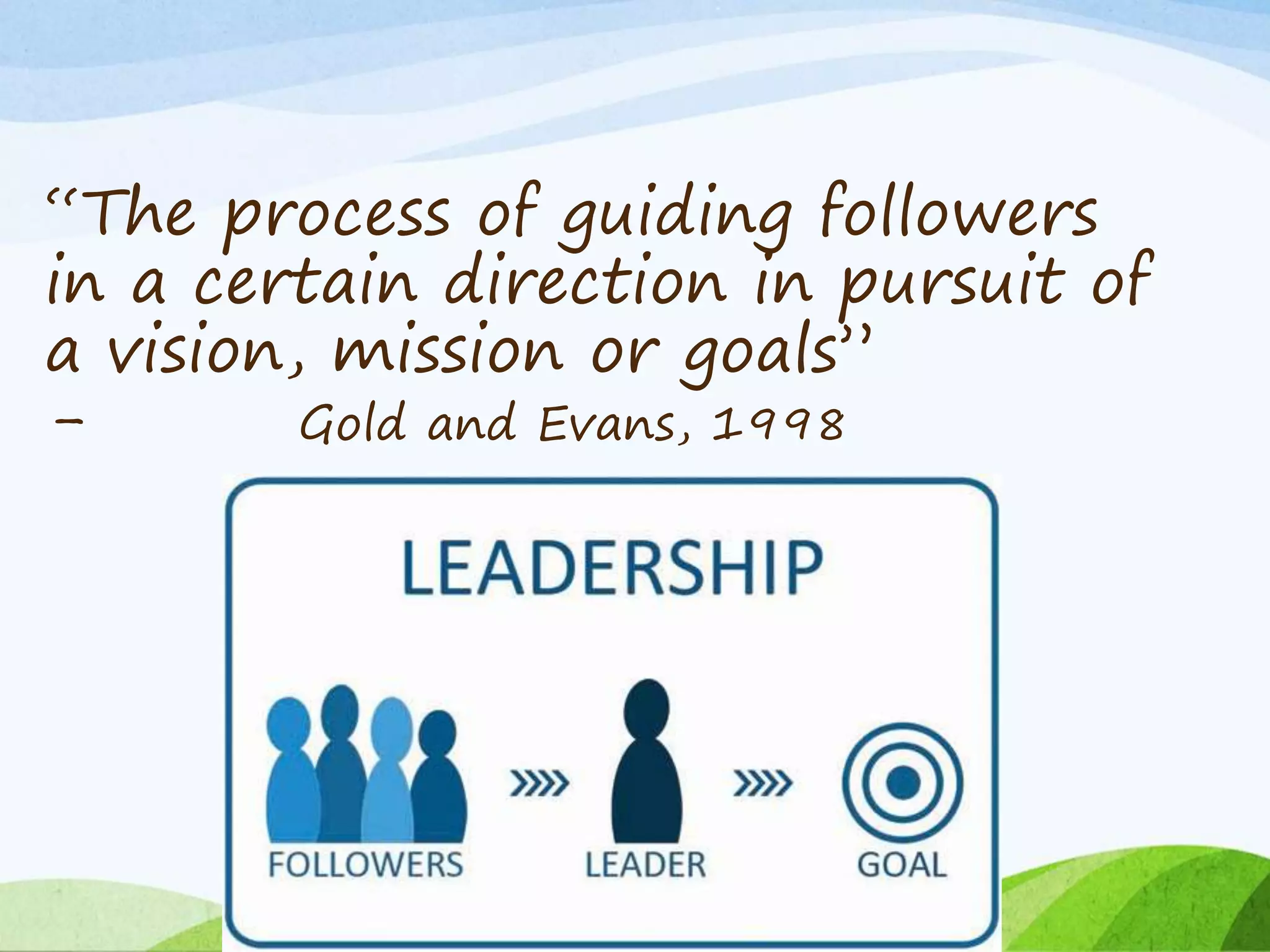
“The process of guiding followers
in a certain direction in pursuit of
a vision, mission or goals”
- Gold and Evans, 1998
The ability to provide
direction to a group of
people and influence
those people to follow the
direction and act
accordingly.
The ability to
bring out the best
in everyone.
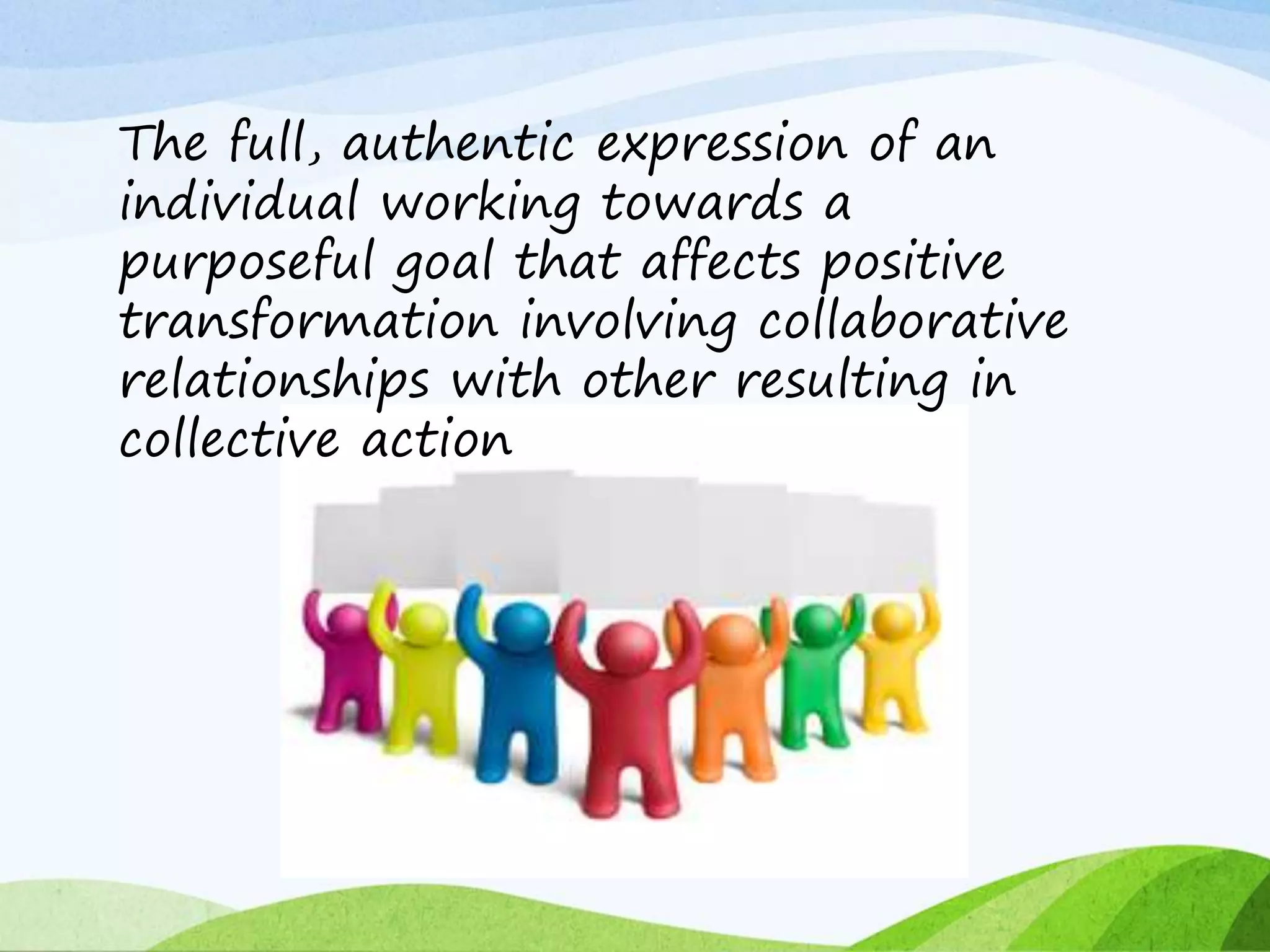
The full, authentic expression of an
individual working towards a
purposeful goal that affects positive
transformation involving collaborative
relationships with other resulting in
collective action
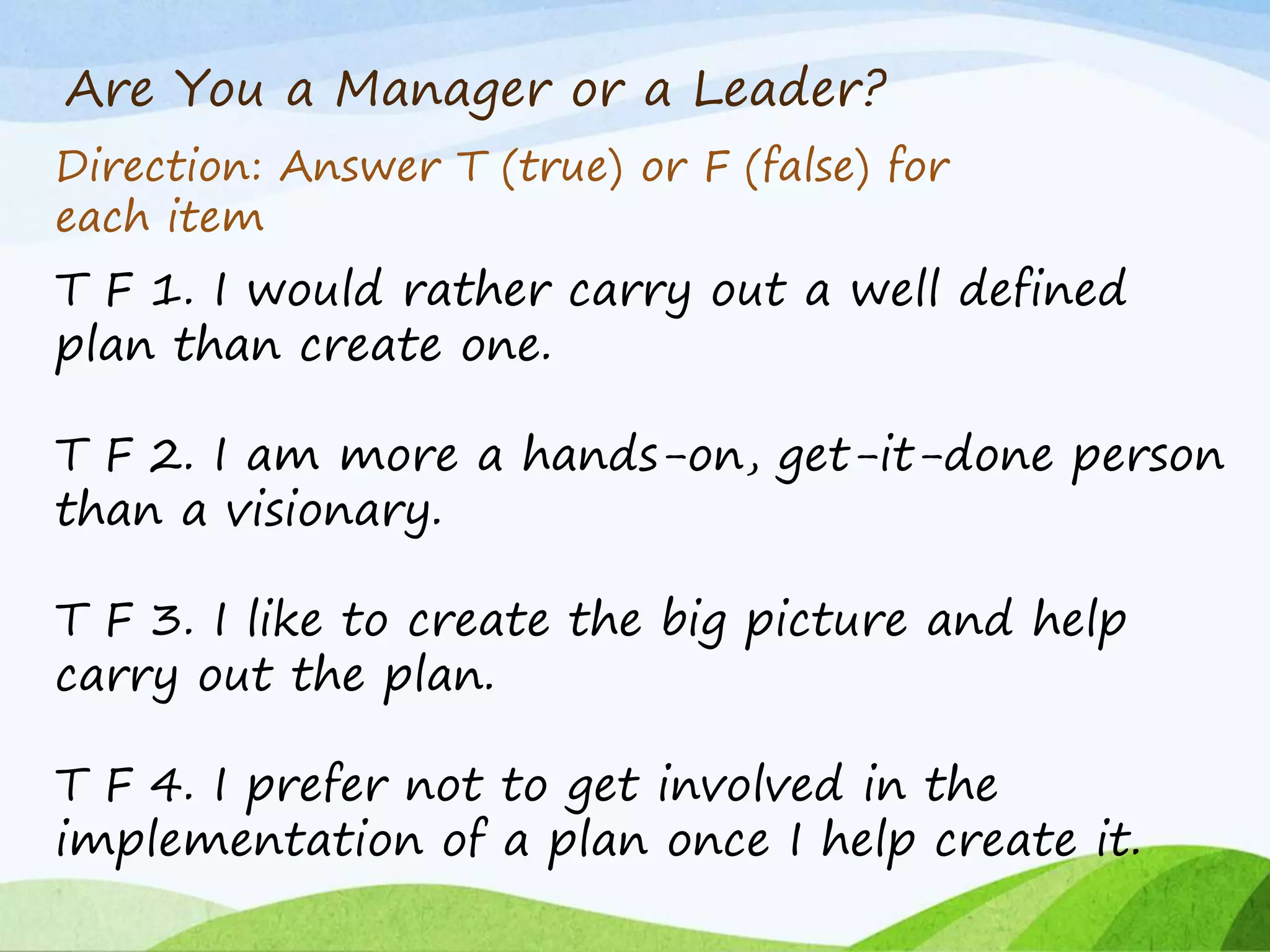
Are You a Manager or a Leader?
Direction: Answer T (true) or F (false) for
each item
T F 1. I would rather carry out a well defined
plan than create one.
T F 2. I am more a hands-on, get-it-done person
than a visionary.
T F 3. I like to create the big picture and help
carry out the plan.
T F 4. I prefer not to get involved in the
implementation of a plan once I help create it.
Are You a Manager or a Leader?
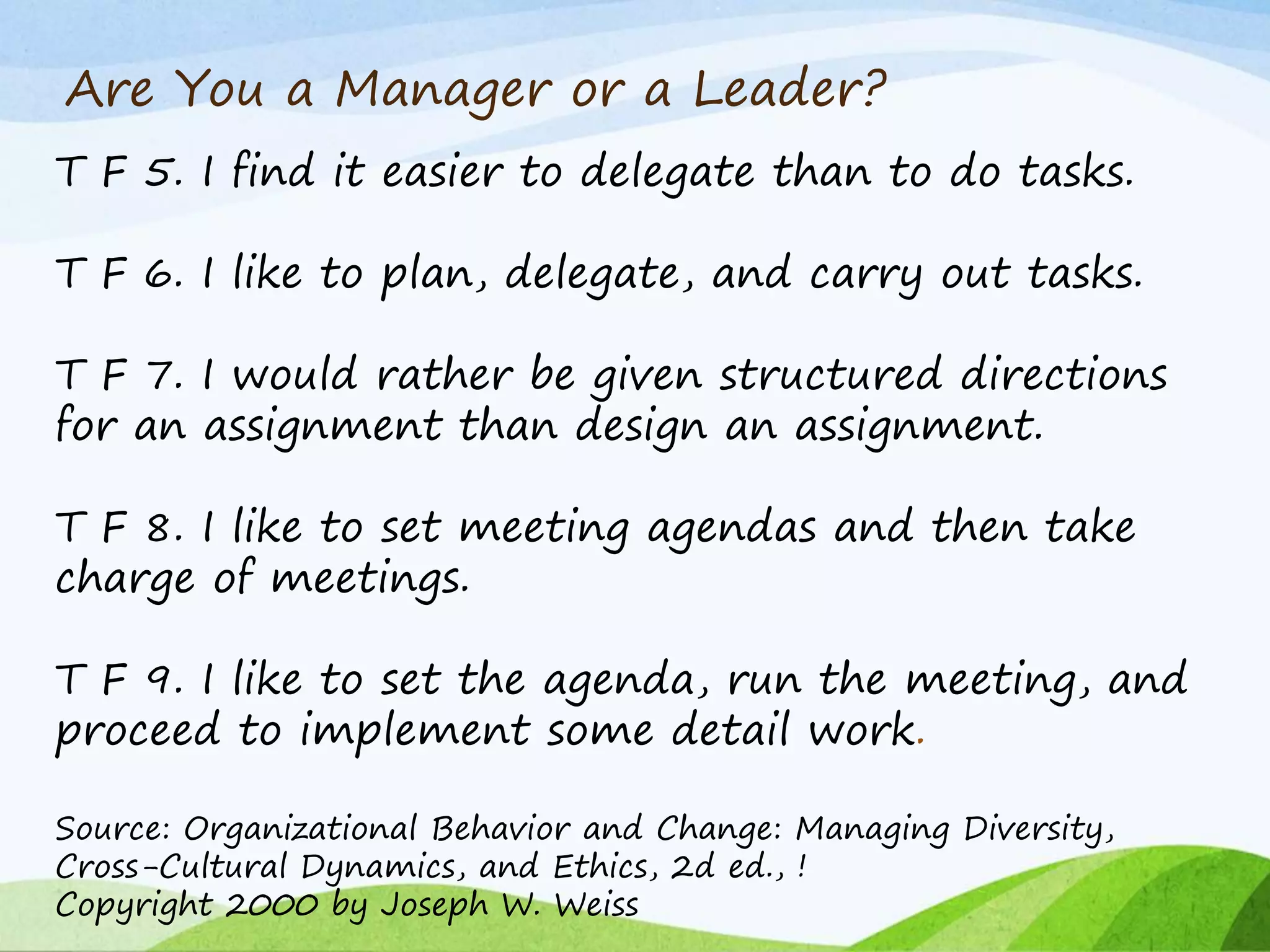
T F 5. I find it easier to delegate than to do tasks.
T F 6. I like to plan, delegate, and carry out tasks.
T F 7. I would rather be given structured directions
for an assignment than design an assignment.
T F 8. I like to set meeting agendas and then take
charge of meetings.
T F 9. I like to set the agenda, run the meeting, and
proceed to implement some detail work.
Source: Organizational Behavior and Change: Managing Diversity,
Cross-Cultural Dynamics, and Ethics, 2d ed., !
Copyright 2000 by Joseph W. Weiss
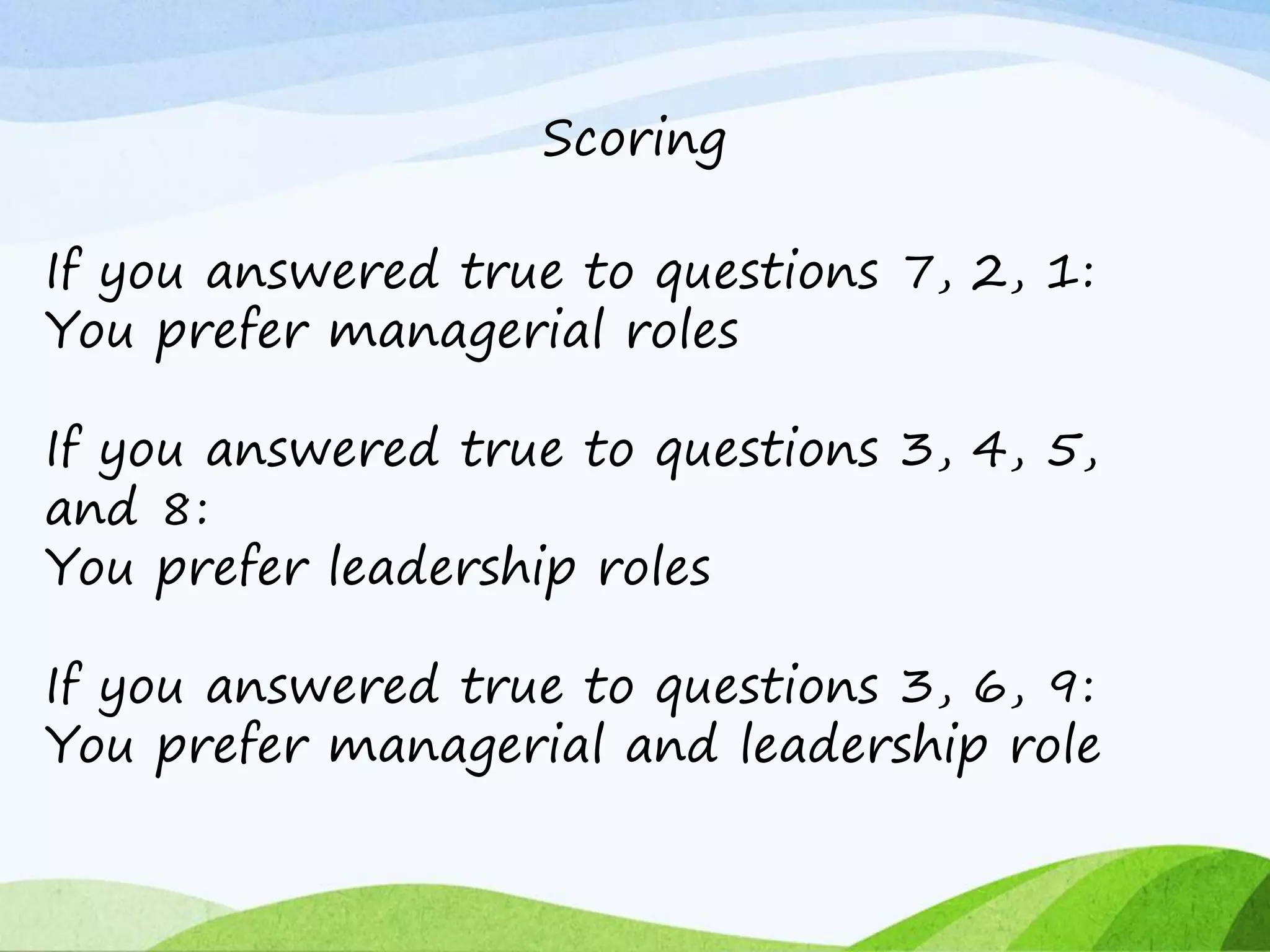
Scoring
If you answered true to questions 7, 2, 1:
You prefer managerial roles
If you answered true to questions 3, 4, 5,
and 8:
You prefer leadership roles
If you answered true to questions 3, 6, 9:
You prefer managerial and leadership role
QUALITIES OF A LEADER
Leadership Practices Inventory
James Kouzes and Barry Posner developed a
survey (The Leadership Practices Inventory)
that asked people which, of a list of common
characteristics of leaders, were, in their
experiences of being led by others, the seven
top things they look for, admire and would
willingly follow.
Kouzes/Posner's Leadership Inventory
(In order of priority)
• Honest Dependable
• Forward-Looking Cooperative
• Competent Determined
• Inspiring Imaginative
• Intelligent Ambitious
• Fair-minded Courageous
• Broad-minded Caring
• Supportive Mature
• Straight-forward Self-controlled
Scenario:
If you could select among these leadership attributes
and only have one, which would you choose and why?
Why are they important?
Confidence and determination
Vision: a goal for a better future
Brains: intelligence developed into wisdom
Heart: empathy and compassion
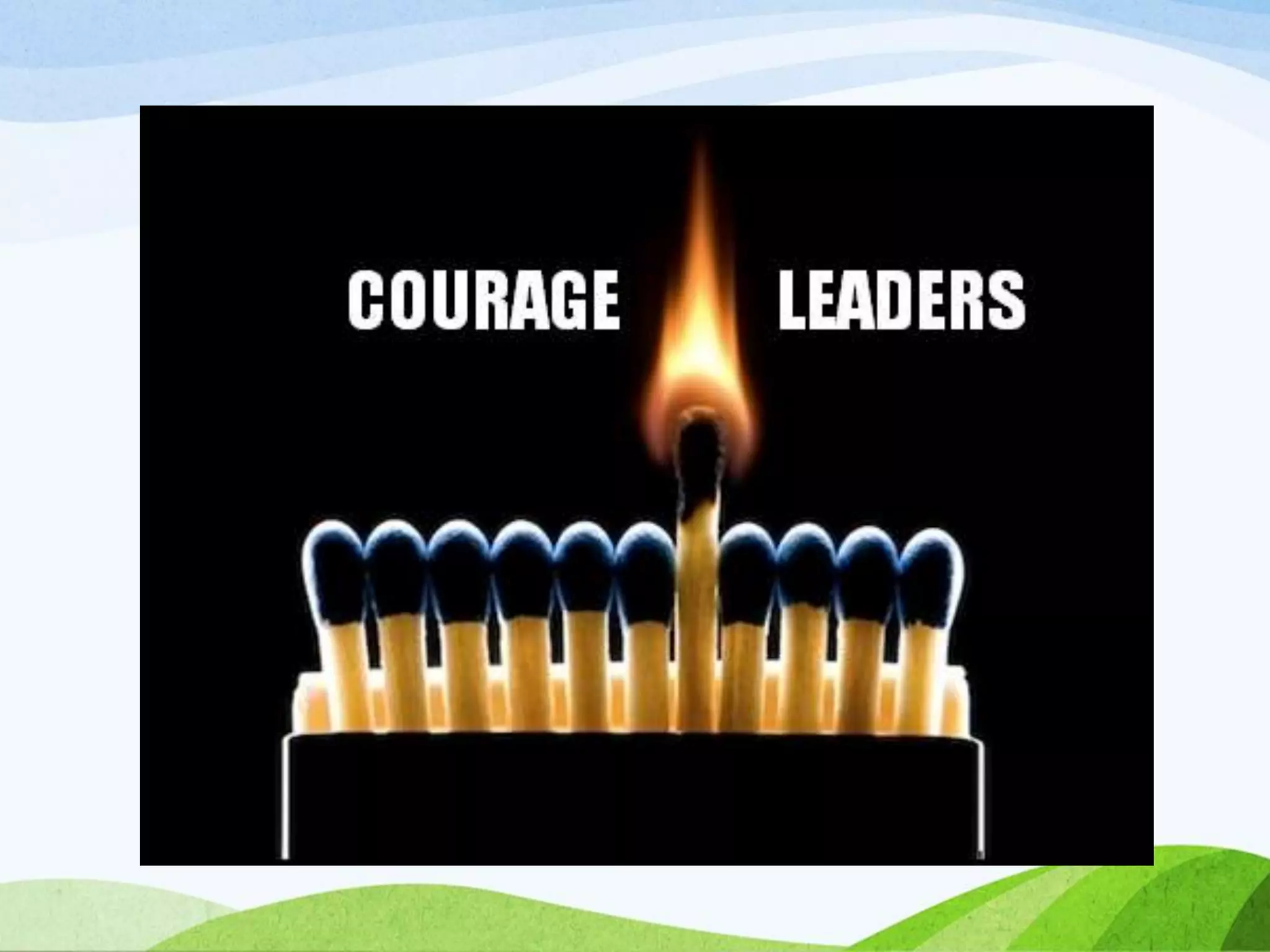
Courage: commitment transferred to action
Do you have everything you need?
Among the listed leadership attributes below,
what attributes, if any, are missing?
Why are they important?
Confidence and determination
Vision: a goal for a better future
Brains: intelligence developed into wisdom
Heart: empathy and compassion
Courage: commitment transferred to action
What is a GOOD LEADER?
Is a person with integrity who is
committed to the organization and
the people who work together
To accomplish the organization’s
mission; this person leads by example,
communicates without ceasing, and
shows care, concern, and consistency
in all dealings.
TYPES OF LEADER
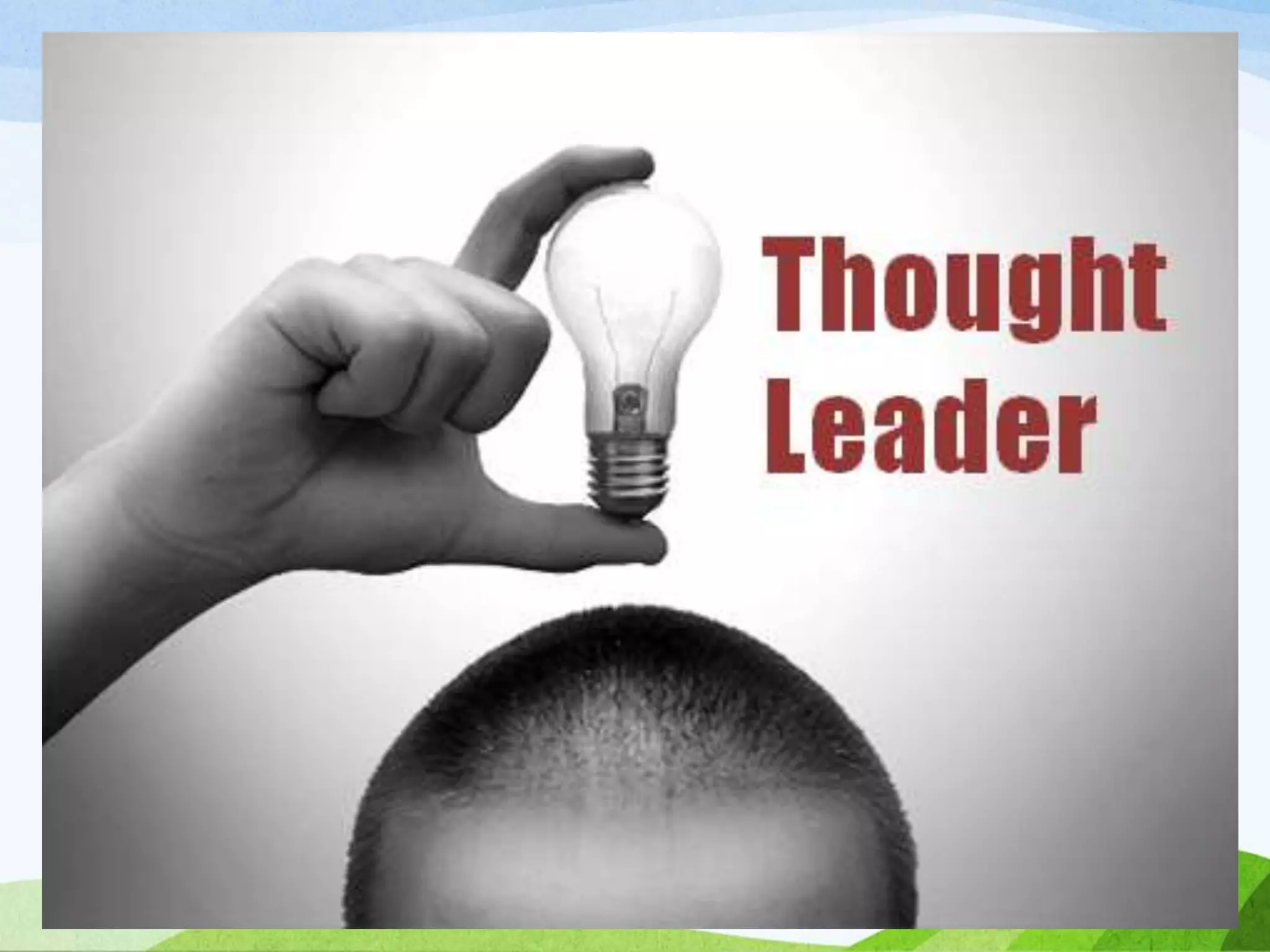
Thought leaders harness the
power of ideas to actualize change.
They stretch their followers by
helping them envision new
possibilities
“The human mind once stretched to a new
idea never goes back to its original dimension.”
THOUGHT LEADERS
“Remember, it is a marathon, not
a sprint.
Ten years. Fifteen years.
You’ve got to get up every day with
a new idea,
a new spin and you’ve got to bring
it in here
every day.”
JACK WELCH, CEO, GE
“Stay hungry.
Stay foolish.”
STEVE JOBS, Apple
“You must never be fearful about
what you are doing
when it is right.”
Rosa Park, African-
American Civil Rights Activist
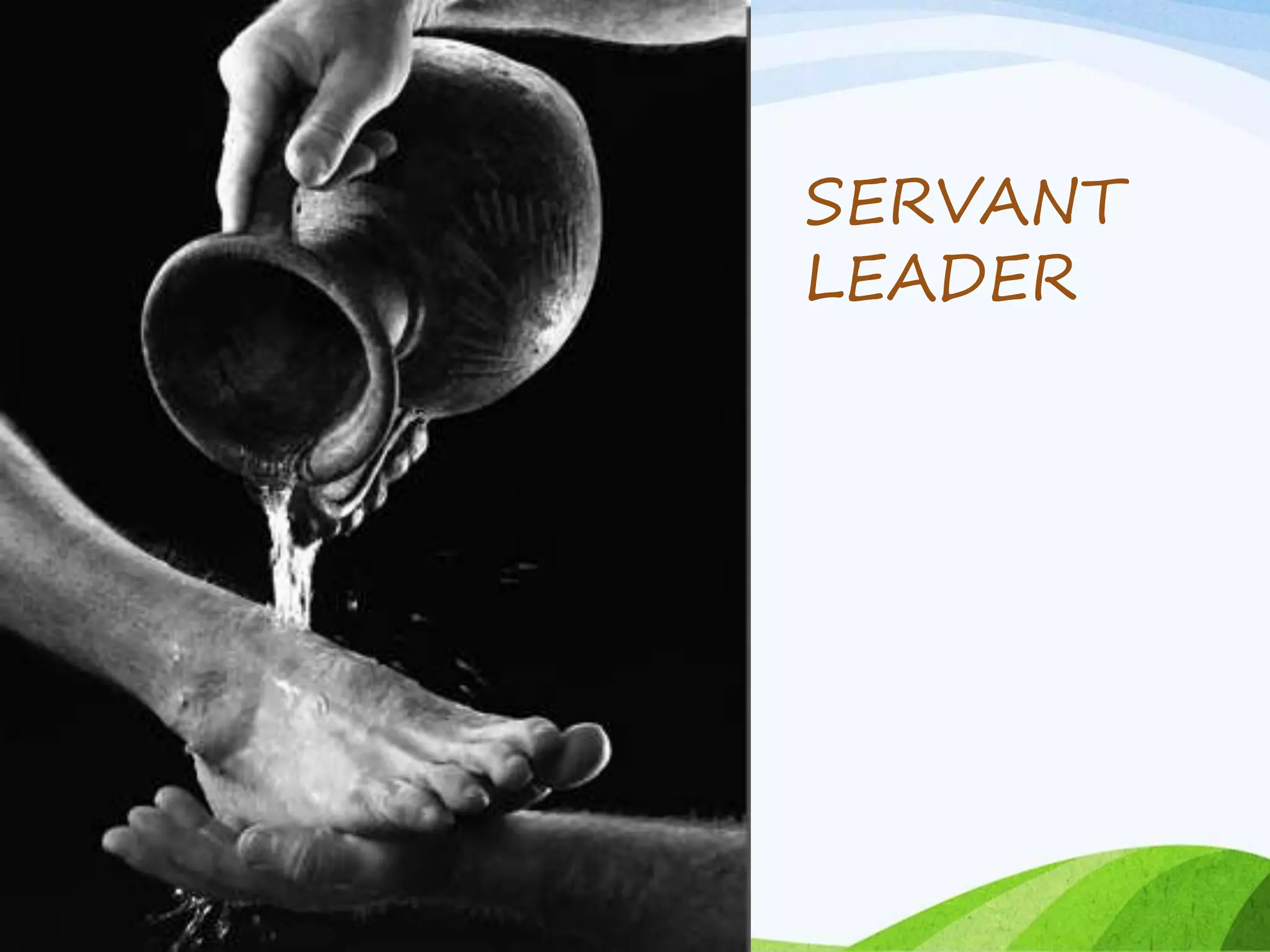
SERVANT
LEADER
“The most terrible
poverty is loneliness
and the
feeling of being
unloved.”
Mother Teresa
“What I know for sure
is that what you give,
comes back to you.”
Transformational Leader
A leadership style focused on
effecting revolutionary change in
organizations through a
commitment to the organization’s
vision.
(Sullivan & Decker, 2001)
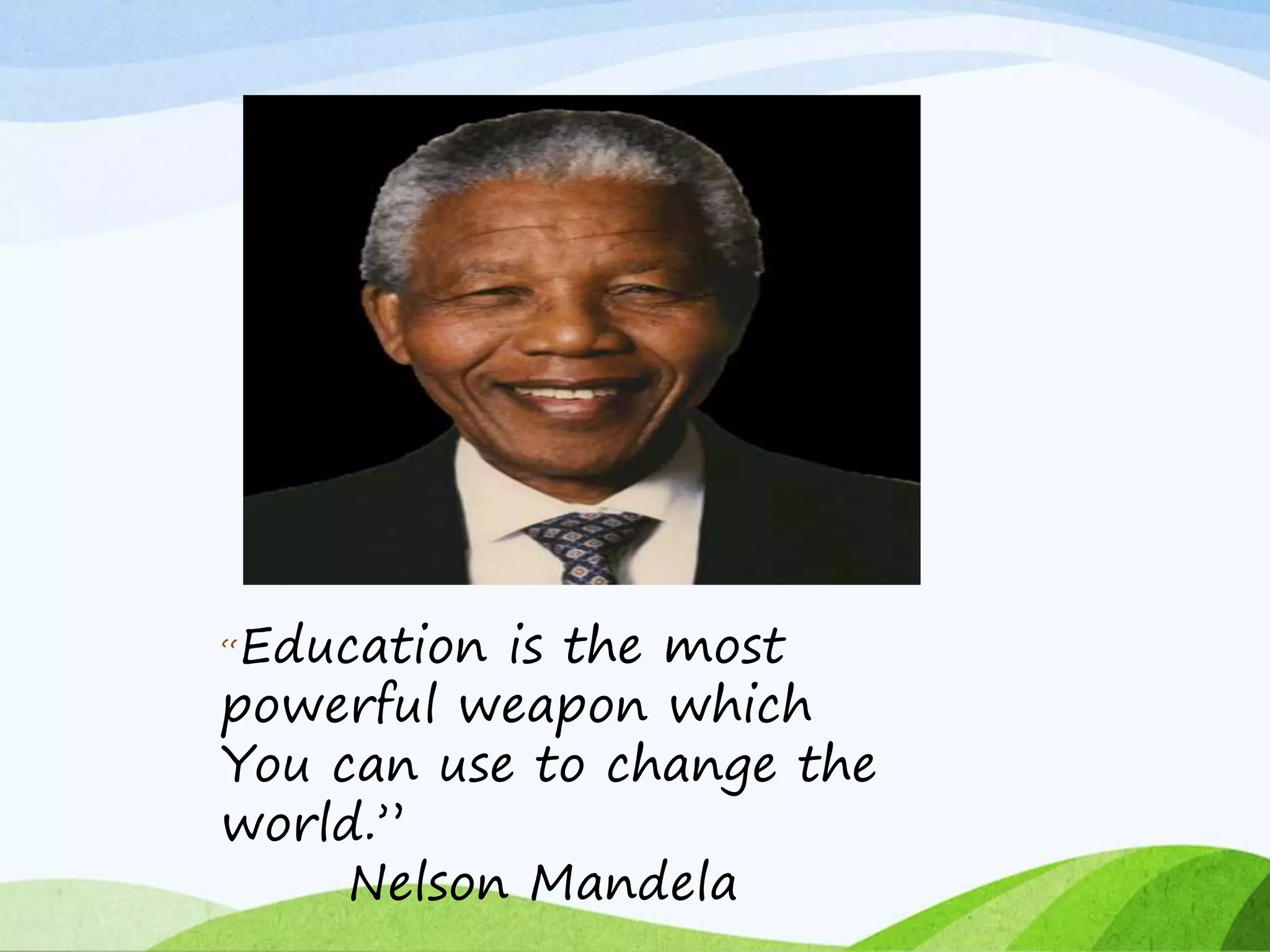
“Education is the most
powerful weapon which
You can use to change the
world.”
Nelson Mandela
“We must become
the change we
want to be.”
Mahatma
Gandhi
Values-based Leader
Values-based leadership is guided by
values and integrity. Values-based
leadership requires that leaders be
modeled by example.
Acts of leadership include:
• A sense of purpose and ethics
• Communication skills to frame
and deepen the conversation for
change
• Deep understanding of change
and transitions
“none of these problems are by nature
inevitable. Nor are they due to any lack of
knowledge. When we think carefully we see
they are all ethical problems. They each
reflect our understanding of what is right
and wrong, of what is positive and what is
negative, of what is appropriate and
inappropriate. But beyond this we can point
to something more fundamental: a neglect
of what I call our inner dimension.”
Dalai Lama
SHARED
LEADERSHIP
A dynamic, interactive influence process
among individuals in groups for which
the objective is to lead one another to
the achievement of group or
organizational goals or both (Conger
and Pearce, 2003)
“A team property whereby leadership
is distributed among team members
rather than focused on a single
designated leader” (p. 1217). Carson
et al. (2007
Task Delegation
• A person authorized to act as representative
for another; a deputy or an agent
• Delegation is a very helpful aid for succession
planning, personal development - and seeking
and encouraging promotion. It's how we grow
in the job - delegation enables us to gain
experience to take on higher responsibilities.
• Delegation is vital for effective leadership
How to Delegate Task
• Identify the task.
• Hunt for suitable person .
• Assign the task.
• Train the member.
• Let go.
• Track progress.
• Give credit.
Delegation and SMART, or SMARTER
A simple delegation rule is the SMART acronym, or
better still, SMARTER. It's a quick checklist for
proper delegation. Delegated tasks must be:
• Specific
• Measurable
• Agreed
• Realistic
• Time bound
• Ethical
• Recorded
• Continuous learning
• A compelling vision and inspiring others to follow
• Taking on risk
• Personal integrity
• Being an original
• Reinvention
• Taking time to think and reflect
• Passion
• Seeing small success
• Using the context of one’s life, rather than
surrendering to it
Becoming a Leader involves…
Activity Description:
Explain that it is important that leaders
clarify their own sense of leadership
values. Ask participants to reflect upon
the values that define their role as a
leader? Then ask each participant to
individually circle five values listed below
that best completes the following sentence
" _________________ is a ‘cornerstone’
in my approach to leadership."
ACHIEVEMENT
ADVENTURE
CHALLENGE
CONTROL
CREATIVITY
ECONOMIC BALANCE
FAIRNESS
FREEDOM
HAPPINESS
HARD WORK
HONESTY
HARMONY
INVOLVEMENT
ORDER
AFFECTION
COMFORT
CONFORMITY
COOPERATION
DIRECTNESS
EXPERTNESS
FLEXIBILITY
FRIENDSHIP
HELPFULNESS
INDEPENDENCE
INTEGRITY
LEADERSHIP
MORALITY/ETHICS
LOYALTY
PREDICTABILITY
RESPONSIBILITY
RESPONSIVENESS
PERSONAL
DEVELOPMENT
POWER
RECOGNITION
RISK
SELF-RESPECT
VARIETY
SECURITY
TRADITION
TRUST
WISDOM
OTHER VALUES:
Team as “a small number of people with
complementary
skills who are committed to a common
purpose,
performance goals, and approach for which
they hold
themselves mutually accountable.”
Katzenbach and Smith
Activity on Teamwork
Leadership_FEU NSTP.pptx

Leadership_FEU NSTP.pptx

  • 1.
    On Becoming a Leader anFEU LEADER! FEU - NSTP-1
  • 2.
    OBJECTIVES • Know themeaning of leadership • Identify the traits and skills of an effective leader • Examine the role, duties and responsibilities of a Team Leader in the workplace • Understand the limits of authority in a Team Leader role • Develop a plan to develop your own leadership potential
  • 3.
  • 4.
  • 5.
    “The process ofguiding followers in a certain direction in pursuit of a vision, mission or goals” - Gold and Evans, 1998
  • 6.
    The ability toprovide direction to a group of people and influence those people to follow the direction and act accordingly.
  • 7.
    The ability to bringout the best in everyone.
  • 8.
    The full, authenticexpression of an individual working towards a purposeful goal that affects positive transformation involving collaborative relationships with other resulting in collective action
  • 9.
    Are You aManager or a Leader? Direction: Answer T (true) or F (false) for each item T F 1. I would rather carry out a well defined plan than create one. T F 2. I am more a hands-on, get-it-done person than a visionary. T F 3. I like to create the big picture and help carry out the plan. T F 4. I prefer not to get involved in the implementation of a plan once I help create it.
  • 10.
    Are You aManager or a Leader? T F 5. I find it easier to delegate than to do tasks. T F 6. I like to plan, delegate, and carry out tasks. T F 7. I would rather be given structured directions for an assignment than design an assignment. T F 8. I like to set meeting agendas and then take charge of meetings. T F 9. I like to set the agenda, run the meeting, and proceed to implement some detail work. Source: Organizational Behavior and Change: Managing Diversity, Cross-Cultural Dynamics, and Ethics, 2d ed., ! Copyright 2000 by Joseph W. Weiss
  • 11.
    Scoring If you answeredtrue to questions 7, 2, 1: You prefer managerial roles If you answered true to questions 3, 4, 5, and 8: You prefer leadership roles If you answered true to questions 3, 6, 9: You prefer managerial and leadership role
  • 14.
    QUALITIES OF ALEADER Leadership Practices Inventory James Kouzes and Barry Posner developed a survey (The Leadership Practices Inventory) that asked people which, of a list of common characteristics of leaders, were, in their experiences of being led by others, the seven top things they look for, admire and would willingly follow.
  • 15.
    Kouzes/Posner's Leadership Inventory (Inorder of priority) • Honest Dependable • Forward-Looking Cooperative • Competent Determined • Inspiring Imaginative • Intelligent Ambitious • Fair-minded Courageous • Broad-minded Caring • Supportive Mature • Straight-forward Self-controlled
  • 16.
    Scenario: If you couldselect among these leadership attributes and only have one, which would you choose and why? Why are they important? Confidence and determination Vision: a goal for a better future Brains: intelligence developed into wisdom Heart: empathy and compassion Courage: commitment transferred to action
  • 17.
    Do you haveeverything you need? Among the listed leadership attributes below, what attributes, if any, are missing? Why are they important? Confidence and determination Vision: a goal for a better future Brains: intelligence developed into wisdom Heart: empathy and compassion Courage: commitment transferred to action
  • 18.
    What is aGOOD LEADER? Is a person with integrity who is committed to the organization and the people who work together To accomplish the organization’s mission; this person leads by example, communicates without ceasing, and shows care, concern, and consistency in all dealings.
  • 19.
  • 21.
    Thought leaders harnessthe power of ideas to actualize change. They stretch their followers by helping them envision new possibilities “The human mind once stretched to a new idea never goes back to its original dimension.”
  • 22.
    THOUGHT LEADERS “Remember, itis a marathon, not a sprint. Ten years. Fifteen years. You’ve got to get up every day with a new idea, a new spin and you’ve got to bring it in here every day.” JACK WELCH, CEO, GE “Stay hungry. Stay foolish.” STEVE JOBS, Apple
  • 24.
    “You must neverbe fearful about what you are doing when it is right.” Rosa Park, African- American Civil Rights Activist
  • 29.
  • 32.
    “The most terrible povertyis loneliness and the feeling of being unloved.” Mother Teresa
  • 33.
    “What I knowfor sure is that what you give, comes back to you.”
  • 34.
  • 35.
    A leadership stylefocused on effecting revolutionary change in organizations through a commitment to the organization’s vision. (Sullivan & Decker, 2001)
  • 36.
    “Education is themost powerful weapon which You can use to change the world.” Nelson Mandela
  • 37.
    “We must become thechange we want to be.” Mahatma Gandhi
  • 38.
  • 39.
    Values-based leadership isguided by values and integrity. Values-based leadership requires that leaders be modeled by example. Acts of leadership include: • A sense of purpose and ethics • Communication skills to frame and deepen the conversation for change • Deep understanding of change and transitions
  • 40.
    “none of theseproblems are by nature inevitable. Nor are they due to any lack of knowledge. When we think carefully we see they are all ethical problems. They each reflect our understanding of what is right and wrong, of what is positive and what is negative, of what is appropriate and inappropriate. But beyond this we can point to something more fundamental: a neglect of what I call our inner dimension.” Dalai Lama
  • 41.
  • 42.
    A dynamic, interactiveinfluence process among individuals in groups for which the objective is to lead one another to the achievement of group or organizational goals or both (Conger and Pearce, 2003) “A team property whereby leadership is distributed among team members rather than focused on a single designated leader” (p. 1217). Carson et al. (2007
  • 43.
    Task Delegation • Aperson authorized to act as representative for another; a deputy or an agent • Delegation is a very helpful aid for succession planning, personal development - and seeking and encouraging promotion. It's how we grow in the job - delegation enables us to gain experience to take on higher responsibilities. • Delegation is vital for effective leadership
  • 44.
    How to DelegateTask • Identify the task. • Hunt for suitable person . • Assign the task. • Train the member. • Let go. • Track progress. • Give credit.
  • 45.
    Delegation and SMART,or SMARTER A simple delegation rule is the SMART acronym, or better still, SMARTER. It's a quick checklist for proper delegation. Delegated tasks must be: • Specific • Measurable • Agreed • Realistic • Time bound • Ethical • Recorded
  • 46.
    • Continuous learning •A compelling vision and inspiring others to follow • Taking on risk • Personal integrity • Being an original • Reinvention • Taking time to think and reflect • Passion • Seeing small success • Using the context of one’s life, rather than surrendering to it Becoming a Leader involves…
  • 47.
    Activity Description: Explain thatit is important that leaders clarify their own sense of leadership values. Ask participants to reflect upon the values that define their role as a leader? Then ask each participant to individually circle five values listed below that best completes the following sentence
  • 48.
    " _________________ isa ‘cornerstone’ in my approach to leadership." ACHIEVEMENT ADVENTURE CHALLENGE CONTROL CREATIVITY ECONOMIC BALANCE FAIRNESS FREEDOM HAPPINESS HARD WORK HONESTY HARMONY INVOLVEMENT ORDER AFFECTION COMFORT CONFORMITY COOPERATION DIRECTNESS EXPERTNESS FLEXIBILITY FRIENDSHIP HELPFULNESS INDEPENDENCE INTEGRITY LEADERSHIP MORALITY/ETHICS LOYALTY PREDICTABILITY RESPONSIBILITY RESPONSIVENESS PERSONAL DEVELOPMENT POWER RECOGNITION RISK SELF-RESPECT VARIETY SECURITY TRADITION TRUST WISDOM OTHER VALUES:
  • 51.
    Team as “asmall number of people with complementary skills who are committed to a common purpose, performance goals, and approach for which they hold themselves mutually accountable.” Katzenbach and Smith
  • 52.

Editor's Notes

  • #49 Share with groups and look for their commonalities.