




Leaders as Career Agents
A STORY ABOUT A GUY
NAMED “MIKE”
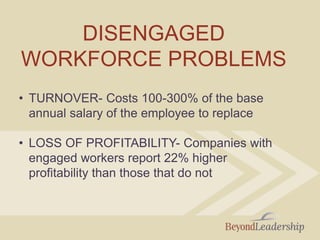
DISENGAGED
WORKFORCE PROBLEMS
• TURNOVER- Costs 100-300% of the base
annual salary of the employee to replace
• LOSS OF PROFITABILITY- Companies with
engaged workers report 22% higher
profitability than those that do not
BACK TO“MIKE”
CREATE WIN-WIN
SITUATIONS
WITH LEADERS
AS CAREER
AGENTS
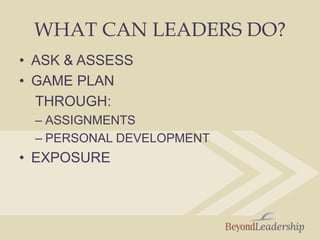
WHAT CAN LEADERS DO?
• ASK & ASSESS
• GAME PLAN
THROUGH:
– ASSIGNMENTS
– PERSONAL DEVELOPMENT
• EXPOSURE
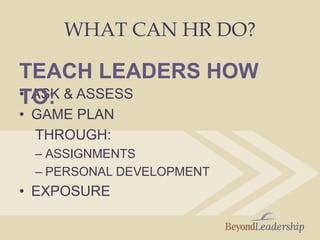
WHAT CAN HR DO?
• ASK & ASSESS
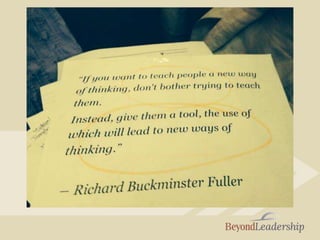
• GAME PLAN
THROUGH:
– ASSIGNMENTS
– PERSONAL DEVELOPMENT
• EXPOSURE
TEACH LEADERS HOW
TO:
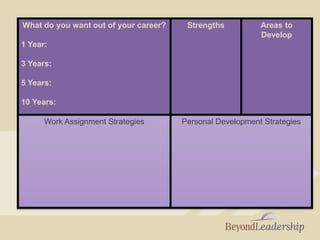
What do you want out of your career?
1 Year:
3 Years:
5 Years:
10 Years:
Strengths Areas to
Develop
Work Assignment Strategies Personal Development Strategies
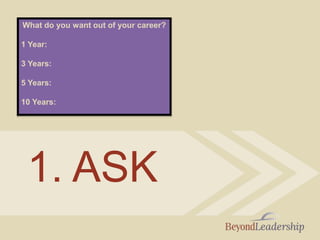
What do you want out of your career?
1 Year:
3 Years:
5 Years:
10 Years:
1. ASK
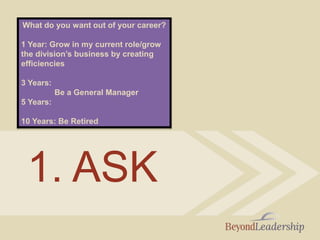
What do you want out of your career?
1 Year: Grow in my current role/grow
the division’s business by creating
efficiencies
3 Years:
Be a General Manager
5 Years:
10 Years: Be Retired
1. ASK
Strengths Areas to
Develop
2.
ASSESS
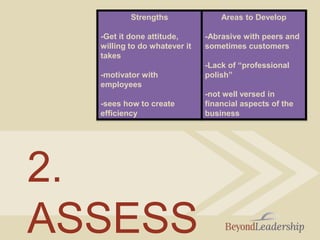
Strengths
-Get it done attitude,
willing to do whatever it
takes
-motivator with
employees
-sees how to create
efficiency
Areas to Develop
-Abrasive with peers and
sometimes customers
-Lack of “professional
polish”
-not well versed in
financial aspects of the
business
2.
ASSESS
Work Assignment Strategies Personal Development Strategies
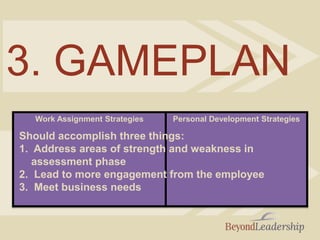
3. GAMEPLAN
Should accomplish three things:
1. Address areas of strength and weakness in
assessment phase
2. Lead to more engagement from the employee
3. Meet business needs
Work Assignment Strategies
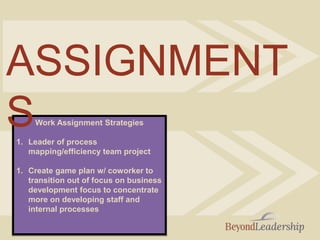
ASSIGNMENT
S
Work Assignment Strategies
1. Leader of process
mapping/efficiency team project
1. Create game plan w/ coworker to
transition out of focus on business
development focus to concentrate
more on developing staff and
internal processes
ASSIGNMENT
S
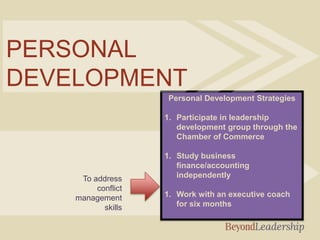
Personal Development Strategies
1. Participate in leadership
development group through the
Chamber of Commerce
1. Study business
finance/accounting
independently
1. Work with an executive coach
for six months
PERSONAL
DEVELOPMENT
To address
conflict
management
skills
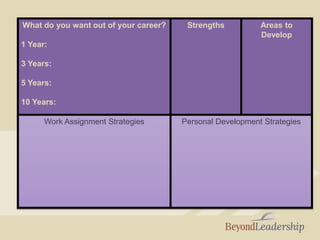
What do you want out of your career?
1 Year:
3 Years:
5 Years:
10 Years:
Strengths Areas to
Develop
Work Assignment Strategies Personal Development Strategies
4.
EXPOSURE
BACK TO OUR
FRIEND “MIKE”
BUT….
AGAPE
256.227.9075
P.O. Box 1014 Decatur, AL 35602
Mary Ila Ward,
SPHR/ SHRM-SCP, GCDF, CDF
Instructor
miw@horizonpointconsulting.com
Find today’s handout on your conference app or visit
www.horizonpointconsulting.com/cdf-training/tools

Leaders as Career Agents

  • 1.
  • 2.
    A STORY ABOUTA GUY NAMED “MIKE”
  • 5.
    DISENGAGED WORKFORCE PROBLEMS • TURNOVER-Costs 100-300% of the base annual salary of the employee to replace • LOSS OF PROFITABILITY- Companies with engaged workers report 22% higher profitability than those that do not
  • 6.
  • 7.
  • 8.
    WHAT CAN LEADERSDO? • ASK & ASSESS • GAME PLAN THROUGH: – ASSIGNMENTS – PERSONAL DEVELOPMENT • EXPOSURE
  • 9.
    WHAT CAN HRDO? • ASK & ASSESS • GAME PLAN THROUGH: – ASSIGNMENTS – PERSONAL DEVELOPMENT • EXPOSURE TEACH LEADERS HOW TO:
  • 11.
    What do youwant out of your career? 1 Year: 3 Years: 5 Years: 10 Years: Strengths Areas to Develop Work Assignment Strategies Personal Development Strategies
  • 12.
    What do youwant out of your career? 1 Year: 3 Years: 5 Years: 10 Years: 1. ASK
  • 13.
    What do youwant out of your career? 1 Year: Grow in my current role/grow the division’s business by creating efficiencies 3 Years: Be a General Manager 5 Years: 10 Years: Be Retired 1. ASK
  • 14.
  • 15.
    Strengths -Get it doneattitude, willing to do whatever it takes -motivator with employees -sees how to create efficiency Areas to Develop -Abrasive with peers and sometimes customers -Lack of “professional polish” -not well versed in financial aspects of the business 2. ASSESS
  • 16.
    Work Assignment StrategiesPersonal Development Strategies 3. GAMEPLAN Should accomplish three things: 1. Address areas of strength and weakness in assessment phase 2. Lead to more engagement from the employee 3. Meet business needs
  • 17.
  • 18.
    Work Assignment Strategies 1.Leader of process mapping/efficiency team project 1. Create game plan w/ coworker to transition out of focus on business development focus to concentrate more on developing staff and internal processes ASSIGNMENT S
  • 19.
    Personal Development Strategies 1.Participate in leadership development group through the Chamber of Commerce 1. Study business finance/accounting independently 1. Work with an executive coach for six months PERSONAL DEVELOPMENT To address conflict management skills
  • 20.
    What do youwant out of your career? 1 Year: 3 Years: 5 Years: 10 Years: Strengths Areas to Develop Work Assignment Strategies Personal Development Strategies
  • 21.
  • 22.
  • 23.
  • 25.
  • 26.
    256.227.9075 P.O. Box 1014Decatur, AL 35602 Mary Ila Ward, SPHR/ SHRM-SCP, GCDF, CDF Instructor miw@horizonpointconsulting.com Find today’s handout on your conference app or visit www.horizonpointconsulting.com/cdf-training/tools

Editor's Notes

  • #3 Tell story found in the article- start first with focus on burnout and disengagement -felt like he was in a rat race where he would never get off the wheel -worked hard, but didn’t see the reward in it, no one noticed -was having trouble sleeping at night because he had so many things on his mind regarding work -said he was thinking about changing jobs -so burnout
  • #4 Why you hate work article- apparently Mike is not alone Gallup poll in 2013- 70% of the American workforce feels disengaged Many report signs of burnout http://www.nytimes.com/2014/06/01/opinion/sunday/why-you-hate-work.html?_r=1
  • #5 And on the flip side of that employers are either loosing employees b/c they are burned out and looking for another job, ppl don’t see the value on them and it is costing a ton of money It’s an employee and employer problem- but is a problem of choice
  • #6 WHY Cost‐per‐hire for replacement* Turnover costs are often estimated to be 100% ‐ 300% of the base salary of replaced employee (150% commonly cited).* Use the Cost‐per‐Hire ANSI/SHRM Standard ** Transition time from exit decision to replacement reaching minimal performance standards*** Source of most variance and potentially largest impact on cost – it’s important to differentiate talent when calculating Taken from: Measuring and Mitigating the Cost of Employee Turnover, Kim E. Ruyle, President Inventive Talent Consulting, LLC, SHRM Webcast July 17, 2012
  • #7  Describe him calling back with his first encounter with his new boss A friend called me the other day to tell me about the first one-on-one encounter he had with his new boss. Prior to this conversation, my friend was nervous about the transition in leadership and what it would mean for his role with the organization as a mid-level manager of a growing healthcare organization.   “He asked me what I wanted my career to look like,” he said. “Although I know what I want for myself in my career, no boss has ever asked me this before especially not the first time I’ve met him. I’d expect our first conversation to be him telling me what he wants, not to ask me what I want.”   My friend ultimately wants to be sitting where his new boss is, in the CEO chair, and once his boss saw his educational background and his work accomplishments thus far, he actually already assumed that was his goal. But he asked the question nevertheless, and then proceeded to discuss with my friend how he, as his boss, could help get him to the CEO seat one day, whether it was with his organization or through other opportunities outside the organization.   The CEO was acting as a leader by being a career agent.   Why do leaders need to be career agents?   With employee engagement statistics showing us that upwards of 70% of the workforce these days is checked out, it is imperative for leaders and organizations to think about how to maximize talent in a way that leads to mutual gains.   My friend, whose boss initiated their first conversation playing the role of career agent, is now more engaged than ever in his work. He wants to work hard for this leader because he knows his work will be noticed and will pay off now that his boss has told him he wants to help him get to where he wants to be. My friend wins by knowing he has an advocate to help him on this career path and the CEO wins by having an engaged employee that is productive, thus helping the organization reach it’s goals.   If all leaders were in the business of making more leaders by acting as career agents, we may be able to flip employee engagement statistics in a positive direction.
  • #8 HOW- Create Win- Win Situations through a Career Agent Model As article in NY Times said about why you hate work, employees are vastly more satisfied and productive when four needs are meet: Physical- opportunities to recharge and renew Emotional- feeling valued and appreciated Mental- focus on the most important things and define when and where they get their work done Spiritual- doing more of what they do best and enjoy most to feel connected to a higher purpose Acting as a career agent helps employees do all these things “Employees who say they have supportive supervisors are 1.3 times as likely to stay with the organization and are 67% more engaged”
  • #10 You can also teach your clients to use this tool for themselves as an initiator to talk with their boss to lead to more fufilling work
  • #12 Here is your simple tool
  • #14 Walk through example, then get them to do it for themselves at each phase and discuss with a partner
  • #15 Variety of ways to do this, through just personal self reflection and reflection with manager- creating self-awareness is critical Could also use a 360 tool -utilize the gaps grid
  • #17 Should accomplish three things: Address areas of strength and weakness in assessment phase- balance of these two, we need to maximize our strengths b/c it leads to increased energy and engagement- it leads to number 2, but also need to minimize weaknesses or road blocks to help person meet their career goals and also help with number 3, meet business needs Lead to more engagement from the employee Meet business needs Addressing these 3 things creates win-win
  • #19 Ask, how are these aligned with the previous step of ask and assess? Transition out of focus on business development role to focus more on developing staff and internal processes- note that if you are doing this with all your people, organization wide, you can cater to people’s strength, his tranistion out of business development role coincided with someone who was doing more operations type stuff transitioning into more business development where he can enjoy it more and better serve the company through his strengths
  • #20 Ask, how are these aligned with the previous step of ask and assess? - click to animate the last one coming in about why with an executive coach
  • #22 Make people aware of opportunities that arise, even if they are outside your organization. This may mean letting them go to another organization. If you’re having career agent conversations with people, they are going to be more productive and you probably don’t want to loose this type of employee. This may seem counter intuitive to an employee retention strategy, however, making employees aware of outside opportunities that are a fit for their career plans, and helping facilitate those opportunities even if they are outside your organization, is a good move in the long run. They become walking and talking recruitment ads for you and your organization, which is hard to come by for free. It leads to a bigger picture recruitment and retention strategy. And who knows, their career path may lead them back to your organization more valuable than when they left. My friend called me back a few months later.   “My boss just let me know about a CEO role that is available at a small organization. He said he had already recommended me for the role to the board chairman who was in charge of the hiring process and gave me information on what to do and who to contact if I was interested in the opportunity.”   “That’s great!” I said. “How did you respond?” I asked.   “I think he thought I was surprised,” he said. “Although we’ve had the conversation about where I want my career to go and ways for me to get there, I never thought he would be the one directly pointing me to advancement opportunities outside the organization. He smiled and told me that he would not be sitting where he is today if his former boss hadn’t pointed him to opportunities.”  
  • #23 Tell story found in the articleMake people aware of opportunities that arise, even if they are outside your organization. This may mean letting them go to another organization. If you’re having career agent conversations with people, they are going to be more productive and you probably don’t want to loose this type of employee. This may seem counter intuitive to an employee retention strategy, however, making employees aware of outside opportunities that are a fit for their career plans, and helping facilitate those opportunities even if they are outside your organization, is a good move in the long run. They become walking and talking recruitment ads for you and your organization, which is hard to come by for free. It leads to a bigger picture recruitment and retention strategy. And who knows, their career path may lead them back to your organization more valuable than when they left. My friend called me back a few months later.   “My boss just let me know about a CEO role that is available at a small organization. He said he had already recommended me for the role to the board chairman who was in charge of the hiring process and gave me information on what to do and who to contact if I was interested in the opportunity.”   “That’s great!” I said. “How did you respond?” I asked.   “I think he thought I was surprised,” he said. “Although we’ve had the conversation about where I want my career to go and ways for me to get there, I never thought he would be the one directly pointing me to advancement opportunities outside the organization. He smiled and told me that he would not be sitting where he is today if his former boss hadn’t pointed him to opportunities.”
  • #24 You just told me the cost of turnover is Cost of Turnover? -100-300% of the base annual salary of the employee Why would anyone try to help someone promote themselves outside the organization Two reasons: They become walking talking recruitment ads for you and your organization They may come back to you better equipped to do an even better job for you and be even more valuable (example from Kris Dunn) This may mean letting them go to another organization. If you’re having career agent conversations with people, they are going to be more productive and you probably don’t want to loose this type of employee. This may seem counter intuitive to an employee retention strategy, however, making employees aware of outside opportunities that are a fit for their career plans, and helping facilitate those opportunities even if they are outside your organization, is a good move in the long run. They become walking and talking recruitment ads for you and your organization, which is hard to come by for free. It leads to a bigger picture recruitment and retention strategy. And who knows, their career path may lead them back to your organization more valuable than when they left. But most importantly, it is the right thing to do
  • #25 Give them the tool AGAPE and see how it changes the workplace
  • #26 Ask/Assess GamePlan through Assignments ad work and Personal Development Plans Then create Exposure Words for love in the greek language: https://www.google.com/webhp?sourceid=chrome-instant&rlz=1C5CHFA_enUS528US528&ion=1&espv=2&ie=UTF-8#q=greek%20words%20for%20love Agape is the highest form of love- it is a servant leadership model “selfless, sacrificial and unconditional”. It is the true model of leadership- leaders making more leaders