GOVERNMENT COLLEGE OF ENGINEERING,
TIRUNELVELI
Course Name : Municipal solid Waste Management
Course Code : EN8591
Module : Leachate Collection system Course Instructor
Dr.S.Pauline,
Asso.professor,
Department of Civil Engineering
GCE-Tirunelveli-07.
Mail-id : pauline@gcetly.ac.in
COURSE CONTENT
UNIT 5: WASTE DISPOSAL 8 hrs
Land disposal of solid waste- Sanitary landfills – site
selection, design and operation of sanitary landfills –
Landfill liners – Management of leachate and landfill
gas- Landfill bioreactor – Dumpsite Rehabilitation.
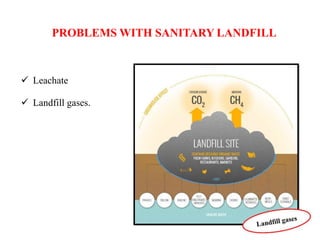
PROBLEMS WITH SANITARY LANDFILL
 Leachate
 Landfill gases.
PROBLEMS WITH SANITARY LANDFILL
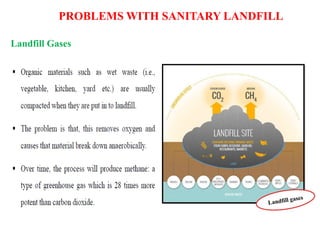
Landfill Gases
PROBLEMS WITH SANITARY LANDFILL
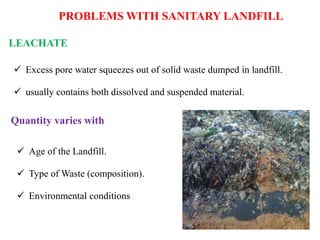
LEACHATE
 Excess pore water squeezes out of solid waste dumped in landfill.
 usually contains both dissolved and suspended material.
Quantity varies with
 Age of the Landfill.
 Type of Waste (composition).
 Environmental conditions
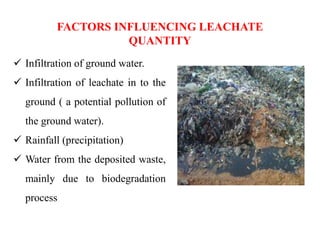
FACTORS INFLUENCING LEACHATE
QUANTITY
 Infiltration of ground water.
 Infiltration of leachate in to the
ground ( a potential pollution of
the ground water).
 Rainfall (precipitation)
 Water from the deposited waste,
mainly due to biodegradation
process
FACTORS INFLUENCING LEACHATE
QUALITY
Refuse composition
Quality variation is higher for putrescible waste than for non- putrescible
waste.
Elapsed time
Leachate quality varies with time. In general overall quality of leachate
generated in 1 year will be less strong than subsequent years.
Ambient temperature
The ambient temperature affects both bacterial growth and chemical
reactions.
Available moisture
water plays a significant role in biodegradation and subsequent leaching of
chemicals out of a waste.
Precipitation
The amount of rain falling on landfill influences the leachate quantity
significantly.
Ground water intrusion
Sometimes landfill base construction below the ground water table, may
increase quantity.
Moisture content of waste
Leachate quantity will increase because of own self weight, the waste
releases pore water when squeezed
FACTORS INFLUENCING LEACHATE
QUALITY
 Computed during the pre-closure and post-closure period
 leachate generation rates in a landfill vary significantly and methods to
calculate are also different.
ESTIMATION OF LEACHATE QUANTITY
i. determine the Spacing of the leachate collection pipe.
ii. determine the Size of the leachate collection tank.
iii. design on site/off site plant for treating the leachate.
Estimation of pre-closure leachate is required to
Estimation of post-closure is required
to determine to long term care cost.
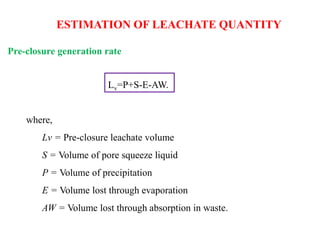
Pre-closure generation rate
ESTIMATION OF LEACHATE QUANTITY
Lv=P+S-E-AW.
where,
Lv = Pre-closure leachate volume
S = Volume of pore squeeze liquid
P = Volume of precipitation
E = Volume lost through evaporation
AW = Volume lost through absorption in waste.
ESTIMATION OF LEACHATE QUANTITY
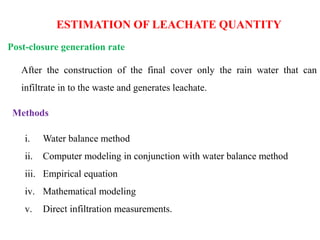
After the construction of the final cover only the rain water that can
infiltrate in to the waste and generates leachate.
Methods
Post-closure generation rate
i. Water balance method
ii. Computer modeling in conjunction with water balance method
iii. Empirical equation
iv. Mathematical modeling
v. Direct infiltration measurements.
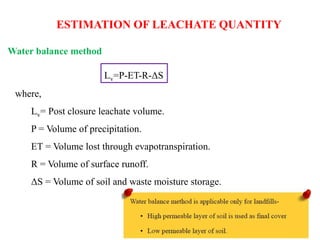
Water balance method
ESTIMATION OF LEACHATE QUANTITY
Lv=P-ET-R-ΔS
where,
Lv= Post closure leachate volume.
P = Volume of precipitation.
ET = Volume lost through evapotranspiration.
R = Volume of surface runoff.
ΔS = Volume of soil and waste moisture storage.
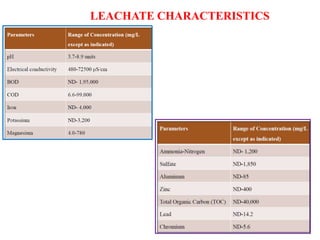
LEACHATE CHARACTERISTICS
PROBLEMS OF LEACHATE
 Clog up with silt or mud and growth of microorganisms in the pipes
 Chemical reaction leading to precipitation of minerals in the pipes
 The pipes become weakened by chemical attack (acids, solvents and
oxidizing agents.
LEACHATE COLLECTION SYSTEM
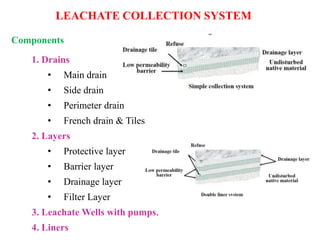
1. Drains
• Main drain
• Side drain
• Perimeter drain
• French drain & Tiles
2. Layers
• Protective layer
• Barrier layer
• Drainage layer
• Filter Layer
3. Leachate Wells with pumps.
4. Liners
Components
LEACHATE COLLECTION SYSTEM
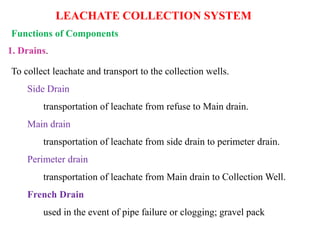
1. Drains.
Functions of Components
To collect leachate and transport to the collection wells.
Side Drain
transportation of leachate from refuse to Main drain.
Main drain
transportation of leachate from side drain to perimeter drain.
Perimeter drain
transportation of leachate from Main drain to Collection Well.
French Drain
used in the event of pipe failure or clogging; gravel pack
LEACHATE COLLECTION SYSTEM
2. Layers.
Functions of Components
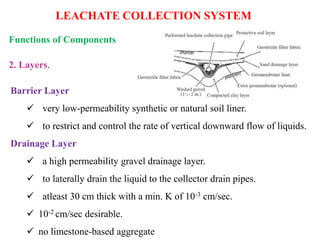
Barrier Layer
 very low-permeability synthetic or natural soil liner.
 to restrict and control the rate of vertical downward flow of liquids.
Drainage Layer
 a high permeability gravel drainage layer.
 to laterally drain the liquid to the collector drain pipes.
 atleast 30 cm thick with a min. K of 10-3 cm/sec.
 10-2 cm/sec desirable.
 no limestone-based aggregate
LEACHATE COLLECTION SYSTEM
2. Layers.
Functions of Components
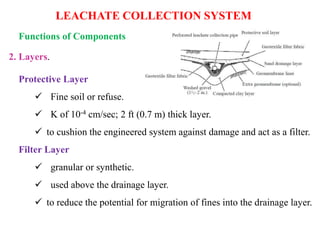
Protective Layer
 Fine soil or refuse.
 K of 10-4 cm/sec; 2 ft (0.7 m) thick layer.
 to cushion the engineered system against damage and act as a filter.
Filter Layer
 granular or synthetic.
 used above the drainage layer.
 to reduce the potential for migration of fines into the drainage layer.
LEACHATE COLLECTION SYSTEM
3. Leachate Collection Wells
Functions of Components
 Leachate Ponds or Lagoons
 Leachate Storage tanks
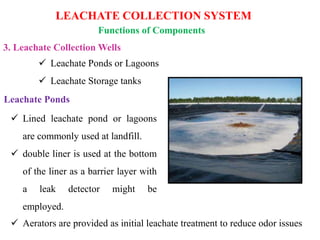
Leachate Ponds
 Lined leachate pond or lagoons
are commonly used at landfill.
 double liner is used at the bottom
of the liner as a barrier layer with
a leak detector might be
employed.
 Aerators are provided as initial leachate treatment to reduce odor issues
LEACHATE COLLECTION SYSTEM
Functions of Components
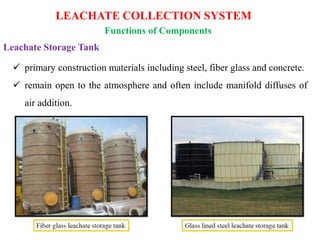
Leachate Storage Tank
 primary construction materials including steel, fiber glass and concrete.
 remain open to the atmosphere and often include manifold diffuses of
air addition.
LEACHATE COLLECTION SYSTEM
Functions of Components
4. Liners
 used as a control for leachate.
Materials
Geotextile:
 Thin synthetic material
 to minimize the intermixing of the soil and sand or gravel
layers.
Geonet:
 Together with geotextile the drainage layer
 To convey leachate to the leachate collection system.
LEACHATE COLLECTION SYSTEM
Functions of Components
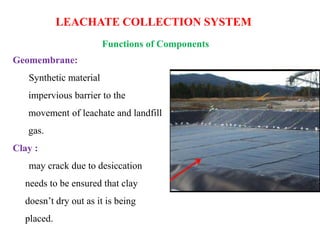
Geomembrane:
Synthetic material
impervious barrier to the
movement of leachate and landfill
gas.
Clay :
may crack due to desiccation
needs to be ensured that clay
doesn’t dry out as it is being
placed.
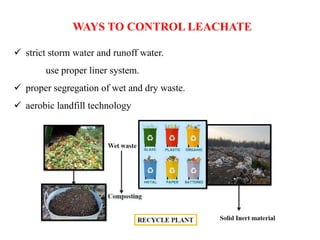
WAYS TO CONTROL LEACHATE
 strict storm water and runoff water.
use proper liner system.
 proper segregation of wet and dry waste.
 aerobic landfill technology
LEACHATE TREATMENT
 Physico-Chemical treatment.
• Reverse Osmosis.
• Flocculation/Precipitation.
• Evaporation and Drying
 Biological Treatment
• Aerobic Process
o Aerated Lagoons
o Rotating Biological Contactors
o Activated Sludge Process/Trickling Filter
• Anaerobic Process
 Advanced Treatment Technology
• Membrane Bioreactor
• Moving Bed Bio Reactor
• Bioreactor Landfill
Leachate collection system in municipal solid waste.pptx

Leachate collection system in municipal solid waste.pptx

  • 1.
    GOVERNMENT COLLEGE OFENGINEERING, TIRUNELVELI Course Name : Municipal solid Waste Management Course Code : EN8591 Module : Leachate Collection system Course Instructor Dr.S.Pauline, Asso.professor, Department of Civil Engineering GCE-Tirunelveli-07. Mail-id : pauline@gcetly.ac.in
  • 2.
    COURSE CONTENT UNIT 5:WASTE DISPOSAL 8 hrs Land disposal of solid waste- Sanitary landfills – site selection, design and operation of sanitary landfills – Landfill liners – Management of leachate and landfill gas- Landfill bioreactor – Dumpsite Rehabilitation.
  • 3.
    PROBLEMS WITH SANITARYLANDFILL  Leachate  Landfill gases.
  • 4.
    PROBLEMS WITH SANITARYLANDFILL Landfill Gases
  • 5.
    PROBLEMS WITH SANITARYLANDFILL LEACHATE  Excess pore water squeezes out of solid waste dumped in landfill.  usually contains both dissolved and suspended material. Quantity varies with  Age of the Landfill.  Type of Waste (composition).  Environmental conditions
  • 6.
    FACTORS INFLUENCING LEACHATE QUANTITY Infiltration of ground water.  Infiltration of leachate in to the ground ( a potential pollution of the ground water).  Rainfall (precipitation)  Water from the deposited waste, mainly due to biodegradation process
  • 7.
    FACTORS INFLUENCING LEACHATE QUALITY Refusecomposition Quality variation is higher for putrescible waste than for non- putrescible waste. Elapsed time Leachate quality varies with time. In general overall quality of leachate generated in 1 year will be less strong than subsequent years. Ambient temperature The ambient temperature affects both bacterial growth and chemical reactions. Available moisture water plays a significant role in biodegradation and subsequent leaching of chemicals out of a waste.
  • 8.
    Precipitation The amount ofrain falling on landfill influences the leachate quantity significantly. Ground water intrusion Sometimes landfill base construction below the ground water table, may increase quantity. Moisture content of waste Leachate quantity will increase because of own self weight, the waste releases pore water when squeezed FACTORS INFLUENCING LEACHATE QUALITY
  • 9.
     Computed duringthe pre-closure and post-closure period  leachate generation rates in a landfill vary significantly and methods to calculate are also different. ESTIMATION OF LEACHATE QUANTITY i. determine the Spacing of the leachate collection pipe. ii. determine the Size of the leachate collection tank. iii. design on site/off site plant for treating the leachate. Estimation of pre-closure leachate is required to Estimation of post-closure is required to determine to long term care cost.
  • 10.
    Pre-closure generation rate ESTIMATIONOF LEACHATE QUANTITY Lv=P+S-E-AW. where, Lv = Pre-closure leachate volume S = Volume of pore squeeze liquid P = Volume of precipitation E = Volume lost through evaporation AW = Volume lost through absorption in waste.
  • 11.
    ESTIMATION OF LEACHATEQUANTITY After the construction of the final cover only the rain water that can infiltrate in to the waste and generates leachate. Methods Post-closure generation rate i. Water balance method ii. Computer modeling in conjunction with water balance method iii. Empirical equation iv. Mathematical modeling v. Direct infiltration measurements.
  • 12.
    Water balance method ESTIMATIONOF LEACHATE QUANTITY Lv=P-ET-R-ΔS where, Lv= Post closure leachate volume. P = Volume of precipitation. ET = Volume lost through evapotranspiration. R = Volume of surface runoff. ΔS = Volume of soil and waste moisture storage.
  • 13.
  • 14.
    PROBLEMS OF LEACHATE Clog up with silt or mud and growth of microorganisms in the pipes  Chemical reaction leading to precipitation of minerals in the pipes  The pipes become weakened by chemical attack (acids, solvents and oxidizing agents.
  • 15.
    LEACHATE COLLECTION SYSTEM 1.Drains • Main drain • Side drain • Perimeter drain • French drain & Tiles 2. Layers • Protective layer • Barrier layer • Drainage layer • Filter Layer 3. Leachate Wells with pumps. 4. Liners Components
  • 16.
    LEACHATE COLLECTION SYSTEM 1.Drains. Functions of Components To collect leachate and transport to the collection wells. Side Drain transportation of leachate from refuse to Main drain. Main drain transportation of leachate from side drain to perimeter drain. Perimeter drain transportation of leachate from Main drain to Collection Well. French Drain used in the event of pipe failure or clogging; gravel pack
  • 17.
    LEACHATE COLLECTION SYSTEM 2.Layers. Functions of Components Barrier Layer  very low-permeability synthetic or natural soil liner.  to restrict and control the rate of vertical downward flow of liquids. Drainage Layer  a high permeability gravel drainage layer.  to laterally drain the liquid to the collector drain pipes.  atleast 30 cm thick with a min. K of 10-3 cm/sec.  10-2 cm/sec desirable.  no limestone-based aggregate
  • 18.
    LEACHATE COLLECTION SYSTEM 2.Layers. Functions of Components Protective Layer  Fine soil or refuse.  K of 10-4 cm/sec; 2 ft (0.7 m) thick layer.  to cushion the engineered system against damage and act as a filter. Filter Layer  granular or synthetic.  used above the drainage layer.  to reduce the potential for migration of fines into the drainage layer.
  • 19.
    LEACHATE COLLECTION SYSTEM 3.Leachate Collection Wells Functions of Components  Leachate Ponds or Lagoons  Leachate Storage tanks Leachate Ponds  Lined leachate pond or lagoons are commonly used at landfill.  double liner is used at the bottom of the liner as a barrier layer with a leak detector might be employed.  Aerators are provided as initial leachate treatment to reduce odor issues
  • 20.
    LEACHATE COLLECTION SYSTEM Functionsof Components Leachate Storage Tank  primary construction materials including steel, fiber glass and concrete.  remain open to the atmosphere and often include manifold diffuses of air addition.
  • 21.
    LEACHATE COLLECTION SYSTEM Functionsof Components 4. Liners  used as a control for leachate. Materials Geotextile:  Thin synthetic material  to minimize the intermixing of the soil and sand or gravel layers. Geonet:  Together with geotextile the drainage layer  To convey leachate to the leachate collection system.
  • 22.
    LEACHATE COLLECTION SYSTEM Functionsof Components Geomembrane: Synthetic material impervious barrier to the movement of leachate and landfill gas. Clay : may crack due to desiccation needs to be ensured that clay doesn’t dry out as it is being placed.
  • 24.
    WAYS TO CONTROLLEACHATE  strict storm water and runoff water. use proper liner system.  proper segregation of wet and dry waste.  aerobic landfill technology
  • 25.
    LEACHATE TREATMENT  Physico-Chemicaltreatment. • Reverse Osmosis. • Flocculation/Precipitation. • Evaporation and Drying  Biological Treatment • Aerobic Process o Aerated Lagoons o Rotating Biological Contactors o Activated Sludge Process/Trickling Filter • Anaerobic Process  Advanced Treatment Technology • Membrane Bioreactor • Moving Bed Bio Reactor • Bioreactor Landfill