

CHALLENGING ALL STUDENTS TO ATTAIN THEIR GREATEST POTENTIAL


                                          2012-2013
       A Guide for Students and Parents
                                                      STUDENT HANDBOOK
CHALLENGING ALL STUDENTS TO ATTAIN THEIR GREATEST POTENTIAL


                                                     CALEDONIA


                             NEW HOPE


WEST LOWNDES 
                                                                       
LOWNDES COUNTY SCHOOL DISTRICT
                                                LOWNDES COUNTY SCHOOL BOARD

The Board of Education meets on the second Friday of each month at 11:00 a.m. The meeting is held in the board
room of the Superintendent’s Office, 1053 Highway 45 South, Columbus, MS 39701 (662-244-5000). Members of
the board are:

           Bobby Barksdale, Vice-President                               Brian Clark, Secretary                           Jacqueline Gray
           Jane Kilgore, President                                       Jeff Smith, Attorney                             Michael Gibson

                                                CENTRAL OFFICE ADMINISTRATION

 Lynn Wright, Superintendent. . . . . . . . . . . . . . . . . . . . . . . . . . . . . . . . . . . . . . . . . . . . . . . . . . . . .   244-5005
 Dr. Peggy J. Rogers, Assistant Superintendent. . . . . . . . . . . . . . . . . . . . . . . . . . . . . . . . . . . . . . . .           244-5001
 Dr. Robin Ballard, Assistant Superintendent. . . . . . . . . . . . . . . . . . . . . . . . . . . . . . . . . . . . . . . . . .         244-5020
 Lotis Johnson, Business Officer/Administrator. . . . . . . . . . . . . . . . . . . . . . . . . . . . . . . . . . . . . . . .           244-5016
 Andra Brown, Special Education Director . . . . . . . . . . . . . . . . . . . . . . . . . . . . . . . . . . . . . . . . . . .          244-5027
 Percy Lee, Vocational & Tech Prep Director. . . . . . . . . . . . . . . . . . . . . . . . . . . . . . . . . . . . . . . . .            244-5008
 Jeanise Andrews, Technology Coordinator. . . . . . . . . . . . . . . . . . . . . . . . . . . . . . . . . . . . . . . . . . .           244-5018
 TBA, Elementary Coordinator. . . . . . . . . . . . . . . . . . . . . . . . . . . . . . . . . . . . . . . . . . . . . . . . . . . . .   244-5007
 Veronica Hill, Human Resources. . . . . . . . . . . . . . . . . . . . . . . . . . . . . . . . . . . . . . . . . . . . . . . . . .      244-5010

                                                     SUPPORT STAFF SUPERVISORS

 Betty Clinton, Director of Child Nutrition. . . . . . . . . . . . . . . . . . . . . . . . . . . . . . . . . . . . . . . . . . . .      244-5021
 Greg Wheat, Maintenance Supervisor. . . . . . . . . . . . . . . . . . . . . . . . . . . . . . . . . . . . . . . . . . . . . . .        434-6123
 James Patrick, Transportation Supervisor. . . . . . . . . . . . . . . . . . . . . . . . . . . . . . . . . . . . . . . . . . . .        434-6299
 Dr. Yolander Jones, Social Worker/Positive Behavior Specialist . . . . . . . . . . . . . . . . . . . . . . . . .                       244-5026
 Dawn Bradley, Referral-to-Placement Case Manager. . . . . . . . . . . . . . . . . . . . . . . . . . . . . . . . . . .                  244-5024
 Roger Gaudet, Network Manager. . . . . . . . . . . . . . . . . . . . . . . . . . . . . . . . . . . . . . . . . . . . . . . . . .       244-5006
 Jodie Dollar, School Psychologist . . . . . . . . . . . . . . . . . . . . . . . . . . . . . . . . . . . . . . . . . . . . . . . . .    244-5025
 Matthew Culpepper, Information Specialist . . . . . . . . . . . . . . . . . . . . . . . . . . . . . . . . . . . . . . . . . .          356-2010
 Jay Morrow, Information Specialist. . . . . . . . . . . . . . . . . . . . . . . . . . . . . . . . . . . . . . . . . . . . . . . .      244-4724
 Brandy Gardner, Safe & Drug Free Schools Educational Coordinator. . . . . . . . . . . . . . . . . . . . . .                            329-7509

                                     LOWNDES COUNTY SCHOOL DISTRICT SCHOOLS

Caledonia Elementary School (K-5)………………………..………………………………..Roger Hill, Principal
99 Confederate Drive, Caledonia, MS 39740………………………………..…Phone 356-2050 – Fax 356-2065
Caledonia Middle School (6-8)…...………………………………………………….......Karen Pittman, Principal
105 Confederate Drive, Caledonia, MS 39740……………………………….....Phone 356-2042 – Fax 356-2045
Caledonia High School (9-12)……………………………………...……………………..Randy Barnett, Principal
111 Confederate Drive, Caledonia, MS 39740.…………………..……………..Phone 356-2001 – Fax 356-2036

New Hope Elementary School (K-5)……………………………………………………...…...Joe York, Principal
199 Enlow Drive, Columbus, MS 39702………………………………………..Phone 244-4760 – Fax 244-4775
New Hope Middle School (6-8)……………………………………………………………Sam Allison, Principal
462 Center Road, Columbus, MS 39702………………………………………...Phone 244-4740 – Fax 244-4758
New Hope High School (9-12)………………………………………………………………Matt Smith, Principal
3419 New Hope Rd, Columbus, MS 39702……………………………………..Phone 244-4701 – Fax 244-4725

West Lowndes Elementary School (K-5)……………………………………………….Robert Sanders, Principal
1000 Gilmer-Wilburn Road, Columbus, MS 39701…………………………….Phone 244-5050 – Fax 328-2912
West Lowndes Middle School (6-8)…………………………………………………..Cynthia McMath, Principal
1380 Motley Road, Columbus, MS 39701……………………………………....Phone 244-5060 – Fax 327-4857
West Lowndes High School (9-12)……………………………………………..……TBA, Principal
644 South Frontage Road, Columbus, MS 39701……………………………….Phone 328-1369 – Fax 327-3353
The policies and procedures in this brief booklet are the result of a concerted effort on the part of
students, faculty, parents, and administration. This information has been carefully prepared to
help you adjust to your school and become an integral part of this school district.

The ultimate purpose of education is to help young people become effective citizens in a
democracy. Developing and accepting responsibilities and obligations of good citizenship lead
to success in the world of tomorrow. We hope you will examine the many and varied activities
in your school and participate in those activities that will prepare you to take your place in this
complex society. Remember, your success will be directly proportional to your efforts.

Please let the principals know if they can help you in any way. Working together we can make a
difference – not only in the lives of all students, but in the lives of everyone in this community,
this country, and ultimately in the world.

We welcome you all. . . .especially new students. Your educational experience can be whatever
you make it. Always strive to make it outstanding.


                   VISIT THE
         LOWNDES COUNTY SCHOOL DISTRICT
                   WEBSITE
                                                 at

                 www.lowndes.k12.ms.us
       FIND OUT ABOUT THE EXCELLENT LEARNING
        OPPORTUNITIES IN THE LOWNDES COUNTY
                  SCHOOL DISTRICT!

      ►Links to each campus can be found at this site.◄
         ►View the LCSD Student Handbook Online!!◄
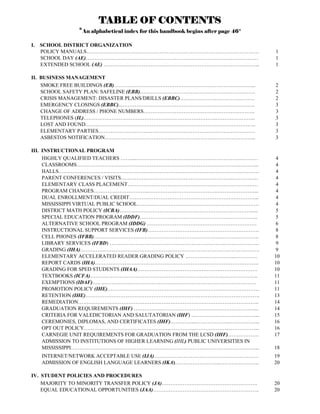
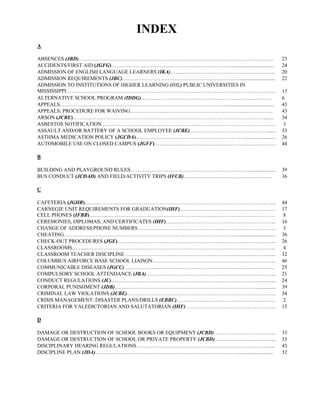
TABLE OF CONTENTS
                ‫٭‬An alphabetical index for this handbook begins after page 46‫٭‬
I.   SCHOOL DISTRICT ORGANIZATION
     POLICY MANUALS………………………………………………………………………………………                             1
     SCHOOL DAY (AE)………………………………………………………………………………………                            1
     EXTENDED SCHOOL (AE) ……………………………………………………………………………...                       1

II. BUSINESS MANAGEMENT
    SMOKE FREE BUILDINGS (EB) ……………………………………………………………………...                      2
    SCHOOL SAFETY PLAN: SAFELINE (EBB)…………………………………………………………                     2
    CRISIS MANAGEMENT: DISASTER PLANS/DRILLS (EBBC)…………………………………….               2
    EMERGENCY CLOSINGS (EBBC)...………………………………………………………………….                       3
    CHANGE OF ADDRESS / PHONE NUMBERS……………………………………………………….                      3
    TELEPHONES (IL)………………………………………………………………….…………………..                           3
    LOST AND FOUND……………………………………………………………………………………..                             3
    ELEMENTARY PARTIES………………………………………………………………………………                             3
    ASBESTOS NOTIFICATION…………………………………………………………………………...                         3

III. INSTRUCTIONAL PROGRAM
     HIGHLY QUALIFIED TEACHERS ……....…………………………………………………….………                     4
     CLASSROOMS…………………………………………………………………………………………...                              4
     HALLS…………………………………………………………………………………………………….                                 4
     PARENT CONFERENCES / VISITS……………………………………………………….……………                      4
     ELEMENTARY CLASS PLACEMENT…………………………………………………………………                          4
     PROGRAM CHANGES…………………………..………………………………….…………………...                          4
     DUAL ENROLLMENT/DUAL CREDIT………………………………………………………………...                       4
     MISSISSIPPI VIRTUAL PUBLIC SCHOOL…………………………………………………………….                   4
     DISTRICT MATH POLICY (ICBA)…………………………………………………………………......                   5
     SPECIAL EDUCATION PROGRAM (IDDF)…………………………………………………………..                     5
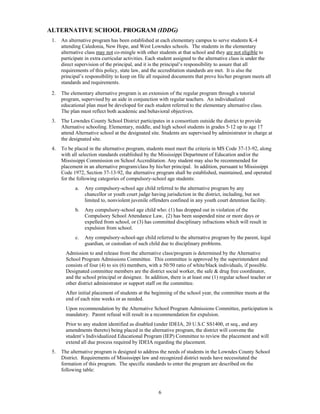
     ALTERNATIVE SCHOOL PROGRAM (IDDG) ………………………………………………………                      6
     INSTRUCTIONAL SUPPORT SERVICES (IFB)……………………………………………………….                   8
     CELL PHONES (IFBB)…………………………………………………………………………………..                          8
     LIBRARY SERVICES (IFBD) …………………………………………………………………………..                       9
     GRADING (IHA)………………………………………………………………………………………….                            9
     ELEMENTARY ACCELERATED READER GRADING POLICY ………………………..………….               10
     REPORT CARDS (IHA)………………………………………………………………………………….                          10
     GRADING FOR SPED STUDENTS (IHAA)……………………………………………………………                     10
     TEXTBOOKS (ICFA)…………………………………………………………………..………………..                         11
     EXEMPTIONS (IDAF)….. .…………………………………………………………………………….                        11
     PROMOTION POLICY (IHE)……………………………………………………………………………                         11
     RETENTION (IHE)……………………………………………………………………………………….                           13
     REMEDIATION…………………………………………………………………………………………..                             14
     GRADUATION REQUIREMENTS (IHF) ……………………………………………………………...                    14
     CRITERIA FOR VALEDICTORIAN AND SALUTATORIAN (IHF) ………………………………....          15
     CEREMONIES, DIPLOMAS, AND CERTIFICATES (IHF)…………...………………..……………...         16
     OPT OUT POLICY…………………………………………..…………...………………..……………...                     16
     CARNEGIE UNIT REQUIREMENTS FOR GRADUATION FROM THE LCSD (IHF)………………         17
     ADMISSION TO INSTITUTIONS OF HIGHER LEARNING (IHL) PUBLIC UNIVERSITIES IN
     MISSISSIPPI……………………….……………………………………………………………………...                          18
     INTERNET/NETWORK ACCEPTABLE USE (IJA)……………………………………………………                   19
     ADMISSION OF ENGLISH LANGUAGE LEARNERS (IKA)……………………..…………………..             20

IV. STUDENT POLICIES AND PROCEDURES
    MAJORITY TO MINORITY TRANSFER POLICY (JA)……………………………………………….                 20
    EQUAL EDUCATIONAL OPPORTUNITIES (JAA)…………………………………………………….                   20
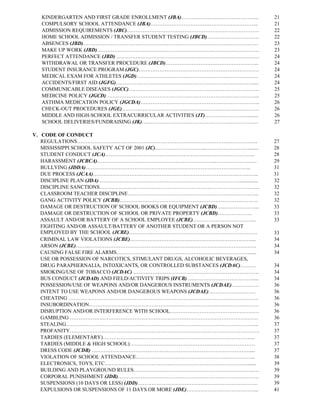
KINDERGARTEN AND FIRST GRADE ENROLLMENT (JBA)……………………………………...            21
  COMPULSORY SCHOOL ATTENDANCE (JBA)……………………………………………………..                  21
  ADMISSION REQUIREMENTS (JBC)………………………………………………………………….                    22
  HOME SCHOOL ADMISSION / TRANSFER STUDENT TESTING (JBCD)…………………………         22
  ABSENCES (JBD)………………………………………………………………….…….………………                         23
  MAKE UP WORK (JBD)…………………………………………………………………………………                         23
  PERFECT ATTENDANCE (JBD) ……………………………………………………………………….                     24
  WITHDRAWAL OR TRANSFER PROCEDURE (JBCD)……………………………………………...               24
  STUDENT INSURANCE PROGRAM (JGC)……………………………………………………………                    24
  MEDICAL EXAM FOR ATHLETES (JGD)…………………………………………………………….                   24
  ACCIDENTS/FIRST AID (JGFG)…………………………………………………………………….....                 24
  COMMUNICABLE DISEASES (JGCC)…………………………………………………………………                     25
  MEDICINE POLICY (JGCD) …………………………………………………………….……………...                   25
  ASTHMA MEDICATION POLICY (JGCDA)…………………………………………………………...                 26
  CHECK-OUT PROCEDURES (JGE)……………………………….……………………………………                     26
  MIDDLE AND HIGH-SCHOOL EXTRACURRICULAR ACTIVITIES (JT)…………………….........   26
  SCHOOL DELIVERIES/FUNDRAISING (JK)…………………………………………….……………                 27

V. CODE OF CONDUCT
   REGULATIONS…………………………………………………………………………………………..                          27
   MISSISSIPPI SCHOOL SAFETY ACT OF 2001 (JC)………………………...……………….…….......   28
   STUDENT CONDUCT (JCA)…………………………………………………………………………..                      28
   HARASSMENT (JCBCA)…………………………………………………………..……………………                       29
   BULLYING (JDDA)…………………………………………………………………………………..                         31
   DUE PROCESS (JCAA)…………………………………………………………………………………..                      31
   DISCIPLINE PLAN (JDA)………………………………………………………………………..............           32
   DISCIPLINE SANCTIONS………………………………………………………………………………..                     32
   CLASSROOM TEACHER DISCIPLINE…………………………………………………….…………...                 32
   GANG ACTIVITY POLICY (JCBB)…………………………………………………………….……….                  32
   DAMAGE OR DESTRUCTION OF SCHOOL BOOKS OR EQUIPMENT (JCBD)….………………...     33
   DAMAGE OR DESTRUCTION OF SCHOOL OR PRIVATE PROPERTY (JCBD)………………..       33
   ASSAULT AND/OR BATTERY OF A SCHOOL EMPLOYEE (JCBE)…………………….………...        33
   FIGHTING AND/OR ASSAULT/BATTERY OF ANOTHER STUDENT OR A PERSON NOT
   EMPLOYED BY THE SCHOOL (JCBE)…………..……………………………………………………                  33
   CRIMINAL LAW VIOLATIONS (JCBE)……………………………………………………………....                34
   ARSON (JCBE)……..……………………………………………………………………………………                         34
   CAUSING FALSE FIRE ALARMS………………………………………………….………………......                34
   USE OR POSSESSION OF NARCOTICS, STIMULANT DRUGS, ALCOHOLIC BEVERAGES,
   DRUG PARAPHERNALIA, INTOXICANTS, OR CONTROLLED SUBSTANCES (JCDAC)………     34
   SMOKING/USE OF TOBACCO (JCDAC) ………………………………………………………………                  34
   BUS CONDUCT (JCDAD) AND FIELD/ACTIVITY TRIPS (IFCB) ….…………………………….....   34
   POSSESSION/USE OF WEAPONS AND/OR DANGEROUS INSTRUMENTS (JCDAE)…………….     36
   INTENT TO USE WEAPONS AND/OR DANGEROUS WEAPONS (JCDAE)………………………          36
   CHEATING ……………………………………………………………………………………………….                           36
   INSUBORDINATION………………………………………………………………..……………………                        36
   DISRUPTION AND/OR INTERFERENCE WITH SCHOOL……………………………………………              36
   GAMBLING ………………………………………………………………………………………………                            36
   STEALING………………………………………………………………………………………………...                          37
   PROFANITY……………………………………………………………………………………………….                           37
   TARDIES (ELEMENTARY)…………………………………………………………………………....                     37
   TARDIES (MIDDLE & HIGH SCHOOL)………………………………………………………………                   37
   DRESS CODE (JCDB) ……………………………………………………………………………….....                    37
   VIOLATION OF SCHOOL ATTENDANCE…………………………………………….……………..                  38
   ELECTRONICS, TOYS, ETC………………………………..………………………………………......                39
   BUILDING AND PLAYGROUND RULES………………………………………………………………                    39
   CORPORAL PUNISHMENT (JDB)………………………………………………………………………                     39
   SUSPENSIONS (10 DAYS OR LESS) (JDD)……………………………………………………………               39
   EXPULSIONS OR SUSPENSIONS OF 11 DAYS OR MORE (JDE)…………………………………...       41
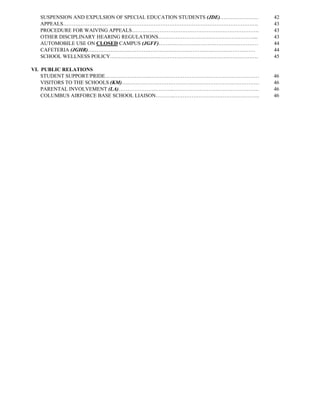
SUSPENSION AND EXPULSION OF SPECIAL EDUCATION STUDENTS (JDE)………………….   42
  APPEALS………………………………………………………………………………………………….                          43
  PROCEDURE FOR WAIVING APPEALS……………………………………………………………….                 43
  OTHER DISCIPLINARY HEARING REGULATIONS………………………………………………....           43
  AUTOMOBILE USE ON CLOSED CAMPUS (JGFF)…………………………………………………              44
  CAFETERIA (JGHR)……………………………………………………………………………………                       44
  SCHOOL WELLNESS POLICY………………………………………………………………………….                    45

VI. PUBLIC RELATIONS
    STUDENT SUPPORT/PRIDE……………………..………………………………………………………                 46
    VISITORS TO THE SCHOOLS (KM)….…………………………………………………………………              46
    PARENTAL INVOLVEMENT (LA)…………………………..………………………………………….               46
    COLUMBUS AIRFORCE BASE SCHOOL LIAISON………..………………………………………….          46
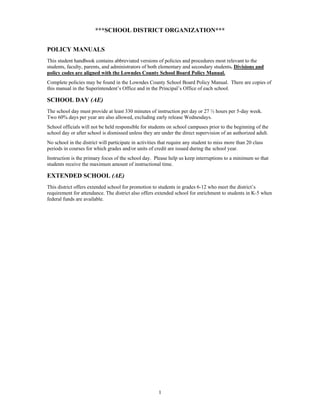
***SCHOOL DISTRICT ORGANIZATION***


POLICY MANUALS
This student handbook contains abbreviated versions of policies and procedures most relevant to the
students, faculty, parents, and administrators of both elementary and secondary students. Divisions and
policy codes are aligned with the Lowndes County School Board Policy Manual.
Complete policies may be found in the Lowndes County School Board Policy Manual. There are copies of
this manual in the Superintendent’s Office and in the Principal’s Office of each school.

SCHOOL DAY (AE)
The school day must provide at least 330 minutes of instruction per day or 27 ½ hours per 5-day week.
Two 60% days per year are also allowed, excluding early release Wednesdays.
School officials will not be held responsible for students on school campuses prior to the beginning of the
school day or after school is dismissed unless they are under the direct supervision of an authorized adult.
No school in the district will participate in activities that require any student to miss more than 20 class
periods in courses for which grades and/or units of credit are issued during the school year.
Instruction is the primary focus of the school day. Please help us keep interruptions to a minimum so that
students receive the maximum amount of instructional time.

EXTENDED SCHOOL (AE)
This district offers extended school for promotion to students in grades 6-12 who meet the district’s
requirement for attendance. The district also offers extended school for enrichment to students in K-5 when
federal funds are available.


                                                       1
***BUSINESS MANAGEMENT***


SMOKE FREE BUILDINGS (EB)
Consistent with Public Law 103-227, 20 USC 6083, the Lowndes County School Board bans the use of all
tobacco products in school buildings, on school property, and in school vehicles by all persons at all times.
This ban extends to employees, students, and patrons attending school-sponsored athletic events/meetings
and to all school-owned or operated vehicles and facilities.

SCHOOL SAFETY PLAN: SAFELINE (EBB)
Students should call 329-7509 to report any information relating to the safety of students, personnel, and
schools in this district. All calls will be anonymous.

CRISIS MANAGEMENT: DISASTER PLANS/DRILLS (EBBC)
1.        Fire (Refer to the district’s Emergency Procedures Plan.)
          Alarm – The alarm will be a continuous blast of a fire horn. The schools that do not
                  have a fire horn will sound repeated short rings of the bell.
          The principal will sound the alert for evacuation and call 911 and the school superintendent. Teachers
          and students will evacuate the building immediately and go to the designated/alternate school site.
          Evacuation routine:
          1.    Students will walk in a single file line to an authorized exit and go to a designated area.
          2.    Students will stay with their present class at all times. A teacher will check rest rooms.
          3.    Teachers will call roll in the designated area.
          4.    Everyone will wait for the “all clear signal,” which will be one long ring of the bell.
          5.    Students will re-enter their classes in an orderly manner.
          6.    Teachers will call roll.
2.        Tornado (Refer to the district’s Emergency Procedures Plan.)
          Alarm – The alarm will be repeated long rings of the bell.
          During severe weather, the principal will listen to the school radio for any weather alert. If
          emergency procedures are necessary, the following steps will be followed:
     1.        The principal will sound the alert.
     2.        Teachers and students will go to the designated area without delay.
     3.        Teachers and students will crouch with their arms placed on the side of their heads and their
               hands placed on the back of their necks until an all-clear signal is given.
     4.        When the danger is over, the signal will be sounded to return to class.

      A tornado watch is a situation in which weather conditions are favorable for a tornado. A warning is
      a situation in which a tornado or funnel cloud has been spotted. All persons should take cover immediately.
3.        Earthquake (Refer to the district’s Emergency Procedures Plan.)
      Alarm – The alarm will be repeated short-long-short-long rings of the bell.
4.        Other disasters (Refer to the district’s Emergency Procedures Plan.)
      All other major disasters shall be reported to the Civil Defense and school officials shall follow their procedures.
 Note: All disaster plans must be on file and the evacuation plan must be posted in the building.
       In the event of damages or injury, the principal will notify 911 and the superintendent.


                                                              2
EMERGENCY CLOSINGS (EBBC)
Upon approval of the School Board, the Superintendent may close any school because of an emergency
situation. However, all schools so closed shall operate for the required full time after being reopened
during the scholastic year. S37-13-65 (1987)
During inclement weather or other emergencies, personnel should refer to the following media concerning
school closings:

Television                 Radio                     Website                      ALERT NOW
WCBI . . . 328-1224        WACR . . .328-1050        www.lowndes.k12.ms.us        Parent Notification System
WTVA. . . 327-6464         WSMS . . .328-7124                                     (Please keep your school
WLOV. . . 494-8327         WKOR . . .327-1183                                      informed of changes to
                                                                                  your cell phone number)

CHANGE OF ADDRESS / PHONE NUMBERS
Parents should notify the school office when their addresses, telephone numbers, place of work, and/or
work telephone numbers change. It is extremely important that parents can be reached at all times in case
of an emergency.

TELEPHONES (IL)
      The school office phone is to be used with the principal’s permission only. Students will not be
       called out of class to answer the telephone; however, messages will be forwarded to them. Students
       will not be allowed to call home to check out, except in an emergency.

   LOST AND FOUND
All items found on campus should be turned into the office, including money. If the owner does not claim
the money within five days, it will be given to the finder. If a student loses an item, he/she should check in
the office to see if it has been turned in. Lost and found items will be turned over to charity if not
picked up by the end of the school year. Parents should write their child’s name in all his/her clothes and
jackets. Each year a great number of clothing items are never claimed.

ELEMENTARY PARTIES
Elementary parties will be limited to Christmas, Valentines, and Easter. Recess time will be utilized for the
parties. No dancing will be allowed. Birthday parties for students and/or teachers are not allowed.
However, parents may send refreshments for everyone to enjoy at recess.

ASBESTOS NOTIFICATION
The Asbestos Hazard Emergency Act of 1986 (AHERA) requires the inspection of all buildings in the
school district for asbestos. The district has complied with this act. A management plan documenting these
inspections is on file for public review. Upon request, this plan may be viewed in the Superintendent’s
office.

The asbestos identified in the management plan will be checked regularly by a licensed asbestos company
and by Lowndes County School District staff to scrutinize any changes in the material which could cause a
health hazard. Asbestos will be monitored according to EPA guidelines. If changes occur, the asbestos
coordinator will notify the appropriate people as prescribed by law.


                                                      3
***INSTRUCTIONAL PROGRAM***


HIGHLY QUALIFIED TEACHERS
Parents have the right to request the qualifications of teachers and paraprofessionals. Parents will be
notified if a non-qualified teacher will be teaching their child for four or more consecutive weeks.

CLASSROOMS
Students will be under the supervision of several teachers during the day. Each instructor will have his/her
own rules/requirements that students must become familiar with and obey.

For significant instructional activities to take place, the students must accept part of the burden of
responsibility. This includes, but is not limited to, being on time to class and having the necessary tools for
learning. Some of the most important tools are pencils, paper, textbooks, and completed homework
assignments. Schools may sell school supplies.

HALLS
Movement in the halls should be quiet and orderly. Students should walk to the right. “Ganging up” or
taking up the entire hall will not be permitted. Student movement in the hall is restricted to walking. No
running is allowed.

PARENT CONFERENCES/VISITS
Parents/guardians are encouraged to become actively involved in their child’s education. Parents are always
welcome but are asked to make an appointment through the teacher, counselor, or principal prior to a visit
or conference with a teacher. Drop-in conferences/visits are discouraged because they are a disruption
to instructional time.

PROGRAM CHANGES
In middle and high schools, schedule changes can be made or a course dropped only during the first full
week of class if:
1.   The change is possible in terms of the student’s existing schedule and the change will not overload a
     particular class.
2.   The change results in a reasonable program of studies in terms of the established curriculum.
3.   The change is approved by parent/guardian, teacher, and counselor.
4.   Final approval is granted by the principal.

DUAL ENROLLMENT/DUAL CREDIT
Dual Enrollment/Dual Credit is a program that allows high school students to simultaneously earn college
or vocational credit toward a postsecondary diploma at a Mississippi public institution that will also count
as credit toward a high school diploma.

Lowndes County School District encourages high school seniors to enroll in college courses. Students who
wish to enroll in college classes should contact their principal or counselor.


MISSISSIPPI VIRTUAL PUBLIC SCHOOL
Lowndes County School District has approved the Mississippi Virtual Public School (MVPS) as a web-
based educational service offered by the Mississippi Department of Education to provide students with
access to a wider range of course work, with more flexibility in scheduling, and with the opportunity to
develop their capacities as independent learners.

High school students may enroll in courses through the Mississippi Virtual Public School with prior
approval from the principal or designee. MVPS is not a credit issuing or diploma-granting institution. The

                                                       4
awarding of credit for successful course completion is determined by the principal or designee. Note:
Students enrolled in MVPS are limited to earning two (2) Carnegie units of credit during the academic
year and one (1) Carnegie unit of credit during the summer.

Students interested in taking MVPS courses should contact their high school counselor or administrator.

DISTRICT MATH POLICY (ICBA)
Math instruction in the Lowndes County School District follows the local math curriculum guides that are
aligned with the Mississippi Math Framework. Students progress according to grade level through the
sixth grade. Beginning in the seventh grade, students are given course sequence options, based on district
policy. The options and specific requirements are as follows and are based on the Mississippi Department
of Education Math Framework:

Grade Level      OPTION 1          OPTION 2               OPTION 3             OPTION 4
                  th                th
      7          7 Grade Math      7 Grade Math           Pre-Algebra          Pre-Algebra

      8          Pre-Algebra       Pre-Algebra            Transition to        Algebra I
                                                          Algebra
      9          Transition to     Algebra I              Algebra I            Geometry
                 Algebra

     10          Algebra I         Geometry               Geometry             Algebra II
     11          Geometry          Algebra II             Algebra II           Advanced Algebra,
                                                                               Trigonometry, or
                                                                               Elective
     12          Algebra II        Advanced               Advanced Algebra,    Pre-Calculus, Advanced
                                   Algebra,               Trigonometry, or     Placement Calculus,
                                   Trigonometry, or       Elective             Advanced Placement
                                   Elective                                    Statistics, or Elective

    To be recommended for 7th grade Pre-Algebra, students
         Must have an overall 90 average in 6th grade math,
         Score 11 or higher on the AP screening rubic

    8th grade Algebra I
          Must complete Pre-Algebra with a minimum 85 overall average

In grade 8, Pre-Algebra, Transition to Algebra, and Algebra I are eligible for a Carnegie unit and can count
as one of the required maths. Only one Carnegie unit will be given for each of these courses. Effective
with the eighth graders of 2008-2009, Geometry may be taken in the eighth grade for a Carnegie Unit
credit. If a student repeats a course after passing it, the second year’s grade will be used for credit/GPA
purposes. Beginning school year 2007-2008 for all entering eighth graders, at least two of the four required
mathematics courses must be higher than Algebra I.

SPECIAL EDUCATION PROGRAM (IDDF)
The State Department of Education shall establish goals for the performance of children with disabilities
that will promote the purpose of IDEIA and are consistent, to the maximum extent appropriate, with other
goals and standards for children established by the Mississippi Department of Education.

The educational programs and services provided for exceptional children shall be designed to provide
individualized appropriate special education and related services that enable a child to reach his/her
appropriate and uniquely designed goals for success.


                                                      5
ALTERNATIVE SCHOOL PROGRAM (IDDG)
 1.   An alternative program has been established at each elementary campus to serve students K-4
      attending Caledonia, New Hope, and West Lowndes schools. The students in the elementary
      alternative class may not co-mingle with other students at that school and they are not eligible to
      participate in extra curricular activities. Each student assigned to the alternative class is under the
      direct supervision of the principal, and it is the principal’s responsibility to assure that all
      requirements of this policy, state law, and the accreditation standards are met. It is also the
      principal’s responsibility to keep on file all required documents that prove his/her program meets all
      standards and requirements.

 2.   The elementary alternative program is an extension of the regular program through a tutorial
      program, supervised by an aide in conjunction with regular teachers. An individualized
      educational plan must be developed for each student referred to the elementary alternative class.
      The plan must reflect both academic and behavioral objectives.
 3.   The Lowndes County School District participates in a consortium outside the district to provide
      Alternative schooling. Elementary, middle, and high school students in grades 5-12 up to age 17
      attend Alternative school at the designated site. Students are supervised by administrator in charge at
      the designated site.
 4.   To be placed in the alternative program, students must meet the criteria in MS Code 37-13-92, along
      with all selection standards established by the Mississippi Department of Education and/or the
      Mississippi Commission on School Accreditation. Any student may also be recommended for
      placement in an alternative program/class by his/her principal. In addition, pursuant to Mississippi
      Code 1972, Section 37-13-92, the alternative program shall be established, maintained, and operated
      for the following categories of compulsory-school age students:
            a.   Any compulsory-school age child referred to the alternative program by any
                 chancellor or youth court judge having jurisdiction in the district, including, but not
                 limited to, nonviolent juvenile offenders confined in any youth court detention facility.
            b.   Any compulsory-school age child who: (1) has dropped out in violation of the
                 Compulsory School Attendance Law, (2) has been suspended nine or more days or
                 expelled from school, or (3) has committed disciplinary infractions which will result in
                 expulsion from school.
            c.   Any compulsory-school-age child referred to the alternative program by the parent, legal
                 guardian, or custodian of such child due to disciplinary problems.
        Admission to and release from the alternative class/program is determined by the Alternative
        School Program Admissions Committee. This committee is approved by the superintendent and
        consists of four (4) to six (6) members, with a 50/50 ratio of white/black individuals, if possible.
        Designated committee members are the district social worker, the safe & drug free coordinator,
        and the school principal or designee. In addition, there is at least one (1) regular school teacher or
        other district administrator or support staff on the committee.
        After initial placement of students at the beginning of the school year, the committee meets at the
        end of each nine weeks or as needed.
        Upon recommendation by the Alternative School Program Admissions Committee, participation is
        mandatory. Parent refusal will result in a recommendation for expulsion.
        Prior to any student identified as disabled (under IDEIA, 20 U.S.C SS1400, et seq., and any
        amendments thereto) being placed in the alternative program, the district will convene the
        student’s Individualized Educational Program (IEP) Committee to review the placement and will
        extend all due process required by IDEIA regarding the placement.
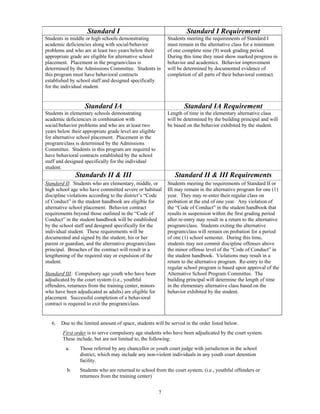
 5.   The alternative program is designed to address the needs of students in the Lowndes County School
      District. Requirements of Mississippi law and recognized district needs have necessitated the
      formation of this program. The specific standards to enter the program are described on the
      following table:


                                                      6
Standard I                                        Standard I Requirement
Students in middle or high schools demonstrating             Students meeting the requirements of Standard I
academic deficiencies along with social/behavior             must remain in the alternative class for a minimum
problems and who are at least two years below their          of one complete nine (9) week grading period.
appropriate grade are eligible for alternative school        During this time they must show marked progress in
placement. Placement in the program/class is                 behavior and academics. Behavior improvement
determined by the Admissions Committee. Students in          will be determined by documented evidence of
this program must have behavioral contracts                  completion of all parts of their behavioral contract.
established by school staff and designed specifically
for the individual student.


                   Standard IA                                       Standard IA Requirement
Students in elementary schools demonstrating                 Length of time in the elementary alternative class
academic deficiencies in combination with                    will be determined by the building principal and will
social/behavior problems and who are at least two            be based on the behavior exhibited by the student.
years below their appropriate grade level are eligible
for alternative school placement. Placement in the
program/class is determined by the Admissions
Committee. Students in this program are required to
have behavioral contracts established by the school
staff and designed specifically for the individual
student.
               Standards II & III                               Standard II & III Requirements
Standard II: Students who are elementary, middle, or         Students meeting the requirements of Standard II or
high school age who have committed severe or habitual        III may remain in the alternative program for one (1)
discipline violations according to the district’s “Code      year. They may re-enter their regular class on
of Conduct” in the student handbook are eligible for         probation at the end of one year. Any violation of
alternative school placement. Behavior contract              the “Code of Conduct” in the student handbook that
requirements beyond those outlined in the “Code of           results in suspension within the first grading period
Conduct” in the student handbook will be established         after re-entry may result in a return to the alternative
by the school staff and designed specifically for the        program/class. Students exiting the alternative
individual student. These requirements will be               program/class will remain on probation for a period
documented and signed by the student, his or her             of one (1) school semester. During this time,
parent or guardian, and the alternative program/class        students may not commit discipline offenses above
principal. Breaches of the contract will result in a         the minor offense level of the “Code of Conduct” in
lengthening of the required stay or expulsion of the         the student handbook. Violations may result in a
student.                                                     return to the alternative program. Re-entry to the
                                                             regular school program is based upon approval of the
Standard III: Compulsory age youth who have been             Alternative School Program Committee. The
adjudicated by the court system (i.e., youthful              building principal will determine the length of time
offenders, returnees from the training center, minors        in the elementary alternative class based on the
who have been adjudicated as adults) are eligible for        behavior exhibited by the student.
placement. Successful completion of a behavioral
contract is required to exit the program/class.


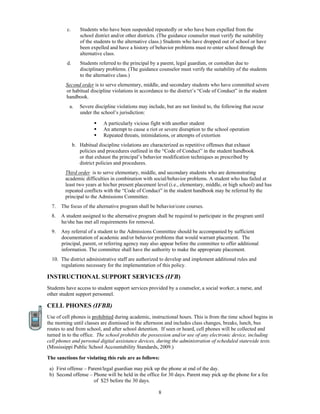
   6.   Due to the limited amount of space, students will be served in the order listed below.
        First order is to serve compulsory age students who have been adjudicated by the court system.
        These include, but are not limited to, the following:
          a.     Those referred by any chancellor or youth court judge with jurisdiction in the school
                 district, which may include any non-violent individuals in any youth court detention
                 facility.
          b.     Students who are returned to school from the court system. (i.e., youthful offenders or
                 returnees from the training center)


                                                         7
c.      Students who have been suspended repeatedly or who have been expelled from the
                 school district and/or other districts. (The guidance counselor must verify the suitability
                 of the students to the alternative class.) Students who have dropped out of school or have
                 been expelled and have a history of behavior problems must re-enter school through the
                 alternative class.
         d.      Students referred to the principal by a parent, legal guardian, or custodian due to
                 disciplinary problems. (The guidance counselor must verify the suitability of the students
                 to the alternative class.)
         Second order is to serve elementary, middle, and secondary students who have committed severe
         or habitual discipline violations in accordance to the district’s “Code of Conduct” in the student
         handbook.
           a.    Severe discipline violations may include, but are not limited to, the following that occur
                 under the school’s jurisdiction:

                            A particularly vicious fight with another student
                            An attempt to cause a riot or severe disruption to the school operation
                            Repeated threats, intimidations, or attempts of extortion
              b. Habitual discipline violations are characterized as repetitive offenses that exhaust
                 policies and procedures outlined in the “Code of Conduct” in the student handbook
                 or that exhaust the principal’s behavior modification techniques as prescribed by
                 district policies and procedures.
         Third order is to serve elementary, middle, and secondary students who are demonstrating
         academic difficulties in combination with social/behavior problems. A student who has failed at
         least two years at his/her present placement level (i.e., elementary, middle, or high school) and has
         repeated conflicts with the “Code of Conduct” in the student handbook may be referred by the
         principal to the Admissions Committee.
  7.   The focus of the alternative program shall be behavior/core courses.
  8.   A student assigned to the alternative program shall be required to participate in the program until
       he/she has met all requirements for removal.
  9.   Any referral of a student to the Admissions Committee should be accompanied by sufficient
       documentation of academic and/or behavior problems that would warrant placement. The
       principal, parent, or referring agency may also appear before the committee to offer additional
       information. The committee shall have the authority to make the appropriate placement.
  10. The district administrative staff are authorized to develop and implement additional rules and
      regulations necessary for the implementation of this policy.

INSTRUCTIONAL SUPPORT SERVICES (IFB)
Students have access to student support services provided by a counselor, a social worker, a nurse, and
other student support personnel.

CELL PHONES (IFBB)
Use of cell phones is prohibited during academic, instructional hours. This is from the time school begins in
the morning until classes are dismissed in the afternoon and includes class changes, breaks, lunch, bus
routes to and from school, and after school detention. If seen or heard, cell phones will be collected and
turned in to the office. The school prohibits the possession and/or use of any electronic device, including
cell phones and personal digital assistance devices, during the administration of scheduled statewide tests.
(Mississippi Public School Accountability Standards, 2009.)

The sanctions for violating this rule are as follows:

 a) First offense – Parent/legal guardian may pick up the phone at end of the day.
 b) Second offense – Phone will be held in the office for 30 days. Parent may pick up the phone for a fee
                      of $25 before the 30 days.

                                                       8
c) Third offense – Phone will be held in the office for 60 days. Parent may pick up the phone for a fee of
                    $50 before the 60 days.

LIBRARY SERVICES (IFBD)
Each school has a library-media center with an organized collection of materials and equipment that
represents a broad range of current learning media, including instructional technology.
The library staff offers an organized program of service to students and staff by providing access to the
materials and equipment, by providing training/instruction in the use of materials/equipment, and by
working with teachers and other staff members to design/provide learning activities for the students.

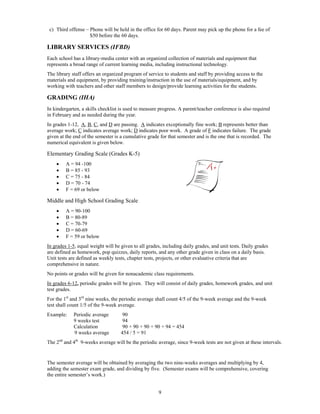
GRADING (IHA)
In kindergarten, a skills checklist is used to measure progress. A parent/teacher conference is also required
in February and as needed during the year.
In grades 1-12, A, B, C, and D are passing. A indicates exceptionally fine work; B represents better than
average work; C indicates average work; D indicates poor work. A grade of F indicates failure. The grade
given at the end of the semester is a cumulative grade for that semester and is the one that is recorded. The
numerical equivalent is given below.

Elementary Grading Scale (Grades K-5)
        A = 94 -100
        B = 85 - 93
        C = 75 - 84
        D = 70 - 74
        F = 69 or below

Middle and High School Grading Scale
        A = 90-100
        B = 80-89
        C = 70-79
        D = 60-69
        F = 59 or below
In grades 1-5, equal weight will be given to all grades, including daily grades, and unit tests. Daily grades
are defined as homework, pop quizzes, daily reports, and any other grade given in class on a daily basis.
Unit tests are defined as weekly tests, chapter tests, projects, or other evaluative criteria that are
comprehensive in nature.
No points or grades will be given for nonacademic class requirements.
In grades 6-12, periodic grades will be given. They will consist of daily grades, homework grades, and unit
test grades.
For the 1st and 3rd nine weeks, the periodic average shall count 4/5 of the 9-week average and the 9-week
test shall count 1/5 of the 9-week average.
Example:     Periodic average        90
             9 weeks test            94
             Calculation             90 + 90 + 90 + 90 + 94 = 454
             9 weeks average        454 / 5 = 91
The 2nd and 4th 9-weeks average will be the periodic average, since 9-week tests are not given at these intervals.


The semester average will be obtained by averaging the two nine-weeks averages and multiplying by 4,
adding the semester exam grade, and dividing by five. (Semester exams will be comprehensive, covering
the entire semester’s work.)


                                                       9
Example: 1st nine weeks average 91
         2nd nine weeks average 87
                                178        178 / 2 = 89

                                  89         356
                                 x 4        + 77 (1st semester exam)      433 / 5 = 87 (1st semester average)
                                  356        433
The same applies to second semester.

The yearly average shall be obtained by averaging the two semester averages. However, in order for
students to receive credit, the first semester can pull up second semester, providing the second semester
average is no lower than 65.
The semester and yearly average, in courses that receive academic credit, will be rounded to the nearest
hundredth (example: 96.48). Grades will not be rounded to the nearest whole number.
Yearly averages which exceed 100 are limited to those weighted classes listed under criteria for
Valedictorian and Salutatorian.
No points or grades will be given for nonacademic class requirements.

ELEMENTARY ACCELERATED READER GRADING POLICY
Accelerated Reader (AR) is a supplemental reading practice program where students read library books
from a selected reading range according to each student’s independent reading level. This level is
determined by a combination of the STAR assessment, teacher professional judgment, and previous
performance in the program. Point goals, which measure the amount of reading practice, are set according
to the allotted practice time and the student’s individual reading level.

Grades for AR make up 10% of the total periodic reading grade. One half of the AR grade comes from the
comprehension grade or percent correct made on cumulative quizzes and the other half is derived from the
percent of goal a student obtains. The remaining portion of the periodic reading grade (90%) pertains to the
basic reading curriculum at the particular grade level.

REPORT CARDS (IHA)
          Report cards are issued on the Thursday after the nine-week grading period. Numerals are used
          to designate a student’s progress in grades 1-12. Letter grades are used to designate a student’s
           progress in Kindergarten. Absences will be recorded on report cards. Parents are encouraged to
           set up a conference with the teacher if they would like to discuss their child’s grades. Parents of
       elementary students must sign the report card and return it to the school the next day.

Students who make all A’s in every subject taken will be on the Superintendent’s list. Students who make
all A’s and B’s in every subject taken will be on the Principal’s list.

GRADING FOR SPED STUDENTS (IHAA)
Any students resourced into the regular classroom for any academic subject will receive grades from the
regular classroom teacher and from the special resource teacher. The grades will be averaged for each
nine-week grading period. The student’s regular classroom performance will reflect three-fourths (3/4) of
the grade, and the student’s resource classroom performance will reflect one-fourth (1/4) of the grade. The
specific criteria set forth for the averaging of the two (2) grades is as follows:
The student’s individual education plan (IEP) must correlate directly with the goals and objectives of the
regular classroom subject areas as determined by the district’s curricular frameworks. In grades 6-12, nine-
weeks exams will be given at the end of the first and third nine-weeks grading periods. Semester exams
will be given at the end of the second and fourth nine-weeks grading periods.
Example: A student is enrolled in a regular class for mathematics. The competencies listed on the student’s
IEP must correlate with the competencies required within the course outline of the regular classroom.
If the stated criteria are not met, the grades will not be averaged together. The two (2) grades will then be
noted separately on the student’s report card.

                                                      10
The grade for any student receiving academic instruction within the special education program and not in
the regular education program will be assigned by the special education teacher. These grades will be based
on the student’s performance at his present level of functioning according to his/her IEP and not on his
grade placement. Grading for lower functioning special education students will be based on mastery of IEP
objectives, and the grades will be assigned based on an E, S, or U rating.

TEXTBOOKS (ICFA)
Textbooks shall be selected from the list adopted by the Mississippi State Textbook Purchasing Board.
They shall be selected by a textbook selection committee appointed by the superintendent or his designee.
The textbooks shall be distributed and loaned to the students for use in their courses. Students who lose or
damage a book must pay for it before any more books are issued. Students who refuse to pay book fines
will be referred to the School Board for possible disposition by the Youth Court.
Book fines will be assessed according to the following schedule:
    Condition                        Condition                   Amount of Fine
   when issued                      when returned
       N                               E                        None
       N                               G                        20% of contract price
       N                               F                        40% of contract price
       N                               P                        60% of contract price
       E                               G                        None
       E                               F                        20% of contract price
       E                               P                        40% of contract price
       G                               F                        None
       G                               P                        20% of contract price
*When books are lost, damaged beyond reading or repair, have missing pages, or have broken spines,
the student will be assessed the full price of the book.

EXEMPTIONS (IDAF)
First Semester: All students are required to take first-semester exams in a full-year course. Students in
grades 9-12 may be exempt in a first-semester, half-credit class if they have an “A” average. Students may
also be exempt if they have a “B” average and no more than three absences in the semester class. If a day
is missed because of school activities, it will be excused if the student has an excused absence slip from the
office signed by the supervising teacher for the day of the activity.
Second Semester: Students in grades 6-11 may be exempt if they have an “A” average in a class for the
year. In addition, all absences must be excused as defined by Mississippi Compulsory School Attendance
Law. Written documentation is required to receive an excused absence.
Students may also be exempt if they have a “B” average for the year and no more than five absences. If a day is
missed because of school activities, it will be excused if the student has an excused absence slip from the office
signed by the supervising teacher for the day of the activity.
Students in grades 6 – 8 must complete all parts of the MCT2 in order to exempt any exam.
Seniors may be exempt from exams with an average of at least 70 and no absences in a full-year or
one-semester course. The average required for exemption increases by one point for each day that is
missed during the school year in that particular subject, with a maximum of 20 days. Days missed for
school activities will be excused as stated above.
There will be no exemptions with any out-of-school suspensions. Principals will determine when
averages and exemptions will be announced.

PROMOTION POLICY (IHE)
Promotion and retention shall be based upon the mastery of objectives identified in the curriculum
frameworks. The district and the school conduct an annual analysis of student performance and take action
to improve the instructional delivery and/or evaluation components when the review of student
performance indicates weaknesses in mastery of the curriculum’s objectives. The District follows an


                                                      11
established Board policy that defines criteria for the academic promotion/progression/retention of students.
Such criteria prohibits the retention of students for extracurricular purposes.

NOTE: This portion of the policy is jointly monitored and enforced by the Board of Education and the
Mississippi High School Activities Association.

Elementary Promotion/Retention Policy (K-5)

Student’s grades are based upon testing that reflects mastery of objectives at 70%.

1. Kindergarten Promotion:

Kindergarten students will be promoted by recommendation of the teacher and the principal based on the
following criteria
      mastery of all standards in English, Language Arts and Math at 70% proficiency.
      having scored at least 600 on STAR Early Literacy assessment.

Process for retention of a kindergarten student will be:

         1.   Review of student yearly progress, growth, and promotion criteria
         2.   Documentation of parent notification
         3.   Recommendation of retention to school principal
         4.   Principal reviews and approves or denies retention

2. First Grade Promotion:

Students in first grade must master all standards in Language Arts (Reading, English, Spelling) and math
with at least 70% proficiency to be promoted and meet one of the following requirements:

         1.   Pass end of year literacy assessment benchmarks, or
         2.   Score 682 or higher on STAR Early Literacy assessment

3. Second Grade Promotion:

Students in second grade must master all standards in Language Arts (Reading, English, Spelling) and
math with at least 70% proficiency to be promoted and meet one of the following requirements:

         1.   Pass the end of year oral fluency reading assessment with at least 70 words per minute, or
         2.   Score 2.5 or higher on STAR assessment

4. Third Grade Promotion:

Students in third grade must pass Language Arts (Reading, English, Spelling), math, science, and social
studies, with at least 70% proficiency to be promoted. Students who score Minimal on any part of the third
grade Mississippi Curriculum Test, 2nd Edition (MCT2), will be referred to Teacher Support Team (TST) as
specified in guidelines of the Mississippi Department of Education. TST will maintain MDE MSIS
Compliance Reports.

5. Fourth and Fifth Grade Promotion:

Students in grades four and five must pass Language Arts (Reading, English, Spelling), math, science, and
social studies with at least 70% proficiency to be promoted.
There may be additional reading/language arts requirements in grades 1-3, as determined by the principal.

Students must attend school a minimum of 160 days during the school year to be promoted, excluding days
for discipline suspensions and state-defined excused absences.
Note: The building principal has the authority to recommend exceptions to the above policy. The
principal’s recommendation will be reviewed by a panel consisting of the Lowndes County elementary
school principals, who have the authority to approve/disapprove the recommendation of the principal. An
example of an exception includes, but is not limited to, the following:


                                                      12
    Students who demonstrate academic deficiencies with social/behavior problems and who are at
         least two years below their appropriate grade level
Middle-school Promotion/Retention Policy (Grades 6-8)
Students in grades six, seven, and eight must pass all courses attempted to be promoted.
Minimum competency requirements, as set by the state, will also be considered as criteria for promotion.

Seventh-grade students who score at the Minimal level on any part of the MCT2 will be referred to the
Teacher Support Team (TST) as specified in guidelines of the Mississippi Department of Education. The
TST will maintain MDE MSIS Compliance Reports.
Elective courses, such as band, chorus, dance, P.E., or art will not be offered during the extended summer
session. Therefore, if a student fails an elective (depending on which courses are offered at a particular
school), the student will not be allowed to make up the subject during the extended summer session.
Students who have final class grades of 55 in English, math, or reading and score Basic or above on the
MCT2 will be promoted in those subject areas and will be given a grade equivalent to a 60. Grades in all
subjects must be established through the instructional process and evaluations that render specific grades.
Pass/fail grades cannot be considered.
Gifted education is also an elective course for those that qualify.
Students must attend 160 days in all credit classes to receive credit for the class. Days for disciplinary
suspensions and excused days, as defined by the state, will be excluded.
Note: The building principal has the authority to recommend exceptions to the above policy. The
principal’s recommendation will be reviewed by a panel consisting of the Lowndes County middle school
principals, who have the authority to approve/disapprove the recommendation of the principal. Examples
of exceptions include, but are not limited to, the following:
        Students who demonstrate academic deficiencies with social/behavior problems and who are at
         least two years below their appropriate grade level
        Students who pass all required academic courses but fail an elective course, such as band, physical
         education, chorus, dance, or art.
High-school Promotion/Retention Policy (Grades 9-12)
For a student to be promoted in grades 9-12, he/she must pass English and earn the number of Carnegie
units for each grade as indicated below:
   Sophomore – 5 units
   Junior – 10 units
   Senior – 15 units
Any student who can graduate if he/she passes all of his/her courses will be classified as a senior.
All students must also pass the state-mandated subject-area tests in Algebra I, English II, Biology I, and
U.S. History from 1877.
Students who have final class grades of 55 in the subjects of the SATP and make passing scores on the
SATP will be given a unit of credit for the specific subject and a grade equivalent to a 60.
Students will be graded in all classes based on evaluations that are correlated to the competencies/
objectives from the curriculum frameworks.
Students must attend 160 days or more to receive credit in a one-credit class or must not miss more than
eleven days in a half-credit class to get credit. Days missed due to disciplinary suspensions and days
excused according to state law will be excluded.

RETENTION (IHE)
The objective of the Lowndes County School District is to provide all students with quality instruction and
thus a quality education. It is in the best interest of some students that they be retained to achieve mastery
of objectives at a minimal level. Any student who is retained in grades 7 or 8 will be ineligible for school
activities, as governed by the Mississippi High School Activities Association.
                                                         13
REMEDIATION
Any student who fails to master basic skills will be provided with remediation through TST, classroom
teachers, and supplemented by Title I services in eligible schools.

GRADUATION REQUIREMENTS (IHF)
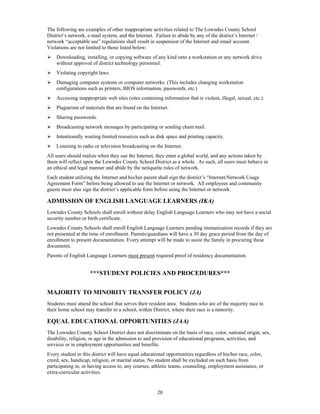
    1.   Beginning school year 2008-2009 and thereafter, all entering ninth graders (seniors of school
         year 2011-2012 and later) will be required to have a minimum of 24 Carnegie units. District
         policies will determine specific requirements for students who transfer their senior year. At least two
         of the last four Carnegie units must be from the school granting the diploma.

    2.   Correspondence courses: When courses are not offered by the school district, they may be taken
         by correspondence if, and only if, the student is behind in his/her credits. A maximum of one
         unit may be earned by completing a correspondence course, and it must be finished before the next
         school year begins. To get credit, the student must obtain approval from the principal and adhere to
         the following:

                   The course must be approved by the Commission on School Accreditation.
                   The principal must certify that the student meets the requirements of the approved
                    correspondence course.

    3.   Extended school: A maximum of two units may be earned during a single extended school session,
         and only six units may be earned in extended school and counted toward graduation. Courses may
         only be taken if a student has fallen behind in his/her credits. Students must also have a
         minimum average of 55 and approval from their principal to enroll.

    4.   Each student receiving a standard diploma must earn a passing score on each of the required high
         school exit examinations: Algebra I, English II, Biology I, U.S. History from 1877.

    5.   Seniors will not be allowed to take less than four subjects during any regular session except for
         fifth-year seniors.

    6.   Completion of a Senior Exit Project will be optional.

    7.   Each student who has completed the secondary curriculum for special education may be issued a
         special diploma or certificate of completion which states: “This student has successfully
         completed an Individualized Education Program.”

    8.   Students with disabilities receiving a Mississippi Occupational Diploma must have successfully
         completed all minimum requirements established by the State Board of Education.

    9.   Early Graduation:
               a.   A student who applies for early graduation must meet the same standards as students who
                    complete 4 years of high school.
               b.   A student who plans to graduate early must file an application with the guidance
                    department by the end of the semester prior to his/her year of graduation.
               c.   The application will be reviewed by a committee comprised of the principal, the guidance
                    counselors, and four classroom teachers.
               d.   The committee will make the final decision regarding early graduation.


               e.   The following items will be used to render a decision:
                                 Application form
                                 Completion of three semesters immediately preceding graduation at the
                                     LCSD high school where the student is currently enrolled
                                 An 85 or B average in all courses attempted at the LCSD high school.
                                     In the event of a special circumstance and a student does not have an 85
                                     or B, the committee will make a determination of the validity of the
                                     request for early graduation.
                                                        14
   A statement explaining the student’s reasons for wanting to graduate
                                    early.
             f.   A decision by the committee will be made by the end of the semester following the
                  student’s application.
             g.   If the application is denied, the committee will respond in writing to the parents/guardian
                  of the student.
             h.   In the event the student fails to meet the requirements for early graduation or withdraws
                  from the program, he/she will enroll in the appropriate grade and complete graduation
                  requirements.

  10. Students who fail to meet the graduation requirements are not permitted to participate in the
      graduation exercises.


                               GRADUATION REQUIREMENTS

CRITERIA FOR VALEDICTORIAN AND SALUTATORIAN (IHF)
The criteria for selection of the valedictorian and salutatorian will be based on all courses taken during the
four years of high school, excluding driver’s education and physical education. Transfer students’ grades
that are letter, rather than numerical, will be averaged using the midpoint grade. Students graduating with a
94 or better average in the IHL core courses will graduate “with special honors.” Beginning with the class
of 2012, students who complete at least three advanced placement courses during their high school career
and have achieved the highest grade point average of eligible students will be eligible for valedictorian and
salutatorian. Fractions of points will be counted and not rounded off. Final averages will be rounded to the
thousandths. Students within .005 of one another will share these awards.

Advanced placement, honors classes, and higher level classes (see below) will receive a weighted value at
the end of each semester. Beginning with the Fall of 2012 students in Advanced Placement courses will
receive a weighted value of 5%. Students in Pre-AP/Honors courses will receive a weighted value of 3%.

Weighted courses to be used in computing class rank include Advanced Placement English, Advanced
Placement Calculus, Advanced Placement Physics, Advanced Placement Chemistry, Advanced Placement
Biology, Advanced Placement Statistics, Advanced Placement U.S. History, Advanced Placement World
History, Advanced Placement Studio Art, Pre-AP English, Pre-AP Biology, Pre-AP Chemistry, Pre-AP
Mississippi Studies, Pre-AP Introduction to World Geography, Pre-AP World History, Pre-AP Geometry,
Pre-AP Algebra II, Pre-AP Biology, Pre-AP Chemistry, Trigonometry, Pre-Calculus, Pre-AP
Trigonometry, Pre-AP PreCalculus, Physics and Pre-AP Algebra I (8th Grade).

Every other class final average (with the exception of physical education and driver’s education) will also
be calculated to determine final overall grade point average. Fine Arts and Health are included as
graduation requirements; therefore, grades in these subjects will be calculated in the student’s GPA.
Beginning with the class of 2012 and beyond, ½ semester of physical education will be included in the
GPA since it is also a graduation requirement.

Beginning with the class of 2011, students who complete three or more advanced placement courses during
their high school career with a 90 average and complete the College Board Advanced Placement exam will
receive recognition at graduation ceremonies by wearing a silver cord with their cap and gown. Students
who take the College Board Advanced Placement exam for advanced placement classes have the option of
being exempt from the final exam if they have no behavior infractions and have approval from the subject
teacher and school administrator.


                                                     15
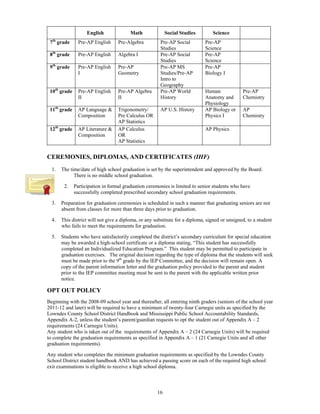
English              Math              Social Studies        Science
  th
 7 grade        Pre-AP English     Pre-Algebra          Pre-AP Social         Pre-AP
                                                        Studies               Science
 8th grade      Pre-AP English     Algebra I            Pre-AP Social         Pre-AP
                                                        Studies               Science
 9th grade      Pre-AP English     Pre-AP               Pre-AP MS             Pre-AP
                I                  Geometry             Studies/Pre-AP        Biology I
                                                        Intro to
                                                        Geography
 10th grade     Pre-AP English     Pre-AP Algebra       Pre-AP World          Human             Pre-AP
                II                 II                   History               Anatomy and       Chemistry
                                                                              Physiology
 11th grade     AP Language &      Trigonometry/        AP U.S. History       AP Biology or     AP
                Composition        Pre Calculus OR                            Physics I         Chemistry
                                   AP Statistics
 12th grade     AP Literature &    AP Calculus                                AP Physics
                Composition        OR
                                   AP Statistics


CEREMONIES, DIPLOMAS, AND CERTIFICATES (IHF)
  1.   The time/date of high school graduation is set by the superintendent and approved by the Board.
             There is no middle school graduation.

        2.    Participation in formal graduation ceremonies is limited to senior students who have
              successfully completed prescribed secondary school graduation requirements.

  3.   Preparation for graduation ceremonies is scheduled in such a manner that graduating seniors are not
       absent from classes for more than three days prior to graduation.

  4.   This district will not give a diploma, or any substitute for a diploma, signed or unsigned, to a student
       who fails to meet the requirements for graduation.

  5.   Students who have satisfactorily completed the district’s secondary curriculum for special education
       may be awarded a high-school certificate or a diploma stating, “This student has successfully
       completed an Individualized Education Program.” This student may be permitted to participate in
       graduation exercises. The original decision regarding the type of diploma that the students will seek
       must be made prior to the 9th grade by the IEP Committee, and the decision will remain open. A
       copy of the parent information letter and the graduation policy provided to the parent and student
       prior to the IEP committee meeting must be sent to the parent with the applicable written prior
       notice.

OPT OUT POLICY
Beginning with the 2008-09 school year and thereafter, all entering ninth graders (seniors of the school year
2011-12 and later) will be required to have a minimum of twenty-four Carnegie units as specified by the
Lowndes County School District Handbook and Mississippi Public School Accountability Standards,
Appendix A-2, unless the student’s parent/guardian requests to opt the student out of Appendix A – 2
requirements (24 Carnegie Units).
Any student who is taken out of the requirements of Appendix A – 2 (24 Carnegie Units) will be required
to complete the graduation requirements as specified in Appendix A – 1 (21 Carnegie Units and all other
graduation requirements).

Any student who completes the minimum graduation requirements as specified by the Lowndes County
School District student handbook AND has achieved a passing score on each of the required high school
exit examinations is eligible to receive a high school diploma.


                                                      16
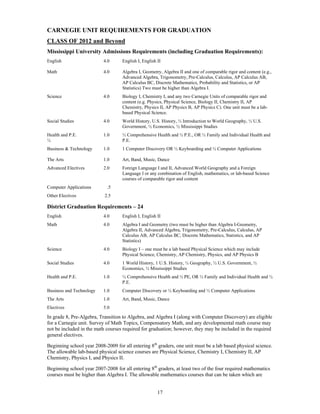
CARNEGIE UNIT REQUIREMENTS FOR GRADUATION
CLASS OF 2012 and Beyond
Mississippi University Admissions Requirements (including Graduation Requirements):
English                    4.0      English I, English II

Math                       4.0      Algebra I, Geometry, Algebra II and one of comparable rigor and content (e.g.,
                                    Advanced Algebra, Trigonometry, Pre-Calculus, Calculus, AP Calculus AB,
                                    AP Calculus BC, Discrete Mathematics, Probability and Statistics, or AP
                                    Statistics) Two must be higher than Algebra I.
Science                    4.0      Biology I, Chemistry I, and any two Carnegie Units of comparable rigor and
                                    content (e.g. Physics, Physical Science, Biology II, Chemistry II, AP
                                    Chemistry, Physics II, AP Physics B, AP Physics C). One unit must be a lab-
                                    based Physical Science.
Social Studies             4.0      World History, U.S. History, ½ Introduction to World Geography, ½ U.S.
                                    Government, ½ Economics, ½ Mississippi Studies
Health and P.E.            1.0      ½ Comprehensive Health and ½ P.E., OR ½ Family and Individual Health and
½                                   P.E.
Business & Technology      1.0      1 Computer Discovery OR ½ Keyboarding and ½ Computer Applications

The Arts                   1.0      Art, Band, Music, Dance
Advanced Electives         2.0      Foreign Language I and II, Advanced World Geography and a Foreign
                                    Language I or any combination of English, mathematics, or lab-based Science
                                    courses of comparable rigor and content
Computer Applications       .5
Other Electives            2.5

District Graduation Requirements – 24
English                    4.0      English I, English II
Math                       4.0      Algebra I and Geometry (two must be higher than Algebra I-Geometry,
                                    Algebra II, Advanced Algebra, Trigonometry, Pre-Calculus, Calculus, AP
                                    Calculus AB, AP Calculus BC, Discrete Mathematics, Statistics, and AP
                                    Statistics)
Science                    4.0      Biology I – one must be a lab based Physical Science which may include
                                    Physical Science, Chemistry, AP Chemistry, Physics, and AP Physics B
Social Studies             4.0      1 World History, 1 U.S. History, ½ Geography, ½ U.S. Government, ½
                                    Economics, ½ Mississippi Studies
Health and P.E.            1.0      ½ Comprehensive Health and ½ PE, OR ½ Family and Individual Health and ½
                                    P.E.
Business and Technology    1.0      Computer Discovery or ½ Keyboarding and ½ Computer Applications
The Arts                   1.0      Art, Band, Music, Dance
Electives                  5.0

In grade 8, Pre-Algebra, Transition to Algebra, and Algebra I (along with Computer Discovery) are eligible
for a Carnegie unit. Survey of Math Topics, Compensatory Math, and any developmental math course may
not be included in the math courses required for graduation; however, they may be included in the required
general electives.

Beginning school year 2008-2009 for all entering 8th graders, one unit must be a lab based physical science.
The allowable lab-based physical science courses are Physical Science, Chemistry I, Chemistry II, AP
Chemistry, Physics I, and Physics II.

Beginning school year 2007-2008 for all entering 8th graders, at least two of the four required mathematics
courses must be higher than Algebra I. The allowable mathematics courses that can be taken which are


                                                       17
higher than Algebra I are: Geometry, Algebra II, Advanced Algebra, Trigonometry, Pre-Calculus,
 Calculus, AP Calculus AB, AP Calculus BC, Discrete Mathematics, Probability and Statistics, and AP
 Statistics.

 A student can earn a maximum of 4 Carnegie units (per course) in band, choral music, and physical
 education. Elective units in P.E. include participation in interscholastic athletic activities that meet the
 instructional requirements specified in the Fitness through Physical Education Framework and that are
 sanctioned by the Mississippi High School Activities Association.

 Evidence of proficiency in keyboarding and computer applications is accepted in lieu of the required
 courses if the student earns one unit in a course in the Business/Technology framework.

 Credit earned for a state/local government course in another state by an out-of-state transfer student who
 enters after the sophomore year can stand in lieu of Mississippi Studies.

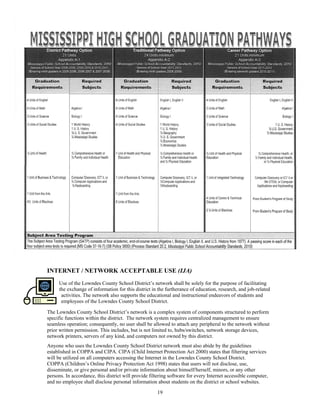
 Requirements for Admission to Institutions of Higher Learning (IHL) Public
 Universities in Mississippi - For graduates entering a public institution of higher
 learning BEGINNING in the summer of 2012.
 CURRICULUM                                         COURSES                                                     UNITS
    AREA
ENGLISH                                                                                                         4

MATHEMATICS Algebra I, Geometry, Algebra II, and any Carnegie Unit of comparable
                  rigor and content (e.g., Advanced Algebra, Trigonometry, Pre-Calculus,
                  Calculus, AP Calculus AB, AP Calculus BC, Discrete Mathematics,                               4
                  Probability and Statistics, or AP Statistics)
SCIENCE           Biology I, Chemistry I, and any two Carnegie Units of comparable rigor
                  and content (e.g., Physics, Physical Science, Biology II, Chemistry II, AP
                  Chemistry, Physics II, AP Physics B, AP Physics C- Electricity and                            4
                  Magnetism, AP Physics C-Mechanics, Botany, Microbiology, or Human
                  Anatomy and Physiology
SOCIAL            World History, U.S. History, Introduction to World Geography, U.S.
STUDIES           Government, Economics, and/or Mississippi Studies. (Credit earned for a
                                                                                                                4
                  state/local government in any other state may stand in lieu of Mississippi
                  Studies).
ARTS              Any visual and/or performing arts course (s), meeting the requirements for
                  high school graduation.                                                                       1

ADVANCED          Foreign Language I and II, Advanced World Geography and a Foreign
ELECTIVES         Language I or any combination of English, mathematics, or lab-based
                  science courses of comparable rigor and content to those required above.                      2
                  Only a math credit beyond Algebra II will be considered an advanced
                  elective.
COMPUTER     Computer Applications
APPLICATIONS                                                                                                    ½

TOTAL UNITS                                                                                                     19 ½
REQUIRED

 Requirements for Admission to Community Colleges
                  High School Diploma                                                    ACT

 *Algebra I in the 8th grade will be accepted for admission provided the course content is the same as the
  high school course.


                                                        18
INTERNET / NETWORK ACCEPTABLE USE (IJA)
     Use of the Lowndes County School District’s network shall be solely for the purpose of facilitating
     the exchange of information for this district in the furtherance of education, research, and job-related
      activities. The network also supports the educational and instructional endeavors of students and
      employees of the Lowndes County School District.

The Lowndes County School District’s network is a complex system of components structured to perform
specific functions within the district. The network system requires centralized management to ensure
seamless operation; consequently, no user shall be allowed to attach any peripheral to the network without
prior written permission. This includes, but is not limited to, hubs/switches, network storage devices,
network printers, servers of any kind, and computers not owned by this district.
Anyone who uses the Lowndes County School District network must also abide by the guidelines
established in COPPA and CIPA. CIPA (Child Internet Protection Act 2000) states that filtering services
will be utilized on all computers accessing the Internet in the Lowndes County School District.
COPPA (Children’s Online Privacy Protection Act 1998) states that users will not disclose, use,
disseminate, or give personal and/or private information about himself/herself, minors, or any other
persons. In accordance, this district will provide filtering software for every Internet accessible computer,
and no employee shall disclose personal information about students on the district or school websites.

                                                      19
The following are examples of other inappropriate activities related to The Lowndes County School
District’s network, e-mail system, and the Internet. Failure to abide by any of the district’s Internet /
network “acceptable use” regulations shall result in suspension of the Internet and email account.
Violations are not limited to those listed below:
   Downloading, installing, or copying software of any kind onto a workstation or any network drive
    without approval of district technology personnel.
   Violating copyright laws.
   Damaging computer systems or computer networks. (This includes changing workstation
    configurations such as printers, BIOS information, passwords, etc.)
   Accessing inappropriate web sites (sites containing information that is violent, illegal, sexual, etc.).
   Plagiarism of materials that are found on the Internet.
   Sharing passwords.
   Broadcasting network messages by participating or sending chain mail.
   Intentionally wasting limited resources such as disk space and printing capacity.
   Listening to radio or television broadcasting on the Internet.
All users should realize when they use the Internet, they enter a global world, and any actions taken by
them will reflect upon the Lowndes County School District as a whole. As such, all users must behave in
an ethical and legal manner and abide by the netiquette rules of network.
Each student utilizing the Internet and his/her parent shall sign the district’s “Internet/Network Usage
Agreement Form” before being allowed to use the Internet or network. All employees and community
guests must also sign the district’s applicable form before using the Internet or network.

ADMISSION OF ENGLISH LANGUAGE LEARNERS (IKA)
Lowndes County Schools shall enroll without delay English Language Learners who may not have a social
security number or birth certificate.
Lowndes County Schools shall enroll English Language Learners pending immunization records if they are
not presented at the time of enrollment. Parents/guardians will have a 30 day grace period from the day of
enrollment to present documentation. Every attempt will be made to assist the family in procuring these
documents.
Parents of English Language Learners must present required proof of residency documentation.


                     ***STUDENT POLICIES AND PROCEDURES***


MAJORITY TO MINORITY TRANSFER POLICY (JA)
Students must attend the school that serves their resident area. Students who are of the majority race in
their home school may transfer to a school, within District, where their race is a minority.

EQUAL EDUCATIONAL OPPORTUNITIES (JAA)
The Lowndes County School District does not discriminate on the basis of race, color, national origin, sex,
disability, religion, or age in the admission to and provision of educational programs, activities, and
services or in employment opportunities and benefits.
Every student in this district will have equal educational opportunities regardless of his/her race, color,
creed, sex, handicap, religion, or marital status. No student shall be excluded on such basis from
participating in, or having access to, any courses, athletic teams, counseling, employment assistance, or
extra-curricular activities.


                                                      20
Furthermore, any awards, honors, etc., of any kind will be based solely upon merit, hard work, and ability
and shall have no relationship to the person’s color, creed, or national origin.
Any complaints should be directed to Dr. Peggy Rogers, 1053 Highway 45 South, Columbus, MS 39701
(662-244-5001).

KINDERGARTEN AND FIRST GRADE ENROLLMENT (JBA)
Pre-registration for the following school year is held during the fourth week of April. The pre-registration is
held daily from 8:00 A.M. - 3:30 P.M. in the elementary school that the child will be attending. During this
time, parents must present all items required for admission.
To be eligible for kindergarten, a student must be 5 years old on or before September 1st of the enrolling school
year. To be eligible for the first grade, he/she must be 6 years old on or before September 1st of that school year.

COMPULSORY SCHOOL ATTENDANCE (JBA)
According to the State of Mississippi law, all children who have attained or will attain the age of 6 years
and who have not attained the age of 17 years on or before September 1st of the calendar year are
“compulsory school-age children” and must be enrolled in school. An “unlawful absence” (MSIS Policy)
is a school-day absence by a compulsory-age child that is not a valid excuse for temporary non-attendance.
Days missed for suspension, expulsion, or other disciplinary action shall not be “excused” absences. Each
of the reasons listed below is a valid excuse for temporary non-attendance if satisfactory evidence is
provided to the superintendent or his designee.
If a compulsory school-age child is not enrolled in school within fifteen (15) calendar days after the first
day of the school year or such child accumulates five (5) unexcused absences during the school year, the
principal shall report such absences to the school attendance officer of the youth court. No report is
required if the cause of the compulsory school-age child’s non-enrollment or absence is one or more of the
following reasons:
1.   The child is physically, mentally, or emotionally incapable of attending school as determined by the
     appropriate school official based upon sufficient medical documentation.
2.   The child is enrolled in or pursing a course of special education, remedial education, or education for
     handicapped or physically/mentally disadvantaged children.
3.   The child is being educated in a legitimate home-instruction program.
4.   The absence of the child results from illness or injury that prevents the child from being physically
     able to attend school.
5.   The absence of the child results from him/her being in isolation ordered by a county health officer or
     by the State Board of Health.
6.   The absence results from the death or serious illness of a member of the child’s immediate family or
     household.

7.   The absence results from a medical/dental appointment of the child that has been approved by the
     principal and is based upon verification from the doctor.

8.   The absence is a result of the child’s attendance at the proceedings of a court or an administrative
     tribunal if such child is a party to the action or under subpoena as a witness.

9.   The absence is excused by the superintendent because the child or his/her parents adhere to a religion
     that requires or suggests the observance of a religious event. The approval of such absence is within
     the discretion of the superintendent, but approval should be granted unless the religious observance is
     of such duration that it interferes with the education of the child.

10. The absence is excused by the superintendent to allow the child to take advantage of a valid
    educational opportunity, such as a vacation or other family travel. Approval of such absences must be
    gained from the superintendent prior to the absence, and approval shall not be unreasonably withheld.

11. The absence is excused by the superintendent for other valid reasons or conditions that he/she deems
    sufficient to warrant the child’s nonattendance. (S37-13-911, as amended by ERA, 1982)
                                                      21
In accordance with the Lowndes County School District Mississippi Student Information System (MSIS)
attendance policy, written documentation of excused absences will be kept on file in the school office for
one year to maintain MSIS compliance.

ADMISSION REQUIREMENTS (JBC)
1.   A certified copy of the child’s birth certificate is required of all students entering the Lowndes
     County School District for the first time (K, 1, or students coming in from other districts).
2.   A student must be enrolled by the parent or legal guardian who lives within the school district and
     must be entered under the student’s full, legal name.
3.   If a student is enrolled by a legal guardian, a copy of the court order granting guardianship must be
     retained by the principal in the child’s permanent record.
4.   If no birth certificate is presented at the time of enrollment, a fee will be charged and the school will
     request the certificate from the state. The student will then be allowed to enroll.
5.   All students, regardless of grade, must have a Mississippi Certificate of Compliance. This may be
     secured from the Lowndes County Health Department or from a family doctor.
6.   Transfer students must show a withdrawal form and report card from the school previously attended.
7.   Any student entering this district from home schooling (or a program not accredited by a state or
     regional agency) will be given a standardized achievement test to determine the grade or class to which
     the student is assigned. SACS accreditation prohibits the Lowndes County School District from
     awarding Carnegie units for home schooling or attendance at non-accredited schools.
8.   The Lowndes County School District will accept foreign exchange students for one year only, and the
     student cannot be a graduating senior.
9.   All new and returning students must provide the school with two current forms of residency
     verification. This information must also be provided when there is a change of residence.
     Acceptable documents are the following:
            a.   Filed homestead exemption application form
            b.   Mortgage documents or property deed
            c.   Apartment or home lease
            d.   Utility bills
            e.   Driver’s license
            f.   Voter precinct identification
            g.   Automobile registration
            h.   Affidavit and/or personal visit by a designated school district official
            i.   Any other documentation that will objectively and unequivocally establish that the
                 parent or guardian resides within the school district
Any document with a post office box as an address will not be accepted.
A certified copy of the filed petition for guardianship and/or final decree must be presented if a student
lives with a legal guardian in the school district.
Students are required to provide 2 proofs of residency each year they attend school. Proof of residency
must be provided each year.

HOME SCHOOL ADMISSION/TRANSFER STUDENT TESTING (JBCD)
The Lowndes County School District will not give Carnegie units, upon transfer request only, for subjects
taught in a tutorial, correspondence, or home study program not accredited regionally or by a State Board
of Education.

To receive a Carnegie unit for a course taught in a non-accredited correspondence, tutorial, or home study
program, a student entering this school district must pass a comprehensive, teacher made, special subject


                                                       22
test with 70% proficiency. The examination will be given within 30 days of the transfer request. The
applicant will be notified of the administration date of such test no less than five days prior to the test date.

The comprehensive examination will consist of 100 questions based on the competencies and objectives in
the Mississippi Curriculum Framework in the specific discipline area. The grade on record for the course
will be based upon the percentage correct and documented according to the Lowndes County School
District Grading Policy.

A separate examination must be passed for each transfer course whereby a Carnegie unit is being requested.
Each examination will be administered only one time. If the student does not pass the exam, he/she must
retake and pass the entire course to receive the Carnegie unit.

K-8 students seeking to transfer from a non-accredited school (public or private) or a home school program
within or outside Mississippi to this district shall be required to take a test(s) to determine the grade/class to
which he/she will be assigned. The test(s) will be given within thirty (30) days of the transfer request, and
the applicant will be notified no less than five (5) days prior to the test’s administration. No transfer shall
be effective until the test(s) has been given and the student has been assigned to the grade/class for which
he/she is best suited.

ABSENCES (JBD)
Each student shall attend school a minimum of 160 days during the school year in order to receive
academic credit for that year of course work. Students shall not exceed 11 absences in a semester class or
21 absences in a yearly course. Absences will also be recorded on the report cards (see Compulsory School
Attendance). An “unlawful absence” (MSIS Policy) is a school-day absence by a compulsory-age child that
is not a valid excuse for temporary non-attendance according to the Compulsory Attendance law of the
State of Mississippi.
In accordance with the Lowndes County School District Mississippi Student Information System (MSIS)
attendance policy, written documentation of excused absences will be kept on file in the school office for
one year to maintain MSIS compliance.
Only 4 absences can be excused each semester with a parent note. All other absences must have medical or
legal documentation to be excused. Students will have three days from the day they return to provide an
excuse to the office. After three days the absence(s) will be deemed unexcused and cannot be changed.

The only way a student may be eligible for promotion if violating this rule is for him/her to present a
physician’s written medical verification of the long-term illness on the day he/she returns to school.
The student, along with a parent or guardian, must appear before the board to request a waiver of
the absentee policy.

During the school year, a student will not be allowed more than five planned absences (extracurricular
school activities) in the same class period in courses for which grades and/or units of credit are given. A
student will not be allowed to miss more than twenty class periods for planned absences. Principals will
identify those absences which are classified as “planned absences.”

Offenses that carry out-of-school suspension will not count against state compulsory attendance.

MAKE-UP WORK (JBD)
     All work must be made up for any absence. Make-up work is the responsibility of the student.
      Work must be made up within a reasonable period of time, as defined by the teacher. If the student
       has an extended illness, he/she (or parents or guardian) must obtain assignments from the school
           and makeup work weekly.
              Make-up work should take approximately the same amount of time as the time missed from
              class. Only in extreme cases of prolonged absence will students be given more than one week to
make up work unless permission is granted by the principal. A day’s absence does not excuse a student from
responsibility for all assignments on the day of his/her return. A grade of zero will be recorded if the work is
not made up.
It is the student’s responsibility to obtain all make-up work from his/her teachers on the day of
his/her return.
                                                       23
Make-up work for Pregnant Students
In order for the student to receive out-of-school assignments, she must adhere to the following:
1.        The student must apply for such work by completing the appropriate form and submitting it to the
          building principal or his/her designee.
2.        After the weekly work is assigned by the teacher, the student must pick up the assignments on Friday
          of that week.
3.        The student must complete the work and return it the following Friday for grading and credit. Work
          not completed and returned will be assigned a zero, and no credit will be given. Students who are
          more than a week behind will not be given additional work. Exceptions will be made only by the
          building principal upon receipt from a physician indicating the student’s inability to complete the
          assignments. Otherwise, work missed cannot be made up.
Note: The absence is not to exceed six weeks unless complications are verified by a physician.

PERFECT ATTENDANCE (JBD)
Perfect attendance certificates will be awarded to all students who are present every day. No certificates
will be presented to students who check in late or check out early.
A student must be present 60% of the class period to be considered present for that class.

WITHDRAWAL OR TRANSFER PROCEDURE (JBCD)
     1.     The student must notify the teacher, counselor, and/or the principal the day before withdrawal.
     2.     The student must have appropriate forms completed by his/her guardian and teachers, return all
            school books and property, and make sure all fees are paid.
     3.     The principal or counselor must give the student final clearance.
The student’s cumulative record will be sent to his/her new school upon receipt of notification that
the student is enrolling in that institution.

STUDENT INSURANCE PROGRAM (JGC)
Accident insurance, under a group policy, will be made available to all students. The School Board will
select the company and the program.
Middle and high-school students participating in interscholastic athletics are required to have accident
insurance coverage. No student will be allowed to practice, play, or scrimmage without this insurance.
This requirement may be waived by a signed affidavit from the parents stating that the student has adequate
insurance coverage under the family’s policy.

MEDICAL EXAM FOR ATHLETES (JGD)
Middle and high-school students wishing to participate in athletics must have a physical examination and
receive certification from a physician stating that the student is in excellent health to participate in the athletic
activity. This certification must be signed and dated by the physician and submitted to the principal. The
physical examination must be during the current school year and must be submitted prior to practice or
competition (MHSAA guidelines).

ACCIDENTS/FIRST AID (JGFG)
The Lowndes County School district will administer first aid and emergency treatment to insure the safety
of its students. In the event that a student needs medical attention and a parent or other designated person
cannot be reached, an ambulance will be called at the parent’s expense.


                                                          24
COMMUNICABLE DISEASES (JGCC)
It shall be unlawful for any student to attend school with a dangerous, contagious, or infectious disease. If
a student becomes ill with an infectious disease at school, he/she will be immediately isolated until he/she
can be taken home or picked up by the parent/guardian. Under no condition will the student be allowed to
ride the bus home. In addition, the student will not be permitted to return to school without a permission
slip from a doctor or health department official.

Once the school nurse or office personnel have attempted to contact a parent/guardian as listed in the
student’s emergency contact list, the parent/guardian is required to pick up the child within two hours. If no
one can be contacted or if no one comes to pick up the child, Child Protective Services and/or Emergency
911may be notified.

MEDICINE POLICY (JGCD)
    1.   No oral over-the-counter medication will be kept by the Lowndes County
         School District.
    2.   Parents must bring to the schools any prescription medication to be administered.
    3.   Students are admonished and instructed not to bring any over-the-counter
         medication to school, except for those under prescription from a medical provider in accordance
         with this policy. Any student bringing over-the-counter medication to school and giving it to
         another student will be disciplined.
    4.   The principal of each school will designate someone to administer prescription drugs. The
         designee, if not the nurse, will be given some instruction or training to insure he/she can safely
         administer the medications requested by the parents of the student.
    5.   School personnel will not administer any prescription medication to students until they have
         received a medication form completed and signed by the doctor, along with the medication in an
         appropriately labeled container.
    6.   Over-the-counter medication will only be administered on a daily basis for temporary conditions.
         The parent must send a new, written note of instructions, along with the over-the-counter
         medications, each day they are required. These over-the-counter medications will not be kept at
         school for any student.
    7.   School personnel must follow the specific, written request of the parent/guardian in administering
         non-prescription drugs and the written direction of the student’s physician in administering
         prescription drugs.
    8.   For children known to have severe or life-threatening allergies, PARENTS should:

             a.   Inform the school nurse and the child’s teacher of their child’s life-threatening allergies
                  (to food, insects, etc.) at the beginning of the school year, or as soon as possible after the
                  diagnosis. All severe allergies must be verified by documentation from a Physician or
                  Nurse Practitioner.
             b.   Complete and submit all required medication forms.
             c.   Provide the school with current cell phone, pager, etc. and maintain updated contact
                  numbers and medical information.
             d.   Provide the school nurse with up-to-date emergency medications (including epinephrine),
                  so they can be placed in all required locations for the current school year.
             e.   Provide epinephrine on field trips.
             f.   Go on field trips with their children if possible.
             g.   Inform the school of any changes in the child’s life-threatening allergy status.
             h.   Provide the school with the physician’s statement if the student no longer has life-
                  threatening allergies.
All necessary permission slips, request forms, etc., must be signed before the above and foregoing
policy is carried out in relation to administering any medication to the student.


                                                      25
ASTHMA MEDICATION POLICY (JGCDA)
A student with asthma may possess and use asthma medications when at school, at a school-sponsored
activity, under the supervision of school personnel, or before and after normal school activities while on
school properties (including school-sponsored child care or after-school programs) according to the
guidelines set forth by the MDE and outlined in the District Policy Manual. The School District shall incur no
liability as a result of any injury sustained by the student from the self-administration of asthma medications.

CHECK-OUT PROCEDURES (JGE)
Teachers and administrators always encourage students to stay in school. When students miss class, they
lose academic time. Administrators will use their discretion in verifying notes and reasons for release. If
an emergency does develop, these checkout procedures will be followed:
  1.        A student must be signed out in the office by a parent, guardian, or a documented designee before
            the student can leave the school grounds. High school students will be allowed to sign out with a
            note signed by a parent and verified by telephone.
  2.        Checking students out before the dismissal bell on a daily basis should be avoided for it may
            adversely affect the student’s academic standing.
  3.        Students will not be allowed to call home to check out except in an emergency.
  4.        Students may not leave the school campus without permission from an administrator or the school
            counselor.
  5.        Any student who checks out must report to the office immediately upon return to the campus.
  6.        Medical and dental appointments should be scheduled after school hours. If this is impossible, they
            should not be scheduled consistently at the same time.
  7.        Students must leave campus promptly at the approved dismissal time. Any student in violation of this
            policy will be subject to administrative disciplinary action and may lose the privilege for future dismissals.
            Students are not allowed to remain on campus if they are not assigned to classes or other school related activities.
  8. Parents are encouraged not to check out their child during a severe weather warning. This puts the students
     in a dangerous situation unnecessarily.
Failure to follow any of these procedures may result in disciplinary action.

MIDDLE AND HIGH-SCHOOL EXTRACURRICULAR ACTIVITIES (JT)
The selection and participation in extracurricular activities are privileges, rather than rights, afforded to
   individual students. With privilege comes responsibility. Those who are selected represent the entire
   school and are expected to conduct themselves in a way that reflects favorably upon the school. These
    awards, honors, and recognition shall not be based upon race, color, or national origin.
    All Lowndes County School Board policies and handbook rules are in effect on school district
 approved field trips and at all school-approved functions and practice sessions.
The Lowndes County School District enforces the following strict rules governing who may be eligible for
try-outs and what policies must be adhered to during the period of participation:
       1.     For a student to be eligible to participate in athletics, band, chorus, dance, cheerleading, and other
              extracurricular activities, he/she must earn a total of five (5) credits for the year. One of the credits
              must be in English. Students must also follow an approved course of study toward graduation.
              Students who do not meet the criteria will be ineligible to participate during the first semester. Second
              semester eligibility will be determined by MHSAA guidelines. Up to two extended school courses per year
               (maximum of 6) and one approved correspondence course during all four years can be taken to meet
               eligibility requirements if the student is behind in his/her credits.
             2.    At a minimum, students must have passed all subjects the previous semester, have an overall
                    average of 75, have no out-of-school suspensions, and have no criminal offense convictions
                   (except for minor traffic offenses) to be eligible for the following:
              a.   Homecoming court and escorts
              b.   Student government positions
                                                            26
c.   Class officers
         d.   Mr. and Miss (School)
         e.   Most Likely to Succeed
         f.   Batgirls
         g.   Who’s Who
         h.   Most Beautiful and Most Handsome
    3.   Students who are diploma candidates and who are passing all subjects with a minimum overall
         average of 90 are eligible for:
            a. Most Intellectual
            b. Beta Club
    4.   The cheerleading guidelines are described in the Lowndes County School District Cheerleading
         Manual. Potential candidates may see the cheerleader sponsor and/or athletic director for details.
    5.   Students who are diploma candidates and who are passing all subjects with a minimum overall
         cumulative average of 92 are eligible for membership in the National Honor Society.
    6.   School accident insurance is available at a nominal cost. When a student insured under this plan is
         injured, he/she will be given a claim form from the office. The form must be completed by the
         parents and presented to the doctor or hospital. The school merely acts as a median in supplying
         the insurance and assumes no liability either for the injury or negotiations with the company.
    7.   All students participating in extracurricular activities, which require trips away from school, shall
         play, or scrimmage without such insurance; however, a signed affidavit from the parents stating
         the student has other adequate accident coverage may be used to waive the requirement.

SCHOOL DELIVERIES/ FUNDRAISING (JK)
Only school-sponsored fund-raising items may be sold at school. Such items may not be delivered to the
school, except on Valentine’s Day. If floral arrangements or other gifts are delivered to the school on
Valentine’s Day, all items will be kept in the office until the end of the day when students will be
called to pick up gifts. Any gifts brought in by students for other students will be sent to the office until
the end of the day. Delivery of balloons or candy will not be accepted.
The Lowndes County School District is not responsible for lost or damaged gift items. Parents of bus
students must pick up students who receive gifts, as flowers and gifts cannot be transported home by bus.


                                   ***CODE OF CONDUCT***

REGULATIONS
A. Administrators in the district, including principals, assistant principals, assistant superintendents, and
   the superintendent are directed to enforce the policies of the Board of Education.
B. All school-sponsored activities, regardless of time or place, are considered an extension of the school
   day and shall be governed by and subject to the same policies and procedures outlined in this handbook.
   Students who are suspended will not be permitted to participate in or attend school activities such as
   band performances, athletic events, or school-sponsored student meetings for the duration of the
   detention/suspension. Should a suspension be appealed, a student will be allowed to attend class, but
   will not be allowed to participate in extracurricular activities until the suspension time is complete.
C. Any act that is considered a violent crime or a felony must be reported to law enforcement.
D. Students may appeal decisions rendered by the school principal or assistant principal to the
   superintendent or his assistants.
E. These procedures will not prevent the School Board from taking action other than that recommended
   by the principal, assistant principal, the superintendent, or his/her assistants.


                                                      27
MISSISSIPPI SCHOOL SAFETY ACT OF 2001 (JCB)
The School Safety Act of 2001 is cumulative and in addition to the school district's existing authority regarding
discipline of students. Pursuant to the Act, the school district has adopted policies and procedures that recognize
the teacher as the authority in classroom matters regarding the school district's written discipline code of conduct.
In the event a teacher removes a student who, in the professional judgment of the teacher, is disrupting the
learning environment, and the removal is approved by the principal or assistant principal, the student may not
return to the classroom until a conference is held with the student's parent, guardian, or custodian. During the
conference, the disruptive behavior will be discussed and agreements reached that no further disruption will be
tolerated. The conference may be in person, by telephone, by e-mail, or by other written communication.
Among other provisions, this act provides that a student 13 years of age or older may be subject to automatic
expulsion on the third occurrence of habitually disruptive behavior during a school year. (Students under age
13 may be subject to expulsion for such conduct pursuant to other school policies and procedures.)
The term "disruptive behavior” refers to student conduct that is so unruly, disruptive, or abusive that it
seriously interferes with a teacher/administrator’s communication with students in a classroom, with a
student’s ability to learn, or with the operation of a school/school-related activity, and also which is not
covered by other laws related to violence or possession of weapons/controlled substances on school
property, school vehicles, or at school-related activities. Such behaviors include, but are not limited to:
        Foul, profane, obscene, threatening, defiant, or abusive language or action toward
         teachers or other school employees
        Defiance, ridicule, or verbal attack of a teacher
        Willful, deliberate, and overt acts of disobedience of the directions of a teacher
The term "habitually disruptive" refers to actions of a student which cause disruption in a classroom, on
school property or vehicles, or at a school-related activity more than two occasions during a school year
and to disruptive behavior that was initiated, willful, and overt on the part of the student and which required
the attention of school personnel to deal with the disruption.
After the second instance of behavior that is determined by the principal/designated administrator to have
seriously interfered with the school environment, the parents/guardians will be contacted to help develop a
behavior modification plan for the student.

STUDENT CONDUCT (JCA)
The objectives of education include the development of self-reliance, as well as the formation of desirable
and acceptable habits of conduct. It is the responsibility of the Board of Education to regulate student
conduct to achieve these goals and to foster a school environment conducive to learning. Parents also have
a responsibility, both to their children and to the school, to help their children develop an understanding of
what proper behavior and conduct entails. Students who come to school to learn and who know that their
parents/guardians expect proper conduct will experience few disciplinary problems.

All students enrolled in the Lowndes County School District will be expected to conform to the ordinary
rules of polite society, to be truthful, to respect the rights of others, and to have regard for the preservation
of school property and the private property of others. It is assumed that a student’s behavior is satisfactory
or better unless parents are notified by telephone or letter. This notification will usually solve the problem.
If the problem isn’t resolved, the parents will be asked to come to the school for a conference.

Some acts of misconduct which are unacceptable and which subject the student to disciplinary action are listed
below. (This list does not include all of the acts of misbehavior which can result in sanctions and/or expulsion.)
Those students found guilty of any of these acts of misconduct will be referred to the principal, who will use
his/her professional judgment to determine punishment in accordance with School Board policies and building
discipline plans. The student’s past records and individual situations surrounding the offense will be taken into
consideration. Specific violations include the following:

    1.   Vandalism
    2.   Use, sale, being under the influence of, or possession of any intoxicating beverage or other substance
         designated as a controlled substance by state or federal statutes (Lowndes County School Board Policy
         authorizes unannounced searches, with the use of dogs trained to detect illegal drugs, at any time during
         the school year.)

                                                       28
3.   Sharing of any medical substances with other persons
    4.   Gambling or possession of gambling devices
    5.   Harassment or intimidation of school personnel or other students (sexual, racial, physical, verbal,
         harassment of the disabled, etc.)
    6.   Assault of a school employee or another student
    7.   Verbal or physical fights with other students or rough horseplay
    8.   Gang or gang-related activities, symbols, colors, etc.
    9.   Stealing or damaging school property or the personal property of any student or employee of the district
    10. Profanity or vulgarity (including acts, gestures, and symbols)
    11. Lying and/or cheating
    12. Smoking or possession of tobacco/tobacco products
    13. Leaving campus without permission
    14. Use or possession of fireworks or other explosive devices
    15. Fondling or sexual harassment and/or possession or display of pornographic materials
    16. Use or possession of dangerous weapons/objects, such as pistols, shotguns, pellet guns, knives, razors,
        brass knuckles, ice picks, loaded canes, sword canes, machetes, chemical dispensing instruments, cigarette
        lighters, or any other objects extending from the hand that can reasonably be considered weapons
    17. Violation of any state or federal criminal statute
    18. Failure to follow the reasonable directions of school personnel
    19. Serious disruptive behavior including open defiance to a teacher or person on duty
    20. Throwing rocks, food, or objects anywhere on the campus or in the building
    21. Cutting school or class or having excessive tardies (more than five in a semester)
    22. Exhibiting public display of affection

Note: Each year students create new games or practices that are distractive or dangerous to other
students. When this occurs, the principal has the right to establish rules and punishments to fit the
situation. Parents will be notified of these additions through the school newsletter.

HARASSMENT/DISCRIMINATION (JCBCA)
Students shall not be subjected to unlawful discrimination or harassment in any academic program or
extracurricular activity, including school-sponsored events, on the basis of race, color, ethnicity, or national
origin.
The District shall take prompt and appropriate disciplinary action to address violations of this policy. The
District will take appropriate action against any person who retaliates against anyone who complains of or
reports any alleged policy violations or testifies or assists in any related investigation or proceeding.
This policy will be included in the student handbook for all District schools. Principals shall include grade-
appropriate discussion of the policy in the review of the handbook with students at the beginning of each
school year, and homeroom teachers shall have an age-appropriate discussion of the policy with students in
their review of the student handbook. The policy will be distributed to the faculty of all schools, and each
school year before the first day students report to class, principals or the school DAs shall review the policy
with faculty. Handbooks containing the policy shall be available in hard copy at District schools and the
central office.
District Compliance Officer:
The District shall name a District Compliance Officer (DCO) to report directly to the Superintendent about
implementation of this policy. The DCO will receive a copy of all complaints, investigation reports, and
student discipline referrals related to violations this policy. The DCO will maintain files, on paper or


                                                      29
electronically, providing the means to track complaints, investigations, related disciplinary actions, and
other relevant information, including the name and race of any alleged harasser and victim.
The name and contact information for the DCO will be provided on the District website and in the student
handbooks.
Designated administrator at each school:
The principal of each school will be the Designated Administrator (DA) unless the Superintendent
designates another person at a school to be the DA. The DA will receive complaints and reports and must
investigate them. A principal may name a designee to investigate any complaints. Within two school days
of receipt of a complaint, the DA must report in writing to the DCO that a complaint has been received.
The name and contact information for the DAs will be provided on the District website and in the student
handbooks.
Procedures for Filing Complaints:
Any person who believes he/she has been the subject of, or is a witness to, unlawful discrimination or
harassment must immediately notify and must immediately report any incident to a school principal,
assistant principal, counselor, teacher, coach, the DCO, the Superintendent, or Central Office administrator.
All complaints that cannot be reported immediately must be reported within seven calendar days of any
incident.
A District employee who receives a complaint or who witnesses discrimination or harassment of a student
must immediately notify the appropriate DA and complete a written statement of facts form. When the
DCO or any other employee at the District level, including the Superintendent, receives a complaint, he
should report the complaint in writing to the appropriate DA who shall initiate an investigation.
Procedure for Investigation of Complaint:
Upon receipt of a complaint, the DA will proceed as follows:
1.       Require the alleged victim or witness to complete a statement of facts form, or if a statement of
         facts form is not available, set forth in writing all information about the complaint, including a
         description of the alleged conduct (specific words, statements, or actions), names of the alleged
         perpetrator and victim, places, times, and other witnesses.
2.       Investigate the complaint personally or, at the DA’s discretion, assign either another administrator
         at the school level or the DCO to conduct the investigation. If the investigation shows that
         material facts are in dispute, e.g., the alleged perpetrator denies the alleged conduct, the DA or his
         designee handling the investigation shall interview both the complainant or alleged victim and the
         alleged perpetrator, obtain written witness statements whenever possible, and complete a written
         investigation report.
3.       Contact an outside agency or law enforcement if required by statute or otherwise deemed
         appropriate by the DA.
4.       In all cases, even if no violation of the policy is found or if a complainant no longer wishes to
         pursue his/her complaint, the investigator himself or herself shall prepare a written investigation
         report as soon as possible after completing the investigation. The report must include findings and
         any disciplinary recommendations. The DA must give the DCO a copy of the investigation report
         together with copies of the investigation materials (statement of facts, student discipline referral
         forms, and other information related to the complaint or report of racial discrimination or
         harassment) no later than ten school days after the DA receives the complaint.
Disciplinary Actions:
1.       If a student violates this policy, the principal or other school administrator has the discretion to
         take a range of disciplinary actions up to and including suspension, placement at the alternative
         school, or expulsion. The principal or other school administrator will complete a student
         discipline referral form for each student disciplined for violation of this policy.
2.       When a student discipline referral form is completed, it will be entered within two school days in
         the District’s electronic student discipline database (“SAMS”) and will show a violation of this
         policy.
                                                      30
District Monitoring:
The DCO will contact the DAs every nine weeks of the school year to monitor compliance with the policy
and to confirm (1) that all complaints have been reported, investigated, and resolved under this policy and
(2) that all disciplinary actions taken have been entered accurately in Oscar. If this policy has not been
complied with, the DCO will take immediate steps to ensure compliance with the policy.
The DCO will receive training or professional development necessary to operate Oscar and will have full
access to Oscar at all times.
At the end of each semester, the DCO will submit to the Superintendent and the Board of Education a
Semester Report that will include a list of complaints and reports, the result of the investigation, and the
names and race of all victims and perpetrators. At the end of each school year, the DCO will submit to the
Superintendent and the School Board an Annual Report summarizing the information for the two full
semesters of the school year. If the DCO finds that this policy has not been complied with in some
manner, that information will be included in the Annual Report. The DCO may also make any
recommendations as to implementation of the policy.
The Superintendent shall oversee the DCO’s compliance with this policy and report to the Board of
Education.
Persons to contact to report complaints about violations of this policy:
District Compliance Officer:             Dr. Peggy Rogers        662-244-5001
Designated Administrators:

New Hope Elementary                      Joe York                662-244-4763
New Hope Middle                          Sam Allison             662-244-4745
New Hope High                            Matt Smith              662-244-4705

Caledonia Elementary                     Roger Hill              662-356-2051
Caledonia Middle                         Karen Pittman           662-356-2047
Caledonia High                           Randy Barnett           662-356-2003

West Lowndes Elementary                  Robert Sanders          662-244-5051
West Lowndes Middle                      Cynthia McMath          662-244-5061
West Lowndes High                        Clifford Reynolds       662-386-1369

BULLYING (JDDA)
The Lowndes County School District does not condone and will not tolerate bullying or harassing behavior.
The Lowndes County School District will make every reasonable effort to ensure that no student or school
employee is subjected to bullying or harassing behavior by other school employees or students. Likewise,
the District will make every reasonable effort to ensure that no person engages in any act of reprisal or
retaliation against a victim, witness or a person with reliable information about an act of bullying or
harassing behavior. The District encourages anyone who has witnessed or has reliable information that a
student or school employee has been subject to any act of bullying or harassing behavior to report the
incident to the appropriate school official. Adherence to the procedures of the Lowndes County School
District is mandatory. The failure of any person to follow these procedures will constitute a waiver of the
right to pursue a complaint at any level, including review by the Board.

DUE PROCESS (JCAA)
The superintendent, assistant superintendents, principals, and assistant principals will have sole jurisdiction
to hear and decide matters of student discipline outside of minor infractions dealt with by the classroom
teacher. The administrators will impose necessary sanctions if guilt for the incident is determined. The
categories of punishment shall be those set forth under “Sanctions.” In the event the recommendation for
punishment is suspension of 3 days or less, the principal or assistant principal of the school in question
will have the authority to act as the hearing officer at the parent’s request. When the offense warrants
suspension from school for more than 3 days but less than 11 days, the superintendent or his/her designee
may serve as the hearing officer at the parent’s request.

                                                            31
DISCIPLINE PLAN (JDA)
The Superintendent is responsible for discipline within the Lowndes County School District. This authority
may be delegated and is hereby delegated by the superintendent as herein set forth. Principals are required
to use professional judgment when administering punishment, basing the punishments on the students’ past
records and individual situations.
A parent, guardian, or custodian of a student enrolled in this school district shall be financially responsible
for his/her student's destructive acts against school property or persons. They shall also be responsible for
any criminal fines brought against such student for unlawful activity occurring on school grounds or buses.
A parent, guardian, or custodian of a student enrolled in this school district may be requested to appear at
school, by the school attendance officer or an appropriate school official, for a conference regarding any
discipline acts of his/her child. If the parent, guardian, or custodian refuses or willfully fails to attend such
discipline conference, he/she may be summoned, through proper notification from the superintendent or the
school attendance officer, and required to attend such discipline conference.
The parents, legal guardian, or custodian of each student shall sign a statement verifying they have been
given notice of the discipline plan.

DISCIPLINE SANCTIONS
In any system of discipline, the penalty should fit the offense. This is no less true with regard to infractions
of rules of orderly student conduct within the Lowndes County School District. Specific sanctions
(punishment) for disciplinary infractions are as follows:
    1.    Informal classroom punishment prescribed by the classroom teacher
    2.    Corporal punishment
    3.    Detention hall
    4.    Assignment to in-school detention, an alternate setting within the school building.
    5.    Overnight suspension
    6.    Suspension from school up to 10 days
    7.    Suspension from school bus for 10 days or less
    8.    Suspension from school bus for 10 days or more
    9.    Expulsion from the school system, which is removal of the student from further school attendance
    10.   Work assignment (under adult supervision)

CLASSROOM TEACHER DISCIPLINE
Primary responsibility for orderly classroom operation rests with the individual classroom teacher. The
classroom teacher is responsible for establishing an environment where students may learn the rules of
polite society and respect for the rights of the teacher and other students. In order to preserve such an
atmosphere, the classroom teacher may impose disciplinary sanctions for minor infractions after
establishing a set of class rules with the student.
Principals may use approved individual teacher discipline plans or school-wide classroom management plans
to maintain an environment conducive to learning. Plans must be posted.

Note: Positive reinforcement for good behavior is also part of the discipline plan. Students who behave properly
and follow the rules may earn rewards, such as free time, happy notes, positive calls to parents, gifts, awards, etc.

GANG ACTIVITY POLICY (JCBB)
This policy will constitute a warning of the implementation of this policy. No further warning will be
issued; therefore, this policy/warning should be read very carefully.
Gangs which initiate, advocate, or promote activities which threaten the safety or well being of persons or
property on school grounds or disrupt the school environment are harmful to the educational process. The
use of hand signals, jewelry, accessories, or manners of grooming that, by virtue of color, trademark,
arrangement, symbol, or affiliation of such group, present a clear and present danger are prohibited. They
are contrary to the school environment and educational objectives and create an atmosphere where unlawful
acts or violations of school regulations may occur.
                                                     32
The Lowndes County School District shall enforce the above rule, and any student wearing, carrying, or
displaying gang paraphernalia or exhibiting behaviors/gestures symbolizing gang membership and/or
participation in activities which intimidate or affect the actions of other students will be subject to
appropriate disciplinary action. The Lowndes County Sheriff’s Department determines what is
designated as gang paraphernalia.
A student may be suspended from school for five days for violation of the above policy, and he/she will be
subject to expulsion if he/she continues to violate the policy.
Any student who attempts to use extortion or intimidation tactics against any other student will be
subject to immediate expulsion.

DAMAGE OR DESTRUCTION OF SCHOOL BOOKS OR EQUIPMENT (JCBD)
A student shall not cause damage to school books or equipment.

The sanctions for violating this rule are as follows:

a) First offense – 2 days suspension and restitution
b) Second offense – 3-10 days suspension and restitution
c) Third offense – restitution and suspension until due process hearing and Board action

Restitution will be made by the offender. Law enforcement officials may be involved.

DAMAGE OR DESTRUCTION OF SCHOOL OR PRIVATE PROPERTY (JCBD)
A student shall not cause or attempt to cause damage to school or private property or steal private property
while on school grounds or at a school activity/function off school grounds that is under school supervision.

The sanctions for violating this rule are as follows:

 d) First offense – 3 days suspension and restitution
 e) Second offense – 3-10 days suspension and restitution
 f) Third offense – restitution and suspension until due process hearing and Board action

Restitution will be made by the offender. Law enforcement officials may be involved.

ASSAULT AND/OR BATTERY OF A SCHOOL EMPLOYEE (JCBE)
A student shall not cause, threaten to cause, or behave in such a way as may cause physical injury to a
school employee at any time on or off the school campus, while at any school activity/function, or under
school supervision.

Students guilty of assault/battery of a school employee will be suspended until due process hearing
and Board action. Law enforcement officials will also be notified. In severe assault cases, a report
will be filed with the Sheriff’s Department.

FIGHTING AND/OR ASSAULT/BATTERY OF ANOTHER STUDENT OR A
PERSON NOT EMPLOYED BY THE SCHOOL DISTRICT (JCBE)
A student shall not cause or threaten to cause bodily harm or mental anguish to any other student, person,
or guest, or cause or threaten to cause damage to anyone’s personal property while on the school grounds,
on a school bus, at school functions, and/or under school supervision.

The sanctions for violation of this rule are as follows:
a) First offense – 3 days suspension (exception: Students in grades K-2 may be given corporal
                   punishment or ISD)
b) Repeated offenses – 3-10 days suspension or suspension until due process hearing and Board action

Sanctions may be increased if injuries result.


                                                     33
If both or all students involved are fighting, all parties will be suspended.

In extreme fights, the Sheriff’s Department will be called to take the students to the Detention
Center, and charges may be filed.

CRIMINAL LAW VIOLATIONS (JCBE)
Sanctions may be taken against a student who has been formally charged with a violation of criminal law
and whose presence on the school campus may endanger the safety of other students and cause substantial
disruption to school operations.

ARSON (JCBE)
No student shall set fire to any school building or property.

Students who are guilty of arson will be suspended until due process hearing and Board action.

CAUSING FALSE FIRE ALARMS
Students shall not cause false fire alarms.

If a student causes false fire alarms, the recommended sanctions will be as follows:

a) First offense – 5 days suspension
b) Second offense – suspension until due process hearing and Board action

USE OR POSSESSION OF NARCOTICS, STIMULANT DRUGS, ALCOHOLIC
BEVERAGES, DRUG PARAPHERNALIA, INTOXICANTS, OR CONTROLLED
SUBSTANCES (JCDAC)
A student who uses, possesses, sells, transmits, or is under the influence of a controlled substance (as
defined by the Mississippi Code of 1972), other than those prescribed by a physician, while on the campus
or in the buildings of the Lowndes County School District, at any school-sponsored activity or function, or
on a school bus or in a school-sponsored vehicle will be suspended until due process hearing and Board
action. Law enforcement officials will also be notified. If Board action is expulsion, the expulsion for
this category of behavior shall be for one (1) calendar year.
These controlled substances include, but are not limited to, narcotic drugs; marijuana and constituents
contained therein; hallucinogenic substances such as phencyclidine (PCP), barbiturates, cocaine, and
related substances; amphetamine-like substances; and alcohol.

The Lowndes County School Board Policy authorizes an unannounced search at any time during the
school year with the use of dogs trained to detect illegal drugs.

The Lowndes County School District has a drug-free policy for students and staff.

SMOKING/USE OF TOBACCO (JCDC)
No student shall use or possess tobacco products at school, at school functions, or at extracurricular activities.

The sanctions for violation of this rule are:
a) First offense – 1 day suspension and counseling
b) Second offense – 3 days suspension
c) Third offense and thereafter – 5-10 days suspension

BUS CONDUCT (JCDAD) AND FIELD/ACTIVITY TRIPS (IFCB)
           The bus driver has the responsibility for the safety and conduct of students riding the bus.
          He/she will not allow any type of distracting behavior by students. The right of students to ride a
          bus is a privilege and is conditional upon good behavior.

           Security cameras, for surveillance purposes, may be installed and utilized on transportation
                                                     34
vehicles owned and operated by the Lowndes County School District.

Unauthorized persons are not permitted on any bus. (Mississippi Code 37-41-2, 1973, “It shall be unlawful
for any individual, other than a student scheduled to be a passenger upon that particular bus, a member of
the public school administration or faculty, or a law enforcement official, to directly or indirectly interfere
in any way with passenger ingress and egress or the operation , including unauthorized boarding thereof,
of a bus used in public school student transportation unless permission has been obtained as prescribed by
pertinent rules and regulations promulgated by the state board of education of the local school
authorities”.)

All bus rules also apply to field trips.
A. General Rules for Riding the Bus
  1. Students should be on time at the designated bus stop and should wait until the bus comes to a
     complete stop before attempting to load.
  2. Students should not leave books, lunches, or other articles on the bus.
  3. Students are not permitted to leave their seats while the bus is in motion.
  4. Students are expected to be courteous to fellow students and the bus driver.
  5. All buses to athletic games or field trips should be scheduled through the school under the direction
     of a faculty member. Students are required to return to the school on their assigned bus, except with
     prior parental permission and a note from the parent before leaving the school. Reasonable dress
     and conduct appropriate to the situation are expected of students.
  6. Students must ride their assigned bus. Exceptions must be at the written request of the parent and
     approved by a building administrator.

B. Specific Rules for Riding the Bus (Violation could result in injury to students or bus property.)
  1. Students must keep their hands and heads inside the bus at all times.
  2. Students should not indulge in loud talking or laughing that may divert the driver’s attention and
      make safe driving difficult.
  3. Students should never tamper with the bus in any manner.
  4. Students should not throw anything out of the window.
  5. Students should be absolutely quiet when the bus approaches a railroad crossing.
  6. Eating, drinking, chewing gum, or using any tobacco products will not be allowed on buses.
  7. Horseplay, including pushing and shoving, will not be allowed on the bus.
  8. Fighting will not be allowed on the bus and will result in the sanctions described under the fighting
      policy.
  9. Unauthorized and/or dangerous objects are not permitted on the bus. A dangerous object is any
      object that could injure students or be destructive to the bus.
  10. Students will not threaten or be disrespectful to the bus driver. The bus driver’s directions must be
      followed at all times.
  11. Students should not open emergency doors and/or activate emergency alarms.
  12. Harassment, of any kind, will not be tolerated.
The sanctions for failure to comply with bus rules are as follows:

a)   1st offense:   verbal warning from the bus driver and written parent notification
b)   2nd offense:   one day suspension from bus and written parent notification
c)   3rd offense:   corporal punishment or 3-day bus suspension, along with written parent notification
d)   4th offense:   5-day bus suspension, along with written parental notification
e)   5th offense:   suspension from the bus until due process hearing and Board action

Note: The principal must have a parent hearing prior to any recommendation for expulsion from the bus.

Exception: Students who violate bus rules on field trips or while waiting for the bus at school and/or
           district-established bus stops will be subject to disciplinary measures.


                                                      35
POSSESSION/USE OF WEAPONS AND/OR DANGEROUS INSTRUMENTS
(JCDAE)
While on school grounds or under school supervision, students shall not possess, handle, or transmit a
knife, razor, brass knuckles, ice pick, explosives, loaded cane, sword, machete, pistol, rifle, shotgun, box
gun or pellet gun, chemical dispensing instrument, cigarette lighter, or any other object which reasonably
can be considered a weapon, or any object considered to be a dangerous weapon, as defined by the
Mississippi Code of 1972, Title 97 and all sections under said Title 97.

Students who possess, transmit, or use weapons and/or dangerous instruments on school grounds or
under school supervision will be suspended immediately until due process hearing and Board action.
Law officials will also be notified. If Board action is expulsion, the expulsion for this category of
behavior shall be for one (1) calendar year.

INTENT TO USE WEAPONS AND/OR DANGEROUS INSTRUMENTS (JCDAE)
A student shall not show intent to use weapons or dangerous instruments, or any instrument converted to
be used as such.

Students who show intent to use weapons or dangerous instruments, or any instrument converted to
be used as such, will be suspended until due process hearing and Board action. If the Board action is
expulsion, the expulsion for this category of behavior shall be for one (1) calendar year. Law
enforcement will also be notified.

CHEATING/PLAGIARISM
Cheating/plagiarism will not be tolerated. No student shall cheat on any exam, project, homework, or
report.

The sanction for cheating is: Every time a student is caught cheating, he/she will be given a grade of zero and
his/her parents will be notified. Continuous violation of this rule could result in additional sanctions.

INSUBORDINATION
Students must comply with reasonable directions/commands of teachers, substitute teachers, teacher aides,
principals, and other authorized school personnel when on the school grounds or under school supervision.

Sanctions for insubordination are as follows:

a) First offense – 3 days suspension
b) Second offense – 5 days suspension
c) Third offense – suspension until due process hearing and Board action

DISRUPTION AND/OR INTERFERENCE WITH SCHOOL
Students may not block any entrance, stop any class/function from taking place, block any normal
pedestrian or vehicular traffic, or otherwise deprive anyone of access to or use of any facility, program, or
activity associated with the Lowndes County School District.

The sanctions for violation of this rule are as follows:
a)   First offense – suspension until due process hearing and Board action

GAMBLING
Gambling will not be tolerated in the school building, on school property, or at any school-sponsored activity.

The sanctions for violation of this rule are as follows:
a) First offense – 1 day suspension
b) Second offense – 2 days suspension
c) Third offense – suspension until due process hearing and Board action
                                                      36
STEALING
Stealing, of any kind, is prohibited.

The minimum sanctions for violation of this rule are as follows:
a) First offense – 2 days suspension and restitution (Grades 6-12);2 days ISD and restitution (Grades K-5)
b) Second offense – 3-10 days suspension and restitution
c) Third offense – restitution and suspension until due process hearing and Board action
Note: Severe cases may result in expulsion.

PROFANITY
Verbal and/or written profanity is prohibited.

The sanctions for violation of this rule are as follows:
a) First offense – 1 day ISD or corporal punishment
b) Repeated offenses – 1 day OSS each time and parent conference

TARDIES (ELEMENTARY)
Being on time for class is extremely important. It is the parent’s responsibility to get his/her student to
school on time. If a parent brings a student to school late, the student is considered tardy. The tardy time
will be determined by the school. After the designated time, a parent must check the student in through the
office. When a student accumulates five unexcused tardies, a letter will be sent to the parent to set up a
mandatory parent conference with the school administrator.

TARDIES (MIDDLE AND HIGH SCHOOL)
Students shall not be tardy to class.

The sanctions for tardiness are as follows:
a) 1st tardy – Warning
b) 2nd tardy – Parental contact
c) 3rd tardy –Office discipline referral, after-school detention, corporal punishment, or 1 day in-school
              detention
d) 4th tardy & thereafter – 1 day out-of-school suspension for each tardy

Policy is for each nine-week period.

DRESS CODE (JCDB)
Good learning situations depend on the best possible behavior and attitude of students. Students are
encouraged to take pride in themselves by being neat and clean, thus reflecting favorably on themselves
and the school.

Safety, health, and individual dignity provide the basis for any dress code. This District believes that
parents and teachers should recognize that the main goal of our schools is to provide a quality education for
students which will help them become useful citizens in society. Thus, any clothing that is disruptive to the
learning situation or is embarrassing to others is prohibited. Disciplinary action will be taken if students
wear such clothing.

Teachers may, at any time, counsel with students about attire that may not be acceptable. The
principal or his/her designee will render the final authority when there is a question as to whether the
student is adhering to the appropriate standard of dress.

Students’ names should be written in all sweaters, coats, and jackets. The school is not responsible for
lost items of clothing.


                                                      37
All of the following rules apply at school and at all school-sponsored activities:
1.    Clothing which advertises alcoholic beverages, tobacco, or drug culture and clothing with suggestive/
      obscene language, gestures, or derogatory symbols/remarks towards any ethnic group will not be worn.
2.    Any jewelry and/or items of ornamentation which depict tobacco, illegal substances, gangs, or cults
      shall not be worn.
3.    All pierced jewelry (except pierced earrings) including, but not limited to, rings and/or studs in noses,
      tongues, or on other exposed parts of the body are also prohibited.
4.    Shoes must be worn at all times.
5.    Hats, headscarves, headbands, rollers, sunglasses, caps, or any other headwear which may interrupt the
      educational process shall not be worn. Headgear worn to/from school must be removed when entering
      the building.
6.    Belts and overall straps must fit, be fastened and worn properly.
7.    No fraternity/sorority or gang jerseys, shirts, or symbols shall be worn. (MS Code/Sec 37-11-39)
8.    No biking shorts or tight-fitting clothing may be worn.
9.    No cut-off jeans are allowed.
10.   Any clothing considered too revealing by an administrator may not be worn.
11.   Any clothing, accessories, or manner of grooming which, by nature of its color, arrangements,
      trademark, symbol, or any other attribute, indicates or implies membership or affiliation with gangs or
      cults is prohibited.
12.   Hair shall be free from obnoxious odors and shall be clean and neat in appearance. Extreme colors of
      hair are also prohibited.
13.   No doo-rags, bandanas, washcloths, or cloth or leather chokers shall be worn, displayed, or hung out of
      any part of clothing.
14.   No sleeves shall hang past the hands.
15.   No cleats shall be worn.
16.   Shirts of inappropriate length as determined by the principal must be tucked in.
17.   Shirts and blouses must be long enough to cover the stomach; the midriff must not be exposed.
18.   Sleeveless shirts may not be worn by boys. Girls may wear sleeveless shirts that are modest and do not
      reveal undergarments.
19.   Pants must be worn at waist level. No oversized pants. Students are not permitted to wear pants in
      such a manner that undergarments show above the top of the pants.
20.   Shorts, dresses, skirts, and culottes must extend below the fingertips when the student is standing.
21.   Clothing shall not be excessively low in front or back; dresses must not be backless. Sundresses may
      be worn.
22.   No spaghetti strap dresses or shirts may be worn.
23.   Bras should be worn, if needed.
24.   No pajamas may be worn unless approved by the principal for a special occasion.
25.   “Grills” may not be worn during the school day.
26.   Elementary students (K-5) should not wear make-up.
* When there is any doubt that students are not adhering to the appropriate standard of dress, the
  principal or his/her designee will render the final authority.
Dress for West Lowndes Elementary and West Lowndes Middle School Students
Students attending West Lowndes Elementary and West Lowndes Middle School are required to wear
school uniforms according to guidelines set by the principal and school committee.
Students may be suspended from school for violating the dress code. The sanctions for this offense are:
a) First offense – changing of clothes and notification of parent or 1 day ISD
b) Second offense – detention for remainder of day or 1 day ISD
c) Third offense – 1 day suspension

VIOLATION OF SCHOOL ATTENDANCE
Students shall not cut class.
The sanctions for violation of school attendance are:
a) First offense – after school detention or ISD and parent conference
b) Repeated offenses – 1 day OSS and parent conference each time

                                                       38
ELECTRONICS, TOYS, ETC.
Students must leave toys and electronic devices at home. This includes, but is not limited to, toy cars,
trading cards, poke’mon cards, laser lights, pagers, radios, tape recorders, c.d. players, beepers, mp3
 players, Ipods, etc. If a student brings one of these items to school, it will be confiscated by a school
 official and turned in to the office. The parent must personally claim the item by the end of the school year.
 After that time, the principal is no longer responsible for any items, and all unclaimed items will be given
 to charity.

Note: A toy is defined as any item that is played with in class.

BUILDING AND PLAYGROUND RULES
The following rules must be observed while in the school building or on the playground:
           a.   There will be no running in the building, in the breezeways, or on the sidewalks.
           b.   No horseplay, wrestling, or tackling is allowed. Students must keep their hands, feet, etc., to
                themselves.
           c.   Students must follow the directions of the persons on duty.
           d.   Students must stay in assigned areas.
           e.   Students must walk to the right of the halls.
           f.   No loud talking or yelling is allowed in the building.
           g.   Students are not allowed to throw rocks.
           h.   Students are not allowed to bring or use skateboards or skates of
                any kind in/on hallways, sideways, parking areas, etc., on school property at any time.
           i.   No gum or candy is allowed in the building or on the bus. Discipline for violation of this
                policy will be determined by the building principal.

If a student breaks any of these rules, he/she will be disciplined for each offense.

CORPORAL PUNISHMENT (JDB)
Corporal punishment may be administered only in accordance with the following regulations:

1.   Corporal punishment shall only be administered by an administrator or teacher.
2.   In grades K-5, corporal punishment shall be administered by an administrator or the student’s
      homeroom teacher.
3.   Corporal punishment shall be administered only to punish and/or correct disruptive student conduct
     and only after other methods of discipline have been tried.
4.   Administrators/teachers are authorized to administer corporal punishment when discipline problems
     arise which demand immediate attention and resolution.
5.   Corporal punishment shall not be administered in anger, nor shall it be excessive or abusive in nature.
     The size and age of the child must be taken into consideration.
6.   Corporal punishment shall be administered only in the presence of a school employee. Certified
      staff should serve as witnesses to paddlings whenever possible; however, school secretaries and nurses
      may serve as witnesses. The punishment must be terminated if the witness refuses to witness further.
7.   Corporal punishment shall be administered to the buttocks only. It shall be administered behind closed
      doors, not in the presence of other students.
8.   Parents/guardians must complete the district’s corporal punishment form if they do not want corporal
      punishment used on their child.

SUSPENSIONS (10 DAYS OR LESS) (JDD)
When unacceptable behavior cannot be corrected by the resources of the teacher or school administration,
the School Board hereby authorizes the school principal or his designee to suspend any student for
violation of any published rule or regulation or any other act of misconduct or insubordination as a final
effort to influence the student’s future behavior.

A student suspended from school shall receive unexcused absences for all classes missed.


                                                      39
Parents or guardians shall be notified when a student is suspended from school. A conference with the
parent or guardian is required prior to the student’s re-admission to school.

A. Due Process for Suspensions (JCAA)
   Both students and faculty members are responsible for reporting infractions of student discipline. When
   a classroom teacher or other person suspects that a student has committed an infraction warranting a
   sanction greater than that which the classroom teacher is empowered to administer, the violation must be
   reported as soon as possible to the principal or assistant principal of the appropriate school.
   The administrator will conduct an investigation. At its conclusion, the administrator will advise the
   student of the findings and will impose a sanction, if warranted. In all cases where the imposition of
   sanctions may result in a suspension of 10 days or less, the following procedure shall be followed:
  1.        The administrator will inform the student of the specific act with which he/she is charged and of
            who made the charges.
  2.        The administrator will notify the student of his/her right to respond to or refute the charges and will
            allow the student to tell his/her side of the story.
  3.        The administrator will inform the student of his/her right to have witnesses appear in his/her behalf,
            and the administrator will interview the witnesses.
  4.        The administrator will explain the maximum punishment that may be imposed.
  5.        If the student is found guilty, the administrator will inform the student of his/her right to appeal the
            charges to the superintendent or the assistant superintendent.
  6.        The administrator will notify the parents/guardian by phone immediately if the student is suspended
            and tell them the student has been informed of his/her right to appeal.

The parent must accompany the suspended student back to school for a conference.

Hearing Procedures for Suspensions

       1.     The hearing will be presided over by the principal or assistant principal. The hearing will not be
              open to the public.
       2.     The format of the hearing will be as follows:
              a.   Presentation of the charge, including the specific act or acts of misconduct with which the
                   student is charged
              b.   Supporting testimony or an explanation by the administrator of the specific information
                   recorded concerning the charge
              c.   Presentation of testimony by the accused student and his/her witnesses and any supporting
                   information presented by the accused
       3.     After hearing and examining the evidence, the administrator will first decide whether the accused
              student is guilty or not guilty of the specified charge or if he/she is guilty of any lesser offense. If
              the administrator reaches a decision of guilt; he/she will then determine the sanction that will be
              imposed. These are distinctly separate decisions.
       4.     The administrator will advise the accused student of the decision and impose a sanction, if
              applicable, at the conclusion of the hearing.
       5.     A record of the written findings will be furnished to the accused student following the verbal
              notification.
       6.     The accused student will be informed verbally and in writing of his/her right to appeal the decision
              to the superintendent and of his/her right to request an appeal on the finding of guilt or the severity
              of the sanction, or both.
       7.     The administrator will summarize the proceeding in writing.


                                                            40
EXPULSIONS OR SUSPENSIONS OF 11 DAYS OR MORE (JDE)
A student may be expelled for committing any of the offenses identified as expellable offenses in the
discipline plan.

A. Due Process for Expulsions or Suspensions of 11 Days or More (JCAA)
    In all cases where the imposition of sanctions may be suspension of 11 days or more or expulsion, the
    student and the student’s parents/guardians will be notified of the following:
    1.   The specific charges made against the student
    2.   The nature of the evidence that is to be presented against the student and whether the evidence is
         to be presented by affidavit or oral testimony
    3.   The names of the witnesses and a brief summary of their expected testimony
    4.   The recommendation for punishment
    5.   The time, date, and place where a hearing of the accusation will be held
    6.   The student’s right to bring witnesses to testify in his/her behalf and/or to present affidavits at
         the hearing
    7.   The student’s right to be accompanied by his/her parents and/or counsel of his/her own choosing

     Official notification of the due process hearing will be given to the student and to the student’s
     parents/guardian not less than seven ( 7) calendar days before the date of the hearing, unless the
     parents and the child waive the seven (7) day notice requirement. The notice will be sent by certified
     mail or hand-delivered, and a signed letter or receipt will be obtained from the student or his/her
     parents/guardian.

     Any student that is recommended for expulsion may not return to school until the hearing is held
     and the School Board has made a decision. The building principal and the superintendent will
     determine if the child is dangerous to himself and others.

B. Hearing Procedures for Suspensions of 11 Days or More or Expulsions
    1.   The hearing in these instances will be conducted before the Superintendent or the Board of
         Education or designated Hearing Officer. The Lowndes County School District normally employs
         a Hearing Officer and, unless otherwise indicated, the hearing will be before the Hearing Officer.
         The accused student may bring an advisor of his/her own choosing to the hearing, at no expense to
         the school. This advisor may be an attorney, a parent, or guardian.
    2.   The format of the hearing will be:
         a. Presentation of the charge
         b. Supporting testimony or information on the charge
         c. Presentation of testimony by the accused student and his/her witnesses and any supporting
             information presented by the accused
    3.   The accused student will have an opportunity to hear and refute all testimony and evidence given
         against him/her. The student may present any evidence in his/her own behalf pertinent to the
         accusations made against him/her and may reply to charges or present witnesses in his/her own
         behalf. The student may cross-examine any witness testifying against him/her.
    4.   All findings of fact concerning guilt or innocence will be based solely upon the evidence presented
         and will be based upon proof by evidence of the breach with which he/she is charged.
    5.   No formal rules of evidence and/or procedure will be followed. The hearing will be conducted in
         an informal but fair manner.
    6.   All testimony will be given under oath. If a witness elects not to appear, his/her affidavit can be
         used and will be accepted and considered by the hearing officer.
    7.   A record of the proceedings held before the Board of Education or its representative will be kept
         either by a tape recording of the testimony or by documentation recorded by a court stenographer
         or reporter. The tapes and/or records will be filed with the superintendent and will be kept for a
         period of two years or until the student involved graduates, whichever occurs first.
                                                      41
8.   At the conclusion of the hearing, the Board of Education or Hearing Officer will prepare a written
         record of their findings. These findings will be hand-delivered or mailed to the student within five
         (5) school days after the completion of the hearing, unless circumstances exist which prohibit the
         School Board from meeting. This time limit can be extended by the Board for extenuating
         circumstances. If the hearing is conducted by a Hearing Officer, as mentioned above, the Hearing
         Officer will prepare a written record of the finding of facts and recommendation for punishment.
         As stated above, the Board will within five (5) days (or after an extension) render a final
         conclusion and finding in regard to the student discipline. The Board will review the finding and
         recommendation of the Hearing Officer and the transcript of the hearing, if necessary, and any
         other pertinent information. Thereafter, the Board will make its decision. The decision of the
         Board will be hand-delivered or mailed to the student no later than five (5) working days after the
         hearing.
    9.   If the Board of Education finds the student guilty of some or all of the charges made against
         him/her, the school record and previous conduct of the student will be taken into consideration in
         determining the discipline administered to the student.
    10. A student will not be allowed to return to the school setting, under any circumstance, wherein
        school violence, drugs and alcohol, or dangerous conduct is committed, which is detrimental to the
        school system. The principal or superintendent may recommend a denial of admission, which
        shall be effective immediately, pending the conclusion of the due process procedure, if
        circumstances exist wherein a deadly weapon, drugs, or other dangerous circumstances were
        involved, which will be detrimental to the school system.
    11. The due process requirements of the Lowndes County School District Board - specifically, “Policy
        Describer Code JCAA” - is the policy upon which this handbook provision is premised. Any
        provisions, hereof, in conflict with this District policy shall be overruled by said policy. Further,
        Mississippi Code Sections 37-11-55, et. seq., are the areas upon which this handbook procedure is
        premised, as well as Sections 37-9-71; 37-5-9; 37-11-92 of the Mississippi Code of 1972, as
        amended and annotated.

SUSPENSION AND EXPULSION OF SPECIAL EDUCATION STUDENTS (JCA)
Discipline Procedures
(1) School personnel may order the removal of a child for no more than ten (10) consecutive school days
    to the extent that such removal would be applied to a child without a disability for the same offense
    or if the child’s behavior is deemed to be dangerous.
(2) Additional removals of not more than ten (10) consecutive days in the same school year for separate
    incidents of misconduct may be ordered as long as those removals do not constitute a change in
    placement. A change in placement occurs when a series of removals is made that constitute a pattern
    due to the child being removed for more than ten (10) school days in a school year, and because of
    factors such as length of each removal, the total amount of time the child is removed, and the proximity
    of the removals to one another.
(3) After the child has been suspended for a total of twenty (20) days for school rule violations, the school will
    provide services within the school, unless the child represents a danger to himself/herself or others.
(4) After a child has been removed from his/her current placement for more than ten (10) cumulative school days
    in the same school year, the local school district must provide services during any subsequent days of removal.

Behavioral Assessment
The following procedures shall be implemented when a child has been removed for more than ten (10) school
days or when a change in placement occurs.
(1) An IEP Committee must meet either before or no later than ten (10) school days after either first removing
    the child for more than ten (10) school days or commencing a removal that constitutes a change in
    placement.
(2) A Functional Behavioral Assessment must be conducted and the results reviewed by the IEP Committee.
    The IEP Committee will develop appropriate behavioral interventions to be addressed on the IEP.

                                                     42
Manifestation Determination Review

When a disciplinary action is contemplated to change a child’s placement to an interim alternative setting
due to a weapon violation or due to a hearing officer’s decision, or if a disciplinary action involving a
change in placement (expulsion) is contemplated for other behavior that violated any rule or code of
conduct of the public agency that applies to all children, the following must occur:
(1) Immediately, if possible, but in no case later than ten (10) school days after the date on which the
    decision to take that action is made, a review shall be conducted of the relationship between the child’s
    disability and the behavior subject to the disciplinary action.
(2) A review as described above will be conducted by the IEP Committee and other qualified personnel.
    This review may occur when the committee meets to discuss the child’s Functional Behavioral
    Assessment and behavioral intervention plan. The IEP Committee and other qualified personnel will
    determine that the behavior of the child was/was not a manifestation of the child’s disability.

APPEALS
A written summary will be kept of all disciplinary proceedings, and if the student’s parent chooses, he/she
may appeal the building administrator’s decision to the superintendent or his/her designee. The appeal must
be a written request by the student to the superintendent, asking the superintendent to review the case.

The written request must be received by the superintendent within three calendar days after the student has
been found guilty and given the sanction. The student will receive written notification of the time and place
of the appeal hearing. The student will remain in good standing and will be permitted to attend school and
to ride the school bus until a final determination is made. Such decision will be based on whether or not
immediate danger is involved. Any disciplinary sanction may be reversed; however, the sanction
previously imposed cannot be increased.

PROCEDURE FOR WAIVING APPEALS
In the event a student desires to waive the opportunity for an appeal, when charged with a breach of
discipline regulations, he/she may do so. The student must, however, confer with the principal or hearing
officer and have the sanction for the offense explained. At that time, the student must sign a waiver of
appeal before the designated discipline authority, and the sanction for the particular offense will be
imposed by the building administrator. A written record signed by the student and the original waiver
executed by the student shall be kept as a record.

OTHER DISCIPLINARY HEARING REGULATIONS
A. Only those persons directly involved in a specific disciplinary case in the Lowndes County School
   District will have access to disciplinary records. Such records will be kept in a locked file under the
   direction and in the sole custody of the Superintendent of Schools. For copies of hearings or
   disciplinary actions, a request must be made in writing to the Lowndes County School Board.
B. Disciplinary hearings will be closed to the public and to the news media. The student’s parent may
   make a written request either before or at the time of the hearing if he/she desires the hearing to be
   open to the public. The decision to open the hearing shall rest in the sole discretion of the Board or its
   duly authorized representative.
C. It is preferred that the student and his/her parents attend all disciplinary hearings. However, proper
   discipline and decorum will be demanded. The presence of the student and his/her representative are
   conditional upon this good behavior.
D. The student’s school status or bus-riding privileges will not be altered until final determination on the
   charges is made, unless the administrator determines that the presence of the student disturbs, hinders, or
   retards the educational process or endangers the safe operation of the school bus. In that case, the student
   will be suspended from school and/or from riding the school bus, pending final disciplinary action.


                                                     43
AUTOMOBILE USE ON CLOSED CAMPUS (JGFF)
Cars driven to campus by students must be registered in the office and parked on the school campus in an
area reserved for students. The student is required to purchase a parking sticker for the car and display this
sticker either on the lower right-hand side of the front windshield, on the rear bumper, or on the rearview
mirror. When purchasing the parking sticker, the student must show proof of a current auto tag and
liability insurance, along with his/her valid driver’s license and parental permission to have the car at
school.
Students must park their cars upon arrival on campus and immediately exit their vehicles. They will not be
permitted to return to their car during the school day or leave campus for any reason unless written
permission is granted from an administrator. This includes lunch, study hall, and other times during the
school day. When checking out, students must immediately exit the campus. Students may not sit in their
cars before or during school.
Middle-school students are not permitted to have or drive cars to or from campus.
Violation of these parking rules or the operation of a motor vehicle in such a way as to cause damage to
school property or to endanger life or limb of persons using school facilities, driveways, or parking areas
may result in the following sanctions:
a) 1st offense - suspension of car privileges for 1 week
b) 2nd offense - suspension of car privileges for 2 weeks
c) 3rd offense - suspension of car privileges for 5 weeks or more

CAFETERIA (JGHR)
At the start of the operational school year in August, free and reduced priced meals shall be served to
children from households with approval applications on file from the previous school year. This process
includes new students in the school district with older siblings that were approved for benefits the previous
year. When a student is transferring to another school in the district, the Child Nutrition Office retains the
original application and notifies the cafeterias of the transferring student. The school’s office provides
transfer data of student information. Similar provisions do not exist for students who transfer between
schools under the jurisdiction of different school food authorities. Therefore, in order to process free and
reduced applications, local school officials are encouraged to expedite eligibility determinations for other
new enrollees with 30 days.
All free and reduced meal applications must be complete in order to qualify for benefits. It is
recommended that parents make any advance payments for student meals in monthly, rather than weekly,
installments.
Breakfast and Lunch Fees:
Breakfast for grades K-12 $1.00
Adult Breakfasts          $2.00
Lunches for grades K-5     $2.25
Lunches for grades 6-12    $2.25
Adult Lunches              $3.25
Classroom/Food Services Compliance Rules

All parents/guardians shall adhere to the Lowndes County School District’s established Wellness Policies
pertaining to student’s healthy environment and safe schools. These rules state that any foods prepared off-
school campus and/or from non-state purchasing approved vendors are not allowed in the student
classroom or school cafeteria. Additionally, all carbonated soft drink beverages packed with student bag
lunches must have a container with no visible soft drink label. For example, “Coca Cola” and “Pepsi”
products are not allowed in the cafeteria dining hall during breakfast/lunch meal services. Additionally, no
glass bottles are allowed.

Any food served to the student by vendors/outside retail merchants, or any other food-carryout retail
business during the school day (7am-4pm) without the District’s Superintendent or the School Food
Service Authority approval is not allowed. (These standards do not apply to the school district’s approved


                                                      44
vending machines or school approved snack sales). Parents/guardians are asked not to bring other vendor
prepared food to the classroom or dining hall during the school day.

No food items, except cafeteria food, will be sold from one hour before the beginning of the first lunch
period until the end of the last lunch period.

Students must comply with the following cafeteria rules:
1.   All lunch litter must be deposited in wastebaskets.
2.   All trays and utensils must be returned to the dishwashing area.
3.   Tables and floors around the seats must be left in clean condition for others.

Note: Disciplinary action will be taken for improper conduct (breaking cafeteria rules).

SCHOOL WELLNESS POLICY
In compliance with federal requirements of the Local Schools Wellness Policy the Lowndes County School
District (LSCD) has appointed School Health Coordinators and committee members to coordinate and
implement procedures in developing the school district’s Wellness Policies. The committee members shall
schedule semiannual meetings at each school site to include LCSD staff, community members/groups,
parents and health officials.

The LCSD Site Health Coordinator and selected committee members shall implement procedures for
developing the District’s Wellness Plan. The plan shall include recommendations to improve the district’s
wellness program for students and staff. The draft developed by the appointed council members shall be
forwarded to the District’s Central Office Wellness Coordinator for review. The draft copy shall be
forwarded to the Superintendent’s Office and the Board for final approval.

The Child Nutrition and WIC Reauthorization Act of 2004 (PL # 108-265) requires each local Educational
Agency that receives funding from U.S. Department of Agriculture (USDA) Child Nutrition Programs to
establish a local school wellness policy as required by Mississippi Code 37-13-134.


                                                      45
***PUBLIC RELATIONS***

STUDENT SUPPORT/PRIDE
The relationship of peers is very important to the success of students in school. Students should show they
care for one another by following these acts of kindness:

1.   Showing concern for others
2.   Helping classmates with studies
3.   Including classmates in group activities
4.   Including classmates in after school activities (sports, etc.)
5.   Relating personal experiences in a positive manner
6.   Providing social interaction with one another

Students should also have pride in their school. Students should demonstrate this pride by:

1.   Using the wastebasket, instead of littering the classrooms, halls, or campus
2.   Helping keep the campus neat and clean by picking up paper and trash
3.   Being courteous to fellow students, teachers, and guests
4.   Being clean, well-mannered, helpful, and pleasant to others
5.   Respecting school property and staff at all times

VISITORS TO THE SCHOOLS (KM)
Parents are welcome and encouraged to visit the district’s schools. To insure the orderly operation of the
schools, to protect students and faculty from contact with undesirable and/or unauthorized persons, and to
protect instructional time, visitors must go to the principal’s office upon arrival on campus. The principal
will, at his/her discretion, admit visitors to the campus. Persons who are on campus without the principal’s
permission will be considered trespassers and may be subject to arrest and prosecution to the full extent of
the law.

Teachers shall be informed of the day and time of classroom visits to avoid any conflicts with the school
schedule and to protect instructional time. Parents who have been invited to an assembly program may
report directly to the gym or auditorium.

Students are not allowed to bring guests to school as this may cause a hardship on both teachers and
students.

All visitors must sign in at the office before going to any other part of the campus. They must also sign
out in the office when they leave campus.

PARENTAL INVOLVEMENT (LA)
Parental support adds to the effectiveness of the educational process of the Lowndes County School
District. Parents are urged to assist with school programs and to respond to surveys and other requests
for input.

COLUMBUS AIRFORCE BASE SCHOOL LIAISON
The LCSD values and appreciates our relationship with the Columbus Air Force Base. In partnership with
the CAFB, the School Liaison Officer is available to facilitate transitioning challenges. Please call 662-
434-2792 or email slo@columbus.af.mil for further assistance and information.


                                                         46
INDEX
A

ABSENCES (JBD)………………………………………………………………………………………………….                                    23
ACCIDENTS/FIRST AID (JGFG)……………….…………..………………………………..................................   24
ADMISSION OF ENGLISH LANGUAGE LEARNERS (IKA)……..……………………………………………..                     20
ADMISSION REQUIREMENTS (JBC)…………………………………………………………….........................            22
ADMISSION TO INSTITUTIONS OF HIGHER LEARNING (IHL) PUBLIC UNIVERSITIES IN
MISSISSIPPI…………………………………………………………………………………………………………                                     17
ALTERNATIVE SCHOOL PROGRAM (IDDG)…………………………………………………………………                              6
APPEALS……………………………………………………………………………………....................................             43
APPEALS: PROCEDURE FOR WAIVING……………………………………………………………………….                              43
ARSON (JCBE)………..………………………………………………………………………………………........                              34
ASBESTOS NOTIFICATION ………………………………………………………………………………………                                  3
ASSAULT AND/OR BATTERY OF A SCHOOL EMPLOYEE (JCBE)………………………………………......                 33
ASTHMA MEDICATION POLICY (JGCDA)……………………………………………………….......................            26
AUTOMOBILE USE ON CLOSED CAMPUS (JGFF)…………………………………………………………….                          44

B

BUILDING AND PLAYGROUND RULES……………………………………………………………...................                 39
BUS CONDUCT (JCDAD) AND FIELD/ACTIVITY TRIPS (IFCB)……………………………………………                    36

C

CAFETERIA (JGHR)…….………………………………………………………………………………………….                                  44
CARNEGIE UNIT REQUIREMENTS FOR GRADUATION(IHF)……………………………………………….                       17
CELL PHONES (IFBB)……….…………………………………………………………………………………….                                  8
CEREMONIES, DIPLOMAS, AND CERTIFICATES (IHF)…….………………………………………………...                    16
CHANGE OF ADDRESS/PHONE NUMBERS …………………………………………………………………….                             3
CHEATING………………………………………………………………………………………..............................                 36
CHECK-OUT PROCEDURES (JGE)……...………………………………………………………………………..                            26
CLASSROOMS……...………………………….…………………………………………………………………...                                   4
CLASSROOM TEACHER DISCIPLINE …………………………………………………………………………...                            32
COLUMBUS AIRFORCE BASE SCHOOL LIAISON……………………………………………………………..                          46
COMMUNICABLE DISEASES (JGCC) …………………………………………………………………………..                             25
COMPULSORY SCHOOL ATTENDANCE (JBA) ………………………………………………………………..                           21
CONDUCT REGULATIONS (JC)…………………………………………………………………………..............                      24
CORPORAL PUNISHMENT (JDB)…….…………………………………………………………………..............                     39
CRIMINAL LAW VIOLATIONS (JCBE)…………………………………………………………………………..                            34
CRISIS MANAGEMENT: DISASTER PLANS/DRILLS (EBBC)……………..………………………………….                     2
CRITERIA FOR VALEDICTORIAN AND SALUTATORIAN (IHF) ……………………………………………                     15

D

DAMAGE OR DESTRUCTION OF SCHOOL BOOKS OR EQUIPMENT (JCBD)……………………………...                 33
DAMAGE OR DESTRUCTION OF SCHOOL OR PRIVATE PROPERTY (JCBD)……………………………...                33
DISCIPLINARY HEARING REGULATIONS…………………………………………………………………......                         43
DISCIPLINE PLAN (JDA)…….…………………………………………………………………...........................            32
DISCIPLINE SANCTIONS…………………………………………………………………………........................                      32
DISRUPTION AND/OR INTERFERENCE WITH SCHOOL……………………………………………………...                             36
DISTRICT MATH POLICY (ICBA) ……………………………………………………………………………….                                   5
DRESS CODE (JCDB)………………………………………………………………………………………………                                         37
DRUGS, ETC.: USE OR POSSESSION OF NARCOTICS, STIMULANT DRUGS, ALCOHOLIC BEVERAGE
DRUG PARAPHERNALIA, INTOXICANTS, OR CONTROLLED SUBSTANCES (JCDAC)………………….                     34
DUAL ENROLLMENT/DUAL CREDIT…………………………………………………………………………..                                      4

E

ELECTRONICS, TOYS, ETC. …………………………………...…………………………………………………                                   39
ELEMENTARY ACCELERATED READER GRADING POLICY……………………………………………….                               10
ELEMENTARY CLASS PLACEMENT…………………………………………………………….........................                     4
ELEMENTARY PARITES…………………………………………………………………………………………..                                         3
EMERGENCY CLOSINGS (EBBC) …..……………………………………………………………………………                                     3
EQUAL EDUCATIONAL OPPORTUNITIES (JAA)……………………………………........................................   20
EXEMPTIONS (IDAF) ………………………………………………………………………..................................               11
EXTENDED SCHOOL (AE)………………………………………………………………………………………...                                       1
EXTRACURRICULAR ACTIVITIES (MIDDLE AND HIGH SCHOOL) (JT)………………………...................          26

F

FIGHTING AND/OR ASSAULT/BATTERY OF ANOTHER STUDENT OR A PERSON NOT EMPLOYED
BY THE SCHOOL DISTRICT (JCBE)…………………………… ………………………………………............                          33
FIRE ALARMS (CAUSING FALSE)……………………………………………………………………………….                                    34

G

GAMBLING………………………………………………………………………………………………………….                                             36
GANG ACTIVITY POLICY (JCBB)………………………………………………………………………………..                                   32
GRADING (IHA)…………………………………………………………………………………………………….                                          9
GRADING FOR SPED STUDENTS (IHAA)…………………………………………….…………………............                         10
GRADUATION REQUIREMENTS (IHF) ………………………………………………………………................                        14

H

HALLS……………………………………………………………………………………………………………….                                              4
HARASSMENT (JCBCA)…………………………………………………………………………...........................                     29
HIGHLY QUALIFIED TEACHERS………………………………………………………………………………...                                    4
HOME SCHOOL ADMISSION/TRANSFER STUDENT TESTING (JBCD)……………………………………..                         22

I

INSTRUCTIONAL SUPPORT SERVICES (IFB)………………………………………………………………..                                8
INSUBORDINATION…………………………………………………………..…………………………………...                                       36
INTERNET/NETWORK ACCEPTABLE USE (IJA)………………………………………………………………                                 19

J

JURISDICTION/DUE PROCESS (JCAA)………………………………………………………..…………………                                 31

K

KINDERGARTEN AND FIRST GRADE ENROLLMENT (JBA)…………………………………………………                              21
L

LIBRARY SERVICES (IFBD)……………………………………………………………………….......................                   9
LOST AND FOUND…………………………………………………………….…………………….......................                       3

M

MAJORITY TO MINORITY TRANSFER POLICY (JA)...………………………………………………………...                        20
MAKE-UP WORK (JBD)…………………………………………………………….……....................................            23
MEDICAL EXAM FOR ATHLETES (JGD)……………………………………………………………..................                    24
MEDICINE POLICY (JGCD)……………………………………………………………………………………….                                    25
MIDDLE SCHOOL ACCELERATED READER GRADING POLICY (IHA) ……………………………………                        10
MISSISSIPPI SCHOOL SAFETY ACT OF 2001 (JC) …………………………………………………………….                         28
MISSISSIPPI VIRTUAL PUBLIC SCHOOL ………………………………………………………………………                               4

P
PARENT CONFERENCES/VISITS…………………………………………………………………........................                  4
PARENTAL INVOLVEMENT (LA)……………………………………………………………………...................                      46
PERFECT ATTENDANCE (JBD) ………………………………………………………………………………                                     24
POLICY MANUALS……………………………………………………………………...........................................         1
PROFANITY…………………………………………………………………………………………………………                                           37
PROGRAM CHANGES ..……………………………………………………………………………………………                                       4
PROMOTION POLICY (IHE)………………………………………………………………………………………                                     11

R

REGULATIONS………………………………………………………………………………………………..........                                   27
REMEDIATION……………………………………………………………………………………………………...                                        14
REPORT CARDS (IHA)…………………………………………………………………………………………….                                      10
RETENTION (IHE)………………………………………………………………………………………………….                                       13

S

SCHOOL DAY (AE)……………………………………………………………………............................................       1
SCHOOL DELIVERIES/FUNDRAISING (JK)………………………………………………………….. ………...                           27
SCHOOL SAFETY PLAN: SAFELINE (EBB)………………………………………………………….. ………...                            2
SCHOOL WELLNESS POLICY ……………………………………………………………………………………                                     45
SMOKE FREE BUILDINGS (EB)…………………………………………………………………….. …………...                                2
SMOKING/USE OF TOBACCO (JCDAC)……………………………………………….......................................     34
SPECIAL EDUCATION PROGRAM (IDDF)……………………………………………………………. ………                                 5
STEALING………………………………………………………………………………….......................................              37
STUDENT CONDUCT (JCA) ………………………………………………………………………………………                                     28
STUDENT INSURANCE PROGRAM (JGC)………………………………………………………………………                                  24
STUDENT SUPPORT/PRIDE……………………………………………………………………………………….                                     46
SUSPENSION AND EXPULSION OF 11 DAYS OR MORE (JDE)……………………………………………....                      41
SUSPENSION AND EXPULSION OF SPECIAL EDUCATION STUDENTS (JDE)…………………………….                    42
SUSPENSIONS (10 DAYS OR LESS) (JDD)…………………………………….…………...................................   39

T

TARDIES (ELEMENTARY)………………………………………………………………………….......................                     37
TARDIES (MIDDLE & HIGH SCHOOL)…………………………………………………………………..............                       37
TELEPHONES (IL)…………………………………………………………………………………………………                                        3
TEXTBOOKS (ICFA)…………………………………………………………………………….............................                  11
V

VIOLATION OF SCHOOL ATTENDANCE ………………………………………………………………………                 38
VISITORS TO THE SCHOOLS (KM)………………………………………………………………………………                 46

W

WEAPONS AND/OR DANGEROUS INSTRUMENTS (INTENT TO USE) (JCDAE)…………………………     36
WEAPONS AND/OR DANGEROUSE INSTRUMENTS (POSSESSION/USE OF) (JCDAE)…………………   36
WITHDRAWAL OR TRANSFER PROCEDURE (JBCD)…………………………………………………………              24
LOWNDES COUNTY SCHOOL DISTRICT
                                           2012-2013 ACADEMIC CALENDAR (187 DAYS)

                 M       T       W         Th        F                 Statewide Test Dates                                               Board Approved: March 9, 2012
AUG 2012                          1        2         3                 Teacher Work Day (student holidays)
T-23             6       7        8        9         10                 School Holiday 
S-20             13     14       15        16        17        Aug. 1, 2, 3- Teacher Work Days/Staff Development
                 20     21       22        22        24        Aug. 8, 15, 22, 29 - Early Release/Staff Development
                 27     28       29        30        31        Aug. 6 - Students' First Day                                                      Grading Periods & # Days
                                                                                                                                                    August 3 -- October 5 (44)
 SEP 2012        3       4        5        6         7         Sept. 5, 12, 19, 26 - Early Release/Staff Development                              October 10 -- December 18 (45)
T-19             10     11       12        13        14        Sept. 3 - Labor Day Holiday                                                           January 3 -- March 8 (45)
S-19             17     18       19        20        21        Sept. 6 - Progress Reports                                                             March 18 -- May 22 (47)
                 24     25       26        27        28        Sept. 12 - SATP English II and English II Writing Retests
                                                               Sept. 17, 18, 19, 20, 21 - SATP2 Retests (Online/PP)
                                                               Oct. 3, 10, 17, 24, 31 - Early Release/Staff Development
 OCT 2012         1      2       3          4        5         Oct. 5 - End of 1st Nine Weeks (K-12)
T-21              8      9       10        11        12        Oct. 8, 9 -- Fall Break
S-21             15     16       17        18        19        Oct. 11 - Grade reports issued (K-12)
                 22     23       24        25        26        Nov. 7, 14, 28 - Early Release/Staff Development
                 29     30       31                            Nov. 13 & 29 - MS Writing Assessment Retest
                                                               Nov. 8 - Progress Reports
NOV 2012                                   1         2         Nov. 19 - 23 - Thanksgiving Holidays (All schools)
T-17             5       6        7        8         9         Dec. 10, 11, 12, 13 - SATP2 Retests
S-17             12     13       14        15        16        Dec. 5, 12 - Early Release /Staff Development
                 19     20       21        22        23        Dec. 18 - End of 2nd nine weeks (K-12)
                 26     27       28        29        30        Dec. 18 - End of 1st Sem (All schools-60% day)
                                                               Dec. 19 - Dec.- 31 - Christmas Holidays (All schools)
 DEC 2012         3      4       5          6         7
T-12             10     11       12        13        14        Jan. 1 - New Year's Day Holiday
S-12             17     18       19        20        21        Jan, 2 - Professional Development/Student Holiday
                 24     25       26        27        28        Jan. 9, 16, 23, 30 - Early Release/Staff Development
                 31                                            Jan. 3 - Students Return
                                                               Jan. 3 - Grade reports issued (K-12)
 JAN 2013                1        2        3         4         Jan. 21 - Martin Luther King Holiday (Weather Day if Needed)
T-21              7      8        9        10        11        Feb. 7 - Progress Reports
S-20             14     15       16        17        18        Feb. 18 - President's Day Holiday (
                                                                                         y      y (Weather Day if Needed)
                                                                                                              y         )
                 21     22       23        24        25        Feb. 6, 13, 20, 27 - Early Release/Staff Development
                 28     29       30        31                  Feb 28 - MS Writing Assessment, Grades 4 & 7
                                                               Mar. 6 - Early Release/Staff Development
 FEB 2013                                            1         Mar. 6 - SATP Eng. II Writing Retest
T-19             4       5        6        7         8         Mar. 8 - End of 3rd Nine Weeks (K-12)
S-19             11     12       13        14        15        Mar. 11 - 15 - Spring Break (All schools)
                 18     19       20        21        22        Mar. 20 - SATP Eng II Writing and Retest (FULL DAY)
                 25     26       27        28                  Mar. 21 - Grade reports issued (K-12)
                                                               Mar. 19, 20, 21, 22, 25 - SATP 2 Retests
MAR 2013                                             1         March 29 - Good Friday Holiday
T-15             4       5        6        7         8         Apr. 1 - 30 - English Language Proficiency (TBD)
S-15             11     12       13        14        15        Apr. 3, 10, 17, 24 - Early Release/Staff Development
                 18     19       20        21        22        Apr. 18 - Progress Reports
                 25     26       27        28        29        Apr. 8 - 26 - MS-CPAS2 (TBA)
                                                               May 6, 7, 8, 9, 10 - SATP (Eng. II, US History, Alg. I, Eng. II, Bio. I)
 APR 2013        1       2        3        4         5         May 1 - Mississippi Science Test (Grades 5 & 8)
T-22             8       9       10        11        12        May 14, 15, 16 - MCT2, Grades 3-8 (Reading, Writing, Math)
S-22             15     16       17        18        19        May 1, 8 and 15 - FULL DAYS
                 22     23       24        25        26        May 6 - 17 Advanced Placement Exams
                 29     30                                     May 22 - End of 4th Nine Weeks (K-12)
                                                               May 22 - Last Day of School (60% Day)
MAY 2013                          1        2         3         May 22 - (or later, by school notification) Grade Reports Issued
T-18             6       7        8        9         10        May 17 - 19 - Graduation
S-16             13     14       15        16        17        May 23, 24 - Teacher Work Days
                 20     21       22        23        24        May 24 - Last Day for Teachers                                                   NOTE: Holidays may be
                 27     28            29        30        31   May 27 - Memorial Day Holiday                                                    used as make-up days for
                                                                                                                                                inclement weather.
 STUDENT DAYS:        1st Semester:          89                      TEACHER DAYS:                    1st Semester:                        92
                      2nd Semester:          92                                                       2nd Semester:                        95
                                            181                                                                                           187


                                  "Challenge all students to attain their greatest potential."
1053 Highway 45 South
Columbus, Mississippi 39701
  www.lowndes.k12.ms.us
      (662)244-5000

LCSD student handbook 2012 2013

  • 1.
    CHALLENGING ALL STUDENTSTO ATTAIN THEIR GREATEST POTENTIAL   2012-2013 A Guide for Students and Parents STUDENT HANDBOOK
  • 2.
    CHALLENGING ALL STUDENTSTO ATTAIN THEIR GREATEST POTENTIAL CALEDONIA NEW HOPE WEST LOWNDES   
  • 3.
    LOWNDES COUNTY SCHOOLDISTRICT LOWNDES COUNTY SCHOOL BOARD The Board of Education meets on the second Friday of each month at 11:00 a.m. The meeting is held in the board room of the Superintendent’s Office, 1053 Highway 45 South, Columbus, MS 39701 (662-244-5000). Members of the board are: Bobby Barksdale, Vice-President Brian Clark, Secretary Jacqueline Gray Jane Kilgore, President Jeff Smith, Attorney Michael Gibson CENTRAL OFFICE ADMINISTRATION Lynn Wright, Superintendent. . . . . . . . . . . . . . . . . . . . . . . . . . . . . . . . . . . . . . . . . . . . . . . . . . . . . 244-5005 Dr. Peggy J. Rogers, Assistant Superintendent. . . . . . . . . . . . . . . . . . . . . . . . . . . . . . . . . . . . . . . . 244-5001 Dr. Robin Ballard, Assistant Superintendent. . . . . . . . . . . . . . . . . . . . . . . . . . . . . . . . . . . . . . . . . . 244-5020 Lotis Johnson, Business Officer/Administrator. . . . . . . . . . . . . . . . . . . . . . . . . . . . . . . . . . . . . . . . 244-5016 Andra Brown, Special Education Director . . . . . . . . . . . . . . . . . . . . . . . . . . . . . . . . . . . . . . . . . . . 244-5027 Percy Lee, Vocational & Tech Prep Director. . . . . . . . . . . . . . . . . . . . . . . . . . . . . . . . . . . . . . . . . 244-5008 Jeanise Andrews, Technology Coordinator. . . . . . . . . . . . . . . . . . . . . . . . . . . . . . . . . . . . . . . . . . . 244-5018 TBA, Elementary Coordinator. . . . . . . . . . . . . . . . . . . . . . . . . . . . . . . . . . . . . . . . . . . . . . . . . . . . . 244-5007 Veronica Hill, Human Resources. . . . . . . . . . . . . . . . . . . . . . . . . . . . . . . . . . . . . . . . . . . . . . . . . . 244-5010 SUPPORT STAFF SUPERVISORS Betty Clinton, Director of Child Nutrition. . . . . . . . . . . . . . . . . . . . . . . . . . . . . . . . . . . . . . . . . . . . 244-5021 Greg Wheat, Maintenance Supervisor. . . . . . . . . . . . . . . . . . . . . . . . . . . . . . . . . . . . . . . . . . . . . . . 434-6123 James Patrick, Transportation Supervisor. . . . . . . . . . . . . . . . . . . . . . . . . . . . . . . . . . . . . . . . . . . . 434-6299 Dr. Yolander Jones, Social Worker/Positive Behavior Specialist . . . . . . . . . . . . . . . . . . . . . . . . . 244-5026 Dawn Bradley, Referral-to-Placement Case Manager. . . . . . . . . . . . . . . . . . . . . . . . . . . . . . . . . . . 244-5024 Roger Gaudet, Network Manager. . . . . . . . . . . . . . . . . . . . . . . . . . . . . . . . . . . . . . . . . . . . . . . . . . 244-5006 Jodie Dollar, School Psychologist . . . . . . . . . . . . . . . . . . . . . . . . . . . . . . . . . . . . . . . . . . . . . . . . . 244-5025 Matthew Culpepper, Information Specialist . . . . . . . . . . . . . . . . . . . . . . . . . . . . . . . . . . . . . . . . . . 356-2010 Jay Morrow, Information Specialist. . . . . . . . . . . . . . . . . . . . . . . . . . . . . . . . . . . . . . . . . . . . . . . . 244-4724 Brandy Gardner, Safe & Drug Free Schools Educational Coordinator. . . . . . . . . . . . . . . . . . . . . . 329-7509 LOWNDES COUNTY SCHOOL DISTRICT SCHOOLS Caledonia Elementary School (K-5)………………………..………………………………..Roger Hill, Principal 99 Confederate Drive, Caledonia, MS 39740………………………………..…Phone 356-2050 – Fax 356-2065 Caledonia Middle School (6-8)…...………………………………………………….......Karen Pittman, Principal 105 Confederate Drive, Caledonia, MS 39740……………………………….....Phone 356-2042 – Fax 356-2045 Caledonia High School (9-12)……………………………………...……………………..Randy Barnett, Principal 111 Confederate Drive, Caledonia, MS 39740.…………………..……………..Phone 356-2001 – Fax 356-2036 New Hope Elementary School (K-5)……………………………………………………...…...Joe York, Principal 199 Enlow Drive, Columbus, MS 39702………………………………………..Phone 244-4760 – Fax 244-4775 New Hope Middle School (6-8)……………………………………………………………Sam Allison, Principal 462 Center Road, Columbus, MS 39702………………………………………...Phone 244-4740 – Fax 244-4758 New Hope High School (9-12)………………………………………………………………Matt Smith, Principal 3419 New Hope Rd, Columbus, MS 39702……………………………………..Phone 244-4701 – Fax 244-4725 West Lowndes Elementary School (K-5)……………………………………………….Robert Sanders, Principal 1000 Gilmer-Wilburn Road, Columbus, MS 39701…………………………….Phone 244-5050 – Fax 328-2912 West Lowndes Middle School (6-8)…………………………………………………..Cynthia McMath, Principal 1380 Motley Road, Columbus, MS 39701……………………………………....Phone 244-5060 – Fax 327-4857 West Lowndes High School (9-12)……………………………………………..……TBA, Principal 644 South Frontage Road, Columbus, MS 39701……………………………….Phone 328-1369 – Fax 327-3353
  • 5.
    The policies andprocedures in this brief booklet are the result of a concerted effort on the part of students, faculty, parents, and administration. This information has been carefully prepared to help you adjust to your school and become an integral part of this school district. The ultimate purpose of education is to help young people become effective citizens in a democracy. Developing and accepting responsibilities and obligations of good citizenship lead to success in the world of tomorrow. We hope you will examine the many and varied activities in your school and participate in those activities that will prepare you to take your place in this complex society. Remember, your success will be directly proportional to your efforts. Please let the principals know if they can help you in any way. Working together we can make a difference – not only in the lives of all students, but in the lives of everyone in this community, this country, and ultimately in the world. We welcome you all. . . .especially new students. Your educational experience can be whatever you make it. Always strive to make it outstanding. VISIT THE LOWNDES COUNTY SCHOOL DISTRICT WEBSITE at www.lowndes.k12.ms.us FIND OUT ABOUT THE EXCELLENT LEARNING OPPORTUNITIES IN THE LOWNDES COUNTY SCHOOL DISTRICT! ►Links to each campus can be found at this site.◄ ►View the LCSD Student Handbook Online!!◄
  • 6.
    TABLE OF CONTENTS ‫٭‬An alphabetical index for this handbook begins after page 46‫٭‬ I. SCHOOL DISTRICT ORGANIZATION POLICY MANUALS……………………………………………………………………………………… 1 SCHOOL DAY (AE)……………………………………………………………………………………… 1 EXTENDED SCHOOL (AE) ……………………………………………………………………………... 1 II. BUSINESS MANAGEMENT SMOKE FREE BUILDINGS (EB) ……………………………………………………………………... 2 SCHOOL SAFETY PLAN: SAFELINE (EBB)………………………………………………………… 2 CRISIS MANAGEMENT: DISASTER PLANS/DRILLS (EBBC)……………………………………. 2 EMERGENCY CLOSINGS (EBBC)...…………………………………………………………………. 3 CHANGE OF ADDRESS / PHONE NUMBERS………………………………………………………. 3 TELEPHONES (IL)………………………………………………………………….………………….. 3 LOST AND FOUND…………………………………………………………………………………….. 3 ELEMENTARY PARTIES……………………………………………………………………………… 3 ASBESTOS NOTIFICATION…………………………………………………………………………... 3 III. INSTRUCTIONAL PROGRAM HIGHLY QUALIFIED TEACHERS ……....…………………………………………………….……… 4 CLASSROOMS…………………………………………………………………………………………... 4 HALLS……………………………………………………………………………………………………. 4 PARENT CONFERENCES / VISITS……………………………………………………….…………… 4 ELEMENTARY CLASS PLACEMENT………………………………………………………………… 4 PROGRAM CHANGES…………………………..………………………………….…………………... 4 DUAL ENROLLMENT/DUAL CREDIT………………………………………………………………... 4 MISSISSIPPI VIRTUAL PUBLIC SCHOOL……………………………………………………………. 4 DISTRICT MATH POLICY (ICBA)…………………………………………………………………...... 5 SPECIAL EDUCATION PROGRAM (IDDF)………………………………………………………….. 5 ALTERNATIVE SCHOOL PROGRAM (IDDG) ……………………………………………………… 6 INSTRUCTIONAL SUPPORT SERVICES (IFB)………………………………………………………. 8 CELL PHONES (IFBB)………………………………………………………………………………….. 8 LIBRARY SERVICES (IFBD) ………………………………………………………………………….. 9 GRADING (IHA)…………………………………………………………………………………………. 9 ELEMENTARY ACCELERATED READER GRADING POLICY ………………………..…………. 10 REPORT CARDS (IHA)…………………………………………………………………………………. 10 GRADING FOR SPED STUDENTS (IHAA)…………………………………………………………… 10 TEXTBOOKS (ICFA)…………………………………………………………………..……………….. 11 EXEMPTIONS (IDAF)….. .……………………………………………………………………………. 11 PROMOTION POLICY (IHE)…………………………………………………………………………… 11 RETENTION (IHE)………………………………………………………………………………………. 13 REMEDIATION………………………………………………………………………………………….. 14 GRADUATION REQUIREMENTS (IHF) ……………………………………………………………... 14 CRITERIA FOR VALEDICTORIAN AND SALUTATORIAN (IHF) ……………………………….... 15 CEREMONIES, DIPLOMAS, AND CERTIFICATES (IHF)…………...………………..……………... 16 OPT OUT POLICY…………………………………………..…………...………………..……………... 16 CARNEGIE UNIT REQUIREMENTS FOR GRADUATION FROM THE LCSD (IHF)……………… 17 ADMISSION TO INSTITUTIONS OF HIGHER LEARNING (IHL) PUBLIC UNIVERSITIES IN MISSISSIPPI……………………….……………………………………………………………………... 18 INTERNET/NETWORK ACCEPTABLE USE (IJA)…………………………………………………… 19 ADMISSION OF ENGLISH LANGUAGE LEARNERS (IKA)……………………..………………….. 20 IV. STUDENT POLICIES AND PROCEDURES MAJORITY TO MINORITY TRANSFER POLICY (JA)………………………………………………. 20 EQUAL EDUCATIONAL OPPORTUNITIES (JAA)……………………………………………………. 20
  • 7.
    KINDERGARTEN AND FIRSTGRADE ENROLLMENT (JBA)……………………………………... 21 COMPULSORY SCHOOL ATTENDANCE (JBA)…………………………………………………….. 21 ADMISSION REQUIREMENTS (JBC)…………………………………………………………………. 22 HOME SCHOOL ADMISSION / TRANSFER STUDENT TESTING (JBCD)………………………… 22 ABSENCES (JBD)………………………………………………………………….…….……………… 23 MAKE UP WORK (JBD)………………………………………………………………………………… 23 PERFECT ATTENDANCE (JBD) ………………………………………………………………………. 24 WITHDRAWAL OR TRANSFER PROCEDURE (JBCD)……………………………………………... 24 STUDENT INSURANCE PROGRAM (JGC)…………………………………………………………… 24 MEDICAL EXAM FOR ATHLETES (JGD)……………………………………………………………. 24 ACCIDENTS/FIRST AID (JGFG)……………………………………………………………………..... 24 COMMUNICABLE DISEASES (JGCC)………………………………………………………………… 25 MEDICINE POLICY (JGCD) …………………………………………………………….……………... 25 ASTHMA MEDICATION POLICY (JGCDA)…………………………………………………………... 26 CHECK-OUT PROCEDURES (JGE)……………………………….…………………………………… 26 MIDDLE AND HIGH-SCHOOL EXTRACURRICULAR ACTIVITIES (JT)……………………......... 26 SCHOOL DELIVERIES/FUNDRAISING (JK)…………………………………………….…………… 27 V. CODE OF CONDUCT REGULATIONS………………………………………………………………………………………….. 27 MISSISSIPPI SCHOOL SAFETY ACT OF 2001 (JC)………………………...……………….……....... 28 STUDENT CONDUCT (JCA)………………………………………………………………………….. 28 HARASSMENT (JCBCA)…………………………………………………………..…………………… 29 BULLYING (JDDA)………………………………………………………………………………….. 31 DUE PROCESS (JCAA)………………………………………………………………………………….. 31 DISCIPLINE PLAN (JDA)……………………………………………………………………….............. 32 DISCIPLINE SANCTIONS……………………………………………………………………………….. 32 CLASSROOM TEACHER DISCIPLINE…………………………………………………….…………... 32 GANG ACTIVITY POLICY (JCBB)…………………………………………………………….………. 32 DAMAGE OR DESTRUCTION OF SCHOOL BOOKS OR EQUIPMENT (JCBD)….………………... 33 DAMAGE OR DESTRUCTION OF SCHOOL OR PRIVATE PROPERTY (JCBD)……………….. 33 ASSAULT AND/OR BATTERY OF A SCHOOL EMPLOYEE (JCBE)…………………….………... 33 FIGHTING AND/OR ASSAULT/BATTERY OF ANOTHER STUDENT OR A PERSON NOT EMPLOYED BY THE SCHOOL (JCBE)…………..…………………………………………………… 33 CRIMINAL LAW VIOLATIONS (JCBE)…………………………………………………………….... 34 ARSON (JCBE)……..…………………………………………………………………………………… 34 CAUSING FALSE FIRE ALARMS………………………………………………….………………...... 34 USE OR POSSESSION OF NARCOTICS, STIMULANT DRUGS, ALCOHOLIC BEVERAGES, DRUG PARAPHERNALIA, INTOXICANTS, OR CONTROLLED SUBSTANCES (JCDAC)……… 34 SMOKING/USE OF TOBACCO (JCDAC) ……………………………………………………………… 34 BUS CONDUCT (JCDAD) AND FIELD/ACTIVITY TRIPS (IFCB) ….……………………………..... 34 POSSESSION/USE OF WEAPONS AND/OR DANGEROUS INSTRUMENTS (JCDAE)……………. 36 INTENT TO USE WEAPONS AND/OR DANGEROUS WEAPONS (JCDAE)……………………… 36 CHEATING ………………………………………………………………………………………………. 36 INSUBORDINATION………………………………………………………………..…………………… 36 DISRUPTION AND/OR INTERFERENCE WITH SCHOOL…………………………………………… 36 GAMBLING ……………………………………………………………………………………………… 36 STEALING………………………………………………………………………………………………... 37 PROFANITY………………………………………………………………………………………………. 37 TARDIES (ELEMENTARY)………………………………………………………………………….... 37 TARDIES (MIDDLE & HIGH SCHOOL)……………………………………………………………… 37 DRESS CODE (JCDB) ………………………………………………………………………………..... 37 VIOLATION OF SCHOOL ATTENDANCE…………………………………………….…………….. 38 ELECTRONICS, TOYS, ETC………………………………..………………………………………...... 39 BUILDING AND PLAYGROUND RULES……………………………………………………………… 39 CORPORAL PUNISHMENT (JDB)……………………………………………………………………… 39 SUSPENSIONS (10 DAYS OR LESS) (JDD)…………………………………………………………… 39 EXPULSIONS OR SUSPENSIONS OF 11 DAYS OR MORE (JDE)…………………………………... 41
  • 8.
    SUSPENSION AND EXPULSIONOF SPECIAL EDUCATION STUDENTS (JDE)…………………. 42 APPEALS…………………………………………………………………………………………………. 43 PROCEDURE FOR WAIVING APPEALS………………………………………………………………. 43 OTHER DISCIPLINARY HEARING REGULATIONS……………………………………………….... 43 AUTOMOBILE USE ON CLOSED CAMPUS (JGFF)………………………………………………… 44 CAFETERIA (JGHR)…………………………………………………………………………………… 44 SCHOOL WELLNESS POLICY…………………………………………………………………………. 45 VI. PUBLIC RELATIONS STUDENT SUPPORT/PRIDE……………………..……………………………………………………… 46 VISITORS TO THE SCHOOLS (KM)….………………………………………………………………… 46 PARENTAL INVOLVEMENT (LA)…………………………..…………………………………………. 46 COLUMBUS AIRFORCE BASE SCHOOL LIAISON………..…………………………………………. 46
  • 9.
    ***SCHOOL DISTRICT ORGANIZATION*** POLICYMANUALS This student handbook contains abbreviated versions of policies and procedures most relevant to the students, faculty, parents, and administrators of both elementary and secondary students. Divisions and policy codes are aligned with the Lowndes County School Board Policy Manual. Complete policies may be found in the Lowndes County School Board Policy Manual. There are copies of this manual in the Superintendent’s Office and in the Principal’s Office of each school. SCHOOL DAY (AE) The school day must provide at least 330 minutes of instruction per day or 27 ½ hours per 5-day week. Two 60% days per year are also allowed, excluding early release Wednesdays. School officials will not be held responsible for students on school campuses prior to the beginning of the school day or after school is dismissed unless they are under the direct supervision of an authorized adult. No school in the district will participate in activities that require any student to miss more than 20 class periods in courses for which grades and/or units of credit are issued during the school year. Instruction is the primary focus of the school day. Please help us keep interruptions to a minimum so that students receive the maximum amount of instructional time. EXTENDED SCHOOL (AE) This district offers extended school for promotion to students in grades 6-12 who meet the district’s requirement for attendance. The district also offers extended school for enrichment to students in K-5 when federal funds are available. 1
  • 10.
    ***BUSINESS MANAGEMENT*** SMOKE FREEBUILDINGS (EB) Consistent with Public Law 103-227, 20 USC 6083, the Lowndes County School Board bans the use of all tobacco products in school buildings, on school property, and in school vehicles by all persons at all times. This ban extends to employees, students, and patrons attending school-sponsored athletic events/meetings and to all school-owned or operated vehicles and facilities. SCHOOL SAFETY PLAN: SAFELINE (EBB) Students should call 329-7509 to report any information relating to the safety of students, personnel, and schools in this district. All calls will be anonymous. CRISIS MANAGEMENT: DISASTER PLANS/DRILLS (EBBC) 1. Fire (Refer to the district’s Emergency Procedures Plan.) Alarm – The alarm will be a continuous blast of a fire horn. The schools that do not have a fire horn will sound repeated short rings of the bell. The principal will sound the alert for evacuation and call 911 and the school superintendent. Teachers and students will evacuate the building immediately and go to the designated/alternate school site. Evacuation routine: 1. Students will walk in a single file line to an authorized exit and go to a designated area. 2. Students will stay with their present class at all times. A teacher will check rest rooms. 3. Teachers will call roll in the designated area. 4. Everyone will wait for the “all clear signal,” which will be one long ring of the bell. 5. Students will re-enter their classes in an orderly manner. 6. Teachers will call roll. 2. Tornado (Refer to the district’s Emergency Procedures Plan.) Alarm – The alarm will be repeated long rings of the bell. During severe weather, the principal will listen to the school radio for any weather alert. If emergency procedures are necessary, the following steps will be followed: 1. The principal will sound the alert. 2. Teachers and students will go to the designated area without delay. 3. Teachers and students will crouch with their arms placed on the side of their heads and their hands placed on the back of their necks until an all-clear signal is given. 4. When the danger is over, the signal will be sounded to return to class. A tornado watch is a situation in which weather conditions are favorable for a tornado. A warning is a situation in which a tornado or funnel cloud has been spotted. All persons should take cover immediately. 3. Earthquake (Refer to the district’s Emergency Procedures Plan.) Alarm – The alarm will be repeated short-long-short-long rings of the bell. 4. Other disasters (Refer to the district’s Emergency Procedures Plan.) All other major disasters shall be reported to the Civil Defense and school officials shall follow their procedures. Note: All disaster plans must be on file and the evacuation plan must be posted in the building. In the event of damages or injury, the principal will notify 911 and the superintendent. 2
  • 11.
    EMERGENCY CLOSINGS (EBBC) Uponapproval of the School Board, the Superintendent may close any school because of an emergency situation. However, all schools so closed shall operate for the required full time after being reopened during the scholastic year. S37-13-65 (1987) During inclement weather or other emergencies, personnel should refer to the following media concerning school closings: Television Radio Website ALERT NOW WCBI . . . 328-1224 WACR . . .328-1050 www.lowndes.k12.ms.us Parent Notification System WTVA. . . 327-6464 WSMS . . .328-7124 (Please keep your school WLOV. . . 494-8327 WKOR . . .327-1183 informed of changes to your cell phone number) CHANGE OF ADDRESS / PHONE NUMBERS Parents should notify the school office when their addresses, telephone numbers, place of work, and/or work telephone numbers change. It is extremely important that parents can be reached at all times in case of an emergency. TELEPHONES (IL) The school office phone is to be used with the principal’s permission only. Students will not be called out of class to answer the telephone; however, messages will be forwarded to them. Students will not be allowed to call home to check out, except in an emergency. LOST AND FOUND All items found on campus should be turned into the office, including money. If the owner does not claim the money within five days, it will be given to the finder. If a student loses an item, he/she should check in the office to see if it has been turned in. Lost and found items will be turned over to charity if not picked up by the end of the school year. Parents should write their child’s name in all his/her clothes and jackets. Each year a great number of clothing items are never claimed. ELEMENTARY PARTIES Elementary parties will be limited to Christmas, Valentines, and Easter. Recess time will be utilized for the parties. No dancing will be allowed. Birthday parties for students and/or teachers are not allowed. However, parents may send refreshments for everyone to enjoy at recess. ASBESTOS NOTIFICATION The Asbestos Hazard Emergency Act of 1986 (AHERA) requires the inspection of all buildings in the school district for asbestos. The district has complied with this act. A management plan documenting these inspections is on file for public review. Upon request, this plan may be viewed in the Superintendent’s office. The asbestos identified in the management plan will be checked regularly by a licensed asbestos company and by Lowndes County School District staff to scrutinize any changes in the material which could cause a health hazard. Asbestos will be monitored according to EPA guidelines. If changes occur, the asbestos coordinator will notify the appropriate people as prescribed by law. 3
  • 12.
    ***INSTRUCTIONAL PROGRAM*** HIGHLY QUALIFIEDTEACHERS Parents have the right to request the qualifications of teachers and paraprofessionals. Parents will be notified if a non-qualified teacher will be teaching their child for four or more consecutive weeks. CLASSROOMS Students will be under the supervision of several teachers during the day. Each instructor will have his/her own rules/requirements that students must become familiar with and obey. For significant instructional activities to take place, the students must accept part of the burden of responsibility. This includes, but is not limited to, being on time to class and having the necessary tools for learning. Some of the most important tools are pencils, paper, textbooks, and completed homework assignments. Schools may sell school supplies. HALLS Movement in the halls should be quiet and orderly. Students should walk to the right. “Ganging up” or taking up the entire hall will not be permitted. Student movement in the hall is restricted to walking. No running is allowed. PARENT CONFERENCES/VISITS Parents/guardians are encouraged to become actively involved in their child’s education. Parents are always welcome but are asked to make an appointment through the teacher, counselor, or principal prior to a visit or conference with a teacher. Drop-in conferences/visits are discouraged because they are a disruption to instructional time. PROGRAM CHANGES In middle and high schools, schedule changes can be made or a course dropped only during the first full week of class if: 1. The change is possible in terms of the student’s existing schedule and the change will not overload a particular class. 2. The change results in a reasonable program of studies in terms of the established curriculum. 3. The change is approved by parent/guardian, teacher, and counselor. 4. Final approval is granted by the principal. DUAL ENROLLMENT/DUAL CREDIT Dual Enrollment/Dual Credit is a program that allows high school students to simultaneously earn college or vocational credit toward a postsecondary diploma at a Mississippi public institution that will also count as credit toward a high school diploma. Lowndes County School District encourages high school seniors to enroll in college courses. Students who wish to enroll in college classes should contact their principal or counselor. MISSISSIPPI VIRTUAL PUBLIC SCHOOL Lowndes County School District has approved the Mississippi Virtual Public School (MVPS) as a web- based educational service offered by the Mississippi Department of Education to provide students with access to a wider range of course work, with more flexibility in scheduling, and with the opportunity to develop their capacities as independent learners. High school students may enroll in courses through the Mississippi Virtual Public School with prior approval from the principal or designee. MVPS is not a credit issuing or diploma-granting institution. The 4
  • 13.
    awarding of creditfor successful course completion is determined by the principal or designee. Note: Students enrolled in MVPS are limited to earning two (2) Carnegie units of credit during the academic year and one (1) Carnegie unit of credit during the summer. Students interested in taking MVPS courses should contact their high school counselor or administrator. DISTRICT MATH POLICY (ICBA) Math instruction in the Lowndes County School District follows the local math curriculum guides that are aligned with the Mississippi Math Framework. Students progress according to grade level through the sixth grade. Beginning in the seventh grade, students are given course sequence options, based on district policy. The options and specific requirements are as follows and are based on the Mississippi Department of Education Math Framework: Grade Level OPTION 1 OPTION 2 OPTION 3 OPTION 4 th th 7 7 Grade Math 7 Grade Math Pre-Algebra Pre-Algebra 8 Pre-Algebra Pre-Algebra Transition to Algebra I Algebra 9 Transition to Algebra I Algebra I Geometry Algebra 10 Algebra I Geometry Geometry Algebra II 11 Geometry Algebra II Algebra II Advanced Algebra, Trigonometry, or Elective 12 Algebra II Advanced Advanced Algebra, Pre-Calculus, Advanced Algebra, Trigonometry, or Placement Calculus, Trigonometry, or Elective Advanced Placement Elective Statistics, or Elective To be recommended for 7th grade Pre-Algebra, students  Must have an overall 90 average in 6th grade math,  Score 11 or higher on the AP screening rubic 8th grade Algebra I  Must complete Pre-Algebra with a minimum 85 overall average In grade 8, Pre-Algebra, Transition to Algebra, and Algebra I are eligible for a Carnegie unit and can count as one of the required maths. Only one Carnegie unit will be given for each of these courses. Effective with the eighth graders of 2008-2009, Geometry may be taken in the eighth grade for a Carnegie Unit credit. If a student repeats a course after passing it, the second year’s grade will be used for credit/GPA purposes. Beginning school year 2007-2008 for all entering eighth graders, at least two of the four required mathematics courses must be higher than Algebra I. SPECIAL EDUCATION PROGRAM (IDDF) The State Department of Education shall establish goals for the performance of children with disabilities that will promote the purpose of IDEIA and are consistent, to the maximum extent appropriate, with other goals and standards for children established by the Mississippi Department of Education. The educational programs and services provided for exceptional children shall be designed to provide individualized appropriate special education and related services that enable a child to reach his/her appropriate and uniquely designed goals for success. 5
  • 14.
    ALTERNATIVE SCHOOL PROGRAM(IDDG) 1. An alternative program has been established at each elementary campus to serve students K-4 attending Caledonia, New Hope, and West Lowndes schools. The students in the elementary alternative class may not co-mingle with other students at that school and they are not eligible to participate in extra curricular activities. Each student assigned to the alternative class is under the direct supervision of the principal, and it is the principal’s responsibility to assure that all requirements of this policy, state law, and the accreditation standards are met. It is also the principal’s responsibility to keep on file all required documents that prove his/her program meets all standards and requirements. 2. The elementary alternative program is an extension of the regular program through a tutorial program, supervised by an aide in conjunction with regular teachers. An individualized educational plan must be developed for each student referred to the elementary alternative class. The plan must reflect both academic and behavioral objectives. 3. The Lowndes County School District participates in a consortium outside the district to provide Alternative schooling. Elementary, middle, and high school students in grades 5-12 up to age 17 attend Alternative school at the designated site. Students are supervised by administrator in charge at the designated site. 4. To be placed in the alternative program, students must meet the criteria in MS Code 37-13-92, along with all selection standards established by the Mississippi Department of Education and/or the Mississippi Commission on School Accreditation. Any student may also be recommended for placement in an alternative program/class by his/her principal. In addition, pursuant to Mississippi Code 1972, Section 37-13-92, the alternative program shall be established, maintained, and operated for the following categories of compulsory-school age students: a. Any compulsory-school age child referred to the alternative program by any chancellor or youth court judge having jurisdiction in the district, including, but not limited to, nonviolent juvenile offenders confined in any youth court detention facility. b. Any compulsory-school age child who: (1) has dropped out in violation of the Compulsory School Attendance Law, (2) has been suspended nine or more days or expelled from school, or (3) has committed disciplinary infractions which will result in expulsion from school. c. Any compulsory-school-age child referred to the alternative program by the parent, legal guardian, or custodian of such child due to disciplinary problems. Admission to and release from the alternative class/program is determined by the Alternative School Program Admissions Committee. This committee is approved by the superintendent and consists of four (4) to six (6) members, with a 50/50 ratio of white/black individuals, if possible. Designated committee members are the district social worker, the safe & drug free coordinator, and the school principal or designee. In addition, there is at least one (1) regular school teacher or other district administrator or support staff on the committee. After initial placement of students at the beginning of the school year, the committee meets at the end of each nine weeks or as needed. Upon recommendation by the Alternative School Program Admissions Committee, participation is mandatory. Parent refusal will result in a recommendation for expulsion. Prior to any student identified as disabled (under IDEIA, 20 U.S.C SS1400, et seq., and any amendments thereto) being placed in the alternative program, the district will convene the student’s Individualized Educational Program (IEP) Committee to review the placement and will extend all due process required by IDEIA regarding the placement. 5. The alternative program is designed to address the needs of students in the Lowndes County School District. Requirements of Mississippi law and recognized district needs have necessitated the formation of this program. The specific standards to enter the program are described on the following table: 6
  • 15.
    Standard I Standard I Requirement Students in middle or high schools demonstrating Students meeting the requirements of Standard I academic deficiencies along with social/behavior must remain in the alternative class for a minimum problems and who are at least two years below their of one complete nine (9) week grading period. appropriate grade are eligible for alternative school During this time they must show marked progress in placement. Placement in the program/class is behavior and academics. Behavior improvement determined by the Admissions Committee. Students in will be determined by documented evidence of this program must have behavioral contracts completion of all parts of their behavioral contract. established by school staff and designed specifically for the individual student. Standard IA Standard IA Requirement Students in elementary schools demonstrating Length of time in the elementary alternative class academic deficiencies in combination with will be determined by the building principal and will social/behavior problems and who are at least two be based on the behavior exhibited by the student. years below their appropriate grade level are eligible for alternative school placement. Placement in the program/class is determined by the Admissions Committee. Students in this program are required to have behavioral contracts established by the school staff and designed specifically for the individual student. Standards II & III Standard II & III Requirements Standard II: Students who are elementary, middle, or Students meeting the requirements of Standard II or high school age who have committed severe or habitual III may remain in the alternative program for one (1) discipline violations according to the district’s “Code year. They may re-enter their regular class on of Conduct” in the student handbook are eligible for probation at the end of one year. Any violation of alternative school placement. Behavior contract the “Code of Conduct” in the student handbook that requirements beyond those outlined in the “Code of results in suspension within the first grading period Conduct” in the student handbook will be established after re-entry may result in a return to the alternative by the school staff and designed specifically for the program/class. Students exiting the alternative individual student. These requirements will be program/class will remain on probation for a period documented and signed by the student, his or her of one (1) school semester. During this time, parent or guardian, and the alternative program/class students may not commit discipline offenses above principal. Breaches of the contract will result in a the minor offense level of the “Code of Conduct” in lengthening of the required stay or expulsion of the the student handbook. Violations may result in a student. return to the alternative program. Re-entry to the regular school program is based upon approval of the Standard III: Compulsory age youth who have been Alternative School Program Committee. The adjudicated by the court system (i.e., youthful building principal will determine the length of time offenders, returnees from the training center, minors in the elementary alternative class based on the who have been adjudicated as adults) are eligible for behavior exhibited by the student. placement. Successful completion of a behavioral contract is required to exit the program/class. 6. Due to the limited amount of space, students will be served in the order listed below. First order is to serve compulsory age students who have been adjudicated by the court system. These include, but are not limited to, the following: a. Those referred by any chancellor or youth court judge with jurisdiction in the school district, which may include any non-violent individuals in any youth court detention facility. b. Students who are returned to school from the court system. (i.e., youthful offenders or returnees from the training center) 7
  • 16.
    c. Students who have been suspended repeatedly or who have been expelled from the school district and/or other districts. (The guidance counselor must verify the suitability of the students to the alternative class.) Students who have dropped out of school or have been expelled and have a history of behavior problems must re-enter school through the alternative class. d. Students referred to the principal by a parent, legal guardian, or custodian due to disciplinary problems. (The guidance counselor must verify the suitability of the students to the alternative class.) Second order is to serve elementary, middle, and secondary students who have committed severe or habitual discipline violations in accordance to the district’s “Code of Conduct” in the student handbook. a. Severe discipline violations may include, but are not limited to, the following that occur under the school’s jurisdiction:  A particularly vicious fight with another student  An attempt to cause a riot or severe disruption to the school operation  Repeated threats, intimidations, or attempts of extortion b. Habitual discipline violations are characterized as repetitive offenses that exhaust policies and procedures outlined in the “Code of Conduct” in the student handbook or that exhaust the principal’s behavior modification techniques as prescribed by district policies and procedures. Third order is to serve elementary, middle, and secondary students who are demonstrating academic difficulties in combination with social/behavior problems. A student who has failed at least two years at his/her present placement level (i.e., elementary, middle, or high school) and has repeated conflicts with the “Code of Conduct” in the student handbook may be referred by the principal to the Admissions Committee. 7. The focus of the alternative program shall be behavior/core courses. 8. A student assigned to the alternative program shall be required to participate in the program until he/she has met all requirements for removal. 9. Any referral of a student to the Admissions Committee should be accompanied by sufficient documentation of academic and/or behavior problems that would warrant placement. The principal, parent, or referring agency may also appear before the committee to offer additional information. The committee shall have the authority to make the appropriate placement. 10. The district administrative staff are authorized to develop and implement additional rules and regulations necessary for the implementation of this policy. INSTRUCTIONAL SUPPORT SERVICES (IFB) Students have access to student support services provided by a counselor, a social worker, a nurse, and other student support personnel. CELL PHONES (IFBB) Use of cell phones is prohibited during academic, instructional hours. This is from the time school begins in the morning until classes are dismissed in the afternoon and includes class changes, breaks, lunch, bus routes to and from school, and after school detention. If seen or heard, cell phones will be collected and turned in to the office. The school prohibits the possession and/or use of any electronic device, including cell phones and personal digital assistance devices, during the administration of scheduled statewide tests. (Mississippi Public School Accountability Standards, 2009.) The sanctions for violating this rule are as follows: a) First offense – Parent/legal guardian may pick up the phone at end of the day. b) Second offense – Phone will be held in the office for 30 days. Parent may pick up the phone for a fee of $25 before the 30 days. 8
  • 17.
    c) Third offense– Phone will be held in the office for 60 days. Parent may pick up the phone for a fee of $50 before the 60 days. LIBRARY SERVICES (IFBD) Each school has a library-media center with an organized collection of materials and equipment that represents a broad range of current learning media, including instructional technology. The library staff offers an organized program of service to students and staff by providing access to the materials and equipment, by providing training/instruction in the use of materials/equipment, and by working with teachers and other staff members to design/provide learning activities for the students. GRADING (IHA) In kindergarten, a skills checklist is used to measure progress. A parent/teacher conference is also required in February and as needed during the year. In grades 1-12, A, B, C, and D are passing. A indicates exceptionally fine work; B represents better than average work; C indicates average work; D indicates poor work. A grade of F indicates failure. The grade given at the end of the semester is a cumulative grade for that semester and is the one that is recorded. The numerical equivalent is given below. Elementary Grading Scale (Grades K-5)  A = 94 -100  B = 85 - 93  C = 75 - 84  D = 70 - 74  F = 69 or below Middle and High School Grading Scale  A = 90-100  B = 80-89  C = 70-79  D = 60-69  F = 59 or below In grades 1-5, equal weight will be given to all grades, including daily grades, and unit tests. Daily grades are defined as homework, pop quizzes, daily reports, and any other grade given in class on a daily basis. Unit tests are defined as weekly tests, chapter tests, projects, or other evaluative criteria that are comprehensive in nature. No points or grades will be given for nonacademic class requirements. In grades 6-12, periodic grades will be given. They will consist of daily grades, homework grades, and unit test grades. For the 1st and 3rd nine weeks, the periodic average shall count 4/5 of the 9-week average and the 9-week test shall count 1/5 of the 9-week average. Example: Periodic average 90 9 weeks test 94 Calculation 90 + 90 + 90 + 90 + 94 = 454 9 weeks average 454 / 5 = 91 The 2nd and 4th 9-weeks average will be the periodic average, since 9-week tests are not given at these intervals. The semester average will be obtained by averaging the two nine-weeks averages and multiplying by 4, adding the semester exam grade, and dividing by five. (Semester exams will be comprehensive, covering the entire semester’s work.) 9
  • 18.
    Example: 1st nineweeks average 91 2nd nine weeks average 87 178 178 / 2 = 89 89 356 x 4 + 77 (1st semester exam) 433 / 5 = 87 (1st semester average) 356 433 The same applies to second semester. The yearly average shall be obtained by averaging the two semester averages. However, in order for students to receive credit, the first semester can pull up second semester, providing the second semester average is no lower than 65. The semester and yearly average, in courses that receive academic credit, will be rounded to the nearest hundredth (example: 96.48). Grades will not be rounded to the nearest whole number. Yearly averages which exceed 100 are limited to those weighted classes listed under criteria for Valedictorian and Salutatorian. No points or grades will be given for nonacademic class requirements. ELEMENTARY ACCELERATED READER GRADING POLICY Accelerated Reader (AR) is a supplemental reading practice program where students read library books from a selected reading range according to each student’s independent reading level. This level is determined by a combination of the STAR assessment, teacher professional judgment, and previous performance in the program. Point goals, which measure the amount of reading practice, are set according to the allotted practice time and the student’s individual reading level. Grades for AR make up 10% of the total periodic reading grade. One half of the AR grade comes from the comprehension grade or percent correct made on cumulative quizzes and the other half is derived from the percent of goal a student obtains. The remaining portion of the periodic reading grade (90%) pertains to the basic reading curriculum at the particular grade level. REPORT CARDS (IHA) Report cards are issued on the Thursday after the nine-week grading period. Numerals are used to designate a student’s progress in grades 1-12. Letter grades are used to designate a student’s progress in Kindergarten. Absences will be recorded on report cards. Parents are encouraged to set up a conference with the teacher if they would like to discuss their child’s grades. Parents of elementary students must sign the report card and return it to the school the next day. Students who make all A’s in every subject taken will be on the Superintendent’s list. Students who make all A’s and B’s in every subject taken will be on the Principal’s list. GRADING FOR SPED STUDENTS (IHAA) Any students resourced into the regular classroom for any academic subject will receive grades from the regular classroom teacher and from the special resource teacher. The grades will be averaged for each nine-week grading period. The student’s regular classroom performance will reflect three-fourths (3/4) of the grade, and the student’s resource classroom performance will reflect one-fourth (1/4) of the grade. The specific criteria set forth for the averaging of the two (2) grades is as follows: The student’s individual education plan (IEP) must correlate directly with the goals and objectives of the regular classroom subject areas as determined by the district’s curricular frameworks. In grades 6-12, nine- weeks exams will be given at the end of the first and third nine-weeks grading periods. Semester exams will be given at the end of the second and fourth nine-weeks grading periods. Example: A student is enrolled in a regular class for mathematics. The competencies listed on the student’s IEP must correlate with the competencies required within the course outline of the regular classroom. If the stated criteria are not met, the grades will not be averaged together. The two (2) grades will then be noted separately on the student’s report card. 10
  • 19.
    The grade forany student receiving academic instruction within the special education program and not in the regular education program will be assigned by the special education teacher. These grades will be based on the student’s performance at his present level of functioning according to his/her IEP and not on his grade placement. Grading for lower functioning special education students will be based on mastery of IEP objectives, and the grades will be assigned based on an E, S, or U rating. TEXTBOOKS (ICFA) Textbooks shall be selected from the list adopted by the Mississippi State Textbook Purchasing Board. They shall be selected by a textbook selection committee appointed by the superintendent or his designee. The textbooks shall be distributed and loaned to the students for use in their courses. Students who lose or damage a book must pay for it before any more books are issued. Students who refuse to pay book fines will be referred to the School Board for possible disposition by the Youth Court. Book fines will be assessed according to the following schedule: Condition Condition Amount of Fine when issued when returned N E None N G 20% of contract price N F 40% of contract price N P 60% of contract price E G None E F 20% of contract price E P 40% of contract price G F None G P 20% of contract price *When books are lost, damaged beyond reading or repair, have missing pages, or have broken spines, the student will be assessed the full price of the book. EXEMPTIONS (IDAF) First Semester: All students are required to take first-semester exams in a full-year course. Students in grades 9-12 may be exempt in a first-semester, half-credit class if they have an “A” average. Students may also be exempt if they have a “B” average and no more than three absences in the semester class. If a day is missed because of school activities, it will be excused if the student has an excused absence slip from the office signed by the supervising teacher for the day of the activity. Second Semester: Students in grades 6-11 may be exempt if they have an “A” average in a class for the year. In addition, all absences must be excused as defined by Mississippi Compulsory School Attendance Law. Written documentation is required to receive an excused absence. Students may also be exempt if they have a “B” average for the year and no more than five absences. If a day is missed because of school activities, it will be excused if the student has an excused absence slip from the office signed by the supervising teacher for the day of the activity. Students in grades 6 – 8 must complete all parts of the MCT2 in order to exempt any exam. Seniors may be exempt from exams with an average of at least 70 and no absences in a full-year or one-semester course. The average required for exemption increases by one point for each day that is missed during the school year in that particular subject, with a maximum of 20 days. Days missed for school activities will be excused as stated above. There will be no exemptions with any out-of-school suspensions. Principals will determine when averages and exemptions will be announced. PROMOTION POLICY (IHE) Promotion and retention shall be based upon the mastery of objectives identified in the curriculum frameworks. The district and the school conduct an annual analysis of student performance and take action to improve the instructional delivery and/or evaluation components when the review of student performance indicates weaknesses in mastery of the curriculum’s objectives. The District follows an 11
  • 20.
    established Board policythat defines criteria for the academic promotion/progression/retention of students. Such criteria prohibits the retention of students for extracurricular purposes. NOTE: This portion of the policy is jointly monitored and enforced by the Board of Education and the Mississippi High School Activities Association. Elementary Promotion/Retention Policy (K-5) Student’s grades are based upon testing that reflects mastery of objectives at 70%. 1. Kindergarten Promotion: Kindergarten students will be promoted by recommendation of the teacher and the principal based on the following criteria  mastery of all standards in English, Language Arts and Math at 70% proficiency.  having scored at least 600 on STAR Early Literacy assessment. Process for retention of a kindergarten student will be: 1. Review of student yearly progress, growth, and promotion criteria 2. Documentation of parent notification 3. Recommendation of retention to school principal 4. Principal reviews and approves or denies retention 2. First Grade Promotion: Students in first grade must master all standards in Language Arts (Reading, English, Spelling) and math with at least 70% proficiency to be promoted and meet one of the following requirements: 1. Pass end of year literacy assessment benchmarks, or 2. Score 682 or higher on STAR Early Literacy assessment 3. Second Grade Promotion: Students in second grade must master all standards in Language Arts (Reading, English, Spelling) and math with at least 70% proficiency to be promoted and meet one of the following requirements: 1. Pass the end of year oral fluency reading assessment with at least 70 words per minute, or 2. Score 2.5 or higher on STAR assessment 4. Third Grade Promotion: Students in third grade must pass Language Arts (Reading, English, Spelling), math, science, and social studies, with at least 70% proficiency to be promoted. Students who score Minimal on any part of the third grade Mississippi Curriculum Test, 2nd Edition (MCT2), will be referred to Teacher Support Team (TST) as specified in guidelines of the Mississippi Department of Education. TST will maintain MDE MSIS Compliance Reports. 5. Fourth and Fifth Grade Promotion: Students in grades four and five must pass Language Arts (Reading, English, Spelling), math, science, and social studies with at least 70% proficiency to be promoted. There may be additional reading/language arts requirements in grades 1-3, as determined by the principal. Students must attend school a minimum of 160 days during the school year to be promoted, excluding days for discipline suspensions and state-defined excused absences. Note: The building principal has the authority to recommend exceptions to the above policy. The principal’s recommendation will be reviewed by a panel consisting of the Lowndes County elementary school principals, who have the authority to approve/disapprove the recommendation of the principal. An example of an exception includes, but is not limited to, the following: 12
  • 21.
    Students who demonstrate academic deficiencies with social/behavior problems and who are at least two years below their appropriate grade level Middle-school Promotion/Retention Policy (Grades 6-8) Students in grades six, seven, and eight must pass all courses attempted to be promoted. Minimum competency requirements, as set by the state, will also be considered as criteria for promotion. Seventh-grade students who score at the Minimal level on any part of the MCT2 will be referred to the Teacher Support Team (TST) as specified in guidelines of the Mississippi Department of Education. The TST will maintain MDE MSIS Compliance Reports. Elective courses, such as band, chorus, dance, P.E., or art will not be offered during the extended summer session. Therefore, if a student fails an elective (depending on which courses are offered at a particular school), the student will not be allowed to make up the subject during the extended summer session. Students who have final class grades of 55 in English, math, or reading and score Basic or above on the MCT2 will be promoted in those subject areas and will be given a grade equivalent to a 60. Grades in all subjects must be established through the instructional process and evaluations that render specific grades. Pass/fail grades cannot be considered. Gifted education is also an elective course for those that qualify. Students must attend 160 days in all credit classes to receive credit for the class. Days for disciplinary suspensions and excused days, as defined by the state, will be excluded. Note: The building principal has the authority to recommend exceptions to the above policy. The principal’s recommendation will be reviewed by a panel consisting of the Lowndes County middle school principals, who have the authority to approve/disapprove the recommendation of the principal. Examples of exceptions include, but are not limited to, the following:  Students who demonstrate academic deficiencies with social/behavior problems and who are at least two years below their appropriate grade level  Students who pass all required academic courses but fail an elective course, such as band, physical education, chorus, dance, or art. High-school Promotion/Retention Policy (Grades 9-12) For a student to be promoted in grades 9-12, he/she must pass English and earn the number of Carnegie units for each grade as indicated below:  Sophomore – 5 units  Junior – 10 units  Senior – 15 units Any student who can graduate if he/she passes all of his/her courses will be classified as a senior. All students must also pass the state-mandated subject-area tests in Algebra I, English II, Biology I, and U.S. History from 1877. Students who have final class grades of 55 in the subjects of the SATP and make passing scores on the SATP will be given a unit of credit for the specific subject and a grade equivalent to a 60. Students will be graded in all classes based on evaluations that are correlated to the competencies/ objectives from the curriculum frameworks. Students must attend 160 days or more to receive credit in a one-credit class or must not miss more than eleven days in a half-credit class to get credit. Days missed due to disciplinary suspensions and days excused according to state law will be excluded. RETENTION (IHE) The objective of the Lowndes County School District is to provide all students with quality instruction and thus a quality education. It is in the best interest of some students that they be retained to achieve mastery of objectives at a minimal level. Any student who is retained in grades 7 or 8 will be ineligible for school activities, as governed by the Mississippi High School Activities Association. 13
  • 22.
    REMEDIATION Any student whofails to master basic skills will be provided with remediation through TST, classroom teachers, and supplemented by Title I services in eligible schools. GRADUATION REQUIREMENTS (IHF) 1. Beginning school year 2008-2009 and thereafter, all entering ninth graders (seniors of school year 2011-2012 and later) will be required to have a minimum of 24 Carnegie units. District policies will determine specific requirements for students who transfer their senior year. At least two of the last four Carnegie units must be from the school granting the diploma. 2. Correspondence courses: When courses are not offered by the school district, they may be taken by correspondence if, and only if, the student is behind in his/her credits. A maximum of one unit may be earned by completing a correspondence course, and it must be finished before the next school year begins. To get credit, the student must obtain approval from the principal and adhere to the following:  The course must be approved by the Commission on School Accreditation.  The principal must certify that the student meets the requirements of the approved correspondence course. 3. Extended school: A maximum of two units may be earned during a single extended school session, and only six units may be earned in extended school and counted toward graduation. Courses may only be taken if a student has fallen behind in his/her credits. Students must also have a minimum average of 55 and approval from their principal to enroll. 4. Each student receiving a standard diploma must earn a passing score on each of the required high school exit examinations: Algebra I, English II, Biology I, U.S. History from 1877. 5. Seniors will not be allowed to take less than four subjects during any regular session except for fifth-year seniors. 6. Completion of a Senior Exit Project will be optional. 7. Each student who has completed the secondary curriculum for special education may be issued a special diploma or certificate of completion which states: “This student has successfully completed an Individualized Education Program.” 8. Students with disabilities receiving a Mississippi Occupational Diploma must have successfully completed all minimum requirements established by the State Board of Education. 9. Early Graduation: a. A student who applies for early graduation must meet the same standards as students who complete 4 years of high school. b. A student who plans to graduate early must file an application with the guidance department by the end of the semester prior to his/her year of graduation. c. The application will be reviewed by a committee comprised of the principal, the guidance counselors, and four classroom teachers. d. The committee will make the final decision regarding early graduation.   e. The following items will be used to render a decision:  Application form  Completion of three semesters immediately preceding graduation at the LCSD high school where the student is currently enrolled  An 85 or B average in all courses attempted at the LCSD high school. In the event of a special circumstance and a student does not have an 85 or B, the committee will make a determination of the validity of the request for early graduation. 14
  • 23.
    A statement explaining the student’s reasons for wanting to graduate early. f. A decision by the committee will be made by the end of the semester following the student’s application. g. If the application is denied, the committee will respond in writing to the parents/guardian of the student. h. In the event the student fails to meet the requirements for early graduation or withdraws from the program, he/she will enroll in the appropriate grade and complete graduation requirements. 10. Students who fail to meet the graduation requirements are not permitted to participate in the graduation exercises. GRADUATION REQUIREMENTS CRITERIA FOR VALEDICTORIAN AND SALUTATORIAN (IHF) The criteria for selection of the valedictorian and salutatorian will be based on all courses taken during the four years of high school, excluding driver’s education and physical education. Transfer students’ grades that are letter, rather than numerical, will be averaged using the midpoint grade. Students graduating with a 94 or better average in the IHL core courses will graduate “with special honors.” Beginning with the class of 2012, students who complete at least three advanced placement courses during their high school career and have achieved the highest grade point average of eligible students will be eligible for valedictorian and salutatorian. Fractions of points will be counted and not rounded off. Final averages will be rounded to the thousandths. Students within .005 of one another will share these awards. Advanced placement, honors classes, and higher level classes (see below) will receive a weighted value at the end of each semester. Beginning with the Fall of 2012 students in Advanced Placement courses will receive a weighted value of 5%. Students in Pre-AP/Honors courses will receive a weighted value of 3%. Weighted courses to be used in computing class rank include Advanced Placement English, Advanced Placement Calculus, Advanced Placement Physics, Advanced Placement Chemistry, Advanced Placement Biology, Advanced Placement Statistics, Advanced Placement U.S. History, Advanced Placement World History, Advanced Placement Studio Art, Pre-AP English, Pre-AP Biology, Pre-AP Chemistry, Pre-AP Mississippi Studies, Pre-AP Introduction to World Geography, Pre-AP World History, Pre-AP Geometry, Pre-AP Algebra II, Pre-AP Biology, Pre-AP Chemistry, Trigonometry, Pre-Calculus, Pre-AP Trigonometry, Pre-AP PreCalculus, Physics and Pre-AP Algebra I (8th Grade). Every other class final average (with the exception of physical education and driver’s education) will also be calculated to determine final overall grade point average. Fine Arts and Health are included as graduation requirements; therefore, grades in these subjects will be calculated in the student’s GPA. Beginning with the class of 2012 and beyond, ½ semester of physical education will be included in the GPA since it is also a graduation requirement. Beginning with the class of 2011, students who complete three or more advanced placement courses during their high school career with a 90 average and complete the College Board Advanced Placement exam will receive recognition at graduation ceremonies by wearing a silver cord with their cap and gown. Students who take the College Board Advanced Placement exam for advanced placement classes have the option of being exempt from the final exam if they have no behavior infractions and have approval from the subject teacher and school administrator. 15
  • 24.
    English Math Social Studies Science th 7 grade Pre-AP English Pre-Algebra Pre-AP Social Pre-AP Studies Science 8th grade Pre-AP English Algebra I Pre-AP Social Pre-AP Studies Science 9th grade Pre-AP English Pre-AP Pre-AP MS Pre-AP I Geometry Studies/Pre-AP Biology I Intro to Geography 10th grade Pre-AP English Pre-AP Algebra Pre-AP World Human Pre-AP II II History Anatomy and Chemistry Physiology 11th grade AP Language & Trigonometry/ AP U.S. History AP Biology or AP Composition Pre Calculus OR Physics I Chemistry AP Statistics 12th grade AP Literature & AP Calculus AP Physics Composition OR AP Statistics CEREMONIES, DIPLOMAS, AND CERTIFICATES (IHF) 1. The time/date of high school graduation is set by the superintendent and approved by the Board. There is no middle school graduation. 2. Participation in formal graduation ceremonies is limited to senior students who have successfully completed prescribed secondary school graduation requirements. 3. Preparation for graduation ceremonies is scheduled in such a manner that graduating seniors are not absent from classes for more than three days prior to graduation. 4. This district will not give a diploma, or any substitute for a diploma, signed or unsigned, to a student who fails to meet the requirements for graduation. 5. Students who have satisfactorily completed the district’s secondary curriculum for special education may be awarded a high-school certificate or a diploma stating, “This student has successfully completed an Individualized Education Program.” This student may be permitted to participate in graduation exercises. The original decision regarding the type of diploma that the students will seek must be made prior to the 9th grade by the IEP Committee, and the decision will remain open. A copy of the parent information letter and the graduation policy provided to the parent and student prior to the IEP committee meeting must be sent to the parent with the applicable written prior notice. OPT OUT POLICY Beginning with the 2008-09 school year and thereafter, all entering ninth graders (seniors of the school year 2011-12 and later) will be required to have a minimum of twenty-four Carnegie units as specified by the Lowndes County School District Handbook and Mississippi Public School Accountability Standards, Appendix A-2, unless the student’s parent/guardian requests to opt the student out of Appendix A – 2 requirements (24 Carnegie Units). Any student who is taken out of the requirements of Appendix A – 2 (24 Carnegie Units) will be required to complete the graduation requirements as specified in Appendix A – 1 (21 Carnegie Units and all other graduation requirements). Any student who completes the minimum graduation requirements as specified by the Lowndes County School District student handbook AND has achieved a passing score on each of the required high school exit examinations is eligible to receive a high school diploma. 16
  • 25.
    CARNEGIE UNIT REQUIREMENTSFOR GRADUATION CLASS OF 2012 and Beyond Mississippi University Admissions Requirements (including Graduation Requirements): English 4.0 English I, English II Math 4.0 Algebra I, Geometry, Algebra II and one of comparable rigor and content (e.g., Advanced Algebra, Trigonometry, Pre-Calculus, Calculus, AP Calculus AB, AP Calculus BC, Discrete Mathematics, Probability and Statistics, or AP Statistics) Two must be higher than Algebra I. Science 4.0 Biology I, Chemistry I, and any two Carnegie Units of comparable rigor and content (e.g. Physics, Physical Science, Biology II, Chemistry II, AP Chemistry, Physics II, AP Physics B, AP Physics C). One unit must be a lab- based Physical Science. Social Studies 4.0 World History, U.S. History, ½ Introduction to World Geography, ½ U.S. Government, ½ Economics, ½ Mississippi Studies Health and P.E. 1.0 ½ Comprehensive Health and ½ P.E., OR ½ Family and Individual Health and ½ P.E. Business & Technology 1.0 1 Computer Discovery OR ½ Keyboarding and ½ Computer Applications The Arts 1.0 Art, Band, Music, Dance Advanced Electives 2.0 Foreign Language I and II, Advanced World Geography and a Foreign Language I or any combination of English, mathematics, or lab-based Science courses of comparable rigor and content Computer Applications .5 Other Electives 2.5 District Graduation Requirements – 24 English 4.0 English I, English II Math 4.0 Algebra I and Geometry (two must be higher than Algebra I-Geometry, Algebra II, Advanced Algebra, Trigonometry, Pre-Calculus, Calculus, AP Calculus AB, AP Calculus BC, Discrete Mathematics, Statistics, and AP Statistics) Science 4.0 Biology I – one must be a lab based Physical Science which may include Physical Science, Chemistry, AP Chemistry, Physics, and AP Physics B Social Studies 4.0 1 World History, 1 U.S. History, ½ Geography, ½ U.S. Government, ½ Economics, ½ Mississippi Studies Health and P.E. 1.0 ½ Comprehensive Health and ½ PE, OR ½ Family and Individual Health and ½ P.E. Business and Technology 1.0 Computer Discovery or ½ Keyboarding and ½ Computer Applications The Arts 1.0 Art, Band, Music, Dance Electives 5.0 In grade 8, Pre-Algebra, Transition to Algebra, and Algebra I (along with Computer Discovery) are eligible for a Carnegie unit. Survey of Math Topics, Compensatory Math, and any developmental math course may not be included in the math courses required for graduation; however, they may be included in the required general electives. Beginning school year 2008-2009 for all entering 8th graders, one unit must be a lab based physical science. The allowable lab-based physical science courses are Physical Science, Chemistry I, Chemistry II, AP Chemistry, Physics I, and Physics II. Beginning school year 2007-2008 for all entering 8th graders, at least two of the four required mathematics courses must be higher than Algebra I. The allowable mathematics courses that can be taken which are 17
  • 26.
    higher than AlgebraI are: Geometry, Algebra II, Advanced Algebra, Trigonometry, Pre-Calculus, Calculus, AP Calculus AB, AP Calculus BC, Discrete Mathematics, Probability and Statistics, and AP Statistics. A student can earn a maximum of 4 Carnegie units (per course) in band, choral music, and physical education. Elective units in P.E. include participation in interscholastic athletic activities that meet the instructional requirements specified in the Fitness through Physical Education Framework and that are sanctioned by the Mississippi High School Activities Association. Evidence of proficiency in keyboarding and computer applications is accepted in lieu of the required courses if the student earns one unit in a course in the Business/Technology framework. Credit earned for a state/local government course in another state by an out-of-state transfer student who enters after the sophomore year can stand in lieu of Mississippi Studies. Requirements for Admission to Institutions of Higher Learning (IHL) Public Universities in Mississippi - For graduates entering a public institution of higher learning BEGINNING in the summer of 2012. CURRICULUM COURSES UNITS AREA ENGLISH 4 MATHEMATICS Algebra I, Geometry, Algebra II, and any Carnegie Unit of comparable rigor and content (e.g., Advanced Algebra, Trigonometry, Pre-Calculus, Calculus, AP Calculus AB, AP Calculus BC, Discrete Mathematics, 4 Probability and Statistics, or AP Statistics) SCIENCE Biology I, Chemistry I, and any two Carnegie Units of comparable rigor and content (e.g., Physics, Physical Science, Biology II, Chemistry II, AP Chemistry, Physics II, AP Physics B, AP Physics C- Electricity and 4 Magnetism, AP Physics C-Mechanics, Botany, Microbiology, or Human Anatomy and Physiology SOCIAL World History, U.S. History, Introduction to World Geography, U.S. STUDIES Government, Economics, and/or Mississippi Studies. (Credit earned for a 4 state/local government in any other state may stand in lieu of Mississippi Studies). ARTS Any visual and/or performing arts course (s), meeting the requirements for high school graduation. 1 ADVANCED Foreign Language I and II, Advanced World Geography and a Foreign ELECTIVES Language I or any combination of English, mathematics, or lab-based science courses of comparable rigor and content to those required above. 2 Only a math credit beyond Algebra II will be considered an advanced elective. COMPUTER Computer Applications APPLICATIONS ½ TOTAL UNITS 19 ½ REQUIRED Requirements for Admission to Community Colleges High School Diploma ACT *Algebra I in the 8th grade will be accepted for admission provided the course content is the same as the high school course. 18
  • 27.
    INTERNET / NETWORKACCEPTABLE USE (IJA) Use of the Lowndes County School District’s network shall be solely for the purpose of facilitating the exchange of information for this district in the furtherance of education, research, and job-related activities. The network also supports the educational and instructional endeavors of students and employees of the Lowndes County School District. The Lowndes County School District’s network is a complex system of components structured to perform specific functions within the district. The network system requires centralized management to ensure seamless operation; consequently, no user shall be allowed to attach any peripheral to the network without prior written permission. This includes, but is not limited to, hubs/switches, network storage devices, network printers, servers of any kind, and computers not owned by this district. Anyone who uses the Lowndes County School District network must also abide by the guidelines established in COPPA and CIPA. CIPA (Child Internet Protection Act 2000) states that filtering services will be utilized on all computers accessing the Internet in the Lowndes County School District. COPPA (Children’s Online Privacy Protection Act 1998) states that users will not disclose, use, disseminate, or give personal and/or private information about himself/herself, minors, or any other persons. In accordance, this district will provide filtering software for every Internet accessible computer, and no employee shall disclose personal information about students on the district or school websites. 19
  • 28.
    The following areexamples of other inappropriate activities related to The Lowndes County School District’s network, e-mail system, and the Internet. Failure to abide by any of the district’s Internet / network “acceptable use” regulations shall result in suspension of the Internet and email account. Violations are not limited to those listed below:  Downloading, installing, or copying software of any kind onto a workstation or any network drive without approval of district technology personnel.  Violating copyright laws.  Damaging computer systems or computer networks. (This includes changing workstation configurations such as printers, BIOS information, passwords, etc.)  Accessing inappropriate web sites (sites containing information that is violent, illegal, sexual, etc.).  Plagiarism of materials that are found on the Internet.  Sharing passwords.  Broadcasting network messages by participating or sending chain mail.  Intentionally wasting limited resources such as disk space and printing capacity.  Listening to radio or television broadcasting on the Internet. All users should realize when they use the Internet, they enter a global world, and any actions taken by them will reflect upon the Lowndes County School District as a whole. As such, all users must behave in an ethical and legal manner and abide by the netiquette rules of network. Each student utilizing the Internet and his/her parent shall sign the district’s “Internet/Network Usage Agreement Form” before being allowed to use the Internet or network. All employees and community guests must also sign the district’s applicable form before using the Internet or network. ADMISSION OF ENGLISH LANGUAGE LEARNERS (IKA) Lowndes County Schools shall enroll without delay English Language Learners who may not have a social security number or birth certificate. Lowndes County Schools shall enroll English Language Learners pending immunization records if they are not presented at the time of enrollment. Parents/guardians will have a 30 day grace period from the day of enrollment to present documentation. Every attempt will be made to assist the family in procuring these documents. Parents of English Language Learners must present required proof of residency documentation. ***STUDENT POLICIES AND PROCEDURES*** MAJORITY TO MINORITY TRANSFER POLICY (JA) Students must attend the school that serves their resident area. Students who are of the majority race in their home school may transfer to a school, within District, where their race is a minority. EQUAL EDUCATIONAL OPPORTUNITIES (JAA) The Lowndes County School District does not discriminate on the basis of race, color, national origin, sex, disability, religion, or age in the admission to and provision of educational programs, activities, and services or in employment opportunities and benefits. Every student in this district will have equal educational opportunities regardless of his/her race, color, creed, sex, handicap, religion, or marital status. No student shall be excluded on such basis from participating in, or having access to, any courses, athletic teams, counseling, employment assistance, or extra-curricular activities. 20
  • 29.
    Furthermore, any awards,honors, etc., of any kind will be based solely upon merit, hard work, and ability and shall have no relationship to the person’s color, creed, or national origin. Any complaints should be directed to Dr. Peggy Rogers, 1053 Highway 45 South, Columbus, MS 39701 (662-244-5001). KINDERGARTEN AND FIRST GRADE ENROLLMENT (JBA) Pre-registration for the following school year is held during the fourth week of April. The pre-registration is held daily from 8:00 A.M. - 3:30 P.M. in the elementary school that the child will be attending. During this time, parents must present all items required for admission. To be eligible for kindergarten, a student must be 5 years old on or before September 1st of the enrolling school year. To be eligible for the first grade, he/she must be 6 years old on or before September 1st of that school year. COMPULSORY SCHOOL ATTENDANCE (JBA) According to the State of Mississippi law, all children who have attained or will attain the age of 6 years and who have not attained the age of 17 years on or before September 1st of the calendar year are “compulsory school-age children” and must be enrolled in school. An “unlawful absence” (MSIS Policy) is a school-day absence by a compulsory-age child that is not a valid excuse for temporary non-attendance. Days missed for suspension, expulsion, or other disciplinary action shall not be “excused” absences. Each of the reasons listed below is a valid excuse for temporary non-attendance if satisfactory evidence is provided to the superintendent or his designee. If a compulsory school-age child is not enrolled in school within fifteen (15) calendar days after the first day of the school year or such child accumulates five (5) unexcused absences during the school year, the principal shall report such absences to the school attendance officer of the youth court. No report is required if the cause of the compulsory school-age child’s non-enrollment or absence is one or more of the following reasons: 1. The child is physically, mentally, or emotionally incapable of attending school as determined by the appropriate school official based upon sufficient medical documentation. 2. The child is enrolled in or pursing a course of special education, remedial education, or education for handicapped or physically/mentally disadvantaged children. 3. The child is being educated in a legitimate home-instruction program. 4. The absence of the child results from illness or injury that prevents the child from being physically able to attend school. 5. The absence of the child results from him/her being in isolation ordered by a county health officer or by the State Board of Health. 6. The absence results from the death or serious illness of a member of the child’s immediate family or household. 7. The absence results from a medical/dental appointment of the child that has been approved by the principal and is based upon verification from the doctor. 8. The absence is a result of the child’s attendance at the proceedings of a court or an administrative tribunal if such child is a party to the action or under subpoena as a witness. 9. The absence is excused by the superintendent because the child or his/her parents adhere to a religion that requires or suggests the observance of a religious event. The approval of such absence is within the discretion of the superintendent, but approval should be granted unless the religious observance is of such duration that it interferes with the education of the child. 10. The absence is excused by the superintendent to allow the child to take advantage of a valid educational opportunity, such as a vacation or other family travel. Approval of such absences must be gained from the superintendent prior to the absence, and approval shall not be unreasonably withheld. 11. The absence is excused by the superintendent for other valid reasons or conditions that he/she deems sufficient to warrant the child’s nonattendance. (S37-13-911, as amended by ERA, 1982) 21
  • 30.
    In accordance withthe Lowndes County School District Mississippi Student Information System (MSIS) attendance policy, written documentation of excused absences will be kept on file in the school office for one year to maintain MSIS compliance. ADMISSION REQUIREMENTS (JBC) 1. A certified copy of the child’s birth certificate is required of all students entering the Lowndes County School District for the first time (K, 1, or students coming in from other districts). 2. A student must be enrolled by the parent or legal guardian who lives within the school district and must be entered under the student’s full, legal name. 3. If a student is enrolled by a legal guardian, a copy of the court order granting guardianship must be retained by the principal in the child’s permanent record. 4. If no birth certificate is presented at the time of enrollment, a fee will be charged and the school will request the certificate from the state. The student will then be allowed to enroll. 5. All students, regardless of grade, must have a Mississippi Certificate of Compliance. This may be secured from the Lowndes County Health Department or from a family doctor. 6. Transfer students must show a withdrawal form and report card from the school previously attended. 7. Any student entering this district from home schooling (or a program not accredited by a state or regional agency) will be given a standardized achievement test to determine the grade or class to which the student is assigned. SACS accreditation prohibits the Lowndes County School District from awarding Carnegie units for home schooling or attendance at non-accredited schools. 8. The Lowndes County School District will accept foreign exchange students for one year only, and the student cannot be a graduating senior. 9. All new and returning students must provide the school with two current forms of residency verification. This information must also be provided when there is a change of residence. Acceptable documents are the following: a. Filed homestead exemption application form b. Mortgage documents or property deed c. Apartment or home lease d. Utility bills e. Driver’s license f. Voter precinct identification g. Automobile registration h. Affidavit and/or personal visit by a designated school district official i. Any other documentation that will objectively and unequivocally establish that the parent or guardian resides within the school district Any document with a post office box as an address will not be accepted. A certified copy of the filed petition for guardianship and/or final decree must be presented if a student lives with a legal guardian in the school district. Students are required to provide 2 proofs of residency each year they attend school. Proof of residency must be provided each year. HOME SCHOOL ADMISSION/TRANSFER STUDENT TESTING (JBCD) The Lowndes County School District will not give Carnegie units, upon transfer request only, for subjects taught in a tutorial, correspondence, or home study program not accredited regionally or by a State Board of Education. To receive a Carnegie unit for a course taught in a non-accredited correspondence, tutorial, or home study program, a student entering this school district must pass a comprehensive, teacher made, special subject 22
  • 31.
    test with 70%proficiency. The examination will be given within 30 days of the transfer request. The applicant will be notified of the administration date of such test no less than five days prior to the test date. The comprehensive examination will consist of 100 questions based on the competencies and objectives in the Mississippi Curriculum Framework in the specific discipline area. The grade on record for the course will be based upon the percentage correct and documented according to the Lowndes County School District Grading Policy. A separate examination must be passed for each transfer course whereby a Carnegie unit is being requested. Each examination will be administered only one time. If the student does not pass the exam, he/she must retake and pass the entire course to receive the Carnegie unit. K-8 students seeking to transfer from a non-accredited school (public or private) or a home school program within or outside Mississippi to this district shall be required to take a test(s) to determine the grade/class to which he/she will be assigned. The test(s) will be given within thirty (30) days of the transfer request, and the applicant will be notified no less than five (5) days prior to the test’s administration. No transfer shall be effective until the test(s) has been given and the student has been assigned to the grade/class for which he/she is best suited. ABSENCES (JBD) Each student shall attend school a minimum of 160 days during the school year in order to receive academic credit for that year of course work. Students shall not exceed 11 absences in a semester class or 21 absences in a yearly course. Absences will also be recorded on the report cards (see Compulsory School Attendance). An “unlawful absence” (MSIS Policy) is a school-day absence by a compulsory-age child that is not a valid excuse for temporary non-attendance according to the Compulsory Attendance law of the State of Mississippi. In accordance with the Lowndes County School District Mississippi Student Information System (MSIS) attendance policy, written documentation of excused absences will be kept on file in the school office for one year to maintain MSIS compliance. Only 4 absences can be excused each semester with a parent note. All other absences must have medical or legal documentation to be excused. Students will have three days from the day they return to provide an excuse to the office. After three days the absence(s) will be deemed unexcused and cannot be changed. The only way a student may be eligible for promotion if violating this rule is for him/her to present a physician’s written medical verification of the long-term illness on the day he/she returns to school. The student, along with a parent or guardian, must appear before the board to request a waiver of the absentee policy. During the school year, a student will not be allowed more than five planned absences (extracurricular school activities) in the same class period in courses for which grades and/or units of credit are given. A student will not be allowed to miss more than twenty class periods for planned absences. Principals will identify those absences which are classified as “planned absences.” Offenses that carry out-of-school suspension will not count against state compulsory attendance. MAKE-UP WORK (JBD) All work must be made up for any absence. Make-up work is the responsibility of the student. Work must be made up within a reasonable period of time, as defined by the teacher. If the student has an extended illness, he/she (or parents or guardian) must obtain assignments from the school and makeup work weekly. Make-up work should take approximately the same amount of time as the time missed from class. Only in extreme cases of prolonged absence will students be given more than one week to make up work unless permission is granted by the principal. A day’s absence does not excuse a student from responsibility for all assignments on the day of his/her return. A grade of zero will be recorded if the work is not made up. It is the student’s responsibility to obtain all make-up work from his/her teachers on the day of his/her return. 23
  • 32.
    Make-up work forPregnant Students In order for the student to receive out-of-school assignments, she must adhere to the following: 1. The student must apply for such work by completing the appropriate form and submitting it to the building principal or his/her designee. 2. After the weekly work is assigned by the teacher, the student must pick up the assignments on Friday of that week. 3. The student must complete the work and return it the following Friday for grading and credit. Work not completed and returned will be assigned a zero, and no credit will be given. Students who are more than a week behind will not be given additional work. Exceptions will be made only by the building principal upon receipt from a physician indicating the student’s inability to complete the assignments. Otherwise, work missed cannot be made up. Note: The absence is not to exceed six weeks unless complications are verified by a physician. PERFECT ATTENDANCE (JBD) Perfect attendance certificates will be awarded to all students who are present every day. No certificates will be presented to students who check in late or check out early. A student must be present 60% of the class period to be considered present for that class. WITHDRAWAL OR TRANSFER PROCEDURE (JBCD) 1. The student must notify the teacher, counselor, and/or the principal the day before withdrawal. 2. The student must have appropriate forms completed by his/her guardian and teachers, return all school books and property, and make sure all fees are paid. 3. The principal or counselor must give the student final clearance. The student’s cumulative record will be sent to his/her new school upon receipt of notification that the student is enrolling in that institution. STUDENT INSURANCE PROGRAM (JGC) Accident insurance, under a group policy, will be made available to all students. The School Board will select the company and the program. Middle and high-school students participating in interscholastic athletics are required to have accident insurance coverage. No student will be allowed to practice, play, or scrimmage without this insurance. This requirement may be waived by a signed affidavit from the parents stating that the student has adequate insurance coverage under the family’s policy. MEDICAL EXAM FOR ATHLETES (JGD) Middle and high-school students wishing to participate in athletics must have a physical examination and receive certification from a physician stating that the student is in excellent health to participate in the athletic activity. This certification must be signed and dated by the physician and submitted to the principal. The physical examination must be during the current school year and must be submitted prior to practice or competition (MHSAA guidelines). ACCIDENTS/FIRST AID (JGFG) The Lowndes County School district will administer first aid and emergency treatment to insure the safety of its students. In the event that a student needs medical attention and a parent or other designated person cannot be reached, an ambulance will be called at the parent’s expense. 24
  • 33.
    COMMUNICABLE DISEASES (JGCC) Itshall be unlawful for any student to attend school with a dangerous, contagious, or infectious disease. If a student becomes ill with an infectious disease at school, he/she will be immediately isolated until he/she can be taken home or picked up by the parent/guardian. Under no condition will the student be allowed to ride the bus home. In addition, the student will not be permitted to return to school without a permission slip from a doctor or health department official. Once the school nurse or office personnel have attempted to contact a parent/guardian as listed in the student’s emergency contact list, the parent/guardian is required to pick up the child within two hours. If no one can be contacted or if no one comes to pick up the child, Child Protective Services and/or Emergency 911may be notified. MEDICINE POLICY (JGCD) 1. No oral over-the-counter medication will be kept by the Lowndes County School District. 2. Parents must bring to the schools any prescription medication to be administered. 3. Students are admonished and instructed not to bring any over-the-counter medication to school, except for those under prescription from a medical provider in accordance with this policy. Any student bringing over-the-counter medication to school and giving it to another student will be disciplined. 4. The principal of each school will designate someone to administer prescription drugs. The designee, if not the nurse, will be given some instruction or training to insure he/she can safely administer the medications requested by the parents of the student. 5. School personnel will not administer any prescription medication to students until they have received a medication form completed and signed by the doctor, along with the medication in an appropriately labeled container. 6. Over-the-counter medication will only be administered on a daily basis for temporary conditions. The parent must send a new, written note of instructions, along with the over-the-counter medications, each day they are required. These over-the-counter medications will not be kept at school for any student. 7. School personnel must follow the specific, written request of the parent/guardian in administering non-prescription drugs and the written direction of the student’s physician in administering prescription drugs. 8. For children known to have severe or life-threatening allergies, PARENTS should: a. Inform the school nurse and the child’s teacher of their child’s life-threatening allergies (to food, insects, etc.) at the beginning of the school year, or as soon as possible after the diagnosis. All severe allergies must be verified by documentation from a Physician or Nurse Practitioner. b. Complete and submit all required medication forms. c. Provide the school with current cell phone, pager, etc. and maintain updated contact numbers and medical information. d. Provide the school nurse with up-to-date emergency medications (including epinephrine), so they can be placed in all required locations for the current school year. e. Provide epinephrine on field trips. f. Go on field trips with their children if possible. g. Inform the school of any changes in the child’s life-threatening allergy status. h. Provide the school with the physician’s statement if the student no longer has life- threatening allergies. All necessary permission slips, request forms, etc., must be signed before the above and foregoing policy is carried out in relation to administering any medication to the student. 25
  • 34.
    ASTHMA MEDICATION POLICY(JGCDA) A student with asthma may possess and use asthma medications when at school, at a school-sponsored activity, under the supervision of school personnel, or before and after normal school activities while on school properties (including school-sponsored child care or after-school programs) according to the guidelines set forth by the MDE and outlined in the District Policy Manual. The School District shall incur no liability as a result of any injury sustained by the student from the self-administration of asthma medications. CHECK-OUT PROCEDURES (JGE) Teachers and administrators always encourage students to stay in school. When students miss class, they lose academic time. Administrators will use their discretion in verifying notes and reasons for release. If an emergency does develop, these checkout procedures will be followed: 1. A student must be signed out in the office by a parent, guardian, or a documented designee before the student can leave the school grounds. High school students will be allowed to sign out with a note signed by a parent and verified by telephone. 2. Checking students out before the dismissal bell on a daily basis should be avoided for it may adversely affect the student’s academic standing. 3. Students will not be allowed to call home to check out except in an emergency. 4. Students may not leave the school campus without permission from an administrator or the school counselor. 5. Any student who checks out must report to the office immediately upon return to the campus. 6. Medical and dental appointments should be scheduled after school hours. If this is impossible, they should not be scheduled consistently at the same time. 7. Students must leave campus promptly at the approved dismissal time. Any student in violation of this policy will be subject to administrative disciplinary action and may lose the privilege for future dismissals. Students are not allowed to remain on campus if they are not assigned to classes or other school related activities. 8. Parents are encouraged not to check out their child during a severe weather warning. This puts the students in a dangerous situation unnecessarily. Failure to follow any of these procedures may result in disciplinary action. MIDDLE AND HIGH-SCHOOL EXTRACURRICULAR ACTIVITIES (JT) The selection and participation in extracurricular activities are privileges, rather than rights, afforded to individual students. With privilege comes responsibility. Those who are selected represent the entire school and are expected to conduct themselves in a way that reflects favorably upon the school. These awards, honors, and recognition shall not be based upon race, color, or national origin. All Lowndes County School Board policies and handbook rules are in effect on school district approved field trips and at all school-approved functions and practice sessions. The Lowndes County School District enforces the following strict rules governing who may be eligible for try-outs and what policies must be adhered to during the period of participation: 1. For a student to be eligible to participate in athletics, band, chorus, dance, cheerleading, and other extracurricular activities, he/she must earn a total of five (5) credits for the year. One of the credits must be in English. Students must also follow an approved course of study toward graduation. Students who do not meet the criteria will be ineligible to participate during the first semester. Second semester eligibility will be determined by MHSAA guidelines. Up to two extended school courses per year (maximum of 6) and one approved correspondence course during all four years can be taken to meet eligibility requirements if the student is behind in his/her credits. 2. At a minimum, students must have passed all subjects the previous semester, have an overall average of 75, have no out-of-school suspensions, and have no criminal offense convictions (except for minor traffic offenses) to be eligible for the following: a. Homecoming court and escorts b. Student government positions 26
  • 35.
    c. Class officers d. Mr. and Miss (School) e. Most Likely to Succeed f. Batgirls g. Who’s Who h. Most Beautiful and Most Handsome 3. Students who are diploma candidates and who are passing all subjects with a minimum overall average of 90 are eligible for: a. Most Intellectual b. Beta Club 4. The cheerleading guidelines are described in the Lowndes County School District Cheerleading Manual. Potential candidates may see the cheerleader sponsor and/or athletic director for details. 5. Students who are diploma candidates and who are passing all subjects with a minimum overall cumulative average of 92 are eligible for membership in the National Honor Society. 6. School accident insurance is available at a nominal cost. When a student insured under this plan is injured, he/she will be given a claim form from the office. The form must be completed by the parents and presented to the doctor or hospital. The school merely acts as a median in supplying the insurance and assumes no liability either for the injury or negotiations with the company. 7. All students participating in extracurricular activities, which require trips away from school, shall play, or scrimmage without such insurance; however, a signed affidavit from the parents stating the student has other adequate accident coverage may be used to waive the requirement. SCHOOL DELIVERIES/ FUNDRAISING (JK) Only school-sponsored fund-raising items may be sold at school. Such items may not be delivered to the school, except on Valentine’s Day. If floral arrangements or other gifts are delivered to the school on Valentine’s Day, all items will be kept in the office until the end of the day when students will be called to pick up gifts. Any gifts brought in by students for other students will be sent to the office until the end of the day. Delivery of balloons or candy will not be accepted. The Lowndes County School District is not responsible for lost or damaged gift items. Parents of bus students must pick up students who receive gifts, as flowers and gifts cannot be transported home by bus. ***CODE OF CONDUCT*** REGULATIONS A. Administrators in the district, including principals, assistant principals, assistant superintendents, and the superintendent are directed to enforce the policies of the Board of Education. B. All school-sponsored activities, regardless of time or place, are considered an extension of the school day and shall be governed by and subject to the same policies and procedures outlined in this handbook. Students who are suspended will not be permitted to participate in or attend school activities such as band performances, athletic events, or school-sponsored student meetings for the duration of the detention/suspension. Should a suspension be appealed, a student will be allowed to attend class, but will not be allowed to participate in extracurricular activities until the suspension time is complete. C. Any act that is considered a violent crime or a felony must be reported to law enforcement. D. Students may appeal decisions rendered by the school principal or assistant principal to the superintendent or his assistants. E. These procedures will not prevent the School Board from taking action other than that recommended by the principal, assistant principal, the superintendent, or his/her assistants. 27
  • 36.
    MISSISSIPPI SCHOOL SAFETYACT OF 2001 (JCB) The School Safety Act of 2001 is cumulative and in addition to the school district's existing authority regarding discipline of students. Pursuant to the Act, the school district has adopted policies and procedures that recognize the teacher as the authority in classroom matters regarding the school district's written discipline code of conduct. In the event a teacher removes a student who, in the professional judgment of the teacher, is disrupting the learning environment, and the removal is approved by the principal or assistant principal, the student may not return to the classroom until a conference is held with the student's parent, guardian, or custodian. During the conference, the disruptive behavior will be discussed and agreements reached that no further disruption will be tolerated. The conference may be in person, by telephone, by e-mail, or by other written communication. Among other provisions, this act provides that a student 13 years of age or older may be subject to automatic expulsion on the third occurrence of habitually disruptive behavior during a school year. (Students under age 13 may be subject to expulsion for such conduct pursuant to other school policies and procedures.) The term "disruptive behavior” refers to student conduct that is so unruly, disruptive, or abusive that it seriously interferes with a teacher/administrator’s communication with students in a classroom, with a student’s ability to learn, or with the operation of a school/school-related activity, and also which is not covered by other laws related to violence or possession of weapons/controlled substances on school property, school vehicles, or at school-related activities. Such behaviors include, but are not limited to:  Foul, profane, obscene, threatening, defiant, or abusive language or action toward teachers or other school employees  Defiance, ridicule, or verbal attack of a teacher  Willful, deliberate, and overt acts of disobedience of the directions of a teacher The term "habitually disruptive" refers to actions of a student which cause disruption in a classroom, on school property or vehicles, or at a school-related activity more than two occasions during a school year and to disruptive behavior that was initiated, willful, and overt on the part of the student and which required the attention of school personnel to deal with the disruption. After the second instance of behavior that is determined by the principal/designated administrator to have seriously interfered with the school environment, the parents/guardians will be contacted to help develop a behavior modification plan for the student. STUDENT CONDUCT (JCA) The objectives of education include the development of self-reliance, as well as the formation of desirable and acceptable habits of conduct. It is the responsibility of the Board of Education to regulate student conduct to achieve these goals and to foster a school environment conducive to learning. Parents also have a responsibility, both to their children and to the school, to help their children develop an understanding of what proper behavior and conduct entails. Students who come to school to learn and who know that their parents/guardians expect proper conduct will experience few disciplinary problems. All students enrolled in the Lowndes County School District will be expected to conform to the ordinary rules of polite society, to be truthful, to respect the rights of others, and to have regard for the preservation of school property and the private property of others. It is assumed that a student’s behavior is satisfactory or better unless parents are notified by telephone or letter. This notification will usually solve the problem. If the problem isn’t resolved, the parents will be asked to come to the school for a conference. Some acts of misconduct which are unacceptable and which subject the student to disciplinary action are listed below. (This list does not include all of the acts of misbehavior which can result in sanctions and/or expulsion.) Those students found guilty of any of these acts of misconduct will be referred to the principal, who will use his/her professional judgment to determine punishment in accordance with School Board policies and building discipline plans. The student’s past records and individual situations surrounding the offense will be taken into consideration. Specific violations include the following: 1. Vandalism 2. Use, sale, being under the influence of, or possession of any intoxicating beverage or other substance designated as a controlled substance by state or federal statutes (Lowndes County School Board Policy authorizes unannounced searches, with the use of dogs trained to detect illegal drugs, at any time during the school year.) 28
  • 37.
    3. Sharing of any medical substances with other persons 4. Gambling or possession of gambling devices 5. Harassment or intimidation of school personnel or other students (sexual, racial, physical, verbal, harassment of the disabled, etc.) 6. Assault of a school employee or another student 7. Verbal or physical fights with other students or rough horseplay 8. Gang or gang-related activities, symbols, colors, etc. 9. Stealing or damaging school property or the personal property of any student or employee of the district 10. Profanity or vulgarity (including acts, gestures, and symbols) 11. Lying and/or cheating 12. Smoking or possession of tobacco/tobacco products 13. Leaving campus without permission 14. Use or possession of fireworks or other explosive devices 15. Fondling or sexual harassment and/or possession or display of pornographic materials 16. Use or possession of dangerous weapons/objects, such as pistols, shotguns, pellet guns, knives, razors, brass knuckles, ice picks, loaded canes, sword canes, machetes, chemical dispensing instruments, cigarette lighters, or any other objects extending from the hand that can reasonably be considered weapons 17. Violation of any state or federal criminal statute 18. Failure to follow the reasonable directions of school personnel 19. Serious disruptive behavior including open defiance to a teacher or person on duty 20. Throwing rocks, food, or objects anywhere on the campus or in the building 21. Cutting school or class or having excessive tardies (more than five in a semester) 22. Exhibiting public display of affection Note: Each year students create new games or practices that are distractive or dangerous to other students. When this occurs, the principal has the right to establish rules and punishments to fit the situation. Parents will be notified of these additions through the school newsletter. HARASSMENT/DISCRIMINATION (JCBCA) Students shall not be subjected to unlawful discrimination or harassment in any academic program or extracurricular activity, including school-sponsored events, on the basis of race, color, ethnicity, or national origin. The District shall take prompt and appropriate disciplinary action to address violations of this policy. The District will take appropriate action against any person who retaliates against anyone who complains of or reports any alleged policy violations or testifies or assists in any related investigation or proceeding. This policy will be included in the student handbook for all District schools. Principals shall include grade- appropriate discussion of the policy in the review of the handbook with students at the beginning of each school year, and homeroom teachers shall have an age-appropriate discussion of the policy with students in their review of the student handbook. The policy will be distributed to the faculty of all schools, and each school year before the first day students report to class, principals or the school DAs shall review the policy with faculty. Handbooks containing the policy shall be available in hard copy at District schools and the central office. District Compliance Officer: The District shall name a District Compliance Officer (DCO) to report directly to the Superintendent about implementation of this policy. The DCO will receive a copy of all complaints, investigation reports, and student discipline referrals related to violations this policy. The DCO will maintain files, on paper or 29
  • 38.
    electronically, providing themeans to track complaints, investigations, related disciplinary actions, and other relevant information, including the name and race of any alleged harasser and victim. The name and contact information for the DCO will be provided on the District website and in the student handbooks. Designated administrator at each school: The principal of each school will be the Designated Administrator (DA) unless the Superintendent designates another person at a school to be the DA. The DA will receive complaints and reports and must investigate them. A principal may name a designee to investigate any complaints. Within two school days of receipt of a complaint, the DA must report in writing to the DCO that a complaint has been received. The name and contact information for the DAs will be provided on the District website and in the student handbooks. Procedures for Filing Complaints: Any person who believes he/she has been the subject of, or is a witness to, unlawful discrimination or harassment must immediately notify and must immediately report any incident to a school principal, assistant principal, counselor, teacher, coach, the DCO, the Superintendent, or Central Office administrator. All complaints that cannot be reported immediately must be reported within seven calendar days of any incident. A District employee who receives a complaint or who witnesses discrimination or harassment of a student must immediately notify the appropriate DA and complete a written statement of facts form. When the DCO or any other employee at the District level, including the Superintendent, receives a complaint, he should report the complaint in writing to the appropriate DA who shall initiate an investigation. Procedure for Investigation of Complaint: Upon receipt of a complaint, the DA will proceed as follows: 1. Require the alleged victim or witness to complete a statement of facts form, or if a statement of facts form is not available, set forth in writing all information about the complaint, including a description of the alleged conduct (specific words, statements, or actions), names of the alleged perpetrator and victim, places, times, and other witnesses. 2. Investigate the complaint personally or, at the DA’s discretion, assign either another administrator at the school level or the DCO to conduct the investigation. If the investigation shows that material facts are in dispute, e.g., the alleged perpetrator denies the alleged conduct, the DA or his designee handling the investigation shall interview both the complainant or alleged victim and the alleged perpetrator, obtain written witness statements whenever possible, and complete a written investigation report. 3. Contact an outside agency or law enforcement if required by statute or otherwise deemed appropriate by the DA. 4. In all cases, even if no violation of the policy is found or if a complainant no longer wishes to pursue his/her complaint, the investigator himself or herself shall prepare a written investigation report as soon as possible after completing the investigation. The report must include findings and any disciplinary recommendations. The DA must give the DCO a copy of the investigation report together with copies of the investigation materials (statement of facts, student discipline referral forms, and other information related to the complaint or report of racial discrimination or harassment) no later than ten school days after the DA receives the complaint. Disciplinary Actions: 1. If a student violates this policy, the principal or other school administrator has the discretion to take a range of disciplinary actions up to and including suspension, placement at the alternative school, or expulsion. The principal or other school administrator will complete a student discipline referral form for each student disciplined for violation of this policy. 2. When a student discipline referral form is completed, it will be entered within two school days in the District’s electronic student discipline database (“SAMS”) and will show a violation of this policy. 30
  • 39.
    District Monitoring: The DCOwill contact the DAs every nine weeks of the school year to monitor compliance with the policy and to confirm (1) that all complaints have been reported, investigated, and resolved under this policy and (2) that all disciplinary actions taken have been entered accurately in Oscar. If this policy has not been complied with, the DCO will take immediate steps to ensure compliance with the policy. The DCO will receive training or professional development necessary to operate Oscar and will have full access to Oscar at all times. At the end of each semester, the DCO will submit to the Superintendent and the Board of Education a Semester Report that will include a list of complaints and reports, the result of the investigation, and the names and race of all victims and perpetrators. At the end of each school year, the DCO will submit to the Superintendent and the School Board an Annual Report summarizing the information for the two full semesters of the school year. If the DCO finds that this policy has not been complied with in some manner, that information will be included in the Annual Report. The DCO may also make any recommendations as to implementation of the policy. The Superintendent shall oversee the DCO’s compliance with this policy and report to the Board of Education. Persons to contact to report complaints about violations of this policy: District Compliance Officer: Dr. Peggy Rogers 662-244-5001 Designated Administrators: New Hope Elementary Joe York 662-244-4763 New Hope Middle Sam Allison 662-244-4745 New Hope High Matt Smith 662-244-4705 Caledonia Elementary Roger Hill 662-356-2051 Caledonia Middle Karen Pittman 662-356-2047 Caledonia High Randy Barnett 662-356-2003 West Lowndes Elementary Robert Sanders 662-244-5051 West Lowndes Middle Cynthia McMath 662-244-5061 West Lowndes High Clifford Reynolds 662-386-1369 BULLYING (JDDA) The Lowndes County School District does not condone and will not tolerate bullying or harassing behavior. The Lowndes County School District will make every reasonable effort to ensure that no student or school employee is subjected to bullying or harassing behavior by other school employees or students. Likewise, the District will make every reasonable effort to ensure that no person engages in any act of reprisal or retaliation against a victim, witness or a person with reliable information about an act of bullying or harassing behavior. The District encourages anyone who has witnessed or has reliable information that a student or school employee has been subject to any act of bullying or harassing behavior to report the incident to the appropriate school official. Adherence to the procedures of the Lowndes County School District is mandatory. The failure of any person to follow these procedures will constitute a waiver of the right to pursue a complaint at any level, including review by the Board. DUE PROCESS (JCAA) The superintendent, assistant superintendents, principals, and assistant principals will have sole jurisdiction to hear and decide matters of student discipline outside of minor infractions dealt with by the classroom teacher. The administrators will impose necessary sanctions if guilt for the incident is determined. The categories of punishment shall be those set forth under “Sanctions.” In the event the recommendation for punishment is suspension of 3 days or less, the principal or assistant principal of the school in question will have the authority to act as the hearing officer at the parent’s request. When the offense warrants suspension from school for more than 3 days but less than 11 days, the superintendent or his/her designee may serve as the hearing officer at the parent’s request. 31
  • 40.
    DISCIPLINE PLAN (JDA) TheSuperintendent is responsible for discipline within the Lowndes County School District. This authority may be delegated and is hereby delegated by the superintendent as herein set forth. Principals are required to use professional judgment when administering punishment, basing the punishments on the students’ past records and individual situations. A parent, guardian, or custodian of a student enrolled in this school district shall be financially responsible for his/her student's destructive acts against school property or persons. They shall also be responsible for any criminal fines brought against such student for unlawful activity occurring on school grounds or buses. A parent, guardian, or custodian of a student enrolled in this school district may be requested to appear at school, by the school attendance officer or an appropriate school official, for a conference regarding any discipline acts of his/her child. If the parent, guardian, or custodian refuses or willfully fails to attend such discipline conference, he/she may be summoned, through proper notification from the superintendent or the school attendance officer, and required to attend such discipline conference. The parents, legal guardian, or custodian of each student shall sign a statement verifying they have been given notice of the discipline plan. DISCIPLINE SANCTIONS In any system of discipline, the penalty should fit the offense. This is no less true with regard to infractions of rules of orderly student conduct within the Lowndes County School District. Specific sanctions (punishment) for disciplinary infractions are as follows: 1. Informal classroom punishment prescribed by the classroom teacher 2. Corporal punishment 3. Detention hall 4. Assignment to in-school detention, an alternate setting within the school building. 5. Overnight suspension 6. Suspension from school up to 10 days 7. Suspension from school bus for 10 days or less 8. Suspension from school bus for 10 days or more 9. Expulsion from the school system, which is removal of the student from further school attendance 10. Work assignment (under adult supervision) CLASSROOM TEACHER DISCIPLINE Primary responsibility for orderly classroom operation rests with the individual classroom teacher. The classroom teacher is responsible for establishing an environment where students may learn the rules of polite society and respect for the rights of the teacher and other students. In order to preserve such an atmosphere, the classroom teacher may impose disciplinary sanctions for minor infractions after establishing a set of class rules with the student. Principals may use approved individual teacher discipline plans or school-wide classroom management plans to maintain an environment conducive to learning. Plans must be posted. Note: Positive reinforcement for good behavior is also part of the discipline plan. Students who behave properly and follow the rules may earn rewards, such as free time, happy notes, positive calls to parents, gifts, awards, etc. GANG ACTIVITY POLICY (JCBB) This policy will constitute a warning of the implementation of this policy. No further warning will be issued; therefore, this policy/warning should be read very carefully. Gangs which initiate, advocate, or promote activities which threaten the safety or well being of persons or property on school grounds or disrupt the school environment are harmful to the educational process. The use of hand signals, jewelry, accessories, or manners of grooming that, by virtue of color, trademark, arrangement, symbol, or affiliation of such group, present a clear and present danger are prohibited. They are contrary to the school environment and educational objectives and create an atmosphere where unlawful acts or violations of school regulations may occur. 32
  • 41.
    The Lowndes CountySchool District shall enforce the above rule, and any student wearing, carrying, or displaying gang paraphernalia or exhibiting behaviors/gestures symbolizing gang membership and/or participation in activities which intimidate or affect the actions of other students will be subject to appropriate disciplinary action. The Lowndes County Sheriff’s Department determines what is designated as gang paraphernalia. A student may be suspended from school for five days for violation of the above policy, and he/she will be subject to expulsion if he/she continues to violate the policy. Any student who attempts to use extortion or intimidation tactics against any other student will be subject to immediate expulsion. DAMAGE OR DESTRUCTION OF SCHOOL BOOKS OR EQUIPMENT (JCBD) A student shall not cause damage to school books or equipment. The sanctions for violating this rule are as follows: a) First offense – 2 days suspension and restitution b) Second offense – 3-10 days suspension and restitution c) Third offense – restitution and suspension until due process hearing and Board action Restitution will be made by the offender. Law enforcement officials may be involved. DAMAGE OR DESTRUCTION OF SCHOOL OR PRIVATE PROPERTY (JCBD) A student shall not cause or attempt to cause damage to school or private property or steal private property while on school grounds or at a school activity/function off school grounds that is under school supervision. The sanctions for violating this rule are as follows: d) First offense – 3 days suspension and restitution e) Second offense – 3-10 days suspension and restitution f) Third offense – restitution and suspension until due process hearing and Board action Restitution will be made by the offender. Law enforcement officials may be involved. ASSAULT AND/OR BATTERY OF A SCHOOL EMPLOYEE (JCBE) A student shall not cause, threaten to cause, or behave in such a way as may cause physical injury to a school employee at any time on or off the school campus, while at any school activity/function, or under school supervision. Students guilty of assault/battery of a school employee will be suspended until due process hearing and Board action. Law enforcement officials will also be notified. In severe assault cases, a report will be filed with the Sheriff’s Department. FIGHTING AND/OR ASSAULT/BATTERY OF ANOTHER STUDENT OR A PERSON NOT EMPLOYED BY THE SCHOOL DISTRICT (JCBE) A student shall not cause or threaten to cause bodily harm or mental anguish to any other student, person, or guest, or cause or threaten to cause damage to anyone’s personal property while on the school grounds, on a school bus, at school functions, and/or under school supervision. The sanctions for violation of this rule are as follows: a) First offense – 3 days suspension (exception: Students in grades K-2 may be given corporal punishment or ISD) b) Repeated offenses – 3-10 days suspension or suspension until due process hearing and Board action Sanctions may be increased if injuries result. 33
  • 42.
    If both orall students involved are fighting, all parties will be suspended. In extreme fights, the Sheriff’s Department will be called to take the students to the Detention Center, and charges may be filed. CRIMINAL LAW VIOLATIONS (JCBE) Sanctions may be taken against a student who has been formally charged with a violation of criminal law and whose presence on the school campus may endanger the safety of other students and cause substantial disruption to school operations. ARSON (JCBE) No student shall set fire to any school building or property. Students who are guilty of arson will be suspended until due process hearing and Board action. CAUSING FALSE FIRE ALARMS Students shall not cause false fire alarms. If a student causes false fire alarms, the recommended sanctions will be as follows: a) First offense – 5 days suspension b) Second offense – suspension until due process hearing and Board action USE OR POSSESSION OF NARCOTICS, STIMULANT DRUGS, ALCOHOLIC BEVERAGES, DRUG PARAPHERNALIA, INTOXICANTS, OR CONTROLLED SUBSTANCES (JCDAC) A student who uses, possesses, sells, transmits, or is under the influence of a controlled substance (as defined by the Mississippi Code of 1972), other than those prescribed by a physician, while on the campus or in the buildings of the Lowndes County School District, at any school-sponsored activity or function, or on a school bus or in a school-sponsored vehicle will be suspended until due process hearing and Board action. Law enforcement officials will also be notified. If Board action is expulsion, the expulsion for this category of behavior shall be for one (1) calendar year. These controlled substances include, but are not limited to, narcotic drugs; marijuana and constituents contained therein; hallucinogenic substances such as phencyclidine (PCP), barbiturates, cocaine, and related substances; amphetamine-like substances; and alcohol. The Lowndes County School Board Policy authorizes an unannounced search at any time during the school year with the use of dogs trained to detect illegal drugs. The Lowndes County School District has a drug-free policy for students and staff. SMOKING/USE OF TOBACCO (JCDC) No student shall use or possess tobacco products at school, at school functions, or at extracurricular activities. The sanctions for violation of this rule are: a) First offense – 1 day suspension and counseling b) Second offense – 3 days suspension c) Third offense and thereafter – 5-10 days suspension BUS CONDUCT (JCDAD) AND FIELD/ACTIVITY TRIPS (IFCB) The bus driver has the responsibility for the safety and conduct of students riding the bus. He/she will not allow any type of distracting behavior by students. The right of students to ride a bus is a privilege and is conditional upon good behavior. Security cameras, for surveillance purposes, may be installed and utilized on transportation 34
  • 43.
    vehicles owned andoperated by the Lowndes County School District. Unauthorized persons are not permitted on any bus. (Mississippi Code 37-41-2, 1973, “It shall be unlawful for any individual, other than a student scheduled to be a passenger upon that particular bus, a member of the public school administration or faculty, or a law enforcement official, to directly or indirectly interfere in any way with passenger ingress and egress or the operation , including unauthorized boarding thereof, of a bus used in public school student transportation unless permission has been obtained as prescribed by pertinent rules and regulations promulgated by the state board of education of the local school authorities”.) All bus rules also apply to field trips. A. General Rules for Riding the Bus 1. Students should be on time at the designated bus stop and should wait until the bus comes to a complete stop before attempting to load. 2. Students should not leave books, lunches, or other articles on the bus. 3. Students are not permitted to leave their seats while the bus is in motion. 4. Students are expected to be courteous to fellow students and the bus driver. 5. All buses to athletic games or field trips should be scheduled through the school under the direction of a faculty member. Students are required to return to the school on their assigned bus, except with prior parental permission and a note from the parent before leaving the school. Reasonable dress and conduct appropriate to the situation are expected of students. 6. Students must ride their assigned bus. Exceptions must be at the written request of the parent and approved by a building administrator. B. Specific Rules for Riding the Bus (Violation could result in injury to students or bus property.) 1. Students must keep their hands and heads inside the bus at all times. 2. Students should not indulge in loud talking or laughing that may divert the driver’s attention and make safe driving difficult. 3. Students should never tamper with the bus in any manner. 4. Students should not throw anything out of the window. 5. Students should be absolutely quiet when the bus approaches a railroad crossing. 6. Eating, drinking, chewing gum, or using any tobacco products will not be allowed on buses. 7. Horseplay, including pushing and shoving, will not be allowed on the bus. 8. Fighting will not be allowed on the bus and will result in the sanctions described under the fighting policy. 9. Unauthorized and/or dangerous objects are not permitted on the bus. A dangerous object is any object that could injure students or be destructive to the bus. 10. Students will not threaten or be disrespectful to the bus driver. The bus driver’s directions must be followed at all times. 11. Students should not open emergency doors and/or activate emergency alarms. 12. Harassment, of any kind, will not be tolerated. The sanctions for failure to comply with bus rules are as follows: a) 1st offense: verbal warning from the bus driver and written parent notification b) 2nd offense: one day suspension from bus and written parent notification c) 3rd offense: corporal punishment or 3-day bus suspension, along with written parent notification d) 4th offense: 5-day bus suspension, along with written parental notification e) 5th offense: suspension from the bus until due process hearing and Board action Note: The principal must have a parent hearing prior to any recommendation for expulsion from the bus. Exception: Students who violate bus rules on field trips or while waiting for the bus at school and/or district-established bus stops will be subject to disciplinary measures. 35
  • 44.
    POSSESSION/USE OF WEAPONSAND/OR DANGEROUS INSTRUMENTS (JCDAE) While on school grounds or under school supervision, students shall not possess, handle, or transmit a knife, razor, brass knuckles, ice pick, explosives, loaded cane, sword, machete, pistol, rifle, shotgun, box gun or pellet gun, chemical dispensing instrument, cigarette lighter, or any other object which reasonably can be considered a weapon, or any object considered to be a dangerous weapon, as defined by the Mississippi Code of 1972, Title 97 and all sections under said Title 97. Students who possess, transmit, or use weapons and/or dangerous instruments on school grounds or under school supervision will be suspended immediately until due process hearing and Board action. Law officials will also be notified. If Board action is expulsion, the expulsion for this category of behavior shall be for one (1) calendar year. INTENT TO USE WEAPONS AND/OR DANGEROUS INSTRUMENTS (JCDAE) A student shall not show intent to use weapons or dangerous instruments, or any instrument converted to be used as such. Students who show intent to use weapons or dangerous instruments, or any instrument converted to be used as such, will be suspended until due process hearing and Board action. If the Board action is expulsion, the expulsion for this category of behavior shall be for one (1) calendar year. Law enforcement will also be notified. CHEATING/PLAGIARISM Cheating/plagiarism will not be tolerated. No student shall cheat on any exam, project, homework, or report. The sanction for cheating is: Every time a student is caught cheating, he/she will be given a grade of zero and his/her parents will be notified. Continuous violation of this rule could result in additional sanctions. INSUBORDINATION Students must comply with reasonable directions/commands of teachers, substitute teachers, teacher aides, principals, and other authorized school personnel when on the school grounds or under school supervision. Sanctions for insubordination are as follows: a) First offense – 3 days suspension b) Second offense – 5 days suspension c) Third offense – suspension until due process hearing and Board action DISRUPTION AND/OR INTERFERENCE WITH SCHOOL Students may not block any entrance, stop any class/function from taking place, block any normal pedestrian or vehicular traffic, or otherwise deprive anyone of access to or use of any facility, program, or activity associated with the Lowndes County School District. The sanctions for violation of this rule are as follows: a) First offense – suspension until due process hearing and Board action GAMBLING Gambling will not be tolerated in the school building, on school property, or at any school-sponsored activity. The sanctions for violation of this rule are as follows: a) First offense – 1 day suspension b) Second offense – 2 days suspension c) Third offense – suspension until due process hearing and Board action 36
  • 45.
    STEALING Stealing, of anykind, is prohibited. The minimum sanctions for violation of this rule are as follows: a) First offense – 2 days suspension and restitution (Grades 6-12);2 days ISD and restitution (Grades K-5) b) Second offense – 3-10 days suspension and restitution c) Third offense – restitution and suspension until due process hearing and Board action Note: Severe cases may result in expulsion. PROFANITY Verbal and/or written profanity is prohibited. The sanctions for violation of this rule are as follows: a) First offense – 1 day ISD or corporal punishment b) Repeated offenses – 1 day OSS each time and parent conference TARDIES (ELEMENTARY) Being on time for class is extremely important. It is the parent’s responsibility to get his/her student to school on time. If a parent brings a student to school late, the student is considered tardy. The tardy time will be determined by the school. After the designated time, a parent must check the student in through the office. When a student accumulates five unexcused tardies, a letter will be sent to the parent to set up a mandatory parent conference with the school administrator. TARDIES (MIDDLE AND HIGH SCHOOL) Students shall not be tardy to class. The sanctions for tardiness are as follows: a) 1st tardy – Warning b) 2nd tardy – Parental contact c) 3rd tardy –Office discipline referral, after-school detention, corporal punishment, or 1 day in-school detention d) 4th tardy & thereafter – 1 day out-of-school suspension for each tardy Policy is for each nine-week period. DRESS CODE (JCDB) Good learning situations depend on the best possible behavior and attitude of students. Students are encouraged to take pride in themselves by being neat and clean, thus reflecting favorably on themselves and the school. Safety, health, and individual dignity provide the basis for any dress code. This District believes that parents and teachers should recognize that the main goal of our schools is to provide a quality education for students which will help them become useful citizens in society. Thus, any clothing that is disruptive to the learning situation or is embarrassing to others is prohibited. Disciplinary action will be taken if students wear such clothing. Teachers may, at any time, counsel with students about attire that may not be acceptable. The principal or his/her designee will render the final authority when there is a question as to whether the student is adhering to the appropriate standard of dress. Students’ names should be written in all sweaters, coats, and jackets. The school is not responsible for lost items of clothing. 37
  • 46.
    All of thefollowing rules apply at school and at all school-sponsored activities: 1. Clothing which advertises alcoholic beverages, tobacco, or drug culture and clothing with suggestive/ obscene language, gestures, or derogatory symbols/remarks towards any ethnic group will not be worn. 2. Any jewelry and/or items of ornamentation which depict tobacco, illegal substances, gangs, or cults shall not be worn. 3. All pierced jewelry (except pierced earrings) including, but not limited to, rings and/or studs in noses, tongues, or on other exposed parts of the body are also prohibited. 4. Shoes must be worn at all times. 5. Hats, headscarves, headbands, rollers, sunglasses, caps, or any other headwear which may interrupt the educational process shall not be worn. Headgear worn to/from school must be removed when entering the building. 6. Belts and overall straps must fit, be fastened and worn properly. 7. No fraternity/sorority or gang jerseys, shirts, or symbols shall be worn. (MS Code/Sec 37-11-39) 8. No biking shorts or tight-fitting clothing may be worn. 9. No cut-off jeans are allowed. 10. Any clothing considered too revealing by an administrator may not be worn. 11. Any clothing, accessories, or manner of grooming which, by nature of its color, arrangements, trademark, symbol, or any other attribute, indicates or implies membership or affiliation with gangs or cults is prohibited. 12. Hair shall be free from obnoxious odors and shall be clean and neat in appearance. Extreme colors of hair are also prohibited. 13. No doo-rags, bandanas, washcloths, or cloth or leather chokers shall be worn, displayed, or hung out of any part of clothing. 14. No sleeves shall hang past the hands. 15. No cleats shall be worn. 16. Shirts of inappropriate length as determined by the principal must be tucked in. 17. Shirts and blouses must be long enough to cover the stomach; the midriff must not be exposed. 18. Sleeveless shirts may not be worn by boys. Girls may wear sleeveless shirts that are modest and do not reveal undergarments. 19. Pants must be worn at waist level. No oversized pants. Students are not permitted to wear pants in such a manner that undergarments show above the top of the pants. 20. Shorts, dresses, skirts, and culottes must extend below the fingertips when the student is standing. 21. Clothing shall not be excessively low in front or back; dresses must not be backless. Sundresses may be worn. 22. No spaghetti strap dresses or shirts may be worn. 23. Bras should be worn, if needed. 24. No pajamas may be worn unless approved by the principal for a special occasion. 25. “Grills” may not be worn during the school day. 26. Elementary students (K-5) should not wear make-up. * When there is any doubt that students are not adhering to the appropriate standard of dress, the principal or his/her designee will render the final authority. Dress for West Lowndes Elementary and West Lowndes Middle School Students Students attending West Lowndes Elementary and West Lowndes Middle School are required to wear school uniforms according to guidelines set by the principal and school committee. Students may be suspended from school for violating the dress code. The sanctions for this offense are: a) First offense – changing of clothes and notification of parent or 1 day ISD b) Second offense – detention for remainder of day or 1 day ISD c) Third offense – 1 day suspension VIOLATION OF SCHOOL ATTENDANCE Students shall not cut class. The sanctions for violation of school attendance are: a) First offense – after school detention or ISD and parent conference b) Repeated offenses – 1 day OSS and parent conference each time 38
  • 47.
    ELECTRONICS, TOYS, ETC. Studentsmust leave toys and electronic devices at home. This includes, but is not limited to, toy cars, trading cards, poke’mon cards, laser lights, pagers, radios, tape recorders, c.d. players, beepers, mp3 players, Ipods, etc. If a student brings one of these items to school, it will be confiscated by a school official and turned in to the office. The parent must personally claim the item by the end of the school year. After that time, the principal is no longer responsible for any items, and all unclaimed items will be given to charity. Note: A toy is defined as any item that is played with in class. BUILDING AND PLAYGROUND RULES The following rules must be observed while in the school building or on the playground: a. There will be no running in the building, in the breezeways, or on the sidewalks. b. No horseplay, wrestling, or tackling is allowed. Students must keep their hands, feet, etc., to themselves. c. Students must follow the directions of the persons on duty. d. Students must stay in assigned areas. e. Students must walk to the right of the halls. f. No loud talking or yelling is allowed in the building. g. Students are not allowed to throw rocks. h. Students are not allowed to bring or use skateboards or skates of any kind in/on hallways, sideways, parking areas, etc., on school property at any time. i. No gum or candy is allowed in the building or on the bus. Discipline for violation of this policy will be determined by the building principal. If a student breaks any of these rules, he/she will be disciplined for each offense. CORPORAL PUNISHMENT (JDB) Corporal punishment may be administered only in accordance with the following regulations: 1. Corporal punishment shall only be administered by an administrator or teacher. 2. In grades K-5, corporal punishment shall be administered by an administrator or the student’s homeroom teacher. 3. Corporal punishment shall be administered only to punish and/or correct disruptive student conduct and only after other methods of discipline have been tried. 4. Administrators/teachers are authorized to administer corporal punishment when discipline problems arise which demand immediate attention and resolution. 5. Corporal punishment shall not be administered in anger, nor shall it be excessive or abusive in nature. The size and age of the child must be taken into consideration. 6. Corporal punishment shall be administered only in the presence of a school employee. Certified staff should serve as witnesses to paddlings whenever possible; however, school secretaries and nurses may serve as witnesses. The punishment must be terminated if the witness refuses to witness further. 7. Corporal punishment shall be administered to the buttocks only. It shall be administered behind closed doors, not in the presence of other students. 8. Parents/guardians must complete the district’s corporal punishment form if they do not want corporal punishment used on their child. SUSPENSIONS (10 DAYS OR LESS) (JDD) When unacceptable behavior cannot be corrected by the resources of the teacher or school administration, the School Board hereby authorizes the school principal or his designee to suspend any student for violation of any published rule or regulation or any other act of misconduct or insubordination as a final effort to influence the student’s future behavior. A student suspended from school shall receive unexcused absences for all classes missed. 39
  • 48.
    Parents or guardiansshall be notified when a student is suspended from school. A conference with the parent or guardian is required prior to the student’s re-admission to school. A. Due Process for Suspensions (JCAA) Both students and faculty members are responsible for reporting infractions of student discipline. When a classroom teacher or other person suspects that a student has committed an infraction warranting a sanction greater than that which the classroom teacher is empowered to administer, the violation must be reported as soon as possible to the principal or assistant principal of the appropriate school. The administrator will conduct an investigation. At its conclusion, the administrator will advise the student of the findings and will impose a sanction, if warranted. In all cases where the imposition of sanctions may result in a suspension of 10 days or less, the following procedure shall be followed: 1. The administrator will inform the student of the specific act with which he/she is charged and of who made the charges. 2. The administrator will notify the student of his/her right to respond to or refute the charges and will allow the student to tell his/her side of the story. 3. The administrator will inform the student of his/her right to have witnesses appear in his/her behalf, and the administrator will interview the witnesses. 4. The administrator will explain the maximum punishment that may be imposed. 5. If the student is found guilty, the administrator will inform the student of his/her right to appeal the charges to the superintendent or the assistant superintendent. 6. The administrator will notify the parents/guardian by phone immediately if the student is suspended and tell them the student has been informed of his/her right to appeal. The parent must accompany the suspended student back to school for a conference. Hearing Procedures for Suspensions 1. The hearing will be presided over by the principal or assistant principal. The hearing will not be open to the public. 2. The format of the hearing will be as follows: a. Presentation of the charge, including the specific act or acts of misconduct with which the student is charged b. Supporting testimony or an explanation by the administrator of the specific information recorded concerning the charge c. Presentation of testimony by the accused student and his/her witnesses and any supporting information presented by the accused 3. After hearing and examining the evidence, the administrator will first decide whether the accused student is guilty or not guilty of the specified charge or if he/she is guilty of any lesser offense. If the administrator reaches a decision of guilt; he/she will then determine the sanction that will be imposed. These are distinctly separate decisions. 4. The administrator will advise the accused student of the decision and impose a sanction, if applicable, at the conclusion of the hearing. 5. A record of the written findings will be furnished to the accused student following the verbal notification. 6. The accused student will be informed verbally and in writing of his/her right to appeal the decision to the superintendent and of his/her right to request an appeal on the finding of guilt or the severity of the sanction, or both. 7. The administrator will summarize the proceeding in writing. 40
  • 49.
    EXPULSIONS OR SUSPENSIONSOF 11 DAYS OR MORE (JDE) A student may be expelled for committing any of the offenses identified as expellable offenses in the discipline plan. A. Due Process for Expulsions or Suspensions of 11 Days or More (JCAA) In all cases where the imposition of sanctions may be suspension of 11 days or more or expulsion, the student and the student’s parents/guardians will be notified of the following: 1. The specific charges made against the student 2. The nature of the evidence that is to be presented against the student and whether the evidence is to be presented by affidavit or oral testimony 3. The names of the witnesses and a brief summary of their expected testimony 4. The recommendation for punishment 5. The time, date, and place where a hearing of the accusation will be held 6. The student’s right to bring witnesses to testify in his/her behalf and/or to present affidavits at the hearing 7. The student’s right to be accompanied by his/her parents and/or counsel of his/her own choosing Official notification of the due process hearing will be given to the student and to the student’s parents/guardian not less than seven ( 7) calendar days before the date of the hearing, unless the parents and the child waive the seven (7) day notice requirement. The notice will be sent by certified mail or hand-delivered, and a signed letter or receipt will be obtained from the student or his/her parents/guardian. Any student that is recommended for expulsion may not return to school until the hearing is held and the School Board has made a decision. The building principal and the superintendent will determine if the child is dangerous to himself and others. B. Hearing Procedures for Suspensions of 11 Days or More or Expulsions 1. The hearing in these instances will be conducted before the Superintendent or the Board of Education or designated Hearing Officer. The Lowndes County School District normally employs a Hearing Officer and, unless otherwise indicated, the hearing will be before the Hearing Officer. The accused student may bring an advisor of his/her own choosing to the hearing, at no expense to the school. This advisor may be an attorney, a parent, or guardian. 2. The format of the hearing will be: a. Presentation of the charge b. Supporting testimony or information on the charge c. Presentation of testimony by the accused student and his/her witnesses and any supporting information presented by the accused 3. The accused student will have an opportunity to hear and refute all testimony and evidence given against him/her. The student may present any evidence in his/her own behalf pertinent to the accusations made against him/her and may reply to charges or present witnesses in his/her own behalf. The student may cross-examine any witness testifying against him/her. 4. All findings of fact concerning guilt or innocence will be based solely upon the evidence presented and will be based upon proof by evidence of the breach with which he/she is charged. 5. No formal rules of evidence and/or procedure will be followed. The hearing will be conducted in an informal but fair manner. 6. All testimony will be given under oath. If a witness elects not to appear, his/her affidavit can be used and will be accepted and considered by the hearing officer. 7. A record of the proceedings held before the Board of Education or its representative will be kept either by a tape recording of the testimony or by documentation recorded by a court stenographer or reporter. The tapes and/or records will be filed with the superintendent and will be kept for a period of two years or until the student involved graduates, whichever occurs first. 41
  • 50.
    8. At the conclusion of the hearing, the Board of Education or Hearing Officer will prepare a written record of their findings. These findings will be hand-delivered or mailed to the student within five (5) school days after the completion of the hearing, unless circumstances exist which prohibit the School Board from meeting. This time limit can be extended by the Board for extenuating circumstances. If the hearing is conducted by a Hearing Officer, as mentioned above, the Hearing Officer will prepare a written record of the finding of facts and recommendation for punishment. As stated above, the Board will within five (5) days (or after an extension) render a final conclusion and finding in regard to the student discipline. The Board will review the finding and recommendation of the Hearing Officer and the transcript of the hearing, if necessary, and any other pertinent information. Thereafter, the Board will make its decision. The decision of the Board will be hand-delivered or mailed to the student no later than five (5) working days after the hearing. 9. If the Board of Education finds the student guilty of some or all of the charges made against him/her, the school record and previous conduct of the student will be taken into consideration in determining the discipline administered to the student. 10. A student will not be allowed to return to the school setting, under any circumstance, wherein school violence, drugs and alcohol, or dangerous conduct is committed, which is detrimental to the school system. The principal or superintendent may recommend a denial of admission, which shall be effective immediately, pending the conclusion of the due process procedure, if circumstances exist wherein a deadly weapon, drugs, or other dangerous circumstances were involved, which will be detrimental to the school system. 11. The due process requirements of the Lowndes County School District Board - specifically, “Policy Describer Code JCAA” - is the policy upon which this handbook provision is premised. Any provisions, hereof, in conflict with this District policy shall be overruled by said policy. Further, Mississippi Code Sections 37-11-55, et. seq., are the areas upon which this handbook procedure is premised, as well as Sections 37-9-71; 37-5-9; 37-11-92 of the Mississippi Code of 1972, as amended and annotated. SUSPENSION AND EXPULSION OF SPECIAL EDUCATION STUDENTS (JCA) Discipline Procedures (1) School personnel may order the removal of a child for no more than ten (10) consecutive school days to the extent that such removal would be applied to a child without a disability for the same offense or if the child’s behavior is deemed to be dangerous. (2) Additional removals of not more than ten (10) consecutive days in the same school year for separate incidents of misconduct may be ordered as long as those removals do not constitute a change in placement. A change in placement occurs when a series of removals is made that constitute a pattern due to the child being removed for more than ten (10) school days in a school year, and because of factors such as length of each removal, the total amount of time the child is removed, and the proximity of the removals to one another. (3) After the child has been suspended for a total of twenty (20) days for school rule violations, the school will provide services within the school, unless the child represents a danger to himself/herself or others. (4) After a child has been removed from his/her current placement for more than ten (10) cumulative school days in the same school year, the local school district must provide services during any subsequent days of removal. Behavioral Assessment The following procedures shall be implemented when a child has been removed for more than ten (10) school days or when a change in placement occurs. (1) An IEP Committee must meet either before or no later than ten (10) school days after either first removing the child for more than ten (10) school days or commencing a removal that constitutes a change in placement. (2) A Functional Behavioral Assessment must be conducted and the results reviewed by the IEP Committee. The IEP Committee will develop appropriate behavioral interventions to be addressed on the IEP. 42
  • 51.
    Manifestation Determination Review Whena disciplinary action is contemplated to change a child’s placement to an interim alternative setting due to a weapon violation or due to a hearing officer’s decision, or if a disciplinary action involving a change in placement (expulsion) is contemplated for other behavior that violated any rule or code of conduct of the public agency that applies to all children, the following must occur: (1) Immediately, if possible, but in no case later than ten (10) school days after the date on which the decision to take that action is made, a review shall be conducted of the relationship between the child’s disability and the behavior subject to the disciplinary action. (2) A review as described above will be conducted by the IEP Committee and other qualified personnel. This review may occur when the committee meets to discuss the child’s Functional Behavioral Assessment and behavioral intervention plan. The IEP Committee and other qualified personnel will determine that the behavior of the child was/was not a manifestation of the child’s disability. APPEALS A written summary will be kept of all disciplinary proceedings, and if the student’s parent chooses, he/she may appeal the building administrator’s decision to the superintendent or his/her designee. The appeal must be a written request by the student to the superintendent, asking the superintendent to review the case. The written request must be received by the superintendent within three calendar days after the student has been found guilty and given the sanction. The student will receive written notification of the time and place of the appeal hearing. The student will remain in good standing and will be permitted to attend school and to ride the school bus until a final determination is made. Such decision will be based on whether or not immediate danger is involved. Any disciplinary sanction may be reversed; however, the sanction previously imposed cannot be increased. PROCEDURE FOR WAIVING APPEALS In the event a student desires to waive the opportunity for an appeal, when charged with a breach of discipline regulations, he/she may do so. The student must, however, confer with the principal or hearing officer and have the sanction for the offense explained. At that time, the student must sign a waiver of appeal before the designated discipline authority, and the sanction for the particular offense will be imposed by the building administrator. A written record signed by the student and the original waiver executed by the student shall be kept as a record. OTHER DISCIPLINARY HEARING REGULATIONS A. Only those persons directly involved in a specific disciplinary case in the Lowndes County School District will have access to disciplinary records. Such records will be kept in a locked file under the direction and in the sole custody of the Superintendent of Schools. For copies of hearings or disciplinary actions, a request must be made in writing to the Lowndes County School Board. B. Disciplinary hearings will be closed to the public and to the news media. The student’s parent may make a written request either before or at the time of the hearing if he/she desires the hearing to be open to the public. The decision to open the hearing shall rest in the sole discretion of the Board or its duly authorized representative. C. It is preferred that the student and his/her parents attend all disciplinary hearings. However, proper discipline and decorum will be demanded. The presence of the student and his/her representative are conditional upon this good behavior. D. The student’s school status or bus-riding privileges will not be altered until final determination on the charges is made, unless the administrator determines that the presence of the student disturbs, hinders, or retards the educational process or endangers the safe operation of the school bus. In that case, the student will be suspended from school and/or from riding the school bus, pending final disciplinary action. 43
  • 52.
    AUTOMOBILE USE ONCLOSED CAMPUS (JGFF) Cars driven to campus by students must be registered in the office and parked on the school campus in an area reserved for students. The student is required to purchase a parking sticker for the car and display this sticker either on the lower right-hand side of the front windshield, on the rear bumper, or on the rearview mirror. When purchasing the parking sticker, the student must show proof of a current auto tag and liability insurance, along with his/her valid driver’s license and parental permission to have the car at school. Students must park their cars upon arrival on campus and immediately exit their vehicles. They will not be permitted to return to their car during the school day or leave campus for any reason unless written permission is granted from an administrator. This includes lunch, study hall, and other times during the school day. When checking out, students must immediately exit the campus. Students may not sit in their cars before or during school. Middle-school students are not permitted to have or drive cars to or from campus. Violation of these parking rules or the operation of a motor vehicle in such a way as to cause damage to school property or to endanger life or limb of persons using school facilities, driveways, or parking areas may result in the following sanctions: a) 1st offense - suspension of car privileges for 1 week b) 2nd offense - suspension of car privileges for 2 weeks c) 3rd offense - suspension of car privileges for 5 weeks or more CAFETERIA (JGHR) At the start of the operational school year in August, free and reduced priced meals shall be served to children from households with approval applications on file from the previous school year. This process includes new students in the school district with older siblings that were approved for benefits the previous year. When a student is transferring to another school in the district, the Child Nutrition Office retains the original application and notifies the cafeterias of the transferring student. The school’s office provides transfer data of student information. Similar provisions do not exist for students who transfer between schools under the jurisdiction of different school food authorities. Therefore, in order to process free and reduced applications, local school officials are encouraged to expedite eligibility determinations for other new enrollees with 30 days. All free and reduced meal applications must be complete in order to qualify for benefits. It is recommended that parents make any advance payments for student meals in monthly, rather than weekly, installments. Breakfast and Lunch Fees: Breakfast for grades K-12 $1.00 Adult Breakfasts $2.00 Lunches for grades K-5 $2.25 Lunches for grades 6-12 $2.25 Adult Lunches $3.25 Classroom/Food Services Compliance Rules All parents/guardians shall adhere to the Lowndes County School District’s established Wellness Policies pertaining to student’s healthy environment and safe schools. These rules state that any foods prepared off- school campus and/or from non-state purchasing approved vendors are not allowed in the student classroom or school cafeteria. Additionally, all carbonated soft drink beverages packed with student bag lunches must have a container with no visible soft drink label. For example, “Coca Cola” and “Pepsi” products are not allowed in the cafeteria dining hall during breakfast/lunch meal services. Additionally, no glass bottles are allowed. Any food served to the student by vendors/outside retail merchants, or any other food-carryout retail business during the school day (7am-4pm) without the District’s Superintendent or the School Food Service Authority approval is not allowed. (These standards do not apply to the school district’s approved 44
  • 53.
    vending machines orschool approved snack sales). Parents/guardians are asked not to bring other vendor prepared food to the classroom or dining hall during the school day. No food items, except cafeteria food, will be sold from one hour before the beginning of the first lunch period until the end of the last lunch period. Students must comply with the following cafeteria rules: 1. All lunch litter must be deposited in wastebaskets. 2. All trays and utensils must be returned to the dishwashing area. 3. Tables and floors around the seats must be left in clean condition for others. Note: Disciplinary action will be taken for improper conduct (breaking cafeteria rules). SCHOOL WELLNESS POLICY In compliance with federal requirements of the Local Schools Wellness Policy the Lowndes County School District (LSCD) has appointed School Health Coordinators and committee members to coordinate and implement procedures in developing the school district’s Wellness Policies. The committee members shall schedule semiannual meetings at each school site to include LCSD staff, community members/groups, parents and health officials. The LCSD Site Health Coordinator and selected committee members shall implement procedures for developing the District’s Wellness Plan. The plan shall include recommendations to improve the district’s wellness program for students and staff. The draft developed by the appointed council members shall be forwarded to the District’s Central Office Wellness Coordinator for review. The draft copy shall be forwarded to the Superintendent’s Office and the Board for final approval. The Child Nutrition and WIC Reauthorization Act of 2004 (PL # 108-265) requires each local Educational Agency that receives funding from U.S. Department of Agriculture (USDA) Child Nutrition Programs to establish a local school wellness policy as required by Mississippi Code 37-13-134. 45
  • 54.
    ***PUBLIC RELATIONS*** STUDENT SUPPORT/PRIDE Therelationship of peers is very important to the success of students in school. Students should show they care for one another by following these acts of kindness: 1. Showing concern for others 2. Helping classmates with studies 3. Including classmates in group activities 4. Including classmates in after school activities (sports, etc.) 5. Relating personal experiences in a positive manner 6. Providing social interaction with one another Students should also have pride in their school. Students should demonstrate this pride by: 1. Using the wastebasket, instead of littering the classrooms, halls, or campus 2. Helping keep the campus neat and clean by picking up paper and trash 3. Being courteous to fellow students, teachers, and guests 4. Being clean, well-mannered, helpful, and pleasant to others 5. Respecting school property and staff at all times VISITORS TO THE SCHOOLS (KM) Parents are welcome and encouraged to visit the district’s schools. To insure the orderly operation of the schools, to protect students and faculty from contact with undesirable and/or unauthorized persons, and to protect instructional time, visitors must go to the principal’s office upon arrival on campus. The principal will, at his/her discretion, admit visitors to the campus. Persons who are on campus without the principal’s permission will be considered trespassers and may be subject to arrest and prosecution to the full extent of the law. Teachers shall be informed of the day and time of classroom visits to avoid any conflicts with the school schedule and to protect instructional time. Parents who have been invited to an assembly program may report directly to the gym or auditorium. Students are not allowed to bring guests to school as this may cause a hardship on both teachers and students. All visitors must sign in at the office before going to any other part of the campus. They must also sign out in the office when they leave campus. PARENTAL INVOLVEMENT (LA) Parental support adds to the effectiveness of the educational process of the Lowndes County School District. Parents are urged to assist with school programs and to respond to surveys and other requests for input. COLUMBUS AIRFORCE BASE SCHOOL LIAISON The LCSD values and appreciates our relationship with the Columbus Air Force Base. In partnership with the CAFB, the School Liaison Officer is available to facilitate transitioning challenges. Please call 662- 434-2792 or email slo@columbus.af.mil for further assistance and information. 46
  • 55.
    INDEX A ABSENCES (JBD)…………………………………………………………………………………………………. 23 ACCIDENTS/FIRST AID (JGFG)……………….…………..……………………………….................................. 24 ADMISSION OF ENGLISH LANGUAGE LEARNERS (IKA)……..…………………………………………….. 20 ADMISSION REQUIREMENTS (JBC)……………………………………………………………......................... 22 ADMISSION TO INSTITUTIONS OF HIGHER LEARNING (IHL) PUBLIC UNIVERSITIES IN MISSISSIPPI………………………………………………………………………………………………………… 17 ALTERNATIVE SCHOOL PROGRAM (IDDG)………………………………………………………………… 6 APPEALS…………………………………………………………………………………….................................... 43 APPEALS: PROCEDURE FOR WAIVING………………………………………………………………………. 43 ARSON (JCBE)………..………………………………………………………………………………………........ 34 ASBESTOS NOTIFICATION ……………………………………………………………………………………… 3 ASSAULT AND/OR BATTERY OF A SCHOOL EMPLOYEE (JCBE)………………………………………...... 33 ASTHMA MEDICATION POLICY (JGCDA)………………………………………………………....................... 26 AUTOMOBILE USE ON CLOSED CAMPUS (JGFF)……………………………………………………………. 44 B BUILDING AND PLAYGROUND RULES……………………………………………………………................... 39 BUS CONDUCT (JCDAD) AND FIELD/ACTIVITY TRIPS (IFCB)…………………………………………… 36 C CAFETERIA (JGHR)…….…………………………………………………………………………………………. 44 CARNEGIE UNIT REQUIREMENTS FOR GRADUATION(IHF)………………………………………………. 17 CELL PHONES (IFBB)……….……………………………………………………………………………………. 8 CEREMONIES, DIPLOMAS, AND CERTIFICATES (IHF)…….………………………………………………... 16 CHANGE OF ADDRESS/PHONE NUMBERS ……………………………………………………………………. 3 CHEATING……………………………………………………………………………………….............................. 36 CHECK-OUT PROCEDURES (JGE)……...……………………………………………………………………….. 26 CLASSROOMS……...………………………….…………………………………………………………………... 4 CLASSROOM TEACHER DISCIPLINE …………………………………………………………………………... 32 COLUMBUS AIRFORCE BASE SCHOOL LIAISON…………………………………………………………….. 46 COMMUNICABLE DISEASES (JGCC) ………………………………………………………………………….. 25 COMPULSORY SCHOOL ATTENDANCE (JBA) ……………………………………………………………….. 21 CONDUCT REGULATIONS (JC)………………………………………………………………………….............. 24 CORPORAL PUNISHMENT (JDB)…….………………………………………………………………….............. 39 CRIMINAL LAW VIOLATIONS (JCBE)………………………………………………………………………….. 34 CRISIS MANAGEMENT: DISASTER PLANS/DRILLS (EBBC)……………..…………………………………. 2 CRITERIA FOR VALEDICTORIAN AND SALUTATORIAN (IHF) …………………………………………… 15 D DAMAGE OR DESTRUCTION OF SCHOOL BOOKS OR EQUIPMENT (JCBD)……………………………... 33 DAMAGE OR DESTRUCTION OF SCHOOL OR PRIVATE PROPERTY (JCBD)……………………………... 33 DISCIPLINARY HEARING REGULATIONS…………………………………………………………………...... 43 DISCIPLINE PLAN (JDA)…….…………………………………………………………………........................... 32
  • 56.
    DISCIPLINE SANCTIONS…………………………………………………………………………........................ 32 DISRUPTION AND/OR INTERFERENCE WITH SCHOOL……………………………………………………... 36 DISTRICT MATH POLICY (ICBA) ………………………………………………………………………………. 5 DRESS CODE (JCDB)……………………………………………………………………………………………… 37 DRUGS, ETC.: USE OR POSSESSION OF NARCOTICS, STIMULANT DRUGS, ALCOHOLIC BEVERAGE DRUG PARAPHERNALIA, INTOXICANTS, OR CONTROLLED SUBSTANCES (JCDAC)…………………. 34 DUAL ENROLLMENT/DUAL CREDIT………………………………………………………………………….. 4 E ELECTRONICS, TOYS, ETC. …………………………………...………………………………………………… 39 ELEMENTARY ACCELERATED READER GRADING POLICY………………………………………………. 10 ELEMENTARY CLASS PLACEMENT……………………………………………………………......................... 4 ELEMENTARY PARITES………………………………………………………………………………………….. 3 EMERGENCY CLOSINGS (EBBC) …..…………………………………………………………………………… 3 EQUAL EDUCATIONAL OPPORTUNITIES (JAA)……………………………………........................................ 20 EXEMPTIONS (IDAF) ……………………………………………………………………….................................. 11 EXTENDED SCHOOL (AE)………………………………………………………………………………………... 1 EXTRACURRICULAR ACTIVITIES (MIDDLE AND HIGH SCHOOL) (JT)………………………................... 26 F FIGHTING AND/OR ASSAULT/BATTERY OF ANOTHER STUDENT OR A PERSON NOT EMPLOYED BY THE SCHOOL DISTRICT (JCBE)…………………………… ………………………………………............ 33 FIRE ALARMS (CAUSING FALSE)………………………………………………………………………………. 34 G GAMBLING…………………………………………………………………………………………………………. 36 GANG ACTIVITY POLICY (JCBB)……………………………………………………………………………….. 32 GRADING (IHA)……………………………………………………………………………………………………. 9 GRADING FOR SPED STUDENTS (IHAA)…………………………………………….…………………............ 10 GRADUATION REQUIREMENTS (IHF) ………………………………………………………………................ 14 H HALLS………………………………………………………………………………………………………………. 4 HARASSMENT (JCBCA)…………………………………………………………………………........................... 29 HIGHLY QUALIFIED TEACHERS………………………………………………………………………………... 4 HOME SCHOOL ADMISSION/TRANSFER STUDENT TESTING (JBCD)…………………………………….. 22 I INSTRUCTIONAL SUPPORT SERVICES (IFB)……………………………………………………………….. 8 INSUBORDINATION…………………………………………………………..…………………………………... 36 INTERNET/NETWORK ACCEPTABLE USE (IJA)……………………………………………………………… 19 J JURISDICTION/DUE PROCESS (JCAA)………………………………………………………..………………… 31 K KINDERGARTEN AND FIRST GRADE ENROLLMENT (JBA)………………………………………………… 21
  • 57.
    L LIBRARY SERVICES (IFBD)………………………………………………………………………....................... 9 LOST AND FOUND…………………………………………………………….……………………....................... 3 M MAJORITY TO MINORITY TRANSFER POLICY (JA)...………………………………………………………... 20 MAKE-UP WORK (JBD)…………………………………………………………….…….................................... 23 MEDICAL EXAM FOR ATHLETES (JGD)…………………………………………………………….................. 24 MEDICINE POLICY (JGCD)………………………………………………………………………………………. 25 MIDDLE SCHOOL ACCELERATED READER GRADING POLICY (IHA) …………………………………… 10 MISSISSIPPI SCHOOL SAFETY ACT OF 2001 (JC) ……………………………………………………………. 28 MISSISSIPPI VIRTUAL PUBLIC SCHOOL ……………………………………………………………………… 4 P PARENT CONFERENCES/VISITS…………………………………………………………………........................ 4 PARENTAL INVOLVEMENT (LA)……………………………………………………………………................... 46 PERFECT ATTENDANCE (JBD) ……………………………………………………………………………… 24 POLICY MANUALS……………………………………………………………………........................................... 1 PROFANITY………………………………………………………………………………………………………… 37 PROGRAM CHANGES ..…………………………………………………………………………………………… 4 PROMOTION POLICY (IHE)……………………………………………………………………………………… 11 R REGULATIONS……………………………………………………………………………………………….......... 27 REMEDIATION……………………………………………………………………………………………………... 14 REPORT CARDS (IHA)……………………………………………………………………………………………. 10 RETENTION (IHE)…………………………………………………………………………………………………. 13 S SCHOOL DAY (AE)……………………………………………………………………............................................ 1 SCHOOL DELIVERIES/FUNDRAISING (JK)………………………………………………………….. ………... 27 SCHOOL SAFETY PLAN: SAFELINE (EBB)………………………………………………………….. ………... 2 SCHOOL WELLNESS POLICY …………………………………………………………………………………… 45 SMOKE FREE BUILDINGS (EB)…………………………………………………………………….. …………... 2 SMOKING/USE OF TOBACCO (JCDAC)………………………………………………....................................... 34 SPECIAL EDUCATION PROGRAM (IDDF)……………………………………………………………. ……… 5 STEALING…………………………………………………………………………………....................................... 37 STUDENT CONDUCT (JCA) ……………………………………………………………………………………… 28 STUDENT INSURANCE PROGRAM (JGC)……………………………………………………………………… 24 STUDENT SUPPORT/PRIDE………………………………………………………………………………………. 46 SUSPENSION AND EXPULSION OF 11 DAYS OR MORE (JDE)…………………………………………….... 41 SUSPENSION AND EXPULSION OF SPECIAL EDUCATION STUDENTS (JDE)……………………………. 42 SUSPENSIONS (10 DAYS OR LESS) (JDD)…………………………………….…………................................... 39 T TARDIES (ELEMENTARY)…………………………………………………………………………....................... 37 TARDIES (MIDDLE & HIGH SCHOOL)………………………………………………………………….............. 37 TELEPHONES (IL)………………………………………………………………………………………………… 3 TEXTBOOKS (ICFA)……………………………………………………………………………............................. 11
  • 58.
    V VIOLATION OF SCHOOLATTENDANCE ……………………………………………………………………… 38 VISITORS TO THE SCHOOLS (KM)……………………………………………………………………………… 46 W WEAPONS AND/OR DANGEROUS INSTRUMENTS (INTENT TO USE) (JCDAE)………………………… 36 WEAPONS AND/OR DANGEROUSE INSTRUMENTS (POSSESSION/USE OF) (JCDAE)………………… 36 WITHDRAWAL OR TRANSFER PROCEDURE (JBCD)………………………………………………………… 24
  • 59.
    LOWNDES COUNTY SCHOOLDISTRICT 2012-2013 ACADEMIC CALENDAR (187 DAYS) M T W Th F        Statewide Test Dates Board Approved: March 9, 2012 AUG 2012 1 2 3        Teacher Work Day (student holidays) T-23 6 7 8 9 10          School Holiday  S-20 13 14 15 16 17 Aug. 1, 2, 3- Teacher Work Days/Staff Development 20 21 22 22 24 Aug. 8, 15, 22, 29 - Early Release/Staff Development 27 28 29 30 31 Aug. 6 - Students' First Day Grading Periods & # Days August 3 -- October 5 (44) SEP 2012 3 4 5 6 7 Sept. 5, 12, 19, 26 - Early Release/Staff Development October 10 -- December 18 (45) T-19 10 11 12 13 14 Sept. 3 - Labor Day Holiday January 3 -- March 8 (45) S-19 17 18 19 20 21 Sept. 6 - Progress Reports March 18 -- May 22 (47) 24 25 26 27 28 Sept. 12 - SATP English II and English II Writing Retests Sept. 17, 18, 19, 20, 21 - SATP2 Retests (Online/PP) Oct. 3, 10, 17, 24, 31 - Early Release/Staff Development OCT 2012 1 2 3 4 5 Oct. 5 - End of 1st Nine Weeks (K-12) T-21 8 9 10 11 12 Oct. 8, 9 -- Fall Break S-21 15 16 17 18 19 Oct. 11 - Grade reports issued (K-12) 22 23 24 25 26 Nov. 7, 14, 28 - Early Release/Staff Development 29 30 31 Nov. 13 & 29 - MS Writing Assessment Retest Nov. 8 - Progress Reports NOV 2012 1 2 Nov. 19 - 23 - Thanksgiving Holidays (All schools) T-17 5 6 7 8 9 Dec. 10, 11, 12, 13 - SATP2 Retests S-17 12 13 14 15 16 Dec. 5, 12 - Early Release /Staff Development 19 20 21 22 23 Dec. 18 - End of 2nd nine weeks (K-12) 26 27 28 29 30 Dec. 18 - End of 1st Sem (All schools-60% day) Dec. 19 - Dec.- 31 - Christmas Holidays (All schools) DEC 2012 3 4 5 6 7 T-12 10 11 12 13 14 Jan. 1 - New Year's Day Holiday S-12 17 18 19 20 21 Jan, 2 - Professional Development/Student Holiday 24 25 26 27 28 Jan. 9, 16, 23, 30 - Early Release/Staff Development 31 Jan. 3 - Students Return Jan. 3 - Grade reports issued (K-12) JAN 2013 1 2 3 4 Jan. 21 - Martin Luther King Holiday (Weather Day if Needed) T-21 7 8 9 10 11 Feb. 7 - Progress Reports S-20 14 15 16 17 18 Feb. 18 - President's Day Holiday ( y y (Weather Day if Needed) y ) 21 22 23 24 25 Feb. 6, 13, 20, 27 - Early Release/Staff Development 28 29 30 31 Feb 28 - MS Writing Assessment, Grades 4 & 7 Mar. 6 - Early Release/Staff Development FEB 2013 1 Mar. 6 - SATP Eng. II Writing Retest T-19 4 5 6 7 8 Mar. 8 - End of 3rd Nine Weeks (K-12) S-19 11 12 13 14 15 Mar. 11 - 15 - Spring Break (All schools) 18 19 20 21 22 Mar. 20 - SATP Eng II Writing and Retest (FULL DAY) 25 26 27 28 Mar. 21 - Grade reports issued (K-12) Mar. 19, 20, 21, 22, 25 - SATP 2 Retests MAR 2013 1 March 29 - Good Friday Holiday T-15 4 5 6 7 8 Apr. 1 - 30 - English Language Proficiency (TBD) S-15 11 12 13 14 15 Apr. 3, 10, 17, 24 - Early Release/Staff Development 18 19 20 21 22 Apr. 18 - Progress Reports 25 26 27 28 29 Apr. 8 - 26 - MS-CPAS2 (TBA) May 6, 7, 8, 9, 10 - SATP (Eng. II, US History, Alg. I, Eng. II, Bio. I) APR 2013 1 2 3 4 5 May 1 - Mississippi Science Test (Grades 5 & 8) T-22 8 9 10 11 12 May 14, 15, 16 - MCT2, Grades 3-8 (Reading, Writing, Math) S-22 15 16 17 18 19 May 1, 8 and 15 - FULL DAYS 22 23 24 25 26 May 6 - 17 Advanced Placement Exams 29 30 May 22 - End of 4th Nine Weeks (K-12) May 22 - Last Day of School (60% Day) MAY 2013 1 2 3 May 22 - (or later, by school notification) Grade Reports Issued T-18 6 7 8 9 10 May 17 - 19 - Graduation S-16 13 14 15 16 17 May 23, 24 - Teacher Work Days 20 21 22 23 24 May 24 - Last Day for Teachers NOTE: Holidays may be 27 28 29 30 31 May 27 - Memorial Day Holiday used as make-up days for inclement weather. STUDENT DAYS: 1st Semester: 89 TEACHER DAYS: 1st Semester: 92 2nd Semester: 92 2nd Semester: 95 181 187 "Challenge all students to attain their greatest potential."
  • 60.
    1053 Highway 45South Columbus, Mississippi 39701 www.lowndes.k12.ms.us (662)244-5000