A Report and Guide from AbilityPath.org
Written By Dashka Slater and Edited By Rachel Marie Paquin
AfterHighSchool
TheJourneytoLife
A Road Map for Parents of Children with Special Needs
Table of Contents
Foreword. .  .  .  .  .  .  .  .  .  .  .  .  .  .  .  .  .  .  .  .  .  .  .  .  .  .  .  .  .  .  .  .  .  .  .  .  .  .  .  .  .  .  .  .  .  .  .  .  .  .  .  .  .  .  .  .  .  .  .  .  .  .  .  .  .  .  .  .  .  .  .  .  .  .  .  .  .  .  .  .  .  .  .  .  .  .  .  .  .  .  .  .  .  .  .  .  . 1
A Journey to College: Kim & Alexis.  .  .  .  .  .  .  .  .  .  .  .  .  .  .  .  .  .  .  .  .  .  .  .  .  .  .  .  .  .  .  .  .  .  .  .  .  .  .  .  .  .  .  .  .  .  .  .  .  .  .  .  .  .  .  .  .  .  .  .  .  .  .  .  .  .  .  .  .  .  .  .  .  . 2
Introduction .  .  .  .  .  .  .  .  .  .  .  .  .  .  .  .  .  .  .  .  .  .  .  .  .  .  .  .  .  .  .  .  .  .  .  .  .  .  .  .  .  .  .  .  .  .  .  .  .  .  .  .  .  .  .  .  .  .  .  .  .  .  .  .  .  .  .  .  .  .  .  .  .  .  .  .  .  .  .  .  .  .  .  .  .  .  .  .  .  .  .  .  .  . 3
Goal-Minded Planning: Lucie & Terri .  .  .  .  .  .  .  .  .  .  .  .  .  .  .  .  .  .  .  .  .  .  .  .  .  .  .  .  .  .  .  .  .  .  .  .  .  .  .  .  .  .  .  .  .  .  .  .  .  .  .  .  .  .  .  .  .  .  .  .  .  .  .  .  .  .  .  .  .  .  .  . 4
Getting Started. .  .  .  .  .  .  .  .  .  .  .  .  .  .  .  .  .  .  .  .  .  .  .  .  .  .  .  .  .  .  .  .  .  .  .  .  .  .  .  .  .  .  .  .  .  .  .  .  .  .  .  .  .  .  .  .  .  .  .  .  .  .  .  .  .  .  .  .  .  .  .  .  .  .  .  .  .  .  .  .  .  .  .  .  .  .  .  .  .  .  . 5
Staying Organized
Self-Advocacy
Person-Centered Planning
Know Your Child’s Rights
Section 504 of the Rehabilitation Act of 1973
The Americans with Disabilities Act of 1990
The Individuals with Disabilities Education Improvement Act of 2004
The Carl D. Perkins Vocational and Technical Education Act
A Transition in Progress: Lynne & David.  .  .  .  .  .  .  .  .  .  .  .  .  .  .  .  .  .  .  .  .  .  .  .  .  .  .  .  .  .  .  .  .  .  .  .  .  .  .  .  .  .  .  .  .  .  .  .  .  .  .  .  .  .  .  .  .  .  .  .  .  .  .  .  .  .  .  .  . 12
The High School Years.  .  .  .  .  .  .  .  .  .  .  .  .  .  .  .  .  .  .  .  .  .  .  .  .  .  .  .  .  .  .  .  .  .  .  .  .  .  .  .  .  .  .  .  .  .  .  .  .  .  .  .  .  .  .  .  .  .  .  .  .  .  .  .  .  .  .  .  .  .  .  .  .  .  .  .  .  .  .  .  .  .  .  .  . 13
Six Simple Things You Can Do
A Successful Individualized Education Program (IEP
Before the Meeting
During the Meeting
After the Meeting
Ten Common Mistakes
Diploma Options
Looking for a College
Traveling with Your Child
An Unexpected Path: Teresa & Tim.  .  .  .  .  .  .  .  .  .  .  .  .  .  .  .  .  .  .  .  .  .  .  .  .  .  .  .  .  .  .  .  .  .  .  .  .  .  .  .  .  .  .  .  .  .  .  .  .  .  .  .  .  .  .  .  .  .  .  .  .  .  .  .  .  .  .  .  .  .  .  .  . 22
After Graduation.  .  .  .  .  .  .  .  .  .  .  .  .  .  .  .  .  .  .  .  .  .  .  .  .  .  .  .  .  .  .  .  .  .  .  .  .  .  .  .  .  .  .  .  .  .  .  .  .  .  .  .  .  .  .  .  .  .  .  .  .  .  .  .  .  .  .  .  .  .  .  .  .  .  .  .  .  .  .  .  .  .  .  .  .  .  .  .  .  . 24
A Study of Employment
Seeking Employment
The Vocation Rehabilitation (VR) Agency
Best Buddies
Day Programs
Full-Time Housing
Six Steps for Exploring Housing Options
Securing Benefits.  .  .  .  .  .  .  .  .  .  .  .  .  .  .  .  .  .  .  .  .  .  .  .  .  .  .  .  .  .  .  .  .  .  .  .  .  .  .  .  .  .  .  .  .  .  .  .  .  .  .  .  .  .  .  .  .  .  .  .  .  .  .  .  .  .  .  .  .  .  .  .  .  .  .  .  .  .  .  .  .  .  .  .  .  .  .  .  .  . 31
Health and Medical Care
Social Security Benefits
Medical Coverage
Legal Decisions
Guardianship & Conservatorship
Durable Power of Attorney
Advanced Medical Directives & Living Wills
A Lifelong Support Network.  .  .  .  .  .  .  .  .  .  .  .  .  .  .  .  .  .  .  .  .  .  .  .  .  .  .  .  .  .  .  .  .  .  .  .  .  .  .  .  .  .  .  .  .  .  .  .  .  .  .  .  .  .  .  .  .  .  .  .  .  .  .  .  .  .  .  .  .  .  .  .  .  .  .  .  .  .  .  . 36
Talking with Siblings
Five Important Steps to Preparing for Your Child’s Long-Term Future
A Happy Ending: Carolyn & Connor.  .  .  .  .  .  .  .  .  .  .  .  .  .  .  .  .  .  .  .  .  .  .  .  .  .  .  .  .  .  .  .  .  .  .  .  .  .  .  .  .  .  .  .  .  .  .  .  .  .  .  .  .  .  .  .  .  .  .  .  .  .  .  .  .  .  .  .  .  .  .  .  . 39
Conclusion.  .  .  .  .  .  .  .  .  .  .  .  .  .  .  .  .  .  .  .  .  .  .  .  .  .  .  .  .  .  .  .  .  .  .  .  .  .  .  .  .  .  .  .  .  .  .  .  .  .  .  .  .  .  .  .  .  .  .  .  .  .  .  .  .  .  .  .  .  .  .  .  .  .  .  .  .  .  .  .  .  .  .  .  .  .  .  .  .  .  .  .  .  .  .  . 40
Resources.  .  .  .  .  .  .  .  .  .  .  .  .  .  .  .  .  .  .  .  .  .  .  .  .  .  .  .  .  .  .  .  .  .  .  .  .  .  .  .  .  .  .  .  .  .  .  .  .  .  .  .  .  .  .  .  .  .  .  .  .  .  .  .  .  .  .  .  .  .  .  .  .  .  .  .  .  .  .  .  .  .  .  .  .  .  .  .  .  .  .  .  .  .  .  .  . 41
Appendices .  .  .  .  .  .  .  .  .  .  .  .  .  .  .  .  .  .  .  .  .  .  .  .  .  .  .  .  .  .  .  .  .  .  .  .  .  .  .  .  .  .  .  .  .  .  .  .  .  .  .  .  .  .  .  .  .  .  .  .  .  .  .  .  .  .  .  .  .  .  .  .  .  .  .  .  .  .  .  .  .  .  .  .  .  .  .  .  .  .  .  .  .  .  . 43
What to Do and When to Do It
Employment Options
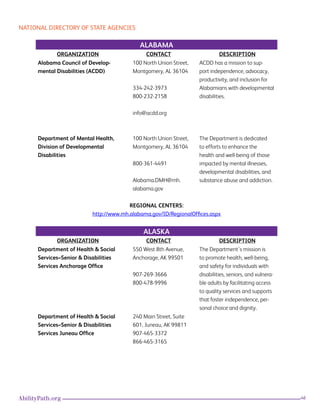
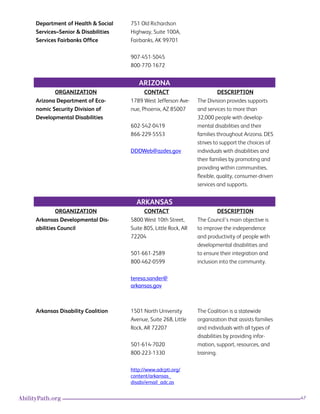
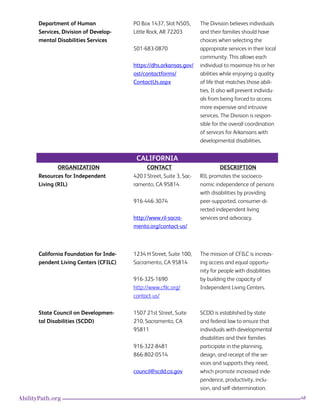
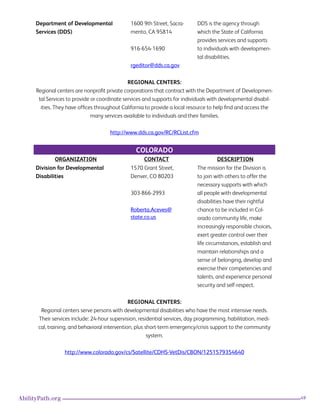
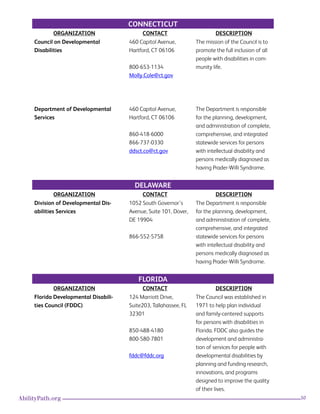
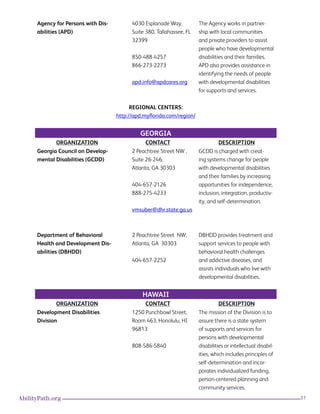
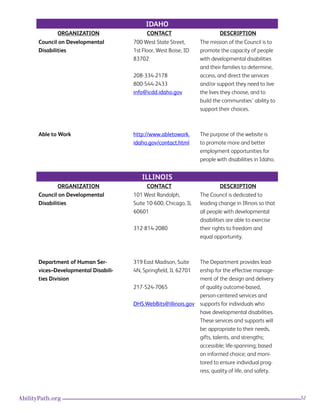
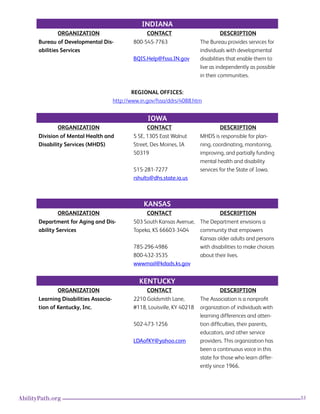
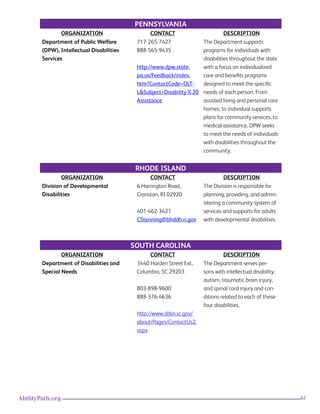
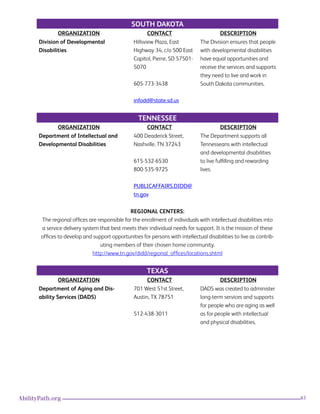
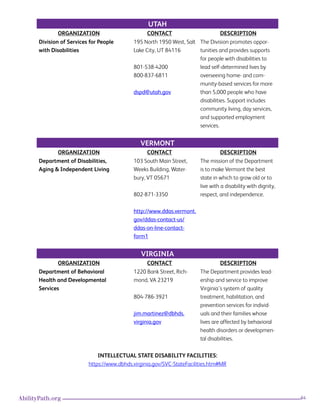
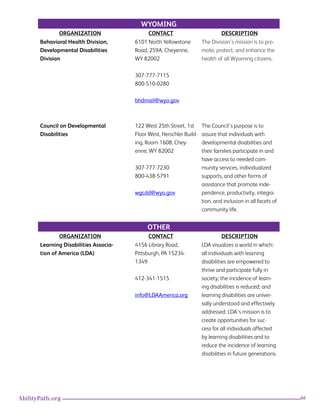
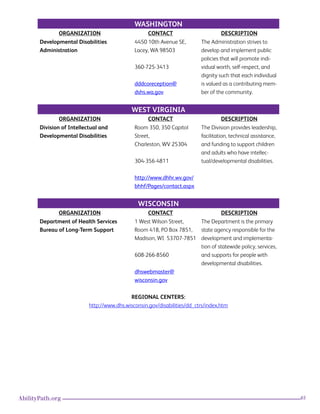
National Directory of State Agencies
Endnotes. .  .  .  .  .  .  .  .  .  .  .  .  .  .  .  .  .  .  .  .  .  .  .  .  .  .  .  .  .  .  .  .  .  .  .  .  .  .  .  .  .  .  .  .  .  .  .  .  .  .  .  .  .  .  .  .  .  .  .  .  .  .  .  .  .  .  .  .  .  .  .  .  .  .  .  .  .  .  .  .  . 78
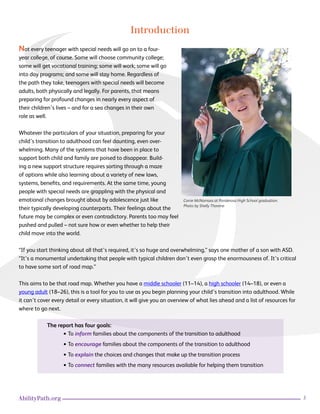
Ponderosa High School Principal Lisa Garret presents Corrie McNamara with her high school graduation certificate. Photo courtesy of The Mountain Democrat
1AbilityPath.org
Foreword
By Anthony Shriver
As a parent with two children in college, I know how challenging the transition to life after high school can be. There
are so many options, so many questions: Will my child go to college? Community college? Will he or she choose to
begin a career or work right out of high school? Or volunteer for a year or two? These are just some of the questions
we faced as a family when my children arrived at this life stage. It is exciting, frightening and can be overwhelming.
When your teenager or young adult has special needs, you
experience the same emotions most parents go through
when transitioning. However, those emotions are likely
heightened and the challenges can be greater. Most families
of children with special needs have an established routine, a
set system that works for their child and the rest of the fam-
ily. As the end of high school nears, this system will no longer
work beyond graduation. The family is faced with all the
same questions posed above but with additional concerns to
think about. What government aid is available, if any? Will
my child be able to work? Is my child ready for college? Are there programs that can help my child in college?
Can my child live on his or her own? How do I prepare financially for my child’s needs after high school?
This process can feel overwhelming, but you are not alone.
Throughout my life, I have worked to ease this process and transition for children with special needs. As the Chairman
and Founder of Best Buddies International, I strive to make sure that people with special needs receive all the same
opportunities and experiences as their peers. Whether it is through peer-to-peer friendships or job placements, I have
dedicated my life to equalizing the circumstances for people with special needs. Through this work, I know it can be
difficult to also prepare the family members for this life-altering transitional period.
Fortunately, there are several avenues of help for families going through this process. This step-by-step guide is a
wonderful resource to help you through this process. Within this “Journey to Life after High School” guide, you will find
a starting point; this guide will help you begin the process of planning for your child’s transition. It will not have all the
answers – no one document ever could – but it does give you a framework to begin: how to get organized, where to
seek aid, and what options might be available to you. In this guide you will find real life stories from families who are
probably no different than yours, and you will find encouragement from their solutions.
It is important that we help our children to live lives as full and rewarding as possible, while we continue to support
and help facilitate their choices. This is the time to allow them to own their lives to the best of their abilities. As a
parent, this is frightening – I’ve been through it. But after all is said and done, it is among the most rewarding aspects
of being a parent – watching your child learn to fly.
In Friendship,
Anthony K. Shriver
2AbilityPath.org
A Journey to College: Kim & Alexis
Alexis Wineman, a 19 year old with an autism spectrum disorder (ASD), is excited about her future. In the fall of
2013, she started college at the university attended by her neurotypical twin sister. Having spent the past year serving
as Miss Montana 2012 – the first Miss America contestant with autism – she has already discovered that she can do
things and go places far outside her comfort zone. Even so, she began the year with her share of precollege jitters.
How would she fare socially? How would she manage her time?
“I won’t have Mom and Dad to breathe down my neck and
remind me of things,” she says as she gets ready to leave for
school. “I have the most anxiety about the schoolwork itself and
keeping up with it, because along with my autism is a lot of short-
term memory problems.”
Kim Butterworth, Alexis’s mother, admits to being “a nervous
wreck” as her daughter gets ready for her new life. For a long time
she worried that Alexis, who has PDD-NOS,1
wouldn’t graduate
from high school. Now she has a host of new worries.
“I can see her being in a dorm room and not coming out of it
for a couple days – she just doesn’t realize how much time has
passed,” Kim says. While Alexis learned to advocate for herself
during her year as Miss Montana, she will have far more self-
advocacy to do as a college student.
“I’ve been her advocate,” Kim says. “I’ve been the one who tap
danced on desks to get her what she needed. And now she’s
going to have to do that herself.”
Still, Alexis and Kim agreed that they both underestimated Alexis’ abilities in the past, letting themselves be guided
by her worst moments rather than her best.
“Sometimes the parents see it from such a different perspective,” Kim says. “They see the meltdowns, the struggles.
But that’s not how those kids necessarily deal with the outside world. That’s how they act in a safe environment, not
how they act when they walk out that door.”
Alexis agrees. Forging her way to adulthood hasn’t been easy, and there are sure to be plenty more pitfalls along the
way. But she’s up for the challenge. “It can be scary, it can be frustrating, but life is like that. You can surprise your-
self,” she says. For children with special needs, she says, “The path isn’t there. Your job is to make it.”
1 As defined by the Diagnostic and Statistical Manual of Mental Disorders (DSM), PDD-NOS is the abbreviation of the diagnosis of pervasive
developmental disorder – not otherwise specified, which is considered an autism spectrum disorder (ASD). With the 2013 release of DSM-5, the
criteria set forth describing ASD were updated to be more consistent, creating one disorder – ASD – rather than the four branches that were
present in DSM-IV. For more information, see the American Psychiatric Association’s statement.
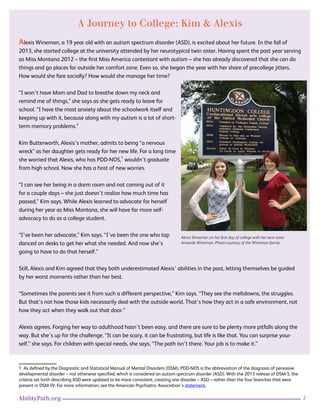
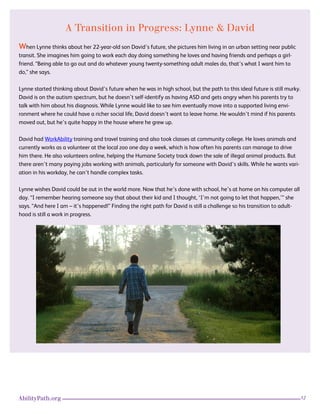
Alexis Wineman on her first day of college with her twin sister
Amanda Wineman. Photo courtesy of the Wineman family.
3AbilityPath.org
Introduction
Not every teenager with special needs will go on to a four-
year college, of course. Some will choose community college;
some will get vocational training; some will work; some will go
into day programs; and some will stay home. Regardless of
the path they take, teenagers with special needs will become
adults, both physically and legally. For parents, that means
preparing for profound changes in nearly every aspect of
their children’s lives – and for a sea changes in their own
role as well.
Whatever the particulars of your situation, preparing for your
child’s transition to adulthood can feel daunting, even over-
whelming. Many of the systems that have been in place to
support both child and family are poised to disappear. Build-
ing a new support structure requires sorting through a maze
of options while also learning about a variety of new laws,
systems, benefits, and requirements. At the same time, young
people with special needs are grappling with the physical and
emotional changes brought about by adolescence just like
their typically developing counterparts. Their feelings about the
future may be complex or even contradictory. Parents too may feel
pushed and pulled – not sure how or even whether to help their
child move into the world.
“If you start thinking about all that’s required, it’s so huge and overwhelming,” says one mother of a son with ASD.
“It’s a monumental undertaking that people with typical children don’t even grasp the enormousness of. It’s critical
to have some sort of road map.”
This aims to be that road map. Whether you have a middle schooler (11–14), a high schooler (14–18), or even a
young adult (18–26), this is a tool for you to use as you begin planning your child’s transition into adulthood. While
it can’t cover every detail or every situation, it will give you an overview of what lies ahead and a list of resources for
where to go next.
The report has four goals:
• To inform families about the components of the transition to adulthood
• To encourage families about the components of the transition to adulthood
• To explain the choices and changes that make up the transition process
• To connect families with the many resources available for helping them transition
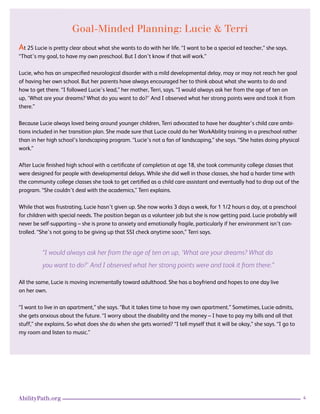
Corrie McNamara at Ponderosa High School graduation.
Photo by Shelly Thorene
4AbilityPath.org
Goal-Minded Planning: Lucie & Terri
At 25 Lucie is pretty clear about what she wants to do with her life. “I want to be a special ed teacher,” she says.
“That’s my goal, to have my own preschool. But I don’t know if that will work.”
Lucie, who has an unspecified neurological disorder with a mild developmental delay, may or may not reach her goal
of having her own school. But her parents have always encouraged her to think about what she wants to do and
how to get there. “I followed Lucie’s lead,” her mother, Terri, says. “I would always ask her from the age of ten on
up, ‘What are your dreams? What do you want to do?’ And I observed what her strong points were and took it from
there.”
Because Lucie always loved being around younger children, Terri advocated to have her daughter’s child care ambi-
tions included in her transition plan. She made sure that Lucie could do her WorkAbility training in a preschool rather
than in her high school’s landscaping program. “Lucie’s not a fan of landscaping,” she says. “She hates doing physical
work.”
After Lucie finished high school with a certificate of completion at age 18, she took community college classes that
were designed for people with developmental delays. While she did well in those classes, she had a harder time with
the community college classes she took to get certified as a child care assistant and eventually had to drop out of the
program. “She couldn’t deal with the academics,” Terri explains.
While that was frustrating, Lucie hasn’t given up. She now works 3 days a week, for 1 1/2 hours a day, at a preschool
for children with special needs. The position began as a volunteer job but she is now getting paid. Lucie probably will
never be self-supporting – she is prone to anxiety and emotionally fragile, particularly if her environment isn’t con-
trolled. “She’s not going to be giving up that SSI check anytime soon,” Terri says.
“I would always ask her from the age of ten on up, ‘What are your dreams? What do
you want to do?’ And I observed what her strong points were and took it from there.”
All the same, Lucie is moving incrementally toward adulthood. She has a boyfriend and hopes to one day live
on her own.
“I want to live in an apartment,” she says. “But it takes time to have my own apartment.” Sometimes, Lucie admits,
she gets anxious about the future. “I worry about the disability and the money – I have to pay my bills and all that
stuff,” she explains. So what does she do when she gets worried? “I tell myself that it will be okay,” she says. “I go to
my room and listen to music.”
5AbilityPath.org
Getting Started
Preparation for the Journey
Looking ahead, it might seem overwhelming to already begin
thinking about your child’s transition from high school to adult-
hood. After all, he or she just started middle school. It is important
to remember, though, that the years will go by quickly. Once your
child starts high school, you will need to work with the school sys-
tem to schedule meetings to plan your child’s education program
and future. Those years are not that far ahead. That is why it is
best to get ahead and take advantage of these middle school
years to learn as much as possible.
In an ideal world, every family would begin the discussions about
self-advocacy and person-centered planning while their children
are still in middle school or earlier, but the important thing is to
start planning sometime; even if you do not begin planning until
your child is in high school. This doesn’t mean that you plan for
your child, but that you plan with your child, helping them think
about the best options for their future. Transition planning isn’t
a one-shot deal; it’s a process that will continue long after your
child is officially an adult. The most important thing is not to get
discouraged. This may seem like a daunting process, but it is more
than doable, and this guide will help!
SELF-ADVOCACY
Up until this point in your child’s life, you have made all the
decisions for them. You were the one advocating on their behalf,
making sure your child’s best interests were always met. Now that
he or she has reached middle school, though, your student may be
capable of also advocating on his or her behalf. It is important to
teach your child how to advocate for themselves so that after the
transition they can voice their concerns and so that you can see
what their abilities truly are.
Throughout the transition process keep your child involved as
much as possible with the decision-making. A great place to start
is sitting them down to have a conversation about what they want
for their future. While asking them questions about where they see
themselves in five or ten years, teach them to continue to voice
these desires.
STAYING
ORGANIZED
There’s no way around it, the
transition process generates stacks
of paperwork. You’ll save your-
self a good measure of time and
frustration if you have a system for
organizing both your electronic and your paper files.
Some people find it works best to put information in
binders. Others prefer to use hanging folders, perhaps
in a portable file box so you can easily carry the files
to meetings. Some people prefer to print out every
electronic document so they have a paper record.
Others prefer to scan every paper document so they
have an electronic record. It doesn’t matter what
system you use, as long as you have a consistent
method for keeping track of the documents. A good
organizational system will allow you to use your time
checking things off your list, rather than searching
for documents or trying to recall what you’ve
already done.
Remember to keep your computer files as well orga-
nized as your paper ones. To avoid having to search
your hard drive every time you need to find some-
thing, create some electronic folders in advance, and
make it a habit to put your electronic documents in
them as you go.
You can create email folders as well. These will
help you keep track of correspondence with various
agencies and programs. Whatever email program you
use, make it a habit to save copies of both the emails
you’ve sent and the ones you’ve received into the
appropriate folder so that you have records of what
you’ve been told. Create folders for your bookmarks
or favorites too, so that you can easily find the web-
sites on which you’ve found useful information.
Finally, make sure to have a system for backing up
your data on a regular basis. A hard drive failure can
cause months of hard work to vanish. One strategy
is to manually back up your data onto two external
thumb drives, keeping one in the house and another
in your purse or car. You can also back up onto
cloud-based systems like Google Drive so that you
can access documents from anywhere, even if you’re
not on your home computer. And there are many
low-cost services that will back up your computer
automatically every night so you don’t have to
remember to do so.
6AbilityPath.org
What is self-advocacy?
According to Dr. Valerie Paradiz from the School for Autistic Strength, Purpose and Independence in Education,
self-advocacy is a lifelong endeavor.1 Self-advocacy comes down to six key components: 2
1. Understanding your disability and being able to explain your disability either through words,
pictures, or gestures
2. Knowing your rights that are protected by law
3. Speaking up for yourself and your interests
4. Asking for what you need in order to live day-to-day
5. Negotiating on your own behalf so that your needs and wants are met
6. Utilizing the resources that are available to you
“Parents are the one constant in a disabled child’s life. Parents can set an example and promote
positive attitudes for their disabled child regarding school and the need for an education. They can
advocate for the continuity of services for their child between school and adult services. In many
ways, the parent has the most to gain or lose when it comes to the progress their disabled child is
able to make concerning academic, social and vocational skills.”
There is clear overlap in these areas, but that is because they are all needed in order for an individual to advocate for
him or herself. It may seem difficult to teach your child to advocate for themselves, especially in the same way that
you currently advocate for them. Remember, though, that you do not need to teach him or her everything at once.
Self-advocacy can begin with small tasks, like allowing your child to decide what time they want to wake up in the
morning or what they want to eat for breakfast. Starting with these small steps allows you to build upon the founda-
tion and building blocks that you will continuously put into place. Eventually you will have a child that is confident in
themselves, their wants and needs in life. And if your child can’t get that far, you have learned to what extent your
child can self-advocate and what level of freedom he or she can have in life.
—James F. Austin,
“The Role of Parents as Advocates for the Transition Rights of Their Disabled Youth”
7AbilityPath.org
PERSON-CENTERED PLANNING
Part of the self-advocacy process is person-centered planning. It helps people with special needs shape their lives. For
these young adults, it allows them to think about what is important to them, like their hopes for the future. While also
learning about and discussing their lives, they get the opportunity to learn from the people closest to them about how
to best approach their goals and reach them. The process allows you and your child to have focused discussions about
both the details of everyday life and the large-scale dreams and values that make life meaningful and satisfying.
Ideally, person-centered planning is a facilitated process involving the people your child trusts and feels closest to.
This means not just you and your spouse but also close friends, relatives, aides, teachers, or other professionals with a
strong interest in your child’s well-being.
“The process helps them paint the picture of who they are, with the majority of the data coming from them, not their
family or their case managers,” explains Eli Poblitz, transition specialist at the San Mateo Union High School District
in California. “Once the student starts realizing who they are then I can start painting the picture of how the world
connects to them.”
Person-centered planning is a chance for your child to discuss things like:
• Where he or she hopes to live
• How he or she wants to spend their days
• Who he or she wants to spend their time with
• If he or she wants to go to college
• What type of job they see themselves having
• What his or her hobbies and passions are
Each of these questions will lead to more questions as you and your child discuss what he or she wants the future to
be like, what steps are necessary to get there, and what support he or she will need in order to take those steps. The
process will include a discussion of what your child does well and what they need help with. These factors will help you
develop a plan for achieving your child’s goals.
At these early stages of person-centered planning, it is important to remind yourself that your child may still be
thinking as am adolescent and not in the long-term as adults do. If you ask them where they want to live in five years,
they may say home. If you ask them what their passions are, they may say video games and the newest hot show
on television. Such answers should not discourage you. It is likely that many of their typically developing peers would
share similar answers.
It would be helpful to make these at least yearly discussions. When having these talks, provide your child with a work
sheet to map out these answers. If he or she has difficulty writing, they can dictate the answers to you and you can
write them down. If he or she would prefer drawing their plan, let them. The goal is to get them thinking about where
they see their life going. While you are doing this, remind your child that they are not going to be held to these deci-
sions and that they can change their mind at any time about what is most important to them and what they want for
their future. By having your student create a physical copy of these thoughts and ideas, it provides a starting point for
the following year and can show how he or she has grown and changed over time.
8AbilityPath.org
KNOW YOUR CHILD’S RIGHTS
In order to make sure you get the most out of the assistance granted to your child, you need to know the federal laws
that protect your child and give them certain rights. The school system may not always be helpful in explaining to you
what your child’s rights are so you should take it upon yourself to learn them. It will also be important to teach your
child these in order to help them fully understand the self-advocacy process.
Over the years, the US federal government has enacted several laws that grant rights to individuals with special needs
that include a free and appropriate education and a lack of discrimination in the workplace. Four of these laws critical
for families planning the transition to adulthood are described below:
1. Section 504 of the Rehabilitation Act of 1973
2. The Americans with Disabilities Act of 1990
3. The Individuals with Disabilities Education Improvement Act of 2004
4. The Carl D. Perkins Vocational and Technical Education Act of 2006
Section 504 of the Rehabilitation Act of 1973
• The Rehabilitation Act of 1973 was signed into law by President Richard Nixon.
• This act protects individuals from discrimination based on their disability.
• This was the first law of its kind to protect the rights of people with special needs.
• It applies to any program, organization, or employer that receives financial assistance from ANY federal
department or agency.
• It also extends to any local education agency, vocational education system, or school system.
• Section 504 of the Rehabilitation Act establishes Free Appropriate Public Education (FAPE):
◊ This provision requires school districts to provide FAPE to any “qualified person with a disability who
is in the school district’s jurisdiction, regardless of the nature or severity of the person’s disability.” 3
• Who is entitled to FAPE?
◊ All school-age children with special needs as defined by Section 504 and the Individuals with
Disabilities Education Act (IDEA)
• What is an “appropriate education”?
◊ Education services must be designed to meet the education needs of a student with a disability as
adequately as they are designed to meet the education needs of a non special needs student.
◊ The evaluation of proper placement procedures to protect against the misclassification and incorrect
placement of students
◊ Continuous and periodic reevaluation of students who receive special education and related services to 		
ensure the placement meets their needs
• Ability of parents and guardians to review their child’s records, receive required notices, and challenge the
identification, evaluation, and placement decisions in regard to their child.4
• FAPE also states that students with special needs must be placed in the same education settings as students
without special needs as frequently as possible and as frequently as appropriate to the individual education
needs of the special needs student.
• Students with special needs must receive specialized education services and support free of charge, just as a
non special needs student would.
9AbilityPath.org
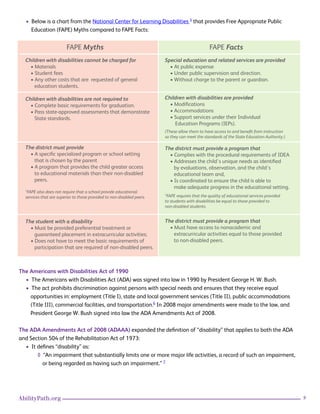
• Below is a chart from the National Center for Learning Disabilities 5
that provides Free Appropriate Public
Education (FAPE) Myths compared to FAPE Facts:
The Americans with Disabilities Act of 1990
• The Americans with Disabilities Act (ADA) was signed into law in 1990 by President George H. W. Bush.
• The act prohibits discrimination against persons with special needs and ensures that they receive equal
opportunities in: employment (Title I), state and local government services (Title II), public accommodations
(Title III), commercial facilities, and transportation.6
In 2008 major amendments were made to the law, and
President George W. Bush signed into law the ADA Amendments Act of 2008.
The ADA Amendments Act of 2008 (ADAAA) expanded the definition of “disability” that applies to both the ADA
and Section 504 of the Rehabilitation Act of 1973:
• It defines “disability” as:
◊ “An impairment that substantially limits one or more major life activities, a record of such an impairment,
or being regarded as having such an impairment.” 7
FAPE Myths
Special education and related services are provided
• At public expense
• Under public supervision and direction.
• Without charge to the parent or guardian.
Children with disabilities are provided
• Modifications
• Accommodations
• Support services under their Individual
Education Programs (IEPs).
(These allow them to have access to and benefit from instruction
so they can meet the standards of the State Education Authority.)
The district must provide a program that
• Complies with the procedural requirements of IDEA
• Addresses the child's unique needs as identified
by evaluations, observation, and the child's
educational team and,
• Is coordinated to ensure the child is able to
make adequate progress in the educational setting.
*FAPE requires that the quality of educational services provided
to students with disabilities be equal to those provided to
non-disabled students.
The district must provide a program that
• Must have access to nonacademic and
extracurricular activities equal to those provided
to non-disabled peers.
Children with disabilities cannot be charged for
• Materials
• Student fees
• Any other costs that are requested of general
education students.
Children with disabilities are not required to
• Complete basic requirements for graduation.
• Pass state-approved assessments that demonstrate
State standards.
The district must provide
• A specific specialized program or school setting
that is chosen by the parent
• A program that provides the child greater access
to educational materials than their non-disabled
peers.
*FAPE also does not require that a school provide educational
services that are superior to those provided to non-disabled peers.
The student with a disability
• Must be provided preferential treatment or
guaranteed placement in extracurricular activities;
• Does not have to meet the basic requirements of
participation that are required of non-disabled peers.
FAPE Facts
10AbilityPath.org
• The ADAAA broadened the definition of “major life activities” to include “major bodily functions:”
◊ Major life activities include but are not limited to “caring for oneself, performing manual tasks, seeing,
hearing, eating, sleeping, walking, standing, lifting, bending, speaking, breathing, learning, reading,
concentrating, thinking, communicating, and working.” 8
◊ Major bodily functions include but are not limited to “functions of the immune system, normal cell growth,
digestive, bowel, bladder, neurological, brain, respiratory, circulatory, endocrine, and reproductive functions.” 9
• While the ADAAA rejects the US Supreme Court’s definition of “substantially limits,” it does not provide a
new definition.
• The ADAAA also provides rights for individuals with special needs who are not eligible for accommodations in
school under IDEA:
◊ These accommodations are the same as those set forth in Section 504 of the Rehabilitation Act of 1973.
The Individuals with Disabilities Education Improvement Act of 2004
• The Individuals with Disabilities Education Act (IDEA) was signed into law in 1990 by President George
H. W. Bush.
• In 2004, the law was amended and reauthorized as the Individuals with Disabilities Education Improvement Act
of 2004 (IDEIA) by President George W. Bush.
• A child with a disability is defined by the IDEA as:
◊ General: “with intellectual disabilities, hearing impairments (including deafness), speech or language
impairments, visual impairments (including blindness), serious emotional disturbance (referred to in this
chapter as “emotional disturbance”), orthopedic impairments, autism, traumatic brain injury, other health
impairments, or specific learning disabilities; and who, by reason thereof, needs special education and
related services.” 10
• It requires public schools to create an Individualized Education Plan (IEP) for each student each year until the
student is 22 years old, regardless of whether the student is enrolled in postsecondary education.
◊ The IEP will be covered in greater detail on page 15 of this guide. In brief, it: 11
· Is a written statement of the uniquely designed education program to meet a child’s specific needs
· States the services the school will provide for your child and the reasonable annual learning goals
for your child
11AbilityPath.org
Includes your child’s current academic performance and levels
· Says how your child’s success and growth toward annual goals will be measured
· Explains how your child will participate in assessments – both statewide and district-wide – and
the accommodations he or she will receive.
◊ Members of your child’s IEP team include:
· The parents of the child
· Not less than one regular education teacher of the child (if the child is, or may be, participating in
the regular education environment)
· Not less than one special education teacher of the child, or where appropriate, not less than one
special education provider of the child
· A representative of the public agency (who has certain specific knowledge and qualifications)
· An individual who can interpret the instructional implications of evaluation results and who may also 	
be one of the other listed members
· At the discretion of the parent or the agency, other individuals who have knowledge or special
expertise regarding the child, including related services personnel as appropriate
· Whenever appropriate, the child with a disability. 12
◊ The law requires that the IEP team begin no later than age 14 to address the student’s need for instruction 	 	
that will assist him or her in preparing for transition. Beginning at age 16 (or younger, if determined
appropriate by the IEP team), the IEP must contain a statement of needed transition services for the student, 	
including, if appropriate, a statement of interagency responsibilities.13
◊ These rights are protected if your child transfers to a new school in the same state OR if your child transfers to	
a new school in a different state.
· For these regulations and rights, see numbers 8 through 10 on the US Department of Education’s 		
website.
◊ It must be reviewed at least annually to see if your child is meeting the goals set forth and readjust if
necessary.
• This is just a brief overview of what your child is entitled to. For a more in-depth look at what this law grants
your child, visit the US Department of Education’s website. It provides a step-by-step list of the special education	
process and the ten topics that an IEP must include.
The Carl D. Perkins Vocational and Technical Education Act
• The Carl D. Perkins Vocational and Technical Education Act was signed into law in 2006 by President
George W. Bush.
• This law states that individuals with special needs must be provided equal access to a vocational education.
• The funds made available through this law can be used to pay for the vocational education services laid forth in 		
an IEP that was developed in accordance with IDEA.
12AbilityPath.org
A Transition in Progress: Lynne & David
When Lynne thinks about her 22-year-old son David’s future, she pictures him living in an urban setting near public
transit. She imagines him going to work each day doing something he loves and having friends and perhaps a girl-
friend. “Being able to go out and do whatever young twenty-something adult males do, that’s what I want him to
do,” she says.
Lynne started thinking about David’s future when he was in high school, but the path to this ideal future is still murky.
David is on the autism spectrum, but he doesn’t self-identify as having ASD and gets angry when his parents try to
talk with him about his diagnosis. While Lynne would like to see him eventually move into a supported living envi-
ronment where he could have a richer social life, David doesn’t want to leave home. He wouldn’t mind if his parents
moved out, but he’s quite happy in the house where he grew up.
David had WorkAbility training and travel training and also took classes at community college. He loves animals and
currently works as a volunteer at the local zoo one day a week, which is how often his parents can manage to drive
him there. He also volunteers online, helping the Humane Society track down the sale of illegal animal products. But
there aren’t many paying jobs working with animals, particularly for someone with David’s skills. While he wants vari-
ation in his workday, he can’t handle complex tasks.
Lynne wishes David could be out in the world more. Now that he’s done with school, he’s at home on his computer all
day. “I remember hearing someone say that about their kid and I thought, ‘I’m not going to let that happen,’” she
says. “And here I am – it’s happened!” Finding the right path for David is still a challenge so his transition to adult-
hood is still a work in progress.
13AbilityPath.org
The High School Years
In the Beginning
Now that your child is in high school, you will need to start meeting annually with the school to create your child’s
Individualized Education Plan (IEP). You may have already begun the IEP process earlier in your child’s life; however,
a high school IEP is a little different. Children are encouraged to participate in their own IEP at the high school stage.
If possible, you should include your child in this process. The highs school level IEP should happen once your child
turns 14. If they are capable of attending, they should be part of the discussion and planning of their education and
goals for the year. Once he or she turns 16, the IEP needs to include transition steps to help them prepare for life after
high school. This means talking about whether they will be going on to receive a postsecondary education or if they
will be finding a job or enrolling in a day program. Through these decisions, the school is required to help you explore
colleges, locate jobs, and find day programs for your child. As you explore these options, it is important to know most
colleges and universities require students to have at least a standard diploma in order to attend. If your child wants to
go to college, it is important to find out what types of diplomas are available at their school.
With so many different areas needing to be covered in the IEP, the background research conducted during your
child’s middle school years is important. It will help alleviate the stress that is sure to come with the first high school
IEP. By going into this first meeting knowing what your child’s rights are and what the school needs to help you with,
you will be able to get more information from the school and create a constructive and beneficial IEP.
SIX SIMPLE THINGS YOU CAN DO
Transition is such a huge and overwhelming topic that it can be hard to know where to start, especially when your life
is already so full. Here are six things you can do right now to begin the process:
1. Take stock of how much you already know. Look back on the early years, before your child’s diagnosis or
immediately afterward. There was so much you didn’t know about your child’s disability and so much you
didn’t know about your child’s capabilities. You’ve learned a lot since then and that knowledge is going to serve
you well now, as you and your child move into the next stage together. Nobody is better equipped to help your
child transition than you are. To help ease the stress of what you think you don’t know, make a list of what you
already know. Once you see how much you’ve learned, you will know that you can tackle these new tasks. “Find
some peace and contentment in the fact that you’ve done a good job so far,” Dr. Robert Naseef, author of Spe-
cial Children, Challenged Parents: The Struggles and Rewards of Raising a Child with a Disability, advises.
2. Face your fears. Anxiety can be paralyzing. But it can also be informative. Naming your fears will help you
understand both your bottom line and your priorities. If your biggest fears revolve around your child’s medical
condition, you know that transitioning their medical providers and medical benefits are first-order priorities –
the rest can wait. If your biggest fears revolve around your child being bored and isolated after high school,
then your first priority may be to focus on employment, education, or day programs.
14AbilityPath.org
3. Establish your priorities. You can’t do everything at once. Use a list and a timeline to help you choose a small
number of first-order tasks, questions, or issues. “Start with something small,” advises Mary Anne Ehlert, CFP,
whose company, Protected Tomorrows, helps families navigate transition and future planning. “Choose one
thing. Write it down and set a deadline. If you think of all the things you’ve got to do, you’ll never do it. Just
take it one step at a time.”
4. Start talking. Having casual conversations about transition with your child and other members of the family
will help normalize the topic and get everyone thinking about options. You might say to your child, “I’ve been
thinking about what life is going to be like when you’re an adult. What do you think it will be like?” “Anything
out of the ordinary, we always talk about,” says Mary Pilster, the mother of a young man with autism, “because
with autism, it’s important to give them a heads-up of what’s coming.”
5. Find a mentor. There’s no reason to reinvent the wheel. Reach out to a family in your disability community
who has gone through transition and talk to them about their experience. One good place to find mentors is
through Parent to Parent. “Always find someone who has been through it or is going through it now to mentor
you through,” says Teresa Jurado, who was a parent resource coordinator at Gatepath for many years. “There’s
nothing like sitting face-to-face with someone who can say, ‘I did this and this is what happened.’”
6. Work with other families. You don’t have to go it alone. Parents who work together can divide up tasks, share
information, and advocate as a group. They can also give each other breaks as needed and – most importantly
– devise new solutions. Dr. Naseef has seen families work together to create innovative answers for their chil-
dren when the existing options weren’t working. One group of families pooled their money to buy a franchise so
that their children with developmental delays would have a place to work; a typically developing sibling with an
interest in business is managing it. Others are setting up group living arrangements for their children or creating
carpools and social groups. “There’s power in community,” Dr. Naseef says.
15AbilityPath.org
A SUCCESSFUL INDIVIDUALIZED EDUCATION PROGRAM (IEP)
While we covered the content of an IEP above, for many the process of creating the first IEP for a student begins as
early as middle school. Some of you may have begun this process at an earlier age. However, here we lay out the steps
that a family should plan on taking as they embark on the IEP process in preparation for life after high school.
“A student-centered approach means finding out the student’s interests, their hobbies, and their skills and how they
spend their time,” explains transition specialist Eli Poblitz. “It’s asking the student what they want to do. Sometimes
they have no idea and we have to give them an idea how the world connects to them.”
First, know that you are not the only parent unsure of what to expect and ask during your child’s first IEP. Since
preparing for an IEP seems daunting, many organizations have already stepped up to create guides to assist you with
the process. Rather than creating yet another list of what to do and what not to do, we searched through the other
lists and are providing you with their best advice, and letting you know where you can find even more information
about the IEP. After all, it is impossible to be over-prepared for these meetings.
Before the Meeting 14
• Plan ahead: Write down the questions and thoughts you have about the IEP. This will help you remember what-
came across your mind during your research. It is natural for questions and concerns to slip your mind, espe-
cially since you are likely to be provided with so much information. By writing down what is important to you
and your child, you are making sure these topics will be addressed during the conversation.
• Get to know your child’s teachers: There are several people included in the IEP. A couple of these people will
be your child’s teachers. Make sure you get to know them before the meeting. You can talk to them about what
you and your child want for his or her future, and the teacher can weigh in on what she thinks is best for your
child. It will also make you more comfortable in the meeting if you know someone there. The teacher will also
be more likely to advocate for your concerns and what you and your child want if you have established a per-
sonal relationship with them. The teacher will know what you want as a parent and understand more how your
mind works. This relationship can also be built with your child’s school principal or school psychologist.
• Review the materials: If this isn’t your first IEP, review last year’s IEP so you can remember what was discussed
and what the goals were. This will allow you to see how your child has progressed toward these goals and what
needs to be adjusted. As a parent, you also should be sent a document of your rights and responsibilities annu-
ally. If you have not received this, make sure to reach out for it. When you do receive it, read it over so that you
understand what you are entitled to as a parent, as well as your responsibilities.
During the Meeting
• You are an important part of the team: As the parent, you are allowed to be part of the IEP by law. You also
know your child better than anyone else at the meeting. While you may not have the professional experience
that your child’s teachers and school officials have, you have the personal experience. Do not feel like this
makes your voice and opinion any less important.
16AbilityPath.org
• Bring a support system: Your child’s other parent can also attend the meetings. It is important that you are
both part of the decision-making process. You can also provide a support system for each other, making you
feel more comfortable at the meeting. You both know what you want for your child and can ease each other’s
worries. Make sure you both know what you want to accomplish at the meeting so that you can work together
as a team for what is in your child’s best interest.
• Bring your child: More than anything, this meeting is about your child. While he or she has told you what they
want from their education and what they wants for their future, it is important to allow them to voice these
desires. The law states that your child needs to be included, if possible, during these talks. By bringing him or her
to the meetings, they will not only be able to advocate for themselves, but they will also learn what the goals
are for their education that year. Give your child the chance to speak for him or herself so that their confidence
can grow and so that the other members of the team can see that this is also what they want.
• Ask questions: You aren’t expected to know everything going into this meeting. There are sure to be terms or
facts stated that you haven’t heard before. When this happens, don’t be afraid to ask the others to clarify and
explain what they mean. You may be afraid that asking such questions will make the professionals think you
don’t fully understand your child’s disability. This is not the case. It will show them that you are invested in
doing what is best for your child and want to understand as much as possible when it comes to bettering your
child’s life.
• The key to success is compromise: While you know what your child wants and what works best for him or her,
the school officials and professionals also know what works best overall in the school environment. They will cite
facts and statistics to prove their points while you cite experiences from your child’s life to prove your points.
What is best for your child is to try all angles. These professionals work with your child on a daily basis in the
classroom. They see the larger picture of what the best options are. In order to make sure the goals you want
reached in the year are met, you may need to let the professionals try their own tactics.
• Look at the big picture: You and your child are there to voice what you want to happen in the next year and
what your child wants to do after high school. It is the job of the professionals to make a work plan to achieve
these goals. Focus on the framework and the outcome, and let the professionals develop the strategies for how
to arrive there.
• Sign the show attendance: You may not want to sign off saying you agree to the IEP yet, but it is important
to sign off saying you attended the meeting. This will put it on record that you were there and part of the
discussion.
After the Meeting
• Review the IEP: Ask for a copy of the IEP that has been developed. Take it home and read over what was
decided. Your signature is needed in order for the plan to be set in motion. If you are uncertain of specific
areas or want to review what is decided before signing off, let them know. It is good to review the material so
that you can make sure you didn’t miss anything and that you are okay with all the decisions. If you have any
concerns about what is written in the plan, write a letter describing these concerns. Return these concerns and
the unsigned IEP to the school so that an open discussion can be continued. You are allowed to ask for another
meeting to discuss these concerns.
17AbilityPath.org
• Discuss the meeting with your child: Even if your child did attend, you want to sit down with him or her and
explain what was decided. If there were terms or ideas you did not understand, then there are sure to be parts
that they did not understand. Since the IEP is all about them, they need to know what the goals are and what
they will be doing during the next academic year.
• Mark your calendar: During the meeting, you should have set markers for reports on your child. Make sure you
have a calendar and can write down when you should be receiving these reports on your child’s progress. This
allows you to make sure the school is keeping you in the loop and letting you know about her or his progress.
• Put in safekeeping: Whether you keep a filing cabinet with all of your child’s documents or an electronic copy
of everything, file away the IEP some place safe. This will be helpful when you are looking to review it before
next year’s IEP and in case you ever want to review it during the year.
Ten Common Mistakes
When preparing and going through the IEP, there is so much to remember. While it is likely that you will forget to ask
a specific question in mind, you can always contact the professionals afterward for clarification. In the meeting, how-
ever, there are topics and areas you want to make sure are addressed. Below is a list compiled by the Texas School for
the Blind and Visually Impaired of ten common mistakes that you want to avoid:
1. Believing the professionals are the only experts
2. Not making requests in writing
3. Being unfamiliar with the prior notice section of the procedural safeguards
4. Requesting a related service rather than an assessment
5. Accepting assessment results that do not recommend services you think your child needs
6. Allowing assessment information to be presented for the first time at the IEP
7. Accepting goals and objectives that cannot be measured
8. Allowing placement decisions to be made before IEP goals and objectives are written
9. Allowing your child’s IEP meeting to be rushed
10. Not asking questions
To learn more about these mistakes in depth, read the School’s article. It is important to note that if your school does
not have a program that works for your child, most schools will work with you develop a customized program. Be sure
to ask about this option.
Nearing Graduation
When your child enters her or his junior and senior years of high school, it is officially time to start thinking about
post-graduation. Like their peers, including those who are typically developing, the prospect of college comes into the
picture. For the most part, colleges and universities require students to have at least a standard diploma in order to
attend. If your child wants to go to college, it is important to find out what types of diplomas are available at their
school.
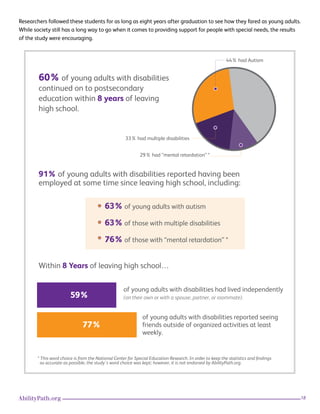
In 2011 the National Center for Special Education Research issued a report, “The Post-High School Outcomes of
Young Adults With Disabilities up to 8 Years After High School,” which looked at a nationally representative sample
of secondary school students with special needs who were receiving special education services in grade 7 or above.
18AbilityPath.org
Researchers followed these students for as long as eight years after graduation to see how they fared as young adults.
While society still has a long way to go when it comes to providing support for people with special needs, the results
of the study were encouraging.
60% of young adults with disabilities
continued on to postsecondary
education within 8 years of leaving
high school.
44% had Autism
33% had multiple disabilities
29% had “mental retardation” *
of young adults with disabilities had lived independently
(on their own or with a spouse, partner, or roommate).
of young adults with disabilities reported seeing
friends outside of organized activities at least
weekly.
Within 8 Years of leaving high school…
91% of young adults with disabilities reported having been
employed at some time since leaving high school, including:
77%
63% of young adults with autism
63% of those with multiple disabilities
76% of those with “mental retardation” *
59%
* This word choice is from the National Center for Special Education Research. In order to keep the statistics and findings
as accurate as possible, the study's word choice was kept; however, it is not endorsed by AbilityPath.org.
19AbilityPath.org
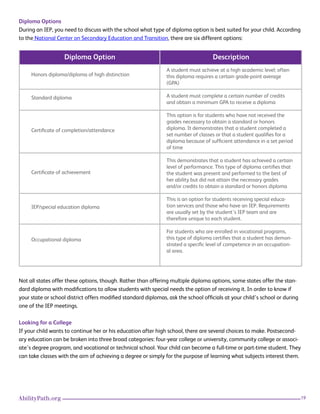
Diploma Options
During an IEP, you need to discuss with the school what type of diploma option is best suited for your child. According
to the National Center on Secondary Education and Transition, there are six different options:
Not all states offer these options, though. Rather than offering multiple diploma options, some states offer the stan-
dard diploma with modifications to allow students with special needs the option of receiving it. In order to know if
your state or school district offers modified standard diplomas, ask the school officials at your child’s school or during
one of the IEP meetings.
Looking for a College
If your child wants to continue her or his education after high school, there are several choices to make. Postsecond-
ary education can be broken into three broad categories: four-year college or university, community college or associ-
ate’s degree program, and vocational or technical school. Your child can become a full-time or part-time student. They
can take classes with the aim of achieving a degree or simply for the purpose of learning what subjects interest them.
Diploma Option Description
A student must achieve at a high academic level; often
this diploma requires a certain grade-point average
(GPA)
A student must complete a certain number of credits
and obtain a minimum GPA to receive a diploma
This option is for students who have not received the
grades necessary to obtain a standard or honors
diploma. It demonstrates that a student completed a
set number of classes or that a student qualifies for a
diploma because of sufficient attendance in a set period
of time
This demonstrates that a student has achieved a certain
level of performance. This type of diploma certifies that
the student was present and performed to the best of
her ability but did not attain the necessary grades
and/or credits to obtain a standard or honors diploma
This is an option for students receiving special educa-
tion services and those who have an IEP. Requirements
are usually set by the student’s IEP team and are
therefore unique to each student.
For students who are enrolled in vocational programs,
this type of diploma certifies that a student has demon-
strated a specific level of competence in an occupation-
al area.
Honors diploma/diploma of high distinction
Standard diploma
Certificate of completion/attendance
Certificate of achievement
IEP/special education diploma
Occupational diploma
20AbilityPath.org
According to the US Department of Education’s Office of
Civil Rights, postsecondary educational institutions are not
required to provide free appropriate public education the
way elementary and high schools are. Instead, they are
required to provide appropriate academic adjustments to
ensure that they don’t discriminate on the basis of disabil-
ity. These adjustments might include extended time for
assignments and tests, providing note takers or readers,
assistive technology, preferential seating, or use of a calcu-
lator. Schools must also provide convenient and accessible
housing to special needs students if they provide housing to
non special needs students.
Most universities and colleges have a disability services
office that is responsible for complying with the ADA and
Section 504. When visiting prospective colleges, it will be
important to make an appointment to visit this office. As
a college student, your child will have to advocate for him
or herself in order to get the support and accommodations
they need. Visiting the disability services office with a list of
questions will be an important first step.
“People have been very accepting,” says Mary Pilster, whose
son Bobby has ASD and is now a student at San Francisco
State University. She and Bobby met with the disability
counselor when he started at community college and again
when he transferred to a four-year university. In both cases,
they showed the counselor Bobby’s IEP and talked about
what accommodations he might need, including more time
for tests. “Don’t sign off saying that you don’t need your
IEP during junior or senior year of high school,” she advises.
“It’s hard to get it back if you need it for college.”
Here is a list of questions incoming students might want to
ask when they visit a college disability services office: 15
1. What is the procedure for students to identify themselves and their disability if they want to
receive accommodations? What documentation is required?
2. Are students required to be a full-time? If not, will this affect financial aid and the ability to live in the
residence halls?
3. What experience does the college have in serving individuals with your child’s disability?
4. How many students use the disability office’s services?
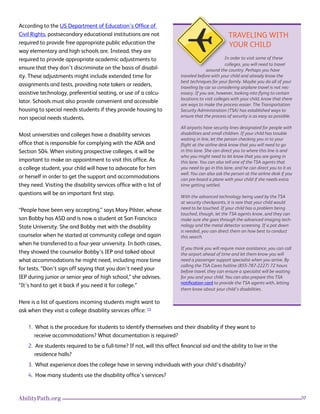
TRAVELING WITH
YOUR CHILD
In order to visit some of these
colleges, you will need to travel
around the country. Perhaps you have
traveled before with your child and already know the
best techniques for your family. Maybe you do all of your
traveling by car so considering airplane travel is not nec-
essary. If you are, however, looking into flying to certain
locations to visit colleges with your child, know that there
are ways to make the process easier. The Transportation
Security Administration (TSA) has established ways to
ensure that the process of security is as easy as possible.
All airports have security lines designated for people with
disabilities and small children. If your child has trouble
waiting in line, let the person checking you in to your
flight at the airline desk know that you will need to go
in this lane. She can direct you to where this line is and
who you might need to let know that you are going in
this lane. You can also tell one of the TSA agents that
you need to go in this lane, and he can direct you to it as
well. You can also ask the person at the airline desk if you
can pre-board a plane with your child if she needs extra
time getting settled.
With the advanced technology being used by the TSA
at security checkpoints, it is rare that your child would
need to be touched. If your child has a problem being
touched, though, let the TSA agents know, and they can
make sure she goes through the advanced imaging tech-
nology and the metal detector screening. If a pat down
is needed, you can direct them on how best to conduct
this search.
If you think you will require more assistance, you can call
the airport ahead of time and let them know you will
need a passenger support specialist when you arrive. By
calling the TSA Cares hotline (855-787-2227) 72 hours
before travel, they can ensure a specialist will be waiting
for you and your child. You can also prepare this TSA
notification card to provide the TSA agents with, letting
them know about your child’s disabilities.
21AbilityPath.org
5. What specific accommodations and services can be made for various types of special needs?
Is there a separate cost for any of these services? Are provisions available for:
– Extended-time exams
– Exemption from any exams/subject areas
– Tutoring
– Counseling
– Readers and note takers
– Interpreters for exams, class lectures, and texts
6. If a professor is not in compliance regarding the student’s needed accommodations, how is the situation 		
resolved?
7. Is there adaptive equipment (i.e., voice-synthesized computers and calculators, reading devices, tape
recorders, hearing amplification systems) available for student use?
8. Does the school work closely with other support agencies, like vocational rehabilitation agencies?
9. Is the entire campus accessible?
10. Are there any student disability support groups on campus?
11. Are there any types of financial aid/scholarships specifically available for special needs students?
If yes, how do you apply for them?
12. What do they consider the most difficult majors/classes for special needs students, and what support
is there on campus for them?
Searching online for colleges that properly accommodate your child’s needs can be difficult. There are literally thou-
sands of colleges available in the United States so it may seem impossible to find the ones that are the best fit for
your child. A good place to start the search is with the College Board website. Visit their college search page and enter
the types of special services you are looking for. The list will only show the colleges that offer these services. Other
sources, like the Huffington Post and U.S. News, provide their lists and advice. To help ease with the search, we’ve
included a list in our resource section with the proper contact information.
It is important for your child to physically visit every school in which she or he is interested. While a college may look
perfect on paper, it can appear less ideal in person. By visiting each school your child considers attending, they will get
a better idea of what type of accommodations they truly need and which colleges meet these needs. While visiting
these schools, try to set up an appointment to meet with the disability services office to talk about your concerns.
At the end of the meeting, ask for a business card so that you can follow up with any future questions. It will also be
good for your child to send a thank-you letter to the person who talked with you.
22AbilityPath.org
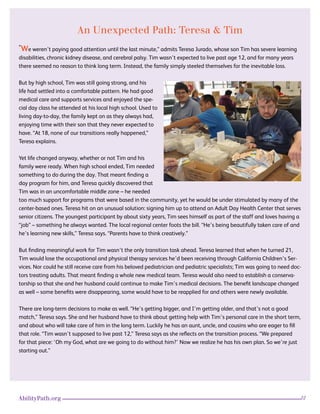
An Unexpected Path: Teresa & Tim
“We weren’t paying good attention until the last minute,” admits Teresa Jurado, whose son Tim has severe learning
disabilities, chronic kidney disease, and cerebral palsy. Tim wasn’t expected to live past age 12, and for many years
there seemed no reason to think long term. Instead, the family simply steeled themselves for the inevitable loss.
But by high school, Tim was still going strong, and his
life had settled into a comfortable pattern. He had good
medical care and supports services and enjoyed the spe-
cial day class he attended at his local high school. Used to
living day-to-day, the family kept on as they always had,
enjoying time with their son that they never expected to
have. “At 18, none of our transitions really happened,”
Teresa explains.
Yet life changed anyway, whether or not Tim and his
family were ready. When high school ended, Tim needed
something to do during the day. That meant finding a
day program for him, and Teresa quickly discovered that
Tim was in an uncomfortable middle zone – he needed
too much support for programs that were based in the community, yet he would be under stimulated by many of the
center-based ones. Teresa hit on an unusual solution: signing him up to attend an Adult Day Health Center that serves
senior citizens. The youngest participant by about sixty years, Tim sees himself as part of the staff and loves having a
“job” – something he always wanted. The local regional center foots the bill. “He’s being beautifully taken care of and
he’s learning new skills,” Teresa says. “Parents have to think creatively.”
But finding meaningful work for Tim wasn’t the only transition task ahead. Teresa learned that when he turned 21,
Tim would lose the occupational and physical therapy services he’d been receiving through California Children’s Ser-
vices. Nor could he still receive care from his beloved pediatrician and pediatric specialists; Tim was going to need doc-
tors treating adults. That meant finding a whole new medical team. Teresa would also need to establish a conserva-
torship so that she and her husband could continue to make Tim’s medical decisions. The benefit landscape changed
as well – some benefits were disappearing, some would have to be reapplied for and others were newly available.
There are long-term decisions to make as well. “He’s getting bigger, and I’m getting older, and that’s not a good
match,” Teresa says. She and her husband have to think about getting help with Tim’s personal care in the short term,
and about who will take care of him in the long term. Luckily he has an aunt, uncle, and cousins who are eager to fill
that role. “Tim wasn’t supposed to live past 12,” Teresa says as she reflects on the transition process. “We prepared
for that piece: ‘Oh my God, what are we going to do without him?’ Now we realize he has his own plan. So we’re just
starting out.”
24AbilityPath.org
After Graduation
Whether your child goes on to a postsecondary education or not, he or she will need to transition into the “real
world.” Depending on the level of their abilities, this may mean finding employment, enrolling them in a day program,
or locating full-time housing. All three of these present their own challenges; ideally, you have already discussed these
three prospects with your child’s IEP team during their high school years. Hopefully through these discussions, you
became better prepared and understand your state or local landscape when it comes to searching for a day program
or full-time housing. Before looking into these two options, though, understanding the employment landscape is nec-
essary.
A STUDY OF EMPLOYMENT
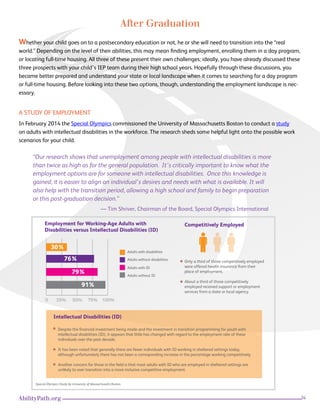
In February 2014 the Special Olympics commissioned the University of Massachusetts Boston to conduct a study
on adults with intellectual disabilities in the workforce. The research sheds some helpful light onto the possible work
scenarios for your child.
“Our research shows that unemployment among people with intellectual disabilities is more
than twice as high as for the general population. It’s critically important to know what the
employment options are for someone with intellectual disabilities. Once this knowledge is
gained, it is easier to align an individual’s desires and needs with what is available. It will
also help with the transition period, allowing a high school and family to begin preparation
or this post-graduation decision.”
Adults without disabilities
Adults with disabilities
Despite the financial investment being made and the investment in transition programming for youth with
intellectual disabilities (ID), it appears that little has changed with regard to the employment rate of these
individuals over the past decade.
It has been noted that generally there are fewer individuals with ID working in sheltered settings today,
although unfortunately there has not been a corresponding increase in the percentage working competitively.
Another concern for those in the field is that most adults with ID who are employed in sheltered settings are
unlikely to ever transition into a more inclusive competitive employment.
Adults without ID
Adults with ID
Only a third of those competitively employed
were offered health insurance from their
place of employment.
About a third of those competitively
employed received support or employment
services from a state or local agency.
Employment for Working-Age Adults with
Disabilities versus Intellectual Disabilities (ID)
Competitively Employed
0 25% 50% 75% 100%
30%
76%
79%
91%
Intellectual Disabilities (ID)
Special Olympics Study by University of Massachusetts Boston
— Tim Shriver, Chairman of the Board, Special Olympics International
25AbilityPath.org
SEEKING EMPLOYMENT
When looking for employment with your child, you need to think about what kind of job your child would be
successful at as well as the level of support he/she will need to secure and maintain a job. There are five basic
levels of employment support for individuals with developmental disabilities.
• Competitive Employment: a full-time or part-time job paid at market wages with no long-term support. The
employer hires the individual based on their skillset and needs of the business.
• Supported Employment: a job in which the employee receives ongoing support that is funded through state
developmental disabilities or vocational rehabilitation agencies. This job can be in an individual or group set-
ting, depending on the support level needed. This type of position also meets the employer’s business needs
and can still include “job carving,” where a job is created to meet the unique skillset of the individual.
• Self-Employment: a job someone does on his own that provides an income.
• Production Employment: a job in which employees with disabilities work at a site with other employees with
disabilities and do defined tasks like collating, assembling, or packaging. This job setting provides a high level of
supervision and job training.
• Volunteer Employment: a job that someone does without pay, usually to benefit the community. Volunteer
jobs can lead to paid employment by providing work experience, or they can be an end to themselves, providing
the volunteer with community and purpose.
Deciding what type of employment is best for your child can be included in his or her IEP. The professionals can help
you and your child figure out where the best place to start is. It is also important to note that where they start is not
where they will be the rest of their life. If your child wants competitive employment but you or the IEP team believes
he or she is best suited for supported employment, it does not mean they can never move over to competitive employ-
ment. Let your child know that this is just the starting point and that they can always change their course later.
Mary Pilster says that when Bobby first went out into the work world things didn’t go very well. “He got interviews, but
his lack of eye contact and sitting kind of squirrely in his seat didn’t allow them to see his potential,” she says.
Eventually Bobby joined Gatepath’s Autism Works program, where he got help with his resume and was able to prac-
tice interview skills through workshops and role-playing. A staff member went with him to his first job interview with a
Safeway supermarket, and another staff member accompanied him to his training after he landed a job as a courtesy
clerk. At Safeway, Bobby bagged groceries, retrieved shopping carts, helped customers find things, and cleaned up
around the store. For the first six weeks of employment, he had a job coach available to help him when he ran into
rough spots.
Eventually, he was transferred to another store, where the management wasn’t as used to working with people with
disabilities. Bobby felt he was being yelled at all the time and his self-esteem plummeted. But Bobby was able to find
seasonal employment working as a loader for Lowe’s, a big home improvement store. This time, Mary says, “he didn’t
need a job coach – he was very confident.”The job became permanent after a few months, and Bobby has now had it
for over a year.
26AbilityPath.org
“The advice I give parents is that if something doesn’t work out the way you planned, that’s OK,” says Laura Dana,
Community Services Manager at Community Gatepath. “There are programs for wherever your kid is at.” Paths can
change or be recharted over time – no decision is permanent. The key is for your child to develop the skills and experi-
ence they need in order to reach their goals.
Here are five ways to prepare your child for a successful experience in the work world:
1. Talk with your child about the kinds of jobs he would like to have and what kinds of skills he will need to do that
work. Help him think realistically and strategically about employment goals so that he can find work that he
enjoys and is qualified to do. Transition specialist Eli Poblitz cites the example of a teenager who loves playing
with younger relatives or caring for neighbors’ pets. “A lot of times they don’t think [of] that as a job, but when
you ask them about that experience they kind of glow,” he says. “Then you realize that person is a helping per-
son, they really like to help. And then you can tell them there are lots of helping jobs that don’t need college.”
2. Include both travel and WorkAbility training in your transition plan, and advocate for longer hours of coaching
and practice. “One hour a day twice a week wasn’t enough time to prepare for even part-time work,”
one mother observes.
3. Encourage your child to do volunteer work, internships, or summer jobs so that she or he develops work
experience and skills and can discover what they like.
4. Take advantage of the services offered by your local Vocational Rehabilitation agency and any screenings and
assessments offered by local nonprofits. These assessments will help identify both what your young adult wants
to do and what supports their needs. These can be used to anticipate problems before they happen.
5. Once your child has landed a job, you may also want to consider hiring a private job coach who can act as a
liaison between your young adult and his or her employer to help design supports to help with their specific
deficits.
“The reality of the workforce is that everyone will be expected to meet and perform at competitive
levels, whether your child has a special need or not. This can be difficult to face if you are not
prepared for it.”
—Tracey Fecher, VP of Programs at Community Gatepath
The Vocation Rehabilitation (VR) Agency
Under the US Department of Education, each state has a Vocation Rehabilitation Agency with regional and local
offices that help people with disabilities find work. While each office is different, VR services may include:
• Vocational guidance and counseling
• Job development and placement
• Skills training
• Job coaching
• Help with transportation
• Adaptive devices, tools, equipment, and supplies
27AbilityPath.org
• Apprenticeship programs
• Interpreter services for people who are deaf or hard of hearing
• Orientation and mobility services
• Transition services for young adults
• Support, advocacy, and follow-up services once work has started
To be eligible for VR services, your child must be an “individual with a disability,” defined as having a physical or
mental impairment that is a barrier to employment and can benefit from VR services, meaning that they are not too
special needs to be able to work. If your child receives Supplemental Security Income (SSI) and/or Social Security
Disability Insurance (SSDI) benefits, they are presumed to be
eligible for VR services.
Because VR offices are government agencies, you should
expect that your child will need to deploy his or her budding
self-advocacy skills in order to get the most out of the services
offered. That means being prepared, proactive, and persistent.
Best Buddies
Another great option to help your child find a job is Best
Buddies. Unlike other organizations, your child can become
involved in Best Buddies starting in middle school. The goal of
this organization is to pair an individual with disabilities with
a peer who does not have disabilities. As your child moves on
to high school and college, he or she can continue to grow
with Best Buddies. Overall, Best Buddies offers eight programs
to help your child at each stage of their development: middle
schools, high schools, colleges, promoters, citizens, ambassa-
dors, jobs, and e-Buddies. By becoming involved in Best Bud-
dies, your child can gain social skills from and develop friend-
ships with peers who do not have disabilities.
Your child does not need to join Best Buddies in middle school to become involved in the organization’s jobs program,
which assists individuals with disabilities in locating competitive employment. Best Buddies partners with various
businesses and employers, and they all work together to find jobs for individuals. Not only does Best Buddies help with
locating a job but they also assist with the hiring process, and once a job is secured, they maintain support for both
the employee and the employer.
DAY PROGRAMS
Not every young adult is suited for postsecondary school or employment. Some will be better suited to a day program.
These programs vary in their emphasis, with some taking participants out into the community and others offering
most of their services in a center. Laura Dana, Community Services Manager at Community Gatepath, suggests that
parents tour different programs to get a sense of the options. “Parents should see whether the program offers some
sort of a trial period, so that the individual looking for services can try out the program,” she advises.
Lauren Potter, Glee Actress and Maria Shriver, Journalist, Author & Activist.
Photo by Stephen Simons
28AbilityPath.org
There are three broad categories of programs:
1. Community Integration(CI) programs
In these programs, participants spend the majority of each day in the community. They may be involved in vol-
unteer work, participate in recreation opportunities, or engage in other activities. They are best for people who
like variety and activity and enjoy being in the community.
Participants might take art or cooking classes, visit senior centers, or help out in an elementary school. Dana
notes that one advantage of these programs is that by bringing people with intellectual disabilities into the
world, they help create a more tolerant and welcoming society.
“People with special needs are just like you and me, and want to be a part of the community.
Community inclusion is a key component of our work and we strive to create this for everyone.”
—Sheryl Young, CEO Community Gatepath
2. Center-Based programs
In these programs, participants spend the majority of their time at a center or home base. The range of activ-
ities usually includes arts and crafts, exercise, and volunteer work along with a couple of community trips each
month. These programs are good for people who do not like much change in their routine and feel less com-
fortable out in the community. Parents should see if there’s a clear continuum of growth in the program, with
demonstrated goals and outcomes.
3. Adult Day Health Care (ADHC)
Services in these programs are provided at a home base and often include health monitoring, socialization,
recreation, dietary consultation, and rehabilitative training. ADHC programs have a diverse group of adults, as
many of the programs enroll persons who are elderly and/or people who need close supervision to remain safe.
When exploring the different day programs for your child, you will want to compare what each of them offers.
While visiting them, bring a notepad with you and take notes about what you like and don’t like. You can also
keep to standard questions you would like to ask at each of them so that you can find out the same information
from each.
The Special School District of St. Louis County in Missouri provides five important areas for you to examine 		
when visiting day programs: 16
1. Funding: How is the program paid for? Are there costs to the individual?
2. Transportation: Does the program provide transportation to and from home?
3. Experience: How long has the program been around? Do they have any big changes planned?
How long have their most senior staff members been in the field?
4. Staff-to-Client Ratio: How many clients/participants does each staffer supervise?
5. Community Experiences: Do they take their clients into the community and if so, how often
and for how long each time?
29AbilityPath.org
In addition to these five areas, we have added on five more that are important:
6. Types of Activities: What kinds of things do clients do each day? What are the program
goals for the participants? Is activity varied and challenging?
7. Hours of Operation: What time does the program start and end each day? How many
days a year is the program closed?
8. Age and Ability: What is the age range of the participants? What is the ability range of participants?
9. Eligibility: What are the entrance/eligibility requirements? What is the application process?
Is there a waiting list?
10. Length of Stay: What is the average length of stay for the participants? Do participants often
move to other types of programs after a period of time? What indicators does the program have of 		
client outcomes and satisfaction?
FULL-TIME HOUSING
Even if it works well for your child to continue living at home now, it may not work as she or he matures and as you
grow older. Since supported living arrangements often have long waiting lists, it’s important to think about housing
options well before you need them.
There are many different kinds of housing options, with varying levels of support. They include:
• Independent living in a house or apartment, alone or with a roommate
• Transitional residential programs offering short-term residential experience for people
who need support, intervention or instruction while learning to live independently
• Supported living programs
• Supervised living programs
• Group homes
• Intermediate care facilities
New models are being developed all the time, including cohousing arrangements and farmstead programs.
As you think about your child’s future living arrangements, it’s important to remember that every option has pros
and cons. A study of the feelings that mothers of adult children with special needs had about having their child live
at home or in a residential facility found that mothers whose children lived away from home felt pleased that their
children were developing new skills and friends, but they also worried more about their child’s future than the moth-
ers whose children stayed at home. On the other hand, as Dr. Robert Naseef explains in his book Special Children,
Challenged Parents: The Struggles and Rewards of Raising a Child with a Disability, families with a son or daughter at
home tended to have more peace of mind about their child’s safety, but they did not feel that their child was neces-
sarily benefiting from opportunities for growth and development.
Some questions to ask yourself as you consider your options:
• What kind of living arrangements does my child prefer?
• What kind of housing arrangements would work best for my child’s physical care and emotional well-being?
• What kinds of support would my child need to live away from home?
30AbilityPath.org
• What kind of living arrangement would work best for my child’s other goals, needs, and desires, including
education, employment, recreational activities and socializing?
• What kind of housing will make it possible for my child to have adequate access to transportation? Are there
bus lines? Services within walking distance? Adequate parking for a van?
• What kind of housing arrangements can we afford?
• What kind of housing arrangements will work best as my partner and I age?
Six Steps for Exploring Housing Options
1. Discuss the topic with your child and other members of his or her circle of support. Make sure housing is part
of the person-centered planning process.
2. Include the development of independent living skills in your child’s transition plan. These might include:
– Safety skills
– Phone skills
– Housecleaning
– Laundry
– Budgeting
– Nutrition and cooking
– Grocery shopping
– Travel training
3. Discuss housing options and benefits with your regional center and with others in your disability community.
Be sure to read about your child’s federal and state housing benefits.
4. Create a checklist of things you and your child want to find out before you visit apartments, group homes, or
care facilities.
5. Create a housing budget that includes not just the monthly cost of the housing itself, but also any associated
costs like:
– Furnishings
– Transportation
– Supportive services
– Utilities
– Groceries
– Incidental Expenses
6. List the sources available for paying for housing. These might include:
– Social Security income
– Disability benefits
– Your income
– Your child’s income
– Money from a trust or legal settlement
– State and county benefits
Additional assistance might come in the form of In-Home Supportive Services, which can be used to provide personal
assistance and other services.
31AbilityPath.org
Securing Benefits
Of all the things that parents worry about as their child approaches transition, the future of their child’s financial and
medical benefits may be the most nerve racking. While you can think about housing and employment when you’re
ready, medical care and financial benefits are tied to the calendar, and they will disappear or convert whether or not
you’re ready for them to do so.
To prepare for this transition, start by getting organized:
• Make a list of all of the benefits your child receives, whether they are in the form of monetary payments or sup-
port services.
• Make a list of all the medical providers your child sees and the therapies your child receives.
• Make a list of your child’s current medications.
• Organize your paperwork in one place, including medical records and school records, your child’s birth certificate
and social security card, contact information for the medical providers, therapists and
services you use, and any other documents
documenting your child’s disability.
HEALTH AND MEDICAL CARE
Begin preparing for the transition to adult care in early adolescence, if possible. Now is the time to start asking ques-
tions about your child’s future care and receiving recommendations of doctors, therapists, and specialists that can
provide it. It’s also important for your child to begin assuming responsibility for his or her medical conditions, perhaps
going into the doctor’s office without you there.
Here are four areas to think about as you search for new medical providers:
1. Location
– Is the office easy to get to?
– Can your child get there on his or her own?
– Is it wheelchair accessible?
2. Relationship
– Does this doctor explain things clearly?
– Does this doctor have a good rapport with .
your child?
3. Convenience
– Are office hours convenient?
– Can you reach the doctor or staff during .
off-hours?
4. Reputation
• Does this provider come recommended?
• Does this provider have expertise or
experience with my child’s disability?
• At what hospital does this provider have .
admitting privileges?
32AbilityPath.org
Social Security Benefits
Social Security benefits are the most important benefit your child can receive as an adult, not only for their own sake,
but also because SSI eligibility is often a prerequisite for other benefits.
• Supplemental Security Income (SSI)
When your child turns 18, he or she becomes eligible for SSI regardless of the parent’s income. SSI is a needs-
based program that provides monthly payments to people with disabilities who have limited income and
resources. While monthly SSI payments are fairly small, SSI eligibility is the gateway to other important pro-
grams, particularly access to the Medicaid health care program, which will be discussed more below. It can also
be the entry into a variety of vocational training and group housing programs. In addition, many states also
provide a supplemental monetary benefit that is added to the SSI benefit. All of these factors make it important
to apply for SSI. You can complete much of the SSI application online. If your child was already receiving SSI
payments before their 18th birthday, they will need to go through a redetermination of eligibility at age 18.
Because SSI is only available to people with fewer than $2,000 in assets, it is important to safeguard your
child’s eligibility by putting any money you are setting aside for him or, including inheritance, life insurance
payment, or legal settlement in a Special Needs Trust.
There are a number of Work Incentive programs that allow your child to work and continue receiving SSI ben-
efits, both while he or she is a student and afterward. The Work Incentive program may also allow your child
to deduct certain disability-related expenses from their income total, including attendant care, transportation,
assistive devices, or job coaches.
• Social Security Disability Insurance (SSDI)
Unlike SSI, which is needs based, SSDI is an entitlement program. This means that assets do not determine
eligibility. An unmarried adult who had special needs before age 22 may be able to receive child’s benefits if a
parent is deceased or has started collecting retirement or disability benefits. It is considered a “child’s benefit”
because it is paid based on the parent’s Social Security earnings record. The “adult disabled child” of someone
who is collecting social security can receive a monthly benefit check as long as he or she is not earning more
than $940 a month. After two years of collecting SSDI payments, the adult special needs child will also receive
Medicare. In many cases, an adult who has had special needs since childhood will receive SSI benefits until his
or her parents retire and then switch to the SSDI program, which has a higher benefit and more flexible rules
about income and assets.
Medical Coverage
• Private Health Insurance
If you have private insurance, it’s important to review your policy carefully so that you know what will
be covered when your child reaches age 18. Under the 2010 Patient Protection and Affordable Care Act
(“Obamacare”), private insurance policies will continue to cover your child under your policy until age 26.17
Some states require insurance companies to continue covering special needs adult children past that age. If
you get insurance through work, check with your Human Resources department to find out if this is true in your
state, or check with your state’s Department of Insurance. Because your private insurance policy may not cover
all the drugs or services your child needs, it may be important to have Medicaid or Medicare coverage to fill
these gaps. For that reason, make sure that claiming your child as a dependent will not jeopardize their eligibil-
ity for those programs.
33AbilityPath.org
• Medicaid
Medicaid is a government-sponsored insurance program for people of all ages who lack the income or
resources to pay for health care. Access to Medicaid is granted when an adult begins receiving SSI. These ben-
efits are particularly important if your child has medical needs because Medicaid may pay for medication and
equipment that insurance doesn’t cover. If your child is already receiving Medicaid benefits, he or she will have
to reapply after they turn 18.
• Medicare
Medicare is a government-sponsored insurance program for people over 65 and some younger people with dis-
abilities. Access to Medicare is granted two years after a special needs adult child begins receiving SSDI. While
not every medical provider accepts Medicaid, most everyone accepts Medicare. “If I have a choice between
Medicare and Medicaid, I want to be on Medicare,” says Mary Anne Ehlert.
LEGAL DECISIONS
Once your child turns 18, the law presumes that he has the capacity to make his own medical, personal, and financial
decisions, regardless of disability. If you feel that your child does not have the ability to make safe and informed
decisions, there are a variety of legal options.
• Guardianship & Conservatorship
A guardian or conservator – terminology varies from state to state – has received legal authority to make
certain decisions on behalf of a person with a disability who has been deemed “incapacitated,” meaning that
she or he can’t participate meaningfully in decisions about their life. The arrangement is usually done with the
help of an attorney, as it requires court appearances and ongoing interaction with the court. Guardianship or
conservatorship can be limited to certain areas such as medical care.
• Durable Power of Attorney
Durable Power of Attorney allows a person with a disability to give someone else the power to make financial
or health care decisions for her or him. It is simpler and less costly to set up than guardianship or conservatorship.
• Advanced Medical Directives & Living Wills
Advanced Medical Directives and Living Wills allow a person with a disability to state their intentions about
medical treatment in the event they become too ill or incapacitated to participate in decisions about their care.
• Trusts
Setting up a Special Needs Trust, sometimes called a Supplemental Needs Trust, will create financial stability
for both your child and for future caregivers. Find more information on page 37.
Determining whether you should pursue guardianship or conservatorship is “a hard decision for people because what
they’re doing is taking people’s rights away,” Ehlert says. She advises parents to think through various scenarios. For
example, if your young adult needs surgery, would he or she be able to assess the benefits and risks on their own?
Could she or he make a decision after getting advice from you or other trusted adults? Or would you need to make the
decision for her or him?
34AbilityPath.org
Autism Speaks has created a useful checklist to use when assessing what kinds of decisions a young adult with special
needs can handle on their own and what aspects of their life you may need to retain authority over. For each area, ask
yourself whether your child can do the following on their own:
Medical
• Seek medical care when he or she is sick or injured
• Weigh the risks and benefits of any particular medical procedure that is being proposed
• Understand the need for routine medical care
• Understand that even if a medical procedure is painful or unpleasant, it may still be necessary
• Assess whether a particular medication is desirable, even though it may have unpleasant side effects
• Provide accurate information about his or her medical condition
• Follow medical advice
Education
• Grasp the essentials of his or her learning problems and understand the services needed to learn effectively
• Advocate for himself or herself to obtain necessary education services
Finances
• Understand money basics, including the purpose of money, how to count money, and how to make change
• Safeguard his or her money so that it is not lost or stolen
• Budget money so that some funds are available to pay expenses at the end of the month
Vocational/Adult Services
• Apply for services from the Department of Disability Services, Department of Mental Health, or other agency 		
that serves people with disabilities
• Access necessary services and supports, such as job training, employment support, or a day habilitation
program
• Negotiate with the agency overseeing his or her care to obtain the best possible services
Living Arrangements
• Provide for his or her own physical care and well-being, such as purchasing proper food, clothing, and shelter
• Live harmoniously in a group setting, respecting others’ needs for quiet, privacy, and cleanliness
Legal and Decision-Making
• Understand the implications of signing documents
• Make sound decisions in important areas such as living arrangements, school, and work
Self-Care and Safety
• Have personal safety skills, such as staying out of dangerous areas, not talking to strangers, and keeping
doors locked
• Know how to summon help in an emergency, such as a fire or accident
• Have basic safety skills, such as being careful around fires, stoves, candles, etc.
Communication
• Communicate effectively (verbally or by other means)
• Understand that he or she has choices and is able to express themselves
36AbilityPath.org
A Lifelong Support Network
Since birth, you have been your child’s passionate advocate and constant companion. But while no one may ever
have the same bond that you have with your child, it is essential to widen the circle. As children move toward adult-
hood, they must have other competent and caring adults in their lives who will be there for them – as friends, mentors,
guardians or caregivers. Now is the time to begin thinking about who will be part of your child’s life for the long term
– people who can age with your child and are able and willing to accept responsibility for his care if that becomes
necessary.
Mary Anne Ehlert, Founder and President of Protected Tomorrows, says that parents
can often become paralyzed by the prospect of appointing a future caregiver and
end up not formalizing their plans. In the absence of any instruction from parents,
however, courts are left to make the decision. Ehlert advises parents to simply tackle
the question head on without over-thinking it. “In one minute, write down everybody
you know who is loving and caring,” she says. “Circle the ones who have a relationship
with your child. Choose the top three. You’re done. That’s the best you can do.”
Here are seven questions to ask yourself as you think about your child’s future
support network:
• Which adults are part of my child’s current support network?
• Who among them might be right to take on a long-term role?
• Have I spoken with my child about the people who will be involved in her or his .
future care?
• Have I spoken to these people about taking on formal or informal roles in the .
future?
• Do the people in my child’s support network have all the information they need.
to take on the role I have in mind for them?
• Have I formalized my plans with legal documents, such as a will and letter of .  .  .
intent?
• Do I have a backup plan?
Talking with Siblings
According to a study conducted by MassMutual and Easter Seals,18 almost a quarter
of adults with special needs siblings serve as their sibling’s primary caregiver. Nearly a
third expects to play that role in the future.
But the study found that many were not prepared for the role, which is often more
expensive and time-consuming than they realized. While 75 percent of current care-
givers feel caring for their sibling is a full-time job, for example, only 55 percent of
future caregivers expect it to be one. And while 67 percent of future caregivers expect
to receive the financial, emotional, and physical support they need, only 57 percent
of current caregivers feel they actually receive that same support. In addition, only 33 Image from MassMutual
37AbilityPath.org
percent of future caregivers feel financially prepared to care for siblings, and 60 percent wish they knew more about
planning for their sibling’s care and finances.
Don Meyer, director of the Sibling Support Project in Seattle, says that parents should start talking about the future
with typically developing siblings as early as possible. Often, siblings will assume that they will need to take on the
responsibility for their special needs sibling whether or not that’s actually true. That can mean that they curtail their
own transition into adulthood, fearing that if they pursue their own aspirations they will be putting their special
needs sibling at risk.
“Kids are thinking about it,” he says. “If parents don’t share their plans with the typically-developing brother or
sister, kids will make their own plans.”
Five Important Steps to Preparing for Your Child’s Long-Term Future
1. Start talking
Talk early and keep the lines of dialogue open. Make discussions about the future part of everyday conversa-
tion and recognize that your plans may need to change as circumstances change. “Normalize that everybody’s
got a future in this family and we’re all thinking about everybody’s future,” Meyer suggests.
2. Consult with an attorney
Make sure that your intentions have been documented in a properly executed will and that you have the legal
power to make any decisions you plan to make. Look into acquiring legal guardianship for siblings or other
future caregivers. Attorneys who specialize in special needs can be found through the Special Needs Alliance’s
“Find an Attorney” page.
3. Protect your money
Setting up a Special Needs Trust, sometimes called a Supplemental Needs Trust, will create financial stability
for both your child and for future caregivers. A trust allows someone with a disability to receive a life insurance
payout, legal settlement, or inheritance money without losing their eligibility for benefits like SSI and Medicaid.
It also ensures that any money you set aside for your child’s future care is only used for that purpose. Without
the protection of a trust, money left to a caregiver can be lost in a divorce or other litigation. There are a vari-
ety of trusts, each of which has different requirements and advantages. Work with an attorney who specializes
in setting up Special Needs Trusts to set up the right kind for you, and make sure that any life insurance policy
you have pays into the trust.
4. Share responsibilities now
The best transitions happen gradually, over time. Rather than hoping that future caregivers will assume full
responsibility at some point in the distant future, give both your child and future caregivers a chance to try
things out slowly. That might mean having siblings or other caregivers take your child on regular outings or
come over for the day or evening while you go out. Or it might mean that you have your child transition into
an independent or supported living arrangement where both parents and future caregivers can visit frequently.
Your child will navigate changes in his or her care better if you are there to help, rather than being plunged into
a new and potentially frightening arrangement after your death.
38AbilityPath.org
5. Write A Letter of Intent
A Letter of Intent is not a legal document but simply a way of documenting the hopes and plans you and your
child have for the future and the important details of your child’s life in the present. What does your child like
to eat? What medications does he or she take? Who is your child’s doctor? What’s soothing to them when their
upset? Where do you keep his or her financial records? There’s so much that you know that others don’t; make
sure it’s written down and that future caregivers know where to find it.
Photo
39AbilityPath.org
A Happy Ending: Carolyn & Connor
Connor is a young man with learning disabilities and an anxiety/panic disorder. He struggled to keep up at his aca-
demically oriented high school but didn’t identify as having a disability or special need, dismissing his one special
education class as a “waste of time.” Because his friends were focused on college, he assumed he would go to college
too. But college turned out to be a mistake. The friends who helped him through his classes in high school weren’t
with him in college to help him make sense of his assignments, and he soon stopped going to class, winding up on
academic probation. It was then that his mother, Carolyn, told him that it was okay with her if he didn’t go to college.
“I think it was a relief for him to realize he wasn’t letting me down,” she says now.
Connor then applied for a job at a sporting goods store and had a friend go with him to the interview. He got the job,
but on his first day of work he was so overcome with anxiety that he stayed home. He stayed home the next day as
well. At last his parents convinced him to try going to work for just one day. Six years later, he is still working for the
same chain and is now the manager of his own store.
“He’s passionate about his job,” Carolyn says. “He can tell you about every type of shoe and the type you should wear
because of the kind of foot you have.” Her advice for families facing the transition process: “Do your research and
follow your gut instinct.”
40AbilityPath.org
Conclusion
“Professionals often state that parents and family members are the most important
elements in the transition from school to adult life process, because they are the only
people to have continuous and stable contact with the student throughout the
entire process.”
— Everson and Moon, 1987 19
Having a child with special needs reach adulthood means taking stock of your own life and trying to envision what
the next stage will look like. No matter what your situation is, this time is almost guaranteed to generate some emo-
tional turmoil. While parents with typically developing children may be thinking about an empty nest, many parents
of special-needs children are realizing that their responsibilities are unlikely to ease up. That can mean a fresh period
of grieving as you come to terms with the prospect of being a lifelong caretaker.
“It’s difficult for parents of special-needs kids because they see their friends who have typically developing kids who
are leaving the nest,” observes Lynne, whose son David has an autism spectrum disorder. “And they’re like, ‘I’d like
to be able to start thinking about myself, especially after all these years in the trenches, but it’s not realistic.’ It’s like
when your child first gets diagnosed and you realize this is forever. You start thinking, ‘What’s going to happen when
I’m gone? Who’s going to look after my child when I’m no longer around?’”
Parents of special-needs children who are ready to leave the nest may experience another kind of grief. As their child
becomes more independent, they may find themselves mourning the loss or diminishment of a role that was as
fulfilling as it was challenging. It isn’t easy to let go of a job that has been your life’s mission for so many years. What
will you do with yourself? How will you manage the fears and anxieties you have about your child’s welfare? After
spending years as your child’s most devoted champion, it can be hard to dismount from your white horse. You may
feel guilty about asking your child to start assuming responsibility for his or her future, as if you are shirking your duty.
And you may worry that your child will be physically or emotionally hurt by an outside world that doesn’t understand
or cherish him or her the way you do.
“Letting go is terrifying because we’re talking about kids who couldn’t have progressed to where they are if their par-
ents, particularly their moms, hadn’t put in a whole lot of effort,” says Dr. Robert Naseef. “But if you can loosen your
grip a little, you start to get a better idea of what your child can handle. It’s not just a transition for this child with
special needs but for the family as a whole.”
Rest assured you are not abandoning your role as your child’s advocate. But you are changing it. This is a time of new
beginnings. Your child is transitioning into a new role as a young adult. You are transitioning into a new role too – the
parent of a young adult. It will take time to reach a new equilibrium. “We’re parents all our lives,” observes Dr. Naseef.
“As our children get older, we might not have to do as much for them, but be there as they need us.”
41AbilityPath.org
Resources
STAYING ORGANIZED
• Checklist for the First 21 Years – a checklist created by the Special School District of St. Louis County to help
with the years leading up to transition
• “Transition Tool Kit” – a guide created by Autism Speaks to assist families with the transition from adolescence
to adulthood
• “SSD Transition Guidebook” – guidebook made by the Special School District of St. Louis County to help with
the move into adulthood
• Find Your Parent Center – a list compiled by the Center for Parent Information and Resources of the parent
training and information centers in the United States
• State Agencies – an interactive guide that provides the contact information for the intellectual/developmen-
tal disability agencies in each state created by the National Association of State Directors of Developmental
Disabilities Services
PERSON-CENTERED PLANNING
• It’s My Choice… by William T. Allen, PhD – a workbook for helping your child think and talk about her future
• Guiding Your Teenager with Special Needs through the Transition from School to Adult Life…by Mary Kopi
KNOW YOUR CHILD’S RIGHTS
• For a list of all the federal laws, and an overview of each, that apply to the rights of the special needs, visit
www.ada.gov/cguide.htm
• For more information on FAPE, please refer to: www2.ed.gov/about/offices/list/ocr/docs/edlite-FAPE504.html
SIX SIMPLE THINGS
• Parent Transition Survey – created by Transition Coalition, this survey allows parents to take stock of what they
already know when it comes to their child’s transition
A SUCCESSFUL INDIVIDUALIZED EDUCATION PROGRAM
• “Your First IEP” by SchwabLearning.org – prepared for the San Francisco United School District, this guide
provides step-by-step preparation for the IEP and work sheets to help you prepare for the meeting
• NSTTAC Indicator 13 – intended for the school district to use, the National Secondary Transition Technical
Assistance Center created two checklists (A and B) that help to make sure an IEP was completed in
accordance with IDEA
• Ten Common Mistakes – a look at ten mistakes parents make during their child’s IEP
DIPLOMA OPTIONS
• “Diploma Options for Students with Disabilities” – compiled by the National Center on Secondary Education
and Transition, this briefing provides an overview of the different diploma options and the benefits of a state
offering multiple options versus one option
• “Diploma Options and Graduation Policies for Students with Disabilities” – created by the National Center on
Educational Outcomes, this guide looks at the positives and negatives of the different diploma options, helping
to make a decision on which is best for your child
• “Graduation Requirements and Diploma Options for Students with Disabilities: What Families and Advocates
Need to Know” – published by the US Department of Labor, this informational brief examines the different
diploma options and the need to align IEP goals with postsecondary goals concerning a diploma
42AbilityPath.org
LOOKING FOR A COLLEGE
• Colleges with Programs for Students with Learning Disabilities – a list of colleges in the United States that pro-
vide programs for students with disabilities; includes links to the specific program pages on the college’s website
TRAVELING WITH YOUR CHILD
• Children with Disabilities – TSA travel information about their accommodations when you travel with your child
• Travelers with Disabilities or Medical Conditions – TSA travel information specific to travelers with autism or an
intellectual disability
SEEKING EMPLOYMENT
• Vocational Rehabilitation Agencies – a list of the VR agencies in each state
• “Getting the Most from VR” – an article that discusses how you can get the best out of VR agencies
• Best Buddies Programs – a master list of all the Best Buddies programs, specifically for colleges, high schools,
and middle schools around the world and a description of the different programs that Best Buddies offer (click
on your state in the left sidebar to see all the programs located in your state)
DAY PROGRAMS
• Services for Younger Adults – a page with information about the day programs offered by Easter Seals
FULL-TIME HOUSING
• When Choosing a Home – a work sheet created by the Regional Center of Orange County in California to help
you and your child look for full-time care; it provides questions that are helpful to ask when searching
• State Associations of Independent Living – a list of the contact information for state independent living cen-
ters compiled by Independent Living Research Utilization
• Choosing a Residential Service Provider – a guide to residential options for people with autism created by the
Foundation for Autism Support and Training
HEALTH AND MEDICAL CARE
• Moving from Pediatric to Adult Healthcare – a compilation of resources on how to create a smooth transition
to adult health care
• “Working While Disabled” – a brochure on how your child can work and continue to receive Social Security
benefits
LEGAL DECISIONS
• Legal Matters to Consider – a look at the legal matters a parent needs to consider when deciding whether to
become a guardian, conservator, or other for an adult child; provides questions and scenarios to consider in the
decision-making process
• The Special Needs Trust – an article by Richard W. Fee about questions surrounding the special needs trust for
the National Institute on Life Planning for Persons with Disabilities
TALKING WITH SIBLINGS
• The Special Needs Trust – a guide from the National Institute on Life Planning for Persons with Disabilities on
the process of creating one of these trusts
• Sample Letter of Intent – a sample version of a Letter of Intent to help you with writing your own
• What to Record – a list of topics to document for future caregivers
• My Special Life – a workbook from Protected Tomorrows where you can document the important information in
your child’s life
43AbilityPath.org
Appendices
WHAT TO DO AND WHEN TO DO IT
Before Age 14:
• Begin transition planning through the IEP process. An IEP must include transition-planning services starting at
age 16, but the process should ideally begin at age 14.
• Find out about diploma types and their requirements and discuss the options with your child and the
IEP team.
• Talk to your child about puberty and sexuality.
Before Age 16:
• Begin thinking about long-term housing because waiting lists can be several years long, consider adding your
child’s name to the waiting list for residential programs. That will give you more options later.
• Make sure your child is receiving WorkAbility and life skills training as part of their transition plan.
• Learn about the admission requirements and funding options for any college or vocational training program
your child is interested in.
• Begin talking with medical providers about the transition to doctors and specialists treating adults. If your child
has complex medical issues, you will want to begin finding new medical providers now.
• Make sure your child has an understanding of any chronic health problems he/she has and how to
manage them.
Before Age 18:
• Determine what adult services your child is eligible for and apply for them.
• Organize your child’s medical records and other documents.
• Find out if there is an age cutoff for any of the therapies your child receives and, if so, get recommendations for
providers working with adults.
• Apply for SSI.
• Apply or reapply for Medicaid.
• Find adult medical providers to replace your pediatrician and pediatric specialists.
• Get legal advice about conservatorship and guardianship.
• Speak with your health insurance agent about medical coverage for your child after s/he turns 18.
• Check with Durable Medical Equipment (DME) vendors and home care agencies to see if there are age cutoffs
and, if so, what agencies can continue to provide the necessary care.
• If appropriate, have discussions with family about advanced directives, including Allow Natural Death/Do Not
Resuscitate (AND/DNR) orders.
• If you have a daughter, arrange for her to have a gynecological examination with a gynecologist who
understands her disability.
• If you have a son, he must register with Selective Service. He may register at the post office or online at
www.sss.gov.
• Help your child register to vote.
• Determine whether or not your child will need a Special Needs Trust (SNT) or other financial plan.
Before Age 21:
• Take advantage of IDEA-funded special education services that run through age 21, particularly transition
services.
Before Age 26:
• Determine whether your child will continue to be covered through your health insurance policy after they turn
26, and if not, what insurance they will need.
44AbilityPath.org
EMPLOYMENT OPTIONS
AbilityPath has spent a year conducting a national search on the best practices to date on various employment mod-
els for individuals with special needs. Below are the findings:
What to look for: key lessons learned
• The programs only succeed if there is a tireless champion at the employer
• The best programs involve collaboration between companies looking to hire and community organizations
who identify and train potential employees
• It needs to make business sense for the hiring organization, like:
◊ Good workers who are more productive
◊ Help your company meet compliance standards
• Even the most successful programs are placing relatively few people: a highly scalable model is yet to be
developed
Health services jobs
• Project Search, Cincinnati & across U.S.
◊ Training and internships for high school seniors
◊ At hospitals, on-site classrooms and on the job training
◊ Funded by school districts out of senior year budget
◊ Detail-oriented jobs like surgical set preparation, stocking drugs by bedsides
Medical and telecommunications jobs
• Launchability, Dallas, Texas
◊ Pre-hire training program to make the developmentally special needs young adults competitive.
◊ Trains on specific work skills for specific jobs plus soft skills that keep them from interviewing well
or doing the job
· Embedded within the company, utilize existing employees as mentors
· 5-6 week training to go into medical and telecommunications jobs
◊ State vocational rehabilitation pays for training
Service jobs in corporate setting
• Microsoft Supported Employment Program
◊ Real estate and facilities division: goal to hire 200 in Redmond, WA campus
◊ Partnering with Washington Initiative for Supported Employment
◊ Service jobs to be offered by Microsoft suppliers
· Food service, transportation, mail, office relocation
◊ Collaborate with local disability organizations to recruit
Software testing jobs
• Specialists Guild, San Francisco
◊ For young people in their 20’s on the autism spectrum
◊ Train, assess their abilities and give them real world experience to build a resume and get work
◊ When hired, can work from home if transportation or being in an office are problematic
45AbilityPath.org
• Aspiritech, Highland Park, Illinois
◊ Workshop that provides training to do technology work, software debugging, for young people with
developmental disabilities who can’t function well onsite
◊ Combined project manager/coach/trainer model
· Test to see if they can work in a group setting
· Creates a social context for the workers who work together, also improved quality because
they collaborate as a team
· They are a social enterprise, a non profit, but they are the employer who contracts with companies
• Specialisterne, coming to Silicon Valley in 2014
◊ Adults on high functioning autism spectrum (37 total in Denmark)
◊ Identifying opportunities and placing consultants in companies
◊ Assessment via building Lego Robot, training, and placement in software testing and other detail work
◊ Assessment, training at Specialisterne offices; job placement on site
Software and game development jobs
• Nonpareil, Plano, Texas
◊ Supports an exclusive segment of autism: could not make it in university environment, could not do 		
calculus, and can’t get a standard programming degree
◊ College level education for IT programming, video graphics, gaming, and apps
· The students become professional game and app designers
· Design products that will sustain the organization
· Their goal is some will work for Google or EA, some will work for non profits become professors 		
there or do programming to sustain
◊ Looking to build a campus community where people can train, develop software and game products,
either from campus or moving to companies, and perhaps teach new recruits. Want them to be able to
live there if they choose
46AbilityPath.org
ALABAMA
ORGANIZATION CONTACT DESCRIPTION
Alabama Council of Develop-
mental Disabilities (ACDD)
100 North Union Street,
Montgomery, AL 36104
334-242-3973
800-232-2158
info@acdd.org
ACDD has a mission to sup-
port independence, advocacy,
productivity, and inclusion for
Alabamians with developmental
disabilities.
Department of Mental Health,
Division of Developmental
Disabilities
100 North Union Street,
Montgomery, AL 36104
800-361-4491
Alabama.DMH@mh.
alabama.gov
The Department is dedicated
to efforts to enhance the
health and well-being of those
impacted by mental illnesses,
developmental disabilities, and
substance abuse and addiction.
REGIONAL CENTERS:
http://www.mh.alabama.gov/ID/RegionalOffices.aspx
ALASKA
ORGANIZATION CONTACT DESCRIPTION
Department of Health & Social
Services–Senior & Disabilities
Services Anchorage Office	
550 West 8th Avenue,
Anchorage, AK 99501
907-269-3666
800-478-9996
The Department’s mission is
to promote health, well-being,
and safety for individuals with
disabilities, seniors, and vulnera-
ble adults by facilitating access
to quality services and supports
that foster independence, per-
sonal choice and dignity.
Department of Health & Social
Services–Senior & Disabilities
Services Juneau Office
240 Main Street, Suite
601, Juneau, AK 99811
907-465-3372
866-465-3165
NATIONAL DIRECTORY OF STATE AGENCIES
47AbilityPath.org
Department of Health & Social
Services–Senior & Disabilities
Services Fairbanks Office
751 Old Richardson
Highway, Suite 100A,
Fairbanks, AK 99701
907-451-5045
800-770-1672
ARIZONA
ORGANIZATION CONTACT DESCRIPTION
Arizona Department of Eco-
nomic Security Division of
Developmental Disabilities
1789 West Jefferson Ave-
nue, Phoenix, AZ 85007
602-542-0419
866-229-5553
DDDWeb@azdes.gov
The Division provides supports
and services to more than
32,000 people with develop-
mental disabilities and their
families throughout Arizona. DES
strives to support the choices of
individuals with disabilities and
their families by promoting and
providing within communities,
flexible, quality, consumer-driven
services and supports. 
ARKANSAS
ORGANIZATION CONTACT DESCRIPTION
Arkansas Developmental Dis-
abilities Council
5800 West 10th Street,
Suite 805, Little Rock, AR
72204
501-661-2589
800-462-0599
teresa.sander@
arkansas.gov
The Council’s main objective is
to improve the independence
and productivity of people with
developmental disabilities and
to ensure their integration and
inclusion into the community.
Arkansas Disability Coalition 1501 North University
Avenue, Suite 268, Little
Rock, AR 72207
501-614-7020
800-223-1330
http://www.adcpti.org/
content/arkansas_
disabi/email_adc.as
The Coalition is a statewide
organization that assists families
and individuals with all types of
disabilities by providing infor-
mation, support, resources, and
training.
48AbilityPath.org
Department of Human
Services, Division of Develop-
mental Disabilities Services
PO Box 1437, Slot N505,
Little Rock, AR 72203
501-683-0870
https://dhs.arkansas.gov/
ost/contactforms/
ContactUs.aspx
The Division believes individuals
and their families should have
choices when selecting the
appropriate services in their local
community. This allows each
individual to maximize his or her
abilities while enjoying a quality
of life that matches those abili-
ties. It also will prevent individu-
als from being forced to access
more expensive and intrusive
services. The Division is respon-
sible for the overall coordination
of services for Arkansans with
developmental disabilities.
CALIFORNIA
ORGANIZATION CONTACT DESCRIPTION
Resources for Independent
Living (RIL)
420 I Street, Suite 3, Sac-
ramento, CA 95814
916-446-3074
http://www.ril-sacra-
mento.org/contact-us/
RIL promotes the socioeco-
nomic independence of persons
with disabilities by providing
peer-supported, consumer-di-
rected independent living
services and advocacy.
California Foundation for Inde-
pendent Living Centers (CFILC)
1234 H Street, Suite 100,
Sacramento, CA 95814
916-325-1690
http://www.cfilc.org/
contact-us/
The mission of CFILC is increas-
ing access and equal opportu-
nity for people with disabilities
by building the capacity of
Independent Living Centers.
State Council on Developmen-
tal Disabilities (SCDD)
1507 21st Street, Suite
210, Sacramento, CA
95811
916-322-8481
866-802-0514
council@scdd.ca.gov
SCDD is established by state
and federal law to ensure that
individuals with developmental
disabilities and their families
participate in the planning,
design, and receipt of the ser-
vices and supports they need,
which promote increased inde-
pendence, productivity, inclu-
sion, and self-determination.
49AbilityPath.org
Department of Developmental
Services (DDS)
1600 9th Street, Sacra-
mento, CA 95814
916-654-1690
rgeditor@dds.ca.gov
DDS is the agency through
which the State of California
provides services and supports
to individuals with developmen-
tal disabilities.
REGIONAL CENTERS:
Regional centers are nonprofit private corporations that contract with the Department of Developmen-
tal Services to provide or coordinate services and supports for individuals with developmental disabil-
ities. They have offices throughout California to provide a local resource to help find and access the
many services available to individuals and their families.
http://www.dds.ca.gov/RC/RCList.cfm
COLORADO
ORGANIZATION CONTACT DESCRIPTION
Division for Developmental
Disabilities
1570 Grant Street,
Denver, CO 80203
303-866-2993
Roberta.Aceves@
state.co.us
The mission for the Division is
to join with others to offer the
necessary supports with which
all people with developmental
disabilities have their rightful
chance to be included in Col-
orado community life, make
increasingly responsible choices,
exert greater control over their
life circumstances, establish and
maintain relationships and a
sense of belonging, develop and
exercise their competencies and
talents, and experience personal
security and self-respect.
REGIONAL CENTERS:
Regional centers serve persons with developmental disabilities who have the most intensive needs.
Their services include: 24-hour supervision, residential services, day programming, habilitation, medi-
cal, training, and behavioral intervention, plus short-term emergency/crisis support to the community
system.
http://www.colorado.gov/cs/Satellite/CDHS-VetDis/CBON/1251579354640
50AbilityPath.org
CONNECTICUT
ORGANIZATION CONTACT DESCRIPTION
Council on Developmental
Disabilities
460 Capitol Avenue,
Hartford, CT 06106
800-653-1134
Molly.Cole@ct.gov
The mission of the Council is to
promote the full inclusion of all
people with disabilities in com-
munity life.  
Department of Developmental
Services
460 Capitol Avenue,
Hartford, CT 06106
860-418-6000
866-737-0330
ddsct.co@ct.gov
The Department is responsible
for the planning, development,
and administration of complete,
comprehensive, and integrated
statewide services for persons
with intellectual disability and
persons medically diagnosed as
having Prader-Willi Syndrome.
DELAWARE
ORGANIZATION CONTACT DESCRIPTION
Division of Developmental Dis-
abilities Services
1052 South Governor’s
Avenue, Suite 101, Dover,
DE 19904
866-552-5758
The Department is responsible
for the planning, development,
and administration of complete,
comprehensive, and integrated
statewide services for persons
with intellectual disability and
persons medically diagnosed as
having Prader-Willi Syndrome.
FLORIDA
ORGANIZATION CONTACT DESCRIPTION
Florida Developmental Disabili-
ties Council (FDDC)
124 Marriott Drive,
Suite203, Tallahassee, FL
32301
850-488-4180
800-580-7801
fddc@fddc.org
The Council was established in
1971 to help plan individual
and family-centered supports
for persons with disabilities in
Florida. FDDC also guides the
development and administra-
tion of services for people with
developmental disabilities by
planning and funding research,
innovations, and programs
designed to improve the quality
of their lives.
51AbilityPath.org
Agency for Persons with Dis-
abilities (APD)
4030 Esplanade Way,
Suite 380, Tallahassee, FL
32399
850-488-4257
866-273-2273
apd.info@apdcares.org
The Agency works in partner-
ship with local communities
and private providers to assist
people who have developmental
disabilities and their families.
APD also provides assistance in
identifying the needs of people
with developmental disabilities
for supports and services.
REGIONAL CENTERS:
http://apd.myflorida.com/region/
GEORGIA
ORGANIZATION CONTACT DESCRIPTION
Georgia Council on Develop-
mental Disabilities (GCDD)
2 Peachtree Street NW ,
Suite 26-246,
Atlanta, GA 30303
404-657-2126
888-275-4233
vmsuber@dhr.state.ga.us
GCDD is charged with creat-
ing systems change for people
with developmental disabilities
and their families by increasing
opportunities for independence,
inclusion, integration, productiv-
ity, and self-determination.
Department of Behavioral
Health and Development Dis-
abilities (DBHDD)
2 Peachtree Street NW,
Atlanta, GA 30303
404-657-2252
DBHDD provides treatment and
support services to people with
behavioral health challenges
and addictive diseases, and
assists individuals who live with
developmental disabilities.
HAWAII
ORGANIZATION CONTACT DESCRIPTION
Development Disabilities
Division
1250 Punchbowl Street,
Room 463, Honolulu, HI
96813
808-586-5840
The mission of the Division is to
assure there is a state system
of supports and services for
persons with developmental
disabilities or intellectual disabil-
ities, which includes principles of
self-determination and incor-
porates individualized funding,
person-centered planning and
community services.
52AbilityPath.org
IDAHO
ORGANIZATION CONTACT DESCRIPTION
Council on Developmental
Disabilities
700 West State Street,
1st Floor, West Boise, ID
83702
208-334-2178
800-544-2433
info@icdd.idaho.gov
The mission of the Council is to
promote the capacity of people
with developmental disabilities
and their families to determine,
access, and direct the services
and/or support they need to live
the lives they choose, and to
build the communities’ ability to
support their choices.
Able to Work http://www.abletowork.
idaho.gov/contact.html
The purpose of the website is
to promote more and better
employment opportunities for
people with disabilities in Idaho.
ILLINOIS
ORGANIZATION CONTACT DESCRIPTION
Council on Developmental
Disabilities
101 West Randolph,
Suite 10-600, Chicago, IL
60601
312-814-2080
The Council is dedicated to
leading change in Illinois so that
all people with developmental
disabilities are able to exercise
their rights to freedom and
equal opportunity.
Department of Human Ser-
vices–Developmental Disabili-
ties Division
319 East Madison, Suite
4N, Springfield, IL 62701
217-524-7065
DHS.WebBits@illinois.gov
The Department provides lead-
ership for the effective manage-
ment of the design and delivery
of quality outcome-based,
person-centered services and
supports for individuals who
have developmental disabilities.
These services and supports will
be: appropriate to their needs,
gifts, talents, and strengths;
accessible; life-spanning; based
on informed choice; and moni-
tored to ensure individual prog-
ress, quality of life, and safety.
53AbilityPath.org
INDIANA
ORGANIZATION CONTACT DESCRIPTION
Bureau of Developmental Dis-
abilities Services
800-545-7763
BQIS.Help@fssa.IN.gov
The Bureau provides services for
individuals with developmental
disabilities that enable them to
live as independently as possible
in their communities. 
REGIONAL OFFICES:
http://www.in.gov/fssa/ddrs/4088.htm
IOWA
ORGANIZATION CONTACT DESCRIPTION
Division of Mental Health and
Disability Services (MHDS)
5 SE, 1305 East Walnut
Street, Des Moines, IA
50319
515-281-7277
rshults@dhs.state.ia.us
MHDS is responsible for plan-
ning, coordinating, monitoring,
improving, and partially funding
mental health and disability
services for the State of Iowa.
KANSAS
ORGANIZATION CONTACT DESCRIPTION
Department for Aging and Dis-
ability Services
503 South Kansas Avenue,
Topeka, KS 66603-3404
785-296-4986
800-432-3535
wwwmail@kdads.ks.gov
The Department envisions a
community that empowers
Kansas older adults and persons
with disabilities to make choices
about their lives.
KENTUCKY
ORGANIZATION CONTACT DESCRIPTION
Learning Disabilities Associa-
tion of Kentucky, Inc.
2210 Goldsmith Lane,
#118, Louisville, KY 40218
502-473-1256
LDAofKY@yahoo.com
The Association is a nonprofit
organization of individuals with
learning differences and atten-
tion difficulties, their parents,
educators, and other service
providers. This organization has
been a continuous voice in this
state for those who learn differ-
ently since 1966.
54AbilityPath.org
Department of Behavioral
Health, Developmental and
Intellectual Disabilities
100 Fair Oaks Lane 4E-B,
Frankfort, KY 40621
502-564-4527
http://dbhdid.ky.gov/con-
tact.aspx?p=1
The Department’s mission is
to provide leadership, in part-
nership with others, to prevent
disability, build resilience in indi-
viduals and their communities,
and facilitate recovery for people
whose lives have been affected
by mental illness, intellectual dis-
ability or other developmental
disability, or substance abuse.
LOUISIANA
ORGANIZATION CONTACT DESCRIPTION
Office for Citizens with Devel-
opmental Disabilities (OCDD)
628 North 4th Street,
Baton Rouge, LA 70802
225-342-0095
866-783-5553
ocddinfo@la.gov
OCDD is committed to ensur-
ing quality services, serving as
the single point of entry into
the developmental disabilities
services system.
REGIONAL CENTERS:
http://new.dhh.louisiana.gov/index.cfm/directory/category/146
MAINE
ORGANIZATION CONTACT DESCRIPTION
Office of Aging and Disability
Services (OADS)
41 Anthony Avenue,
Augusta, ME 04333
207-287-4242
The Office is responsible for
planning, developing, managing,
and providing services to pro-
mote independence for elders
and adults with brain injuries,
intellectual disabilities, and phys-
ical disabilities through the pro-
vision of services. These include
evidence-based prevention pro-
grams and comprehensive home
and community-based services,
including Adult Protective Ser-
vices and Public Guardianship
and Conservatorship Programs.
OADS fulfills its mission through:
Policy and Prevention, Interven-
tion and Care Management,
Community Partnerships, and
Accountability and Information
Services.
55AbilityPath.org
MARYLAND
ORGANIZATION CONTACT DESCRIPTION
Department of Disabilities 217 East Redwood Street,
Suite 1300, Baltimore, MD
21202
410-767-3660
800-637-4113
MDOD@mdod.state.
md.us
The Department advances the
rights and interests of people
with disabilities so they may
fully participate in their commu-
nities.
Transitioning Youth 217 East Redwood Street,
Suite 1300, Baltimore, MD
21202
410-767-3660
800-637-4113
MDOD@mdod.state.
md.us
Their mission is to ensure effec-
tive interagency planning and
delivery of services for secondary
students with disabilities.
MASSACHUSETTS
ORGANIZATION CONTACT DESCRIPTION
Department of Developmental
Services
500 Harrison Avenue,
Boston, MA 02118
617-727-5608
http://www.mass.gov/
eohhs/gov/departments/
mcdhh/contact-us/ques-
tion-about-our-services.
html
The Department is dedicated
to creating, in partnership with
others, innovative and genuine
opportunities for individuals with
intellectual disabilities to partic-
ipate fully and meaningfully in,
and contribute to, their commu-
nities as valued members.
56AbilityPath.org
MICHIGAN
ORGANIZATION CONTACT DESCRIPTION
Michigan Development Disabil-
ities Council
201 Townsend Street,
Suite 120, Lansing, MI
48913
517-335-3158
mdch-dd-council
@michigan.gov
The Council’s mission is to
support people with develop-
mental disabilities to achieve life
dreams.
MINNESOTA
ORGANIZATION CONTACT DESCRIPTION
Council on Developmental
Disabilities
658 Cedar Street,
St. Paul, MN 55155
651-296-4018
877-348-0505
admin.dd@state.mn.us
The Council serves as an advo-
cate for all persons with devel-
opmental disabilities by carrying
out activities in major areas of
emphasis.
Department of Human Services 651-431-2400
800-747-5484
dhs.info@state.mn.us
The Department helps people
with disabilities live as inde-
pendently as possible so they
can be a part of the communi-
ties in which they live.
MISSISSIPPI
ORGANIZATION CONTACT DESCRIPTION
Department of Mental Health 239 North Lamar Street,
Jackson, MS 39201
877-210-8513
The Department is supporting
a better tomorrow by making a
difference in the lives of Mis-
sissippians with mental illness,
substance abuse problems and
intellectual/developmental dis-
abilities one person at a time.
57AbilityPath.org
Mississippi Society for Disabili-
ties (MSD)
500-G East Woodrow
Wilson Drive, PO Box 4958,
Jackson, MS 39296
601-982-7051
http://msdisabilities.
com/contact/
The mission of MSD is to provide
a broad spectrum of programs
and services to meet the needs
of Mississippi children and adults
with disabilities, thus enabling
them to achieve maximum inde-
pendence and gain the greatest
possible quality of life.
MISSOURI
ORGANIZATION CONTACT DESCRIPTION
Department of Mental Health,
Division of Developmental
Disabilities
1706 East Elm, PO Box
687, Jefferson City, MS
65102
573-751-3070
ddmail@dmh.mo.gov
The Division serves a popula-
tion that has developmental
disabilities such as intellectual
disabilities, cerebral palsy, head
injuries, autism, epilepsy, and
certain learning disabilities. Their
mission is to improve lives of
Missourians with developmental
disabilities through supports and
services that foster self-determi-
nation.
REGIONAL OFFICES:
http://dmh.mo.gov/dd/facilities/
MONTANA
ORGANIZATION CONTACT DESCRIPTION
Developmental Disabilities
Program
111 Sanders, Suite 305,
PO Box 4210,
Helena, MT 59604-4210
406-444-2995
http://www.dphhs.
mt.gov/dsd/
contactus.shtml
The Program is dedicated to cre-
ating a system that coordinates
resources, supports, and services
for people to have meaningful
lives in their communities.
REGIONAL OFFICES:
http://www.dphhs.mt.gov/dsd/ddp/regionaloffices.shtml
58AbilityPath.org
NEBRASKA
ORGANIZATION CONTACT DESCRIPTION
Division of Developmental
Disabilities
301 Centennial Mall
South, Lincoln, NE 68509
402-471-8501
dhhs.developmentaldis-
abilities@nebraska.gov
The Division administers the
Beatrice State Developmental
Center and publicly funded com-
munity based developmental
disability services. Their respon-
sibilities include certification,
technical assistance, regulations
and payment for providers of
community-based develop-
mental disabilities services,
and operation of the Beatrice
State Developmental Center
(a 24-hour intermediate care
facility for persons with develop-
mental disabilities).
NEVADA
ORGANIZATION CONTACT DESCRIPTION
Aging and Disability Services
Programs
1010 Ruby Vista Drive,
Suite 104, Elko, NV 89801
775-738-1966
adsd@adsd.nv.gov
Aging and Disability Services
provides resources at the com-
munity level that promote equal
opportunity and life choices for
people with disabilities through
which they may positively con-
tribute to Nevada.
NEW HAMPSHIRE
ORGANIZATION CONTACT DESCRIPTION
Bureau of Developmental
Services
105 Pleasant Street,
Concord, NH 03301
603-271-5034
800-852-3345, ext. 5034
http://apps.dhhs.nh.gov/
EmailContact/EmailCon-
tact.aspx?a=bds&b=Bu-
reau%20of%20Develop-
mental%20Services
The Bureau will join with local
communities to support indi-
viduals of all ages with develop-
mental disabilities or acquired
brain disorders and their families
to experience as much freedom,
choice, control, and responsibil-
ity over the services and sup-
ports they receive as desired.
59AbilityPath.org
NEW JERSEY
ORGANIZATION CONTACT DESCRIPTION
Division of Developmental
Disabilities
195 Gateway, Suite 100, 5
Commerce Way, Hamilton,
NJ 08691
800-832-9173
http://nj.gov/humanser-
vices/ddd/staff/email/
index.html
Some of the most basic aspects
of the Division’s mission are
protecting the health and safety
of the individuals it serves, pro-
moting equity and fairness, and
spending state dollars responsi-
bly. The Division also continues
to strive to expand the type and
number of services available in
the community. In this way it is
not only able to help individuals
avoid unnecessary institutional
placements but also help make
it possible for them to remain at
home with their families for as
long as possible.
DEVELOPMENTAL CENTERS:
http://nj.gov/humanservices/ddd/home/centers/
NEW MEXICO
ORGANIZATION CONTACT DESCRIPTION
Developmental Disabilities
Planning Council
625 Silver Avenue SW,
Suite 100, Albuquerque,
NM 87102
505-841-4519
Justin.Moore@state.
nm.us
The Council will promote advo-
cacy, capacity building, and
systemic change to improve the
quality of life for individuals with
developmental disabilities and
their families.
60AbilityPath.org
NEW YORK
ORGANIZATION CONTACT DESCRIPTION
Office for People with Develop-
mental Disabilities (OPWDD)
44 Holland Avenue,
Albany, NY 12229
866-946-9733
people.first@opwdd.
ny.gov
OPWDD is responsible for
coordinating services for more
than 126,000 New Yorkers with
developmental disabilities,
including intellectual disabilities,
cerebral palsy, Down syndrome,
autism spectrum disorders, and
other neurological impairments.
It provides services directly
and through a network of
approximately 700 nonprofit
service-providing agencies, with
about 80 percent of services
provided by the private nonprof-
its and 20 percent provided by
state-run services.
NORTH CAROLINA
ORGANIZATION CONTACT DESCRIPTION
Division of Mental Health,
Developmental Disabilities and
Substance Abuse Services
Albemarle Building, 325
North Salisbury Street,
Raleigh, NC 27699
919-733-7011
contactdmh@dhhs.nc.gov
The Division’s mission is to
promote excellence in preven-
tion, treatment, and rehabilita-
tion programs for persons with
mental illness, developmental
disabilities, and substance abuse
disorders in North Carolina.
NORTH DAKOTA
ORGANIZATION CONTACT DESCRIPTION
Developmental Disabilities
Services
600 East Boulevard
Avenue, Department 325,
Bismarck, ND 58505
701-328-2310
800-472-2622
dhseo@nd.gov
Developmental Disabilities
provides support and training to
individuals and families in order
to maximize community and
family inclusion, independence,
and self-sufficiency; to prevent
institutionalization; and to
enable institutionalized individu-
als to return to the community.
REGIONAL CENTERS:
http://www.nd.gov/dhs/locations/regionalhsc/
61AbilityPath.org
OHIO
ORGANIZATION CONTACT DESCRIPTION
Department of Developmental
Disabilities
30 East Broad Street,
Columbus, OH 43215
800-617-6733
John.Martin@dodd.
ohio.gov
The Department is responsi-
ble for overseeing a statewide
system of supports and services
for people with developmental
disabilities and their families.
OKLAHOMA
ORGANIZATION CONTACT DESCRIPTION
Developmental Disabilities
Services
2400 North Lincoln
Boulevard,
Oklahoma City, OK 73105
405-521-6267
The mission of Developmental
Disabilities is to help individuals
with developmental disabilities
and their families help them-
selves to lead safer, healthier,
more independent and produc-
tive lives.
OREGON
ORGANIZATION CONTACT DESCRIPTION
Developmental Disability
Services
500 Summer Street NE
E02, Salem, OR 97301
503-945-5811
800-282-8096
ODDS.INFO@state.or.us
Developmental Disability Ser-
vices strive to support choices of
individuals with disabilities and
their families within communi-
ties by promoting and providing
services that are person cen-
tered and directed, flexible, com-
munity inclusive, and supportive
of the discovery and develop-
ment of each individual’s unique
gifts, talents, and abilities.
Oregon Council on Develop-
mental Disabilities
540 24th Place NE, Salem,
OR 97301-4517
503-945-9941
800-292-4154
ocdd@ocdd.org
The mission of the Council is to
create change that improves the
lives of Oregonians with devel-
opmental disabilities.
62AbilityPath.org
PENNSYLVANIA
ORGANIZATION CONTACT DESCRIPTION
Department of Public Welfare
(DPW), Intellectual Disabilities
Services
717-265-7427
888-565-9435
http://www.dpw.state.
pa.us/Feedback/index.
htm?ContactCode=OLT-
L&Subject=Disability%20
Assistance
The Department supports
programs for individuals with
disabilities throughout the state
with a focus on individualized
care and benefits programs
designed to meet the specific
needs of each person. From
assisted living and personal care
homes, to individual supports
plans for community services, to
medical assistance, DPW seeks
to meet the needs of individuals
with disabilities throughout the
community.
RHODE ISLAND
ORGANIZATION CONTACT DESCRIPTION
Division of Developmental
Disabilities
6 Harrington Road,
Cranston, RI 02920
401-462-3421
CStenning@bhddh.ri.gov
The Division is responsible for
planning, providing, and admin-
istering a community system of
services and supports for adults
with developmental disabilities.
SOUTH CAROLINA
ORGANIZATION CONTACT DESCRIPTION
Department of Disabilities and
Special Needs
3440 Harden Street Ext.,
Columbia, SC 29203
803-898-9600
888-376-4636
http://www.ddsn.sc.gov/
about/Pages/ContactUs2.
aspx
The Department serves per-
sons with intellectual disability,
autism, traumatic brain injury,
and spinal cord injury and con-
ditions related to each of these
four disabilities.
63AbilityPath.org
SOUTH DAKOTA
ORGANIZATION CONTACT DESCRIPTION
Division of Developmental
Disabilities
Hillsview Plaza, East
Highway 34, c/o 500 East
Capitol, Pierre, SD 57501-
5070
605-773-3438
infodd@state.sd.us
The Division ensures that people
with developmental disabilities
have equal opportunities and
receive the services and supports
they need to live and work in
South Dakota communities.
TENNESSEE
ORGANIZATION CONTACT DESCRIPTION
Department of Intellectual and
Developmental Disabilities
400 Deaderick Street,
Nashville, TN 37243
615-532-6530
800-535-9725
PUBLICAFFAIRS.DIDD@
tn.gov
The Department supports all
Tennesseans with intellectual
and developmental disabilities
to live fulfilling and rewarding
lives.
REGIONAL CENTERS:
The regional offices are responsible for the enrollment of individuals with intellectual disabilities into
a service delivery system that best meets their individual needs for support. It is the mission of these
offices to develop and support opportunities for persons with intellectual disabilities to live as contrib-
uting members of their chosen home community.
http://www.tn.gov/didd/regional_offices/locations.shtml
TEXAS
ORGANIZATION CONTACT DESCRIPTION
Department of Aging and Dis-
ability Services (DADS)
701 West 51st Street,
Austin, TX 78751
512-438-3011
DADS was created to administer
long-term services and supports
for people who are aging as well
as for people with intellectual
and physical disabilities.
64AbilityPath.org
UTAH
ORGANIZATION CONTACT DESCRIPTION
Division of Services for People
with Disabilities
195 North 1950 West, Salt
Lake City, UT 84116
801-538-4200
800-837-6811
dspd@utah.gov
The Division promotes oppor-
tunities and provides supports
for people with disabilities to
lead self-determined lives by
overseeing home- and com-
munity-based services for more
than 5,000 people who have
disabilities. Support includes
community living, day services,
and supported employment
services.
VERMONT
ORGANIZATION CONTACT DESCRIPTION
Department of Disabilities,
Aging & Independent Living
103 South Main Street,
Weeks Building, Water-
bury, VT 05671
802-871-3350
http://www.ddas.vermont.
gov/ddas-contact-us/
ddas-on-line-contact-
form1
The mission of the Department
is to make Vermont the best
state in which to grow old or to
live with a disability with dignity,
respect, and independence.
VIRGINIA
ORGANIZATION CONTACT DESCRIPTION
Department of Behavioral
Health and Developmental
Services
1220 Bank Street, Rich-
mond, VA 23219
804-786-3921
jim.martinez@dbhds.
virginia.gov
The Department provides lead-
ership and service to improve
Virginia’s system of quality
treatment, habilitation, and
prevention services for individ-
uals and their families whose
lives are affected by behavioral
health disorders or developmen-
tal disabilities.
INTELLECTUAL STATE DISABILITY FACILITIES:
https://www.dbhds.virginia.gov/SVC-StateFacilities.htm#MR
65AbilityPath.org
WASHINGTON
ORGANIZATION CONTACT DESCRIPTION
Developmental Disabilities
Administration
4450 10th Avenue SE,
Lacey, WA 98503
360-725-3413
dddcoreception@
dshs.wa.gov
The Administration strives to
develop and implement public
policies that will promote indi-
vidual worth, self-respect, and
dignity such that each individual
is valued as a contributing mem-
ber of the community.
WEST VIRGINIA
ORGANIZATION CONTACT DESCRIPTION
Division of Intellectual and
Developmental Disabilities
Room 350, 350 Capitol
Street,
Charleston, WV 25304
304-356-4811
http://www.dhhr.wv.gov/
bhhf/Pages/contact.aspx
The Division provides leadership,
facilitation, technical assistance,
and funding to support children
and adults who have intellec-
tual/developmental disabilities.
WISCONSIN
ORGANIZATION CONTACT DESCRIPTION
Department of Health Services
Bureau of Long-Term Support
1 West Wilson Street,
Room 418, PO Box 7851,
Madison, WI 53707-7851
608-266-8560
dhswebmaster@
wisconsin.gov
The Department is the primary
state agency responsible for the
development and implementa-
tion of statewide policy, services,
and supports for people with
developmental disabilities.
	
REGIONAL CENTERS:
http://www.dhs.wisconsin.gov/disabilities/dd_ctrs/index.htm
66AbilityPath.org
WYOMING
ORGANIZATION CONTACT DESCRIPTION
Behavioral Health Division,
Developmental Disabilities
Division
6101 North Yellowstone
Road, 259A, Cheyenne,
WY 82002
307-777-7115
800-510-0280
bhdmail@wyo.gov
The Division’s mission is to pro-
mote, protect, and enhance the
health of all Wyoming citizens.
	
Council on Developmental
Disabilities
122 West 25th Street, 1st
Floor West, Herschler Build-
ing, Room 1608, Chey-
enne, WY 82002
307-777-7230
800-438-5791
wgcdd@wyo.gov
The Council’s purpose is to
assure that individuals with
developmental disabilities and
their families participate in and
have access to needed com-
munity services, individualized
supports, and other forms of
assistance that promote inde-
pendence, productivity, integra-
tion, and inclusion in all facets of
community life.
OTHER
ORGANIZATION CONTACT DESCRIPTION
Learning Disabilities Associa-
tion of America (LDA)
4156 Library Road,
Pittsburgh, PA 15234-
1349
412-341-1515
info@LDAAmerica.org
LDA visualizes a world in which:
all individuals with learning
disabilities are empowered to
thrive and participate fully in
society; the incidence of learn-
ing disabilities is reduced; and
learning disabilities are univer-
sally understood and effectively
addressed. LDA’s mission is to
create opportunities for suc-
cess for all individuals affected
by learning disabilities and to
reduce the incidence of learning
disabilities in future generations.
67AbilityPath.org
Special Olympics 1133 19th Street NW
Washington, DC 20036-3604
USA
+1 (202) 628-3630
+1 (800) 700-8585
+1 (202) 824-0200 (Fax)
info@specialolympics.org
Special Olympics transforms lives
through the joy of sport, every day,
everywhere. They are the world’s
largest sports organization for people
with intellectual disabilities: with
4.4 million athletes in 170 countries
-- and millions more volunteers and
supporters. They are also a global
social movement.
The Arc 1825 K Street NW, Suite
1200, Washington, DC
20006
202-534-3700
800-433-5255
info@thearc.org
The Arc is the largest national
community-based organiza-
tion advocating for and serving
people with intellectual and
developmental disabilities and
their families. They encompass
all ages and all spectrums from
autism, Down syndrome, fragile
X, and various other develop-
mental disabilities.
Best Buddies 100 Southeast Second
Street, Suite 2200,
Miami, FL 33131
305-374-2233
800-892-8339
info@bestbuddies.org
Best Buddies is a nonprofit 501
(c)(3) organization dedicated to
establishing a global volunteer
movement that creates oppor-
tunities for one-to-one friend-
ships, integrated employment,
and leadership development
for people with intellectual and
developmental disabilities.
68AbilityPath.org
Center for Independent Living
of Broward
4800 N. State Road 7,
Suite 102 Ft. Lauderdale,
FL 33319
Voice: 954-722-6400
TTY: 954-735-0963
Fax: 954-735-1958
Toll Free: 888-722-6400
Under the Rehabilitation Act of 1978,
Congress established the Center for
Independent Living in response to
individuals with disabilities need for core
services focused on independent living
skills training, peer support, information
and referral, and advocacy.  Since 1991,
The Center for Independent Living of
Broward (CILB) has served more than
60,000 individuals with disabilities in ful-
filling their goals of independence and
self-sufficiency.  CILB strives to enhance
the lives of people with disabilities,
regardless of age, in Broward, Charlotte,
Collier, Glades, Hendry, and Lee counties.
Autism’s Got Talent 44 020 8882 0629
info@autismshow.co.uk
The Autism Show deserves the same
production values and levels of market-
ing spend as other more mainstream
events. They strive every year to stage a
high quality and busy event while trying
to keep their costs for visitors and exhib-
itors to a minimum. As a result they feel
that they offer good value for money.
They enjoy working in partnership with
others to ensure that they fully under-
stand the needs of their visitor audience.
The National Autistic Society has sup-
ported The Autism Show since its birth.
Erik’s Ranch and Retreats Minnesota contact:
3420 Heritage Dr.
Edina, MN 55435
612-401-3080
Montana contact:
1627 West Main St. #340
Bozeman, MT 59715
406-451-2722
Erik’s Ranch & Retreats provides safe
and unequaled living, working, social
and recreational environments for
young adults with autism, using its
guiding principles of lifelong learning,
individual community building and bidi-
rectional integration through voluntour-
ism. They’re committed to giving these
individuals a rewarding life on their own
terms, experiencing dignity, compassion
and the joy of continuing possibility.
69AbilityPath.org
Ability Catcher AbilityCatcher
9921 Carmel Mountain
Road, #128
San Diego, CA  92129
AbilityCatcher has a mission to “human-
ize the way the world thinks and treats
individuals with differing abilities.” The
stories – both collective and individual
– are the collateral behind this business.
They are a creative think tank and pro-
duction company that aims to cleverly
and accurately portray rich stories in the
ability space through a wide-variety of
mediums.
Easter Seals 233 South Wacker Drive,
Suite 2400, Chicago, IL
60606
800-221-6827 (toll-free)
Easter Seals provides exceptional ser-
vices, education, outreach, and advocacy
so that people living with autism and
other disabilities can live, learn, work and
play in their communities. Easter Seals
has been helping individuals with disabil-
ities and special needs, and their families,
live better lives for more than 90 years.
From child development centers to
physical rehabilitation and job training
for people with disabilities, Easter Seals
offers a variety of services to help people
with disabilities address life’s challenges
and achieve personal goals.
American Association for
Physical Activity & Recreation
(Special Needs)
1900 Association Drive
Reston, VA 20191-1599
Telephone : 7034763431
Fax : 7034769527
MNelson@aahperd.org
AAPAR is dedicated to enhancing quality
of life by promoting creative and active
lifestyles through meaningful, inclusive
physical activity, recreation and fitness
experiences across the lifespan with
particular focus on community-based
programs.
The National Ability Center Mailing Address:
National Ability Center
PO Box 682799
Park City, UT 84068
Physical Address:

National Ability Center
1000 Ability Way
Park City, UT 84060
Phone: 435.649.3991
Fax: 435.658.3992
Email: info@DiscoverNAC.
org
The National Ability Center offers a wide
variety of programs both seasonally and
year-round. Activities include alpine and
Nordic skiing, snowboarding, snowshoe-
ing, horseback riding, hippotherapy,
indoor rock climbing, swimming, archery,
sled hockey, cycling, water-skiing, wake-
boarding, kayaking, canoeing, paddle
boarding, and challenge course activities.
70AbilityPath.org
The National Center on Physi-
cal Activity & Disability
4000 Ridgeway Drive
Birmingham, Alabama -
35209
1-800-900-8086
1-205-313-7475
email@nchpad.org
The National Center on Health, Physi-
cal Activity and Disability (NCHPAD) is
positioned to effect change in health
promotion/obesity management
among people with disabilities through
its existing 15-year history of providing
advocacy, services and programs to
numerous organizations and people
throughout the country. The primary
focus of the Center’s approach is to
collaborate with the nation’s leading
health advocacy and disability organi-
zations in linking them to the hundreds
of program initiatives ongoing across
the nation, and using this framework
to build inclusion and integration into
these existing programs.
Autism Community Network 4242 Woodcock Drive,
Suite 101
San Antonio, TX 78228
Phone: (210) 435-1000
Fax: (210) 200-6056
The mission of Autism Community
Network is to maximize the potential
of children with autism by increasing
autism awareness and services for fam-
ilies throughout the San Antonio area
with an emphasis on collaboration with
autism service providers, early diagnosis,
and providing services to underserved
young children and their families.
The Foundation School for
Autism
2235 Thousand Oaks,
Suite 130
San Antonio, TX 78232
210-402-0253
Rheatha Miller
rlmiller@responsiveed.com
Campus Director
The ResponsiveEd community of schools
is tuition-free, public charter schools
dedicated to helping students of all ages
achieve their full potential.
At ResponsiveEd, They’re all about
options in education. Strongly tied to
the communities they serve, the mis-
sion of their schools is to provide hope
for students through an encouraging,
innovative environment where they are
academically successful and develop
into lifelong learners.
Arts ‘n Autism P.O. Box 20111
Tuscaloosa, AL 35402
(205) 247-4990
artsnautism@gmail.com
The Arts ‘n Autism after school and
summer camp program was initiated
in March 2004. It provides services to
children from preschool to young adults
with autism in the Tuscaloosa, Alabama
area and surrounding counties. Arts
‘n Autism was conceived by a veteran
teacher of children with autism in the lo-
cal public schools and a parent of a child
with autism. Both founding members
are still actively involved in the develop-
ment and growth of Arts ‘n Autism.
71AbilityPath.org
Spare Some for Autism 7474 Creedmoor Road
#125
Raleigh NC 27613
Telephone: (919) 844-
1960
www.sparesomeforautism.
org
Spare Some for Autism seeks to support
families affected by ASD by educating
them on such topics as literacy and
coping with disabilities so that families
will be better prepared to support each
other.
Autism Family Foundation Wanda Malone
Founder/Executive Director
wanda@autismfamily-
foundation.net
630-803-8471
Autism Family Foundation was founded
in 2010 and is a 501 (c) (3).  AFF was
created to provide resources, networking
opportunities and financial assistance to
local families impacted by Autism/ADHD.
Autism Speaks New York
1 East 33rd Street
4th Floor
New York, NY 10016
Phone: (212) 252-8584
Fax: (212) 252-8676
Princeton
1060 State Road, 2nd Floor
Princeton, NJ 08540
Phone: (609) 228-7310
Fax #1: (609) 430-9163
Fax #2: (609) 430-9505
Los Angeles
6330 San Vicente Blvd.,
Suite 401
Los Angeles, CA 90048
Phone: (323) 549-0500
Fax: (323) 549-0547
Autism Speaks was founded in Febru-
ary 2005 by Bob and Suzanne Wright,
grandparents of a child with autism.
Their longtime friend Bernie Marcus
donated $25 million to help financially
launch the organization. Since then, Au-
tism Speaks has grown into the world’s
leading autism science and advocacy
organization, dedicated to funding re-
search into the causes, prevention, treat-
ments and a cure for autism; increasing
awareness of autism spectrum disorders;
and advocating for the needs of individ-
uals with autism and their families. They
are proud of what They’ve been able to
accomplish and look forward to contin-
ued successes in the years ahead.
72AbilityPath.org
Autism Science Foundation 28 West 39th Street, Suite
#502
New York, NY 10018
 
Phone: 212 391 3913
Fax: 212 391 3954
Email: contactus@autism-
sciencefoundation.org
The Autism Science Foundation is a
nonprofit corporation organized for
charitable and educational purposes,
and exempt from taxation under section
501(c)(3) of the IRS code.
The Autism Science Foundation’s mis-
sion is to support autism research by pro-
viding funding and other assistance to
scientists and organizations conducting,
facilitating, publicizing and disseminat-
ing autism research. The organization
also provides information about autism
to the general public and serves to
increase awareness of autism spectrum
disorders and the needs of individuals
and families affected by autism.
Golden Hat Foundation 7301 Ranch Road 620 N
Suite 155, #111
Austin, TX 78726-4537
info@goldenhatfounda-
tion.org
The mission of the Golden Hat Foun-
dation is to change the way people on
the autism spectrum are perceived, by
shining a light on their abilities and
emphasizing their great potential. With
proper education and career training,
these individuals can truly realize their
dreams. 
In addition to ongoing unique aware-
ness initiatives that highlight capabilities
of those on the autism spectrum and
their free meetup groups that provide
monthly outings and support meetings
for autistic individuals and their fami-
lies, their long-term goals include the
establishment of innovative post-high
school campuses designed to truly honor
all autistic individuals - not just those
considered “higher-functioning” - by
creating an environment that supports
and respects their individual needs and
strengths.
73AbilityPath.org
The Center for Autism and
Related Disorders, Inc.
19019 Ventura Blvd. Suite
300
Tarzana, CA 91356
Phone: (818) 345-2345 
Fax: (818) 758-8015
CARD is committed to remaining
at the forefront of research on ABA-
based methods of autism assessment
and treatment. CARD is equally com-
mitted to developing technology to
make autism recovery available to
professionals and families around
the world. Based on over 30 years of
research on child development and
autism, CARD›s breakthrough Web-
based tool, Skills®, provides compre-
hensive skill assessment, individualized
curriculum design, and the ability to
track treatment progress with auto-
matically-generated graphs and clinical
timeline charts. Skills™ is designed to
teach over 4,000 age-appropriate skills
to children with autism, making it the
most in-depth, multidisciplinary system
of its kind in the world.
Families for Early Autism
Treatment
P. O. Box 255722
Sacramento, CA 95865-
5722
(916) 303-7405
feat@feat.org
Families for Early Autism Treatment, Inc.
(FEAT) is a non-profit organization of
parents, family members, and treatment
professionals, designed to help families
with children of all ages who have an
Autism Spectrum Disorder (ASD), which
includes Autistic Disorder, Pervasive
Developmental Disorder, Not Otherwise
Specified (PDD-NOS), and Aspergers’s
Disorder (AS).  It offers a network of sup-
port where families can meet each other
to discuss issues surrounding autism and
treatment options.  FEAT has a Board of
Directors that meets monthly to discuss
issues, establish priorities, and vote on
the direction of the organization.
National Down Syndrome
Society
800-221-4602
info@ndss.org
The mission of the National Down
Syndrome Society is to be the national
advocate for the value, acceptance and
inclusion of people with Down syndrome.
74AbilityPath.org
Spina Bifida Association Street Address:
1600 Wilson Blvd.
Suite 800
Arlington, VA 22209
Please send all correspon-
dence to:
P.O. Box 17427
Arlington, VA 22216
Phone:
Main (202) 944-3285
Fax (202) 944-3295
Email:
sbaa@sbaa.org
The Spina Bifida Association (SBA)
serves adults and children who live with
the challenges of Spina Bifida. Since
1973, SBA has been the only national
voluntary health agency solely dedi-
cated to enhancing the lives of those
with Spina Bifida and those whose lives
are touched by this challenging birth
defect. Its tools are education, advocacy,
research, and service.
Through its network of Chapters, SBA
has a presence in more than 125
communities nationwide and touches
thousands of people each year. Lives
are changed by the programs SBA has
created, the services provided, and the
results of their advocacy efforts.
Shining Through Center 7365 Martin Grove Road
Woodbridge, Ontario L4L
9E4
Phone: 905-851-7955
Fax: 905-851-1132
250 Beecroft Road
Toronto, Ontario M2N
6W3
Phone: 416-782-4816
The Shining Through Centre for Children
with Autism, a not-for-profit charitable
organization, is a recognized leader in
the field of autism, providing service ex-
cellence in therapy, education, research,
and awareness to affected children and
their families. Through their work, they
provide intensive, comprehensive, and
individualized therapeutic and educa-
tional programs to each of their children,
based on the recognized principles of
Applied Behaviour Analysis (ABA). ABA
is the only scientifically-validated mode
of engagement with children who have
Autism that has been demonstrated
to produce long-term and permanent
learning.
Lucile Packard Foundation for
Children’s Health
400 Hamilton Avenue,
Suite 340
Palo Alto, CA 94301
(650) 497-8365
info@lpfch.org
www.lpfch.org
The vision of the Lucile Packard Foun-
dation for Children’s Health is that all
children in the communities they serve
are able to reach their maximum health
potential.
75AbilityPath.org
The Six Degree Project They are a grassroots student organiza-
tion committed to improving the lives of
children and youth with autism around
the world, by providing awareness and
knowledge. The six degree project is a
student driven mission to get celebrities
to participate in helping to create and to
generate awareness around autism. By
having community members and their
networks connect to these celebrities, it
will allow them to make a greater impact
around the world.
Organization for Autism Re-
search
2000 North 14th Street,
Suite 240, Arlington, VA
22201
Tel: 703.243.9710
The Organization for Autism Research
(OAR) was created in December 2001–
the product of the shared vision and
unique life experiences of OAR’s seven
founders. Led by these parents and
grandparents of children and adults on
the autism spectrum, OAR set out to use
applied science to answer questions that
parents, families, individuals with autism,
teachers and caregivers confront daily.
No other autism organization has this
singular focus.
Kids Peace 4085 Independence Drive
Schnecksville, PA  18078-
2574
800-25PEACE  (800-257-
3223)
kpinfo@KidsPeace.org
KidsPeace is a private charity dedicated
to serving the behavioral and mental
health needs of children, families and
communities.
KidsPeace provides a unique psychiatric
hospital; a comprehensive range of resi-
dential treatment programs; accredited
educational services; and a variety of
foster care and community-based treat-
ment programs to help people in need
overcome challenges and transform their
lives. KidsPeace provides emotional and
physical health care and educational
services in an atmosphere of teamwork,
compassion and creativity. 
76AbilityPath.org
Paper Clouds Apparel 3434 North 11th Street
Suite 9
Phoenix, AZ  85014
602-525-1315 - Robert
Thornton
Info@PaperCloudsApparel.
com
Paper Clouds Apparel was formed to
showcase the creative minds and artistic
abilities of individuals with special needs
while raising funds to provide financial
support for special needs schools and
organizations. They achieve this goal by
selling t-shirts, hats and totes featuring
artwork designed by individuals with
special needs. Paper Clouds Apparel
also hires individuals with special needs
to package all of their sensory-friendly
clothing. Fifty percent of the net pro-
ceeds from the sale of all merchandise is
given to the cause they are promoting in
each campaign.
Generation Rescue 13636 Ventura Blvd. #259
Sherman Oaks, CA 91423
877-98-AUTISM
Generation Rescue is the leading na-
tional organization that provides hope,
information and immediate treatment
assistance to families affected by autism
spectrum disorders.
STRIVE U
28 Foden Road
South Portland, ME 04106
Phone: 207-774-6278
Fax: 207-774-7695
E-mail: info@pslstrive.org
STRIVE U provides post-secondary edu-
cation and training to young adults with
developmental disabilities in the realms
of residential, employment, and com-
munity skills with the goal of enabling
its graduates to live and work as full
community members with maximum
independence and productivity.
77AbilityPath.org
Unicorn Children’s Foundation 21100 Ruth & Baron Cole-
man Blvd. , Suite 250
Boca Raton, FL 33428
Phone: 561-620-9377
Fax: 561-620-9376
1350 Sherbrooke Street
West, Suite 700
Montreal, Quebec
H3G 2T4 Canada
Unicorn Children’s Foundation is an
international non-profit organization
dedicated to children and young adults
with developmental, communication,
and learning disorders through educa-
tion, awareness, and research so that
they have every opportunity to lead
productive and fulfilling lives.
Unicorn Children’s Foundation’s key
initiatives include: promoting early
identification of symptoms associated
with ADHD, autism, bipolar, dyslexia and
other learning disorders; developing and
disseminating worldwide ground-break-
ing and extensive evaluation and treat-
ment guidelines; fostering communica-
tion and collaboration between parents,
professionals and policy makers to
promote learning and increased aware-
ness; and to provide adequate tools and
resources to better meet the needs of
their beneficiaries.
Doug Flutie Foundation PO Box 767
Framingham, MA 01701
508-270-8855 (Phone)
508-270-6868 (Fax)
The goal of the Flutie Foundation is to
improve the quality of life for people
and families living with autism.
They are dedicated to increasing the
awareness of autism and the unique
challenges of families who are faced
with it every day. Their commitment
is to support these families by helping
them find the resources they need and
by funding advocacy programs as well
as educational, therapeutic and recre-
ational opportunities.
Lindamood-Bell Learning Pro-
cesses
1610 Arden Way #277,
Sacramento, CA 95815
Phone:(916) 929-8183
Lindamood-Bell helps children and
adults improve language processing —
the foundation of all communication
and learning. For over 25 years, their
intensive, process-based instruction has
been used in Lindamood-Bell Learning
Centers to strengthen the sensory-cog-
nitive functions needed for reading and
comprehension, and has proven success-
ful for individuals with learning challeng-
es, including dyslexia, ADHD, CAPD, and
ASD.
78AbilityPath.org
Endnotes
1 Paradiz, Valerie, Ph.D. “Developing Self-Advocacy Skills: An Integral Aspect of Transition Planning.” Asperger’s Association of New 		
	England. Asperger’s Association of New England, n.d. Web. 9 June 2014.
	 www.aane.org/asperger_resources/articles/teens/developing_self_advocacy_skills.html.
2 “Transition Tool Kit.” Autism Speaks. Autism Speaks, n.d. Web. 9 June 2014.
	 www.autismspeaks.org/family-services/tool-kits/transition-tool-kit.
3 U.S. Department of Education Office for Civil Rights. “Free Appropriate Public Education for Students with Disabilities:
	 Requirements under Section 504 ofthe Rehabilitation Act of 1973.” Office of Civil Rights. U.S. Department of
	 Education, Aug. 2010. Web. 9 June 2014. www2.ed.gov/about/offices/list/ocr/docs/edlite-FAPE504.html. 
4 Ibid.
5 NCLD Editorial Team. “What Is FAPE, and What Can It Mean to My Child?” National Center for Learning Disabilities.
	 National Center for Learning Disabilities, n.d. Web. 9 June 2014.
	 ncld.org/parents-child-disabilities/ld-rights/what-is-fape-what-can-it-mean-my-child.
6 “The Americans with Disabilities Act of 1990 and Revised ADA Regulations Implementing Title II and Title III.” Information and 		
	 Technical Assistance on Americans with Disabilities Act. United States Department of Justice Civil Rights Division, n.d. Web. 9 		
	 June 2014. www.ada.gov/2010_regs.htm. 
7 “The ADA Amendments Act of 2008: Frequently Asked Questions.” Office of Federal Contract Compliance Programs.
	 U.S. Department of Labor, n.d. Web. 9 June 2014. www.dol.gov/ofccp/regs/compliance/faqs/ADAfaqs.htm.
8 Ibid.
9 Ibid.
10 “20 U.S. Code § 1401 - Definitions.” Legal Information Institute. Cornell University Law School, n.d. Web. 9 June 2014. 
www.law.cornell.edu/uscode/text/20/1401.
11 NICHCY. “The Short-and-sweet IEP Overview.” Center for Parent Information and Resources. Center for
	 Parent Information and Resources, Mar. 2013. Web. 9 June 2014. www.parentcenterhub.org/repository/iep-overview/.
12 U.S. Department of Education, Office of Special Education Programs. “Individualized Education Program (IEP), Team Meetings 		
	 and Changes to the IEP.” Building the Legacy: IDEA 2004. U.S Department of Education, 4 Oct. 2006. Web. 9 June 			
	2014. http://idea.ed.gov/explore/view/p/%2Croot%2Cdynamic%2CTopicalBrief%2C9%2C.
13 Ibid.
14 San Franicisco Unified School District, Special Education Services. “Your First IEP Meeting.” E-ssential Guide.
	 San Franicisco Unified School District, n.d. Web. 9 June 2014.
	 www.sfusd.edu/en/assets/sfusd-staff/programs/files/special-education/First%20IEPfinalIEP.pdf.
15 “Questions to Ask College Disability Services Staff.” Oregon Student Access Commission. Oregon Student Access
	 Commission, n.d. Web. 9 June 2014. http://oregonstudentaid.gov/aspire-students-disabilities-questions.aspx.
O’Shaughnessy, Lynn. “12 Questions to Ask about a College’s Disability Services.” The College Solution. College Solution, 		 	
	 15 Aug. 2012. Web. 9 June 2014. www.thecollegesolution.com/12-questions-to-ask-about-a-colleges-disability-services/.
16 “Beginning the Search — Tips and Questions.” Partners for Student Success. Special School District of St. Louis County, 	 		
	 n.d. Web. 9 June 2014. www.ssdmo.org/step3/beginning_search.html.
17 “Can Children Stay on a Parent’s Plan until Age 26?” HealthCare.gov. U.S. Centers for Medicare & Medicaid Service, n.d. 	 		
	 Web. 9 June 2014. www.healthcare.gov/can-i-keep-my-child-on-my-insurance-until-age-26/.
18 “Sibling Caregivers Meet Unexpected Challenges.” MassMutual Financial Group. Massachusetts Mutual Life Insurance 			
	 Company, 21 Feb. 2013. Web. 9 June 2014. www.massmutual.com/aboutmassmutual/newscenter/pressreleases/
	 articledisplay?mmcom_articleid=34b89774b4dfc310VgnVCM100000d47106aaRCRD.
19 Everson, J. M., and Moon, M. S. (1987). “Transition services for young adults with severe disabilities: Defining
	 professional and parental roles and responsibilities.” Journal of the Association for Persons with Severe Handicaps,
	 12 (2): 87–95.

life-after-high-school

  • 1.
    A Report andGuide from AbilityPath.org Written By Dashka Slater and Edited By Rachel Marie Paquin AfterHighSchool TheJourneytoLife A Road Map for Parents of Children with Special Needs
  • 2.
    Table of Contents Foreword.. . . . . . . . . . . . . . . . . . . . . . . . . . . . . . . . . . . . . . . . . . . . . . . . . . . . . . . . . . . . . . . . . . . . . . . . . . . . . . . . . . . . . . . . . . . . . . . . . 1 A Journey to College: Kim & Alexis. . . . . . . . . . . . . . . . . . . . . . . . . . . . . . . . . . . . . . . . . . . . . . . . . . . . . . . . . . . . . . . . . . . . . . . . . . 2 Introduction . . . . . . . . . . . . . . . . . . . . . . . . . . . . . . . . . . . . . . . . . . . . . . . . . . . . . . . . . . . . . . . . . . . . . . . . . . . . . . . . . . . . . . . . . . . . . . 3 Goal-Minded Planning: Lucie & Terri . . . . . . . . . . . . . . . . . . . . . . . . . . . . . . . . . . . . . . . . . . . . . . . . . . . . . . . . . . . . . . . . . . . . . . . . 4 Getting Started. . . . . . . . . . . . . . . . . . . . . . . . . . . . . . . . . . . . . . . . . . . . . . . . . . . . . . . . . . . . . . . . . . . . . . . . . . . . . . . . . . . . . . . . . . . . 5 Staying Organized Self-Advocacy Person-Centered Planning Know Your Child’s Rights Section 504 of the Rehabilitation Act of 1973 The Americans with Disabilities Act of 1990 The Individuals with Disabilities Education Improvement Act of 2004 The Carl D. Perkins Vocational and Technical Education Act A Transition in Progress: Lynne & David. . . . . . . . . . . . . . . . . . . . . . . . . . . . . . . . . . . . . . . . . . . . . . . . . . . . . . . . . . . . . . . . . . . . . 12 The High School Years. . . . . . . . . . . . . . . . . . . . . . . . . . . . . . . . . . . . . . . . . . . . . . . . . . . . . . . . . . . . . . . . . . . . . . . . . . . . . . . . . . . . . 13 Six Simple Things You Can Do A Successful Individualized Education Program (IEP Before the Meeting During the Meeting After the Meeting Ten Common Mistakes Diploma Options Looking for a College Traveling with Your Child An Unexpected Path: Teresa & Tim. . . . . . . . . . . . . . . . . . . . . . . . . . . . . . . . . . . . . . . . . . . . . . . . . . . . . . . . . . . . . . . . . . . . . . . . . 22 After Graduation. . . . . . . . . . . . . . . . . . . . . . . . . . . . . . . . . . . . . . . . . . . . . . . . . . . . . . . . . . . . . . . . . . . . . . . . . . . . . . . . . . . . . . . . . . 24 A Study of Employment Seeking Employment The Vocation Rehabilitation (VR) Agency Best Buddies Day Programs Full-Time Housing Six Steps for Exploring Housing Options Securing Benefits. . . . . . . . . . . . . . . . . . . . . . . . . . . . . . . . . . . . . . . . . . . . . . . . . . . . . . . . . . . . . . . . . . . . . . . . . . . . . . . . . . . . . . . . . . 31 Health and Medical Care Social Security Benefits Medical Coverage Legal Decisions Guardianship & Conservatorship Durable Power of Attorney Advanced Medical Directives & Living Wills A Lifelong Support Network. . . . . . . . . . . . . . . . . . . . . . . . . . . . . . . . . . . . . . . . . . . . . . . . . . . . . . . . . . . . . . . . . . . . . . . . . . . . . . . . 36 Talking with Siblings Five Important Steps to Preparing for Your Child’s Long-Term Future A Happy Ending: Carolyn & Connor. . . . . . . . . . . . . . . . . . . . . . . . . . . . . . . . . . . . . . . . . . . . . . . . . . . . . . . . . . . . . . . . . . . . . . . . . 39 Conclusion. . . . . . . . . . . . . . . . . . . . . . . . . . . . . . . . . . . . . . . . . . . . . . . . . . . . . . . . . . . . . . . . . . . . . . . . . . . . . . . . . . . . . . . . . . . . . . . . 40 Resources. . . . . . . . . . . . . . . . . . . . . . . . . . . . . . . . . . . . . . . . . . . . . . . . . . . . . . . . . . . . . . . . . . . . . . . . . . . . . . . . . . . . . . . . . . . . . . . . . 41 Appendices . . . . . . . . . . . . . . . . . . . . . . . . . . . . . . . . . . . . . . . . . . . . . . . . . . . . . . . . . . . . . . . . . . . . . . . . . . . . . . . . . . . . . . . . . . . . . . . 43 What to Do and When to Do It Employment Options National Directory of State Agencies Endnotes. . . . . . . . . . . . . . . . . . . . . . . . . . . . . . . . . . . . . . . . . . . . . . . . . . . . . . . . . . . . . . . . . . . . . . . . . . . . . . . . . . 78
  • 3.
    Ponderosa High SchoolPrincipal Lisa Garret presents Corrie McNamara with her high school graduation certificate. Photo courtesy of The Mountain Democrat
  • 4.
    1AbilityPath.org Foreword By Anthony Shriver Asa parent with two children in college, I know how challenging the transition to life after high school can be. There are so many options, so many questions: Will my child go to college? Community college? Will he or she choose to begin a career or work right out of high school? Or volunteer for a year or two? These are just some of the questions we faced as a family when my children arrived at this life stage. It is exciting, frightening and can be overwhelming. When your teenager or young adult has special needs, you experience the same emotions most parents go through when transitioning. However, those emotions are likely heightened and the challenges can be greater. Most families of children with special needs have an established routine, a set system that works for their child and the rest of the fam- ily. As the end of high school nears, this system will no longer work beyond graduation. The family is faced with all the same questions posed above but with additional concerns to think about. What government aid is available, if any? Will my child be able to work? Is my child ready for college? Are there programs that can help my child in college? Can my child live on his or her own? How do I prepare financially for my child’s needs after high school? This process can feel overwhelming, but you are not alone. Throughout my life, I have worked to ease this process and transition for children with special needs. As the Chairman and Founder of Best Buddies International, I strive to make sure that people with special needs receive all the same opportunities and experiences as their peers. Whether it is through peer-to-peer friendships or job placements, I have dedicated my life to equalizing the circumstances for people with special needs. Through this work, I know it can be difficult to also prepare the family members for this life-altering transitional period. Fortunately, there are several avenues of help for families going through this process. This step-by-step guide is a wonderful resource to help you through this process. Within this “Journey to Life after High School” guide, you will find a starting point; this guide will help you begin the process of planning for your child’s transition. It will not have all the answers – no one document ever could – but it does give you a framework to begin: how to get organized, where to seek aid, and what options might be available to you. In this guide you will find real life stories from families who are probably no different than yours, and you will find encouragement from their solutions. It is important that we help our children to live lives as full and rewarding as possible, while we continue to support and help facilitate their choices. This is the time to allow them to own their lives to the best of their abilities. As a parent, this is frightening – I’ve been through it. But after all is said and done, it is among the most rewarding aspects of being a parent – watching your child learn to fly. In Friendship, Anthony K. Shriver
  • 5.
    2AbilityPath.org A Journey toCollege: Kim & Alexis Alexis Wineman, a 19 year old with an autism spectrum disorder (ASD), is excited about her future. In the fall of 2013, she started college at the university attended by her neurotypical twin sister. Having spent the past year serving as Miss Montana 2012 – the first Miss America contestant with autism – she has already discovered that she can do things and go places far outside her comfort zone. Even so, she began the year with her share of precollege jitters. How would she fare socially? How would she manage her time? “I won’t have Mom and Dad to breathe down my neck and remind me of things,” she says as she gets ready to leave for school. “I have the most anxiety about the schoolwork itself and keeping up with it, because along with my autism is a lot of short- term memory problems.” Kim Butterworth, Alexis’s mother, admits to being “a nervous wreck” as her daughter gets ready for her new life. For a long time she worried that Alexis, who has PDD-NOS,1 wouldn’t graduate from high school. Now she has a host of new worries. “I can see her being in a dorm room and not coming out of it for a couple days – she just doesn’t realize how much time has passed,” Kim says. While Alexis learned to advocate for herself during her year as Miss Montana, she will have far more self- advocacy to do as a college student. “I’ve been her advocate,” Kim says. “I’ve been the one who tap danced on desks to get her what she needed. And now she’s going to have to do that herself.” Still, Alexis and Kim agreed that they both underestimated Alexis’ abilities in the past, letting themselves be guided by her worst moments rather than her best. “Sometimes the parents see it from such a different perspective,” Kim says. “They see the meltdowns, the struggles. But that’s not how those kids necessarily deal with the outside world. That’s how they act in a safe environment, not how they act when they walk out that door.” Alexis agrees. Forging her way to adulthood hasn’t been easy, and there are sure to be plenty more pitfalls along the way. But she’s up for the challenge. “It can be scary, it can be frustrating, but life is like that. You can surprise your- self,” she says. For children with special needs, she says, “The path isn’t there. Your job is to make it.” 1 As defined by the Diagnostic and Statistical Manual of Mental Disorders (DSM), PDD-NOS is the abbreviation of the diagnosis of pervasive developmental disorder – not otherwise specified, which is considered an autism spectrum disorder (ASD). With the 2013 release of DSM-5, the criteria set forth describing ASD were updated to be more consistent, creating one disorder – ASD – rather than the four branches that were present in DSM-IV. For more information, see the American Psychiatric Association’s statement. Alexis Wineman on her first day of college with her twin sister Amanda Wineman. Photo courtesy of the Wineman family.
  • 6.
    3AbilityPath.org Introduction Not every teenagerwith special needs will go on to a four- year college, of course. Some will choose community college; some will get vocational training; some will work; some will go into day programs; and some will stay home. Regardless of the path they take, teenagers with special needs will become adults, both physically and legally. For parents, that means preparing for profound changes in nearly every aspect of their children’s lives – and for a sea changes in their own role as well. Whatever the particulars of your situation, preparing for your child’s transition to adulthood can feel daunting, even over- whelming. Many of the systems that have been in place to support both child and family are poised to disappear. Build- ing a new support structure requires sorting through a maze of options while also learning about a variety of new laws, systems, benefits, and requirements. At the same time, young people with special needs are grappling with the physical and emotional changes brought about by adolescence just like their typically developing counterparts. Their feelings about the future may be complex or even contradictory. Parents too may feel pushed and pulled – not sure how or even whether to help their child move into the world. “If you start thinking about all that’s required, it’s so huge and overwhelming,” says one mother of a son with ASD. “It’s a monumental undertaking that people with typical children don’t even grasp the enormousness of. It’s critical to have some sort of road map.” This aims to be that road map. Whether you have a middle schooler (11–14), a high schooler (14–18), or even a young adult (18–26), this is a tool for you to use as you begin planning your child’s transition into adulthood. While it can’t cover every detail or every situation, it will give you an overview of what lies ahead and a list of resources for where to go next. The report has four goals: • To inform families about the components of the transition to adulthood • To encourage families about the components of the transition to adulthood • To explain the choices and changes that make up the transition process • To connect families with the many resources available for helping them transition Corrie McNamara at Ponderosa High School graduation. Photo by Shelly Thorene
  • 7.
    4AbilityPath.org Goal-Minded Planning: Lucie& Terri At 25 Lucie is pretty clear about what she wants to do with her life. “I want to be a special ed teacher,” she says. “That’s my goal, to have my own preschool. But I don’t know if that will work.” Lucie, who has an unspecified neurological disorder with a mild developmental delay, may or may not reach her goal of having her own school. But her parents have always encouraged her to think about what she wants to do and how to get there. “I followed Lucie’s lead,” her mother, Terri, says. “I would always ask her from the age of ten on up, ‘What are your dreams? What do you want to do?’ And I observed what her strong points were and took it from there.” Because Lucie always loved being around younger children, Terri advocated to have her daughter’s child care ambi- tions included in her transition plan. She made sure that Lucie could do her WorkAbility training in a preschool rather than in her high school’s landscaping program. “Lucie’s not a fan of landscaping,” she says. “She hates doing physical work.” After Lucie finished high school with a certificate of completion at age 18, she took community college classes that were designed for people with developmental delays. While she did well in those classes, she had a harder time with the community college classes she took to get certified as a child care assistant and eventually had to drop out of the program. “She couldn’t deal with the academics,” Terri explains. While that was frustrating, Lucie hasn’t given up. She now works 3 days a week, for 1 1/2 hours a day, at a preschool for children with special needs. The position began as a volunteer job but she is now getting paid. Lucie probably will never be self-supporting – she is prone to anxiety and emotionally fragile, particularly if her environment isn’t con- trolled. “She’s not going to be giving up that SSI check anytime soon,” Terri says. “I would always ask her from the age of ten on up, ‘What are your dreams? What do you want to do?’ And I observed what her strong points were and took it from there.” All the same, Lucie is moving incrementally toward adulthood. She has a boyfriend and hopes to one day live on her own. “I want to live in an apartment,” she says. “But it takes time to have my own apartment.” Sometimes, Lucie admits, she gets anxious about the future. “I worry about the disability and the money – I have to pay my bills and all that stuff,” she explains. So what does she do when she gets worried? “I tell myself that it will be okay,” she says. “I go to my room and listen to music.”
  • 8.
    5AbilityPath.org Getting Started Preparation forthe Journey Looking ahead, it might seem overwhelming to already begin thinking about your child’s transition from high school to adult- hood. After all, he or she just started middle school. It is important to remember, though, that the years will go by quickly. Once your child starts high school, you will need to work with the school sys- tem to schedule meetings to plan your child’s education program and future. Those years are not that far ahead. That is why it is best to get ahead and take advantage of these middle school years to learn as much as possible. In an ideal world, every family would begin the discussions about self-advocacy and person-centered planning while their children are still in middle school or earlier, but the important thing is to start planning sometime; even if you do not begin planning until your child is in high school. This doesn’t mean that you plan for your child, but that you plan with your child, helping them think about the best options for their future. Transition planning isn’t a one-shot deal; it’s a process that will continue long after your child is officially an adult. The most important thing is not to get discouraged. This may seem like a daunting process, but it is more than doable, and this guide will help! SELF-ADVOCACY Up until this point in your child’s life, you have made all the decisions for them. You were the one advocating on their behalf, making sure your child’s best interests were always met. Now that he or she has reached middle school, though, your student may be capable of also advocating on his or her behalf. It is important to teach your child how to advocate for themselves so that after the transition they can voice their concerns and so that you can see what their abilities truly are. Throughout the transition process keep your child involved as much as possible with the decision-making. A great place to start is sitting them down to have a conversation about what they want for their future. While asking them questions about where they see themselves in five or ten years, teach them to continue to voice these desires. STAYING ORGANIZED There’s no way around it, the transition process generates stacks of paperwork. You’ll save your- self a good measure of time and frustration if you have a system for organizing both your electronic and your paper files. Some people find it works best to put information in binders. Others prefer to use hanging folders, perhaps in a portable file box so you can easily carry the files to meetings. Some people prefer to print out every electronic document so they have a paper record. Others prefer to scan every paper document so they have an electronic record. It doesn’t matter what system you use, as long as you have a consistent method for keeping track of the documents. A good organizational system will allow you to use your time checking things off your list, rather than searching for documents or trying to recall what you’ve already done. Remember to keep your computer files as well orga- nized as your paper ones. To avoid having to search your hard drive every time you need to find some- thing, create some electronic folders in advance, and make it a habit to put your electronic documents in them as you go. You can create email folders as well. These will help you keep track of correspondence with various agencies and programs. Whatever email program you use, make it a habit to save copies of both the emails you’ve sent and the ones you’ve received into the appropriate folder so that you have records of what you’ve been told. Create folders for your bookmarks or favorites too, so that you can easily find the web- sites on which you’ve found useful information. Finally, make sure to have a system for backing up your data on a regular basis. A hard drive failure can cause months of hard work to vanish. One strategy is to manually back up your data onto two external thumb drives, keeping one in the house and another in your purse or car. You can also back up onto cloud-based systems like Google Drive so that you can access documents from anywhere, even if you’re not on your home computer. And there are many low-cost services that will back up your computer automatically every night so you don’t have to remember to do so.
  • 9.
    6AbilityPath.org What is self-advocacy? Accordingto Dr. Valerie Paradiz from the School for Autistic Strength, Purpose and Independence in Education, self-advocacy is a lifelong endeavor.1 Self-advocacy comes down to six key components: 2 1. Understanding your disability and being able to explain your disability either through words, pictures, or gestures 2. Knowing your rights that are protected by law 3. Speaking up for yourself and your interests 4. Asking for what you need in order to live day-to-day 5. Negotiating on your own behalf so that your needs and wants are met 6. Utilizing the resources that are available to you “Parents are the one constant in a disabled child’s life. Parents can set an example and promote positive attitudes for their disabled child regarding school and the need for an education. They can advocate for the continuity of services for their child between school and adult services. In many ways, the parent has the most to gain or lose when it comes to the progress their disabled child is able to make concerning academic, social and vocational skills.” There is clear overlap in these areas, but that is because they are all needed in order for an individual to advocate for him or herself. It may seem difficult to teach your child to advocate for themselves, especially in the same way that you currently advocate for them. Remember, though, that you do not need to teach him or her everything at once. Self-advocacy can begin with small tasks, like allowing your child to decide what time they want to wake up in the morning or what they want to eat for breakfast. Starting with these small steps allows you to build upon the founda- tion and building blocks that you will continuously put into place. Eventually you will have a child that is confident in themselves, their wants and needs in life. And if your child can’t get that far, you have learned to what extent your child can self-advocate and what level of freedom he or she can have in life. —James F. Austin, “The Role of Parents as Advocates for the Transition Rights of Their Disabled Youth”
  • 10.
    7AbilityPath.org PERSON-CENTERED PLANNING Part ofthe self-advocacy process is person-centered planning. It helps people with special needs shape their lives. For these young adults, it allows them to think about what is important to them, like their hopes for the future. While also learning about and discussing their lives, they get the opportunity to learn from the people closest to them about how to best approach their goals and reach them. The process allows you and your child to have focused discussions about both the details of everyday life and the large-scale dreams and values that make life meaningful and satisfying. Ideally, person-centered planning is a facilitated process involving the people your child trusts and feels closest to. This means not just you and your spouse but also close friends, relatives, aides, teachers, or other professionals with a strong interest in your child’s well-being. “The process helps them paint the picture of who they are, with the majority of the data coming from them, not their family or their case managers,” explains Eli Poblitz, transition specialist at the San Mateo Union High School District in California. “Once the student starts realizing who they are then I can start painting the picture of how the world connects to them.” Person-centered planning is a chance for your child to discuss things like: • Where he or she hopes to live • How he or she wants to spend their days • Who he or she wants to spend their time with • If he or she wants to go to college • What type of job they see themselves having • What his or her hobbies and passions are Each of these questions will lead to more questions as you and your child discuss what he or she wants the future to be like, what steps are necessary to get there, and what support he or she will need in order to take those steps. The process will include a discussion of what your child does well and what they need help with. These factors will help you develop a plan for achieving your child’s goals. At these early stages of person-centered planning, it is important to remind yourself that your child may still be thinking as am adolescent and not in the long-term as adults do. If you ask them where they want to live in five years, they may say home. If you ask them what their passions are, they may say video games and the newest hot show on television. Such answers should not discourage you. It is likely that many of their typically developing peers would share similar answers. It would be helpful to make these at least yearly discussions. When having these talks, provide your child with a work sheet to map out these answers. If he or she has difficulty writing, they can dictate the answers to you and you can write them down. If he or she would prefer drawing their plan, let them. The goal is to get them thinking about where they see their life going. While you are doing this, remind your child that they are not going to be held to these deci- sions and that they can change their mind at any time about what is most important to them and what they want for their future. By having your student create a physical copy of these thoughts and ideas, it provides a starting point for the following year and can show how he or she has grown and changed over time.
  • 11.
    8AbilityPath.org KNOW YOUR CHILD’SRIGHTS In order to make sure you get the most out of the assistance granted to your child, you need to know the federal laws that protect your child and give them certain rights. The school system may not always be helpful in explaining to you what your child’s rights are so you should take it upon yourself to learn them. It will also be important to teach your child these in order to help them fully understand the self-advocacy process. Over the years, the US federal government has enacted several laws that grant rights to individuals with special needs that include a free and appropriate education and a lack of discrimination in the workplace. Four of these laws critical for families planning the transition to adulthood are described below: 1. Section 504 of the Rehabilitation Act of 1973 2. The Americans with Disabilities Act of 1990 3. The Individuals with Disabilities Education Improvement Act of 2004 4. The Carl D. Perkins Vocational and Technical Education Act of 2006 Section 504 of the Rehabilitation Act of 1973 • The Rehabilitation Act of 1973 was signed into law by President Richard Nixon. • This act protects individuals from discrimination based on their disability. • This was the first law of its kind to protect the rights of people with special needs. • It applies to any program, organization, or employer that receives financial assistance from ANY federal department or agency. • It also extends to any local education agency, vocational education system, or school system. • Section 504 of the Rehabilitation Act establishes Free Appropriate Public Education (FAPE): ◊ This provision requires school districts to provide FAPE to any “qualified person with a disability who is in the school district’s jurisdiction, regardless of the nature or severity of the person’s disability.” 3 • Who is entitled to FAPE? ◊ All school-age children with special needs as defined by Section 504 and the Individuals with Disabilities Education Act (IDEA) • What is an “appropriate education”? ◊ Education services must be designed to meet the education needs of a student with a disability as adequately as they are designed to meet the education needs of a non special needs student. ◊ The evaluation of proper placement procedures to protect against the misclassification and incorrect placement of students ◊ Continuous and periodic reevaluation of students who receive special education and related services to ensure the placement meets their needs • Ability of parents and guardians to review their child’s records, receive required notices, and challenge the identification, evaluation, and placement decisions in regard to their child.4 • FAPE also states that students with special needs must be placed in the same education settings as students without special needs as frequently as possible and as frequently as appropriate to the individual education needs of the special needs student. • Students with special needs must receive specialized education services and support free of charge, just as a non special needs student would.
  • 12.
    9AbilityPath.org • Below isa chart from the National Center for Learning Disabilities 5 that provides Free Appropriate Public Education (FAPE) Myths compared to FAPE Facts: The Americans with Disabilities Act of 1990 • The Americans with Disabilities Act (ADA) was signed into law in 1990 by President George H. W. Bush. • The act prohibits discrimination against persons with special needs and ensures that they receive equal opportunities in: employment (Title I), state and local government services (Title II), public accommodations (Title III), commercial facilities, and transportation.6 In 2008 major amendments were made to the law, and President George W. Bush signed into law the ADA Amendments Act of 2008. The ADA Amendments Act of 2008 (ADAAA) expanded the definition of “disability” that applies to both the ADA and Section 504 of the Rehabilitation Act of 1973: • It defines “disability” as: ◊ “An impairment that substantially limits one or more major life activities, a record of such an impairment, or being regarded as having such an impairment.” 7 FAPE Myths Special education and related services are provided • At public expense • Under public supervision and direction. • Without charge to the parent or guardian. Children with disabilities are provided • Modifications • Accommodations • Support services under their Individual Education Programs (IEPs). (These allow them to have access to and benefit from instruction so they can meet the standards of the State Education Authority.) The district must provide a program that • Complies with the procedural requirements of IDEA • Addresses the child's unique needs as identified by evaluations, observation, and the child's educational team and, • Is coordinated to ensure the child is able to make adequate progress in the educational setting. *FAPE requires that the quality of educational services provided to students with disabilities be equal to those provided to non-disabled students. The district must provide a program that • Must have access to nonacademic and extracurricular activities equal to those provided to non-disabled peers. Children with disabilities cannot be charged for • Materials • Student fees • Any other costs that are requested of general education students. Children with disabilities are not required to • Complete basic requirements for graduation. • Pass state-approved assessments that demonstrate State standards. The district must provide • A specific specialized program or school setting that is chosen by the parent • A program that provides the child greater access to educational materials than their non-disabled peers. *FAPE also does not require that a school provide educational services that are superior to those provided to non-disabled peers. The student with a disability • Must be provided preferential treatment or guaranteed placement in extracurricular activities; • Does not have to meet the basic requirements of participation that are required of non-disabled peers. FAPE Facts
  • 13.
    10AbilityPath.org • The ADAAAbroadened the definition of “major life activities” to include “major bodily functions:” ◊ Major life activities include but are not limited to “caring for oneself, performing manual tasks, seeing, hearing, eating, sleeping, walking, standing, lifting, bending, speaking, breathing, learning, reading, concentrating, thinking, communicating, and working.” 8 ◊ Major bodily functions include but are not limited to “functions of the immune system, normal cell growth, digestive, bowel, bladder, neurological, brain, respiratory, circulatory, endocrine, and reproductive functions.” 9 • While the ADAAA rejects the US Supreme Court’s definition of “substantially limits,” it does not provide a new definition. • The ADAAA also provides rights for individuals with special needs who are not eligible for accommodations in school under IDEA: ◊ These accommodations are the same as those set forth in Section 504 of the Rehabilitation Act of 1973. The Individuals with Disabilities Education Improvement Act of 2004 • The Individuals with Disabilities Education Act (IDEA) was signed into law in 1990 by President George H. W. Bush. • In 2004, the law was amended and reauthorized as the Individuals with Disabilities Education Improvement Act of 2004 (IDEIA) by President George W. Bush. • A child with a disability is defined by the IDEA as: ◊ General: “with intellectual disabilities, hearing impairments (including deafness), speech or language impairments, visual impairments (including blindness), serious emotional disturbance (referred to in this chapter as “emotional disturbance”), orthopedic impairments, autism, traumatic brain injury, other health impairments, or specific learning disabilities; and who, by reason thereof, needs special education and related services.” 10 • It requires public schools to create an Individualized Education Plan (IEP) for each student each year until the student is 22 years old, regardless of whether the student is enrolled in postsecondary education. ◊ The IEP will be covered in greater detail on page 15 of this guide. In brief, it: 11 · Is a written statement of the uniquely designed education program to meet a child’s specific needs · States the services the school will provide for your child and the reasonable annual learning goals for your child
  • 14.
    11AbilityPath.org Includes your child’scurrent academic performance and levels · Says how your child’s success and growth toward annual goals will be measured · Explains how your child will participate in assessments – both statewide and district-wide – and the accommodations he or she will receive. ◊ Members of your child’s IEP team include: · The parents of the child · Not less than one regular education teacher of the child (if the child is, or may be, participating in the regular education environment) · Not less than one special education teacher of the child, or where appropriate, not less than one special education provider of the child · A representative of the public agency (who has certain specific knowledge and qualifications) · An individual who can interpret the instructional implications of evaluation results and who may also be one of the other listed members · At the discretion of the parent or the agency, other individuals who have knowledge or special expertise regarding the child, including related services personnel as appropriate · Whenever appropriate, the child with a disability. 12 ◊ The law requires that the IEP team begin no later than age 14 to address the student’s need for instruction that will assist him or her in preparing for transition. Beginning at age 16 (or younger, if determined appropriate by the IEP team), the IEP must contain a statement of needed transition services for the student, including, if appropriate, a statement of interagency responsibilities.13 ◊ These rights are protected if your child transfers to a new school in the same state OR if your child transfers to a new school in a different state. · For these regulations and rights, see numbers 8 through 10 on the US Department of Education’s website. ◊ It must be reviewed at least annually to see if your child is meeting the goals set forth and readjust if necessary. • This is just a brief overview of what your child is entitled to. For a more in-depth look at what this law grants your child, visit the US Department of Education’s website. It provides a step-by-step list of the special education process and the ten topics that an IEP must include. The Carl D. Perkins Vocational and Technical Education Act • The Carl D. Perkins Vocational and Technical Education Act was signed into law in 2006 by President George W. Bush. • This law states that individuals with special needs must be provided equal access to a vocational education. • The funds made available through this law can be used to pay for the vocational education services laid forth in an IEP that was developed in accordance with IDEA.
  • 15.
    12AbilityPath.org A Transition inProgress: Lynne & David When Lynne thinks about her 22-year-old son David’s future, she pictures him living in an urban setting near public transit. She imagines him going to work each day doing something he loves and having friends and perhaps a girl- friend. “Being able to go out and do whatever young twenty-something adult males do, that’s what I want him to do,” she says. Lynne started thinking about David’s future when he was in high school, but the path to this ideal future is still murky. David is on the autism spectrum, but he doesn’t self-identify as having ASD and gets angry when his parents try to talk with him about his diagnosis. While Lynne would like to see him eventually move into a supported living envi- ronment where he could have a richer social life, David doesn’t want to leave home. He wouldn’t mind if his parents moved out, but he’s quite happy in the house where he grew up. David had WorkAbility training and travel training and also took classes at community college. He loves animals and currently works as a volunteer at the local zoo one day a week, which is how often his parents can manage to drive him there. He also volunteers online, helping the Humane Society track down the sale of illegal animal products. But there aren’t many paying jobs working with animals, particularly for someone with David’s skills. While he wants vari- ation in his workday, he can’t handle complex tasks. Lynne wishes David could be out in the world more. Now that he’s done with school, he’s at home on his computer all day. “I remember hearing someone say that about their kid and I thought, ‘I’m not going to let that happen,’” she says. “And here I am – it’s happened!” Finding the right path for David is still a challenge so his transition to adult- hood is still a work in progress.
  • 16.
    13AbilityPath.org The High SchoolYears In the Beginning Now that your child is in high school, you will need to start meeting annually with the school to create your child’s Individualized Education Plan (IEP). You may have already begun the IEP process earlier in your child’s life; however, a high school IEP is a little different. Children are encouraged to participate in their own IEP at the high school stage. If possible, you should include your child in this process. The highs school level IEP should happen once your child turns 14. If they are capable of attending, they should be part of the discussion and planning of their education and goals for the year. Once he or she turns 16, the IEP needs to include transition steps to help them prepare for life after high school. This means talking about whether they will be going on to receive a postsecondary education or if they will be finding a job or enrolling in a day program. Through these decisions, the school is required to help you explore colleges, locate jobs, and find day programs for your child. As you explore these options, it is important to know most colleges and universities require students to have at least a standard diploma in order to attend. If your child wants to go to college, it is important to find out what types of diplomas are available at their school. With so many different areas needing to be covered in the IEP, the background research conducted during your child’s middle school years is important. It will help alleviate the stress that is sure to come with the first high school IEP. By going into this first meeting knowing what your child’s rights are and what the school needs to help you with, you will be able to get more information from the school and create a constructive and beneficial IEP. SIX SIMPLE THINGS YOU CAN DO Transition is such a huge and overwhelming topic that it can be hard to know where to start, especially when your life is already so full. Here are six things you can do right now to begin the process: 1. Take stock of how much you already know. Look back on the early years, before your child’s diagnosis or immediately afterward. There was so much you didn’t know about your child’s disability and so much you didn’t know about your child’s capabilities. You’ve learned a lot since then and that knowledge is going to serve you well now, as you and your child move into the next stage together. Nobody is better equipped to help your child transition than you are. To help ease the stress of what you think you don’t know, make a list of what you already know. Once you see how much you’ve learned, you will know that you can tackle these new tasks. “Find some peace and contentment in the fact that you’ve done a good job so far,” Dr. Robert Naseef, author of Spe- cial Children, Challenged Parents: The Struggles and Rewards of Raising a Child with a Disability, advises. 2. Face your fears. Anxiety can be paralyzing. But it can also be informative. Naming your fears will help you understand both your bottom line and your priorities. If your biggest fears revolve around your child’s medical condition, you know that transitioning their medical providers and medical benefits are first-order priorities – the rest can wait. If your biggest fears revolve around your child being bored and isolated after high school, then your first priority may be to focus on employment, education, or day programs.
  • 17.
    14AbilityPath.org 3. Establish yourpriorities. You can’t do everything at once. Use a list and a timeline to help you choose a small number of first-order tasks, questions, or issues. “Start with something small,” advises Mary Anne Ehlert, CFP, whose company, Protected Tomorrows, helps families navigate transition and future planning. “Choose one thing. Write it down and set a deadline. If you think of all the things you’ve got to do, you’ll never do it. Just take it one step at a time.” 4. Start talking. Having casual conversations about transition with your child and other members of the family will help normalize the topic and get everyone thinking about options. You might say to your child, “I’ve been thinking about what life is going to be like when you’re an adult. What do you think it will be like?” “Anything out of the ordinary, we always talk about,” says Mary Pilster, the mother of a young man with autism, “because with autism, it’s important to give them a heads-up of what’s coming.” 5. Find a mentor. There’s no reason to reinvent the wheel. Reach out to a family in your disability community who has gone through transition and talk to them about their experience. One good place to find mentors is through Parent to Parent. “Always find someone who has been through it or is going through it now to mentor you through,” says Teresa Jurado, who was a parent resource coordinator at Gatepath for many years. “There’s nothing like sitting face-to-face with someone who can say, ‘I did this and this is what happened.’” 6. Work with other families. You don’t have to go it alone. Parents who work together can divide up tasks, share information, and advocate as a group. They can also give each other breaks as needed and – most importantly – devise new solutions. Dr. Naseef has seen families work together to create innovative answers for their chil- dren when the existing options weren’t working. One group of families pooled their money to buy a franchise so that their children with developmental delays would have a place to work; a typically developing sibling with an interest in business is managing it. Others are setting up group living arrangements for their children or creating carpools and social groups. “There’s power in community,” Dr. Naseef says.
  • 18.
    15AbilityPath.org A SUCCESSFUL INDIVIDUALIZEDEDUCATION PROGRAM (IEP) While we covered the content of an IEP above, for many the process of creating the first IEP for a student begins as early as middle school. Some of you may have begun this process at an earlier age. However, here we lay out the steps that a family should plan on taking as they embark on the IEP process in preparation for life after high school. “A student-centered approach means finding out the student’s interests, their hobbies, and their skills and how they spend their time,” explains transition specialist Eli Poblitz. “It’s asking the student what they want to do. Sometimes they have no idea and we have to give them an idea how the world connects to them.” First, know that you are not the only parent unsure of what to expect and ask during your child’s first IEP. Since preparing for an IEP seems daunting, many organizations have already stepped up to create guides to assist you with the process. Rather than creating yet another list of what to do and what not to do, we searched through the other lists and are providing you with their best advice, and letting you know where you can find even more information about the IEP. After all, it is impossible to be over-prepared for these meetings. Before the Meeting 14 • Plan ahead: Write down the questions and thoughts you have about the IEP. This will help you remember what- came across your mind during your research. It is natural for questions and concerns to slip your mind, espe- cially since you are likely to be provided with so much information. By writing down what is important to you and your child, you are making sure these topics will be addressed during the conversation. • Get to know your child’s teachers: There are several people included in the IEP. A couple of these people will be your child’s teachers. Make sure you get to know them before the meeting. You can talk to them about what you and your child want for his or her future, and the teacher can weigh in on what she thinks is best for your child. It will also make you more comfortable in the meeting if you know someone there. The teacher will also be more likely to advocate for your concerns and what you and your child want if you have established a per- sonal relationship with them. The teacher will know what you want as a parent and understand more how your mind works. This relationship can also be built with your child’s school principal or school psychologist. • Review the materials: If this isn’t your first IEP, review last year’s IEP so you can remember what was discussed and what the goals were. This will allow you to see how your child has progressed toward these goals and what needs to be adjusted. As a parent, you also should be sent a document of your rights and responsibilities annu- ally. If you have not received this, make sure to reach out for it. When you do receive it, read it over so that you understand what you are entitled to as a parent, as well as your responsibilities. During the Meeting • You are an important part of the team: As the parent, you are allowed to be part of the IEP by law. You also know your child better than anyone else at the meeting. While you may not have the professional experience that your child’s teachers and school officials have, you have the personal experience. Do not feel like this makes your voice and opinion any less important.
  • 19.
    16AbilityPath.org • Bring asupport system: Your child’s other parent can also attend the meetings. It is important that you are both part of the decision-making process. You can also provide a support system for each other, making you feel more comfortable at the meeting. You both know what you want for your child and can ease each other’s worries. Make sure you both know what you want to accomplish at the meeting so that you can work together as a team for what is in your child’s best interest. • Bring your child: More than anything, this meeting is about your child. While he or she has told you what they want from their education and what they wants for their future, it is important to allow them to voice these desires. The law states that your child needs to be included, if possible, during these talks. By bringing him or her to the meetings, they will not only be able to advocate for themselves, but they will also learn what the goals are for their education that year. Give your child the chance to speak for him or herself so that their confidence can grow and so that the other members of the team can see that this is also what they want. • Ask questions: You aren’t expected to know everything going into this meeting. There are sure to be terms or facts stated that you haven’t heard before. When this happens, don’t be afraid to ask the others to clarify and explain what they mean. You may be afraid that asking such questions will make the professionals think you don’t fully understand your child’s disability. This is not the case. It will show them that you are invested in doing what is best for your child and want to understand as much as possible when it comes to bettering your child’s life. • The key to success is compromise: While you know what your child wants and what works best for him or her, the school officials and professionals also know what works best overall in the school environment. They will cite facts and statistics to prove their points while you cite experiences from your child’s life to prove your points. What is best for your child is to try all angles. These professionals work with your child on a daily basis in the classroom. They see the larger picture of what the best options are. In order to make sure the goals you want reached in the year are met, you may need to let the professionals try their own tactics. • Look at the big picture: You and your child are there to voice what you want to happen in the next year and what your child wants to do after high school. It is the job of the professionals to make a work plan to achieve these goals. Focus on the framework and the outcome, and let the professionals develop the strategies for how to arrive there. • Sign the show attendance: You may not want to sign off saying you agree to the IEP yet, but it is important to sign off saying you attended the meeting. This will put it on record that you were there and part of the discussion. After the Meeting • Review the IEP: Ask for a copy of the IEP that has been developed. Take it home and read over what was decided. Your signature is needed in order for the plan to be set in motion. If you are uncertain of specific areas or want to review what is decided before signing off, let them know. It is good to review the material so that you can make sure you didn’t miss anything and that you are okay with all the decisions. If you have any concerns about what is written in the plan, write a letter describing these concerns. Return these concerns and the unsigned IEP to the school so that an open discussion can be continued. You are allowed to ask for another meeting to discuss these concerns.
  • 20.
    17AbilityPath.org • Discuss themeeting with your child: Even if your child did attend, you want to sit down with him or her and explain what was decided. If there were terms or ideas you did not understand, then there are sure to be parts that they did not understand. Since the IEP is all about them, they need to know what the goals are and what they will be doing during the next academic year. • Mark your calendar: During the meeting, you should have set markers for reports on your child. Make sure you have a calendar and can write down when you should be receiving these reports on your child’s progress. This allows you to make sure the school is keeping you in the loop and letting you know about her or his progress. • Put in safekeeping: Whether you keep a filing cabinet with all of your child’s documents or an electronic copy of everything, file away the IEP some place safe. This will be helpful when you are looking to review it before next year’s IEP and in case you ever want to review it during the year. Ten Common Mistakes When preparing and going through the IEP, there is so much to remember. While it is likely that you will forget to ask a specific question in mind, you can always contact the professionals afterward for clarification. In the meeting, how- ever, there are topics and areas you want to make sure are addressed. Below is a list compiled by the Texas School for the Blind and Visually Impaired of ten common mistakes that you want to avoid: 1. Believing the professionals are the only experts 2. Not making requests in writing 3. Being unfamiliar with the prior notice section of the procedural safeguards 4. Requesting a related service rather than an assessment 5. Accepting assessment results that do not recommend services you think your child needs 6. Allowing assessment information to be presented for the first time at the IEP 7. Accepting goals and objectives that cannot be measured 8. Allowing placement decisions to be made before IEP goals and objectives are written 9. Allowing your child’s IEP meeting to be rushed 10. Not asking questions To learn more about these mistakes in depth, read the School’s article. It is important to note that if your school does not have a program that works for your child, most schools will work with you develop a customized program. Be sure to ask about this option. Nearing Graduation When your child enters her or his junior and senior years of high school, it is officially time to start thinking about post-graduation. Like their peers, including those who are typically developing, the prospect of college comes into the picture. For the most part, colleges and universities require students to have at least a standard diploma in order to attend. If your child wants to go to college, it is important to find out what types of diplomas are available at their school. In 2011 the National Center for Special Education Research issued a report, “The Post-High School Outcomes of Young Adults With Disabilities up to 8 Years After High School,” which looked at a nationally representative sample of secondary school students with special needs who were receiving special education services in grade 7 or above.
  • 21.
    18AbilityPath.org Researchers followed thesestudents for as long as eight years after graduation to see how they fared as young adults. While society still has a long way to go when it comes to providing support for people with special needs, the results of the study were encouraging. 60% of young adults with disabilities continued on to postsecondary education within 8 years of leaving high school. 44% had Autism 33% had multiple disabilities 29% had “mental retardation” * of young adults with disabilities had lived independently (on their own or with a spouse, partner, or roommate). of young adults with disabilities reported seeing friends outside of organized activities at least weekly. Within 8 Years of leaving high school… 91% of young adults with disabilities reported having been employed at some time since leaving high school, including: 77% 63% of young adults with autism 63% of those with multiple disabilities 76% of those with “mental retardation” * 59% * This word choice is from the National Center for Special Education Research. In order to keep the statistics and findings as accurate as possible, the study's word choice was kept; however, it is not endorsed by AbilityPath.org.
  • 22.
    19AbilityPath.org Diploma Options During anIEP, you need to discuss with the school what type of diploma option is best suited for your child. According to the National Center on Secondary Education and Transition, there are six different options: Not all states offer these options, though. Rather than offering multiple diploma options, some states offer the stan- dard diploma with modifications to allow students with special needs the option of receiving it. In order to know if your state or school district offers modified standard diplomas, ask the school officials at your child’s school or during one of the IEP meetings. Looking for a College If your child wants to continue her or his education after high school, there are several choices to make. Postsecond- ary education can be broken into three broad categories: four-year college or university, community college or associ- ate’s degree program, and vocational or technical school. Your child can become a full-time or part-time student. They can take classes with the aim of achieving a degree or simply for the purpose of learning what subjects interest them. Diploma Option Description A student must achieve at a high academic level; often this diploma requires a certain grade-point average (GPA) A student must complete a certain number of credits and obtain a minimum GPA to receive a diploma This option is for students who have not received the grades necessary to obtain a standard or honors diploma. It demonstrates that a student completed a set number of classes or that a student qualifies for a diploma because of sufficient attendance in a set period of time This demonstrates that a student has achieved a certain level of performance. This type of diploma certifies that the student was present and performed to the best of her ability but did not attain the necessary grades and/or credits to obtain a standard or honors diploma This is an option for students receiving special educa- tion services and those who have an IEP. Requirements are usually set by the student’s IEP team and are therefore unique to each student. For students who are enrolled in vocational programs, this type of diploma certifies that a student has demon- strated a specific level of competence in an occupation- al area. Honors diploma/diploma of high distinction Standard diploma Certificate of completion/attendance Certificate of achievement IEP/special education diploma Occupational diploma
  • 23.
    20AbilityPath.org According to theUS Department of Education’s Office of Civil Rights, postsecondary educational institutions are not required to provide free appropriate public education the way elementary and high schools are. Instead, they are required to provide appropriate academic adjustments to ensure that they don’t discriminate on the basis of disabil- ity. These adjustments might include extended time for assignments and tests, providing note takers or readers, assistive technology, preferential seating, or use of a calcu- lator. Schools must also provide convenient and accessible housing to special needs students if they provide housing to non special needs students. Most universities and colleges have a disability services office that is responsible for complying with the ADA and Section 504. When visiting prospective colleges, it will be important to make an appointment to visit this office. As a college student, your child will have to advocate for him or herself in order to get the support and accommodations they need. Visiting the disability services office with a list of questions will be an important first step. “People have been very accepting,” says Mary Pilster, whose son Bobby has ASD and is now a student at San Francisco State University. She and Bobby met with the disability counselor when he started at community college and again when he transferred to a four-year university. In both cases, they showed the counselor Bobby’s IEP and talked about what accommodations he might need, including more time for tests. “Don’t sign off saying that you don’t need your IEP during junior or senior year of high school,” she advises. “It’s hard to get it back if you need it for college.” Here is a list of questions incoming students might want to ask when they visit a college disability services office: 15 1. What is the procedure for students to identify themselves and their disability if they want to receive accommodations? What documentation is required? 2. Are students required to be a full-time? If not, will this affect financial aid and the ability to live in the residence halls? 3. What experience does the college have in serving individuals with your child’s disability? 4. How many students use the disability office’s services? TRAVELING WITH YOUR CHILD In order to visit some of these colleges, you will need to travel around the country. Perhaps you have traveled before with your child and already know the best techniques for your family. Maybe you do all of your traveling by car so considering airplane travel is not nec- essary. If you are, however, looking into flying to certain locations to visit colleges with your child, know that there are ways to make the process easier. The Transportation Security Administration (TSA) has established ways to ensure that the process of security is as easy as possible. All airports have security lines designated for people with disabilities and small children. If your child has trouble waiting in line, let the person checking you in to your flight at the airline desk know that you will need to go in this lane. She can direct you to where this line is and who you might need to let know that you are going in this lane. You can also tell one of the TSA agents that you need to go in this lane, and he can direct you to it as well. You can also ask the person at the airline desk if you can pre-board a plane with your child if she needs extra time getting settled. With the advanced technology being used by the TSA at security checkpoints, it is rare that your child would need to be touched. If your child has a problem being touched, though, let the TSA agents know, and they can make sure she goes through the advanced imaging tech- nology and the metal detector screening. If a pat down is needed, you can direct them on how best to conduct this search. If you think you will require more assistance, you can call the airport ahead of time and let them know you will need a passenger support specialist when you arrive. By calling the TSA Cares hotline (855-787-2227) 72 hours before travel, they can ensure a specialist will be waiting for you and your child. You can also prepare this TSA notification card to provide the TSA agents with, letting them know about your child’s disabilities.
  • 24.
    21AbilityPath.org 5. What specificaccommodations and services can be made for various types of special needs? Is there a separate cost for any of these services? Are provisions available for: – Extended-time exams – Exemption from any exams/subject areas – Tutoring – Counseling – Readers and note takers – Interpreters for exams, class lectures, and texts 6. If a professor is not in compliance regarding the student’s needed accommodations, how is the situation resolved? 7. Is there adaptive equipment (i.e., voice-synthesized computers and calculators, reading devices, tape recorders, hearing amplification systems) available for student use? 8. Does the school work closely with other support agencies, like vocational rehabilitation agencies? 9. Is the entire campus accessible? 10. Are there any student disability support groups on campus? 11. Are there any types of financial aid/scholarships specifically available for special needs students? If yes, how do you apply for them? 12. What do they consider the most difficult majors/classes for special needs students, and what support is there on campus for them? Searching online for colleges that properly accommodate your child’s needs can be difficult. There are literally thou- sands of colleges available in the United States so it may seem impossible to find the ones that are the best fit for your child. A good place to start the search is with the College Board website. Visit their college search page and enter the types of special services you are looking for. The list will only show the colleges that offer these services. Other sources, like the Huffington Post and U.S. News, provide their lists and advice. To help ease with the search, we’ve included a list in our resource section with the proper contact information. It is important for your child to physically visit every school in which she or he is interested. While a college may look perfect on paper, it can appear less ideal in person. By visiting each school your child considers attending, they will get a better idea of what type of accommodations they truly need and which colleges meet these needs. While visiting these schools, try to set up an appointment to meet with the disability services office to talk about your concerns. At the end of the meeting, ask for a business card so that you can follow up with any future questions. It will also be good for your child to send a thank-you letter to the person who talked with you.
  • 25.
    22AbilityPath.org An Unexpected Path:Teresa & Tim “We weren’t paying good attention until the last minute,” admits Teresa Jurado, whose son Tim has severe learning disabilities, chronic kidney disease, and cerebral palsy. Tim wasn’t expected to live past age 12, and for many years there seemed no reason to think long term. Instead, the family simply steeled themselves for the inevitable loss. But by high school, Tim was still going strong, and his life had settled into a comfortable pattern. He had good medical care and supports services and enjoyed the spe- cial day class he attended at his local high school. Used to living day-to-day, the family kept on as they always had, enjoying time with their son that they never expected to have. “At 18, none of our transitions really happened,” Teresa explains. Yet life changed anyway, whether or not Tim and his family were ready. When high school ended, Tim needed something to do during the day. That meant finding a day program for him, and Teresa quickly discovered that Tim was in an uncomfortable middle zone – he needed too much support for programs that were based in the community, yet he would be under stimulated by many of the center-based ones. Teresa hit on an unusual solution: signing him up to attend an Adult Day Health Center that serves senior citizens. The youngest participant by about sixty years, Tim sees himself as part of the staff and loves having a “job” – something he always wanted. The local regional center foots the bill. “He’s being beautifully taken care of and he’s learning new skills,” Teresa says. “Parents have to think creatively.” But finding meaningful work for Tim wasn’t the only transition task ahead. Teresa learned that when he turned 21, Tim would lose the occupational and physical therapy services he’d been receiving through California Children’s Ser- vices. Nor could he still receive care from his beloved pediatrician and pediatric specialists; Tim was going to need doc- tors treating adults. That meant finding a whole new medical team. Teresa would also need to establish a conserva- torship so that she and her husband could continue to make Tim’s medical decisions. The benefit landscape changed as well – some benefits were disappearing, some would have to be reapplied for and others were newly available. There are long-term decisions to make as well. “He’s getting bigger, and I’m getting older, and that’s not a good match,” Teresa says. She and her husband have to think about getting help with Tim’s personal care in the short term, and about who will take care of him in the long term. Luckily he has an aunt, uncle, and cousins who are eager to fill that role. “Tim wasn’t supposed to live past 12,” Teresa says as she reflects on the transition process. “We prepared for that piece: ‘Oh my God, what are we going to do without him?’ Now we realize he has his own plan. So we’re just starting out.”
  • 27.
    24AbilityPath.org After Graduation Whether yourchild goes on to a postsecondary education or not, he or she will need to transition into the “real world.” Depending on the level of their abilities, this may mean finding employment, enrolling them in a day program, or locating full-time housing. All three of these present their own challenges; ideally, you have already discussed these three prospects with your child’s IEP team during their high school years. Hopefully through these discussions, you became better prepared and understand your state or local landscape when it comes to searching for a day program or full-time housing. Before looking into these two options, though, understanding the employment landscape is nec- essary. A STUDY OF EMPLOYMENT In February 2014 the Special Olympics commissioned the University of Massachusetts Boston to conduct a study on adults with intellectual disabilities in the workforce. The research sheds some helpful light onto the possible work scenarios for your child. “Our research shows that unemployment among people with intellectual disabilities is more than twice as high as for the general population. It’s critically important to know what the employment options are for someone with intellectual disabilities. Once this knowledge is gained, it is easier to align an individual’s desires and needs with what is available. It will also help with the transition period, allowing a high school and family to begin preparation or this post-graduation decision.” Adults without disabilities Adults with disabilities Despite the financial investment being made and the investment in transition programming for youth with intellectual disabilities (ID), it appears that little has changed with regard to the employment rate of these individuals over the past decade. It has been noted that generally there are fewer individuals with ID working in sheltered settings today, although unfortunately there has not been a corresponding increase in the percentage working competitively. Another concern for those in the field is that most adults with ID who are employed in sheltered settings are unlikely to ever transition into a more inclusive competitive employment. Adults without ID Adults with ID Only a third of those competitively employed were offered health insurance from their place of employment. About a third of those competitively employed received support or employment services from a state or local agency. Employment for Working-Age Adults with Disabilities versus Intellectual Disabilities (ID) Competitively Employed 0 25% 50% 75% 100% 30% 76% 79% 91% Intellectual Disabilities (ID) Special Olympics Study by University of Massachusetts Boston — Tim Shriver, Chairman of the Board, Special Olympics International
  • 28.
    25AbilityPath.org SEEKING EMPLOYMENT When lookingfor employment with your child, you need to think about what kind of job your child would be successful at as well as the level of support he/she will need to secure and maintain a job. There are five basic levels of employment support for individuals with developmental disabilities. • Competitive Employment: a full-time or part-time job paid at market wages with no long-term support. The employer hires the individual based on their skillset and needs of the business. • Supported Employment: a job in which the employee receives ongoing support that is funded through state developmental disabilities or vocational rehabilitation agencies. This job can be in an individual or group set- ting, depending on the support level needed. This type of position also meets the employer’s business needs and can still include “job carving,” where a job is created to meet the unique skillset of the individual. • Self-Employment: a job someone does on his own that provides an income. • Production Employment: a job in which employees with disabilities work at a site with other employees with disabilities and do defined tasks like collating, assembling, or packaging. This job setting provides a high level of supervision and job training. • Volunteer Employment: a job that someone does without pay, usually to benefit the community. Volunteer jobs can lead to paid employment by providing work experience, or they can be an end to themselves, providing the volunteer with community and purpose. Deciding what type of employment is best for your child can be included in his or her IEP. The professionals can help you and your child figure out where the best place to start is. It is also important to note that where they start is not where they will be the rest of their life. If your child wants competitive employment but you or the IEP team believes he or she is best suited for supported employment, it does not mean they can never move over to competitive employ- ment. Let your child know that this is just the starting point and that they can always change their course later. Mary Pilster says that when Bobby first went out into the work world things didn’t go very well. “He got interviews, but his lack of eye contact and sitting kind of squirrely in his seat didn’t allow them to see his potential,” she says. Eventually Bobby joined Gatepath’s Autism Works program, where he got help with his resume and was able to prac- tice interview skills through workshops and role-playing. A staff member went with him to his first job interview with a Safeway supermarket, and another staff member accompanied him to his training after he landed a job as a courtesy clerk. At Safeway, Bobby bagged groceries, retrieved shopping carts, helped customers find things, and cleaned up around the store. For the first six weeks of employment, he had a job coach available to help him when he ran into rough spots. Eventually, he was transferred to another store, where the management wasn’t as used to working with people with disabilities. Bobby felt he was being yelled at all the time and his self-esteem plummeted. But Bobby was able to find seasonal employment working as a loader for Lowe’s, a big home improvement store. This time, Mary says, “he didn’t need a job coach – he was very confident.”The job became permanent after a few months, and Bobby has now had it for over a year.
  • 29.
    26AbilityPath.org “The advice Igive parents is that if something doesn’t work out the way you planned, that’s OK,” says Laura Dana, Community Services Manager at Community Gatepath. “There are programs for wherever your kid is at.” Paths can change or be recharted over time – no decision is permanent. The key is for your child to develop the skills and experi- ence they need in order to reach their goals. Here are five ways to prepare your child for a successful experience in the work world: 1. Talk with your child about the kinds of jobs he would like to have and what kinds of skills he will need to do that work. Help him think realistically and strategically about employment goals so that he can find work that he enjoys and is qualified to do. Transition specialist Eli Poblitz cites the example of a teenager who loves playing with younger relatives or caring for neighbors’ pets. “A lot of times they don’t think [of] that as a job, but when you ask them about that experience they kind of glow,” he says. “Then you realize that person is a helping per- son, they really like to help. And then you can tell them there are lots of helping jobs that don’t need college.” 2. Include both travel and WorkAbility training in your transition plan, and advocate for longer hours of coaching and practice. “One hour a day twice a week wasn’t enough time to prepare for even part-time work,” one mother observes. 3. Encourage your child to do volunteer work, internships, or summer jobs so that she or he develops work experience and skills and can discover what they like. 4. Take advantage of the services offered by your local Vocational Rehabilitation agency and any screenings and assessments offered by local nonprofits. These assessments will help identify both what your young adult wants to do and what supports their needs. These can be used to anticipate problems before they happen. 5. Once your child has landed a job, you may also want to consider hiring a private job coach who can act as a liaison between your young adult and his or her employer to help design supports to help with their specific deficits. “The reality of the workforce is that everyone will be expected to meet and perform at competitive levels, whether your child has a special need or not. This can be difficult to face if you are not prepared for it.” —Tracey Fecher, VP of Programs at Community Gatepath The Vocation Rehabilitation (VR) Agency Under the US Department of Education, each state has a Vocation Rehabilitation Agency with regional and local offices that help people with disabilities find work. While each office is different, VR services may include: • Vocational guidance and counseling • Job development and placement • Skills training • Job coaching • Help with transportation • Adaptive devices, tools, equipment, and supplies
  • 30.
    27AbilityPath.org • Apprenticeship programs •Interpreter services for people who are deaf or hard of hearing • Orientation and mobility services • Transition services for young adults • Support, advocacy, and follow-up services once work has started To be eligible for VR services, your child must be an “individual with a disability,” defined as having a physical or mental impairment that is a barrier to employment and can benefit from VR services, meaning that they are not too special needs to be able to work. If your child receives Supplemental Security Income (SSI) and/or Social Security Disability Insurance (SSDI) benefits, they are presumed to be eligible for VR services. Because VR offices are government agencies, you should expect that your child will need to deploy his or her budding self-advocacy skills in order to get the most out of the services offered. That means being prepared, proactive, and persistent. Best Buddies Another great option to help your child find a job is Best Buddies. Unlike other organizations, your child can become involved in Best Buddies starting in middle school. The goal of this organization is to pair an individual with disabilities with a peer who does not have disabilities. As your child moves on to high school and college, he or she can continue to grow with Best Buddies. Overall, Best Buddies offers eight programs to help your child at each stage of their development: middle schools, high schools, colleges, promoters, citizens, ambassa- dors, jobs, and e-Buddies. By becoming involved in Best Bud- dies, your child can gain social skills from and develop friend- ships with peers who do not have disabilities. Your child does not need to join Best Buddies in middle school to become involved in the organization’s jobs program, which assists individuals with disabilities in locating competitive employment. Best Buddies partners with various businesses and employers, and they all work together to find jobs for individuals. Not only does Best Buddies help with locating a job but they also assist with the hiring process, and once a job is secured, they maintain support for both the employee and the employer. DAY PROGRAMS Not every young adult is suited for postsecondary school or employment. Some will be better suited to a day program. These programs vary in their emphasis, with some taking participants out into the community and others offering most of their services in a center. Laura Dana, Community Services Manager at Community Gatepath, suggests that parents tour different programs to get a sense of the options. “Parents should see whether the program offers some sort of a trial period, so that the individual looking for services can try out the program,” she advises. Lauren Potter, Glee Actress and Maria Shriver, Journalist, Author & Activist. Photo by Stephen Simons
  • 31.
    28AbilityPath.org There are threebroad categories of programs: 1. Community Integration(CI) programs In these programs, participants spend the majority of each day in the community. They may be involved in vol- unteer work, participate in recreation opportunities, or engage in other activities. They are best for people who like variety and activity and enjoy being in the community. Participants might take art or cooking classes, visit senior centers, or help out in an elementary school. Dana notes that one advantage of these programs is that by bringing people with intellectual disabilities into the world, they help create a more tolerant and welcoming society. “People with special needs are just like you and me, and want to be a part of the community. Community inclusion is a key component of our work and we strive to create this for everyone.” —Sheryl Young, CEO Community Gatepath 2. Center-Based programs In these programs, participants spend the majority of their time at a center or home base. The range of activ- ities usually includes arts and crafts, exercise, and volunteer work along with a couple of community trips each month. These programs are good for people who do not like much change in their routine and feel less com- fortable out in the community. Parents should see if there’s a clear continuum of growth in the program, with demonstrated goals and outcomes. 3. Adult Day Health Care (ADHC) Services in these programs are provided at a home base and often include health monitoring, socialization, recreation, dietary consultation, and rehabilitative training. ADHC programs have a diverse group of adults, as many of the programs enroll persons who are elderly and/or people who need close supervision to remain safe. When exploring the different day programs for your child, you will want to compare what each of them offers. While visiting them, bring a notepad with you and take notes about what you like and don’t like. You can also keep to standard questions you would like to ask at each of them so that you can find out the same information from each. The Special School District of St. Louis County in Missouri provides five important areas for you to examine when visiting day programs: 16 1. Funding: How is the program paid for? Are there costs to the individual? 2. Transportation: Does the program provide transportation to and from home? 3. Experience: How long has the program been around? Do they have any big changes planned? How long have their most senior staff members been in the field? 4. Staff-to-Client Ratio: How many clients/participants does each staffer supervise? 5. Community Experiences: Do they take their clients into the community and if so, how often and for how long each time?
  • 32.
    29AbilityPath.org In addition tothese five areas, we have added on five more that are important: 6. Types of Activities: What kinds of things do clients do each day? What are the program goals for the participants? Is activity varied and challenging? 7. Hours of Operation: What time does the program start and end each day? How many days a year is the program closed? 8. Age and Ability: What is the age range of the participants? What is the ability range of participants? 9. Eligibility: What are the entrance/eligibility requirements? What is the application process? Is there a waiting list? 10. Length of Stay: What is the average length of stay for the participants? Do participants often move to other types of programs after a period of time? What indicators does the program have of client outcomes and satisfaction? FULL-TIME HOUSING Even if it works well for your child to continue living at home now, it may not work as she or he matures and as you grow older. Since supported living arrangements often have long waiting lists, it’s important to think about housing options well before you need them. There are many different kinds of housing options, with varying levels of support. They include: • Independent living in a house or apartment, alone or with a roommate • Transitional residential programs offering short-term residential experience for people who need support, intervention or instruction while learning to live independently • Supported living programs • Supervised living programs • Group homes • Intermediate care facilities New models are being developed all the time, including cohousing arrangements and farmstead programs. As you think about your child’s future living arrangements, it’s important to remember that every option has pros and cons. A study of the feelings that mothers of adult children with special needs had about having their child live at home or in a residential facility found that mothers whose children lived away from home felt pleased that their children were developing new skills and friends, but they also worried more about their child’s future than the moth- ers whose children stayed at home. On the other hand, as Dr. Robert Naseef explains in his book Special Children, Challenged Parents: The Struggles and Rewards of Raising a Child with a Disability, families with a son or daughter at home tended to have more peace of mind about their child’s safety, but they did not feel that their child was neces- sarily benefiting from opportunities for growth and development. Some questions to ask yourself as you consider your options: • What kind of living arrangements does my child prefer? • What kind of housing arrangements would work best for my child’s physical care and emotional well-being? • What kinds of support would my child need to live away from home?
  • 33.
    30AbilityPath.org • What kindof living arrangement would work best for my child’s other goals, needs, and desires, including education, employment, recreational activities and socializing? • What kind of housing will make it possible for my child to have adequate access to transportation? Are there bus lines? Services within walking distance? Adequate parking for a van? • What kind of housing arrangements can we afford? • What kind of housing arrangements will work best as my partner and I age? Six Steps for Exploring Housing Options 1. Discuss the topic with your child and other members of his or her circle of support. Make sure housing is part of the person-centered planning process. 2. Include the development of independent living skills in your child’s transition plan. These might include: – Safety skills – Phone skills – Housecleaning – Laundry – Budgeting – Nutrition and cooking – Grocery shopping – Travel training 3. Discuss housing options and benefits with your regional center and with others in your disability community. Be sure to read about your child’s federal and state housing benefits. 4. Create a checklist of things you and your child want to find out before you visit apartments, group homes, or care facilities. 5. Create a housing budget that includes not just the monthly cost of the housing itself, but also any associated costs like: – Furnishings – Transportation – Supportive services – Utilities – Groceries – Incidental Expenses 6. List the sources available for paying for housing. These might include: – Social Security income – Disability benefits – Your income – Your child’s income – Money from a trust or legal settlement – State and county benefits Additional assistance might come in the form of In-Home Supportive Services, which can be used to provide personal assistance and other services.
  • 34.
    31AbilityPath.org Securing Benefits Of allthe things that parents worry about as their child approaches transition, the future of their child’s financial and medical benefits may be the most nerve racking. While you can think about housing and employment when you’re ready, medical care and financial benefits are tied to the calendar, and they will disappear or convert whether or not you’re ready for them to do so. To prepare for this transition, start by getting organized: • Make a list of all of the benefits your child receives, whether they are in the form of monetary payments or sup- port services. • Make a list of all the medical providers your child sees and the therapies your child receives. • Make a list of your child’s current medications. • Organize your paperwork in one place, including medical records and school records, your child’s birth certificate and social security card, contact information for the medical providers, therapists and services you use, and any other documents documenting your child’s disability. HEALTH AND MEDICAL CARE Begin preparing for the transition to adult care in early adolescence, if possible. Now is the time to start asking ques- tions about your child’s future care and receiving recommendations of doctors, therapists, and specialists that can provide it. It’s also important for your child to begin assuming responsibility for his or her medical conditions, perhaps going into the doctor’s office without you there. Here are four areas to think about as you search for new medical providers: 1. Location – Is the office easy to get to? – Can your child get there on his or her own? – Is it wheelchair accessible? 2. Relationship – Does this doctor explain things clearly? – Does this doctor have a good rapport with . your child? 3. Convenience – Are office hours convenient? – Can you reach the doctor or staff during . off-hours? 4. Reputation • Does this provider come recommended? • Does this provider have expertise or experience with my child’s disability? • At what hospital does this provider have . admitting privileges?
  • 35.
    32AbilityPath.org Social Security Benefits SocialSecurity benefits are the most important benefit your child can receive as an adult, not only for their own sake, but also because SSI eligibility is often a prerequisite for other benefits. • Supplemental Security Income (SSI) When your child turns 18, he or she becomes eligible for SSI regardless of the parent’s income. SSI is a needs- based program that provides monthly payments to people with disabilities who have limited income and resources. While monthly SSI payments are fairly small, SSI eligibility is the gateway to other important pro- grams, particularly access to the Medicaid health care program, which will be discussed more below. It can also be the entry into a variety of vocational training and group housing programs. In addition, many states also provide a supplemental monetary benefit that is added to the SSI benefit. All of these factors make it important to apply for SSI. You can complete much of the SSI application online. If your child was already receiving SSI payments before their 18th birthday, they will need to go through a redetermination of eligibility at age 18. Because SSI is only available to people with fewer than $2,000 in assets, it is important to safeguard your child’s eligibility by putting any money you are setting aside for him or, including inheritance, life insurance payment, or legal settlement in a Special Needs Trust. There are a number of Work Incentive programs that allow your child to work and continue receiving SSI ben- efits, both while he or she is a student and afterward. The Work Incentive program may also allow your child to deduct certain disability-related expenses from their income total, including attendant care, transportation, assistive devices, or job coaches. • Social Security Disability Insurance (SSDI) Unlike SSI, which is needs based, SSDI is an entitlement program. This means that assets do not determine eligibility. An unmarried adult who had special needs before age 22 may be able to receive child’s benefits if a parent is deceased or has started collecting retirement or disability benefits. It is considered a “child’s benefit” because it is paid based on the parent’s Social Security earnings record. The “adult disabled child” of someone who is collecting social security can receive a monthly benefit check as long as he or she is not earning more than $940 a month. After two years of collecting SSDI payments, the adult special needs child will also receive Medicare. In many cases, an adult who has had special needs since childhood will receive SSI benefits until his or her parents retire and then switch to the SSDI program, which has a higher benefit and more flexible rules about income and assets. Medical Coverage • Private Health Insurance If you have private insurance, it’s important to review your policy carefully so that you know what will be covered when your child reaches age 18. Under the 2010 Patient Protection and Affordable Care Act (“Obamacare”), private insurance policies will continue to cover your child under your policy until age 26.17 Some states require insurance companies to continue covering special needs adult children past that age. If you get insurance through work, check with your Human Resources department to find out if this is true in your state, or check with your state’s Department of Insurance. Because your private insurance policy may not cover all the drugs or services your child needs, it may be important to have Medicaid or Medicare coverage to fill these gaps. For that reason, make sure that claiming your child as a dependent will not jeopardize their eligibil- ity for those programs.
  • 36.
    33AbilityPath.org • Medicaid Medicaid isa government-sponsored insurance program for people of all ages who lack the income or resources to pay for health care. Access to Medicaid is granted when an adult begins receiving SSI. These ben- efits are particularly important if your child has medical needs because Medicaid may pay for medication and equipment that insurance doesn’t cover. If your child is already receiving Medicaid benefits, he or she will have to reapply after they turn 18. • Medicare Medicare is a government-sponsored insurance program for people over 65 and some younger people with dis- abilities. Access to Medicare is granted two years after a special needs adult child begins receiving SSDI. While not every medical provider accepts Medicaid, most everyone accepts Medicare. “If I have a choice between Medicare and Medicaid, I want to be on Medicare,” says Mary Anne Ehlert. LEGAL DECISIONS Once your child turns 18, the law presumes that he has the capacity to make his own medical, personal, and financial decisions, regardless of disability. If you feel that your child does not have the ability to make safe and informed decisions, there are a variety of legal options. • Guardianship & Conservatorship A guardian or conservator – terminology varies from state to state – has received legal authority to make certain decisions on behalf of a person with a disability who has been deemed “incapacitated,” meaning that she or he can’t participate meaningfully in decisions about their life. The arrangement is usually done with the help of an attorney, as it requires court appearances and ongoing interaction with the court. Guardianship or conservatorship can be limited to certain areas such as medical care. • Durable Power of Attorney Durable Power of Attorney allows a person with a disability to give someone else the power to make financial or health care decisions for her or him. It is simpler and less costly to set up than guardianship or conservatorship. • Advanced Medical Directives & Living Wills Advanced Medical Directives and Living Wills allow a person with a disability to state their intentions about medical treatment in the event they become too ill or incapacitated to participate in decisions about their care. • Trusts Setting up a Special Needs Trust, sometimes called a Supplemental Needs Trust, will create financial stability for both your child and for future caregivers. Find more information on page 37. Determining whether you should pursue guardianship or conservatorship is “a hard decision for people because what they’re doing is taking people’s rights away,” Ehlert says. She advises parents to think through various scenarios. For example, if your young adult needs surgery, would he or she be able to assess the benefits and risks on their own? Could she or he make a decision after getting advice from you or other trusted adults? Or would you need to make the decision for her or him?
  • 37.
    34AbilityPath.org Autism Speaks hascreated a useful checklist to use when assessing what kinds of decisions a young adult with special needs can handle on their own and what aspects of their life you may need to retain authority over. For each area, ask yourself whether your child can do the following on their own: Medical • Seek medical care when he or she is sick or injured • Weigh the risks and benefits of any particular medical procedure that is being proposed • Understand the need for routine medical care • Understand that even if a medical procedure is painful or unpleasant, it may still be necessary • Assess whether a particular medication is desirable, even though it may have unpleasant side effects • Provide accurate information about his or her medical condition • Follow medical advice Education • Grasp the essentials of his or her learning problems and understand the services needed to learn effectively • Advocate for himself or herself to obtain necessary education services Finances • Understand money basics, including the purpose of money, how to count money, and how to make change • Safeguard his or her money so that it is not lost or stolen • Budget money so that some funds are available to pay expenses at the end of the month Vocational/Adult Services • Apply for services from the Department of Disability Services, Department of Mental Health, or other agency that serves people with disabilities • Access necessary services and supports, such as job training, employment support, or a day habilitation program • Negotiate with the agency overseeing his or her care to obtain the best possible services Living Arrangements • Provide for his or her own physical care and well-being, such as purchasing proper food, clothing, and shelter • Live harmoniously in a group setting, respecting others’ needs for quiet, privacy, and cleanliness Legal and Decision-Making • Understand the implications of signing documents • Make sound decisions in important areas such as living arrangements, school, and work Self-Care and Safety • Have personal safety skills, such as staying out of dangerous areas, not talking to strangers, and keeping doors locked • Know how to summon help in an emergency, such as a fire or accident • Have basic safety skills, such as being careful around fires, stoves, candles, etc. Communication • Communicate effectively (verbally or by other means) • Understand that he or she has choices and is able to express themselves
  • 39.
    36AbilityPath.org A Lifelong SupportNetwork Since birth, you have been your child’s passionate advocate and constant companion. But while no one may ever have the same bond that you have with your child, it is essential to widen the circle. As children move toward adult- hood, they must have other competent and caring adults in their lives who will be there for them – as friends, mentors, guardians or caregivers. Now is the time to begin thinking about who will be part of your child’s life for the long term – people who can age with your child and are able and willing to accept responsibility for his care if that becomes necessary. Mary Anne Ehlert, Founder and President of Protected Tomorrows, says that parents can often become paralyzed by the prospect of appointing a future caregiver and end up not formalizing their plans. In the absence of any instruction from parents, however, courts are left to make the decision. Ehlert advises parents to simply tackle the question head on without over-thinking it. “In one minute, write down everybody you know who is loving and caring,” she says. “Circle the ones who have a relationship with your child. Choose the top three. You’re done. That’s the best you can do.” Here are seven questions to ask yourself as you think about your child’s future support network: • Which adults are part of my child’s current support network? • Who among them might be right to take on a long-term role? • Have I spoken with my child about the people who will be involved in her or his . future care? • Have I spoken to these people about taking on formal or informal roles in the . future? • Do the people in my child’s support network have all the information they need. to take on the role I have in mind for them? • Have I formalized my plans with legal documents, such as a will and letter of . . . intent? • Do I have a backup plan? Talking with Siblings According to a study conducted by MassMutual and Easter Seals,18 almost a quarter of adults with special needs siblings serve as their sibling’s primary caregiver. Nearly a third expects to play that role in the future. But the study found that many were not prepared for the role, which is often more expensive and time-consuming than they realized. While 75 percent of current care- givers feel caring for their sibling is a full-time job, for example, only 55 percent of future caregivers expect it to be one. And while 67 percent of future caregivers expect to receive the financial, emotional, and physical support they need, only 57 percent of current caregivers feel they actually receive that same support. In addition, only 33 Image from MassMutual
  • 40.
    37AbilityPath.org percent of futurecaregivers feel financially prepared to care for siblings, and 60 percent wish they knew more about planning for their sibling’s care and finances. Don Meyer, director of the Sibling Support Project in Seattle, says that parents should start talking about the future with typically developing siblings as early as possible. Often, siblings will assume that they will need to take on the responsibility for their special needs sibling whether or not that’s actually true. That can mean that they curtail their own transition into adulthood, fearing that if they pursue their own aspirations they will be putting their special needs sibling at risk. “Kids are thinking about it,” he says. “If parents don’t share their plans with the typically-developing brother or sister, kids will make their own plans.” Five Important Steps to Preparing for Your Child’s Long-Term Future 1. Start talking Talk early and keep the lines of dialogue open. Make discussions about the future part of everyday conversa- tion and recognize that your plans may need to change as circumstances change. “Normalize that everybody’s got a future in this family and we’re all thinking about everybody’s future,” Meyer suggests. 2. Consult with an attorney Make sure that your intentions have been documented in a properly executed will and that you have the legal power to make any decisions you plan to make. Look into acquiring legal guardianship for siblings or other future caregivers. Attorneys who specialize in special needs can be found through the Special Needs Alliance’s “Find an Attorney” page. 3. Protect your money Setting up a Special Needs Trust, sometimes called a Supplemental Needs Trust, will create financial stability for both your child and for future caregivers. A trust allows someone with a disability to receive a life insurance payout, legal settlement, or inheritance money without losing their eligibility for benefits like SSI and Medicaid. It also ensures that any money you set aside for your child’s future care is only used for that purpose. Without the protection of a trust, money left to a caregiver can be lost in a divorce or other litigation. There are a vari- ety of trusts, each of which has different requirements and advantages. Work with an attorney who specializes in setting up Special Needs Trusts to set up the right kind for you, and make sure that any life insurance policy you have pays into the trust. 4. Share responsibilities now The best transitions happen gradually, over time. Rather than hoping that future caregivers will assume full responsibility at some point in the distant future, give both your child and future caregivers a chance to try things out slowly. That might mean having siblings or other caregivers take your child on regular outings or come over for the day or evening while you go out. Or it might mean that you have your child transition into an independent or supported living arrangement where both parents and future caregivers can visit frequently. Your child will navigate changes in his or her care better if you are there to help, rather than being plunged into a new and potentially frightening arrangement after your death.
  • 41.
    38AbilityPath.org 5. Write ALetter of Intent A Letter of Intent is not a legal document but simply a way of documenting the hopes and plans you and your child have for the future and the important details of your child’s life in the present. What does your child like to eat? What medications does he or she take? Who is your child’s doctor? What’s soothing to them when their upset? Where do you keep his or her financial records? There’s so much that you know that others don’t; make sure it’s written down and that future caregivers know where to find it. Photo
  • 42.
    39AbilityPath.org A Happy Ending:Carolyn & Connor Connor is a young man with learning disabilities and an anxiety/panic disorder. He struggled to keep up at his aca- demically oriented high school but didn’t identify as having a disability or special need, dismissing his one special education class as a “waste of time.” Because his friends were focused on college, he assumed he would go to college too. But college turned out to be a mistake. The friends who helped him through his classes in high school weren’t with him in college to help him make sense of his assignments, and he soon stopped going to class, winding up on academic probation. It was then that his mother, Carolyn, told him that it was okay with her if he didn’t go to college. “I think it was a relief for him to realize he wasn’t letting me down,” she says now. Connor then applied for a job at a sporting goods store and had a friend go with him to the interview. He got the job, but on his first day of work he was so overcome with anxiety that he stayed home. He stayed home the next day as well. At last his parents convinced him to try going to work for just one day. Six years later, he is still working for the same chain and is now the manager of his own store. “He’s passionate about his job,” Carolyn says. “He can tell you about every type of shoe and the type you should wear because of the kind of foot you have.” Her advice for families facing the transition process: “Do your research and follow your gut instinct.”
  • 43.
    40AbilityPath.org Conclusion “Professionals often statethat parents and family members are the most important elements in the transition from school to adult life process, because they are the only people to have continuous and stable contact with the student throughout the entire process.” — Everson and Moon, 1987 19 Having a child with special needs reach adulthood means taking stock of your own life and trying to envision what the next stage will look like. No matter what your situation is, this time is almost guaranteed to generate some emo- tional turmoil. While parents with typically developing children may be thinking about an empty nest, many parents of special-needs children are realizing that their responsibilities are unlikely to ease up. That can mean a fresh period of grieving as you come to terms with the prospect of being a lifelong caretaker. “It’s difficult for parents of special-needs kids because they see their friends who have typically developing kids who are leaving the nest,” observes Lynne, whose son David has an autism spectrum disorder. “And they’re like, ‘I’d like to be able to start thinking about myself, especially after all these years in the trenches, but it’s not realistic.’ It’s like when your child first gets diagnosed and you realize this is forever. You start thinking, ‘What’s going to happen when I’m gone? Who’s going to look after my child when I’m no longer around?’” Parents of special-needs children who are ready to leave the nest may experience another kind of grief. As their child becomes more independent, they may find themselves mourning the loss or diminishment of a role that was as fulfilling as it was challenging. It isn’t easy to let go of a job that has been your life’s mission for so many years. What will you do with yourself? How will you manage the fears and anxieties you have about your child’s welfare? After spending years as your child’s most devoted champion, it can be hard to dismount from your white horse. You may feel guilty about asking your child to start assuming responsibility for his or her future, as if you are shirking your duty. And you may worry that your child will be physically or emotionally hurt by an outside world that doesn’t understand or cherish him or her the way you do. “Letting go is terrifying because we’re talking about kids who couldn’t have progressed to where they are if their par- ents, particularly their moms, hadn’t put in a whole lot of effort,” says Dr. Robert Naseef. “But if you can loosen your grip a little, you start to get a better idea of what your child can handle. It’s not just a transition for this child with special needs but for the family as a whole.” Rest assured you are not abandoning your role as your child’s advocate. But you are changing it. This is a time of new beginnings. Your child is transitioning into a new role as a young adult. You are transitioning into a new role too – the parent of a young adult. It will take time to reach a new equilibrium. “We’re parents all our lives,” observes Dr. Naseef. “As our children get older, we might not have to do as much for them, but be there as they need us.”
  • 44.
    41AbilityPath.org Resources STAYING ORGANIZED • Checklistfor the First 21 Years – a checklist created by the Special School District of St. Louis County to help with the years leading up to transition • “Transition Tool Kit” – a guide created by Autism Speaks to assist families with the transition from adolescence to adulthood • “SSD Transition Guidebook” – guidebook made by the Special School District of St. Louis County to help with the move into adulthood • Find Your Parent Center – a list compiled by the Center for Parent Information and Resources of the parent training and information centers in the United States • State Agencies – an interactive guide that provides the contact information for the intellectual/developmen- tal disability agencies in each state created by the National Association of State Directors of Developmental Disabilities Services PERSON-CENTERED PLANNING • It’s My Choice… by William T. Allen, PhD – a workbook for helping your child think and talk about her future • Guiding Your Teenager with Special Needs through the Transition from School to Adult Life…by Mary Kopi KNOW YOUR CHILD’S RIGHTS • For a list of all the federal laws, and an overview of each, that apply to the rights of the special needs, visit www.ada.gov/cguide.htm • For more information on FAPE, please refer to: www2.ed.gov/about/offices/list/ocr/docs/edlite-FAPE504.html SIX SIMPLE THINGS • Parent Transition Survey – created by Transition Coalition, this survey allows parents to take stock of what they already know when it comes to their child’s transition A SUCCESSFUL INDIVIDUALIZED EDUCATION PROGRAM • “Your First IEP” by SchwabLearning.org – prepared for the San Francisco United School District, this guide provides step-by-step preparation for the IEP and work sheets to help you prepare for the meeting • NSTTAC Indicator 13 – intended for the school district to use, the National Secondary Transition Technical Assistance Center created two checklists (A and B) that help to make sure an IEP was completed in accordance with IDEA • Ten Common Mistakes – a look at ten mistakes parents make during their child’s IEP DIPLOMA OPTIONS • “Diploma Options for Students with Disabilities” – compiled by the National Center on Secondary Education and Transition, this briefing provides an overview of the different diploma options and the benefits of a state offering multiple options versus one option • “Diploma Options and Graduation Policies for Students with Disabilities” – created by the National Center on Educational Outcomes, this guide looks at the positives and negatives of the different diploma options, helping to make a decision on which is best for your child • “Graduation Requirements and Diploma Options for Students with Disabilities: What Families and Advocates Need to Know” – published by the US Department of Labor, this informational brief examines the different diploma options and the need to align IEP goals with postsecondary goals concerning a diploma
  • 45.
    42AbilityPath.org LOOKING FOR ACOLLEGE • Colleges with Programs for Students with Learning Disabilities – a list of colleges in the United States that pro- vide programs for students with disabilities; includes links to the specific program pages on the college’s website TRAVELING WITH YOUR CHILD • Children with Disabilities – TSA travel information about their accommodations when you travel with your child • Travelers with Disabilities or Medical Conditions – TSA travel information specific to travelers with autism or an intellectual disability SEEKING EMPLOYMENT • Vocational Rehabilitation Agencies – a list of the VR agencies in each state • “Getting the Most from VR” – an article that discusses how you can get the best out of VR agencies • Best Buddies Programs – a master list of all the Best Buddies programs, specifically for colleges, high schools, and middle schools around the world and a description of the different programs that Best Buddies offer (click on your state in the left sidebar to see all the programs located in your state) DAY PROGRAMS • Services for Younger Adults – a page with information about the day programs offered by Easter Seals FULL-TIME HOUSING • When Choosing a Home – a work sheet created by the Regional Center of Orange County in California to help you and your child look for full-time care; it provides questions that are helpful to ask when searching • State Associations of Independent Living – a list of the contact information for state independent living cen- ters compiled by Independent Living Research Utilization • Choosing a Residential Service Provider – a guide to residential options for people with autism created by the Foundation for Autism Support and Training HEALTH AND MEDICAL CARE • Moving from Pediatric to Adult Healthcare – a compilation of resources on how to create a smooth transition to adult health care • “Working While Disabled” – a brochure on how your child can work and continue to receive Social Security benefits LEGAL DECISIONS • Legal Matters to Consider – a look at the legal matters a parent needs to consider when deciding whether to become a guardian, conservator, or other for an adult child; provides questions and scenarios to consider in the decision-making process • The Special Needs Trust – an article by Richard W. Fee about questions surrounding the special needs trust for the National Institute on Life Planning for Persons with Disabilities TALKING WITH SIBLINGS • The Special Needs Trust – a guide from the National Institute on Life Planning for Persons with Disabilities on the process of creating one of these trusts • Sample Letter of Intent – a sample version of a Letter of Intent to help you with writing your own • What to Record – a list of topics to document for future caregivers • My Special Life – a workbook from Protected Tomorrows where you can document the important information in your child’s life
  • 46.
    43AbilityPath.org Appendices WHAT TO DOAND WHEN TO DO IT Before Age 14: • Begin transition planning through the IEP process. An IEP must include transition-planning services starting at age 16, but the process should ideally begin at age 14. • Find out about diploma types and their requirements and discuss the options with your child and the IEP team. • Talk to your child about puberty and sexuality. Before Age 16: • Begin thinking about long-term housing because waiting lists can be several years long, consider adding your child’s name to the waiting list for residential programs. That will give you more options later. • Make sure your child is receiving WorkAbility and life skills training as part of their transition plan. • Learn about the admission requirements and funding options for any college or vocational training program your child is interested in. • Begin talking with medical providers about the transition to doctors and specialists treating adults. If your child has complex medical issues, you will want to begin finding new medical providers now. • Make sure your child has an understanding of any chronic health problems he/she has and how to manage them. Before Age 18: • Determine what adult services your child is eligible for and apply for them. • Organize your child’s medical records and other documents. • Find out if there is an age cutoff for any of the therapies your child receives and, if so, get recommendations for providers working with adults. • Apply for SSI. • Apply or reapply for Medicaid. • Find adult medical providers to replace your pediatrician and pediatric specialists. • Get legal advice about conservatorship and guardianship. • Speak with your health insurance agent about medical coverage for your child after s/he turns 18. • Check with Durable Medical Equipment (DME) vendors and home care agencies to see if there are age cutoffs and, if so, what agencies can continue to provide the necessary care. • If appropriate, have discussions with family about advanced directives, including Allow Natural Death/Do Not Resuscitate (AND/DNR) orders. • If you have a daughter, arrange for her to have a gynecological examination with a gynecologist who understands her disability. • If you have a son, he must register with Selective Service. He may register at the post office or online at www.sss.gov. • Help your child register to vote. • Determine whether or not your child will need a Special Needs Trust (SNT) or other financial plan. Before Age 21: • Take advantage of IDEA-funded special education services that run through age 21, particularly transition services. Before Age 26: • Determine whether your child will continue to be covered through your health insurance policy after they turn 26, and if not, what insurance they will need.
  • 47.
    44AbilityPath.org EMPLOYMENT OPTIONS AbilityPath hasspent a year conducting a national search on the best practices to date on various employment mod- els for individuals with special needs. Below are the findings: What to look for: key lessons learned • The programs only succeed if there is a tireless champion at the employer • The best programs involve collaboration between companies looking to hire and community organizations who identify and train potential employees • It needs to make business sense for the hiring organization, like: ◊ Good workers who are more productive ◊ Help your company meet compliance standards • Even the most successful programs are placing relatively few people: a highly scalable model is yet to be developed Health services jobs • Project Search, Cincinnati & across U.S. ◊ Training and internships for high school seniors ◊ At hospitals, on-site classrooms and on the job training ◊ Funded by school districts out of senior year budget ◊ Detail-oriented jobs like surgical set preparation, stocking drugs by bedsides Medical and telecommunications jobs • Launchability, Dallas, Texas ◊ Pre-hire training program to make the developmentally special needs young adults competitive. ◊ Trains on specific work skills for specific jobs plus soft skills that keep them from interviewing well or doing the job · Embedded within the company, utilize existing employees as mentors · 5-6 week training to go into medical and telecommunications jobs ◊ State vocational rehabilitation pays for training Service jobs in corporate setting • Microsoft Supported Employment Program ◊ Real estate and facilities division: goal to hire 200 in Redmond, WA campus ◊ Partnering with Washington Initiative for Supported Employment ◊ Service jobs to be offered by Microsoft suppliers · Food service, transportation, mail, office relocation ◊ Collaborate with local disability organizations to recruit Software testing jobs • Specialists Guild, San Francisco ◊ For young people in their 20’s on the autism spectrum ◊ Train, assess their abilities and give them real world experience to build a resume and get work ◊ When hired, can work from home if transportation or being in an office are problematic
  • 48.
    45AbilityPath.org • Aspiritech, HighlandPark, Illinois ◊ Workshop that provides training to do technology work, software debugging, for young people with developmental disabilities who can’t function well onsite ◊ Combined project manager/coach/trainer model · Test to see if they can work in a group setting · Creates a social context for the workers who work together, also improved quality because they collaborate as a team · They are a social enterprise, a non profit, but they are the employer who contracts with companies • Specialisterne, coming to Silicon Valley in 2014 ◊ Adults on high functioning autism spectrum (37 total in Denmark) ◊ Identifying opportunities and placing consultants in companies ◊ Assessment via building Lego Robot, training, and placement in software testing and other detail work ◊ Assessment, training at Specialisterne offices; job placement on site Software and game development jobs • Nonpareil, Plano, Texas ◊ Supports an exclusive segment of autism: could not make it in university environment, could not do calculus, and can’t get a standard programming degree ◊ College level education for IT programming, video graphics, gaming, and apps · The students become professional game and app designers · Design products that will sustain the organization · Their goal is some will work for Google or EA, some will work for non profits become professors there or do programming to sustain ◊ Looking to build a campus community where people can train, develop software and game products, either from campus or moving to companies, and perhaps teach new recruits. Want them to be able to live there if they choose
  • 49.
    46AbilityPath.org ALABAMA ORGANIZATION CONTACT DESCRIPTION AlabamaCouncil of Develop- mental Disabilities (ACDD) 100 North Union Street, Montgomery, AL 36104 334-242-3973 800-232-2158 info@acdd.org ACDD has a mission to sup- port independence, advocacy, productivity, and inclusion for Alabamians with developmental disabilities. Department of Mental Health, Division of Developmental Disabilities 100 North Union Street, Montgomery, AL 36104 800-361-4491 Alabama.DMH@mh. alabama.gov The Department is dedicated to efforts to enhance the health and well-being of those impacted by mental illnesses, developmental disabilities, and substance abuse and addiction. REGIONAL CENTERS: http://www.mh.alabama.gov/ID/RegionalOffices.aspx ALASKA ORGANIZATION CONTACT DESCRIPTION Department of Health & Social Services–Senior & Disabilities Services Anchorage Office 550 West 8th Avenue, Anchorage, AK 99501 907-269-3666 800-478-9996 The Department’s mission is to promote health, well-being, and safety for individuals with disabilities, seniors, and vulnera- ble adults by facilitating access to quality services and supports that foster independence, per- sonal choice and dignity. Department of Health & Social Services–Senior & Disabilities Services Juneau Office 240 Main Street, Suite 601, Juneau, AK 99811 907-465-3372 866-465-3165 NATIONAL DIRECTORY OF STATE AGENCIES
  • 50.
    47AbilityPath.org Department of Health& Social Services–Senior & Disabilities Services Fairbanks Office 751 Old Richardson Highway, Suite 100A, Fairbanks, AK 99701 907-451-5045 800-770-1672 ARIZONA ORGANIZATION CONTACT DESCRIPTION Arizona Department of Eco- nomic Security Division of Developmental Disabilities 1789 West Jefferson Ave- nue, Phoenix, AZ 85007 602-542-0419 866-229-5553 DDDWeb@azdes.gov The Division provides supports and services to more than 32,000 people with develop- mental disabilities and their families throughout Arizona. DES strives to support the choices of individuals with disabilities and their families by promoting and providing within communities, flexible, quality, consumer-driven services and supports.  ARKANSAS ORGANIZATION CONTACT DESCRIPTION Arkansas Developmental Dis- abilities Council 5800 West 10th Street, Suite 805, Little Rock, AR 72204 501-661-2589 800-462-0599 teresa.sander@ arkansas.gov The Council’s main objective is to improve the independence and productivity of people with developmental disabilities and to ensure their integration and inclusion into the community. Arkansas Disability Coalition 1501 North University Avenue, Suite 268, Little Rock, AR 72207 501-614-7020 800-223-1330 http://www.adcpti.org/ content/arkansas_ disabi/email_adc.as The Coalition is a statewide organization that assists families and individuals with all types of disabilities by providing infor- mation, support, resources, and training.
  • 51.
    48AbilityPath.org Department of Human Services,Division of Develop- mental Disabilities Services PO Box 1437, Slot N505, Little Rock, AR 72203 501-683-0870 https://dhs.arkansas.gov/ ost/contactforms/ ContactUs.aspx The Division believes individuals and their families should have choices when selecting the appropriate services in their local community. This allows each individual to maximize his or her abilities while enjoying a quality of life that matches those abili- ties. It also will prevent individu- als from being forced to access more expensive and intrusive services. The Division is respon- sible for the overall coordination of services for Arkansans with developmental disabilities. CALIFORNIA ORGANIZATION CONTACT DESCRIPTION Resources for Independent Living (RIL) 420 I Street, Suite 3, Sac- ramento, CA 95814 916-446-3074 http://www.ril-sacra- mento.org/contact-us/ RIL promotes the socioeco- nomic independence of persons with disabilities by providing peer-supported, consumer-di- rected independent living services and advocacy. California Foundation for Inde- pendent Living Centers (CFILC) 1234 H Street, Suite 100, Sacramento, CA 95814 916-325-1690 http://www.cfilc.org/ contact-us/ The mission of CFILC is increas- ing access and equal opportu- nity for people with disabilities by building the capacity of Independent Living Centers. State Council on Developmen- tal Disabilities (SCDD) 1507 21st Street, Suite 210, Sacramento, CA 95811 916-322-8481 866-802-0514 council@scdd.ca.gov SCDD is established by state and federal law to ensure that individuals with developmental disabilities and their families participate in the planning, design, and receipt of the ser- vices and supports they need, which promote increased inde- pendence, productivity, inclu- sion, and self-determination.
  • 52.
    49AbilityPath.org Department of Developmental Services(DDS) 1600 9th Street, Sacra- mento, CA 95814 916-654-1690 rgeditor@dds.ca.gov DDS is the agency through which the State of California provides services and supports to individuals with developmen- tal disabilities. REGIONAL CENTERS: Regional centers are nonprofit private corporations that contract with the Department of Developmen- tal Services to provide or coordinate services and supports for individuals with developmental disabil- ities. They have offices throughout California to provide a local resource to help find and access the many services available to individuals and their families. http://www.dds.ca.gov/RC/RCList.cfm COLORADO ORGANIZATION CONTACT DESCRIPTION Division for Developmental Disabilities 1570 Grant Street, Denver, CO 80203 303-866-2993 Roberta.Aceves@ state.co.us The mission for the Division is to join with others to offer the necessary supports with which all people with developmental disabilities have their rightful chance to be included in Col- orado community life, make increasingly responsible choices, exert greater control over their life circumstances, establish and maintain relationships and a sense of belonging, develop and exercise their competencies and talents, and experience personal security and self-respect. REGIONAL CENTERS: Regional centers serve persons with developmental disabilities who have the most intensive needs. Their services include: 24-hour supervision, residential services, day programming, habilitation, medi- cal, training, and behavioral intervention, plus short-term emergency/crisis support to the community system. http://www.colorado.gov/cs/Satellite/CDHS-VetDis/CBON/1251579354640
  • 53.
    50AbilityPath.org CONNECTICUT ORGANIZATION CONTACT DESCRIPTION Councilon Developmental Disabilities 460 Capitol Avenue, Hartford, CT 06106 800-653-1134 Molly.Cole@ct.gov The mission of the Council is to promote the full inclusion of all people with disabilities in com- munity life.   Department of Developmental Services 460 Capitol Avenue, Hartford, CT 06106 860-418-6000 866-737-0330 ddsct.co@ct.gov The Department is responsible for the planning, development, and administration of complete, comprehensive, and integrated statewide services for persons with intellectual disability and persons medically diagnosed as having Prader-Willi Syndrome. DELAWARE ORGANIZATION CONTACT DESCRIPTION Division of Developmental Dis- abilities Services 1052 South Governor’s Avenue, Suite 101, Dover, DE 19904 866-552-5758 The Department is responsible for the planning, development, and administration of complete, comprehensive, and integrated statewide services for persons with intellectual disability and persons medically diagnosed as having Prader-Willi Syndrome. FLORIDA ORGANIZATION CONTACT DESCRIPTION Florida Developmental Disabili- ties Council (FDDC) 124 Marriott Drive, Suite203, Tallahassee, FL 32301 850-488-4180 800-580-7801 fddc@fddc.org The Council was established in 1971 to help plan individual and family-centered supports for persons with disabilities in Florida. FDDC also guides the development and administra- tion of services for people with developmental disabilities by planning and funding research, innovations, and programs designed to improve the quality of their lives.
  • 54.
    51AbilityPath.org Agency for Personswith Dis- abilities (APD) 4030 Esplanade Way, Suite 380, Tallahassee, FL 32399 850-488-4257 866-273-2273 apd.info@apdcares.org The Agency works in partner- ship with local communities and private providers to assist people who have developmental disabilities and their families. APD also provides assistance in identifying the needs of people with developmental disabilities for supports and services. REGIONAL CENTERS: http://apd.myflorida.com/region/ GEORGIA ORGANIZATION CONTACT DESCRIPTION Georgia Council on Develop- mental Disabilities (GCDD) 2 Peachtree Street NW , Suite 26-246, Atlanta, GA 30303 404-657-2126 888-275-4233 vmsuber@dhr.state.ga.us GCDD is charged with creat- ing systems change for people with developmental disabilities and their families by increasing opportunities for independence, inclusion, integration, productiv- ity, and self-determination. Department of Behavioral Health and Development Dis- abilities (DBHDD) 2 Peachtree Street NW, Atlanta, GA 30303 404-657-2252 DBHDD provides treatment and support services to people with behavioral health challenges and addictive diseases, and assists individuals who live with developmental disabilities. HAWAII ORGANIZATION CONTACT DESCRIPTION Development Disabilities Division 1250 Punchbowl Street, Room 463, Honolulu, HI 96813 808-586-5840 The mission of the Division is to assure there is a state system of supports and services for persons with developmental disabilities or intellectual disabil- ities, which includes principles of self-determination and incor- porates individualized funding, person-centered planning and community services.
  • 55.
    52AbilityPath.org IDAHO ORGANIZATION CONTACT DESCRIPTION Councilon Developmental Disabilities 700 West State Street, 1st Floor, West Boise, ID 83702 208-334-2178 800-544-2433 info@icdd.idaho.gov The mission of the Council is to promote the capacity of people with developmental disabilities and their families to determine, access, and direct the services and/or support they need to live the lives they choose, and to build the communities’ ability to support their choices. Able to Work http://www.abletowork. idaho.gov/contact.html The purpose of the website is to promote more and better employment opportunities for people with disabilities in Idaho. ILLINOIS ORGANIZATION CONTACT DESCRIPTION Council on Developmental Disabilities 101 West Randolph, Suite 10-600, Chicago, IL 60601 312-814-2080 The Council is dedicated to leading change in Illinois so that all people with developmental disabilities are able to exercise their rights to freedom and equal opportunity. Department of Human Ser- vices–Developmental Disabili- ties Division 319 East Madison, Suite 4N, Springfield, IL 62701 217-524-7065 DHS.WebBits@illinois.gov The Department provides lead- ership for the effective manage- ment of the design and delivery of quality outcome-based, person-centered services and supports for individuals who have developmental disabilities. These services and supports will be: appropriate to their needs, gifts, talents, and strengths; accessible; life-spanning; based on informed choice; and moni- tored to ensure individual prog- ress, quality of life, and safety.
  • 56.
    53AbilityPath.org INDIANA ORGANIZATION CONTACT DESCRIPTION Bureauof Developmental Dis- abilities Services 800-545-7763 BQIS.Help@fssa.IN.gov The Bureau provides services for individuals with developmental disabilities that enable them to live as independently as possible in their communities.  REGIONAL OFFICES: http://www.in.gov/fssa/ddrs/4088.htm IOWA ORGANIZATION CONTACT DESCRIPTION Division of Mental Health and Disability Services (MHDS) 5 SE, 1305 East Walnut Street, Des Moines, IA 50319 515-281-7277 rshults@dhs.state.ia.us MHDS is responsible for plan- ning, coordinating, monitoring, improving, and partially funding mental health and disability services for the State of Iowa. KANSAS ORGANIZATION CONTACT DESCRIPTION Department for Aging and Dis- ability Services 503 South Kansas Avenue, Topeka, KS 66603-3404 785-296-4986 800-432-3535 wwwmail@kdads.ks.gov The Department envisions a community that empowers Kansas older adults and persons with disabilities to make choices about their lives. KENTUCKY ORGANIZATION CONTACT DESCRIPTION Learning Disabilities Associa- tion of Kentucky, Inc. 2210 Goldsmith Lane, #118, Louisville, KY 40218 502-473-1256 LDAofKY@yahoo.com The Association is a nonprofit organization of individuals with learning differences and atten- tion difficulties, their parents, educators, and other service providers. This organization has been a continuous voice in this state for those who learn differ- ently since 1966.
  • 57.
    54AbilityPath.org Department of Behavioral Health,Developmental and Intellectual Disabilities 100 Fair Oaks Lane 4E-B, Frankfort, KY 40621 502-564-4527 http://dbhdid.ky.gov/con- tact.aspx?p=1 The Department’s mission is to provide leadership, in part- nership with others, to prevent disability, build resilience in indi- viduals and their communities, and facilitate recovery for people whose lives have been affected by mental illness, intellectual dis- ability or other developmental disability, or substance abuse. LOUISIANA ORGANIZATION CONTACT DESCRIPTION Office for Citizens with Devel- opmental Disabilities (OCDD) 628 North 4th Street, Baton Rouge, LA 70802 225-342-0095 866-783-5553 ocddinfo@la.gov OCDD is committed to ensur- ing quality services, serving as the single point of entry into the developmental disabilities services system. REGIONAL CENTERS: http://new.dhh.louisiana.gov/index.cfm/directory/category/146 MAINE ORGANIZATION CONTACT DESCRIPTION Office of Aging and Disability Services (OADS) 41 Anthony Avenue, Augusta, ME 04333 207-287-4242 The Office is responsible for planning, developing, managing, and providing services to pro- mote independence for elders and adults with brain injuries, intellectual disabilities, and phys- ical disabilities through the pro- vision of services. These include evidence-based prevention pro- grams and comprehensive home and community-based services, including Adult Protective Ser- vices and Public Guardianship and Conservatorship Programs. OADS fulfills its mission through: Policy and Prevention, Interven- tion and Care Management, Community Partnerships, and Accountability and Information Services.
  • 58.
    55AbilityPath.org MARYLAND ORGANIZATION CONTACT DESCRIPTION Departmentof Disabilities 217 East Redwood Street, Suite 1300, Baltimore, MD 21202 410-767-3660 800-637-4113 MDOD@mdod.state. md.us The Department advances the rights and interests of people with disabilities so they may fully participate in their commu- nities. Transitioning Youth 217 East Redwood Street, Suite 1300, Baltimore, MD 21202 410-767-3660 800-637-4113 MDOD@mdod.state. md.us Their mission is to ensure effec- tive interagency planning and delivery of services for secondary students with disabilities. MASSACHUSETTS ORGANIZATION CONTACT DESCRIPTION Department of Developmental Services 500 Harrison Avenue, Boston, MA 02118 617-727-5608 http://www.mass.gov/ eohhs/gov/departments/ mcdhh/contact-us/ques- tion-about-our-services. html The Department is dedicated to creating, in partnership with others, innovative and genuine opportunities for individuals with intellectual disabilities to partic- ipate fully and meaningfully in, and contribute to, their commu- nities as valued members.
  • 59.
    56AbilityPath.org MICHIGAN ORGANIZATION CONTACT DESCRIPTION MichiganDevelopment Disabil- ities Council 201 Townsend Street, Suite 120, Lansing, MI 48913 517-335-3158 mdch-dd-council @michigan.gov The Council’s mission is to support people with develop- mental disabilities to achieve life dreams. MINNESOTA ORGANIZATION CONTACT DESCRIPTION Council on Developmental Disabilities 658 Cedar Street, St. Paul, MN 55155 651-296-4018 877-348-0505 admin.dd@state.mn.us The Council serves as an advo- cate for all persons with devel- opmental disabilities by carrying out activities in major areas of emphasis. Department of Human Services 651-431-2400 800-747-5484 dhs.info@state.mn.us The Department helps people with disabilities live as inde- pendently as possible so they can be a part of the communi- ties in which they live. MISSISSIPPI ORGANIZATION CONTACT DESCRIPTION Department of Mental Health 239 North Lamar Street, Jackson, MS 39201 877-210-8513 The Department is supporting a better tomorrow by making a difference in the lives of Mis- sissippians with mental illness, substance abuse problems and intellectual/developmental dis- abilities one person at a time.
  • 60.
    57AbilityPath.org Mississippi Society forDisabili- ties (MSD) 500-G East Woodrow Wilson Drive, PO Box 4958, Jackson, MS 39296 601-982-7051 http://msdisabilities. com/contact/ The mission of MSD is to provide a broad spectrum of programs and services to meet the needs of Mississippi children and adults with disabilities, thus enabling them to achieve maximum inde- pendence and gain the greatest possible quality of life. MISSOURI ORGANIZATION CONTACT DESCRIPTION Department of Mental Health, Division of Developmental Disabilities 1706 East Elm, PO Box 687, Jefferson City, MS 65102 573-751-3070 ddmail@dmh.mo.gov The Division serves a popula- tion that has developmental disabilities such as intellectual disabilities, cerebral palsy, head injuries, autism, epilepsy, and certain learning disabilities. Their mission is to improve lives of Missourians with developmental disabilities through supports and services that foster self-determi- nation. REGIONAL OFFICES: http://dmh.mo.gov/dd/facilities/ MONTANA ORGANIZATION CONTACT DESCRIPTION Developmental Disabilities Program 111 Sanders, Suite 305, PO Box 4210, Helena, MT 59604-4210 406-444-2995 http://www.dphhs. mt.gov/dsd/ contactus.shtml The Program is dedicated to cre- ating a system that coordinates resources, supports, and services for people to have meaningful lives in their communities. REGIONAL OFFICES: http://www.dphhs.mt.gov/dsd/ddp/regionaloffices.shtml
  • 61.
    58AbilityPath.org NEBRASKA ORGANIZATION CONTACT DESCRIPTION Divisionof Developmental Disabilities 301 Centennial Mall South, Lincoln, NE 68509 402-471-8501 dhhs.developmentaldis- abilities@nebraska.gov The Division administers the Beatrice State Developmental Center and publicly funded com- munity based developmental disability services. Their respon- sibilities include certification, technical assistance, regulations and payment for providers of community-based develop- mental disabilities services, and operation of the Beatrice State Developmental Center (a 24-hour intermediate care facility for persons with develop- mental disabilities). NEVADA ORGANIZATION CONTACT DESCRIPTION Aging and Disability Services Programs 1010 Ruby Vista Drive, Suite 104, Elko, NV 89801 775-738-1966 adsd@adsd.nv.gov Aging and Disability Services provides resources at the com- munity level that promote equal opportunity and life choices for people with disabilities through which they may positively con- tribute to Nevada. NEW HAMPSHIRE ORGANIZATION CONTACT DESCRIPTION Bureau of Developmental Services 105 Pleasant Street, Concord, NH 03301 603-271-5034 800-852-3345, ext. 5034 http://apps.dhhs.nh.gov/ EmailContact/EmailCon- tact.aspx?a=bds&b=Bu- reau%20of%20Develop- mental%20Services The Bureau will join with local communities to support indi- viduals of all ages with develop- mental disabilities or acquired brain disorders and their families to experience as much freedom, choice, control, and responsibil- ity over the services and sup- ports they receive as desired.
  • 62.
    59AbilityPath.org NEW JERSEY ORGANIZATION CONTACTDESCRIPTION Division of Developmental Disabilities 195 Gateway, Suite 100, 5 Commerce Way, Hamilton, NJ 08691 800-832-9173 http://nj.gov/humanser- vices/ddd/staff/email/ index.html Some of the most basic aspects of the Division’s mission are protecting the health and safety of the individuals it serves, pro- moting equity and fairness, and spending state dollars responsi- bly. The Division also continues to strive to expand the type and number of services available in the community. In this way it is not only able to help individuals avoid unnecessary institutional placements but also help make it possible for them to remain at home with their families for as long as possible. DEVELOPMENTAL CENTERS: http://nj.gov/humanservices/ddd/home/centers/ NEW MEXICO ORGANIZATION CONTACT DESCRIPTION Developmental Disabilities Planning Council 625 Silver Avenue SW, Suite 100, Albuquerque, NM 87102 505-841-4519 Justin.Moore@state. nm.us The Council will promote advo- cacy, capacity building, and systemic change to improve the quality of life for individuals with developmental disabilities and their families.
  • 63.
    60AbilityPath.org NEW YORK ORGANIZATION CONTACTDESCRIPTION Office for People with Develop- mental Disabilities (OPWDD) 44 Holland Avenue, Albany, NY 12229 866-946-9733 people.first@opwdd. ny.gov OPWDD is responsible for coordinating services for more than 126,000 New Yorkers with developmental disabilities, including intellectual disabilities, cerebral palsy, Down syndrome, autism spectrum disorders, and other neurological impairments. It provides services directly and through a network of approximately 700 nonprofit service-providing agencies, with about 80 percent of services provided by the private nonprof- its and 20 percent provided by state-run services. NORTH CAROLINA ORGANIZATION CONTACT DESCRIPTION Division of Mental Health, Developmental Disabilities and Substance Abuse Services Albemarle Building, 325 North Salisbury Street, Raleigh, NC 27699 919-733-7011 contactdmh@dhhs.nc.gov The Division’s mission is to promote excellence in preven- tion, treatment, and rehabilita- tion programs for persons with mental illness, developmental disabilities, and substance abuse disorders in North Carolina. NORTH DAKOTA ORGANIZATION CONTACT DESCRIPTION Developmental Disabilities Services 600 East Boulevard Avenue, Department 325, Bismarck, ND 58505 701-328-2310 800-472-2622 dhseo@nd.gov Developmental Disabilities provides support and training to individuals and families in order to maximize community and family inclusion, independence, and self-sufficiency; to prevent institutionalization; and to enable institutionalized individu- als to return to the community. REGIONAL CENTERS: http://www.nd.gov/dhs/locations/regionalhsc/
  • 64.
    61AbilityPath.org OHIO ORGANIZATION CONTACT DESCRIPTION Departmentof Developmental Disabilities 30 East Broad Street, Columbus, OH 43215 800-617-6733 John.Martin@dodd. ohio.gov The Department is responsi- ble for overseeing a statewide system of supports and services for people with developmental disabilities and their families. OKLAHOMA ORGANIZATION CONTACT DESCRIPTION Developmental Disabilities Services 2400 North Lincoln Boulevard, Oklahoma City, OK 73105 405-521-6267 The mission of Developmental Disabilities is to help individuals with developmental disabilities and their families help them- selves to lead safer, healthier, more independent and produc- tive lives. OREGON ORGANIZATION CONTACT DESCRIPTION Developmental Disability Services 500 Summer Street NE E02, Salem, OR 97301 503-945-5811 800-282-8096 ODDS.INFO@state.or.us Developmental Disability Ser- vices strive to support choices of individuals with disabilities and their families within communi- ties by promoting and providing services that are person cen- tered and directed, flexible, com- munity inclusive, and supportive of the discovery and develop- ment of each individual’s unique gifts, talents, and abilities. Oregon Council on Develop- mental Disabilities 540 24th Place NE, Salem, OR 97301-4517 503-945-9941 800-292-4154 ocdd@ocdd.org The mission of the Council is to create change that improves the lives of Oregonians with devel- opmental disabilities.
  • 65.
    62AbilityPath.org PENNSYLVANIA ORGANIZATION CONTACT DESCRIPTION Departmentof Public Welfare (DPW), Intellectual Disabilities Services 717-265-7427 888-565-9435 http://www.dpw.state. pa.us/Feedback/index. htm?ContactCode=OLT- L&Subject=Disability%20 Assistance The Department supports programs for individuals with disabilities throughout the state with a focus on individualized care and benefits programs designed to meet the specific needs of each person. From assisted living and personal care homes, to individual supports plans for community services, to medical assistance, DPW seeks to meet the needs of individuals with disabilities throughout the community. RHODE ISLAND ORGANIZATION CONTACT DESCRIPTION Division of Developmental Disabilities 6 Harrington Road, Cranston, RI 02920 401-462-3421 CStenning@bhddh.ri.gov The Division is responsible for planning, providing, and admin- istering a community system of services and supports for adults with developmental disabilities. SOUTH CAROLINA ORGANIZATION CONTACT DESCRIPTION Department of Disabilities and Special Needs 3440 Harden Street Ext., Columbia, SC 29203 803-898-9600 888-376-4636 http://www.ddsn.sc.gov/ about/Pages/ContactUs2. aspx The Department serves per- sons with intellectual disability, autism, traumatic brain injury, and spinal cord injury and con- ditions related to each of these four disabilities.
  • 66.
    63AbilityPath.org SOUTH DAKOTA ORGANIZATION CONTACTDESCRIPTION Division of Developmental Disabilities Hillsview Plaza, East Highway 34, c/o 500 East Capitol, Pierre, SD 57501- 5070 605-773-3438 infodd@state.sd.us The Division ensures that people with developmental disabilities have equal opportunities and receive the services and supports they need to live and work in South Dakota communities. TENNESSEE ORGANIZATION CONTACT DESCRIPTION Department of Intellectual and Developmental Disabilities 400 Deaderick Street, Nashville, TN 37243 615-532-6530 800-535-9725 PUBLICAFFAIRS.DIDD@ tn.gov The Department supports all Tennesseans with intellectual and developmental disabilities to live fulfilling and rewarding lives. REGIONAL CENTERS: The regional offices are responsible for the enrollment of individuals with intellectual disabilities into a service delivery system that best meets their individual needs for support. It is the mission of these offices to develop and support opportunities for persons with intellectual disabilities to live as contrib- uting members of their chosen home community. http://www.tn.gov/didd/regional_offices/locations.shtml TEXAS ORGANIZATION CONTACT DESCRIPTION Department of Aging and Dis- ability Services (DADS) 701 West 51st Street, Austin, TX 78751 512-438-3011 DADS was created to administer long-term services and supports for people who are aging as well as for people with intellectual and physical disabilities.
  • 67.
    64AbilityPath.org UTAH ORGANIZATION CONTACT DESCRIPTION Divisionof Services for People with Disabilities 195 North 1950 West, Salt Lake City, UT 84116 801-538-4200 800-837-6811 dspd@utah.gov The Division promotes oppor- tunities and provides supports for people with disabilities to lead self-determined lives by overseeing home- and com- munity-based services for more than 5,000 people who have disabilities. Support includes community living, day services, and supported employment services. VERMONT ORGANIZATION CONTACT DESCRIPTION Department of Disabilities, Aging & Independent Living 103 South Main Street, Weeks Building, Water- bury, VT 05671 802-871-3350 http://www.ddas.vermont. gov/ddas-contact-us/ ddas-on-line-contact- form1 The mission of the Department is to make Vermont the best state in which to grow old or to live with a disability with dignity, respect, and independence. VIRGINIA ORGANIZATION CONTACT DESCRIPTION Department of Behavioral Health and Developmental Services 1220 Bank Street, Rich- mond, VA 23219 804-786-3921 jim.martinez@dbhds. virginia.gov The Department provides lead- ership and service to improve Virginia’s system of quality treatment, habilitation, and prevention services for individ- uals and their families whose lives are affected by behavioral health disorders or developmen- tal disabilities. INTELLECTUAL STATE DISABILITY FACILITIES: https://www.dbhds.virginia.gov/SVC-StateFacilities.htm#MR
  • 68.
    65AbilityPath.org WASHINGTON ORGANIZATION CONTACT DESCRIPTION DevelopmentalDisabilities Administration 4450 10th Avenue SE, Lacey, WA 98503 360-725-3413 dddcoreception@ dshs.wa.gov The Administration strives to develop and implement public policies that will promote indi- vidual worth, self-respect, and dignity such that each individual is valued as a contributing mem- ber of the community. WEST VIRGINIA ORGANIZATION CONTACT DESCRIPTION Division of Intellectual and Developmental Disabilities Room 350, 350 Capitol Street, Charleston, WV 25304 304-356-4811 http://www.dhhr.wv.gov/ bhhf/Pages/contact.aspx The Division provides leadership, facilitation, technical assistance, and funding to support children and adults who have intellec- tual/developmental disabilities. WISCONSIN ORGANIZATION CONTACT DESCRIPTION Department of Health Services Bureau of Long-Term Support 1 West Wilson Street, Room 418, PO Box 7851, Madison, WI 53707-7851 608-266-8560 dhswebmaster@ wisconsin.gov The Department is the primary state agency responsible for the development and implementa- tion of statewide policy, services, and supports for people with developmental disabilities. REGIONAL CENTERS: http://www.dhs.wisconsin.gov/disabilities/dd_ctrs/index.htm
  • 69.
    66AbilityPath.org WYOMING ORGANIZATION CONTACT DESCRIPTION BehavioralHealth Division, Developmental Disabilities Division 6101 North Yellowstone Road, 259A, Cheyenne, WY 82002 307-777-7115 800-510-0280 bhdmail@wyo.gov The Division’s mission is to pro- mote, protect, and enhance the health of all Wyoming citizens. Council on Developmental Disabilities 122 West 25th Street, 1st Floor West, Herschler Build- ing, Room 1608, Chey- enne, WY 82002 307-777-7230 800-438-5791 wgcdd@wyo.gov The Council’s purpose is to assure that individuals with developmental disabilities and their families participate in and have access to needed com- munity services, individualized supports, and other forms of assistance that promote inde- pendence, productivity, integra- tion, and inclusion in all facets of community life. OTHER ORGANIZATION CONTACT DESCRIPTION Learning Disabilities Associa- tion of America (LDA) 4156 Library Road, Pittsburgh, PA 15234- 1349 412-341-1515 info@LDAAmerica.org LDA visualizes a world in which: all individuals with learning disabilities are empowered to thrive and participate fully in society; the incidence of learn- ing disabilities is reduced; and learning disabilities are univer- sally understood and effectively addressed. LDA’s mission is to create opportunities for suc- cess for all individuals affected by learning disabilities and to reduce the incidence of learning disabilities in future generations.
  • 70.
    67AbilityPath.org Special Olympics 113319th Street NW Washington, DC 20036-3604 USA +1 (202) 628-3630 +1 (800) 700-8585 +1 (202) 824-0200 (Fax) info@specialolympics.org Special Olympics transforms lives through the joy of sport, every day, everywhere. They are the world’s largest sports organization for people with intellectual disabilities: with 4.4 million athletes in 170 countries -- and millions more volunteers and supporters. They are also a global social movement. The Arc 1825 K Street NW, Suite 1200, Washington, DC 20006 202-534-3700 800-433-5255 info@thearc.org The Arc is the largest national community-based organiza- tion advocating for and serving people with intellectual and developmental disabilities and their families. They encompass all ages and all spectrums from autism, Down syndrome, fragile X, and various other develop- mental disabilities. Best Buddies 100 Southeast Second Street, Suite 2200, Miami, FL 33131 305-374-2233 800-892-8339 info@bestbuddies.org Best Buddies is a nonprofit 501 (c)(3) organization dedicated to establishing a global volunteer movement that creates oppor- tunities for one-to-one friend- ships, integrated employment, and leadership development for people with intellectual and developmental disabilities.
  • 71.
    68AbilityPath.org Center for IndependentLiving of Broward 4800 N. State Road 7, Suite 102 Ft. Lauderdale, FL 33319 Voice: 954-722-6400 TTY: 954-735-0963 Fax: 954-735-1958 Toll Free: 888-722-6400 Under the Rehabilitation Act of 1978, Congress established the Center for Independent Living in response to individuals with disabilities need for core services focused on independent living skills training, peer support, information and referral, and advocacy.  Since 1991, The Center for Independent Living of Broward (CILB) has served more than 60,000 individuals with disabilities in ful- filling their goals of independence and self-sufficiency.  CILB strives to enhance the lives of people with disabilities, regardless of age, in Broward, Charlotte, Collier, Glades, Hendry, and Lee counties. Autism’s Got Talent 44 020 8882 0629 info@autismshow.co.uk The Autism Show deserves the same production values and levels of market- ing spend as other more mainstream events. They strive every year to stage a high quality and busy event while trying to keep their costs for visitors and exhib- itors to a minimum. As a result they feel that they offer good value for money. They enjoy working in partnership with others to ensure that they fully under- stand the needs of their visitor audience. The National Autistic Society has sup- ported The Autism Show since its birth. Erik’s Ranch and Retreats Minnesota contact: 3420 Heritage Dr. Edina, MN 55435 612-401-3080 Montana contact: 1627 West Main St. #340 Bozeman, MT 59715 406-451-2722 Erik’s Ranch & Retreats provides safe and unequaled living, working, social and recreational environments for young adults with autism, using its guiding principles of lifelong learning, individual community building and bidi- rectional integration through voluntour- ism. They’re committed to giving these individuals a rewarding life on their own terms, experiencing dignity, compassion and the joy of continuing possibility.
  • 72.
    69AbilityPath.org Ability Catcher AbilityCatcher 9921Carmel Mountain Road, #128 San Diego, CA  92129 AbilityCatcher has a mission to “human- ize the way the world thinks and treats individuals with differing abilities.” The stories – both collective and individual – are the collateral behind this business. They are a creative think tank and pro- duction company that aims to cleverly and accurately portray rich stories in the ability space through a wide-variety of mediums. Easter Seals 233 South Wacker Drive, Suite 2400, Chicago, IL 60606 800-221-6827 (toll-free) Easter Seals provides exceptional ser- vices, education, outreach, and advocacy so that people living with autism and other disabilities can live, learn, work and play in their communities. Easter Seals has been helping individuals with disabil- ities and special needs, and their families, live better lives for more than 90 years. From child development centers to physical rehabilitation and job training for people with disabilities, Easter Seals offers a variety of services to help people with disabilities address life’s challenges and achieve personal goals. American Association for Physical Activity & Recreation (Special Needs) 1900 Association Drive Reston, VA 20191-1599 Telephone : 7034763431 Fax : 7034769527 MNelson@aahperd.org AAPAR is dedicated to enhancing quality of life by promoting creative and active lifestyles through meaningful, inclusive physical activity, recreation and fitness experiences across the lifespan with particular focus on community-based programs. The National Ability Center Mailing Address: National Ability Center PO Box 682799 Park City, UT 84068 Physical Address:
 National Ability Center 1000 Ability Way Park City, UT 84060 Phone: 435.649.3991 Fax: 435.658.3992 Email: info@DiscoverNAC. org The National Ability Center offers a wide variety of programs both seasonally and year-round. Activities include alpine and Nordic skiing, snowboarding, snowshoe- ing, horseback riding, hippotherapy, indoor rock climbing, swimming, archery, sled hockey, cycling, water-skiing, wake- boarding, kayaking, canoeing, paddle boarding, and challenge course activities.
  • 73.
    70AbilityPath.org The National Centeron Physi- cal Activity & Disability 4000 Ridgeway Drive Birmingham, Alabama - 35209 1-800-900-8086 1-205-313-7475 email@nchpad.org The National Center on Health, Physi- cal Activity and Disability (NCHPAD) is positioned to effect change in health promotion/obesity management among people with disabilities through its existing 15-year history of providing advocacy, services and programs to numerous organizations and people throughout the country. The primary focus of the Center’s approach is to collaborate with the nation’s leading health advocacy and disability organi- zations in linking them to the hundreds of program initiatives ongoing across the nation, and using this framework to build inclusion and integration into these existing programs. Autism Community Network 4242 Woodcock Drive, Suite 101 San Antonio, TX 78228 Phone: (210) 435-1000 Fax: (210) 200-6056 The mission of Autism Community Network is to maximize the potential of children with autism by increasing autism awareness and services for fam- ilies throughout the San Antonio area with an emphasis on collaboration with autism service providers, early diagnosis, and providing services to underserved young children and their families. The Foundation School for Autism 2235 Thousand Oaks, Suite 130 San Antonio, TX 78232 210-402-0253 Rheatha Miller rlmiller@responsiveed.com Campus Director The ResponsiveEd community of schools is tuition-free, public charter schools dedicated to helping students of all ages achieve their full potential. At ResponsiveEd, They’re all about options in education. Strongly tied to the communities they serve, the mis- sion of their schools is to provide hope for students through an encouraging, innovative environment where they are academically successful and develop into lifelong learners. Arts ‘n Autism P.O. Box 20111 Tuscaloosa, AL 35402 (205) 247-4990 artsnautism@gmail.com The Arts ‘n Autism after school and summer camp program was initiated in March 2004. It provides services to children from preschool to young adults with autism in the Tuscaloosa, Alabama area and surrounding counties. Arts ‘n Autism was conceived by a veteran teacher of children with autism in the lo- cal public schools and a parent of a child with autism. Both founding members are still actively involved in the develop- ment and growth of Arts ‘n Autism.
  • 74.
    71AbilityPath.org Spare Some forAutism 7474 Creedmoor Road #125 Raleigh NC 27613 Telephone: (919) 844- 1960 www.sparesomeforautism. org Spare Some for Autism seeks to support families affected by ASD by educating them on such topics as literacy and coping with disabilities so that families will be better prepared to support each other. Autism Family Foundation Wanda Malone Founder/Executive Director wanda@autismfamily- foundation.net 630-803-8471 Autism Family Foundation was founded in 2010 and is a 501 (c) (3).  AFF was created to provide resources, networking opportunities and financial assistance to local families impacted by Autism/ADHD. Autism Speaks New York 1 East 33rd Street 4th Floor New York, NY 10016 Phone: (212) 252-8584 Fax: (212) 252-8676 Princeton 1060 State Road, 2nd Floor Princeton, NJ 08540 Phone: (609) 228-7310 Fax #1: (609) 430-9163 Fax #2: (609) 430-9505 Los Angeles 6330 San Vicente Blvd., Suite 401 Los Angeles, CA 90048 Phone: (323) 549-0500 Fax: (323) 549-0547 Autism Speaks was founded in Febru- ary 2005 by Bob and Suzanne Wright, grandparents of a child with autism. Their longtime friend Bernie Marcus donated $25 million to help financially launch the organization. Since then, Au- tism Speaks has grown into the world’s leading autism science and advocacy organization, dedicated to funding re- search into the causes, prevention, treat- ments and a cure for autism; increasing awareness of autism spectrum disorders; and advocating for the needs of individ- uals with autism and their families. They are proud of what They’ve been able to accomplish and look forward to contin- ued successes in the years ahead.
  • 75.
    72AbilityPath.org Autism Science Foundation28 West 39th Street, Suite #502 New York, NY 10018   Phone: 212 391 3913 Fax: 212 391 3954 Email: contactus@autism- sciencefoundation.org The Autism Science Foundation is a nonprofit corporation organized for charitable and educational purposes, and exempt from taxation under section 501(c)(3) of the IRS code. The Autism Science Foundation’s mis- sion is to support autism research by pro- viding funding and other assistance to scientists and organizations conducting, facilitating, publicizing and disseminat- ing autism research. The organization also provides information about autism to the general public and serves to increase awareness of autism spectrum disorders and the needs of individuals and families affected by autism. Golden Hat Foundation 7301 Ranch Road 620 N Suite 155, #111 Austin, TX 78726-4537 info@goldenhatfounda- tion.org The mission of the Golden Hat Foun- dation is to change the way people on the autism spectrum are perceived, by shining a light on their abilities and emphasizing their great potential. With proper education and career training, these individuals can truly realize their dreams.  In addition to ongoing unique aware- ness initiatives that highlight capabilities of those on the autism spectrum and their free meetup groups that provide monthly outings and support meetings for autistic individuals and their fami- lies, their long-term goals include the establishment of innovative post-high school campuses designed to truly honor all autistic individuals - not just those considered “higher-functioning” - by creating an environment that supports and respects their individual needs and strengths.
  • 76.
    73AbilityPath.org The Center forAutism and Related Disorders, Inc. 19019 Ventura Blvd. Suite 300 Tarzana, CA 91356 Phone: (818) 345-2345  Fax: (818) 758-8015 CARD is committed to remaining at the forefront of research on ABA- based methods of autism assessment and treatment. CARD is equally com- mitted to developing technology to make autism recovery available to professionals and families around the world. Based on over 30 years of research on child development and autism, CARD›s breakthrough Web- based tool, Skills®, provides compre- hensive skill assessment, individualized curriculum design, and the ability to track treatment progress with auto- matically-generated graphs and clinical timeline charts. Skills™ is designed to teach over 4,000 age-appropriate skills to children with autism, making it the most in-depth, multidisciplinary system of its kind in the world. Families for Early Autism Treatment P. O. Box 255722 Sacramento, CA 95865- 5722 (916) 303-7405 feat@feat.org Families for Early Autism Treatment, Inc. (FEAT) is a non-profit organization of parents, family members, and treatment professionals, designed to help families with children of all ages who have an Autism Spectrum Disorder (ASD), which includes Autistic Disorder, Pervasive Developmental Disorder, Not Otherwise Specified (PDD-NOS), and Aspergers’s Disorder (AS).  It offers a network of sup- port where families can meet each other to discuss issues surrounding autism and treatment options.  FEAT has a Board of Directors that meets monthly to discuss issues, establish priorities, and vote on the direction of the organization. National Down Syndrome Society 800-221-4602 info@ndss.org The mission of the National Down Syndrome Society is to be the national advocate for the value, acceptance and inclusion of people with Down syndrome.
  • 77.
    74AbilityPath.org Spina Bifida AssociationStreet Address: 1600 Wilson Blvd. Suite 800 Arlington, VA 22209 Please send all correspon- dence to: P.O. Box 17427 Arlington, VA 22216 Phone: Main (202) 944-3285 Fax (202) 944-3295 Email: sbaa@sbaa.org The Spina Bifida Association (SBA) serves adults and children who live with the challenges of Spina Bifida. Since 1973, SBA has been the only national voluntary health agency solely dedi- cated to enhancing the lives of those with Spina Bifida and those whose lives are touched by this challenging birth defect. Its tools are education, advocacy, research, and service. Through its network of Chapters, SBA has a presence in more than 125 communities nationwide and touches thousands of people each year. Lives are changed by the programs SBA has created, the services provided, and the results of their advocacy efforts. Shining Through Center 7365 Martin Grove Road Woodbridge, Ontario L4L 9E4 Phone: 905-851-7955 Fax: 905-851-1132 250 Beecroft Road Toronto, Ontario M2N 6W3 Phone: 416-782-4816 The Shining Through Centre for Children with Autism, a not-for-profit charitable organization, is a recognized leader in the field of autism, providing service ex- cellence in therapy, education, research, and awareness to affected children and their families. Through their work, they provide intensive, comprehensive, and individualized therapeutic and educa- tional programs to each of their children, based on the recognized principles of Applied Behaviour Analysis (ABA). ABA is the only scientifically-validated mode of engagement with children who have Autism that has been demonstrated to produce long-term and permanent learning. Lucile Packard Foundation for Children’s Health 400 Hamilton Avenue, Suite 340 Palo Alto, CA 94301 (650) 497-8365 info@lpfch.org www.lpfch.org The vision of the Lucile Packard Foun- dation for Children’s Health is that all children in the communities they serve are able to reach their maximum health potential.
  • 78.
    75AbilityPath.org The Six DegreeProject They are a grassroots student organiza- tion committed to improving the lives of children and youth with autism around the world, by providing awareness and knowledge. The six degree project is a student driven mission to get celebrities to participate in helping to create and to generate awareness around autism. By having community members and their networks connect to these celebrities, it will allow them to make a greater impact around the world. Organization for Autism Re- search 2000 North 14th Street, Suite 240, Arlington, VA 22201 Tel: 703.243.9710 The Organization for Autism Research (OAR) was created in December 2001– the product of the shared vision and unique life experiences of OAR’s seven founders. Led by these parents and grandparents of children and adults on the autism spectrum, OAR set out to use applied science to answer questions that parents, families, individuals with autism, teachers and caregivers confront daily. No other autism organization has this singular focus. Kids Peace 4085 Independence Drive Schnecksville, PA  18078- 2574 800-25PEACE  (800-257- 3223) kpinfo@KidsPeace.org KidsPeace is a private charity dedicated to serving the behavioral and mental health needs of children, families and communities. KidsPeace provides a unique psychiatric hospital; a comprehensive range of resi- dential treatment programs; accredited educational services; and a variety of foster care and community-based treat- ment programs to help people in need overcome challenges and transform their lives. KidsPeace provides emotional and physical health care and educational services in an atmosphere of teamwork, compassion and creativity. 
  • 79.
    76AbilityPath.org Paper Clouds Apparel3434 North 11th Street Suite 9 Phoenix, AZ  85014 602-525-1315 - Robert Thornton Info@PaperCloudsApparel. com Paper Clouds Apparel was formed to showcase the creative minds and artistic abilities of individuals with special needs while raising funds to provide financial support for special needs schools and organizations. They achieve this goal by selling t-shirts, hats and totes featuring artwork designed by individuals with special needs. Paper Clouds Apparel also hires individuals with special needs to package all of their sensory-friendly clothing. Fifty percent of the net pro- ceeds from the sale of all merchandise is given to the cause they are promoting in each campaign. Generation Rescue 13636 Ventura Blvd. #259 Sherman Oaks, CA 91423 877-98-AUTISM Generation Rescue is the leading na- tional organization that provides hope, information and immediate treatment assistance to families affected by autism spectrum disorders. STRIVE U 28 Foden Road South Portland, ME 04106 Phone: 207-774-6278 Fax: 207-774-7695 E-mail: info@pslstrive.org STRIVE U provides post-secondary edu- cation and training to young adults with developmental disabilities in the realms of residential, employment, and com- munity skills with the goal of enabling its graduates to live and work as full community members with maximum independence and productivity.
  • 80.
    77AbilityPath.org Unicorn Children’s Foundation21100 Ruth & Baron Cole- man Blvd. , Suite 250 Boca Raton, FL 33428 Phone: 561-620-9377 Fax: 561-620-9376 1350 Sherbrooke Street West, Suite 700 Montreal, Quebec H3G 2T4 Canada Unicorn Children’s Foundation is an international non-profit organization dedicated to children and young adults with developmental, communication, and learning disorders through educa- tion, awareness, and research so that they have every opportunity to lead productive and fulfilling lives. Unicorn Children’s Foundation’s key initiatives include: promoting early identification of symptoms associated with ADHD, autism, bipolar, dyslexia and other learning disorders; developing and disseminating worldwide ground-break- ing and extensive evaluation and treat- ment guidelines; fostering communica- tion and collaboration between parents, professionals and policy makers to promote learning and increased aware- ness; and to provide adequate tools and resources to better meet the needs of their beneficiaries. Doug Flutie Foundation PO Box 767 Framingham, MA 01701 508-270-8855 (Phone) 508-270-6868 (Fax) The goal of the Flutie Foundation is to improve the quality of life for people and families living with autism. They are dedicated to increasing the awareness of autism and the unique challenges of families who are faced with it every day. Their commitment is to support these families by helping them find the resources they need and by funding advocacy programs as well as educational, therapeutic and recre- ational opportunities. Lindamood-Bell Learning Pro- cesses 1610 Arden Way #277, Sacramento, CA 95815 Phone:(916) 929-8183 Lindamood-Bell helps children and adults improve language processing — the foundation of all communication and learning. For over 25 years, their intensive, process-based instruction has been used in Lindamood-Bell Learning Centers to strengthen the sensory-cog- nitive functions needed for reading and comprehension, and has proven success- ful for individuals with learning challeng- es, including dyslexia, ADHD, CAPD, and ASD.
  • 81.
    78AbilityPath.org Endnotes 1 Paradiz, Valerie,Ph.D. “Developing Self-Advocacy Skills: An Integral Aspect of Transition Planning.” Asperger’s Association of New England. Asperger’s Association of New England, n.d. Web. 9 June 2014. www.aane.org/asperger_resources/articles/teens/developing_self_advocacy_skills.html. 2 “Transition Tool Kit.” Autism Speaks. Autism Speaks, n.d. Web. 9 June 2014. www.autismspeaks.org/family-services/tool-kits/transition-tool-kit. 3 U.S. Department of Education Office for Civil Rights. “Free Appropriate Public Education for Students with Disabilities: Requirements under Section 504 ofthe Rehabilitation Act of 1973.” Office of Civil Rights. U.S. Department of Education, Aug. 2010. Web. 9 June 2014. www2.ed.gov/about/offices/list/ocr/docs/edlite-FAPE504.html.  4 Ibid. 5 NCLD Editorial Team. “What Is FAPE, and What Can It Mean to My Child?” National Center for Learning Disabilities. National Center for Learning Disabilities, n.d. Web. 9 June 2014. ncld.org/parents-child-disabilities/ld-rights/what-is-fape-what-can-it-mean-my-child. 6 “The Americans with Disabilities Act of 1990 and Revised ADA Regulations Implementing Title II and Title III.” Information and Technical Assistance on Americans with Disabilities Act. United States Department of Justice Civil Rights Division, n.d. Web. 9 June 2014. www.ada.gov/2010_regs.htm.  7 “The ADA Amendments Act of 2008: Frequently Asked Questions.” Office of Federal Contract Compliance Programs. U.S. Department of Labor, n.d. Web. 9 June 2014. www.dol.gov/ofccp/regs/compliance/faqs/ADAfaqs.htm. 8 Ibid. 9 Ibid. 10 “20 U.S. Code § 1401 - Definitions.” Legal Information Institute. Cornell University Law School, n.d. Web. 9 June 2014.  www.law.cornell.edu/uscode/text/20/1401. 11 NICHCY. “The Short-and-sweet IEP Overview.” Center for Parent Information and Resources. Center for Parent Information and Resources, Mar. 2013. Web. 9 June 2014. www.parentcenterhub.org/repository/iep-overview/. 12 U.S. Department of Education, Office of Special Education Programs. “Individualized Education Program (IEP), Team Meetings and Changes to the IEP.” Building the Legacy: IDEA 2004. U.S Department of Education, 4 Oct. 2006. Web. 9 June 2014. http://idea.ed.gov/explore/view/p/%2Croot%2Cdynamic%2CTopicalBrief%2C9%2C. 13 Ibid. 14 San Franicisco Unified School District, Special Education Services. “Your First IEP Meeting.” E-ssential Guide. San Franicisco Unified School District, n.d. Web. 9 June 2014. www.sfusd.edu/en/assets/sfusd-staff/programs/files/special-education/First%20IEPfinalIEP.pdf. 15 “Questions to Ask College Disability Services Staff.” Oregon Student Access Commission. Oregon Student Access Commission, n.d. Web. 9 June 2014. http://oregonstudentaid.gov/aspire-students-disabilities-questions.aspx. O’Shaughnessy, Lynn. “12 Questions to Ask about a College’s Disability Services.” The College Solution. College Solution, 15 Aug. 2012. Web. 9 June 2014. www.thecollegesolution.com/12-questions-to-ask-about-a-colleges-disability-services/. 16 “Beginning the Search — Tips and Questions.” Partners for Student Success. Special School District of St. Louis County, n.d. Web. 9 June 2014. www.ssdmo.org/step3/beginning_search.html. 17 “Can Children Stay on a Parent’s Plan until Age 26?” HealthCare.gov. U.S. Centers for Medicare & Medicaid Service, n.d. Web. 9 June 2014. www.healthcare.gov/can-i-keep-my-child-on-my-insurance-until-age-26/. 18 “Sibling Caregivers Meet Unexpected Challenges.” MassMutual Financial Group. Massachusetts Mutual Life Insurance Company, 21 Feb. 2013. Web. 9 June 2014. www.massmutual.com/aboutmassmutual/newscenter/pressreleases/ articledisplay?mmcom_articleid=34b89774b4dfc310VgnVCM100000d47106aaRCRD. 19 Everson, J. M., and Moon, M. S. (1987). “Transition services for young adults with severe disabilities: Defining professional and parental roles and responsibilities.” Journal of the Association for Persons with Severe Handicaps, 12 (2): 87–95.