2004-2005SCCCatalogBEATRICE|LINCOLN|MILFORD
BEATRICE | LINCOLN | MILFORD
CONTINUING EDUCATION ACADEMIC EDUCATION VOCATIONAL EDUCATION TECHNICAL EDUCATION
www.southeast.edu
4771 West Scott Road
Beatrice, NE 68310-7042
Tel. 402.228.3468
1.800.233.5027 ext. 214
8800 O Street
Lincoln, NE 68520-1299
Tel. 402.437.2600
1.800.642.4075 ext. 2600
TDD 402.437.2702
600 State Street
Milford, NE 684058498
Tel. 402.761.8243
1.800.933.7223 ext. 8243
Offered on the campuses
and at local sites throughout
southeast Nebraska
301 S. 68th Street Place
Lincoln, NE 68510-2499
Tel. 402.437.2700
1.800.828.0072
www.southeast.edu
Cover.qxp 3/26/2004 12:59 PM Page 209
Table of ContentsIntroduction
Ch 1 Enrollment . . . . . . . . . . . . . . . . . . . . . . . . . . . . . . . . . . . . . . . . . . . . . . . . . . . . . . . . . . . . . . . . . . . . . . . . . 11
Ch 2 Financial Planning . . . . . . . . . . . . . . . . . . . . . . . . . . . . . . . . . . . . . . . . . . . . . . . . . . . . . . . . . . . . . . . . . . 15
Tuition and Fees/Housing Chart. . . . . . . . . . . . . . . . . . . . . . . . . . . . . . . . . . . . . . . . . . . . . . . . . . . . . . . . . . . 22
Ch 3 Policies . . . . . . . . . . . . . . . . . . . . . . . . . . . . . . . . . . . . . . . . . . . . . . . . . . . . . . . . . . . . . . . . . . . . . . . . . . . . 23
Ch 4 Student Services . . . . . . . . . . . . . . . . . . . . . . . . . . . . . . . . . . . . . . . . . . . . . . . . . . . . . . . . . . . . . . . . . . . . 41
Ch 5 Continuing Education. . . . . . . . . . . . . . . . . . . . . . . . . . . . . . . . . . . . . . . . . . . . . . . . . . . . . . . . . . . . . . . . 55
Ch 6 Distance Education . . . . . . . . . . . . . . . . . . . . . . . . . . . . . . . . . . . . . . . . . . . . . . . . . . . . . . . . . . . . . . . . . . 59
Ch 7 SCC Programs of Study . . . . . . . . . . . . . . . . . . . . . . . . . . . . . . . . . . . . . . . . . . . . . . . . . . . . . . . . . . . . . . 63
Ch 8 Course Descriptions . . . . . . . . . . . . . . . . . . . . . . . . . . . . . . . . . . . . . . . . . . . . . . . . . . . . . . . . . . . . . . . . 123
Ch 9 Personnel . . . . . . . . . . . . . . . . . . . . . . . . . . . . . . . . . . . . . . . . . . . . . . . . . . . . . . . . . . . . . . . . . . . . . . . . . 189
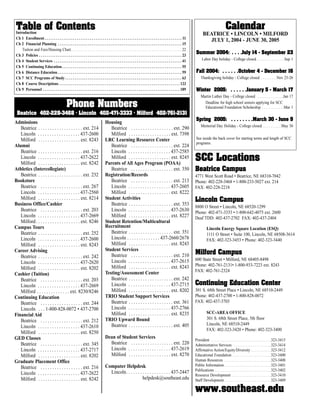
Calendar
BEATRICE • LINCOLN • MILFORD
JULY 1, 2004 - JUNE 30, 2005
Summer 2004: . . . .July 14 - September 23
Labor Day holiday - College closed . . . . . . . . . . . . . . .Sep 1
Fall 2004: . . . . . .October 4 - December 16
Thanksgiving holiday - College closed . . . . . . . . .Nov 25-26
Winter 2005: . . . . . .January 5 - March 17
Martin Luther Day - College closed . . . . . . . . . . . . . .Jan 17
Deadline for high school seniors applying for SCC
Educational Foundation Scholarship . . . . . . . . . . . .Mar 1
Spring 2005: . . . . . . . .March 30 - June 9
Memorial Day Holiday - College closed . . . . . . . . . .May 30
See inside the back cover for starting terms and length of SCC
programs.
SCC Locations
Beatrice Campus
4771 West Scott Road • Beatrice, NE 68310-7042
Phone: 402-228-3468 • 1-800-233-5027 ext. 214
FAX: 402-228-2218
Lincoln Campus
8800 O Street • Lincoln, NE 68520-1299
Phone: 402-471-3333 • 1-800-642-4075 ext. 2600
Deaf TDD: 402-437-2702 FAX: 402-437-2404
Lincoln Energy Square Location (ESQ)
1111 O Street • Suite 100, Lincoln, NE 68508-3614
FAX: 402-323-3453 • Phone: 402-323-3440
Milford Campus
600 State Street • Milford, NE 68405-8498
Phone: 402-761-2131• 1-800-933-7223 ext. 8243
FAX: 402-761-2324
Continuing Education Center
301 S. 68th Street Place • Lincoln, NE 68510-2449
Phone: 402-437-2700 • 1-800-828-0072
FAX: 402-437-3703
SCC-AREA OFFICE
301 S. 68th Street Place, 5th floor
Lincoln, NE 68510-2449
FAX: 402-323-3420 • Phone: 402-323-3400
President . . . . . . . . . . . . . . . . . . . . . . . . . . . . . . . .323-3415
Administrative Services . . . . . . . . . . . . . . . . . . . .323-3414
Affirmative Action/Equity/Diversity . . . . . . . . . . .323-3412
Educational Foundation . . . . . . . . . . . . . . . . . . . . .323-3400
Human Resources . . . . . . . . . . . . . . . . . . . . . . . . .323-3408
Public Information . . . . . . . . . . . . . . . . . . . . . . . . .323-3401
Publications . . . . . . . . . . . . . . . . . . . . . . . . . . . . . .323-3402
Resource Development . . . . . . . . . . . . . . . . . . . . .323-3410
Staff Development . . . . . . . . . . . . . . . . . . . . . . . . .323-3409
www.southeast.edu
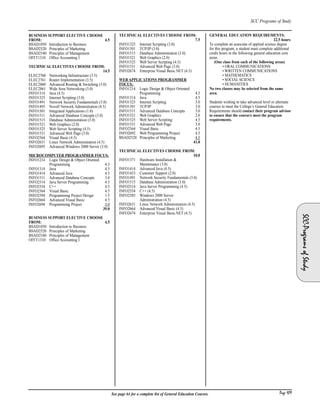
PROGRAM TITLE ______________________________________________________________LENGTH ______LOCATION __________AWARDS ________STARTING
________________________________________________________________________OF PROGRAM* ____OFFERED ____________OFFERED ________TERM
ACADEMIC EDUCATION
Academic Transfer__________________________________________________________18-24 months____Beatrice/Lincoln __________AA/AS __________All terms
Nebraska Law Enforcement ______________________________________________________21 ____________Lincoln________________AAS __________All terms
AGRICULTURE/LABORATORY SCIENCE
Agriculture Business & Management Technology______________________________________24 __________Beatrice________________AAS __________All terms
Laboratory Science Technology ____________________________________________________18 ____________Lincoln ______________AAS/Dip ________All terms
BUSINESS
Business Administration__________________________________________________________18 ____Beatrice/Lincoln/Milford ______AAS/Dip ________All terms
Office Technology ______________________________________________________________18 ________Beatrice/Lincoln ________AAS/Dip/Cert ______All terms
CONSTRUCTION
Architectural-Engineering Technology ______________________________________________18 ____________Milford________________AAS __________Winter, Summer
Building Construction Technology__________________________________________________18 ____________Milford________________AAS __________Spring, Fall
Computer Aided Drafting & Design Technology ____________________________________18-24 __________Lincoln________________AAS __________All terms
Fire Protection Technology ______________________________________________________18 ____________Lincoln________________AAS __________Call Admissions
Heating, Ventilation, Air Conditioning & Refrigeration Technology ______________________18 ____________Milford________________AAS __________Winter, Summer
Land Surveying/Civil Engineering Technology________________________________________18 ____________Milford________________AAS __________Call Admissions
ELECTRONIC/COMPUTER
Computer Programming Technology ________________________________________________18 ____________Milford________________AAS __________Winter, Summer
Construction Electrician - IBEW Option ____________________________________________18 __________________________________AAS __________Call Admissions
Electrical & Electromechanical Technology __________________________________________18 ____________Milford ______________AAS/Dip ________Winter, Summer
Electronic Servicing & Electronic Engineering Technology ____________________________18-30 ______Lincoln/Milford ____________AAS __________L-All; M-Win, Sum
Electronic Technology-Navy Option ________________________________________________12 __________________________________AAS __________Call Admissions
Microcomputer Technology ______________________________________________________18 ____________Lincoln______________AAS/Cert ________All terms
FAMILY & CONSUMER SCIENCE
Early Childhood Education ______________________________________________________18 ____________Lincoln ______________AAS/Dip ________All terms
Food Service/Hospitality ________________________________________________________18 ____________Lincoln ____________AAS/Dip/Cert ______All terms
HEALTH
Associate Degree Nursing ________________________________________________________18 ____________Lincoln________________AAS __________Winter, Summer
Dental Assisting ________________________________________________________________12 ____________Lincoln ________________Dip____________All terms
Human Services ________________________________________________________________24 ____________Lincoln ______________AAS/Dip ________All terms
Medical Assisting ______________________________________________________________12 ____________Lincoln ________________Dip____________Spring, Fall
Medical Laboratory Technology____________________________________________________18 ____________Lincoln________________AAS __________Summer
Practical Nursing ______________________________________________________________12 ________Beatrice/Lincoln ____________Dip____________Call Admissions
Radiologic Technology __________________________________________________________36 ____________Lincoln________________AAS __________Winter, Summer
Respiratory Care________________________________________________________________30 ____________Lincoln________________AAS __________Summer
Surgical Technology ____________________________________________________________18 ____________Lincoln________________AAS __________Call Admissions
MANUFACTURING
Machine Tool Technology ________________________________________________________18 ________Lincoln/Milford __________AAS/Dip ________All terms
Manufacturing Engineering & CAD Technology ______________________________________18 ____________Milford ______________AAS/Dip ________Winter, Summer
Nondestructive Testing Technology ________________________________________________18 ____________Milford________________AAS __________Winter, Summer
Welding Technology ____________________________________________________________18 ________Lincoln/Milford ________AAS/Dip/Cert ______All terms
MASS MEDIA/COMMUNICATION
Graphic Design ________________________________________________________________18 ____________Milford ______________AAS __________Call Admissions
Mass Media __________________________________________________________________18-24 __________Beatrice________________AAS __________All terms
Visual Publications ______________________________________________________________18 ____________Lincoln________________AAS __________Call Admissions
TRANSPORTATION
Auto Collision Repair Technology__________________________________________________18 ____________Milford________________AAS __________Winter, Summer
Automotive Technology __________________________________________________________18 ________Lincoln/Milford ____________AAS __________L-Win, Sum, M-All
DaimlerChrysler (CAP) College Automotive Program __________________________________21 ____________Milford________________AAS __________Call Admissions
Deere Construction & Forestry Equipment Tech ______________________________________21 ____________Milford________________AAS __________Call Admissions
Diesel Technology-Farm ________________________________________________________18 ____________Milford________________AAS __________Winter, Summer
Diesel Technology-Truck ________________________________________________________18 ____________Milford________________AAS __________Winter, Summer
Ford (ASSET) Automotive Student Service Educational Training Program ________________21 ____________Milford________________AAS ________Call Admissions
General Motors (ASEP) Automotive Service Educational Program ________________________21 ____________Milford________________AAS __________Call Admissions
John Deere Ag Parts ____________________________________________________________18 ____________Milford________________AAS __________Call Admissions
John Deere Ag Tech ____________________________________________________________21 ____________Milford________________AAS __________Call Admissions
Motorcycle, ATV, & Personal Watercraft Technology __________________________________12 ____________Lincoln ______________Dip/Cert__________Summer
Parts Marketing & Management __________________________________________________15 ____________Milford ______________AAS/Dip ________Fall
Professional Truck Driver Training__________________________________________________3 ____________Lincoln ________________Cert __________All terms
Awards: AA=Associate of Arts, AS=Associate of Science, AAS=Associate of Applied Science, Dip=Diploma, Cert=Certificate
SCC PROGRAMS of STUDY • LENGTH • LOCATIONS • AWARDS • STARTING TERMS
SCC runs on the Quarter System: 4 quarters per year *For a student attending full-time, average length of time - in months - for graduation/completion.
Beatrice Campus
FAX: 402-228-2218
Phone: 402-228-3468 • 1-800-233-5027
Admissions: ext. 214
Lincoln Campus
FAX: 402-437-2404 • Deaf TDD: 402-437-2702
Phone: 402-471-3333 • 1-800-642-4075
Admissions: ext. 2600
Milford Campus
FAX: 402-761-2324
Phone: 402-761-2131 • 1-800-933-7223
Admissions: ext. 8243
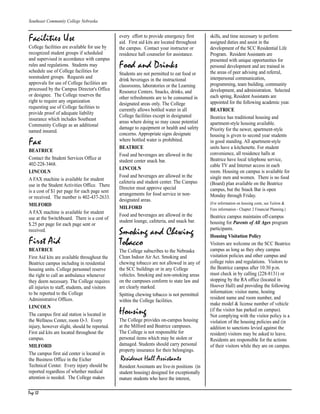
Admissions
Beatrice . . . . . . . . . . . . . . . . . . . ext. 214
Lincoln . . . . . . . . . . . . . . . . . . 437-2600
Milford . . . . . . . . . . . . . . . . . . ext. 8243
Alumni
Beatrice . . . . . . . . . . . . . . . . . . . ext. 216
Lincoln . . . . . . . . . . . . . . . . . . 437-2622
Milford . . . . . . . . . . . . . . . . . . ext. 8242
Athletics (Intercollegiate)
Beatrice . . . . . . . . . . . . . . . . . . . ext. 232
Bookstore
Beatrice . . . . . . . . . . . . . . . . . . ext. 267
Lincoln . . . . . . . . . . . . . . . . . . 437-2560
Milford . . . . . . . . . . . . . . . . . . ext. 8214
Business Office/Cashier
Beatrice . . . . . . . . . . . . . . . . . . ext. 203
Lincoln . . . . . . . . . . . . . . . . . . 437-2669
Milford. . . . . . . . . . . . . . . . . . . ext. 8246
Campus Tours
Beatrice . . . . . . . . . . . . . . . . . . . ext. 252
Lincoln . . . . . . . . . . . . . . . . . . 437-2600
Milford . . . . . . . . . . . . . . . . . . ext. 8243
Career Advising
Beatrice . . . . . . . . . . . . . . . . . . . ext. 242
Lincoln . . . . . . . . . . . . . . . . . . 437-2620
Milford . . . . . . . . . . . . . . . . . . ext. 8202
Cashier (Tuition)
Beatrice . . . . . . . . . . . . . . . . . . ext. 203
Lincoln . . . . . . . . . . . . . . . . . . 437-2669
Milford . . . . . . . . . . . . . . ext. 8230/8246
Continuing Education
Beatrice . . . . . . . . . . . . . . . . . . ext. 244
Lincoln . . . 1-800-828-0072 • 437-2700
Financial Aid
Beatrice . . . . . . . . . . . . . . . . . . ext. 212
Lincoln . . . . . . . . . . . . . . . . . . 437-2610
Milford . . . . . . . . . . . . . . . . . . ext. 8250
GED Classes
Beatrice . . . . . . . . . . . . . . . . . . ext. 345
Lincoln . . . . . . . . . . . . . . . . . . 437-2717
Milford . . . . . . . . . . . . . . . . . . ext. 8202
Graduate Placement Office
Beatrice . . . . . . . . . . . . . . . . . . ext. 216
Lincoln . . . . . . . . . . . . . . . . . . 437-2622
Milford . . . . . . . . . . . . . . . . . . ext. 8242
Housing
Beatrice . . . . . . . . . . . . . . . . . . ext. 290
Milford . . . . . . . . . . . . . . . . . . ext. 7398
LRC Learning Resource Center
Beatrice . . . . . . . . . . . . . . . . . . ext. 224
Lincoln . . . . . . . . . . . . . . . . . . 437-2585
Milford . . . . . . . . . . . . . . . . . . ext. 8245
Parents of All Ages Program (POAA)
Beatrice . . . . . . . . . . . . . . . . . . ext. 350
Registration/Records
Beatrice . . . . . . . . . . . . . . . . . . ext. 213
Lincoln . . . . . . . . . . . . . . . . . . 437-2605
Milford . . . . . . . . . . . . . . . . . . ext. 8222
Student Activities
Beatrice . . . . . . . . . . . . . . . . . . . ext. 353
Lincoln . . . . . . . . . . . . . . . . . . 437-2630
Milford . . . . . . . . . . . . . . . . . . ext. 8227
Student Retention/Multicultural
Recruitment
Beatrice . . . . . . . . . . . . . . . . . . . ext. 351
Lincoln . . . . . . . . . . . . . . 437-2660/2678
Milford . . . . . . . . . . . . . . . . . . ext. 8243
Student Services
Beatrice . . . . . . . . . . . . . . . . . . ext. 210
Lincoln . . . . . . . . . . . . . . . . . . 437-2615
Milford . . . . . . . . . . . . . . . . . . ext. 8243
Testing/Assessment Center
Beatrice . . . . . . . . . . . . . . . . . . . ext. 242
Lincoln . . . . . . . . . . . . . . . . . . 437-2715
Milford . . . . . . . . . . . . . . . . . . ext. 8202
TRIO Student Support Services
Beatrice . . . . . . . . . . . . . . . . . . . ext. 361
Lincoln . . . . . . . . . . . . . . . . . . 437-2766
Milford . . . . . . . . . . . . . . . . . . ext. 8235
TRIO Upward Bound
Beatrice . . . . . . . . . . . . . . . . . . . ext. 405
Dean of Student Services
Beatrice . . . . . . . . . . . . . . . . . . ext. 220
Lincoln . . . . . . . . . . . . . . . . . . 437-2619
Milford . . . . . . . . . . . . . . . . . . ext. 8270
Computer Helpdesk
Lincoln. . . . . . . . . . . . . . . . . . . 437-2447
. . . . . . . . . . . . . helpdesk@southeast.edu
Phone Numbers
Beatrice 402-228-3468 • Lincoln 402-471-3333 • Milford 402-761-2131
Cover.qxp 3/26/2004 12:59 PM Page 210
Southeast Community College is a public
two-year institution located in southeast
Nebraska. The College offers its
educational services at three campuses in Beatrice, Lincoln and
Milford, and at Continuing Education centers located in each of the fifteen
counties served by the College. SCC was created in 1973 by enactment of
state law that authorized a system of six locally governed and locally
supported Nebraska community college areas.
The major educational emphasis of the College is applied technology
programs that prepare students for careers or further education. SCC
also offers a college transfer program for students who wish to complete
the first two years of a four-year degree and transfer those credits to a
senior institution. The College provides Continuing Education in a variety
of fields including training customized for business and industry.
We hope you will use this catalog to learn about the quality educational
opportunities and excellent continuing education classes offered at our
campuses. You will also read about the lifelong learning classes and
seminars available in communities throughout our fifteen-county district in
southeast Nebraska. We believe you will find a program or class that is
just right for you.
Southeast Community College is what a community college should be.
Classes are small and student-centered. Outstanding faculty focus on
excellence in teaching to help students prepare for successful careers and
transfer to four-year institutions. Dedicated staff members provide
students with career counseling, financial aid information, career
placement and many other support services. SCC provides this remarkable
array of educational opportunities at an affordable cost.
Southeast Community College welcomes students of all races and
nationalities, women and men, people with disabilities and students of all
ages in its programs and activities. SCC values diversity as an important
part of the educational process, and continues to seek students, faculty and
staff who bring a variety of life experiences and viewpoints to the College.
Southeast Community College faculty and staff understand that the
nation’s workforce is composed of many different people successfully
performing a variety of jobs. We strive to prepare students to live and
work in harmony with people different from themselves.
Dr. Jack J. Huck, President
Welcome
to Southeast Community College!
CH P1_6.qxp 3/26/2004 12:44 PM Page 1
2003-2004
Board of Governors
Row 1: Helen E. Griffin, Chair, Lincoln;
Ruth M. Johnson, Vice Chair, Lincoln;
Row 2: Lynn Schluckebier, Secretary, Seward;
Gene Watermeier, Treasurer, Unadilla;
Row 3: Jacki Allensworth, Lincoln;
Darryl Baker, Beatrice;
Row 4: Robert J. Feit, Beatrice;
Ed C. Heiden, Sterling;
Row 5: Richard O. Scott, Lincoln;
Doug Merryman, Geneva;
Row 6: Nancy A. Seim; Lincoln;
Bill Beltz, Faculty Representative, Milford
Page 2
Southeast Community College Nebraska
College Administration
Dr. Jack J. Huck, President
Dr. Dennis Headrick, Vice President for
Instruction/Beatrice Campus Director
Jeanette Volker, Vice President for
Student Services/Lincoln Campus
Director
Lyle Neal, Vice President for
Technology/Milford Campus Director
Ted Suhr, Vice President for
Administrative Services/Resource
Development
Don Byrnes, Vice President for Human
Resources/Staff Development
Rosemary Machacek, Vice President for
Public Information
José Soto, Vice President for Affirmative
Action/Equity/Diversity
Limitations of Catalog Information - This catalog should not be considered a contract between Southeast Community College
and any prospective student. The Board of Governors of Southeast Community College reserves the right to make changes in
graduation requirements, costs, curriculum, course structure and content, and the calendar of operation, during the life of the
catalog and without notice.
Equal Opportunity/Nondiscrimination Policy - It is the policy of Southeast Community College to provide equal opportunity
and nondiscrimination in all admission, attendance, and employment matters to all persons without regard to race, color, religion,
sex, age, marital status, national origin, ancestry, veteran status, sexual orientation, disability, or other factors prohibited by law or
College policy. Inquiries concerning the application of Southeast Community College’s policies on equal opportunity and
nondiscrimination should be directed to the Vice President for Affirmative Action, Equity and Diversity, SCC Area Office, 301 S.
68th Street Place, Lincoln, NE 68510, 402-323-3412, FAX 402-323-3420, or jsoto@southeast.edu via E-mail.
The SCC Mission...
Southeast Community College values the opportunity to provide quality
applied technology and academic educational opportunities for the students,
businesses and communities of our district. To achieve that purpose,
Southeast Community College will:
• Continue to value local
governance
• Value diversity
• Be affordable and accessible
• Develop and maintain
partnerships
• Provide responsive delivery
systems
• Respond to emerging technology
• Promote continuous
improvement
• Promote student learning
through the provision of quality
instruction and curriculum
• Embrace lifelong learning
• Maximize and utilize resources
efficiently
• Be accountable
• Encourage a positive
environment
• Promote recruitment and
retention
• Be communicative
2003-2004
Board of Governors
CH P1_6.qxp 3/26/2004 12:44 PM Page 2
About SCC
Location
The College includes three campuses and
more than 20 off-campus sites in 15
counties. Our Beatrice campus is located
in a city of 12,805 and our Milford campus
is at home in a community of 2,071. Our
Lincoln campus is located in the capital
city of 232,362. Each location offers
individual benefits—from rural friendliness
and small city energy to metropolitan
ambience.
In addition to our campus locations, SCC
serves 15 counties located in southeast
Nebraska with courses operated through
the College Continuing Education division.
Counties included in the SCC service area
are Saunders, York, Seward, Lancaster,
Cass, Otoe, Fillmore, Saline, Thayer,
Jefferson, Gage, Johnson, Nemaha, Pawnee
and Richardson.
The general College Administrative Offices
are located at 301 S. 68th Street Place in
Lincoln. This SCC System Office provides
the central coordination for the College,
serving as the administrative unit for the
SCC campuses and 15-county service area.
Accreditation
Southeast Community College is
accredited by the Higher Learning
Commission of the North Central
Association of Colleges and Schools, 30
LaSalle Street, Suite 2400, Chicago, IL
60602, 1-800-621-7440. Many programs
are also accredited by specific industry
accrediting agencies.
Enrollment
The College enrolls approximately 17,240
full-time and part-time credit students on
its three campuses. Another 13,557
students take advantage of non-credit
courses annually.
Calendar
SCC operates on a quarter calendar system
with terms that start in January, March,
July and October. Summer sessions are
also available.
Technical & Career
Education
Students may choose from
applied technology programs grouped
into nine divisions:
1) Agriculture/Laboratory Science;
2) Business;
3) Construction;
4) Electronic/Computer;
5) Family and Consumer Science;
6) Health;
7) Manufacturing;
8) Mass Media/Communication; and
9) Transportation.
Job opportunities in each area are growing
as the demands for employees with
technical knowledge and skills increase.
Business and industry advisory groups
provide suggestions on standards, trends,
emerging technology and course content.
Academic Transfer
Education
SCC offers the first two years of college
course work for transfer to four-year
colleges and universities. Transfer of
credits has become easier since the
approval of the Nebraska Transfer
Initiative in 1995. Students who begin
their college careers at SCC and transfer
credits to a four-year college graduate at
rates comparable to those who began their
college work at a four-year institution.
Awards
SCC awards the following to students who
successfully complete a required program
of study:
• Associate of Applied Science Degree
• Associate of Arts Degree
• Associate of Science Degree
• Certificate
• Diploma
CH P1_6.qxp 3/26/2004 12:44 PM Page 3
Page 4
Southeast Community College Nebraska
Continuing Education
Both credit and non-credit courses are
offered to individuals, businesses and
communities throughout the SCC service
area. Continuing Education focus areas
are
• Adult Guided Studies-GED, English as
a Second Language and citizenship
classes
• Agriculture-classes in farm and
financial management and marketing
• Business-a wide variety of classes from
keyboarding to real estate
appraiser/licensure, small business
management, and microcomputer
classes for business and home
• Family and Consumer Science-training
for school food service supervisors and
child care professionals
• Health-updates (CEUs) for nurses,
nursing assistants, emergency medical
technicians and many other classes
• Personal enrichment-many types of
classes in arts, crafts, floristry,
recreation and fitness, woodworking,
travel and much more
• Industrial, Technical and Vocational
Trades-training in automotive, boiler
operation, custodial maintenance,
electrical, machine tool and more
• Community Services- many types of
classes offered in communities
throughout southeast Nebraska
• Customized Training-classes in all
areas tailored to meet the needs of
business and industry, scheduled at
convenient times and places
Distance Education
SCC makes education more accessible and
convenient by offering off-campus
educational opportunities. Students of any
age can earn college credit by successfully
completing on-line courses or by viewing
videotaped courses and taking tests or labs
on SCC campuses. Individuals can also
participate in SCC classes through a
satellite downlink site originating from an
SCC campus or attending a class in one of
more than 52 off-campus sites. See
Chapter 6 - Distance Education for the
SCC programs available on-line. Credits
earned by distance education are
transferable to SCC and other colleges.
Student Activities
Each campus offers students opportunities
to build leadership skills and friendships in
organizations such as Student Senate and
Phi Theta Kappa, the national community
college scholastic honor society. Students
may also participate in career-specific
groups, such as the Licensed Practical
Nurses Association of Nebraska, the
Social Science Club and student chapters
of such organizations as the Society of
Manufacturing Engineers.
In addition to career-related and scholastic
groups, the Beatrice campus offers
intercollegiate sports including men’s and
women’s basketball, men’s golf, and
women’s volleyball. SCC-Beatrice also
provides a variety of other activities
including art, theater, and vocal and
instrumental music.
Each campus offers intramural sports and
wellness centers where students can use
exercise equipment and participate in
aerobic and fitness activities.
Housing
SCC campuses in Beatrice and Milford
offer residence hall living for single
students. The Milford campus also has
housing for married couples and single
parents. The Lincoln campus maintains
rental listings, city maps, and prices to
assist students with their living
arrangements.
Placement
At least 90% of SCC graduates regularly
report placement in training related
positions or in continued education
following graduation. Most career
program graduates receive multiple job
offers, many before they graduate. Career
graduates are entitled to lifetime job
placement services. In response to
College surveys, employers report high
satisfaction with the preparation and work
habits of SCC graduates.
Instruction
SCC instructors are highly qualified.
Academic instructors have completed
master’s degrees in their teaching fields.
Some instructors have earned doctorates or
have completed hours toward their
doctoral degrees. Technical instructors
have both formal and vocational
education.
Services
SCC provides students with a wide variety
of services, such as academic advising,
financial aid, tutoring, TRIO Student
Support Services, and TRIO Upward
Bound. Students also have access to
cafeterias, ample parking, housing
(Beatrice and Milford), and a child care
center in Lincoln. The College provides
libraries, computer labs with Internet
access, and placement services. These
services support classroom experiences
and help make a college education more
accessible to prospective students.
Student Population
Nearly half of the nation’s first-time
freshmen enroll at community colleges.
More and more students take classes
simultaneously at two colleges. Flexible
schedules, cost, convenient locations and
small classrooms make community
colleges a good education investment.
Nebraska community colleges and four-
year institutions work together to make co-
enrollment and transfer of credit as easy as
possible.
Career Earnings
Over a lifetime of work, the nation’s
community college graduates can expect
to keep pace with or surpass the earnings
of four-year college or university
graduates. The average starting salaries
for all SCC program graduates are
published in the Annual College
Placement Report.
Student Diversity
Southeast Community College values
diversity and seeks to recruit and retain
students from a variety of cultures, races
and ethnic groups. The College values the
heritage and viewpoint each student brings
to the campuses and classrooms. SCC
offers activities, services and recognitions
celebrating diversity.
Support programs are offered for students
of a variety of races and cultures as well
as single parents and persons who are
entering nontraditional careers. SCC also
welcomes students with disabilities and
complies with the Americans with
Disabilities Act (ADA).
College programs and activities are based
on the principle that all students have the
right to obtain an education in a college
environment free from all forms of
discrimination and harassment.
CH P1_6.qxp 3/26/2004 12:44 PM Page 4
Page 5
Introduction
Introduction
SCC-Beatrice Campus offers a
beautiful semi-rural campus
on the west edge of
Beatrice, Nebraska.
SCC-Beatrice Campus
4771 W. Scott Road, Beatrice, NE 68310-7042
The campus offers the Academic Transfer
program as well as applied technology
programs including: Agriculture Business &
Management Technology; Business
Administration; Mass Media; Nebraska Law
Enforcement; Office Technology; and Practical
Nursing.
Adams Hall: One-Stop Shop Family Resource
Center, Lecture Hall;
Classrooms for: Nursing
Agriculture Center: The Agriculture Center, a
model land and animal laboratory for the
Agriculture Business and Management
program, is located one mile south of the main
campus.
Carter Building: Student Housing located off-
campus, for qualified students with families.
Ford Hall: Classrooms for: Ag Equipment, Ag
Mechanics, Crops, Horticulture and Ag
Business
Hoover Hall: Residence Hall
Jackson Hall: ABE/GED, Career Advising
Center, Testing & Assessment; TRIO Upward
Bound
Classrooms for: Broadcasting, Business
Occupations, Distance Learning, Journalism,
Office Technology, Photography.
Kennedy Center: Administration, Admissions,
Advising, Athletics, Bookstore, Cashier,
Computer Lab, Continuing Education,
Financial Aid, Learning Resource Center,
Placement, Registration, Retention, Student
Center, Snack Bar, Student Services, TRIO
Student Support Services.
Classrooms for: Languages, Life Sciences,
Math/Physics, Social Sciences
Roosevelt Hall: Residence Hall
Truman Center: Gymnasium, Theatre,
Wellness Center;
Classrooms for: Art, Theatre, Speech, Music
SCC-Beatrice Campus is located on 640 acres at
the west edge of Beatrice, Nebraska.
For a tour of the SCC-Beatrice Campus:
1-800-233-5027, ext. 252
or visit us on the College web site:
www.southeast.edu
The Carter Building is located off-campus and
houses qualified students with families.
CH P1_6.qxp 3/26/2004 12:44 PM Page 5
Page 6
Southeast Community College Nebraska
SCC-Milford enjoys a
63-year history as Nebraska’s
premier technical college
established in 1941.
Cornhusker Hall: - Residence Hall
ETC - Eicher Technical Center:
Admissions, Business Office, Cashier,
Computer Lab, Campus Administration,
Financial Aid, Learning Resource Center,
Registration, Retention, Student Lounge,
Student Services, TRIO Student Support
Services
Classrooms for: Architectural-Engineering
Technology; Auto Collision Repair
Technology; Automotive Technology;
Building Construction Technology;
Computer Programming Technology;
DaimlerChrysler (CAP) College Automotive
Program; Deere Construction and Forestry
Equipment Tech; Diesel Technology-Farm;
Diesel Technology-Truck; Electrical &
Electromechanical Technology; Electronic
Servicing & Electronic Engineering
Technology; Ford (ASSET) - Automotive
Student Service Educational Training;
General Motors (ASEP) - Automotive
Service Education Program; Graphic Design;
John Deere Ag Parts; John Deere Ag Tech;
Land Surveying /Civil Engineering
Technology; Machine Tool Technology;
Nondestructive Testing Technology; Parts
Marketing & Management; and Welding
Technology
G. Alan Dunlap Center: Cafeteria,
Bookstore, Conference Rooms
HVAC: Classrooms for: Heating,
Ventilation, Air Conditioning, and
Refrigeration Technology
ITC: Industry Training Center
John Deere Building: Classrooms for:
Deere Construction and Forestry Equipment
Tech; John Deere Ag Parts, John Deere Ag
Tech
Lowell A. Welsh Center: Legacy Room,
Gymnasium, Heritage Room, Student Center
Nebraska Hall: Residence Hall
Pioneer Complex: Residence Hall
Placement & Assessment Center:
Assessment, Career Advising, Placement
SCC-Milford Campus is located on 53.5 acres
in Milford, Nebraska.
For a tour of the SCC-Milford Campus:
1-800-933-7223, ext. 8243 or access the
College web site: www.southeast.edu
SCC-Milford Campus
600 State Street, Milford, NE 68405-8498
CH P1_6.qxp 3/26/2004 12:44 PM Page 6
Page 7
Introduction
Introduction
A - Classrooms for: Laboratory Science,
Early Childhood Education, General Studies
B - Classrooms for: Dental Assisting,
Medical Assisting, Medical Laboratory
Technology, Practical Nursing, Radiologic
Technology, Respiratory Care, Surgical
Technology
C - Child Development Center
D - Bookstore; Classrooms for: Associate
Degree Nursing, Early Childhood Education
E - Admissions, Cashier, Financial Aid,
Registration and Records, Student Services;
Classrooms for: Food Service/Hospitality
F - Campus Administration
FPTC - Fire Protection Training Center;
Classrooms for: Fire Protection Technology
G - Cafeteria, Shipping/Receiving;
Classrooms for: Food Service/Hospitality
H - Media Production, Placement Office
J - Continuing Education, Distance Learning
K - Classrooms for: Machine Tool
Technology, Motorcycle, ATV, & Personal
Watercraft Technology, Welding Technology
L - ABE/GED, Advising, Assessment, Career
Advising Center, Computer Lab, Learning
Resource Center, Multi-Academic Center,
Retention, TRIO Student Support Services
M - Classrooms for: Automotive Technology
N - Classrooms for: Computer Aided
Drafting & Design Technology, Electronic
Servicing & Electronic Engineering
Technology
NCEE - (Located off-campus) Nebraska
Center for Excellence in Electronics: 4740
Discovery Drive, Lincoln NE Classrooms
for: Customized Training Services for
business and industry
O - Student Activities, Gym, Student Center,
Wellness Center
P - Student Activities Center
R - Classrooms for: Microcomputer
Technology
S - Classrooms for: Professional Truck
Driver Training
T - Classrooms for: Business Administration,
Office Technology
U - Classrooms for: Academic Education,
Continuing Education, Human Services,
Visual Publications, and a Multi-Purpose
Room
Variety and flexibility
are the hallmarks
of programs at the
SCC-Lincoln Campus
8800 O Street.
The Lincoln Campus is located on the east
edge of the capital city and houses a 280,000
sq. ft. facility on a 117 acre site.
For a tour of the SCC-Lincoln
Campus and downtown Energy Square
location: 1-800-642-4075, ext. 2600 or
access the College web site:
www.southeast.edu
SCC-Lincoln offers the Academic Transfer program as well as applied technology programs including:
Associate Degree Nursing; Automotive Technology; Business Administration; Computer Aided Drafting &
Design Technology; Dental Assisting; Early Childhood Education; Electronic Servicing & Electronic
Engineering Technology; Laboratory Science Technology; Fire Protection Technology; Food
Service/Hospitality; Human Services; Machine Tool Technology; Medical Assisting; Medical Laboratory
Technology; Microcomputer Technology; Motorcycle, ATV, & Personal Watercraft Technology; Nebraska
Law Enforcement; Office Technology; Practical Nursing; Professional Truck Driver Training; Radiologic
Technology; Respiratory Care; Surgical Technology; Visual Publications; and Welding Technology.
SCC-Lincoln Campus
8800 O Street, Lincoln, NE 68520
CH P1_6.qxp 3/26/2004 12:44 PM Page 7
Page 8
SCC-LINCOLN ENERGY SQUARE
SCC-Lincoln ESQ location
offers convenience in
downtown Lincoln, at 1111 O Street.
SCC-Lincoln Campus - Energy Square Location
1111 O Street, Lincoln, NE 68508-3614
The Lincoln Campus has a downtown location on the
first floor of the Energy Square Building.
The downtown location offers Academic Transfer
classes; Adult Basic Education ABE/GED/ESL
classes; Customized Training Services for Business &
Industry; Computer classes; and a Distance Learning
classroom.
Suite 100: Academic Transfer
Office; Lincoln Campus-Energy
Square Office, Information
Rooms 102, 104-110, 112C, 112F:
Classrooms for: Accounting, Art,
Chemistry, Computer, Criminal
Justice, Economics, English,
Geology, Geography, Math,
Medical Terminology, Music,
Philosophy, Political Science,
Psychology, Sociology, Speech,
Spanish
Room 103: Distance Learning
Room 104: ABE/GED
Rooms 112A: Video Conference
Room, TRIO
Room 112B: Workforce
Development
Room 112E: Customized Training
for Business & Industry
ESQ Students: There are discount
parking tickets available. Tickets are
sold at AMPCO • 317 S. 12th Street,
Suite 101 • 402-441-6472 • 7:30 am-
5:30 pm
You must bring your student ID and
CURRENT TERM class schedule.
(Schedule can be printed out from
WASI) www.southeast.edu/wasi.htm
NCEE - (Located off-campus) Nebraska Center for
Excellence in Electronics: 4740 Discovery Drive,
Lincoln NE Classrooms for: Customized Training
Services for business and industry
CH P1_6.qxp 3/26/2004 12:44 PM Page 8
Page 9
Introduction
Introduction
The SCC-Continuing Education Center
offers one of the most sophisticated
technological capacity in Lincoln, including
state-of-the-art equipment allowing
communication throughout the world.
SCC-Continuing Education Center
301 S. 68th Street Place, Lincoln, NE 68510-2449
The Continuing Education Center will be used for a
variety of purposes including special classes and
seminars in workforce training, personal development
and customized training programs for business and
industry.
The College Food Service/Hospitality program will
use the first floor of the Center as a satellite training
laboratory to accommodate the program’s growing
enrollment.
The College Administration is located on the fifth
floor of the building.
1st floor: (Basement Level)
Kitchen
Classrooms for: Continuing Education and Food
Service/Hospitality
2nd floor: (Street Level)
Auditorium, Commons Area, Reception Desk
Offices for Continuing Education Directors of
Workforce Development - Customized Training Services
for Business and Industry
CH P1_6.qxp 3/26/2004 12:45 PM Page 9
Page 10
Southeast Community College Nebraska
4th floor: Offices for Continuing Education Dean, Director of
Business, Director of Personal Enrichment and Leisure
Classrooms for: Continuing Education
Computer Labs
5th floor: SCC-Area Office
Offices for College Administration including:
Affirmative Action/Equity/Diversity, Human Resources,
Educational Foundation
3rd floor: Classrooms for Workshops, Seminars, and Conferences
CH P1_6.qxp 3/26/2004 12:45 PM Page 10
ENROLLMENTFor the right move and to have a successful college career at SCC, admissions
representatives and career advisors are available to help you decide on a program of
study. To further assist you please schedule a visit to the campuses to see our
exceptional instructional labs and classrooms and to visit with instructors for first-
hand information about the programs.
• Admission Requirements
• Application for Admission
• Steps for Admission to Programs of Study
• Readmission Steps
• Pre-admission Advising and Testing
• Nebraska Residency Requirements
• Advanced Standing
• International Students
• Undeclared Students
• Registration Procedures
• Prerequisites
• Student Status
• Licensure Requirements
• Drop/Add/Withdrawal
Chapter 1 -
Enrollment
CH P1_6.qxp 3/26/2004 12:45 PM Page 11
Page 12
Southeast Community College Nebraska
Page 12
Admission Requirements
All students who are accepted for admission to a
program of study must demonstrate the “ability to
benefit” from instruction by having graduated
from an accredited or approved high school or
college, or having completed the requirements for
a GED certificate.
The student who has not graduated from high
school or who does not have a GED certificate
must take an independently administered
assessment test and must achieve specified test
scores in order to demonstrate an “ability to
benefit.” This is required by federal regulation
governing Title IV programs. The
ASSET/COMPASS assessment used by Southeast
Community College is one of these tests approved
by the U.S. Department of Education to determine
a student’s ability to benefit.
Transcript requirements may be waived under
certain circumstances. Contact the College
Admissions Office for more information.
Any person 16 years of age or older who is not
enrolled in a regular secondary school program is
eligible to enroll in Southeast Community College
classes provided they meet any stated class
prerequisites. Eligible high school students in
good standing may enroll in college credit classes
with written permission from their high school
principal or counselor. Students under 16 years of
age will not be accepted for admission into
programs of study. Students under 16 may enroll
in credit classes with special permission from the
College campus Dean of Student Services.
Contact an SCC Student Services Office to obtain
a permission form.
Students under 16 years of age may enroll in
special noncredit classes which are offered by the
Continuing Education division. These special
classes usually are designed for youth and adults
who register and attend classes together. Other
special enrollment opportunities for students
under 16 will be identified in the course
description and/or advertisement.
High school students enrolling in distance
learning classes must meet all of the College
course prerequisites prior to the start of class.
Contact the campus Registration and Records
Office for additional information.
Some programs offered by the College may
require completion of prerequisite courses,
physical examinations, and other special
requirements such as CPR training or a certified
copy of driving record. All special requirements
for admission are outlined in the individual
program brochures and at the campus Admissions
Offices.
Developmental course work and high school
equivalency programs are available at SCC to
students who do not meet College admission
requirements.
All requests for information regarding admission
to any program and all completed application
forms should be obtained from and submitted to
the Admissions Office of the campus selected by
the student. SCC has the right to deny admission
or continued enrollment to persons who have
misrepresented their credentials or background.
Application for
Admission
All new students seeking admission to a program
of study at SCC must complete an Application for
Admission form. Students need to complete only
one Application for Admission form to attend
classes at any SCC campus location. Students
desiring to transfer in their program of study to a
different campus location must contact the
program chair at the different location to
determine if openings are available. There is no
Application for Admission fee. Application for
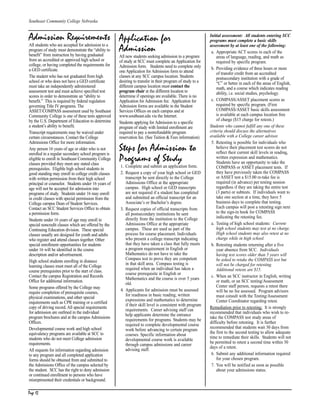
Admission forms are available in the Student
Services Offices on each campus and at
www.southeast.edu via the Internet.
Students applying for Admission to a specific
program of study with limited enrollment are
required to pay a nonrefundable program
reservation fee. (See Tuition & Fees information)
Steps for Admission to
Programs of Study
1. Complete and submit an application form.
2. Request a copy of your high school or GED
transcript be sent directly to the College
Admissions Office at the appropriate
campus. High school or GED transcripts
are not required if a student has completed
and submitted an official transcript for an
Associate’s or Bachelor’s degree.
3. Request copies of official transcripts from
all postsecondary institutions be sent
directly from the institution to the College
Admissions Office at the appropriate
campus. These are used as part of the
process for course placement. Individuals
who present a college transcript indicating
that they have taken a class that fully meets
a program requirement in English or
Mathematics do not have to take the
Compass test to prove they are competent
in that skill area. Compass testing is
required when an individual has taken a
course prerequisite in English or
Mathematics and the course is over 5 years
old.
4. Applicants for admission must be assessed
for readiness in basic reading, written
expressions and mathematics to determine
if their skill level is consistent with program
requirements. Career advising staff can
help applicants determine the entrance
requirements for programs. Students may be
required to complete developmental course
work before advancing to certain program
courses. Specific information about
developmental course work is available
through campus admissions and career
advising staff.
Initial assessment: All students entering SCC
programs must complete a basic skills
assessment by at least one of the following:
a. Appropriate ACT scores in each of the
areas of language, reading, and math as
required by specific program.
b. Providing evidence of three hours or more
of transfer credit from an accredited
postsecondary institution with a grade of
“C” or better in each of the areas of English,
math, and a course which indicates reading
ability, i.e. social studies, psychology.
c. COMPASS/ASSET placement scores as
required by specific program. (First
COMPASS/ASSET basic skills assessment
is available at each campus location free
of charge ($15 charge for retests.)
Students who cannot fulfill any one of these
criteria should discuss the alternatives
available with a College career advisor.
5. Retesting is possible for individuals who
believe their placement test scores do not
reflect their current skill levels in reading,
written expression and mathematics.
Students have an opportunity to take the
COMPASS or ASSET placement tests. If
they have previously taken the COMPASS
or ASSET test a $15.00 re-take fee is
required (in advance) per testing session
regardless if they are taking the entire test
(3 parts) or subtests. If individuals want to
take one section at a time, they have 5
business days to complete that testing.
Each campus will post a retesting sign next
to the sign-in book for COMPASS
indicating the retesting fee.
a. Testing of high school students: Current
high school students may test at no charge.
High school students may also retest at no
charge while in high school.
b. Retesting students returning after a five
year absence from SCC. Individuals
having test scores older than 5 years will
be asked to retake the COMPASS test but
will not be charged for retesting.
Additional retests are $15.
c. When an SCC instructor in English, writing
or math, or an SCC testing/Assessment
Center staff person, requests a retest there
will be no fee assessed. Program advisors
must consult with the Testing/Assessment
Center Coordinator regarding retest.
Remediation prior to retesting: It is strongly
recommended that individuals who wish to re-
take the COMPASS test study areas of
difficulty before retesting. It is further
recommended that students wait 30 days from
the first to the second testing to allow adequate
time to remediate their skills. Students will not
be permitted to retest a second time within 30
days of a retest.
6. Submit any additional information required
for your chosen program.
7. You will be notified as soon as possible
about your admissions status.
CH P1_6.qxp 3/26/2004 12:45 PM Page 12
Page 13
Enrollment
Enrollment
Readmission Steps
Former Southeast Community College students
who were declared and enrolled in a program
of study, and who have not been enrolled for
one or more years, must reapply for admission
to be eligible to register for program classes.
Returning former students must complete an
Application for Readmission form and submit
the completed application to the appropriate
campus Admissions Office.
Readmission is subject to available space and
current requirements established by the
College and the program of study.
Pre-admission Advising
and Testing
All applicants for admission are provided
opportunities for pre-admission basic skills
assessment, testing, advising and career
planning. Applicants who desire pre-admission
basic academic skills testing and/or career
advising should contact the appropriate
Admissions Office for arrangements. Southeast
Community College promotes the philosophy
that all applicants should possess certain levels
of academic ability in order to succeed in their
selected program of study. Applicants required
to complete COMPASS/ASSET basic skills
testing will be notified by the appropriate
campus. Students may be required to complete
developmental course work before advancing
to certain program courses. Specific
information about developmental course work
is available through campus admissions and
career advising staff.
Nebraska Residency
Requirements
To be eligible to register at resident tuition rates at
Southeast Community College, Nebraska
residency must be established according to the
provisions of Nebraska revised statutes of 1980,
Section 85-501 and 85-502.
An individual will qualify as a resident of the
state of Nebraska for tuition purposes at
Southeast Community College if the standards
set forth in any one of the following eight (8)
categories are met:
1. An individual who is a graduate of an
accredited Nebraska senior high school, or
has previously been enrolled at Southeast
Community College as a resident student.
2. An individual who has married a resident of
Nebraska.
3. A person of legal age who is dependent for
federal income tax purposes on a parent or
guardian who has established a home in
Nebraska.
4. A minor whose parent(s) or guardian who
for a period of six months have established
a home in Nebraska where such parent(s)
or guardian are habitually present with the
bona fide intention of making Nebraska
their permanent place of residence.
5. A person of legal age or an emancipated
minor who for a period of six months shall
have established a home in Nebraska where
he/she is habitually present, and shall
verify by documentary proof that he/she
intends to make Nebraska his/her
permanent residence. (Examples that may
satisfy Nebraska residency: voter
registration, Nebraska driver’s license,
vehicle registration, payroll records,
apartment lease agreement.)
6. An individual who is an alien and who for a
period of at least two years has established
a home in Nebraska where he/she is
habitually present with the bona fide
intention of becoming a permanent resident
alien of the United States and making
Nebraska his/her permanent residence.
7. An individual who is a dependent of a
permanent full-time staff member of
Southeast Community College, the
University of Nebraska system, one of the
Nebraska state colleges, or one of the other
technical community college areas.
8. An individual on active duty with the armed
services of the United States who has been
assigned a permanent duty station in
Nebraska, or a dependent of an individual
who is a member of the armed services
assigned to a permanent duty station in
Nebraska.
International students who are attending
Southeast Community College on a student
visa ARE NOT eligible to be classified as a
Nebraska resident.
Any student who has been classified as a
nonresident and believes he/she may qualify as
a resident must file a residency application
form with the Dean of Student Services before
the end of the fourth week of the quarter for
which the tuition fee was charged. Residency
application forms, as well as further
information regarding residency classification,
are available from each campus Student
Services Office. It is the student’s
responsibility to initiate a change for residency
status.
Advanced Standing
The College believes students should be
recognized and rewarded for previous
educational and occupational experience when
that experience results in competence in areas
normally addressed by the courses and
programs of the College. The College has
established three methods for students to gain
advanced standing:
1. Transfer of Credit
2. Credit by Waiver
3. Credit by Examination
Please refer to the Policy section of this
catalog (chapter 3) for further information on
Advanced Standing.
International Students
The following requirements apply for students
applying to Southeast Community College
requesting an I-20
(F-1 Visa).
1. Completed application for admission.
2. Certified copies of academic records, plus
English translations where necessary.
3. International version of TOEFL (Test of
English as a Foreign Language) with a total
score of 500 or higher if paper based, or
173 if computer based. Scores must be sent
directly to the College by using
institutional code 6795.
4. Signed Financial Resource Statement
showing resources sufficient to cover
course of study and transportation expenses
to and from the home country.
Contact the campus Admissions Office for
specific information assistance and required
forms.
Undeclared Students
Students may take courses at the College in an
undeclared status. There are two categories of
undeclared students:
1. Those awaiting acceptance into a program
of study.
2. Those not planning to pursue a program of
study but who are taking credit classes for
transfer, job advancement, or other
purposes.
Undeclared students may register for classes
during general registration. College staff are
available for assistance.
Registration Procedures
It is recommended that prior to registration,
students should consult with advisors or
instructors. Registration dates are published
and available in the Student Services Office
prior to each registration period. Additional
information will also be made available by
faculty and program advisors. General
registration information is distributed each
term by the Registration and Records Office on
each campus. It is each student’s responsibility
to become familiar with registration schedules,
deadlines, completion of registration forms,
CH P1_6.qxp 3/26/2004 12:45 PM Page 13
Page 14
Southeast Community College Nebraska
and any required signatures. Students who are
declared in a program of study are allowed to
register before general registration.
The College requires a student’s Social
Security Number as a condition for
enrollment for all students registering for
classes at SCC (See Family Educational Rights
and Privacy Act - FERPA - College Policies
Chapter 3). with the exception of individuals
who are documented to be “lawfully admitted
aliens.” For those registering students who are
documented as “lawfully admitted aliens,”
independent of their eligibility to obtain a
Social Security Number, an alternate number
will be assigned to distinguish their student
records from others.
Registration forms are processed by the
Registration and Records Office. The
Registration and Records Office is responsible
for collecting and maintaining all student
records and grades, and is in charge of
registrations. The Registration and Records
Office also receives all drop/add and
termination forms.
After registering, payment of tuition and fees
must be made to the campus Business Office
within the established payment deadline.
Failure to meet established payment deadlines
will result in debt collection activity. The
student is responsible for all unpaid balances.
All balances must be paid before a student can
register for courses on any SCC campus.
Students may enroll in the “FACTS” monthly
payment plan. (See Payment Policy - Financial
Planning Chapter 2.)
Prerequisites
A student may be prohibited from registering for
some programs/courses which have specific
program prerequisites if the student fails to meet
those program/course prerequisites.
Academic Transfer students - may not
register for more than 20 credits in a term
unless permission is granted by the Dean of
Student Services.
Arranged and Independent Study Classes -
Students who register for any arranged classes
or independent study classes must report to the
instructor for each class on the first day of
class, at the beginning of the term. Students
who register for any arranged or independent
study classes, after the term begins (adding
classes with drop/add form) must report within
five (5) days from the Registration and Records
Office date on the drop/add form. Failure to
report will cause the instructor to void the
registration. Once voided, the student cannot
re-enroll during the same term.
Student Status
Full time = 12 or more credit hours per term
Part time = less than 12 credit hours per term
3/4 time = 9 through 11.5 credit hours per term
1/2 time = 6 through 8.5 credit hours per term
Less than 1/2 time = Less than 6 credit hours
per term
Contact the campus Registration and Records
Office for questions about student status for
terms other than quarter (summer sessions,
short courses, or others.)
Licensure Requirements
Licensure is a requirement for employment
after graduation from several College
programs. Specific licensure requirements may
be obtained from the agency or authority
responsible for issuing licensure. The College
does not grant licensure or ensure an
individual's eligibility to obtain licensure after
graduation. It is each student's responsibility to
know and understand these requirements.
Drop/Add/Withdrawal
Student Initiated Drop or Withdrawal -
Students may initiate a drop from a class/es, or
withdraw from all classes prior to the deadline
for dropping classes (see deadline below). To
drop or withdraw from classes, you must submit
an "Official Drop/Add Form For Credit Classes"
or an "Official Termination of Enrollment Form,"
to the Registration and Records Office which is
located in the Student Services Office. Failure to
attend classes or notification by telephone does
not constitute a drop or withdrawal. Students
must submit an official drop or withdrawal form
prior to the refund deadline to be eligible for a
tuition refund. Failure to attend classes does not
absolve the student of making complete payment
for all tuition and fees associated with the
student's registration.
Deadline for Dropping Class/es - The campus
deadline for dropping a class/es is 75% of the
elapsed time of the term. Classes which start
after the first week of the term (7 calendar days)
and classes which vary in length (less than or
more than the 11-week term) will be handled on
a pro-rata basis (approximately 75% of the
course length) to determine the drop deadline
and the eligibility for a tuition refund.
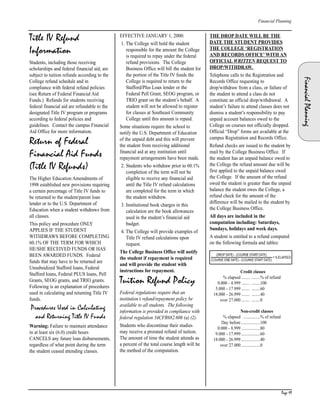
Tuition Refunds - Refunds are not automatic.
To obtain a refund or adjustment on your account
you must submit an official drop or withdrawal
form prior to the deadline for dropping and
receiving a refund. Refunds will not be granted
after these deadlines. Refunds for cancelled
classes are automatically processed and students
are not required to submit a drop or withdrawal
form for any cancelled classes. Refund checks
are mailed to the student's current address.
Refund checks usually take 2-3 weeks to process
after notification. Please do not contact the
college to inquire about a refund prior to the third
week deadline.
Grade Reporting for Student Initiated
Drops/Withdrawals - The student's transcript
will not show any registration data or
withdrawal grade if the drop or withdrawal
occurs prior to the census date of the class
(approximately 20% of course). Student
initiated drops or withdrawals which occur after
the census date and prior to the drop deadline
will receive a grade of "W" (withdrawal).
Students may receive a withdrawal grade "W"
for administrative withdrawals which are
submitted and approved after the drop deadline
(see Administrative Withdrawal).
Administrative Withdrawal - Students may
request an administrative withdrawal (awarding
of a "W" grade) after the deadline for dropping
classes, if extenuating circumstances exist.
Personal problems such as illness, job change, a
move out of town, may be considered by
individual instructors. Withdrawals will not be
processed for nonattendance. Nonattendance
after the deadline for dropping usually results in
the student receiving an unsatisfactory grade,
"U".
Adding Courses After Initial Registration -
To add a course or courses “DURING” the first
6 school days after the start of the class a
student must complete an official drop/add form,
have the course instructor or program designee
sign the drop/add form to approve the add, and
submit the signed drop/add form to the
Registration and Records Office. To add a
course or courses “AFTER: the first 6 school
days of class a student must complete and
official drop/add form, have the Program Chair
and Division Dean sign the drop/add form to
approve the add, and submit the signed drop/add
form to the Registration and Records Office.
Some classes are taught on an individualized
basis and offer continuous enrollment if space is
available. These classes may be added at any
time.
Course Repeat Procedure: Students may not
take an academic/vocational course more than
two times, whether to improve a passing grade
or to repeat a course in which the grade was
“W”, “I”, “U”, “AU”, without prior approval.
Prior to a student registering for a course for the
third time, a plan of action (repeat course form)
must be completed and approved by the
student’s advisor and Program Chair of the
course. Declared students must meet with a
program advisor. Undeclared students must
meet with a career advisor. If a student retakes
an academic/vocational course, the highest
grade earned will be used in the computation of
the cumulative GPA and for satisfying degree
requirements. Any request to take a course more
than three times must be documented and
presented to the Program Chair and Division
Dean for their approval. Appeals to this policy
must follow the established grievance policy and
procedures. The Vice President for Instruction’s
decision shall be final on this matter. (Other
Federal/Program Guidelines may supercede this
policy.)
CH P1_6.qxp 3/26/2004 12:45 PM Page 14
Chapter 2 -
Financial
Planning
FINANCIAL PLANNING
The cost of a quality education at Southeast Community College is very affordable.
However to determine if you will need assistance, please visit with our financial aid staff.
Loans, scholarships, grants and work study programs are all available to qualified
persons. Remember, the key to obtaining financial assistance is to apply early.
• Financial Aid Programs
• Scholarships
• Other Sources of Assistance
• Applying for Financial Aid
• Award of Financial Aid
• Grants / Loans
• Title IV Refund Information
• Return of Federal Financial Aid Funds
(Title IV Refunds)
• Procedures Used in Calculating and Returning
Title IV Funds
• Tuition Refund Policy
• Withdrawals
• Cafeteria / Residence Halls Contract Refund Policy
• Payment Policy
• Debts
• FACTS Monthly Payment Plan
• Other Charges
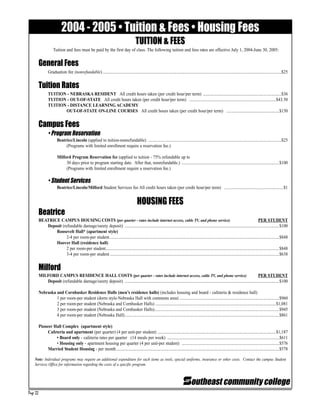
• 2004 - 2005 Tuition and Fees / Housing Fees
CH P1_6.qxp 3/26/2004 12:45 PM Page 15
Page 16
Southeast Community College Nebraska
Financial Aid
Programs
SCC participates in federal and state
financial aid programs to help qualified
students defray their educational expenses.
Amounts of financial assistance available
are based on a determined level of
financial need as well as availability of
funding. Students are advised to complete
necessary forms early to avoid delays in
receipt of a financial aid award. Aid is
awarded on a first-come, first-served basis.
Southeast Community College participates
in the following financial aid programs
• Federal Pell Grant
• Federal Supplemental Educational
Opportunity Grant (FSEOG)
• Nebraska State Grant (NSG)
• SCC Tuition Grants
• Federal Work-Study
• Federal Stafford Student Loan Programs
(Subsidized and Unsubsidized)
• Federal Parent Loan for Undergraduate
Students (FPLUS)
• Federal Pell Grant
Federal Pell Grants are funds to assist
undergraduates with the cost of their
education. Unlike loans, grants are not
repaid. Eligibility for a Federal Pell Grant
is determined by a federal formula which
is revised and approved every year by
Congress. The formula produces an
Expected Family Contribution number
(EFC). A Student Aid Report (SAR)
contains this number and reports
eligibility. The EFC is used to determine
eligibility for all federal and need-based
financial aid. The information contained
in the SAR will be downloaded
electronically to the school(s) you specify.
The Federal Pell Grant requires a student
(who has not already earned a bachelor's
degree) to be enrolled in an eligible
certificate, diploma or degree program at
SCC. The amount of the grant depends on
the Expected Family Contribution (EFC),
the cost of education, enrollment status
and the number of terms attended during
the academic year. Notification of award
is made on the student's award letter from
SCC.
• Federal Supplemental
Educational Opportunity
Grant (Federal SEOG)
Federal SEOG awards are made to
undergraduate students on the basis of
financial need eligibility. SCC has a
limited amount of funds to award to
eligible students. Eligible Federal Pell
Grant recipients with the lowest EFC's are
considered first for available Federal SEOG
funds. Notification of award is made on
the student's award letter from SCC.
Awards vary from $25 to $200 per term.
• Nebraska State Grant (NSG)
NSG funds are awarded to Nebraska
residents on the basis of financial need.
Students apply by completing the Free
Application for Federal Student Aid
(FAFSA). Eligibility is determined by state
guidelines. Notification of award is made
on the student’s award letter from SCC.
Awards vary from $25 to $100 per term.
• SCC Tuition Grant (TGA)
The SCC Tuition Grant is a waiver of
tuition or a portion thereof for one or more
terms, and not a cash award. Students apply
by completing the Free Application for
Federal Student Aid (FAFSA). This
institutional grant is awarded on the basis of
academic achievement and financial need
eligibility. Notification of award is made on
the student’s award letter from SCC.
• Federal Work-Study Program
(FWS)
Southeast Community College participates
in the Federal Work-Study Program.
Institutional part-time employment
opportunities are also available on each
campus. For more information on these
programs, contact the campus Financial
Aid Office.
• Federal Stafford Loan
The Federal Stafford Loan program
enables students to borrow from a bank,
credit union or other participating lender.
The loan amount is limited to the cost of
education minus expected family
contribution (EFC), and in some instances
minus other financial aid the borrower is
expected to receive for the loan period.
Dependent first year students may borrow
a maximum of $2,625 per school year.
Dependent second year students may
borrow a maximum of $3,500 per school
year (subject to other restrictions per
federal regulations). Independent first year
students may borrow a maximum of
$6,625 per school year. Independent
second year students may have a loan limit
of $7,500. New borrowers are not
eligible for the first disbursement of
Federal Stafford Loans until they have
attended classes for 30 calendar days.
• Federal Parent Loan (PLUS)
The Federal PLUS is for parent borrowers
and provides additional funds for
educational expenses. Federal PLUS
loans enable parents with good credit
histories to borrow for each dependent
child who is enrolled at least halftime.
Federal PLUS loans are made by a lender
such as a bank, credit union or savings and
loan association. Applicants do not have
to show financial need, but must undergo a
credit analysis. Repayment begins within
60 days of disbursement, and deferments
are available under certain conditions.
Federal PLUS loans cannot exceed the
College’s estimate of the cost of education
minus other financial aid.
Scholarships
The Southeast Community College
scholarship program was established to
promote and encourage interest in
education for students planning to enroll,
to reduce the student's financial obligation
and to recognize outstanding academic
achievement in course work already
completed at SCC. Scholarships are
considered “gift aid” and do not require
repayment unless the donor has clearly
indicated repayment procedures in the
scholarship announcement.
CH P1_6.qxp 3/26/2004 12:45 PM Page 16
Page 17
Financial Planning
FinancialPlanning
Scholarships are awarded on the basis of
academic achievement and/or financial
need. Applicants are judged on criteria
specified by the scholarship donor.
Selection is made by the SCC campus
Scholarship Committee or the scholarship
donor.
Students applying for scholarships
awarded on the basis of financial need
must file a Free Application for Federal
Student Aid (FAFSA). Scholarships are
added to the student’s aid package. In
case of a student withdrawal, unused funds
are returned to the appropriate fund.
Scholarships available include
scholarships which promote diversity, the
SCC Educational Foundation Scholarships
for high school seniors, and various
campus scholarships donated by business,
professional organizations and individuals.
For more information and a listing of
available scholarships by campus, contact
the campus Financial Aid Office.
Other Sources of
Assistance
Financial aid for educational expenses is
also available from the:
• Veterans' Administration
• Nebraska National Guard
• Army and Navy Reserves
• Bureau of Indian Affairs
• Workforce Development
• Vocational Rehabilitation
• Nebraska Department of Labor
Contact the respective agency for
information.
Applying for
Financial Aid
To insure timely receipt of a Financial Aid
Award, there are two important processes
that must be followed. We recommend
completion of both Steps 1 and 2 below at
the same time. Also, meeting priority
filing deadlines will insure timely
processing of aid.
1. Complete an Application for
Admission.
Complete an “Application for Admission”
and submit it to the SCC Admissions
Office or completed on-line at the
Southeast Community College website, on
the “Admissions” page.
NOTE: Students must complete the
admissions process before they become
eligible to receive financial aid. The
complete admissions process includes:
official acceptance into a program of study
leading to a diploma or degree; pay any
required deposit; and enroll in courses that
are requirements of that program of study.
Students receiving financial aid cannot
count audited courses or courses for
which credit is granted by waiver or
examination in determining the course
load.
2. Complete the Free Application for
Federal Student Aid (FAFSA) form.
The Financial Aid Office encourages
completion of the FAFSA on-line. Access
to the FAFSA link on-line can be obtained
by logging on to the SCC website
Financial Aid page, or by going directly to
www.fafsa.ed.gov on the Internet. Paper
applications (FAFSA) are available
through the Financial Aid Office or high
school guidance office.
Carefully complete all questions, not
leaving any blank, and mail it as early as
possible.
Important: It is very important to list the
Title IV Code for the SCC campus the
student will be attending for the FAFSA
form.
• SCC-Beatrice . . . . . . . . 002546
• SCC-Lincoln. . . . . . . . . 007591
• SCC-Milford. . . . . . . . . 004723
If you need assistance completing the
FAFSA, make an appointment with
EducationQuest.
EducationQuest is open Monday through
Friday, 8:30 am to 5:00 pm. To schedule an
appointment, call the location nearest you.
Kearney
3712 Second Ave., Kearney, NE 68847
308-234-6310, 800-666-3721,
308-234-2113 FAX
Lincoln
1300 O Street, Lincoln, NE 68508
402-475-5222, 800-303-3745,
402-479-6658 FAX
Omaha
Rockbrook Village, (108th & W. Center Road)
11031 Elm Street, Omaha, NE 68144
402-391-4033, 888-357-6300,
402-391-7376 FAX
(If you wish to have the information on
the FAFSA sent to other colleges, check
with your high school counselor, your
public library or Financial Aid Offices for
other Title IV School Codes.)
Processing time for the FAFSA will be
approximately three to six weeks. The
U.S. Department of Education will mail
the student a Student Aid Report (SAR)
when processing is complete. This form
should be reviewed for accuracy upon
receipt. At the same time the SAR is
received by the student, all schools listed
to receive processed FAFSA results will
be sent information electronically (called
an ISIR). In some cases, the college will
be required to verify the information
reported on the FAFSA. A SAR that is
selected for verification will be sent a
letter requesting (1) copies of the
student’s/spouse’s and/or parent’s federal
income tax, as applicable, and the
corresponding W-2 forms, and (2) the
completion of a Verification Worksheet.
Students having previously attended SCC
must be in compliance with Satisfactory
CH P1_6.qxp 3/26/2004 12:45 PM Page 17
Page 18
Southeast Community College Nebraska
Academic Progress (SAP) policies, to be
eligible to receive financial aid. SAP is a
requirement of the federal government for
receipt of financial aid.
3. Complete SCC's Financial Aid
Questionnaire and return it to the
Financial Aid Office. This
questionnaire is available in the
Financial Aid Office.
(Steps 4-6 may not apply to all students.
If applicable, please contact the SCC
Financial Aid Office for the appropriate
forms.)
4. Students wanting to be considered for a
Stafford student loan, must submit a
Loan Request Form. In addition, a
Loan Application/Master Promisary
Note (MPN) is needed for loan
certification. Loan Request Forms are
available from the SCC Financial Aid
Office on each campus. Loan
Application/Master Promisary Note
(MPN) are available from SCC or from
your lending institution.
Note: A student must be enrolled for at
least six (6) credit hours per term to be
eligible for a student loan. Failure to
maintain enrollment can result in the
return of loan proceeds and future
ineligibility for receipt of loan proceeds.
5. Students seeking Federal Work-Study
need to complete and return a Work-
Study Application form, available in
the SCC Financial Aid Office.
Note: A student must be enrolled for at
least six (6) credit hours per term to be
eligible for the Work-Study Program.
6. Students wanting to apply for a
scholarship must complete and return
a Scholarship Application, which is
available in the Financial Aid Office.
Available scholarships are posted on
campus, and in the Financial Aid
Office. Applicants are selected on
criteria specified by the scholarship
donor. Please check the bulletin board
for eligibility requirements and
deadlines for the respective
scholarships.
If you have any questions, please
contact the SCC Financial Aid
Offices listed below.
Beatrice -
4771 W. Scott Rd., Beatrice, NE 68310
1-800-233-5027 or 402-228-3468 ext. 212
Lincoln -
8800 O Street, Lincoln, NE 68520
1-800-642-4075 ext. 2610 or
402-437-2610.
Milford -
600 State St., Milford, NE 68405
1-800-933-7223 ext. 8250 or
402-761-8250.
Award of Financial
Aid
Southeast Community College issues an
award letter which informs students of the
financial aid awarded.
Priority filing deadline dates have been
established to prevent delays in processing
a financial aid award in a timely manner.
Review of documents received begins
immediately. Complete information will
be processed and a Financial Aid Award
letter will be generated and mailed to the
student, indicating financial aid eligibility
for the academic year.
Priority filing deadline dates are as
follows.
April 1 . . . . . . . . . . .for summer term
July 1 . . . . . . . . . . . . . . . .for fall term
October 1 . . . . . . . . . .for winter term
January 1 . . . . . . . . . .for spring term
Applying for Veterans'
Benefits
Students applying for veterans’ benefits
need to complete an “Application for
Veterans' Educational Benefits." These
forms are available from the Veterans
Administration or SCC. The completed
application, along with other required
documents, should be submitted to SCC
approximately two months prior to
enrollment. If the student previously
attended another college or school, an
academic transcript from each school must
also be submitted to SCC within 30 days
after initial enrollment for review.
Transcripts are required even if no credits
were earned. Students receiving
veterans’ benefits cannot count audited
courses in determining course load. Soon
after enrollment, SCC will certify the
student’s credit hour load. This
certification initiates the payment process,
and students should receive their first
payment in six weeks. Payment is mailed
directly to the student’s home address.
Satisfactory Progress
All students receiving federal financial aid
and/or veterans' benefits are subject to
certain policies regarding eligibility and
satisfactory academic progress toward an
educational goal. Failure to make
satisfactory progress could result in the
student being placed on financial aid
probation or termination. Information
on specific satisfactory progress policies
and requirements is provided to all
students who participate in federal
financial aid and veterans’ benefit
programs.
CH P1_6.qxp 3/26/2004 12:45 PM Page 18
Page 19
Financial Planning
FinancialPlanning
Title IV Refund
Information
Students, including those receiving
scholarships and federal financial aid, are
subject to tuition refunds according to the
College refund schedule and in
compliance with federal refund policies
(see Return of Federal Financial Aid
Funds.) Refunds for students receiving
federal financial aid are refundable to the
designated Title IV program or programs
according to federal policies and
guidelines. Contact the campus Financial
Aid Office for more information.
Return of Federal
Financial Aid Funds
(Title IV Refunds)
The Higher Education Amendments of
1998 established new provisions requiring
a certain percentage of Title IV funds to
be returned to the student/parent loan
lender or to the U.S. Department of
Education when a student withdraws from
all classes.
This policy and procedure ONLY
APPLIES IF THE STUDENT
WITHDRAWS BEFORE COMPLETING
60.1% OF THE TERM FOR WHICH
HE/SHE RECEIVED FUNDS OR HAS
BEEN AWARDED FUNDS. Federal
funds that may have to be returned are
Unsubsidized Stafford loans, Federal
Stafford loans, Federal PLUS loans, Pell
Grants, SEOG grants, and TRIO grants.
Following is an explanation of procedures
used in calculating and returning Title IV
funds.
Procedures Used in Calculating
and Returning Title IV Funds
Warning: Failure to maintain attendance
in at least six (6.0) credit hours
CANCELS any future loan disbursements,
regardless of what point during the term
the student ceased attending classes.
EFFECTIVE JANUARY 1, 2000:
1. The College will hold the student
responsible for the amount the College
is required to repay under the federal
refund provisions. The College
Business Office will bill the student for
the portion of the Title IV funds the
College is required to return to the
Stafford/Plus Loan lender or the
Federal Pell Grant, SEOG program, or
TRIO grant on the student’s behalf. A
student will not be allowed to register
for classes at Southeast Community
College until this amount is repaid.
Some situations require the school to
notify the U.S. Department of Education
of the unpaid debt and this will prevent
the student from receiving additional
financial aid at any institution until
repayment arrangements have been made.
2. Students who withdraw prior to 60.1%
completion of the term will not be
eligible to receive any financial aid
until the Title IV refund calculations
are completed for the term in which
the student withdrew.
3. Institutional book charges in this
calculation are the book allowances
used in the student’s financial aid
budget.
4. The College will provide examples of
Title IV refund calculations upon
request.
The College Business Office will notify
the student if repayment is required
and will provide the student with
instructions for repayment.
Tuition Refund Policy
Federal regulations require that an
institution’s refund/repayment policy be
available to all students. The following
information is provided in compliance with
federal regulation 34CFR682.606 (a) (2).
Students who discontinue their studies
may receive a prorated refund of tuition.
The amount of time the student attends as
a percent of the total course length will be
the method of the computation.
THE DROP DATE WILL BE THE
DATE THE STUDENT PROVIDES
THE COLLEGE ‘REGISTRATION
AND RECORDS OFFICE’ WITH AN
OFFICIAL WRITTEN REQUEST TO
DROP/WITHDRAW.
Telephone calls to the Registration and
Records Office requesting to
drop/withdraw from a class, or failure of
the student to attend a class do not
constitute an official drop/withdrawal. A
student’s failure to attend classes does not
dismiss a student’s responsibility to pay
unpaid account balances owed to the
College on courses not officially dropped.
Official “Drop” forms are available at the
campus Registration and Records Office.
Refund checks are issued to the student by
mail by the College Business Office. If
the student has an unpaid balance owed to
the College the refund amount due will be
first applied to the unpaid balance owed
the College. If the amount of the refund
owed the student is greater than the unpaid
balance the student owes the College, a
refund check for the amount of the
difference will be mailed to the student by
the College Business Office.
All days are included in the
computation including: Saturdays,
Sundays, holidays and week days.
A student is entitled to a refund computed
on the following formula and tables:
Credit classes
% elapsed ........ ........% of refund
0.000 - 4.999 ........ ........100
5.000 - 17.999 ........ ........60
18.000 - 26.999 ........ ........40
over 27.000 ........ ........0
Non-credit classes
% elapsed ................% of refund
Day before..................100
0.000 - 8.999..................80
9.000 - 17.999..................60
18.000 - 26.999..................40
over 27.000..................0
CH P1_6.qxp 3/26/2004 12:45 PM Page 19
Page 20
Southeast Community College Nebraska
Program reservation fees are
nonrefundable. Student activity fees are
refundable only if a student drops before
the first day of class. Students who
receive federal financial aid may be
subject to further refund calculations; also,
any refund due may need to be returned to
a federal aid program. (See Return of
Federal Financial Aid Funds (Title IV
Refunds) Information.)
Official Withdrawals
When a student officially withdraws from
all classes for the term in which Title IV
federal financial aid is awarded, the
campus Financial Aid Office must
calculate how much of a student’s
financial aid must be returned to the U.S.
Department of Education and/or to a
Stafford/Plus loan lender.
Unofficial Withdrawals
A student who receives all “U” grades or a
combination of all “U”, “W”, or “NP”
grades is considered to have
UNOFFICIALLY withdrawn from classes.
A student receiving Title IV financial aid
funds who drops out without notifying the
College is considered to have made an
unofficial withdrawal. Students who make
unofficial withdrawals are considered to
have withdrawn at the MIDPOINT of the
term, unless the College documents a date
later than the midpoint of the term.
The College will use 50% for unofficial
withdrawals as the unearned percentage to
determine the amount of federal funds that
must be returned. The Financial Aid
Office will perform the following steps to
determine the amount of Title IV federal
funds to be returned:
Step 1: Determine how much Title IV
financial aid the student is entitled to
use or the amount “earned” by
attending classes.
The date that the student officially drops
all classes is the official date that is used
to calculate the percentage of time the
student was enrolled in the term and how
much aid the student was entitled to
receive or “earned.”
The amount of financial aid includes
funds actually disbursed plus funds that
had been authorized but not yet disbursed
by the date the student withdrew. If the
student withdraws prior to the Pell census
date (the 10th day of the quarter), the only
Title IV federal aid which may have been
disbursed would have been Stafford loans
the student received. If the student
withdraws prior to the 10th day (and the
student was eligible for a Pell Grant), the
Pell fund may be used to pay a portion of
institutional costs UNLESS the student
withdraws during the 100% tuition refund
period.
Step 2: Determine how much of the
Title IV federal aid must be
returned to the U.S. Department of
Education and/or the student/parent
loan lender.
The “earned” percentage is subtracted
from 100% to determine the “unearned”
amount of Title IV federal aid.
Step 3: Determine who must return the
unearned aid.
This may be the College, the student, or
in some cases, both the College and the
student. The unearned percentage is also
used to determine, if necessary, how much
the College must return of the federal
funds which were received as payment for
tuition, fees, books, room and board, and
other approved institutional charges. The
difference between the Total Unearned
Title IV aid and the amount of Unearned
Aid due from the school is the amount of
Unearned Title IV aid due from the
student.
Once it is determined how much Title IV
aid must be returned, the federal funds
must be returned in the order specified by
the law. This priority order is as follows:
• Unsubsidized Federal Stafford Loan
• Subsidized Federal Stafford Loan
• PLUS Loan
• Pell Grant
• SEOG Grant
NOTE: Federal Work Study earnings are
exempt from the calculations.
Cafeteria / Residence
Halls Contract Refund
Policy
1. Termination: If a student wishes to
terminate a cafeteria (Milford) or
residence hall contract (Beatrice or
Milford), he or she must secure
approval of termination before a refund
can be made. Refunds are made only
upon written request and after
satisfactory completion of formal
checkout procedures. Detailed
information regarding refunds of
housing deposits or fees can be found
in the housing contract or by contacting
the housing office. Contracts are
binding for one (1) quarter term.
2. Disciplinary action: No refund will
be made if a student is suspended from
the residence hall and/or cafeteria due
to disciplinary action.
3. Residence hall refunds for those who
pay, enter and drop from College will
follow a specific refund schedule.
During the first week (5 days) of the
term, 80% will be refunded. During
the second week (6 -10 days) 60% will
be refunded. During the third and
fourth week (11-20 days) 40% will be
refunded. After the fourth week, there
will be no refund. Residents moving
out for reasons not stipulated in the
housing contract terms or in the HALL
handbook also forfeit their deposits.
4. Cafeteria refunds will follow a
prorated schedule.
CH P1_6.qxp 3/26/2004 12:45 PM Page 20
Page 21
Financial Planning
FinancialPlanning
Payment Policy
Full payment of tuition, student services
fees, and room and board charges are due
to the campus Business Office no later
than the beginning of a term, or according
to established campus payment deadlines.
Payment is due immediately for class
registrations that occur after the beginning
of the term. Nonpayment of tuition and
fees may affect enrollment status. SCC
accepts VISA, Mastercard and Discover
credit cards for payment.
For information on Payment Options,
please see the College website’s Payment
Options page.
Debts
All financial obligations to the College
must be paid before a student may register
for any new term and before transcripts,
awards and credentials may be released.
Financial obligations include (but are not
limited to) tuition and fees, college loans,
library and parking fines. The College
will charge $15.00 for every insufficient
funds check.
FACTS Monthly
Payment Plan
Students may enroll in the “FACTS”
monthly payment plan. “FACTS” provides
an option for budgeting tuition and other
educational expenses. Contact the campus
Business Office for a “FACTS” brochure
which includes a copy of the Automatic
Tuition Payment Agreement.
Other Charges
Students should expect costs for books,
tools, supplies, uniforms, travel and other
items. Costs will vary depending on the
requirements of each program and the
needs of the individual. There are cost
estimate sheets available for programs of
study. Contact your campus Student
Services Office for more information.
CH P1_6.qxp 3/26/2004 12:45 PM Page 21
Page 22
2004 - 2005 • Tuition & Fees • Housing Fees
TUITION & FEES
Tuition and fees must be paid by the first day of class. The following tuition and fees rates are effective July 1, 2004-June 30, 2005:
General Fees
Graduation fee (nonrefundable).........................................................................................................................................................................$25
Tuition Rates
TUITION - NEBRASKA RESIDENT All credit hours taken (per credit hour/per term) ..........................................................................$36
TUITION - OUT-OF-STATE All credit hours taken (per credit hour/per term) ..................................................................................$43.50
TUITION - DISTANCE LEARNING ACADEMY
OUT-OF-STATE ON-LINE COURSES All credit hours taken (per credit hour/per term) ..................................................$150
Campus Fees
• Program Reservation
Beatrice/Lincoln (applied to tuition-nonrefundable) ..............................................................................................................................$25
(Programs with limited enrollment require a reservation fee.)
Milford Program Reservation fee (applied to tuition - 75% refundable up to
30 days prior to program starting date. After that, nonrefundable.) ............................................................................................$100
(Programs with limited enrollment require a reservation fee.)
• Student Services
Beatrice/Lincoln/Milford Student Services fee All credit hours taken (per credit hour/per term) ........................................................$1
HOUSING FEES
Beatrice
BEATRICE CAMPUS HOUSING COSTS (per quarter - rates include internet access, cable TV, and phone service)..........................PER STUDENT
Deposit (refundable damage/surety deposit) ..................................................................................................................................................$100
Roosevelt Hall* (apartment style)
2-4 per room-per student ................................................................................................................................................................$848
Hoover Hall (residence hall)
2 per room-per student....................................................................................................................................................................$848
3-4 per room-per student ................................................................................................................................................................$638
Milford
MILFORD CAMPUS RESIDENCE HALL COSTS (per quarter - rates include internet access, cable TV, and phone service) ..........PER STUDENT
Deposit (refundable damage/surety deposit) ..................................................................................................................................................$100
Nebraska and Cornhusker Residence Halls (men’s residence halls) (includes housing and board - cafeteria & residence hall)
1 per room-per student (dorm style-Nebraska Hall with commons area) ..............................................................................................$960
2 per room-per student (Nebraska and Cornhusker Halls) ..................................................................................................................$1,081
3 per room-per student (Nebraska and Cornhusker Halls)......................................................................................................................$945
4 per room-per student (Nebraska Hall)..................................................................................................................................................$861
Pioneer Hall Complex (apartment style)
Cafeteria and apartment (per quarter) (4 per unit-per student) ................................................................................................................$1,187
• Board only - cafeteria rates per quarter (14 meals per week) ..........................................................................................................$611
• Housing only - apartment housing per quarter (4 per unit-per student) ............................................................................................$576
Married Student Housing - per month..........................................................................................................................................................$578
Note: Individual programs may require an additional expenditure for such items as tools, special uniforms, insurance or other costs. Contact the campus Student
Services Office for information regarding the costs of a specific program.
CH P1_6.qxp 3/26/2004 12:45 PM Page 22
Chapter 3 -
College Policies
COLLEGE POLICIESCollege policies are vital to each student while pursuing an educational experience.
SCC strives to make your college career as smooth as possible and encourages you to
acquaint yourself with the College policies listed in this chapter.
• Attendance
• Graduation
• Quality Assurance
• Health, Safety, and Security
• Safety Procedures and Practices
• Equity & Diversity
• Grades & Records
• Grades/Transcripts
• Advanced Standing
• Conduct Expectations
CH P1_6.qxp 3/26/2004 12:45 PM Page 23
Page 24
Southeast Community College Nebraska
Attendance
Attendance Policy
Regular, punctual attendance is required in
all credit courses. Each instructor will
inform students by means of a written
syllabus of attendance requirements at the
first class meeting. Any class or lab
session missed, regardless of cause,
reduces the opportunity for learning and
may affect achievement. Students are
responsible for all instruction missed,
regardless of the reason for the absence.
The student will be held responsible for
notifying the instructor of any anticipated
absences. The instructor has the
prerogative to decide whether the student
will be permitted to make up work missed
during the absence. The College reserves
the right and has the responsibility to
obtain a doctor's release when it is
determined that a student's absence has
been the result of a serious medical
problem that might jeopardize the health
of the student or other students. Programs
involving clinical or off-campus
assignments may require telephone notice
of all absences. The College has no leave
of absence policy for students.
Reserve and Guard Training
The College recognizes the need for
military reserve and National Guard
training and will cooperate with the
military in arranging for such absences.
The College strongly recommends that
military reserve and National Guard
training be completed during the summer
break. Absences during the regular term
usually cause hardships, since a great
amount of classroom time is lost. Some
laboratory and practicum experiences are
impossible to accomplish either ahead of
schedule or away from the campus.
Please contact the Dean of Student
Services if there is a conflict with school
and military training. The College will
assist you in requesting a change in your
annual training to minimize conflict with
your College classes.
Graduation
Graduation Awards /Honors
Southeast Community College awards the
following:
• Associate of Applied Science Degree
(A.A.S.): Awarded upon successful
completion of a minimum of 90 quarter
credit hours and the requirements of a
prescribed program or course of study.
• Associate of Arts Degree (A.A.):
Awarded upon successful completion
of a minimum of 90 quarter credit
hours of a prescribed program of study.
This degree is usually awarded to a
student who completes the first two
years of the Academic Transfer
program.
• Associate of Science Degree (A.S.):
Awarded upon successful completion
of a minimum of 90 quarter credit
hours and the requirements of a
prescribed program or course of study
in the Academic Transfer Program.
• Diploma: Awarded upon successful
completion of a minimum of 45 quarter
credit hours and the requirements of a
prescribed program or course of study.
• Certificate: Awarded for successful
completion of a prescribed course of
study that requires fewer credit hours
than a diploma program.
Graduation with Distinction: A student
must have completed 45 quarter credit
hours, and attained a cumulative 3.75 GPA
to graduate “With Distinction”, and a 4.0
cumulative GPA to graduate “With High
Distinction.”
Graduation Rates
Graduation completion rates are available
at the campus Student Services Office
upon request.
Graduation Requirements
All students are required to meet certain
requirements before they are permitted to
graduate from any program at Southeast
Community College. The number of
credit hours required for graduation is
based on specific program credit hour
requirements.
Students must meet all the following
criteria to be approved for graduation:
1. A student must meet all graduation
requirements for a program of study
and all other campus graduation
requirements.
2. The minimal Cumulative Grade Point
Average (CGPA) for graduation
purposes is 2.0. Extenuating
circumstances, involving GPA or other
requirements, may be considered by
the Vice President for Instruction.
3. Students who have been continuously
enrolled in a program of study will be
permitted to graduate under the
program requirements in effect at the
time of their initial enrollment (except,
students will be required to complete
curriculum and course changes
implemented after a student starts
his/her program as long as the change
does not extend the student's time to
complete the program) or students may
elect to satisfy revised graduation
requirements approved and initiated
during their continuous enrollment.
Students who have not maintained
continuous enrollment, and who are
applying for graduation under the
catalog of their initial enrollment, must
secure approval from the division dean.
4. Students will not be eligible for
graduation if a grade of “U”
(Unsatisfactory), “I” (Incomplete), or
"NP" (No Pass) in a required course
remains on the student’s transcript.
5. Students must be free of any financial
responsibility to the College prior to
graduation.
6. All students must complete an
Application for Graduation form and
submit the required fee with the
application to the campus Registration
and Records Office by the end of the
second week of the term in which they
expect to graduate. Graduation fees
are not refundable. Forms may be
obtained in the campus Student
Services Office.
7. To receive a second degree, the student
must meet all requirements of the
College and the program in which the
second degree will be obtained.
CH P1_6.qxp 3/26/2004 12:45 PM Page 24
Page 25
College Policies
CollegePolicies
Students should not bring children to
classes or quiet study areas.
Communicable Disease
Southeast Community College cooperates
with county and state health departments
in developing procedures for the control of
communicable diseases. All procedures
conform to the regulations for
communicable disease control established
by the State Health Department.
Firearms/Weapons
The possession of firearms, weapons or
fireworks on campus is prohibited.
Weapons are defined as bows and arrows,
crossbows, knives with blades over four
inches (not including kitchen knives),
switch blades, swords, ammunition or
martial arts equipment.
Possession of any of these items on
campus may result in immediate dismissal
from the College.
General Liability Insurance
The College maintains general liability
insurance to cover accidents that occur as
a result of faulty equipment or College
negligence. However, Southeast
Community College is not responsible for
accidents that occur on campus as a result
of student negligence. Students are urged
to maintain private health insurance to
assure coverage. Contact the campus
Student Services Office for additional
information.
Sex Offender Registry
The Nebraska Sex Offender Registration
Act (Neb. Rev. Statute 29-4001-29-4115)
requires certain classes of sex offenders to
register with local law enforcement
officials. Registry information regarding
Level 3 (high risk) offenders is published
in local newspapers and is also available
to the public at http://www.nsp.state.ne.us
on the Nebraska State Patrol’s website.
Should you have an interest in accessing
registry information while on campus,
computers are available in the Learning
Resource Center at each SCC facility.
The Act also requires certain institutions,
including colleges and universities, to
monitor the presence of Level 2 (moderate
risk) sex offenders at their facilities. SCC
officials will routinely receive information
regarding moderate risk sex offenders
residing in counties where our campuses
8. A minimum of one-third of the credit
hours required for a degree must be
completed at Southeast Community
College for SCC to be the degree
granting institution.
9. Certain programs of study may require
specific assessment activities as a
graduation requirement.
Quality Assurance
Assessment of Student Learning
and Program Review
Student assessment is a major focus in
higher education. The programs at
Southeast Community College conduct an
ongoing assessment of student learning
with an annual report completed each fall.
This process is managed by the faculty
within each program who assess the
instruction, the quality of the program and
the student learning that is taking place.
Students are assessed as they enter the
college/programs, during their studies and
as they complete their program of study.
Continual modifications are made to
enhance the programs for more student
leaning opportunities.
Program Review is a formal review
process completed for the Nebraska
Postsecondary Coordinating Commission
on a seven-year rotation. The programs
utilize advisory committees on an annual
basis. These committees consist of
employers that are business and industry
professionals. The annual review and
formal program review provide SCC with
assistance in making decisions regarding
program content and program changes.
(See Advisory Committees - Chapter 9.)
Student Evaluation of Faculty
Students are provided an opportunity to
evaluate instructors. The purpose of the
instructor evaluations is to help instructors
improve instructional methods. Student
feedback helps reaffirm good instructional
performance. For information regarding
student evaluations of faculty contact the
appropriate division dean.
Student Representative on the
Board of Governors
Southeast Community College students are
represented on the SCC Board of
Governors through a nonvoting student
representative. The student Board
member helps present students' issues and
enables positive communication among
the students, the administration and the
Board of Governors. This position is
shared by three students, each representing
his/her respective campus.
Health, Safety, and
Security
Appearance
Reasonable cleanliness and appearance in
dress are expected of all students. When
and where safety factors are involved,
each program shall continue to establish
those regulations considered in the best
interest of the students. Program safety
regulations are posted.
Campus Security
Southeast Community College is
committed to ensuring the safety and
security of students, employees, and
visitors on its campuses, in College
facilities and at College-sponsored
activities and events. The College
provides a variety of services and
programs designed to promote and support
safety and security.
Southeast Community College students,
visitors, and employees should report any
suspected criminal activity or other
emergencies at any SCC location to local
law enforcement. Any student who is
involved in an incident concerning safety
and security should immediately report the
incident to the campus Dean of Student
Services.
The College monitors potential safety and
security risks continuously, and maintains
and reports crime information as required
by the Crime and Campus Security Act of
1990. Anyone interested in accessing
crime log information should contact the
campus Dean of Student Services. The
Office of Post-Secondary Education (U.S.
Department of Education, Washington
D.C.) Campus Crime and Security data for
the Southeast Community College area is
available at http://ope.ed.gov/security via
the Internet.
Children on Campus
Children are not to be left unattended in
any area of the campus. Children may
accompany students and visitors in
common areas such as the cafeteria,
student center and Student Services areas.
CH P1_6.qxp 3/26/2004 12:45 PM Page 25
Page 26
Southeast Community College Nebraska
campus facilities. Eye wear is available
through the campus bookstores.
Safety Procedures and
Practices
Good safety procedures and practices are
an important part of a student’s education
and future employment. Each division at
Southeast Community College maintains
certain safety standards and expects
students to understand and practice those
standards.
Emergency Procedures
Students should be aware of the
emergency exits and procedures posted
throughout the buildings.
Drills and Evacuation
Fire drills are held periodically during the
year. Each instructor will inform students
of the exit or exits to be used in an
emergency evacuation. The signal to
leave the building will be a steady alarm
signal. Whenever this occurs students are
to immediately exit the building in an
orderly manner. Students are to move
away from the building to a distance of at
least 50 feet and are not to block the exits,
sidewalks or fire hydrants. A signal will
be sounded to return to the building.
Tornadoes, Severe Storms or
Nuclear Attack
In case of a nuclear attack, severe weather
or threat of a tornado, students will be
notified by a steady alarm signal. Students
are to follow the instructor's directions and
move in an orderly fashion to a shelter
area. When an "all clear" has been
sounded, students will be notified and
given further instructions.
It is the responsibility of the division
deans, program chairs and instructors of
SCC to properly inform the students of the
designated shelter areas. They are:
BEATRICE
• Kennedy Center - Basement, stairs
located at the north end
• Adams Hall - Interior walls, restroom
• Hoover Hall - Interior walls, restroom
• Jackson Hall - Interior walls, restroom
• Ag Center - Interior walls
• Roosevelt Hall - Interior walls
LINCOLN
Proceed to any interior room away from
windows. Remain as close to a wall and
as low to the ground as possible.
MILFORD
Eicher Technical Center
• Boiler Room – under lower stairs
leading to boiler room: two wire cage
storerooms, north part of boiler room
proper.
• Related Welding Lab – under shipping
and receiving: Related Welding lab,
Welding restroom and hallway leading
into the Nondestructive Testing lab.
• Auto Collision Repair Basement –
lower hallway into Auto Collision
Repair basement: restroom, classroom,
two storerooms and basic Auto
Collision Repair lab area.
• Learning Resource Center (LRC) -
Basement
Welsh Center
• Dressing room/weight room
Cornhusker Hall
• Under lower stairwells and lower floor
area.
Equity & Diversity
Equal Opportunity and
NonDiscrimination Policy
It is the policy of Southeast Community
College to provide equal opportunity and
nondiscrimination in all admission,
attendance, and employment matters to all
persons without regard to race, color,
religion, sex, age, marital status, national
origin, ancestry, veteran status, sexual
orientation, disability, or other factors
prohibited by law or College policy.
Inquiries concerning the application of
Southeast Community College’s policies
on equal opportunity and
nondiscrimination should be directed to
the Vice President for Affirmative Action,
Equity and Diversity, SCC Area Office,
301 S. 68th Street Place, Lincoln, NE
68510, 402-323-3412, FAX 402-323-3420,
or jsoto@southeast.edu via E-mail.
are located. This information is not
available to the public, and will only be
shared with designated staff responsible
for monitoring activities on campus.
To report any persons, activities, or
behaviors you deem to be suspicious or
questionable, please contact the Dean of
Student Services at your campus location.
NOTICE: You are advised to immediately
contact law enforcement by dialing 911 to
report crimes, or if you feel a reasonable
threat to your safety and security.
Illness, Accident and Injury
Southeast Community College reserves the
right to call a physician in case of student
illness or injury, and to call for ambulance
service to deliver a student to the hospital.
Judgment of the school officials shall
determine such action. Every effort will
be made to prevent accidents, but the
College incorporates the following
statement as part of its understanding with
students. Southeast Community College
assumes no liability, expressed or implied,
for the results of sickness or accidents
involving personal injury to any student
whether in connection with the College’s
instructional program wherever conducted,
or incidental to other activities on the
College’s properties or elsewhere.
Presence & Use of Animals at
SCC Facilities and Events
Bona fide service animals may accompany
students, employees, and visitors with
disabilities to all SCC events, activities,
and locations. Local, state, and federal
laws regulate the use of service animals at
SCC locations and/or events. Animals
associated with a college-related program
of study (e.g. livestock) or research
laboratory activity (e.g. livestock, mice)
are covered by these guidelines. Please
contact the Dean of Student Services on
your campus for the complete
administrative guidelines document for
clarification and/or additional information
regarding the presence and use of animals
at SCC locations.
Safety Glasses
In compliance with Nebraska statute 79-
4144, students at Southeast Community
College are required to obtain and wear
appropriate industrial quality eye
protective devices while participating in or
observing activities in designated areas of
CH P1_6.qxp 3/26/2004 12:45 PM Page 26
Page 27
College Policies
CollegePolicies
• SCC Policies
Southeast Community College has a long-
standing policy on nondiscrimination. The
Affirmative Action Plan and College
policy for Equal Opportunity and
NonDiscrimination constitute a serious
commitment to the implementation of that
policy.
The College is committed to providing
equal opportunity and protection from
discrimination for all persons. Further,
SCC prohibits all forms of harassment and
discrimination in all aspects of its policies,
program practices and operations, and in
all its conditions for and relationships
with current and prospective employees
and students.
Sexual Harassment
Sexual harassment is a form of sex
discrimination and is a violation of federal
and state laws. It is the responsibility of all
SCC employees and students to discourage
and refuse sexual overtures and not to
engage in behaviors that, because of their
nature, have a high probability of being
misinterpreted or classified as sexual
harassment. All employees, students and
visitors are expected to maintain
appropriate professional/personal
boundaries at all times.
If you believe you have been a victim of
sexual harassment:
1. Inform the person responsible for the
harassing behavior that such behavior
is offensive and must stop. If the
behavior continues, a complaint should
be filed.
2. Complaints may be brought to the
attention of any College employee with
whom the complainant feels
comfortable, or to one of the two
designated educational equity
representatives.
3. Any allegation of sexual harassment
will be investigated and appropriate
action to resolve the complaint will be
initiated while protecting the
anonymity of all individuals involved.
Reporting
Harassment/Discrimination
Southeast Community College believes
that it is the right of all students to obtain
an education in a college environment free
from all forms of discrimination or
harassment, including sexual harassment.
Any student who believes he/she has been
the subject of discrimination or harassment
should report the incident to a member of
the College's professional staff or one of
the two campus education equity
representatives:
BEATRICE
Tom Cardwell, Dean of Student Services
Jan Arnold, Instructor, Academic
Education
LINCOLN
Dave Sonenberg, Dean of Student Services
Susan Kash-Brown, Social Services
Coordinator
MILFORD
Larry Meyer, Dean of Student Services
Marcy Grace, Career Advisor, Assessment
Racial/Ethnic Harassment
Racial and/or ethnic harassment includes
verbal, physical, or written behavior
directed toward or relating to an individual
or group on the basis of race, ethnicity or
racial affiliation and has the purpose or
effect of:
1. Creating an intimidating, hostile, or
offensive work or educational
environment;
2. Interfering with an individual’s work,
academic performance, living
environment, personal security, or
participation in any College-sponsored
activities;
3. Threatening an individual’s
employment or academic opportunities.
This definition also encompasses and
applies to harassment of persons because
of their association with or support of
members of a specific racial or ethnic
group.
While some examples of racial and/or
ethnic harassment, such as physical and
verbal assaults, are easily identified, more
frequent and generalized instances, such as
blatant or subtle graffiti and insensitive
use of language—including epithets and
“humor”—often go unacknowledged and
unchallenged. All of the above instances
are equally demeaning and violate the
spirit of this policy.
Southeast Community College recognizes
its legal as well as moral obligation to
prevent racial and/or ethnic harassment.
Therefore, this policy is consistent with
federal and state laws.
• Federal Laws
Pursuant to Title VII of the 1964 Civil
Rights Act, employers have a
responsibility to maintain a working
environment free of racial intimidation and
harassment. The Federal Equal
Employment Opportunity Commission
(EEOC) has long found a violation of Title
VII where discrimination evidenced by a
deprecatory employment atmosphere has
occurred. Unlawful harassment in the
workplace is not limited to mere verbal
abuse. It may also take the form of
discrimination in training, job assignment,
promotion, or discipline of minority
employees, or because of racial attitudes
or association with members of an ethnic
group. Further, the EEOC has ruled that an
employer is required to take “positive
action where positive action” is necessary
to redress or eliminate employee
intimidation. This principle has been
extended by the EEOC to include ethnic
jokes and derogatory epithets written on
walls, bulletin boards, etc.
• Nebraska Laws and Policies
The declaration of the state policy and
purpose in the Nebraska Fair Employment
Practice Act, Neb. Rev. Stat. 48-1101
(Reissue 1988) states, in part, the
following:
“It is the policy of this state to foster the
employment of all employable persons in
the state on the basis of merit regardless of
their race, color, religion, sex, disability, or
national origin, and to safeguard their right
to obtain and hold employment without
discrimination because of their race, color,
religion, sex, disability, or national origin.
Denying equal opportunity for
employment because of race, color,
religion, sex, disability, or national origin
is contrary to the principles of freedom
and is a burden on the objectives of the
public policy of this state.”
CH P1_6.qxp 3/26/2004 12:45 PM Page 27
Page 28
Southeast Community College Nebraska
Grades & Records
FERPA
FAMILY EDUCATIONAL RIGHTS &
PRIVACY ACT (FERPA)
Southeast Community College has
developed policies and procedures in
compliance with the Family Educational
Rights and Privacy Act (FERPA) of 1974.
The rights accorded students shall apply to
all students 18 years of age or older, or no
longer dependent upon their parents;
students in a postsecondary education
program, regardless of their age; and
parents of eligible dependent students.
Generally, students have the following
rights: to inspect and review their
educational records; to a hearing to
challenge the contents of their records; and
to receive copies of all or part of their
educational records upon request.
All requests for student records and
information must be in writing and
directed to the campus Student Services
Office. Questions relating to the release of
records and information should be directed
to the campus Student Services Office.
Southeast Community College may
provide directory lists of graduates to
senior institutions that have an articulation
agreement with Southeast Community
College.
Directory information consisting of the
items listed below may be released:
Name; Major field of study; Dates of
attendance; Most recent previous school
attended; Degrees and awards received;
Honors and awards received; Participation
in officially recognized activities; Weight
and height of athletic team members;
Parking permit number and auto license
number; Student’s address and telephone
number will be released at the discretion
of the Student Services Office.
To avoid having this information released,
the student must submit a written request
to the campus Student Services Office
within ten (10) days after initial
enrollment in the College. After the initial
ten-day period, any new request for
withholding of directory information shall
require a ten (10) day written notice to the
campus Student Services Office to become
effective.
Academic Honors
Dean’s List: To be recognized on the
Dean’s List a student must complete at
least 6 hours for the term with a minimum
GPA of 3.5. (Classes with a grade of “P”
[Pass] do not count towards the 6-hour
minimum.)
A student is not eligible to be included on
the Dean’s List if a “U” (Unsatisfactory)
an “I” (Incomplete), or a "NP" (No Pass)
remain on his/her grade report for the
given term. It is the campus’ prerogative
as to whether or not such a Dean's List is
maintained.
Midterm Progress Reports
At midterm all instructors are required to
review students’ academic progress.
Instructors submit a report of students with
unsatisfactory academic progress to the
campus Student Services Office, and a
progress report is distributed to the
students. The purpose of the report is to
advise the students of unsatisfactory
academic progress. It is the responsibility
of each student to seek help from a
College Career Services Advisor,
Retention Specialist, TRIO Student
Support personnel, the instructor or any
other person the student feels can assist.
Midterm progress reports do not become
part of the student’s permanent record.
Grade Changes
1. A grade reported and recorded as
permanent may be changed only in the
event of an instructor or institutional
error.
2. A grade may be removed from the
student’s cumulative GPA by:
a. repeating the course and receiving a
higher grade. All courses will appear
on the transcript in their respective
session. The course with the lower
grade will be indicated as a repeated
course and will not be included in the
cumulative GPA.
b. declaring academic bankruptcy.
Academic Bankruptcy
Academic bankruptcy permits the removal
of credit hours and grades for one or two
quarters from a student's grade point
average to allow for improvement of
student's cumulative GPA.
The College requires a student’s Social
Security Number as a condition for
enrollment. A student’s Social Security
number information constitutes an
“educational record” under the Family
Educational Rights and Privacy Act
(FERPA). The College will be privileged
to redisclose that information only with
the consent of the student or in those very
limited circumstances when consent is not
required by FERPA. Questions regarding
the Family Educational Rights and Privacy
Act (FERPA) should be directed to the
campus Registration and Records Office.
Retention of Student Records
The official student academic record, the
transcript of credit earned, will be retained
permanently at the campus. All other
documents (except disciplinary records)
which are used to create, update and
support a student’s file will be retained for
five (5) years from the last date of
enrollment. All student financial aid
records will be retained for three (3) years
following the end of the fiscal year in
which funds were awarded. All veterans'
records will be retained in the student’s
file for five (5) years from the last date of
enrollment. All placement records will be
retained for three (3) years following the
last date of enrollment.
Grades/Transcripts
Address Change
Students are requested to advise Student
Services of any address change to
facilitate sending correspondence to the
correct address.
Grade Reports
Grade reports are issued within two weeks
following the end of the term. Grade
reports become part of the student's
permanent record. It is the student’s
responsibility to review his/her grade
report for accuracy. If there is a question
or disagreement with any part of the report
a student should contact the campus
Registration and Records Office. Grade
disputes must be resolved within twenty
(20) days of this notification.
CH P1_6.qxp 3/26/2004 12:45 PM Page 28
Page 29
College Policies
CollegePolicies
Essentially, any student who has
successfully completed the courses
identified in the articulated associate of
arts general education core curriculum
with an equivalent of a "C" (2.0 on a 4.0
scale) or higher, and is admitted in transfer
to a participating institution will be:
1. Granted standing comparable to current
students who have completed the same
number of equivalent credit courses
toward an associate/baccalaureate-level
degree; and
2. Able to progress toward an
associate/baccalaureate degree
completion at a rate comparable to that
of students who entered the
associate/baccalaureate institution as
first-time freshmen.
Participating institutions in this initiative
include: Bellevue University, Central
Community College Area, Chadron State
College, Clarkson College, College of
Saint Mary, Concordia College, Dana
College, Doane College, Grace University,
Hastings College, Little Priest Tribal
College, Metropolitan Community College
Area, Mid-Plains Community College
Area, Midland Lutheran College,
Nebraska Christian College, Nebraska
Indian Community College, Nebraska
Methodist College, Nebraska Wesleyan
University, Northeast Community College,
Peru State College, Southeast Community
College Area, Union College, University
of Nebraska, Wayne State College,
Western Community College Area and
York College. In all cases the College
advises the student to consider specific
transfer institutional requirements. Please
contact a college transfer advisor and the
institution to which you are transferring.
Credit Types
AU Audit
PX Pass-Exam
TR Transfer
CW Credit by Waiver
BK Bankruptcy
CR Credit
NC Noncredit
BF Balance forward as of 7/1/94
IP In Progress
A student may be granted academic
bankruptcy only one time. A student must
have completed 18 quarter credit hours
with a minimum grade point average of
3.00; or 37.5 quarter credit hours with a
minimum grade point average of 2.50
following the term(s) for which
bankruptcy is sought.
A student may elect to retain courses from
the bankrupt term. Any course that is a
requirement for graduation from the
student's current program of study will be
retained and will be included in the
student's cumulative GPA.
Courses and grades which are granted
academic bankruptcy will remain on the
student's official transcript, but will be
marked "BK".
Bankrupt credit hours and grades will not
count toward graduation or be included in
calculating the student's cumulative GPA.
Courses which have been considered in
granting a previous graduation award may
not be bankrupt.
Warning – Students who are granted
academic bankruptcy may be required to
pay back some or all benefits received for
those courses and terms for which
veterans' benefits or financial aid was
received.
A student may be granted academic
bankruptcy only one time and it is not
reversible.
Issuance of Transcripts
1. SCC issues a transcript on written
request by the student. The request
must include the student’s name (at the
time of attendance), social security
number, approximate dates of
attendance, and signature, along with
the address where the transcript is to be
sent. Telephone requests will not be
honored, but SCC will accept FAX
requests for transcripts. Walk-in
transcript service is available at a cost
of $5 per request.
2. There is no charge for issuing a
transcript; however, SCC will not issue
a transcript if the student or contracting
agency responsible for payment of
student tuition has financial obligations
to the College.
3. Transcripts may be picked up or mailed
as requested after three (3) working
days from the date of request.
4. The transcript request will be kept on
file in the campus Registration and
Records Office.
5. Official transcripts will bear the official
seal of the College and be signed by
the associate registrar or other
appropriate official. Official transcripts
directed to the student will be stamped
“Issued to Student”. All transcripts
from an SCC Registration and Records
Office are official transcripts.
Transfer Agreements
Southeast Community College maintains
special cooperative programs and transfer
agreements with many colleges and
universities. Through a cooperative
program with Peru State College, students
with an associate degree from SCC in
either a technical or transfer program can
transfer to Peru State with junior standing.
Many of the required Peru classes are
offered at SCC campus locations.
The Nebraska Transfer Initiative provides
seamless transition for SCC Academic
Transfer graduates. The Initiative is a
cooperative effort by Nebraska's public
and private higher education institutions to
facilitate the transfer of students who have
earned an associate of arts degree into
baccalaureate-level programs.
The core of this initiative is a common
general education cluster of courses, with
the remainder of credit hours required for
the associate of arts degree selected by the
student in consultation with a transfer
advisor and the institution to which they
are transferring. This initiative provides a
smooth transition with a minimum loss of
time and credit when it is accepted by the
baccalaureate-granting institution in
Nebraska. Effectively, through this
initiative, associate and baccalaureate-
granting institutions are equal partners in
providing the first two years of a
baccalaureate degree.
CH P1_6.qxp 3/26/2004 12:45 PM Page 29
Page 30
Southeast Community College Nebraska
Explanation of Credit Transcript
P Pass: The letter grade "P" is
assigned when credit is granted for
successful completion of campus-approved
“Pass-No Pass” courses only. The pass
grade represents a 70%, or a grade of C or
better. Each division will identify the
courses which may be taken with Pass/No-
Pass option. Divisions will also establish
the maximum Pass/No Pass hours that
may be earned and applied to completion
of a prescribed course of study.
NP No Pass: The letter grade "NP" is
assigned when required level of
performance in a "Pass/No Pass" course is
not attained.
PX Pass by Examination: The letter
grade "PX" is assigned when credit is
granted for successful completion of a
campus-approved examination or
evaluation procedure rather than through
course enrollment.
AU Audit: The letter grade “AU” is
assigned when a student registers to audit
a course. The student pays the regular
tuition and fees, which are nonrefundable,
for the course but will not receive college
credit for the course. The grade “AU”
cannot be changed to another grade at a
later time without taking the course for
college credit.
I Incomplete: The letter grade "I" is a
designation assigned when course
requirements are not completed due to
extenuating circumstances as determined
by the course instructor. The “I” is
considered a temporary letter grade.
1. For removal of the “I”, a “Contract for
Removal of Incomplete” must be
negotiated by the end of the fourth
(4th) week of the term or the eighth
(8th) week of the term, following the
assignment of the Incomplete. The
deadline for work to be completed is
the end of the term immediately
following the term in which the
Incomplete grade was awarded.
2. The time period of a contract may be
extended one additional term with the
approval of the division dean. A notice
of the extension must be filed with the
campus Registration and Records
Office.
3. If a student does not initiate and
complete a “Contract for Removal of
Incomplete," he/she must reregister and
successfully complete that course to
receive credit.
4. A student may not drop a course for
which he/she has negotiated a
“Contract.”
5. The student may progress to the next
sequential course only if a “Contract”
has been negotiated.
6. It is the student’s responsibility to:
a. initiate contract negotiations
b. file the contract with the campus
Registration and Records Office
c. fulfill the contract
7. It is the instructor’s responsibility to:
a. determine if a grade of Incomplete is
appropriate
b. notify the student and the campus
Registration and Records Office that an
Incomplete has been given to the
student
c. negotiate the contract
d. file notice of grade change with the
campus Registration and Records
Office when appropriate to change the
“I” grade to a permanent letter grade.
8. If the student thinks the contract is
unfair, he/she has the right of appeal
beginning at the program level.
W Withdrawal: The letter "W" is
assigned when a student withdraws from a
course within the campus withdrawal
deadlines.
U Unsatisfactory: The letter "U" is
assigned when a student has not attained
the required level of performance in a
course. No credit is granted.
TR Transfer Credit: The letter grade
"TR" is assigned to indicate transfer credit
from another college or SCC campus
location.
CW Credit by Waiver: The letter
grade "CW" is assigned for advanced
placement credit based on evaluation by
the appropriate campus department.
IP In Progress: Currently enrolled
classes. Will print with IP in the grade
column.
BK Bankruptcy: Will appear on the
transcript with a # in front of the grade for
which the course has been bankrupt.
Bankruptcy grades will not count in the
cumulative GPA, but will count in the
term GPA.
R* Repeat: Will appear on the
transcript for the highest grade received
when a class has been repeated.
** Repeat: Will appear on the
transcript for the lower grade received
when a class has been repeated. This
grade will not count in the cumulative
GPA, but will count in the term GPA.
Noncredit Transcript Key
Grade Status Description
P Permanent Pass with formal
assessment
NG Permanent Completed with no
assessment
I Temporary Incomplete
W Permanent Withdraw
NP Permanent No pass
Credit Types
NC Noncredit
PX Pass-Exam
In Progress - currently enrolled classes
will print with IP in the grade column.
CEU - continuing education units are
given for designated noncredit courses.
Ten hours of instruction is equivalent to
one CEU.
Grade Point Average (GPA)
Grade point average (GPA) is determined
by multiplying the honor points earned for
each course times the credit hours for the
course. The sum total of the honor points
earned is then divided by the total number
of credits attempted.
EX: Math 4.5 cr. hrs. (B grade) - 4.5 x 3.0 = 13.5 pts.
Comp 2.0 cr. hrs. (A grade) - 2.0 x 4.0 = 8.0 pts.
6.5 total cr. hrs. = 21.5 total pts.
(21.5 points) divided by (6.5 credit hours)
= 3.30 (GPA earned for these two
classes.)
(See the Credit Transcript Key)
CH P1_6.qxp 3/26/2004 12:45 PM Page 30
Page 31
College Policies
CollegePolicies
Page 31
Semester Hour to
Quarter Hour
Conversion
One quarter = 10 weeks.
Each quarter hour equals 2/3 of a
semester hour. This table shows the
conversion between semester credit
hours, that may have been earned under
the previous SCC Beatrice semester
system or transferred from another
college, and quarter credit hours.
Semester . . . . . . . .Quarter
0.33 . . . . . . . .0.5
0.67 . . . . . . . .1.0
1.00 . . . . . . . .1.5
1.33 . . . . . . . .2.0
1.67 . . . . . . . .2.5
2.00 . . . . . . . .3.0
2.33 . . . . . . . .3.5
2.67 . . . . . . . .4.0
3.00 . . . . . . . .4.5
3.33 . . . . . . . .5.0
3.67 . . . . . . . .5.5
4.00 . . . . . . . .6.0
4.33 . . . . . . . .6.5
4.67 . . . . . . . .7.0
5.00 . . . . . . . .7.5
5.33 . . . . . . . .8.0
5.67 . . . . . . . .8.5
6.00 . . . . . . . .9.0
6.33 . . . . . . . .9.5
6.67 . . . . . . . .10.0
7.00 . . . . . . . .10.5
7.33 . . . . . . . .11.0
7.67 . . . . . . . .11.5
8.00 . . . . . . . .12.0
Advanced Standing
The three methods the College has
established for students to gain advanced
standing are: transfer credit, credit by
waiver and credit by examination. To be
granted advance standing credit:
1.) A student must be accepted for
admission to a College degree
program.
2.) A minimum of one-third (1/3) of the
credit hours required for a degree must
be completed at Southeast Community
College, the degree granting institution.
3) Up to two-thirds (2/3) of the credit
hours required for a program of study
may be waived through the three
methods established for advanced
standing; (credit by transfer, waiver,
and examination).
Up to two-thirds (2/3) of the credits for
advance standing may be transfer
credits.
Credit hours granted by waiver or
examination or by any combination of
waiver and examination may be
awarded up to limits established by
each department but may not exceed
one-third (1/3) of the total credit
hours required for a program award.
Credit Transcript Key
GRADE STATUS HONOR POINTS DESCRIPTION SUGGESTED
PERCENTAGE
A+ Permanent 4.0 Excellent 95-100
A Permanent 4.0 90-94
B+ Permanent 3.5 Above Average 85-89
B Permanent 3.0 80-84
C+ Permanent 2.5 Average 75-79
C Permanent 2.0 70-74
D+ Permanent 1.5 Below Average 65-69
D Permanent 1.0 60-64
U Permanent 0.0 Unsatisfactory Below 60
P Permanent * Pass 70
NP Permanent * No Pass
I Temporary * Incomplete
W Permanent * Withdraw
AU Permanent * Audit - No Credit
*Not included in GPA
Please refer to the specifications listed in
each of the following three (3) advanced
standing methods.
Transfer Credit
Transfer credit from other accredited
postsecondary institutions may be
awarded for advanced standing. Transfer
credit may or may not apply to SCC
programs. Determination will be made by
the division dean regarding graduation or
satisfaction of program requirements with
transfer credit.
SCC recognizes course work completed at
military schools through active duty,
National Guard or Reserves. Credits may
be applied to military courses with the
approval of the appropriate campus
division. The Guide to the Evaluation of
Educational Experiences in the Armed
Services, published by the American
Council for Education, is used as a
guideline. Courses for which credit is
granted by transfer will be recorded with
a “TR” grade and will not be included in
calculating a student’s grade point
average.
Credit by Waiver
To apply for Credit by Waiver the
applicant must be accepted for admission
to a College degree program. Students
requesting advanced standing Credit by
Waiver must complete an application for
Credit by Waiver and supply supportive
CH P1_6.qxp 3/26/2004 12:45 PM Page 31
Page 32
Southeast Community College Nebraska
documents such as competency reports,
proficiency certificates or training records.
Credit granted by Waiver and Examination
or any combination of Waiver and
Examination may be awarded up to limits
established by each department of the
College but not exceeding one-third (1/3)
of the total credit hours required for a
program award. The application must be
submitted for evaluation to the campus
department responsible for teaching the
course. Upon successful completion of
the evaluation, both the application and
evaluation will be submitted to the campus
Registration and Records Office for
recording credit on the student’s transcript.
Courses in which credit is granted by
waiver will be recorded on the transcript
with a “CW” grade and will not be
included in calculating a student’s grade
point average. Credit granted by waiver
is subject to evaluation by other
institutions and may not be accepted for
transfer credit.
Tech Prep Advanced Placement
Tech Prep is a partnership between
high schools and SCC. This
partnership helps prepare high school
students for technical careers.
Pathways of courses to prepare
students for college level work are laid
out. Tech Prep Advanced Placement
means the student may apply for
Credit by Waiver (See Advanced
Standing section) for approved courses
taken at the high school level and
avoid duplication in classes. In order
to receive Tech Prep Advanced
Placement, a student must:
• Enroll in SCC within one year of
high school graduation or as soon as
a program waiting list allows
following high school graduation.
• Obtain a grade of “B” or better in
the high school articulated course.
• Complete and submit a Credit by
Waiver form available from the
Registrar’s Office with all appropriate
signatures.
Some Advanced Placement agreements
require the student to take the next
course in the sequence of the program
at the college and obtain a grade of
“C” or better in order for the credit
for the previous course to be placed
on the transcript.
Credit by Examination
Some courses may be completed by
examination. Testing devices and
evaluation procedures will vary according
to the course, division requirements and
the amount of credit being advanced. To
apply for Credit by Examination, the
applicant must have been accepted for
admission to a College degree program.
Applications for Credit by Examination
are obtained from the campus Registration
and Records Office and submitted to the
division responsible for teaching the
course. An application for Credit by
Examination must be completed and
submitted to the campus Registration and
Records Office for all credit granted as
“PX” (Passed by Examination) on the
transcript. No grade points will be
awarded, and the Credit by Examination
will not be included in the cumulative
grade point average. Copies of the
certification will be returned to the student
and the department in which the student is
enrolled.
Credit granted by Waiver and Examination
or any combination of Waiver and
Examination may be awarded up to limits
established by each department of the
College but not exceeding one-third (1/3)
of the total credit hours required for a
program award. Applicants for Credit by
Examination must pay prior to
examination: 50 percent of the current per
credit hour tuition rate for each credit hour
attempted by examination.
Credit by placement examinations which
offer credit for multiple courses may be
priced at a lower rate than 50 percent of
the current credit hour tuition rate at the
discretion of the appropriate division dean.
All parts of multiple course examinations
must be satisfactorily completed to receive
credit for any of the individual courses
included in the multiple course
examination.
College Level Examination Program
(CLEP)
Southeast Community College
administers the College Level
Examination Program (CLEP) at the
Lincoln Campus, 8800 O Street in the
Testing/ Assessment Center. Each
program has established a list of
courses for which CLEP scores will be
accepted for credit by examination.
Minimum CLEP scores vary from
exam to exam; therefore, students
should request a list of these minimum
scores. Credits granted through a
CLEP exam will not apply towards
load requirements for extraordinary
activities, veteran’s benefits or
scholastic honors. Only Southeast
Community College students may have
CLEP scores recorded on their SCC
transcripts. Acceptable CLEP credits
are recorded as PX (Pass by
Examination).
Students interested in CLEP testing
should contact the Testing/Assessment
Center (402-437-2626) for
information and testing arrangements.
CLEP subject exams cost
approximately $50 per examination.
Some colleges do not accept CLEP
credits as transfer credits. Transfer
students should carefully investigate
minimum CLEP scores established by
other colleges.
CH P1_6.qxp 3/26/2004 12:45 PM Page 32
Page 33
College Policies
CollegePolicies
Conduct Expectations
Academic Integrity
As you pursue your studies at Southeast
Community College, be mindful that
academic honesty and integrity are
fundamental expectations of those who
interact with you. Information concerning
academic honesty may be obtained by
contacting the Dean of Student Services.
Good Academic Standing
Students must maintain a cumulative
grade point average of 2.0 to remain in
good academic standing.
Academic Warning
Students failing at mid-term will receive a
written mid-term progress report from the
Student Services Office specifying the
course work which is below acceptable
standards.
Academic Probation and
Suspension
Southeast Community College believes
that students should demonstrate
consistent progress toward their stated
academic goals. In an effort to assist our
students in meeting graduation
requirements, the College has developed
the following minimum academic
standards. Students who have earned a
minimum of 12 credits (with grades A, B,
C, D, or U) are covered under these
standards.
Academic Probation
Students who receive a cumulative grade
point average (CGPA) of less than 2.00 at
the end of a term will automatically be
placed on academic probation.
• These students will be notified of their
academic probationary status by a
letter from the campus Dean of Student
Services.
• Upon such notification, these students
should immediately see their program
chair/advisor to determine the course
of action to be taken and to determine
the procedure necessary to be removed
from academic probation.
• Students who raise their CGPA to a 2.00
or higher by the end of the
probationary term will automatically be
removed from academic probation.
• Students will continue on academic
probation if they achieve a term GPA
of 2.00 or greater but have a total
cumulative GPA of less that 2.00.
Academic Suspension
Students who have been on Academic
Probation will automatically be placed on
Academic Suspension if their cumulative
and term GPA are below 2.00. Students
will be notified of their academic
suspension status by a registered letter
from the campus Dean of Student
Services.
Options for Students on
Academic Suspension
Students who are placed on academic
suspension are not eligible to enroll or to
attend any credit classes at any Southeast
Community College location. Academic
suspensions are automatically removed
after the end of the term for which the
suspension was issued. A term is defined
as a quarter. Short sessions do not qualify
as terms.
Students who have extenuating
circumstances may appeal suspensions by
notifying the Dean of Student Services
within three school days after receipt of
the suspension letter.
"Extenuating circumstances" will include
students who return to SCC after a
significant number of years and are
carrying a low GPA from the previous
enrollment period. The Dean of Student
Services will provide the Appeal Request
forms and process the appeal. Response
will be given to the student within two
school days after receipt of the appeal.
Students who are denied appeals may
process a student grievance in accordance
with College standards.
Programs and divisions that wish to
establish academic probation and
suspension standards that are stricter than
these guidelines may do so with
permission of the Vice President for
Instruction. However, these standards
must be published and distributed to
students and Student Services personnel.
Programs and divisions which establish
standards that differ from College
standards stated herein will be responsible
for notifying affected students of these
standards and the students' academic
standing as well as maintaining
program/division records with respect to
these students.
Items of Public Display
Southeast Community College does not
condone the public display of items (e.g.,
posters, t-shirt designs, paintings, etc.)
which are intended and/or deemed racist,
sexist, indecent, illegal, inciting, or
oppressive in nature. Such materials are
disruptive to the learning environment or
do not promote an atmosphere of positive
encouragement and mutual respect for
others. Persons in violation of this
expectation will be asked to remove items
of this nature, and be subject to
disciplinary action.
Student Conduct
All students enrolled at SCC are expected
to conduct themselves as good citizens of
an educational community. Students are
expected to obey the laws and regulations
of the nation, state, and community, and
policies of the College.
Students may be dismissed from a
program of study or from the College
when violations occur. Due process is
intended and provided; however,
immediate suspension or dismissal may be
the first course of action when violations
are of a serious nature.
Categories of student misconduct which
are not compatible with Southeast
Community College's standards:
1. Cheating and plagiarism, knowingly
furnishing false information to the
College, forgery, alteration or misuse
of College documents or records. (See
Academic Integrity)
2. Disruption or obstruction of teaching,
research, administration, disciplinary
procedures or other College activities
or public service functions.
3. Physical or verbal abuse of any person
on College owned or controlled
property or at College sponsored or
supervised functions, or conduct which
threatens or endangers the health and
safety of such person. This abuse
includes all forms of harassment and
discrimination.
4. Participating in or inciting a riot or an
unauthorized or disorderly assembly.
CH P1_6.qxp 3/26/2004 12:45 PM Page 33
Page 34
Southeast Community College Nebraska
5. Seizing, holding, commandeering or
damaging any property or facility of
the College, or threatening to do so.
6. Refusing to depart from any property
or facility belonging to or being used
by the College upon a reasonable
request of an authorized College
official.
7. Unlawful possession, use, distribution,
or under the influence of illicit drugs,
alcohol or controlled substance on
College owned or controlled property
or at any College sponsored event.
8. Obstructing the free movement of
persons or vehicles on College
premises or at College activities.
9. Possession of dangerous chemicals,
explosives, firearms or items used as a
weapon on College owned or
controlled property or at College
sponsored or supervised functions
without prior authorization from
College officials.
10. Littering, defacing, destroying,
vandalizing or damaging property
owned or being used by the College.
11. Removing College property or
property assigned to the College
without authorization.
12. Unauthorized entry onto College
property or property under the control
of the College.
13. Unauthorized use of College
equipment or facilities.
14. Violating campus parking and/or
driving regulations.
15. Violating College policies, rules or
regulations.
16. Discrimination or harassment on the
basis of race, color, religion, sex, age,
marital status, national origin, ancestry,
veteran status or disability.
17. Disorderly conduct or lewd, indecent
or obscene conduct on College owned
or controlled property or at College
sponsored or College supervised
functions.
18. Theft of property, money, or other
items deemed College/student
possessions/property.
Student Rights & Responsibilities
The following statements of rights and
responsibilities clarify those rights which
a student may expect to enjoy as a
member of the student body of the
College, and the obligations and
responsibilities which admission to the
College places upon the student.
A.The submission of an application for
admission to the College represents a
voluntary decision on the part of the
prospective student to participate in the
programs offered by the institution
pursuant to the policies, rules and
regulations of the Lincoln Campus, the
Southeast Area administration and the
SCC Board of Governors. Acceptance
of the application, in turn, represents
the extension of a privilege to
participate in educational programs and
activities; and to remain a student so
long as the academic and behavior
standards of the College are met.
B.Each individual student is guaranteed
the privilege of exercising his/her
rights without fear or prejudice. Such
rights include the following:
1. Students are free to pursue their
educational goals; appropriate
opportunities for learning in the
classroom and on campus shall be
provided by the College.
2. No disciplinary action may be imposed
upon any student without due process.
3. Free inquiry, expressions and assembly
are guaranteed to all students provided
their actions do not interfere with the
rights of others, interfere with the
teaching-learning process or the
normal operation of the school.
4. Academic evaluation of student
performances shall be neither arbitrary
nor capricious.
5. Students, faculty and staff of the
College have the right to expect
personal safety, protection of property
and the continuity of the educational
process.
C.Students have the right to inspect and
review their educational records. They
have the right to a hearing to challenge
the contents of their records and the
right to receive copies of all or parts of
their records. These rights are in
accordance with the Family Rights &
Privacy Act, state laws, and campus
rules and regulations.
D. All students have the right of due
process in filing and resolving
grievances concerning abridgement of
rights (See Hearing Procedures.)
Disciplinary Procedures
1. When a student is suspected of
violating a rule or regulation he or she
will be immediately made aware of
these suspicions. The rule or
regulation that may have been violated
and the evidence supporting the
complaint should be thoroughly
discussed with the student. The
purpose of this discussion is to
determine the seriousness of the
misconduct and to determine the
appropriate response (sanction). The
following sanctions are options which
may be considered and rendered:
A. Warning - An oral or written
statement to a student alleging that
he/she is violating or has violated
College rules or regulations and may
be subject to more severe disciplinary
action.
B. Restitution - Required payment for
damage or misappropriation of
property. This obligation may be
satisfied by payment of money or other
appropriate services. Failure to make
restitution could result in a more severe
sanction.
C. Probation - A written reprimand for
alleged violation of specific rules or
regulations. The probation notice will
specify a period of time for which
specific privileges may be withheld or
for which the student has the
opportunity to exhibit corrective
behavior. Violation of any College rule
or regulation during the probation
period may be cause for additional
disciplinary action. Students who
violate policies, rules or regulations are
generally granted warning and
sometimes probation prior to
suspension or dismissal from the
College. HOWEVER, SUSPENSION
OR DISMISSAL MAY BE THE
FIRST ACTION TAKEN WHEN THE
MISCONDUCT IS SERIOUS AND
SUCH ACTION IS DEEMED
APPROPRIATE.
CH P1_6.qxp 3/26/2004 12:45 PM Page 34
Page 35
College Policies
CollegePolicies
D. Suspension - Exclusion from
attending classes and all student
activities. The student will be
excluded for a definite period of time
not to exceed one year. The letter of
suspension will state the terms of the
exclusion and the conditions for
readmission to the College. The Dean
of Student Services is responsible for
administering suspensions and
dismissals.
E. Dismissal - Termination of student
status. Readmission to the College
shall not be granted.
Disciplinary Hearing
Students who are considered for
disciplinary suspension or dismissal are
entitled to a disciplinary hearing. They
will receive a written notice from the
Dean of Student Services which outlines
the misconduct and the reasons which
would justify suspension or dismissal from
the College. The notice will inform the
student of the option of a disciplinary
hearing. The student must indicate a
desire for a hearing within 5 business days
of receipt of the letter from the Dean.
The hearing must be held within five days
of the receipt (from the student) of notice
that he or she desires a hearing. This
notice will include the location, time, and
date of the hearing. The disciplinary
hearing committee and hearing format will
be the same as that used by the process for
student grievances. (See “Hearing
Procedures for Student Grievances.)
1. The results of disciplinary hearings will
be submitted in writing to students
within 5 days of the hearing.
2. Students who violate rules or
regulations are generally granted
warnings and sometimes probation
prior to suspension or dismissal from
the College. HOWEVER,
SUSPENSION OR DISMISSAL MAY
BE THE FIRST ACTION TAKEN
WHEN THE MISCONDUCT IS
SERIOUS AND SUCH ACTION IS
DEEMED APPROPRIATE. Students
who are scheduled for a disciplinary
hearing will generally be allowed to
continue attending classes until the
hearing is completed EXCEPT when
such continued attendance presents a
volatile situation and attendance is not
recommended until the hearing is
completed.
3. All students have the right to appeal
action/s taken against them. Appeals
shall be submitted to the Campus
Director. In order to provide an
orderly procedure with due process and
justice, the following procedures will
be required:
A. A written notice of appeal must be
submitted by the student to the Campus
Director within five (5) days of the
disciplinary action.
B. A hearing before the Campus Director
will be provided when requested by the
student. Appeal decisions will be made
solely by the Campus Director. All
requests for an appeal hearing will be
honored within 20 days of the request.
C. Use of legal counsel - Appeal hearings
are not intended to be a judicial type
adversary procedure, but simply a fair
and ample opportunity for both sides to
present facts. Neither party will be
allowed the presence or use of legal
counsel at any stage of the appeal
process unless the student is
concurrently facing criminal charges
generated by the same incident. In this
case, the student would be allowed the
right of passive assistance of counsel
in the hearing and appeals procedure,
but the legal counsel may not speak in
behalf of the student, nor in his/her
stead. If in this instance the student
utilizes legal counsel, the College also
retains the right to have legal counsel
present.
D. A record of the hearing will be kept by
the College. Copies may be requested
by the student. Written decisions will
be given following appeal hearings.
E. The student shall be advised of appeal
procedures.
F. The decision of the Campus Director
may be appealed in writing to the
College President within five (5) days
following the receipt of the decision.
G. Only matters involving a student’s
suspension, expulsion or termination
may be appealed to the Board of
Governors.
CH P1_6.qxp 3/26/2004 12:45 PM Page 35
Page 36
Southeast Community College Nebraska
Hearing Procedures for Student
Grievances
All students have the right of due process
in filing and resolving grievances
concerning abridgement of rights,
including, but not limited to:
• Disciplinary action
• Student scholastic progress
• Grades
• Financial aid
• Actions or activities of the College
• Americans with Disabilities Act (ADA)
Reasonable Accommodations1 2
Grievances may be processed on either an
informal or formal basis.
1
This policy shall also apply to grievances arising from
objection to or dissatisfaction with actions taken by Southeast
Community College with regards to requests for reasonable
accommodation.
2
The Americans with Disabilities Act and Section 504 of the
Rehabilitation Act require Southeast Community College to
provide reasonable accommodations to qualified individuals
with a disability to facilitate effective participation in courses
or activities offered by the College. Under the Americans
with Disabilities Act (ADA) and Section 504 of the
Rehabilitation Act, “no qualified individual with a disability
shall, by reason of such disability, be excluded from
participation in or be denied the benefits of the services,
programs or activities of a public entity [such as Southeast
Community College], or be subjected to discrimination by
any such entity.”
ADA/504 Grievance - Is defined as
meaning an allegation by a student that
at least one of the following has
occurred. The student has: a)
experienced disparate treatment; b) has
been discriminated against because of
a disability; or c) there has been a
failure to provide a requested
accommodation.
Essential Functions: The fundamental
competencies or knowledge each
student is expected to comprehend or
demonstrate as part of mastery of
course content.
Otherwise Qualified: A student with a
disability is considered otherwise
qualified if s/he meets the technical
and academic standards requisite for
admission into the institution’s
program.
Reasonable Accommodation:
Reasonable accommodations are
changes or adjustments to a school
site, program or practice that makes it
possible for an otherwise qualified
student to perform essential functions
or effectively participate in a course.
Remedies: Remedies under this
grievance procedure are corrective
steps: measures to provide a
reasonable accommodation or reverse
the effects of any discrimination and to
ensure proper ongoing treatment.
In grievances involving suspension or
expulsion from class or College activities,
the student who is pursuing resolution of
either an informal or formal grievance
will be allowed to continue to attend
classes and College-sponsored events and
activities until the grievance is resolved.
However, the student will not be
permitted to attend classes or participate
in College-sponsored events and activities
if the campus Dean of Student Services
has determined that the student’s presence
presents:
• A volatile or hostile situation which
would endanger the safety or welfare
of SCC employees, students or
others;
• Escalates the grievance being
considered.
Students needing reasonable
accommodations to access or participate
in the grievance process should contact
the Dean of Student Services at their
campus location for additional
information and assistance.
Section 1: Purpose
The purpose of this procedure is to secure,
at the lowest level possible, equitable and
timely solutions to problems that may
arise. Both formal and informal means to
resolve student grievances are available.
Section 2: Definitions
Grievance: A grievance is defined to mean
an allegation by a student that there has
been a violation, misapplication or non-
application of College rule or policy.
Grievant: A student who files a grievance.
Disciplinary action: Action taken by a
College staff member in response to a
student violation, misapplication, or non-
application of a College rule or policy.
Days: Shall be defined to mean school
days.
Board of Governors: Refers to the Board
of Governors of Southeast Community
College.
Section 3: Informal Procedure
An attempt should be made by both
parties to resolve the grievance
immediately and at the lowest level of
involvement. The grievance must be
raised within five (5) days from the date
the grievant could have reasonably gained
knowledge thereof, but in no event, more
than twenty (20) days from the occurrence
giving rise to the grievance. If the
problem is not resolved at this level, the
formal grievance procedure may be
initiated. Students are encouraged to seek
resolution of the grievance through the
informal procedure.
Section 4: Formal Procedure
The formal grievance procedure is
available to all students of the College in
an attempt to provide equitable solutions
to concerns and problems that may arise.
The formal grievance must be raised
within five (5) days from the date of the
resolution of the informal grievance.
Step 1. If the informal grievance
procedures have not satisfied the
grievant, a formal grievance form may
be submitted to the campus Dean of
Student Services.
Step 1.1 Requesting and Completing an
Appeal Form
• To formally submit a grievance, an
appeal form must be completed.
• Formal grievance forms may be
obtained from the campus Dean of
Student Services Office.
• The completed form is filed with the
campus Dean of Student Services
The completed form must include the
following information:
• The grievant’s name, address and
phone number
• A full description of the problem
• Where appropriate, the remedy
requested
• Whether the grievant desires to
appear in person at the appeal hearing
to review the grievance.
Step 1.2 The campus Dean of Student
Services, will, within five (5) days, call
together the Campus Student Grievance
Committee. The campus Dean of
Student Services or the dean’s
designated substitute will serve as
chairperson of the Campus Grievance
Committee.
CH P1_6.qxp 3/26/2004 12:45 PM Page 36
Page 37
College Policies
CollegePolicies
Grievance/Hearing Committee
The campus Dean of Student Services
shall be responsible for appointing
members to the grievance / hearing
committee each term. A grievance /
hearing committee may include, but is not
limited to:
• The Campus Dean of Student
Services (grievance committee chair)
• Program chair
• Instructional staff
• Student Senate representative
• Support staff
• Administrative staff
• Other individuals deemed appropriate
and/or necessary as determined by the
Dean of Student Services
A quorum will consist of at least five (5)
committee members. Grievance and
hearing meetings are intended to have
neither an adversary nor a legalistic
approach, but a fair opportunity to present
the facts of the situation.
Step 2. The Campus Student Grievance
Committee shall meet within five (5)
days of the date the complaint is
received by the campus Dean of
Student Services to review evidence
from both sides, and prepare a written
response to the grievant. The
following guidelines will serve as a
basis for committee meetings and
hearings:
Grievance Hearing Guidelines
1. The student may request to appear in
person to review the complaint. Such a
request must be indicated on the formal
grievance form. Committee members,
the student and witnesses will receive
copies of the formal grievance.
2. The student will be notified in
writing of the date, time and place of
the hearing.
3. Hearings are not open to the public,
or to College staff not specifically
invited by the involved parties to
participate in the hearing.
4. Witnesses will be excused after their
statements are given and questioning
has ended.
5. Conformity to technical rules or
judicial procedures is not required.
The chairperson may make any
procedural rulings necessary to
expedite the hearing, to exclude
unreliable or prejudicial evidence, and
to safeguard the confidentiality of
statements and evidence given at the
hearing. Specific procedures will be
explained by the committee
chairperson prior to the beginning of
the meeting or hearing.
6. The student may have witnesses and
an advisor of his/her choice, who have
specific knowledge of the grievable
situation, to be selected from faculty,
staff or student body of the College.
(See Sect 6: Use of Legal Counsel for
exception to these guidelines.) In no
instance will another person be
permitted to speak independently for
the student or in his/her stead.
7. Students are responsible for
notification of their selected advisors
and/or witnesses, and they are
responsible to inform the committee
chairperson prior to the hearing of
selected advisors’ and/or witnesses’
intentions to attend the hearing.
8. The chairperson may expel or
exclude from the meeting or hearing
any persons who fail to comply with
the procedures or rulings of the
chairperson.
9. After hearing the testimony of the
student and witnesses concerning the
grievance or alleged misconduct, the
committee members will discuss the
case in closed session.
a) The committee shall review the
relevant evidence submitted by the
grievant and that offered by the
individual, department, or program
against which the grievance is directed.
b) A response to the grievant shall be
prepared in an appropriately accessible
format, by the chairperson or
member(s) appointed by him/her after
a review of the evidence.
10. The committee shall review and
consider the information presented and
consult with appropriate College
staff. After review and consideration,
the committee may decide to:
a.) uphold the action taken;
b.) grant the remedy requested; or
c.) select an alternative solution.
11. A decision requires a simple
majority vote of the committee
members present.
12. If the student fails to appear at a
scheduled hearing, and has not
requested a continuance with
reasonable basis for continuance, the
committee will proceed on the basis of
available evidence. An audio
recording will be made of the
testimony presented.
13. The decision of the committee will
be communicated in an appropriately
accessible format to the student,
committee members, Vice
President/Campus Director, and the
Vice President for Student Services
within five (5) days. The committee
shall also provide the student with the
name, address, and contact information
for the next step in the appeal process.
Step 3. Appeal to the Vice
President/Campus Director
If the student is not satisfied with the
decision of the Campus Student
Grievance Committee, the student may
file with the Campus Director a
written request for an appeal hearing
with the College Vice President
responsible for the issue addressed in
the grievance, as identified by the
committee. The request must be filed
within five (5) days of receiving the
committee’s decision.
1. The appropriate College Vice
President will honor the appeal hearing
request within twenty (20) days of the
date the request was received.
CH P1_6.qxp 3/26/2004 12:45 PM Page 37
Page 38
Southeast Community College Nebraska
Step 4. Appeal to the College
President
If the decision of the appropriate
College Vice President is not
satisfactory to the grievant, the
grievant may request in writing within
five (5) days an appeal hearing with
the College President on the findings
and decision of the appropriate
College Vice President.
Step 5. Appeal to the Board of
Governors
Only matters involving a student’s
suspension, expulsion or dismissal
may be appealed to the Board of
Governors.
1.If the grievant is not satisfied with
the decision of the President, he/she
may request in writing a hearing
before the Board of Governors.
2. The request must be made in
writing.
3. The hearing before the Board of
Governors will be held as scheduled
by the Board Chair.
Step 6. External Avenues for Redress
In the event the grievant is not
satisfied with the decision of the
College, the grievance can be
submitted to agencies, organizations or
judicial bodies external to the College.
The student may have legal counsel
for this procedure.
Section 5: Withdrawal
A grievance may be withdrawn by the
student at any time during this process.
Section 6: Use of Legal Counsel
Hearings are not intended to be a judicial-
type adversary procedure, but simply a
fair and ample opportunity for both sides
to present facts. Neither party will be
allowed the presence or use of legal
counsel at any stage of the procedure
unless the student is concurrently facing
criminal charges generated by the same
incident. In this case, the student would
be allowed the right of passive assistance
of counsel in the hearing and appeals
procedure, but the legal counsel may not
speak in behalf of the student, nor in
his/her stead. If, in this instance, the
student utilizes legal counsel, the College
also retains the right to have legal counsel
present in a similarly passive role.
Copyright Restrictions
The copyright law of the United States
(Title 17, U.S. Code) governs the
reproduction of copyrighted materials,
including publications, computer software
and audiovisual materials. It is the
responsibility of the students when using
SCC equipment, such as photocopy
machines and computers, to adhere to
these guidelines.
Discrimination
Students who believe they have been
discriminated against should contact the
College's Affirmative
Action/Equity/Diversity Office, 301 S.
68th Street Place, Lincoln, NE 68510,
402-323-3412, FAX 402-323-3420, or
jsoto@southeast.edu via E-mail.
Drug, Alcohol and Controlled
Substance Policy
Southeast Community College’s standards
of conduct clearly prohibit the unlawful
possession, use, or distribution of illicit
drugs, alcohol or controlled substances by
students and employees on its property, or
as part of any of its officially recognized
activities. The laws of the State of
Nebraska pertaining to the possession and
use of illicit drugs, alcoholic beverages
and controlled substances on public
property shall be followed. It shall be a
violation of the drug, alcohol and
controlled substance policy for students or
employees to purchase, manufacture,
possess, consume or sell such items on
SCC campuses, or to be under the
influence of drugs, alcohol or controlled
substances while on campus.
When cause exists as determined by staff,
a student suspected of being under the
influence of drugs, alcohol or controlled
substance while on campus or at a College
activity may be requested to submit to a
drug/alcohol test. Arrangements for and
expense of such tests will be borne by the
College.
Student violations of the standards as
stated in the above paragraph may result
in any one or a combination of the
following disciplinary sanctions:
• Warning
• Disciplinary probation
• Suspension
• Referral to an appropriate
drug/alcohol/controlled substance
treatment program
• Referral to law enforcement agencies
• Any other action considered
necessary by College officials
Students’ rights shall be protected in
accordance with due process. Students
accused of violating the
drug/alcohol/controlled substance policy
as established shall have the right to a
hearing and appeal as defined within the
College grievance policies and
procedures.
Drug and Alcohol Testing
Procedures for Students
The purpose of these procedures is to help
ensure compliance with the College’s
Drug-Free Environment Policy E-2i.
Testing Requirements: The results of
any test performed on the body fluid or
breath specimen of a student, as directed
by the College, to determine the presence
of drugs or alcohol shall not be used to
deny any continued enrollment or
administrative action unless the following
requirements are met:
1. A positive finding of drugs by
preliminary screening procedures has
been subsequently confirmed by a gas
chromatography mass spectrometry or
other scientific testing technique which
has been, or may be, approved by the
Nebraska Department of Health; and
2. a positive finding of alcohol by a
preliminary screening procedure is
subsequently confirmed by either:
a.gas chromatography with a
flame ionization detector or other
scientific technique which has been, or
may be, approved by the Nebraska
Department of Health; or
b. a breath-testing device
operated by a breath-testing device
operator.
CH P1_6.qxp 3/26/2004 12:45 PM Page 38
Page 39
College Policies
CollegePolicies
Types of Tests: The College will conduct
drug and alcohol tests in circumstances
where reasonable cause exists.
Arrangements for and expense of such
tests will be borne by the College.
Reasonable Cause: When cause exists as
determined by staff, a student suspected of
being under the influence of drugs, alcohol
or controlled substance while on campus
or at a College activity may be requested
to submit to a drug/alcohol test. The staff
shall report the fact to the campus Dean of
Student Services (or designated
representative). If the Dean of Student
Services (or designated representative)
concurs that reasonable cause exists to
believe that a student is under the
influence of drugs, alcohol or controlled
substance, then the student shall be
requested to submit a test of his or her
urine for the purpose of determining the
presence of illegal drugs. An evidential
breath test device will be used to
determine alcohol content. The testing
shall be performed under the supervision
of the campus Dean of Student Services,
or by such other persons as may be
designated by him/her. The student shall
also be requested to execute a consent
form authorizing the analysis of his or her
urine for the purpose of determining the
presence of illegal drugs and/or breath
tests to determine alcohol content. The
form shall authorize the release of the
written results of such tests to the College.
The refusal of a student to give a urine
specimen, breath sample test or to execute
a consent form when requested to do so
shall be grounds for dismissal.
Reasonable grounds for requesting that a
student submit to testing and execute a
consent form shall be deemed to exist
when the student manifests physical or
physiological symptoms or reactions
commonly caused by the use of alcoholic
beverages or controlled substance, such as
the odor of alcohol on the breath, slurred
or thick speech, apparent loss of
coordination or unsteady gait, or
uncharacteristic emotional behavior.
Reasonable grounds shall also be deemed
to exist whenever a student is involved in
an accident while enrolled which results in
an injury to himself or herself or any other
person, or which causes damage to
College property or the property of
another individual in excess of $1,000.
The Vice President for Student Services
and the campus Dean of Student Services
shall be notified when a student has been
directed by the College to follow the
College’s Drug and Alcohol Testing
procedures.
Refusal to Test: Refusal to submit to the
types of drug and alcohol tests employed
by the College will be grounds for
dismissal from the College. A refusal to
test is defined to be conduct which would
obstruct the proper administration of a
test. A delay in providing the urine or
breath specimen could be considered a
refusal. If a student cannot provide a
sufficient urine specimen or adequate
breath, he/she will be evaluated by a
physician of the College’s choice. If the
physician cannot find legitimate medical
explanation for the inability to provide a
specimen (either urine or breath), it will be
considered a refusal to test. In that
circumstance, the student will be subject
to dismissal.
Drug Urinalysis: Drug testing will be
performed through urinalysis. Urinalysis
will test for presence of drugs and/or
metabolites of the following controlled
substances:
1) marijuana, 2) cocaine, 3) opiates, 4)
amphetamines, and 5) phencyclidine
(PCP). The urinalysis procedure starts
with the collection of a urine sample.
Urine specimens will be submitted to and
all confirmatory tests shall be performed
by a clinic, hospital or laboratory which is
licensed pursuant to the federal Clinical
Laboratories Improvement Act of 1967, 42
U.S.C. 263a, or which is accredited by the
College of American Pathologists for
testing. As part of the collection process,
the specimen provided would be split into
two vials: a primary vial and a secondary
vial. A certified laboratory will perform
initial screening on all primary vials. In
the event that the primary specimen test is
positive, a confirmation test of that
specimen will be performed before being
reported by the laboratory to the Medical
Review Officer (MRO) as a positive.
A written record of the chain of custody of
the specimen shall be maintained from the
time of the collection of the specimen
until the specimen is no longer required.
All laboratory results will be reported by
the laboratory to a MRO designated by the
College. Negative test results shall be
reported by the MRO to the College.
Before reporting a positive test to the
College, the MRO will attempt to contact
the student to discuss the test results. If
the MRO is unable to contact the student
directly, the MRO will contact the College
management official, designated in
advance by the College, who shall in turn,
contact the student and direct the student
to contact the MRO. Upon being so
directed, the student shall contact the
MRO immediately or, if after the MRO’s
customary business hours, then at the start
of the next business day. In the MRO’s
sole discretion, a determination will be
made as to whether a result is positive or
negative.
An individual testing positive may make a
request of the MRO to have the secondary
vial tested. The student may request that
the secondary vial be tested by a different
certified lab than the one which tested the
primary specimen. The individual making
the request for the test of the second
specimen must prepay all costs associated
with the test. Requests for testing of a
second specimen is timely if it is made to
the MRO within 72 hours of the individual
being notified by College of a positive test
result.
All specimens, which result in a finding of
drugs or alcohol, shall be refrigerated and
preserved in a sufficient quantity for
retesting for a period of at least 180 days.
CH P1_6.qxp 3/26/2004 12:45 PM Page 39
Page 40
Southeast Community College Nebraska
Page 40
Alcohol Tests: The College will perform
alcohol tests using an evidential breath-
testing device. The College will utilize
the evidential breath-testing device
provided by a vendor or agent. Students
shall report to the site of the evidential
breath-testing device as directed by the
College. The evidential breath-testing
device will be operated by the breath
alcohol technician. The student shall
follow all instructions given by the breath
alcohol technician. Students with tests
indicating breath alcohol concentration in
excess of U.S. Department of
Transportation “DOT Regulations” are
considered to have engaged in conduct
prohibited by this procedure which may
result in disciplinary action up to and
including dismissal.
Counseling: The College understands the
importance of providing information
concerning the locations of available drug
counseling, rehabilitation, and student
assistance programs. Accordingly, any
student who wishes to receive information
regarding counseling and rehabilitation
may request such information from the
Student Services Office.
Confidentiality: The results of any
urinalysis conducted under this procedure
shall be made available to the student, the
Vice President for Student Services, and
the campus Dean of Student Services.
The results of such tests shall not
otherwise be divulged to any other person
except when necessary for the conduct of
the College’s student affairs. The College
shall not be precluded, however, from
divulging such test results upon request to
agencies of local, state, or federal
government; in any administrative or
judicial proceeding wherein the results of
such a test are relevant to the issues
involved; or when the College is required
to divulge such test results by subpoena.
CH P1_6.qxp 3/26/2004 12:45 PM Page 40
STUDENT SERVICESSoutheast Community College is a full service educational institution. The College
provides a wide range of student services including: career exploration, academic and
vocational advising, help with adjustment to college life, services to students with
disabilities, referrals to tutoring, clubs, and social activities.
The SCC Placement Centers are known for their success in linking graduates with
representatives of business and industry who are eager to hire them. 90% or more of
Southeast Community College graduates regularly report placement in jobs or
continued education.
• Academic Support
Career Advising Services
• Campus and Student Life
• Clubs and Organizations
• On-Campus Policies and Services
Chapter 4 -
Student Services
CH P1_6.qxp 3/26/2004 12:45 PM Page 41
Page 42
Southeast Community College Nebraska
Page 42
Academic
Support
Career Advising Services
Career advising services are available to
students, alumni and the general public.
The planning process includes assistance
in matching students to potential careers
that merge values, interests and abilities
and help in researching academic and
career paths. The Career Advising Center
at each campus can provide the following
services:
Academic Advising
Most academic advising is provided by
campus faculty, program chairs or deans.
Advisors discuss requirements of the
programs and offer guidance to students in
planning a schedule which fits individual
needs. Each campus Career Advising
Center offers academic advising to
undeclared students or students who are
contemplating changing majors.
Alumni
The Alumni Offices of Southeast
Community College cultivate ongoing
relationships with alumni. The College
invites alumni to open houses,
homecoming and other College events and
publishes newsletters highlighting College
events, programs and opportunities.
Employment
Students interested in current off-campus
employment opportunities should contact
the Placement Office on their campus.
Equal Opportunity and
Nondiscrimination
Policy
It is the policy of Southeast Community
College to provide equal opportunity and
nondiscrimination in all admission,
attendance, and employment matters to all
persons without regard to race, color,
religion, sex, age, marital status, national
origin, ancestry, veteran status, sexual
orientation, disability, or other factors
prohibited by law or College policy.
Inquiries concerning the application of
Southeast Community College’s policies
on equal opportunity and
nondiscrimination should be directed to
the Vice President for Affirmative Action,
Equity and Diversity, SCC Area Office,
301 S. 68th Street Place, Lincoln, NE
68510, 402-323-3412, FAX 402-323-3420,
or jsoto@southeast.edu via E-mail.
Non-Traditional
Students
Career Advising Services assist older
students, single parents or students
entering gender nontraditional programs to
be successful.
Personal Counseling
Personal counseling or therapy is not
available through the Career Advising
Centers in Beatrice, Lincoln, or Milford.
Students are welcome to visit with SCC
advisors about personal concerns to
ascertain whether a referral to outside
professional mental health services is
advisable. Staff will assist students to
locate professional resources appropriate
to their needs.
Placement Services
Lifetime placement services are offered to
SCC graduates to assist in their search for
employment. Placement services include
career advising, posting of job listings, job
referrals, resume assistance, interviewing
techniques, on-campus interviews and
career fairs.
BEATRICE
All students about to graduate are required
to complete a graduation survey.
Information collected is used to assist
students in finding jobs and completing
follow-up reports. Students and alumni
seeking employment can register with the
Placement Office. Registered individuals
are sent job opportunities weekly via US
postal mail and email at the request of the
students or alumni. Students and alumni
may also receive assistance with resumes,
interviewing and networking by contacting
the Placement staff. Employers may
interview students on campus for
upcoming full-time positions.
LINCOLN
Full-time Employment for Graduates
• The Placement Office is available to
assist current students and alumni,
without charge, in their search for full-
time training related employment.
This is a lifetime service for SCC
alumni. After completion of the
Graduation Application in the final
quarter before graduation, students will
have full-time employment information
sent directly to them via e-mail or US
mail.
Part-time Student Employment
• Students who are enrolled for six (6) or
more credit hours and are looking for
work while attending SCC may contact
the Part-time Job Locator. Student
may continue to keep in contact with
the Job Locator until they find a part-
time job.
Services provided for full-time and part-
time employment include:
• Resume and interview skills assistance
• Posting of job openings on the Job
Boards located outside the Learning
Resource Center, T-100 and Energy
Square
• Publication of the Job Bulletin,
distributed weekly
• Coordination of on-campus interviews
• Organization of on-campus Job Fairs
MILFORD
Employers are informed by letter when
each class will graduate. When an
employer lists a job opportunity with the
Placement Office, students and graduates
are notified. If requested, the Placement
Office supplies student names and brief
résumés of students who wish to be
considered for the position. Employer on-
campus visits are also scheduled so
interested students have the opportunity
for interviews. Many students receive job
offers prior to graduation.
CH P1_6.qxp 3/26/2004 12:45 PM Page 42
Page 43
Student Services
StudentServices
Page 43
Services to Students
with Disabilities
Southeast Community College provides
services for students with disabilities.
Information regarding accommodations for
students with disabilities is available from
the campus Student Services Office.
Students who are requesting an
accommodation based on a documented
disability are advised to make the request
known as soon as possible to ensure
timely service. Failure to do so may result
in delayed admission and/or accessibility
to College programs and services.
Student Diversity
Southeast Community College seeks to
recruit and retain students from a variety
of cultures, races and ethnic groups. The
College values the heritage and differences
each student brings to the campuses and
classrooms. SCC offers activities, services
and recognitions celebrating diversity.
Southeast Community College believes
that it is the right of all students to obtain
an education in a college environment free
from all forms of discrimination or
harassment, including sexual and racial
harassment. Any student who believes he
or she has been the subject of
discrimination or harassment should report
the incident to a member of the College’s
professional staff or administration.
Assistance is also available directly from
the Affirmative Action/Equity/Diversity
Office located in the Area Office.
Testing and Assessment
Students who wish to take certain college
level English and mathematics classes
must offer evidence that they are
academically ready to be successful in
these courses. SCC administers the
ASSET/COMPASS tests on site at each
campus to evaluate initial academic
readiness. The test administration is
provided at no charge but retesting costs
$15. In some cases, in lieu of placement
testing, students can submit ACT scores or
college transcripts that demonstrate ability
to be successful in college level course
work. See the Career Advising Center on
each campus for details.
TRIO Student Support Services
TRIO Student Support Services is a
federally funded program that helps first-
generation, low income, and students with
disabilities with demonstrated academic
need overcome class, social and cultural
barriers to higher education. The goal of
the program is to increase retention,
graduation and transfer rates from two-
year to four-year institutions of eligible
students. TRIO/SSS is available to 150
SCC students who have applied and have
been accepted each year.
To qualify students must meet one of the
following criteria:
• Be a first-generation student (neither
parents a 4-year college graduate)
• Fall within the Federal TRIO Program
low-income guidelines
• Qualified Individual with a documented
disability
Demonstrate academic need, as
evidenced by one of the following:
• College entrance scores (COMPASS,
ASSET, ACT) indicating academic need
• High school grade point average of 2.00
or less (C)
• College grade point average of 2.00 or
less (C)
• Enrollment in developmental courses
• Early evidence from college performance
indicating academic risk
• Individual assessment made by counselor
or referral
As a TRIO/SSS student, you will be
assigned an academic counselor to help
you succeed in college.
• You and your counselor will jointly
develop and Individual Success Plan.
• You will have access to Intensive
academic advising, personal
counseling, tutoring, mentoring, laptop
computers, the textbook lending
programs, and assistance with
transferring to four-year colleges.
• You will benefit from personal assistance
in applying for and managing financial
aid, as well as TRIO/SSS grant aid to
those that qualify.
• You will participate in guided career
exploration and job shadowing.
• You will enjoy taking part in special off-
campus cultural activities, leadership
and campus visits with other
TRIO/SSS students.
• Special topics in SSS workshops:
• Study skills
• Stress management
• Leadership
• Time management
• Recognizing and developing your
strengths
• Money management
• Emotional intelligence
• Developing a resume
For more information visit the TRIO
Student Support Services offices on your
campus.
Beatrice – Kennedy Center L141
Lincoln – Lower Level, Learning
Resource Center (LRC)
ESQ- by appointment only
Milford - Eicher Technical Center-
Room 100Q
TRIO Upward Bound
TRIO Upward Bound is a new grant
funded program awarded to Southeast
Community College by the U.S.
Department of Education. The goals of
Upward Bound are to help academically
at-risk students in grades 9 through 12 stay
in school, graduate and prepare to enter
and succeed in college. The program
targets low income, first generation
students for assistance. First generation
students are those whose parents had not
graduated from a 4 year college.
The SCC Upward Bound program began
September 01, 2003 and is based on the
Beatrice Campus. The college is
partnering with three southeast Nebraska
high schools to serve 50 eligible students.
Participating high schools are Beatrice,
Fairbury, and Southern (Wymore-Blue
Springs).
The SCC Upward Bound program
provides intensive support to participants
including ongoing advising, counseling,
tutoring, supplemental education, skills
development, career and college
exploration and a five-week summer
instructional program. Upward Bound
participants who graduate from high
school continue to be advised through a
bridge-to-college program.
For more information visit The Upward
Bound staff - Beatrice campus, Jackson
Hall room 411.
CH P1_6.qxp 3/26/2004 12:45 PM Page 43
Radio:
KZKX/KFRX (Lincoln),
KLIN (Lincoln),
KFGE (Lincoln),
KGMT/KUTT (Fairbury)
KTGL (Lincoln),
KNDY (Marysville, KS)
KWBE (Beatrice)
Hazardous driving conditions do not
automatically mean classes will be
cancelled. However, travel for students is
not recommended or encouraged if there is
a question of being able to reach the
campus safely.
LINCOLN
Posted Announcements - Information
concerning College matters is posted in
each program area and on bulletin boards
located throughout the building. A
bulletin board is located in the student
center for student use. All announcements
for posting must be approved by the
student activities coordinator and posted
only on this bulletin board.
Cancellations - Only the Campus Director
or a designated representative can
authorize the cancellation of College
programs and activities or announce the
cancellation to the news media. It can be
assumed that campus programs, classes
and services will be held as scheduled if
no announcement is made through the
news media. The campus feels adequate
provisions have been established to
eliminate calling College personnel
regarding cancellations.
Telephone: 402-437-2405 –
a recorded message will update you on
the status of classes.
When individual Continuing Education
classes are cancelled, the decision will be
made with the approval of the Continuing
Education dean or the division dean. If an
individual class is cancelled, the instructor
will notify students. Makeup or
rescheduling of individual classes or
programs will require the approval of the
Continuing Education dean or division
dean. Hazardous driving conditions do not
automatically mean that classes will be
cancelled. Students should use good
judgement in making travel decisions.
When weather or other conditions
necessitate cancellation, the following
procedure is followed:
Page 44
Southeast Community College Nebraska
Page 44
Daytime programs and services - a
decision will be made and announced to
the news media by 5 a.m.
Evening programs and services - a
decision will be made and announced to
the news media by 4 p.m.
Announcements of cancellation of College
programs and services will be made to the
following area media:
Television:
Channel 10-11 KOLN-KGIN TV
(Lincoln)
Channel 8 KLKN TV (Lincoln)
Radio:
Lincoln: KFOR: 1240 AM,
KFRX: 102.7 FM, KRKR: 95.1 FM,
KLMS: 1480 AM, KIBZ: 106.3 FM,
The Point FM, Eagle FM,
KZKX: (96 KX) FM, KLIN: 1400 AM,
KBBZ: B107 FM,
KKUL: (Kool 105.3) FM,
KFGE: (Froggy 98) FM
MILFORD
Posted Announcements - Information
concerning College matters is posted daily
in each program area and on first floor
bulletin boards of the Eicher Technical
Center. A bulletin board for students to
advertise items for sale is available on the
second floor. All announcements and
notices posted must be approved by the
Student Services Office and hung only on
bulletin boards.
Public Address System - Announcements
of extreme importance are broadcast over
the College P.A. system at 7:55 a.m.
Emergency announcements are made
when necessary.
Cancellations - When classes are
cancelled, every effort is made to contact
the media by 6 a.m. or earlier. The
following media are notified if classes are
cancelled:
Television:
Channel 10-11 KOLN-KGIN TV
(Lincoln)
Channel 8 KLKN TV (Lincoln)
Radio:
WOW (Omaha), KZKX (Lincoln)
Telephone: 402-761-8400 –
a recorded message will update you on
the status of classes.
Tutoring Services
Career Advising Services provide free
tutorial services, in many subject areas, to
students taking credit classes. Tutoring
services depend on the availability of
volunteer student tutors. See the locations
listed below to obtain information about
tutoring availability, times, and locations.
BEATRICE
Student Retention/Multicultural
Recruitment Office
LINCOLN
Multi-Academic Center (MAC) located in
the Learning Resource Center (LRC)
Room L1 and the Academic Transfer
Office, Suite 100 at the downtown Energy
Square (ESQ) location. Tutors are
qualified SCC students.
MILFORD
Math tutor is available for students on the
second floor of the Eicher Technical
Center, Monday through Thursday, 4-5
pm. Some programs have peer tutors.
Check with your program chairperson or
instructor for tutor availability, times, and
locations.
Campus/
Student Life
Announcements &
Cancellations
BEATRICE
Posted Announcements - A bulletin board
located in the Kennedy Center
Administration Building is available for
students to advertise items for sale. The
Administrative Office must approve all
posted announcements and notices.
Cancellations - When classes are
cancelled, every effort is made to contact
the media by 7 a.m. or earlier. The
following media will be notified if classes
are cancelled:
Television:
Channel 10-11-KOLN-KGIN TV
(Lincoln)
Channel 8-KLKN TV (Lincoln)
CH P1_6.qxp 3/26/2004 12:45 PM Page 44
Page 45
Student Services
StudentServices
Page 45
Hazardous driving conditions do not
automatically mean classes will be
cancelled. However, travel for students is
not recommended or encouraged if there is
a question of being able to reach the
campus safely. Students should use good
judgment in making travel decisions.
Students can call the campus to check for
cancellation.
Athletics
Intercollegiate Athletics
The Beatrice campus is a member of the
Nebraska Community College Athletic
Conference and the National Junior
College Athletic Association. SCC-
Beatrice competes at the intercollegiate
level in men’s basketball, women’s
basketball, men’s golf and women’s
volleyball. The campus mascot is SCC
Storm.
To compete in intercollegiate athletics,
students must maintain the required
scholastic level and conduct themselves on
and off campus in a manner which brings
credit to themselves, to teammates and to
the College.
Southeast Community College athletic
participation is governed by the eligibility
rules of the National Junior College
Athletic Association.
Cheerleading -Beatrice
Cheerleading is an activity designed for
students to promote school spirit by
organizing rallies and leading the cheering
section at home athletic events. Tryouts
are held in June.
Intramural Athletics
Each campus of Southeast Community
College offers intramural
sports/recreational activities for any full-
or part-time student enrolled in credit
division courses. Intramural sports are
arranged by the Campus Activities Office
and may include flag football, basketball,
volleyball, softball, golf, tennis and
racquetball. Each campus also has tennis
courts and a gymnasium available for
student use. For more information about
the intramurals on campus, contact the
Student Activities Office on campus.
Bookstore
The College operates and manages a
campus bookstore on each campus. A full
range of new and used textbooks, supplies,
educational aids, gift items and personal
items is available. The bookstore offers a
buy back program for used textbooks
generally at the end of the term.
Bookstore hours are compatible with most
class schedules. The bookstore accepts
cash, checks, MasterCard, VISA, and
Discover credit cards.
Bus Service
The Lincoln campus is served by the
Lincoln Transportation System. Bus
service is provided at the main entrance
(east) of the building. For bus schedules
and information about pickup and delivery
points and fees, contact the Lincoln
Transportation System.
Cafeteria/Food Service
The College provides food service on each
campus. Vending machines are also
available.
BEATRICE
The campus operates a snack bar located
in Kennedy Center. It is open to students,
staff, and the general public, and serves
breakfast, lunch, and snacks Monday
through Friday.
Students eating in the snack bar are
requested to be considerate of others.
Reasonable cleanliness and appearance in
dress are expected, and it is requested that
shoes be worn, shirts buttoned and dirty
gym clothes covered with a jacket or shirt.
LINCOLN
The campus operates a cafeteria located in
the main hallway near the front entrance
and is open to SCC students, personnel
and the general public. The cafeteria
serves breakfast and lunch, and a snack
menu throughout the afternoon and
evening hours. Vending machines and a
microwave are also available in the
cafeteria area. Catering service is available
by special arrangements.
Students are asked to use the student
center to study or socialize during the
busiest dining time– 9:45 a.m. -1 p.m. All
cafeteria customers are requested to bus
their dishes and leave the table clean for
the next person.
MILFORD
Contract food service is provided at the
campus cafeteria. Non-contract meals for
visitors and guests are also available. The
cafeteria is closed on Friday evenings and
on weekends.
The cafeteria is located in the G. Alan
Dunlap Center. All students living in
Nebraska and Cornhusker residence halls
must contract to eat meals in the cafeteria.
Room and board contracts are signed for
each term. Contracts are considered to be
in effect until expired or terminated. A
registered, full-time student whose course
of study requires the majority of time to be
spent off campus during meal time, may
request a waiver of this cafeteria contract
from the Dean of Student Services.
Cafeteria contracts are available for
students living off campus.
Students eating in the cafeteria are
requested to be considerate of others.
Reasonable cleanliness and appearance in
dress are expected, and it is requested that
shoes be worn, shirts buttoned and dirty
gym clothes covered with a jacket or shirt.
The cafeteria is operated by Ara Mark, a
private contractor, and is managed by their
personnel. The manager has the right to
refuse service to individuals who ignore or
fail to comply with established standards
of good health, conduct, appearance and
dress.
A cafeteria committee comprised of
students, the manager and the Dean of
Student Services, meets regularly to
discuss mutual problems. All comments
and concerns about the cafeteria are
handled through this committee. Special
meetings are called when needed.
The cafeteria contract is on a declining
balance. When you purchase food, the
amount will be subtracted from your
account. You cannot carry over credit to
the next term.
Calendar
The Student Activities Office prepares a
calendar of activities and events scheduled
on campus. The calendars are available to
students free of charge from the Student
Activities Office.
A College calendar with each campus
beginning, ending, registration, and
graduation dates is available on the
College website, www.southeast.edu.
CH P1_6.qxp 3/26/2004 12:45 PM Page 45
Page 46
Southeast Community College Nebraska
Page 46
Child Care
The Child Development Center located on
the Lincoln campus provides SCC-Lincoln
students with first-priority status for
developmental child care. A professional
staff provides care and education for the
center’s children. Since children are
enrolled on a first-come, first-served basis
according to age groups, early contact is
advised. Services are available for
children aged six weeks to 12 years.
Hours allow flexibility for students'
schedules.
Additional information may be obtained
by contacting the Child Development
Center director on the Lincoln campus.
The Milford campus assists those needing
day care services to locate services
available in the community. Contact
Student Services for more information.
The Beatrice campus provides information
to those needing day care services.
Contact Student Services for more
information.
Student Ambassadors
Student Ambassadors is an organization
designed for students to experience and
assist with campus public relations
activities. The ambassadors serve as tour
guides, admissions assistants and goodwill
ambassadors for the College. Ambassadors
are selected by each program and meet
once a month. If you are interested in
becoming an ambassador, contact your
program supervisor.
Student Centers
Southeast Community College provides
campus student centers where students
meet to relax, socialize with other
students or participate in scheduled
activities. Each student center provides a
lounge area, snack area, TV, video games
and vending machines. The hours of each
campus student center are posted.
Wellness/Fitness Center
Each campus has a wellness/fitness center
that provides, free to students, the use of
exercise equipment that is designed to help
students achieve a healthy lifestyle.
Student Fees
The Student Services fee is used to finance
student activities, programs and events
which include intramural sports, social and
cultural activities, student senate, security
escorts and tutorial services. All part-time
and full-time credit students are charged a
Student Services fee each term. The
student senate is responsible for budgeting
this fee. The furnishings and equipment in
the student center are examples of the use
of this fee.
Student Senate
Student Senate is the student governing
body of the campus participating in the
administration of student affairs. The
Senate acts in an advisory capacity and
represents students in the planning and
decision- making process. The president
of Student Senate is a nonvoting member
of the Southeast Community College
governing board.
Student Identification
Cards (I.D.S)
Free photo identification cards (IDs) are
available for each student for use on
campus in the LRC, Business Office,
bookstore, entry to College activities, etc.
Photo IDs are not transferrable. A $5.00
fee is charged to replace lost cards. Photo
times will be announced and taken at the
following locations.
BEATRICE
Learning Resource Center (LRC)
LINCOLN
Switchboard
MILFORD
Assessment Center
Student Organizations
Southeast Community College believes
that an important part of an educational
program for students includes the
opportunity to participate in
extracurricular activities. Each campus
provides an organized activities program
for students. The goal is to encourage the
social, cultural and/or physical
development of students. Leadership and
participation in activities are looked upon
favorably by future employers. Students
gain a sense of satisfaction and
accomplishment as well.
Student Organization Guidelines
Southeast Community College recognizes
student organizations which will
contribute to the intellectual development
of students. In order for a student
organization to gain recognition from the
College, it must have an approved
constitution, a faculty member as advisor
and be approved by the student senate and
the campus administration. For the
process of establishing a new
organization, information about a specific
organization or how you can join, contact
the student activities coordinator.
Clubs &
Organizations
BEATRICE
AGRIBUSINESS CLUB - The
Agribusiness Club is an active organization
designed for students enrolled in the
Agriculture Business & Management
Technology program at SCC-Beatrice.
Students develop leadership skills by
participating in the club’s activities which in
turn improves their qualifications for
professional employment. The members
and officers of the Agribusiness Club are
specifically charged with the responsibility
to encourage high levels of participation in
the club’s activities. Learning the skill of
involvement is highly sought by employers
who seek new members of their company
who can remotivate their current workforce
and thus become more productive.
AGRONOMY CLUB - The Agronomy
Club allows students to actively participate
in an ag-related activity. The SCC Crops
Lab houses an excellent preserved and
displayed collection of crop, rangeland grass
and weed samples for student learning. This
collection also includes a wide range of
weed and crop seed samples as well as
horticulture plants. Teams from the
Agronomy Club participate in the annual
NACTA Crops Judging contests and sponsor
students in the annual fall Collegiate Crops
Judging Contest in Kansas City and
Chicago. Invaluable experience is gained in
grain grading, seed analysis, identification
and general agronomic knowledge by
participating on these teams.
CROPS JUDGING CLUB - This club of
students learns to expertly judge a variety of
crops and participates in county fairs and
other competitions.
CH P1_6.qxp 3/26/2004 12:45 PM Page 46
Page 47
Student Services
StudentServices
Page 47
HORTICULTURE CLUB - Horticulture
Club members learn to cultivate and show
flowers and ornamental plants. Participants
also join in social and educational activities
designed to further their professional
development.
LICENSED PRACTICAL NURSES
ASSOCIATION OF NEBRASKA
(LPNAN) - LPNAN is a student
organization for LPN students that provides
members with leadership training and
orientation to professional organizations. It
serves as a network with other students
throughout the state of Nebraska.
LIVESTOCK JUDGING CLUB - This
club provides leadership development and
support for students who want to participate
in college level livestock judging
competitions. Members will have an
opportunity to travel and compete in contests
throughout the Midwest including
Louisville, Kansas City and Denver. To
compete at livestock judging contests
students must first enroll in Introduction to
Livestock Evaluation and Advanced
Livestock Evaluation classes. These courses
are not required to become a club member.
Expenses for travels are raised by the club
through various activities. College
scholarships are available to members of the
Livestock Judging Club.
MULTI ETHNIC STUDENT
ORGANIZATION (MESO) provides
opportunities for students to become more
culturally sensitive and aware with
multicultural and human relations issues.
The organization provides an avenue for
students to gain skills to set and meet goals,
improve their coping skills, increase their
knowledge and skills on how to make the
system work, and to experience greater
involvement in the College.
PHI BETA LAMBDA - This group is a
national business honorary for College
business students. It is the college level
equivalent of Future Business Leaders of
America. Phi Beta Lambda promotes
interest in business administration,
accounting and secretarial education and
helps members gain self-confidence and
develop leadership skills.
PHI THETA KAPPA-ETAALPHA
CHAPTER - This national two-year college
honorary organization is comparable to Phi
Beta Kappa at a four-year college. It is open
to students who have a cumulative grade
point average of 3.5 or higher on a 4.0 scale.
Students participate in an induction
ceremony and must develop an “honors
theme” each year. Members are involved as
volunteers in a variety of campus and
community service projects. They are also
eligible to apply for transfer scholarships to
four-year institutions. SCC-Beatrice has a
thriving chapter composed of about 60
members.
RESIDENCE HALLASSOCIATION -
The Residence Hall Association (RHA) is
composed of student wing representatives in
the residence halls. Officers include the
president, vice president and
secretary/treasurer who are elected by a
general vote of the residents during the
previous spring term. The RHA plans
activities, brings issues of concern to the
Residence Hall Manager and Assistant
Manager and serves in an advisory capacity
regarding policy changes. The group meets
several times each term and elects wing
representatives at the beginning of the fall
term.
RODEO CLUB - Rodeo Club provides
leadership development and support for
students who participate in collegiate rodeo
events. Membership is open to all SCC-
Beatrice students beginning each fall with
new members welcomed throughout the
year. The Rodeo Club is affiliated with the
Great Plains Section of the National Inter-
Collegiate Rodeo Association (NIRA). Club
members have the option of joining the
NIRA and competing in ten sanctioned Great
Plains Rodeos each school year, collecting
points to qualify them for the Collegiate
National Finals held each June. Additional
rodeo event opportunities are available
through the Rodeo Club’s work with the
Sunrise Sertoma of Beatrice and their
sponsorship of a professional rodeo. College
scholarships are available to members of the
Rodeo Club.
Performing Arts - BEATRICE
COLLEGE CHORUS - The College
Chorus performs a variety of musical styles
in concerts on campus and for organizations
in the community. Every other year the
group performs overseas, joining with the
theatre students on a Fine Arts tour to
another country. Student participants receive
one hour of college credit.
SHOWCASE SINGERS - The Showcase
Singers is an auditioned small performance
ensemble that performs a wide variety of
choreographed music. Students participants
receive two hours of college credit while
providing entertainment opportunities to
several communities throughout the state.
THEATRE - Theatre production classes are
open to all interested students. Theatre
students rehearse and perform two
productions each school year. During the
fall term, the students perform a musical and
in the spring, they present a drama or
comedy. The students have begun an
overseas program to view universal types of
theatre on a Fine Arts tour scheduled for
every other year as a joint venture with the
College Chorus.
COLLEGE/COMMUNITY BAND - This
band is composed of SCC-Beatrice students,
faculty, staff, and community members. The
group presents fall, spring and holiday
concerts that typically consist of light
classical music. Auditions for group
membership are not required. Student
participants receive one hour of college credit.
LINCOLN
AMERICAN WELDING SOCIETY –
SCC Chapter is designed to advance the
science and technology of welding and
promote the educational opportunities for
student members.
LINCOLN MANAGEMENT SOCIETY
(LMS) provides opportunity for students to
gain experience in business activities
NATIONAL STUDENT NURSES'
ASSOCIATION (NSNA) – SCC chapter
assumes responsibility for contributing to
nursing education in order to provide for the
highest quality health care; to provide
programs representative of fundamental and
current professional interests and concerns,
and to aid in the development of the whole
person, the professional role and the
responsibility for the health care of people in
all walks of life.
PHI THETA KAPPA (PTK)–ALPHA PI
LAMBDA CHAPTER is an affiliate of Phi
Theta Kappa International designed to
promote scholarship, develop leadership and
service, and to cultivate fellowship among
qualified students of the College.
MULTI ETHNIC STUDENT
ORGANIZATION (MESO) provides
opportunities for students to become more
culturally sensitive and aware with
multicultural and human relations issues.
The organization provides an avenue for
students to gain skills to set and meet goals,
improve their coping skills, increase their
knowledge and skills on how to make the
system work, and to experience greater
involvement in the College.
SkillsUSA-VICA is an affiliate of the
National SkillsUSA-VICA and organization
and prepares America’s high performance
workers. SkillsUSA-VICA is designed to
provide quality education experiences in
leadership, teamwork and character
development; it builds and reinforces self-
confidence, work attitudes and
communication skills and emphasizes high-
ethical standards, superior work skills and
life-long education.
CH P1_6.qxp 3/26/2004 12:45 PM Page 47
Page 48
Southeast Community College Nebraska
Page 48
MILFORD
AMERICAN SOCIETY FOR
NONDESTRUCTIVE TESTING is an
affiliate of the ASNT and open to all NDT
students. ASNT is designed for the
advancement of scientific, engineering and
technical knowledge of NDT through
planned group activities.
AMERICAN WELDING SOCIETY is an
affiliate of the American Welding Society and
open to all Welding Technology students.
ASSOCIATED GENERAL
CONTRACTORS is a student chapter of
the Associated General Contractors,
Nebraska Building Chapter and is open to
students enrolled in Heating, Ventilation, Air
Conditioning, & Refrigeration; Architecture;
Surveying & CAD, and Building
Construction Technology. AGC is designed
to promote the educational aspects of the
construction industry and work towards
professional development in all areas.
ASSOCIATION OF INFORMATION
TECHNOLOGY PROFESSIONALS
(AITP) - STUDENT CHAPTER is an
affiliate of the Cornhusker chapter of AITP
in Lincoln and open to all Computer
Programming Technology students. AITP is
designed to provide opportunities for
professional association membership;
provide opportunities to learn more about
information processing; and to open up an
exchange of information with people in the
information processing community.
CAMPUS CRUSADE FOR CHRIST is an
interdenominational Christian student
organization open to all students. Weekly
meetings are held to help meet the spiritual
needs of students through worship, music,
Bible study, and fellowship. Evenings and
weekend retreats are designed to provide
interaction with students from other colleges.
DATA PROCESSING MANAGEMENT
ASSOCIATION-Student Chapter is an
affiliate of the Cornhusker Chapter of
DPMA in Lincoln and open to all Computer
Programming Technology students. DPMA
is designed to provide opportunities for
professional association membership;
provide opportunities to learn more about
information processing; and to open up an
exchange of information with people in the
data processing community. The group
meets monthly.
NATIONALASSOCIATION OF HOME
BUILDERS is a student chapter of the
National Home Builders Association
sponsored by the Lincoln Home Builders
Association and is open to students enrolled
in any of the construction technology
programs. NAHB is designed to enhance
educational opportunities for students
interested in careers related to
residential/light commercial construction
remodeling and provides professional growth
beyond the classroom environment. The
Milford Campus chapter was selected the
nation's "outstanding chapter" for 1990,
chosen over Texas A & M and Purdue
University, who placed second and third
respectively.
MULTI ETHNIC STUDENT
ORGANIZATION (MESO) provides
opportunities for students to become more
culturally sensitive and aware with
multicultural and human relations issues.
The organization provides an avenue for
students to gain skills to set and meet goals,
improve their coping skills, increase their
knowledge and skills on how to make the
system work, and to experience greater
involvement in the College.
RESIDENCE HALLASSOCIATION The
residence halls are governed in part by the
Residence Hall Association (RHA) which
consists of representatives elected from each
residence hall. RHA responsibilities are to
plan activities, bring issues of concern to the
director and administration, and advise the
director on housing policy changes.
Residence hall representatives are elected at
the beginning of each term.
SkillsUSA-VICA is an affiliate of the
National SkillsUSA-VICA and organization
and prepares America’s high performance
workers. SkillsUSA-VICA is designed to
provide quality education experiences in
leadership, teamwork and character
development; it builds and reinforces self-
confidence, work attitudes and
communication skills and emphasizes high-
ethical standards, superior work skills and
life-long education.
SOCIETY OF MANUFACTURING
ENGINEERS S218 is a student affiliate of
the Lincoln Senior Chapter 222 open to
Manufacturing Engineering & CAD and
Machine Tool & CAD/CAM and students in
other programs related to manufacturing.
The organization is designed to promote
higher levels of understanding in areas
related to manufacturing, to provide an
opportunity for professional association
membership, and to allow students
opportunities for professional development
in the world of manufacturing.
College Colors
The College’s colors are blue and white.
On-Campus
Policies and
Services
Computer Usage
Computers are available for student use at
each campus. Computers are located in the
computer labs, classrooms, and Learning
Resource Centers. SCC welcomes students
to use the available computer facilities for
completion of school-related projects.
SCC also provides excellent software on
its computers. Students are not to use
software other than the software installed
on the SCC machines and are not to
modify the computers' directory structure
in any way. According to federal
regulations, the unauthorized operation or
duplication of software is a prosecutable
crime.
Users will abide by the guidelines
regarding the use of computers and
software. There is a charge for all paper
printed in the computer labs.
• Student Housing Data Network
Acceptable Use Policy
The Student Housing Data Network
provides resident housing students with in-
room connections to the campus data
network providing Internet Access. The
Internet Access is a privilege that can be
revoked if terms of this policy are
violated. Your use of the Southeast
Community College provided network
access indicates your acceptance of this
policy, as well as your responsibility to
use the connection appropriately and in
accordance with applicable laws and
regulations.
In general students cannot use their
computer of the Internet for any illegal
purpose. Examples of illegal usage may
include but not be limited to copyright
infringement, viewing, producing,
downloading or uploading literature,
movies, or other media that are illegal in
general such as child pornography. Other
illegal activity may include but not be
limited to harassing, threatening, or
intimidating other individuals or groups.
CH P1_6.qxp 3/26/2004 12:45 PM Page 48
Page 49
Student Services
StudentServices
Page 49
Prohibited Internet Usage Include –
(Applies to all computers used by students
at Southeast Community College):
1. Any receipt, retransmission or
destruction of software or data must
observe copyright laws, license
restrictions and SCC policies. Sharing
copyrighted material such as MP3’s
and software is strictly prohibited.
2. Copying College-owned or licensed
software or data for personal or
external use without prior approval.
3. Attempting to modify College-owned
or licensed software or data without
prior approval.
4. Use of the SCC Internet connection for
gambling.
5. Attempting to damage or disrupt
operation of computing equipment,
data communications equipment or
data communications lines. Attempting
to create or launch viruses or other
malicious programs designed to
interfere with the SCC or State of
Nebraska computing resources
including the Internet access system.
6. In-room connections may not be
altered or extended beyond their
intended use. No more than one device
should be connected to each active
network port. Network hubs are
prohibited.
7. In-room connections may not be used
to provide access to the Internet or
SCC resources to individuals not
formally affiliated with the College.
8. Any attempt to capture transmissions
on the network not addressed to your
location is prohibited. In other words,
“sniffing” – the digital equivalent of
wire-tapping – is not allowed.
9. You may not use the network to
attempt to gain access to any data,
software or services, without explicit
permission of the owner.
10. You may not attempt to conceal or
misrepresent your or another’s identity
through the use of your network
connections. Examples: Never
attempt to send electronic mail under
an assumed name. Never share your
login password with another individual.
11. SCC computing resources, including
your in-room connections, may not be
used for personal profit, business
ventures, or for any political purpose.
In particular, these resources may not
be used to support or oppose the
candidacy of any person for political
office, or to support or oppose any
ballot question.
12. The network is a shared resource.
Excessive use of network resources
that interferes or inhibits the use of the
network or Internet access of others is
prohibited. This includes but is not
limited to applications that use a large
amount of bandwidth (for example,
Quake, Half-life, downloading MP3’s
and MPEGs). Sending out mass e-
mails and/or spamming is also
prohibited. Academic use of the
network is top priority.
13. Electronic communications over the
network may not be used to send
messages that are fraudulent, harassing,
obscene, threatening, or other messages
that are a violation of applicable
federal, state or other law or College
policy.
• Computer Use Violations
Suspected or alleged violation of this
policy should be reported immediately.
SCC Computer Helpdesk
402-437-2447 or
1-800-642-4075 ext. 2447
helpdesk@southeast.edu
Administrators have the authority to
temporarily suspend network access to a
computer that is believed to have been the
source of a violation.
Attempts will be made to contact users
prior to the suspension of a computer’s
network access. An incident report will be
filed and appropriate action taken.
Abuse of network and computing
privileges is subject to disciplinary action.
The appropriate SCC Authorities,
beginning with the VP for Technology,
will handle violations of this Acceptable
Use Policy. Disciplinary actions as a result
of violations may include the following:
• Loss of access privileges
• SCC judicial sanctions as defined within
the code of student conduct
• Monetary reimbursement to the College
or other appropriate sources if
responsible for malicious damage to
the College network of information
systems.
• Expulsion or suspension from SCC
• Prosecution under applicable civil or
criminal laws
The SCC Residence Services and
Information Technology Services reserves
the right to modify, Change and revise this
document as necessary without permission
or consent of the users.
A “Residence Hall Computer Use Policy”
agreement must be signed and returned to
the Dorm manager before Information
Technology will provide Internet service
to the student’s room.
Copyright Restrictions
The copyright law of the United States
(Title 17, U.S. Code) governs the
reproduction of copyrighted materials,
including publications, computer software
and audiovisual materials. It is the
responsibility of the student when using
SCC equipment such as photocopy
machines and computers, to adhere to
these guidelines.
Debts
All financial obligations to the College
must be paid before a student may register
for any new term and before transcripts,
awards and credentials may be released.
Financial obligations include (but are not
limited to) tuition and fees, college loans,
library and parking fines. The College
will charge $15.00 for every insufficient
funds check.
Employment
Students interested in current off-campus
employment opportunities should contact
the Placement Office.
CH P1_6.qxp 3/26/2004 12:45 PM Page 49
Page 50
Southeast Community College Nebraska
Facilities Use
College facilities are available for use by
recognized student groups if scheduled
and supervised in accordance with campus
rules and regulations. Students may
schedule use of College facilities for
nonstudent groups. Requests and
approvals for use of College facilities are
processed by the Campus Director's Office
or designee. The College reserves the
right to require any organization
requesting use of College facilities to
provide proof of adequate liability
insurance which includes Southeast
Community College as an additional
named insured.
Fax
BEATRICE
Contact the Student Services Office at
402-228-3468.
LINCOLN
A FAX machine is available for student
use in the Student Activities Office. There
is a cost of $1 per page for each page sent
or received. The number is 402-437-2633.
MILFORD
A FAX machine is available for student
use at the Switchboard. There is a cost of
$.25 per page for each page sent or
received.
First Aid
BEATRICE
First Aid kits are available throughout the
Beatrice campus including in residential
housing units. College personnel reserve
the right to call an ambulance whenever
they deem necessary. The College requires
all injuries to staff, students, and visitors
to be reported to the College
Administrative Offices.
LINCOLN
The campus first aid station is located in
the Wellness Center, room O-3. Every
injury, however slight, should be reported.
First aid kits are located throughout the
campus.
MILFORD
The campus first aid center is located in
the Business Office in the Eicher
Technical Center. Every injury should be
reported regardless of whether medical
attention is needed. The College makes
every effort to provide emergency first
aid. First aid kits are located throughout
the campus. Contact your instructor or
residence hall counselor for assistance.
Food and Drinks
Students are not permitted to eat food or
drink beverages in the instructional
classrooms, laboratories or the Learning
Resource Centers. Snacks, drinks, and
other refreshments are to be consumed in
designated areas only. The College
currently allows bottled water in all
College facilities except in designated
areas where doing so may cause potential
damage to equipment or health and safety
concerns. Appropriate signs designate
where bottled water is prohibited.
BEATRICE
Food and beverages are allowed in the
student center snack bar.
LINCOLN
Food and beverages are allowed in the
cafeteria and student center. The Campus
Director must approve special
arrangements for food service in non-
designated areas.
MILFORD
Food and beverages are allowed in the
student lounge, cafeteria, and snack bar.
Smoking and Chewing
Tobacco
The College subscribes to the Nebraska
Clean Indoor Air Act. Smoking and
chewing tobacco are not allowed in any of
the SCC buildings or in any College
vehicles. Smoking and non-smoking areas
on the campuses conform to state law and
are clearly marked.
Spitting chewing tobacco is not permitted
within the College facilities.
Housing
The College provides on-campus housing
at the Milford and Beatrice campuses.
The College is not responsible for
personal items which may be stolen or
damaged. Students should carry personal
property insurance for their belongings.
Residence Hall Assistants
Resident Assistants are live-in positions (in
student housing) designed for exceptionally
mature students who have the interest,
skills, and time necessary to perform
assigned duties and assist in the
development of the SCC Residential Life
Program. Resident Assistants are
presented with unique opportunities for
personal development and are trained in
the areas of peer advising and referral,
interpersonal communication,
programming, team building, community
development, and administration. Selected
each spring, Resident Assistants are
appointed for the following academic year.
BEATRICE
Beatrice has traditional housing and
apartment-style housing available.
Priority for the newer, apartment-style
housing is given to second year students
in good standing. All apartment-style
units have a kitchenette. For student
convenience, all residence halls at
Beatrice have local telephone service,
cable TV and Internet access in each
room. Housing on campus is available for
single men and women. There is no food
(Board) plan available on the Beatrice
campus, but the Snack Bar is open
Monday through Friday.
(For information on housing costs, see Tuition &
Fees information - Chapter 2 Financial Planning.)
Beatrice campus maintains off-campus
housing for Parents of All Ages program
participants.
Housing Visitation Policy
Visitors are welcome on the SCC Beatrice
campus as long as they obey campus
visitation policies and other campus and
college rules and regulations. Visitors to
the Beatrice campus after 10:30 p.m.
must check in by calling (228-8131) or
stopping by the RA office (located in
Hoover Hall) and providing the following
information: visitor name, hosting
resident name and room number, and
make model & license number of vehicle
(if the visitor has parked on campus).
Not complying with the visitor policy is a
violation of the housing policies and (in
addition to sanctions levied against the
resident) visitors may be asked to leave.
Residents are responsible for the actions
of their visitors while they are on campus.
CH P1_6.qxp 3/26/2004 12:45 PM Page 50
Page 51
Student Services
StudentServices
LINCOLN
Lincoln campus does not provide student
housing, but it will provide information
for students seeking housing which
includes apartment and home listings, city
locator maps, prices and general
information on independent living. Please
contact the Student Services Office for
more information.
MILFORD
Milford residence halls have local
telephone service, cable TV, and Internet
access. Housing is available for men,
women, married couples and single
parents. Housing contracts are signed
prior to the beginning of each term on the
Milford campus.
(For information on housing costs, see Tuition &
Fees information - Chapter 2 Financial Planning.)
Learning Resource
Centers (LRC) - Library
and Media Services
The Learning Resource Centers (LRCs) of
Southeast Community College provide an
optimal learning environment and a
variety of resource materials. Local
collections exist to support the needs of
students and staff on campus. The LRC
collections are also available via remote
access. Check with the LRC on your
campus for information about access.
Loan policies vary at each location and
overdue/replacement fees will be charged
and assessed for late or missing materials.
A valid Student Identification Card is
required to check out materials.
The open hours of service vary per
campus but schedules have been set to
offer convenient access to services and
collections during the school day. Remote
access allows students and staff to
research material even when the LRC is
closed. Students are encouraged to visit
the campus LRC and learn more about the
collections and services offered.
Lost and Found
BEATRICE
Lost and found items may be reclaimed at
the receptionist's desk in the
Administration Office.
LINCOLN
The campus lost and found is located in
the Student Services Office, room E-1.
Report lost items and turn in found items
to this location. Unclaimed items are
donated to charity at the end of each term.
MILFORD
The lost and found department is located
in the Student Services Office in the
Eicher Technical Center. Items found
should be turned in, and items lost should
be reported. Unclaimed items will be
donated to charity.
Makeup Testing
LINCOLN
The campus testing center is located in
room L-3. The center provides makeup
testing services for students who cannot
attend their regularly scheduled testing
date due to circumstances beyond their
control and distance learning class testing.
The instructor will complete and attach a
"Makeup Test" cover slip to each test
submitted. The following procedures are
implemented to ensure proper
authorization for testing and identification
of each examinee:
1. All tests must have a makeup test form
properly completed and attached.
2. Students referred for testing must know
the title or name of the test, know the
instructor's name, and present a picture
ID or positive identification by SCC
personnel.
3. It is very important that the test be
available in the testing center once
permission has been given for the
student to test.
4.Students will have a maximum of two
(2) weeks from their date of return to
complete a makeup test. Tests not
completed will be returned to the
instructor and will become ineligible
for utilization in the testing center.
5.Instructors are responsible for picking
up the completed tests.
Note: Reviewing previous tests in
preparation for current tests is not
appropriate in the testing center.
Mail
BEATRICE
Incoming - Mail for residents of student
housing is placed in an assigned mailbox.
The address for resident students is:
Student’s Name
c/o SCC-Student Housing
Residence Hall name, and Box #
4771 W. Scott Rd.,
Beatrice, NE 68310-7042
Outgoing - A mailbox for outgoing mail is
located in the Kennedy Center near the
Administrative Office and in the mail
room in Hoover Hall.
LINCOLN
Lincoln campus does not have student
housing and therefore does not have
incoming or outgoing mail for students.
MILFORD
Incoming - Postal boxes for residence hall
residents are located in Cornhusker Hall.
Resident students are requested to use the
following residence address:
Name
Southeast Community College-Milford
_____________Hall, Room # ______
611 State Street
Milford, NE 68405-8498
Outgoing - A mailbox for outgoing mail is
located on campus by the Eicher
Technical Center on the north side of the
LRC.
Messages
The campus will attempt to notify a
student if an emergency message is
received, however, the College cannot
assume liability or responsibility for
messages not successfully delivered.
Non-emergency message service is not
available. Students should not request
deliveries or personal mail be sent to the
campus.
CH P1_6.qxp 3/26/2004 12:45 PM Page 51
Page 52
Southeast Community College Nebraska
Newspapers
BEATRICE
The Storm Warning is a weekly bulletin
of current events and news, that is
produced by the student activities
coordinator and is distributed on campus
each Monday.
Students may work on the campus
newspaper, The Challenge, in a variety of
capacities if they have experience from
high school, another college, or a
commercial newspaper. Positions are open
for reporters, photographers, and page
layout designers who are familiar with
Pagemaker software. Students receive one
hour of college credit.
LINCOLN
The Source is a weekly bulletin of current
events and news, that is produced by the
student activities coordinator and is
distributed on campus each Monday.
Deadline for submitting articles and news
items is the preceding Thursday at 12
noon. Items should be submitted to the
Student Activities Office located in the
student center. The activities coordinator
prepares the publication and serves as
editor.
Other publications (newsletters,
newspapers, brochures, pamphlets)
distributed on campus must have the
approval of the Campus Director.
MILFORD
The Daily Announcements is a bulletin of
current events and news that is distributed
throughout the campus at designated
locations.
The Milford Campus newspaper, The
Technician, is published once each term
by the student activities coordinator.
Campus news and activities make up the
articles with the programs in one
department featured each term.
Notary
BEATRICE
A notary public is located in the
Administrative Office in the Kennedy
Center. This service is free to students
and employees of the College.
LINCOLN
Notary service is available free of charge
in the following locations:
• Business Occupations T100
• Continuing Education Office J2
• Testing Center L3
• Financial Aid E1
• Campus Director’s Office F1
MILFORD
Notary service is available free of charge
in the Student Services Office and the
Business Office.
Parking and Driving
Parking is available to students on each
campus. Some parking spaces are
reserved and designated for persons with
disabilities. Parking in these designated
areas requires a special permit.
Driving or parking is not permitted on
grassy surfaces or other non-established
driving or parking areas except as
expressly permitted by posted signs.
Contact the Student Services Office for
information on Restricted Parking Spaces,
Administrative Guidelines, and
procedures.
Milford and Beatrice campuses require a
parking permit sticker for the campus
parking lots. Contact your campus’
Student Services Office for more
information. Each campus encourages
owners to lock their cars. Campus speed
limits and all state and local traffic
regulations must be observed. Driving
against the normal flow of traffic is not
allowed.
BEATRICE
Driving
1. The speed limit on the Beatrice
Campus is 20 miles per hour.
2. All federal, state and local traffic
regulations are in effect on campus.
Driving against the normal flow of
traffic is not allowed.
Parking
1. All faculty, staff and enrolled students
who use the parking lots are required
to display a parking permit. Permits
are issued to students at registration.
2. Student parking is located in the lots
west of the residence halls and the
areas in the lot east of Kennedy Center
not designated "handicapped" and
"visitor".
3. Residential student parking is
designated in the lot west of Hoover
Hall.
4. No vehicle is permitted to occupy
more than one stall. Please park
between the lines. Improper parking
will result in a citation and fine.
5. Students using parking lots with
angled parking stalls are not permitted
to move ahead into a stall that faces
against the flow of traffic. Students
parking against the flow of traffic will
be ticketed.
6. General student parking is not allowed
in the following designated areas and
will result in a citation and fine:
• visitor parking
• handicapped parking (without visible
permit)
• designated NO PARKING or
restricted zones
• service entrances
• Family Resource Center lot west of
Adams Hall
Fines
1. Parking fines may be paid at the
Business Office located in the
Kennedy Center. Hours are 8 a.m. - 5
p.m., Monday through Friday.
2. Failure to pay fines will result in the
following:
• Fine will increase as noted on the
citation.
• Student may not register for next
term.
• Transcripts will not be issued.
3. Students who have repeated parking
violations and unpaid fines will be
subject to having their vehicle towed at
their expense plus the expense of the
violation.
Other Regulations
1. Major repair of vehicles on campus is
discouraged. Inoperable vehicles will
be towed at owner's expense if allowed
to remain on campus property an
unreasonable length of time.
CH P1_6.qxp 3/26/2004 12:45 PM Page 52
Page 53
Student Services
StudentServices
2. For your safety, keep your car doors
locked and do not leave valuables in
your car.
Snow Removal Parking Regulations
1. Hoover/Jackson parking lot: The snow
will first be removed from the west end
of the Hoover parking lot. The day
after it snows, all Hoover and Jackson
residents will be required to move their
vehicles to the west end of the lot by
10:30 a.m., after the snow has been
removed.
2. Roosevelt/Kennedy Center parking lot:
The day after it snows, all Roosevelt
residents will be required to move their
vehicles to the Truman Center parking
lot by 10:30 a.m., after the snow has
been removed.
Vehicles not moved will be ticketed and, if
necessary, towed at the owner’s expense.
LINCOLN
Driving
1. While driving on campus, each student
is expected to follow all state, local and
College driving regulations.
2. Campus speed limits for all motorized
vehicles are 20 m.p.h. unless otherwise
posted.
Parking
1. Students may park in any parking lot
unless otherwise posted.
2. A parking area for motorcycles is
designated in both the south and north
parking lots.
3. General student parking is not allowed
in the following designated areas:
a) Reserved for SCC Board of
Governors
b) Handicapped Parking (without
visible special permit)
c) On campus streets, drives or service
drives.
4. Vehicles left overnight without prior
approval are subject to being towed. To
obtain approval call the physical plant,
402-437-2570.
Violation Fees
Illegally parked vehicles will be ticketed
and violators will be required to pay
parking fines according to the fine
schedule. Repeat offenders' vehicles may
be towed away at the owner’s expense.
Parking ticket fines must be paid prior to
the deadline stated on the ticket and are
payable at the Cashier's Office in Student
Services, room E-1. Failure to pay fines
according to campus rules and regulations
will result in disciplinary action.
Handicapped Parking Permits
Handicapped parking permits are available
at the city clerk's office located in the
City/County Building, 550 So. 10 St. For
either a permanent or temporary permit a
doctor's statement stating need will be
required. The fee for either permit is $5.
SCC Temporary Permit
A temporary handicap permit valid only
on the SCC-Lincoln campus may be
obtained at the Physical Plant Office. A
doctor's statement stating need is required.
No fee required. Call 437-2570.
Downtown Energy Square ESQ Parking
Students attending classes at the Energy
Square location in Lincoln may purchase
stamps for reduced parking rates. Contact
the ESQ Academic Education Office at
402-323-3441for more information.
MILFORD
Parking Permits
1. All students are required to register the
vehicles they will be driving on
campus. All vehicles parked on campus
must have a valid permanent or
temporary parking permit.
2. Permits are available on the day of
class registration or from the parking
office in the Physical Plant Building
Hours: 7:30 a.m. - 12 noon and 1 -
4:15 p.m.
3. Parking permits are valid for the
student's enrollment period.
4. One vehicle permit and one motorcycle
permit are allowed to each student at
no cost. A $6 fee is charged for
additional permits.
5. Temporary permits are available and
valid for ten school days. They must be
visible before parking on campus.
Driving
1. While driving on campus, each student
is expected to follow the regulations
and traffic policies established by the
College, and all state and local traffic
regulations.
2. The speed limit on campus is 15
miles/hour.
Parking
1. Student parking lots are located west of
the residence halls. This is the only
area for student parking.
2. Motorcycle parking, staff parking,
production parking, visitor parking,
cafeteria staff parking and handicap
parking areas are designated by signs.
Student parking is not allowed in
designated areas without a visual
permit.
3. Faculty overflow parking is in the
student lot only. Vehicles will be
ticketed in all other areas.
4. Visitor overflow parking is in the
student lot.
5. Staff loading and unloading materials
must have permission from the
Physical Plant Office and must park in
designated area immediately after
loading or unloading.
Visitor Parking
Visitor parking is reserved parking for
visitors: prospective students, class
speakers, companies and business
interviewing, seminar and workshop
participants, and training center
participants. Staff and students are not
allowed to park in the visitors' lot. All
training center and seminar or workshop
participants must display a visitors "Guest
Permit" or be ticketed.
Violation Fees
1. Improper parking in student parking -
$5 fine; Winter parking violations -
$15.
2. All other parking violations - $15 fine.
3. Students who have repeated violations
will be subject to their vehicle being
towed or booted at their expense plus
the expense of the parking violation.
Towing charges will be paid by the
violator to the tow service. Booting
charges of $20 will be paid to the
Parking Office.
4. Persons receiving parking tickets who
have not paid their fines within 5
school days will be sent a letter from
the Campus Parking Office, stating
that the fine will be doubled.
5. Fines are paid to the Parking Office
located in the Physical Plant Building.
6. Persons who have acquired a parking
permit may receive a replacement
permit if identifiable remnants of the
original permit are presented to the
Campus Parking Office. Persons
unable to comply with this requirement
must submit an acceptable statement
that the original permit has been
destroyed and is not available. All
violations incurred on the old permit
will be charged to the original permit
holder.
CH P1_6.qxp 3/26/2004 12:45 PM Page 53
Page 54
Southeast Community College Nebraska
Appeals
1. Violations may be appealed to the
Parking Violations Appeals Team
which meets the first and third Friday
of each month at 9:45 a.m. in the
Physical Plant Conference Room.
2. The Parking Violation Appeals team
may uphold or dismiss the violation.
Any violation fee paid prior to
adjudication by the team will be
refunded through normal College
processes should the violation be
reduced or dismissed.
Parking Violations Appeals Team
1. The Parking Violations Appeals Team
will consist of the following: two
students and one staff representative
elected by the Dean of Student
Services.
2. The Parking Violations Appeals Team
will meet the first and third Friday of
each month at 9:45 a.m. in the Physical
Plant Conference Room.
3. A Parking Appeals Form must be
completed and turned in to the Parking
Office prior to 4 p.m. of the 5th class
day (first day begins the date the
violation was received.) A copy of the
violation must accompany this form for
the appeal to be accepted.
4. Upon returning this properly completed
form with violation notice attached, the
appeal will be forwarded to the Parking
Violations Appeals Team.
5. The student or staff filing the appeal
must attend a hearing before the
Parking Violations Appeals Team
within 15 class days from the date of
the violation or be assessed the fine.
Other Regulations
1. Outdoor repair of automobiles on or off
the student parking lot is discouraged.
2. Inoperable vehicles will be towed at
owner's expense if on campus property
an unreasonable length of time.
3. Major mechanical work is not allowed
on campus or in parking areas.
4. For your safety, we suggest you keep
your car doors locked. Do not leave
valuables in your car. Purchase and
installation of smooth "Theft Proof"
lock knobs are advised.
5. Responsibility for finding a legal
parking space rests with the motor
vehicle operator. Lack of space is not
an acceptable excuse for violation of
parking regulations.
6. Operation of snowmobiles on all
College property is prohibited.
7. All vehicles must be removed from
campus over the winter and summer
breaks.
Winter Parking (Nov. 1 - March 31)
1. All student vehicles parked overnight
(10 p.m. to 7 a.m.) are to be parked in
the designated Winter Parking Area -
sections B, C, and D in student
parking, or the crushed rock area.
2. No vehicles are to remain in the
faculty/staff parking lot overnight.
Faculty and staff who are off-campus
overnight with a College vehicle are to
park their personal vehicles in the
parking area to the east of the Physical
Plant Building.
3. Production vehicles, where the work is
completed and being held for payment
and pickup, are to be parked in the
enclosed production storage area or if
space is not available, parked west of
the Physical Plant Building. Other
production vehicles parked along the
Welsh Street are to be parked to the
east end of the street.
4. Vehicles left overnight in undesignated
student parking areas and faculty/staff
parking lots will be ticketed and
subject to being towed at the owner's
expense.
Photocopy
Coin-operated photocopy machines are
available for student use in the LRC on
each campus. Copyright restrictions apply.
Copyright Restrictions - The copyright
law of the United States (Title 17, U.S.
Code) governs the reproduction of
copyrighted materials, including
publications, computer software and
audiovisual materials. It is the
responsibility of the student when using
SCC equipment such as photocopy
machines and computers, to adhere to
these guidelines.
Computer Software - SCC welcomes
student use of all available computer
facilities for completion of school-related
projects. SCC provides excellent software
for use in the computer labs and
classrooms. Students are not to use
software other than the software installed
on the SCC machines and are not to
modify the computers' directory structure
in any way. According to federal
regulations, the unauthorized operation or
duplication of software is a prosecutable
crime.
Telephone
Pay phones are available in each campus
building for student use. Office
telephones on campus are for the use of
College personnel.
Tools
The majority of the tools and equipment
used by students in the programs are
supplied by the College. However,
students may want to purchase their own
tools and equipment. Students in some
programs are required to purchase hand
tools. Students will want to own an
electronic calculator.
Detailed tool lists for each program are
available in the bookstore and/or the
Student Services Office. Instructional
staff in individual programs will offer
guidance to enable students to purchase
the most serviceable tools for the money.
Tool companies visit the school
throughout the school year and those dates
are announced.
Students should carry insurance for their
personally-owned equipment.
CH P1_6.qxp 3/26/2004 12:45 PM Page 54
CONTINUING EDUCATIONSoutheast Community College offers a wide variety of credit and noncredit continuing
education classes, workshops and seminars in Beatrice, Lincoln, Milford and throughout
the 15 counties of southeast Nebraska. These educational activities provide instruction
in areas that allow individuals to upgrade their present job skills, train for new careers,
develop recreational and cultural interests, prepare for high school completion tests,
improve basic education skills, or earn non-program college credit.
Customized Training for Business & Industry is provided by the College to assist
companies and organizations challenged by cultural, technological, demographic, and
economic trends and conditions. Continuing Education classes are made available in
cooperation with many local public and private entities such as public schools,
hospitals, nursing homes, libraries, senior citizen centers, civic organizations,
businesses, industries and churches. Advisory committees help the College determine
needs, suggest classes, seek talent and promote continuing education programs.
• ABE/GED/ESL/Citizenship
• Agriculture
• Business
• Community Services
• Computer Training
• Customized Training Services
• Family and Consumer Science
• Health
• Industrial & Technical Trades
• Personal Enrichment & Leisure
• Transportation
Chapter 5 -
Continuing
Education
CH P1_6.qxp 3/26/2004 12:45 PM Page 55
Page 56
Southeast Community College Nebraska
Page 56
Skills for a lifetime.
Computer Skills
• Access
• AS/400
• Cisco
• Excel
• Internet
• PowerPoint
• Quickbooks
• Web Page Design
• Windows
• Word
Technical Skills
• Air Conditioning
• AutoCAD
• Basic Math
• Blueprint Reading
• Circuit Analysis
• CNC Programming
• Coordinate Measuring
• Digital Electronics
• Electric Motor Controls
• Electrical Code
• Electronics
• Gas Codes
• GDT
• Hydraulics
• Machining
• Mechanical Reasoning
• Metrics
• Nondestructive Testing
• PL Controller’s
• Plumbing
• Plumbing Codes
• Pneumatics
• Precision Measuring
• Pump Maintenance
• Refrigeration
• Soldering
• Troubleshooting
• Welding
• Welding Certification
Supervisory Skills
• Assertiveness Training
• Business Writing
• Coaching
• Communications
• Conflict Management
• Delegation
• Employee Development
• Goal Setting/Planning
• Leadership
• Performance Appraisals
• Problem Solving
• Team Building Skills
• Train the Trainer
Business-Related
Skills
• Basic Math
• Business Writing
• Career Planning and
Development
• Customer Services
• Phone Etiquette
• Team Building Skills
• Work Place Literacy
Management
Development
• Hiring and Firing
• ISO9000
• Performance
Management
• Planning and Control
• Quality Management
• Strategic Planning
• Team Building
Regulatory
Compliance
• Affirmative Action
• Americans with
Disabilities Act
• Drug Free Work Place
• Equal Employment
Opportunity
• Hazardous Materials
• OSHA
• Safety
Intercultural
• Diversity
• English As a Second
Language
• Spanish for Supervisors
Adult Guided Studies
Adult Basic Education
Southeast Community College provides
Adult Basic Education classes as a free
service to out-of-school and under
educated persons, 16 years and older. The
classes provide individualized instruction
in basic skills including reading, writing,
mathematics, and consumer education.
Classes are offered at a number of
locations in the 15-county area. Both
daytime and evening hours are available.
Instructors provide individual help as
students proceed toward their goals.
General Educational Development
(GED)
Adults and out-of-school youth, 16 years
and older, who want to prepare for the
General Educational Development (GED)
tests to qualify for the Nebraska High
School diploma may attend classes in
several area locations. Students attend
classes where individualized instruction is
provided for the five GED tests covering
writing skills, social studies, science,
interpreting literature and the arts, and math.
English As a Second Language
(ESL)
A variety of credit and noncredit English
As a Second Language (ESL) classes are
offered at SCC for individuals wanting to
improve their ability to speak, understand,
and write the English language. The SCC-
ESL program consists of eight levels that
include conversational English,
pronunciation improvement, and two
levels of college preparation ESL credit
classes.
Level 1 (beginning) ESL classes are
offered free of charge. Refugees and
asylees who have been in the U.S.A. less
than five years may qualify for federally
funded employment-oriented ESL classes.
Levels 2-8 noncredit classes are available
and are tuition based. Advanced credit
ESL classes are available for those
individuals who wish to enter SCC
programs.
Citizenship
Citizenship education prepares foreign-
born persons to take the United States
naturalization test. Instruction includes
principles of U.S. government, civics and
history.
CH P1_6.qxp 3/26/2004 12:45 PM Page 56
Page 57
Continuing Education
ContinuingEducation
Page 57
Agriculture
Farm Business Management
Program
The Farm Business Management program
provides farmers and ranchers training in
farm business record-keeping the
opportunity to develop and understand a
year-end analysis to aid in making
management decisions. The program
includes instruction, individual
conferences, on-site farm conferences if
necessary, and a year-end analysis of the
business. There are beginning and
advanced classes.
Marketing Techniques for
Agriculture Commodities
The Marketing Techniques for Agricultural
Commodities class is an intensive program
that will enable each participant to develop
and implement a marketing plan for their
agricultural commodity, considering
personal financial situations, government
programs, local and regional cash markets,
and the futures and options markets.
Major class units include: offensive and
defensive marketing plans; understanding
technical and fundamental marketing
terms; strategies used in the options
markets; and a review of financial analysis
and financial planning.
Gold Medal Management Program
The Gold Medal Management program is
designed to instruct borrowers in financial
and production management. Specific
topics include: identify and write family
and business goals; prepare and complete
a balance sheet and an income statement;
develop a family and business cash flow
budget; construct specific enterprise
records that permit enterprise analysis; and
identify and define the level of risks
related to production, marketing,
technology, and the financial areas of the
family business. This program was
specifically designed to meet the needs of
individuals who have borrowed from the
Farm Service Agency.
Other classes have been designed to assist
farmers and ranchers understand money
management and cash flow, tax planning
and preparation, and the utilization of
computer software programs that assist in
making agricultural decisions.
Business
A variety of noncredit business-related
classes are offered through the Continuing
Education Division. Classes include a
wide selection of computer software
classes, real estate and appraiser classes
approved for licensure purposes by the
state, small business workshops,
leadership development and management
related workshops, and personal investing
classes.
SCORE
Small business owners can receive free
management consulting, information, and
technical assistance from SCORE
(Service Corps of Retired Executives).
SCORE can consult with you on a
confidential, one-on-one basis regarding
areas such as accounting, finance, sales,
marketing, data analysis, personnel, and
technical assistance. SCORE also
maintains a resource library stocked with
useful information for anyone starting,
buying, or operating a small business.
Computer Training
A variety of classes to meet the
educational, occupational, and
recreational needs of area residents in the
fields of Webmaster Certificate Program,
Microsoft Certification Programs, Cisco
Networking Academy, Microcomputer
classes for Business & Home, Operating
Systems, Accounting/Finance Software,
Database Software, Desktop Publishing
Software, Presentation Software,
Hardware Maintenance, Internet and
Worldwide Web, Programming Classes,
Spreadsheet Software, Word Processing
Software, and One-Day Classes.
Customized Training
Services
To meet your organizations specific
training needs, the Continuing Education
Division can deliver cost-effective
training at your on-site location. All
training programs can be custom-designed
to meet your specific training needs and
will allow you maximum input on content
and flexibility of scheduling. Our staff is
experienced in assisting organizations to
determine employee training needs and
interest.
Seminars/Classes
Customized Training Services can assist in
finding the program that will provide
training, retraining or upgrading
employees’ skills through a variety of
seminars and classes including:
management, team development,
microcomputer training, office skills
training, small business management,
adult basic skills, retail classes, and
technical training. SCC has quality,
affordable classes and seminars packed
with information, techniques, and tools
that can make organizations more
effective. In addition, these programs
provide participants with valuable
resource materials that will continue
training after the event has concluded.
Economic Development
At the request of area Chambers of
Commerce or economic development
councils, workforce development staff
make presentations or gather information
to encourage businesses to settle in
southeast Nebraska. SCC stays abreast of
legislative activity, working with
businesses, local governments, and other
interested parties on upcoming action that
could affect economic development.
WorkKeys
Together, Nebraska business and
education systems face a tremendous
challenge: to close the gap between the
levels of job skills needed in today’s
workplace and the actual skill levels
possessed by today’s employees. In
addition, future employees must be
prepared–not with narrow skills
appropriate only to jobs which may
disappear or change radically within five
or ten years, but with transferable skills
that will enable them to adapt to the
constantly changing workplace.
Increasingly, new jobs will require
individuals to possess strong interpersonal,
communication, and problem-solving
workplace skills.
The WorkKeys system from American
College Testing (ACT) is an effective
network of information services designed
to help bridge this skills gap. By
providing individuals with reliable
information regarding their own
workplace skill levels and the skill levels
required by jobs, WorkKeys empowers
individuals to make informed career
decisions.
CH P1_6.qxp 3/26/2004 12:45 PM Page 57
Page 58
Southeast Community College Nebraska
Driver Education &
Safety
Providing individuals the opportunity to
enhance skill levels and the skill levels
required in the state of Nebraska are
courses such as Driver Education, Smart
Drivers, Defensive Driving, CDL,
Motorcycle Off Road Driving, and
Motorcycle Safety.
Family & Consumer
Science
Continuing Education is dedicated to
helping individuals and families identify
and obtain certain competencies that will
enhance their life skills, improve home
environments and the quality of personal
and family life.
Courses are designed to meet the needs of
persons who wish to upgrade job skills
and knowledge, prepare for useful
employment, and personal improvements.
These basic concepts comprise the subject
matter areas in the fields of: child
development, family relations, and
foods/nutrition. Special activities include
training school food service supervisors,
in-service training for Child Care
Providers, single parent workshops, and
culinary updates for family and consumer
science teachers.
Health
SCC offers training programs and courses
for adults who wish to become health care
providers, who need to upgrade their
skills, or who are required to maintain
their professional licensure by acquiring
Continuing Education Units (CEUs).
SCC is approved by the Nebraska
Department of Health as a training agency
for EMTs and nursing assistants. The
College is also an approved training
agency by the American Heart
Association.
The Continuing Education Division offers
numerous credit, noncredit, and CEU
programs such as continuing education for
nurses, nursing assistants, surgical
technicians, radiology technicians, nursing
home administrators, counselors, and
childbirth education classes. Many short-
term programs prepare students to seek
employment as EMTs, nursing assistants,
and care staff members (CSM/medication
aides). Many programs are co-sponsored
with health care facilities, professional
associations, and voluntary health
agencies.
Continuing education classes are also
offered to meet consumer needs for
healthy living skills such as stress
management, nutrition, and family
relationships.
Home Improvement
A variety of classes designed to meet the
educational, occupational, and recreational
needs of area residents related to the fields
of Furniture Repair, Home Construction,
House and Home, and Sprinkler Repair.
Industrial, Technical,
& Vocational Trades
Credit and noncredit classes, seminars and
workshops are conducted to meet the
educational, occupational, and recreational
needs of area residents related to fields of
Auto Body, Automotive, Boiler Operation,
Custodial Maintenance, Electrical,
Forklift, Industrial Maintenance, Machine
Tool, Motorcycle, Plumbing,
Refrigeration & Air Conditioning, Small
Engines, Welding.
Personal Enrichment
A variety of classes, leisure oriented, are
designed for personal enrichment. The
Personal Enrichment Division is divided
into areas such as: Animal Care,
Arts/Crafts/Hobbies, Audio/Video,
Communication, Dance, Floristry, History,
Horticulture, Languages, Music,
Needlework, Party Planning, Personal
Development, Recreation, Sports and
Fitness, Science, Sewing, and
Woodworking. Each area provides a
variety of courses available to public each
term.
CH P1_6.qxp 3/26/2004 12:45 PM Page 58
Chapter 6 -
Distance
Education
DISTANCE EDUCATIONSCC is pleased to offer high quality courses in a variety of non-traditional mediums to
students. Distance Education serves students who need ways to access quality education
and professional development at nontraditional times, in nontraditional places and with
nontraditional formats. Distance learning courses use the same curriculum and meet the
same standards as those offered on SCC’s three campuses.
Several state of the art teaching technologies are used in the delivery of the distance
learning courses. SCC offers credit courses comprised of telecourses (audio and video
cassettes), fiber-optics, Internet, NEB*SAT (satellite based courses), and off-campus
courses.
• Telecourses
• Fiber Optics
• Medical Coding Diploma
• Criminal Justice
• Off Campus Courses
• Online/Internet
• Distance Learning Academy
CH P1_6.qxp 3/26/2004 12:46 PM Page 59
Page 60
Southeast Community College Nebraska
Page 60
Going the Distance
Video Telecourses
Telecourses are a collaborative project of
Nebraska ETV, Nebraska colleges and
universities and the Public Broadcasting
Service (PBS). The goal is to enable
remote learners to earn an Associate of
Arts degree through distance learning.
Students participate in Going the Distance
through telecourses. Telecourses are fully
accredited college-level courses available
through VHS tapes checked out from the
Lincoln Campus Learning Center (LRC) or
available through some local cable TV
systems or the Nebraska ETV network.
Students watch videos and read textbooks
instead of attending lectures. Exams are
arranged and some courses require
students to attend limited campus activities
such as labs, field trips, group discussions,
or oral presentations.
Fiber Optics
The fiber optics system is a fully interactive
distance learning system, using fiber optic
cable between sites to transmit video, audio,
and data signals.
Southeast Nebraska Distance Learning
Consortium (SNDLC). A fiber optic system
in southeast Nebraska that includes four
SCC locations (Beatrice, Lincoln, Milford,
Energy Square), Peru State College,
Educational Service Units (ESU) 3, 4, 5, and
6, and more than 50 public school districts.
Academic as well as vocational course
offerings are available through this system.
Both day and evening courses are available.
Public school districts that are connected to
the system include Arlington, Beatrice, Blair,
Bruning, Centennial, Chester-Hubbell-
Byron, Conestoga, Crete, Davenport,
Dawson-Verdon, Deshler, Diller, Elkhorn,
Elmwood/Murdock, Exeter, Fairmont, Fort
Calhoun, Freeman, Friend, Fillmore Central,
Gretna, Heartland, Johnson/Brock,
Lewiston, Louisville, Malcolm, Meridian,
Milford, Millard, Nebraska City, Nemaha
Valley, Norris, Palmyra, Papillion, Pawnee
City, Plattsmouth, Ralston, Southeast
Consolidated, Seward, Shickley, Southern,
Sterling, Syracuse, Tecumseh, Tri County,
Valley, Waverly, Weeping Water, Westside,
Wilber/Clatonia, and York.
Medical Coding Diploma
Central Community College, in
cooperation with Southeast Community
College, provides students the opportunity
to enter the occupation of Medical Coding.
This program allows the student to
maintain residency in their hometown
area. Students who pursue an education in
Medical Coding will complete the
program’s general education courses and
support level courses through Southeast
Community College. The Medical Coding
courses will be taken from Central
Community College via the Internet.
Criminal Justice
Central Community College and Northeast
Community College, in cooperation with
Southeast Community College, provides
graduates the opportunity to enter the
occupation of Criminal Justice. This
program allows the student to maintain
residency in their hometown area.
Students pursuing an education in
Criminal Justice can complete the
program’s general education courses and
support level courses at Southeast
Community College. The majority of
Criminal Justice courses will be taken
from Central Community College by
satellite delivered to a Southeast
Community College campus site.
The criminal justice program provides the
skills and knowledge necessary for entry-
level employment in law enforcement,
corrections, probation, security, loss
prevention, rehabilitation, youth
development centers and domestic
violence centers. In addition, this program
offers an avenue of professional
development for persons already working
in these fields.
Although the associate of applied science
degree is intended to prepare graduates for
immediate employment, many courses will
transfer to four-year colleges and
universities. A student who is interested in
pursuing a baccalaureate degree should
consult an adviser, the transfer guide, and
the catalog of the four-year institution.
Off Campus Courses
Off campus courses are conducted within
the College Area, but not at one of the
SCC campuses. Credit classes meet the
approved curriculum, meet the same
criteria and have the same course number
as a campus class and are taught by an
instructor approved by the College. Some
credit courses may have prerequisites or
minimum required scores on an
assessment test prior to registration.
ASSET, COMPASS, and ACT/SAT scores
are frequently used to determine
placement. Courses are frequently held at
local high school facilities and students
may get the college course to meet high
school requirements.
CH P1_6.qxp 3/26/2004 12:46 PM Page 60
Page 61
Distance Education
DistanceEducation
Page 61
Online/Internet
SCC OnLine addresses the changing
nature of work, home life, and learning
with the creative use of educational
technology. You are at the gates of our
virtual campus, a campus that extends
SCC’s educational programs to learners
around the globe.
SCC OnLine is much more than a
collection of courses available through the
Web because our online program provides
a complete academic environment. It
draws on the expertise of SCC’s faculty, it
provides learner support that ranges from
advising to online registration, and it
offers access to a wide range of resources
including the College’s Library System.
You have an opportunity to do homework
with others in your class, to join in
collaborative discussions led by the
instructor, and to participate in a wide
range of educational activities—all thanks
to a cyberspace journey of just a few
seconds.
SCC OnLine is growing. A substantial list
of online classes are currently available.
Programs currently provided
via the Internet are:
Business Administration
Students interested in pursuing a degree in
Business Administration can do so online.
Students will earn an Associate of Applied
Science degree in Business Administration
and can focus in one of three areas;
Accounting, Marketing or Nursing Home
Administration. Please contact a Business
Program Chair for additional information
or contact the Admissions Office at any
one of our campus locations.
Radiologic Technology
Students interested in pursuing a degree in
Radioloic Technology can take the
classroom instructional portion of the
program on campus or online. The
clinical courses are supervised and held at
pre-approved accredited medical centers.
Radiography programs prepare individuals
to safely use radiation to produce images
of the human body for diagnostic
purposes. Graduates of this program are
eligible to take the national examination of
the American Registry of Radiologic
Technologists. This program is accredited
by the Joint Review Committee on
Education in Radiologic Technology.
Respiratory Care
Students interested in pursing a degree in
Respiratory Care can do so on campus or
online starting July 2003. This program is
designed to prepare a student to function
as a qualified Respiratory Care
Practitioner. Upon completion of the
program, the graduate is eligible to take
the national examination and apply for a
state license. Clinical practice for the
program is provided in cooperation with a
variety of health care facilities throughout
the region. This program is accredited by
the Committee on Accreditation of
Respiratory Therapy.
Surgical Technology
The Surgical Technology program
provides a planned course of study and
clinical practice in the operating room.
Students are trained to function as an
important member of the surgical team.
Clinical experience is provided in
cooperation with health care institutions.
Graduates are eligible to take the national
certification examination to become a
Certified Surgical Technologist. Students
interested in pursuing this degree can do
so on campus or online web based
delivery. This program is accredited by the
Commission on Accreditation of Allied
Health Education Programs.
Food Service Training Courses
Employees of health care facilities and
school food service that need certification
would be interested in this program.
Classes can be accessed day and night
from any computer with online
capabilities. Taking one year to complete
on a part-time basis, students can become
eligible to take the Dietary Managers
Association certifying exam after
completing the courses and a
preceptorship. The classes offered online
for the Food Service Training certificate
are the first 12 classes in the Food
Service/Hospitality Program. To complete
the Food Service/Hospitality Program
requirement, students would continue their
education on campus. School food service
students with enough work experience and
taking the Healthy Edge 2000 class can
become certified managers through the
American School Food Service
Association. Contact Lois Cockerham at
1-800-828-0072, ext. 2467 or
lcockerh@southeast.edu for more
information.
CH P1_6.qxp 3/26/2004 12:46 PM Page 61
Page 62
Southeast Community College Nebraska
Distance Learning
Academy
The SCC Distance Learning Academy
allows students to take classes on-line
while remaining in your community and
region. At the same time SCC works with
your local community college and local
hospital to ensure that the general
education component of the plan is in
place.
Students are admitted to the Radiologic
Technology, Surgical Technology or
Respiratory Care program. Students will
complete core education classes in areas
such as composition and math at your
local community college or through the
Distance Learning Academy and then
begin their health care provider programs
with SCC instructors who teach the
courses on-line. The on-line classroom
allows instructors and students to engage
in discussion and interactions through
modern technology. Depending on the
agreements reached with local hospitals
the on-line portion of the program can
serve students anywhere in the nation or
world.
Your local hospital or clinic provides the
clinical laboratory setting and an
instructor/supervisor for students who are
required to complete their program
requirements of clinical (practicum)
education. In addition to completing
graduation requirements for the program,
clinical training allows students to gain
greater familiarity with local health care
facilities and staff. Your investment is
based on the likelihood that the medical
technologists educated right in your own
community or region are very likely to
remain there to work in your hospitals and
clinics.
SCC faculty in the three programs are
committed to placing 80% or more of the
graduates of the medical programs right in
your community and regional medical
facilities and in other less urban areas
where they are needed so much.
Southeast Community College's
Radiologic Technology distance program
is the only one in the United States to
have earned AMA approval.
SCC will work with your local hospital or
clinic to develop a plan for addressing
your needs, including whether or not SCC
can assist you. One issue will be to
determine whether there are sufficient
procedures in your surgery, respiratory
care, and/or radiology departments to
provide the necessary clinical settings for
students.
Contact Bob Morgan, Director, Distance
Learning Academy at 402-228-3468 ext.
272 or bmorgan@southeast.edu for more
information.
CH P1_6.qxp 3/26/2004 12:46 PM Page 62
Chapter 7 -
Programs of Study
Academic Transfer
Agriculture Business &
Management Technology
Architectural-Engineering
Technology
Associate Degree Nursing
Auto Collision Repair Technology
Automotive Technology
Building Construction Technology
Business Administration
Computer Aided Drafting & Design
Technology
Computer Programming
Technology
Construction Electrician - IBEW
Option
DaimlerChrysler (CAP) - College
Automotive Program
Deere Construction & Forestry
Equipment Tech
Dental Assisting
Diesel Technology - Farm
Diesel Technology - Truck
Early Childhood Education
Electrical & Electromechanical
Technology
Electronic Servicing & Electronic
Engineering Technology
Electronic Technology - Navy
Option
Fire Protection Technology
Food Service/Hospitality
Ford (ASSET) - Automotive
Student Service Educational
Training Program
General Motors (ASEP) -
Automotive Service Educational
Program
Graphic Design
Heating, Ventilation, Air
Conditioning & Refrigeration
Technology
Human Services
John Deere Ag Parts
John Deere Ag Tech
Laboratory Science Technology
Land Surveying/Civil Engineering
Technology
Machine Tool Technology
Manufacturing Engineering &
CAD Technology
Mass Media
Medical Assisting
Medical Laboratory Technology
Microcomputer Technology
Motorcycle, ATV, & Personal
Watercraft Technology
Nebraska Law Enforcement
Nondestructive Testing Technology
Office Technology
Parts Marketing & Management
Practical Nursing
Professional Truck Driver Training
Radiologic Technology
Respiratory Care
Surgical Technology
Visual Publications
Welding Technology
CH P7_programs.qxp 3/26/2004 12:51 PM Page 63
Page 64
Southeast Community College Nebraska
See page 64 for a complete list of General Education Courses.
General Education Requirements Quarter Credits
(ORAL & WRITTEN COMMUNICATIONS are required for all Associate Degrees.)
Oral Communication 4.5
SPCH1090 Fundamentals of Human Communication
SPCH1110 Public Speaking
SPCH2810 Business and Professional Communication
Written Communication 4.5
ENGL1000 Written Communications
ENGL1010 Composition I
Mathematics: 4.5
MATH1000 Basic College Mathematics
MATH1040 Business Math
MATH1080 Applied Algebra & Trigonometry
MATH1100 Intermediate Algebra
MATH1150 College Algebra
MATH1180 Elementary Statistics
MATH1400 Applied Calculus
MATH1600 Calculus & Analytic Geometry I
MATH2030 Contemporary Mathematics
MATH2450 Applied Statistics
Science: 4.5-7.5
BIOS1010 General Biology
BIOS1090 General Botany
BIOS1110 Biology of Microorganisms
BIOS1140 Human Anatomy & Lab
BIOS1210 Human Anatomy & Physiology
BIOS1220 Human Anatomy & Physiology
BIOS2130 Human Physiology
CHEM1050 Chemistry and the Citizen
CHEM1090 General Chemistry I
FSDT1350 Introduction to Nutrition
PHYS1017 Technical Physics
PHYS1110 Survey of Physical Science
PHYS1150 Descriptive Physics
PHYS1410 General Physics I
PHYS2010 College Physics I
Social Science: 4.5
ANTH1120 General Anthropology
ECON1200 Personal Finance
ECON2110 Macroeconomics
ECON2120 Microeconomics
GEOG1420 World Regional Geography
HIST1000 Western Tradition I
HIST1010 Western Tradition II
HIST2010 American History I
HIST2020 American History II
HIST2100 Survey of World History to 1500
HIST2110 Survey of World History 1500 to present
HIST2960 Survey of African American History
POLS1000 American Government
POLS1040 Comparative Politics
POLS1600 Introduction To International Relations
PSYC1250 Interpersonal Relations
PSYC1810 Introduction to Psychology
SOCI1010 Introduction to Sociology
SOCI1020 Diversity in Society
SOCI2150 Issues of Unity and Diversity
Humanities: 4.5
ARTS1010 Introduction to Visual Arts
ARTS1050 Introduction to Art History & Criticism I
ARTS1060 Introduction to Art History and Criticism II
ARTS2650 Native American Art
ARTS2750 Women in Art
HUMS1100 Introduction To Humanities
MUSC1010 Introduction To Music
PHIL1010 Introduction To Philosophy
PHIL1060 Applied Ethics
PHIL1150 Critical and Creative Thinking
SPAN1010 Elementary Spanish I
THEA1120 Introduction To Theatre
Computer Technology: 4.5
BSAD1010 Microsoft Applications I
INFO1010 Computer Literacy
INFO1117 Microcomputer Applications
General Education Requirements
Every Program of Study requires students to take General Education classes as well as Program’s Core classes.
To complete an associate of applied science, associate of arts or associate of science degree at Southeast Community College
a student must successfully complete a minimum of 22.5 quarter credits; selected from the general education core areas.
A certificate program must complete one course from the core areas, and a diploma program must complete one course in two
core areas. Two exceptions are the Professional Truck Driver Training
Certificate and the Food Service Training Certificate.
Students should work with their advisors to select the most appropriate
general education courses for their program of study. Transfer students
should work closely with the college to which they plan to transfer.
General Education Core Areas: 22.5
• ORAL COMMUNICATION
• WRITTEN COMMUNICATION
• MATHEMATICS
• SCIENCE
• SOCIAL SCIENCE
• HUMANITIES
• COMPUTER TECHNOLOGY
CH P7_programs.qxp 3/26/2004 12:51 PM Page 64
Page 65
SCC Programs of Study
SCC-ProgramsofStudy
See page 64 for a complete list of General Education Courses.
ACADEMIC TRANSFER PROGRAM
Southeast Community College is fully accredited by the Higher Learning Commission of the North
Central Association of Colleges. Credits are therefore acceptable by most colleges and universities
in the United States. Even though most courses listed under the Academic Transfer area at SCC
transfer to most colleges and universities, you should consult with your advisor, the Registrar’s
office in Beatrice and Milford or Career Services in Lincoln to be sure the courses you take are
applicable to the degree you are seeking. Advisors, Career Services in Lincoln and the Registrar’s
office in Beatrice or Milford will provide the latest information that is available.
It is ultimately the student’s responsibility to check with the institution where
credits are being transferred.
UNIVERSITY/COLLEGE TRANSFER COURSES FOR
SPECIFIC MAJORS
Copies of university/college degree requirements are available in the
Registration and Records Office in Beatrice and Milford and in
Career Services in Lincoln for the following majors:
Academic Transfer
The Academic Transfer program enables
students to complete the first two years of
general education credits, or to take specific
academic courses for transfer.
Academic Transfer courses are carefully
designed to meet transfer specifications, and
SCC instructors are qualified professional
educators in their subject areas. The result is
that SCC students are consistently well
prepared for success in their transfer colleges.
SCC’s positive learning environment
encourages student confidence and helps
enhance overall academic performance. The
instructors set the tone, with strong emphasis
on teacher accessibility and student success.
Facilities are convenient and well-designed,
with carefully maintained classrooms and labs,
a complete learning resource center, and up-to-
date computer resources. Other student-
friendly features include affordable tuition,
flexible scheduling, easy registration, and
small classes.
Students who satisfactorily complete a two-
year Academic Transfer program earn an
associate of arts or an associate of science
degree from Southeast Community College.
The associate degree demonstrates an ability to
successfully complete college level studies and
expands student options for both further study
and career advancement.
Both day and evening classes are available, as
well as some weekend classes. Part-time and
full-time students are welcome.
New students are accepted every term.
For more information about this SCC
Program of Study, please contact:
Mary Bartels, Academic Transfer Advisor-
Lincoln
Michele Richards, Academic Transfer
Advisor-Lincoln
Robert Mitchell, Humanities Co-Chair-
Beatrice
Nancy Hagler-Vujovic, Humanities Co-Chair-
Beatrice
Amanda Baron, Humanities Co-chair-Lincoln
Carolee Ritter, Humanities Co-chair-Lincoln
Sandeep Holay, Math/Science Chair-Lincoln
Steven Bassett, Science Chair-Lincoln
Bob Eddy, Math/Science & Biotechnology
Chair-Beatrice
Rose Suggett, Social Science Co-Chair-
Lincoln
Jim Iseman, Social Science Co-Chair-Lincoln
Jan Arnold, Social Science Co-chair-Beatrice
Dan Johnson, Social Science Co-chair-
Beatrice
Accounting
Agricultural Sciences
Agribusiness
Agricultural Economics
Agricultural Journalism
Agronomy
Animal Science
Biochemistry
Crop Protection
Grazing Livestock Systems
Horticulture
Veterinary Science
Veterinary Technologist
Architecture
Art
Art History
Business Administration
Clothing and Textiles
Commercial Art
Computer Science
Construction Science
Criminal Justice
Dietetics
Early Childhood Education
Education
Art K-12
Athletic Training
Elementary
Exercise Science
Industrial Technology Education
Middle Grades Education
Music
Secondary
Electronics Technology
Engineering
Aerospace
Chemical
Civil
Computer
Electrical
Engineering Management
Engineering Mechanics
Industrial
Mechanical
Metallurgical
Mining
Natural Resources
Nuclear
Petroleum
Food Science and Technology
Human Relations
Information Systems
Interior Design
Journalism and Mass
Communication
Advertising
Broadcasting
News-Editorial
Public Relations
Liberal Arts and Sciences
Actuarial Science
Anthropology
Astronomy
Biological Sciences
Chemistry
Communication Studies
Computer Science
Economics
English
Environmental Studies
Foreign Language
Geography
Geology
History
Humanities
Mathematics
Philosophy
Physics
Political Science
Psychology
Sociology
Spanish
Speech
Statistics
Management
Marketing
Medical Technology
Music
Natural Resources
Nursing
Occupational Therapy
Pharmacy
Physical Education
Pre-Professional Studies
Pre-Chiropractic
Pre-Dental Hygiene
Pre-Dentistry
Pre-Law
Pre-Medicine
Pre-Mortuary Science
Pre-Nursing
Pre-Occupational Therapy
Pre-Optometry
Pre-Pharmacy
Pre-Physical Therapy
Pre-Physician’s Assistant
Pre-Veterinary
Social Work
Textiles, Clothing and Design
Theater
The Nebraska Transfer Initiative
will assist in choosing general
education course to take if you are
undecided about where you will
attend a 4-year institution. Catalog
information about general education
requirements for area four-year
colleges and universities is available
in the Career Service area, Lincoln
campus and the Registrar’s Office at
Beatrice and Milford.
See page 125 for the
Nebraska Transfer
Initiative Articulation
MATRIX.
These four-year colleges and
universities have approved course
articulation agreements with
Southeast Community College.
Bellevue University
Chadron State College
Clarkson College
College of Saint Mary
Concordia University
Dana College
Doane College
Grace University
Hastings College
Kansas State University
Midland Lutheran
Nebraska Christian College
Nebraska Methodist College
Nebraska Wesleyan University
Northwest Missouri State
University
Peru State College
Union College
University of Nebraska-Kearney
University of Nebraska-Lincoln
University of Nebraska-Omaha
Wayne State College
York College
CH P7_programs.qxp 3/26/2004 12:51 PM Page 65
Page 66
Southeast Community College Nebraska
See page 64 for a complete list of General Education Courses.
Academic Transfer
Associate of Arts
Degree (A.A.)
The associate of arts degree is for
students who plan to complete their first two years of
a bachelor’s degree at Southeast Community College
before transferring to a college or university. Students
are encouraged to meet with their advisor and
receiving college or university to determine a
program of transfer courses that will meet the
requirement for the student’s field of study.
Credit Hours Required for Graduation: 90.0
COURSE# COURSE TITLE CREDIT HRS
A. Written Communication ** 9.0
ENGL1010 *Composition I and
ENGL1020 *Composition II or
ENGL2560 *Technical Writing or
OFFT1110 *Business Communications
B. Speech ** 4.5
(One class from the following)
SPCH1090 Fund of Human Communication
SPCH1110 Public Speaking
SPCH2810 Business & Professional
Communication
C. Mathematics/Logic ** 4.5
(One class from the following)
MATH1150 *College Algebra
MATH1180 *Elementary Statistics/Lin
MATH1200 *Trigonometry
MATH1300 *Precalculus
MATH1400 *Applied Calculus
MATH1600 *Calculus & Analytical Geometry I
MATH2030 *Contemporary Mathematics
PHIL2110 *Introduction to Modern Logic
MATH2450 *Applied Statistics/Bea
D. Natural Science with lab ** 12.0
(One class from Biological Science and
one class from Physical Science)
BIOLOGICAL SCIENCE
BIOS1010 General Biology
BIOS1110 Biology of Microorganisms
BIOS1140 Human Anatomy/Lin
BIOS1210 Human Anatomy &
Physiology/Bea
BIOS2130 Human Physiology/Lin
FSDT1350 Basic Nutrition
PHYSICAL SCIENCE
CHEM1050 *Chemistry and the Citizen/Lin
CHEM1090 *General Chemistry I
GEOG1500 Physical Geography
GEOL1010 Physical Geology
GEOL1060 Environmental Geology
LBST1101 Applied Chemistry I/Lin and
LBST1102 Applied Chemistry II/Lin
LBST1111 *Applied Chemistry I
Laboratory/Lin and
LBST1112 *Applied Chemistry II
Laboratory/Lin
PHYS1030 *Astronomy
PHYS1110 Survey of Physical Science/Bea
PHYS1150 *Descriptive Physics
PHYS1410 *General Physics I
PHYS2010 *College Physics I/Bea
E. Humanities ** 13.5
1. Literature or Philosophy 4.5
(One class from the following)
ENGL1510 *Introduction to Creative Writing
ENGL2050 *Modern Fiction
ENGL2100 *Introduction to Literature
ENGL2140 *Introduction to Shakespeare
ENGL2150 * Introduction to Women’s Literature
ENGL2160 *Children’s Literature
ENGL2440 *African American Literature
ENGL2450 *Native American Literature
ENGL2460 *Latino/a & Latin American Literature
ENGL2520 *Fiction Writing
* Course has a pre-requisite or placement test
** A course may only be used to satisfy one
graduation requirement
ENGL2530 *Poetry Writing
PHIL1010 *Introduction to Philosophy
PHIL1060 *Applied Ethics
PHIL1150 *Creative & Critical Thinking
PHIL2130 *Bioethics
PHIL2610 *Comparative Religions
2. Take one class in any two different
fields below 9.0
ARTS1010 Introduction to Visual Arts (Art
Appreciation)
ARTS1050 Introduction to Art History and
Criticism I
ARTS1060 Introduction to Art History and
Criticism II
ARTS1110 Beginning Drawing I/Bea
ARTS1210 Design & Composition/Bea
ARTS1330 Beginning Ceramics I/Bea
ARTS2510 Beginning Painting I/Bea
ARTS2650 Native American Art
ARTS2750 Women in Art
BRDC1710 Survey of Electronic Media/Bea
BRDC2780 Public Relations Strategies &
Techniques/Bea
ENGL1510 *Introduction to Creative Writing
ENGL2050 *Modern Fiction
ENGL2100 *Introduction to Literature
ENGL2140 *Introduction to Shakespeare
ENGL2150 *Introduction to Women’s Literature
ENGL2160 *Children’s Literature
ENGL2440 *African American Literature
ENGL2450 *Native American Literature
ENGL2460 *Latino/a & Latin American Literature
ENGL2520 *Fiction Writing
ENGL2530 *Poetry Writing
GERM1010 Elementary German I
GERM1020 Elementary German II
GERM2010 *Second Year German I
GERM2020 *Second Year German II
HUMS1100 *Introduction to the Humanities
HUMS1200 *20th-Century Arts & Ideas
JOUR1810 Introduction to Mass
Communications/Bea
JOUR1820 *News Writing & Reporting
MUSC1010 Introduction to Music
MUSC1610 Music Theory I/Bea
MUSC2720 Music History & Literature I
MUSC2730 Music History & Literature II
MUSC2750 Introduction to American Music
PHIL1010 *Introduction to Philosophy
PHIL1060 *Applied Ethics
PHIL1150 *Creative & Critical Thinking
PHIL2130 *Bioethics
PHIL2610 *Comparative Religions
PHOT1750 Beginning Photography/Bea
SIGN1010 & 1030 American Sign Language 1 & 2
SIGN1050 & 1070 *American Sign Language 3 & 4
SIGN2020 & 2040 *American Sign Language 5 & 6
SIGN2060 & 2080 *American Sign Language 7 & 8
SPCH2050 Oral Performances of Literature
SPAN1010 Elementary Spanish I
SPAN1020 *Elementary Spanish II
SPAN2010 *Second Year Spanish I
How to enroll in this Program of Study
1. Complete an application for admission.
2. Submit official high school transcripts,
GED scores, and/or other college
transcripts.
3. Check with an advisor to determine
whether the COMPASS assessment test is
needed. This requirement may be waived
if the applicant has sufficiently high and
recent ACT scores or has successfully
completed necessary college-level
prerequisite courses elsewhere.
4. If applicants have deficiencies or lack a
high school diploma or GED, check with a
counselor to determine a preparatory plan.
ACADEMIC TRANSFER
Beatrice and Lincoln Campuses
ASSOCIATE OF ARTS DEGREE OR
ASSOCIATE OF SCIENCE DEGREE
Prepares students for transfer to a senior
college/university.
To receive an A.A. or A.S. degree from either
the Beatrice or Lincoln Campus, a student must
meet the requirements stated in this catalog.
Mathematics classes numbered below 1150 and
other classes numbered below 1000 do not meet
graduation requirements and will not transfer to
other colleges.
• It is the student’s responsibility to know the
requirements for the desired degree. The
Vice-President of Instruction must approve
any deviation from the curriculum printed in
this catalog.
• Four-year colleges and universities have their
own requirements for a bachelor’s degree.
Students who plan to transfer to a senior
college or university should consult early with
an advisor to determine their curriculum.
• A student who lacks a high school diploma or
GED and is enrolled in the academic transfer
courses may take a maximum of 24 credit
hours. Enrolling in further academic transfer
courses will require a high school diploma or
GED.
Competency in the basic skills – reading
writing and computation
These competencies are essential if you are to
function effectively in transfer classes. You
must meet the following minimum requirements
to enroll in academic transfer courses.
1. Minimum proficiency in reading and writing,
either at the original entrance assessment,
subsequent assessment or in courses that
address these competencies prior to
enrollment in courses requiring these
competencies.
2. Minimum proficiency in computational or
algebraic skills, either at the original entrance
assessment, subsequent assessment or in
courses that address these competencies prior
to enrollment in mathematics courses
requiring these skills
Mathematics, English and Reading Placement
Policy: Students presenting proof of passing (a
grade of C [P] or better) the prerequisite course
are exempt from the readiness requirement.
Otherwise, readiness is established by having a
current, satisfactory score on the college
placement exam (Compass/Asset/ACT).
CH P7_programs.qxp 3/26/2004 12:51 PM Page 66
Page 67
SCC Programs of Study
SCC-ProgramsofStudy
See page 64 for a complete list of General Education Courses.
SPAN2020 *Second Year Spanish II
SPAN2030 *Intensive Conversation
SPAN2040 *Intensive Writing
SPAN2100 *Accelerated Second Year of Spanish
SPCH2110 Intercultural Communication
THEA1120 Introduction to Theater
THEA1140 Basic Acting
F. Social Sciences ** 18.0
1. Social/Behavior Science 4.5
(One class from the following)
ANTH1120 General Anthropology
PSYC1250 Interpersonal Relations/Lin
PSYC1810 Introduction to Psychology
SOCI1010 Introduction to Sociology
2. Economics or Political Science 4.5
(One class from the following)
ECON2110 Macroeconomics
ECON2120 Microeconomics
POLS1000 American Government
POLS1600 Introduction to International
Relations/Lin
3. Geography or History 4.5
(One class from the following)
GEOG1400 Intro to Human Geography
GEOG1420 World Regional Geography
HIST1000 Western Tradition I/Lin
HIST1010 Western Tradition II/Lin
HIST1810 Survey of Russian History/Bea
HIST1820 Survey of Asian History
HIST2010 American History I
HIST2020 American History II
HIST2100 World History to 1500
HIST2110 World History since 1500
HIST2960 Survey of African American
History/Lin
4. The fourth class taken from any of
the following: 4.5
ANTH1120 General Anthropology
ANTH2320 Introduction to Archaeology/Lin
ECON2110 Macroeconomics
ECON2120 Microeconomics
GEOG1400 Intro to Human Geography
GEOG1420 World Regional Geography
HIST1000 Western Tradition I/Lin
HIST1010 Western Tradition II/Lin
HIST1810 Survey of Russian History/Bea
HIST2010 American History I
HIST2020 American History II
HIST2100 World History to 1500
HIST2110 World History since 1500
HIST2960 Survey of African American
History/Lin
POLS1000 American Government
POLS1040 Comparative Politics
POLS1600 *Introduction to International
Relations/Lin
POLS2020 *State & Local Government
POLS2300 *Political Parties/Lin
PSYC1250 Interpersonal Relations/Lin
PSYC1810 Introduction to Psychology
PSYC2870 *Psychology of the Personality
PSYC2880 *Social Psychology
PSYC2890 *Child Psychology
PSYC2900 *Adolescent Psychology
PSYC2950 *Introduction to Counseling
PSYC2960 *Life-span Human Development
PSYC2970 *Introduction to Psychological
Research/Bea
PSYC2980 *Abnormal Psychology
SOCI1010 Introduction to Sociology
SOCI1020 Diversity in Society
SOCI2000 *Women in Contemporary Society
SOCI2010 *Social Problems
SOCI2150 Issues of Unity & Diversity
SOCI2250 *Marriage and the Family
SOCI2260 *Parenting
G. Race, Ethnicity & Gender ** 4.5
ARTS2650 Native American Art
ARTS2750 Women in Art
ENGL2150 *Introduction to Woman’s
Literature
ENGL2440 *African American Literature
ENGL2450 *Native American Literature
ENGL2460 *Latino/a and Latin American
Literature
HIST1820 Survey of Asian History
HIST2960 African American History/Lin
SOCI1020 Diversity in Society
SOCI2000 *Women in Contemporary Society
SOCI2150 Issues of Unity & Diversity
SPCH2110 Intercultural Communication/Lin
H. Electives that fulfill the Associate Degree
Requirements: 25.5
(May be taken from — but are not limited to — the
above listed classes or from classes listed below.
Check with your SCC advisor or your receiving
institution.)
ACCT1200 Principles of Accounting I
ACCT1210 *Principles of Accounting II
AGRI1131 Crop & Food Science /Bea
AGRI1141 Livestock Management &
Selection/Bea
AGRI1153 Soils & Plant Nutrition/Bea
AGRI1171 Ag Technology/Bea
ARTS1120 *Beginning Drawing II/Bea
ARTS1340 *Beginning Ceramics II/Bea
ARTS2210 *Beginning Graphic Design/Bea
ARTS2520 *Beginning Painting II/Bea
BIOS1090 *General Botany/Bea
BIOS1120 *Introduction to Zoology/Bea
BIOS1220 *Human Anatomy & Physiology/Bea
BIOS2410 *General Genetics/Bea
BRDC1710 Survey of Electronic Media/Bea
BRDC1860 Radio Workshop/Bea
BRDC2100 Broadcast Media Production/Bea
BRDC2760 Broadcast Management/Bea
BRDC2830 Communication Law & Ethics/Bea
BRDC2860 Radio Workshop/Bea
BRDC2970 Radio Internship/Bea
BSAD1090 Business Law I
BSAD1100 *Business Law II
BSAD2520 Principles of Marketing
BSAD2540 Principles of Management
CHEM1100 *General Chemistry II
CHEM2510 *Organic Chemistry I/Bea
CHEM2520 *Organic Chemistry II/Bea
CHEM2610 *Biochemistry/Bea
CRIM1010 Introduction to Criminal Justice
CRIM1020 Introduction to Corrections
CRIM1030 *Courts & the Judicial Process
CRIM1140 *Reporting Techniques for Criminal
Justice
CRIM2000 Criminal Law
CRIM2030 Police & Society
CRIM2050 Community Based Corrections
CRIM2100 Juvenile Justice
CRIM2150 Social Issues in Criminal Justice
CRIM2200 Criminology
CRIM2260 Criminal Investigation
CRIM2310 Rules of Evidence
CRIM2940 Criminal Justice Internship
DRAF1120 Basic Computer Aided Drafting/Lin
ECON2110 Macroeconomics
ECON2120 Microeconomics
EDUC1080 *Observation/Bea
EDUC1310 Introduction to Education
EDUC2500 Fundamentals of Child
Development for Education
EDUC2510 Fundamentals of Adolescent
Development for Education
EDUC2610 Fundamentals of Psychology
EDUC2970 Professional Practicum Experiences
EDUC2971 Professional Practicum Experiences
FSDT1350 Basic Nutrition
HLTH1010 Introduction to Health/Bea
HMRS1404 Introduction to Social Work/Lin
HMRS2541 Social Services-Long Term Care
Facilities/Lin
JOUR1810 Introduction to Mass
Communications/Bea
JOUR1820 *News Writing & Reporting/Bea
JOUR1840/1880/2840/2880
*Publications Production/Bea
JOUR 2970 *Communication Internship/Bea
LBST2162&2172&2163&2173
*Biochemistry I & II w/lab /Lin
MATH1700 *Calculus & Analytic Geometry II
MATH2080 *Calculus & Analytic Geometry III
MATH2200 *Differential Equations
MUSC1015/1020,2010/2020,2030/2040
Individual Instruction in Voice/Bea
MUSC1220/1230,2200/2210,2220/2230
Individual Instruction in Brass/Bea
MUSC1240/1250,2240/2250,2280/2290
Individual Instruction in
Woodwinds/Bea
MUSC1260/1270/2260/2270
Class Piano I, II, III, IV/Bea
MUSC1410/1420,2390/2400,2410/2420
College Chorus/Bea
MUSC1430,1440,2430,2440
Vocal Ensemble: Showcase
Singers/Bea
MUSC1480/1490,2480/2490,2500/2510
College Band/Bea
MUSC1610 Music Theory I/Bea
MUSC1620 Music Theory II/Bea
MUSC2520/2530,2540/2550,2580/2590
Individual Instruction in Piano/Bea
MUSC2720 Music History & Literature I
MUSC2730 Music History & Literature II
MUSC2750 Introduction to American Music
PHED1000 Lifetime Fitness/Lin
PHOT1760 *Creative Photography/Bea
PHOT1780 *Color Photography/Bea
PHOT2750 *Photojournalism/Bea
PHYS1420 *General Physics II
PHYS2020 *College Physics II/Bea
PSYC2890 Child Psychology
PSYC2900 Adolescent Psychology
PSYC2950 Introduction to Counseling
SOCI2260 Parenting
THEA1850/1860/2850/2860/2880
Theatre Production/Bea
* Course has a pre-requisite or placement test
** A course may only be used to satisfy one
graduation requirement
Academic Transfer
Associate of Science
Degree (A.S.)
The associate of science degree is for
students who plan to complete their first two years of
a bachelor’s degree in engineering, science,
mathematics, or pre-professional programs.
Students are encouraged to meet with their advisor
and receiving college or university to determine a
program of transfer courses that will meet the
requirement for the student’s field of study.
Credit Hours Required for Graduation: 90.0
COURSE # COURSE TITLE CREDIT HRS
A. Written Communication ** 9.0
ENGL1010 *Composition I and
ENGL1020 *Composition II or
ENGL2560 *Technical Writing or
OFFT1110 *Business Communications
B. Speech ** 4.5
(One class from the following)
SPCH1090 Fund of Human Communication
SPCH1110 Public Speaking
SPCH2810 Business & Professional
Communication/Lin
C. Mathematics/Logic ** 9.0
MATH1150 *College Algebra
MATH1180 *Elementary Statistics/Lin
MATH1200 *Trigonometry
MATH1300 * Precalculus
MATH1400 *Applied Calculus
MATH1600 *Calculus & Analytical Geometry I
MATH1700 *Calculus & Analytical Geometry II
* Course has a pre-requisite or placement test
** A course may only be used to satisfy one
graduation requirement
CH P7_programs.qxp 3/26/2004 12:51 PM Page 67
Page 68
Southeast Community College Nebraska
See page 64 for a complete list of General Education Courses.
MATH2030 *Contemporary Mathematics
MATH2450 *Applied Statistics/Bea
PHIL2110 *Introduction to Modern Logic
D. Natural Science with lab ** 12.0
(One class from Biological Science and
one class from Physical Science)
BIOLOGICAL SCIENCE
BIOS1010 General Biology
BIOS1110 Biology of Microorganisms
BIOS1140 Human Anatomy/Lin
BIOS1210 Human Anatomy &
Physiology I/Bea
BIOS2130 Human Physiology/Lin
PHYSICAL SCIENCE
CHEM1050 *Chemistry and the Citizen/Lin
CHEM1090 *General Chemistry I
GEOL1010 Physical Geology/Lin
GEOL1060 Environmental Geology
LBST1101&1102 Chemistry I and Chemistry II
and Chem I & II with Labs
PHYS1030 *Astronomy
PHYS1110 Survey of Physical Science/Bea
PHYS1150 *Descriptive Physics
PHYS1410 *General Physics I
PHYS2010 *College Physics I/Bea
E. Humanities ** 4.5
ARTS1010 Introduction to Visual Arts (Art
Appreciation)
ARTS1050 Introduction to Art History and
Criticism I
ARTS1060 Introduction to Art History and
Criticism II
ENGL2050 *Modern Fiction
ENGL2100 *Introduction to Literature
ENGL2140 *Introduction to Shakespeare
ENGL2150 * Introduction to Women’s Literature
ENGL2160 *Children’s Literature
ENGL2440 *African American Literature
ENGL2450 *Native American Literature
ENGL2460 *Latino/a & Latin American Literature
GERM1010 Elementary German I
GERM1020 *Elementary German II
GERM2010 *Second Year German I
GERM2020 *Second Year German II
HUMS1100 *Introduction to the Humanities
HUMS1200 *20th-Century Arts & Ideas
MUSC1010 Introduction to Music
PHIL1010 *Introduction to Philosophy
PHIL1060 *Applied Ethics
PHIL1150 *Creative & Critical Thinking
PHIL2130 *Bioethics
PHIL2610 *Comparative Religions
SPAN1010 Elementary Spanish I
SPAN1020 *Elementary Spanish II
SPAN2010 *Second Year Spanish I
SPAN2020 *Second Year Spanish II
SPAN2030 *Intensive Conversation
SPAN2040 *Intensive Writing
SPAN2100 *Accelerated Second Year of Spanish
F. Social Sciences ** 4.5
ANTH1120 General Anthropology
ECON2110 Macroeconomics
ECON2120 Microeconomics
PSYC1250 Interpersonal Relations
PSYC1810 Introduction to Psychology
SOCI1010 Introduction to Sociology
G. Race, Ethnicity & Gender ** 4.5
ARTS2650 Native American Arts
ARTS2750 Women in Art
ENGL2150 Introduction to Woman’s
Literature
ENGL2440 *African American Literature
ENGL2450 *Native American Literature
ENGL2460 Latino/a and Latin American
Literature
HIST1820 Survey of Asian History
HIST2960 African American History/Lin
SOCI1020 Diversity in Society
SOCI2000 *Women in Contemporary Society
SOCI2150 Issues of Unity & Diversity
SPCH2110 Intercultural Communication/Lin
H. Electives that fulfill the Associate Degree
Requirements: 42.0
(May be taken from — but are not limited to — the
above listed classes or from classes listed below.
Check with your SCC advisor or your receiving
institution.)
ACCT1200 Principles of Accounting I
ACCT1210 *Principles of Accounting II
AGRI1131 Crop & Food Science /Bea
AGRI1141 Livestock Management &
Selection/Bea
AGRI1153 Soils & Plant Nutrition/Bea
AGRI1171 Ag Technology/Bea
ARTS1120 *Beginning Drawing II/Bea
ARTS1340 *Beginning Ceramics II/Bea
ARTS2210 *Beginning Graphic Design/Bea
ARTS2520 *Beginning Painting II/Bea
BIOS1090 *General Botany/Bea
BIOS1120 *Introduction to Zoology/Bea
BIOS1220 *Human Anatomy & Physiology/Bea
BIOS2410 *General Genetics/Bea
BRDC1710 Survey of Electronic Media
BRDC1860 Radio Workshop/Bea
BRDC2100 Broadcast Media Production/Bea
BRDC2760 Broadcast Management/Bea
BRDC2780 Public Relations Strategies &
Techniques/Bea
BRDC2830 Communication Law & Ethics/Bea
BRDC2860 Radio Workshop/Bea
BRDC2970 Radio Internship/Bea
BSAD1090 Business Law I
BSAD1100 *Business Law II
BSAD2520 Principles of Marketing
BSAD2540 Principles of Management
CHEM1100 *General Chemistry II
CHEM2510 *Organic Chemistry I/Bea
CHEM2520 *Organic Chemistry II/Bea
CHEM2610 *Biochemistry/Bea
CRIM1010 Introduction to Criminal Justice
CRIM1020 Introduction to Corrections
CRIM1030 *Courts & the Judicial Process
CRIM1140 *Reporting Techniques for Criminal
Justice
CRIM2000 Criminal Law
CRIM2030 Police & Society
CRIM2050 *Community Based Corrections
CRIM2100 Juvenile Justice
CRIM2150 Social Issues in Criminal Justice
CRIM2200 Criminology
CRIM2260 Criminal Investigation
CRIM2310 Rules of Evidence
CRIM2940 Criminal Justice Internship
DRAF1120 Basic Computer Aided Drafting
EDUC1080 *Observation
EDUC1310 Introduction to Education
EDUC2500 Fundamentals of Child
Development for Education
EDUC2510 Fundamentals of Adolescent
Development for Education
EDUC2610 Fundamentals of Psychology
EDUC2970 Professional Practicum Experiences
EDUC2971 Professional Practicum Experiences
ENGL1510 *Introduction to Creative Writing
ENGL2520 *Fiction Writing
ENGL2530 *Poetry Writing
FSDT1350 Basic Nutrition
GEOG1400 Intro to Human Geography
GEOG1420 World Regional Geography
GEOG1500 Physical Geography
HIST1000 Western Tradition I/Lin
HIST1010 Western Tradition II/Lin
HIST1810 Survey of Russian History
HIST2010 American History I
HIST2020 American History II
HIST2100 World History to 1500
HIST2110 World History since 1500
HLTH1010 Introduction to Health/Bea
HMRS1404 Introduction to Social Work/Lin
HMRS2541 Social Services-Long Term Care
Facilities/Lin
JOUR1820 *News Writing & Reporting/Bea
JOUR1840/1880/2840/2880
*Publications Production/Bea
JOUR 2970 *Communication Internship/Bea
LBST2162&2172&2163&2173
*Biochemistry I & II w/lab /Lin
MATH2080 *Calculus & Analytic Geometry III
MATH2200 *Differential Equations/Bea
MUSC1015/1020,2010/2020,2030/2040
Individual Instruction in Voice/Bea
MUSC1220/1230,2200/2210,2220/2230
Individual Instruction in Brass/Bea
MUSC1240/1250,2240/2250,2280/2290
Individual Instruction in
Woodwinds/Bea
MUSC1260/1270/2260/2270
Class Piano I, II, III, IV/Bea
MUSC1410/1420,2390/2400,2410/2420
College Chorus/Bea
MUSC1430,1440,2430,2440
Vocal Ensemble: Showcase
Singers/Bea
MUSC1480/1490,2480/2490,2500/2510
College Band/Bea
MUSC1610 Music Theory I/Bea
MUSC1620 *Music Theory II/Bea
MUSC2520/2530,2540/2550,2580/2590
Individual Instruction in Piano/Bea
MUSC2720 Music History & Literature I
MUSC2730 Music History & Literature II
MUSC2750 Introduction to American Music
PHED1000 Lifetime Fitness/Lin
PHOT1750 Beginning Photography
PHOT1760 *Creative Photography/Bea
PHOT1780 *Color Photography/Bea
PHOT2750 *Photojournalism/Bea
PHYS1420 *General Physics II
PHYS2020 *College Physics II/Bea
POLS1000 American Government
POLS1040 Comparative Politics
POLS1600 Introduction to International
Relations
POLS2020 *Introduction to State & Local
Government
POLS2300 *Political Parties
PSYC2870 *Psychology of the Personality
PSYC2880 *Social Psychology
PSYC2890 Child Psychology
PSYC2900 Adolescent Psychology
PSYC2950 Introduction to Counseling
PSYC2960 *Life-span Human Development
PSYC2970 *Introduction to Psychological
Research
PSYC2980 *Abnormal Psychology
SIGN1010&1030
American Sign Language 1 & 2/Lin
SIGN1050&1070
*American Sign Language 3 & 4/Lin
SIGN2020&2040
*American Sign Language 5 & 6/Lin
SIGN2060&2080
*American Sign Language 7 & 8/Lin
SOCI2010 *Social Problems
SOCI2250 *Marriage and the Family
SOCI2260 *Parenting
SPCH2050 Oral Performance of
Literature/Bea
THEA1120 Introduction to Theatre
THEA1140 Basic Acting
THEA1860/2850/2860/2880
Theatre Production/Bea
* Course has a pre-requisite or placement test
** A course may meet only one graduation
requirement
CH P7_programs.qxp 3/26/2004 12:51 PM Page 68
Page 69
SCC Programs of Study
SCC-ProgramsofStudy
How to enroll in this Program of Study
1. Complete an application for admission.
2. Submit official high school transcripts,
GED scores, and/or other college
transcripts.
3. Check with an advisor to determine
whether the COMPASS assessment test is
needed. This requirement may be waived
if the applicant has sufficiently high and
recent ACT scores or has successfully
completed necessary college-level
prerequisite courses elsewhere.
4. If applicants have deficiencies or lack a
high school diploma or GED, check with a
counselor to determine a preparatory plan.
See page 64 for a complete list of General Education Courses.
AGRICULTURE BUSINESS
& MANAGEMENT
TECHNOLOGY
Beatrice Campus
ASSOCIATE OF APPLIED
SCIENCE DEGREE
Prepares student for careers in
agribusiness, horticulture, crops,
livestock, and diversified agriculture.
Credit Hours Required for Graduation:
•Associate of Applied Science Degree:
Agribusiness Focus: 132.0
Horticulture Focus: 132.0
Crops Focus: 132.0
Livestock Focus: 132.0
Diversified Agriculture Focus: 132.0
•Certificate:
Dairy Technician Certification: 61.5
Students who wish to pursue an associate of science
degree in agriculture should refer to the Academic
Transfer program. Due to enrollment demands a
registration priority for classes in the AGRI program
will be followed. Please visit with an SCC-Beatrice
advisor.
AGRI CORE COURSES:
COURSE # COURSE TITLE CREDIT HRS
AGRI1123 Agribusiness Careers 4.5
AGRI1131 Crop & Food Science 4.5
AGRI1141 Livestock Management & Selection* 6.0
AGRI1171 Ag Technology 3.0
AGRI1205 Enterprise Analysis 4.5
AGRI1211 Agricultural Marketing 4.5
AGRI1216 Agribusiness Management 4.5
AGRI2204 Agribusiness Intern Seminar I 4.5
AGRI2281 Agribusiness Cooperative
Internship 10.5
AGRI2285 Agribusiness Internship Seminar II 1.5
AGRI2291 Ag Business Sales 4.5
52.5
*Horticulture Focus may substitute AGRI1177
Companion Animals.
GENERAL EDUCATION REQUIREMENTS:
22.5 hours
To complete an associate of applied science degree
for this program, a student must complete additional
credit hours in the following general education core
areas.
(One class from each of the following areas)
• ORAL COMMUNICATIONS
• WRITTEN COMMUNICATIONS
(Three classes from five areas below)
• MATHEMATICS
• SCIENCE
• SOCIAL SCIENCE
• HUMANITIES
• COMPUTER TECHNOLOGY
No two classes may be selected from the same area.
Students wishing to take advanced level or alternate
courses to meet the College’s General Education
Requirements should contact their program advisor
to ensure that the course/s meet the program
requirements.
AGRIBUSINESS FOCUS:
AGRI1135 Basic Fertilizer Management 3.0
AGRI1221 Livestock Nutrition 6.0
AGRI1153 Soils & Plant Nutrition 6.0
AGRI2219 Pesticide Certification 3.0
AGRI2232 Harvesting Equipment or
AGRI2233 Planting and Tillage Equipment 6.0
AGRI2267 Advanced Marketing 4.5
AGRI2279 Advanced Ag Technology 4.5
Select 21 hours from the following:
AGRI1132 Horticulture Plant Identification &
Selection 4.5
AGRI1143 Equine Management 4.5
AGRI1154 Greenhouse Management 3.0
AGRI1155 Basic Landscaping 4.5
AGRI1239 Arborculture 3.0
AGRI1242 Turfgrass Management 4.5
AGRI1257 Live Animal Selection & Carcass
Evaluation 4.5
AGRI2202 Farm & Ranch Management 3.0
AGRI2220 Ag Chemicals & Equipment
Application 4.5
AGRI2223 Principles of Livestock Feeding 3.0
AGRI2231 Animal Breeding 7.5
AGRI2245 Animal Health 6.0
AGRI2253 Grain Management 3.0
AGRI2258 Livestock Ultrasound Technology 3.0
AGRI2280 Advanced Crops 4.5
Agribusiness Focus: 54.0
Electives: 3.0
57.0
HORTICULTURE FOCUS:
AGRI1132 Horticulture Plant Identification &
Selection 4.5
AGRI1153 Soils & Plant Nutrition 6.0
AGRI2219 Pesticide Certification 3.0
AGRI2220 Ag Chemicals & Equipment
Application 4.5
AGRI2265 Irrigation & Water Management 6.0
BIOS1090 General Botany 6.0
Select 18 hours from the following:
AGRI1135 Basic Fertilizer Management 3.0
AGRI1136 Plant Propagation 3.0
AGRI1145 Agricultural Electricity and Welding 3.0
AGRI1154 Greenhouse Management 3.0
AGRI1155 Basic Landscaping 4.5
AGRI1242 Turfgrass Management 4.5
AGRI2214 Horticulture Equipment Maintenance 3.0
AGRI2222 Agriculture Analysis 3.0
AGRI2292 Landscape Maintenance 3.0
Select 6 hours from the following:
AGRI1239 Arborculture 3.0
AGRI2240 Range & Forage Management 6.0
AGRI2286 Advanced Landscaping 4.5
AGRI2288 Golf Course Management 3.0
BIOS1010 General Biology 6.0
BIOS1120 Introduction to Zoology 6.0
Horticulture Focus: 54.0
Electives: 3.0
57.0
Agriculture Business &
Management Technology
Offers a scientific background for success in
agriculture.
Southeast Community College has a long-
standing reputation in agribusiness as a
respected provider of concentrated technical
ag education. The College provides training
relevant to current industry, and maintains a
leadership position in exposing students to the
most advanced technology and modern
methods available, from precision agriculture
systems to ultrasound. Students also receive
instruction in business fundamentals
applicable to ag-related professions, including
record keeping, computer software, marketing,
and communication.
Student learning is enhanced by experiencing
the program’s renowned cooperative
internship opportunities throughout the United
States and several foreign countries.
SCC offers five areas of focus in the program:
agribusiness, horticulture, crops, livestock, and
diversified agriculture. After completing a
common core of studies, students select
program electives in a chosen focus.
Students can elect either the technical
associate's degree (A.A.S.) or the academic
transfer-agriculture associate's degree (A.S.),
depending upon their educational and career
goals. By agreement, credits earned in the
Agriculture program may transfer to many
four-year colleges. Please check with the four-
year college of choice to determine
requirements, and plan an SCC curriculum
accordingly.
For more information about this SCC
Program of Study, please contact:
Jeff Jensby, Agriculture Business &
Management Program Chair
CH P7_programs.qxp 3/26/2004 12:51 PM Page 69
Page 70
Southeast Community College Nebraska
How to enroll in this Program of Study
1. Complete an application for admission.
2. Submit official high school transcripts,
GED scores, and/or other college
transcripts.
3. Check with an advisor to determine
whether the COMPASS assessment test is
needed. This requirement may be waived
if the applicant has sufficiently high and
recent ACT scores or has successfully
completed necessary college-level
prerequisite courses elsewhere.
4. If applicants have deficiencies or lack a
high school diploma or GED, check with a
counselor to determine a preparatory plan.
See page 64 for a complete list of General Education Courses.
DIVERSIFIED AGRICULTURE FOCUS:
AGRI1153 Soils & Plants Nutrition 6.0
AGRI1221 Livestock Nutrition 6.0
Agribusiness Courses - Take a minimum of
6 credits
AGRI2202 Farm & Ranch Management 6.0
AGRI2223 Principles of Livestock Feeding 3.0
AGRI2253 Grain Management 3.0
AGRI2267 Advanced Marketing 4.5
AGRI2274 Individual Marketing/Management
Lab 1.5
AGRI2279 Advanced Ag Technology 4.5
Livestock Courses -Take a minimum of
12 credits
AGRI1143 Equine Management 4.5
AGRI1257 Live Animal Selection & Carcass
Evaluation 4.5
AGRI2231 Animal Breeding 7.5
AGRI2240 Range & Forage Management 6.0
AGRI2245 Animal Health 6.0
AGRI1248 Artificial Insemination 1.5
AGRI2254 Advanced Swine Production 4.5
AGRI2255 Advanced Sheep Production 4.5
AGRI2256 Advanced Beef Production 4.5
AGRI2258 Livestock Ultrasound Technology 3.0
Crops Courses -Take a minimum of
12 credits
AGRI1135 Basic Fertilizer Management 3.0
AGRI1136 Plant Propagation 3.0
AGRI1154 Greenhouse Management 3.0
AGRI1155 Basic Landscaping 4.5
AGRI1239 Arborculture 4.5
AGRI1242 Turfgrass Management 4.5
AGRI2219 Pesticide Certification 3.0
AGRI2220 Ag Chemicals & Equipment
Application 4.5
AGRI2222 Agriculture Analysis 3.0
AGRI2240 Range & Forage Management 6.0
AGRI2265 Irrigation & Water Management 6.0
AGRI2280 Advanced Crops 4.5
Mechanics Courses -Take a minimum of
9 credits
AGRI1116 Electric & Gas Welding 3.0
AGRI1145 Ag Electricity & Welding 3.0
AGRI1218 Basic Farm Engines 4.5
AGRI2212 Ag Machinery Maintenance 3.0
AGRI2214 Horticulture Equipment Maintenance 3.0
AGRI2232 Harvesting Equipment 6.0
AGRI2233 Planting & Tillage Equipment 6.0
Diversified Agriculture Focus: 51.0
Electives: 6.0
57.0
CROPS FOCUS:
AGRI1135 Basic Fertilizer Management 3.0
AGRI1153 Soils & Plant Nutrition 6.0
AGRI2202 Farm & Ranch Management or 6.0
AGRI2279 Advanced Ag Technology 4.5
AGRI2219 Pesticide Certification 4.0
AGRI2220 Ag Chemicals & Equipment
Application 4.5
AGRI2232 Harvesting Equipment 6.0
AGRI2233 Planting & Tillage Equipment 6.0
AGRI2265 Irrigation & Water Management 6.0
AGRI2267 Advanced Marketing 4.5
Select 9 hours from the following:
AGRI1136 Plant Propagation 3.0
AGRI1154 Greenhouse Management 3.0
AGRI2212 Ag Machinery Maintenance 3.0
AGRI2240 Range & Forage Management 6.0
AGRI1242 Turfgrass Management 4.5
AGRI2222 Agriculture Analysis 3.0
AGRI2253 Grain Management 3.0
AGRI2280 Advanced Crop 4.5
Crops Focus: 54.0
Electives: 3.0
57.0
LIVESTOCK FOCUS:
AGRI1221 Livestock Nutrition 6.0
AGRI2223 Principles of Livestock Feeding 3.0
AGRI2231 Animal Breeding 7.5
AGRI2245 Animal Health 6.0
Select 18 hours from the following courses:
AGRI1135 Basic Fertilizer Management 3.0
AGRI2202 Farm & Ranch Management 6.0
AGRI2222 Agriculture Analysis 3.0
AGRI2232 Harvesting Equipment 6.0
AGRI2233 Planting & Tillage Equipment 6.0
AGRI2240 Range & Forage Management 6.0
AGRI2253 Grain Management 3.0
AGRI2258 Livestock Ultrasound Technology 3.0
AGRI2267 Advanced Marketing 4.5
Select 13.5 hours from the following courses:
AGRI1143 Equine Management 4.5
AGRI1257 Live Animal Selection & Carcass
Evaluation 4.5
AGRI2254 Advanced Swine Production 4.5
AGRI2255 Advanced Sheep Production 4.5
AGRI2256 Advanced Beef Cattle Production 4.5
Livestock Focus: 54.0
Electives: 3.0
57.0
PROGRAM ELECTIVES
AGRI1116 Electric & Gas Welding 2.0
AGRI1124 Basic Ag Leadership 4.5
AGRI1132 Horticulture Plant Identification &
Selection 4.5
AGRI1135 Basic Fertilizer Management 3.0
AGRI1136 Plant Propagation 3.0
AGRI1143 Equine Management 4.5
AGRI1145 Ag Electricity & Welding 3.0
AGRI1153 Soils & Plant Nutrition 6.0
AGRI1154 Greenhouse Management 6.0
AGRI1155 Basic Landscaping 4.5
AGRI1177 Companion Animals 4.5
AGRI1195 Advanced Electric and
Gas Welding 2.0
AGRI1218 Basic Farm Engines 4.5
AGRI1221 Livestock Nutrition 6.0
AGRI1239 Arborculture 3.0
AGRI1242 Turfgrass Management 4.5
AGRI1248 Artificial Insemination 1.5
AGRI1251 Individualized Laboratory 3.0
AGRI1257 Live Animal Selection & Carcass
Evaluation 4.5
AGRI1272 Intermediate Live Animal Selection 1.5
AGRI1258 Introduction to Meats 4.5
AGRI2202 Farm & Ranch Management 6.0
AGRI2212 Ag Machinery Maintenance 3.0
AGRI2214 Horticulture Equipment
Maintenance 3.0
AGRI2219 Pesticide Certification 3.0
AGRI2220 Ag Chemicals & Equipment
Application 4.5
AGRI2222 Agriculture Analysis 3.0
AGRI2223 Principles of Livestock Feeding 3.0
AGRI2225 Advanced Leadership Skills 2.0
AGRI2231 Animal Breeding 7.5
AGRI2232 Harvesting Equipment 6.0
AGRI2233 Planting & Tillage Equipment 6.0
AGRI2240 Range & Forage Management 6.0
AGRI2245 Animal Health 6.0
AGRI2253 Grain Management 3.0
AGRI2254 Advanced Swine Production 4.5
AGRI2255 Advanced Sheep Production 4.5
AGRI2256 Advanced Beef Cattle Production 4.5
AGRI2258 Livestock Ultrasound Technology 3.0
AGRI2265 Irrigation & Water Management 6.0
AGRI2267 Advanced Marketing 4.5
AGRI2272 Advanced Live Animal Evaluation &
Carcass Selection 1.5
AGRI2274 Individual Marketing/Management
Laboratory 1.5
AGRI2279 Advanced Ag Technology 4.5
AGRI2280 Advanced Crops 4.5
AGRI2286 Advanced Landscaping 4.5
AGRI2288 Golf Course Management 3.0
AGRI2291 Agribusiness Sales 4.5
AGRI2292 Landscape Maintenance 4.5
CH P7_programs.qxp 3/26/2004 12:51 PM Page 70
Page 71
SCC Programs of Study
SCC-ProgramsofStudy
How to enroll in this Program of Study
1. Complete an application for admission.
2. Submit official high school transcripts,
GED scores, and/or other college
transcripts.
3. Check with an advisor to determine
whether the COMPASS assessment test is
needed. This requirement may be waived
if the applicant has sufficiently high and
recent ACT scores or has successfully
completed necessary college-level
prerequisite courses elsewhere.
4. If applicants have deficiencies or lack a
high school diploma or GED, check with a
counselor to determine a preparatory plan.
See page 64 for a complete list of General Education Courses.
ARCHITECTURAL-ENGINEERING
GENERAL EDUCATION REQUIREMENTS:
22.5 hours
To complete an associate of applied science degree
for this program, a student must complete additional
credit hours in the following general education core
areas.
(One class from each of the following areas)
• ORAL COMMUNICATIONS
• WRITTEN COMMUNICATIONS
(One class from each of three areas below)
• MATHEMATICS
(MATH1080 or higher)
• SOCIAL SCIENCE
• COMPUTER TECHNOLOGY
No two classes may be selected from the same area.
MATH1080 is a prerequisite for ARCH1210
Elementary Structural Design. Students must receive a
“C” or better in MATH1080 before enrolling in
ARCH1210.
ARCHITECTURAL-
ENGINEERING
TECHNOLOGY
Milford Campus
ASSOCIATE OF
APPLIED SCIENCE
DEGREE
Prepares students for
careers in architectural and
engineering building technologies.
Credit Hours Required for Graduation:
• Associate of Applied Science Degree: 136.5
Below is a suggested guide for a full-time student to
complete an A.A.S. degree in Architectural-
Engineering Technology. Graduates of the program
are trained to be a special member of an engineering
or architectural team, assisting both the engineer and
architect. Students may substitute academic transfer
courses for vocational general education courses.
Please note: Before a student can enroll in
ARCH1434, 1436, 2637, ALL prerequisite classes
must have the appropriate grade of “C” or above.
Corequisite/companion classes must be taken during
the same quarter, as theory & lab information
changes each quarter. All classes, ARCH1103
through ARCH2546 are prerequisites for acceptance
into the 6th quarter.
ARCHITECTURAL-ENGINEERING
TECHNOLOGY COURSES:
COURSE # COURSE TITLE CREDIT HRS
ARCH1103 Materials of Construction 3.0
ARCH1107 Heating & Air Conditioning
Systems I 3.5
ARCH1115 Light Construction Principles 5.0
ARCH1150 Computer Aided Drafting I (CAD) 2.0
ARCH1158 Basic Architectural Drafting 3.0
ARCH1208 Heating & Air Conditioning
Systems II 5.0
ARCH1210 Elementary Structural Design 4.5
ARCH1224 Plumbing Systems Drafting 2.5
ARCH1225 Plumbing Systems 5.0
ARCH1226 Heating & Air Conditioning
Systems Drafting 2.5
ARCH1240 Computer Aided Drafting II (CAD) 3.0
ARCH1311 Basic Estimating 3.5
ARCH1320 Freehand Drawing for
Design Detailers 1.0
ARCH1328 Structural & Building Systems 8.0
ARCH1329 Structural Concrete &
Wood Building Systems 4.0
ARCH1330 Structural Detailing & Design 4.0
ARCH1340 Computer Aided Drafting III (CAD) 1.5
ARCH1434 Fundamentals of Commercial
Architecture 3.0
ARCH1436 Commercial Architectural Drafting 5.5
ARCH1438 Residential Design and Drafting 4.5
ARCH2531 Electrical Systems Theory 5.0
ARCH2533 Advanced Mechanical Systems
Theory 5.0
ARCH2542 Electrical Systems Drafting 2.5
ARCH2544 Advanced Mechanical Systems
Drafting 2.5
ARCH2546 Site Planning & Surveying 3.0
ARCH2637 Comprehensive Project Design 3.0
ARCH2639 Construction Estimating 3.5
ARCH2641 Life Safety Code 3.0
ARCH2648 Comprehensive Project Drawing 8.0
ARCH2710 Construction Law 4.5
114.0
Architectural-
Engineering Technology
Prepares students for careers in architectural
and engineering building technologies.
The Architectural-Engineering Technology
program teaches students the basics of the
architectural, engineering and construction
processes. Students complete a variety of
drafting projects, using both conventional and
AutoCAD® with other CAD systems, which
are recognized as the accepted standard in the
industry. The final quarter is spent applying
design and drafting skills to projects for
nonprofit and community organizations. In
addition, students may join the Associated
General Contractors (AGC) student chapter
and the National Association of Home
Builders (NAHB) student chapters. Both
student chapters have received national honors
for their programs and are typically held in
high esteem by professionals in the field.
Graduates earn an associate of applied science
degree. Some students continue their studies
at a four-year college to earn a bachelor’s
degree. Graduates of the program are trained
to be a special member of an engineering team,
assisting both the architect and engineer.
Students are admitted in the summer and
winter quarters.
Special program notes
A grade of “C”, 70% or above is required in
prerequisite courses for graduation from this
program.
For more information about this SCC
Program of Study, please contact:
Dean Roll, Architectural-Engineering
Technology Chair
CH P7_programs.qxp 3/26/2004 12:51 PM Page 71
Page 72
Southeast Community College Nebraska
How to enroll in this Program of Study
1. Complete an application for admission.
2. Submit official high school transcripts,
GED scores, and/or other college
transcripts.
3. Check with an advisor to determine
whether the COMPASS assessment test is
needed. This requirement may be waived
if the applicant has sufficiently high and
recent ACT scores or has successfully
completed necessary college-level
prerequisite courses elsewhere.
4. If applicants have deficiencies or lack a
high school diploma or GED, check with a
counselor to determine a preparatory plan.
See page 64 for a complete list of General Education Courses.
ASSOCIATE DEGREE
NURSING
Lincoln Campus
ASSOCIATE OF APPLIED
SCIENCE DEGREE
Prepares students for careers
as a registered nurse.
This program is accredited by the National League for
Nursing Accrediting Commission, 61 Broadway
Street, New York, NY 10006, 212-812-0390,
www.nlnac.org
Credit Hours Required for Graduation:
• Associate of Applied Science Degree: 108.0
The Associate Degree Nursing program is approved
by the Nebraska State Board of Nursing and
accredited by the National League for Nursing
Accrediting Commission. Graduates are eligible to
take the National Council of State Board of Nursing
Licensing Examination (NCLEX) for registered
nurses. This program provides nursing care education
with a high degree of skill in a variety of structured
health care settings. Advanced placement is available
for the LPN. Contact the program chair for specific
information about LPN advanced placement. The
following is a list of required courses to complete an
A.A.S. degree in the ADN program.
Basic Nursing Assistant status on the Nebraska
registry is required.
ASSOCIATE DEGREE NURSING CORE
COURSES:
COURSE # COURSE TITLE CREDIT HRS
NURS1304 *Transition** 1.0
NURS1206 *Intro to Professional Nursing 2.0
NURS1305 *Nursing Concepts I 6.0
NURS1306 *Pathophysiology 4.5
NURS1307 *Nursing Concepts II 3.0
NURS2400 *Nursing Assessment 4.5
NURS2403 *Gerontological Nursing Concepts 3.5
NURS2404 *Nursing Concepts III 6.0
NURS2501 *Nursing Concepts-Childbearing
Family 6.0
NURS2502 *Nursing Concepts-Child Rearing
Family 6.0
NURS2602 *Mental Health Nursing Concepts 6.0
NURS2603 *Nursing Concepts IV 6.5
54.0
*Course has a prerequisite
**Required for LPNS advanced placement students
only.
A minimum 2.5 grade (4.0 system) is required in each
course.
ASSOCIATE DEGREE NURSING
GENERAL EDUCATION REQUIREMENTS:
46.5 hours
To complete an associate of applied science degree
for this program, a student must complete additional
credit hours in the following general education core
areas.
(One class from area below)
• MATHEMATICS 4.5
MATH1100 or higher level math
(The following classes are required by
accreditation, and fulfill the general education
requirement.)
(One class from each of the following areas)
• ORAL COMMUNICATIONS 4.5
• WRITTEN COMMUNICATIONS 4.5
Composition I
• SCIENCE
BIOS1140 Human Anatomy & Lab 6.0
BIOS1110 Biology of Microorganisms 6.0
BIOS2130 Human Physiology & Lab 6.0
CHEM1050 Chemistry & the Citizen 6.0
FSDT1350 Basic Nutrition 4.5
• SOCIAL SCIENCE
SOCI1010 Introduction to Sociology 4.5
Required Support Courses: 7.5
MEDA1406*Basic Pharmacology 2.0
MEDA1407*Medical Calculations 1.0
PSYC2960 Life-span Human Development 4.5
Please note: Misdemeanor or felony convictions may
prevent a graduate from acquiring a state license.
Contact the State Board of Nursing with questions.
SPECIAL PROGRAM REQUIREMENTS:
1. Basic Nursing Assistant course completed and
“Active Status” on Nebraska registry.
2. Specific immunizations per health statement and
current CPR card for Healthcare Provider.
3. “C+” grade or better is required in all courses to
progress through the program.
Other courses to improve success:
• MEDA1101/1102 Medical Terminology I, II
• INFO1010 or Computer Literacy
BSAD1010
• PSYC1250 Interpersonal Relations
• MATH1000 Basic College Mathematics
• PSYC1810 Introduction to Psychology
Associate Degree
Nursing
Under the guidance of experienced master's
level nurses, the Associate Degree Nursing
program provides instruction in basic nursing
skills, medical/surgical nursing, maternal/child
nursing, mental health, and gerontology. An
intensive curriculum of chemistry,
microbiology, anatomy, physiology and other
related sciences gives students an essential
academic foundation for 615 hours of clinical
practice in a variety of settings.
Advanced placement is possible for Licensed
Practical Nurses who desire to continue their
nursing education.
Graduates of the Associate Degree Nursing
program receive an associate of applied
science degree. Students may take the
NCLEX-RN, become registered nurses, and
accept positions in hospitals or clinical
settings. Many go on to earn a bachelor's or
master's degree at a four-year college. To
determine which SCC courses will meet a
specific four-year college's requirements,
students should consult in advance with
representatives from that institution.
Application requirements
Acceptance into the ADN program is
dependent upon fulfillment of College
admission requirements and program
requirements. Program requirements include
medical history, immunizations, and a current
CPR card and current BNA on the Nebraska
registry. Contact the Admissions Office for
more information.
For more information about this SCC
Program of Study, please contact:
Virginia Hess,Associate Degree Nursing Chair
CH P7_programs.qxp 3/26/2004 12:51 PM Page 72
Page 73
SCC Programs of Study
SCC-ProgramsofStudy
How to enroll in this Program of Study
1. Complete an application for admission.
2. Submit official high school transcripts,
GED scores, and/or other college
transcripts.
3. Check with an advisor to determine
whether the COMPASS assessment test is
needed. This requirement may be waived
if the applicant has sufficiently high and
recent ACT scores or has successfully
completed necessary college-level
prerequisite courses elsewhere.
4. If applicants have deficiencies or lack a
high school diploma or GED, check with a
counselor to determine a preparatory plan.
Auto Collision Repair
Technology
Auto Collision Technology students learn the
entry level basics of auto body repair, and
master the skills required for today's structural
and non-structural body components. Students
apply concepts to laboratory work on cars and
light pick-ups, becoming familiar with new
and used products and technologies. In
addition to technical skills, students acquire
business preparation in applied math, personal
finance, management principles,
communication, and sales, providing a well-
rounded education.
Nebraska's first ASE certified program
Southeast Community College is nationally
recognized for its excellence in automotive
training. The Auto Collision Repair
Technology program was the first program of
its kind in Nebraska to be ASE certified by the
National Automotive Technicians Education
Foundation.
Special Program Requirements
Students are required to provide or purchase a
basic tool set during the first quarter. A
required tool list and more information can be
acquired by contacting the program.
Entrance and graduation
Students are admitted to the program in the
summer and winter quarters. The program can
be completed in six full-time quarters.
Graduates of the program earn an associate of
applied science degree.
For more information about this SCC
Program of Study, please contact:
Bill Vocasek, Auto Collision Repair
Technology Chair
See page 64 for a complete list of General Education Courses.
AUTO COLLISION
REPAIR TECHNOLOGY
Milford Campus
ASSOCIATE OF APPLIED
SCIENCE DEGREE
Prepares students for careers
in the automotive collision
repair industry
This program is accredited by the National
Automotive Technicians Educational Foundation
(NATEF), 101 Blue Seal Drive, Suite 101, Leesburg,
VA 20175, 703-669-6125, www.natef.org
Credit Hours Required for Graduation:
• Associate of Applied Science Degree: 105.0-106.5
The Auto Collision Repair Technology program is
ASE certified by the National Automotive
Technicians Educational Foundation (NATEF), and is
the only Auto Collision Repair program certified in
the state of Nebraska. Students gain the entry-level
basics of auto collision repair and master the skills
required for today’s structural and non-structural body
components.
AUTO COLLISION REPAIR CORE COURSES:
COURSE # COURSE TITLE CREDIT HRS
AUTB1150 Tools & Equipment 2.0
AUTB1155 Collision Repair Theory 7.5
AUTB1160 Welding Theory 2.0
AUTB1165 Collision Repair Lab 3.5
AUTB1170 Welding Lab 1.0
AUTB1175 Paint Finishes Theory 2.0
AUTB1250 Collision Repair Theory II 4.5
AUTB1255 Collision Repair Lab II 7.0
AUTB1260 Electrical Repair I 1.5
AUTB1350 Paint Finishes Theory II 3.0
AUTB1355 Estimating Theory 1.5
AUTB1360 Electrical Repair II 1.5
AUTB1365 Refinishing Lab I 5.5
AUTB1370 Collision Repair Lab III 1.5
AUTB1450 Structural Repair Theory 3.0
AUTB1455 Safety Restraints Systems 1.5
AUTB1460 Collision Repair Lab IV 3.5
AUTB1465 Refinishing Lab II 4.0
AUTB2550 Suspension & Alignment Theory 2.0
AUTB2555 Automotive Heating & Air
Conditioning 1.0
AUTB2560 Brake Systems 1.5
AUTB2565 Collision Repair Lab V 7.5
AUTB2650 Collision Repair Lab VI 10.0
BSAD2270 Professional Selling 4.5
82.5
AUTO COLLISION REPAIR
GENERAL EDUCATION REQUIREMENTS:
22.5-24.0 hours
To complete an associate of applied science degree
for this program, a student must complete additional
credit hours in the following general education core
areas.
(One class from each of the following areas)
• ORAL COMMUNICATIONS
• WRITTEN COMMUNICATIONS
(Three classes from the five areas below)
• MATHEMATICS
• SCIENCE
• SOCIAL SCIENCE
• HUMANITIES
• COMPUTER TECHNOLOGY
No two classes may be selected from the same
area.
Students wishing to take advanced level or alternate
courses to meet the College’s General Education
Requirements should contact their program advisor
to ensure that the course/s meet the program
requirements.
CH P7_programs.qxp 3/26/2004 12:51 PM Page 73
Page 74
Southeast Community College Nebraska
How to enroll in this Program of Study
1. Complete an application for admission.
2. Submit official high school transcripts,
GED scores, and/or other college
transcripts.
3. Check with an advisor to determine
whether the COMPASS assessment test is
needed. This requirement may be waived
if the applicant has sufficiently high and
recent ACT scores or has successfully
completed necessary college-level
prerequisite courses elsewhere.
4. If applicants have deficiencies or lack a
high school diploma or GED, check with a
counselor to determine a preparatory plan.
Automotive Technology
The Automotive Technology program provides
students the fundamental knowledge and
practical experience necessary to become a
technician in the automotive industry. The
program offers training in all aspects of engine
repair, transmissions, suspension systems and
brakes, electrical/electronics, heating and air
conditioning and diagnostics. Students gain
experience by diagnosing and repairing current
vehicles in supervised lab settings by certified
automotive professionals.
Our credentials are second to none
Southeast Community College has long been
recognized as a leader in automotive training.
The program is certified by the National
Automotive Technical Education Foundation.
The college has received national recognition
and its graduates meet many certification
requirements for the National Institute of
Automotive Service Excellence (ASE).
Choices allow flexibility
The Lincoln campus offers entry into the
program in either the summer or winter
quarter. The Milford campus offers entry into
the program in the summer, fall, winter and
spring quarters. Graduates receive an associate
of applied science degree and find positions in
a variety of independent garages, dealerships,
governmental agencies, machine shops, and
service stations.
Special Program Requirements
Students are required to provide or purchase a
basic tool set during the first quarter. A
required tool list and more information can be
acquired by contacting the program.
For more information about this SCC
Program of Study, please contact:
Ken Jefferson, Automotive Technology Chair-
Lincoln;
Rick Morphew, Automotive Technology
Chair-Milford
See page 64 for a complete list of General Education Courses.
AUTOMOTIVE
TECHNOLOGY
Lincoln and Milford Campuses
ASSOCIATE OF APPLIED
SCIENCE DEGREE
Prepares students for careers
in the automotive service and
repair industry.
This program is accredited by the National
Automotive Technicians Educational Foundation
(NATEF), 101 Blue Seal Drive, Suite 101, Leesburg,
VA 20175, 703-669-6125, www.natef.org
Credit Hours Required for Graduation:
• Associate of Applied Science Degree: 128.5-130.0
The Automotive Technology Program is nationally
recognized and is certified by the National
Automotive Technical Education Foundation
(NATEF), and is led by Automotive Service
Excellence (ASE) certified instructors. The program
provides students the fundamental knowledge and
experience needed to become entry level technicians
in the automotive industry.
AUTOMOTIVE COURSES:
COURSE # COURSE TITLE CREDIT HRS
AUTT1000 Shop Procedures 2.0
AUTT1010 Welding 1.5
AUTT1100 Shop Safety & Repair 2.5
AUTT1103 Drive Trains 3.5
AUTT1104 Steering & Suspension I 4.5
AUTT1105 Automotive Brake Systems 7.0
AUTT1106 Electrical Concepts 6.0
AUTT1107 Automotive Heating & AC 6.0
AUTT1108 Automotive Fuel and Control
Systems 8.5
AUTT1203 Manual Transmission/Transaxle
Theory 4.0
AUTT1204 Steering & Suspension II 2.0
AUTT1206 Automotive Electricity 3.5
AUTT1221 Engine Theory 5.0
AUTT1222 Engine II 11.0
AUTT1306 Automotive Ignition Systems 1.5
AUTT1406 Automotive Electronics I 3.5
AUTT1408 Advanced Engine Performance 9.0
AUTT1506 Automotive Electronics II 4.0
AUTT2102 Automatic Transmission/Transaxle 12.5
AUTT2303 Manual Transmission/Transaxle Lab 4.0
101.5
Special program requirements:
A grade of “C” (2.0) or better in all AUTT classes is
required to progress through the program.
AUTOMOTIVE TECHNOLOGY
GENERAL EDUCATION REQUIREMENTS:
27.0-28.5 hours
To complete an associate of applied science degree
for this program, a student must complete additional
credit hours in the following general education core
areas.
(One class from each of the following areas)
• ORAL COMMUNICATIONS
• WRITTEN COMMUNICATIONS
(Four classes from the five areas below)
• MATHEMATICS
• SCIENCE
• SOCIAL SCIENCE
• HUMANITIES
• COMPUTER TECHNOLOGY
No two classes may be selected from the same
area.
Students wishing to take advanced level or alternate
courses to meet the College’s General Education
Requirements should contact their program advisor
to ensure that the course/s meet the program
requirements.
CH P7_programs.qxp 3/26/2004 12:51 PM Page 74
Page 75
SCC Programs of Study
SCC-ProgramsofStudy
How to enroll in this Program of Study
1. Complete an application for admission.
2. Submit official high school transcripts,
GED scores, and/or other college
transcripts.
3. Check with an advisor to determine
whether the COMPASS assessment test is
needed. This requirement may be waived
if the applicant has sufficiently high and
recent ACT scores or has successfully
completed necessary college-level
prerequisite courses elsewhere.
4. If applicants have deficiencies or lack a
high school diploma or GED, check with a
counselor to determine a preparatory plan.
Building Construction
Technology
In Building Construction Technology, students
take part in learning activities related to
concrete, masonry, carpentry, drafting,
estimating, cabinet making, and house
construction. Courses in communication,
math, personal finance, human relations and
microcomputers provide additional foundation
for use in business. Throughout training,
students have opportunities to apply concepts
and skills to building projects. A key
component of the program is building a new
house from the planning stages to the final
finishing touches.
Students also have the opportunity to
participate in the award-winning Associated
General Contractors (AGC) student chapter or
the National Association of Home Builders
(NAHB) student chapter. This affiliation
provides an excellent chance to acquire more
industry exposure and to make employer
contacts.
Program entrance and award
Students are admitted to the program in the
spring and fall quarters. The program can be
completed in six full-time quarters, with
graduates receiving an associate of applied
science degree.
For more information about this SCC
Program of Study, please contact:
Ron Petsch, Building Construction
Technology Chair
See page 64 for a complete list of General Education Courses.
BUILDING
CONSTRUCTION
TECHNOLOGY
Milford Campus
ASSOCIATE OF APPLIED
SCIENCE DEGREE
Prepares students for careers
in the residential, remodeling,
light commercial and other building
construction industries.
Credit Hours Required for Graduation:
• Associate of Applied Science Degree: 121.0
Students of the Building Construction Technology
program take part in learning activities related to
concrete, masonry, carpentry, drafting, estimating,
cabinet making, and house construction. A grade of
“C”, 70% or above, is required in CNST prerequisite
courses for graduation from this program.
BUILDING CONSTRUCTION TECHNOLOGY
COURSES:
COURSE # COURSE TITLE CREDIT HRS
CNST1121 Concrete & Masonry Tools
& Materials 8.0
CNST1122 Concrete, & Masonry Applications 7.0
CNST1223 Residential Blueprint Reading 3.0
CNST1224 Construction Processes & Practices 5.5
CNST1225 Tools & Materials 7.5
CNST1326 Residential Construction Drafting
Laboratory 2.5
CNST1327 Residential Construction Drafting
Theory 5.0
CNST1328 Residential Construction Estimating
Laboratory 2.5
CNST1329 Residential Construction Estimating
Theory 5.0
CNST1331 Drafting Aids & Trends 3.0
CNST1430 Cabinetry and Carpentry Laboratory 6.5
CNST1433 Carpentry Theory 10.0
CNST2532 Residential Construction
Applications 9.0
CNST2537 Residential Construction Principles 2.0
CNST2627 Building Construction Welding 1.5
CNST2634 Commercial Construction Drafting
Laboratory 2.0
CNST2636 Commercial Construction Estimating
Laboratory 2.5
CNST2639 Commercial Construction Drafting
Theory 3.5
CNST2641 Commercial Construction Estimating
Theory 5.0
CNST2643 Fundamentals of Structural Steel 3.0
ECON1200 Personal Finance 4.5
98.5
BUILDING CONSTRUCTION TECHNOLOGY
GENERAL EDUCATION REQUIREMENTS:
22.5 hours
To complete an associate of applied science degree
for this program, a student must complete additional
credit hours in the following general education core
areas.
(One class from each of the following areas)
• ORAL COMMUNICATIONS 4.5
• WRITTEN COMMUNICATIONS 4.5
ENGL1000 or higher
(Three classes from the areas below)
• MATHEMATICS 4.5
MATH1000 or higher
• SOCIAL SCIENCE
• COMPUTER TECHNOLOGY 4.5
BSAD1010 Microsoft Applications I
No two classes may be selected from the same
area.
Students wishing to take advanced level or alternate
courses to meet the College’s General Education
Requirements should contact their program advisor
to ensure that the course/s meet the program
requirements.
CH P7_programs.qxp 3/26/2004 12:51 PM Page 75
Page 76
Southeast Community College Nebraska
How to enroll in this Program of Study
1. Complete an application for admission.
2. Submit official high school transcripts,
GED scores, and/or other college
transcripts.
3. Check with an advisor to determine
whether the COMPASS assessment test is
needed. This requirement may be waived
if the applicant has sufficiently high and
recent ACT scores or has successfully
completed necessary college-level
prerequisite courses elsewhere.
4. If applicants have deficiencies or lack a
high school diploma or GED, check with a
counselor to determine a preparatory plan.
Business
Administration
The Business Administration Program
provides graduates with up-to-date skills and
knowledge needed in today’s specialized
marketplace.
Today’s businesses prefer to hire applicants
with special training that enhances
productivity and avoids expensive on-the-job
training. Business Administration students
who choose the diploma track can complete a
basic program of core courses and electives in
approximately four quarters of full-time study
or a more comprehensive associate of applied
science degree in six quarters of full-time
study.
A focus that fits
The associate of applied science track has
three possible focuses: accounting, marketing,
and nursing home administration. Each focus
provides a common core of business and
related courses, specialized courses in the
interest area, and valuable intern experiences.
Flexibility — to accommodate student needs
Most business courses are offered during the
day and evening, making it convenient for
working students to achieve their educational
goals. New students are accepted each quarter
for both day and evening classes.
For more information about this SCC
Program of Study, please contact:
Sharon Dexter, Business Administration
Chair-Beatrice;
Doug Strope, Business Administration Chair-
Lincoln
Bill Beltz, Business Administration Chair-
Milford
See page 64 for a complete list of General Education Courses.
BUSINESS
ADMINISTRATION
Beatrice, Lincoln, & Milford
Campuses
ASSOCIATE OF APPLIED SCIENCE
DEGREE • DIPLOMA
Prepares students for careers
in business.
This program is
accredited by the
Association of
Collegiate
Business Schools &
Programs. 7007 College Blvd, Suite 420, Overland
Park, KS 66211, (913) 339-9356, www.acbsp.org
Credit Hours Required for Graduation::
• Diploma: 51.0
• Associate of Applied Science Degree:
Accounting Focus: 107.0
Marketing Focus: 110.0
Nursing Home Administration Focus: 109.5
Students may pursue a basic course of study leading
to a diploma or choose from focus areas, which lead
to an associate of applied science degree. The focus
areas are accounting, marketing, and nursing home
administration. Students who wish to pursue an
Associate of Science or Associate of Arts degree
should refer to the Academic Transfer program. All
prerequisite courses must have a grade of “C” or
better to continue through the program.
A.A.S. BUSINESS ADMINISTRATION CORE
CLASSES:
* Course has prerequisite.
~ Required Competency must be met before taking
course.
(B=Beatrice, L=Lincoln, M=Milford)
COURSE # COURSE TITLE CREDIT HRS
ACCT1200 ~Principles of Accounting I 4.5
ACCT1210 *Principles of Accounting II 4.5
BSAD1020 *Microsoft Applications II 4.5
BSAD1090 Business Law I 4.5
OFFT1110 *Business Communications 4.5
BSAD1050 Introduction to Business 4.5
OFFT2000 *Employment Techniques 3.0
BSAD2310 ~Business Ethics 3.0
BSAD2540 Principles of Management 4.5
ECON2110 Macroeconomics 4.5
ECON2120 Microeconomics 4.5
46.5
ACCOUNTING FOCUS: (B/L)
This business focus provides the practical skills
required for entry-level accounting positions. The
following courses must be completed for an A.A.S.
Degree.
BSAD1100 *Business Law II 4.5
BSAD2030 *Co-op Supervised Employment 5.0
BSAD2050 *Payroll Accounting 3.0
BSAD2100 Individual Income Tax Procedures or4.5
OFFT2400 *Organizational Procedures/Bea
BSAD2130 *Intermediate Accounting I 4.5
BSAD2230 *Computerized Accounting 4.5
BSAD2390 *Small Business Management 4.5
ECON1200 ~Personal Finance 4.5
35.0
ADVISOR APPROVED ELECTIVES:
BSAD2090 *Cost Accounting 4.5
BSAD2140 *Intermediate Accounting II 4.5
BSAD2110 *Business Income Tax Procedures 3.0
3.0
MARKETING FOCUS: (B/L/M)
This business focus is designed to develop specific
skills in business marketing. The following courses
must be completed for an A.A.S. Degree.
BSAD2030 *Co-op Supervised Employment 5.0
BSAD2270 Professional Selling 4.5
BSAD2520 Principles of Marketing 4.5
BSAD2430 Marketing Communications 4.5
ECON1200 ~Personal Finance 4.5
23.0
Choose one class from the two options below:
BSAD2370 Human Resources Management 4.5
BSAD2390 *Small Business Management 4.5
4.5
Choose one class from the two options below:
OFFT1680 *Web Page Support 4.5
BSAD2460 Electronic Commerce Marketing 4.5
4.5
Choose two electives from the options below:
(Must not have been previously taken for another
category.)
BSAD1100 *Business Law II 4.5
BSAD1230 Visual Merchandising 4.5
BSAD2370 Human Resources Management 4.5
BSAD2390 *Small Business Management 4.5
BSAD2400 Principles of Retailing 4.5
BSAD2460 Electronic Commerce Marketing 4.5
BSAD2470 International Marketing 4.5
BSAD2480 Sports Entertainment Marketing 4.5
OFFT1680 *Web Page Support 4.5
9.0
CH P7_programs.qxp 3/26/2004 12:51 PM Page 76
Page 77
SCC Programs of Study
SCC-ProgramsofStudy
See page 64 for a complete list of General Education Courses.
NURSING HOME ADMINISTRATION FOCUS:
(B/L)
This business focus area allows an individual to work
toward licensure in Nursing Home Administration.
This person is responsible for planning, organizing,
directing, and controlling the operation of a nursing
home, a home for the aged or infirm, or an integrated
system. Other job opportunities include: Managing
Assisted Living Facilities, Director of Senior Center,
and Aging Services.
BSAD1100 *Business Law II 4.5
BSAD2520 Principles of Marketing 4.5
ECON1200 ~Personal Finance 4.5
HMRS2541 Social Services-Long-Term
Care Facility 4.5
HMRS2542 Financial Management for
Long-Term Care
HMRS2544 Patient Care and Services 4.5
HMRS2547 Administration for Long-Term
Care Facilities 4.5
HMRS2549 Rules, Regulations, and Standards
Relating to the Operation of a
Health Care Facility 4.5
HMRS2550 Assisted Living Facility Licensure,
Regulations, & Standards 4.5
40.5
GENERAL EDUCATION REQUIREMENTS:
22.5 hours
To complete an associate of applied science degree
for this program, a student must complete additional
credit hours in the following general education core
areas.
(One class from each of the following areas)
• ORAL COMMUNICATIONS
• WRITTEN COMMUNICATIONS
ENGL1010 Composition I 4.5
• COMPUTER TECHNOLOGY
BSAD1010 Microsoft Applications I 4.5
(One class from each area below)
• MATHEMATICS
• SOCIAL SCIENCE
No two classes may be selected from the same area.
Students wishing to take advanced level or alternate
courses to meet the College’s General Education
Requirements should contact their program advisor
to ensure that the course/s meet the program
requirements.
BUSINESS ADMINISTRATION DIPLOMA:
(B/L/M)
The Diploma in Business Administration is designed
to provide a general, but comprehensive study in the
basic skills needed for students to obtain entry-level
jobs.
DIPLOMA CORE COURSES:
ACCT1200 ~Principles of Accounting I 4.5
BSAD1010 ~Microsoft Applications I 4.5
BSAD1020 *Microsoft Applications II 4.5
BSAD1050 Introduction to Business 4.5
BSAD2310 ~Business Ethics 3.0
BSAD2540 Principles of Management 4.5
OFFT1110 *Business Communications 4.5
OFFT2000 *Employment Techniques 3.0
28.5
DIPLOMA GENERAL EDUCATION
REQUIREMENTS: 18.0 hours
• WRITTEN COMMUNICATIONS
ENGL 1010 ~Composition I 4.5
• MATHEMATICS
(Select one course listed below based on
COMPASS/ACT/ASSET Score)
MATH1000 ~Basic College Mathematics 4.5
MATH1040 ~Business Math 4.5
MATH1100 *Intermediate Algebra 4.5
MATH1150 *College Algebra 4.5
MATH1400 *Applied Calculus 4.5
• ADVISOR APPROVED BSAD ELECTIVES:9.0
18.0
SPECIAL PROGRAM REQUIREMENTS:
Students who wish to pursue their education in
Business Administration must complete the regular
College admission requirements and the following
special requirements:
1.Students will need previous accounting work
experience or course work in accounting, which can
be validated from high school and/or college
transcripts.
2. Students will need to demonstrate keyboarding skills
of at least 30 words per minute minimum.
Students who cannot validate competencies in
accounting and keyboarding may take courses in
these areas at SCC; Credits earned in the courses
listed below will not count towards graduation.
• Office Accounting I (OFFT1310)
• Beginning Keyboarding I (OFFT1010)
• Beginning Keyboarding II (OFFT1020)
CH P7_programs.qxp 3/26/2004 12:51 PM Page 77
Page 78
Southeast Community College Nebraska
How to enroll in this Program of Study
1. Complete an application for admission.
2. Submit official high school transcripts,
GED scores, and/or other college
transcripts.
3. Check with an advisor to determine
whether the COMPASS assessment test is
needed. This requirement may be waived
if the applicant has sufficiently high and
recent ACT scores or has successfully
completed necessary college-level
prerequisite courses elsewhere.
4. If applicants have deficiencies or lack a
high school diploma or GED, check with a
counselor to determine a preparatory plan.
Computer Aided
Drafting & Design
Technology
Students take courses using AutoCad and other
CAD software in the first three quarters as a
prerequisite for advanced computer aided
drafting courses. Drafting labs are designed to
give students hands-on training in an
atmosphere commonly found in the industry.
Students take courses in areas of drafting such
as mechanical engineering, electronic and
printed circuit board design, residential and/or
commercial architecture, electrical
engineering, consumer product design and
technical illustration.
Academic preparation for job entry requires
courses in math, English, physics, and selected
general elective courses. Students may elect to
take general vocational courses in math and
communications or college transfer courses.
The Computer Aided Drafting & Design
program is certified by the American Design
Drafting Association and is an authorized
testing center for the ADDA Drafter
Certification Examination.
Program Focus
The focus of the program is to emphasize the
design aspect for architectural, engineering,
and electrical/electronic areas that employ
computer aided drafters. Time is spent in
design courses doing research on materials,
processes, and end-use requirements for
consumer products. Students create products
from customer requirements based on past
product experience and new technologies.
Career Opportunities
CADD graduates are qualified with entrance
level skills in fields of: mechanical, electrical
and electronics, architecture, consumer
product design and printed circuit board
layout. Computer Aided Drafting & Design
graduates are employed with companies
involved with electronic security equipment,
commercial architecture, national defense,
automotive related areas, sporting equipment,
toys and games, and modern communications.
Graduates, after gaining experience, may
reasonably expect advancements into positions
such as product design, drafting checker,
engineering design, and supervision. Many
graduates elect to continue their education to
attain a bachelor degree.
Starting Dates
The Computer Aided Drafting and Design
program accepts new students every quarter.
For more information about this SCC
Program of Study, please contact:
Dan Masters, Computer Aided Drafting &
Design Technology Chair
See page 64 for a complete list of General Education Courses.
COMPUTER AIDED
DRAFTING & DESIGN
TECHNOLOGY
Lincoln Campus
ASSOCIATE OF APPLIED
SCIENCE DEGREE
Prepares students for
employment in a wide range of
industries as a Computer Aided Drafting
Technician.
Credit Hours Required for Graduation::
Associate of Applied Science Degree: 106.5
Computer Aided Drafting is communication through
the use of graphic representation. Students take
courses that prepare them for employment in a variety
of exciting and rewarding areas of computer aided
drafting and design. The Computer Aided Drafting &
Design program is certified by the American Design
Drafting Association and is an authorized testing
center for the ADDA Drafter Certification
Examination. Students take courses using AutoCad
and other CAD software in the first three quarters as a
prerequisite for advanced computer aided drafting
courses. Drafting labs are designed to give students
hands-on training in an atmosphere commonly found
in industry. Please note: Students may substitute
academic transfer courses for vocational general study
courses. A minimum grade of "C" or 70% is required
in all courses for graduation from this program.
CORE COURSES:
COURSE # COURSE TITLE CREDIT HRS
DRAF1110 Drafting Concepts 3.0
DRAF1120 Basic Computer Aided Drafting 5.0
DRAF1210 Descriptive Geometry 3.0
DRAF1220 3-D Solid Modeling 5.0
DRAF1310 3-D Visualization 3.0
DRAF1330 Solid Works 5.0
DRAF1340 Strength of Materials 4.0
DRAF2100 Principles & Materials of
Construction 4.5
DRAF2110 Residential Planning 3.0
DRAF2120 Residential Structures 3.0
DRAF2140 Electrical & Mechanical Systems 3.0
DRAF2160 Commercial Construction 3.0
DRAF2200 Geometric Dimensioning
& Tolerancing 3.0
DRAF2210 Engineering Processes & Procedures 3.0
DRAF2220 Flat Pattern Layout 3.0
DRAF2240 Consumer Product Design 3.0
DRAF2260 Jigs & Fixture-Design 3.0
DRAF2300 Pipe Drafting 3.0
DRAF2440 Topographic/Civil Drafting 3.0
DRAF2520 Electronic Drafting 3.0
ACFS2020 Career Development 2.5
71.0
DRAFTING TECHNICAL ELECTIVES:
Students must get approval from their advisor and
select from this list for 7 hours of Drafting Technical
Electives.
DRAF1320 AutoDesk Applications 3.0
DRAF2170 Structural Steel 3.0
DRAF2180 Professional Practice-Architectural 4.0
DRAF2190 Construction For Americans with
Disabilities 3.0
DRAF2540 Printed Circuit Board Layout 3.0
DRAF2600 Special Drafting 3.0
DRAF2620 Co-op Education Drafting I 3.0
DRAF2621 Co-op Education Drafting II 3.0
GENERAL EDUCATION REQUIREMENTS:
24.0 hours
To complete an associate of applied science degree
for this program, a student must complete additional
credit hours in the following general education core
areas.
(One class from each of the following areas)
• ORAL COMMUNICATIONS
• WRITTEN COMMUNICATIONS
• MATHEMATICS
MATH1080 Applied Algebra & Trigonometry 4.5
(or higher)
• SCIENCE
PHYS1150 Descriptive Physics (or higher) 6.0
• COMPUTER TECHNOLOGY
BSAD1010 Microsoft Applications I or
INFO1010 Computer Literacy 4.5
No two classes may be selected from the same
area.
*Students must select a minimum of 4.5 credit hours
from the following partial list of electives.
GENERAL EDUCATION ELECTIVES:
(partial list)*
BSAD1090 Business Law I 4.5
ECON2110 Macroeconomics 4.5
MACH1172 Machine Tool Lab I 6.5
MACH1222 Machine Tool Lab II 7.0
SOCI1010 Introduction to Sociology 4.5
Students should check with the Program Chair prior
to registration for approval of other courses used for
electives.
CH P7_programs.qxp 3/26/2004 12:51 PM Page 78
Page 79
SCC Programs of Study
SCC-ProgramsofStudy
How to enroll in this Program of Study
1. Complete an application for admission.
2. Submit official high school transcripts,
GED scores, and/or other college
transcripts.
3. Check with an advisor to determine
whether the COMPASS assessment test is
needed. This requirement may be waived
if the applicant has sufficiently high and
recent ACT scores or has successfully
completed necessary college-level
prerequisite courses elsewhere.
4. If applicants have deficiencies or lack a
high school diploma or GED, check with a
counselor to determine a preparatory plan.
Computer
Programming
Technology
The main emphasis of the Computer
Programming Technology program is the
development of application programs typically
found in business and industry. Students
utilize hands-on experience on personal
computers, IBM mainframe and midrange
systems. Students will work in a team, to
design and develop a mock business system in
a mainframe environment. In the following
quarter, they will develop web applications
commonly used in E-commerce.
The Computer Programming Technology
program offers students the fundamentals of
applications programming in common
programming languages, such as Java,
COBOL, Visual BASIC, RPG/IV, CICS (on
line) and SQL. The major portion of the
Computer Programming Technology program
experience is on IBM mainframe and
midrange systems. Instructors will emphasize
program structure, coding and documentation,
as well as analysis and problem-solving.
Students also receive training in practical
business skills, such as oral and written
communication. SCC students apply what
they've learned in class in SCC’s computer
laboratories on the IBM-OS/MVS mainframe
system and the IBM iSeries midrange system,
as well as on personal computers—hardware
that is typically used in businesses,
government agencies and educational
institutions. Students will collaborate on a
team project, integrating many acquired skills:
research, design, programming, testing,
documentation and reporting.
Admission and completion
New students are accepted during the summer
and winter quarters. Graduates are awarded an
associate of applied science degree. Southeast
Community College's Computer Programming
graduates are highly recruited for excellent
positions in computer programming, system
analysis and design, and data base
management. Check with the placement office
for the latest statistics on job placement,
salaries, and employers.
For more information about this SCC
Program of Study, please contact:
Beth Stuzman, Computer Programming
Technology Chair
See page 64 for a complete list of General Education Courses.
COMPUTER
PROGRAMMING
TECHNOLOGY
Milford Campus
ASSOCIATE OF APPLIED
SCIENCE DEGREE
Prepares students for careers
in computer applications
programming.
Credit Hours Required for Graduation:
• Associate of Applied Science Degree: 131.0
COMPUTER PROGRAMMING TECHNOLOGY
CORE COURSES:
Not listed in curriculum sequence order.
COURSE# COURSE TITLE CREDIT HRS
INFO1117 Microcomputer Applications 2.0
INFO1187 Computer Fundamentals 5.0
INFO1214 Logic Design & Object Oriented
Programming 4.5
INFO1217 Database Management 5.0
INFO1221 Introduction to MVS Environment 2.0
INFO1287 Operating Systems 5.0
INFO1314 Java 4.5
INFO1325 Internet Scripting 3.0
INFO1337 AS/400 Application Development 3.5
INFO1381 Data Communications
& Networking 4.5
INFO1414 Advanced Java 4.5
INFO1428 COBOL 8.0
INFO1431 Web Page Fundamentals 2.0
INFO1458 RPG IV 7.5
INFO2528 Advanced COBOL 8.0
INFO2548 Customer Information Control
System Programming 8.0
INFO2558 System Analysis & Design 5.0
INFO2564 Visual Basic 4.5
INFO2638 Computer Programming Projects 4.0
INFO2644 Web Application Programming 7.5
INFO2664 Advanced Visual Basic 4.5
INFO2678 DB2 Database Applications & SQL 3.5
ACFS2020 Career Development 2.5
108.5
GENERAL EDUCATION REQUIREMENTS:
22.5 hours
To complete an associate of applied science degree
for this program, a student must complete additional
credit hours in the following general education core
areas.
(One class from each of the following areas)
• ORAL COMMUNICATIONS
• WRITTEN COMMUNICATIONS
• MATHEMATICS
MATH1080 or higher
(Two classes from four areas below)
• SCIENCE
• SOCIAL SCIENCE
• HUMANITIES
• COMPUTER TECHNOLOGY
No two classes may be selected from the same
area.
Students wishing to take advanced level or alternate
courses to meet the College’s General Education
Requirements should contact their program advisor
to ensure that the course/s meet the program
requirements.
Please note: A grade of “C” or better is required in all
prerequisite courses.
CH P7_programs.qxp 3/26/2004 12:51 PM Page 79
Page 80
Southeast Community College Nebraska
How to enroll in this Program of Study
1. Complete an application for admission.
2. Submit official high school transcripts,
GED scores, and/or other college
transcripts.
3. Check with an advisor to determine
whether the COMPASS assessment test is
needed. This requirement may be waived
if the applicant has sufficiently high and
recent ACT scores or has successfully
completed necessary college-level
prerequisite courses elsewhere.
4. If applicants have deficiencies or lack a
high school diploma or GED, check with a
counselor to determine a preparatory plan.
Construction
Electrician –
IBEW option
The curriculum would be delivered with the
cooperation of representatives of the Southeast
Community College and Nebraska
representatives of the IBEW-Local 265.
Applicants must meet the stated Southeast
Community College entrance requirements.
Applicants must also meet with representatives
of the IBEW-Local 265 and meet their
entrance requirements to be accepted into the
program.
The curriculum would normally be delivered
over a five-year period and consist of the
following. Instruction will be delivered at the
IBEW training facility.
For more information about this SCC
Program of Study, please contact:
IBEW Option Administration: Earl Fosler,
Electronic/Computer Division Dean
Ken Reinsch, Electrical Technology Program
Chair
Roy Lamb, Director of Training, Joint
Apprenticeship and Training Committee
(JATC)
See page 64 for a complete list of General Education Courses.
CONSTRUCTION
ELECTRICIAN – IBEW
OPTION
ASSOCIATE OF APPLIED
SCIENCE DEGREE
For members of the
International Brotherhood of
Electrical Workers (IBEW - Local 265).
Prepares students for a career in the
commercial and residential electrical
construction industry.
Credit Hours Required for Graduation:
• Associate of Applied Science Degree: 157.5
COMBINATION THEORY/LABORATORY
CLASSES ONE PER YEAR, AS FOLLOWS:
COURSE# COURSE TITLE CREDITS HRS
ELET1714 DC Circuits and Blueprint Reading 14
ELET1719 AC Circuits and Wire Sizing 14
ELET1724 Electronic Devices and Electrical
Grounding 14
ELET1729 Logic Circuits and Electrical Motors 14
ELET1734 Process Controllers and Special
Electrical Circuits 14
70.0
GENERAL EDUCATION REQUIREMENTS:
22.5 hours
To complete an associate of applied science degree
for this program, a student must complete additional
credit hours in the following general education core
areas.
(One class from each of the following areas)
• ORAL COMMUNICATIONS
• WRITTEN COMMUNICATIONS
(Three classes from five areas below)
• MATHEMATICS
• SCIENCE
• SOCIAL SCIENCE
• HUMANITIES
• COMPUTER TECHNOLOGY
No two classes may be selected from the same
area.
Students wishing to take advanced level or alternate
courses to meet the College’s General Education
Requirements should contact their program advisor
to ensure that the course/s meet the program
requirements.
ON THE JOB OR COOPERATIVE TRAINING:
One course of 520 clock hours per year. Skills
checklist, as shown on syllabi, verified to SCC by
IBEW. Supervision by IBEW members. Location of
the OJT site varies with the demands of the Electrical
industry.
ELET1715 Electrical Wiring Applications I 13
ELET1720 Electrical Wiring Applications II 13
ELET1725 Electrical Wiring Applications III 13
ELET1730 Electrical Wiring Applications IV 13
ELET1735 Electrical Wiring Applications V 13
65.0
CH P7_programs.qxp 3/26/2004 12:51 PM Page 80
Page 81
SCC Programs of Study
SCC-ProgramsofStudy
How to enroll in this Program of Study
1. Complete an application for admission.
2. Submit official high school transcripts,
GED scores, and/or other college
transcripts.
3. Check with an advisor to determine
whether the COMPASS assessment test is
needed. This requirement may be waived
if the applicant has sufficiently high and
recent ACT scores or has successfully
completed necessary college-level
prerequisite courses elsewhere.
4. If applicants have deficiencies or lack a
high school diploma or GED, check with a
counselor to determine a preparatory plan.
DaimlerChrysler CAP
College Automotive
Program
The CAP program is offered jointly by
DaimlerChrysler and Southeast Community
College in cooperation with DaimlerChrysler
dealers. Students spend four quarters as full-
time students on the Milford Campus and three
quarters working in a DaimlerChrysler
dealership. Campus and dealership quarters
are rotated to allow students more frequent
opportunities to apply classroom concepts.
Instructors follow a curriculum designed by an
advisory committee including Southeast
Community College, the DaimlerChrysler
Corporation and DaimlerChrysler dealerships.
For instructional purposes, the
DaimlerChrysler Corporation provides current
vehicles, components, state-of-the-art
diagnostic equipment, and instructional
materials.
Excellence in automotive training
Because of its national reputation for
excellence in automotive training, Southeast
Community College was selected by
DaimlerChrysler as one of 25 college
programs in the nation to provide
apprenticeship training. The College is
certified through the National Institute for
Automotive Service Excellence/National
Automotive Technicians Education
Foundation (ASE/NATEF).
How to qualify for the program
Students interested in the CAP program must
locate a sponsoring DaimlerChrysler
dealership. Agreements with dealerships can
be arranged to meet mutual needs, including
contract length and salary arrangements. In
addition to securing a sponsorship, students are
required to meet College entrance
requirements, specified below. A strong
physics background is recommended for
success in the DaimlerChrysler College
Automotive Program.
Entrance, graduation and employment
Students are admitted to the DaimlerChrysler
College Automotive program annually. Please
contact the Student Services Office on the
Milford Campus for current starting dates.
The program can be completed in seven full-
time quarters. Graduates of the program earn
an associate of applied science degree from
Southeast Community College, and continue
working at the sponsoring DaimlerChrysler
dealership according to their agreement.
For more information about this SCC
Program of Study, please contact:
Rick Morphew, DaimlerChrysler CAP College
Automotive Program Chair
See page 64 for a complete list of General Education Courses.
DAIMLERCHRYSLER
(CAP)
COLLEGE AUTOMOTIVE
PROGRAM
Milford Campus
ASSOCIATE OF APPLIED
SCIENCE DEGREE
Prepares students for careers as
service technicians in DaimlerChrysler
dealerships.
This program is accredited by the National
Automotive Technicians Educational Foundation
(NATEF), 101 Blue Seal Drive, Suite 101, Leesburg,
VA 20175, 703-669-6125, www.natef.org
Credit Hours Required for Graduation:
• Associate of Applied Science Degree: 145.0-146.5
DAIMLERCHRYSLER (CAP) COURSES:
Course offerings and prerequisites will be determined
by the program. A grade of “C” (2.0) or better in all
CAP classes is required to progress through the
program.
COURSE# COURSE TITLE CREDIT HRS
CAPP1110 DaimlerChrysler Shop Orientation 1.5
CAPP1170 DaimlerChrysler Shop Safety
& Repair 1.5
CAPP1171 DaimlerChrysler Welding 1.0
CAPP1173 DaimlerChrysler Fundamentals 2.0
CAPP1175 DaimlerChrysler Electrical
& Electronic Principles 12.0
CAPP1177 DaimlerChrysler Brake Systems 2.0
CAPP1179 DaimlerChrysler Heating
& Air Conditioning 2.0
CAPP1268 Dealer Cooperative Experience 12.0
CAPP1360 DaimlerChrysler Electronic Fuel
Systems 10.0
CAPP1361 DaimlerChrysler Diesel Fuel Systems
& Emission Control 2.0
CAPP1363 DaimlerChrysler Engine Repair 9.5
CAPP1468 Dealer Cooperative Experience 12.0
CAPP2528 DaimlerChrysler Steering
& Suspension Systems 4.5
CAPP2529 DaimlerChrysler Manual Transmission,
Transaxles, Clutches, and
Transfer Cases 7.0
CAPP2537 DaimlerChrysler Rear Axle Service 2.0
CAPP2538 DaimlerChrysler Advanced Diagnosis,
Tune-Up & Driveability 7.0
CAPP2668 Dealer Cooperative Experience 12.0
CAPP2745 DaimlerChrysler Anti-Lock Brake
Systems 2.0
CAPP2746 DaimlerChrysler Heating
& Air Conditioning 3.5
CAPP2747 DaimlerChrysler Body Electrical
& Electronics 6.0
CAPP2748 DaimlerChrysler Automatic
Transmissions & Transaxles 9.0
CAPP2749 DaimlerChrysler New Product
Update 2.0
122.5
DAIMLERCHRYSLER CAP
GENERAL EDUCATION REQUIREMENTS:
22.5-24.0 hours
To complete an associate of applied science degree
for this program, a student must complete additional
credit hours in the following general education core
areas.
(One class from each of the following areas)
• ORAL COMMUNICATIONS
• WRITTEN COMMUNICATIONS
(Three classes from five areas below)
• MATHEMATICS
• SCIENCE
• SOCIAL SCIENCE
• HUMANITIES
• COMPUTER TECHNOLOGY
No two classes may be selected from the same
area.
Students wishing to take advanced level or alternate
courses to meet the College’s General Education
Requirements should contact their program advisor
to ensure that the course/s meet the program
requirements.
Special Program Requirements
Students are required to provide or purchase a
basic tool set during the first quarter. A required
tool list and more information can be acquired
by contacting the program.
CH P7_programs.qxp 3/26/2004 12:51 PM Page 81
Page 82
Southeast Community College Nebraska
How to enroll in this Program of Study
1. Complete an application for admission.
2. Submit official high school transcripts,
GED scores, and/or other college
transcripts.
3. Check with an advisor to determine
whether the COMPASS assessment test is
needed. This requirement may be waived
if the applicant has sufficiently high and
recent ACT scores or has successfully
completed necessary college-level
prerequisite courses elsewhere.
4. If applicants have deficiencies or lack a
high school diploma or GED, check with a
counselor to determine a preparatory plan.
Deere Construction &
Forestry Equipment
Tech
The Deere Construction & Forestry Equipment
Tech program is offered jointly by John Deere
and Southeast Community College in
cooperation with Deere Construction &
Forestry Equipment dealers.
Carefully designed curriculum
Deere Construction & Forestry Equipment
Tech program students receive classroom,
laboratory and on-the-job experiences. The
first quarter of instruction takes place on
campus with alternate quarters at a Deere
Construction & Forestry Equipment dealership
and on campus. Students gain competence and
expertise in general engine fundamentals and
repair, focusing on systems, such as electrical
and electronics, fuel injection, hydraulics,
heating and air conditioning. They learn how
to repair and adjust Deere Construction &
Forestry Equipment products including
backhoes, loaders, excavators, motor graders,
scrapers and other construction equipment.
College-level communications, mathematics
and personal finance round out the program.
Special program requirements and benefits
In addition to meeting the general
requirements of Southeast Community
College, students are tested to evaluate
potential for success in the Deere Construction
& Forestry Equipment Tech program.
Selected applicants must secure a Deere
Construction & Forestry Equipment dealership
sponsor for off-campus training. Students earn
wages for hours of dealership work and are
expected to continue employment at the
dealership after graduation.
Students are required to provide or purchase a
basic tool set during the first quarter. A
required tool list and more information can be
acquired by contacting the program.
For more information about this SCC
Program of Study, please contact:
Bill August, John Deere Construction
Equipment Tech Chair
See page 64 for a complete list of General Education Courses.
DEERE CONSTRUCTION
& FORESTRY
EQUIPMENT TECH
Milford Campus
ASSOCIATE OF APPLIED
SCIENCE DEGREE
Prepares students for careers
in Deere Construction &
Forestry Equipment dealerships.
Credit Hours Required for Graduation:
• Associate of Applied Science Degree: 138.5-140.0
The program prepares students to be entry-level
service technicians with Deere Construction &
Forestry dealerships. Graduates typically continue
employment with their sponsoring dealership. Each
student spends four quarters on campus and three
quarters working in a sponsoring Deere Construction
& Forestry dealership.
DEERE CONSTRUCTION & FORESTRY
EQUIPMENT TECH COURSES:
Course offerings and prerequisites will be determined
by the program. A grade of “C” (2.0) or better in all
JDCE classes is required to progress through the
program.
COURSE # COURSE TITLE CREDIT HRS
JDCE1130 Deere Orientation and Safety 4.0
JDCE1131 Deere Fundamentals 3.0
JDCE1132 Deere Welding I 1.5
JDCE1133 Deere Heating, Ventilation,
& Air Conditioning 2.5
JDCE1134 Deere Electrical/Electronics I 9.0
JDCE1270 Dealer Cooperative Education 12.0
JDCE1340 Deere Theory of Engine Operation 2.5
JDCE1341 Deere Diesel and Gasoline Fuel
Systems 5.0
JDCE1342 Deere Engine Repair 8.0
JDCE1343 Deere Electrical/Electronics II 3.0
JDCE1470 Dealer Cooperative Education 12.0
JDCE2550 Deere Mechanical Power Trains 7.0
JDCE2551 Deere Hydraulics 6.0
JDCE2552 Deere Hydrostatic Drives 6.0
JDCE2553 Deere Welding II 1.0
JDCE2670 Dealer Cooperative Education 12.0
JDCE2760 Deere Back Hoes/ Landscape
Loaders 3.5
JDCE2761 Deere Excavators 3.5
JDCE2762 Deere Crawler Dozers/Loaders 3.5
JDCE2763 Deere Motor Graders 3.0
JDCE2764 Deere Four Wheel Drive Loaders 3.5
JDCE2765 Deere Forklifts, Skid Steer Loaders 1.0
JDCE2766 Deere Scrapers/Articulated Truck 3.5
116.0
DEERE CONSTRUCTION & FORESTRY
EQUIPMENT TECH
GENERAL EDUCATION REQUIREMENTS:
22.5-24.0 hours
To complete an associate of applied science degree
for this program, a student must complete additional
credit hours in the following general education core
areas.
(One class from each of the following areas)
• ORAL COMMUNICATIONS
• WRITTEN COMMUNICATIONS
(Three classes from five areas below)
• MATHEMATICS
• SCIENCE
• SOCIAL SCIENCE
• HUMANITIES
• COMPUTER TECHNOLOGY
No two classes may be selected from the same area.
Students wishing to take advanced level or alternate
courses to meet the College’s General Education
Requirements should contact their program advisor
to ensure that the course/s meet the program
requirements.
CH P7_programs.qxp 3/26/2004 12:51 PM Page 82
Page 83
SCC Programs of Study
SCC-ProgramsofStudy
How to enroll in this Program of Study
1. Complete an application for admission.
2. Submit official high school transcripts,
GED scores, and/or other college
transcripts.
3. Check with an advisor to determine
whether the COMPASS assessment test is
needed. This requirement may be waived
if the applicant has sufficiently high and
recent ACT scores or has successfully
completed necessary college-level
prerequisite courses elsewhere.
4. If applicants have deficiencies or lack a
high school diploma or GED, check with a
counselor to determine a preparatory plan.
Dental Assisting
For careers in chairside dental assisting and
dental office management.
The Dental Assisting program at Southeast
Community College provides comprehensive
classroom and laboratory instruction in
foundational sciences and specialized dental
health topics. Instructors and cooperating
dentists enhance the curriculum with
information on current dental practices,
laboratory demonstrations, and return
demonstrations. Students develop essential
job skills by participating in clinical
experiences at hospitals, clinics, and private
dental offices.
Program starting dates
The Dental Assisting program accepts new
students each quarter. Full-time clinical track
students can complete the diploma program in
four quarters. Part-time students are accepted
on a space available basis. Clinical track
begins March and October quarters.
Earn a diploma, prepare for certification
Upon successful completion of the Dental
Assisting program, students are awarded a
diploma in Dental Assisting and become
eligible to take the Dental Assisting National
Board Exam. The diploma and certification
are essential to attaining satisfactory
employment in this career.
For more information about this SCC
Program of Study, please contact:
Susan Asher, Dental Assisting Program Chair
See page 64 for a complete list of General Education Courses.
DENTALASSISTING
Lincoln Campus
DIPLOMA
For careers in chairside
dental assisting and dental
office management.
This program is accredited by the American Dental
Association Commission on Dental Accreditation, 211
East Chicago Avenue, Chicago, IL 60611, 312-440-
2500, www.ada.org
Credit Hours Required for Graduation:
• Diploma: 77.0
The Dental Assisting program provides opportunities
to develop specialized skills in dental health
education, chairside assisting, laboratory procedures
and business office management. The program
provides clinical experiences at the University of
Nebraska Medical Center-College of Dentistry, the
Veterans Administration Dental Clinic, the
Lincoln/Lancaster-County Dental Clinic and in
private dental offices. Graduates of the program are
eligible to take the chairside certification examination
of the Dental Assisting National Board, Inc.
All (DENT) courses must be passed with a 75% (C+)
or above. All General Education courses must be
passed at the 70% (C) or above. Part-time options are
available, consult your advisor.
DENTALASSISTING COURSES:
COURSE # COURSE TITLE CREDIT HRS
*DENT1103 Oral Sciences I 3.0
*DENT1110 Preclinical Concepts 6.5
*DENT1210 Oral Sciences II 6.0
*DENT1211 Dental Assisting Foundations I 4.5
*DENT1214 Clinical Concepts 3.5
*DENT1311 Dental Assisting Foundations II 6.0
*DENT1312 Dental Materials I 3.0
*DENT1313 Oral Radiography I 4.0
*DENT1314 Clinical Education I 6.5
*DENT1410 Practice Management Skills 3.0
*DENT1411 Dental Assisting Foundations III 4.0
*DENT1412 Dental Materials II 3.0
*DENT1413 Oral Radiography II 2.0
*DENT1414 Clinical Education II 6.5
FSDT1106 Nutrition I or 3.0
FSDT1350 Basic Nutrition 4.5
MEDA1101 Medical Terminology I 2.0
66.5
GENERAL EDUCATION
RECOMMENDATIONS:
PSYC1250 Interpersonal Relations or 4.5
PSYC1810 Introduction to Psychology 4.5
SPCH1110 Public Speaking 4.5
9.0
*Clinical track courses
SPECIAL PROGRAM REQUIREMENTS:
Verification of current health insurance policy,
medical statement, hepatitis immunizations, health
care provider card, and current prophylaxis (teeth
cleaned) are required prior to entering the clinical
track courses DENT1110 and DENT1103.
CH P7_programs.qxp 3/26/2004 12:51 PM Page 83
Page 84
Southeast Community College Nebraska
How to enroll in this Program of Study
1. Complete an application for admission.
2. Submit official high school transcripts,
GED scores, and/or other college
transcripts.
3. Check with an advisor to determine
whether the COMPASS assessment test is
needed. This requirement may be waived
if the applicant has sufficiently high and
recent ACT scores or has successfully
completed necessary college-level
prerequisite courses elsewhere.
4. If applicants have deficiencies or lack a
high school diploma or GED, check with a
counselor to determine a preparatory plan.
Diesel Technology -
Farm
The Diesel Technology-Farm training covers
the repair and service of diesel engines/farm
applications, diesel fuel injection systems,
electrical/electronic systems, farm equipment
power trains, hydraulic systems and air
conditioning systems. Students also study the
setup and adjustment of tillage, planting and
harvesting equipment. Other topics include
personal finance, management, selling and
other business basics.
Learn on the job and earn, too
The fourth quarter of the Diesel Technology-
Farm program includes a cooperative
education experience in a farm implement
dealership. This experience gives students an
opportunity to apply training concepts and
interact with customers in the field. An extra
added benefit is the salary students receive for
cooperative work.
Special Program Requirements
Students are required to provide or purchase a
basic tool set during the first quarter. A
required tool list and more information can be
acquired by contacting the program.
Admission and completion
New students are accepted during the summer
and winter quarters. Graduates earn an
associate of applied science degree.
For more information about this SCC
Program of Study, please contact:
Bill August, Diesel Technology Farm Chair
See page 64 for a complete list of General Education Courses.
DIESEL TECHNOLOGY-
FARM
Milford Campus
ASSOCIATE OF APPLIED
SCIENCE DEGREE
Prepares students for careers
in the repair and service of
farm equipment
Credit Hours Required for Graduation:
• Associate of Applied Science Degree: 122.0-123.5
The Diesel Technology- Farm program provides
students with skills to become entry-level technicians
in the farm equipment industry. Training is provided
on a variety of farm equipment makes and models.
DIESEL TECHNOLOGY - FARM COURSES:
Course offerings and prerequisites will be determined
by the program. A grade of “C” (2.0) or better in all
DESL classes is required to progress through the
program.
COURSE # COURSE TITLE CREDIT HRS
DESL1120 Basic Electrical 2.5
DESL1121 Cranking Motors & Ignition Systems 3.5
DESL1122 Charging Systems 3.0
DESL1123 Power Trains I 3.5
DESL1126 Hand & Precision Measuring Tools 3.0
DESL1160 Oxyacetylene and Arc Welding 2.0
DESL1225 Theory of Engine Operation 3.0
DESL1227 Theory of Fuel System Operation 4.0
DESL1228 Valve Trains 3.0
DESL1230 Diesel Engine Overhaul & Inspection4.0
DESL1235 Diesel & LPG Fuel Systems I 6.0
DESL1331 Basic Cab Air Conditioning 2.5
DESL1349 Diesel Fuel Injection Systems II 5.0
DESL1351 Mobile Hydraulics 8.5
DESL1362 Diesel Fuel Injection Systems
Laboratory 2.0
DESL1453 Post-Cooperative Education Seminar 2.0
DESL1468 Cooperative Education 10.0
DESL2536 Farm Equipment Diesel Engine Tune-
Up & Diagnosis 2.0
DESL2564 Farm Equipment Electricity 8.5
DESL2566 Farm Equipment Power Trains 3.5
DESL2567 Advanced Air Conditioning 1.0
DESL2602 Planting Equipment 7.5
DESL2603 Harvesting Equipment 7.0
DESL2604 Tillage & Spraying Equipment 3.0
99.5
DIESEL TECHNOLOGY - FARM
GENERAL EDUCATION REQUIREMENTS:
22.5-24.0 hours
To complete an associate of applied science degree
for this program, a student must complete additional
credit hours in the following general education core
areas.
(One class from each of the following areas)
• ORAL COMMUNICATIONS
• WRITTEN COMMUNICATIONS
(Three classes from five areas below)
• MATHEMATICS
• SCIENCE
• SOCIAL SCIENCE
• HUMANITIES
• COMPUTER TECHNOLOGY
No two classes may be selected from the same
area.
Students wishing to take advanced level or alternate
courses to meet the College’s General Education
Requirements should contact their program advisor
to ensure that the course/s meet the program
requirements.
CH P7_programs.qxp 3/26/2004 12:51 PM Page 84
Page 85
SCC Programs of Study
SCC-ProgramsofStudy
How to enroll in this Program of Study
1. Complete an application for admission.
2. Submit official high school transcripts,
GED scores, and/or other college
transcripts.
3. Check with an advisor to determine
whether the COMPASS assessment test is
needed. This requirement may be waived
if the applicant has sufficiently high and
recent ACT scores or has successfully
completed necessary college-level
prerequisite courses elsewhere.
4. If applicants have deficiencies or lack a
high school diploma or GED, check with a
counselor to determine a preparatory plan.
Diesel Technology
SCC is well known throughout the nation for
its excellence in technical and vocational
training. The Diesel Technology program
provides a comprehensive curriculum, with
classes in diesel fuel systems,
electrical/electronic systems, truck power
trains, mobile hydraulic systems, air
conditioning, steering and suspension, truck
and trailer alignment, truck air brake systems,
and oxyacetylene welding and cutting.
Experience-based education promotes real
learning
On-the-job learning pays off. A co-op
experience in a truck dealership lets students
put classroom theory to work. An extra added
benefit is the salary paid for co-op work.
Special Program Requirements
Students are required to provide or purchase a
basic tool set during the first quarter. A
required tool list and more information can be
acquired by contacting the program.
Admission dates, award
New students are accepted during the summer
and winter quarters. Graduates of the Diesel
Technology program receive an associate of
applied science degree.
For more information about this SCC
Program of Study, please contact:
Bill August, Diesel Technology Truck Chair
See page 64 for a complete list of General Education Courses.
DIESEL TECHNOLOGY -
TRUCK
Milford Campus
ASSOCIATE OF APPLIED
SCIENCE DEGREE
Prepares students for careers
in diesel truck service.
This program is accredited by the National
Automotive Technicians Educational Foundation
(NATEF), 101 Blue Seal Drive, Suite 101, Leesburg,
VA 20175, 703-669-6125, www.natef.org
Credit Hours Required for Graduation:
• Associate of Applied Science Degree: 123.5-125.0
The Diesel Technology program is certified by the
National Automotive Technician Educational
Foundation (NATEF) and is led by ASE certified
instructors. The program provides students with skills
to become entry-level technicians in the diesel truck
service industry.
DIESEL TECHNOLOGY - TRUCK COURSES:
Course offerings and prerequisites will be determined
by the program. A grade of “C” (2.0) or better in all
DESL classes is required to progress through the
program.
COURSE # COURSE TITLE CREDIT HRS
DESL1201 Electrical Systems I 2.5
DESL1211 Batteries & Cranking Motors 2.5
DESL1221 Electronic Ignition & Charging
Systems 3.0
DESL1231 Power Trains I 3.5
DESL1241 Diesel Welding 1.5
DESL1261 Hand & Precision Measuring Tools 3.5
DESL2251 Theory of Engine Operation 3.0
DESL2271 Theory of Fuel System Operations 3.0
DESL2281 Valve Trains 3.0
DESL2301 Engine Overhaul & Inspection 3.5
DESL2321 Diesel and Gas Fuel Injection 4.0
DESL2351 Electrical/Electronic Systems I 4.0
DESL3451 Conventional Transmissions and
Clutches 6.5
DESL3471 Truck Final Drives 4.0
DESL3481 Preventative Maintenance and
Inspection 5.5
DESL4341 Air Brakes 4.5
DESL4351 Steering & Suspensions 5.0
DESL4361 Hydraulic Brakes 3.0
DESL4381 Basic Hydraulics 2.5
DESL4541 Heating & Air Conditioning I 3.5
DESL5412 Post-Cooperative Education Seminar 2.0
DESL5582 Cooperative Education 10.0
DESL6302 Heating & Air Conditioning II 2.5
DESL6432 Automatic Truck Transmissions 3.5
DESL6452 Electrical Systems III 6.0
DESL6482 Electronic Diesel Engine Diagnosis
& Tune-Up 5.5
101.0
DIESEL TECHNOLOGY - TRUCK
GENERAL EDUCATION REQUIREMENTS:
22.5-24.0 hours
To complete an associate of applied science degree
for this program, a student must complete additional
credit hours in the following general education core
areas.
(One class from each of the following areas)
• ORAL COMMUNICATIONS
• WRITTEN COMMUNICATIONS
(Three classes from five areas below)
• MATHEMATICS
• SCIENCE
• SOCIAL SCIENCE
• HUMANITIES
• COMPUTER TECHNOLOGY
No two classes may be selected from the same
area.
Students wishing to take advanced level or alternate
courses to meet the College’s General Education
Requirements should contact their program advisor
to ensure that the course/s meet the program
requirements.
CH P7_programs.qxp 3/26/2004 12:51 PM Page 85
Page 86
Southeast Community College Nebraska
How to enroll in this Program of Study
1. Complete an application for admission.
2. Submit official high school transcripts,
GED scores, and/or other college
transcripts.
3. Check with an advisor to determine
whether the COMPASS assessment test is
needed. This requirement may be waived
if the applicant has sufficiently high and
recent ACT scores or has successfully
completed necessary college-level
prerequisite courses elsewhere.
4. If applicants have deficiencies or lack a
high school diploma or GED, check with a
counselor to determine a preparatory plan.
Early Childhood
Education
The Early Childhood Education program
prepares students to provide care and
protection for infants, preschool and school-
aged children, and to plan developmentally
appropriate activities and environments.
Students are trained to care for and teach
children in a variety of settings. The program
offers students two different diploma focuses
and one associate of applied science (A.A.S.)
degree track.
The A.A.S. degree track is designed for
students who wish to receive a comprehensive
child development education and obtain
advanced competencies in the
administrative/management area of group
child care. For students who plan to continue
their education towards an advanced degree,
this track provides additional required courses
that may transfer to other colleges and
universities.
Two diploma focuses are offered in the Early
Childhood Education program.
• The In-Home Child Care Professional focus
offers students the basic skills and knowledge
to work in a home setting as a professional
nanny or a family child care provider.
• The Child Care Professional focus is more
comprehensive where students gain the skills,
knowledge and practice needed to become a
head teacher in a child care center, or an aide
or assistant in most early childhood settings.
Starting dates
The program accepts new students each
quarter. Part-time students are accepted on a
space-available basis.
For more information about this SCC
Program of Study, please contact:
Alicia Baillie, Early Childhood Education
Chair
See page 64 for a complete list of General Education Courses.
EARLY CHILDHOOD
EDUCATION
Lincoln Campus
ASSOCIATE OF APPLIED
SCIENCE DEGREE •
DIPLOMA
Prepares
students for
careers in
child care.
Credit Hours Required for Graduation:
Diploma:
• In-Home Child Care Professional Focus 80.0
• Child Care Professional Focus: 83.5
Associate of Applied Science Degree: 120.0
ECED REQUIRED CORE COURSES:
COURSE # COURSE TITLE CREDIT HRS
ECED1000 Pre-Practicum Seminar 2.0
ECED1101 Introduction to Early Childhood
Education 4.5
ECED1110 Infant and Toddler Development 4.5
ECED1120 Preschool Child Development 3.0
ECED1140 Children with Exceptionalities 4.5
ECED1145 School Age Child 3.0
ECED1200 Observation, Assessment
and Guidance 4.5
ECED1222 Early Language & Literature 4.5
ECED1224 Preschool Math, Science and Social
Studies Curriculum 3.0
ECED1228 Expressive Arts Curriculum 4.5
ECED1235 Early Childhood Health, Safety
and Nutrition 4.5
ECED1510 Infant and Toddler Practicum 3.0
ECED1540 Preschool/School Age Practicum 3.0
ECED2150 Family & Community Relations 4.5
ECED2800 Early Childhood Graduation
Seminar 3.0
56.0
IN-HOME CHILD CARE PROFESSIONAL
FOCUS:
(ECED Required Core Courses 56.0)
ECED1475 Professional In-Home Child Care 4.5
ECED1575 In-Home Child Care Professional
Practicum or
ECED1675 In-Home Child Care Professional
Co-op 6.0
10.5
IN-HOME DIPLOMA - GENERAL EDUCATION
REQUIREMENTS: 13.5
(One class from each of the following areas)
• ORAL COMMUNICATIONS
• WRITTEN COMMUNICATIONS
(One class from five areas below)
• MATHEMATICS
• SOCIAL SCIENCE
• SCIENCE
• HUMANITIES
• COMPUTER TECHNOLOGY
CHILD CARE PROFESSIONAL FOCUS:
(ECED Required Core Courses 56.0)
ECED1226 Early Childhood Education
Curriculum Planning 4.5
ECED1340 How Children Learn 3.0
ECED1565 Child Care Head Teacher Practicum or
ECED1665 Child Care Head Teacher Co-op 8.0
Elective Credit* 3.0
18.5
CHILD CARE DIPLOMA - GENERAL
EDUCATION REQUIREMENTS: 9.0
(One class from each of the following areas)
• ORAL COMMUNICATIONS
• WRITTEN COMMUNICATIONS
A.A.S. DEGREE CORE COURSES:
(ECED Required Core Courses 56.0)
ECED1226 Early Childhood Education
Curriculum Planning 4.5
ECED1340 How Children Learn 3.0
ECED2455 Child Care Administration 4.5
ECED1565 Child Care Head Teacher / Practicum
or
ECED1665 Child Care Head Teacher Co-op 8.0
ECED2501 Early Childhood Education
Professional Lab 7.0
ECED2575 Advanced Practicum or
ECED2675 Advanced Co-op 7.0
34.0
EARLY CHILDHOOD EDUCATION
GENERAL EDUCATION REQUIREMENTS:
22.5 hours
To complete an associate of applied science degree
for this program, a student must complete additional
credit hours in the following general education core
areas.
(One class from each of the following areas)
• ORAL COMMUNICATIONS
• WRITTEN COMMUNICATIONS
(Three classes from five areas below)
• MATHEMATICS
• SOCIAL SCIENCE
• SCIENCE
• HUMANITIES
• COMPUTER TECHNOLOGY
No two classes may be selected from the same
area.
*Students will also have to complete an additional
7.5 credit hours. Any ECED course not required for
specialization diploma or AAS degree OR any
elective approved at the discretion of the academic
advisor.
SPECIAL PROGRAM REQUIREMENTS:
Students who will be taking classes or practicums
where they will be working directly with children or
adults will be charged a nominal fee for insurance
and a name tag. Persons must be declared Early
Childhood Education program students in order to
register for any lab, practicum or co-op course that
requires First Aid/CPR certification. Students’ names
will be submitted and must clear the State Central
Register of Child Abuse and Neglect. Current CPR
certification with infant and child skills, and First Aid
certification are required before enrolling in specific
labs, practicums or co-ops. See course descriptions.
CH P7_programs.qxp 3/26/2004 12:51 PM Page 86
Page 87
SCC Programs of Study
SCC-ProgramsofStudy
How to enroll in this Program of Study
You must choose either the Electrical Technology
Program or the Electromechanical Technology
Program and then
1. Complete an application for admission.
2. Submit official high school transcripts,
GED scores, and/or other college
transcripts.
3. Check with an advisor to determine
whether the COMPASS assessment test is
needed. This requirement may be waived
if the applicant has sufficiently high and
recent ACT scores or has successfully
completed necessary college-level
prerequisite courses elsewhere.
4. If applicants have deficiencies or lack a
high school diploma or GED, check with a
counselor to determine a preparatory plan.
Electrical &
Electromechanical
Technology
Electrical Technology
Prepares students for careers in designing and
installing electrical systems. In the Electrical
Technology program students receive
classroom instruction on many topics,
including fundamental electrical principles,
the National Electrical Code, residential,
commercial and industrial wiring, repair and
maintenance of electric motors and generators,
variable speed and digital control systems,
predictive maintenance, programmable logic
controllers and robotics. Approximately half
of the training time will take place in a
laboratory setting where students will apply
classroom theory.
Admission and completion
New students are accepted in the summer and
winter quarters. Graduates earn an associate of
applied science degree and readily find
positions in commercial, residential and
industrial wiring, sales, repair and
maintenance.
Electromechanical Technology
Prepares students for careers in the assembly,
installation, maintenance, and repair of
industrial equipment. In the
Electromechanical Technology program,
students focus on electrical principles,
manufacturing processes, electrical and
mechanical repair of machinery, hydraulics,
and many other components and processes
directly related to electromechanical
technology. Through concentrated classroom
and hands-on learning, students acquire the
ability to construct circuits and do computer-
aided drafting of mechanical components.
Laboratories provide ample opportunity to
apply classroom theory and specialized skills.
Admission and completion
New students are accepted in the summer and
winter quarters. Graduates earn an associate of
applied science degree or diploma and readily
find positions in business and industry as
technicians, maintenance supervisors/engineers,
and service representatives.
Graduates from either program may choose to
enhance their education by completing
approximately 33 credit hours of additional
training and receive a second A.A.S. degree.
For more information about either of these
SCC Programs of Study, please contact:
Ken Reinsch, Electrical Technology Chair and
Electromechanical Technology Chair
See page 64 for a complete list of General Education Courses.
ELECTRICALAND
ELECTROMECHANICAL
TECHNOLOGY
Milford Campus
DIPLOMA • ASSOCIATE OF
APPLIED SCIENCE
DEGREE
Prepares students
for careers in
designing,
installing and
maintaining
industrial electrical and mechanical systems.
Credit Hours Required for Graduation:
• Diploma – Construction Electrician: 84.0
• Associate of Applied Science Degree
Electrical Technology: 148.0
Electromechanical Technology: 147.5
CONSTRUCTION ELECTRICIAN DIPLOMA
REQUIRED COURSES:
COURSE # COURSE TITLE CREDIT HRS
ELEC1131 DC Principles 13.0
ELEC1217 AC Principles 13.0
ELEC1336 CAD & Electrical Estimating 3.0
ELEC1344 Motor Controls 3.0
ELEC1365 Residential & Commercial Wiring 18.0
ELEC1464 Transformer Three Phase Systems 6.5
ELEC1474 Predictive Maintenance Principles 4.0
ELEC1495 Industrial Wiring 13.0
INFO1121 Microsoft Word 1.5
75.0
GENERAL EDUCATION REQUIREMENTS: 9.0
(Diploma students must take MATH1080 and one
other General Education core course.)
ELECTRICAL
AAS DEGREE COURSES:
(Diploma courses (75.0) credits plus the following)
ELEC2534 Programmable Logic Controllers I 5.5
ELEC2546 Electrical Machine Controls 3.0
ELEC2555 Industrial Communications & Alarm
Systems 3.0
ELEC2564 Industrial Electronics 9.0
ELEC2614 Industrial Control Systems 12.0
ELEC2624 Programmable Logic Controllers II 13.0
ACFS2020 Career Development 2.5
BSAD1730 Principles of TQM 2.5
50.5
ELECTROMECHANICAL
AAS DEGREE COURSES:
ELEC1131 DC Principles 13.0
ELEC1217 AC Principles 13.0
ELEC1337 Sketching & CAD 3.0
ELEC1344 Motor Controls 3.0
ELEC1356 Fluid Power 6.5
ELEC1376 Welding 3.0
ELEC1436 Power Transmission & Lubricants 5.0
ELEC1446 Industrial Machines & Mechanical
Systems 6.5
ELEC1464 Transformer Three Phase Systems 6.5
ELEC1474 Predictive Maintenance Principles 4.0
ELEC2534 Programmable Logic Controllers I 5.5
ELEC2546 Electrical Machine Controls 3.0
ELEC2555 Industrial Communications & Alarm
Systems 3.0
ELEC2564 Industrial Electronics 9.0
ELEC2614 Industrial Control Systems 12.0
ELEC2624 Programmable Logic Controllers II13.0
INFO1121 Microsoft Word 1.5
MACH1121 Manufacturing Processes 5.0
MFGT1456 Manufacturing Processes II 4.5
ACFS2020 Career Development 2.5
BSAD1730 Principles of TQM 2.5
125.0
GENERAL EDUCATION REQUIREMENTS:
22.5 hours
To complete an associate of applied science degree
for this program, a student must complete additional
credit hours in the following general education core
areas.
(One class from each of the following areas)
• ORAL COMMUNICATIONS
• WRITTEN COMMUNICATIONS
• MATHEMATICS
MATH1080 Algebra & Trigonometry
• SCIENCE
PHYS1017 Technical Physics or
PHYS1150 Descriptive Physics
(One class from three areas below)
• SOCIAL SCIENCE
• HUMANITIES
• COMPUTER TECHNOLOGY
No two classes may be selected from the same
area.
Students wishing to take advanced level or alternate
courses to meet the College’s General Education
Requirements should contact their program advisor
to ensure that the course/s meet the program
requirements.
CH P7_programs.qxp 3/26/2004 12:51 PM Page 87
Page 88
Southeast Community College Nebraska
How to enroll in this Program of Study
1. Complete an application for admission.
2. Submit official high school transcripts,
GED scores, and/or other college
transcripts.
3. Check with an advisor to determine
whether the COMPASS assessment test is
needed. This requirement may be waived
if the applicant has sufficiently high and
recent ACT scores or has successfully
completed necessary college-level
prerequisite courses elsewhere.
4. If applicants have deficiencies or lack a
high school diploma or GED, check with a
counselor to determine a preparatory plan.
Electronic Servicing
and Electronic
Engineering Technology
Electronic Servicing Technology
The Electronic Servicing focus places
emphasis on the installation, configuration and
repair of commercial and consumer electronics
products such as computer systems, video and
audio systems, AM/FM radio communication
systems, avionics, alarm systems and
telephone systems.
Electronic Engineering Technology
The Electronic Engineering focus is an
additional step that Electronic Service
graduates can take to further their education
and skill set. These courses emphasize more
advanced electronic training in two
specializations.
The first of the two specializations is
Computers and Networking, which prepares
technicians to install, configure and repair
various computer systems and networks.
The second of the two specializations is
Industrial Control, which prepares technicians
that will install, configure and repair industrial
control systems that include such devices such
as programmable logic controllers, robotics
and vision systems. Typical job positions
obtainable by graduates would include
network administrator, network technician,
computer PC support technician, technical
manager, engineering assistant, field service
technician, robotics technician, industrial
automation technician, plus many more.
SCC is well known throughout the region for
excellence in technical and vocational training.
To receive an associate of applied science
degree in the Electronic Servicing Technology
program, students complete a core curriculum
focusing on the development of a solid, well-
rounded background in electronics. Students
can then continue training to earn an additional
associate of applied science degree in
Electronic Engineering Technology, choosing
one of two possible focus areas of study:
Computers & Networking or Industrial
Control.
Admission dates
New daytime students are admitted each
winter and summer quarter at both campuses.
Evening students are admitted at the Lincoln
campus only for the spring and fall quarters.
For more information about this SCC
Program of Study, please contact:
John Fiedler, Electronic Servicing and
Engineering Chair-Lincoln;
Al Brunkow, Electronic Servicing and
Engineering Chair-Milford
See page 64 for a complete list of General Education Courses.
ELECTRONIC
SERVICING AND
ELECTRONIC
ENGINEERING
TECHNOLOGY
Lincoln and Milford Campuses
ASSOCIATE OF APPLIED
SCIENCE DEGREE
Prepares students for careers
in consumer and industrial
electronics.
Credit Hours Required for Graduation:
• Associate of Applied Science Degree:
Electronic Servicing: 138.0
Electronic Engineering:
• Computers & Networking Focus: 180.0
• Industrial Control Focus: 180.0
ELECTRONIC SERVICING TECHNOLOGY:
REQUIRED AAS DEGREE COURSES:
COURSE # COURSE TITLE CREDIT HRS
ELEC1131 DC Principles 13.0
ELEC1217 AC Principles 13.0
ELEC1227 Digital I 6.5
ELEC1317 Active Devices 13.0
ELEC1362 Electronic Drafting 1.0
ELEC1422 Analog Circuits 10.0
ELEC1432 Power Supply Systems 3.0
ELEC1452 Audio Systems 3.0
ELEC1482 Digital II 6.5
ELEC2522 Voice Communication Circuits 13.0
ELEC2527 Microprocessors 6.5
ELEC2542 Telephony Systems 2.0
ELEC2562 Antennas & Transmission Lines 2.0
ELEC2622 Video Display Systems 13.0
INFO2564 Visual Basic or
INFO1314 Java 4.5
INFO1121 Microsoft Word 1.5
INFO1131 Microsoft Excel 1.5
ACFS2020 Career Development 2.5
115.5
ELECTRONIC ENGINEERING TECHNOLOGY:
Students must complete the Electronic Servicing
courses before progressing in the program.
ELECTRONIC ENGINEERING TECHNOLOGY
REQUIRED AAS DEGREE COURSES:
COURSE # COURSE TITLE CREDIT HRS
ELEC2760 Networking Infrastructure 3.5
ELEC2761 Router Implementation 3.5
ELEC2743 Microcontroller Interfacing &
Programming/Mil 7.5
ELEC2753 PC Operating Systems
& Hardware/Mil 7.0
INFO2664 Advanced Visual Basic or
INFO1414 Advanced Java 4.5
26.0
COMPUTERS & NETWORKING FOCUS:
This specialization prepares individuals for a variety
of positions in the Computers & Networking field.
The positions include computer systems specialists,
network administrators, telecommunication
technicians, computer network infrastructure
technicians, as well as engineering assistants.
ELEC2823 Network Operating Systems &
Administration/Mil 10.0
ELEC2860 Advanced Routing & Switching 3.0
ELEC2861 Wide Area Networks 3.0
16.0
INDUSTRIAL CONTROL FOCUS: (Milford
only)
This specialization prepares individuals for a variety
of positions in the Industrial Control field. The
positions include robotic field service technicians,
security systems installation and maintenance
technicians, as well as engineering assistants.
ELEC2672 Electronic Control Systems/Mil 4.0
ELEC2853 Hydraulics & Pneumatics/Mil 2.5
ELEC2863 PLC’s in Automation Systems/Mil 6.5
ELEC2883 Robotics in Automation Systems/Mil3.0
16.0
GENERAL EDUCATION REQUIREMENTS:
22.5 hours
To complete an associate of applied science degree
for this program, a student must complete additional
credit hours in the following general education core
areas.
(One class from each of the following areas)
• ORAL COMMUNICATIONS
• WRITTEN COMMUNICATIONS
• MATHEMATICS
MATH1080 Algebra & Trigonometry
• SCIENCE
PHYS1017 Technical Physics or
PHYS1150 Descriptive Physics
(One class from three areas below)
• SOCIAL SCIENCE
• HUMANITIES
• COMPUTER TECHNOLOGY
No two classes may be selected from the same
area.
Students wishing to take advanced level or alternate
courses to meet the College’s General Education
Requirements should contact their program advisor
to ensure that the course/s meet the program
requirements.
CH P7_programs.qxp 3/26/2004 12:51 PM Page 88
Page 89
SCC Programs of Study
SCC-ProgramsofStudy
How to enroll in this Program of Study
1. Complete an application for admission.
2. Submit official high school transcripts,
GED scores, and/or other college
transcripts.
3. Check with an advisor to determine
whether the COMPASS assessment test is
needed. This requirement may be waived
if the applicant has sufficiently high and
recent ACT scores or has successfully
completed necessary college-level
prerequisite courses elsewhere.
4. If applicants have deficiencies or lack a
high school diploma or GED, check with a
counselor to determine a preparatory plan.
Electronic Technology -
NAVY Option
The Nebraska Community Colleges Tech Prep
Navy Program will assist the Navy in
identifying, recruiting, and training qualified
individuals who have the necessary skills to
succeed in high-demand job classifications.
This Electronic Technology - Navy option
program prepares the student for both entry
and advanced level employment in a wide
array of work areas related to electronics.
Please note: The Electronic Technology -
Navy option program is not an approved
program for students wanting to use the
Montgomery GI Bill to help finance
educational cost. Other SCC electrical
programs that are available for veteran training
are:
• ELECTRONIC SERVICING TECHNOLOGY
• ELECTRONIC ENGINEERING TECHNOLOGY
• ELECTRICAL TECHNOLOGY
• ELECTROMECHANICAL TECHNOLOGY
It is recommended that students complete the
following courses while attending secondary
school:
Algebra I & II
Trigonometry
Applied Math I & II
Physics
Principles of Technology I & II
Drafting/AutoCad
AC, DC, Active Devices
Digital Electronics
Computers
For more information about this SCC
Program of Study, please contact:
Navy Option Administration: Earl Fosler,
Electronic/Computer Division Dean
See page 64 for a complete list of General Education Courses.
ELECTRONIC
TECHNOLOGY - NAVY
OPTION
ASSOCIATE OF APPLIED
SCIENCE DEGREE
Provides an articulation path
for students who have
completed electronics training in the Navy to
earn an Associate of Applied Science degree at
Nebraska Community Colleges.
AAS ELECTRONICS DEGREE – NAVY
OPTION
REQUIRED CORE COURSES: 22.5
DC Principles
AC Principles
Active Devices
Digital Electronics
Or other Electronics courses approved by
advisor
The student will receive approximately 1200 hours of
electronics training from the Navy in the following
areas:
Direct Current
Alternating Current
Solid State
Digital
Superheterodyne Receiver
Fire Controlman
Or Electronics Technician – Communications
Or Electronics Technician - Radar
Or Nuclear Field – Electronics Technician
Or Nuclear Field – Electrician’s Mate
Or Nuclear Field – Machinist’s Mate
“C” School
GENERAL EDUCATION REQUIREMENTS:
22.5
The following General Education requirements must
be met to complete the requirements for the
Electronics Technology AAS degree – Navy Option
as prescribed by Nebraska Community Colleges.
ENGL1010 English Composition 4.5
SPCH1110 Public Speaking 4.5
MATH1150 College Algebra
(or Higher level Math Course) 4.5
PHYS1017 Technical Physics 4.5
SOCI1010 Introduction to Sociology 4.5
CH P7_programs.qxp 3/26/2004 12:51 PM Page 89
Page 90
Southeast Community College Nebraska
How to enroll in this Program of Study
1. Complete an application for admission.
2. Submit official high school transcripts,
GED scores, and/or other college
transcripts.
3. Check with an advisor to determine
whether the COMPASS assessment test is
needed. This requirement may be waived
if the applicant has sufficiently high and
recent ACT scores or has successfully
completed necessary college-level
prerequisite courses elsewhere.
4. If applicants have deficiencies or lack a
high school diploma or GED, check with a
counselor to determine a preparatory plan.
Fire Protection
Technology
Students of Fire Protection Technology receive
comprehensive instruction in building
construction as related to the fire protection
field, fire department management, hazardous
materials, fire prevention fundamentals,
investigation, public education, Firefighter I
requirements and other areas.
Graduates are certified in Hazardous Materials
Operations and eligible to take the Nebraska
State Firefighter I Certification Test.
A unique training facility
SCC’s Fire Protection Technology program,
the Lincoln Fire Department, and several rural
fire departments have joined together to
provide an exceptional fire protection training
facility on the College grounds.
A unique feature of the facility is a full-sized
fire tower used for practice in tactical control
of structural fires.
Earn an associate’s degree
Graduates of Fire Protection Technology earn
an associate of applied science degree which
qualifies them to work in many areas of fire
science. For information on admission dates,
please contact the Admissions office.
For more information about this SCC
Program of Study, please contact:
Bill Meehan, Fire Protection Technology Chair
See page 64 for a complete list of General Education Courses.
FIRE PROTECTION
TECHNOLOGY
Lincoln Campus
ASSOCIATE OF APPLIED
SCIENCE DEGREE
Prepares students for careers
in fire science.
Credit Hours Required for Graduation:
• Associate of Applied Science Degree: 99.5
The Fire Protection Technology program offers
comprehensive instruction in building construction as
related to the fire protection field, fire department
management, hazardous materials, fire prevention
fundamentals, investigation, public education,
Firefighter 1 and other areas.
REQUIRED AAS DEGREE COURSES:
COURSE # COURSE TITLE CREDIT HRS
FIRE1110 Fire Department Management 7.0
FIRE1113 Instructor I 4.0
FIRE1120 Building Construction 7.5
FIRE1123 Public Fire Education 4.0
FIRE1131 Fire Protection Hydraulics 7.0
FIRE1245 Fundamentals of Fire Prevention 3.0
FIRE1247 Firefighter I 8.0
FIRE1241 Introduction to Fire Investigation 4.0
FIRE2251 Hazardous Materials 3.0
FIRE2252 Fire Detection & Suppression
Systems 3.0
FIRE2261 Firefighting Tactics & Strategy 8.0
EMTL1220 EMT-B 11.0
ACFS2020 Career Development 2.5
72.0
GENERAL EDUCATION REQUIREMENTS:
22.5 hours
To complete an associate of applied science degree
for this program, a student must complete additional
credit hours in the following general education core
areas.
(One class from each of the following areas)
• ORAL COMMUNICATIONS
• WRITTEN COMMUNICATIONS
• MATHEMATICS
• SOCIAL SCIENCE
• SCIENCE or
• HUMANITIES
No two classes may be selected from the same
area.
Students wishing to take advanced level or alternate
courses to meet the College’s General Education
Requirements should contact their program advisor
to ensure that the course/s meet the program
requirements.
ELECTIVES:
Electives* may include but are not limited to:
BSAD1050 Introduction to Business
Administration 4.5
SIGN1010 American Sign Language I 3.0
FIRE1171 Independent Study 3.0
FSDT1360 Lifetime Fitness 2.0
SPAN1010 Elementary Spanish I 7.5
5.0
*Program advisors may determine course offerings
and availability. Contact the program for additional
details.
All (FIRE) courses must be passed with a 70% (C) or
above to graduate from this program.
CH P7_programs.qxp 3/26/2004 12:51 PM Page 90
Page 91
SCC Programs of Study
SCC-ProgramsofStudy
How to enroll in this Program of Study
1. Complete an application for admission.
2. Submit official high school transcripts,
GED scores, and/or other college
transcripts.
3. Check with an advisor to determine
whether the COMPASS assessment test is
needed. This requirement may be waived
if the applicant has sufficiently high and
recent ACT scores or has successfully
completed necessary college-level
prerequisite courses elsewhere.
4. If applicants have deficiencies or lack a
high school diploma or GED, check with a
counselor to determine a preparatory plan.
Food
Service/Hospitality
Food Service Training Certificate
Courses in this focus cover many aspects of
the institutional food service operation and
may be used to update knowledge of food
service for people currently employed in the
food service industry. Completion of the
curriculum meets the requirements of the
Nebraska department of Health for a food
service manager of a hospital or nursing home.
After completion of the course work and the
preceptorship, the student will be eligible as a
non-certified member of the Dietary Managers
Association. Successful completion of
credential examination given by the Dietary
Managers Association permits certified status.
Program Entry and Awards
The Food Service/Hospitality program accepts
new students each quarter. Part-time students
are admitted on a space-available basis.
Special program requirements
All Food Service/Hospitality students must
obtain a Lincoln-Lancaster County Food
Handlers permit.
Dietetic Technology students are required to
complete a physical examination and earn a
Cardiopulmonary Resuscitation (CPR) card
prior to entering the second quarter of the
program. You will be required to purchase a
professional uniform and appropriate shoes
and provide your own transportation to off-
campus practicum and co-op learning sites.
Agrade of "C" is required for all required Food
Service/Hospitality program courses and a
grade of "C" is also required for all courses
which serve as prerequisites before students
may advance to the next course in the
sequence.
For more information about this SCC
Program of Study, please contact:
Jo Taylor, Food Service/Hospitality Chair
See page 64 for a complete list of General Education Courses.
FOOD
SERVICE/HOSPITALITY
Lincoln Campus
ASSOCIATE OF APPLIED
SCIENCE DEGREE •
DIPLOMA •
CERTIFICATE
Prepares students for
careers in food
service
management,
culinary arts, dietetic
technology, and provides
updates for current food
service professionals.
The Dietetic Technician focus is granted development
accreditation by the Commission on Accreditation for
Dietetics Education, 120 So. Riverside Plaza, Suite
2000, Chicago, IL 60606-6995, 800-877-1600.
The Culinary Arts focus is accredited by the American
Culinary Federation Accrediting Commission, 10 San
Bartola Drive, St. Augustine, FL 32086, 800-624-9458
Credit Hours Required for Graduation:
• Associate of Applied Science Degree: 112.0
• Diploma: 72.0
• Certificate
Food Service Management Focus: 35.0
Dietetic Technician Focus: 35.0
Culinary Arts Focus: 35.0
• Food Service Training Certificate: 14.0
The Food Service program prepares students for
employment in the food service industry and provides
an opportunity to increase job knowledge and skills
for those already employed in the area.
A.A.S. DEGREE REQUIREMENTS:
To receive an Associate of Applied Science degree in
the Food Service/Hospitality Program, students must
complete the following requirements:
• Food Service/Hospitality Core Classes 51.0 hours
• General Education Requirements 24.0 hours
• AAS degree Focus area 37.0 hours
FOOD SERVICE/HOSPITALITY CORE CLASSES:
FSDT1100 Introduction to the Food
Service/Hospitality Industry 1.5
+•*FSDT1102 Sanitation & Safety 4.5
+•FSDT1104 Quantity Food Preparation I 2.0
+•FSDT1105 Quantity Food Preparation I Lab 2.0
+•FSDT1108 Food Service Concepts 1.5
+•FSDT1110 Quantity Food Preparation II 2.0
+•FSDT1111 Quantity Food Preparation II Lab 2.0
+FSDT1114 Meal Service I 1.5
+FSDT1115 Meal Service I Lab 0.5
+*FSDT1118 Food Purchasing 4.0
+FSDT1119 Food Purchasing Practices 1.5
+FSDT1126 Food Production I 3.0
+FSDT1127 Food Production I Lab 2.0
+*FSDT1130 Food Service Strategies 3.0
+FSDT1131 Food Service Strategies Lab 1.5
+*FSDT1138 Food Cost Control 4.0
FSDT1350 Basic Nutrition 4.5
FSDT1360 Lifetime Fitness 2.0
FSDT2140 Food Production II 5.0
*FSDT2146 Equipment & Layout 3.0
51.0
* Required for the National Restaurant Association’s
Educational Foundation Management Development
diploma course.
FOOD SERVICE MANAGEMENT FOCUS:
These courses prepare students for employment as
production supervisors, manager trainees, and entry
level managers in food service.
FSDT1122 Beverage Selection and
Management 2.0
FSDT1150 Selection of Meat Products 3.0
*FSDT2142 Meal Service II 2.0
FSDT2154 Food Service Seminar I 1.0
FSDT2160 Co-op Education or
FSDT2180 Practicum 5.5
FSDT1208 Advanced Food Prep I 2.0
FSDT1209 Advanced Food Prep I Lab 1.0
OFFT1310 Office Accounting I 4.5
Choose two business electives
from the following: 7.5 - 9.0
BSAD1090 Business Law I 4.5
BSAD2270 Professional Selling 4.5
*BSAD2370 Human Resource Management 4.5
*BSAD2520 Principles of Marketing 4.5
BSAD2430 Marketing Communications 3.0
ECON2110 Macroeconomics 4.5
Additional Electives 7.5-9.0
37.0
CULINARY ARTS FOCUS:
The Culinary Arts courses are currently granted
accreditation by the American Culinary Federation
Accrediting Commission. These courses emphasize
more advanced culinary training in recognition of
today's opportunities for educated chefs to become
mainstays in the management of food service
establishments. Graduates of this focus who are also
American Culinary Federation members at the time
of graduation will become certified.
FSDT1122 Beverage Selection and
Management 2.0
FSDT1150 Selection of Meat Products 3.0
FSDT2142 Meal Service II 2.0
FSDT2154 Food Service Seminar I 1.0
FSDT2160 Food Service Co-op or
FSDT2180 Practicum 5.5
FSDT1204 Artistry for Baker 1.5
+•FSDT1208Advanced Food Prep I 2.0
+•FSDT1209Advanced Food Prep I Lab 1.0
+FSDT1214 Advanced Food Prep II 2.0
+FSDT1215 Advanced Food Prep II Lab 1.0
FSDT2218 Professional Baking 2.0
FSDT2220 Buffet Decorating & Catering 1.0
FSDT2221 Buffet Decorating & Catering Lab 1.0
FSDT2222 International Cuisine 3.0
FSDT2224 Restaurant Fundamentals 3.0
FSDT2226 Culinary Nutrition 2.0
FSDT2228 Garde Manger 2.0
FSDT2230 Advanced Pastry 2.0
37.0
CH P7_programs.qxp 3/26/2004 12:51 PM Page 91
Page 92
Southeast Community College Nebraska
See page 64 for a complete list of General Education Courses.
DIETETIC TECHNICIAN FOCUS:
The Dietetic Technician courses are currently granted
approval by the American Dietetic Association
Council on Education Division of Education
Accreditation/Approval, a specialized accrediting
body recognized by the Council on Postsecondary
Accreditation and the United States Department of
Education. Graduates of these courses are eligible to
take the registration exam and apply for membership
in the American Dietetic Association. This option is
designed to prepare students to work under the
supervision of a dietitian or consultant focusing on
the nutritional goals of the targeted market groups.
+•FSDT1304 Diet Therapy I 1.5
+•FSDT1305 Diet Therapy I Practicum .5
+FSDT1308 Nutrition II 3.0
+FSDT1309 Nutrition II Practicum 1.0
FSDT1312 Diet Therapy II 2.0
FSDT1313 Diet Therapy II Practicum 1.0
FSDT2318 Diet Therapy III 2.0
FSDT2319 Diet Therapy III Practicum 1.0
FSDT2324 Dietetic Technician Practicum 5.5
FSDT2326 Dietetic Technician Seminar 2.0
FSDT2330 Nutrition III 3.0
BIOS2130 Human Physiology or
LPNS1103 Anatomy & Physiology 6.0
MEDA1101 Medical Terminology I 2.0
Additional Electives 6.5
37.0
GENERAL EDUCATION REQUIREMENTS:
18.0 hours
To complete an associate of applied science degree
for this program, a student must complete additional
credit hours in the following general education core
areas.
(One class from each of the following areas)
• ORAL COMMUNICATIONS
• WRITTEN COMMUNICATIONS
• MATHEMATICS
• SOCIAL SCIENCE
• SCIENCE
FSDT1350 Basic Nutrition
(program requirement fulfills this area)
In addition, students will complete the following
courses to fulfill program requirements (6 credit
hours)
BSAD1050 Introduction to Business 4.5
INFO1121 Microsoft Word 1.5
(or other appropriate course)
FOOD SERVICE/HOSPITALITY CERTIFICATE:
Food Service Management Certificate: 35.0 hours
Dietetic Technician Certificate: 35.0 hours
Culinary Arts Certificate: 35.0 hours
• Required certificate courses-Food
Service/Hospitality Core Courses plus one General
Education class and additional FSDT classes to equal
35.0 hours.
FOOD SERVICE/HOSPITALITY DIPLOMA:
72.0 credit hours
+ Required diploma courses-Food Service/Hospitality
Core Courses
Plus two General Education classes and additional
FSDT classes to equal 72.0 hours.
FOOD SERVICE TRAINING CERTIFICATE:
All Food Service Training Certificate classes are
offered online as well as in the typical classroom
setting. Courses in this focus cover many aspects of
the institutional food service operation and may be
used to update knowledge of food service for people
currently employed in the food service industry. After
completion of the course work and the preceptorship,
students are eligible for membership in the Dietary
Managers Association. Successful completion of the
Dietary Manager Association's credentialing exam
permits certified status. These classes meet the
educational requirements of the American School
Food Service Association for certified managers.
REQUIRED FOOD SERVICE TRAINING
CERTIFICATE COURSES:
COURSE # COURSE TITLE CREDIT HRS
*FSDT1870 Sanitation & Safety 1.5
*FSDT1872 Food Preparation Techniques 1.0
FSDT1876 Introduction to Food Service 1.0
**FSDT1879Protein & Starch Cookery Lab .5
**FSDT1881Yeast & Quick Breads Lab .5
**FSDT1883Fruits, Vegetables & Salads Lab .5
**FSDT1885Desserts Lab .5
FSDT1886 Basic Nutrition & Menu
Planning 2.0
FSDT1887 School Food Service 1.0
FSDT1888 Principles of Diet Therapy &
Nutrition Assessment 2.0
FSDT1896 Management Skills I 1.5
FSDT1898 Management Skills II 2.0
14.0
* Prerequisites to lab classes - A grade of “C” (2.0) or
better in these classes is required to progress through
the program.
** FSDT1870 Sanitation & Safety and FSDT1872
Food Preparation Techniques are required
prerequisites to these lab classes.
The entirety of the “Food Service Training
Certificate” curriculum transfers into the Food
Service/Hospitality associate degree program for
FSDT1102 Sanitation & Safety; FSDT1108 Food
Service Concepts; FSDT1105 Quantity Food Prep I
Lab; FSDT1111 Quantity Food Prep II Lab; and three
elective hours.
CH P7_programs.qxp 3/26/2004 12:51 PM Page 92
Page 93
SCC Programs of Study
SCC-ProgramsofStudy
How to enroll in this Program of Study
1. Complete an application for admission.
2. Submit official high school transcripts,
GED scores, and/or other college
transcripts.
3. Check with an advisor to determine
whether the COMPASS assessment test is
needed. This requirement may be waived
if the applicant has sufficiently high and
recent ACT scores or has successfully
completed necessary college-level
prerequisite courses elsewhere.
4. If applicants have deficiencies or lack a
high school diploma or GED, check with a
counselor to determine a preparatory plan.
Ford ASSET
Automotive Student Service
Educational Training Program
The Automotive Student Service Educational
Training Program (ASSET) is offered jointly
by Ford Motor Company and SCC in
cooperation with Ford-Lincoln-Mercury
dealers. Students spend four quarters as full-
time students on the Milford Campus and three
quarters working in a Ford-Lincoln-Mercury
dealership. Instructors follow a curriculum
designed by an advisory committee including
SCC, Ford Motor Company and Ford-Lincoln-
Mercury dealerships.
Knowledge and experience
Ford Motor Company provides current
vehicles, components, state-of-the-art
diagnostic equipment and instructional
materials. Students gain knowledge of the
entire operation of the vehicle and receive
advanced diagnostic training to keep them
current with industry progress.
Dealership sponsor, entrance, graduation
and employment
Students must secure a Ford-Lincoln-Mercury
dealer to sponsor them during training. This
training alternates between the dealer and the
SCC campus. Full details are available
through the Student Services Office on the
Milford Campus. The program can be
completed in seven full-time quarters.
Graduates earn an associate of applied science
degree from SCC, and continue working at the
sponsoring Ford-Lincoln-Mercury dealership.
Special Program Requirements
Students are required to provide or purchase a
basic tool set during the first quarter. A
required tool list and more information can be
acquired by contacting the program.
For more information about this SCC
Program of Study, please contact:
Rick Morphew, Ford ASSET Chair
See page 64 for a complete list of General Education Courses.
FORD (ASSET)
AUTOMOTIVE STUDENT
SERVICE
EDUCATIONAL
TRAINING PROGRAM
Milford Campus
ASSOCIATE OF APPLIED
SCIENCE DEGREE
Prepares students for careers
as service technicians in Ford-
Lincoln-Mercury dealerships.
This program is accredited by the National
Automotive Technicians Educational Foundation
(NATEF), 101 Blue Seal Drive, Suite 101, Leesburg,
VA 20175, 703-669-6125, www.natef.org
Credit Hours Required for Graduation:
• Associate of Applied Science Degree: 145.0-146.5
ASSET - AUTOMOTIVE STUDENT SERVICE
EDUCATIONAL TRAINING A.A.S. DEGREE:
Course offerings and prerequisites will be determined
by the program. A grade of “C” (2.0) or better in all
ASST classes is required to progress through the
program.
COURSE # COURSE TITLE CREDIT HRS
ASST1110 Ford Shop Orientation 1.5
ASST1170 Ford Shop Safety & Repair 1.5
ASST1171 Ford Welding 1.0
ASST1173 Ford Fundamentals 2.0
ASST1175 Ford Electrical & Electronic
Principles 12.0
ASST1177 Ford Brake Systems I 2.0
ASST1179 Ford Heating & Air Conditioning I 2.0
ASST1268 Dealer Cooperative Experience 12.0
ASST1360 Ford Electronic Engine Controls 10.0
ASST1361 Ford Diesel Engine & Fuel Systems 4.0
ASST1363 Ford Engine Repair 7.5
ASST1468 Dealer Cooperative Experience 12.0
ASST2529 Ford Manual Transmission, Transaxles,
Clutches, and Transfer Cases 7.0
ASST2537 Ford Rear Axle & Driveline 2.0
ASST2538 Ford Advanced Diagnosis,
& Driveability 7.0
ASST2546 Ford Heating & Air Conditioning II 3.5
ASST2668 Dealer Cooperative Experience 12.0
ASST2728 Ford Steering & Suspension
Systems 4.0
ASST2745 Ford Brake Systems II 2.0
ASST2747 Ford Body Electrical & Electronics 7.5
ASST2748 Ford Automatic Transmissions &
Transaxles 8.0
ASST2749 Ford New Product Update 2.0
122.5
FORD ASSET
GENERAL EDUCATION REQUIREMENTS:
22.5-24.0 hours
To complete an associate of applied science degree
for this program, a student must complete additional
credit hours in the following general education core
areas.
(One class from each of the following areas)
• ORAL COMMUNICATIONS
• WRITTEN COMMUNICATIONS
(Three classes from five areas below)
• MATHEMATICS
• SCIENCE
• SOCIAL SCIENCE
• HUMANITIES
• COMPUTER TECHNOLOGY
No two classes may be selected from the same
area.
Students wishing to take advanced level or alternate
courses to meet the College’s General Education
Requirements should contact their program advisor
to ensure that the course/s meet the program
requirements.
CH P7_programs.qxp 3/26/2004 12:51 PM Page 93
Page 94
Southeast Community College Nebraska
How to enroll in this Program of Study
1. Complete an application for admission.
2. Submit official high school transcripts,
GED scores, and/or other college
transcripts.
3. Check with an advisor to determine
whether the COMPASS assessment test is
needed. This requirement may be waived
if the applicant has sufficiently high and
recent ACT scores or has successfully
completed necessary college-level
prerequisite courses elsewhere.
4. If applicants have deficiencies or lack a
high school diploma or GED, check with a
counselor to determine a preparatory plan.
General Motors ASEP
Automotive Service Educational
Program
The Automotive Service Educational Program
(ASEP) is offered jointly by General Motors
and Southeast Community College in
cooperation with GM dealers. Students spend
four quarters as a full-time student on the
Milford campus and the remaining three
quarters working in a General Motors
dealership.
Knowledge and experience
Through a carefully constructed program of
classroom and experience-based education,
students gain knowledge of engine
fundamentals, electrical and electronic
principles, fuel systems, brakes, steering and
suspension systems, body computer systems,
transmissions, heating and air conditioning
systems. Students have access to new products
and equipment necessary for proper and
accurate diagnosis of current GM systems.
They also receive regular updates on all new
GM products to stay current with industry
progress.
Dealership sponsor required
Students must arrange with a General Motors
dealer to sponsor them during training, which
rotates between the campus and the dealership.
Wages are paid for work at the dealership.
Special Program Requirements
Students are required to provide or purchase a
basic tool set during the first quarter. A
required tool list and more information can be
acquired by contacting the program.
Employment after graduation
Graduates receive an associate of applied
science degree and are offered employment in
a General Motors dealership as a service
technician, specialty technician, or service
writer.
For more information about this SCC
Program of Study, please contact:
Rick Morphew, General Motors ASEP Chair
See page 64 for a complete list of General Education Courses.
GENERAL MOTORS
(ASEP) AUTOMOTIVE
SERVICE EDUCATIONAL
PROGRAM
Milford Campus
ASSOCIATE OF APPLIED
SCIENCE DEGREE
Prepares students for careers
in the automotive careers in a
General Motors dealership.
This program is accredited by the National
Automotive Technicians Educational Foundation
(NATEF), 101 Blue Seal Drive, Suite 101, Leesburg,
VA 20175, 703-669-6125, www.natef.org
The competencies embedded into the curriculum of
this program will satisfy the requirements currently in
place for the graduates to be eligible to continue on to
the hands-on components and then the final
assessments necessary to become a General Motors
World Class Technician.
Credit Hours Required for Graduation:
• Associate of Applied Science Degree: 143.0-144.5
ASEP - AUTOMOTIVE SERVICE
EDUCATIONAL PROGRAM A.A.S DEGREE
COURSES:
Course offerings and prerequisites will be determined
by the program. A grade of “C” (2.0) or better in all
ASEP classes is required to progress through the
program.
COURSE # COURSE TITLE CREDIT HRS
ASEP1170 GM Shop Orientation & Safety 2.0
ASEP1171 GM Welding 1.0
ASEP1173 GM Fundamentals 3.0
ASEP1175 GM Electrical and Electronic
Principles 12.0
ASEP1177 GM Brake Systems 4.0
ASEP1268 Dealer Cooperative Experience 12.0
ASEP1360 GM Powertrain Electronic Systems 6.5
ASEP1363 GM Engine Repair 9.5
ASEP1379 GM Heating & Air Conditioning 5.0
ASEP1468 Dealer Cooperative Experience 12.0
ASEP2528 GM Steering and Suspension
Systems 4.5
ASEP2529 GM Manual Transmission, Transaxles,
Clutch & Transfer Case 7.0
ASEP2537 GM Rear Axle Service 2.0
ASEP2538 GM Advanced Powertrain Electronic
Systems 3.5
ASEP2561 GM Diesel Fuel & Emission Control
System 2.0
ASEP2668 Dealer Cooperative Experience 12.0
ASEP2743 GM Powertrain Electronic Systems &
Driveability Diagnostics 5.5
ASEP2747 GM Body Electrical & Electronics 6.0
ASEP2748 GM Automatic Transmission
& Transaxles 9.0
ASEP2749 GM New Product Update 2.0
120.5
GM ASEP
GENERAL EDUCATION REQUIREMENTS:
22.5-24.0 hours
To complete an associate of applied science degree
for this program, a student must complete additional
credit hours in the following general education core
areas.
(One class from each of the following areas)
• ORAL COMMUNICATIONS
• WRITTEN COMMUNICATIONS
(Three classes from five areas below)
• MATHEMATICS
• SCIENCE
• SOCIAL SCIENCE
• HUMANITIES
• COMPUTER TECHNOLOGY
No two classes may be selected from the same
area.
Students wishing to take advanced level or alternate
courses to meet the College’s General Education
Requirements should contact their program advisor
to ensure that the course/s meet the program
requirements.
CH P7_programs.qxp 3/26/2004 12:51 PM Page 94
Page 95
SCC Programs of Study
SCC-ProgramsofStudy
How to enroll in this Program of Study
1. Complete an application for admission.
2. Submit official high school transcripts,
GED scores, and/or other college
transcripts.
3. Check with an advisor to determine
whether the COMPASS assessment test is
needed. This requirement may be waived
if the applicant has sufficiently high and
recent ACT scores or has successfully
completed necessary college-level
prerequisite courses elsewhere.
4. If applicants have deficiencies or lack a
high school diploma or GED, check with a
counselor to determine a preparatory plan.
Graphic Design
Graphic design prepares students for design
careers in a variety of positions as art directors
in advertising agencies, newspaper layout
artists, outdoor billboard artists, publication
designers, web designers, and numerous other
businesses. Students learn to solve graphic
design problems with hands-on application
and individual direction. Computer and
drawing board applications as well as
extensive study, reading, research, testing,
written and oral presentations are required.
Students learn basic theories, techniques and
skills needed to produce multimedia
art/advertising. Assignments simulate typical
job-related projects requiring team and
individual effort. Students work in individual
computer stations using major software
programs found in businesses today.
Computer and drawing board applications as
well as extensive study, reading, research,
testing, written and oral presentations are
required. Techniques, skills, theories and tools
are a major emphasis. Students learn to design
with a combination of media, graphics,
photography and typography. Finished
projects become part of the student's
professional portfolio.
Special program requirements
One group of 18 students is accepted into the
program every 18 months. Students are
selected on the basis of an assessment of talent,
interest and aptitude in a half-day workshop
held at the College. Applicants will also
submit a portfolio with at least eight samples
of original art in various media of various
subjects.
For the next acceptance date, please contact
SCC-Milford.
Earn a degree — step up your career
Graduates of the Graphic Design program earn
an associate of applied science degree.
For more information about this SCC
Program of Study, please contact:
Merrill Peterson, Graphic Design Chair
See page 64 for a complete list of General Education Courses.
GRAPHIC DESIGN
Milford Campus
ASSOCIATE OF APPLIED
SCIENCE DEGREE
Prepares students for careers
in graphic design.
Credit Hours Required for
Graduation:
Associate of Applied Science Degree: 139.0
GRAPHIC DESIGN AAS DEGREE COURSES:
COURSE # COURSE TITLE CREDIT HRS
EIGT1120 Drawing/Illustration I 6.0
EIGT1122 Introduction to Graphic Design 4.5
EIGT1126 Typography I 4.5
EIGT1136 Computer Graphics I 6.0
EIGT1230 Typography II 4.5
EIGT1234 Computer Graphics II 6.0
EIGT1238 Drawing/Illustration II 6.0
EIGT1240 Publication Design 4.5
EIGT1348 Computer Graphics III 6.0
EIGT1354 Color Theory 6.0
EIGT1356 Photography & Digital Imaging 6.0
EIGT1460 Environmental & Package Design 6.0
EIGT1465 Corporate Identity Design 6.0
EIGT1485 Web Design I 6.0
EIGT2567 Web Design II 6.0
EIGT2575 Graphic Design Portfolio I 7.5
EIGT2585 Print Reproduction Processes 4.5
EIGT2662 Web Design III 6.0
EIGT2664 Graphic Design Portfolio II 8.0
EIGT2799 Directed Independent Study
in Graphic Design 1.0-5.0
EIGT2800 Graphic Design Internship 2.0
BSAD2520 Principles of Marketing 4.5
117.5
GRAPHIC DESIGN
GENERAL EDUCATION REQUIREMENTS:
22.5 hours
To complete an associate of applied science degree
for this program, a student must complete additional
credit hours in the following general education core
areas.
(One class from each of the following areas)
• ORAL COMMUNICATIONS
• WRITTEN COMMUNICATIONS
(Three classes from five areas below)
• MATHEMATICS
• SCIENCE
• SOCIAL SCIENCE
• HUMANITIES
• COMPUTER TECHNOLOGY
No two classes may be selected from the same
area.
Students wishing to take advanced level or alternate
courses to meet the College’s General Education
Requirements should contact their program advisor
to ensure that the course/s meet the program
requirements.
CH P7_programs.qxp 3/26/2004 12:51 PM Page 95
Page 96
Southeast Community College Nebraska
How to enroll in this Program of Study
1. Complete an application for admission.
2. Submit official high school transcripts,
GED scores, and/or other college
transcripts.
3. Check with an advisor to determine
whether the COMPASS assessment test is
needed. This requirement may be waived
if the applicant has sufficiently high and
recent ACT scores or has successfully
completed necessary college-level
prerequisite courses elsewhere.
4. If applicants have deficiencies or lack a
high school diploma or GED, check with a
counselor to determine a preparatory plan.
Heating, Ventilation,
Air Conditioning &
Refrigeration
Technology
Comprehensive training at its best
The Heating, Ventilation, Air Conditioning &
Refrigeration Technology program offers
training in the most current technologies for
installation and maintenance of indoor
temperature control systems.
Students in the program acquire basic concepts
and practices using current materials and test
instruments to prepare them for employment
opportunities as HVAC/R service technicians
and installers, maintenance in manufacturing
and apartment buildings, plumbing, sheet
metal, sales or design. Skills and knowledge
for these careers are gained in the
classroom/lab and through coop on-the-job
training with industry.
They learn to use current materials and
instruments for troubleshooting and ductwork
design. Concepts and skills are applied to
practical projects, including the design and
installation of heating and air conditioning
systems in a house built at SCC-Milford as a
joint project with students in various
construction programs.
Program entry
Students are admitted into the program during
the summer and winter quarters.
Earn an associate’s degree
Graduates of the program receive an associate
of applied science degree.
Special Program Requirements
1. A grade of “C” or better is required in all
prerequisite courses.
2. Students may substitute academic transfer
courses for vocational general study courses.
For more information about this SCC
Program of Study, please contact:
Glenn Pasho, Heating, Ventilation, Air
Conditioning & Refrigeration Technology
Chair
See page 64 for a complete list of General Education Courses.
HEATING, VENTILATION,
AIR CONDITIONING &
REFRIGERATION
TECHNOLOGY
Milford Campus
ASSOCIATE OF APPLIED
SCIENCE DEGREE
Prepares students for careers
in design, installation and
servicing temperature control
systems.
Credit Hours Required for Graduation:
•Associate of Applied Science Degree: 132.0
HVAC/R REQUIRED COURSES:
COURSE # COURSE TITLE CREDIT HRS
HVAC1109 Electrical Fundamentals 4.0
HVAC1131 Refrigeration Theory I 5.0
HVAC1132 Piping Practices 3.0
HVAC1133 Plumbing Theory/Print Reading 5.0
HVAC1226 Refrigeration Lab I 6.0
HVAC1230 Electrical Principles & Practices 2.0
HVAC1234 Plumbing Code 5.0
HVAC1237 Refrigeration Theory II 5.0
HVAC1251 Hydronic Theory 4.0
HVAC1330 Residential HVAC Systems
& Controls I 4.0
HVAC1331 Manual J/Manual D 6.0
HVAC1336 Sheet Metal Lab 3.0
HVAC1343 Refrigeration Theory III 5.0
HVAC1363 Heat Pump Principles 5.0
HVAC1434 Refrigeration Lab II 3.0
HVAC1435 HVAC Welding Practices 1.5
HVAC1440 Mechanical Code 1.5
HVAC1447 Commercial HVAC Fundamental
& Practices I 5.0
HVAC1450 EPA Refrigerant Certification 2.5
HVAC1452 Residential Install Lab 2.0
HVAC1461 Residential HVAC Systems
& Controls II 5.0
HVAC2500 Cooperative Education 10.0
HVAC2510 Post Cooperative Education 2.0
HVAC2600 HVAC/R Lab 5.0
HVAC2649 Commercial HVAC Fundamental
& Practices II 5.0
HVAC2650 Troubleshooting Techniques 4.0
INFO1000 Computer Essentials 1.0
109.5
HVAC
GENERAL EDUCATION REQUIREMENTS:
22.5 hours
To complete an associate of applied science degree
for this program, a student must complete additional
credit hours in the following general education core
areas.
(One class from each of the following areas)
• ORAL COMMUNICATIONS
• WRITTEN COMMUNICATIONS
(Three classes from five areas below)
• MATHEMATICS
• SCIENCE
• SOCIAL SCIENCE
• HUMANITIES
• COMPUTER TECHNOLOGY
No two classes may be selected from the same
area.
Students wishing to take advanced level or alternate
courses to meet the College’s General Education
Requirements should contact their program advisor
to ensure that the course/s meet the program
requirements.
CH P7_programs.qxp 3/26/2004 12:51 PM Page 96
Page 97
SCC Programs of Study
SCC-ProgramsofStudy
How to enroll in this Program of Study
1. Complete an application for admission.
2. Submit official high school transcripts,
GED scores, and/or other college
transcripts.
3. Check with an advisor to determine
whether the COMPASS assessment test is
needed. This requirement may be waived
if the applicant has sufficiently high and
recent ACT scores or has successfully
completed necessary college-level
prerequisite courses elsewhere.
4. If applicants have deficiencies or lack a
high school diploma or GED, check with a
counselor to determine a preparatory plan.
Human Services
The Human Services program is an accredited
program with the Council for Standards in
Human Services Education. Students follow a
comprehensive curriculum which includes
general academic studies, human services core
courses, and a minimum of 900 hours of direct
client contact in clinical settings.
Choices of focus and degree
Students can earn an Associate of Applied
Science Degree. Graduates are qualified to
work in a variety of positions, including
mental health technician, drug and alcohol
abuse counselor, houseparent, youth worker,
activities director, or senior center director.
Flexibility is a hallmark of Human Services
Students in Human Services typically
complete an associate degree in eight quarters.
However, schedules are planned to meet
individual needs, and students may take longer
to complete the program. Both daytime and
evening classes are available. Students may
enter the program any quarter.
Special program requirements
Students must complete a physical
examination prior to acceptance into the
program.
Students admitted to the program will have
their names submitted to the Nebraska Child
Abuse and Neglect Central Registry and to the
Nebraska Adult Protective Services Central
Registry. Students whose names appear on
either registry will then have an opportunity to
clear their name before beginning the clinical
education portion of the program. An
uncleared file with either registry may limit
possible placements. A grade of “C” or above
is required for all Human Services (HMRS)
courses. Students should work with their
advisor to establish a plan of study.
For more information about this SCC
Program of Study, please contact:
David Lamb, Human Services Chair
See page 64 for a complete list of General Education Courses.
HUMAN SERVICES
Lincoln Campus
ASSOCIATE OF APPLIED
SCIENCE DEGREE
Prepares students for careers
in mental health, developmental
disabilities, alcohol and drug counseling,
Nursing Home Administration, and youth.
This program is accredited by the Council for
Standards in Human Services Education, John Heares,
President, Harrisburg Area Community College,
Human Services Program, One HACC Drive,
Harrisburg, PA 12110-2999, (717) 780-2518
Credit Hours Required for Graduation:
• Associate of Applied Science Degree: 146.0
PROGRAM PREREQUISITES:
COURSE # COURSE TITLE CREDIT HRS
(During the first or second quarter for declared
students)
+HMRS1102 Counseling Theories and
Techniques 4.5
+HMRS2591 Intra-personal Training for Human
Services 2.0
6.5
REQUIRED HUMAN SERVICES COURSES:
HMRS1101 Human Services Concepts or
HMRS1404 Introduction to Social Work 4.5
HMRS1201 Health Foundations 4.5
HMRS1202 Behavior Therapy 4.5
HMRS1302 Crisis Intervention 4.5
HMRS1320 Multicultural Competency 4.5
+HMRS1357 Multicultural Counseling 4.5
+HMRS1402 Group Theory & Process 4.5
+HMRS1403 Assessment, Case Planning/
Management & Professional
Ethics for A & D or
HMRS1405 Case Management & Ethics for
Human Services 4.5
36.0
REQUIRED CLINICAL COURSES:
+HMRS1109 Pre-Clinical Education I 4.0
+HMRS1110 Clinical Education I 4.0
+HMRS1210 Clinical Education II 5.0
HMRS1310 Clinical Education III or
+HMRS1311 Clinical Education Alcohol/Drug
Counseling I 5.0
HMRS1410 Clinical Education IV or
+HMRS1411 Clinical Education Alcohol/Drug
Counseling II 5.0
HMRS2510 Clinical Education V or
+HMRS2511 Clinical Education Alcohol/Drug
Counseling III 5.0
HMRS2610 Clinical Education VI or
+HMRS2611 Clinical Education Alcohol/Drug
Counseling IV 5.0
33.0
ADDITIONAL HMRS REQUIRED COURSES:
(Select 4 classes totaling 18 hours from the
following classes)
HMRS1355 Strategies for Relaxation 4.5
HMRS2360 Women’s Issues in Human
Services 4.5
HMRS2363 Death, Dying, Grieving, & Loss 4.5
HMRS2501 Developmental Disabilities 4.5
*HMRS2502 Activities and Recreation in Human
Services 4.5
HMRS2504 Mental Retardation 4.5
HMRS2516 Co-Dependency & Dysfunctional
Families 4.5
+HMRS2517 Medical & Psychosocial Aspects of
Alcohol/Drug Use, Abuse
& Addiction 4.5
+HMRS2518 Clinical Treatment Issues in
Chemical Dependency 4.5
HMRS2521 Applied Behavior Analysis 4.5
HMRS2523 Human Sexuality 4.5
HMRS2524 Advanced Counseling 4.5
HMRS2533 Youth & the Juvenile Justice
System 4.5
•HMRS2541 Social Services-Long Term
Care Facilities 4.5
HMRS2542 Financial Management for
Long Term Care 4.5
•HMRS2544 Patient Care & Services 4.5
•HMRS2547 Administration for Long Term
Care Facilities 4.5
•HMRS2549 Rules, Regulations and Standards
Relating to the Operation of
a Health Care Facility 4.5
HMRS2550 Assisted Living Facility Licensure,
Regulations, and Standards 4.5
18.0
• Approved Nursing Home Administration licensure
courses.
* Meets Nebraska requirements for activities worker
in long term care facilities.
CH P7_programs.qxp 3/26/2004 12:51 PM Page 97
Page 98
Southeast Community College Nebraska
See page 64 for a complete list of General Education Courses.
HMRS ELECTIVES:
Any of the previous “ADDITIONAL HMRS
REQUIRED COURSES” not used as part of the (18.0
credits) may be used as electives. The program also
offers elective courses, or a student may choose from
any College credit course or a combination of all
three. The program recommends a computer course
for students who have no computer skills.
ELECTIVES:
(Select 12 hours from the following classes)
HMRS1150 Communication & Assertiveness
Training 2.0
HMRS2361 Domestic Violence 3.0
HMRS2362 Child Abuse 3.0
HMRS2364 Adult Survivors of Child
Sexual Abuse 3.0
HMRS2365 Mental Illness & Family Issues 3.0
HMRS2505 Non-aversive Intervention for
Problem Behaviors 2.5
HMRS2710 Clinical Education VII 5.0
HMRS2711 Clinical Education for Alcohol/Drug
Counseling V 6.0
HMRS2811 Clinical Education for Alcohol/Drug
Counseling VI 6.0
12.0
GENERAL EDUCATION REQUIREMENTS:
31.5 hours
To complete an associate of applied science degree
for this program, a student must complete additional
credit hours in the following general education core
areas.
(One class from each of the following areas)
• ORAL COMMUNICATIONS 4.5
• WRITTEN COMMUNICATIONS 4.5
• MATHEMATICS 4.5
(One class from three areas below) 4.5
• SCIENCE
• HUMANITIES
• COMPUTER TECHNOLOGY
No two classes may be selected from the same
area.
• SOCIAL SCIENCE
PSYC1250 Interpersonal Relations 4.5
PSYC1810 Introduction to Psychology 4.5
SOCI1010 Introduction to Sociology 4.5
Students wishing to take advanced level or alternate
courses to meet the College’s General Education
Requirements should contact their program advisor
to ensure that the course/s meet the program
requirements.
ADDITIONAL REQUIREMENTS:
+PSYC2960 Life-span Human Development 4.5
PSYC2980 Abnormal Psychology 4.5
9.0
• Approved Nursing Home Administration licensure
courses.
* Meets Nebraska requirements for activities worker
in long term care facilities.
Please note: Students need to obtain a First Aid and
CPR before progressing in HMRS1110 Clinical
Education I.
REQUIREMENTS FOR ALCOHOL & DRUG (A
& D) ABUSE COUNSELOR STUDENTS:
+Advanced standing is available for those individuals
seeking an educational program approved to offer
training for State of Nebraska certification as a
provisional alcohol and drug abuse counselor.
Prospective students with degrees in related health
and human services fields may apply for advanced
standing. Students seeking the A.A.S. degree must
complete a minimum of 48.0 quarter credits from
Southeast Community College.
REQUIREMENTS FOR PROVISIONALA & D
CERTIFICATION:
1. A minimum of 300 clinical hours of clinical
performance with a CADAC counselor. (At least 10
hours in each of the 12 core competencies/functions.
2. Hours supervised at 1:10 ratio by supervisor.
3-9. HMRS1102, HMRS1357, PSYC2960 (not
online), HMRS1402, HMRS1403, HMRS2517, and
HMRS2518.
CH P7_programs.qxp 3/26/2004 12:51 PM Page 98
Page 99
SCC Programs of Study
SCC-ProgramsofStudy
How to enroll in this Program of Study
1. Complete an application for admission.
2. Submit official high school transcripts,
GED scores, and/or other college
transcripts.
3. Check with an advisor to determine
whether the COMPASS assessment test is
needed. This requirement may be waived
if the applicant has sufficiently high and
recent ACT scores or has successfully
completed necessary college-level
prerequisite courses elsewhere.
4. If applicants have deficiencies or lack a
high school diploma or GED, check with a
counselor to determine a preparatory plan.
John Deere Ag Parts
The first of its kind in the United States, the
John Deere Ag Parts program has given
hundreds of people a unique training and
employment opportunity.
Carefully designed curriculum
The John Deere Ag Parts program provides
students a balance of classroom instruction,
laboratory experience and on-the-job
experiences. Instruction begins on campus for
the first two quarters, then alternates quarters
between a John Deere dealership and the
campus. Students gain competence and
expertise in parts nomenclature, shipping and
receiving, computer parts system, inventory
control and management. The basic
components of parts marketing are
emphasized: selling, merchandising, and
telemarketing techniques. Communications,
mathematics and personal finance courses
round out the curriculum. Graduates of the
program earn an associate of applied science
degree.
Special program requirements and benefits
The program starts every two years. In
addition to meeting the general requirements
of Southeast Community College, students are
tested to evaluate potential for success in the
John Deere Ag Parts program. Selected
applicants must secure a John Deere
dealership sponsor for off-campus training.
Students earn wages for hours of dealership
work and are expected to continue
employment at the dealership after graduation.
For more information about this SCC
Program of Study, please contact:
Dennis Medinger, John Deere Ag Parts Chair
See page 64 for a complete list of General Education Courses.
JOHN DEERE AG PARTS
Milford Campus
ASSOCIATE OF APPLIED
SCIENCE DEGREE
Prepares students for careers
in John Deere dealerships in
parts management and
merchandising.
Credit Hours Required for Graduation:
• Associate of Applied Science Degree: 117.0
The John Deere Ag Parts program prepares students
to be entry level parts department personnel for John
Deere dealers. This program is offered jointly by
SCC and the John Deere Co. in cooperation with John
Deere dealers. Upon completion of the program,
graduates typically continue employment at a
sponsoring John Deere dealership. Each student
spends four quarters on campus and two quarters
working in a sponsoring John Deere dealership.
JOHN DEERE AG PARTS COURSES:
Course offerings and prerequisites will be determined
by the program.
COURSE # COURSE TITLE CREDIT HRS
JDAP1140 Product Knowledge I 7.0
JDAP1141 Shipping & Receiving 1.5
JDAP1142 John Deere Merchandise 7.0
JDAP1143 Concepts of Merchandising 4.5
JDAP1247 Product Knowledge II 7.0
JDAP1248 References, Electronic Cataloging 5.0
JDAP1249 Counter Sales 5.0
JDAP1351 Dealer Cooperative Education 12.0
JDAP2454 Inventory Control & Management 9.0
JDAP2455 Product Knowledge III 5.0
JDAP2558 Dealer Cooperative Experience 12.0
JDAP2660 Marketing Strategies 7.5
JDAP2662 Parts Marketing & Management 7.5
BSAD2270 Professional Selling 4.5
94.5
JOHN DEERE AG PARTS
GENERAL EDUCATION REQUIREMENTS:
22.5 hours
To complete an associate of applied science degree
for this program, a student must complete additional
credit hours in the following general education core
areas.
(One class from each of the following areas)
• ORAL COMMUNICATIONS
• WRITTEN COMMUNICATIONS
(Three classes from five areas below)
• MATHEMATICS
• SCIENCE
• SOCIAL SCIENCE
• HUMANITIES
• COMPUTER TECHNOLOGY
No two classes may be selected from the same
area.
Students wishing to take advanced level or alternate
courses to meet the College’s General Education
Requirements should contact their program advisor
to ensure that the course/s meet the program
requirements.
CH P7_programs.qxp 3/26/2004 12:51 PM Page 99
Page 100
Southeast Community College Nebraska
How to enroll in this Program of Study
1. Complete an application for admission.
2. Submit official high school transcripts,
GED scores, and/or other college
transcripts.
3. Check with an advisor to determine
whether the COMPASS assessment test is
needed. This requirement may be waived
if the applicant has sufficiently high and
recent ACT scores or has successfully
completed necessary college-level
prerequisite courses elsewhere.
4. If applicants have deficiencies or lack a
high school diploma or GED, check with a
counselor to determine a preparatory plan.
John Deere Ag Tech
The John Deere Ag Tech program is offered
jointly by John Deere and Southeast
Community College in cooperation with John
Deere dealers. The model program was the
first of its kind in the United States.
Carefully designed curriculum
John Deere Ag Tech program students receive
classroom, laboratory and on-the-job
experiences. The first two quarters of
instruction take place on campus with alternate
quarters at a John Deere dealership and on
campus. Students gain competence and
expertise in general engine fundamentals and
repair, focusing on systems, such as electrical
and electronics, fuel injection, hydraulic,
heating and air conditioning. They learn how
to set up and adjust John Deere
products–tractors, tillage, planting, harvesting
and monitoring equipment. College-level
communications, mathematics and personal
finance round out the program.
Special program requirements and benefits
New students are admitted once a year. In
addition to meeting the general requirements
of Southeast Community College, students are
tested to evaluate potential for success in the
John Deere Ag Tech program. Selected
applicants must secure a John Deere
dealership sponsor for off-campus training.
Students earn wages for hours of dealership
work and are expected to continue
employment at the dealership after graduation.
Students are required to provide or purchase a
basic tool set during the first quarter. A
required tool list and more information can be
acquired by contacting the program.
For more information about this SCC
Program of Study, please contact:
Bill August, John Deere Ag Tech Chair
See page 64 for a complete list of General Education Courses.
JOHN DEERE AG TECH
Milford Campus
ASSOCIATE OF APPLIED
SCIENCE DEGREE
Prepares students for careers
in John Deere dealerships.
Credit Hours Required for Graduation:
Associate of Applied Science Degree: 157.5-159.0
JOHN DEERE AG TECH COURSES:
Course offerings and prerequisites will be determined
by the program. A grade of “C” (2.0) or better in all
JDAT classes is required to progress through the
program.
COURSE # COURSE TITLE CREDIT HRS
JDAT1140 John Deere Fundamentals 5.5
JDAT1142 John Deere Orientation & Safety 4.5
JDAT1144 John Deere Welding 1.5
JDAT1146 John Deere Electrical/Electronics I 9.0
JDAT1240 John Deere Theory of Engine
Operation 7.0
JDAT1242 John Deere Engine Repair 8.0
JDAT1244 John Deere Fuel Systems 2.0
JDAT1246 John Deere Tractor Performance 2.0
JDAT1370 Dealer Cooperative Experience 12.0
JDAT1440 John Deere Heating/
Air Conditioning 4.0
JDAT1442 John Deere Electrical/Electronics II 7.0
JDAT1446 John Deere Hydraulics I 6.5
JDAT1448 John Deere Power Trains I 6.5
JDAT2540 John Deere Hydraulics II 13.5
JDAT2542 John Deere Power Trains II 12.0
JDAT2670 Dealer Cooperative Experience 12.0
JDAT2740 John Deere Hydraulics II 3.5
JDAT2742 John Deere Power Trains III 3.5
JDAT2744 John Deere Tillage and Seeding
Equipment 2.0
JDAT2746 John Deere Harvesting Equipment 7.0
JDAT2748 John Deere Electrical/Electronics III 4.0
JDAT2750 John Deere Advanced Technologies 2.0
135.0
JOHN DEERE AG TECH
GENERAL EDUCATION REQUIREMENTS:
22.5-24.0 hours
To complete an associate of applied science degree
for this program, a student must complete additional
credit hours in the following general education core
areas.
(One class from each of the following areas)
• ORAL COMMUNICATIONS
• WRITTEN COMMUNICATIONS
(Three classes from five areas below)
• MATHEMATICS
• SCIENCE
• SOCIAL SCIENCE
• HUMANITIES
• COMPUTER TECHNOLOGY
No two classes may be selected from the same
area.
Students wishing to take advanced level or alternate
courses to meet the College’s General Education
Requirements should contact their program advisor
to ensure that the course/s meet the program
requirements.
CH P7_programs.qxp 3/26/2004 12:51 PM Page 100
Page 101
SCC Programs of Study
SCC-ProgramsofStudy
How to enroll in this Program of Study
1. Complete an application for admission.
2. Submit official high school transcripts,
GED scores, and/or other college
transcripts.
3. Check with an advisor to determine
whether the COMPASS assessment test is
needed. This requirement may be waived
if the applicant has sufficiently high and
recent ACT scores or has successfully
completed necessary college-level
prerequisite courses elsewhere.
4. If applicants have deficiencies or lack a
high school diploma or GED, check with a
counselor to determine a preparatory plan.
Laboratory Science
Technology
In the Laboratory Science Technology
Program, students obtain a science background
for application to a variety of laboratory
positions. Specific examples of materials
tested include soil, biological samples,
pharmaceutical formulations, water and
wastewater.
Graduates work in a variety of laboratories,
including quality assurance, analytical
chemistry, biochemistry, biotechnology,
microbiology, water treatment, and
wastewater treatment. Starting salaries are
typically in the $22,000 - $25,000 range.
Hands-on laboratory experience and on-site
practicums offer ample opportunities to perfect
lab skills. The program is highly regarded in
the industry and has been approved by the
American Chemical Society through its
Chemical Technology Program Approval
Service.
Earn a diploma or an associate degree
Graduates may earn a diploma in four quarters
of full-time study or an associate's degree in
six quarters, full-time. Both choices include
basic core courses and qualify graduates to
work as a laboratory technician.
Starting Dates
Qualified students are able to enter the
program during any quarter on either a full- or
part-time basis.
Please note: There are special academic
performance requirements in the program
above the minimum requirements for
graduation. Students must attain a minimum
2.25 cumulative GPA in the core science
courses. A list of these courses is available in
the program chair's office. In addition, no
more than two grades below "C" will be
accepted in the core courses. Students may re-
register for courses involved only once to
remove the deficiencies.
For more information about this SCC
Program of Study, please contact:
Don Mumm, Laboratory Science Chair
See page 64 for a complete list of General Education Courses.
LABORATORY SCIENCE
TECHNOLOGY
Lincoln Campus
ASSOCIATE OF APPLIED
SCIENCE DEGREE •
DIPLOMA
Prepares students for positions
as laboratory technicians in
areas of chemistry,
biological sciences, water
and wastewater systems.
This program is accredited by the
American Chemical Society, 1155 Sixteenth Street,
NW, Washington DC, 20036, 800-227-5558
Credit Hours Required for Graduation:
• Diploma: 69.0
• Associate of Applied Science Degree: 104.0
REQUIRED LBST COURSES:
COURSE # COURSE TITLE CREDIT HRS
*LBST1100 Laboratory Science Orientation 1.0
*LBST1101 Applied Chemistry I 3.0
*LBST1102 Applied Chemistry II 3.0
*LBST1111 Applied Chemistry I Laboratory 1.5
*LBST1112 Applied Chemistry II Laboratory 1.5
*LBST1121 Analytical Chemistry for
Technicians I 3.0
*LBST1131 Analytical Chemistry I Laboratory 1.5
*LBST1161 Organic Chemistry 3.0
*LBST1171 Organic Chemistry Laboratory 1.0
*LBST1205 Introductory Biology 3.0
*LBST1215 Introductory Biology Laboratory 1.5
*LBST1221 Introduction to Microbiology 2.0
*LBST1231 Introduction to Microbiology
Laboratory 1.5
*LBST1301 Water Quality 3.0
*LBST2122 Analytical Chemistry for
Technicians II 3.0
+LBST2124 Analytical Chemistry for
Technicians III 3.0
*LBST2132 Analytical Chemistry II Laboratory 1.0
LBST2134 Analytical Chemistry III Laboratory 1.0
*LBST2162 Biochemistry I 3.0
+LBST2163 Biochemistry II 2.0
*LBST2172 Biochemistry I Laboratory 1.0
LBST2173 Biochemistry II Laboratory 1.5
+LBST2261 Sanitation 2.0
+LBST2265 Applied Microbiology 2.0
LBST2275 Applied Microbiology Laboratory 2.0
*LBST2302 Water and Wastewater Technology 3.0
+LBST2303 Water/Wastewater Analysis 2.0
LBST2313 Water/Wastewater Analysis
Laboratory 1.5
+LBST2321 Hazardous Materials 3.0
*LBST2400 Laboratory Skills Competency 0.5
*LBST2406 Quality in the Analytical Laboratory 1.0
*LBST2407 Water and Wastewater Mathematics 1.0
*LBST2501 Practicum I 3.0
LBST2502 Practicum II 3.0
69.0
LABORATORY SCIENCE
GENERAL EDUCATION REQUIREMENTS:
24.0 hours
To complete an associate of applied science degree
for this program, a student must complete additional
credit hours in the following general education core
areas.
(One class from each of the following areas)
• ORAL COMMUNICATIONS
• WRITTEN COMMUNICATIONS
• MATHEMATICS
MATH1100 Intermediate Algebra or higher 4.5
• SCIENCE
PHYS1150 Descriptive Physics 6.0
• SOCIAL SCIENCE
No two classes may be selected from the same
area.
Students wishing to take advanced level or alternate
courses to meet the College’s General Education
Requirements should contact their program advisor
to ensure that the course/s meet the program
requirements.
ADDITIONAL REQUIREMENTS: 11.0 hours
In addition, students will need to complete 11 credit
hours from the following courses. Please select the
courses with a program advisor.
Microcomputer Elective 2.0
Microcomputer Elective 3.0
Biology Elective 3.0
Advisor Approved Elective 3.0
*Core classes required for a diploma.
+Any four classes with this designation, including
accompanying laboratory class if applicable, must be
chosen to apply toward a diploma.
Please note: There are special academic performance
requirements in the program above the minimum
requirements for graduation. Students must attain a
minimum 2.25 cumulative GPA in the core science
courses. A list of these courses is available in the
program chair's office. In addition, no more than two
grades below "C" will be accepted in the core
courses. Students may re-register for courses
involved only once to remove the deficiencies.
LBST2522 Cooperative Education may be used as a
substitution for LBST2501/2502 Practicum, please
see program advisor.
CH P7_programs.qxp 3/26/2004 12:51 PM Page 101
Page 102
Southeast Community College Nebraska
How to enroll in this Program of Study
1. Complete an application for admission.
2. Submit official high school transcripts,
GED scores, and/or other college
transcripts.
3. Check with an advisor to determine
whether the COMPASS assessment test is
needed. This requirement may be waived
if the applicant has sufficiently high and
recent ACT scores or has successfully
completed necessary college-level
prerequisite courses elsewhere.
4. If applicants have deficiencies or lack a
high school diploma or GED, check with a
counselor to determine a preparatory plan.
Land Surveying/Civil
Engineering Technology
Land Surveying/Civil Engineering Technology
is a comprehensive, six-quarter program, with
thorough training in surveying, AutoCAD civil
drafting with Land Development Desktop
applications, and conventional board drafting.
Students train on the latest surveying and
drafting equipment, including electronic
distance measuring instruments, digital read-
outs and a state-of-the-art CAD laboratory.
Studies include blueprint reading, soils and
concrete inspection processes, utility systems,
construction materials and safety practices.
One quarter is spent in an internship with a
cooperating employer, where students earn a
salary and absorb valuable on-the-job
experiences. Additional courses in math,
communications and personal finance build
student's practical business expertise.
Degree and career opportunities
Graduates are awarded an associate of applied
science degree and find positions in private
consulting, engineering firms, governmental
engineering departments, materials testing
laboratories, and private surveying companies.
Program admission dates
For information on admission dates, please
contact the Admissions Office.
Special Program requirements
A minimum grade of “C” or 70% is required in
all LSCE and General Education courses to
progress through or graduate from the
program.
For more information about this SCC
Program of Study, please contact:
Dale Mueller, Land Surveying/Civil
Engineering Chair
See page 64 for a complete list of General Education Courses.
LAND SURVEYING/CIVIL
ENGINEERING
TECHNOLOGY
Milford Campus
ASSOCIATE OF APPLIED
SCIENCE DEGREE
Prepares students for
employment opportunities as
land surveyors, civil drafters and
construction material inspectors.
Credit Hours Required for Graduation:
• Associate of Applied Science Degree: 126.5
REQUIRED LSCE COURSES:
COURSE # COURSE TITLE CREDIT HRS
LSCE1110 Land Surveyors Math 5.0
LSCE1120 Plane Surveying 9.0
LSCE1126 Civil Drafting I 6.0
LSCE1220 Engineering Surveying 6.0
LSCE1226 Civil Drafting II 5.0
LSCE1230 Earthworks Inspection 3.0
LSCE1232 Highway Plan Reading 3.0
LSCE1320 Route and Construction Surveying 5.0
LSCE1324 Concrete Inspection 4.0
LSCE1326 Civil Drafting III 2.0
LSCE1346 Computer Aided Drafting 6.0
LSCE1392 Pre-Cooperative Education 1.0
LSCE1400 Cooperative Education 10.0
LSCE1441 Post-Cooperative Education 2.0
LSCE2520 Geodetic Surveying 11.0
LSCE2526 Civil Drafting IV 3.0
LSCE2546 Applied Computer Aided Drafting 5.0
LSCE2620 Boundary Control and Legal
Principles 5.0
LSCE2626 Civil Drafting V 3.0
LSCE2646 Advanced Computer Aided
Drafting 5.0
LSCE2667 Land Surveying Systems 5.0
104.0
GENERAL EDUCATION REQUIREMENTS:
22.5 hours
To complete an associate of applied science degree
for this program, a student must complete additional
credit hours in the following general education core
areas.
(One class from each of the following areas)
• ORAL COMMUNICATIONS
• WRITTEN COMMUNICATIONS
• MATHEMATICS
MATH1080 Applied Algebra & Trigonometry
(or higher)
• COMPUTER TECHNOLOGY
• SOCIAL SCIENCE
No two classes may be selected from the same
area.
Students wishing to take advanced level or alternate
courses to meet the College’s General Education
Requirements should contact their program advisor
to ensure that the course/s meet the program
requirements.
CH P7_programs.qxp 3/26/2004 12:51 PM Page 102
Page 103
SCC Programs of Study
SCC-ProgramsofStudy
How to enroll in this Program of Study
1. Complete an application for admission.
2. Submit official high school transcripts,
GED scores, and/or other college
transcripts.
3. Check with an advisor to determine
whether the COMPASS assessment test is
needed. This requirement may be waived
if the applicant has sufficiently high and
recent ACT scores or has successfully
completed necessary college-level
prerequisite courses elsewhere.
4. If applicants have deficiencies or lack a
high school diploma or GED, check with a
counselor to determine a preparatory plan.
Machine Tool
Technology
The Machine Tool Technology program
provides curriculum and experience in tool and
materials selection, blueprint-reading,
measurement, and project layout. In addition
to machine-specific training, students also
receive a foundation in academic subjects
useful in the manufacturing industry.
SCC provides instruction in the fundamentals
of conventional machine operation, materials
and manufacturing processes. Students
practice skills on the College's state-of-the-art
machines, including Computer Numerical
Control machines, CNC lathes and milling
machines, CNC wire feed and Ram-type
electrical discharge machines. Laboratories
provide valuable experience in computer aided
drafting (CAD) using AutoCAD software, and
computer aided manufacturing (CAM) using
TEKSOFT.
Two possible levels of mastery
Machine Tool Technology offers the choice of
completing a diploma or an associate of
applied science degree, depending upon career
and education goals. Each level is carefully
planned around a common core of classes, so
students can readily continue to the next level.
With completion of each academic level,
students gain additional skills which will
benefit them in attaining the position and
salary level desired.
Admission and completion
New students are admitted to the program each
quarter. Graduates earn either a diploma or an
associate of applied science degree. They can
expect to find high quality careers in many
areas: general and production machining,
toolmaking, moldmaking, tool designing,
CNC programming, machine maintenance and
quality assurance.
Gain experience along with education
Individualized instruction and plenty of hands-
on training characterize the Machine Tool
Technology program. In state-of-the-art
laboratories, students practice skills on the
same or similar equipment and materials
commonly used in the industry.
For more information about this SCC
Program of Study, please contact:
John Gabelhouse, Machine Tool Co-chair-
Lincoln;
Brian Livingston, Machine Tool Co-chair-
Lincoln;
Scott Kahler, Machine Tool Chair-Milford
See page 64 for a complete list of General Education Courses.
MACHINE TOOL
TECHNOLOGY
Lincoln and Milford Campuses
DIPLOMA • ASSOCIATE
OF APPLIED SCIENCE
DEGREE
Prepares students for careers
as a skilled machinist and a
specialist in die making,
mold making, and tool &
die making.
Credit Hours Required for
Graduation:
• Diploma: 80.5
• Associate of Applied Science: 122.0
Die Maker Focus
Mold Maker Focus
Tool and Die Maker Focus
REQUIRED MACH DIPLOMA COURSES:
COURSE# COURSE TITLE CREDIT HRS
MACH1110 Orientation 0.5
MACH1121 Manufacturing Processes 5.0
MACH1156 Blueprint Reading & Drawing 3.0
MACH1172 Machine Tool Lab I 6.5
MACH1222 Machine Tool Lab II 7.0
MACH1225 Materials of Industry 5.0
MACH1241 Machinery’s Handbook 5.0
MACH1250 Computer Aided Drafting 3.0
MACH1324 Machine Tool Lab III 7.0
MACH1349 Basic CNC 7.5
MACH1370 Applied Trigonometry 4.5
MACH1428 Machine Tool Lab IV 5.5
MACH1451 Advanced CNC 6.5
MACH1453 CNC Lathe 3.5
MACH1454 CAM 2.0
71.5
MACH A.A.S. DEGREE REQUIREMENTS:
Not all courses may not be available at each SCC
campus.
DIE MAKER FOCUS: (Milford)
MACH2530 Die Design I 2.0
MACH2532 Die Making Lab I 7.0
MACH2547 Die Theory 5.0
MACH2634 Die Design II 2.0
MACH2636 Die Making Lab II 7.0
MACH2535 Mold Theory 5.0
28.0
MOLD MAKER FOCUS: (Milford)
MACH2535 Mold Theory 5.0
MACH2537 Injection Mold Design 2.0
MACH2538 Mold Making Lab I 7.0
MACH2547 Die Theory 5.0
MACH2640 Injection Mold Design II 2.0
MACH2642 Mold Making Lab II 7.0
28.0
TOOLAND DIE MAKER FOCUS: (Lincoln)
WELD1174 Machine Tool Welding 1.5
MACH2244 Tool and Cutter Grinding 3.0
MACH2246 Jigs and Fixtures 6.0
MACH2256 Die Construction 7.0
MACH2258 Quality Control 3.0
MACH2266 Advanced Die Construction 7.5
28.0
MACHINE TOOL TECHNOLOGY
GENERAL EDUCATION REQUIREMENTS:
22.5 hours
To complete an associate of applied science degree
for this program, a student must complete additional
credit hours in the following general education core
areas.
(One class from each of the following areas)
• ORAL COMMUNICATIONS
• WRITTEN COMMUNICATIONS
• MATHEMATICS
(Two classes from four areas below)
• SCIENCE
• SOCIAL SCIENCE
• HUMANITIES
• COMPUTER TECHNOLOGY
No two classes may be selected from the same
area.
Students wishing to take advanced level or alternate
courses to meet the College’s General Education
Requirements should contact their program advisor
to ensure that the course/s meet the program
requirements.
To complete the diploma, a total of nine (9.0) general
education requirements must be fulfilled. MATH1000
plus one other general education course from Oral or
Written Communications.)
CH P7_programs.qxp 3/26/2004 12:51 PM Page 103
Page 104
Southeast Community College Nebraska
How to enroll in this Program of Study
1. Complete an application for admission.
2. Submit official high school transcripts,
GED scores, and/or other college
transcripts.
3. Check with an advisor to determine
whether the COMPASS assessment test is
needed. This requirement may be waived
if the applicant has sufficiently high and
recent ACT scores or has successfully
completed necessary college-level
prerequisite courses elsewhere.
4. If applicants have deficiencies or lack a
high school diploma or GED, check with a
counselor to determine a preparatory plan.
Manufacturing
Engineering & CAD
Technology
The Manufacturing Engineering and CAD
Technology program provides focused
instruction in traditional and computer-aided
drafting, layout and design of fabricated
products, study of materials used in
manufacturing, plant layout and materials
handling, manufacturing processes, and use of
machines. Students also study quality control,
time and motion efficiency, tool and product
design, and mold design. Classes in applied
mathematics, physics, personal finance and
communication help to round out the
curriculum.
Certified Program
The Manufacturing Engineering and CAD
Technology program is fully certified at the
Design Drafter level by the American Design
Drafting Association (www.adda.org). New
students are accepted every other quarter.
Students attend six quarters and earn an
Associate of Applied Science degree and in
some cases, if they so choose, can transfer
credits to a four-year institution for a
baccalaureate degree. Students who know
which four-year institution they prefer to
transfer to should check with an advisor from
that college to ensure smooth transfer of
credits.
Establish important contacts in your field:
While in college, most students take advantage
of student membership in the Society of
Manufacturing Engineers (www.sme.org).
This provides an opportunity to learn more
about the industry and meet other engineers
and technicians. Students in the program are
eligible, in their sixth quarter, to take the
Certified Manufacturing Technologist exam
offered by the Society of Manufacturing
Engineers.
Graduates are highly recruited and can expect
to find quality work in engineering technology
within engineering firms, corporations, and
state and federal governmental agencies.
For more information about this SCC
Program of Study, please contact:
George Matzen, Manufacturing Engineering &
CAD Chair
See page 64 for a complete list of General Education Courses.
MANUFACTURING
ENGINEERING & CAD
TECHNOLOGY
Milford Campus
ASSOCIATE OF APPLIED
SCIENCE DEGREE
This program prepares
students for manufacturing or
engineering careers in drafting, layout and
design of products.
Credit Hours Required for Graduation:
• Associate of Applied Science Degree: 145.0
Graduates of the program are trained to be a member
of an engineering team. They will work with
everyone, from the engineers to the individuals in the
shop, to design and build their company’s products.
The Manufacturing Engineering & CAD Technology
program is fully certified at the Design Drafter level
by the American Design Drafting Association
(www.adda.org). Students in the program are eligible
in their sixth quarter, to take the Certified
Manufacturing Technologist exam offered by the
Society of Manufacturing Engineers (www.sme.org).
Please note: A grade of “C” or better is required in all
prerequisite courses.
MANUFACTURING ENGINEERING & CAD
TECHNOLOGY
AAS DEGREE REQUIREMENTS:
COURSE # COURSE TITLE CREDIT HRS
MFGT1125 Materials of Industry 5.0
MFGT1144 Industrial Drafting I 8.5
MFGT1250 Industrial Drafting II 5.5
MFGT1333 Applied Hydraulic & Pneumatics 8.0
MFGT1350 Computer Aided Drafting 4.5
MFGT1354 Elementary Tool Design 6.5
MFGT1362 Plant Layout & Materials Handling 3.5
MACH1370 Applied Trigonometry 4.5
MFGT1413 Electrical Fundamentals 5.0
MFGT1421 Manufacturing Processes I 5.0
MFGT1429 CNC Machines 3.5
MFGT1441 Machine Design 5.0
MFGT1456 Manufacturing Processes II 4.5
MFGT1458 Electrical Drafting 2.0
MFGT2549 Quality Assurance & SPC 5.0
MFGT2551 Time & Motion Study 5.0
MFGT2559 Advanced Geometric Dimensioning
& Tolerancing 5.0
MFGT2560 Manufacturing Processes III 4.0
MFGT2566 Tool & Product Design 4.0
MFGT2635 Plastics: Design & Engineering 5.0
MFGT2643 Strength of Materials 5.0
MFGT2668 Design and Production Problems 3.5
MFGT2670 Advanced CAD/CAE Autodesk
Inventor 5.5
MFGT2672 Mechanisms 5.0
118.0
MANUFACTURING ENGINEERING & CAD
GENERAL EDUCATION REQUIREMENTS:
22.5 hours
To complete an associate of applied science degree
for this program, a student must complete additional
credit hours in the following general education core
areas.
(One class from each of the following areas)
• ORAL COMMUNICATIONS
• WRITTEN COMMUNICATIONS
• MATHEMATICS
(Two classes from four areas below)
• SCIENCE
• SOCIAL SCIENCE
• HUMANITIES
• COMPUTER TECHNOLOGY
No two classes may be selected from the same
area.
To complete the AAS degree, students are also
required to take:
OFFT1110 Business Communications 4.5
Students wishing to take advanced level or alternate
courses to meet the College’s General Education
Requirements should contact their program advisor
to ensure that the course/s meet the program
requirements.
CH P7_programs.qxp 3/26/2004 12:51 PM Page 104
Page 105
SCC Programs of Study
SCC-ProgramsofStudy
How to enroll in this Program of Study
1. Complete an application for admission.
2. Submit official high school transcripts,
GED scores, and/or other college
transcripts.
3. Check with an advisor to determine
whether the COMPASS assessment test is
needed. This requirement may be waived
if the applicant has sufficiently high and
recent ACT scores or has successfully
completed necessary college-level
prerequisite courses elsewhere.
4. If applicants have deficiencies or lack a
high school diploma or GED, check with a
counselor to determine a preparatory plan.
Mass Media
Mass Media program students can choose to
earn an associate of applied science with a
focus in either broadcasting or
communication. The Broadcasting focus
provides a solid background in radio with
plenty of on-air and station management
experience at the College’s radio station,
KQIQ-88.3 FM.
The Communication focus is ideal for students
who want to use acquired skills such as
photography, production, writing and public
relations in other fields. Six areas of emphasis
in communication are offered: Agriculture
Business and Management Technology,
Business, Health Occupations, Humanities,
Social Science or Math, and Science. Working
on the campus newspaper, The Challenge,
provides practical experience for students.
Choice of degree
If the student's ultimate goal is to earn a
bachelor's degree, the Academic Transfer
program provides general education courses
intended for transfer to a four-year institution.
Additional courses in broadcasting or
communication are included. Graduates of the
Academic Transfer program earn an associate
of arts degree.
SCC transfer agreements with public and
private four-year colleges and universities
allow transfer of SCC credits. However, if
students know the institution to which they
will transfer, it is their responsibility to check
with an appropriate advisor at the four-year
college to determine the best course selection
for transfer.
For more information about this SCC
Program of Study, please contact:
Jerry Fritz, Mass Media Chair
See page 64 for a complete list of General Education Courses.
MASS MEDIA
Beatrice Campus
ASSOCIATE OF APPLIED
SCIENCE DEGREE
Prepares students for a
career in broadcasting or
communication or transfer to a
senior institution.
Credit Hours Required for Graduation:
• Associate of Applied Science Degree 93.0
MASS MEDIA REQUIREMENTS:
COURSE # COURSE TITLE CREDIT HRS
BRDC1710 Survey of Electronic Media 4.5
BRDC1860 Radio Workshop 4.5
BRDC2100 Broadcast Media Production 4.5
BRDC2760 Broadcast Management 4.5
BRDC2830 Communication Law & Ethics 4.5
BRDC2860 Radio Workshop 4.5
BRDC2780 Public Relation Strategies
& Techniques 4.5
BRDC2970 Broadcast Internship 4.5
JOUR1810 Introduction to Mass
Communication 4.5
JOUR1820 News Writing & Reporting 4.5
45.0
MASS MEDIA
GENERAL EDUCATION REQUIREMENTS:
48.0 hours
To complete an associate of applied science degree
for this program, a student must complete additional
credit hours in the following general education core
areas.
• ORAL COMMUNICATIONS 4.5
• WRITTEN COMMUNICATIONS 4.5
ENGL1010 Composition I (prerequisite to
ENGL1020)
• MATHEMATICS 4.5
MATH1150 College Algebra (or higher)
• SCIENCE 12.0
• SOCIAL SCIENCE 4.5
• HUMANITIES 9.0
• COMPUTER TECHNOLOGY 4.5
No two classes may be selected from the same
area.
In addition students must complete the following
course.
ENGL1020 Composition II 4.5
Students wishing to take advanced level or alternate
courses to meet the College’s General Education
Requirements should contact their program advisor
to ensure that the course/s meet the program
requirements.
Please note - for students who wish to continue on to
a 4-year institution: It is the student’s responsibility
to check with the receiving institution where credits
will be transferred. Even though most courses listed
under the Academic Transfer area at SCC transfer to
most colleges and universities, you should consult
with your advisor, the Registrar’s office in Beatrice
and Milford or Career Services in Lincoln to be sure
the courses you take are applicable to the degree you
are seeking. Copies of some university/college
degree requirements are available in the Registrar’s
office in Beatrice and Milford and in Career Services
in Lincoln.
CH P7_programs.qxp 3/26/2004 12:51 PM Page 105
Page 106
Southeast Community College Nebraska
How to enroll in this Program of Study
1. Complete an application for admission.
2. Submit official high school transcripts,
GED scores, and/or other college
transcripts.
3. Check with an advisor to determine
whether the COMPASS assessment test is
needed. This requirement may be waived
if the applicant has sufficiently high and
recent ACT scores or has successfully
completed necessary college-level
prerequisite courses elsewhere.
4. If applicants have deficiencies or lack a
high school diploma or GED, check with a
counselor to determine a preparatory plan.
Medical Assisting
The trained medical assistant is increasingly an
essential member of the medical team in
medical offices, clinics, and hospitals,
providing vital support services in a variety of
skill areas. The Medical Assisting program
includes instruction in office patient care
procedures and basic laboratory techniques.
The student also learns office practices and
receptionist/secretarial duties related to a
medical environment. A clinical experience is
provided for students in cooperation with
physicians and surgeons in Lincoln and
surrounding communities.
Earn a diploma from an accredited program
Graduates of this program receive a diploma
and are eligible to take the American
Association of Medical Assistants
Certification Examination to become a
Certified Medical Assistant. The program is
accredited by the Commission on
Accreditation of Allied Health Education
Programs (CAAHEP, 35 East Wacker Drive,
Suite 1970, Chicago, IL 60601-2208), on
recommendation of the Committee on
Accreditation for Medical Assistant Education.
Program starting dates
Students are admitted to the program in the
spring and fall quarters.
Special program requirements
1. Students must complete a health statement
before acceptance into the Medical Assisting
program.
2. Students may be requested by clinical sites
to submit to and pass drug testing and to a
reasonable background investigation,
including a criminal background check.
3. Students must pass all required courses for
the program with a "C+" or better to continue
through the program.
4. All students must have a Current CPR card -
Module C, prior to enrolling in fourth quarter
classes.
5. MEDA1301, MEDT1161/1171/1181/ &
1191 taken and passed concurrently or all must
be repeated.
Keyboarding placement is dependent on
assessment of skills. Testing is available in the
Testing Center.
High school biology and other natural sciences
are recommended prerequisites to Medical
Assisting.
For more information about this SCC
Program of Study, please contact:
Jeanette Goodwin, Medical Assisting Chair
See page 64 for a complete list of General Education Courses.
MEDICALASSISTING
Lincoln Campus
DIPLOMA
Prepares students for a
career in medical assisting,
including patient care,
laboratory procedures, and medical office
administration.
This program is accredited by the Commission on
Accreditation of Allied Health Education Programs
(CAAHEP), on recommendation of the Curriculum
Review Board of the American Association of
Medical Assistants’ Endowment (AAMAE).
Credit Hours Required for Graduation:
• Diploma: 80.5
To complete a diploma in the Medical Assisting
program, courses are generally taken in the following
order.
COURSE # COURSE TITLE CREDIT HRS
LPNS1103 Anatomy & Physiology 6.0
MEDA1101 Medical Terminology I 2.0
MEDA1102 Medical Assisting Orientation 2.0
OFFT1710 Word Applications I 4.0
MEDA1204 First Aid 2.0
MEDA1201 Medical Terminology II 3.0
MEDA1202 Communication in Allied Health 4.5
MEDA1203 Medical Law, Ethics & Bioethics for
the Medical Office Employee 3.0
MEDA1406 Basic Pharmacology 2.0
MEDA1407 Medical Calculations 1.0
OFFT1160 Keyboarding III 3.0
MEDA1301 Examination Room Techniques 7.5
MEDT1161 Basic Urinalysis & Microbiology
for the Office Laboratory 1.0
MEDT1171 Basic Urinalysis & Microbiology
Laboratory 1.0
MEDT1181 Basic Hematology for the Office
Laboratory 1.0
MEDT1191 Basic Hematology Laboratory 1.0
OFFT1190 Medical Assisting Machine
Transcription 4.5
OFFT2440 Medical Office Procedures 4.5
MEDA1401 Clinical Education 8.0
MEDA1402 Senior Clinical Seminar 3.0
MEDA1404 Medical Diseases 3.0
MEDA1405 Insurance for the Medical Office 4.5
71.5
Please note: Felony convictions may prevent a
graduate from acquiring certification. Contact the
American Association of Medical Assistants
(AAMA) Certifying Board for more information.
GENERAL EDUCATION REQUIREMENTS:
9.0 hours
To complete an associate of applied science degree
for this program, a student must complete additional
credit hours in the following general education core
areas.
(One class from each of the following areas)
• WRITTEN COMMUNICATIONS
ENGL1010 Composition I 4.5
• COMPUTER TECHNOLOGY
BSAD1010 Microsoft Applications I 4.5
Students wishing to take advanced level or alternate
courses to meet the College’s General Education
Requirements should contact their program advisor
to ensure that the course/s meet the program
requirements.
MEDICAL CODING
Lincoln Campus
DIPLOMA
Southeast Community College in
cooperation with Central
Community College provides the
opportunity for students to enter
the occupation of Medical Coding.
If interested, contact the admissions
office on the Lincoln Campus.
CH P7_programs.qxp 3/26/2004 12:51 PM Page 106
Page 107
SCC Programs of Study
SCC-ProgramsofStudy
How to enroll in this Program of Study
1. Complete an application for admission.
2. Submit official high school transcripts,
GED scores, and/or other college
transcripts.
3. Check with an advisor to determine
whether the COMPASS assessment test is
needed. This requirement may be waived
if the applicant has sufficiently high and
recent ACT scores or has successfully
completed necessary college-level
prerequisite courses elsewhere.
4. If applicants have deficiencies or lack a
high school diploma or GED, check with a
counselor to determine a preparatory plan.
Medical Laboratory
Technology
The Medical Laboratory Technician performs
clinical laboratory tests that aid in the
diagnosis and treatment of disease. The
program includes principles and technical
instruction in the areas of hematology, clinical
chemistry, clinical microbiology,
immunohematology (blood banking),
immunology/serology, parasitology,
urinalysis, and clinical microscopy. Students
obtain additional laboratory experiences and
learning opportunities within hospital and
clinic laboratories.
Accreditation and certification
The Medical Laboratory Technician Program
is accredited by the National Accreditation
Agency for Clinical Laboratory Sciences
(NAACLS). A graduate of the program is
eligible to take national certification
examinations offered by the American Society
for Clinical Pathology (ASCP) and/or National
Certification Agency for Clinical Laboratory
Sciences (NCA), and may also transfer these
two years of credits to the University of
Nebraska Medical Technology program.
Admission and completion
Students are admitted into the program in the
summer quarter. The program can be
completed in eight full-time quarters.
Special Program Requirements:
A minimum grade of “C” is required in all
courses. A health statement, including a skin
test for tuberculosis and/or a chest x-ray,
laboratory tests, and immunizations, is
required before acceptance into the program.
A cardiopulmonary resuscitation (CPR) card
and a repeat skin test for tuberculosis and/or a
chest x-ray are required prior to Clinical
Education I.
Advanced Standing: Students with previous
college credit may apply for advanced
placement pending evaluation of transcripts
and availability of class space.
Options: Students may choose a three-year
option in which to complete the program.
For more information about this SCC
Program of Study, please contact:
Janis Bible, Medical Laboratory Technology
Chair
See page 64 for a complete list of General Education Courses.
MEDICAL LABORATORY
TECHNOLOGY
Lincoln Campus
ASSOCIATE OF APPLIED
SCIENCE DEGREE
Prepares students for careers
as technicians in medical
laboratories, performing clinical
laboratory tests to obtain test results used by a
physician.
This program is accredited by the National
Accreditation Agency for Clinical Laboratory Sciences
(NAACLS), 8410 W. Byrn Mawr Ave., Ste. 670,
Chicago, IL 60631, 773-714-8880, www.naacls.org
Credit Hours Required for Graduation:
• Associate of Applied Science Degree: 133.5
MEDICAL LABORATORY TECHNOLOGY
REQUIREMENTS:
COURSE # COURSE TITLE CREDIT HRS
LBST1101 Applied Chemistry I 3.0
LBST1111 Applied Chemistry I Laboratory 1.5
LBST1205 Introductory Biology 3.0
LBST1215 Introductory Biology Laboratory 1.5
MEDT1101 Clinical Laboratory Procedures 2.0
LBST1221 Introduction to Microbiology 2.0
LBST1231 Introduction to Microbiology Lab 1.5
LBST1102 Applied Chemistry II 3.0
LBST1112 Applied Chemistry II Laboratory 1.5
MEDT1201 Medical Laboratory Measurements 2.0
MEDT1100 Procedures in Phlebotomy 2.5
LBST1161 Organic Chemistry 3.0
LBST1171 Organic Chemistry Laboratory 1.0
MEDT1301 Clinical Microbiology I 2.0
MEDT1311 Clinical Microbiology I Laboratory 2.0
MEDT1321 Hematology I 2.0
MEDT1331 Hematology I Laboratory 2.0
LBST1121 Analytical Chemistry I 3.0
LBST1131 Analytical Chemistry I Laboratory 1.5
BIOS2130 Human Physiology and Laboratory 6.0
MEDT1401 Clinical Microbiology II 2.0
MEDT1411 Clinical Microbiology II Laboratory2.0
MEDT1421 Hematology II 2.0
MEDT1431 Hematology II Laboratory 2.0
LBST2125 Instrumental Analytical Chemistry 3.0
LBST2135 Instrumental Analytical Chemistry
Laboratory 1.0
MEDT2501 Urinalysis 1.0
MEDT2511 Urinalysis Laboratory 1.0
MEDT2521 Immunohematology I 1.0
MEDT2531 Immunohematology I Laboratory 1.0
MEDT2541 Clinical Chemistry I 2.5
MEDT2551 Clinical Chemistry I Laboratory 2.0
MEDT2561 Immunology 2.0
MEDT2571 Immunology/Serology Laboratory 2.0
MEDT2581 Hemostasis 1.5
MEDT2591 Hemostasis Laboratory 1.0
MEDT2601 Parasitology 1.0
MEDT2611 Parasitology Laboratory 1.0
MEDT2621 Immunohematology II 1.0
MEDT2631 Immunohematology II Laboratory 1.0
MEDT2641 Clinical Chemistry II 2.5
MEDT2651 Clinical Chemistry II Laboratory 2.0
MEDT2681 Clinical Orientation I 2.0
MEDT2690 Clinical Education I 2.5
MEDT2701 Clinical Education II 11.0
MEDT2702 Clinical Seminar I 2.0
MEDT2703 Clinical Orientation II 2.0
MEDT2801 Clinical Education III 11.0
MEDT2802 Clinical Seminar II 2.0
114.0
OPTIONAL:
MEDT2710 Clinical Project I 1.0 - 3.0
MEDT2810 Clinical Project II 1.0 - 3.0
GENERAL EDUCATION REQUIREMENTS:
19.5 hours
To complete an associate of applied science degree
for this program, a student must complete additional
credit hours in the following general education core
areas.
(One class from each of the following areas)
• WRITTEN COMMUNICATIONS 4.5
*ENGL1010 Composition I
• MATHEMATICS 4.5
MATH1100 Intermediate Algebra or higher
• ORAL COMMUNICATIONS 4.5
*SPCH1090 Fundamentals of Human
Communication or
*SPCH1110 Public Speaking
• SOCIAL SCIENCE 4.5
• COMPUTER TECHNOLOGY 1.5
Students wishing to take advanced level or alternate
courses to meet the College’s General Education
Requirements should contact their program advisor
to ensure that the course/s meet the program
requirements.
* Recommended for transfer to 4-year institution.
UNMC Articulation Agreement.
CH P7_programs.qxp 3/26/2004 12:51 PM Page 107
Page 108
Southeast Community College Nebraska
How to enroll in this Program of Study
1. Complete an application for admission.
2. Submit official high school transcripts,
GED scores, and/or other college
transcripts.
3. Check with an advisor to determine
whether the COMPASS assessment test is
needed. This requirement may be waived
if the applicant has sufficiently high and
recent ACT scores or has successfully
completed necessary college-level
prerequisite courses elsewhere.
4. If applicants have deficiencies or lack a
high school diploma or GED, check with a
counselor to determine a preparatory plan.
Microcomputer
Technology
Students in Microcomputer Technology have
the option of earning a certificate or an
associate of applied science degree. The
certificate level provides basic instruction in
software applications, operating systems, and
hardware installation. Or students can go on to
earn an associate degree, acquiring a
foundation in general education, business-
related courses, and advanced training in
microcomputers.
Choosing a focus
Four focuses are available at the associate
degree level: PC Support, Microcomputer
Programming, Web Applications
Programming, or Network Management.
Each focus trains students in a core group of
competencies and further develops specialized
skills and knowledge. The program of study
is designed to accommodate full-time and part-
time students, and is a flexible way to build
marketable skills for employment.
Program starting dates
The Microcomputer Technology program
accepts new full-time day students in the fall
and spring quarters only. Part-time evening
students are accepted any quarter. Both day
and evening classes are available, but not
every course is offered each term.
Special Program Requirements
All INFO courses have the prerequisite of
prior computer experience or coursework.
Additional prerequisites are listed in the course
description section of the college catalog.
Courses taken in the Microcomputer
Technology program must be completed with a
grade of “C” or better if the class is a
prerequisite.
For more information about this SCC
Program of Study, please contact:
Linda Bettinger, Microcomputer Co-chair-
Lincoln;
Jo Schuster, Microcomputer Co-chair-Lincoln
See page 64 for a complete list of General Education Courses.
MICROCOMPUTER
TECHNOLOGY
Lincoln Campus
ASSOCIATE OF APPLIED
SCIENCE DEGREE •
CERTIFICATE
Prepares students for
careers in the
microcomputer field.
Credit Hours Required
for Graduation::
• Associate of Applied Science Degree: 110.0
Network Manager Focus
PC Support Specialist Focus
Microcomputer Programmer Focus
Web Applications Programmer Focus
• Certificate: 30.5
CERTIFICATE REQUIREMENTS:
COURSE # COURSE TITLE CREDIT HRS
INFO1121 Microsoft Word 1.5
INFO1131 Microsoft Excel 1.5
INFO1141 Windows 2000 Professional 2.0
INFO1151 Microcomputer Fundamentals 4.5
INFO1211 Microsoft Access 1.5
INFO1261 MS-DOS 2.5
INFO1311 Database Concepts 3.0
INFO1371 Hardware Installation
& Maintenance 3.0
INFO1381 Data Communications
& Networking 4.5
INFO1431 Web Page Fundamentals 2.0
MATH1000 Basic College Math or higher level
MATH class 4.5
30.5
AAS DEGREE CORE COURSES:
The following core courses must be completed to
meet the requirements for all four specializations in
the Microcomputer Technology AAS degree -
Network Manager, Microcomputer Programmer, PC
Support Specialist, and Web Applications
Programmer.
INFO1121 Microsoft Word 1.5
INFO1131 Microsoft Excel 1.5
INFO1141 Windows 2000 Professional 2.0
INFO1151 Microcomputer Fundamentals 4.5
INFO1211 Microsoft Access 1.5
INFO1261 MS-DOS 2.5
INFO1311 Database Concepts 3.0
INFO1381 Data Communications
& Networking 4.5
INFO1431 Web Page Fundamentals 2.0
INFO1441 Advanced Windows 2000
Professional 3.0
INFO2511 Microcomputer Lab Assistant 1.0
INFO2531 UNIX Operating System 2.0
INFO2611 Microcomputer Practicum or
OFFT2000 Employment Techniques 3.0
OFFT1110 Business Communications 4.5
36.5
NETWORK MANAGER FOCUS:
INFO1371 Hardware Installation
& Maintenance 3.0
INFO1391 TCP/IP 3.0
INFO1453 Customer Support 2.0
INFO1463 Advanced Hardware
Troubleshooting 3.0
INFO1495 Novell Network Administration 4.5
INFO2585 Windows 2000 Server
Administration 4.5
INFO2631 Linux Network Administration 4.5
INFO2695 Advanced Windows 2000 Server 3.0
27.5
BUSINESS SUPPORT ELECTIVE CHOOSE
FROM: 4.5
BSAD1050 Introduction to Business
BSAD2540 Principles of Management
BSAD2520 Principles of Marketing
OFFT1310 Office Accounting I
TECHNICAL ELECTIVES CHOOSE FROM:
19.0
ELEC2760 Networking Infrastructure (3.5)
ELEC2761 Router Implementation (3.5)
ELEC2860 Advanced Routing & Switching (3.0)
ELEC2861 Wide Area Networking (3.0)
INFO1214 Logic Design & Object Oriented
Programming (4.5)
INFO1314 Java (4.5)
INFO1325 Internet Scripting (3.0)
INFO1491 Network Security Fundamentals (3.0)
INFO1511 Advanced Database Concepts (3.0)
INFO1515 Database Administration (3.0)
INFO1525 Web Server Scripting (4.5)
INFO1531 Advanced Web Page (3.0)
INFO2564 Visual Basic (4.5)
PC SUPPORT SPECIALIST FOCUS:
INFO1214 Logic Design & Object Oriented
Programming 4.5
INFO1371 Hardware Installation
& Maintenance 3.0
INFO1391 TCP/IP 3.0
INFO1413 WordPerfect for Windows 2.0
INFO1423 Microsoft PowerPoint 2.0
INFO1453 Customer Support 2.0
INFO1463 Advanced Hardware
Troubleshooting 3.0
INFO1473 Advanced Microsoft Word 2.0
INFO1483 Advanced Microsoft Excel 2.0
INFO1493 Advanced Microsoft Access 2.0
INFO2513 Software Support 2.0
INFO2585 Windows 2000 Server
Administration 4.5
32.0
CH P7_programs.qxp 3/26/2004 12:51 PM Page 108
Page 109
SCC Programs of Study
SCC-ProgramsofStudy
See page 64 for a complete list of General Education Courses.
BUSINESS SUPPORT ELECTIVE CHOOSE
FROM: 4.5
BSAD1050 Introduction to Business
BSAD2520 Principles of Marketing
BSAD2540 Principles of Management
OFFT1310 Office Accounting I
TECHNICAL ELECTIVES CHOOSE FROM:
14.5
ELEC2760 Networking Infrastructure (3.5)
ELEC2761 Router Implementation (3.5)
ELEC2860 Advanced Routing & Switching (3.0)
ELEC2861 Wide Area Networking (3.0)
INFO1314 Java (4.5)
INFO1325 Internet Scripting (3.0)
INFO1491 Network Security Fundamentals (3.0)
INFO1495 Novell Network Administration (4.5)
INFO1501 Integrated Applications (1.0)
INFO1511 Advanced Database Concepts (3.0)
INFO1515 Database Administration (3.0)
INFO1521 Web Graphics (2.0)
INFO1525 Web Server Scripting (4.5)
INFO1531 Advanced Web Page (3.0)
INFO2564 Visual Basic (4.5)
INFO2631 Linux Network Administration (4.5)
INFO2695 Advanced Windows 2000 Server (3.0)
MICROCOMPUTER PROGRAMMER FOCUS:
INFO1214 Logic Design & Object Oriented
Programming 4.5
INFO1314 Java 4.5
INFO1414 Advanced Java 4.5
INFO1511 Advanced Database Concepts 3.0
INFO2514 Java Server Programming 4.5
INFO2554 C++ 4.5
INFO2564 Visual Basic 4.5
INFO2594 Programming Project Design 1.5
INFO2664 Advanced Visual Basic 4.5
INFO2694 Programming Project 3.0
39.0
BUSINESS SUPPORT ELECTIVE CHOOSE
FROM: 4.5
BSAD1050 Introduction to Business
BSAD2520 Principles of Marketing
BSAD2540 Principles of Management
OFFT1310 Office Accounting I
TECHNICAL ELECTIVES CHOOSE FROM:
7.5
INFO1325 Internet Scripting (3.0)
INFO1391 TCP/IP (3.0)
INFO1515 Database Administration (3.0)
INFO1521 Web Graphics (2.0)
INFO1525 Web Server Scripting (4.5)
INFO1531 Advanced Web Page (3.0)
INFO2674 Enterprise Visual Basic.NET (4.5)
WEB APPLICATIONS PROGRAMMER
FOCUS:
INFO1214 Logic Design & Object Oriented
Programming 4.5
INFO1314 Java 4.5
INFO1325 Internet Scripting 3.0
INFO1391 TCP/IP 3.0
INFO1511 Advanced Database Concepts 3.0
INFO1521 Web Graphics 2.0
INFO1525 Web Server Scripting 4.5
INFO1531 Advanced Web Page 3.0
INFO2564 Visual Basic 4.5
INFO2692 Web Programming Project 4.5
BSAD2520 Principles of Marketing 4.5
41.0
TECHNICAL ELECTIVES CHOOSE FROM:
10.0
INFO1371 Hardware Installation &
Maintenance (3.0)
INFO1414 Advanced Java (4.5)
INFO1453 Customer Support (2.0)
INFO1491 Network Security Fundamentals (3.0)
INFO1515 Database Administration (3.0)
INFO2514 Java Server Programming (4.5)
INFO2554 C++ (4.5)
INFO2585 Windows 2000 Server
Administration (4.5)
INFO2631 Linux Network Administration (4.5)
INFO2664 Advanced Visual Basic (4.5)
INFO2674 Enterprise Visual Basic.NET (4.5)
GENERAL EDUCATION REQUIREMENTS:
22.5 hours
To complete an associate of applied science degree
for this program, a student must complete additional
credit hours in the following general education core
areas.
(One class from each of the following areas)
• ORAL COMMUNICATIONS
• WRITTEN COMMUNICATIONS
• MATHEMATICS
• SOCIAL SCIENCE
• HUMANITIES
No two classes may be selected from the same
area.
Students wishing to take advanced level or alternate
courses to meet the College’s General Education
Requirements should contact their program advisor
to ensure that the course/s meet the program
requirements.
CH P7_programs.qxp 3/26/2004 12:51 PM Page 109
Page 110
Southeast Community College Nebraska
How to enroll in this Program of Study
1. Complete an application for admission.
2. Submit official high school transcripts,
GED scores, and/or other college
transcripts.
3. Check with an advisor to determine
whether the COMPASS assessment test is
needed. This requirement may be waived
if the applicant has sufficiently high and
recent ACT scores or has successfully
completed necessary college-level
prerequisite courses elsewhere.
4. If applicants have deficiencies or lack a
high school diploma or GED, check with a
counselor to determine a preparatory plan.
Motorcycle, ATV, and
Personal Watercraft
Technology
The Motorcycle, ATV and Personal Watercraft
Technology program places a high priority on
practical training to ensure that students
receive individual attention and adequate
laboratory experience to develop their skills.
Students receive instruction in all aspects of
Motorcycle, ATV and Personal Watercraft
repair along with classes in metrics, specialty
tools, applied mathematics, and physics to
ensure an academic foundation for hands-on
training. Curriculum is designed to coincide
with current industry and service standards.
Students can complete a diploma in four
quarters. The program classes begin July, but
students may complete the General Education
requirements prior to or during the program
schedule.
Special Program Requirements
Students are required to provide or purchase a
basic tool set during the first quarter. A
required tool list and more information can be
acquired by contacting the program.
For more information about this SCC
Program of Study, please contact:
Ken Jefferson, Motorcycle, ATV, & Personal
Watercraft Technology Chair
See page 64 for a complete list of General Education Courses.
MOTORCYCLE, ATV,
AND PERSONAL
WATERCRAFT
TECHNOLOGY
Lincoln Campus
DIPLOMA
Prepares students for careers
in repair and maintenance of
motorcycles, All-Terrain-
Vehicles and personal watercrafts.
Credit Hours Required for Graduation:
• Diploma: 84.5-86.0
REQUIRED DIPLOMA COURSES:
Course offerings and prerequisites will be determined
by the program.
COURSE # COURSE TITLE CREDIT HRS
MSTT1000 Shop Procedures & Hand Tools 4.5
MSTT1112 Basic Engine Theory 5.0
MSTT1120 Wheels & Tires 3.0
MSTT1122 Frames, Suspensions, & Brakes 3.5
MSTT1125 Electrical Concepts 4.5
MSTT1131 Electrical Circuits 10.0
MSTT1132 Fuel & Ignition Systems 5.0
MSTT1133 Tune Up & Rideability 7.5
MSTT1138 Personal Watercraft 3.0
MSTT1140 Transmissions and Final Drives 3.5
MSTT1141 Engine Rebuild and Overhaul 4.0
MSTT1145 Engine Machine Operations 3.0
MSTT1146 Rideability and Electrical Update or
MSTT1147 Rideability and Electrical Update
with Coop 6.0
WELD1178 Motorcycle Welding 4.0
66.5
MOTORCYCLE, ATV, & PERSONAL
WATERCRAFT
GENERAL EDUCATION REQUIREMENTS:
18.0-19.5 hours
To complete a diploma for this program, a student
must complete additional credit hours in the
following general education core areas.
(One class from each of the following areas)
• ORAL COMMUNICATIONS
• WRITTEN COMMUNICATIONS
(Two classes from five areas below)
• MATHEMATICS
• SCIENCE
• SOCIAL SCIENCE
• HUMANITIES
• COMPUTER TECHNOLOGY
No two classes may be selected from the same
area.
Students wishing to take advanced level or alternate
courses to meet the College’s General Education
Requirements should contact their program advisor
to ensure that the course/s meet the program
requirements.
CH P7_programs.qxp 3/26/2004 12:51 PM Page 110
Page 111
SCC Programs of Study
SCC-ProgramsofStudy
How to enroll in this Program of Study
1. Complete an application for admission.
2. Submit official high school transcripts,
GED scores, and/or other college
transcripts.
3. Check with an advisor to determine
whether the COMPASS assessment test is
needed. This requirement may be waived
if the applicant has sufficiently high and
recent ACT scores or has successfully
completed necessary college-level
prerequisite courses elsewhere.
4. If applicants have deficiencies or lack a
high school diploma or GED, check with a
counselor to determine a preparatory plan.
Nebraska Law
Enforcement
The purpose of the cooperative Associate of
Applied Science Degree in Nebraska Law
Enforcement is to provide a special track for
students at the six Nebraska community
colleges who want to pursue a career in law
enforcement. This track includes criminal
justice courses with common learning
objectives identified by the colleges and the
Nebraska Law Enforcement Training Center
(NLETC) in Grand Island. As a result of the
common learning objectives, the students will
complete an abbreviated certification program
at the NLETC designated as an internship.
Upon completing the internship, students will
have an associate's degree and certification
from NLETC.
Individuals considering a degree or
employment in law enforcement must be
aware of strict qualifications. Factors that
usually disqualify candidates from
employment in the profession include a
criminal record, history of drug abuse,
significant psychological/personal disorders,
physiological disorders, neuro-muscular
dysfunction, etc. Law enforcement agencies
hire only the highest, best-qualified
individuals available in order to obtain and
maintain public trust and confidence at all
times.
Please note: Estimated cost for the nine-hour
internship at the Training Center is $4,000. A
comprehensive test may remain part of the
admissions process to the NLETC.
Nebraska Law Enforcement
Training Center:
3600 North Academy Road,
Grand Island, NE 68801
www.nletc.state.ne.us
Thanks to the NLETC for permission to use
the NLETC logo.
For more information about this SCC
Program of Study, please contact:
Tom Young, Social Science - Beatrice
Michele Richards, Academic Transfer Advisor
- Lincoln
See page 64 for a complete list of General Education Courses.
NEBRASKA LAW
ENFORCEMENT
Beatrice and Lincoln Campuses
ASSOCIATE OF APPLIED
SCIENCE DEGREE
Prepares students for careers
in city and county law
enforcement agencies in Nebraska
Credit Hours Required for Graduation:
• Associate of Applied Science Degree: 90.0
REQUIRED NEBRASKA LAW
ENFORCEMENT COURSES:
Course offerings and prerequisites will be determined
by the program.
COURSE # COURSE TITLE CREDIT HRS
CRIM1010 Intro To Criminal Justice 4.5
CRIM1030 Courts & The Judicial Process 4.5
CRIM1140 Reporting Techniques for CRJ 4.5
CRIM2000 Criminal Law 4.5
CRIM2030 Police and Society 4.5
CRIM2100 Juvenile Justice 4.5
CRIM2150 Social Issues in Criminal Justice 4.5
CRIM2200 Criminology 4.5
CRIM2260 Criminal Investigation 4.5
CRIM2310 Rules of Evidence 4.5
45.0
Admissions to NLETC and Physical Training:
Students enrolling in the NE Law Enforcement
program need to be aware of the admission
requirements for acceptance at the Nebraska Law
Enforcement Training Center for the six credit hour
internship to complete requirements for the Associate
of Applied Science Degree. Students must meet the
following stipulations as part of the application
process at the Training Center.
SPECIAL PROGRAM REQUIREMENTS:
1. Take and pass the required Test of Adult Basic
Education (TABE) before the processing of any
paperwork can be done
2. Be a citizen of the United States
3. Be 21 years of age or older
4. Be a high school graduate or provide GED
5. Possess a valid motor vehicle operator's or
chauffeur's license
6.Have 20/20 vision or correctable to 20/30
7. Have normal hearing or corrected to normal hearing
8. Submit 4 fingerprint cards for criminal record
search
9. Possess good character as determined by a thorough
background check conducted by the Training Center
10. Have not used illegal drugs or narcotics in the past
two years
11. Have not been convicted of DREW in the two
years immediately preceding admission to the
Training Center
12. Submit to a physical exam within one year prior to
admission and provide medical history
13. Provide current photograph
14. Provide driving record (obtain from NE
Department of Motor Vehicles)
15. Pay $100 non-refundable processing fee
16. Plan to submit application to the Training Center
one year prior to attending
17. Plan to interview at the Training Center as part of
the admission process
GENERAL EDUCATION REQUIREMENTS:
36.0 hours
To complete an associate of applied science degree
for this program, a student must complete additional
credit hours in the following general education core
areas.
(One class from each of the following areas)
• ORAL COMMUNICATIONS
• WRITTEN COMMUNICATIONS
(One class from five areas below)
• MATHEMATICS
• SCIENCE
• SOCIAL SCIENCE
• HUMANITIES
• COMPUTER TECHNOLOGY
No two classes may be selected from the same
area.
Physical Education (aerobic & anaerobic) 6.0
Advisor Approved Electives 7.5
INTERNSHIPAT LAW ENFORCEMENT
TRAINING CENTER:
CRIM2940 Law Enforcement Internship
(Nine Weeks) 9.0
9.0
Students wishing to take advanced level or alternate
courses to meet the College’s General Education
Requirements should contact their program advisor
to ensure that the course/s meet the program
requirements.
CH P7_programs.qxp 3/26/2004 12:51 PM Page 111
Page 112
Southeast Community College Nebraska
How to enroll in this Program of Study
1. Complete an application for admission.
2. Submit official high school transcripts,
GED scores, and/or other college
transcripts.
3. Check with an advisor to determine
whether the COMPASS assessment test is
needed. This requirement may be waived
if the applicant has sufficiently high and
recent ACT scores or has successfully
completed necessary college-level
prerequisite courses elsewhere.
4. If applicants have deficiencies or lack a
high school diploma or GED, check with a
counselor to determine a preparatory plan.
Nondestructive Testing
Technology
The Nondestructive Testing Technology
program is one of few such training programs
in the United States. Developed in cooperation
with the industries it serves, the program trains
technicians who are in demand in a wide
variety of industries, including aircraft and
aerospace, construction, nuclear and
manufacturing.
Experience-based curriculum
NDT students learn to examine products and
materials for flaws without damaging the
products. They master a variety of testing
techniques: visual inspection, liquid penetrant,
magnetic particle, radiography, ultrasonics,
and Eddy current. Study of topics such as
blueprint reading, metallurgy, electrical and
electronics, and welding provide essential
background. Communications, management,
personal finance, and computer applications
courses impart practical business skills. SCC
students practice on equipment comparable to
industry’s.
Admission and completion
New students are admitted during the summer
and winter quarters. Graduates of the program
earn an associate of applied science degree.
For more information about this SCC
Program of Study, please contact:
Randy Walbridge, Nondestructive Testing
Chair
See page 64 for a complete list of General Education Courses.
NONDESTRUCTIVE
TESTING TECHNOLOGY
Milford Campus
ASSOCIATE OF APPLIED
SCIENCE DEGREE
Prepares students for product
testing, consulting and
inspecting careers in engineering
and quality assurance areas of industry.
Credit Hours Required for Graduation:
• Associate of Applied Science Degree: 146.0
The Nondestructive Testing Technology program
trains students to examine products and materials for
flaws without damaging the products. This program
is one of the few nondestructive testing programs in
the United States. Listed below are the courses
necessary for a full-time student to complete an AAS
degree in Nondestructive Testing Technology. A
grade of “C” or better is required in all prerequisite
courses.
REQUIRED NDTT COURSES:
COURSE # COURSE TITLE CREDIT HRS
NDTT1121 Visual Inspection Methods 4.5
NDTT1133 Manufacturing Processes 10.0
NDTT1138 Welding Processes 3.0
NDTT1164 Blueprint Reading & CAD 5.0
NDTT1236 Electrical & Electronic
Fundamentals 5.0
NDTT1255 NDT Methods 10.0
NDTT1263 Metallurgy 6.5
NDTT1356 Liquid Penetrant 3.0
NDTT1360 Ultrasonics I 7.5
NDTT1450 Eddy Current I 2.5
NDTT1458 Magnetic Particle 4.0
NDTT1464 Radiography I 9.0
NDTT1470 Radiation Safety & Administration 5.0
NDTT2040 NDTT Mathematics 4.5
NDTT2569 Radiography II & Film
Interpretation 8.0
NDTT2570 Eddy Current II 10.0
NDTT2652 Ultrasonics II 8.0
NDTT2675 Computer Applications in NDT 4.5
NDTT2679 Code Interpretation & Procedure
Development 4.5
114.5
NONDESTRUCTIVE TESTING
GENERAL EDUCATION REQUIREMENTS:
22.5 hours
To complete an associate of applied science degree
for this program, a student must complete additional
credit hours in the following general education core
areas.
(One class from each of the following areas)
• ORAL COMMUNICATIONS
• WRITTEN COMMUNICATIONS
• MATHEMATICS
(Two classes from four areas below)
• SCIENCE
• SOCIAL SCIENCE
• HUMANITIES
• COMPUTER TECHNOLOGY
No two classes may be selected from the same
area.
In addition students must complete the following
courses.
BSAD2540 Principles of Management 4.5
PHYS1017 Technical Physics 4.5
Students wishing to take advanced level or alternate
courses to meet the College’s General Education
Requirements should contact their program advisor
to ensure that the course/s meet the program
requirements.
CH P7_programs.qxp 3/26/2004 12:51 PM Page 112
Page 113
SCC Programs of Study
SCC-ProgramsofStudy
How to enroll in this Program of Study
1. Complete an application for admission.
2. Submit official high school transcripts,
GED scores, and/or other college
transcripts.
3. Check with an advisor to determine
whether the COMPASS assessment test is
needed. This requirement may be waived
if the applicant has sufficiently high and
recent ACT scores or has successfully
completed necessary college-level
prerequisite courses elsewhere.
4. If applicants have deficiencies or lack a
high school diploma or GED, check with a
counselor to determine a preparatory plan.
Office Technology
Today’s offices require extensive knowledge
of grammar, punctuation, computers, word
processing, accounting, office machines, and
special vocabularies. The Office Technology
Program offers course work and cooperative
work experiences designed to prepare students
for responsible office positions.
Earn the award of your choice.
Students have the option of completing a
certificate, a diploma, or an associate of
applied science degree, depending upon their
career goals.
Choose a focus tailored to your interests.
Students completing an associate degree may
choose among three special focuses--
administrative, legal, and medical. With
appropriate elective courses, students
completing requirements for the associate of
applied science degree will also be prepared to
take the Certified Professional Secretary (CPS)
examination awarded through the International
Association of Administrative Professionals.
For more information about this SCC
Program of Study, please contact:
Sharon Dexter, Office Technology Program
Chair–Beatrice;
Jo Ann Frazell, Office Technology Program
Chair–Lincoln
See page 64 for a complete list of General Education Courses.
OFFICE
TECHNOLOGY
Beatrice and Lincoln
Campuses
ASSOCIATE OF APPLIED
SCIENCE DEGREE •
DIPLOMA •
CERTIFICATE
Prepares students
for careers in office
professions.
Credit Hours Required for
Graduation:
• Certificate: 40.0
• Diploma:
General Office Focus: 80.0
Medical Transcription Focus: 84.0
• Associate of Applied Science Degree:
Administrative Office Focus: 119.0
Legal Office Focus: 119.5
Medical Office Focus: 118.0
The Office Technology Program offers students
generalized training in office professions as well as
course work in three focus areas: administrative,
legal, and medical. All course prerequisites must be
passed with a "C" or better to continue through the
program.
Special Program Requirements
Students who wish to pursue their education in Office
Technology must complete the regular College
admission requirements and the special program
requirements:
1. Students will complete the pre-admissions
COMPASS test administered by SCC. This test will
help determine the skills students currently have in
math, writing, and reading comprehension. Scores
from this test will be used to place students in
appropriate math and writing courses as well as any
developmental reading program that may be
necessary. Developmental courses include the
following:
ENGL0850 Reading Strategies I
ENGL0880 Reading Strategies II
ENGL0950 Writing Skills
ENGL0980 Basic Writing
MATH0400 Math Fundamentals
Your advisor will assist you in interpreting placement
scores and determining if you are required to take the
prescribed developmental courses.
2. Students’ high school or college transcript must
validate successful completion of an accounting
course. Two semesters of high school accounting or
one semester/quarter of college accounting must have
been completed with a “B” average or better.
Students who cannot validate previous accounting
course work will be required to take OFFT1310,
Office Accounting.
3. Prerequisite competencies required in the program
include a typing/keyboarding skill of a minimum of
30 words per minute with three or fewer errors on a
three-minute timing. Students who do not meet this
requirement will complete Keyboarding I
(OFFT1010) and/or Keyboarding II (OFFT1020).
4. If your advisor determines that you must take
developmental courses, they will be taken during the
first part of the program. The credit hours earned in
these classes will not count toward graduation
requirements.
CH P7_programs.qxp 3/26/2004 12:51 PM Page 113
Page 114
Southeast Community College Nebraska
See page 64 for a complete list of General Education Courses.
PREREQUISITE COURSES OR
EQUIVALENTS
(Credits not counted toward graduation requirements)
(Course numbers preceded by an asterisk (*) have
prerequisites.)
COURSE # COURSE TITLE CREDIT HRS
OFFT1010 Beginning Keyboarding I 2.0
*OFFT1020 Beginning Keyboarding II 2.0
OFFT1310 Office Accounting 4.5
AAS OFFICE TECHNOLOGY CORE
COURSES:
BSAD1050 Introduction to Business (Bea) or
*OFFT2430 Administrative Office
Management (Linc) 4.5
*INFO1211 Microsoft Access (Linc) or
*OFFT1480 Microsoft Access (Bea) 1.5
OFFT1040 Records Management 3.0
*OFFT1110 Business Communications 4.5
*OFFT1160 Keyboarding III 3.0
*OFFT1170 Keyboarding IV 3.0
*OFFT1710 Word Applications I 4.0
*OFFT1720 Word Applications II 4.0
*OFFT1730 Word Applications III 4.0
*OFFT2000 Employment Techniques 3.0
*OFFT2020 Co-op Supervised Employment 5.0
*OFFT2090 Applied Transcription Skills 4.5
*OFFT2180 Keyboarding V 3.0
*OFFT2410 Administrative Professional
Procedures I 4.5
*OFFT2420 Administrative Professional
Procedures II 4.5
*OFFT2460 Office Simulation 4.5
*OFFT2600 Emerging Business Technologies 4.5
65.0
ADMINISTRATIVE FOCUS COURSES:
*ACCT1200 Principles of Accounting I 4.5
*OFFT1680 Web Page Support 4.5
*OFFT2040 Computer Input Technologies 4.5
*OFFT1470 Advanced Excel (Bea) and 1.5
BSAD2050 Payroll Accounting (Bea) or 3.0
*OFFT2330 Excel Applications for Office
Accounting (Linc) 4.5
*OFFT2700 Multimedia Office Applications 4.5
*OFFT2710 Microsoft Office Integration I 4.5
*OFFT2720 Microsoft Office Integration II 4.5
31.5
LEGAL FOCUS COURSES:
*ACCT1200 Principles of Accounting I 4.5
BSAD1090 Business Law I 4.5
*BSAD1100 Business Law II 4.5
*OFFT1200 WordPerfect for Windows (Bea) or
*INFO1413 WordPerfect for Windows (Linc) 2.0
*OFFT2210 Legal Processes I 4.5
*OFFT2220 Legal Processes II 4.5
*OFFT2230 Legal Processes III 4.5
*OFFT2260 Legal Research 3.0
32.0
MEDICAL FOCUS COURSES:
*BIOS1210 Anatomy and Physiology (Bea)
*LPNS1103 Anatomy and Physiology (Linc) 6.0
MEDA1101 Medical Terminology I (Linc) 2.0
*MEDA1201 Medical Terminology II (Linc) or 3.0
OFFT1120 Medical Terminology (Bea) 4.5
*MEDA1203 Medical Law, Ethics,
and Bioethics (Linc) 3.0
*MEDA1404 Medical Diseases (Linc) 3.0
*OFFT1210 Medical Coding (Bea) or
*MEDA1405 Insurance for the Medical
Office (Linc) 4.5
*OFFT2130 Medical Machine Transcription 4.5
*OFFT2440 Medical Office Procedures 4.5
30.5
GENERAL EDUCATION REQUIREMENTS:
22.5 hours
To complete an associate of applied science degree
for this program, a student must complete additional
credit hours in the following general education core
areas.
(One class from each of the following areas)
• ORAL COMMUNICATIONS
• WRITTEN COMMUNICATIONS
ENGL1010 Composition I
• MATHEMATICS
MATH1040 or higher
• SOCIAL SCIENCE
• COMPUTER TECHNOLOGY
BSAD1010 Microsoft Applications I
No two classes may be selected from the same
area.
OFFICE TECHNOLOGY DIPLOMA:
Choose from two focuses: General Office Focus or
Medical Transcription Focus.
GENERAL OFFICE FOCUS:
OFFT1040 Records Management 3.0
*OFFT1160 Keyboarding III 3.0
*OFFT1170 Keyboarding IV 3.0
*OFFT1680 Web Page Support 4.5
*OFFT1710 Word Applications I 4.0
*OFFT1720 Word Applications II 4.0
*OFFT1730 Word Applications III 4.0
*OFFT2000 Employment Techniques 3.0
*OFFT2020 Co-op Supervised Employment 5.0
*OFFT2090 Applied Transcription Skills 4.5
*OFFT2410 Administrative Professional
Procedures I 4.5
*OFFT2420 Administrative Professional
Procedures II 4.5
Adviser Approved Electives 15.0
62.0
MEDICAL TRANSCRIPTION FOCUS:
BIOS1210 Anatomy and Physiology (Bea) or
LPNS1103 Anatomy and Physiology (Linc) 6.0
MEDA1101 Medical Terminology I (Linc) 2.0
*MEDA1201 Medical Terminology II (Linc) or 3.0
OFFT1120 Medical Terminology (Bea) 4.5
*MEDA1203 Medical Law, Ethics,
and Bioethics (Linc) 3.0
*MEDA1404 Medical Diseases (Linc) 3.0
*OFFT1210 Medical Coding (Bea) or
*MEDA1405 Insurance for the
Medical Office (Linc) 4.5
*MEDA1406 Basic Pharmacology (Linc) 2.0
OFFT1040 Records Management 3.0
*OFFT1160 Keyboarding III 3.0
*OFFT1170 Keyboarding IV 3.0
*OFFT1710 Word Applications I 4.0
*OFFT1720 Word Applications II 4.0
*OFFT1730 Word Applications III 4.0
*OFFT2000 Employment Techniques 3.0
*OFFT2020 Co-op Supervised Employment 5.0
*OFFT2090 Applied Transcription Skills 4.5
*OFFT2130 Medical Machine Transcription 4.5
*OFFT2440 Medical Office Procedures 4.5
66.0
Some courses for this focus are offered only on the
Lincoln campus.
REQUIRED GENERAL EDUCATION
DIPLOMA COURSES:
BSAD1010 Microsoft Applications I 4.5
ENGL1010 Composition I 4.5
MATH1040 Business Math
(General Office Focus) or
Speech (Medical Transcription Focus
students choose one of the two) 4.5
PSYC1250 Interpersonal Relations 4.5
18.0
OFFICE TECHNOLOGY CERTIFICATE:
OFFT1040 Records Management 3.0
*OFFT1160 Keyboarding III 3.0
*OFFT1710 Word Applications I 4.0
*OFFT2000 Employment Techniques 3.0
Adviser Approved Electives 13.5
26.5
REQUIRED GENERAL EDUCATION
CERTIFICATE COURSES:
BSAD1010 Microsoft Applications I 4.5
MATH1040 Business Math 4.5
PSYC1250 Interpersonal Relations 4.5
13.5
CH P7_programs.qxp 3/26/2004 12:51 PM Page 114
Page 115
SCC Programs of Study
SCC-ProgramsofStudy
How to enroll in this Program of Study
1. Complete an application for admission.
2. Submit official high school transcripts,
GED scores, and/or other college
transcripts.
3. Check with an advisor to determine
whether the COMPASS assessment test is
needed. This requirement may be waived
if the applicant has sufficiently high and
recent ACT scores or has successfully
completed necessary college-level
prerequisite courses elsewhere.
4. If applicants have deficiencies or lack a
high school diploma or GED, check with a
counselor to determine a preparatory plan.
Parts Marketing &
Management
Prepares students for careers in sales and
service to customers in automotive,
implement, aviation, construction, or any other
business that sells products.
The Parts Marketing and Management
program is a five quarter program, which
includes a cooperative education experience
during the fourth quarter.
Students develop competencies including
personnel and business management,
marketing, advertising, inventory control,
pricing and salesmanship through a certified
ASE (Automotive Service Excellence)
instructor. A high priority is placed on practical
training in the SCC parts store to ensure that
students receive individual attention and lab
time to develop their skills. Students have the
option of a Diploma or anAssociate ofApplied
Science degree.
The Parts Marketing and Management
Technology program focuses on job
competencies, such as inventory control,
cataloging, pricing, warranty policies,
nomenclature, microfiche, and computer parts
systems. To develop effective customer
service skills, students receive instruction in
sales, merchandising and marketing. They
also gain practical experience working at the
SCC parts store and in a cooperative internship
in a commercial operation. The internship
offers wages as well as an opportunity to
establish vital contacts with people in the field.
Accounting, applied mathematics, and oral and
written communication courses provide
information and skills applicable to any
business.
Admission, completion and rewards
New students are admitted in the fall quarter.
Graduates of the program earn an Associate of
Applied Science degree or a diploma.
Trained individuals in this field are scarce, and
job opportunities are excellent. Graduates are
often hired by their cooperating businesses
following the internship.
For more information about this SCC
Program of Study, please contact:
Dennis Medinger, Parts Marketing &
Management Chair
See page 64 for a complete list of General Education Courses.
PARTS MARKETING &
MANAGEMENT
Milford Campus
ASSOCIATE OF APPLIED
SCIENCE DEGREE •
DIPLOMA
Prepares students for
careers in sales and
service to customers
in automotive,
implement,
aviation, construction, or
any other business that sells products.
Credit Hours Required for Graduation:
• Diploma: 88.5
• Associate of Applied Science: 110.5
Admission to the Parts Marketing & Management
Program begins in the Fall term but students may
enroll early and begin taking General Education or
the other required non-PDSM classes before fall.
PARTS MARKETING AND MANAGEMENT
REQUIREMENTS:
Course offerings and prerequisites will be determined
by the program.
COURSE # COURSE TITLE CREDIT HRS
PDSM1120 Nomenclature I 12.0
PDSM1131 Aftermarket Catalogs &
Obsolescence I 5.5
PDSM1221 Nomenclature II 4.0
PDSM1222 Dealership Cataloging &
Obsolescence II 6.0
PDSM1223 Warranty Policies, Tools,
& Equipment 3.0
PDSM1226 Counter Sales & Operations 2.0
PDSM1321 Parts Management & Advanced
Counter Operations 3.0
PDSM1325 Merchandising & Advertising 4.0
PDSM1327 Customer Sales & Relations 3.5
PDSM1339 Computer Electronic Cataloging 6.0
PDSM1428 Cooperative Education 10.0
PDSM1429 Cooperative Education Experience
Analysis Seminar 2.0
ACCT1200 Principles of Accounting I 4.5
BSAD2270 Professional Selling 4.5
BSAD2400 Principles of Retailing 4.5
BSAD2520 Principles of Marketing 4.5
BSAD2540 Principles of Management 4.5
PSYC1250 Interpersonal Relations 4.5
88.0
PARTS MARKETING & MANAGEMENT
GENERAL EDUCATION REQUIREMENTS:
22.5 hours
To complete an associate of applied science degree
for this program, a student must complete additional
credit hours in the following general education core
areas.
(One class from each of the following areas)
• ORAL COMMUNICATIONS
• WRITTEN COMMUNICATIONS
(Three classes from five areas below)
• MATHEMATICS
• SCIENCE
• SOCIAL SCIENCE
• HUMANITIES
• COMPUTER TECHNOLOGY
No two classes may be selected from the same
area.
Students wishing to take advanced level or alternate
courses to meet the College’s General Education
Requirements should contact their program advisor
to ensure that the course/s meet the program
requirements.
CH P7_programs.qxp 3/26/2004 12:51 PM Page 115
Page 116
Southeast Community College Nebraska
How to enroll in this Program of Study
1. Complete an application for admission.
2. Submit official high school transcripts,
GED scores, and/or other college
transcripts.
3. Check with an advisor to determine
whether the COMPASS assessment test is
needed. This requirement may be waived
if the applicant has sufficiently high and
recent ACT scores or has successfully
completed necessary college-level
prerequisite courses elsewhere.
4. If applicants have deficiencies or lack a
high school diploma or GED, check with a
counselor to determine a preparatory plan.
Practical Nursing
The Practical Nursing program offers
concentrated basic study and laboratory
practice in nursing fundamentals. The program
teaches students the concepts, principles,
skills, and attitudes needed to become practical
nurses who can work with patients throughout
the life-span. Students will gain knowledge in
medical-surgical, maternal-child, and geriatric
nursing. Faculty facilitate clinical experience
in area health care agencies.
Learning by doing - clinical experience
Students will have hands-on clinical
experience in a variety of health care facilities.
SCC instructors provide close supervision and
guidance in the clinical settings.
Becoming a licensed practitioner
The Practical Nursing diploma program is
approved by the Nebraska State Board of
Nursing and accredited by the National League
for Nursing Accreditation Commission.
Graduates are eligible to apply to take the
National Council Licensure Examination
(NCLEX-PN). Graduates become a licensed
practical nurse (LPN) by successfully passing
the exam.
Please note: Misdemeanor or felony
convictions may prevent a graduate from
acquiring a state license. Contact the State
Board of Nursing with questions.
For students interested in advanced study
SCC transfer agreements with public and
private four-year colleges and universities
allow the transfer of SCC credits. However, if
students know the institution to which they
will transfer, it is their responsibility to check
with an appropriate advisor at the four-year
college to determine the best course selection
for transfer.
Program starting dates:
Beatrice - Winter and Summer Quarters
Lincoln - Fall and Spring Quarters
Satellite Sites:
This program is also offered in Falls City and
Geneva, Nebraska on a part-time basis. Total
time approximately 18 months.
For more information about this SCC
Program of Study, please contact:
Crystal Higgins, Practical Nursing Chair-
Beatrice;
Mary Trumble, Practical Nursing Chair-
Lincoln
See page 64 for a complete list of General Education Courses.
PRACTICAL NURSING
Beatrice and Lincoln Campuses
DIPLOMA
Prepares students for a career
as a licensed practical nurse.
This program is accredited by the
National League for Nursing Accrediting
Commission, 61 Broadway Street, New York, NY
10006, 212-363-5555, www.nlnac.org
Credit Hours Required for Graduation:
• Diploma 75.5
• Satellite Sites
• Falls City, Nebraska
• Geneva, Nebraska
PRACTICAL NURSING DIPLOMA COURSES:
All program nursing courses must be taken in
sequence.
COURSE # COURSE TITLE CREDIT HRS
*LPNS1103 Anatomy & Physiology 6.0
LPNS1155 Transition to Practical Nursing 8.0
**PSYC2960 Lifespan/Growth & Development or
LPNS1158 Growth and Development 3.0
LPNS1156 Foundations of Practical Nsg. I 6.0
LPNS1157 Foundations of Practical Nsg. II 4.5
LPNS1176 Pharmacology 3.0
LPNS1178 PN Across the Life Span I 9.0
LPNS1179 PN Across the Life Span II 9.0
LPNS1180 PN Across the Life Span III 9.0
LPNS1181 PN Across the Life Span IV 9.0
66.5
Courses marked (*/**) may be taken prior to entering
the program.
**Students planning to continue into an RN program
should select courses that will apply to both
programs. To continue to an RN program students
should take Anatomy and Physiology courses with
lab.
SPECIAL PROGRAM REQUIREMENTS:
1. Must have taken a basic nursing assistant course
and be on the Nebraska Registry for nursing
assistants
2. Specific immunizations and current CPR-
Healthcare Provider level (contact program for list)
3. A “C+” must be achieved in each nursing course to
progress in the program.
PRACTICAL NURSING
GENERAL EDUCATION REQUIREMENTS:
9.0 hours
To complete a diploma for this program, a student
must complete additional credit hours in the
following general education core areas.
(One class from the following area)
• WRITTEN COMMUNICATIONS 4.5
In addition the student must also take
FSDT1350 Nutrition 4.5
Students wishing to take advanced level or alternate
courses to meet the College’s General Education
Requirements should contact their program advisor
to ensure that the course/s meet the program
requirements.
OTHER COURSES TO IMPROVE SUCCESS IN
THE PROGRAM: Medical Terminology,
Microcomputer Concepts, Human Relations, First
Aid.
CH P7_programs.qxp 3/26/2004 12:51 PM Page 116
Page 117
SCC Programs of Study
SCC-ProgramsofStudy
How to enroll in this Program of Study
1. Complete an application for admission.
2. Submit official high school transcripts,
GED scores, and/or other college
transcripts.
3. Check with an advisor to determine
whether the COMPASS assessment test is
needed. This requirement may be waived
if the applicant has sufficiently high and
recent ACT scores or has successfully
completed necessary college-level
prerequisite courses elsewhere.
4. If applicants have deficiencies or lack a
high school diploma or GED, check with a
counselor to determine a preparatory plan.
Professional Truck
Driver Training
Students in Professional Truck Driver Training
learn to expertly operate articulated vans and
flat beds through instruction and experience.
The program includes accident procedures,
daily driver's log, trip planning, hazard
perception, speed management, vehicle
preventative maintenance, extreme driving
conditions, hands-on defensive driving and
skill development in coupling and uncoupling,
backing, shifting, and city and highway
driving.
Students perfect driving skills on the private
Southeast Community College concourse
before progressing to highway driving.
Scheduling and time commitment
Students are assigned to either first or second
shift by the program. During first shift,
students are scheduled from 7 a.m. to 1:30
p.m.
During second shift, students attend 15 days of
classroom instruction from 7 a.m. to 1:30 p.m.,
with the remaining 39 days of the quarter for
practice driving from 1:30 to 8 p.m. Second
shift may not be offered each quarter.
Program entry and completion
Students are admitted to the program in any
quarter. The program can be completed in one
quarter. Graduates receive a certificate from
Southeast Community College.
For more information about this SCC
Program of Study, please contact:
Cliff Sawyer, Professional Truck Driver
Training Chair
See page 64 for a complete list of General Education Courses.
PROFESSIONAL TRUCK
DRIVER TRAINING
Lincoln Campus
CERTIFICATE
Prepares students for careers
in over-the-road truck driving
in both intrastate and
interstate commerce.
Credit Hours Required for Graduation:
• Certificate: 15.0
The Professional Truck Driver Training program
prepares students for a career in over-the-road truck
driving in both intrastate and interstate commerce.
This is a 10.5-week (one quarter) intensive truck
driving course. Students learn to operate articulated
vans and flat beds. Training includes driving on the
city streets and rural roads, two-lane and interstate
highways.
SCHEDULING:
First shift 7 a.m. to 1:30 p.m.
Second shift 15 days of: Classroom,
7 a.m. - 1:30 p.m.
36 days of: Driving,
1:30 - 8 p.m.
Students are assigned to either first or second shift by
the program.
Below is the guide for a student to complete an
award in Professional Truck Driver Training.
COURSE # COURSE TITLE CREDIT HRS
TRUK1110 Professional Truck Driver
Training 15.0
SPECIAL REQUIREMENTS OF THIS
PROGRAM PRIOR TO START OF CLASS:
1. Valid motor vehicle operator's license.
2. Copy of driving record for the past five years from
the Department of Motor Vehicles.
3. Physically qualified under Department of
Transportation regulations. Physician to complete
a D.O.T. form.
4. Minimum age of 18 years.*
5. Drug screen required.
6. Acceptance into the program may be contingent on
the quality of the driving record, results of the drug
screen, and results of the D.O.T. physical.
All reviews will be made by the program.
*Employment opportunities require the applicant to
be at least 21 years old to work in Interstate
Commerce, and at least 23 years old for insurance
requirements with some commercial carriers.
CH P7_programs.qxp 3/26/2004 12:51 PM Page 117
Page 118
Southeast Community College Nebraska
How to enroll in this Program of Study
1. Complete an application for admission.
2. Submit official high school transcripts,
GED scores, and/or other college
transcripts.
3. Check with an advisor to determine
whether the COMPASS assessment test is
needed. This requirement may be waived
if the applicant has sufficiently high and
recent ACT scores or has successfully
completed necessary college-level
prerequisite courses elsewhere.
4. If applicants have deficiencies or lack a
high school diploma or GED, check with a
counselor to determine a preparatory plan.
Radiologic Technology
The Radiologic Technology program teaches
the safe use of radiation to produce images of
the human body for diagnostic purposes.
Students will learn the knowledge and skills
required for critical thinking, problem solving,
and effective communication in the Radiologic
Technology field. Students will also be
prepared to practice within the ethical and
professional legal boundaries required.
Earn an associate's degree
Program graduates can earn an associate of
applied science degree after eight quarters of
study and become eligible to take the national
examination of the American Registry of
Radiologic Technologists and apply for state
licensure.
The Radiologic Technology program offers
classroom instruction and web-based courses.
The clinical courses are supervised and held at
pre-approved accredited medical centers.
Students are responsible for their own
transportation and will rotate between rural
hospitals, long-term care facilities, and various
clinics.
Transfer options
Graduates may continue their education
toward a baccalaureate degree in Radiologic
Technology at several colleges which grant
transfer credit. These institutions may provide
additional training in specialties, such as
nuclear medicine, radiation therapy,
sonography and related modalities. Check
with the four-year college of choice for
information on transfer requirements and
courses.
Program starting dates
Program Prerequisites must be completed prior
to entering the program. General Education
requirements may be completed prior to
program entry as well. Students must be
accepted into the program before any RADT
classes are taken. The RADT program classes
begin in the summer and winter quarters.
For more information about this SCC
Program of Study, please contact:
Kelly Findley, Radiologic Technology
Co-chair, Program Coordinator;
Bev Niewohner, Radiologic Technology
Co-chair, Distance Learning Coordinator
See page 64 for a complete list of General Education Courses.
RADIOLOGIC
TECHNOLOGY
Lincoln Campus
ASSOCIATE OF APPLIED
SCIENCE DEGREE
Prepares students for careers
in performing diagnostic
imaging procedures.
This program is accredited by the Joint Review
Committee on Education in Radiologic Technology,
20 North Wacker Drive, Suite 900, Chicago, IL
60606, 312-704-5300, www.jrcert.org
Credit Hours Required for Graduation:
• Associate of Applied Science Degree: 124.5
NOTE: All required Program Prerequisite courses
must be completed with a grade of C+ (75%) or
better prior to entry into the program. All Program
courses must also be completed with a grade of C+
or better. If a student receives less than a “C+” in
any program course, the student may take the class
over, within one year, if there is an opening in the
program that term.
Individuals who met requirements five or more years
prior must repeat or test out of the math and science
courses. The General Education requirements may
be taken at any accredited college or university, but
an application for admission to the program must
also be completed at SCC when beginning
prerequisite courses.
PROGRAM PRE-REQUISITES:
The following classes must be taken prior to entry to
the RADT program. Credits may be transferred to or
earned at SCC.
• * Human Anatomy and Physiology/with a lab
(two terms)
• Concept based physics/with a lab
• * Intermediate Algebra
• Medical Terminology
• General college chemistry
• Pharmacology
• * Computer Literacy
• * Composition I
* Must meet four of the General Education
Requirement Core Areas on page 64.
RADIOLOGIC TECHNOLOGY COURSES:
COURSE # COURSE TITLE CREDIT HRS
RADT1100 Radiologic Technology 2.0
RADT1111 Radiographic Production 4.5
RADT1112 Radiographic Procedures I 4.5
RADT1119 Clinical Education I 5.0
RADT1123 Radiographic Procedures II 5.0
RADT1124 Radiologic Science 4.5
RADT1129 Clinical Education II 7.5
RADT1133 Radiographic Procedures III 5.0
RADT1134 Radiation Biology 3.0
RADT1139 Clinical Education III 7.5
RADT1143 Radiographic Procedures IV 5.0
RADT1147 Specialized Imaging 4.5
RADT1149 Clinical Education IV 7.5
RADT2253 Radiographic Procedures V 4.5
RADT2259 Clinical Education V 7.5
RADT2265 Pathophysiology 5.5
RADT2269 Clinical Education VI 7.5
RADT2276 Imaging Systems & Equipment 5.5
RADT2279 Clinical Education VII 7.5
RADT2288 Senior Seminar 4.5
RADT2289 Clinical Education VIII 7.5
115.5
GENERAL EDUCATION REQUIREMENTS:
4.5 hours
To complete an associate of applied science degree
for this program, a student must complete additional
credit hours in the following general education core
area.
• ORAL COMMUNICATIONS
Students are encouraged but not required to complete
the Oral Communications requirement prior to
beginning the program.
Students wishing to take advanced level or alternate
courses to meet the College’s General Education
Requirements should contact their program advisor
to ensure that the course/s meet the program
requirements.
SPECIAL PROGRAM REQUIREMENTS:
1. CPR for Health Care Providers Certification is
required prior to entrance into the program.
2. Health statement with required immunizations:
a. Tetanus
b. MMR (measles, mumps, rubella)
c. Heptavax (Hepatitis B) Series of 3
d. Negative Tuberculosis Skin text (in the event
a student has a positive TB skin test,
a Negative TB chest X-ray is required.)
CH P7_programs.qxp 3/26/2004 12:51 PM Page 118
Page 119
SCC Programs of Study
SCC-ProgramsofStudy
How to enroll in this Program of Study
1. Complete an application for admission.
2. Submit official high school transcripts,
GED scores, and/or other college
transcripts.
3. Check with an advisor to determine
whether the COMPASS assessment test is
needed. This requirement may be waived
if the applicant has sufficiently high and
recent ACT scores or has successfully
completed necessary college-level
prerequisite courses elsewhere.
4. If applicants have deficiencies or lack a
high school diploma or GED, check with a
counselor to determine a preparatory plan.
Respiratory Care
In the Respiratory Care Program, students
complete a comprehensive curriculum in
assessment, treatment, management, control,
diagnostic evaluation, and care of patients with
lung or heart problems. Supervised clinical
practice at local hospitals and health centers
give students practice in common procedures,
such as administering medical gases, aerosols
and inhaled medications, applying ventilatory
support, and testing techniques used in
diagnosis, monitoring, and treatment. Clinical
practice for the program is provided in
cooperation with a variety of healthcare
facilities throughout the region.
Fully accredited program
The program is fully accredited by the
Commission on Accreditation of Allied Health
Education Programs and the Joint Review
Committee for Respiratory Therapy
Education. Upon completion of the program,
students receive an associate of applied
science degree and are eligible to take the
national examination and apply for a license
from the State Health Department.
Course options
The Respiratory Care program offers
classroom instruction, web-based courses, and
part-time online courses for declared distance
students.
Transfer options
Graduates may continue their education
toward a baccalaureate degree by transferring
credit to receiving institutions. Students need
to check with the four-year college of their
choice for information on transfer
requirements and courses.
Program starting dates
Students accepted into the program may enter
during the summer quarter. All Program
Prerequisites and General Education
requirements must be completed prior to
entering the program.
For more information about this SCC
Program of Study, please contact:
Charlotte Pasco, Respiratory Care Chair
See page 64 for a complete list of General Education Courses.
RESPIRATORY CARE
Lincoln Campus
ASSOCIATE OF APPLIED
SCIENCE DEGREE
Prepares students for a career
as a respiratory care
practitioner in a variety of
health care settings.
This program is accredited by the Committee on
Accreditation for Respiratory Therapy (CoARC),
1248 Harwood Road, Bedford, TX 76021-4244,
(800) 874-5615, www.coarc.com
Credit Hours Required for Graduation:
• Associate of Applied Science Degree: 121.5
RESPIRATORY CARE COURSES:
Student must complete RESP courses in the
following order.
COURSE # COURSE TITLE CREDIT HRS
RESP1111 Respiratory Physiology 4.5
RESP1112 Respiratory Care Procedures I 4.5
RESP1113 Respiratory Pharmacology 3.0
RESP1114 Patient Care Principles 3.0
RESP1117 Respiratory Care Lab I 2.0
RESP1121 Cardiopulmonary Pathology 4.5
RESP1122 Respiratory Care Procedures II 4.5
RESP1124 Biomedical Ethics 2.0
RESP1127 Respiratory Care Lab II 2.0
RESP1129 Clinical Education II 1.0
RESP1131 Cardiopulmonary Diagnostics 3.0
RESP1132 Mechanical Ventilation 6.5
RESP1137 Cardiopulmonary Diagnostics Lab 1.0
RESP1139 Clinical Education III 5.0
RESP1141 Cardiopulmonary Pathology II 4.5
RESP1143 Neonatal & Pediatric
Respiratory Care 4.5
RESP1144 Rehab/Home Care 3.0
RESP1149 Clinical Education IV 8.0
RESP2251 Cardiovascular Physiology 4.5
RESP2257 Cardiopulmonary Procedures Lab 1.0
RESP2258 Respiratory Care Professions 3.0
RESP2259 Clinical Education V 8.0
RESP2263 Patient Education 2.0
RESP2267 Clinical Simulations Lab 2.0
RESP2268 Seminar Review 4.0
RESP2269 Clinical Education VI 8.0
99.0
PROGRAM PREREQUISITES:
(May be transferred or earned at SCC. These courses
must be completed before entry to the program.
Contact a program advisor for specific courses.)
• Human Anatomy & Physiology with Lab
• Microbiology with lab
• Computer course
• Physics & Lab
• Chemistry & Lab
• Medical Terminology I
A program prerequisite may fulfill general education
requirements.
NOTE: All required Program Prerequisite courses
must be completed with a grade of C+ or better prior
to entry into the program. If a student receives less
than a C+ in two or more courses, he/she must
reapply to the program; and program entry is based
on available space and successful completion of all
prerequisites.
GENERAL EDUCATION REQUIREMENTS:
22.5 hours
To complete an associate of applied science degree
for this program, a student must complete additional
credit hours in the following general education core
areas.
(One class from each of the following areas)
• ORAL COMMUNICATIONS
• WRITTEN COMMUNICATIONS
• MATHEMATICS
• SOCIAL SCIENCE
(One class from three areas below)
• SCIENCE
• HUMANITIES
• COMPUTER TECHNOLOGY
No two classes may be selected from the same
area.
Students wishing to take advanced level or alternate
courses to meet the College’s General Education
Requirements should contact their program advisor
to ensure that the course/s meet the program
requirements.
SPECIAL PROGRAM REQUIREMENTS:
1. CPR for Health Care Providers Certification is
required prior to entrance into the program.
2. Misdemeanor or felony convictions may prevent a
graduate from acquiring a state license. Contact the
State Licensing Board if there are questions.
3. All RESP courses must be passed with a minimum
grade of 75% (C+) to progress through the program.
If a 75% is not achieved, the student will be dropped
from the program. The student may reapply to the
program the following year if space is available.
CH P7_programs.qxp 3/26/2004 12:51 PM Page 119
Page 120
Southeast Community College Nebraska
How to enroll in this Program of Study
1. Complete an application for admission.
2. Submit official high school transcripts,
GED scores, and/or other college
transcripts.
3. Check with an advisor to determine
whether the COMPASS assessment test is
needed. This requirement may be waived
if the applicant has sufficiently high and
recent ACT scores or has successfully
completed necessary college-level
prerequisite courses elsewhere.
4. If applicants have deficiencies or lack a
high school diploma or GED, check with a
counselor to determine a preparatory plan.
Surgical Technology
Surgical technologists are highly skilled and
uniquely prepared in their role as a valuable
and integral part of the surgical team. Surgical
technologists perform a wide variety of tasks
in the operating room. Their main role is to
hand the necessary instruments, supplies and
equipment to the surgeon(s) during surgery.
Their role may also be to assist the surgeon
during surgery by holding retractors, cutting
sutures, suctioning the wound, adjusting the
lights, and applying the dressings. Additional
responsibilities are to operate the sterilizer, set
up the room in preparation for the procedure,
care and handling of the instruments after the
procedure, and to gather supplies, instrument
set(s), and equipment for the next day's
procedures.
Comprehensive instruction and experience
The Surgical Technology program provides a
planned course of classroom study and clinical
experience. The classroom study encompasses
many facets of the operating room, such as
operating room techniques, care and handling
of instruments and equipment, principles of
asepsis, and an extensive study of surgical
procedures. The program includes clinical
experience with a surgical team at a hospital or
clinic surgical area. Clinical experience is
provided in cooperation with health care
institutions in Lincoln and surrounding areas.
Entering the program
New program students enter every third
quarter, contact the college Admissions
department for entry dates.
Earn an associate degree and certification
The Surgical Technology program is
accredited by the Commission on
Accreditation of Allied Health Education
Programs. Program graduates earn an
associate of applied science degree and are
eligible to take the National Certification
Examination for certified surgical technologist
status.
This program is also offered via online, web-
based delivery. Online learning students can
work in conjunction with the local community
college in their area to complete the General
Education courses.
For more information about this SCC
Program of Study, please contact:
Kathy Uribe, Surgical Technology Chair
See page 64 for a complete list of General Education Courses.
SURGICAL
TECHNOLOGY
Lincoln Campus
ASSOCIATE OF APPLIED
SCIENCE DEGREE
Prepares students to function
as a trained surgical
technologist on a surgical team.
This program is accredited by the Commission on
Accreditation of Allied Health Education Programs
(CAAHEP) www.caahep.org ARC-ST, 7108-C
South Alton Way, Centennial, CO 80112-2106,
303-694-9262
Credit Hours Required for Graduation:
• Associate of Applied Science Degree: 108.5
REQUIRED SURT COURSES:
COURSE # COURSE TITLE CREDIT HRS
*BIOS1110 Biology of Microorganisms 6.0
*BIOS1140 Human Anatomy with Lab 6.0
*BIOS2130 Human Physiology with Lab 6.0
SURT1600 Orientation to Surgical Technology2.0
*MEDA1101 Medical Terminology I 2.0
SURT1601 Techniques of Surgical Asepsis 2.5
SURT1603 Fundamentals of Surgical
Technology 5.0
SURT1604 Concepts of Surgical Procedures 2.0
SURT1701 Clinical Orientation 4.5
SURT1704 Surgical Procedures
& Techniques I 6.0
SURT1705 Principles of Surgical Technology 4.0
*MEDA1407 Medical Calculations 1.0
SURT1804 Surgical Procedures &
Techniques II 5.0
SURT1810 Clinical Education I 7.0
SURT2904 Surgical Procedures &
Techniques III 5.0
SURT2907 Senior Seminar 2.0
SURT2909 Correlated Patient Study 2.5
SURT2910 Clinical Education II 8.0
SURT2920 Individualized Clinical Instruction 5.0
SURT2930 Clinical Education III 4.5
86.0
SPECIAL PROGRAM REQUIREMENTS:
1. It is recommended that Microbiology, Anatomy &
Physiology, and Medical Terminology be taken
before entry to the program.
2. A current CPR card and TB test are required prior
to entering the clinical portion of the program and
required to remain current throughout the program.
3. All SURT courses, unless otherwise specified on
the class syllabus, must be passed with a C+ (75%)
4. All General Education courses must be passed
with a “C” (70%) or above.
GENERAL EDUCATION REQUIREMENTS:
22.5 hours
To complete an associate of applied science degree
for this program, a student must complete additional
credit hours in the following general education core
areas.
(One class from each of the following areas)
• ORAL COMMUNICATIONS
• WRITTEN COMMUNICATIONS
• MATHEMATICS
• SOCIAL SCIENCE
• COMPUTER TECHNOLOGY
Microcomputer knowledge is required to graduate.
If no prior experience or course has been taken, a
computer fundamentals course should be taken
before graduation.
No two classes may be selected from the same
area.
Students wishing to take advanced level or alternate
courses to meet the College’s General Education
Requirements should contact their program advisor
to ensure that the course/s meet the program
requirements.
CH P7_programs.qxp 3/26/2004 12:51 PM Page 120
Page 121
SCC Programs of Study
SCC-ProgramsofStudy
How to enroll in this Program of Study
1. Complete an application for admission.
2. Submit official high school transcripts,
GED scores, and/or other college
transcripts.
3. Check with an advisor to determine
whether the COMPASS assessment test is
needed. This requirement may be waived
if the applicant has sufficiently high and
recent ACT scores or has successfully
completed necessary college-level
prerequisite courses elsewhere.
4. If applicants have deficiencies or lack a
high school diploma or GED, check with a
counselor to determine a preparatory plan.
Visual Publications
The Visual Publications program works
primarily with software programs currently
being used in the Printing, Publishing,
Multimedia, and Web fields. Graduates will
acquire skills in both Macintosh and PC
platforms. Both knowledge and hands on skills
will be experienced in offset printing and web
design.
The Visual Publications field is changing
rapidly. With this change comes new
opportunities in growing technological job
markets. Graduates are trained to meet these
opportunities in a variety of possible positions
in Publications, Web, Multimedia, Computer
Illustration and Computer Layout, Prepress
and Desktop Publishing.
The Visual Publications Diploma would
prepare graduates for work in entry-level
positions for printing industries. Students will
gain knowledge of the production sequences of
the printing industry and have hands on
experiences in publishing software.
The Digital Publishing Certificate offers
graduates generalized training for the
administrative and office professional
interested in advancing skills in the publishing
software.
The Offset Printing Certificate will prepare
graduates for work in entry-level positions for
printing industries. Students will gain
knowledge in the production sequences and
have hands on experiences in computer,
camera, film assembly, Offset duplicators,
platemaking, and binding/finishing processes.
Program entry
Students are admitted to the program in the
fourth quarter.
Special Program Requirements: A grade of
“C” or better is required in each VPUB course
to progress in the program.
Please note: It is recommended that VPUB
students have a keyboarding speed of at least
40 words per minute.
For more information about this SCC
Program of Study, please contact:
Mike Keating, Visual Publications Chair
See page 64 for a complete list of General Education Courses.
VISUAL PUBLICATIONS
Lincoln Campus
ASSOCIATE OF APPLIED
SCIENCE DEGREE •
DIPLOMA •
CERTIFICATE
Prepares students
for careers in
Publications, Web,
Multimedia,
Computer Illustration,
Layout, Prepress and Desktop
Publishing.
Credit Hours Required for
Graduation::
Associate of Applied Science Degree: 116.0
Diploma:
Digital Publishing Focus: 48.0
Certificate:
Digital Publishing Focus: 31.5
Offset Printing Focus: 28.0
VPUB CORE COURSES:
COURSE # COURSE NAME CREDIT HRS
VPUB1110 Publishing Concepts 4.5
VPUB1111 Platform Manipulation 4.5
VPUB1112 Elements of Design 4.5
VPUB1120 Design to Production 5.0
VPUB1121 PhotoShop I 4.5
VPUB1122 Page Layout I 4.5
VPUB1125 Digital Typography 2.0
VPUB1130 Pre Production Techniques 4.5
VPUB1131 PhotoShop II 4.5
VPUB1132 Page Layout II 4.5
VPUB1133 Creative Troubleshooting 2.0
VPUB1134 Web Design I 4.5
VPUB2241 PhotoShop III 4.5
VPUB2242 Computer Illustration I 4.5
VPUB2244 Web Design II 4.5
VPUB2245 Digital Video Production 2.0
VPUB2252 Computer Illustration II 4.5
VPUB2254 Web Design III 4.5
VPUB2255 Portfolio Development 3.0
VPUB2260 Design Fieldwork 4.5
VPUB2265 3D Design 4.5
BSAD1020 Microsoft Applications II 4.5
OFFT2000 Employment Techniques 3.0
93.5
Please note: All VPUB courses must be passed with a
“C” (70%) to progress through the program.
GENERAL EDUCATION REQUIREMENTS:
22.5 hours
To complete an associate of applied science degree
for this program, a student must complete additional
credit hours in the following general education core
areas.
(One class from each of the following areas)
• ORAL COMMUNICATIONS
• WRITTEN COMMUNICATIONS
• MATHEMATICS
• SOCIAL SCIENCE
• COMPUTER TECHNOLOGY
BSAD1010 Microsoft Applications I
No two classes may be selected from the same
area.
Students wishing to take advanced level or alternate
courses to meet the College’s General Education
Requirements should contact their program advisor
to ensure that the course/s meet the program
requirements.
DIGITAL PUBLISHING DIPLOMA:
VPUB1110 Publishing Concepts 4.5
VPUB1111 Platform Manipulation 4.5
VPUB1112 Elements of Design 4.5
VPUB1121 PhotoShop I 4.5
VPUB1122 Page Layout I 4.5
VPUB1132 Page Layout II 4.5
VPUB1134 Web Design I 4.5
VPUB2242 Computer Illustration I 4.5
36.0
GENERAL EDUCATION REQUIREMENTS:
OFFT2000 Employment Techniques 3.0
Written Communications 4.5
Math/Physical Science 4.5
12.0
DIGITAL PUBLISHING CERTIFICATE:
DIGITAL PUBLISHING FOCUS:
VPUB1110 Publishing Concepts 4.5
VPUB1111 Platform Manipulation 4.5
VPUB1121 PhotoShop I 4.5
VPUB1122 Page Layout I 4.5
VPUB1132 Page Layout II 4.5
VPUB1134 Web Design I 4.5
27.0
GENERAL EDUCATION REQUIREMENTS:
Written Communications 4.5
4.5
OFFSET PRINTING FOCUS:
VPUB1110 Publishing Concepts 4.5
VPUB1111 Platform Manipulation 4.5
VPUB1120 Design to Production 5.0
VPUB1133 Creative Troubleshooting 2.0
VPUB2260 Design Fieldwork 4.5
20.5
GENERAL EDUCATION REQUIREMENTS:
OFFT2000 Employment Techniques 3.0
Math 4.5
7.5
CH P7_programs.qxp 3/26/2004 12:51 PM Page 121
Page 122
Southeast Community College Nebraska
How to enroll in this Program of Study
1. Complete an application for admission.
2. Submit official high school transcripts,
GED scores, and/or other college
transcripts.
3. Check with an advisor to determine
whether the COMPASS assessment test is
needed. This requirement may be waived
if the applicant has sufficiently high and
recent ACT scores or has successfully
completed necessary college-level
prerequisite courses elsewhere.
4. If applicants have deficiencies or lack a
high school diploma or GED, check with a
counselor to determine a preparatory plan.
Welding Technology
The Welding Technology program includes
classroom instruction and extensive hands-on
training. The program meets AWS, API and
ASME standards. The curriculum focuses on
current welding practices and procedures,
material handling, troubleshooting, metallurgy,
destructive and nondestructive testing, and
principles of design and inspection.
Students in this program get practical
experience in SCC labs using typical
equipment found in industry today. Lab
experiences include plasma arc cutting, oxy-
fuel cutting, plus the following welding
processes: shielded metal arc, gas tungsten
arc, gas metal arc, flux cored arc, submerged
arc, and much more. Information on welding
symbols, codes and standards, and quality
control is presented. Classes in
communications, management, personal
finance, computer and applied math teach
students practical business competencies.
Program entry and completion
New students are admitted every quarter.
Graduates earn either a certificate/diploma in
four quarters or an associate of applied science
degree in six quarters. SCC graduates are
highly recruited by local and regional
employers.
For more information about this SCC
Program of Study, please contact:
Duane Parrish, Welding Technology Chair-
Lincoln;
Shannon Hansen, Welding Technology Co-
chair-Milford;
Jeff Pelster, Welding Technology Co-chair-
Milford
See page 64 for a complete list of General Education Courses.
WELDING
TECHNOLOGY
Lincoln and Milford
Campuses
CERTIFICATE •
DIPLOMA•
ASSOCIATE OF
APPLIED
SCIENCE
DEGREE
Prepares students for
careers in welding and
related specialties.
Credit Hours Required for
Graduation:
• Certificate: 36.0
• Diploma: 77.0
• Associate of Applied Science: 121.0
The Welding Technology program provides students
with comprehensive training in current welding
practices and procedures. Course offerings will be
determined by each program location. Not all
courses will be available at each location - contact
your program advisor for more information.
WELD CORE COURSES:
COURSE # COURSE TITLE CREDIT HRS
WELD1100 Welding Orientation 1.0
WELD1110 SMAW Theory 2.0
WELD1112 SMAW Lab I 4.0
WELD1113 SMAW Lab II 4.0
WELD1115 Equipment & Tools 1.5
WELD1117 Oxyacetylene Theory 2.0
WELD1119 OA Welding & Cutting 3.0
WELD1122 GMAW Theory 3.0
WELD1124 GMAW Lab I 3.0
WELD1126 GMAW Lab II 3.0
WELD1128 Blueprint Reading & Weld Symbols5.0
WELD1129 Computer Aided Drafting 2.5
WELD1130 Metallurgy I 4.0
WELD1135 Advanced OA & Plasma Cutting 2.0
WELD1139 Welding Measurement & Layout 4.0
WELD1140 Metallurgy II 3.0
WELD1143 Pipe Welding & Cutting 4.0
WELD1144 GTAW Theory 2.0
WELD1148 GTAW (Mild Steel) 4.0
WELD1149 GTAW (SS & AL) 3.0
WELD2250 FCAW 4.0
WELD2254 Welding Codes & Standards 2.5
WELD2256 Welder Pre-Qualification 6.0
WELD2258 Welder Qualification/Certification 4.0
WELD2262 Welding Fabrication & Repair 4.0
WELD2264 Quality Control & NDT Methods 6.0
86.5
WELD TECHNICAL ELECTIVES:
WELD1120 SMAW Lab III 5.0
WELD1252 GMAW (SS & AL) 4.0
WELD1273 Special Welding Applications 3.0
WELD2550 Post-Cooperative Education 2.0
WELD2551 Cooperative Education 10.0
GENERAL EDUCATION REQUIREMENTS:
22.5 hours
To complete an associate of applied science degree
for this program, a student must complete additional
credit hours in the following general education core
areas.
(One class from each of the following areas)
• ORAL COMMUNICATIONS
• WRITTEN COMMUNICATIONS
• MATHEMATICS
(Two classes from four areas below)
• SCIENCE
• SOCIAL SCIENCE
• HUMANITIES
• COMPUTER TECHNOLOGY
No two classes may be selected from the same
area.
Students wishing to take advanced level or alternate
courses to meet the College’s General Education
Requirements should contact their program advisor
to ensure that the course/s meet the program
requirements.
CERTIFICATE:
Requires 31.5 credit hours of weld core courses, and
MATH1000, see program advisor .
DIPLOMA:
Requires 68.0 credit hours of weld core courses,
MATH1000 and one additional General Education
course, see program advisor.
AAS DEGREE:
Requires 86.5 credit hours of weld core courses,
12.0 credit hours of weld technical electives,
MATH1000 or higher and four General Education
courses, see program advisor.
CH P7_programs.qxp 3/26/2004 12:51 PM Page 122
! = Denote course also offered On-line.
Chapter 8 -
Course
Descriptions
COURSE DESCRIPTIONSOn the following pages are the descriptions (alphabetical by prefix) for credit
courses offered at Southeast Community College.
Each course is identified with a lettered prefix and a course number, followed by
the course title and campus where class is taught, class hours, lab/clinical/co-
op/practicum hours (when applicable) and credit hours.
Following that is any prerequisite needed before taking the course and a brief
description.
*Please note that those courses with a zero (0) as the first digit of the course number are
designated as developmental and may not be used to fulfill degree requirements.
Example ENGL 0810.
COURSE # COURSE TITLE
LOCATION CLASS LAB CREDIT
OFFERED HOURS HOURS HOURS
ENGL 2100 Introduction to Literature
B/L 45 - 4.5
Prerequisite: ENGL1010 or permission of instructor. Introduction to the major
genres and conventions associated with literature. Includes fiction, poetry, drama,
and memoir. By employing critical reading/thinking skills and analytical and
creative writing skills, students will understand literature more fully. Exposure to a
range of authors representing a variety of cultural and ethnic backgrounds.
COURSE
PREFIX
COURSE # COURSE TITLE
OFFERED AT THIS
CAMPUS LOCATION
CLASS HOURS LAB HOURS CREDIT
HOURS
CH P8_crsedesc.qxp 3/26/2004 12:53 PM Page 123
Page 124
Southeast Community College Nebraska
! = Denote course also offered On-line.
SCC Credit Course Prefixes
SCC PROGRAMS OF STUDY
CREDIT COURSES
STARTS ON PAGE 128
AACS (see Continuing Education)
ACCT Accounting
ACFS Academic Foundation
AGRI Agriculture Business &
Management
ANTH Anthropology
ARCH Architectural-Engineering
Technology
ARTS Art
ASEP General Motors ASEP -
Automotive Service Educational
Program
ASST Ford ASSET - Automotive
Student Service Educational
Training Program
AUTB Auto Collision Repair Technology
AUTT Automotive Technology
BIOS Bioscience
BRDC Broadcasting
BSAD Business Administration
CAPP DaimlerChrysler CAP
College Automotive Program
CHEM Chemistry
CNST Building Construction Technology
CRIM Criminal Justice
DENT Dental Assisting
DESL Diesel Technology
DRAF Computer Aided Drafting
& Design Technology
ECED Early Childhood Education
ECON Economics
EDUC Education
EIGT Graphic Design
ELEC Electrical Technology
Electromechanical Technology
Electronic Servicing Technology
Electronic Engineering
Technology
ELET Construction Electrician-IBEW
Option
EMTL (see Continuing Education)
ENGL English
ESLX (see Continuing Education)
FIRE Fire Protection Technology
FSDT Food Service/Hospitality
GEOG Geography
GEOL Geology
GERM German
HIMS Health Information Medical
Services (Medical Coding)
HIST History
HLTH Health
HMRS Human Services
HUMS Humanities
HVAC Heating, Ventilation, Air
Conditioning, & Refrigeration
Technology
INFO Computer Programming
Technology, Microcomputer
Technology
JDAP John Deere Ag Parts
JDAT John Deere Ag Tech
JDCE Deere Construction & Forestry
Equipment Tech
JOUR Journalism
LBST Laboratory Science Technology
LLFW (see Continuing Education)
LPNS Practical Nursing
LSCE Land Surveying/Civil
Engineering Technology
MACH Machine Tool Technology
MATH Math
MEDA Medical Assisting
MEDT Medical Laboratory Technology
MFGT Manufacturing Engineering
& CAD Technology
MSTT Motorcycle, ATV, & Personal
Watercraft Technology
MUSC Music
NDTT Nondestructive Testing
Technology
NURA (see Continuing Education)
NURS Associate Degree Nursing
OFFT Office Technology
PDSM Parts Marketing & Management
PHED Physical Education
PHIL Philosophy
PHOT Photography
PHYS Physical Sciences
POLS Political Science
PSYC Psychology
RADT Radiologic Technology
(see also Continuing Education)
RESP Respiratory Care
SIGN Sign Language
SOCI Sociology
SPAN Spanish
SPCH Speech
SURT Surgical Technology
THEA Theatre
TRUK Professional Truck Driver
Training
VPUB Visual Publications
WELD Welding Technology
SCC CONTINUING EDUCATION
CREDIT COURSE PREFIXES
STARTS ON PAGE 187
AACS Area Community Services
EMTL Emergency Medical Services
ESLX English As a Second Language
LLFW Family & Consumer Science
NURA Nursing Assistant
RADT Radiography
CH P8_crsedesc.qxp 3/26/2004 12:53 PM Page 124
Page 125
Nebraska Initiative Articulation Matrix
CourseDescriptions
! = Denote course also offered On-line.
Nebraska Community Colleges • Nebraska Initiative • Associate of Arts Articulation Matrix
Core Area English Speech Fine Arts 3.0 Semester Hours History 3.0 Semester Hours
Community
College
!!Course
ENGL 1010
English Composition
3 Cr. Hrs.
SPCH 1110
Public Speaking
3 Cr. Hrs.
ARTS 1010
Intro to Visual Arts
3 Cr. Hrs.
MUSC 1010
Introduction to Music
3 Cr. Hrs.
THEA 1010
Introduction to Theatre
3 Cr. Hrs.
HIST 2010
American History
3 Cr. Hrs.
HIST 2020
American History
3 Cr. Hrs.
Receiving
Institution
Bellevue
University
EN 101 CA 103 Art Elective
No Equivalent
Course
No Equivalent
Course
HI 151 HI 152
Chadron State
College
ENG 135 SP 135
No Equivalent
Course
MUS 235 TH 235 HIST 231 HIST 232
Clarkson College EN 101 CA 120
No Equivalent
Course
HI 201 HI 202
College of Saint
Mary
ENG 101 CAC 310 ART 200 HPS 131 HPS 132
Concordia
University
ENG 102 CTA 103 ART 101 MU 101 CTA 151 HIST 115 HIST 115
Dana College 21.103 15116 Gen. Ed. Gen. Ed Gen. Ed. 27 201 27 202
Doane College ENG 101 CMS 205 ART 204 FAR 103 THE 101 HIS 205 HIS 206
Grace University EN 101, 102 SP 120
No Equivalent
Course
MU 211 COM 360 SS 431 SS 432
Hastings College ENG 100 SPH 100 ART 200 MU 200 (2 cr) THR 200 (2 cr) HIS 251 HIS 253
Midland Lutheran ENG 101 SPE 110 ART 120 HIS 205 HIS 207
Nebraska
Christian College
ENG 101 SP 101 ART 100 HS 205 HS 206
Nebraska
Methodist College
CM 101 CM 205
No Equivalent
Course
No Equivalent
Course
No Equivalent
Course
No Equivalent
Course
No Equivalent
Course
Nebraska
Wesleyan
University
ENG 001 COMM 001
Fulfill Fine Arts
Require.
MUSIC 013 THTRE 001 HIST 001 HIST 002
Peru State
College
English 101 Speech 152 ART 206 MUSC 211 SPCH 232 History 113 History 114
Union College ENGL 111 COMM 105 ART 104 HIST 255 HIST 455
UNK ENG 101 SPCH 100 ART 120 MUS 100 THEA 120 HIST 250 HIST 251
UNL ENGL 150 COMM 209
General Hours
Credit
MUNM 276G THEA 112 HIST 201 HIST 202
UNO ENGL 1150 SPCH 1110 ART 1010 MUS 1090 DART 1010 HIST 1110 HIST1120
Wayne State ENG 102 CNA 100 ART 100 MUS100 CNA 101
HIS 180 / HIS 181
Only 3 crs from
this block apply
HIS 180 / HIS 181
Only 3 crs from
this block apply
York College ENG 113 COM 113 ART 203 MUS 203 COM 173 HST 213 HST 223
CH P8_crsedesc.qxp 3/26/2004 12:53 PM Page 125
Page 126
Southeast Community College Nebraska
! = Denote course also offered On-line.
Nebraska Community Colleges • Nebraska Initiative • Associate of Arts Articulation Matrix
Core Area Diversity Humanities 3.0 Semester Hours
ECON/Political
Science -
3.0 HRS
Community
College
!!Course
SOCI 2150
Issues of Unity &
Diversity 3 Cr. Hrs.
PHIL 1010
Intro to Philosophy
3 Cr. Hrs.
ENGL 2100
Intro to Literature
3 Cr. Hrs.
RELS 2610
Comparative Religions
3 Cr. Hrs.
HUMS 1100
Intro to Humanities
3 Cr. Hrs.
PHIL 1150 Critical &
Creative Thinking
3 Cr. Hrs.
POLS 1000
American Government
3 Cr. Hrs.
Receiving
Institution
Bellevue
University
Soc. Elective PH 101 EN 110 PH 215 HU 101 PH 103 PS 102
Chadron State
College
SOC 335 PHIL 231 ENG 233 HUM 335 HUM 231 PHIL 333 PS 231
Clarkson College
No Equivalent
Course
PL 101
No Equivalent
Course
PL 201
No Equivalent
Course
PL 330 GV 101
College of Saint
Mary
PSY/EDU 475 PHL 101 ENG 105 or 106 THE 104 Elective PHL 110 HPS 110
Concordia
University
No Equivalent
Course
PHIL 201 ENG 201 THEO 390
No equivalent
course
No equivalent
course
PS 111
Dana College Gen. Ed. 43201 Gen Ed. 38111 Gen Ed. Gen Ed 36217
Doane College ANT/SOC 308 PRE 110 ENG 237
PRE 323 (Doane
Lincoln Only)
No equivalent
course
No equivalent
course
PSI 101
Grace University ED 203 HU 221
HU 381 or HU
382
HU 321 HU 100 HU 414 SS 433
Hastings College
No Equivalent
Course
PHL 100 ENG 110 REL 200
No Equivalent
Course
Any course in
PHL
PSL 100
Midland Lutheran SOC 210 PHI 200 ENG 110 REL 240 HIS 260
No Equivalent
Course
HIS 207
Nebraska
Christian College
SS 118, 119,
120
PH 301 ENG 102 MI 206 MU 101 PHI 310 POLS 1110
Nebraska
Methodist College
HU 130
No Equivalent
Course
No Equivalent
Course
No Equivalent
Course
No Equivalent
Course
CM 201
No Equivalent
Course
Nebraska
Wesleyan
University
Elective PHIL 010 Elective RELIG 120 Elective PHIL 101 POLSC 001
Peru State
College
Sociology 370 Philosophy 201 English 202 Sociology 321
No Equivalent
Course
No Equivalent
Course
Political Science
201
Union College SOCI 227 PHIl 335 ENGL 235 RELT 147 HMNT 305
No Equivalent
Course
PLSC 205
UNK Elective Elective ENG 254 Elective
Hum Elective
Gen. Studies
Elective PSCI 110
UNL SOCI 217
General Hours
Credit
ENGL 180
General Hours
Credit
General Hours
Credit
General hours
credit
POLS 100
UNO BGS CREDIT PHIL 1010 ENGL 2300 BGS CREDIT ELECTIVE BGS CREDIT PSCI 1100
Wayne State Soc Elective PHI 101 ENG 150 PHE 130 No equivalent No equivalent
Only 3 credit hours from
this block apply
POS 100 / POS 110
ECO 202 / ECO 203
York College
EDU 343 (LD
credit only)
No Equivalent
Course
Sub ENG 213/223
No Equivalent
Course
Sub MUS 203
No equivalent
course
POL 123
CH P8_crsedesc.qxp 3/26/2004 12:53 PM Page 126
Page 127
Nebraska Initiative Articulation Matrix
CourseDescriptions
! = Denote course also offered On-line.
Nebraska Community Colleges • Nebraska Initiative • Associate of Arts Articulation Matrix
Core Area
ECON/Political Science - 3.0 Semester
Hours
Social Science 3.0 Semester
Hours
Science 7.0 Semester
Hours
Math
Community
College
!!Course
POLS 1600
International Relations
3 Cr. Hrs.
ECON 2110 Principles
of Macroeconomics
3 Cr. Hrs.
ECON 2120 Principles
of Microeconomics
3 Cr. Hrs.
PSYC 1810
Intro to Psychology
3 Cr. Hrs.
SOCI 1010
Intro to Sociology
3 Cr. Hrs.
BIOS 1010
General Biology
3 Cr. Hrs.
PHYS 1100
Physical Science
4 Cr. Hrs.
MATH 1150
College Algebra
3 Cr. Hrs.
Receiving
Institution
Bellevue
University
Econ Elective EC 201 EC 202 PY 101 SO 101 BI 101 PC 101 MA 102
Chadron State
College
PS 332 ECON 231 ECON 232 PSYC 131 SOC 231
BIOL 136 &
136L
PHYS 135 Math 141
Clarkson
College
No Equivalent
Course
BU 200 BU 202 PY 101 SO 101 BIO 117
No Equivalent
Course
MA 120
College of Saint
Mary
HPS 110 ECO 131 ECO 132 PSY 101 SOC 101 BIO 110 & 111
Science Gen
Ed.
MTH 114
Concordia
University
No equivalent
course
ECON 101 ECON 102 PSY 101 SOC 101
Gen Ed
Science
Science Gen
Ed.
Math 132
Dana College Elective 18201 18202 37101 40103 12121 32112 30122
Doane College PSI 214 ECO 101 ECO 102 PSY 117 SOC 109 BIO 101 PHS 105 MTH 105
Grace
University
BU 402 SS 202 SS 201 SS 100 SS 222 SCI 341 SCI 342 MA 201
Hastings
College
No equivalent
course
ECO 213 ECO 211 PSY 100 SOC 200
BIO 101 or
BIO 300
PHY201, CHM
124/136 SCI
223/ 232
No Equiv.
Course
Midland
Lutheran
N/A ECO 201 ECO 202 PSY 120 SOC 130 BIO 103 PHY 151 MTH 140
Nebraska
Christian
College
POS 110 ECON 2130 ECON 2140 PS 101 SOC 2100 BIO 1010 Phy 1010 Math 1140
Nebraska
Methodist
College
No equivalent
course
No Equivalent
course
No Equivalent
Course
SS 101 SS 120
No Equivalent
Course
No Equivalent
Course
No Equiv.
Course
Nebraska
Wesleyan
University
POLSC 009 ECON 053 ECON 054
PSYCH 001
002 SS
Requirement
SOC 003 BIO 001
Fulfills Nat. Sci
Require.
MATH 010
Peru State
College
No equivalent
course
Economics 220 Economics 221 Psychology 121 Sociology 201
General
Science 205
General
Science 206
MATH 101
Union College
No equivalent
course
ECOn 236 ECOn 235 PSYC 205 SOCI 105 BIOL 151 PHYS 111 MATH 111
UNK PSCI 168 ECON 270 ECON 271 PSY 203 SOC 100 BIOL 103 PHYS 100 MATH 102
UNL POLS 160 ECON 211 ECON 212 PSYC 181 SOCI 101
BIOS 101 +
101L
Gen Science
Credit
MATH 101
UNO PSCI 2210 ECON 2220 ECON 2200 PSYC 1010 SOC 1010 BIOL1020
ELECTIVE
GENERAL
EDUCATION
MATH 1320 OR
GET 1010
Wayne State
Only 3 credit hours
from this block apply
POS 100 / POS 110
ECO 202 / ECO 203
Only 3 credit hours
from this block apply
POS 100 / POS 110
ECO 202 / ECO 203
Only 3 credit hours
from this block apply
POS 100 / POS 110
ECO 202 / ECO 203
Only 3 crs from this
block apply
PSY 101 / SOC 101
Only 3 crs from this
block apply
PSY 101 / SOC 101
BIO 102
Physical Sci
Require.
MAT 115
York College
No equivalent
course
ECO 233 ECO 243 PSY 113 SOC 113
BIO 154 or
NSC 163
NSC 153 MTH 173
CH P8_crsedesc.qxp 3/26/2004 12:53 PM Page 127
Page 128
Southeast Community College Nebraska
COURSE # COURSE TITLE
LOCATION CLASS LAB CREDIT
OFFERED HOURS HOURS HOURS
! = Denote course also offered On-line.
AGRI1153 Soils & Plant Nutrition
B 42 54 6
Study of the physical and chemical properties of
soil as they apply to agriculture production, land
evaluation and land use planning. Practical
application to farming in relation to the
characteristics of the soil, conservation of soil,
water and conservation tillage.
AGRI1154 Greenhouse Management
B 21 27 3
Study of greenhouse operations including
ventilation, lighting, and temperature control.
Focuses on economic considerations of operating
and maintaining a greenhouse.
AGRI1155 Basic Landscaping
B 45 3 4.5
Prerequisite: AGRI1132. Introduction to landscape
design and construction using techniques that
combine color, plant species, and symmetrical and
asymmetrical balance.
AGRI1171 Ag Technology
B 21 27 3
Introduction to electronic spreadsheets for solving
agricultural problems with emphasis on logical and
systematic decision making. Preparation for
computer use in subsequent courses.
AGRI1177 Companion Animals
B 45 3 4.5
Principles and practices for the life cycle and care
of companion animals which may include nutrient
regimen, breed identification, various infections
and non-infectious disease diagnostics and
treatment, anatomy, physiology, parasitic life
cycles and internal and external identification,
medication requirements for certain problems and
the importance of companion animals in
contemporary society.
AGRI1195 Advanced Electric and Gas
Welding
B 15 30 2
Prerequisite: AGRI1116 or instructor permission.
Advanced instruction in all types of welding, for
use in maintenance and repair of machinery and
project construction. Electric and gas welders
such as Stick, MIG, TIG, hard-facing, brazing and
stainless steel welding.
AGRI1205 Enterprise Analysis
B 45 3 4.5
Study of record keeping techniques and processes
for horticulture, crop, and livestock production
units. Manual and computerized record keeping
techniques for production operations used to
determine alternatives, effective and efficient cash
flow operations and cost accounting with the least
amount of additional training.
AGRI1211 Agriculture Marketing
B 45 3 4.5
Introduction to utilization of marketing
alternatives in pricing agricultural products.
Emphasis on sources of fundamental and technical
information, charting, developing local basis
estimates and computing hedges.
AGRI1216 Agribusiness Management
B 45 3 4.5
Introduction to management principles in
agribusiness. Management simulation and
computer systems illustrate the decision-making
process.
ACCT • Accounting
!ACCT1200 Principles of Accounting I
B/L/M 45 - 4.5
Prerequisite: Accounting Competency met.
Learning account types and studying the
accounting cycle, which includes recording
transactions, adjusting accounts, and preparing
financial statements for service and merchandising
companies. Additional topics include: cash,
accounts receivable, inventory, plant assets, and
current liabilities.
!ACCT1210 Principles of Accounting II
B/L 45 - 4.5
Prerequisite: ACCT1200. Continuation course of
ACCT1200. Includes study of partnerships,
corporations, notes payable and bonds, concept of
present value, issuance of stocks and bonds, cash
flow statement, long-term investments, budgeting,
analysis of financial statements, cost-volume-profit
analysis, departmental, branch, and manufacturing
accounting.
ACFS • Academic
Foundation
ACFS0840 Collegiate Study Skills
B/L/M - 30 1.5
A general information course to help students
develop skills for study, research, and test
preparation. Includes computer aided instruction
and personal tutoring. Instructional time is arranged
to accommodate students class and work schedules.
Excellent course for students returning to school
who are needing to upgrade skills in the use of
computers for school work. Graded pass/no pass.
ACFS0860 Learning Strategies
L 15 - 1.5
Individualized approach to learning and applying
strategies needed to succeed in college. Designed
for students who need help in improving skills
such as time management, note-taking, test taking,
memory building, and studying/reading textbooks.
!ACFS0880 Student Success
B/L/M 45 - 4.5
How to control learning and how to apply strategies
needed to succeed in college. Topics of study and
application include time management, goal setting,
learning styles, reading/study strategies, memory
techniques, note-taking methods, test taking skills,
critical thinking, and diversity.
ACFS1010 Academic & Career
Development
L 15 - 1.5
Recommended to be taken during the first term of
the Academic Transfer program-Lincoln Campus)
Insight into career satisfaction and selection,
understanding of self, full scope of career
exploration, development and professional
relationships, overview of the A.A. and A.S.
degrees, and development of an academic plan to
help achieve career goals. Designed to foster a
positive adjustment to college and work
environments.
ACFS2020 Career Development
L/M 25 - 2.5
Overview of career development with emphasis on
the skills necessary for a job search, interpersonal
skills, and communication.
AGRI • Agriculture
Business & Management
AGRI1116 Electric & Gas Welding
B 15 30 2
Introduction to all types of welding, basic to
advanced, for use in maintenance and repair of
machinery. Electric and gas welders including
stick, MIG, TIG, hard-facing, brazing, aluminum
and stainless steel.
AGRI1123 Agribusiness Careers
B 45 3 4.5
Overviews of occupations in the field of
agribusiness. In-depth exploration of several
broad occupational areas and personal interview
of at least two agribusiness management level
employers.
AGRI1124 Basic Ag Leadership
B 40 10 4.5
This course will help students become more
successful in life and the workplace through
learning and enhancing personal development and
communication skills; attaining desired leadership
positions both in their careers and community.
AGRI1131 Crop & Food Science
B 45 3 4.5
Principles and practices of production of the
major agronomic crops of the high plains.
AGRI1132 Horticulture Plant Identification
& Selection
B 45 3 4.5
Study and identification of a variety of
horticulture plants used in landscape design,
greenhouses, and nurseries in the Midwest.
AGRI1135 Basic Fertilizer Management
B 28 20 3
Methods of evaluating soil fertility, prescribing
and formulating fertilizer blends, and calibration
and operation of application equipment. Forms of
fertilizer, uses, storage and plant processes and
operations.
AGRI1136 Plant Propagation
B 21 27 3
Introductory study of plant propagation and
reproduction. Areas of focus include vegetative
reproduction, cross pollination and grafting
procedures.
AGRI1141 Livestock Management
& Selection
B 42 54 6
Management of livestock production. Work with
the school’s sow herd in farrowing and nursery,
and with sheep during lambing. Basic production
systems and methods for beef, sheep and swine.
AGRI1143 Equine Management
B 43 5 4.5
An introduction to the fundamental aspects of
horse management.
AGRI1145 Agricultural Electricity &
Welding
B 10 86 3
Fundamentals of electrical terms, wiring materials
and practices. Includes wiring basic switches,
lights and outlets. Maintenance of electrical
equipment and wiring, electric and gas welding
included. Repair of agricultural machinery.
CH P8_crsedesc.qxp 3/26/2004 12:53 PM Page 128
Page 129
Course Descriptions
CourseDescriptions
COURSE # COURSE TITLE
LOCATION CLASS LAB CREDIT
OFFERED HOURS HOURS HOURS
! = Denote course also offered On-line.
AGRI1218 Basic Farm Engines
B 30 45 4.5
Principles of operation and care of diesel, gasoline
and LP gas engines. Parts identification and
analysis of engine and parts failure. Tune-up of
engines and familiarity with overhaul procedures.
AGRI1221 Livestock Nutrition
B 60 36 6
Introduction to animal nutrition and foodstuffs.
Feed formulation, feed processing, handling, sales
and service.
AGRI1239 Arborculture
B 21 27 3
Introduction to the biology of trees, and their
selection and placement in a landscaping design.
Includes general tree maintenance including
planting, pruning, fertilizing and damage repair.
AGRI1242 Turfgrass Management
B 45 3 4.5
Basic study of turfgrass species and varieties and
the procedures for establishment and maintenance
of a turfgrass lawn. Emphasis on fertility, pest
control, irrigation requirements and proper
mowing procedures.
AGRI1248 Artificial Insemination
B 10 16 1.5
Firsthand experience with artificial insemination
of beef and dairy cattle. Arranged with various
breeder service companies. Students work with
equipment and animals used in the industry.
Additional Fees required.
AGRI1251 Individualized Laboratory
B - 90 3
Selected topics in agribusiness arranged on
individual contract basis.
AGRI1257 Live Animal Selection
& Carcass Evaluation
B 45 3 4.5
Methods of selection and evaluation of live
animals and carcasses. Training in selection of
replacement breeding animals of economic
importance. Purchasing slaughter animals and
carcasses for primal cuts within the meat industry.
AGRI1258 Introduction to Meats
B 45 3 4.5
Identification and grading of retail and wholesale
cuts of meat of swine, beef and sheep, with
emphasis on economic and nutritional value.
Carcass grading and processing is covered.
AGRI1272 Intermediate Live Animal
Selection
B 8 22 1.5
Prerequisite: AGRI1257. Introduction in methods
of livestock evaluation and oral reasons
presentations including beef, swine, sheep and
horses. Includes fieldwork in selection.
AGRI2202 Farm & Ranch Management
B 51 45 6
Prerequisites: Students should have completed or
be currently enrolled in AGRI1131, AGRI1141,
AGRI1205, AGRI1211, and AGRI1216. Study of
crop and livestock management systems within
the total farm operation. Methods of acquiring
financial resources for agricultural business such
as purchasing, leasing, and contractual
agreements. Includes developing cash flow,
income balance sheets, partial budgets, and
developing and utilizing a management plan.
AGRI2204 Agribusiness Intern Seminar I
B 45 3 4.5
Prerequisite: AGRI1123 or instructor permission.
Guidelines for agribusiness internship. Applying
and interviewing for placement, basic preparation
for the specific internship experience and the
process to be used for supervision and evaluation
on the job.
AGRI2212 Ag Machinery Maintenance
B 6 90 3
Study of engines, hydraulics and power trains for
use in maintenance of agriculture machinery.
Proper maintenance, adjustment, operation and
minor repair of agricultural power machinery.
AGRI2214 Horticulture Equipment
Maintenance
B 6 90 3
Basic study of proper maintenance and repair of
horticultural equipment including blade
sharpening, small engine repair, and scheduled
maintenance.
AGRI2219 Pesticide Certification
B 28 20 3
Study of the current laws and regulations as they
affect the commercial application of pesticides.
Serves as preparation for the Nebraska
Commercial Pesticide Applicators Examination.
AGRI2220 Ag Chemicals & Equipment
Application
B 23 73 4.5
Pre/co-requisite: AGRI1153. Intensive study of
insects, diseases and weed identification and
control. Study and application of herbicides,
insecticides, fungicides, and fertilizers with
emphasis on safety, toxicity, dangers, chemicals,
formulation and application procedures.
Operational maintenance and application
experience with various types of equipment with
emphasis on chemical and fertilizer application
equipment.
AGRI2222 Agriculture Analysis
B 21 27 3
Prerequisite: AGRI1153 or AGRI2223. Practical
course in equipment use, testing procedures and
analysis interpretation. Testing in areas of soil,
forages, feed stuffs and water.
AGRI2223 Principles of Livestock Feeding
B 23 25 3
Prerequisite: AGRI1221. Provides a practical
background in feed formulation, feet processing,
handling, sales and service. Includes a basic
study of livestock performance and feed trials.
AGRI2225 Advanced Leadership Skills
B 30 - 2
Prerequisite: AGRI1221. Provides a practical
background in feed formulation, feet processing,
handling, sales and service. Includes a basic
study of livestock performance and feed trials.
AGRI2231 Animal Breeding
B 66 30 7.5
Prerequisites: AGRI1123 or AGRI1124. The
intent of this course is the help the student attain
professional and personal success through
advanced leadership development.
AGRI2232 Harvesting Equipment
B 42 54 6
Operation, adjustment and maintenance of grain,
forage and hay harvesting equipment. Hands-on
experience with equipment used on the land
laboratory in actual cropping situations.
AGRI2233 Planting & Tillage Equipment
B 42 54 6
Study of tillage and planting equipment used in
agriculture crop production. Operation, uses,
maintenance and field adjustment of equipment.
AGRI2240 Range & Forage Management
B 42 54 6
Study of efficient utilization of range resources.
Consolidates the range ecosystem with the
utilization systems employed in modern livestock
based agriculture. Includes study of production,
harvesting, and utilization of forage crops to
facilitate a year-round forage plan for livestock
management.
AGRI2245 Animal Health
B 42 54 6
Study of management of animal health products.
Review of common animal health problems and
proper use of animal health products and
equipment.
AGRI2253 Grain Management
B 25 23 3
Methods of cereal grain crop storage.
Maintenance of grain quality in farm and
agribusiness storage facilities.
AGRI2254 Advanced Swine Production
B 45 3 4.5
Prerequisite: AGRI2231. Study of profitable
swine production. Consolidates swine production,
marketing, meat processing and sales to pork
consumers.
AGRI2255 Advanced Sheep Production
B 45 3 4.5
Study of profitable sheep production. Issues
facing sheep producers and lamb feeders as a
national industry working toward common goals.
AGRI2256 Advanced Beef Cattle
Production
B 45 3 4.5
Prerequisite: AGRI2231. Study of beef cattle and
the interrelationship in the beef production chain.
AGRI2258 Livestock Ultrasound
Technology
B 25 23 3
Prerequisites: AGRI2231 and AGRI1257.
Principles and technology of the use of ultrasound
and supporting computer analysis software as it
pertains to livestock.
AGRI2265 Irrigation & Water Management
B 42 54 6
Prerequisite: AGRI1153. Principles of irrigation,
soil, water and plant relationships, and operation
of irrigation equipment. Irrigation scheduling,
chemigation, and management of water to prevent
erosion and maintain surface and groundwater
quality.
CH P8_crsedesc.qxp 3/26/2004 12:53 PM Page 129
Page 130
Southeast Community College Nebraska
COURSE # COURSE TITLE
LOCATION CLASS LAB CREDIT
OFFERED HOURS HOURS HOURS
! = Denote course also offered On-line.
ARCH1150 Computer Aided Drafting I
(CAD)
M 20 - 2
Corequisite: ARCH1158. Fundamentals of
Computer Aided Drafting using AutoCAD on high
tech micro computers. Instruction on computer
operating system. AutoCAD menus, AutoCAD
settings and drawing set up. Draw and Edit
commands, AutoCAD coordinate systems.
ARCH1158 Basic Architectural Drafting
M - 100 3
Corequisite: ARCH1115. Techniques and
fundamental skills of architectural drafting.
Lettering, line work and basic technical drawing.
Schedules, details, framing drawings and
construction assembly methods used by drafters.
ARCH1208 Heating & Air Conditioning
Systems II
M 50 - 5
Prerequisites: ARCH1107, ARCH1158 and
MATH1080. Concurrent with: ARCH1226.
Methods of sizing a residential duct work system
according to ACCA Manual D.
ARCH1210 Elementary Structural Design
M 45 - 4.5
Prerequisite: MATH1080. Basic structural design.
Study of mathematics and trigonometry used in
determining strength of materials. Wood, concrete,
and steel reactions to varying loads.
ARCH1224 Plumbing Systems Drafting
M - 80 2.5
Prerequisites: ARCH1158 and MATH1080.
Concurrent with: ARCH1225. Production of
drawings of waste, vent and water piping systems
that are acceptable to industry standards.
ARCH1225 Plumbing Systems
M 50 - 5
Prerequisites: ARCH1158 and MATH1080.
Concurrent with ARCH1224. Methods of design,
layout and sizing of waste, vent, and water piping
systems as required on commercial building
projects.
ARCH1226 Heating & Air Conditioning
Systems Drafting
M - 70 2.5
Prerequisites: ARCH1107, ARCH1158 and
MATH1080. Concurrent with: ARCH1208.
Methods of drawing duct work systems for
residences using calculations from course
ARCH1208 as a guide.
ARCH1240 Computer Aided Drafting II
(CAD)
M 25 25 3
Prerequisites:ARCH1150, ARCH1158,
MATH1080. Continuation of ARCH1150,
Computer Aided Drafting I. Exercises in
drawings, including drawing setup, layer setup,
dimensioning setup, sheet setup, dimensioning,
plotting setup and plotting.
ARCH1311 Basic Estimating
M 35 - 3.5
Prerequisites: ARCH1103, ARCH1158 and
MATH1080. Methods of performing a quantity
survey of a residential building project.
Residential construction techniques.
AGRI2267 Advanced Marketing
B 45 3 4.5
Prerequisite: AGRI1211. Study and application of
option contracts in a market plan in conjunction
with other market alternatives. Use of indicators
through fundamental and technical analysis for
pricing and timing to market ag commodities.
AGRI2272 Advanced Live Animal
& Carcass Selection
B 8 22 1.5
Prerequisite: AGRI1257. Advanced methods of
livestock evaluation. Training in evaluation of
live animals and carcasses of beef, sheep, swine
and horses. Includes field work in selection.
Extensive oral reasons presentations.
AGRI2274 Individual Marketing /
Management Laboratory
B - 45 1.5
Firsthand experience in identifying a management
or marketing problem, gathering resources, and
developing alternative solutions. Use of computer
technology and other management tools.
AGRI2279 Advanced Ag Technology
B 45 3 4.5
Prerequisite: AGRI1211 and AGRI1171 or
permission. Study and application of decision
making techniques and forecasting through the
use of microcomputer spreadsheet software, data
management software, graphic presentations, and
integration of decision making procedures.
AGRI2280 Advanced Crops
B 45 3 4.5
Prerequisites: AGRI1131, AGRI1135, AGRI1153.
Study of crop production, including the major
elements of growth and development, seed
formation, fertilization, insect and disease control
of crops grown on the high plains.
AGRI2281 Agribusiness Cooperative
Internship
B - 420 10.5
Prerequisite: Must have completed AGRI2204 or
instructor permission. Instructor supervised on-
the-job training to gain experience in an
agribusiness occupation. Apply skills and
principles learned and acquire additional skills for
growth and advancement.
AGRI2285 Agribusiness Cooperative
Internship Seminar II
B 15 - 1.5
Prerequisites: Must register for AGRI2281 and
have completed ten (10) weeks of the internship,
or instructor permission. Evaluation of the
cooperative experience. Preparation for
employment.
AGRI2286 Advanced Landscaping
B 45 3 4.5
Prerequisite: AGRI1155. Detailed study of
advanced techniques including retaining walls,
constructed structures and various color schemes.
AGRI2288 Golf Course Management
B 22 26 3
Prerequisite: AGRI1242, AGRI1135, AGRI2219;
Corequisite: AGRI2265. Study of golf course
management practices as they pertain to bunker,
green, tee, and fairway construction, and
maintenance and upkeep including mowing,
fertilization, irrigation, pest management and
equipment maintenance and operation.
AGRI2291 Agribusiness Sales
B 45 3 4.5
Prerequisite: AGRI1123. Exploration of
agribusiness sales. Functions and role of sales
representatives. Productive relationships between
consumers and sales representatives.
AGRI2292 Landscape Maintenance
B 21 27 3
General understanding of procedures for reviving
and maintaining existing landscapes, using annual
and perennial plant species.
ANTH • Anthropology
ANTH1120 General Anthropology
B/L 45 - 4.5
A survey of the study of the races, their
characteristics, customs, social relationships and
work; the cultural and linguistic diversity of living
people.
ANTH2320 Introduction to Archaeology
B/L 45 - 4.5
Integrated overview of archaeology, including
methods used by archaeologists to study the past
as well as what has been learned about human
prehistory through archaeology. Topics include
but not limited to, the history of archaeology and
anthropology, cultural and public resources
management, dating methods, Geographical
Information Systems, remote sensing, human
ecology, signs and symbols, the rise and fall of
civilizations, religion, and ideology.
ARCH • Architectural-
Engineering Technology
ARCH1103 Materials of Construction
M 30 - 3
Fundamental aspects of modern construction
materials. Manufacturing, sizes, and application
of materials.
ARCH1107 Heating & Air Conditioning
Systems I
M 30 20 3.5
Methods of calculating heat loss and heat gain for
residential buildings according to ACCA Manual J.
ARCH1115 Light Construction Principles
M 50 - 5
Corequisite: ARCH1158. Methods of light
construction on wood frame and masonry
structures. Theory of architectural drafting with
emphasis on lettering, line work and the
procedures related to producing architectural
working drawings.
CH P8_crsedesc.qxp 3/26/2004 12:53 PM Page 130
Page 131
Course Descriptions
CourseDescriptions
COURSE # COURSE TITLE
LOCATION CLASS LAB CREDIT
OFFERED HOURS HOURS HOURS
! = Denote course also offered On-line.
ARCH1320 Freehand Drawing for Design
Detailers
M 5 20 1
Techniques of freehand drawing for construction
work. How to express ideas graphically to assure
correct interpretation.
ARCH1328 Structural & Building Systems
M 80 4 8
Prerequisites: ARCH1103, ARCH1110,
ARCH1115, ARCH1240. Corequisites:
ARCH1329, ARCH1330. Concepts of heavy
structural systems. Structural steel and detailing.
ARCH1329 Structural Concrete & Wood
Building Systems
M 40 7 4
Prerequisites: ARCH1103, ARCH1110,
ARCH1115, ARCH1240. Corequisite: ARCH1328
and ARCH1330. Concepts of heavy structural
systems. Reinforced concrete, commercial and
industrial wood applications.
ARCH1330 Structural Detailing & Design
M 20 65 4
Prerequisites: ARCH1103, ARCH1110,
ARCH1115, ARCH1240. Corequisite: ARCH1328
and ARCH1329. Methods of graphically
representing structures. Drafting, detailing steel
and concrete and wood structural systems. All
drawings will be computer generated.
ARCH1340 Computer Aided Drafting III
(CAD)
M 15 10 1.5
Prerequisite: ARCH1240. Exercises in drawing
the Floor Plan, Elevations, Section, Details, using
the current CAD system.
ARCH1434 Fundamentals of Commercial
Architecture
M 34 - 3
Prerequisites: ARCH1329 and ARCH1328.
Concurrent with: ARCH1436. Study of
construction methods for commercial buildings.
Techniques of industry in developing working
drawings and written specifications for a
commercial building.
ARCH1436 Commercial Architectural
Drafting
M - 172 5.5
Prerequisites: ARCH1320, ARCH1328,
ARCH1329, ARCH1330 and ARCH1340.
Concurrent with: ARCH1434. Project: Production
of architectural and structural working drawings
for a small commercial building. All drawings
shall be CAD generated.
ARCH1438 Residential Design & Drafting
M 20 78 4.5
Prerequisites: ARCH1320, ARCH1328,
ARCH1329, ARCH1330 and ARCH1340.
Advanced study of residential architectural
drafting. Drafting a complete set of plans from an
original design of a new residence including site,
floor, and framing plans; door, window, and room
finishing schedules; building, wall, and stairway
sections; construction details and exterior and
interior elevations. All drawings will be CAD
generated.
ARCH2531 Electrical Systems Theory
M 50 - 5
Prerequisite: MATH1080. Concurrent with:
ARCH2542. Techniques for calculating lighting
levels, lighting requirements and circuit loads
required for the building trades.
ARCH2533 Advanced Mechanical Systems
Theory
M 50 - 5
Prerequisite: ARCH1208. Concurrent with
ARCH2544. Methods of calculating heat loss and
heat gain of a commercial structure and the layout
and sizing of duct work systems.
ARCH2542 Electrical Systems Drafting
M - 75 2.5
Prerequisite: ARCH1340. Concurrent with:
ARCH2531. Practice in drafting electrical systems
for structures using ARCH2531 as a guide. All
drawings will be CAD generated.
ARCH2544 Advanced Mechanical Systems
Drafting
M - 75 2.5
Prerequisites: ARCH1226 and ARCH1340.
Corequisite: ARCH2533. Concurrent with
ARCH2533. Practice in design of duct work
systems required in building using information
from ARCH2533 as a guide for the required duct
work. All drawings will be CAD generated.
ARCH2546 Site Planning & Surveying
M 25 25 3
Prerequisites: ARCH1340 and MATH1080.
Basic surveying. Practice in running levels and a
topographic survey to aid in a site plan.
Computations in determining lot measurements,
areas of lots, earth work excavation quantities,
and contours prepare the student for the site plan
for the sixth quarter project.
ARCH2637 Comprehensive Project Design
M 30 - 3
Prerequisites: ARCH1434, ARCH1436 and
ARCH2546. Concurrent with: ARCH2648.
Logical sequence of steps involved in design of a
building following the design and planning of a
nearby structure. Instructor and guest consultants
provide criteria of the project for the class. An
accumulation of the five previous quarters’
experiences are used by the student to prepare a
functional design that fits the needs and budget of
the client. The application of the life safety code
to the project will be a major consideration.
Minimum of “C” grade for graduation.
ARCH2639 Construction Estimating
M 35 - 3.5
Prerequisite: ARCH1311. Concurrent with:
ARCH2648. Methods of performing material
takeoff and pricing materials for commercial
construction. The building used for estimating
will be drawn by the student in ARCH2648.
Minimum of “C” grade for graduation.
ARCH2641 Life Safety Code
M 31 - 3
The basics of building design utilizing the Life
Safety Code (NFPA). Occupancy classifications
means and sizing of egress components and
features of fire protection are covered. Minimum
of “C” grade for graduation.
ARCH2648 Comprehensive Project Drawing
M 28 177 8
Prerequisites: ARCH1434, ARCH1436, and
ARCH2546. Concurrent with: ARCH2637, and
ARCH2639. Preparation of a full set of working
drawings from information accumulated from
ARCH2546 and ARCH2637 Speed is an
important factor as the student applies the
accumulated knowledge of the five previous
quarters. All drawings in this project will be CAD
generated. Minimum of “C” grade for graduation.
ARCH2710 Construction Law
M 45 - 4.5
Introductory legal overview of the major aspects
of contemporary construction law applicable to
architects, contractors, and/or subcontractor.
Legal, financial and accounting problems
experienced within the day-to-day work
environment.
ARTS • Art
!ARTS1010 Introduction to the Visual Arts
(Art Appreciation)
B/L 45 - 4.5
An appreciation of the visual arts from a historical
perspective. Includes an overview of the creative
process, the evolution of art, and art as it relates to
society.
!ARTS1050 Introduction to Art History
and Criticism I
B/L 45 - 4.5
A survey of major works of art in all media from
Prehistory through the end of the Middle Ages.
Artistic styles will be discussed in relation to
contemporary history, society and culture.
Individual works of art will be explored as well as
the role of art and architecture in a cultural
context.
!ARTS1060 Introduction to Art History
and Criticism II
B/L 45 - 4.5
A survey of major works of art in all media from
the Renaissance to the present. Artistic styles will
be discussed in relation to contemporary history,
society and culture. Individual works of art will
be explored as well as the role of art and
architecture in a cultural context.
ARTS1110 Beginning Drawing I
B 15 60 4.5
Introduction to drawing. Emphasis on basic
techniques and composition. Subjects: still life,
figure, landscape. Materials: charcoal, graphite,
ink wash.
ARTS1120 Beginning Drawing II
B 15 60 4.5
Prerequisite: ARTS1110. Continuation of
Beginning Drawing I with an emphasis on
advanced studio problems, techniques, materials,
and creative solutions.
ARTS1210 Design & Composition
B 15 60 4.5
Introduction to the principles of design and
composition. Skills, techniques and basic ideas
necessary to artistic planning. Development of
sensitivity and creativity.
CH P8_crsedesc.qxp 3/26/2004 12:53 PM Page 131
Page 132
Southeast Community College Nebraska
COURSE # COURSE TITLE
LOCATION CLASS LAB CREDIT
OFFERED HOURS HOURS HOURS
! = Denote course also offered On-line.
ASEP2528 GM Steering & Suspension
Systems M 30 50 4.5
Prerequisite: ASEP1468. Principles of
operations, disassembly procedures, and repair of
General Motors steering and suspension systems.
Power and manually controlled Integral and Rack
and Pinion steering gears. Conventional and
McPhearson Strut suspensions. Techniques and
procedures for four wheel alignment and
computer wheel balancing, both on and off the
vehicle.
ASEP2529 GM Manual Transmission,
Transaxles, Clutch & Transfer
Case
M 60 30 7
Prerequisite: ASEP1468. Operating principles
and service of General Motors manual
transmissions and related drive train components.
Diagnosis and repair procedures. (Includes GM
courses: 13002.02 Vibration Correction;
14003.04 All Wheel/ Four Wheel Drive.)
ASEP2537 GM Rear Axle Service
M 20 10 2
Prerequisite: ASEP1468. Operation, diagnosis,
and repair of drive shafts, universal joint axles,
axle bearings, seals, and differentials used on late
model General Motors vehicles. (Includes GM
course: 14001.00 - Rear Axles and Drive Shafts.)
ASEP2538 GM Advanced Powertrain
Electronic Systems
M 20 50 3.5
Prerequisite: ASEP1468. Advanced study of
GM ignition systems, fuel delivery systems,
emission control systems and diagnostic routines.
ASEP2561 GM Diesel Fuel & Emission
Control System
M 20 10 2
Prerequisite: ASEP1468. Theory and operation
of GM Diesel Fuel Injection Nozzles; operation
and repair of the Injector Pump, Injector Nozzles,
Glow Plug System and Emission Control
Systems.
ASEP2668 Dealer Cooperative Experience
M - 480 12
Prerequisites: ASEP2528, 2529, 2537, 2538 and
2561. Dealer coordinated work experience.
Supervised by the Southeast Community College -
Milford Campus and ASEP coordinator at the
dealership.
ASEP2743 GM Powertrain Electronic
Systems & Drivability Diagnosis
M 40 40 5.5
Prerequisite: ASEP2668. Diagnosis, adjustments
and repair procedures using electrical meters,
oscilloscopes and GM approved diagnostic test
equipment.
ASEP2747 GM Body Electrical &
Electronics
M 50 30 6
Prerequisite: ASEP2668. Advanced electrical
course covering operation, testing, diagnosis and
repair of GM computerized body electrical and
electronic systems.
ARTS1330 Beginning Ceramics I
B 15 60 4.5
Introduction to the construction of pottery and
sculptural clay forms. Hand building, wheel-
throwing, and glaze application.
ARTS1340 Beginning Ceramics II
B 15 60 4.5
Prerequisite: ARTS1330. Continuation of
Beginning Ceramics I with an emphasis on
advanced studio problems, techniques, materials
and creative solutions.
ARTS2210 Beginning Graphic Design
B 15 60 4.5
Prerequisite: ARTS1110 and ARTS1120 or
permission. Introduction to graphic art and the
foundations of visual communication. History,
principles of design and layout, methods,
materials and applications.
ARTS2510 Beginning Painting I
B 15 60 4.5
Introduction to painting. Emphasis on basic
techniques and composition. Subjects: still life,
landscape. Materials: alkyds or acrylics.
ARTS2520 Beginning Painting II
B 15 60 4.5
Prerequisite: ARTS2510. Continuation of
ARTS2510. Emphasis on advanced studio
problems, materials, techniques, and creative
solutions.
!ARTS2650 Introduction to
Native American Art
B/L 45 - 4.5
Survey of Native American art of North America
from prehistory to the present, emphasizing the art
of indigenous peoples as a fine art form. History,
cultural environment, special issues, art methods
and materials.
!ARTS2750 Women In Art
B/L 45 - 4.5
Survey of the lives and achievements of women
artists from prehistory to the present in Europe
and America. History, cultural environment, and
special issues.
ASEP • General Motors
Automotive Service
Educational
Program (ASEP)
ASEP1170 GM Shop Orientation & Safety
M 20 12 2
Introduction to automotive shop procedures, shop
safety. Proper use of hand tools, power tools, and
other equipment used by the automotive
technician. Thread repair, tube flaring and
fasteners.
ASEP1171 GM Welding
M 10 8 1
Theory and practice of “GMAW” welding, braze
welding, and oxyacetylene cutting. Equipment
setup, safety, and operation is stressed.
ASEP1173 GM Fundamentals
M 30 10 3
Introduction to and proper use of GM service
manuals, warranty flat rate manuals, daily time
tickets and repair order completion. Complete
overview of all service manual sections (0-9) with
emphasis on theory of operation of the various
systems and components. OSHA hazard
communication std/hazard chemical right-to-know
included.
ASEP1175 GM Electrical & Electronic
Principles
M 110 40 12
Specialized Electronics Training Part 1. Principles
and concepts of GM electrical systems. Study of
operation and testing of batteries, charging and
starting systems, ignition systems principles, body
wiring and components for power windows, seats
and door-locks, windshield wipers, cruise control
and theft deterrent systems.
ASEP1177 GM Brake Systems
M 30 30 4
Theory, diagnosis, and repair procedures of disc
and drum brake systems on current General
Motors vehicles.
ASEP1268 Dealer Cooperative Experience
M - 480 12
Prerequisites: ASEP1170, 1171, 1173, 1175, 1177
and 1179. Dealer coordinated work experience
for the student in accordance with the program
schedule. Supervised by the Southeast
Community College - Milford Campus and ASEP
coordinator at the dealership.
ASEP1360 GM Powertrain Electronic
Systems
M 55 35 6.5
Prerequisite: ASEP1268. Specialized Electronics
Training, Part 2. Operation of solid state
automotive electrical components. Study of
operation of basic computer operation, input and
output devices. Also GM ignition systems, fuel
delivery systems, emission control systems and
diagnostic routines.
ASEP1363 GM Engine Repair
M 80 50 9.5
Prerequisite: ASEP1268. Operation and
construction of General Motors gas and diesel
engines. Techniques and skills for testing and
diagnosis of engine mechanical condition,
cylinder head reconditioning, complete
disassembly, inspection, measurement and
reassembly of GM gas and diesel engines.
Accuracy of measurements, repair decisions and
procedures involving correct and safe engine
removal and installation.
ASEP1379 GM Heating & Air Conditioning
M 40 40 5
Prerequisite: ASEP1268. Study of theory,
operation, diagnosis and repair of late model GM
air conditioning, heating and ventilation systems.
Includes manual and automatic systems.
Refrigerant recovery and recycling procedures.
ASEP1468 Dealer Cooperative Experience
M - 480 12
Prerequisites: ASEP1360 and ASEP1363. Dealer
coordinated work experience. Supervised by the
Southeast Community College - Milford Campus
and ASEP coordinator at the dealership.
CH P8_crsedesc.qxp 3/26/2004 12:53 PM Page 132
Page 133
Course Descriptions
CourseDescriptions
COURSE # COURSE TITLE
LOCATION CLASS LAB CREDIT
OFFERED HOURS HOURS HOURS
! = Denote course also offered On-line.
ASEP2748 GM Automatic Transmission
& Transaxles
M 80 40 9
Prerequisite: ASEP2668. Operation, diagnosis,
adjustment, and repair of the automatic
transmissions used in rear-wheel and front-wheel
drive General Motors cars. Removal and
installation procedures and safety.
ASEP2749 GM New Product Update
M 20 - 2
Overview of new product features for current
model year. Includes available General Motors
New Product information.
ASST • Ford (ASSET)
Automotive Student
Service Educational
Training Program
ASST1110 Ford Shop Orientation
M 15 6 1.5
Introduction to automotive shop procedures and
repair. Proper use of hand and power tools. This
course deals with many basic elements of
automotive repair.
ASST1170 Ford Shop Safety & Repair
M 15 6 1.5
This course deals with shop safety, OSHA hazard
communication standards/hazard chemical right-
to-know. Thread repair, tube flaring, fasteners,
micrometers and other equipment used by the
professional automotive technician.
ASST1171 Ford Welding
M 10 8 1
Theory and practice of “GMAW” welding, braze
welding, and oxyacetylene cutting. Equipment
setup, safety and operation is stressed.
ASST1173 Ford Fundamentals
M 20 10 2
Introduction and use of Ford service manuals,
warranty flat rate manuals, daily time tickets and
repair order completion. Overview of service
manual groups with emphasis on theory of
operation of systems and components, Pre-
delivery Inspection and Master Tech Training.
ASST1175 Ford Electrical
& Electronic Principles
M 110 40 12
Study of Electronics Training building from
electrical principles and concepts through
automotive semiconductors to microprocessors.
Batteries, charging systems, starting systems and
ignition system principles, operation and testing.
ASST1177 Ford Brake Systems I
M 20 10 2
Theory, diagnosis and repair procedures of disc
and drum brake systems on current Ford vehicles.
ASST1179 Ford Heating & Air
Conditioning
M 20 10 2
Study of theory, operation and repair of air
conditioning, heating and ventilation systems on
late model Ford vehicles.
ASST1268 Dealer Cooperative Experience
M - 480 12
Coordinated work experience from Ford dealer in
accordance with program schedule. Work
experience supervised by Southeast Community
College-Milford and ASSET coordinator.
ASST1360 Ford Electronic Engine Controls
M 85 55 10
Study of engine tune-up, oscilloscope use and
Ford computer system; basic computer operation,
sensor operation and actuator operation. Theory
and principles of operation of Ford fuel systems:
fuel pumps, fuel tanks, filters and emission
control systems. Ford fuel injection systems.
ASST1361 Ford Diesel Engine
& Fuel Systems
M 35 25 4
Theory and operation of Ford diesel fuel injection
systems: pump repair, operation, nozzle repair.
Diagnosis and service of diesel electrical and
emission control systems.
ASST1363 Ford Engine Repair
M 65 35 7.5
Study of operation and construction of Ford gas
and diesel engines. Techniques and skills in
testing and diagnosing of engine mechanical
condition. Cylinder head reconditioning,
disassembly, inspection, measurement and
reassembly. Accuracy of measurement and repair
decisions. Correct and safe engine removal and
installation.
ASST1468 Dealer Cooperative Experience
M - 480 12
Coordinated work experience from dealer in
accordance with the program schedule. Work
experience supervised by Southeast Community
College-Milford and ASSET coordinator.
ASST2529 Ford Manual Transmissions,
Transaxles, Clutches and
Transfer Cases
M 60 30 7
Operating principles and service of Ford manual
transmissions and related drive train components.
Diagnosis and repair procedures.
ASST2537 Ford Rear Axle & Driveline
M 20 10 2
Operation, diagnosis and repair of drive shafts,
universal joint axles, axle bearings, seals and
differentials on late model Ford vehicles.
ASST2538 Ford Advanced Diagnosis,
& Driveability
M 60 40 7
Advanced tune-up, electrical and fuel systems.
Electronic carburetors, throttle body, multiple
injection systems, turbo chargers, electronic and
computer controlled ignition systems, charging
systems and cranking systems. Diagnosis,
adjustments and repair procedures using electrical
meters, scopes and infrared diagnostic equipment.
ASST2546 Ford Heating & Air
Conditioning II
M 30 20 3.5
Advanced heating and air conditioning with
emphasis on diagnosis and repair. Theory and
repair of automatic and electronic air conditioning
control systems on Ford vehicles.
ASST2668 Dealer Cooperative Experience
M - 480 12
Coordinated work experience from dealer in
accordance with program schedule. Work
experience supervised by Southeast Community
College-Milford and ASSET coordinator.
ASST2728 Ford Steering & Suspension
Systems
M 30 40 4
Study of the principles of operations, disassembly
procedures and repair of Ford steering and
suspension systems. Power and Manually
controlled integral and rack and pinion steering
gears. Conventional and McPhearson Strut
suspensions. Techniques and procedures for four
wheel alignment and computer wheel balancing,
on and off of vehicle.
ASST2745 Ford Brake Systems II
M 20 10 2
Study of operation, diagnosis and service of
electronic brake control systems on late model
Ford vehicles.
ASST2747 Ford Body Electrical
& Electronics
M 65 30 7.5
Advanced auto electricity covering theory, testing,
diagnosis and repair of body electrical
accessories: windows, power seats, windshield
wipers, cruise controls and computer controlled
body electronics.
ASST2748 Ford Automatic Transmissions
& Transaxles
M 70 40 8
Operation, diagnosis, adjustment and repair of
automatic transmissions in rear-wheel and front-
wheel drive Ford vehicles. Removal and
installation procedures and safety.
ASST2749 Ford New Product Update
M 20 - 2
Overview of new product features for current
model year. Includes available Ford New
Product information.
AUTB • Auto Collision
Repair Technology
AUTB1150 Tools and Equipment
M 20 - 2
Proper Identification, selection, usage,
maintenance, and cost of tools and equipment
used in the collision repair and maintenance
program.
AUTB1155 Collision Repair Theory
M 75 - 7.5
Prerequisites: AUTB1150. Theory of repair
processes using basic hand tools and progressing
into use of power tools and filler materials.
Theory of metal bending including the study of
sheet metal, damage classification, types of
damage, and corrective forces used to restore
damaged components to original dimensions and
contours. The processes involved in repairing
minor non-structural automotive body panels as
well as automobile body panel alignment.
Material safety data sheet information to follow
EPA and OSHA standards.
CH P8_crsedesc.qxp 3/26/2004 12:53 PM Page 133
Page 134
Southeast Community College Nebraska
COURSE # COURSE TITLE
LOCATION CLASS LAB CREDIT
OFFERED HOURS HOURS HOURS
! = Denote course also offered On-line.
AUTB2550 Suspension & Alignment Theory
M 20 - 2
Prerequisites: AUTB1450. Evolution and theory
of front and rear suspension design. Transaxle and
four wheel alignment and its relationship to
collision damaged vehicles.
AUTB2555 Automotive Heating
& Air Conditioning
M 10 - 1
Operation of the automotive cooling system and
theory of air conditioning systems, and the repair
of damaged components after a collision.
Refrigerant recovery and recycling is covered.
AUTB2560 Brake Systems
M 15 - 1.5
Introduction to drum, disc, manual, power-assisted
braking systems, theory and operation of the anti-
lock brake systems.
AUTB2565 Collision Repair Lab V
M - 225 7.5
Prerequisites: AUTB1450 through AUTB2560.
Laboratory on collision repair with comprehensive
practice in problem solving in structural analysis
and repair of collision damaged vehicles.
Estimating, structural alignment, major body
repair, panel replacement, refinishing, glass
installation, wheel alignment, mechanical and
electrical repairs on a production basis.
AUTB2650 Collision Repair Lab VI
M 15 255 10
Prerequisites: AUTB2565. Practice in major
structural repair operations including body, frame,
unitized construction, major panel replacement,
mechanical repairs, electrical repairs, paint
refinishing, suspension alignment, all of which is
based on a production basis following damage
reports as used in the collision repair industry.
Repairs to vehicles including analysis, through all
processes including detailing prior to delivery of
the vehicle and will also include delivery to the
customer.
AUTT • Automotive
Technology
AUTT1000 Shop Procedures
L/M 20 - 2
Introduction to automotive shop procedures and
repair. This course deals with the many basic
elements of automotive repair and the proper use
of hand and power tools.
AUTT1010 Welding
L/M 10 20 1.5
Theory and practical applications of welding
procedures as applied to the automotive field.
AUTT1100 Shop Safety and Repair
L/M 20 20 2.5
This course deals with shop safety, OSHA hazard
communication standards/hazard chemical right-
to-know. Thread repair, tube flaring, fasteners,
micrometers and other equipment used by the
professional automotive technician.
AUTT1103 Drive Trains
L/M 20 45 3.5
Prerequisites determined by location. Theory and
principle of power train operation from the engine
to the drive wheels on automotive systems.
AUTB1160 Welding Theory
M 20 - 2
Study of welding processes used in the auto
collision repair industry including oxyacetylene
fusion welding, brazing, S.M.A.W., G.M.A.W.,
aluminum processes, plasma arc cutting and
resistance spot welding. Safety factors and
equipment selection, application of the theory of
expansion and contraction, and the effects of
distortion and its control. Heavy emphasis on the
MIG welding and structural spot welding used in
structural unibody and non-structural panel
replacement because of the heavy use of high
strength steels used in the modern automobile.
AUTB1165 Collision Repair Lab
M - 105 3.5
Prerequisites: AUTB1155. Practice in basic metal
repair fundamentals as it relates to the repair of
nonstructural automobile body panels. Repair on
non-structural automobile body panels is done to
replicate real world repairs. Automobile body
panel alignment on vehicles to ensure quality
repairs required according to collision repair
industry standards.
AUTB1170 Welding Lab
M - 30 1
Prerequisites: AUTB1160. Practical experience in
oxyacetylene welding, brazing, MIG welding,
aluminum welding, gas and plasma cutting
techniques used in collision repair.
AUTB1175 Paint Finishes Theory
M 20 - 2
Study of the sequence of surface preparation
operations needed to acquire a durable, high
quality, long lasting topcoat. Paint gun care,
troubleshooting and proper usage in applying
primer surfaces.
AUTB1250 Collision Repair Theory II
M 45 - 4.5
Prerequisites: AUTB1150 through AUTB1175.
Application of replacing parts, use of materials,
and operating hydraulic external pull equipment.
Identification and repair procedures for
composites and plastics using the latest repair
procedures currently used in the collision repair
industry
AUTB1255 Collision Repair Lab II
M - 210 7
Prerequisites: AUTB1150 through AUTB1175.
Projects will be assigned to students that will
include basic metal repair, plastic repair,
composite repair, as well as corrosion protection
and priming operations with care of vehicle to be
taken to ensure customer satisfaction.
AUTB1260 Electrical Repair I
M 15 - 1.5
Prerequisites: AUTB1150. Theory of the
automobile electrical storage and wiring system.
Wiring troubleshooting processes and automobile
lighting.
AUTB1350 Paint Finishes Theory II
M 30 - 3
Prerequisites: AUTB1175. The study of
equipment, preparation, materials, topcoat
selection, and application to an overall painting
operation will be emphasized. Techniques of spot
painting repairs to include color matching and
application.
AUTB1355 Estimating Theory
M 15 - 1.5
Estimating principles and procedures of cost
accounting. Emphasis is based on present day
business practices and operations of the
automobile collision repair field.
AUTB1360 Electrical Repair II
M 15 - 1.5
Prerequisites: AUTB1260. Introduction to proper
usage of diagnostic procedures including flow
charts, wiring diagrams, scan tools, digital and
analog multimeters. This will include
identification of programmable electrical,
electronic components, including servicing
precautions of body electronic and body
computers.
AUTB1365 Refinishing Lab I
M - 165 5.5
Prerequisites: AUTB1175 through AUTB1350.
Lab experience will include analyzing condition
and type of existing finish and determining the
sequence of preparation for a high quality, durable
finish. The proper use of various refinishing
systems and clear top-coatings to perform overall
and spot painting tasks will be covered.
AUTB1370 Collision Repair Lab III
M - 45 1.5
Prerequisites: AUTB1165. Practical on the job
experiences in the proper repair of sheet metal
damages on current model vehicles. Some weld-
on and bolt-on panel replacement will be
included.
AUTB1450 Structural Repair Theory
M 30 - 3
Prerequisites: AUTB1150, AUTB1155. This course
will cover the study of conventional frame and
unitized body construction, body alignment,
steering components and how it relates to frame
and unitized body construction of modern day
vehicles. The proper identification of structural
damages and measurement techniques will be
covered. Methods of repair and operation of
equipment, safety is stressed at all times.
AUTB1455 Safety Restraint Systems
M 15 - 1.5
Prerequisites: AUTB1260, AUTB1360.
Introduction to active and passive restraint
systems, operation and basic troubleshooting of
restraint systems including air bag supplemental
restraint systems.
AUTB1460 Collision Repair Lab IV
M - 105 3.5
Prerequisites: AUTB1370. Assigned training
projects will include following repair estimates
being evaluated by the quality of work and the
time taken to complete assigned training projects.
AUTB1465 Refinishing Lab II
M - 120 4
Prerequisites: AUTB1350, AUTB1365. Advanced
practical experiences in spot painting with the
concentration on correct color matching and
problem solving.
CH P8_crsedesc.qxp 3/26/2004 12:53 PM Page 134
Page 135
Course Descriptions
CourseDescriptions
COURSE # COURSE TITLE
LOCATION CLASS LAB CREDIT
OFFERED HOURS HOURS HOURS
! = Denote course also offered On-line.
AUTT1104 Steering and Suspensions I
L/M 40 20 4.5
Prerequisites determined by location. Theory of
conventional and power steering gears, wheels &
tires, balancing, steering components and two and
four wheel alignment.
AUTT1105 Automotive Brake Systems
L/M 50 60 7
Prerequisites determined by location. Theory,
application and principles of operation of
hydraulic disc and drum automotive brakes. This
will include anti-lock brake systems with
laboratory exercises in brake diagnosis and repair.
AUTT1106 Electrical Concepts
L/M 55 15 6
Basic electrical and electronic principles, Ohm’s
law, magnetism and electromagnetism as applied
to automotive systems are covered. The use of
DVOM meters along with the practical use of
them is covered. The design of storage batteries
used in automotive systems is covered.
AUTT1107 Automotive Heating & AC
L/M 40 70 6
Prerequisites determined by location. Theory and
operation of automotive HVAC systems is
covered. Laboratory exercises in heating and air
conditioning systems, which includes diagnosis,
evaluation and repair. Refrigerant recovery and
recycling is covered.
AUTT1108 Automotive Fuel and
Control Systems
L/M 70 50 8.5
Prerequisites determined by location. Theory,
design and operation of the automotive fuel
system are covered. This includes fuel gauges,
tanks, pumps and fuel injection components. A
study of fuel manufacturing, testing, and fuel
reaction as it applies to emission systems is
covered. The use of service equipment to
diagnose, evaluate and repair components of the
fuel system are covered.
AUTT1203 Manual Transmission/
Transaxle Theory
L/M 30 35 4
Prerequisites determined by location. Theory,
diagnosis, evaluation and repair of manual
transmissions, clutches, drive lines, transfer cases
and 4WD components.
AUTT1204 Steering and Suspension II
L/M 10 30 2
Prerequisites determined by location. Diagnosis
and practical experience of power and
conventional steering, 2 and 4 wheel alignment
and wheel balancing.
AUTT1206 Automotive Electricity
L/M 30 15 3.5
Prerequisites determined by location. Starting
and charging systems theory, design and operation
are covered. Starting and charging systems
diagnosis and repair are also covered.
AUTT1221 Engine Theory
L/M 50 - 5
Basic construction, physical principles and
operation of two and four cycle engines as applied
to single and multiple-cylinder engines. Ignition
systems, fuel system, lubrication systems, cooling
systems and valve trains are covered.
AUTT1222 Engine II
L/M 70 130 11
Prerequisites determined by location. Advanced
automotive engine coursework on removal,
disassembly, and machining operations for
complete major engine overhaul.
AUTT1306 Automotive Ignition Systems
L/M 10 15 1.5
Prerequisites determined by location. Theory,
operation and testing of automotive ignition
systems is covered. This will include individual
component testing, inspection and repair with the
use of DVOM meters.
AUTT1406 Automotive Electronics I
L/M 30 15 3.5
Prerequisites determined by location. This course
is an advanced auto electronics course covering
the automotive wiring and accessories. Emphasis
is placed on procedures, testing, diagnosing and
repairing automotive systems.
AUTT1408 Advanced Engine Performance
L/M 60 90 9
Prerequisites determined by location. Advanced
tune-up, fuel injection systems, ignition systems
and vehicle driveability are stressed. Practical
experience is gained through the inspection,
service and repair to computer controlled engine
systems including fuel-injection and ignition
systems with the aid of state-of-the-art equipment.
AUTT1506 Automotive Electronics II
L/M 30 30 4
Prerequisites determined by location. Advanced
interpretation and use of wiring diagrams,
electronic component testing and repair. The use
of advanced test equipment is covered.
AUTT2102 Automatic
Transmission/Transaxle
L/M 100 80 12.5
Prerequisites determined by location. Theory of
operation, basic design, components, disassembly
diagnosis and reassembly of automatic
transmissions/transaxles is covered. Disassembly,
reassembly and dyno-testing of
transmissions/transaxles.
AUTT2303 Manual Transmission/Transaxle
Lab
L/M 25 45 4
Prerequisites determined by location. Diagnosis,
evaluation and repair of manual
transmissions/transaxles, rear axles, transfer cases,
drive lines and front axles.
BIOS • Bioscience
!BIOS1010 General Biology
B/L 45 30 6
Fundamental processes of cells and organisms,
cell structure, genetics, evolution, classification,
diversity, and interaction of organisms at the
molecular, cellular, organismic, ecosystem, and
biosphere level. Designed for both non-majors
and as a foundation for those planning additional
work in biology. Includes lab.
!BIOS1090 General Botany
B/L 45 30 6
Prerequisite: BIOS1010 or equivalent. Survey of
the plant kingdom with a study of representative
plants from each of the major plant groups.
Structure, relationships, economic importance and
natural history of major plant groups.
BIOS1110 Biology of Microorganisms
B/L 45 30 6
Comparative study of microorganisms, principles
and applications. Structure, function,
development and control of pathogenic organisms.
Laboratory includes isolation, culturing and
staining techniques plus identification of unknown
organisms.
BIOS1120 Introduction to Zoology
B 45 30 6
Prerequisite: BIOS1010 or equivalent. Survey of
the phyla of the animal kingdom. Emphasis on
morphology, physiology, developmental cell
biology and diversity of animal life. Laboratory
includes observation and dissection of selected
specimens.
!BIOS1140 Human Anatomy & Lab
L 45 30 6
Study and identification of anatomical structures
of the human body. Includes a detailed study of:
tissues that make up the various body systems,
integument, skeletal structures, joints, muscles
(origin, insertion, action), peripheral and cranial
nerves, brain structures, major blood vessels, heart
structures, respiratory, digestive, reproductive,
endocrine, and urinary systems. Lab complements
the material presented in lecture. Utilize the
knowledge in a laboratory setting by studying
with a “hands-on” approach using models,
dissected tissues, and pictures. Lecture concurrent
with lab.
BIOS1210 Human Anatomy & Physiology
B 45 30 6
Introduction to anatomy and physiology for
students in biological medical and health related
programs. Relationships between structure and
function. Chemical, cellular and tissue levels of
organization. Introduction to principal systems of
the human body. Structure and function of the
integumentary skeletal, muscular and nervous
systems of the body. Important physiology
experiments and structural identification
experiments.
BIOS1220 Human Anatomy & Physiology
B 45 30 6
Continuation of the study of BIOS1210.
Relationships between structure and function.
Detailed study of the major systems of the human
body including cardiovascular, respiratory,
digestive, urinary, reproductive, endocrine and
lymphatic systems. Special senses, immunity,
fluid, electrolyte and acid-base dynamics.
Important physiology experiments and structural
identification experiments.
CH P8_crsedesc.qxp 3/26/2004 12:53 PM Page 135
Page 136
Southeast Community College Nebraska
COURSE # COURSE TITLE
LOCATION CLASS LAB CREDIT
OFFERED HOURS HOURS HOURS
! = Denote course also offered On-line.
BSAD1730 Principles of TQM
M 25 - 2.5
Introductory course covering the rationale for a
continuous improvement process, the use of
analytical and statistical data to make decisions,
and the eight basic TQM tools used to gather and
report data.
BSAD2030 Co-op Supervised Employment
B/L - 200 5
Prerequisites: OFFT2000. Practical work
experience for the development of marketable
skills for employment in the selected
specialization. The course is under the guidance
of the cooperative education coordinator. Open to
Business Administration students only.
!BSAD2050 Payroll Accounting
B/L 30 - 3
Prerequisite: ACCT1200 and 1210 or by
instructor permission. Comprehensive course in
payroll accounting principles and practices.
Includes the evolution of payroll laws and
regulations, computation of wages and salaries
and related withholdings as well as the filings of
payroll reports. From the financial accounting
perspective it will cover the analysis and
journalizing of various payroll transactions.
!BSAD2090 Cost Accounting
B/L 45 - 4.5
Prerequisite: ACCT1210. Overview of the basic
concepts and objectives of cost accounting for a
manufacturing concern. Elements of the job order
system is presented in-depth with emphasis on
controlling materials, labor, and factory overhead.
A business simulation is utilized.
!BSAD2100 Individual Income Tax
Procedures
B/L 45 - 4.5
Preparation of personal income tax returns. Study
of tax regulations and completion of various
internal revenue forms.
!BSAD2110 Business Income Tax Procedures
L 30 - 3
Prerequisite: BSAD2100. Partnership, Subchapter
S and corporation tax returns covered. Study of
the regulations and completion of actual internal
revenue forms. General business deductions for
all business structures covered.
BSAD2130 Intermediate Accounting I
B/L 45 - 4.5
Prerequisite: ACCT1210. Begins with review of
basic accounting principles. Provides transition to
more rigorous professional levels of accounting.
Topics include extraordinary items, long-term
construction contracts, earnings per share, cash
and receivables, marketable securities and
inventories.
BSAD2140 Intermediate Accounting II
B/L 45 - 4.5
Prerequisite: ACCT1210. Operational assets,
intangibles, stockholders’ equity, and long-term
debt sections of the balance sheet. Current and
controversial topics such as pension plans, leases,
stock options and deferred taxes.
!BIOS2130 Human Physiology & Lab
L 45 30 6
Study of the functions of the various human body
systems including the study of cells, chemical
reactions in the body (metabolism), bone growth,
muscle contraction, digestive processes, functions
of various blood components, nerve impulses,
urinalysis, endocrinology, reproduction, and
immunology. Lab complements the material
presented in lecture. Utilize the knowledge in a
laboratory setting by studying with a “hands-on”
approach using a variety of instruments that are
used in hospital settings. Lab concurrent with
lecture.
BIOS2410 General Genetics
B 60 - 6
Prerequisites: 1000 level Bioscience course and
one year of high school algebra. Study of
heredity factors of plants and animals. Genetic
mechanisms of evolution; molecular genetics.
BRDC • Broadcasting
BRDC1710 Survey of Electronic Media
B 45 - 4.5
An historical overview of electronic media with
an emphasis on broadcasting structure, processes,
effects and social responsibility.
BRDC1860 Radio Workshop
B 15 90 4.5
Prerequisite: By permission only. Participation in
on-air or off-air production work at the College
radio station. May be taken twice for credit.
BRDC2100 Broadcast Media Production
B 15 90 4.5
Prerequisite: BRDC1710 or permission. An
introduction to the principles, practices,
procedures and equipment utilized to produce
broadcast quality advertising spots, public service
announcements, news and interviews.
BRDC2760 Broadcast Management
B 45 - 4.5
Prerequisite: Mass Media Majors only. Principles
of broadcast management. A discussion of
management techniques and concepts as they
relate to broadcast operations, programming
decisions and personnel operations.
BRDC2780 Public Relations, Strategies
& Techniques
B 45 - 4.5
Study of strategies, problems, and procedures in
public relations. Practice in solving public
relations problems. Preparation of public relations
material.
BRDC2830 Communication Law & Ethics
B 45 - 4.5
Prerequisite: BRDC1710, JOUR1810, or
permission. A study of the theories, freedoms,
legal aspects and responsibilities of the mass
media. Emphasis is placed on the First
Amendment as it relates to broadcasting.
BRDC2860 Radio Workshop
B 15 90 4.5
Prerequisite: By permission only and a “C” or
better in BRDC1100 and BRDC1860. Second
workshop opportunity. Credit given to students
who actively participate in on-air or off-air
production work at the College radio station.
BRDC2970 Radio Internship
B 15 120 4.5
Prerequisite: By permission only. This course is
open only to those pursuing an A.A.S. degree.
Students will be placed in a job situation to gain
firsthand knowledge and experience in the field of
radio. Placement may be in any field of radio:
advertising sales, announcing, continuity or
production.
BSAD • Business
Administration
!BSAD1010 Microsoft Applications I
B/L/M 45 - 4.5
Prerequisite: Keyboarding skills and prior
computer experience recommended. Use of
Windows operating system to learn about My
Computer and Windows Explorer to manage
folders and files. Use of a popular Internet
browser to explore the World Wide Web and work
with electronic mail. Use of Microsoft Office
software suite to learn basic features and
integration of the word processing application MS
Word and the spreadsheet application MS Excel.
!BSAD1020 Microsoft Applications II
B/L 45 - 4.5
Prerequisite: BSAD1010. Continues efficient use
of Windows Explorer and electronic mail. Use of
Microsoft (MS) Office software suite to continue
integration, to learn basic/intermediate features of
the MS PowerPoint presentation application and
the MS Access database application, and to learn
intermediate/advanced features of the MS Excel
spreadsheet application.
!BSAD1050 Introduction to Business
B/L/M 45 - 4.5
Foundation course on business and its importance
in society and everyday life. Introduction to
common types of business organizations such as
sole proprietorship, partnerships, corporations and
cooperatives. Basic factors in the organization,
operation, business control and procedures
affecting each type. Business vocabulary used to
understand and interpret business news and
information.
!BSAD1090 Business Law I
B/L 45 - 4.5
Introduction to the history and origin of the legal
system. All facets of the course are related to
business including ethics and business crimes,
contract law relative to dispute settlements, torts,
sales contracts under the U.C.C. and agency.
!BSAD1100 Business Law II
B/L 45 - 4.5
Prerequisite: BSAD1090. Continuation of
Business Law I. Study of business law
relationships including personal and real property,
wills and estates, landlord/tenant law, sales,
commercial paper, business organization, credit
transactions, and government regulation.
BSAD1230 Visual Merchandising
B/L 45 - 4.5
Fundamentals of planning promotional activities
and store design. Design and art principles for use
in window and in-store displays. Lab includes
construction of window displays and props,
signing, and flat panel techniques.
CH P8_crsedesc.qxp 3/26/2004 12:53 PM Page 136
Page 137
Course Descriptions
CourseDescriptions
COURSE # COURSE TITLE
LOCATION CLASS LAB CREDIT
OFFERED HOURS HOURS HOURS
! = Denote course also offered On-line.
!BSAD2230 Computerized Accounting
B/L 45 - 4.5
Prerequisites: ACCT1210 and BSAD1010.
Microcomputers will be used along with
accounting software to complete accounting
transactions for a company thru to year-end
financial statements, including adjustments.
Activities will include accounts payable, accounts
receivable, and general ledger activities.
!BSAD2270 Professional Selling
B/L/M 45 - 4.5
Development of selling principles and concepts
used in a wide variety of selling situations
including specialty, wholesale and retail.
Necessary personality traits, ethics, and
negotiation techniques required for successful
selling are stressed and applied through the use of
sales presentations and demonstrations.
!BSAD2310 Business Ethics
B/L 30 - 3
Prerequisite: Writing/English Competency met.
Study of different perspectives of ethics and
impact on organizations and individuals. Current
ethical issues as they relate to business.
!BSAD2370 Human Resources Management
B/L 45 - 4.5
Study of functions of personnel; recruiting
selection, assessment, re-muneration, training,
union relations. Emphasis on negotiations,
communications, ADA, EEOC, leadership, and
the legalities of hiring and firing.
!BSAD2390 Small Business Management
B/L 45 - 4.5
Prerequisites: ACCT1210, BSAD1010 and math
competency met or instructor permission. How to
plan, organize, operate and fund a small business.
Creation of a business plan for either a retail,
service, franchise or manufacturing operation.
Entrepreneurial personality, buying or starting a
business from scratch, evaluating franchising
opportunities, and planning small business
operation.
BSAD2400 Principles of Retailing
B/L/M 45 - 4.5
Introduction to retailing principles in major retail
areas. Policies and practices, marketing and
business systems of small and large retailers are
studied.
!BSAD2430 Marketing Communications
B/L 45 - 4.5
Focus on planning for the optimal use of all
communication elements: advertising, personal
selling, sales promotions, public relations.
Combination of these elements must be tightly
interwoven for successful management of brand
equity, coordinating all aspects to achieve the
same goals.
BSAD2460 Electronic Commerce Marketing
B/L 45 - 4.5
Application and management techniques in
utilizing electronic commerce in the workplace.
Strategies for businesses that may initiate or
reassess the overall effectiveness and value of the
digital elements of doing business to their overall
corporate goals. Ethical and societal implications
of e-commerce on the marketplace, customer base
and employee commitment.
BSAD2470 International Marketing
B/L 45 - 4.5
Focus on theory and strategy involved in the
effective development and implementation of
marketing strategies in the global business arena.
Emphasis on managerial aspects of import and
export marketing and of US products and services
relating to the following areas: demand,
competition, economics, social-cultural, political-
legal, and technology. Special attention placed on
the following details: culture, consumer behavior,
distribution and trade agreements.
BSAD2480 Sports Entertainment Marketing
B/L 45 - 4.5
Develop skills based on concepts and theories that
are unique to the Sports Marketing arena.
Examine basic principles of marketing in the
sports environment. Structure provided on the
unpredictability of the sports industry and
comparisons of the elements of sports and
marketing. Research conducted in sports
marketing, study the elements of change in all
sports and sports globalization.
!BSAD2520 Principles of Marketing
B/L/M 45 - 4.5
Comprehensive course in marketing theory and
application. Emphasis placed on the assessment
and satisfaction of consumer needs and wants
through strategic implementation of the marketing
mix. Topics of marketing environment, marketing
planning, marketing research, consumer behavior,
organizational purchasing, product strategy,
pricing, distribution and promotion.
!BSAD2540 Principles of Management
B/L/M 45 - 4.5
Introduction to management theory and practice
for supervisors of employees or managers of
organizations. Functions of planning, organizing,
directing, controlling and supervising. New and
rapidly developing areas of management.
BSAD2993 Special Projects
- - 1-3
Must have permission of instructor, program
chair, and division dean. Credit hours will vary.
CAPP •
DaimlerChrysler (CAP)
College Automotive
Program
CAPP1110 DaimlerChrysler Shop
Orientation M 15 6 1.5
Introduction to automotive shop procedures and
repair. Proper use of hand and power tools. This
course deals with the many basic elements of
automotive repair.
CAPP1170 DaimlerChrysler Shop Safety
and Repair
M 15 6 1.5
This course deals with shop safety, OSHA hazard
communication standards/hazard chemical right-
to-know. Thread repair, tube flaring, fasteners,
micrometers and other equipment used by the
professional automotive technician.
CAPP1171 DaimlerChrysler Welding
M 10 8 1
Theory and practice of “GMAW” welding, braze
welding, and oxyacetylene cutting. Equipment
setup, safety and operation is stressed.
CAPP1173 DaimlerChrysler Fundamentals
M 20 10 2
Introduction and use of DaimlerChrysler service
manuals, warranty flat rate manuals, daily time
tickets and repair order completion. Overview of
service manual groups with emphasis on theory of
operation of systems and components, Pre-
delivery Inspection and Master Tech Training.
CAPP1175 DaimlerChrysler Electrical
& Electronic Principles
M 110 40 12
Study of Electronics Training building from
electrical principles and concepts through
automotive semiconductors to microprocessors.
Batteries, charging systems, starting systems and
ignition system principles, operation and testing.
CAPP1177 DaimlerChrysler Brake Systems
M 20 10 2
Theory, diagnosis and repair procedures of disc
and drum brake systems on current
DaimlerChrysler vehicles.
CAPP1179 DaimlerChrysler Heating
& Air Conditioning
M 20 10 2
Study of theory, operation and repair of air
conditioning, heating and ventilation systems on
late model DaimlerChrysler vehicles.
CAPP1268 Dealer Cooperative Experience
M - 480 12
Coordinated work experience from
DaimlerChrysler dealer in accordance with
program schedule. Work experience supervised
by Southeast Community College-Milford and
CAP coordinator.
CH P8_crsedesc.qxp 3/26/2004 12:53 PM Page 137
Page 138
Southeast Community College Nebraska
COURSE # COURSE TITLE
LOCATION CLASS LAB CREDIT
OFFERED HOURS HOURS HOURS
! = Denote course also offered On-line.
CHEM • Chemistry
CHEM0950 Pre-chemistry
B 45 - 4.5
Summer session. Designed for student who does
not have background necessary for success in
college chemistry. Formula writing, naming
compounds, balancing equations, chemical
computations. Graded pass/no pass. Does not
fulfill science requirement for A.A. or A.S.
degree.
CHEM1050 Chemistry and the Citizen
L 45 30 6
Prerequisite: MATH1100 or two years of high
school algebra. Designed for the non-science
major. Survey of principles of chemistry, stressing
concepts and qualitative understanding rather than
problem solving and technical skills.
CHEM1090 General Chemistry I
B/L 45 30 6
Prerequisite: Two years of high school algebra,
MATH1100 or permission of the instructor.
Introduction to the principles of chemistry. States
of matter, atomic and molecular structures and
bonding, Periodic Law, gas laws, and kinetic
molecular theory, solutions and their properties.
CHEM1100 General Chemistry II
B/L 45 30 6
Prerequisite: CHEM1090 with a grade of “C” or
better. A continuation of CHEM1090. Topics
include chemical equilibrium and Kinetics, acids
and bases, solubility product, electrochemistry and
oxidation-reduction and qualitative analyses of
ions. Brief introduction to organic and
biochemistry.
CHEM2510 Organic Chemistry I
B 45 60 6
Prerequisite: CHEM1100. The chemistry of
compounds of carbon, hydrogen, oxygen and
other elements. Alkanes; alkenes, petroleum
products; alcohol; ethers; acids, fats, and oils;
aldehydes and ketones; amino acids and proteins;
carbohydrates; and applications to biochemistry.
CHEM2520 Organic Chemistry II
B 45 60 6
Prerequisite: CHEM2510. Continuation of
CHEM2510. Benzene and related compounds,
nitro compounds, sulfuric acids, amines,
diazonium compounds, phenols, alcohol, acids,
dyes, stains and indicators, heterocyclic
compounds and applications to biochemistry.
CHEM2610 Biochemistry
B 45 30 6
Prerequisite: CHEM2510 or permission. Study
of the structure, function and metabolism of
carbohydrates, lipids, proteins and nucleic acids.
Studies of enzymes and cellular energetics
included.
Note:
Computer Aided Drafting &
Design Technology —
see DRAF
Computer Programming &
Microcomputer Technology —
see INFO
CAPP1360 DaimlerChrysler Electronic
Fuel Systems
M 85 55 10
Study of engine tune-up, oscilloscope use and
DaimlerChrysler computer system; basic
computer operation, sensor operation and actuator
operation. Theory and principles of operation of
DaimlerChrysler fuel systems: fuel pumps, fuel
tanks, filters and emission control systems.
DaimlerChrysler fuel injection systems.
CAPP1361 DaimlerChrysler Diesel Fuel
Systems & Emission Control
M 20 10 2
Theory and operation of DaimlerChrysler diesel
fuel injection systems: pump repair, operation,
nozzle repair. Diagnosis and service of diesel
electrical and emission control systems.
CAPP1363 DaimlerChrysler Engine Repair
M 80 50 9.5
Study of operation and construction of
DaimlerChrysler gas and diesel engines.
Techniques and skills in testing and diagnosing of
engine mechanical condition. Cylinder head
reconditioning, disassembly, inspection,
measurement and reassembly. Accuracy of
measurement and repair decisions. Correct and
safe engine removal and installation.
CAPP1468 Dealer Cooperative Experience
M - 480 12
Coordinated work experience from dealer in
accordance with the program schedule. Work
experience supervised by Southeast Community
College-Milford and CAP coordinator.
CAPP2528 DaimlerChrysler Steering &
Suspension Systems
M 30 50 4.5
Study of the principles of operations, disassembly
procedures and repair of DaimlerChrysler steering
and suspension systems. Power and Manually
controlled integral and rack and pinion steering
gears. Conventional and McPhearson Strut
suspensions. Techniques and procedures for four
wheel alignment and computer wheel balancing,
on and off of vehicle.
CAPP2529 DaimlerChrysler Manual
Transmissions, Transaxles,
Clutches and Transfer Cases
M 60 30 7
Operating principles and service of
DaimlerChrysler manual transmissions and related
drive train components. Diagnosis and repair
procedures.
CAPP2537 DaimlerChrysler Rear Axle
Service
M 20 10 2
Operation, diagnosis and repair of drive shafts,
universal joint axles, axle bearings, seals and
differentials on late model DaimlerChrysler
vehicles.
CAPP2538 DaimlerChrysler Advanced
Diagnosis, Tune-up &
Driveability
M 60 40 7
Advanced tune-up, electrical and fuel systems.
Electronic carburetors, throttle body, multiple
injection systems, turbo chargers, electronic and
computer controlled ignition systems, charging
systems and cranking systems. Diagnosis,
adjustments and repair procedures using electrical
meters, scopes and infrared diagnostic equipment.
CAPP2668 Dealer Cooperative Experience
M - 480 12
Coordinated work experience from dealer in
accordance with program schedule. Work
experience supervised by Southeast Community
College-Milford and CAP coordinator.
CAPP2745 DaimlerChrysler Antilock
Brake Systems
M 20 10 2
Study of operation, diagnosis and service of
electronic brake control systems on late model
DaimlerChrysler vehicles.
CAPP2746 DaimlerChrysler Heating
& Air Conditioning
M 30 20 3.5
Advanced heating and air conditioning with
emphasis on diagnosis and repair. Theory and
repair of automatic and electronic air conditioning
control systems on DaimlerChrysler vehicles.
CAPP2747 DaimlerChrysler Body Electrical
& Electronics
M 50 30 6
Advanced auto electricity covering theory, testing,
diagnosis and repair of body electrical
accessories: windows, power seats, windshield
wipers, cruise controls and computer controlled
body electronics.
CAPP2748 DaimlerChrysler Automatic
Transmissions & Transaxles
M 80 40 9
Operation, diagnosis, adjustment and repair of
automatic transmissions in rear-wheel and front-
wheel drive DaimlerChrysler vehicles. Removal
and installation procedures and safety.
CAPP2749 DaimlerChrysler New Product
Update
M 20 - 2
Overview of new product features for current
model year. Includes available DaimlerChrysler
New Product Information.
CH P8_crsedesc.qxp 3/26/2004 12:53 PM Page 138
Page 139
Course Descriptions
CourseDescriptions
COURSE # COURSE TITLE
LOCATION CLASS LAB CREDIT
OFFERED HOURS HOURS HOURS
! = Denote course also offered On-line.
CNST • Building
Construction
Technology
CNST1121 Concrete & Masonry Tools &
Material
M 83 - 8
Theory designed to acquaint the student with
materials and techniques for planning, estimating
and constructing masonry and concrete structures
including foundations. Demonstrations, videos,
and clinics emphasizing the best practices in
concrete and form work.
CNST1122 Concrete & Masonry
Applications
M - 217 7
Laboratory application in proper use of concrete
and masonry tools, materials. Experience in block
and brick laying, fireplace construction, concrete
forming, and reinforcing and finishing. Safety
habits.
CNST1223 Residential Blueprint Reading
M 20 30 3
Prerequisite: MATH1000. Introduction to
blueprint reading, residential drawings,
reproduction processes of drawings, scale reading,
terms, abbreviations, symbols and basic sketching.
Estimating procedures for some aspects of
construction are covered. The course emphasizes
layout and design of a basic residential floor plan
with reading specifications and understanding of
the Uniform Dwelling Code Book. The student
completes a preliminary floor plan with schedules
to be utilized in CNST1326, Residential
Construction Drafting Lab. Coincides with
CNST1225, Tools and Materials.
CNST1224 Construction Processes &
Practices
M - 175 5.5
Prerequisite: MATH1000. Introduction to hand
tools, construction safety, machine woodworking,
modern practices and processes used in the
building construction industry. Carpentry
techniques, competency in blueprint reading,
proper layout practices, parts cutting and
assembly procedures.
CNST1225 Tools & Materials
M 75 - 7.5
Prerequisite: MATH1000 and CNST1223.
Introduction to care, use and maintenance of hand
tools, portable power and stationary lab
equipment. New construction methods, materials
and concepts. Origin, manufacturing processes,
and characteristics and application of materials
used in residential and light commercial
construction today.
CNST1326 Residential Construction
Drafting Laboratory
M - 84 2.5
Prerequisite: CNST1223. Laboratory which
applies concepts acquired in CNST1327.
Purposes of residential working drawings.
Drawing door and window schedules, a floor plan,
a basement/foundation plan, and construction
details. Emphasis on methods of construction.
CNST1327 Residential Construction
Drafting Theory
M 50 - 5
Prerequisite: CNST1223. Architectural drafting
for beginners including drafting and detailing
techniques and methods, lettering, standard
symbols and drafting equipment. Concepts for
door and window schedules. Floor plans,
basement/foundation plan, stair calculations and
construction details.
CNST1328 Residential Construction
Estimating Laboratory
M - 84 2.5
Prerequisite: CNST1223 and BSAD1010.
Application of skills acquired in CNST1329.
Using standardized forms and information,
student develops lists of construction materials
and prices for residential construction. Emphasis
on accuracy and completeness.
CNST1329 Residential Construction
Estimating Theory
M 50 - 5
Prerequisite: CNST1223. Concepts of estimating
quantities of residential construction materials.
Interpretation of residential construction drawings
and an introduction to quantity survey techniques
and formulas. Decision making and materials
estimate organization.
CNST1331 Drafting Aids & Trends
M 32 - 3
Prerequisite: CNST1223. Fundamentals of
commercial blueprint reading, introduction to the
metric system, and basic design criteria for
developing a practical approach to earth-sheltered
design.
CNST1430 Cabinetry & Carpentry
Laboratory
M - 200 6.5
Prerequisites: CNST1223, CNST1224 and
CNST1225. Companion course to CNST1433.
Application of classroom instruction to job
situations through the use of mock-up training
aids, cabinets and other projects.
CNST1433 Carpentry Theory
M 100 - 10
Prerequisite: CNST1225. Corequisite: CNST1430.
Fundamentals of carpentry, emphasizing the
process of home building through the study of
blueprints and construction texts and references.
Site layout, foundations, framing, roofing, exterior
trim, interior trim and cabinet making.
Prerequisite to house project in the fifth quarter.
CNST1710 Construction Law
M 45 - 4.5
Introductory legal overview of the major aspects
of contemporary construction law applicable to
architects, contractors, and/or subcontractor.
Legal, financial and accounting problems
experienced within the day-to-day work
environment.
CNST2532 Residential Construction
Applications
M - 280 9
Prerequisites: CNST1430 and CNST1433. CPR
and First Aid Certification training required.
Application of theory and technical courses to
practical situations including residential framing,
exterior finish, interior trim, cabinet making,
roofing and painting. Primary project is a frame
residence which provides experiences in all
aspects of framing through exterior and interior
trim work. Includes short information briefing
daily.
CNST2537 Residential Construction
Principles
M 20 - 2
Prerequisites: CNST1430 and CNST1433.
Acceptable methods of home construction as
established by federal, state and local building
codes. Work procedures and practices for home
construction.
CNST2627 Building Construction Welding
M 6 30 1.5
Theory and practice of shield metal arc welding
and oxy acetylene torch cutting. Emphasis on
safety, equipment setup and operation as it applies
to the construction industry.
CNST2634 Commercial Construction
Drafting Laboratory
M - 69 2
Prerequisite: CNST1326. Laboratory for drawing
and representation of commercial structures.
Preliminary information provided by instructor,
but student bears more responsibility for planning
design than in earlier drafting courses. Use of the
Uniform Building Code for floor plan design and
the Interrelationship of drawings and information
for a set of construction drawings is included.
CNST2636 Commercial Construction
Estimating Laboratory
M - 76 2.5
Prerequisite: CNST1328 and BSAD1010.
Laboratory for creation of commercial materials
estimate using the procedures described in
CNST2641. The R.S. Means Company format,
estimating forms and procedures used. Emphasis
on creativity, accuracy, and completeness.
CNST2639 Commercial Construction
Drafting Theory
M 37 - 3.5
Prerequisite: CNST1327 and ENGL1000 or
higher. Study of light commercial structures and
methods of construction. Requirements of the
Uniform Building Code for commercial
construction. Construction materials and
methods. Methods of graphic representation for
each drawing.
CNST2641 Commercial Construction
Estimating Theory
M 50 - 5
Prerequisite: CNST1329. Procedures and
methods of estimating commercial structures as
defined by the R.S. Means estimating system.
Quantity survey and cost analysis forms and
procedures.
CNST2643 Fundamentals of Structural Steel
M 32 - 3
Prerequisites: CNST1327 and CNST1331.
Introduction to iron and steel making, structural
shapes, design and sizing of steel structural
systems, joists, beams and columns.
CH P8_crsedesc.qxp 3/26/2004 12:53 PM Page 139
DENT • Dental
Assisting
DENT1103 Oral Sciences I
L 30 - 3
Prerequisite: Declared DENT students only.
Basic overview of normal structure of functioning
of the cellular, skeletal, cardiovascular,
circulatory, neurological, respiratory, and
immunological body systems and their
interrelationships as related to dental structures.
DENT1110 Preclinical Concepts
L 40 75 6.5
Prerequisite: Currently enrolled in the clinical
track phase of the program. Screening course for
Dental Assisting Foundations I course
DENT1211. Introduction to the history of the
profession of dental assisting, the professional and
ethical responsibilities of the dental assistant in
the practice of dental assisting, professional
terminology, state and national regulations
governing dentistry, education of the dental team,
and the process of national certification (CDA).
Basic skills in dental health care worker protocol,
patient care, communication with diverse
population equipment and instrument
identification, high velocity evacuation, four-
handed instrument exchange, manipulation of
temporary cement, and occupational exposure
protocol techniques.
DENT1210 Oral Sciences II
L 50 30 6
Prerequisites: DENT1103, DENT1110, FSDT1106
or FSDT1350, and MEDA1101. Thorough study
of anatomical concepts pertaining to the structures
of the face and oral cavity. Application of oral
hygiene principles to personal oral hygiene and
also to instruct children and adults in oral hygiene
and dietary needs.
DENT1211 Dental Assistant Foundations I
L 30 45 4.5
Prerequisites: DENT1103, DENT1110, FSDT1106
or FSDT1350, and MEDA1101. Continuation of
basic skills, manipulation of specific types of
dental materials, rubber dam placement, assembly
of matrix retainers, basic treatment setups,
techniques for control of disease-producing blood-
borne pathogens, personal protection, universal
precautions, and hazard protection as required by
OSHA guidelines for health care providers.
Laboratory experiences occur at the U of N
Medical Center College of Dentistry and at SCC
Lincoln Campus.
DENT1214 Clinical Concepts
L 30 20 3.5
Prerequisites: DENT1103, DENT1110, FSDT1106
or FSDT1350, and MEDA1101. Recognition and
management of medical and dental emergencies in
the dental office, assisting with dental
examination data gathering, oral pathology and
overview of pharmacology and pain control.
DENT1311 Dental Assisting Foundations II
L 40 60 6
Prerequisites: DENT1210, DENT1211,
DENT1214, and DENT1312. Emphasis on the
principles and techniques of chairside dentistry
(including coronal polish) for the dental assistant.
Emphasis on dental laboratory asepsis and clinic
asepsis with further development in skill,
efficiency, and consistency.
Page 140
Southeast Community College Nebraska
COURSE # COURSE TITLE
LOCATION CLASS LAB CREDIT
OFFERED HOURS HOURS HOURS
! = Denote course also offered On-line.
CRIM • Criminal
Justice
CRIM1010 Introduction to Criminal Justice
B/L 45 - 4.5
Provides an overview of the history, development,
and philosophies of crime control within a
democratic society. Examines the criminal justice
system with emphasis on the police, the
prosecution and defense, the courts, and the
correctional agencies.
CRIM1020 Introduction to Corrections
B/L 45 - 4.5
Outlines corrections in a systematic process
showing the evolving changes within institutional
and community based corrections. Topics include,
but are not limited to, the history of corrections,
the influence of social thought and philosophy on
the development of corrections, the rights of the
incarcerated inmate, and the duties of the
correctional officer.
CRIM1030 Courts & the Judicial Process
B/L 45 - 4.5
Prerequisite: CRIM 1010 or adviser approval.
Surveys the United States judicial system. Topics
include, but are not limited to, legal and
constitutional concepts, institutions and processes.
Coverage includes adult and civil courts.
CRIM1140 Reporting Techniques for
Criminal Justice
B/L 45 - 4.5
Prerequisite: ENGL1010 or equivalent. The
student learns to observe and document the
behavior of crime victims, witnesses and suspects.
The student also learns to accurately describe and
record conditions and activities of crime scenes
for courtroom presentations. In accordance with
the legal guidelines of confidentiality, each
student maintains a log of classroom and field
experiences.
CRIM2000 Criminal Law
B/L 45 - 4.5
Outlines the purpose and function of criminal law.
Topics include, but are not limited to the rights
and duties of citizens and police in relation to
local, state, and federal law (i.e. arrest, search and
seizure, confessions); the development,
application, and enforcement of laws;
constitutional issues; and sentencing.
CRIM2030 Police and Society
B/L 45 - 4.5
Examines the role of the police in relationship to
law enforcement and American society. Topics
include, but are not limited to the role and
function of police, the nature of police
organizations and police work, and the patterns of
police-community relations.
CRIM2050 Community Based Corrections
B/L 45 - 4.5
Prerequisite: CRIM1020 or permission of
instructor. A course designed to introduce the
correctional process as it is applied in a
community setting. The course is designed
specifically to focus on probation, parole, and
other community based strategies for dealing with
the offender.
CRIM2100 Juvenile Justice
B/L 45 - 4.5
Examines the origins, philosophy, and objectives
of the juvenile justice system. Topics include, but
are not limited to causation of crime (i.e.
race/gender, socioeconomic relevance,
victimization), the juvenile court system, the law
enforcement approach, corrections, and
prevention.
CRIM2150 Social Issues in Criminal Justice
B/L 45 - 4.5
Examines the relationships between law
enforcement agencies and such complex social
issues as, but not limited to, domestic violence,
child abuse, elder abuse, gangs, and drugs.
CRIM2200 Criminology
B/L 45 - 4.5
Examines crime and criminology from a broad
social perspective. Emphasizes the nature and
causes of crimes, investigation and prosecution,
and treatment and prevention.
!CRIM2260 Criminal Investigation
B/L 45 - 4.5
Introduces criminal investigation procedures.
Reviews the historical development and
investigative processes related to law enforcement
functions. Topics include, but are not limited to
the proper collection, organization, and
preservation of evidence using basic investigative
tools; examining the primary sources of
information; analyzing the importance of writing
skills; and reviewing the constitutional (legal)
limitations of the investigation.
CRIM2310 Rules of Evidence
B/L 45 - 4.5
Emphasizes the concept of evidence and the rules
governing its admissibility. Includes theoretical
and pragmatic consideration of constitutional
requirements affecting evidence and procedure.
CRIM2940 Criminal Justice Internship
B/L - 360 9
Provides instruction in basic law enforcement
techniques at the Nebraska Law Enforcement
Training Center. Instruction includes, but is not
limited to: courtroom performance, traffic
enforcement, civil process, techniques of arrest,
firearms training, and criminal investigation
applications.
Please Note • Deere
Construction & Forestry
Equipment Tech - See JDCE
CH P8_crsedesc.qxp 3/26/2004 12:53 PM Page 140
Page 141
Course Descriptions
CourseDescriptions
COURSE # COURSE TITLE
LOCATION CLASS LAB CREDIT
OFFERED HOURS HOURS HOURS
! = Denote course also offered On-line.
DENT1312 Dental Materials I
L 15 45 3
Prerequisites: DENT1103, DENT1110, FSDT1106
or FSDT1350, and MEDA1101. Introduction to
physical properties; principles of manipulation
and storage of materials; manipulation of specific
types of dental materials; laboratory projects
pertaining to diagnostic impressions; and casts on
a manikin and human patient.
DENT1313 Oral Radiography I
L 30 30 4
Prerequisites: DENT1210, DENT1211,
DENT1214, and DENT1314. Extensive study in
radiography pertaining to the oral cavity.
Laboratory emphasis on DXTTR manikin.
DENT1314 Clinical Education I
L 15 150 6.5
Prerequisites: DENT1210, DENT1211,
DENT1214, and DENT1312. Clinical education
is scheduled throughout quarters two, three and
four. Under supervision, work with patients and
application of acquired skills and principles
studied in the classroom and laboratory settings.
DENT1410 Practice Management Skills
L 20 30 3
Prerequisites: DENT1412, DENT1311,
DENT1313, and DENT1314. Principles of dental
office procedures, resume, letter of application,
and inventory control. Dental software program
utilized.
DENT1411 Dental Assisting Foundations III
L 35 15 4
Prerequisites: DENT1412, DENT1311,
DENT1313, and DENT1314. Principles and
techniques associated with the specialties in
dentistry.
DENT1412 Dental Materials II
L 15 45 3
Prerequisites: DENT1210, DENT1211,
DENT1214, and DENT1312. Continuation of
Dental Materials I course with laboratory
emphasis on human patient diagnostic
impressions, casts and other specific laboratory
projects.
DENT1413 Oral Radiography II
L 10 30 2
Prerequisites: DENT1412, DENT1311,
DENT1313, and DENT1314. Laboratory projects
pertaining to human patient x-radiation exposures
intra oral with emphasis on quality control and
infection control.
DENT1414 Clinical Education II
L 15 150 6.5
Prerequisites: DENT1412, DENT1311,
DENT1313, and DENT1314. Adaptation to new
clinical environment with further development in
skill efficiency and consistency.
DESL • Diesel
Technology FARM
DESL1120 Basic Electrical-Farm
M 20 20 2.5
Basic electrical principles and applications of
magnetism, electromagnetism, and the use of
three basic electrical meters. Circuit theory
exercises in three basic types of circuits, using
OHM’s Law and basic math skills. Design,
construction, safe operation and testing of lead
acid storage batteries.
DESL1121 Cranking Motors & Ignition
Systems-Farm
M 28 30 3.5
Prerequisite: DESL1120. Principles, operation
and testing of battery ignition systems, motor
vehicle cranking motors, switches and drives.
DESL1122 Charging Systems-Farm
M 20 32 3
Prerequisite: DESL1120. Principles of operation,
and procedures for testing and repair of AC and
DC type generator charging systems.
DESL1123 Power Trains I-Farm
M 30 22 3.5
Prerequisite: DESL1126. Theory of power
transmission from engine to rear wheels. Includes
engine measurements and performance, levers,
gears, chains, clutches, transmissions, planetary
gears, drive lines, differentials, rear axles, and
disassembly, inspection, adjustments and
reassembly of standard transmissions and
differentials.
DESL1126 Hand Tools & Precision
Measuring Instruments-Farm
M 21 37 3
Study of the proper use and care of power and
hand tools. Micrometers, dial indicators, torque
wrenches, twist drills, taps, dies, screw extractors,
thread restoration, tube flaring, fittings, and
fasteners. Student project utilizing hand tools and
measuring instruments.
DESL1160 Oxyacetylene & Arc
Welding-Farm
M 13 27 1.5
Theory and practice of oxy acetylene braze
welding and cutting, including proper operation of
equipment. Principles and applications of SMAW
(stick) in the flat, horizontal position.
DESL1225 Theory of Engine Operation-
Farm
M 26 22 3
Prerequisites: DESL1120 through DESL1160.
Physical principles, operation, and construction of
two and four stroke cycles, single and multiple
cylinder engines. Ignition timing of four stroke
cycle engines to factory specifications; balance,
compression, and cylinder leakage tests; types of
internal combustion engine cooling systems,
components and coolants.
DESL1227 Theory of Fuel System
Operation-Farm
M 34 18 3
Prerequisites: DESL1120 through DESL1160.
Operational theory, construction, testing, and
repair methods for spark ignition engine fuel
system components. LPG and gasoline fuel
systems, as well as air induction and exhaust
systems, and the relationship of valve timing,
ignition and injection timing to normal
combustion. Physical and chemical properties of
distillate fuels used in Diesel, LPG and gasoline
powered engines. Normal and abnormal
combustion theory related to fuel production,
testing, storage, handling and engine design
methods.
DESL1228 Valve Trains-Farm
M 22 33 3
Prerequisites: DESL1120 and DESL1160. Theory,
construction, and operation of engine valve trains.
Valves, valve seats, camshafts, cam followers,
valve springs, rocker arm assemblies, push rods
and related parts. Valve timing and adjustments
will be judged for proficiency by actual engine
operation. Basic procedure and operation of valve
and seat reconditioning is performed and
proficiency evaluated.
DESL1230 Diesel Engine Overhaul
& Inspection-Farm
M 34 30 4
Prerequisites: DESL1120 and DESL1160.
Experience in the operation and service methods
for the following engine components: crankshafts,
connecting rods, pistons, cylinder liners, bearing
and crankcase assemblies. Crankcase lubricants,
lubrication, and filtration systems. Laboratory in
disassembly, inspection, measurements,
reassembly, and adjustments performed on
agricultural diesel engines.
DESL1235 Diesel & LPG Fuel Systems I-
Farm
M 59 22 6
Prerequisites: DESL1160 through DESL1160.
Theory of diesel fuel injection system. Pump and
nozzle components, fuel flow, and fuel filtering
systems. Diesel engine compression ignition
theory, combustion chamber design, and
maintenance procedures for proper removal,
installation, and timing of fuel injection pumps.
Construction and operation of updraft, one and
two barrel carbs, LPG fuel systems and turbo
chargers.
DESL1331 Basic Cab Air Conditioning-
Farm
M 26 14 2.5
Prerequisites: DESL1120 through DESL1235.
Study of the theory of operation and repair of air
conditioning, heating, and ventilation systems
used on today’s farm equipment.
DESL1349 Diesel Fuel Injection
Systems II-Farm
M 54 - 5
Prerequisites: DESL1120 through DESL1235.
Study of diesel fuel injection systems including
theory of Roosa Master, CAV, American Bosch,
Robert Bosch, and Caterpillar sleeve metering
fuel injection systems. Fuel injection nozzles and
nozzle holders.
CH P8_crsedesc.qxp 3/26/2004 12:53 PM Page 141
Page 142
Southeast Community College Nebraska
COURSE # COURSE TITLE
LOCATION CLASS LAB CREDIT
OFFERED HOURS HOURS HOURS
! = Denote course also offered On-line.
DESL1231 Power Trains I-Truck
M 30 26 3.5
Prerequisite: DESL1261. Theory of power
transmission from engine to rear wheels. Engine
measurements and performance, levers, gears,
chains, clutches, transmissions, planetary gears,
drive lines, differentials, rear axles, and
disassembly, inspection, adjustments and
reassembly of standard transmissions and
differentials.
DESL1241 Diesel Welding-Truck
M 10 18 1.5
Instruction in gas metal arc welding (MIG), oxy
acetylene braze welding and cutting, equipment
set up, safety and operation is stressed.
DESL1261 Hand & Precision Measuring
Tools-Truck
M 20 46 3.5
Proper use and care of power and hand tools.
Micrometers, dial indicators, torque wrenches,
twist drills, taps, dies, screw extractors, thread
restoration, tube flaring, fittings, and fasteners.
Students project utilizing hand tools and
measuring instruments.
DESL2251 Theory of Engine Operation-
Truck
M 25 15 3
Prerequisites: DESL1201, DESL1211,
DESL1221, and DESL1261. Basic physical
operation and construction of two and four stroke
cycle, single, and multiple cylinder engines.
Ignition timing of four stroke cycle engines to
factory specifications balance, compression, and
cylinder leakage tests; type of internal combustion
engine cooling systems, components and coolants.
DESL2271 Theory of Fuel System
Operation-Truck
M 30 10 3
Prerequisites: DESL1201, DESL1211,
DESL1221, and DESL1261. Study of fuel
fundamentals, testing, octane and cetane numbers,
additives, and how fuels react during compression
and combustion in gasoline and diesel
applications. The use of alternate fuels in gasoline
and diesel engines including a discussion of the
pros and cons. Theory, construction, and
operation of fuel tanks, fuel gauges, fuel lift
pumps, air and fuel filtering systems, fuel lines
and intake/exhaust manifold systems. Includes
theory, construction, and operation of heat
exchangers. Theory, construction, operation,
servicing, and troubleshooting of turbochargers is
covered.
DESL2281 Valve Trains-Truck
M 21 34 3
Prerequisites: DESL1201, DESL1211,
DESL1221, DESL1261 and DESL2251. Basic
theory, construction and operation of engine valve
trains. Valves, valve seats, camshafts, cam
followers, valve springs, rocker arm assemblies,
push rods, and related parts. Valve timing and
adjustments will be judged for proficiency by
actual engine operation. Basic procedure and
operation of valve and seat reconditioning is
performed and proficiency evaluated.
DESL1351 Mobile Hydraulics-Farm
M 60 88 8.5
Prerequisites: DESL1120 through DESL1235.
Principles and application of theory, design,
construction, fluid flow, and testing of hydraulic
systems including pumps, actuators, reservoirs,
and accumulators, lines, fitting, filters and fluids.
DESL1362 Diesel Fuel Injection Systems
Laboratory-Farm
M - 70 2
Prerequisites: DESL1120 through DESL1235.
Laboratory experience in servicing and
troubleshooting Roosa Master, CAV, American
Bosch, Robert Bosch, Caterpillar sleeve metering
fuel injection systems, fuel injection nozzles and
nozzle holders.
DESL1453 Post-Cooperative Education
Seminar-Farm
M 20 - 2
Prerequisites: DESL1120 through DESL1362.
DESL1468. Evaluation of the on-the-job training
to share experiences, ideas, and prepare for full-
time employment upon graduation.
DESL1468 Cooperative Education-Farm
M - 400 10
Prerequisites: DESL1120 through DESL1362.
On-the-job experience in a diesel repair shop or
dealership. Application of skills and knowledge
acquired in previous quarters. Meeting with
supervising instructor three times throughout the
quarter.
DESL2536 Farm Equipment Diesel Engine
Tune-Up & Diagnosis-Farm
M 11 35 2
Prerequisites: DESL1120 through DESL1362.
Advanced study of diesel engines.
Troubleshooting, cylinder head repair, and
dynamometer testing of farm equipment diesel
engines. Student projects in repair, testing, and
adjustment of farm equipment diesel engines.
DESL2564 Farm Equipment Electricity-
Farm
M 56 93 8.5
Prerequisites: DESL1120 through DESL1362.
Advanced study in electrical and electronics.
Theory, design, construction, troubleshooting,
repair, and testing of farm equipment. Cranking
motors, solenoid switches, alternator, regulators
and related accessories. Diodes, transistors, and
microprocessors. Lab experiences on
components.
DESL2566 Farm Equipment Power
Trains-Farm
M 23 54 3.5
Prerequisites: DESL1120 through DESL1362.
Advanced study of power trains. Theory, design,
construction, troubleshooting, repair, and testing
of farm equipment power trains, particularly those
transmissions classified as “on-the-go” shift types.
Farm equipment clutch systems. Lab projects on
components.
DESL2567 Advanced Air Conditioning-
Farm
M 6 22 1
Prerequisites: DESL1120 through DESL1362.
Review of Cab Air Conditioning fundamentals
and service procedures. Diagnosing, system
evaluation, repairing, and recharging exercises in
the lab.
DESL2602 Planting Equipment-Farm
M 50 77 7.5
Prerequisites: DESL1120 through DESL1362.
Theory, design, principles of operation, set up and
adjustment, troubleshooting and repair of planting
equipment. Row crop planters and grain drills.
Electronic monitoring systems. Set up, operation,
calibration, and troubleshooting of spraying
equipment.
DESL2603 Harvesting Equipment-Farm
M 50 70 7
Prerequisites: DESL1120 through DESL1362.
Theory, design, principles of operation, set up,
and adjustment, troubleshooting, and repair of
harvesting equipment including combines and hay
and forage equipment. Electronic monitoring
systems.
DESL2604 Tillage & Spraying Equipment-
Farm
M 21 32 3
Prerequisites: DESL1120 through DESL1362.
Theory, design, principles of operation, set up,
and adjustment, troubleshooting, and repair of
tillage equipment. Spraying equipment theory,
design, principles of operation, adjustment,
troubleshooting and repair is included.
DESL • Diesel
Technology TRUCK
DESL1201 Electrical Systems I-Truck
M 23 18 2.5
Basic electrical and electronic principles and
applications of magnetism, electromagnetism, and
the practice of electrical measurements with
analog and digital meters.
DESL1211 Batteries & Cranking
Motors-Truck
M 24 29 2.5
Prerequisite: DESL1201. Purpose, theory,
construction, operation, and testing of lead acid
batteries. Theory of cranking motor operation and
its application to modern cranking systems. Lab
activities include component and circuit testing
with analogue and digital meters. Review of
conventional ignition systems.
DESL1221 Electronic Ignition & Charging
Systems-Truck
M 22 34 3
Prerequisite: DESL1201. Theory, operation, and
testing of electronic ignition systems. Theory of
AC type charging systems and their application to
modern vehicles. Lab work in charging system
diagnosis, proper disassembly procedures,
alternator component testing, reassembly, and
complete system testing with results compared to
specifications.
CH P8_crsedesc.qxp 3/26/2004 12:53 PM Page 142
Page 143
Course Descriptions
CourseDescriptions
COURSE # COURSE TITLE
LOCATION CLASS LAB CREDIT
OFFERED HOURS HOURS HOURS
! = Denote course also offered On-line.
DESL2301 Engine Overhaul &
Inspection-Truck
M 30 25 3.5
Prerequisites: DESL1201, DESL1211,
DESL1221, DESL1261 and DESL2251. Design,
construction, operation, and servicing of the
following engine components; crankshaft, pistons,
piston rings, connecting rods, and bearings. It
also covers lubricants, lubrication systems, and
filtration systems. Activities include disassembly,
inspection, measurements, reassembly, and
adjustments. Performance exhibited by assembly
and adjustments of engine.
DESL2321 Diesel & Gas Fuel Injection-
Truck
M 35 20 4
Prerequisite: DESL2271. Theory of operation and
construction of diesel/gasoline fuel injection
system nozzles and injectors. Electronic injectors
are covered. Lab work consists of testing and
service procedures for nozzles/injectors. Theory
of operation and service procedures for emission
control devices used on diesel and gasoline
applications included.
DESL2351 Electrical/Electronic
Systems I-Truck
M 35 18 4
Prerequisites: DESL1201, DESL1211,
DESL1221, and DESL1261. Theory of operation,
troubleshooting, diagnosis, and repair of truck
cab/chassis and trailer wiring/lighting systems.
Instruments, gauges, and electrical accessories are
also covered. Engine/vehicle electronic sensors
and computers included.
DESL3451 Conventional Transmissions
& Clutches-Truck
M 40 85 6.5
Prerequisites: All first and second quarter
classes. Lecture, demonstration and laboratory
course encompassing the principles, design,
construction, operation, repair and adjustment of
five through eighteen speed manual shift
transmissions. Clutch removal, troubleshooting,
repair, installation and adjustment plus PTO
installation and adjustment are also covered.
DESL3471 Truck Final Drives-Truck
M 30 40 4
Prerequisites: All first and second quarter
classes. Lecture, demonstration and laboratory
course encompassing principles, design,
construction and repair of truck final drives and
related components. Phasing and angularity of
drivelines is covered along with operation,
inspection and replacement of U-joints.
DESL3481 Preventative Maintenance
& Inspection-Truck
M 30 75 5.5
Prerequisites: All first and second quarter
classes. Lecture, demonstration, and laboratory
course for the entry level technician designed to
introduce the student to correct procedures and
practices of vehicle preventative maintenance and
inspection.
DESL4341 Air Brakes-Truck
M 30 45 4.5
Prerequisites: All first and second quarter
classes. Principles, components, operation,
service, repair, adjustment and troubleshooting of
the air brake system used on today's trucks,
including safety, brake balance and anti-lock
brakes.
DESL4351 Steering and Suspension-Truck
M 30 60 5
Prerequisites: All first, second and third quarter
classes. Principles, components, operation,
service, repair, adjustment and troubleshooting of
the steering and suspension system used on
today's trucks tractor and trailer alignment, use of
equipment and shop safety.
DESL4361 Hydraulic Brakes-Truck
M 20 30 3
Prerequisite: All first, second and third quarter
classes. Principles, components, operation,
service, repair, adjustment and troubleshooting of
the hydraulic brake system used on today's trucks,
including safety, brake balance and anti-lock
brakes.
DESL4381 Basic Hydraulics-Truck
M 20 15 2.5
Principles and application of theory design,
construction, and testing of hydraulic systems
including pumps, actuators, reservoirs,
accumulators, lines, fittings, filters and fluids.
DESL4541 Heating and Air
Conditioning I-Truck
M 30 20 3.5
Principles and application of theory design,
construction, components, operation, service,
repair, adjustment and troubleshooting of the air
conditioning and heating systems used on today's
trucks, use of equipment and shop safety.
DESL5412 Post-Cooperative Education/
Seminar-Truck
M 20 - 2
Prerequisites: DESL1201 through DESL4541 and
DESL5582. Evaluation of the on-the-job training
to share experiences, ideas, and preparation for
full-time employment upon graduation.
DESL5582 Cooperative Education-Truck
M - 400 10
Prerequisites: DESL1201 through DESL4541.
On-the-job experience in a diesel repair shop.
Practice of skills and knowledge acquired in
previous quarters.
DESL6302 Heating & Air
Conditioning II-Truck
M 15 35 2.5
Prerequisites: DESL1201 through DESL5582.
Study of advanced mobile air conditioning to
include heat exchange, diagnosing, evacuating,
charging, leak testing, adjusting and proper
handling of required service tools in the
laboratory.
DESL6432 Automatic Truck
Transmissions-Truck
M 25 35 3.5
Prerequisites: DESL1201 through DESL5582.
Principles, design, and construction of Allison
automatic truck transmissions. Lab work in
disassembly, inspection, reassembly, adjustment,
repair, and testing of the automatic transmission.
DESL6452 Electrical Systems III-Truck
M 40 60 6.0
Prerequisites: DESL1201 through DESL5582.
Electrical principles and concepts, semiconductors
and microprocessors. The use of digital
multimeters and wire repairing including weather
pack service techniques. Bench and on vehicle
diagnostic procedures for present and future diesel
electronic systems.
DESL6482 Electronic Diesel Engine
Diagnostics & Tune-Up-Truck
M 40 50 5.5
Prerequisites: DESL1201 through DESL5582.
Lecture, demonstration and laboratory course
designed to give students an introduction to the
electronic heavy duty diesel engine. Includes
tune-up and troubleshooting the electronic engine,
setting customer specified parameters, progressive
shifting to include the operation and adjustment of
the engine brake system.
DRAF • Computer
Aided Drafting &
Design Technology
DRAF1110 Drafting Concepts
L 30 - 3
Basic drafting skills, equipment, & applications.
Sketching, measurement, lettering, dimensioning,
geometric construction, orthographic projection,
pictorial drawings, sections and auxiliary views.
Define and apply basic drawing principles and
practices.
DRAF1120 Basic Computer Aided Drafting
L 45 15 5
Introductory two-dimensional drafting as used in
Architectural, Electrical/Electronic, Mechanical,
Structural, Piping. Menus, display, coordinates,
draw, edit, save, plot, file management, drawing
set-up, lettering, line types.
DRAF1210 Descriptive Geometry
L 15 45 3
Prerequisite: DRAF1110 and DRAF1120. Graphic
analysis of space problems, includes points lines,
planes, connections and combinations, solve real
world problems.
DRAF1220 3-D Solid Modeling
L 45 15 5
Prerequisite: DRAF1110 and DRAF1120. Use of
solid primitives, surfaces, objects. Application of
attributes and data base information within
drawings. 3-D drafting as used in Architectural,
Electrical/Electronic Mechanical Structural,
Piping.
DRAF1310 3-D Visualization
L 15 45 3
Prerequisite: DRAF1110 and DRAF1220.
Computer presentation methods of pictorial
drawings, exploded view drawings, computer
rendering and printing. Introduces software for
color rendering.
DRAF1320 AutoDesk Applications
L 15 45 3
Prerequisite: DRAF1110 and DRAF1120. Using
AutoDesk Architectural Desktop for the creation
of architectural drawings.
CH P8_crsedesc.qxp 3/26/2004 12:53 PM Page 143
Page 144
Southeast Community College Nebraska
COURSE # COURSE TITLE
LOCATION CLASS LAB CREDIT
OFFERED HOURS HOURS HOURS
! = Denote course also offered On-line.
DRAF2520 Electronic Drafting
L 15 45 3
Prerequisite: DRAF1110 and DRAF1120. The use
of electronic symbols to create block diagrams
and schematic diagrams of electronic circuits.
Drawing highway cable designs and cabinet /
panel layouts.
DRAF2540 Printed Circuit Board Layout
L 15 45 3
Prerequisite: DRAF2520. Study and application of
printed circuit board layouts for discrete and logic
components. Design of single, double and multi-
layered printed circuit boards.
DRAF2600 Special Drafting
L 15 45 3
Prerequisite: Permission of Program Chair. Study
of a special area in drafting or completion of a
special drafting project not previously covered in
the curriculum.
DRAF2620 CO-OP Education I-Drafting
L - 200 3
Prerequisite: Permission of Program Chair.
Training in a work situation. Guidance from the
instructor/coordinator and the training supervisor.
Individualized, specific, written objectives which
have been approved by the College. During the
co-op period, the student will attend a mandatory
related class each week.
DRAF2621 CO-OP Education II -Drafting
L - 200 3
Prerequisite: Permission of Program Chair and
DRAF2620. A continuation of the DRAF2620
course giving students an extended opportunity to
experience a work situation.
ECED • Early
Childhood Education
ECED1000 Early Childhood
Pre-Practicum Seminar
L 20 - 2
Co-requisite: First ECED practicum
Screening course for entry into a student’s first
ECED practicum or lab. Skills, methods and
professional expectations of working with
children, families, supervisors and peers. Includes
licensing standards and OSHA certification. A
grade of “C” or better is required to pass.
ECED1101 Introduction to Early Childhood
Education
L 45 - 4.5
An overview of early childhood education,
history, trends and the philosophies of various
programs, diversity, inclusion, licensing standards,
current legislation, professionalism and advocacy
are examined.
ECED1110 Infant and Toddler Development
L 45 - 4.5
Strongly recommended to be taken in conjunction
with ECED1510. This course focuses on typical /
atypical development of children in the prenatal
period of development through age two. Planning
curriculum in the domains of physical growth and
motor skills, cognition and language, and social /
emotional development are examined. Grade of
“C” or better required for ECED1565.
DRAF1330 Solid Works
L 45 15 5
Prerequisite: DRAF1110 and DRAF1220. Using
Solid Works software students create designs to
produce parts, assemblies and drawings of 3D and
2D drawings. Design of products follows industry
typical designs from local companies.
DRAF1340 Strength of Materials
L 44 4
Prerequisite: DRAF1110 and MATH1080 or
higher. Theories of forces acting on bodies.
Moments of forces, formulas for stresses in
materials and structural members.
DRAF2100 Principles & Materials of
Construction
L 45 4.5
Prerequisite: DRAF1110 and ENGL1000 or 1010.
Commonly used materials and accepted methods
of residential and small commercial construction.
DRAF2110 Residential Planning
L 15 45 3
Prerequisite: DRAF1120 and DRAF2100.
Interior/exterior planning. Design concepts for
styles, shapes, materials, zoning, traffic patterns,
site conditions, preparation of floor plans,
foundation plans, site plans, elevations, and wall
sections.
DRAF2120 Residential Structures
L 30 3
Prerequisite: DRAF1110, DRAF2100, and
MATH1080 or higher. Materials, methods &
concepts used in design and detailing of
foundations and basements & structural drawings.
DRAF2140 Electrical & Mechanical Systems
L 15 45 3
Prerequisite: DRAF2110. Electrical, plumbing,
mechanical systems, code requirements,
calculation methods, related design techniques,
preparation of working drawings to include: plans,
legends, symbolization & equipment schedules.
DRAF2160 Commercial Construction
L 15 45 3
Prerequisite: DRAF2140. Planning, design, and
layout for a commercial building with attention to
structural components, commercial building
materials, and building code requirements.
DRAF2170 Structural Steel
L 15 45 3
Prerequisite: DRAF1120 and DRAF2100. A study
of the design and preparation of working drawings
for buildings, bridges, tanks, towers, and other
structures of steel.
DRAF2180 Professional Practice-
Architectural
L 6 60/30 4
Prerequisite: DRAF2140. Simulation of
circumstances encountered designing and drafting
residential house plans. Full-time employees of
Southeast Community College-Lincoln Campus
volunteer to act as clients and will receive a set of
working drawings prepared by students.
DRAF2190 Construction for Americans
with Disabilities
L 15 45 3
Prerequisite: DRAF2140. Planning, design, and
layout for buildings with attention given to the
needs of people with special requirements. A
study of the compliance for Federal, state, and
local building code requirements.
DRAF2200 Geometric Dimensioning
& Tolerancing
L 30 3
Prerequisite: DRAF1110. Study of the language of
geometric dimensioning and tolerancing using
ASME Y 14.5M. Application of the rules and
symbols for G.D.T. (Required course for
DRAF2210.)
DRAF2210 Engineering Processes
& Procedures
L 15 45 3
Prerequisite: DRAF1220 and DRAF2200. Study
of the materials and the manufacturing processes
used in the fabrication of consumer products.
Application of engineering responsibility to the
manufacturing, quality assurance, and marketing
of consumer products.
DRAF2220 Flat Pattern Layout
L 15 45 3
Prerequisite: DRAF1210. Study of flat pattern
developments use for consumer products and
product packaging. Layout of basic fittings such
as elbows, angles, transitions, and various size
and shaped cartons and packages for product
shipment.
DRAF2240 Consumer Products-Design
L 15 45 3
Prerequisite: DRAF2210. Definition of the steps
used in the design process. Application of steps in
solving typical consumer products design
problems. Research current product history and
cost related to the manufacture of products.
DRAF2260 Jig & Fixture-Design
L 15 45 3
Prerequisite: DRAF2210. Study of the design and
economics of work holding devices. Drawing
layout for product relationship to fixture use.
DRAF2300 Pipe Drafting
L 15 45 3
Prerequisite: DRAF1110 and DRAF1120. Study
and layout of pipe drawings. Representation of
piping systems with American Standards
Association Symbols.
DRAF2440 Topographic/Civil Drafting
L 15 45 3
Prerequisite: DRAF1110 and DRAF1120. Methods
used in drawing maps including symbols, the
procedure of plotting traverses, and the drawing
of property boundaries from a legal description.
Introduction in reading, interpreting and plotting
information from a surveyor's field book. Drawing
roadways, cross sections and plan & profiles, and
subdivision plats.
CH P8_crsedesc.qxp 3/26/2004 12:53 PM Page 144
Page 145
Course Descriptions
CourseDescriptions
COURSE # COURSE TITLE
LOCATION CLASS LAB CREDIT
OFFERED HOURS HOURS HOURS
! = Denote course also offered On-line.
ECED1112 Advanced Infant and Toddler
Concepts
L 30 - 3
Pre-requisite:ECED1110 & ECED1510. A
continued and in-depth study and application of
typical growth and development of the child from
birth to age three. Infusion of exceptionalities
into course work to prepare the student to work
with children with disabilities. Developmentally
appropriate practices are examined. Emphasis on
supporting partnership with the family as a crucial
factor in the child’s development and learning.
Required class for Coop students working in an
Infant/Toddler setting. Offered Spring Quarter
only.
ECED1120 Preschool Child Development
L 30 - 3
This course focuses on typical / atypical
development of the child ages 3 to 5 years, in the
domains of physical growth and motor skills,
cognition and language, and social/emotional
development. Grade of “C” or better required
for ECED1565.
ECED1140 Children with Exceptionalities
L 40 15 4.5
This course focuses on the awareness of the
theory, development and philosophy of early
childhood education programs serving children
with exceptionalities. Topics include working
with families, legislation, role of the
interventionist, interdisciplinary teams, and
inclusion of children with special needs in natural
environments. Students spend 15 clock hours
field experiences in a setting caring for children
with special needs.
ECED1145 School Age Child Development
L 30 - 3
This course focuses on typical / atypical
development of the child ages 5-12 years in the
domains of physical growth and motor skills,
cognition and language, and social/emotional
development. Grade of “C” or better required
for ECED1565.
ECED1200 Observation, Assessment and
Guidance
L 45 - 4.5
This course introduces a variety of observation,
assessment and guidance techniques used in an
early childhood education setting birth through
age 8. Grade of “C” or better required for
ECED1565.
ECED1222 Early Language and Literacy
L 45 - 4.5
This course focuses on the development of
literacy and language skills for children from birth
through age 8. Students will plan and prepare
developmentally appropriate literacy and language
activities. Grade of “C” or better required for
ECED1565.
ECED1224 Preschool Math, Science and
Social Studies Curriculum
L 30 - 3
Planning developmentally appropriate activities
for children. Grade of “C” or better required for
ECED1565.
ECED1226 Early Childhood Education
Curriculum Planning
L 45 - 4.5
This course prepares students to plan a
developmentally appropriate curriculum and
environments for children ages 3-8 years of age.
Topics include writing goals and objectives,
lesson plans, daily schedules, working with
parents, and inclusionary practices. Prior
knowledge of preschool development and
planning is recommended. Grade of “C” or
better required for ECED1565.
ECED1228 Expressive Arts Curriculum
L 45 - 4.5
This course focuses on the selection, construction
and use of materials, activities and experiences
that encourage the young child’s creativity and
aesthetic appreciation through the visual arts,
music, body movement, and dramatic play.
Curriculum designed for 3-8 year olds. Grade of
“C” or better required for ECED1565.
ECED1235 Early Childhood Health, Safety
and Nutrition
L 45 - 4.5
Defines interrelationship of safety, nutritional
planning & health and how environmental factors
affect young lives. Grade of “C” or better
required for ECED1565.
ECED1340 How Children Learn
L 30 - 3
Theory, methods, and planning techniques for
teaching the young child in relation to thinking
patterns and learning styles.
ECED1401 ECED Classroom Displays
L 5 - .5
Selection, construction and use of materials,
activities and experiences that encourage creative
displays and bulleting board design. Curriculum
designed for three to eight-year-olds.
ECED1402 Technology in ECED Classrooms
L 5 - .5
Introducing students to skills and techniques of
incorporating computers and other forms of
technology into the classroom.
ECED1403 ECED Educator Portfolios
L 5 - .5
Focuses on assisting the early childhood educator
begin the process of developing and assembling a
personal / professional portfolio to be used
throughout their professional career.
ECED1404 Diversity in ECED Classrooms
L 5 - .5
Focuses on developing a culture and ethnic
awareness for early childhood educators as they
respond sensitively to diversity in the classroom.
ECED1405 ECED Portfolio Assessments
L 5 - .5
Focuses on helping the early childhood educator
understand the importance of this alternative
method of assessment and ways to incorporate it
into the classroom curriculum and environment.
ECED1406 ECED Classroom Transitions
L 5 - .5
Fun and effective ways to make transitions work
in an early childhood setting.
ECED1407 ECED Creative Group Times
L 5 - .5
This course focuses on the awareness of using
creative techniques during group times in early
childhood settings infant to age eight.
ECED1408 ECED Home Visits
L 5 - .5
Focuses on how to establish a stronger
relationship with parents by planning and
conducting positive, non-threatening home visits.
ECED1475 Professional In-home Care
L 45 - 4.5
Skills and requirements specifically for the person
working in a home setting as a professional nanny
or a family child care provider. Development of a
business plan, parent handbook, selection of
employment agencies, contract negotiations and
interviewing or prospective clients / employers.
Activity planning and scheduling for children of
diverse ages and abilities. A grade of “B” or
better is required for the In-home Child Care
Professional Focus.
ECED1510 Infant / Toddler Practicum
L - 90 3
Pre-requisite: Program Permission. Students
must be taking or have taken ECED1110. If this
is a student’s first practicum, he/she must also
enroll in ECED1000.
Students will complete at least 90 hours of
practical work experience in a licensed site.
Students will demonstrate application of concepts
learned through prior early childhood education
courses relating to infants and toddlers. Students
will be supervised and evaluated on their ability to
apply prior learning regarding curriculum
planning, developmentally appropriate practice,
and creating an effective learning environment for
infants and toddlers. Grade of “C” or better
required for ECED1565.
ECED1540 Preschool/School Age Practicum
L - 90 3
Students must be taking or have taken ECED1120,
1145 and 1200. If this is a student’s first
practicum, he/she must also enroll in ECED1000.
Students will complete at least 90 hours of
practical work experience in a licensed site.
Students will demonstrate application of concepts
learned through prior early childhood education
courses relating to preschool / school-age
children. Students will be supervised and
evaluated on their ability to apply prior learning
regarding curriculum planning, developmentally
appropriate practice, and creating an effective
learning environment for preschoolers and school-
age children. Grade of “C” or better required for
ECED1565.
CH P8_crsedesc.qxp 3/26/2004 12:53 PM Page 145
Page 146
Southeast Community College Nebraska
COURSE # COURSE TITLE
LOCATION CLASS LAB CREDIT
OFFERED HOURS HOURS HOURS
! = Denote course also offered On-line.
ECED2501 Early Childhood Education
Professional Lab
L 20 150 7
Prerequisite; Program permission required to
register.
ECED1565 with grade of B or better. Must be
taking or have taken ECED2455.
An intensive, inclusive lab experience in a variety
of settings. Application of all skills needed for
working in a comprehensive child care setting.
Discussion and presentation of child development
topics and student’s lab experiences. A grade of B
or better is required. 20 seminar / lecture hours
scheduled.
ECED2575 Advanced Practicum
L 10 180 7
Prerequisite: Program Permission required to
register. Prerequisites: ECED2501 with a “B” or
better, ECED2150 and three of the four General
Ed. core classes. Overall GPA of 2.5 or above.
Current first aid/CPR certification. A grade of B
or better required to meet graduation
requirements.
Advanced practicum experiences as an intern in a
variety of child care settings. Presentation and
discussion of child development topics and
student’s practicum experiences. 10
seminar/lecture hours arranged with
instructor/supervisor.
ECED2607 Individualized Practicum
L 15 - .5
2617 L 30 - 1
2627 L 60 - 2
Pre-requisite: Program permission
Practicum experiences designed to meet
individual and program needs. A grade of B or
better is required.
ECED2675 Advanced Coop
L 10 240 7
Pre-requisite: Program permission required to
register. Pre-requisites: ECED2501 with a “B”
or better, ECED2150 and three of the four
General Ed. core classes. Open only to declared
students graduating with an A.A.S. degree.
Overall GPA of 2.8 or above. Current first
aid/CPR certification. A grade of B or better to
meet graduation requirements.
Practical work experience in a licensed or
approved child care setting. Work site and job
description must meet program standards. 10
seminar/lecture hours arranged with
instructor/supervisor.
ECED2800 Early Childhood Education
Graduation Seminar
L 30 - 3
Pre-requisite: Program Permission
Open only to students graduating at the end of the
current quarter. Designed for graduating Early
Childhood Education students to complete and
present their final project and professional
portfolio in preparation for the workplace.
Students will develop their personal philosophy of
education and research current issues in education
. A grade of B or better is required.
ECED1565 Child Care Head Teacher
Practicum
L 30 150 8
Open only to declared ECED students.
Prerequisites: Program Permission
Overall GPA of 2.5 or above. Current first
aid/CPR certification. ECED1222, 1224, 1228,
1226, 1510 and 1540 with a grade of C” or
above. Student must pass a comprehensive
competency exam with a 75% or better before
enrolling. A grade of B or better to meet
graduation requirements.
Experience as a teacher in a cooperating childcare
facility using advanced skills and techniques.
Presentation and discussion of child development
topics and practicum experiences. 3 hours per
week of seminar/lecture hours will be scheduled.
ECED1575 In-Home Child Care
Professional Practicum
L 10 150 6
Pre-requisite: Program Permission
Open only to declared students graduating with
the In-home Child Care Professional diploma or
with program permission. Must have taken or be
taking ECED1475. Overall GPA of 2.5 or above.
Current first aid/CPR certification. ECED1110
and ECED1120 with a grade of “B” or better. A
grade of “B” or better required.
Designed to provide an understanding of the role
and duties of an in-home child care provider /
nanny. Various areas will include good
communication skills, professional practices,
planning skills, parental needs and knowledge of
business practices. Student will spend 75 hours
working in a private home (nanny) setting and 75
hours working in a family child care home I or II.
10 seminar / lecture hours will be arranged with
the instructor/supervisor.
ECED1665 Child Care Head Teacher Coop
L 30 200 8
Pre-Requisite Program permission required to
register. Open only to declared students
graduating with the Child Care Professional
Diploma.. Prerequisites: Overall GPA of 2.8 or
above. Current first aid/CPR certification.
ECED1110, 1120, 1145, 1222, 1224, 1228, 1226,
1510 and 1540 with a grade of C or above. A
grade of B or better to meet graduation
requirements.
Practical work experience as a teacher in a
licensed site. Site must meet certain guidelines
set by the program. Presentation and discussion of
child development topics and work related
experiences. 30 seminar / lecture hours will be
arranged with the instructor / supervisor.
ECED1675 In-Home Child Care
Professional Coop
L 10 200 6
Pre-requisite: Program Permission required to
register Must have taken or be taking
ECED1475. Open only to declared students
graduating with the In-home Child Care
Professional diploma. Pre-requisites:
ECED1510,1540, 1228, 1222, 1224, and 1235
with a grade of “B” or better. Must have
completed two of the Gen.Ed. core requirements.
Practical work experience in a private home
setting as either a professional nanny or an in-
home child care provider. Sites must meet the
approval of the program and/or meet licensing
standards. 10 seminar/lecture hours will be
arranged with the instructor/supervisor.
ECED1700 Independent Study
L 15 .5
Allows students to attend approved workshops
and/or seminars and work with a faculty advisor
to develop an individualized plan of study.
ECED1705 Independent Study
L 15 - .5
1710 L 30 - 1
1720 L 60 - 2
1730 L 90 - 3
Prerequisite: program permission
Selected educational experiences that provide
intensive study and research on a topic beyond
those included in the regular curriculum.
Completed under the direction of a faculty
member.
ECED2150 Family and Community
Relationships
L 45 - 4.5
This course focuses on the development of skills,
techniques, and attitudes needed to form
successful collaboration with diverse family
systems and communities. Ten to twenty hours of
volunteer service learning required.
ECED2455 Child Care Administration
L 45 - 4.5
Prerequisites: ECED1510, 1540, 1140, 1235,
1226 and ENGL1010.
It is strongly recommended that students have
completed their core Behavioral Science and
Speech requirements before enrolling in this class.
Special program permission to enroll may be
given to non-degree seeking administrators with
prior administration experience.
Analysis of supervisory and administrative
procedures for the application of management
theory in early childhood programs. A grade of
“B” or better required for graduation.
ECED2457 Advanced Child Care
Administration Concepts
L 30 - 3
Pre-requisite: ECED2455
A continuation of more in-depth administrative
principles designed for students pursuing a
management / supervisory position. This class
will focus on the application and practice of the
administrative duties and skills presented at an
awareness level in ECED2455.
CH P8_crsedesc.qxp 3/26/2004 12:53 PM Page 146
Page 147
Course Descriptions
CourseDescriptions
COURSE # COURSE TITLE
LOCATION CLASS LAB CREDIT
OFFERED HOURS HOURS HOURS
! = Denote course also offered On-line.
ECON • Economics
!ECON1200 Personal Finance
B/L/M 45 - 4.5
Prerequisite: Math competency met. Survey of
principles and methods of managing personal
finance resources. An introduction to how
economic concepts and functions impact personal
financial decisions. Topics include: economic
concepts, banking, saving and investment, credit,
major purchases (home/auto), risk management
(home, life, health, auto), tax strategies, retirement
and estate planning.
!ECON2110 Macroeconomics
B/L 45 - 4.5
It is recommended that students have a strong
college level math and accounting background
before taking this class. A study of the “big
ideas” of macroeconomics such as GDP, inflation,
unemployment, labor productivity, and rational
economic decision making using the marginal
principle and diminishing returns. A look at public
policy decisions using Keynesian fiscal and
monetary policies, globalization and the economic
challenges facing our economy.
!ECON2120 Microeconomics
B/L 45 - 4.5
It is strongly recommended to complete
Macroeconomics ECON2110, and have a strong
college level math and accounting background
before taking this class. A study of basic
economic principles such as elasticity of demand,
consumer choice, profit maximization, types of
competition and asymmetric markets. A
microeconomic focus on the behaviors on
individual households and firms.
EDUC • Education
EDUC1080 Observation
B/L 15 30 4.5
Prerequisite: EDUC1310. Guided observation in
the public schools. Trends in teaching,
certification and other issues in teacher education.
Includes on-campus class one hour each week and
two hours per week in a public school classroom
observation. Graded pass/no pass.
EDUC1310 Introduction to Education
B/L 45 - 4.5
Overview of the field of education. Encourages
critical thought regarding the role of education in
society, the role of the teacher and educational
practices in schools.
EDUC2500 Fundamentals of Child
Development for Education
B/L 45 - 4.5
Fundamental concepts and principles of human
development with reference to cognitive and
social/emotional development from infancy to
early adolescence. Biosocial forces which affect
behavior and development in children in relation
to educational practice.
EDUC2510 Fundamentals of Adolescent
Development for Education
B/L 45 - 4.5
Fundamental concepts and principles of human
development with reference to cognitive and
social/emotional development from late childhood
to early adulthood. Biosocial forces which affect
behavior and development in adolescents as they
relate to educational practice.
EDUC2610 Fundamentals of Psychology
B/L 45 - 4.5
Prerequisite: EDUC1310 for education majors;
PSYC1810 for non-education majors. Principles
of psychology as applied to classroom teaching.
Emphasis on development, learning, motivation,
evaluation, adjustment, and education techniques
and innovations.
EDUC2970 Professional Practicum
Experiences
B/L 30 - 1.5
Guided participation and/or observation in schools
and/or agencies offering programs for children
and/or youth.
EDUC2971 Professional Practicum
Experiences
B/L 60 - 3.0
Guided participation and/or observation in schools
and/or agencies offering programs for children
and/or youth.
EIGT • Graphic Design
EIGT1120 Drawing/Illustration I
M 40 60 6
Prerequisite: Program Permission. This course
provides a foundation in basic perceptual,
expressive and compositional aspects of drawing
with an emphasis on perception and realistic
rendering (learning to see with accuracy). A wide
range of black and white media will be explored
with an emphasis on line art techniques.
EIGT1122 Introduction to Graphic Design
M 40 10 4.5
Prerequisite: Program Permission. This course is
concerned with the basic principles of graphic
design. Emphasis is placed on basic design
processes and communication principles.
Development of creative ideas, evaluation of
diverse methods used to produce simple and
functional graphic translations will be explored.
An introduction to basic technical procedures will
also be studied.
EIGT1126 Typography I
M 40 10 4.5
Prerequisite: Program Permission. This course
provides a comprehensive introduction to
effective type usage. The course builds upon the
extensive language and practice of typography
and its application. Typographic principles are
combined with a general history, both aesthetic
and technical. The impact of legibility and
readability will be investigated in relation to a
student’s choice of selecting and applying type
and related design elements.
EIGT1136 Computer Graphics I
M 40 60 6
Prerequisite: Program Permission. This course
features an introduction to the Macintosh
operating system and an in-depth look at
QuarkXPress. The class explores setting up pages
and methods of controlling type, working with
different color models and file formats and
creating tables and forms, as well as a variety of
layout options. Students explore production issues
including desktop printers, font management,
color separations, and basic image scanning and
image importing.
EIGT1230 Typography II
M 40 10 4.5
Prerequisite: Program Permission. This course
examines typographic issues which emphasize the
basic typographic areas of: historical, technical,
and formal. Students study letterform and
typographic application as well as research and
writing. Project content includes typographic
history, letterform, development, and changing
technology. This course provides students with a
fundamental working knowledge of typographic
applications.
EIGT1234 Computer Graphics II
M 40 60 6
Prerequisite: Program Permission. This course
focuses on digital illustration methods used by
graphic designers. Students (working in Freehand)
learn how to draw bezier curves, manipulate type,
use layers, blend, trace hand sketches, import
photos, work with color and print production
issues. Projects include the creation of product
logos and rendering information graphics that
communicate with charts and graphs.
EIGT1238 Drawing/Illustration II
M 40 60 6
Prerequisite: Program Permission. This course
provides an exploration of drawing the human
figure with an emphasis on anatomy, proportion
and form. A variety of media will be explored
including pencil, ink, gouache, and an
introduction to color. Projects will include
working with the human form in the context of
illustration applications and creating spatial
compositions.
EIGT1240 Publication Design
M 40 15 4.5
Prerequisite: Program Permission. The aesthetics
of type and image remains the most widespread
media for graphic designers. Virtually all aspects
of the printed word and image are investigated
and considered. The class focuses on the process
by which ideas are developed, edited, and
presented. Projects include magazine, newsletter,
brochure, poster and financial/annual report
design with an emphasis on layout, typography
and image.
EIGT1348 Computer Graphics III
M 40 60 6
Prerequisite: Program Permission. This course is
a study of Photoshop, one of the computer’s most
complex creativity tools and the industry standard
in digital (pixel) imaging. Students learn how to
scan, correct, and adjust image tone and color.
Layering, masking, and collage techniques, as
well as numerous selecting and editing tools
offered in Photoshop are used. Also, Photoshop’s
painting and drawing options are explored in
combination with other image-manipulation
techniques.
CH P8_crsedesc.qxp 3/26/2004 12:53 PM Page 147
Page 148
Southeast Community College Nebraska
COURSE # COURSE TITLE
LOCATION CLASS LAB CREDIT
OFFERED HOURS HOURS HOURS
! = Denote course also offered On-line.
EIGT2664 Graphic Design Portfolio II
M 40 120 8
Prerequisite: Program Permission. In this course
students will on an individualized basis complete
the development of a personal portfolio with an
emphasis on demonstration of typographic, layout
and image making skills. Portfolio development
will focus on self promotion and development of a
second full ad campaign. Along with completion
of a portfolio, a personal sales/marketing
presentation kit and resume will be required.
EIGT2799 Directed Independent Study
in Graphic Design
M - - 1-5
Must have permission of instructor and division
dean. Credit hours vary.
EIGT2800 Graphic Design Internship
M - 80 2
Prerequisite: Program Permission. Practical
graphic design work experience for the
development of marketable employment skills.
The course is under the guidance of the graphic
design faculty.
EIGT1354 Color Theory
M 40 60 6
Prerequisite: Program Permission. This course is
a study of color beginning with the color theories
of Itten, Albers, Munsell, and others. Exercises to
develop a sensitivity to color phenomena and
color characteristics are studied. Mixing and
matching of pigmented color as well as other
sources of color are explored. Emphasis is placed
on color as a tool for use in RGB and CMYK
color applications for the graphic designer.
EIGT1356 Photography & Digital Imaging
M 40 60 6
Prerequisite: Program Permission. This course is
an introduction to photography as a creative
medium. An exploration of the technical issues
related to camera operation, control of light,
lenses, film and digital scanning will be
emphasized. In addition to learning technical
skills, the focus of the course will be devoted to
the wide variety of creative image making
strategies employed by photographers over the
past 175 years using traditional film based and
digital methods. A portion of this course will
include the use of Photoshop as an image-
manipulation tool.
EIGT1460 Environmental &
Package Design
M 40 60 6
Prerequisite: Program Permission. In this course
students will use the environmental sign to
explore the aesthetics of sign and symbol.
Lectures and projects introduce typographic
connotation, semiotic theory, and image
communication as design tools. Students will
explore and create applications in 2D and 3D
environmental and exhibition design with an
emphasis on effective communication. Package
design will begin with an analysis of
contemporary packaging and address the
functional and aesthetic requirement of 3D
package design. Production/technical
requirements are also examined. Students will
explore the creative potential for application of a
diverse range of mediums and materials. An
emphasis will be placed on function and craft
(execution).
EIGT1465 Corporate Identity Design
M 40 60 6
Prerequisite: Program Permission. In this course
students will examine and analyze existing
identity and explore the history of corporate
identity. Branding strategy will be studied as it
relates to identity. Students will create identity
revision/updates and create new identity systems
based on specific branding requirements. Students
will examine current identity requirements and
will write a graphic standards and application
manual for identity designs they create. An
emphasis will be placed on use of appropriate
typographic qualities, shape/form, color and
integration of these elements.
EIGT1485 Web Design I
M 40 60 6
Prerequisite: Program Permission. In this course
students will explore the development of websites
using fundamental skills including project
planning/management, content organization,
visual design approach and navigation. Emphasis
will be placed on creating functional methods that
meet clear and concise application/technical
requirements. Students will research and explore
the unique qualities that make a web site efficient,
functional and visually appealing. With the use of
Dreamweaver and Fireworks, students will learn
the basic strategies necessary to plan and execute
a web site and create a visual structure and
hierarchy.
EIGT2567 Web Design II
M 40 60 6
Prerequisite: Program Permission. In this course
students will explore web development using
advanced integrated project planning,
organization, navigation and visual skills. This
class will explore the use of animation as an
additional tool in web development. Students will
research and explore the animation methods and
applications. With the use of Flash, students will
learn the basic techniques necessary to execute
animated web site banners.
EIGT2575 Graphic Design Portfolio I
M 40 105 7.5
Prerequisite: Program Permission. In this course
students will begin to explore on an individualized
basis the development of a personal portfolio with
an emphasis on demonstration of typographic,
layout and image making skills. Portfolio
development will focus on self promotion and
development of a full ad campaign. This portfolio
will use all the skills and knowledge acquired in
the previous four quarters.
EIGT2585 Print Reproduction Processes
M 40 15 4.5
Prerequisite: Program Permission. In this course
students learn the fundamental processes and
standard technical requirements used in the
graphic arts industry. Beginning with service
bureau and prepress requirements, digital
requirements, film output, platemaking, presses,
paper, bindery and finishing and ancillary
production issues, students will learn how the
graphic arts industry functions and how to
establish a professional working relationship with
the industry. In addition to lecture and research,
students will take field trips to multiple industry
work sites to observe the variety of processes that
exist within the graphic arts industry.
EIGT2662 Web Design III
M 40 60 6
Prerequisite: Program Permission. In this course
each student will create a personal web site that
expresses who they are as people and designers
and demonstrate their web skills. The site they
create will include their complete graphic design
portfolio, professional/academic resume and
biographical information. Each site must be fully
functional and posted.. The successful creation of
a personal graphic design web site is a
requirement for graduation.
CH P8_crsedesc.qxp 3/26/2004 12:53 PM Page 148
Page 149
Course Descriptions
CourseDescriptions
COURSE # COURSE TITLE
LOCATION CLASS LAB CREDIT
OFFERED HOURS HOURS HOURS
! = Denote course also offered On-line.
ELEC •
Electrical Technology,
Electromechanical
Technology,
Electronic Servicing
Technology,
Electronic Engineering
Technology
ELEC1131 DC Principles
L/M 100 100 13
Prerequisite: Lincoln, MATH0950.
Pre/Corequisite: Milford, MATH1080. Basic
electrical concepts, Ohm’s Law, Kirchhoff’s laws;
series, parallel, and combination circuits.
Magnetism and an introduction to inductors and
capacitors are also covered. Familiarization with
VOM, oscilloscope, power supply and other basic
lab equipment.
ELEC1217 AC Principles
L/M 100 100 13
Prerequisites: ELEC1131 and MATH1080. AC
circuits containing resistors, inductors, and
capacitors in series and parallel combinations,
including resonant and nonresonant circuits.
Transient response shapes discussed. Uses of
oscilloscope and familiarization with function
generator, frequency counter, and DMM.
ELEC1227 Digital I
L/M 50 50 6.5
Prerequisite: ELEC1131. Truth tables, Boolean
algebra and number systems to explain the
operation of AND, OR, and INVERTER
functions. Flip-flop registers and arithmetic
operations. Lab work includes wiring of pre-
designed circuits using ICs.
ELEC1317 Active Devices
L/M 100 100 13
Prerequisites: ELEC1217. Introduction to diodes,
transistors, FETs, SCRs and TRIACs which make
up complete electronic circuits. Device analysis,
basic circuit design, and common troubleshooting
practice for these devices.
ELEC1336 CAD & Electrical Estimating
M 20 30 3
Introduction to computer based drafting systems
for electrical applications followed by the design
of electrical distribution system and computerized
cost estimating.
ELEC1337 Sketching & CAD
M 20 30 3
Electromechanical students will learn the
fundamentals of freehand sketching and computer
based drafting for maintenance purposes.
ELEC1344 Motor Controls
M 20 30 3
Prerequisites: ELEC1217. Practices in the
operation, application, wiring, and troubleshooting
of AC electrical control systems.
ELEC1356 Fluid Power
M 50 50 6.5
Prerequisite: MATH1080. Study of fluid power
(hydraulic and pneumatic) systems. Circuitry and
various components, their design, operation,
application, and maintenance.
ELEC1362 Electronic Drafting
L/M 10 10 1
Prerequisites: Prior computer coursework or
experience. Introduction to computer based
drafting systems for electronics applications.
ELEC1365 Residential & Commercial
Wiring
M 150 100 18
Prerequisites: ELEC1217. Practical experience in
the construction of residential wiring systems.
Design, layout and estimating of a residential
electrical system based on the National Electrical
Code (NEC).
ELEC1376 Welding
M 20 30 3
Fundamentals of oxyacetylene equipment, OA
cutting, brazing, and silver soldering. Arc
welding theory and lab practice with emphasis on
maintenance welding. Safe operation of
equipment and application emphasized.
ELEC1422 Analog Circuits
L/M 75 75 10
Prerequisites: ELEC1317. Theory and lab
experience in design, testing, troubleshooting, and
repair of multistage, small signal and power
amplifiers using discrete and integrated circuitry
for linear amplifier and oscillator applications.
Principles of audio, IF and RF amplifiers are
addressed.
ELEC1432 Power Supply Systems
L/M 25 25 3
Prerequisites: ELEC1317. Operational theory of
voltage regulating supplies and related system
components. Troubleshooting techniques and test
specifications will be covered and reinforced
through lab applications.
ELEC1436 Power Transmission &
Lubricants
M 50 - 5
Prerequisites: MACH1121 and MFGT1456.
Fundamentals of power transmission equipment
including belt drives, chain drives, couplings,
bearings, lubrication, and open and enclosed
gearing.
ELEC1446 Industrial Machines &
Mechanical Systems
M 50 50 6.5
Prerequisites: ELEC1356, ELEC1376,
ELEC1337, MACH1121, and MFGT1456.
Troubleshooting and repair of mechanical
equipment. Bending, installing conduits, and
repair of clutches and brakes.
ELEC1452 Audio Systems
L/M 25 25 3
Prerequisites: ELEC1227 and ELEC1317.
Pre/Corequisite: ELEC1422. Operational theory
of audio systems and components. Trouble-
shooting techniques and test specifications will be
covered and reinforced through lab applications.
ELEC1464 Transformers, Three-Phase
System
M 50 50 6.5
Prerequisites: ELEC1217. Study of transformers
including three-phase use with balanced and
unbalanced loads. Wiring techniques and
performance characteristics of one-phase motors.
ELEC1474 Predictive Maintenance
Principles
M 40 10 4
Prerequisites: ELEC1131, ELEC1217.
Orientation, planning, and practical application of
setting up a predictive maintenance program for
inspection, testing, cleaning, fabricating, and
adjusting of equipment.
ELEC1482 Digital II
L/M 50 50 6.5
Prerequisites: ELEC1227. Digital registers,
counters, multiplexers, demultiplexers, encoders,
decoders, arithmetic logic circuits, AD and DA
conversion, and memory. Lab work includes
circuit construction and measurement.
ELEC1495 Industrial Wiring
M 100 100 13
Prerequisites: ELEC1365. Study of the
construction of electrical systems used in the
industrial and commercial areas. Circuitry
required in lighting, controller systems, power
distribution (overhead), and service entrance for
electrical systems of public and commercial
buildings. Study of the National Electrical Code
for industrial wiring.
ELEC1999 Basic Electrical Concepts (UNL)
L 40 40 5
Basic electricity course specifically deigned for
UNL students. Covers DC and AC circuits
utilizing Ohm’s and Kirchhoff’s laws. Series,
parallel, and series-parallel circuits are studied.
Use of various types of electronic test equipment
to analyze these circuits.
ELEC2522 Voice Communications Circuits
L/M 100 100 13
Prerequisites: ELEC1422, 1432, 1452, & 1482.
Circuit theory of home entertainment and
industrial communications transceivers.
Principles of AM, FM, SSB, and phase
modulation techniques and their applications to
various data transmission and reception circuits.
Proper alignment, testing and suggested
troubleshooting techniques are covered.
ELEC2527 Microprocessor
L/M 50 50 6.5
Prerequisites: ELEC1482. Introductory course
covering instruction set, memory and I/O
techniques for microprocessor based machines.
ELEC2534 Programmable Logic
Controllers I
M 50 25 5.5
Prerequisite: ELEC1344. Parallel with
ELEC2564. An introduction to Logic functions
and the Programmable Logic Controller (PLC).
CH P8_crsedesc.qxp 3/26/2004 12:53 PM Page 149
Page 150
Southeast Community College Nebraska
COURSE # COURSE TITLE
LOCATION CLASS LAB CREDIT
OFFERED HOURS HOURS HOURS
! = Denote course also offered On-line.
ELEC2883 Robotics in Automation Systems
M 20 30 3
Prerequisites: ELEC2672, ELEC2743, and
INFO2564; ELEC2863 - concurrent or previous.
Lecture and lab projects featuring an in-depth
study of industrial robotic systems and Smart
Image Sensor technology. Programming and
interfacing.
ELET • Construction
Electrician – IBEW
Option
ELET1714 DC Circuits and Blueprint
Reading 120 60 14
Prerequisite: Successful completion of SCC and
IBEW entrance requirements. Corequisite:
ELET1715. A first course in electricity and
electronics. Covers physical and electrical safety
principles, DC electrical circuits, magnetism and
blue print reading. Includes the interpretation and
application selected articles of the National
Electrical Code (NEC).
ELET1715 Electrical Wiring Applications I
- 520 13
Prerequisite: Co-requisite in ELET1714. On the
Job Training (OJT) to apply construction
electrician principles covered in ELET1714.
ELET1719 AC Circuits and Wire Sizing
120 60 14
Prerequisite: ELET1714. Corequisite: ELET1720.
Alternating Current (AC) circuits are analyzed.
Proper use of test equipment is stressed during
lab. Study of the NEC is continued. Wire sizing
for branch circuits is discussed. Conduit bending
is introduced.
ELET1720 Electrical Wiring Applications II
- 520 13
Corequisite ELET1719. On the Job Training
(OJT) to apply construction electrician principles
covered in ELET1719.
ELET1724 Electronic Devices and Electrical
Grounding
120 60 14
Prerequisite: ELET1719. Corequisite ELET1725.
Diodes, transistors, silicon controlled rectifiers,
triacs, and other active devices used in amplifier
and switching circuits. NEC article 250 is
covered. Proper electrical system grounding is
stressed. Electrical load calculations are
introduced.
ELET1725 Electrical Wiring
Applications III
- 520 13
Corequisite ELET1724. On the Job Training
(OJT) to apply construction electrician principles
covered in ELET1724.
ELET1729 Logic Circuits and Electrical
Motors
120 60 14
Prerequisite: ELET1724. Corequisite ELET1730.
Logic devices and functions such as AND, OR,
NAND, NOR and Boolean algebra are introduced.
General principles of AC and DC motors and their
control are studied. Power factor and power
quality are discussed.
ELEC2542 Telephony Systems
L/M 20 5 2
Prerequisites: ELEC1482 and ELEC1422.
Introduction to basic telephony concepts. Public
and private telephone switching systems.
Historical and modern perspectives. Local loop,
PBX, Telco wiring schemes. Copper vs. fiber
transmissions. Voice channel frequency spectrum.
Integrated communications systems. FDM vs.
TDM.
ELEC2546 Electrical Machine Controls
M 20 30 3
Prerequisites: ELEC1344. Continuation of
Industrial Machines & Mechanical Systems with
more emphasis on design, troubleshooting and
repair of electrical circuits.
ELEC2555 Industrial Communications
& Alarm Systems
M 25 25 3
Installation and maintenance of data
communications systems, security/fire alarm
systems, and telephone systems.
ELEC2562 Antennas & Transmission Lines
L/M 20 5 2.0
Prerequisite: ELEC1422, 1482 - concurrent or
previous. Introduction to the physical and
electrical characteristics of antennas and
transmission lines in electromagnetic radiation
propagation. Includes copper, fiber-optic and
waveguide transmission systems. Troubleshooting
antenna and transmission lines.
ELEC2564 Industrial Electronics
M 75 50 9
Prerequisite: ELEC1217. Parallel with
ELEC2534. Study of solid state components such
as transistors, triacs, diacs, and SCR’s.
ELEC2614 Industrial Control Systems
M 100 50 12
Prerequisites: ELEC2534 and ELEC2564. A
study of open and closed loop control systems,
AC, DC, and brushless DC motor drives used in
industry. Systems including process control, servo
systems, and Robotics. With hands on experience
of installation, setup, and troubleshooting.
ELEC2622 Video Display Systems
L/M 100 100 13
Prerequisites: ELEC2522. Theory and repair of
televisions, video tape recorders, and other related
video equipment. Detailed circuit analysis of
television receivers and computer display systems.
Advanced troubleshooting of consumer and
industrial grade video products.
ELEC2624 Programmable Logic
Controllers II
M 100 100 13
Prerequisites: ELEC2534 and ELEC2564.
Programming, wiring, and troubleshooting of
Programmable Logic Controller (PLC).
ELEC2672 Electronic Control Systems
M 40 10 4
Prerequisites: PHYS1017 and ELEC1422 and
ELEC2743. Study of the use of transducers in the
control of industrial processes, characteristics of
transducers and their associated circuitry, and
characteristics of control systems.
ELEC2743 Microcontroller Interfacing
& Programming
M 50 75 7.5
Prerequisite: ELEC2527. Advanced design,
circuit analysis, calibration, maintenance, and
troubleshooting of digital systems such as those
encountered in computers, digital communications
circuits, and other industrial control applications.
Programming and interfacing techniques covered
for both microprocessors and microcontrollers.
ELEC2753 PC Operating Systems
& Hardware
M 60 40 7
Prerequisite: ELEC2527. Current operating
systems will be discussed and compared. An
emphasis will be placed on their application and
their interaction with hardware.
ELEC2760 Networking Infrastructure
L/M 30 20 3.5
Prerequisite: ELEC2527 or INFO1381.
Introductory course on networking infrastructure
which includes switches, hubs, and routers.
CCNA1 course materials are utilized.
ELEC2761 Router Implementation
L/M 30 20 3.5
Prerequisite: ELEC2760. Introductory course on
networking infrastructure which includes
switches, hubs, and routers. CCNA2 course
materials utilized.
ELEC2823 Network Operating Systems
& Administration
M 80 70 10
Prerequisite: ELEC2753, ELEC2760. Study of
current network operating systems and
applications installation, configuration and
management, including Linux, Windows
platforms and Novell Netware. Windows 2000
Server architecture will be studied in detail.
ELEC2853 Hydraulics & Pneumatics
M 25 - 2.5
Prerequisite: ELEC1217. Study of fluid power
(hydraulic and pneumatic) systems and devices.
Circuitry and various components, their design,
operation, and application.
ELEC2860 Advanced Routing & Switching
L/M 20 30 3
Prerequisite: ELEC2761. This course focuses on
the application and configuration of advanced IP
addressing, routers, routing protocols, switches,
and VLANs. CCNA3 course materials are
utilized.
ELEC2861 Wide Area Networking
L/M 20 30 3
Prerequisite: ELEC2860. This course focuses on
the application and configuration of advanced
network address management, Wide Area
Network technologies and terminologies, and
network management. CCNA4 course materials
are utilized.
ELEC2863 PLCs in Automation Systems
M 40 85 6.5
Prerequisites: ELEC2672 - concurrent or
previous, ELEC2743. Lecture and lab projects
featuring an in-depth study of industrial process
control technologies, practices, and procedures.
CH P8_crsedesc.qxp 3/26/2004 12:53 PM Page 150
Page 151
Course Descriptions
CourseDescriptions
COURSE # COURSE TITLE
LOCATION CLASS LAB CREDIT
OFFERED HOURS HOURS HOURS
! = Denote course also offered On-line.
ELET1730 Electrical Wiring
Applications IV
- 520 13
Corequisite: ELET1729. On the Job Training
(OJT) to apply construction electrician principles
covered in ELET1729.
ELET1734 Process Controllers and Special
Electrical Circuits
120 60 14
Prerequisite: ELET1729. Corequisite ELET1735.
Logic circuit input, output, timing and sequencing
are studied. Programmable logic controllers
(PLC’s) are explored in theory and lab. Alarm
and security systems, phone systems, air
conditioning and other special control and
instrumentation circuits are covered.
ELET1735 Electrical Wiring Applications V
- 520 13
Corequisite ELET1734. On the Job Training
(OJT) to apply construction electrician principles
covered in ELET1734.
ENGL • English
Placement in English courses will be determined
by a placement examination. Your advisor will
register you for the appropriate English course.
ENGL0250 Spelling Improvement
L 15 - 1.5
Individualized approach to improving the ability
to spell. Students learn to analyze their particular
difficulties with spelling and practice various
methods to improve spelling and writing
vocabulary. Graded pass/no pass.
ENGL0810 Grammar Review
B/L 15 - 1.5
Condensed course review of English grammar and
usage. Parts of speech, management of the
sentence in its various patterns, current usage,
punctuation, capitalization, spelling, numbers, etc.
ENGL0810 does not fulfill the composition
requirement in any program. Graded pass/no
pass.
ENGL0830 Reading Skills Tune-up
B 5 30 1.5
A developmental reading course to prepare
students to succeed in college course work.
Course work includes computer aided instruction
and personal tutoring. Instructional time is
arranged to accommodate students’ class and
work schedules. May be taken along with college
courses not requiring high levels of reading skill.
Graded pass/no pass.
ENGL0840 Language Skills Tune-up
B/L/M 5 30 1.5
A developmental course to upgrade students’
language and writing skills to be successful in
ENGL1000 and ENGL1010. Includes computer
aided instruction and personal tutoring.
Instructional time is arranged to accommodate
students class and work schedules. Excellent for
nontraditional students needing to review
grammar rules and writing skills. Graded pass/no
pass.
!ENGL0850 Reading Strategies I
B/L/M 45 15 4.5
Based on placement scores, all students required
to take reading classes will take this class. This
class will develop the basic reading and study
skills necessary for success in academic and
vocational classes through traditional classroom
activities as well as individualized, self-paced,
computer-based instruction. This course is also
available online. Graded pass/no pass.
ENGL0860 Vocabulary Improvement
L 15 - 1.5
This is an individualized, self-paced class
designed to develop a college-level vocabulary
through programmed, word-building exercises.
Graded pass/no pass.
!ENGL0880 Reading Strategies II
B/L/M 45 15 4.5
Prerequisite: Previous enrollment in ENGL0850.
This class will further develop college-level
reading and study skills necessary for success in
academic and vocational classes through
traditional classroom activities as well as
individualized, self-paced, computer-based
instruction. This course is also available online.
Graded pass/no pass.
ENGL0890 Speed Reading
L 15 - 1.5
Individualized approach to learning speed reading
strategies needed to succeed in college. Designed
for students who need help improving reading
speed and comprehension. Graded pass/no pass.
ENGL0950 Writing Skills
B/L/M 45 - 4.5
This course is designed to help students develop
their writing skills. Within the context of their
own essays, students learn how to improve the
structure of their sentences and the expression of
their ideas. The integration of thinking, reading,
and writing is also emphasized. Graded pass/no
pass.
!ENGL0980 Basic Writing
B/L 45 - 4.5
Prerequisite: Appropriate placement score. A
developmental English course which prepares
students to succeed in college composition.
ENGL0980 does not fulfill the composition
requirement in any program. Includes lab.
Graded pass/no pass.
ENGL0990 Writing Supplement
L 15 - 1.5
Prerequisite: ENGL0980 or appropriate
placement score. Offers students structured,
individualized assistance with their writing. Those
who have completed developmental coursework
or anyone who is currently enrolled in ENGL1010
Composition I and would like extra assistance
may opt to take this course. Graded pass/no pass.
This course does not fulfill any degree or transfer
requirements.
ENGL1000 Written Communications
B/L/M 45 - 4.5
Prerequisite: ENGL0950 or appropriate
placement score. ENGL1000 is designed to
develop writing skills for vocational students.
Course emphasizes the clear written expression of
ideas. Process of planning, writing, revising and
editing for a particular audience emphasized.
!ENGL1010 Composition I
B/L/M 45 - 4.5
Prerequisite: Appropriate placement score OR
minimum grade of “P” in ENGL0980.
ENGL1010 is designed to develop writing skills.
Students write short papers and essays based upon
their personal experience and/or assigned
readings. The course emphasizes the clear written
expression of ideas and importance of
organization, word choice, logic, and sentence
construction. The process of planning, writing,
revising, and editing essays for a particular
audience is also emphasized.
!ENGL1020 Composition II
B/L 45 - 4.5
Prerequisite: A grade of “C” or better in
ENGL1010 or equivalent. Continuation of
ENGL1010 with emphasis on the study of
argumentation and library research techniques and
their application.
ENGL1510 Introduction to Creative Writing
B/L 45 - 4.5
Prerequisite: ENGL1010 or permission of
instructor. Study and practice of the techniques of
creative writing of both fiction and poetry.
!ENGL2050 Modern Fiction
B/L 45 - 4.5
Prerequisite: ENGL1010 or permission of
instructor. Survey of late 19th and 20th century
short fiction and novel. Consideration of major
literary movements and trends as represented
through significant works by international authors.
!ENGL2100 Introduction to Literature
B/L 45 - 4.5
Prerequisite: ENGL1010 or permission of
instructor. Introduction to the major genres and
conventions associated with literature. Includes
fiction, poetry, drama, and memoir. By
employing critical reading/thinking skills and
analytical and creative writing skills, students will
understand literature more fully. Exposure to a
range of authors representing a variety of cultural
and ethnic backgrounds.
ENGL2140 Introduction to Shakespeare
B/L 45 - 4.5
Prerequisite: ENGL1010 or permission of
instructor. An introduction to the work of William
Shakespeare through the study of a selection of
major plays and sonnets. This course will place
Shakespeare’s writings within the context of his
time and society while exploring themes that
speak to a modern audience.
!ENGL2150 Introduction to Woman’s
Literature
B/L 45 - 4.5
Prerequisite: ENGL1010 or permission of
instructor. Introduction to various writing forms in
English by women of diverse cultural, political,
historical, and economic backgrounds from the
19th century to present.
!ENGL2160 Children’s Literature
B/L 45 - 4.5
Prerequisite: ENGL1010 or permission of
instructor. Survey of children’s literature for
teaching and sharing. Emphasis on methods of
evaluating both traditional and recent selections.
CH P8_crsedesc.qxp 3/26/2004 12:53 PM Page 151
Page 152
Southeast Community College Nebraska
COURSE # COURSE TITLE
LOCATION CLASS LAB CREDIT
OFFERED HOURS HOURS HOURS
! = Denote course also offered On-line.
FIRE1241 Introduction to Fire
Investigation
L 40 - 4
Importance of fire-cause investigation to the fire
service, the firefighter’s role in detecting and
preserving evidence. Methods used to determine
fire origin.
FIRE1245 Fundamentals of Fire Prevention
L 30 - 3
Introduction to NFPA 101 Life Safety Code.
Covers the history of codes, the need for codes
and how to use the code book.
FIRE1247 Firefighter I
L 60 60 8
Information and skills to perform basic fire
fighting functions on the fire ground. Upon
completion, students are eligible to take the
Nebraska State Firefighter I Certification Test.
FIRE2251 Hazardous Materials
L 30 - 3
Course provides the training required for the
Hazardous Material Awareness and Operations
Level as set by NFPA, DOT, EPA, and OSHA.
FIRE2252 Fire Detection & Suppression
Systems
L 30 - 3
Study of fire detection and suppression systems.
Proper systems needed to provide maximum
protection based on occupancy involved.
FIRE2261 Fire Fighting Tactics & Strategy
L 80 - 8
Strategy and tactics of controlling structural fires
and wildland or cropland fires. Decision-making
process in determining the strategy that dictates
tactics.
!ENGL2440 African American Literature
B/L 45 - 4.5
Prerequisite: ENGL1010 or permission of
instructor. Introduction to literature by African
American writers, with emphasis on social and
historical context.
!ENGL2450 Native American Literature
B/L 45 - 4.5
Prerequisite: ENGL1010 or permission of
instructor. Introduction to study of Native
American prose, poetry, literature oral-tradition,
and culture. Discussions, journals, writing.
!ENGL2460 Latino/a & Latin American
Literature
B/L 45 - 4.5
Prerequisite: ENGL1010 or permission of
instructor. A study of the relationships and
parallel aspects between Latin American and
Latino literature in the United States. The course
provides a general chronological, and thematic
introduction to verse, fiction, travels and memoirs
written by Latin American writers and U.S.
citizens of Latin American descent and their
contribution to U.S. literature. Social, historical,
and political backgrounds that have given rise to
the literature are also emphasized along with an
analysis of the literary techniques and motifs that
authors employ in their aesthetic productions.
ENGL2520 Fiction Writing
B/L 45 - 4.5
Prerequisite: ENGL1010 or permission of
instructor. Designed to teach the fundamentals of
writing fiction, both theory and application.
!ENGL2530 Poetry Writing
B/L 45 - 4.5
Prerequisite: ENGL1010 or permission of
instructor. Designed to teach the fundamentals of
writing poetry, both theory and application.
ENGL2560 Technical Writing
B/L 45 - 4.5
Prerequisite: A grade of "C" or better in
ENGL1010, equivalent, or permission of
instructor. Methods of scientific and technical
writing. Abstracts, manuals, reports, proposals,
letters, memos and presentations.
FIRE • Fire Protection
Technology
FIRE1110 Fire Department Management
L 71 - 7
Study of organization and administration of a fire
department. Responsibilities of a supervisor.
Methods of proper supervision.
FIRE1113 Instructor I
L 40 - 4
Principles, procedures and techniques for
teaching. Formulating objectives, making lesson
plans and conducting a class.
FIRE1115 NFPA Fire Instructor I
L 30 - 3
Study of the principles, procedures, and
techniques for teaching. Directed toward
formulating objectives, making lesson plans, and
conducting a class. Available to members of the
Lincoln Fire Department only.
FIRE1117 Fire Officer I
L 60 - 6
Development of the company level officer
charged with the responsibility of commanding an
initial response to an incident.
Managing/supervising the numerous aspects
associated with the daily operations of a fire
service organization. Available to members of the
Lincoln Fire Department only.
FIRE1119 Fire Officer II
L 42 - 4
Administrative and operational aspects associated
with the daily routine of a mid-level company
officer/supervisor. Addresses many of the highly
specialized and complex/technical issues
confronted by a first-line to mid-level supervisor
during a normal tour of duty. Provides an
awareness/exposure to the inner workings and
dynamics of a typical fire service organization.
Available to members of the Lincoln Fire
Department only.
FIRE1120 Building Construction
L 76 - 7.5
Study of building construction and design, and
their relationship to fire protection. Expectations
if specific type of building construction is
involved in a fire.
FIRE1123 Public Fire Education
L 40 - 4
Creation and organization of programs in fire
education for public presentation, and their
importance to the community.
FIRE1131 Fire Protection Hydraulics
L 72 8 7
Basic hydraulic laws and formulas applied to the
fire service. Enables student to apply calculations
to water supply problems, and relate this
information to practical field applications.
FIRE1171 Independent Study
L 90 - 3
Prerequisite: Program chair approval. Study of
selected topic in fire protection technology by
doing additional research and development in an
area of interest.
CH P8_crsedesc.qxp 3/26/2004 12:53 PM Page 152
Page 153
Course Descriptions
CourseDescriptions
COURSE # COURSE TITLE
LOCATION CLASS LAB CREDIT
OFFERED HOURS HOURS HOURS
! = Denote course also offered On-line.
FSDT • Food
Service/Hospitality
FSDT1100 Introduction to the Food
Service/Hospitality Industry
L 15 - 1.5
Parallel with FSDT1104 and 1105. Career
options, mission statements and the professional
organizations associated with the industry. Guest
speakers will share their experiences. Course will
include work simplification techniques, history of
the industry, social issues and other career related
topics.
FSDT1102 Sanitation & Safety
L 30 45 4.5
Lecture will focus on sanitation as it relates to the
food service industry. Covers microbiology of
foodborne illnesses, their causes and preventative
measure; personal hygiene in food service;
establishing a food safety system, such as
HACCP; creating a lean and sanitary facility;
safety practices; and overall sanitation
management. Students will complete
projects/assignments relating to foodborne
illnesses, HACCP, sanitation of equipment, and
developing an inservice of a sanitation topic.
FSDT1104 Quantity Food Preparation I
L 20 - 2
Basic food service/preparation food science.
Standardized recipes, terminology, weights and
measures, identification of small utensils and
preparation. Science of foods: stocks, sauces,
soups, meats, poultry, fish and vegetables.
FSDT1105 Quantity Food Preparation I
Lab
L - 60 2
Prerequisites: FSDT1102 and FSDT1104
simultaneously or with special permission. Basic
quantity food preparation stressing quality food
products, care and operation of food service
equipment, organization of the workplace, and
application of the principles of sanitation and
safety.
FSDT1106 Nutrition I
L 30 - 3
Study of cultural influence on food selection.
Study of nutrients, digestion, metabolism, fitness,
consumer concerns, assessment and nutrition
throughout the life-cycle.
FSDT1108 Food Service Concepts
L 15 - 1.5
Introduction to types of food service operations
and employment opportunities. Field trips and
guest speakers.
FSDT1110 Quantity Food Preparation II
L 20 - 2
Prerequisite: FSDT1102. Study of basic food
service/preparation food science, and work
improvement. Science of foods: baking
techniques, quick breads, pastry, cakes, cookies,
yeast breads, meats, poultry and fish.
FSDT1111 Quantity Food Preparation II
Lab
L - 60 2
Prerequisites: FSDT1102, FSDT1104 and
FSDT1105 taken simultaneously with FSDT1110
or with special permission. Basic quantity food
preparation stressing quality food products.
Continuation of principles learned in FSDT1105
with increased application of work improvement
techniques.
FSDT1114 Meal Service I
L 15 - 1.5
Study of techniques in American, French and
Russian style of meal service, buffet, banquet
service, cafeteria service and tray-line service.
FSDT1115 Meal Service I Lab
L - 15 .5
Service and practice emphasizing customer
relation skills and serving techniques in American,
French, Russian and banquet services.
FSDT1118 Food Purchasing
L 40 - 4
Study of quantity purchasing of fresh fruits and
vegetables, dairy products, cereal products, fish,
poultry, meat, convenience foods, beverages.
Pricing of all food products and recipes.
FSDT1119 Food Purchasing Practices
L 15 - 1.5
Prerequisites: FSDT1104, FSDT1110 or related
work experience. Practices in quantity food
purchasing including field trips to various
purveyors and speakers.
FSDT1122 Beverage Selection &
Management
L 20 - 2
Study of selection of imported and domestic
wines, proper wine service, selection and
preparation, and service of beer and spirits for
commercial food service. Management, cost
control, and laws covering alcohol service.
FSDT1126 Food Production I
L 30 - 3
Prerequisites: FSDT1104, FSDT1105, FSDT1110,
FSDT1111, FSDT1118 and FSDT1119. Course
work in menu planning, menu descriptions, recipe
writing, waste studies, portion and production
controls, forecasting, and pricing. Preparation for
Food Production II.
FSDT1127 Food Production I Lab
L - 60 2
Prerequisites: FSDT1102, FSDT1104, FSDT1105,
FSDT1110, FSDT1111, FSDT1118 and FSDT1119:
Taken simultaneously with FSDT1126. Applying
principles of food production in salads, baking
and cook’s area. Applying principles of
management function including menu planning,
inventory, purchasing, forecasting, pricing and
cashiering.
FSDT1130 Food Service Strategies
L 30 - 3
Application of management principles to food
service operations, regulations governing the
operation of a food service establishment and role
and function of a leader in food service.
FSDT1131 Food Service Strategies Lab
L - 45 1.5
Corequisite: FSDT1130. Application of
management techniques including orientation, job
descriptions, job schedules, evaluations and other
principles essential to the leader of a food service
institution.
FSDT1138 Food Cost Control
L 40 - 4
Application of accounting and record keeping.
Teaches the necessity of controlling costs in all
facets of an operation. Overview of food,
beverage and labor control. Detailed look at food
costs, controlling operation and sales. Operation
costs and sales, discussion of labor cost control.
FSDT1150 Selection of Meat Products
L 30 - 3
Course work in the proper selection and
preparation of wholesale primal cuts based upon
menu and facilities characteristics.
FSDT1204 Artistry for Baker
L 10 20 1.5
Cake decorating using basic techniques, butter
cream frosting and royal icing.
FSDT1208 Advanced Food Preparation I
L 20 - 2
Prerequisite: FSDT1104 or FSDT1110. Study of
specialty food products — stocks, sauces, fruit
and vegetable carving, garnishes, and gourmet
specialty items in poultry, pork, beef, veal, fresh
seafood and specialty desserts.
FSDT1209 Advanced Food Preparation I
Lab
L - 30 1
Prerequisite: FSDT1104 or FSDT1110. Practice in
preparation of specialty food products. Taken
simultaneously with FSDT1208.
FSDT1214 Advanced Food Preparation II
L 20 - 2
Prerequisites: FSDT1104, FSDT1110, and
FSDT1208 or related work experience. Advanced
study of preparation of specialty food products
including pan sauces, compound sauces, moist/dry
heat and combination cooking, vegetables,
legumes, grains, pasta, dumplings, breakfast
cooking, and hors d’oeuvres.
FSDT1215 Advanced Food Preparation II
Lab
L - 30 1
Prerequisites: FSDT1104, FSDT1110, and
FSDT1208. Advanced practicum preparation of
specialty food products. Taken simultaneously
with FSDT1214.
!FSDT1304 Diet Therapy I
L 15 - 1.5
Introduction to diet therapy and its importance.
Includes introduction to communication in
counseling, role of diet histories, basic therapeutic
diets, supplemental nutrition, and nutritional
assessment.
FSDT1305 Diet Therapy I Practicum
L - 15 .5
Introduction of basic principles of diet therapy.
Basic therapeutic diets, role of the dietetic
technician, and job opportunities for dietetic
technicians in hospitals and long-term care
facilities.
CH P8_crsedesc.qxp 3/26/2004 12:53 PM Page 153
Page 154
Southeast Community College Nebraska
COURSE # COURSE TITLE
LOCATION CLASS LAB CREDIT
OFFERED HOURS HOURS HOURS
! = Denote course also offered On-line.
!FSDT1898 Management Skills II
L 21 - 2
Topics related to employee communication and
human relations: quality assurance, leadership
styles, organizational charts, job descriptions,
employee recruitment, effective communication,
employee orientation, training programs,
performance evaluations, motivation and
scheduling.
FSDT2140 Food Production II
L 15 105 5
Prerequisites: FSDT1126 and FSDT1127.
Planning, securing, storing, issuing, food
preparation, delegation and management of the
production, and service of quality food in
quantity.
FSDT2142 Meal Service II
L 20 - 2
Merchandising, customer relations, menu
planning, menu mechanics and a profile of the
industry. Development of a restaurant menu.
FSDT2146 Equipment & Layout
L 30 - 3
Covers planning a food service operation from
ground up. An overview of the planning and
design process, along with layout principles and
facility and equipment maintenance. Students
design a food service kitchen for a given situation.
FSDT2154 Food Service Seminar I
L 10 - 1
Prerequisite: Taken simultaneously with
FSDT2160 or FSDT2180 or special permission.
Presentation and discussion of current food
industry topics, job seeking skills and discussion
of student’s practicum and cooperative work
experience.
FSDT2156 Food Service Seminar II
L 10 - 1
Prerequisite: Taken simultaneously with
FSDT2160 or FSDT2180 or special permission.
Presentation and discussion of current food
industry topics, job seeking skills, and discussion
of student’s practicum and cooperative work
experience.
FSDT2160 Cooperative Education
L - 220 5.5
2162 - 80 2
2163 - 120 3
2164 - 160 4
2166 - 240 6
2172 - 480 12
Prerequisite: Special permission of program
supervisor. Students are assigned to a food
service facility at a pay scale agreed to by both
student and food service facility. Experience in
planning, organizing, preparing, and managing the
production and service of quality food in quantity.
Individual objectives are established for each
student.
FSDT2180 Food Service Practicum
L - 165 5.5
2184 - 135 4.5
Prerequisite: Special permission of program
supervisor. Students are assigned to work 16
hours per week at a food service facility providing
experience in planning, organizing and managing
the production and service of quality food in
quantity. Individual objectives are established for
each student.
FSDT1308 Nutrition II
L 30 - 3
Prerequisite: FSDT1106. Study of the chemistry
of carbohydrate, protein, fat, vitamins and
minerals, their digestion and absorption, and the
relationship of food to development and
maintenance of health; nutrition in pregnancy,
infancy, preschool age, adolescence, and school
lunch.
FSDT1309 Nutrition II Practicum
L - 30 1
Prerequisite: FSDT1106 taken simultaneously
with FSDT1308 or special permission.
Application of nutrition principles to normal,
healthy individuals of various age groups. Clinical
experiences with individuals of various age
groups, professional activities, and community-
based programs. Clinical experiences with
individuals and groups requiring good normal
nutrition.
FSDT1312 Diet Therapy II
L 20 - 2
Prerequisites: FSDT1106, FSDT1304, FSDT1308.
Continuation of Diet Therapy I emphasizing
therapeutic nutrition, techniques of the patient
interview and diet history, nutrition assessment,
enteral and parentarel nutrition, and dietary
concerns related to obesity, diabetes, surgery, and
trauma and burns.
FSDT1313 Diet Therapy II Practicum
L - 30 1
Prerequisite: FSDT1304. Co-requisite:
FSDT1312. Laboratory experience at health care
sites and diverse groups. Introduction to medical
records, assessment calculations, team approach to
medical care, and awareness and understanding of
the role of normal and therapeutic nutrition in
treatment of disease.
!FSDT1350 Basic Nutrition
B/L 45 - 4.5
Study of nutrients, their digestion, absorption.
Relationship of food to development and
maintenance of health. Nutrition in pregnancy,
infancy, adolescence, adult, elderly and physical
fitness. Relation of nutrition to various health
problems.
FSDT1360 Lifetime Fitness
L 20 - 2
Study of exercise physiology relating to fitness
components, nutrition, physical conditioning,
stress management and behavior modification.
Pre-assessment to determine entrance level of
student.
!FSDT1870 Sanitation & Safety
L 15 - 1.5
Sanitation in the food industry. Microbiology,
sanitary food handling and storage, personal
health and hygiene, housekeeping, pest control,
HACCP food safety program, and safety
procedures. Prerequisite for all labs.
!FSDT1872 Food Preparation Techniques
L 12 - 1
Describes effect of cooking on fruits and
vegetables, portion costs, meat cookery, bakery
processes, convenience foods, production
forecasting, and standardized recipes. Prerequisite
for all labs.
!FSDT1876 Introduction to Food Service
L 12 - 1
Overview of types of food service operations and
jobs; advantages of employment in the food
service profession; and national and state agencies
and laws governing food service operations.
!FSDT1879 Protein & Starch Cookery Lab
L 6 6 .5
Includes course work and laboratory experience in
selection and preparation of high protein foods.
!FSDT1881 Yeast Breads & Quick Breads
Lab
L 5 4 .5
Includes course work and laboratory experience in
quality preparation of bread products.
!FSDT1883 Fruits, Vegetables & Salads Lab
L 4 3 .5
Includes course work and laboratory experience in
preparation techniques for retaining quality and
nutritional value of fruits, vegetables and salads.
!FSDT1885 Desserts Lab
L 5 4 .5
Includes course work and laboratory experience in
quantity preparation of desserts.
!FSDT1886 Basic Nutrition & Menu
Planning
L 21 - 2
Covers food nutrients, their functions, food
sources and their relationship to the maintenance
of health through the life cycle. The factors
affecting menu planning and a systematic method
for planning nutritious and appealing meals.
!FSDT1887 School Food Service
L 10 - 1
Describes the planning of meals to meet the
requirements of USDA school meal patterns, and
the involvement of food service personnel in
nutritional education.
!FSDT1888 Principles of Diet Therapy
& Nutritional Assessment
L 21 - 2
Focus on the study of modified diets to meet
special health needs, and the understanding of
nutritional assessment methods.
!FSDT1896 Management Skills I
L 15 - 1.5
Information necessary for the manager who
purchases food and equipment. Purchase
specifications, qualities of a good supplier and
inventory systems. Cost control of budgets, food
and labor costs; and cash register handling.
CH P8_crsedesc.qxp 3/26/2004 12:53 PM Page 154
Page 155
Course Descriptions
CourseDescriptions
COURSE # COURSE TITLE
LOCATION CLASS LAB CREDIT
OFFERED HOURS HOURS HOURS
! = Denote course also offered On-line.
FSDT2191 Special Project
L - 30 1
2192 - 60 2
2193 - 90 3
2194 - 120 4
2195 - 15 .5
Prerequisite: Permission of program chair and
instructor. Selected educational experiences
beyond those included in the regular curriculum.
Experiences may include—but are not limited
to—advanced study in special areas of interest,
workshops, menu courses, conventions, lectures,
etc.
FSDT2218 Professional Baking
L 10 30 2
Prerequisites: FSDT1104 and FSDT1110.
Advanced baking class involving course work
with yeast, dough formulas, quick breads, creams,
icings, sauces, pastries, pie, and decorating cakes.
FSDT2220 Buffet Decorating & Catering
L 10 - 1
Prerequisites: FSDT1208 and FSDT1214. Study
of catering techniques including food costing,
food preparation, centerpieces & buffet services.
FSDT2221 Buffet Decorating & Catering
Lab
L - 30 1
Prerequisite: Taken simultaneously with
FSDT2220. Preparation of foods in buffet
decorating and catering.
FSDT2222 International Cuisine
L 20 30 3
Exploration of foods from countries and regions
world wide. History and makeup of these foods
and their origins.
FSDT2224 Restaurant Fundamentals
L 20 30 3
Prerequisite: FSDT1208. Running a restaurant.
Work in all capacities in a working restaurant. Job
descriptions include kitchen manager, dining room
manager, host/hostess, wait staff, cook, garde
manager, pastry chef, dishwasher, cashier.
FSDT2226 Culinary Nutrition
L 20 - 2
Prerequisites: FSDT1104, FSDT1106, FSDT1110.
The marriage of gourmet cooking and nutrition.
FSDT2228 Garde Manger
L 10 30 2
Designed to teach students how to make all foods
pleasing to the eye. Involves carving techniques
for fruits, vegetables, chocolate and ice. Proper
techniques for platter presentations and
centerpieces for elaborate banquet and buffets.
FSDT2230 Advanced Pastries
L 10 30 2
Prerequisites: FSDT1108, FSDT1214. Speciality
class involving advanced techniques in
preparation for elaborate European and domestic
desserts, making cheese, sausage, and rolled
buttercreme figures.
FSDT2318 Diet Therapy III
L 20 - 2
Prerequisites: FSDT1304, FSDT1106, FSDT1208,
FSDT1214, FSDT1308, FSDT1312. Continuation
of Diet Therapy II with emphasis on the anatomy
and physiology of diet and nutrition in relation to
cancer, AIDS, cardiovascular, renal,
gastrointestinal, and liver and metabolic disorders.
FSDT2319 Diet Therapy III Practicum
L - 30 1
Prerequisites: FSDT1304, FSDT1106, FSDT1308
and FSDT1312. Corequisite: FSDT2318.
Continuation of Diet Therapy II with practicum
experience at health care sites and diverse groups.
Skills in counseling patients on therapeutic diets
with emphasis on cancer, cardiovascular, renal,
gastrointestinal and psychiatric nutritional care.
FSDT2324 Dietetic Technician Practicum
L - 165 5.5
Prerequisites: FSDT2318 and FSDT2319.
Students will gain clinical experience as a
member of the health care team. Patient
counseling, charting of patient progress, dietary
records and procedures, supervision and special
diet preparation. Students assigned to clinical sites
for 16 hours per week.
FSDT2326 Dietetic Technician Seminar
L 20 - 2
Prerequisite: Taken simultaneously with
FSDT2324. Comprehensive view of the role of
the dietetic technician as a member of the health
care team with emphasis on legal implications,
professional organizations and medical ethics.
Presentations of clinical case studies and charting.
FSDT2330 Nutrition III
L 30 - 3
Prerequisites: FSDT1106, FSDT1308,
FSDT1304, FSDT1312 and FSDT2318. Study of
the nutritional needs and health problems
associated with adults and aging. Study of
wellness and behavior modification, including
consumer related nutrition concerns.
GEOG • Geography
GEOG1400 Introduction to Human
Geography
B/L 45 - 4.5
Basic understanding of the way people live on and
leave their impact upon the earth’s surface.
Geographic viewpoint (emphasizing spatial
organization, ecology, and the character of place)
provides a perspective for understanding many of
the crucial problems facing humanity today and in
the future.
GEOG1420 World Regional Geography
B/L 45 - 4.5
Study of the major regions of the world.
Landforms; climate; economic, cultural and
political systems.
GEOG1500 Physical Geography
B/L 45 - 4.5
Systematic examination of the basic elements of
the physical environment. Study of the
atmosphere, including the processes for weather
and climate. The oceans, their characteristics and
impact, a study of land forms, their creation and
change, comprise a major portion of the course.
The effect of people on the environment is a
constant point of study. Map study. Lincoln class
includes lab.
GEOL • Geology
GEOL1010 Physical Geology
B/L 45 30 6
Introductory course in geology with lab.
Introduction to minerals, rocks and ores; surface
features and internal character of the earth and the
forces that are constantly changing. Maps and
aerial photographs for local interpretation.
GEOL1060 Environmental Geology
L 45 - 4.5
The course considers: Earth geology, impact of
geological structures and features of
environmental issues, geologic hazards, flooding,
earthquakes, volcanoes, human intervention and
interaction with geologic processes.
GERM • German
GERM1010 Elementary German I
L 75 30 7 . 5
Prerequisite: German Placement test and interview
with instructor. Study of grammar, punctuation,
dictation, reading and writing of German.
GERM1020 Beginning German II
L 75 30 7.5
Prerequisite: GERM1010 or equivalent as
demonstrated by German placement test and
interview with instructor. Continuation of
GERM1010. Readings on contemporary cultural
and social issues in German.
GERM2010 Second Year German I
L 45 - 4.5
Prerequisite: GERM1020 or equivalent as
demonstrated by German placement test and
interview with instructor. Intensive and extensive
reading of moderately difficult German prose,
review of grammar and conversation.
GERM2020 Second Year German II
L 45 - 4.5
Prerequisite: GERM2010 or equivalent as
demonstrated by German placement test and
interview with instructor. Reading of more
difficult texts. Class discussion and reports on
supplementary reading.
CH P8_crsedesc.qxp 3/26/2004 12:53 PM Page 155
Page 156
Southeast Community College Nebraska
COURSE # COURSE TITLE
LOCATION CLASS LAB CREDIT
OFFERED HOURS HOURS HOURS
! = Denote course also offered On-line.
HMRS • Human
Services
HMRS1101 Human Services Concepts
L 45 - 4.5
Introduction to the human services field including
definitions, team planning, community resources,
worker roles, and social role valorization.
HMRS1102 Counseling Theories &
Techniques
L 35 30 4.5
Study of functional theories, principles and
techniques of counseling. Active listening to
problem solving. Practice in techniques and
theories.
HMRS1109 Pre-Clinical Education I
L 20 60 4
Prerequisite: HMRS1102. Screening course for
entry into clinical education. Methods of
approaching clients, basic communication, and
employee values and skills. First Aid and CPR
required before progressing into clinical.
HMRS1110 Clinical Education I
L - 120 4
Prerequisites: HMRS1109 and permission.
Clinical education scheduled throughout the
program. Under supervision, work with selected
clients and application of acquired skills and
principles studied in the classroom.
HMRS1111 Pre-Clinical Education II
L 20 60 4
Screening course for re-entry into clinical
education. Methods of approaching clients, basic
communication, employee values, and skills.
HMRS1150 Communication and
Assertiveness Training
L 20 - 2
Communication and assertiveness skills needed in
human services settings. Includes practice.
HMRS1201 Health Foundations
L 45 - 4.5
Health concerns of the human services profession.
Body systems, functional aids, activities of daily
living, seizure management and medications.
HMRS1202 Behavior Therapy
L 45 - 4.5
Behavioral techniques in the human services field.
Skills needed for developing, implementing, and
monitoring behavioral programs.
HMRS1210 Clinical Education II
L - 150 5
Prerequisites: HMRS1110 and permission. For
course description, refer to HMRS1110 Clinical
Education I.
HIMS • Health
Information
Management Services
(Medical Coding)
HIMS1100 Disease Process I
L 45 - 4.5
Prerequisites: LPNS1103 and MEDA1201.
Introduction to the fundamentals of human disease
processes including causes, clinical
manifestations, diagnostic tests and treatments.
HIMS1101 Disease Process II
L 45 - 4.5
Prerequisite: HIMS1100. Continuation of Disease
Process I with focus on specific disorders based
on body systems causes, clinical manifestations,
diagnostic tests and treatments.
HIMS1102 Coding I
L 45 - 4.5
Prerequisites: LPNS1103, MEDA1201, concurrent
with HIMS1100 or permission. Study and
application of coding systems and their uses in
various reimbursement schemes. Practical
application of coding principles provided
throughout by use of exercises and patient
records.
HIMS1103 Coding II
L 60 - 6
Prerequisites: HIMS1100, HIMS1102, concurrent
with HIMS1101 or permission. Continuation of
Coding I where the student will study and apply
more advanced and specialized coding principles.
Overview of the prospective payment system and
the coder’s role in that system included. Practical
experience provided through the use of exercises
and patient records.
HIMS1104 Clinical Education
L - 135 4.5
Prerequisites: HIMS1101 and HIMS1103 or
concurrent. Practical experience under supervision
in hospital setting, physician’s office, or clinic.
HIST • History
HIST1000 Western Tradition I
B/L 45 - 4.5
Development of Western civilizations from the
origins of the human race to the Renaissance, and
the discovery of America, including examination
of the political, social, economic, cultural, and
religious components.
HIST1010 Western Tradition II
B/L 45 - 4.5
Development of Western civilizations from the
Reformation to the present, including examination
of the political, social, economic, cultural, and
religious components.
HIST1810 Survey of Russian History
B/L 45 - 4.5
Study of the four major periods of Russian history
— the Kievan era, the rise of Moscow, the
Romanov period and Soviet Russia. Emphasis on
political, social, cultural and economic
characteristics.
HIST1820 Survey of Asian History
B/L 45 - 4.5
Survey of Asian history. Political, social, cultural
and economic development of China, Japan and
Southeast Asia from ancient to modern times.
HIST2010 American History I
Early America
B/L 45 - 4.5
Survey of American history from the age of
discovery through the Civil War. Emphasis on
political, economic, and social problems in the
growth of the American nation.
HIST2020 American History II
Late America
B/L 45 - 4.5
Survey of major political, social, cultural and
economic developments since 1877.
Industrialization and urbanization, the rise of the
United States as a world power, the New Deal and
World War II, the postwar years, civil rights
struggles, the Vietnam era and contemporary
America.
HIST2100 Survey of World History to 1500
B/L 45 - 4.5
Survey of the major political, social, cultural and
economic developments of the Ancient world.
Emphasis on European, Middle Eastern
development. Includes major civilizations of Asia
and Sub-Saharan Africa.
HIST2110 Survey of World History –
1500 to Present
B/L 45 - 4.5
Survey of the major political, social, cultural and
economic developments during the Middle Ages
and the Early-Modern era. Emphasis on European
expansion, the Reformation, absolutism and the
Enlightenment. Major Asian civilizations and the
struggles in Africa and the Americas to resist
European influence.
HIST2960 Survey of African American
History
L 45 - 4.5
Overview of the major political, social, cultural,
and economic themes in the African American
experience from the origins of the Atlantic Slave
Trade into the late twentieth century.
HLTH • Health
HLTH1010 Introduction to Health
B 45 - 4.5
Spring Semester. Survey of major health
problems, diseases and their prevention; drug and
alcohol abuse; family planning and birth control;
mental health; consumer protection and physical
fitness. Issues of individual health choices.
CH P8_crsedesc.qxp 3/26/2004 12:53 PM Page 156
Page 157
Course Descriptions
CourseDescriptions
COURSE # COURSE TITLE
LOCATION CLASS LAB CREDIT
OFFERED HOURS HOURS HOURS
! = Denote course also offered On-line.
HMRS1302 Crisis Intervention
L 45 - 4.5
Prerequisite: HMRS1102. Models for
understanding people and their problems
including crisis counseling.
HMRS1310 Clinical Education III
L - 150 5
Prerequisites: HMRS1210 and permission. For
course description, refer to HMRS1110 Clinical
Education I.
HMRS1311 Clinical Education
for Alcohol/Drug Counseling I
L - 150 5
Prerequisites: HMRS1210 and permission.
Intensive counseling experience in the field of
alcoholism/drug abuse. Under supervision of a
certified Alcohol and Drug Abuse counselor,
students perform all twelve core functions
required for State of Nebraska certification.
HMRS1320 Multicultural Competency
L 45 - 4.5
Understanding of self in viewing culture,
including dominant and non-dominant culture,
power, and privilege. Overview of various culture
and groups.
HMRS1355 Strategies for Relaxation
L 45 - 4.5
Methods used to increase relaxation, reduce
muscular tension, and alleviate stress. Techniques
are adaptable to personal or client use. Includes
progressive relaxation, imagery, visualization,
meditation, rational emotive and self hypnosis
strategies.
HMRS1357 Multicultural Counseling
L 35 30 4.5
Prerequisites: HMRS1102 and 1320.
Understanding of cultural sameness and
differences, and effect on human experience.
Historical, political, social, and economic
influences. Special counseling techniques
applicable to minority groups and variations from
traditional counseling.
HMRS1402 Group Theory & Process
L 45 - 4.5
Prerequisite: HMRS1102 or basic counseling
skills. Small group process dynamics and theory
in an effort to better understand the workings of
small groups.
HMRS1403 Assessment, Case
Planning/Management
& Professional Ethics for A & D
L 45 - 4.5
Prerequisite: HMRS1102 or permission. Case
work skills of assessment, interview techniques,
treatment decisions, case presentation, and referral
and follow-up for those in alcohol and drug fields.
Use of computers in record keeping. Professional
ethics and issues.
HMRS1404 Introduction to Social Work
L 45 - 4.5
Introduction to field of professional social work
including roles, philosophy, ethics, values and
competencies. Career expectations and diversity
issues.
HMRS1405 Case Management & Ethics
for Human Services
L 45 - 4.5
Prerequisite: HMRS1102 or permission. Case
work skills of assessment, interviewing, case
presentation, referral, and follow-up. Use of
computers in record keeping. Professional ethics
and issues. For general human services field.
HMRS1410 Clinical Education IV
L - 150 5
Prerequisites: HMRS1310 and permission. For
course description refer to HMRS1110 Clinical
Education I.
HMRS1411 Clinical Education
for Alcohol/Drug Counseling II
L - 150 5
Prerequisites: HMRS1311 and permission. For
course description refer to HMRS1311, Clinical
Education, Alcohol/Drug Counseling I.
HMRS2360 Women’s Issues in Human
Services
L 45 - 4.5
Needs and expectations of women as clients and
service providers in human services agencies.
Philosophy, socialization, self image, equity, child
care, alcohol and drug, and other addictive
disorders, minority women, and health and legal
issues.
HMRS2361 Domestic Violence
L 30 - 3
Recognition of signs of domestic abuse (physical,
emotional or sexual), the cycle of violence, and
community interventions.
HMRS2362 Child Abuse
L 30 - 3
Definitions of child abuse, recognition of abuse,
treatment modalities, and community
interventions.
HMRS2363 Death, Dying, Grieving
& Loss
L 45 - 4.5
Process of loss and grief from the perspective of
the human service provider/client relationship.
Recognizing loss, stages of grieving, support
groups, and letting go and going on.
HMRS2364 Adult Survivors of Childhood
Sexual Abuse
L 30 - 3
Working effectively with adult survivors of
childhood abuse. Issues of sexuality and intimacy.
Counselor roles in diagnosis and treatment.
HMRS2365 Mental Illness & Family Issues
L 30 - 3
Study of mental illness and impact on the family.
Symptoms of schizophrenia bipolar disorder.
Community resources, medications, stressors, risk.
Recognizing decompensation signs, when to seek
professional help. Effective ways of
communicating with a person who has a mental
illness.
HMRS2501 Developmental Disabilities
L 45 - 4.5
Nature, causes, and factors which influence the
delivery of services for a select group of
developmental disabilities (epilepsy, cerebral
palsy, autism and learning disabilities).
Assessment techniques included.
HMRS2502 Activities & Recreation in
Human Services
L 45 - 4.5
Selecting and developing recreational and
educational activities with clients. Includes
computer use.
HMRS2504 Mental Retardation
L 45 - 4.5
Study of the nature, causes, and factors which
influence the delivery of services to people who
are mentally retarded. Assessment techniques.
HMRS2505 Non-aversive Intervention
for Problem Behaviors
L 25 - 2.5
Prerequisite: HMRS1202. Overview of non-
aversive responses to behaviors typically not
acceptable to society. Ethical issues. Optional
approaches of intervention.
HMRS2510 Clinical Education V
L - 150 5
Prerequisites: HMRS1410 and permission. For
course description refer to HMRS1110 Clinical
Education I.
HMRS2511 Clinical Education for
Alcohol/Drug Counseling III
L - 150 5
Prerequisites: HMRS1311 and permission. For
course description refer to HMRS1311, Clinical
Education, Alcohol/Drug Counseling I.
HMRS2516 Co-Dependency & Dysfunctional
Families
L 45 - 4.5
Co-dependency and dysfunctional family systems.
Evaluation and assessment, treatment, and self-
help groups will be discussed.
HMRS2517 Medical & Psychosocial Aspects
of Alcohol/Drug Use,
Abuse & Addiction
L 45 - 4.5
Study of physiological and sociological aspects of
alcohol/drug use and abuse. Classification and
basic pharmacology of drugs and their effects.
Assessment and drug testing. Etrological,
behavioral, cultural, demographic, and spiritual
aspects and belief systems concerning
alcohol/drug use. Processes of dependence and
addiction. Signs, symptoms, and behavioral
patterns.
HMRS2518 Clinical Treatment Issues
in Chemical Dependency
L 45 - 4.5
Prerequisite: HMRS2517 or permission. Study of
treatment issues specific to alcohol/drug abuse.
Diagnosis, adult children of alcoholics, denial,
family disease concepts, cultural dimensions.
Treatment issues with adolescents, women,
elderly, gay/lesbian/bisexual clients. Treatment
modalities, strengths, and weaknesses. Selection
of appropriate modality.
CH P8_crsedesc.qxp 3/26/2004 12:53 PM Page 157
Page 158
Southeast Community College Nebraska
COURSE # COURSE TITLE
LOCATION CLASS LAB CREDIT
OFFERED HOURS HOURS HOURS
! = Denote course also offered On-line.
HUMS • Humanities
HUMS1100 Introduction to the Humanities
B/L 45 - 4.5
Prerequisite: Reading/writing at Comp. I level or
instructor’s approval. Survey course focusing on
art, music, theatre, film, dance, architecture, and
philosophy which examines the unfolding of the
humanistic traditions of the West through the
landmarks of Western cultural traditions in order
to reawaken our sense of wonder and curiosity
about the meaning of life. Criteria to evaluate our
own times and situation and in addition enriches
our historical perspectives. Shows how the
various arts intersect, influence and are influenced
by their times.
HUMS1200 20th-Century Arts & Ideas
B/L 45 - 4.5
Prerequisite: Read/write at Composition I level or
instructor approval. Global and multicultural
survey of the fine arts of architecture, drama,
music, painting, and sculpture in the 20th century.
Emphasis on the effect of revolutionary artistic
styles on society. Includes attendance at live
performances and art galleries.
HVAC • Heating,
Ventilation, Air
Conditioning &
Refrigeration Technology
HVAC1109 Electrical Fundamentals
M 42 8 4
Study of basic electricity for use in the HVAC/R
trades, including DC fundamentals, focusing on
AC electrical theory, understanding AC electrical
circuits, interpreting AC electrical wiring
schematics, and usage of test instruments.
HVAC1131 Refrigeration Theory I
M 50 - 5
Basic refrigeration fundamentals with emphasis
on heat energy, heat transfer, temperature,
pressure, refrigerants, refrigerant oils,
stratospheric ozone, greenhouse effect, and EPA
guidelines.
HVAC1132 Piping Practices
M - 100 3
Study of materials and methods used in the
installation and service of refrigeration, air
conditioning and plumbing equipment. Piping,
soldering, welding, tube bending and installation
procedures performed by student. Industrial
safety, hazard communications standards, and
material safety data sheets are studied.
HVAC1133 Plumbing Theory/Print Reading
M 50 - 5
Introduction to blueprint reading, plumbing tools,
materials, and practices for residential
applications.
HVAC1226 Refrigeration Laboratory I
M 40 60 6
Prerequisite: HVAC1109, HVAC1131 AND
HVAC1132. Basic refrigeration service
fundamentals with emphasis on physically
constructing, leak checking, evacuating, electrical
wiring, start up and performing system checks on
a basic refrigeration system. Assembly of an
electrical lab trainer also offered.
HMRS2521 Applied Behavior Analysis
L 45 - 4.5
Basic principles of behavior modification. Major
assumptions and issues of behavior modification,
and recent application.
HMRS2523 Human Sexuality
L 45 - 4.5
Introduction to human sexuality and sexual
function/dysfunction. Attitudes and values about
sexuality.
HMRS2524 Advanced Counseling
L 45 - 4.5
Prerequisite: HMRS1102. Integration of theories
and techniques which will help students develop a
personal style of counseling. Course will provide
an overview of some of the major approaches to
counseling. A practical application of the material
will be presented.
HMRS2533 Youth & the Juvenile Justice
System
L 45 - 4.5
Youth involvement with crime and the justice
system. Cause, prevention, and consequences.
!HMRS2541 Social Services-Long Term
Care Facility
L 45 - 4.5
Study of people in the final life cycle, pre-
retirement to death. Psychological, social, and
economic needs. Feelings, attitudes, and theories
of the elderly will be examined.
!HMRS2542 Financial Management for
Long Term Care
L 45 - 4.5
Designed to provide knowledge of accounting
principles for long term care facilities including
payroll, accounts payable, accounts receivable,
budgeting, resident trust funds, operation
planning, financial planning, and related
regulations.
!HMRS2544 Patient Care & Services
L 45 - 4.5
Physical, psychological, and social aspects of
disability; motor and sensory losses; and diseases
of the aged.
!HMRS2547 Administration for Long Term
Care Facilities
L 45 - 4.5
Study of the functions of a nursing home.
Understanding organizational management,
governing body, marketing and public relations,
financial management, environmental
management, personnel, and human resources.
Current issues in gerontology and nursing home
administration.
!HMRS2549 Rules, Regulations, & Standards
Relating to the Operation of a
Health Care Facility
L 45 - 4.5
Overview of the Medicaid, Medicare, OBRA
regulations including quality indicators and the
Minimum Data Set (MDS). Distinction of levels
of care within a nursing home along with
licensure and certification will be examined.
!HMRS2550 Assisted Living Facility
Licensure, Regulations, and
Standards
L 45 - 4.5
An in-depth study of the licensure requirements,
regulatory standards, and the current standards of
practice of assisted living facilities in Nebraska. It
defines the role of the assisted living setting in the
long-term care continuum, the philosophy of
assisted living services, and the current trends and
issues both locally and nationally.
HMRS2591 Intra-personal Training for
Human Services
L 20 - 2
Prerequisite: Admission to Human Services
program. Instructor led group training in student
issues related to worker skills and attitudes.
HMRS2610 Clinical Education VI
L - 150 5
Prerequisites HMRS2510 and permission. For
course description refer to HMRS1110 Clinical
Education I.
HMRS2611 Clinical Education for
Alcohol/Drug Counseling IV
L - 150 5
Prerequisites: HMRS2511 and permission. For
course description refer to HMRS1311, Clinical
Education, Alcohol/Drug Counseling I.
HMRS2710 Clinical Education VII
L - 150 5
Prerequisites: HMRS2610 and permission. For
course description refer to HMRS1110, Clinical
Education I. May be used as an elective for
additional clinical experience.
HMRS2711 Clinical Education for
Alcohol/Drug Counseling V
L - 180 6
Prerequisite: HMRS2611 and permission. For
course description refer to HMRS1311, Clinical
Education, Alcohol/Drug Counseling I.
HMRS2811 Clinical Education for
Alcohol/Drug Counseling VI
L - 180 6
Prerequisite: HMRS2711 and permission. For
course description refer to HMRS1311, Clinical
Education, Alcohol/Drug Counseling I.
CH P8_crsedesc.qxp 3/26/2004 12:53 PM Page 158
Page 159
Course Descriptions
CourseDescriptions
COURSE # COURSE TITLE
LOCATION CLASS LAB CREDIT
OFFERED HOURS HOURS HOURS
! = Denote course also offered On-line.
HVAC1230 Electrical Principles & Practices
M 10 40 2
Prerequisite: HVAC1109. Study of controls and
their application. This includes series and parallel
circuits, electrical symbols and electrical
schematics, ohms law, Kirchoff’s voltage &
current laws, control transformers and motor
starter circuits as applied to residential and light
commercial air conditioning.
HVAC1234 Plumbing Code
M 50 - 5
Prerequisite: HVAC1133. Study of uniform
plumbing code. Piping practices, pipe fittings and
plumbing fixtures. Drains waste and vent systems
are designed and applied to residential structures.
HVAC1237 Refrigeration Theory II
M 50 - 5
Prerequisites: HVAC1109 and HVAC1131. Study
of basic mechanical components used in the
operation of a basic commercial refrigeration
system.
HVAC1251 Hydronic Theory
M 35 15 4
Study of the classifications and descriptions of
hydronics systems and the component parts which
make up a hydronic heating system including a
description of each part, its function and how it is
rated.
HVAC1330 Residential HVAC Systems &
Controls I
M 40 10 4
Prerequisite: HVAC1230. Continuation of
HVAC1230, Electrical Principles and Practices,
with further emphasis on control circuits and
electrical schematics, HVAC sensors, furnace
components and central air conditioning
components. Basic HVAC system installation,
maintenance and operating sequences are
discussed. Safety rules for HVAC technicians are
also presented.
HVAC1331 Manual J/Manual D
M 40 60 6
Calculations of heat loss and heat gain for
residential structures. Procedures in accordance
with ACCA Manual J. Design of heating and air
conditioning systems, types of systems, equipment
selection and air distribution. Systems designed
using ACCA Manual D.
HVAC1336 Sheet Metal Lab
M - 100 3
Introduction to pattern development and
fabrication of fittings used in the heating/air
conditioning industry. Layout techniques include
radial line development and triangulation.
HVAC1343 Refrigeration Theory III
M 50 - 5
Prerequisites: HVAC1226, 1230, & 1237.
Continuation of HVAC1237 with emphasis on
commercial refrigeration controls, electrical
wiring schematic, theory application of different
refrigeration systems, methods of defrost, basic
operation of cuber and Flacker ice machines.
HVAC1363 Heat Pump Principles
M 50 - 5
Prerequisite: HVAC1230. The study of
components, controls, system design, installation,
troubleshooting, start-up, standard service
procedures, wiring diagrams and annual operating
costs.
HVAC1434 Refrigeration Laboratory II
M - 100 3
Prerequisite: HVAC1343. Laboratory application
of commercial refrigeration theory. Exposure to
the electrical and mechanical operation of
refrigeration systems associated with walk-in
coolers and freezers, open freezer case, ice
machines, reach-in freezers and coolers, computer
diagnostic programs, and electrical wiring panels.
HVAC1435 HVAC Welding Practices
M 10 20 1.5
Study of theory and practice of welding, cutting
fundamentals including safety, oxy-fuel, flame
cutting, and MIG/ARC welding.
HVAC1440 Mechanical Code
M 15 - 1.5
Study of the Uniform Mechanical Code and it
application to the installation and maintenance of
heating, air conditioning and ventilation systems.
HVAC1447 Commercial HVAC
Fundamentals & Practices I
M 50 - 5
Prerequisite: HVAC1330. The study of basic
commercial/industrial air conditioning control
applications. electrical-mechanical, electronic-
mechanical, and pneumatic (air) actuated control
components. Building operation supervisory
systems are briefly discussed.
HVAC1450 EPA Refrigerant Certification
M 25 - 2.5
Study of the EPA HVAC/R requirements and
procedures for Type I, II, III, and Universal
Certification. Upon completion, each student will
be required to pass to Type I and Type II of an
EPA approved test. Type III is optional.
HVAC1452 Residential Install Lab
M - 70 2
Prerequisites: HVAC1234 and 1336. Application
of theory and technical courses to practical
situations including installation of plumbing,
heating and air conditioning equipment. Primary
project is a residence constructed on the College
campus.
HVAC1461 Residential HVAC Systems
& Controls II
M 50 - 5
Prerequisite: HVAC1330. Study of high
efficiency, condensing gas fired furnaces. Includes
special control applications and different
mechanical devices such as humidifies, electronic
air cleaners, and programmable thermostats.
Firing rates, efficiency measuring, venting and
installation procedures studied. Solid state
controls discussed to the extent practical.
HVAC2500 Cooperative Education
M - 400 10
Prerequisites: HVAC1434 and HVAC1452. On-
the-job experience doing heating, air conditioning,
refrigeration, sheet metal, heat pumps or plumbing
with employers. Application of skills and
knowledge acquired in previous quarters. Meeting
with supervising instructor three times throughout
the quarter.
HVAC2510 Post-cooperative Education
M 20 - 2
Evaluation of the on-the-job training. Preparation
for full-time employment. Classroom oral
presentation and written report of co-op
experience.
HVAC2600 HVAC/R Lab
M - 150 5
Prerequisite: HVAC1461. Lab setting employing
the use of residential and light commercial
equipment, training panels and interactive
computer programs to acquire experience with
wiring, function, operation and troubleshooting of
heating, ventilation, air conditioning and
refrigeration equipment.
HVAC2649 Commercial HVAC
Fundamentals & Practices II
M 50 - 5
Prerequisite: HVAC1447. Theory and practices of
commercial air conditioning system operation. An
in-depth study of human comfort, psychrometrics
and the engineering principles that apply to
heating, ventilating and air conditioning (HVAC).
The eight basic processes of HVAC are studied
via the psychrometric chart.
HVAC2650 Troubleshooting Techniques
M 35 15 4
Prerequisite: HVAC1461. Theory and application
of servicing and troubleshooting as specifically
applied to air conditioning and refrigeration
systems, both mechanically and electrically.
CH P8_crsedesc.qxp 3/26/2004 12:53 PM Page 159
Page 160
Southeast Community College Nebraska
COURSE # COURSE TITLE
LOCATION CLASS LAB CREDIT
OFFERED HOURS HOURS HOURS
! = Denote course also offered On-line.
INFO1371 Hardware Installation
& Maintenance
L 20 30 3
Prerequisites: INFO1151, INFO1261, and
MATH1000. Overview of computer system
components. Fundamental concepts of installation,
interfacing, and preventive maintenance.
INFO1381 Data Communications
& Networking
L/M 40 15 4.5
Prerequisites: INFO1141 and INFO1151-Lincoln.
INFO1187-Milford. Introduction to data
communications and network terminology.
Concepts related to network services, data
transmission, and protocols.
INFO1391 TCP/IP
L 30 - 3
Prerequisite: INFO1381. An in-depth coverage of
all the salient models, protocols, services, and
standards that govern TCP/IP.
INFO1413 WordPerfect for Windows
L - 60 2
Prerequisite: Prior computer coursework or
experience. Practical experience using
WordPerfect for Windows. Create, edit, and print
documents. Other word processing features
explored.
INFO1414 Advanced Java
L/M 30 45 4.5
Prerequisite: INFO1314. Object-oriented
programming covering advanced Java topics.
INFO1423 Microsoft PowerPoint
L 15 15 2
Prerequisite: INFO1121. Create text pages, charts,
drawings, tables using tools to view and organize
presentations. Integrate sound, video, graphics,
animation for presentations.
INFO1428 COBOL
M 50 100 8
Prerequisites: INFO1214, and INFO1221.
An in-depth study of the American National
Standard COBOL language, ANS COBOL ‘85
and structured standards. Practice in coding basic
business applications and business reporting
functions in the related lab assignments.
INFO1431 Web Page Fundamentals
L/M 15 15 2
Prerequisites: INFO1121, INFO1141, and
INFO1151-Lincoln. INFO1117- Milford.
Overview of basic web page design. Create and
edit web pages.
INFO1441 Advanced Windows 2000
Professional
L 20 30 3
Prerequisite: INFO1381. Use advanced Windows
2000 Professional features to implement, manage,
and troubleshoot Windows 2000 Professional
resources.
INFO1453 Customer Support
L 20 - 2
Prerequisite: INFO1151. Different skills and
techniques necessary to provide quality technical
customer support.
INFO •
Computer Programming
and
Microcomputer
Technology
INFO1000 Computer Essentials
M - 30 1
Students will learn how to login to the computer
labs and use Windows. Features of Microsoft
Windows and the Microsoft Word - processing
program are the main focus. Students will learn
the basics of the personal computer. Students will
learn to create, edit, and print documents in
Microsoft Word.
INFO1010 Computer Literacy
L 40 15 4.5
No prerequisite. Introduces computer hardware
concepts related to system unit, input/output,
storage, and communications devices. Additional
topics include the Windows Operating System for
desktop and file management, use of productivity
software, and use of a web browser for research
and e-mail. Course does not count toward
Microcomputer Technology program course
requirements.
INFO1117 Microcomputer Applications
M 5 45 2
Self-paced, hands-on lab format used to introduce
students to Windows, word processing software,
presentation software, spreadsheet software, and
database software.
INFO1121 Microsoft Word
L/M 10 15 1.5
Prerequisite: Prior computer coursework or
experience. Introduction to Word. Basic word
processing skills to create, edit, and print
documents. Additional word processing
commands also covered.
INFO1131 Microsoft Excel
L/M 10 15 1.5
Prerequisite: Prior computer coursework or
experience. Practical experience using Excel
spreadsheet. Learn basic and intermediate
commands to create and format spreadsheet data.
INFO1141 Windows 2000 Professional
L 15 15 2
Prerequisite: Prior computer coursework or
experience. Introduction to features and
capabilities of Microsoft Windows 2000
Professional, including icons, menus, dialog
boxes, and accessories.
INFO1151 Microcomputer Fundamentals
L 40 15 4.5
Prerequisite: Declared Microcomputer
Technology program students only. Prior
computer coursework or experience.
Fundamentals of microcomputer concepts and
terminology. Topics include hardware
components, software overview, business and
social aspects of computers, and computer
Internet researching.
INFO1187 Computer Fundamentals
M 50 - 5
Introduction to the fundamentals of computers and
history of information processing.
INFO1211 Microsoft Access
L 10 15 1.5
Prerequisite: Prior computer coursework or
experience. Introduction to database creation and
manipulation using Microsoft Access.
INFO1214 Logic Design & Object Oriented
Programming
L/M 40 15 4.5
Prerequisites: INFO1141, INFO1151, and
MATH1000-Lincoln. No prerequisites for Milford.
Fundamental concepts of structured programming
techniques. Topics include top-down design,
hierarchy charts, flow charts, pseudocode.
INFO1217 Database Management
M 50 - 5
Introduction to database management systems.
Basics of database design and manipulation
covered. Topics include relationships, database
normalization, integrity constraints, and Microsoft
Access DBMS software.
INFO1221 Introduction to the MVS
Environment
M 20 10 2
Prerequisite: INFO1214. This course will address
the MVS mainframe environment to include the
TSO/ISPF facilities for program development,
basic JCL statements, IDCAMS and sort utility
programs.
INFO1261 MS-DOS
L 20 15 2.5
Prerequisite: INFO1141. MS-DOS operating
system for computers. Common operating system
concepts. Commands for file manipulation and
batch file creation.
INFO1287 Operating Systems
M 50 - 5
Introduction to the concepts of various operating
systems, their usage, history of development, and
particular characteristics. Terminology and case
studies in various operating systems covered.
INFO1311 Database Concepts
L 30 - 3
Prerequisite: INFO1211. Introduction to database
management concepts. Topics include database
terminology, manipulation, organization, and
relationships.
INFO1314 Java
L/M 30 45 4.5
Prerequisite: INFO1214. Introduction to
programming using Java.
INFO1325 Internet Scripting
L/M 20 30 3
Prerequisites: INFO1214 and INFO1431.
Introduction to the use of scripting languages in
web page development.
INFO1337 AS/400 Application Development
M 30 20 3.5
Prerequisite: INFO1214. Introduction to the
AS/400 operating system and Control Language
commands. Physical and logical files are
illustrated, using SEU, PDM, and DFU. CLP and
SDA are also discussed.
CH P8_crsedesc.qxp 3/26/2004 12:53 PM Page 160
Page 161
Course Descriptions
CourseDescriptions
COURSE # COURSE TITLE
LOCATION CLASS LAB CREDIT
OFFERED HOURS HOURS HOURS
! = Denote course also offered On-line.
INFO1458 RPG - IV
M 50 75 7.5
Prerequisite: INFO1337. Programming of the
AS/400 computer using RPG IV (Report Program
Generator) language. Applications used in RPG
IV illustrate basic input/output, calculations,
comparisons, control breaks, tables, arrays, and
data base file I/O - using DB2/400. Subfile
processing is used for on-line applications.
INFO1463 Advanced Hardware
Troubleshooting
L 20 30 3
Prerequisite: INFO1371. Diagnose and correct
microcomputer hardware problems. Install and
test peripheral devices.
INFO1473 Advanced Microsoft Word
L - 60 2
Prerequisite: INFO1121. Advanced features and
capabilities of Word.
INFO1483 Advanced Microsoft Excel
L - 60 2
Prerequisite: INFO1131. Advanced spreadsheet
design and manipulation using Excel.
INFO1491 Network Security Fundamentals
L 30 - 3
Prerequisite: INFO1391. Provides an overview of
information security basics.
INFO1493 Advanced Microsoft Access
L - 60 2
Prerequisite: INFO1211. Advanced database
techniques using Access.
INFO1495 Novell Network Administration
L 40 15 4.5
Prerequisites: INFO1371, INFO1391, and
INFO1441. Administration of Novell Network.
Design and setup of NDS tree, containers, and
leaf objects. Managing users, groups, NDS
security, and file system security. Setting up print
services.
INFO1501 Integrated Applications
L - 30 1
Prerequisites: INFO1121, INFO1131, and
INFO1211. Project based course integrating word
processing, spreadsheet, database, and
presentation software.
INFO1511 Advanced Database Concepts
L 20 30 3
Prerequisite: INFO1311. Advanced topics in
database management. Topics include database
relationships, SQL, and additional work with
DBMS software.
INFO1515 Database Administration
L 20 30 3
Prerequisite: INFO1311. Introduction to the
database administration concepts using Microsoft
SQL Server. Topics include creating and
managing databases, tables, indexes, views, stored
procedures, triggers, and user-defined functions.
Additional topics include installation issues and
management tools.
INFO1521 Web Graphics
L 15 15 2
Prerequisite: INFO1431. Techniques for adding
graphical information onto a web page.
INFO1525 Web Server Scripting
L 30 45 4.5
Prerequisites: INFO1314, INFO1325, INFO1511,
INFO2531, and INFO2564. Server-side scripting
techniques for web database access.
INFO1531 Advanced Web Page
L 20 30 3
Prerequisite: INFO1431. Techniques to design,
build and implement effective web sites.
INFO2511 Microcomputer Lab Assistant
L - 30 1
Prerequisites: INFO1131, INFO1261, INFO1311,
INFO1431, and INFO1441. Practicum in
providing microcomputer support in school lab
setting.
INFO2513 Software Support
L 20 - 2
Prerequisites: ENGL1010, INFO1131, INFO1141,
INFO1211, and INFO1423. Instructor supervised
simulation requiring students to troubleshoot
software-related problems.
INFO2514 Java Server Programming
L 30 45 4.5
Prerequisites: INFO1414 and INFO1431. Skills
needed to develop and implement web-based
database applications using Java servlets and
JDBC techniques.
INFO2528 Advanced COBOL
M 50 100 8.0
Prerequisites: INFO1428 and INFO2678. An
advanced study of the American National
Standard COBOL language, (ANS COBOL /85).
Programming techniques include multiple level
table and variable length record processing,
alternate index processing and embedded SQL,
VSAM file processing, COBOL internal sort, and
subprograms. Programming experience to apply
the advanced techniques in the related lab
assignments.
INFO2531 UNIX Operating System
L 15 15 2
Prerequisite: INFO1261. Fundamental concepts
and use of the UNIX operating system.
INFO2548 Customer Information Control
System Programming
M 50 100 8
Prerequisites: INFO1428, INFO2678. Study of
primary Command Level CICS concepts and
applications programming instructions. Lab
experience will allow student to write a common
business on-line application using CICS, VSAM
& DB2/SQL.
INFO2554 C++
L 30 45 4.5
Prerequisite: INFO1314. Introduction to object-
oriented programming using C++.
INFO2558 Systems Analysis & Design
M 50 - 5
Prerequisite: INFO1428. System concepts and
terms, program definition, interviewing
techniques, and specific requirements for a
computer system. Project groups will design
systems for the INFO2638 Computer
Programming Projects course.
INFO2564 Visual Basic
L/M 30 45 4.5
Prerequisite: ELEC2527 or INFO1214 (Lincoln),
Concurrent INFO1214 (Milford). Program coding
in Visual Basic using a graphical user interface.
INFO2585 Windows 2000
Server Administration
L 40 15 4.5
Prerequisites: INFO1371, INFO1391, and
INFO1441. Skills needed for managing a
Windows 2000 network including using resources,
working with file systems, security, installing
applications, and setting up users.
INFO2594 Programming Project Design
L 10 15 1.5
Prerequisite: INFO1414. Prerequisite or
concurrent with INFO2664. Use proper
techniques to develop and document the design of
a complete system project.
INFO2611 Microcomputer Practicum
L - 90 3
Prerequisites: INFO2511 and permission of
program chair. Students spend 90 hours at a work
site applying microcomputer knowledge and skills
in career interest area. Exact nature of work
varies. Individual objectives established for each
student.
INFO2631 Linux Network Administration
L 40 15 4.5
Prerequisites: INFO1371, INFO1391, and
INFO2531. Skills needed for managing a Linux
based network, including installation, using
resources, security and setting up users.
INFO2638 Computer Programming Project
M - 125 4
Prerequisites: INFO2528, INFO2548 and
INFO2558. Projects to apply programming
languages and systems design in the creation of
the total application of an Information System.
Student groups work with industry and are
responsible for file design, programming
operations, documentation, and management
output. Formal presentation of the completed
system is required.
INFO2644 Web Application Programming
M 50 75 7.5
Prerequisites: INFO1414, and INFO1431. Java
Server Pages, Java Servlets, JDBC, and XML are
used to create e-commerce applications on a Web
Server. Applications will access data stored on
PC, mainframe, and midrange platforms.
INFO2664 Advanced Visual Basic
L/M 30 45 4.5
Prerequisites: INFO1311 and INFO2564-Lincoln.
INFO2564 and INFO1214-Milford. Advanced
programming in Visual Basic with the application
of logic and data structures.
CH P8_crsedesc.qxp 3/26/2004 12:53 PM Page 161
Page 162
Southeast Community College Nebraska
COURSE # COURSE TITLE
LOCATION CLASS LAB CREDIT
OFFERED HOURS HOURS HOURS
! = Denote course also offered On-line.
JDAP2455 Product Knowledge III
M 25 75 5
Prerequisites: JDAP1140 through JDAP1351.
Continued, in-depth learning of nomenclature
through the use of John Deere electronic parts
cataloging, parts reference manuals, John Deere
merchandise sales manual, bearing guide, seal
guide, parts marketing guides, and other available
cross reference information.
JDAP2558 Dealer Cooperative Education
M - 480 12
Prerequisites: JDAP1140 through JDAP2455. On-
the-job experience in a John Deere dealership.
Application of skills and knowledge learned in
previous quarters. Supervised by the Southeast
Community College-Milford Campus John Deere
Ag Parts coordinator.
JDAP2660 Marketing Strategies
M 50 75 7.5
Prerequisites: JDAP1140 through JDAP2558.
Study of new market opportunities. Identifying
John Deere parts for competitors’ equipment,
retrofit parts, and customer clinics. Positive
managerial traits like teamwork with the service
department. Marketing and promotional strategies.
Seasonal and general promotions, advertising,
sales prospecting, market share, sales potential,
etc. Pricing strategy, competitors’ pricing, buying
right, best buy alternatives, margins, and
discounts.
JDAP2662 Parts Marketing & Management
M 50 75 7.5
Prerequisites: JDAP1140 through JDAP2558.
Review of the parts counter operations and service
department requisitions using the Parts Marketing
Management System. Analysis of marketing
functions of the system. Application of principles
learned in the John Deere Marketing and
Merchandising Center on campus.
JDAT • John Deere
Ag Tech
JDAT1140 John Deere Fundamentals
M 45 30 5.5
This course provides an introduction to the John
Deere product line, manuals, time management,
engine classifications, and serial numbers.
Warranty, shop tickets, and John Deere service
department policy and procedures are explained as
well as an introduction to John Deere Service
Advisor.
JDAT1142 John Deere Orientation & Safety
M 30 45 4.5
The proper use and care of power and hand tools.
Encompasses micrometers, dial indicators, torque
wrenches, twist drills, tap, dies, screw extractors,
thread restoration, tube fittings, and fasteners.
Safety, product labels and material safety data
sheets, and handling of hazardous materials will
be explained. Safe forklift operation will be
covered.
JDAT1144 John Deere Welding
M 10 20 1.5
Theory and practice of oxyacetylene braze
welding and cutting including proper operation of
equipment. Principles, safety, procedures, and
application of gas metal arc welding (MIG).
INFO2674 Enterprise Visual Basic.NET
L/M 30 45 4.5
Prerequisites: INFO2664. Object-oriented
programming in Visual Basic.NET.
INFO2678 DB2 Database Application
& SQL
M 30 20 3.5
Prerequisite: INFO1217. Introductory course of
IBM’s DB2 Database Management System
accessed with SQL (Structured Query Language).
INFO2692 Web Programming Project
L 20 75 4.5
Prerequisites: INFO1391, INFO1521, INFO1525,
and INFO1531. Design, develop, and document
web-based programming project which utilized
HTML and client/server-side scripting techniques.
INFO2694 Programming Project
L 10 60 3
Prerequisite: INFO2594. Develop projects
applying system design and programming
languages in the creation of a total microcomputer
application.
INFO2695 Advanced Windows 2000 Server
L 20 30 3
Prerequisites: INFO1463 and INFO2585.
Advanced topics in Windows 2000 Server,
including Active Directory Services.
JDAP • John Deere
Ag Parts
JDAP1140 Product Knowledge I
M 55 45 7
Study of function, composition, life expectancy,
and nomenclature of the parts. Emphasis on John
Deere equipment for harvest and tillage.
Principles of diesel and gas engines, electrical
system components. Disassembly and reassembly
of components. Recognition of worn and
defective parts.
JDAP1141 Shipping & Receiving
M 10 15 1.5
Introduction to filling and shipping orders.
Receiving inventory, shipping inventory,
arranging transportation; and all documents
involved in shipping and receiving. Study and use
of Hundred Bin System and stock maintenance.
JDAP1142 John Deere Merchandise
M 55 45 7
Introduction to Deere and Company. History of
the company, organizational overview, and
company/dealer relationship. Agricultural
equipment and consumer products of JD. Major
products by factory lines and identification of the
top ten JD merchandise products with features and
benefits. Product information on other John Deere
merchandise.
JDAP1143 Concepts of Merchandising
M 30 45 4.5
Study of basic merchandising, product grouping,
and special merchandising. Drawing plan-o-grams
of the merchandising area with different types of
merchandising techniques. Development of signs
and special displays to enhance merchandising.
Suggestive selling by using merchandising and
demonstrations. Identification of hazardous
materials in the work place and proper safety
procedures.
JDAP1247 Product Knowledge II
M 55 45 7
Prerequisites: JDAP1140 through JDAP1143. In-
depth study of types of John Deere equipment
used for tillage, planting, material handling and
harvesting. Identification of parts and relationship
of components. Continuation of the study of
commonly requested parts, their function,
composition, life expectancy, and nomenclature.
Product information, features and benefits.
JDAP1248 References & Electronic
Cataloging
M 25 75 5
Prerequisites: JDAP1140 through JDAP1143.
Introduction to JD parts reference manuals. JD
merchandising sales manuals, bearing guides, seal
guides, parts marketing guides, all other available
cross reference information. Use of computer
electronic cataloging, and reference materials.
JDAP1249 Counter Sales
M 25 75 5
Prerequisites: JDAP1140 through JDAP1143.
Introduction to the features of parts counter sales
(customer and shop). System of serial numbers to
derive the correct parts numbers. Proper
completion of warranty claims and shop tickets.
Basic inventory control procedures. John Deere
Parts department policy and procedure: learning
the distribution network, emergency orders, search
sequence, the parts telecommunication system, the
dealer network system, stock orders, parts
terminology, the various divisions of counter
work, how to deal with customers.
JDAP1351 Dealer Cooperative Education
M - 480 12
Prerequisites: JDAP1140 through JDAP1249. On-
the-job experience in a John Deere dealership.
Application of skills and concepts learned in
previous quarters. Supervised by the Southeast
Community College-Milford Campus John Deere
Ag Parts coordinator.
JDAP2454 Inventory Control &
Management
M 60 90 9
Prerequisites: JDAP1140 through JDAP1351.
Study of PMM (Parts Marketing and
Management). Basic inventory control counter
operations, file maintenance, ordering, receiving,
return stock, daily transmissions, monthly
management report, report explanation, operating
procedures, policy, goals, obsolescence and
recording lost sales. Development of order
formula codes, impact on the system, inventory.
Application and adjustment of year-end, activity
and quarterly status reports. Analysis of dealership
fill, turnover, and cost effective index.
CH P8_crsedesc.qxp 3/26/2004 12:53 PM Page 162
Page 163
Course Descriptions
CourseDescriptions
COURSE # COURSE TITLE
LOCATION CLASS LAB CREDIT
OFFERED HOURS HOURS HOURS
! = Denote course also offered On-line.
JDAT1146 John Deere Electrical/
Electronics I
M 84 36 9
Basic electrical principles and applications of
magnetism, electromagnetism, and the safe
utilization of electrical test meters are covered.
The design, construction, and safe operation and
testing of lead acid batteries is part of this class.
Principles of operation, testing, and repair of
ignition systems, cranking systems, and charging
systems are included.
JDAT1240 John Deere Theory of Engine
Operation
M 60 30 7
Prerequisites: JDAT1140 through JDAT1146. This
course deals with basic physical principles,
operation, and construction of two and four stroke
cycle engines. It includes ignition timing of four
stroke cycle engines to factory specifications.
Basic diagnostic engine test procedures will be
practiced on spark and compression ignition
engines. This course also covers the types of
internal combustion engine cooling systems,
lubrication systems, air intake systems, and
exhaust systems.
JDAT1242 John Deere Engine Repair
M 50 100 8
Prerequisites: JDAT1140 through JDAT1146.
Course contains basic theory, construction, and
operation of engine valve train and cylinder head.
It includes valve timing and adjustments of actual
John Deere engines. Basic procedures and
operation of valve and seal reconditioning will be
preformed on actual cylinder heads. Design,
construction, operation, and service methods for
the following engine components: crankshafts,
connecting rods, piston assemblies, cylinder
liners, bearings, and related engine accessories.
Activities include disassembly, inspection,
measurements, reassemble, and adjustments
performed on John Deere engines.
JDAT1244 John Deere Fuel Systems
M 20 10 2
Prerequisites: JDAT1140 through JDAT1146.
Operation, theory, testing, and repair methods for
spark ignition engine fuel system along with
normal and abnormal combustion theory. Fuel
production, testing, storage, and handling are also
covered. The theory of diesel fuel injection system
includes injection pump and nozzle components,
fuel flow, and fuel filtering systems. Maintenance
procedures including proper removal, installation,
and timing of fuel injection pumps is also
covered.
JDAT1246 John Deere Tractor Performance
M 20 10 2
Prerequisites: JDAT1140 through JDAT1146. This
course deals with proper performance of John
Deere agricultural tractors. Techniques and
procedures for determining percentage of tractor
slippage and ballast are covered. Engine
performance test equipment, procedures, results,
and corrections will be covered.
JDAT1370 Dealer Cooperative Experience
M - 480 12
Prerequisites: JDAT1140 through JDAT1246.
On-the-job experience in a John Deere
agricultural dealership. Application of skills and
concepts learned in pervious quarters. Supervised
by Southeast Community College-Milford
Campus John Deere Ag Tech Instructors.
JDAT1440 John Deere Heating/
Air Conditioning
M 30 30 4
Prerequisites: JDAT1140 through JDAT1370.
Theory, operation, and repair of John Deere air
conditioning, heating, and ventilation systems
including operation of recovery/recycling
equipment. Retrofit procedures for converting
equipment from R-12 to R134A refrigerant is also
covered. Operation and repair of Climate Control
Systems as used on John Deere Agricultural
Equipment is included.
JDAT1442 John Deere Electrical/
Electronics II
M 60 30 7
Prerequisites: JDAT1140 through JDAT1370.
Review of electrical fundamentals and safe
operation of meters is included. Coverage
includes theory, operation, and testing of 24-volt
systems. An introduction to combine and tractor
electrical systems are included as well as
troubleshooting techniques for circuit diagnosis
using electrical schematics. Testing electrical
circuits with meters is part of the lab exercises.
JDAT1446 John Deere Hydraulics I
M 60 15 6.5
Prerequisites: JDAT1140 through JDAT1370.
Introduction to basic hydraulic concepts,
principles, symbols, and safety. Theory and
construction of open-center and closed-center
systems, pumps, valves, cylinders, motors,
accumulators, and testing equipment as used on
Waterloo built row-crop tractors.
JDAT1448 John Deere Power Trains I
M 60 15 6.5
Prerequisites: JDAT1140 through JDAT1370.
Theory, function, and operation of gears, chains,
clutches, planetary gears, drive lines, differentials,
and transmissions. Design, construction,
operation, and service methods of bearings, seals,
and shafts.
JDAT2540 John Deere Hydraulics II
M 130 20 13.5
Prerequisites: JDAT1140 through JDAT1448.
John Deere row-crop tractor theories of operation
of low pressure, high pressure, and control
systems. Theory and function of load sense
systems, cooling-lube circuits, and pilot oil.
Diagnostic testing and repair of hydraulic
components and systems.
JDAT2542 John Deere Power Trains II
M 110 40 12
JDAT1140 through JDAT1448. Theory of power
transmission from engine to traction wheels.
Complete disassembly, inspection, and reassembly
of John Deere clutches, 2-speed planetary,
differentials, final drives, mechanical front-wheel
drive, power takeoffs, and transmissions as used
in Waterloo built row-crop tractors. Syncro-range,
quad-range, and powershift transmission, repair,
adjustment, and diagnostics.
JDAT2670 Dealer Cooperative Experience
M - 480 12
Prerequisites: JDAT1140 through JDAT2542.
On-the-job experience in a John Deere
agricultural dealership. Application of skills and
concepts learned in pervious quarters. Supervised
by Southeast Community College-Milford
Campus John Deere Ag Tech Instructors.
JDAT2740 John Deere Hydraulics III
M 30 15 3.5
Prerequisites: JDAT1140 through JDAT2670.
Principles, function, and application of low and
high-pressure systems as used in four wheel drive,
6000, and 7000 series John Deere tractors.
Construction, fluid flow and testing of hydraulic
components and systems.
JDAT2742 John Deere Power Trains III
M 30 15 3.5
Prerequisites: JDAT1140 through JDAT2670.
Theory of function and operation of power trains
as applied to the four wheel drive, 6000, and 7000
series tractors. Two speed planetary, quad-range,
and power dividers. Function, repair, and
adjustment of the 12 and 24 speed mechanical
transmissions, auto-quad, powr-quad, and the 12
speed, 18 speed, and 19 speed powershifts.
JDAT2744 John Deere Tillage and
Seeding Equipment
M 20 10 2
Prerequisites: JDAT1140 through JDAT2670. This
course covers the theory, design, principles of
operation and adjustment, troubleshooting and
repair of tillage equipment and planting
equipment. Primary, secondary, and row crop
tillage tools will be covered as well as row crop
planters and grain drills.
JDAT2746 John Deere Harvesting
Equipment
M 60 30 7
Prerequisites: JDAT1140 through JDAT2670. This
course covers the theory, design, principles of
operation and adjustment, and troubleshooting of
harvesting equipment. Emphasis will be place in
inspection and repair of all combine operational
systems as well as the header systems.
JDAT2748 John Deere Electrical/
Electronics III
M 30 30 4
Prerequisites: JDAT1140 through JDAT2670.
Review of electrical fundamentals and
introduction to basic electronics, plus the
procedures and use of a digital multimeter in
testing electrical circuits is covered.
Troubleshooting techniques for circuit diagnosis
using electrical schematics is included. The
function, operation, and testing of semiconductors
and transistors is covered along with
microprocessor operation, including inputs and
outputs. Testing of tractor circuits including
lighting, accessory, safety, instrumentation and
gauges is a part of the lab exercises. Electronic
monitoring systems used on planting and
harvesting equipment is also covered.
JDAT2750 John Deere Advanced
Technologies
M 20 10 2
Prerequisites: JDAT1140 through JDAT2670.
Operation, theory, testing, and repairs of precision
farming tools to include Global Positioning
Systems as used for Ag Management Solutions.
Included are parallel tracking (guidance systems),
yield mapping/monitoring, field documentation
(acre counters, fuel consumption, periodical
maintenance of machine, etc.), map-based
seeding, Accudepth (tillage machines), and Crop
Verifeye (tracing crop from planting to harvest).
CH P8_crsedesc.qxp 3/26/2004 12:53 PM Page 163
Page 164
Southeast Community College Nebraska
COURSE # COURSE TITLE
LOCATION CLASS LAB CREDIT
OFFERED HOURS HOURS HOURS
! = Denote course also offered On-line.
JDCE2552 Deere Hydrostatic Drives
M 50 40 6
Principles and application of theory, construction,
fluid flow, operation, testing, disassembly,
inspection, repair, reassembly, and testing of
hydrostatic components and systems as used in
Deere construction equipment. Safety is stressed.
JDCE2553 Deere Welding II
M 5 25 1
Principles and application of arc welding in the
flat, horizontal, and vertical positions. Practice
with Air Carbon, Arc cutting and the study of
basic metals and metals properties as applied to
Deere Construction and Forestry Equipment.
JDCE2670 Dealer Cooperative Education
M - 480 12
Prerequisites: JDCE1130 through JDCE2553.
On the job experience in a Deere construction
equipment dealership. Application of skills and
concepts learned in previous quarters. Supervised
by the Southeast Community College-Milford
Campus Deere Construction Equipment instructor.
JDCE2760 Deere Back Hoes/Landscape
Loaders
M 30 16 3.5
Theory, design, uses, principles of operation,
adjustments, troubleshooting, and repair of Deere
Back Hoes/Landscape Loaders. Students will
experience actual operation of equipment as
available. Safety is stressed.
JDCE2761 Deere Excavators
M 30 16 3.5
Theory, design, uses, principles of operation,
adjustments, troubleshooting, and repair of Deere
Excavators. Students will experience actual
operation of equipment as available. Safety
training will be included.
JDCE2762 Deere Crawler Dozers/Loaders
M 30 16 3.5
Theory, design, uses, principles of operation,
adjustments, troubleshooting, and repair of Deere
crawler dozers/loaders. Students will experience
actual operation of equipment as available. Safety
is stressed.
JDCE2763 Deere Motor Graders
M 25 16 3
Theory, design, uses, principles of operation,
adjustments, troubleshooting, and repair of Deere
motor graders. Students will experience actual
operation of equipment as available. Safety is
stressed.
JDCE2764 Deere Four Wheel Drive Loaders
M 30 16 3.5
Theory, design, uses, principles of operation,
adjustments, troubleshooting, and repair of Deere
four wheel drive loaders. Students will experience
actual operation of equipment as available. Safety
training will be included.
JDCE2765 Deere Forklifts, Skid Steer
Loaders
M 10 5 1
Theory, design, uses, principles of operation,
adjustments, troubleshooting, and repair of Deere
forklifts and skid steer loaders. Students will
experience actual operation of equipment as
available. Safety is stressed.
JDCE • Deere
Construction&
Forestry Equipment Tech
JDCE1130 Deere Orientation & Safety
M 42 6 4
Introduction to manuals, time management,
machine classifications, engine classifications, and
serial numbers. Warranty, shop tickets, safety, and
Deere service department policy and procedures.
JDCE1131 Deere Fundamentals
M 26 22 3
Use and care of power and hand tools.
Micrometers, dial indicators, torque wrenches,
twist drills, taps, dies, screw extractors, thread
restoration, tube fittings, and fasteners. Safety and
proper operation of pullers and presses.
JDCE1132 Deere Welding I
M 10 20 1.5
Theory and practice of oxyacetylene braze
welding and cutting including proper operation of
equipment. Principles, safety, procedures, and
application of gas metal Arc welding (MIG) on
sheet metal.
JDCE1133 Deere Heating, Ventilation,
& Air Conditioning
M 22 26 2.5
Theory, operation, and repair of Deere air
conditioning, heating, and ventilation systems.
Safety is also stressed.
JDCE1134 Deere Electrical/Electronics I
M 78 48 9
Basic electrical principles and applications of
magnetism, electromagnetism, and the safe
utilization of electrical test meters. Design,
construction, and safe operation and testing of
lead acid storage batteries. Principles of operation,
testing, and repair of cranking systems and
charging systems. Ignition system principles of
operation are also discussed.
JDCE1270 Dealer Cooperative Education
M - 480 12
Prerequisites: JDCE1130 through JDCE1134.
On the job experience in a Deere construction
equipment dealership. Application of skills and
concepts learned in previous quarters. Supervised
by the Southeast Community College-Milford
Campus Deere Construction Equipment instructor.
JDCE1340 Deere Theory of Engine
Operation
M 22 20 2.5
Study of basic physical principles, operation, and
construction of two and four stroke cycle engines.
Ignition timing of four-stroke cycle engines to
factory specifications. Basic diagnostic engine test
procedures practiced on spark and compression
ignition engines. Types of internal combustion
engine cooling systems, components, and
coolants. Safety training is included.
JDCE1341 Deere Diesel/Gasoline Fuel
Systems
M 42 42 5
Operation, theory, construction, testing, repair
methods, and safety for spark ignition fuel system
components. Relationship of valve timing,
ignition, and injection timing to normal
combustion. Normal and abnormal combustion
theory to fuel production, testing, storage, and
handling. Theory of diesel fuel injection system
includes pump and nozzle components, fuel flow,
and fuel filtering systems. Diesel engine
compression ignition theory, combustion chamber
design, and maintenance procedures for proper
removal, installation, and timing of fuel injection
pumps. Safety is stressed.
JDCE1342 Deere Engine Repair
M 60 60 8
Basic theory, construction, and operation of
engine valve train and cylinder head. Valve timing
and adjustments of Deere engines. Design,
construction, operation, and service methods for
the following engine components: crankshafts,
connecting rods, piston assemblies, cylinder
liners, bearings, and related engine accessories.
Crankcase lubricants, lubrication systems, and oil
filtration systems. Disassembly, inspection,
measurements, reassembly, and adjustments
performed on Deere diesel engines. Safety is
included.
JDCE1343 Deere Electrical/Electronics II
M 24 30 3
Review of electrical fundamentals and
introduction to basic electronics. Procedures and
use of digital multimeter in electrical circuits.
Techniques of circuit diagnosis using electrical
schematics. Function, operation, and testing of
semiconductors and transistors. Microprocessor
operation, including inputs and outputs. Testing of
machine circuits including lighting, accessory,
instrumentation, and gauges. Safety is stressed in
this course.
JDCE1470 Dealer Cooperative Education
M - 480 12
Prerequisites: JDCE1130 through JDCE1343.
On the job experience in a Deere construction
equipment dealership. Application of skills and
concepts learned in previous quarters. Supervised
by the Southeast Community College-Milford
Campus Deere Construction Equipment instructor.
JDCE2550 Deere Mechanical Power Trains
M 60 40 7
Theory of power transmission from engine to
traction wheels. Function and operation of gears,
clutches, planetary gears, drive lines, differentials,
and transmissions. Lab exercises will include
disassembly, inspection, adjustment, and
reassembly of clutches, differentials, final drives,
mechanical front-wheel drive, power takeoffs,
mechanical, and power shift transmissions. Safety
training will be included.
JDCE2551 Deere Hydraulics
M 50 30 6
Principles and application of theory, construction,
fluid flow, operation, testing, disassembly,
inspection, repair, reassembly, and testing of
hydraulic components and systems as used in
Deere construction equipment. Safety is stressed.
CH P8_crsedesc.qxp 3/26/2004 12:53 PM Page 164
Page 165
Course Descriptions
CourseDescriptions
COURSE # COURSE TITLE
LOCATION CLASS LAB CREDIT
OFFERED HOURS HOURS HOURS
! = Denote course also offered On-line.
JDCE2766 Deere Scrapers/
Articulated Trucks
M 30 15 3.5
Theory, design, uses, principles of operation,
adjustments, troubleshooting, and repair of Deere
scrapers and articulated trucks. Students will
experience actual operation of equipment as
available. Safety training will be included.
JOUR • Journalism
JOUR1810 Introduction to Mass
Communication
B 45 - 4.5
Survey of mass media, their roles, organization,
personnel and procedures. Introduction to news
writing style and technique. Writing assignments
for campus newspaper.
JOUR1820 News Writing & Reporting
B 45 - 4.5
Prerequisite: Eligible for ENGL1010. Study of
basic techniques of news gathering and news
writing. Writing assignments for campus and area
newspapers.
JOUR1840,1880, 2840, 2880
Publications Production
B - 30 1.5
Prerequisite: Permission of the instructor.
Individualized Study. Assigned work in news
writing, photography, and/or page design and
makeup to be published in the campus newspaper
and/or other publications as assigned. Emphasis is
on publishable work. Assignments are based on
student’s knowledge of and experience in news
writing, photography, and page design and
makeup.
JOUR2970 Communication Internship
B 15 120 4.5
Prerequisites: JOUR1820 and PHOT1750 and by
permission only. Internship in mass
communication field or location where mass
communication knowledge and skills are the
primary requirements. Guidance from professional
staff in employment situation.
LBST • Laboratory
Science Technology
LBST1100 Laboratory Science Orientation
L 10 - 1
Overview of Laboratory Science Technology for
new or prospective students. Employment
expectations, content of courses, curriculum
chronology and other items of concern to new
students. Tours of local employment facilities.
LBST1101 Applied Chemistry I
L 33 - 3
Introductory course in chemistry. Basic chemical
concepts. Atomic structure, periodic table,
chemical bonding, organic chemistry.
LBST1102 Applied Chemistry II
L 33 - 3
Prerequisite: LBST1101 and LBST1111 or
equivalent. Continuation of introductory
chemistry. Measurement, stoichiometry, gas laws,
solution preparation, chemical equilibrium and
acid/base concepts.
LBST1111 Applied Chemistry I Laboratory
L - 33 1.5
Laboratory course to accompany LBST1101.
Emphasizes qualitative analysis.
LBST1112 Applied Chemistry II
Laboratory
L - 33 1.5
Laboratory course to accompany LBST1102.
Practice of concepts learned in LBST1102.
LBST1121 Analytical Chemistry for
Technicians I
L 33 - 3
Prerequisites: LBST1102 and LBST1112 or
equivalent. Introduction to classical quantitative
chemical analysis emphasizing gravimetric and
titrimetric analysis. Sampling and sample
preparation, statistical data analysis, chemical
equilibrium, acid/base and complex ion chemistry,
and oxidation-reduction.
LBST1131 Analytical Chemistry I
Laboratory
L - 44 1.5
Laboratory course to accompany LBST1121.
Practice of concepts learned in LBST1121.
LBST1161 Organic Chemistry
L 33 - 3
Prerequisites: LBST1102 and LBST1112 or
equivalent. Organic chemistry emphasizing
nomenclature, physical properties, reactions and
structure including elementary infrared
spectroscopy.
LBST1171 Organic Chemistry Laboratory
L - 33 1
Laboratory course to accompany LBST1161.
Practice of concepts learned in LBST1161.
LBST1201 Structure & Function of
Organisms
L 33 - 3
Introductory biology course stressing basic
biological principles, taxonomy, anatomy,
physiology and embryology. Fulfills biology
elective requirements.
LBST1205 Introductory Biology
L 33 - 3
Basic biology course emphasizing cellular and
molecular biology. Cell structure and function, the
nature of heredity and metabolism.
LBST1208 Ecology
L 33 - 3
Basic biology course concerned with the
interrelationships among organisms and their
environments. Emphasis on the roles of
microorganisms. Fulfills biology elective
requirements.
LBST1211 Structure & Function of
Organisms Laboratory
L - 33 1.5
Laboratory course to accompany LBST1201.
Practice of concepts learned in LBST1201.
LBST1215 Introductory Biology Laboratory
L - 33 1.5
Laboratory course to accompany LBST1205.
Practice of concepts learned LBST1205.
LBST1221 Introduction to Microbiology
L 22 - 2
Prerequisites: LBST1205 and LBST1215 or
equivalent. Survey course introducing students to
various types of microorganisms. Cell structure,
history, and growth of microorganisms.
Microscopic examination and handling of
cultures.
LBST1231 Introduction to Microbiology
Laboratory
L - 44 1.5
Laboratory course to accompany LBST1221.
Practice of concepts learned in LBST1221.
LBST1301 Water Quality
L 33 - 3
Prerequisite: LBST1102 and LBST1221 or
equivalent, or permission. Introduction to natural
aquatic environment. Physical, biological and
chemical characteristics of freshwater in ponds,
lakes, reservoir, and rivers. Addresses water
quality issues for water and wastewater treatment.
Identification of what constitutes pollution of
natural water systems.
LBST2122 Analytical Chemistry for
Technicians II
L 33 - 3
Prerequisites: LBST1121 and LBST1131.
Introduction to instrumental analytical chemistry
emphasizing molecular and atomic spectroscopy.
UV/visible absorption and emission, IR and FTIR,
NMR, and mass spectrometry, flame atomic
absorption and emission, and graphite furnace,
and ICP techniques. Computerized data
acquisition and analysis.
LBST2124 Analytical Chemistry for
Technicians III
L 33 - 3
Prerequisites: LBST2122 and LBST2132.
Continuation of the study of instrumental analysis
chemistry emphasizing analytical separations and
electroanalytical chemistry. Extraction,
chromatography, gas chromatography, high
performance liquid chromatography,
potentiometry and voltammetry. Computerized
data handling methods.
LBST2125 Instrumental Analytical
Chemistry
L 33 - 3
Prerequisites: LBST1121 and LBST1131.
Introduction to instrumental analytical chemistry
emphasizing molecular spectroscopy, atomic
spectroscopy, gas chromatography, high
performance liquid chromatography and
potentiometry. Fulfills requirement of Medical
Laboratory Technician program only.
LBST2132 Analytical Chemistry II
Laboratory
L - 33 1
Laboratory course to accompany LBST2122.
Practice of concepts learned in LBST1122.
LBST2134 Analytical Chemistry III
Laboratory
L - 33 1
Laboratory course to accompany LBST2124.
Practice of concepts learned in LBST2124.
CH P8_crsedesc.qxp 3/26/2004 12:53 PM Page 165
Page 166
Southeast Community College Nebraska
COURSE # COURSE TITLE
LOCATION CLASS LAB CREDIT
OFFERED HOURS HOURS HOURS
! = Denote course also offered On-line.
LPNS - Practical
Nursing
!LPNS1103 Anatomy & Physiology
B/L 60 - 6
Overview of the normal structure and function of
the human body systems and their
interrelationships.
LPNS1155 Transition to Practical Nursing
B/L 60 60 8
Prerequisites: Admission to the Practical Nursing
program. Introduction to the role of the Practical
Nurse as a member of the healthcare team. The
nursing process is used to provide safe health care
according to legal, ethical, and holistic principles
across the lifespan. Concepts of communication,
medical asepsis, physical assessment, medical
calculations and basic medication administration
are introduced.
LPNS1156 Foundations of Practical
Nursing I
B/L 35 75 6
The focus of this course is on basics principles
and procedures within the scope of practice for
practical nursing. Introductory concepts of
geriatric care, death and dying, complications of
bedrest, thermoregulation, and calculation and
administration of parenteral medications are
included.
LPNS1157 Foundations of Practical
Nursing II
B/L 25 60 4.5
The focus of this course is on basic principles and
procedures within the scope of practice for
practical nursing. Introductory concepts of wound
care, surgical asepsis, urinary needs, and
perioperative care.
LPNS1158 Growth and Development
B/L 30 - 3
Introduction to human development from
conception to death. Explores theories of human
development including several major theorists.
The physical, psychosocial, cognitive, and moral
aspects of development and health promotion are
explored throughout the lifespan.
LPNS1176 Pharmacology
B/L 30 - 3
Prerequisite: LPNS1103. Provides an
introductory discussion of Pharmacology, drug
and patient information, legal standards, drug
development, drug actions and classifications
across the lifespan.
LPNS1178 Practical Nursing Across the
Lifespan I
B/L 55 105 9
The study of patient needs along the
wellness/illness continuum incorporating concepts
in maternal/child health and medical/surgical
nursing within the scope of practice for the
practical nurse. Principles of health prevention,
promotion, and maintenance are introduced.
LBST2135 Instrumental Analytical
Chemistry Laboratory
L - 33 1
Laboratory course to accompany LBST2125.
Practice of concepts learned in LBST2125.
LBST2162 Biochemistry I
L 33 - 3
Prerequisites: LBST1161 1and LBST1711 or
equivalent; LBST1205 or equivalent. Examination
of the chemistry of life with special emphasis on
structure and function of biomolecules such as
proteins. Review of organic chemistry. Basic
techniques used to isolate and study biomolecules.
LBST2163 Biochemistry II
L 22 - 2
Prerequisites: LBST2162 and LBST2172 or
equivalent. Continuation of Biochemistry I with
emphasis on biotechnology, metabolism and
chromatographic, spectroscopic and
electrophoretic laboratory methods.
LBST2172 Biochemistry I Laboratory
L - 33 1
Laboratory course to accompany LBST2162.
Practice of concepts learned in LBST2162.
LBST2173 Biochemistry II Laboratory
L - 44 1.5
Laboratory course to accompany LBST2163.
Practice of concepts learned in LBST2163.
LBST2261 Sanitation
L 15 15 2
Prerequisites: LBST1221 and LBST1231 or
equivalent. Study of cleaning and sanitizing
procedures related to industrial settings. Microbial
spoilage, food poisoning and other topics related
to food microbiology.
LBST2265 Applied Microbiology
L 22 - 2
Prerequisites: LBST1221 and LBST1231 or
equivalent. Study of man’s interaction with
microorganisms. Immunology, the nature of
infectious diseases, resistance to diseases.
LBST2275 Applied Microbiology
Laboratory
L - 66 2
Laboratory course to accompany LBST2265.
Practice of concepts in microbiology, including
media preparation, culture techniques, media
selection and identification of pathogens.
!LBST2302 Water & Wastewater Technology
L 33 - 3
Prerequisite: LBST1301 or permission. Study of
development, design and operation of public
water supply systems and pollution control
facilities. Wells, water treatment plants,
distribution systems, wastewater collection
systems, design and operation of wastewater
treatment plants. Basic types of pumps, motors
and valves are included as part of the preparation
for the state water certification exam.
LBST2303 Water-Wastewater Analysis
L 22 - 2
Prerequisite: LBST2302 or permission. Standard
techniques for water/wastewater analysis. Basic
laboratory procedures and techniques.
Environmental sample collection and
preservation, precision, records and interpretation
of results from analysis.
LBST2313 Water-Wastewater Analysis
Laboratory
L - 44 1.5
Laboratory course to accompany LBST2303.
Practice of concepts learned in LBST2303.
LBST2321 Hazardous Materials
L 33 - 3
Prerequisite: LBST1161. Introduction to the
nature, handling, storage and disposition of
hazardous materials. Protection in a laboratory
setting. Descriptions of hazardous materials,
protective equipment, reading an MSDS, disposal,
health effects and transportation of hazardous
materials. Review of various legislation governing
hazardous materials including Right to Know,
SARA, RCRA, CERCLA – and others.
LBST2400 Laboratory Skills Competency
L 10 - .5
Prerequisite: Must be in final quarter of
enrollment. Practical examinations by instructors
in the Laboratory Science Technology program.
Students tested individually on lab skills: solution
preparation, pipetting, titrations, microbiological
culture media preparation, sterile technique,
instrumentation and safety.
LBST2406 Quality in the Analytical
Laboratory
L 10 - 1
Overview of quality assurances practices for
laboratory technicians. Topic include elementary
statistics, control charts, and good laboratory
practices (GLP).
!LBST2407 Water and Wastewater
Mathematics
L 10 - 1
Prerequisite: LBST2302. Introduction of the
mathematics used for process control of water
treatment, water delivery and wastewater
treatment. To understand the application of this
mathematics, student must take LBST2302 first.
LBST2501/2502 Practicum Laboratory
Methods I & II
L - 90 3
Prerequisite: Permission of the program chair.
Practical, hands-on experience in a local industrial
or governmental laboratory. Differentiated from
LBST2522 in that student receives no pay but
receives three credits for 90 clock hours spent in
the laboratory. Credits in LBST2522 may be
substituted for credits in this course.
LBST2522 Cooperative Education
L - 200 5
Prerequisite: Permission of the program chair.
Part-time employment experience in a laboratory
or other appropriate setting. Clock hours, pay and
exact nature of work are determined by the
employer. Credits in this course can be substituted
in full or in part for LBST2501/LBST2502.
CH P8_crsedesc.qxp 3/26/2004 12:53 PM Page 166
Page 167
Course Descriptions
CourseDescriptions
COURSE # COURSE TITLE
LOCATION CLASS LAB CREDIT
OFFERED HOURS HOURS HOURS
! = Denote course also offered On-line.
LPNS1179 Practical Nursing Across the
Lifespan II
B/L 55 105 9
A continuation of the study of patient needs along
the wellness/illness continuum incorporating
concepts in medical/surgical nursing within the
scope of practice for the practical nurse. Principles
of health prevention, promotion, and maintenance
are emphasized.
LPNS1180 Practical Nursing Across the
Lifespan III
B/L 55 105 9
A continuation of the study of patient needs along
the wellness/illness continuum incorporating
concepts in more complex medical/surgical
nursing within the scope of practice for the
practical nurse. Principles of health prevention,
promotion, and maintenance are utilized in patient
care.
LPNS1181 Practical Nursing Across the
Lifespan IV
B/L 55 105 9
A continuation of the study of patient needs along
the wellness/illness continuum incorporating
concepts in more complex medical/surgical
nursing within the scope of practice for the
practical nurse. Principles of health prevention,
promotion, and maintenance are emphasized.
LSCE • Land Surveying
/ Civil Engineering
LSCE1110 Land Surveyors Math
M 50 - 5
Introduction to trigonometric functions,
cofunctions, and complements of angles. Solving
problems using theorems and complex
applications requiring auxiliary lines. Systems of
linear equations, graphing both linear and
quadratic equations, and utilizing ratios,
proportion, and variations to solve problems.
LSCE1120 Plane Surveying
M 60 90 9
Study of the use of surveying instruments and
equipment. Includes units on measurement,
beginning instrument use, field notes, and taping
procedures. Care of surveying instruments and
surveying safety. Applications of trigonometry.
Calculations of lengths of boundaries and
elevation changes.
LSCE1126 Civil Drafting I
M 40 60 6
Windows applications related to Computer Aided
Drafting using AutoCAD software. AutoCAD
basic drawing commands and file handling
procedures are practiced. Continuation of study
and application of surveying mathematics.
LSCE1220 Engineering Surveying
M 40 60 6
Prerequisites: LSCE1120, MATH1080 or higher,
and LSCE1110. Studies related to surveying as
carried out in traversing, traverse computations,
area and volume. Measuring horizontal and
vertical angles using a variety of different
instruments and readouts. Solving practical
surveying problems using basic trigonometry.
Field note forms. Safety practices.
LSCE1226 Civil Drafting II
M 30 70 5
Prerequisites: LSCE1126, MATH1080 or higher,
and LSCE1110. Continuation of LSCE1126 Civil
Drafting I. Includes exercises in typical civil
drawings. Continuation of study and application
of surveying mathematics.
LSCE1230 Earthwork Inspection
M 20 30 3
Prerequisite: MATH1080 or higher. Study of
properties of soils affecting the ability to support
structures such as bridges, highways, and building
sites. Inspector’s duties are studied regarding
his/her function to ensure that a quality foundation
or embankment is constructed. Areas of study
include compaction, soil types, basic geology, and
density and moisture of soils used in construction.
Continuation of study and application of
surveying mathematics.
LSCE1232 Highway Plan Reading
M 20 30 3
Prerequisite: MATH1080 or higher. Programmed
study that teaches the fundamentals of reading and
interpreting a complete set of highway plans.
Continuation of study and application of
surveying mathematics.
LSCE1320 Route & Construction Surveying
M 30 60 5
Prerequisite: LSCE1220 and LSCE1232. Study of
circular and vertical curves as employed in
construction projects. Area and volume
computations. Slope staking, building and pipeline
stakeout. Fieldwork for topographic details using
total station equipment and electronic data
collected. Unit of study also covers sanitary sewer
networks and principles of hydraulics and a safety
course including CPR and First Aid.
LSCE1324 Concrete Inspection
M 35 15 4
Prerequisite: LSCE1230. Study based on the
fundamental principles of cement and concrete.
Understanding of cement, concrete, and concrete
products as applied to the job. Reasons behind the
“why” of cement and concrete. Study of
ingredients, placement, and other factors which
affect the quality of pavement and structures. Role
of the inspector in maintaining quality control of
concrete construction projects. Includes Concrete
Field Testing Technician Grade I certification
through the American Concrete Institute.
Continuation of study and application of
surveying mathematics.
LSCE1326 Civil Drafting III
M 10 40 2
Prerequisite: LSCE1226, BSAD1010 or
INFO1010. Applications of design and layout to
sanitary sewage system. Drawings of subdivision
plats and computer aided drafting projects.
Continuation of study and application of
surveying mathematics.
LSCE1346 Computer Aided Drafting
M 40 60 6
Prerequisites: LSCE1226, BSAD1010 or
INFO1010. Use of AutoCAD to draft civil
drawings of subdivision plats, municipal plan and
profile sheets and standard details. Basic study of
city, county and state plat regulations.
Continuation of study and application of
surveying mathematics.
LSCE1392 Pre-Cooperative Education
M 10 - 1
Prerequisites: LSCE1220, LSCE1226, LSCE1230,
LSCE1232, and BSAD1010 or INFO1010.
Guidelines for the upcoming quarter of
cooperative education. Applying and interviewing
for placement, basic preparation for the on-the-job
experience and the explanation of the process
used for school supervision and evaluation of the
cooperative education experience.
LSCE1400 Cooperative Education
M - 400 10
Prerequisites: LSCE1320, LSCE1324, LSCE1346,
LSCE1326, LSCE1392, and ENGL1000 or
ENGL1010. On-the- job experience doing
surveying, drafting, or materials testing/inspection
with employers. Application of skills and
knowledge acquired in previous quarters.
LSCE1441 Post-Cooperative Education
M 20 - 2
Prerequisite: LSCE1400 and ENGL1000 or
ENGL1010. Evaluation of the on-the-job training.
Preparation for full-time employment. Classroom
oral presentation and written report of co-op
experience.
LSCE2520 Geodetic Surveying
M 90 60 11
Prerequisites: LSCE1320. Study of control
surveys, state plane coordinates, photogrammetry,
geographic information systems, and global
positioning systems. Applications of trigonometry
are used to solve surveying problems.
LSCE2526 Civil Drafting IV
M 20 30 3
Prerequisite: LSCE1326. Principles of land use
and development with application to the fields of
surveying and civil engineering. Theory and
calculations cover transportation, the environment,
utility projects, plans and specifications. Includes
a study of bridge plan reading. Continuation of
study and application of surveying mathematics.
LSCE2546 Applied Computer Aided
Drafting
M 25 75 5
Prerequisite: LSCE1346. Study and application of
AutoDESK Land Development Desktop
engineering software including Civil Drafting
Design, Land Desktop, Survey, and Map. Includes
a full cycle of field surveying to finish drawing
projects. Continuation of study and application of
surveying mathematics.
LSCE2620 Boundary Control & Legal
Principles
M 40 40 5
Prerequisite: LSCE2520 and
SPCH1090/1110/2810. Study of the advanced
methods and equipment for making surveying
measurements. Using a property description,
students conduct a record history search. Field
search for locating survey points and field-to-field
survey, processing data and drawing is completed.
LSCE2626 Civil Drafting V
M 20 30 3
Prerequisites: LSCE2546, LSCE2526, and
SPCH1090/1110/2810. Practice in conventional
and computer aided drawings from field notes.
Student projects are used to complete a variety of
drawings. Continuation of study and application
of surveying mathematics.
CH P8_crsedesc.qxp 3/26/2004 12:53 PM Page 167
Page 168
Southeast Community College Nebraska
COURSE # COURSE TITLE
LOCATION CLASS LAB CREDIT
OFFERED HOURS HOURS HOURS
! = Denote course also offered On-line.
MACH1810 Basic Engine Lathe I
L 10 20 1.5
Prerequisite: MACH1110. Basic engine lathe use.
Identification of types of engine lathes in use
today. Exercises in turning, facing, drilling,
boring, taper turning and external threads. Proper
speeds and feeds, proper tool bit geometry, and
correct setup procedures.
MACH1811 Basic Engine Lathe II
L 10 20 1.5
Prerequisite: MACH1810. Continuation of Basic
Engine Lathe I. See course description for
MACH1810.
MACH2244 Tool & Cutter Grinding
L 20 40 3
Prerequisite: MACH1110 through MACH1454.
Fundamental operations performed on a tool and
cutter grinder. Sharpening of standard cutters,
reamers and drills.
MACH2246 Jigs and Fixtures
L 30 90 6
Prerequisite: MACH1110 through MACH1454.
Introduction to design and construction principles
and requirements for manufacturing. Clamping,
loading, unloading, location, and materials to be
used with commercially available components.
Construction of a jig or fixture.
MACH2256 Die Construction
L 30 130 7
Prerequisite: MACH1110 through MACH1454.
Introduction to principles of operation, use and
design of dies for manufacturing sheet metal
parts. Types of dies in use today and associated
equipment in metal working industries.
MACH2258 Quality Control
L 30 - 3
Prerequisites: MACH1110 through MACH1454.
Inspection procedures used to determine product
quality. Application of shop methods to produce
parts in accordance with blueprint specifications
using a variety of measuring instruments.
Statistical Process Control (SPC) will be
introduced.
MACH2266 Advanced Die Construction
L 20 175 7.5
Prerequisite: MACH2256. Continuation of
MACH2256. Utilizing laboratory equipment to
design and make a progressive die and produce
100 pieces to specifications.
MACH2530 Die Design I
L/M 10 40 2
Prerequisites: MACH1110 through MACH1454.
Study of the design of piercing and blanking dies.
Laboratory work in developing and preparing
working drawings for a die which the student will
construct during the fifth quarter.
MACH2532 Die Making Lab I
M 10 190 7
Prerequisites: MACH1110 through MACH1454.
Practical experience in construction of metal dies.
Two types of dies are built, one from the student’s
own blueprint designed in Die Design I. Use of
form ground and wire EDM (electric discharge
machine) construction methods.
LSCE2646 Advanced Computer Aided
Drafting
M 25 75 5
Prerequisite: LSCE2546 and SPCH1090/1110/2810.
Study of advanced computer aided design. Use of
engineering software by Softdesk including
Earthworks, Design, and Advanced Design
modules. Surveying field projects in electronic data
collection are downloaded into the computer using
Softdesk software. Continuation of study and
application of surveying mathematics.
LSCE2667 Land Survey Systems
M 40 30 5
Prerequisite: LSCE2520 and SPCH1090/1110/2810.
Study of the Public Land system of division and
the legal descriptions of plots of land, and
methods for describing boundaries and locating
property including easements and floodplain
boundaries.
MACH • Machine Tool
Technology
MACH1110 Orientation
L/M 5 - .5
Orientation to the College philosophy, goals,
objectives and rules in the machine tool area.
MACH1121 Manufacturing Processes
L/M 50 - 5
Theory and safe operation of machine and hand
tools. Covers metrology, five basic machining
techniques (drilling, turning, boring, milling, and
grinding), tool geometry, speeds, feeds, and
cutting fluids.
MACH1156 Blueprint Reading & Drawing
L/M 20 30 3
Basic theory and laboratory work in blueprint
reading, drafting, equipment utilization, lettering,
and geometric constructions. Shape and size
description, section views and freehand sketching.
MACH1172 Machine Tool Lab I
L/M 25 120 6.5
Prerequisite: MACH1110. Basic operation of the
lathe, milling machine, and grinder. Laboratory
experience with hand tools, metrology, metal
sawing, drilling and tapping.
MACH1222 Machine Tool Lab II
L/M 10 190 7
Prerequisites: MACH1110, MACH1121 and
MACH1172. Practice using machine tools. Drill
press, lathe, milling machine, surface grinder and
cylindrical grinder.
MACH1225 Materials of Industry
L/M 50 - 5
Introduction to materials (steel, irons, etc.) used in
industry. Properties, uses, specifications,
availability, heat treatment and tool steel.
MACH1241 Machinery’s Handbook
L/M 50 - 5
Introduction to technical area handbooks and
problems of design. Use of Machinery’s
Handbook for measurement, circle, geometry,
allowance and tolerance, keys and keyseats,
gearing problems, cutting speeds, and threads and
bearing problems.
MACH1250 Computer Aided Drafting (CAD)
L/M 20 30 3
Fundamentals of Computer Aided Drafting using
AutoCAD computer operating system, AutoCAD
menus, AutoCAD settings and drawing setup,
draw and edit commands, AutoCAD coordinate
system, practice drawings, symbols, prototype
drawings and plotting.
MACH1324 Machine Tool Lab III
L/M 10 190 7
Prerequisite: MACH1222. Practice using machine
tools. Lathe, milling machine, surface grinder,
cylindrical, and cutter grinder. Projects for lab
work. Introduction to die and mold construction.
MACH1349 Basic CNC
L/M 65 35 7.5
Basic theory and laboratory work in basic
programming, operation and maintenance of CNC
machines. Operation and maintenance of
Coordinate Measuring Machines (C.M.M.).
MACH1370 Applied Trigonometry
L/M 45 - 4.5
Prerequisite: MATH1000. Use of trigonometry for
design and shop problems. Electronic calculator is
used for most assigned problems.
MACH1428 Machine Tool Lab IV
L/M 10 140 5.5
Prerequisite: MACH1324. Advanced projects to
improve proficiency on machine tools.
MACH1451 Advanced CNC
L/M 60 15 6.5
Prerequisites: MACH1250, MACH1349, and
MACH1370. Advanced programming, operation,
and setup of CNC machines.
MACH1453 CNC Lathe
L/M 30 15 3.5
Prerequisites: MACH1250, MACH1349, and
MACH1370. Fundamentals of manual and
conversational programming, operation, and
maintenance of the CNC Lathe.
MACH1454 CAM
L/M 20 10 2
Prerequisite: MACH1250. Introduction to the
fundamentals of Computer Aided Manufacturing.
Various functions and methods of 3D AND 2D
CAM programming will be covered.
MACH1800 Basic Milling Machine I
L 10 20 1.5
Prerequisite: MACH1110. Basic milling machine
course. Practice in using and identifying the
many different kinds of milling machines used
today. Selection of proper milling cutters, spindle
speeds and table feeds, and work-holding devices.
Practice in alignment, location of part edge
finding and proper use of various milling
processes.
MACH1801 Basic Milling Machine II
L 10 20 1.5
Prerequisite: MACH1800. Continuation of Basic
Milling Machine I. See course description for
MACH1800.
CH P8_crsedesc.qxp 3/26/2004 12:53 PM Page 168
Page 169
Course Descriptions
CourseDescriptions
COURSE # COURSE TITLE
LOCATION CLASS LAB CREDIT
OFFERED HOURS HOURS HOURS
! = Denote course also offered On-line.
MACH2535 Mold Theory
M 50 - 5
Prerequisites: MACH1110 through MACH1454.
Fundamental processes and basic construction of
plastic molds (compression, transfer, and
injection), molds for die casting (pressure molding
of nonferrous alloys) and rubber molds.
MACH2537 Injection Mold Design I
M 10 40 2
Prerequisites: MACH1110 through MACH1454.
Basic principles and design of injection molds,
gating methods, and runner systems. Study of
mold making materials and standard mold bases
and components. Use of basic principles and
designs in developing plans for a single cavity
mold that will be constructed as a laboratory
project.
MACH2538 Mold Making Lab I
M 10 190 7
Prerequisites: MACH1110 through MACH1454.
Construction of plastic injection molds, one from
the student’s prints designed in the injection mold
design class. Construction of two other molds to
pre-designed specifications. Construction of some
components using CNC lathe and mills.
MACH2547 Die Theory
M 50 - 5
Prerequisites: MACH1110 through MACH1454.
Study of the design and construction of shearing,
blanking, piercing, cutoff, bending, and forming.
Punch presses and die sets.
MACH2634 Die Design II
M 10 40 2
Prerequisites: MACH1110 through MACH1454.
Laboratory experience in basic designs and
preparing working drawings for a compound die
which the student will construct during the sixth
quarter.
MACH2636 Die Making Lab II
M 10 190 7
Prerequisites: MACH1110 through MACH1454.
Practical experience in construction of two dies.
Construction of one die following blueprints
developed in Die Design II. Electrical discharge
machine EDM die construction methods.
Electrode is made on CNC mill.
MACH2640 Injection Mold Design II
M 10 40 2
Prerequisites: MACH1110 through MACH1454.
Design of a single cavity injection mold.
Laboratory work in developing and preparing
working drawings for a mold to be constructed
during the sixth quarter.
MACH2642 Mold Making Lab II
M 10 190 7
Prerequisites: MACH1110 through MACH1454.
Practical experience in constructing two molds.
Construction of one injection mold from
blueprints developed in the Injection Mold Design
II class. Use of wire feed and ram type electrical
discharge machining and engraving. Completed
projects are set up and run to evaluate the quality
of the finished molds.
MATH • Mathematics
MATH0400 Math Fundamentals
B/LM 15 - 1.5
Review basic concepts of whole numbers,
fractions, decimal numbers, ratio, proportions and
percents. May include computer aided instruction
and personal tutoring. Prepares students for
MATH0950 and MATH1000. Graded pass/no
pass.
MATH0950 Beginning Algebra
B/L/M 45 - 4.5
Prerequisite: Completion of MATH0900, or
GENN0400 or equivalent, or math placement test.
Study of elementary concepts of algebra.
Emphasis on developing functional competency.
Practical applications. Graded pass/no pass.
MATH0980 Geometry
B/L 45 - 4.5
Prerequisite: MATH0950 or one year of high
school algebra or equivalent. Development of
spatial awareness and critical thinking skills.
Through use of contraction, labs and proofs,
discovery of properties of lines, angles, polygons,
circles. With the use of Cartesian, coordination of
the relationship between algebra and geometry.
Graded pass/no pass.
MATH1000 Basic College Mathematics
B/L/M 45 - 4.5
This course will cover a variety of basic algebra
skills. Topics will include: order of operations,
powers, exponents and polynomials; factoring;
solving linear equations and word problems
involving direct and inverse variation and
formulas from geometry involving: perimeter,
area, volume, Pythagorean Theorem, and right
triangle trigonometry including special triangles;
plotting points and equations of lines. Various
relevant applications will be discussed.
MATH1040 Business Math
B/L/M 45 - 4.5
Prerequisite: Appropriate math placement score
(COMPASS or ACT). Touch control operation of a
ten-key pad to solve business problems. Review
of mental math skills/principles.
MATH1080 Algebra & Trigonometry
L/M 45 - 4.5
Prerequisite: MATH0950 or or equivalent or one
year of high school algebra and math placement
test. This course will cover a variety of algebra
and trigonometry skills. Topics will include: order
of operations; powers, exponents, engineering and
scientific notation, polynomials, metric prefixes,
and logarithms; factoring, quadratic equation;
solving absolute value equations, solving two
equations/two unknowns; transposing formulas;
solving complex fractional equations; word
problems involving direct and inverse variation;
and formulas from geometry involving perimeter,
area, volume, Pythagorean Theorem, and right
triangle trigonometry including special triangles;
oblique triangle formulas and graphing equations
of lines. Various relevant applications will be
discussed.
MATH1100 Intermediate Algebra
B/L 45 - 4.5
Prerequisite: MATH0950 or one year of high
school algebra or math placement test. Review of
topics in a second year high school algebra course
taught at the college level. Topics include: real
numbers, 1st and 2nd degree equations and
inequalities, linear systems, polynomials and
rational functions, exponents and radicals,
functions and relations, exponential and
logarithms. Does not fulfill the math requirement
for the associate of arts or associate of science
degrees.
!MATH1150 College Algebra
B/L 45 - 4.5
Prerequisites: A grade or “C” or better in
MATH1100 or two years of high school algebra
and math placement test. Study of college algebra.
Emphasis on 1) equations and inequalities, 2)
functions and graphs, 3) polynomial and rational
functions, 4) exponential and logarithmic
functions, 5) systems of equations and
inequalities, and 6) analytic geometry. A graphing
calculator may be required.
!MATH1180 Elementary Statistics
L/M 45 - 4.5
Prerequisites: Two years of high school algebra
and math placement test or MATH1100. Study of
descriptive statistic, probability and probability
distributions, topics from inferential statistics such
as estimates, sampling, hypothesis testing and
inferences. Correlation and regression
multinomial experiments and nonparametric
statistics. Use of some statistical software
packages.
MATH1200 Trigonometry
B/L 45 - 4.5
Prerequisite: MATH1150 or equivalent, or math
placement test. Study of trigonometry. Definitions
of trigonometric functions, relations between the
functions, identities, use of tables, graphs of the
functions, solution of equations and triangles,
inverse trigonometric functions, complex numbers
and polar coordinates.
MATH1300 Precalculus
B/L 75 - 7.5
Prerequisites: MATH1100. Appropriate placement
exam score, one year high school geometry, and
two years high school algebra. Intensive review
of college algebra and trigonometry. Study of the
concept of a function and its graph. Study of
certain specific functions: polynomial, rational,
exponential, logarithmic and trigonometric
functions. Covers analytic trigonometry, some
applications of trigonometry, conic sections, and
systems of equations. Most study uses three points
of view: algebraic, graphical, and numerical.
Graphical and numerical approaches using a
graphing calculator. A graphing calculator is
required for the course.
!MATH1400 Applied Calculus
B/L 45 - 4.5
Prerequisite: MATH1150 or equivalent, or math
placement test. Fundamentals of differential and
integral calculus with emphasis on applications
from business, economics and the life sciences.
Not open to pre-engineering or pre-architectural
majors.
CH P8_crsedesc.qxp 3/26/2004 12:53 PM Page 169
Page 170
Southeast Community College Nebraska
COURSE # COURSE TITLE
LOCATION CLASS LAB CREDIT
OFFERED HOURS HOURS HOURS
! = Denote course also offered On-line.
MEDA1402 Senior Clinical Seminar
L 30 - 3
Prerequisite: Concurrent with MEDA1401.
Informal class for reviewing and critiquing
clinical procedures with correlation of classroom
theory. Expansion of special procedures and
pharmacology. Resumé preparation.
MEDA1404 Medical Diseases
L 30 - 3
Prerequisites: MEDA1101 and LPNS1103 or
instructor approval. Introduction to symptoms and
mechanics of diseases and conditions that affect
the human body. Includes bacteriology as related
to health, immunology and infectious disease.
MEDA1405 Insurance for the Medical Office
L 45 - 4.5
Prerequisites: MEDA1101 and LPNS1103, or
instructor approval. Introduction to procedural
and diagnostic coding methods. Provides
knowledge of third party carriers to give a
working knowledge of preparing medical
insurance claims.
!MEDA1406 Basic Pharmacology
L 20 - 2
Prerequisite: LPNS1103, BIOS1210, or
BIOS1140. Introduction to legal aspects and
government regulations, medication resource
material, types of medication, route of
administration, actions and effects of drugs and
drugs used on various systems.
!MEDA1407 Medical Calculations
L 10 - 1
Prerequisites: ACT score of 16 or higher,
appropriate math assessment, and advisor
approval. Medical dosage calculations with
metric, apothecary and household systems,
conversions between systems and dosage
preparation.
MATH1600 Calculus & Analytic Geometry I
B/L 75 - 7.5
Prerequisites: A grade of “C” or better in
MATH1150 and MATH1200 or equivalent, or
math placement test. Review of functions,
introduction to limits, differentiation of algebraic
and trigonometric functions, applications, anti-
differentiation and the definite integral. A
graphing calculator is required.
MATH1700 Calculus & Analytic Geometry II
B/L 75 - 7.5
Prerequisite: A grade of “C” or better in
MATH1600 or equivalent. Continuation of
MATH1600. Study of antiderivatives, methods of
integration; numerical methods, coordinates and
conics, differential equations, Taylor and Fourier
approximation.
MATH2030 Contemporary Mathematics
B/L 45 - 4.5
Prerequisites: Two years of high school algebra,
or a grade of “C” or better in MATH1100, and
one year of geometry or equivalent. Applications
of quantitative reasoning and methods to problems
and decision making in the areas of management,
statistics and social choice. Topics include
networks, critical paths, linear programming,
sampling, central tendency, inference, voting
methods, power index, game theory, and fair
division problems.
MATH2080 Calculus & Analytical
Geometry III
B/L 60 - 6
Prerequisite: MATH1700. Study of calculus and
analytic geometry for functions of two or more
variables. Coordinates, three-dimensional vectors,
three-dimensional analytic geometry,
differentiation and integration of functions of
many variables. Use of some mathematical
software.
MATH2200 Differential Equations
B/L 45 - 4.5
Prerequisite: MATH2080. Introduction to the
theory and applications of differential equations.
Linear differential equations, elementary existence
theorems, power series methods of solution,
boundary value problems and linear systems.
MATH2450 Applied Statistics
B 45 - 4.5
Prerequisite:A grade of “C” or better in
MATH1150 or equivalent. Study of descriptive
statistics, basic probability and probability
distributions, sampling, statistical inference,
regression and correlation, ANOVA and computer
applications using MINITAB.
MEDA • Medical
Assisting
!MEDA1101 Medical Terminology I
L 20 - 2
Introduction to medical terms. System for
building a basic structure of medical terms.
Pronouncing, spelling, defining terms and
common medical abbreviations included.
MEDA1102 Medical Assisting Orientation
L 20 - 2
Prerequisites: Admission to Medical Assisting
program and appropriate assessment score.
Introduction to medical assisting. Addresses
interactions of medical assistants with all health
professionals. Provides general knowledge needed
for administrative duties. Fire safety included.
Required for first quarter students who are
accepted into Medical Assisting program.
!MEDA1201 Medical Terminology II
L 30 - 3
Prerequisite: MEDA1101. Continuation of
MEDA1101. Terminology relating to body
systems and disorders. Intended to increase
medical vocabulary. Continuing system for
building a medical vocabulary with emphasis on
anatomy, physiology and diseases. Divided into
"Basic Understanding and Greater
Comprehension."
MEDA1202 Communication in Allied Health
L 45 - 4.5
Prerequisites: For Medical Assisting students.
MEDA1102 or permission. Assistance for the
student in medical assisting to learn basic
principles of human behavior and apply a
personalized approach to patient care and
effective relationships with co-workers.
MEDA1203 Medical Law, Ethics & Bioethics
for the Medical Office Employee
L 30 - 3
Prerequisite: Acceptance into Medical Assisting
program or Office Technology program, or
permission. Study of medical law, ethics and
bioethics for the medical office employee.
Business management and general liability for the
medical office included.
MEDA1204 First Aid
L 20 - 2
First aid and emergency care developed in
cooperation with the National Safety Council.
MEDA1301 Examination Room Techniques
L 55 60 7.5
Prerequisites: MEDA1102, MEDA1202,
MEDA1203. Major activities include assisting
with physical examinations, minor surgery, EKG’s
and medical emergencies. Sterilization techniques,
handling of instruments, pharmacology, injections,
housekeeping and inventory included.
Introduction to physical therapy and radiology.
MEDA1401 Clinical Education
L - 240 8
Prerequisites: MEDA1301, MEDT1181. Practical
experience under supervision in physician’s office
or clinic.
CH P8_crsedesc.qxp 3/26/2004 12:53 PM Page 170
Page 171
Course Descriptions
CourseDescriptions
COURSE # COURSE TITLE
LOCATION CLASS LAB CREDIT
OFFERED HOURS HOURS HOURS
! = Denote course also offered On-line.
MEDT • Medical
Laboratory Technology
MEDT1100 Procedures in Phlebotomy
L 20 10 2.5
Introduction to the principles and skills needed to
safely perform venipuncture and capillary blood
collection techniques and special collection
procedures. Quality assurance procedures
pertaining to collection and transport of
specimens, laboratory safety, ethical and legal
issues pertaining to phlebotomy, and anatomy and
physiology of cardiovascular system included.
Supervised instruction and experience in
collection techniques in lab.
MEDT1101 Clinical Laboratory Procedures
L 15 20 2
Prerequisite: Admission to the Medical
Laboratory Technology Program. Introduction to
clinical laboratory procedures. Basic laboratory
techniques and skills required in the field of
medical laboratory technology. Laboratory safety,
equipment, quality control, and basic techniques.
MEDT1161 Basic Urinalysis & Microbiology
for the Office Laboratory
L 10 - 1
Prerequisite: Concurrent with MEDA1301. Study
of routine medical office procedures: urine and
throat cultures, wet preps, gram stains, and
complete UA with microscopic. Specimen
collection, handling, quality control methods, and
laboratory safety.
MEDT1171 Basic Urinalysis & Microbiology
Laboratory
L - 30 1
Must be taken concurrently with the lecture.
Laboratory which accompanies MEDT1161.
Demonstration and practice of basic skills and
laboratory techniques corresponding to theoretical
information presented in the lecture.
MEDT1181 Basic Hematology for the Office
Laboratory
L 10 - 1
Prerequisite: Concurrent with MEDA1301. Study
of hematology tests required in medical offices:
automated cell counts, hematocrit, hemoglobin,
ESR, and basic chemistry tests. Theoretical
background for procedures. Blood collection
techniques, specimen collection and handling,
quality control, and laboratory safety.
MEDT1191 Basic Hematology Laboratory
L - 30 1
Must be taken concurrently with the lecture.
Laboratory which accompanies MEDT1181.
Demonstration and practice of basic skills and
laboratory techniques corresponding to theoretical
information presented in the lecture.
MEDT1201 Medical Laboratory
Measurements
L 20 - 2
Prerequisite: MATH1100 and MEDT1101.
Mathematical applications used in the medical
laboratory. Use of the Metric system and S.I.
units. Laboratory calculations and use of
statistical data.
MEDT1301 Clinical Microbiology I
L 20 - 2
Prerequisites: LBST1221, LBST1231, MEDT1101.
Study of routine procedures in clinical
microbiology emphasizing the isolation and
identification of common pathogenic bacteria.
MEDT1311 Clinical Microbiology I
Laboratory
L - 60 2
Must be taken concurrently with the lecture.
Laboratory which accompanies MEDT1301.
Skills and laboratory techniques corresponding to
theoretical information presented in the lecture.
MEDT1321 Hematology I
L 20 - 2
Prerequisites: MEDT1101 or permission. Study of
routine laboratory procedures of the hematology
laboratory. Identification of normal cellular
constituents of the blood.
MEDT1331 Hematology I Laboratory
L - 60 2
Must be taken concurrently with the lecture.
Laboratory which accompanies MEDT1321.
Skills and laboratory techniques corresponding to
theoretical information presented in the lecture.
MEDT1401 Clinical Microbiology II
L 20 - 2
Prerequisites: MEDT1301 and MEDT1311.
Advanced study of clinical microbiology theory
and procedures. Culturing, isolating, and
identifying microorganisms from human
specimens, utilizing microscopic, biochemical and
serological techniques. Antibiotic susceptibility
testing of pathogenic bacteria.
MEDT1411 Clinical Microbiology II
Laboratory
L - 60 2
Must be taken concurrently with the lecture.
Laboratory which accompanies MEDT1401.
Skills and laboratory techniques corresponding to
theoretical information presented in the lecture.
MEDT1421 Hematology II
L 20 - 2
Prerequisites: MEDT1321 and MEDT1331. Study
of advanced hematology procedures, disease
states, and the identification of abnormal cellular
constituents of the blood.
MEDT1431 Hematology II Laboratory
L - 60 2
Must be taken concurrently with the lecture.
Laboratory which accompanies MEDT1421.
Skills and laboratory techniques corresponding to
theoretical information presented in the lecture.
MEDT2501 Urinalysis
L 10 - 1
Prerequisites: MEDT1421 and MEDT1431. Study
of normal and abnormal chemical and cellular
constituents of urine.
MEDT2511 Urinalysis Laboratory
L - 30 1
Must be taken concurrently with the lecture.
Laboratory which accompanies MEDT2501.
Skills and laboratory techniques corresponding to
the theoretical information presented in the lecture
listed above.
MEDT2521 Immunohematology I
L 10 - 1
Prerequisites: MEDT1421 and MEDT1431. Study
of the theories and procedures of routine blood
bank testing. Blood grouping and antibody
detection and identification, the genetics of the
clinically important blood groups, and functions
of the immune system.
MEDT2531 Immunohematology I
Laboratory
L - 30 1
Must be taken concurrently with the lecture.
Laboratory which accompanies MEDT2521.
Skills and laboratory techniques corresponding to
theoretical information presented in the lecture.
MEDT2541 Clinical Chemistry I
L 25 - 2.5
Prerequisites: LBST1121, LBST1131, MEDT1201,
and MEDT1321. Study of theory and application
of clinical chemistry procedures. Manual and
automated testing, disease states and quality
control.
MEDT2551 Clinical Chemistry I Laboratory
L - 60 2
Must be taken concurrently with the lecture.
Laboratory which accompanies MEDT2541.
Skills and laboratory techniques corresponding to
theoretical information presented in the lecture.
MEDT2561 Immunology
L 20 - 2
Prerequisites: MEDT1401 and MEDT1411.
Introduction to Immunology. Immune system,
antigens, antibodies, complement, and reactions of
antigens and antibodies. Relationships to diseases
that are immunologically involved.
MEDT2571 Immunology/Serology
Laboratory
L 10 30 2
Must be taken concurrently with the lecture.
Laboratory which accompanies MEDT2561.
Skills and laboratory techniques corresponding to
theoretical information presented in the lecture.
MEDT2581 Hemostasis
L 15 - 1.5
Prerequisites: MEDT1421 and MEDT1431.
Principles of blood coagulation and basic
coagulation procedures.
MEDT2591 Hemostasis Laboratory
L - 30 1
Lab must be taken concurrently with the lecture.
Laboratory which accompanies MEDT2581.
Skills and laboratory techniques corresponding to
the theoretical information presented in the
lecture.
MEDT2601 Parasitology
L 10 - 1
Prerequisites: MEDT2561 and MEDT2571.
Procedures for proper specimen collection and
preparation. Identification of common human
parasites and their life cycles.
MEDT2611 Parasitology Laboratory
L - 30 1
Must be taken concurrently with the lecture.
Laboratory which accompanies MEDT2601.
Skills and laboratory techniques corresponding to
theoretical information presented in the lecture.
CH P8_crsedesc.qxp 3/26/2004 12:53 PM Page 171
Page 172
Southeast Community College Nebraska
COURSE # COURSE TITLE
LOCATION CLASS LAB CREDIT
OFFERED HOURS HOURS HOURS
! = Denote course also offered On-line.
MFGT1354 Elementary Tool Design
M 50 50 6.5
Prerequisites: MFGT1250 and MFGT1350.
Design of shearing, blanking, piercing, cutoff,
bending, and forming dies. Study of the parts and
components used in these dies. Punch presses and
die sets are also covered.
MFGT1362 Plant Layout & Materials
Handling
M 30 20 3.5
Prerequisites: MFGT1250 and MFGT1350. Study
of manufacturing flow, material handling, J.I.T.,
use of available facilities and equipment,
packaging, shipping, receiving, and employee
protective equipment.
MFGT1413 Electrical Fundamentals
M 50 - 5
Prerequisite: MATH1000. Fundamental concepts
of electricity. Energy, basic electrical
fundamentals, and circuits and devices.
Application of Ohm’s Law, power and efficiency
formulas to problems involving basic circuits.
Sources and effects of electric current, magnetism,
electromagnetism, generators, and motors.
MFGT1421 Manufacturing Processes I
M 50 - 5
The theory and safe operation of machine and
hand tools. Covers metrology, five basic
machining techniques (drilling, turning, boring,
milling, and grinding), tool geometry, speeds,
feeds, and cutting fluids.
MFGT1429 CNC Machines
M 30 20 3.5
Prerequisites: MFGT1250 and MFGT1350. Basic
programming, operation, and maintenance of
CNC machining centers.
MFGT1441 Machine Design
M 50 - 5
Introduction to technical handbooks and problems
of design. Use of Machinery’s Handbook for
measurement, circle, geometry, allowance and
tolerance, keys and keyseats, gearing problems,
cutting speeds, and threads and bearing problems.
MFGT1456 Manufacturing Processes II
M 20 80 4.5
Basic operation of the lathe, milling machine and
grinder. Laboratory experience with hand tools,
metrology, metal sawing, drilling and tapping.
MFGT1458 Electrical Drafting
M 10 40 2
Prerequisites: MFGT1250 and MFGT1350. Study
of graphical methods of describing industrial
electrical controls and control circuits. Elementary
or schematic diagrams, connection and block
diagrams, and printed circuit drawings using
computer aided drafting techniques. Use of
American Standard Association and National
Electrical Component Association Standards.
MFGT2549 Quality Assurance & SPC
M 50 - 5
Prerequisite: MATH1000. Study of statistical
techniques used in the control of the quality
requirements of manufactured articles. Sampling,
inspection techniques, S.P.C., and the use of
inspection tools and instruments.
MEDT2621 Immunohematology II
L 10 - 1
Prerequisites: MEDT2521 and MEDT2531.
Continuation of immunohematology, including
theory and application of blood banking practices
and procedures. Compatibility testing, transfusion
reactions, and special testing procedures.
MEDT2631 Immunohematology II
Laboratory
L - 30 1
Must be taken concurrently with the lecture.
Laboratory which accompanies MEDT2621.
Skills and laboratory techniques corresponding to
theoretical information presented in the lecture.
MEDT2641 Clinical Chemistry II
L 25 - 2.5
Prerequisites: MEDT2541 and MEDT2551.
Advanced study in the theory and application of
clinical chemistry procedures. Manual and
automated testing, disease states and quality
control.
MEDT2651 Clinical Chemistry II
Laboratory
L - 60 2
Must be taken concurrently with the lecture.
Laboratory which accompanies MEDT2641.
Skills and laboratory techniques corresponding to
theoretical information presented in the lecture.
MEDT2681 Clinical Orientation I
L 20 - 2
Prerequisite: 6th quarter standing. Introduction to
the hospital and clinic laboratories where the
students might receive their clinical experiences.
Professional ethics, patient confidentiality,
laboratory safety, and phlebotomy skills reviewed.
MEDT2690 Clinical Education I
L - 72 2.5
Prerequisite: MEDT2681. Phlebotomy experience
and additional learning opportunities within a
clinic laboratory. Application of theory and skills
acquired in classroom and laboratory courses.
MEDT2701 Clinical Education II
L - 330 11
Prerequisite: MEDT2690. Continuation of
laboratory experience and training opportunities
within a hospital and clinic laboratory. Rotation
throughout departments of the clinical laboratory.
Application of theory and skills acquired in
classroom and laboratory courses.
MEDT2702 Clinical Seminar I
L 20 - 2
Must be taken concurrently with MEDT2701.
Group interaction, participation, and presentation
relating to various aspects of the clinical
laboratory.
MEDT2703 Clinical Education
Orientation II
L 20 - 2
Concurrent with MEDT2701. Review of clinical
laboratory theory and technical skills for Clinical
Education II and III. Requirements and clinical
rotation schedules are presented.
MEDT2710 Clinical Project I (optional)
L 30-90 - 1-3
Special papers or projects as suggested by the
college or clinical sites.
MEDT2801 Clinical Education III
L - 330 11
Prerequisite: MEDT2701. Continuation of
laboratory experience and training opportunities
within a hospital and clinic laboratory. Rotation
throughout clinical laboratory. Application of
theory and skills acquired in classroom and
laboratory courses.
MEDT2802 Clinical Seminar II
L 20 - 2
Must be taken concurrently with MEDT2801.
Group interaction, participation, and presentation
relating to various aspects of the clinical
laboratory.
MEDT2810 Clinical Project II (optional)
L 30-90 - 1-3
Special papers or projects as suggested by the
College or clinical sites.
MFGT • Manufacturing
Engineering & CAD
Technology
MFGT1125 Materials of Industry
M 50 - 5
Introduction to materials (steel, irons, etc.) used in
industry. Properties, uses, specifications,
availability, and heat treatment. Special attention
given to tool steel.
MFGT1144 Industrial Drafting I
M 30 170 8.5
Basic industrial drafting. Drawing instruments,
lettering, geometric construction, orthographic
projections, dimensioning and sectioning,
auxiliary views, gears, cams and splines, and
detail and assembly drawings.
MFGT1250 Industrial Drafting II
M 20 105 5.5
Prerequisite: MFGT1144. Continuation of
MFGT1144 covering precision dimensioning and
tolerancing, pictorial drafting, sheet metal layout,
threads and fastening devices, welding symbols
and drawings, and a team approach to product
design.
MFGT1333 Applied Hydraulics &
Pneumatics
M 70 30 8
Prerequisite: MATH1000, MFGT1350 and
MFGT1250. Introduction to fluid power
(hydraulic and pneumatic) systems, circuitry and
various components, their design, operation, and
application. Practical manufacturing-related
systems. Use of standard ANSI symbols.
MFGT1350 Computer Aided Drafting
M 30 45 4.5
Prerequisite: MFGT1144. Fundamentals of
Computer Aided Drafting using AutoCAD on
IBM microcomputers. Computer operating
system. AutoCAD menus, AutoCAD settings and
drawing setup, draw and edit commands,
AutoCAD coordinate system, practice drawings,
symbols, prototype drawings and plotting.
CH P8_crsedesc.qxp 3/26/2004 12:53 PM Page 172
Page 173
Course Descriptions
CourseDescriptions
COURSE # COURSE TITLE
LOCATION CLASS LAB CREDIT
OFFERED HOURS HOURS HOURS
! = Denote course also offered On-line.
MFGT2551 Time & Motion Study
M 50 - 5
Study of systematic, practical, and scientifically
correct treatment of present-day motion and time
study along with application of economics and
productivity as applicable to the manufacturing
field.
MFGT2559 Advanced Geometric
Dimensioning & Tolerancing
M 50 - 5
Prerequisite: MFGT1250. Study and application
of current methods, symbols, and principles of
geometric dimensioning and tolerancing as per
ASME 14.5M-1994.
MFGT2560 Manufacturing Processes III
M 40 10 4
Prerequisites: MFGT1421 and MFGT1456. Study
of electrical discharge machines (EDM),
powdered metallurgy (PM), flexible
manufacturing systems (FMS), flexible
manufacturing cells (FMC), lasers, water jets,
composites, stereolithography and simulation.
MFGT2566 Tool & Product Design
M 10 90 4
Prerequisites: PHYS1010, MACH1370,
MFGT1250 and MFGT1350. Design and
development steps of one or more of the
following using computer aided drafting
techniques: various dies, plastic and metal molds,
patterns, drill jigs, welding fixtures, machining
fixtures, and the piece part products of these
various tools.
MFGT2635 Plastics: Design & Engineering
M 50 - 5
Study of the physical, chemical, and mechanical
properties of plastics. Study of molding
techniques and processes. Product design
considerations and guidelines.
MFGT2643 Strength of Materials
M 50 - 5
Prerequisite: MACH1370. The study of resultant
and equilibrant of forces, moments, simple
stresses, properties of materials, bolted, riveted
and welded joints, centroids, and moment of
inertia.
MFGT2668 Design & Production Problems
M 5 95 3.5
Prerequisites: PHYS1010, MFGT1250,
MFGT1350, and MFGT2670. Analysis of
practical design and production problems.
Development of manufacturing and inspection
procedures and the necessary equipment needed to
manufacture specific products or components.
Previously learned skills and concepts applied in
the development of economical designs.
MFGT2670 Advanced CAD/CAE–
Autodesk Inventor
M 35 65 5.5
Prerequisites: BSAD1010, MFGT1250,
MFGT1350. Course devoted to the needs of the
experienced AutoCAD user. Autodesk Inventor
software is used extensively for the creation of
adaptive parametric solid model parts and
assemblies. Attention is given to the use of
dynamic three-dimensional construction, solid
modeling, paper space, model space, and
customizing of AutoCAD and Inventor
environment.
MFGT2672 Mechanisms
M 50 - 5
Prerequisites: MATH1000, MFGT1250,
MFGT1350, MACH1370. Theory and application
of cams and gears, analysis of mechanisms and
determination of positions, displacements,
velocities, and accelerations of parts. Use of
graphical solutions. Mechanisms such as
couplings, universal joints, clutches, drive trains,
four bar, slider crank, quick return, toggle, straight
line, parallel, and intermittent motion devices.
MSTT • Motorcycle,
ATV, and Personal
Watercraft Technology
MSTT1000 Shop Procedures & Hand Tools
L 35 30 4.5
Effective use of parts and service information
resources. Proper use and care of hand and power
tools. Safety practices and procedures. Use of
precision measuring instruments.
MSTT1112 Basic Engine Theory
L 30 65 5
Prerequisite MSTT1000. Introduction to basic
engine design and components in two-cycle and
four-cycle engine operation. Hands-on experience
in rebuilding two-cycle and four-cycle engines.
MSTT1113 Metric Measure
L 33 - 3
Introduction to metric system (SI). Practice in
measurements of area, volume, weight and
capacity. Proper use of metric precision measuring
equipment.
MSTT1120 Wheels & Tires
L 25 35 3
Prerequisite MSTT1112. Theory and maintenance
of stamped steel, spoked and magnesium wheels.
Inspection, service, repair and balance of various
tire designs.
MSTT1122 Frames, Suspensions, & Brakes
L 15 60 3.5
Prerequisite MSTT1120. Theory of frame
geometry and function of the suspensions units.
Proper procedures for maintaining and rebuilding
of various types of steering heads, forks, shocks,
swing arms and suspension components on
motorcycles and ATV’s. Theory and operation and
proper service procedures of drum and disk
brakes.
MSTT1125 Electrical Concepts
L 45 7 4.5
Basic electrical and electronic principles, Ohm’s
law, magnetism and electromagnetism as applied
to the motorcycle, ATV, and Power product are
covered. The proper and effective use of analog
and digital meters.
MSTT1131 Electrical Circuits
L 90 30 10
Prerequisite MSTT1125. Theory of electrical
circuits and ignition systems for motorcycles,
ATV’s and Power Products. Troubleshooting and
repair of electrical circuits.
MSTT1132 Fuel & Ignition Systems
L 40 30 5
Prerequisite MSTT1131. Introduction to
carburetion and fuel injection systems used on
motorcycles, ATV’s, personal watercraft and
power products.
MSTT1133 Tune up & Rideability
L 40 110 7.5
Prerequisite MSTT1132. Proper procedures for
diagnosis and troubleshooting of engine
performance problems. Procedures for adjustment
of ignition systems, valve trains and fuel delivery
systems.
MSTT1138 Personal Watercraft
L 22 18 3
Prerequisite MSTT1133. Proper repair and
maintenance of various types of personal
watercraft with special attention to steering,
cooling systems, fuel delivery, and propulsion
operation and repair.
MSTT1140 Transmission and Final Drives
L 30 20 3.5
Prerequisite MSTT1133. Theory of clutches, gear
ratios, drive trains for constant mesh and
automatic transmissions as used on motorcycles
and ATV’s.
MSTT1141 Engine Rebuild and Overhaul
L 20 60 4
Prerequisite MSTT1145. Disassembly and
reassemble procedures of two-cycle and four-
cycle motorcycle, ATV, personal watercraft, and
power products engines.
MSTT1145 Engine Machine Operations
L 20 30 3
Prerequisite MSTT1000-MSTT1112. Study and
application of machining operations used in the
repair and maintenance of two-cycle and four-
cycle engines. Boring and honing cylinders,
rebuilding crankshafts, grinding valves and valve
seats.
MSTT1146 Rideability and Electrical
Update
L 40 60 6
Prerequisite MSTT1133. Advanced electrical
update and review covering all systems and
diagnosis relating to engine performance and
emissions.
MSTT1147 Rideability and Electrical
Update with Coop
L 40 90 6
Prerequisite: MSTT1133. Advanced electrical
update and review of all systems and diagnosis
relating to engine performance and emission. Lab
time is split approximately 50% Coop work
experience at a local dealership.
CH P8_crsedesc.qxp 3/26/2004 12:53 PM Page 173
Page 174
Southeast Community College Nebraska
COURSE # COURSE TITLE
LOCATION CLASS LAB CREDIT
OFFERED HOURS HOURS HOURS
! = Denote course also offered On-line.
NDTT • Nondestructive
Testing Technology
NDTT1121 Visual Inspection Method
M 30 45 4.5
Concepts and applications of visual inspection as
it relates to other NDT methods. Use of optical
devices, precision measurement tools and gauges.
Use of various tools in laboratory and field
situations.
NDTT1133 Manufacturing Processes
M 100 - 10
Study of metal forming casting and forging
processes, metals production, plastic, and other
material types. Materials joining processes and
nontraditional machining methods along with
allied cutting processes.
NDTT1138 Welding Processes
M 20 30 3
Introduction to the theory and practice of oxy-
acetylene hand torch cutting. SMAW practice
includes study of variables and parameters of
equipment and operation. Safety of welding and
cutting equipment and lab work emphasized.
NDTT1164 Blueprint Reading & CAD
M 40 35 5
Study of industrial graphics language for shape
description, size description, instrument drawing,
blueprint reading, pictorial drawing (isometric and
oblique drawing) and CAD.
NDTT1236 Electrical & Electronic
Fundamentals
M 50 - 5
Prerequisite: MATH1000. Introduction to
electrical and electronic fundamentals. Sources
and effects of electric current, magnetism, and
electromagnetism. Formulas for problem solving
in basic circuitry. Instrumentation used in NDT .
System concepts and basic troubleshooting.
NDTT1255 NDT Methods
M 75 75 10
Prerequisites: MATH1000, NDTT1121,
NDTT1133 and NDTT1138. Introduction to the
UT, RT, PT, MT, and ET methods of
nondestructive testing. Fundamental operating
principles and traditional applications. Laboratory
work on instrument and equipment
familiarization, instrument calibration, inspection,
procedures, and reporting of inspection results.
NDTT1263 Metallurgy
M 50 50 6.5
Prerequisites: MATH1000, NDTT1133 and
NDTT1138. Study of the nature of metals,
methods of metallurgical examination, mechanical
testing, chemistry, and production of metals.
NDTT1356 Liquid Penetrant
M 20 30 3
Prerequisites: NDTT1121 and NDTT1255. Study
of proper penetrant testing techniques and
applications. Process control for the solvent
removable, post emulsifiable, and water wash
penetrant techniques. Study of codes, standards,
inspection procedures, and job specifications for
liquid penetrant inspection.
MUSC • Music
MUSC1010 Introduction to Music
B/L 45 - 4.5
An introduction of musical forms, styles, and
composers within a historical perspective.
Includes an introduction to music elements as well
as a range of music literature.
MUSC1015/1020, 2010/2020, 2030/2040
Individual Instruction in Voice
B - 15 1.5
MUSC1220/1230, 2200/2210, 2220/2230
Individual Instruction in Brass
B - 15 1.5
MUSC1240/1250, 2240/2250, 2280/2290
Individual Instruction in
Woodwinds
B - 15 1.5
MUSC1260 Class Piano I
B - 30 1.5
Beginning fundamentals of piano performance.
Scales, fingering, sight-reading and transposing
included. Assumes no prior knowledge of music.
MUSC1270 Class Piano II
B - 30 1.5
Prerequisite: MUSC1260 or permission of
instructor. Continuation of MUSC1260 Class
Piano I. Increasing technical facility and
functional skills, playing by ear, and adding
improvisation and harmonization skills.
MUSC1410/1420, 2390/2400, 2410/2420
College Chorus
B - 30 1
Study and performance of standard choral
literature for mixed voices. Public appearance
both on and off campus required.
MUSC1430, 1440, 2430, 2440
Vocal Ensemble:
Showcase Singers
B - 60 3
Participation by audition only and permission of
instructor. Select group of singers with
performance emphasis on jazz repertoire. Includes
several off-campus performances.
MUSC1480/1490, 2480/2490 2500/2510
College Band
B - 30 1.5
Performance of standard band music. Appearances
at designated functions both on and off campus
are required.
MUSC1610 Music Theory I
B 45 30 6
Fall semester, alternate years Introduction to the
fundamentals of music, notation, rhythm, meter,
scales, keys, intervals, triads, seventh chords,
inversion and figured bass. Sight singing,
dictation and keyboard.
MUSC1620 Music Theory II
B 45 30 6
Spring semester, alternate years. Prerequisite:
MUSC1610 or permission of instructor. Study of
basic harmonic techniques of the baroque,
classical and romantic periods including chord
progressions, cadences, harmonization,
completion and composition. Elements of form,
such as phrase, period and phrase group.
Continued work in sight singing, dictation and
keyboarding.
MUSC2260 Class Piano III
B - 30 1.5
Prerequisite: MUSC1270 or permission of
instructor. Preparation of repertoire for
performance. Continue working on piano
fundamentals, and playing by ear. Additional
chords and scales presented.
MUSC2270 Class Piano IV
B - 30 1.5
Prerequisite: MUSC2260 or permission of
instructor. Preparation of solo repertoire as well as
accompaniments from vocal/instrumental
literature. Improvisation, harmonizing, sight-
reading and transposition stressed. Review of
scales and chords.
MUSC2520/2530, 2540/2550, 2580/2590
Individual Instruction in Piano
B - 15 1.5
Prerequisite: MUSC2270 or instructor permission.
MUSC2720 Music History & Literature I
B/L 45 - 4.5
Tracing the historical development of music from
Middle Ages through end of Baroque.
Comprehensive survey with emphasis on styles
and characteristics of Gregorian Chant, early
polyphony, and music of the Renaissance and
Baroque periods.
MUSC2730 Music History & Literature II
B/L 45 - 4.5
Tracing the historical development of music from
Classical period to present day. Survey
presentation with emphasis on styles and
characteristics of the classical, romantic,
impressionistic and modern schools.
MUSC2750 Introduction to American Music
B/L 45 - 4.5
Survey of the various types of American music
including jazz, popular, folk and musical theatre.
Discussion centers on the relationship between the
music and its historical and cultural context.
Includes music of Americans of European,
African, Asian, Hispanic and American Indian
descent.
Note: Nebraska Law
Enforcement - See CRIM
CH P8_crsedesc.qxp 3/26/2004 12:53 PM Page 174
Page 175
Course Descriptions
CourseDescriptions
COURSE # COURSE TITLE
LOCATION CLASS LAB CREDIT
OFFERED HOURS HOURS HOURS
! = Denote course also offered On-line.
NDTT1360 Ultrasonics I
M 40 110 7.5
Prerequisites: MATH1000 and NDTT1255.
Applications and ultrasonic inspection techniques.
Technique requirements specified in selected
codes, standards, and job specifications.
Examination and reporting consistency.
Introduction to ultrasonic system configuration
and computers.
NDTT1450 Eddy Current I
M 20 20 2.5
Prerequisites: NDTT1236 and NDTT1255. Study
of electromagnetic theory as it applies to eddy
current inspection. Applications and limitations of
various test systems, operation of single frequency
phase and amplitude analysis instrumentation.
NDTT1458 Magnetic Particle
M 30 30 4
Prerequisites: NDTT1236 and NDTT1255. Study
of proper MT testing techniques and applications.
Control of inspection variables in all forms of
magnetic particle inspection. Study of codes,
standards, inspection procedures, and job
specifications as they relate to magnetic particle
inspection.
NDTT1464 Radiography I
M 60 90 9
Prerequisites: GENN2040 and NDTT1255.
Applications and radiographic inspection
techniques. Technique requirements specified in
selected codes, standards, and job specifications.
Examination and reporting consistency. Methods
for developing RT techniques in situations where
limited information is available about a test object
or where codes and standards do not exist.
NDTT1470 Radiation Safety &
Administration
M 50 - 5
Prerequisites: GENN2040 and NDTT1255. Study
of operational and functional radiation safety
programs. Exercise of personal responsibilities
related to safety in industrial radiography.
Practical aspects of x-ray and radioisotope
operations. Program administrative
responsibilities and radiation physics.
NDTT2040 NDTT Mathematics
M 45 - 4.5
Introduction to advanced math skills. Common
and natural logarithms, industrial application,
angles and triangles. Angular measurement, right
triangle and oblique triangle trigonometry and
vectors. Polar and rectangular coordinates.
Capabilities, functions and use of scientific
calculators.
NDTT2569 Radiography II & Film
Interpretation
M 50 100 8
Prerequisites: NDTT1464 and NDTT1470. Study
of industrial radiography with major emphasis on
developing skills in technique and procedure
development. Code requirements, film
interpretation, control of film processing, film
reviews and audits, radiation safety
administration, and special radiographic
techniques. Including lab projects related to
interpreting and evaluating radiography of welds,
castings, forgings, electrical components and
composite materials.
NDTT2570 Eddy Current II
M 75 75 10
Prerequisite: NDTT1450. Continued study of
electromagnetic testing. Advanced theory and
operation of single and multifrequency, and
multiparameter data acquisition systems.
Multifrequency data collection and evaluation.
System calibration and standardization methods
related to phase analysis instrumentation. Data
analysis concepts and computer based analysis
and reporting systems. Introduction to Remote
Field Testing (RFT) theory, instrumentation,
calibration or equipment and data acquisition.
NDTT2652 Ultrasonics II
M 50 100 8
Prerequisites: GENN2040 and NDTT1360.
Continued study of ultrasonic testing. Developing
testing techniques and procedures.
Instrumentation, calibration methods, code
requirements, evaluation procedures. Computer
assisted motion control and data acquisition
systems.
NDTT2675 Computer Applications in NDT
M 30 45 4.5
Prerequisites: BSAD1010 and NDTT1360. Study
of computer assisted NDT. Motion control and
data acquisition techniques. Assigned projects for
practical adaptation of a computer to an inspection
situation.
NDTT2679 Code Interpretation
& Procedure Development
M 35 40 4.5
Development of technical skills for writing
qualifiable test procedures. Audit and surveillance
procedures and implementation. Quality assurance
functions.
NURS• Associate
Degree Nursing
NURS1206 Introduction to
Professional Nursing
L 20 - 2
Prerequisites: BIOS1140, BIOS1110, ENGL1010,
BIOS2130, PSYC1810, and CHEM1050.
Overviews the current nursing organizations,
development of the nursing profession, and the
health care system. An overall introduction to the
philosophy, objectives, and curriculum framework
of the associate degree program is presented.
Caring is introduced as an integral concept of
nursing. Discussions of the concepts of
health/illness continuum, health care delivery,
basic human needs, professional behavior,
communication, legal/ethical issues, and
multicultural diversity.
NURS1304 Transition to Associate Degree
Nursing
L 10 - 1
Prerequisites: BIOS1110, BIOS1140, BIOS2130,
CHEM1050, ENGL1010, FSDT1350, MEDA1407,
PSYC1810, PSYC2960, SOCI1010. Required for
the licensed practical nurse (licensed in Nebraska)
requesting advanced placement into the Associate
Degree Nursing program. Oriented toward
developing associate degree level nursing skills
for new role of student nurse. An overall
introduction to the philosophy, objectives and
curriculum framework of the Associate Degree
Nursing program is presented. Includes the
nursing process and the roles and functions of the
associate degree nurse.
NURS1305 Basic Nursing Concepts I
L 30 15/75 6
Prerequisites: NURS1206, MEDA1406/1407,
PSYC2960, SOCI1010, and FSDT1350. The
nursing process as a method of problem solving is
discussed and related to a nursing care plan
framework. Emphasis is placed on technical skills
and identification of basic human needs as it
relates to the nursing process. Nursing techniques
taught in the program lab are correlated with
scientific principles and applied in the clinical
setting. Basic pharmacological principles and drug
classification are included when administration is
introduced. Clinical experiences are provided to
apply nursing techniques, apply nursing process to
patient care, and introduce the nurse and client
role in a variety of health care settings.
NURS1306 Pathophysiology
L 45 - 4.5
Prerequisites: BIOS1140, BIOS2130, CHEM1050,
and BIOS1110. This course is designed for
students pursuing a career in nursing or other
health related fields. Students are introduced to
common disease conditions, terminology such as
etiology, prognosis, and signs and symptoms.
Concepts such as inflammation, immunity, allergy,
and neoplasia are explained. General diagnostic
and treatment procedures for each system are
included. Physiological adaptation, diagnostic
tests and treatment procedures for each body
system are explained.
NURS1307 Nursing Concepts II
L 5 15/60 3
Prerequisite or concurrent with NURS1305,
NURS1306. Students are introduced to the
principles and skills needed to care for individual
clients with common disease conditions along the
health/illness continuum. Pathophysiology, diet
therapy, process when identifying common health
problems and planning care. Clinical experiences
are correlated with theory in a variety of health care
settings.
NURS2400 Nursing Assessment
L 30 30/15 4.5
Prerequisite: NURS1304/NURS1305 or
concurrent with NURS2403/2404. Focuses on the
acquisition of skills used in the comprehensive
health assessment of children and adults in the
nursing process. Emphasis on well clients with the
identification of some deviations from the normal.
Introduction to communication skills and the
assessment of the person in his/her physical,
developmental, psychological and sociocultural
environment.
NURS2403 Gerontological Nursing Concepts
L 20 45 3.5
Prerequisite: NURS1305. Focuses on the nursing
process as a problem solving tool in assisting
older clients' adaptation to stress related to chronic
and terminal illness. Gerontological principles and
rehabilitative aspects of nursing are examined.
Pathophysiological concepts, therapeutic nutrition
and pharmacology are integrated.
CH P8_crsedesc.qxp 3/26/2004 12:53 PM Page 175
Page 176
Southeast Community College Nebraska
COURSE # COURSE TITLE
LOCATION CLASS LAB CREDIT
OFFERED HOURS HOURS HOURS
! = Denote course also offered On-line.
OFFT1120 Medical Terminology
B 45 - 4.5
Study of medical vocabulary for practitioners in
the field of medicine. Much of the course is auto-
instructional with extra drill and practice during
class sessions.
OFFT1160 Keyboarding III
B/L 30 - 3
Prerequisite: OFFT1020 or equivalent. Uses a
comprehensive diagnostic approach to build speed
while maintaining a high degree of accuracy. A
speed of 40 GWAM is a C and 50 GWAM is an A
on five-minute timings with five or fewer errors.
OFFT1170 Keyboarding IV
B/L 30 - 3
Prerequisite: OFFT1160 or equivalent. Uses
appropriate practice material to produce
significant gains in speed and accuracy. A speed
of 50 GWAM is a C and 60 GWAM is an A on
five-minute timings with five or fewer errors.
OFFT1190 Medical Assisting Machine
Transcription
L 45 - 4.5
Prerequisites: ENGL1010, MEDA1201,
OFFT1160, and OFFT1710. For medical
assisting. Practice in using medical abbreviations,
terminology, and phrases. Transcription of basic
hospital reports from recorded dictation using MS
Word.
OFFT1200 WordPerfect for Windows
B 45 - 4.5
Prerequisite: BSAD1010. Practical experience
using WordPerfect for Windows. Create, edit, and
print documents. Other word processing features
explored.
OFFT1210 Medical Coding
B 45 - 4.5
Prerequisite: OFFT1120. Instruction for the
medical secretarial student. Study of coding
guidelines used in conjunction with the
International Classification of diseases (ICD-9-
CM). Applicable to vital statistics reporting,
morbidity reporting, and many third-party
payment systems in the United States including
Medicare.
!OFFT1310 Office Accounting
B/L 45 - 4.5
Introduction to basic principles of accounting for
a personal service enterprise. Analyzing, sorting,
classifying, journalizing, and posting business
transactions; taking a trial balance; preparing a
work sheet; adjusting and closing the books;
preparing an income statement, a statement of
owner’s equity and a balance sheet; and working
with payroll records.
OFFT1470 Advanced Microsoft Excel
B 15 - 1.5
Prerequisite: BSAD1010. Features and functions
include advanced database operation, H and V
lookup functions, what-if analysis, pivot tables,
macros, and enhanced charts and work sheets.
OFFT1480 Microsoft Access
B 15 - 1.5
Prerequisite: BSAD1010. Create database tables,
sort and filter those tables, create simple and
complex queries, design and modify forms and
reports.
NURS2404 Nursing Concepts III
L 30 15/75 6
Prerequisite: NURS1305/1306/1307 or concurrent
with NURS2400/2403. Focus on the nursing
process applied to clients' adaptive responses to
stressors, including hospitalization and the disease
process. Perioperative nursing principles are
included. Related pathophysiology, therapeutic
nutrition and pharmacology are integrated.
Clinical experiences are provided to develop and
refine nursing techniques appropriate for clients
being cared for in a variety of health care settings.
Understanding of concepts basic to positive
adaptation to life-threatening physiologic stress
are examined.
NURS2501 Nursing Concepts Related
to the Childbearing Family
L 30 90 6
Prerequisite: NURS2404. Normal psychological
and physiological changes /adaptations that occur
during the maternity cycle are examined along
with pre-, post- and perinatal stressors/adaptations
of the maternity client/childbearing family. The
student explores family structures, stressors, and
subsequent adaptation of the family and
gynecological client. Concepts of cultural
differences on childbearing and self-care abilities
are considered. Nursing experiences are provided
in postpartum, labor and delivery, normal
newborn nursery, and selected
hospital/community observational experiences.
NURS2502 Nursing Concepts Related
to Child Rearing Family
L 30 90 6
Prerequisite: NURS2404. The course utilizes the
nursing process based on the knowledge of
childhood variations to specific pediatric problems
while reinforcing normal growth and
developmental processes. Concepts of nutrition,
pharmacology and pathophysiology are integrated
in the course. The student gains insight within the
secondary care setting by helping the pediatric
client/child rearing family cope with the stress of
illness and by promoting family health.
NURS2602 Mental Health Nursing Concepts
L 30 15/75 6
Prerequisite: NURS2501 or NURS2502 or
concurrent with NURS2603. A study of behavioral
reactions to social, physical and emotional stress
as seen in clients receiving psychotherapeutic care
is studied. Introduces nursing interventions in
dysfunctional behavior in secondary care settings.
Further development of the nurse-client
relationship, techniques and therapeutic
communication skills are emphasized. Overview
of the modes of therapy (including
psychopharmacology) and intervention in
recurring maturational and situational crises.
Pathophysiology and diet therapy are integrated.
Clinical experiences are provided in a variety of
health care settings.
NURS2603 Nursing Concepts IV
L 30 15/90 6.5
Prerequisite: NURS2501/2502 or concurrent with
NURS2602. Introduction to more complex
cognitive and psychomotor skills needed to care
for individuals with more complex disease
conditions along the wellness/illness continuum.
The clinical course emphasizes setting priorities
of needs with emphasis on the distinction between
normal and abnormal adaptation to multiple
stressors affecting the client systems. Crisis theory
interventions are introduced. Pathophysiology,
diet therapy and pharmacology are integrated.
Clinical experience to correlate with theory is
provided in a variety of acute health care settings.
The clinical portion of this course allows the
student to practice decision-making skills for
groups of clients in selected health care settings
and to further develop communicative and
technical skills. Content includes legal/ethical
issues in nursing and health care, nursing roles,
trends in nursing and reality shock.
OFFT • Office
Technology
All prerequisite courses must be passed with a
“C” or better.
OFFT1010 Beginning Keyboarding I
B/L 20 - 2
Suitable for beginning students or for review
using touch method. Introduces keyboarding
techniques using the touch method; uses practice
drills and strategies to develop excellent rhythmic
keyboarding skills. A minimum of 20 Gross
Words a Minute (GWAM) with three or fewer
errors on three-minute timings must be achieved
to pass. Graded pass/no pass.
OFFT1020 Beginning Keyboarding II
B/L 20 - 2
Prerequisite: OFFT1010 or equivalent. Reinforces
keyboarding techniques using the touch method;
uses practice drills and strategies to develop
excellent rhythmic keyboarding skills. A
minimum of 30 GWAM with three or fewer errors
on three-minute timings must be achieved to pass.
Graded pass/no pass.
OFFT1040 Records Management
B/L 30 - 3
Introduction to records management. Rules of
alphabetic, geographic, numeric, subject, and
chronological methods of filing according to the
Association of Records Managers and
Administrators (ARMA) rules.
!OFFT1110 Business Communications
B/L/M 45 - 4.5
Prerequisite: ENGL1010. Recommended word
processing courses of OFFT1710, BSAD1010, or
INFO1121 with a "C" or better. Principles and
techniques of writing business letters, electronic
and written messages, and reports. Principles of
grammar, punctuation, and correct word usage
that have practical application in writing for
business purposes.
CH P8_crsedesc.qxp 3/26/2004 12:53 PM Page 176
Page 177
Course Descriptions
CourseDescriptions
COURSE # COURSE TITLE
LOCATION CLASS LAB CREDIT
OFFERED HOURS HOURS HOURS
! = Denote course also offered On-line.
!OFFT1680 Web Page Support
B/L 45 - 4.5
Prerequisites: BSAD1010 or equivalent
Windows/Word skills. Reinforces using Web
browser and e-mail programs efficiently,
searching, and downloading/uploading while
presenting essential skills for today’s office
professional to create and maintain Web pages.
OFFT1710 Word Applications I
B/L 40 - 4
Prerequisite: BSAD1010. Create, format, and edit
basic business office documents, letters, memos,
and reports using Microsoft Office. Emphasis on
usable/mailable copy.
OFFT1720 Word Applications II
B/L 40 - 4
Prerequisite: OFFT1710 with a minimum grade of
“C”. Create, format, and edit advanced office
documents, tables, letters with special parts, two-
page memos, and long reports using Microsoft
Office. Emphasis on usable/mailable copy.
OFFT1730 Word Applications III
B/L 40 - 4
Prerequisite: OFFT1720 with a minimum grade of
“C”. Create reports with enhancements, labels,
business forms, and macros. Use productivity
tools and merge documents using Microsoft
Office. Emphasis on usable/mailable copy.
!OFFT2000 Employment Techniques
B/L 30 - 3
Prerequisite: Declared students only. OFFT1110
or HIMS1103. Development of techniques and
skills necessary for students to be successful in
seeking or retaining employment within career
area. Taken immediately before Co-op Supervised
Employment/Cooperative Education and
graduation for associate degree or diploma
students.
OFFT2020 Co-op Supervised Employment
B/L - 200 5
Prerequisite: OFFT2000. Under the guidance of a
cooperative education coordinator, practical work
experience for development of marketable skills
in an office position. Open to Office Technology
students only with a minimum GPA of 2.0.
OFFT2040 Computer Input Technologies
B/L 45 - 4.5
Prerequisite: OFFT1710, OFFT1110 or
concurrent. This course provides instruction and
hands-on practice in the use of various computer
input technologies including speech recognition,
handwriting recognition, and personal digital
assistants (PDAs). Students will also utilize skills
necessary for editing documents produced using
alternative input methods and work with
organizational features of Outlook.
OFFT2090 Applied Transcription Skills
B/L 45 - 4.5
Prerequisites: OFFT1710 and eligible to take
ENGL1010. Review of document format,
capitalization, punctuation, number rules, and
commonly confused words. Apply English,
keyboarding, and proofreading skills to the
production of business documents from recorded
dictation using Microsoft Word.
OFFT2130 Medical Machine Transcription
B/L 45 - 4.5
Prerequisites: MEDA1201 or OFFT1120 and
OFFT2090. Practice using medical abbreviations,
terminology, and phrases; transcription of basic
hospital cases from recorded dictation using MS
Word.
OFFT2180 Keyboarding V
B/L 30 - 3
Prerequisite: OFFT1170 or equivalent. Uses
lessons designed to develop both speed and
accuracy at the same time while also encouraging
students to reach high goals on an individual
basis. A speed of 60 GWAM is a C and 70
GWAM is an A on five-minute timings with five
or fewer errors.
OFFT2210 Legal Processes I
B/L 45 - 4.5
Prerequisite: OFFT1710. Concurrent with
OFFT2090. Introduction to legal terminology,
spelling, and punctuation of legal terms.
Preparation of legal documents, instruments, and
correspondence. Responsibilities of legal
secretaries including nontechnical skills, such as
making decisions; exercising initiative; following
through; exercising confidentiality; and interacting
with employers, coworkers, clients, and other
people involved in the legal field.
OFFT2220 Legal Processes II
B/L 45 - 4.5
Prerequisite: OFFT2210. Continuation of Legal
Processes I. Further study of legal terminology
including spelling and punctuation. Use of legal
terms through the preparation of documents,
instruments, and correspondence.
OFFT2230 Legal Processes III
B/L 45 - 4.5
Prerequisite: OFFT2220. Should be taken
concurrently with OFFT2260. Continuation of
Legal Processes II. Further study of legal
terminology and responsibilities of legal
secretaries including nontechnical skills such as
decision making, following through with projects,
and exercising confidentiality on the job.
OFFT2260 Legal Research
B/L 30 - 3
Prerequisites: BSAD1090 and OFFT2220. Should
be taken concurrently with OFFT2230. Hands-on
experience in legal research and citation. Use of
law library, and Internet (online) resources. How
to properly cite statutory law, case law, and other
resources.
OFFT2330 Excel Applications for
Office Accounting
L 45 - 4.5
Prerequisites: BSAD1010 or INFO1131 and
ACCT1200. Entire accounting cycle for a retail
business reviewed by completing a practice set
manually and completing financial reports on a
microcomputer using Excel.
OFFT2400 Organizational Procedures
B 45 - 4.5
Prerequisites: BSAD1010 and OFFT1220. Study
of the electronic office and the skills necessary for
success in business. Topics include records
management, telephone procedures, human
relations skills, office mail, ethics, and career
planning. Touch calculator and keyboard timed
writings and drills will also be included.
OFFT2410 Administrative
Professional Procedures I
B/L 45 - 4.5
Prerequisites: OFFT1710. Comprehensive
coverage of relevant skills and procedures in the
performance of office duties including the role of
the administrative assistant, communication skills,
and reference sources. Provides the student with
the opportunity to apply relevant skills for today’s
automated work environment.
OFFT2420 Administrative
Professional Procedures II
B/L 45 - 4.5
Prerequisites: OFFT2410. Continued coverage of
office procedures including information
processing procedures, travel and conference
arrangements, mail processing procedures,
organizational skills, and decision making.
Provides students with a strong background in
administrative skills and knowledge.
OFFT2430 Administrative Office
Management
L 45 - 4.5
Prerequisites: OFFT1710 and OFFT2410 (may be
taken concurrently). Designed to acquaint the
administrative assistant with the various theories
of management and related concepts relevant to
their office duties and responsibilities.
OFFT2440 Medical Office Procedures
B/L 45 - 4.5
Prerequisites: MEDA1101 or OFFT1120,
OFFT1160, and OFFT1710. Integration of
relevant medical office skills and procedures in
the performance of modern medical office duties.
Simulations included.
OFFT2460 Office Simulation
B/L 45 - 4.5
Prerequisites: BSAD1010, OFFT1040,
OFFT1110, OFFT2410, INFO1211 or OFFT1480,
ACCT1200 or OFFT1310, MATH1040,
PYYC1250, or by permission. Corequisite:
OFFT2420. Uses previously learned office skills
and procedures in an interactive work
environment. Jobs include managers, assistant
managers, supervisors, and administrative
assistants in human resources, marketing,
ordering, and accounting departments.
OFFT2600 Emerging Business Technologies
B/L 45 - 4.5
Prerequisites: OFFT1710 and OFFT1110 or
instructor permission. This course will give
students practical experience implementing PC
troubleshooting techniques, maintaining electronic
equipment, and reviewing emerging technologies.
OFFT2700 Multimedia Office Applications
B/L 45 - 4.5
Prerequisites: OFFT1720. Add multimedia
enhancements to office documents utilizing
features of Microsoft Office Word and Publisher.
Apply desktop publishing concepts and design
elements consistently in newsletters and other
office documents. Emphasis on the importance of
usable/mailable copy.
CH P8_crsedesc.qxp 3/26/2004 12:53 PM Page 177
Page 178
Southeast Community College Nebraska
COURSE # COURSE TITLE
LOCATION CLASS LAB CREDIT
OFFERED HOURS HOURS HOURS
! = Denote course also offered On-line.
OFFT2710 Microsoft Office Integration I
B/L 45 - 4.5
Concurrent with OFFT1730. Prerequisites:
BSAD1010 or OFFT1131, INFO1211 or
OFFT1480. Integrate basic business office
documents using Microsoft Office Professional
applications. Emphasis on usable/mailable copy.
OFFT2720 Microsoft Office Integration II
B/L 45 - 4.5
Prerequisite: OFFT2710. Project-based class
requires advanced skills to integrate data among
Microsoft Word, Excel, Access, PowerPoint, and
the Internet while working in a simulated office
situation. Ability to work independently and in
teams will be necessary as students apply skills
and knowledge acquired in previous courses to
initiate and complete Microsoft integration
projects. Emphasis on mailable documents.
OFFT3010 Special Projects
L 45 - 4.5
Prerequisites: Completion of at least 55 credit
hours; a minimum 2.5 GPA; permission of adviser
and program chair. Study of a particular area in
the office technology field arranged with the
student’s adviser and approved by the program
chair. Admittance by permission only.
PDSM • Parts
Marketing &
Management
PDSM1120 Nomenclature I
M 110 30 12
Function, composition, life expectancy, and
nomenclature of the commonly requested parts.
Identification of those parts most often in demand.
Also, the principles of diesel and gas engines,
electrical system components, fuel systems.
Students will disassemble and reassemble these
components.
PDSM1131 Aftermarket Catalogs
& Obsolescence I
M 30 80 5.5
Introduction to jobber parts catalog indexing and
use. Location of parts on shelves, charging out
items on counter tickets and first level return of
parts, use of price sheets and classification. The
course includes the computerized parts system.
PDSM1221 Nomenclature II
M 35 15 4
Prerequisites: PDSM1120, PDSM1131.
Continuation of commonly requested parts, their
function, composition, life expectancy, and
nomenclature. Also the principles of
transmissions, differentials, steering, suspension,
brakes, and air conditioning. Followed by mixing
paint and products used in preparation for
collision repair.
PDSM1222 Dealership Cataloging,
& Obsolescence II
M 40 60 6
Prerequisites: PDSM1120 through PDSM1221.
Study and use of General Motors, Ford, and
DaimlerChrysler parts cataloging and the various
levels of pricing retail, wholesale, and dealer
goods. There will be a continued learning of
nomenclature by using these references.
PDSM1223 Warranty Policies, Tools
& Equipment
M 20 30 3
Prerequisites: PDSM1120, PDSM1131. Study of
warranties and how parts under warranty are
returned to the supplier, time limits which apply,
and what is acceptable under warranty. Basic tools
and equipment used in and sold from a parts
department. Proper use and care.
PDSM1226 Counter Sales & Operations
M 10 40 2
Prerequisites: PDSM1120, PDSM1131.
Introduction to inventory control, computerized
systems, and other functions performed in the
typical parts store, i.e., shipping and receiving
inventory, counter sales, posting invoices,
telephone skills and customer relations are
performed in the college parts store.
PDSM1321 Parts Management & Advanced
Counter Operations
M 20 30 3
Prerequisites: PDSM1120 through PDSM1226.
Continuation of lab activities for the parts
department. Positions available, knowledge
required for each position, and what level each
position carries within the department. Individuals
will manage the college parts store.
PDSM1325 Merchandising & Advertising
M 40 10 4
Prerequisites: PDSM1120 through PDSM1226.
Basic merchandising, product grouping, and
special merchandising. Draw plan-o-grams of the
merchandising areas with different types of
merchandising techniques. Signs and special
displays developed to enhance merchandising.
Suggestive selling by doing merchandising. Skills
used in advertising.
PDSM1327 Customer Sales & Relations
M 30 20 3.5
Prerequisites: PDSM1120 through PDSM1226.
Guidelines for the parts person regarding
customer relations, telephone manners,
development of advanced selling skills used in
selling a complete line of products, grooming,
good sales objectives, and courtesy. Material
Safety Data sheets on hazardous materials.
PDSM1339 Computer Electronic Cataloging
M 40 60 6
Prerequisites: PDSM1120 through PDSM1226.
Use of the various parts, microfiche and electronic
cataloging systems; including automotive,
agricultural, Mitchell, and more. Individualized
training in the field he/she has chosen for
cooperative training.
PDSM1428 Cooperative Education
M - 400 10
Prerequisites: PDSM1120 through PDSM1339.
Cooperative training with a jobber or dealership
for on-the-job experience. Application of acquired
skills. Expectations of employees in a parts
department. Work experience is supervised by the
Southeast Community College Coordinator.
PDSM1429 Cooperative Education
Experience Analysis Seminar
M 20 - 2
Prerequisites: PDSM1120 through PDSM1339.
Group evaluation of field experience and
individual performance during cooperative
education and prepare students for full time
employment upon graduation.
PHED • Physical
Education
PHED1000 Lifetime Fitness
L 45 15 4.5
Theoretical and practical information on the
relationship of life-style habits to productivity,
quality of life and one's potential. Topics include
life-style related risks, nutrition, physical fitness,
and stress management encompassing the mind-
body health perspective of wellness.
PHED1010 Golf
B - 30 1.5
Basic skills and fundamentals of golf. Scoring,
selection and care of equipment for the beginning
golfer.
PHED1030/2030/2035/2040
Physical Fitness Activities
B/L - 30 1.5
Study of and participation in chosen activities,
such as weight training, cardiovascular
conditioning, flexibility, basketball, volleyball and
weight control. Planning and participating in an
individualized program for development.
PHED1050/2050 Recreational Sports
B - 30 1.5
Participation in recreational sports for the student
with a disability who is unable to participate in a
regularly scheduled required program. Credit can
be earned by nonathletic participation in the
intercollegiate athletic program such as keeping
statistics, videotaping, care and handling of
equipment, and game site management. Other
options include managerial involvement in
school’s intramural or physical education
programs.
PHED1060 Fitness Throughout Life
B 15 30 3
Study and application of theories which promote
wellness throughout the life cycle. Emphasis on
cardiovascular conditioning, flexibility, muscular
strength, endurance, body composition, and
nutrition maintenance programs.
CH P8_crsedesc.qxp 3/26/2004 12:53 PM Page 178
Page 179
Course Descriptions
CourseDescriptions
COURSE # COURSE TITLE
LOCATION CLASS LAB CREDIT
OFFERED HOURS HOURS HOURS
! = Denote course also offered On-line.
PHED1610 Standard First Aid
B 45 - 4.5
Principles and techniques for administration of
first aid. Legal aspects of emergency care,
cardiorespiratory emergencies, hemorrhage
control, wound maintenance, shock control,
poisoning, heat and cold injuries.
PHED1750 Introduction to Physical
Education
B 45 - 4.5
For the prospective physical education major or
minor at the secondary school level. Survey of
physical education, history, principles, objectives.
Review of activities offered in the P.E.
curriculum.
PHED1600 Introduction to Recreation
B 45 - 4.5
Principles, history and philosophy of recreation
and leisure. Introduces recreation as a profession.
Explores recreation and leisure studies throughout
the life cycle.
PHED1800 Physical Education
in the Elementary School
B 45 - 4.5
For the prospective elementary teacher and the
physical education major. Study of curriculum and
methods of teaching of physical education at the
elementary level. Needs and characteristics of
elementary school-age child by grade level.
PHED2010/2020 Officiating Sports
B 30 - 3
Study and application of rules, techniques and
interpretations for becoming officials or coaches
in football, volleyball, soccer, basketball, softball
or baseball.
INTERCOLLEGIATE ATHLETICS
The following courses will allow student athletes
to earn credit through participation in
intercollegiate athletics. Regular attendance and
participation in all squad activities required.
PHED1300/2300, 1310/2310
Intercollegiate Golf
B - - 1.5
PHED1320/2320, 1330/2330
Intercollegiate Basketball (men)
B - - 1.5
PHED1340/2340, 1350/2350 (women)
Intercollegiate Basketball
B - - 1.5
PHED1360/2360, 1370/2370
Intercollegiate Volleyball
B - - 1.5
PHIL • Philosophy
PHIL1010 Introduction to Philosophy
B/L 45 - 4.5
Prerequisite: Reading/writing skills at ENGL1010
level or instructor’s permission. Introduction to
the components of philosophy through readings
from the history of philosophy (ancient, modern,
and contemporary) combined with the
examination of topics such as metaphysics, logic,
ethics, epistemology, aesthetics, philosophy of
religion, freedom, and self-identity. Exposure to a
range of ideas and readings representing a variety
of cultural and ethnic backgrounds.
PHIL1060 Applied Ethics
B/L 45 - 4.5
Introduction to different approaches to moral
decision-making and how to tell the difference
between good and bad reasoning in applied ethics.
Includes some of most recent philosophical
writings on a variety of issues.
PHIL1150 Critical and Creative Thinking
B/L 45 - 4.5
Prerequisite: Reading/writing skills at ENGL1010
level or instructor’s permission. Designed to
increase critical (convergent thinking) and
creative (divergent thinking) thinking skills.
Explores the use of logic and perception to
analyze ideas, construct and evaluate arguments,
and draw logical conclusions. Raise level of
problem identification, idea-generation, solution
finding and implementation. Exposure to a range
of ideas and readings representing a variety of
cultural and ethnic backgrounds.
PHIL2110 Introduction to Modern Logic
B/L 45 - 4.5
Introduction to deductive logic, emphasizing
symbolic logic. Arguments, language and
meaning, informal fallacies, traditional logic,
sentence logic and predicate logic. May be used as
math credit.
!PHIL2130 Bioethics
B/L 45 - 4.5
Prerequisite: ENGL1010 or equivalent.
Philosophical study of moral problems in the
health care industry. Exploration of issues that
include the allocation of scarce medical resources,
patients’ rights, biomedical research and
transplants, abortion, material-fetal conflict, death
and dying, socialized medicine, and the right to
health care.
PHIL2610 Comparative Religions
B/L 45 - 4.5
Prerequisite: Reading/writing skills at ENGL1010
level or instructor’s permission. This course will
offer a cross-cultural introduction to the world’s
major religious/philosophical traditions or faith
systems through a comparison of historical
origins, rituals, beliefs, practices, and sacred texts
and sources.
PHOT • Photography
PHOT1750 Beginning Photography
B 30 30 4.5
Introduction to the fundamentals of black and
white photography, composition and lighting.
Lecture, text and laboratory with emphasis on use
of 35mm camera and developing, enlarging, and
printing 35mm negatives.
PHOT1760 Creative Photography
B 30 30 4.5
Prerequisite: PHOT1750 or instructor permission.
Study of techniques for creative expression
through black and white photography using 35mm
camera, darkroom manipulation, and computer
manipulation with Photoshop software.
PHOT1780 Color Photography
B 30 30 4.5
Prerequisite: PHOT1750 or instructor permission.
Study of color theory, color vision, color printing
and photographic composition. Lecture, text and
laboratory with emphasis on theory, composition
and printing.
PHOT2750 Photojournalism
B 30 30 4.5
Prerequisite: PHOT1750 or instructor permission.
Study of photojournalism for mass media.
Textbook study and photography assignments for
publication of news, features, sports, studio
photography and photo essays. Technical aspects
include screening and editing prints at the
computer using Photoshop software, and flatbed
and negative scanners.
PHYS • Physical
Science
PHYS1017 Technical Physics
M 40 10 4.5
Prerequisite: MATH1080. Study of physics
applied to electrical and electromechanical trades.
Measurement, mechanics, and heat. Metric
system, conversion of units, use of precision
instruments, equilibrium, friction, energy, power,
simple machines, thermal expansion and heat
transfer.
PHYS1030 Astronomy
L 45 30 6
Prerequisite: MATH0950 or one year of high
school algebra, or permission of the instructor.
The study of the nature and motions of the night
sky, planets, the sun, the starts, and their lives,
galaxies, and the structure of the universe. This is
an elementary course designed for non-science
majors with an approach that uses minimal
mathematics. Laboratory allows students to study
selected topics in more detail.
PHYS1110 Survey of Physical Science
B 45 30 4
Survey course in the physical sciences with
emphasis on scientific processes. Includes topics
from chemistry, physics, astronomy, geology and
meteorology. Includes lab.
CH P8_crsedesc.qxp 3/26/2004 12:53 PM Page 179
Page 180
Southeast Community College Nebraska
COURSE # COURSE TITLE
LOCATION CLASS LAB CREDIT
OFFERED HOURS HOURS HOURS
! = Denote course also offered On-line.
PHYS1150 Descriptive Physics
B/L/M 45 30 6
Prerequisite(s) and/or co-requisite(s): MATH0950
or equivalent. Conceptual view of physics for the
non-science major. Concepts included will be
from the areas of mechanics, matter, heat, sound,
light, optics, electricity, magnetism, radioactivity,
and nuclear energy. Recommended for student
who wants to know the concepts behind modern
technology.
PHYS1410 General Physics I
B/L 60 30 7.5
Prerequisite: High school trigonometry with "B-"
or better, or MATH1200 or equivalent. Study of
mechanics, heat phenomena, wave motion and
sound.
PHYS1420 General Physics II
B/L 60 30 7.5
Prerequisite: PHYS1410 or equivalent. Study of
optics, electricity, magnetism and modern physics.
PHYS2010 College Physics I
B 60 30 5
Prerequisites: High school physics or by
permission, and concurrent with MATH1600.
Study of mechanics, fluids, heat, wave motion and
sound.
PHYS2020 College Physics II
B 60 30 5
Prerequisites: MATH1700 preceding or
concurrent; PHYS2010 or equivalent. Study of
optics, electricity, magnetism and modern physics.
POLS • Political
Science
POLS1000 American Government
B/L 45 - 4.5
Study of the functioning of the political system
through an analysis and application of its
underlying theories.
POLS1040 Comparative Politics
L 45 - 4.5
Focus on the description and analysis of modern
political systems and their respective ideologies.
First half of course focuses on broad structural
features of government. Second half of course
looks at several individual nation states. Final part
of course analyses problems facing modern
political systems.
POLS1600 Introduction to International
Relations
L 45 - 4.5
Introductory survey of the actors, institutions,
processes, and theories of international relations -
including a study of contemporary global issues.
POLS2020 State & Local Government
B/L 45 - 4.5
Prerequisite: POLS1000 or permission of
instructor. Study of the structure and operation of
state and local government with special attention
to the direct impact on the individual citizen.
POLS2300 Political Parties
L 45 - 4.5
Prerequisite: POLS1000 strongly recommended.
Comprehensive review of party politics and
elections in the United States. Emphasis on the
historical development of the American party
system; political party organization in America;
voting and elections; and the activity of parties in
government.
Note: Practical Nursing —
See LPNS
Note: Professional Truck
Driver Training —
See TRUK
PSYC • Psychology
PSYC1250 Interpersonal Relations
B/L/M 45 - 4.5
Personal development and adjustment, self-esteem
building, values clarification and decision-making,
interpersonal communication skills, appreciation
of diversity, development of healthy personal and
professional relationships.
!PSYC1810 Introduction to Psychology
B/L/M 45 - 4.5
Introduction to the science of psychology
including the study of learning theory, memory,
personality, growth and development, neurological
aspects, abnormal behavior therapies, intelligence,
motivation, emotion, sensation, perception and
theoretical perspectives.
PSYC2870 Psychology of the Personality
B/L 45 - 4.5
Prerequisite: PSYC1810 or permission of the
instructor. Systematic study of personality
theories, the factors influencing personality
development and the dynamics of personal
adjustment.
PSYC2880 Social Psychology
B/L 45 - 4.5
Prerequisite: PSYC1810 or SOCI1010 or
permission of the instructor. Exploration of human
social behavior including development and
understanding of the self as a social being; social
perception; attitudes and persuasion; social
influence; attraction, interactions, and
relationships; prosocial and antisocial behavior;
and group behavior.
PSYC2890 Child Psychology
B/L 45 - 4.5
Prerequisite: PSYC1810 or permission of the
instructor. Study of developmental approach to
human behavior from conception to adolescence.
Personality, cognition, language, behavioral
change and emotion will be discussed.
PSYC2900 Adolescent Psychology
B/L 45 - 4.5
Prerequisite: PSYC1810 or permission of the
instructor. Study of developmental approach to
normal adolescence from puberty to young
adulthood. Impact of social factors on
psychological behavior development.
PSYC2950 Introduction to Counseling
B/L 45 - 4.5
Prerequisite: PSYC1810 or permission of
instructor. Overview of major counseling theories
and intervention strategies. Skills involved in
providing feedback to clients, crisis intervention
and other methods of short-term counseling.
Cross-cultural approaches to counseling.
!PSYC2960 Life-span Human Development
B/L 45 - 4.5
Prerequisite: PSYC1810 or permission of
instructor. Integration of the basic concepts and
principles of physical, cognitive and psychosocial
development at each major stage of life. Provides
an essential background for students in
psychology, nursing, education, social welfare and
home economics; for workers in community
service; and for parents and prospective parents.
PSYC2970 Introduction to Psychological
Research
B 45 - 4.5
Prerequisite: PSYC1810 or permission of
instructor. Introduction to the methodological
aspects of psychology. Survey of research reports
from a variety of psychological perspectives.
Scientific research methods in psychology.
Significant biases in human thought. Designing
individual experiments. For nursing students only.
PSYC2980 Abnormal Psychology
B/L 45 - 4.5
Prerequisite: PSYC1810 or permission of
instructor. Course covers etiology, treatment and
prevention of abnormal behavior, use of DSM IV
as diagnostic tool, effects of labeling.
CH P8_crsedesc.qxp 3/26/2004 12:53 PM Page 180
Page 181
Course Descriptions
CourseDescriptions
COURSE # COURSE TITLE
LOCATION CLASS LAB CREDIT
OFFERED HOURS HOURS HOURS
! = Denote course also offered On-line.
RADT • Radiologic
Technology
!RADT1100 Radiologic Technology
L 20 - 2
Introduction to the Radiologic Technology
program. Orientation to the hospital and clinic
settings. Assisting patients and patient transfers,
proper handling of cassettes, darkroom
procedures, and clinical setting office procedures.
!RADT1111 Radiographic Production
L 45 10 4.5
Prerequisites: High school algebra and geometry.
Essentials of radiographic exposure formulation.
Elements contributing to radiographic quality in
the areas of density, contrast, recorded detail and
distortion.
!RADT1112 Radiographic Procedures I
L 55 10 4.5
Active participation in radiology departments,
radiographic and fluoroscopic rooms with
elementary safety practices. Anatomy and
positioning of the chest and abdomen. Application
of procedural terminology and clinical data.
Application of infection control, ethics and
pharmacology in the radiography
practice.
!RADT1119 Clinical Education I
L - 150 5
Adaptation to the hospital environment and, with
supervision, correlating classroom theory with
performance of basic radiographic procedures.
Competency evaluations of routine chest and
KUB exams.
!RADT1123 Radiographic Procedures II
L 45 15 5
Prerequisites: College anatomy and physiology.
Radiographic anatomy and positioning of the
abdominal contents with contrast media, upper
extremity, and shoulder girdle. Image
evaluation/critique of these procedures.
!RADT1124 Radiologic Science
L 45 - 4.5
Prerequisite: College physics. Continuation of the
study of fundamental physical principles from
mechanics to electromagnetism. Application of
these principles to the construction and operation
of fundamental x-ray equipment. Analysis of basic
x-ray circuit, construction and operation of
tomographic, mobile and fluoro equipment;
comparison of image detectors and timers.
!RADT1129 Clinical Education II
L - 225 7.5
Supervised clinical practice. Rotating shifts and
assignments. Competency evaluations of more
difficult chest and abdomen exams.
!RADT1133 Radiographic Procedures III
L 45 15 5
Prerequisite: RADT1123. Anatomy and
positioning of lower extremity, pelvic girdle and
the vertebral column. Image evaluation/critique of
these procedures.
!RADT1134 Radiation Biology
L 30 - 3
Prerequisite: RADT1124. Nature of x-rays.
Interaction with matter. Effects of radiation
exposure. Review of patient and personnel
radiation protection. Limiting standards, units of
measurement and regulatory agencies.
RADT1139 Clinical Education III
L - 225 7.5
Supervised clinical practice. Rotating shifts and
assignments. Competency evaluations of contrast
media exams.
!RADT1143 Radiographic Procedures IV
L 45 16 5
Prerequisite: RADT1133. Anatomy and
positioning of the bony thorax, cranium, facial
bones, sinuses and other skull exams. Image
evaluation/critique of these procedures.
RADT1147 Specialized Imaging
L 45 - 4.5
Prerequisites: Computer course and see program
advisor. Two part course.
Part I: Construction of equipment necessary to
perform specialized vascular procedures. Rapid
filmer, pressure injectors and programmers,
appropriate positioning, technique and evaluation
of radiographs for diagnostic value.
Part II: Survey specialty areas including
sonography, MRI, nuclear medicine and radiation
therapy. Use of computers in radiography with
applications in computed tomography and digital
radiography, and applicable cross sectional
anatomy.
!RADT1149 Clinical Education IV
L - 225 7.5
Supervised clinical practice. Rotating shifts and
assignments. Competency evaluations of skull and
facial exams.
!RADT2253 Radiographic Procedures V
L 45 - 4.5
Advanced imaging procedures of the pediatric
patient, traumatized patient, neurologic procedures
such as myelography, arthrography, and a variety
of miscellaneous procedures including
mammography. Advanced discussion of film
evaluation and application of critical thinking.
RADT2259 Clinical Education V
L - 225 7.5
Clinical practice with less assistance to foster
increased proficiency and responsible decision-
making in a variety of situations. Competency
evaluations of the girdles, bony thorax and spine.
!RADT2265 Pathophysiology
L 55 - 5.5
Review of human physiology. Pathologies and
congenital abnormalities of all systems. Advanced
discussion of film evaluation and application of
critical thinking.
RADT2269 Clinical Education VI
L - 225 7.5
Clinical practice with less assistance to foster
increased proficiency and responsible decision-
making in a variety of situations. Competency
evaluations of cranial exams.
!RADT2276 Imaging Systems & Equipment
L 55 - 5.5
Exploration of advanced concepts of radiographic
production, radiographic processing, conservative
use of equipment and quality assurance
techniques. Advanced discussion of film
evaluation and application of critical thinking.
RADT2279 Clinical Education VII
L - 225 7.5
Clinical practice with less assistance to foster
increased efficient and responsible decision-
making in a variety of situations. Competency
evaluations of miscellaneous procedures such as
surgery, trauma, etc.
!RADT2288 Senior Seminar
L 45 - 4.5
Review and testing of all areas of the program.
Resume preparation and a test anxiety
presentation will also be included in preparation
for taking the ARRT exam.
!RADT2289 Clinical Education VIII
L - 225 7.5
Clinical practice with less assistance to foster
increased efficiency and responsible decision-
making in a variety of situations. Competency
evaluations of miscellaneous procedures will be
continued. Arthrograms, myelograms, etc.
RESP • Respiratory
Care
!RESP1111 Respiratory Physiology
L 45 - 4.5
Prerequisites: Admission to Respiratory Care
program; Human Anatomy and Physiology. In-
depth study of respiratory system, including
anatomical structures, ventilation mechanics,
oxygen transport, and acid-base balance with
emphasis on clinical application.
!RESP1112 Respiratory Care Procedures I
L 45 - 4.5
Prerequisites: Admission to Respiratory Care
Program and current BLS card. Study of technical
aspects of medical gas and aerosol administration,
including required equipment and patient
application.
!RESP1113 Respiratory Pharmacology
L 30 - 3
Prerequisite: Human Anatomy and Physiology.
Study of drugs affecting the cardiorespiratory and
autonomic nervous systems. Includes drug dosage
calculation, administration, and clinical side
effects.
!RESP1114 Patient Care Principles
L 30 - 3
Development of skills in asepsis, isolation
techniques, and controlling the spread of diseases.
Development of assessment skills in regards to
patient history, physical exam, and laboratory
studies with emphasis on proper charting of
assessments.
CH P8_crsedesc.qxp 3/26/2004 12:53 PM Page 181
Page 182
Southeast Community College Nebraska
COURSE # COURSE TITLE
LOCATION CLASS LAB CREDIT
OFFERED HOURS HOURS HOURS
! = Denote course also offered On-line.
RESP1117 Respiratory Care Lab I
L - 60 2
Prerequisite: Basic Life Support certification.
Selected aspects of respiratory physiology
measurements, adjuncts for basic life support, gas
and aerosol administration, body mechanics, basic
infection control practices, and cardiopulmonary
assessment techniques.
!RESP1121 Cardiopulmonary Pathology
L 45 - 4.5
Prerequisites: RESP1111 through RESP1117.
Study of the etiology, pathology, diagnosis,
complications, prevention, and treatment of
respiratory and related diseases.
!RESP1122 Respiratory Care Procedures II
L 45 - 4.5
Prerequisites: RESP1111 through RESP1117.
Fundamentals of hyperinflation therapy, breathing
exercises, pulmonary drainage, and airway
management.
!RESP1124 Biomedical Ethics
L 20 - 2
Prerequisite: Permission of the instructor. Study
of the moral responsibilities of health care
providers, current ethical dilemmas and specific
ethical decision-making techniques as they apply
to given situations.
RESP1127 Respiratory Care Lab II
L - 60 2
Prerequisites: RESP1111 through RESP1117.
Practical application of breathing exercises,
pulmonary drainage, hyperinflation maneuvers,
and adjuncts for airway care.
!RESP1129 Clinical Education II
L - 30 1
Prerequisites: RESP1111 through RESP1117.
Co-requisite: RESP1122. An orientation to the
clinical sites, infection control and record-
keeping, observation of therapy, and under direct
supervision, the student may complete some
respiratory care procedures.
RESP1131 Cardiopulmonary Diagnostics
L 30 - 3
Prerequisites: RESP1121 through RESP1129.
Study of arterial blood gas analysis, basic
pulmonary function testing, and electrocardiogram
monitoring and recording.
RESP1132 Mechanical Ventilation & Lab
L 45 60 6.5
Prerequisites: RESP1121 through RESP1129 or
instructor permission. Study of adult mechanical
ventilators, ventilation techniques with critical
care monitoring and management. Lab
complements the material presented in lecture.
Utilizing the knowledge in a laboratory setting by
practicing the set-up, application, monitoring of
various adult ventilators used in the hospital
setting. Lab is concurrent with lecture.
RESP1137 Cardiopulmonary Diagnostics
Lab
L - 30 1
Prerequisites: RESP1121 through RESP1129.
Practice drawing arterial blood samples,
performing and calculating pulmonary function
studies, and recording electrocardiograms.
!RESP1139 Clinical Education III
L - 160 5
Prerequisites: RESP1121 through RESP1129.
Practice in basic respiratory care procedures,
including gas and aerosol administration,
resuscitation, airway management, incentive
breathing, IPPB, IPV, and postural drainage.
Includes clinical conferences.
RESP1141 Cardiopulmonary Pathology II
L 45 - 4.5
Prerequisites: RESP1131 through RESP1139.
Study of the respiratory management of patients
in critical care settings with emphasis on using
critical thinking skills in patient assessment and
monitoring, and recommending alternative
therapies.
RESP1143 Neonatal & Pediatric
Respiratory Care
L 45 - 4.5
Prerequisites: RESP1131 through RESP1139.
Study of neonatal and pediatric physiology,
pathology, clinical situation management, infant
and pediatric mechanical ventilation. Includes
simulated practice.
!RESP1144 Respiratory Rehab & Home
Care
L 30 - 3
Prerequisites: RESP1131 through RESP1139.
Overview of pulmonary rehabilitation, subacute
care, and home care principles and practices.
!RESP1149 Clinical Education IV
L - 240 8
Prerequisites: RESP1131 through RESP1139.
Practice in adult critical care, basic pulmonary
function testing, arterial bloods gases, EKGs,
mechanical ventilation, and emergency airway
management. Includes student case study
presentation.
RESP2251 Cardiovascular Physiology
L 45 - 4.5
Prerequisites: RESP1141 through RESP1149 or
permission of instructor. Study of the
cardiovascular system with emphasis on
hemodynamic monitoring of the critically ill and
pharmacologic control of cardiac output.
RESP2257 Cardiopulmonary Procedures
Lab
L - 30 1
Prerequisites: RESP1141 through RESP1149.
Includes detailed examination of cardiovascular
anatomy, non-invasive and invasive hemodynamic
monitoring, interpretation and analysis and
selected topics in advanced cardiac care.
!RESP2258 Respiratory Care Professions
L 30 - 3
Overview of respiratory care profession, licensure,
national and state requirements for board exams,
and the process of finding a job. Includes job
resume, interview process, legal aspects, conflict
resolution skills, empathy communication styles
and leadership skills as it relates to the profession
of respiratory care.
!RESP2259 Clinical Education V
L - 240 8
Prerequisites: RESP1141 through RESP1149.
Includes rotations in neonatal and adult critical
care, subacute and home care, cardiac and
pulmonary rehabilitation, physician rounds,
invasive and non-invasive lab.Students will also
present a case study.
RESP2263 Patient Education
L 20 - 2
Prerequisites: RESP2251 through RESP2259.
Study of a wide variety of physical, psychological
and social factors that impact the development of
and recovery from disease. Includes an awareness
development of a number of patient education
programs in health care agencies and the
community.
RESP2267 Clinical Simulations Lab
L - 60 2
Prerequisites: RESP2251 through RESP2259.
Practice in information gathering and decision
making in a variety of selected respiratory care
scenarios.
RESP2268 Seminar Review
L 40 - 4
Prerequisites: RESP2251 through RESP2259;
Completion of CRT & SAE’s. Review of course
and clinical materials to prepare for National
Board exam.
!RESP2269 Clinical Education VI
L - 240 8
Prerequisites: RESP2251 through RESP2259. A
continuation of Clinical Education V.
SIGN • Sign Language
SIGN1010 American Sign Language I
L 40 - 3
First in a series of eight courses in American Sign
Language (ASL). Using ASL as the medium of
instruction, students learn ASL vocabulary and
grammar including phonological, morphosyntactic
and pragmatic rules of ASL. Promotes inquiry
about the deaf culture and the deaf community’s
place in citizen diversity.
SIGN1030 American Sign Language 2
L 40 - 3
Prerequisite: SIGN1010 or permission of
instructor. Second in a series of eight courses in
American Sign Language (ASL). Using ASL as
the medium of instruction, students learn ASL
vocabulary and grammar, including the
phonological, morphosyntactic and pragmatic
rules of ASL. Promotes inquiry about deaf culture
and the deaf community’s place in citizen
diversity.
CH P8_crsedesc.qxp 3/26/2004 12:53 PM Page 182
Page 183
Course Descriptions
CourseDescriptions
COURSE # COURSE TITLE
LOCATION CLASS LAB CREDIT
OFFERED HOURS HOURS HOURS
! = Denote course also offered On-line.
SIGN1050 American Sign Language 3
L 40 - 3
Prerequisites: SIGN1030 or permission of
instructor. Third in a series of eight courses in
American Sign Language (ASL). Using ASL as
the medium of instruction, students learn ASL
vocabulary and grammar, including the
phonological, morphosyntactic and pragmatic
rules of ASL. Promotes inquiry about deaf culture
and the deaf community’s place in citizen
diversity.
SIGN1070 American Sign Language 4
L 40 - 3
Prerequisite: SIGN1050 or permission of
instructor. Fourth in a series of eight courses in
American Sign Language (ASL). Using ASL as
the medium of instruction, students learn ASL
vocabulary and grammar, including the
phonological, morphosyntactic and pragmatic
rules of ASL. Promotes inquiry about deaf culture
and the deaf community’s place in citizen
diversity.
SIGN2020 American Sign Language 5
L 40 - 3
Prerequisite: SIGN1070 or permission of
instructor. Fifth in a series of eight courses in
American Sign Language (ASL). Using ASL as
the medium of instruction, students learn ASL
vocabulary and grammar, including the
phonological, morphosyntactic and pragmatic
rules of ASL. Promotes inquiry about deaf culture
and the deaf community’s place in citizen
diversity.
SIGN2040 American Sign Language 6
L 40 - 3
Prerequisite: SIGN2020 or permission of
instructor. Sixth in a series of eight courses in
American Sign Language (ASL). Using ASL as
the medium of instruction, students learn ASL
vocabulary and grammar, including the
phonological, morphosyntactic and pragmatic
rules of ASL. Promotes inquiry about deaf culture
and the deaf community’s place in citizen
diversity.
SIGN2060 American Sign Language 7
L 40 - 3
Prerequisite: SIGN2040 or permission of
instructor. Seventh in a series of eight courses in
American Sign Language (ASL). Using ASL as
the medium of instruction, students learn ASL
vocabulary and grammar, including the
phonological, morphosyntactic and pragmatic
rules of ASL. Promotes inquiry about deaf culture
and the deaf community’s place in citizen
diversity.
SIGN2080 American Sign Language 8
L 40 - 3
Prerequisite: SIGN2060 or permission of
instructor. Eight in a series of eight courses in
American Sign Language (ASL). Using ASL as
the medium of instruction, students learn ASL
vocabulary and grammar, including the
phonological, morphosyntactic and pragmatic
rules of ASL. Promotes inquiry about deaf culture
and the deaf community’s place in citizen
diversity.
SOCI • Sociology
!SOCI1010 Introduction to Sociology
B/L/M 45 - 4.5
Introduction to the basic principles of sociology
including the study of culture, socialization, social
structure, social institutions, investigative
behavior, deviance, inequalities, and theoretical
perspectives.
SOCI1020 Diversity in Society
B/L 45 - 4.5
On overview of minority groups and majority-
minority relations in the United States. Topics
include awareness of similarities and differences,
prejudice, discrimination, and the benefits of a
diverse society.
SOCI2000 Women in Contemporary
Society
B/L 45 - 4.5
Prerequisite: SOCI1010 or permission of
instructor. Interdisciplinary examination of the
contributions of women to society, gender issues,
and the progress toward equality.
SOCI2010 Social Problems
B/L 45 - 4.5
Prerequisite: SOCI1010 or permission of
instructor. Analysis and suggested treatment of
the principal problem areas in contemporary
society, and the multilevel causes that perpetuate
social problems.
SOCI2150 Issues of Unity and Diversity
B/L 45 - 4.5
Increases awareness and sensitivity of
commonalities and differences among people.
Promotes positive exchange in our diverse and
global society.
SOCI2250 Marriage and the Family
B/L 45 - 4.5
Prerequisite: SOCI1010 or permission of
instructor. Emphasis on diversity in the family,
and examination of factors that affect families and
the process of family development.
SOCI2260 Parenting
B/L 45 - 4.5
Prerequisite: PSYC2960 or permission of
instructor. This course will introduce the student
to effective parenting skills and strategies for
solving family problems. Emphasis is placed on
parent-child relationships, developmental
milestones of infants through adolescence, family
communication, family composition and issues
related to abuse and neglect. Parenting challenges
such as single-parenthood, divorce, custody
issues, stepfamily systems and conflict
management will be explored.
SPAN • Spanish
SPAN1010 Elementary Spanish I
B/L 75 30 7.5
Prerequisites: Spanish placement test. First of a
beginning four level language sequence focusing
on the essentials of Spanish. Covers fundamental
mechanical and grammatical concepts which are
built upon progressively. Emphasizes using
Spanish from the onset and developing basic
proficiency in the four linguistic skills: listening,
speaking, reading and writing. (Laboratory
required.)
SPAN1020 Elementary Spanish II
B/L 75 30 7.5
Prerequisites: SPAN1010 (Spanish I) or
equivalent knowledge as demonstrated with
Spanish placement test and interview with
instructor, and eligible for ENGL1010. Second of
the four level language sequence focusing on the
essentials of Spanish. Further develops basic
proficiency in the four linguistic skills and
expands upon mechanical and grammatical
concepts from SPAN1010. (Laboratory required.)
SPAN2010 Second-year Spanish
B/L 45 - 4.5
Prerequisites: SPAN1020 (Spanish II) or
equivalent knowledge as demonstrated with
Spanish placement test and interview with
instructor, and eligible for ENGL1010. Third of
the four level language sequence. Includes:
intensive and extensive reading of moderately
difficult Spanish texts, thorough review of
minimum essentials of Spanish grammar;
conversational practice supplemented by in-class
discussions and work in laboratory. Conducted
primarily in Spanish. (Laboratory may be
required.)
SPAN2020 Second-year Spanish II
B/L 45 - 4.5
Prerequisite: SPAN2010 (Spanish II) or equivalent
knowledge as demonstrated with Spanish
placement test and interview with instructor, and
eligible for ENGL1010. Last course of the four
level language sequence. Provides ample
opportunities to develop vocabulary, strengthen
the four linguistic skills, and increase awareness
and appreciation of contemporary Hispanic
literature. Conducted primarily in Spanish.
(Laboratory may be required.)
SPAN2030 Intensive Conversation
B/L 45 15 4.5
Prerequisite: SPAN2020, or 2100 or equivalent
knowledge as demonstrated with Spanish
placement test and interview with instructor.
Focuses on the development of oral proficiency so
that students may be able to express and discuss
their ideas and experiences in clear, direct
Spanish. The primary goals are fluency and
cultural comprehension - reinforced through
reading, writing and listening activities.
SPAN2040 Intensive Writing
B/L 45 15 4.5
Prerequisite: SPAN2020, or 2100 or equivalent
knowledge as demonstrated with Spanish
placement test and interview with instructor.
Focuses on the achievement of oral and written
communication proficiency so the students learn
to express their own ideas and experiences in a
coherent manner. Special emphasis on thematic
content, organizational skills and self-editing.
CH P8_crsedesc.qxp 3/26/2004 12:53 PM Page 183
Page 184
Southeast Community College Nebraska
COURSE # COURSE TITLE
LOCATION CLASS LAB CREDIT
OFFERED HOURS HOURS HOURS
! = Denote course also offered On-line.
SPCH • Speech
SPCH1090 Fundamentals of Human
Communication
B/L/M 45 - 4.5
Prerequisite: Eligible for ENGL1010. Provides a
theoretical basis and practical experience in basic
communication skills. Topics include the
communication process, language, self-concept,
verbal and nonverbal communication, perception,
listening, interpersonal and group communication,
interviewing, audience analysis and public
speaking.
SPCH1110 Public Speaking
B/L/M 45 - 4.5
Prerequisite: Eligible for ENGL1010. Provides
both theoretical basis and practical instruction for
speaking effectively in public. Emphasis on
training in basic speech skills, development of
voice, topic selection, audience analysis, speech
preparation and organization, researching,
strategic and creative language use, effective
listening and delivery skills, and common types of
public speeches, acknowledging the influence of
various cultural and ethnic backgrounds.
SPCH2050 Oral Performance of Literature
B/L 45 - 4.5
Prerequisite: Eligible for ENGL1010. Introductory
course in the art, theory, analysis and appreciation
of a work of literary art. Methods and skills of
communicating literature orally to an audience.
SPCH2110 Intercultural Communication
L 45 - 4.5
Prerequisite: Eligible for ENGL1010. Introduction
to current theories and scholarship in intercultural
communication. Critical thinking skills directly
applicable to cultural interactions and
communication styles. Patterns of interaction and
expectations based on cultural differences.
Assignments and examinations for practical
experience and application of intercultural
concepts.
SPCH2810 Business and Professional
Communication
B/L/M 45 - 4.5
Prerequisite: Eligible for ENGL1010. Study of
communication skills and theory intended to
function successfully with others in the work
place. Focus on the basic process of
communications, developing interpersonal
relationships, interviewing techniques, oral
presentations, small group work and
organizational networks, acknowledgment of the
influence of various diversity issues.
SURT • Surgical
Technology
!SURT1600 Orientation to Surgical
Technology
L 20 - 2
Introduction to the surgical technology program,
the health care system, effective communication,
multicultural diversity, legal/ethical issues,
infection control, and basic skills necessary to
effectively function as a health care team member.
!SURT1601 Techniques in Surgical Asepsis
L 20 20 2.5
Prerequisites: SURT1600. Introduction to
preparation, packaging, sterilization, and/or
disinfection of supplies, instruments and
equipment. Principles of aseptic technique are
applied in laboratory setting related to the sterile
and unsterile roles of the Surgical Technologist.
!SURT1603 Fundamentals of Surgical
Technology
L 50 - 5
Study of supplies and equipment used in the
perioperative process of surgery.
!SURT1604 Concepts of Surgical Procedures
L 20 - 2
Taken concurrent with SURT1603 and SURT1601.
Study of the resection concept, abdominal
incisions, commonly used instruments, sutures
and needles required for basic surgical procedures.
!SURT1701 Clinical Orientation
L 20 30/45 4.5
Introduction to specific hospital techniques and
duties of the surgical team members. Clinical
experience in sterile processing and distribution
also included.
!SURT1704 Surgical Procedures
& Techniques I
L 60 - 6
The introduction of surgical procedures to
include: concepts, techniques, anatomy,
procedural sequence, definitions, purpose,
etiology, supplies and equipment.
!SURT1705 Principles of Surgical
Technology
L 40 - 4
Introduction to the intraoperative care of the
surgical patient and the patient with special needs,
perioperative pharmacology, anesthesia, special
patient monitoring, hemostasis, blood loss and
replacement.
!SURT1804 Surgical Procedures
& Techniques II
L 50 - 5
Prerequisite: SURT1704. Study of advanced
surgical procedures to include: concepts,
techniques, anatomy, procedural sequence,
definitions, purpose, etiology, supplies and
equipment.
SURT1810 Clinical Education I
L - 210 7
Prerequisites: All previous program courses.
Clinical practice with application of the student’s
basic skills, aseptic technique, and instrument
knowledge to operative procedures in the hospital.
!SURT2904 Surgical Procedures
& Techniques III
L 50 - 5
Prerequisite: SURT1804. Continued study of
specialized surgical procedures including:
concepts, techniques, anatomy, procedural
sequence, definitions, purpose, etiology, supplies
and equipment.
!SURT2907 Senior Seminar
L 20 - 2
Prerequisites: All previous program courses.
Preparation for employment, professional
organization membership, and the study of ethical
and legal aspects of the surgical environment.
SURT2909 Correlated Patient Study
L 12 15 2.5
Prerequisites: All previous program courses.
Study of obstetrical concepts and post anesthesia
care incorporating patient centered clinical
experiences and all aspects of the perioperative
care to the surgical patient.
!SURT2910 Clinical Education II
L - 240 8
Prerequisites: All previous program courses.
Adapting to a new hospital environment with
further development in skill efficiency and
consistency.
!SURT2920 Individualized Clinical
Instruction
L 30 60 5
Prerequisites: All previous program courses.
Study of expanded roles and further development
in skills relating to advanced surgical specialities.
SURT2930 Clinical Education III
L - 140 4.5
Prerequisites: All previous program courses. The
application of the student’s acquired skills and
aseptic technique to the operating room team and
environment on a more independent basis.
THEA • Theatre
!THEA1120 Introduction to Theatre
B/L 45 - 4.5
An introduction to the forms and functions of the
dramatic arts within an historical perspective.
Includes an introduction to basic theatre skills as
well as an introduction to a range of dramatic
literature.
THEA1140 Basic Acting
B 45 - 4.5
Introduction to the techniques and history of
acting through individual and group exercises,
study and discussion of text and professional
example. Develops the students appreciation of
the theatre and the craft of acting. Allows
students to build connections between life and
acting through lecture, discussion, observation,
improvisation and scene work. Familiarizes
student with the history and development of
acting theories using selected examples of its
various cultural contexts.
THEA1850, 1860, 2850, 2860, 2880
Theatre Production
B 30-60-90 - 1.5-4.5
Prerequisite: By permission of play director.
Introduction to theory and principles of theatre
production. Concentration on all phases of theatre
production. Public performance produced.
CH P8_crsedesc.qxp 3/26/2004 12:53 PM Page 184
Page 185
Course Descriptions
CourseDescriptions
COURSE # COURSE TITLE
LOCATION CLASS LAB CREDIT
OFFERED HOURS HOURS HOURS
! = Denote course also offered On-line.
TRUK • Professional
Truck Driver Training
TRUK1110 Professional Truck Driver
Training
L 68 262 15
Prerequisite: Special program requirements prior
to start of class. Intensive training course for
tractor/trailer drivers. Accident procedures, daily
driver’s log, trip planning, hazard perception,
speed management, vehicle preventative
maintenance, extreme driving conditions, hands-
on-defensive driving and skills development in
coupling and uncoupling, backing, shifting, and
city and highway driving.
VPUB • Visual
Publications
VPUB1110 Publishing Concepts
L 30 45 4.5
This course is a prerequisite to all other VPUB
courses. This course provides students with a
broad perspective through lectures on the printing
industry and the sequence of events in production
printing. Students will acquire hands on
experience in paste up, camera, film assembly,
and proofing.
VPUB1111 Platform Manipulation
L 30 45 4.5
This course is a prerequisite to all other VPUB
courses. This course introduces the student to the
Macintosh and PC platforms. Page layout basics
and gaining fundamental skills associated with
using hardware, software and peripheral devices
using Adobe InDesign.
VPUB1112 Elements of Design
L 45 - 4.5
This course is a prerequisite to all other VPUB
courses. Students will explore the fundamentals of
visual perception, proportion, lighting, dimension,
and color theory. They will have experience in 2
and 3 dimensional designs.
VPUB1120 Design to Production
L 20 90 5
Prerequisites: VPUB1110, VPUB1111, &
VPUB1112. Students will follow the process of
seeing designs from their conception through to
the offset printing process. This gives the student
the technical knowledge needed to design for
production specifications. Hands-on experience
with camera, film assembly, plate, proof making,
and offset duplicators.
VPUB1121 PhotoShop I
L 40 15 4.5
Prerequisites: VPUB1110, VPUB1111, &
VPUB1112 or permission of program chair. This
course will address the fundamentals of the
software to include scanning and editing, master
menu, tool bar. While introducing the concepts of
photo manipulation including file formats, layer
techniques, filters, picture taking and PDF
creation.
VPUB1122 Page Layout I
L 40 15 4.5
Prerequisites: VPUB1110, VPUB1111, &
VPUB1112. This course will explore the
fundamentals of Page layout software and the
options for the production of the finished page.
Using class projects each student will become
skilled in the basics of page layout, document
construction, and the tools using Quark XPress.
VPUB1125 Digital Typography
L 20 - 2
Prerequisites: VPUB1110, VPUB1111, &
VPUB1112. Printing terms and components of
type are learned as well as design do’s and don’ts.
Choosing type faces, legibility, readability, size,
style and use of typography software.
VPUB1130 Pre Production Techniques
L 30 45 4.5
Prerequisites: VPUB1121, VPUB1122. Students
learn to recognize problem files using manual
techniques and Preflighting software. This course
explores the many facets of electronic prepress
focusing on preflight software, fonts, text, and
graphic requirements. Providing useful
applications that will assist them in creating
quality and efficient files, including PDF files.
VPUB1131 PhotoShop II
L 45 - 4.5
Prerequisite: VPUB1121. The second level of
PhotoShop will expand on techniques used in
PhotoShop I. Web graphics will be covered as
well as color correction tools, and interaction with
other software, using Photoshop in conjunction
with ImageReady.
VPUB1132 Page Layout II
L 45 - 4.5
Prerequisite: VPUB1122. Building on the
fundamentals introduced in Page layout I, this
course will introduce new construction elements
with a focus on the essentials required for
successful layout. Rules and tips for dealing with
images and color. Students will preflight, print
composites and color separation documents using
Quark XPress and PDF files.
VPUB1133 Creative Troubleshooting
L 20 - 2
Prerequisites: VPUB1110, VPUB1111, &
VPUB1112. Demonstrate creative troubleshooting
strategies and problem solving skills as it relates
to the printing and publishing field.
VPUB1134 Web Design I
L 25 60 4.5
Prerequisites: VPUB1121 or permission of
program chair. Introduction to basic Internet
functions. How to design an effective and efficient
Web page. Students learn a beginning web page
layout and tools using Dreamweaver.
VPUB2241 PhotoShop III
L 25 60 4.5
Prerequisite: VPUB1131. The third level
continues to expand on techniques in the dynamic
program. Students will use PhotoShop to create
graphics for a portfolio. Having learned the
foundation of Photoshop students will have the
opportunity to apply their skills to advanced
projects that will serve as portfolio pieces.
VPUB2242 Computer Illustration I
L 35 30 4.5
Prerequisites: VPUB1110, VPUB1111, &
VPUB1112 or permission of program chair.
Introduces the student to using the computer as a
creative drawing tool. Basic draw program skills
are learned that generate computer effects, styles
and illustrations using Macromedia Freehand.
VPUB2244 Web Design II
L 35 30 4.5
Prerequisite: VPUB1134. Students will build upon
the foundation learned in Web Design I and
expand knowledge in web page layout program.
Students will save and incorporate graphics, text,
and animation using Macromedia Flash in
conjunction with Dreamweaver.
VPUB2245 Digital Video Production
L 10 30 2
Prerequisites: VPUB1134. Students will
experiment with basic tools of the program to
create video by incorporating film clips, graphics,
text and audio.
VPUB2252 Computer Illustration II
L 35 30 4.5
Prerequisite: VPUB2242. This course builds on
the foundation achieved in Computer Illustration
I. Emphasis is placed on expansion of techniques
and interaction with other software programs
using Adobe Illustrator.
VPUB2254 Web Design III
L 30 45 4.5
Prerequisite: VPUB2244. Advanced techniques
and software skills are applied to create
animation, graphics, page layout, ftp, and site
control. Web pages will be used to exhibit
student’s ability and creativity.
VPUB2255 Portfolio Development
L 30 - 3
Prerequisites: VPUB1132, VPUB2241,
VPUB2252, & VPUB2254. The student will
develop from previous course work a complete
portfolio to include Web and CD formats. Class
and industry presentations will prepare the student
for the future job market. Students will be
expected to defend their portfolio choices and
explore individual design philosophy.
VPUB2260 Design Fieldwork
L - 180 4.5
Prerequisites: VPUB2255 or advisor permission.
Students will have an opportunity to apply their
classroom knowledge in a real world situation
while working under the direction of an
experienced instructor. The student will
implement projects or student will be placed in an
internship situation outside the school.
VPUB2265 3D Design
L 30 45 4.5
Prerequisites: VPUB1131, VPUB1111, &
VPUB2242. Introduces the student to computer
3D design fundamentals. Exploring tools,
textures, forms, light and shadow along with
perceptual development using Maxon’s Cinema
4DXL.
CH P8_crsedesc.qxp 3/26/2004 12:53 PM Page 185
Page 186
Southeast Community College Nebraska
COURSE # COURSE TITLE
LOCATION CLASS LAB CREDIT
OFFERED HOURS HOURS HOURS
! = Denote course also offered On-line.
WELD • Welding
WELD1100 Welding Orientation
L/M 10 - 1
Orientation to the college philosophy, goals,
objectives within the welding program area.
WELD1110 SMAW Theory
L/M 20 - 2
Prerequisite: WELD1100. Study of Shielded
Metal Arc Welding theory, safety, applications,
procedures, and welding practices. Study and
selection of power sources and electrodes.
WELD1112 SMAW Lab I
L/M 20 60 4
Prerequisite: WELD1110. Beginning welding of
carbon steel with the Shielded Metal Arc Welding
process on various joint configurations and with
various electrodes.
WELD1113 SMAW Lab II
L/M 20 60 4
Prerequisite: WELD1112. Intermediate welding of
carbon steel with the Shielded Metal Arc Welding
process on various joint configurations and with
various electrodes.
WELD1115 Equipment & Tools
L/M 15 - 1.5
Prerequisite: WELD1100. Explanation of safe
operation and the proper use of equipment, power
tools, and hand tools.
WELD1117 Oxyacetylene Theory
L/M 20 - 2
Prerequisite: WELD1100. Study of the theory,
safety, equipment and applications of the
Oxyacetylene Welding process.
WELD1119 OA Welding & Cutting
L/M 10 60 3
Prerequisite: WELD1117. Laboratory exercises
with the Oxyacetylene Welding, Braze Welding,
Oxyacetylene Cutting and related processes.
WELD1120 SMAW Lab III
L/M 25 75 5
Prerequisite: WELD1113. Advanced welding of
carbon steel with the Shielded Metal Arc Welding
process on various joint configurations and with
various electrodes.
WELD1122 GMAW Theory
L/M 30 - 3
Prerequisite: WELD1100. Study of Gas Metal Arc
Welding theory, safety, applications, manipulative
skills, welding principles, and procedures. Study
and use of various filler wires and shielding gases
and welding power source set-up.
WELD1124 GMAW Lab I
L/M 10 60 3
Prerequisite: WELD1122. Beginning welding of
carbon steel with the Gas Metal Arc Welding
process on various joint configurations.
WELD1126 GMAW Lab II
L/M 10 60 3
Prerequisite: WELD1124. Advanced welding of
carbon steel with the Gas Metal Arc Welding
process on various joint configurations.
WELD1128 Blueprint Reading & Weld
Symbols
L/M 50 - 5
Prerequisite: WELD1100. Introduction to blueprint
reading and drawing procedures. Interpretation
and drawing of isometric, oblique, and
orthographic views, welding symbols, and bill of
materials.
WELD1129 Computer Aided Drafting
L/M 20 15 2.5
Prerequisite: WELD1128. Fundamentals of
computer aided drafting using AutoCAD®. Study
of the AutoCAD® menus, settings and drawing
setup, draw and edit commands, AutoCAD®
coordinate system, symbols, practice drawings and
plotting.
WELD1130 Metallurgy I
L/M 40 - 4
Prerequisite: WELD1100. Study of the production
of metals, methods of identification, properties of
metals, methods of metallurgical examination,
mechanical testing and chemistry of welding.
WELD1135 Advanced OA & Plasma Cutting
L/M 10 30 2
Prerequisite: WELD1119. Theory of the Plasma
Arc Cutting process and advanced laboratory
exercises to include the use of automated
equipment.
WELD1139 Welding Measurement & Layout
L/M 30 30 4
Prerequisite: WELD1100. Explanation of layout
procedures used in the welding and fabrication
industry.
WELD1140 Metallurgy II
L/M 30 - 3
Prerequisite: WELD1130. Study of the structure of
metals, heat treatment and welding, and the control
of stresses in welding.
WELD1143 Pipe Welding & Cutting
L/M 30 30 4
Prerequisites: WELD1113, WELD1119,
WELD1139. Study and practical applications in
pipe welding and cutting. Includes pattern
making, layout, cutting, fitting, and welding.
WELD1144 GTAW Theory
L/M 20 - 2
Prerequisite: WELD1100. Study of Gas Tungsten
Arc Welding theory, safety, principles,
applications, procedures, and welding practices.
Study and use of tungsten electrodes, filler wires,
shielding gases, and power source selection and
set-up.
WELD1148 GTAW (Mild Steel)
L/M 15 75 4
Prerequisite: WELD1144. Welding of carbon steel
with the Gas Tungsten Arc Welding process in all
positions and on various joint configurations.
WELD1149 GTAW (SS & AL)
L/M 10 60 3
Prerequisite: WELD1144. Welding of stainless
steel and aluminum with the Gas Tungsten Arc
Welding process in all positions and on various
joint configurations.
WELD1178 Motorcycle Welding
L 20 60 4
Theory and practical application of arc and
oxyacetylene welding as applied to the motorcycle
field.
WELD1252 GMAW (SS & AL)
L/M 20 60 4
Prerequisite: WELD1122.Theory and practical
exercises using the Gas Metal Arc Welding
process in the welding of stainless steel and
aluminum.
WELD1273 Special Welding Applications
L/M 10 60 3
Course requirements and objectives arranged with
program chair.
WELD2250 FCAW
L/M 15 75 4
Prerequisite: WELD1122. Study of the Flux Cored
Arc Welding process theory and laboratory
exercises using the process in all positions and on
various joint configurations.
WELD2254 Welding Codes & Standards
L/M 25 - 2.5
Prerequisites: WELD1110, WELD1117,
WELD1122, WELD1128, WELD1144. Study of
welding codes and standards required for the
qualification and certification of welding
personnel.
WELD2256 Welder Pre-Qualification
L/M 25 105 6
Prerequisite: WELD2254. Practice of techniques
and procedures within established codes and
standards in preparation for taking a qualification
test.
WELD2258 Welder
Qualification/Certification
L/M 20 60 4
Prerequisite: WELD2256. Student
qualification/certification tests in structural and/or
pipe welding in compliance with the code and/or
standards of American Welding Society, American
Society of Mechanical Engineers or recognized
codes and standards of industry.
WELD2262 Welding Fabrication & Repair
L/M 10 90 4
Prerequisite: WELD1113, WELD1126,
WELD1128, WELD1135, WELD1139, WELD1140,
WELD1148, WELD1149. Design and fabrication
of various projects to include the basic design and
use of jigs and fixtures. Repair and maintenance
of projects employing the major welding
processes.
WELD2264 Quality Control & NDT
Methods
L/M 60 - 6
Prerequisite: WELD1100. Theory of
nondestructive testing methods, welding
discontinuities, weld inspection and quality
assurance.
WELD2550 Post-Cooperative Education
L/M 15 75 4
Prerequisite: 5th Quarter Standing. Corequisite:
WELD2551. Evaluation of the on-the-job training
experience. Preparation for full-time
employment.
WELD2551 Cooperative Education
L/M - 400 10
Prerequisite: 5th Quarter Standing. Corequisite:
WELD2550. On-the-job experience within an
industrial welding/metallurgy related company.
Practice of skills and knowledge acquired though
previous quarters.
CH P8_crsedesc.qxp 3/26/2004 12:53 PM Page 186
Page 187
Course Descriptions
CourseDescriptions
COURSE # COURSE TITLE
LOCATION CLASS LAB CREDIT
OFFERED HOURS HOURS HOURS
! = Denote course also offered On-line.
• Special and
Individualized Courses
Special topics courses (numbered 2799) are one-
time class offerings. Approval of the program
chair and the campus administrator must be
secured before the course is offered. If the course
is to be offered more than once, it must be
submitted through the normal channels and
assigned its own course number. No course will
be offered by independent study unless prior
permission has been given by the program chair
and the campus administrator as well as the
instructor.
Continuing Education
Credit Courses
The following courses are non-program credit
courses offered at Southeast Community College,
and may or may not be used as electives in
programs offered. These courses may appear on
a student's transcript and are approved credit
courses of the College.
Prefixes:
AACS Area Community Services
EMTL Emergency Medical Services
ESLX English As a Second
Language
LLFW Family & Consumer Science
NURA Nursing Assistant
RADT Radiography
AACS • Area
Community Services
AACS1104 Advanced Farm & Ranch
Management 24 36 3.5
Prerequisites: AACS1100, AACS1101, and
AACS1102 or instructor approval. Instruction to
farmers and ranchers on how to utilize previous
year’s records to make business decisions based
on the analysis of accurate records. Assistance in
analyzing records and an understanding of the
importance of complete record system of
production and household records.
AACS1100 Farm & Ranch Management
Year 1 36 36 4.5
Assistance to the farmer or rancher on gathering
information to make business decisions based on
the analysis of accurate records. Topics identify
the need for maintaining an accurate and complete
system of production and household records used
in future analysis.
AACS1101 Farm & Ranch Management
Year 2 36 36 4.5
Prerequisite: AACS1100. Use of previous year’s
information and analysis to make business and
family decisions. Importance of maintaining and
utilizing accurate and complete production and
household records. Major changes considered
utilizing two years of records to reflect various
opportunities for improvement.
AACS1102 Farm & Ranch Management
Year 3 36 36 4.5
Prerequisites: AACS1100 and AACS1101. Use of
previous year’s information and analysis to make
business and family decisions. Recognizing the
importance of maintaining and utilizing accurate
and complete production and household records.
Major changes considered utilizing three years of
records to reflect various opportunities for
improvement.
AACS1112 Gold Medal Management
60 10 6
Designed to instruct borrowers in financial and
production management. Specific topics include:
identify and write family and business goals;
prepare the complete a balance sheet and an
income statement; develop a family and business
cash flow budget; construct specific enterprise
records that permit enterprise analysis; and
identify and define the level of risks related to
production, marketing, technology and the
financial areas of the family business. Specific
units of instruction incorporated relative to the
management of livestock and crop production.
Class is specifically designed for individuals who
have borrowed from the Farm Service Agency.
EMTL • Emergency
Medical Services
EMTL1220 EMT-Basic
91 69 11
Prerequisite: Minimum 18 years of age, high
school diploma or GED, current AHA Healthcare
Provider CPR or ARC Professional Rescuer CPR
card.
The State of Nebraska has adopted the Emergency
Medical Technician-Basic National curriculum.
Students must pass the National Registry exam to
be certified in Nebraska as an Emergency Medical
Technician. An Emergency Medical Technician
may serve on a volunteer rescue squad or be
employed by a paid ambulance service. An
Emergency Medical Technician (EMT) responds
to emergency calls, assesses the scene and the
patients and renders emergency medical care to
adult, infant and child, medical and trauma
patients according to established guidelines.
EMTL1240 EMT-Intermediate
200 275 29
Prerequisite: EMTL 1220. This is a course
designed for ambulance personnel who have
completed the EMT Basic Course. Students will
be trained in the advanced skills of assessment
and treatment based upon the 1999 U.S.
Department of Transportation curriculum and
scope of practice for an Advanced Emergency
Medical Technician Intermediate.
EMTL1242 First Responder Transition to
EMT Basic 64 48 8
Prerequisite: First Responder Certification,
current AHA Healthcare Provider CPR or ARC
Professional Rescuer CPR card. This curriculum
covers the material that is necessary for a student
to progress from the level of Nebraska First
Responder to Emergency Medical Technician
Basic. This course is unique to Nebraska. It is
adapted from the DOT EMT-B course and
therefore uses DOT objectives.
EMTL1265 First Responder
38 19 4
Prerequisite: Minimum 18 years of age, high
school diploma or GED. Emergency procedures
and skills appropriate for the first responder at
medical emergency. Especially appropriate for
rescue squad members, law enforcement and fire
personnel and persons needing advance first aid
skills. This course includes AHA Healthcare
Provider CPR, and the AED addition.
ESLX • English as a
Second Language
ESLX0810 Advanced English As
A Second Language I
L 60 - 6
Prerequisite: Placement test. A developmental
ESL course which helps students build on their
foundation of grammar structures, sentence
patterns and vocabulary while developing
advanced reading skills.
ESLX0830 Advanced English As
A Second Language II
L 60 - 6
Prerequisites: ESLX0810 or placement test. A
developmental ESL course which helps students
develop more complex sentence structures and
vocabulary, and develop more advanced reading
skills.
LLFW • Family &
Consumer Science
LLFW1155 Designing with Cut Flowers
3 15 .5
Hands-on course to develop basic skills in
designing fresh flower arrangements.
LLFW1157 Wedding Designs
10 20 1.5
Focus on the design and construction of floral
compositions and decorations for wedding
ceremonies and receptions.
LLFW1159 Contemporary European
Designs 10 20 1.5
Examination of contemporary European floral
forms. Designing of floral arrangements using a
variety of forms, contemporary design techniques,
and positive/negative space.
LLFW1160 Interpretive Oriental Design
8 16 1
History and development of oriental floral design
and its influence on modern designs.
LLFW1164 Designing Table Decorations
10 20 1.5
Study of the importance of coordinating floral
designs with the environment in which they will
be used. Create a variety of floral designs for
different themes and occasions.
LLFW1165 Floral Merchandise and Display
10 20 1.5
Study of the fundamentals of merchandising floral
products and related gift ware. Elements and
principles of design in relation to the composition
of window and shop display.
CH P8_crsedesc.qxp 3/26/2004 12:53 PM Page 187
Page 188
Southeast Community College Nebraska
COURSE # COURSE TITLE
LOCATION CLASS LAB CREDIT
OFFERED HOURS HOURS HOURS
! = Denote course also offered On-line.
LLFW1166 In Remembrance
10 20 1.5
Focus on the construction of traditional floral
pieces and their proper use for funerals and times
of mourning.
LLFW1167 Designing with Tropical Flowers
8 4 .5
Identification, care, and design techniques used
with tropical flowers.
LLFW1170 Floral Design Theory and
Methods 20 10 2
Prerequisite for other floral classes. Study of
floral design, including history, elements and
principles of floral design, and design styles.
LLFW1171 Celebrating with Flowers
10 20 1.5
Discussion and creation of various holiday and
special occasion design styles and traditions.
LLFW1172 Care and ID of Floral Material
25 5 2.5
Study of fresh, everlasting, and permanent flowers
available in the floral industry. Identification,
preparation, care, and handling practices will be
covered.
LLFW1198 Furniture Reupholstery
15 15 2
Hands-on course reupholstering a chair. Learn
with tools, equipment, parts, disassembly,
measuring and reassembly of upholstered
furniture.
LLFW1199 Couch Reupholstery
15 15 2
Prerequisite: LLFW1198. Develop intermediate
skills through reupholstering a couch.
NURA • Nursing
Assistant
NURA1401 Basic Nursing Assistant
50 50 6.5
Completion of the class meets the Nebraska
Department of Health requirements for
employment as a Nursing Assistant. The course
includes classroom, nursing lab, and clinical
experience in a health care facility.
RADT • Online
for
Healthcare Providers
Teaching in the Patient Care Setting:
How to be a Successful Preceptor
A series of four courses designed for healthcare
workers who are preceptors, instructors, and those
who work with students or new employees, to
prepare to teach in the clinical setting.
RADT1300 Introduction to Healthcare
Education 10 - 1
This course is designed to help health care
professions develop strategies for improved
teaching and learning when students are assigned
to the healthcare environment. It introduces the
student to on-line learning. The student also learns
about creating positive learning environments and
how learning styles affect the learning process.
RADT1301 Application to Healthcare
Education 10 - 1
Prerequisite: RADT1300. Assists student in
understanding the principles of clinical
instruction. Students gain experience in evaluation
and feedback techniques.
RADT1302 Preceptor Practicum
10 - 1
Prerequisite: RADT1301. Applies all of the theory
learned in courses 1 and 2 to the clinical learning
environment, providing a forum for the student to
reflect upon methods and challenges and
implement changes for areas of improvement.
RADT1303 Changes in Healthcare
Education 10 - 1
Prerequisite: RADT1302. Discusses technology,
issues, and challenges facing healthcare education
today and in the future. Discussion also focuses
on how to deal with change, both in the clinical
learning environment and in helping students deal
with change.
CH P8_crsedesc.qxp 3/26/2004 12:53 PM Page 188
PERSONNELSoutheast Community College’s faculty and staff concentrate on excellence in
teaching, and dedicate themselves to helping students prepare for successful careers.
The College is governed by an eleven-member Board of Governors, ten of whom are
elected by district to staggered four-year terms. One member is elected at large from
the entire 15-county district for a four-year term.
Advisory committees are chosen from the business and industrial areas to advise
SCC in the planning, implementing and maintaining of our educational programs.
• Board of Governors
• SCC Faculty and Staff
• Advisory Committees
• Index
Chapter 9 -
Personnel
SCC Board of Governors
Allensworth, Jacki - District 5
1812 Devoe Drive • Lincoln, NE 68506
Baker, Darryl - District 3
1600 South Ninth • Beatrice, NE 68310
Feit, Robert J., - District 3
1305 North 11th Street • Beatrice, NE 68310
Griffin, Helen E., Chair - District 5
6629 Shenandoah Court • Lincoln, NE 68510
Heiden, Ed C. - District 2
RR 1, Box 117 • Sterling, NE 68443
Johnson, Ruth M., Vice Chair - District 4
819 North 33rd Street • Lincoln, NE 68503
Merryman, Doug - District 1
808 Road P • Geneva, NE 68361
Schluckebier, Lynn, Secretary - District 1
215 East Jackson Avenue • Seward, NE 68434
Scott, Richard O., Treasurer - At Large
7531 North Hampton Road • Lincoln, NE
68506
Seim, Nancy A. - District 4
2515 North 76th Street • Lincoln, NE 68507
Watermeier, Gene, - District 2
646 South 22 Road • Unadilla, NE 68454
Beltz, Bill, Faculty Representative
SCC Milford Campus • Milford, NE 68405
CH P9_personnel.qxp 3/26/2004 12:54 PM Page 189
Page 190
Southeast Community College Nebraska
Dennis A. Headrick, Vice President for Instruction/Campus
Director
AA, Southeast Community College 1974
BA, University of Nebraska, Kearney, NE 1976
MA, University of Nebraska, Omaha, NE 1985
PhD, University of Nebraska, Lincoln NE 2003
Randy V. Hiatt, Director, Distance and Extended Learning
BS, University of Nebraska, Lincoln, NE 1971
MA, University of Nebraska, Lincoln, NE 1976
Jeanette Hoffman, Food Service Manager/Cook
AAS, Southeast Community College, Lincoln, NE 1997
James M. Holen, Assistant Director, Continuing Education
BA, Kearney State College, Kearney, NE 1964
MEd, University of Nebraska, Lincoln, NE 1982
Nancy Holman, Director, Continuing Education/Family &
Consumer Science and Leisure Activities
BS, University of Nebraska, Lincoln, NE 1975
Cindy Hradec, Student Retention Specialist
AAS, Southeast Community College, Lincoln, NE 1995
BA, Doane College, Lincoln, NE 1997
Jack J. Huck, President
BA, Nebraska Wesleyan, Lincoln, NE University 1969
MEd, University of Nebraska, Lincoln, NE 1971
EdD, University of Nebraska, Lincoln, NE 1975
Shirley A. Huttenmaier, Financial Aid Associate Director
BS, Peru State, Peru, NE College 1991
Susan Kash-Brown, Assistant Director, ESL
BA, University of Nebraska, Lincoln, NE 1980
Masters School for International Training, Brattleboro, VT
1989
Sheila Kepler, Staff Development Coordinator
BAEd, University of Nebraska, Lincoln, NE 1969
MA, University of Nebraska, Lincoln, NE 1984
Robert F. Kluge, Career Counselor/Assessment
BA, Wayne State College, Wayne, NE 1963
MAE, University of Nebraska, Lincoln, NE 1968
Larry A. Kness, Dean, Construction Occupations
Diploma, Nebraska Vocational Technical School, Milford,
NE 1963
BA, Kearney State College, Kearney, NE 1972
MEd, University of Nebraska, Lincoln, NE 1986
Rosemary J. Machacek, Vice President for Public
Information
BS, Doane College, Crete, NE, 1969
MA, Southern Illinois University, Carbondale, IL 1970
MA, University of Nebraska, Lincoln, NE 1973
Jerry Alan Magorian, Director, Continuing Education/
Trades & Industry/Customized Training Services
AAS, Southeast Community College, Milford, NE 1974
BS, University of Nebraska, Lincoln, NE 1975
Barry R. Masin, Assistant Campus Director
BS, University of Nebraska, Lincoln, NE 1973
Rachel J. Mason, Student Activities Coordinator
BS, Kearney State College, Kearney, NE 1981
Aditha McLaughlin, Testing Center Specialist
BA, Northwest Missouri State University, Maryville, MO
1972
Administrative / Professional
Robert J. Aguilar, Superintendent, Physical Plant
Diploma, Northeast High School, Lincoln, NE 1960;
Master Plumber 1972
Amy M. Armstrong, Financial Aid Associate Director
BS, Creighton University, Omaha, NE 1996
Bill E. Backes, Student Activities Coordinator
BS, Kearney State College, Kearney, NE 1966
Lori Balke, Admissions Representative
BS, University of Nebraska, Lincoln, NE 1985
Donna Bargen, Director, Financial Aid - Student Services
BA, Doane College, Crete, NE 1994
Catherine A. Barringer, Learning Resource Center Dean
BA, Mount Marty, Yankton, SD 1971;
MA, University of South Dakota, Vermillion, SD 1975
Mary Bartels, Academic Advisor
BA, University of Nebraska, Lincoln, NE 1971
Kaye Bartels-Eiland, Admissions Representative
BA, Doane College, Lincoln, NE 1998
Kenton Baughman, Trainer John Deere Program Manager
Automotive Certification, Flint Hills Area Vo-Tech,
Emporia, KS 1977
AAA, Colby Community College, Colby, KS 1978
BS, Pittsburg State University, Pittsburg, KS 1979
MS, Pittsburg State University, Pittsburg, KS 1980
Donald L. Byrnes, Vice President for Human Resources
and Staff Development
BS, University of Nebraska, Lincoln, NE 1964
MA, Kearney State College, Kearney, NE 1969
Six-year Educational Administration Specialist, University
of Nebraska-Lincoln 1973
Mona A. Callies, Dean, Continuing Education
BS, Eastern Illinois University, Charleston, IL 1981
MPE, University of Nebraska, Lincoln, NE 1986
PhD, University of Nebraska, Lincoln, NE 2000
Thomas Cardwell, Dean, Student Services/Student Support
Programs & Services
BA, University of Nebraska, Lincoln, NE 1975
MA, University of Nebraska, Lincoln, NE 1977
PhD, University of Nebraska, Lincoln, NE 2000
Don Carlson, Dean, Business Occupations/Mass Media
Communication Occupations
BS, University of Nebraska, Omaha, NE 1985
MBA, University of Nebraska, Omaha, NE 1988
Clinton E. Chapman, Publications Director – Public
Information
AAS, Southeast Community College, Milford, NE 1988
Janet Claassen, Tech Prep Coordinator
BA, Nebraska Wesleyan University, Lincoln, NE 1970
Teacher Certification, University of Nebraska, Omaha, NE
1971
MA, University of Nebraska, Lincoln, NE 1978
Gary Cooper, Superintendent, Physical Plant,
Diploma, Milford High School, Milford, NE 1964
U.S. Naval Schools Construction; Air Force CDC & ECI
University of Nebraska, Lincoln, NE, Nebraska Dept. of
Health
Susan Dauber, Distance Learning Curriculum
Designer/Technical Coordinator
AA, Southeast Community College, Lincoln, NE 1975
BA, Kearney State College, Kearney, NE 1977
MA, University of Nebraska, Lincoln, NE 1983
Babette Dickinson, Assistant Director, ABE
BA, University of Nebraska, Lincoln, NE 1971
Joel R. Dickinson, Admissions Representative
BS, Black Hills State University, Spearfish, SD 1986
Tom Duis, Dean, Agricultural/Laboratory Science/Family
& Consumer Science Occupations
BS, Kansas State University, Manhattan, KS 1975
Susan Dunn Stewart, ADA/Affirmative Action/Equity
Specialist
BFA, Doane College, Crete, NE 1978
MLS-Library Science, Emporia State University, Emporia,
KS 1979
MLS-Legal Studies, University of Nebraska, Lincoln, NE
College of Law 1992
Gerald R. Eigsti, Director, Placement, Alumni & Advisory
Services
AAS, National Business Institute, Lincoln, NE 1961
BS, University of Nebraska, Lincoln, NE 1964
MEd, Colorado State University, Fort Collins, CO 1970
Kathy Eitzmann, Director, Business/Continuing Education
BS, Truman State University, Kirksville, Missouri 1988
MA, Doane College, Crete, NE 2002
Pat Enevoldsen, Child Development Center Director
BS, University of Nebraska, Lincoln, NE 1970
Bruce Exstrom, Director, Assessment and Student
Learning
AA, Northeast Community College, Norfolk, NE 1981
BS, University of Nebraska, Lincoln, NE 1983
MA, University of Nebraska, Lincoln, NE 1994
PhD, University of Nebraska, Lincoln, NE 2003
Margarita Feyerherm, Student Retention/Multicultural
Recruitment Specialist
BA, University of Nebraska, Lincoln, NE 1990
MA, University of Nebraska, Lincoln, NE 1997
Earl R. Fosler, Dean, Electronic/Computer Occupations
Diploma, Nebraska Vocational Technical School, Milford,
NE 1964
AAS, Southeast Community College, Milford, NE 1973
BS, University of Nebraska, Lincoln, NE 1972
Patricia Frakes, Admissions Representative
High School Diploma 1967
Brooke Glenn, Student Activities Coordinator
BS, Nebraska Wesleyan University, Lincoln, NE 1999
Janet R. Going, Financial Aid Associate Director
Diploma, West Point High, West Point, NE 1964
Marcy Grace, Career Counselor/Assessment
BS, Peru State College, Peru, NE 1993
Donna L. Havener, Associate Registrar
AAS, Southeast Community College, Lincoln, NE 2001
CH P9_personnel.qxp 3/26/2004 12:54 PM Page 190
Page 191
Personnel
Personnel
Douglas Meyer, Admissions Representative
BS, University of Nebraska, Lincoln, NE 1990
John W. Meyer, Information Services Manager
AAS, Southeast Community College, Milford, NE 1968
BS, Colorado State University, Fort Collins, CO 1975
Larry E. Meyer, Dean, Student Services/Enrollment &
Registration
AAS, Norfolk Junior College, Norfolk, NE 1960
BA, Wayne State College, Wayne, NE 1962
MA, Connecticut Wesleyan, Middletown, CT 1968
Tamara L. Meyers, Associate Director, Health Occupations
EMS
EMS Instructor Certificate, Nebraska Methodist College,
Omaha, NE 1999
Sherine A. Miller, Director, Career Services
BS, University of Nebraska, Lincoln, NE 1993
MA, University of Nebraska, Lincoln, NE 1995
Mary Lou Mittan, TRIO, Career Advisor/Counselor
BS, University of Nebraska, Lincoln, NE 1975
MS, Wayne State College, Wayne, NE 1994
Arden M. Mohrman, Learning Resource Center Dean
AAS, Nebraska Wesleyan University, Lincoln, NE 1976
Robin M. Moore, Director, Registration & Records
BS, University of Nebraska, Lincoln, NE 1984
Kelly Morgan, Assistant Director, Continuing Education
AAS, Southeast Community College, Beatrice, NE 1990
Robert D. Morgan, Assistant Campus Director/Director of
Distance Learning
BS, University of Nebraska, Lincoln, NE 1980
MA, University of Nebraska, Lincoln, NE 1995
Janet C. Nason, Director, Accounting and Finance
BS, University of Nebraska, Lincoln, NE 1988
Emerson "Lyle" Neal, Vice President for
Technology/Campus Director
BBA, Evangel College, Springfield, MO 1971
Susan Noler, Dean, Health Occupations
BSN, Creighton University, Omaha, NE 1968
MSN, University of Washington, Seattle, WA 1974
Charles Pegram, TRIO Career Advisor/Counselor
BA, Truman State University, Kirksville, MO 1997
MS, Western Illinois University, Macomb, IL 2000
Gregory B. Peters, Career Counselor/Assessment
BS, University of Nebraska, Lincoln, NE 1972
MS, University of Nebraska, Lincoln, NE 1974
Frederick J. Petsch, Director, John Deere Pro Tech Training
AAS, Southeast Community College, Milford, NE 1971
BS, University of South Dakota, Vermillion, SD 1975
Russell R. Plessel, Data Base Administrator
AAS, Southeast Community College, Lincoln, NE 1983
Jill A. Rice, Education Specialist, Upward Bound Grant
Project
BA, Doane College, Crete, NE 1999
MA, Doane College, Lincoln, NE 2002
Michele Richards, Academic Advisor
AAS, Lincoln School of Commerce, Lincoln, NE 1992
BA, Doane College, Lincoln, NE 1998
Diane Rink, Associate Registrar
AAS, Southeast Community College, Lincoln, NE1990
BS, Doane College, Lincoln, NE 1992
MS, University of Oklahoma, Offutt AFB, NE 1994
Richard A. Ross, Dean, Academic Education
BS, Emporia State University, Emporia, KS 1964
MA, Louisiana State University, Baton Rouge, LA 1969
Brian Rundquist, Bookstore Manager
BA, University of Nebraska, Lincoln, NE 1992
Karen S. Sachtleben, Career Counselor/Assessment
BS, University of Nebraska, Lincoln, NE 1976
MA, University of Nebraska, Lincoln, NE 1998
April Schueths, Director, TRIO Grant Project
BA, University of Nebraska, Lincoln, NE 1997
MSW, University of Nebraska, Omaha, NE 2000
Pam Sedlacek, Bookstore Manager
AA, Southeast Community College, Lincoln, NE 1983
BA, Chadron State College, Chadron, NE 1991
Brian Seger, Trainer/Instructor, John Deere Training Center
AAS, Southeast Community College, Milford, NE 1985
Jerry Shald, Trainer, John Deere Program Technician
AAS, Southeast Community College, Milford, NE 1979
Judy Shonerd, Resource Development Specialist
BS, University of Nebraska, Lincoln 1966
Reginal Simonsen, Trainer, John Deere Program
Technician
AAS, Southeast Community College, Milford, NE 1984
Ronald D. Snyder, Director, Continuing Education/
Customized Training Services
Diploma, Cleveland Institute of Electronics 1971
BA, University of Nebraska, Lincoln, NE 1967
MA, University of Nebraska, Lincoln, NE 1973
PhD, University of Nebraska, Lincoln, NE 1985
David A. Sonenberg, Dean, Student Services/Financial Aid
AS, Ames Community College, Ames, IA 1977
BEd, Colorado State University, Fort Collins, CO 1984
MEd, Colorado State University, Fort Collins, CO 1986
José J. Soto, Vice President for Affirmative
Action/Equity/Diversity
BA, Inter-American University of Puerto Rico 1975
JD, University of Nebraska Lincoln College of Law,
Lincoln, NE 1984
Monte E. Specht, Dean, Manufacturing Occupations
AAS, Southeast Community College, Milford, NE 1965
BS, University of Nebraska, Lincoln, NE 1972
MEd, University of Nebraska, Lincoln, NE 1982
Lisa St. Louis, Director, Purchasing Administrative
Services
BA, Doane College, Crete, NE 1986
Philip Steffen, Food Service Assistant Manager
AAS, Southeast Community College, Lincoln, NE 2000
Theodore G. Suhr, Vice President for Administrative
Services
BS, University of Nebraska, Lincoln, NE 1968
MBA, University of Nebraska, Lincoln, NE 1972
Rhonda C. Taft, Director, Continuing Education/
Manufacturing & Transportation
Diploma, Southeast Community College, Lincoln, NE
1981
Lila J. Thomas, Associate Registrar
AA, Fairbury Jr. College, Fairbury, NE 1972
BS, Peru State College, Peru, NE 1993
Margaret Tvrdy, Financial Aid Associate Director
BS, University of Nebraska, Lincoln, NE 1993
Lori Vancura, Coordinator of Assessment/Data
Management
BA, Briar Cliff College, Sioux City, IA 1985
MA, University of Wisconsin, Menomonie, WI 1993
Jeanette L. Volker, Vice President for Student
Services/Campus Director
BS, University of Nebraska, Lincoln 1965
MA, University of Nebraska, Lincoln 1983
Elizabeth "Lisa" Vosta, Supervisor, Print Shop
Diploma, Southeast Community College, Lincoln, NE
1979
Fred Wagner, Assistant Director, Customized Training
Services
AAA, Nebraska Vocational Technical School, Milford, NE
1969
Jeanette Walsh, Director, Continuing Education/Health
Programs
RN, Diploma, Nebraska Methodist Hospital School of
Nursing, Omaha, NE 1975
BSN, University of Nebraska Medical Center College of
Nursing, Omaha, NE
Jennifer J. Warren, Bookstore Manager
BS, Nebraska Wesleyan University, Lincoln, NE 1995
Amy Weides, Placement Specialist
BS, University of Nebraska, Lincoln, NE 1999
Charles E. Whitehead, Superintendent, Physical Plant
Holmesville High School Diploma 1963
Lynn Willey, Placement Specialist
AAS, National College of Business, Rapid City, SD 1972
BA, Doane College, Lincoln, NE 1991
Glen Williams, Dean, Transportation Occupations
BS, University of Nebraska, Lincoln, NE 1976
MS, Central State University, Edmond, Oklahoma 1986
Merlyn J. Williams, Financial Aid Associate Director
Diploma, Milford High School, Milford, NE
Paula S. Young, Assistant Campus Director –
Administrative Services
BS, University of Nebraska, Lincoln, NE 1987
Rebecca Zabel, Business Coordinator
AA, Worthington Community College, Worthington, MN
1979
BS, Peru State College, Peru, NE 1983
CH P9_personnel.qxp 3/26/2004 12:54 PM Page 191
Page 192
Southeast Community College Nebraska
Faculty
Michael B. Aalberg, Instructor, Electronic Servicing &
Electronic Engineering Technology
AA, University of South Dakota, Vermillion, SD
BS, University of South Dakota, Vermillion, SD 1982
MEd, University of Nebraska, Lincoln, NE 2002
Diane R. Anderson, Instructor, Practical Nursing Program
BSN, Union College, Lincoln, NE 2000
Michael Anderson, Instructor, Machine Tool Technology
Diploma, Southeast Community College, Lincoln, NE
1984
AAS, Southeast Community College, Lincoln, NE 1996
Janice Radil Arnold, Program Co-chair/Instructor Social
Sciences
BS, University of Nebraska, Lincoln, NE 1968
MEd, University of Nebraska, Lincoln, NE 1973
Susan L. Asher, Program Chair/Instructor, Dental Assisting
Diploma, Lincoln Technical College, Lincoln, NE 1970
BS, University of Nebraska, Lincoln, NE 1991
William A. August, Program Chair/Instructor, Diesel
Technology and John Deere Ag Technology
AAS, Southeast Community College, Milford, NE 1966
Virginia Backes, Lab Assistant, Graphic Design
Diploma, Sutherland High School, Sutherland, NE
Alicia A. Baillie, Program Chair/Instructor, Early
Childhood Education
BA, University of Northern Colorado, Greeley, CO 1963
Scot Baillie, Instructor, Business Administration
AAS, Southeast Community College, Milford, NE 1982
BS, Peru State College, Peru, NE 1984
Deann M. Barnard, Instructor, Practical Nursing Program
BSN, Midland Lutheran College, Fremont, NE 1999
Doris Amanda Baron, Program Co-chair/Instructor,
Humanities/Spanish
BA, Sarilape´de Bogota-Columbia, South America 1983
MA, Sarilape´de Bogota-Columbia, South America 1988
PhD, University of Nebraska, Lincoln, NE 1999
Charles D. Barringer, Instructor, Mathematics and Statistics
BA, Nebraska Wesleyan University, Lincoln, NE 1970
MAT, University of Nebraska, Lincoln, NE 1972
EdS, University of Nebraska, Lincoln, NE 1976
Steven E. Bassett, Program Co-Chair/Instructor, Anatomy
and Physiology
BA, Hastings College, Hastings, NE 1978
MS, Kearney State College, Kearney, NE 1982
Dennis W. Bauman, Instructor, Automotive Technology
AAS, Southeast Community College, Milford, NE 1964
Howard D. Bay, Program Tri-Chair/Instructor, Related
Welding Technology
AA, Nebraska Vocational Technical School, Milford, NE
1968
Teresa Beacom, Instructor, English
BA, College of Saint Benedict, St. Joseph, MO 1988;
MA, University of Missouri, Kansas City, MO 1996
Marian L. Beckner, Instructor, Adult Guided Studies
BS, Nebraska Wesleyan University, Lincoln, NE 1965
MEd, University of Nebraska, Lincoln, NE 1972
William C. Beltz, Program Chair/Instructor, General
Education
BA, Wayne State College, Wayne, NE 1970
MEd, University of Nebraska, Lincoln, NE 1981
Michael P. Berg, Instructor, Machine Tool Technology
AAS, Southeast Community College, Milford, NE 1983
Linda A. Bettinger, Program Co-chair/Instructor,
Microcomputer Technology
BA, Nebraska Wesleyan University, Lincoln, NE 1976
MA, University of Nebraska, Lincoln 1978
Janis K. Bible, Program Chair/Instructor, Medical
Laboratory Technology
BA, Doane College, Crete, NE 1968
MT (ASCP), Lincoln General Hospital School of Medical
Technology, Lincoln, NE 1969
Danne J. Blanc, Instructor, Practical Nursing Program
BSN, San Diego State University, San Diego, CA 1986
Sheri Bloc, Instructor, Speech
AA, Grand Rapids Community College, Grand Rapids, MI
1986
BA, Central Michigan University, Mount Pleasant, MI
1989
MA, Central Michigan University, Mount Pleasant, MI
1992
PhD, University of Nebraska, Lincoln, NE 2002
Jeff Boaz, Instructor, Heating, Ventilaiton, Air
Conditioning, & Refrigeration Technology
Degree, Redwing Area Vocational Technical Institute, Red
Wing, MN 1981
BA, Concordia University, Seward, NE 1998
John Bockoven, Instructor, Machine Tool Technology
AAS, Southeast Community College, Milford, NE 1990
Donald L. Bossung, Instructor, Microcomputer Technology
Diploma, Southeast Community College, Lincoln, NE
1983
AAS, Southeast Community College, Lincoln, NE 1999
Lester E. Breidenstine, Instructor, Diesel Technology
AAS, Southeast Community College, Milford, NE 1972
Dean A. Bruha, Instructor, Automotive Technology and
Diesel Technology-Heavy Duty Truck Program
AAS, Southeast Community College, Milford, NE 1976
Alan W. Brunkow, Program Chair/Instructor, Electronic
Servicing & Electronic Engineering Technology
AAS, Southeast Community College, Milford, NE 1978
Tracy Buch, Instructor, Clinical Radiologic
AAS, Washburn University, Topeka, KS 1996
Paul J. Buell, Instructor, Architectural-Engineering
Technology
AAS, Southeast Community College, Milford, NE 1980
Daren Buettner, Instructor, Electronic Servicing &
Electronic Engineering Technology Program
AAS, Southeast Community College, Milford, NE 1995
J. Michael Burdic, Instructor, Welding Technology
AAS, Southeast Community College, Lincoln, NE 1976
Gregory M. Burroughs, Instructor, Fire Protection
Technology
AS, Sierra Community College, Rocklin, CA 1990
BS, California State University, Sacramento, CA 1993
Rebecca M. Burt, Instructor, Life Sciences
BA, Chadron State College, Chadron, NE 1984
MA, University of Nebraska, Omaha, NE 1988
Doris L. Buttell, Instructor, Business
BA, Kearney State College, Kearney, NE 1970
MEd, University of Nebraska, Lincoln, NE 1990
William C. Campbell, Instructor, Social Sciences
BS, University of Nebraska, Lincoln, NE 1974
MEd, Peru State College, Peru, NE 1988
Roxana Carlo, Instructor, Psychology
AA, Miami-Dade Community College, Miami, FL 1983
BA, Florida International University, Miami, FL 1986
MC, Arizona State University, Tempe, AZ 1990
Alan L. Carter, Instructor, Machine Tool Technology
AAS, Southeast Community College, Milford, NE1974
Duane E. Cassem, Instructor, Machine Tool Technology
Diploma, American Jet School
Erin C. Caudill, Instructor, Food Service/Hospitality
BA, University of Nebraska, Lincoln, NE 1975
MS, University of Nebraska, Lincoln, NE 1979
Carla Chapman, Instructor, Speech
BS, University of Nebraska, Kearney, NE 1997
MA, University of Nebraska, Kearney, NE 2000
Dhiren K. Chatterji, Instructor, Respiratory Care
BS, Ravi Shanker University, Raipur, India 1975
Diploma, Southeast Community College, Lincoln, NE
1981
Diploma, Creighton University, Omaha, NE 1982
MS, Fort Hays State University, Hays, KS 1991
Bridget Christensen, Instructor, Sociology
BA, University of Nebraska, Lincoln, NE 1993
MA, State University of New York, Binghamton, NY 1995
Mark Christensen, Instructor, GM Automotive Service
Education Program (ASEP)
BS, University of Nebraska, Lincoln, NE 1985
AAS, Southeast Community College, Milford, NE 1990
Lisa L. Church, Instructor, Practical Nursing Program
LPN, Diploma, Southeast Community College, Lincoln,
NE 1990
RN, Diploma, Bryan Memorial School of Nursing,
Lincoln, NE 1992
BA, Doane College, Crete, NE 1997
BSN, Nebraska Wesleyan University, Lincoln, NE 2003
Lois E. Cockerham, Instructor, Food Service/Hospitality
BS, University of Nebraska, Lincoln, NE 1971
Certificate, Southeast Community College, Lincoln, NE
1982
Joyce Colombe, Instructor, Medical Laboratory Technology
BS, University of Nebraska Medical Center-Division of
Medical Technology-Omaha 1976; MT (ASCP)
MEd, University of Nebraska, Lincoln, NE 2002
Roxann Coudeyras, Instructor, Office Technology
AAS, Peru State College, Peru, NE 1977;
BS, University of Nebraska, Lincoln, NE 1979
MS, University of Nebraska, Lincoln, NE 1989
CH P9_personnel.qxp 3/26/2004 12:54 PM Page 192
Page 193
Personnel
Personnel
Robert L. Eddy, Jr., Program Chair/Instructor,
Math/Science, Chemistry
BS, Chadron State College, Chadron, NE 1972
MS, Kearney State College, Kearney, NE 1984
Mark W. Eilers, Instructor, Manufacturing Engineering &
CAD Technology
AAS, Southeast Community College, Milford, NE 1992
BS, Bellevue University, Bellevue, NE 1996
Wayne A. Embrey, Instructor, GM Automotive Service
Education Program (ASEP)
NOCTI, University of Nebraska, Kearney, NE 1992
Michael Estes, Instructor, Heating, Ventilation, Air
Conditioning, & Refrigeration Technology
BS, Kansas State University, Manhattan, KS 1970
MS, Kansas State University, Manhattan Ks 1971
AAS, Southeast Community College, Milford, NE 1997
Daniel Everhart, Instructor, English
BA, Drake University, Des Moines, IA 1990
MA, Drake University, Des Moines, IA 1993
Dennise L. Exstrom, Instructor, Associate Degree Nursing
LPN, Diploma, Southeast Community College, Lincoln,
NE 1989
BSN, Union College, Lincoln, NE 1993
Kimberly A. Fangman, Instructor, English
BA, Briar Cliff College, Sioux City, IA 1988
MA, The University of Iowa, Iowa City, IA 1989
Barbara Fechner, Instructor, Business Administration
AS Community College of Denver, Denver, CO 1971
BA, Metropolitan State College, Denver, CO 1975
MBA, University Texas, El Paso, TX 1995
Frank Ferrante, Instructor, Developmental Studies
BS, University of Nebraska, Omaha, NE 1983
MA, Appalachian State University, Boone, NC 1990
John W. Fiedler, Program Chair/ Instructor, Electronic
Servicing & Electronic Engineering Technology
Diploma, Lincoln High School, Lincoln, NE 1971
Kelly Findley, Program Co-chair/Instructor, Radiologic
Technology
AAS, University of Nebraska Medical Center, Omaha, NE
1979
Jo Ann Frazell, Program Chair/Instructor, Office
Technology
BA, Nebraska Wesleyan University, Lincoln, NE 1963
MEd, University of Nebraska, Lincoln, NE 1968
Dolen D. Freeouf, Instructor, Physics and Mathematics
BA, Doane College 1965
MEd, University of Nebraska, Lincoln, NE 1974
Gerald C. Fritz, Program Chair/Instructor, Mass Media
BA, University of Nebraska, Omaha, NE 1991
MA, University of Nebraska, Omaha, NE 1995
Mark Fuerniss, Instructor, Mathematics
BS, Regis College, Denver, Co, 1969
MST, University of Nebraska, Lincoln, NE 1980
MS, University of Nebraska, Lincoln, NE 1982
Gene L. Furry, Instructor, Automotive Technology
Diploma, Southeast Community College, Milford, NE
1971
John D. Gabelhouse, Program Co-chair/Instructor, Machine
Tool Technology
AAS, Nebraska Vocational Technical College, Milford, NE
1970
Mary "Pat" Galitz, Instructor, Business Administration
BS, University of Nebraska, Lincoln, NE 1983
MA, University of Nebraska, Lincoln, NE 1995
Jeannette Gallagher, Instructor, Speech
BS, Kearney State College, Kearney, NE 1987
MS, Kearney State College, Kearney, NE 1989
Deborah Gaspard, Instructor, Business Administration
BA, Tulane University, New Orleans, LA 1997
MBA, Tulane University, New Orleans, LA 2000
Elizabeth Gausman, Instructor, Early Childhood Education
BS, University of Minnesota, Twin Cities, MN 1979
Lori Gaydusek, Instructor, Practical Nursing
BSN, Midland Lutheran College, Fremont, NE 1988
Karim Gharzai, Instructor, Electronic Servicing &
Electronic Engineering Technology
MS, University of Nebraska, Lincoln, NE 1979
PhD, University of Nebraska, Lincoln, NE 1984
Deb Glathar, Instructor, Office Technology
BS, University of Nebraska, Lincoln, NE 1982
MA, University of Nebraska, Lincoln, NE 1984
Maureen D. Gobel, Program Chair/Instructor, Humanities,
Journalism, Photography
AA, Fairbury Junior College, Fairbury, NE 1959
BA, Kansas State University, Manhattan, KS 1961
MA, Arizona State University, Tempe, AZ 1965
Mark Goes, Instructor, Agriculture Business &
Management Technology
BS, University of Nebraska, Lincoln, NE 1986
Randall L. Goldsmith, Instructor, Electrical and
Electromechanical Technology
AAS, Southeast Community College, Milford, NE 1983
Jeanette M. Goodwin, Program Chair/Instructor, Medical
Assisting
Diploma, St. Vincent's Hosp. School of Nursing, Sioux
City, IA 1963
BS, University of Nebraska, Lincoln, NE 1980
BSN, Union College, Lincoln, NE 1990
David B. Grant, Instructor, Professional Truck Driver
Training
Diploma, Lincoln Northeast High School, Lincoln, NE
1964
Nebraska CDL
Lyle Gruntorad, Instructor, Professional Truck Driver
Training
Diploma, Malcolm High School, Malcolm, NE 1958
Nebraska CDL
Gordon Haag, Instructor, Business Administration
AAS, McCook College, McCook, NE 1976
BA, Kearney State College, Kearney, NE 1979
MEd, Doane College, Lincoln, NE 2000
Paul Haar, Instructor, Physics
AB, University of Chicago, Chicago, IL 1989
PhD, Stanford University, Stanford, CA 1996
Pamela Crocker, Instructor, Associate Degree Nursing
BSN, University of Iowa College of Nursing, Iowa City, IA
1976
MSN, Andrews University, Berrien Springs, MI 1992
Cynthia Cronick, Instructor, Dental Assisting
AAS, Elgin Community College, Elgin, Illinois 1985
BS, Bellevue University, Bellevue, Nebraska 1997
Paul Cummins, Instructor, Electrical and Electromechanical
Technology
AAS, Southeast Community College, Milford, NE 1984
Patricia Dankenbring, Instructor, General Studies
Mathematics
BS, Lincoln University of Missouri, Jefferson City, MO
1972
MA, University of Nebraska, Lincoln, NE 1994
Beth Deinert, Instructor, General Education
BS, University of Nebraska, Lincoln, NE 1992
MA, University of Nebraska, Lincoln, NE 1997
Linda Delgado, Instructor, Coding Certificate
BS, Chadron State College, Chadron, NE 1973
ART, American Medical Record Association 1988
Danny DeLong, Instructor, English
BA, Kearney State College, Kearney, NE 1969
MEd, University of Nebraska, Kearney, NE 1995
Michael DeWitt, Instructor, Radiologic Technology
AAS, Southeast Community College, Lincoln, NE 1999
Sharon K. Dexter, Program Chair/Instructor, Office
Technology &Business Administration
BA, Nebraska Wesleyan University, Lincoln, NE 1969
MEd, University of Nebraska, Lincoln, NE 1991
Hildy A. Dickinson, Instructor, Computer Programming
Technology
AAS, Southeast Community College, Milford, NE 1983
Stanley H. Docter, Instructor, Computer Aided Drafting &
Design Technology
AAS, Southeast Community College, Lincoln, NE 1966
Carla Dorman, Instructor, Land Surveying/Civil
Engineering Technology
AAS, Southeast Community College, Milford, NE 1990
Mary Douglass, Instructor, Speech & Theater
BFA, University of Nebraska, Lincoln, NE 1986
Richard L. Douglass, Instructor, Agriculture
BS, University of Nebraska, Lincoln, NE 1965
MS, University of Nebraska, Lincoln, NE 1968
PhD, University of Nebraska, Lincoln, NE 1971
Cheri Dragoo, Instructor, Business
AA, Johnson County Community College, Overland Park,
KS 1988
BS, Avila College, Kansas City, MO 1991
MA, Doane College, Crete, NE 1996
Mark A. Duffek, Instructor, John Deere Ag Parts
Diploma, Southeast Community College, Milford, NE
1980
BS, University of Nebraska, Lincoln, NE 1998
Alan D. Earhart, Instructor, Chemistry
AS, Grossmont College, El Cajon, CA 1998
BS, San Diego State University, San Diego, CA 1993
MS, The Ohio State University, Columbus, OH 1998
CH P9_personnel.qxp 3/26/2004 12:54 PM Page 193
Page 194
Southeast Community College Nebraska
Nancy Hagler-Vujovic, Instructor, Art
BA, Northern Illinois University, DeKalb, IL 1981
MAA, Northern Illinois University, DeKalb, IL 1985
MFA, University of Wyoming, Laramie, WY 1990
Sharon L. Hanna, Program Chair/Instructor, Social Science
BA, Nebraska Wesleyan University, Lincoln, NE 1962
MS, University of Nebraska, Lincoln, NE 1980
Shannon Hansen, Program Tri-Chair/Instructor, Welding
Technology
AA, Western Community College, Sidney, NE 1986
AAS, Southeast Community College, Milford, NE 1990
Bachelor of Technology Division of Continuing Education,
Peru State College, Peru, NE 1999
Nancy Harr, RN, Instructor, Medical Assisting
BSN, Union College, Lincoln, NE 1962
MA, University of Nebraska, Lincoln, NE 1978
Mark J. Hawkins, Instructor, Welding Technology
AAS, Southeast Community College, Milford, NE 1981
Carolyn "Carrie" L. Rocco Healy, Instructor, Human
Services
AAS, Southeast Community College, Lincoln, NE 1981
BS, University of Nebraska, Lincoln, NE 1983
MS, University of Nebraska, Lincoln, NE 1984
Susanne Helms, Instructor, Chemistry
BS, College of St. Mary, Omaha, NE 1990
MS, University of Nebraska, Lincoln, NE 1993
David Hennings, Instructor, Chemistry, Physics/Math
BS, University of Nebraska, Omaha, NE 1964
MS, University of Nebraska, Omaha, NE 1969
PhD, University of Nebraska, Omaha, NE 1980
Karen A. Hermsen, Instructor, Office Technology
BS, University of Nebraska, Lincoln, NE 1973
ME, University of Nebraska, Lincoln, NE 1990
Sally Herrin, Instructor, English
AB, Indiana University, Bloomington, IN 1973
MS, Louisiana State University, Baton Rouge, LA 1974
MA, University of Nebraska, Lincoln, NE 1977
PhD, University of Nebraska, Lincoln, NE 1983
Virginia Ann Hess, Program Chair/Instructor, Associate
Degree Nursing
Diploma, Lincoln School of Nursing, Lincoln, NE 1970
BS Education, University of Nebraska, Lincoln, NE 1987
MSN, Andrews University, Berrien Springs, MI 1992
Rodney R. Hiebenthal, Instructor, Machine Tool
Technology
Diploma, Nebraska Vocational Technical School, Milford,
NE 1962
BEd, Colorado State University, Fort Collins, CO 1970
Crystal R. Higgins, Program Chair/Instructor, Practical
Nursing
Diploma, RN, Nebraska Methodist Hospital School of
Nursing, Omaha, NE 1975
BSN, University of Nebraska Medical Center, Omaha, NE
1987
MS, Andrews University, Berrien Springs, MI 1992
Thomas A. Hohman, Instructor, Diesel Technology
AAS, Fairbury Junior College, Fairbury, NE 1972
BS, University of Nebraska, Lincoln, NE 1974
Sandeep Holay, Program Co-Chair/Instructor,
Mathematics/Science
BSC, University of Poona-India 1983
MSC, University of Poona-India 1985
MS, Purdue University, West Lafayette, IN 1989
PhD, University of Nebraska, Lincoln, NE 1994
Susan K. Holland, Instructor, Business Administration
BS, University of Nebraska, Lincoln, NE 1982
MEd, University of Nebraska, Lincoln, NE 1987
Martha Howe, Instructor, Practical Nursing
LPN, Fairbury Jr. College, Fairbury, NE 1974
RN, Bryan Memorial Hospital, Lincoln, NE 1988
BSN, Nebraska Wesleyan University, Lincoln, NE 1997
Anton Humlicek, Instructor, Automotive Technology
AAS, Southeast Community College, Milford, NE 1985
Bradley Hummer, Instructor, Computer Aided Drafting &
Design Technology
AAS, Southeast Community College, Lincoln, NE 1990
Tad Hunt, Instructor, Respiratory Care
AAS, Southeast Community College, Lincoln, NE 1990
CETT, Northwestern University, Skokie, IL 1987
BA, Concordia University, Seward, NE 2000
MS, University of Nebraska, Lincoln, NE 2003
Mick Hutcheson, Instructor, Motorcycle/ATV/Personal
Watercraft Technology
AAS, Area II Community College, Ankeny, IA 1970
Bachelor Technology-Supervision, Peru State College 2000
Daniel P. Hutt, Instructor, Spanish
BA, University of Nebraska, Lincoln, NE 1993
James Isemann, Instructor, History
BA, Truman State University, Kirksville, MO 1991
MA, Truman State University, Kirksville, MO 1992
Mark A. Jacobsen, Instructor, Automotive Technology
AAS, Southeast Community College, Lincoln, NE 1982
Linda C. Jaeger, Instructor, Office Technology
BS, University of Nebraska, Lincoln, NE 1979
MEd, University of Nebraska, Lincoln, NE 1983
Barbara A. Jauken, Instructor, Microcomputer Technology
AAS, McCook Community College, McCook, NE 1974
BS, Kearney State College, Kearney, NE 1983
Ken L. Jefferson, Program Chair/Instructor, Automotive
Technology/Motorcycle, ATV
AAS, Southeast Community College, Milford, NE 1970;
Bachelor of Technology, Peru State College, Peru, NE 2002
Jeff Jensby, Program Chair/Instructor, Agribusiness
BS, Kansas State University, Manhattan, KS 1986
Daniel B. Johnson, Program Co-chair/Instructor, Social
Sciences
BS, Iowa State University, Ames, IA 1975
MS, Iowa State University, Ames, IA 1977
Douglas A. Johnson, Instructor, Business Administration
BS, Nebraska Wesleyan University, Lincoln, NE 1973
Stephanie Johnson, Instructor, Psychology
BS, University of Nebraska, Lincoln, NE 1993
MEd, University of Nebraska, Lincoln, NE 1999
Keith E. Jones, Instructor, Diesel Technology-Heavy Duty
Truck Program
Diploma, Central Community College, Hastings, NE 1972
Veronica Jones-Aki, Instructor, Human Services
BA, Rider University, Lawrenceville, New Jersey 1979
Michael J. Kadavy, Instructor, Human Services
AAS, Southeast Community College, Lincoln, NE 1981
BS, College of St. Mary, Omaha, NE 1986
Scott A. Kahler, Program Chair/Instructor, Machine Tool
Technology
AAS, Southeast Community College, Milford, NE 1977
BS, University of Nebraska, Lincoln, NE 1981
Mike F. Keating, Program Chair/ Instructor, Visual
Publications
BA, University of Great Falls, Great Falls, MT 1979
BS, Montana State University, Bozeman, MT 1989
MEd, Montant State University, Bozeman, MT 1999
John V. Kenkel, Instructor, Laboratory Science Technology
BS, Iowa State University, Ames, IA 1970
MA, University of Texas, Austin, TX 1972
Patty H. Killman, Instructor, Office Technology
AAS, Wichita State University, Wichita, KS 1972
BA, Wichita State University, Wichita, KS 1974
Laurie Kilzer, Instructor, Microcomputer Technology
Diploma, Southeast Community College, Lincoln, NE
1988
AAS, Southeast Community College, Lincoln, NE 1998
Brian Kirchner, Instructor, English
BS, Emporia State University, Emporia, Kansas 1990
MA, Emporia State University, Emporia, Kansas 1992
MFA, University of Alabama, Tuscaloosa, AL 1995
Janet Kirchner, Instructor, English/Developmental Writing
BA, Regis University, Denver, CO 1990
MA, University of Alabama, Tuscaloosa, AL 1993
Michael Knisely, Instructor, English
BA, University of Arizona, Tucson, AZ 1977
MFA, University of Arizona, Tucson, AZ 1989
Karen A. Koch, Instructor, Architectural/Engineering
Technology
AAS, Southeast Community College, Milford, NE 1998
BA, University of Nebraska, Kearney, NE 1991
Rob Koch, Instructor, Automotive Technology
AAS, Southeast Community College, Milford, NE 1986
BA, University of Nebraska, Kearney, NE 1990
Richard Louis Kohn, Instructor, Business Administration
BS, University of Nebraska, Lincoln, NE 1975
JD, University of Nebraska Law College, Lincoln, NE
1982
Julie Kohtz, Instructor, Computer Programming
Technology
AAS, Southeast Community College, Milford, NE 1991
James Kollars, Instructor, Machine Tool Technology
Nebraska Vocational Technology College, Milford, NE
1970
Nancy M. Krumland, Instructor, Business Administration
BS, University of Nebraska, Lincoln, NE 1975
MS, University of Nebraska, Lincoln, NE 1979
Gordon L. Kuklish, Instructor, Human Services
BA, Nebraska Wesleyan University, Lincoln, NE 1966
MSW, University of Nebraska, Lincoln, NE 1973
CH P9_personnel.qxp 3/26/2004 12:54 PM Page 194
Page 195
Personnel
Personnel
Denise W. Lagueux, Instructor, Practical Nursing Program
LPN, Diploma, Southeast Community College, Lincoln,
NE 1981
ADN, College of St. Mary, Omaha, NE 1990
BSN, Nebraska Wesleyan University, Lincoln, NE 1998
David F. Lamb, Program Chair/Instructor, Human Services
BA, Texas Technological University, Lubbock, TX 1971
Janelle J. Lamb, Instructor, Office Technology Program
BS, University of Nebraska, Lincoln, NE 1975
Toni Landenberger, Instructor, Business
Occupations/Office Technology
BS, Peru State College, Peru, NE 1993
MEd, University of Nebraska, Lincoln, NE 2001
Luann Larsen, Instructor, Psychology
BA, University of Nebraska, Lincoln, NE 1982
MA, University of Nebraska, Lincoln, NE 1987
Dale Lawver, Instructor, John Deere Ag Tech
AAS, Southeast Community College, Milford, NE 1992
Karen K. Lay, Instructor, Office Technology Program
BS, University of Nebraska, Lincoln, NE 1970
Linda L. Liston, Instructor, Practical Nursing
BSN, University of Nebraska College of Medicine, Omaha,
NE 1962
Brian C. Livingston, Program Co-chair/I
Southeast-Community-College-2004-2005 Catalog

Southeast-Community-College-2004-2005 Catalog

  • 1.
    2004-2005SCCCatalogBEATRICE|LINCOLN|MILFORD BEATRICE | LINCOLN| MILFORD CONTINUING EDUCATION ACADEMIC EDUCATION VOCATIONAL EDUCATION TECHNICAL EDUCATION www.southeast.edu 4771 West Scott Road Beatrice, NE 68310-7042 Tel. 402.228.3468 1.800.233.5027 ext. 214 8800 O Street Lincoln, NE 68520-1299 Tel. 402.437.2600 1.800.642.4075 ext. 2600 TDD 402.437.2702 600 State Street Milford, NE 684058498 Tel. 402.761.8243 1.800.933.7223 ext. 8243 Offered on the campuses and at local sites throughout southeast Nebraska 301 S. 68th Street Place Lincoln, NE 68510-2499 Tel. 402.437.2700 1.800.828.0072 www.southeast.edu Cover.qxp 3/26/2004 12:59 PM Page 209
  • 2.
    Table of ContentsIntroduction Ch1 Enrollment . . . . . . . . . . . . . . . . . . . . . . . . . . . . . . . . . . . . . . . . . . . . . . . . . . . . . . . . . . . . . . . . . . . . . . . . . 11 Ch 2 Financial Planning . . . . . . . . . . . . . . . . . . . . . . . . . . . . . . . . . . . . . . . . . . . . . . . . . . . . . . . . . . . . . . . . . . 15 Tuition and Fees/Housing Chart. . . . . . . . . . . . . . . . . . . . . . . . . . . . . . . . . . . . . . . . . . . . . . . . . . . . . . . . . . . 22 Ch 3 Policies . . . . . . . . . . . . . . . . . . . . . . . . . . . . . . . . . . . . . . . . . . . . . . . . . . . . . . . . . . . . . . . . . . . . . . . . . . . . 23 Ch 4 Student Services . . . . . . . . . . . . . . . . . . . . . . . . . . . . . . . . . . . . . . . . . . . . . . . . . . . . . . . . . . . . . . . . . . . . 41 Ch 5 Continuing Education. . . . . . . . . . . . . . . . . . . . . . . . . . . . . . . . . . . . . . . . . . . . . . . . . . . . . . . . . . . . . . . . 55 Ch 6 Distance Education . . . . . . . . . . . . . . . . . . . . . . . . . . . . . . . . . . . . . . . . . . . . . . . . . . . . . . . . . . . . . . . . . . 59 Ch 7 SCC Programs of Study . . . . . . . . . . . . . . . . . . . . . . . . . . . . . . . . . . . . . . . . . . . . . . . . . . . . . . . . . . . . . . 63 Ch 8 Course Descriptions . . . . . . . . . . . . . . . . . . . . . . . . . . . . . . . . . . . . . . . . . . . . . . . . . . . . . . . . . . . . . . . . 123 Ch 9 Personnel . . . . . . . . . . . . . . . . . . . . . . . . . . . . . . . . . . . . . . . . . . . . . . . . . . . . . . . . . . . . . . . . . . . . . . . . . 189 Calendar BEATRICE • LINCOLN • MILFORD JULY 1, 2004 - JUNE 30, 2005 Summer 2004: . . . .July 14 - September 23 Labor Day holiday - College closed . . . . . . . . . . . . . . .Sep 1 Fall 2004: . . . . . .October 4 - December 16 Thanksgiving holiday - College closed . . . . . . . . .Nov 25-26 Winter 2005: . . . . . .January 5 - March 17 Martin Luther Day - College closed . . . . . . . . . . . . . .Jan 17 Deadline for high school seniors applying for SCC Educational Foundation Scholarship . . . . . . . . . . . .Mar 1 Spring 2005: . . . . . . . .March 30 - June 9 Memorial Day Holiday - College closed . . . . . . . . . .May 30 See inside the back cover for starting terms and length of SCC programs. SCC Locations Beatrice Campus 4771 West Scott Road • Beatrice, NE 68310-7042 Phone: 402-228-3468 • 1-800-233-5027 ext. 214 FAX: 402-228-2218 Lincoln Campus 8800 O Street • Lincoln, NE 68520-1299 Phone: 402-471-3333 • 1-800-642-4075 ext. 2600 Deaf TDD: 402-437-2702 FAX: 402-437-2404 Lincoln Energy Square Location (ESQ) 1111 O Street • Suite 100, Lincoln, NE 68508-3614 FAX: 402-323-3453 • Phone: 402-323-3440 Milford Campus 600 State Street • Milford, NE 68405-8498 Phone: 402-761-2131• 1-800-933-7223 ext. 8243 FAX: 402-761-2324 Continuing Education Center 301 S. 68th Street Place • Lincoln, NE 68510-2449 Phone: 402-437-2700 • 1-800-828-0072 FAX: 402-437-3703 SCC-AREA OFFICE 301 S. 68th Street Place, 5th floor Lincoln, NE 68510-2449 FAX: 402-323-3420 • Phone: 402-323-3400 President . . . . . . . . . . . . . . . . . . . . . . . . . . . . . . . .323-3415 Administrative Services . . . . . . . . . . . . . . . . . . . .323-3414 Affirmative Action/Equity/Diversity . . . . . . . . . . .323-3412 Educational Foundation . . . . . . . . . . . . . . . . . . . . .323-3400 Human Resources . . . . . . . . . . . . . . . . . . . . . . . . .323-3408 Public Information . . . . . . . . . . . . . . . . . . . . . . . . .323-3401 Publications . . . . . . . . . . . . . . . . . . . . . . . . . . . . . .323-3402 Resource Development . . . . . . . . . . . . . . . . . . . . .323-3410 Staff Development . . . . . . . . . . . . . . . . . . . . . . . . .323-3409 www.southeast.edu PROGRAM TITLE ______________________________________________________________LENGTH ______LOCATION __________AWARDS ________STARTING ________________________________________________________________________OF PROGRAM* ____OFFERED ____________OFFERED ________TERM ACADEMIC EDUCATION Academic Transfer__________________________________________________________18-24 months____Beatrice/Lincoln __________AA/AS __________All terms Nebraska Law Enforcement ______________________________________________________21 ____________Lincoln________________AAS __________All terms AGRICULTURE/LABORATORY SCIENCE Agriculture Business & Management Technology______________________________________24 __________Beatrice________________AAS __________All terms Laboratory Science Technology ____________________________________________________18 ____________Lincoln ______________AAS/Dip ________All terms BUSINESS Business Administration__________________________________________________________18 ____Beatrice/Lincoln/Milford ______AAS/Dip ________All terms Office Technology ______________________________________________________________18 ________Beatrice/Lincoln ________AAS/Dip/Cert ______All terms CONSTRUCTION Architectural-Engineering Technology ______________________________________________18 ____________Milford________________AAS __________Winter, Summer Building Construction Technology__________________________________________________18 ____________Milford________________AAS __________Spring, Fall Computer Aided Drafting & Design Technology ____________________________________18-24 __________Lincoln________________AAS __________All terms Fire Protection Technology ______________________________________________________18 ____________Lincoln________________AAS __________Call Admissions Heating, Ventilation, Air Conditioning & Refrigeration Technology ______________________18 ____________Milford________________AAS __________Winter, Summer Land Surveying/Civil Engineering Technology________________________________________18 ____________Milford________________AAS __________Call Admissions ELECTRONIC/COMPUTER Computer Programming Technology ________________________________________________18 ____________Milford________________AAS __________Winter, Summer Construction Electrician - IBEW Option ____________________________________________18 __________________________________AAS __________Call Admissions Electrical & Electromechanical Technology __________________________________________18 ____________Milford ______________AAS/Dip ________Winter, Summer Electronic Servicing & Electronic Engineering Technology ____________________________18-30 ______Lincoln/Milford ____________AAS __________L-All; M-Win, Sum Electronic Technology-Navy Option ________________________________________________12 __________________________________AAS __________Call Admissions Microcomputer Technology ______________________________________________________18 ____________Lincoln______________AAS/Cert ________All terms FAMILY & CONSUMER SCIENCE Early Childhood Education ______________________________________________________18 ____________Lincoln ______________AAS/Dip ________All terms Food Service/Hospitality ________________________________________________________18 ____________Lincoln ____________AAS/Dip/Cert ______All terms HEALTH Associate Degree Nursing ________________________________________________________18 ____________Lincoln________________AAS __________Winter, Summer Dental Assisting ________________________________________________________________12 ____________Lincoln ________________Dip____________All terms Human Services ________________________________________________________________24 ____________Lincoln ______________AAS/Dip ________All terms Medical Assisting ______________________________________________________________12 ____________Lincoln ________________Dip____________Spring, Fall Medical Laboratory Technology____________________________________________________18 ____________Lincoln________________AAS __________Summer Practical Nursing ______________________________________________________________12 ________Beatrice/Lincoln ____________Dip____________Call Admissions Radiologic Technology __________________________________________________________36 ____________Lincoln________________AAS __________Winter, Summer Respiratory Care________________________________________________________________30 ____________Lincoln________________AAS __________Summer Surgical Technology ____________________________________________________________18 ____________Lincoln________________AAS __________Call Admissions MANUFACTURING Machine Tool Technology ________________________________________________________18 ________Lincoln/Milford __________AAS/Dip ________All terms Manufacturing Engineering & CAD Technology ______________________________________18 ____________Milford ______________AAS/Dip ________Winter, Summer Nondestructive Testing Technology ________________________________________________18 ____________Milford________________AAS __________Winter, Summer Welding Technology ____________________________________________________________18 ________Lincoln/Milford ________AAS/Dip/Cert ______All terms MASS MEDIA/COMMUNICATION Graphic Design ________________________________________________________________18 ____________Milford ______________AAS __________Call Admissions Mass Media __________________________________________________________________18-24 __________Beatrice________________AAS __________All terms Visual Publications ______________________________________________________________18 ____________Lincoln________________AAS __________Call Admissions TRANSPORTATION Auto Collision Repair Technology__________________________________________________18 ____________Milford________________AAS __________Winter, Summer Automotive Technology __________________________________________________________18 ________Lincoln/Milford ____________AAS __________L-Win, Sum, M-All DaimlerChrysler (CAP) College Automotive Program __________________________________21 ____________Milford________________AAS __________Call Admissions Deere Construction & Forestry Equipment Tech ______________________________________21 ____________Milford________________AAS __________Call Admissions Diesel Technology-Farm ________________________________________________________18 ____________Milford________________AAS __________Winter, Summer Diesel Technology-Truck ________________________________________________________18 ____________Milford________________AAS __________Winter, Summer Ford (ASSET) Automotive Student Service Educational Training Program ________________21 ____________Milford________________AAS ________Call Admissions General Motors (ASEP) Automotive Service Educational Program ________________________21 ____________Milford________________AAS __________Call Admissions John Deere Ag Parts ____________________________________________________________18 ____________Milford________________AAS __________Call Admissions John Deere Ag Tech ____________________________________________________________21 ____________Milford________________AAS __________Call Admissions Motorcycle, ATV, & Personal Watercraft Technology __________________________________12 ____________Lincoln ______________Dip/Cert__________Summer Parts Marketing & Management __________________________________________________15 ____________Milford ______________AAS/Dip ________Fall Professional Truck Driver Training__________________________________________________3 ____________Lincoln ________________Cert __________All terms Awards: AA=Associate of Arts, AS=Associate of Science, AAS=Associate of Applied Science, Dip=Diploma, Cert=Certificate SCC PROGRAMS of STUDY • LENGTH • LOCATIONS • AWARDS • STARTING TERMS SCC runs on the Quarter System: 4 quarters per year *For a student attending full-time, average length of time - in months - for graduation/completion. Beatrice Campus FAX: 402-228-2218 Phone: 402-228-3468 • 1-800-233-5027 Admissions: ext. 214 Lincoln Campus FAX: 402-437-2404 • Deaf TDD: 402-437-2702 Phone: 402-471-3333 • 1-800-642-4075 Admissions: ext. 2600 Milford Campus FAX: 402-761-2324 Phone: 402-761-2131 • 1-800-933-7223 Admissions: ext. 8243 Admissions Beatrice . . . . . . . . . . . . . . . . . . . ext. 214 Lincoln . . . . . . . . . . . . . . . . . . 437-2600 Milford . . . . . . . . . . . . . . . . . . ext. 8243 Alumni Beatrice . . . . . . . . . . . . . . . . . . . ext. 216 Lincoln . . . . . . . . . . . . . . . . . . 437-2622 Milford . . . . . . . . . . . . . . . . . . ext. 8242 Athletics (Intercollegiate) Beatrice . . . . . . . . . . . . . . . . . . . ext. 232 Bookstore Beatrice . . . . . . . . . . . . . . . . . . ext. 267 Lincoln . . . . . . . . . . . . . . . . . . 437-2560 Milford . . . . . . . . . . . . . . . . . . ext. 8214 Business Office/Cashier Beatrice . . . . . . . . . . . . . . . . . . ext. 203 Lincoln . . . . . . . . . . . . . . . . . . 437-2669 Milford. . . . . . . . . . . . . . . . . . . ext. 8246 Campus Tours Beatrice . . . . . . . . . . . . . . . . . . . ext. 252 Lincoln . . . . . . . . . . . . . . . . . . 437-2600 Milford . . . . . . . . . . . . . . . . . . ext. 8243 Career Advising Beatrice . . . . . . . . . . . . . . . . . . . ext. 242 Lincoln . . . . . . . . . . . . . . . . . . 437-2620 Milford . . . . . . . . . . . . . . . . . . ext. 8202 Cashier (Tuition) Beatrice . . . . . . . . . . . . . . . . . . ext. 203 Lincoln . . . . . . . . . . . . . . . . . . 437-2669 Milford . . . . . . . . . . . . . . ext. 8230/8246 Continuing Education Beatrice . . . . . . . . . . . . . . . . . . ext. 244 Lincoln . . . 1-800-828-0072 • 437-2700 Financial Aid Beatrice . . . . . . . . . . . . . . . . . . ext. 212 Lincoln . . . . . . . . . . . . . . . . . . 437-2610 Milford . . . . . . . . . . . . . . . . . . ext. 8250 GED Classes Beatrice . . . . . . . . . . . . . . . . . . ext. 345 Lincoln . . . . . . . . . . . . . . . . . . 437-2717 Milford . . . . . . . . . . . . . . . . . . ext. 8202 Graduate Placement Office Beatrice . . . . . . . . . . . . . . . . . . ext. 216 Lincoln . . . . . . . . . . . . . . . . . . 437-2622 Milford . . . . . . . . . . . . . . . . . . ext. 8242 Housing Beatrice . . . . . . . . . . . . . . . . . . ext. 290 Milford . . . . . . . . . . . . . . . . . . ext. 7398 LRC Learning Resource Center Beatrice . . . . . . . . . . . . . . . . . . ext. 224 Lincoln . . . . . . . . . . . . . . . . . . 437-2585 Milford . . . . . . . . . . . . . . . . . . ext. 8245 Parents of All Ages Program (POAA) Beatrice . . . . . . . . . . . . . . . . . . ext. 350 Registration/Records Beatrice . . . . . . . . . . . . . . . . . . ext. 213 Lincoln . . . . . . . . . . . . . . . . . . 437-2605 Milford . . . . . . . . . . . . . . . . . . ext. 8222 Student Activities Beatrice . . . . . . . . . . . . . . . . . . . ext. 353 Lincoln . . . . . . . . . . . . . . . . . . 437-2630 Milford . . . . . . . . . . . . . . . . . . ext. 8227 Student Retention/Multicultural Recruitment Beatrice . . . . . . . . . . . . . . . . . . . ext. 351 Lincoln . . . . . . . . . . . . . . 437-2660/2678 Milford . . . . . . . . . . . . . . . . . . ext. 8243 Student Services Beatrice . . . . . . . . . . . . . . . . . . ext. 210 Lincoln . . . . . . . . . . . . . . . . . . 437-2615 Milford . . . . . . . . . . . . . . . . . . ext. 8243 Testing/Assessment Center Beatrice . . . . . . . . . . . . . . . . . . . ext. 242 Lincoln . . . . . . . . . . . . . . . . . . 437-2715 Milford . . . . . . . . . . . . . . . . . . ext. 8202 TRIO Student Support Services Beatrice . . . . . . . . . . . . . . . . . . . ext. 361 Lincoln . . . . . . . . . . . . . . . . . . 437-2766 Milford . . . . . . . . . . . . . . . . . . ext. 8235 TRIO Upward Bound Beatrice . . . . . . . . . . . . . . . . . . . ext. 405 Dean of Student Services Beatrice . . . . . . . . . . . . . . . . . . ext. 220 Lincoln . . . . . . . . . . . . . . . . . . 437-2619 Milford . . . . . . . . . . . . . . . . . . ext. 8270 Computer Helpdesk Lincoln. . . . . . . . . . . . . . . . . . . 437-2447 . . . . . . . . . . . . . helpdesk@southeast.edu Phone Numbers Beatrice 402-228-3468 • Lincoln 402-471-3333 • Milford 402-761-2131 Cover.qxp 3/26/2004 12:59 PM Page 210
  • 3.
    Southeast Community Collegeis a public two-year institution located in southeast Nebraska. The College offers its educational services at three campuses in Beatrice, Lincoln and Milford, and at Continuing Education centers located in each of the fifteen counties served by the College. SCC was created in 1973 by enactment of state law that authorized a system of six locally governed and locally supported Nebraska community college areas. The major educational emphasis of the College is applied technology programs that prepare students for careers or further education. SCC also offers a college transfer program for students who wish to complete the first two years of a four-year degree and transfer those credits to a senior institution. The College provides Continuing Education in a variety of fields including training customized for business and industry. We hope you will use this catalog to learn about the quality educational opportunities and excellent continuing education classes offered at our campuses. You will also read about the lifelong learning classes and seminars available in communities throughout our fifteen-county district in southeast Nebraska. We believe you will find a program or class that is just right for you. Southeast Community College is what a community college should be. Classes are small and student-centered. Outstanding faculty focus on excellence in teaching to help students prepare for successful careers and transfer to four-year institutions. Dedicated staff members provide students with career counseling, financial aid information, career placement and many other support services. SCC provides this remarkable array of educational opportunities at an affordable cost. Southeast Community College welcomes students of all races and nationalities, women and men, people with disabilities and students of all ages in its programs and activities. SCC values diversity as an important part of the educational process, and continues to seek students, faculty and staff who bring a variety of life experiences and viewpoints to the College. Southeast Community College faculty and staff understand that the nation’s workforce is composed of many different people successfully performing a variety of jobs. We strive to prepare students to live and work in harmony with people different from themselves. Dr. Jack J. Huck, President Welcome to Southeast Community College! CH P1_6.qxp 3/26/2004 12:44 PM Page 1
  • 4.
    2003-2004 Board of Governors Row1: Helen E. Griffin, Chair, Lincoln; Ruth M. Johnson, Vice Chair, Lincoln; Row 2: Lynn Schluckebier, Secretary, Seward; Gene Watermeier, Treasurer, Unadilla; Row 3: Jacki Allensworth, Lincoln; Darryl Baker, Beatrice; Row 4: Robert J. Feit, Beatrice; Ed C. Heiden, Sterling; Row 5: Richard O. Scott, Lincoln; Doug Merryman, Geneva; Row 6: Nancy A. Seim; Lincoln; Bill Beltz, Faculty Representative, Milford Page 2 Southeast Community College Nebraska College Administration Dr. Jack J. Huck, President Dr. Dennis Headrick, Vice President for Instruction/Beatrice Campus Director Jeanette Volker, Vice President for Student Services/Lincoln Campus Director Lyle Neal, Vice President for Technology/Milford Campus Director Ted Suhr, Vice President for Administrative Services/Resource Development Don Byrnes, Vice President for Human Resources/Staff Development Rosemary Machacek, Vice President for Public Information José Soto, Vice President for Affirmative Action/Equity/Diversity Limitations of Catalog Information - This catalog should not be considered a contract between Southeast Community College and any prospective student. The Board of Governors of Southeast Community College reserves the right to make changes in graduation requirements, costs, curriculum, course structure and content, and the calendar of operation, during the life of the catalog and without notice. Equal Opportunity/Nondiscrimination Policy - It is the policy of Southeast Community College to provide equal opportunity and nondiscrimination in all admission, attendance, and employment matters to all persons without regard to race, color, religion, sex, age, marital status, national origin, ancestry, veteran status, sexual orientation, disability, or other factors prohibited by law or College policy. Inquiries concerning the application of Southeast Community College’s policies on equal opportunity and nondiscrimination should be directed to the Vice President for Affirmative Action, Equity and Diversity, SCC Area Office, 301 S. 68th Street Place, Lincoln, NE 68510, 402-323-3412, FAX 402-323-3420, or jsoto@southeast.edu via E-mail. The SCC Mission... Southeast Community College values the opportunity to provide quality applied technology and academic educational opportunities for the students, businesses and communities of our district. To achieve that purpose, Southeast Community College will: • Continue to value local governance • Value diversity • Be affordable and accessible • Develop and maintain partnerships • Provide responsive delivery systems • Respond to emerging technology • Promote continuous improvement • Promote student learning through the provision of quality instruction and curriculum • Embrace lifelong learning • Maximize and utilize resources efficiently • Be accountable • Encourage a positive environment • Promote recruitment and retention • Be communicative 2003-2004 Board of Governors CH P1_6.qxp 3/26/2004 12:44 PM Page 2
  • 5.
    About SCC Location The Collegeincludes three campuses and more than 20 off-campus sites in 15 counties. Our Beatrice campus is located in a city of 12,805 and our Milford campus is at home in a community of 2,071. Our Lincoln campus is located in the capital city of 232,362. Each location offers individual benefits—from rural friendliness and small city energy to metropolitan ambience. In addition to our campus locations, SCC serves 15 counties located in southeast Nebraska with courses operated through the College Continuing Education division. Counties included in the SCC service area are Saunders, York, Seward, Lancaster, Cass, Otoe, Fillmore, Saline, Thayer, Jefferson, Gage, Johnson, Nemaha, Pawnee and Richardson. The general College Administrative Offices are located at 301 S. 68th Street Place in Lincoln. This SCC System Office provides the central coordination for the College, serving as the administrative unit for the SCC campuses and 15-county service area. Accreditation Southeast Community College is accredited by the Higher Learning Commission of the North Central Association of Colleges and Schools, 30 LaSalle Street, Suite 2400, Chicago, IL 60602, 1-800-621-7440. Many programs are also accredited by specific industry accrediting agencies. Enrollment The College enrolls approximately 17,240 full-time and part-time credit students on its three campuses. Another 13,557 students take advantage of non-credit courses annually. Calendar SCC operates on a quarter calendar system with terms that start in January, March, July and October. Summer sessions are also available. Technical & Career Education Students may choose from applied technology programs grouped into nine divisions: 1) Agriculture/Laboratory Science; 2) Business; 3) Construction; 4) Electronic/Computer; 5) Family and Consumer Science; 6) Health; 7) Manufacturing; 8) Mass Media/Communication; and 9) Transportation. Job opportunities in each area are growing as the demands for employees with technical knowledge and skills increase. Business and industry advisory groups provide suggestions on standards, trends, emerging technology and course content. Academic Transfer Education SCC offers the first two years of college course work for transfer to four-year colleges and universities. Transfer of credits has become easier since the approval of the Nebraska Transfer Initiative in 1995. Students who begin their college careers at SCC and transfer credits to a four-year college graduate at rates comparable to those who began their college work at a four-year institution. Awards SCC awards the following to students who successfully complete a required program of study: • Associate of Applied Science Degree • Associate of Arts Degree • Associate of Science Degree • Certificate • Diploma CH P1_6.qxp 3/26/2004 12:44 PM Page 3
  • 6.
    Page 4 Southeast CommunityCollege Nebraska Continuing Education Both credit and non-credit courses are offered to individuals, businesses and communities throughout the SCC service area. Continuing Education focus areas are • Adult Guided Studies-GED, English as a Second Language and citizenship classes • Agriculture-classes in farm and financial management and marketing • Business-a wide variety of classes from keyboarding to real estate appraiser/licensure, small business management, and microcomputer classes for business and home • Family and Consumer Science-training for school food service supervisors and child care professionals • Health-updates (CEUs) for nurses, nursing assistants, emergency medical technicians and many other classes • Personal enrichment-many types of classes in arts, crafts, floristry, recreation and fitness, woodworking, travel and much more • Industrial, Technical and Vocational Trades-training in automotive, boiler operation, custodial maintenance, electrical, machine tool and more • Community Services- many types of classes offered in communities throughout southeast Nebraska • Customized Training-classes in all areas tailored to meet the needs of business and industry, scheduled at convenient times and places Distance Education SCC makes education more accessible and convenient by offering off-campus educational opportunities. Students of any age can earn college credit by successfully completing on-line courses or by viewing videotaped courses and taking tests or labs on SCC campuses. Individuals can also participate in SCC classes through a satellite downlink site originating from an SCC campus or attending a class in one of more than 52 off-campus sites. See Chapter 6 - Distance Education for the SCC programs available on-line. Credits earned by distance education are transferable to SCC and other colleges. Student Activities Each campus offers students opportunities to build leadership skills and friendships in organizations such as Student Senate and Phi Theta Kappa, the national community college scholastic honor society. Students may also participate in career-specific groups, such as the Licensed Practical Nurses Association of Nebraska, the Social Science Club and student chapters of such organizations as the Society of Manufacturing Engineers. In addition to career-related and scholastic groups, the Beatrice campus offers intercollegiate sports including men’s and women’s basketball, men’s golf, and women’s volleyball. SCC-Beatrice also provides a variety of other activities including art, theater, and vocal and instrumental music. Each campus offers intramural sports and wellness centers where students can use exercise equipment and participate in aerobic and fitness activities. Housing SCC campuses in Beatrice and Milford offer residence hall living for single students. The Milford campus also has housing for married couples and single parents. The Lincoln campus maintains rental listings, city maps, and prices to assist students with their living arrangements. Placement At least 90% of SCC graduates regularly report placement in training related positions or in continued education following graduation. Most career program graduates receive multiple job offers, many before they graduate. Career graduates are entitled to lifetime job placement services. In response to College surveys, employers report high satisfaction with the preparation and work habits of SCC graduates. Instruction SCC instructors are highly qualified. Academic instructors have completed master’s degrees in their teaching fields. Some instructors have earned doctorates or have completed hours toward their doctoral degrees. Technical instructors have both formal and vocational education. Services SCC provides students with a wide variety of services, such as academic advising, financial aid, tutoring, TRIO Student Support Services, and TRIO Upward Bound. Students also have access to cafeterias, ample parking, housing (Beatrice and Milford), and a child care center in Lincoln. The College provides libraries, computer labs with Internet access, and placement services. These services support classroom experiences and help make a college education more accessible to prospective students. Student Population Nearly half of the nation’s first-time freshmen enroll at community colleges. More and more students take classes simultaneously at two colleges. Flexible schedules, cost, convenient locations and small classrooms make community colleges a good education investment. Nebraska community colleges and four- year institutions work together to make co- enrollment and transfer of credit as easy as possible. Career Earnings Over a lifetime of work, the nation’s community college graduates can expect to keep pace with or surpass the earnings of four-year college or university graduates. The average starting salaries for all SCC program graduates are published in the Annual College Placement Report. Student Diversity Southeast Community College values diversity and seeks to recruit and retain students from a variety of cultures, races and ethnic groups. The College values the heritage and viewpoint each student brings to the campuses and classrooms. SCC offers activities, services and recognitions celebrating diversity. Support programs are offered for students of a variety of races and cultures as well as single parents and persons who are entering nontraditional careers. SCC also welcomes students with disabilities and complies with the Americans with Disabilities Act (ADA). College programs and activities are based on the principle that all students have the right to obtain an education in a college environment free from all forms of discrimination and harassment. CH P1_6.qxp 3/26/2004 12:44 PM Page 4
  • 7.
    Page 5 Introduction Introduction SCC-Beatrice Campusoffers a beautiful semi-rural campus on the west edge of Beatrice, Nebraska. SCC-Beatrice Campus 4771 W. Scott Road, Beatrice, NE 68310-7042 The campus offers the Academic Transfer program as well as applied technology programs including: Agriculture Business & Management Technology; Business Administration; Mass Media; Nebraska Law Enforcement; Office Technology; and Practical Nursing. Adams Hall: One-Stop Shop Family Resource Center, Lecture Hall; Classrooms for: Nursing Agriculture Center: The Agriculture Center, a model land and animal laboratory for the Agriculture Business and Management program, is located one mile south of the main campus. Carter Building: Student Housing located off- campus, for qualified students with families. Ford Hall: Classrooms for: Ag Equipment, Ag Mechanics, Crops, Horticulture and Ag Business Hoover Hall: Residence Hall Jackson Hall: ABE/GED, Career Advising Center, Testing & Assessment; TRIO Upward Bound Classrooms for: Broadcasting, Business Occupations, Distance Learning, Journalism, Office Technology, Photography. Kennedy Center: Administration, Admissions, Advising, Athletics, Bookstore, Cashier, Computer Lab, Continuing Education, Financial Aid, Learning Resource Center, Placement, Registration, Retention, Student Center, Snack Bar, Student Services, TRIO Student Support Services. Classrooms for: Languages, Life Sciences, Math/Physics, Social Sciences Roosevelt Hall: Residence Hall Truman Center: Gymnasium, Theatre, Wellness Center; Classrooms for: Art, Theatre, Speech, Music SCC-Beatrice Campus is located on 640 acres at the west edge of Beatrice, Nebraska. For a tour of the SCC-Beatrice Campus: 1-800-233-5027, ext. 252 or visit us on the College web site: www.southeast.edu The Carter Building is located off-campus and houses qualified students with families. CH P1_6.qxp 3/26/2004 12:44 PM Page 5
  • 8.
    Page 6 Southeast CommunityCollege Nebraska SCC-Milford enjoys a 63-year history as Nebraska’s premier technical college established in 1941. Cornhusker Hall: - Residence Hall ETC - Eicher Technical Center: Admissions, Business Office, Cashier, Computer Lab, Campus Administration, Financial Aid, Learning Resource Center, Registration, Retention, Student Lounge, Student Services, TRIO Student Support Services Classrooms for: Architectural-Engineering Technology; Auto Collision Repair Technology; Automotive Technology; Building Construction Technology; Computer Programming Technology; DaimlerChrysler (CAP) College Automotive Program; Deere Construction and Forestry Equipment Tech; Diesel Technology-Farm; Diesel Technology-Truck; Electrical & Electromechanical Technology; Electronic Servicing & Electronic Engineering Technology; Ford (ASSET) - Automotive Student Service Educational Training; General Motors (ASEP) - Automotive Service Education Program; Graphic Design; John Deere Ag Parts; John Deere Ag Tech; Land Surveying /Civil Engineering Technology; Machine Tool Technology; Nondestructive Testing Technology; Parts Marketing & Management; and Welding Technology G. Alan Dunlap Center: Cafeteria, Bookstore, Conference Rooms HVAC: Classrooms for: Heating, Ventilation, Air Conditioning, and Refrigeration Technology ITC: Industry Training Center John Deere Building: Classrooms for: Deere Construction and Forestry Equipment Tech; John Deere Ag Parts, John Deere Ag Tech Lowell A. Welsh Center: Legacy Room, Gymnasium, Heritage Room, Student Center Nebraska Hall: Residence Hall Pioneer Complex: Residence Hall Placement & Assessment Center: Assessment, Career Advising, Placement SCC-Milford Campus is located on 53.5 acres in Milford, Nebraska. For a tour of the SCC-Milford Campus: 1-800-933-7223, ext. 8243 or access the College web site: www.southeast.edu SCC-Milford Campus 600 State Street, Milford, NE 68405-8498 CH P1_6.qxp 3/26/2004 12:44 PM Page 6
  • 9.
    Page 7 Introduction Introduction A -Classrooms for: Laboratory Science, Early Childhood Education, General Studies B - Classrooms for: Dental Assisting, Medical Assisting, Medical Laboratory Technology, Practical Nursing, Radiologic Technology, Respiratory Care, Surgical Technology C - Child Development Center D - Bookstore; Classrooms for: Associate Degree Nursing, Early Childhood Education E - Admissions, Cashier, Financial Aid, Registration and Records, Student Services; Classrooms for: Food Service/Hospitality F - Campus Administration FPTC - Fire Protection Training Center; Classrooms for: Fire Protection Technology G - Cafeteria, Shipping/Receiving; Classrooms for: Food Service/Hospitality H - Media Production, Placement Office J - Continuing Education, Distance Learning K - Classrooms for: Machine Tool Technology, Motorcycle, ATV, & Personal Watercraft Technology, Welding Technology L - ABE/GED, Advising, Assessment, Career Advising Center, Computer Lab, Learning Resource Center, Multi-Academic Center, Retention, TRIO Student Support Services M - Classrooms for: Automotive Technology N - Classrooms for: Computer Aided Drafting & Design Technology, Electronic Servicing & Electronic Engineering Technology NCEE - (Located off-campus) Nebraska Center for Excellence in Electronics: 4740 Discovery Drive, Lincoln NE Classrooms for: Customized Training Services for business and industry O - Student Activities, Gym, Student Center, Wellness Center P - Student Activities Center R - Classrooms for: Microcomputer Technology S - Classrooms for: Professional Truck Driver Training T - Classrooms for: Business Administration, Office Technology U - Classrooms for: Academic Education, Continuing Education, Human Services, Visual Publications, and a Multi-Purpose Room Variety and flexibility are the hallmarks of programs at the SCC-Lincoln Campus 8800 O Street. The Lincoln Campus is located on the east edge of the capital city and houses a 280,000 sq. ft. facility on a 117 acre site. For a tour of the SCC-Lincoln Campus and downtown Energy Square location: 1-800-642-4075, ext. 2600 or access the College web site: www.southeast.edu SCC-Lincoln offers the Academic Transfer program as well as applied technology programs including: Associate Degree Nursing; Automotive Technology; Business Administration; Computer Aided Drafting & Design Technology; Dental Assisting; Early Childhood Education; Electronic Servicing & Electronic Engineering Technology; Laboratory Science Technology; Fire Protection Technology; Food Service/Hospitality; Human Services; Machine Tool Technology; Medical Assisting; Medical Laboratory Technology; Microcomputer Technology; Motorcycle, ATV, & Personal Watercraft Technology; Nebraska Law Enforcement; Office Technology; Practical Nursing; Professional Truck Driver Training; Radiologic Technology; Respiratory Care; Surgical Technology; Visual Publications; and Welding Technology. SCC-Lincoln Campus 8800 O Street, Lincoln, NE 68520 CH P1_6.qxp 3/26/2004 12:44 PM Page 7
  • 10.
    Page 8 SCC-LINCOLN ENERGYSQUARE SCC-Lincoln ESQ location offers convenience in downtown Lincoln, at 1111 O Street. SCC-Lincoln Campus - Energy Square Location 1111 O Street, Lincoln, NE 68508-3614 The Lincoln Campus has a downtown location on the first floor of the Energy Square Building. The downtown location offers Academic Transfer classes; Adult Basic Education ABE/GED/ESL classes; Customized Training Services for Business & Industry; Computer classes; and a Distance Learning classroom. Suite 100: Academic Transfer Office; Lincoln Campus-Energy Square Office, Information Rooms 102, 104-110, 112C, 112F: Classrooms for: Accounting, Art, Chemistry, Computer, Criminal Justice, Economics, English, Geology, Geography, Math, Medical Terminology, Music, Philosophy, Political Science, Psychology, Sociology, Speech, Spanish Room 103: Distance Learning Room 104: ABE/GED Rooms 112A: Video Conference Room, TRIO Room 112B: Workforce Development Room 112E: Customized Training for Business & Industry ESQ Students: There are discount parking tickets available. Tickets are sold at AMPCO • 317 S. 12th Street, Suite 101 • 402-441-6472 • 7:30 am- 5:30 pm You must bring your student ID and CURRENT TERM class schedule. (Schedule can be printed out from WASI) www.southeast.edu/wasi.htm NCEE - (Located off-campus) Nebraska Center for Excellence in Electronics: 4740 Discovery Drive, Lincoln NE Classrooms for: Customized Training Services for business and industry CH P1_6.qxp 3/26/2004 12:44 PM Page 8
  • 11.
    Page 9 Introduction Introduction The SCC-ContinuingEducation Center offers one of the most sophisticated technological capacity in Lincoln, including state-of-the-art equipment allowing communication throughout the world. SCC-Continuing Education Center 301 S. 68th Street Place, Lincoln, NE 68510-2449 The Continuing Education Center will be used for a variety of purposes including special classes and seminars in workforce training, personal development and customized training programs for business and industry. The College Food Service/Hospitality program will use the first floor of the Center as a satellite training laboratory to accommodate the program’s growing enrollment. The College Administration is located on the fifth floor of the building. 1st floor: (Basement Level) Kitchen Classrooms for: Continuing Education and Food Service/Hospitality 2nd floor: (Street Level) Auditorium, Commons Area, Reception Desk Offices for Continuing Education Directors of Workforce Development - Customized Training Services for Business and Industry CH P1_6.qxp 3/26/2004 12:45 PM Page 9
  • 12.
    Page 10 Southeast CommunityCollege Nebraska 4th floor: Offices for Continuing Education Dean, Director of Business, Director of Personal Enrichment and Leisure Classrooms for: Continuing Education Computer Labs 5th floor: SCC-Area Office Offices for College Administration including: Affirmative Action/Equity/Diversity, Human Resources, Educational Foundation 3rd floor: Classrooms for Workshops, Seminars, and Conferences CH P1_6.qxp 3/26/2004 12:45 PM Page 10
  • 13.
    ENROLLMENTFor the rightmove and to have a successful college career at SCC, admissions representatives and career advisors are available to help you decide on a program of study. To further assist you please schedule a visit to the campuses to see our exceptional instructional labs and classrooms and to visit with instructors for first- hand information about the programs. • Admission Requirements • Application for Admission • Steps for Admission to Programs of Study • Readmission Steps • Pre-admission Advising and Testing • Nebraska Residency Requirements • Advanced Standing • International Students • Undeclared Students • Registration Procedures • Prerequisites • Student Status • Licensure Requirements • Drop/Add/Withdrawal Chapter 1 - Enrollment CH P1_6.qxp 3/26/2004 12:45 PM Page 11
  • 14.
    Page 12 Southeast CommunityCollege Nebraska Page 12 Admission Requirements All students who are accepted for admission to a program of study must demonstrate the “ability to benefit” from instruction by having graduated from an accredited or approved high school or college, or having completed the requirements for a GED certificate. The student who has not graduated from high school or who does not have a GED certificate must take an independently administered assessment test and must achieve specified test scores in order to demonstrate an “ability to benefit.” This is required by federal regulation governing Title IV programs. The ASSET/COMPASS assessment used by Southeast Community College is one of these tests approved by the U.S. Department of Education to determine a student’s ability to benefit. Transcript requirements may be waived under certain circumstances. Contact the College Admissions Office for more information. Any person 16 years of age or older who is not enrolled in a regular secondary school program is eligible to enroll in Southeast Community College classes provided they meet any stated class prerequisites. Eligible high school students in good standing may enroll in college credit classes with written permission from their high school principal or counselor. Students under 16 years of age will not be accepted for admission into programs of study. Students under 16 may enroll in credit classes with special permission from the College campus Dean of Student Services. Contact an SCC Student Services Office to obtain a permission form. Students under 16 years of age may enroll in special noncredit classes which are offered by the Continuing Education division. These special classes usually are designed for youth and adults who register and attend classes together. Other special enrollment opportunities for students under 16 will be identified in the course description and/or advertisement. High school students enrolling in distance learning classes must meet all of the College course prerequisites prior to the start of class. Contact the campus Registration and Records Office for additional information. Some programs offered by the College may require completion of prerequisite courses, physical examinations, and other special requirements such as CPR training or a certified copy of driving record. All special requirements for admission are outlined in the individual program brochures and at the campus Admissions Offices. Developmental course work and high school equivalency programs are available at SCC to students who do not meet College admission requirements. All requests for information regarding admission to any program and all completed application forms should be obtained from and submitted to the Admissions Office of the campus selected by the student. SCC has the right to deny admission or continued enrollment to persons who have misrepresented their credentials or background. Application for Admission All new students seeking admission to a program of study at SCC must complete an Application for Admission form. Students need to complete only one Application for Admission form to attend classes at any SCC campus location. Students desiring to transfer in their program of study to a different campus location must contact the program chair at the different location to determine if openings are available. There is no Application for Admission fee. Application for Admission forms are available in the Student Services Offices on each campus and at www.southeast.edu via the Internet. Students applying for Admission to a specific program of study with limited enrollment are required to pay a nonrefundable program reservation fee. (See Tuition & Fees information) Steps for Admission to Programs of Study 1. Complete and submit an application form. 2. Request a copy of your high school or GED transcript be sent directly to the College Admissions Office at the appropriate campus. High school or GED transcripts are not required if a student has completed and submitted an official transcript for an Associate’s or Bachelor’s degree. 3. Request copies of official transcripts from all postsecondary institutions be sent directly from the institution to the College Admissions Office at the appropriate campus. These are used as part of the process for course placement. Individuals who present a college transcript indicating that they have taken a class that fully meets a program requirement in English or Mathematics do not have to take the Compass test to prove they are competent in that skill area. Compass testing is required when an individual has taken a course prerequisite in English or Mathematics and the course is over 5 years old. 4. Applicants for admission must be assessed for readiness in basic reading, written expressions and mathematics to determine if their skill level is consistent with program requirements. Career advising staff can help applicants determine the entrance requirements for programs. Students may be required to complete developmental course work before advancing to certain program courses. Specific information about developmental course work is available through campus admissions and career advising staff. Initial assessment: All students entering SCC programs must complete a basic skills assessment by at least one of the following: a. Appropriate ACT scores in each of the areas of language, reading, and math as required by specific program. b. Providing evidence of three hours or more of transfer credit from an accredited postsecondary institution with a grade of “C” or better in each of the areas of English, math, and a course which indicates reading ability, i.e. social studies, psychology. c. COMPASS/ASSET placement scores as required by specific program. (First COMPASS/ASSET basic skills assessment is available at each campus location free of charge ($15 charge for retests.) Students who cannot fulfill any one of these criteria should discuss the alternatives available with a College career advisor. 5. Retesting is possible for individuals who believe their placement test scores do not reflect their current skill levels in reading, written expression and mathematics. Students have an opportunity to take the COMPASS or ASSET placement tests. If they have previously taken the COMPASS or ASSET test a $15.00 re-take fee is required (in advance) per testing session regardless if they are taking the entire test (3 parts) or subtests. If individuals want to take one section at a time, they have 5 business days to complete that testing. Each campus will post a retesting sign next to the sign-in book for COMPASS indicating the retesting fee. a. Testing of high school students: Current high school students may test at no charge. High school students may also retest at no charge while in high school. b. Retesting students returning after a five year absence from SCC. Individuals having test scores older than 5 years will be asked to retake the COMPASS test but will not be charged for retesting. Additional retests are $15. c. When an SCC instructor in English, writing or math, or an SCC testing/Assessment Center staff person, requests a retest there will be no fee assessed. Program advisors must consult with the Testing/Assessment Center Coordinator regarding retest. Remediation prior to retesting: It is strongly recommended that individuals who wish to re- take the COMPASS test study areas of difficulty before retesting. It is further recommended that students wait 30 days from the first to the second testing to allow adequate time to remediate their skills. Students will not be permitted to retest a second time within 30 days of a retest. 6. Submit any additional information required for your chosen program. 7. You will be notified as soon as possible about your admissions status. CH P1_6.qxp 3/26/2004 12:45 PM Page 12
  • 15.
    Page 13 Enrollment Enrollment Readmission Steps FormerSoutheast Community College students who were declared and enrolled in a program of study, and who have not been enrolled for one or more years, must reapply for admission to be eligible to register for program classes. Returning former students must complete an Application for Readmission form and submit the completed application to the appropriate campus Admissions Office. Readmission is subject to available space and current requirements established by the College and the program of study. Pre-admission Advising and Testing All applicants for admission are provided opportunities for pre-admission basic skills assessment, testing, advising and career planning. Applicants who desire pre-admission basic academic skills testing and/or career advising should contact the appropriate Admissions Office for arrangements. Southeast Community College promotes the philosophy that all applicants should possess certain levels of academic ability in order to succeed in their selected program of study. Applicants required to complete COMPASS/ASSET basic skills testing will be notified by the appropriate campus. Students may be required to complete developmental course work before advancing to certain program courses. Specific information about developmental course work is available through campus admissions and career advising staff. Nebraska Residency Requirements To be eligible to register at resident tuition rates at Southeast Community College, Nebraska residency must be established according to the provisions of Nebraska revised statutes of 1980, Section 85-501 and 85-502. An individual will qualify as a resident of the state of Nebraska for tuition purposes at Southeast Community College if the standards set forth in any one of the following eight (8) categories are met: 1. An individual who is a graduate of an accredited Nebraska senior high school, or has previously been enrolled at Southeast Community College as a resident student. 2. An individual who has married a resident of Nebraska. 3. A person of legal age who is dependent for federal income tax purposes on a parent or guardian who has established a home in Nebraska. 4. A minor whose parent(s) or guardian who for a period of six months have established a home in Nebraska where such parent(s) or guardian are habitually present with the bona fide intention of making Nebraska their permanent place of residence. 5. A person of legal age or an emancipated minor who for a period of six months shall have established a home in Nebraska where he/she is habitually present, and shall verify by documentary proof that he/she intends to make Nebraska his/her permanent residence. (Examples that may satisfy Nebraska residency: voter registration, Nebraska driver’s license, vehicle registration, payroll records, apartment lease agreement.) 6. An individual who is an alien and who for a period of at least two years has established a home in Nebraska where he/she is habitually present with the bona fide intention of becoming a permanent resident alien of the United States and making Nebraska his/her permanent residence. 7. An individual who is a dependent of a permanent full-time staff member of Southeast Community College, the University of Nebraska system, one of the Nebraska state colleges, or one of the other technical community college areas. 8. An individual on active duty with the armed services of the United States who has been assigned a permanent duty station in Nebraska, or a dependent of an individual who is a member of the armed services assigned to a permanent duty station in Nebraska. International students who are attending Southeast Community College on a student visa ARE NOT eligible to be classified as a Nebraska resident. Any student who has been classified as a nonresident and believes he/she may qualify as a resident must file a residency application form with the Dean of Student Services before the end of the fourth week of the quarter for which the tuition fee was charged. Residency application forms, as well as further information regarding residency classification, are available from each campus Student Services Office. It is the student’s responsibility to initiate a change for residency status. Advanced Standing The College believes students should be recognized and rewarded for previous educational and occupational experience when that experience results in competence in areas normally addressed by the courses and programs of the College. The College has established three methods for students to gain advanced standing: 1. Transfer of Credit 2. Credit by Waiver 3. Credit by Examination Please refer to the Policy section of this catalog (chapter 3) for further information on Advanced Standing. International Students The following requirements apply for students applying to Southeast Community College requesting an I-20 (F-1 Visa). 1. Completed application for admission. 2. Certified copies of academic records, plus English translations where necessary. 3. International version of TOEFL (Test of English as a Foreign Language) with a total score of 500 or higher if paper based, or 173 if computer based. Scores must be sent directly to the College by using institutional code 6795. 4. Signed Financial Resource Statement showing resources sufficient to cover course of study and transportation expenses to and from the home country. Contact the campus Admissions Office for specific information assistance and required forms. Undeclared Students Students may take courses at the College in an undeclared status. There are two categories of undeclared students: 1. Those awaiting acceptance into a program of study. 2. Those not planning to pursue a program of study but who are taking credit classes for transfer, job advancement, or other purposes. Undeclared students may register for classes during general registration. College staff are available for assistance. Registration Procedures It is recommended that prior to registration, students should consult with advisors or instructors. Registration dates are published and available in the Student Services Office prior to each registration period. Additional information will also be made available by faculty and program advisors. General registration information is distributed each term by the Registration and Records Office on each campus. It is each student’s responsibility to become familiar with registration schedules, deadlines, completion of registration forms, CH P1_6.qxp 3/26/2004 12:45 PM Page 13
  • 16.
    Page 14 Southeast CommunityCollege Nebraska and any required signatures. Students who are declared in a program of study are allowed to register before general registration. The College requires a student’s Social Security Number as a condition for enrollment for all students registering for classes at SCC (See Family Educational Rights and Privacy Act - FERPA - College Policies Chapter 3). with the exception of individuals who are documented to be “lawfully admitted aliens.” For those registering students who are documented as “lawfully admitted aliens,” independent of their eligibility to obtain a Social Security Number, an alternate number will be assigned to distinguish their student records from others. Registration forms are processed by the Registration and Records Office. The Registration and Records Office is responsible for collecting and maintaining all student records and grades, and is in charge of registrations. The Registration and Records Office also receives all drop/add and termination forms. After registering, payment of tuition and fees must be made to the campus Business Office within the established payment deadline. Failure to meet established payment deadlines will result in debt collection activity. The student is responsible for all unpaid balances. All balances must be paid before a student can register for courses on any SCC campus. Students may enroll in the “FACTS” monthly payment plan. (See Payment Policy - Financial Planning Chapter 2.) Prerequisites A student may be prohibited from registering for some programs/courses which have specific program prerequisites if the student fails to meet those program/course prerequisites. Academic Transfer students - may not register for more than 20 credits in a term unless permission is granted by the Dean of Student Services. Arranged and Independent Study Classes - Students who register for any arranged classes or independent study classes must report to the instructor for each class on the first day of class, at the beginning of the term. Students who register for any arranged or independent study classes, after the term begins (adding classes with drop/add form) must report within five (5) days from the Registration and Records Office date on the drop/add form. Failure to report will cause the instructor to void the registration. Once voided, the student cannot re-enroll during the same term. Student Status Full time = 12 or more credit hours per term Part time = less than 12 credit hours per term 3/4 time = 9 through 11.5 credit hours per term 1/2 time = 6 through 8.5 credit hours per term Less than 1/2 time = Less than 6 credit hours per term Contact the campus Registration and Records Office for questions about student status for terms other than quarter (summer sessions, short courses, or others.) Licensure Requirements Licensure is a requirement for employment after graduation from several College programs. Specific licensure requirements may be obtained from the agency or authority responsible for issuing licensure. The College does not grant licensure or ensure an individual's eligibility to obtain licensure after graduation. It is each student's responsibility to know and understand these requirements. Drop/Add/Withdrawal Student Initiated Drop or Withdrawal - Students may initiate a drop from a class/es, or withdraw from all classes prior to the deadline for dropping classes (see deadline below). To drop or withdraw from classes, you must submit an "Official Drop/Add Form For Credit Classes" or an "Official Termination of Enrollment Form," to the Registration and Records Office which is located in the Student Services Office. Failure to attend classes or notification by telephone does not constitute a drop or withdrawal. Students must submit an official drop or withdrawal form prior to the refund deadline to be eligible for a tuition refund. Failure to attend classes does not absolve the student of making complete payment for all tuition and fees associated with the student's registration. Deadline for Dropping Class/es - The campus deadline for dropping a class/es is 75% of the elapsed time of the term. Classes which start after the first week of the term (7 calendar days) and classes which vary in length (less than or more than the 11-week term) will be handled on a pro-rata basis (approximately 75% of the course length) to determine the drop deadline and the eligibility for a tuition refund. Tuition Refunds - Refunds are not automatic. To obtain a refund or adjustment on your account you must submit an official drop or withdrawal form prior to the deadline for dropping and receiving a refund. Refunds will not be granted after these deadlines. Refunds for cancelled classes are automatically processed and students are not required to submit a drop or withdrawal form for any cancelled classes. Refund checks are mailed to the student's current address. Refund checks usually take 2-3 weeks to process after notification. Please do not contact the college to inquire about a refund prior to the third week deadline. Grade Reporting for Student Initiated Drops/Withdrawals - The student's transcript will not show any registration data or withdrawal grade if the drop or withdrawal occurs prior to the census date of the class (approximately 20% of course). Student initiated drops or withdrawals which occur after the census date and prior to the drop deadline will receive a grade of "W" (withdrawal). Students may receive a withdrawal grade "W" for administrative withdrawals which are submitted and approved after the drop deadline (see Administrative Withdrawal). Administrative Withdrawal - Students may request an administrative withdrawal (awarding of a "W" grade) after the deadline for dropping classes, if extenuating circumstances exist. Personal problems such as illness, job change, a move out of town, may be considered by individual instructors. Withdrawals will not be processed for nonattendance. Nonattendance after the deadline for dropping usually results in the student receiving an unsatisfactory grade, "U". Adding Courses After Initial Registration - To add a course or courses “DURING” the first 6 school days after the start of the class a student must complete an official drop/add form, have the course instructor or program designee sign the drop/add form to approve the add, and submit the signed drop/add form to the Registration and Records Office. To add a course or courses “AFTER: the first 6 school days of class a student must complete and official drop/add form, have the Program Chair and Division Dean sign the drop/add form to approve the add, and submit the signed drop/add form to the Registration and Records Office. Some classes are taught on an individualized basis and offer continuous enrollment if space is available. These classes may be added at any time. Course Repeat Procedure: Students may not take an academic/vocational course more than two times, whether to improve a passing grade or to repeat a course in which the grade was “W”, “I”, “U”, “AU”, without prior approval. Prior to a student registering for a course for the third time, a plan of action (repeat course form) must be completed and approved by the student’s advisor and Program Chair of the course. Declared students must meet with a program advisor. Undeclared students must meet with a career advisor. If a student retakes an academic/vocational course, the highest grade earned will be used in the computation of the cumulative GPA and for satisfying degree requirements. Any request to take a course more than three times must be documented and presented to the Program Chair and Division Dean for their approval. Appeals to this policy must follow the established grievance policy and procedures. The Vice President for Instruction’s decision shall be final on this matter. (Other Federal/Program Guidelines may supercede this policy.) CH P1_6.qxp 3/26/2004 12:45 PM Page 14
  • 17.
    Chapter 2 - Financial Planning FINANCIALPLANNING The cost of a quality education at Southeast Community College is very affordable. However to determine if you will need assistance, please visit with our financial aid staff. Loans, scholarships, grants and work study programs are all available to qualified persons. Remember, the key to obtaining financial assistance is to apply early. • Financial Aid Programs • Scholarships • Other Sources of Assistance • Applying for Financial Aid • Award of Financial Aid • Grants / Loans • Title IV Refund Information • Return of Federal Financial Aid Funds (Title IV Refunds) • Procedures Used in Calculating and Returning Title IV Funds • Tuition Refund Policy • Withdrawals • Cafeteria / Residence Halls Contract Refund Policy • Payment Policy • Debts • FACTS Monthly Payment Plan • Other Charges • 2004 - 2005 Tuition and Fees / Housing Fees CH P1_6.qxp 3/26/2004 12:45 PM Page 15
  • 18.
    Page 16 Southeast CommunityCollege Nebraska Financial Aid Programs SCC participates in federal and state financial aid programs to help qualified students defray their educational expenses. Amounts of financial assistance available are based on a determined level of financial need as well as availability of funding. Students are advised to complete necessary forms early to avoid delays in receipt of a financial aid award. Aid is awarded on a first-come, first-served basis. Southeast Community College participates in the following financial aid programs • Federal Pell Grant • Federal Supplemental Educational Opportunity Grant (FSEOG) • Nebraska State Grant (NSG) • SCC Tuition Grants • Federal Work-Study • Federal Stafford Student Loan Programs (Subsidized and Unsubsidized) • Federal Parent Loan for Undergraduate Students (FPLUS) • Federal Pell Grant Federal Pell Grants are funds to assist undergraduates with the cost of their education. Unlike loans, grants are not repaid. Eligibility for a Federal Pell Grant is determined by a federal formula which is revised and approved every year by Congress. The formula produces an Expected Family Contribution number (EFC). A Student Aid Report (SAR) contains this number and reports eligibility. The EFC is used to determine eligibility for all federal and need-based financial aid. The information contained in the SAR will be downloaded electronically to the school(s) you specify. The Federal Pell Grant requires a student (who has not already earned a bachelor's degree) to be enrolled in an eligible certificate, diploma or degree program at SCC. The amount of the grant depends on the Expected Family Contribution (EFC), the cost of education, enrollment status and the number of terms attended during the academic year. Notification of award is made on the student's award letter from SCC. • Federal Supplemental Educational Opportunity Grant (Federal SEOG) Federal SEOG awards are made to undergraduate students on the basis of financial need eligibility. SCC has a limited amount of funds to award to eligible students. Eligible Federal Pell Grant recipients with the lowest EFC's are considered first for available Federal SEOG funds. Notification of award is made on the student's award letter from SCC. Awards vary from $25 to $200 per term. • Nebraska State Grant (NSG) NSG funds are awarded to Nebraska residents on the basis of financial need. Students apply by completing the Free Application for Federal Student Aid (FAFSA). Eligibility is determined by state guidelines. Notification of award is made on the student’s award letter from SCC. Awards vary from $25 to $100 per term. • SCC Tuition Grant (TGA) The SCC Tuition Grant is a waiver of tuition or a portion thereof for one or more terms, and not a cash award. Students apply by completing the Free Application for Federal Student Aid (FAFSA). This institutional grant is awarded on the basis of academic achievement and financial need eligibility. Notification of award is made on the student’s award letter from SCC. • Federal Work-Study Program (FWS) Southeast Community College participates in the Federal Work-Study Program. Institutional part-time employment opportunities are also available on each campus. For more information on these programs, contact the campus Financial Aid Office. • Federal Stafford Loan The Federal Stafford Loan program enables students to borrow from a bank, credit union or other participating lender. The loan amount is limited to the cost of education minus expected family contribution (EFC), and in some instances minus other financial aid the borrower is expected to receive for the loan period. Dependent first year students may borrow a maximum of $2,625 per school year. Dependent second year students may borrow a maximum of $3,500 per school year (subject to other restrictions per federal regulations). Independent first year students may borrow a maximum of $6,625 per school year. Independent second year students may have a loan limit of $7,500. New borrowers are not eligible for the first disbursement of Federal Stafford Loans until they have attended classes for 30 calendar days. • Federal Parent Loan (PLUS) The Federal PLUS is for parent borrowers and provides additional funds for educational expenses. Federal PLUS loans enable parents with good credit histories to borrow for each dependent child who is enrolled at least halftime. Federal PLUS loans are made by a lender such as a bank, credit union or savings and loan association. Applicants do not have to show financial need, but must undergo a credit analysis. Repayment begins within 60 days of disbursement, and deferments are available under certain conditions. Federal PLUS loans cannot exceed the College’s estimate of the cost of education minus other financial aid. Scholarships The Southeast Community College scholarship program was established to promote and encourage interest in education for students planning to enroll, to reduce the student's financial obligation and to recognize outstanding academic achievement in course work already completed at SCC. Scholarships are considered “gift aid” and do not require repayment unless the donor has clearly indicated repayment procedures in the scholarship announcement. CH P1_6.qxp 3/26/2004 12:45 PM Page 16
  • 19.
    Page 17 Financial Planning FinancialPlanning Scholarshipsare awarded on the basis of academic achievement and/or financial need. Applicants are judged on criteria specified by the scholarship donor. Selection is made by the SCC campus Scholarship Committee or the scholarship donor. Students applying for scholarships awarded on the basis of financial need must file a Free Application for Federal Student Aid (FAFSA). Scholarships are added to the student’s aid package. In case of a student withdrawal, unused funds are returned to the appropriate fund. Scholarships available include scholarships which promote diversity, the SCC Educational Foundation Scholarships for high school seniors, and various campus scholarships donated by business, professional organizations and individuals. For more information and a listing of available scholarships by campus, contact the campus Financial Aid Office. Other Sources of Assistance Financial aid for educational expenses is also available from the: • Veterans' Administration • Nebraska National Guard • Army and Navy Reserves • Bureau of Indian Affairs • Workforce Development • Vocational Rehabilitation • Nebraska Department of Labor Contact the respective agency for information. Applying for Financial Aid To insure timely receipt of a Financial Aid Award, there are two important processes that must be followed. We recommend completion of both Steps 1 and 2 below at the same time. Also, meeting priority filing deadlines will insure timely processing of aid. 1. Complete an Application for Admission. Complete an “Application for Admission” and submit it to the SCC Admissions Office or completed on-line at the Southeast Community College website, on the “Admissions” page. NOTE: Students must complete the admissions process before they become eligible to receive financial aid. The complete admissions process includes: official acceptance into a program of study leading to a diploma or degree; pay any required deposit; and enroll in courses that are requirements of that program of study. Students receiving financial aid cannot count audited courses or courses for which credit is granted by waiver or examination in determining the course load. 2. Complete the Free Application for Federal Student Aid (FAFSA) form. The Financial Aid Office encourages completion of the FAFSA on-line. Access to the FAFSA link on-line can be obtained by logging on to the SCC website Financial Aid page, or by going directly to www.fafsa.ed.gov on the Internet. Paper applications (FAFSA) are available through the Financial Aid Office or high school guidance office. Carefully complete all questions, not leaving any blank, and mail it as early as possible. Important: It is very important to list the Title IV Code for the SCC campus the student will be attending for the FAFSA form. • SCC-Beatrice . . . . . . . . 002546 • SCC-Lincoln. . . . . . . . . 007591 • SCC-Milford. . . . . . . . . 004723 If you need assistance completing the FAFSA, make an appointment with EducationQuest. EducationQuest is open Monday through Friday, 8:30 am to 5:00 pm. To schedule an appointment, call the location nearest you. Kearney 3712 Second Ave., Kearney, NE 68847 308-234-6310, 800-666-3721, 308-234-2113 FAX Lincoln 1300 O Street, Lincoln, NE 68508 402-475-5222, 800-303-3745, 402-479-6658 FAX Omaha Rockbrook Village, (108th & W. Center Road) 11031 Elm Street, Omaha, NE 68144 402-391-4033, 888-357-6300, 402-391-7376 FAX (If you wish to have the information on the FAFSA sent to other colleges, check with your high school counselor, your public library or Financial Aid Offices for other Title IV School Codes.) Processing time for the FAFSA will be approximately three to six weeks. The U.S. Department of Education will mail the student a Student Aid Report (SAR) when processing is complete. This form should be reviewed for accuracy upon receipt. At the same time the SAR is received by the student, all schools listed to receive processed FAFSA results will be sent information electronically (called an ISIR). In some cases, the college will be required to verify the information reported on the FAFSA. A SAR that is selected for verification will be sent a letter requesting (1) copies of the student’s/spouse’s and/or parent’s federal income tax, as applicable, and the corresponding W-2 forms, and (2) the completion of a Verification Worksheet. Students having previously attended SCC must be in compliance with Satisfactory CH P1_6.qxp 3/26/2004 12:45 PM Page 17
  • 20.
    Page 18 Southeast CommunityCollege Nebraska Academic Progress (SAP) policies, to be eligible to receive financial aid. SAP is a requirement of the federal government for receipt of financial aid. 3. Complete SCC's Financial Aid Questionnaire and return it to the Financial Aid Office. This questionnaire is available in the Financial Aid Office. (Steps 4-6 may not apply to all students. If applicable, please contact the SCC Financial Aid Office for the appropriate forms.) 4. Students wanting to be considered for a Stafford student loan, must submit a Loan Request Form. In addition, a Loan Application/Master Promisary Note (MPN) is needed for loan certification. Loan Request Forms are available from the SCC Financial Aid Office on each campus. Loan Application/Master Promisary Note (MPN) are available from SCC or from your lending institution. Note: A student must be enrolled for at least six (6) credit hours per term to be eligible for a student loan. Failure to maintain enrollment can result in the return of loan proceeds and future ineligibility for receipt of loan proceeds. 5. Students seeking Federal Work-Study need to complete and return a Work- Study Application form, available in the SCC Financial Aid Office. Note: A student must be enrolled for at least six (6) credit hours per term to be eligible for the Work-Study Program. 6. Students wanting to apply for a scholarship must complete and return a Scholarship Application, which is available in the Financial Aid Office. Available scholarships are posted on campus, and in the Financial Aid Office. Applicants are selected on criteria specified by the scholarship donor. Please check the bulletin board for eligibility requirements and deadlines for the respective scholarships. If you have any questions, please contact the SCC Financial Aid Offices listed below. Beatrice - 4771 W. Scott Rd., Beatrice, NE 68310 1-800-233-5027 or 402-228-3468 ext. 212 Lincoln - 8800 O Street, Lincoln, NE 68520 1-800-642-4075 ext. 2610 or 402-437-2610. Milford - 600 State St., Milford, NE 68405 1-800-933-7223 ext. 8250 or 402-761-8250. Award of Financial Aid Southeast Community College issues an award letter which informs students of the financial aid awarded. Priority filing deadline dates have been established to prevent delays in processing a financial aid award in a timely manner. Review of documents received begins immediately. Complete information will be processed and a Financial Aid Award letter will be generated and mailed to the student, indicating financial aid eligibility for the academic year. Priority filing deadline dates are as follows. April 1 . . . . . . . . . . .for summer term July 1 . . . . . . . . . . . . . . . .for fall term October 1 . . . . . . . . . .for winter term January 1 . . . . . . . . . .for spring term Applying for Veterans' Benefits Students applying for veterans’ benefits need to complete an “Application for Veterans' Educational Benefits." These forms are available from the Veterans Administration or SCC. The completed application, along with other required documents, should be submitted to SCC approximately two months prior to enrollment. If the student previously attended another college or school, an academic transcript from each school must also be submitted to SCC within 30 days after initial enrollment for review. Transcripts are required even if no credits were earned. Students receiving veterans’ benefits cannot count audited courses in determining course load. Soon after enrollment, SCC will certify the student’s credit hour load. This certification initiates the payment process, and students should receive their first payment in six weeks. Payment is mailed directly to the student’s home address. Satisfactory Progress All students receiving federal financial aid and/or veterans' benefits are subject to certain policies regarding eligibility and satisfactory academic progress toward an educational goal. Failure to make satisfactory progress could result in the student being placed on financial aid probation or termination. Information on specific satisfactory progress policies and requirements is provided to all students who participate in federal financial aid and veterans’ benefit programs. CH P1_6.qxp 3/26/2004 12:45 PM Page 18
  • 21.
    Page 19 Financial Planning FinancialPlanning TitleIV Refund Information Students, including those receiving scholarships and federal financial aid, are subject to tuition refunds according to the College refund schedule and in compliance with federal refund policies (see Return of Federal Financial Aid Funds.) Refunds for students receiving federal financial aid are refundable to the designated Title IV program or programs according to federal policies and guidelines. Contact the campus Financial Aid Office for more information. Return of Federal Financial Aid Funds (Title IV Refunds) The Higher Education Amendments of 1998 established new provisions requiring a certain percentage of Title IV funds to be returned to the student/parent loan lender or to the U.S. Department of Education when a student withdraws from all classes. This policy and procedure ONLY APPLIES IF THE STUDENT WITHDRAWS BEFORE COMPLETING 60.1% OF THE TERM FOR WHICH HE/SHE RECEIVED FUNDS OR HAS BEEN AWARDED FUNDS. Federal funds that may have to be returned are Unsubsidized Stafford loans, Federal Stafford loans, Federal PLUS loans, Pell Grants, SEOG grants, and TRIO grants. Following is an explanation of procedures used in calculating and returning Title IV funds. Procedures Used in Calculating and Returning Title IV Funds Warning: Failure to maintain attendance in at least six (6.0) credit hours CANCELS any future loan disbursements, regardless of what point during the term the student ceased attending classes. EFFECTIVE JANUARY 1, 2000: 1. The College will hold the student responsible for the amount the College is required to repay under the federal refund provisions. The College Business Office will bill the student for the portion of the Title IV funds the College is required to return to the Stafford/Plus Loan lender or the Federal Pell Grant, SEOG program, or TRIO grant on the student’s behalf. A student will not be allowed to register for classes at Southeast Community College until this amount is repaid. Some situations require the school to notify the U.S. Department of Education of the unpaid debt and this will prevent the student from receiving additional financial aid at any institution until repayment arrangements have been made. 2. Students who withdraw prior to 60.1% completion of the term will not be eligible to receive any financial aid until the Title IV refund calculations are completed for the term in which the student withdrew. 3. Institutional book charges in this calculation are the book allowances used in the student’s financial aid budget. 4. The College will provide examples of Title IV refund calculations upon request. The College Business Office will notify the student if repayment is required and will provide the student with instructions for repayment. Tuition Refund Policy Federal regulations require that an institution’s refund/repayment policy be available to all students. The following information is provided in compliance with federal regulation 34CFR682.606 (a) (2). Students who discontinue their studies may receive a prorated refund of tuition. The amount of time the student attends as a percent of the total course length will be the method of the computation. THE DROP DATE WILL BE THE DATE THE STUDENT PROVIDES THE COLLEGE ‘REGISTRATION AND RECORDS OFFICE’ WITH AN OFFICIAL WRITTEN REQUEST TO DROP/WITHDRAW. Telephone calls to the Registration and Records Office requesting to drop/withdraw from a class, or failure of the student to attend a class do not constitute an official drop/withdrawal. A student’s failure to attend classes does not dismiss a student’s responsibility to pay unpaid account balances owed to the College on courses not officially dropped. Official “Drop” forms are available at the campus Registration and Records Office. Refund checks are issued to the student by mail by the College Business Office. If the student has an unpaid balance owed to the College the refund amount due will be first applied to the unpaid balance owed the College. If the amount of the refund owed the student is greater than the unpaid balance the student owes the College, a refund check for the amount of the difference will be mailed to the student by the College Business Office. All days are included in the computation including: Saturdays, Sundays, holidays and week days. A student is entitled to a refund computed on the following formula and tables: Credit classes % elapsed ........ ........% of refund 0.000 - 4.999 ........ ........100 5.000 - 17.999 ........ ........60 18.000 - 26.999 ........ ........40 over 27.000 ........ ........0 Non-credit classes % elapsed ................% of refund Day before..................100 0.000 - 8.999..................80 9.000 - 17.999..................60 18.000 - 26.999..................40 over 27.000..................0 CH P1_6.qxp 3/26/2004 12:45 PM Page 19
  • 22.
    Page 20 Southeast CommunityCollege Nebraska Program reservation fees are nonrefundable. Student activity fees are refundable only if a student drops before the first day of class. Students who receive federal financial aid may be subject to further refund calculations; also, any refund due may need to be returned to a federal aid program. (See Return of Federal Financial Aid Funds (Title IV Refunds) Information.) Official Withdrawals When a student officially withdraws from all classes for the term in which Title IV federal financial aid is awarded, the campus Financial Aid Office must calculate how much of a student’s financial aid must be returned to the U.S. Department of Education and/or to a Stafford/Plus loan lender. Unofficial Withdrawals A student who receives all “U” grades or a combination of all “U”, “W”, or “NP” grades is considered to have UNOFFICIALLY withdrawn from classes. A student receiving Title IV financial aid funds who drops out without notifying the College is considered to have made an unofficial withdrawal. Students who make unofficial withdrawals are considered to have withdrawn at the MIDPOINT of the term, unless the College documents a date later than the midpoint of the term. The College will use 50% for unofficial withdrawals as the unearned percentage to determine the amount of federal funds that must be returned. The Financial Aid Office will perform the following steps to determine the amount of Title IV federal funds to be returned: Step 1: Determine how much Title IV financial aid the student is entitled to use or the amount “earned” by attending classes. The date that the student officially drops all classes is the official date that is used to calculate the percentage of time the student was enrolled in the term and how much aid the student was entitled to receive or “earned.” The amount of financial aid includes funds actually disbursed plus funds that had been authorized but not yet disbursed by the date the student withdrew. If the student withdraws prior to the Pell census date (the 10th day of the quarter), the only Title IV federal aid which may have been disbursed would have been Stafford loans the student received. If the student withdraws prior to the 10th day (and the student was eligible for a Pell Grant), the Pell fund may be used to pay a portion of institutional costs UNLESS the student withdraws during the 100% tuition refund period. Step 2: Determine how much of the Title IV federal aid must be returned to the U.S. Department of Education and/or the student/parent loan lender. The “earned” percentage is subtracted from 100% to determine the “unearned” amount of Title IV federal aid. Step 3: Determine who must return the unearned aid. This may be the College, the student, or in some cases, both the College and the student. The unearned percentage is also used to determine, if necessary, how much the College must return of the federal funds which were received as payment for tuition, fees, books, room and board, and other approved institutional charges. The difference between the Total Unearned Title IV aid and the amount of Unearned Aid due from the school is the amount of Unearned Title IV aid due from the student. Once it is determined how much Title IV aid must be returned, the federal funds must be returned in the order specified by the law. This priority order is as follows: • Unsubsidized Federal Stafford Loan • Subsidized Federal Stafford Loan • PLUS Loan • Pell Grant • SEOG Grant NOTE: Federal Work Study earnings are exempt from the calculations. Cafeteria / Residence Halls Contract Refund Policy 1. Termination: If a student wishes to terminate a cafeteria (Milford) or residence hall contract (Beatrice or Milford), he or she must secure approval of termination before a refund can be made. Refunds are made only upon written request and after satisfactory completion of formal checkout procedures. Detailed information regarding refunds of housing deposits or fees can be found in the housing contract or by contacting the housing office. Contracts are binding for one (1) quarter term. 2. Disciplinary action: No refund will be made if a student is suspended from the residence hall and/or cafeteria due to disciplinary action. 3. Residence hall refunds for those who pay, enter and drop from College will follow a specific refund schedule. During the first week (5 days) of the term, 80% will be refunded. During the second week (6 -10 days) 60% will be refunded. During the third and fourth week (11-20 days) 40% will be refunded. After the fourth week, there will be no refund. Residents moving out for reasons not stipulated in the housing contract terms or in the HALL handbook also forfeit their deposits. 4. Cafeteria refunds will follow a prorated schedule. CH P1_6.qxp 3/26/2004 12:45 PM Page 20
  • 23.
    Page 21 Financial Planning FinancialPlanning PaymentPolicy Full payment of tuition, student services fees, and room and board charges are due to the campus Business Office no later than the beginning of a term, or according to established campus payment deadlines. Payment is due immediately for class registrations that occur after the beginning of the term. Nonpayment of tuition and fees may affect enrollment status. SCC accepts VISA, Mastercard and Discover credit cards for payment. For information on Payment Options, please see the College website’s Payment Options page. Debts All financial obligations to the College must be paid before a student may register for any new term and before transcripts, awards and credentials may be released. Financial obligations include (but are not limited to) tuition and fees, college loans, library and parking fines. The College will charge $15.00 for every insufficient funds check. FACTS Monthly Payment Plan Students may enroll in the “FACTS” monthly payment plan. “FACTS” provides an option for budgeting tuition and other educational expenses. Contact the campus Business Office for a “FACTS” brochure which includes a copy of the Automatic Tuition Payment Agreement. Other Charges Students should expect costs for books, tools, supplies, uniforms, travel and other items. Costs will vary depending on the requirements of each program and the needs of the individual. There are cost estimate sheets available for programs of study. Contact your campus Student Services Office for more information. CH P1_6.qxp 3/26/2004 12:45 PM Page 21
  • 24.
    Page 22 2004 -2005 • Tuition & Fees • Housing Fees TUITION & FEES Tuition and fees must be paid by the first day of class. The following tuition and fees rates are effective July 1, 2004-June 30, 2005: General Fees Graduation fee (nonrefundable).........................................................................................................................................................................$25 Tuition Rates TUITION - NEBRASKA RESIDENT All credit hours taken (per credit hour/per term) ..........................................................................$36 TUITION - OUT-OF-STATE All credit hours taken (per credit hour/per term) ..................................................................................$43.50 TUITION - DISTANCE LEARNING ACADEMY OUT-OF-STATE ON-LINE COURSES All credit hours taken (per credit hour/per term) ..................................................$150 Campus Fees • Program Reservation Beatrice/Lincoln (applied to tuition-nonrefundable) ..............................................................................................................................$25 (Programs with limited enrollment require a reservation fee.) Milford Program Reservation fee (applied to tuition - 75% refundable up to 30 days prior to program starting date. After that, nonrefundable.) ............................................................................................$100 (Programs with limited enrollment require a reservation fee.) • Student Services Beatrice/Lincoln/Milford Student Services fee All credit hours taken (per credit hour/per term) ........................................................$1 HOUSING FEES Beatrice BEATRICE CAMPUS HOUSING COSTS (per quarter - rates include internet access, cable TV, and phone service)..........................PER STUDENT Deposit (refundable damage/surety deposit) ..................................................................................................................................................$100 Roosevelt Hall* (apartment style) 2-4 per room-per student ................................................................................................................................................................$848 Hoover Hall (residence hall) 2 per room-per student....................................................................................................................................................................$848 3-4 per room-per student ................................................................................................................................................................$638 Milford MILFORD CAMPUS RESIDENCE HALL COSTS (per quarter - rates include internet access, cable TV, and phone service) ..........PER STUDENT Deposit (refundable damage/surety deposit) ..................................................................................................................................................$100 Nebraska and Cornhusker Residence Halls (men’s residence halls) (includes housing and board - cafeteria & residence hall) 1 per room-per student (dorm style-Nebraska Hall with commons area) ..............................................................................................$960 2 per room-per student (Nebraska and Cornhusker Halls) ..................................................................................................................$1,081 3 per room-per student (Nebraska and Cornhusker Halls)......................................................................................................................$945 4 per room-per student (Nebraska Hall)..................................................................................................................................................$861 Pioneer Hall Complex (apartment style) Cafeteria and apartment (per quarter) (4 per unit-per student) ................................................................................................................$1,187 • Board only - cafeteria rates per quarter (14 meals per week) ..........................................................................................................$611 • Housing only - apartment housing per quarter (4 per unit-per student) ............................................................................................$576 Married Student Housing - per month..........................................................................................................................................................$578 Note: Individual programs may require an additional expenditure for such items as tools, special uniforms, insurance or other costs. Contact the campus Student Services Office for information regarding the costs of a specific program. CH P1_6.qxp 3/26/2004 12:45 PM Page 22
  • 25.
    Chapter 3 - CollegePolicies COLLEGE POLICIESCollege policies are vital to each student while pursuing an educational experience. SCC strives to make your college career as smooth as possible and encourages you to acquaint yourself with the College policies listed in this chapter. • Attendance • Graduation • Quality Assurance • Health, Safety, and Security • Safety Procedures and Practices • Equity & Diversity • Grades & Records • Grades/Transcripts • Advanced Standing • Conduct Expectations CH P1_6.qxp 3/26/2004 12:45 PM Page 23
  • 26.
    Page 24 Southeast CommunityCollege Nebraska Attendance Attendance Policy Regular, punctual attendance is required in all credit courses. Each instructor will inform students by means of a written syllabus of attendance requirements at the first class meeting. Any class or lab session missed, regardless of cause, reduces the opportunity for learning and may affect achievement. Students are responsible for all instruction missed, regardless of the reason for the absence. The student will be held responsible for notifying the instructor of any anticipated absences. The instructor has the prerogative to decide whether the student will be permitted to make up work missed during the absence. The College reserves the right and has the responsibility to obtain a doctor's release when it is determined that a student's absence has been the result of a serious medical problem that might jeopardize the health of the student or other students. Programs involving clinical or off-campus assignments may require telephone notice of all absences. The College has no leave of absence policy for students. Reserve and Guard Training The College recognizes the need for military reserve and National Guard training and will cooperate with the military in arranging for such absences. The College strongly recommends that military reserve and National Guard training be completed during the summer break. Absences during the regular term usually cause hardships, since a great amount of classroom time is lost. Some laboratory and practicum experiences are impossible to accomplish either ahead of schedule or away from the campus. Please contact the Dean of Student Services if there is a conflict with school and military training. The College will assist you in requesting a change in your annual training to minimize conflict with your College classes. Graduation Graduation Awards /Honors Southeast Community College awards the following: • Associate of Applied Science Degree (A.A.S.): Awarded upon successful completion of a minimum of 90 quarter credit hours and the requirements of a prescribed program or course of study. • Associate of Arts Degree (A.A.): Awarded upon successful completion of a minimum of 90 quarter credit hours of a prescribed program of study. This degree is usually awarded to a student who completes the first two years of the Academic Transfer program. • Associate of Science Degree (A.S.): Awarded upon successful completion of a minimum of 90 quarter credit hours and the requirements of a prescribed program or course of study in the Academic Transfer Program. • Diploma: Awarded upon successful completion of a minimum of 45 quarter credit hours and the requirements of a prescribed program or course of study. • Certificate: Awarded for successful completion of a prescribed course of study that requires fewer credit hours than a diploma program. Graduation with Distinction: A student must have completed 45 quarter credit hours, and attained a cumulative 3.75 GPA to graduate “With Distinction”, and a 4.0 cumulative GPA to graduate “With High Distinction.” Graduation Rates Graduation completion rates are available at the campus Student Services Office upon request. Graduation Requirements All students are required to meet certain requirements before they are permitted to graduate from any program at Southeast Community College. The number of credit hours required for graduation is based on specific program credit hour requirements. Students must meet all the following criteria to be approved for graduation: 1. A student must meet all graduation requirements for a program of study and all other campus graduation requirements. 2. The minimal Cumulative Grade Point Average (CGPA) for graduation purposes is 2.0. Extenuating circumstances, involving GPA or other requirements, may be considered by the Vice President for Instruction. 3. Students who have been continuously enrolled in a program of study will be permitted to graduate under the program requirements in effect at the time of their initial enrollment (except, students will be required to complete curriculum and course changes implemented after a student starts his/her program as long as the change does not extend the student's time to complete the program) or students may elect to satisfy revised graduation requirements approved and initiated during their continuous enrollment. Students who have not maintained continuous enrollment, and who are applying for graduation under the catalog of their initial enrollment, must secure approval from the division dean. 4. Students will not be eligible for graduation if a grade of “U” (Unsatisfactory), “I” (Incomplete), or "NP" (No Pass) in a required course remains on the student’s transcript. 5. Students must be free of any financial responsibility to the College prior to graduation. 6. All students must complete an Application for Graduation form and submit the required fee with the application to the campus Registration and Records Office by the end of the second week of the term in which they expect to graduate. Graduation fees are not refundable. Forms may be obtained in the campus Student Services Office. 7. To receive a second degree, the student must meet all requirements of the College and the program in which the second degree will be obtained. CH P1_6.qxp 3/26/2004 12:45 PM Page 24
  • 27.
    Page 25 College Policies CollegePolicies Studentsshould not bring children to classes or quiet study areas. Communicable Disease Southeast Community College cooperates with county and state health departments in developing procedures for the control of communicable diseases. All procedures conform to the regulations for communicable disease control established by the State Health Department. Firearms/Weapons The possession of firearms, weapons or fireworks on campus is prohibited. Weapons are defined as bows and arrows, crossbows, knives with blades over four inches (not including kitchen knives), switch blades, swords, ammunition or martial arts equipment. Possession of any of these items on campus may result in immediate dismissal from the College. General Liability Insurance The College maintains general liability insurance to cover accidents that occur as a result of faulty equipment or College negligence. However, Southeast Community College is not responsible for accidents that occur on campus as a result of student negligence. Students are urged to maintain private health insurance to assure coverage. Contact the campus Student Services Office for additional information. Sex Offender Registry The Nebraska Sex Offender Registration Act (Neb. Rev. Statute 29-4001-29-4115) requires certain classes of sex offenders to register with local law enforcement officials. Registry information regarding Level 3 (high risk) offenders is published in local newspapers and is also available to the public at http://www.nsp.state.ne.us on the Nebraska State Patrol’s website. Should you have an interest in accessing registry information while on campus, computers are available in the Learning Resource Center at each SCC facility. The Act also requires certain institutions, including colleges and universities, to monitor the presence of Level 2 (moderate risk) sex offenders at their facilities. SCC officials will routinely receive information regarding moderate risk sex offenders residing in counties where our campuses 8. A minimum of one-third of the credit hours required for a degree must be completed at Southeast Community College for SCC to be the degree granting institution. 9. Certain programs of study may require specific assessment activities as a graduation requirement. Quality Assurance Assessment of Student Learning and Program Review Student assessment is a major focus in higher education. The programs at Southeast Community College conduct an ongoing assessment of student learning with an annual report completed each fall. This process is managed by the faculty within each program who assess the instruction, the quality of the program and the student learning that is taking place. Students are assessed as they enter the college/programs, during their studies and as they complete their program of study. Continual modifications are made to enhance the programs for more student leaning opportunities. Program Review is a formal review process completed for the Nebraska Postsecondary Coordinating Commission on a seven-year rotation. The programs utilize advisory committees on an annual basis. These committees consist of employers that are business and industry professionals. The annual review and formal program review provide SCC with assistance in making decisions regarding program content and program changes. (See Advisory Committees - Chapter 9.) Student Evaluation of Faculty Students are provided an opportunity to evaluate instructors. The purpose of the instructor evaluations is to help instructors improve instructional methods. Student feedback helps reaffirm good instructional performance. For information regarding student evaluations of faculty contact the appropriate division dean. Student Representative on the Board of Governors Southeast Community College students are represented on the SCC Board of Governors through a nonvoting student representative. The student Board member helps present students' issues and enables positive communication among the students, the administration and the Board of Governors. This position is shared by three students, each representing his/her respective campus. Health, Safety, and Security Appearance Reasonable cleanliness and appearance in dress are expected of all students. When and where safety factors are involved, each program shall continue to establish those regulations considered in the best interest of the students. Program safety regulations are posted. Campus Security Southeast Community College is committed to ensuring the safety and security of students, employees, and visitors on its campuses, in College facilities and at College-sponsored activities and events. The College provides a variety of services and programs designed to promote and support safety and security. Southeast Community College students, visitors, and employees should report any suspected criminal activity or other emergencies at any SCC location to local law enforcement. Any student who is involved in an incident concerning safety and security should immediately report the incident to the campus Dean of Student Services. The College monitors potential safety and security risks continuously, and maintains and reports crime information as required by the Crime and Campus Security Act of 1990. Anyone interested in accessing crime log information should contact the campus Dean of Student Services. The Office of Post-Secondary Education (U.S. Department of Education, Washington D.C.) Campus Crime and Security data for the Southeast Community College area is available at http://ope.ed.gov/security via the Internet. Children on Campus Children are not to be left unattended in any area of the campus. Children may accompany students and visitors in common areas such as the cafeteria, student center and Student Services areas. CH P1_6.qxp 3/26/2004 12:45 PM Page 25
  • 28.
    Page 26 Southeast CommunityCollege Nebraska campus facilities. Eye wear is available through the campus bookstores. Safety Procedures and Practices Good safety procedures and practices are an important part of a student’s education and future employment. Each division at Southeast Community College maintains certain safety standards and expects students to understand and practice those standards. Emergency Procedures Students should be aware of the emergency exits and procedures posted throughout the buildings. Drills and Evacuation Fire drills are held periodically during the year. Each instructor will inform students of the exit or exits to be used in an emergency evacuation. The signal to leave the building will be a steady alarm signal. Whenever this occurs students are to immediately exit the building in an orderly manner. Students are to move away from the building to a distance of at least 50 feet and are not to block the exits, sidewalks or fire hydrants. A signal will be sounded to return to the building. Tornadoes, Severe Storms or Nuclear Attack In case of a nuclear attack, severe weather or threat of a tornado, students will be notified by a steady alarm signal. Students are to follow the instructor's directions and move in an orderly fashion to a shelter area. When an "all clear" has been sounded, students will be notified and given further instructions. It is the responsibility of the division deans, program chairs and instructors of SCC to properly inform the students of the designated shelter areas. They are: BEATRICE • Kennedy Center - Basement, stairs located at the north end • Adams Hall - Interior walls, restroom • Hoover Hall - Interior walls, restroom • Jackson Hall - Interior walls, restroom • Ag Center - Interior walls • Roosevelt Hall - Interior walls LINCOLN Proceed to any interior room away from windows. Remain as close to a wall and as low to the ground as possible. MILFORD Eicher Technical Center • Boiler Room – under lower stairs leading to boiler room: two wire cage storerooms, north part of boiler room proper. • Related Welding Lab – under shipping and receiving: Related Welding lab, Welding restroom and hallway leading into the Nondestructive Testing lab. • Auto Collision Repair Basement – lower hallway into Auto Collision Repair basement: restroom, classroom, two storerooms and basic Auto Collision Repair lab area. • Learning Resource Center (LRC) - Basement Welsh Center • Dressing room/weight room Cornhusker Hall • Under lower stairwells and lower floor area. Equity & Diversity Equal Opportunity and NonDiscrimination Policy It is the policy of Southeast Community College to provide equal opportunity and nondiscrimination in all admission, attendance, and employment matters to all persons without regard to race, color, religion, sex, age, marital status, national origin, ancestry, veteran status, sexual orientation, disability, or other factors prohibited by law or College policy. Inquiries concerning the application of Southeast Community College’s policies on equal opportunity and nondiscrimination should be directed to the Vice President for Affirmative Action, Equity and Diversity, SCC Area Office, 301 S. 68th Street Place, Lincoln, NE 68510, 402-323-3412, FAX 402-323-3420, or jsoto@southeast.edu via E-mail. are located. This information is not available to the public, and will only be shared with designated staff responsible for monitoring activities on campus. To report any persons, activities, or behaviors you deem to be suspicious or questionable, please contact the Dean of Student Services at your campus location. NOTICE: You are advised to immediately contact law enforcement by dialing 911 to report crimes, or if you feel a reasonable threat to your safety and security. Illness, Accident and Injury Southeast Community College reserves the right to call a physician in case of student illness or injury, and to call for ambulance service to deliver a student to the hospital. Judgment of the school officials shall determine such action. Every effort will be made to prevent accidents, but the College incorporates the following statement as part of its understanding with students. Southeast Community College assumes no liability, expressed or implied, for the results of sickness or accidents involving personal injury to any student whether in connection with the College’s instructional program wherever conducted, or incidental to other activities on the College’s properties or elsewhere. Presence & Use of Animals at SCC Facilities and Events Bona fide service animals may accompany students, employees, and visitors with disabilities to all SCC events, activities, and locations. Local, state, and federal laws regulate the use of service animals at SCC locations and/or events. Animals associated with a college-related program of study (e.g. livestock) or research laboratory activity (e.g. livestock, mice) are covered by these guidelines. Please contact the Dean of Student Services on your campus for the complete administrative guidelines document for clarification and/or additional information regarding the presence and use of animals at SCC locations. Safety Glasses In compliance with Nebraska statute 79- 4144, students at Southeast Community College are required to obtain and wear appropriate industrial quality eye protective devices while participating in or observing activities in designated areas of CH P1_6.qxp 3/26/2004 12:45 PM Page 26
  • 29.
    Page 27 College Policies CollegePolicies •SCC Policies Southeast Community College has a long- standing policy on nondiscrimination. The Affirmative Action Plan and College policy for Equal Opportunity and NonDiscrimination constitute a serious commitment to the implementation of that policy. The College is committed to providing equal opportunity and protection from discrimination for all persons. Further, SCC prohibits all forms of harassment and discrimination in all aspects of its policies, program practices and operations, and in all its conditions for and relationships with current and prospective employees and students. Sexual Harassment Sexual harassment is a form of sex discrimination and is a violation of federal and state laws. It is the responsibility of all SCC employees and students to discourage and refuse sexual overtures and not to engage in behaviors that, because of their nature, have a high probability of being misinterpreted or classified as sexual harassment. All employees, students and visitors are expected to maintain appropriate professional/personal boundaries at all times. If you believe you have been a victim of sexual harassment: 1. Inform the person responsible for the harassing behavior that such behavior is offensive and must stop. If the behavior continues, a complaint should be filed. 2. Complaints may be brought to the attention of any College employee with whom the complainant feels comfortable, or to one of the two designated educational equity representatives. 3. Any allegation of sexual harassment will be investigated and appropriate action to resolve the complaint will be initiated while protecting the anonymity of all individuals involved. Reporting Harassment/Discrimination Southeast Community College believes that it is the right of all students to obtain an education in a college environment free from all forms of discrimination or harassment, including sexual harassment. Any student who believes he/she has been the subject of discrimination or harassment should report the incident to a member of the College's professional staff or one of the two campus education equity representatives: BEATRICE Tom Cardwell, Dean of Student Services Jan Arnold, Instructor, Academic Education LINCOLN Dave Sonenberg, Dean of Student Services Susan Kash-Brown, Social Services Coordinator MILFORD Larry Meyer, Dean of Student Services Marcy Grace, Career Advisor, Assessment Racial/Ethnic Harassment Racial and/or ethnic harassment includes verbal, physical, or written behavior directed toward or relating to an individual or group on the basis of race, ethnicity or racial affiliation and has the purpose or effect of: 1. Creating an intimidating, hostile, or offensive work or educational environment; 2. Interfering with an individual’s work, academic performance, living environment, personal security, or participation in any College-sponsored activities; 3. Threatening an individual’s employment or academic opportunities. This definition also encompasses and applies to harassment of persons because of their association with or support of members of a specific racial or ethnic group. While some examples of racial and/or ethnic harassment, such as physical and verbal assaults, are easily identified, more frequent and generalized instances, such as blatant or subtle graffiti and insensitive use of language—including epithets and “humor”—often go unacknowledged and unchallenged. All of the above instances are equally demeaning and violate the spirit of this policy. Southeast Community College recognizes its legal as well as moral obligation to prevent racial and/or ethnic harassment. Therefore, this policy is consistent with federal and state laws. • Federal Laws Pursuant to Title VII of the 1964 Civil Rights Act, employers have a responsibility to maintain a working environment free of racial intimidation and harassment. The Federal Equal Employment Opportunity Commission (EEOC) has long found a violation of Title VII where discrimination evidenced by a deprecatory employment atmosphere has occurred. Unlawful harassment in the workplace is not limited to mere verbal abuse. It may also take the form of discrimination in training, job assignment, promotion, or discipline of minority employees, or because of racial attitudes or association with members of an ethnic group. Further, the EEOC has ruled that an employer is required to take “positive action where positive action” is necessary to redress or eliminate employee intimidation. This principle has been extended by the EEOC to include ethnic jokes and derogatory epithets written on walls, bulletin boards, etc. • Nebraska Laws and Policies The declaration of the state policy and purpose in the Nebraska Fair Employment Practice Act, Neb. Rev. Stat. 48-1101 (Reissue 1988) states, in part, the following: “It is the policy of this state to foster the employment of all employable persons in the state on the basis of merit regardless of their race, color, religion, sex, disability, or national origin, and to safeguard their right to obtain and hold employment without discrimination because of their race, color, religion, sex, disability, or national origin. Denying equal opportunity for employment because of race, color, religion, sex, disability, or national origin is contrary to the principles of freedom and is a burden on the objectives of the public policy of this state.” CH P1_6.qxp 3/26/2004 12:45 PM Page 27
  • 30.
    Page 28 Southeast CommunityCollege Nebraska Grades & Records FERPA FAMILY EDUCATIONAL RIGHTS & PRIVACY ACT (FERPA) Southeast Community College has developed policies and procedures in compliance with the Family Educational Rights and Privacy Act (FERPA) of 1974. The rights accorded students shall apply to all students 18 years of age or older, or no longer dependent upon their parents; students in a postsecondary education program, regardless of their age; and parents of eligible dependent students. Generally, students have the following rights: to inspect and review their educational records; to a hearing to challenge the contents of their records; and to receive copies of all or part of their educational records upon request. All requests for student records and information must be in writing and directed to the campus Student Services Office. Questions relating to the release of records and information should be directed to the campus Student Services Office. Southeast Community College may provide directory lists of graduates to senior institutions that have an articulation agreement with Southeast Community College. Directory information consisting of the items listed below may be released: Name; Major field of study; Dates of attendance; Most recent previous school attended; Degrees and awards received; Honors and awards received; Participation in officially recognized activities; Weight and height of athletic team members; Parking permit number and auto license number; Student’s address and telephone number will be released at the discretion of the Student Services Office. To avoid having this information released, the student must submit a written request to the campus Student Services Office within ten (10) days after initial enrollment in the College. After the initial ten-day period, any new request for withholding of directory information shall require a ten (10) day written notice to the campus Student Services Office to become effective. Academic Honors Dean’s List: To be recognized on the Dean’s List a student must complete at least 6 hours for the term with a minimum GPA of 3.5. (Classes with a grade of “P” [Pass] do not count towards the 6-hour minimum.) A student is not eligible to be included on the Dean’s List if a “U” (Unsatisfactory) an “I” (Incomplete), or a "NP" (No Pass) remain on his/her grade report for the given term. It is the campus’ prerogative as to whether or not such a Dean's List is maintained. Midterm Progress Reports At midterm all instructors are required to review students’ academic progress. Instructors submit a report of students with unsatisfactory academic progress to the campus Student Services Office, and a progress report is distributed to the students. The purpose of the report is to advise the students of unsatisfactory academic progress. It is the responsibility of each student to seek help from a College Career Services Advisor, Retention Specialist, TRIO Student Support personnel, the instructor or any other person the student feels can assist. Midterm progress reports do not become part of the student’s permanent record. Grade Changes 1. A grade reported and recorded as permanent may be changed only in the event of an instructor or institutional error. 2. A grade may be removed from the student’s cumulative GPA by: a. repeating the course and receiving a higher grade. All courses will appear on the transcript in their respective session. The course with the lower grade will be indicated as a repeated course and will not be included in the cumulative GPA. b. declaring academic bankruptcy. Academic Bankruptcy Academic bankruptcy permits the removal of credit hours and grades for one or two quarters from a student's grade point average to allow for improvement of student's cumulative GPA. The College requires a student’s Social Security Number as a condition for enrollment. A student’s Social Security number information constitutes an “educational record” under the Family Educational Rights and Privacy Act (FERPA). The College will be privileged to redisclose that information only with the consent of the student or in those very limited circumstances when consent is not required by FERPA. Questions regarding the Family Educational Rights and Privacy Act (FERPA) should be directed to the campus Registration and Records Office. Retention of Student Records The official student academic record, the transcript of credit earned, will be retained permanently at the campus. All other documents (except disciplinary records) which are used to create, update and support a student’s file will be retained for five (5) years from the last date of enrollment. All student financial aid records will be retained for three (3) years following the end of the fiscal year in which funds were awarded. All veterans' records will be retained in the student’s file for five (5) years from the last date of enrollment. All placement records will be retained for three (3) years following the last date of enrollment. Grades/Transcripts Address Change Students are requested to advise Student Services of any address change to facilitate sending correspondence to the correct address. Grade Reports Grade reports are issued within two weeks following the end of the term. Grade reports become part of the student's permanent record. It is the student’s responsibility to review his/her grade report for accuracy. If there is a question or disagreement with any part of the report a student should contact the campus Registration and Records Office. Grade disputes must be resolved within twenty (20) days of this notification. CH P1_6.qxp 3/26/2004 12:45 PM Page 28
  • 31.
    Page 29 College Policies CollegePolicies Essentially,any student who has successfully completed the courses identified in the articulated associate of arts general education core curriculum with an equivalent of a "C" (2.0 on a 4.0 scale) or higher, and is admitted in transfer to a participating institution will be: 1. Granted standing comparable to current students who have completed the same number of equivalent credit courses toward an associate/baccalaureate-level degree; and 2. Able to progress toward an associate/baccalaureate degree completion at a rate comparable to that of students who entered the associate/baccalaureate institution as first-time freshmen. Participating institutions in this initiative include: Bellevue University, Central Community College Area, Chadron State College, Clarkson College, College of Saint Mary, Concordia College, Dana College, Doane College, Grace University, Hastings College, Little Priest Tribal College, Metropolitan Community College Area, Mid-Plains Community College Area, Midland Lutheran College, Nebraska Christian College, Nebraska Indian Community College, Nebraska Methodist College, Nebraska Wesleyan University, Northeast Community College, Peru State College, Southeast Community College Area, Union College, University of Nebraska, Wayne State College, Western Community College Area and York College. In all cases the College advises the student to consider specific transfer institutional requirements. Please contact a college transfer advisor and the institution to which you are transferring. Credit Types AU Audit PX Pass-Exam TR Transfer CW Credit by Waiver BK Bankruptcy CR Credit NC Noncredit BF Balance forward as of 7/1/94 IP In Progress A student may be granted academic bankruptcy only one time. A student must have completed 18 quarter credit hours with a minimum grade point average of 3.00; or 37.5 quarter credit hours with a minimum grade point average of 2.50 following the term(s) for which bankruptcy is sought. A student may elect to retain courses from the bankrupt term. Any course that is a requirement for graduation from the student's current program of study will be retained and will be included in the student's cumulative GPA. Courses and grades which are granted academic bankruptcy will remain on the student's official transcript, but will be marked "BK". Bankrupt credit hours and grades will not count toward graduation or be included in calculating the student's cumulative GPA. Courses which have been considered in granting a previous graduation award may not be bankrupt. Warning – Students who are granted academic bankruptcy may be required to pay back some or all benefits received for those courses and terms for which veterans' benefits or financial aid was received. A student may be granted academic bankruptcy only one time and it is not reversible. Issuance of Transcripts 1. SCC issues a transcript on written request by the student. The request must include the student’s name (at the time of attendance), social security number, approximate dates of attendance, and signature, along with the address where the transcript is to be sent. Telephone requests will not be honored, but SCC will accept FAX requests for transcripts. Walk-in transcript service is available at a cost of $5 per request. 2. There is no charge for issuing a transcript; however, SCC will not issue a transcript if the student or contracting agency responsible for payment of student tuition has financial obligations to the College. 3. Transcripts may be picked up or mailed as requested after three (3) working days from the date of request. 4. The transcript request will be kept on file in the campus Registration and Records Office. 5. Official transcripts will bear the official seal of the College and be signed by the associate registrar or other appropriate official. Official transcripts directed to the student will be stamped “Issued to Student”. All transcripts from an SCC Registration and Records Office are official transcripts. Transfer Agreements Southeast Community College maintains special cooperative programs and transfer agreements with many colleges and universities. Through a cooperative program with Peru State College, students with an associate degree from SCC in either a technical or transfer program can transfer to Peru State with junior standing. Many of the required Peru classes are offered at SCC campus locations. The Nebraska Transfer Initiative provides seamless transition for SCC Academic Transfer graduates. The Initiative is a cooperative effort by Nebraska's public and private higher education institutions to facilitate the transfer of students who have earned an associate of arts degree into baccalaureate-level programs. The core of this initiative is a common general education cluster of courses, with the remainder of credit hours required for the associate of arts degree selected by the student in consultation with a transfer advisor and the institution to which they are transferring. This initiative provides a smooth transition with a minimum loss of time and credit when it is accepted by the baccalaureate-granting institution in Nebraska. Effectively, through this initiative, associate and baccalaureate- granting institutions are equal partners in providing the first two years of a baccalaureate degree. CH P1_6.qxp 3/26/2004 12:45 PM Page 29
  • 32.
    Page 30 Southeast CommunityCollege Nebraska Explanation of Credit Transcript P Pass: The letter grade "P" is assigned when credit is granted for successful completion of campus-approved “Pass-No Pass” courses only. The pass grade represents a 70%, or a grade of C or better. Each division will identify the courses which may be taken with Pass/No- Pass option. Divisions will also establish the maximum Pass/No Pass hours that may be earned and applied to completion of a prescribed course of study. NP No Pass: The letter grade "NP" is assigned when required level of performance in a "Pass/No Pass" course is not attained. PX Pass by Examination: The letter grade "PX" is assigned when credit is granted for successful completion of a campus-approved examination or evaluation procedure rather than through course enrollment. AU Audit: The letter grade “AU” is assigned when a student registers to audit a course. The student pays the regular tuition and fees, which are nonrefundable, for the course but will not receive college credit for the course. The grade “AU” cannot be changed to another grade at a later time without taking the course for college credit. I Incomplete: The letter grade "I" is a designation assigned when course requirements are not completed due to extenuating circumstances as determined by the course instructor. The “I” is considered a temporary letter grade. 1. For removal of the “I”, a “Contract for Removal of Incomplete” must be negotiated by the end of the fourth (4th) week of the term or the eighth (8th) week of the term, following the assignment of the Incomplete. The deadline for work to be completed is the end of the term immediately following the term in which the Incomplete grade was awarded. 2. The time period of a contract may be extended one additional term with the approval of the division dean. A notice of the extension must be filed with the campus Registration and Records Office. 3. If a student does not initiate and complete a “Contract for Removal of Incomplete," he/she must reregister and successfully complete that course to receive credit. 4. A student may not drop a course for which he/she has negotiated a “Contract.” 5. The student may progress to the next sequential course only if a “Contract” has been negotiated. 6. It is the student’s responsibility to: a. initiate contract negotiations b. file the contract with the campus Registration and Records Office c. fulfill the contract 7. It is the instructor’s responsibility to: a. determine if a grade of Incomplete is appropriate b. notify the student and the campus Registration and Records Office that an Incomplete has been given to the student c. negotiate the contract d. file notice of grade change with the campus Registration and Records Office when appropriate to change the “I” grade to a permanent letter grade. 8. If the student thinks the contract is unfair, he/she has the right of appeal beginning at the program level. W Withdrawal: The letter "W" is assigned when a student withdraws from a course within the campus withdrawal deadlines. U Unsatisfactory: The letter "U" is assigned when a student has not attained the required level of performance in a course. No credit is granted. TR Transfer Credit: The letter grade "TR" is assigned to indicate transfer credit from another college or SCC campus location. CW Credit by Waiver: The letter grade "CW" is assigned for advanced placement credit based on evaluation by the appropriate campus department. IP In Progress: Currently enrolled classes. Will print with IP in the grade column. BK Bankruptcy: Will appear on the transcript with a # in front of the grade for which the course has been bankrupt. Bankruptcy grades will not count in the cumulative GPA, but will count in the term GPA. R* Repeat: Will appear on the transcript for the highest grade received when a class has been repeated. ** Repeat: Will appear on the transcript for the lower grade received when a class has been repeated. This grade will not count in the cumulative GPA, but will count in the term GPA. Noncredit Transcript Key Grade Status Description P Permanent Pass with formal assessment NG Permanent Completed with no assessment I Temporary Incomplete W Permanent Withdraw NP Permanent No pass Credit Types NC Noncredit PX Pass-Exam In Progress - currently enrolled classes will print with IP in the grade column. CEU - continuing education units are given for designated noncredit courses. Ten hours of instruction is equivalent to one CEU. Grade Point Average (GPA) Grade point average (GPA) is determined by multiplying the honor points earned for each course times the credit hours for the course. The sum total of the honor points earned is then divided by the total number of credits attempted. EX: Math 4.5 cr. hrs. (B grade) - 4.5 x 3.0 = 13.5 pts. Comp 2.0 cr. hrs. (A grade) - 2.0 x 4.0 = 8.0 pts. 6.5 total cr. hrs. = 21.5 total pts. (21.5 points) divided by (6.5 credit hours) = 3.30 (GPA earned for these two classes.) (See the Credit Transcript Key) CH P1_6.qxp 3/26/2004 12:45 PM Page 30
  • 33.
    Page 31 College Policies CollegePolicies Page31 Semester Hour to Quarter Hour Conversion One quarter = 10 weeks. Each quarter hour equals 2/3 of a semester hour. This table shows the conversion between semester credit hours, that may have been earned under the previous SCC Beatrice semester system or transferred from another college, and quarter credit hours. Semester . . . . . . . .Quarter 0.33 . . . . . . . .0.5 0.67 . . . . . . . .1.0 1.00 . . . . . . . .1.5 1.33 . . . . . . . .2.0 1.67 . . . . . . . .2.5 2.00 . . . . . . . .3.0 2.33 . . . . . . . .3.5 2.67 . . . . . . . .4.0 3.00 . . . . . . . .4.5 3.33 . . . . . . . .5.0 3.67 . . . . . . . .5.5 4.00 . . . . . . . .6.0 4.33 . . . . . . . .6.5 4.67 . . . . . . . .7.0 5.00 . . . . . . . .7.5 5.33 . . . . . . . .8.0 5.67 . . . . . . . .8.5 6.00 . . . . . . . .9.0 6.33 . . . . . . . .9.5 6.67 . . . . . . . .10.0 7.00 . . . . . . . .10.5 7.33 . . . . . . . .11.0 7.67 . . . . . . . .11.5 8.00 . . . . . . . .12.0 Advanced Standing The three methods the College has established for students to gain advanced standing are: transfer credit, credit by waiver and credit by examination. To be granted advance standing credit: 1.) A student must be accepted for admission to a College degree program. 2.) A minimum of one-third (1/3) of the credit hours required for a degree must be completed at Southeast Community College, the degree granting institution. 3) Up to two-thirds (2/3) of the credit hours required for a program of study may be waived through the three methods established for advanced standing; (credit by transfer, waiver, and examination). Up to two-thirds (2/3) of the credits for advance standing may be transfer credits. Credit hours granted by waiver or examination or by any combination of waiver and examination may be awarded up to limits established by each department but may not exceed one-third (1/3) of the total credit hours required for a program award. Credit Transcript Key GRADE STATUS HONOR POINTS DESCRIPTION SUGGESTED PERCENTAGE A+ Permanent 4.0 Excellent 95-100 A Permanent 4.0 90-94 B+ Permanent 3.5 Above Average 85-89 B Permanent 3.0 80-84 C+ Permanent 2.5 Average 75-79 C Permanent 2.0 70-74 D+ Permanent 1.5 Below Average 65-69 D Permanent 1.0 60-64 U Permanent 0.0 Unsatisfactory Below 60 P Permanent * Pass 70 NP Permanent * No Pass I Temporary * Incomplete W Permanent * Withdraw AU Permanent * Audit - No Credit *Not included in GPA Please refer to the specifications listed in each of the following three (3) advanced standing methods. Transfer Credit Transfer credit from other accredited postsecondary institutions may be awarded for advanced standing. Transfer credit may or may not apply to SCC programs. Determination will be made by the division dean regarding graduation or satisfaction of program requirements with transfer credit. SCC recognizes course work completed at military schools through active duty, National Guard or Reserves. Credits may be applied to military courses with the approval of the appropriate campus division. The Guide to the Evaluation of Educational Experiences in the Armed Services, published by the American Council for Education, is used as a guideline. Courses for which credit is granted by transfer will be recorded with a “TR” grade and will not be included in calculating a student’s grade point average. Credit by Waiver To apply for Credit by Waiver the applicant must be accepted for admission to a College degree program. Students requesting advanced standing Credit by Waiver must complete an application for Credit by Waiver and supply supportive CH P1_6.qxp 3/26/2004 12:45 PM Page 31
  • 34.
    Page 32 Southeast CommunityCollege Nebraska documents such as competency reports, proficiency certificates or training records. Credit granted by Waiver and Examination or any combination of Waiver and Examination may be awarded up to limits established by each department of the College but not exceeding one-third (1/3) of the total credit hours required for a program award. The application must be submitted for evaluation to the campus department responsible for teaching the course. Upon successful completion of the evaluation, both the application and evaluation will be submitted to the campus Registration and Records Office for recording credit on the student’s transcript. Courses in which credit is granted by waiver will be recorded on the transcript with a “CW” grade and will not be included in calculating a student’s grade point average. Credit granted by waiver is subject to evaluation by other institutions and may not be accepted for transfer credit. Tech Prep Advanced Placement Tech Prep is a partnership between high schools and SCC. This partnership helps prepare high school students for technical careers. Pathways of courses to prepare students for college level work are laid out. Tech Prep Advanced Placement means the student may apply for Credit by Waiver (See Advanced Standing section) for approved courses taken at the high school level and avoid duplication in classes. In order to receive Tech Prep Advanced Placement, a student must: • Enroll in SCC within one year of high school graduation or as soon as a program waiting list allows following high school graduation. • Obtain a grade of “B” or better in the high school articulated course. • Complete and submit a Credit by Waiver form available from the Registrar’s Office with all appropriate signatures. Some Advanced Placement agreements require the student to take the next course in the sequence of the program at the college and obtain a grade of “C” or better in order for the credit for the previous course to be placed on the transcript. Credit by Examination Some courses may be completed by examination. Testing devices and evaluation procedures will vary according to the course, division requirements and the amount of credit being advanced. To apply for Credit by Examination, the applicant must have been accepted for admission to a College degree program. Applications for Credit by Examination are obtained from the campus Registration and Records Office and submitted to the division responsible for teaching the course. An application for Credit by Examination must be completed and submitted to the campus Registration and Records Office for all credit granted as “PX” (Passed by Examination) on the transcript. No grade points will be awarded, and the Credit by Examination will not be included in the cumulative grade point average. Copies of the certification will be returned to the student and the department in which the student is enrolled. Credit granted by Waiver and Examination or any combination of Waiver and Examination may be awarded up to limits established by each department of the College but not exceeding one-third (1/3) of the total credit hours required for a program award. Applicants for Credit by Examination must pay prior to examination: 50 percent of the current per credit hour tuition rate for each credit hour attempted by examination. Credit by placement examinations which offer credit for multiple courses may be priced at a lower rate than 50 percent of the current credit hour tuition rate at the discretion of the appropriate division dean. All parts of multiple course examinations must be satisfactorily completed to receive credit for any of the individual courses included in the multiple course examination. College Level Examination Program (CLEP) Southeast Community College administers the College Level Examination Program (CLEP) at the Lincoln Campus, 8800 O Street in the Testing/ Assessment Center. Each program has established a list of courses for which CLEP scores will be accepted for credit by examination. Minimum CLEP scores vary from exam to exam; therefore, students should request a list of these minimum scores. Credits granted through a CLEP exam will not apply towards load requirements for extraordinary activities, veteran’s benefits or scholastic honors. Only Southeast Community College students may have CLEP scores recorded on their SCC transcripts. Acceptable CLEP credits are recorded as PX (Pass by Examination). Students interested in CLEP testing should contact the Testing/Assessment Center (402-437-2626) for information and testing arrangements. CLEP subject exams cost approximately $50 per examination. Some colleges do not accept CLEP credits as transfer credits. Transfer students should carefully investigate minimum CLEP scores established by other colleges. CH P1_6.qxp 3/26/2004 12:45 PM Page 32
  • 35.
    Page 33 College Policies CollegePolicies ConductExpectations Academic Integrity As you pursue your studies at Southeast Community College, be mindful that academic honesty and integrity are fundamental expectations of those who interact with you. Information concerning academic honesty may be obtained by contacting the Dean of Student Services. Good Academic Standing Students must maintain a cumulative grade point average of 2.0 to remain in good academic standing. Academic Warning Students failing at mid-term will receive a written mid-term progress report from the Student Services Office specifying the course work which is below acceptable standards. Academic Probation and Suspension Southeast Community College believes that students should demonstrate consistent progress toward their stated academic goals. In an effort to assist our students in meeting graduation requirements, the College has developed the following minimum academic standards. Students who have earned a minimum of 12 credits (with grades A, B, C, D, or U) are covered under these standards. Academic Probation Students who receive a cumulative grade point average (CGPA) of less than 2.00 at the end of a term will automatically be placed on academic probation. • These students will be notified of their academic probationary status by a letter from the campus Dean of Student Services. • Upon such notification, these students should immediately see their program chair/advisor to determine the course of action to be taken and to determine the procedure necessary to be removed from academic probation. • Students who raise their CGPA to a 2.00 or higher by the end of the probationary term will automatically be removed from academic probation. • Students will continue on academic probation if they achieve a term GPA of 2.00 or greater but have a total cumulative GPA of less that 2.00. Academic Suspension Students who have been on Academic Probation will automatically be placed on Academic Suspension if their cumulative and term GPA are below 2.00. Students will be notified of their academic suspension status by a registered letter from the campus Dean of Student Services. Options for Students on Academic Suspension Students who are placed on academic suspension are not eligible to enroll or to attend any credit classes at any Southeast Community College location. Academic suspensions are automatically removed after the end of the term for which the suspension was issued. A term is defined as a quarter. Short sessions do not qualify as terms. Students who have extenuating circumstances may appeal suspensions by notifying the Dean of Student Services within three school days after receipt of the suspension letter. "Extenuating circumstances" will include students who return to SCC after a significant number of years and are carrying a low GPA from the previous enrollment period. The Dean of Student Services will provide the Appeal Request forms and process the appeal. Response will be given to the student within two school days after receipt of the appeal. Students who are denied appeals may process a student grievance in accordance with College standards. Programs and divisions that wish to establish academic probation and suspension standards that are stricter than these guidelines may do so with permission of the Vice President for Instruction. However, these standards must be published and distributed to students and Student Services personnel. Programs and divisions which establish standards that differ from College standards stated herein will be responsible for notifying affected students of these standards and the students' academic standing as well as maintaining program/division records with respect to these students. Items of Public Display Southeast Community College does not condone the public display of items (e.g., posters, t-shirt designs, paintings, etc.) which are intended and/or deemed racist, sexist, indecent, illegal, inciting, or oppressive in nature. Such materials are disruptive to the learning environment or do not promote an atmosphere of positive encouragement and mutual respect for others. Persons in violation of this expectation will be asked to remove items of this nature, and be subject to disciplinary action. Student Conduct All students enrolled at SCC are expected to conduct themselves as good citizens of an educational community. Students are expected to obey the laws and regulations of the nation, state, and community, and policies of the College. Students may be dismissed from a program of study or from the College when violations occur. Due process is intended and provided; however, immediate suspension or dismissal may be the first course of action when violations are of a serious nature. Categories of student misconduct which are not compatible with Southeast Community College's standards: 1. Cheating and plagiarism, knowingly furnishing false information to the College, forgery, alteration or misuse of College documents or records. (See Academic Integrity) 2. Disruption or obstruction of teaching, research, administration, disciplinary procedures or other College activities or public service functions. 3. Physical or verbal abuse of any person on College owned or controlled property or at College sponsored or supervised functions, or conduct which threatens or endangers the health and safety of such person. This abuse includes all forms of harassment and discrimination. 4. Participating in or inciting a riot or an unauthorized or disorderly assembly. CH P1_6.qxp 3/26/2004 12:45 PM Page 33
  • 36.
    Page 34 Southeast CommunityCollege Nebraska 5. Seizing, holding, commandeering or damaging any property or facility of the College, or threatening to do so. 6. Refusing to depart from any property or facility belonging to or being used by the College upon a reasonable request of an authorized College official. 7. Unlawful possession, use, distribution, or under the influence of illicit drugs, alcohol or controlled substance on College owned or controlled property or at any College sponsored event. 8. Obstructing the free movement of persons or vehicles on College premises or at College activities. 9. Possession of dangerous chemicals, explosives, firearms or items used as a weapon on College owned or controlled property or at College sponsored or supervised functions without prior authorization from College officials. 10. Littering, defacing, destroying, vandalizing or damaging property owned or being used by the College. 11. Removing College property or property assigned to the College without authorization. 12. Unauthorized entry onto College property or property under the control of the College. 13. Unauthorized use of College equipment or facilities. 14. Violating campus parking and/or driving regulations. 15. Violating College policies, rules or regulations. 16. Discrimination or harassment on the basis of race, color, religion, sex, age, marital status, national origin, ancestry, veteran status or disability. 17. Disorderly conduct or lewd, indecent or obscene conduct on College owned or controlled property or at College sponsored or College supervised functions. 18. Theft of property, money, or other items deemed College/student possessions/property. Student Rights & Responsibilities The following statements of rights and responsibilities clarify those rights which a student may expect to enjoy as a member of the student body of the College, and the obligations and responsibilities which admission to the College places upon the student. A.The submission of an application for admission to the College represents a voluntary decision on the part of the prospective student to participate in the programs offered by the institution pursuant to the policies, rules and regulations of the Lincoln Campus, the Southeast Area administration and the SCC Board of Governors. Acceptance of the application, in turn, represents the extension of a privilege to participate in educational programs and activities; and to remain a student so long as the academic and behavior standards of the College are met. B.Each individual student is guaranteed the privilege of exercising his/her rights without fear or prejudice. Such rights include the following: 1. Students are free to pursue their educational goals; appropriate opportunities for learning in the classroom and on campus shall be provided by the College. 2. No disciplinary action may be imposed upon any student without due process. 3. Free inquiry, expressions and assembly are guaranteed to all students provided their actions do not interfere with the rights of others, interfere with the teaching-learning process or the normal operation of the school. 4. Academic evaluation of student performances shall be neither arbitrary nor capricious. 5. Students, faculty and staff of the College have the right to expect personal safety, protection of property and the continuity of the educational process. C.Students have the right to inspect and review their educational records. They have the right to a hearing to challenge the contents of their records and the right to receive copies of all or parts of their records. These rights are in accordance with the Family Rights & Privacy Act, state laws, and campus rules and regulations. D. All students have the right of due process in filing and resolving grievances concerning abridgement of rights (See Hearing Procedures.) Disciplinary Procedures 1. When a student is suspected of violating a rule or regulation he or she will be immediately made aware of these suspicions. The rule or regulation that may have been violated and the evidence supporting the complaint should be thoroughly discussed with the student. The purpose of this discussion is to determine the seriousness of the misconduct and to determine the appropriate response (sanction). The following sanctions are options which may be considered and rendered: A. Warning - An oral or written statement to a student alleging that he/she is violating or has violated College rules or regulations and may be subject to more severe disciplinary action. B. Restitution - Required payment for damage or misappropriation of property. This obligation may be satisfied by payment of money or other appropriate services. Failure to make restitution could result in a more severe sanction. C. Probation - A written reprimand for alleged violation of specific rules or regulations. The probation notice will specify a period of time for which specific privileges may be withheld or for which the student has the opportunity to exhibit corrective behavior. Violation of any College rule or regulation during the probation period may be cause for additional disciplinary action. Students who violate policies, rules or regulations are generally granted warning and sometimes probation prior to suspension or dismissal from the College. HOWEVER, SUSPENSION OR DISMISSAL MAY BE THE FIRST ACTION TAKEN WHEN THE MISCONDUCT IS SERIOUS AND SUCH ACTION IS DEEMED APPROPRIATE. CH P1_6.qxp 3/26/2004 12:45 PM Page 34
  • 37.
    Page 35 College Policies CollegePolicies D.Suspension - Exclusion from attending classes and all student activities. The student will be excluded for a definite period of time not to exceed one year. The letter of suspension will state the terms of the exclusion and the conditions for readmission to the College. The Dean of Student Services is responsible for administering suspensions and dismissals. E. Dismissal - Termination of student status. Readmission to the College shall not be granted. Disciplinary Hearing Students who are considered for disciplinary suspension or dismissal are entitled to a disciplinary hearing. They will receive a written notice from the Dean of Student Services which outlines the misconduct and the reasons which would justify suspension or dismissal from the College. The notice will inform the student of the option of a disciplinary hearing. The student must indicate a desire for a hearing within 5 business days of receipt of the letter from the Dean. The hearing must be held within five days of the receipt (from the student) of notice that he or she desires a hearing. This notice will include the location, time, and date of the hearing. The disciplinary hearing committee and hearing format will be the same as that used by the process for student grievances. (See “Hearing Procedures for Student Grievances.) 1. The results of disciplinary hearings will be submitted in writing to students within 5 days of the hearing. 2. Students who violate rules or regulations are generally granted warnings and sometimes probation prior to suspension or dismissal from the College. HOWEVER, SUSPENSION OR DISMISSAL MAY BE THE FIRST ACTION TAKEN WHEN THE MISCONDUCT IS SERIOUS AND SUCH ACTION IS DEEMED APPROPRIATE. Students who are scheduled for a disciplinary hearing will generally be allowed to continue attending classes until the hearing is completed EXCEPT when such continued attendance presents a volatile situation and attendance is not recommended until the hearing is completed. 3. All students have the right to appeal action/s taken against them. Appeals shall be submitted to the Campus Director. In order to provide an orderly procedure with due process and justice, the following procedures will be required: A. A written notice of appeal must be submitted by the student to the Campus Director within five (5) days of the disciplinary action. B. A hearing before the Campus Director will be provided when requested by the student. Appeal decisions will be made solely by the Campus Director. All requests for an appeal hearing will be honored within 20 days of the request. C. Use of legal counsel - Appeal hearings are not intended to be a judicial type adversary procedure, but simply a fair and ample opportunity for both sides to present facts. Neither party will be allowed the presence or use of legal counsel at any stage of the appeal process unless the student is concurrently facing criminal charges generated by the same incident. In this case, the student would be allowed the right of passive assistance of counsel in the hearing and appeals procedure, but the legal counsel may not speak in behalf of the student, nor in his/her stead. If in this instance the student utilizes legal counsel, the College also retains the right to have legal counsel present. D. A record of the hearing will be kept by the College. Copies may be requested by the student. Written decisions will be given following appeal hearings. E. The student shall be advised of appeal procedures. F. The decision of the Campus Director may be appealed in writing to the College President within five (5) days following the receipt of the decision. G. Only matters involving a student’s suspension, expulsion or termination may be appealed to the Board of Governors. CH P1_6.qxp 3/26/2004 12:45 PM Page 35
  • 38.
    Page 36 Southeast CommunityCollege Nebraska Hearing Procedures for Student Grievances All students have the right of due process in filing and resolving grievances concerning abridgement of rights, including, but not limited to: • Disciplinary action • Student scholastic progress • Grades • Financial aid • Actions or activities of the College • Americans with Disabilities Act (ADA) Reasonable Accommodations1 2 Grievances may be processed on either an informal or formal basis. 1 This policy shall also apply to grievances arising from objection to or dissatisfaction with actions taken by Southeast Community College with regards to requests for reasonable accommodation. 2 The Americans with Disabilities Act and Section 504 of the Rehabilitation Act require Southeast Community College to provide reasonable accommodations to qualified individuals with a disability to facilitate effective participation in courses or activities offered by the College. Under the Americans with Disabilities Act (ADA) and Section 504 of the Rehabilitation Act, “no qualified individual with a disability shall, by reason of such disability, be excluded from participation in or be denied the benefits of the services, programs or activities of a public entity [such as Southeast Community College], or be subjected to discrimination by any such entity.” ADA/504 Grievance - Is defined as meaning an allegation by a student that at least one of the following has occurred. The student has: a) experienced disparate treatment; b) has been discriminated against because of a disability; or c) there has been a failure to provide a requested accommodation. Essential Functions: The fundamental competencies or knowledge each student is expected to comprehend or demonstrate as part of mastery of course content. Otherwise Qualified: A student with a disability is considered otherwise qualified if s/he meets the technical and academic standards requisite for admission into the institution’s program. Reasonable Accommodation: Reasonable accommodations are changes or adjustments to a school site, program or practice that makes it possible for an otherwise qualified student to perform essential functions or effectively participate in a course. Remedies: Remedies under this grievance procedure are corrective steps: measures to provide a reasonable accommodation or reverse the effects of any discrimination and to ensure proper ongoing treatment. In grievances involving suspension or expulsion from class or College activities, the student who is pursuing resolution of either an informal or formal grievance will be allowed to continue to attend classes and College-sponsored events and activities until the grievance is resolved. However, the student will not be permitted to attend classes or participate in College-sponsored events and activities if the campus Dean of Student Services has determined that the student’s presence presents: • A volatile or hostile situation which would endanger the safety or welfare of SCC employees, students or others; • Escalates the grievance being considered. Students needing reasonable accommodations to access or participate in the grievance process should contact the Dean of Student Services at their campus location for additional information and assistance. Section 1: Purpose The purpose of this procedure is to secure, at the lowest level possible, equitable and timely solutions to problems that may arise. Both formal and informal means to resolve student grievances are available. Section 2: Definitions Grievance: A grievance is defined to mean an allegation by a student that there has been a violation, misapplication or non- application of College rule or policy. Grievant: A student who files a grievance. Disciplinary action: Action taken by a College staff member in response to a student violation, misapplication, or non- application of a College rule or policy. Days: Shall be defined to mean school days. Board of Governors: Refers to the Board of Governors of Southeast Community College. Section 3: Informal Procedure An attempt should be made by both parties to resolve the grievance immediately and at the lowest level of involvement. The grievance must be raised within five (5) days from the date the grievant could have reasonably gained knowledge thereof, but in no event, more than twenty (20) days from the occurrence giving rise to the grievance. If the problem is not resolved at this level, the formal grievance procedure may be initiated. Students are encouraged to seek resolution of the grievance through the informal procedure. Section 4: Formal Procedure The formal grievance procedure is available to all students of the College in an attempt to provide equitable solutions to concerns and problems that may arise. The formal grievance must be raised within five (5) days from the date of the resolution of the informal grievance. Step 1. If the informal grievance procedures have not satisfied the grievant, a formal grievance form may be submitted to the campus Dean of Student Services. Step 1.1 Requesting and Completing an Appeal Form • To formally submit a grievance, an appeal form must be completed. • Formal grievance forms may be obtained from the campus Dean of Student Services Office. • The completed form is filed with the campus Dean of Student Services The completed form must include the following information: • The grievant’s name, address and phone number • A full description of the problem • Where appropriate, the remedy requested • Whether the grievant desires to appear in person at the appeal hearing to review the grievance. Step 1.2 The campus Dean of Student Services, will, within five (5) days, call together the Campus Student Grievance Committee. The campus Dean of Student Services or the dean’s designated substitute will serve as chairperson of the Campus Grievance Committee. CH P1_6.qxp 3/26/2004 12:45 PM Page 36
  • 39.
    Page 37 College Policies CollegePolicies Grievance/HearingCommittee The campus Dean of Student Services shall be responsible for appointing members to the grievance / hearing committee each term. A grievance / hearing committee may include, but is not limited to: • The Campus Dean of Student Services (grievance committee chair) • Program chair • Instructional staff • Student Senate representative • Support staff • Administrative staff • Other individuals deemed appropriate and/or necessary as determined by the Dean of Student Services A quorum will consist of at least five (5) committee members. Grievance and hearing meetings are intended to have neither an adversary nor a legalistic approach, but a fair opportunity to present the facts of the situation. Step 2. The Campus Student Grievance Committee shall meet within five (5) days of the date the complaint is received by the campus Dean of Student Services to review evidence from both sides, and prepare a written response to the grievant. The following guidelines will serve as a basis for committee meetings and hearings: Grievance Hearing Guidelines 1. The student may request to appear in person to review the complaint. Such a request must be indicated on the formal grievance form. Committee members, the student and witnesses will receive copies of the formal grievance. 2. The student will be notified in writing of the date, time and place of the hearing. 3. Hearings are not open to the public, or to College staff not specifically invited by the involved parties to participate in the hearing. 4. Witnesses will be excused after their statements are given and questioning has ended. 5. Conformity to technical rules or judicial procedures is not required. The chairperson may make any procedural rulings necessary to expedite the hearing, to exclude unreliable or prejudicial evidence, and to safeguard the confidentiality of statements and evidence given at the hearing. Specific procedures will be explained by the committee chairperson prior to the beginning of the meeting or hearing. 6. The student may have witnesses and an advisor of his/her choice, who have specific knowledge of the grievable situation, to be selected from faculty, staff or student body of the College. (See Sect 6: Use of Legal Counsel for exception to these guidelines.) In no instance will another person be permitted to speak independently for the student or in his/her stead. 7. Students are responsible for notification of their selected advisors and/or witnesses, and they are responsible to inform the committee chairperson prior to the hearing of selected advisors’ and/or witnesses’ intentions to attend the hearing. 8. The chairperson may expel or exclude from the meeting or hearing any persons who fail to comply with the procedures or rulings of the chairperson. 9. After hearing the testimony of the student and witnesses concerning the grievance or alleged misconduct, the committee members will discuss the case in closed session. a) The committee shall review the relevant evidence submitted by the grievant and that offered by the individual, department, or program against which the grievance is directed. b) A response to the grievant shall be prepared in an appropriately accessible format, by the chairperson or member(s) appointed by him/her after a review of the evidence. 10. The committee shall review and consider the information presented and consult with appropriate College staff. After review and consideration, the committee may decide to: a.) uphold the action taken; b.) grant the remedy requested; or c.) select an alternative solution. 11. A decision requires a simple majority vote of the committee members present. 12. If the student fails to appear at a scheduled hearing, and has not requested a continuance with reasonable basis for continuance, the committee will proceed on the basis of available evidence. An audio recording will be made of the testimony presented. 13. The decision of the committee will be communicated in an appropriately accessible format to the student, committee members, Vice President/Campus Director, and the Vice President for Student Services within five (5) days. The committee shall also provide the student with the name, address, and contact information for the next step in the appeal process. Step 3. Appeal to the Vice President/Campus Director If the student is not satisfied with the decision of the Campus Student Grievance Committee, the student may file with the Campus Director a written request for an appeal hearing with the College Vice President responsible for the issue addressed in the grievance, as identified by the committee. The request must be filed within five (5) days of receiving the committee’s decision. 1. The appropriate College Vice President will honor the appeal hearing request within twenty (20) days of the date the request was received. CH P1_6.qxp 3/26/2004 12:45 PM Page 37
  • 40.
    Page 38 Southeast CommunityCollege Nebraska Step 4. Appeal to the College President If the decision of the appropriate College Vice President is not satisfactory to the grievant, the grievant may request in writing within five (5) days an appeal hearing with the College President on the findings and decision of the appropriate College Vice President. Step 5. Appeal to the Board of Governors Only matters involving a student’s suspension, expulsion or dismissal may be appealed to the Board of Governors. 1.If the grievant is not satisfied with the decision of the President, he/she may request in writing a hearing before the Board of Governors. 2. The request must be made in writing. 3. The hearing before the Board of Governors will be held as scheduled by the Board Chair. Step 6. External Avenues for Redress In the event the grievant is not satisfied with the decision of the College, the grievance can be submitted to agencies, organizations or judicial bodies external to the College. The student may have legal counsel for this procedure. Section 5: Withdrawal A grievance may be withdrawn by the student at any time during this process. Section 6: Use of Legal Counsel Hearings are not intended to be a judicial- type adversary procedure, but simply a fair and ample opportunity for both sides to present facts. Neither party will be allowed the presence or use of legal counsel at any stage of the procedure unless the student is concurrently facing criminal charges generated by the same incident. In this case, the student would be allowed the right of passive assistance of counsel in the hearing and appeals procedure, but the legal counsel may not speak in behalf of the student, nor in his/her stead. If, in this instance, the student utilizes legal counsel, the College also retains the right to have legal counsel present in a similarly passive role. Copyright Restrictions The copyright law of the United States (Title 17, U.S. Code) governs the reproduction of copyrighted materials, including publications, computer software and audiovisual materials. It is the responsibility of the students when using SCC equipment, such as photocopy machines and computers, to adhere to these guidelines. Discrimination Students who believe they have been discriminated against should contact the College's Affirmative Action/Equity/Diversity Office, 301 S. 68th Street Place, Lincoln, NE 68510, 402-323-3412, FAX 402-323-3420, or jsoto@southeast.edu via E-mail. Drug, Alcohol and Controlled Substance Policy Southeast Community College’s standards of conduct clearly prohibit the unlawful possession, use, or distribution of illicit drugs, alcohol or controlled substances by students and employees on its property, or as part of any of its officially recognized activities. The laws of the State of Nebraska pertaining to the possession and use of illicit drugs, alcoholic beverages and controlled substances on public property shall be followed. It shall be a violation of the drug, alcohol and controlled substance policy for students or employees to purchase, manufacture, possess, consume or sell such items on SCC campuses, or to be under the influence of drugs, alcohol or controlled substances while on campus. When cause exists as determined by staff, a student suspected of being under the influence of drugs, alcohol or controlled substance while on campus or at a College activity may be requested to submit to a drug/alcohol test. Arrangements for and expense of such tests will be borne by the College. Student violations of the standards as stated in the above paragraph may result in any one or a combination of the following disciplinary sanctions: • Warning • Disciplinary probation • Suspension • Referral to an appropriate drug/alcohol/controlled substance treatment program • Referral to law enforcement agencies • Any other action considered necessary by College officials Students’ rights shall be protected in accordance with due process. Students accused of violating the drug/alcohol/controlled substance policy as established shall have the right to a hearing and appeal as defined within the College grievance policies and procedures. Drug and Alcohol Testing Procedures for Students The purpose of these procedures is to help ensure compliance with the College’s Drug-Free Environment Policy E-2i. Testing Requirements: The results of any test performed on the body fluid or breath specimen of a student, as directed by the College, to determine the presence of drugs or alcohol shall not be used to deny any continued enrollment or administrative action unless the following requirements are met: 1. A positive finding of drugs by preliminary screening procedures has been subsequently confirmed by a gas chromatography mass spectrometry or other scientific testing technique which has been, or may be, approved by the Nebraska Department of Health; and 2. a positive finding of alcohol by a preliminary screening procedure is subsequently confirmed by either: a.gas chromatography with a flame ionization detector or other scientific technique which has been, or may be, approved by the Nebraska Department of Health; or b. a breath-testing device operated by a breath-testing device operator. CH P1_6.qxp 3/26/2004 12:45 PM Page 38
  • 41.
    Page 39 College Policies CollegePolicies Typesof Tests: The College will conduct drug and alcohol tests in circumstances where reasonable cause exists. Arrangements for and expense of such tests will be borne by the College. Reasonable Cause: When cause exists as determined by staff, a student suspected of being under the influence of drugs, alcohol or controlled substance while on campus or at a College activity may be requested to submit to a drug/alcohol test. The staff shall report the fact to the campus Dean of Student Services (or designated representative). If the Dean of Student Services (or designated representative) concurs that reasonable cause exists to believe that a student is under the influence of drugs, alcohol or controlled substance, then the student shall be requested to submit a test of his or her urine for the purpose of determining the presence of illegal drugs. An evidential breath test device will be used to determine alcohol content. The testing shall be performed under the supervision of the campus Dean of Student Services, or by such other persons as may be designated by him/her. The student shall also be requested to execute a consent form authorizing the analysis of his or her urine for the purpose of determining the presence of illegal drugs and/or breath tests to determine alcohol content. The form shall authorize the release of the written results of such tests to the College. The refusal of a student to give a urine specimen, breath sample test or to execute a consent form when requested to do so shall be grounds for dismissal. Reasonable grounds for requesting that a student submit to testing and execute a consent form shall be deemed to exist when the student manifests physical or physiological symptoms or reactions commonly caused by the use of alcoholic beverages or controlled substance, such as the odor of alcohol on the breath, slurred or thick speech, apparent loss of coordination or unsteady gait, or uncharacteristic emotional behavior. Reasonable grounds shall also be deemed to exist whenever a student is involved in an accident while enrolled which results in an injury to himself or herself or any other person, or which causes damage to College property or the property of another individual in excess of $1,000. The Vice President for Student Services and the campus Dean of Student Services shall be notified when a student has been directed by the College to follow the College’s Drug and Alcohol Testing procedures. Refusal to Test: Refusal to submit to the types of drug and alcohol tests employed by the College will be grounds for dismissal from the College. A refusal to test is defined to be conduct which would obstruct the proper administration of a test. A delay in providing the urine or breath specimen could be considered a refusal. If a student cannot provide a sufficient urine specimen or adequate breath, he/she will be evaluated by a physician of the College’s choice. If the physician cannot find legitimate medical explanation for the inability to provide a specimen (either urine or breath), it will be considered a refusal to test. In that circumstance, the student will be subject to dismissal. Drug Urinalysis: Drug testing will be performed through urinalysis. Urinalysis will test for presence of drugs and/or metabolites of the following controlled substances: 1) marijuana, 2) cocaine, 3) opiates, 4) amphetamines, and 5) phencyclidine (PCP). The urinalysis procedure starts with the collection of a urine sample. Urine specimens will be submitted to and all confirmatory tests shall be performed by a clinic, hospital or laboratory which is licensed pursuant to the federal Clinical Laboratories Improvement Act of 1967, 42 U.S.C. 263a, or which is accredited by the College of American Pathologists for testing. As part of the collection process, the specimen provided would be split into two vials: a primary vial and a secondary vial. A certified laboratory will perform initial screening on all primary vials. In the event that the primary specimen test is positive, a confirmation test of that specimen will be performed before being reported by the laboratory to the Medical Review Officer (MRO) as a positive. A written record of the chain of custody of the specimen shall be maintained from the time of the collection of the specimen until the specimen is no longer required. All laboratory results will be reported by the laboratory to a MRO designated by the College. Negative test results shall be reported by the MRO to the College. Before reporting a positive test to the College, the MRO will attempt to contact the student to discuss the test results. If the MRO is unable to contact the student directly, the MRO will contact the College management official, designated in advance by the College, who shall in turn, contact the student and direct the student to contact the MRO. Upon being so directed, the student shall contact the MRO immediately or, if after the MRO’s customary business hours, then at the start of the next business day. In the MRO’s sole discretion, a determination will be made as to whether a result is positive or negative. An individual testing positive may make a request of the MRO to have the secondary vial tested. The student may request that the secondary vial be tested by a different certified lab than the one which tested the primary specimen. The individual making the request for the test of the second specimen must prepay all costs associated with the test. Requests for testing of a second specimen is timely if it is made to the MRO within 72 hours of the individual being notified by College of a positive test result. All specimens, which result in a finding of drugs or alcohol, shall be refrigerated and preserved in a sufficient quantity for retesting for a period of at least 180 days. CH P1_6.qxp 3/26/2004 12:45 PM Page 39
  • 42.
    Page 40 Southeast CommunityCollege Nebraska Page 40 Alcohol Tests: The College will perform alcohol tests using an evidential breath- testing device. The College will utilize the evidential breath-testing device provided by a vendor or agent. Students shall report to the site of the evidential breath-testing device as directed by the College. The evidential breath-testing device will be operated by the breath alcohol technician. The student shall follow all instructions given by the breath alcohol technician. Students with tests indicating breath alcohol concentration in excess of U.S. Department of Transportation “DOT Regulations” are considered to have engaged in conduct prohibited by this procedure which may result in disciplinary action up to and including dismissal. Counseling: The College understands the importance of providing information concerning the locations of available drug counseling, rehabilitation, and student assistance programs. Accordingly, any student who wishes to receive information regarding counseling and rehabilitation may request such information from the Student Services Office. Confidentiality: The results of any urinalysis conducted under this procedure shall be made available to the student, the Vice President for Student Services, and the campus Dean of Student Services. The results of such tests shall not otherwise be divulged to any other person except when necessary for the conduct of the College’s student affairs. The College shall not be precluded, however, from divulging such test results upon request to agencies of local, state, or federal government; in any administrative or judicial proceeding wherein the results of such a test are relevant to the issues involved; or when the College is required to divulge such test results by subpoena. CH P1_6.qxp 3/26/2004 12:45 PM Page 40
  • 43.
    STUDENT SERVICESSoutheast CommunityCollege is a full service educational institution. The College provides a wide range of student services including: career exploration, academic and vocational advising, help with adjustment to college life, services to students with disabilities, referrals to tutoring, clubs, and social activities. The SCC Placement Centers are known for their success in linking graduates with representatives of business and industry who are eager to hire them. 90% or more of Southeast Community College graduates regularly report placement in jobs or continued education. • Academic Support Career Advising Services • Campus and Student Life • Clubs and Organizations • On-Campus Policies and Services Chapter 4 - Student Services CH P1_6.qxp 3/26/2004 12:45 PM Page 41
  • 44.
    Page 42 Southeast CommunityCollege Nebraska Page 42 Academic Support Career Advising Services Career advising services are available to students, alumni and the general public. The planning process includes assistance in matching students to potential careers that merge values, interests and abilities and help in researching academic and career paths. The Career Advising Center at each campus can provide the following services: Academic Advising Most academic advising is provided by campus faculty, program chairs or deans. Advisors discuss requirements of the programs and offer guidance to students in planning a schedule which fits individual needs. Each campus Career Advising Center offers academic advising to undeclared students or students who are contemplating changing majors. Alumni The Alumni Offices of Southeast Community College cultivate ongoing relationships with alumni. The College invites alumni to open houses, homecoming and other College events and publishes newsletters highlighting College events, programs and opportunities. Employment Students interested in current off-campus employment opportunities should contact the Placement Office on their campus. Equal Opportunity and Nondiscrimination Policy It is the policy of Southeast Community College to provide equal opportunity and nondiscrimination in all admission, attendance, and employment matters to all persons without regard to race, color, religion, sex, age, marital status, national origin, ancestry, veteran status, sexual orientation, disability, or other factors prohibited by law or College policy. Inquiries concerning the application of Southeast Community College’s policies on equal opportunity and nondiscrimination should be directed to the Vice President for Affirmative Action, Equity and Diversity, SCC Area Office, 301 S. 68th Street Place, Lincoln, NE 68510, 402-323-3412, FAX 402-323-3420, or jsoto@southeast.edu via E-mail. Non-Traditional Students Career Advising Services assist older students, single parents or students entering gender nontraditional programs to be successful. Personal Counseling Personal counseling or therapy is not available through the Career Advising Centers in Beatrice, Lincoln, or Milford. Students are welcome to visit with SCC advisors about personal concerns to ascertain whether a referral to outside professional mental health services is advisable. Staff will assist students to locate professional resources appropriate to their needs. Placement Services Lifetime placement services are offered to SCC graduates to assist in their search for employment. Placement services include career advising, posting of job listings, job referrals, resume assistance, interviewing techniques, on-campus interviews and career fairs. BEATRICE All students about to graduate are required to complete a graduation survey. Information collected is used to assist students in finding jobs and completing follow-up reports. Students and alumni seeking employment can register with the Placement Office. Registered individuals are sent job opportunities weekly via US postal mail and email at the request of the students or alumni. Students and alumni may also receive assistance with resumes, interviewing and networking by contacting the Placement staff. Employers may interview students on campus for upcoming full-time positions. LINCOLN Full-time Employment for Graduates • The Placement Office is available to assist current students and alumni, without charge, in their search for full- time training related employment. This is a lifetime service for SCC alumni. After completion of the Graduation Application in the final quarter before graduation, students will have full-time employment information sent directly to them via e-mail or US mail. Part-time Student Employment • Students who are enrolled for six (6) or more credit hours and are looking for work while attending SCC may contact the Part-time Job Locator. Student may continue to keep in contact with the Job Locator until they find a part- time job. Services provided for full-time and part- time employment include: • Resume and interview skills assistance • Posting of job openings on the Job Boards located outside the Learning Resource Center, T-100 and Energy Square • Publication of the Job Bulletin, distributed weekly • Coordination of on-campus interviews • Organization of on-campus Job Fairs MILFORD Employers are informed by letter when each class will graduate. When an employer lists a job opportunity with the Placement Office, students and graduates are notified. If requested, the Placement Office supplies student names and brief résumés of students who wish to be considered for the position. Employer on- campus visits are also scheduled so interested students have the opportunity for interviews. Many students receive job offers prior to graduation. CH P1_6.qxp 3/26/2004 12:45 PM Page 42
  • 45.
    Page 43 Student Services StudentServices Page43 Services to Students with Disabilities Southeast Community College provides services for students with disabilities. Information regarding accommodations for students with disabilities is available from the campus Student Services Office. Students who are requesting an accommodation based on a documented disability are advised to make the request known as soon as possible to ensure timely service. Failure to do so may result in delayed admission and/or accessibility to College programs and services. Student Diversity Southeast Community College seeks to recruit and retain students from a variety of cultures, races and ethnic groups. The College values the heritage and differences each student brings to the campuses and classrooms. SCC offers activities, services and recognitions celebrating diversity. Southeast Community College believes that it is the right of all students to obtain an education in a college environment free from all forms of discrimination or harassment, including sexual and racial harassment. Any student who believes he or she has been the subject of discrimination or harassment should report the incident to a member of the College’s professional staff or administration. Assistance is also available directly from the Affirmative Action/Equity/Diversity Office located in the Area Office. Testing and Assessment Students who wish to take certain college level English and mathematics classes must offer evidence that they are academically ready to be successful in these courses. SCC administers the ASSET/COMPASS tests on site at each campus to evaluate initial academic readiness. The test administration is provided at no charge but retesting costs $15. In some cases, in lieu of placement testing, students can submit ACT scores or college transcripts that demonstrate ability to be successful in college level course work. See the Career Advising Center on each campus for details. TRIO Student Support Services TRIO Student Support Services is a federally funded program that helps first- generation, low income, and students with disabilities with demonstrated academic need overcome class, social and cultural barriers to higher education. The goal of the program is to increase retention, graduation and transfer rates from two- year to four-year institutions of eligible students. TRIO/SSS is available to 150 SCC students who have applied and have been accepted each year. To qualify students must meet one of the following criteria: • Be a first-generation student (neither parents a 4-year college graduate) • Fall within the Federal TRIO Program low-income guidelines • Qualified Individual with a documented disability Demonstrate academic need, as evidenced by one of the following: • College entrance scores (COMPASS, ASSET, ACT) indicating academic need • High school grade point average of 2.00 or less (C) • College grade point average of 2.00 or less (C) • Enrollment in developmental courses • Early evidence from college performance indicating academic risk • Individual assessment made by counselor or referral As a TRIO/SSS student, you will be assigned an academic counselor to help you succeed in college. • You and your counselor will jointly develop and Individual Success Plan. • You will have access to Intensive academic advising, personal counseling, tutoring, mentoring, laptop computers, the textbook lending programs, and assistance with transferring to four-year colleges. • You will benefit from personal assistance in applying for and managing financial aid, as well as TRIO/SSS grant aid to those that qualify. • You will participate in guided career exploration and job shadowing. • You will enjoy taking part in special off- campus cultural activities, leadership and campus visits with other TRIO/SSS students. • Special topics in SSS workshops: • Study skills • Stress management • Leadership • Time management • Recognizing and developing your strengths • Money management • Emotional intelligence • Developing a resume For more information visit the TRIO Student Support Services offices on your campus. Beatrice – Kennedy Center L141 Lincoln – Lower Level, Learning Resource Center (LRC) ESQ- by appointment only Milford - Eicher Technical Center- Room 100Q TRIO Upward Bound TRIO Upward Bound is a new grant funded program awarded to Southeast Community College by the U.S. Department of Education. The goals of Upward Bound are to help academically at-risk students in grades 9 through 12 stay in school, graduate and prepare to enter and succeed in college. The program targets low income, first generation students for assistance. First generation students are those whose parents had not graduated from a 4 year college. The SCC Upward Bound program began September 01, 2003 and is based on the Beatrice Campus. The college is partnering with three southeast Nebraska high schools to serve 50 eligible students. Participating high schools are Beatrice, Fairbury, and Southern (Wymore-Blue Springs). The SCC Upward Bound program provides intensive support to participants including ongoing advising, counseling, tutoring, supplemental education, skills development, career and college exploration and a five-week summer instructional program. Upward Bound participants who graduate from high school continue to be advised through a bridge-to-college program. For more information visit The Upward Bound staff - Beatrice campus, Jackson Hall room 411. CH P1_6.qxp 3/26/2004 12:45 PM Page 43
  • 46.
    Radio: KZKX/KFRX (Lincoln), KLIN (Lincoln), KFGE(Lincoln), KGMT/KUTT (Fairbury) KTGL (Lincoln), KNDY (Marysville, KS) KWBE (Beatrice) Hazardous driving conditions do not automatically mean classes will be cancelled. However, travel for students is not recommended or encouraged if there is a question of being able to reach the campus safely. LINCOLN Posted Announcements - Information concerning College matters is posted in each program area and on bulletin boards located throughout the building. A bulletin board is located in the student center for student use. All announcements for posting must be approved by the student activities coordinator and posted only on this bulletin board. Cancellations - Only the Campus Director or a designated representative can authorize the cancellation of College programs and activities or announce the cancellation to the news media. It can be assumed that campus programs, classes and services will be held as scheduled if no announcement is made through the news media. The campus feels adequate provisions have been established to eliminate calling College personnel regarding cancellations. Telephone: 402-437-2405 – a recorded message will update you on the status of classes. When individual Continuing Education classes are cancelled, the decision will be made with the approval of the Continuing Education dean or the division dean. If an individual class is cancelled, the instructor will notify students. Makeup or rescheduling of individual classes or programs will require the approval of the Continuing Education dean or division dean. Hazardous driving conditions do not automatically mean that classes will be cancelled. Students should use good judgement in making travel decisions. When weather or other conditions necessitate cancellation, the following procedure is followed: Page 44 Southeast Community College Nebraska Page 44 Daytime programs and services - a decision will be made and announced to the news media by 5 a.m. Evening programs and services - a decision will be made and announced to the news media by 4 p.m. Announcements of cancellation of College programs and services will be made to the following area media: Television: Channel 10-11 KOLN-KGIN TV (Lincoln) Channel 8 KLKN TV (Lincoln) Radio: Lincoln: KFOR: 1240 AM, KFRX: 102.7 FM, KRKR: 95.1 FM, KLMS: 1480 AM, KIBZ: 106.3 FM, The Point FM, Eagle FM, KZKX: (96 KX) FM, KLIN: 1400 AM, KBBZ: B107 FM, KKUL: (Kool 105.3) FM, KFGE: (Froggy 98) FM MILFORD Posted Announcements - Information concerning College matters is posted daily in each program area and on first floor bulletin boards of the Eicher Technical Center. A bulletin board for students to advertise items for sale is available on the second floor. All announcements and notices posted must be approved by the Student Services Office and hung only on bulletin boards. Public Address System - Announcements of extreme importance are broadcast over the College P.A. system at 7:55 a.m. Emergency announcements are made when necessary. Cancellations - When classes are cancelled, every effort is made to contact the media by 6 a.m. or earlier. The following media are notified if classes are cancelled: Television: Channel 10-11 KOLN-KGIN TV (Lincoln) Channel 8 KLKN TV (Lincoln) Radio: WOW (Omaha), KZKX (Lincoln) Telephone: 402-761-8400 – a recorded message will update you on the status of classes. Tutoring Services Career Advising Services provide free tutorial services, in many subject areas, to students taking credit classes. Tutoring services depend on the availability of volunteer student tutors. See the locations listed below to obtain information about tutoring availability, times, and locations. BEATRICE Student Retention/Multicultural Recruitment Office LINCOLN Multi-Academic Center (MAC) located in the Learning Resource Center (LRC) Room L1 and the Academic Transfer Office, Suite 100 at the downtown Energy Square (ESQ) location. Tutors are qualified SCC students. MILFORD Math tutor is available for students on the second floor of the Eicher Technical Center, Monday through Thursday, 4-5 pm. Some programs have peer tutors. Check with your program chairperson or instructor for tutor availability, times, and locations. Campus/ Student Life Announcements & Cancellations BEATRICE Posted Announcements - A bulletin board located in the Kennedy Center Administration Building is available for students to advertise items for sale. The Administrative Office must approve all posted announcements and notices. Cancellations - When classes are cancelled, every effort is made to contact the media by 7 a.m. or earlier. The following media will be notified if classes are cancelled: Television: Channel 10-11-KOLN-KGIN TV (Lincoln) Channel 8-KLKN TV (Lincoln) CH P1_6.qxp 3/26/2004 12:45 PM Page 44
  • 47.
    Page 45 Student Services StudentServices Page45 Hazardous driving conditions do not automatically mean classes will be cancelled. However, travel for students is not recommended or encouraged if there is a question of being able to reach the campus safely. Students should use good judgment in making travel decisions. Students can call the campus to check for cancellation. Athletics Intercollegiate Athletics The Beatrice campus is a member of the Nebraska Community College Athletic Conference and the National Junior College Athletic Association. SCC- Beatrice competes at the intercollegiate level in men’s basketball, women’s basketball, men’s golf and women’s volleyball. The campus mascot is SCC Storm. To compete in intercollegiate athletics, students must maintain the required scholastic level and conduct themselves on and off campus in a manner which brings credit to themselves, to teammates and to the College. Southeast Community College athletic participation is governed by the eligibility rules of the National Junior College Athletic Association. Cheerleading -Beatrice Cheerleading is an activity designed for students to promote school spirit by organizing rallies and leading the cheering section at home athletic events. Tryouts are held in June. Intramural Athletics Each campus of Southeast Community College offers intramural sports/recreational activities for any full- or part-time student enrolled in credit division courses. Intramural sports are arranged by the Campus Activities Office and may include flag football, basketball, volleyball, softball, golf, tennis and racquetball. Each campus also has tennis courts and a gymnasium available for student use. For more information about the intramurals on campus, contact the Student Activities Office on campus. Bookstore The College operates and manages a campus bookstore on each campus. A full range of new and used textbooks, supplies, educational aids, gift items and personal items is available. The bookstore offers a buy back program for used textbooks generally at the end of the term. Bookstore hours are compatible with most class schedules. The bookstore accepts cash, checks, MasterCard, VISA, and Discover credit cards. Bus Service The Lincoln campus is served by the Lincoln Transportation System. Bus service is provided at the main entrance (east) of the building. For bus schedules and information about pickup and delivery points and fees, contact the Lincoln Transportation System. Cafeteria/Food Service The College provides food service on each campus. Vending machines are also available. BEATRICE The campus operates a snack bar located in Kennedy Center. It is open to students, staff, and the general public, and serves breakfast, lunch, and snacks Monday through Friday. Students eating in the snack bar are requested to be considerate of others. Reasonable cleanliness and appearance in dress are expected, and it is requested that shoes be worn, shirts buttoned and dirty gym clothes covered with a jacket or shirt. LINCOLN The campus operates a cafeteria located in the main hallway near the front entrance and is open to SCC students, personnel and the general public. The cafeteria serves breakfast and lunch, and a snack menu throughout the afternoon and evening hours. Vending machines and a microwave are also available in the cafeteria area. Catering service is available by special arrangements. Students are asked to use the student center to study or socialize during the busiest dining time– 9:45 a.m. -1 p.m. All cafeteria customers are requested to bus their dishes and leave the table clean for the next person. MILFORD Contract food service is provided at the campus cafeteria. Non-contract meals for visitors and guests are also available. The cafeteria is closed on Friday evenings and on weekends. The cafeteria is located in the G. Alan Dunlap Center. All students living in Nebraska and Cornhusker residence halls must contract to eat meals in the cafeteria. Room and board contracts are signed for each term. Contracts are considered to be in effect until expired or terminated. A registered, full-time student whose course of study requires the majority of time to be spent off campus during meal time, may request a waiver of this cafeteria contract from the Dean of Student Services. Cafeteria contracts are available for students living off campus. Students eating in the cafeteria are requested to be considerate of others. Reasonable cleanliness and appearance in dress are expected, and it is requested that shoes be worn, shirts buttoned and dirty gym clothes covered with a jacket or shirt. The cafeteria is operated by Ara Mark, a private contractor, and is managed by their personnel. The manager has the right to refuse service to individuals who ignore or fail to comply with established standards of good health, conduct, appearance and dress. A cafeteria committee comprised of students, the manager and the Dean of Student Services, meets regularly to discuss mutual problems. All comments and concerns about the cafeteria are handled through this committee. Special meetings are called when needed. The cafeteria contract is on a declining balance. When you purchase food, the amount will be subtracted from your account. You cannot carry over credit to the next term. Calendar The Student Activities Office prepares a calendar of activities and events scheduled on campus. The calendars are available to students free of charge from the Student Activities Office. A College calendar with each campus beginning, ending, registration, and graduation dates is available on the College website, www.southeast.edu. CH P1_6.qxp 3/26/2004 12:45 PM Page 45
  • 48.
    Page 46 Southeast CommunityCollege Nebraska Page 46 Child Care The Child Development Center located on the Lincoln campus provides SCC-Lincoln students with first-priority status for developmental child care. A professional staff provides care and education for the center’s children. Since children are enrolled on a first-come, first-served basis according to age groups, early contact is advised. Services are available for children aged six weeks to 12 years. Hours allow flexibility for students' schedules. Additional information may be obtained by contacting the Child Development Center director on the Lincoln campus. The Milford campus assists those needing day care services to locate services available in the community. Contact Student Services for more information. The Beatrice campus provides information to those needing day care services. Contact Student Services for more information. Student Ambassadors Student Ambassadors is an organization designed for students to experience and assist with campus public relations activities. The ambassadors serve as tour guides, admissions assistants and goodwill ambassadors for the College. Ambassadors are selected by each program and meet once a month. If you are interested in becoming an ambassador, contact your program supervisor. Student Centers Southeast Community College provides campus student centers where students meet to relax, socialize with other students or participate in scheduled activities. Each student center provides a lounge area, snack area, TV, video games and vending machines. The hours of each campus student center are posted. Wellness/Fitness Center Each campus has a wellness/fitness center that provides, free to students, the use of exercise equipment that is designed to help students achieve a healthy lifestyle. Student Fees The Student Services fee is used to finance student activities, programs and events which include intramural sports, social and cultural activities, student senate, security escorts and tutorial services. All part-time and full-time credit students are charged a Student Services fee each term. The student senate is responsible for budgeting this fee. The furnishings and equipment in the student center are examples of the use of this fee. Student Senate Student Senate is the student governing body of the campus participating in the administration of student affairs. The Senate acts in an advisory capacity and represents students in the planning and decision- making process. The president of Student Senate is a nonvoting member of the Southeast Community College governing board. Student Identification Cards (I.D.S) Free photo identification cards (IDs) are available for each student for use on campus in the LRC, Business Office, bookstore, entry to College activities, etc. Photo IDs are not transferrable. A $5.00 fee is charged to replace lost cards. Photo times will be announced and taken at the following locations. BEATRICE Learning Resource Center (LRC) LINCOLN Switchboard MILFORD Assessment Center Student Organizations Southeast Community College believes that an important part of an educational program for students includes the opportunity to participate in extracurricular activities. Each campus provides an organized activities program for students. The goal is to encourage the social, cultural and/or physical development of students. Leadership and participation in activities are looked upon favorably by future employers. Students gain a sense of satisfaction and accomplishment as well. Student Organization Guidelines Southeast Community College recognizes student organizations which will contribute to the intellectual development of students. In order for a student organization to gain recognition from the College, it must have an approved constitution, a faculty member as advisor and be approved by the student senate and the campus administration. For the process of establishing a new organization, information about a specific organization or how you can join, contact the student activities coordinator. Clubs & Organizations BEATRICE AGRIBUSINESS CLUB - The Agribusiness Club is an active organization designed for students enrolled in the Agriculture Business & Management Technology program at SCC-Beatrice. Students develop leadership skills by participating in the club’s activities which in turn improves their qualifications for professional employment. The members and officers of the Agribusiness Club are specifically charged with the responsibility to encourage high levels of participation in the club’s activities. Learning the skill of involvement is highly sought by employers who seek new members of their company who can remotivate their current workforce and thus become more productive. AGRONOMY CLUB - The Agronomy Club allows students to actively participate in an ag-related activity. The SCC Crops Lab houses an excellent preserved and displayed collection of crop, rangeland grass and weed samples for student learning. This collection also includes a wide range of weed and crop seed samples as well as horticulture plants. Teams from the Agronomy Club participate in the annual NACTA Crops Judging contests and sponsor students in the annual fall Collegiate Crops Judging Contest in Kansas City and Chicago. Invaluable experience is gained in grain grading, seed analysis, identification and general agronomic knowledge by participating on these teams. CROPS JUDGING CLUB - This club of students learns to expertly judge a variety of crops and participates in county fairs and other competitions. CH P1_6.qxp 3/26/2004 12:45 PM Page 46
  • 49.
    Page 47 Student Services StudentServices Page47 HORTICULTURE CLUB - Horticulture Club members learn to cultivate and show flowers and ornamental plants. Participants also join in social and educational activities designed to further their professional development. LICENSED PRACTICAL NURSES ASSOCIATION OF NEBRASKA (LPNAN) - LPNAN is a student organization for LPN students that provides members with leadership training and orientation to professional organizations. It serves as a network with other students throughout the state of Nebraska. LIVESTOCK JUDGING CLUB - This club provides leadership development and support for students who want to participate in college level livestock judging competitions. Members will have an opportunity to travel and compete in contests throughout the Midwest including Louisville, Kansas City and Denver. To compete at livestock judging contests students must first enroll in Introduction to Livestock Evaluation and Advanced Livestock Evaluation classes. These courses are not required to become a club member. Expenses for travels are raised by the club through various activities. College scholarships are available to members of the Livestock Judging Club. MULTI ETHNIC STUDENT ORGANIZATION (MESO) provides opportunities for students to become more culturally sensitive and aware with multicultural and human relations issues. The organization provides an avenue for students to gain skills to set and meet goals, improve their coping skills, increase their knowledge and skills on how to make the system work, and to experience greater involvement in the College. PHI BETA LAMBDA - This group is a national business honorary for College business students. It is the college level equivalent of Future Business Leaders of America. Phi Beta Lambda promotes interest in business administration, accounting and secretarial education and helps members gain self-confidence and develop leadership skills. PHI THETA KAPPA-ETAALPHA CHAPTER - This national two-year college honorary organization is comparable to Phi Beta Kappa at a four-year college. It is open to students who have a cumulative grade point average of 3.5 or higher on a 4.0 scale. Students participate in an induction ceremony and must develop an “honors theme” each year. Members are involved as volunteers in a variety of campus and community service projects. They are also eligible to apply for transfer scholarships to four-year institutions. SCC-Beatrice has a thriving chapter composed of about 60 members. RESIDENCE HALLASSOCIATION - The Residence Hall Association (RHA) is composed of student wing representatives in the residence halls. Officers include the president, vice president and secretary/treasurer who are elected by a general vote of the residents during the previous spring term. The RHA plans activities, brings issues of concern to the Residence Hall Manager and Assistant Manager and serves in an advisory capacity regarding policy changes. The group meets several times each term and elects wing representatives at the beginning of the fall term. RODEO CLUB - Rodeo Club provides leadership development and support for students who participate in collegiate rodeo events. Membership is open to all SCC- Beatrice students beginning each fall with new members welcomed throughout the year. The Rodeo Club is affiliated with the Great Plains Section of the National Inter- Collegiate Rodeo Association (NIRA). Club members have the option of joining the NIRA and competing in ten sanctioned Great Plains Rodeos each school year, collecting points to qualify them for the Collegiate National Finals held each June. Additional rodeo event opportunities are available through the Rodeo Club’s work with the Sunrise Sertoma of Beatrice and their sponsorship of a professional rodeo. College scholarships are available to members of the Rodeo Club. Performing Arts - BEATRICE COLLEGE CHORUS - The College Chorus performs a variety of musical styles in concerts on campus and for organizations in the community. Every other year the group performs overseas, joining with the theatre students on a Fine Arts tour to another country. Student participants receive one hour of college credit. SHOWCASE SINGERS - The Showcase Singers is an auditioned small performance ensemble that performs a wide variety of choreographed music. Students participants receive two hours of college credit while providing entertainment opportunities to several communities throughout the state. THEATRE - Theatre production classes are open to all interested students. Theatre students rehearse and perform two productions each school year. During the fall term, the students perform a musical and in the spring, they present a drama or comedy. The students have begun an overseas program to view universal types of theatre on a Fine Arts tour scheduled for every other year as a joint venture with the College Chorus. COLLEGE/COMMUNITY BAND - This band is composed of SCC-Beatrice students, faculty, staff, and community members. The group presents fall, spring and holiday concerts that typically consist of light classical music. Auditions for group membership are not required. Student participants receive one hour of college credit. LINCOLN AMERICAN WELDING SOCIETY – SCC Chapter is designed to advance the science and technology of welding and promote the educational opportunities for student members. LINCOLN MANAGEMENT SOCIETY (LMS) provides opportunity for students to gain experience in business activities NATIONAL STUDENT NURSES' ASSOCIATION (NSNA) – SCC chapter assumes responsibility for contributing to nursing education in order to provide for the highest quality health care; to provide programs representative of fundamental and current professional interests and concerns, and to aid in the development of the whole person, the professional role and the responsibility for the health care of people in all walks of life. PHI THETA KAPPA (PTK)–ALPHA PI LAMBDA CHAPTER is an affiliate of Phi Theta Kappa International designed to promote scholarship, develop leadership and service, and to cultivate fellowship among qualified students of the College. MULTI ETHNIC STUDENT ORGANIZATION (MESO) provides opportunities for students to become more culturally sensitive and aware with multicultural and human relations issues. The organization provides an avenue for students to gain skills to set and meet goals, improve their coping skills, increase their knowledge and skills on how to make the system work, and to experience greater involvement in the College. SkillsUSA-VICA is an affiliate of the National SkillsUSA-VICA and organization and prepares America’s high performance workers. SkillsUSA-VICA is designed to provide quality education experiences in leadership, teamwork and character development; it builds and reinforces self- confidence, work attitudes and communication skills and emphasizes high- ethical standards, superior work skills and life-long education. CH P1_6.qxp 3/26/2004 12:45 PM Page 47
  • 50.
    Page 48 Southeast CommunityCollege Nebraska Page 48 MILFORD AMERICAN SOCIETY FOR NONDESTRUCTIVE TESTING is an affiliate of the ASNT and open to all NDT students. ASNT is designed for the advancement of scientific, engineering and technical knowledge of NDT through planned group activities. AMERICAN WELDING SOCIETY is an affiliate of the American Welding Society and open to all Welding Technology students. ASSOCIATED GENERAL CONTRACTORS is a student chapter of the Associated General Contractors, Nebraska Building Chapter and is open to students enrolled in Heating, Ventilation, Air Conditioning, & Refrigeration; Architecture; Surveying & CAD, and Building Construction Technology. AGC is designed to promote the educational aspects of the construction industry and work towards professional development in all areas. ASSOCIATION OF INFORMATION TECHNOLOGY PROFESSIONALS (AITP) - STUDENT CHAPTER is an affiliate of the Cornhusker chapter of AITP in Lincoln and open to all Computer Programming Technology students. AITP is designed to provide opportunities for professional association membership; provide opportunities to learn more about information processing; and to open up an exchange of information with people in the information processing community. CAMPUS CRUSADE FOR CHRIST is an interdenominational Christian student organization open to all students. Weekly meetings are held to help meet the spiritual needs of students through worship, music, Bible study, and fellowship. Evenings and weekend retreats are designed to provide interaction with students from other colleges. DATA PROCESSING MANAGEMENT ASSOCIATION-Student Chapter is an affiliate of the Cornhusker Chapter of DPMA in Lincoln and open to all Computer Programming Technology students. DPMA is designed to provide opportunities for professional association membership; provide opportunities to learn more about information processing; and to open up an exchange of information with people in the data processing community. The group meets monthly. NATIONALASSOCIATION OF HOME BUILDERS is a student chapter of the National Home Builders Association sponsored by the Lincoln Home Builders Association and is open to students enrolled in any of the construction technology programs. NAHB is designed to enhance educational opportunities for students interested in careers related to residential/light commercial construction remodeling and provides professional growth beyond the classroom environment. The Milford Campus chapter was selected the nation's "outstanding chapter" for 1990, chosen over Texas A & M and Purdue University, who placed second and third respectively. MULTI ETHNIC STUDENT ORGANIZATION (MESO) provides opportunities for students to become more culturally sensitive and aware with multicultural and human relations issues. The organization provides an avenue for students to gain skills to set and meet goals, improve their coping skills, increase their knowledge and skills on how to make the system work, and to experience greater involvement in the College. RESIDENCE HALLASSOCIATION The residence halls are governed in part by the Residence Hall Association (RHA) which consists of representatives elected from each residence hall. RHA responsibilities are to plan activities, bring issues of concern to the director and administration, and advise the director on housing policy changes. Residence hall representatives are elected at the beginning of each term. SkillsUSA-VICA is an affiliate of the National SkillsUSA-VICA and organization and prepares America’s high performance workers. SkillsUSA-VICA is designed to provide quality education experiences in leadership, teamwork and character development; it builds and reinforces self- confidence, work attitudes and communication skills and emphasizes high- ethical standards, superior work skills and life-long education. SOCIETY OF MANUFACTURING ENGINEERS S218 is a student affiliate of the Lincoln Senior Chapter 222 open to Manufacturing Engineering & CAD and Machine Tool & CAD/CAM and students in other programs related to manufacturing. The organization is designed to promote higher levels of understanding in areas related to manufacturing, to provide an opportunity for professional association membership, and to allow students opportunities for professional development in the world of manufacturing. College Colors The College’s colors are blue and white. On-Campus Policies and Services Computer Usage Computers are available for student use at each campus. Computers are located in the computer labs, classrooms, and Learning Resource Centers. SCC welcomes students to use the available computer facilities for completion of school-related projects. SCC also provides excellent software on its computers. Students are not to use software other than the software installed on the SCC machines and are not to modify the computers' directory structure in any way. According to federal regulations, the unauthorized operation or duplication of software is a prosecutable crime. Users will abide by the guidelines regarding the use of computers and software. There is a charge for all paper printed in the computer labs. • Student Housing Data Network Acceptable Use Policy The Student Housing Data Network provides resident housing students with in- room connections to the campus data network providing Internet Access. The Internet Access is a privilege that can be revoked if terms of this policy are violated. Your use of the Southeast Community College provided network access indicates your acceptance of this policy, as well as your responsibility to use the connection appropriately and in accordance with applicable laws and regulations. In general students cannot use their computer of the Internet for any illegal purpose. Examples of illegal usage may include but not be limited to copyright infringement, viewing, producing, downloading or uploading literature, movies, or other media that are illegal in general such as child pornography. Other illegal activity may include but not be limited to harassing, threatening, or intimidating other individuals or groups. CH P1_6.qxp 3/26/2004 12:45 PM Page 48
  • 51.
    Page 49 Student Services StudentServices Page49 Prohibited Internet Usage Include – (Applies to all computers used by students at Southeast Community College): 1. Any receipt, retransmission or destruction of software or data must observe copyright laws, license restrictions and SCC policies. Sharing copyrighted material such as MP3’s and software is strictly prohibited. 2. Copying College-owned or licensed software or data for personal or external use without prior approval. 3. Attempting to modify College-owned or licensed software or data without prior approval. 4. Use of the SCC Internet connection for gambling. 5. Attempting to damage or disrupt operation of computing equipment, data communications equipment or data communications lines. Attempting to create or launch viruses or other malicious programs designed to interfere with the SCC or State of Nebraska computing resources including the Internet access system. 6. In-room connections may not be altered or extended beyond their intended use. No more than one device should be connected to each active network port. Network hubs are prohibited. 7. In-room connections may not be used to provide access to the Internet or SCC resources to individuals not formally affiliated with the College. 8. Any attempt to capture transmissions on the network not addressed to your location is prohibited. In other words, “sniffing” – the digital equivalent of wire-tapping – is not allowed. 9. You may not use the network to attempt to gain access to any data, software or services, without explicit permission of the owner. 10. You may not attempt to conceal or misrepresent your or another’s identity through the use of your network connections. Examples: Never attempt to send electronic mail under an assumed name. Never share your login password with another individual. 11. SCC computing resources, including your in-room connections, may not be used for personal profit, business ventures, or for any political purpose. In particular, these resources may not be used to support or oppose the candidacy of any person for political office, or to support or oppose any ballot question. 12. The network is a shared resource. Excessive use of network resources that interferes or inhibits the use of the network or Internet access of others is prohibited. This includes but is not limited to applications that use a large amount of bandwidth (for example, Quake, Half-life, downloading MP3’s and MPEGs). Sending out mass e- mails and/or spamming is also prohibited. Academic use of the network is top priority. 13. Electronic communications over the network may not be used to send messages that are fraudulent, harassing, obscene, threatening, or other messages that are a violation of applicable federal, state or other law or College policy. • Computer Use Violations Suspected or alleged violation of this policy should be reported immediately. SCC Computer Helpdesk 402-437-2447 or 1-800-642-4075 ext. 2447 helpdesk@southeast.edu Administrators have the authority to temporarily suspend network access to a computer that is believed to have been the source of a violation. Attempts will be made to contact users prior to the suspension of a computer’s network access. An incident report will be filed and appropriate action taken. Abuse of network and computing privileges is subject to disciplinary action. The appropriate SCC Authorities, beginning with the VP for Technology, will handle violations of this Acceptable Use Policy. Disciplinary actions as a result of violations may include the following: • Loss of access privileges • SCC judicial sanctions as defined within the code of student conduct • Monetary reimbursement to the College or other appropriate sources if responsible for malicious damage to the College network of information systems. • Expulsion or suspension from SCC • Prosecution under applicable civil or criminal laws The SCC Residence Services and Information Technology Services reserves the right to modify, Change and revise this document as necessary without permission or consent of the users. A “Residence Hall Computer Use Policy” agreement must be signed and returned to the Dorm manager before Information Technology will provide Internet service to the student’s room. Copyright Restrictions The copyright law of the United States (Title 17, U.S. Code) governs the reproduction of copyrighted materials, including publications, computer software and audiovisual materials. It is the responsibility of the student when using SCC equipment such as photocopy machines and computers, to adhere to these guidelines. Debts All financial obligations to the College must be paid before a student may register for any new term and before transcripts, awards and credentials may be released. Financial obligations include (but are not limited to) tuition and fees, college loans, library and parking fines. The College will charge $15.00 for every insufficient funds check. Employment Students interested in current off-campus employment opportunities should contact the Placement Office. CH P1_6.qxp 3/26/2004 12:45 PM Page 49
  • 52.
    Page 50 Southeast CommunityCollege Nebraska Facilities Use College facilities are available for use by recognized student groups if scheduled and supervised in accordance with campus rules and regulations. Students may schedule use of College facilities for nonstudent groups. Requests and approvals for use of College facilities are processed by the Campus Director's Office or designee. The College reserves the right to require any organization requesting use of College facilities to provide proof of adequate liability insurance which includes Southeast Community College as an additional named insured. Fax BEATRICE Contact the Student Services Office at 402-228-3468. LINCOLN A FAX machine is available for student use in the Student Activities Office. There is a cost of $1 per page for each page sent or received. The number is 402-437-2633. MILFORD A FAX machine is available for student use at the Switchboard. There is a cost of $.25 per page for each page sent or received. First Aid BEATRICE First Aid kits are available throughout the Beatrice campus including in residential housing units. College personnel reserve the right to call an ambulance whenever they deem necessary. The College requires all injuries to staff, students, and visitors to be reported to the College Administrative Offices. LINCOLN The campus first aid station is located in the Wellness Center, room O-3. Every injury, however slight, should be reported. First aid kits are located throughout the campus. MILFORD The campus first aid center is located in the Business Office in the Eicher Technical Center. Every injury should be reported regardless of whether medical attention is needed. The College makes every effort to provide emergency first aid. First aid kits are located throughout the campus. Contact your instructor or residence hall counselor for assistance. Food and Drinks Students are not permitted to eat food or drink beverages in the instructional classrooms, laboratories or the Learning Resource Centers. Snacks, drinks, and other refreshments are to be consumed in designated areas only. The College currently allows bottled water in all College facilities except in designated areas where doing so may cause potential damage to equipment or health and safety concerns. Appropriate signs designate where bottled water is prohibited. BEATRICE Food and beverages are allowed in the student center snack bar. LINCOLN Food and beverages are allowed in the cafeteria and student center. The Campus Director must approve special arrangements for food service in non- designated areas. MILFORD Food and beverages are allowed in the student lounge, cafeteria, and snack bar. Smoking and Chewing Tobacco The College subscribes to the Nebraska Clean Indoor Air Act. Smoking and chewing tobacco are not allowed in any of the SCC buildings or in any College vehicles. Smoking and non-smoking areas on the campuses conform to state law and are clearly marked. Spitting chewing tobacco is not permitted within the College facilities. Housing The College provides on-campus housing at the Milford and Beatrice campuses. The College is not responsible for personal items which may be stolen or damaged. Students should carry personal property insurance for their belongings. Residence Hall Assistants Resident Assistants are live-in positions (in student housing) designed for exceptionally mature students who have the interest, skills, and time necessary to perform assigned duties and assist in the development of the SCC Residential Life Program. Resident Assistants are presented with unique opportunities for personal development and are trained in the areas of peer advising and referral, interpersonal communication, programming, team building, community development, and administration. Selected each spring, Resident Assistants are appointed for the following academic year. BEATRICE Beatrice has traditional housing and apartment-style housing available. Priority for the newer, apartment-style housing is given to second year students in good standing. All apartment-style units have a kitchenette. For student convenience, all residence halls at Beatrice have local telephone service, cable TV and Internet access in each room. Housing on campus is available for single men and women. There is no food (Board) plan available on the Beatrice campus, but the Snack Bar is open Monday through Friday. (For information on housing costs, see Tuition & Fees information - Chapter 2 Financial Planning.) Beatrice campus maintains off-campus housing for Parents of All Ages program participants. Housing Visitation Policy Visitors are welcome on the SCC Beatrice campus as long as they obey campus visitation policies and other campus and college rules and regulations. Visitors to the Beatrice campus after 10:30 p.m. must check in by calling (228-8131) or stopping by the RA office (located in Hoover Hall) and providing the following information: visitor name, hosting resident name and room number, and make model & license number of vehicle (if the visitor has parked on campus). Not complying with the visitor policy is a violation of the housing policies and (in addition to sanctions levied against the resident) visitors may be asked to leave. Residents are responsible for the actions of their visitors while they are on campus. CH P1_6.qxp 3/26/2004 12:45 PM Page 50
  • 53.
    Page 51 Student Services StudentServices LINCOLN Lincolncampus does not provide student housing, but it will provide information for students seeking housing which includes apartment and home listings, city locator maps, prices and general information on independent living. Please contact the Student Services Office for more information. MILFORD Milford residence halls have local telephone service, cable TV, and Internet access. Housing is available for men, women, married couples and single parents. Housing contracts are signed prior to the beginning of each term on the Milford campus. (For information on housing costs, see Tuition & Fees information - Chapter 2 Financial Planning.) Learning Resource Centers (LRC) - Library and Media Services The Learning Resource Centers (LRCs) of Southeast Community College provide an optimal learning environment and a variety of resource materials. Local collections exist to support the needs of students and staff on campus. The LRC collections are also available via remote access. Check with the LRC on your campus for information about access. Loan policies vary at each location and overdue/replacement fees will be charged and assessed for late or missing materials. A valid Student Identification Card is required to check out materials. The open hours of service vary per campus but schedules have been set to offer convenient access to services and collections during the school day. Remote access allows students and staff to research material even when the LRC is closed. Students are encouraged to visit the campus LRC and learn more about the collections and services offered. Lost and Found BEATRICE Lost and found items may be reclaimed at the receptionist's desk in the Administration Office. LINCOLN The campus lost and found is located in the Student Services Office, room E-1. Report lost items and turn in found items to this location. Unclaimed items are donated to charity at the end of each term. MILFORD The lost and found department is located in the Student Services Office in the Eicher Technical Center. Items found should be turned in, and items lost should be reported. Unclaimed items will be donated to charity. Makeup Testing LINCOLN The campus testing center is located in room L-3. The center provides makeup testing services for students who cannot attend their regularly scheduled testing date due to circumstances beyond their control and distance learning class testing. The instructor will complete and attach a "Makeup Test" cover slip to each test submitted. The following procedures are implemented to ensure proper authorization for testing and identification of each examinee: 1. All tests must have a makeup test form properly completed and attached. 2. Students referred for testing must know the title or name of the test, know the instructor's name, and present a picture ID or positive identification by SCC personnel. 3. It is very important that the test be available in the testing center once permission has been given for the student to test. 4.Students will have a maximum of two (2) weeks from their date of return to complete a makeup test. Tests not completed will be returned to the instructor and will become ineligible for utilization in the testing center. 5.Instructors are responsible for picking up the completed tests. Note: Reviewing previous tests in preparation for current tests is not appropriate in the testing center. Mail BEATRICE Incoming - Mail for residents of student housing is placed in an assigned mailbox. The address for resident students is: Student’s Name c/o SCC-Student Housing Residence Hall name, and Box # 4771 W. Scott Rd., Beatrice, NE 68310-7042 Outgoing - A mailbox for outgoing mail is located in the Kennedy Center near the Administrative Office and in the mail room in Hoover Hall. LINCOLN Lincoln campus does not have student housing and therefore does not have incoming or outgoing mail for students. MILFORD Incoming - Postal boxes for residence hall residents are located in Cornhusker Hall. Resident students are requested to use the following residence address: Name Southeast Community College-Milford _____________Hall, Room # ______ 611 State Street Milford, NE 68405-8498 Outgoing - A mailbox for outgoing mail is located on campus by the Eicher Technical Center on the north side of the LRC. Messages The campus will attempt to notify a student if an emergency message is received, however, the College cannot assume liability or responsibility for messages not successfully delivered. Non-emergency message service is not available. Students should not request deliveries or personal mail be sent to the campus. CH P1_6.qxp 3/26/2004 12:45 PM Page 51
  • 54.
    Page 52 Southeast CommunityCollege Nebraska Newspapers BEATRICE The Storm Warning is a weekly bulletin of current events and news, that is produced by the student activities coordinator and is distributed on campus each Monday. Students may work on the campus newspaper, The Challenge, in a variety of capacities if they have experience from high school, another college, or a commercial newspaper. Positions are open for reporters, photographers, and page layout designers who are familiar with Pagemaker software. Students receive one hour of college credit. LINCOLN The Source is a weekly bulletin of current events and news, that is produced by the student activities coordinator and is distributed on campus each Monday. Deadline for submitting articles and news items is the preceding Thursday at 12 noon. Items should be submitted to the Student Activities Office located in the student center. The activities coordinator prepares the publication and serves as editor. Other publications (newsletters, newspapers, brochures, pamphlets) distributed on campus must have the approval of the Campus Director. MILFORD The Daily Announcements is a bulletin of current events and news that is distributed throughout the campus at designated locations. The Milford Campus newspaper, The Technician, is published once each term by the student activities coordinator. Campus news and activities make up the articles with the programs in one department featured each term. Notary BEATRICE A notary public is located in the Administrative Office in the Kennedy Center. This service is free to students and employees of the College. LINCOLN Notary service is available free of charge in the following locations: • Business Occupations T100 • Continuing Education Office J2 • Testing Center L3 • Financial Aid E1 • Campus Director’s Office F1 MILFORD Notary service is available free of charge in the Student Services Office and the Business Office. Parking and Driving Parking is available to students on each campus. Some parking spaces are reserved and designated for persons with disabilities. Parking in these designated areas requires a special permit. Driving or parking is not permitted on grassy surfaces or other non-established driving or parking areas except as expressly permitted by posted signs. Contact the Student Services Office for information on Restricted Parking Spaces, Administrative Guidelines, and procedures. Milford and Beatrice campuses require a parking permit sticker for the campus parking lots. Contact your campus’ Student Services Office for more information. Each campus encourages owners to lock their cars. Campus speed limits and all state and local traffic regulations must be observed. Driving against the normal flow of traffic is not allowed. BEATRICE Driving 1. The speed limit on the Beatrice Campus is 20 miles per hour. 2. All federal, state and local traffic regulations are in effect on campus. Driving against the normal flow of traffic is not allowed. Parking 1. All faculty, staff and enrolled students who use the parking lots are required to display a parking permit. Permits are issued to students at registration. 2. Student parking is located in the lots west of the residence halls and the areas in the lot east of Kennedy Center not designated "handicapped" and "visitor". 3. Residential student parking is designated in the lot west of Hoover Hall. 4. No vehicle is permitted to occupy more than one stall. Please park between the lines. Improper parking will result in a citation and fine. 5. Students using parking lots with angled parking stalls are not permitted to move ahead into a stall that faces against the flow of traffic. Students parking against the flow of traffic will be ticketed. 6. General student parking is not allowed in the following designated areas and will result in a citation and fine: • visitor parking • handicapped parking (without visible permit) • designated NO PARKING or restricted zones • service entrances • Family Resource Center lot west of Adams Hall Fines 1. Parking fines may be paid at the Business Office located in the Kennedy Center. Hours are 8 a.m. - 5 p.m., Monday through Friday. 2. Failure to pay fines will result in the following: • Fine will increase as noted on the citation. • Student may not register for next term. • Transcripts will not be issued. 3. Students who have repeated parking violations and unpaid fines will be subject to having their vehicle towed at their expense plus the expense of the violation. Other Regulations 1. Major repair of vehicles on campus is discouraged. Inoperable vehicles will be towed at owner's expense if allowed to remain on campus property an unreasonable length of time. CH P1_6.qxp 3/26/2004 12:45 PM Page 52
  • 55.
    Page 53 Student Services StudentServices 2.For your safety, keep your car doors locked and do not leave valuables in your car. Snow Removal Parking Regulations 1. Hoover/Jackson parking lot: The snow will first be removed from the west end of the Hoover parking lot. The day after it snows, all Hoover and Jackson residents will be required to move their vehicles to the west end of the lot by 10:30 a.m., after the snow has been removed. 2. Roosevelt/Kennedy Center parking lot: The day after it snows, all Roosevelt residents will be required to move their vehicles to the Truman Center parking lot by 10:30 a.m., after the snow has been removed. Vehicles not moved will be ticketed and, if necessary, towed at the owner’s expense. LINCOLN Driving 1. While driving on campus, each student is expected to follow all state, local and College driving regulations. 2. Campus speed limits for all motorized vehicles are 20 m.p.h. unless otherwise posted. Parking 1. Students may park in any parking lot unless otherwise posted. 2. A parking area for motorcycles is designated in both the south and north parking lots. 3. General student parking is not allowed in the following designated areas: a) Reserved for SCC Board of Governors b) Handicapped Parking (without visible special permit) c) On campus streets, drives or service drives. 4. Vehicles left overnight without prior approval are subject to being towed. To obtain approval call the physical plant, 402-437-2570. Violation Fees Illegally parked vehicles will be ticketed and violators will be required to pay parking fines according to the fine schedule. Repeat offenders' vehicles may be towed away at the owner’s expense. Parking ticket fines must be paid prior to the deadline stated on the ticket and are payable at the Cashier's Office in Student Services, room E-1. Failure to pay fines according to campus rules and regulations will result in disciplinary action. Handicapped Parking Permits Handicapped parking permits are available at the city clerk's office located in the City/County Building, 550 So. 10 St. For either a permanent or temporary permit a doctor's statement stating need will be required. The fee for either permit is $5. SCC Temporary Permit A temporary handicap permit valid only on the SCC-Lincoln campus may be obtained at the Physical Plant Office. A doctor's statement stating need is required. No fee required. Call 437-2570. Downtown Energy Square ESQ Parking Students attending classes at the Energy Square location in Lincoln may purchase stamps for reduced parking rates. Contact the ESQ Academic Education Office at 402-323-3441for more information. MILFORD Parking Permits 1. All students are required to register the vehicles they will be driving on campus. All vehicles parked on campus must have a valid permanent or temporary parking permit. 2. Permits are available on the day of class registration or from the parking office in the Physical Plant Building Hours: 7:30 a.m. - 12 noon and 1 - 4:15 p.m. 3. Parking permits are valid for the student's enrollment period. 4. One vehicle permit and one motorcycle permit are allowed to each student at no cost. A $6 fee is charged for additional permits. 5. Temporary permits are available and valid for ten school days. They must be visible before parking on campus. Driving 1. While driving on campus, each student is expected to follow the regulations and traffic policies established by the College, and all state and local traffic regulations. 2. The speed limit on campus is 15 miles/hour. Parking 1. Student parking lots are located west of the residence halls. This is the only area for student parking. 2. Motorcycle parking, staff parking, production parking, visitor parking, cafeteria staff parking and handicap parking areas are designated by signs. Student parking is not allowed in designated areas without a visual permit. 3. Faculty overflow parking is in the student lot only. Vehicles will be ticketed in all other areas. 4. Visitor overflow parking is in the student lot. 5. Staff loading and unloading materials must have permission from the Physical Plant Office and must park in designated area immediately after loading or unloading. Visitor Parking Visitor parking is reserved parking for visitors: prospective students, class speakers, companies and business interviewing, seminar and workshop participants, and training center participants. Staff and students are not allowed to park in the visitors' lot. All training center and seminar or workshop participants must display a visitors "Guest Permit" or be ticketed. Violation Fees 1. Improper parking in student parking - $5 fine; Winter parking violations - $15. 2. All other parking violations - $15 fine. 3. Students who have repeated violations will be subject to their vehicle being towed or booted at their expense plus the expense of the parking violation. Towing charges will be paid by the violator to the tow service. Booting charges of $20 will be paid to the Parking Office. 4. Persons receiving parking tickets who have not paid their fines within 5 school days will be sent a letter from the Campus Parking Office, stating that the fine will be doubled. 5. Fines are paid to the Parking Office located in the Physical Plant Building. 6. Persons who have acquired a parking permit may receive a replacement permit if identifiable remnants of the original permit are presented to the Campus Parking Office. Persons unable to comply with this requirement must submit an acceptable statement that the original permit has been destroyed and is not available. All violations incurred on the old permit will be charged to the original permit holder. CH P1_6.qxp 3/26/2004 12:45 PM Page 53
  • 56.
    Page 54 Southeast CommunityCollege Nebraska Appeals 1. Violations may be appealed to the Parking Violations Appeals Team which meets the first and third Friday of each month at 9:45 a.m. in the Physical Plant Conference Room. 2. The Parking Violation Appeals team may uphold or dismiss the violation. Any violation fee paid prior to adjudication by the team will be refunded through normal College processes should the violation be reduced or dismissed. Parking Violations Appeals Team 1. The Parking Violations Appeals Team will consist of the following: two students and one staff representative elected by the Dean of Student Services. 2. The Parking Violations Appeals Team will meet the first and third Friday of each month at 9:45 a.m. in the Physical Plant Conference Room. 3. A Parking Appeals Form must be completed and turned in to the Parking Office prior to 4 p.m. of the 5th class day (first day begins the date the violation was received.) A copy of the violation must accompany this form for the appeal to be accepted. 4. Upon returning this properly completed form with violation notice attached, the appeal will be forwarded to the Parking Violations Appeals Team. 5. The student or staff filing the appeal must attend a hearing before the Parking Violations Appeals Team within 15 class days from the date of the violation or be assessed the fine. Other Regulations 1. Outdoor repair of automobiles on or off the student parking lot is discouraged. 2. Inoperable vehicles will be towed at owner's expense if on campus property an unreasonable length of time. 3. Major mechanical work is not allowed on campus or in parking areas. 4. For your safety, we suggest you keep your car doors locked. Do not leave valuables in your car. Purchase and installation of smooth "Theft Proof" lock knobs are advised. 5. Responsibility for finding a legal parking space rests with the motor vehicle operator. Lack of space is not an acceptable excuse for violation of parking regulations. 6. Operation of snowmobiles on all College property is prohibited. 7. All vehicles must be removed from campus over the winter and summer breaks. Winter Parking (Nov. 1 - March 31) 1. All student vehicles parked overnight (10 p.m. to 7 a.m.) are to be parked in the designated Winter Parking Area - sections B, C, and D in student parking, or the crushed rock area. 2. No vehicles are to remain in the faculty/staff parking lot overnight. Faculty and staff who are off-campus overnight with a College vehicle are to park their personal vehicles in the parking area to the east of the Physical Plant Building. 3. Production vehicles, where the work is completed and being held for payment and pickup, are to be parked in the enclosed production storage area or if space is not available, parked west of the Physical Plant Building. Other production vehicles parked along the Welsh Street are to be parked to the east end of the street. 4. Vehicles left overnight in undesignated student parking areas and faculty/staff parking lots will be ticketed and subject to being towed at the owner's expense. Photocopy Coin-operated photocopy machines are available for student use in the LRC on each campus. Copyright restrictions apply. Copyright Restrictions - The copyright law of the United States (Title 17, U.S. Code) governs the reproduction of copyrighted materials, including publications, computer software and audiovisual materials. It is the responsibility of the student when using SCC equipment such as photocopy machines and computers, to adhere to these guidelines. Computer Software - SCC welcomes student use of all available computer facilities for completion of school-related projects. SCC provides excellent software for use in the computer labs and classrooms. Students are not to use software other than the software installed on the SCC machines and are not to modify the computers' directory structure in any way. According to federal regulations, the unauthorized operation or duplication of software is a prosecutable crime. Telephone Pay phones are available in each campus building for student use. Office telephones on campus are for the use of College personnel. Tools The majority of the tools and equipment used by students in the programs are supplied by the College. However, students may want to purchase their own tools and equipment. Students in some programs are required to purchase hand tools. Students will want to own an electronic calculator. Detailed tool lists for each program are available in the bookstore and/or the Student Services Office. Instructional staff in individual programs will offer guidance to enable students to purchase the most serviceable tools for the money. Tool companies visit the school throughout the school year and those dates are announced. Students should carry insurance for their personally-owned equipment. CH P1_6.qxp 3/26/2004 12:45 PM Page 54
  • 57.
    CONTINUING EDUCATIONSoutheast CommunityCollege offers a wide variety of credit and noncredit continuing education classes, workshops and seminars in Beatrice, Lincoln, Milford and throughout the 15 counties of southeast Nebraska. These educational activities provide instruction in areas that allow individuals to upgrade their present job skills, train for new careers, develop recreational and cultural interests, prepare for high school completion tests, improve basic education skills, or earn non-program college credit. Customized Training for Business & Industry is provided by the College to assist companies and organizations challenged by cultural, technological, demographic, and economic trends and conditions. Continuing Education classes are made available in cooperation with many local public and private entities such as public schools, hospitals, nursing homes, libraries, senior citizen centers, civic organizations, businesses, industries and churches. Advisory committees help the College determine needs, suggest classes, seek talent and promote continuing education programs. • ABE/GED/ESL/Citizenship • Agriculture • Business • Community Services • Computer Training • Customized Training Services • Family and Consumer Science • Health • Industrial & Technical Trades • Personal Enrichment & Leisure • Transportation Chapter 5 - Continuing Education CH P1_6.qxp 3/26/2004 12:45 PM Page 55
  • 58.
    Page 56 Southeast CommunityCollege Nebraska Page 56 Skills for a lifetime. Computer Skills • Access • AS/400 • Cisco • Excel • Internet • PowerPoint • Quickbooks • Web Page Design • Windows • Word Technical Skills • Air Conditioning • AutoCAD • Basic Math • Blueprint Reading • Circuit Analysis • CNC Programming • Coordinate Measuring • Digital Electronics • Electric Motor Controls • Electrical Code • Electronics • Gas Codes • GDT • Hydraulics • Machining • Mechanical Reasoning • Metrics • Nondestructive Testing • PL Controller’s • Plumbing • Plumbing Codes • Pneumatics • Precision Measuring • Pump Maintenance • Refrigeration • Soldering • Troubleshooting • Welding • Welding Certification Supervisory Skills • Assertiveness Training • Business Writing • Coaching • Communications • Conflict Management • Delegation • Employee Development • Goal Setting/Planning • Leadership • Performance Appraisals • Problem Solving • Team Building Skills • Train the Trainer Business-Related Skills • Basic Math • Business Writing • Career Planning and Development • Customer Services • Phone Etiquette • Team Building Skills • Work Place Literacy Management Development • Hiring and Firing • ISO9000 • Performance Management • Planning and Control • Quality Management • Strategic Planning • Team Building Regulatory Compliance • Affirmative Action • Americans with Disabilities Act • Drug Free Work Place • Equal Employment Opportunity • Hazardous Materials • OSHA • Safety Intercultural • Diversity • English As a Second Language • Spanish for Supervisors Adult Guided Studies Adult Basic Education Southeast Community College provides Adult Basic Education classes as a free service to out-of-school and under educated persons, 16 years and older. The classes provide individualized instruction in basic skills including reading, writing, mathematics, and consumer education. Classes are offered at a number of locations in the 15-county area. Both daytime and evening hours are available. Instructors provide individual help as students proceed toward their goals. General Educational Development (GED) Adults and out-of-school youth, 16 years and older, who want to prepare for the General Educational Development (GED) tests to qualify for the Nebraska High School diploma may attend classes in several area locations. Students attend classes where individualized instruction is provided for the five GED tests covering writing skills, social studies, science, interpreting literature and the arts, and math. English As a Second Language (ESL) A variety of credit and noncredit English As a Second Language (ESL) classes are offered at SCC for individuals wanting to improve their ability to speak, understand, and write the English language. The SCC- ESL program consists of eight levels that include conversational English, pronunciation improvement, and two levels of college preparation ESL credit classes. Level 1 (beginning) ESL classes are offered free of charge. Refugees and asylees who have been in the U.S.A. less than five years may qualify for federally funded employment-oriented ESL classes. Levels 2-8 noncredit classes are available and are tuition based. Advanced credit ESL classes are available for those individuals who wish to enter SCC programs. Citizenship Citizenship education prepares foreign- born persons to take the United States naturalization test. Instruction includes principles of U.S. government, civics and history. CH P1_6.qxp 3/26/2004 12:45 PM Page 56
  • 59.
    Page 57 Continuing Education ContinuingEducation Page57 Agriculture Farm Business Management Program The Farm Business Management program provides farmers and ranchers training in farm business record-keeping the opportunity to develop and understand a year-end analysis to aid in making management decisions. The program includes instruction, individual conferences, on-site farm conferences if necessary, and a year-end analysis of the business. There are beginning and advanced classes. Marketing Techniques for Agriculture Commodities The Marketing Techniques for Agricultural Commodities class is an intensive program that will enable each participant to develop and implement a marketing plan for their agricultural commodity, considering personal financial situations, government programs, local and regional cash markets, and the futures and options markets. Major class units include: offensive and defensive marketing plans; understanding technical and fundamental marketing terms; strategies used in the options markets; and a review of financial analysis and financial planning. Gold Medal Management Program The Gold Medal Management program is designed to instruct borrowers in financial and production management. Specific topics include: identify and write family and business goals; prepare and complete a balance sheet and an income statement; develop a family and business cash flow budget; construct specific enterprise records that permit enterprise analysis; and identify and define the level of risks related to production, marketing, technology, and the financial areas of the family business. This program was specifically designed to meet the needs of individuals who have borrowed from the Farm Service Agency. Other classes have been designed to assist farmers and ranchers understand money management and cash flow, tax planning and preparation, and the utilization of computer software programs that assist in making agricultural decisions. Business A variety of noncredit business-related classes are offered through the Continuing Education Division. Classes include a wide selection of computer software classes, real estate and appraiser classes approved for licensure purposes by the state, small business workshops, leadership development and management related workshops, and personal investing classes. SCORE Small business owners can receive free management consulting, information, and technical assistance from SCORE (Service Corps of Retired Executives). SCORE can consult with you on a confidential, one-on-one basis regarding areas such as accounting, finance, sales, marketing, data analysis, personnel, and technical assistance. SCORE also maintains a resource library stocked with useful information for anyone starting, buying, or operating a small business. Computer Training A variety of classes to meet the educational, occupational, and recreational needs of area residents in the fields of Webmaster Certificate Program, Microsoft Certification Programs, Cisco Networking Academy, Microcomputer classes for Business & Home, Operating Systems, Accounting/Finance Software, Database Software, Desktop Publishing Software, Presentation Software, Hardware Maintenance, Internet and Worldwide Web, Programming Classes, Spreadsheet Software, Word Processing Software, and One-Day Classes. Customized Training Services To meet your organizations specific training needs, the Continuing Education Division can deliver cost-effective training at your on-site location. All training programs can be custom-designed to meet your specific training needs and will allow you maximum input on content and flexibility of scheduling. Our staff is experienced in assisting organizations to determine employee training needs and interest. Seminars/Classes Customized Training Services can assist in finding the program that will provide training, retraining or upgrading employees’ skills through a variety of seminars and classes including: management, team development, microcomputer training, office skills training, small business management, adult basic skills, retail classes, and technical training. SCC has quality, affordable classes and seminars packed with information, techniques, and tools that can make organizations more effective. In addition, these programs provide participants with valuable resource materials that will continue training after the event has concluded. Economic Development At the request of area Chambers of Commerce or economic development councils, workforce development staff make presentations or gather information to encourage businesses to settle in southeast Nebraska. SCC stays abreast of legislative activity, working with businesses, local governments, and other interested parties on upcoming action that could affect economic development. WorkKeys Together, Nebraska business and education systems face a tremendous challenge: to close the gap between the levels of job skills needed in today’s workplace and the actual skill levels possessed by today’s employees. In addition, future employees must be prepared–not with narrow skills appropriate only to jobs which may disappear or change radically within five or ten years, but with transferable skills that will enable them to adapt to the constantly changing workplace. Increasingly, new jobs will require individuals to possess strong interpersonal, communication, and problem-solving workplace skills. The WorkKeys system from American College Testing (ACT) is an effective network of information services designed to help bridge this skills gap. By providing individuals with reliable information regarding their own workplace skill levels and the skill levels required by jobs, WorkKeys empowers individuals to make informed career decisions. CH P1_6.qxp 3/26/2004 12:45 PM Page 57
  • 60.
    Page 58 Southeast CommunityCollege Nebraska Driver Education & Safety Providing individuals the opportunity to enhance skill levels and the skill levels required in the state of Nebraska are courses such as Driver Education, Smart Drivers, Defensive Driving, CDL, Motorcycle Off Road Driving, and Motorcycle Safety. Family & Consumer Science Continuing Education is dedicated to helping individuals and families identify and obtain certain competencies that will enhance their life skills, improve home environments and the quality of personal and family life. Courses are designed to meet the needs of persons who wish to upgrade job skills and knowledge, prepare for useful employment, and personal improvements. These basic concepts comprise the subject matter areas in the fields of: child development, family relations, and foods/nutrition. Special activities include training school food service supervisors, in-service training for Child Care Providers, single parent workshops, and culinary updates for family and consumer science teachers. Health SCC offers training programs and courses for adults who wish to become health care providers, who need to upgrade their skills, or who are required to maintain their professional licensure by acquiring Continuing Education Units (CEUs). SCC is approved by the Nebraska Department of Health as a training agency for EMTs and nursing assistants. The College is also an approved training agency by the American Heart Association. The Continuing Education Division offers numerous credit, noncredit, and CEU programs such as continuing education for nurses, nursing assistants, surgical technicians, radiology technicians, nursing home administrators, counselors, and childbirth education classes. Many short- term programs prepare students to seek employment as EMTs, nursing assistants, and care staff members (CSM/medication aides). Many programs are co-sponsored with health care facilities, professional associations, and voluntary health agencies. Continuing education classes are also offered to meet consumer needs for healthy living skills such as stress management, nutrition, and family relationships. Home Improvement A variety of classes designed to meet the educational, occupational, and recreational needs of area residents related to the fields of Furniture Repair, Home Construction, House and Home, and Sprinkler Repair. Industrial, Technical, & Vocational Trades Credit and noncredit classes, seminars and workshops are conducted to meet the educational, occupational, and recreational needs of area residents related to fields of Auto Body, Automotive, Boiler Operation, Custodial Maintenance, Electrical, Forklift, Industrial Maintenance, Machine Tool, Motorcycle, Plumbing, Refrigeration & Air Conditioning, Small Engines, Welding. Personal Enrichment A variety of classes, leisure oriented, are designed for personal enrichment. The Personal Enrichment Division is divided into areas such as: Animal Care, Arts/Crafts/Hobbies, Audio/Video, Communication, Dance, Floristry, History, Horticulture, Languages, Music, Needlework, Party Planning, Personal Development, Recreation, Sports and Fitness, Science, Sewing, and Woodworking. Each area provides a variety of courses available to public each term. CH P1_6.qxp 3/26/2004 12:45 PM Page 58
  • 61.
    Chapter 6 - Distance Education DISTANCEEDUCATIONSCC is pleased to offer high quality courses in a variety of non-traditional mediums to students. Distance Education serves students who need ways to access quality education and professional development at nontraditional times, in nontraditional places and with nontraditional formats. Distance learning courses use the same curriculum and meet the same standards as those offered on SCC’s three campuses. Several state of the art teaching technologies are used in the delivery of the distance learning courses. SCC offers credit courses comprised of telecourses (audio and video cassettes), fiber-optics, Internet, NEB*SAT (satellite based courses), and off-campus courses. • Telecourses • Fiber Optics • Medical Coding Diploma • Criminal Justice • Off Campus Courses • Online/Internet • Distance Learning Academy CH P1_6.qxp 3/26/2004 12:46 PM Page 59
  • 62.
    Page 60 Southeast CommunityCollege Nebraska Page 60 Going the Distance Video Telecourses Telecourses are a collaborative project of Nebraska ETV, Nebraska colleges and universities and the Public Broadcasting Service (PBS). The goal is to enable remote learners to earn an Associate of Arts degree through distance learning. Students participate in Going the Distance through telecourses. Telecourses are fully accredited college-level courses available through VHS tapes checked out from the Lincoln Campus Learning Center (LRC) or available through some local cable TV systems or the Nebraska ETV network. Students watch videos and read textbooks instead of attending lectures. Exams are arranged and some courses require students to attend limited campus activities such as labs, field trips, group discussions, or oral presentations. Fiber Optics The fiber optics system is a fully interactive distance learning system, using fiber optic cable between sites to transmit video, audio, and data signals. Southeast Nebraska Distance Learning Consortium (SNDLC). A fiber optic system in southeast Nebraska that includes four SCC locations (Beatrice, Lincoln, Milford, Energy Square), Peru State College, Educational Service Units (ESU) 3, 4, 5, and 6, and more than 50 public school districts. Academic as well as vocational course offerings are available through this system. Both day and evening courses are available. Public school districts that are connected to the system include Arlington, Beatrice, Blair, Bruning, Centennial, Chester-Hubbell- Byron, Conestoga, Crete, Davenport, Dawson-Verdon, Deshler, Diller, Elkhorn, Elmwood/Murdock, Exeter, Fairmont, Fort Calhoun, Freeman, Friend, Fillmore Central, Gretna, Heartland, Johnson/Brock, Lewiston, Louisville, Malcolm, Meridian, Milford, Millard, Nebraska City, Nemaha Valley, Norris, Palmyra, Papillion, Pawnee City, Plattsmouth, Ralston, Southeast Consolidated, Seward, Shickley, Southern, Sterling, Syracuse, Tecumseh, Tri County, Valley, Waverly, Weeping Water, Westside, Wilber/Clatonia, and York. Medical Coding Diploma Central Community College, in cooperation with Southeast Community College, provides students the opportunity to enter the occupation of Medical Coding. This program allows the student to maintain residency in their hometown area. Students who pursue an education in Medical Coding will complete the program’s general education courses and support level courses through Southeast Community College. The Medical Coding courses will be taken from Central Community College via the Internet. Criminal Justice Central Community College and Northeast Community College, in cooperation with Southeast Community College, provides graduates the opportunity to enter the occupation of Criminal Justice. This program allows the student to maintain residency in their hometown area. Students pursuing an education in Criminal Justice can complete the program’s general education courses and support level courses at Southeast Community College. The majority of Criminal Justice courses will be taken from Central Community College by satellite delivered to a Southeast Community College campus site. The criminal justice program provides the skills and knowledge necessary for entry- level employment in law enforcement, corrections, probation, security, loss prevention, rehabilitation, youth development centers and domestic violence centers. In addition, this program offers an avenue of professional development for persons already working in these fields. Although the associate of applied science degree is intended to prepare graduates for immediate employment, many courses will transfer to four-year colleges and universities. A student who is interested in pursuing a baccalaureate degree should consult an adviser, the transfer guide, and the catalog of the four-year institution. Off Campus Courses Off campus courses are conducted within the College Area, but not at one of the SCC campuses. Credit classes meet the approved curriculum, meet the same criteria and have the same course number as a campus class and are taught by an instructor approved by the College. Some credit courses may have prerequisites or minimum required scores on an assessment test prior to registration. ASSET, COMPASS, and ACT/SAT scores are frequently used to determine placement. Courses are frequently held at local high school facilities and students may get the college course to meet high school requirements. CH P1_6.qxp 3/26/2004 12:46 PM Page 60
  • 63.
    Page 61 Distance Education DistanceEducation Page61 Online/Internet SCC OnLine addresses the changing nature of work, home life, and learning with the creative use of educational technology. You are at the gates of our virtual campus, a campus that extends SCC’s educational programs to learners around the globe. SCC OnLine is much more than a collection of courses available through the Web because our online program provides a complete academic environment. It draws on the expertise of SCC’s faculty, it provides learner support that ranges from advising to online registration, and it offers access to a wide range of resources including the College’s Library System. You have an opportunity to do homework with others in your class, to join in collaborative discussions led by the instructor, and to participate in a wide range of educational activities—all thanks to a cyberspace journey of just a few seconds. SCC OnLine is growing. A substantial list of online classes are currently available. Programs currently provided via the Internet are: Business Administration Students interested in pursuing a degree in Business Administration can do so online. Students will earn an Associate of Applied Science degree in Business Administration and can focus in one of three areas; Accounting, Marketing or Nursing Home Administration. Please contact a Business Program Chair for additional information or contact the Admissions Office at any one of our campus locations. Radiologic Technology Students interested in pursuing a degree in Radioloic Technology can take the classroom instructional portion of the program on campus or online. The clinical courses are supervised and held at pre-approved accredited medical centers. Radiography programs prepare individuals to safely use radiation to produce images of the human body for diagnostic purposes. Graduates of this program are eligible to take the national examination of the American Registry of Radiologic Technologists. This program is accredited by the Joint Review Committee on Education in Radiologic Technology. Respiratory Care Students interested in pursing a degree in Respiratory Care can do so on campus or online starting July 2003. This program is designed to prepare a student to function as a qualified Respiratory Care Practitioner. Upon completion of the program, the graduate is eligible to take the national examination and apply for a state license. Clinical practice for the program is provided in cooperation with a variety of health care facilities throughout the region. This program is accredited by the Committee on Accreditation of Respiratory Therapy. Surgical Technology The Surgical Technology program provides a planned course of study and clinical practice in the operating room. Students are trained to function as an important member of the surgical team. Clinical experience is provided in cooperation with health care institutions. Graduates are eligible to take the national certification examination to become a Certified Surgical Technologist. Students interested in pursuing this degree can do so on campus or online web based delivery. This program is accredited by the Commission on Accreditation of Allied Health Education Programs. Food Service Training Courses Employees of health care facilities and school food service that need certification would be interested in this program. Classes can be accessed day and night from any computer with online capabilities. Taking one year to complete on a part-time basis, students can become eligible to take the Dietary Managers Association certifying exam after completing the courses and a preceptorship. The classes offered online for the Food Service Training certificate are the first 12 classes in the Food Service/Hospitality Program. To complete the Food Service/Hospitality Program requirement, students would continue their education on campus. School food service students with enough work experience and taking the Healthy Edge 2000 class can become certified managers through the American School Food Service Association. Contact Lois Cockerham at 1-800-828-0072, ext. 2467 or lcockerh@southeast.edu for more information. CH P1_6.qxp 3/26/2004 12:46 PM Page 61
  • 64.
    Page 62 Southeast CommunityCollege Nebraska Distance Learning Academy The SCC Distance Learning Academy allows students to take classes on-line while remaining in your community and region. At the same time SCC works with your local community college and local hospital to ensure that the general education component of the plan is in place. Students are admitted to the Radiologic Technology, Surgical Technology or Respiratory Care program. Students will complete core education classes in areas such as composition and math at your local community college or through the Distance Learning Academy and then begin their health care provider programs with SCC instructors who teach the courses on-line. The on-line classroom allows instructors and students to engage in discussion and interactions through modern technology. Depending on the agreements reached with local hospitals the on-line portion of the program can serve students anywhere in the nation or world. Your local hospital or clinic provides the clinical laboratory setting and an instructor/supervisor for students who are required to complete their program requirements of clinical (practicum) education. In addition to completing graduation requirements for the program, clinical training allows students to gain greater familiarity with local health care facilities and staff. Your investment is based on the likelihood that the medical technologists educated right in your own community or region are very likely to remain there to work in your hospitals and clinics. SCC faculty in the three programs are committed to placing 80% or more of the graduates of the medical programs right in your community and regional medical facilities and in other less urban areas where they are needed so much. Southeast Community College's Radiologic Technology distance program is the only one in the United States to have earned AMA approval. SCC will work with your local hospital or clinic to develop a plan for addressing your needs, including whether or not SCC can assist you. One issue will be to determine whether there are sufficient procedures in your surgery, respiratory care, and/or radiology departments to provide the necessary clinical settings for students. Contact Bob Morgan, Director, Distance Learning Academy at 402-228-3468 ext. 272 or bmorgan@southeast.edu for more information. CH P1_6.qxp 3/26/2004 12:46 PM Page 62
  • 65.
    Chapter 7 - Programsof Study Academic Transfer Agriculture Business & Management Technology Architectural-Engineering Technology Associate Degree Nursing Auto Collision Repair Technology Automotive Technology Building Construction Technology Business Administration Computer Aided Drafting & Design Technology Computer Programming Technology Construction Electrician - IBEW Option DaimlerChrysler (CAP) - College Automotive Program Deere Construction & Forestry Equipment Tech Dental Assisting Diesel Technology - Farm Diesel Technology - Truck Early Childhood Education Electrical & Electromechanical Technology Electronic Servicing & Electronic Engineering Technology Electronic Technology - Navy Option Fire Protection Technology Food Service/Hospitality Ford (ASSET) - Automotive Student Service Educational Training Program General Motors (ASEP) - Automotive Service Educational Program Graphic Design Heating, Ventilation, Air Conditioning & Refrigeration Technology Human Services John Deere Ag Parts John Deere Ag Tech Laboratory Science Technology Land Surveying/Civil Engineering Technology Machine Tool Technology Manufacturing Engineering & CAD Technology Mass Media Medical Assisting Medical Laboratory Technology Microcomputer Technology Motorcycle, ATV, & Personal Watercraft Technology Nebraska Law Enforcement Nondestructive Testing Technology Office Technology Parts Marketing & Management Practical Nursing Professional Truck Driver Training Radiologic Technology Respiratory Care Surgical Technology Visual Publications Welding Technology CH P7_programs.qxp 3/26/2004 12:51 PM Page 63
  • 66.
    Page 64 Southeast CommunityCollege Nebraska See page 64 for a complete list of General Education Courses. General Education Requirements Quarter Credits (ORAL & WRITTEN COMMUNICATIONS are required for all Associate Degrees.) Oral Communication 4.5 SPCH1090 Fundamentals of Human Communication SPCH1110 Public Speaking SPCH2810 Business and Professional Communication Written Communication 4.5 ENGL1000 Written Communications ENGL1010 Composition I Mathematics: 4.5 MATH1000 Basic College Mathematics MATH1040 Business Math MATH1080 Applied Algebra & Trigonometry MATH1100 Intermediate Algebra MATH1150 College Algebra MATH1180 Elementary Statistics MATH1400 Applied Calculus MATH1600 Calculus & Analytic Geometry I MATH2030 Contemporary Mathematics MATH2450 Applied Statistics Science: 4.5-7.5 BIOS1010 General Biology BIOS1090 General Botany BIOS1110 Biology of Microorganisms BIOS1140 Human Anatomy & Lab BIOS1210 Human Anatomy & Physiology BIOS1220 Human Anatomy & Physiology BIOS2130 Human Physiology CHEM1050 Chemistry and the Citizen CHEM1090 General Chemistry I FSDT1350 Introduction to Nutrition PHYS1017 Technical Physics PHYS1110 Survey of Physical Science PHYS1150 Descriptive Physics PHYS1410 General Physics I PHYS2010 College Physics I Social Science: 4.5 ANTH1120 General Anthropology ECON1200 Personal Finance ECON2110 Macroeconomics ECON2120 Microeconomics GEOG1420 World Regional Geography HIST1000 Western Tradition I HIST1010 Western Tradition II HIST2010 American History I HIST2020 American History II HIST2100 Survey of World History to 1500 HIST2110 Survey of World History 1500 to present HIST2960 Survey of African American History POLS1000 American Government POLS1040 Comparative Politics POLS1600 Introduction To International Relations PSYC1250 Interpersonal Relations PSYC1810 Introduction to Psychology SOCI1010 Introduction to Sociology SOCI1020 Diversity in Society SOCI2150 Issues of Unity and Diversity Humanities: 4.5 ARTS1010 Introduction to Visual Arts ARTS1050 Introduction to Art History & Criticism I ARTS1060 Introduction to Art History and Criticism II ARTS2650 Native American Art ARTS2750 Women in Art HUMS1100 Introduction To Humanities MUSC1010 Introduction To Music PHIL1010 Introduction To Philosophy PHIL1060 Applied Ethics PHIL1150 Critical and Creative Thinking SPAN1010 Elementary Spanish I THEA1120 Introduction To Theatre Computer Technology: 4.5 BSAD1010 Microsoft Applications I INFO1010 Computer Literacy INFO1117 Microcomputer Applications General Education Requirements Every Program of Study requires students to take General Education classes as well as Program’s Core classes. To complete an associate of applied science, associate of arts or associate of science degree at Southeast Community College a student must successfully complete a minimum of 22.5 quarter credits; selected from the general education core areas. A certificate program must complete one course from the core areas, and a diploma program must complete one course in two core areas. Two exceptions are the Professional Truck Driver Training Certificate and the Food Service Training Certificate. Students should work with their advisors to select the most appropriate general education courses for their program of study. Transfer students should work closely with the college to which they plan to transfer. General Education Core Areas: 22.5 • ORAL COMMUNICATION • WRITTEN COMMUNICATION • MATHEMATICS • SCIENCE • SOCIAL SCIENCE • HUMANITIES • COMPUTER TECHNOLOGY CH P7_programs.qxp 3/26/2004 12:51 PM Page 64
  • 67.
    Page 65 SCC Programsof Study SCC-ProgramsofStudy See page 64 for a complete list of General Education Courses. ACADEMIC TRANSFER PROGRAM Southeast Community College is fully accredited by the Higher Learning Commission of the North Central Association of Colleges. Credits are therefore acceptable by most colleges and universities in the United States. Even though most courses listed under the Academic Transfer area at SCC transfer to most colleges and universities, you should consult with your advisor, the Registrar’s office in Beatrice and Milford or Career Services in Lincoln to be sure the courses you take are applicable to the degree you are seeking. Advisors, Career Services in Lincoln and the Registrar’s office in Beatrice or Milford will provide the latest information that is available. It is ultimately the student’s responsibility to check with the institution where credits are being transferred. UNIVERSITY/COLLEGE TRANSFER COURSES FOR SPECIFIC MAJORS Copies of university/college degree requirements are available in the Registration and Records Office in Beatrice and Milford and in Career Services in Lincoln for the following majors: Academic Transfer The Academic Transfer program enables students to complete the first two years of general education credits, or to take specific academic courses for transfer. Academic Transfer courses are carefully designed to meet transfer specifications, and SCC instructors are qualified professional educators in their subject areas. The result is that SCC students are consistently well prepared for success in their transfer colleges. SCC’s positive learning environment encourages student confidence and helps enhance overall academic performance. The instructors set the tone, with strong emphasis on teacher accessibility and student success. Facilities are convenient and well-designed, with carefully maintained classrooms and labs, a complete learning resource center, and up-to- date computer resources. Other student- friendly features include affordable tuition, flexible scheduling, easy registration, and small classes. Students who satisfactorily complete a two- year Academic Transfer program earn an associate of arts or an associate of science degree from Southeast Community College. The associate degree demonstrates an ability to successfully complete college level studies and expands student options for both further study and career advancement. Both day and evening classes are available, as well as some weekend classes. Part-time and full-time students are welcome. New students are accepted every term. For more information about this SCC Program of Study, please contact: Mary Bartels, Academic Transfer Advisor- Lincoln Michele Richards, Academic Transfer Advisor-Lincoln Robert Mitchell, Humanities Co-Chair- Beatrice Nancy Hagler-Vujovic, Humanities Co-Chair- Beatrice Amanda Baron, Humanities Co-chair-Lincoln Carolee Ritter, Humanities Co-chair-Lincoln Sandeep Holay, Math/Science Chair-Lincoln Steven Bassett, Science Chair-Lincoln Bob Eddy, Math/Science & Biotechnology Chair-Beatrice Rose Suggett, Social Science Co-Chair- Lincoln Jim Iseman, Social Science Co-Chair-Lincoln Jan Arnold, Social Science Co-chair-Beatrice Dan Johnson, Social Science Co-chair- Beatrice Accounting Agricultural Sciences Agribusiness Agricultural Economics Agricultural Journalism Agronomy Animal Science Biochemistry Crop Protection Grazing Livestock Systems Horticulture Veterinary Science Veterinary Technologist Architecture Art Art History Business Administration Clothing and Textiles Commercial Art Computer Science Construction Science Criminal Justice Dietetics Early Childhood Education Education Art K-12 Athletic Training Elementary Exercise Science Industrial Technology Education Middle Grades Education Music Secondary Electronics Technology Engineering Aerospace Chemical Civil Computer Electrical Engineering Management Engineering Mechanics Industrial Mechanical Metallurgical Mining Natural Resources Nuclear Petroleum Food Science and Technology Human Relations Information Systems Interior Design Journalism and Mass Communication Advertising Broadcasting News-Editorial Public Relations Liberal Arts and Sciences Actuarial Science Anthropology Astronomy Biological Sciences Chemistry Communication Studies Computer Science Economics English Environmental Studies Foreign Language Geography Geology History Humanities Mathematics Philosophy Physics Political Science Psychology Sociology Spanish Speech Statistics Management Marketing Medical Technology Music Natural Resources Nursing Occupational Therapy Pharmacy Physical Education Pre-Professional Studies Pre-Chiropractic Pre-Dental Hygiene Pre-Dentistry Pre-Law Pre-Medicine Pre-Mortuary Science Pre-Nursing Pre-Occupational Therapy Pre-Optometry Pre-Pharmacy Pre-Physical Therapy Pre-Physician’s Assistant Pre-Veterinary Social Work Textiles, Clothing and Design Theater The Nebraska Transfer Initiative will assist in choosing general education course to take if you are undecided about where you will attend a 4-year institution. Catalog information about general education requirements for area four-year colleges and universities is available in the Career Service area, Lincoln campus and the Registrar’s Office at Beatrice and Milford. See page 125 for the Nebraska Transfer Initiative Articulation MATRIX. These four-year colleges and universities have approved course articulation agreements with Southeast Community College. Bellevue University Chadron State College Clarkson College College of Saint Mary Concordia University Dana College Doane College Grace University Hastings College Kansas State University Midland Lutheran Nebraska Christian College Nebraska Methodist College Nebraska Wesleyan University Northwest Missouri State University Peru State College Union College University of Nebraska-Kearney University of Nebraska-Lincoln University of Nebraska-Omaha Wayne State College York College CH P7_programs.qxp 3/26/2004 12:51 PM Page 65
  • 68.
    Page 66 Southeast CommunityCollege Nebraska See page 64 for a complete list of General Education Courses. Academic Transfer Associate of Arts Degree (A.A.) The associate of arts degree is for students who plan to complete their first two years of a bachelor’s degree at Southeast Community College before transferring to a college or university. Students are encouraged to meet with their advisor and receiving college or university to determine a program of transfer courses that will meet the requirement for the student’s field of study. Credit Hours Required for Graduation: 90.0 COURSE# COURSE TITLE CREDIT HRS A. Written Communication ** 9.0 ENGL1010 *Composition I and ENGL1020 *Composition II or ENGL2560 *Technical Writing or OFFT1110 *Business Communications B. Speech ** 4.5 (One class from the following) SPCH1090 Fund of Human Communication SPCH1110 Public Speaking SPCH2810 Business & Professional Communication C. Mathematics/Logic ** 4.5 (One class from the following) MATH1150 *College Algebra MATH1180 *Elementary Statistics/Lin MATH1200 *Trigonometry MATH1300 *Precalculus MATH1400 *Applied Calculus MATH1600 *Calculus & Analytical Geometry I MATH2030 *Contemporary Mathematics PHIL2110 *Introduction to Modern Logic MATH2450 *Applied Statistics/Bea D. Natural Science with lab ** 12.0 (One class from Biological Science and one class from Physical Science) BIOLOGICAL SCIENCE BIOS1010 General Biology BIOS1110 Biology of Microorganisms BIOS1140 Human Anatomy/Lin BIOS1210 Human Anatomy & Physiology/Bea BIOS2130 Human Physiology/Lin FSDT1350 Basic Nutrition PHYSICAL SCIENCE CHEM1050 *Chemistry and the Citizen/Lin CHEM1090 *General Chemistry I GEOG1500 Physical Geography GEOL1010 Physical Geology GEOL1060 Environmental Geology LBST1101 Applied Chemistry I/Lin and LBST1102 Applied Chemistry II/Lin LBST1111 *Applied Chemistry I Laboratory/Lin and LBST1112 *Applied Chemistry II Laboratory/Lin PHYS1030 *Astronomy PHYS1110 Survey of Physical Science/Bea PHYS1150 *Descriptive Physics PHYS1410 *General Physics I PHYS2010 *College Physics I/Bea E. Humanities ** 13.5 1. Literature or Philosophy 4.5 (One class from the following) ENGL1510 *Introduction to Creative Writing ENGL2050 *Modern Fiction ENGL2100 *Introduction to Literature ENGL2140 *Introduction to Shakespeare ENGL2150 * Introduction to Women’s Literature ENGL2160 *Children’s Literature ENGL2440 *African American Literature ENGL2450 *Native American Literature ENGL2460 *Latino/a & Latin American Literature ENGL2520 *Fiction Writing * Course has a pre-requisite or placement test ** A course may only be used to satisfy one graduation requirement ENGL2530 *Poetry Writing PHIL1010 *Introduction to Philosophy PHIL1060 *Applied Ethics PHIL1150 *Creative & Critical Thinking PHIL2130 *Bioethics PHIL2610 *Comparative Religions 2. Take one class in any two different fields below 9.0 ARTS1010 Introduction to Visual Arts (Art Appreciation) ARTS1050 Introduction to Art History and Criticism I ARTS1060 Introduction to Art History and Criticism II ARTS1110 Beginning Drawing I/Bea ARTS1210 Design & Composition/Bea ARTS1330 Beginning Ceramics I/Bea ARTS2510 Beginning Painting I/Bea ARTS2650 Native American Art ARTS2750 Women in Art BRDC1710 Survey of Electronic Media/Bea BRDC2780 Public Relations Strategies & Techniques/Bea ENGL1510 *Introduction to Creative Writing ENGL2050 *Modern Fiction ENGL2100 *Introduction to Literature ENGL2140 *Introduction to Shakespeare ENGL2150 *Introduction to Women’s Literature ENGL2160 *Children’s Literature ENGL2440 *African American Literature ENGL2450 *Native American Literature ENGL2460 *Latino/a & Latin American Literature ENGL2520 *Fiction Writing ENGL2530 *Poetry Writing GERM1010 Elementary German I GERM1020 Elementary German II GERM2010 *Second Year German I GERM2020 *Second Year German II HUMS1100 *Introduction to the Humanities HUMS1200 *20th-Century Arts & Ideas JOUR1810 Introduction to Mass Communications/Bea JOUR1820 *News Writing & Reporting MUSC1010 Introduction to Music MUSC1610 Music Theory I/Bea MUSC2720 Music History & Literature I MUSC2730 Music History & Literature II MUSC2750 Introduction to American Music PHIL1010 *Introduction to Philosophy PHIL1060 *Applied Ethics PHIL1150 *Creative & Critical Thinking PHIL2130 *Bioethics PHIL2610 *Comparative Religions PHOT1750 Beginning Photography/Bea SIGN1010 & 1030 American Sign Language 1 & 2 SIGN1050 & 1070 *American Sign Language 3 & 4 SIGN2020 & 2040 *American Sign Language 5 & 6 SIGN2060 & 2080 *American Sign Language 7 & 8 SPCH2050 Oral Performances of Literature SPAN1010 Elementary Spanish I SPAN1020 *Elementary Spanish II SPAN2010 *Second Year Spanish I How to enroll in this Program of Study 1. Complete an application for admission. 2. Submit official high school transcripts, GED scores, and/or other college transcripts. 3. Check with an advisor to determine whether the COMPASS assessment test is needed. This requirement may be waived if the applicant has sufficiently high and recent ACT scores or has successfully completed necessary college-level prerequisite courses elsewhere. 4. If applicants have deficiencies or lack a high school diploma or GED, check with a counselor to determine a preparatory plan. ACADEMIC TRANSFER Beatrice and Lincoln Campuses ASSOCIATE OF ARTS DEGREE OR ASSOCIATE OF SCIENCE DEGREE Prepares students for transfer to a senior college/university. To receive an A.A. or A.S. degree from either the Beatrice or Lincoln Campus, a student must meet the requirements stated in this catalog. Mathematics classes numbered below 1150 and other classes numbered below 1000 do not meet graduation requirements and will not transfer to other colleges. • It is the student’s responsibility to know the requirements for the desired degree. The Vice-President of Instruction must approve any deviation from the curriculum printed in this catalog. • Four-year colleges and universities have their own requirements for a bachelor’s degree. Students who plan to transfer to a senior college or university should consult early with an advisor to determine their curriculum. • A student who lacks a high school diploma or GED and is enrolled in the academic transfer courses may take a maximum of 24 credit hours. Enrolling in further academic transfer courses will require a high school diploma or GED. Competency in the basic skills – reading writing and computation These competencies are essential if you are to function effectively in transfer classes. You must meet the following minimum requirements to enroll in academic transfer courses. 1. Minimum proficiency in reading and writing, either at the original entrance assessment, subsequent assessment or in courses that address these competencies prior to enrollment in courses requiring these competencies. 2. Minimum proficiency in computational or algebraic skills, either at the original entrance assessment, subsequent assessment or in courses that address these competencies prior to enrollment in mathematics courses requiring these skills Mathematics, English and Reading Placement Policy: Students presenting proof of passing (a grade of C [P] or better) the prerequisite course are exempt from the readiness requirement. Otherwise, readiness is established by having a current, satisfactory score on the college placement exam (Compass/Asset/ACT). CH P7_programs.qxp 3/26/2004 12:51 PM Page 66
  • 69.
    Page 67 SCC Programsof Study SCC-ProgramsofStudy See page 64 for a complete list of General Education Courses. SPAN2020 *Second Year Spanish II SPAN2030 *Intensive Conversation SPAN2040 *Intensive Writing SPAN2100 *Accelerated Second Year of Spanish SPCH2110 Intercultural Communication THEA1120 Introduction to Theater THEA1140 Basic Acting F. Social Sciences ** 18.0 1. Social/Behavior Science 4.5 (One class from the following) ANTH1120 General Anthropology PSYC1250 Interpersonal Relations/Lin PSYC1810 Introduction to Psychology SOCI1010 Introduction to Sociology 2. Economics or Political Science 4.5 (One class from the following) ECON2110 Macroeconomics ECON2120 Microeconomics POLS1000 American Government POLS1600 Introduction to International Relations/Lin 3. Geography or History 4.5 (One class from the following) GEOG1400 Intro to Human Geography GEOG1420 World Regional Geography HIST1000 Western Tradition I/Lin HIST1010 Western Tradition II/Lin HIST1810 Survey of Russian History/Bea HIST1820 Survey of Asian History HIST2010 American History I HIST2020 American History II HIST2100 World History to 1500 HIST2110 World History since 1500 HIST2960 Survey of African American History/Lin 4. The fourth class taken from any of the following: 4.5 ANTH1120 General Anthropology ANTH2320 Introduction to Archaeology/Lin ECON2110 Macroeconomics ECON2120 Microeconomics GEOG1400 Intro to Human Geography GEOG1420 World Regional Geography HIST1000 Western Tradition I/Lin HIST1010 Western Tradition II/Lin HIST1810 Survey of Russian History/Bea HIST2010 American History I HIST2020 American History II HIST2100 World History to 1500 HIST2110 World History since 1500 HIST2960 Survey of African American History/Lin POLS1000 American Government POLS1040 Comparative Politics POLS1600 *Introduction to International Relations/Lin POLS2020 *State & Local Government POLS2300 *Political Parties/Lin PSYC1250 Interpersonal Relations/Lin PSYC1810 Introduction to Psychology PSYC2870 *Psychology of the Personality PSYC2880 *Social Psychology PSYC2890 *Child Psychology PSYC2900 *Adolescent Psychology PSYC2950 *Introduction to Counseling PSYC2960 *Life-span Human Development PSYC2970 *Introduction to Psychological Research/Bea PSYC2980 *Abnormal Psychology SOCI1010 Introduction to Sociology SOCI1020 Diversity in Society SOCI2000 *Women in Contemporary Society SOCI2010 *Social Problems SOCI2150 Issues of Unity & Diversity SOCI2250 *Marriage and the Family SOCI2260 *Parenting G. Race, Ethnicity & Gender ** 4.5 ARTS2650 Native American Art ARTS2750 Women in Art ENGL2150 *Introduction to Woman’s Literature ENGL2440 *African American Literature ENGL2450 *Native American Literature ENGL2460 *Latino/a and Latin American Literature HIST1820 Survey of Asian History HIST2960 African American History/Lin SOCI1020 Diversity in Society SOCI2000 *Women in Contemporary Society SOCI2150 Issues of Unity & Diversity SPCH2110 Intercultural Communication/Lin H. Electives that fulfill the Associate Degree Requirements: 25.5 (May be taken from — but are not limited to — the above listed classes or from classes listed below. Check with your SCC advisor or your receiving institution.) ACCT1200 Principles of Accounting I ACCT1210 *Principles of Accounting II AGRI1131 Crop & Food Science /Bea AGRI1141 Livestock Management & Selection/Bea AGRI1153 Soils & Plant Nutrition/Bea AGRI1171 Ag Technology/Bea ARTS1120 *Beginning Drawing II/Bea ARTS1340 *Beginning Ceramics II/Bea ARTS2210 *Beginning Graphic Design/Bea ARTS2520 *Beginning Painting II/Bea BIOS1090 *General Botany/Bea BIOS1120 *Introduction to Zoology/Bea BIOS1220 *Human Anatomy & Physiology/Bea BIOS2410 *General Genetics/Bea BRDC1710 Survey of Electronic Media/Bea BRDC1860 Radio Workshop/Bea BRDC2100 Broadcast Media Production/Bea BRDC2760 Broadcast Management/Bea BRDC2830 Communication Law & Ethics/Bea BRDC2860 Radio Workshop/Bea BRDC2970 Radio Internship/Bea BSAD1090 Business Law I BSAD1100 *Business Law II BSAD2520 Principles of Marketing BSAD2540 Principles of Management CHEM1100 *General Chemistry II CHEM2510 *Organic Chemistry I/Bea CHEM2520 *Organic Chemistry II/Bea CHEM2610 *Biochemistry/Bea CRIM1010 Introduction to Criminal Justice CRIM1020 Introduction to Corrections CRIM1030 *Courts & the Judicial Process CRIM1140 *Reporting Techniques for Criminal Justice CRIM2000 Criminal Law CRIM2030 Police & Society CRIM2050 Community Based Corrections CRIM2100 Juvenile Justice CRIM2150 Social Issues in Criminal Justice CRIM2200 Criminology CRIM2260 Criminal Investigation CRIM2310 Rules of Evidence CRIM2940 Criminal Justice Internship DRAF1120 Basic Computer Aided Drafting/Lin ECON2110 Macroeconomics ECON2120 Microeconomics EDUC1080 *Observation/Bea EDUC1310 Introduction to Education EDUC2500 Fundamentals of Child Development for Education EDUC2510 Fundamentals of Adolescent Development for Education EDUC2610 Fundamentals of Psychology EDUC2970 Professional Practicum Experiences EDUC2971 Professional Practicum Experiences FSDT1350 Basic Nutrition HLTH1010 Introduction to Health/Bea HMRS1404 Introduction to Social Work/Lin HMRS2541 Social Services-Long Term Care Facilities/Lin JOUR1810 Introduction to Mass Communications/Bea JOUR1820 *News Writing & Reporting/Bea JOUR1840/1880/2840/2880 *Publications Production/Bea JOUR 2970 *Communication Internship/Bea LBST2162&2172&2163&2173 *Biochemistry I & II w/lab /Lin MATH1700 *Calculus & Analytic Geometry II MATH2080 *Calculus & Analytic Geometry III MATH2200 *Differential Equations MUSC1015/1020,2010/2020,2030/2040 Individual Instruction in Voice/Bea MUSC1220/1230,2200/2210,2220/2230 Individual Instruction in Brass/Bea MUSC1240/1250,2240/2250,2280/2290 Individual Instruction in Woodwinds/Bea MUSC1260/1270/2260/2270 Class Piano I, II, III, IV/Bea MUSC1410/1420,2390/2400,2410/2420 College Chorus/Bea MUSC1430,1440,2430,2440 Vocal Ensemble: Showcase Singers/Bea MUSC1480/1490,2480/2490,2500/2510 College Band/Bea MUSC1610 Music Theory I/Bea MUSC1620 Music Theory II/Bea MUSC2520/2530,2540/2550,2580/2590 Individual Instruction in Piano/Bea MUSC2720 Music History & Literature I MUSC2730 Music History & Literature II MUSC2750 Introduction to American Music PHED1000 Lifetime Fitness/Lin PHOT1760 *Creative Photography/Bea PHOT1780 *Color Photography/Bea PHOT2750 *Photojournalism/Bea PHYS1420 *General Physics II PHYS2020 *College Physics II/Bea PSYC2890 Child Psychology PSYC2900 Adolescent Psychology PSYC2950 Introduction to Counseling SOCI2260 Parenting THEA1850/1860/2850/2860/2880 Theatre Production/Bea * Course has a pre-requisite or placement test ** A course may only be used to satisfy one graduation requirement Academic Transfer Associate of Science Degree (A.S.) The associate of science degree is for students who plan to complete their first two years of a bachelor’s degree in engineering, science, mathematics, or pre-professional programs. Students are encouraged to meet with their advisor and receiving college or university to determine a program of transfer courses that will meet the requirement for the student’s field of study. Credit Hours Required for Graduation: 90.0 COURSE # COURSE TITLE CREDIT HRS A. Written Communication ** 9.0 ENGL1010 *Composition I and ENGL1020 *Composition II or ENGL2560 *Technical Writing or OFFT1110 *Business Communications B. Speech ** 4.5 (One class from the following) SPCH1090 Fund of Human Communication SPCH1110 Public Speaking SPCH2810 Business & Professional Communication/Lin C. Mathematics/Logic ** 9.0 MATH1150 *College Algebra MATH1180 *Elementary Statistics/Lin MATH1200 *Trigonometry MATH1300 * Precalculus MATH1400 *Applied Calculus MATH1600 *Calculus & Analytical Geometry I MATH1700 *Calculus & Analytical Geometry II * Course has a pre-requisite or placement test ** A course may only be used to satisfy one graduation requirement CH P7_programs.qxp 3/26/2004 12:51 PM Page 67
  • 70.
    Page 68 Southeast CommunityCollege Nebraska See page 64 for a complete list of General Education Courses. MATH2030 *Contemporary Mathematics MATH2450 *Applied Statistics/Bea PHIL2110 *Introduction to Modern Logic D. Natural Science with lab ** 12.0 (One class from Biological Science and one class from Physical Science) BIOLOGICAL SCIENCE BIOS1010 General Biology BIOS1110 Biology of Microorganisms BIOS1140 Human Anatomy/Lin BIOS1210 Human Anatomy & Physiology I/Bea BIOS2130 Human Physiology/Lin PHYSICAL SCIENCE CHEM1050 *Chemistry and the Citizen/Lin CHEM1090 *General Chemistry I GEOL1010 Physical Geology/Lin GEOL1060 Environmental Geology LBST1101&1102 Chemistry I and Chemistry II and Chem I & II with Labs PHYS1030 *Astronomy PHYS1110 Survey of Physical Science/Bea PHYS1150 *Descriptive Physics PHYS1410 *General Physics I PHYS2010 *College Physics I/Bea E. Humanities ** 4.5 ARTS1010 Introduction to Visual Arts (Art Appreciation) ARTS1050 Introduction to Art History and Criticism I ARTS1060 Introduction to Art History and Criticism II ENGL2050 *Modern Fiction ENGL2100 *Introduction to Literature ENGL2140 *Introduction to Shakespeare ENGL2150 * Introduction to Women’s Literature ENGL2160 *Children’s Literature ENGL2440 *African American Literature ENGL2450 *Native American Literature ENGL2460 *Latino/a & Latin American Literature GERM1010 Elementary German I GERM1020 *Elementary German II GERM2010 *Second Year German I GERM2020 *Second Year German II HUMS1100 *Introduction to the Humanities HUMS1200 *20th-Century Arts & Ideas MUSC1010 Introduction to Music PHIL1010 *Introduction to Philosophy PHIL1060 *Applied Ethics PHIL1150 *Creative & Critical Thinking PHIL2130 *Bioethics PHIL2610 *Comparative Religions SPAN1010 Elementary Spanish I SPAN1020 *Elementary Spanish II SPAN2010 *Second Year Spanish I SPAN2020 *Second Year Spanish II SPAN2030 *Intensive Conversation SPAN2040 *Intensive Writing SPAN2100 *Accelerated Second Year of Spanish F. Social Sciences ** 4.5 ANTH1120 General Anthropology ECON2110 Macroeconomics ECON2120 Microeconomics PSYC1250 Interpersonal Relations PSYC1810 Introduction to Psychology SOCI1010 Introduction to Sociology G. Race, Ethnicity & Gender ** 4.5 ARTS2650 Native American Arts ARTS2750 Women in Art ENGL2150 Introduction to Woman’s Literature ENGL2440 *African American Literature ENGL2450 *Native American Literature ENGL2460 Latino/a and Latin American Literature HIST1820 Survey of Asian History HIST2960 African American History/Lin SOCI1020 Diversity in Society SOCI2000 *Women in Contemporary Society SOCI2150 Issues of Unity & Diversity SPCH2110 Intercultural Communication/Lin H. Electives that fulfill the Associate Degree Requirements: 42.0 (May be taken from — but are not limited to — the above listed classes or from classes listed below. Check with your SCC advisor or your receiving institution.) ACCT1200 Principles of Accounting I ACCT1210 *Principles of Accounting II AGRI1131 Crop & Food Science /Bea AGRI1141 Livestock Management & Selection/Bea AGRI1153 Soils & Plant Nutrition/Bea AGRI1171 Ag Technology/Bea ARTS1120 *Beginning Drawing II/Bea ARTS1340 *Beginning Ceramics II/Bea ARTS2210 *Beginning Graphic Design/Bea ARTS2520 *Beginning Painting II/Bea BIOS1090 *General Botany/Bea BIOS1120 *Introduction to Zoology/Bea BIOS1220 *Human Anatomy & Physiology/Bea BIOS2410 *General Genetics/Bea BRDC1710 Survey of Electronic Media BRDC1860 Radio Workshop/Bea BRDC2100 Broadcast Media Production/Bea BRDC2760 Broadcast Management/Bea BRDC2780 Public Relations Strategies & Techniques/Bea BRDC2830 Communication Law & Ethics/Bea BRDC2860 Radio Workshop/Bea BRDC2970 Radio Internship/Bea BSAD1090 Business Law I BSAD1100 *Business Law II BSAD2520 Principles of Marketing BSAD2540 Principles of Management CHEM1100 *General Chemistry II CHEM2510 *Organic Chemistry I/Bea CHEM2520 *Organic Chemistry II/Bea CHEM2610 *Biochemistry/Bea CRIM1010 Introduction to Criminal Justice CRIM1020 Introduction to Corrections CRIM1030 *Courts & the Judicial Process CRIM1140 *Reporting Techniques for Criminal Justice CRIM2000 Criminal Law CRIM2030 Police & Society CRIM2050 *Community Based Corrections CRIM2100 Juvenile Justice CRIM2150 Social Issues in Criminal Justice CRIM2200 Criminology CRIM2260 Criminal Investigation CRIM2310 Rules of Evidence CRIM2940 Criminal Justice Internship DRAF1120 Basic Computer Aided Drafting EDUC1080 *Observation EDUC1310 Introduction to Education EDUC2500 Fundamentals of Child Development for Education EDUC2510 Fundamentals of Adolescent Development for Education EDUC2610 Fundamentals of Psychology EDUC2970 Professional Practicum Experiences EDUC2971 Professional Practicum Experiences ENGL1510 *Introduction to Creative Writing ENGL2520 *Fiction Writing ENGL2530 *Poetry Writing FSDT1350 Basic Nutrition GEOG1400 Intro to Human Geography GEOG1420 World Regional Geography GEOG1500 Physical Geography HIST1000 Western Tradition I/Lin HIST1010 Western Tradition II/Lin HIST1810 Survey of Russian History HIST2010 American History I HIST2020 American History II HIST2100 World History to 1500 HIST2110 World History since 1500 HLTH1010 Introduction to Health/Bea HMRS1404 Introduction to Social Work/Lin HMRS2541 Social Services-Long Term Care Facilities/Lin JOUR1820 *News Writing & Reporting/Bea JOUR1840/1880/2840/2880 *Publications Production/Bea JOUR 2970 *Communication Internship/Bea LBST2162&2172&2163&2173 *Biochemistry I & II w/lab /Lin MATH2080 *Calculus & Analytic Geometry III MATH2200 *Differential Equations/Bea MUSC1015/1020,2010/2020,2030/2040 Individual Instruction in Voice/Bea MUSC1220/1230,2200/2210,2220/2230 Individual Instruction in Brass/Bea MUSC1240/1250,2240/2250,2280/2290 Individual Instruction in Woodwinds/Bea MUSC1260/1270/2260/2270 Class Piano I, II, III, IV/Bea MUSC1410/1420,2390/2400,2410/2420 College Chorus/Bea MUSC1430,1440,2430,2440 Vocal Ensemble: Showcase Singers/Bea MUSC1480/1490,2480/2490,2500/2510 College Band/Bea MUSC1610 Music Theory I/Bea MUSC1620 *Music Theory II/Bea MUSC2520/2530,2540/2550,2580/2590 Individual Instruction in Piano/Bea MUSC2720 Music History & Literature I MUSC2730 Music History & Literature II MUSC2750 Introduction to American Music PHED1000 Lifetime Fitness/Lin PHOT1750 Beginning Photography PHOT1760 *Creative Photography/Bea PHOT1780 *Color Photography/Bea PHOT2750 *Photojournalism/Bea PHYS1420 *General Physics II PHYS2020 *College Physics II/Bea POLS1000 American Government POLS1040 Comparative Politics POLS1600 Introduction to International Relations POLS2020 *Introduction to State & Local Government POLS2300 *Political Parties PSYC2870 *Psychology of the Personality PSYC2880 *Social Psychology PSYC2890 Child Psychology PSYC2900 Adolescent Psychology PSYC2950 Introduction to Counseling PSYC2960 *Life-span Human Development PSYC2970 *Introduction to Psychological Research PSYC2980 *Abnormal Psychology SIGN1010&1030 American Sign Language 1 & 2/Lin SIGN1050&1070 *American Sign Language 3 & 4/Lin SIGN2020&2040 *American Sign Language 5 & 6/Lin SIGN2060&2080 *American Sign Language 7 & 8/Lin SOCI2010 *Social Problems SOCI2250 *Marriage and the Family SOCI2260 *Parenting SPCH2050 Oral Performance of Literature/Bea THEA1120 Introduction to Theatre THEA1140 Basic Acting THEA1860/2850/2860/2880 Theatre Production/Bea * Course has a pre-requisite or placement test ** A course may meet only one graduation requirement CH P7_programs.qxp 3/26/2004 12:51 PM Page 68
  • 71.
    Page 69 SCC Programsof Study SCC-ProgramsofStudy How to enroll in this Program of Study 1. Complete an application for admission. 2. Submit official high school transcripts, GED scores, and/or other college transcripts. 3. Check with an advisor to determine whether the COMPASS assessment test is needed. This requirement may be waived if the applicant has sufficiently high and recent ACT scores or has successfully completed necessary college-level prerequisite courses elsewhere. 4. If applicants have deficiencies or lack a high school diploma or GED, check with a counselor to determine a preparatory plan. See page 64 for a complete list of General Education Courses. AGRICULTURE BUSINESS & MANAGEMENT TECHNOLOGY Beatrice Campus ASSOCIATE OF APPLIED SCIENCE DEGREE Prepares student for careers in agribusiness, horticulture, crops, livestock, and diversified agriculture. Credit Hours Required for Graduation: •Associate of Applied Science Degree: Agribusiness Focus: 132.0 Horticulture Focus: 132.0 Crops Focus: 132.0 Livestock Focus: 132.0 Diversified Agriculture Focus: 132.0 •Certificate: Dairy Technician Certification: 61.5 Students who wish to pursue an associate of science degree in agriculture should refer to the Academic Transfer program. Due to enrollment demands a registration priority for classes in the AGRI program will be followed. Please visit with an SCC-Beatrice advisor. AGRI CORE COURSES: COURSE # COURSE TITLE CREDIT HRS AGRI1123 Agribusiness Careers 4.5 AGRI1131 Crop & Food Science 4.5 AGRI1141 Livestock Management & Selection* 6.0 AGRI1171 Ag Technology 3.0 AGRI1205 Enterprise Analysis 4.5 AGRI1211 Agricultural Marketing 4.5 AGRI1216 Agribusiness Management 4.5 AGRI2204 Agribusiness Intern Seminar I 4.5 AGRI2281 Agribusiness Cooperative Internship 10.5 AGRI2285 Agribusiness Internship Seminar II 1.5 AGRI2291 Ag Business Sales 4.5 52.5 *Horticulture Focus may substitute AGRI1177 Companion Animals. GENERAL EDUCATION REQUIREMENTS: 22.5 hours To complete an associate of applied science degree for this program, a student must complete additional credit hours in the following general education core areas. (One class from each of the following areas) • ORAL COMMUNICATIONS • WRITTEN COMMUNICATIONS (Three classes from five areas below) • MATHEMATICS • SCIENCE • SOCIAL SCIENCE • HUMANITIES • COMPUTER TECHNOLOGY No two classes may be selected from the same area. Students wishing to take advanced level or alternate courses to meet the College’s General Education Requirements should contact their program advisor to ensure that the course/s meet the program requirements. AGRIBUSINESS FOCUS: AGRI1135 Basic Fertilizer Management 3.0 AGRI1221 Livestock Nutrition 6.0 AGRI1153 Soils & Plant Nutrition 6.0 AGRI2219 Pesticide Certification 3.0 AGRI2232 Harvesting Equipment or AGRI2233 Planting and Tillage Equipment 6.0 AGRI2267 Advanced Marketing 4.5 AGRI2279 Advanced Ag Technology 4.5 Select 21 hours from the following: AGRI1132 Horticulture Plant Identification & Selection 4.5 AGRI1143 Equine Management 4.5 AGRI1154 Greenhouse Management 3.0 AGRI1155 Basic Landscaping 4.5 AGRI1239 Arborculture 3.0 AGRI1242 Turfgrass Management 4.5 AGRI1257 Live Animal Selection & Carcass Evaluation 4.5 AGRI2202 Farm & Ranch Management 3.0 AGRI2220 Ag Chemicals & Equipment Application 4.5 AGRI2223 Principles of Livestock Feeding 3.0 AGRI2231 Animal Breeding 7.5 AGRI2245 Animal Health 6.0 AGRI2253 Grain Management 3.0 AGRI2258 Livestock Ultrasound Technology 3.0 AGRI2280 Advanced Crops 4.5 Agribusiness Focus: 54.0 Electives: 3.0 57.0 HORTICULTURE FOCUS: AGRI1132 Horticulture Plant Identification & Selection 4.5 AGRI1153 Soils & Plant Nutrition 6.0 AGRI2219 Pesticide Certification 3.0 AGRI2220 Ag Chemicals & Equipment Application 4.5 AGRI2265 Irrigation & Water Management 6.0 BIOS1090 General Botany 6.0 Select 18 hours from the following: AGRI1135 Basic Fertilizer Management 3.0 AGRI1136 Plant Propagation 3.0 AGRI1145 Agricultural Electricity and Welding 3.0 AGRI1154 Greenhouse Management 3.0 AGRI1155 Basic Landscaping 4.5 AGRI1242 Turfgrass Management 4.5 AGRI2214 Horticulture Equipment Maintenance 3.0 AGRI2222 Agriculture Analysis 3.0 AGRI2292 Landscape Maintenance 3.0 Select 6 hours from the following: AGRI1239 Arborculture 3.0 AGRI2240 Range & Forage Management 6.0 AGRI2286 Advanced Landscaping 4.5 AGRI2288 Golf Course Management 3.0 BIOS1010 General Biology 6.0 BIOS1120 Introduction to Zoology 6.0 Horticulture Focus: 54.0 Electives: 3.0 57.0 Agriculture Business & Management Technology Offers a scientific background for success in agriculture. Southeast Community College has a long- standing reputation in agribusiness as a respected provider of concentrated technical ag education. The College provides training relevant to current industry, and maintains a leadership position in exposing students to the most advanced technology and modern methods available, from precision agriculture systems to ultrasound. Students also receive instruction in business fundamentals applicable to ag-related professions, including record keeping, computer software, marketing, and communication. Student learning is enhanced by experiencing the program’s renowned cooperative internship opportunities throughout the United States and several foreign countries. SCC offers five areas of focus in the program: agribusiness, horticulture, crops, livestock, and diversified agriculture. After completing a common core of studies, students select program electives in a chosen focus. Students can elect either the technical associate's degree (A.A.S.) or the academic transfer-agriculture associate's degree (A.S.), depending upon their educational and career goals. By agreement, credits earned in the Agriculture program may transfer to many four-year colleges. Please check with the four- year college of choice to determine requirements, and plan an SCC curriculum accordingly. For more information about this SCC Program of Study, please contact: Jeff Jensby, Agriculture Business & Management Program Chair CH P7_programs.qxp 3/26/2004 12:51 PM Page 69
  • 72.
    Page 70 Southeast CommunityCollege Nebraska How to enroll in this Program of Study 1. Complete an application for admission. 2. Submit official high school transcripts, GED scores, and/or other college transcripts. 3. Check with an advisor to determine whether the COMPASS assessment test is needed. This requirement may be waived if the applicant has sufficiently high and recent ACT scores or has successfully completed necessary college-level prerequisite courses elsewhere. 4. If applicants have deficiencies or lack a high school diploma or GED, check with a counselor to determine a preparatory plan. See page 64 for a complete list of General Education Courses. DIVERSIFIED AGRICULTURE FOCUS: AGRI1153 Soils & Plants Nutrition 6.0 AGRI1221 Livestock Nutrition 6.0 Agribusiness Courses - Take a minimum of 6 credits AGRI2202 Farm & Ranch Management 6.0 AGRI2223 Principles of Livestock Feeding 3.0 AGRI2253 Grain Management 3.0 AGRI2267 Advanced Marketing 4.5 AGRI2274 Individual Marketing/Management Lab 1.5 AGRI2279 Advanced Ag Technology 4.5 Livestock Courses -Take a minimum of 12 credits AGRI1143 Equine Management 4.5 AGRI1257 Live Animal Selection & Carcass Evaluation 4.5 AGRI2231 Animal Breeding 7.5 AGRI2240 Range & Forage Management 6.0 AGRI2245 Animal Health 6.0 AGRI1248 Artificial Insemination 1.5 AGRI2254 Advanced Swine Production 4.5 AGRI2255 Advanced Sheep Production 4.5 AGRI2256 Advanced Beef Production 4.5 AGRI2258 Livestock Ultrasound Technology 3.0 Crops Courses -Take a minimum of 12 credits AGRI1135 Basic Fertilizer Management 3.0 AGRI1136 Plant Propagation 3.0 AGRI1154 Greenhouse Management 3.0 AGRI1155 Basic Landscaping 4.5 AGRI1239 Arborculture 4.5 AGRI1242 Turfgrass Management 4.5 AGRI2219 Pesticide Certification 3.0 AGRI2220 Ag Chemicals & Equipment Application 4.5 AGRI2222 Agriculture Analysis 3.0 AGRI2240 Range & Forage Management 6.0 AGRI2265 Irrigation & Water Management 6.0 AGRI2280 Advanced Crops 4.5 Mechanics Courses -Take a minimum of 9 credits AGRI1116 Electric & Gas Welding 3.0 AGRI1145 Ag Electricity & Welding 3.0 AGRI1218 Basic Farm Engines 4.5 AGRI2212 Ag Machinery Maintenance 3.0 AGRI2214 Horticulture Equipment Maintenance 3.0 AGRI2232 Harvesting Equipment 6.0 AGRI2233 Planting & Tillage Equipment 6.0 Diversified Agriculture Focus: 51.0 Electives: 6.0 57.0 CROPS FOCUS: AGRI1135 Basic Fertilizer Management 3.0 AGRI1153 Soils & Plant Nutrition 6.0 AGRI2202 Farm & Ranch Management or 6.0 AGRI2279 Advanced Ag Technology 4.5 AGRI2219 Pesticide Certification 4.0 AGRI2220 Ag Chemicals & Equipment Application 4.5 AGRI2232 Harvesting Equipment 6.0 AGRI2233 Planting & Tillage Equipment 6.0 AGRI2265 Irrigation & Water Management 6.0 AGRI2267 Advanced Marketing 4.5 Select 9 hours from the following: AGRI1136 Plant Propagation 3.0 AGRI1154 Greenhouse Management 3.0 AGRI2212 Ag Machinery Maintenance 3.0 AGRI2240 Range & Forage Management 6.0 AGRI1242 Turfgrass Management 4.5 AGRI2222 Agriculture Analysis 3.0 AGRI2253 Grain Management 3.0 AGRI2280 Advanced Crop 4.5 Crops Focus: 54.0 Electives: 3.0 57.0 LIVESTOCK FOCUS: AGRI1221 Livestock Nutrition 6.0 AGRI2223 Principles of Livestock Feeding 3.0 AGRI2231 Animal Breeding 7.5 AGRI2245 Animal Health 6.0 Select 18 hours from the following courses: AGRI1135 Basic Fertilizer Management 3.0 AGRI2202 Farm & Ranch Management 6.0 AGRI2222 Agriculture Analysis 3.0 AGRI2232 Harvesting Equipment 6.0 AGRI2233 Planting & Tillage Equipment 6.0 AGRI2240 Range & Forage Management 6.0 AGRI2253 Grain Management 3.0 AGRI2258 Livestock Ultrasound Technology 3.0 AGRI2267 Advanced Marketing 4.5 Select 13.5 hours from the following courses: AGRI1143 Equine Management 4.5 AGRI1257 Live Animal Selection & Carcass Evaluation 4.5 AGRI2254 Advanced Swine Production 4.5 AGRI2255 Advanced Sheep Production 4.5 AGRI2256 Advanced Beef Cattle Production 4.5 Livestock Focus: 54.0 Electives: 3.0 57.0 PROGRAM ELECTIVES AGRI1116 Electric & Gas Welding 2.0 AGRI1124 Basic Ag Leadership 4.5 AGRI1132 Horticulture Plant Identification & Selection 4.5 AGRI1135 Basic Fertilizer Management 3.0 AGRI1136 Plant Propagation 3.0 AGRI1143 Equine Management 4.5 AGRI1145 Ag Electricity & Welding 3.0 AGRI1153 Soils & Plant Nutrition 6.0 AGRI1154 Greenhouse Management 6.0 AGRI1155 Basic Landscaping 4.5 AGRI1177 Companion Animals 4.5 AGRI1195 Advanced Electric and Gas Welding 2.0 AGRI1218 Basic Farm Engines 4.5 AGRI1221 Livestock Nutrition 6.0 AGRI1239 Arborculture 3.0 AGRI1242 Turfgrass Management 4.5 AGRI1248 Artificial Insemination 1.5 AGRI1251 Individualized Laboratory 3.0 AGRI1257 Live Animal Selection & Carcass Evaluation 4.5 AGRI1272 Intermediate Live Animal Selection 1.5 AGRI1258 Introduction to Meats 4.5 AGRI2202 Farm & Ranch Management 6.0 AGRI2212 Ag Machinery Maintenance 3.0 AGRI2214 Horticulture Equipment Maintenance 3.0 AGRI2219 Pesticide Certification 3.0 AGRI2220 Ag Chemicals & Equipment Application 4.5 AGRI2222 Agriculture Analysis 3.0 AGRI2223 Principles of Livestock Feeding 3.0 AGRI2225 Advanced Leadership Skills 2.0 AGRI2231 Animal Breeding 7.5 AGRI2232 Harvesting Equipment 6.0 AGRI2233 Planting & Tillage Equipment 6.0 AGRI2240 Range & Forage Management 6.0 AGRI2245 Animal Health 6.0 AGRI2253 Grain Management 3.0 AGRI2254 Advanced Swine Production 4.5 AGRI2255 Advanced Sheep Production 4.5 AGRI2256 Advanced Beef Cattle Production 4.5 AGRI2258 Livestock Ultrasound Technology 3.0 AGRI2265 Irrigation & Water Management 6.0 AGRI2267 Advanced Marketing 4.5 AGRI2272 Advanced Live Animal Evaluation & Carcass Selection 1.5 AGRI2274 Individual Marketing/Management Laboratory 1.5 AGRI2279 Advanced Ag Technology 4.5 AGRI2280 Advanced Crops 4.5 AGRI2286 Advanced Landscaping 4.5 AGRI2288 Golf Course Management 3.0 AGRI2291 Agribusiness Sales 4.5 AGRI2292 Landscape Maintenance 4.5 CH P7_programs.qxp 3/26/2004 12:51 PM Page 70
  • 73.
    Page 71 SCC Programsof Study SCC-ProgramsofStudy How to enroll in this Program of Study 1. Complete an application for admission. 2. Submit official high school transcripts, GED scores, and/or other college transcripts. 3. Check with an advisor to determine whether the COMPASS assessment test is needed. This requirement may be waived if the applicant has sufficiently high and recent ACT scores or has successfully completed necessary college-level prerequisite courses elsewhere. 4. If applicants have deficiencies or lack a high school diploma or GED, check with a counselor to determine a preparatory plan. See page 64 for a complete list of General Education Courses. ARCHITECTURAL-ENGINEERING GENERAL EDUCATION REQUIREMENTS: 22.5 hours To complete an associate of applied science degree for this program, a student must complete additional credit hours in the following general education core areas. (One class from each of the following areas) • ORAL COMMUNICATIONS • WRITTEN COMMUNICATIONS (One class from each of three areas below) • MATHEMATICS (MATH1080 or higher) • SOCIAL SCIENCE • COMPUTER TECHNOLOGY No two classes may be selected from the same area. MATH1080 is a prerequisite for ARCH1210 Elementary Structural Design. Students must receive a “C” or better in MATH1080 before enrolling in ARCH1210. ARCHITECTURAL- ENGINEERING TECHNOLOGY Milford Campus ASSOCIATE OF APPLIED SCIENCE DEGREE Prepares students for careers in architectural and engineering building technologies. Credit Hours Required for Graduation: • Associate of Applied Science Degree: 136.5 Below is a suggested guide for a full-time student to complete an A.A.S. degree in Architectural- Engineering Technology. Graduates of the program are trained to be a special member of an engineering or architectural team, assisting both the engineer and architect. Students may substitute academic transfer courses for vocational general education courses. Please note: Before a student can enroll in ARCH1434, 1436, 2637, ALL prerequisite classes must have the appropriate grade of “C” or above. Corequisite/companion classes must be taken during the same quarter, as theory & lab information changes each quarter. All classes, ARCH1103 through ARCH2546 are prerequisites for acceptance into the 6th quarter. ARCHITECTURAL-ENGINEERING TECHNOLOGY COURSES: COURSE # COURSE TITLE CREDIT HRS ARCH1103 Materials of Construction 3.0 ARCH1107 Heating & Air Conditioning Systems I 3.5 ARCH1115 Light Construction Principles 5.0 ARCH1150 Computer Aided Drafting I (CAD) 2.0 ARCH1158 Basic Architectural Drafting 3.0 ARCH1208 Heating & Air Conditioning Systems II 5.0 ARCH1210 Elementary Structural Design 4.5 ARCH1224 Plumbing Systems Drafting 2.5 ARCH1225 Plumbing Systems 5.0 ARCH1226 Heating & Air Conditioning Systems Drafting 2.5 ARCH1240 Computer Aided Drafting II (CAD) 3.0 ARCH1311 Basic Estimating 3.5 ARCH1320 Freehand Drawing for Design Detailers 1.0 ARCH1328 Structural & Building Systems 8.0 ARCH1329 Structural Concrete & Wood Building Systems 4.0 ARCH1330 Structural Detailing & Design 4.0 ARCH1340 Computer Aided Drafting III (CAD) 1.5 ARCH1434 Fundamentals of Commercial Architecture 3.0 ARCH1436 Commercial Architectural Drafting 5.5 ARCH1438 Residential Design and Drafting 4.5 ARCH2531 Electrical Systems Theory 5.0 ARCH2533 Advanced Mechanical Systems Theory 5.0 ARCH2542 Electrical Systems Drafting 2.5 ARCH2544 Advanced Mechanical Systems Drafting 2.5 ARCH2546 Site Planning & Surveying 3.0 ARCH2637 Comprehensive Project Design 3.0 ARCH2639 Construction Estimating 3.5 ARCH2641 Life Safety Code 3.0 ARCH2648 Comprehensive Project Drawing 8.0 ARCH2710 Construction Law 4.5 114.0 Architectural- Engineering Technology Prepares students for careers in architectural and engineering building technologies. The Architectural-Engineering Technology program teaches students the basics of the architectural, engineering and construction processes. Students complete a variety of drafting projects, using both conventional and AutoCAD® with other CAD systems, which are recognized as the accepted standard in the industry. The final quarter is spent applying design and drafting skills to projects for nonprofit and community organizations. In addition, students may join the Associated General Contractors (AGC) student chapter and the National Association of Home Builders (NAHB) student chapters. Both student chapters have received national honors for their programs and are typically held in high esteem by professionals in the field. Graduates earn an associate of applied science degree. Some students continue their studies at a four-year college to earn a bachelor’s degree. Graduates of the program are trained to be a special member of an engineering team, assisting both the architect and engineer. Students are admitted in the summer and winter quarters. Special program notes A grade of “C”, 70% or above is required in prerequisite courses for graduation from this program. For more information about this SCC Program of Study, please contact: Dean Roll, Architectural-Engineering Technology Chair CH P7_programs.qxp 3/26/2004 12:51 PM Page 71
  • 74.
    Page 72 Southeast CommunityCollege Nebraska How to enroll in this Program of Study 1. Complete an application for admission. 2. Submit official high school transcripts, GED scores, and/or other college transcripts. 3. Check with an advisor to determine whether the COMPASS assessment test is needed. This requirement may be waived if the applicant has sufficiently high and recent ACT scores or has successfully completed necessary college-level prerequisite courses elsewhere. 4. If applicants have deficiencies or lack a high school diploma or GED, check with a counselor to determine a preparatory plan. See page 64 for a complete list of General Education Courses. ASSOCIATE DEGREE NURSING Lincoln Campus ASSOCIATE OF APPLIED SCIENCE DEGREE Prepares students for careers as a registered nurse. This program is accredited by the National League for Nursing Accrediting Commission, 61 Broadway Street, New York, NY 10006, 212-812-0390, www.nlnac.org Credit Hours Required for Graduation: • Associate of Applied Science Degree: 108.0 The Associate Degree Nursing program is approved by the Nebraska State Board of Nursing and accredited by the National League for Nursing Accrediting Commission. Graduates are eligible to take the National Council of State Board of Nursing Licensing Examination (NCLEX) for registered nurses. This program provides nursing care education with a high degree of skill in a variety of structured health care settings. Advanced placement is available for the LPN. Contact the program chair for specific information about LPN advanced placement. The following is a list of required courses to complete an A.A.S. degree in the ADN program. Basic Nursing Assistant status on the Nebraska registry is required. ASSOCIATE DEGREE NURSING CORE COURSES: COURSE # COURSE TITLE CREDIT HRS NURS1304 *Transition** 1.0 NURS1206 *Intro to Professional Nursing 2.0 NURS1305 *Nursing Concepts I 6.0 NURS1306 *Pathophysiology 4.5 NURS1307 *Nursing Concepts II 3.0 NURS2400 *Nursing Assessment 4.5 NURS2403 *Gerontological Nursing Concepts 3.5 NURS2404 *Nursing Concepts III 6.0 NURS2501 *Nursing Concepts-Childbearing Family 6.0 NURS2502 *Nursing Concepts-Child Rearing Family 6.0 NURS2602 *Mental Health Nursing Concepts 6.0 NURS2603 *Nursing Concepts IV 6.5 54.0 *Course has a prerequisite **Required for LPNS advanced placement students only. A minimum 2.5 grade (4.0 system) is required in each course. ASSOCIATE DEGREE NURSING GENERAL EDUCATION REQUIREMENTS: 46.5 hours To complete an associate of applied science degree for this program, a student must complete additional credit hours in the following general education core areas. (One class from area below) • MATHEMATICS 4.5 MATH1100 or higher level math (The following classes are required by accreditation, and fulfill the general education requirement.) (One class from each of the following areas) • ORAL COMMUNICATIONS 4.5 • WRITTEN COMMUNICATIONS 4.5 Composition I • SCIENCE BIOS1140 Human Anatomy & Lab 6.0 BIOS1110 Biology of Microorganisms 6.0 BIOS2130 Human Physiology & Lab 6.0 CHEM1050 Chemistry & the Citizen 6.0 FSDT1350 Basic Nutrition 4.5 • SOCIAL SCIENCE SOCI1010 Introduction to Sociology 4.5 Required Support Courses: 7.5 MEDA1406*Basic Pharmacology 2.0 MEDA1407*Medical Calculations 1.0 PSYC2960 Life-span Human Development 4.5 Please note: Misdemeanor or felony convictions may prevent a graduate from acquiring a state license. Contact the State Board of Nursing with questions. SPECIAL PROGRAM REQUIREMENTS: 1. Basic Nursing Assistant course completed and “Active Status” on Nebraska registry. 2. Specific immunizations per health statement and current CPR card for Healthcare Provider. 3. “C+” grade or better is required in all courses to progress through the program. Other courses to improve success: • MEDA1101/1102 Medical Terminology I, II • INFO1010 or Computer Literacy BSAD1010 • PSYC1250 Interpersonal Relations • MATH1000 Basic College Mathematics • PSYC1810 Introduction to Psychology Associate Degree Nursing Under the guidance of experienced master's level nurses, the Associate Degree Nursing program provides instruction in basic nursing skills, medical/surgical nursing, maternal/child nursing, mental health, and gerontology. An intensive curriculum of chemistry, microbiology, anatomy, physiology and other related sciences gives students an essential academic foundation for 615 hours of clinical practice in a variety of settings. Advanced placement is possible for Licensed Practical Nurses who desire to continue their nursing education. Graduates of the Associate Degree Nursing program receive an associate of applied science degree. Students may take the NCLEX-RN, become registered nurses, and accept positions in hospitals or clinical settings. Many go on to earn a bachelor's or master's degree at a four-year college. To determine which SCC courses will meet a specific four-year college's requirements, students should consult in advance with representatives from that institution. Application requirements Acceptance into the ADN program is dependent upon fulfillment of College admission requirements and program requirements. Program requirements include medical history, immunizations, and a current CPR card and current BNA on the Nebraska registry. Contact the Admissions Office for more information. For more information about this SCC Program of Study, please contact: Virginia Hess,Associate Degree Nursing Chair CH P7_programs.qxp 3/26/2004 12:51 PM Page 72
  • 75.
    Page 73 SCC Programsof Study SCC-ProgramsofStudy How to enroll in this Program of Study 1. Complete an application for admission. 2. Submit official high school transcripts, GED scores, and/or other college transcripts. 3. Check with an advisor to determine whether the COMPASS assessment test is needed. This requirement may be waived if the applicant has sufficiently high and recent ACT scores or has successfully completed necessary college-level prerequisite courses elsewhere. 4. If applicants have deficiencies or lack a high school diploma or GED, check with a counselor to determine a preparatory plan. Auto Collision Repair Technology Auto Collision Technology students learn the entry level basics of auto body repair, and master the skills required for today's structural and non-structural body components. Students apply concepts to laboratory work on cars and light pick-ups, becoming familiar with new and used products and technologies. In addition to technical skills, students acquire business preparation in applied math, personal finance, management principles, communication, and sales, providing a well- rounded education. Nebraska's first ASE certified program Southeast Community College is nationally recognized for its excellence in automotive training. The Auto Collision Repair Technology program was the first program of its kind in Nebraska to be ASE certified by the National Automotive Technicians Education Foundation. Special Program Requirements Students are required to provide or purchase a basic tool set during the first quarter. A required tool list and more information can be acquired by contacting the program. Entrance and graduation Students are admitted to the program in the summer and winter quarters. The program can be completed in six full-time quarters. Graduates of the program earn an associate of applied science degree. For more information about this SCC Program of Study, please contact: Bill Vocasek, Auto Collision Repair Technology Chair See page 64 for a complete list of General Education Courses. AUTO COLLISION REPAIR TECHNOLOGY Milford Campus ASSOCIATE OF APPLIED SCIENCE DEGREE Prepares students for careers in the automotive collision repair industry This program is accredited by the National Automotive Technicians Educational Foundation (NATEF), 101 Blue Seal Drive, Suite 101, Leesburg, VA 20175, 703-669-6125, www.natef.org Credit Hours Required for Graduation: • Associate of Applied Science Degree: 105.0-106.5 The Auto Collision Repair Technology program is ASE certified by the National Automotive Technicians Educational Foundation (NATEF), and is the only Auto Collision Repair program certified in the state of Nebraska. Students gain the entry-level basics of auto collision repair and master the skills required for today’s structural and non-structural body components. AUTO COLLISION REPAIR CORE COURSES: COURSE # COURSE TITLE CREDIT HRS AUTB1150 Tools & Equipment 2.0 AUTB1155 Collision Repair Theory 7.5 AUTB1160 Welding Theory 2.0 AUTB1165 Collision Repair Lab 3.5 AUTB1170 Welding Lab 1.0 AUTB1175 Paint Finishes Theory 2.0 AUTB1250 Collision Repair Theory II 4.5 AUTB1255 Collision Repair Lab II 7.0 AUTB1260 Electrical Repair I 1.5 AUTB1350 Paint Finishes Theory II 3.0 AUTB1355 Estimating Theory 1.5 AUTB1360 Electrical Repair II 1.5 AUTB1365 Refinishing Lab I 5.5 AUTB1370 Collision Repair Lab III 1.5 AUTB1450 Structural Repair Theory 3.0 AUTB1455 Safety Restraints Systems 1.5 AUTB1460 Collision Repair Lab IV 3.5 AUTB1465 Refinishing Lab II 4.0 AUTB2550 Suspension & Alignment Theory 2.0 AUTB2555 Automotive Heating & Air Conditioning 1.0 AUTB2560 Brake Systems 1.5 AUTB2565 Collision Repair Lab V 7.5 AUTB2650 Collision Repair Lab VI 10.0 BSAD2270 Professional Selling 4.5 82.5 AUTO COLLISION REPAIR GENERAL EDUCATION REQUIREMENTS: 22.5-24.0 hours To complete an associate of applied science degree for this program, a student must complete additional credit hours in the following general education core areas. (One class from each of the following areas) • ORAL COMMUNICATIONS • WRITTEN COMMUNICATIONS (Three classes from the five areas below) • MATHEMATICS • SCIENCE • SOCIAL SCIENCE • HUMANITIES • COMPUTER TECHNOLOGY No two classes may be selected from the same area. Students wishing to take advanced level or alternate courses to meet the College’s General Education Requirements should contact their program advisor to ensure that the course/s meet the program requirements. CH P7_programs.qxp 3/26/2004 12:51 PM Page 73
  • 76.
    Page 74 Southeast CommunityCollege Nebraska How to enroll in this Program of Study 1. Complete an application for admission. 2. Submit official high school transcripts, GED scores, and/or other college transcripts. 3. Check with an advisor to determine whether the COMPASS assessment test is needed. This requirement may be waived if the applicant has sufficiently high and recent ACT scores or has successfully completed necessary college-level prerequisite courses elsewhere. 4. If applicants have deficiencies or lack a high school diploma or GED, check with a counselor to determine a preparatory plan. Automotive Technology The Automotive Technology program provides students the fundamental knowledge and practical experience necessary to become a technician in the automotive industry. The program offers training in all aspects of engine repair, transmissions, suspension systems and brakes, electrical/electronics, heating and air conditioning and diagnostics. Students gain experience by diagnosing and repairing current vehicles in supervised lab settings by certified automotive professionals. Our credentials are second to none Southeast Community College has long been recognized as a leader in automotive training. The program is certified by the National Automotive Technical Education Foundation. The college has received national recognition and its graduates meet many certification requirements for the National Institute of Automotive Service Excellence (ASE). Choices allow flexibility The Lincoln campus offers entry into the program in either the summer or winter quarter. The Milford campus offers entry into the program in the summer, fall, winter and spring quarters. Graduates receive an associate of applied science degree and find positions in a variety of independent garages, dealerships, governmental agencies, machine shops, and service stations. Special Program Requirements Students are required to provide or purchase a basic tool set during the first quarter. A required tool list and more information can be acquired by contacting the program. For more information about this SCC Program of Study, please contact: Ken Jefferson, Automotive Technology Chair- Lincoln; Rick Morphew, Automotive Technology Chair-Milford See page 64 for a complete list of General Education Courses. AUTOMOTIVE TECHNOLOGY Lincoln and Milford Campuses ASSOCIATE OF APPLIED SCIENCE DEGREE Prepares students for careers in the automotive service and repair industry. This program is accredited by the National Automotive Technicians Educational Foundation (NATEF), 101 Blue Seal Drive, Suite 101, Leesburg, VA 20175, 703-669-6125, www.natef.org Credit Hours Required for Graduation: • Associate of Applied Science Degree: 128.5-130.0 The Automotive Technology Program is nationally recognized and is certified by the National Automotive Technical Education Foundation (NATEF), and is led by Automotive Service Excellence (ASE) certified instructors. The program provides students the fundamental knowledge and experience needed to become entry level technicians in the automotive industry. AUTOMOTIVE COURSES: COURSE # COURSE TITLE CREDIT HRS AUTT1000 Shop Procedures 2.0 AUTT1010 Welding 1.5 AUTT1100 Shop Safety & Repair 2.5 AUTT1103 Drive Trains 3.5 AUTT1104 Steering & Suspension I 4.5 AUTT1105 Automotive Brake Systems 7.0 AUTT1106 Electrical Concepts 6.0 AUTT1107 Automotive Heating & AC 6.0 AUTT1108 Automotive Fuel and Control Systems 8.5 AUTT1203 Manual Transmission/Transaxle Theory 4.0 AUTT1204 Steering & Suspension II 2.0 AUTT1206 Automotive Electricity 3.5 AUTT1221 Engine Theory 5.0 AUTT1222 Engine II 11.0 AUTT1306 Automotive Ignition Systems 1.5 AUTT1406 Automotive Electronics I 3.5 AUTT1408 Advanced Engine Performance 9.0 AUTT1506 Automotive Electronics II 4.0 AUTT2102 Automatic Transmission/Transaxle 12.5 AUTT2303 Manual Transmission/Transaxle Lab 4.0 101.5 Special program requirements: A grade of “C” (2.0) or better in all AUTT classes is required to progress through the program. AUTOMOTIVE TECHNOLOGY GENERAL EDUCATION REQUIREMENTS: 27.0-28.5 hours To complete an associate of applied science degree for this program, a student must complete additional credit hours in the following general education core areas. (One class from each of the following areas) • ORAL COMMUNICATIONS • WRITTEN COMMUNICATIONS (Four classes from the five areas below) • MATHEMATICS • SCIENCE • SOCIAL SCIENCE • HUMANITIES • COMPUTER TECHNOLOGY No two classes may be selected from the same area. Students wishing to take advanced level or alternate courses to meet the College’s General Education Requirements should contact their program advisor to ensure that the course/s meet the program requirements. CH P7_programs.qxp 3/26/2004 12:51 PM Page 74
  • 77.
    Page 75 SCC Programsof Study SCC-ProgramsofStudy How to enroll in this Program of Study 1. Complete an application for admission. 2. Submit official high school transcripts, GED scores, and/or other college transcripts. 3. Check with an advisor to determine whether the COMPASS assessment test is needed. This requirement may be waived if the applicant has sufficiently high and recent ACT scores or has successfully completed necessary college-level prerequisite courses elsewhere. 4. If applicants have deficiencies or lack a high school diploma or GED, check with a counselor to determine a preparatory plan. Building Construction Technology In Building Construction Technology, students take part in learning activities related to concrete, masonry, carpentry, drafting, estimating, cabinet making, and house construction. Courses in communication, math, personal finance, human relations and microcomputers provide additional foundation for use in business. Throughout training, students have opportunities to apply concepts and skills to building projects. A key component of the program is building a new house from the planning stages to the final finishing touches. Students also have the opportunity to participate in the award-winning Associated General Contractors (AGC) student chapter or the National Association of Home Builders (NAHB) student chapter. This affiliation provides an excellent chance to acquire more industry exposure and to make employer contacts. Program entrance and award Students are admitted to the program in the spring and fall quarters. The program can be completed in six full-time quarters, with graduates receiving an associate of applied science degree. For more information about this SCC Program of Study, please contact: Ron Petsch, Building Construction Technology Chair See page 64 for a complete list of General Education Courses. BUILDING CONSTRUCTION TECHNOLOGY Milford Campus ASSOCIATE OF APPLIED SCIENCE DEGREE Prepares students for careers in the residential, remodeling, light commercial and other building construction industries. Credit Hours Required for Graduation: • Associate of Applied Science Degree: 121.0 Students of the Building Construction Technology program take part in learning activities related to concrete, masonry, carpentry, drafting, estimating, cabinet making, and house construction. A grade of “C”, 70% or above, is required in CNST prerequisite courses for graduation from this program. BUILDING CONSTRUCTION TECHNOLOGY COURSES: COURSE # COURSE TITLE CREDIT HRS CNST1121 Concrete & Masonry Tools & Materials 8.0 CNST1122 Concrete, & Masonry Applications 7.0 CNST1223 Residential Blueprint Reading 3.0 CNST1224 Construction Processes & Practices 5.5 CNST1225 Tools & Materials 7.5 CNST1326 Residential Construction Drafting Laboratory 2.5 CNST1327 Residential Construction Drafting Theory 5.0 CNST1328 Residential Construction Estimating Laboratory 2.5 CNST1329 Residential Construction Estimating Theory 5.0 CNST1331 Drafting Aids & Trends 3.0 CNST1430 Cabinetry and Carpentry Laboratory 6.5 CNST1433 Carpentry Theory 10.0 CNST2532 Residential Construction Applications 9.0 CNST2537 Residential Construction Principles 2.0 CNST2627 Building Construction Welding 1.5 CNST2634 Commercial Construction Drafting Laboratory 2.0 CNST2636 Commercial Construction Estimating Laboratory 2.5 CNST2639 Commercial Construction Drafting Theory 3.5 CNST2641 Commercial Construction Estimating Theory 5.0 CNST2643 Fundamentals of Structural Steel 3.0 ECON1200 Personal Finance 4.5 98.5 BUILDING CONSTRUCTION TECHNOLOGY GENERAL EDUCATION REQUIREMENTS: 22.5 hours To complete an associate of applied science degree for this program, a student must complete additional credit hours in the following general education core areas. (One class from each of the following areas) • ORAL COMMUNICATIONS 4.5 • WRITTEN COMMUNICATIONS 4.5 ENGL1000 or higher (Three classes from the areas below) • MATHEMATICS 4.5 MATH1000 or higher • SOCIAL SCIENCE • COMPUTER TECHNOLOGY 4.5 BSAD1010 Microsoft Applications I No two classes may be selected from the same area. Students wishing to take advanced level or alternate courses to meet the College’s General Education Requirements should contact their program advisor to ensure that the course/s meet the program requirements. CH P7_programs.qxp 3/26/2004 12:51 PM Page 75
  • 78.
    Page 76 Southeast CommunityCollege Nebraska How to enroll in this Program of Study 1. Complete an application for admission. 2. Submit official high school transcripts, GED scores, and/or other college transcripts. 3. Check with an advisor to determine whether the COMPASS assessment test is needed. This requirement may be waived if the applicant has sufficiently high and recent ACT scores or has successfully completed necessary college-level prerequisite courses elsewhere. 4. If applicants have deficiencies or lack a high school diploma or GED, check with a counselor to determine a preparatory plan. Business Administration The Business Administration Program provides graduates with up-to-date skills and knowledge needed in today’s specialized marketplace. Today’s businesses prefer to hire applicants with special training that enhances productivity and avoids expensive on-the-job training. Business Administration students who choose the diploma track can complete a basic program of core courses and electives in approximately four quarters of full-time study or a more comprehensive associate of applied science degree in six quarters of full-time study. A focus that fits The associate of applied science track has three possible focuses: accounting, marketing, and nursing home administration. Each focus provides a common core of business and related courses, specialized courses in the interest area, and valuable intern experiences. Flexibility — to accommodate student needs Most business courses are offered during the day and evening, making it convenient for working students to achieve their educational goals. New students are accepted each quarter for both day and evening classes. For more information about this SCC Program of Study, please contact: Sharon Dexter, Business Administration Chair-Beatrice; Doug Strope, Business Administration Chair- Lincoln Bill Beltz, Business Administration Chair- Milford See page 64 for a complete list of General Education Courses. BUSINESS ADMINISTRATION Beatrice, Lincoln, & Milford Campuses ASSOCIATE OF APPLIED SCIENCE DEGREE • DIPLOMA Prepares students for careers in business. This program is accredited by the Association of Collegiate Business Schools & Programs. 7007 College Blvd, Suite 420, Overland Park, KS 66211, (913) 339-9356, www.acbsp.org Credit Hours Required for Graduation:: • Diploma: 51.0 • Associate of Applied Science Degree: Accounting Focus: 107.0 Marketing Focus: 110.0 Nursing Home Administration Focus: 109.5 Students may pursue a basic course of study leading to a diploma or choose from focus areas, which lead to an associate of applied science degree. The focus areas are accounting, marketing, and nursing home administration. Students who wish to pursue an Associate of Science or Associate of Arts degree should refer to the Academic Transfer program. All prerequisite courses must have a grade of “C” or better to continue through the program. A.A.S. BUSINESS ADMINISTRATION CORE CLASSES: * Course has prerequisite. ~ Required Competency must be met before taking course. (B=Beatrice, L=Lincoln, M=Milford) COURSE # COURSE TITLE CREDIT HRS ACCT1200 ~Principles of Accounting I 4.5 ACCT1210 *Principles of Accounting II 4.5 BSAD1020 *Microsoft Applications II 4.5 BSAD1090 Business Law I 4.5 OFFT1110 *Business Communications 4.5 BSAD1050 Introduction to Business 4.5 OFFT2000 *Employment Techniques 3.0 BSAD2310 ~Business Ethics 3.0 BSAD2540 Principles of Management 4.5 ECON2110 Macroeconomics 4.5 ECON2120 Microeconomics 4.5 46.5 ACCOUNTING FOCUS: (B/L) This business focus provides the practical skills required for entry-level accounting positions. The following courses must be completed for an A.A.S. Degree. BSAD1100 *Business Law II 4.5 BSAD2030 *Co-op Supervised Employment 5.0 BSAD2050 *Payroll Accounting 3.0 BSAD2100 Individual Income Tax Procedures or4.5 OFFT2400 *Organizational Procedures/Bea BSAD2130 *Intermediate Accounting I 4.5 BSAD2230 *Computerized Accounting 4.5 BSAD2390 *Small Business Management 4.5 ECON1200 ~Personal Finance 4.5 35.0 ADVISOR APPROVED ELECTIVES: BSAD2090 *Cost Accounting 4.5 BSAD2140 *Intermediate Accounting II 4.5 BSAD2110 *Business Income Tax Procedures 3.0 3.0 MARKETING FOCUS: (B/L/M) This business focus is designed to develop specific skills in business marketing. The following courses must be completed for an A.A.S. Degree. BSAD2030 *Co-op Supervised Employment 5.0 BSAD2270 Professional Selling 4.5 BSAD2520 Principles of Marketing 4.5 BSAD2430 Marketing Communications 4.5 ECON1200 ~Personal Finance 4.5 23.0 Choose one class from the two options below: BSAD2370 Human Resources Management 4.5 BSAD2390 *Small Business Management 4.5 4.5 Choose one class from the two options below: OFFT1680 *Web Page Support 4.5 BSAD2460 Electronic Commerce Marketing 4.5 4.5 Choose two electives from the options below: (Must not have been previously taken for another category.) BSAD1100 *Business Law II 4.5 BSAD1230 Visual Merchandising 4.5 BSAD2370 Human Resources Management 4.5 BSAD2390 *Small Business Management 4.5 BSAD2400 Principles of Retailing 4.5 BSAD2460 Electronic Commerce Marketing 4.5 BSAD2470 International Marketing 4.5 BSAD2480 Sports Entertainment Marketing 4.5 OFFT1680 *Web Page Support 4.5 9.0 CH P7_programs.qxp 3/26/2004 12:51 PM Page 76
  • 79.
    Page 77 SCC Programsof Study SCC-ProgramsofStudy See page 64 for a complete list of General Education Courses. NURSING HOME ADMINISTRATION FOCUS: (B/L) This business focus area allows an individual to work toward licensure in Nursing Home Administration. This person is responsible for planning, organizing, directing, and controlling the operation of a nursing home, a home for the aged or infirm, or an integrated system. Other job opportunities include: Managing Assisted Living Facilities, Director of Senior Center, and Aging Services. BSAD1100 *Business Law II 4.5 BSAD2520 Principles of Marketing 4.5 ECON1200 ~Personal Finance 4.5 HMRS2541 Social Services-Long-Term Care Facility 4.5 HMRS2542 Financial Management for Long-Term Care HMRS2544 Patient Care and Services 4.5 HMRS2547 Administration for Long-Term Care Facilities 4.5 HMRS2549 Rules, Regulations, and Standards Relating to the Operation of a Health Care Facility 4.5 HMRS2550 Assisted Living Facility Licensure, Regulations, & Standards 4.5 40.5 GENERAL EDUCATION REQUIREMENTS: 22.5 hours To complete an associate of applied science degree for this program, a student must complete additional credit hours in the following general education core areas. (One class from each of the following areas) • ORAL COMMUNICATIONS • WRITTEN COMMUNICATIONS ENGL1010 Composition I 4.5 • COMPUTER TECHNOLOGY BSAD1010 Microsoft Applications I 4.5 (One class from each area below) • MATHEMATICS • SOCIAL SCIENCE No two classes may be selected from the same area. Students wishing to take advanced level or alternate courses to meet the College’s General Education Requirements should contact their program advisor to ensure that the course/s meet the program requirements. BUSINESS ADMINISTRATION DIPLOMA: (B/L/M) The Diploma in Business Administration is designed to provide a general, but comprehensive study in the basic skills needed for students to obtain entry-level jobs. DIPLOMA CORE COURSES: ACCT1200 ~Principles of Accounting I 4.5 BSAD1010 ~Microsoft Applications I 4.5 BSAD1020 *Microsoft Applications II 4.5 BSAD1050 Introduction to Business 4.5 BSAD2310 ~Business Ethics 3.0 BSAD2540 Principles of Management 4.5 OFFT1110 *Business Communications 4.5 OFFT2000 *Employment Techniques 3.0 28.5 DIPLOMA GENERAL EDUCATION REQUIREMENTS: 18.0 hours • WRITTEN COMMUNICATIONS ENGL 1010 ~Composition I 4.5 • MATHEMATICS (Select one course listed below based on COMPASS/ACT/ASSET Score) MATH1000 ~Basic College Mathematics 4.5 MATH1040 ~Business Math 4.5 MATH1100 *Intermediate Algebra 4.5 MATH1150 *College Algebra 4.5 MATH1400 *Applied Calculus 4.5 • ADVISOR APPROVED BSAD ELECTIVES:9.0 18.0 SPECIAL PROGRAM REQUIREMENTS: Students who wish to pursue their education in Business Administration must complete the regular College admission requirements and the following special requirements: 1.Students will need previous accounting work experience or course work in accounting, which can be validated from high school and/or college transcripts. 2. Students will need to demonstrate keyboarding skills of at least 30 words per minute minimum. Students who cannot validate competencies in accounting and keyboarding may take courses in these areas at SCC; Credits earned in the courses listed below will not count towards graduation. • Office Accounting I (OFFT1310) • Beginning Keyboarding I (OFFT1010) • Beginning Keyboarding II (OFFT1020) CH P7_programs.qxp 3/26/2004 12:51 PM Page 77
  • 80.
    Page 78 Southeast CommunityCollege Nebraska How to enroll in this Program of Study 1. Complete an application for admission. 2. Submit official high school transcripts, GED scores, and/or other college transcripts. 3. Check with an advisor to determine whether the COMPASS assessment test is needed. This requirement may be waived if the applicant has sufficiently high and recent ACT scores or has successfully completed necessary college-level prerequisite courses elsewhere. 4. If applicants have deficiencies or lack a high school diploma or GED, check with a counselor to determine a preparatory plan. Computer Aided Drafting & Design Technology Students take courses using AutoCad and other CAD software in the first three quarters as a prerequisite for advanced computer aided drafting courses. Drafting labs are designed to give students hands-on training in an atmosphere commonly found in the industry. Students take courses in areas of drafting such as mechanical engineering, electronic and printed circuit board design, residential and/or commercial architecture, electrical engineering, consumer product design and technical illustration. Academic preparation for job entry requires courses in math, English, physics, and selected general elective courses. Students may elect to take general vocational courses in math and communications or college transfer courses. The Computer Aided Drafting & Design program is certified by the American Design Drafting Association and is an authorized testing center for the ADDA Drafter Certification Examination. Program Focus The focus of the program is to emphasize the design aspect for architectural, engineering, and electrical/electronic areas that employ computer aided drafters. Time is spent in design courses doing research on materials, processes, and end-use requirements for consumer products. Students create products from customer requirements based on past product experience and new technologies. Career Opportunities CADD graduates are qualified with entrance level skills in fields of: mechanical, electrical and electronics, architecture, consumer product design and printed circuit board layout. Computer Aided Drafting & Design graduates are employed with companies involved with electronic security equipment, commercial architecture, national defense, automotive related areas, sporting equipment, toys and games, and modern communications. Graduates, after gaining experience, may reasonably expect advancements into positions such as product design, drafting checker, engineering design, and supervision. Many graduates elect to continue their education to attain a bachelor degree. Starting Dates The Computer Aided Drafting and Design program accepts new students every quarter. For more information about this SCC Program of Study, please contact: Dan Masters, Computer Aided Drafting & Design Technology Chair See page 64 for a complete list of General Education Courses. COMPUTER AIDED DRAFTING & DESIGN TECHNOLOGY Lincoln Campus ASSOCIATE OF APPLIED SCIENCE DEGREE Prepares students for employment in a wide range of industries as a Computer Aided Drafting Technician. Credit Hours Required for Graduation:: Associate of Applied Science Degree: 106.5 Computer Aided Drafting is communication through the use of graphic representation. Students take courses that prepare them for employment in a variety of exciting and rewarding areas of computer aided drafting and design. The Computer Aided Drafting & Design program is certified by the American Design Drafting Association and is an authorized testing center for the ADDA Drafter Certification Examination. Students take courses using AutoCad and other CAD software in the first three quarters as a prerequisite for advanced computer aided drafting courses. Drafting labs are designed to give students hands-on training in an atmosphere commonly found in industry. Please note: Students may substitute academic transfer courses for vocational general study courses. A minimum grade of "C" or 70% is required in all courses for graduation from this program. CORE COURSES: COURSE # COURSE TITLE CREDIT HRS DRAF1110 Drafting Concepts 3.0 DRAF1120 Basic Computer Aided Drafting 5.0 DRAF1210 Descriptive Geometry 3.0 DRAF1220 3-D Solid Modeling 5.0 DRAF1310 3-D Visualization 3.0 DRAF1330 Solid Works 5.0 DRAF1340 Strength of Materials 4.0 DRAF2100 Principles & Materials of Construction 4.5 DRAF2110 Residential Planning 3.0 DRAF2120 Residential Structures 3.0 DRAF2140 Electrical & Mechanical Systems 3.0 DRAF2160 Commercial Construction 3.0 DRAF2200 Geometric Dimensioning & Tolerancing 3.0 DRAF2210 Engineering Processes & Procedures 3.0 DRAF2220 Flat Pattern Layout 3.0 DRAF2240 Consumer Product Design 3.0 DRAF2260 Jigs & Fixture-Design 3.0 DRAF2300 Pipe Drafting 3.0 DRAF2440 Topographic/Civil Drafting 3.0 DRAF2520 Electronic Drafting 3.0 ACFS2020 Career Development 2.5 71.0 DRAFTING TECHNICAL ELECTIVES: Students must get approval from their advisor and select from this list for 7 hours of Drafting Technical Electives. DRAF1320 AutoDesk Applications 3.0 DRAF2170 Structural Steel 3.0 DRAF2180 Professional Practice-Architectural 4.0 DRAF2190 Construction For Americans with Disabilities 3.0 DRAF2540 Printed Circuit Board Layout 3.0 DRAF2600 Special Drafting 3.0 DRAF2620 Co-op Education Drafting I 3.0 DRAF2621 Co-op Education Drafting II 3.0 GENERAL EDUCATION REQUIREMENTS: 24.0 hours To complete an associate of applied science degree for this program, a student must complete additional credit hours in the following general education core areas. (One class from each of the following areas) • ORAL COMMUNICATIONS • WRITTEN COMMUNICATIONS • MATHEMATICS MATH1080 Applied Algebra & Trigonometry 4.5 (or higher) • SCIENCE PHYS1150 Descriptive Physics (or higher) 6.0 • COMPUTER TECHNOLOGY BSAD1010 Microsoft Applications I or INFO1010 Computer Literacy 4.5 No two classes may be selected from the same area. *Students must select a minimum of 4.5 credit hours from the following partial list of electives. GENERAL EDUCATION ELECTIVES: (partial list)* BSAD1090 Business Law I 4.5 ECON2110 Macroeconomics 4.5 MACH1172 Machine Tool Lab I 6.5 MACH1222 Machine Tool Lab II 7.0 SOCI1010 Introduction to Sociology 4.5 Students should check with the Program Chair prior to registration for approval of other courses used for electives. CH P7_programs.qxp 3/26/2004 12:51 PM Page 78
  • 81.
    Page 79 SCC Programsof Study SCC-ProgramsofStudy How to enroll in this Program of Study 1. Complete an application for admission. 2. Submit official high school transcripts, GED scores, and/or other college transcripts. 3. Check with an advisor to determine whether the COMPASS assessment test is needed. This requirement may be waived if the applicant has sufficiently high and recent ACT scores or has successfully completed necessary college-level prerequisite courses elsewhere. 4. If applicants have deficiencies or lack a high school diploma or GED, check with a counselor to determine a preparatory plan. Computer Programming Technology The main emphasis of the Computer Programming Technology program is the development of application programs typically found in business and industry. Students utilize hands-on experience on personal computers, IBM mainframe and midrange systems. Students will work in a team, to design and develop a mock business system in a mainframe environment. In the following quarter, they will develop web applications commonly used in E-commerce. The Computer Programming Technology program offers students the fundamentals of applications programming in common programming languages, such as Java, COBOL, Visual BASIC, RPG/IV, CICS (on line) and SQL. The major portion of the Computer Programming Technology program experience is on IBM mainframe and midrange systems. Instructors will emphasize program structure, coding and documentation, as well as analysis and problem-solving. Students also receive training in practical business skills, such as oral and written communication. SCC students apply what they've learned in class in SCC’s computer laboratories on the IBM-OS/MVS mainframe system and the IBM iSeries midrange system, as well as on personal computers—hardware that is typically used in businesses, government agencies and educational institutions. Students will collaborate on a team project, integrating many acquired skills: research, design, programming, testing, documentation and reporting. Admission and completion New students are accepted during the summer and winter quarters. Graduates are awarded an associate of applied science degree. Southeast Community College's Computer Programming graduates are highly recruited for excellent positions in computer programming, system analysis and design, and data base management. Check with the placement office for the latest statistics on job placement, salaries, and employers. For more information about this SCC Program of Study, please contact: Beth Stuzman, Computer Programming Technology Chair See page 64 for a complete list of General Education Courses. COMPUTER PROGRAMMING TECHNOLOGY Milford Campus ASSOCIATE OF APPLIED SCIENCE DEGREE Prepares students for careers in computer applications programming. Credit Hours Required for Graduation: • Associate of Applied Science Degree: 131.0 COMPUTER PROGRAMMING TECHNOLOGY CORE COURSES: Not listed in curriculum sequence order. COURSE# COURSE TITLE CREDIT HRS INFO1117 Microcomputer Applications 2.0 INFO1187 Computer Fundamentals 5.0 INFO1214 Logic Design & Object Oriented Programming 4.5 INFO1217 Database Management 5.0 INFO1221 Introduction to MVS Environment 2.0 INFO1287 Operating Systems 5.0 INFO1314 Java 4.5 INFO1325 Internet Scripting 3.0 INFO1337 AS/400 Application Development 3.5 INFO1381 Data Communications & Networking 4.5 INFO1414 Advanced Java 4.5 INFO1428 COBOL 8.0 INFO1431 Web Page Fundamentals 2.0 INFO1458 RPG IV 7.5 INFO2528 Advanced COBOL 8.0 INFO2548 Customer Information Control System Programming 8.0 INFO2558 System Analysis & Design 5.0 INFO2564 Visual Basic 4.5 INFO2638 Computer Programming Projects 4.0 INFO2644 Web Application Programming 7.5 INFO2664 Advanced Visual Basic 4.5 INFO2678 DB2 Database Applications & SQL 3.5 ACFS2020 Career Development 2.5 108.5 GENERAL EDUCATION REQUIREMENTS: 22.5 hours To complete an associate of applied science degree for this program, a student must complete additional credit hours in the following general education core areas. (One class from each of the following areas) • ORAL COMMUNICATIONS • WRITTEN COMMUNICATIONS • MATHEMATICS MATH1080 or higher (Two classes from four areas below) • SCIENCE • SOCIAL SCIENCE • HUMANITIES • COMPUTER TECHNOLOGY No two classes may be selected from the same area. Students wishing to take advanced level or alternate courses to meet the College’s General Education Requirements should contact their program advisor to ensure that the course/s meet the program requirements. Please note: A grade of “C” or better is required in all prerequisite courses. CH P7_programs.qxp 3/26/2004 12:51 PM Page 79
  • 82.
    Page 80 Southeast CommunityCollege Nebraska How to enroll in this Program of Study 1. Complete an application for admission. 2. Submit official high school transcripts, GED scores, and/or other college transcripts. 3. Check with an advisor to determine whether the COMPASS assessment test is needed. This requirement may be waived if the applicant has sufficiently high and recent ACT scores or has successfully completed necessary college-level prerequisite courses elsewhere. 4. If applicants have deficiencies or lack a high school diploma or GED, check with a counselor to determine a preparatory plan. Construction Electrician – IBEW option The curriculum would be delivered with the cooperation of representatives of the Southeast Community College and Nebraska representatives of the IBEW-Local 265. Applicants must meet the stated Southeast Community College entrance requirements. Applicants must also meet with representatives of the IBEW-Local 265 and meet their entrance requirements to be accepted into the program. The curriculum would normally be delivered over a five-year period and consist of the following. Instruction will be delivered at the IBEW training facility. For more information about this SCC Program of Study, please contact: IBEW Option Administration: Earl Fosler, Electronic/Computer Division Dean Ken Reinsch, Electrical Technology Program Chair Roy Lamb, Director of Training, Joint Apprenticeship and Training Committee (JATC) See page 64 for a complete list of General Education Courses. CONSTRUCTION ELECTRICIAN – IBEW OPTION ASSOCIATE OF APPLIED SCIENCE DEGREE For members of the International Brotherhood of Electrical Workers (IBEW - Local 265). Prepares students for a career in the commercial and residential electrical construction industry. Credit Hours Required for Graduation: • Associate of Applied Science Degree: 157.5 COMBINATION THEORY/LABORATORY CLASSES ONE PER YEAR, AS FOLLOWS: COURSE# COURSE TITLE CREDITS HRS ELET1714 DC Circuits and Blueprint Reading 14 ELET1719 AC Circuits and Wire Sizing 14 ELET1724 Electronic Devices and Electrical Grounding 14 ELET1729 Logic Circuits and Electrical Motors 14 ELET1734 Process Controllers and Special Electrical Circuits 14 70.0 GENERAL EDUCATION REQUIREMENTS: 22.5 hours To complete an associate of applied science degree for this program, a student must complete additional credit hours in the following general education core areas. (One class from each of the following areas) • ORAL COMMUNICATIONS • WRITTEN COMMUNICATIONS (Three classes from five areas below) • MATHEMATICS • SCIENCE • SOCIAL SCIENCE • HUMANITIES • COMPUTER TECHNOLOGY No two classes may be selected from the same area. Students wishing to take advanced level or alternate courses to meet the College’s General Education Requirements should contact their program advisor to ensure that the course/s meet the program requirements. ON THE JOB OR COOPERATIVE TRAINING: One course of 520 clock hours per year. Skills checklist, as shown on syllabi, verified to SCC by IBEW. Supervision by IBEW members. Location of the OJT site varies with the demands of the Electrical industry. ELET1715 Electrical Wiring Applications I 13 ELET1720 Electrical Wiring Applications II 13 ELET1725 Electrical Wiring Applications III 13 ELET1730 Electrical Wiring Applications IV 13 ELET1735 Electrical Wiring Applications V 13 65.0 CH P7_programs.qxp 3/26/2004 12:51 PM Page 80
  • 83.
    Page 81 SCC Programsof Study SCC-ProgramsofStudy How to enroll in this Program of Study 1. Complete an application for admission. 2. Submit official high school transcripts, GED scores, and/or other college transcripts. 3. Check with an advisor to determine whether the COMPASS assessment test is needed. This requirement may be waived if the applicant has sufficiently high and recent ACT scores or has successfully completed necessary college-level prerequisite courses elsewhere. 4. If applicants have deficiencies or lack a high school diploma or GED, check with a counselor to determine a preparatory plan. DaimlerChrysler CAP College Automotive Program The CAP program is offered jointly by DaimlerChrysler and Southeast Community College in cooperation with DaimlerChrysler dealers. Students spend four quarters as full- time students on the Milford Campus and three quarters working in a DaimlerChrysler dealership. Campus and dealership quarters are rotated to allow students more frequent opportunities to apply classroom concepts. Instructors follow a curriculum designed by an advisory committee including Southeast Community College, the DaimlerChrysler Corporation and DaimlerChrysler dealerships. For instructional purposes, the DaimlerChrysler Corporation provides current vehicles, components, state-of-the-art diagnostic equipment, and instructional materials. Excellence in automotive training Because of its national reputation for excellence in automotive training, Southeast Community College was selected by DaimlerChrysler as one of 25 college programs in the nation to provide apprenticeship training. The College is certified through the National Institute for Automotive Service Excellence/National Automotive Technicians Education Foundation (ASE/NATEF). How to qualify for the program Students interested in the CAP program must locate a sponsoring DaimlerChrysler dealership. Agreements with dealerships can be arranged to meet mutual needs, including contract length and salary arrangements. In addition to securing a sponsorship, students are required to meet College entrance requirements, specified below. A strong physics background is recommended for success in the DaimlerChrysler College Automotive Program. Entrance, graduation and employment Students are admitted to the DaimlerChrysler College Automotive program annually. Please contact the Student Services Office on the Milford Campus for current starting dates. The program can be completed in seven full- time quarters. Graduates of the program earn an associate of applied science degree from Southeast Community College, and continue working at the sponsoring DaimlerChrysler dealership according to their agreement. For more information about this SCC Program of Study, please contact: Rick Morphew, DaimlerChrysler CAP College Automotive Program Chair See page 64 for a complete list of General Education Courses. DAIMLERCHRYSLER (CAP) COLLEGE AUTOMOTIVE PROGRAM Milford Campus ASSOCIATE OF APPLIED SCIENCE DEGREE Prepares students for careers as service technicians in DaimlerChrysler dealerships. This program is accredited by the National Automotive Technicians Educational Foundation (NATEF), 101 Blue Seal Drive, Suite 101, Leesburg, VA 20175, 703-669-6125, www.natef.org Credit Hours Required for Graduation: • Associate of Applied Science Degree: 145.0-146.5 DAIMLERCHRYSLER (CAP) COURSES: Course offerings and prerequisites will be determined by the program. A grade of “C” (2.0) or better in all CAP classes is required to progress through the program. COURSE# COURSE TITLE CREDIT HRS CAPP1110 DaimlerChrysler Shop Orientation 1.5 CAPP1170 DaimlerChrysler Shop Safety & Repair 1.5 CAPP1171 DaimlerChrysler Welding 1.0 CAPP1173 DaimlerChrysler Fundamentals 2.0 CAPP1175 DaimlerChrysler Electrical & Electronic Principles 12.0 CAPP1177 DaimlerChrysler Brake Systems 2.0 CAPP1179 DaimlerChrysler Heating & Air Conditioning 2.0 CAPP1268 Dealer Cooperative Experience 12.0 CAPP1360 DaimlerChrysler Electronic Fuel Systems 10.0 CAPP1361 DaimlerChrysler Diesel Fuel Systems & Emission Control 2.0 CAPP1363 DaimlerChrysler Engine Repair 9.5 CAPP1468 Dealer Cooperative Experience 12.0 CAPP2528 DaimlerChrysler Steering & Suspension Systems 4.5 CAPP2529 DaimlerChrysler Manual Transmission, Transaxles, Clutches, and Transfer Cases 7.0 CAPP2537 DaimlerChrysler Rear Axle Service 2.0 CAPP2538 DaimlerChrysler Advanced Diagnosis, Tune-Up & Driveability 7.0 CAPP2668 Dealer Cooperative Experience 12.0 CAPP2745 DaimlerChrysler Anti-Lock Brake Systems 2.0 CAPP2746 DaimlerChrysler Heating & Air Conditioning 3.5 CAPP2747 DaimlerChrysler Body Electrical & Electronics 6.0 CAPP2748 DaimlerChrysler Automatic Transmissions & Transaxles 9.0 CAPP2749 DaimlerChrysler New Product Update 2.0 122.5 DAIMLERCHRYSLER CAP GENERAL EDUCATION REQUIREMENTS: 22.5-24.0 hours To complete an associate of applied science degree for this program, a student must complete additional credit hours in the following general education core areas. (One class from each of the following areas) • ORAL COMMUNICATIONS • WRITTEN COMMUNICATIONS (Three classes from five areas below) • MATHEMATICS • SCIENCE • SOCIAL SCIENCE • HUMANITIES • COMPUTER TECHNOLOGY No two classes may be selected from the same area. Students wishing to take advanced level or alternate courses to meet the College’s General Education Requirements should contact their program advisor to ensure that the course/s meet the program requirements. Special Program Requirements Students are required to provide or purchase a basic tool set during the first quarter. A required tool list and more information can be acquired by contacting the program. CH P7_programs.qxp 3/26/2004 12:51 PM Page 81
  • 84.
    Page 82 Southeast CommunityCollege Nebraska How to enroll in this Program of Study 1. Complete an application for admission. 2. Submit official high school transcripts, GED scores, and/or other college transcripts. 3. Check with an advisor to determine whether the COMPASS assessment test is needed. This requirement may be waived if the applicant has sufficiently high and recent ACT scores or has successfully completed necessary college-level prerequisite courses elsewhere. 4. If applicants have deficiencies or lack a high school diploma or GED, check with a counselor to determine a preparatory plan. Deere Construction & Forestry Equipment Tech The Deere Construction & Forestry Equipment Tech program is offered jointly by John Deere and Southeast Community College in cooperation with Deere Construction & Forestry Equipment dealers. Carefully designed curriculum Deere Construction & Forestry Equipment Tech program students receive classroom, laboratory and on-the-job experiences. The first quarter of instruction takes place on campus with alternate quarters at a Deere Construction & Forestry Equipment dealership and on campus. Students gain competence and expertise in general engine fundamentals and repair, focusing on systems, such as electrical and electronics, fuel injection, hydraulics, heating and air conditioning. They learn how to repair and adjust Deere Construction & Forestry Equipment products including backhoes, loaders, excavators, motor graders, scrapers and other construction equipment. College-level communications, mathematics and personal finance round out the program. Special program requirements and benefits In addition to meeting the general requirements of Southeast Community College, students are tested to evaluate potential for success in the Deere Construction & Forestry Equipment Tech program. Selected applicants must secure a Deere Construction & Forestry Equipment dealership sponsor for off-campus training. Students earn wages for hours of dealership work and are expected to continue employment at the dealership after graduation. Students are required to provide or purchase a basic tool set during the first quarter. A required tool list and more information can be acquired by contacting the program. For more information about this SCC Program of Study, please contact: Bill August, John Deere Construction Equipment Tech Chair See page 64 for a complete list of General Education Courses. DEERE CONSTRUCTION & FORESTRY EQUIPMENT TECH Milford Campus ASSOCIATE OF APPLIED SCIENCE DEGREE Prepares students for careers in Deere Construction & Forestry Equipment dealerships. Credit Hours Required for Graduation: • Associate of Applied Science Degree: 138.5-140.0 The program prepares students to be entry-level service technicians with Deere Construction & Forestry dealerships. Graduates typically continue employment with their sponsoring dealership. Each student spends four quarters on campus and three quarters working in a sponsoring Deere Construction & Forestry dealership. DEERE CONSTRUCTION & FORESTRY EQUIPMENT TECH COURSES: Course offerings and prerequisites will be determined by the program. A grade of “C” (2.0) or better in all JDCE classes is required to progress through the program. COURSE # COURSE TITLE CREDIT HRS JDCE1130 Deere Orientation and Safety 4.0 JDCE1131 Deere Fundamentals 3.0 JDCE1132 Deere Welding I 1.5 JDCE1133 Deere Heating, Ventilation, & Air Conditioning 2.5 JDCE1134 Deere Electrical/Electronics I 9.0 JDCE1270 Dealer Cooperative Education 12.0 JDCE1340 Deere Theory of Engine Operation 2.5 JDCE1341 Deere Diesel and Gasoline Fuel Systems 5.0 JDCE1342 Deere Engine Repair 8.0 JDCE1343 Deere Electrical/Electronics II 3.0 JDCE1470 Dealer Cooperative Education 12.0 JDCE2550 Deere Mechanical Power Trains 7.0 JDCE2551 Deere Hydraulics 6.0 JDCE2552 Deere Hydrostatic Drives 6.0 JDCE2553 Deere Welding II 1.0 JDCE2670 Dealer Cooperative Education 12.0 JDCE2760 Deere Back Hoes/ Landscape Loaders 3.5 JDCE2761 Deere Excavators 3.5 JDCE2762 Deere Crawler Dozers/Loaders 3.5 JDCE2763 Deere Motor Graders 3.0 JDCE2764 Deere Four Wheel Drive Loaders 3.5 JDCE2765 Deere Forklifts, Skid Steer Loaders 1.0 JDCE2766 Deere Scrapers/Articulated Truck 3.5 116.0 DEERE CONSTRUCTION & FORESTRY EQUIPMENT TECH GENERAL EDUCATION REQUIREMENTS: 22.5-24.0 hours To complete an associate of applied science degree for this program, a student must complete additional credit hours in the following general education core areas. (One class from each of the following areas) • ORAL COMMUNICATIONS • WRITTEN COMMUNICATIONS (Three classes from five areas below) • MATHEMATICS • SCIENCE • SOCIAL SCIENCE • HUMANITIES • COMPUTER TECHNOLOGY No two classes may be selected from the same area. Students wishing to take advanced level or alternate courses to meet the College’s General Education Requirements should contact their program advisor to ensure that the course/s meet the program requirements. CH P7_programs.qxp 3/26/2004 12:51 PM Page 82
  • 85.
    Page 83 SCC Programsof Study SCC-ProgramsofStudy How to enroll in this Program of Study 1. Complete an application for admission. 2. Submit official high school transcripts, GED scores, and/or other college transcripts. 3. Check with an advisor to determine whether the COMPASS assessment test is needed. This requirement may be waived if the applicant has sufficiently high and recent ACT scores or has successfully completed necessary college-level prerequisite courses elsewhere. 4. If applicants have deficiencies or lack a high school diploma or GED, check with a counselor to determine a preparatory plan. Dental Assisting For careers in chairside dental assisting and dental office management. The Dental Assisting program at Southeast Community College provides comprehensive classroom and laboratory instruction in foundational sciences and specialized dental health topics. Instructors and cooperating dentists enhance the curriculum with information on current dental practices, laboratory demonstrations, and return demonstrations. Students develop essential job skills by participating in clinical experiences at hospitals, clinics, and private dental offices. Program starting dates The Dental Assisting program accepts new students each quarter. Full-time clinical track students can complete the diploma program in four quarters. Part-time students are accepted on a space available basis. Clinical track begins March and October quarters. Earn a diploma, prepare for certification Upon successful completion of the Dental Assisting program, students are awarded a diploma in Dental Assisting and become eligible to take the Dental Assisting National Board Exam. The diploma and certification are essential to attaining satisfactory employment in this career. For more information about this SCC Program of Study, please contact: Susan Asher, Dental Assisting Program Chair See page 64 for a complete list of General Education Courses. DENTALASSISTING Lincoln Campus DIPLOMA For careers in chairside dental assisting and dental office management. This program is accredited by the American Dental Association Commission on Dental Accreditation, 211 East Chicago Avenue, Chicago, IL 60611, 312-440- 2500, www.ada.org Credit Hours Required for Graduation: • Diploma: 77.0 The Dental Assisting program provides opportunities to develop specialized skills in dental health education, chairside assisting, laboratory procedures and business office management. The program provides clinical experiences at the University of Nebraska Medical Center-College of Dentistry, the Veterans Administration Dental Clinic, the Lincoln/Lancaster-County Dental Clinic and in private dental offices. Graduates of the program are eligible to take the chairside certification examination of the Dental Assisting National Board, Inc. All (DENT) courses must be passed with a 75% (C+) or above. All General Education courses must be passed at the 70% (C) or above. Part-time options are available, consult your advisor. DENTALASSISTING COURSES: COURSE # COURSE TITLE CREDIT HRS *DENT1103 Oral Sciences I 3.0 *DENT1110 Preclinical Concepts 6.5 *DENT1210 Oral Sciences II 6.0 *DENT1211 Dental Assisting Foundations I 4.5 *DENT1214 Clinical Concepts 3.5 *DENT1311 Dental Assisting Foundations II 6.0 *DENT1312 Dental Materials I 3.0 *DENT1313 Oral Radiography I 4.0 *DENT1314 Clinical Education I 6.5 *DENT1410 Practice Management Skills 3.0 *DENT1411 Dental Assisting Foundations III 4.0 *DENT1412 Dental Materials II 3.0 *DENT1413 Oral Radiography II 2.0 *DENT1414 Clinical Education II 6.5 FSDT1106 Nutrition I or 3.0 FSDT1350 Basic Nutrition 4.5 MEDA1101 Medical Terminology I 2.0 66.5 GENERAL EDUCATION RECOMMENDATIONS: PSYC1250 Interpersonal Relations or 4.5 PSYC1810 Introduction to Psychology 4.5 SPCH1110 Public Speaking 4.5 9.0 *Clinical track courses SPECIAL PROGRAM REQUIREMENTS: Verification of current health insurance policy, medical statement, hepatitis immunizations, health care provider card, and current prophylaxis (teeth cleaned) are required prior to entering the clinical track courses DENT1110 and DENT1103. CH P7_programs.qxp 3/26/2004 12:51 PM Page 83
  • 86.
    Page 84 Southeast CommunityCollege Nebraska How to enroll in this Program of Study 1. Complete an application for admission. 2. Submit official high school transcripts, GED scores, and/or other college transcripts. 3. Check with an advisor to determine whether the COMPASS assessment test is needed. This requirement may be waived if the applicant has sufficiently high and recent ACT scores or has successfully completed necessary college-level prerequisite courses elsewhere. 4. If applicants have deficiencies or lack a high school diploma or GED, check with a counselor to determine a preparatory plan. Diesel Technology - Farm The Diesel Technology-Farm training covers the repair and service of diesel engines/farm applications, diesel fuel injection systems, electrical/electronic systems, farm equipment power trains, hydraulic systems and air conditioning systems. Students also study the setup and adjustment of tillage, planting and harvesting equipment. Other topics include personal finance, management, selling and other business basics. Learn on the job and earn, too The fourth quarter of the Diesel Technology- Farm program includes a cooperative education experience in a farm implement dealership. This experience gives students an opportunity to apply training concepts and interact with customers in the field. An extra added benefit is the salary students receive for cooperative work. Special Program Requirements Students are required to provide or purchase a basic tool set during the first quarter. A required tool list and more information can be acquired by contacting the program. Admission and completion New students are accepted during the summer and winter quarters. Graduates earn an associate of applied science degree. For more information about this SCC Program of Study, please contact: Bill August, Diesel Technology Farm Chair See page 64 for a complete list of General Education Courses. DIESEL TECHNOLOGY- FARM Milford Campus ASSOCIATE OF APPLIED SCIENCE DEGREE Prepares students for careers in the repair and service of farm equipment Credit Hours Required for Graduation: • Associate of Applied Science Degree: 122.0-123.5 The Diesel Technology- Farm program provides students with skills to become entry-level technicians in the farm equipment industry. Training is provided on a variety of farm equipment makes and models. DIESEL TECHNOLOGY - FARM COURSES: Course offerings and prerequisites will be determined by the program. A grade of “C” (2.0) or better in all DESL classes is required to progress through the program. COURSE # COURSE TITLE CREDIT HRS DESL1120 Basic Electrical 2.5 DESL1121 Cranking Motors & Ignition Systems 3.5 DESL1122 Charging Systems 3.0 DESL1123 Power Trains I 3.5 DESL1126 Hand & Precision Measuring Tools 3.0 DESL1160 Oxyacetylene and Arc Welding 2.0 DESL1225 Theory of Engine Operation 3.0 DESL1227 Theory of Fuel System Operation 4.0 DESL1228 Valve Trains 3.0 DESL1230 Diesel Engine Overhaul & Inspection4.0 DESL1235 Diesel & LPG Fuel Systems I 6.0 DESL1331 Basic Cab Air Conditioning 2.5 DESL1349 Diesel Fuel Injection Systems II 5.0 DESL1351 Mobile Hydraulics 8.5 DESL1362 Diesel Fuel Injection Systems Laboratory 2.0 DESL1453 Post-Cooperative Education Seminar 2.0 DESL1468 Cooperative Education 10.0 DESL2536 Farm Equipment Diesel Engine Tune- Up & Diagnosis 2.0 DESL2564 Farm Equipment Electricity 8.5 DESL2566 Farm Equipment Power Trains 3.5 DESL2567 Advanced Air Conditioning 1.0 DESL2602 Planting Equipment 7.5 DESL2603 Harvesting Equipment 7.0 DESL2604 Tillage & Spraying Equipment 3.0 99.5 DIESEL TECHNOLOGY - FARM GENERAL EDUCATION REQUIREMENTS: 22.5-24.0 hours To complete an associate of applied science degree for this program, a student must complete additional credit hours in the following general education core areas. (One class from each of the following areas) • ORAL COMMUNICATIONS • WRITTEN COMMUNICATIONS (Three classes from five areas below) • MATHEMATICS • SCIENCE • SOCIAL SCIENCE • HUMANITIES • COMPUTER TECHNOLOGY No two classes may be selected from the same area. Students wishing to take advanced level or alternate courses to meet the College’s General Education Requirements should contact their program advisor to ensure that the course/s meet the program requirements. CH P7_programs.qxp 3/26/2004 12:51 PM Page 84
  • 87.
    Page 85 SCC Programsof Study SCC-ProgramsofStudy How to enroll in this Program of Study 1. Complete an application for admission. 2. Submit official high school transcripts, GED scores, and/or other college transcripts. 3. Check with an advisor to determine whether the COMPASS assessment test is needed. This requirement may be waived if the applicant has sufficiently high and recent ACT scores or has successfully completed necessary college-level prerequisite courses elsewhere. 4. If applicants have deficiencies or lack a high school diploma or GED, check with a counselor to determine a preparatory plan. Diesel Technology SCC is well known throughout the nation for its excellence in technical and vocational training. The Diesel Technology program provides a comprehensive curriculum, with classes in diesel fuel systems, electrical/electronic systems, truck power trains, mobile hydraulic systems, air conditioning, steering and suspension, truck and trailer alignment, truck air brake systems, and oxyacetylene welding and cutting. Experience-based education promotes real learning On-the-job learning pays off. A co-op experience in a truck dealership lets students put classroom theory to work. An extra added benefit is the salary paid for co-op work. Special Program Requirements Students are required to provide or purchase a basic tool set during the first quarter. A required tool list and more information can be acquired by contacting the program. Admission dates, award New students are accepted during the summer and winter quarters. Graduates of the Diesel Technology program receive an associate of applied science degree. For more information about this SCC Program of Study, please contact: Bill August, Diesel Technology Truck Chair See page 64 for a complete list of General Education Courses. DIESEL TECHNOLOGY - TRUCK Milford Campus ASSOCIATE OF APPLIED SCIENCE DEGREE Prepares students for careers in diesel truck service. This program is accredited by the National Automotive Technicians Educational Foundation (NATEF), 101 Blue Seal Drive, Suite 101, Leesburg, VA 20175, 703-669-6125, www.natef.org Credit Hours Required for Graduation: • Associate of Applied Science Degree: 123.5-125.0 The Diesel Technology program is certified by the National Automotive Technician Educational Foundation (NATEF) and is led by ASE certified instructors. The program provides students with skills to become entry-level technicians in the diesel truck service industry. DIESEL TECHNOLOGY - TRUCK COURSES: Course offerings and prerequisites will be determined by the program. A grade of “C” (2.0) or better in all DESL classes is required to progress through the program. COURSE # COURSE TITLE CREDIT HRS DESL1201 Electrical Systems I 2.5 DESL1211 Batteries & Cranking Motors 2.5 DESL1221 Electronic Ignition & Charging Systems 3.0 DESL1231 Power Trains I 3.5 DESL1241 Diesel Welding 1.5 DESL1261 Hand & Precision Measuring Tools 3.5 DESL2251 Theory of Engine Operation 3.0 DESL2271 Theory of Fuel System Operations 3.0 DESL2281 Valve Trains 3.0 DESL2301 Engine Overhaul & Inspection 3.5 DESL2321 Diesel and Gas Fuel Injection 4.0 DESL2351 Electrical/Electronic Systems I 4.0 DESL3451 Conventional Transmissions and Clutches 6.5 DESL3471 Truck Final Drives 4.0 DESL3481 Preventative Maintenance and Inspection 5.5 DESL4341 Air Brakes 4.5 DESL4351 Steering & Suspensions 5.0 DESL4361 Hydraulic Brakes 3.0 DESL4381 Basic Hydraulics 2.5 DESL4541 Heating & Air Conditioning I 3.5 DESL5412 Post-Cooperative Education Seminar 2.0 DESL5582 Cooperative Education 10.0 DESL6302 Heating & Air Conditioning II 2.5 DESL6432 Automatic Truck Transmissions 3.5 DESL6452 Electrical Systems III 6.0 DESL6482 Electronic Diesel Engine Diagnosis & Tune-Up 5.5 101.0 DIESEL TECHNOLOGY - TRUCK GENERAL EDUCATION REQUIREMENTS: 22.5-24.0 hours To complete an associate of applied science degree for this program, a student must complete additional credit hours in the following general education core areas. (One class from each of the following areas) • ORAL COMMUNICATIONS • WRITTEN COMMUNICATIONS (Three classes from five areas below) • MATHEMATICS • SCIENCE • SOCIAL SCIENCE • HUMANITIES • COMPUTER TECHNOLOGY No two classes may be selected from the same area. Students wishing to take advanced level or alternate courses to meet the College’s General Education Requirements should contact their program advisor to ensure that the course/s meet the program requirements. CH P7_programs.qxp 3/26/2004 12:51 PM Page 85
  • 88.
    Page 86 Southeast CommunityCollege Nebraska How to enroll in this Program of Study 1. Complete an application for admission. 2. Submit official high school transcripts, GED scores, and/or other college transcripts. 3. Check with an advisor to determine whether the COMPASS assessment test is needed. This requirement may be waived if the applicant has sufficiently high and recent ACT scores or has successfully completed necessary college-level prerequisite courses elsewhere. 4. If applicants have deficiencies or lack a high school diploma or GED, check with a counselor to determine a preparatory plan. Early Childhood Education The Early Childhood Education program prepares students to provide care and protection for infants, preschool and school- aged children, and to plan developmentally appropriate activities and environments. Students are trained to care for and teach children in a variety of settings. The program offers students two different diploma focuses and one associate of applied science (A.A.S.) degree track. The A.A.S. degree track is designed for students who wish to receive a comprehensive child development education and obtain advanced competencies in the administrative/management area of group child care. For students who plan to continue their education towards an advanced degree, this track provides additional required courses that may transfer to other colleges and universities. Two diploma focuses are offered in the Early Childhood Education program. • The In-Home Child Care Professional focus offers students the basic skills and knowledge to work in a home setting as a professional nanny or a family child care provider. • The Child Care Professional focus is more comprehensive where students gain the skills, knowledge and practice needed to become a head teacher in a child care center, or an aide or assistant in most early childhood settings. Starting dates The program accepts new students each quarter. Part-time students are accepted on a space-available basis. For more information about this SCC Program of Study, please contact: Alicia Baillie, Early Childhood Education Chair See page 64 for a complete list of General Education Courses. EARLY CHILDHOOD EDUCATION Lincoln Campus ASSOCIATE OF APPLIED SCIENCE DEGREE • DIPLOMA Prepares students for careers in child care. Credit Hours Required for Graduation: Diploma: • In-Home Child Care Professional Focus 80.0 • Child Care Professional Focus: 83.5 Associate of Applied Science Degree: 120.0 ECED REQUIRED CORE COURSES: COURSE # COURSE TITLE CREDIT HRS ECED1000 Pre-Practicum Seminar 2.0 ECED1101 Introduction to Early Childhood Education 4.5 ECED1110 Infant and Toddler Development 4.5 ECED1120 Preschool Child Development 3.0 ECED1140 Children with Exceptionalities 4.5 ECED1145 School Age Child 3.0 ECED1200 Observation, Assessment and Guidance 4.5 ECED1222 Early Language & Literature 4.5 ECED1224 Preschool Math, Science and Social Studies Curriculum 3.0 ECED1228 Expressive Arts Curriculum 4.5 ECED1235 Early Childhood Health, Safety and Nutrition 4.5 ECED1510 Infant and Toddler Practicum 3.0 ECED1540 Preschool/School Age Practicum 3.0 ECED2150 Family & Community Relations 4.5 ECED2800 Early Childhood Graduation Seminar 3.0 56.0 IN-HOME CHILD CARE PROFESSIONAL FOCUS: (ECED Required Core Courses 56.0) ECED1475 Professional In-Home Child Care 4.5 ECED1575 In-Home Child Care Professional Practicum or ECED1675 In-Home Child Care Professional Co-op 6.0 10.5 IN-HOME DIPLOMA - GENERAL EDUCATION REQUIREMENTS: 13.5 (One class from each of the following areas) • ORAL COMMUNICATIONS • WRITTEN COMMUNICATIONS (One class from five areas below) • MATHEMATICS • SOCIAL SCIENCE • SCIENCE • HUMANITIES • COMPUTER TECHNOLOGY CHILD CARE PROFESSIONAL FOCUS: (ECED Required Core Courses 56.0) ECED1226 Early Childhood Education Curriculum Planning 4.5 ECED1340 How Children Learn 3.0 ECED1565 Child Care Head Teacher Practicum or ECED1665 Child Care Head Teacher Co-op 8.0 Elective Credit* 3.0 18.5 CHILD CARE DIPLOMA - GENERAL EDUCATION REQUIREMENTS: 9.0 (One class from each of the following areas) • ORAL COMMUNICATIONS • WRITTEN COMMUNICATIONS A.A.S. DEGREE CORE COURSES: (ECED Required Core Courses 56.0) ECED1226 Early Childhood Education Curriculum Planning 4.5 ECED1340 How Children Learn 3.0 ECED2455 Child Care Administration 4.5 ECED1565 Child Care Head Teacher / Practicum or ECED1665 Child Care Head Teacher Co-op 8.0 ECED2501 Early Childhood Education Professional Lab 7.0 ECED2575 Advanced Practicum or ECED2675 Advanced Co-op 7.0 34.0 EARLY CHILDHOOD EDUCATION GENERAL EDUCATION REQUIREMENTS: 22.5 hours To complete an associate of applied science degree for this program, a student must complete additional credit hours in the following general education core areas. (One class from each of the following areas) • ORAL COMMUNICATIONS • WRITTEN COMMUNICATIONS (Three classes from five areas below) • MATHEMATICS • SOCIAL SCIENCE • SCIENCE • HUMANITIES • COMPUTER TECHNOLOGY No two classes may be selected from the same area. *Students will also have to complete an additional 7.5 credit hours. Any ECED course not required for specialization diploma or AAS degree OR any elective approved at the discretion of the academic advisor. SPECIAL PROGRAM REQUIREMENTS: Students who will be taking classes or practicums where they will be working directly with children or adults will be charged a nominal fee for insurance and a name tag. Persons must be declared Early Childhood Education program students in order to register for any lab, practicum or co-op course that requires First Aid/CPR certification. Students’ names will be submitted and must clear the State Central Register of Child Abuse and Neglect. Current CPR certification with infant and child skills, and First Aid certification are required before enrolling in specific labs, practicums or co-ops. See course descriptions. CH P7_programs.qxp 3/26/2004 12:51 PM Page 86
  • 89.
    Page 87 SCC Programsof Study SCC-ProgramsofStudy How to enroll in this Program of Study You must choose either the Electrical Technology Program or the Electromechanical Technology Program and then 1. Complete an application for admission. 2. Submit official high school transcripts, GED scores, and/or other college transcripts. 3. Check with an advisor to determine whether the COMPASS assessment test is needed. This requirement may be waived if the applicant has sufficiently high and recent ACT scores or has successfully completed necessary college-level prerequisite courses elsewhere. 4. If applicants have deficiencies or lack a high school diploma or GED, check with a counselor to determine a preparatory plan. Electrical & Electromechanical Technology Electrical Technology Prepares students for careers in designing and installing electrical systems. In the Electrical Technology program students receive classroom instruction on many topics, including fundamental electrical principles, the National Electrical Code, residential, commercial and industrial wiring, repair and maintenance of electric motors and generators, variable speed and digital control systems, predictive maintenance, programmable logic controllers and robotics. Approximately half of the training time will take place in a laboratory setting where students will apply classroom theory. Admission and completion New students are accepted in the summer and winter quarters. Graduates earn an associate of applied science degree and readily find positions in commercial, residential and industrial wiring, sales, repair and maintenance. Electromechanical Technology Prepares students for careers in the assembly, installation, maintenance, and repair of industrial equipment. In the Electromechanical Technology program, students focus on electrical principles, manufacturing processes, electrical and mechanical repair of machinery, hydraulics, and many other components and processes directly related to electromechanical technology. Through concentrated classroom and hands-on learning, students acquire the ability to construct circuits and do computer- aided drafting of mechanical components. Laboratories provide ample opportunity to apply classroom theory and specialized skills. Admission and completion New students are accepted in the summer and winter quarters. Graduates earn an associate of applied science degree or diploma and readily find positions in business and industry as technicians, maintenance supervisors/engineers, and service representatives. Graduates from either program may choose to enhance their education by completing approximately 33 credit hours of additional training and receive a second A.A.S. degree. For more information about either of these SCC Programs of Study, please contact: Ken Reinsch, Electrical Technology Chair and Electromechanical Technology Chair See page 64 for a complete list of General Education Courses. ELECTRICALAND ELECTROMECHANICAL TECHNOLOGY Milford Campus DIPLOMA • ASSOCIATE OF APPLIED SCIENCE DEGREE Prepares students for careers in designing, installing and maintaining industrial electrical and mechanical systems. Credit Hours Required for Graduation: • Diploma – Construction Electrician: 84.0 • Associate of Applied Science Degree Electrical Technology: 148.0 Electromechanical Technology: 147.5 CONSTRUCTION ELECTRICIAN DIPLOMA REQUIRED COURSES: COURSE # COURSE TITLE CREDIT HRS ELEC1131 DC Principles 13.0 ELEC1217 AC Principles 13.0 ELEC1336 CAD & Electrical Estimating 3.0 ELEC1344 Motor Controls 3.0 ELEC1365 Residential & Commercial Wiring 18.0 ELEC1464 Transformer Three Phase Systems 6.5 ELEC1474 Predictive Maintenance Principles 4.0 ELEC1495 Industrial Wiring 13.0 INFO1121 Microsoft Word 1.5 75.0 GENERAL EDUCATION REQUIREMENTS: 9.0 (Diploma students must take MATH1080 and one other General Education core course.) ELECTRICAL AAS DEGREE COURSES: (Diploma courses (75.0) credits plus the following) ELEC2534 Programmable Logic Controllers I 5.5 ELEC2546 Electrical Machine Controls 3.0 ELEC2555 Industrial Communications & Alarm Systems 3.0 ELEC2564 Industrial Electronics 9.0 ELEC2614 Industrial Control Systems 12.0 ELEC2624 Programmable Logic Controllers II 13.0 ACFS2020 Career Development 2.5 BSAD1730 Principles of TQM 2.5 50.5 ELECTROMECHANICAL AAS DEGREE COURSES: ELEC1131 DC Principles 13.0 ELEC1217 AC Principles 13.0 ELEC1337 Sketching & CAD 3.0 ELEC1344 Motor Controls 3.0 ELEC1356 Fluid Power 6.5 ELEC1376 Welding 3.0 ELEC1436 Power Transmission & Lubricants 5.0 ELEC1446 Industrial Machines & Mechanical Systems 6.5 ELEC1464 Transformer Three Phase Systems 6.5 ELEC1474 Predictive Maintenance Principles 4.0 ELEC2534 Programmable Logic Controllers I 5.5 ELEC2546 Electrical Machine Controls 3.0 ELEC2555 Industrial Communications & Alarm Systems 3.0 ELEC2564 Industrial Electronics 9.0 ELEC2614 Industrial Control Systems 12.0 ELEC2624 Programmable Logic Controllers II13.0 INFO1121 Microsoft Word 1.5 MACH1121 Manufacturing Processes 5.0 MFGT1456 Manufacturing Processes II 4.5 ACFS2020 Career Development 2.5 BSAD1730 Principles of TQM 2.5 125.0 GENERAL EDUCATION REQUIREMENTS: 22.5 hours To complete an associate of applied science degree for this program, a student must complete additional credit hours in the following general education core areas. (One class from each of the following areas) • ORAL COMMUNICATIONS • WRITTEN COMMUNICATIONS • MATHEMATICS MATH1080 Algebra & Trigonometry • SCIENCE PHYS1017 Technical Physics or PHYS1150 Descriptive Physics (One class from three areas below) • SOCIAL SCIENCE • HUMANITIES • COMPUTER TECHNOLOGY No two classes may be selected from the same area. Students wishing to take advanced level or alternate courses to meet the College’s General Education Requirements should contact their program advisor to ensure that the course/s meet the program requirements. CH P7_programs.qxp 3/26/2004 12:51 PM Page 87
  • 90.
    Page 88 Southeast CommunityCollege Nebraska How to enroll in this Program of Study 1. Complete an application for admission. 2. Submit official high school transcripts, GED scores, and/or other college transcripts. 3. Check with an advisor to determine whether the COMPASS assessment test is needed. This requirement may be waived if the applicant has sufficiently high and recent ACT scores or has successfully completed necessary college-level prerequisite courses elsewhere. 4. If applicants have deficiencies or lack a high school diploma or GED, check with a counselor to determine a preparatory plan. Electronic Servicing and Electronic Engineering Technology Electronic Servicing Technology The Electronic Servicing focus places emphasis on the installation, configuration and repair of commercial and consumer electronics products such as computer systems, video and audio systems, AM/FM radio communication systems, avionics, alarm systems and telephone systems. Electronic Engineering Technology The Electronic Engineering focus is an additional step that Electronic Service graduates can take to further their education and skill set. These courses emphasize more advanced electronic training in two specializations. The first of the two specializations is Computers and Networking, which prepares technicians to install, configure and repair various computer systems and networks. The second of the two specializations is Industrial Control, which prepares technicians that will install, configure and repair industrial control systems that include such devices such as programmable logic controllers, robotics and vision systems. Typical job positions obtainable by graduates would include network administrator, network technician, computer PC support technician, technical manager, engineering assistant, field service technician, robotics technician, industrial automation technician, plus many more. SCC is well known throughout the region for excellence in technical and vocational training. To receive an associate of applied science degree in the Electronic Servicing Technology program, students complete a core curriculum focusing on the development of a solid, well- rounded background in electronics. Students can then continue training to earn an additional associate of applied science degree in Electronic Engineering Technology, choosing one of two possible focus areas of study: Computers & Networking or Industrial Control. Admission dates New daytime students are admitted each winter and summer quarter at both campuses. Evening students are admitted at the Lincoln campus only for the spring and fall quarters. For more information about this SCC Program of Study, please contact: John Fiedler, Electronic Servicing and Engineering Chair-Lincoln; Al Brunkow, Electronic Servicing and Engineering Chair-Milford See page 64 for a complete list of General Education Courses. ELECTRONIC SERVICING AND ELECTRONIC ENGINEERING TECHNOLOGY Lincoln and Milford Campuses ASSOCIATE OF APPLIED SCIENCE DEGREE Prepares students for careers in consumer and industrial electronics. Credit Hours Required for Graduation: • Associate of Applied Science Degree: Electronic Servicing: 138.0 Electronic Engineering: • Computers & Networking Focus: 180.0 • Industrial Control Focus: 180.0 ELECTRONIC SERVICING TECHNOLOGY: REQUIRED AAS DEGREE COURSES: COURSE # COURSE TITLE CREDIT HRS ELEC1131 DC Principles 13.0 ELEC1217 AC Principles 13.0 ELEC1227 Digital I 6.5 ELEC1317 Active Devices 13.0 ELEC1362 Electronic Drafting 1.0 ELEC1422 Analog Circuits 10.0 ELEC1432 Power Supply Systems 3.0 ELEC1452 Audio Systems 3.0 ELEC1482 Digital II 6.5 ELEC2522 Voice Communication Circuits 13.0 ELEC2527 Microprocessors 6.5 ELEC2542 Telephony Systems 2.0 ELEC2562 Antennas & Transmission Lines 2.0 ELEC2622 Video Display Systems 13.0 INFO2564 Visual Basic or INFO1314 Java 4.5 INFO1121 Microsoft Word 1.5 INFO1131 Microsoft Excel 1.5 ACFS2020 Career Development 2.5 115.5 ELECTRONIC ENGINEERING TECHNOLOGY: Students must complete the Electronic Servicing courses before progressing in the program. ELECTRONIC ENGINEERING TECHNOLOGY REQUIRED AAS DEGREE COURSES: COURSE # COURSE TITLE CREDIT HRS ELEC2760 Networking Infrastructure 3.5 ELEC2761 Router Implementation 3.5 ELEC2743 Microcontroller Interfacing & Programming/Mil 7.5 ELEC2753 PC Operating Systems & Hardware/Mil 7.0 INFO2664 Advanced Visual Basic or INFO1414 Advanced Java 4.5 26.0 COMPUTERS & NETWORKING FOCUS: This specialization prepares individuals for a variety of positions in the Computers & Networking field. The positions include computer systems specialists, network administrators, telecommunication technicians, computer network infrastructure technicians, as well as engineering assistants. ELEC2823 Network Operating Systems & Administration/Mil 10.0 ELEC2860 Advanced Routing & Switching 3.0 ELEC2861 Wide Area Networks 3.0 16.0 INDUSTRIAL CONTROL FOCUS: (Milford only) This specialization prepares individuals for a variety of positions in the Industrial Control field. The positions include robotic field service technicians, security systems installation and maintenance technicians, as well as engineering assistants. ELEC2672 Electronic Control Systems/Mil 4.0 ELEC2853 Hydraulics & Pneumatics/Mil 2.5 ELEC2863 PLC’s in Automation Systems/Mil 6.5 ELEC2883 Robotics in Automation Systems/Mil3.0 16.0 GENERAL EDUCATION REQUIREMENTS: 22.5 hours To complete an associate of applied science degree for this program, a student must complete additional credit hours in the following general education core areas. (One class from each of the following areas) • ORAL COMMUNICATIONS • WRITTEN COMMUNICATIONS • MATHEMATICS MATH1080 Algebra & Trigonometry • SCIENCE PHYS1017 Technical Physics or PHYS1150 Descriptive Physics (One class from three areas below) • SOCIAL SCIENCE • HUMANITIES • COMPUTER TECHNOLOGY No two classes may be selected from the same area. Students wishing to take advanced level or alternate courses to meet the College’s General Education Requirements should contact their program advisor to ensure that the course/s meet the program requirements. CH P7_programs.qxp 3/26/2004 12:51 PM Page 88
  • 91.
    Page 89 SCC Programsof Study SCC-ProgramsofStudy How to enroll in this Program of Study 1. Complete an application for admission. 2. Submit official high school transcripts, GED scores, and/or other college transcripts. 3. Check with an advisor to determine whether the COMPASS assessment test is needed. This requirement may be waived if the applicant has sufficiently high and recent ACT scores or has successfully completed necessary college-level prerequisite courses elsewhere. 4. If applicants have deficiencies or lack a high school diploma or GED, check with a counselor to determine a preparatory plan. Electronic Technology - NAVY Option The Nebraska Community Colleges Tech Prep Navy Program will assist the Navy in identifying, recruiting, and training qualified individuals who have the necessary skills to succeed in high-demand job classifications. This Electronic Technology - Navy option program prepares the student for both entry and advanced level employment in a wide array of work areas related to electronics. Please note: The Electronic Technology - Navy option program is not an approved program for students wanting to use the Montgomery GI Bill to help finance educational cost. Other SCC electrical programs that are available for veteran training are: • ELECTRONIC SERVICING TECHNOLOGY • ELECTRONIC ENGINEERING TECHNOLOGY • ELECTRICAL TECHNOLOGY • ELECTROMECHANICAL TECHNOLOGY It is recommended that students complete the following courses while attending secondary school: Algebra I & II Trigonometry Applied Math I & II Physics Principles of Technology I & II Drafting/AutoCad AC, DC, Active Devices Digital Electronics Computers For more information about this SCC Program of Study, please contact: Navy Option Administration: Earl Fosler, Electronic/Computer Division Dean See page 64 for a complete list of General Education Courses. ELECTRONIC TECHNOLOGY - NAVY OPTION ASSOCIATE OF APPLIED SCIENCE DEGREE Provides an articulation path for students who have completed electronics training in the Navy to earn an Associate of Applied Science degree at Nebraska Community Colleges. AAS ELECTRONICS DEGREE – NAVY OPTION REQUIRED CORE COURSES: 22.5 DC Principles AC Principles Active Devices Digital Electronics Or other Electronics courses approved by advisor The student will receive approximately 1200 hours of electronics training from the Navy in the following areas: Direct Current Alternating Current Solid State Digital Superheterodyne Receiver Fire Controlman Or Electronics Technician – Communications Or Electronics Technician - Radar Or Nuclear Field – Electronics Technician Or Nuclear Field – Electrician’s Mate Or Nuclear Field – Machinist’s Mate “C” School GENERAL EDUCATION REQUIREMENTS: 22.5 The following General Education requirements must be met to complete the requirements for the Electronics Technology AAS degree – Navy Option as prescribed by Nebraska Community Colleges. ENGL1010 English Composition 4.5 SPCH1110 Public Speaking 4.5 MATH1150 College Algebra (or Higher level Math Course) 4.5 PHYS1017 Technical Physics 4.5 SOCI1010 Introduction to Sociology 4.5 CH P7_programs.qxp 3/26/2004 12:51 PM Page 89
  • 92.
    Page 90 Southeast CommunityCollege Nebraska How to enroll in this Program of Study 1. Complete an application for admission. 2. Submit official high school transcripts, GED scores, and/or other college transcripts. 3. Check with an advisor to determine whether the COMPASS assessment test is needed. This requirement may be waived if the applicant has sufficiently high and recent ACT scores or has successfully completed necessary college-level prerequisite courses elsewhere. 4. If applicants have deficiencies or lack a high school diploma or GED, check with a counselor to determine a preparatory plan. Fire Protection Technology Students of Fire Protection Technology receive comprehensive instruction in building construction as related to the fire protection field, fire department management, hazardous materials, fire prevention fundamentals, investigation, public education, Firefighter I requirements and other areas. Graduates are certified in Hazardous Materials Operations and eligible to take the Nebraska State Firefighter I Certification Test. A unique training facility SCC’s Fire Protection Technology program, the Lincoln Fire Department, and several rural fire departments have joined together to provide an exceptional fire protection training facility on the College grounds. A unique feature of the facility is a full-sized fire tower used for practice in tactical control of structural fires. Earn an associate’s degree Graduates of Fire Protection Technology earn an associate of applied science degree which qualifies them to work in many areas of fire science. For information on admission dates, please contact the Admissions office. For more information about this SCC Program of Study, please contact: Bill Meehan, Fire Protection Technology Chair See page 64 for a complete list of General Education Courses. FIRE PROTECTION TECHNOLOGY Lincoln Campus ASSOCIATE OF APPLIED SCIENCE DEGREE Prepares students for careers in fire science. Credit Hours Required for Graduation: • Associate of Applied Science Degree: 99.5 The Fire Protection Technology program offers comprehensive instruction in building construction as related to the fire protection field, fire department management, hazardous materials, fire prevention fundamentals, investigation, public education, Firefighter 1 and other areas. REQUIRED AAS DEGREE COURSES: COURSE # COURSE TITLE CREDIT HRS FIRE1110 Fire Department Management 7.0 FIRE1113 Instructor I 4.0 FIRE1120 Building Construction 7.5 FIRE1123 Public Fire Education 4.0 FIRE1131 Fire Protection Hydraulics 7.0 FIRE1245 Fundamentals of Fire Prevention 3.0 FIRE1247 Firefighter I 8.0 FIRE1241 Introduction to Fire Investigation 4.0 FIRE2251 Hazardous Materials 3.0 FIRE2252 Fire Detection & Suppression Systems 3.0 FIRE2261 Firefighting Tactics & Strategy 8.0 EMTL1220 EMT-B 11.0 ACFS2020 Career Development 2.5 72.0 GENERAL EDUCATION REQUIREMENTS: 22.5 hours To complete an associate of applied science degree for this program, a student must complete additional credit hours in the following general education core areas. (One class from each of the following areas) • ORAL COMMUNICATIONS • WRITTEN COMMUNICATIONS • MATHEMATICS • SOCIAL SCIENCE • SCIENCE or • HUMANITIES No two classes may be selected from the same area. Students wishing to take advanced level or alternate courses to meet the College’s General Education Requirements should contact their program advisor to ensure that the course/s meet the program requirements. ELECTIVES: Electives* may include but are not limited to: BSAD1050 Introduction to Business Administration 4.5 SIGN1010 American Sign Language I 3.0 FIRE1171 Independent Study 3.0 FSDT1360 Lifetime Fitness 2.0 SPAN1010 Elementary Spanish I 7.5 5.0 *Program advisors may determine course offerings and availability. Contact the program for additional details. All (FIRE) courses must be passed with a 70% (C) or above to graduate from this program. CH P7_programs.qxp 3/26/2004 12:51 PM Page 90
  • 93.
    Page 91 SCC Programsof Study SCC-ProgramsofStudy How to enroll in this Program of Study 1. Complete an application for admission. 2. Submit official high school transcripts, GED scores, and/or other college transcripts. 3. Check with an advisor to determine whether the COMPASS assessment test is needed. This requirement may be waived if the applicant has sufficiently high and recent ACT scores or has successfully completed necessary college-level prerequisite courses elsewhere. 4. If applicants have deficiencies or lack a high school diploma or GED, check with a counselor to determine a preparatory plan. Food Service/Hospitality Food Service Training Certificate Courses in this focus cover many aspects of the institutional food service operation and may be used to update knowledge of food service for people currently employed in the food service industry. Completion of the curriculum meets the requirements of the Nebraska department of Health for a food service manager of a hospital or nursing home. After completion of the course work and the preceptorship, the student will be eligible as a non-certified member of the Dietary Managers Association. Successful completion of credential examination given by the Dietary Managers Association permits certified status. Program Entry and Awards The Food Service/Hospitality program accepts new students each quarter. Part-time students are admitted on a space-available basis. Special program requirements All Food Service/Hospitality students must obtain a Lincoln-Lancaster County Food Handlers permit. Dietetic Technology students are required to complete a physical examination and earn a Cardiopulmonary Resuscitation (CPR) card prior to entering the second quarter of the program. You will be required to purchase a professional uniform and appropriate shoes and provide your own transportation to off- campus practicum and co-op learning sites. Agrade of "C" is required for all required Food Service/Hospitality program courses and a grade of "C" is also required for all courses which serve as prerequisites before students may advance to the next course in the sequence. For more information about this SCC Program of Study, please contact: Jo Taylor, Food Service/Hospitality Chair See page 64 for a complete list of General Education Courses. FOOD SERVICE/HOSPITALITY Lincoln Campus ASSOCIATE OF APPLIED SCIENCE DEGREE • DIPLOMA • CERTIFICATE Prepares students for careers in food service management, culinary arts, dietetic technology, and provides updates for current food service professionals. The Dietetic Technician focus is granted development accreditation by the Commission on Accreditation for Dietetics Education, 120 So. Riverside Plaza, Suite 2000, Chicago, IL 60606-6995, 800-877-1600. The Culinary Arts focus is accredited by the American Culinary Federation Accrediting Commission, 10 San Bartola Drive, St. Augustine, FL 32086, 800-624-9458 Credit Hours Required for Graduation: • Associate of Applied Science Degree: 112.0 • Diploma: 72.0 • Certificate Food Service Management Focus: 35.0 Dietetic Technician Focus: 35.0 Culinary Arts Focus: 35.0 • Food Service Training Certificate: 14.0 The Food Service program prepares students for employment in the food service industry and provides an opportunity to increase job knowledge and skills for those already employed in the area. A.A.S. DEGREE REQUIREMENTS: To receive an Associate of Applied Science degree in the Food Service/Hospitality Program, students must complete the following requirements: • Food Service/Hospitality Core Classes 51.0 hours • General Education Requirements 24.0 hours • AAS degree Focus area 37.0 hours FOOD SERVICE/HOSPITALITY CORE CLASSES: FSDT1100 Introduction to the Food Service/Hospitality Industry 1.5 +•*FSDT1102 Sanitation & Safety 4.5 +•FSDT1104 Quantity Food Preparation I 2.0 +•FSDT1105 Quantity Food Preparation I Lab 2.0 +•FSDT1108 Food Service Concepts 1.5 +•FSDT1110 Quantity Food Preparation II 2.0 +•FSDT1111 Quantity Food Preparation II Lab 2.0 +FSDT1114 Meal Service I 1.5 +FSDT1115 Meal Service I Lab 0.5 +*FSDT1118 Food Purchasing 4.0 +FSDT1119 Food Purchasing Practices 1.5 +FSDT1126 Food Production I 3.0 +FSDT1127 Food Production I Lab 2.0 +*FSDT1130 Food Service Strategies 3.0 +FSDT1131 Food Service Strategies Lab 1.5 +*FSDT1138 Food Cost Control 4.0 FSDT1350 Basic Nutrition 4.5 FSDT1360 Lifetime Fitness 2.0 FSDT2140 Food Production II 5.0 *FSDT2146 Equipment & Layout 3.0 51.0 * Required for the National Restaurant Association’s Educational Foundation Management Development diploma course. FOOD SERVICE MANAGEMENT FOCUS: These courses prepare students for employment as production supervisors, manager trainees, and entry level managers in food service. FSDT1122 Beverage Selection and Management 2.0 FSDT1150 Selection of Meat Products 3.0 *FSDT2142 Meal Service II 2.0 FSDT2154 Food Service Seminar I 1.0 FSDT2160 Co-op Education or FSDT2180 Practicum 5.5 FSDT1208 Advanced Food Prep I 2.0 FSDT1209 Advanced Food Prep I Lab 1.0 OFFT1310 Office Accounting I 4.5 Choose two business electives from the following: 7.5 - 9.0 BSAD1090 Business Law I 4.5 BSAD2270 Professional Selling 4.5 *BSAD2370 Human Resource Management 4.5 *BSAD2520 Principles of Marketing 4.5 BSAD2430 Marketing Communications 3.0 ECON2110 Macroeconomics 4.5 Additional Electives 7.5-9.0 37.0 CULINARY ARTS FOCUS: The Culinary Arts courses are currently granted accreditation by the American Culinary Federation Accrediting Commission. These courses emphasize more advanced culinary training in recognition of today's opportunities for educated chefs to become mainstays in the management of food service establishments. Graduates of this focus who are also American Culinary Federation members at the time of graduation will become certified. FSDT1122 Beverage Selection and Management 2.0 FSDT1150 Selection of Meat Products 3.0 FSDT2142 Meal Service II 2.0 FSDT2154 Food Service Seminar I 1.0 FSDT2160 Food Service Co-op or FSDT2180 Practicum 5.5 FSDT1204 Artistry for Baker 1.5 +•FSDT1208Advanced Food Prep I 2.0 +•FSDT1209Advanced Food Prep I Lab 1.0 +FSDT1214 Advanced Food Prep II 2.0 +FSDT1215 Advanced Food Prep II Lab 1.0 FSDT2218 Professional Baking 2.0 FSDT2220 Buffet Decorating & Catering 1.0 FSDT2221 Buffet Decorating & Catering Lab 1.0 FSDT2222 International Cuisine 3.0 FSDT2224 Restaurant Fundamentals 3.0 FSDT2226 Culinary Nutrition 2.0 FSDT2228 Garde Manger 2.0 FSDT2230 Advanced Pastry 2.0 37.0 CH P7_programs.qxp 3/26/2004 12:51 PM Page 91
  • 94.
    Page 92 Southeast CommunityCollege Nebraska See page 64 for a complete list of General Education Courses. DIETETIC TECHNICIAN FOCUS: The Dietetic Technician courses are currently granted approval by the American Dietetic Association Council on Education Division of Education Accreditation/Approval, a specialized accrediting body recognized by the Council on Postsecondary Accreditation and the United States Department of Education. Graduates of these courses are eligible to take the registration exam and apply for membership in the American Dietetic Association. This option is designed to prepare students to work under the supervision of a dietitian or consultant focusing on the nutritional goals of the targeted market groups. +•FSDT1304 Diet Therapy I 1.5 +•FSDT1305 Diet Therapy I Practicum .5 +FSDT1308 Nutrition II 3.0 +FSDT1309 Nutrition II Practicum 1.0 FSDT1312 Diet Therapy II 2.0 FSDT1313 Diet Therapy II Practicum 1.0 FSDT2318 Diet Therapy III 2.0 FSDT2319 Diet Therapy III Practicum 1.0 FSDT2324 Dietetic Technician Practicum 5.5 FSDT2326 Dietetic Technician Seminar 2.0 FSDT2330 Nutrition III 3.0 BIOS2130 Human Physiology or LPNS1103 Anatomy & Physiology 6.0 MEDA1101 Medical Terminology I 2.0 Additional Electives 6.5 37.0 GENERAL EDUCATION REQUIREMENTS: 18.0 hours To complete an associate of applied science degree for this program, a student must complete additional credit hours in the following general education core areas. (One class from each of the following areas) • ORAL COMMUNICATIONS • WRITTEN COMMUNICATIONS • MATHEMATICS • SOCIAL SCIENCE • SCIENCE FSDT1350 Basic Nutrition (program requirement fulfills this area) In addition, students will complete the following courses to fulfill program requirements (6 credit hours) BSAD1050 Introduction to Business 4.5 INFO1121 Microsoft Word 1.5 (or other appropriate course) FOOD SERVICE/HOSPITALITY CERTIFICATE: Food Service Management Certificate: 35.0 hours Dietetic Technician Certificate: 35.0 hours Culinary Arts Certificate: 35.0 hours • Required certificate courses-Food Service/Hospitality Core Courses plus one General Education class and additional FSDT classes to equal 35.0 hours. FOOD SERVICE/HOSPITALITY DIPLOMA: 72.0 credit hours + Required diploma courses-Food Service/Hospitality Core Courses Plus two General Education classes and additional FSDT classes to equal 72.0 hours. FOOD SERVICE TRAINING CERTIFICATE: All Food Service Training Certificate classes are offered online as well as in the typical classroom setting. Courses in this focus cover many aspects of the institutional food service operation and may be used to update knowledge of food service for people currently employed in the food service industry. After completion of the course work and the preceptorship, students are eligible for membership in the Dietary Managers Association. Successful completion of the Dietary Manager Association's credentialing exam permits certified status. These classes meet the educational requirements of the American School Food Service Association for certified managers. REQUIRED FOOD SERVICE TRAINING CERTIFICATE COURSES: COURSE # COURSE TITLE CREDIT HRS *FSDT1870 Sanitation & Safety 1.5 *FSDT1872 Food Preparation Techniques 1.0 FSDT1876 Introduction to Food Service 1.0 **FSDT1879Protein & Starch Cookery Lab .5 **FSDT1881Yeast & Quick Breads Lab .5 **FSDT1883Fruits, Vegetables & Salads Lab .5 **FSDT1885Desserts Lab .5 FSDT1886 Basic Nutrition & Menu Planning 2.0 FSDT1887 School Food Service 1.0 FSDT1888 Principles of Diet Therapy & Nutrition Assessment 2.0 FSDT1896 Management Skills I 1.5 FSDT1898 Management Skills II 2.0 14.0 * Prerequisites to lab classes - A grade of “C” (2.0) or better in these classes is required to progress through the program. ** FSDT1870 Sanitation & Safety and FSDT1872 Food Preparation Techniques are required prerequisites to these lab classes. The entirety of the “Food Service Training Certificate” curriculum transfers into the Food Service/Hospitality associate degree program for FSDT1102 Sanitation & Safety; FSDT1108 Food Service Concepts; FSDT1105 Quantity Food Prep I Lab; FSDT1111 Quantity Food Prep II Lab; and three elective hours. CH P7_programs.qxp 3/26/2004 12:51 PM Page 92
  • 95.
    Page 93 SCC Programsof Study SCC-ProgramsofStudy How to enroll in this Program of Study 1. Complete an application for admission. 2. Submit official high school transcripts, GED scores, and/or other college transcripts. 3. Check with an advisor to determine whether the COMPASS assessment test is needed. This requirement may be waived if the applicant has sufficiently high and recent ACT scores or has successfully completed necessary college-level prerequisite courses elsewhere. 4. If applicants have deficiencies or lack a high school diploma or GED, check with a counselor to determine a preparatory plan. Ford ASSET Automotive Student Service Educational Training Program The Automotive Student Service Educational Training Program (ASSET) is offered jointly by Ford Motor Company and SCC in cooperation with Ford-Lincoln-Mercury dealers. Students spend four quarters as full- time students on the Milford Campus and three quarters working in a Ford-Lincoln-Mercury dealership. Instructors follow a curriculum designed by an advisory committee including SCC, Ford Motor Company and Ford-Lincoln- Mercury dealerships. Knowledge and experience Ford Motor Company provides current vehicles, components, state-of-the-art diagnostic equipment and instructional materials. Students gain knowledge of the entire operation of the vehicle and receive advanced diagnostic training to keep them current with industry progress. Dealership sponsor, entrance, graduation and employment Students must secure a Ford-Lincoln-Mercury dealer to sponsor them during training. This training alternates between the dealer and the SCC campus. Full details are available through the Student Services Office on the Milford Campus. The program can be completed in seven full-time quarters. Graduates earn an associate of applied science degree from SCC, and continue working at the sponsoring Ford-Lincoln-Mercury dealership. Special Program Requirements Students are required to provide or purchase a basic tool set during the first quarter. A required tool list and more information can be acquired by contacting the program. For more information about this SCC Program of Study, please contact: Rick Morphew, Ford ASSET Chair See page 64 for a complete list of General Education Courses. FORD (ASSET) AUTOMOTIVE STUDENT SERVICE EDUCATIONAL TRAINING PROGRAM Milford Campus ASSOCIATE OF APPLIED SCIENCE DEGREE Prepares students for careers as service technicians in Ford- Lincoln-Mercury dealerships. This program is accredited by the National Automotive Technicians Educational Foundation (NATEF), 101 Blue Seal Drive, Suite 101, Leesburg, VA 20175, 703-669-6125, www.natef.org Credit Hours Required for Graduation: • Associate of Applied Science Degree: 145.0-146.5 ASSET - AUTOMOTIVE STUDENT SERVICE EDUCATIONAL TRAINING A.A.S. DEGREE: Course offerings and prerequisites will be determined by the program. A grade of “C” (2.0) or better in all ASST classes is required to progress through the program. COURSE # COURSE TITLE CREDIT HRS ASST1110 Ford Shop Orientation 1.5 ASST1170 Ford Shop Safety & Repair 1.5 ASST1171 Ford Welding 1.0 ASST1173 Ford Fundamentals 2.0 ASST1175 Ford Electrical & Electronic Principles 12.0 ASST1177 Ford Brake Systems I 2.0 ASST1179 Ford Heating & Air Conditioning I 2.0 ASST1268 Dealer Cooperative Experience 12.0 ASST1360 Ford Electronic Engine Controls 10.0 ASST1361 Ford Diesel Engine & Fuel Systems 4.0 ASST1363 Ford Engine Repair 7.5 ASST1468 Dealer Cooperative Experience 12.0 ASST2529 Ford Manual Transmission, Transaxles, Clutches, and Transfer Cases 7.0 ASST2537 Ford Rear Axle & Driveline 2.0 ASST2538 Ford Advanced Diagnosis, & Driveability 7.0 ASST2546 Ford Heating & Air Conditioning II 3.5 ASST2668 Dealer Cooperative Experience 12.0 ASST2728 Ford Steering & Suspension Systems 4.0 ASST2745 Ford Brake Systems II 2.0 ASST2747 Ford Body Electrical & Electronics 7.5 ASST2748 Ford Automatic Transmissions & Transaxles 8.0 ASST2749 Ford New Product Update 2.0 122.5 FORD ASSET GENERAL EDUCATION REQUIREMENTS: 22.5-24.0 hours To complete an associate of applied science degree for this program, a student must complete additional credit hours in the following general education core areas. (One class from each of the following areas) • ORAL COMMUNICATIONS • WRITTEN COMMUNICATIONS (Three classes from five areas below) • MATHEMATICS • SCIENCE • SOCIAL SCIENCE • HUMANITIES • COMPUTER TECHNOLOGY No two classes may be selected from the same area. Students wishing to take advanced level or alternate courses to meet the College’s General Education Requirements should contact their program advisor to ensure that the course/s meet the program requirements. CH P7_programs.qxp 3/26/2004 12:51 PM Page 93
  • 96.
    Page 94 Southeast CommunityCollege Nebraska How to enroll in this Program of Study 1. Complete an application for admission. 2. Submit official high school transcripts, GED scores, and/or other college transcripts. 3. Check with an advisor to determine whether the COMPASS assessment test is needed. This requirement may be waived if the applicant has sufficiently high and recent ACT scores or has successfully completed necessary college-level prerequisite courses elsewhere. 4. If applicants have deficiencies or lack a high school diploma or GED, check with a counselor to determine a preparatory plan. General Motors ASEP Automotive Service Educational Program The Automotive Service Educational Program (ASEP) is offered jointly by General Motors and Southeast Community College in cooperation with GM dealers. Students spend four quarters as a full-time student on the Milford campus and the remaining three quarters working in a General Motors dealership. Knowledge and experience Through a carefully constructed program of classroom and experience-based education, students gain knowledge of engine fundamentals, electrical and electronic principles, fuel systems, brakes, steering and suspension systems, body computer systems, transmissions, heating and air conditioning systems. Students have access to new products and equipment necessary for proper and accurate diagnosis of current GM systems. They also receive regular updates on all new GM products to stay current with industry progress. Dealership sponsor required Students must arrange with a General Motors dealer to sponsor them during training, which rotates between the campus and the dealership. Wages are paid for work at the dealership. Special Program Requirements Students are required to provide or purchase a basic tool set during the first quarter. A required tool list and more information can be acquired by contacting the program. Employment after graduation Graduates receive an associate of applied science degree and are offered employment in a General Motors dealership as a service technician, specialty technician, or service writer. For more information about this SCC Program of Study, please contact: Rick Morphew, General Motors ASEP Chair See page 64 for a complete list of General Education Courses. GENERAL MOTORS (ASEP) AUTOMOTIVE SERVICE EDUCATIONAL PROGRAM Milford Campus ASSOCIATE OF APPLIED SCIENCE DEGREE Prepares students for careers in the automotive careers in a General Motors dealership. This program is accredited by the National Automotive Technicians Educational Foundation (NATEF), 101 Blue Seal Drive, Suite 101, Leesburg, VA 20175, 703-669-6125, www.natef.org The competencies embedded into the curriculum of this program will satisfy the requirements currently in place for the graduates to be eligible to continue on to the hands-on components and then the final assessments necessary to become a General Motors World Class Technician. Credit Hours Required for Graduation: • Associate of Applied Science Degree: 143.0-144.5 ASEP - AUTOMOTIVE SERVICE EDUCATIONAL PROGRAM A.A.S DEGREE COURSES: Course offerings and prerequisites will be determined by the program. A grade of “C” (2.0) or better in all ASEP classes is required to progress through the program. COURSE # COURSE TITLE CREDIT HRS ASEP1170 GM Shop Orientation & Safety 2.0 ASEP1171 GM Welding 1.0 ASEP1173 GM Fundamentals 3.0 ASEP1175 GM Electrical and Electronic Principles 12.0 ASEP1177 GM Brake Systems 4.0 ASEP1268 Dealer Cooperative Experience 12.0 ASEP1360 GM Powertrain Electronic Systems 6.5 ASEP1363 GM Engine Repair 9.5 ASEP1379 GM Heating & Air Conditioning 5.0 ASEP1468 Dealer Cooperative Experience 12.0 ASEP2528 GM Steering and Suspension Systems 4.5 ASEP2529 GM Manual Transmission, Transaxles, Clutch & Transfer Case 7.0 ASEP2537 GM Rear Axle Service 2.0 ASEP2538 GM Advanced Powertrain Electronic Systems 3.5 ASEP2561 GM Diesel Fuel & Emission Control System 2.0 ASEP2668 Dealer Cooperative Experience 12.0 ASEP2743 GM Powertrain Electronic Systems & Driveability Diagnostics 5.5 ASEP2747 GM Body Electrical & Electronics 6.0 ASEP2748 GM Automatic Transmission & Transaxles 9.0 ASEP2749 GM New Product Update 2.0 120.5 GM ASEP GENERAL EDUCATION REQUIREMENTS: 22.5-24.0 hours To complete an associate of applied science degree for this program, a student must complete additional credit hours in the following general education core areas. (One class from each of the following areas) • ORAL COMMUNICATIONS • WRITTEN COMMUNICATIONS (Three classes from five areas below) • MATHEMATICS • SCIENCE • SOCIAL SCIENCE • HUMANITIES • COMPUTER TECHNOLOGY No two classes may be selected from the same area. Students wishing to take advanced level or alternate courses to meet the College’s General Education Requirements should contact their program advisor to ensure that the course/s meet the program requirements. CH P7_programs.qxp 3/26/2004 12:51 PM Page 94
  • 97.
    Page 95 SCC Programsof Study SCC-ProgramsofStudy How to enroll in this Program of Study 1. Complete an application for admission. 2. Submit official high school transcripts, GED scores, and/or other college transcripts. 3. Check with an advisor to determine whether the COMPASS assessment test is needed. This requirement may be waived if the applicant has sufficiently high and recent ACT scores or has successfully completed necessary college-level prerequisite courses elsewhere. 4. If applicants have deficiencies or lack a high school diploma or GED, check with a counselor to determine a preparatory plan. Graphic Design Graphic design prepares students for design careers in a variety of positions as art directors in advertising agencies, newspaper layout artists, outdoor billboard artists, publication designers, web designers, and numerous other businesses. Students learn to solve graphic design problems with hands-on application and individual direction. Computer and drawing board applications as well as extensive study, reading, research, testing, written and oral presentations are required. Students learn basic theories, techniques and skills needed to produce multimedia art/advertising. Assignments simulate typical job-related projects requiring team and individual effort. Students work in individual computer stations using major software programs found in businesses today. Computer and drawing board applications as well as extensive study, reading, research, testing, written and oral presentations are required. Techniques, skills, theories and tools are a major emphasis. Students learn to design with a combination of media, graphics, photography and typography. Finished projects become part of the student's professional portfolio. Special program requirements One group of 18 students is accepted into the program every 18 months. Students are selected on the basis of an assessment of talent, interest and aptitude in a half-day workshop held at the College. Applicants will also submit a portfolio with at least eight samples of original art in various media of various subjects. For the next acceptance date, please contact SCC-Milford. Earn a degree — step up your career Graduates of the Graphic Design program earn an associate of applied science degree. For more information about this SCC Program of Study, please contact: Merrill Peterson, Graphic Design Chair See page 64 for a complete list of General Education Courses. GRAPHIC DESIGN Milford Campus ASSOCIATE OF APPLIED SCIENCE DEGREE Prepares students for careers in graphic design. Credit Hours Required for Graduation: Associate of Applied Science Degree: 139.0 GRAPHIC DESIGN AAS DEGREE COURSES: COURSE # COURSE TITLE CREDIT HRS EIGT1120 Drawing/Illustration I 6.0 EIGT1122 Introduction to Graphic Design 4.5 EIGT1126 Typography I 4.5 EIGT1136 Computer Graphics I 6.0 EIGT1230 Typography II 4.5 EIGT1234 Computer Graphics II 6.0 EIGT1238 Drawing/Illustration II 6.0 EIGT1240 Publication Design 4.5 EIGT1348 Computer Graphics III 6.0 EIGT1354 Color Theory 6.0 EIGT1356 Photography & Digital Imaging 6.0 EIGT1460 Environmental & Package Design 6.0 EIGT1465 Corporate Identity Design 6.0 EIGT1485 Web Design I 6.0 EIGT2567 Web Design II 6.0 EIGT2575 Graphic Design Portfolio I 7.5 EIGT2585 Print Reproduction Processes 4.5 EIGT2662 Web Design III 6.0 EIGT2664 Graphic Design Portfolio II 8.0 EIGT2799 Directed Independent Study in Graphic Design 1.0-5.0 EIGT2800 Graphic Design Internship 2.0 BSAD2520 Principles of Marketing 4.5 117.5 GRAPHIC DESIGN GENERAL EDUCATION REQUIREMENTS: 22.5 hours To complete an associate of applied science degree for this program, a student must complete additional credit hours in the following general education core areas. (One class from each of the following areas) • ORAL COMMUNICATIONS • WRITTEN COMMUNICATIONS (Three classes from five areas below) • MATHEMATICS • SCIENCE • SOCIAL SCIENCE • HUMANITIES • COMPUTER TECHNOLOGY No two classes may be selected from the same area. Students wishing to take advanced level or alternate courses to meet the College’s General Education Requirements should contact their program advisor to ensure that the course/s meet the program requirements. CH P7_programs.qxp 3/26/2004 12:51 PM Page 95
  • 98.
    Page 96 Southeast CommunityCollege Nebraska How to enroll in this Program of Study 1. Complete an application for admission. 2. Submit official high school transcripts, GED scores, and/or other college transcripts. 3. Check with an advisor to determine whether the COMPASS assessment test is needed. This requirement may be waived if the applicant has sufficiently high and recent ACT scores or has successfully completed necessary college-level prerequisite courses elsewhere. 4. If applicants have deficiencies or lack a high school diploma or GED, check with a counselor to determine a preparatory plan. Heating, Ventilation, Air Conditioning & Refrigeration Technology Comprehensive training at its best The Heating, Ventilation, Air Conditioning & Refrigeration Technology program offers training in the most current technologies for installation and maintenance of indoor temperature control systems. Students in the program acquire basic concepts and practices using current materials and test instruments to prepare them for employment opportunities as HVAC/R service technicians and installers, maintenance in manufacturing and apartment buildings, plumbing, sheet metal, sales or design. Skills and knowledge for these careers are gained in the classroom/lab and through coop on-the-job training with industry. They learn to use current materials and instruments for troubleshooting and ductwork design. Concepts and skills are applied to practical projects, including the design and installation of heating and air conditioning systems in a house built at SCC-Milford as a joint project with students in various construction programs. Program entry Students are admitted into the program during the summer and winter quarters. Earn an associate’s degree Graduates of the program receive an associate of applied science degree. Special Program Requirements 1. A grade of “C” or better is required in all prerequisite courses. 2. Students may substitute academic transfer courses for vocational general study courses. For more information about this SCC Program of Study, please contact: Glenn Pasho, Heating, Ventilation, Air Conditioning & Refrigeration Technology Chair See page 64 for a complete list of General Education Courses. HEATING, VENTILATION, AIR CONDITIONING & REFRIGERATION TECHNOLOGY Milford Campus ASSOCIATE OF APPLIED SCIENCE DEGREE Prepares students for careers in design, installation and servicing temperature control systems. Credit Hours Required for Graduation: •Associate of Applied Science Degree: 132.0 HVAC/R REQUIRED COURSES: COURSE # COURSE TITLE CREDIT HRS HVAC1109 Electrical Fundamentals 4.0 HVAC1131 Refrigeration Theory I 5.0 HVAC1132 Piping Practices 3.0 HVAC1133 Plumbing Theory/Print Reading 5.0 HVAC1226 Refrigeration Lab I 6.0 HVAC1230 Electrical Principles & Practices 2.0 HVAC1234 Plumbing Code 5.0 HVAC1237 Refrigeration Theory II 5.0 HVAC1251 Hydronic Theory 4.0 HVAC1330 Residential HVAC Systems & Controls I 4.0 HVAC1331 Manual J/Manual D 6.0 HVAC1336 Sheet Metal Lab 3.0 HVAC1343 Refrigeration Theory III 5.0 HVAC1363 Heat Pump Principles 5.0 HVAC1434 Refrigeration Lab II 3.0 HVAC1435 HVAC Welding Practices 1.5 HVAC1440 Mechanical Code 1.5 HVAC1447 Commercial HVAC Fundamental & Practices I 5.0 HVAC1450 EPA Refrigerant Certification 2.5 HVAC1452 Residential Install Lab 2.0 HVAC1461 Residential HVAC Systems & Controls II 5.0 HVAC2500 Cooperative Education 10.0 HVAC2510 Post Cooperative Education 2.0 HVAC2600 HVAC/R Lab 5.0 HVAC2649 Commercial HVAC Fundamental & Practices II 5.0 HVAC2650 Troubleshooting Techniques 4.0 INFO1000 Computer Essentials 1.0 109.5 HVAC GENERAL EDUCATION REQUIREMENTS: 22.5 hours To complete an associate of applied science degree for this program, a student must complete additional credit hours in the following general education core areas. (One class from each of the following areas) • ORAL COMMUNICATIONS • WRITTEN COMMUNICATIONS (Three classes from five areas below) • MATHEMATICS • SCIENCE • SOCIAL SCIENCE • HUMANITIES • COMPUTER TECHNOLOGY No two classes may be selected from the same area. Students wishing to take advanced level or alternate courses to meet the College’s General Education Requirements should contact their program advisor to ensure that the course/s meet the program requirements. CH P7_programs.qxp 3/26/2004 12:51 PM Page 96
  • 99.
    Page 97 SCC Programsof Study SCC-ProgramsofStudy How to enroll in this Program of Study 1. Complete an application for admission. 2. Submit official high school transcripts, GED scores, and/or other college transcripts. 3. Check with an advisor to determine whether the COMPASS assessment test is needed. This requirement may be waived if the applicant has sufficiently high and recent ACT scores or has successfully completed necessary college-level prerequisite courses elsewhere. 4. If applicants have deficiencies or lack a high school diploma or GED, check with a counselor to determine a preparatory plan. Human Services The Human Services program is an accredited program with the Council for Standards in Human Services Education. Students follow a comprehensive curriculum which includes general academic studies, human services core courses, and a minimum of 900 hours of direct client contact in clinical settings. Choices of focus and degree Students can earn an Associate of Applied Science Degree. Graduates are qualified to work in a variety of positions, including mental health technician, drug and alcohol abuse counselor, houseparent, youth worker, activities director, or senior center director. Flexibility is a hallmark of Human Services Students in Human Services typically complete an associate degree in eight quarters. However, schedules are planned to meet individual needs, and students may take longer to complete the program. Both daytime and evening classes are available. Students may enter the program any quarter. Special program requirements Students must complete a physical examination prior to acceptance into the program. Students admitted to the program will have their names submitted to the Nebraska Child Abuse and Neglect Central Registry and to the Nebraska Adult Protective Services Central Registry. Students whose names appear on either registry will then have an opportunity to clear their name before beginning the clinical education portion of the program. An uncleared file with either registry may limit possible placements. A grade of “C” or above is required for all Human Services (HMRS) courses. Students should work with their advisor to establish a plan of study. For more information about this SCC Program of Study, please contact: David Lamb, Human Services Chair See page 64 for a complete list of General Education Courses. HUMAN SERVICES Lincoln Campus ASSOCIATE OF APPLIED SCIENCE DEGREE Prepares students for careers in mental health, developmental disabilities, alcohol and drug counseling, Nursing Home Administration, and youth. This program is accredited by the Council for Standards in Human Services Education, John Heares, President, Harrisburg Area Community College, Human Services Program, One HACC Drive, Harrisburg, PA 12110-2999, (717) 780-2518 Credit Hours Required for Graduation: • Associate of Applied Science Degree: 146.0 PROGRAM PREREQUISITES: COURSE # COURSE TITLE CREDIT HRS (During the first or second quarter for declared students) +HMRS1102 Counseling Theories and Techniques 4.5 +HMRS2591 Intra-personal Training for Human Services 2.0 6.5 REQUIRED HUMAN SERVICES COURSES: HMRS1101 Human Services Concepts or HMRS1404 Introduction to Social Work 4.5 HMRS1201 Health Foundations 4.5 HMRS1202 Behavior Therapy 4.5 HMRS1302 Crisis Intervention 4.5 HMRS1320 Multicultural Competency 4.5 +HMRS1357 Multicultural Counseling 4.5 +HMRS1402 Group Theory & Process 4.5 +HMRS1403 Assessment, Case Planning/ Management & Professional Ethics for A & D or HMRS1405 Case Management & Ethics for Human Services 4.5 36.0 REQUIRED CLINICAL COURSES: +HMRS1109 Pre-Clinical Education I 4.0 +HMRS1110 Clinical Education I 4.0 +HMRS1210 Clinical Education II 5.0 HMRS1310 Clinical Education III or +HMRS1311 Clinical Education Alcohol/Drug Counseling I 5.0 HMRS1410 Clinical Education IV or +HMRS1411 Clinical Education Alcohol/Drug Counseling II 5.0 HMRS2510 Clinical Education V or +HMRS2511 Clinical Education Alcohol/Drug Counseling III 5.0 HMRS2610 Clinical Education VI or +HMRS2611 Clinical Education Alcohol/Drug Counseling IV 5.0 33.0 ADDITIONAL HMRS REQUIRED COURSES: (Select 4 classes totaling 18 hours from the following classes) HMRS1355 Strategies for Relaxation 4.5 HMRS2360 Women’s Issues in Human Services 4.5 HMRS2363 Death, Dying, Grieving, & Loss 4.5 HMRS2501 Developmental Disabilities 4.5 *HMRS2502 Activities and Recreation in Human Services 4.5 HMRS2504 Mental Retardation 4.5 HMRS2516 Co-Dependency & Dysfunctional Families 4.5 +HMRS2517 Medical & Psychosocial Aspects of Alcohol/Drug Use, Abuse & Addiction 4.5 +HMRS2518 Clinical Treatment Issues in Chemical Dependency 4.5 HMRS2521 Applied Behavior Analysis 4.5 HMRS2523 Human Sexuality 4.5 HMRS2524 Advanced Counseling 4.5 HMRS2533 Youth & the Juvenile Justice System 4.5 •HMRS2541 Social Services-Long Term Care Facilities 4.5 HMRS2542 Financial Management for Long Term Care 4.5 •HMRS2544 Patient Care & Services 4.5 •HMRS2547 Administration for Long Term Care Facilities 4.5 •HMRS2549 Rules, Regulations and Standards Relating to the Operation of a Health Care Facility 4.5 HMRS2550 Assisted Living Facility Licensure, Regulations, and Standards 4.5 18.0 • Approved Nursing Home Administration licensure courses. * Meets Nebraska requirements for activities worker in long term care facilities. CH P7_programs.qxp 3/26/2004 12:51 PM Page 97
  • 100.
    Page 98 Southeast CommunityCollege Nebraska See page 64 for a complete list of General Education Courses. HMRS ELECTIVES: Any of the previous “ADDITIONAL HMRS REQUIRED COURSES” not used as part of the (18.0 credits) may be used as electives. The program also offers elective courses, or a student may choose from any College credit course or a combination of all three. The program recommends a computer course for students who have no computer skills. ELECTIVES: (Select 12 hours from the following classes) HMRS1150 Communication & Assertiveness Training 2.0 HMRS2361 Domestic Violence 3.0 HMRS2362 Child Abuse 3.0 HMRS2364 Adult Survivors of Child Sexual Abuse 3.0 HMRS2365 Mental Illness & Family Issues 3.0 HMRS2505 Non-aversive Intervention for Problem Behaviors 2.5 HMRS2710 Clinical Education VII 5.0 HMRS2711 Clinical Education for Alcohol/Drug Counseling V 6.0 HMRS2811 Clinical Education for Alcohol/Drug Counseling VI 6.0 12.0 GENERAL EDUCATION REQUIREMENTS: 31.5 hours To complete an associate of applied science degree for this program, a student must complete additional credit hours in the following general education core areas. (One class from each of the following areas) • ORAL COMMUNICATIONS 4.5 • WRITTEN COMMUNICATIONS 4.5 • MATHEMATICS 4.5 (One class from three areas below) 4.5 • SCIENCE • HUMANITIES • COMPUTER TECHNOLOGY No two classes may be selected from the same area. • SOCIAL SCIENCE PSYC1250 Interpersonal Relations 4.5 PSYC1810 Introduction to Psychology 4.5 SOCI1010 Introduction to Sociology 4.5 Students wishing to take advanced level or alternate courses to meet the College’s General Education Requirements should contact their program advisor to ensure that the course/s meet the program requirements. ADDITIONAL REQUIREMENTS: +PSYC2960 Life-span Human Development 4.5 PSYC2980 Abnormal Psychology 4.5 9.0 • Approved Nursing Home Administration licensure courses. * Meets Nebraska requirements for activities worker in long term care facilities. Please note: Students need to obtain a First Aid and CPR before progressing in HMRS1110 Clinical Education I. REQUIREMENTS FOR ALCOHOL & DRUG (A & D) ABUSE COUNSELOR STUDENTS: +Advanced standing is available for those individuals seeking an educational program approved to offer training for State of Nebraska certification as a provisional alcohol and drug abuse counselor. Prospective students with degrees in related health and human services fields may apply for advanced standing. Students seeking the A.A.S. degree must complete a minimum of 48.0 quarter credits from Southeast Community College. REQUIREMENTS FOR PROVISIONALA & D CERTIFICATION: 1. A minimum of 300 clinical hours of clinical performance with a CADAC counselor. (At least 10 hours in each of the 12 core competencies/functions. 2. Hours supervised at 1:10 ratio by supervisor. 3-9. HMRS1102, HMRS1357, PSYC2960 (not online), HMRS1402, HMRS1403, HMRS2517, and HMRS2518. CH P7_programs.qxp 3/26/2004 12:51 PM Page 98
  • 101.
    Page 99 SCC Programsof Study SCC-ProgramsofStudy How to enroll in this Program of Study 1. Complete an application for admission. 2. Submit official high school transcripts, GED scores, and/or other college transcripts. 3. Check with an advisor to determine whether the COMPASS assessment test is needed. This requirement may be waived if the applicant has sufficiently high and recent ACT scores or has successfully completed necessary college-level prerequisite courses elsewhere. 4. If applicants have deficiencies or lack a high school diploma or GED, check with a counselor to determine a preparatory plan. John Deere Ag Parts The first of its kind in the United States, the John Deere Ag Parts program has given hundreds of people a unique training and employment opportunity. Carefully designed curriculum The John Deere Ag Parts program provides students a balance of classroom instruction, laboratory experience and on-the-job experiences. Instruction begins on campus for the first two quarters, then alternates quarters between a John Deere dealership and the campus. Students gain competence and expertise in parts nomenclature, shipping and receiving, computer parts system, inventory control and management. The basic components of parts marketing are emphasized: selling, merchandising, and telemarketing techniques. Communications, mathematics and personal finance courses round out the curriculum. Graduates of the program earn an associate of applied science degree. Special program requirements and benefits The program starts every two years. In addition to meeting the general requirements of Southeast Community College, students are tested to evaluate potential for success in the John Deere Ag Parts program. Selected applicants must secure a John Deere dealership sponsor for off-campus training. Students earn wages for hours of dealership work and are expected to continue employment at the dealership after graduation. For more information about this SCC Program of Study, please contact: Dennis Medinger, John Deere Ag Parts Chair See page 64 for a complete list of General Education Courses. JOHN DEERE AG PARTS Milford Campus ASSOCIATE OF APPLIED SCIENCE DEGREE Prepares students for careers in John Deere dealerships in parts management and merchandising. Credit Hours Required for Graduation: • Associate of Applied Science Degree: 117.0 The John Deere Ag Parts program prepares students to be entry level parts department personnel for John Deere dealers. This program is offered jointly by SCC and the John Deere Co. in cooperation with John Deere dealers. Upon completion of the program, graduates typically continue employment at a sponsoring John Deere dealership. Each student spends four quarters on campus and two quarters working in a sponsoring John Deere dealership. JOHN DEERE AG PARTS COURSES: Course offerings and prerequisites will be determined by the program. COURSE # COURSE TITLE CREDIT HRS JDAP1140 Product Knowledge I 7.0 JDAP1141 Shipping & Receiving 1.5 JDAP1142 John Deere Merchandise 7.0 JDAP1143 Concepts of Merchandising 4.5 JDAP1247 Product Knowledge II 7.0 JDAP1248 References, Electronic Cataloging 5.0 JDAP1249 Counter Sales 5.0 JDAP1351 Dealer Cooperative Education 12.0 JDAP2454 Inventory Control & Management 9.0 JDAP2455 Product Knowledge III 5.0 JDAP2558 Dealer Cooperative Experience 12.0 JDAP2660 Marketing Strategies 7.5 JDAP2662 Parts Marketing & Management 7.5 BSAD2270 Professional Selling 4.5 94.5 JOHN DEERE AG PARTS GENERAL EDUCATION REQUIREMENTS: 22.5 hours To complete an associate of applied science degree for this program, a student must complete additional credit hours in the following general education core areas. (One class from each of the following areas) • ORAL COMMUNICATIONS • WRITTEN COMMUNICATIONS (Three classes from five areas below) • MATHEMATICS • SCIENCE • SOCIAL SCIENCE • HUMANITIES • COMPUTER TECHNOLOGY No two classes may be selected from the same area. Students wishing to take advanced level or alternate courses to meet the College’s General Education Requirements should contact their program advisor to ensure that the course/s meet the program requirements. CH P7_programs.qxp 3/26/2004 12:51 PM Page 99
  • 102.
    Page 100 Southeast CommunityCollege Nebraska How to enroll in this Program of Study 1. Complete an application for admission. 2. Submit official high school transcripts, GED scores, and/or other college transcripts. 3. Check with an advisor to determine whether the COMPASS assessment test is needed. This requirement may be waived if the applicant has sufficiently high and recent ACT scores or has successfully completed necessary college-level prerequisite courses elsewhere. 4. If applicants have deficiencies or lack a high school diploma or GED, check with a counselor to determine a preparatory plan. John Deere Ag Tech The John Deere Ag Tech program is offered jointly by John Deere and Southeast Community College in cooperation with John Deere dealers. The model program was the first of its kind in the United States. Carefully designed curriculum John Deere Ag Tech program students receive classroom, laboratory and on-the-job experiences. The first two quarters of instruction take place on campus with alternate quarters at a John Deere dealership and on campus. Students gain competence and expertise in general engine fundamentals and repair, focusing on systems, such as electrical and electronics, fuel injection, hydraulic, heating and air conditioning. They learn how to set up and adjust John Deere products–tractors, tillage, planting, harvesting and monitoring equipment. College-level communications, mathematics and personal finance round out the program. Special program requirements and benefits New students are admitted once a year. In addition to meeting the general requirements of Southeast Community College, students are tested to evaluate potential for success in the John Deere Ag Tech program. Selected applicants must secure a John Deere dealership sponsor for off-campus training. Students earn wages for hours of dealership work and are expected to continue employment at the dealership after graduation. Students are required to provide or purchase a basic tool set during the first quarter. A required tool list and more information can be acquired by contacting the program. For more information about this SCC Program of Study, please contact: Bill August, John Deere Ag Tech Chair See page 64 for a complete list of General Education Courses. JOHN DEERE AG TECH Milford Campus ASSOCIATE OF APPLIED SCIENCE DEGREE Prepares students for careers in John Deere dealerships. Credit Hours Required for Graduation: Associate of Applied Science Degree: 157.5-159.0 JOHN DEERE AG TECH COURSES: Course offerings and prerequisites will be determined by the program. A grade of “C” (2.0) or better in all JDAT classes is required to progress through the program. COURSE # COURSE TITLE CREDIT HRS JDAT1140 John Deere Fundamentals 5.5 JDAT1142 John Deere Orientation & Safety 4.5 JDAT1144 John Deere Welding 1.5 JDAT1146 John Deere Electrical/Electronics I 9.0 JDAT1240 John Deere Theory of Engine Operation 7.0 JDAT1242 John Deere Engine Repair 8.0 JDAT1244 John Deere Fuel Systems 2.0 JDAT1246 John Deere Tractor Performance 2.0 JDAT1370 Dealer Cooperative Experience 12.0 JDAT1440 John Deere Heating/ Air Conditioning 4.0 JDAT1442 John Deere Electrical/Electronics II 7.0 JDAT1446 John Deere Hydraulics I 6.5 JDAT1448 John Deere Power Trains I 6.5 JDAT2540 John Deere Hydraulics II 13.5 JDAT2542 John Deere Power Trains II 12.0 JDAT2670 Dealer Cooperative Experience 12.0 JDAT2740 John Deere Hydraulics II 3.5 JDAT2742 John Deere Power Trains III 3.5 JDAT2744 John Deere Tillage and Seeding Equipment 2.0 JDAT2746 John Deere Harvesting Equipment 7.0 JDAT2748 John Deere Electrical/Electronics III 4.0 JDAT2750 John Deere Advanced Technologies 2.0 135.0 JOHN DEERE AG TECH GENERAL EDUCATION REQUIREMENTS: 22.5-24.0 hours To complete an associate of applied science degree for this program, a student must complete additional credit hours in the following general education core areas. (One class from each of the following areas) • ORAL COMMUNICATIONS • WRITTEN COMMUNICATIONS (Three classes from five areas below) • MATHEMATICS • SCIENCE • SOCIAL SCIENCE • HUMANITIES • COMPUTER TECHNOLOGY No two classes may be selected from the same area. Students wishing to take advanced level or alternate courses to meet the College’s General Education Requirements should contact their program advisor to ensure that the course/s meet the program requirements. CH P7_programs.qxp 3/26/2004 12:51 PM Page 100
  • 103.
    Page 101 SCC Programsof Study SCC-ProgramsofStudy How to enroll in this Program of Study 1. Complete an application for admission. 2. Submit official high school transcripts, GED scores, and/or other college transcripts. 3. Check with an advisor to determine whether the COMPASS assessment test is needed. This requirement may be waived if the applicant has sufficiently high and recent ACT scores or has successfully completed necessary college-level prerequisite courses elsewhere. 4. If applicants have deficiencies or lack a high school diploma or GED, check with a counselor to determine a preparatory plan. Laboratory Science Technology In the Laboratory Science Technology Program, students obtain a science background for application to a variety of laboratory positions. Specific examples of materials tested include soil, biological samples, pharmaceutical formulations, water and wastewater. Graduates work in a variety of laboratories, including quality assurance, analytical chemistry, biochemistry, biotechnology, microbiology, water treatment, and wastewater treatment. Starting salaries are typically in the $22,000 - $25,000 range. Hands-on laboratory experience and on-site practicums offer ample opportunities to perfect lab skills. The program is highly regarded in the industry and has been approved by the American Chemical Society through its Chemical Technology Program Approval Service. Earn a diploma or an associate degree Graduates may earn a diploma in four quarters of full-time study or an associate's degree in six quarters, full-time. Both choices include basic core courses and qualify graduates to work as a laboratory technician. Starting Dates Qualified students are able to enter the program during any quarter on either a full- or part-time basis. Please note: There are special academic performance requirements in the program above the minimum requirements for graduation. Students must attain a minimum 2.25 cumulative GPA in the core science courses. A list of these courses is available in the program chair's office. In addition, no more than two grades below "C" will be accepted in the core courses. Students may re- register for courses involved only once to remove the deficiencies. For more information about this SCC Program of Study, please contact: Don Mumm, Laboratory Science Chair See page 64 for a complete list of General Education Courses. LABORATORY SCIENCE TECHNOLOGY Lincoln Campus ASSOCIATE OF APPLIED SCIENCE DEGREE • DIPLOMA Prepares students for positions as laboratory technicians in areas of chemistry, biological sciences, water and wastewater systems. This program is accredited by the American Chemical Society, 1155 Sixteenth Street, NW, Washington DC, 20036, 800-227-5558 Credit Hours Required for Graduation: • Diploma: 69.0 • Associate of Applied Science Degree: 104.0 REQUIRED LBST COURSES: COURSE # COURSE TITLE CREDIT HRS *LBST1100 Laboratory Science Orientation 1.0 *LBST1101 Applied Chemistry I 3.0 *LBST1102 Applied Chemistry II 3.0 *LBST1111 Applied Chemistry I Laboratory 1.5 *LBST1112 Applied Chemistry II Laboratory 1.5 *LBST1121 Analytical Chemistry for Technicians I 3.0 *LBST1131 Analytical Chemistry I Laboratory 1.5 *LBST1161 Organic Chemistry 3.0 *LBST1171 Organic Chemistry Laboratory 1.0 *LBST1205 Introductory Biology 3.0 *LBST1215 Introductory Biology Laboratory 1.5 *LBST1221 Introduction to Microbiology 2.0 *LBST1231 Introduction to Microbiology Laboratory 1.5 *LBST1301 Water Quality 3.0 *LBST2122 Analytical Chemistry for Technicians II 3.0 +LBST2124 Analytical Chemistry for Technicians III 3.0 *LBST2132 Analytical Chemistry II Laboratory 1.0 LBST2134 Analytical Chemistry III Laboratory 1.0 *LBST2162 Biochemistry I 3.0 +LBST2163 Biochemistry II 2.0 *LBST2172 Biochemistry I Laboratory 1.0 LBST2173 Biochemistry II Laboratory 1.5 +LBST2261 Sanitation 2.0 +LBST2265 Applied Microbiology 2.0 LBST2275 Applied Microbiology Laboratory 2.0 *LBST2302 Water and Wastewater Technology 3.0 +LBST2303 Water/Wastewater Analysis 2.0 LBST2313 Water/Wastewater Analysis Laboratory 1.5 +LBST2321 Hazardous Materials 3.0 *LBST2400 Laboratory Skills Competency 0.5 *LBST2406 Quality in the Analytical Laboratory 1.0 *LBST2407 Water and Wastewater Mathematics 1.0 *LBST2501 Practicum I 3.0 LBST2502 Practicum II 3.0 69.0 LABORATORY SCIENCE GENERAL EDUCATION REQUIREMENTS: 24.0 hours To complete an associate of applied science degree for this program, a student must complete additional credit hours in the following general education core areas. (One class from each of the following areas) • ORAL COMMUNICATIONS • WRITTEN COMMUNICATIONS • MATHEMATICS MATH1100 Intermediate Algebra or higher 4.5 • SCIENCE PHYS1150 Descriptive Physics 6.0 • SOCIAL SCIENCE No two classes may be selected from the same area. Students wishing to take advanced level or alternate courses to meet the College’s General Education Requirements should contact their program advisor to ensure that the course/s meet the program requirements. ADDITIONAL REQUIREMENTS: 11.0 hours In addition, students will need to complete 11 credit hours from the following courses. Please select the courses with a program advisor. Microcomputer Elective 2.0 Microcomputer Elective 3.0 Biology Elective 3.0 Advisor Approved Elective 3.0 *Core classes required for a diploma. +Any four classes with this designation, including accompanying laboratory class if applicable, must be chosen to apply toward a diploma. Please note: There are special academic performance requirements in the program above the minimum requirements for graduation. Students must attain a minimum 2.25 cumulative GPA in the core science courses. A list of these courses is available in the program chair's office. In addition, no more than two grades below "C" will be accepted in the core courses. Students may re-register for courses involved only once to remove the deficiencies. LBST2522 Cooperative Education may be used as a substitution for LBST2501/2502 Practicum, please see program advisor. CH P7_programs.qxp 3/26/2004 12:51 PM Page 101
  • 104.
    Page 102 Southeast CommunityCollege Nebraska How to enroll in this Program of Study 1. Complete an application for admission. 2. Submit official high school transcripts, GED scores, and/or other college transcripts. 3. Check with an advisor to determine whether the COMPASS assessment test is needed. This requirement may be waived if the applicant has sufficiently high and recent ACT scores or has successfully completed necessary college-level prerequisite courses elsewhere. 4. If applicants have deficiencies or lack a high school diploma or GED, check with a counselor to determine a preparatory plan. Land Surveying/Civil Engineering Technology Land Surveying/Civil Engineering Technology is a comprehensive, six-quarter program, with thorough training in surveying, AutoCAD civil drafting with Land Development Desktop applications, and conventional board drafting. Students train on the latest surveying and drafting equipment, including electronic distance measuring instruments, digital read- outs and a state-of-the-art CAD laboratory. Studies include blueprint reading, soils and concrete inspection processes, utility systems, construction materials and safety practices. One quarter is spent in an internship with a cooperating employer, where students earn a salary and absorb valuable on-the-job experiences. Additional courses in math, communications and personal finance build student's practical business expertise. Degree and career opportunities Graduates are awarded an associate of applied science degree and find positions in private consulting, engineering firms, governmental engineering departments, materials testing laboratories, and private surveying companies. Program admission dates For information on admission dates, please contact the Admissions Office. Special Program requirements A minimum grade of “C” or 70% is required in all LSCE and General Education courses to progress through or graduate from the program. For more information about this SCC Program of Study, please contact: Dale Mueller, Land Surveying/Civil Engineering Chair See page 64 for a complete list of General Education Courses. LAND SURVEYING/CIVIL ENGINEERING TECHNOLOGY Milford Campus ASSOCIATE OF APPLIED SCIENCE DEGREE Prepares students for employment opportunities as land surveyors, civil drafters and construction material inspectors. Credit Hours Required for Graduation: • Associate of Applied Science Degree: 126.5 REQUIRED LSCE COURSES: COURSE # COURSE TITLE CREDIT HRS LSCE1110 Land Surveyors Math 5.0 LSCE1120 Plane Surveying 9.0 LSCE1126 Civil Drafting I 6.0 LSCE1220 Engineering Surveying 6.0 LSCE1226 Civil Drafting II 5.0 LSCE1230 Earthworks Inspection 3.0 LSCE1232 Highway Plan Reading 3.0 LSCE1320 Route and Construction Surveying 5.0 LSCE1324 Concrete Inspection 4.0 LSCE1326 Civil Drafting III 2.0 LSCE1346 Computer Aided Drafting 6.0 LSCE1392 Pre-Cooperative Education 1.0 LSCE1400 Cooperative Education 10.0 LSCE1441 Post-Cooperative Education 2.0 LSCE2520 Geodetic Surveying 11.0 LSCE2526 Civil Drafting IV 3.0 LSCE2546 Applied Computer Aided Drafting 5.0 LSCE2620 Boundary Control and Legal Principles 5.0 LSCE2626 Civil Drafting V 3.0 LSCE2646 Advanced Computer Aided Drafting 5.0 LSCE2667 Land Surveying Systems 5.0 104.0 GENERAL EDUCATION REQUIREMENTS: 22.5 hours To complete an associate of applied science degree for this program, a student must complete additional credit hours in the following general education core areas. (One class from each of the following areas) • ORAL COMMUNICATIONS • WRITTEN COMMUNICATIONS • MATHEMATICS MATH1080 Applied Algebra & Trigonometry (or higher) • COMPUTER TECHNOLOGY • SOCIAL SCIENCE No two classes may be selected from the same area. Students wishing to take advanced level or alternate courses to meet the College’s General Education Requirements should contact their program advisor to ensure that the course/s meet the program requirements. CH P7_programs.qxp 3/26/2004 12:51 PM Page 102
  • 105.
    Page 103 SCC Programsof Study SCC-ProgramsofStudy How to enroll in this Program of Study 1. Complete an application for admission. 2. Submit official high school transcripts, GED scores, and/or other college transcripts. 3. Check with an advisor to determine whether the COMPASS assessment test is needed. This requirement may be waived if the applicant has sufficiently high and recent ACT scores or has successfully completed necessary college-level prerequisite courses elsewhere. 4. If applicants have deficiencies or lack a high school diploma or GED, check with a counselor to determine a preparatory plan. Machine Tool Technology The Machine Tool Technology program provides curriculum and experience in tool and materials selection, blueprint-reading, measurement, and project layout. In addition to machine-specific training, students also receive a foundation in academic subjects useful in the manufacturing industry. SCC provides instruction in the fundamentals of conventional machine operation, materials and manufacturing processes. Students practice skills on the College's state-of-the-art machines, including Computer Numerical Control machines, CNC lathes and milling machines, CNC wire feed and Ram-type electrical discharge machines. Laboratories provide valuable experience in computer aided drafting (CAD) using AutoCAD software, and computer aided manufacturing (CAM) using TEKSOFT. Two possible levels of mastery Machine Tool Technology offers the choice of completing a diploma or an associate of applied science degree, depending upon career and education goals. Each level is carefully planned around a common core of classes, so students can readily continue to the next level. With completion of each academic level, students gain additional skills which will benefit them in attaining the position and salary level desired. Admission and completion New students are admitted to the program each quarter. Graduates earn either a diploma or an associate of applied science degree. They can expect to find high quality careers in many areas: general and production machining, toolmaking, moldmaking, tool designing, CNC programming, machine maintenance and quality assurance. Gain experience along with education Individualized instruction and plenty of hands- on training characterize the Machine Tool Technology program. In state-of-the-art laboratories, students practice skills on the same or similar equipment and materials commonly used in the industry. For more information about this SCC Program of Study, please contact: John Gabelhouse, Machine Tool Co-chair- Lincoln; Brian Livingston, Machine Tool Co-chair- Lincoln; Scott Kahler, Machine Tool Chair-Milford See page 64 for a complete list of General Education Courses. MACHINE TOOL TECHNOLOGY Lincoln and Milford Campuses DIPLOMA • ASSOCIATE OF APPLIED SCIENCE DEGREE Prepares students for careers as a skilled machinist and a specialist in die making, mold making, and tool & die making. Credit Hours Required for Graduation: • Diploma: 80.5 • Associate of Applied Science: 122.0 Die Maker Focus Mold Maker Focus Tool and Die Maker Focus REQUIRED MACH DIPLOMA COURSES: COURSE# COURSE TITLE CREDIT HRS MACH1110 Orientation 0.5 MACH1121 Manufacturing Processes 5.0 MACH1156 Blueprint Reading & Drawing 3.0 MACH1172 Machine Tool Lab I 6.5 MACH1222 Machine Tool Lab II 7.0 MACH1225 Materials of Industry 5.0 MACH1241 Machinery’s Handbook 5.0 MACH1250 Computer Aided Drafting 3.0 MACH1324 Machine Tool Lab III 7.0 MACH1349 Basic CNC 7.5 MACH1370 Applied Trigonometry 4.5 MACH1428 Machine Tool Lab IV 5.5 MACH1451 Advanced CNC 6.5 MACH1453 CNC Lathe 3.5 MACH1454 CAM 2.0 71.5 MACH A.A.S. DEGREE REQUIREMENTS: Not all courses may not be available at each SCC campus. DIE MAKER FOCUS: (Milford) MACH2530 Die Design I 2.0 MACH2532 Die Making Lab I 7.0 MACH2547 Die Theory 5.0 MACH2634 Die Design II 2.0 MACH2636 Die Making Lab II 7.0 MACH2535 Mold Theory 5.0 28.0 MOLD MAKER FOCUS: (Milford) MACH2535 Mold Theory 5.0 MACH2537 Injection Mold Design 2.0 MACH2538 Mold Making Lab I 7.0 MACH2547 Die Theory 5.0 MACH2640 Injection Mold Design II 2.0 MACH2642 Mold Making Lab II 7.0 28.0 TOOLAND DIE MAKER FOCUS: (Lincoln) WELD1174 Machine Tool Welding 1.5 MACH2244 Tool and Cutter Grinding 3.0 MACH2246 Jigs and Fixtures 6.0 MACH2256 Die Construction 7.0 MACH2258 Quality Control 3.0 MACH2266 Advanced Die Construction 7.5 28.0 MACHINE TOOL TECHNOLOGY GENERAL EDUCATION REQUIREMENTS: 22.5 hours To complete an associate of applied science degree for this program, a student must complete additional credit hours in the following general education core areas. (One class from each of the following areas) • ORAL COMMUNICATIONS • WRITTEN COMMUNICATIONS • MATHEMATICS (Two classes from four areas below) • SCIENCE • SOCIAL SCIENCE • HUMANITIES • COMPUTER TECHNOLOGY No two classes may be selected from the same area. Students wishing to take advanced level or alternate courses to meet the College’s General Education Requirements should contact their program advisor to ensure that the course/s meet the program requirements. To complete the diploma, a total of nine (9.0) general education requirements must be fulfilled. MATH1000 plus one other general education course from Oral or Written Communications.) CH P7_programs.qxp 3/26/2004 12:51 PM Page 103
  • 106.
    Page 104 Southeast CommunityCollege Nebraska How to enroll in this Program of Study 1. Complete an application for admission. 2. Submit official high school transcripts, GED scores, and/or other college transcripts. 3. Check with an advisor to determine whether the COMPASS assessment test is needed. This requirement may be waived if the applicant has sufficiently high and recent ACT scores or has successfully completed necessary college-level prerequisite courses elsewhere. 4. If applicants have deficiencies or lack a high school diploma or GED, check with a counselor to determine a preparatory plan. Manufacturing Engineering & CAD Technology The Manufacturing Engineering and CAD Technology program provides focused instruction in traditional and computer-aided drafting, layout and design of fabricated products, study of materials used in manufacturing, plant layout and materials handling, manufacturing processes, and use of machines. Students also study quality control, time and motion efficiency, tool and product design, and mold design. Classes in applied mathematics, physics, personal finance and communication help to round out the curriculum. Certified Program The Manufacturing Engineering and CAD Technology program is fully certified at the Design Drafter level by the American Design Drafting Association (www.adda.org). New students are accepted every other quarter. Students attend six quarters and earn an Associate of Applied Science degree and in some cases, if they so choose, can transfer credits to a four-year institution for a baccalaureate degree. Students who know which four-year institution they prefer to transfer to should check with an advisor from that college to ensure smooth transfer of credits. Establish important contacts in your field: While in college, most students take advantage of student membership in the Society of Manufacturing Engineers (www.sme.org). This provides an opportunity to learn more about the industry and meet other engineers and technicians. Students in the program are eligible, in their sixth quarter, to take the Certified Manufacturing Technologist exam offered by the Society of Manufacturing Engineers. Graduates are highly recruited and can expect to find quality work in engineering technology within engineering firms, corporations, and state and federal governmental agencies. For more information about this SCC Program of Study, please contact: George Matzen, Manufacturing Engineering & CAD Chair See page 64 for a complete list of General Education Courses. MANUFACTURING ENGINEERING & CAD TECHNOLOGY Milford Campus ASSOCIATE OF APPLIED SCIENCE DEGREE This program prepares students for manufacturing or engineering careers in drafting, layout and design of products. Credit Hours Required for Graduation: • Associate of Applied Science Degree: 145.0 Graduates of the program are trained to be a member of an engineering team. They will work with everyone, from the engineers to the individuals in the shop, to design and build their company’s products. The Manufacturing Engineering & CAD Technology program is fully certified at the Design Drafter level by the American Design Drafting Association (www.adda.org). Students in the program are eligible in their sixth quarter, to take the Certified Manufacturing Technologist exam offered by the Society of Manufacturing Engineers (www.sme.org). Please note: A grade of “C” or better is required in all prerequisite courses. MANUFACTURING ENGINEERING & CAD TECHNOLOGY AAS DEGREE REQUIREMENTS: COURSE # COURSE TITLE CREDIT HRS MFGT1125 Materials of Industry 5.0 MFGT1144 Industrial Drafting I 8.5 MFGT1250 Industrial Drafting II 5.5 MFGT1333 Applied Hydraulic & Pneumatics 8.0 MFGT1350 Computer Aided Drafting 4.5 MFGT1354 Elementary Tool Design 6.5 MFGT1362 Plant Layout & Materials Handling 3.5 MACH1370 Applied Trigonometry 4.5 MFGT1413 Electrical Fundamentals 5.0 MFGT1421 Manufacturing Processes I 5.0 MFGT1429 CNC Machines 3.5 MFGT1441 Machine Design 5.0 MFGT1456 Manufacturing Processes II 4.5 MFGT1458 Electrical Drafting 2.0 MFGT2549 Quality Assurance & SPC 5.0 MFGT2551 Time & Motion Study 5.0 MFGT2559 Advanced Geometric Dimensioning & Tolerancing 5.0 MFGT2560 Manufacturing Processes III 4.0 MFGT2566 Tool & Product Design 4.0 MFGT2635 Plastics: Design & Engineering 5.0 MFGT2643 Strength of Materials 5.0 MFGT2668 Design and Production Problems 3.5 MFGT2670 Advanced CAD/CAE Autodesk Inventor 5.5 MFGT2672 Mechanisms 5.0 118.0 MANUFACTURING ENGINEERING & CAD GENERAL EDUCATION REQUIREMENTS: 22.5 hours To complete an associate of applied science degree for this program, a student must complete additional credit hours in the following general education core areas. (One class from each of the following areas) • ORAL COMMUNICATIONS • WRITTEN COMMUNICATIONS • MATHEMATICS (Two classes from four areas below) • SCIENCE • SOCIAL SCIENCE • HUMANITIES • COMPUTER TECHNOLOGY No two classes may be selected from the same area. To complete the AAS degree, students are also required to take: OFFT1110 Business Communications 4.5 Students wishing to take advanced level or alternate courses to meet the College’s General Education Requirements should contact their program advisor to ensure that the course/s meet the program requirements. CH P7_programs.qxp 3/26/2004 12:51 PM Page 104
  • 107.
    Page 105 SCC Programsof Study SCC-ProgramsofStudy How to enroll in this Program of Study 1. Complete an application for admission. 2. Submit official high school transcripts, GED scores, and/or other college transcripts. 3. Check with an advisor to determine whether the COMPASS assessment test is needed. This requirement may be waived if the applicant has sufficiently high and recent ACT scores or has successfully completed necessary college-level prerequisite courses elsewhere. 4. If applicants have deficiencies or lack a high school diploma or GED, check with a counselor to determine a preparatory plan. Mass Media Mass Media program students can choose to earn an associate of applied science with a focus in either broadcasting or communication. The Broadcasting focus provides a solid background in radio with plenty of on-air and station management experience at the College’s radio station, KQIQ-88.3 FM. The Communication focus is ideal for students who want to use acquired skills such as photography, production, writing and public relations in other fields. Six areas of emphasis in communication are offered: Agriculture Business and Management Technology, Business, Health Occupations, Humanities, Social Science or Math, and Science. Working on the campus newspaper, The Challenge, provides practical experience for students. Choice of degree If the student's ultimate goal is to earn a bachelor's degree, the Academic Transfer program provides general education courses intended for transfer to a four-year institution. Additional courses in broadcasting or communication are included. Graduates of the Academic Transfer program earn an associate of arts degree. SCC transfer agreements with public and private four-year colleges and universities allow transfer of SCC credits. However, if students know the institution to which they will transfer, it is their responsibility to check with an appropriate advisor at the four-year college to determine the best course selection for transfer. For more information about this SCC Program of Study, please contact: Jerry Fritz, Mass Media Chair See page 64 for a complete list of General Education Courses. MASS MEDIA Beatrice Campus ASSOCIATE OF APPLIED SCIENCE DEGREE Prepares students for a career in broadcasting or communication or transfer to a senior institution. Credit Hours Required for Graduation: • Associate of Applied Science Degree 93.0 MASS MEDIA REQUIREMENTS: COURSE # COURSE TITLE CREDIT HRS BRDC1710 Survey of Electronic Media 4.5 BRDC1860 Radio Workshop 4.5 BRDC2100 Broadcast Media Production 4.5 BRDC2760 Broadcast Management 4.5 BRDC2830 Communication Law & Ethics 4.5 BRDC2860 Radio Workshop 4.5 BRDC2780 Public Relation Strategies & Techniques 4.5 BRDC2970 Broadcast Internship 4.5 JOUR1810 Introduction to Mass Communication 4.5 JOUR1820 News Writing & Reporting 4.5 45.0 MASS MEDIA GENERAL EDUCATION REQUIREMENTS: 48.0 hours To complete an associate of applied science degree for this program, a student must complete additional credit hours in the following general education core areas. • ORAL COMMUNICATIONS 4.5 • WRITTEN COMMUNICATIONS 4.5 ENGL1010 Composition I (prerequisite to ENGL1020) • MATHEMATICS 4.5 MATH1150 College Algebra (or higher) • SCIENCE 12.0 • SOCIAL SCIENCE 4.5 • HUMANITIES 9.0 • COMPUTER TECHNOLOGY 4.5 No two classes may be selected from the same area. In addition students must complete the following course. ENGL1020 Composition II 4.5 Students wishing to take advanced level or alternate courses to meet the College’s General Education Requirements should contact their program advisor to ensure that the course/s meet the program requirements. Please note - for students who wish to continue on to a 4-year institution: It is the student’s responsibility to check with the receiving institution where credits will be transferred. Even though most courses listed under the Academic Transfer area at SCC transfer to most colleges and universities, you should consult with your advisor, the Registrar’s office in Beatrice and Milford or Career Services in Lincoln to be sure the courses you take are applicable to the degree you are seeking. Copies of some university/college degree requirements are available in the Registrar’s office in Beatrice and Milford and in Career Services in Lincoln. CH P7_programs.qxp 3/26/2004 12:51 PM Page 105
  • 108.
    Page 106 Southeast CommunityCollege Nebraska How to enroll in this Program of Study 1. Complete an application for admission. 2. Submit official high school transcripts, GED scores, and/or other college transcripts. 3. Check with an advisor to determine whether the COMPASS assessment test is needed. This requirement may be waived if the applicant has sufficiently high and recent ACT scores or has successfully completed necessary college-level prerequisite courses elsewhere. 4. If applicants have deficiencies or lack a high school diploma or GED, check with a counselor to determine a preparatory plan. Medical Assisting The trained medical assistant is increasingly an essential member of the medical team in medical offices, clinics, and hospitals, providing vital support services in a variety of skill areas. The Medical Assisting program includes instruction in office patient care procedures and basic laboratory techniques. The student also learns office practices and receptionist/secretarial duties related to a medical environment. A clinical experience is provided for students in cooperation with physicians and surgeons in Lincoln and surrounding communities. Earn a diploma from an accredited program Graduates of this program receive a diploma and are eligible to take the American Association of Medical Assistants Certification Examination to become a Certified Medical Assistant. The program is accredited by the Commission on Accreditation of Allied Health Education Programs (CAAHEP, 35 East Wacker Drive, Suite 1970, Chicago, IL 60601-2208), on recommendation of the Committee on Accreditation for Medical Assistant Education. Program starting dates Students are admitted to the program in the spring and fall quarters. Special program requirements 1. Students must complete a health statement before acceptance into the Medical Assisting program. 2. Students may be requested by clinical sites to submit to and pass drug testing and to a reasonable background investigation, including a criminal background check. 3. Students must pass all required courses for the program with a "C+" or better to continue through the program. 4. All students must have a Current CPR card - Module C, prior to enrolling in fourth quarter classes. 5. MEDA1301, MEDT1161/1171/1181/ & 1191 taken and passed concurrently or all must be repeated. Keyboarding placement is dependent on assessment of skills. Testing is available in the Testing Center. High school biology and other natural sciences are recommended prerequisites to Medical Assisting. For more information about this SCC Program of Study, please contact: Jeanette Goodwin, Medical Assisting Chair See page 64 for a complete list of General Education Courses. MEDICALASSISTING Lincoln Campus DIPLOMA Prepares students for a career in medical assisting, including patient care, laboratory procedures, and medical office administration. This program is accredited by the Commission on Accreditation of Allied Health Education Programs (CAAHEP), on recommendation of the Curriculum Review Board of the American Association of Medical Assistants’ Endowment (AAMAE). Credit Hours Required for Graduation: • Diploma: 80.5 To complete a diploma in the Medical Assisting program, courses are generally taken in the following order. COURSE # COURSE TITLE CREDIT HRS LPNS1103 Anatomy & Physiology 6.0 MEDA1101 Medical Terminology I 2.0 MEDA1102 Medical Assisting Orientation 2.0 OFFT1710 Word Applications I 4.0 MEDA1204 First Aid 2.0 MEDA1201 Medical Terminology II 3.0 MEDA1202 Communication in Allied Health 4.5 MEDA1203 Medical Law, Ethics & Bioethics for the Medical Office Employee 3.0 MEDA1406 Basic Pharmacology 2.0 MEDA1407 Medical Calculations 1.0 OFFT1160 Keyboarding III 3.0 MEDA1301 Examination Room Techniques 7.5 MEDT1161 Basic Urinalysis & Microbiology for the Office Laboratory 1.0 MEDT1171 Basic Urinalysis & Microbiology Laboratory 1.0 MEDT1181 Basic Hematology for the Office Laboratory 1.0 MEDT1191 Basic Hematology Laboratory 1.0 OFFT1190 Medical Assisting Machine Transcription 4.5 OFFT2440 Medical Office Procedures 4.5 MEDA1401 Clinical Education 8.0 MEDA1402 Senior Clinical Seminar 3.0 MEDA1404 Medical Diseases 3.0 MEDA1405 Insurance for the Medical Office 4.5 71.5 Please note: Felony convictions may prevent a graduate from acquiring certification. Contact the American Association of Medical Assistants (AAMA) Certifying Board for more information. GENERAL EDUCATION REQUIREMENTS: 9.0 hours To complete an associate of applied science degree for this program, a student must complete additional credit hours in the following general education core areas. (One class from each of the following areas) • WRITTEN COMMUNICATIONS ENGL1010 Composition I 4.5 • COMPUTER TECHNOLOGY BSAD1010 Microsoft Applications I 4.5 Students wishing to take advanced level or alternate courses to meet the College’s General Education Requirements should contact their program advisor to ensure that the course/s meet the program requirements. MEDICAL CODING Lincoln Campus DIPLOMA Southeast Community College in cooperation with Central Community College provides the opportunity for students to enter the occupation of Medical Coding. If interested, contact the admissions office on the Lincoln Campus. CH P7_programs.qxp 3/26/2004 12:51 PM Page 106
  • 109.
    Page 107 SCC Programsof Study SCC-ProgramsofStudy How to enroll in this Program of Study 1. Complete an application for admission. 2. Submit official high school transcripts, GED scores, and/or other college transcripts. 3. Check with an advisor to determine whether the COMPASS assessment test is needed. This requirement may be waived if the applicant has sufficiently high and recent ACT scores or has successfully completed necessary college-level prerequisite courses elsewhere. 4. If applicants have deficiencies or lack a high school diploma or GED, check with a counselor to determine a preparatory plan. Medical Laboratory Technology The Medical Laboratory Technician performs clinical laboratory tests that aid in the diagnosis and treatment of disease. The program includes principles and technical instruction in the areas of hematology, clinical chemistry, clinical microbiology, immunohematology (blood banking), immunology/serology, parasitology, urinalysis, and clinical microscopy. Students obtain additional laboratory experiences and learning opportunities within hospital and clinic laboratories. Accreditation and certification The Medical Laboratory Technician Program is accredited by the National Accreditation Agency for Clinical Laboratory Sciences (NAACLS). A graduate of the program is eligible to take national certification examinations offered by the American Society for Clinical Pathology (ASCP) and/or National Certification Agency for Clinical Laboratory Sciences (NCA), and may also transfer these two years of credits to the University of Nebraska Medical Technology program. Admission and completion Students are admitted into the program in the summer quarter. The program can be completed in eight full-time quarters. Special Program Requirements: A minimum grade of “C” is required in all courses. A health statement, including a skin test for tuberculosis and/or a chest x-ray, laboratory tests, and immunizations, is required before acceptance into the program. A cardiopulmonary resuscitation (CPR) card and a repeat skin test for tuberculosis and/or a chest x-ray are required prior to Clinical Education I. Advanced Standing: Students with previous college credit may apply for advanced placement pending evaluation of transcripts and availability of class space. Options: Students may choose a three-year option in which to complete the program. For more information about this SCC Program of Study, please contact: Janis Bible, Medical Laboratory Technology Chair See page 64 for a complete list of General Education Courses. MEDICAL LABORATORY TECHNOLOGY Lincoln Campus ASSOCIATE OF APPLIED SCIENCE DEGREE Prepares students for careers as technicians in medical laboratories, performing clinical laboratory tests to obtain test results used by a physician. This program is accredited by the National Accreditation Agency for Clinical Laboratory Sciences (NAACLS), 8410 W. Byrn Mawr Ave., Ste. 670, Chicago, IL 60631, 773-714-8880, www.naacls.org Credit Hours Required for Graduation: • Associate of Applied Science Degree: 133.5 MEDICAL LABORATORY TECHNOLOGY REQUIREMENTS: COURSE # COURSE TITLE CREDIT HRS LBST1101 Applied Chemistry I 3.0 LBST1111 Applied Chemistry I Laboratory 1.5 LBST1205 Introductory Biology 3.0 LBST1215 Introductory Biology Laboratory 1.5 MEDT1101 Clinical Laboratory Procedures 2.0 LBST1221 Introduction to Microbiology 2.0 LBST1231 Introduction to Microbiology Lab 1.5 LBST1102 Applied Chemistry II 3.0 LBST1112 Applied Chemistry II Laboratory 1.5 MEDT1201 Medical Laboratory Measurements 2.0 MEDT1100 Procedures in Phlebotomy 2.5 LBST1161 Organic Chemistry 3.0 LBST1171 Organic Chemistry Laboratory 1.0 MEDT1301 Clinical Microbiology I 2.0 MEDT1311 Clinical Microbiology I Laboratory 2.0 MEDT1321 Hematology I 2.0 MEDT1331 Hematology I Laboratory 2.0 LBST1121 Analytical Chemistry I 3.0 LBST1131 Analytical Chemistry I Laboratory 1.5 BIOS2130 Human Physiology and Laboratory 6.0 MEDT1401 Clinical Microbiology II 2.0 MEDT1411 Clinical Microbiology II Laboratory2.0 MEDT1421 Hematology II 2.0 MEDT1431 Hematology II Laboratory 2.0 LBST2125 Instrumental Analytical Chemistry 3.0 LBST2135 Instrumental Analytical Chemistry Laboratory 1.0 MEDT2501 Urinalysis 1.0 MEDT2511 Urinalysis Laboratory 1.0 MEDT2521 Immunohematology I 1.0 MEDT2531 Immunohematology I Laboratory 1.0 MEDT2541 Clinical Chemistry I 2.5 MEDT2551 Clinical Chemistry I Laboratory 2.0 MEDT2561 Immunology 2.0 MEDT2571 Immunology/Serology Laboratory 2.0 MEDT2581 Hemostasis 1.5 MEDT2591 Hemostasis Laboratory 1.0 MEDT2601 Parasitology 1.0 MEDT2611 Parasitology Laboratory 1.0 MEDT2621 Immunohematology II 1.0 MEDT2631 Immunohematology II Laboratory 1.0 MEDT2641 Clinical Chemistry II 2.5 MEDT2651 Clinical Chemistry II Laboratory 2.0 MEDT2681 Clinical Orientation I 2.0 MEDT2690 Clinical Education I 2.5 MEDT2701 Clinical Education II 11.0 MEDT2702 Clinical Seminar I 2.0 MEDT2703 Clinical Orientation II 2.0 MEDT2801 Clinical Education III 11.0 MEDT2802 Clinical Seminar II 2.0 114.0 OPTIONAL: MEDT2710 Clinical Project I 1.0 - 3.0 MEDT2810 Clinical Project II 1.0 - 3.0 GENERAL EDUCATION REQUIREMENTS: 19.5 hours To complete an associate of applied science degree for this program, a student must complete additional credit hours in the following general education core areas. (One class from each of the following areas) • WRITTEN COMMUNICATIONS 4.5 *ENGL1010 Composition I • MATHEMATICS 4.5 MATH1100 Intermediate Algebra or higher • ORAL COMMUNICATIONS 4.5 *SPCH1090 Fundamentals of Human Communication or *SPCH1110 Public Speaking • SOCIAL SCIENCE 4.5 • COMPUTER TECHNOLOGY 1.5 Students wishing to take advanced level or alternate courses to meet the College’s General Education Requirements should contact their program advisor to ensure that the course/s meet the program requirements. * Recommended for transfer to 4-year institution. UNMC Articulation Agreement. CH P7_programs.qxp 3/26/2004 12:51 PM Page 107
  • 110.
    Page 108 Southeast CommunityCollege Nebraska How to enroll in this Program of Study 1. Complete an application for admission. 2. Submit official high school transcripts, GED scores, and/or other college transcripts. 3. Check with an advisor to determine whether the COMPASS assessment test is needed. This requirement may be waived if the applicant has sufficiently high and recent ACT scores or has successfully completed necessary college-level prerequisite courses elsewhere. 4. If applicants have deficiencies or lack a high school diploma or GED, check with a counselor to determine a preparatory plan. Microcomputer Technology Students in Microcomputer Technology have the option of earning a certificate or an associate of applied science degree. The certificate level provides basic instruction in software applications, operating systems, and hardware installation. Or students can go on to earn an associate degree, acquiring a foundation in general education, business- related courses, and advanced training in microcomputers. Choosing a focus Four focuses are available at the associate degree level: PC Support, Microcomputer Programming, Web Applications Programming, or Network Management. Each focus trains students in a core group of competencies and further develops specialized skills and knowledge. The program of study is designed to accommodate full-time and part- time students, and is a flexible way to build marketable skills for employment. Program starting dates The Microcomputer Technology program accepts new full-time day students in the fall and spring quarters only. Part-time evening students are accepted any quarter. Both day and evening classes are available, but not every course is offered each term. Special Program Requirements All INFO courses have the prerequisite of prior computer experience or coursework. Additional prerequisites are listed in the course description section of the college catalog. Courses taken in the Microcomputer Technology program must be completed with a grade of “C” or better if the class is a prerequisite. For more information about this SCC Program of Study, please contact: Linda Bettinger, Microcomputer Co-chair- Lincoln; Jo Schuster, Microcomputer Co-chair-Lincoln See page 64 for a complete list of General Education Courses. MICROCOMPUTER TECHNOLOGY Lincoln Campus ASSOCIATE OF APPLIED SCIENCE DEGREE • CERTIFICATE Prepares students for careers in the microcomputer field. Credit Hours Required for Graduation:: • Associate of Applied Science Degree: 110.0 Network Manager Focus PC Support Specialist Focus Microcomputer Programmer Focus Web Applications Programmer Focus • Certificate: 30.5 CERTIFICATE REQUIREMENTS: COURSE # COURSE TITLE CREDIT HRS INFO1121 Microsoft Word 1.5 INFO1131 Microsoft Excel 1.5 INFO1141 Windows 2000 Professional 2.0 INFO1151 Microcomputer Fundamentals 4.5 INFO1211 Microsoft Access 1.5 INFO1261 MS-DOS 2.5 INFO1311 Database Concepts 3.0 INFO1371 Hardware Installation & Maintenance 3.0 INFO1381 Data Communications & Networking 4.5 INFO1431 Web Page Fundamentals 2.0 MATH1000 Basic College Math or higher level MATH class 4.5 30.5 AAS DEGREE CORE COURSES: The following core courses must be completed to meet the requirements for all four specializations in the Microcomputer Technology AAS degree - Network Manager, Microcomputer Programmer, PC Support Specialist, and Web Applications Programmer. INFO1121 Microsoft Word 1.5 INFO1131 Microsoft Excel 1.5 INFO1141 Windows 2000 Professional 2.0 INFO1151 Microcomputer Fundamentals 4.5 INFO1211 Microsoft Access 1.5 INFO1261 MS-DOS 2.5 INFO1311 Database Concepts 3.0 INFO1381 Data Communications & Networking 4.5 INFO1431 Web Page Fundamentals 2.0 INFO1441 Advanced Windows 2000 Professional 3.0 INFO2511 Microcomputer Lab Assistant 1.0 INFO2531 UNIX Operating System 2.0 INFO2611 Microcomputer Practicum or OFFT2000 Employment Techniques 3.0 OFFT1110 Business Communications 4.5 36.5 NETWORK MANAGER FOCUS: INFO1371 Hardware Installation & Maintenance 3.0 INFO1391 TCP/IP 3.0 INFO1453 Customer Support 2.0 INFO1463 Advanced Hardware Troubleshooting 3.0 INFO1495 Novell Network Administration 4.5 INFO2585 Windows 2000 Server Administration 4.5 INFO2631 Linux Network Administration 4.5 INFO2695 Advanced Windows 2000 Server 3.0 27.5 BUSINESS SUPPORT ELECTIVE CHOOSE FROM: 4.5 BSAD1050 Introduction to Business BSAD2540 Principles of Management BSAD2520 Principles of Marketing OFFT1310 Office Accounting I TECHNICAL ELECTIVES CHOOSE FROM: 19.0 ELEC2760 Networking Infrastructure (3.5) ELEC2761 Router Implementation (3.5) ELEC2860 Advanced Routing & Switching (3.0) ELEC2861 Wide Area Networking (3.0) INFO1214 Logic Design & Object Oriented Programming (4.5) INFO1314 Java (4.5) INFO1325 Internet Scripting (3.0) INFO1491 Network Security Fundamentals (3.0) INFO1511 Advanced Database Concepts (3.0) INFO1515 Database Administration (3.0) INFO1525 Web Server Scripting (4.5) INFO1531 Advanced Web Page (3.0) INFO2564 Visual Basic (4.5) PC SUPPORT SPECIALIST FOCUS: INFO1214 Logic Design & Object Oriented Programming 4.5 INFO1371 Hardware Installation & Maintenance 3.0 INFO1391 TCP/IP 3.0 INFO1413 WordPerfect for Windows 2.0 INFO1423 Microsoft PowerPoint 2.0 INFO1453 Customer Support 2.0 INFO1463 Advanced Hardware Troubleshooting 3.0 INFO1473 Advanced Microsoft Word 2.0 INFO1483 Advanced Microsoft Excel 2.0 INFO1493 Advanced Microsoft Access 2.0 INFO2513 Software Support 2.0 INFO2585 Windows 2000 Server Administration 4.5 32.0 CH P7_programs.qxp 3/26/2004 12:51 PM Page 108
  • 111.
    Page 109 SCC Programsof Study SCC-ProgramsofStudy See page 64 for a complete list of General Education Courses. BUSINESS SUPPORT ELECTIVE CHOOSE FROM: 4.5 BSAD1050 Introduction to Business BSAD2520 Principles of Marketing BSAD2540 Principles of Management OFFT1310 Office Accounting I TECHNICAL ELECTIVES CHOOSE FROM: 14.5 ELEC2760 Networking Infrastructure (3.5) ELEC2761 Router Implementation (3.5) ELEC2860 Advanced Routing & Switching (3.0) ELEC2861 Wide Area Networking (3.0) INFO1314 Java (4.5) INFO1325 Internet Scripting (3.0) INFO1491 Network Security Fundamentals (3.0) INFO1495 Novell Network Administration (4.5) INFO1501 Integrated Applications (1.0) INFO1511 Advanced Database Concepts (3.0) INFO1515 Database Administration (3.0) INFO1521 Web Graphics (2.0) INFO1525 Web Server Scripting (4.5) INFO1531 Advanced Web Page (3.0) INFO2564 Visual Basic (4.5) INFO2631 Linux Network Administration (4.5) INFO2695 Advanced Windows 2000 Server (3.0) MICROCOMPUTER PROGRAMMER FOCUS: INFO1214 Logic Design & Object Oriented Programming 4.5 INFO1314 Java 4.5 INFO1414 Advanced Java 4.5 INFO1511 Advanced Database Concepts 3.0 INFO2514 Java Server Programming 4.5 INFO2554 C++ 4.5 INFO2564 Visual Basic 4.5 INFO2594 Programming Project Design 1.5 INFO2664 Advanced Visual Basic 4.5 INFO2694 Programming Project 3.0 39.0 BUSINESS SUPPORT ELECTIVE CHOOSE FROM: 4.5 BSAD1050 Introduction to Business BSAD2520 Principles of Marketing BSAD2540 Principles of Management OFFT1310 Office Accounting I TECHNICAL ELECTIVES CHOOSE FROM: 7.5 INFO1325 Internet Scripting (3.0) INFO1391 TCP/IP (3.0) INFO1515 Database Administration (3.0) INFO1521 Web Graphics (2.0) INFO1525 Web Server Scripting (4.5) INFO1531 Advanced Web Page (3.0) INFO2674 Enterprise Visual Basic.NET (4.5) WEB APPLICATIONS PROGRAMMER FOCUS: INFO1214 Logic Design & Object Oriented Programming 4.5 INFO1314 Java 4.5 INFO1325 Internet Scripting 3.0 INFO1391 TCP/IP 3.0 INFO1511 Advanced Database Concepts 3.0 INFO1521 Web Graphics 2.0 INFO1525 Web Server Scripting 4.5 INFO1531 Advanced Web Page 3.0 INFO2564 Visual Basic 4.5 INFO2692 Web Programming Project 4.5 BSAD2520 Principles of Marketing 4.5 41.0 TECHNICAL ELECTIVES CHOOSE FROM: 10.0 INFO1371 Hardware Installation & Maintenance (3.0) INFO1414 Advanced Java (4.5) INFO1453 Customer Support (2.0) INFO1491 Network Security Fundamentals (3.0) INFO1515 Database Administration (3.0) INFO2514 Java Server Programming (4.5) INFO2554 C++ (4.5) INFO2585 Windows 2000 Server Administration (4.5) INFO2631 Linux Network Administration (4.5) INFO2664 Advanced Visual Basic (4.5) INFO2674 Enterprise Visual Basic.NET (4.5) GENERAL EDUCATION REQUIREMENTS: 22.5 hours To complete an associate of applied science degree for this program, a student must complete additional credit hours in the following general education core areas. (One class from each of the following areas) • ORAL COMMUNICATIONS • WRITTEN COMMUNICATIONS • MATHEMATICS • SOCIAL SCIENCE • HUMANITIES No two classes may be selected from the same area. Students wishing to take advanced level or alternate courses to meet the College’s General Education Requirements should contact their program advisor to ensure that the course/s meet the program requirements. CH P7_programs.qxp 3/26/2004 12:51 PM Page 109
  • 112.
    Page 110 Southeast CommunityCollege Nebraska How to enroll in this Program of Study 1. Complete an application for admission. 2. Submit official high school transcripts, GED scores, and/or other college transcripts. 3. Check with an advisor to determine whether the COMPASS assessment test is needed. This requirement may be waived if the applicant has sufficiently high and recent ACT scores or has successfully completed necessary college-level prerequisite courses elsewhere. 4. If applicants have deficiencies or lack a high school diploma or GED, check with a counselor to determine a preparatory plan. Motorcycle, ATV, and Personal Watercraft Technology The Motorcycle, ATV and Personal Watercraft Technology program places a high priority on practical training to ensure that students receive individual attention and adequate laboratory experience to develop their skills. Students receive instruction in all aspects of Motorcycle, ATV and Personal Watercraft repair along with classes in metrics, specialty tools, applied mathematics, and physics to ensure an academic foundation for hands-on training. Curriculum is designed to coincide with current industry and service standards. Students can complete a diploma in four quarters. The program classes begin July, but students may complete the General Education requirements prior to or during the program schedule. Special Program Requirements Students are required to provide or purchase a basic tool set during the first quarter. A required tool list and more information can be acquired by contacting the program. For more information about this SCC Program of Study, please contact: Ken Jefferson, Motorcycle, ATV, & Personal Watercraft Technology Chair See page 64 for a complete list of General Education Courses. MOTORCYCLE, ATV, AND PERSONAL WATERCRAFT TECHNOLOGY Lincoln Campus DIPLOMA Prepares students for careers in repair and maintenance of motorcycles, All-Terrain- Vehicles and personal watercrafts. Credit Hours Required for Graduation: • Diploma: 84.5-86.0 REQUIRED DIPLOMA COURSES: Course offerings and prerequisites will be determined by the program. COURSE # COURSE TITLE CREDIT HRS MSTT1000 Shop Procedures & Hand Tools 4.5 MSTT1112 Basic Engine Theory 5.0 MSTT1120 Wheels & Tires 3.0 MSTT1122 Frames, Suspensions, & Brakes 3.5 MSTT1125 Electrical Concepts 4.5 MSTT1131 Electrical Circuits 10.0 MSTT1132 Fuel & Ignition Systems 5.0 MSTT1133 Tune Up & Rideability 7.5 MSTT1138 Personal Watercraft 3.0 MSTT1140 Transmissions and Final Drives 3.5 MSTT1141 Engine Rebuild and Overhaul 4.0 MSTT1145 Engine Machine Operations 3.0 MSTT1146 Rideability and Electrical Update or MSTT1147 Rideability and Electrical Update with Coop 6.0 WELD1178 Motorcycle Welding 4.0 66.5 MOTORCYCLE, ATV, & PERSONAL WATERCRAFT GENERAL EDUCATION REQUIREMENTS: 18.0-19.5 hours To complete a diploma for this program, a student must complete additional credit hours in the following general education core areas. (One class from each of the following areas) • ORAL COMMUNICATIONS • WRITTEN COMMUNICATIONS (Two classes from five areas below) • MATHEMATICS • SCIENCE • SOCIAL SCIENCE • HUMANITIES • COMPUTER TECHNOLOGY No two classes may be selected from the same area. Students wishing to take advanced level or alternate courses to meet the College’s General Education Requirements should contact their program advisor to ensure that the course/s meet the program requirements. CH P7_programs.qxp 3/26/2004 12:51 PM Page 110
  • 113.
    Page 111 SCC Programsof Study SCC-ProgramsofStudy How to enroll in this Program of Study 1. Complete an application for admission. 2. Submit official high school transcripts, GED scores, and/or other college transcripts. 3. Check with an advisor to determine whether the COMPASS assessment test is needed. This requirement may be waived if the applicant has sufficiently high and recent ACT scores or has successfully completed necessary college-level prerequisite courses elsewhere. 4. If applicants have deficiencies or lack a high school diploma or GED, check with a counselor to determine a preparatory plan. Nebraska Law Enforcement The purpose of the cooperative Associate of Applied Science Degree in Nebraska Law Enforcement is to provide a special track for students at the six Nebraska community colleges who want to pursue a career in law enforcement. This track includes criminal justice courses with common learning objectives identified by the colleges and the Nebraska Law Enforcement Training Center (NLETC) in Grand Island. As a result of the common learning objectives, the students will complete an abbreviated certification program at the NLETC designated as an internship. Upon completing the internship, students will have an associate's degree and certification from NLETC. Individuals considering a degree or employment in law enforcement must be aware of strict qualifications. Factors that usually disqualify candidates from employment in the profession include a criminal record, history of drug abuse, significant psychological/personal disorders, physiological disorders, neuro-muscular dysfunction, etc. Law enforcement agencies hire only the highest, best-qualified individuals available in order to obtain and maintain public trust and confidence at all times. Please note: Estimated cost for the nine-hour internship at the Training Center is $4,000. A comprehensive test may remain part of the admissions process to the NLETC. Nebraska Law Enforcement Training Center: 3600 North Academy Road, Grand Island, NE 68801 www.nletc.state.ne.us Thanks to the NLETC for permission to use the NLETC logo. For more information about this SCC Program of Study, please contact: Tom Young, Social Science - Beatrice Michele Richards, Academic Transfer Advisor - Lincoln See page 64 for a complete list of General Education Courses. NEBRASKA LAW ENFORCEMENT Beatrice and Lincoln Campuses ASSOCIATE OF APPLIED SCIENCE DEGREE Prepares students for careers in city and county law enforcement agencies in Nebraska Credit Hours Required for Graduation: • Associate of Applied Science Degree: 90.0 REQUIRED NEBRASKA LAW ENFORCEMENT COURSES: Course offerings and prerequisites will be determined by the program. COURSE # COURSE TITLE CREDIT HRS CRIM1010 Intro To Criminal Justice 4.5 CRIM1030 Courts & The Judicial Process 4.5 CRIM1140 Reporting Techniques for CRJ 4.5 CRIM2000 Criminal Law 4.5 CRIM2030 Police and Society 4.5 CRIM2100 Juvenile Justice 4.5 CRIM2150 Social Issues in Criminal Justice 4.5 CRIM2200 Criminology 4.5 CRIM2260 Criminal Investigation 4.5 CRIM2310 Rules of Evidence 4.5 45.0 Admissions to NLETC and Physical Training: Students enrolling in the NE Law Enforcement program need to be aware of the admission requirements for acceptance at the Nebraska Law Enforcement Training Center for the six credit hour internship to complete requirements for the Associate of Applied Science Degree. Students must meet the following stipulations as part of the application process at the Training Center. SPECIAL PROGRAM REQUIREMENTS: 1. Take and pass the required Test of Adult Basic Education (TABE) before the processing of any paperwork can be done 2. Be a citizen of the United States 3. Be 21 years of age or older 4. Be a high school graduate or provide GED 5. Possess a valid motor vehicle operator's or chauffeur's license 6.Have 20/20 vision or correctable to 20/30 7. Have normal hearing or corrected to normal hearing 8. Submit 4 fingerprint cards for criminal record search 9. Possess good character as determined by a thorough background check conducted by the Training Center 10. Have not used illegal drugs or narcotics in the past two years 11. Have not been convicted of DREW in the two years immediately preceding admission to the Training Center 12. Submit to a physical exam within one year prior to admission and provide medical history 13. Provide current photograph 14. Provide driving record (obtain from NE Department of Motor Vehicles) 15. Pay $100 non-refundable processing fee 16. Plan to submit application to the Training Center one year prior to attending 17. Plan to interview at the Training Center as part of the admission process GENERAL EDUCATION REQUIREMENTS: 36.0 hours To complete an associate of applied science degree for this program, a student must complete additional credit hours in the following general education core areas. (One class from each of the following areas) • ORAL COMMUNICATIONS • WRITTEN COMMUNICATIONS (One class from five areas below) • MATHEMATICS • SCIENCE • SOCIAL SCIENCE • HUMANITIES • COMPUTER TECHNOLOGY No two classes may be selected from the same area. Physical Education (aerobic & anaerobic) 6.0 Advisor Approved Electives 7.5 INTERNSHIPAT LAW ENFORCEMENT TRAINING CENTER: CRIM2940 Law Enforcement Internship (Nine Weeks) 9.0 9.0 Students wishing to take advanced level or alternate courses to meet the College’s General Education Requirements should contact their program advisor to ensure that the course/s meet the program requirements. CH P7_programs.qxp 3/26/2004 12:51 PM Page 111
  • 114.
    Page 112 Southeast CommunityCollege Nebraska How to enroll in this Program of Study 1. Complete an application for admission. 2. Submit official high school transcripts, GED scores, and/or other college transcripts. 3. Check with an advisor to determine whether the COMPASS assessment test is needed. This requirement may be waived if the applicant has sufficiently high and recent ACT scores or has successfully completed necessary college-level prerequisite courses elsewhere. 4. If applicants have deficiencies or lack a high school diploma or GED, check with a counselor to determine a preparatory plan. Nondestructive Testing Technology The Nondestructive Testing Technology program is one of few such training programs in the United States. Developed in cooperation with the industries it serves, the program trains technicians who are in demand in a wide variety of industries, including aircraft and aerospace, construction, nuclear and manufacturing. Experience-based curriculum NDT students learn to examine products and materials for flaws without damaging the products. They master a variety of testing techniques: visual inspection, liquid penetrant, magnetic particle, radiography, ultrasonics, and Eddy current. Study of topics such as blueprint reading, metallurgy, electrical and electronics, and welding provide essential background. Communications, management, personal finance, and computer applications courses impart practical business skills. SCC students practice on equipment comparable to industry’s. Admission and completion New students are admitted during the summer and winter quarters. Graduates of the program earn an associate of applied science degree. For more information about this SCC Program of Study, please contact: Randy Walbridge, Nondestructive Testing Chair See page 64 for a complete list of General Education Courses. NONDESTRUCTIVE TESTING TECHNOLOGY Milford Campus ASSOCIATE OF APPLIED SCIENCE DEGREE Prepares students for product testing, consulting and inspecting careers in engineering and quality assurance areas of industry. Credit Hours Required for Graduation: • Associate of Applied Science Degree: 146.0 The Nondestructive Testing Technology program trains students to examine products and materials for flaws without damaging the products. This program is one of the few nondestructive testing programs in the United States. Listed below are the courses necessary for a full-time student to complete an AAS degree in Nondestructive Testing Technology. A grade of “C” or better is required in all prerequisite courses. REQUIRED NDTT COURSES: COURSE # COURSE TITLE CREDIT HRS NDTT1121 Visual Inspection Methods 4.5 NDTT1133 Manufacturing Processes 10.0 NDTT1138 Welding Processes 3.0 NDTT1164 Blueprint Reading & CAD 5.0 NDTT1236 Electrical & Electronic Fundamentals 5.0 NDTT1255 NDT Methods 10.0 NDTT1263 Metallurgy 6.5 NDTT1356 Liquid Penetrant 3.0 NDTT1360 Ultrasonics I 7.5 NDTT1450 Eddy Current I 2.5 NDTT1458 Magnetic Particle 4.0 NDTT1464 Radiography I 9.0 NDTT1470 Radiation Safety & Administration 5.0 NDTT2040 NDTT Mathematics 4.5 NDTT2569 Radiography II & Film Interpretation 8.0 NDTT2570 Eddy Current II 10.0 NDTT2652 Ultrasonics II 8.0 NDTT2675 Computer Applications in NDT 4.5 NDTT2679 Code Interpretation & Procedure Development 4.5 114.5 NONDESTRUCTIVE TESTING GENERAL EDUCATION REQUIREMENTS: 22.5 hours To complete an associate of applied science degree for this program, a student must complete additional credit hours in the following general education core areas. (One class from each of the following areas) • ORAL COMMUNICATIONS • WRITTEN COMMUNICATIONS • MATHEMATICS (Two classes from four areas below) • SCIENCE • SOCIAL SCIENCE • HUMANITIES • COMPUTER TECHNOLOGY No two classes may be selected from the same area. In addition students must complete the following courses. BSAD2540 Principles of Management 4.5 PHYS1017 Technical Physics 4.5 Students wishing to take advanced level or alternate courses to meet the College’s General Education Requirements should contact their program advisor to ensure that the course/s meet the program requirements. CH P7_programs.qxp 3/26/2004 12:51 PM Page 112
  • 115.
    Page 113 SCC Programsof Study SCC-ProgramsofStudy How to enroll in this Program of Study 1. Complete an application for admission. 2. Submit official high school transcripts, GED scores, and/or other college transcripts. 3. Check with an advisor to determine whether the COMPASS assessment test is needed. This requirement may be waived if the applicant has sufficiently high and recent ACT scores or has successfully completed necessary college-level prerequisite courses elsewhere. 4. If applicants have deficiencies or lack a high school diploma or GED, check with a counselor to determine a preparatory plan. Office Technology Today’s offices require extensive knowledge of grammar, punctuation, computers, word processing, accounting, office machines, and special vocabularies. The Office Technology Program offers course work and cooperative work experiences designed to prepare students for responsible office positions. Earn the award of your choice. Students have the option of completing a certificate, a diploma, or an associate of applied science degree, depending upon their career goals. Choose a focus tailored to your interests. Students completing an associate degree may choose among three special focuses-- administrative, legal, and medical. With appropriate elective courses, students completing requirements for the associate of applied science degree will also be prepared to take the Certified Professional Secretary (CPS) examination awarded through the International Association of Administrative Professionals. For more information about this SCC Program of Study, please contact: Sharon Dexter, Office Technology Program Chair–Beatrice; Jo Ann Frazell, Office Technology Program Chair–Lincoln See page 64 for a complete list of General Education Courses. OFFICE TECHNOLOGY Beatrice and Lincoln Campuses ASSOCIATE OF APPLIED SCIENCE DEGREE • DIPLOMA • CERTIFICATE Prepares students for careers in office professions. Credit Hours Required for Graduation: • Certificate: 40.0 • Diploma: General Office Focus: 80.0 Medical Transcription Focus: 84.0 • Associate of Applied Science Degree: Administrative Office Focus: 119.0 Legal Office Focus: 119.5 Medical Office Focus: 118.0 The Office Technology Program offers students generalized training in office professions as well as course work in three focus areas: administrative, legal, and medical. All course prerequisites must be passed with a "C" or better to continue through the program. Special Program Requirements Students who wish to pursue their education in Office Technology must complete the regular College admission requirements and the special program requirements: 1. Students will complete the pre-admissions COMPASS test administered by SCC. This test will help determine the skills students currently have in math, writing, and reading comprehension. Scores from this test will be used to place students in appropriate math and writing courses as well as any developmental reading program that may be necessary. Developmental courses include the following: ENGL0850 Reading Strategies I ENGL0880 Reading Strategies II ENGL0950 Writing Skills ENGL0980 Basic Writing MATH0400 Math Fundamentals Your advisor will assist you in interpreting placement scores and determining if you are required to take the prescribed developmental courses. 2. Students’ high school or college transcript must validate successful completion of an accounting course. Two semesters of high school accounting or one semester/quarter of college accounting must have been completed with a “B” average or better. Students who cannot validate previous accounting course work will be required to take OFFT1310, Office Accounting. 3. Prerequisite competencies required in the program include a typing/keyboarding skill of a minimum of 30 words per minute with three or fewer errors on a three-minute timing. Students who do not meet this requirement will complete Keyboarding I (OFFT1010) and/or Keyboarding II (OFFT1020). 4. If your advisor determines that you must take developmental courses, they will be taken during the first part of the program. The credit hours earned in these classes will not count toward graduation requirements. CH P7_programs.qxp 3/26/2004 12:51 PM Page 113
  • 116.
    Page 114 Southeast CommunityCollege Nebraska See page 64 for a complete list of General Education Courses. PREREQUISITE COURSES OR EQUIVALENTS (Credits not counted toward graduation requirements) (Course numbers preceded by an asterisk (*) have prerequisites.) COURSE # COURSE TITLE CREDIT HRS OFFT1010 Beginning Keyboarding I 2.0 *OFFT1020 Beginning Keyboarding II 2.0 OFFT1310 Office Accounting 4.5 AAS OFFICE TECHNOLOGY CORE COURSES: BSAD1050 Introduction to Business (Bea) or *OFFT2430 Administrative Office Management (Linc) 4.5 *INFO1211 Microsoft Access (Linc) or *OFFT1480 Microsoft Access (Bea) 1.5 OFFT1040 Records Management 3.0 *OFFT1110 Business Communications 4.5 *OFFT1160 Keyboarding III 3.0 *OFFT1170 Keyboarding IV 3.0 *OFFT1710 Word Applications I 4.0 *OFFT1720 Word Applications II 4.0 *OFFT1730 Word Applications III 4.0 *OFFT2000 Employment Techniques 3.0 *OFFT2020 Co-op Supervised Employment 5.0 *OFFT2090 Applied Transcription Skills 4.5 *OFFT2180 Keyboarding V 3.0 *OFFT2410 Administrative Professional Procedures I 4.5 *OFFT2420 Administrative Professional Procedures II 4.5 *OFFT2460 Office Simulation 4.5 *OFFT2600 Emerging Business Technologies 4.5 65.0 ADMINISTRATIVE FOCUS COURSES: *ACCT1200 Principles of Accounting I 4.5 *OFFT1680 Web Page Support 4.5 *OFFT2040 Computer Input Technologies 4.5 *OFFT1470 Advanced Excel (Bea) and 1.5 BSAD2050 Payroll Accounting (Bea) or 3.0 *OFFT2330 Excel Applications for Office Accounting (Linc) 4.5 *OFFT2700 Multimedia Office Applications 4.5 *OFFT2710 Microsoft Office Integration I 4.5 *OFFT2720 Microsoft Office Integration II 4.5 31.5 LEGAL FOCUS COURSES: *ACCT1200 Principles of Accounting I 4.5 BSAD1090 Business Law I 4.5 *BSAD1100 Business Law II 4.5 *OFFT1200 WordPerfect for Windows (Bea) or *INFO1413 WordPerfect for Windows (Linc) 2.0 *OFFT2210 Legal Processes I 4.5 *OFFT2220 Legal Processes II 4.5 *OFFT2230 Legal Processes III 4.5 *OFFT2260 Legal Research 3.0 32.0 MEDICAL FOCUS COURSES: *BIOS1210 Anatomy and Physiology (Bea) *LPNS1103 Anatomy and Physiology (Linc) 6.0 MEDA1101 Medical Terminology I (Linc) 2.0 *MEDA1201 Medical Terminology II (Linc) or 3.0 OFFT1120 Medical Terminology (Bea) 4.5 *MEDA1203 Medical Law, Ethics, and Bioethics (Linc) 3.0 *MEDA1404 Medical Diseases (Linc) 3.0 *OFFT1210 Medical Coding (Bea) or *MEDA1405 Insurance for the Medical Office (Linc) 4.5 *OFFT2130 Medical Machine Transcription 4.5 *OFFT2440 Medical Office Procedures 4.5 30.5 GENERAL EDUCATION REQUIREMENTS: 22.5 hours To complete an associate of applied science degree for this program, a student must complete additional credit hours in the following general education core areas. (One class from each of the following areas) • ORAL COMMUNICATIONS • WRITTEN COMMUNICATIONS ENGL1010 Composition I • MATHEMATICS MATH1040 or higher • SOCIAL SCIENCE • COMPUTER TECHNOLOGY BSAD1010 Microsoft Applications I No two classes may be selected from the same area. OFFICE TECHNOLOGY DIPLOMA: Choose from two focuses: General Office Focus or Medical Transcription Focus. GENERAL OFFICE FOCUS: OFFT1040 Records Management 3.0 *OFFT1160 Keyboarding III 3.0 *OFFT1170 Keyboarding IV 3.0 *OFFT1680 Web Page Support 4.5 *OFFT1710 Word Applications I 4.0 *OFFT1720 Word Applications II 4.0 *OFFT1730 Word Applications III 4.0 *OFFT2000 Employment Techniques 3.0 *OFFT2020 Co-op Supervised Employment 5.0 *OFFT2090 Applied Transcription Skills 4.5 *OFFT2410 Administrative Professional Procedures I 4.5 *OFFT2420 Administrative Professional Procedures II 4.5 Adviser Approved Electives 15.0 62.0 MEDICAL TRANSCRIPTION FOCUS: BIOS1210 Anatomy and Physiology (Bea) or LPNS1103 Anatomy and Physiology (Linc) 6.0 MEDA1101 Medical Terminology I (Linc) 2.0 *MEDA1201 Medical Terminology II (Linc) or 3.0 OFFT1120 Medical Terminology (Bea) 4.5 *MEDA1203 Medical Law, Ethics, and Bioethics (Linc) 3.0 *MEDA1404 Medical Diseases (Linc) 3.0 *OFFT1210 Medical Coding (Bea) or *MEDA1405 Insurance for the Medical Office (Linc) 4.5 *MEDA1406 Basic Pharmacology (Linc) 2.0 OFFT1040 Records Management 3.0 *OFFT1160 Keyboarding III 3.0 *OFFT1170 Keyboarding IV 3.0 *OFFT1710 Word Applications I 4.0 *OFFT1720 Word Applications II 4.0 *OFFT1730 Word Applications III 4.0 *OFFT2000 Employment Techniques 3.0 *OFFT2020 Co-op Supervised Employment 5.0 *OFFT2090 Applied Transcription Skills 4.5 *OFFT2130 Medical Machine Transcription 4.5 *OFFT2440 Medical Office Procedures 4.5 66.0 Some courses for this focus are offered only on the Lincoln campus. REQUIRED GENERAL EDUCATION DIPLOMA COURSES: BSAD1010 Microsoft Applications I 4.5 ENGL1010 Composition I 4.5 MATH1040 Business Math (General Office Focus) or Speech (Medical Transcription Focus students choose one of the two) 4.5 PSYC1250 Interpersonal Relations 4.5 18.0 OFFICE TECHNOLOGY CERTIFICATE: OFFT1040 Records Management 3.0 *OFFT1160 Keyboarding III 3.0 *OFFT1710 Word Applications I 4.0 *OFFT2000 Employment Techniques 3.0 Adviser Approved Electives 13.5 26.5 REQUIRED GENERAL EDUCATION CERTIFICATE COURSES: BSAD1010 Microsoft Applications I 4.5 MATH1040 Business Math 4.5 PSYC1250 Interpersonal Relations 4.5 13.5 CH P7_programs.qxp 3/26/2004 12:51 PM Page 114
  • 117.
    Page 115 SCC Programsof Study SCC-ProgramsofStudy How to enroll in this Program of Study 1. Complete an application for admission. 2. Submit official high school transcripts, GED scores, and/or other college transcripts. 3. Check with an advisor to determine whether the COMPASS assessment test is needed. This requirement may be waived if the applicant has sufficiently high and recent ACT scores or has successfully completed necessary college-level prerequisite courses elsewhere. 4. If applicants have deficiencies or lack a high school diploma or GED, check with a counselor to determine a preparatory plan. Parts Marketing & Management Prepares students for careers in sales and service to customers in automotive, implement, aviation, construction, or any other business that sells products. The Parts Marketing and Management program is a five quarter program, which includes a cooperative education experience during the fourth quarter. Students develop competencies including personnel and business management, marketing, advertising, inventory control, pricing and salesmanship through a certified ASE (Automotive Service Excellence) instructor. A high priority is placed on practical training in the SCC parts store to ensure that students receive individual attention and lab time to develop their skills. Students have the option of a Diploma or anAssociate ofApplied Science degree. The Parts Marketing and Management Technology program focuses on job competencies, such as inventory control, cataloging, pricing, warranty policies, nomenclature, microfiche, and computer parts systems. To develop effective customer service skills, students receive instruction in sales, merchandising and marketing. They also gain practical experience working at the SCC parts store and in a cooperative internship in a commercial operation. The internship offers wages as well as an opportunity to establish vital contacts with people in the field. Accounting, applied mathematics, and oral and written communication courses provide information and skills applicable to any business. Admission, completion and rewards New students are admitted in the fall quarter. Graduates of the program earn an Associate of Applied Science degree or a diploma. Trained individuals in this field are scarce, and job opportunities are excellent. Graduates are often hired by their cooperating businesses following the internship. For more information about this SCC Program of Study, please contact: Dennis Medinger, Parts Marketing & Management Chair See page 64 for a complete list of General Education Courses. PARTS MARKETING & MANAGEMENT Milford Campus ASSOCIATE OF APPLIED SCIENCE DEGREE • DIPLOMA Prepares students for careers in sales and service to customers in automotive, implement, aviation, construction, or any other business that sells products. Credit Hours Required for Graduation: • Diploma: 88.5 • Associate of Applied Science: 110.5 Admission to the Parts Marketing & Management Program begins in the Fall term but students may enroll early and begin taking General Education or the other required non-PDSM classes before fall. PARTS MARKETING AND MANAGEMENT REQUIREMENTS: Course offerings and prerequisites will be determined by the program. COURSE # COURSE TITLE CREDIT HRS PDSM1120 Nomenclature I 12.0 PDSM1131 Aftermarket Catalogs & Obsolescence I 5.5 PDSM1221 Nomenclature II 4.0 PDSM1222 Dealership Cataloging & Obsolescence II 6.0 PDSM1223 Warranty Policies, Tools, & Equipment 3.0 PDSM1226 Counter Sales & Operations 2.0 PDSM1321 Parts Management & Advanced Counter Operations 3.0 PDSM1325 Merchandising & Advertising 4.0 PDSM1327 Customer Sales & Relations 3.5 PDSM1339 Computer Electronic Cataloging 6.0 PDSM1428 Cooperative Education 10.0 PDSM1429 Cooperative Education Experience Analysis Seminar 2.0 ACCT1200 Principles of Accounting I 4.5 BSAD2270 Professional Selling 4.5 BSAD2400 Principles of Retailing 4.5 BSAD2520 Principles of Marketing 4.5 BSAD2540 Principles of Management 4.5 PSYC1250 Interpersonal Relations 4.5 88.0 PARTS MARKETING & MANAGEMENT GENERAL EDUCATION REQUIREMENTS: 22.5 hours To complete an associate of applied science degree for this program, a student must complete additional credit hours in the following general education core areas. (One class from each of the following areas) • ORAL COMMUNICATIONS • WRITTEN COMMUNICATIONS (Three classes from five areas below) • MATHEMATICS • SCIENCE • SOCIAL SCIENCE • HUMANITIES • COMPUTER TECHNOLOGY No two classes may be selected from the same area. Students wishing to take advanced level or alternate courses to meet the College’s General Education Requirements should contact their program advisor to ensure that the course/s meet the program requirements. CH P7_programs.qxp 3/26/2004 12:51 PM Page 115
  • 118.
    Page 116 Southeast CommunityCollege Nebraska How to enroll in this Program of Study 1. Complete an application for admission. 2. Submit official high school transcripts, GED scores, and/or other college transcripts. 3. Check with an advisor to determine whether the COMPASS assessment test is needed. This requirement may be waived if the applicant has sufficiently high and recent ACT scores or has successfully completed necessary college-level prerequisite courses elsewhere. 4. If applicants have deficiencies or lack a high school diploma or GED, check with a counselor to determine a preparatory plan. Practical Nursing The Practical Nursing program offers concentrated basic study and laboratory practice in nursing fundamentals. The program teaches students the concepts, principles, skills, and attitudes needed to become practical nurses who can work with patients throughout the life-span. Students will gain knowledge in medical-surgical, maternal-child, and geriatric nursing. Faculty facilitate clinical experience in area health care agencies. Learning by doing - clinical experience Students will have hands-on clinical experience in a variety of health care facilities. SCC instructors provide close supervision and guidance in the clinical settings. Becoming a licensed practitioner The Practical Nursing diploma program is approved by the Nebraska State Board of Nursing and accredited by the National League for Nursing Accreditation Commission. Graduates are eligible to apply to take the National Council Licensure Examination (NCLEX-PN). Graduates become a licensed practical nurse (LPN) by successfully passing the exam. Please note: Misdemeanor or felony convictions may prevent a graduate from acquiring a state license. Contact the State Board of Nursing with questions. For students interested in advanced study SCC transfer agreements with public and private four-year colleges and universities allow the transfer of SCC credits. However, if students know the institution to which they will transfer, it is their responsibility to check with an appropriate advisor at the four-year college to determine the best course selection for transfer. Program starting dates: Beatrice - Winter and Summer Quarters Lincoln - Fall and Spring Quarters Satellite Sites: This program is also offered in Falls City and Geneva, Nebraska on a part-time basis. Total time approximately 18 months. For more information about this SCC Program of Study, please contact: Crystal Higgins, Practical Nursing Chair- Beatrice; Mary Trumble, Practical Nursing Chair- Lincoln See page 64 for a complete list of General Education Courses. PRACTICAL NURSING Beatrice and Lincoln Campuses DIPLOMA Prepares students for a career as a licensed practical nurse. This program is accredited by the National League for Nursing Accrediting Commission, 61 Broadway Street, New York, NY 10006, 212-363-5555, www.nlnac.org Credit Hours Required for Graduation: • Diploma 75.5 • Satellite Sites • Falls City, Nebraska • Geneva, Nebraska PRACTICAL NURSING DIPLOMA COURSES: All program nursing courses must be taken in sequence. COURSE # COURSE TITLE CREDIT HRS *LPNS1103 Anatomy & Physiology 6.0 LPNS1155 Transition to Practical Nursing 8.0 **PSYC2960 Lifespan/Growth & Development or LPNS1158 Growth and Development 3.0 LPNS1156 Foundations of Practical Nsg. I 6.0 LPNS1157 Foundations of Practical Nsg. II 4.5 LPNS1176 Pharmacology 3.0 LPNS1178 PN Across the Life Span I 9.0 LPNS1179 PN Across the Life Span II 9.0 LPNS1180 PN Across the Life Span III 9.0 LPNS1181 PN Across the Life Span IV 9.0 66.5 Courses marked (*/**) may be taken prior to entering the program. **Students planning to continue into an RN program should select courses that will apply to both programs. To continue to an RN program students should take Anatomy and Physiology courses with lab. SPECIAL PROGRAM REQUIREMENTS: 1. Must have taken a basic nursing assistant course and be on the Nebraska Registry for nursing assistants 2. Specific immunizations and current CPR- Healthcare Provider level (contact program for list) 3. A “C+” must be achieved in each nursing course to progress in the program. PRACTICAL NURSING GENERAL EDUCATION REQUIREMENTS: 9.0 hours To complete a diploma for this program, a student must complete additional credit hours in the following general education core areas. (One class from the following area) • WRITTEN COMMUNICATIONS 4.5 In addition the student must also take FSDT1350 Nutrition 4.5 Students wishing to take advanced level or alternate courses to meet the College’s General Education Requirements should contact their program advisor to ensure that the course/s meet the program requirements. OTHER COURSES TO IMPROVE SUCCESS IN THE PROGRAM: Medical Terminology, Microcomputer Concepts, Human Relations, First Aid. CH P7_programs.qxp 3/26/2004 12:51 PM Page 116
  • 119.
    Page 117 SCC Programsof Study SCC-ProgramsofStudy How to enroll in this Program of Study 1. Complete an application for admission. 2. Submit official high school transcripts, GED scores, and/or other college transcripts. 3. Check with an advisor to determine whether the COMPASS assessment test is needed. This requirement may be waived if the applicant has sufficiently high and recent ACT scores or has successfully completed necessary college-level prerequisite courses elsewhere. 4. If applicants have deficiencies or lack a high school diploma or GED, check with a counselor to determine a preparatory plan. Professional Truck Driver Training Students in Professional Truck Driver Training learn to expertly operate articulated vans and flat beds through instruction and experience. The program includes accident procedures, daily driver's log, trip planning, hazard perception, speed management, vehicle preventative maintenance, extreme driving conditions, hands-on defensive driving and skill development in coupling and uncoupling, backing, shifting, and city and highway driving. Students perfect driving skills on the private Southeast Community College concourse before progressing to highway driving. Scheduling and time commitment Students are assigned to either first or second shift by the program. During first shift, students are scheduled from 7 a.m. to 1:30 p.m. During second shift, students attend 15 days of classroom instruction from 7 a.m. to 1:30 p.m., with the remaining 39 days of the quarter for practice driving from 1:30 to 8 p.m. Second shift may not be offered each quarter. Program entry and completion Students are admitted to the program in any quarter. The program can be completed in one quarter. Graduates receive a certificate from Southeast Community College. For more information about this SCC Program of Study, please contact: Cliff Sawyer, Professional Truck Driver Training Chair See page 64 for a complete list of General Education Courses. PROFESSIONAL TRUCK DRIVER TRAINING Lincoln Campus CERTIFICATE Prepares students for careers in over-the-road truck driving in both intrastate and interstate commerce. Credit Hours Required for Graduation: • Certificate: 15.0 The Professional Truck Driver Training program prepares students for a career in over-the-road truck driving in both intrastate and interstate commerce. This is a 10.5-week (one quarter) intensive truck driving course. Students learn to operate articulated vans and flat beds. Training includes driving on the city streets and rural roads, two-lane and interstate highways. SCHEDULING: First shift 7 a.m. to 1:30 p.m. Second shift 15 days of: Classroom, 7 a.m. - 1:30 p.m. 36 days of: Driving, 1:30 - 8 p.m. Students are assigned to either first or second shift by the program. Below is the guide for a student to complete an award in Professional Truck Driver Training. COURSE # COURSE TITLE CREDIT HRS TRUK1110 Professional Truck Driver Training 15.0 SPECIAL REQUIREMENTS OF THIS PROGRAM PRIOR TO START OF CLASS: 1. Valid motor vehicle operator's license. 2. Copy of driving record for the past five years from the Department of Motor Vehicles. 3. Physically qualified under Department of Transportation regulations. Physician to complete a D.O.T. form. 4. Minimum age of 18 years.* 5. Drug screen required. 6. Acceptance into the program may be contingent on the quality of the driving record, results of the drug screen, and results of the D.O.T. physical. All reviews will be made by the program. *Employment opportunities require the applicant to be at least 21 years old to work in Interstate Commerce, and at least 23 years old for insurance requirements with some commercial carriers. CH P7_programs.qxp 3/26/2004 12:51 PM Page 117
  • 120.
    Page 118 Southeast CommunityCollege Nebraska How to enroll in this Program of Study 1. Complete an application for admission. 2. Submit official high school transcripts, GED scores, and/or other college transcripts. 3. Check with an advisor to determine whether the COMPASS assessment test is needed. This requirement may be waived if the applicant has sufficiently high and recent ACT scores or has successfully completed necessary college-level prerequisite courses elsewhere. 4. If applicants have deficiencies or lack a high school diploma or GED, check with a counselor to determine a preparatory plan. Radiologic Technology The Radiologic Technology program teaches the safe use of radiation to produce images of the human body for diagnostic purposes. Students will learn the knowledge and skills required for critical thinking, problem solving, and effective communication in the Radiologic Technology field. Students will also be prepared to practice within the ethical and professional legal boundaries required. Earn an associate's degree Program graduates can earn an associate of applied science degree after eight quarters of study and become eligible to take the national examination of the American Registry of Radiologic Technologists and apply for state licensure. The Radiologic Technology program offers classroom instruction and web-based courses. The clinical courses are supervised and held at pre-approved accredited medical centers. Students are responsible for their own transportation and will rotate between rural hospitals, long-term care facilities, and various clinics. Transfer options Graduates may continue their education toward a baccalaureate degree in Radiologic Technology at several colleges which grant transfer credit. These institutions may provide additional training in specialties, such as nuclear medicine, radiation therapy, sonography and related modalities. Check with the four-year college of choice for information on transfer requirements and courses. Program starting dates Program Prerequisites must be completed prior to entering the program. General Education requirements may be completed prior to program entry as well. Students must be accepted into the program before any RADT classes are taken. The RADT program classes begin in the summer and winter quarters. For more information about this SCC Program of Study, please contact: Kelly Findley, Radiologic Technology Co-chair, Program Coordinator; Bev Niewohner, Radiologic Technology Co-chair, Distance Learning Coordinator See page 64 for a complete list of General Education Courses. RADIOLOGIC TECHNOLOGY Lincoln Campus ASSOCIATE OF APPLIED SCIENCE DEGREE Prepares students for careers in performing diagnostic imaging procedures. This program is accredited by the Joint Review Committee on Education in Radiologic Technology, 20 North Wacker Drive, Suite 900, Chicago, IL 60606, 312-704-5300, www.jrcert.org Credit Hours Required for Graduation: • Associate of Applied Science Degree: 124.5 NOTE: All required Program Prerequisite courses must be completed with a grade of C+ (75%) or better prior to entry into the program. All Program courses must also be completed with a grade of C+ or better. If a student receives less than a “C+” in any program course, the student may take the class over, within one year, if there is an opening in the program that term. Individuals who met requirements five or more years prior must repeat or test out of the math and science courses. The General Education requirements may be taken at any accredited college or university, but an application for admission to the program must also be completed at SCC when beginning prerequisite courses. PROGRAM PRE-REQUISITES: The following classes must be taken prior to entry to the RADT program. Credits may be transferred to or earned at SCC. • * Human Anatomy and Physiology/with a lab (two terms) • Concept based physics/with a lab • * Intermediate Algebra • Medical Terminology • General college chemistry • Pharmacology • * Computer Literacy • * Composition I * Must meet four of the General Education Requirement Core Areas on page 64. RADIOLOGIC TECHNOLOGY COURSES: COURSE # COURSE TITLE CREDIT HRS RADT1100 Radiologic Technology 2.0 RADT1111 Radiographic Production 4.5 RADT1112 Radiographic Procedures I 4.5 RADT1119 Clinical Education I 5.0 RADT1123 Radiographic Procedures II 5.0 RADT1124 Radiologic Science 4.5 RADT1129 Clinical Education II 7.5 RADT1133 Radiographic Procedures III 5.0 RADT1134 Radiation Biology 3.0 RADT1139 Clinical Education III 7.5 RADT1143 Radiographic Procedures IV 5.0 RADT1147 Specialized Imaging 4.5 RADT1149 Clinical Education IV 7.5 RADT2253 Radiographic Procedures V 4.5 RADT2259 Clinical Education V 7.5 RADT2265 Pathophysiology 5.5 RADT2269 Clinical Education VI 7.5 RADT2276 Imaging Systems & Equipment 5.5 RADT2279 Clinical Education VII 7.5 RADT2288 Senior Seminar 4.5 RADT2289 Clinical Education VIII 7.5 115.5 GENERAL EDUCATION REQUIREMENTS: 4.5 hours To complete an associate of applied science degree for this program, a student must complete additional credit hours in the following general education core area. • ORAL COMMUNICATIONS Students are encouraged but not required to complete the Oral Communications requirement prior to beginning the program. Students wishing to take advanced level or alternate courses to meet the College’s General Education Requirements should contact their program advisor to ensure that the course/s meet the program requirements. SPECIAL PROGRAM REQUIREMENTS: 1. CPR for Health Care Providers Certification is required prior to entrance into the program. 2. Health statement with required immunizations: a. Tetanus b. MMR (measles, mumps, rubella) c. Heptavax (Hepatitis B) Series of 3 d. Negative Tuberculosis Skin text (in the event a student has a positive TB skin test, a Negative TB chest X-ray is required.) CH P7_programs.qxp 3/26/2004 12:51 PM Page 118
  • 121.
    Page 119 SCC Programsof Study SCC-ProgramsofStudy How to enroll in this Program of Study 1. Complete an application for admission. 2. Submit official high school transcripts, GED scores, and/or other college transcripts. 3. Check with an advisor to determine whether the COMPASS assessment test is needed. This requirement may be waived if the applicant has sufficiently high and recent ACT scores or has successfully completed necessary college-level prerequisite courses elsewhere. 4. If applicants have deficiencies or lack a high school diploma or GED, check with a counselor to determine a preparatory plan. Respiratory Care In the Respiratory Care Program, students complete a comprehensive curriculum in assessment, treatment, management, control, diagnostic evaluation, and care of patients with lung or heart problems. Supervised clinical practice at local hospitals and health centers give students practice in common procedures, such as administering medical gases, aerosols and inhaled medications, applying ventilatory support, and testing techniques used in diagnosis, monitoring, and treatment. Clinical practice for the program is provided in cooperation with a variety of healthcare facilities throughout the region. Fully accredited program The program is fully accredited by the Commission on Accreditation of Allied Health Education Programs and the Joint Review Committee for Respiratory Therapy Education. Upon completion of the program, students receive an associate of applied science degree and are eligible to take the national examination and apply for a license from the State Health Department. Course options The Respiratory Care program offers classroom instruction, web-based courses, and part-time online courses for declared distance students. Transfer options Graduates may continue their education toward a baccalaureate degree by transferring credit to receiving institutions. Students need to check with the four-year college of their choice for information on transfer requirements and courses. Program starting dates Students accepted into the program may enter during the summer quarter. All Program Prerequisites and General Education requirements must be completed prior to entering the program. For more information about this SCC Program of Study, please contact: Charlotte Pasco, Respiratory Care Chair See page 64 for a complete list of General Education Courses. RESPIRATORY CARE Lincoln Campus ASSOCIATE OF APPLIED SCIENCE DEGREE Prepares students for a career as a respiratory care practitioner in a variety of health care settings. This program is accredited by the Committee on Accreditation for Respiratory Therapy (CoARC), 1248 Harwood Road, Bedford, TX 76021-4244, (800) 874-5615, www.coarc.com Credit Hours Required for Graduation: • Associate of Applied Science Degree: 121.5 RESPIRATORY CARE COURSES: Student must complete RESP courses in the following order. COURSE # COURSE TITLE CREDIT HRS RESP1111 Respiratory Physiology 4.5 RESP1112 Respiratory Care Procedures I 4.5 RESP1113 Respiratory Pharmacology 3.0 RESP1114 Patient Care Principles 3.0 RESP1117 Respiratory Care Lab I 2.0 RESP1121 Cardiopulmonary Pathology 4.5 RESP1122 Respiratory Care Procedures II 4.5 RESP1124 Biomedical Ethics 2.0 RESP1127 Respiratory Care Lab II 2.0 RESP1129 Clinical Education II 1.0 RESP1131 Cardiopulmonary Diagnostics 3.0 RESP1132 Mechanical Ventilation 6.5 RESP1137 Cardiopulmonary Diagnostics Lab 1.0 RESP1139 Clinical Education III 5.0 RESP1141 Cardiopulmonary Pathology II 4.5 RESP1143 Neonatal & Pediatric Respiratory Care 4.5 RESP1144 Rehab/Home Care 3.0 RESP1149 Clinical Education IV 8.0 RESP2251 Cardiovascular Physiology 4.5 RESP2257 Cardiopulmonary Procedures Lab 1.0 RESP2258 Respiratory Care Professions 3.0 RESP2259 Clinical Education V 8.0 RESP2263 Patient Education 2.0 RESP2267 Clinical Simulations Lab 2.0 RESP2268 Seminar Review 4.0 RESP2269 Clinical Education VI 8.0 99.0 PROGRAM PREREQUISITES: (May be transferred or earned at SCC. These courses must be completed before entry to the program. Contact a program advisor for specific courses.) • Human Anatomy & Physiology with Lab • Microbiology with lab • Computer course • Physics & Lab • Chemistry & Lab • Medical Terminology I A program prerequisite may fulfill general education requirements. NOTE: All required Program Prerequisite courses must be completed with a grade of C+ or better prior to entry into the program. If a student receives less than a C+ in two or more courses, he/she must reapply to the program; and program entry is based on available space and successful completion of all prerequisites. GENERAL EDUCATION REQUIREMENTS: 22.5 hours To complete an associate of applied science degree for this program, a student must complete additional credit hours in the following general education core areas. (One class from each of the following areas) • ORAL COMMUNICATIONS • WRITTEN COMMUNICATIONS • MATHEMATICS • SOCIAL SCIENCE (One class from three areas below) • SCIENCE • HUMANITIES • COMPUTER TECHNOLOGY No two classes may be selected from the same area. Students wishing to take advanced level or alternate courses to meet the College’s General Education Requirements should contact their program advisor to ensure that the course/s meet the program requirements. SPECIAL PROGRAM REQUIREMENTS: 1. CPR for Health Care Providers Certification is required prior to entrance into the program. 2. Misdemeanor or felony convictions may prevent a graduate from acquiring a state license. Contact the State Licensing Board if there are questions. 3. All RESP courses must be passed with a minimum grade of 75% (C+) to progress through the program. If a 75% is not achieved, the student will be dropped from the program. The student may reapply to the program the following year if space is available. CH P7_programs.qxp 3/26/2004 12:51 PM Page 119
  • 122.
    Page 120 Southeast CommunityCollege Nebraska How to enroll in this Program of Study 1. Complete an application for admission. 2. Submit official high school transcripts, GED scores, and/or other college transcripts. 3. Check with an advisor to determine whether the COMPASS assessment test is needed. This requirement may be waived if the applicant has sufficiently high and recent ACT scores or has successfully completed necessary college-level prerequisite courses elsewhere. 4. If applicants have deficiencies or lack a high school diploma or GED, check with a counselor to determine a preparatory plan. Surgical Technology Surgical technologists are highly skilled and uniquely prepared in their role as a valuable and integral part of the surgical team. Surgical technologists perform a wide variety of tasks in the operating room. Their main role is to hand the necessary instruments, supplies and equipment to the surgeon(s) during surgery. Their role may also be to assist the surgeon during surgery by holding retractors, cutting sutures, suctioning the wound, adjusting the lights, and applying the dressings. Additional responsibilities are to operate the sterilizer, set up the room in preparation for the procedure, care and handling of the instruments after the procedure, and to gather supplies, instrument set(s), and equipment for the next day's procedures. Comprehensive instruction and experience The Surgical Technology program provides a planned course of classroom study and clinical experience. The classroom study encompasses many facets of the operating room, such as operating room techniques, care and handling of instruments and equipment, principles of asepsis, and an extensive study of surgical procedures. The program includes clinical experience with a surgical team at a hospital or clinic surgical area. Clinical experience is provided in cooperation with health care institutions in Lincoln and surrounding areas. Entering the program New program students enter every third quarter, contact the college Admissions department for entry dates. Earn an associate degree and certification The Surgical Technology program is accredited by the Commission on Accreditation of Allied Health Education Programs. Program graduates earn an associate of applied science degree and are eligible to take the National Certification Examination for certified surgical technologist status. This program is also offered via online, web- based delivery. Online learning students can work in conjunction with the local community college in their area to complete the General Education courses. For more information about this SCC Program of Study, please contact: Kathy Uribe, Surgical Technology Chair See page 64 for a complete list of General Education Courses. SURGICAL TECHNOLOGY Lincoln Campus ASSOCIATE OF APPLIED SCIENCE DEGREE Prepares students to function as a trained surgical technologist on a surgical team. This program is accredited by the Commission on Accreditation of Allied Health Education Programs (CAAHEP) www.caahep.org ARC-ST, 7108-C South Alton Way, Centennial, CO 80112-2106, 303-694-9262 Credit Hours Required for Graduation: • Associate of Applied Science Degree: 108.5 REQUIRED SURT COURSES: COURSE # COURSE TITLE CREDIT HRS *BIOS1110 Biology of Microorganisms 6.0 *BIOS1140 Human Anatomy with Lab 6.0 *BIOS2130 Human Physiology with Lab 6.0 SURT1600 Orientation to Surgical Technology2.0 *MEDA1101 Medical Terminology I 2.0 SURT1601 Techniques of Surgical Asepsis 2.5 SURT1603 Fundamentals of Surgical Technology 5.0 SURT1604 Concepts of Surgical Procedures 2.0 SURT1701 Clinical Orientation 4.5 SURT1704 Surgical Procedures & Techniques I 6.0 SURT1705 Principles of Surgical Technology 4.0 *MEDA1407 Medical Calculations 1.0 SURT1804 Surgical Procedures & Techniques II 5.0 SURT1810 Clinical Education I 7.0 SURT2904 Surgical Procedures & Techniques III 5.0 SURT2907 Senior Seminar 2.0 SURT2909 Correlated Patient Study 2.5 SURT2910 Clinical Education II 8.0 SURT2920 Individualized Clinical Instruction 5.0 SURT2930 Clinical Education III 4.5 86.0 SPECIAL PROGRAM REQUIREMENTS: 1. It is recommended that Microbiology, Anatomy & Physiology, and Medical Terminology be taken before entry to the program. 2. A current CPR card and TB test are required prior to entering the clinical portion of the program and required to remain current throughout the program. 3. All SURT courses, unless otherwise specified on the class syllabus, must be passed with a C+ (75%) 4. All General Education courses must be passed with a “C” (70%) or above. GENERAL EDUCATION REQUIREMENTS: 22.5 hours To complete an associate of applied science degree for this program, a student must complete additional credit hours in the following general education core areas. (One class from each of the following areas) • ORAL COMMUNICATIONS • WRITTEN COMMUNICATIONS • MATHEMATICS • SOCIAL SCIENCE • COMPUTER TECHNOLOGY Microcomputer knowledge is required to graduate. If no prior experience or course has been taken, a computer fundamentals course should be taken before graduation. No two classes may be selected from the same area. Students wishing to take advanced level or alternate courses to meet the College’s General Education Requirements should contact their program advisor to ensure that the course/s meet the program requirements. CH P7_programs.qxp 3/26/2004 12:51 PM Page 120
  • 123.
    Page 121 SCC Programsof Study SCC-ProgramsofStudy How to enroll in this Program of Study 1. Complete an application for admission. 2. Submit official high school transcripts, GED scores, and/or other college transcripts. 3. Check with an advisor to determine whether the COMPASS assessment test is needed. This requirement may be waived if the applicant has sufficiently high and recent ACT scores or has successfully completed necessary college-level prerequisite courses elsewhere. 4. If applicants have deficiencies or lack a high school diploma or GED, check with a counselor to determine a preparatory plan. Visual Publications The Visual Publications program works primarily with software programs currently being used in the Printing, Publishing, Multimedia, and Web fields. Graduates will acquire skills in both Macintosh and PC platforms. Both knowledge and hands on skills will be experienced in offset printing and web design. The Visual Publications field is changing rapidly. With this change comes new opportunities in growing technological job markets. Graduates are trained to meet these opportunities in a variety of possible positions in Publications, Web, Multimedia, Computer Illustration and Computer Layout, Prepress and Desktop Publishing. The Visual Publications Diploma would prepare graduates for work in entry-level positions for printing industries. Students will gain knowledge of the production sequences of the printing industry and have hands on experiences in publishing software. The Digital Publishing Certificate offers graduates generalized training for the administrative and office professional interested in advancing skills in the publishing software. The Offset Printing Certificate will prepare graduates for work in entry-level positions for printing industries. Students will gain knowledge in the production sequences and have hands on experiences in computer, camera, film assembly, Offset duplicators, platemaking, and binding/finishing processes. Program entry Students are admitted to the program in the fourth quarter. Special Program Requirements: A grade of “C” or better is required in each VPUB course to progress in the program. Please note: It is recommended that VPUB students have a keyboarding speed of at least 40 words per minute. For more information about this SCC Program of Study, please contact: Mike Keating, Visual Publications Chair See page 64 for a complete list of General Education Courses. VISUAL PUBLICATIONS Lincoln Campus ASSOCIATE OF APPLIED SCIENCE DEGREE • DIPLOMA • CERTIFICATE Prepares students for careers in Publications, Web, Multimedia, Computer Illustration, Layout, Prepress and Desktop Publishing. Credit Hours Required for Graduation:: Associate of Applied Science Degree: 116.0 Diploma: Digital Publishing Focus: 48.0 Certificate: Digital Publishing Focus: 31.5 Offset Printing Focus: 28.0 VPUB CORE COURSES: COURSE # COURSE NAME CREDIT HRS VPUB1110 Publishing Concepts 4.5 VPUB1111 Platform Manipulation 4.5 VPUB1112 Elements of Design 4.5 VPUB1120 Design to Production 5.0 VPUB1121 PhotoShop I 4.5 VPUB1122 Page Layout I 4.5 VPUB1125 Digital Typography 2.0 VPUB1130 Pre Production Techniques 4.5 VPUB1131 PhotoShop II 4.5 VPUB1132 Page Layout II 4.5 VPUB1133 Creative Troubleshooting 2.0 VPUB1134 Web Design I 4.5 VPUB2241 PhotoShop III 4.5 VPUB2242 Computer Illustration I 4.5 VPUB2244 Web Design II 4.5 VPUB2245 Digital Video Production 2.0 VPUB2252 Computer Illustration II 4.5 VPUB2254 Web Design III 4.5 VPUB2255 Portfolio Development 3.0 VPUB2260 Design Fieldwork 4.5 VPUB2265 3D Design 4.5 BSAD1020 Microsoft Applications II 4.5 OFFT2000 Employment Techniques 3.0 93.5 Please note: All VPUB courses must be passed with a “C” (70%) to progress through the program. GENERAL EDUCATION REQUIREMENTS: 22.5 hours To complete an associate of applied science degree for this program, a student must complete additional credit hours in the following general education core areas. (One class from each of the following areas) • ORAL COMMUNICATIONS • WRITTEN COMMUNICATIONS • MATHEMATICS • SOCIAL SCIENCE • COMPUTER TECHNOLOGY BSAD1010 Microsoft Applications I No two classes may be selected from the same area. Students wishing to take advanced level or alternate courses to meet the College’s General Education Requirements should contact their program advisor to ensure that the course/s meet the program requirements. DIGITAL PUBLISHING DIPLOMA: VPUB1110 Publishing Concepts 4.5 VPUB1111 Platform Manipulation 4.5 VPUB1112 Elements of Design 4.5 VPUB1121 PhotoShop I 4.5 VPUB1122 Page Layout I 4.5 VPUB1132 Page Layout II 4.5 VPUB1134 Web Design I 4.5 VPUB2242 Computer Illustration I 4.5 36.0 GENERAL EDUCATION REQUIREMENTS: OFFT2000 Employment Techniques 3.0 Written Communications 4.5 Math/Physical Science 4.5 12.0 DIGITAL PUBLISHING CERTIFICATE: DIGITAL PUBLISHING FOCUS: VPUB1110 Publishing Concepts 4.5 VPUB1111 Platform Manipulation 4.5 VPUB1121 PhotoShop I 4.5 VPUB1122 Page Layout I 4.5 VPUB1132 Page Layout II 4.5 VPUB1134 Web Design I 4.5 27.0 GENERAL EDUCATION REQUIREMENTS: Written Communications 4.5 4.5 OFFSET PRINTING FOCUS: VPUB1110 Publishing Concepts 4.5 VPUB1111 Platform Manipulation 4.5 VPUB1120 Design to Production 5.0 VPUB1133 Creative Troubleshooting 2.0 VPUB2260 Design Fieldwork 4.5 20.5 GENERAL EDUCATION REQUIREMENTS: OFFT2000 Employment Techniques 3.0 Math 4.5 7.5 CH P7_programs.qxp 3/26/2004 12:51 PM Page 121
  • 124.
    Page 122 Southeast CommunityCollege Nebraska How to enroll in this Program of Study 1. Complete an application for admission. 2. Submit official high school transcripts, GED scores, and/or other college transcripts. 3. Check with an advisor to determine whether the COMPASS assessment test is needed. This requirement may be waived if the applicant has sufficiently high and recent ACT scores or has successfully completed necessary college-level prerequisite courses elsewhere. 4. If applicants have deficiencies or lack a high school diploma or GED, check with a counselor to determine a preparatory plan. Welding Technology The Welding Technology program includes classroom instruction and extensive hands-on training. The program meets AWS, API and ASME standards. The curriculum focuses on current welding practices and procedures, material handling, troubleshooting, metallurgy, destructive and nondestructive testing, and principles of design and inspection. Students in this program get practical experience in SCC labs using typical equipment found in industry today. Lab experiences include plasma arc cutting, oxy- fuel cutting, plus the following welding processes: shielded metal arc, gas tungsten arc, gas metal arc, flux cored arc, submerged arc, and much more. Information on welding symbols, codes and standards, and quality control is presented. Classes in communications, management, personal finance, computer and applied math teach students practical business competencies. Program entry and completion New students are admitted every quarter. Graduates earn either a certificate/diploma in four quarters or an associate of applied science degree in six quarters. SCC graduates are highly recruited by local and regional employers. For more information about this SCC Program of Study, please contact: Duane Parrish, Welding Technology Chair- Lincoln; Shannon Hansen, Welding Technology Co- chair-Milford; Jeff Pelster, Welding Technology Co-chair- Milford See page 64 for a complete list of General Education Courses. WELDING TECHNOLOGY Lincoln and Milford Campuses CERTIFICATE • DIPLOMA• ASSOCIATE OF APPLIED SCIENCE DEGREE Prepares students for careers in welding and related specialties. Credit Hours Required for Graduation: • Certificate: 36.0 • Diploma: 77.0 • Associate of Applied Science: 121.0 The Welding Technology program provides students with comprehensive training in current welding practices and procedures. Course offerings will be determined by each program location. Not all courses will be available at each location - contact your program advisor for more information. WELD CORE COURSES: COURSE # COURSE TITLE CREDIT HRS WELD1100 Welding Orientation 1.0 WELD1110 SMAW Theory 2.0 WELD1112 SMAW Lab I 4.0 WELD1113 SMAW Lab II 4.0 WELD1115 Equipment & Tools 1.5 WELD1117 Oxyacetylene Theory 2.0 WELD1119 OA Welding & Cutting 3.0 WELD1122 GMAW Theory 3.0 WELD1124 GMAW Lab I 3.0 WELD1126 GMAW Lab II 3.0 WELD1128 Blueprint Reading & Weld Symbols5.0 WELD1129 Computer Aided Drafting 2.5 WELD1130 Metallurgy I 4.0 WELD1135 Advanced OA & Plasma Cutting 2.0 WELD1139 Welding Measurement & Layout 4.0 WELD1140 Metallurgy II 3.0 WELD1143 Pipe Welding & Cutting 4.0 WELD1144 GTAW Theory 2.0 WELD1148 GTAW (Mild Steel) 4.0 WELD1149 GTAW (SS & AL) 3.0 WELD2250 FCAW 4.0 WELD2254 Welding Codes & Standards 2.5 WELD2256 Welder Pre-Qualification 6.0 WELD2258 Welder Qualification/Certification 4.0 WELD2262 Welding Fabrication & Repair 4.0 WELD2264 Quality Control & NDT Methods 6.0 86.5 WELD TECHNICAL ELECTIVES: WELD1120 SMAW Lab III 5.0 WELD1252 GMAW (SS & AL) 4.0 WELD1273 Special Welding Applications 3.0 WELD2550 Post-Cooperative Education 2.0 WELD2551 Cooperative Education 10.0 GENERAL EDUCATION REQUIREMENTS: 22.5 hours To complete an associate of applied science degree for this program, a student must complete additional credit hours in the following general education core areas. (One class from each of the following areas) • ORAL COMMUNICATIONS • WRITTEN COMMUNICATIONS • MATHEMATICS (Two classes from four areas below) • SCIENCE • SOCIAL SCIENCE • HUMANITIES • COMPUTER TECHNOLOGY No two classes may be selected from the same area. Students wishing to take advanced level or alternate courses to meet the College’s General Education Requirements should contact their program advisor to ensure that the course/s meet the program requirements. CERTIFICATE: Requires 31.5 credit hours of weld core courses, and MATH1000, see program advisor . DIPLOMA: Requires 68.0 credit hours of weld core courses, MATH1000 and one additional General Education course, see program advisor. AAS DEGREE: Requires 86.5 credit hours of weld core courses, 12.0 credit hours of weld technical electives, MATH1000 or higher and four General Education courses, see program advisor. CH P7_programs.qxp 3/26/2004 12:51 PM Page 122
  • 125.
    ! = Denotecourse also offered On-line. Chapter 8 - Course Descriptions COURSE DESCRIPTIONSOn the following pages are the descriptions (alphabetical by prefix) for credit courses offered at Southeast Community College. Each course is identified with a lettered prefix and a course number, followed by the course title and campus where class is taught, class hours, lab/clinical/co- op/practicum hours (when applicable) and credit hours. Following that is any prerequisite needed before taking the course and a brief description. *Please note that those courses with a zero (0) as the first digit of the course number are designated as developmental and may not be used to fulfill degree requirements. Example ENGL 0810. COURSE # COURSE TITLE LOCATION CLASS LAB CREDIT OFFERED HOURS HOURS HOURS ENGL 2100 Introduction to Literature B/L 45 - 4.5 Prerequisite: ENGL1010 or permission of instructor. Introduction to the major genres and conventions associated with literature. Includes fiction, poetry, drama, and memoir. By employing critical reading/thinking skills and analytical and creative writing skills, students will understand literature more fully. Exposure to a range of authors representing a variety of cultural and ethnic backgrounds. COURSE PREFIX COURSE # COURSE TITLE OFFERED AT THIS CAMPUS LOCATION CLASS HOURS LAB HOURS CREDIT HOURS CH P8_crsedesc.qxp 3/26/2004 12:53 PM Page 123
  • 126.
    Page 124 Southeast CommunityCollege Nebraska ! = Denote course also offered On-line. SCC Credit Course Prefixes SCC PROGRAMS OF STUDY CREDIT COURSES STARTS ON PAGE 128 AACS (see Continuing Education) ACCT Accounting ACFS Academic Foundation AGRI Agriculture Business & Management ANTH Anthropology ARCH Architectural-Engineering Technology ARTS Art ASEP General Motors ASEP - Automotive Service Educational Program ASST Ford ASSET - Automotive Student Service Educational Training Program AUTB Auto Collision Repair Technology AUTT Automotive Technology BIOS Bioscience BRDC Broadcasting BSAD Business Administration CAPP DaimlerChrysler CAP College Automotive Program CHEM Chemistry CNST Building Construction Technology CRIM Criminal Justice DENT Dental Assisting DESL Diesel Technology DRAF Computer Aided Drafting & Design Technology ECED Early Childhood Education ECON Economics EDUC Education EIGT Graphic Design ELEC Electrical Technology Electromechanical Technology Electronic Servicing Technology Electronic Engineering Technology ELET Construction Electrician-IBEW Option EMTL (see Continuing Education) ENGL English ESLX (see Continuing Education) FIRE Fire Protection Technology FSDT Food Service/Hospitality GEOG Geography GEOL Geology GERM German HIMS Health Information Medical Services (Medical Coding) HIST History HLTH Health HMRS Human Services HUMS Humanities HVAC Heating, Ventilation, Air Conditioning, & Refrigeration Technology INFO Computer Programming Technology, Microcomputer Technology JDAP John Deere Ag Parts JDAT John Deere Ag Tech JDCE Deere Construction & Forestry Equipment Tech JOUR Journalism LBST Laboratory Science Technology LLFW (see Continuing Education) LPNS Practical Nursing LSCE Land Surveying/Civil Engineering Technology MACH Machine Tool Technology MATH Math MEDA Medical Assisting MEDT Medical Laboratory Technology MFGT Manufacturing Engineering & CAD Technology MSTT Motorcycle, ATV, & Personal Watercraft Technology MUSC Music NDTT Nondestructive Testing Technology NURA (see Continuing Education) NURS Associate Degree Nursing OFFT Office Technology PDSM Parts Marketing & Management PHED Physical Education PHIL Philosophy PHOT Photography PHYS Physical Sciences POLS Political Science PSYC Psychology RADT Radiologic Technology (see also Continuing Education) RESP Respiratory Care SIGN Sign Language SOCI Sociology SPAN Spanish SPCH Speech SURT Surgical Technology THEA Theatre TRUK Professional Truck Driver Training VPUB Visual Publications WELD Welding Technology SCC CONTINUING EDUCATION CREDIT COURSE PREFIXES STARTS ON PAGE 187 AACS Area Community Services EMTL Emergency Medical Services ESLX English As a Second Language LLFW Family & Consumer Science NURA Nursing Assistant RADT Radiography CH P8_crsedesc.qxp 3/26/2004 12:53 PM Page 124
  • 127.
    Page 125 Nebraska InitiativeArticulation Matrix CourseDescriptions ! = Denote course also offered On-line. Nebraska Community Colleges • Nebraska Initiative • Associate of Arts Articulation Matrix Core Area English Speech Fine Arts 3.0 Semester Hours History 3.0 Semester Hours Community College !!Course ENGL 1010 English Composition 3 Cr. Hrs. SPCH 1110 Public Speaking 3 Cr. Hrs. ARTS 1010 Intro to Visual Arts 3 Cr. Hrs. MUSC 1010 Introduction to Music 3 Cr. Hrs. THEA 1010 Introduction to Theatre 3 Cr. Hrs. HIST 2010 American History 3 Cr. Hrs. HIST 2020 American History 3 Cr. Hrs. Receiving Institution Bellevue University EN 101 CA 103 Art Elective No Equivalent Course No Equivalent Course HI 151 HI 152 Chadron State College ENG 135 SP 135 No Equivalent Course MUS 235 TH 235 HIST 231 HIST 232 Clarkson College EN 101 CA 120 No Equivalent Course HI 201 HI 202 College of Saint Mary ENG 101 CAC 310 ART 200 HPS 131 HPS 132 Concordia University ENG 102 CTA 103 ART 101 MU 101 CTA 151 HIST 115 HIST 115 Dana College 21.103 15116 Gen. Ed. Gen. Ed Gen. Ed. 27 201 27 202 Doane College ENG 101 CMS 205 ART 204 FAR 103 THE 101 HIS 205 HIS 206 Grace University EN 101, 102 SP 120 No Equivalent Course MU 211 COM 360 SS 431 SS 432 Hastings College ENG 100 SPH 100 ART 200 MU 200 (2 cr) THR 200 (2 cr) HIS 251 HIS 253 Midland Lutheran ENG 101 SPE 110 ART 120 HIS 205 HIS 207 Nebraska Christian College ENG 101 SP 101 ART 100 HS 205 HS 206 Nebraska Methodist College CM 101 CM 205 No Equivalent Course No Equivalent Course No Equivalent Course No Equivalent Course No Equivalent Course Nebraska Wesleyan University ENG 001 COMM 001 Fulfill Fine Arts Require. MUSIC 013 THTRE 001 HIST 001 HIST 002 Peru State College English 101 Speech 152 ART 206 MUSC 211 SPCH 232 History 113 History 114 Union College ENGL 111 COMM 105 ART 104 HIST 255 HIST 455 UNK ENG 101 SPCH 100 ART 120 MUS 100 THEA 120 HIST 250 HIST 251 UNL ENGL 150 COMM 209 General Hours Credit MUNM 276G THEA 112 HIST 201 HIST 202 UNO ENGL 1150 SPCH 1110 ART 1010 MUS 1090 DART 1010 HIST 1110 HIST1120 Wayne State ENG 102 CNA 100 ART 100 MUS100 CNA 101 HIS 180 / HIS 181 Only 3 crs from this block apply HIS 180 / HIS 181 Only 3 crs from this block apply York College ENG 113 COM 113 ART 203 MUS 203 COM 173 HST 213 HST 223 CH P8_crsedesc.qxp 3/26/2004 12:53 PM Page 125
  • 128.
    Page 126 Southeast CommunityCollege Nebraska ! = Denote course also offered On-line. Nebraska Community Colleges • Nebraska Initiative • Associate of Arts Articulation Matrix Core Area Diversity Humanities 3.0 Semester Hours ECON/Political Science - 3.0 HRS Community College !!Course SOCI 2150 Issues of Unity & Diversity 3 Cr. Hrs. PHIL 1010 Intro to Philosophy 3 Cr. Hrs. ENGL 2100 Intro to Literature 3 Cr. Hrs. RELS 2610 Comparative Religions 3 Cr. Hrs. HUMS 1100 Intro to Humanities 3 Cr. Hrs. PHIL 1150 Critical & Creative Thinking 3 Cr. Hrs. POLS 1000 American Government 3 Cr. Hrs. Receiving Institution Bellevue University Soc. Elective PH 101 EN 110 PH 215 HU 101 PH 103 PS 102 Chadron State College SOC 335 PHIL 231 ENG 233 HUM 335 HUM 231 PHIL 333 PS 231 Clarkson College No Equivalent Course PL 101 No Equivalent Course PL 201 No Equivalent Course PL 330 GV 101 College of Saint Mary PSY/EDU 475 PHL 101 ENG 105 or 106 THE 104 Elective PHL 110 HPS 110 Concordia University No Equivalent Course PHIL 201 ENG 201 THEO 390 No equivalent course No equivalent course PS 111 Dana College Gen. Ed. 43201 Gen Ed. 38111 Gen Ed. Gen Ed 36217 Doane College ANT/SOC 308 PRE 110 ENG 237 PRE 323 (Doane Lincoln Only) No equivalent course No equivalent course PSI 101 Grace University ED 203 HU 221 HU 381 or HU 382 HU 321 HU 100 HU 414 SS 433 Hastings College No Equivalent Course PHL 100 ENG 110 REL 200 No Equivalent Course Any course in PHL PSL 100 Midland Lutheran SOC 210 PHI 200 ENG 110 REL 240 HIS 260 No Equivalent Course HIS 207 Nebraska Christian College SS 118, 119, 120 PH 301 ENG 102 MI 206 MU 101 PHI 310 POLS 1110 Nebraska Methodist College HU 130 No Equivalent Course No Equivalent Course No Equivalent Course No Equivalent Course CM 201 No Equivalent Course Nebraska Wesleyan University Elective PHIL 010 Elective RELIG 120 Elective PHIL 101 POLSC 001 Peru State College Sociology 370 Philosophy 201 English 202 Sociology 321 No Equivalent Course No Equivalent Course Political Science 201 Union College SOCI 227 PHIl 335 ENGL 235 RELT 147 HMNT 305 No Equivalent Course PLSC 205 UNK Elective Elective ENG 254 Elective Hum Elective Gen. Studies Elective PSCI 110 UNL SOCI 217 General Hours Credit ENGL 180 General Hours Credit General Hours Credit General hours credit POLS 100 UNO BGS CREDIT PHIL 1010 ENGL 2300 BGS CREDIT ELECTIVE BGS CREDIT PSCI 1100 Wayne State Soc Elective PHI 101 ENG 150 PHE 130 No equivalent No equivalent Only 3 credit hours from this block apply POS 100 / POS 110 ECO 202 / ECO 203 York College EDU 343 (LD credit only) No Equivalent Course Sub ENG 213/223 No Equivalent Course Sub MUS 203 No equivalent course POL 123 CH P8_crsedesc.qxp 3/26/2004 12:53 PM Page 126
  • 129.
    Page 127 Nebraska InitiativeArticulation Matrix CourseDescriptions ! = Denote course also offered On-line. Nebraska Community Colleges • Nebraska Initiative • Associate of Arts Articulation Matrix Core Area ECON/Political Science - 3.0 Semester Hours Social Science 3.0 Semester Hours Science 7.0 Semester Hours Math Community College !!Course POLS 1600 International Relations 3 Cr. Hrs. ECON 2110 Principles of Macroeconomics 3 Cr. Hrs. ECON 2120 Principles of Microeconomics 3 Cr. Hrs. PSYC 1810 Intro to Psychology 3 Cr. Hrs. SOCI 1010 Intro to Sociology 3 Cr. Hrs. BIOS 1010 General Biology 3 Cr. Hrs. PHYS 1100 Physical Science 4 Cr. Hrs. MATH 1150 College Algebra 3 Cr. Hrs. Receiving Institution Bellevue University Econ Elective EC 201 EC 202 PY 101 SO 101 BI 101 PC 101 MA 102 Chadron State College PS 332 ECON 231 ECON 232 PSYC 131 SOC 231 BIOL 136 & 136L PHYS 135 Math 141 Clarkson College No Equivalent Course BU 200 BU 202 PY 101 SO 101 BIO 117 No Equivalent Course MA 120 College of Saint Mary HPS 110 ECO 131 ECO 132 PSY 101 SOC 101 BIO 110 & 111 Science Gen Ed. MTH 114 Concordia University No equivalent course ECON 101 ECON 102 PSY 101 SOC 101 Gen Ed Science Science Gen Ed. Math 132 Dana College Elective 18201 18202 37101 40103 12121 32112 30122 Doane College PSI 214 ECO 101 ECO 102 PSY 117 SOC 109 BIO 101 PHS 105 MTH 105 Grace University BU 402 SS 202 SS 201 SS 100 SS 222 SCI 341 SCI 342 MA 201 Hastings College No equivalent course ECO 213 ECO 211 PSY 100 SOC 200 BIO 101 or BIO 300 PHY201, CHM 124/136 SCI 223/ 232 No Equiv. Course Midland Lutheran N/A ECO 201 ECO 202 PSY 120 SOC 130 BIO 103 PHY 151 MTH 140 Nebraska Christian College POS 110 ECON 2130 ECON 2140 PS 101 SOC 2100 BIO 1010 Phy 1010 Math 1140 Nebraska Methodist College No equivalent course No Equivalent course No Equivalent Course SS 101 SS 120 No Equivalent Course No Equivalent Course No Equiv. Course Nebraska Wesleyan University POLSC 009 ECON 053 ECON 054 PSYCH 001 002 SS Requirement SOC 003 BIO 001 Fulfills Nat. Sci Require. MATH 010 Peru State College No equivalent course Economics 220 Economics 221 Psychology 121 Sociology 201 General Science 205 General Science 206 MATH 101 Union College No equivalent course ECOn 236 ECOn 235 PSYC 205 SOCI 105 BIOL 151 PHYS 111 MATH 111 UNK PSCI 168 ECON 270 ECON 271 PSY 203 SOC 100 BIOL 103 PHYS 100 MATH 102 UNL POLS 160 ECON 211 ECON 212 PSYC 181 SOCI 101 BIOS 101 + 101L Gen Science Credit MATH 101 UNO PSCI 2210 ECON 2220 ECON 2200 PSYC 1010 SOC 1010 BIOL1020 ELECTIVE GENERAL EDUCATION MATH 1320 OR GET 1010 Wayne State Only 3 credit hours from this block apply POS 100 / POS 110 ECO 202 / ECO 203 Only 3 credit hours from this block apply POS 100 / POS 110 ECO 202 / ECO 203 Only 3 credit hours from this block apply POS 100 / POS 110 ECO 202 / ECO 203 Only 3 crs from this block apply PSY 101 / SOC 101 Only 3 crs from this block apply PSY 101 / SOC 101 BIO 102 Physical Sci Require. MAT 115 York College No equivalent course ECO 233 ECO 243 PSY 113 SOC 113 BIO 154 or NSC 163 NSC 153 MTH 173 CH P8_crsedesc.qxp 3/26/2004 12:53 PM Page 127
  • 130.
    Page 128 Southeast CommunityCollege Nebraska COURSE # COURSE TITLE LOCATION CLASS LAB CREDIT OFFERED HOURS HOURS HOURS ! = Denote course also offered On-line. AGRI1153 Soils & Plant Nutrition B 42 54 6 Study of the physical and chemical properties of soil as they apply to agriculture production, land evaluation and land use planning. Practical application to farming in relation to the characteristics of the soil, conservation of soil, water and conservation tillage. AGRI1154 Greenhouse Management B 21 27 3 Study of greenhouse operations including ventilation, lighting, and temperature control. Focuses on economic considerations of operating and maintaining a greenhouse. AGRI1155 Basic Landscaping B 45 3 4.5 Prerequisite: AGRI1132. Introduction to landscape design and construction using techniques that combine color, plant species, and symmetrical and asymmetrical balance. AGRI1171 Ag Technology B 21 27 3 Introduction to electronic spreadsheets for solving agricultural problems with emphasis on logical and systematic decision making. Preparation for computer use in subsequent courses. AGRI1177 Companion Animals B 45 3 4.5 Principles and practices for the life cycle and care of companion animals which may include nutrient regimen, breed identification, various infections and non-infectious disease diagnostics and treatment, anatomy, physiology, parasitic life cycles and internal and external identification, medication requirements for certain problems and the importance of companion animals in contemporary society. AGRI1195 Advanced Electric and Gas Welding B 15 30 2 Prerequisite: AGRI1116 or instructor permission. Advanced instruction in all types of welding, for use in maintenance and repair of machinery and project construction. Electric and gas welders such as Stick, MIG, TIG, hard-facing, brazing and stainless steel welding. AGRI1205 Enterprise Analysis B 45 3 4.5 Study of record keeping techniques and processes for horticulture, crop, and livestock production units. Manual and computerized record keeping techniques for production operations used to determine alternatives, effective and efficient cash flow operations and cost accounting with the least amount of additional training. AGRI1211 Agriculture Marketing B 45 3 4.5 Introduction to utilization of marketing alternatives in pricing agricultural products. Emphasis on sources of fundamental and technical information, charting, developing local basis estimates and computing hedges. AGRI1216 Agribusiness Management B 45 3 4.5 Introduction to management principles in agribusiness. Management simulation and computer systems illustrate the decision-making process. ACCT • Accounting !ACCT1200 Principles of Accounting I B/L/M 45 - 4.5 Prerequisite: Accounting Competency met. Learning account types and studying the accounting cycle, which includes recording transactions, adjusting accounts, and preparing financial statements for service and merchandising companies. Additional topics include: cash, accounts receivable, inventory, plant assets, and current liabilities. !ACCT1210 Principles of Accounting II B/L 45 - 4.5 Prerequisite: ACCT1200. Continuation course of ACCT1200. Includes study of partnerships, corporations, notes payable and bonds, concept of present value, issuance of stocks and bonds, cash flow statement, long-term investments, budgeting, analysis of financial statements, cost-volume-profit analysis, departmental, branch, and manufacturing accounting. ACFS • Academic Foundation ACFS0840 Collegiate Study Skills B/L/M - 30 1.5 A general information course to help students develop skills for study, research, and test preparation. Includes computer aided instruction and personal tutoring. Instructional time is arranged to accommodate students class and work schedules. Excellent course for students returning to school who are needing to upgrade skills in the use of computers for school work. Graded pass/no pass. ACFS0860 Learning Strategies L 15 - 1.5 Individualized approach to learning and applying strategies needed to succeed in college. Designed for students who need help in improving skills such as time management, note-taking, test taking, memory building, and studying/reading textbooks. !ACFS0880 Student Success B/L/M 45 - 4.5 How to control learning and how to apply strategies needed to succeed in college. Topics of study and application include time management, goal setting, learning styles, reading/study strategies, memory techniques, note-taking methods, test taking skills, critical thinking, and diversity. ACFS1010 Academic & Career Development L 15 - 1.5 Recommended to be taken during the first term of the Academic Transfer program-Lincoln Campus) Insight into career satisfaction and selection, understanding of self, full scope of career exploration, development and professional relationships, overview of the A.A. and A.S. degrees, and development of an academic plan to help achieve career goals. Designed to foster a positive adjustment to college and work environments. ACFS2020 Career Development L/M 25 - 2.5 Overview of career development with emphasis on the skills necessary for a job search, interpersonal skills, and communication. AGRI • Agriculture Business & Management AGRI1116 Electric & Gas Welding B 15 30 2 Introduction to all types of welding, basic to advanced, for use in maintenance and repair of machinery. Electric and gas welders including stick, MIG, TIG, hard-facing, brazing, aluminum and stainless steel. AGRI1123 Agribusiness Careers B 45 3 4.5 Overviews of occupations in the field of agribusiness. In-depth exploration of several broad occupational areas and personal interview of at least two agribusiness management level employers. AGRI1124 Basic Ag Leadership B 40 10 4.5 This course will help students become more successful in life and the workplace through learning and enhancing personal development and communication skills; attaining desired leadership positions both in their careers and community. AGRI1131 Crop & Food Science B 45 3 4.5 Principles and practices of production of the major agronomic crops of the high plains. AGRI1132 Horticulture Plant Identification & Selection B 45 3 4.5 Study and identification of a variety of horticulture plants used in landscape design, greenhouses, and nurseries in the Midwest. AGRI1135 Basic Fertilizer Management B 28 20 3 Methods of evaluating soil fertility, prescribing and formulating fertilizer blends, and calibration and operation of application equipment. Forms of fertilizer, uses, storage and plant processes and operations. AGRI1136 Plant Propagation B 21 27 3 Introductory study of plant propagation and reproduction. Areas of focus include vegetative reproduction, cross pollination and grafting procedures. AGRI1141 Livestock Management & Selection B 42 54 6 Management of livestock production. Work with the school’s sow herd in farrowing and nursery, and with sheep during lambing. Basic production systems and methods for beef, sheep and swine. AGRI1143 Equine Management B 43 5 4.5 An introduction to the fundamental aspects of horse management. AGRI1145 Agricultural Electricity & Welding B 10 86 3 Fundamentals of electrical terms, wiring materials and practices. Includes wiring basic switches, lights and outlets. Maintenance of electrical equipment and wiring, electric and gas welding included. Repair of agricultural machinery. CH P8_crsedesc.qxp 3/26/2004 12:53 PM Page 128
  • 131.
    Page 129 Course Descriptions CourseDescriptions COURSE# COURSE TITLE LOCATION CLASS LAB CREDIT OFFERED HOURS HOURS HOURS ! = Denote course also offered On-line. AGRI1218 Basic Farm Engines B 30 45 4.5 Principles of operation and care of diesel, gasoline and LP gas engines. Parts identification and analysis of engine and parts failure. Tune-up of engines and familiarity with overhaul procedures. AGRI1221 Livestock Nutrition B 60 36 6 Introduction to animal nutrition and foodstuffs. Feed formulation, feed processing, handling, sales and service. AGRI1239 Arborculture B 21 27 3 Introduction to the biology of trees, and their selection and placement in a landscaping design. Includes general tree maintenance including planting, pruning, fertilizing and damage repair. AGRI1242 Turfgrass Management B 45 3 4.5 Basic study of turfgrass species and varieties and the procedures for establishment and maintenance of a turfgrass lawn. Emphasis on fertility, pest control, irrigation requirements and proper mowing procedures. AGRI1248 Artificial Insemination B 10 16 1.5 Firsthand experience with artificial insemination of beef and dairy cattle. Arranged with various breeder service companies. Students work with equipment and animals used in the industry. Additional Fees required. AGRI1251 Individualized Laboratory B - 90 3 Selected topics in agribusiness arranged on individual contract basis. AGRI1257 Live Animal Selection & Carcass Evaluation B 45 3 4.5 Methods of selection and evaluation of live animals and carcasses. Training in selection of replacement breeding animals of economic importance. Purchasing slaughter animals and carcasses for primal cuts within the meat industry. AGRI1258 Introduction to Meats B 45 3 4.5 Identification and grading of retail and wholesale cuts of meat of swine, beef and sheep, with emphasis on economic and nutritional value. Carcass grading and processing is covered. AGRI1272 Intermediate Live Animal Selection B 8 22 1.5 Prerequisite: AGRI1257. Introduction in methods of livestock evaluation and oral reasons presentations including beef, swine, sheep and horses. Includes fieldwork in selection. AGRI2202 Farm & Ranch Management B 51 45 6 Prerequisites: Students should have completed or be currently enrolled in AGRI1131, AGRI1141, AGRI1205, AGRI1211, and AGRI1216. Study of crop and livestock management systems within the total farm operation. Methods of acquiring financial resources for agricultural business such as purchasing, leasing, and contractual agreements. Includes developing cash flow, income balance sheets, partial budgets, and developing and utilizing a management plan. AGRI2204 Agribusiness Intern Seminar I B 45 3 4.5 Prerequisite: AGRI1123 or instructor permission. Guidelines for agribusiness internship. Applying and interviewing for placement, basic preparation for the specific internship experience and the process to be used for supervision and evaluation on the job. AGRI2212 Ag Machinery Maintenance B 6 90 3 Study of engines, hydraulics and power trains for use in maintenance of agriculture machinery. Proper maintenance, adjustment, operation and minor repair of agricultural power machinery. AGRI2214 Horticulture Equipment Maintenance B 6 90 3 Basic study of proper maintenance and repair of horticultural equipment including blade sharpening, small engine repair, and scheduled maintenance. AGRI2219 Pesticide Certification B 28 20 3 Study of the current laws and regulations as they affect the commercial application of pesticides. Serves as preparation for the Nebraska Commercial Pesticide Applicators Examination. AGRI2220 Ag Chemicals & Equipment Application B 23 73 4.5 Pre/co-requisite: AGRI1153. Intensive study of insects, diseases and weed identification and control. Study and application of herbicides, insecticides, fungicides, and fertilizers with emphasis on safety, toxicity, dangers, chemicals, formulation and application procedures. Operational maintenance and application experience with various types of equipment with emphasis on chemical and fertilizer application equipment. AGRI2222 Agriculture Analysis B 21 27 3 Prerequisite: AGRI1153 or AGRI2223. Practical course in equipment use, testing procedures and analysis interpretation. Testing in areas of soil, forages, feed stuffs and water. AGRI2223 Principles of Livestock Feeding B 23 25 3 Prerequisite: AGRI1221. Provides a practical background in feed formulation, feet processing, handling, sales and service. Includes a basic study of livestock performance and feed trials. AGRI2225 Advanced Leadership Skills B 30 - 2 Prerequisite: AGRI1221. Provides a practical background in feed formulation, feet processing, handling, sales and service. Includes a basic study of livestock performance and feed trials. AGRI2231 Animal Breeding B 66 30 7.5 Prerequisites: AGRI1123 or AGRI1124. The intent of this course is the help the student attain professional and personal success through advanced leadership development. AGRI2232 Harvesting Equipment B 42 54 6 Operation, adjustment and maintenance of grain, forage and hay harvesting equipment. Hands-on experience with equipment used on the land laboratory in actual cropping situations. AGRI2233 Planting & Tillage Equipment B 42 54 6 Study of tillage and planting equipment used in agriculture crop production. Operation, uses, maintenance and field adjustment of equipment. AGRI2240 Range & Forage Management B 42 54 6 Study of efficient utilization of range resources. Consolidates the range ecosystem with the utilization systems employed in modern livestock based agriculture. Includes study of production, harvesting, and utilization of forage crops to facilitate a year-round forage plan for livestock management. AGRI2245 Animal Health B 42 54 6 Study of management of animal health products. Review of common animal health problems and proper use of animal health products and equipment. AGRI2253 Grain Management B 25 23 3 Methods of cereal grain crop storage. Maintenance of grain quality in farm and agribusiness storage facilities. AGRI2254 Advanced Swine Production B 45 3 4.5 Prerequisite: AGRI2231. Study of profitable swine production. Consolidates swine production, marketing, meat processing and sales to pork consumers. AGRI2255 Advanced Sheep Production B 45 3 4.5 Study of profitable sheep production. Issues facing sheep producers and lamb feeders as a national industry working toward common goals. AGRI2256 Advanced Beef Cattle Production B 45 3 4.5 Prerequisite: AGRI2231. Study of beef cattle and the interrelationship in the beef production chain. AGRI2258 Livestock Ultrasound Technology B 25 23 3 Prerequisites: AGRI2231 and AGRI1257. Principles and technology of the use of ultrasound and supporting computer analysis software as it pertains to livestock. AGRI2265 Irrigation & Water Management B 42 54 6 Prerequisite: AGRI1153. Principles of irrigation, soil, water and plant relationships, and operation of irrigation equipment. Irrigation scheduling, chemigation, and management of water to prevent erosion and maintain surface and groundwater quality. CH P8_crsedesc.qxp 3/26/2004 12:53 PM Page 129
  • 132.
    Page 130 Southeast CommunityCollege Nebraska COURSE # COURSE TITLE LOCATION CLASS LAB CREDIT OFFERED HOURS HOURS HOURS ! = Denote course also offered On-line. ARCH1150 Computer Aided Drafting I (CAD) M 20 - 2 Corequisite: ARCH1158. Fundamentals of Computer Aided Drafting using AutoCAD on high tech micro computers. Instruction on computer operating system. AutoCAD menus, AutoCAD settings and drawing set up. Draw and Edit commands, AutoCAD coordinate systems. ARCH1158 Basic Architectural Drafting M - 100 3 Corequisite: ARCH1115. Techniques and fundamental skills of architectural drafting. Lettering, line work and basic technical drawing. Schedules, details, framing drawings and construction assembly methods used by drafters. ARCH1208 Heating & Air Conditioning Systems II M 50 - 5 Prerequisites: ARCH1107, ARCH1158 and MATH1080. Concurrent with: ARCH1226. Methods of sizing a residential duct work system according to ACCA Manual D. ARCH1210 Elementary Structural Design M 45 - 4.5 Prerequisite: MATH1080. Basic structural design. Study of mathematics and trigonometry used in determining strength of materials. Wood, concrete, and steel reactions to varying loads. ARCH1224 Plumbing Systems Drafting M - 80 2.5 Prerequisites: ARCH1158 and MATH1080. Concurrent with: ARCH1225. Production of drawings of waste, vent and water piping systems that are acceptable to industry standards. ARCH1225 Plumbing Systems M 50 - 5 Prerequisites: ARCH1158 and MATH1080. Concurrent with ARCH1224. Methods of design, layout and sizing of waste, vent, and water piping systems as required on commercial building projects. ARCH1226 Heating & Air Conditioning Systems Drafting M - 70 2.5 Prerequisites: ARCH1107, ARCH1158 and MATH1080. Concurrent with: ARCH1208. Methods of drawing duct work systems for residences using calculations from course ARCH1208 as a guide. ARCH1240 Computer Aided Drafting II (CAD) M 25 25 3 Prerequisites:ARCH1150, ARCH1158, MATH1080. Continuation of ARCH1150, Computer Aided Drafting I. Exercises in drawings, including drawing setup, layer setup, dimensioning setup, sheet setup, dimensioning, plotting setup and plotting. ARCH1311 Basic Estimating M 35 - 3.5 Prerequisites: ARCH1103, ARCH1158 and MATH1080. Methods of performing a quantity survey of a residential building project. Residential construction techniques. AGRI2267 Advanced Marketing B 45 3 4.5 Prerequisite: AGRI1211. Study and application of option contracts in a market plan in conjunction with other market alternatives. Use of indicators through fundamental and technical analysis for pricing and timing to market ag commodities. AGRI2272 Advanced Live Animal & Carcass Selection B 8 22 1.5 Prerequisite: AGRI1257. Advanced methods of livestock evaluation. Training in evaluation of live animals and carcasses of beef, sheep, swine and horses. Includes field work in selection. Extensive oral reasons presentations. AGRI2274 Individual Marketing / Management Laboratory B - 45 1.5 Firsthand experience in identifying a management or marketing problem, gathering resources, and developing alternative solutions. Use of computer technology and other management tools. AGRI2279 Advanced Ag Technology B 45 3 4.5 Prerequisite: AGRI1211 and AGRI1171 or permission. Study and application of decision making techniques and forecasting through the use of microcomputer spreadsheet software, data management software, graphic presentations, and integration of decision making procedures. AGRI2280 Advanced Crops B 45 3 4.5 Prerequisites: AGRI1131, AGRI1135, AGRI1153. Study of crop production, including the major elements of growth and development, seed formation, fertilization, insect and disease control of crops grown on the high plains. AGRI2281 Agribusiness Cooperative Internship B - 420 10.5 Prerequisite: Must have completed AGRI2204 or instructor permission. Instructor supervised on- the-job training to gain experience in an agribusiness occupation. Apply skills and principles learned and acquire additional skills for growth and advancement. AGRI2285 Agribusiness Cooperative Internship Seminar II B 15 - 1.5 Prerequisites: Must register for AGRI2281 and have completed ten (10) weeks of the internship, or instructor permission. Evaluation of the cooperative experience. Preparation for employment. AGRI2286 Advanced Landscaping B 45 3 4.5 Prerequisite: AGRI1155. Detailed study of advanced techniques including retaining walls, constructed structures and various color schemes. AGRI2288 Golf Course Management B 22 26 3 Prerequisite: AGRI1242, AGRI1135, AGRI2219; Corequisite: AGRI2265. Study of golf course management practices as they pertain to bunker, green, tee, and fairway construction, and maintenance and upkeep including mowing, fertilization, irrigation, pest management and equipment maintenance and operation. AGRI2291 Agribusiness Sales B 45 3 4.5 Prerequisite: AGRI1123. Exploration of agribusiness sales. Functions and role of sales representatives. Productive relationships between consumers and sales representatives. AGRI2292 Landscape Maintenance B 21 27 3 General understanding of procedures for reviving and maintaining existing landscapes, using annual and perennial plant species. ANTH • Anthropology ANTH1120 General Anthropology B/L 45 - 4.5 A survey of the study of the races, their characteristics, customs, social relationships and work; the cultural and linguistic diversity of living people. ANTH2320 Introduction to Archaeology B/L 45 - 4.5 Integrated overview of archaeology, including methods used by archaeologists to study the past as well as what has been learned about human prehistory through archaeology. Topics include but not limited to, the history of archaeology and anthropology, cultural and public resources management, dating methods, Geographical Information Systems, remote sensing, human ecology, signs and symbols, the rise and fall of civilizations, religion, and ideology. ARCH • Architectural- Engineering Technology ARCH1103 Materials of Construction M 30 - 3 Fundamental aspects of modern construction materials. Manufacturing, sizes, and application of materials. ARCH1107 Heating & Air Conditioning Systems I M 30 20 3.5 Methods of calculating heat loss and heat gain for residential buildings according to ACCA Manual J. ARCH1115 Light Construction Principles M 50 - 5 Corequisite: ARCH1158. Methods of light construction on wood frame and masonry structures. Theory of architectural drafting with emphasis on lettering, line work and the procedures related to producing architectural working drawings. CH P8_crsedesc.qxp 3/26/2004 12:53 PM Page 130
  • 133.
    Page 131 Course Descriptions CourseDescriptions COURSE# COURSE TITLE LOCATION CLASS LAB CREDIT OFFERED HOURS HOURS HOURS ! = Denote course also offered On-line. ARCH1320 Freehand Drawing for Design Detailers M 5 20 1 Techniques of freehand drawing for construction work. How to express ideas graphically to assure correct interpretation. ARCH1328 Structural & Building Systems M 80 4 8 Prerequisites: ARCH1103, ARCH1110, ARCH1115, ARCH1240. Corequisites: ARCH1329, ARCH1330. Concepts of heavy structural systems. Structural steel and detailing. ARCH1329 Structural Concrete & Wood Building Systems M 40 7 4 Prerequisites: ARCH1103, ARCH1110, ARCH1115, ARCH1240. Corequisite: ARCH1328 and ARCH1330. Concepts of heavy structural systems. Reinforced concrete, commercial and industrial wood applications. ARCH1330 Structural Detailing & Design M 20 65 4 Prerequisites: ARCH1103, ARCH1110, ARCH1115, ARCH1240. Corequisite: ARCH1328 and ARCH1329. Methods of graphically representing structures. Drafting, detailing steel and concrete and wood structural systems. All drawings will be computer generated. ARCH1340 Computer Aided Drafting III (CAD) M 15 10 1.5 Prerequisite: ARCH1240. Exercises in drawing the Floor Plan, Elevations, Section, Details, using the current CAD system. ARCH1434 Fundamentals of Commercial Architecture M 34 - 3 Prerequisites: ARCH1329 and ARCH1328. Concurrent with: ARCH1436. Study of construction methods for commercial buildings. Techniques of industry in developing working drawings and written specifications for a commercial building. ARCH1436 Commercial Architectural Drafting M - 172 5.5 Prerequisites: ARCH1320, ARCH1328, ARCH1329, ARCH1330 and ARCH1340. Concurrent with: ARCH1434. Project: Production of architectural and structural working drawings for a small commercial building. All drawings shall be CAD generated. ARCH1438 Residential Design & Drafting M 20 78 4.5 Prerequisites: ARCH1320, ARCH1328, ARCH1329, ARCH1330 and ARCH1340. Advanced study of residential architectural drafting. Drafting a complete set of plans from an original design of a new residence including site, floor, and framing plans; door, window, and room finishing schedules; building, wall, and stairway sections; construction details and exterior and interior elevations. All drawings will be CAD generated. ARCH2531 Electrical Systems Theory M 50 - 5 Prerequisite: MATH1080. Concurrent with: ARCH2542. Techniques for calculating lighting levels, lighting requirements and circuit loads required for the building trades. ARCH2533 Advanced Mechanical Systems Theory M 50 - 5 Prerequisite: ARCH1208. Concurrent with ARCH2544. Methods of calculating heat loss and heat gain of a commercial structure and the layout and sizing of duct work systems. ARCH2542 Electrical Systems Drafting M - 75 2.5 Prerequisite: ARCH1340. Concurrent with: ARCH2531. Practice in drafting electrical systems for structures using ARCH2531 as a guide. All drawings will be CAD generated. ARCH2544 Advanced Mechanical Systems Drafting M - 75 2.5 Prerequisites: ARCH1226 and ARCH1340. Corequisite: ARCH2533. Concurrent with ARCH2533. Practice in design of duct work systems required in building using information from ARCH2533 as a guide for the required duct work. All drawings will be CAD generated. ARCH2546 Site Planning & Surveying M 25 25 3 Prerequisites: ARCH1340 and MATH1080. Basic surveying. Practice in running levels and a topographic survey to aid in a site plan. Computations in determining lot measurements, areas of lots, earth work excavation quantities, and contours prepare the student for the site plan for the sixth quarter project. ARCH2637 Comprehensive Project Design M 30 - 3 Prerequisites: ARCH1434, ARCH1436 and ARCH2546. Concurrent with: ARCH2648. Logical sequence of steps involved in design of a building following the design and planning of a nearby structure. Instructor and guest consultants provide criteria of the project for the class. An accumulation of the five previous quarters’ experiences are used by the student to prepare a functional design that fits the needs and budget of the client. The application of the life safety code to the project will be a major consideration. Minimum of “C” grade for graduation. ARCH2639 Construction Estimating M 35 - 3.5 Prerequisite: ARCH1311. Concurrent with: ARCH2648. Methods of performing material takeoff and pricing materials for commercial construction. The building used for estimating will be drawn by the student in ARCH2648. Minimum of “C” grade for graduation. ARCH2641 Life Safety Code M 31 - 3 The basics of building design utilizing the Life Safety Code (NFPA). Occupancy classifications means and sizing of egress components and features of fire protection are covered. Minimum of “C” grade for graduation. ARCH2648 Comprehensive Project Drawing M 28 177 8 Prerequisites: ARCH1434, ARCH1436, and ARCH2546. Concurrent with: ARCH2637, and ARCH2639. Preparation of a full set of working drawings from information accumulated from ARCH2546 and ARCH2637 Speed is an important factor as the student applies the accumulated knowledge of the five previous quarters. All drawings in this project will be CAD generated. Minimum of “C” grade for graduation. ARCH2710 Construction Law M 45 - 4.5 Introductory legal overview of the major aspects of contemporary construction law applicable to architects, contractors, and/or subcontractor. Legal, financial and accounting problems experienced within the day-to-day work environment. ARTS • Art !ARTS1010 Introduction to the Visual Arts (Art Appreciation) B/L 45 - 4.5 An appreciation of the visual arts from a historical perspective. Includes an overview of the creative process, the evolution of art, and art as it relates to society. !ARTS1050 Introduction to Art History and Criticism I B/L 45 - 4.5 A survey of major works of art in all media from Prehistory through the end of the Middle Ages. Artistic styles will be discussed in relation to contemporary history, society and culture. Individual works of art will be explored as well as the role of art and architecture in a cultural context. !ARTS1060 Introduction to Art History and Criticism II B/L 45 - 4.5 A survey of major works of art in all media from the Renaissance to the present. Artistic styles will be discussed in relation to contemporary history, society and culture. Individual works of art will be explored as well as the role of art and architecture in a cultural context. ARTS1110 Beginning Drawing I B 15 60 4.5 Introduction to drawing. Emphasis on basic techniques and composition. Subjects: still life, figure, landscape. Materials: charcoal, graphite, ink wash. ARTS1120 Beginning Drawing II B 15 60 4.5 Prerequisite: ARTS1110. Continuation of Beginning Drawing I with an emphasis on advanced studio problems, techniques, materials, and creative solutions. ARTS1210 Design & Composition B 15 60 4.5 Introduction to the principles of design and composition. Skills, techniques and basic ideas necessary to artistic planning. Development of sensitivity and creativity. CH P8_crsedesc.qxp 3/26/2004 12:53 PM Page 131
  • 134.
    Page 132 Southeast CommunityCollege Nebraska COURSE # COURSE TITLE LOCATION CLASS LAB CREDIT OFFERED HOURS HOURS HOURS ! = Denote course also offered On-line. ASEP2528 GM Steering & Suspension Systems M 30 50 4.5 Prerequisite: ASEP1468. Principles of operations, disassembly procedures, and repair of General Motors steering and suspension systems. Power and manually controlled Integral and Rack and Pinion steering gears. Conventional and McPhearson Strut suspensions. Techniques and procedures for four wheel alignment and computer wheel balancing, both on and off the vehicle. ASEP2529 GM Manual Transmission, Transaxles, Clutch & Transfer Case M 60 30 7 Prerequisite: ASEP1468. Operating principles and service of General Motors manual transmissions and related drive train components. Diagnosis and repair procedures. (Includes GM courses: 13002.02 Vibration Correction; 14003.04 All Wheel/ Four Wheel Drive.) ASEP2537 GM Rear Axle Service M 20 10 2 Prerequisite: ASEP1468. Operation, diagnosis, and repair of drive shafts, universal joint axles, axle bearings, seals, and differentials used on late model General Motors vehicles. (Includes GM course: 14001.00 - Rear Axles and Drive Shafts.) ASEP2538 GM Advanced Powertrain Electronic Systems M 20 50 3.5 Prerequisite: ASEP1468. Advanced study of GM ignition systems, fuel delivery systems, emission control systems and diagnostic routines. ASEP2561 GM Diesel Fuel & Emission Control System M 20 10 2 Prerequisite: ASEP1468. Theory and operation of GM Diesel Fuel Injection Nozzles; operation and repair of the Injector Pump, Injector Nozzles, Glow Plug System and Emission Control Systems. ASEP2668 Dealer Cooperative Experience M - 480 12 Prerequisites: ASEP2528, 2529, 2537, 2538 and 2561. Dealer coordinated work experience. Supervised by the Southeast Community College - Milford Campus and ASEP coordinator at the dealership. ASEP2743 GM Powertrain Electronic Systems & Drivability Diagnosis M 40 40 5.5 Prerequisite: ASEP2668. Diagnosis, adjustments and repair procedures using electrical meters, oscilloscopes and GM approved diagnostic test equipment. ASEP2747 GM Body Electrical & Electronics M 50 30 6 Prerequisite: ASEP2668. Advanced electrical course covering operation, testing, diagnosis and repair of GM computerized body electrical and electronic systems. ARTS1330 Beginning Ceramics I B 15 60 4.5 Introduction to the construction of pottery and sculptural clay forms. Hand building, wheel- throwing, and glaze application. ARTS1340 Beginning Ceramics II B 15 60 4.5 Prerequisite: ARTS1330. Continuation of Beginning Ceramics I with an emphasis on advanced studio problems, techniques, materials and creative solutions. ARTS2210 Beginning Graphic Design B 15 60 4.5 Prerequisite: ARTS1110 and ARTS1120 or permission. Introduction to graphic art and the foundations of visual communication. History, principles of design and layout, methods, materials and applications. ARTS2510 Beginning Painting I B 15 60 4.5 Introduction to painting. Emphasis on basic techniques and composition. Subjects: still life, landscape. Materials: alkyds or acrylics. ARTS2520 Beginning Painting II B 15 60 4.5 Prerequisite: ARTS2510. Continuation of ARTS2510. Emphasis on advanced studio problems, materials, techniques, and creative solutions. !ARTS2650 Introduction to Native American Art B/L 45 - 4.5 Survey of Native American art of North America from prehistory to the present, emphasizing the art of indigenous peoples as a fine art form. History, cultural environment, special issues, art methods and materials. !ARTS2750 Women In Art B/L 45 - 4.5 Survey of the lives and achievements of women artists from prehistory to the present in Europe and America. History, cultural environment, and special issues. ASEP • General Motors Automotive Service Educational Program (ASEP) ASEP1170 GM Shop Orientation & Safety M 20 12 2 Introduction to automotive shop procedures, shop safety. Proper use of hand tools, power tools, and other equipment used by the automotive technician. Thread repair, tube flaring and fasteners. ASEP1171 GM Welding M 10 8 1 Theory and practice of “GMAW” welding, braze welding, and oxyacetylene cutting. Equipment setup, safety, and operation is stressed. ASEP1173 GM Fundamentals M 30 10 3 Introduction to and proper use of GM service manuals, warranty flat rate manuals, daily time tickets and repair order completion. Complete overview of all service manual sections (0-9) with emphasis on theory of operation of the various systems and components. OSHA hazard communication std/hazard chemical right-to-know included. ASEP1175 GM Electrical & Electronic Principles M 110 40 12 Specialized Electronics Training Part 1. Principles and concepts of GM electrical systems. Study of operation and testing of batteries, charging and starting systems, ignition systems principles, body wiring and components for power windows, seats and door-locks, windshield wipers, cruise control and theft deterrent systems. ASEP1177 GM Brake Systems M 30 30 4 Theory, diagnosis, and repair procedures of disc and drum brake systems on current General Motors vehicles. ASEP1268 Dealer Cooperative Experience M - 480 12 Prerequisites: ASEP1170, 1171, 1173, 1175, 1177 and 1179. Dealer coordinated work experience for the student in accordance with the program schedule. Supervised by the Southeast Community College - Milford Campus and ASEP coordinator at the dealership. ASEP1360 GM Powertrain Electronic Systems M 55 35 6.5 Prerequisite: ASEP1268. Specialized Electronics Training, Part 2. Operation of solid state automotive electrical components. Study of operation of basic computer operation, input and output devices. Also GM ignition systems, fuel delivery systems, emission control systems and diagnostic routines. ASEP1363 GM Engine Repair M 80 50 9.5 Prerequisite: ASEP1268. Operation and construction of General Motors gas and diesel engines. Techniques and skills for testing and diagnosis of engine mechanical condition, cylinder head reconditioning, complete disassembly, inspection, measurement and reassembly of GM gas and diesel engines. Accuracy of measurements, repair decisions and procedures involving correct and safe engine removal and installation. ASEP1379 GM Heating & Air Conditioning M 40 40 5 Prerequisite: ASEP1268. Study of theory, operation, diagnosis and repair of late model GM air conditioning, heating and ventilation systems. Includes manual and automatic systems. Refrigerant recovery and recycling procedures. ASEP1468 Dealer Cooperative Experience M - 480 12 Prerequisites: ASEP1360 and ASEP1363. Dealer coordinated work experience. Supervised by the Southeast Community College - Milford Campus and ASEP coordinator at the dealership. CH P8_crsedesc.qxp 3/26/2004 12:53 PM Page 132
  • 135.
    Page 133 Course Descriptions CourseDescriptions COURSE# COURSE TITLE LOCATION CLASS LAB CREDIT OFFERED HOURS HOURS HOURS ! = Denote course also offered On-line. ASEP2748 GM Automatic Transmission & Transaxles M 80 40 9 Prerequisite: ASEP2668. Operation, diagnosis, adjustment, and repair of the automatic transmissions used in rear-wheel and front-wheel drive General Motors cars. Removal and installation procedures and safety. ASEP2749 GM New Product Update M 20 - 2 Overview of new product features for current model year. Includes available General Motors New Product information. ASST • Ford (ASSET) Automotive Student Service Educational Training Program ASST1110 Ford Shop Orientation M 15 6 1.5 Introduction to automotive shop procedures and repair. Proper use of hand and power tools. This course deals with many basic elements of automotive repair. ASST1170 Ford Shop Safety & Repair M 15 6 1.5 This course deals with shop safety, OSHA hazard communication standards/hazard chemical right- to-know. Thread repair, tube flaring, fasteners, micrometers and other equipment used by the professional automotive technician. ASST1171 Ford Welding M 10 8 1 Theory and practice of “GMAW” welding, braze welding, and oxyacetylene cutting. Equipment setup, safety and operation is stressed. ASST1173 Ford Fundamentals M 20 10 2 Introduction and use of Ford service manuals, warranty flat rate manuals, daily time tickets and repair order completion. Overview of service manual groups with emphasis on theory of operation of systems and components, Pre- delivery Inspection and Master Tech Training. ASST1175 Ford Electrical & Electronic Principles M 110 40 12 Study of Electronics Training building from electrical principles and concepts through automotive semiconductors to microprocessors. Batteries, charging systems, starting systems and ignition system principles, operation and testing. ASST1177 Ford Brake Systems I M 20 10 2 Theory, diagnosis and repair procedures of disc and drum brake systems on current Ford vehicles. ASST1179 Ford Heating & Air Conditioning M 20 10 2 Study of theory, operation and repair of air conditioning, heating and ventilation systems on late model Ford vehicles. ASST1268 Dealer Cooperative Experience M - 480 12 Coordinated work experience from Ford dealer in accordance with program schedule. Work experience supervised by Southeast Community College-Milford and ASSET coordinator. ASST1360 Ford Electronic Engine Controls M 85 55 10 Study of engine tune-up, oscilloscope use and Ford computer system; basic computer operation, sensor operation and actuator operation. Theory and principles of operation of Ford fuel systems: fuel pumps, fuel tanks, filters and emission control systems. Ford fuel injection systems. ASST1361 Ford Diesel Engine & Fuel Systems M 35 25 4 Theory and operation of Ford diesel fuel injection systems: pump repair, operation, nozzle repair. Diagnosis and service of diesel electrical and emission control systems. ASST1363 Ford Engine Repair M 65 35 7.5 Study of operation and construction of Ford gas and diesel engines. Techniques and skills in testing and diagnosing of engine mechanical condition. Cylinder head reconditioning, disassembly, inspection, measurement and reassembly. Accuracy of measurement and repair decisions. Correct and safe engine removal and installation. ASST1468 Dealer Cooperative Experience M - 480 12 Coordinated work experience from dealer in accordance with the program schedule. Work experience supervised by Southeast Community College-Milford and ASSET coordinator. ASST2529 Ford Manual Transmissions, Transaxles, Clutches and Transfer Cases M 60 30 7 Operating principles and service of Ford manual transmissions and related drive train components. Diagnosis and repair procedures. ASST2537 Ford Rear Axle & Driveline M 20 10 2 Operation, diagnosis and repair of drive shafts, universal joint axles, axle bearings, seals and differentials on late model Ford vehicles. ASST2538 Ford Advanced Diagnosis, & Driveability M 60 40 7 Advanced tune-up, electrical and fuel systems. Electronic carburetors, throttle body, multiple injection systems, turbo chargers, electronic and computer controlled ignition systems, charging systems and cranking systems. Diagnosis, adjustments and repair procedures using electrical meters, scopes and infrared diagnostic equipment. ASST2546 Ford Heating & Air Conditioning II M 30 20 3.5 Advanced heating and air conditioning with emphasis on diagnosis and repair. Theory and repair of automatic and electronic air conditioning control systems on Ford vehicles. ASST2668 Dealer Cooperative Experience M - 480 12 Coordinated work experience from dealer in accordance with program schedule. Work experience supervised by Southeast Community College-Milford and ASSET coordinator. ASST2728 Ford Steering & Suspension Systems M 30 40 4 Study of the principles of operations, disassembly procedures and repair of Ford steering and suspension systems. Power and Manually controlled integral and rack and pinion steering gears. Conventional and McPhearson Strut suspensions. Techniques and procedures for four wheel alignment and computer wheel balancing, on and off of vehicle. ASST2745 Ford Brake Systems II M 20 10 2 Study of operation, diagnosis and service of electronic brake control systems on late model Ford vehicles. ASST2747 Ford Body Electrical & Electronics M 65 30 7.5 Advanced auto electricity covering theory, testing, diagnosis and repair of body electrical accessories: windows, power seats, windshield wipers, cruise controls and computer controlled body electronics. ASST2748 Ford Automatic Transmissions & Transaxles M 70 40 8 Operation, diagnosis, adjustment and repair of automatic transmissions in rear-wheel and front- wheel drive Ford vehicles. Removal and installation procedures and safety. ASST2749 Ford New Product Update M 20 - 2 Overview of new product features for current model year. Includes available Ford New Product information. AUTB • Auto Collision Repair Technology AUTB1150 Tools and Equipment M 20 - 2 Proper Identification, selection, usage, maintenance, and cost of tools and equipment used in the collision repair and maintenance program. AUTB1155 Collision Repair Theory M 75 - 7.5 Prerequisites: AUTB1150. Theory of repair processes using basic hand tools and progressing into use of power tools and filler materials. Theory of metal bending including the study of sheet metal, damage classification, types of damage, and corrective forces used to restore damaged components to original dimensions and contours. The processes involved in repairing minor non-structural automotive body panels as well as automobile body panel alignment. Material safety data sheet information to follow EPA and OSHA standards. CH P8_crsedesc.qxp 3/26/2004 12:53 PM Page 133
  • 136.
    Page 134 Southeast CommunityCollege Nebraska COURSE # COURSE TITLE LOCATION CLASS LAB CREDIT OFFERED HOURS HOURS HOURS ! = Denote course also offered On-line. AUTB2550 Suspension & Alignment Theory M 20 - 2 Prerequisites: AUTB1450. Evolution and theory of front and rear suspension design. Transaxle and four wheel alignment and its relationship to collision damaged vehicles. AUTB2555 Automotive Heating & Air Conditioning M 10 - 1 Operation of the automotive cooling system and theory of air conditioning systems, and the repair of damaged components after a collision. Refrigerant recovery and recycling is covered. AUTB2560 Brake Systems M 15 - 1.5 Introduction to drum, disc, manual, power-assisted braking systems, theory and operation of the anti- lock brake systems. AUTB2565 Collision Repair Lab V M - 225 7.5 Prerequisites: AUTB1450 through AUTB2560. Laboratory on collision repair with comprehensive practice in problem solving in structural analysis and repair of collision damaged vehicles. Estimating, structural alignment, major body repair, panel replacement, refinishing, glass installation, wheel alignment, mechanical and electrical repairs on a production basis. AUTB2650 Collision Repair Lab VI M 15 255 10 Prerequisites: AUTB2565. Practice in major structural repair operations including body, frame, unitized construction, major panel replacement, mechanical repairs, electrical repairs, paint refinishing, suspension alignment, all of which is based on a production basis following damage reports as used in the collision repair industry. Repairs to vehicles including analysis, through all processes including detailing prior to delivery of the vehicle and will also include delivery to the customer. AUTT • Automotive Technology AUTT1000 Shop Procedures L/M 20 - 2 Introduction to automotive shop procedures and repair. This course deals with the many basic elements of automotive repair and the proper use of hand and power tools. AUTT1010 Welding L/M 10 20 1.5 Theory and practical applications of welding procedures as applied to the automotive field. AUTT1100 Shop Safety and Repair L/M 20 20 2.5 This course deals with shop safety, OSHA hazard communication standards/hazard chemical right- to-know. Thread repair, tube flaring, fasteners, micrometers and other equipment used by the professional automotive technician. AUTT1103 Drive Trains L/M 20 45 3.5 Prerequisites determined by location. Theory and principle of power train operation from the engine to the drive wheels on automotive systems. AUTB1160 Welding Theory M 20 - 2 Study of welding processes used in the auto collision repair industry including oxyacetylene fusion welding, brazing, S.M.A.W., G.M.A.W., aluminum processes, plasma arc cutting and resistance spot welding. Safety factors and equipment selection, application of the theory of expansion and contraction, and the effects of distortion and its control. Heavy emphasis on the MIG welding and structural spot welding used in structural unibody and non-structural panel replacement because of the heavy use of high strength steels used in the modern automobile. AUTB1165 Collision Repair Lab M - 105 3.5 Prerequisites: AUTB1155. Practice in basic metal repair fundamentals as it relates to the repair of nonstructural automobile body panels. Repair on non-structural automobile body panels is done to replicate real world repairs. Automobile body panel alignment on vehicles to ensure quality repairs required according to collision repair industry standards. AUTB1170 Welding Lab M - 30 1 Prerequisites: AUTB1160. Practical experience in oxyacetylene welding, brazing, MIG welding, aluminum welding, gas and plasma cutting techniques used in collision repair. AUTB1175 Paint Finishes Theory M 20 - 2 Study of the sequence of surface preparation operations needed to acquire a durable, high quality, long lasting topcoat. Paint gun care, troubleshooting and proper usage in applying primer surfaces. AUTB1250 Collision Repair Theory II M 45 - 4.5 Prerequisites: AUTB1150 through AUTB1175. Application of replacing parts, use of materials, and operating hydraulic external pull equipment. Identification and repair procedures for composites and plastics using the latest repair procedures currently used in the collision repair industry AUTB1255 Collision Repair Lab II M - 210 7 Prerequisites: AUTB1150 through AUTB1175. Projects will be assigned to students that will include basic metal repair, plastic repair, composite repair, as well as corrosion protection and priming operations with care of vehicle to be taken to ensure customer satisfaction. AUTB1260 Electrical Repair I M 15 - 1.5 Prerequisites: AUTB1150. Theory of the automobile electrical storage and wiring system. Wiring troubleshooting processes and automobile lighting. AUTB1350 Paint Finishes Theory II M 30 - 3 Prerequisites: AUTB1175. The study of equipment, preparation, materials, topcoat selection, and application to an overall painting operation will be emphasized. Techniques of spot painting repairs to include color matching and application. AUTB1355 Estimating Theory M 15 - 1.5 Estimating principles and procedures of cost accounting. Emphasis is based on present day business practices and operations of the automobile collision repair field. AUTB1360 Electrical Repair II M 15 - 1.5 Prerequisites: AUTB1260. Introduction to proper usage of diagnostic procedures including flow charts, wiring diagrams, scan tools, digital and analog multimeters. This will include identification of programmable electrical, electronic components, including servicing precautions of body electronic and body computers. AUTB1365 Refinishing Lab I M - 165 5.5 Prerequisites: AUTB1175 through AUTB1350. Lab experience will include analyzing condition and type of existing finish and determining the sequence of preparation for a high quality, durable finish. The proper use of various refinishing systems and clear top-coatings to perform overall and spot painting tasks will be covered. AUTB1370 Collision Repair Lab III M - 45 1.5 Prerequisites: AUTB1165. Practical on the job experiences in the proper repair of sheet metal damages on current model vehicles. Some weld- on and bolt-on panel replacement will be included. AUTB1450 Structural Repair Theory M 30 - 3 Prerequisites: AUTB1150, AUTB1155. This course will cover the study of conventional frame and unitized body construction, body alignment, steering components and how it relates to frame and unitized body construction of modern day vehicles. The proper identification of structural damages and measurement techniques will be covered. Methods of repair and operation of equipment, safety is stressed at all times. AUTB1455 Safety Restraint Systems M 15 - 1.5 Prerequisites: AUTB1260, AUTB1360. Introduction to active and passive restraint systems, operation and basic troubleshooting of restraint systems including air bag supplemental restraint systems. AUTB1460 Collision Repair Lab IV M - 105 3.5 Prerequisites: AUTB1370. Assigned training projects will include following repair estimates being evaluated by the quality of work and the time taken to complete assigned training projects. AUTB1465 Refinishing Lab II M - 120 4 Prerequisites: AUTB1350, AUTB1365. Advanced practical experiences in spot painting with the concentration on correct color matching and problem solving. CH P8_crsedesc.qxp 3/26/2004 12:53 PM Page 134
  • 137.
    Page 135 Course Descriptions CourseDescriptions COURSE# COURSE TITLE LOCATION CLASS LAB CREDIT OFFERED HOURS HOURS HOURS ! = Denote course also offered On-line. AUTT1104 Steering and Suspensions I L/M 40 20 4.5 Prerequisites determined by location. Theory of conventional and power steering gears, wheels & tires, balancing, steering components and two and four wheel alignment. AUTT1105 Automotive Brake Systems L/M 50 60 7 Prerequisites determined by location. Theory, application and principles of operation of hydraulic disc and drum automotive brakes. This will include anti-lock brake systems with laboratory exercises in brake diagnosis and repair. AUTT1106 Electrical Concepts L/M 55 15 6 Basic electrical and electronic principles, Ohm’s law, magnetism and electromagnetism as applied to automotive systems are covered. The use of DVOM meters along with the practical use of them is covered. The design of storage batteries used in automotive systems is covered. AUTT1107 Automotive Heating & AC L/M 40 70 6 Prerequisites determined by location. Theory and operation of automotive HVAC systems is covered. Laboratory exercises in heating and air conditioning systems, which includes diagnosis, evaluation and repair. Refrigerant recovery and recycling is covered. AUTT1108 Automotive Fuel and Control Systems L/M 70 50 8.5 Prerequisites determined by location. Theory, design and operation of the automotive fuel system are covered. This includes fuel gauges, tanks, pumps and fuel injection components. A study of fuel manufacturing, testing, and fuel reaction as it applies to emission systems is covered. The use of service equipment to diagnose, evaluate and repair components of the fuel system are covered. AUTT1203 Manual Transmission/ Transaxle Theory L/M 30 35 4 Prerequisites determined by location. Theory, diagnosis, evaluation and repair of manual transmissions, clutches, drive lines, transfer cases and 4WD components. AUTT1204 Steering and Suspension II L/M 10 30 2 Prerequisites determined by location. Diagnosis and practical experience of power and conventional steering, 2 and 4 wheel alignment and wheel balancing. AUTT1206 Automotive Electricity L/M 30 15 3.5 Prerequisites determined by location. Starting and charging systems theory, design and operation are covered. Starting and charging systems diagnosis and repair are also covered. AUTT1221 Engine Theory L/M 50 - 5 Basic construction, physical principles and operation of two and four cycle engines as applied to single and multiple-cylinder engines. Ignition systems, fuel system, lubrication systems, cooling systems and valve trains are covered. AUTT1222 Engine II L/M 70 130 11 Prerequisites determined by location. Advanced automotive engine coursework on removal, disassembly, and machining operations for complete major engine overhaul. AUTT1306 Automotive Ignition Systems L/M 10 15 1.5 Prerequisites determined by location. Theory, operation and testing of automotive ignition systems is covered. This will include individual component testing, inspection and repair with the use of DVOM meters. AUTT1406 Automotive Electronics I L/M 30 15 3.5 Prerequisites determined by location. This course is an advanced auto electronics course covering the automotive wiring and accessories. Emphasis is placed on procedures, testing, diagnosing and repairing automotive systems. AUTT1408 Advanced Engine Performance L/M 60 90 9 Prerequisites determined by location. Advanced tune-up, fuel injection systems, ignition systems and vehicle driveability are stressed. Practical experience is gained through the inspection, service and repair to computer controlled engine systems including fuel-injection and ignition systems with the aid of state-of-the-art equipment. AUTT1506 Automotive Electronics II L/M 30 30 4 Prerequisites determined by location. Advanced interpretation and use of wiring diagrams, electronic component testing and repair. The use of advanced test equipment is covered. AUTT2102 Automatic Transmission/Transaxle L/M 100 80 12.5 Prerequisites determined by location. Theory of operation, basic design, components, disassembly diagnosis and reassembly of automatic transmissions/transaxles is covered. Disassembly, reassembly and dyno-testing of transmissions/transaxles. AUTT2303 Manual Transmission/Transaxle Lab L/M 25 45 4 Prerequisites determined by location. Diagnosis, evaluation and repair of manual transmissions/transaxles, rear axles, transfer cases, drive lines and front axles. BIOS • Bioscience !BIOS1010 General Biology B/L 45 30 6 Fundamental processes of cells and organisms, cell structure, genetics, evolution, classification, diversity, and interaction of organisms at the molecular, cellular, organismic, ecosystem, and biosphere level. Designed for both non-majors and as a foundation for those planning additional work in biology. Includes lab. !BIOS1090 General Botany B/L 45 30 6 Prerequisite: BIOS1010 or equivalent. Survey of the plant kingdom with a study of representative plants from each of the major plant groups. Structure, relationships, economic importance and natural history of major plant groups. BIOS1110 Biology of Microorganisms B/L 45 30 6 Comparative study of microorganisms, principles and applications. Structure, function, development and control of pathogenic organisms. Laboratory includes isolation, culturing and staining techniques plus identification of unknown organisms. BIOS1120 Introduction to Zoology B 45 30 6 Prerequisite: BIOS1010 or equivalent. Survey of the phyla of the animal kingdom. Emphasis on morphology, physiology, developmental cell biology and diversity of animal life. Laboratory includes observation and dissection of selected specimens. !BIOS1140 Human Anatomy & Lab L 45 30 6 Study and identification of anatomical structures of the human body. Includes a detailed study of: tissues that make up the various body systems, integument, skeletal structures, joints, muscles (origin, insertion, action), peripheral and cranial nerves, brain structures, major blood vessels, heart structures, respiratory, digestive, reproductive, endocrine, and urinary systems. Lab complements the material presented in lecture. Utilize the knowledge in a laboratory setting by studying with a “hands-on” approach using models, dissected tissues, and pictures. Lecture concurrent with lab. BIOS1210 Human Anatomy & Physiology B 45 30 6 Introduction to anatomy and physiology for students in biological medical and health related programs. Relationships between structure and function. Chemical, cellular and tissue levels of organization. Introduction to principal systems of the human body. Structure and function of the integumentary skeletal, muscular and nervous systems of the body. Important physiology experiments and structural identification experiments. BIOS1220 Human Anatomy & Physiology B 45 30 6 Continuation of the study of BIOS1210. Relationships between structure and function. Detailed study of the major systems of the human body including cardiovascular, respiratory, digestive, urinary, reproductive, endocrine and lymphatic systems. Special senses, immunity, fluid, electrolyte and acid-base dynamics. Important physiology experiments and structural identification experiments. CH P8_crsedesc.qxp 3/26/2004 12:53 PM Page 135
  • 138.
    Page 136 Southeast CommunityCollege Nebraska COURSE # COURSE TITLE LOCATION CLASS LAB CREDIT OFFERED HOURS HOURS HOURS ! = Denote course also offered On-line. BSAD1730 Principles of TQM M 25 - 2.5 Introductory course covering the rationale for a continuous improvement process, the use of analytical and statistical data to make decisions, and the eight basic TQM tools used to gather and report data. BSAD2030 Co-op Supervised Employment B/L - 200 5 Prerequisites: OFFT2000. Practical work experience for the development of marketable skills for employment in the selected specialization. The course is under the guidance of the cooperative education coordinator. Open to Business Administration students only. !BSAD2050 Payroll Accounting B/L 30 - 3 Prerequisite: ACCT1200 and 1210 or by instructor permission. Comprehensive course in payroll accounting principles and practices. Includes the evolution of payroll laws and regulations, computation of wages and salaries and related withholdings as well as the filings of payroll reports. From the financial accounting perspective it will cover the analysis and journalizing of various payroll transactions. !BSAD2090 Cost Accounting B/L 45 - 4.5 Prerequisite: ACCT1210. Overview of the basic concepts and objectives of cost accounting for a manufacturing concern. Elements of the job order system is presented in-depth with emphasis on controlling materials, labor, and factory overhead. A business simulation is utilized. !BSAD2100 Individual Income Tax Procedures B/L 45 - 4.5 Preparation of personal income tax returns. Study of tax regulations and completion of various internal revenue forms. !BSAD2110 Business Income Tax Procedures L 30 - 3 Prerequisite: BSAD2100. Partnership, Subchapter S and corporation tax returns covered. Study of the regulations and completion of actual internal revenue forms. General business deductions for all business structures covered. BSAD2130 Intermediate Accounting I B/L 45 - 4.5 Prerequisite: ACCT1210. Begins with review of basic accounting principles. Provides transition to more rigorous professional levels of accounting. Topics include extraordinary items, long-term construction contracts, earnings per share, cash and receivables, marketable securities and inventories. BSAD2140 Intermediate Accounting II B/L 45 - 4.5 Prerequisite: ACCT1210. Operational assets, intangibles, stockholders’ equity, and long-term debt sections of the balance sheet. Current and controversial topics such as pension plans, leases, stock options and deferred taxes. !BIOS2130 Human Physiology & Lab L 45 30 6 Study of the functions of the various human body systems including the study of cells, chemical reactions in the body (metabolism), bone growth, muscle contraction, digestive processes, functions of various blood components, nerve impulses, urinalysis, endocrinology, reproduction, and immunology. Lab complements the material presented in lecture. Utilize the knowledge in a laboratory setting by studying with a “hands-on” approach using a variety of instruments that are used in hospital settings. Lab concurrent with lecture. BIOS2410 General Genetics B 60 - 6 Prerequisites: 1000 level Bioscience course and one year of high school algebra. Study of heredity factors of plants and animals. Genetic mechanisms of evolution; molecular genetics. BRDC • Broadcasting BRDC1710 Survey of Electronic Media B 45 - 4.5 An historical overview of electronic media with an emphasis on broadcasting structure, processes, effects and social responsibility. BRDC1860 Radio Workshop B 15 90 4.5 Prerequisite: By permission only. Participation in on-air or off-air production work at the College radio station. May be taken twice for credit. BRDC2100 Broadcast Media Production B 15 90 4.5 Prerequisite: BRDC1710 or permission. An introduction to the principles, practices, procedures and equipment utilized to produce broadcast quality advertising spots, public service announcements, news and interviews. BRDC2760 Broadcast Management B 45 - 4.5 Prerequisite: Mass Media Majors only. Principles of broadcast management. A discussion of management techniques and concepts as they relate to broadcast operations, programming decisions and personnel operations. BRDC2780 Public Relations, Strategies & Techniques B 45 - 4.5 Study of strategies, problems, and procedures in public relations. Practice in solving public relations problems. Preparation of public relations material. BRDC2830 Communication Law & Ethics B 45 - 4.5 Prerequisite: BRDC1710, JOUR1810, or permission. A study of the theories, freedoms, legal aspects and responsibilities of the mass media. Emphasis is placed on the First Amendment as it relates to broadcasting. BRDC2860 Radio Workshop B 15 90 4.5 Prerequisite: By permission only and a “C” or better in BRDC1100 and BRDC1860. Second workshop opportunity. Credit given to students who actively participate in on-air or off-air production work at the College radio station. BRDC2970 Radio Internship B 15 120 4.5 Prerequisite: By permission only. This course is open only to those pursuing an A.A.S. degree. Students will be placed in a job situation to gain firsthand knowledge and experience in the field of radio. Placement may be in any field of radio: advertising sales, announcing, continuity or production. BSAD • Business Administration !BSAD1010 Microsoft Applications I B/L/M 45 - 4.5 Prerequisite: Keyboarding skills and prior computer experience recommended. Use of Windows operating system to learn about My Computer and Windows Explorer to manage folders and files. Use of a popular Internet browser to explore the World Wide Web and work with electronic mail. Use of Microsoft Office software suite to learn basic features and integration of the word processing application MS Word and the spreadsheet application MS Excel. !BSAD1020 Microsoft Applications II B/L 45 - 4.5 Prerequisite: BSAD1010. Continues efficient use of Windows Explorer and electronic mail. Use of Microsoft (MS) Office software suite to continue integration, to learn basic/intermediate features of the MS PowerPoint presentation application and the MS Access database application, and to learn intermediate/advanced features of the MS Excel spreadsheet application. !BSAD1050 Introduction to Business B/L/M 45 - 4.5 Foundation course on business and its importance in society and everyday life. Introduction to common types of business organizations such as sole proprietorship, partnerships, corporations and cooperatives. Basic factors in the organization, operation, business control and procedures affecting each type. Business vocabulary used to understand and interpret business news and information. !BSAD1090 Business Law I B/L 45 - 4.5 Introduction to the history and origin of the legal system. All facets of the course are related to business including ethics and business crimes, contract law relative to dispute settlements, torts, sales contracts under the U.C.C. and agency. !BSAD1100 Business Law II B/L 45 - 4.5 Prerequisite: BSAD1090. Continuation of Business Law I. Study of business law relationships including personal and real property, wills and estates, landlord/tenant law, sales, commercial paper, business organization, credit transactions, and government regulation. BSAD1230 Visual Merchandising B/L 45 - 4.5 Fundamentals of planning promotional activities and store design. Design and art principles for use in window and in-store displays. Lab includes construction of window displays and props, signing, and flat panel techniques. CH P8_crsedesc.qxp 3/26/2004 12:53 PM Page 136
  • 139.
    Page 137 Course Descriptions CourseDescriptions COURSE# COURSE TITLE LOCATION CLASS LAB CREDIT OFFERED HOURS HOURS HOURS ! = Denote course also offered On-line. !BSAD2230 Computerized Accounting B/L 45 - 4.5 Prerequisites: ACCT1210 and BSAD1010. Microcomputers will be used along with accounting software to complete accounting transactions for a company thru to year-end financial statements, including adjustments. Activities will include accounts payable, accounts receivable, and general ledger activities. !BSAD2270 Professional Selling B/L/M 45 - 4.5 Development of selling principles and concepts used in a wide variety of selling situations including specialty, wholesale and retail. Necessary personality traits, ethics, and negotiation techniques required for successful selling are stressed and applied through the use of sales presentations and demonstrations. !BSAD2310 Business Ethics B/L 30 - 3 Prerequisite: Writing/English Competency met. Study of different perspectives of ethics and impact on organizations and individuals. Current ethical issues as they relate to business. !BSAD2370 Human Resources Management B/L 45 - 4.5 Study of functions of personnel; recruiting selection, assessment, re-muneration, training, union relations. Emphasis on negotiations, communications, ADA, EEOC, leadership, and the legalities of hiring and firing. !BSAD2390 Small Business Management B/L 45 - 4.5 Prerequisites: ACCT1210, BSAD1010 and math competency met or instructor permission. How to plan, organize, operate and fund a small business. Creation of a business plan for either a retail, service, franchise or manufacturing operation. Entrepreneurial personality, buying or starting a business from scratch, evaluating franchising opportunities, and planning small business operation. BSAD2400 Principles of Retailing B/L/M 45 - 4.5 Introduction to retailing principles in major retail areas. Policies and practices, marketing and business systems of small and large retailers are studied. !BSAD2430 Marketing Communications B/L 45 - 4.5 Focus on planning for the optimal use of all communication elements: advertising, personal selling, sales promotions, public relations. Combination of these elements must be tightly interwoven for successful management of brand equity, coordinating all aspects to achieve the same goals. BSAD2460 Electronic Commerce Marketing B/L 45 - 4.5 Application and management techniques in utilizing electronic commerce in the workplace. Strategies for businesses that may initiate or reassess the overall effectiveness and value of the digital elements of doing business to their overall corporate goals. Ethical and societal implications of e-commerce on the marketplace, customer base and employee commitment. BSAD2470 International Marketing B/L 45 - 4.5 Focus on theory and strategy involved in the effective development and implementation of marketing strategies in the global business arena. Emphasis on managerial aspects of import and export marketing and of US products and services relating to the following areas: demand, competition, economics, social-cultural, political- legal, and technology. Special attention placed on the following details: culture, consumer behavior, distribution and trade agreements. BSAD2480 Sports Entertainment Marketing B/L 45 - 4.5 Develop skills based on concepts and theories that are unique to the Sports Marketing arena. Examine basic principles of marketing in the sports environment. Structure provided on the unpredictability of the sports industry and comparisons of the elements of sports and marketing. Research conducted in sports marketing, study the elements of change in all sports and sports globalization. !BSAD2520 Principles of Marketing B/L/M 45 - 4.5 Comprehensive course in marketing theory and application. Emphasis placed on the assessment and satisfaction of consumer needs and wants through strategic implementation of the marketing mix. Topics of marketing environment, marketing planning, marketing research, consumer behavior, organizational purchasing, product strategy, pricing, distribution and promotion. !BSAD2540 Principles of Management B/L/M 45 - 4.5 Introduction to management theory and practice for supervisors of employees or managers of organizations. Functions of planning, organizing, directing, controlling and supervising. New and rapidly developing areas of management. BSAD2993 Special Projects - - 1-3 Must have permission of instructor, program chair, and division dean. Credit hours will vary. CAPP • DaimlerChrysler (CAP) College Automotive Program CAPP1110 DaimlerChrysler Shop Orientation M 15 6 1.5 Introduction to automotive shop procedures and repair. Proper use of hand and power tools. This course deals with the many basic elements of automotive repair. CAPP1170 DaimlerChrysler Shop Safety and Repair M 15 6 1.5 This course deals with shop safety, OSHA hazard communication standards/hazard chemical right- to-know. Thread repair, tube flaring, fasteners, micrometers and other equipment used by the professional automotive technician. CAPP1171 DaimlerChrysler Welding M 10 8 1 Theory and practice of “GMAW” welding, braze welding, and oxyacetylene cutting. Equipment setup, safety and operation is stressed. CAPP1173 DaimlerChrysler Fundamentals M 20 10 2 Introduction and use of DaimlerChrysler service manuals, warranty flat rate manuals, daily time tickets and repair order completion. Overview of service manual groups with emphasis on theory of operation of systems and components, Pre- delivery Inspection and Master Tech Training. CAPP1175 DaimlerChrysler Electrical & Electronic Principles M 110 40 12 Study of Electronics Training building from electrical principles and concepts through automotive semiconductors to microprocessors. Batteries, charging systems, starting systems and ignition system principles, operation and testing. CAPP1177 DaimlerChrysler Brake Systems M 20 10 2 Theory, diagnosis and repair procedures of disc and drum brake systems on current DaimlerChrysler vehicles. CAPP1179 DaimlerChrysler Heating & Air Conditioning M 20 10 2 Study of theory, operation and repair of air conditioning, heating and ventilation systems on late model DaimlerChrysler vehicles. CAPP1268 Dealer Cooperative Experience M - 480 12 Coordinated work experience from DaimlerChrysler dealer in accordance with program schedule. Work experience supervised by Southeast Community College-Milford and CAP coordinator. CH P8_crsedesc.qxp 3/26/2004 12:53 PM Page 137
  • 140.
    Page 138 Southeast CommunityCollege Nebraska COURSE # COURSE TITLE LOCATION CLASS LAB CREDIT OFFERED HOURS HOURS HOURS ! = Denote course also offered On-line. CHEM • Chemistry CHEM0950 Pre-chemistry B 45 - 4.5 Summer session. Designed for student who does not have background necessary for success in college chemistry. Formula writing, naming compounds, balancing equations, chemical computations. Graded pass/no pass. Does not fulfill science requirement for A.A. or A.S. degree. CHEM1050 Chemistry and the Citizen L 45 30 6 Prerequisite: MATH1100 or two years of high school algebra. Designed for the non-science major. Survey of principles of chemistry, stressing concepts and qualitative understanding rather than problem solving and technical skills. CHEM1090 General Chemistry I B/L 45 30 6 Prerequisite: Two years of high school algebra, MATH1100 or permission of the instructor. Introduction to the principles of chemistry. States of matter, atomic and molecular structures and bonding, Periodic Law, gas laws, and kinetic molecular theory, solutions and their properties. CHEM1100 General Chemistry II B/L 45 30 6 Prerequisite: CHEM1090 with a grade of “C” or better. A continuation of CHEM1090. Topics include chemical equilibrium and Kinetics, acids and bases, solubility product, electrochemistry and oxidation-reduction and qualitative analyses of ions. Brief introduction to organic and biochemistry. CHEM2510 Organic Chemistry I B 45 60 6 Prerequisite: CHEM1100. The chemistry of compounds of carbon, hydrogen, oxygen and other elements. Alkanes; alkenes, petroleum products; alcohol; ethers; acids, fats, and oils; aldehydes and ketones; amino acids and proteins; carbohydrates; and applications to biochemistry. CHEM2520 Organic Chemistry II B 45 60 6 Prerequisite: CHEM2510. Continuation of CHEM2510. Benzene and related compounds, nitro compounds, sulfuric acids, amines, diazonium compounds, phenols, alcohol, acids, dyes, stains and indicators, heterocyclic compounds and applications to biochemistry. CHEM2610 Biochemistry B 45 30 6 Prerequisite: CHEM2510 or permission. Study of the structure, function and metabolism of carbohydrates, lipids, proteins and nucleic acids. Studies of enzymes and cellular energetics included. Note: Computer Aided Drafting & Design Technology — see DRAF Computer Programming & Microcomputer Technology — see INFO CAPP1360 DaimlerChrysler Electronic Fuel Systems M 85 55 10 Study of engine tune-up, oscilloscope use and DaimlerChrysler computer system; basic computer operation, sensor operation and actuator operation. Theory and principles of operation of DaimlerChrysler fuel systems: fuel pumps, fuel tanks, filters and emission control systems. DaimlerChrysler fuel injection systems. CAPP1361 DaimlerChrysler Diesel Fuel Systems & Emission Control M 20 10 2 Theory and operation of DaimlerChrysler diesel fuel injection systems: pump repair, operation, nozzle repair. Diagnosis and service of diesel electrical and emission control systems. CAPP1363 DaimlerChrysler Engine Repair M 80 50 9.5 Study of operation and construction of DaimlerChrysler gas and diesel engines. Techniques and skills in testing and diagnosing of engine mechanical condition. Cylinder head reconditioning, disassembly, inspection, measurement and reassembly. Accuracy of measurement and repair decisions. Correct and safe engine removal and installation. CAPP1468 Dealer Cooperative Experience M - 480 12 Coordinated work experience from dealer in accordance with the program schedule. Work experience supervised by Southeast Community College-Milford and CAP coordinator. CAPP2528 DaimlerChrysler Steering & Suspension Systems M 30 50 4.5 Study of the principles of operations, disassembly procedures and repair of DaimlerChrysler steering and suspension systems. Power and Manually controlled integral and rack and pinion steering gears. Conventional and McPhearson Strut suspensions. Techniques and procedures for four wheel alignment and computer wheel balancing, on and off of vehicle. CAPP2529 DaimlerChrysler Manual Transmissions, Transaxles, Clutches and Transfer Cases M 60 30 7 Operating principles and service of DaimlerChrysler manual transmissions and related drive train components. Diagnosis and repair procedures. CAPP2537 DaimlerChrysler Rear Axle Service M 20 10 2 Operation, diagnosis and repair of drive shafts, universal joint axles, axle bearings, seals and differentials on late model DaimlerChrysler vehicles. CAPP2538 DaimlerChrysler Advanced Diagnosis, Tune-up & Driveability M 60 40 7 Advanced tune-up, electrical and fuel systems. Electronic carburetors, throttle body, multiple injection systems, turbo chargers, electronic and computer controlled ignition systems, charging systems and cranking systems. Diagnosis, adjustments and repair procedures using electrical meters, scopes and infrared diagnostic equipment. CAPP2668 Dealer Cooperative Experience M - 480 12 Coordinated work experience from dealer in accordance with program schedule. Work experience supervised by Southeast Community College-Milford and CAP coordinator. CAPP2745 DaimlerChrysler Antilock Brake Systems M 20 10 2 Study of operation, diagnosis and service of electronic brake control systems on late model DaimlerChrysler vehicles. CAPP2746 DaimlerChrysler Heating & Air Conditioning M 30 20 3.5 Advanced heating and air conditioning with emphasis on diagnosis and repair. Theory and repair of automatic and electronic air conditioning control systems on DaimlerChrysler vehicles. CAPP2747 DaimlerChrysler Body Electrical & Electronics M 50 30 6 Advanced auto electricity covering theory, testing, diagnosis and repair of body electrical accessories: windows, power seats, windshield wipers, cruise controls and computer controlled body electronics. CAPP2748 DaimlerChrysler Automatic Transmissions & Transaxles M 80 40 9 Operation, diagnosis, adjustment and repair of automatic transmissions in rear-wheel and front- wheel drive DaimlerChrysler vehicles. Removal and installation procedures and safety. CAPP2749 DaimlerChrysler New Product Update M 20 - 2 Overview of new product features for current model year. Includes available DaimlerChrysler New Product Information. CH P8_crsedesc.qxp 3/26/2004 12:53 PM Page 138
  • 141.
    Page 139 Course Descriptions CourseDescriptions COURSE# COURSE TITLE LOCATION CLASS LAB CREDIT OFFERED HOURS HOURS HOURS ! = Denote course also offered On-line. CNST • Building Construction Technology CNST1121 Concrete & Masonry Tools & Material M 83 - 8 Theory designed to acquaint the student with materials and techniques for planning, estimating and constructing masonry and concrete structures including foundations. Demonstrations, videos, and clinics emphasizing the best practices in concrete and form work. CNST1122 Concrete & Masonry Applications M - 217 7 Laboratory application in proper use of concrete and masonry tools, materials. Experience in block and brick laying, fireplace construction, concrete forming, and reinforcing and finishing. Safety habits. CNST1223 Residential Blueprint Reading M 20 30 3 Prerequisite: MATH1000. Introduction to blueprint reading, residential drawings, reproduction processes of drawings, scale reading, terms, abbreviations, symbols and basic sketching. Estimating procedures for some aspects of construction are covered. The course emphasizes layout and design of a basic residential floor plan with reading specifications and understanding of the Uniform Dwelling Code Book. The student completes a preliminary floor plan with schedules to be utilized in CNST1326, Residential Construction Drafting Lab. Coincides with CNST1225, Tools and Materials. CNST1224 Construction Processes & Practices M - 175 5.5 Prerequisite: MATH1000. Introduction to hand tools, construction safety, machine woodworking, modern practices and processes used in the building construction industry. Carpentry techniques, competency in blueprint reading, proper layout practices, parts cutting and assembly procedures. CNST1225 Tools & Materials M 75 - 7.5 Prerequisite: MATH1000 and CNST1223. Introduction to care, use and maintenance of hand tools, portable power and stationary lab equipment. New construction methods, materials and concepts. Origin, manufacturing processes, and characteristics and application of materials used in residential and light commercial construction today. CNST1326 Residential Construction Drafting Laboratory M - 84 2.5 Prerequisite: CNST1223. Laboratory which applies concepts acquired in CNST1327. Purposes of residential working drawings. Drawing door and window schedules, a floor plan, a basement/foundation plan, and construction details. Emphasis on methods of construction. CNST1327 Residential Construction Drafting Theory M 50 - 5 Prerequisite: CNST1223. Architectural drafting for beginners including drafting and detailing techniques and methods, lettering, standard symbols and drafting equipment. Concepts for door and window schedules. Floor plans, basement/foundation plan, stair calculations and construction details. CNST1328 Residential Construction Estimating Laboratory M - 84 2.5 Prerequisite: CNST1223 and BSAD1010. Application of skills acquired in CNST1329. Using standardized forms and information, student develops lists of construction materials and prices for residential construction. Emphasis on accuracy and completeness. CNST1329 Residential Construction Estimating Theory M 50 - 5 Prerequisite: CNST1223. Concepts of estimating quantities of residential construction materials. Interpretation of residential construction drawings and an introduction to quantity survey techniques and formulas. Decision making and materials estimate organization. CNST1331 Drafting Aids & Trends M 32 - 3 Prerequisite: CNST1223. Fundamentals of commercial blueprint reading, introduction to the metric system, and basic design criteria for developing a practical approach to earth-sheltered design. CNST1430 Cabinetry & Carpentry Laboratory M - 200 6.5 Prerequisites: CNST1223, CNST1224 and CNST1225. Companion course to CNST1433. Application of classroom instruction to job situations through the use of mock-up training aids, cabinets and other projects. CNST1433 Carpentry Theory M 100 - 10 Prerequisite: CNST1225. Corequisite: CNST1430. Fundamentals of carpentry, emphasizing the process of home building through the study of blueprints and construction texts and references. Site layout, foundations, framing, roofing, exterior trim, interior trim and cabinet making. Prerequisite to house project in the fifth quarter. CNST1710 Construction Law M 45 - 4.5 Introductory legal overview of the major aspects of contemporary construction law applicable to architects, contractors, and/or subcontractor. Legal, financial and accounting problems experienced within the day-to-day work environment. CNST2532 Residential Construction Applications M - 280 9 Prerequisites: CNST1430 and CNST1433. CPR and First Aid Certification training required. Application of theory and technical courses to practical situations including residential framing, exterior finish, interior trim, cabinet making, roofing and painting. Primary project is a frame residence which provides experiences in all aspects of framing through exterior and interior trim work. Includes short information briefing daily. CNST2537 Residential Construction Principles M 20 - 2 Prerequisites: CNST1430 and CNST1433. Acceptable methods of home construction as established by federal, state and local building codes. Work procedures and practices for home construction. CNST2627 Building Construction Welding M 6 30 1.5 Theory and practice of shield metal arc welding and oxy acetylene torch cutting. Emphasis on safety, equipment setup and operation as it applies to the construction industry. CNST2634 Commercial Construction Drafting Laboratory M - 69 2 Prerequisite: CNST1326. Laboratory for drawing and representation of commercial structures. Preliminary information provided by instructor, but student bears more responsibility for planning design than in earlier drafting courses. Use of the Uniform Building Code for floor plan design and the Interrelationship of drawings and information for a set of construction drawings is included. CNST2636 Commercial Construction Estimating Laboratory M - 76 2.5 Prerequisite: CNST1328 and BSAD1010. Laboratory for creation of commercial materials estimate using the procedures described in CNST2641. The R.S. Means Company format, estimating forms and procedures used. Emphasis on creativity, accuracy, and completeness. CNST2639 Commercial Construction Drafting Theory M 37 - 3.5 Prerequisite: CNST1327 and ENGL1000 or higher. Study of light commercial structures and methods of construction. Requirements of the Uniform Building Code for commercial construction. Construction materials and methods. Methods of graphic representation for each drawing. CNST2641 Commercial Construction Estimating Theory M 50 - 5 Prerequisite: CNST1329. Procedures and methods of estimating commercial structures as defined by the R.S. Means estimating system. Quantity survey and cost analysis forms and procedures. CNST2643 Fundamentals of Structural Steel M 32 - 3 Prerequisites: CNST1327 and CNST1331. Introduction to iron and steel making, structural shapes, design and sizing of steel structural systems, joists, beams and columns. CH P8_crsedesc.qxp 3/26/2004 12:53 PM Page 139
  • 142.
    DENT • Dental Assisting DENT1103Oral Sciences I L 30 - 3 Prerequisite: Declared DENT students only. Basic overview of normal structure of functioning of the cellular, skeletal, cardiovascular, circulatory, neurological, respiratory, and immunological body systems and their interrelationships as related to dental structures. DENT1110 Preclinical Concepts L 40 75 6.5 Prerequisite: Currently enrolled in the clinical track phase of the program. Screening course for Dental Assisting Foundations I course DENT1211. Introduction to the history of the profession of dental assisting, the professional and ethical responsibilities of the dental assistant in the practice of dental assisting, professional terminology, state and national regulations governing dentistry, education of the dental team, and the process of national certification (CDA). Basic skills in dental health care worker protocol, patient care, communication with diverse population equipment and instrument identification, high velocity evacuation, four- handed instrument exchange, manipulation of temporary cement, and occupational exposure protocol techniques. DENT1210 Oral Sciences II L 50 30 6 Prerequisites: DENT1103, DENT1110, FSDT1106 or FSDT1350, and MEDA1101. Thorough study of anatomical concepts pertaining to the structures of the face and oral cavity. Application of oral hygiene principles to personal oral hygiene and also to instruct children and adults in oral hygiene and dietary needs. DENT1211 Dental Assistant Foundations I L 30 45 4.5 Prerequisites: DENT1103, DENT1110, FSDT1106 or FSDT1350, and MEDA1101. Continuation of basic skills, manipulation of specific types of dental materials, rubber dam placement, assembly of matrix retainers, basic treatment setups, techniques for control of disease-producing blood- borne pathogens, personal protection, universal precautions, and hazard protection as required by OSHA guidelines for health care providers. Laboratory experiences occur at the U of N Medical Center College of Dentistry and at SCC Lincoln Campus. DENT1214 Clinical Concepts L 30 20 3.5 Prerequisites: DENT1103, DENT1110, FSDT1106 or FSDT1350, and MEDA1101. Recognition and management of medical and dental emergencies in the dental office, assisting with dental examination data gathering, oral pathology and overview of pharmacology and pain control. DENT1311 Dental Assisting Foundations II L 40 60 6 Prerequisites: DENT1210, DENT1211, DENT1214, and DENT1312. Emphasis on the principles and techniques of chairside dentistry (including coronal polish) for the dental assistant. Emphasis on dental laboratory asepsis and clinic asepsis with further development in skill, efficiency, and consistency. Page 140 Southeast Community College Nebraska COURSE # COURSE TITLE LOCATION CLASS LAB CREDIT OFFERED HOURS HOURS HOURS ! = Denote course also offered On-line. CRIM • Criminal Justice CRIM1010 Introduction to Criminal Justice B/L 45 - 4.5 Provides an overview of the history, development, and philosophies of crime control within a democratic society. Examines the criminal justice system with emphasis on the police, the prosecution and defense, the courts, and the correctional agencies. CRIM1020 Introduction to Corrections B/L 45 - 4.5 Outlines corrections in a systematic process showing the evolving changes within institutional and community based corrections. Topics include, but are not limited to, the history of corrections, the influence of social thought and philosophy on the development of corrections, the rights of the incarcerated inmate, and the duties of the correctional officer. CRIM1030 Courts & the Judicial Process B/L 45 - 4.5 Prerequisite: CRIM 1010 or adviser approval. Surveys the United States judicial system. Topics include, but are not limited to, legal and constitutional concepts, institutions and processes. Coverage includes adult and civil courts. CRIM1140 Reporting Techniques for Criminal Justice B/L 45 - 4.5 Prerequisite: ENGL1010 or equivalent. The student learns to observe and document the behavior of crime victims, witnesses and suspects. The student also learns to accurately describe and record conditions and activities of crime scenes for courtroom presentations. In accordance with the legal guidelines of confidentiality, each student maintains a log of classroom and field experiences. CRIM2000 Criminal Law B/L 45 - 4.5 Outlines the purpose and function of criminal law. Topics include, but are not limited to the rights and duties of citizens and police in relation to local, state, and federal law (i.e. arrest, search and seizure, confessions); the development, application, and enforcement of laws; constitutional issues; and sentencing. CRIM2030 Police and Society B/L 45 - 4.5 Examines the role of the police in relationship to law enforcement and American society. Topics include, but are not limited to the role and function of police, the nature of police organizations and police work, and the patterns of police-community relations. CRIM2050 Community Based Corrections B/L 45 - 4.5 Prerequisite: CRIM1020 or permission of instructor. A course designed to introduce the correctional process as it is applied in a community setting. The course is designed specifically to focus on probation, parole, and other community based strategies for dealing with the offender. CRIM2100 Juvenile Justice B/L 45 - 4.5 Examines the origins, philosophy, and objectives of the juvenile justice system. Topics include, but are not limited to causation of crime (i.e. race/gender, socioeconomic relevance, victimization), the juvenile court system, the law enforcement approach, corrections, and prevention. CRIM2150 Social Issues in Criminal Justice B/L 45 - 4.5 Examines the relationships between law enforcement agencies and such complex social issues as, but not limited to, domestic violence, child abuse, elder abuse, gangs, and drugs. CRIM2200 Criminology B/L 45 - 4.5 Examines crime and criminology from a broad social perspective. Emphasizes the nature and causes of crimes, investigation and prosecution, and treatment and prevention. !CRIM2260 Criminal Investigation B/L 45 - 4.5 Introduces criminal investigation procedures. Reviews the historical development and investigative processes related to law enforcement functions. Topics include, but are not limited to the proper collection, organization, and preservation of evidence using basic investigative tools; examining the primary sources of information; analyzing the importance of writing skills; and reviewing the constitutional (legal) limitations of the investigation. CRIM2310 Rules of Evidence B/L 45 - 4.5 Emphasizes the concept of evidence and the rules governing its admissibility. Includes theoretical and pragmatic consideration of constitutional requirements affecting evidence and procedure. CRIM2940 Criminal Justice Internship B/L - 360 9 Provides instruction in basic law enforcement techniques at the Nebraska Law Enforcement Training Center. Instruction includes, but is not limited to: courtroom performance, traffic enforcement, civil process, techniques of arrest, firearms training, and criminal investigation applications. Please Note • Deere Construction & Forestry Equipment Tech - See JDCE CH P8_crsedesc.qxp 3/26/2004 12:53 PM Page 140
  • 143.
    Page 141 Course Descriptions CourseDescriptions COURSE# COURSE TITLE LOCATION CLASS LAB CREDIT OFFERED HOURS HOURS HOURS ! = Denote course also offered On-line. DENT1312 Dental Materials I L 15 45 3 Prerequisites: DENT1103, DENT1110, FSDT1106 or FSDT1350, and MEDA1101. Introduction to physical properties; principles of manipulation and storage of materials; manipulation of specific types of dental materials; laboratory projects pertaining to diagnostic impressions; and casts on a manikin and human patient. DENT1313 Oral Radiography I L 30 30 4 Prerequisites: DENT1210, DENT1211, DENT1214, and DENT1314. Extensive study in radiography pertaining to the oral cavity. Laboratory emphasis on DXTTR manikin. DENT1314 Clinical Education I L 15 150 6.5 Prerequisites: DENT1210, DENT1211, DENT1214, and DENT1312. Clinical education is scheduled throughout quarters two, three and four. Under supervision, work with patients and application of acquired skills and principles studied in the classroom and laboratory settings. DENT1410 Practice Management Skills L 20 30 3 Prerequisites: DENT1412, DENT1311, DENT1313, and DENT1314. Principles of dental office procedures, resume, letter of application, and inventory control. Dental software program utilized. DENT1411 Dental Assisting Foundations III L 35 15 4 Prerequisites: DENT1412, DENT1311, DENT1313, and DENT1314. Principles and techniques associated with the specialties in dentistry. DENT1412 Dental Materials II L 15 45 3 Prerequisites: DENT1210, DENT1211, DENT1214, and DENT1312. Continuation of Dental Materials I course with laboratory emphasis on human patient diagnostic impressions, casts and other specific laboratory projects. DENT1413 Oral Radiography II L 10 30 2 Prerequisites: DENT1412, DENT1311, DENT1313, and DENT1314. Laboratory projects pertaining to human patient x-radiation exposures intra oral with emphasis on quality control and infection control. DENT1414 Clinical Education II L 15 150 6.5 Prerequisites: DENT1412, DENT1311, DENT1313, and DENT1314. Adaptation to new clinical environment with further development in skill efficiency and consistency. DESL • Diesel Technology FARM DESL1120 Basic Electrical-Farm M 20 20 2.5 Basic electrical principles and applications of magnetism, electromagnetism, and the use of three basic electrical meters. Circuit theory exercises in three basic types of circuits, using OHM’s Law and basic math skills. Design, construction, safe operation and testing of lead acid storage batteries. DESL1121 Cranking Motors & Ignition Systems-Farm M 28 30 3.5 Prerequisite: DESL1120. Principles, operation and testing of battery ignition systems, motor vehicle cranking motors, switches and drives. DESL1122 Charging Systems-Farm M 20 32 3 Prerequisite: DESL1120. Principles of operation, and procedures for testing and repair of AC and DC type generator charging systems. DESL1123 Power Trains I-Farm M 30 22 3.5 Prerequisite: DESL1126. Theory of power transmission from engine to rear wheels. Includes engine measurements and performance, levers, gears, chains, clutches, transmissions, planetary gears, drive lines, differentials, rear axles, and disassembly, inspection, adjustments and reassembly of standard transmissions and differentials. DESL1126 Hand Tools & Precision Measuring Instruments-Farm M 21 37 3 Study of the proper use and care of power and hand tools. Micrometers, dial indicators, torque wrenches, twist drills, taps, dies, screw extractors, thread restoration, tube flaring, fittings, and fasteners. Student project utilizing hand tools and measuring instruments. DESL1160 Oxyacetylene & Arc Welding-Farm M 13 27 1.5 Theory and practice of oxy acetylene braze welding and cutting, including proper operation of equipment. Principles and applications of SMAW (stick) in the flat, horizontal position. DESL1225 Theory of Engine Operation- Farm M 26 22 3 Prerequisites: DESL1120 through DESL1160. Physical principles, operation, and construction of two and four stroke cycles, single and multiple cylinder engines. Ignition timing of four stroke cycle engines to factory specifications; balance, compression, and cylinder leakage tests; types of internal combustion engine cooling systems, components and coolants. DESL1227 Theory of Fuel System Operation-Farm M 34 18 3 Prerequisites: DESL1120 through DESL1160. Operational theory, construction, testing, and repair methods for spark ignition engine fuel system components. LPG and gasoline fuel systems, as well as air induction and exhaust systems, and the relationship of valve timing, ignition and injection timing to normal combustion. Physical and chemical properties of distillate fuels used in Diesel, LPG and gasoline powered engines. Normal and abnormal combustion theory related to fuel production, testing, storage, handling and engine design methods. DESL1228 Valve Trains-Farm M 22 33 3 Prerequisites: DESL1120 and DESL1160. Theory, construction, and operation of engine valve trains. Valves, valve seats, camshafts, cam followers, valve springs, rocker arm assemblies, push rods and related parts. Valve timing and adjustments will be judged for proficiency by actual engine operation. Basic procedure and operation of valve and seat reconditioning is performed and proficiency evaluated. DESL1230 Diesel Engine Overhaul & Inspection-Farm M 34 30 4 Prerequisites: DESL1120 and DESL1160. Experience in the operation and service methods for the following engine components: crankshafts, connecting rods, pistons, cylinder liners, bearing and crankcase assemblies. Crankcase lubricants, lubrication, and filtration systems. Laboratory in disassembly, inspection, measurements, reassembly, and adjustments performed on agricultural diesel engines. DESL1235 Diesel & LPG Fuel Systems I- Farm M 59 22 6 Prerequisites: DESL1160 through DESL1160. Theory of diesel fuel injection system. Pump and nozzle components, fuel flow, and fuel filtering systems. Diesel engine compression ignition theory, combustion chamber design, and maintenance procedures for proper removal, installation, and timing of fuel injection pumps. Construction and operation of updraft, one and two barrel carbs, LPG fuel systems and turbo chargers. DESL1331 Basic Cab Air Conditioning- Farm M 26 14 2.5 Prerequisites: DESL1120 through DESL1235. Study of the theory of operation and repair of air conditioning, heating, and ventilation systems used on today’s farm equipment. DESL1349 Diesel Fuel Injection Systems II-Farm M 54 - 5 Prerequisites: DESL1120 through DESL1235. Study of diesel fuel injection systems including theory of Roosa Master, CAV, American Bosch, Robert Bosch, and Caterpillar sleeve metering fuel injection systems. Fuel injection nozzles and nozzle holders. CH P8_crsedesc.qxp 3/26/2004 12:53 PM Page 141
  • 144.
    Page 142 Southeast CommunityCollege Nebraska COURSE # COURSE TITLE LOCATION CLASS LAB CREDIT OFFERED HOURS HOURS HOURS ! = Denote course also offered On-line. DESL1231 Power Trains I-Truck M 30 26 3.5 Prerequisite: DESL1261. Theory of power transmission from engine to rear wheels. Engine measurements and performance, levers, gears, chains, clutches, transmissions, planetary gears, drive lines, differentials, rear axles, and disassembly, inspection, adjustments and reassembly of standard transmissions and differentials. DESL1241 Diesel Welding-Truck M 10 18 1.5 Instruction in gas metal arc welding (MIG), oxy acetylene braze welding and cutting, equipment set up, safety and operation is stressed. DESL1261 Hand & Precision Measuring Tools-Truck M 20 46 3.5 Proper use and care of power and hand tools. Micrometers, dial indicators, torque wrenches, twist drills, taps, dies, screw extractors, thread restoration, tube flaring, fittings, and fasteners. Students project utilizing hand tools and measuring instruments. DESL2251 Theory of Engine Operation- Truck M 25 15 3 Prerequisites: DESL1201, DESL1211, DESL1221, and DESL1261. Basic physical operation and construction of two and four stroke cycle, single, and multiple cylinder engines. Ignition timing of four stroke cycle engines to factory specifications balance, compression, and cylinder leakage tests; type of internal combustion engine cooling systems, components and coolants. DESL2271 Theory of Fuel System Operation-Truck M 30 10 3 Prerequisites: DESL1201, DESL1211, DESL1221, and DESL1261. Study of fuel fundamentals, testing, octane and cetane numbers, additives, and how fuels react during compression and combustion in gasoline and diesel applications. The use of alternate fuels in gasoline and diesel engines including a discussion of the pros and cons. Theory, construction, and operation of fuel tanks, fuel gauges, fuel lift pumps, air and fuel filtering systems, fuel lines and intake/exhaust manifold systems. Includes theory, construction, and operation of heat exchangers. Theory, construction, operation, servicing, and troubleshooting of turbochargers is covered. DESL2281 Valve Trains-Truck M 21 34 3 Prerequisites: DESL1201, DESL1211, DESL1221, DESL1261 and DESL2251. Basic theory, construction and operation of engine valve trains. Valves, valve seats, camshafts, cam followers, valve springs, rocker arm assemblies, push rods, and related parts. Valve timing and adjustments will be judged for proficiency by actual engine operation. Basic procedure and operation of valve and seat reconditioning is performed and proficiency evaluated. DESL1351 Mobile Hydraulics-Farm M 60 88 8.5 Prerequisites: DESL1120 through DESL1235. Principles and application of theory, design, construction, fluid flow, and testing of hydraulic systems including pumps, actuators, reservoirs, and accumulators, lines, fitting, filters and fluids. DESL1362 Diesel Fuel Injection Systems Laboratory-Farm M - 70 2 Prerequisites: DESL1120 through DESL1235. Laboratory experience in servicing and troubleshooting Roosa Master, CAV, American Bosch, Robert Bosch, Caterpillar sleeve metering fuel injection systems, fuel injection nozzles and nozzle holders. DESL1453 Post-Cooperative Education Seminar-Farm M 20 - 2 Prerequisites: DESL1120 through DESL1362. DESL1468. Evaluation of the on-the-job training to share experiences, ideas, and prepare for full- time employment upon graduation. DESL1468 Cooperative Education-Farm M - 400 10 Prerequisites: DESL1120 through DESL1362. On-the-job experience in a diesel repair shop or dealership. Application of skills and knowledge acquired in previous quarters. Meeting with supervising instructor three times throughout the quarter. DESL2536 Farm Equipment Diesel Engine Tune-Up & Diagnosis-Farm M 11 35 2 Prerequisites: DESL1120 through DESL1362. Advanced study of diesel engines. Troubleshooting, cylinder head repair, and dynamometer testing of farm equipment diesel engines. Student projects in repair, testing, and adjustment of farm equipment diesel engines. DESL2564 Farm Equipment Electricity- Farm M 56 93 8.5 Prerequisites: DESL1120 through DESL1362. Advanced study in electrical and electronics. Theory, design, construction, troubleshooting, repair, and testing of farm equipment. Cranking motors, solenoid switches, alternator, regulators and related accessories. Diodes, transistors, and microprocessors. Lab experiences on components. DESL2566 Farm Equipment Power Trains-Farm M 23 54 3.5 Prerequisites: DESL1120 through DESL1362. Advanced study of power trains. Theory, design, construction, troubleshooting, repair, and testing of farm equipment power trains, particularly those transmissions classified as “on-the-go” shift types. Farm equipment clutch systems. Lab projects on components. DESL2567 Advanced Air Conditioning- Farm M 6 22 1 Prerequisites: DESL1120 through DESL1362. Review of Cab Air Conditioning fundamentals and service procedures. Diagnosing, system evaluation, repairing, and recharging exercises in the lab. DESL2602 Planting Equipment-Farm M 50 77 7.5 Prerequisites: DESL1120 through DESL1362. Theory, design, principles of operation, set up and adjustment, troubleshooting and repair of planting equipment. Row crop planters and grain drills. Electronic monitoring systems. Set up, operation, calibration, and troubleshooting of spraying equipment. DESL2603 Harvesting Equipment-Farm M 50 70 7 Prerequisites: DESL1120 through DESL1362. Theory, design, principles of operation, set up, and adjustment, troubleshooting, and repair of harvesting equipment including combines and hay and forage equipment. Electronic monitoring systems. DESL2604 Tillage & Spraying Equipment- Farm M 21 32 3 Prerequisites: DESL1120 through DESL1362. Theory, design, principles of operation, set up, and adjustment, troubleshooting, and repair of tillage equipment. Spraying equipment theory, design, principles of operation, adjustment, troubleshooting and repair is included. DESL • Diesel Technology TRUCK DESL1201 Electrical Systems I-Truck M 23 18 2.5 Basic electrical and electronic principles and applications of magnetism, electromagnetism, and the practice of electrical measurements with analog and digital meters. DESL1211 Batteries & Cranking Motors-Truck M 24 29 2.5 Prerequisite: DESL1201. Purpose, theory, construction, operation, and testing of lead acid batteries. Theory of cranking motor operation and its application to modern cranking systems. Lab activities include component and circuit testing with analogue and digital meters. Review of conventional ignition systems. DESL1221 Electronic Ignition & Charging Systems-Truck M 22 34 3 Prerequisite: DESL1201. Theory, operation, and testing of electronic ignition systems. Theory of AC type charging systems and their application to modern vehicles. Lab work in charging system diagnosis, proper disassembly procedures, alternator component testing, reassembly, and complete system testing with results compared to specifications. CH P8_crsedesc.qxp 3/26/2004 12:53 PM Page 142
  • 145.
    Page 143 Course Descriptions CourseDescriptions COURSE# COURSE TITLE LOCATION CLASS LAB CREDIT OFFERED HOURS HOURS HOURS ! = Denote course also offered On-line. DESL2301 Engine Overhaul & Inspection-Truck M 30 25 3.5 Prerequisites: DESL1201, DESL1211, DESL1221, DESL1261 and DESL2251. Design, construction, operation, and servicing of the following engine components; crankshaft, pistons, piston rings, connecting rods, and bearings. It also covers lubricants, lubrication systems, and filtration systems. Activities include disassembly, inspection, measurements, reassembly, and adjustments. Performance exhibited by assembly and adjustments of engine. DESL2321 Diesel & Gas Fuel Injection- Truck M 35 20 4 Prerequisite: DESL2271. Theory of operation and construction of diesel/gasoline fuel injection system nozzles and injectors. Electronic injectors are covered. Lab work consists of testing and service procedures for nozzles/injectors. Theory of operation and service procedures for emission control devices used on diesel and gasoline applications included. DESL2351 Electrical/Electronic Systems I-Truck M 35 18 4 Prerequisites: DESL1201, DESL1211, DESL1221, and DESL1261. Theory of operation, troubleshooting, diagnosis, and repair of truck cab/chassis and trailer wiring/lighting systems. Instruments, gauges, and electrical accessories are also covered. Engine/vehicle electronic sensors and computers included. DESL3451 Conventional Transmissions & Clutches-Truck M 40 85 6.5 Prerequisites: All first and second quarter classes. Lecture, demonstration and laboratory course encompassing the principles, design, construction, operation, repair and adjustment of five through eighteen speed manual shift transmissions. Clutch removal, troubleshooting, repair, installation and adjustment plus PTO installation and adjustment are also covered. DESL3471 Truck Final Drives-Truck M 30 40 4 Prerequisites: All first and second quarter classes. Lecture, demonstration and laboratory course encompassing principles, design, construction and repair of truck final drives and related components. Phasing and angularity of drivelines is covered along with operation, inspection and replacement of U-joints. DESL3481 Preventative Maintenance & Inspection-Truck M 30 75 5.5 Prerequisites: All first and second quarter classes. Lecture, demonstration, and laboratory course for the entry level technician designed to introduce the student to correct procedures and practices of vehicle preventative maintenance and inspection. DESL4341 Air Brakes-Truck M 30 45 4.5 Prerequisites: All first and second quarter classes. Principles, components, operation, service, repair, adjustment and troubleshooting of the air brake system used on today's trucks, including safety, brake balance and anti-lock brakes. DESL4351 Steering and Suspension-Truck M 30 60 5 Prerequisites: All first, second and third quarter classes. Principles, components, operation, service, repair, adjustment and troubleshooting of the steering and suspension system used on today's trucks tractor and trailer alignment, use of equipment and shop safety. DESL4361 Hydraulic Brakes-Truck M 20 30 3 Prerequisite: All first, second and third quarter classes. Principles, components, operation, service, repair, adjustment and troubleshooting of the hydraulic brake system used on today's trucks, including safety, brake balance and anti-lock brakes. DESL4381 Basic Hydraulics-Truck M 20 15 2.5 Principles and application of theory design, construction, and testing of hydraulic systems including pumps, actuators, reservoirs, accumulators, lines, fittings, filters and fluids. DESL4541 Heating and Air Conditioning I-Truck M 30 20 3.5 Principles and application of theory design, construction, components, operation, service, repair, adjustment and troubleshooting of the air conditioning and heating systems used on today's trucks, use of equipment and shop safety. DESL5412 Post-Cooperative Education/ Seminar-Truck M 20 - 2 Prerequisites: DESL1201 through DESL4541 and DESL5582. Evaluation of the on-the-job training to share experiences, ideas, and preparation for full-time employment upon graduation. DESL5582 Cooperative Education-Truck M - 400 10 Prerequisites: DESL1201 through DESL4541. On-the-job experience in a diesel repair shop. Practice of skills and knowledge acquired in previous quarters. DESL6302 Heating & Air Conditioning II-Truck M 15 35 2.5 Prerequisites: DESL1201 through DESL5582. Study of advanced mobile air conditioning to include heat exchange, diagnosing, evacuating, charging, leak testing, adjusting and proper handling of required service tools in the laboratory. DESL6432 Automatic Truck Transmissions-Truck M 25 35 3.5 Prerequisites: DESL1201 through DESL5582. Principles, design, and construction of Allison automatic truck transmissions. Lab work in disassembly, inspection, reassembly, adjustment, repair, and testing of the automatic transmission. DESL6452 Electrical Systems III-Truck M 40 60 6.0 Prerequisites: DESL1201 through DESL5582. Electrical principles and concepts, semiconductors and microprocessors. The use of digital multimeters and wire repairing including weather pack service techniques. Bench and on vehicle diagnostic procedures for present and future diesel electronic systems. DESL6482 Electronic Diesel Engine Diagnostics & Tune-Up-Truck M 40 50 5.5 Prerequisites: DESL1201 through DESL5582. Lecture, demonstration and laboratory course designed to give students an introduction to the electronic heavy duty diesel engine. Includes tune-up and troubleshooting the electronic engine, setting customer specified parameters, progressive shifting to include the operation and adjustment of the engine brake system. DRAF • Computer Aided Drafting & Design Technology DRAF1110 Drafting Concepts L 30 - 3 Basic drafting skills, equipment, & applications. Sketching, measurement, lettering, dimensioning, geometric construction, orthographic projection, pictorial drawings, sections and auxiliary views. Define and apply basic drawing principles and practices. DRAF1120 Basic Computer Aided Drafting L 45 15 5 Introductory two-dimensional drafting as used in Architectural, Electrical/Electronic, Mechanical, Structural, Piping. Menus, display, coordinates, draw, edit, save, plot, file management, drawing set-up, lettering, line types. DRAF1210 Descriptive Geometry L 15 45 3 Prerequisite: DRAF1110 and DRAF1120. Graphic analysis of space problems, includes points lines, planes, connections and combinations, solve real world problems. DRAF1220 3-D Solid Modeling L 45 15 5 Prerequisite: DRAF1110 and DRAF1120. Use of solid primitives, surfaces, objects. Application of attributes and data base information within drawings. 3-D drafting as used in Architectural, Electrical/Electronic Mechanical Structural, Piping. DRAF1310 3-D Visualization L 15 45 3 Prerequisite: DRAF1110 and DRAF1220. Computer presentation methods of pictorial drawings, exploded view drawings, computer rendering and printing. Introduces software for color rendering. DRAF1320 AutoDesk Applications L 15 45 3 Prerequisite: DRAF1110 and DRAF1120. Using AutoDesk Architectural Desktop for the creation of architectural drawings. CH P8_crsedesc.qxp 3/26/2004 12:53 PM Page 143
  • 146.
    Page 144 Southeast CommunityCollege Nebraska COURSE # COURSE TITLE LOCATION CLASS LAB CREDIT OFFERED HOURS HOURS HOURS ! = Denote course also offered On-line. DRAF2520 Electronic Drafting L 15 45 3 Prerequisite: DRAF1110 and DRAF1120. The use of electronic symbols to create block diagrams and schematic diagrams of electronic circuits. Drawing highway cable designs and cabinet / panel layouts. DRAF2540 Printed Circuit Board Layout L 15 45 3 Prerequisite: DRAF2520. Study and application of printed circuit board layouts for discrete and logic components. Design of single, double and multi- layered printed circuit boards. DRAF2600 Special Drafting L 15 45 3 Prerequisite: Permission of Program Chair. Study of a special area in drafting or completion of a special drafting project not previously covered in the curriculum. DRAF2620 CO-OP Education I-Drafting L - 200 3 Prerequisite: Permission of Program Chair. Training in a work situation. Guidance from the instructor/coordinator and the training supervisor. Individualized, specific, written objectives which have been approved by the College. During the co-op period, the student will attend a mandatory related class each week. DRAF2621 CO-OP Education II -Drafting L - 200 3 Prerequisite: Permission of Program Chair and DRAF2620. A continuation of the DRAF2620 course giving students an extended opportunity to experience a work situation. ECED • Early Childhood Education ECED1000 Early Childhood Pre-Practicum Seminar L 20 - 2 Co-requisite: First ECED practicum Screening course for entry into a student’s first ECED practicum or lab. Skills, methods and professional expectations of working with children, families, supervisors and peers. Includes licensing standards and OSHA certification. A grade of “C” or better is required to pass. ECED1101 Introduction to Early Childhood Education L 45 - 4.5 An overview of early childhood education, history, trends and the philosophies of various programs, diversity, inclusion, licensing standards, current legislation, professionalism and advocacy are examined. ECED1110 Infant and Toddler Development L 45 - 4.5 Strongly recommended to be taken in conjunction with ECED1510. This course focuses on typical / atypical development of children in the prenatal period of development through age two. Planning curriculum in the domains of physical growth and motor skills, cognition and language, and social / emotional development are examined. Grade of “C” or better required for ECED1565. DRAF1330 Solid Works L 45 15 5 Prerequisite: DRAF1110 and DRAF1220. Using Solid Works software students create designs to produce parts, assemblies and drawings of 3D and 2D drawings. Design of products follows industry typical designs from local companies. DRAF1340 Strength of Materials L 44 4 Prerequisite: DRAF1110 and MATH1080 or higher. Theories of forces acting on bodies. Moments of forces, formulas for stresses in materials and structural members. DRAF2100 Principles & Materials of Construction L 45 4.5 Prerequisite: DRAF1110 and ENGL1000 or 1010. Commonly used materials and accepted methods of residential and small commercial construction. DRAF2110 Residential Planning L 15 45 3 Prerequisite: DRAF1120 and DRAF2100. Interior/exterior planning. Design concepts for styles, shapes, materials, zoning, traffic patterns, site conditions, preparation of floor plans, foundation plans, site plans, elevations, and wall sections. DRAF2120 Residential Structures L 30 3 Prerequisite: DRAF1110, DRAF2100, and MATH1080 or higher. Materials, methods & concepts used in design and detailing of foundations and basements & structural drawings. DRAF2140 Electrical & Mechanical Systems L 15 45 3 Prerequisite: DRAF2110. Electrical, plumbing, mechanical systems, code requirements, calculation methods, related design techniques, preparation of working drawings to include: plans, legends, symbolization & equipment schedules. DRAF2160 Commercial Construction L 15 45 3 Prerequisite: DRAF2140. Planning, design, and layout for a commercial building with attention to structural components, commercial building materials, and building code requirements. DRAF2170 Structural Steel L 15 45 3 Prerequisite: DRAF1120 and DRAF2100. A study of the design and preparation of working drawings for buildings, bridges, tanks, towers, and other structures of steel. DRAF2180 Professional Practice- Architectural L 6 60/30 4 Prerequisite: DRAF2140. Simulation of circumstances encountered designing and drafting residential house plans. Full-time employees of Southeast Community College-Lincoln Campus volunteer to act as clients and will receive a set of working drawings prepared by students. DRAF2190 Construction for Americans with Disabilities L 15 45 3 Prerequisite: DRAF2140. Planning, design, and layout for buildings with attention given to the needs of people with special requirements. A study of the compliance for Federal, state, and local building code requirements. DRAF2200 Geometric Dimensioning & Tolerancing L 30 3 Prerequisite: DRAF1110. Study of the language of geometric dimensioning and tolerancing using ASME Y 14.5M. Application of the rules and symbols for G.D.T. (Required course for DRAF2210.) DRAF2210 Engineering Processes & Procedures L 15 45 3 Prerequisite: DRAF1220 and DRAF2200. Study of the materials and the manufacturing processes used in the fabrication of consumer products. Application of engineering responsibility to the manufacturing, quality assurance, and marketing of consumer products. DRAF2220 Flat Pattern Layout L 15 45 3 Prerequisite: DRAF1210. Study of flat pattern developments use for consumer products and product packaging. Layout of basic fittings such as elbows, angles, transitions, and various size and shaped cartons and packages for product shipment. DRAF2240 Consumer Products-Design L 15 45 3 Prerequisite: DRAF2210. Definition of the steps used in the design process. Application of steps in solving typical consumer products design problems. Research current product history and cost related to the manufacture of products. DRAF2260 Jig & Fixture-Design L 15 45 3 Prerequisite: DRAF2210. Study of the design and economics of work holding devices. Drawing layout for product relationship to fixture use. DRAF2300 Pipe Drafting L 15 45 3 Prerequisite: DRAF1110 and DRAF1120. Study and layout of pipe drawings. Representation of piping systems with American Standards Association Symbols. DRAF2440 Topographic/Civil Drafting L 15 45 3 Prerequisite: DRAF1110 and DRAF1120. Methods used in drawing maps including symbols, the procedure of plotting traverses, and the drawing of property boundaries from a legal description. Introduction in reading, interpreting and plotting information from a surveyor's field book. Drawing roadways, cross sections and plan & profiles, and subdivision plats. CH P8_crsedesc.qxp 3/26/2004 12:53 PM Page 144
  • 147.
    Page 145 Course Descriptions CourseDescriptions COURSE# COURSE TITLE LOCATION CLASS LAB CREDIT OFFERED HOURS HOURS HOURS ! = Denote course also offered On-line. ECED1112 Advanced Infant and Toddler Concepts L 30 - 3 Pre-requisite:ECED1110 & ECED1510. A continued and in-depth study and application of typical growth and development of the child from birth to age three. Infusion of exceptionalities into course work to prepare the student to work with children with disabilities. Developmentally appropriate practices are examined. Emphasis on supporting partnership with the family as a crucial factor in the child’s development and learning. Required class for Coop students working in an Infant/Toddler setting. Offered Spring Quarter only. ECED1120 Preschool Child Development L 30 - 3 This course focuses on typical / atypical development of the child ages 3 to 5 years, in the domains of physical growth and motor skills, cognition and language, and social/emotional development. Grade of “C” or better required for ECED1565. ECED1140 Children with Exceptionalities L 40 15 4.5 This course focuses on the awareness of the theory, development and philosophy of early childhood education programs serving children with exceptionalities. Topics include working with families, legislation, role of the interventionist, interdisciplinary teams, and inclusion of children with special needs in natural environments. Students spend 15 clock hours field experiences in a setting caring for children with special needs. ECED1145 School Age Child Development L 30 - 3 This course focuses on typical / atypical development of the child ages 5-12 years in the domains of physical growth and motor skills, cognition and language, and social/emotional development. Grade of “C” or better required for ECED1565. ECED1200 Observation, Assessment and Guidance L 45 - 4.5 This course introduces a variety of observation, assessment and guidance techniques used in an early childhood education setting birth through age 8. Grade of “C” or better required for ECED1565. ECED1222 Early Language and Literacy L 45 - 4.5 This course focuses on the development of literacy and language skills for children from birth through age 8. Students will plan and prepare developmentally appropriate literacy and language activities. Grade of “C” or better required for ECED1565. ECED1224 Preschool Math, Science and Social Studies Curriculum L 30 - 3 Planning developmentally appropriate activities for children. Grade of “C” or better required for ECED1565. ECED1226 Early Childhood Education Curriculum Planning L 45 - 4.5 This course prepares students to plan a developmentally appropriate curriculum and environments for children ages 3-8 years of age. Topics include writing goals and objectives, lesson plans, daily schedules, working with parents, and inclusionary practices. Prior knowledge of preschool development and planning is recommended. Grade of “C” or better required for ECED1565. ECED1228 Expressive Arts Curriculum L 45 - 4.5 This course focuses on the selection, construction and use of materials, activities and experiences that encourage the young child’s creativity and aesthetic appreciation through the visual arts, music, body movement, and dramatic play. Curriculum designed for 3-8 year olds. Grade of “C” or better required for ECED1565. ECED1235 Early Childhood Health, Safety and Nutrition L 45 - 4.5 Defines interrelationship of safety, nutritional planning & health and how environmental factors affect young lives. Grade of “C” or better required for ECED1565. ECED1340 How Children Learn L 30 - 3 Theory, methods, and planning techniques for teaching the young child in relation to thinking patterns and learning styles. ECED1401 ECED Classroom Displays L 5 - .5 Selection, construction and use of materials, activities and experiences that encourage creative displays and bulleting board design. Curriculum designed for three to eight-year-olds. ECED1402 Technology in ECED Classrooms L 5 - .5 Introducing students to skills and techniques of incorporating computers and other forms of technology into the classroom. ECED1403 ECED Educator Portfolios L 5 - .5 Focuses on assisting the early childhood educator begin the process of developing and assembling a personal / professional portfolio to be used throughout their professional career. ECED1404 Diversity in ECED Classrooms L 5 - .5 Focuses on developing a culture and ethnic awareness for early childhood educators as they respond sensitively to diversity in the classroom. ECED1405 ECED Portfolio Assessments L 5 - .5 Focuses on helping the early childhood educator understand the importance of this alternative method of assessment and ways to incorporate it into the classroom curriculum and environment. ECED1406 ECED Classroom Transitions L 5 - .5 Fun and effective ways to make transitions work in an early childhood setting. ECED1407 ECED Creative Group Times L 5 - .5 This course focuses on the awareness of using creative techniques during group times in early childhood settings infant to age eight. ECED1408 ECED Home Visits L 5 - .5 Focuses on how to establish a stronger relationship with parents by planning and conducting positive, non-threatening home visits. ECED1475 Professional In-home Care L 45 - 4.5 Skills and requirements specifically for the person working in a home setting as a professional nanny or a family child care provider. Development of a business plan, parent handbook, selection of employment agencies, contract negotiations and interviewing or prospective clients / employers. Activity planning and scheduling for children of diverse ages and abilities. A grade of “B” or better is required for the In-home Child Care Professional Focus. ECED1510 Infant / Toddler Practicum L - 90 3 Pre-requisite: Program Permission. Students must be taking or have taken ECED1110. If this is a student’s first practicum, he/she must also enroll in ECED1000. Students will complete at least 90 hours of practical work experience in a licensed site. Students will demonstrate application of concepts learned through prior early childhood education courses relating to infants and toddlers. Students will be supervised and evaluated on their ability to apply prior learning regarding curriculum planning, developmentally appropriate practice, and creating an effective learning environment for infants and toddlers. Grade of “C” or better required for ECED1565. ECED1540 Preschool/School Age Practicum L - 90 3 Students must be taking or have taken ECED1120, 1145 and 1200. If this is a student’s first practicum, he/she must also enroll in ECED1000. Students will complete at least 90 hours of practical work experience in a licensed site. Students will demonstrate application of concepts learned through prior early childhood education courses relating to preschool / school-age children. Students will be supervised and evaluated on their ability to apply prior learning regarding curriculum planning, developmentally appropriate practice, and creating an effective learning environment for preschoolers and school- age children. Grade of “C” or better required for ECED1565. CH P8_crsedesc.qxp 3/26/2004 12:53 PM Page 145
  • 148.
    Page 146 Southeast CommunityCollege Nebraska COURSE # COURSE TITLE LOCATION CLASS LAB CREDIT OFFERED HOURS HOURS HOURS ! = Denote course also offered On-line. ECED2501 Early Childhood Education Professional Lab L 20 150 7 Prerequisite; Program permission required to register. ECED1565 with grade of B or better. Must be taking or have taken ECED2455. An intensive, inclusive lab experience in a variety of settings. Application of all skills needed for working in a comprehensive child care setting. Discussion and presentation of child development topics and student’s lab experiences. A grade of B or better is required. 20 seminar / lecture hours scheduled. ECED2575 Advanced Practicum L 10 180 7 Prerequisite: Program Permission required to register. Prerequisites: ECED2501 with a “B” or better, ECED2150 and three of the four General Ed. core classes. Overall GPA of 2.5 or above. Current first aid/CPR certification. A grade of B or better required to meet graduation requirements. Advanced practicum experiences as an intern in a variety of child care settings. Presentation and discussion of child development topics and student’s practicum experiences. 10 seminar/lecture hours arranged with instructor/supervisor. ECED2607 Individualized Practicum L 15 - .5 2617 L 30 - 1 2627 L 60 - 2 Pre-requisite: Program permission Practicum experiences designed to meet individual and program needs. A grade of B or better is required. ECED2675 Advanced Coop L 10 240 7 Pre-requisite: Program permission required to register. Pre-requisites: ECED2501 with a “B” or better, ECED2150 and three of the four General Ed. core classes. Open only to declared students graduating with an A.A.S. degree. Overall GPA of 2.8 or above. Current first aid/CPR certification. A grade of B or better to meet graduation requirements. Practical work experience in a licensed or approved child care setting. Work site and job description must meet program standards. 10 seminar/lecture hours arranged with instructor/supervisor. ECED2800 Early Childhood Education Graduation Seminar L 30 - 3 Pre-requisite: Program Permission Open only to students graduating at the end of the current quarter. Designed for graduating Early Childhood Education students to complete and present their final project and professional portfolio in preparation for the workplace. Students will develop their personal philosophy of education and research current issues in education . A grade of B or better is required. ECED1565 Child Care Head Teacher Practicum L 30 150 8 Open only to declared ECED students. Prerequisites: Program Permission Overall GPA of 2.5 or above. Current first aid/CPR certification. ECED1222, 1224, 1228, 1226, 1510 and 1540 with a grade of C” or above. Student must pass a comprehensive competency exam with a 75% or better before enrolling. A grade of B or better to meet graduation requirements. Experience as a teacher in a cooperating childcare facility using advanced skills and techniques. Presentation and discussion of child development topics and practicum experiences. 3 hours per week of seminar/lecture hours will be scheduled. ECED1575 In-Home Child Care Professional Practicum L 10 150 6 Pre-requisite: Program Permission Open only to declared students graduating with the In-home Child Care Professional diploma or with program permission. Must have taken or be taking ECED1475. Overall GPA of 2.5 or above. Current first aid/CPR certification. ECED1110 and ECED1120 with a grade of “B” or better. A grade of “B” or better required. Designed to provide an understanding of the role and duties of an in-home child care provider / nanny. Various areas will include good communication skills, professional practices, planning skills, parental needs and knowledge of business practices. Student will spend 75 hours working in a private home (nanny) setting and 75 hours working in a family child care home I or II. 10 seminar / lecture hours will be arranged with the instructor/supervisor. ECED1665 Child Care Head Teacher Coop L 30 200 8 Pre-Requisite Program permission required to register. Open only to declared students graduating with the Child Care Professional Diploma.. Prerequisites: Overall GPA of 2.8 or above. Current first aid/CPR certification. ECED1110, 1120, 1145, 1222, 1224, 1228, 1226, 1510 and 1540 with a grade of C or above. A grade of B or better to meet graduation requirements. Practical work experience as a teacher in a licensed site. Site must meet certain guidelines set by the program. Presentation and discussion of child development topics and work related experiences. 30 seminar / lecture hours will be arranged with the instructor / supervisor. ECED1675 In-Home Child Care Professional Coop L 10 200 6 Pre-requisite: Program Permission required to register Must have taken or be taking ECED1475. Open only to declared students graduating with the In-home Child Care Professional diploma. Pre-requisites: ECED1510,1540, 1228, 1222, 1224, and 1235 with a grade of “B” or better. Must have completed two of the Gen.Ed. core requirements. Practical work experience in a private home setting as either a professional nanny or an in- home child care provider. Sites must meet the approval of the program and/or meet licensing standards. 10 seminar/lecture hours will be arranged with the instructor/supervisor. ECED1700 Independent Study L 15 .5 Allows students to attend approved workshops and/or seminars and work with a faculty advisor to develop an individualized plan of study. ECED1705 Independent Study L 15 - .5 1710 L 30 - 1 1720 L 60 - 2 1730 L 90 - 3 Prerequisite: program permission Selected educational experiences that provide intensive study and research on a topic beyond those included in the regular curriculum. Completed under the direction of a faculty member. ECED2150 Family and Community Relationships L 45 - 4.5 This course focuses on the development of skills, techniques, and attitudes needed to form successful collaboration with diverse family systems and communities. Ten to twenty hours of volunteer service learning required. ECED2455 Child Care Administration L 45 - 4.5 Prerequisites: ECED1510, 1540, 1140, 1235, 1226 and ENGL1010. It is strongly recommended that students have completed their core Behavioral Science and Speech requirements before enrolling in this class. Special program permission to enroll may be given to non-degree seeking administrators with prior administration experience. Analysis of supervisory and administrative procedures for the application of management theory in early childhood programs. A grade of “B” or better required for graduation. ECED2457 Advanced Child Care Administration Concepts L 30 - 3 Pre-requisite: ECED2455 A continuation of more in-depth administrative principles designed for students pursuing a management / supervisory position. This class will focus on the application and practice of the administrative duties and skills presented at an awareness level in ECED2455. CH P8_crsedesc.qxp 3/26/2004 12:53 PM Page 146
  • 149.
    Page 147 Course Descriptions CourseDescriptions COURSE# COURSE TITLE LOCATION CLASS LAB CREDIT OFFERED HOURS HOURS HOURS ! = Denote course also offered On-line. ECON • Economics !ECON1200 Personal Finance B/L/M 45 - 4.5 Prerequisite: Math competency met. Survey of principles and methods of managing personal finance resources. An introduction to how economic concepts and functions impact personal financial decisions. Topics include: economic concepts, banking, saving and investment, credit, major purchases (home/auto), risk management (home, life, health, auto), tax strategies, retirement and estate planning. !ECON2110 Macroeconomics B/L 45 - 4.5 It is recommended that students have a strong college level math and accounting background before taking this class. A study of the “big ideas” of macroeconomics such as GDP, inflation, unemployment, labor productivity, and rational economic decision making using the marginal principle and diminishing returns. A look at public policy decisions using Keynesian fiscal and monetary policies, globalization and the economic challenges facing our economy. !ECON2120 Microeconomics B/L 45 - 4.5 It is strongly recommended to complete Macroeconomics ECON2110, and have a strong college level math and accounting background before taking this class. A study of basic economic principles such as elasticity of demand, consumer choice, profit maximization, types of competition and asymmetric markets. A microeconomic focus on the behaviors on individual households and firms. EDUC • Education EDUC1080 Observation B/L 15 30 4.5 Prerequisite: EDUC1310. Guided observation in the public schools. Trends in teaching, certification and other issues in teacher education. Includes on-campus class one hour each week and two hours per week in a public school classroom observation. Graded pass/no pass. EDUC1310 Introduction to Education B/L 45 - 4.5 Overview of the field of education. Encourages critical thought regarding the role of education in society, the role of the teacher and educational practices in schools. EDUC2500 Fundamentals of Child Development for Education B/L 45 - 4.5 Fundamental concepts and principles of human development with reference to cognitive and social/emotional development from infancy to early adolescence. Biosocial forces which affect behavior and development in children in relation to educational practice. EDUC2510 Fundamentals of Adolescent Development for Education B/L 45 - 4.5 Fundamental concepts and principles of human development with reference to cognitive and social/emotional development from late childhood to early adulthood. Biosocial forces which affect behavior and development in adolescents as they relate to educational practice. EDUC2610 Fundamentals of Psychology B/L 45 - 4.5 Prerequisite: EDUC1310 for education majors; PSYC1810 for non-education majors. Principles of psychology as applied to classroom teaching. Emphasis on development, learning, motivation, evaluation, adjustment, and education techniques and innovations. EDUC2970 Professional Practicum Experiences B/L 30 - 1.5 Guided participation and/or observation in schools and/or agencies offering programs for children and/or youth. EDUC2971 Professional Practicum Experiences B/L 60 - 3.0 Guided participation and/or observation in schools and/or agencies offering programs for children and/or youth. EIGT • Graphic Design EIGT1120 Drawing/Illustration I M 40 60 6 Prerequisite: Program Permission. This course provides a foundation in basic perceptual, expressive and compositional aspects of drawing with an emphasis on perception and realistic rendering (learning to see with accuracy). A wide range of black and white media will be explored with an emphasis on line art techniques. EIGT1122 Introduction to Graphic Design M 40 10 4.5 Prerequisite: Program Permission. This course is concerned with the basic principles of graphic design. Emphasis is placed on basic design processes and communication principles. Development of creative ideas, evaluation of diverse methods used to produce simple and functional graphic translations will be explored. An introduction to basic technical procedures will also be studied. EIGT1126 Typography I M 40 10 4.5 Prerequisite: Program Permission. This course provides a comprehensive introduction to effective type usage. The course builds upon the extensive language and practice of typography and its application. Typographic principles are combined with a general history, both aesthetic and technical. The impact of legibility and readability will be investigated in relation to a student’s choice of selecting and applying type and related design elements. EIGT1136 Computer Graphics I M 40 60 6 Prerequisite: Program Permission. This course features an introduction to the Macintosh operating system and an in-depth look at QuarkXPress. The class explores setting up pages and methods of controlling type, working with different color models and file formats and creating tables and forms, as well as a variety of layout options. Students explore production issues including desktop printers, font management, color separations, and basic image scanning and image importing. EIGT1230 Typography II M 40 10 4.5 Prerequisite: Program Permission. This course examines typographic issues which emphasize the basic typographic areas of: historical, technical, and formal. Students study letterform and typographic application as well as research and writing. Project content includes typographic history, letterform, development, and changing technology. This course provides students with a fundamental working knowledge of typographic applications. EIGT1234 Computer Graphics II M 40 60 6 Prerequisite: Program Permission. This course focuses on digital illustration methods used by graphic designers. Students (working in Freehand) learn how to draw bezier curves, manipulate type, use layers, blend, trace hand sketches, import photos, work with color and print production issues. Projects include the creation of product logos and rendering information graphics that communicate with charts and graphs. EIGT1238 Drawing/Illustration II M 40 60 6 Prerequisite: Program Permission. This course provides an exploration of drawing the human figure with an emphasis on anatomy, proportion and form. A variety of media will be explored including pencil, ink, gouache, and an introduction to color. Projects will include working with the human form in the context of illustration applications and creating spatial compositions. EIGT1240 Publication Design M 40 15 4.5 Prerequisite: Program Permission. The aesthetics of type and image remains the most widespread media for graphic designers. Virtually all aspects of the printed word and image are investigated and considered. The class focuses on the process by which ideas are developed, edited, and presented. Projects include magazine, newsletter, brochure, poster and financial/annual report design with an emphasis on layout, typography and image. EIGT1348 Computer Graphics III M 40 60 6 Prerequisite: Program Permission. This course is a study of Photoshop, one of the computer’s most complex creativity tools and the industry standard in digital (pixel) imaging. Students learn how to scan, correct, and adjust image tone and color. Layering, masking, and collage techniques, as well as numerous selecting and editing tools offered in Photoshop are used. Also, Photoshop’s painting and drawing options are explored in combination with other image-manipulation techniques. CH P8_crsedesc.qxp 3/26/2004 12:53 PM Page 147
  • 150.
    Page 148 Southeast CommunityCollege Nebraska COURSE # COURSE TITLE LOCATION CLASS LAB CREDIT OFFERED HOURS HOURS HOURS ! = Denote course also offered On-line. EIGT2664 Graphic Design Portfolio II M 40 120 8 Prerequisite: Program Permission. In this course students will on an individualized basis complete the development of a personal portfolio with an emphasis on demonstration of typographic, layout and image making skills. Portfolio development will focus on self promotion and development of a second full ad campaign. Along with completion of a portfolio, a personal sales/marketing presentation kit and resume will be required. EIGT2799 Directed Independent Study in Graphic Design M - - 1-5 Must have permission of instructor and division dean. Credit hours vary. EIGT2800 Graphic Design Internship M - 80 2 Prerequisite: Program Permission. Practical graphic design work experience for the development of marketable employment skills. The course is under the guidance of the graphic design faculty. EIGT1354 Color Theory M 40 60 6 Prerequisite: Program Permission. This course is a study of color beginning with the color theories of Itten, Albers, Munsell, and others. Exercises to develop a sensitivity to color phenomena and color characteristics are studied. Mixing and matching of pigmented color as well as other sources of color are explored. Emphasis is placed on color as a tool for use in RGB and CMYK color applications for the graphic designer. EIGT1356 Photography & Digital Imaging M 40 60 6 Prerequisite: Program Permission. This course is an introduction to photography as a creative medium. An exploration of the technical issues related to camera operation, control of light, lenses, film and digital scanning will be emphasized. In addition to learning technical skills, the focus of the course will be devoted to the wide variety of creative image making strategies employed by photographers over the past 175 years using traditional film based and digital methods. A portion of this course will include the use of Photoshop as an image- manipulation tool. EIGT1460 Environmental & Package Design M 40 60 6 Prerequisite: Program Permission. In this course students will use the environmental sign to explore the aesthetics of sign and symbol. Lectures and projects introduce typographic connotation, semiotic theory, and image communication as design tools. Students will explore and create applications in 2D and 3D environmental and exhibition design with an emphasis on effective communication. Package design will begin with an analysis of contemporary packaging and address the functional and aesthetic requirement of 3D package design. Production/technical requirements are also examined. Students will explore the creative potential for application of a diverse range of mediums and materials. An emphasis will be placed on function and craft (execution). EIGT1465 Corporate Identity Design M 40 60 6 Prerequisite: Program Permission. In this course students will examine and analyze existing identity and explore the history of corporate identity. Branding strategy will be studied as it relates to identity. Students will create identity revision/updates and create new identity systems based on specific branding requirements. Students will examine current identity requirements and will write a graphic standards and application manual for identity designs they create. An emphasis will be placed on use of appropriate typographic qualities, shape/form, color and integration of these elements. EIGT1485 Web Design I M 40 60 6 Prerequisite: Program Permission. In this course students will explore the development of websites using fundamental skills including project planning/management, content organization, visual design approach and navigation. Emphasis will be placed on creating functional methods that meet clear and concise application/technical requirements. Students will research and explore the unique qualities that make a web site efficient, functional and visually appealing. With the use of Dreamweaver and Fireworks, students will learn the basic strategies necessary to plan and execute a web site and create a visual structure and hierarchy. EIGT2567 Web Design II M 40 60 6 Prerequisite: Program Permission. In this course students will explore web development using advanced integrated project planning, organization, navigation and visual skills. This class will explore the use of animation as an additional tool in web development. Students will research and explore the animation methods and applications. With the use of Flash, students will learn the basic techniques necessary to execute animated web site banners. EIGT2575 Graphic Design Portfolio I M 40 105 7.5 Prerequisite: Program Permission. In this course students will begin to explore on an individualized basis the development of a personal portfolio with an emphasis on demonstration of typographic, layout and image making skills. Portfolio development will focus on self promotion and development of a full ad campaign. This portfolio will use all the skills and knowledge acquired in the previous four quarters. EIGT2585 Print Reproduction Processes M 40 15 4.5 Prerequisite: Program Permission. In this course students learn the fundamental processes and standard technical requirements used in the graphic arts industry. Beginning with service bureau and prepress requirements, digital requirements, film output, platemaking, presses, paper, bindery and finishing and ancillary production issues, students will learn how the graphic arts industry functions and how to establish a professional working relationship with the industry. In addition to lecture and research, students will take field trips to multiple industry work sites to observe the variety of processes that exist within the graphic arts industry. EIGT2662 Web Design III M 40 60 6 Prerequisite: Program Permission. In this course each student will create a personal web site that expresses who they are as people and designers and demonstrate their web skills. The site they create will include their complete graphic design portfolio, professional/academic resume and biographical information. Each site must be fully functional and posted.. The successful creation of a personal graphic design web site is a requirement for graduation. CH P8_crsedesc.qxp 3/26/2004 12:53 PM Page 148
  • 151.
    Page 149 Course Descriptions CourseDescriptions COURSE# COURSE TITLE LOCATION CLASS LAB CREDIT OFFERED HOURS HOURS HOURS ! = Denote course also offered On-line. ELEC • Electrical Technology, Electromechanical Technology, Electronic Servicing Technology, Electronic Engineering Technology ELEC1131 DC Principles L/M 100 100 13 Prerequisite: Lincoln, MATH0950. Pre/Corequisite: Milford, MATH1080. Basic electrical concepts, Ohm’s Law, Kirchhoff’s laws; series, parallel, and combination circuits. Magnetism and an introduction to inductors and capacitors are also covered. Familiarization with VOM, oscilloscope, power supply and other basic lab equipment. ELEC1217 AC Principles L/M 100 100 13 Prerequisites: ELEC1131 and MATH1080. AC circuits containing resistors, inductors, and capacitors in series and parallel combinations, including resonant and nonresonant circuits. Transient response shapes discussed. Uses of oscilloscope and familiarization with function generator, frequency counter, and DMM. ELEC1227 Digital I L/M 50 50 6.5 Prerequisite: ELEC1131. Truth tables, Boolean algebra and number systems to explain the operation of AND, OR, and INVERTER functions. Flip-flop registers and arithmetic operations. Lab work includes wiring of pre- designed circuits using ICs. ELEC1317 Active Devices L/M 100 100 13 Prerequisites: ELEC1217. Introduction to diodes, transistors, FETs, SCRs and TRIACs which make up complete electronic circuits. Device analysis, basic circuit design, and common troubleshooting practice for these devices. ELEC1336 CAD & Electrical Estimating M 20 30 3 Introduction to computer based drafting systems for electrical applications followed by the design of electrical distribution system and computerized cost estimating. ELEC1337 Sketching & CAD M 20 30 3 Electromechanical students will learn the fundamentals of freehand sketching and computer based drafting for maintenance purposes. ELEC1344 Motor Controls M 20 30 3 Prerequisites: ELEC1217. Practices in the operation, application, wiring, and troubleshooting of AC electrical control systems. ELEC1356 Fluid Power M 50 50 6.5 Prerequisite: MATH1080. Study of fluid power (hydraulic and pneumatic) systems. Circuitry and various components, their design, operation, application, and maintenance. ELEC1362 Electronic Drafting L/M 10 10 1 Prerequisites: Prior computer coursework or experience. Introduction to computer based drafting systems for electronics applications. ELEC1365 Residential & Commercial Wiring M 150 100 18 Prerequisites: ELEC1217. Practical experience in the construction of residential wiring systems. Design, layout and estimating of a residential electrical system based on the National Electrical Code (NEC). ELEC1376 Welding M 20 30 3 Fundamentals of oxyacetylene equipment, OA cutting, brazing, and silver soldering. Arc welding theory and lab practice with emphasis on maintenance welding. Safe operation of equipment and application emphasized. ELEC1422 Analog Circuits L/M 75 75 10 Prerequisites: ELEC1317. Theory and lab experience in design, testing, troubleshooting, and repair of multistage, small signal and power amplifiers using discrete and integrated circuitry for linear amplifier and oscillator applications. Principles of audio, IF and RF amplifiers are addressed. ELEC1432 Power Supply Systems L/M 25 25 3 Prerequisites: ELEC1317. Operational theory of voltage regulating supplies and related system components. Troubleshooting techniques and test specifications will be covered and reinforced through lab applications. ELEC1436 Power Transmission & Lubricants M 50 - 5 Prerequisites: MACH1121 and MFGT1456. Fundamentals of power transmission equipment including belt drives, chain drives, couplings, bearings, lubrication, and open and enclosed gearing. ELEC1446 Industrial Machines & Mechanical Systems M 50 50 6.5 Prerequisites: ELEC1356, ELEC1376, ELEC1337, MACH1121, and MFGT1456. Troubleshooting and repair of mechanical equipment. Bending, installing conduits, and repair of clutches and brakes. ELEC1452 Audio Systems L/M 25 25 3 Prerequisites: ELEC1227 and ELEC1317. Pre/Corequisite: ELEC1422. Operational theory of audio systems and components. Trouble- shooting techniques and test specifications will be covered and reinforced through lab applications. ELEC1464 Transformers, Three-Phase System M 50 50 6.5 Prerequisites: ELEC1217. Study of transformers including three-phase use with balanced and unbalanced loads. Wiring techniques and performance characteristics of one-phase motors. ELEC1474 Predictive Maintenance Principles M 40 10 4 Prerequisites: ELEC1131, ELEC1217. Orientation, planning, and practical application of setting up a predictive maintenance program for inspection, testing, cleaning, fabricating, and adjusting of equipment. ELEC1482 Digital II L/M 50 50 6.5 Prerequisites: ELEC1227. Digital registers, counters, multiplexers, demultiplexers, encoders, decoders, arithmetic logic circuits, AD and DA conversion, and memory. Lab work includes circuit construction and measurement. ELEC1495 Industrial Wiring M 100 100 13 Prerequisites: ELEC1365. Study of the construction of electrical systems used in the industrial and commercial areas. Circuitry required in lighting, controller systems, power distribution (overhead), and service entrance for electrical systems of public and commercial buildings. Study of the National Electrical Code for industrial wiring. ELEC1999 Basic Electrical Concepts (UNL) L 40 40 5 Basic electricity course specifically deigned for UNL students. Covers DC and AC circuits utilizing Ohm’s and Kirchhoff’s laws. Series, parallel, and series-parallel circuits are studied. Use of various types of electronic test equipment to analyze these circuits. ELEC2522 Voice Communications Circuits L/M 100 100 13 Prerequisites: ELEC1422, 1432, 1452, & 1482. Circuit theory of home entertainment and industrial communications transceivers. Principles of AM, FM, SSB, and phase modulation techniques and their applications to various data transmission and reception circuits. Proper alignment, testing and suggested troubleshooting techniques are covered. ELEC2527 Microprocessor L/M 50 50 6.5 Prerequisites: ELEC1482. Introductory course covering instruction set, memory and I/O techniques for microprocessor based machines. ELEC2534 Programmable Logic Controllers I M 50 25 5.5 Prerequisite: ELEC1344. Parallel with ELEC2564. An introduction to Logic functions and the Programmable Logic Controller (PLC). CH P8_crsedesc.qxp 3/26/2004 12:53 PM Page 149
  • 152.
    Page 150 Southeast CommunityCollege Nebraska COURSE # COURSE TITLE LOCATION CLASS LAB CREDIT OFFERED HOURS HOURS HOURS ! = Denote course also offered On-line. ELEC2883 Robotics in Automation Systems M 20 30 3 Prerequisites: ELEC2672, ELEC2743, and INFO2564; ELEC2863 - concurrent or previous. Lecture and lab projects featuring an in-depth study of industrial robotic systems and Smart Image Sensor technology. Programming and interfacing. ELET • Construction Electrician – IBEW Option ELET1714 DC Circuits and Blueprint Reading 120 60 14 Prerequisite: Successful completion of SCC and IBEW entrance requirements. Corequisite: ELET1715. A first course in electricity and electronics. Covers physical and electrical safety principles, DC electrical circuits, magnetism and blue print reading. Includes the interpretation and application selected articles of the National Electrical Code (NEC). ELET1715 Electrical Wiring Applications I - 520 13 Prerequisite: Co-requisite in ELET1714. On the Job Training (OJT) to apply construction electrician principles covered in ELET1714. ELET1719 AC Circuits and Wire Sizing 120 60 14 Prerequisite: ELET1714. Corequisite: ELET1720. Alternating Current (AC) circuits are analyzed. Proper use of test equipment is stressed during lab. Study of the NEC is continued. Wire sizing for branch circuits is discussed. Conduit bending is introduced. ELET1720 Electrical Wiring Applications II - 520 13 Corequisite ELET1719. On the Job Training (OJT) to apply construction electrician principles covered in ELET1719. ELET1724 Electronic Devices and Electrical Grounding 120 60 14 Prerequisite: ELET1719. Corequisite ELET1725. Diodes, transistors, silicon controlled rectifiers, triacs, and other active devices used in amplifier and switching circuits. NEC article 250 is covered. Proper electrical system grounding is stressed. Electrical load calculations are introduced. ELET1725 Electrical Wiring Applications III - 520 13 Corequisite ELET1724. On the Job Training (OJT) to apply construction electrician principles covered in ELET1724. ELET1729 Logic Circuits and Electrical Motors 120 60 14 Prerequisite: ELET1724. Corequisite ELET1730. Logic devices and functions such as AND, OR, NAND, NOR and Boolean algebra are introduced. General principles of AC and DC motors and their control are studied. Power factor and power quality are discussed. ELEC2542 Telephony Systems L/M 20 5 2 Prerequisites: ELEC1482 and ELEC1422. Introduction to basic telephony concepts. Public and private telephone switching systems. Historical and modern perspectives. Local loop, PBX, Telco wiring schemes. Copper vs. fiber transmissions. Voice channel frequency spectrum. Integrated communications systems. FDM vs. TDM. ELEC2546 Electrical Machine Controls M 20 30 3 Prerequisites: ELEC1344. Continuation of Industrial Machines & Mechanical Systems with more emphasis on design, troubleshooting and repair of electrical circuits. ELEC2555 Industrial Communications & Alarm Systems M 25 25 3 Installation and maintenance of data communications systems, security/fire alarm systems, and telephone systems. ELEC2562 Antennas & Transmission Lines L/M 20 5 2.0 Prerequisite: ELEC1422, 1482 - concurrent or previous. Introduction to the physical and electrical characteristics of antennas and transmission lines in electromagnetic radiation propagation. Includes copper, fiber-optic and waveguide transmission systems. Troubleshooting antenna and transmission lines. ELEC2564 Industrial Electronics M 75 50 9 Prerequisite: ELEC1217. Parallel with ELEC2534. Study of solid state components such as transistors, triacs, diacs, and SCR’s. ELEC2614 Industrial Control Systems M 100 50 12 Prerequisites: ELEC2534 and ELEC2564. A study of open and closed loop control systems, AC, DC, and brushless DC motor drives used in industry. Systems including process control, servo systems, and Robotics. With hands on experience of installation, setup, and troubleshooting. ELEC2622 Video Display Systems L/M 100 100 13 Prerequisites: ELEC2522. Theory and repair of televisions, video tape recorders, and other related video equipment. Detailed circuit analysis of television receivers and computer display systems. Advanced troubleshooting of consumer and industrial grade video products. ELEC2624 Programmable Logic Controllers II M 100 100 13 Prerequisites: ELEC2534 and ELEC2564. Programming, wiring, and troubleshooting of Programmable Logic Controller (PLC). ELEC2672 Electronic Control Systems M 40 10 4 Prerequisites: PHYS1017 and ELEC1422 and ELEC2743. Study of the use of transducers in the control of industrial processes, characteristics of transducers and their associated circuitry, and characteristics of control systems. ELEC2743 Microcontroller Interfacing & Programming M 50 75 7.5 Prerequisite: ELEC2527. Advanced design, circuit analysis, calibration, maintenance, and troubleshooting of digital systems such as those encountered in computers, digital communications circuits, and other industrial control applications. Programming and interfacing techniques covered for both microprocessors and microcontrollers. ELEC2753 PC Operating Systems & Hardware M 60 40 7 Prerequisite: ELEC2527. Current operating systems will be discussed and compared. An emphasis will be placed on their application and their interaction with hardware. ELEC2760 Networking Infrastructure L/M 30 20 3.5 Prerequisite: ELEC2527 or INFO1381. Introductory course on networking infrastructure which includes switches, hubs, and routers. CCNA1 course materials are utilized. ELEC2761 Router Implementation L/M 30 20 3.5 Prerequisite: ELEC2760. Introductory course on networking infrastructure which includes switches, hubs, and routers. CCNA2 course materials utilized. ELEC2823 Network Operating Systems & Administration M 80 70 10 Prerequisite: ELEC2753, ELEC2760. Study of current network operating systems and applications installation, configuration and management, including Linux, Windows platforms and Novell Netware. Windows 2000 Server architecture will be studied in detail. ELEC2853 Hydraulics & Pneumatics M 25 - 2.5 Prerequisite: ELEC1217. Study of fluid power (hydraulic and pneumatic) systems and devices. Circuitry and various components, their design, operation, and application. ELEC2860 Advanced Routing & Switching L/M 20 30 3 Prerequisite: ELEC2761. This course focuses on the application and configuration of advanced IP addressing, routers, routing protocols, switches, and VLANs. CCNA3 course materials are utilized. ELEC2861 Wide Area Networking L/M 20 30 3 Prerequisite: ELEC2860. This course focuses on the application and configuration of advanced network address management, Wide Area Network technologies and terminologies, and network management. CCNA4 course materials are utilized. ELEC2863 PLCs in Automation Systems M 40 85 6.5 Prerequisites: ELEC2672 - concurrent or previous, ELEC2743. Lecture and lab projects featuring an in-depth study of industrial process control technologies, practices, and procedures. CH P8_crsedesc.qxp 3/26/2004 12:53 PM Page 150
  • 153.
    Page 151 Course Descriptions CourseDescriptions COURSE# COURSE TITLE LOCATION CLASS LAB CREDIT OFFERED HOURS HOURS HOURS ! = Denote course also offered On-line. ELET1730 Electrical Wiring Applications IV - 520 13 Corequisite: ELET1729. On the Job Training (OJT) to apply construction electrician principles covered in ELET1729. ELET1734 Process Controllers and Special Electrical Circuits 120 60 14 Prerequisite: ELET1729. Corequisite ELET1735. Logic circuit input, output, timing and sequencing are studied. Programmable logic controllers (PLC’s) are explored in theory and lab. Alarm and security systems, phone systems, air conditioning and other special control and instrumentation circuits are covered. ELET1735 Electrical Wiring Applications V - 520 13 Corequisite ELET1734. On the Job Training (OJT) to apply construction electrician principles covered in ELET1734. ENGL • English Placement in English courses will be determined by a placement examination. Your advisor will register you for the appropriate English course. ENGL0250 Spelling Improvement L 15 - 1.5 Individualized approach to improving the ability to spell. Students learn to analyze their particular difficulties with spelling and practice various methods to improve spelling and writing vocabulary. Graded pass/no pass. ENGL0810 Grammar Review B/L 15 - 1.5 Condensed course review of English grammar and usage. Parts of speech, management of the sentence in its various patterns, current usage, punctuation, capitalization, spelling, numbers, etc. ENGL0810 does not fulfill the composition requirement in any program. Graded pass/no pass. ENGL0830 Reading Skills Tune-up B 5 30 1.5 A developmental reading course to prepare students to succeed in college course work. Course work includes computer aided instruction and personal tutoring. Instructional time is arranged to accommodate students’ class and work schedules. May be taken along with college courses not requiring high levels of reading skill. Graded pass/no pass. ENGL0840 Language Skills Tune-up B/L/M 5 30 1.5 A developmental course to upgrade students’ language and writing skills to be successful in ENGL1000 and ENGL1010. Includes computer aided instruction and personal tutoring. Instructional time is arranged to accommodate students class and work schedules. Excellent for nontraditional students needing to review grammar rules and writing skills. Graded pass/no pass. !ENGL0850 Reading Strategies I B/L/M 45 15 4.5 Based on placement scores, all students required to take reading classes will take this class. This class will develop the basic reading and study skills necessary for success in academic and vocational classes through traditional classroom activities as well as individualized, self-paced, computer-based instruction. This course is also available online. Graded pass/no pass. ENGL0860 Vocabulary Improvement L 15 - 1.5 This is an individualized, self-paced class designed to develop a college-level vocabulary through programmed, word-building exercises. Graded pass/no pass. !ENGL0880 Reading Strategies II B/L/M 45 15 4.5 Prerequisite: Previous enrollment in ENGL0850. This class will further develop college-level reading and study skills necessary for success in academic and vocational classes through traditional classroom activities as well as individualized, self-paced, computer-based instruction. This course is also available online. Graded pass/no pass. ENGL0890 Speed Reading L 15 - 1.5 Individualized approach to learning speed reading strategies needed to succeed in college. Designed for students who need help improving reading speed and comprehension. Graded pass/no pass. ENGL0950 Writing Skills B/L/M 45 - 4.5 This course is designed to help students develop their writing skills. Within the context of their own essays, students learn how to improve the structure of their sentences and the expression of their ideas. The integration of thinking, reading, and writing is also emphasized. Graded pass/no pass. !ENGL0980 Basic Writing B/L 45 - 4.5 Prerequisite: Appropriate placement score. A developmental English course which prepares students to succeed in college composition. ENGL0980 does not fulfill the composition requirement in any program. Includes lab. Graded pass/no pass. ENGL0990 Writing Supplement L 15 - 1.5 Prerequisite: ENGL0980 or appropriate placement score. Offers students structured, individualized assistance with their writing. Those who have completed developmental coursework or anyone who is currently enrolled in ENGL1010 Composition I and would like extra assistance may opt to take this course. Graded pass/no pass. This course does not fulfill any degree or transfer requirements. ENGL1000 Written Communications B/L/M 45 - 4.5 Prerequisite: ENGL0950 or appropriate placement score. ENGL1000 is designed to develop writing skills for vocational students. Course emphasizes the clear written expression of ideas. Process of planning, writing, revising and editing for a particular audience emphasized. !ENGL1010 Composition I B/L/M 45 - 4.5 Prerequisite: Appropriate placement score OR minimum grade of “P” in ENGL0980. ENGL1010 is designed to develop writing skills. Students write short papers and essays based upon their personal experience and/or assigned readings. The course emphasizes the clear written expression of ideas and importance of organization, word choice, logic, and sentence construction. The process of planning, writing, revising, and editing essays for a particular audience is also emphasized. !ENGL1020 Composition II B/L 45 - 4.5 Prerequisite: A grade of “C” or better in ENGL1010 or equivalent. Continuation of ENGL1010 with emphasis on the study of argumentation and library research techniques and their application. ENGL1510 Introduction to Creative Writing B/L 45 - 4.5 Prerequisite: ENGL1010 or permission of instructor. Study and practice of the techniques of creative writing of both fiction and poetry. !ENGL2050 Modern Fiction B/L 45 - 4.5 Prerequisite: ENGL1010 or permission of instructor. Survey of late 19th and 20th century short fiction and novel. Consideration of major literary movements and trends as represented through significant works by international authors. !ENGL2100 Introduction to Literature B/L 45 - 4.5 Prerequisite: ENGL1010 or permission of instructor. Introduction to the major genres and conventions associated with literature. Includes fiction, poetry, drama, and memoir. By employing critical reading/thinking skills and analytical and creative writing skills, students will understand literature more fully. Exposure to a range of authors representing a variety of cultural and ethnic backgrounds. ENGL2140 Introduction to Shakespeare B/L 45 - 4.5 Prerequisite: ENGL1010 or permission of instructor. An introduction to the work of William Shakespeare through the study of a selection of major plays and sonnets. This course will place Shakespeare’s writings within the context of his time and society while exploring themes that speak to a modern audience. !ENGL2150 Introduction to Woman’s Literature B/L 45 - 4.5 Prerequisite: ENGL1010 or permission of instructor. Introduction to various writing forms in English by women of diverse cultural, political, historical, and economic backgrounds from the 19th century to present. !ENGL2160 Children’s Literature B/L 45 - 4.5 Prerequisite: ENGL1010 or permission of instructor. Survey of children’s literature for teaching and sharing. Emphasis on methods of evaluating both traditional and recent selections. CH P8_crsedesc.qxp 3/26/2004 12:53 PM Page 151
  • 154.
    Page 152 Southeast CommunityCollege Nebraska COURSE # COURSE TITLE LOCATION CLASS LAB CREDIT OFFERED HOURS HOURS HOURS ! = Denote course also offered On-line. FIRE1241 Introduction to Fire Investigation L 40 - 4 Importance of fire-cause investigation to the fire service, the firefighter’s role in detecting and preserving evidence. Methods used to determine fire origin. FIRE1245 Fundamentals of Fire Prevention L 30 - 3 Introduction to NFPA 101 Life Safety Code. Covers the history of codes, the need for codes and how to use the code book. FIRE1247 Firefighter I L 60 60 8 Information and skills to perform basic fire fighting functions on the fire ground. Upon completion, students are eligible to take the Nebraska State Firefighter I Certification Test. FIRE2251 Hazardous Materials L 30 - 3 Course provides the training required for the Hazardous Material Awareness and Operations Level as set by NFPA, DOT, EPA, and OSHA. FIRE2252 Fire Detection & Suppression Systems L 30 - 3 Study of fire detection and suppression systems. Proper systems needed to provide maximum protection based on occupancy involved. FIRE2261 Fire Fighting Tactics & Strategy L 80 - 8 Strategy and tactics of controlling structural fires and wildland or cropland fires. Decision-making process in determining the strategy that dictates tactics. !ENGL2440 African American Literature B/L 45 - 4.5 Prerequisite: ENGL1010 or permission of instructor. Introduction to literature by African American writers, with emphasis on social and historical context. !ENGL2450 Native American Literature B/L 45 - 4.5 Prerequisite: ENGL1010 or permission of instructor. Introduction to study of Native American prose, poetry, literature oral-tradition, and culture. Discussions, journals, writing. !ENGL2460 Latino/a & Latin American Literature B/L 45 - 4.5 Prerequisite: ENGL1010 or permission of instructor. A study of the relationships and parallel aspects between Latin American and Latino literature in the United States. The course provides a general chronological, and thematic introduction to verse, fiction, travels and memoirs written by Latin American writers and U.S. citizens of Latin American descent and their contribution to U.S. literature. Social, historical, and political backgrounds that have given rise to the literature are also emphasized along with an analysis of the literary techniques and motifs that authors employ in their aesthetic productions. ENGL2520 Fiction Writing B/L 45 - 4.5 Prerequisite: ENGL1010 or permission of instructor. Designed to teach the fundamentals of writing fiction, both theory and application. !ENGL2530 Poetry Writing B/L 45 - 4.5 Prerequisite: ENGL1010 or permission of instructor. Designed to teach the fundamentals of writing poetry, both theory and application. ENGL2560 Technical Writing B/L 45 - 4.5 Prerequisite: A grade of "C" or better in ENGL1010, equivalent, or permission of instructor. Methods of scientific and technical writing. Abstracts, manuals, reports, proposals, letters, memos and presentations. FIRE • Fire Protection Technology FIRE1110 Fire Department Management L 71 - 7 Study of organization and administration of a fire department. Responsibilities of a supervisor. Methods of proper supervision. FIRE1113 Instructor I L 40 - 4 Principles, procedures and techniques for teaching. Formulating objectives, making lesson plans and conducting a class. FIRE1115 NFPA Fire Instructor I L 30 - 3 Study of the principles, procedures, and techniques for teaching. Directed toward formulating objectives, making lesson plans, and conducting a class. Available to members of the Lincoln Fire Department only. FIRE1117 Fire Officer I L 60 - 6 Development of the company level officer charged with the responsibility of commanding an initial response to an incident. Managing/supervising the numerous aspects associated with the daily operations of a fire service organization. Available to members of the Lincoln Fire Department only. FIRE1119 Fire Officer II L 42 - 4 Administrative and operational aspects associated with the daily routine of a mid-level company officer/supervisor. Addresses many of the highly specialized and complex/technical issues confronted by a first-line to mid-level supervisor during a normal tour of duty. Provides an awareness/exposure to the inner workings and dynamics of a typical fire service organization. Available to members of the Lincoln Fire Department only. FIRE1120 Building Construction L 76 - 7.5 Study of building construction and design, and their relationship to fire protection. Expectations if specific type of building construction is involved in a fire. FIRE1123 Public Fire Education L 40 - 4 Creation and organization of programs in fire education for public presentation, and their importance to the community. FIRE1131 Fire Protection Hydraulics L 72 8 7 Basic hydraulic laws and formulas applied to the fire service. Enables student to apply calculations to water supply problems, and relate this information to practical field applications. FIRE1171 Independent Study L 90 - 3 Prerequisite: Program chair approval. Study of selected topic in fire protection technology by doing additional research and development in an area of interest. CH P8_crsedesc.qxp 3/26/2004 12:53 PM Page 152
  • 155.
    Page 153 Course Descriptions CourseDescriptions COURSE# COURSE TITLE LOCATION CLASS LAB CREDIT OFFERED HOURS HOURS HOURS ! = Denote course also offered On-line. FSDT • Food Service/Hospitality FSDT1100 Introduction to the Food Service/Hospitality Industry L 15 - 1.5 Parallel with FSDT1104 and 1105. Career options, mission statements and the professional organizations associated with the industry. Guest speakers will share their experiences. Course will include work simplification techniques, history of the industry, social issues and other career related topics. FSDT1102 Sanitation & Safety L 30 45 4.5 Lecture will focus on sanitation as it relates to the food service industry. Covers microbiology of foodborne illnesses, their causes and preventative measure; personal hygiene in food service; establishing a food safety system, such as HACCP; creating a lean and sanitary facility; safety practices; and overall sanitation management. Students will complete projects/assignments relating to foodborne illnesses, HACCP, sanitation of equipment, and developing an inservice of a sanitation topic. FSDT1104 Quantity Food Preparation I L 20 - 2 Basic food service/preparation food science. Standardized recipes, terminology, weights and measures, identification of small utensils and preparation. Science of foods: stocks, sauces, soups, meats, poultry, fish and vegetables. FSDT1105 Quantity Food Preparation I Lab L - 60 2 Prerequisites: FSDT1102 and FSDT1104 simultaneously or with special permission. Basic quantity food preparation stressing quality food products, care and operation of food service equipment, organization of the workplace, and application of the principles of sanitation and safety. FSDT1106 Nutrition I L 30 - 3 Study of cultural influence on food selection. Study of nutrients, digestion, metabolism, fitness, consumer concerns, assessment and nutrition throughout the life-cycle. FSDT1108 Food Service Concepts L 15 - 1.5 Introduction to types of food service operations and employment opportunities. Field trips and guest speakers. FSDT1110 Quantity Food Preparation II L 20 - 2 Prerequisite: FSDT1102. Study of basic food service/preparation food science, and work improvement. Science of foods: baking techniques, quick breads, pastry, cakes, cookies, yeast breads, meats, poultry and fish. FSDT1111 Quantity Food Preparation II Lab L - 60 2 Prerequisites: FSDT1102, FSDT1104 and FSDT1105 taken simultaneously with FSDT1110 or with special permission. Basic quantity food preparation stressing quality food products. Continuation of principles learned in FSDT1105 with increased application of work improvement techniques. FSDT1114 Meal Service I L 15 - 1.5 Study of techniques in American, French and Russian style of meal service, buffet, banquet service, cafeteria service and tray-line service. FSDT1115 Meal Service I Lab L - 15 .5 Service and practice emphasizing customer relation skills and serving techniques in American, French, Russian and banquet services. FSDT1118 Food Purchasing L 40 - 4 Study of quantity purchasing of fresh fruits and vegetables, dairy products, cereal products, fish, poultry, meat, convenience foods, beverages. Pricing of all food products and recipes. FSDT1119 Food Purchasing Practices L 15 - 1.5 Prerequisites: FSDT1104, FSDT1110 or related work experience. Practices in quantity food purchasing including field trips to various purveyors and speakers. FSDT1122 Beverage Selection & Management L 20 - 2 Study of selection of imported and domestic wines, proper wine service, selection and preparation, and service of beer and spirits for commercial food service. Management, cost control, and laws covering alcohol service. FSDT1126 Food Production I L 30 - 3 Prerequisites: FSDT1104, FSDT1105, FSDT1110, FSDT1111, FSDT1118 and FSDT1119. Course work in menu planning, menu descriptions, recipe writing, waste studies, portion and production controls, forecasting, and pricing. Preparation for Food Production II. FSDT1127 Food Production I Lab L - 60 2 Prerequisites: FSDT1102, FSDT1104, FSDT1105, FSDT1110, FSDT1111, FSDT1118 and FSDT1119: Taken simultaneously with FSDT1126. Applying principles of food production in salads, baking and cook’s area. Applying principles of management function including menu planning, inventory, purchasing, forecasting, pricing and cashiering. FSDT1130 Food Service Strategies L 30 - 3 Application of management principles to food service operations, regulations governing the operation of a food service establishment and role and function of a leader in food service. FSDT1131 Food Service Strategies Lab L - 45 1.5 Corequisite: FSDT1130. Application of management techniques including orientation, job descriptions, job schedules, evaluations and other principles essential to the leader of a food service institution. FSDT1138 Food Cost Control L 40 - 4 Application of accounting and record keeping. Teaches the necessity of controlling costs in all facets of an operation. Overview of food, beverage and labor control. Detailed look at food costs, controlling operation and sales. Operation costs and sales, discussion of labor cost control. FSDT1150 Selection of Meat Products L 30 - 3 Course work in the proper selection and preparation of wholesale primal cuts based upon menu and facilities characteristics. FSDT1204 Artistry for Baker L 10 20 1.5 Cake decorating using basic techniques, butter cream frosting and royal icing. FSDT1208 Advanced Food Preparation I L 20 - 2 Prerequisite: FSDT1104 or FSDT1110. Study of specialty food products — stocks, sauces, fruit and vegetable carving, garnishes, and gourmet specialty items in poultry, pork, beef, veal, fresh seafood and specialty desserts. FSDT1209 Advanced Food Preparation I Lab L - 30 1 Prerequisite: FSDT1104 or FSDT1110. Practice in preparation of specialty food products. Taken simultaneously with FSDT1208. FSDT1214 Advanced Food Preparation II L 20 - 2 Prerequisites: FSDT1104, FSDT1110, and FSDT1208 or related work experience. Advanced study of preparation of specialty food products including pan sauces, compound sauces, moist/dry heat and combination cooking, vegetables, legumes, grains, pasta, dumplings, breakfast cooking, and hors d’oeuvres. FSDT1215 Advanced Food Preparation II Lab L - 30 1 Prerequisites: FSDT1104, FSDT1110, and FSDT1208. Advanced practicum preparation of specialty food products. Taken simultaneously with FSDT1214. !FSDT1304 Diet Therapy I L 15 - 1.5 Introduction to diet therapy and its importance. Includes introduction to communication in counseling, role of diet histories, basic therapeutic diets, supplemental nutrition, and nutritional assessment. FSDT1305 Diet Therapy I Practicum L - 15 .5 Introduction of basic principles of diet therapy. Basic therapeutic diets, role of the dietetic technician, and job opportunities for dietetic technicians in hospitals and long-term care facilities. CH P8_crsedesc.qxp 3/26/2004 12:53 PM Page 153
  • 156.
    Page 154 Southeast CommunityCollege Nebraska COURSE # COURSE TITLE LOCATION CLASS LAB CREDIT OFFERED HOURS HOURS HOURS ! = Denote course also offered On-line. !FSDT1898 Management Skills II L 21 - 2 Topics related to employee communication and human relations: quality assurance, leadership styles, organizational charts, job descriptions, employee recruitment, effective communication, employee orientation, training programs, performance evaluations, motivation and scheduling. FSDT2140 Food Production II L 15 105 5 Prerequisites: FSDT1126 and FSDT1127. Planning, securing, storing, issuing, food preparation, delegation and management of the production, and service of quality food in quantity. FSDT2142 Meal Service II L 20 - 2 Merchandising, customer relations, menu planning, menu mechanics and a profile of the industry. Development of a restaurant menu. FSDT2146 Equipment & Layout L 30 - 3 Covers planning a food service operation from ground up. An overview of the planning and design process, along with layout principles and facility and equipment maintenance. Students design a food service kitchen for a given situation. FSDT2154 Food Service Seminar I L 10 - 1 Prerequisite: Taken simultaneously with FSDT2160 or FSDT2180 or special permission. Presentation and discussion of current food industry topics, job seeking skills and discussion of student’s practicum and cooperative work experience. FSDT2156 Food Service Seminar II L 10 - 1 Prerequisite: Taken simultaneously with FSDT2160 or FSDT2180 or special permission. Presentation and discussion of current food industry topics, job seeking skills, and discussion of student’s practicum and cooperative work experience. FSDT2160 Cooperative Education L - 220 5.5 2162 - 80 2 2163 - 120 3 2164 - 160 4 2166 - 240 6 2172 - 480 12 Prerequisite: Special permission of program supervisor. Students are assigned to a food service facility at a pay scale agreed to by both student and food service facility. Experience in planning, organizing, preparing, and managing the production and service of quality food in quantity. Individual objectives are established for each student. FSDT2180 Food Service Practicum L - 165 5.5 2184 - 135 4.5 Prerequisite: Special permission of program supervisor. Students are assigned to work 16 hours per week at a food service facility providing experience in planning, organizing and managing the production and service of quality food in quantity. Individual objectives are established for each student. FSDT1308 Nutrition II L 30 - 3 Prerequisite: FSDT1106. Study of the chemistry of carbohydrate, protein, fat, vitamins and minerals, their digestion and absorption, and the relationship of food to development and maintenance of health; nutrition in pregnancy, infancy, preschool age, adolescence, and school lunch. FSDT1309 Nutrition II Practicum L - 30 1 Prerequisite: FSDT1106 taken simultaneously with FSDT1308 or special permission. Application of nutrition principles to normal, healthy individuals of various age groups. Clinical experiences with individuals of various age groups, professional activities, and community- based programs. Clinical experiences with individuals and groups requiring good normal nutrition. FSDT1312 Diet Therapy II L 20 - 2 Prerequisites: FSDT1106, FSDT1304, FSDT1308. Continuation of Diet Therapy I emphasizing therapeutic nutrition, techniques of the patient interview and diet history, nutrition assessment, enteral and parentarel nutrition, and dietary concerns related to obesity, diabetes, surgery, and trauma and burns. FSDT1313 Diet Therapy II Practicum L - 30 1 Prerequisite: FSDT1304. Co-requisite: FSDT1312. Laboratory experience at health care sites and diverse groups. Introduction to medical records, assessment calculations, team approach to medical care, and awareness and understanding of the role of normal and therapeutic nutrition in treatment of disease. !FSDT1350 Basic Nutrition B/L 45 - 4.5 Study of nutrients, their digestion, absorption. Relationship of food to development and maintenance of health. Nutrition in pregnancy, infancy, adolescence, adult, elderly and physical fitness. Relation of nutrition to various health problems. FSDT1360 Lifetime Fitness L 20 - 2 Study of exercise physiology relating to fitness components, nutrition, physical conditioning, stress management and behavior modification. Pre-assessment to determine entrance level of student. !FSDT1870 Sanitation & Safety L 15 - 1.5 Sanitation in the food industry. Microbiology, sanitary food handling and storage, personal health and hygiene, housekeeping, pest control, HACCP food safety program, and safety procedures. Prerequisite for all labs. !FSDT1872 Food Preparation Techniques L 12 - 1 Describes effect of cooking on fruits and vegetables, portion costs, meat cookery, bakery processes, convenience foods, production forecasting, and standardized recipes. Prerequisite for all labs. !FSDT1876 Introduction to Food Service L 12 - 1 Overview of types of food service operations and jobs; advantages of employment in the food service profession; and national and state agencies and laws governing food service operations. !FSDT1879 Protein & Starch Cookery Lab L 6 6 .5 Includes course work and laboratory experience in selection and preparation of high protein foods. !FSDT1881 Yeast Breads & Quick Breads Lab L 5 4 .5 Includes course work and laboratory experience in quality preparation of bread products. !FSDT1883 Fruits, Vegetables & Salads Lab L 4 3 .5 Includes course work and laboratory experience in preparation techniques for retaining quality and nutritional value of fruits, vegetables and salads. !FSDT1885 Desserts Lab L 5 4 .5 Includes course work and laboratory experience in quantity preparation of desserts. !FSDT1886 Basic Nutrition & Menu Planning L 21 - 2 Covers food nutrients, their functions, food sources and their relationship to the maintenance of health through the life cycle. The factors affecting menu planning and a systematic method for planning nutritious and appealing meals. !FSDT1887 School Food Service L 10 - 1 Describes the planning of meals to meet the requirements of USDA school meal patterns, and the involvement of food service personnel in nutritional education. !FSDT1888 Principles of Diet Therapy & Nutritional Assessment L 21 - 2 Focus on the study of modified diets to meet special health needs, and the understanding of nutritional assessment methods. !FSDT1896 Management Skills I L 15 - 1.5 Information necessary for the manager who purchases food and equipment. Purchase specifications, qualities of a good supplier and inventory systems. Cost control of budgets, food and labor costs; and cash register handling. CH P8_crsedesc.qxp 3/26/2004 12:53 PM Page 154
  • 157.
    Page 155 Course Descriptions CourseDescriptions COURSE# COURSE TITLE LOCATION CLASS LAB CREDIT OFFERED HOURS HOURS HOURS ! = Denote course also offered On-line. FSDT2191 Special Project L - 30 1 2192 - 60 2 2193 - 90 3 2194 - 120 4 2195 - 15 .5 Prerequisite: Permission of program chair and instructor. Selected educational experiences beyond those included in the regular curriculum. Experiences may include—but are not limited to—advanced study in special areas of interest, workshops, menu courses, conventions, lectures, etc. FSDT2218 Professional Baking L 10 30 2 Prerequisites: FSDT1104 and FSDT1110. Advanced baking class involving course work with yeast, dough formulas, quick breads, creams, icings, sauces, pastries, pie, and decorating cakes. FSDT2220 Buffet Decorating & Catering L 10 - 1 Prerequisites: FSDT1208 and FSDT1214. Study of catering techniques including food costing, food preparation, centerpieces & buffet services. FSDT2221 Buffet Decorating & Catering Lab L - 30 1 Prerequisite: Taken simultaneously with FSDT2220. Preparation of foods in buffet decorating and catering. FSDT2222 International Cuisine L 20 30 3 Exploration of foods from countries and regions world wide. History and makeup of these foods and their origins. FSDT2224 Restaurant Fundamentals L 20 30 3 Prerequisite: FSDT1208. Running a restaurant. Work in all capacities in a working restaurant. Job descriptions include kitchen manager, dining room manager, host/hostess, wait staff, cook, garde manager, pastry chef, dishwasher, cashier. FSDT2226 Culinary Nutrition L 20 - 2 Prerequisites: FSDT1104, FSDT1106, FSDT1110. The marriage of gourmet cooking and nutrition. FSDT2228 Garde Manger L 10 30 2 Designed to teach students how to make all foods pleasing to the eye. Involves carving techniques for fruits, vegetables, chocolate and ice. Proper techniques for platter presentations and centerpieces for elaborate banquet and buffets. FSDT2230 Advanced Pastries L 10 30 2 Prerequisites: FSDT1108, FSDT1214. Speciality class involving advanced techniques in preparation for elaborate European and domestic desserts, making cheese, sausage, and rolled buttercreme figures. FSDT2318 Diet Therapy III L 20 - 2 Prerequisites: FSDT1304, FSDT1106, FSDT1208, FSDT1214, FSDT1308, FSDT1312. Continuation of Diet Therapy II with emphasis on the anatomy and physiology of diet and nutrition in relation to cancer, AIDS, cardiovascular, renal, gastrointestinal, and liver and metabolic disorders. FSDT2319 Diet Therapy III Practicum L - 30 1 Prerequisites: FSDT1304, FSDT1106, FSDT1308 and FSDT1312. Corequisite: FSDT2318. Continuation of Diet Therapy II with practicum experience at health care sites and diverse groups. Skills in counseling patients on therapeutic diets with emphasis on cancer, cardiovascular, renal, gastrointestinal and psychiatric nutritional care. FSDT2324 Dietetic Technician Practicum L - 165 5.5 Prerequisites: FSDT2318 and FSDT2319. Students will gain clinical experience as a member of the health care team. Patient counseling, charting of patient progress, dietary records and procedures, supervision and special diet preparation. Students assigned to clinical sites for 16 hours per week. FSDT2326 Dietetic Technician Seminar L 20 - 2 Prerequisite: Taken simultaneously with FSDT2324. Comprehensive view of the role of the dietetic technician as a member of the health care team with emphasis on legal implications, professional organizations and medical ethics. Presentations of clinical case studies and charting. FSDT2330 Nutrition III L 30 - 3 Prerequisites: FSDT1106, FSDT1308, FSDT1304, FSDT1312 and FSDT2318. Study of the nutritional needs and health problems associated with adults and aging. Study of wellness and behavior modification, including consumer related nutrition concerns. GEOG • Geography GEOG1400 Introduction to Human Geography B/L 45 - 4.5 Basic understanding of the way people live on and leave their impact upon the earth’s surface. Geographic viewpoint (emphasizing spatial organization, ecology, and the character of place) provides a perspective for understanding many of the crucial problems facing humanity today and in the future. GEOG1420 World Regional Geography B/L 45 - 4.5 Study of the major regions of the world. Landforms; climate; economic, cultural and political systems. GEOG1500 Physical Geography B/L 45 - 4.5 Systematic examination of the basic elements of the physical environment. Study of the atmosphere, including the processes for weather and climate. The oceans, their characteristics and impact, a study of land forms, their creation and change, comprise a major portion of the course. The effect of people on the environment is a constant point of study. Map study. Lincoln class includes lab. GEOL • Geology GEOL1010 Physical Geology B/L 45 30 6 Introductory course in geology with lab. Introduction to minerals, rocks and ores; surface features and internal character of the earth and the forces that are constantly changing. Maps and aerial photographs for local interpretation. GEOL1060 Environmental Geology L 45 - 4.5 The course considers: Earth geology, impact of geological structures and features of environmental issues, geologic hazards, flooding, earthquakes, volcanoes, human intervention and interaction with geologic processes. GERM • German GERM1010 Elementary German I L 75 30 7 . 5 Prerequisite: German Placement test and interview with instructor. Study of grammar, punctuation, dictation, reading and writing of German. GERM1020 Beginning German II L 75 30 7.5 Prerequisite: GERM1010 or equivalent as demonstrated by German placement test and interview with instructor. Continuation of GERM1010. Readings on contemporary cultural and social issues in German. GERM2010 Second Year German I L 45 - 4.5 Prerequisite: GERM1020 or equivalent as demonstrated by German placement test and interview with instructor. Intensive and extensive reading of moderately difficult German prose, review of grammar and conversation. GERM2020 Second Year German II L 45 - 4.5 Prerequisite: GERM2010 or equivalent as demonstrated by German placement test and interview with instructor. Reading of more difficult texts. Class discussion and reports on supplementary reading. CH P8_crsedesc.qxp 3/26/2004 12:53 PM Page 155
  • 158.
    Page 156 Southeast CommunityCollege Nebraska COURSE # COURSE TITLE LOCATION CLASS LAB CREDIT OFFERED HOURS HOURS HOURS ! = Denote course also offered On-line. HMRS • Human Services HMRS1101 Human Services Concepts L 45 - 4.5 Introduction to the human services field including definitions, team planning, community resources, worker roles, and social role valorization. HMRS1102 Counseling Theories & Techniques L 35 30 4.5 Study of functional theories, principles and techniques of counseling. Active listening to problem solving. Practice in techniques and theories. HMRS1109 Pre-Clinical Education I L 20 60 4 Prerequisite: HMRS1102. Screening course for entry into clinical education. Methods of approaching clients, basic communication, and employee values and skills. First Aid and CPR required before progressing into clinical. HMRS1110 Clinical Education I L - 120 4 Prerequisites: HMRS1109 and permission. Clinical education scheduled throughout the program. Under supervision, work with selected clients and application of acquired skills and principles studied in the classroom. HMRS1111 Pre-Clinical Education II L 20 60 4 Screening course for re-entry into clinical education. Methods of approaching clients, basic communication, employee values, and skills. HMRS1150 Communication and Assertiveness Training L 20 - 2 Communication and assertiveness skills needed in human services settings. Includes practice. HMRS1201 Health Foundations L 45 - 4.5 Health concerns of the human services profession. Body systems, functional aids, activities of daily living, seizure management and medications. HMRS1202 Behavior Therapy L 45 - 4.5 Behavioral techniques in the human services field. Skills needed for developing, implementing, and monitoring behavioral programs. HMRS1210 Clinical Education II L - 150 5 Prerequisites: HMRS1110 and permission. For course description, refer to HMRS1110 Clinical Education I. HIMS • Health Information Management Services (Medical Coding) HIMS1100 Disease Process I L 45 - 4.5 Prerequisites: LPNS1103 and MEDA1201. Introduction to the fundamentals of human disease processes including causes, clinical manifestations, diagnostic tests and treatments. HIMS1101 Disease Process II L 45 - 4.5 Prerequisite: HIMS1100. Continuation of Disease Process I with focus on specific disorders based on body systems causes, clinical manifestations, diagnostic tests and treatments. HIMS1102 Coding I L 45 - 4.5 Prerequisites: LPNS1103, MEDA1201, concurrent with HIMS1100 or permission. Study and application of coding systems and their uses in various reimbursement schemes. Practical application of coding principles provided throughout by use of exercises and patient records. HIMS1103 Coding II L 60 - 6 Prerequisites: HIMS1100, HIMS1102, concurrent with HIMS1101 or permission. Continuation of Coding I where the student will study and apply more advanced and specialized coding principles. Overview of the prospective payment system and the coder’s role in that system included. Practical experience provided through the use of exercises and patient records. HIMS1104 Clinical Education L - 135 4.5 Prerequisites: HIMS1101 and HIMS1103 or concurrent. Practical experience under supervision in hospital setting, physician’s office, or clinic. HIST • History HIST1000 Western Tradition I B/L 45 - 4.5 Development of Western civilizations from the origins of the human race to the Renaissance, and the discovery of America, including examination of the political, social, economic, cultural, and religious components. HIST1010 Western Tradition II B/L 45 - 4.5 Development of Western civilizations from the Reformation to the present, including examination of the political, social, economic, cultural, and religious components. HIST1810 Survey of Russian History B/L 45 - 4.5 Study of the four major periods of Russian history — the Kievan era, the rise of Moscow, the Romanov period and Soviet Russia. Emphasis on political, social, cultural and economic characteristics. HIST1820 Survey of Asian History B/L 45 - 4.5 Survey of Asian history. Political, social, cultural and economic development of China, Japan and Southeast Asia from ancient to modern times. HIST2010 American History I Early America B/L 45 - 4.5 Survey of American history from the age of discovery through the Civil War. Emphasis on political, economic, and social problems in the growth of the American nation. HIST2020 American History II Late America B/L 45 - 4.5 Survey of major political, social, cultural and economic developments since 1877. Industrialization and urbanization, the rise of the United States as a world power, the New Deal and World War II, the postwar years, civil rights struggles, the Vietnam era and contemporary America. HIST2100 Survey of World History to 1500 B/L 45 - 4.5 Survey of the major political, social, cultural and economic developments of the Ancient world. Emphasis on European, Middle Eastern development. Includes major civilizations of Asia and Sub-Saharan Africa. HIST2110 Survey of World History – 1500 to Present B/L 45 - 4.5 Survey of the major political, social, cultural and economic developments during the Middle Ages and the Early-Modern era. Emphasis on European expansion, the Reformation, absolutism and the Enlightenment. Major Asian civilizations and the struggles in Africa and the Americas to resist European influence. HIST2960 Survey of African American History L 45 - 4.5 Overview of the major political, social, cultural, and economic themes in the African American experience from the origins of the Atlantic Slave Trade into the late twentieth century. HLTH • Health HLTH1010 Introduction to Health B 45 - 4.5 Spring Semester. Survey of major health problems, diseases and their prevention; drug and alcohol abuse; family planning and birth control; mental health; consumer protection and physical fitness. Issues of individual health choices. CH P8_crsedesc.qxp 3/26/2004 12:53 PM Page 156
  • 159.
    Page 157 Course Descriptions CourseDescriptions COURSE# COURSE TITLE LOCATION CLASS LAB CREDIT OFFERED HOURS HOURS HOURS ! = Denote course also offered On-line. HMRS1302 Crisis Intervention L 45 - 4.5 Prerequisite: HMRS1102. Models for understanding people and their problems including crisis counseling. HMRS1310 Clinical Education III L - 150 5 Prerequisites: HMRS1210 and permission. For course description, refer to HMRS1110 Clinical Education I. HMRS1311 Clinical Education for Alcohol/Drug Counseling I L - 150 5 Prerequisites: HMRS1210 and permission. Intensive counseling experience in the field of alcoholism/drug abuse. Under supervision of a certified Alcohol and Drug Abuse counselor, students perform all twelve core functions required for State of Nebraska certification. HMRS1320 Multicultural Competency L 45 - 4.5 Understanding of self in viewing culture, including dominant and non-dominant culture, power, and privilege. Overview of various culture and groups. HMRS1355 Strategies for Relaxation L 45 - 4.5 Methods used to increase relaxation, reduce muscular tension, and alleviate stress. Techniques are adaptable to personal or client use. Includes progressive relaxation, imagery, visualization, meditation, rational emotive and self hypnosis strategies. HMRS1357 Multicultural Counseling L 35 30 4.5 Prerequisites: HMRS1102 and 1320. Understanding of cultural sameness and differences, and effect on human experience. Historical, political, social, and economic influences. Special counseling techniques applicable to minority groups and variations from traditional counseling. HMRS1402 Group Theory & Process L 45 - 4.5 Prerequisite: HMRS1102 or basic counseling skills. Small group process dynamics and theory in an effort to better understand the workings of small groups. HMRS1403 Assessment, Case Planning/Management & Professional Ethics for A & D L 45 - 4.5 Prerequisite: HMRS1102 or permission. Case work skills of assessment, interview techniques, treatment decisions, case presentation, and referral and follow-up for those in alcohol and drug fields. Use of computers in record keeping. Professional ethics and issues. HMRS1404 Introduction to Social Work L 45 - 4.5 Introduction to field of professional social work including roles, philosophy, ethics, values and competencies. Career expectations and diversity issues. HMRS1405 Case Management & Ethics for Human Services L 45 - 4.5 Prerequisite: HMRS1102 or permission. Case work skills of assessment, interviewing, case presentation, referral, and follow-up. Use of computers in record keeping. Professional ethics and issues. For general human services field. HMRS1410 Clinical Education IV L - 150 5 Prerequisites: HMRS1310 and permission. For course description refer to HMRS1110 Clinical Education I. HMRS1411 Clinical Education for Alcohol/Drug Counseling II L - 150 5 Prerequisites: HMRS1311 and permission. For course description refer to HMRS1311, Clinical Education, Alcohol/Drug Counseling I. HMRS2360 Women’s Issues in Human Services L 45 - 4.5 Needs and expectations of women as clients and service providers in human services agencies. Philosophy, socialization, self image, equity, child care, alcohol and drug, and other addictive disorders, minority women, and health and legal issues. HMRS2361 Domestic Violence L 30 - 3 Recognition of signs of domestic abuse (physical, emotional or sexual), the cycle of violence, and community interventions. HMRS2362 Child Abuse L 30 - 3 Definitions of child abuse, recognition of abuse, treatment modalities, and community interventions. HMRS2363 Death, Dying, Grieving & Loss L 45 - 4.5 Process of loss and grief from the perspective of the human service provider/client relationship. Recognizing loss, stages of grieving, support groups, and letting go and going on. HMRS2364 Adult Survivors of Childhood Sexual Abuse L 30 - 3 Working effectively with adult survivors of childhood abuse. Issues of sexuality and intimacy. Counselor roles in diagnosis and treatment. HMRS2365 Mental Illness & Family Issues L 30 - 3 Study of mental illness and impact on the family. Symptoms of schizophrenia bipolar disorder. Community resources, medications, stressors, risk. Recognizing decompensation signs, when to seek professional help. Effective ways of communicating with a person who has a mental illness. HMRS2501 Developmental Disabilities L 45 - 4.5 Nature, causes, and factors which influence the delivery of services for a select group of developmental disabilities (epilepsy, cerebral palsy, autism and learning disabilities). Assessment techniques included. HMRS2502 Activities & Recreation in Human Services L 45 - 4.5 Selecting and developing recreational and educational activities with clients. Includes computer use. HMRS2504 Mental Retardation L 45 - 4.5 Study of the nature, causes, and factors which influence the delivery of services to people who are mentally retarded. Assessment techniques. HMRS2505 Non-aversive Intervention for Problem Behaviors L 25 - 2.5 Prerequisite: HMRS1202. Overview of non- aversive responses to behaviors typically not acceptable to society. Ethical issues. Optional approaches of intervention. HMRS2510 Clinical Education V L - 150 5 Prerequisites: HMRS1410 and permission. For course description refer to HMRS1110 Clinical Education I. HMRS2511 Clinical Education for Alcohol/Drug Counseling III L - 150 5 Prerequisites: HMRS1311 and permission. For course description refer to HMRS1311, Clinical Education, Alcohol/Drug Counseling I. HMRS2516 Co-Dependency & Dysfunctional Families L 45 - 4.5 Co-dependency and dysfunctional family systems. Evaluation and assessment, treatment, and self- help groups will be discussed. HMRS2517 Medical & Psychosocial Aspects of Alcohol/Drug Use, Abuse & Addiction L 45 - 4.5 Study of physiological and sociological aspects of alcohol/drug use and abuse. Classification and basic pharmacology of drugs and their effects. Assessment and drug testing. Etrological, behavioral, cultural, demographic, and spiritual aspects and belief systems concerning alcohol/drug use. Processes of dependence and addiction. Signs, symptoms, and behavioral patterns. HMRS2518 Clinical Treatment Issues in Chemical Dependency L 45 - 4.5 Prerequisite: HMRS2517 or permission. Study of treatment issues specific to alcohol/drug abuse. Diagnosis, adult children of alcoholics, denial, family disease concepts, cultural dimensions. Treatment issues with adolescents, women, elderly, gay/lesbian/bisexual clients. Treatment modalities, strengths, and weaknesses. Selection of appropriate modality. CH P8_crsedesc.qxp 3/26/2004 12:53 PM Page 157
  • 160.
    Page 158 Southeast CommunityCollege Nebraska COURSE # COURSE TITLE LOCATION CLASS LAB CREDIT OFFERED HOURS HOURS HOURS ! = Denote course also offered On-line. HUMS • Humanities HUMS1100 Introduction to the Humanities B/L 45 - 4.5 Prerequisite: Reading/writing at Comp. I level or instructor’s approval. Survey course focusing on art, music, theatre, film, dance, architecture, and philosophy which examines the unfolding of the humanistic traditions of the West through the landmarks of Western cultural traditions in order to reawaken our sense of wonder and curiosity about the meaning of life. Criteria to evaluate our own times and situation and in addition enriches our historical perspectives. Shows how the various arts intersect, influence and are influenced by their times. HUMS1200 20th-Century Arts & Ideas B/L 45 - 4.5 Prerequisite: Read/write at Composition I level or instructor approval. Global and multicultural survey of the fine arts of architecture, drama, music, painting, and sculpture in the 20th century. Emphasis on the effect of revolutionary artistic styles on society. Includes attendance at live performances and art galleries. HVAC • Heating, Ventilation, Air Conditioning & Refrigeration Technology HVAC1109 Electrical Fundamentals M 42 8 4 Study of basic electricity for use in the HVAC/R trades, including DC fundamentals, focusing on AC electrical theory, understanding AC electrical circuits, interpreting AC electrical wiring schematics, and usage of test instruments. HVAC1131 Refrigeration Theory I M 50 - 5 Basic refrigeration fundamentals with emphasis on heat energy, heat transfer, temperature, pressure, refrigerants, refrigerant oils, stratospheric ozone, greenhouse effect, and EPA guidelines. HVAC1132 Piping Practices M - 100 3 Study of materials and methods used in the installation and service of refrigeration, air conditioning and plumbing equipment. Piping, soldering, welding, tube bending and installation procedures performed by student. Industrial safety, hazard communications standards, and material safety data sheets are studied. HVAC1133 Plumbing Theory/Print Reading M 50 - 5 Introduction to blueprint reading, plumbing tools, materials, and practices for residential applications. HVAC1226 Refrigeration Laboratory I M 40 60 6 Prerequisite: HVAC1109, HVAC1131 AND HVAC1132. Basic refrigeration service fundamentals with emphasis on physically constructing, leak checking, evacuating, electrical wiring, start up and performing system checks on a basic refrigeration system. Assembly of an electrical lab trainer also offered. HMRS2521 Applied Behavior Analysis L 45 - 4.5 Basic principles of behavior modification. Major assumptions and issues of behavior modification, and recent application. HMRS2523 Human Sexuality L 45 - 4.5 Introduction to human sexuality and sexual function/dysfunction. Attitudes and values about sexuality. HMRS2524 Advanced Counseling L 45 - 4.5 Prerequisite: HMRS1102. Integration of theories and techniques which will help students develop a personal style of counseling. Course will provide an overview of some of the major approaches to counseling. A practical application of the material will be presented. HMRS2533 Youth & the Juvenile Justice System L 45 - 4.5 Youth involvement with crime and the justice system. Cause, prevention, and consequences. !HMRS2541 Social Services-Long Term Care Facility L 45 - 4.5 Study of people in the final life cycle, pre- retirement to death. Psychological, social, and economic needs. Feelings, attitudes, and theories of the elderly will be examined. !HMRS2542 Financial Management for Long Term Care L 45 - 4.5 Designed to provide knowledge of accounting principles for long term care facilities including payroll, accounts payable, accounts receivable, budgeting, resident trust funds, operation planning, financial planning, and related regulations. !HMRS2544 Patient Care & Services L 45 - 4.5 Physical, psychological, and social aspects of disability; motor and sensory losses; and diseases of the aged. !HMRS2547 Administration for Long Term Care Facilities L 45 - 4.5 Study of the functions of a nursing home. Understanding organizational management, governing body, marketing and public relations, financial management, environmental management, personnel, and human resources. Current issues in gerontology and nursing home administration. !HMRS2549 Rules, Regulations, & Standards Relating to the Operation of a Health Care Facility L 45 - 4.5 Overview of the Medicaid, Medicare, OBRA regulations including quality indicators and the Minimum Data Set (MDS). Distinction of levels of care within a nursing home along with licensure and certification will be examined. !HMRS2550 Assisted Living Facility Licensure, Regulations, and Standards L 45 - 4.5 An in-depth study of the licensure requirements, regulatory standards, and the current standards of practice of assisted living facilities in Nebraska. It defines the role of the assisted living setting in the long-term care continuum, the philosophy of assisted living services, and the current trends and issues both locally and nationally. HMRS2591 Intra-personal Training for Human Services L 20 - 2 Prerequisite: Admission to Human Services program. Instructor led group training in student issues related to worker skills and attitudes. HMRS2610 Clinical Education VI L - 150 5 Prerequisites HMRS2510 and permission. For course description refer to HMRS1110 Clinical Education I. HMRS2611 Clinical Education for Alcohol/Drug Counseling IV L - 150 5 Prerequisites: HMRS2511 and permission. For course description refer to HMRS1311, Clinical Education, Alcohol/Drug Counseling I. HMRS2710 Clinical Education VII L - 150 5 Prerequisites: HMRS2610 and permission. For course description refer to HMRS1110, Clinical Education I. May be used as an elective for additional clinical experience. HMRS2711 Clinical Education for Alcohol/Drug Counseling V L - 180 6 Prerequisite: HMRS2611 and permission. For course description refer to HMRS1311, Clinical Education, Alcohol/Drug Counseling I. HMRS2811 Clinical Education for Alcohol/Drug Counseling VI L - 180 6 Prerequisite: HMRS2711 and permission. For course description refer to HMRS1311, Clinical Education, Alcohol/Drug Counseling I. CH P8_crsedesc.qxp 3/26/2004 12:53 PM Page 158
  • 161.
    Page 159 Course Descriptions CourseDescriptions COURSE# COURSE TITLE LOCATION CLASS LAB CREDIT OFFERED HOURS HOURS HOURS ! = Denote course also offered On-line. HVAC1230 Electrical Principles & Practices M 10 40 2 Prerequisite: HVAC1109. Study of controls and their application. This includes series and parallel circuits, electrical symbols and electrical schematics, ohms law, Kirchoff’s voltage & current laws, control transformers and motor starter circuits as applied to residential and light commercial air conditioning. HVAC1234 Plumbing Code M 50 - 5 Prerequisite: HVAC1133. Study of uniform plumbing code. Piping practices, pipe fittings and plumbing fixtures. Drains waste and vent systems are designed and applied to residential structures. HVAC1237 Refrigeration Theory II M 50 - 5 Prerequisites: HVAC1109 and HVAC1131. Study of basic mechanical components used in the operation of a basic commercial refrigeration system. HVAC1251 Hydronic Theory M 35 15 4 Study of the classifications and descriptions of hydronics systems and the component parts which make up a hydronic heating system including a description of each part, its function and how it is rated. HVAC1330 Residential HVAC Systems & Controls I M 40 10 4 Prerequisite: HVAC1230. Continuation of HVAC1230, Electrical Principles and Practices, with further emphasis on control circuits and electrical schematics, HVAC sensors, furnace components and central air conditioning components. Basic HVAC system installation, maintenance and operating sequences are discussed. Safety rules for HVAC technicians are also presented. HVAC1331 Manual J/Manual D M 40 60 6 Calculations of heat loss and heat gain for residential structures. Procedures in accordance with ACCA Manual J. Design of heating and air conditioning systems, types of systems, equipment selection and air distribution. Systems designed using ACCA Manual D. HVAC1336 Sheet Metal Lab M - 100 3 Introduction to pattern development and fabrication of fittings used in the heating/air conditioning industry. Layout techniques include radial line development and triangulation. HVAC1343 Refrigeration Theory III M 50 - 5 Prerequisites: HVAC1226, 1230, & 1237. Continuation of HVAC1237 with emphasis on commercial refrigeration controls, electrical wiring schematic, theory application of different refrigeration systems, methods of defrost, basic operation of cuber and Flacker ice machines. HVAC1363 Heat Pump Principles M 50 - 5 Prerequisite: HVAC1230. The study of components, controls, system design, installation, troubleshooting, start-up, standard service procedures, wiring diagrams and annual operating costs. HVAC1434 Refrigeration Laboratory II M - 100 3 Prerequisite: HVAC1343. Laboratory application of commercial refrigeration theory. Exposure to the electrical and mechanical operation of refrigeration systems associated with walk-in coolers and freezers, open freezer case, ice machines, reach-in freezers and coolers, computer diagnostic programs, and electrical wiring panels. HVAC1435 HVAC Welding Practices M 10 20 1.5 Study of theory and practice of welding, cutting fundamentals including safety, oxy-fuel, flame cutting, and MIG/ARC welding. HVAC1440 Mechanical Code M 15 - 1.5 Study of the Uniform Mechanical Code and it application to the installation and maintenance of heating, air conditioning and ventilation systems. HVAC1447 Commercial HVAC Fundamentals & Practices I M 50 - 5 Prerequisite: HVAC1330. The study of basic commercial/industrial air conditioning control applications. electrical-mechanical, electronic- mechanical, and pneumatic (air) actuated control components. Building operation supervisory systems are briefly discussed. HVAC1450 EPA Refrigerant Certification M 25 - 2.5 Study of the EPA HVAC/R requirements and procedures for Type I, II, III, and Universal Certification. Upon completion, each student will be required to pass to Type I and Type II of an EPA approved test. Type III is optional. HVAC1452 Residential Install Lab M - 70 2 Prerequisites: HVAC1234 and 1336. Application of theory and technical courses to practical situations including installation of plumbing, heating and air conditioning equipment. Primary project is a residence constructed on the College campus. HVAC1461 Residential HVAC Systems & Controls II M 50 - 5 Prerequisite: HVAC1330. Study of high efficiency, condensing gas fired furnaces. Includes special control applications and different mechanical devices such as humidifies, electronic air cleaners, and programmable thermostats. Firing rates, efficiency measuring, venting and installation procedures studied. Solid state controls discussed to the extent practical. HVAC2500 Cooperative Education M - 400 10 Prerequisites: HVAC1434 and HVAC1452. On- the-job experience doing heating, air conditioning, refrigeration, sheet metal, heat pumps or plumbing with employers. Application of skills and knowledge acquired in previous quarters. Meeting with supervising instructor three times throughout the quarter. HVAC2510 Post-cooperative Education M 20 - 2 Evaluation of the on-the-job training. Preparation for full-time employment. Classroom oral presentation and written report of co-op experience. HVAC2600 HVAC/R Lab M - 150 5 Prerequisite: HVAC1461. Lab setting employing the use of residential and light commercial equipment, training panels and interactive computer programs to acquire experience with wiring, function, operation and troubleshooting of heating, ventilation, air conditioning and refrigeration equipment. HVAC2649 Commercial HVAC Fundamentals & Practices II M 50 - 5 Prerequisite: HVAC1447. Theory and practices of commercial air conditioning system operation. An in-depth study of human comfort, psychrometrics and the engineering principles that apply to heating, ventilating and air conditioning (HVAC). The eight basic processes of HVAC are studied via the psychrometric chart. HVAC2650 Troubleshooting Techniques M 35 15 4 Prerequisite: HVAC1461. Theory and application of servicing and troubleshooting as specifically applied to air conditioning and refrigeration systems, both mechanically and electrically. CH P8_crsedesc.qxp 3/26/2004 12:53 PM Page 159
  • 162.
    Page 160 Southeast CommunityCollege Nebraska COURSE # COURSE TITLE LOCATION CLASS LAB CREDIT OFFERED HOURS HOURS HOURS ! = Denote course also offered On-line. INFO1371 Hardware Installation & Maintenance L 20 30 3 Prerequisites: INFO1151, INFO1261, and MATH1000. Overview of computer system components. Fundamental concepts of installation, interfacing, and preventive maintenance. INFO1381 Data Communications & Networking L/M 40 15 4.5 Prerequisites: INFO1141 and INFO1151-Lincoln. INFO1187-Milford. Introduction to data communications and network terminology. Concepts related to network services, data transmission, and protocols. INFO1391 TCP/IP L 30 - 3 Prerequisite: INFO1381. An in-depth coverage of all the salient models, protocols, services, and standards that govern TCP/IP. INFO1413 WordPerfect for Windows L - 60 2 Prerequisite: Prior computer coursework or experience. Practical experience using WordPerfect for Windows. Create, edit, and print documents. Other word processing features explored. INFO1414 Advanced Java L/M 30 45 4.5 Prerequisite: INFO1314. Object-oriented programming covering advanced Java topics. INFO1423 Microsoft PowerPoint L 15 15 2 Prerequisite: INFO1121. Create text pages, charts, drawings, tables using tools to view and organize presentations. Integrate sound, video, graphics, animation for presentations. INFO1428 COBOL M 50 100 8 Prerequisites: INFO1214, and INFO1221. An in-depth study of the American National Standard COBOL language, ANS COBOL ‘85 and structured standards. Practice in coding basic business applications and business reporting functions in the related lab assignments. INFO1431 Web Page Fundamentals L/M 15 15 2 Prerequisites: INFO1121, INFO1141, and INFO1151-Lincoln. INFO1117- Milford. Overview of basic web page design. Create and edit web pages. INFO1441 Advanced Windows 2000 Professional L 20 30 3 Prerequisite: INFO1381. Use advanced Windows 2000 Professional features to implement, manage, and troubleshoot Windows 2000 Professional resources. INFO1453 Customer Support L 20 - 2 Prerequisite: INFO1151. Different skills and techniques necessary to provide quality technical customer support. INFO • Computer Programming and Microcomputer Technology INFO1000 Computer Essentials M - 30 1 Students will learn how to login to the computer labs and use Windows. Features of Microsoft Windows and the Microsoft Word - processing program are the main focus. Students will learn the basics of the personal computer. Students will learn to create, edit, and print documents in Microsoft Word. INFO1010 Computer Literacy L 40 15 4.5 No prerequisite. Introduces computer hardware concepts related to system unit, input/output, storage, and communications devices. Additional topics include the Windows Operating System for desktop and file management, use of productivity software, and use of a web browser for research and e-mail. Course does not count toward Microcomputer Technology program course requirements. INFO1117 Microcomputer Applications M 5 45 2 Self-paced, hands-on lab format used to introduce students to Windows, word processing software, presentation software, spreadsheet software, and database software. INFO1121 Microsoft Word L/M 10 15 1.5 Prerequisite: Prior computer coursework or experience. Introduction to Word. Basic word processing skills to create, edit, and print documents. Additional word processing commands also covered. INFO1131 Microsoft Excel L/M 10 15 1.5 Prerequisite: Prior computer coursework or experience. Practical experience using Excel spreadsheet. Learn basic and intermediate commands to create and format spreadsheet data. INFO1141 Windows 2000 Professional L 15 15 2 Prerequisite: Prior computer coursework or experience. Introduction to features and capabilities of Microsoft Windows 2000 Professional, including icons, menus, dialog boxes, and accessories. INFO1151 Microcomputer Fundamentals L 40 15 4.5 Prerequisite: Declared Microcomputer Technology program students only. Prior computer coursework or experience. Fundamentals of microcomputer concepts and terminology. Topics include hardware components, software overview, business and social aspects of computers, and computer Internet researching. INFO1187 Computer Fundamentals M 50 - 5 Introduction to the fundamentals of computers and history of information processing. INFO1211 Microsoft Access L 10 15 1.5 Prerequisite: Prior computer coursework or experience. Introduction to database creation and manipulation using Microsoft Access. INFO1214 Logic Design & Object Oriented Programming L/M 40 15 4.5 Prerequisites: INFO1141, INFO1151, and MATH1000-Lincoln. No prerequisites for Milford. Fundamental concepts of structured programming techniques. Topics include top-down design, hierarchy charts, flow charts, pseudocode. INFO1217 Database Management M 50 - 5 Introduction to database management systems. Basics of database design and manipulation covered. Topics include relationships, database normalization, integrity constraints, and Microsoft Access DBMS software. INFO1221 Introduction to the MVS Environment M 20 10 2 Prerequisite: INFO1214. This course will address the MVS mainframe environment to include the TSO/ISPF facilities for program development, basic JCL statements, IDCAMS and sort utility programs. INFO1261 MS-DOS L 20 15 2.5 Prerequisite: INFO1141. MS-DOS operating system for computers. Common operating system concepts. Commands for file manipulation and batch file creation. INFO1287 Operating Systems M 50 - 5 Introduction to the concepts of various operating systems, their usage, history of development, and particular characteristics. Terminology and case studies in various operating systems covered. INFO1311 Database Concepts L 30 - 3 Prerequisite: INFO1211. Introduction to database management concepts. Topics include database terminology, manipulation, organization, and relationships. INFO1314 Java L/M 30 45 4.5 Prerequisite: INFO1214. Introduction to programming using Java. INFO1325 Internet Scripting L/M 20 30 3 Prerequisites: INFO1214 and INFO1431. Introduction to the use of scripting languages in web page development. INFO1337 AS/400 Application Development M 30 20 3.5 Prerequisite: INFO1214. Introduction to the AS/400 operating system and Control Language commands. Physical and logical files are illustrated, using SEU, PDM, and DFU. CLP and SDA are also discussed. CH P8_crsedesc.qxp 3/26/2004 12:53 PM Page 160
  • 163.
    Page 161 Course Descriptions CourseDescriptions COURSE# COURSE TITLE LOCATION CLASS LAB CREDIT OFFERED HOURS HOURS HOURS ! = Denote course also offered On-line. INFO1458 RPG - IV M 50 75 7.5 Prerequisite: INFO1337. Programming of the AS/400 computer using RPG IV (Report Program Generator) language. Applications used in RPG IV illustrate basic input/output, calculations, comparisons, control breaks, tables, arrays, and data base file I/O - using DB2/400. Subfile processing is used for on-line applications. INFO1463 Advanced Hardware Troubleshooting L 20 30 3 Prerequisite: INFO1371. Diagnose and correct microcomputer hardware problems. Install and test peripheral devices. INFO1473 Advanced Microsoft Word L - 60 2 Prerequisite: INFO1121. Advanced features and capabilities of Word. INFO1483 Advanced Microsoft Excel L - 60 2 Prerequisite: INFO1131. Advanced spreadsheet design and manipulation using Excel. INFO1491 Network Security Fundamentals L 30 - 3 Prerequisite: INFO1391. Provides an overview of information security basics. INFO1493 Advanced Microsoft Access L - 60 2 Prerequisite: INFO1211. Advanced database techniques using Access. INFO1495 Novell Network Administration L 40 15 4.5 Prerequisites: INFO1371, INFO1391, and INFO1441. Administration of Novell Network. Design and setup of NDS tree, containers, and leaf objects. Managing users, groups, NDS security, and file system security. Setting up print services. INFO1501 Integrated Applications L - 30 1 Prerequisites: INFO1121, INFO1131, and INFO1211. Project based course integrating word processing, spreadsheet, database, and presentation software. INFO1511 Advanced Database Concepts L 20 30 3 Prerequisite: INFO1311. Advanced topics in database management. Topics include database relationships, SQL, and additional work with DBMS software. INFO1515 Database Administration L 20 30 3 Prerequisite: INFO1311. Introduction to the database administration concepts using Microsoft SQL Server. Topics include creating and managing databases, tables, indexes, views, stored procedures, triggers, and user-defined functions. Additional topics include installation issues and management tools. INFO1521 Web Graphics L 15 15 2 Prerequisite: INFO1431. Techniques for adding graphical information onto a web page. INFO1525 Web Server Scripting L 30 45 4.5 Prerequisites: INFO1314, INFO1325, INFO1511, INFO2531, and INFO2564. Server-side scripting techniques for web database access. INFO1531 Advanced Web Page L 20 30 3 Prerequisite: INFO1431. Techniques to design, build and implement effective web sites. INFO2511 Microcomputer Lab Assistant L - 30 1 Prerequisites: INFO1131, INFO1261, INFO1311, INFO1431, and INFO1441. Practicum in providing microcomputer support in school lab setting. INFO2513 Software Support L 20 - 2 Prerequisites: ENGL1010, INFO1131, INFO1141, INFO1211, and INFO1423. Instructor supervised simulation requiring students to troubleshoot software-related problems. INFO2514 Java Server Programming L 30 45 4.5 Prerequisites: INFO1414 and INFO1431. Skills needed to develop and implement web-based database applications using Java servlets and JDBC techniques. INFO2528 Advanced COBOL M 50 100 8.0 Prerequisites: INFO1428 and INFO2678. An advanced study of the American National Standard COBOL language, (ANS COBOL /85). Programming techniques include multiple level table and variable length record processing, alternate index processing and embedded SQL, VSAM file processing, COBOL internal sort, and subprograms. Programming experience to apply the advanced techniques in the related lab assignments. INFO2531 UNIX Operating System L 15 15 2 Prerequisite: INFO1261. Fundamental concepts and use of the UNIX operating system. INFO2548 Customer Information Control System Programming M 50 100 8 Prerequisites: INFO1428, INFO2678. Study of primary Command Level CICS concepts and applications programming instructions. Lab experience will allow student to write a common business on-line application using CICS, VSAM & DB2/SQL. INFO2554 C++ L 30 45 4.5 Prerequisite: INFO1314. Introduction to object- oriented programming using C++. INFO2558 Systems Analysis & Design M 50 - 5 Prerequisite: INFO1428. System concepts and terms, program definition, interviewing techniques, and specific requirements for a computer system. Project groups will design systems for the INFO2638 Computer Programming Projects course. INFO2564 Visual Basic L/M 30 45 4.5 Prerequisite: ELEC2527 or INFO1214 (Lincoln), Concurrent INFO1214 (Milford). Program coding in Visual Basic using a graphical user interface. INFO2585 Windows 2000 Server Administration L 40 15 4.5 Prerequisites: INFO1371, INFO1391, and INFO1441. Skills needed for managing a Windows 2000 network including using resources, working with file systems, security, installing applications, and setting up users. INFO2594 Programming Project Design L 10 15 1.5 Prerequisite: INFO1414. Prerequisite or concurrent with INFO2664. Use proper techniques to develop and document the design of a complete system project. INFO2611 Microcomputer Practicum L - 90 3 Prerequisites: INFO2511 and permission of program chair. Students spend 90 hours at a work site applying microcomputer knowledge and skills in career interest area. Exact nature of work varies. Individual objectives established for each student. INFO2631 Linux Network Administration L 40 15 4.5 Prerequisites: INFO1371, INFO1391, and INFO2531. Skills needed for managing a Linux based network, including installation, using resources, security and setting up users. INFO2638 Computer Programming Project M - 125 4 Prerequisites: INFO2528, INFO2548 and INFO2558. Projects to apply programming languages and systems design in the creation of the total application of an Information System. Student groups work with industry and are responsible for file design, programming operations, documentation, and management output. Formal presentation of the completed system is required. INFO2644 Web Application Programming M 50 75 7.5 Prerequisites: INFO1414, and INFO1431. Java Server Pages, Java Servlets, JDBC, and XML are used to create e-commerce applications on a Web Server. Applications will access data stored on PC, mainframe, and midrange platforms. INFO2664 Advanced Visual Basic L/M 30 45 4.5 Prerequisites: INFO1311 and INFO2564-Lincoln. INFO2564 and INFO1214-Milford. Advanced programming in Visual Basic with the application of logic and data structures. CH P8_crsedesc.qxp 3/26/2004 12:53 PM Page 161
  • 164.
    Page 162 Southeast CommunityCollege Nebraska COURSE # COURSE TITLE LOCATION CLASS LAB CREDIT OFFERED HOURS HOURS HOURS ! = Denote course also offered On-line. JDAP2455 Product Knowledge III M 25 75 5 Prerequisites: JDAP1140 through JDAP1351. Continued, in-depth learning of nomenclature through the use of John Deere electronic parts cataloging, parts reference manuals, John Deere merchandise sales manual, bearing guide, seal guide, parts marketing guides, and other available cross reference information. JDAP2558 Dealer Cooperative Education M - 480 12 Prerequisites: JDAP1140 through JDAP2455. On- the-job experience in a John Deere dealership. Application of skills and knowledge learned in previous quarters. Supervised by the Southeast Community College-Milford Campus John Deere Ag Parts coordinator. JDAP2660 Marketing Strategies M 50 75 7.5 Prerequisites: JDAP1140 through JDAP2558. Study of new market opportunities. Identifying John Deere parts for competitors’ equipment, retrofit parts, and customer clinics. Positive managerial traits like teamwork with the service department. Marketing and promotional strategies. Seasonal and general promotions, advertising, sales prospecting, market share, sales potential, etc. Pricing strategy, competitors’ pricing, buying right, best buy alternatives, margins, and discounts. JDAP2662 Parts Marketing & Management M 50 75 7.5 Prerequisites: JDAP1140 through JDAP2558. Review of the parts counter operations and service department requisitions using the Parts Marketing Management System. Analysis of marketing functions of the system. Application of principles learned in the John Deere Marketing and Merchandising Center on campus. JDAT • John Deere Ag Tech JDAT1140 John Deere Fundamentals M 45 30 5.5 This course provides an introduction to the John Deere product line, manuals, time management, engine classifications, and serial numbers. Warranty, shop tickets, and John Deere service department policy and procedures are explained as well as an introduction to John Deere Service Advisor. JDAT1142 John Deere Orientation & Safety M 30 45 4.5 The proper use and care of power and hand tools. Encompasses micrometers, dial indicators, torque wrenches, twist drills, tap, dies, screw extractors, thread restoration, tube fittings, and fasteners. Safety, product labels and material safety data sheets, and handling of hazardous materials will be explained. Safe forklift operation will be covered. JDAT1144 John Deere Welding M 10 20 1.5 Theory and practice of oxyacetylene braze welding and cutting including proper operation of equipment. Principles, safety, procedures, and application of gas metal arc welding (MIG). INFO2674 Enterprise Visual Basic.NET L/M 30 45 4.5 Prerequisites: INFO2664. Object-oriented programming in Visual Basic.NET. INFO2678 DB2 Database Application & SQL M 30 20 3.5 Prerequisite: INFO1217. Introductory course of IBM’s DB2 Database Management System accessed with SQL (Structured Query Language). INFO2692 Web Programming Project L 20 75 4.5 Prerequisites: INFO1391, INFO1521, INFO1525, and INFO1531. Design, develop, and document web-based programming project which utilized HTML and client/server-side scripting techniques. INFO2694 Programming Project L 10 60 3 Prerequisite: INFO2594. Develop projects applying system design and programming languages in the creation of a total microcomputer application. INFO2695 Advanced Windows 2000 Server L 20 30 3 Prerequisites: INFO1463 and INFO2585. Advanced topics in Windows 2000 Server, including Active Directory Services. JDAP • John Deere Ag Parts JDAP1140 Product Knowledge I M 55 45 7 Study of function, composition, life expectancy, and nomenclature of the parts. Emphasis on John Deere equipment for harvest and tillage. Principles of diesel and gas engines, electrical system components. Disassembly and reassembly of components. Recognition of worn and defective parts. JDAP1141 Shipping & Receiving M 10 15 1.5 Introduction to filling and shipping orders. Receiving inventory, shipping inventory, arranging transportation; and all documents involved in shipping and receiving. Study and use of Hundred Bin System and stock maintenance. JDAP1142 John Deere Merchandise M 55 45 7 Introduction to Deere and Company. History of the company, organizational overview, and company/dealer relationship. Agricultural equipment and consumer products of JD. Major products by factory lines and identification of the top ten JD merchandise products with features and benefits. Product information on other John Deere merchandise. JDAP1143 Concepts of Merchandising M 30 45 4.5 Study of basic merchandising, product grouping, and special merchandising. Drawing plan-o-grams of the merchandising area with different types of merchandising techniques. Development of signs and special displays to enhance merchandising. Suggestive selling by using merchandising and demonstrations. Identification of hazardous materials in the work place and proper safety procedures. JDAP1247 Product Knowledge II M 55 45 7 Prerequisites: JDAP1140 through JDAP1143. In- depth study of types of John Deere equipment used for tillage, planting, material handling and harvesting. Identification of parts and relationship of components. Continuation of the study of commonly requested parts, their function, composition, life expectancy, and nomenclature. Product information, features and benefits. JDAP1248 References & Electronic Cataloging M 25 75 5 Prerequisites: JDAP1140 through JDAP1143. Introduction to JD parts reference manuals. JD merchandising sales manuals, bearing guides, seal guides, parts marketing guides, all other available cross reference information. Use of computer electronic cataloging, and reference materials. JDAP1249 Counter Sales M 25 75 5 Prerequisites: JDAP1140 through JDAP1143. Introduction to the features of parts counter sales (customer and shop). System of serial numbers to derive the correct parts numbers. Proper completion of warranty claims and shop tickets. Basic inventory control procedures. John Deere Parts department policy and procedure: learning the distribution network, emergency orders, search sequence, the parts telecommunication system, the dealer network system, stock orders, parts terminology, the various divisions of counter work, how to deal with customers. JDAP1351 Dealer Cooperative Education M - 480 12 Prerequisites: JDAP1140 through JDAP1249. On- the-job experience in a John Deere dealership. Application of skills and concepts learned in previous quarters. Supervised by the Southeast Community College-Milford Campus John Deere Ag Parts coordinator. JDAP2454 Inventory Control & Management M 60 90 9 Prerequisites: JDAP1140 through JDAP1351. Study of PMM (Parts Marketing and Management). Basic inventory control counter operations, file maintenance, ordering, receiving, return stock, daily transmissions, monthly management report, report explanation, operating procedures, policy, goals, obsolescence and recording lost sales. Development of order formula codes, impact on the system, inventory. Application and adjustment of year-end, activity and quarterly status reports. Analysis of dealership fill, turnover, and cost effective index. CH P8_crsedesc.qxp 3/26/2004 12:53 PM Page 162
  • 165.
    Page 163 Course Descriptions CourseDescriptions COURSE# COURSE TITLE LOCATION CLASS LAB CREDIT OFFERED HOURS HOURS HOURS ! = Denote course also offered On-line. JDAT1146 John Deere Electrical/ Electronics I M 84 36 9 Basic electrical principles and applications of magnetism, electromagnetism, and the safe utilization of electrical test meters are covered. The design, construction, and safe operation and testing of lead acid batteries is part of this class. Principles of operation, testing, and repair of ignition systems, cranking systems, and charging systems are included. JDAT1240 John Deere Theory of Engine Operation M 60 30 7 Prerequisites: JDAT1140 through JDAT1146. This course deals with basic physical principles, operation, and construction of two and four stroke cycle engines. It includes ignition timing of four stroke cycle engines to factory specifications. Basic diagnostic engine test procedures will be practiced on spark and compression ignition engines. This course also covers the types of internal combustion engine cooling systems, lubrication systems, air intake systems, and exhaust systems. JDAT1242 John Deere Engine Repair M 50 100 8 Prerequisites: JDAT1140 through JDAT1146. Course contains basic theory, construction, and operation of engine valve train and cylinder head. It includes valve timing and adjustments of actual John Deere engines. Basic procedures and operation of valve and seal reconditioning will be preformed on actual cylinder heads. Design, construction, operation, and service methods for the following engine components: crankshafts, connecting rods, piston assemblies, cylinder liners, bearings, and related engine accessories. Activities include disassembly, inspection, measurements, reassemble, and adjustments performed on John Deere engines. JDAT1244 John Deere Fuel Systems M 20 10 2 Prerequisites: JDAT1140 through JDAT1146. Operation, theory, testing, and repair methods for spark ignition engine fuel system along with normal and abnormal combustion theory. Fuel production, testing, storage, and handling are also covered. The theory of diesel fuel injection system includes injection pump and nozzle components, fuel flow, and fuel filtering systems. Maintenance procedures including proper removal, installation, and timing of fuel injection pumps is also covered. JDAT1246 John Deere Tractor Performance M 20 10 2 Prerequisites: JDAT1140 through JDAT1146. This course deals with proper performance of John Deere agricultural tractors. Techniques and procedures for determining percentage of tractor slippage and ballast are covered. Engine performance test equipment, procedures, results, and corrections will be covered. JDAT1370 Dealer Cooperative Experience M - 480 12 Prerequisites: JDAT1140 through JDAT1246. On-the-job experience in a John Deere agricultural dealership. Application of skills and concepts learned in pervious quarters. Supervised by Southeast Community College-Milford Campus John Deere Ag Tech Instructors. JDAT1440 John Deere Heating/ Air Conditioning M 30 30 4 Prerequisites: JDAT1140 through JDAT1370. Theory, operation, and repair of John Deere air conditioning, heating, and ventilation systems including operation of recovery/recycling equipment. Retrofit procedures for converting equipment from R-12 to R134A refrigerant is also covered. Operation and repair of Climate Control Systems as used on John Deere Agricultural Equipment is included. JDAT1442 John Deere Electrical/ Electronics II M 60 30 7 Prerequisites: JDAT1140 through JDAT1370. Review of electrical fundamentals and safe operation of meters is included. Coverage includes theory, operation, and testing of 24-volt systems. An introduction to combine and tractor electrical systems are included as well as troubleshooting techniques for circuit diagnosis using electrical schematics. Testing electrical circuits with meters is part of the lab exercises. JDAT1446 John Deere Hydraulics I M 60 15 6.5 Prerequisites: JDAT1140 through JDAT1370. Introduction to basic hydraulic concepts, principles, symbols, and safety. Theory and construction of open-center and closed-center systems, pumps, valves, cylinders, motors, accumulators, and testing equipment as used on Waterloo built row-crop tractors. JDAT1448 John Deere Power Trains I M 60 15 6.5 Prerequisites: JDAT1140 through JDAT1370. Theory, function, and operation of gears, chains, clutches, planetary gears, drive lines, differentials, and transmissions. Design, construction, operation, and service methods of bearings, seals, and shafts. JDAT2540 John Deere Hydraulics II M 130 20 13.5 Prerequisites: JDAT1140 through JDAT1448. John Deere row-crop tractor theories of operation of low pressure, high pressure, and control systems. Theory and function of load sense systems, cooling-lube circuits, and pilot oil. Diagnostic testing and repair of hydraulic components and systems. JDAT2542 John Deere Power Trains II M 110 40 12 JDAT1140 through JDAT1448. Theory of power transmission from engine to traction wheels. Complete disassembly, inspection, and reassembly of John Deere clutches, 2-speed planetary, differentials, final drives, mechanical front-wheel drive, power takeoffs, and transmissions as used in Waterloo built row-crop tractors. Syncro-range, quad-range, and powershift transmission, repair, adjustment, and diagnostics. JDAT2670 Dealer Cooperative Experience M - 480 12 Prerequisites: JDAT1140 through JDAT2542. On-the-job experience in a John Deere agricultural dealership. Application of skills and concepts learned in pervious quarters. Supervised by Southeast Community College-Milford Campus John Deere Ag Tech Instructors. JDAT2740 John Deere Hydraulics III M 30 15 3.5 Prerequisites: JDAT1140 through JDAT2670. Principles, function, and application of low and high-pressure systems as used in four wheel drive, 6000, and 7000 series John Deere tractors. Construction, fluid flow and testing of hydraulic components and systems. JDAT2742 John Deere Power Trains III M 30 15 3.5 Prerequisites: JDAT1140 through JDAT2670. Theory of function and operation of power trains as applied to the four wheel drive, 6000, and 7000 series tractors. Two speed planetary, quad-range, and power dividers. Function, repair, and adjustment of the 12 and 24 speed mechanical transmissions, auto-quad, powr-quad, and the 12 speed, 18 speed, and 19 speed powershifts. JDAT2744 John Deere Tillage and Seeding Equipment M 20 10 2 Prerequisites: JDAT1140 through JDAT2670. This course covers the theory, design, principles of operation and adjustment, troubleshooting and repair of tillage equipment and planting equipment. Primary, secondary, and row crop tillage tools will be covered as well as row crop planters and grain drills. JDAT2746 John Deere Harvesting Equipment M 60 30 7 Prerequisites: JDAT1140 through JDAT2670. This course covers the theory, design, principles of operation and adjustment, and troubleshooting of harvesting equipment. Emphasis will be place in inspection and repair of all combine operational systems as well as the header systems. JDAT2748 John Deere Electrical/ Electronics III M 30 30 4 Prerequisites: JDAT1140 through JDAT2670. Review of electrical fundamentals and introduction to basic electronics, plus the procedures and use of a digital multimeter in testing electrical circuits is covered. Troubleshooting techniques for circuit diagnosis using electrical schematics is included. The function, operation, and testing of semiconductors and transistors is covered along with microprocessor operation, including inputs and outputs. Testing of tractor circuits including lighting, accessory, safety, instrumentation and gauges is a part of the lab exercises. Electronic monitoring systems used on planting and harvesting equipment is also covered. JDAT2750 John Deere Advanced Technologies M 20 10 2 Prerequisites: JDAT1140 through JDAT2670. Operation, theory, testing, and repairs of precision farming tools to include Global Positioning Systems as used for Ag Management Solutions. Included are parallel tracking (guidance systems), yield mapping/monitoring, field documentation (acre counters, fuel consumption, periodical maintenance of machine, etc.), map-based seeding, Accudepth (tillage machines), and Crop Verifeye (tracing crop from planting to harvest). CH P8_crsedesc.qxp 3/26/2004 12:53 PM Page 163
  • 166.
    Page 164 Southeast CommunityCollege Nebraska COURSE # COURSE TITLE LOCATION CLASS LAB CREDIT OFFERED HOURS HOURS HOURS ! = Denote course also offered On-line. JDCE2552 Deere Hydrostatic Drives M 50 40 6 Principles and application of theory, construction, fluid flow, operation, testing, disassembly, inspection, repair, reassembly, and testing of hydrostatic components and systems as used in Deere construction equipment. Safety is stressed. JDCE2553 Deere Welding II M 5 25 1 Principles and application of arc welding in the flat, horizontal, and vertical positions. Practice with Air Carbon, Arc cutting and the study of basic metals and metals properties as applied to Deere Construction and Forestry Equipment. JDCE2670 Dealer Cooperative Education M - 480 12 Prerequisites: JDCE1130 through JDCE2553. On the job experience in a Deere construction equipment dealership. Application of skills and concepts learned in previous quarters. Supervised by the Southeast Community College-Milford Campus Deere Construction Equipment instructor. JDCE2760 Deere Back Hoes/Landscape Loaders M 30 16 3.5 Theory, design, uses, principles of operation, adjustments, troubleshooting, and repair of Deere Back Hoes/Landscape Loaders. Students will experience actual operation of equipment as available. Safety is stressed. JDCE2761 Deere Excavators M 30 16 3.5 Theory, design, uses, principles of operation, adjustments, troubleshooting, and repair of Deere Excavators. Students will experience actual operation of equipment as available. Safety training will be included. JDCE2762 Deere Crawler Dozers/Loaders M 30 16 3.5 Theory, design, uses, principles of operation, adjustments, troubleshooting, and repair of Deere crawler dozers/loaders. Students will experience actual operation of equipment as available. Safety is stressed. JDCE2763 Deere Motor Graders M 25 16 3 Theory, design, uses, principles of operation, adjustments, troubleshooting, and repair of Deere motor graders. Students will experience actual operation of equipment as available. Safety is stressed. JDCE2764 Deere Four Wheel Drive Loaders M 30 16 3.5 Theory, design, uses, principles of operation, adjustments, troubleshooting, and repair of Deere four wheel drive loaders. Students will experience actual operation of equipment as available. Safety training will be included. JDCE2765 Deere Forklifts, Skid Steer Loaders M 10 5 1 Theory, design, uses, principles of operation, adjustments, troubleshooting, and repair of Deere forklifts and skid steer loaders. Students will experience actual operation of equipment as available. Safety is stressed. JDCE • Deere Construction& Forestry Equipment Tech JDCE1130 Deere Orientation & Safety M 42 6 4 Introduction to manuals, time management, machine classifications, engine classifications, and serial numbers. Warranty, shop tickets, safety, and Deere service department policy and procedures. JDCE1131 Deere Fundamentals M 26 22 3 Use and care of power and hand tools. Micrometers, dial indicators, torque wrenches, twist drills, taps, dies, screw extractors, thread restoration, tube fittings, and fasteners. Safety and proper operation of pullers and presses. JDCE1132 Deere Welding I M 10 20 1.5 Theory and practice of oxyacetylene braze welding and cutting including proper operation of equipment. Principles, safety, procedures, and application of gas metal Arc welding (MIG) on sheet metal. JDCE1133 Deere Heating, Ventilation, & Air Conditioning M 22 26 2.5 Theory, operation, and repair of Deere air conditioning, heating, and ventilation systems. Safety is also stressed. JDCE1134 Deere Electrical/Electronics I M 78 48 9 Basic electrical principles and applications of magnetism, electromagnetism, and the safe utilization of electrical test meters. Design, construction, and safe operation and testing of lead acid storage batteries. Principles of operation, testing, and repair of cranking systems and charging systems. Ignition system principles of operation are also discussed. JDCE1270 Dealer Cooperative Education M - 480 12 Prerequisites: JDCE1130 through JDCE1134. On the job experience in a Deere construction equipment dealership. Application of skills and concepts learned in previous quarters. Supervised by the Southeast Community College-Milford Campus Deere Construction Equipment instructor. JDCE1340 Deere Theory of Engine Operation M 22 20 2.5 Study of basic physical principles, operation, and construction of two and four stroke cycle engines. Ignition timing of four-stroke cycle engines to factory specifications. Basic diagnostic engine test procedures practiced on spark and compression ignition engines. Types of internal combustion engine cooling systems, components, and coolants. Safety training is included. JDCE1341 Deere Diesel/Gasoline Fuel Systems M 42 42 5 Operation, theory, construction, testing, repair methods, and safety for spark ignition fuel system components. Relationship of valve timing, ignition, and injection timing to normal combustion. Normal and abnormal combustion theory to fuel production, testing, storage, and handling. Theory of diesel fuel injection system includes pump and nozzle components, fuel flow, and fuel filtering systems. Diesel engine compression ignition theory, combustion chamber design, and maintenance procedures for proper removal, installation, and timing of fuel injection pumps. Safety is stressed. JDCE1342 Deere Engine Repair M 60 60 8 Basic theory, construction, and operation of engine valve train and cylinder head. Valve timing and adjustments of Deere engines. Design, construction, operation, and service methods for the following engine components: crankshafts, connecting rods, piston assemblies, cylinder liners, bearings, and related engine accessories. Crankcase lubricants, lubrication systems, and oil filtration systems. Disassembly, inspection, measurements, reassembly, and adjustments performed on Deere diesel engines. Safety is included. JDCE1343 Deere Electrical/Electronics II M 24 30 3 Review of electrical fundamentals and introduction to basic electronics. Procedures and use of digital multimeter in electrical circuits. Techniques of circuit diagnosis using electrical schematics. Function, operation, and testing of semiconductors and transistors. Microprocessor operation, including inputs and outputs. Testing of machine circuits including lighting, accessory, instrumentation, and gauges. Safety is stressed in this course. JDCE1470 Dealer Cooperative Education M - 480 12 Prerequisites: JDCE1130 through JDCE1343. On the job experience in a Deere construction equipment dealership. Application of skills and concepts learned in previous quarters. Supervised by the Southeast Community College-Milford Campus Deere Construction Equipment instructor. JDCE2550 Deere Mechanical Power Trains M 60 40 7 Theory of power transmission from engine to traction wheels. Function and operation of gears, clutches, planetary gears, drive lines, differentials, and transmissions. Lab exercises will include disassembly, inspection, adjustment, and reassembly of clutches, differentials, final drives, mechanical front-wheel drive, power takeoffs, mechanical, and power shift transmissions. Safety training will be included. JDCE2551 Deere Hydraulics M 50 30 6 Principles and application of theory, construction, fluid flow, operation, testing, disassembly, inspection, repair, reassembly, and testing of hydraulic components and systems as used in Deere construction equipment. Safety is stressed. CH P8_crsedesc.qxp 3/26/2004 12:53 PM Page 164
  • 167.
    Page 165 Course Descriptions CourseDescriptions COURSE# COURSE TITLE LOCATION CLASS LAB CREDIT OFFERED HOURS HOURS HOURS ! = Denote course also offered On-line. JDCE2766 Deere Scrapers/ Articulated Trucks M 30 15 3.5 Theory, design, uses, principles of operation, adjustments, troubleshooting, and repair of Deere scrapers and articulated trucks. Students will experience actual operation of equipment as available. Safety training will be included. JOUR • Journalism JOUR1810 Introduction to Mass Communication B 45 - 4.5 Survey of mass media, their roles, organization, personnel and procedures. Introduction to news writing style and technique. Writing assignments for campus newspaper. JOUR1820 News Writing & Reporting B 45 - 4.5 Prerequisite: Eligible for ENGL1010. Study of basic techniques of news gathering and news writing. Writing assignments for campus and area newspapers. JOUR1840,1880, 2840, 2880 Publications Production B - 30 1.5 Prerequisite: Permission of the instructor. Individualized Study. Assigned work in news writing, photography, and/or page design and makeup to be published in the campus newspaper and/or other publications as assigned. Emphasis is on publishable work. Assignments are based on student’s knowledge of and experience in news writing, photography, and page design and makeup. JOUR2970 Communication Internship B 15 120 4.5 Prerequisites: JOUR1820 and PHOT1750 and by permission only. Internship in mass communication field or location where mass communication knowledge and skills are the primary requirements. Guidance from professional staff in employment situation. LBST • Laboratory Science Technology LBST1100 Laboratory Science Orientation L 10 - 1 Overview of Laboratory Science Technology for new or prospective students. Employment expectations, content of courses, curriculum chronology and other items of concern to new students. Tours of local employment facilities. LBST1101 Applied Chemistry I L 33 - 3 Introductory course in chemistry. Basic chemical concepts. Atomic structure, periodic table, chemical bonding, organic chemistry. LBST1102 Applied Chemistry II L 33 - 3 Prerequisite: LBST1101 and LBST1111 or equivalent. Continuation of introductory chemistry. Measurement, stoichiometry, gas laws, solution preparation, chemical equilibrium and acid/base concepts. LBST1111 Applied Chemistry I Laboratory L - 33 1.5 Laboratory course to accompany LBST1101. Emphasizes qualitative analysis. LBST1112 Applied Chemistry II Laboratory L - 33 1.5 Laboratory course to accompany LBST1102. Practice of concepts learned in LBST1102. LBST1121 Analytical Chemistry for Technicians I L 33 - 3 Prerequisites: LBST1102 and LBST1112 or equivalent. Introduction to classical quantitative chemical analysis emphasizing gravimetric and titrimetric analysis. Sampling and sample preparation, statistical data analysis, chemical equilibrium, acid/base and complex ion chemistry, and oxidation-reduction. LBST1131 Analytical Chemistry I Laboratory L - 44 1.5 Laboratory course to accompany LBST1121. Practice of concepts learned in LBST1121. LBST1161 Organic Chemistry L 33 - 3 Prerequisites: LBST1102 and LBST1112 or equivalent. Organic chemistry emphasizing nomenclature, physical properties, reactions and structure including elementary infrared spectroscopy. LBST1171 Organic Chemistry Laboratory L - 33 1 Laboratory course to accompany LBST1161. Practice of concepts learned in LBST1161. LBST1201 Structure & Function of Organisms L 33 - 3 Introductory biology course stressing basic biological principles, taxonomy, anatomy, physiology and embryology. Fulfills biology elective requirements. LBST1205 Introductory Biology L 33 - 3 Basic biology course emphasizing cellular and molecular biology. Cell structure and function, the nature of heredity and metabolism. LBST1208 Ecology L 33 - 3 Basic biology course concerned with the interrelationships among organisms and their environments. Emphasis on the roles of microorganisms. Fulfills biology elective requirements. LBST1211 Structure & Function of Organisms Laboratory L - 33 1.5 Laboratory course to accompany LBST1201. Practice of concepts learned in LBST1201. LBST1215 Introductory Biology Laboratory L - 33 1.5 Laboratory course to accompany LBST1205. Practice of concepts learned LBST1205. LBST1221 Introduction to Microbiology L 22 - 2 Prerequisites: LBST1205 and LBST1215 or equivalent. Survey course introducing students to various types of microorganisms. Cell structure, history, and growth of microorganisms. Microscopic examination and handling of cultures. LBST1231 Introduction to Microbiology Laboratory L - 44 1.5 Laboratory course to accompany LBST1221. Practice of concepts learned in LBST1221. LBST1301 Water Quality L 33 - 3 Prerequisite: LBST1102 and LBST1221 or equivalent, or permission. Introduction to natural aquatic environment. Physical, biological and chemical characteristics of freshwater in ponds, lakes, reservoir, and rivers. Addresses water quality issues for water and wastewater treatment. Identification of what constitutes pollution of natural water systems. LBST2122 Analytical Chemistry for Technicians II L 33 - 3 Prerequisites: LBST1121 and LBST1131. Introduction to instrumental analytical chemistry emphasizing molecular and atomic spectroscopy. UV/visible absorption and emission, IR and FTIR, NMR, and mass spectrometry, flame atomic absorption and emission, and graphite furnace, and ICP techniques. Computerized data acquisition and analysis. LBST2124 Analytical Chemistry for Technicians III L 33 - 3 Prerequisites: LBST2122 and LBST2132. Continuation of the study of instrumental analysis chemistry emphasizing analytical separations and electroanalytical chemistry. Extraction, chromatography, gas chromatography, high performance liquid chromatography, potentiometry and voltammetry. Computerized data handling methods. LBST2125 Instrumental Analytical Chemistry L 33 - 3 Prerequisites: LBST1121 and LBST1131. Introduction to instrumental analytical chemistry emphasizing molecular spectroscopy, atomic spectroscopy, gas chromatography, high performance liquid chromatography and potentiometry. Fulfills requirement of Medical Laboratory Technician program only. LBST2132 Analytical Chemistry II Laboratory L - 33 1 Laboratory course to accompany LBST2122. Practice of concepts learned in LBST1122. LBST2134 Analytical Chemistry III Laboratory L - 33 1 Laboratory course to accompany LBST2124. Practice of concepts learned in LBST2124. CH P8_crsedesc.qxp 3/26/2004 12:53 PM Page 165
  • 168.
    Page 166 Southeast CommunityCollege Nebraska COURSE # COURSE TITLE LOCATION CLASS LAB CREDIT OFFERED HOURS HOURS HOURS ! = Denote course also offered On-line. LPNS - Practical Nursing !LPNS1103 Anatomy & Physiology B/L 60 - 6 Overview of the normal structure and function of the human body systems and their interrelationships. LPNS1155 Transition to Practical Nursing B/L 60 60 8 Prerequisites: Admission to the Practical Nursing program. Introduction to the role of the Practical Nurse as a member of the healthcare team. The nursing process is used to provide safe health care according to legal, ethical, and holistic principles across the lifespan. Concepts of communication, medical asepsis, physical assessment, medical calculations and basic medication administration are introduced. LPNS1156 Foundations of Practical Nursing I B/L 35 75 6 The focus of this course is on basics principles and procedures within the scope of practice for practical nursing. Introductory concepts of geriatric care, death and dying, complications of bedrest, thermoregulation, and calculation and administration of parenteral medications are included. LPNS1157 Foundations of Practical Nursing II B/L 25 60 4.5 The focus of this course is on basic principles and procedures within the scope of practice for practical nursing. Introductory concepts of wound care, surgical asepsis, urinary needs, and perioperative care. LPNS1158 Growth and Development B/L 30 - 3 Introduction to human development from conception to death. Explores theories of human development including several major theorists. The physical, psychosocial, cognitive, and moral aspects of development and health promotion are explored throughout the lifespan. LPNS1176 Pharmacology B/L 30 - 3 Prerequisite: LPNS1103. Provides an introductory discussion of Pharmacology, drug and patient information, legal standards, drug development, drug actions and classifications across the lifespan. LPNS1178 Practical Nursing Across the Lifespan I B/L 55 105 9 The study of patient needs along the wellness/illness continuum incorporating concepts in maternal/child health and medical/surgical nursing within the scope of practice for the practical nurse. Principles of health prevention, promotion, and maintenance are introduced. LBST2135 Instrumental Analytical Chemistry Laboratory L - 33 1 Laboratory course to accompany LBST2125. Practice of concepts learned in LBST2125. LBST2162 Biochemistry I L 33 - 3 Prerequisites: LBST1161 1and LBST1711 or equivalent; LBST1205 or equivalent. Examination of the chemistry of life with special emphasis on structure and function of biomolecules such as proteins. Review of organic chemistry. Basic techniques used to isolate and study biomolecules. LBST2163 Biochemistry II L 22 - 2 Prerequisites: LBST2162 and LBST2172 or equivalent. Continuation of Biochemistry I with emphasis on biotechnology, metabolism and chromatographic, spectroscopic and electrophoretic laboratory methods. LBST2172 Biochemistry I Laboratory L - 33 1 Laboratory course to accompany LBST2162. Practice of concepts learned in LBST2162. LBST2173 Biochemistry II Laboratory L - 44 1.5 Laboratory course to accompany LBST2163. Practice of concepts learned in LBST2163. LBST2261 Sanitation L 15 15 2 Prerequisites: LBST1221 and LBST1231 or equivalent. Study of cleaning and sanitizing procedures related to industrial settings. Microbial spoilage, food poisoning and other topics related to food microbiology. LBST2265 Applied Microbiology L 22 - 2 Prerequisites: LBST1221 and LBST1231 or equivalent. Study of man’s interaction with microorganisms. Immunology, the nature of infectious diseases, resistance to diseases. LBST2275 Applied Microbiology Laboratory L - 66 2 Laboratory course to accompany LBST2265. Practice of concepts in microbiology, including media preparation, culture techniques, media selection and identification of pathogens. !LBST2302 Water & Wastewater Technology L 33 - 3 Prerequisite: LBST1301 or permission. Study of development, design and operation of public water supply systems and pollution control facilities. Wells, water treatment plants, distribution systems, wastewater collection systems, design and operation of wastewater treatment plants. Basic types of pumps, motors and valves are included as part of the preparation for the state water certification exam. LBST2303 Water-Wastewater Analysis L 22 - 2 Prerequisite: LBST2302 or permission. Standard techniques for water/wastewater analysis. Basic laboratory procedures and techniques. Environmental sample collection and preservation, precision, records and interpretation of results from analysis. LBST2313 Water-Wastewater Analysis Laboratory L - 44 1.5 Laboratory course to accompany LBST2303. Practice of concepts learned in LBST2303. LBST2321 Hazardous Materials L 33 - 3 Prerequisite: LBST1161. Introduction to the nature, handling, storage and disposition of hazardous materials. Protection in a laboratory setting. Descriptions of hazardous materials, protective equipment, reading an MSDS, disposal, health effects and transportation of hazardous materials. Review of various legislation governing hazardous materials including Right to Know, SARA, RCRA, CERCLA – and others. LBST2400 Laboratory Skills Competency L 10 - .5 Prerequisite: Must be in final quarter of enrollment. Practical examinations by instructors in the Laboratory Science Technology program. Students tested individually on lab skills: solution preparation, pipetting, titrations, microbiological culture media preparation, sterile technique, instrumentation and safety. LBST2406 Quality in the Analytical Laboratory L 10 - 1 Overview of quality assurances practices for laboratory technicians. Topic include elementary statistics, control charts, and good laboratory practices (GLP). !LBST2407 Water and Wastewater Mathematics L 10 - 1 Prerequisite: LBST2302. Introduction of the mathematics used for process control of water treatment, water delivery and wastewater treatment. To understand the application of this mathematics, student must take LBST2302 first. LBST2501/2502 Practicum Laboratory Methods I & II L - 90 3 Prerequisite: Permission of the program chair. Practical, hands-on experience in a local industrial or governmental laboratory. Differentiated from LBST2522 in that student receives no pay but receives three credits for 90 clock hours spent in the laboratory. Credits in LBST2522 may be substituted for credits in this course. LBST2522 Cooperative Education L - 200 5 Prerequisite: Permission of the program chair. Part-time employment experience in a laboratory or other appropriate setting. Clock hours, pay and exact nature of work are determined by the employer. Credits in this course can be substituted in full or in part for LBST2501/LBST2502. CH P8_crsedesc.qxp 3/26/2004 12:53 PM Page 166
  • 169.
    Page 167 Course Descriptions CourseDescriptions COURSE# COURSE TITLE LOCATION CLASS LAB CREDIT OFFERED HOURS HOURS HOURS ! = Denote course also offered On-line. LPNS1179 Practical Nursing Across the Lifespan II B/L 55 105 9 A continuation of the study of patient needs along the wellness/illness continuum incorporating concepts in medical/surgical nursing within the scope of practice for the practical nurse. Principles of health prevention, promotion, and maintenance are emphasized. LPNS1180 Practical Nursing Across the Lifespan III B/L 55 105 9 A continuation of the study of patient needs along the wellness/illness continuum incorporating concepts in more complex medical/surgical nursing within the scope of practice for the practical nurse. Principles of health prevention, promotion, and maintenance are utilized in patient care. LPNS1181 Practical Nursing Across the Lifespan IV B/L 55 105 9 A continuation of the study of patient needs along the wellness/illness continuum incorporating concepts in more complex medical/surgical nursing within the scope of practice for the practical nurse. Principles of health prevention, promotion, and maintenance are emphasized. LSCE • Land Surveying / Civil Engineering LSCE1110 Land Surveyors Math M 50 - 5 Introduction to trigonometric functions, cofunctions, and complements of angles. Solving problems using theorems and complex applications requiring auxiliary lines. Systems of linear equations, graphing both linear and quadratic equations, and utilizing ratios, proportion, and variations to solve problems. LSCE1120 Plane Surveying M 60 90 9 Study of the use of surveying instruments and equipment. Includes units on measurement, beginning instrument use, field notes, and taping procedures. Care of surveying instruments and surveying safety. Applications of trigonometry. Calculations of lengths of boundaries and elevation changes. LSCE1126 Civil Drafting I M 40 60 6 Windows applications related to Computer Aided Drafting using AutoCAD software. AutoCAD basic drawing commands and file handling procedures are practiced. Continuation of study and application of surveying mathematics. LSCE1220 Engineering Surveying M 40 60 6 Prerequisites: LSCE1120, MATH1080 or higher, and LSCE1110. Studies related to surveying as carried out in traversing, traverse computations, area and volume. Measuring horizontal and vertical angles using a variety of different instruments and readouts. Solving practical surveying problems using basic trigonometry. Field note forms. Safety practices. LSCE1226 Civil Drafting II M 30 70 5 Prerequisites: LSCE1126, MATH1080 or higher, and LSCE1110. Continuation of LSCE1126 Civil Drafting I. Includes exercises in typical civil drawings. Continuation of study and application of surveying mathematics. LSCE1230 Earthwork Inspection M 20 30 3 Prerequisite: MATH1080 or higher. Study of properties of soils affecting the ability to support structures such as bridges, highways, and building sites. Inspector’s duties are studied regarding his/her function to ensure that a quality foundation or embankment is constructed. Areas of study include compaction, soil types, basic geology, and density and moisture of soils used in construction. Continuation of study and application of surveying mathematics. LSCE1232 Highway Plan Reading M 20 30 3 Prerequisite: MATH1080 or higher. Programmed study that teaches the fundamentals of reading and interpreting a complete set of highway plans. Continuation of study and application of surveying mathematics. LSCE1320 Route & Construction Surveying M 30 60 5 Prerequisite: LSCE1220 and LSCE1232. Study of circular and vertical curves as employed in construction projects. Area and volume computations. Slope staking, building and pipeline stakeout. Fieldwork for topographic details using total station equipment and electronic data collected. Unit of study also covers sanitary sewer networks and principles of hydraulics and a safety course including CPR and First Aid. LSCE1324 Concrete Inspection M 35 15 4 Prerequisite: LSCE1230. Study based on the fundamental principles of cement and concrete. Understanding of cement, concrete, and concrete products as applied to the job. Reasons behind the “why” of cement and concrete. Study of ingredients, placement, and other factors which affect the quality of pavement and structures. Role of the inspector in maintaining quality control of concrete construction projects. Includes Concrete Field Testing Technician Grade I certification through the American Concrete Institute. Continuation of study and application of surveying mathematics. LSCE1326 Civil Drafting III M 10 40 2 Prerequisite: LSCE1226, BSAD1010 or INFO1010. Applications of design and layout to sanitary sewage system. Drawings of subdivision plats and computer aided drafting projects. Continuation of study and application of surveying mathematics. LSCE1346 Computer Aided Drafting M 40 60 6 Prerequisites: LSCE1226, BSAD1010 or INFO1010. Use of AutoCAD to draft civil drawings of subdivision plats, municipal plan and profile sheets and standard details. Basic study of city, county and state plat regulations. Continuation of study and application of surveying mathematics. LSCE1392 Pre-Cooperative Education M 10 - 1 Prerequisites: LSCE1220, LSCE1226, LSCE1230, LSCE1232, and BSAD1010 or INFO1010. Guidelines for the upcoming quarter of cooperative education. Applying and interviewing for placement, basic preparation for the on-the-job experience and the explanation of the process used for school supervision and evaluation of the cooperative education experience. LSCE1400 Cooperative Education M - 400 10 Prerequisites: LSCE1320, LSCE1324, LSCE1346, LSCE1326, LSCE1392, and ENGL1000 or ENGL1010. On-the- job experience doing surveying, drafting, or materials testing/inspection with employers. Application of skills and knowledge acquired in previous quarters. LSCE1441 Post-Cooperative Education M 20 - 2 Prerequisite: LSCE1400 and ENGL1000 or ENGL1010. Evaluation of the on-the-job training. Preparation for full-time employment. Classroom oral presentation and written report of co-op experience. LSCE2520 Geodetic Surveying M 90 60 11 Prerequisites: LSCE1320. Study of control surveys, state plane coordinates, photogrammetry, geographic information systems, and global positioning systems. Applications of trigonometry are used to solve surveying problems. LSCE2526 Civil Drafting IV M 20 30 3 Prerequisite: LSCE1326. Principles of land use and development with application to the fields of surveying and civil engineering. Theory and calculations cover transportation, the environment, utility projects, plans and specifications. Includes a study of bridge plan reading. Continuation of study and application of surveying mathematics. LSCE2546 Applied Computer Aided Drafting M 25 75 5 Prerequisite: LSCE1346. Study and application of AutoDESK Land Development Desktop engineering software including Civil Drafting Design, Land Desktop, Survey, and Map. Includes a full cycle of field surveying to finish drawing projects. Continuation of study and application of surveying mathematics. LSCE2620 Boundary Control & Legal Principles M 40 40 5 Prerequisite: LSCE2520 and SPCH1090/1110/2810. Study of the advanced methods and equipment for making surveying measurements. Using a property description, students conduct a record history search. Field search for locating survey points and field-to-field survey, processing data and drawing is completed. LSCE2626 Civil Drafting V M 20 30 3 Prerequisites: LSCE2546, LSCE2526, and SPCH1090/1110/2810. Practice in conventional and computer aided drawings from field notes. Student projects are used to complete a variety of drawings. Continuation of study and application of surveying mathematics. CH P8_crsedesc.qxp 3/26/2004 12:53 PM Page 167
  • 170.
    Page 168 Southeast CommunityCollege Nebraska COURSE # COURSE TITLE LOCATION CLASS LAB CREDIT OFFERED HOURS HOURS HOURS ! = Denote course also offered On-line. MACH1810 Basic Engine Lathe I L 10 20 1.5 Prerequisite: MACH1110. Basic engine lathe use. Identification of types of engine lathes in use today. Exercises in turning, facing, drilling, boring, taper turning and external threads. Proper speeds and feeds, proper tool bit geometry, and correct setup procedures. MACH1811 Basic Engine Lathe II L 10 20 1.5 Prerequisite: MACH1810. Continuation of Basic Engine Lathe I. See course description for MACH1810. MACH2244 Tool & Cutter Grinding L 20 40 3 Prerequisite: MACH1110 through MACH1454. Fundamental operations performed on a tool and cutter grinder. Sharpening of standard cutters, reamers and drills. MACH2246 Jigs and Fixtures L 30 90 6 Prerequisite: MACH1110 through MACH1454. Introduction to design and construction principles and requirements for manufacturing. Clamping, loading, unloading, location, and materials to be used with commercially available components. Construction of a jig or fixture. MACH2256 Die Construction L 30 130 7 Prerequisite: MACH1110 through MACH1454. Introduction to principles of operation, use and design of dies for manufacturing sheet metal parts. Types of dies in use today and associated equipment in metal working industries. MACH2258 Quality Control L 30 - 3 Prerequisites: MACH1110 through MACH1454. Inspection procedures used to determine product quality. Application of shop methods to produce parts in accordance with blueprint specifications using a variety of measuring instruments. Statistical Process Control (SPC) will be introduced. MACH2266 Advanced Die Construction L 20 175 7.5 Prerequisite: MACH2256. Continuation of MACH2256. Utilizing laboratory equipment to design and make a progressive die and produce 100 pieces to specifications. MACH2530 Die Design I L/M 10 40 2 Prerequisites: MACH1110 through MACH1454. Study of the design of piercing and blanking dies. Laboratory work in developing and preparing working drawings for a die which the student will construct during the fifth quarter. MACH2532 Die Making Lab I M 10 190 7 Prerequisites: MACH1110 through MACH1454. Practical experience in construction of metal dies. Two types of dies are built, one from the student’s own blueprint designed in Die Design I. Use of form ground and wire EDM (electric discharge machine) construction methods. LSCE2646 Advanced Computer Aided Drafting M 25 75 5 Prerequisite: LSCE2546 and SPCH1090/1110/2810. Study of advanced computer aided design. Use of engineering software by Softdesk including Earthworks, Design, and Advanced Design modules. Surveying field projects in electronic data collection are downloaded into the computer using Softdesk software. Continuation of study and application of surveying mathematics. LSCE2667 Land Survey Systems M 40 30 5 Prerequisite: LSCE2520 and SPCH1090/1110/2810. Study of the Public Land system of division and the legal descriptions of plots of land, and methods for describing boundaries and locating property including easements and floodplain boundaries. MACH • Machine Tool Technology MACH1110 Orientation L/M 5 - .5 Orientation to the College philosophy, goals, objectives and rules in the machine tool area. MACH1121 Manufacturing Processes L/M 50 - 5 Theory and safe operation of machine and hand tools. Covers metrology, five basic machining techniques (drilling, turning, boring, milling, and grinding), tool geometry, speeds, feeds, and cutting fluids. MACH1156 Blueprint Reading & Drawing L/M 20 30 3 Basic theory and laboratory work in blueprint reading, drafting, equipment utilization, lettering, and geometric constructions. Shape and size description, section views and freehand sketching. MACH1172 Machine Tool Lab I L/M 25 120 6.5 Prerequisite: MACH1110. Basic operation of the lathe, milling machine, and grinder. Laboratory experience with hand tools, metrology, metal sawing, drilling and tapping. MACH1222 Machine Tool Lab II L/M 10 190 7 Prerequisites: MACH1110, MACH1121 and MACH1172. Practice using machine tools. Drill press, lathe, milling machine, surface grinder and cylindrical grinder. MACH1225 Materials of Industry L/M 50 - 5 Introduction to materials (steel, irons, etc.) used in industry. Properties, uses, specifications, availability, heat treatment and tool steel. MACH1241 Machinery’s Handbook L/M 50 - 5 Introduction to technical area handbooks and problems of design. Use of Machinery’s Handbook for measurement, circle, geometry, allowance and tolerance, keys and keyseats, gearing problems, cutting speeds, and threads and bearing problems. MACH1250 Computer Aided Drafting (CAD) L/M 20 30 3 Fundamentals of Computer Aided Drafting using AutoCAD computer operating system, AutoCAD menus, AutoCAD settings and drawing setup, draw and edit commands, AutoCAD coordinate system, practice drawings, symbols, prototype drawings and plotting. MACH1324 Machine Tool Lab III L/M 10 190 7 Prerequisite: MACH1222. Practice using machine tools. Lathe, milling machine, surface grinder, cylindrical, and cutter grinder. Projects for lab work. Introduction to die and mold construction. MACH1349 Basic CNC L/M 65 35 7.5 Basic theory and laboratory work in basic programming, operation and maintenance of CNC machines. Operation and maintenance of Coordinate Measuring Machines (C.M.M.). MACH1370 Applied Trigonometry L/M 45 - 4.5 Prerequisite: MATH1000. Use of trigonometry for design and shop problems. Electronic calculator is used for most assigned problems. MACH1428 Machine Tool Lab IV L/M 10 140 5.5 Prerequisite: MACH1324. Advanced projects to improve proficiency on machine tools. MACH1451 Advanced CNC L/M 60 15 6.5 Prerequisites: MACH1250, MACH1349, and MACH1370. Advanced programming, operation, and setup of CNC machines. MACH1453 CNC Lathe L/M 30 15 3.5 Prerequisites: MACH1250, MACH1349, and MACH1370. Fundamentals of manual and conversational programming, operation, and maintenance of the CNC Lathe. MACH1454 CAM L/M 20 10 2 Prerequisite: MACH1250. Introduction to the fundamentals of Computer Aided Manufacturing. Various functions and methods of 3D AND 2D CAM programming will be covered. MACH1800 Basic Milling Machine I L 10 20 1.5 Prerequisite: MACH1110. Basic milling machine course. Practice in using and identifying the many different kinds of milling machines used today. Selection of proper milling cutters, spindle speeds and table feeds, and work-holding devices. Practice in alignment, location of part edge finding and proper use of various milling processes. MACH1801 Basic Milling Machine II L 10 20 1.5 Prerequisite: MACH1800. Continuation of Basic Milling Machine I. See course description for MACH1800. CH P8_crsedesc.qxp 3/26/2004 12:53 PM Page 168
  • 171.
    Page 169 Course Descriptions CourseDescriptions COURSE# COURSE TITLE LOCATION CLASS LAB CREDIT OFFERED HOURS HOURS HOURS ! = Denote course also offered On-line. MACH2535 Mold Theory M 50 - 5 Prerequisites: MACH1110 through MACH1454. Fundamental processes and basic construction of plastic molds (compression, transfer, and injection), molds for die casting (pressure molding of nonferrous alloys) and rubber molds. MACH2537 Injection Mold Design I M 10 40 2 Prerequisites: MACH1110 through MACH1454. Basic principles and design of injection molds, gating methods, and runner systems. Study of mold making materials and standard mold bases and components. Use of basic principles and designs in developing plans for a single cavity mold that will be constructed as a laboratory project. MACH2538 Mold Making Lab I M 10 190 7 Prerequisites: MACH1110 through MACH1454. Construction of plastic injection molds, one from the student’s prints designed in the injection mold design class. Construction of two other molds to pre-designed specifications. Construction of some components using CNC lathe and mills. MACH2547 Die Theory M 50 - 5 Prerequisites: MACH1110 through MACH1454. Study of the design and construction of shearing, blanking, piercing, cutoff, bending, and forming. Punch presses and die sets. MACH2634 Die Design II M 10 40 2 Prerequisites: MACH1110 through MACH1454. Laboratory experience in basic designs and preparing working drawings for a compound die which the student will construct during the sixth quarter. MACH2636 Die Making Lab II M 10 190 7 Prerequisites: MACH1110 through MACH1454. Practical experience in construction of two dies. Construction of one die following blueprints developed in Die Design II. Electrical discharge machine EDM die construction methods. Electrode is made on CNC mill. MACH2640 Injection Mold Design II M 10 40 2 Prerequisites: MACH1110 through MACH1454. Design of a single cavity injection mold. Laboratory work in developing and preparing working drawings for a mold to be constructed during the sixth quarter. MACH2642 Mold Making Lab II M 10 190 7 Prerequisites: MACH1110 through MACH1454. Practical experience in constructing two molds. Construction of one injection mold from blueprints developed in the Injection Mold Design II class. Use of wire feed and ram type electrical discharge machining and engraving. Completed projects are set up and run to evaluate the quality of the finished molds. MATH • Mathematics MATH0400 Math Fundamentals B/LM 15 - 1.5 Review basic concepts of whole numbers, fractions, decimal numbers, ratio, proportions and percents. May include computer aided instruction and personal tutoring. Prepares students for MATH0950 and MATH1000. Graded pass/no pass. MATH0950 Beginning Algebra B/L/M 45 - 4.5 Prerequisite: Completion of MATH0900, or GENN0400 or equivalent, or math placement test. Study of elementary concepts of algebra. Emphasis on developing functional competency. Practical applications. Graded pass/no pass. MATH0980 Geometry B/L 45 - 4.5 Prerequisite: MATH0950 or one year of high school algebra or equivalent. Development of spatial awareness and critical thinking skills. Through use of contraction, labs and proofs, discovery of properties of lines, angles, polygons, circles. With the use of Cartesian, coordination of the relationship between algebra and geometry. Graded pass/no pass. MATH1000 Basic College Mathematics B/L/M 45 - 4.5 This course will cover a variety of basic algebra skills. Topics will include: order of operations, powers, exponents and polynomials; factoring; solving linear equations and word problems involving direct and inverse variation and formulas from geometry involving: perimeter, area, volume, Pythagorean Theorem, and right triangle trigonometry including special triangles; plotting points and equations of lines. Various relevant applications will be discussed. MATH1040 Business Math B/L/M 45 - 4.5 Prerequisite: Appropriate math placement score (COMPASS or ACT). Touch control operation of a ten-key pad to solve business problems. Review of mental math skills/principles. MATH1080 Algebra & Trigonometry L/M 45 - 4.5 Prerequisite: MATH0950 or or equivalent or one year of high school algebra and math placement test. This course will cover a variety of algebra and trigonometry skills. Topics will include: order of operations; powers, exponents, engineering and scientific notation, polynomials, metric prefixes, and logarithms; factoring, quadratic equation; solving absolute value equations, solving two equations/two unknowns; transposing formulas; solving complex fractional equations; word problems involving direct and inverse variation; and formulas from geometry involving perimeter, area, volume, Pythagorean Theorem, and right triangle trigonometry including special triangles; oblique triangle formulas and graphing equations of lines. Various relevant applications will be discussed. MATH1100 Intermediate Algebra B/L 45 - 4.5 Prerequisite: MATH0950 or one year of high school algebra or math placement test. Review of topics in a second year high school algebra course taught at the college level. Topics include: real numbers, 1st and 2nd degree equations and inequalities, linear systems, polynomials and rational functions, exponents and radicals, functions and relations, exponential and logarithms. Does not fulfill the math requirement for the associate of arts or associate of science degrees. !MATH1150 College Algebra B/L 45 - 4.5 Prerequisites: A grade or “C” or better in MATH1100 or two years of high school algebra and math placement test. Study of college algebra. Emphasis on 1) equations and inequalities, 2) functions and graphs, 3) polynomial and rational functions, 4) exponential and logarithmic functions, 5) systems of equations and inequalities, and 6) analytic geometry. A graphing calculator may be required. !MATH1180 Elementary Statistics L/M 45 - 4.5 Prerequisites: Two years of high school algebra and math placement test or MATH1100. Study of descriptive statistic, probability and probability distributions, topics from inferential statistics such as estimates, sampling, hypothesis testing and inferences. Correlation and regression multinomial experiments and nonparametric statistics. Use of some statistical software packages. MATH1200 Trigonometry B/L 45 - 4.5 Prerequisite: MATH1150 or equivalent, or math placement test. Study of trigonometry. Definitions of trigonometric functions, relations between the functions, identities, use of tables, graphs of the functions, solution of equations and triangles, inverse trigonometric functions, complex numbers and polar coordinates. MATH1300 Precalculus B/L 75 - 7.5 Prerequisites: MATH1100. Appropriate placement exam score, one year high school geometry, and two years high school algebra. Intensive review of college algebra and trigonometry. Study of the concept of a function and its graph. Study of certain specific functions: polynomial, rational, exponential, logarithmic and trigonometric functions. Covers analytic trigonometry, some applications of trigonometry, conic sections, and systems of equations. Most study uses three points of view: algebraic, graphical, and numerical. Graphical and numerical approaches using a graphing calculator. A graphing calculator is required for the course. !MATH1400 Applied Calculus B/L 45 - 4.5 Prerequisite: MATH1150 or equivalent, or math placement test. Fundamentals of differential and integral calculus with emphasis on applications from business, economics and the life sciences. Not open to pre-engineering or pre-architectural majors. CH P8_crsedesc.qxp 3/26/2004 12:53 PM Page 169
  • 172.
    Page 170 Southeast CommunityCollege Nebraska COURSE # COURSE TITLE LOCATION CLASS LAB CREDIT OFFERED HOURS HOURS HOURS ! = Denote course also offered On-line. MEDA1402 Senior Clinical Seminar L 30 - 3 Prerequisite: Concurrent with MEDA1401. Informal class for reviewing and critiquing clinical procedures with correlation of classroom theory. Expansion of special procedures and pharmacology. Resumé preparation. MEDA1404 Medical Diseases L 30 - 3 Prerequisites: MEDA1101 and LPNS1103 or instructor approval. Introduction to symptoms and mechanics of diseases and conditions that affect the human body. Includes bacteriology as related to health, immunology and infectious disease. MEDA1405 Insurance for the Medical Office L 45 - 4.5 Prerequisites: MEDA1101 and LPNS1103, or instructor approval. Introduction to procedural and diagnostic coding methods. Provides knowledge of third party carriers to give a working knowledge of preparing medical insurance claims. !MEDA1406 Basic Pharmacology L 20 - 2 Prerequisite: LPNS1103, BIOS1210, or BIOS1140. Introduction to legal aspects and government regulations, medication resource material, types of medication, route of administration, actions and effects of drugs and drugs used on various systems. !MEDA1407 Medical Calculations L 10 - 1 Prerequisites: ACT score of 16 or higher, appropriate math assessment, and advisor approval. Medical dosage calculations with metric, apothecary and household systems, conversions between systems and dosage preparation. MATH1600 Calculus & Analytic Geometry I B/L 75 - 7.5 Prerequisites: A grade of “C” or better in MATH1150 and MATH1200 or equivalent, or math placement test. Review of functions, introduction to limits, differentiation of algebraic and trigonometric functions, applications, anti- differentiation and the definite integral. A graphing calculator is required. MATH1700 Calculus & Analytic Geometry II B/L 75 - 7.5 Prerequisite: A grade of “C” or better in MATH1600 or equivalent. Continuation of MATH1600. Study of antiderivatives, methods of integration; numerical methods, coordinates and conics, differential equations, Taylor and Fourier approximation. MATH2030 Contemporary Mathematics B/L 45 - 4.5 Prerequisites: Two years of high school algebra, or a grade of “C” or better in MATH1100, and one year of geometry or equivalent. Applications of quantitative reasoning and methods to problems and decision making in the areas of management, statistics and social choice. Topics include networks, critical paths, linear programming, sampling, central tendency, inference, voting methods, power index, game theory, and fair division problems. MATH2080 Calculus & Analytical Geometry III B/L 60 - 6 Prerequisite: MATH1700. Study of calculus and analytic geometry for functions of two or more variables. Coordinates, three-dimensional vectors, three-dimensional analytic geometry, differentiation and integration of functions of many variables. Use of some mathematical software. MATH2200 Differential Equations B/L 45 - 4.5 Prerequisite: MATH2080. Introduction to the theory and applications of differential equations. Linear differential equations, elementary existence theorems, power series methods of solution, boundary value problems and linear systems. MATH2450 Applied Statistics B 45 - 4.5 Prerequisite:A grade of “C” or better in MATH1150 or equivalent. Study of descriptive statistics, basic probability and probability distributions, sampling, statistical inference, regression and correlation, ANOVA and computer applications using MINITAB. MEDA • Medical Assisting !MEDA1101 Medical Terminology I L 20 - 2 Introduction to medical terms. System for building a basic structure of medical terms. Pronouncing, spelling, defining terms and common medical abbreviations included. MEDA1102 Medical Assisting Orientation L 20 - 2 Prerequisites: Admission to Medical Assisting program and appropriate assessment score. Introduction to medical assisting. Addresses interactions of medical assistants with all health professionals. Provides general knowledge needed for administrative duties. Fire safety included. Required for first quarter students who are accepted into Medical Assisting program. !MEDA1201 Medical Terminology II L 30 - 3 Prerequisite: MEDA1101. Continuation of MEDA1101. Terminology relating to body systems and disorders. Intended to increase medical vocabulary. Continuing system for building a medical vocabulary with emphasis on anatomy, physiology and diseases. Divided into "Basic Understanding and Greater Comprehension." MEDA1202 Communication in Allied Health L 45 - 4.5 Prerequisites: For Medical Assisting students. MEDA1102 or permission. Assistance for the student in medical assisting to learn basic principles of human behavior and apply a personalized approach to patient care and effective relationships with co-workers. MEDA1203 Medical Law, Ethics & Bioethics for the Medical Office Employee L 30 - 3 Prerequisite: Acceptance into Medical Assisting program or Office Technology program, or permission. Study of medical law, ethics and bioethics for the medical office employee. Business management and general liability for the medical office included. MEDA1204 First Aid L 20 - 2 First aid and emergency care developed in cooperation with the National Safety Council. MEDA1301 Examination Room Techniques L 55 60 7.5 Prerequisites: MEDA1102, MEDA1202, MEDA1203. Major activities include assisting with physical examinations, minor surgery, EKG’s and medical emergencies. Sterilization techniques, handling of instruments, pharmacology, injections, housekeeping and inventory included. Introduction to physical therapy and radiology. MEDA1401 Clinical Education L - 240 8 Prerequisites: MEDA1301, MEDT1181. Practical experience under supervision in physician’s office or clinic. CH P8_crsedesc.qxp 3/26/2004 12:53 PM Page 170
  • 173.
    Page 171 Course Descriptions CourseDescriptions COURSE# COURSE TITLE LOCATION CLASS LAB CREDIT OFFERED HOURS HOURS HOURS ! = Denote course also offered On-line. MEDT • Medical Laboratory Technology MEDT1100 Procedures in Phlebotomy L 20 10 2.5 Introduction to the principles and skills needed to safely perform venipuncture and capillary blood collection techniques and special collection procedures. Quality assurance procedures pertaining to collection and transport of specimens, laboratory safety, ethical and legal issues pertaining to phlebotomy, and anatomy and physiology of cardiovascular system included. Supervised instruction and experience in collection techniques in lab. MEDT1101 Clinical Laboratory Procedures L 15 20 2 Prerequisite: Admission to the Medical Laboratory Technology Program. Introduction to clinical laboratory procedures. Basic laboratory techniques and skills required in the field of medical laboratory technology. Laboratory safety, equipment, quality control, and basic techniques. MEDT1161 Basic Urinalysis & Microbiology for the Office Laboratory L 10 - 1 Prerequisite: Concurrent with MEDA1301. Study of routine medical office procedures: urine and throat cultures, wet preps, gram stains, and complete UA with microscopic. Specimen collection, handling, quality control methods, and laboratory safety. MEDT1171 Basic Urinalysis & Microbiology Laboratory L - 30 1 Must be taken concurrently with the lecture. Laboratory which accompanies MEDT1161. Demonstration and practice of basic skills and laboratory techniques corresponding to theoretical information presented in the lecture. MEDT1181 Basic Hematology for the Office Laboratory L 10 - 1 Prerequisite: Concurrent with MEDA1301. Study of hematology tests required in medical offices: automated cell counts, hematocrit, hemoglobin, ESR, and basic chemistry tests. Theoretical background for procedures. Blood collection techniques, specimen collection and handling, quality control, and laboratory safety. MEDT1191 Basic Hematology Laboratory L - 30 1 Must be taken concurrently with the lecture. Laboratory which accompanies MEDT1181. Demonstration and practice of basic skills and laboratory techniques corresponding to theoretical information presented in the lecture. MEDT1201 Medical Laboratory Measurements L 20 - 2 Prerequisite: MATH1100 and MEDT1101. Mathematical applications used in the medical laboratory. Use of the Metric system and S.I. units. Laboratory calculations and use of statistical data. MEDT1301 Clinical Microbiology I L 20 - 2 Prerequisites: LBST1221, LBST1231, MEDT1101. Study of routine procedures in clinical microbiology emphasizing the isolation and identification of common pathogenic bacteria. MEDT1311 Clinical Microbiology I Laboratory L - 60 2 Must be taken concurrently with the lecture. Laboratory which accompanies MEDT1301. Skills and laboratory techniques corresponding to theoretical information presented in the lecture. MEDT1321 Hematology I L 20 - 2 Prerequisites: MEDT1101 or permission. Study of routine laboratory procedures of the hematology laboratory. Identification of normal cellular constituents of the blood. MEDT1331 Hematology I Laboratory L - 60 2 Must be taken concurrently with the lecture. Laboratory which accompanies MEDT1321. Skills and laboratory techniques corresponding to theoretical information presented in the lecture. MEDT1401 Clinical Microbiology II L 20 - 2 Prerequisites: MEDT1301 and MEDT1311. Advanced study of clinical microbiology theory and procedures. Culturing, isolating, and identifying microorganisms from human specimens, utilizing microscopic, biochemical and serological techniques. Antibiotic susceptibility testing of pathogenic bacteria. MEDT1411 Clinical Microbiology II Laboratory L - 60 2 Must be taken concurrently with the lecture. Laboratory which accompanies MEDT1401. Skills and laboratory techniques corresponding to theoretical information presented in the lecture. MEDT1421 Hematology II L 20 - 2 Prerequisites: MEDT1321 and MEDT1331. Study of advanced hematology procedures, disease states, and the identification of abnormal cellular constituents of the blood. MEDT1431 Hematology II Laboratory L - 60 2 Must be taken concurrently with the lecture. Laboratory which accompanies MEDT1421. Skills and laboratory techniques corresponding to theoretical information presented in the lecture. MEDT2501 Urinalysis L 10 - 1 Prerequisites: MEDT1421 and MEDT1431. Study of normal and abnormal chemical and cellular constituents of urine. MEDT2511 Urinalysis Laboratory L - 30 1 Must be taken concurrently with the lecture. Laboratory which accompanies MEDT2501. Skills and laboratory techniques corresponding to the theoretical information presented in the lecture listed above. MEDT2521 Immunohematology I L 10 - 1 Prerequisites: MEDT1421 and MEDT1431. Study of the theories and procedures of routine blood bank testing. Blood grouping and antibody detection and identification, the genetics of the clinically important blood groups, and functions of the immune system. MEDT2531 Immunohematology I Laboratory L - 30 1 Must be taken concurrently with the lecture. Laboratory which accompanies MEDT2521. Skills and laboratory techniques corresponding to theoretical information presented in the lecture. MEDT2541 Clinical Chemistry I L 25 - 2.5 Prerequisites: LBST1121, LBST1131, MEDT1201, and MEDT1321. Study of theory and application of clinical chemistry procedures. Manual and automated testing, disease states and quality control. MEDT2551 Clinical Chemistry I Laboratory L - 60 2 Must be taken concurrently with the lecture. Laboratory which accompanies MEDT2541. Skills and laboratory techniques corresponding to theoretical information presented in the lecture. MEDT2561 Immunology L 20 - 2 Prerequisites: MEDT1401 and MEDT1411. Introduction to Immunology. Immune system, antigens, antibodies, complement, and reactions of antigens and antibodies. Relationships to diseases that are immunologically involved. MEDT2571 Immunology/Serology Laboratory L 10 30 2 Must be taken concurrently with the lecture. Laboratory which accompanies MEDT2561. Skills and laboratory techniques corresponding to theoretical information presented in the lecture. MEDT2581 Hemostasis L 15 - 1.5 Prerequisites: MEDT1421 and MEDT1431. Principles of blood coagulation and basic coagulation procedures. MEDT2591 Hemostasis Laboratory L - 30 1 Lab must be taken concurrently with the lecture. Laboratory which accompanies MEDT2581. Skills and laboratory techniques corresponding to the theoretical information presented in the lecture. MEDT2601 Parasitology L 10 - 1 Prerequisites: MEDT2561 and MEDT2571. Procedures for proper specimen collection and preparation. Identification of common human parasites and their life cycles. MEDT2611 Parasitology Laboratory L - 30 1 Must be taken concurrently with the lecture. Laboratory which accompanies MEDT2601. Skills and laboratory techniques corresponding to theoretical information presented in the lecture. CH P8_crsedesc.qxp 3/26/2004 12:53 PM Page 171
  • 174.
    Page 172 Southeast CommunityCollege Nebraska COURSE # COURSE TITLE LOCATION CLASS LAB CREDIT OFFERED HOURS HOURS HOURS ! = Denote course also offered On-line. MFGT1354 Elementary Tool Design M 50 50 6.5 Prerequisites: MFGT1250 and MFGT1350. Design of shearing, blanking, piercing, cutoff, bending, and forming dies. Study of the parts and components used in these dies. Punch presses and die sets are also covered. MFGT1362 Plant Layout & Materials Handling M 30 20 3.5 Prerequisites: MFGT1250 and MFGT1350. Study of manufacturing flow, material handling, J.I.T., use of available facilities and equipment, packaging, shipping, receiving, and employee protective equipment. MFGT1413 Electrical Fundamentals M 50 - 5 Prerequisite: MATH1000. Fundamental concepts of electricity. Energy, basic electrical fundamentals, and circuits and devices. Application of Ohm’s Law, power and efficiency formulas to problems involving basic circuits. Sources and effects of electric current, magnetism, electromagnetism, generators, and motors. MFGT1421 Manufacturing Processes I M 50 - 5 The theory and safe operation of machine and hand tools. Covers metrology, five basic machining techniques (drilling, turning, boring, milling, and grinding), tool geometry, speeds, feeds, and cutting fluids. MFGT1429 CNC Machines M 30 20 3.5 Prerequisites: MFGT1250 and MFGT1350. Basic programming, operation, and maintenance of CNC machining centers. MFGT1441 Machine Design M 50 - 5 Introduction to technical handbooks and problems of design. Use of Machinery’s Handbook for measurement, circle, geometry, allowance and tolerance, keys and keyseats, gearing problems, cutting speeds, and threads and bearing problems. MFGT1456 Manufacturing Processes II M 20 80 4.5 Basic operation of the lathe, milling machine and grinder. Laboratory experience with hand tools, metrology, metal sawing, drilling and tapping. MFGT1458 Electrical Drafting M 10 40 2 Prerequisites: MFGT1250 and MFGT1350. Study of graphical methods of describing industrial electrical controls and control circuits. Elementary or schematic diagrams, connection and block diagrams, and printed circuit drawings using computer aided drafting techniques. Use of American Standard Association and National Electrical Component Association Standards. MFGT2549 Quality Assurance & SPC M 50 - 5 Prerequisite: MATH1000. Study of statistical techniques used in the control of the quality requirements of manufactured articles. Sampling, inspection techniques, S.P.C., and the use of inspection tools and instruments. MEDT2621 Immunohematology II L 10 - 1 Prerequisites: MEDT2521 and MEDT2531. Continuation of immunohematology, including theory and application of blood banking practices and procedures. Compatibility testing, transfusion reactions, and special testing procedures. MEDT2631 Immunohematology II Laboratory L - 30 1 Must be taken concurrently with the lecture. Laboratory which accompanies MEDT2621. Skills and laboratory techniques corresponding to theoretical information presented in the lecture. MEDT2641 Clinical Chemistry II L 25 - 2.5 Prerequisites: MEDT2541 and MEDT2551. Advanced study in the theory and application of clinical chemistry procedures. Manual and automated testing, disease states and quality control. MEDT2651 Clinical Chemistry II Laboratory L - 60 2 Must be taken concurrently with the lecture. Laboratory which accompanies MEDT2641. Skills and laboratory techniques corresponding to theoretical information presented in the lecture. MEDT2681 Clinical Orientation I L 20 - 2 Prerequisite: 6th quarter standing. Introduction to the hospital and clinic laboratories where the students might receive their clinical experiences. Professional ethics, patient confidentiality, laboratory safety, and phlebotomy skills reviewed. MEDT2690 Clinical Education I L - 72 2.5 Prerequisite: MEDT2681. Phlebotomy experience and additional learning opportunities within a clinic laboratory. Application of theory and skills acquired in classroom and laboratory courses. MEDT2701 Clinical Education II L - 330 11 Prerequisite: MEDT2690. Continuation of laboratory experience and training opportunities within a hospital and clinic laboratory. Rotation throughout departments of the clinical laboratory. Application of theory and skills acquired in classroom and laboratory courses. MEDT2702 Clinical Seminar I L 20 - 2 Must be taken concurrently with MEDT2701. Group interaction, participation, and presentation relating to various aspects of the clinical laboratory. MEDT2703 Clinical Education Orientation II L 20 - 2 Concurrent with MEDT2701. Review of clinical laboratory theory and technical skills for Clinical Education II and III. Requirements and clinical rotation schedules are presented. MEDT2710 Clinical Project I (optional) L 30-90 - 1-3 Special papers or projects as suggested by the college or clinical sites. MEDT2801 Clinical Education III L - 330 11 Prerequisite: MEDT2701. Continuation of laboratory experience and training opportunities within a hospital and clinic laboratory. Rotation throughout clinical laboratory. Application of theory and skills acquired in classroom and laboratory courses. MEDT2802 Clinical Seminar II L 20 - 2 Must be taken concurrently with MEDT2801. Group interaction, participation, and presentation relating to various aspects of the clinical laboratory. MEDT2810 Clinical Project II (optional) L 30-90 - 1-3 Special papers or projects as suggested by the College or clinical sites. MFGT • Manufacturing Engineering & CAD Technology MFGT1125 Materials of Industry M 50 - 5 Introduction to materials (steel, irons, etc.) used in industry. Properties, uses, specifications, availability, and heat treatment. Special attention given to tool steel. MFGT1144 Industrial Drafting I M 30 170 8.5 Basic industrial drafting. Drawing instruments, lettering, geometric construction, orthographic projections, dimensioning and sectioning, auxiliary views, gears, cams and splines, and detail and assembly drawings. MFGT1250 Industrial Drafting II M 20 105 5.5 Prerequisite: MFGT1144. Continuation of MFGT1144 covering precision dimensioning and tolerancing, pictorial drafting, sheet metal layout, threads and fastening devices, welding symbols and drawings, and a team approach to product design. MFGT1333 Applied Hydraulics & Pneumatics M 70 30 8 Prerequisite: MATH1000, MFGT1350 and MFGT1250. Introduction to fluid power (hydraulic and pneumatic) systems, circuitry and various components, their design, operation, and application. Practical manufacturing-related systems. Use of standard ANSI symbols. MFGT1350 Computer Aided Drafting M 30 45 4.5 Prerequisite: MFGT1144. Fundamentals of Computer Aided Drafting using AutoCAD on IBM microcomputers. Computer operating system. AutoCAD menus, AutoCAD settings and drawing setup, draw and edit commands, AutoCAD coordinate system, practice drawings, symbols, prototype drawings and plotting. CH P8_crsedesc.qxp 3/26/2004 12:53 PM Page 172
  • 175.
    Page 173 Course Descriptions CourseDescriptions COURSE# COURSE TITLE LOCATION CLASS LAB CREDIT OFFERED HOURS HOURS HOURS ! = Denote course also offered On-line. MFGT2551 Time & Motion Study M 50 - 5 Study of systematic, practical, and scientifically correct treatment of present-day motion and time study along with application of economics and productivity as applicable to the manufacturing field. MFGT2559 Advanced Geometric Dimensioning & Tolerancing M 50 - 5 Prerequisite: MFGT1250. Study and application of current methods, symbols, and principles of geometric dimensioning and tolerancing as per ASME 14.5M-1994. MFGT2560 Manufacturing Processes III M 40 10 4 Prerequisites: MFGT1421 and MFGT1456. Study of electrical discharge machines (EDM), powdered metallurgy (PM), flexible manufacturing systems (FMS), flexible manufacturing cells (FMC), lasers, water jets, composites, stereolithography and simulation. MFGT2566 Tool & Product Design M 10 90 4 Prerequisites: PHYS1010, MACH1370, MFGT1250 and MFGT1350. Design and development steps of one or more of the following using computer aided drafting techniques: various dies, plastic and metal molds, patterns, drill jigs, welding fixtures, machining fixtures, and the piece part products of these various tools. MFGT2635 Plastics: Design & Engineering M 50 - 5 Study of the physical, chemical, and mechanical properties of plastics. Study of molding techniques and processes. Product design considerations and guidelines. MFGT2643 Strength of Materials M 50 - 5 Prerequisite: MACH1370. The study of resultant and equilibrant of forces, moments, simple stresses, properties of materials, bolted, riveted and welded joints, centroids, and moment of inertia. MFGT2668 Design & Production Problems M 5 95 3.5 Prerequisites: PHYS1010, MFGT1250, MFGT1350, and MFGT2670. Analysis of practical design and production problems. Development of manufacturing and inspection procedures and the necessary equipment needed to manufacture specific products or components. Previously learned skills and concepts applied in the development of economical designs. MFGT2670 Advanced CAD/CAE– Autodesk Inventor M 35 65 5.5 Prerequisites: BSAD1010, MFGT1250, MFGT1350. Course devoted to the needs of the experienced AutoCAD user. Autodesk Inventor software is used extensively for the creation of adaptive parametric solid model parts and assemblies. Attention is given to the use of dynamic three-dimensional construction, solid modeling, paper space, model space, and customizing of AutoCAD and Inventor environment. MFGT2672 Mechanisms M 50 - 5 Prerequisites: MATH1000, MFGT1250, MFGT1350, MACH1370. Theory and application of cams and gears, analysis of mechanisms and determination of positions, displacements, velocities, and accelerations of parts. Use of graphical solutions. Mechanisms such as couplings, universal joints, clutches, drive trains, four bar, slider crank, quick return, toggle, straight line, parallel, and intermittent motion devices. MSTT • Motorcycle, ATV, and Personal Watercraft Technology MSTT1000 Shop Procedures & Hand Tools L 35 30 4.5 Effective use of parts and service information resources. Proper use and care of hand and power tools. Safety practices and procedures. Use of precision measuring instruments. MSTT1112 Basic Engine Theory L 30 65 5 Prerequisite MSTT1000. Introduction to basic engine design and components in two-cycle and four-cycle engine operation. Hands-on experience in rebuilding two-cycle and four-cycle engines. MSTT1113 Metric Measure L 33 - 3 Introduction to metric system (SI). Practice in measurements of area, volume, weight and capacity. Proper use of metric precision measuring equipment. MSTT1120 Wheels & Tires L 25 35 3 Prerequisite MSTT1112. Theory and maintenance of stamped steel, spoked and magnesium wheels. Inspection, service, repair and balance of various tire designs. MSTT1122 Frames, Suspensions, & Brakes L 15 60 3.5 Prerequisite MSTT1120. Theory of frame geometry and function of the suspensions units. Proper procedures for maintaining and rebuilding of various types of steering heads, forks, shocks, swing arms and suspension components on motorcycles and ATV’s. Theory and operation and proper service procedures of drum and disk brakes. MSTT1125 Electrical Concepts L 45 7 4.5 Basic electrical and electronic principles, Ohm’s law, magnetism and electromagnetism as applied to the motorcycle, ATV, and Power product are covered. The proper and effective use of analog and digital meters. MSTT1131 Electrical Circuits L 90 30 10 Prerequisite MSTT1125. Theory of electrical circuits and ignition systems for motorcycles, ATV’s and Power Products. Troubleshooting and repair of electrical circuits. MSTT1132 Fuel & Ignition Systems L 40 30 5 Prerequisite MSTT1131. Introduction to carburetion and fuel injection systems used on motorcycles, ATV’s, personal watercraft and power products. MSTT1133 Tune up & Rideability L 40 110 7.5 Prerequisite MSTT1132. Proper procedures for diagnosis and troubleshooting of engine performance problems. Procedures for adjustment of ignition systems, valve trains and fuel delivery systems. MSTT1138 Personal Watercraft L 22 18 3 Prerequisite MSTT1133. Proper repair and maintenance of various types of personal watercraft with special attention to steering, cooling systems, fuel delivery, and propulsion operation and repair. MSTT1140 Transmission and Final Drives L 30 20 3.5 Prerequisite MSTT1133. Theory of clutches, gear ratios, drive trains for constant mesh and automatic transmissions as used on motorcycles and ATV’s. MSTT1141 Engine Rebuild and Overhaul L 20 60 4 Prerequisite MSTT1145. Disassembly and reassemble procedures of two-cycle and four- cycle motorcycle, ATV, personal watercraft, and power products engines. MSTT1145 Engine Machine Operations L 20 30 3 Prerequisite MSTT1000-MSTT1112. Study and application of machining operations used in the repair and maintenance of two-cycle and four- cycle engines. Boring and honing cylinders, rebuilding crankshafts, grinding valves and valve seats. MSTT1146 Rideability and Electrical Update L 40 60 6 Prerequisite MSTT1133. Advanced electrical update and review covering all systems and diagnosis relating to engine performance and emissions. MSTT1147 Rideability and Electrical Update with Coop L 40 90 6 Prerequisite: MSTT1133. Advanced electrical update and review of all systems and diagnosis relating to engine performance and emission. Lab time is split approximately 50% Coop work experience at a local dealership. CH P8_crsedesc.qxp 3/26/2004 12:53 PM Page 173
  • 176.
    Page 174 Southeast CommunityCollege Nebraska COURSE # COURSE TITLE LOCATION CLASS LAB CREDIT OFFERED HOURS HOURS HOURS ! = Denote course also offered On-line. NDTT • Nondestructive Testing Technology NDTT1121 Visual Inspection Method M 30 45 4.5 Concepts and applications of visual inspection as it relates to other NDT methods. Use of optical devices, precision measurement tools and gauges. Use of various tools in laboratory and field situations. NDTT1133 Manufacturing Processes M 100 - 10 Study of metal forming casting and forging processes, metals production, plastic, and other material types. Materials joining processes and nontraditional machining methods along with allied cutting processes. NDTT1138 Welding Processes M 20 30 3 Introduction to the theory and practice of oxy- acetylene hand torch cutting. SMAW practice includes study of variables and parameters of equipment and operation. Safety of welding and cutting equipment and lab work emphasized. NDTT1164 Blueprint Reading & CAD M 40 35 5 Study of industrial graphics language for shape description, size description, instrument drawing, blueprint reading, pictorial drawing (isometric and oblique drawing) and CAD. NDTT1236 Electrical & Electronic Fundamentals M 50 - 5 Prerequisite: MATH1000. Introduction to electrical and electronic fundamentals. Sources and effects of electric current, magnetism, and electromagnetism. Formulas for problem solving in basic circuitry. Instrumentation used in NDT . System concepts and basic troubleshooting. NDTT1255 NDT Methods M 75 75 10 Prerequisites: MATH1000, NDTT1121, NDTT1133 and NDTT1138. Introduction to the UT, RT, PT, MT, and ET methods of nondestructive testing. Fundamental operating principles and traditional applications. Laboratory work on instrument and equipment familiarization, instrument calibration, inspection, procedures, and reporting of inspection results. NDTT1263 Metallurgy M 50 50 6.5 Prerequisites: MATH1000, NDTT1133 and NDTT1138. Study of the nature of metals, methods of metallurgical examination, mechanical testing, chemistry, and production of metals. NDTT1356 Liquid Penetrant M 20 30 3 Prerequisites: NDTT1121 and NDTT1255. Study of proper penetrant testing techniques and applications. Process control for the solvent removable, post emulsifiable, and water wash penetrant techniques. Study of codes, standards, inspection procedures, and job specifications for liquid penetrant inspection. MUSC • Music MUSC1010 Introduction to Music B/L 45 - 4.5 An introduction of musical forms, styles, and composers within a historical perspective. Includes an introduction to music elements as well as a range of music literature. MUSC1015/1020, 2010/2020, 2030/2040 Individual Instruction in Voice B - 15 1.5 MUSC1220/1230, 2200/2210, 2220/2230 Individual Instruction in Brass B - 15 1.5 MUSC1240/1250, 2240/2250, 2280/2290 Individual Instruction in Woodwinds B - 15 1.5 MUSC1260 Class Piano I B - 30 1.5 Beginning fundamentals of piano performance. Scales, fingering, sight-reading and transposing included. Assumes no prior knowledge of music. MUSC1270 Class Piano II B - 30 1.5 Prerequisite: MUSC1260 or permission of instructor. Continuation of MUSC1260 Class Piano I. Increasing technical facility and functional skills, playing by ear, and adding improvisation and harmonization skills. MUSC1410/1420, 2390/2400, 2410/2420 College Chorus B - 30 1 Study and performance of standard choral literature for mixed voices. Public appearance both on and off campus required. MUSC1430, 1440, 2430, 2440 Vocal Ensemble: Showcase Singers B - 60 3 Participation by audition only and permission of instructor. Select group of singers with performance emphasis on jazz repertoire. Includes several off-campus performances. MUSC1480/1490, 2480/2490 2500/2510 College Band B - 30 1.5 Performance of standard band music. Appearances at designated functions both on and off campus are required. MUSC1610 Music Theory I B 45 30 6 Fall semester, alternate years Introduction to the fundamentals of music, notation, rhythm, meter, scales, keys, intervals, triads, seventh chords, inversion and figured bass. Sight singing, dictation and keyboard. MUSC1620 Music Theory II B 45 30 6 Spring semester, alternate years. Prerequisite: MUSC1610 or permission of instructor. Study of basic harmonic techniques of the baroque, classical and romantic periods including chord progressions, cadences, harmonization, completion and composition. Elements of form, such as phrase, period and phrase group. Continued work in sight singing, dictation and keyboarding. MUSC2260 Class Piano III B - 30 1.5 Prerequisite: MUSC1270 or permission of instructor. Preparation of repertoire for performance. Continue working on piano fundamentals, and playing by ear. Additional chords and scales presented. MUSC2270 Class Piano IV B - 30 1.5 Prerequisite: MUSC2260 or permission of instructor. Preparation of solo repertoire as well as accompaniments from vocal/instrumental literature. Improvisation, harmonizing, sight- reading and transposition stressed. Review of scales and chords. MUSC2520/2530, 2540/2550, 2580/2590 Individual Instruction in Piano B - 15 1.5 Prerequisite: MUSC2270 or instructor permission. MUSC2720 Music History & Literature I B/L 45 - 4.5 Tracing the historical development of music from Middle Ages through end of Baroque. Comprehensive survey with emphasis on styles and characteristics of Gregorian Chant, early polyphony, and music of the Renaissance and Baroque periods. MUSC2730 Music History & Literature II B/L 45 - 4.5 Tracing the historical development of music from Classical period to present day. Survey presentation with emphasis on styles and characteristics of the classical, romantic, impressionistic and modern schools. MUSC2750 Introduction to American Music B/L 45 - 4.5 Survey of the various types of American music including jazz, popular, folk and musical theatre. Discussion centers on the relationship between the music and its historical and cultural context. Includes music of Americans of European, African, Asian, Hispanic and American Indian descent. Note: Nebraska Law Enforcement - See CRIM CH P8_crsedesc.qxp 3/26/2004 12:53 PM Page 174
  • 177.
    Page 175 Course Descriptions CourseDescriptions COURSE# COURSE TITLE LOCATION CLASS LAB CREDIT OFFERED HOURS HOURS HOURS ! = Denote course also offered On-line. NDTT1360 Ultrasonics I M 40 110 7.5 Prerequisites: MATH1000 and NDTT1255. Applications and ultrasonic inspection techniques. Technique requirements specified in selected codes, standards, and job specifications. Examination and reporting consistency. Introduction to ultrasonic system configuration and computers. NDTT1450 Eddy Current I M 20 20 2.5 Prerequisites: NDTT1236 and NDTT1255. Study of electromagnetic theory as it applies to eddy current inspection. Applications and limitations of various test systems, operation of single frequency phase and amplitude analysis instrumentation. NDTT1458 Magnetic Particle M 30 30 4 Prerequisites: NDTT1236 and NDTT1255. Study of proper MT testing techniques and applications. Control of inspection variables in all forms of magnetic particle inspection. Study of codes, standards, inspection procedures, and job specifications as they relate to magnetic particle inspection. NDTT1464 Radiography I M 60 90 9 Prerequisites: GENN2040 and NDTT1255. Applications and radiographic inspection techniques. Technique requirements specified in selected codes, standards, and job specifications. Examination and reporting consistency. Methods for developing RT techniques in situations where limited information is available about a test object or where codes and standards do not exist. NDTT1470 Radiation Safety & Administration M 50 - 5 Prerequisites: GENN2040 and NDTT1255. Study of operational and functional radiation safety programs. Exercise of personal responsibilities related to safety in industrial radiography. Practical aspects of x-ray and radioisotope operations. Program administrative responsibilities and radiation physics. NDTT2040 NDTT Mathematics M 45 - 4.5 Introduction to advanced math skills. Common and natural logarithms, industrial application, angles and triangles. Angular measurement, right triangle and oblique triangle trigonometry and vectors. Polar and rectangular coordinates. Capabilities, functions and use of scientific calculators. NDTT2569 Radiography II & Film Interpretation M 50 100 8 Prerequisites: NDTT1464 and NDTT1470. Study of industrial radiography with major emphasis on developing skills in technique and procedure development. Code requirements, film interpretation, control of film processing, film reviews and audits, radiation safety administration, and special radiographic techniques. Including lab projects related to interpreting and evaluating radiography of welds, castings, forgings, electrical components and composite materials. NDTT2570 Eddy Current II M 75 75 10 Prerequisite: NDTT1450. Continued study of electromagnetic testing. Advanced theory and operation of single and multifrequency, and multiparameter data acquisition systems. Multifrequency data collection and evaluation. System calibration and standardization methods related to phase analysis instrumentation. Data analysis concepts and computer based analysis and reporting systems. Introduction to Remote Field Testing (RFT) theory, instrumentation, calibration or equipment and data acquisition. NDTT2652 Ultrasonics II M 50 100 8 Prerequisites: GENN2040 and NDTT1360. Continued study of ultrasonic testing. Developing testing techniques and procedures. Instrumentation, calibration methods, code requirements, evaluation procedures. Computer assisted motion control and data acquisition systems. NDTT2675 Computer Applications in NDT M 30 45 4.5 Prerequisites: BSAD1010 and NDTT1360. Study of computer assisted NDT. Motion control and data acquisition techniques. Assigned projects for practical adaptation of a computer to an inspection situation. NDTT2679 Code Interpretation & Procedure Development M 35 40 4.5 Development of technical skills for writing qualifiable test procedures. Audit and surveillance procedures and implementation. Quality assurance functions. NURS• Associate Degree Nursing NURS1206 Introduction to Professional Nursing L 20 - 2 Prerequisites: BIOS1140, BIOS1110, ENGL1010, BIOS2130, PSYC1810, and CHEM1050. Overviews the current nursing organizations, development of the nursing profession, and the health care system. An overall introduction to the philosophy, objectives, and curriculum framework of the associate degree program is presented. Caring is introduced as an integral concept of nursing. Discussions of the concepts of health/illness continuum, health care delivery, basic human needs, professional behavior, communication, legal/ethical issues, and multicultural diversity. NURS1304 Transition to Associate Degree Nursing L 10 - 1 Prerequisites: BIOS1110, BIOS1140, BIOS2130, CHEM1050, ENGL1010, FSDT1350, MEDA1407, PSYC1810, PSYC2960, SOCI1010. Required for the licensed practical nurse (licensed in Nebraska) requesting advanced placement into the Associate Degree Nursing program. Oriented toward developing associate degree level nursing skills for new role of student nurse. An overall introduction to the philosophy, objectives and curriculum framework of the Associate Degree Nursing program is presented. Includes the nursing process and the roles and functions of the associate degree nurse. NURS1305 Basic Nursing Concepts I L 30 15/75 6 Prerequisites: NURS1206, MEDA1406/1407, PSYC2960, SOCI1010, and FSDT1350. The nursing process as a method of problem solving is discussed and related to a nursing care plan framework. Emphasis is placed on technical skills and identification of basic human needs as it relates to the nursing process. Nursing techniques taught in the program lab are correlated with scientific principles and applied in the clinical setting. Basic pharmacological principles and drug classification are included when administration is introduced. Clinical experiences are provided to apply nursing techniques, apply nursing process to patient care, and introduce the nurse and client role in a variety of health care settings. NURS1306 Pathophysiology L 45 - 4.5 Prerequisites: BIOS1140, BIOS2130, CHEM1050, and BIOS1110. This course is designed for students pursuing a career in nursing or other health related fields. Students are introduced to common disease conditions, terminology such as etiology, prognosis, and signs and symptoms. Concepts such as inflammation, immunity, allergy, and neoplasia are explained. General diagnostic and treatment procedures for each system are included. Physiological adaptation, diagnostic tests and treatment procedures for each body system are explained. NURS1307 Nursing Concepts II L 5 15/60 3 Prerequisite or concurrent with NURS1305, NURS1306. Students are introduced to the principles and skills needed to care for individual clients with common disease conditions along the health/illness continuum. Pathophysiology, diet therapy, process when identifying common health problems and planning care. Clinical experiences are correlated with theory in a variety of health care settings. NURS2400 Nursing Assessment L 30 30/15 4.5 Prerequisite: NURS1304/NURS1305 or concurrent with NURS2403/2404. Focuses on the acquisition of skills used in the comprehensive health assessment of children and adults in the nursing process. Emphasis on well clients with the identification of some deviations from the normal. Introduction to communication skills and the assessment of the person in his/her physical, developmental, psychological and sociocultural environment. NURS2403 Gerontological Nursing Concepts L 20 45 3.5 Prerequisite: NURS1305. Focuses on the nursing process as a problem solving tool in assisting older clients' adaptation to stress related to chronic and terminal illness. Gerontological principles and rehabilitative aspects of nursing are examined. Pathophysiological concepts, therapeutic nutrition and pharmacology are integrated. CH P8_crsedesc.qxp 3/26/2004 12:53 PM Page 175
  • 178.
    Page 176 Southeast CommunityCollege Nebraska COURSE # COURSE TITLE LOCATION CLASS LAB CREDIT OFFERED HOURS HOURS HOURS ! = Denote course also offered On-line. OFFT1120 Medical Terminology B 45 - 4.5 Study of medical vocabulary for practitioners in the field of medicine. Much of the course is auto- instructional with extra drill and practice during class sessions. OFFT1160 Keyboarding III B/L 30 - 3 Prerequisite: OFFT1020 or equivalent. Uses a comprehensive diagnostic approach to build speed while maintaining a high degree of accuracy. A speed of 40 GWAM is a C and 50 GWAM is an A on five-minute timings with five or fewer errors. OFFT1170 Keyboarding IV B/L 30 - 3 Prerequisite: OFFT1160 or equivalent. Uses appropriate practice material to produce significant gains in speed and accuracy. A speed of 50 GWAM is a C and 60 GWAM is an A on five-minute timings with five or fewer errors. OFFT1190 Medical Assisting Machine Transcription L 45 - 4.5 Prerequisites: ENGL1010, MEDA1201, OFFT1160, and OFFT1710. For medical assisting. Practice in using medical abbreviations, terminology, and phrases. Transcription of basic hospital reports from recorded dictation using MS Word. OFFT1200 WordPerfect for Windows B 45 - 4.5 Prerequisite: BSAD1010. Practical experience using WordPerfect for Windows. Create, edit, and print documents. Other word processing features explored. OFFT1210 Medical Coding B 45 - 4.5 Prerequisite: OFFT1120. Instruction for the medical secretarial student. Study of coding guidelines used in conjunction with the International Classification of diseases (ICD-9- CM). Applicable to vital statistics reporting, morbidity reporting, and many third-party payment systems in the United States including Medicare. !OFFT1310 Office Accounting B/L 45 - 4.5 Introduction to basic principles of accounting for a personal service enterprise. Analyzing, sorting, classifying, journalizing, and posting business transactions; taking a trial balance; preparing a work sheet; adjusting and closing the books; preparing an income statement, a statement of owner’s equity and a balance sheet; and working with payroll records. OFFT1470 Advanced Microsoft Excel B 15 - 1.5 Prerequisite: BSAD1010. Features and functions include advanced database operation, H and V lookup functions, what-if analysis, pivot tables, macros, and enhanced charts and work sheets. OFFT1480 Microsoft Access B 15 - 1.5 Prerequisite: BSAD1010. Create database tables, sort and filter those tables, create simple and complex queries, design and modify forms and reports. NURS2404 Nursing Concepts III L 30 15/75 6 Prerequisite: NURS1305/1306/1307 or concurrent with NURS2400/2403. Focus on the nursing process applied to clients' adaptive responses to stressors, including hospitalization and the disease process. Perioperative nursing principles are included. Related pathophysiology, therapeutic nutrition and pharmacology are integrated. Clinical experiences are provided to develop and refine nursing techniques appropriate for clients being cared for in a variety of health care settings. Understanding of concepts basic to positive adaptation to life-threatening physiologic stress are examined. NURS2501 Nursing Concepts Related to the Childbearing Family L 30 90 6 Prerequisite: NURS2404. Normal psychological and physiological changes /adaptations that occur during the maternity cycle are examined along with pre-, post- and perinatal stressors/adaptations of the maternity client/childbearing family. The student explores family structures, stressors, and subsequent adaptation of the family and gynecological client. Concepts of cultural differences on childbearing and self-care abilities are considered. Nursing experiences are provided in postpartum, labor and delivery, normal newborn nursery, and selected hospital/community observational experiences. NURS2502 Nursing Concepts Related to Child Rearing Family L 30 90 6 Prerequisite: NURS2404. The course utilizes the nursing process based on the knowledge of childhood variations to specific pediatric problems while reinforcing normal growth and developmental processes. Concepts of nutrition, pharmacology and pathophysiology are integrated in the course. The student gains insight within the secondary care setting by helping the pediatric client/child rearing family cope with the stress of illness and by promoting family health. NURS2602 Mental Health Nursing Concepts L 30 15/75 6 Prerequisite: NURS2501 or NURS2502 or concurrent with NURS2603. A study of behavioral reactions to social, physical and emotional stress as seen in clients receiving psychotherapeutic care is studied. Introduces nursing interventions in dysfunctional behavior in secondary care settings. Further development of the nurse-client relationship, techniques and therapeutic communication skills are emphasized. Overview of the modes of therapy (including psychopharmacology) and intervention in recurring maturational and situational crises. Pathophysiology and diet therapy are integrated. Clinical experiences are provided in a variety of health care settings. NURS2603 Nursing Concepts IV L 30 15/90 6.5 Prerequisite: NURS2501/2502 or concurrent with NURS2602. Introduction to more complex cognitive and psychomotor skills needed to care for individuals with more complex disease conditions along the wellness/illness continuum. The clinical course emphasizes setting priorities of needs with emphasis on the distinction between normal and abnormal adaptation to multiple stressors affecting the client systems. Crisis theory interventions are introduced. Pathophysiology, diet therapy and pharmacology are integrated. Clinical experience to correlate with theory is provided in a variety of acute health care settings. The clinical portion of this course allows the student to practice decision-making skills for groups of clients in selected health care settings and to further develop communicative and technical skills. Content includes legal/ethical issues in nursing and health care, nursing roles, trends in nursing and reality shock. OFFT • Office Technology All prerequisite courses must be passed with a “C” or better. OFFT1010 Beginning Keyboarding I B/L 20 - 2 Suitable for beginning students or for review using touch method. Introduces keyboarding techniques using the touch method; uses practice drills and strategies to develop excellent rhythmic keyboarding skills. A minimum of 20 Gross Words a Minute (GWAM) with three or fewer errors on three-minute timings must be achieved to pass. Graded pass/no pass. OFFT1020 Beginning Keyboarding II B/L 20 - 2 Prerequisite: OFFT1010 or equivalent. Reinforces keyboarding techniques using the touch method; uses practice drills and strategies to develop excellent rhythmic keyboarding skills. A minimum of 30 GWAM with three or fewer errors on three-minute timings must be achieved to pass. Graded pass/no pass. OFFT1040 Records Management B/L 30 - 3 Introduction to records management. Rules of alphabetic, geographic, numeric, subject, and chronological methods of filing according to the Association of Records Managers and Administrators (ARMA) rules. !OFFT1110 Business Communications B/L/M 45 - 4.5 Prerequisite: ENGL1010. Recommended word processing courses of OFFT1710, BSAD1010, or INFO1121 with a "C" or better. Principles and techniques of writing business letters, electronic and written messages, and reports. Principles of grammar, punctuation, and correct word usage that have practical application in writing for business purposes. CH P8_crsedesc.qxp 3/26/2004 12:53 PM Page 176
  • 179.
    Page 177 Course Descriptions CourseDescriptions COURSE# COURSE TITLE LOCATION CLASS LAB CREDIT OFFERED HOURS HOURS HOURS ! = Denote course also offered On-line. !OFFT1680 Web Page Support B/L 45 - 4.5 Prerequisites: BSAD1010 or equivalent Windows/Word skills. Reinforces using Web browser and e-mail programs efficiently, searching, and downloading/uploading while presenting essential skills for today’s office professional to create and maintain Web pages. OFFT1710 Word Applications I B/L 40 - 4 Prerequisite: BSAD1010. Create, format, and edit basic business office documents, letters, memos, and reports using Microsoft Office. Emphasis on usable/mailable copy. OFFT1720 Word Applications II B/L 40 - 4 Prerequisite: OFFT1710 with a minimum grade of “C”. Create, format, and edit advanced office documents, tables, letters with special parts, two- page memos, and long reports using Microsoft Office. Emphasis on usable/mailable copy. OFFT1730 Word Applications III B/L 40 - 4 Prerequisite: OFFT1720 with a minimum grade of “C”. Create reports with enhancements, labels, business forms, and macros. Use productivity tools and merge documents using Microsoft Office. Emphasis on usable/mailable copy. !OFFT2000 Employment Techniques B/L 30 - 3 Prerequisite: Declared students only. OFFT1110 or HIMS1103. Development of techniques and skills necessary for students to be successful in seeking or retaining employment within career area. Taken immediately before Co-op Supervised Employment/Cooperative Education and graduation for associate degree or diploma students. OFFT2020 Co-op Supervised Employment B/L - 200 5 Prerequisite: OFFT2000. Under the guidance of a cooperative education coordinator, practical work experience for development of marketable skills in an office position. Open to Office Technology students only with a minimum GPA of 2.0. OFFT2040 Computer Input Technologies B/L 45 - 4.5 Prerequisite: OFFT1710, OFFT1110 or concurrent. This course provides instruction and hands-on practice in the use of various computer input technologies including speech recognition, handwriting recognition, and personal digital assistants (PDAs). Students will also utilize skills necessary for editing documents produced using alternative input methods and work with organizational features of Outlook. OFFT2090 Applied Transcription Skills B/L 45 - 4.5 Prerequisites: OFFT1710 and eligible to take ENGL1010. Review of document format, capitalization, punctuation, number rules, and commonly confused words. Apply English, keyboarding, and proofreading skills to the production of business documents from recorded dictation using Microsoft Word. OFFT2130 Medical Machine Transcription B/L 45 - 4.5 Prerequisites: MEDA1201 or OFFT1120 and OFFT2090. Practice using medical abbreviations, terminology, and phrases; transcription of basic hospital cases from recorded dictation using MS Word. OFFT2180 Keyboarding V B/L 30 - 3 Prerequisite: OFFT1170 or equivalent. Uses lessons designed to develop both speed and accuracy at the same time while also encouraging students to reach high goals on an individual basis. A speed of 60 GWAM is a C and 70 GWAM is an A on five-minute timings with five or fewer errors. OFFT2210 Legal Processes I B/L 45 - 4.5 Prerequisite: OFFT1710. Concurrent with OFFT2090. Introduction to legal terminology, spelling, and punctuation of legal terms. Preparation of legal documents, instruments, and correspondence. Responsibilities of legal secretaries including nontechnical skills, such as making decisions; exercising initiative; following through; exercising confidentiality; and interacting with employers, coworkers, clients, and other people involved in the legal field. OFFT2220 Legal Processes II B/L 45 - 4.5 Prerequisite: OFFT2210. Continuation of Legal Processes I. Further study of legal terminology including spelling and punctuation. Use of legal terms through the preparation of documents, instruments, and correspondence. OFFT2230 Legal Processes III B/L 45 - 4.5 Prerequisite: OFFT2220. Should be taken concurrently with OFFT2260. Continuation of Legal Processes II. Further study of legal terminology and responsibilities of legal secretaries including nontechnical skills such as decision making, following through with projects, and exercising confidentiality on the job. OFFT2260 Legal Research B/L 30 - 3 Prerequisites: BSAD1090 and OFFT2220. Should be taken concurrently with OFFT2230. Hands-on experience in legal research and citation. Use of law library, and Internet (online) resources. How to properly cite statutory law, case law, and other resources. OFFT2330 Excel Applications for Office Accounting L 45 - 4.5 Prerequisites: BSAD1010 or INFO1131 and ACCT1200. Entire accounting cycle for a retail business reviewed by completing a practice set manually and completing financial reports on a microcomputer using Excel. OFFT2400 Organizational Procedures B 45 - 4.5 Prerequisites: BSAD1010 and OFFT1220. Study of the electronic office and the skills necessary for success in business. Topics include records management, telephone procedures, human relations skills, office mail, ethics, and career planning. Touch calculator and keyboard timed writings and drills will also be included. OFFT2410 Administrative Professional Procedures I B/L 45 - 4.5 Prerequisites: OFFT1710. Comprehensive coverage of relevant skills and procedures in the performance of office duties including the role of the administrative assistant, communication skills, and reference sources. Provides the student with the opportunity to apply relevant skills for today’s automated work environment. OFFT2420 Administrative Professional Procedures II B/L 45 - 4.5 Prerequisites: OFFT2410. Continued coverage of office procedures including information processing procedures, travel and conference arrangements, mail processing procedures, organizational skills, and decision making. Provides students with a strong background in administrative skills and knowledge. OFFT2430 Administrative Office Management L 45 - 4.5 Prerequisites: OFFT1710 and OFFT2410 (may be taken concurrently). Designed to acquaint the administrative assistant with the various theories of management and related concepts relevant to their office duties and responsibilities. OFFT2440 Medical Office Procedures B/L 45 - 4.5 Prerequisites: MEDA1101 or OFFT1120, OFFT1160, and OFFT1710. Integration of relevant medical office skills and procedures in the performance of modern medical office duties. Simulations included. OFFT2460 Office Simulation B/L 45 - 4.5 Prerequisites: BSAD1010, OFFT1040, OFFT1110, OFFT2410, INFO1211 or OFFT1480, ACCT1200 or OFFT1310, MATH1040, PYYC1250, or by permission. Corequisite: OFFT2420. Uses previously learned office skills and procedures in an interactive work environment. Jobs include managers, assistant managers, supervisors, and administrative assistants in human resources, marketing, ordering, and accounting departments. OFFT2600 Emerging Business Technologies B/L 45 - 4.5 Prerequisites: OFFT1710 and OFFT1110 or instructor permission. This course will give students practical experience implementing PC troubleshooting techniques, maintaining electronic equipment, and reviewing emerging technologies. OFFT2700 Multimedia Office Applications B/L 45 - 4.5 Prerequisites: OFFT1720. Add multimedia enhancements to office documents utilizing features of Microsoft Office Word and Publisher. Apply desktop publishing concepts and design elements consistently in newsletters and other office documents. Emphasis on the importance of usable/mailable copy. CH P8_crsedesc.qxp 3/26/2004 12:53 PM Page 177
  • 180.
    Page 178 Southeast CommunityCollege Nebraska COURSE # COURSE TITLE LOCATION CLASS LAB CREDIT OFFERED HOURS HOURS HOURS ! = Denote course also offered On-line. OFFT2710 Microsoft Office Integration I B/L 45 - 4.5 Concurrent with OFFT1730. Prerequisites: BSAD1010 or OFFT1131, INFO1211 or OFFT1480. Integrate basic business office documents using Microsoft Office Professional applications. Emphasis on usable/mailable copy. OFFT2720 Microsoft Office Integration II B/L 45 - 4.5 Prerequisite: OFFT2710. Project-based class requires advanced skills to integrate data among Microsoft Word, Excel, Access, PowerPoint, and the Internet while working in a simulated office situation. Ability to work independently and in teams will be necessary as students apply skills and knowledge acquired in previous courses to initiate and complete Microsoft integration projects. Emphasis on mailable documents. OFFT3010 Special Projects L 45 - 4.5 Prerequisites: Completion of at least 55 credit hours; a minimum 2.5 GPA; permission of adviser and program chair. Study of a particular area in the office technology field arranged with the student’s adviser and approved by the program chair. Admittance by permission only. PDSM • Parts Marketing & Management PDSM1120 Nomenclature I M 110 30 12 Function, composition, life expectancy, and nomenclature of the commonly requested parts. Identification of those parts most often in demand. Also, the principles of diesel and gas engines, electrical system components, fuel systems. Students will disassemble and reassemble these components. PDSM1131 Aftermarket Catalogs & Obsolescence I M 30 80 5.5 Introduction to jobber parts catalog indexing and use. Location of parts on shelves, charging out items on counter tickets and first level return of parts, use of price sheets and classification. The course includes the computerized parts system. PDSM1221 Nomenclature II M 35 15 4 Prerequisites: PDSM1120, PDSM1131. Continuation of commonly requested parts, their function, composition, life expectancy, and nomenclature. Also the principles of transmissions, differentials, steering, suspension, brakes, and air conditioning. Followed by mixing paint and products used in preparation for collision repair. PDSM1222 Dealership Cataloging, & Obsolescence II M 40 60 6 Prerequisites: PDSM1120 through PDSM1221. Study and use of General Motors, Ford, and DaimlerChrysler parts cataloging and the various levels of pricing retail, wholesale, and dealer goods. There will be a continued learning of nomenclature by using these references. PDSM1223 Warranty Policies, Tools & Equipment M 20 30 3 Prerequisites: PDSM1120, PDSM1131. Study of warranties and how parts under warranty are returned to the supplier, time limits which apply, and what is acceptable under warranty. Basic tools and equipment used in and sold from a parts department. Proper use and care. PDSM1226 Counter Sales & Operations M 10 40 2 Prerequisites: PDSM1120, PDSM1131. Introduction to inventory control, computerized systems, and other functions performed in the typical parts store, i.e., shipping and receiving inventory, counter sales, posting invoices, telephone skills and customer relations are performed in the college parts store. PDSM1321 Parts Management & Advanced Counter Operations M 20 30 3 Prerequisites: PDSM1120 through PDSM1226. Continuation of lab activities for the parts department. Positions available, knowledge required for each position, and what level each position carries within the department. Individuals will manage the college parts store. PDSM1325 Merchandising & Advertising M 40 10 4 Prerequisites: PDSM1120 through PDSM1226. Basic merchandising, product grouping, and special merchandising. Draw plan-o-grams of the merchandising areas with different types of merchandising techniques. Signs and special displays developed to enhance merchandising. Suggestive selling by doing merchandising. Skills used in advertising. PDSM1327 Customer Sales & Relations M 30 20 3.5 Prerequisites: PDSM1120 through PDSM1226. Guidelines for the parts person regarding customer relations, telephone manners, development of advanced selling skills used in selling a complete line of products, grooming, good sales objectives, and courtesy. Material Safety Data sheets on hazardous materials. PDSM1339 Computer Electronic Cataloging M 40 60 6 Prerequisites: PDSM1120 through PDSM1226. Use of the various parts, microfiche and electronic cataloging systems; including automotive, agricultural, Mitchell, and more. Individualized training in the field he/she has chosen for cooperative training. PDSM1428 Cooperative Education M - 400 10 Prerequisites: PDSM1120 through PDSM1339. Cooperative training with a jobber or dealership for on-the-job experience. Application of acquired skills. Expectations of employees in a parts department. Work experience is supervised by the Southeast Community College Coordinator. PDSM1429 Cooperative Education Experience Analysis Seminar M 20 - 2 Prerequisites: PDSM1120 through PDSM1339. Group evaluation of field experience and individual performance during cooperative education and prepare students for full time employment upon graduation. PHED • Physical Education PHED1000 Lifetime Fitness L 45 15 4.5 Theoretical and practical information on the relationship of life-style habits to productivity, quality of life and one's potential. Topics include life-style related risks, nutrition, physical fitness, and stress management encompassing the mind- body health perspective of wellness. PHED1010 Golf B - 30 1.5 Basic skills and fundamentals of golf. Scoring, selection and care of equipment for the beginning golfer. PHED1030/2030/2035/2040 Physical Fitness Activities B/L - 30 1.5 Study of and participation in chosen activities, such as weight training, cardiovascular conditioning, flexibility, basketball, volleyball and weight control. Planning and participating in an individualized program for development. PHED1050/2050 Recreational Sports B - 30 1.5 Participation in recreational sports for the student with a disability who is unable to participate in a regularly scheduled required program. Credit can be earned by nonathletic participation in the intercollegiate athletic program such as keeping statistics, videotaping, care and handling of equipment, and game site management. Other options include managerial involvement in school’s intramural or physical education programs. PHED1060 Fitness Throughout Life B 15 30 3 Study and application of theories which promote wellness throughout the life cycle. Emphasis on cardiovascular conditioning, flexibility, muscular strength, endurance, body composition, and nutrition maintenance programs. CH P8_crsedesc.qxp 3/26/2004 12:53 PM Page 178
  • 181.
    Page 179 Course Descriptions CourseDescriptions COURSE# COURSE TITLE LOCATION CLASS LAB CREDIT OFFERED HOURS HOURS HOURS ! = Denote course also offered On-line. PHED1610 Standard First Aid B 45 - 4.5 Principles and techniques for administration of first aid. Legal aspects of emergency care, cardiorespiratory emergencies, hemorrhage control, wound maintenance, shock control, poisoning, heat and cold injuries. PHED1750 Introduction to Physical Education B 45 - 4.5 For the prospective physical education major or minor at the secondary school level. Survey of physical education, history, principles, objectives. Review of activities offered in the P.E. curriculum. PHED1600 Introduction to Recreation B 45 - 4.5 Principles, history and philosophy of recreation and leisure. Introduces recreation as a profession. Explores recreation and leisure studies throughout the life cycle. PHED1800 Physical Education in the Elementary School B 45 - 4.5 For the prospective elementary teacher and the physical education major. Study of curriculum and methods of teaching of physical education at the elementary level. Needs and characteristics of elementary school-age child by grade level. PHED2010/2020 Officiating Sports B 30 - 3 Study and application of rules, techniques and interpretations for becoming officials or coaches in football, volleyball, soccer, basketball, softball or baseball. INTERCOLLEGIATE ATHLETICS The following courses will allow student athletes to earn credit through participation in intercollegiate athletics. Regular attendance and participation in all squad activities required. PHED1300/2300, 1310/2310 Intercollegiate Golf B - - 1.5 PHED1320/2320, 1330/2330 Intercollegiate Basketball (men) B - - 1.5 PHED1340/2340, 1350/2350 (women) Intercollegiate Basketball B - - 1.5 PHED1360/2360, 1370/2370 Intercollegiate Volleyball B - - 1.5 PHIL • Philosophy PHIL1010 Introduction to Philosophy B/L 45 - 4.5 Prerequisite: Reading/writing skills at ENGL1010 level or instructor’s permission. Introduction to the components of philosophy through readings from the history of philosophy (ancient, modern, and contemporary) combined with the examination of topics such as metaphysics, logic, ethics, epistemology, aesthetics, philosophy of religion, freedom, and self-identity. Exposure to a range of ideas and readings representing a variety of cultural and ethnic backgrounds. PHIL1060 Applied Ethics B/L 45 - 4.5 Introduction to different approaches to moral decision-making and how to tell the difference between good and bad reasoning in applied ethics. Includes some of most recent philosophical writings on a variety of issues. PHIL1150 Critical and Creative Thinking B/L 45 - 4.5 Prerequisite: Reading/writing skills at ENGL1010 level or instructor’s permission. Designed to increase critical (convergent thinking) and creative (divergent thinking) thinking skills. Explores the use of logic and perception to analyze ideas, construct and evaluate arguments, and draw logical conclusions. Raise level of problem identification, idea-generation, solution finding and implementation. Exposure to a range of ideas and readings representing a variety of cultural and ethnic backgrounds. PHIL2110 Introduction to Modern Logic B/L 45 - 4.5 Introduction to deductive logic, emphasizing symbolic logic. Arguments, language and meaning, informal fallacies, traditional logic, sentence logic and predicate logic. May be used as math credit. !PHIL2130 Bioethics B/L 45 - 4.5 Prerequisite: ENGL1010 or equivalent. Philosophical study of moral problems in the health care industry. Exploration of issues that include the allocation of scarce medical resources, patients’ rights, biomedical research and transplants, abortion, material-fetal conflict, death and dying, socialized medicine, and the right to health care. PHIL2610 Comparative Religions B/L 45 - 4.5 Prerequisite: Reading/writing skills at ENGL1010 level or instructor’s permission. This course will offer a cross-cultural introduction to the world’s major religious/philosophical traditions or faith systems through a comparison of historical origins, rituals, beliefs, practices, and sacred texts and sources. PHOT • Photography PHOT1750 Beginning Photography B 30 30 4.5 Introduction to the fundamentals of black and white photography, composition and lighting. Lecture, text and laboratory with emphasis on use of 35mm camera and developing, enlarging, and printing 35mm negatives. PHOT1760 Creative Photography B 30 30 4.5 Prerequisite: PHOT1750 or instructor permission. Study of techniques for creative expression through black and white photography using 35mm camera, darkroom manipulation, and computer manipulation with Photoshop software. PHOT1780 Color Photography B 30 30 4.5 Prerequisite: PHOT1750 or instructor permission. Study of color theory, color vision, color printing and photographic composition. Lecture, text and laboratory with emphasis on theory, composition and printing. PHOT2750 Photojournalism B 30 30 4.5 Prerequisite: PHOT1750 or instructor permission. Study of photojournalism for mass media. Textbook study and photography assignments for publication of news, features, sports, studio photography and photo essays. Technical aspects include screening and editing prints at the computer using Photoshop software, and flatbed and negative scanners. PHYS • Physical Science PHYS1017 Technical Physics M 40 10 4.5 Prerequisite: MATH1080. Study of physics applied to electrical and electromechanical trades. Measurement, mechanics, and heat. Metric system, conversion of units, use of precision instruments, equilibrium, friction, energy, power, simple machines, thermal expansion and heat transfer. PHYS1030 Astronomy L 45 30 6 Prerequisite: MATH0950 or one year of high school algebra, or permission of the instructor. The study of the nature and motions of the night sky, planets, the sun, the starts, and their lives, galaxies, and the structure of the universe. This is an elementary course designed for non-science majors with an approach that uses minimal mathematics. Laboratory allows students to study selected topics in more detail. PHYS1110 Survey of Physical Science B 45 30 4 Survey course in the physical sciences with emphasis on scientific processes. Includes topics from chemistry, physics, astronomy, geology and meteorology. Includes lab. CH P8_crsedesc.qxp 3/26/2004 12:53 PM Page 179
  • 182.
    Page 180 Southeast CommunityCollege Nebraska COURSE # COURSE TITLE LOCATION CLASS LAB CREDIT OFFERED HOURS HOURS HOURS ! = Denote course also offered On-line. PHYS1150 Descriptive Physics B/L/M 45 30 6 Prerequisite(s) and/or co-requisite(s): MATH0950 or equivalent. Conceptual view of physics for the non-science major. Concepts included will be from the areas of mechanics, matter, heat, sound, light, optics, electricity, magnetism, radioactivity, and nuclear energy. Recommended for student who wants to know the concepts behind modern technology. PHYS1410 General Physics I B/L 60 30 7.5 Prerequisite: High school trigonometry with "B-" or better, or MATH1200 or equivalent. Study of mechanics, heat phenomena, wave motion and sound. PHYS1420 General Physics II B/L 60 30 7.5 Prerequisite: PHYS1410 or equivalent. Study of optics, electricity, magnetism and modern physics. PHYS2010 College Physics I B 60 30 5 Prerequisites: High school physics or by permission, and concurrent with MATH1600. Study of mechanics, fluids, heat, wave motion and sound. PHYS2020 College Physics II B 60 30 5 Prerequisites: MATH1700 preceding or concurrent; PHYS2010 or equivalent. Study of optics, electricity, magnetism and modern physics. POLS • Political Science POLS1000 American Government B/L 45 - 4.5 Study of the functioning of the political system through an analysis and application of its underlying theories. POLS1040 Comparative Politics L 45 - 4.5 Focus on the description and analysis of modern political systems and their respective ideologies. First half of course focuses on broad structural features of government. Second half of course looks at several individual nation states. Final part of course analyses problems facing modern political systems. POLS1600 Introduction to International Relations L 45 - 4.5 Introductory survey of the actors, institutions, processes, and theories of international relations - including a study of contemporary global issues. POLS2020 State & Local Government B/L 45 - 4.5 Prerequisite: POLS1000 or permission of instructor. Study of the structure and operation of state and local government with special attention to the direct impact on the individual citizen. POLS2300 Political Parties L 45 - 4.5 Prerequisite: POLS1000 strongly recommended. Comprehensive review of party politics and elections in the United States. Emphasis on the historical development of the American party system; political party organization in America; voting and elections; and the activity of parties in government. Note: Practical Nursing — See LPNS Note: Professional Truck Driver Training — See TRUK PSYC • Psychology PSYC1250 Interpersonal Relations B/L/M 45 - 4.5 Personal development and adjustment, self-esteem building, values clarification and decision-making, interpersonal communication skills, appreciation of diversity, development of healthy personal and professional relationships. !PSYC1810 Introduction to Psychology B/L/M 45 - 4.5 Introduction to the science of psychology including the study of learning theory, memory, personality, growth and development, neurological aspects, abnormal behavior therapies, intelligence, motivation, emotion, sensation, perception and theoretical perspectives. PSYC2870 Psychology of the Personality B/L 45 - 4.5 Prerequisite: PSYC1810 or permission of the instructor. Systematic study of personality theories, the factors influencing personality development and the dynamics of personal adjustment. PSYC2880 Social Psychology B/L 45 - 4.5 Prerequisite: PSYC1810 or SOCI1010 or permission of the instructor. Exploration of human social behavior including development and understanding of the self as a social being; social perception; attitudes and persuasion; social influence; attraction, interactions, and relationships; prosocial and antisocial behavior; and group behavior. PSYC2890 Child Psychology B/L 45 - 4.5 Prerequisite: PSYC1810 or permission of the instructor. Study of developmental approach to human behavior from conception to adolescence. Personality, cognition, language, behavioral change and emotion will be discussed. PSYC2900 Adolescent Psychology B/L 45 - 4.5 Prerequisite: PSYC1810 or permission of the instructor. Study of developmental approach to normal adolescence from puberty to young adulthood. Impact of social factors on psychological behavior development. PSYC2950 Introduction to Counseling B/L 45 - 4.5 Prerequisite: PSYC1810 or permission of instructor. Overview of major counseling theories and intervention strategies. Skills involved in providing feedback to clients, crisis intervention and other methods of short-term counseling. Cross-cultural approaches to counseling. !PSYC2960 Life-span Human Development B/L 45 - 4.5 Prerequisite: PSYC1810 or permission of instructor. Integration of the basic concepts and principles of physical, cognitive and psychosocial development at each major stage of life. Provides an essential background for students in psychology, nursing, education, social welfare and home economics; for workers in community service; and for parents and prospective parents. PSYC2970 Introduction to Psychological Research B 45 - 4.5 Prerequisite: PSYC1810 or permission of instructor. Introduction to the methodological aspects of psychology. Survey of research reports from a variety of psychological perspectives. Scientific research methods in psychology. Significant biases in human thought. Designing individual experiments. For nursing students only. PSYC2980 Abnormal Psychology B/L 45 - 4.5 Prerequisite: PSYC1810 or permission of instructor. Course covers etiology, treatment and prevention of abnormal behavior, use of DSM IV as diagnostic tool, effects of labeling. CH P8_crsedesc.qxp 3/26/2004 12:53 PM Page 180
  • 183.
    Page 181 Course Descriptions CourseDescriptions COURSE# COURSE TITLE LOCATION CLASS LAB CREDIT OFFERED HOURS HOURS HOURS ! = Denote course also offered On-line. RADT • Radiologic Technology !RADT1100 Radiologic Technology L 20 - 2 Introduction to the Radiologic Technology program. Orientation to the hospital and clinic settings. Assisting patients and patient transfers, proper handling of cassettes, darkroom procedures, and clinical setting office procedures. !RADT1111 Radiographic Production L 45 10 4.5 Prerequisites: High school algebra and geometry. Essentials of radiographic exposure formulation. Elements contributing to radiographic quality in the areas of density, contrast, recorded detail and distortion. !RADT1112 Radiographic Procedures I L 55 10 4.5 Active participation in radiology departments, radiographic and fluoroscopic rooms with elementary safety practices. Anatomy and positioning of the chest and abdomen. Application of procedural terminology and clinical data. Application of infection control, ethics and pharmacology in the radiography practice. !RADT1119 Clinical Education I L - 150 5 Adaptation to the hospital environment and, with supervision, correlating classroom theory with performance of basic radiographic procedures. Competency evaluations of routine chest and KUB exams. !RADT1123 Radiographic Procedures II L 45 15 5 Prerequisites: College anatomy and physiology. Radiographic anatomy and positioning of the abdominal contents with contrast media, upper extremity, and shoulder girdle. Image evaluation/critique of these procedures. !RADT1124 Radiologic Science L 45 - 4.5 Prerequisite: College physics. Continuation of the study of fundamental physical principles from mechanics to electromagnetism. Application of these principles to the construction and operation of fundamental x-ray equipment. Analysis of basic x-ray circuit, construction and operation of tomographic, mobile and fluoro equipment; comparison of image detectors and timers. !RADT1129 Clinical Education II L - 225 7.5 Supervised clinical practice. Rotating shifts and assignments. Competency evaluations of more difficult chest and abdomen exams. !RADT1133 Radiographic Procedures III L 45 15 5 Prerequisite: RADT1123. Anatomy and positioning of lower extremity, pelvic girdle and the vertebral column. Image evaluation/critique of these procedures. !RADT1134 Radiation Biology L 30 - 3 Prerequisite: RADT1124. Nature of x-rays. Interaction with matter. Effects of radiation exposure. Review of patient and personnel radiation protection. Limiting standards, units of measurement and regulatory agencies. RADT1139 Clinical Education III L - 225 7.5 Supervised clinical practice. Rotating shifts and assignments. Competency evaluations of contrast media exams. !RADT1143 Radiographic Procedures IV L 45 16 5 Prerequisite: RADT1133. Anatomy and positioning of the bony thorax, cranium, facial bones, sinuses and other skull exams. Image evaluation/critique of these procedures. RADT1147 Specialized Imaging L 45 - 4.5 Prerequisites: Computer course and see program advisor. Two part course. Part I: Construction of equipment necessary to perform specialized vascular procedures. Rapid filmer, pressure injectors and programmers, appropriate positioning, technique and evaluation of radiographs for diagnostic value. Part II: Survey specialty areas including sonography, MRI, nuclear medicine and radiation therapy. Use of computers in radiography with applications in computed tomography and digital radiography, and applicable cross sectional anatomy. !RADT1149 Clinical Education IV L - 225 7.5 Supervised clinical practice. Rotating shifts and assignments. Competency evaluations of skull and facial exams. !RADT2253 Radiographic Procedures V L 45 - 4.5 Advanced imaging procedures of the pediatric patient, traumatized patient, neurologic procedures such as myelography, arthrography, and a variety of miscellaneous procedures including mammography. Advanced discussion of film evaluation and application of critical thinking. RADT2259 Clinical Education V L - 225 7.5 Clinical practice with less assistance to foster increased proficiency and responsible decision- making in a variety of situations. Competency evaluations of the girdles, bony thorax and spine. !RADT2265 Pathophysiology L 55 - 5.5 Review of human physiology. Pathologies and congenital abnormalities of all systems. Advanced discussion of film evaluation and application of critical thinking. RADT2269 Clinical Education VI L - 225 7.5 Clinical practice with less assistance to foster increased proficiency and responsible decision- making in a variety of situations. Competency evaluations of cranial exams. !RADT2276 Imaging Systems & Equipment L 55 - 5.5 Exploration of advanced concepts of radiographic production, radiographic processing, conservative use of equipment and quality assurance techniques. Advanced discussion of film evaluation and application of critical thinking. RADT2279 Clinical Education VII L - 225 7.5 Clinical practice with less assistance to foster increased efficient and responsible decision- making in a variety of situations. Competency evaluations of miscellaneous procedures such as surgery, trauma, etc. !RADT2288 Senior Seminar L 45 - 4.5 Review and testing of all areas of the program. Resume preparation and a test anxiety presentation will also be included in preparation for taking the ARRT exam. !RADT2289 Clinical Education VIII L - 225 7.5 Clinical practice with less assistance to foster increased efficiency and responsible decision- making in a variety of situations. Competency evaluations of miscellaneous procedures will be continued. Arthrograms, myelograms, etc. RESP • Respiratory Care !RESP1111 Respiratory Physiology L 45 - 4.5 Prerequisites: Admission to Respiratory Care program; Human Anatomy and Physiology. In- depth study of respiratory system, including anatomical structures, ventilation mechanics, oxygen transport, and acid-base balance with emphasis on clinical application. !RESP1112 Respiratory Care Procedures I L 45 - 4.5 Prerequisites: Admission to Respiratory Care Program and current BLS card. Study of technical aspects of medical gas and aerosol administration, including required equipment and patient application. !RESP1113 Respiratory Pharmacology L 30 - 3 Prerequisite: Human Anatomy and Physiology. Study of drugs affecting the cardiorespiratory and autonomic nervous systems. Includes drug dosage calculation, administration, and clinical side effects. !RESP1114 Patient Care Principles L 30 - 3 Development of skills in asepsis, isolation techniques, and controlling the spread of diseases. Development of assessment skills in regards to patient history, physical exam, and laboratory studies with emphasis on proper charting of assessments. CH P8_crsedesc.qxp 3/26/2004 12:53 PM Page 181
  • 184.
    Page 182 Southeast CommunityCollege Nebraska COURSE # COURSE TITLE LOCATION CLASS LAB CREDIT OFFERED HOURS HOURS HOURS ! = Denote course also offered On-line. RESP1117 Respiratory Care Lab I L - 60 2 Prerequisite: Basic Life Support certification. Selected aspects of respiratory physiology measurements, adjuncts for basic life support, gas and aerosol administration, body mechanics, basic infection control practices, and cardiopulmonary assessment techniques. !RESP1121 Cardiopulmonary Pathology L 45 - 4.5 Prerequisites: RESP1111 through RESP1117. Study of the etiology, pathology, diagnosis, complications, prevention, and treatment of respiratory and related diseases. !RESP1122 Respiratory Care Procedures II L 45 - 4.5 Prerequisites: RESP1111 through RESP1117. Fundamentals of hyperinflation therapy, breathing exercises, pulmonary drainage, and airway management. !RESP1124 Biomedical Ethics L 20 - 2 Prerequisite: Permission of the instructor. Study of the moral responsibilities of health care providers, current ethical dilemmas and specific ethical decision-making techniques as they apply to given situations. RESP1127 Respiratory Care Lab II L - 60 2 Prerequisites: RESP1111 through RESP1117. Practical application of breathing exercises, pulmonary drainage, hyperinflation maneuvers, and adjuncts for airway care. !RESP1129 Clinical Education II L - 30 1 Prerequisites: RESP1111 through RESP1117. Co-requisite: RESP1122. An orientation to the clinical sites, infection control and record- keeping, observation of therapy, and under direct supervision, the student may complete some respiratory care procedures. RESP1131 Cardiopulmonary Diagnostics L 30 - 3 Prerequisites: RESP1121 through RESP1129. Study of arterial blood gas analysis, basic pulmonary function testing, and electrocardiogram monitoring and recording. RESP1132 Mechanical Ventilation & Lab L 45 60 6.5 Prerequisites: RESP1121 through RESP1129 or instructor permission. Study of adult mechanical ventilators, ventilation techniques with critical care monitoring and management. Lab complements the material presented in lecture. Utilizing the knowledge in a laboratory setting by practicing the set-up, application, monitoring of various adult ventilators used in the hospital setting. Lab is concurrent with lecture. RESP1137 Cardiopulmonary Diagnostics Lab L - 30 1 Prerequisites: RESP1121 through RESP1129. Practice drawing arterial blood samples, performing and calculating pulmonary function studies, and recording electrocardiograms. !RESP1139 Clinical Education III L - 160 5 Prerequisites: RESP1121 through RESP1129. Practice in basic respiratory care procedures, including gas and aerosol administration, resuscitation, airway management, incentive breathing, IPPB, IPV, and postural drainage. Includes clinical conferences. RESP1141 Cardiopulmonary Pathology II L 45 - 4.5 Prerequisites: RESP1131 through RESP1139. Study of the respiratory management of patients in critical care settings with emphasis on using critical thinking skills in patient assessment and monitoring, and recommending alternative therapies. RESP1143 Neonatal & Pediatric Respiratory Care L 45 - 4.5 Prerequisites: RESP1131 through RESP1139. Study of neonatal and pediatric physiology, pathology, clinical situation management, infant and pediatric mechanical ventilation. Includes simulated practice. !RESP1144 Respiratory Rehab & Home Care L 30 - 3 Prerequisites: RESP1131 through RESP1139. Overview of pulmonary rehabilitation, subacute care, and home care principles and practices. !RESP1149 Clinical Education IV L - 240 8 Prerequisites: RESP1131 through RESP1139. Practice in adult critical care, basic pulmonary function testing, arterial bloods gases, EKGs, mechanical ventilation, and emergency airway management. Includes student case study presentation. RESP2251 Cardiovascular Physiology L 45 - 4.5 Prerequisites: RESP1141 through RESP1149 or permission of instructor. Study of the cardiovascular system with emphasis on hemodynamic monitoring of the critically ill and pharmacologic control of cardiac output. RESP2257 Cardiopulmonary Procedures Lab L - 30 1 Prerequisites: RESP1141 through RESP1149. Includes detailed examination of cardiovascular anatomy, non-invasive and invasive hemodynamic monitoring, interpretation and analysis and selected topics in advanced cardiac care. !RESP2258 Respiratory Care Professions L 30 - 3 Overview of respiratory care profession, licensure, national and state requirements for board exams, and the process of finding a job. Includes job resume, interview process, legal aspects, conflict resolution skills, empathy communication styles and leadership skills as it relates to the profession of respiratory care. !RESP2259 Clinical Education V L - 240 8 Prerequisites: RESP1141 through RESP1149. Includes rotations in neonatal and adult critical care, subacute and home care, cardiac and pulmonary rehabilitation, physician rounds, invasive and non-invasive lab.Students will also present a case study. RESP2263 Patient Education L 20 - 2 Prerequisites: RESP2251 through RESP2259. Study of a wide variety of physical, psychological and social factors that impact the development of and recovery from disease. Includes an awareness development of a number of patient education programs in health care agencies and the community. RESP2267 Clinical Simulations Lab L - 60 2 Prerequisites: RESP2251 through RESP2259. Practice in information gathering and decision making in a variety of selected respiratory care scenarios. RESP2268 Seminar Review L 40 - 4 Prerequisites: RESP2251 through RESP2259; Completion of CRT & SAE’s. Review of course and clinical materials to prepare for National Board exam. !RESP2269 Clinical Education VI L - 240 8 Prerequisites: RESP2251 through RESP2259. A continuation of Clinical Education V. SIGN • Sign Language SIGN1010 American Sign Language I L 40 - 3 First in a series of eight courses in American Sign Language (ASL). Using ASL as the medium of instruction, students learn ASL vocabulary and grammar including phonological, morphosyntactic and pragmatic rules of ASL. Promotes inquiry about the deaf culture and the deaf community’s place in citizen diversity. SIGN1030 American Sign Language 2 L 40 - 3 Prerequisite: SIGN1010 or permission of instructor. Second in a series of eight courses in American Sign Language (ASL). Using ASL as the medium of instruction, students learn ASL vocabulary and grammar, including the phonological, morphosyntactic and pragmatic rules of ASL. Promotes inquiry about deaf culture and the deaf community’s place in citizen diversity. CH P8_crsedesc.qxp 3/26/2004 12:53 PM Page 182
  • 185.
    Page 183 Course Descriptions CourseDescriptions COURSE# COURSE TITLE LOCATION CLASS LAB CREDIT OFFERED HOURS HOURS HOURS ! = Denote course also offered On-line. SIGN1050 American Sign Language 3 L 40 - 3 Prerequisites: SIGN1030 or permission of instructor. Third in a series of eight courses in American Sign Language (ASL). Using ASL as the medium of instruction, students learn ASL vocabulary and grammar, including the phonological, morphosyntactic and pragmatic rules of ASL. Promotes inquiry about deaf culture and the deaf community’s place in citizen diversity. SIGN1070 American Sign Language 4 L 40 - 3 Prerequisite: SIGN1050 or permission of instructor. Fourth in a series of eight courses in American Sign Language (ASL). Using ASL as the medium of instruction, students learn ASL vocabulary and grammar, including the phonological, morphosyntactic and pragmatic rules of ASL. Promotes inquiry about deaf culture and the deaf community’s place in citizen diversity. SIGN2020 American Sign Language 5 L 40 - 3 Prerequisite: SIGN1070 or permission of instructor. Fifth in a series of eight courses in American Sign Language (ASL). Using ASL as the medium of instruction, students learn ASL vocabulary and grammar, including the phonological, morphosyntactic and pragmatic rules of ASL. Promotes inquiry about deaf culture and the deaf community’s place in citizen diversity. SIGN2040 American Sign Language 6 L 40 - 3 Prerequisite: SIGN2020 or permission of instructor. Sixth in a series of eight courses in American Sign Language (ASL). Using ASL as the medium of instruction, students learn ASL vocabulary and grammar, including the phonological, morphosyntactic and pragmatic rules of ASL. Promotes inquiry about deaf culture and the deaf community’s place in citizen diversity. SIGN2060 American Sign Language 7 L 40 - 3 Prerequisite: SIGN2040 or permission of instructor. Seventh in a series of eight courses in American Sign Language (ASL). Using ASL as the medium of instruction, students learn ASL vocabulary and grammar, including the phonological, morphosyntactic and pragmatic rules of ASL. Promotes inquiry about deaf culture and the deaf community’s place in citizen diversity. SIGN2080 American Sign Language 8 L 40 - 3 Prerequisite: SIGN2060 or permission of instructor. Eight in a series of eight courses in American Sign Language (ASL). Using ASL as the medium of instruction, students learn ASL vocabulary and grammar, including the phonological, morphosyntactic and pragmatic rules of ASL. Promotes inquiry about deaf culture and the deaf community’s place in citizen diversity. SOCI • Sociology !SOCI1010 Introduction to Sociology B/L/M 45 - 4.5 Introduction to the basic principles of sociology including the study of culture, socialization, social structure, social institutions, investigative behavior, deviance, inequalities, and theoretical perspectives. SOCI1020 Diversity in Society B/L 45 - 4.5 On overview of minority groups and majority- minority relations in the United States. Topics include awareness of similarities and differences, prejudice, discrimination, and the benefits of a diverse society. SOCI2000 Women in Contemporary Society B/L 45 - 4.5 Prerequisite: SOCI1010 or permission of instructor. Interdisciplinary examination of the contributions of women to society, gender issues, and the progress toward equality. SOCI2010 Social Problems B/L 45 - 4.5 Prerequisite: SOCI1010 or permission of instructor. Analysis and suggested treatment of the principal problem areas in contemporary society, and the multilevel causes that perpetuate social problems. SOCI2150 Issues of Unity and Diversity B/L 45 - 4.5 Increases awareness and sensitivity of commonalities and differences among people. Promotes positive exchange in our diverse and global society. SOCI2250 Marriage and the Family B/L 45 - 4.5 Prerequisite: SOCI1010 or permission of instructor. Emphasis on diversity in the family, and examination of factors that affect families and the process of family development. SOCI2260 Parenting B/L 45 - 4.5 Prerequisite: PSYC2960 or permission of instructor. This course will introduce the student to effective parenting skills and strategies for solving family problems. Emphasis is placed on parent-child relationships, developmental milestones of infants through adolescence, family communication, family composition and issues related to abuse and neglect. Parenting challenges such as single-parenthood, divorce, custody issues, stepfamily systems and conflict management will be explored. SPAN • Spanish SPAN1010 Elementary Spanish I B/L 75 30 7.5 Prerequisites: Spanish placement test. First of a beginning four level language sequence focusing on the essentials of Spanish. Covers fundamental mechanical and grammatical concepts which are built upon progressively. Emphasizes using Spanish from the onset and developing basic proficiency in the four linguistic skills: listening, speaking, reading and writing. (Laboratory required.) SPAN1020 Elementary Spanish II B/L 75 30 7.5 Prerequisites: SPAN1010 (Spanish I) or equivalent knowledge as demonstrated with Spanish placement test and interview with instructor, and eligible for ENGL1010. Second of the four level language sequence focusing on the essentials of Spanish. Further develops basic proficiency in the four linguistic skills and expands upon mechanical and grammatical concepts from SPAN1010. (Laboratory required.) SPAN2010 Second-year Spanish B/L 45 - 4.5 Prerequisites: SPAN1020 (Spanish II) or equivalent knowledge as demonstrated with Spanish placement test and interview with instructor, and eligible for ENGL1010. Third of the four level language sequence. Includes: intensive and extensive reading of moderately difficult Spanish texts, thorough review of minimum essentials of Spanish grammar; conversational practice supplemented by in-class discussions and work in laboratory. Conducted primarily in Spanish. (Laboratory may be required.) SPAN2020 Second-year Spanish II B/L 45 - 4.5 Prerequisite: SPAN2010 (Spanish II) or equivalent knowledge as demonstrated with Spanish placement test and interview with instructor, and eligible for ENGL1010. Last course of the four level language sequence. Provides ample opportunities to develop vocabulary, strengthen the four linguistic skills, and increase awareness and appreciation of contemporary Hispanic literature. Conducted primarily in Spanish. (Laboratory may be required.) SPAN2030 Intensive Conversation B/L 45 15 4.5 Prerequisite: SPAN2020, or 2100 or equivalent knowledge as demonstrated with Spanish placement test and interview with instructor. Focuses on the development of oral proficiency so that students may be able to express and discuss their ideas and experiences in clear, direct Spanish. The primary goals are fluency and cultural comprehension - reinforced through reading, writing and listening activities. SPAN2040 Intensive Writing B/L 45 15 4.5 Prerequisite: SPAN2020, or 2100 or equivalent knowledge as demonstrated with Spanish placement test and interview with instructor. Focuses on the achievement of oral and written communication proficiency so the students learn to express their own ideas and experiences in a coherent manner. Special emphasis on thematic content, organizational skills and self-editing. CH P8_crsedesc.qxp 3/26/2004 12:53 PM Page 183
  • 186.
    Page 184 Southeast CommunityCollege Nebraska COURSE # COURSE TITLE LOCATION CLASS LAB CREDIT OFFERED HOURS HOURS HOURS ! = Denote course also offered On-line. SPCH • Speech SPCH1090 Fundamentals of Human Communication B/L/M 45 - 4.5 Prerequisite: Eligible for ENGL1010. Provides a theoretical basis and practical experience in basic communication skills. Topics include the communication process, language, self-concept, verbal and nonverbal communication, perception, listening, interpersonal and group communication, interviewing, audience analysis and public speaking. SPCH1110 Public Speaking B/L/M 45 - 4.5 Prerequisite: Eligible for ENGL1010. Provides both theoretical basis and practical instruction for speaking effectively in public. Emphasis on training in basic speech skills, development of voice, topic selection, audience analysis, speech preparation and organization, researching, strategic and creative language use, effective listening and delivery skills, and common types of public speeches, acknowledging the influence of various cultural and ethnic backgrounds. SPCH2050 Oral Performance of Literature B/L 45 - 4.5 Prerequisite: Eligible for ENGL1010. Introductory course in the art, theory, analysis and appreciation of a work of literary art. Methods and skills of communicating literature orally to an audience. SPCH2110 Intercultural Communication L 45 - 4.5 Prerequisite: Eligible for ENGL1010. Introduction to current theories and scholarship in intercultural communication. Critical thinking skills directly applicable to cultural interactions and communication styles. Patterns of interaction and expectations based on cultural differences. Assignments and examinations for practical experience and application of intercultural concepts. SPCH2810 Business and Professional Communication B/L/M 45 - 4.5 Prerequisite: Eligible for ENGL1010. Study of communication skills and theory intended to function successfully with others in the work place. Focus on the basic process of communications, developing interpersonal relationships, interviewing techniques, oral presentations, small group work and organizational networks, acknowledgment of the influence of various diversity issues. SURT • Surgical Technology !SURT1600 Orientation to Surgical Technology L 20 - 2 Introduction to the surgical technology program, the health care system, effective communication, multicultural diversity, legal/ethical issues, infection control, and basic skills necessary to effectively function as a health care team member. !SURT1601 Techniques in Surgical Asepsis L 20 20 2.5 Prerequisites: SURT1600. Introduction to preparation, packaging, sterilization, and/or disinfection of supplies, instruments and equipment. Principles of aseptic technique are applied in laboratory setting related to the sterile and unsterile roles of the Surgical Technologist. !SURT1603 Fundamentals of Surgical Technology L 50 - 5 Study of supplies and equipment used in the perioperative process of surgery. !SURT1604 Concepts of Surgical Procedures L 20 - 2 Taken concurrent with SURT1603 and SURT1601. Study of the resection concept, abdominal incisions, commonly used instruments, sutures and needles required for basic surgical procedures. !SURT1701 Clinical Orientation L 20 30/45 4.5 Introduction to specific hospital techniques and duties of the surgical team members. Clinical experience in sterile processing and distribution also included. !SURT1704 Surgical Procedures & Techniques I L 60 - 6 The introduction of surgical procedures to include: concepts, techniques, anatomy, procedural sequence, definitions, purpose, etiology, supplies and equipment. !SURT1705 Principles of Surgical Technology L 40 - 4 Introduction to the intraoperative care of the surgical patient and the patient with special needs, perioperative pharmacology, anesthesia, special patient monitoring, hemostasis, blood loss and replacement. !SURT1804 Surgical Procedures & Techniques II L 50 - 5 Prerequisite: SURT1704. Study of advanced surgical procedures to include: concepts, techniques, anatomy, procedural sequence, definitions, purpose, etiology, supplies and equipment. SURT1810 Clinical Education I L - 210 7 Prerequisites: All previous program courses. Clinical practice with application of the student’s basic skills, aseptic technique, and instrument knowledge to operative procedures in the hospital. !SURT2904 Surgical Procedures & Techniques III L 50 - 5 Prerequisite: SURT1804. Continued study of specialized surgical procedures including: concepts, techniques, anatomy, procedural sequence, definitions, purpose, etiology, supplies and equipment. !SURT2907 Senior Seminar L 20 - 2 Prerequisites: All previous program courses. Preparation for employment, professional organization membership, and the study of ethical and legal aspects of the surgical environment. SURT2909 Correlated Patient Study L 12 15 2.5 Prerequisites: All previous program courses. Study of obstetrical concepts and post anesthesia care incorporating patient centered clinical experiences and all aspects of the perioperative care to the surgical patient. !SURT2910 Clinical Education II L - 240 8 Prerequisites: All previous program courses. Adapting to a new hospital environment with further development in skill efficiency and consistency. !SURT2920 Individualized Clinical Instruction L 30 60 5 Prerequisites: All previous program courses. Study of expanded roles and further development in skills relating to advanced surgical specialities. SURT2930 Clinical Education III L - 140 4.5 Prerequisites: All previous program courses. The application of the student’s acquired skills and aseptic technique to the operating room team and environment on a more independent basis. THEA • Theatre !THEA1120 Introduction to Theatre B/L 45 - 4.5 An introduction to the forms and functions of the dramatic arts within an historical perspective. Includes an introduction to basic theatre skills as well as an introduction to a range of dramatic literature. THEA1140 Basic Acting B 45 - 4.5 Introduction to the techniques and history of acting through individual and group exercises, study and discussion of text and professional example. Develops the students appreciation of the theatre and the craft of acting. Allows students to build connections between life and acting through lecture, discussion, observation, improvisation and scene work. Familiarizes student with the history and development of acting theories using selected examples of its various cultural contexts. THEA1850, 1860, 2850, 2860, 2880 Theatre Production B 30-60-90 - 1.5-4.5 Prerequisite: By permission of play director. Introduction to theory and principles of theatre production. Concentration on all phases of theatre production. Public performance produced. CH P8_crsedesc.qxp 3/26/2004 12:53 PM Page 184
  • 187.
    Page 185 Course Descriptions CourseDescriptions COURSE# COURSE TITLE LOCATION CLASS LAB CREDIT OFFERED HOURS HOURS HOURS ! = Denote course also offered On-line. TRUK • Professional Truck Driver Training TRUK1110 Professional Truck Driver Training L 68 262 15 Prerequisite: Special program requirements prior to start of class. Intensive training course for tractor/trailer drivers. Accident procedures, daily driver’s log, trip planning, hazard perception, speed management, vehicle preventative maintenance, extreme driving conditions, hands- on-defensive driving and skills development in coupling and uncoupling, backing, shifting, and city and highway driving. VPUB • Visual Publications VPUB1110 Publishing Concepts L 30 45 4.5 This course is a prerequisite to all other VPUB courses. This course provides students with a broad perspective through lectures on the printing industry and the sequence of events in production printing. Students will acquire hands on experience in paste up, camera, film assembly, and proofing. VPUB1111 Platform Manipulation L 30 45 4.5 This course is a prerequisite to all other VPUB courses. This course introduces the student to the Macintosh and PC platforms. Page layout basics and gaining fundamental skills associated with using hardware, software and peripheral devices using Adobe InDesign. VPUB1112 Elements of Design L 45 - 4.5 This course is a prerequisite to all other VPUB courses. Students will explore the fundamentals of visual perception, proportion, lighting, dimension, and color theory. They will have experience in 2 and 3 dimensional designs. VPUB1120 Design to Production L 20 90 5 Prerequisites: VPUB1110, VPUB1111, & VPUB1112. Students will follow the process of seeing designs from their conception through to the offset printing process. This gives the student the technical knowledge needed to design for production specifications. Hands-on experience with camera, film assembly, plate, proof making, and offset duplicators. VPUB1121 PhotoShop I L 40 15 4.5 Prerequisites: VPUB1110, VPUB1111, & VPUB1112 or permission of program chair. This course will address the fundamentals of the software to include scanning and editing, master menu, tool bar. While introducing the concepts of photo manipulation including file formats, layer techniques, filters, picture taking and PDF creation. VPUB1122 Page Layout I L 40 15 4.5 Prerequisites: VPUB1110, VPUB1111, & VPUB1112. This course will explore the fundamentals of Page layout software and the options for the production of the finished page. Using class projects each student will become skilled in the basics of page layout, document construction, and the tools using Quark XPress. VPUB1125 Digital Typography L 20 - 2 Prerequisites: VPUB1110, VPUB1111, & VPUB1112. Printing terms and components of type are learned as well as design do’s and don’ts. Choosing type faces, legibility, readability, size, style and use of typography software. VPUB1130 Pre Production Techniques L 30 45 4.5 Prerequisites: VPUB1121, VPUB1122. Students learn to recognize problem files using manual techniques and Preflighting software. This course explores the many facets of electronic prepress focusing on preflight software, fonts, text, and graphic requirements. Providing useful applications that will assist them in creating quality and efficient files, including PDF files. VPUB1131 PhotoShop II L 45 - 4.5 Prerequisite: VPUB1121. The second level of PhotoShop will expand on techniques used in PhotoShop I. Web graphics will be covered as well as color correction tools, and interaction with other software, using Photoshop in conjunction with ImageReady. VPUB1132 Page Layout II L 45 - 4.5 Prerequisite: VPUB1122. Building on the fundamentals introduced in Page layout I, this course will introduce new construction elements with a focus on the essentials required for successful layout. Rules and tips for dealing with images and color. Students will preflight, print composites and color separation documents using Quark XPress and PDF files. VPUB1133 Creative Troubleshooting L 20 - 2 Prerequisites: VPUB1110, VPUB1111, & VPUB1112. Demonstrate creative troubleshooting strategies and problem solving skills as it relates to the printing and publishing field. VPUB1134 Web Design I L 25 60 4.5 Prerequisites: VPUB1121 or permission of program chair. Introduction to basic Internet functions. How to design an effective and efficient Web page. Students learn a beginning web page layout and tools using Dreamweaver. VPUB2241 PhotoShop III L 25 60 4.5 Prerequisite: VPUB1131. The third level continues to expand on techniques in the dynamic program. Students will use PhotoShop to create graphics for a portfolio. Having learned the foundation of Photoshop students will have the opportunity to apply their skills to advanced projects that will serve as portfolio pieces. VPUB2242 Computer Illustration I L 35 30 4.5 Prerequisites: VPUB1110, VPUB1111, & VPUB1112 or permission of program chair. Introduces the student to using the computer as a creative drawing tool. Basic draw program skills are learned that generate computer effects, styles and illustrations using Macromedia Freehand. VPUB2244 Web Design II L 35 30 4.5 Prerequisite: VPUB1134. Students will build upon the foundation learned in Web Design I and expand knowledge in web page layout program. Students will save and incorporate graphics, text, and animation using Macromedia Flash in conjunction with Dreamweaver. VPUB2245 Digital Video Production L 10 30 2 Prerequisites: VPUB1134. Students will experiment with basic tools of the program to create video by incorporating film clips, graphics, text and audio. VPUB2252 Computer Illustration II L 35 30 4.5 Prerequisite: VPUB2242. This course builds on the foundation achieved in Computer Illustration I. Emphasis is placed on expansion of techniques and interaction with other software programs using Adobe Illustrator. VPUB2254 Web Design III L 30 45 4.5 Prerequisite: VPUB2244. Advanced techniques and software skills are applied to create animation, graphics, page layout, ftp, and site control. Web pages will be used to exhibit student’s ability and creativity. VPUB2255 Portfolio Development L 30 - 3 Prerequisites: VPUB1132, VPUB2241, VPUB2252, & VPUB2254. The student will develop from previous course work a complete portfolio to include Web and CD formats. Class and industry presentations will prepare the student for the future job market. Students will be expected to defend their portfolio choices and explore individual design philosophy. VPUB2260 Design Fieldwork L - 180 4.5 Prerequisites: VPUB2255 or advisor permission. Students will have an opportunity to apply their classroom knowledge in a real world situation while working under the direction of an experienced instructor. The student will implement projects or student will be placed in an internship situation outside the school. VPUB2265 3D Design L 30 45 4.5 Prerequisites: VPUB1131, VPUB1111, & VPUB2242. Introduces the student to computer 3D design fundamentals. Exploring tools, textures, forms, light and shadow along with perceptual development using Maxon’s Cinema 4DXL. CH P8_crsedesc.qxp 3/26/2004 12:53 PM Page 185
  • 188.
    Page 186 Southeast CommunityCollege Nebraska COURSE # COURSE TITLE LOCATION CLASS LAB CREDIT OFFERED HOURS HOURS HOURS ! = Denote course also offered On-line. WELD • Welding WELD1100 Welding Orientation L/M 10 - 1 Orientation to the college philosophy, goals, objectives within the welding program area. WELD1110 SMAW Theory L/M 20 - 2 Prerequisite: WELD1100. Study of Shielded Metal Arc Welding theory, safety, applications, procedures, and welding practices. Study and selection of power sources and electrodes. WELD1112 SMAW Lab I L/M 20 60 4 Prerequisite: WELD1110. Beginning welding of carbon steel with the Shielded Metal Arc Welding process on various joint configurations and with various electrodes. WELD1113 SMAW Lab II L/M 20 60 4 Prerequisite: WELD1112. Intermediate welding of carbon steel with the Shielded Metal Arc Welding process on various joint configurations and with various electrodes. WELD1115 Equipment & Tools L/M 15 - 1.5 Prerequisite: WELD1100. Explanation of safe operation and the proper use of equipment, power tools, and hand tools. WELD1117 Oxyacetylene Theory L/M 20 - 2 Prerequisite: WELD1100. Study of the theory, safety, equipment and applications of the Oxyacetylene Welding process. WELD1119 OA Welding & Cutting L/M 10 60 3 Prerequisite: WELD1117. Laboratory exercises with the Oxyacetylene Welding, Braze Welding, Oxyacetylene Cutting and related processes. WELD1120 SMAW Lab III L/M 25 75 5 Prerequisite: WELD1113. Advanced welding of carbon steel with the Shielded Metal Arc Welding process on various joint configurations and with various electrodes. WELD1122 GMAW Theory L/M 30 - 3 Prerequisite: WELD1100. Study of Gas Metal Arc Welding theory, safety, applications, manipulative skills, welding principles, and procedures. Study and use of various filler wires and shielding gases and welding power source set-up. WELD1124 GMAW Lab I L/M 10 60 3 Prerequisite: WELD1122. Beginning welding of carbon steel with the Gas Metal Arc Welding process on various joint configurations. WELD1126 GMAW Lab II L/M 10 60 3 Prerequisite: WELD1124. Advanced welding of carbon steel with the Gas Metal Arc Welding process on various joint configurations. WELD1128 Blueprint Reading & Weld Symbols L/M 50 - 5 Prerequisite: WELD1100. Introduction to blueprint reading and drawing procedures. Interpretation and drawing of isometric, oblique, and orthographic views, welding symbols, and bill of materials. WELD1129 Computer Aided Drafting L/M 20 15 2.5 Prerequisite: WELD1128. Fundamentals of computer aided drafting using AutoCAD®. Study of the AutoCAD® menus, settings and drawing setup, draw and edit commands, AutoCAD® coordinate system, symbols, practice drawings and plotting. WELD1130 Metallurgy I L/M 40 - 4 Prerequisite: WELD1100. Study of the production of metals, methods of identification, properties of metals, methods of metallurgical examination, mechanical testing and chemistry of welding. WELD1135 Advanced OA & Plasma Cutting L/M 10 30 2 Prerequisite: WELD1119. Theory of the Plasma Arc Cutting process and advanced laboratory exercises to include the use of automated equipment. WELD1139 Welding Measurement & Layout L/M 30 30 4 Prerequisite: WELD1100. Explanation of layout procedures used in the welding and fabrication industry. WELD1140 Metallurgy II L/M 30 - 3 Prerequisite: WELD1130. Study of the structure of metals, heat treatment and welding, and the control of stresses in welding. WELD1143 Pipe Welding & Cutting L/M 30 30 4 Prerequisites: WELD1113, WELD1119, WELD1139. Study and practical applications in pipe welding and cutting. Includes pattern making, layout, cutting, fitting, and welding. WELD1144 GTAW Theory L/M 20 - 2 Prerequisite: WELD1100. Study of Gas Tungsten Arc Welding theory, safety, principles, applications, procedures, and welding practices. Study and use of tungsten electrodes, filler wires, shielding gases, and power source selection and set-up. WELD1148 GTAW (Mild Steel) L/M 15 75 4 Prerequisite: WELD1144. Welding of carbon steel with the Gas Tungsten Arc Welding process in all positions and on various joint configurations. WELD1149 GTAW (SS & AL) L/M 10 60 3 Prerequisite: WELD1144. Welding of stainless steel and aluminum with the Gas Tungsten Arc Welding process in all positions and on various joint configurations. WELD1178 Motorcycle Welding L 20 60 4 Theory and practical application of arc and oxyacetylene welding as applied to the motorcycle field. WELD1252 GMAW (SS & AL) L/M 20 60 4 Prerequisite: WELD1122.Theory and practical exercises using the Gas Metal Arc Welding process in the welding of stainless steel and aluminum. WELD1273 Special Welding Applications L/M 10 60 3 Course requirements and objectives arranged with program chair. WELD2250 FCAW L/M 15 75 4 Prerequisite: WELD1122. Study of the Flux Cored Arc Welding process theory and laboratory exercises using the process in all positions and on various joint configurations. WELD2254 Welding Codes & Standards L/M 25 - 2.5 Prerequisites: WELD1110, WELD1117, WELD1122, WELD1128, WELD1144. Study of welding codes and standards required for the qualification and certification of welding personnel. WELD2256 Welder Pre-Qualification L/M 25 105 6 Prerequisite: WELD2254. Practice of techniques and procedures within established codes and standards in preparation for taking a qualification test. WELD2258 Welder Qualification/Certification L/M 20 60 4 Prerequisite: WELD2256. Student qualification/certification tests in structural and/or pipe welding in compliance with the code and/or standards of American Welding Society, American Society of Mechanical Engineers or recognized codes and standards of industry. WELD2262 Welding Fabrication & Repair L/M 10 90 4 Prerequisite: WELD1113, WELD1126, WELD1128, WELD1135, WELD1139, WELD1140, WELD1148, WELD1149. Design and fabrication of various projects to include the basic design and use of jigs and fixtures. Repair and maintenance of projects employing the major welding processes. WELD2264 Quality Control & NDT Methods L/M 60 - 6 Prerequisite: WELD1100. Theory of nondestructive testing methods, welding discontinuities, weld inspection and quality assurance. WELD2550 Post-Cooperative Education L/M 15 75 4 Prerequisite: 5th Quarter Standing. Corequisite: WELD2551. Evaluation of the on-the-job training experience. Preparation for full-time employment. WELD2551 Cooperative Education L/M - 400 10 Prerequisite: 5th Quarter Standing. Corequisite: WELD2550. On-the-job experience within an industrial welding/metallurgy related company. Practice of skills and knowledge acquired though previous quarters. CH P8_crsedesc.qxp 3/26/2004 12:53 PM Page 186
  • 189.
    Page 187 Course Descriptions CourseDescriptions COURSE# COURSE TITLE LOCATION CLASS LAB CREDIT OFFERED HOURS HOURS HOURS ! = Denote course also offered On-line. • Special and Individualized Courses Special topics courses (numbered 2799) are one- time class offerings. Approval of the program chair and the campus administrator must be secured before the course is offered. If the course is to be offered more than once, it must be submitted through the normal channels and assigned its own course number. No course will be offered by independent study unless prior permission has been given by the program chair and the campus administrator as well as the instructor. Continuing Education Credit Courses The following courses are non-program credit courses offered at Southeast Community College, and may or may not be used as electives in programs offered. These courses may appear on a student's transcript and are approved credit courses of the College. Prefixes: AACS Area Community Services EMTL Emergency Medical Services ESLX English As a Second Language LLFW Family & Consumer Science NURA Nursing Assistant RADT Radiography AACS • Area Community Services AACS1104 Advanced Farm & Ranch Management 24 36 3.5 Prerequisites: AACS1100, AACS1101, and AACS1102 or instructor approval. Instruction to farmers and ranchers on how to utilize previous year’s records to make business decisions based on the analysis of accurate records. Assistance in analyzing records and an understanding of the importance of complete record system of production and household records. AACS1100 Farm & Ranch Management Year 1 36 36 4.5 Assistance to the farmer or rancher on gathering information to make business decisions based on the analysis of accurate records. Topics identify the need for maintaining an accurate and complete system of production and household records used in future analysis. AACS1101 Farm & Ranch Management Year 2 36 36 4.5 Prerequisite: AACS1100. Use of previous year’s information and analysis to make business and family decisions. Importance of maintaining and utilizing accurate and complete production and household records. Major changes considered utilizing two years of records to reflect various opportunities for improvement. AACS1102 Farm & Ranch Management Year 3 36 36 4.5 Prerequisites: AACS1100 and AACS1101. Use of previous year’s information and analysis to make business and family decisions. Recognizing the importance of maintaining and utilizing accurate and complete production and household records. Major changes considered utilizing three years of records to reflect various opportunities for improvement. AACS1112 Gold Medal Management 60 10 6 Designed to instruct borrowers in financial and production management. Specific topics include: identify and write family and business goals; prepare the complete a balance sheet and an income statement; develop a family and business cash flow budget; construct specific enterprise records that permit enterprise analysis; and identify and define the level of risks related to production, marketing, technology and the financial areas of the family business. Specific units of instruction incorporated relative to the management of livestock and crop production. Class is specifically designed for individuals who have borrowed from the Farm Service Agency. EMTL • Emergency Medical Services EMTL1220 EMT-Basic 91 69 11 Prerequisite: Minimum 18 years of age, high school diploma or GED, current AHA Healthcare Provider CPR or ARC Professional Rescuer CPR card. The State of Nebraska has adopted the Emergency Medical Technician-Basic National curriculum. Students must pass the National Registry exam to be certified in Nebraska as an Emergency Medical Technician. An Emergency Medical Technician may serve on a volunteer rescue squad or be employed by a paid ambulance service. An Emergency Medical Technician (EMT) responds to emergency calls, assesses the scene and the patients and renders emergency medical care to adult, infant and child, medical and trauma patients according to established guidelines. EMTL1240 EMT-Intermediate 200 275 29 Prerequisite: EMTL 1220. This is a course designed for ambulance personnel who have completed the EMT Basic Course. Students will be trained in the advanced skills of assessment and treatment based upon the 1999 U.S. Department of Transportation curriculum and scope of practice for an Advanced Emergency Medical Technician Intermediate. EMTL1242 First Responder Transition to EMT Basic 64 48 8 Prerequisite: First Responder Certification, current AHA Healthcare Provider CPR or ARC Professional Rescuer CPR card. This curriculum covers the material that is necessary for a student to progress from the level of Nebraska First Responder to Emergency Medical Technician Basic. This course is unique to Nebraska. It is adapted from the DOT EMT-B course and therefore uses DOT objectives. EMTL1265 First Responder 38 19 4 Prerequisite: Minimum 18 years of age, high school diploma or GED. Emergency procedures and skills appropriate for the first responder at medical emergency. Especially appropriate for rescue squad members, law enforcement and fire personnel and persons needing advance first aid skills. This course includes AHA Healthcare Provider CPR, and the AED addition. ESLX • English as a Second Language ESLX0810 Advanced English As A Second Language I L 60 - 6 Prerequisite: Placement test. A developmental ESL course which helps students build on their foundation of grammar structures, sentence patterns and vocabulary while developing advanced reading skills. ESLX0830 Advanced English As A Second Language II L 60 - 6 Prerequisites: ESLX0810 or placement test. A developmental ESL course which helps students develop more complex sentence structures and vocabulary, and develop more advanced reading skills. LLFW • Family & Consumer Science LLFW1155 Designing with Cut Flowers 3 15 .5 Hands-on course to develop basic skills in designing fresh flower arrangements. LLFW1157 Wedding Designs 10 20 1.5 Focus on the design and construction of floral compositions and decorations for wedding ceremonies and receptions. LLFW1159 Contemporary European Designs 10 20 1.5 Examination of contemporary European floral forms. Designing of floral arrangements using a variety of forms, contemporary design techniques, and positive/negative space. LLFW1160 Interpretive Oriental Design 8 16 1 History and development of oriental floral design and its influence on modern designs. LLFW1164 Designing Table Decorations 10 20 1.5 Study of the importance of coordinating floral designs with the environment in which they will be used. Create a variety of floral designs for different themes and occasions. LLFW1165 Floral Merchandise and Display 10 20 1.5 Study of the fundamentals of merchandising floral products and related gift ware. Elements and principles of design in relation to the composition of window and shop display. CH P8_crsedesc.qxp 3/26/2004 12:53 PM Page 187
  • 190.
    Page 188 Southeast CommunityCollege Nebraska COURSE # COURSE TITLE LOCATION CLASS LAB CREDIT OFFERED HOURS HOURS HOURS ! = Denote course also offered On-line. LLFW1166 In Remembrance 10 20 1.5 Focus on the construction of traditional floral pieces and their proper use for funerals and times of mourning. LLFW1167 Designing with Tropical Flowers 8 4 .5 Identification, care, and design techniques used with tropical flowers. LLFW1170 Floral Design Theory and Methods 20 10 2 Prerequisite for other floral classes. Study of floral design, including history, elements and principles of floral design, and design styles. LLFW1171 Celebrating with Flowers 10 20 1.5 Discussion and creation of various holiday and special occasion design styles and traditions. LLFW1172 Care and ID of Floral Material 25 5 2.5 Study of fresh, everlasting, and permanent flowers available in the floral industry. Identification, preparation, care, and handling practices will be covered. LLFW1198 Furniture Reupholstery 15 15 2 Hands-on course reupholstering a chair. Learn with tools, equipment, parts, disassembly, measuring and reassembly of upholstered furniture. LLFW1199 Couch Reupholstery 15 15 2 Prerequisite: LLFW1198. Develop intermediate skills through reupholstering a couch. NURA • Nursing Assistant NURA1401 Basic Nursing Assistant 50 50 6.5 Completion of the class meets the Nebraska Department of Health requirements for employment as a Nursing Assistant. The course includes classroom, nursing lab, and clinical experience in a health care facility. RADT • Online for Healthcare Providers Teaching in the Patient Care Setting: How to be a Successful Preceptor A series of four courses designed for healthcare workers who are preceptors, instructors, and those who work with students or new employees, to prepare to teach in the clinical setting. RADT1300 Introduction to Healthcare Education 10 - 1 This course is designed to help health care professions develop strategies for improved teaching and learning when students are assigned to the healthcare environment. It introduces the student to on-line learning. The student also learns about creating positive learning environments and how learning styles affect the learning process. RADT1301 Application to Healthcare Education 10 - 1 Prerequisite: RADT1300. Assists student in understanding the principles of clinical instruction. Students gain experience in evaluation and feedback techniques. RADT1302 Preceptor Practicum 10 - 1 Prerequisite: RADT1301. Applies all of the theory learned in courses 1 and 2 to the clinical learning environment, providing a forum for the student to reflect upon methods and challenges and implement changes for areas of improvement. RADT1303 Changes in Healthcare Education 10 - 1 Prerequisite: RADT1302. Discusses technology, issues, and challenges facing healthcare education today and in the future. Discussion also focuses on how to deal with change, both in the clinical learning environment and in helping students deal with change. CH P8_crsedesc.qxp 3/26/2004 12:53 PM Page 188
  • 191.
    PERSONNELSoutheast Community College’sfaculty and staff concentrate on excellence in teaching, and dedicate themselves to helping students prepare for successful careers. The College is governed by an eleven-member Board of Governors, ten of whom are elected by district to staggered four-year terms. One member is elected at large from the entire 15-county district for a four-year term. Advisory committees are chosen from the business and industrial areas to advise SCC in the planning, implementing and maintaining of our educational programs. • Board of Governors • SCC Faculty and Staff • Advisory Committees • Index Chapter 9 - Personnel SCC Board of Governors Allensworth, Jacki - District 5 1812 Devoe Drive • Lincoln, NE 68506 Baker, Darryl - District 3 1600 South Ninth • Beatrice, NE 68310 Feit, Robert J., - District 3 1305 North 11th Street • Beatrice, NE 68310 Griffin, Helen E., Chair - District 5 6629 Shenandoah Court • Lincoln, NE 68510 Heiden, Ed C. - District 2 RR 1, Box 117 • Sterling, NE 68443 Johnson, Ruth M., Vice Chair - District 4 819 North 33rd Street • Lincoln, NE 68503 Merryman, Doug - District 1 808 Road P • Geneva, NE 68361 Schluckebier, Lynn, Secretary - District 1 215 East Jackson Avenue • Seward, NE 68434 Scott, Richard O., Treasurer - At Large 7531 North Hampton Road • Lincoln, NE 68506 Seim, Nancy A. - District 4 2515 North 76th Street • Lincoln, NE 68507 Watermeier, Gene, - District 2 646 South 22 Road • Unadilla, NE 68454 Beltz, Bill, Faculty Representative SCC Milford Campus • Milford, NE 68405 CH P9_personnel.qxp 3/26/2004 12:54 PM Page 189
  • 192.
    Page 190 Southeast CommunityCollege Nebraska Dennis A. Headrick, Vice President for Instruction/Campus Director AA, Southeast Community College 1974 BA, University of Nebraska, Kearney, NE 1976 MA, University of Nebraska, Omaha, NE 1985 PhD, University of Nebraska, Lincoln NE 2003 Randy V. Hiatt, Director, Distance and Extended Learning BS, University of Nebraska, Lincoln, NE 1971 MA, University of Nebraska, Lincoln, NE 1976 Jeanette Hoffman, Food Service Manager/Cook AAS, Southeast Community College, Lincoln, NE 1997 James M. Holen, Assistant Director, Continuing Education BA, Kearney State College, Kearney, NE 1964 MEd, University of Nebraska, Lincoln, NE 1982 Nancy Holman, Director, Continuing Education/Family & Consumer Science and Leisure Activities BS, University of Nebraska, Lincoln, NE 1975 Cindy Hradec, Student Retention Specialist AAS, Southeast Community College, Lincoln, NE 1995 BA, Doane College, Lincoln, NE 1997 Jack J. Huck, President BA, Nebraska Wesleyan, Lincoln, NE University 1969 MEd, University of Nebraska, Lincoln, NE 1971 EdD, University of Nebraska, Lincoln, NE 1975 Shirley A. Huttenmaier, Financial Aid Associate Director BS, Peru State, Peru, NE College 1991 Susan Kash-Brown, Assistant Director, ESL BA, University of Nebraska, Lincoln, NE 1980 Masters School for International Training, Brattleboro, VT 1989 Sheila Kepler, Staff Development Coordinator BAEd, University of Nebraska, Lincoln, NE 1969 MA, University of Nebraska, Lincoln, NE 1984 Robert F. Kluge, Career Counselor/Assessment BA, Wayne State College, Wayne, NE 1963 MAE, University of Nebraska, Lincoln, NE 1968 Larry A. Kness, Dean, Construction Occupations Diploma, Nebraska Vocational Technical School, Milford, NE 1963 BA, Kearney State College, Kearney, NE 1972 MEd, University of Nebraska, Lincoln, NE 1986 Rosemary J. Machacek, Vice President for Public Information BS, Doane College, Crete, NE, 1969 MA, Southern Illinois University, Carbondale, IL 1970 MA, University of Nebraska, Lincoln, NE 1973 Jerry Alan Magorian, Director, Continuing Education/ Trades & Industry/Customized Training Services AAS, Southeast Community College, Milford, NE 1974 BS, University of Nebraska, Lincoln, NE 1975 Barry R. Masin, Assistant Campus Director BS, University of Nebraska, Lincoln, NE 1973 Rachel J. Mason, Student Activities Coordinator BS, Kearney State College, Kearney, NE 1981 Aditha McLaughlin, Testing Center Specialist BA, Northwest Missouri State University, Maryville, MO 1972 Administrative / Professional Robert J. Aguilar, Superintendent, Physical Plant Diploma, Northeast High School, Lincoln, NE 1960; Master Plumber 1972 Amy M. Armstrong, Financial Aid Associate Director BS, Creighton University, Omaha, NE 1996 Bill E. Backes, Student Activities Coordinator BS, Kearney State College, Kearney, NE 1966 Lori Balke, Admissions Representative BS, University of Nebraska, Lincoln, NE 1985 Donna Bargen, Director, Financial Aid - Student Services BA, Doane College, Crete, NE 1994 Catherine A. Barringer, Learning Resource Center Dean BA, Mount Marty, Yankton, SD 1971; MA, University of South Dakota, Vermillion, SD 1975 Mary Bartels, Academic Advisor BA, University of Nebraska, Lincoln, NE 1971 Kaye Bartels-Eiland, Admissions Representative BA, Doane College, Lincoln, NE 1998 Kenton Baughman, Trainer John Deere Program Manager Automotive Certification, Flint Hills Area Vo-Tech, Emporia, KS 1977 AAA, Colby Community College, Colby, KS 1978 BS, Pittsburg State University, Pittsburg, KS 1979 MS, Pittsburg State University, Pittsburg, KS 1980 Donald L. Byrnes, Vice President for Human Resources and Staff Development BS, University of Nebraska, Lincoln, NE 1964 MA, Kearney State College, Kearney, NE 1969 Six-year Educational Administration Specialist, University of Nebraska-Lincoln 1973 Mona A. Callies, Dean, Continuing Education BS, Eastern Illinois University, Charleston, IL 1981 MPE, University of Nebraska, Lincoln, NE 1986 PhD, University of Nebraska, Lincoln, NE 2000 Thomas Cardwell, Dean, Student Services/Student Support Programs & Services BA, University of Nebraska, Lincoln, NE 1975 MA, University of Nebraska, Lincoln, NE 1977 PhD, University of Nebraska, Lincoln, NE 2000 Don Carlson, Dean, Business Occupations/Mass Media Communication Occupations BS, University of Nebraska, Omaha, NE 1985 MBA, University of Nebraska, Omaha, NE 1988 Clinton E. Chapman, Publications Director – Public Information AAS, Southeast Community College, Milford, NE 1988 Janet Claassen, Tech Prep Coordinator BA, Nebraska Wesleyan University, Lincoln, NE 1970 Teacher Certification, University of Nebraska, Omaha, NE 1971 MA, University of Nebraska, Lincoln, NE 1978 Gary Cooper, Superintendent, Physical Plant, Diploma, Milford High School, Milford, NE 1964 U.S. Naval Schools Construction; Air Force CDC & ECI University of Nebraska, Lincoln, NE, Nebraska Dept. of Health Susan Dauber, Distance Learning Curriculum Designer/Technical Coordinator AA, Southeast Community College, Lincoln, NE 1975 BA, Kearney State College, Kearney, NE 1977 MA, University of Nebraska, Lincoln, NE 1983 Babette Dickinson, Assistant Director, ABE BA, University of Nebraska, Lincoln, NE 1971 Joel R. Dickinson, Admissions Representative BS, Black Hills State University, Spearfish, SD 1986 Tom Duis, Dean, Agricultural/Laboratory Science/Family & Consumer Science Occupations BS, Kansas State University, Manhattan, KS 1975 Susan Dunn Stewart, ADA/Affirmative Action/Equity Specialist BFA, Doane College, Crete, NE 1978 MLS-Library Science, Emporia State University, Emporia, KS 1979 MLS-Legal Studies, University of Nebraska, Lincoln, NE College of Law 1992 Gerald R. Eigsti, Director, Placement, Alumni & Advisory Services AAS, National Business Institute, Lincoln, NE 1961 BS, University of Nebraska, Lincoln, NE 1964 MEd, Colorado State University, Fort Collins, CO 1970 Kathy Eitzmann, Director, Business/Continuing Education BS, Truman State University, Kirksville, Missouri 1988 MA, Doane College, Crete, NE 2002 Pat Enevoldsen, Child Development Center Director BS, University of Nebraska, Lincoln, NE 1970 Bruce Exstrom, Director, Assessment and Student Learning AA, Northeast Community College, Norfolk, NE 1981 BS, University of Nebraska, Lincoln, NE 1983 MA, University of Nebraska, Lincoln, NE 1994 PhD, University of Nebraska, Lincoln, NE 2003 Margarita Feyerherm, Student Retention/Multicultural Recruitment Specialist BA, University of Nebraska, Lincoln, NE 1990 MA, University of Nebraska, Lincoln, NE 1997 Earl R. Fosler, Dean, Electronic/Computer Occupations Diploma, Nebraska Vocational Technical School, Milford, NE 1964 AAS, Southeast Community College, Milford, NE 1973 BS, University of Nebraska, Lincoln, NE 1972 Patricia Frakes, Admissions Representative High School Diploma 1967 Brooke Glenn, Student Activities Coordinator BS, Nebraska Wesleyan University, Lincoln, NE 1999 Janet R. Going, Financial Aid Associate Director Diploma, West Point High, West Point, NE 1964 Marcy Grace, Career Counselor/Assessment BS, Peru State College, Peru, NE 1993 Donna L. Havener, Associate Registrar AAS, Southeast Community College, Lincoln, NE 2001 CH P9_personnel.qxp 3/26/2004 12:54 PM Page 190
  • 193.
    Page 191 Personnel Personnel Douglas Meyer,Admissions Representative BS, University of Nebraska, Lincoln, NE 1990 John W. Meyer, Information Services Manager AAS, Southeast Community College, Milford, NE 1968 BS, Colorado State University, Fort Collins, CO 1975 Larry E. Meyer, Dean, Student Services/Enrollment & Registration AAS, Norfolk Junior College, Norfolk, NE 1960 BA, Wayne State College, Wayne, NE 1962 MA, Connecticut Wesleyan, Middletown, CT 1968 Tamara L. Meyers, Associate Director, Health Occupations EMS EMS Instructor Certificate, Nebraska Methodist College, Omaha, NE 1999 Sherine A. Miller, Director, Career Services BS, University of Nebraska, Lincoln, NE 1993 MA, University of Nebraska, Lincoln, NE 1995 Mary Lou Mittan, TRIO, Career Advisor/Counselor BS, University of Nebraska, Lincoln, NE 1975 MS, Wayne State College, Wayne, NE 1994 Arden M. Mohrman, Learning Resource Center Dean AAS, Nebraska Wesleyan University, Lincoln, NE 1976 Robin M. Moore, Director, Registration & Records BS, University of Nebraska, Lincoln, NE 1984 Kelly Morgan, Assistant Director, Continuing Education AAS, Southeast Community College, Beatrice, NE 1990 Robert D. Morgan, Assistant Campus Director/Director of Distance Learning BS, University of Nebraska, Lincoln, NE 1980 MA, University of Nebraska, Lincoln, NE 1995 Janet C. Nason, Director, Accounting and Finance BS, University of Nebraska, Lincoln, NE 1988 Emerson "Lyle" Neal, Vice President for Technology/Campus Director BBA, Evangel College, Springfield, MO 1971 Susan Noler, Dean, Health Occupations BSN, Creighton University, Omaha, NE 1968 MSN, University of Washington, Seattle, WA 1974 Charles Pegram, TRIO Career Advisor/Counselor BA, Truman State University, Kirksville, MO 1997 MS, Western Illinois University, Macomb, IL 2000 Gregory B. Peters, Career Counselor/Assessment BS, University of Nebraska, Lincoln, NE 1972 MS, University of Nebraska, Lincoln, NE 1974 Frederick J. Petsch, Director, John Deere Pro Tech Training AAS, Southeast Community College, Milford, NE 1971 BS, University of South Dakota, Vermillion, SD 1975 Russell R. Plessel, Data Base Administrator AAS, Southeast Community College, Lincoln, NE 1983 Jill A. Rice, Education Specialist, Upward Bound Grant Project BA, Doane College, Crete, NE 1999 MA, Doane College, Lincoln, NE 2002 Michele Richards, Academic Advisor AAS, Lincoln School of Commerce, Lincoln, NE 1992 BA, Doane College, Lincoln, NE 1998 Diane Rink, Associate Registrar AAS, Southeast Community College, Lincoln, NE1990 BS, Doane College, Lincoln, NE 1992 MS, University of Oklahoma, Offutt AFB, NE 1994 Richard A. Ross, Dean, Academic Education BS, Emporia State University, Emporia, KS 1964 MA, Louisiana State University, Baton Rouge, LA 1969 Brian Rundquist, Bookstore Manager BA, University of Nebraska, Lincoln, NE 1992 Karen S. Sachtleben, Career Counselor/Assessment BS, University of Nebraska, Lincoln, NE 1976 MA, University of Nebraska, Lincoln, NE 1998 April Schueths, Director, TRIO Grant Project BA, University of Nebraska, Lincoln, NE 1997 MSW, University of Nebraska, Omaha, NE 2000 Pam Sedlacek, Bookstore Manager AA, Southeast Community College, Lincoln, NE 1983 BA, Chadron State College, Chadron, NE 1991 Brian Seger, Trainer/Instructor, John Deere Training Center AAS, Southeast Community College, Milford, NE 1985 Jerry Shald, Trainer, John Deere Program Technician AAS, Southeast Community College, Milford, NE 1979 Judy Shonerd, Resource Development Specialist BS, University of Nebraska, Lincoln 1966 Reginal Simonsen, Trainer, John Deere Program Technician AAS, Southeast Community College, Milford, NE 1984 Ronald D. Snyder, Director, Continuing Education/ Customized Training Services Diploma, Cleveland Institute of Electronics 1971 BA, University of Nebraska, Lincoln, NE 1967 MA, University of Nebraska, Lincoln, NE 1973 PhD, University of Nebraska, Lincoln, NE 1985 David A. Sonenberg, Dean, Student Services/Financial Aid AS, Ames Community College, Ames, IA 1977 BEd, Colorado State University, Fort Collins, CO 1984 MEd, Colorado State University, Fort Collins, CO 1986 José J. Soto, Vice President for Affirmative Action/Equity/Diversity BA, Inter-American University of Puerto Rico 1975 JD, University of Nebraska Lincoln College of Law, Lincoln, NE 1984 Monte E. Specht, Dean, Manufacturing Occupations AAS, Southeast Community College, Milford, NE 1965 BS, University of Nebraska, Lincoln, NE 1972 MEd, University of Nebraska, Lincoln, NE 1982 Lisa St. Louis, Director, Purchasing Administrative Services BA, Doane College, Crete, NE 1986 Philip Steffen, Food Service Assistant Manager AAS, Southeast Community College, Lincoln, NE 2000 Theodore G. Suhr, Vice President for Administrative Services BS, University of Nebraska, Lincoln, NE 1968 MBA, University of Nebraska, Lincoln, NE 1972 Rhonda C. Taft, Director, Continuing Education/ Manufacturing & Transportation Diploma, Southeast Community College, Lincoln, NE 1981 Lila J. Thomas, Associate Registrar AA, Fairbury Jr. College, Fairbury, NE 1972 BS, Peru State College, Peru, NE 1993 Margaret Tvrdy, Financial Aid Associate Director BS, University of Nebraska, Lincoln, NE 1993 Lori Vancura, Coordinator of Assessment/Data Management BA, Briar Cliff College, Sioux City, IA 1985 MA, University of Wisconsin, Menomonie, WI 1993 Jeanette L. Volker, Vice President for Student Services/Campus Director BS, University of Nebraska, Lincoln 1965 MA, University of Nebraska, Lincoln 1983 Elizabeth "Lisa" Vosta, Supervisor, Print Shop Diploma, Southeast Community College, Lincoln, NE 1979 Fred Wagner, Assistant Director, Customized Training Services AAA, Nebraska Vocational Technical School, Milford, NE 1969 Jeanette Walsh, Director, Continuing Education/Health Programs RN, Diploma, Nebraska Methodist Hospital School of Nursing, Omaha, NE 1975 BSN, University of Nebraska Medical Center College of Nursing, Omaha, NE Jennifer J. Warren, Bookstore Manager BS, Nebraska Wesleyan University, Lincoln, NE 1995 Amy Weides, Placement Specialist BS, University of Nebraska, Lincoln, NE 1999 Charles E. Whitehead, Superintendent, Physical Plant Holmesville High School Diploma 1963 Lynn Willey, Placement Specialist AAS, National College of Business, Rapid City, SD 1972 BA, Doane College, Lincoln, NE 1991 Glen Williams, Dean, Transportation Occupations BS, University of Nebraska, Lincoln, NE 1976 MS, Central State University, Edmond, Oklahoma 1986 Merlyn J. Williams, Financial Aid Associate Director Diploma, Milford High School, Milford, NE Paula S. Young, Assistant Campus Director – Administrative Services BS, University of Nebraska, Lincoln, NE 1987 Rebecca Zabel, Business Coordinator AA, Worthington Community College, Worthington, MN 1979 BS, Peru State College, Peru, NE 1983 CH P9_personnel.qxp 3/26/2004 12:54 PM Page 191
  • 194.
    Page 192 Southeast CommunityCollege Nebraska Faculty Michael B. Aalberg, Instructor, Electronic Servicing & Electronic Engineering Technology AA, University of South Dakota, Vermillion, SD BS, University of South Dakota, Vermillion, SD 1982 MEd, University of Nebraska, Lincoln, NE 2002 Diane R. Anderson, Instructor, Practical Nursing Program BSN, Union College, Lincoln, NE 2000 Michael Anderson, Instructor, Machine Tool Technology Diploma, Southeast Community College, Lincoln, NE 1984 AAS, Southeast Community College, Lincoln, NE 1996 Janice Radil Arnold, Program Co-chair/Instructor Social Sciences BS, University of Nebraska, Lincoln, NE 1968 MEd, University of Nebraska, Lincoln, NE 1973 Susan L. Asher, Program Chair/Instructor, Dental Assisting Diploma, Lincoln Technical College, Lincoln, NE 1970 BS, University of Nebraska, Lincoln, NE 1991 William A. August, Program Chair/Instructor, Diesel Technology and John Deere Ag Technology AAS, Southeast Community College, Milford, NE 1966 Virginia Backes, Lab Assistant, Graphic Design Diploma, Sutherland High School, Sutherland, NE Alicia A. Baillie, Program Chair/Instructor, Early Childhood Education BA, University of Northern Colorado, Greeley, CO 1963 Scot Baillie, Instructor, Business Administration AAS, Southeast Community College, Milford, NE 1982 BS, Peru State College, Peru, NE 1984 Deann M. Barnard, Instructor, Practical Nursing Program BSN, Midland Lutheran College, Fremont, NE 1999 Doris Amanda Baron, Program Co-chair/Instructor, Humanities/Spanish BA, Sarilape´de Bogota-Columbia, South America 1983 MA, Sarilape´de Bogota-Columbia, South America 1988 PhD, University of Nebraska, Lincoln, NE 1999 Charles D. Barringer, Instructor, Mathematics and Statistics BA, Nebraska Wesleyan University, Lincoln, NE 1970 MAT, University of Nebraska, Lincoln, NE 1972 EdS, University of Nebraska, Lincoln, NE 1976 Steven E. Bassett, Program Co-Chair/Instructor, Anatomy and Physiology BA, Hastings College, Hastings, NE 1978 MS, Kearney State College, Kearney, NE 1982 Dennis W. Bauman, Instructor, Automotive Technology AAS, Southeast Community College, Milford, NE 1964 Howard D. Bay, Program Tri-Chair/Instructor, Related Welding Technology AA, Nebraska Vocational Technical School, Milford, NE 1968 Teresa Beacom, Instructor, English BA, College of Saint Benedict, St. Joseph, MO 1988; MA, University of Missouri, Kansas City, MO 1996 Marian L. Beckner, Instructor, Adult Guided Studies BS, Nebraska Wesleyan University, Lincoln, NE 1965 MEd, University of Nebraska, Lincoln, NE 1972 William C. Beltz, Program Chair/Instructor, General Education BA, Wayne State College, Wayne, NE 1970 MEd, University of Nebraska, Lincoln, NE 1981 Michael P. Berg, Instructor, Machine Tool Technology AAS, Southeast Community College, Milford, NE 1983 Linda A. Bettinger, Program Co-chair/Instructor, Microcomputer Technology BA, Nebraska Wesleyan University, Lincoln, NE 1976 MA, University of Nebraska, Lincoln 1978 Janis K. Bible, Program Chair/Instructor, Medical Laboratory Technology BA, Doane College, Crete, NE 1968 MT (ASCP), Lincoln General Hospital School of Medical Technology, Lincoln, NE 1969 Danne J. Blanc, Instructor, Practical Nursing Program BSN, San Diego State University, San Diego, CA 1986 Sheri Bloc, Instructor, Speech AA, Grand Rapids Community College, Grand Rapids, MI 1986 BA, Central Michigan University, Mount Pleasant, MI 1989 MA, Central Michigan University, Mount Pleasant, MI 1992 PhD, University of Nebraska, Lincoln, NE 2002 Jeff Boaz, Instructor, Heating, Ventilaiton, Air Conditioning, & Refrigeration Technology Degree, Redwing Area Vocational Technical Institute, Red Wing, MN 1981 BA, Concordia University, Seward, NE 1998 John Bockoven, Instructor, Machine Tool Technology AAS, Southeast Community College, Milford, NE 1990 Donald L. Bossung, Instructor, Microcomputer Technology Diploma, Southeast Community College, Lincoln, NE 1983 AAS, Southeast Community College, Lincoln, NE 1999 Lester E. Breidenstine, Instructor, Diesel Technology AAS, Southeast Community College, Milford, NE 1972 Dean A. Bruha, Instructor, Automotive Technology and Diesel Technology-Heavy Duty Truck Program AAS, Southeast Community College, Milford, NE 1976 Alan W. Brunkow, Program Chair/Instructor, Electronic Servicing & Electronic Engineering Technology AAS, Southeast Community College, Milford, NE 1978 Tracy Buch, Instructor, Clinical Radiologic AAS, Washburn University, Topeka, KS 1996 Paul J. Buell, Instructor, Architectural-Engineering Technology AAS, Southeast Community College, Milford, NE 1980 Daren Buettner, Instructor, Electronic Servicing & Electronic Engineering Technology Program AAS, Southeast Community College, Milford, NE 1995 J. Michael Burdic, Instructor, Welding Technology AAS, Southeast Community College, Lincoln, NE 1976 Gregory M. Burroughs, Instructor, Fire Protection Technology AS, Sierra Community College, Rocklin, CA 1990 BS, California State University, Sacramento, CA 1993 Rebecca M. Burt, Instructor, Life Sciences BA, Chadron State College, Chadron, NE 1984 MA, University of Nebraska, Omaha, NE 1988 Doris L. Buttell, Instructor, Business BA, Kearney State College, Kearney, NE 1970 MEd, University of Nebraska, Lincoln, NE 1990 William C. Campbell, Instructor, Social Sciences BS, University of Nebraska, Lincoln, NE 1974 MEd, Peru State College, Peru, NE 1988 Roxana Carlo, Instructor, Psychology AA, Miami-Dade Community College, Miami, FL 1983 BA, Florida International University, Miami, FL 1986 MC, Arizona State University, Tempe, AZ 1990 Alan L. Carter, Instructor, Machine Tool Technology AAS, Southeast Community College, Milford, NE1974 Duane E. Cassem, Instructor, Machine Tool Technology Diploma, American Jet School Erin C. Caudill, Instructor, Food Service/Hospitality BA, University of Nebraska, Lincoln, NE 1975 MS, University of Nebraska, Lincoln, NE 1979 Carla Chapman, Instructor, Speech BS, University of Nebraska, Kearney, NE 1997 MA, University of Nebraska, Kearney, NE 2000 Dhiren K. Chatterji, Instructor, Respiratory Care BS, Ravi Shanker University, Raipur, India 1975 Diploma, Southeast Community College, Lincoln, NE 1981 Diploma, Creighton University, Omaha, NE 1982 MS, Fort Hays State University, Hays, KS 1991 Bridget Christensen, Instructor, Sociology BA, University of Nebraska, Lincoln, NE 1993 MA, State University of New York, Binghamton, NY 1995 Mark Christensen, Instructor, GM Automotive Service Education Program (ASEP) BS, University of Nebraska, Lincoln, NE 1985 AAS, Southeast Community College, Milford, NE 1990 Lisa L. Church, Instructor, Practical Nursing Program LPN, Diploma, Southeast Community College, Lincoln, NE 1990 RN, Diploma, Bryan Memorial School of Nursing, Lincoln, NE 1992 BA, Doane College, Crete, NE 1997 BSN, Nebraska Wesleyan University, Lincoln, NE 2003 Lois E. Cockerham, Instructor, Food Service/Hospitality BS, University of Nebraska, Lincoln, NE 1971 Certificate, Southeast Community College, Lincoln, NE 1982 Joyce Colombe, Instructor, Medical Laboratory Technology BS, University of Nebraska Medical Center-Division of Medical Technology-Omaha 1976; MT (ASCP) MEd, University of Nebraska, Lincoln, NE 2002 Roxann Coudeyras, Instructor, Office Technology AAS, Peru State College, Peru, NE 1977; BS, University of Nebraska, Lincoln, NE 1979 MS, University of Nebraska, Lincoln, NE 1989 CH P9_personnel.qxp 3/26/2004 12:54 PM Page 192
  • 195.
    Page 193 Personnel Personnel Robert L.Eddy, Jr., Program Chair/Instructor, Math/Science, Chemistry BS, Chadron State College, Chadron, NE 1972 MS, Kearney State College, Kearney, NE 1984 Mark W. Eilers, Instructor, Manufacturing Engineering & CAD Technology AAS, Southeast Community College, Milford, NE 1992 BS, Bellevue University, Bellevue, NE 1996 Wayne A. Embrey, Instructor, GM Automotive Service Education Program (ASEP) NOCTI, University of Nebraska, Kearney, NE 1992 Michael Estes, Instructor, Heating, Ventilation, Air Conditioning, & Refrigeration Technology BS, Kansas State University, Manhattan, KS 1970 MS, Kansas State University, Manhattan Ks 1971 AAS, Southeast Community College, Milford, NE 1997 Daniel Everhart, Instructor, English BA, Drake University, Des Moines, IA 1990 MA, Drake University, Des Moines, IA 1993 Dennise L. Exstrom, Instructor, Associate Degree Nursing LPN, Diploma, Southeast Community College, Lincoln, NE 1989 BSN, Union College, Lincoln, NE 1993 Kimberly A. Fangman, Instructor, English BA, Briar Cliff College, Sioux City, IA 1988 MA, The University of Iowa, Iowa City, IA 1989 Barbara Fechner, Instructor, Business Administration AS Community College of Denver, Denver, CO 1971 BA, Metropolitan State College, Denver, CO 1975 MBA, University Texas, El Paso, TX 1995 Frank Ferrante, Instructor, Developmental Studies BS, University of Nebraska, Omaha, NE 1983 MA, Appalachian State University, Boone, NC 1990 John W. Fiedler, Program Chair/ Instructor, Electronic Servicing & Electronic Engineering Technology Diploma, Lincoln High School, Lincoln, NE 1971 Kelly Findley, Program Co-chair/Instructor, Radiologic Technology AAS, University of Nebraska Medical Center, Omaha, NE 1979 Jo Ann Frazell, Program Chair/Instructor, Office Technology BA, Nebraska Wesleyan University, Lincoln, NE 1963 MEd, University of Nebraska, Lincoln, NE 1968 Dolen D. Freeouf, Instructor, Physics and Mathematics BA, Doane College 1965 MEd, University of Nebraska, Lincoln, NE 1974 Gerald C. Fritz, Program Chair/Instructor, Mass Media BA, University of Nebraska, Omaha, NE 1991 MA, University of Nebraska, Omaha, NE 1995 Mark Fuerniss, Instructor, Mathematics BS, Regis College, Denver, Co, 1969 MST, University of Nebraska, Lincoln, NE 1980 MS, University of Nebraska, Lincoln, NE 1982 Gene L. Furry, Instructor, Automotive Technology Diploma, Southeast Community College, Milford, NE 1971 John D. Gabelhouse, Program Co-chair/Instructor, Machine Tool Technology AAS, Nebraska Vocational Technical College, Milford, NE 1970 Mary "Pat" Galitz, Instructor, Business Administration BS, University of Nebraska, Lincoln, NE 1983 MA, University of Nebraska, Lincoln, NE 1995 Jeannette Gallagher, Instructor, Speech BS, Kearney State College, Kearney, NE 1987 MS, Kearney State College, Kearney, NE 1989 Deborah Gaspard, Instructor, Business Administration BA, Tulane University, New Orleans, LA 1997 MBA, Tulane University, New Orleans, LA 2000 Elizabeth Gausman, Instructor, Early Childhood Education BS, University of Minnesota, Twin Cities, MN 1979 Lori Gaydusek, Instructor, Practical Nursing BSN, Midland Lutheran College, Fremont, NE 1988 Karim Gharzai, Instructor, Electronic Servicing & Electronic Engineering Technology MS, University of Nebraska, Lincoln, NE 1979 PhD, University of Nebraska, Lincoln, NE 1984 Deb Glathar, Instructor, Office Technology BS, University of Nebraska, Lincoln, NE 1982 MA, University of Nebraska, Lincoln, NE 1984 Maureen D. Gobel, Program Chair/Instructor, Humanities, Journalism, Photography AA, Fairbury Junior College, Fairbury, NE 1959 BA, Kansas State University, Manhattan, KS 1961 MA, Arizona State University, Tempe, AZ 1965 Mark Goes, Instructor, Agriculture Business & Management Technology BS, University of Nebraska, Lincoln, NE 1986 Randall L. Goldsmith, Instructor, Electrical and Electromechanical Technology AAS, Southeast Community College, Milford, NE 1983 Jeanette M. Goodwin, Program Chair/Instructor, Medical Assisting Diploma, St. Vincent's Hosp. School of Nursing, Sioux City, IA 1963 BS, University of Nebraska, Lincoln, NE 1980 BSN, Union College, Lincoln, NE 1990 David B. Grant, Instructor, Professional Truck Driver Training Diploma, Lincoln Northeast High School, Lincoln, NE 1964 Nebraska CDL Lyle Gruntorad, Instructor, Professional Truck Driver Training Diploma, Malcolm High School, Malcolm, NE 1958 Nebraska CDL Gordon Haag, Instructor, Business Administration AAS, McCook College, McCook, NE 1976 BA, Kearney State College, Kearney, NE 1979 MEd, Doane College, Lincoln, NE 2000 Paul Haar, Instructor, Physics AB, University of Chicago, Chicago, IL 1989 PhD, Stanford University, Stanford, CA 1996 Pamela Crocker, Instructor, Associate Degree Nursing BSN, University of Iowa College of Nursing, Iowa City, IA 1976 MSN, Andrews University, Berrien Springs, MI 1992 Cynthia Cronick, Instructor, Dental Assisting AAS, Elgin Community College, Elgin, Illinois 1985 BS, Bellevue University, Bellevue, Nebraska 1997 Paul Cummins, Instructor, Electrical and Electromechanical Technology AAS, Southeast Community College, Milford, NE 1984 Patricia Dankenbring, Instructor, General Studies Mathematics BS, Lincoln University of Missouri, Jefferson City, MO 1972 MA, University of Nebraska, Lincoln, NE 1994 Beth Deinert, Instructor, General Education BS, University of Nebraska, Lincoln, NE 1992 MA, University of Nebraska, Lincoln, NE 1997 Linda Delgado, Instructor, Coding Certificate BS, Chadron State College, Chadron, NE 1973 ART, American Medical Record Association 1988 Danny DeLong, Instructor, English BA, Kearney State College, Kearney, NE 1969 MEd, University of Nebraska, Kearney, NE 1995 Michael DeWitt, Instructor, Radiologic Technology AAS, Southeast Community College, Lincoln, NE 1999 Sharon K. Dexter, Program Chair/Instructor, Office Technology &Business Administration BA, Nebraska Wesleyan University, Lincoln, NE 1969 MEd, University of Nebraska, Lincoln, NE 1991 Hildy A. Dickinson, Instructor, Computer Programming Technology AAS, Southeast Community College, Milford, NE 1983 Stanley H. Docter, Instructor, Computer Aided Drafting & Design Technology AAS, Southeast Community College, Lincoln, NE 1966 Carla Dorman, Instructor, Land Surveying/Civil Engineering Technology AAS, Southeast Community College, Milford, NE 1990 Mary Douglass, Instructor, Speech & Theater BFA, University of Nebraska, Lincoln, NE 1986 Richard L. Douglass, Instructor, Agriculture BS, University of Nebraska, Lincoln, NE 1965 MS, University of Nebraska, Lincoln, NE 1968 PhD, University of Nebraska, Lincoln, NE 1971 Cheri Dragoo, Instructor, Business AA, Johnson County Community College, Overland Park, KS 1988 BS, Avila College, Kansas City, MO 1991 MA, Doane College, Crete, NE 1996 Mark A. Duffek, Instructor, John Deere Ag Parts Diploma, Southeast Community College, Milford, NE 1980 BS, University of Nebraska, Lincoln, NE 1998 Alan D. Earhart, Instructor, Chemistry AS, Grossmont College, El Cajon, CA 1998 BS, San Diego State University, San Diego, CA 1993 MS, The Ohio State University, Columbus, OH 1998 CH P9_personnel.qxp 3/26/2004 12:54 PM Page 193
  • 196.
    Page 194 Southeast CommunityCollege Nebraska Nancy Hagler-Vujovic, Instructor, Art BA, Northern Illinois University, DeKalb, IL 1981 MAA, Northern Illinois University, DeKalb, IL 1985 MFA, University of Wyoming, Laramie, WY 1990 Sharon L. Hanna, Program Chair/Instructor, Social Science BA, Nebraska Wesleyan University, Lincoln, NE 1962 MS, University of Nebraska, Lincoln, NE 1980 Shannon Hansen, Program Tri-Chair/Instructor, Welding Technology AA, Western Community College, Sidney, NE 1986 AAS, Southeast Community College, Milford, NE 1990 Bachelor of Technology Division of Continuing Education, Peru State College, Peru, NE 1999 Nancy Harr, RN, Instructor, Medical Assisting BSN, Union College, Lincoln, NE 1962 MA, University of Nebraska, Lincoln, NE 1978 Mark J. Hawkins, Instructor, Welding Technology AAS, Southeast Community College, Milford, NE 1981 Carolyn "Carrie" L. Rocco Healy, Instructor, Human Services AAS, Southeast Community College, Lincoln, NE 1981 BS, University of Nebraska, Lincoln, NE 1983 MS, University of Nebraska, Lincoln, NE 1984 Susanne Helms, Instructor, Chemistry BS, College of St. Mary, Omaha, NE 1990 MS, University of Nebraska, Lincoln, NE 1993 David Hennings, Instructor, Chemistry, Physics/Math BS, University of Nebraska, Omaha, NE 1964 MS, University of Nebraska, Omaha, NE 1969 PhD, University of Nebraska, Omaha, NE 1980 Karen A. Hermsen, Instructor, Office Technology BS, University of Nebraska, Lincoln, NE 1973 ME, University of Nebraska, Lincoln, NE 1990 Sally Herrin, Instructor, English AB, Indiana University, Bloomington, IN 1973 MS, Louisiana State University, Baton Rouge, LA 1974 MA, University of Nebraska, Lincoln, NE 1977 PhD, University of Nebraska, Lincoln, NE 1983 Virginia Ann Hess, Program Chair/Instructor, Associate Degree Nursing Diploma, Lincoln School of Nursing, Lincoln, NE 1970 BS Education, University of Nebraska, Lincoln, NE 1987 MSN, Andrews University, Berrien Springs, MI 1992 Rodney R. Hiebenthal, Instructor, Machine Tool Technology Diploma, Nebraska Vocational Technical School, Milford, NE 1962 BEd, Colorado State University, Fort Collins, CO 1970 Crystal R. Higgins, Program Chair/Instructor, Practical Nursing Diploma, RN, Nebraska Methodist Hospital School of Nursing, Omaha, NE 1975 BSN, University of Nebraska Medical Center, Omaha, NE 1987 MS, Andrews University, Berrien Springs, MI 1992 Thomas A. Hohman, Instructor, Diesel Technology AAS, Fairbury Junior College, Fairbury, NE 1972 BS, University of Nebraska, Lincoln, NE 1974 Sandeep Holay, Program Co-Chair/Instructor, Mathematics/Science BSC, University of Poona-India 1983 MSC, University of Poona-India 1985 MS, Purdue University, West Lafayette, IN 1989 PhD, University of Nebraska, Lincoln, NE 1994 Susan K. Holland, Instructor, Business Administration BS, University of Nebraska, Lincoln, NE 1982 MEd, University of Nebraska, Lincoln, NE 1987 Martha Howe, Instructor, Practical Nursing LPN, Fairbury Jr. College, Fairbury, NE 1974 RN, Bryan Memorial Hospital, Lincoln, NE 1988 BSN, Nebraska Wesleyan University, Lincoln, NE 1997 Anton Humlicek, Instructor, Automotive Technology AAS, Southeast Community College, Milford, NE 1985 Bradley Hummer, Instructor, Computer Aided Drafting & Design Technology AAS, Southeast Community College, Lincoln, NE 1990 Tad Hunt, Instructor, Respiratory Care AAS, Southeast Community College, Lincoln, NE 1990 CETT, Northwestern University, Skokie, IL 1987 BA, Concordia University, Seward, NE 2000 MS, University of Nebraska, Lincoln, NE 2003 Mick Hutcheson, Instructor, Motorcycle/ATV/Personal Watercraft Technology AAS, Area II Community College, Ankeny, IA 1970 Bachelor Technology-Supervision, Peru State College 2000 Daniel P. Hutt, Instructor, Spanish BA, University of Nebraska, Lincoln, NE 1993 James Isemann, Instructor, History BA, Truman State University, Kirksville, MO 1991 MA, Truman State University, Kirksville, MO 1992 Mark A. Jacobsen, Instructor, Automotive Technology AAS, Southeast Community College, Lincoln, NE 1982 Linda C. Jaeger, Instructor, Office Technology BS, University of Nebraska, Lincoln, NE 1979 MEd, University of Nebraska, Lincoln, NE 1983 Barbara A. Jauken, Instructor, Microcomputer Technology AAS, McCook Community College, McCook, NE 1974 BS, Kearney State College, Kearney, NE 1983 Ken L. Jefferson, Program Chair/Instructor, Automotive Technology/Motorcycle, ATV AAS, Southeast Community College, Milford, NE 1970; Bachelor of Technology, Peru State College, Peru, NE 2002 Jeff Jensby, Program Chair/Instructor, Agribusiness BS, Kansas State University, Manhattan, KS 1986 Daniel B. Johnson, Program Co-chair/Instructor, Social Sciences BS, Iowa State University, Ames, IA 1975 MS, Iowa State University, Ames, IA 1977 Douglas A. Johnson, Instructor, Business Administration BS, Nebraska Wesleyan University, Lincoln, NE 1973 Stephanie Johnson, Instructor, Psychology BS, University of Nebraska, Lincoln, NE 1993 MEd, University of Nebraska, Lincoln, NE 1999 Keith E. Jones, Instructor, Diesel Technology-Heavy Duty Truck Program Diploma, Central Community College, Hastings, NE 1972 Veronica Jones-Aki, Instructor, Human Services BA, Rider University, Lawrenceville, New Jersey 1979 Michael J. Kadavy, Instructor, Human Services AAS, Southeast Community College, Lincoln, NE 1981 BS, College of St. Mary, Omaha, NE 1986 Scott A. Kahler, Program Chair/Instructor, Machine Tool Technology AAS, Southeast Community College, Milford, NE 1977 BS, University of Nebraska, Lincoln, NE 1981 Mike F. Keating, Program Chair/ Instructor, Visual Publications BA, University of Great Falls, Great Falls, MT 1979 BS, Montana State University, Bozeman, MT 1989 MEd, Montant State University, Bozeman, MT 1999 John V. Kenkel, Instructor, Laboratory Science Technology BS, Iowa State University, Ames, IA 1970 MA, University of Texas, Austin, TX 1972 Patty H. Killman, Instructor, Office Technology AAS, Wichita State University, Wichita, KS 1972 BA, Wichita State University, Wichita, KS 1974 Laurie Kilzer, Instructor, Microcomputer Technology Diploma, Southeast Community College, Lincoln, NE 1988 AAS, Southeast Community College, Lincoln, NE 1998 Brian Kirchner, Instructor, English BS, Emporia State University, Emporia, Kansas 1990 MA, Emporia State University, Emporia, Kansas 1992 MFA, University of Alabama, Tuscaloosa, AL 1995 Janet Kirchner, Instructor, English/Developmental Writing BA, Regis University, Denver, CO 1990 MA, University of Alabama, Tuscaloosa, AL 1993 Michael Knisely, Instructor, English BA, University of Arizona, Tucson, AZ 1977 MFA, University of Arizona, Tucson, AZ 1989 Karen A. Koch, Instructor, Architectural/Engineering Technology AAS, Southeast Community College, Milford, NE 1998 BA, University of Nebraska, Kearney, NE 1991 Rob Koch, Instructor, Automotive Technology AAS, Southeast Community College, Milford, NE 1986 BA, University of Nebraska, Kearney, NE 1990 Richard Louis Kohn, Instructor, Business Administration BS, University of Nebraska, Lincoln, NE 1975 JD, University of Nebraska Law College, Lincoln, NE 1982 Julie Kohtz, Instructor, Computer Programming Technology AAS, Southeast Community College, Milford, NE 1991 James Kollars, Instructor, Machine Tool Technology Nebraska Vocational Technology College, Milford, NE 1970 Nancy M. Krumland, Instructor, Business Administration BS, University of Nebraska, Lincoln, NE 1975 MS, University of Nebraska, Lincoln, NE 1979 Gordon L. Kuklish, Instructor, Human Services BA, Nebraska Wesleyan University, Lincoln, NE 1966 MSW, University of Nebraska, Lincoln, NE 1973 CH P9_personnel.qxp 3/26/2004 12:54 PM Page 194
  • 197.
    Page 195 Personnel Personnel Denise W.Lagueux, Instructor, Practical Nursing Program LPN, Diploma, Southeast Community College, Lincoln, NE 1981 ADN, College of St. Mary, Omaha, NE 1990 BSN, Nebraska Wesleyan University, Lincoln, NE 1998 David F. Lamb, Program Chair/Instructor, Human Services BA, Texas Technological University, Lubbock, TX 1971 Janelle J. Lamb, Instructor, Office Technology Program BS, University of Nebraska, Lincoln, NE 1975 Toni Landenberger, Instructor, Business Occupations/Office Technology BS, Peru State College, Peru, NE 1993 MEd, University of Nebraska, Lincoln, NE 2001 Luann Larsen, Instructor, Psychology BA, University of Nebraska, Lincoln, NE 1982 MA, University of Nebraska, Lincoln, NE 1987 Dale Lawver, Instructor, John Deere Ag Tech AAS, Southeast Community College, Milford, NE 1992 Karen K. Lay, Instructor, Office Technology Program BS, University of Nebraska, Lincoln, NE 1970 Linda L. Liston, Instructor, Practical Nursing BSN, University of Nebraska College of Medicine, Omaha, NE 1962 Brian C. Livingston, Program Co-chair/I