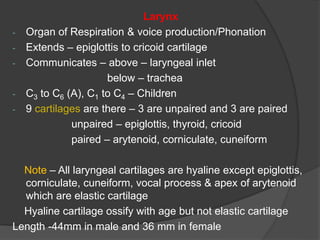
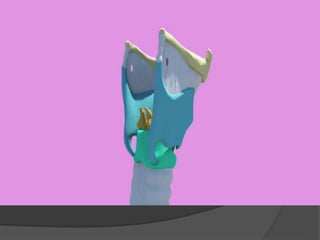
Larynx
- Organ of Respiration & voice production/Phonation
- Extends – epiglottis to cricoid cartilage
- Communicates – above – laryngeal inlet
below – trachea
- C3 to C6 (A), C1 to C4 – Children
- 9 cartilages are there – 3 are unpaired and 3 are paired
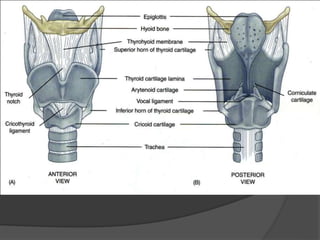
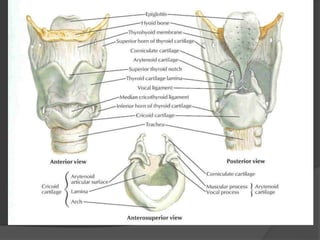
unpaired – epiglottis, thyroid, cricoid
paired – arytenoid, corniculate, cuneiform
Note – All laryngeal cartilages are hyaline except epiglottis,
corniculate, cuneiform, vocal process & apex of arytenoid
which are elastic cartilage
Hyaline cartilage ossify with age but not elastic cartilage
Length -44mm in male and 36 mm in female
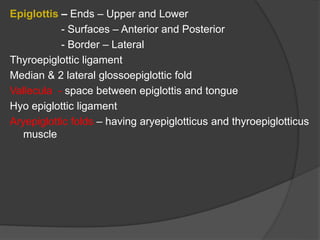
Epiglottis – Ends – Upper and Lower
- Surfaces – Anterior and Posterior
- Border – Lateral
Thyroepiglottic ligament
Median & 2 lateral glossoepiglottic fold
Vallecula - space between epiglottis and tongue
Hyo epiglottic ligament
Aryepiglottic folds – having aryepiglotticus and thyroepiglotticus
muscle
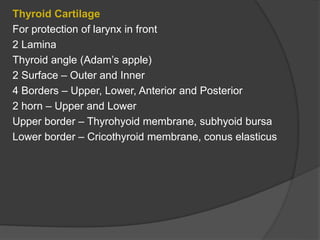
Thyroid Cartilage
For protection of larynx in front
2 Lamina
Thyroid angle (Adam’s apple)
2 Surface – Outer and Inner
4 Borders – Upper, Lower, Anterior and Posterior
2 horn – Upper and Lower
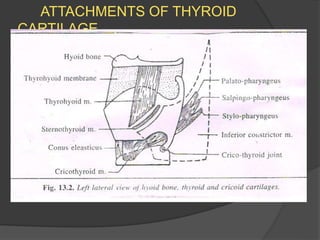
Upper border – Thyrohyoid membrane, subhyoid bursa
Lower border – Cricothyroid membrane, conus elasticus
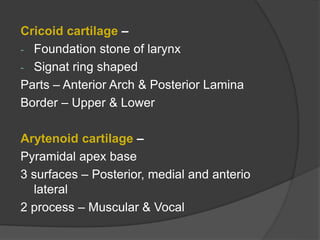
Cricoid cartilage –
- Foundation stone of larynx
- Signat ring shaped
Parts – Anterior Arch & Posterior Lamina
Border – Upper & Lower
Arytenoid cartilage –
Pyramidal apex base
3 surfaces – Posterior, medial and anterio
lateral
2 process – Muscular & Vocal
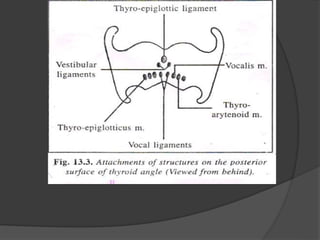
ATTACHMENTS OF THYROID
CARTILAGE
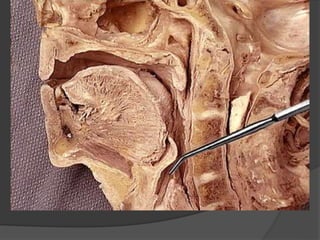
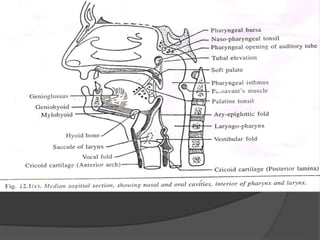
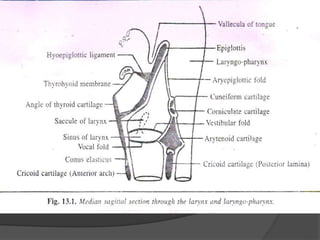
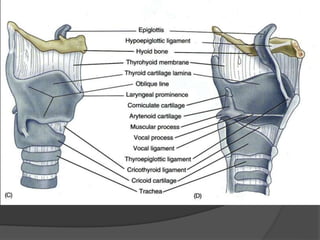
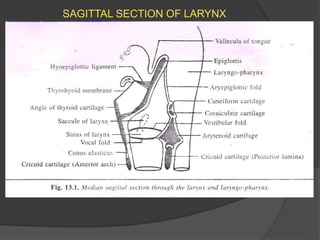
SAGITTAL SECTION OF LARYNX
LARYNGEAL LIGAMENTS AND
MEMBRANES
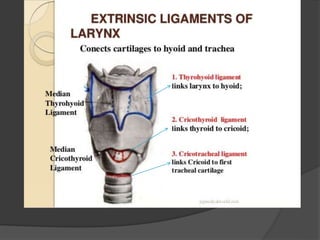
Extrinsic
 -Thyrohyoid membrane,medial and
lateral thyrohyoid ligaments
 -Hyoepiglottic ligament
 -Cricotracheal membrane
 -Thyroepiglottic ligament
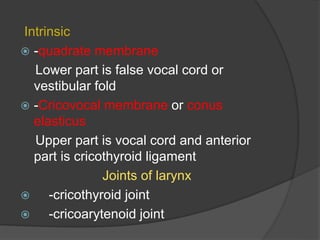
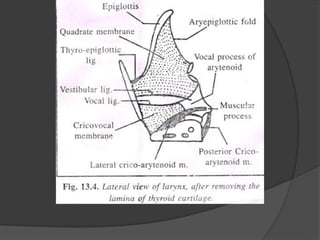
Intrinsic
 -quadrate membrane
Lower part is false vocal cord or
vestibular fold
 -Cricovocal membrane or conus
elasticus
Upper part is vocal cord and anterior
part is cricothyroid ligament
Joints of larynx
 -cricothyroid joint
 -cricoarytenoid joint
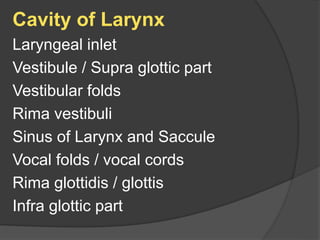
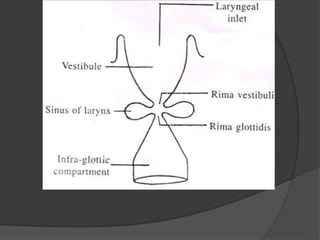
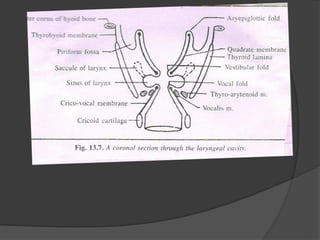
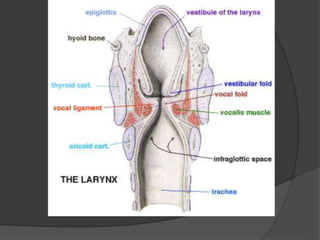
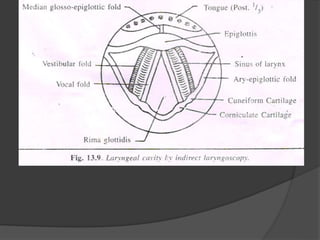
Cavity of Larynx
Laryngeal inlet
Vestibule / Supra glottic part
Vestibular folds
Rima vestibuli
Sinus of Larynx and Saccule
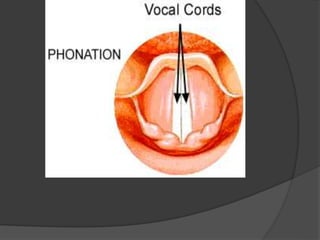
Vocal folds / vocal cords
Rima glottidis / glottis
Infra glottic part
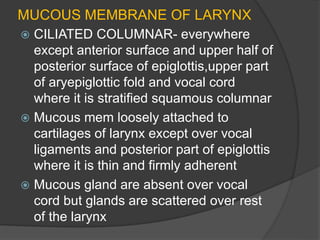
MUCOUS MEMBRANE OF LARYNX
 CILIATED COLUMNAR- everywhere
except anterior surface and upper half of
posterior surface of epiglottis,upper part
of aryepiglottic fold and vocal cord
where it is stratified squamous columnar
 Mucous mem loosely attached to
cartilages of larynx except over vocal
ligaments and posterior part of epiglottis
where it is thin and firmly adherent
 Mucous gland are absent over vocal
cord but glands are scattered over rest
of the larynx
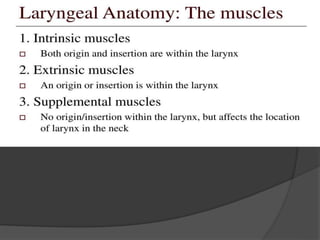
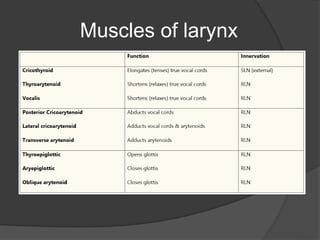
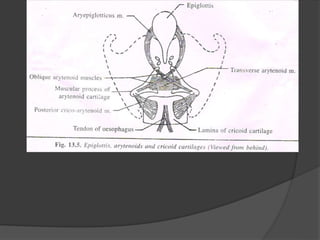
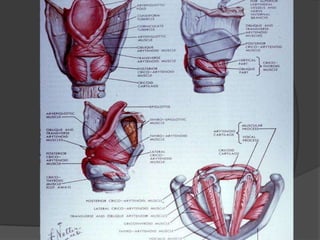
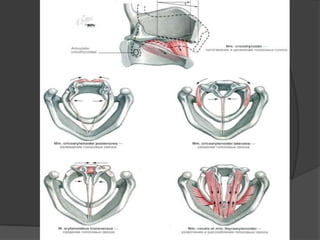
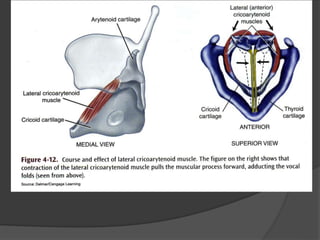
Muscles of larynx
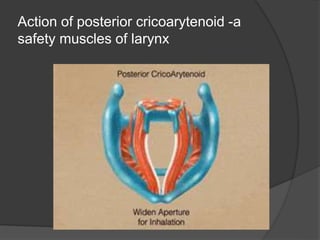
Action of posterior cricoarytenoid -a
safety muscles of larynx
Movements of Rima glottidis
- Abduction
- Adduction
- Tension
- Relaxation
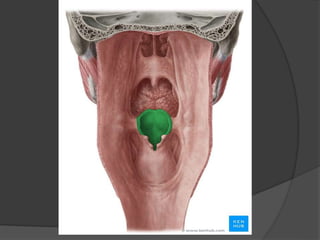
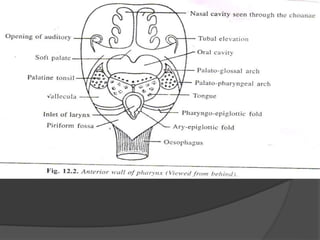
Boundaries of Laryngeal inlet –
- epiglottis, aryepiglottic fold, inter-
arytenoid fold of mucous membrane
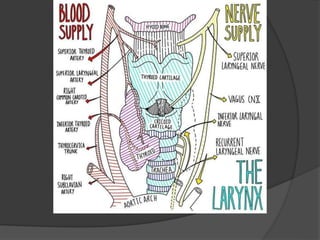
Nerve Supply of Larynx
Vocal Cord (VC) is watershed line
Sensory – above VC internal laryngeal nerve(vagus)
below VC recurrent laryngeal nerve (RLN)
Motor – All muscles of larynx are supplied by RLN (cranial part
of accessory nerve) except – cricothyroid (ext. laryngeal
nerve br. of vagus)
All muscle of larynx are paired except transversus arytenoid
which is having dual nerve supply RLN & Internal laryngeal
nerve
Blood Supply
Above VC – Superior thyroid artery
Below VC – inf. Thyroid artery by thyrocervical trunk from
subclavian artery
Lymphatic drainage
Above VC – Prelaryngeal LN
juglodiagastric LN
Below VC – Pre & Para tracheal LN
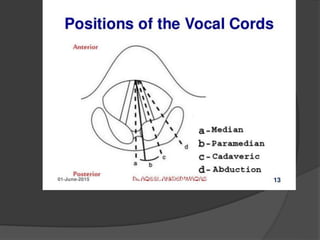
APPLIED OF NERVE SUPPLY
Paralysis of Laryngeal muscles
Nerve involved Position of glottis
(a) One side RLN Fixed Para median
(b) Both RLN Both glottis are in
Para median position
(c) RLN with ext. laryngeal nerve Fixed and abducted
(cadaveric)
Semon’s law – Abductors of larynx are paralyzed first in
chronic involvement of RLN.
APPLIED ANATOMY
 LARYNGITIS
 LARYNGEAL OEDEMA
 FOREIGN BODY
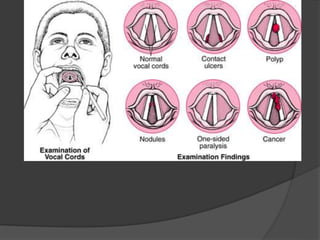
 LARYNGOSCOPY –DIRECT OR
INDIRCT
thanks

Layrnx

  • 5.
    Larynx - Organ ofRespiration & voice production/Phonation - Extends – epiglottis to cricoid cartilage - Communicates – above – laryngeal inlet below – trachea - C3 to C6 (A), C1 to C4 – Children - 9 cartilages are there – 3 are unpaired and 3 are paired unpaired – epiglottis, thyroid, cricoid paired – arytenoid, corniculate, cuneiform Note – All laryngeal cartilages are hyaline except epiglottis, corniculate, cuneiform, vocal process & apex of arytenoid which are elastic cartilage Hyaline cartilage ossify with age but not elastic cartilage Length -44mm in male and 36 mm in female
  • 6.
    Epiglottis – Ends– Upper and Lower - Surfaces – Anterior and Posterior - Border – Lateral Thyroepiglottic ligament Median & 2 lateral glossoepiglottic fold Vallecula - space between epiglottis and tongue Hyo epiglottic ligament Aryepiglottic folds – having aryepiglotticus and thyroepiglotticus muscle
  • 7.
    Thyroid Cartilage For protectionof larynx in front 2 Lamina Thyroid angle (Adam’s apple) 2 Surface – Outer and Inner 4 Borders – Upper, Lower, Anterior and Posterior 2 horn – Upper and Lower Upper border – Thyrohyoid membrane, subhyoid bursa Lower border – Cricothyroid membrane, conus elasticus
  • 8.
    Cricoid cartilage – -Foundation stone of larynx - Signat ring shaped Parts – Anterior Arch & Posterior Lamina Border – Upper & Lower Arytenoid cartilage – Pyramidal apex base 3 surfaces – Posterior, medial and anterio lateral 2 process – Muscular & Vocal
  • 13.
  • 15.
  • 16.
    LARYNGEAL LIGAMENTS AND MEMBRANES Extrinsic -Thyrohyoid membrane,medial and lateral thyrohyoid ligaments  -Hyoepiglottic ligament  -Cricotracheal membrane  -Thyroepiglottic ligament
  • 17.
    Intrinsic  -quadrate membrane Lowerpart is false vocal cord or vestibular fold  -Cricovocal membrane or conus elasticus Upper part is vocal cord and anterior part is cricothyroid ligament Joints of larynx  -cricothyroid joint  -cricoarytenoid joint
  • 20.
    Cavity of Larynx Laryngealinlet Vestibule / Supra glottic part Vestibular folds Rima vestibuli Sinus of Larynx and Saccule Vocal folds / vocal cords Rima glottidis / glottis Infra glottic part
  • 24.
    MUCOUS MEMBRANE OFLARYNX  CILIATED COLUMNAR- everywhere except anterior surface and upper half of posterior surface of epiglottis,upper part of aryepiglottic fold and vocal cord where it is stratified squamous columnar  Mucous mem loosely attached to cartilages of larynx except over vocal ligaments and posterior part of epiglottis where it is thin and firmly adherent  Mucous gland are absent over vocal cord but glands are scattered over rest of the larynx
  • 26.
  • 30.
    Action of posteriorcricoarytenoid -a safety muscles of larynx
  • 32.
    Movements of Rimaglottidis - Abduction - Adduction - Tension - Relaxation
  • 34.
    Boundaries of Laryngealinlet – - epiglottis, aryepiglottic fold, inter- arytenoid fold of mucous membrane
  • 40.
    Nerve Supply ofLarynx Vocal Cord (VC) is watershed line Sensory – above VC internal laryngeal nerve(vagus) below VC recurrent laryngeal nerve (RLN) Motor – All muscles of larynx are supplied by RLN (cranial part of accessory nerve) except – cricothyroid (ext. laryngeal nerve br. of vagus) All muscle of larynx are paired except transversus arytenoid which is having dual nerve supply RLN & Internal laryngeal nerve Blood Supply Above VC – Superior thyroid artery Below VC – inf. Thyroid artery by thyrocervical trunk from subclavian artery
  • 41.
    Lymphatic drainage Above VC– Prelaryngeal LN juglodiagastric LN Below VC – Pre & Para tracheal LN APPLIED OF NERVE SUPPLY Paralysis of Laryngeal muscles Nerve involved Position of glottis (a) One side RLN Fixed Para median (b) Both RLN Both glottis are in Para median position (c) RLN with ext. laryngeal nerve Fixed and abducted (cadaveric) Semon’s law – Abductors of larynx are paralyzed first in chronic involvement of RLN.
  • 43.
    APPLIED ANATOMY  LARYNGITIS LARYNGEAL OEDEMA  FOREIGN BODY  LARYNGOSCOPY –DIRECT OR INDIRCT
  • 45.