Generating Insights:
Using Competitive & Market Assessment
to Shape Your Content Strategy
1.  Introduction
2.  Competitive Assessment Overview
3.  Step 1: Getting Started

AGENDA

4.  Step 2: Gathering Data
5.  Step 3: Analyzing Results
6.  Step 4: Creating Recommendations
7.  Q-and-A

2
01

INTRODUCTION
Content strategy overview
ABOUT LAURA BLAYDON
§ Senior Manager, Content Strategy at SapientNitro in Chicago, IL
§ 15 years experience in content, digital and communications strategy
§ Previous clients and employers include Allstate, Sears, HSBC, Walgreens and
Northern Trust
§ Passionate about large enterprise sites (including intranets) and exploring the
intersection of business and audience needs

4
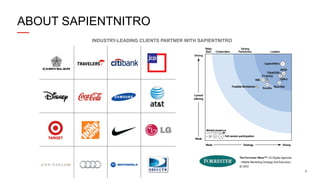
ABOUT SAPIENTNITRO
INDUSTRY-LEADING CLIENTS PARTNER WITH SAPIENTNITRO

5
CONTENT STRATEGY AT SAPIENTNITRO
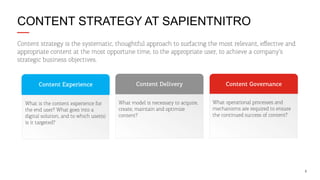
Content strategy is the systematic, thoughtful approach to surfacing the most relevant, effective and
appropriate content at the most opportune time, to the appropriate user, to achieve a company’s
strategic business objectives.

Content Experience

Content Delivery

What is the content experience for
the end user? What goes into a
digital solution, and to which user(s)
is it targeted?

What model is necessary to acquire,
create, maintain and optimize
content?

Content Governance
What operational processes and
mechanisms are required to ensure
the continued success of content?

6
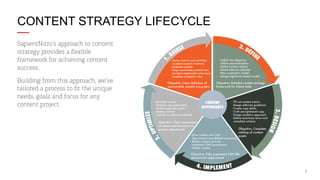
CONTENT STRATEGY LIFECYCLE
SapientNitro’s approach to content
strategy provides a flexible
framework for achieving content
success.
Building from this approach, we’ve
tailored a process to fit the unique
needs, goals and focus for any
content project.

7
02

COMPETITIVE ASSESSMENT OVERVIEW
Who needs a competitive assessment, and why
COMPETITIVE
ASSESSMENT:
WHAT IS IT?

§  An in-depth look at direct and indirect
competitor experiences, generally conducted
during the project discovery phase
§  An exercise to inform an understanding of one’s
relative position in the marketplace and identify
gaps and areas of opportunity
§  A targeted view of digital (desktop, email,
mobile, social experiences) and non-digital
(print, in-store, call center) experiences
§  A complement to other research activities
including user research, persona creation and
stakeholder research

9
A competitive assessment is needed when:

WHEN IS IT
NECESSARY?

§  An organization is just starting up, is entering
new markets or is introducing new products or
services
§  An established business is looking for a way to
benchmark against peers and “change the game”
§  New data is needed, either to evaluate new
channels and/or competitors, or to bring findings
up to date

10
Competitive assessment:

WHY IS IT
IMPORTANT?

§  Provides a broad view of what others are doing
and how they’re doing it
§  Yields insights that can be used to inform tactics
and to define an overall strategic approach
§  Offers valuable perspective on creating a truly
differentiated strategy
§  Provides a baseline so that future performance
can be measured and monitored

11
03

STEP 1: GETTING STARTED
Ensuring your assessment is set up for success
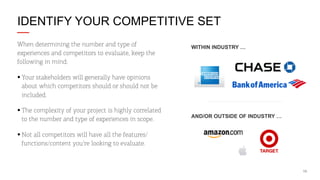
IDENTIFY YOUR COMPETITIVE SET
When determining the number and type of
experiences and competitors to evaluate, keep the
following in mind:

WITHIN INDUSTRY …

§ Your stakeholders will generally have opinions
about which competitors should or should not be
included.
§ The complexity of your project is highly correlated
to the number and type of experiences in scope.

AND/OR OUTSIDE OF INDUSTRY …

§ Not all competitors will have all the features/
functions/content you’re looking to evaluate.

13
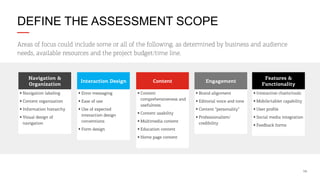
DEFINE THE ASSESSMENT SCOPE
Areas of focus could include some or all of the following, as determined by business and audience
needs, available resources and the project budget/time line.

Navigation &
Organization

Interaction Design

§ Navigation labeling

§ Error messaging

§ Content organization

§ Ease of use

§ Information hierarchy

§ Use of expected
interaction design
conventions

§ Visual design of
navigation

§ Form design

Content
§ Content
comprehensiveness and
usefulness
§ Content usability
§ Multimedia content
§ Education content

Engagement

Features &
Functionality

§ Brand alignment

§ Interactive charts/tools

§ Editorial voice and tone

§ Mobile/tablet capability

§ Content “personality”

§ User profile

§ Professionalism/
credibility

§ Social media integration
§ Feedback forms

§ Home page content

14
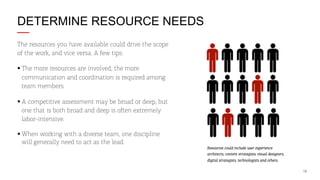
DETERMINE RESOURCE NEEDS
The resources you have available could drive the scope
of the work, and vice versa. A few tips:
§ The more resources are involved, the more
communication and coordination is required among
team members.
§ A competitive assessment may be broad or deep, but
one that is both broad and deep is oſten extremely
labor-intensive.
§ When working with a diverse team, one discipline
will generally need to act as the lead.
Resources could include user experience
architects, content strategists, visual designers,
digital strategists, technologists and others.
15
04

STEP 2: GATHERING DATA
Gathering inputs to inform your assessment
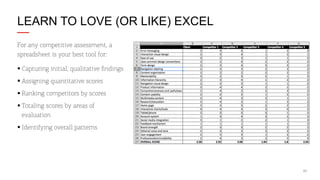
LEARN TO LOVE (OR LIKE) EXCEL
For any competitive assessment, a
spreadsheet is your best tool for:
§ Capturing initial, qualitative findings
§ Assigning quantitative scores
§ Ranking competitors by scores
§ Totaling scores by areas of
evaluation
§ Identifying overall patterns

17
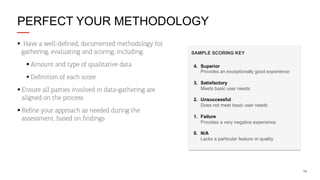
PERFECT YOUR METHODOLOGY
§  Have a well-defined, documented methodology for
gathering, evaluating and scoring, including:
§ Amount and type of qualitative data
§ Definition of each score
§ Ensure all parties involved in data-gathering are
aligned on the process
§ Refine your approach as needed during the
assessment, based on findings

SAMPLE SCORING KEY
4. Superior !
Provides an exceptionally good experience
3. Satisfactory!
Meets basic user needs"
2. Unsuccessful!
Does not meet basic user needs"
1. Failure!
Provides a very negative experience"
0. N/A
Lacks a particular feature or quality"

18
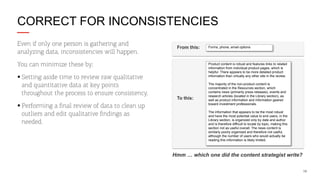
CORRECT FOR INCONSISTENCIES
Even if only one person is gathering and
analyzing data, inconsistencies will happen.

From this:

You can minimize these by:
§ Setting aside time to review raw qualitative
and quantitative data at key points
throughout the process to ensure consistency.
§ Performing a final review of data to clean up
outliers and edit qualitative findings as
needed.

Forms, phone, email options

Product content is robust and features links to related
information from individual product pages, which is
helpful. There appears to be more detailed product
information than virtually any other site in the review.

To this:

The majority of the non-product content is
concentrated in the Resources section, which
contains news (primarily press releases), events and
research articles (located in the Library section), as
well as product information and information geared
toward investment professionals.
The information that appears to be the most robust
and have the most potential value to end users, in the
Library section, is organized only by date and author
and is therefore difficult to locate by topic, making this
section not as useful overall. The news content is
similarly poorly organized and therefore not useful,
although the number of users who would actually be
reading this information is likely limited.

Hmm … which one did the content strategist write?
19
05

STEP 3: ANALYZING RESULTS
Identifying key insights and patterns
Goals for your analysis include the following:

ANALYSIS
GOALS

§  Identifying patterns in the data for each competitor,
and for the competitive set
§  Highlighting overall themes that can be used to frame
the analysis and guide recommendations
§  Finding any outliers in the data, which could be the
result of a unique competitor or inconsistencies in the
evaluation process

21
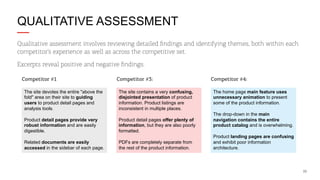
QUALITATIVE ASSESSMENT
Qualitative assessment involves reviewing detailed findings and identifying themes, both within each
competitor’s experience as well as across the competitive set.
Excerpts reveal positive and negative findings:
Competitor #1
The site devotes the entire "above the
fold" area on their site to guiding
users to product detail pages and
analysis tools.
Product detail pages provide very
robust information and are easily
digestible.
Related documents are easily
accessed in the sidebar of each page.

Competitor #3:
The site contains a very confusing,
disjointed presentation of product
information. Product listings are
inconsistent in multiple places.
Product detail pages offer plenty of
information, but they are also poorly
formatted.
PDFs are completely separate from
the rest of the product information.

Competitor #4:
The home page main feature uses
unnecessary animation to present
some of the product information.
The drop-down in the main
navigation contains the entire
product catalog and is overwhelming.
Product landing pages are confusing
and exhibit poor information
architecture.

22
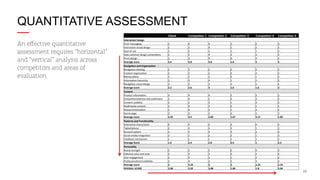
QUANTITATIVE ASSESSMENT


An effective quantitative
assessment requires “horizontal”
and “vertical” analysis across
competitors and areas of
evaluation.

Interac+on	
  Design	
  
Error	
  messaging	
  
Interac3on	
  visual	
  design	
  
Ease	
  of	
  use	
  
Uses	
  common	
  design	
  conven3ons	
  
Form	
  design	
  
Average	
  score	
  
Naviga+on	
  and	
  Organiza+on	
  
Naviga3on	
  labeling	
  
Content	
  organiza3on	
  	
  
Memorability	
  
Informa3on	
  hierarchy	
  
Naviga3on	
  visual	
  design	
  
Average	
  score	
  
Content	
  
Product	
  informa3on	
  
Comprehensiveness	
  and	
  usefulness	
  
Content	
  usability	
  
Mul3media	
  content	
  
Research/educa3on	
  
Home	
  page	
  
Average	
  score	
  
Features	
  and	
  Func+onality	
  
Interac3ve	
  charts/tools	
  
Tablet/phone	
  
Account	
  system	
  
Social	
  media	
  integra3on	
  
Feedback	
  mechanism	
  
Average	
  Score	
  
Personality	
  
Brand	
  strength	
  
Editorial	
  voice	
  and	
  tone	
  
User	
  engagement	
  
Professionalism/credibility	
  
Average	
  score	
  
OVERALL	
  SCORE	
  

Client	
  

Compe+tor	
  1	
   Compe+tor	
  2	
   Compe+tor	
  3	
  

Compe+tor	
  4	
  

Compe+tor	
  5	
  

3	
  
2	
  
3	
  
2	
  
2	
  
2.4	
  

4	
  
3	
  
2	
  
2	
  
3	
  
2.8	
  

4	
  
4	
  
3	
  
4	
  
4	
  
3.8	
  

1	
  
1	
  
1	
  
2	
  
3	
  
1.6	
  

2	
  
2	
  
1	
  
2	
  
3	
  
2	
  

3	
  
1	
  
2	
  
2	
  
2	
  
2	
  

2	
  
2	
  
3	
  
2	
  
2	
  
2.2	
  

3	
  
2	
  
2	
  
3	
  
3	
  
2.6	
  

3	
  
2	
  
3	
  
4	
  
3	
  
3	
  

2	
  
2	
  
2	
  
1	
  
1	
  
1.6	
  

2	
  
2	
  
1	
  
2	
  
1	
  
1.6	
  

2	
  
2	
  
2	
  
2	
  
2	
  
2	
  

3	
  
2	
  
2	
  
2	
  
2	
  
3	
  
2.33	
  

4	
  
4	
  
2	
  
4	
  
4	
  
3	
  
3.5	
  

4	
  
2	
  
3	
  
3	
  
2	
  
3	
  
2.83	
  

2	
  
2	
  
1	
  
2	
  
1	
  
2	
  
1.67	
  

2	
  
3	
  
2	
  
1	
  
3	
  
2	
  
2.17	
  

2	
  
2	
  
2	
  
1	
  
2	
  
2	
  
1.83	
  

0	
  
2	
  
1	
  
3	
  
1	
  
1.4	
  

4	
  
3	
  
3	
  
1	
  
1	
  
2.4	
  

4	
  
3	
  
4	
  
2	
  
1	
  
2.8	
  

3	
  
3	
  
3	
  
2	
  
1	
  
2.4	
  

0	
  
1	
  
2	
  
1	
  
1	
  
1	
  

2	
  
2	
  
2	
  
3	
  
2	
  
2.2	
  

2	
  
2	
  
2	
  
2	
  
2	
  
2.08	
  

3	
  
3	
  
3	
  
4	
  
3.25	
  
2.92	
  

3	
  
3	
  
3	
  
3	
  
3	
  
3.08	
  

2	
  
3	
  
1	
  
2	
  
2	
  
1.84	
  

2	
  
2	
  
2	
  
3	
  
2.25	
  
1.8	
  

2	
  
2	
  
2	
  
3	
  
2.25	
  
2.04	
  

23
06

STEP 4: CREATING RECOMMENDATIONS
Determining an approach based on findings
1.  Document the high-level themes from your analysis.

ORGANIZE
YOUR FINDINGS

2.  List improvement opportunities that relate to each
theme and address major gaps identified in your
findings.
3.  Show findings in a summary view as well as a
prioritization chart, as appropriate to the project.
4.  Know your audience and present findings and
recommendations accordingly.

25
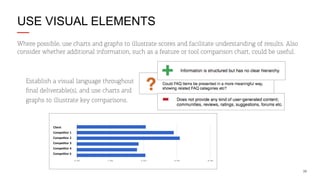
USE VISUAL ELEMENTS
Where possible, use charts and graphs to illustrate scores and facilitate understanding of results. Also
consider whether additional information, such as a feature or tool comparison chart, could be useful.

Establish a visual language throughout
final deliverable(s), and use charts and
graphs to illustrate key comparisons.

Client	
  
Compe+tor	
  1	
  
Compe+tor	
  2	
  
Compe+tor	
  3	
  
Compe+tor	
  4	
  
Compe+tor	
  5	
  

26
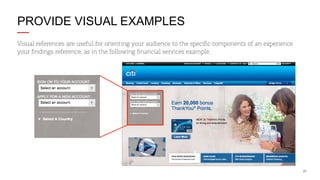
PROVIDE VISUAL EXAMPLES
Visual references are useful for orienting your audience to the specific components of an experience
your findings reference, as in the following financial services example.

27
ALIGN WITH BUSINESS OBJECTIVES
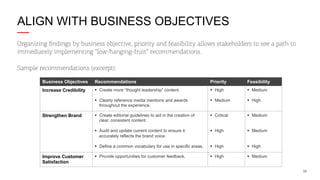
Organizing findings by business objective, priority and feasibility allows stakeholders to see a path to
immediately implementing “low-hanging-fruit” recommendations.
Sample recommendations (excerpt):
Business Objectives

Recommendations

Priority

Feasibility

Increase Credibility

§  Create more “thought leadership” content.

§  High

§  Medium

§  Clearly reference media mentions and awards
throughout the experience.

§  Medium

§  High

§  Create editorial guidelines to aid in the creation of
clear, consistent content.

§  Critical

§  Medium

§  Audit and update current content to ensure it
accurately reflects the brand voice.

§  High

§  Medium

§  Define a common vocabulary for use in specific areas.

§  High

§  High

§  Provide opportunities for customer feedback.

§  High

§  Medium

Strengthen Brand

Improve Customer
Satisfaction

28
CREATE A PLAN FOR THE FUTURE
A well-executed, robust competitive assessment yields valuable insights that can be used to inform
short-, medium- and long-term content strategies.
If you’re ambitious, you can use assessment findings as a platform to:
§  Jump-start business planning and prioritization sessions
§  Create a case for a more focused, sustained measurement program
§  Develop a strategic road map to guide future content creation,
feature/functionality development, authoring capabilities, etc.
§  Secure the necessary resources to successfully execute your plan

29
07

Q-AND-A
THANK YOU!
Laura Blaydon
Senior Manager, Content Strategy
SapientNitro
lblaydon@sapient.com

© 2013 SAPIENT CORPORATION | CONFIDENTIAL

Generating Insights: Using Competitive Assessment to Shape Your Content Strategy

  • 1.
    Generating Insights: Using Competitive& Market Assessment to Shape Your Content Strategy
  • 2.
    1.  Introduction 2.  CompetitiveAssessment Overview 3.  Step 1: Getting Started AGENDA 4.  Step 2: Gathering Data 5.  Step 3: Analyzing Results 6.  Step 4: Creating Recommendations 7.  Q-and-A 2
  • 3.
  • 4.
    ABOUT LAURA BLAYDON § SeniorManager, Content Strategy at SapientNitro in Chicago, IL § 15 years experience in content, digital and communications strategy § Previous clients and employers include Allstate, Sears, HSBC, Walgreens and Northern Trust § Passionate about large enterprise sites (including intranets) and exploring the intersection of business and audience needs 4
  • 5.
  • 6.
    CONTENT STRATEGY ATSAPIENTNITRO Content strategy is the systematic, thoughtful approach to surfacing the most relevant, effective and appropriate content at the most opportune time, to the appropriate user, to achieve a company’s strategic business objectives. Content Experience Content Delivery What is the content experience for the end user? What goes into a digital solution, and to which user(s) is it targeted? What model is necessary to acquire, create, maintain and optimize content? Content Governance What operational processes and mechanisms are required to ensure the continued success of content? 6
  • 7.
    CONTENT STRATEGY LIFECYCLE SapientNitro’sapproach to content strategy provides a flexible framework for achieving content success. Building from this approach, we’ve tailored a process to fit the unique needs, goals and focus for any content project. 7
  • 8.
    02 COMPETITIVE ASSESSMENT OVERVIEW Whoneeds a competitive assessment, and why
  • 9.
    COMPETITIVE ASSESSMENT: WHAT IS IT? § An in-depth look at direct and indirect competitor experiences, generally conducted during the project discovery phase §  An exercise to inform an understanding of one’s relative position in the marketplace and identify gaps and areas of opportunity §  A targeted view of digital (desktop, email, mobile, social experiences) and non-digital (print, in-store, call center) experiences §  A complement to other research activities including user research, persona creation and stakeholder research 9
  • 10.
    A competitive assessmentis needed when: WHEN IS IT NECESSARY? §  An organization is just starting up, is entering new markets or is introducing new products or services §  An established business is looking for a way to benchmark against peers and “change the game” §  New data is needed, either to evaluate new channels and/or competitors, or to bring findings up to date 10
  • 11.
    Competitive assessment: WHY ISIT IMPORTANT? §  Provides a broad view of what others are doing and how they’re doing it §  Yields insights that can be used to inform tactics and to define an overall strategic approach §  Offers valuable perspective on creating a truly differentiated strategy §  Provides a baseline so that future performance can be measured and monitored 11
  • 12.
    03 STEP 1: GETTINGSTARTED Ensuring your assessment is set up for success
  • 13.
    IDENTIFY YOUR COMPETITIVESET When determining the number and type of experiences and competitors to evaluate, keep the following in mind: WITHIN INDUSTRY … § Your stakeholders will generally have opinions about which competitors should or should not be included. § The complexity of your project is highly correlated to the number and type of experiences in scope. AND/OR OUTSIDE OF INDUSTRY … § Not all competitors will have all the features/ functions/content you’re looking to evaluate. 13
  • 14.
    DEFINE THE ASSESSMENTSCOPE Areas of focus could include some or all of the following, as determined by business and audience needs, available resources and the project budget/time line. Navigation & Organization Interaction Design § Navigation labeling § Error messaging § Content organization § Ease of use § Information hierarchy § Use of expected interaction design conventions § Visual design of navigation § Form design Content § Content comprehensiveness and usefulness § Content usability § Multimedia content § Education content Engagement Features & Functionality § Brand alignment § Interactive charts/tools § Editorial voice and tone § Mobile/tablet capability § Content “personality” § User profile § Professionalism/ credibility § Social media integration § Feedback forms § Home page content 14
  • 15.
    DETERMINE RESOURCE NEEDS Theresources you have available could drive the scope of the work, and vice versa. A few tips: § The more resources are involved, the more communication and coordination is required among team members. § A competitive assessment may be broad or deep, but one that is both broad and deep is oſten extremely labor-intensive. § When working with a diverse team, one discipline will generally need to act as the lead. Resources could include user experience architects, content strategists, visual designers, digital strategists, technologists and others. 15
  • 16.
    04 STEP 2: GATHERINGDATA Gathering inputs to inform your assessment
  • 17.
    LEARN TO LOVE(OR LIKE) EXCEL For any competitive assessment, a spreadsheet is your best tool for: § Capturing initial, qualitative findings § Assigning quantitative scores § Ranking competitors by scores § Totaling scores by areas of evaluation § Identifying overall patterns 17
  • 18.
    PERFECT YOUR METHODOLOGY § Have a well-defined, documented methodology for gathering, evaluating and scoring, including: § Amount and type of qualitative data § Definition of each score § Ensure all parties involved in data-gathering are aligned on the process § Refine your approach as needed during the assessment, based on findings SAMPLE SCORING KEY 4. Superior ! Provides an exceptionally good experience 3. Satisfactory! Meets basic user needs" 2. Unsuccessful! Does not meet basic user needs" 1. Failure! Provides a very negative experience" 0. N/A Lacks a particular feature or quality" 18
  • 19.
    CORRECT FOR INCONSISTENCIES Evenif only one person is gathering and analyzing data, inconsistencies will happen. From this: You can minimize these by: § Setting aside time to review raw qualitative and quantitative data at key points throughout the process to ensure consistency. § Performing a final review of data to clean up outliers and edit qualitative findings as needed. Forms, phone, email options Product content is robust and features links to related information from individual product pages, which is helpful. There appears to be more detailed product information than virtually any other site in the review. To this: The majority of the non-product content is concentrated in the Resources section, which contains news (primarily press releases), events and research articles (located in the Library section), as well as product information and information geared toward investment professionals. The information that appears to be the most robust and have the most potential value to end users, in the Library section, is organized only by date and author and is therefore difficult to locate by topic, making this section not as useful overall. The news content is similarly poorly organized and therefore not useful, although the number of users who would actually be reading this information is likely limited. Hmm … which one did the content strategist write? 19
  • 20.
    05 STEP 3: ANALYZINGRESULTS Identifying key insights and patterns
  • 21.
    Goals for youranalysis include the following: ANALYSIS GOALS §  Identifying patterns in the data for each competitor, and for the competitive set §  Highlighting overall themes that can be used to frame the analysis and guide recommendations §  Finding any outliers in the data, which could be the result of a unique competitor or inconsistencies in the evaluation process 21
  • 22.
    QUALITATIVE ASSESSMENT Qualitative assessmentinvolves reviewing detailed findings and identifying themes, both within each competitor’s experience as well as across the competitive set. Excerpts reveal positive and negative findings: Competitor #1 The site devotes the entire "above the fold" area on their site to guiding users to product detail pages and analysis tools. Product detail pages provide very robust information and are easily digestible. Related documents are easily accessed in the sidebar of each page. Competitor #3: The site contains a very confusing, disjointed presentation of product information. Product listings are inconsistent in multiple places. Product detail pages offer plenty of information, but they are also poorly formatted. PDFs are completely separate from the rest of the product information. Competitor #4: The home page main feature uses unnecessary animation to present some of the product information. The drop-down in the main navigation contains the entire product catalog and is overwhelming. Product landing pages are confusing and exhibit poor information architecture. 22
  • 23.
    QUANTITATIVE ASSESSMENT     An effective quantitative assessment requires “horizontal” and “vertical” analysis across competitors and areas of evaluation. Interac+on  Design   Error  messaging   Interac3on  visual  design   Ease  of  use   Uses  common  design  conven3ons   Form  design   Average  score   Naviga+on  and  Organiza+on   Naviga3on  labeling   Content  organiza3on     Memorability   Informa3on  hierarchy   Naviga3on  visual  design   Average  score   Content   Product  informa3on   Comprehensiveness  and  usefulness   Content  usability   Mul3media  content   Research/educa3on   Home  page   Average  score   Features  and  Func+onality   Interac3ve  charts/tools   Tablet/phone   Account  system   Social  media  integra3on   Feedback  mechanism   Average  Score   Personality   Brand  strength   Editorial  voice  and  tone   User  engagement   Professionalism/credibility   Average  score   OVERALL  SCORE   Client   Compe+tor  1   Compe+tor  2   Compe+tor  3   Compe+tor  4   Compe+tor  5   3   2   3   2   2   2.4   4   3   2   2   3   2.8   4   4   3   4   4   3.8   1   1   1   2   3   1.6   2   2   1   2   3   2   3   1   2   2   2   2   2   2   3   2   2   2.2   3   2   2   3   3   2.6   3   2   3   4   3   3   2   2   2   1   1   1.6   2   2   1   2   1   1.6   2   2   2   2   2   2   3   2   2   2   2   3   2.33   4   4   2   4   4   3   3.5   4   2   3   3   2   3   2.83   2   2   1   2   1   2   1.67   2   3   2   1   3   2   2.17   2   2   2   1   2   2   1.83   0   2   1   3   1   1.4   4   3   3   1   1   2.4   4   3   4   2   1   2.8   3   3   3   2   1   2.4   0   1   2   1   1   1   2   2   2   3   2   2.2   2   2   2   2   2   2.08   3   3   3   4   3.25   2.92   3   3   3   3   3   3.08   2   3   1   2   2   1.84   2   2   2   3   2.25   1.8   2   2   2   3   2.25   2.04   23
  • 24.
    06 STEP 4: CREATINGRECOMMENDATIONS Determining an approach based on findings
  • 25.
    1.  Document thehigh-level themes from your analysis. ORGANIZE YOUR FINDINGS 2.  List improvement opportunities that relate to each theme and address major gaps identified in your findings. 3.  Show findings in a summary view as well as a prioritization chart, as appropriate to the project. 4.  Know your audience and present findings and recommendations accordingly. 25
  • 26.
    USE VISUAL ELEMENTS Wherepossible, use charts and graphs to illustrate scores and facilitate understanding of results. Also consider whether additional information, such as a feature or tool comparison chart, could be useful. Establish a visual language throughout final deliverable(s), and use charts and graphs to illustrate key comparisons. Client   Compe+tor  1   Compe+tor  2   Compe+tor  3   Compe+tor  4   Compe+tor  5   26
  • 27.
    PROVIDE VISUAL EXAMPLES Visualreferences are useful for orienting your audience to the specific components of an experience your findings reference, as in the following financial services example. 27
  • 28.
    ALIGN WITH BUSINESSOBJECTIVES Organizing findings by business objective, priority and feasibility allows stakeholders to see a path to immediately implementing “low-hanging-fruit” recommendations. Sample recommendations (excerpt): Business Objectives Recommendations Priority Feasibility Increase Credibility §  Create more “thought leadership” content. §  High §  Medium §  Clearly reference media mentions and awards throughout the experience. §  Medium §  High §  Create editorial guidelines to aid in the creation of clear, consistent content. §  Critical §  Medium §  Audit and update current content to ensure it accurately reflects the brand voice. §  High §  Medium §  Define a common vocabulary for use in specific areas. §  High §  High §  Provide opportunities for customer feedback. §  High §  Medium Strengthen Brand Improve Customer Satisfaction 28
  • 29.
    CREATE A PLANFOR THE FUTURE A well-executed, robust competitive assessment yields valuable insights that can be used to inform short-, medium- and long-term content strategies. If you’re ambitious, you can use assessment findings as a platform to: §  Jump-start business planning and prioritization sessions §  Create a case for a more focused, sustained measurement program §  Develop a strategic road map to guide future content creation, feature/functionality development, authoring capabilities, etc. §  Secure the necessary resources to successfully execute your plan 29
  • 30.
  • 31.
    THANK YOU! Laura Blaydon SeniorManager, Content Strategy SapientNitro lblaydon@sapient.com © 2013 SAPIENT CORPORATION | CONFIDENTIAL