HIGHER EUCATION
       2000-PRESENT
    Instructor: Dr. David Hinton
              Course: EDU 657
Demographics and Diversity
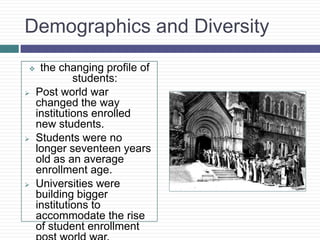
    the changing profile of
             students:
   Post world war
    changed the way
    institutions enrolled
    new students.
   Students were no
    longer seventeen years
    old as an average
    enrollment age.
   Universities were
    building bigger
    institutions to
    accommodate the rise
    of student enrollment
STUDENT PROFILE: “non
traditional students”
   Thelin (2010) illustrates two end result for
    campus administrators (pg. 326):
     1. campus administrators pay close attention to
      prospective students and their parents in order to
      better serve the mass public with their needs but
      most importantly with curricula.
     2. Colleges are beginning to recognize its diverse
      enrollments; from student of average age, post
      war veterans, returning, and as well older
      students
Student profile cont’d:
          A new era of students:
              Fred Buining (2008) highlights that students are becoming more and
               more aware of their own future therefore they are taking control in
               terms of choosing their career path. Stduents are choosing a diverse
               path in their career field, thus it is reflecting towards institutions
               catering to student needs.

              Fred Buining (2008) mentions three important aspects that universities
               should approach higher education:
               1. Vast practice: education should work as a community to inspire the
               vast population with pressing issues that are important to higher
               education such as hosting seminars, conferences, and conventions to
               help create a mass effect on the community for higher education.
               2. Using the community as a role model so that institutions are able to
               bring in community speakers to help the community become involved
               within the higher education community.
               3. Work in multidisciplinary ways so that institutions are able to create
               innovative ways to help support issues that are important to
               institutions, furthermore, pushing across departments issues that are
               relevant to an institutions.
Fenske and Scott (1978) student
ratio:
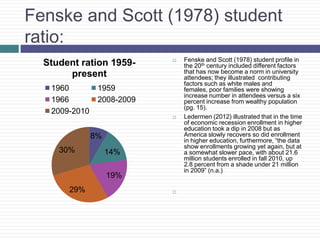
                               Fenske and Scott (1978) student profile in
  Student ration 1959-          the 20th century included different factors
       present                  that has now become a norm in university
                                attendees; they illustrated contributing
                                factors such as white males and
   1960         1959            females, poor families were showing
                                increase number in attendees versus a six
   1966         2008-2009       percent increase from wealthy population
                                (pg. 15).
   2009-2010
                               Ledermen (2012) illustrated that in the time
                                of economic recession enrollment in higher
                                education took a dip in 2008 but as
               8%               America slowly recovers so did enrollment
                                in higher education, furthermore, “the data
                                show enrollments growing yet again, but at
     30%            14%         a somewhat slower pace, with about 21.6
                                million students enrolled in fall 2010, up
                                2.8 percent from a shade under 21 million
                                in 2009” (n.a.)
                    19%
       29%                  
INTERCOLLEGIATE SPORTS:
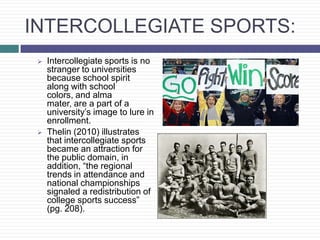
    Intercollegiate sports is no
     stranger to universities
     because school spirit
     along with school
     colors, and alma
     mater, are a part of a
     university’s image to lure in
     enrollment.
    Thelin (2010) illustrates
     that intercollegiate sports
     became an attraction for
     the public domain, in
     addition, “the regional
     trends in attendance and
     national championships
     signaled a redistribution of
     college sports success”
     (pg. 208).
Intercollegiate sports cont’d:
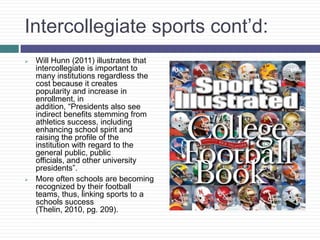
   Will Hunn (2011) illustrates that
    intercollegiate is important to
    many institutions regardless the
    cost because it creates
    popularity and increase in
    enrollment, in
    addition, “Presidents also see
    indirect benefits stemming from
    athletics success, including
    enhancing school spirit and
    raising the profile of the
    institution with regard to the
    general public, public
    officials, and other university
    presidents”.
   More often schools are becoming
    recognized by their football
    teams, thus, linking sports to a
    schools success
    (Thelin, 2010, pg. 209).
Holding on to school spirit:
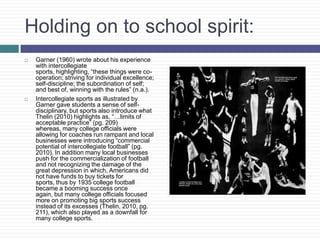
   Garner (1960) wrote about his experience
    with intercollegiate
    sports, highlighting, “these things were co-
    operation; striving for individual excellence;
    self-discipline; the subordination of self;
    and best of, winning with the rules” (n.a.).
   Intercollegiate sports as illustrated by
    Garner gave students a sense of self-
    disciplinary, but sports also introduce what
    Thelin (2010) highlights as, “…limits of
    acceptable practice” (pg. 209)
    whereas, many college officials were
    allowing for coaches run rampant and local
    businesses were introducing “commercial
    potential of intercollegiate football” (pg.
    2010). In addition many local businesses
    push for the commercialization of football
    and not recognizing the damage of the
    great depression in which, Americans did
    not have funds to buy tickets for
    sports, thus by 1935 college football
    became a booming success once
    again, but many college officials focused
    more on promoting big sports success
    instead of its excesses (Thelin, 2010, pg.
    211), which also played as a downfall for
    many college sports.
Conclusion
   Higher Education is always evolving because the student
    interest is different, so as new trends arise so do new
    institutions, Buining (2008) highlighted this in his
    segment, also indicating that in order for universities to keep
    up to speed with such trends, institutions should be assessing
    their methods from within the institution and branching out to
    the community so that there is a sense of urgency about
    higher education, but most importantly a sense of security for
    higher education.
   Moyen, Edwards, & Thelin (n.a.) writes, “One theme that
    pervades higher education in the United States in the second
    half of the twentieth century is that of a "managerial
    revolution“…Maintaining and bolstering widespread trust in
    postsecondary education will be the central determinant in
    present and future discussions about ways in which
    Americans support higher education”.
References:
   Buining, F. (2008). Complex Change in Higher Education. Retrieved from
        http://www.youtube.com/watch?v=slOEbOC89pg
   Fenske, R., & Scott, C. (1973). The changing profile of college students. Retrieved from
            http://www.eric.ed.gov/PDFS/ED088393.pdf
   Jessica , S. (2011, February 10). Jessica schwartz - ut austin - student video profile. Retrieved
    from http://www.youtube.com/watch?v=b0nOcofvctU
   Huhn, W. (2011, October 17). [Web log article]. Retrieved from
            http://www.ohioverticals.com/blogs/akron_law_cafe/2011/10/affordability-of-public-higher-
            education-1-intercollegiate-athletics/
   Gardner, F. (1960). The place of intercollegiate athletics in higher education: Hold that tiger!. The
    Journal             Of Higher Education, 31(7), 364-368. Retrieved from
    http://www.jstor.org/discover/10.2307
   Lederman, D. (2012, March 28). Enrollments grow, but more slowly. Retrieved from
            http://www.insidehighered.com/news/2012/03/28/us-data-show-rate-enrollment-growth-
    slowing-            2009-10
   Thelin, J. R. (2011). A history of American higher education (2nd ed.). Baltimore: Johns Hopkins
    University          Press.
   Thelin, J., Edwards, J., & Moyen, E. (n.d.). Higher education in the united states - historical
    development, system              read more: Higher education in the united states - historical
    development, system - colleges, institutions,            universities, and american -
    stateuniversity.com              http://education.stateuniversity.com/pages/2044/higher-education-
    in-united-states.html

Lauilefue eleanor final project

  • 1.
    HIGHER EUCATION 2000-PRESENT Instructor: Dr. David Hinton Course: EDU 657
  • 2.
    Demographics and Diversity  the changing profile of students:  Post world war changed the way institutions enrolled new students.  Students were no longer seventeen years old as an average enrollment age.  Universities were building bigger institutions to accommodate the rise of student enrollment
  • 3.
    STUDENT PROFILE: “non traditionalstudents”  Thelin (2010) illustrates two end result for campus administrators (pg. 326):  1. campus administrators pay close attention to prospective students and their parents in order to better serve the mass public with their needs but most importantly with curricula.  2. Colleges are beginning to recognize its diverse enrollments; from student of average age, post war veterans, returning, and as well older students
  • 4.
    Student profile cont’d:  A new era of students:  Fred Buining (2008) highlights that students are becoming more and more aware of their own future therefore they are taking control in terms of choosing their career path. Stduents are choosing a diverse path in their career field, thus it is reflecting towards institutions catering to student needs.  Fred Buining (2008) mentions three important aspects that universities should approach higher education: 1. Vast practice: education should work as a community to inspire the vast population with pressing issues that are important to higher education such as hosting seminars, conferences, and conventions to help create a mass effect on the community for higher education. 2. Using the community as a role model so that institutions are able to bring in community speakers to help the community become involved within the higher education community. 3. Work in multidisciplinary ways so that institutions are able to create innovative ways to help support issues that are important to institutions, furthermore, pushing across departments issues that are relevant to an institutions.
  • 6.
    Fenske and Scott(1978) student ratio:  Fenske and Scott (1978) student profile in Student ration 1959- the 20th century included different factors present that has now become a norm in university attendees; they illustrated contributing factors such as white males and 1960 1959 females, poor families were showing increase number in attendees versus a six 1966 2008-2009 percent increase from wealthy population (pg. 15). 2009-2010  Ledermen (2012) illustrated that in the time of economic recession enrollment in higher education took a dip in 2008 but as 8% America slowly recovers so did enrollment in higher education, furthermore, “the data show enrollments growing yet again, but at 30% 14% a somewhat slower pace, with about 21.6 million students enrolled in fall 2010, up 2.8 percent from a shade under 21 million in 2009” (n.a.) 19% 29% 
  • 7.
    INTERCOLLEGIATE SPORTS:  Intercollegiate sports is no stranger to universities because school spirit along with school colors, and alma mater, are a part of a university’s image to lure in enrollment.  Thelin (2010) illustrates that intercollegiate sports became an attraction for the public domain, in addition, “the regional trends in attendance and national championships signaled a redistribution of college sports success” (pg. 208).
  • 8.
    Intercollegiate sports cont’d:  Will Hunn (2011) illustrates that intercollegiate is important to many institutions regardless the cost because it creates popularity and increase in enrollment, in addition, “Presidents also see indirect benefits stemming from athletics success, including enhancing school spirit and raising the profile of the institution with regard to the general public, public officials, and other university presidents”.  More often schools are becoming recognized by their football teams, thus, linking sports to a schools success (Thelin, 2010, pg. 209).
  • 9.
    Holding on toschool spirit:  Garner (1960) wrote about his experience with intercollegiate sports, highlighting, “these things were co- operation; striving for individual excellence; self-discipline; the subordination of self; and best of, winning with the rules” (n.a.).  Intercollegiate sports as illustrated by Garner gave students a sense of self- disciplinary, but sports also introduce what Thelin (2010) highlights as, “…limits of acceptable practice” (pg. 209) whereas, many college officials were allowing for coaches run rampant and local businesses were introducing “commercial potential of intercollegiate football” (pg. 2010). In addition many local businesses push for the commercialization of football and not recognizing the damage of the great depression in which, Americans did not have funds to buy tickets for sports, thus by 1935 college football became a booming success once again, but many college officials focused more on promoting big sports success instead of its excesses (Thelin, 2010, pg. 211), which also played as a downfall for many college sports.
  • 10.
    Conclusion  Higher Education is always evolving because the student interest is different, so as new trends arise so do new institutions, Buining (2008) highlighted this in his segment, also indicating that in order for universities to keep up to speed with such trends, institutions should be assessing their methods from within the institution and branching out to the community so that there is a sense of urgency about higher education, but most importantly a sense of security for higher education.  Moyen, Edwards, & Thelin (n.a.) writes, “One theme that pervades higher education in the United States in the second half of the twentieth century is that of a "managerial revolution“…Maintaining and bolstering widespread trust in postsecondary education will be the central determinant in present and future discussions about ways in which Americans support higher education”.
  • 11.
    References:  Buining, F. (2008). Complex Change in Higher Education. Retrieved from http://www.youtube.com/watch?v=slOEbOC89pg  Fenske, R., & Scott, C. (1973). The changing profile of college students. Retrieved from http://www.eric.ed.gov/PDFS/ED088393.pdf  Jessica , S. (2011, February 10). Jessica schwartz - ut austin - student video profile. Retrieved from http://www.youtube.com/watch?v=b0nOcofvctU  Huhn, W. (2011, October 17). [Web log article]. Retrieved from http://www.ohioverticals.com/blogs/akron_law_cafe/2011/10/affordability-of-public-higher- education-1-intercollegiate-athletics/  Gardner, F. (1960). The place of intercollegiate athletics in higher education: Hold that tiger!. The Journal Of Higher Education, 31(7), 364-368. Retrieved from http://www.jstor.org/discover/10.2307  Lederman, D. (2012, March 28). Enrollments grow, but more slowly. Retrieved from http://www.insidehighered.com/news/2012/03/28/us-data-show-rate-enrollment-growth- slowing- 2009-10  Thelin, J. R. (2011). A history of American higher education (2nd ed.). Baltimore: Johns Hopkins University Press.  Thelin, J., Edwards, J., & Moyen, E. (n.d.). Higher education in the united states - historical development, system read more: Higher education in the united states - historical development, system - colleges, institutions, universities, and american - stateuniversity.com http://education.stateuniversity.com/pages/2044/higher-education- in-united-states.html

Editor's Notes

  • #2 Presentation slide for courses, classes, lectures et al.
  • #3 Beginning course details and/or books/materials needed for a class/project.
  • #4 A schedule design for optional periods of time/objectives.
  • #5 Introductory notes.
  • #6 Objectives for instruction and expected results and/or skills developed from learning.
  • #8 Relative vocabulary list.
  • #9 A list of procedures and steps, or a lecture slide with media.
  • #11 Conclusion to course, lecture, et al.
  • #12 An opportunity for questions and discussions.