International
Journal of
Educational
Reform
The International Journal of Educational Reform is included in the following index-
ing and abstracting services:
Academic Abstracts
Current Index to Journals of Education
Educational Administration Abstracts
12-008_IJER_V21_No2.indb i12-008_IJER_V21_No2.indb i 2/1/12 2:49 PM2/1/12 2:49 PM
EDITOR
Dr. Charles Russo Panzer Chair in Education, School of Education and Allied Professions, University of
Dayton, 300 College Park, Chaminade Hall, Room 324, Dayton, OH 45469-0534
EDITORIAL ASSISTANT
Elizabeth Pearn University of Dayton
MANAGING EDITOR
Jin Yu Rowman & Littlefield
PRODUCTION EDITOR
Jayme Bartles Reed Rowman & Littlefield
EDITORIAL ADVISORY BOARD
Frank Brown University of North Carolina at Chapel Hill
Stuart Carroll The College of New Jersey
Gerald M. Cattaro Fordham University
James G. Conway University of Glasgow, Scotland
Gregory M. Dickinson The University of Western Ontario
Petra Englebrecht Canterbury Christ Church University
Zehavit Gross Bar-Ilan University
Neville Harris University of Manchester
Tie Fatt Hee University of Malaya
Ralph D. Mawdsley Cleveland State University
Steve Permuth University of South Florida
Kenneth Stott University of South Queensland
William Thro Christopher Newport University
Allan Walker The Chinese University of Hong Kong
PERMISSIONS TO PHOTOCOPY—POLICY STATEMENT
For copying rights to the articles within this journal, beyond those permitted by Sections 107 and 108 of the
U.S. Copyright Law, please contact the Copyright Clearance Center, Inc., 222 Rosewood Drive, Danvers, MA
01923, or by e-mail at info@copyright.com.
INTERNATIONAL JOURNAL OF EDUCATIONAL REFORM (ISSN 1056-7879)—Published
quarterly—Winter, Spring, Summer, and Fall, one volume per year, by Rowman & Littlefield, 4501 Forbes
Boulevard, Suite 200, Lanham, MD 20706. Postage paid at Blue Ridge Summit, PA.
CHANGE OF ADDRESS—International Journal of Educational Reform Subscriptions, 4501 Forbes Boule-
vard, Suite 200, Lanham, MD 20706. Phone: (800) 273-2223. Fax: (717) 794-3852. E-mail: journals@rowman.
com. Please notify us four weeks in advance of change. Include zip codes on all addresses.
Subscriptions: Annual $175, $200 international. Single copy price $40, $45 international.
PUBLISHING AND BUSINESS OFFICES
Rowman & Littlefield, 4501 Forbes Boulevard, Suite 200, Lanham, MD 20706. (301) 459-3366.
REPRINT CORRESPONDENCE—Write Reprint Department, Rowman & Littlefield, 4501 Forbes
Boulevard, Suite 200, Lanham, MD 20706.
GENERAL—The International Journal of Educational Reform is not responsible for the views expressed by
individual contributors in articles published in the journal.
www.rowmanlittlefield.com
Copyright © 2012 by Rowman & Littlefield. All Rights Reserved.
MISSION STATEMENT
The mission of the International Journal of Educational Reform (IJER) is to keep readers up-to-date with
worldwide developments in education reform by providing scholarly information and practical analysis from
recognized international authorities. As the only peer-reviewed scholarly publication that combines authors’
voices without regard for the political affiliations’ perspective, or research methodologies, IJER provides read-
ers with a balanced view of all sides of the political and educational mainstream. To this end, IJER includes,
but is not limited to, inquiry based and opinion pieces on developments in such areas as policy, administration,
curriculum, instruction, law, and research.
IJER should thus be of interest to professional educators with decision-making roles and policymakers at
all levels since it provides a broad-based conversation between and among policymakers, practitioners, and
academicians about reform goals, objectives, and methods for success throughout the world.
Readers can call on IJER to learn from an international group of reform implementers by discovering what
they can do that has actually worked. IJER can also help readers to understand the pitfalls of current reforms
in order to avoid making similar mistakes. Finally, it is the mission of IJER to help readers to learn about
key issues in school reform from movers and shakers who help to study and shape the power base directing
educational reform in the United States and the world.
12-008_IJER_V21_No2.indb ii12-008_IJER_V21_No2.indb ii 2/1/12 2:49 PM2/1/12 2:49 PM
International Journal of Educational Reform, Vol. 21, No. 2 / Spring 2012 79
Contents
Situating Programs of Study Within Current and Historical
Career and Technical Educational Reform Efforts . . .
Natalie Stipanovic, Morgan V. Lewis, and Sam Stringfield 80
Do Career and Technical Education Programs of Study Improve
Student Achievement? Preliminary Analyses From a Rigorous
Longitudinal Study . . . Marisa Castellano, Kirsten Sundell,
Laura T. Overman, and Oscar A. Aliaga 98
Mature Programs of Study: A Structure for the Transition
to College and Career? . . . Corinne Alfeld and Sharika Bhattacharya 119
Implementing a Statewide Mandated Career Pathways/Programs
of Study School Reform Model: Select Findings From a Multisite
Case Study . . . Cairen Withington, Cathy Hammond, Catherine Mobley,
Natalie Stipanovic, Julia L. Sharp, Sam Stringfield, and Sam F. Drew Jr. 138
12-008_IJER_V21_No2.indb 7912-008_IJER_V21_No2.indb 79 2/1/12 2:49 PM2/1/12 2:49 PM
80 International Journal of Educational Reform, Vol. 21, No. 2 / Spring 2012
Situating Programs of Study Within
Current and Historical Career and
Technical Educational Reform Efforts
Natalie Stipanovic, Morgan V. Lewis, and Sam Stringfield
ABSTRACT: This article provides a broad overview of the history of career-
focused education in the United States and the reauthorization of the federal
Carl D. Perkins Career and Technical Education Improvement Act of 2006. The
Perkins act required that the recipients of its funding offer at least one program
of study, and this reauthorization included four core components that play a
central role in the implementation of the overall Programs of Study initiative. As
such, we provide a background of the development of the Programs of Study
initiative in Perkins through earlier initiatives: Tech Prep, career pathways, youth
apprenticeship, and dual/concurrent-credit programs. We also offer a brief
overview of the challenges faced by each initiative, along with an overview of the
three National Research Center for Career and Technical Education longitudinal
studies represented in this special issue.
AThis special issue of the International Journal of Educational Reform
is focused on one of the largest, and least studied, change efforts
currently under way in American secondary and postsecondary education:
the movement toward creating coherent educational and career pathways for
the more than two-thirds of America’s young people who are not likely to
graduate from a 4-year college. This effort has become known as Programs
of Study (POS). As a result of the rapid growth of POS, at least one such
coherent pathway now exists in almost every school district in the country.
Combining academic rigor with practical educational experiences, POS
can be viewed as a concrete extension of the goals and ideals of John Dewey.
Dewey was a leading advocate in the early part of the 20th century for making
schooling more engaging, with a greater balance between demanding academic
requirements and “real world” applications. Dewey (1938) wrote in support of
the “intimate and necessary relation between the process of actual experience
and education” (p. 7). Dewey’s philosophy encouraged teachers to create edu-
cational experiences for students that aligned educational content with real life,
resulting in more meaningful experiences for students (Pieratt, 2010).
Dewey and other progressives were convinced that all schooling—particu-
larly, secondary schooling—needed to become more relevant to the lives of
students and that school and occupation needed to be blended in preparing
all students for meaningful citizenship and vocations.
12-008_IJER_V21_No2.indb 8012-008_IJER_V21_No2.indb 80 2/1/12 2:49 PM2/1/12 2:49 PM
Career and Technical Educational Reform Efforts 81
A vocation means nothing but such a direction in life activities as renders them
perceptibly significant to a person, because of the consequences they accomplish.
. . . Occupation is the concrete term for continuity. It includes the development
of artistic capacity of any kind, of special scientific ability, of effective citizenship,
as well as professional and business occupations, to say nothing of mechanical
labor or engagement in gainful pursuits. (Dewey, 1916, p. 307)
Beginning with the Smith-Hughes Act of 1917, the federal government
has provided funding in support of what was then known as vocational educa-
tion.1
In addition to the modest level of funding, the early federal legislation
carried what some now see as the unfortunate requirement of separating “vo-
cational” from “academic” studies. It is possible to view POS as the latest in a
multidecade set of efforts to reunite academic and career-focused education.
However, the path through the 20th century has not been smooth.
Major Reports Advocating a Balance in Secondary Education
In 1988, the W. T. Grant Foundation published The Forgotten Half. Its sober-
ing report reminded America that less than half of our young people go to
4-year colleges and that less than two-thirds of those who do go to college
graduate. The report noted that the prospects for young people who lack
a college degree or specific technical skills were dimming and that to be a
healthy democracy, all of our citizens needed to find productive labor. Ten
years later, the American Youth Policy Forum released The Forgotten Half
Revisited (1998). The forum warned that the situation had only worsened—
specifically, that the follow-up decade’s underprepared young adults had
fallen considerably behind their counterparts only a decade earlier. In 2011,
the Harvard Graduate School of Education released Pathways to Prosperity, a
detailed follow-up to the Grant and forum reports (Symonds, Schwartz, &
Ferguson, 2011). The Harvard team found that the labor market’s demands
for evermore highly skilled workers (noted in the previous reports) had accel-
erated. This trend had continued up to and throughout the Great Recession.
Among the other longitudinal changes in the demands of the economy noted
in the Pathways to Prosperity report were the following:
• In 1973, 32% of the jobs created in the United States did not require
a high school degree; by 2007, that percentage was 11%. (Yet, the per-
centage of American youth dropping out of high school has been rela-
tively constant over the last four decades, at 25% to 29%.)
• From 2000 to 2010, the employment to population ratio for 18- to
19-year-olds dropped from 51.4% to 28.5%. For Americans aged 20
to 24, the drop was from 74.2% to 62.2%. Our economy is simply not
generating jobs for underprepared young people.
• Today, only 40% of 25- to 35-year-olds in America hold associate de-
grees or higher, placing us 12th in the world.
• Among young adults, about 31% have completed 4-year college degrees.
12-008_IJER_V21_No2.indb 8112-008_IJER_V21_No2.indb 81 2/1/12 2:49 PM2/1/12 2:49 PM
82 NATALIE STIPANOVIC ET AL.
One of the report’s conclusions was that
we clearly need a more comprehensive effort to develop a robust pathways
system. If high school career-focused pathways were firmly linked to two-year
community college and four-year career majors, for example, we believe more
students would be likely to stay the course. Indeed, we are convinced that this
is an exceptionally promising strategy for increasing post-secondary attainment.
(Symonds et al., 2011, p. 13)
A Recent History of Career and Technical Education’s Focus
on POS
The current federal funding support for career-related education is the Carl
D. Perkins Career and Technical Education Improvement Act of 2006 (Per-
kins IV). Career and technical education (CTE) refers to educational preparation
and training in a variety of occupational areas. According to the Association
for Career and Technical Education (2011), CTE provides a real-world
relevance to academic content; offers students employability skills; includes
career pathways, linking secondary and postsecondary education and train-
ing; and provides workplace training, skills upgrades, and career advance-
ment opportunities. Schools that receive Perkins IV funding to support CTE
programs are required to provide students with at least one program of study
for their students. POS must include coherent and rigorous academic content
aligned with relevant career and technical content.
The development of POS is the result of a multidecade process of attempt-
ing to improve the delivery and long-term effects of CTE programming. In
POS, the content is to “incorporate secondary education and postsecondary
education elements; include coherent and rigorous content aligned with
challenging academic standards and relevant career and technical content in
a coordinated, non-duplicative progression of courses that align secondary
education with postsecondary education to adequately prepare students to
succeed in postsecondary education; may include the opportunity for sec-
ondary education students to participate in dual- or concurrent-enrollment
programs or other ways to acquire postsecondary education credits; and lead
to an industry-recognized credential or certificate at the postsecondary level,
or an associate or baccalaureate degree” (§ 122.c.1).
Origins of the Term Programs of Study
Well before POS were written into federal legislation, a consensus had
emerged that high school occupational courses should prepare students
for meaningful work in a modern economy that is undergoing continuous
technological advancement. Increasingly, obtaining the skills to succeed in
such an environment requires postsecondary preparation. Perkins II, passed
in 1990, included a “Tech Prep” title to encourage programs that connected
12-008_IJER_V21_No2.indb 8212-008_IJER_V21_No2.indb 82 2/1/12 2:49 PM2/1/12 2:49 PM
Career and Technical Educational Reform Efforts 83
secondary and postsecondary instruction. For more than a decade, CTE state
directors supported the development of career clusters and career pathways
to articulate high school and postsecondary programs. The Association for
Career and Technical Education (2006, 2007), which represents CTE teach-
ers and administrators nationwide, published position papers advocating
CTE as a key component of high school reform (Reinventing the American
High School for the 21st Century) and for the enhanced articulation of sec-
ondary and postsecondary education (Expanding Opportunities: Postsecondary
Career and Technical Education and Preparing Tomorrow’s Workforce). The field
was ready for the POS requirements contained in Perkins IV, but what label
should be applied to them?
When the House and Senate considered the separate bills that were even-
tually reconciled into Perkins IV, both legislative bodies wanted to encourage
the integration of rigorous academic and technical content in programs. Both
sought to closely link secondary and postsecondary education. Both bills also
sought to increase accountability by specifying measurable outcomes for
programs (i.e., attainment of an industry-recognized certificate or credential
at the postsecondary level or an associate or baccalaureate degree). The two
bills, however, used different terms for such programs. The House used
“Model Sequences of Courses,” while the Senate used “Career Pathways.”
The House resisted any use of the word careers. To some House members,
careers implied that schools have undue influence on the occupational plans
of students. This perception was a carryover of criticisms raised about the
earlier School-to-Work Opportunities Act. Critics of this act claimed that it
was an attempt to produce docile workers willing to accept assignments to
roles in a planned economy (Schlafly, 1997).
The recollections of those directly involved in shaping and writing the
legislation differ with regard to how they finally chose the term Programs of
Study. However, both the House and the Senate wanted programs that were
integrated, articulated, and accountable, and the term Programs of Study was
deemed acceptable to all involved.
Precursors to POS
Federal funding in support of vocational education in the United States
began with the passage of the Smith-Hughes Act of 1917. Concerned
that schools would use the Smith-Hughes money for purposes other than
vocation-specific training for non-college-bound youth, Congress wrote lan-
guage into Smith-Hughes that explicitly separated vocation from the more
academic educational experiences of students. That division stood for several
decades. However, post–World War II, the requirements for success in
various careers carrying middle-class wages increased, and the field has spent
much of the last four decades reconnecting coursework in mathematics, sci-
ences, and language arts with more applied career educational opportunities.
12-008_IJER_V21_No2.indb 8312-008_IJER_V21_No2.indb 83 2/1/12 2:49 PM2/1/12 2:49 PM
84 NATALIE STIPANOVIC ET AL.
In an attempt to develop stronger ties between secondary and postsecond-
ary education and between education and work, several initiatives have been
put into place in the last 40 years. These precursors to today’s POS have
undergone a series of revisions in an effort to balance the needs of students
and meet the demands of a global economy. Career education in the 1970s
(Herr, 1976) and School-to-Work in the 1990s (Hughes, Bailey, & Mechur,
2001) were major federal initiatives. Both attempted to improve all of edu-
cation by emphasizing the relevance and utility of the knowledge and skills
studied in school to students’ future careers. Neither had the impact on the
more traditionally “academic” portions of schooling that their proponents
had hoped, but these initiatives helped to create the context from which four
approaches emerged: Tech Prep, career clusters and career pathways, youth
apprenticeships, and dual/concurrent enrollment.
Tech Prep programs. Two decades before federal law required the offering
of POS, Dale Parnell (1985) proposed Tech Prep: articulated programs de-
signed to teach technical skills by combining the final 2 years of high school
with the first 2 years of postsecondary education. A solid Tech Prep program,
one that met the criteria set forth in previous Perkins legislation, would be
in effect a program of study. The foundation of a Tech Prep program was an
articulation agreement between one or more high schools with one or more
postsecondary institutions. The agreement set out a specific course sequence
to be delivered at the secondary and postsecondary levels, and established
criteria that students must meet to receive postsecondary credit for the skills
and knowledge acquired in high school.
The effectiveness of Tech Prep was mixed. In comparison to nonpartici-
pants in Tech Prep programs, participants in Tech Prep did not have a sig-
nificant relationship with improved academic performance or less of a need
for remediation at the postsecondary level (e.g., Bragg et al., 2002; Hershey,
Silverberg, Owens, & Hulsey, 1998). Bragg and colleagues (2002) found
higher rates of 2-year college enrollment among Tech Prep students, but the
rate of persistence and degree attainment among students was modest.
Career clusters and career pathways. At the same time that Tech Prep con-
sortia were being organized, other initiatives to align high school prepara-
tion more closely with the needs of the labor force were being designed
and implemented. Two of these were the development of career clusters
and career pathways. Career clusters organize related occupations by the
types of products and services these occupations provide to society, such as
manufacturing, health services, and architecture and construction. Career
pathways provide guidance toward the knowledge and skills—academic and
technical—that students must acquire to prepare for occupations at varying
levels within the clusters. Career clusters have evolved into the primary way
of organizing U.S. secondary occupational instruction and include 16 areas:
• Agriculture, food, and natural resources
• Architecture and construction
12-008_IJER_V21_No2.indb 8412-008_IJER_V21_No2.indb 84 2/1/12 2:49 PM2/1/12 2:49 PM
Career and Technical Educational Reform Efforts 85
• Arts, audio/video technology, and communications
• Business, management, and administration
• Education and training
• Finance
• Government and public administration
• Health sciences
• Hospitality and tourism
• Human services
• Information technology
• Law, public safety, corrections, and security
• Manufacturing
• Marketing, sales, and service
• Science, technology, engineering, and mathematics
• Transportation, distribution, and logistics
Although there is little research regarding the effectiveness of career
pathways, one study by Castellano and colleagues (2007) identified some
promising findings. They studied three selected high schools that were
engaged in comprehensive school reform, with one site employing a career
pathways model. Although the career pathways model did not improve
students’ graduation rates, the pathway graduates outperformed their non-
pathway counterparts on many measures of transition to postsecondary
education. Pathway graduates who attended the main community college
serving their area outperformed their comparison group counterparts. For
each academic subject, fewer pathway than nonpathway students were re-
quired to take remedial courses; however, 60% still needed remediation.
More pathway students had post–high school plans, and equal numbers
were accepted to 4-year universities. More pathway students participated in
Tech Prep, and at the end of 1 year of college, pathway students had earned
significantly more credits.
Lekes and colleagues (2007) studied transition initiatives and found few
differences between the students who had participated in career pathways and
those in comparison groups who had not. The pathway students were more
likely to have experienced the components recommended for pathways, such
as contextualized learning, mentoring, and work-based learning. In most
comparisons, however, these experiences were not associated with differences
between pathway and nonpathway students in outcomes such as graduation,
grade point averages, and postsecondary enrollment. The pathway students
did have an advantage in postsecondary credits earned, in part because of the
dual-credit courses they had taken in high school. This advantage appears to
have increased their chances of earning a certificate or degree: 21.3% in the
information technology–computer information systems pathway earned a
credential compared to 17.2% for the nonpathway students.
Youth apprenticeships. The 1990s saw a surge of interest in youth appren-
ticeships as a means of facilitating the transition between school and work.
12-008_IJER_V21_No2.indb 8512-008_IJER_V21_No2.indb 85 2/1/12 2:49 PM2/1/12 2:49 PM
86 NATALIE STIPANOVIC ET AL.
The German dual system of combining paid employment and academic
studies linked to that employment was seen as a model with much potential
for the United States. Today, youth apprenticeships have largely faded
from the scene.
Working in the 1990s with the aim of aiding students in overcoming
problems with transitioning after higher school, Hamilton (1990) proposed
that elements of the German dual system be adopted. Not only did he pro-
pose a model, but he and his wife tested it in Broome County, New York
(Hamilton & Hamilton, 1999). Their model articulated the last 2 years
of high school with 2 years of postsecondary education. It had rigorous
academic and technical standards and integrated academic and technical
content. The goals of the Hamilton’s youth apprenticeships were for stu-
dents to earn associate degrees and nationally recognized skill certificates
once the program became registered with the New York State Department
of Labor. The Hamilton model placed the responsibility for skill training
firmly on employers rather than on high schools working in conjunction
with employers, and youth apprentices could earn credentials by demon-
strating the competencies that they acquired.
Educators predicted that youth apprenticeships had the potential to ad-
dress many of the problems related to the process of transition from educa-
tion to employment, but they also recognized the difficulties of large-scale
adoption. Rosenbaum and colleagues (1992) found that an important benefit
of the project consisted of demonstrating to young people the relevance of
what they studied in school, thereby increasing motivation and the learning
of academic and technical skills. Furthermore, apprenticeships held the po-
tential to socialize young people to the realities of the workplace by requiring
the performance of tasks with economic consequences.
Although youth apprenticeships were thought to hold a great deal of
promise, they held many challenges. As described by Bailey (1993), these
challenges included (1) high job mobility rates among adolescents in the
United States, causing employers to be reluctant in providing serious training
to students; (2) job- or employer-specific work-based learning, thus limiting
the application of learned skills to other settings; and (3) inequities in the
availability of apprenticeships, especially for minorities and poor students.
Overcoming these challenges would require schools and employers to work
together. The most significant of these consisted of encouraging employers
to assume an expanded role in training young people. Although legislative
efforts were put into place that supported youth apprenticeships (School-to-
Work Opportunities Act of 1994), few of these programs exist today due to
the challenges of implementation.
Dual or concurrent enrollment and middle college models. Dual enrollment is
seen as a means of increasing (1) the efficiency of education by reducing the
time and cost of obtaining postsecondary degrees and (2) the rigor of high
school instruction, thereby reducing the need for postsecondary remediation
12-008_IJER_V21_No2.indb 8612-008_IJER_V21_No2.indb 86 2/1/12 2:49 PM2/1/12 2:49 PM
Career and Technical Educational Reform Efforts 87
(Lewis, 2008). Dual-credit courses vary on several dimensions beyond their
content. Students may take individual (“cafeteria-style”) courses or defined
sequences, which may be taught by high school or college faculty. The
courses may be offered in high schools or on college campuses, and they may
enroll only high school students or both high school and college students.
The courses may be targeted to high-achieving or underserved students.
According to Waits, Setzer, and Lewis (2005), during the 2002–2003
school year, 71% of high schools offered courses in which students could
simultaneously earn high school and college credit. Almost all these schools
(92%) offered dual-credit academic courses, and half (51%) offered dual-
credit CTE courses. Whereas dual-credit courses have been made available
in a majority of high schools, students taking these courses represented only
8% of the total high school enrollment during the 2002–2003 school year.
Students taking CTE courses made up 36% of all dual-credit students, or
3.1% of total high school enrollment. Several advantages have been iden-
tified with the dual-credit model for CTE students, such as an increased
likelihood of completing high school, an increased likelihood in enrolling in
a 2- or 4-year college, and a greater degree of persistence in postsecondary
(Karp, Calcagno, Hughes, Jeong, & Bailey, 2007).
Middle/early colleges are, at their core, intensive dual-enrollment pro-
grams targeted to students who are underserved and deemed “at risk” in
the traditional high school. The primary principle of this model, as outlined
by the Middle College National Consortium (2011), is that middle colleges
must be on or near college campuses. The premise is that physical proxim-
ity supports close collaboration, resulting in articulation between the high
school and postsecondary curriculum with the goal that students earn 30
postsecondary credits, at no direct cost, by the time they graduate from high
school. Despite the soundness of the middle college approach, it is clear from
studies of this model that implementing the core principles of the initiative
have proven difficult (Dynarski, Gleason, Rangarajan, & Wood, 1998). As-
sisting students who are typically underrepresented in postsecondary educa-
tion to do college-level work while in high school is a formidable task, but
a recent study of the Early College Initiative in North Carolina (SERVE
Center, 2010) found improvements in academic performance and suspen-
sions between ninth-grade students admitted to early colleges by lottery and
those who applied but were not admitted.
In predicting the success of POS, we must consider the predecessors of
POS. As explained here, these predecessors (Tech prep, career pathways, youth
apprenticeships, and dual enrollment) evidenced relatively modest effects in
improving students’ achievement and successful transition to postsecondary
education. At the same time, we must take into consideration that genuine
POS must include important elements from each predecessor and that, up
to this point, few programs have contained all the components of POS. This
consideration, coupled with very few studies, means that conclusions regarding
12-008_IJER_V21_No2.indb 8712-008_IJER_V21_No2.indb 87 2/1/12 2:49 PM2/1/12 2:49 PM
88 NATALIE STIPANOVIC ET AL.
the effectiveness of POS are still to be determined. Although research on
prior initiatives indicates that they have not achieved as much as their advo-
cates had envisioned, initial data collected for the three longitudinal studies
described in this issue cause us to be cautiously optimistic about the potential
of POS to improve students’ educational outcomes and aid in their transition
from secondary to postsecondary or work. These studies provide preliminary
observations about the implementation of the four core components of POS.
We present general observations about challenges associated with any edu-
cational change effort, followed by observations specific to POS implemen-
tation under Perkins IV, and then provide a brief introduction to the three
studies that compose the remainder of this special issue. We also briefly note
the four articles that will be in a second special issue, also focused on POS (to
be published in the fall of 2012).
Challenges in Implementing the Core Components of
Perkins IV/POS and in All Educational Change Efforts
Regardless of the area of schooling, creating lasting change in schools and
school systems is challenging. From the Eight Year Study of the 1930s
(Aikin, 1942) through the Rand Change Agent Studies of the 1970s (Berman
& McLaughlin, 1978; McLaughlin, 1990) and the Promising Programs of
the New American Schools and other externally developed, whole-school re-
forms of the 1990s (Stringfield, Millsap, & Herman, 1998; Datnow, Borman,
Stringfield, Rachuba, & Castellano, 2003), research on educational reform
efforts has consistently found what Supovitz and Weinbaum (2008) labeled
“the implementation gap,” leading to “so much reform, so little change”
(Payne, 2008). The scantest review of this literature drives home the point
that most previous reform efforts have died, whether they were worthy or
not, on the nitty-gritty issues involved in local implementation.
Research highlighted in Payne (2008) points to what can be considered a
second-generation educational change challenge: the sustainability of hard-
won change. As Hargreaves and Fink (2006) make clear, it is, if anything,
easier to implement a change than to sustain it. Datnow (2005) summarized
research on the reforms that are sustained, as meeting the following criteria:
• They help educators meet new local and state demands or at least do not
come into conflict with those local demands.
• They place few long-term financial demands on the system.
• They can be aligned with any high-stakes accountability systems.
• Subsequent policies do not intentionally or unintentionally counter-
mand the reforms.
• The advocates of the reform must understand that change takes time
and that institutionalization takes much more time. They must plan for
the long haul.
12-008_IJER_V21_No2.indb 8812-008_IJER_V21_No2.indb 88 2/1/12 2:49 PM2/1/12 2:49 PM
Career and Technical Educational Reform Efforts 89
Perkins IV–Specific Change Challenges
Given the challenges found in research on school change efforts generally,
it is no surprise that at least four specific challenges must be addressed to
achieve the goals of Perkins IV. Resolving these challenges appears to be
key in ensuring the success of POS. This success lies in the full implemen-
tation of four components outlined in Perkins IV, described here. These
components, however, create unique challenges for secondary and postsec-
ondary systems and school personnel, related to issues such as communica-
tion between institutions, resources, standardized skill assessment criteria,
and the integration of content.
Core Component 1: Incorporate secondary and postsecondary education elements.
Alignment requires secondary and postsecondary faculty to agree about the
content most appropriate to be delivered at each level and the ways in which
secondary students will demonstrate the acquisition of knowledge and skills
sufficient to receive postsecondary credit. This requires faculty from both
levels to take the time to construct meaningful course sequences that each
will be trusted to deliver. Years of experience with the articulation agree-
ments developed for Tech Prep consortia demonstrated that even after
agreements were signed, students did not often receive postsecondary credit
for content they studied at the secondary level (Bragg et al., 2002; Hershey
et al., 1998). For POS to be successful, educators must ensure alignment of
articulated course content, use appropriate measures of knowledge and skills,
and fully implement agreements between secondary and postsecondary insti-
tutions regarding course credit.
Core Component 2: Include coherent and rigorous content aligned with challeng-
ing academic standards and relevant career and technical content in a coordinated,
nonduplicative progression of courses. The integration of technical and academic
content requires time for teachers of academic and technical courses to work
together to identify the knowledge and skills appropriate for instruction in
their respective classes. District- and school-level administrators have rarely
provided the common planning time needed to engage in this work. An
added challenge arises when academic courses are offered at the home high
school and technical courses at a regional CTE center, which is a common
occurrence. This results in the physical separation of academic and technical
faculty. When integration occurs, it is often the result of the initiative of indi-
vidual teachers, not a systematic school process (Johnson, Charner, & White,
2003). Project-based learning is inherently integrative, but few teachers have
used fully project-based learning as their primary instructional method.
Schools must identify ways to overcome the physical and philosophical bar-
riers that restrict integration.
Core Component 3: May include the opportunity for dual- or concurrent-
enrollment programs. Scheduling, costs, and teacher qualifications represent
barriers to offering courses that award postsecondary credit at the high
12-008_IJER_V21_No2.indb 8912-008_IJER_V21_No2.indb 89 2/1/12 2:49 PM2/1/12 2:49 PM
90 NATALIE STIPANOVIC ET AL.
school level. As noted in connection with Core Component 1, high school
students have not often received the postsecondary credits they are eligible
for through articulation agreements. These are often referred to as escrowed
credits because they are not awarded until students meet defined criteria at
the postsecondary level. High school students who earn transcripted post-
secondary credits typically do so in courses in which they are simultaneously
enrolled at the postsecondary level. Transcripted credit, while adding an
extra step for the colleges, makes it easier for high school students to claim
them when they enroll. A related challenge comes with efforts to ensure that
the credits are accepted at multiple postsecondary institutions in the state; the
ideal is statewide articulation agreements, which have been achieved in only
a handful of states to date.
Core Component 4: Lead to an industry-recognized credential or certificate at
the postsecondary level or an associate or baccalaureate degree. Schools recognize
the value of industry certification in improving instruction and signaling that
students have acquired a defined set of skills and knowledge. Programs that
earn industry certification receive high-quality curriculum and professional
development opportunities for their instructors. Earning certification re-
quires that programs meet national standards with regard to facilities, equip-
ment, curriculum, and instructor qualifications. Some schools find it difficult
to meet these standards, provide the time, and cover the expenses needed for
professional development. Furthermore, not all programs that have industry
certification arrange for their students to take the assessments required for
individual certificates, due to costs or other reasons.
Clearly, successful POS require much hard work from a range of stake-
holders. It is relatively easy to design a program of study that shows the aca-
demic and technical courses to be taken at the secondary and postsecondary
levels; the much harder work lies in actually integrating and articulating these
courses. This requires extensive interaction, negotiation, and collaboration
over time.
Office of Vocational and Adult Education’s Design Framework for POS
In an effort to ensure the implementation of the core components in POS
and to increase the rigor of CTE curriculum, the U.S. Department of Educa-
tion’s Office of Vocational and Adult Education (2010) developed a design
framework for POS. This framework—based on the collaborative efforts of
the Office of Vocational and Adult Education, CTE experts, and representa-
tives of major CTE associations and state leaders—includes 10 components
that provide greater detail than and go beyond the 4 components included in
the Perkins IV legislation. These components, taken together, are intended
to support the development and implementation of effective POS. Although
all the components are potentially important, their levels of priority and
degrees of adoption must be identified at the state and local levels2
to meet
12-008_IJER_V21_No2.indb 9012-008_IJER_V21_No2.indb 90 2/1/12 2:49 PM2/1/12 2:49 PM
Career and Technical Educational Reform Efforts 91
educational needs and support the development and implementation of ef-
fective POS within the context of the systems in which they are housed. The
10 components include the following:
1. Legislation and policies: Federal, state, and local legislation or adminis-
trative policies promote POS development and implementation.
2. Partnerships: Ongoing relationships among education, business, and
other community stakeholders are central to POS design, implementa-
tion, and maintenance.
3. Professional development: Sustained, intensive, and focused opportuni-
ties for administrators, teachers, and faculty foster POS design, imple-
mentation, and maintenance.
4. Accountability and evaluation systems: Systems and strategies to gather
quantitative and qualitative data on POS components and student
outcomes are crucial for ongoing efforts to development and imple-
ment POS.
5. College and career readiness standards: Content standards that define
what students are expected to know and be able to do to enter and
advance in college and/or their careers form the foundation of a POS.
6. Course sequence: Nonduplicative sequences of secondary and postsec-
ondary courses within POS ensure that students transition to post-
secondary education without duplicating classes or requiring remedial
coursework.
7. Credit transfer agreements: Credit transfer agreements provide opportu-
nities for secondary students to be awarded transcripted postsecondary
credit, supported with formal agreements among secondary and post-
secondary education systems.
8. Guidance counseling and academic advisement: Guidance counseling and
academic advisement help students to make informed decisions about
which POS to pursue.
9. Teaching and learning strategies: Innovative and creative instructional
approaches enable teachers to integrate academic and technical in-
struction and students to apply academic and technical learning in
their POS coursework.
10. Technical skills assessments: National, state, and/or local assessments
provide ongoing information on the extent to which students are at-
taining the necessary knowledge and skills for entry into and advance-
ment in postsecondary education and careers in their chosen POS.
Each framework component contains subcomponents3
that outline recom-
mendations for their successful application. The components are intended to
aid state and local educators in the implementation of POS and to help pro-
grams avoid many of the problems that have plagued CTE in the past (e.g.,
poor articulation, incomplete credit transfer agreements). This framework
also provides an additional lens used by the studies in this issue.
12-008_IJER_V21_No2.indb 9112-008_IJER_V21_No2.indb 91 2/1/12 2:49 PM2/1/12 2:49 PM
92 NATALIE STIPANOVIC ET AL.
Studies of POS Sponsored by the National Research Center
for Career and Technical Education
This first of two special issues presents interim results from the three Na-
tional Research Center for Career and Technical Education longitudinal
studies of POS implemented in secondary and postsecondary settings across
the United States. The overarching goals of these studies are to identify how
POS are defined and implemented and to identify the effects of POS on stu-
dent outcomes. The longitudinal studies have been designed to complement
one another and test portions of the underlying POS theory by focusing data
collection and analysis on student and school outcomes at varying stages of
the POS process. The longitudinal studies are introduced as follows.
Study 1
“Do Career and Technical Education Programs of Study Improve Student
Achievement? Preliminary Analyses From a Rigorous Longitudinal Study,” by
Marisa Castellano, Kirsten Sundell, Laura T. Overman, and Oscar A. Aliaga.
Describing the early findings from a mixed-method longitudinal study
examining the effect of POS on student achievement, this study follows stu-
dents through their 4 years of high school, beginning with those entering 9th
grade in the fall of 2008. Current findings compare POS student achievement
in the first 2 years in two treatment contexts with that of carefully matched
control groups from the same districts. Results indicate that although 9th-
grade achievement showed few differences across groups, by the end of 10th
grade, the treatment students’ state test scores, academic grade point aver-
ages, and progress to graduation (depending on district) were better than
those of the control or comparison schools. Qualitative data analysis suggests
that treatment schools create school identities and cultures around POS that
may influence engagement and achievement.
Study 2
“Mature Programs of Study: A Structure for the Transition to College and
Career?” by Corinne Alfeld and Sharika Bhattacharya.
Ideally, a program of study begins in high school, continues through at
least the first 2 years of postsecondary education, and includes career guid-
ance. This study examines “mature” POS sites to identify the key compo-
nents of POS that lead to positive student outcomes. For the purposes of
this study, a mature program of study is one having several years of evidence
indicating that students moved through a sequence of high school and college
CTE courses, earned degrees or certificates in a CTE field, and obtained em-
ployment in that field. Through observations, interviews, and focus groups,
as complemented by analyses of student survey and transcript data, the objec-
12-008_IJER_V21_No2.indb 9212-008_IJER_V21_No2.indb 92 2/1/12 2:49 PM2/1/12 2:49 PM
Career and Technical Educational Reform Efforts 93
tive of the study was to determine the critical components of the structure
and process of POS and how these compare with the legislated elements of
POS. The article in this issue presents preliminary findings from interviews,
student surveys, and student records.
Study 3
“Implementing a Statewide Mandated Career Pathways–Programs of Study
School Reform Model: Select Findings From a Multisite Case Study,” by
Cairen Withington, Cathy Hammond, Catherine Mobley, Natalie Sti-
panovic, Julia L. Sharp, Sam Stringfield, and Sam Drew.
The state of South Carolina has a history of low student achievement,
high dropout rates, and a modest number of adults holding university,
community college, and technical degrees and certifications. In 2005, with
the strong backing of the state’s business community, the state’s legislature
passed a school reform package: the Education and Economic Development
Act (EEDA). The goals of EEDA are to increase student achievement and
graduation rates and improve college and career readiness, with the long-
term goals of enhancing the state’s business environment and the welfare
of all citizens. The EEDA was designed to achieve these results through a
focus on high academic standards, career awareness and exploration at all
school levels, and the creation of locally relevant career pathways and POS.
The EEDA contains nearly all the basic and supporting components recom-
mended by the Office of Vocational and Adult Education for the successful
development of Perkins IV POS.
The National Research Center for Career and Technical Education
funded a longitudinal quasi-experimental study of the effects of the EEDA
on school organization and student outcomes in eight high schools. The
schools were carefully chosen to vary on factors critical to the research: com-
munity economic conditions and industries, levels of school and community
resources, and initial levels of EEDA policy implementation. A multimethod
design is producing analyses regarding policy implementation and impacts.
Furthermore, surveys are examined as conducted with the student cohorts
on their experiences with career-focused activities and career planning with
guidance personnel.
Studies for the Fall 2012 Issue
Three additional POS studies have been funded by the National Research
Center for Career and Technical Education. These, and an integrative reflec-
tion, will be published in a second special issue, to be published in the fall of
2012. Topics/articles in that issue will include the following.
A stepwise triangulation study spanning three longitudinal POS studies. This
study, conducted in the winter and spring of 2011, sought common charac-
12-008_IJER_V21_No2.indb 9312-008_IJER_V21_No2.indb 93 2/1/12 2:49 PM2/1/12 2:49 PM
94 NATALIE STIPANOVIC ET AL.
teristics of high-functioning sites across the three POS studies described in
the current issue.
The expanded role of guidance for all students in POS. Among the clear find-
ings from the POS sites across the National Research Center for Career and
Technical Education has been the need for an increase in career counseling
and guidance services for students hoping to explore career options while in
high school. This article provides a look at how career counseling and guid-
ance services are offered in POS schools.
The “Six States Study” of POS. The longitudinal POS studies point to the
key role being played by state-level policymakers in negotiating the space
between federal laws and policies and local schools’ and districts’ implemen-
tation efforts. This article explores how six diverse states are dealing with
those challenges.
A reflection on the evolution and future of programs of study. Jim Stone, direc-
tor of the National Research Center for Career and Technical Education,
will provide perspective on the implications of this set of studies for practice,
policy, and future research.
The studies in these two special issues each provide a unique view of the
application and effectiveness of POS, an education model designed to pro-
vide American students with a full range of “pathways to prosperity.” In so
doing, they provide measures of the extent to which we are moving toward at
least some fraction of Dewey’s ideals for making education more relevant to
students and, perhaps slightly less prosaically, the intentions of the 2006 Per-
kins IV legislation. While each presents a somewhat mixed picture, taken
together they leave little doubt that our schools are working to create educa-
tional opportunities that can help our 21st-century students become both
college and career ready. IJER
Notes
1. In the United States, the term vocational education was used throughout the 20th
century and was changed to career and technical education in the Perkins act of 2006.
2. A self-assessment tool for this purpose has been provided by the U.S. Department
of Education, at http://cte.ed.gov/docs/POSLocalImplementationTool-9-14-10.pdf.
3. For a detailed description of the components, see http://cte.ed.gov/nationalinitia-
tives/rposdesignFramework.cfm.
References
Aikin, W. M. (1942). The story of the Eight Year Study. New York: Harper.
American Youth Policy Forum. (1998). The forgotten half revisited. Washington, DC:
Author.
Association for Career and Technical Education. (2006). Reinventing the American high
school for the 21st century: A position paper. Alexandria, VA: Author.
12-008_IJER_V21_No2.indb 9412-008_IJER_V21_No2.indb 94 2/1/12 2:49 PM2/1/12 2:49 PM
Career and Technical Educational Reform Efforts 95
Association for Career and Technical Education. (2007). Expanding opportunities: Post-
secondary career and technical education and preparing tomorrow’s workforce. A position
paper. Alexandria, VA: Author.
Association for Career and Technical Education. (2011). What is career and technical
education? CTE fact sheet. Retrieved from http://www.acteonline.org/cte_info.aspx
Bailey, T. (1993). Can youth apprenticeship thrive in the United States? Educational
Researcher, 22(3), 4–10.
Berman, P., & McLaughlin, M. (1978). Federal programs supporting educational change:
Vol. 3. Implementing and sustaining innovations. Santa Monica, CA: Rand.
Bragg, D. D., Loeb, J. W., Gong, Y., Deng, C.-P., Yoo, J., & Hill, J. L. (2002).
Transition from high school to college and work for Tech Prep participants in eight selected
consortia. St. Paul: University of Minnesota, National Research Center for Career
and Technical Education. Retrieved from http://www.nccte.org/publications/
infosynthesis/r% 26dreport/Transition-Bragg%20ALL.pdf
Carl D. Perkins Career and Technical Education Improvement Act of 2006, Pub. L.
No. 105-332, 250 Stat. 35 (2006).
Castellano, M., Stone, J. R., III, Stringfield, S., Farley-Ripple, E. N., Overman, L. T.,
& Hussain, R. (2007). Career-based comprehensive school reform serving disadvantaged
youth in minority communities. St. Paul: University of Minnesota, National Research
Center for Career and Technical Education. Retrieved from http://www.nccte.org/
publications/Career-Based_CSR.pdf
Datnow, A. (2005). The sustainability of comprehensive school reform models in chang-
ing district and state contexts. Educational Administration Quarterly, 41(1), 121–153.
Datnow, A., Borman, G., Stringfield, S., Rachuba, L., & Castellano, M. (2003).
Comprehensive school reform in culturally and linguistically diverse contexts:
Implementation and outcomes from a four-year study. Educational Evaluation and
Policy Analysis, 25(2), 143–170.
Dewey, J. (1916). Democracy and education. New York: Macmillan.
Dewey, J. (1938). Experience and education. New York: Macmillan.
Dynarski, M., Gleason, P., Rangarajan, A., & Wood, R. (1998). Impacts of dropout pre-
vention programs: Final report. Princeton, NJ: Mathematica Policy Research.
Hamilton, S. F. (1990). Apprenticeship for adulthood: Preparing youth for the future. New
York: Free Press.
Hamilton, S. F., & Hamilton, M. A. (1999). Creating new pathways to adulthood
by adapting German apprenticeship in the United States. In W. R. Heinz (Ed.),
From education to work: Cross-national perspectives (pp. 194–213). Cambridge, UK:
Cambridge University Press.
Hargreaves, A., & Fink, D. (2006). The ripple effect. Educational Leadership, 63(8),
16–20.
Herr, E. L. (1976). The emerging history of career education. Washington, DC: National
Advisory Council on Career Education.
Hershey, A. M., Silverberg, M. K., Owens, T., & Hulsey, L. K. (1998). Focus for the
future: The final report of the national Tech-Prep evaluation. Princeton, NJ, Math-
ematica Policy Research. Retrieved from http://www.eric.ed.gov/ERICDocs/data/
ericdocs2sql/content_storage_01/0000019b/80/15/cb/7c.pdf
Hughes, K. L., Bailey, T. R., & Mechur, M. J. (2001). School-to-work: Making a
difference in education. New York: Columbia University, Institute on Education
12-008_IJER_V21_No2.indb 9512-008_IJER_V21_No2.indb 95 2/1/12 2:49 PM2/1/12 2:49 PM
96 NATALIE STIPANOVIC ET AL.
and the Economy. Retrieved from http://www.eric.ed.gov/ERICWebPortal/
Home.portal?_nfpb=true&ERICExtSearch_SearchValue_0=School-towork%3
A+Making+a+difference+in+education&ERICExtSearch_SearchType_0=ti&_
pageLabel=ERICSearchResult
Johnson, A., Charner, I., & White, R. (2003). Curriculum integration in context: An
exploration of how structures and circumstances affect design and implementation. St.
Paul: University of Minnesota, National Research Center for Career and Technical
Education. Retrieved from http://www.eric.ed.gov/ERICDocs/data/ericdocs2sql/
content_storage_01/0000019b/80/1a/d0/41.pdf
Karp, M. M., Calcagno, J. C., Hughes, K. L., Jeong, D. W., & Bailey. T. R. (2007).
The postsecondary achievement of participants in dual enrollment: An analysis of student
outcomes in two states. St. Paul: University of Minnesota, National Research Center for
Career and Technical Education. Retrieved from http://www.nccte.org/publications/
Dual_Enrollment.pdf
Lekes, N., Bragg, D. D., Loeb, J. W., Oleksiw, C. A. Marszalek, J., LaRaviere, M. B.,
et al. (2007). Career and technical education pathway programs, academic performance,
and the transition to college and career. St. Paul: University of Minnesota, National
Research Center for Career and Technical Education. Retrieved from http://www
.nccte.org/publications/infosynthesis/r&dreport/CTE_Pathway_Programs.pdf
Lewis, V. D. (2008). Effectiveness of previous initiatives similar to programs of study:
Tech Prep, career pathways, and youth apprenticeships. Career and Technical Educa-
tion Research, 33(3), 165–188.
McLaughlin, J. M., & Moore, C. E. (1990). The reform movement and Ed.D. expan-
sion. Paper presented at the Fall Meeting of the Midwest Council for Educational
Administration (St. Cloud, MN, October 26, 1990).
Middle College National Consortium. (2011). Design principles. Retrieved from http://
www.mcnc.us/about/design-principle/
Office of Vocational and Adult Education (OVAE). (2010). Career and technical pro-
grams of study: A design framework. Washington, DC: U.S. Department of Educa-
tion, Division of Academic and Technical Education. Retrieved from http://cte.
ed.gov/file/POS_Framework_Unpacking_1-20-10.pdf
Parnell, D. (1985). The neglected majority. Washington, DC: Community College
Press.
Payne, C. M. (2008). So much reform, so little change. Cambridge, MA: Harvard Educa-
tion Press.
Pieratt, J. R. (2010). Advancing the ideas of John Dewey: A look at the high tech
schools. Education & Culture, 26(2), 52–64.
Rosenbaum, J. E., Stern, D., Hamilton, S. F., Hamilton, M. A., Berryman, S. E., &
Kazis, R. (1992). Youth apprenticeship in America: Guidelines for building an effective
system. Washington, DC: W. T. Grant Foundation Commission on Youth and
America’s Future. Retrieved from http://www.eric.ed.gov/ERICDocs/data/eric
docs2sql/content_storage_01/0000019b/80/13/93/19.pdf
Schlafly, P. (1997). School-to-work and Goals 2000. The Phyllis Schlafly Report, 30(9).
Retrieved from http://www.eagleforum.org/psr/1997/apr97/psrapr97.html
SERVE Center. (2010). A better 9th grade: Early results from an experimental study of the
early college high school model. Greensboro, NC: Author. Retrieved from http://www
.serve.org/FileLibraryDetails.aspx?id=179
12-008_IJER_V21_No2.indb 9612-008_IJER_V21_No2.indb 96 2/1/12 2:49 PM2/1/12 2:49 PM
Career and Technical Educational Reform Efforts 97
Stringfield, S., Millsap, M., & Herman, R. (1998). Using “promising programs” to
improve educational processes and student outcomes. In A. Hargreaves, A. Lieber-
man, M. Fullan, & D. Hopkins (Eds.), International handbook of educational change
(pp. 1314–1338). Dordrecht, Netherlands: Kluwer.
Supovitz, J. A., & Weinbaum, E. H. (Eds.). (2008). The implementation gap. New York:
Teachers College.
Symonds, W. C., Schwartz, R. B., & Ferguson, R. (2011). Pathways to prosperity: Meet-
ing the challenge of preparing young Americans for the 21st century. Cambridge, MA:
Harvard University.
Waits, T., Setzer, J. C., & Lewis, L. (2005). Dual credit and exam-based courses in
U.S. public high schools: 2002–03 (NCES Document No. 2005–009). Washing-
ton, DC: U.S. Department of Education, National Center for Education Statistics.
Retrieved from http://nces.ed.gov/pubs2005/2005009.pdf
W. T. Grant Foundation. (1988). The forgotten half. New York: Author.
Natalie Stipanovic is an assistant professor at the University of Louisville. She serves
as a research associate for the National Center for Career and Technical Education,
where she conducts research on the role of counseling and advising in career and
technical education. Address correspondence to Natalie Stipanovic, ECPY, College
of Education and Human Development, University of Louisville, Louisville, KY
40292. E-mail: nrkosi01@louisville.edu.
Morgan V. Lewis retired from Ohio State University in 2006. He has studied
education and training programs for over 40 years. Since retiring, he has been a
consultant to the National Center for Career and Technical Education, working
primarily on programs of study and professional development for career and technical
education teachers.
Sam Stringfield is a distinguished university scholar and professor in the College
of Education and Human Development at the University of Louisville. Stringfield
has authored (or coauthored) over 150 articles, book, chapters, and reports, as well
as over two dozen funded grants. His career is focused on improving teacher, school,
and system effectiveness.
12-008_IJER_V21_No2.indb 9712-008_IJER_V21_No2.indb 97 2/1/12 2:49 PM2/1/12 2:49 PM
98 International Journal of Educational Reform, Vol. 21, No. 2 / Spring 2012
Do Career and Technical Education
Programs of Study Improve Student
Achievement? Preliminary Analyses
From a Rigorous Longitudinal Study
Marisa Castellano, Kirsten Sundell, Laura T. Overman,
and Oscar A. Aliaga
ABSTRACT: This longitudinal study examines the impact of programs of study
on high school academic and technical achievement. Two districts are
participating in experimental and quasi-experimental strands of the study. This
article describes the sample selection, baseline characteristics, study design,
career and technical education and academic achievement results of 9th and
10th graders, and qualitative findings from site visits. Few differences existed
across groups in 9th grade, but by the end of 10th grade, students’ test scores,
academic grade point averages, and progress to graduation tended to be
better for the students in programs of study (i.e., treatment students) than for
control/comparison students. Qualitative results suggest that treatment schools
have created school cultures around programs of study that appear to explain
improved engagement and achievement.
AThis longitudinal study, currently in its 3rd of 4 years, is being
conducted in the context of the last reauthorization of the Carl D.
Perkins legislation (2006), which funds career and technical education (CTE)
nationwide. This reauthorization, known as Perkins IV, modified exist-
ing practice by increasing program accountability in the areas of academic
achievement, technical skills achievement, and alignment with postsecondary
technical education in the form of programs of study (POS). The larger study
seeks to estimate the impact of POS on high school students’ academic and
technical achievement outcomes through the completion of high school.
This article presents interim findings regarding 9th- and 10th-grade
CTE and academic achievement in POS and control contexts. It begins
with a description of the study’s conceptual framework, based on three
desired outcomes of high school reform: increased student engagement,
achievement, and successful post–high school transition. We then describe
the study’s design, including sample selection process, baseline sample
characteristics, and measures used to estimate the impact of POS. Results
are presented in two sections by district, with results reported from 2 years
of achievement data and 2 years of qualitative data collection. We describe
the participating districts and schools based on school site visits that in-
cluded participant interviews and classroom observations. These qualitative
data also provide a rich context with which to interpret our systems-level
12-008_IJER_V21_No2.indb 9812-008_IJER_V21_No2.indb 98 2/1/12 2:49 PM2/1/12 2:49 PM
Preliminary Analyses From a Rigorous Longitudinal Study 99
data analysis. Ninth- and 10th-grade CTE and academic results, including
grade point average (GPA) and mathematics course-taking analyses, are
then reported, with each district’s results section concluding with findings
from a student survey. Our discussion section summarizes these results and
offers some preliminary conclusions.
Conceptual Framework: Student Engagement and Achievement
as a Means to Success
Since A Nation at Risk (National Commission on Excellence in Education,
1983) decried the state of U.S. education and noted the challenges that the
country faced in preparing the workforce of the future, the United States has
embarked on reform efforts intended to improve its education and workforce
preparation systems. Cheap international labor and technological advances
in industry have cost the U.S. economy many of the traditional manufactur-
ing jobs that provided millions of Americans with a middle-class way of life.
Current and future workers must be provided with a different set of tools to
compete and succeed in this changed labor market. Issues related to chang-
ing technology and a globalized economy have affected other developed
nations as well. The Paris-based Organisation for Economic Cooperation
and Development (2010) recently released a report, Learning for Jobs, that
stressed the importance of vocational education and training (the preferred
international term for CTE) as a means of ensuring that youth and other
trainees receive the skills they need to succeed. Several of the report’s specific
recommendations resemble recommendations made in 2006 by Perkins IV,
including incorporating soft skills, career guidance, and work-based learning
opportunities into CTE. Such elements are mentioned, although not man-
dated, in Perkins IV.
Symonds, Schwartz, and Ferguson’s (2011) Pathways to Prosperity reviewed
data on the state of workforce preparation in a changing U.S. economy
(see Stipanovic, Lewis, & Stringfield, 2012 [this issue]). Symonds and col-
leagues argued that a U.S. youth development and preparation system must
be upgraded to include multiple pathways to success beyond just a 4-year
university education, as well as an employer role. POS are prime examples
of potential multiple pathways to success, and Perkins IV includes individual
graduation plans and dual-credit opportunities to enhance student prepara-
tion, as recommended in the Pathways to Prosperity report. Next, we briefly
examine research on CTE as a means of increasing student preparation
through engagement and achievement in high school. The role of CTE in
aiding students’ transition to postsecondary education or work is outside the
scope of this article but is reviewed as part of the larger study in Castellano,
Sundell, Overman, and Aliaga (2011).
Student engagement. As an example of curricular programming that is rel-
evant to students, CTE has been proposed as a means of increasing student
12-008_IJER_V21_No2.indb 9912-008_IJER_V21_No2.indb 99 2/1/12 2:49 PM2/1/12 2:49 PM
100 MARISA CASTELLANO ET AL.
engagement and reducing dropout rates (Castellano et al., 2007). Studies
using national data sets have come to different conclusions regarding the
role of CTE in increasing student engagement and lowering dropout (Plank,
2002; Plank, DeLuca, & Estacion, 2005; Silverberg, Warner, Fong, & Good-
win, 2004). Although not definitive, these studies cumulatively suggest some
value to CTE participation in student engagement and persistence. Such
results argue for further research.
Academic achievement. Regarding the impact of CTE participation on aca-
demic achievement, the results of previous studies have been mixed or shown
no effect (Agodini & Deke, 2004; Castellano et al., 2007; Kemple & Snipes,
2000; Stone, 2004). Other research, however, showed that CTE students
have made significant academic achievement gains in CTE programs in
which mathematics has been embedded in the curriculum (Stone, Alfeld, &
Pearson, 2008).
Research Questions
The research studies described here examined the role of CTE in student
engagement and achievement; however, the mixed results call for further
research. The new requirement of POS led us to formulate the following
research questions for the larger study:
Research Question 1: To what extent does participation in POS lead to im-
proved student academic and technical outcomes as compared to the out-
comes of a control group students (who applied to be in the program but
were not selected in a lottery process) and a closely matched comparison
group?
Research Question 2: How do students’ lived experiences of attending POS
differ from the traditional high school experience at the schools attended
by the control and comparison group students?
This article reports 9th- and 10th-grade achievement results for academic
and technical coursework. Additional measures, including high school
completion, will be addressed after the cohort we are following graduates, in
spring 2012.
Sample
To accommodate a rigorous study design, we searched for sites that con-
ducted lotteries to assign students to oversubscribed school choice sites.
We did not attempt to implement random assignment ourselves because of
the difficulties of introducing lotteries in schools not accustomed to them
(Bloom & Sommo, 2005; Cronbach et al., 1980). We searched the websites
of national organizations of career academies, charter schools, and magnet
schools, looking for high schools with career-based reform themes. We
12-008_IJER_V21_No2.indb 10012-008_IJER_V21_No2.indb 100 2/1/12 2:49 PM2/1/12 2:49 PM
Preliminary Analyses From a Rigorous Longitudinal Study 101
called experts in the field and state and local school officials, and we worked
with an industry organization that sponsors CTE programs in high schools.
From their recommendations, we eliminated any sites that did not offer POS
or use a lottery to select students for enrollment. By the end of our search,
we identified two districts that met all of our criteria.
West District. West District is located in a large city in a Western state. It
serves a combined urban–suburban student population, 64% of whom self-
identify as ethnic minorities. Over 40% of the students are eligible for the
federal free lunch program. A lottery is held every spring for oversubscribed
high school choice options, including the schools in this study. Student ap-
plicants must first meet the eligibility criteria—minimum requirements for
attendance, achievement, and behavior—of the programs to which they
apply.1
Although eligibility criteria bias the sample away from the very
lowest-achieving students, their use is not unrepresentative of the manner in
which students are often selected for popular high school programs.
In many districts that employ lotteries to place students in a variety of
programs, certain lottery preferences are provided to minimize student travel
and maximize student diversity across schools. West District reserves 25% of
the available seats at any school for siblings of students already attending the
schools, 25% for geographical proximity, and 25% for feeder preference (i.e.,
students coming from similarly themed middle schools). The remainder of
the seats available—including those not taken in the preference lotteries—are
used in a general lottery. This creates bias in the sample; the district could
not provide any information on how many or which students were accepted
into the treatment schools as a result of these preferences, except to say that
in most cases, the reserved seats were not all taken by preference students and
were thus returned to the general lottery.
Applicants may submit one application per school and apply to up to 10
schools. On their applications, students select their school of choice and then
rank their preferred programs within that school. A student selected in the
lottery is mailed a letter of intent that must be signed by the student’s parent
or guardian and returned to the district lottery office. After all letters have
been returned, if there are still available seats, a second lottery is held for
those applicants who were not selected in the initial lottery.
One year after the lottery that was held in spring 2008 for the high school
class of 2012, baseline data were provided to the research team on all stu-
dents who had applied to any of our three treatment schools. The treatment
group (n = 1,957) consists of eligible applicants who were selected to attend
one of the treatment schools. The control group (n = 509) comprises stu-
dents who had applied to one of our three treatment schools, met eligibility
requirements, were entered into the lottery, but were not selected into the
POS schools.
Three high schools are participating in the experimental strand of this
study. All are wall-to-wall POS schools. The first, Navy,2
is a new high school
12-008_IJER_V21_No2.indb 10112-008_IJER_V21_No2.indb 101 2/1/12 2:49 PM2/1/12 2:49 PM
102 MARISA CASTELLANO ET AL.
in which CTE and academic programs are both housed in modular units
customized by teachers and the business community for their program areas.
These units facilitate collaboration between academic and CTE teachers.
The school was designed around “best practice” tenets of education (e.g.,
learning communities, project-based learning, and the expectation that stu-
dents will earn postsecondary credits).
The second treatment school, Sky, is the district’s recently renovated
40-year-old former career center. As the district began upgrading its CTE
offerings, this school greatly strengthened its academics. It now has many AP
classes and boasts a strong pass rate on state achievement exams.
The third treatment school, Azure, is a magnet high school composed
of wall-to-wall academies that offers high-tech CTE programs (e.g., com-
puter science). Although other district high schools now offer many of the
same kinds of programs, it has a strong reputation in the district as a high-
performing school.
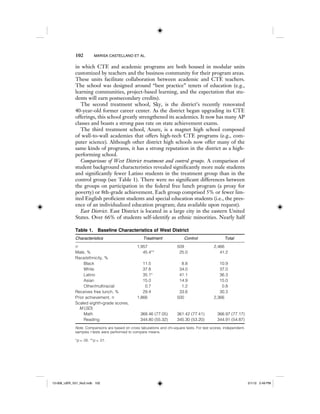
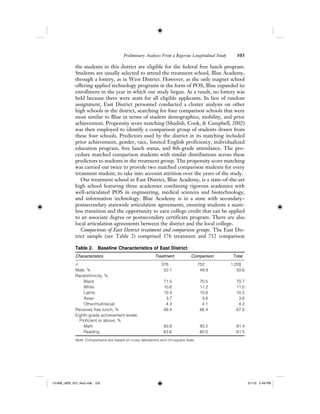
Comparisons of West District treatment and control groups. A comparison of
student background characteristics revealed significantly more male students
and significantly fewer Latino students in the treatment group than in the
control group (see Table 1). There were no significant differences between
the groups on participation in the federal free lunch program (a proxy for
poverty) or 8th-grade achievement. Each group comprised 5% or fewer lim-
ited English proficient students and special education students (i.e., the pres-
ence of an individualized education program; data available upon request).
East District. East District is located in a large city in the eastern United
States. Over 66% of students self-identify as ethnic minorities. Nearly half
Table 1. Baseline Characteristics of West District
Characteristics Treatment Control Total
n 1,957 509 2,466
Male, % 45.4** 25.0 41.2
Race/ethnicity, %
Black 11.5 8.8 10.9
White 37.8 34.0 37.0
Latino 35.1* 41.1 36.3
Asian 15.0 14.9 15.0
Other/multiracial 0.7 1.2 0.8
Receives free lunch, % 29.4 33.6 30.3
Prior achievement, n 1,866 500 2,366
Scaled eighth-grade scores,
M (SD)
Math 368.46 (77.05) 361.42 (77.41) 366.97 (77.17)
Reading 344.80 (55.32) 345.30 (53.20) 344.91 (54.87)
Note. Comparisons are based on cross tabulations and chi-square tests. For test scores, independent-
samples t tests were performed to compare means.
*p < .05. **p < .01.
12-008_IJER_V21_No2.indb 10212-008_IJER_V21_No2.indb 102 2/1/12 2:49 PM2/1/12 2:49 PM
Preliminary Analyses From a Rigorous Longitudinal Study 103
the students in this district are eligible for the federal free lunch program.
Students are usually selected to attend the treatment school, Blue Academy,
through a lottery, as in West District. However, as the only magnet school
offering applied technology programs in the form of POS, Blue expanded its
enrollment in the year in which our study began. As a result, no lottery was
held because there were seats for all eligible applicants. In lieu of random
assignment, East District personnel conducted a cluster analysis on other
high schools in the district, searching for four comparison schools that were
most similar to Blue in terms of student demographics, mobility, and prior
achievement. Propensity score matching (Shadish, Cook, & Campbell, 2002)
was then employed to identify a comparison group of students drawn from
these four schools. Predictors used by the district in its matching included
prior achievement, gender, race, limited English proficiency, individualized
education program, free lunch status, and 8th-grade attendance. The pro-
cedure matched comparison students with similar distributions across these
predictors to students in the treatment group. The propensity score matching
was carried out twice to provide two matched comparison students for every
treatment student, to take into account attrition over the years of the study.
Our treatment school in East District, Blue Academy, is a state-of-the-art
high school featuring three academies combining rigorous academics with
well-articulated POS in engineering, medical sciences and biotechnology,
and information technology. Blue Academy is in a state with secondary–
postsecondary statewide articulation agreements, ensuring students a seam-
less transition and the opportunity to earn college credit that can be applied
to an associate degree or postsecondary certificate program. There are also
local articulation agreements between the district and the local college.
Comparisons of East District treatment and comparison groups. The East Dis-
trict sample (see Table 2) comprised 376 treatment and 752 comparison
Table 2. Baseline Characteristics of East District
Characteristics Treatment Comparison Total
n 376 752 1,228
Male, % 52.1 49.9 50.6
Race/ethnicity, %
Black 71.0 70.5 70.7
White 10.6 11.2 11.0
Latino 10.4 10.6 10.5
Asian 3.7 3.6 3.6
Other/multiracial 4.3 4.1 4.2
Receives free lunch, % 68.4 66.4 67.0
Eighth-grade achievement levels:
Proficient or above, %
Math 83.8 80.2 81.4
Reading 63.6 60.5 61.5
Note. Comparisons are based on cross tabulations and chi-square tests.
12-008_IJER_V21_No2.indb 10312-008_IJER_V21_No2.indb 103 2/1/12 2:49 PM2/1/12 2:49 PM
104 MARISA CASTELLANO ET AL.
students. As with West District, we compared student characteristics in both
groups. There were no significant differences between the two groups on
any characteristics, confirming that the propensity score matching procedure
found appropriate matches for all treatment students.
Measures
Most of our outcome measures are found in districts’ data warehouses; these
measures capture most of the skills and content that POS are designed to ad-
dress. Among the measures in the final analysis will be indicators mandated
by Perkins IV, including high school completion rates and completion of
coursework leading to college credits. For this article, we analyzed 9th- and
10th-grade CTE and academic achievement, including CTE GPA, academic
GPA, 10th-grade achievement test scores, and on track for graduation. Later
reports will address additional outcomes as those data become available.
Study Design
In this study, the unit of analysis is the student. Student background char-
acteristics were collected, and any preexisting differences between the
groups serve as covariates. These characteristics include gender, race, prior
achievement, participation in the federal free lunch program, limited Eng-
lish proficiency, and individualized education program. These variables are
being employed in statistical analyses as appropriate to explore questions
related to student-level outcomes, either as covariates or as individual dif-
ference variables.
The study has two design strands: an experimental strand in West District,
where we take advantage of the random assignment of students through
the district-run lottery, and a quasi-experimental strand in East District,
where the sample was not randomly assigned but consists of a well-matched
comparison group. In West District, we are estimating the impact of POS
through an intent-to-treat analysis (Shadish et al., 2002), in which students
selected for the POS treatment by the lottery are compared to students who
applied to the lottery but were not selected. Intent-to-treat analyses require
that if participants are selected for treatment by random assignment, they
must be assigned to the treatment group regardless of whether they actually
receive the treatment or not. Our analysis therefore includes in the treatment
group any students who were selected by the lottery—including those who
were selected but through choice or other factors did not attend a treatment
school—or who dropped out or changed schools during the study. We per-
formed the same analyses for the quasi-experiment in East District as we did
for the experiment in West District.
Quantitative data analysis. There are two data analysis phases in this study.
The central analysis will be performed once our cohort graduates from high
12-008_IJER_V21_No2.indb 10412-008_IJER_V21_No2.indb 104 2/1/12 2:49 PM2/1/12 2:49 PM
Preliminary Analyses From a Rigorous Longitudinal Study 105
school in the summer of 2012. It will include the analysis of the impact of the
enrollment in POS on the noted measures of engagement, achievement, and,
if continuation funding permits, post–high school transition. Interim analyses,
such as those presented in this article, have been conducted primarily using
descriptive statistics, including analysis of covariance for GPA analyses, chi-
square tests for on track for graduation and West District 10th-grade test score
analyses, and logistic regression for East District state test score analyses.
Qualitative data analysis. To help us understand the processes through
which POS produce change, this study employs a qualitative component.
During each year of the study, we conducted site visits during which we
interviewed teachers, students, and administrators in the treatment and
control/comparison schools. These interviews focused on what these partici-
pants perceived to be the most important differences between the treatment
schools and the control/comparison conditions, as well as the usefulness of
their schools’ programs as preparation for postsecondary education and work.
We also conducted classroom observations consisting of the systematic re-
cording of classroom practices, as well as rich descriptions of the teaching and
learning observed (Castellano & Datnow, 2004).
Interviews were audio recorded and transcribed. Transcripts were classified
by type (e.g., CTE teachers, students). Following the case study methods of
Yin (1994) and the grounded theory approach of Strauss and Corbin (1998),
the content of these transcripts and observations were coded and entered
into a qualitative data analysis software package. Query reports yielded rich
information from various stakeholders; this, along with data from the class-
room observations, produced a number of emergent themes. Through the
data reduction process, this information was organized into categories (Miles
& Huberman, 1984), such as high expectations or a school’s sense of pride. This
process aided in within- and cross-site analyses to identify the relationships
between the intervening variables, providing a picture of the role of CTE and
POS in these sites. In addition, case studies of each school were prepared on
the basis of these data. Both the query reports and the case studies were used
to generate an understanding of POS in these contexts that was derived and
analyzed “from the ground up” (Strauss & Corbin, 1998). Such an analysis
process maximized the triangulation of as many data sources as possible.
Results
West District: Qualitative Findings
During our visits to the treatment schools, we found that all POS met the
minimum requirements of Perkins IV, with the exception of cosmetology,
which lacked a postsecondary component. In one way or another, the control
school CTE programs fell short of POS requirements. Some did not offer
any postsecondary or credentialing opportunities; others were not organized
12-008_IJER_V21_No2.indb 10512-008_IJER_V21_No2.indb 105 2/1/12 2:49 PM2/1/12 2:49 PM
106 MARISA CASTELLANO ET AL.
into coherent sequences; and we saw no evidence in our observations or
examinations of control school course guides that academic courses were
aligned or cross-referenced to CTE.
Our findings of CTE in West District also suggested that the resources
and structures supporting CTE were more plentiful in the POS schools
than in the control schools. This was not due to district favoritism; schools
received finite resources and had to allocate them according to their diverse
needs, missions, and student populations. At the POS schools—which were
created for the purpose of delivering a variety of technologically up-to-date
career-oriented POS—this meant strongly supporting CTE; the comprehen-
sive high schools had a wider range of competing demands on their funding.
As a result, we saw less emphasis on course sequencing and real-world careers
at the control schools compared to the treatment schools.
We identified other practices at the West District POS schools that aided
in POS development and implementation, such as using innovative teaching
techniques to include applying academic learning to career contexts and de-
veloping a sense of identity around POS. Many of these practices, which form
a vital part of the POS schools’ cultures, were not evident in our visits to the
control schools. This does not mean that they do not exist there; however,
control school personnel did not indicate that these practices occurred at
their schools. Some of the practices that foster these different school cultures
are described here.
Navy: The Cutting Edge
Integrated technology. A newly built school, Navy features up-to-date facilities,
full online connectivity, and innovative project-based teaching and learning
strategies. Its culinary and hospitality facilities—including a full-size banquet
hall, industrial kitchens, and demonstration classroom—were described by
its chef–instructors as better than the community college’s, which uses the
school’s facilities for evening classes. Navy students frequently cook for and
host banquets and other events for the school district and community orga-
nizations. Classes that we observed used digital cameras to record lessons to
be broadcast later as podcasts; these were seen as being helpful to all students
but especially for those individualized education program students who
needed to review lessons several times for full understanding.
Project-based learning. Project-based learning is a guiding principle at Navy.
Project-based learning combines academic and technical content knowledge
and hands-on applications of that knowledge, culminating in an annual mul-
tiday open house of themed projects. During 1 year of our observations, the
theme of this open house was “space exploration and Earth conservation.”
The event featured poster tables, multimedia presentations, technology
demonstrations, and mock trials. Students designed space rovers, cultivated
a hydroponics laboratory that simulated various natural environments, and
12-008_IJER_V21_No2.indb 10612-008_IJER_V21_No2.indb 106 2/1/12 2:49 PM2/1/12 2:49 PM
Preliminary Analyses From a Rigorous Longitudinal Study 107
explored the impacts of space travel on human health and fitness. Some stu-
dents took on methodologically sophisticated science projects; one student
studied the effects on bacteria of a common antibacterial agent found in many
personal care products. Such students worked with adult experts outside the
school, and one student secured an internship with a prestigious medical
clinic in the area.
Support. Navy’s culture nurtures students and teachers. Notable is its ad-
vocacy period, during which students engage in one-on-one mentoring and
advising with a teacher who remains their mentor throughout their four years
of high school. Teachers receive support on a variety of fronts, including the
principal’s open-door policy and commitment to supporting curricular in-
novation and ongoing professional development.
Sky: A Tradition of Pride and Success
Familial culture. Sky is one of the older high schools in the district, with a
familial sense of continuity, shared history, and communal values that have
been passed on to succeeding cohorts of students. The school’s values are
communicated to new students through a combination of establishing and re-
inforcing mechanisms and customs that encourage them to take pride in the
school’s appearance and their own accomplishments. Students neatly stack up
their chairs after the end of the lunch period; a welcome luncheon is served
to the new freshmen by the senior class; and students and teachers are overtly
praised and rewarded for their accomplishments. Sky actively promotes itself
as a place of excellence and achievement—it distributes information sheets
touting its low dropout rate and high attendance and graduation rates. The
school staff we interviewed trumpeted the school’s many AP classes, strong
pass rates on the state achievement exams, healthy college-going numbers,
and reputation for safety.
Hands-on learning. Students engage in hands-on learning at Sky. One
health careers student stated that she was happy at Sky “because usually
in regular high school, they don’t have any hands-on. You’re just listen-
ing and writing on paper.” She described how her health occupations POS
teachers brought in “biology, chemistry, anatomy all into it to understand
the body and functions too. And math—they use it too, for calculations of
blood pressure.”
Soft skills and professional standards. A required 9th-grade class at Sky teaches
soft skills, career exploration, and standards of professional behavior. In this
class, students prepare resumes, chart out their 4-year graduation plans, and
participate in mock interviews with community business partners. Such in-
terviews were described as sometimes leading to students being offered jobs
after high school. During our observations of this class, students were being
evaluated on the professionalism of their dress. Sky’s Career Center serves
as a model for the rest of the district and includes a job bank, cooperative
12-008_IJER_V21_No2.indb 10712-008_IJER_V21_No2.indb 107 2/1/12 2:49 PM2/1/12 2:49 PM
108 MARISA CASTELLANO ET AL.
education agreements, and computers with access to career interest invento-
ries, college and career information, and industry assessments.
Azure: The Technology Flagship
High achievement. As one of the district’s highest-achieving schools, Azure
has a reputation to maintain. We heard this from district personnel and
most interviewees at Azure, including the students. Azure’s focus is academic
achievement within career-themed programs. For example, the school hosts
popular career and technical student organizations, such as Future Business
Leaders of America (FBLA). A business teacher we interviewed stressed the
importance of FBLA in imparting dress, networking, and written and oral
communication skills to students, in addition to providing opportunities for
business-related field trips and leadership development activities. A student
described the FBLA–sponsored management and decision-making competi-
tions she took part in that required teamwork to resolve an issue and then
present the resolution to judges. The connection between high academic
achievement and careers seemed clear to the teachers we spoke with: “I
always tell students, when you get into the workforce, employers want some-
one who’s well rounded.” This CTE teacher exhorted her students to excel
in both academics and CTE: “Content is the foundation of the program area.
The math, the English, the history. It all works together.”
Self-awareness. One counselor reported that Azure was full of self-described
“nerds.” The students we spoke with concurred, describing their strong focus
on schoolwork and goals. One said, “I feel really prepared because of the
workload and the different ways that we are learning why we’re doing some-
thing. Not just learning the actual topic, but the reasons behind it.”
West District: Quantitative Findings
Grade Point Average
CTE. Although treatment group students had a significantly lower CTE
GPA than control students in 9th grade (3.17 vs. 3.25, p < .01), by the end of
10th grade, we found no significant difference in cumulative CTE GPA (3.23
treatment vs. 3.21 control).
Academic. We received fall 2008 and spring 2009 semester letter grades
for each course taken by the students in the cohort. Fall and spring GPAs
were computed for the following core content areas: math, science, English,
and social studies. Final GPAs were calculated by averaging fall and spring
semester GPAs for each content area. A mean of the final GPAs was then
computed to calculate an overall academic GPA. Controlling for reading and
math achievement in 8th grade, we found no significant differences between
12-008_IJER_V21_No2.indb 10812-008_IJER_V21_No2.indb 108 2/1/12 2:49 PM2/1/12 2:49 PM
Preliminary Analyses From a Rigorous Longitudinal Study 109
the groups in 9th-grade academic GPA (2.63 treatment vs. 2.65 control) or
9th- and 10th-grade cumulative academic GPA (3.28 for both treatment and
control groups, weighted for AP, IB, and honors classes in the 10th grade;
see Table 3).
On Track for Graduation
Following Allensworth and Easton (2005), we defined not on track for gradu-
ation by the end of 9th grade as being in the 9th grade during the 2009–2010
school year or being in the 10th grade but having failed two or more courses
in either semester or both semesters of 2008–2009. To be considered not on
track by the end of 10th grade, students lacked at least one of the following
credits: two math, two English, one science, or one social studies. Treatment
students were significantly more likely than control students to be on track
by the end of 10th grade (see Table 4).
State achievement exam scores. Treatment students scored significantly
higher than the control students on all three 10th-grade state academic
achievement exams (see Table 5).
Table 3. Academic Grade Point Averages: West District, 2008–2010
Treatment Control Cohen’s d
9th grade
M (SD) 2.63 (0.87) 2.65 (0.86) –0.02
n 1,866 500
Cumulative 9th and 10th gradea
3.28 (1.02) 3.28 (1.06) 0.0
M (SD)
n 1,827b
500
Note. An analysis of covariance test was performed to compare mean differences, controlling for eighth-
grade reading and math achievement.
a
Cumulative grade point average weighted for AP, International Baccalaureate (IB), and honors classes.
b
The sample was reduced by 39 students; 47 actually left the district, but 8 of those students would have
been excluded due to missing pretest reading and math data.
Table 4. On Track for Graduation: West District,
2008–2010
Status Treatment Control
n 1,907 509
On track, %
End of 9th grade 92.9 91.7
End of 10th grade 70.6*
64.2
Note. Comparisons were based on 2 × 2 cross tabulations and
chi-square tests.
12-008_IJER_V21_No2.indb 10912-008_IJER_V21_No2.indb 109 2/1/12 2:49 PM2/1/12 2:49 PM
110 MARISA CASTELLANO ET AL.
East District: Qualitative Findings
CTE in East District is a well-supported curricular component in the high
schools. Instructional technology is in wide use throughout the district,
and teachers have clearly been trained in its use. However, East District
has been badly affected by the recession, and many of the elements of
POS have suffered. Students at the treatment and comparison schools
have lost the state funding that waived tuition for their attending the local
community college; nor can students depend on district help in paying for
industry-recognized credentialing exams. Such opportunities—including
some mandated elements of POS—continue to exist, but fewer students can
take advantage of them.
We found that POS at Blue Academy met the legal requirements of Per-
kins IV. In addition, Blue students enjoyed a school environment supportive
of CTE as a means to attend college, more up-to-date equipment, and many
faculty members with recent careers in relevant industries. We also found
that Blue students were held to high expectations within a culture of support,
as described later.
By contrast, there was no relationship between CTE course sequences and
specific academic requirements at the comparison schools. These schools
often had less-resourced programs that lacked a tangible connection to
careers and “the real world.” CTE was much more variable in quality and
technical and academic rigor at the comparison schools. As in West District,
CTE had to compete for funds at the comprehensive high schools. Finally,
comparison school students could take CTE courses in one program area and
Table 5. Tenth-Grade State Achievement Exam
Scale Scores: West District
Scale Treatment Control
n 1,957 509
Reading
M (SD) 329.27** (43.22) 325.26 (42.10)
n 1,788 467
Mathematics
M (SD) 303.36** (70.96) 291.42 (74.32)
n 1,792 471
Science
M (SD) 333.27* (50.06) 328.45 (50.36)
n 1,470 269
Note. Significance is based on analyses of covariance run for each
subject, controlling for prior achievement for that subject.
* p < .05. **p < .01.
12-008_IJER_V21_No2.indb 11012-008_IJER_V21_No2.indb 110 2/1/12 2:49 PM2/1/12 2:49 PM
Preliminary Analyses From a Rigorous Longitudinal Study 111
move to another at any time. Our interviews revealed that some comparison
school students were being placed in CTE courses they did not request,
through accidents of scheduling or the loss of other elective options.
Blue Academy: A Culture of Caring and High Expectations
Culture of caring and collaboration. Blue’s school culture has helped the school
maintain its focus on academic and technical achievement. It emphasizes car-
ing and collaboration, high expectations, and college and career planning as
part of its daily activities. This culture is communicated on multiple fronts
using a variety of media, including posters in hallways, mandatory student
schedule books, and closed-circuit monitors in each classroom that deliver
a constant stream of interesting facts, school news, and inspirational quotes.
The principal introduced a corporate-inspired philosophy about imple-
menting change through personal responsibility and positive interactions with
others. Mascots embodying this philosophy were displayed in classrooms, hall-
ways, and offices, and posters featuring its main tenets were hung in common
spaces. The principal told us that he thought that students had bought into it;
he saw this reflected in the older students’ practice of befriending the 9th grad-
ers, who, coming to Blue from far-flung corners of the district, were unlikely
to know anyone there. We also observed students in a 10th-grade English
course critiquing one another’s work. They were required to comment on
their partners’ writing, or the students being assessed would lose points. In this
way, students knew their responsibility for one another’s learning: The teacher
reminded them to respond “out of respect for them.”
High expectations. High expectations were visible in the staff’s frequent
monitoring of student progress and sponsorship of friendly competitions to
spur higher achievement. One teacher had students from each of his classes
post their self-determined goals (i.e., increase end-of-term test scores by 2
points) on the wall for others to see, along with graphs of their progress.
College and career planning. College going was championed at Blue—for
example, a banner in one classroom read, “Students who are the first in their
families to go to college END poverty in their family lines forever.—U.S.
Department of Labor.” College and career planning was also suffused in the
classroom. In one web design class, a teacher described the industry from the
standpoint of how much web designers can make and how much the district’s
website redesign had cost. Blue also offers many college- and career-oriented
assemblies and field trips. At the end of one biotechnology class we observed,
the teacher spoke of an upcoming field trip to a biotechnology company in
the area. She related a story about a former student who, during a tour the
previous year, caught the attention of company staff; this student interviewed
with the company and got a job upon graduation.
12-008_IJER_V21_No2.indb 11112-008_IJER_V21_No2.indb 111 2/1/12 2:49 PM2/1/12 2:49 PM
112 MARISA CASTELLANO ET AL.
East District: Quantitative Findings
Grade Point Average
CTE. There were no significant differences between treatment and compari-
son students taking a CTE course in 9th grade (2.46 treatment vs. 2.44 com-
parison) nor in the 9th- and 10th-grade cumulative analysis (2.58 treatment
vs. 2.64 comparison).
Academic. We received letter grades for each course that students took
from fall 2008 to spring 2010. Academic GPAs were calculated by finding the
mean GPA of the highest grade for each required math, science, English, and
social studies course. Controlling for reading and math prior achievement,
we found no significant difference in 9th-grade academic GPA between the
groups. The results of the comparison of 9th- and 10th-grade cumulative
GPA, however, significantly favored the treatment group (see Table 6).
On Track for Graduation
We used the same definitions for both districts’ on-track analyses. Although
there was no significant difference on this measure in 9th grade, by the end of
10th grade, treatment students were significantly more likely than compari-
son students to be on track to graduate on time (see Table 7).
State Achievement Exam Scores
This state has yearly end-of-term assessments that serve as state achievement
exams for federal accountability purposes. For this reason, our sample stu-
dents could be taking an Algebra I, geometry, or Algebra II exam, depending
on their 10th-grade mathematics level. Over 81% of students in both groups
scored proficient or above on all their exams. We explored the treatment and
prior achievement effects on end-of-term test scores of proficient or above
Table 6. Academic Grade Point Averages: East District, 2008–2010
Treatment Comparison Cohen’s d
9th grade
M (SD) 2.13 (0.79) 2.16 (0.97) –0.03
n 376 752
Cumulative 9th and 10th gradea
M (SD) 2.71 (1.00)* 2.60 (1.09) 0.10
n 361b
698c
Note. An analysis of covariance test was performed to compare mean differences, controlling for eighth-
grade reading and math achievement.
a
Cumulative grade point average weighted for AP, IB, and honors classes.
b
The sample was reduced by 15 students who left the district.
c
The sample was reduced by 54 students who left the district.
*p < .05.
12-008_IJER_V21_No2.indb 11212-008_IJER_V21_No2.indb 112 2/1/12 2:49 PM2/1/12 2:49 PM
Preliminary Analyses From a Rigorous Longitudinal Study 113
for English, Algebra I, geometry, Algebra II, and biology. For most exams,
the coefficient for treatment status failed to reach significance, suggesting
that the odds of testing at the proficient or above level was unrelated to at-
tending the treatment versus comparison schools. However, for geometry,
treatment students were 1.82 times more likely to score proficient or above
than comparison students (see Table 8).
Discussion and Conclusions
The preceding exploration of 9th- and 10th-grade achievement offers an
early look at the impact of POS on student achievement. Our course-taking
analyses found that there were students in the treatment and control groups
who had not yet taken any CTE course by the end of 9th grade. This is not
unusual: In many districts, 9th-grade course taking is restricted to fulfilling
course requirements, leaving little room for CTE or other electives. With
respect to the effects of POS on student achievement, it should come as no
surprise that we found little discernible difference between groups by the
end of 9th grade. By the end of 10th grade, however, students’ involvement
in POS-specific activities and courses was becoming a larger portion of their
Table 7. On Track for Graduation: East District,
2008–2010
Status Treatment Comparison
n 376 752
End of 9th grade
On track, % 82.7 78.7
n 376 752
End of 10th grade
On track, % 90.9*
82.5
n 361a
698b
Note. Comparisons were based on 2 × 2 cross tabulations and
chi-square tests.
a
The sample was reduced by 15 students who left the district.
b
The sample was reduced by 54 students who left the district.
*p < .001.
Table 8. Log Odds Ratio of Scoring Proficient or Above on End-of-Term
Exams: East District, 2008–2010
English I Algebra I Geometry Algebra II Biology
Treatment compared to
comparison group ns ns 1.82** ns ns
Note. Coefficient represents the likelihood that a student scored proficient or above by treatment group.
Coefficient rounded to two digits. Full regression tables are available upon request. ns = coefficient not
significant. Significant positive effect for 8th-grade achievement for each contrast.
**p < .01.
12-008_IJER_V21_No2.indb 11312-008_IJER_V21_No2.indb 113 2/1/12 2:49 PM2/1/12 2:49 PM
114 MARISA CASTELLANO ET AL.
school days, and indeed, some differentiation between treatment groups and
their respective control or comparison groups began to appear, showing
promising results for POS students.
Achievement results for both districts are summarized in Table 9, which
shows the direction of the trend in outcomes. The three measures that
have 9th-grade and 9th- and 10th-grade cumulative measures (CTE GPA,
academic GPA, and on track to graduate) show that the groups did not
significantly differ during their 1st year of high school (or, as in the case of
West District CTE GPA, the results favored the control group). The trends
in 10th grade, where statistically significant, consistently favored the treat-
ment groups. State exam scores for West District continued the trend of a
consistent advantage for the treatment group. In the East District, state exam
results were not significantly different between treatment and comparison
students in three of four areas. In the fourth area, geometry, results favored
the treatment group.
In both districts, the groups ended 9th grade similarly on track to gradu-
ate on time, but by the time they finished 10th grade, significantly more
treatment students remained on track to graduate. Whether students stay on
track or not is a good predictor of dropping out because dropout is a process
of gradual disengagement, not a one-time event (Dynarski, Gleason, Ranga-
rajan, & Wood, 1998; Neild & Balfanz, 2001). Each year that students stay
on track moves them closer to graduation. Balfanz and colleagues (Balfanz,
McPartland, & Shaw, 2002) noted that helping students stay on track in
Table 9. Trends in Findings: West and East Districts
Results Favoring . . .
Measures West District East District
Grade point average
Career and technical education
9th grade Control ns
Cumulative 9th and 10th grade ns ns
Academic
9th grade ns ns
Cumulative 9th and 10th grade ns Treatment
On track to graduate on time
End of 9th grade ns ns
End of 10th grade Treatment Treatment
State exam
English Treatment ns
Mathematics–West District Treatment —
Algebra I–East District — ns
Geometry–East District — ns
Algebra II–East District — ns
Science Treatment ns
Note. ns = not statistically significant.
12-008_IJER_V21_No2.indb 11412-008_IJER_V21_No2.indb 114 2/1/12 2:49 PM2/1/12 2:49 PM
Preliminary Analyses From a Rigorous Longitudinal Study 115
urban districts, like those participating in this study, requires broad organi-
zational and instructional reforms that change the school culture toward suc-
cess and away from disengagement and apathy. Such cultures of success are
evident in the POS schools in both the West District and the East District.
These schools are places that many students choose to attend; once there,
they soon understand that they are expected to maintain those reputations of
achievement for future students.
The culture of achievement that we observed at the POS schools mani-
fested itself in different ways at each school (e.g., supportive, “nerdy”), which
might account for the varied results. For instance, in West District, success
was seen in CTE GPA trending toward the treatment group and superior
10th-grade test score results. In East District, academic GPA trended toward
the treatment group along with one end-of-term achievement test. Many
studies eschew GPA in favor of state achievement test results. Using this
latter measure suggests a positive association between the POS treatment
and increased academic achievement, especially in West District. We will
continue to collect and analyze data for the 2 remaining years of high school
to see whether this association holds.
In terms of CTE achievement, results favored the treatment group in
West District, which allows us to be cautiously optimistic about the effects
of providing students with rigorous relevant high school curricula that lead
to college and careers. We can expect CTE course taking in both districts to
increase over the next 2 years—POS will come to take up a larger portion of
POS students’ hours in school, and we can safely assume that the control and
comparison students will also take more CTE because 97% of all U.S. high
school students take at least one CTE course during high school (Levesque,
Lauen, Teitelbaum, Alt, & Librera, 2000).
We will continue to examine the academic and technical achievement of
these cohorts as they go through high school, adding other measures as they
become available (e.g., college credits and industry-recognized credentials
earned during high school). And we will continue to increase our understand-
ing of school contexts through qualitative data analysis. The final 2 years of
high school are the culminating experience of POS; for our study, they will
offer the data with which to generate more definitive conclusions about the
effectiveness of POS as a means of preparing students for college and careers.
Our final results may help policymakers decide the best ways to improve POS
to help students succeed.
Acknowledgment
The work reported here was supported under the National Research Center
for Career and Technical Education (PR/Award No. VO51A070003) as ad-
ministered by the Office of Vocational and Adult Education, U.S. Depart-
ment of Education. However, the contents do not necessarily represent the
12-008_IJER_V21_No2.indb 11512-008_IJER_V21_No2.indb 115 2/1/12 2:49 PM2/1/12 2:49 PM
116 MARISA CASTELLANO ET AL.
positions or policies of the Office of Vocational and Adult Education or the
U.S. Department of Education, and you should not assume endorsement by
the federal government. IJER
Notes
1. Special education student applicants receive individual reviews; CTE area profes-
sionals and special education professionals both determine students’ eligibility.
2. All names of schools and districts are pseudonyms.
References
Agodini, R., & Deke, J. (2004). The relationship between high school vocational education
and dropping out. Princeton, NJ: Mathematica Policy Research.
Allensworth, E. M., & Easton, J. Q. (2005). The ontrack indicator as a predictor of high
school graduation. Chicago: University of Chicago, Consortium on Chicago School
Research. Retrieved from http://ccsr.uchicago.edu/publications/p78.pdf
Balfanz, R., McPartland, J., & Shaw, A. (2002). Re-conceptualizing extra help for high
school students in a high standards era. Baltimore, MD: Johns Hopkins University,
Center for Social Organization of Schools.
Bloom, T., & Sommo, C. (2005). Building learning communities: Early results from the
Opening Doors demonstration at Kingsborough Community College. Washington, DC:
MDRC.
Carl D. Perkins Career and Technical Education Improvement Act of 2006, Pub L.
No. 109-270, § 122.
Castellano, M., & Datnow, A. (2004). The influence of school reform on classroom
instruction in diverse schools: Findings from an observational study of Success for
All. In H. C. Waxman, R. G. Tharp, & R. S. Hilberg (Eds.), Observational research
in U.S. classrooms: New approaches for understanding cultural and linguistic diversity (pp.
231–265). Cambridge, UK: Cambridge University Press.
Castellano, M., Stone, J. R., III, Stringfield, S., Farley-Ripple, E. N., Overman, L. T.,
& Hussain, R. (2007). Career-based comprehensive school reform: Serving disadvantaged
youth in minority communities. St. Paul: University of Minnesota, National Center
for Research on Career and Technical Education.
Castellano, M., Sundell, K. E., Overman, L. T., & Aliaga, O. A. (2011). Rigorous tests
of student outcomes in CTE programs of study: Year 3 report. Louisville, KY: University
of Louisville, National Research Center for Career and Technical Education.
Cronbach, L. J., Ambron, S. R., Dornbusch, S. M., Hess, R. D., Hornik, R. C., Phil-
lips, D. C., et al. (1980). Toward reform of program evaluation: Aims, methods, and
institutional arrangements. San Francisco: Jossey-Bass.
Dynarski, R., Gleason, P., Rangarajan, A., & Wood, R. (1998). Impacts of dropout pre-
vention programs. Princeton, NJ: Mathematica Policy Research.
Kemple, J. J., & Snipes, J. C. (2000). Career academies: Impacts on students’ engagement
and performance in high school. New York: MDRC.
Levesque, K., Lauen, D., Teitelbaum, P., Alt, M., & Librera, S. (2000). Vocational edu-
cation in the United States: Toward the year 2000 (NCES Document No. 2000-029).
12-008_IJER_V21_No2.indb 11612-008_IJER_V21_No2.indb 116 2/1/12 2:49 PM2/1/12 2:49 PM
Preliminary Analyses From a Rigorous Longitudinal Study 117
Washington, DC: U.S. Department of Education, National Center for Education
Statistics.
Miles, M., & Huberman, M. (1984). Qualitative data analysis (2nd ed.). Thousand
Oaks, CA: Sage.
National Commission on Excellence in Education. (1983). A nation at risk: The im-
perative for educational reform. Washington, DC: Author.
Neild, R. C., & Balfanz, R. (2001). An extreme degree of difficulty: The educational demo-
graphics of the ninth grade in Philadelphia. Baltimore, MD: Johns Hopkins University,
Center for Social Organization of Schools.
Organisation for Economic Cooperation and Development. (2010). Learning for jobs.
Paris: Author.
Plank, S. B. (2002). A question of balance: CTE, academic courses, high school
persistence, and student achievement. Journal of Vocational Education Research, 26,
279–327.
Plank, S. B., DeLuca, S., & Estacion, A. (2005). Dropping out of high school and the
place of career and technical education: A survival analysis of surviving high school. St.
Paul: University of Minnesota, National Research Center for Career and Techni-
cal Education.
Shadish, W. R., Cook, T. D., & Campbell, D. T. (2002). Experimental and quasi-
experimental designs for generalized causal inference. Boston: Houghton Mifflin.
Silverberg, M., Warner, E., Fong, M., & Goodwin, D. (2004). National assessment of
vocational education: Final report to Congress. Washington, DC: U.S. Department of
Education.
Stipanovic, N., Lewis, M. V., & Stringfield, S. (2012). Situating programs of study
within current and historical career and technical educational reform efforts. Inter-
national Journal of Educational Reform, 21, 80–97.
Stone, J. R., III. (2004). Math course taking for CTE concentrators: Evidence from
three studies of the impact of a decade of education reform. Journal of Career and
Technical Education, 21(1), 49–68.
Stone, J. R., III, Alfeld, C., & Pearson, D. (2008). Rigor and relevance: Enhancing
high school students’ math skills through career and technical education. American
Educational Research Journal, 45, 767–795.
Strauss, A., & Corbin, J. (1998). Basics of qualitative research: Techniques and procedures
for developing grounded theory (2nd ed.). Newbury Park, CA: Sage.
Symonds, W. C., Schwartz, R. B., & Ferguson, R. (2011). Pathways to prosperity: Meet-
ing the challenge of preparing young Americans for the 21st century. Cambridge, MA:
Harvard University.
Yin, R. K. (1994). Case study research: Design and methods (2nd ed.). Thousand Oaks,
CA: Sage.
Marisa Castellano is a visiting associate professor in the College of Education
and Human Development at the University of Louisville and a principal inves-
tigator for the National Research Center for Career and Technical Education
(NRCCTE). Her research includes identifying strategies to improve opportunities
for high school and community college students. Address correspondence to Marisa
12-008_IJER_V21_No2.indb 11712-008_IJER_V21_No2.indb 117 2/1/12 2:49 PM2/1/12 2:49 PM
118 MARISA CASTELLANO ET AL.
Castellano, National Research Center for Career and Technical Education, Uni-
versity of Louisville, 5927 Monte Verde Drive, Santa Rosa, CA 95409. E-mail:
marisa.castellano@louisville.edu.
Kirsten Sundell is the communications director of the NRCCTE, a member of the
faculty of the Department of Educational Leadership, Foundations, and Human
Resource Education, and the former principal investigator of GEAR UP Kentucky
at the University of Louisville.
Laura T. Overman is a research assistant with the NRCCTE at the University of
Louisville.
Oscar A. Aliaga is the program director at the NRCCTE, University of Louisville.
He has worked extensively on CTE participation issues and outcomes. He is currently
co–principal investigator for the Vanguard Practices research project.
12-008_IJER_V21_No2.indb 11812-008_IJER_V21_No2.indb 118 2/1/12 2:49 PM2/1/12 2:49 PM
International Journal of Educational Reform, Vol. 21, No. 2 / Spring 2012 119
Mature Programs of Study:
A Structure for the Transition
to College and Career?
Corinne Alfeld and Sharika Bhattacharya
ABSTRACT: This study uses a mixed methods approach to examine a new type
of curriculum configuration that supports students’ transitions to college: career
technical programs of study (POS). Interview and survey data were collected
from a college and its feeder high schools in each of three well-established
(“mature”) sites in geographically varied communities in the United States to
investigate how POS are structured, what the key the “ingredients” are, and what
students experience as they move through the POS. Interview findings suggest
that the key elements of POS include dedicated staff to create secondary–
postsecondary connections, active multistakeholder advisory committees, and
flexibility and compromise in developing dual-credit options for students. Survey
data show that high school students feel positively about their experiences in
POS; however, career guidance is lacking. Student records indicate that even
when POS were in place to support their transition, less than one-fifth of students
remained in the same POS in college that they began in high school. Results are
discussed in relation to the 2006 Perkins IV legislation.
AThere is consensus from many fronts that high schools are not ad-
equately preparing students for college or the workplace. Although
high school students are taking more courses than ever before, many are
still not meeting “college ready” standards (ACT, 2011; National Center
for Education Statistics, 2011). This suggests a disconnect between what
colleges expect and what high schools are delivering (Achieve, 2010). Most
students report that they plan to go to college, but many parents and teach-
ers agree that high schools are not doing enough to prepare students to get
there (MetLife, 2011). At the same time, there is a growing recognition that
students need to be not only college ready but also “career ready.” Unfortu-
nately, many young people are lacking essential skills needed to thrive in a
21st-century workplace (Partnership for 21st Century Skills, 2010).
Amid educators’ and employers’ concerns about preparing young people
for college and careers, developmental psychologists have focused on demo-
graphic trends that affect identity development in young adults. For example,
research on “emerging adulthood,” a developmental stage that spans the ages
of roughly 18 to 25, shows that young people are taking longer today than
they did in previous generations to explore the possibilities of adulthood—in
areas such as education, religion, love, and work—before settling on a path
12-008_IJER_V21_No2.indb 11912-008_IJER_V21_No2.indb 119 2/1/12 2:49 PM2/1/12 2:49 PM
120 CORINNE ALFELD AND SHARIKA BHATTACHARYA
(Arnett, 2000, 2002). This longer exploration period may in part be due to
fewer institutionalized educational supports for students in this country com-
pared to other countries. For example, whereas in Europe students have a
variety of well-established and equally respectable postsecondary options, in-
cluding universities, technical schools, and apprenticeship experiences, young
people in the United States have traditionally experienced a relatively less
orderly or systematic transition from school to work (Arnett, 2002). Although
some contend that less structure gives American young people more choices,
others cite high school and college dropout and unemployment statistics in
arguing for greater structure in secondary and postsecondary educational
pathways (Symonds, Schwartz, & Ferguson, 2011).
Two recent reports have brought this issue to the forefront of educational
policy discussions. Both Pathways to Prosperity (Symonds et al., 2011) and
Learning for Jobs (Organization for Economic Cooperation and Develop-
ment, 2010) have argued that other nations provide better-designed career
preparation for secondary and postsecondary students. The Learning report
suggested that high-quality work-based learning with strong links to the
labor market to meet employer needs in some Organization for Economic
Cooperation and Development countries is the best way to prepare young
people for careers. The Pathways report suggested that such an approach
would benefit young people and the economy if it were adapted in the
United States. These reports, in addition to other recent reports calling for
greater focus on career and college readiness, have served to mobilize U.S.
policymakers and educators on the issue of linking secondary and postsec-
ondary vocational training and work-based learning. It is possible that recent
developments in the field of career and technical education (CTE; formerly
termed vocational education) can provide a model for such change.
Programs of study (POS) were introduced in the Carl D. Perkins Career
and Technical Education Act of 2006 (also known as Perkins IV) as a require-
ment for secondary and postsecondary recipients of CTE funds. As defined in
Perkins IV, a POS “(a) incorporates secondary education and postsecondary
elements, (b) includes coherent and rigorous content aligned with challeng-
ing academic standards and relevant career and technical content in a coordi-
nated, non-duplicative progression of courses that align secondary education
to adequately prepare students to succeed in postsecondary education, (c)
includes the opportunity for secondary students to participate in dual or con-
current enrollment programs or other ways to acquire postsecondary educa-
tion credits, and (d) leads to an industry-recognized credential or certificate
at the postsecondary level, or an associate degree” (or successful transfer to a
four-year institution).
Although the legislation on POS is new, neither the spirit nor the ele-
ments of POS are new in the history of CTE as a vehicle for school reform
(Stipanovic, Lewis, & Stringfield, 2012 [this issue]). POS evolved over
12-008_IJER_V21_No2.indb 12012-008_IJER_V21_No2.indb 120 2/1/12 2:49 PM2/1/12 2:49 PM
Mature Programs of Study 121
several decades of efforts to create effective transition programs from sec-
ondary school into postsecondary education or the workforce. Initiatives of
the 1990s, such as youth apprenticeships, School-to-Work, and Tech Prep,
all provided elements that formed the basis for POS, including an increas-
ing emphasis on the integration of academic and technical skills (Lewis &
Kosine, 2008). More recently, the identification of 16 career clusters by
the National Association of State Directors of Career Technical Educa-
tion Consortium united the elements of previous CTE transition programs
(e.g., curriculum integration, work-based learning, dual enrollment) to
create specific career pathways.1
POS are similar to career pathways in that
they are organized around defined career areas that prepare students for
the transition to postsecondary education and entry-level employment in
occupations requiring specialized skills.
Ideally, a program of study begins in high school and continues through
at least the first 2 years of postsecondary education to a degree or other
industry-recognized credential. Investigating the development and imple-
mentation of POS in relation to other transition programs and practices
can provide a foundation for better understanding the components of POS
that support a successful transition from high school to and through post-
secondary education. As POS are relatively new, in name if not in practice,
research evidence on their implementation and effectiveness has not yet
borne results. However, several field-based studies of POS are underway,
as described elsewhere in this special issue. Longitudinal research on CTE
students’ educational pathways in general is also limited, although a variety of
CTE and career preparation programs are being implemented and studied in
schools across the United States, including secondary to postsecondary CTE
transition (Castellano, Stringfield, & Stone, 2003; Lekes et al., 2007), career
pathway programs (Pierce, 2001), career academies (Kemple, 2004), credit-
based transition programs (Bailey & Mechur Karp, 2003; Karp, Calcagno,
Hughes, Jeong, & Bailey, 2007), and school-to-career programs (Furstenberg
& Neumark, 2005).
Studies of these reforms, however, have focused primarily on student
outcomes, with little detailed information about the implementation process
of initiatives leading to these outcomes. This study seeks to address these
research needs in examining POS as the newest CTE transition initiative.
Whether POS are effective or not, and under what conditions, is a pressing
question for Perkins IV because of both its imperative and its promise. This
study aims to better understand the mechanisms and goals of POS. It also
seeks to understand the relationship between POS in practice and POS as
required by the policy. This comparison to legislation is important because
Perkins IV is not very detailed or prescriptive; if other components are criti-
cal to POS implementation, or if any components in the legislation are not
necessary, then this information is critical to policymakers and practitioners.
12-008_IJER_V21_No2.indb 12112-008_IJER_V21_No2.indb 121 2/1/12 2:49 PM2/1/12 2:49 PM
122 CORINNE ALFELD AND SHARIKA BHATTACHARYA
Site Selection and Research Questions
At the start of the study, in collaboration with other researchers from the
National Research Center for Career and Technical Education (NRCCTE),
the authors reviewed previous research and policy regarding elements of
POS as specified in the 2006 Perkins IV legislation as well as other relevant
documents, including an early version of a POS self-assessment tool devel-
oped by the U.S. Department of Education, Office of Vocational and Adult
Education (OVAE) (final version released in 2010), and a literature review
by the NRCCTE on the history of CTE programs focused on the transi-
tion to postsecondary education (Lewis & Kosine, 2008), which provided
background context for POS. These various lenses were used to develop an
understanding of what policymakers consider to be POS, which strongly
emphasized the first element of the legislation.
Site Selection
To study how POS work or might work, it is necessary to study operational
POS sites. However, because very few new POS were fully developed at
the start of the study in 2008, it was necessary to use proxies. A search was
conducted for older, more established, or more mature programs meeting
many of the POS criteria to approximate fully developed POS. Most of
these POS-like sites had begun under a different name (e.g., Tech Prep,
career pathways) with slightly different components and structures and
were adapted by local educators to meet the POS requirement in Perkins
IV. This study therefore cast a broader net in the search for potential sites
to include than just POS as defined by Perkins IV. Specifically, a site was
considered “mature” if it had a strong relationship between secondary and
postsecondary levels and evidence that students had been completing both
portions of the POS for consecutive years (minimum of 2 years, preferably
3). Sites that also had articulation agreements in place that allowed students
to receive dual credit were favored.
The method of identifying and narrowing down a pool of potential sites in-
cluded soliciting nominations from CTE leaders at the national and state levels
in government, for-profit, and not-for-profit sectors and conducting preliminary
web searches, phone calls, and in-person visits. The study researchers received
almost 40 nominations of sites to consider. Because the first component in the
legislation on POS (secondary and postsecondary elements) was determined by
the NRCCTE team to be the most important, an initial screening process deter-
mined whether a given site met this description. The secondary–postsecondary
link was considered to be an indicator that the path for course taking beginning
in high school and leading to the college level had been clearly defined for stu-
dents. Based on these criteria, the sample of potential sites was winnowed to eight
sites, which were selected for visits to further confirm their eligibility.2
Initial
12-008_IJER_V21_No2.indb 12212-008_IJER_V21_No2.indb 122 2/1/12 2:49 PM2/1/12 2:49 PM
Mature Programs of Study 123
visits were conducted in 2008 and helped the researchers begin to understand
how POS work and what may make them successful (see Alfeld, 2010 for findings
based on these initial 8 site visits).
This multistaged process resulted in the selection of 3 sites for inclusion in
the longitudinal multimethod study. The three sites are each anchored by a
community college (see Table 1). Each college has at least a dozen area high
schools feeding into it; however, high schools are included in this study only
if they had developed a program of study in conjunction with the selected
college (i.e., with articulation agreements in place) and had principals who
agreed to participate. The sample therefore includes six participating high
schools that feed into Desert College, six regular high schools and one alter-
nate high school feeding into River College, and three high schools feeding
into Northern College (site names are masked to protect confidentiality).
Research Questions
This study examines the following research questions about the three mature
POS:
Research Question 1: What are the elements of mature secondary–postsecond-
ary career pathways? Who are the key players? What are the key policies
and processes?
Research Question 2: How do these elements map back onto the Perkins IV
legislation on POS?
Research Question 3: What are the educational and career pathways of students
who begin a program of study in high school? Do they continue in college?
What happens to students who do not continue in the POS in college?
Method
Different methodologies are employed to answer each research question.
The first two are addressed using qualitative data (interviews, focus groups,
observations, documents), the third with quantitative data (student surveys
and student records). This mixed methods design provides a balance between
the evidence provided by the quantitative data and the rich context of qualita-
tive data in researching processes and outcomes related to POS.
Table 1. Selected Mature Programs of Study Sites
Masked Site Location
2009 City
Population
Programs of Study Selected
for Research
River College Midwest/South 55,745 Industrial maintenance, mechatronics
Desert College Southwest 529,219 Film tech, culinary arts, construction
technology
Northern College North Midwest 67,145 Automotive technology, welding
12-008_IJER_V21_No2.indb 12312-008_IJER_V21_No2.indb 123 2/1/12 2:49 PM2/1/12 2:49 PM
124 CORINNE ALFELD AND SHARIKA BHATTACHARYA
For the qualitative piece of this study, the researchers compiled data from
focus groups with students and interviews with academic and CTE teachers,
school principals, guidance counselors, CTE district- or school-level direc-
tors, and postsecondary-level staff and instructors at each of the three sites.
To understand how mature POS evolved, a backward mapping approach
was chosen to analyze the qualitative data. Much like reverse engineering in
technical fields, backward mapping is an approach that can help unpack social
program or policy implementation. This type of analysis starts at the end of
the process—the outcome—and works backward to each successive level of
implementation that affects it. This requires a rich understanding of the actors
and their relationships and motivations, which is why most backward mapping
efforts use case studies (Elmore, 1979) or profiles (Recesso, 1999). “Case study
research generally answers one or more questions which begin with ‘how’ or
‘why.’ The questions are targeted to a limited number of events or conditions
and their inter-relationships” (Soy, 1997, p. 1). Through a combination case
study and backward mapping approach, we were able to build a working un-
derstanding of the mechanisms of the POS, which were compared across sites
to provide a rich understanding of the common key elements.
Quantitative data sources to understand students’ perspectives on POS
include surveys and school records (beginning when they are high school
juniors and seniors). Two cohorts of CTE students from each high school
in the selected sites are being tracked for a period of 4 years (2009–2012),
a time frame that includes the students’ last 1 or 2 years of high school
and the first 1 or 2 years of postsecondary education or work, depending
on the cohort. Surveys were developed in conjunction with the NRCCTE
research team and include items from multiple national surveys with ex-
ternal and construct validity. The surveys ask about students’ educational
and work activities, attitudes about their experiences, and career and edu-
cational goals. On the detachable front page of the survey, students were
asked to provide future contact information so that once the they leave
school (either immediately following high school or after postsecondary
education), so that we would be able to use their contact information to find
them again. In follow-up surveys administered annually, students are being
asked about their educational and occupational experiences since the time
of the last survey, reasons for deviations from expectations, immediate and
long-term goals, and employment status. Students who have not enrolled in
the college are being sent a brief online survey to determine what they are
doing (e.g., attending another college, working) and the reasons for their
education and employment decisions.
Results
Case Studies
The following section contains excerpts from the case studies of each of the
three mature POS sites selected for participation in the longer longitudinal
study.
12-008_IJER_V21_No2.indb 12412-008_IJER_V21_No2.indb 124 2/1/12 2:49 PM2/1/12 2:49 PM
Mature Programs of Study 125
River College. River College is a community college (formerly a technical
college) located in an industrial town with fairly close ties among education,

business, and government. The college is fed by 14 high schools (including 2
vocational centers) in 6 counties (the high schools included in this study are
mostly from the county in which the college is located).
In the 1990s, the industries in and around the town were becoming in-
creasingly high tech and needed trained workers. In the past, apprentice-
ship programs provided specialized technical training, but (according to an
advisory committee member) apprenticeships are disappearing because they
are expensive. The dual-enrollment program at River College was founded
in 1998 through a partnership with the town’s Economic Development Cor-
poration and the P-16 Council. The planning process focused on developing
more strategic ways to link secondary and postsecondary education and re-
sulted in a policy agenda seeking to strengthen CTE to fill gaps in workforce
preparation and provide needed skills to the younger generation in a town
with an aging population. The vision of the planning partnership is that
postsecondary education is for everyone and every student should be able to
graduate from high school with some college credit.
Each program of study has an industry advisory committee, which provides
curriculum guidance and equipment in exchange for students being prepared
to meet their expectations. The curricula are set in collaboration with the
local workforce investment board.
River College now has the highest enrollment of high school students of any
college in the state: 1,700 high school students are dually enrolled (30% of the
college’s total enrollment). The program was originally created as an umbrella
for all of their high school–postsecondary initiatives, with support from a vari-
ety of funding streams (federal, state, and foundation grants). The college has
tried to facilitate the establishment of articulation agreements for each of its
feeder high schools by tailoring course offerings to fit with high school sched-
ules. Agreements between the college and area high schools are individually
developed by a dedicated coordinator at the college to the needs of each high
school (including providing distance learning for rural high schools).
Desert College. Desert College is the second-largest institution in its
state, serving more than 26,000 students at four campuses and a Workforce
Training Center. Certificate and degree programs are offered in 100 areas,
with more dual-enrollment students than anywhere else in the state. Every
program at the college is required to have an advisory board, including
secondary, postsecondary, and business/industry representatives. The CTE
programs are highly attuned to the needs of students and employers in the
region; some students are even recruited by local and regional companies to
work before they have finished their programs.3
Dual-credit programs began at the college in 1995 with articulation agree-
ments with four feeder districts. In 2000, with large enrollments in technical
areas, the college began to explore ways to build pipelines to prepare students
at the high school level to feed into the college. The planning process for dual
enrollment, which took close to a year, began with the selection of 30 to 40
12-008_IJER_V21_No2.indb 12512-008_IJER_V21_No2.indb 125 2/1/12 2:49 PM2/1/12 2:49 PM
126 CORINNE ALFELD AND SHARIKA BHATTACHARYA
CTE courses at the secondary level that already had established articulation
agreements with the college. Planners established a review process in which
high school syllabi and texts required approval by Desert College deans and
department chairs. The college funded a staff person with Perkins dollars in
2001 to head the secondary-to-postsecondary pipeline-building effort, and by
2006 there were three full-time staff in the Office of High School Relations,
an office whose sole function is to work with area high schools on recruit-
ment, articulation, credits, and enrollment. As a result of linking high school
courses with the college, dual-credit enrollment has more than doubled be-
tween academic years 2005–2006 and 2009–2010.
Northern College. Northern College is a technical college in a small city
that is the linchpin of a relatively large regional Tech Prep consortium that
includes 27 school districts. About 12 years ago, the college decided to use
Perkins money to fund a full-time director of education partnerships to
coordinate the articulation agreements for the consortium (other consortia
use a consultant or a counselor for this role). The college’s dual-enrollment
programs started in 2001 in response to consortium high schools’ need for
expanded CTE programs that they could not afford alone. Technology
had changed; schools were losing CTE teachers; and industry was unhappy
with the quality of the high school graduates. Area high schools approached
Northern College to look for ways to collaborate on a solution. Industry was
also involved in the subsequent conversations, as was the workforce develop-
ment office (colocated at the college).
In addition to Tech Prep funds—the Perkins funding stream that had
been funding the consortium—initial funding to launch new training pro-
grams to fill jobs in manufacturing came from a state “sector” grant as well
as from local industry. These resources enabled the college to equip the high
schools with needed equipment and labs and to collaborate more closely on
curriculum. The leadership/implementation team originally responsible for
this initiative continues to meet regularly, as do consortium-wide curriculum
groups consisting of high school and college faculty in each program. North-
ern College now has a website for POS to show what is offered at each high
school in the consortium and how courses link with college programs. Due
to the involvement of the director for education partnerships with state-level
POS development efforts under Perkins IV, the Northern College website
links to a state website that provides information about all POS in the state.
If a course is not offered at one high school, a student may take it at another
high school to fill a POS sequence.
Backward Mapping
In backward mapping—or unpacking—the mechanisms of each mature POS
site using the qualitative data collected for the case studies, several common-
alities were evident across sites.
12-008_IJER_V21_No2.indb 12612-008_IJER_V21_No2.indb 126 2/1/12 2:49 PM2/1/12 2:49 PM
Mature Programs of Study 127
Initiative and commitment of the college. In two of the three sites (Desert
and River), the college rather than the school district had taken the initia-
tive to begin building POS. In the third site (Northern), once the problem
was brought to the attention of the college by area high schools, the college
stepped in to take action. At two sites (River and Northern, which are smaller
and more rural), the impetus for creating secondary–postsecondary links was
economic—providing a supply of graduates to meet regional employers’ de-
mands for a skilled workforce. At the third site (Desert, which is larger and
more urban), the impetus was more educational in that the college wanted
to better align students’ high school preparation with expectations in the
programs they offered. Notably, each of the three colleges in this study had
dedicated staff working with area high schools to do such things such as align
curriculum (in collaboration with instructors from both levels), develop ar-
ticulation agreements, arrange student schedules, and work with high school
guidance counselors to make students and parents aware of the opportuni-
ties for students to begin earning college credit while in high school. That
is, a decision had been made by the leadership of these colleges that it was
important to invest resources to create seamless transitions for students. In
one case, Perkins funds were used for “high school relations” staff positions;
in another case, the college and the state both contributed monies; and in a
third case, following several years of grant support, a budget to pay four staff
members dedicated to working with high schools became a regular part of the
community college’s operating budget. This kind of commitment on the part
of a college seems to be critical for facilitating POS development.
Active advisory committees. Another commonality across the three mature
sites is the existence of strong, active advisory committees for each program of
study, made up of secondary and postsecondary instructors and business rep-
resentatives. Some sites also included, as advisory committee members, alumni
of the POS who were now working in the local community. Most committees
met at least yearly, but some met two or three times a year to discuss issues such
as curriculum content, equipment, changes in industry standards, and local
internship and co-op arrangements. Some advisory committees also regularly
discussed regional industry needs and employment outlooks.
Unique dual-credit arrangements. While the three sites differed in their
geographic size and reach, each anchoring college successfully arranged op-
portunities for high school students in its feeder districts to earn dual credit.
This achievement required flexibility, compromise, and resources that the
researchers consider to be one of the key mechanisms for successful POS.
Some of the barriers that the sites had to overcome, which were not included
in the case study excerpts above, included the following.
Location. If the dual-credit course was offered at the college, transportation
had to be provided, or students had to drive themselves to campus. In addi-
tion, semester and daily schedules needed to be aligned between the institu-
tions to allow students to leave their high schools for part of the day without
12-008_IJER_V21_No2.indb 12712-008_IJER_V21_No2.indb 127 2/1/12 2:49 PM2/1/12 2:49 PM
128 CORINNE ALFELD AND SHARIKA BHATTACHARYA
missing any of their other classes. This became a bigger challenge at vacation
and holiday times, which were not often synchronized across secondary and
postsecondary institutions. Colleges often tried to develop arrangements
with multiple high schools that were all on different schedules. Many creative
and individualized solutions were worked out at the sites that were consid-
ered successful, but these often came at a high cost to the college.
Teacher credentials. If a dual-credit course was offered at a high school, either
the college instructor needed to travel to one or more high schools to teach
the course, or the high school teacher needed to have the proper credentials
to teach a college-level course. The high school teacher obtained such creden-
tials either by showing relevant documents or by enrolling in college courses
themselves to receive a degree. Because many CTE teachers have industry ex-
perience in lieu of a bachelor’s degree, this was sometimes a significant hurdle.
College instructor compensation for extra travel and inconvenience in deliver-
ing college content to high school students varied across the sites.
Transcripts. In two sites, high school students were required to enroll as
college students to take the dual-credit courses offered (the third site was in
the process of transitioning to this system). Dual-credit students were thus
simultaneously considered college students and high school students (in one
site, they were even issued college IDs and given access to the library and
other campus resources). As a part of this system, course credit was directly
posted on college transcripts and already accounted for, if and when these
students graduated high school and enrolled full-time at the college. When
we compared our sites with others that we had scouted, it became clear that
unless the college recorded the credit at the time the course was taken (i.e.,
transcripted credit), high school students were at risk of losing the college
credits earned because they would often forget about or lose their credit
certificate, which meant retaking the same course at the college at full price.
All the colleges in the study are at various points in the process of negotiating
whether dual credits they award will be accepted at other colleges in the state.
In comparing findings from the mature POS sites with the four compo-
nents of the Perkins IV legislation, we see that some components are more
easily achievable than others.
Secondary and postsecondary elements. At the mature sites we studied, a sec-
ondary–postsecondary connection was part of the selection criteria and had
already occurred.
Curriculum alignment and integration. Perhaps because in these three ma-
ture sites, the effort around POS seemed to originate primarily from the col-
lege where disciplines are often in silos, we did not find much solid evidence
of curriculum alignment (academic and CTE courses with complementary
curriculum offered at the same time) or integration (academic and technical
content delivered in the same course) in the selected POS. At the college
level, the POS were often part of a technical certificate or degree program
(e.g., AAS) that did not require academic courses, while in the high schools,
12-008_IJER_V21_No2.indb 12812-008_IJER_V21_No2.indb 128 2/1/12 2:49 PM2/1/12 2:49 PM
Mature Programs of Study 129
academic courses were often offered in separate sequences. One high school
English teacher complained that she had students from multiple POS in her
classes and that it was challenging to align the academic course content with
more than one industry or career area (e.g., culinary, welding, health) at a
time. Although we saw some CTE courses integrating academic content,
it was not happening in a systematic way (i.e., with curriculum mapping
to identify natural intersections of academic and technical content). Other
research (cf. Johnson, Charner, & White, 2003) suggests that common plan-
ning time and colocation of academic and technical teachers can support
better academic–CTE alignment and integration.
Opportunity for dual credit. As noted, all the sites in this study had success-
fully negotiated the complex logistics required to carry out dual-credit agree-
ments with high schools.
Leads to an industry-recognized credential or postsecondary degree. Because the
sites selected for this study were anchored by colleges with established pro-
grams, all the selected POS were degree or certificate programs. A related
issue is that, in some cases, the POS only offer certificates (not degrees) and
that if high school students take enough dual-credit courses, they are able
to graduate from high school with a certificate in their POS area and never
actually enroll at the college for further coursework.
Other non–Perkins IV POS elements that we observed at the three sites
included the following.
Technical skills assessments. Both secondary and postsecondary faculty in-
volved in the POS at the three sites were conversant with and often offered
their students various technical skills assessments appropriate for their oc-
cupational focus (e.g., culinary certificates such as ProStart4
and auto tech
certificates such as Automotive Service Excellence5
).
CTE student organizations. Some faculty (primarily at the college level
because relatively more resources were available there) offered students op-
portunities to participate in CTE student organizations (e.g., SkillsUSA),
including regional and national skills competitions.
Work-based learning. Many POS faculty at the high school and college lev-
els had industry connections and were able to arrange work-based learning
experiences (co-ops, internships) for their top students; unfortunately, the
recent recession (beginning in 2007) was curtailing the number of students
that employers were willing to employ.
Career counseling. Interviews during site visits revealed a gap in high school
guidance counselors’ awareness and understanding of the POS being offered,
which limited their ability to knowledgeably guide students in their selection
of CTE course sequences leading to local college programs. In addition, as
seen in the student survey section, students have not reported receiving much
help from guidance counselors.
Fortunately, the POS framework developed by OVAE (2010) addresses
these additional “supporting” components of POS, among several others
12-008_IJER_V21_No2.indb 12912-008_IJER_V21_No2.indb 129 2/1/12 2:49 PM2/1/12 2:49 PM
130 CORINNE ALFELD AND SHARIKA BHATTACHARYA
(e.g., professional development), and provides guidance to state and local
agencies in these important considerations in implementing POS.
Student Surveys
To understand students’ perspectives and how they progress through the
POS in high school and transition into college, a total of 219 juniors and
seniors (72% male and 51% White) in the seven POS across the three sites
were surveyed in spring 2009 (additionally, the 122 students who were ju-
niors in spring 2009 were recruited again for a follow up survey in spring
2010). Because we visited the sites in person to administer the first round of
surveys and school administrators and teachers were highly accommodating,
virtually all the students in the classes visited completed a survey. We there-
fore consider the 219 students the population of students in the seven POS.
High school. Only about half (52%) of the 219 students surveyed reported
that their high school program of study was the one in which they were most
interested, although most (63%–84%) agreed or strongly agreed that being in
a program of study made them more engaged in school and in preparing for a
career. Eighty-one percent agreed or strongly agreed that their POS “made
me focus my studies so I know where I am headed.” High school participants
tended to discuss course planning most frequently with friends (96%); only
32% had participated in a meeting with a parent and a counselor regarding
course planning. Parents were seen as the most helpful (31%, compared to
friends at 18%). Interestingly, more students reported “no one” (21%) than
guidance counselors (17%) or teachers (13%) as being helpful. The majority
of the students (70%) planned to enroll in postsecondary education (at least
technical school) after high school, with 30% planning to enroll in a 4-year
college. For the 61% of students who reported participating in work-based
learning, about half (47%) considered these experiences at least somewhat re-
lated to their future career. In contrast, less than a quarter of students (21%)
reported their paid jobs as being at least somewhat related to chosen careers.
In spring 2010, 63% of the Desert sample, 43% of the River sample, and
51% of the Northern sample were still in high school (most had been juniors
the year before, when the study began). The same survey was adapted for an
online format for this round of data collection to reduce costs. High school
students who were in the initial high school sample and expected to be still
enrolled in high school (mostly those who had been juniors in spring 2009)
were recruited for a follow-up survey. Individual letters with the survey invi-
tation were distributed to the students by school administrators. Reminders
to students were conducted through e-mail as well as general verbal remind-
ers by school staff. Each student who completed the survey was sent a $25
Amazon.com gift card.
Thirty-four of the eligible 122 participants still in high school in 2010
participated in the follow-up high school survey (a 28% response rate). This
12-008_IJER_V21_No2.indb 13012-008_IJER_V21_No2.indb 130 2/1/12 2:50 PM2/1/12 2:50 PM
Mature Programs of Study 131
section compares responses from this group of students in their junior and
senior year (i.e., only the data for students who responded to this follow-up
survey from the initial survey were used for comparisons). Statistical testing
was not conducted due to small cell sizes; thus, findings presented here are
simply descriptive.
In comparing repeat participants’ follow-up survey responses to their
responses from the previous year, participants reported talking more
frequently with parents, teachers, counselors, and friends about planning
courses as seniors than they had as juniors, but counselors were still the least
likely option to whom students turned; 18% had still not had a conversation
with a guidance counselor about course planning. Yet, the percentage of
students who reported attending a meeting at school with their parents to
talk about plans after high school jumped from 38% to 61%. Students con-
tinued to report that their parents remained the most helpful group from
one year to the next in course planning, although the percentage who found
parents to be the most helpful dropped from the 1st year to the 2nd (from
53% to 42%). However, teachers, guidance counselors, and friends were
all seen as more helpful than they were the previous year. From one year
to the next, participants’ level of satisfaction with the help they received in
course planning increased from 42% to 67%. Follow-up survey participants
had more knowledge about the eligibility of their courses for college credit
(31%, compared to 59% the previous year, did not know whether college
credit was available for courses at their high school).
The majority (74%) of high school students taking the follow-up survey
agreed that the program of study they were enrolled in was the one of most
interest to them, compared to only half of the same group of students the 1st
year. Most of the follow-up survey takers (65%) still agreed that their pro-
gram of study was related to their career goals, as they did in the first round
(71%). High school students’ opinions about their involvement in a POS and
their academic engagement in school remained positive in the follow-up sur-
vey. The largest increase was in the number of students strongly agreeing that
being enrolled in a program of study made them more interested in coming
to school (from 24% to 42%), followed by the increase in students strongly
agreeing that being in a program of study has helped them focus their stud-
ies (from 29% to 44%). There was an increase in the percentage of students
reporting that they agreed or strongly agreed with the following benefits of
being involved in a program of study: “Helped me get better grades” (from
62% to 76%), “Helped me make connections (from 82% to 88%), “Made it
more likely that I would take courses that I need for the future (from 85%to
91%), and “Made it more likely that my parents got involved in my course
selection” (from 56% to 64%).
The number of students reporting that they had a good deal of knowl-
edge about aspects of their future job increased in all categories from junior
to senior year except for “advancement opportunities,” which remained
12-008_IJER_V21_No2.indb 13112-008_IJER_V21_No2.indb 131 2/1/12 2:50 PM2/1/12 2:50 PM
132 CORINNE ALFELD AND SHARIKA BHATTACHARYA
unchanged. The job aspects that students seemed to be gaining the most
knowledge on between their junior and senior years were job qualifications
and required training and education (from 38% to 61% for both catego-
ries). For both years, the job aspect that students reported having the least
knowledge of was different ways to get their desired future job.
College. Of the 219 students who initially participated in our study in 2009,
122 were still in high school in spring 2010, as discussed earlier. The other
94 had been seniors in spring 2009 and were no longer in high school the
following fall. We learned from the colleges’ enrollment rosters that, of this
group of 94 seniors across the three sites, only 16 (17%) were enrolled at the
college in the same POS the following fall.6
Follow-up surveys were adminis-
tered online to the other 78 students to learn what they were doing, in return
for a $35 Amazon.com gift certificate. The following findings apply to the 14
participants (18% response rate) who completed the follow-up survey. Only 1
of the 14 students who responded was not employed or in school and had no
definitive plans to return to either. Twelve were in school either full- or part-
time, either in 2-year colleges or 4-year universities. Four of these students
(all from one site) were in fact enrolled at one of the postsecondary institu-
tions participating in our study, just not in the same POS that they started in
high school. Most students who completed the follow-up survey agreed that
their high schools adequately prepared them for college (n = 9) and/or work
(n = 11). However, increased rigor was a common recommendation for what
could have made their preparation better (e.g., “more homework,” “making
it harder,” “stricter deadlines”).
Based on the small proportion of students transitioning to college in the
same POS they started in high school, it appears that even when a program
of study is well established and mature, there is no guarantee that students
will continue to progress through it. This may be of concern to policymakers,
as POS are intended to support students in the secondary-to-postsecondary
transition in a particular career path. However, once leaving high school,
many more opportunities open up to students, allowing them increased flex-
ibility (recall that only half of high school students surveyed in this study re-
ported that their high school program was the one they were most interested
in). It is therefore not surprising that students may choose to go in other
directions; in fact, this is developmentally expected (Arnett, 2002).
In addition to reflecting the state of flux in which most students are during
this stage of their lives, these findings may demonstrate that the high school–
college transition is not linear, particularly when the number of options for
possible career fields increases greatly once students get to college. This does
not indicate that the POS studied are not successful in preparing students for
postsecondary education or facilitating decision making around career paths.
The measure of success for POS should not be limited to the rate at which
12-008_IJER_V21_No2.indb 13212-008_IJER_V21_No2.indb 132 2/1/12 2:50 PM2/1/12 2:50 PM
Mature Programs of Study 133
students are guided into specific career paths during high school but should
include the capacity that these programs have for providing students with the
ability to make future educational and career decisions using the skills they
gained through participating in POS (recall that 80% of POS students sur-
veyed in this study agreed or strongly agreed that their POS “made me focus
my studies so I know where I am headed.”) If these are the intended outcomes
of POS under Perkins IV, then whether students continue in a given career
path or choose another may be less important.
Future Research
This article is being written at the end of the 4th year of a 5-year study. The
majority of data have been collected, but several tasks remain.
• We plan to collect follow-up survey data from the initial pool of 219
students in fall 2011 (2 years after the initial data collection). We hope to
be able to reach everyone from the original sample, using various means,
to find out about their educational and work activities, even if they did
not attend the college affiliated with our study.
• In addition, we have collected college student records for all students
(not just those in our initial sample) in the POS of interest between 2008
and 2011 at the three colleges, but cleaning and analyses remain to be
done. Once this is complete, we plan to analyze differences in course-
taking patterns and outcomes for students who did and did not attend a
high school linked to the college (i.e., mature POS), with the hypothesis
that students who experienced the POS in high school will have higher
achievement and less time to degree than the comparison students.
• Also, linking the newly collected college student records with the high
school transcripts for the students in the initial sample7
of 219 will allow
us to identify these POS students’ course-taking patterns from high
school and college. We will be able to determine what their educational
pathways looked like, as a descriptive addition to the case studies.
In addition to the three research questions addressed in this article, the fol-
lowing additional questions will be explored with the new survey and student
record data:
Research Question 4: How do college POS students who were exposed to the
POS in high school differ from students who were not in related POS in
high school on college outcome variables, such as credits earned, grades,
and completion? How do these two groups differ in their educational and
career preparation experiences?
Research Question 5: For POS students who complete college and enter the
workforce, do they seek and find employment in their POS career areas?
12-008_IJER_V21_No2.indb 13312-008_IJER_V21_No2.indb 133 2/1/12 2:50 PM2/1/12 2:50 PM
134 CORINNE ALFELD AND SHARIKA BHATTACHARYA
The conclusion of this ongoing study, as well as the others described in this
special issue, will provide additional information about POS students’ path-
ways and outcomes.
Conclusion
As POS are further developed in the field and clarified by the OVAE and
Congress, findings from this study suggest that the development of POS
will be easier said (legislated) than done (implemented). The mature sites
that we studied had successfully surmounted various barriers to developing
POS over a time frame of at least 9 years. The common key to these three
sites’ success—which required attention and resources primarily supplied
by the college rather than the school districts—was personnel dedicated to
(1) initiating and creating partnerships with local high schools, (2) recruit-
ing administrators and faculty from each education level as well as business
representatives to advise on the development of each program of study, and
(3) tailoring dual-credit arrangements to the needs of the high schools and
the college, with compromises from both sides. Without such attention,
these sites may not have been able to navigate the bumpy road to achieve
mature POS.
Judging from the amount of federal, state, and local activity in the 5 years
since the passage of Perkins IV, much of the CTE community appears to
have embraced POS. Based on the findings from three mature POS sites,
the process of developing and implementing POS takes time and requires
resources, relationships, and compromise from both education levels. The
students experiencing the mature POS, while typically lacking in sufficient
career guidance, felt that being in the POS had a positive influence on their
career trajectories. However, given the student behaviors, the authors cau-
tion the field not to expect that the majority of POS students will stay in
the same career area they began in high school. Findings from the student
data gathered in this study, although neither representative or final, suggest
that even when a program of study is well established and mature, it does
not guarantee that students will continue to progress through it. Career
interests and college and work decisions are still in flux at this point in
students’ lives.
We are cautiously optimistic, however, about the promise of state and
local efforts to develop POS to ease students’ transitions from high school to
postsecondary education and careers. Whether students follow a single path
or not, POS have the potential to create a more tangible future (or set of
possible futures) for students by giving them structure. Offering POS at least
shows students the range of education and career options beyond high school
and what kind of preparation they need to achieve their goals.
12-008_IJER_V21_No2.indb 13412-008_IJER_V21_No2.indb 134 2/1/12 2:50 PM2/1/12 2:50 PM
Mature Programs of Study 135
Acknowledgment
This research was supported by a grant from the National Research Center
for Career and Technical Education. IJER
Notes
1. See http://www.careertech.org/career-clusters/.
2. Two sites that were highly recommended and met all of our initial criteria declined
our request for a visit based on limited time and resources for hosting researchers.
3. Such an outcome could reflect negatively on the college because they have fewer
program completers, but the outcome is positive for the individual student and re-
flects well on the quality of the programs.
4. See http://prostart.restaurant.org.
5. See http://www.ase.com.
6. The following year, the number enrolling in the same program of study in college
was even smaller (5 out of 117, or 4%).
7. College records exist for any students in the original sample who took dual-credit
courses and/or were enrolled in the college full-time after leaving high school (total
number of college records < 219).
References
Achieve. (2010). Closing the expectations gap. Washington, DC: Author.
ACT. (2011). Affirming the goal: Is college and career readiness an internationally competi-
tive standard? Iowa City, IA: Author.
Alfeld, C. (2010, January). Programs of study: Observations on process and structure.
Techniques, 85(1), 52–55.
Arnett, J. J. (2000). Emerging adulthood: A theory of development from the late teens
through the twenties. American Psychologist, 55(5), 469–480.
Arnett, J. J. (2002). Adolescents in Western countries in the 21st century: Vast op-
portunities—For all? In B. B. Brown, R. W. Larson, & T. S. Saraswathi (Eds.),
The world’s youth: Adolescents in eight regions of the globe (pp. 307–343). New York:
Cambridge University Press.
Bailey, T. R., & Mechur Karp, M. (2003). Promoting college access and success: A review of
credit-based transition programs. New York: Columbia University, Teachers College,
Community College Research Center, and Institute on Education and the Economy.
Castellano, M., Stringfield, S., & Stone, J. R., III. (2003). Secondary career and tech-
nical education and comprehensive school reform: Implications for research and
practice. Review of Educational Research, 73, 231–272.
Elmore, R. F. (1979). Backward mapping: Implementation research and policy deci-
sions. Political Science Quarterly, 94, 601–616.
Furstenberg, F. F., & Neumark, D. (2005). School-to-career and postsecondary educa-
tion: Evidence from the Philadelphia educational longitudinal study. Cambridge, MA:
National Bureau of Economic Research.
12-008_IJER_V21_No2.indb 13512-008_IJER_V21_No2.indb 135 2/1/12 2:50 PM2/1/12 2:50 PM
136 CORINNE ALFELD AND SHARIKA BHATTACHARYA
Johnson, A. B., Charner, I., & White, R. (2003). Curriculum integration in context: An
exploration of how structures and circumstances affect design and implementation. St. Paul,
MN: National Research Center for Career and Technical Education.
Karp, M. M., Calcagno, J. C., Hughes, K. L., Jeong, D. W., & Bailey, T. R. (2007).
The postsecondary achievement of participants in dual enrollment: An analysis of student
outcomes in two states. St. Paul, MN: National Research Center for Career and
Technical Education.
Kemple, J. J. (2004). Career academies: Impacts on labor market outcomes and educational
attainment. New York: MDRC.
Lekes, N., Bragg, D. D., Loeb, J. W., Oleksiw, C. A., Marszalek, J., Brooks-LaRaviere,
M., et al. (2007). Career and technical education pathway programs, academic performance,
and the transition to college and career. St. Paul, MN: National Research Center for
Career and Technical Education.
Lewis, M. V., & Kosine, N. R. (with Overman, L.). (2008). What will be the impact
of programs of study? A preliminary assessment based on similar previous initiatives, state
plans for implementation, and career development theory. Louisville, KY: University of
Louisville, National Research Center for Career and Technical Education.
MetLife. (2011). Preparing students for college and careers: Part I. Clearing the path. New
York: Metropolitan Life Insurance Company.
National Center for Education Statistics. (2011). The nation’s report card: America’s
high school graduates (NCES Document No. 2011-462). Washington, DC: U.S.
Department of Education.
Office of Vocational and Adult Education (OVAE). (2010). Programs of study local imple-
mentation readiness and capacity self-assessment: A tool for local college and career readiness.
Retrieved from http://cte.ed.gov/docs/POSLocalImplementationTool-9-14-10.pdf
Organization for Economic Cooperation and Development. (2010). Learning for jobs:
Synthesis report of the OECD reviews of vocational education and training. Paris: Author.
Partnership for 21st Century Skills. (2010). Up to the challenge: The role of career and
technical education and 21st century skills in college and career readiness. Washington,
DC: Author.
Pierce, D. R. (2001). Student pathways through high school to college. Preschool
through postsecondary. Denver, CO: Education Commission of the States. Re-
trieved from http://eric.ed.gov/ERICDocs/data/ericdocs2sql/content_
storage_01/0000019b/80/1a/62/80.pdf
Recesso, A. M. (1999). First year implementation of the School to Work Opportuni-
ties Act Policy: An effort at backward mapping. Education Policy Analysis Archives, 7.
Retrieved from http://epaa.asu.edu/epaa/v7n11.html
Soy, S. (1997). The case study as a research method. Retrieved from http://www.gslis
.utexas.edu/~ssoy/usesusers/l391d1b.htm
Stipanovic, N., Lewis, M. V., & Stringfield, S. (2012). Situating programs of study
within current and historical career and technical educational reform efforts. Inter-
national Journal of Educational Reform, 21, 80–97.
Symonds, W. C., Schwartz, R. B., & Ferguson, R. (2011). Pathways to prosperity: Meet-
ing the challenge of preparing young Americans for the 21st century. Cambridge, MA:
Harvard Graduate School of Education, Pathways to Prosperity Project.
12-008_IJER_V21_No2.indb 13612-008_IJER_V21_No2.indb 136 2/1/12 2:50 PM2/1/12 2:50 PM
Mature Programs of Study 137
Corinne Alfeld is a senior researcher at FHI 360’s National Institute for Work
and Learning. Her professional career focuses on the conduct and dissemination of
rigorous, policy-relevant research on educational structures and supports for adoles-
cents and young adults preparing for college and careers. Address correspondence to
Corinne Alfeld, National Institute for Work and Learning, FHI 360, 1825 Con-
necticut Avenue, NW, Washington, DC 20009. E-mail: calfeld@fhi360.org.
Sharika Bhattacharya is a researcher at FHI 360’s National Institute for Work
and Learning. Her work includes the implementation of research projects focused on
college and career readiness and workforce development. Her other research interests
include education access and equity for underserved populations.
12-008_IJER_V21_No2.indb 13712-008_IJER_V21_No2.indb 137 2/1/12 2:50 PM2/1/12 2:50 PM
138 International Journal of Educational Reform, Vol. 21, No. 2 / Spring 2012
Implementing a Statewide Mandated
Career Pathways/Programs of
Study School Reform Model: Select
Findings From a Multisite Case Study
Cairen Withington, Cathy Hammond, Catherine Mobley, Natalie
Stipanovic, Julia L. Sharp, Sam Stringfield, and Sam F. Drew Jr.
ABSTRACT: A Longitudinal Study of the South Carolina Personal Pathways to
Success Initiative (see Hammond, Drew, et al., 2011) follows the implementation
of a statewide mandated career-focused school reform policy in one U.S. state.
The research focuses on eight diverse high schools in the state, personnel
at those schools, and approximately 6,200 students across three cohorts,
with varying amounts of exposure to the policy. In the longitudinal study, we
investigate whether the number of highly developed career-focused programs
of study available to students increases under the policy and whether targeted
student and school outcomes are affected. Findings are presented here as
related to overall policy implementation, differences in student experiences,
changes in the roles of guidance, and changing attitudes toward career and
technical education.
AA recent Harvard Graduate School of Education report, Pathways
to Prosperity (Symonds, Schwartz, & Ferguson, 2011), points to a
widening “skills gap” between labor market needs in the United States and
the skills possessed by our current generation of high school dropouts and
graduates. As part of the solution, the Harvard report recommends broader
school reform, with high-quality career and technical education (CTE) as a
key element. South Carolina is one U.S. state where the skills gap has become
increasingly apparent, due in large part to a changing industrial base along
with continuing patterns of low student achievement, high dropout rates, and
a modest number of adults holding university, community college, or techni-
cal degrees and certifications.
In 2005, with strong backing from the state’s business community, South
Carolina legislators passed a comprehensive statewide school reform pack-
age revolving around high-quality career-focused education for all students
to address these challenges and the changing demands of the workplace.
The Education and Economic Development Act (EEDA), unique nation-
ally in its goals and scope, was designed to increase student achievement
and graduation rates and improve college and career readiness through a
focus on high academic standards, career awareness, and exploration at all
school levels and through the creation of locally relevant career pathways
and programs of study.
12-008_IJER_V21_No2.indb 13812-008_IJER_V21_No2.indb 138 2/1/12 2:50 PM2/1/12 2:50 PM
Select Findings from a Multisite Case Study 139
Recognizing the potential of examining EEDA in the early years of
implementation, the National Research Center for Career and Technical
Education in 2007 funded A Longitudinal Study of the South Carolina Personal
Pathways to Success Initiative in 2007 (see Hammond, Drew, et al., 2011;
Hammond, Stipanovic, et al., 2011). This 5-year study examining the influ-
ence of this policy on the development of career-focused programs of study
(POS) and student outcomes. EEDA preceded Perkins IV, but it required
South Carolina schools to implement reforms similar to nearly all the core
and supporting components either required or considered necessary for the
successful development of Perkins IV POS as defined by the U.S. Depart-
ment of Education’s Office of Vocational and Adult Education (OVAE;
2010) in its Career and Technical Programs of Study: A Design Framework
(henceforth, POS design framework). EEDA therefore provides a unique
opportunity to explore implementation of a policy with substantial similari-
ties to Perkins IV and the POS design framework.
The Pathways study tests the hypotheses that a statewide mandate such as
EEDA can increase the number of POS in schools and that career-focused
curriculum and the creation of universal career pathways and POS will posi-
tively affect selected outcomes for high school students and the schools they
attend. A variety of quantitative and qualitative data from sample schools
and student cohorts have been collected and analyzed to create a broader
understanding of EEDA’s impact on schools, students, and the creation of
POS. The information presented in this article represents only a portion of
the data we have gathered, and it focuses on four areas: (1) observations of
overall policy implementation in sample schools; (2) differences between the
reported career-focused activities of students with early concentrations of
CTE courses versus those not taking as many CTE courses, as of the end of
10th grade; (3) ways in which the statewide career-focused educational re-
form effort is changing the roles and impact of guidance personnel in sample
schools; and (4) how the attitudes of students, school personnel, and others
toward CTE may be changing, as well as what that might mean to CTE en-
rollment and, ultimately, the workforce.
Background
Career-Focused Education, Career Pathways, and POS
McCharen and High (2010), Hull (2005), and Lynch (2000) stated that
students can benefit greatly from clearly defined, developed, and articulated
career pathways or programs of study, along with guidance to help the stu-
dents navigate into and through the appropriate pathways or programs. The
term programs of study, as defined by OVAE (2010) in the POS design frame-
work, refers to CTE programs that (1) are clearly defined and articulated
across secondary and postsecondary levels; (2) utilize input from education,
12-008_IJER_V21_No2.indb 13912-008_IJER_V21_No2.indb 139 2/1/12 2:50 PM2/1/12 2:50 PM
140 CAIREN WITHINGTON ET AL.
business, and community stakeholders to ensure program relevancy as well
as the teaching of skills needed for further education and the workforce;
and (3) include opportunities for students to benefit from work-, project-,
and problem-based learning approaches. POS include explicit opportunities
for students to obtain real-world work experiences through job shadowing,
internships, school-based enterprises, and cooperative educational experi-
ences. Work-based learning (WBL) in POS can facilitate career planning
(McCharen & High, 2010) and lead to smoother, more efficient transitions
between school and work. Ryken (2004) found that WBL tends to result in
higher levels of student engagement in school, increased school retention and
graduation rates, and greater success in the labor market.
Lynch (2000) presented a synthesis of current research and thinking on
CTE in high school and pointed to four forces currently behind the need
for high school vocational education reform: the new economy, rising public
expectation for schools, new research on student learning and motivation,
and high school reform. Lynch outlined ways in which students and society
benefit from CTE and reported that educators and business persons believe
that all students, not just CTE students, should have the opportunity to par-
ticipate and benefit from career-focused education and WBL. In line with
this current research, EEDA requires all students in state public schools to
participate in comprehensive career-focused education.
Counseling and Guidance in CTE
The inclusion of counseling and guidance in OVAE’s (2010) POS design
framework as a supporting component of a high-quality POS reflects the
growing call to increase the amount and specialization of career counseling
and guidance services to students through school counseling programs (e.g.,
Association for Career and Technical Education, 2008; Carnevale & Des-
rochers, 2003; Feller, 2003). This emphasis is in response to students’ need
to receive reliable career information about post–high school opportunities,
including postsecondary education (both 2- and 4-year), training and certifi-
cate program options, and employment options. To provide students with
comprehensive counseling services, efforts are being made to develop school
counseling programs that directly affect student outcomes (Dahir, Burnham,
& Stone, 2009).
The counseling and guidance component of OVAE’s POS design frame-
work promotes the role of counseling professionals in such areas as aiding
students in career decision making, providing students with tools and in-
formation about postsecondary and career options, and providing students
with career assessment data. In schools with a POS focus, there is a strong
connection between school goals and counseling program goals. These
goals include offering career majors that provide a framework for organiz-
ing courses, faculty, and WBL activities based on specific career clusters and
12-008_IJER_V21_No2.indb 14012-008_IJER_V21_No2.indb 140 2/1/12 2:50 PM2/1/12 2:50 PM
Select Findings from a Multisite Case Study 141
pathways to postsecondary education and training (Stone & Aliaga, 2003).
In these settings, counselors provide students with focused comprehensive
career counseling services in an effort to aid them in making career-based
decisions that create a seamless transition from high school to postsecondary
education, training, or work.
Although there has been little previous exploration of the role of counsel-
ing in CTE, there is evidence that providing students with comprehensive
career guidance services helps them in career planning and leads to better
career outcomes (e.g., Lapan, Gysbers, & Sun, 1997; Utah State Office of
Education, 2000). For example, Lapan, Aoyagi, and Kayson (2007) found that
students who received career development services reported greater career
awareness and higher levels of career exploration and planning than those
who did not receive such services.
For students to make effective educational and career choices, they need
guidance from knowledgeable and experienced adults who can provide them
with information regarding careers, help them to engage in self-exploration,
and provide opportunities for work-based experiences. South Carolina’s
EEDA policy, like OVAE’s POS design framework, considers counseling and
guidance services as essential to preparing youth for transition to the world of
work and recommends an enhanced role for guidance in this area.
Influence of CTE Reform on Perceptions of CTE
Traditionally, vocational education has been viewed and structured as alter-
native education, separate from “regular” educational programs, for students
who are considered to be not interested in going, or not able to go, to college.
Wonacott (2000) found that educators in general have seen CTE as a place
for non-college-bound students, potential dropouts, and special needs stu-
dents. Research reviewed by Castellano, Stringfield, and Stone (2003) found
similarly that historically, vocational education has been considered to be for
students at risk of not finishing high school or for those not going on to any
postsecondary education (p. 243). At the beginning of the 21st century, the
term vocational education still carries a negative connotation, where “parents,
students and employers hold stereotypes about career and technical educa-
tion” (Brown, 2003, p. 1).
The language and mandates of the latest iterations of Perkins legislation
were designed to redefine vocational education. Included in Perkins IV is
the name change to career and technical education. CTE now emphasizes the
integration of rigorous and traditional academic content into traditional
CTE programs and focuses on preparation for viable and rewarding postsec-
ondary options, including advanced education degree attainment. Effective
CTE programs prepare students for further postsecondary education and
careers, include more academic content in their curricula, and demonstrate
more clearly how academic concepts are applied to technical or occupational
12-008_IJER_V21_No2.indb 14112-008_IJER_V21_No2.indb 141 2/1/12 2:50 PM2/1/12 2:50 PM
142 CAIREN WITHINGTON ET AL.
settings (American Youth Policy Forum, 2009). Consequently, several re-
searchers have asserted that vocational education is no longer segregated from
academic education, as CTE students are now being prepared for careers and
postsecondary education (DeLuca, Plank, & Estacion, 2006; Gordon, 2008).
CTE is also becoming a significant part of all students’ educations. A study of
class-of-2005 graduates found that nearly 97% of high school graduates took
a CTE course during high school (Levesque et al., 2008, p. 27).
We have presented the case that students benefit from a career pathways/
POS approach, that counselors should have an enhanced role in career coun-
seling and development, and that the negative stereotypes about CTE may be
diminishing. Reform toward these ends, however, may be slow and sporadic
and occurring in bits and pieces. In contrast, as described in the next section,
the South Carolina policy was designed to be comprehensive, to be fully im-
plemented over a period of less than 6 years, and to increase and broaden the
influence of the types of reform described here on student outcomes and on
the development of quality career-focused programs of study. We anticipate
that our in-depth study of this comprehensive, multifaceted, career-focused
school reform policy can further understanding of the potential impact of
these types of policies on schools and students (Hammond, Drew, et al.,
2011; Hammond, Stipanovic, et al., 2011).
The EEDA
South Carolina’s EEDA was enacted in 2005 to help address the state’s chal-
lenges with high dropout rates and high percentages of workers lacking the
skills or postsecondary education needed for success in the 21st century. The
EEDA was designed to substantially increase student graduation rates and
college and career readiness by providing all students with high academic
standards, integrated technical and career-focused content and rigorous
academic content, career education that begins early and broadly and then
narrows in focus, and enhanced career guidance.
In 2005, South Carolina had the third-highest unemployment rate of any
state in the United States (“South Carolina Maps and Data,” n.d.), and state
leaders were making efforts to bring new high-tech, high-wage, high-demand
industries into the state at a time when historically leading industries were
experiencing severe downsizing and shutdowns. Schools were seen as having
the potential to play a large role in helping to prepare young people for suc-
cess in this rapidly changing environment.
The EEDA legislation was designed to be implemented in stages across
several years starting in 2006–2007 and ending with full implementation in
2010–2011. The South Carolina law is considered to be one of the most com-
prehensive in the nation. Hull (2005) stated that EEDA broke new ground in
its explicit emphasis on the integration of career counseling and career-oriented
12-008_IJER_V21_No2.indb 14212-008_IJER_V21_No2.indb 142 2/1/12 2:50 PM2/1/12 2:50 PM
Select Findings from a Multisite Case Study 143
curriculum for all students. The law is considered to be particularly innovative
in its integration of traditional CTE with a broader career pathways approach.
EEDA contains nearly all the components that OVAE considers neces-
sary for the successful implementation of Perkins IV–funded POS (i.e.,
POS design framework; OVAE, 2010); however, EEDA applies to all stu-
dents in public schools in South Carolina, not just CTE students. Under
EEDA, locally relevant programs of study beginning in high school (called
career majors) are organized within career clusters and include, but are not
limited to, Perkins IV–defined POS. By the end of eighth grade, each South
Carolina student, working with a parent and school guidance personnel,
must select a career cluster of interest and create an Individual Gradua-
tion Plan (IGP), which will eventually map out all high school coursework,
WBL options and plans, postsecondary education plans, and career goals.
By the end of 10th grade, each student must select a career major within a
cluster, and with that selection, the IGP is further focused. South Caroli-
na’s high school career majors must have postsecondary elements (with the
goal being alignment); they must pertain to local economic realities and in-
dustry; they must use business–education partnerships through the regional
education centers and state, district, and school advisory boards; and they
must provide WBL opportunities for all students. The law requires that
every high school organize its curricula around at least three career clusters
(our sample schools offer between 11 and 16 clusters each).
As mentioned, a key element of EEDA is an enhanced role for school
counselors. Hughes and Karp (2006) pointed to widespread support for
counseling and guidance activities and the positive influences on young peo-
ple from such activities. They highlighted South Carolina’s career-focused
advising and the provision that all middle schools and high schools employ
career specialists certified in career development. Hull (2005) further ob-
served that in South Carolina’s comprehensive career counseling approach,
school counselors function as “catalysts” for strengthening career pathways
partnerships (p. 193). Other parts of the law include requirements for schools
to implement evidence-based whole school reform and to identify and pro-
vide assistance for at-risk students.
Method
Larger Study Framework and Design
The analysis and findings presented here are part of a larger 5-year study
being conducted to examine the influence of the implementation of South
Carolina’s EEDA on the development of POS and student outcomes. Be-
cause all public high schools in the state are operating under the same law,
it was not feasible to randomly assign schools to experimental and control
12-008_IJER_V21_No2.indb 14312-008_IJER_V21_No2.indb 143 2/1/12 2:50 PM2/1/12 2:50 PM
144 CAIREN WITHINGTON ET AL.
groups. Instead, the study uses a quasi-experimental design (Shadish, Cook,
& Campbell, 2002) with a mixed methods triangulated approach (Tashak-
kori & Teddlie, 2002) to follow three student cohorts from a sample of
eight public high schools. A four-stage purposive mixed methods sampling
strategy (Teddlie & Yu, 2007) was used (see Sharp et al., 2011) to draw a
sample from selected regions of the state. The sampling strategy included
controls for economic conditions and industries, levels of school and com-
munity resources, and initial levels of EEDA policy implementation. The
eight sample schools selected were chosen to vary not only on these factors
but also on the size of the student population, school performance out-
comes, ethnic diversity, and locale.
Study researchers chose to follow three student cohorts from the selected
high schools because of the cohorts’ varying levels of exposure to the state
policy. The class of 2009 received virtually no exposure to the EEDA policy;
the class of 2011 has been exposed to the policy since eighth grade; and the
class of 2014 has been exposed to the policy since before middle school.
To date, we have collected and analyzed a variety of quantitative and quali-
tative data, including interview responses and observations about policy and
POS implementation with school personnel during two on-site visits, surveys
of students and guidance personnel, student focus groups, and analysis of
statewide data on policy and POS implementation.
Data collection and analysis procedures used to derive findings discussed
in this article are briefly described here. For the full study design, see Smink
and others (2010) and Hammond and others (Hammond, Drew, et al., 2011;
Hammond, Stipanovic, et al., 2011).
Initial On-Site Interviews With School Personnel
The primary goal of the initial site visits, conducted in 2008–2009, was to
understand the level of ongoing EEDA activities at individual schools. Dur-
ing these visits, information was collected on EEDA policy activities to add
to the information already collected through school archival data. Interview
protocols were developed addressing key facets of the policy identified as
being most relevant to high schools.
Interviews and focus groups were conducted with all school principals and
guidance directors, randomly selected teachers (sampling from core academ-
ics, CTE, various learning levels, and special education areas), available assis-
tant principals, and other guidance personnel at the eight schools. Interview-
ees were asked to describe how their schools were implementing EEDA and
its components, the level of progress of implementation, the development of
the high school’s majors and career pathways, and the operational details of
the IGP development process. Guidance directors were also asked to describe
their specific roles in implementing the policy; how they were working with
students, teachers, and parents; and the amount of time they devoted to these
12-008_IJER_V21_No2.indb 14412-008_IJER_V21_No2.indb 144 2/1/12 2:50 PM2/1/12 2:50 PM
Select Findings from a Multisite Case Study 145
activities. Teachers were also asked to discuss any changes in teaching meth-
ods, course content, and collaboration.
Following Miles and Huberman (1994), interview notes were analyzed for
key words, and an open coding process was used to note concepts or topics
relevant to key policy facets. Cross-site matrices on key topics were devel-
oped to facilitate analysis across school sites to identify themes across schools.
POS Site Visits and POS Measurement Tool
Since study interests include measuring the impact of EEDA on the develop-
ment of Perkins IV–defined POS, we used several methods to collect data
on POS at sample schools during the 2009–2010 school year. First, a POS
measurement tool was developed to assess the number of POS at each sample
school that met a list of minimal POS requirements, based on Perkins IV
POS core elements (see OVAE, 2010).
Schools received POS charts to complete, based on the majors and clusters
appearing in their school registration materials. Analysis of responses led to
the development of interview questions for second site visits in late 2009 to
collect more in-depth POS data from schools, primary technical or commu-
nity college partners, and career center partners (where relevant). Questions,
for example, covered the types of credentials and degrees to which each major
could lead, the availability of college credit courses during high school, the
degree of academic and technical information in courses, and whether pro-
grams or courses had changed since EEDA.
Interviews were conducted using a semistructured format with guidance
personnel, curriculum coordinators, CTE coordinators and faculty, career
center staff, and college administrators or faculty. Audio transcripts and notes
were analyzed across interview groups and schools.
Surveys of Guidance Personnel
During the POS site visits, school counselors and career specialists com-
pleted a survey further exploring the impact of the EEDA on the roles of
guidance personnel in students’ career planning and IGP development and
how duties may have changed since the beginning of EEDA.
Each survey included a list of possible school counseling duties, adapted
from the School Counselor Activity Rating Scale (Scarborough, 2005), such
as assisting students in the areas of career, academic, and social develop-
ment; consulting with other school staff or parents; coordinating activities;
and participating in “inappropriate” duties based on EEDA and the Ameri-
can School Counselor Association guidelines (South Carolina Department
of Education, 2006).
Twenty-five of the 29 counselors from the sample high schools responded
to the survey. Seven out of nine career specialists responded. Counselors
12-008_IJER_V21_No2.indb 14512-008_IJER_V21_No2.indb 145 2/1/12 2:50 PM2/1/12 2:50 PM
146 CAIREN WITHINGTON ET AL.
were queried on how much specific duties had or had not changed since
the beginning of EEDA at their school, while career specialists were asked
whether or not certain duties were assigned to them.
Follow-Up Phone Interviews With Counselors
During 2009–2010, data collected from various sources were coded and cat-
egorized into a matrix and then cross-case analyzed for major themes (Miles
& Huberman, 1994). Four major content areas were identified for follow-up
phone interviews with guidance counselors: (1) changes in job duties and
roles since EEDA; (2) changes in school counseling program services for stu-
dents since EEDA; (3) degree of alignment between the EEDA state model
and the American School Counselor Association’s national model for services
provided; and (4) the type of training needed by school counselors for advis-
ing students about career pathways, majors, and postsecondary options.
In spring 2010, phone interviews were conducted at seven of the eight
sample schools. We were unable to arrange an interview at the eighth sample
school during the interview time frame. A total of 12 certified school coun-
selors were interviewed.
Each interview was tape-recorded, transcribed, coded, and analyzed
using NVivo QSR 8 qualitative research software. A constant comparative
approach was employed to code the resulting data into emergent themes
(Morgan, 1993).
Surveys of Students
To obtain student input and perspective, a student survey was developed in
collaboration with the other two National Research Center for Career and
Technical Education longitudinal POS studies (Programs of Study Joint
Technical Working Group, 2010, 2011). Questions for the “Student Engage-
ment/POS Experiences Survey” were developed from an extensive literature
review on CTE, career development and planning, and school engagement
and from previous nationally administered surveys. The survey was piloted
with a sample of students from two high schools. The final survey included
approximately 70 questions on topics including career clusters, career plan-
ning and development, the development of IGPs, majors, coursework, school
engagement, and demographic characteristics.
The student survey data in this analysis are from the first administration of
the “Student Engagement/POS Experiences Survey” administered to mem-
bers of the class of 2011 in early fall 2009. A total of 1,455 usable surveys were
gathered across the eight schools. The overall response rate was 67%, with
rates for individual schools ranging from 45% to 95%.
Among other analyses, we conducted χ2
analyses to determine if the distri-
bution of responses was similar among non-CTE participants, CTE partici-
pants, and CTE-concentrated participants.
12-008_IJER_V21_No2.indb 14612-008_IJER_V21_No2.indb 146 2/1/12 2:50 PM2/1/12 2:50 PM
Select Findings from a Multisite Case Study 147
Career Specialist/Guidance Personnel Accountability Report
Data are being acquired yearly from the state department of education from
its Career Specialists/Guidance Personnel Accountability Report (GP Accountabil-
ity Report). Schools are required to respond to these questionnaires about
the types of career development and planning activities being provided to
students, parents, and educators by guidance personnel. Data from these
reports are being used to supplement interview data and give context to
other survey results.
Class of 2011: Student Focus Groups
Researchers conducted two to three student focus groups at each sample
high school in spring 2011, with a total of 83 participating students. All
were seniors from the class of 2011, the first cohort that had exposure to
EEDA from eighth grade through high school. Research teams used a strat-
ified random sampling scheme to select students from specific courses such
that approximately two thirds were CTE concentrators and one third were
from mixed groups of CTE concentrators and non-CTE concentrators.
Topics for discussion included the development of IGPs, career planning,
majors, and POS; how the students’ IGPs have related to school experi-
ences and future plans; differences between CTE and non-CTE students’
experiences; students’ future plans; and how students’ high school majors
and POS influenced their plans. Interviews were recorded and are being
transcribed; however, some preliminary observations from interviewers are
noted here.
Findings
Overall Policy Implementation
Differences in levels of implementation were built into the sample selection
to ensure a sample of schools with a range in initial levels of implementation
of EEDA. At the time of site selection, two sample schools had relatively low
levels of implementation; three had moderate levels; and three had relatively
high levels of implementation. Highlights from initial policy-level data are
summarized here, as organized around six facets of EEDA identified as par-
ticularly relevant to high schools.
Identification of and assistance for high-risk students. Schools varied in the
extent to which they have implemented reform models for high-risk schools.
Some were in the early stages of tracking the performance and outcomes for
high-risk students, and others were further along in their efforts.
Integration of rigorous academic and career-focused curricula, organized into career
clusters and majors. Several schools were well along in their implementation and
use of IGP documents, the IGP process and annual guidance–student–parent
12-008_IJER_V21_No2.indb 14712-008_IJER_V21_No2.indb 147 2/1/12 2:50 PM2/1/12 2:50 PM
148 CAIREN WITHINGTON ET AL.
meetings, and the electronic IGP system, while others were in their 1st year
of implementation of the electronic IGP system. All schools had established
at least preliminary career majors, with a range from 14 to 44 career majors
offered and an average of 26 majors across schools. All but one of the sample
schools had organized these majors into career clusters. The numbers of clus-
ters at the seven high schools ranged from 11 to 14. The one school that was in
the process of organizing its career majors into clusters during our first site visit
had completed that process by the following school year and listed 16 career
clusters in that year’s registration materials.
Increased counselor role in education and career planning. All high schools had
access to the services of career specialists by the time of our first site visit, and
all reported having student-to-guidance personnel ratios of 300 to 1 or less,
as required by EEDA. Furthermore, school guidance personnel were found
to be key players in policy implementation. More findings related to counsel-
ors are presented in the section on roles of guidance personnel.
Implementation of evidence-based high school reform. All eight high schools
indicated that they had implemented at least some of the key elements of the
“High Schools That Work” reform model by the time of our first site visit
(2008–2009). Two schools had begun implementing “High Schools That
Work” before passage of EEDA (2005), while two others began implementa-
tion at the same time or shortly after EEDA’s passage. The remaining four
schools were later but still in compliance with EEDA’s requirement of whole
school reform implementation before 2009–2010.
Facilitation of local business–education partnerships and resource dissemination.
Again, from the initial site visit data, some schools were much further along
than others in the formation of partnerships with the business community.
Nearly all the schools had little to no contact with their regional educa-
tion centers, although these centers are supposed to be assisting schools
in recruiting business partners, training teachers and staff, and identifying
WBL experiences for students. We did find that all schools were dissemi-
nating information on CTE, career planning and IGPs, the career majors
and clusters, and, to some extent, WBL opportunities to students, parents,
and school staff.
Articulation between K–12 and higher education and industry/employment.
The articulation structures and processes varied widely across the schools;
however, most high schools offered at least some opportunities to students
for dual credit and/or dual enrollment. Also, although not all POS terminate
with a four-year college degree, some could; therefore, efforts have been
made not only to increase traditional local dual credit offerings for high
school students, but also to create statewide articulation agreements between
the community or technical colleges (offering 2-year associate degrees)
and 4-year colleges and universities across the state. All of the sample high
schools or their partner career centers offered opportunities for students
to earn industry-recognized credentials while in high school in at least one
12-008_IJER_V21_No2.indb 14812-008_IJER_V21_No2.indb 148 2/1/12 2:50 PM2/1/12 2:50 PM
Select Findings from a Multisite Case Study 149
program of study. Administrators interviewed at several schools wished
more certificate programs were available to high school students. A lack of
industry-qualified teachers to provide the instruction for certification in some
areas was cited as an obstacle. The schools in our study also work with local
employers to learn what skills and credentials are needed, and then design
their programs around these.
Analyses of data collected during the initial and second site visits indicate
that policy implementation is being affected by a variety of variables, includ-
ing the presence or absence of jobs and WBL opportunities in local commu-
nities, resources available within the school districts, state funding for EEDA
and other educational services, and changing demands placed on school per-
sonnel. Building on existing CTE programs or whole school reform models
such as “High Schools That Work” seems to have facilitated early imple-
mentation. Not surprisingly, policy implementation was greater where there
was access to a variety of resources, such as having staff with prior knowledge
of and experience with various policy areas or being located in a community
with diverse local businesses willing to provide resources and educational op-
portunities for students. Several schools lacked some of the basic resources
necessary to design and implement POS components.
Differences Among Non-CTE Participants, CTE Participants,
and CTE-Concentrated Participants
Because EEDA was designed to give all students, not just CTE concentra-
tors, access to career-focused education, we wanted to compare student expe-
riences among those taking CTE courses and those not taking CTE courses.
On our student survey of the class of 2011 after 10th grade, students indicated
their participation in vocational, career, or technical courses by reporting the
number of times they had been in these types of courses. Students were clas-
sified into three categories: non-CTE participants, CTE participants, and
CTE-concentrated participants. By definition, students categorized as non-
CTE participants (29%, n = 401) reported having never taken any vocational,
career, or technical courses. Students categorized as CTE participants (56%,
n = 787) reported taking vocational, career, or technical courses one to two
times, while those categorized as CTE-concentrated participants (15%, n =
213) reported taking these types of courses three or more times. Note that
having just completed 10th grade, these students were relatively early in their
high school progression.
Reports of participation in some job/career identification activities are related to
the number of CTE courses taken. Students were asked to indicate whether or
not they had participated in activities to help them identify jobs or careers
that they may be interested in pursuing. There were statistically significant
differences in the proportions of the non-CTE, CTE, and CTE-concen-
trated participants who had researched different jobs or careers (80%, 84%,
12-008_IJER_V21_No2.indb 14912-008_IJER_V21_No2.indb 149 2/1/12 2:50 PM2/1/12 2:50 PM
150 CAIREN WITHINGTON ET AL.
and 91%, respectively; p < .01); researched different colleges, universities,
military branches, or technical/community colleges (74%, 80%, and 83%,
respectively; p < .05); spoken to or visited someone working in an area of
career interest (48%, 55%, and 65%, respectively; p < .01); or toured a local
business with a group from their school (18%, 23%, and 30%, respectively; p
< .01). In each case, the more exposure to CTE (as grouped), the greater the
proportion of students reporting participation in those types of job or career
identification activities. However, there were no significant differences in
the proportions of students in the three groups who reported taking career-
related questionnaires (78%, 78%, and 86%, respectively) or being in a class
where a local industry representative talked about jobs or careers (53%, 56%,
and 61%). One explanation for these results may be that all students are
required to take career inventories and receive general group exposure to ca-
reers, but those taking CTE courses in 9th or 10th grades perhaps are being
exposed to more and earlier person-specific career information.
Reports of participation in certain types of WBL experiences are related to the
number of CTE courses taken. On the same survey, students were asked to
indicate whether they had participated in none, any, or all of six WBL expe-
rience activities during high school (through 10th grade), including intern-
ship, co-op, job shadowing, mentoring, community service, and school-based
enterprise. The proportions of non-CTE, CTE, and CTE-concentrated
participants significantly differed for those who did a co-op experience (5%,
9%, and 12%, respectively; p < .05), were mentored by an adult in their ca-
reer area for advice and support (9%, 11%, and 16%, respectively; p < .05),
and worked in a business run by students or teachers from their school (7%,
14%, and 19%, respectively; p < .001). As before, the more exposure to CTE
(as grouped), the greater the proportion of students reporting participation
in those types of WBL activities. There were no statistically significant dif-
ferences in the proportions of participants in the three CTE categories who
reported having done an internship (13%, 16%, 17%, respectively), job shad-
owing (33%, 37%, and 40%), or community service (28%, 29%, and 31%).
Preliminary Findings on the Roles of Guidance Personnel
The IGP process is a key facet of policy implementation and has served to in-
crease counselor interactions with students. Counselors at all schools reported
increased interactions with students. Some discrepancies, however, were
identified between school counselor and student reports of engaging in one-
on-one career planning and IGP development, with counselors reporting a
higher level of student participation. Counselors reported a high rate of stu-
dent participation in IGP conferences, nearly 100% at most schools. Under
EEDA, by the end of the 10th grade, every student’s IGP should include the
selection of a career cluster and a major within that cluster. Our survey of
the class of 2011 just after 10th grade found that only 85% of students re-
12-008_IJER_V21_No2.indb 15012-008_IJER_V21_No2.indb 150 2/1/12 2:50 PM2/1/12 2:50 PM
Select Findings from a Multisite Case Study 151
ported having selected a “career cluster to plan for” and only 65% reported
having put together “a ‘career plan’ or 4-year ‘Individual Graduation Plan.’”
Sixty-three percent reported having selected a major within their career
cluster. Nineteen percent of student respondents reported that they had
not developed an IGP, while 17% reported that they “didn’t know” if they
had developed an IGP. One reason for the discrepancies in reports between
counselors and students may be an inconsistent use of EEDA terminology
among participants. In focus groups conducted with this same cohort 2 years
later (near the end of the 12th grade), some students did not immediately
recognize the term Individual Graduation Plan. However, most recalled hav-
ing gone through such a planning process once interviewers provided a few
prompts. Many reported having their parents involved in the process, espe-
cially when their IGPs were first developed.
Interestingly, among students who reported on the survey that they had
completed an IGP, 49% reported that their school counselor was the most
helpful individual in this process, and 33% reported that a parent was the
most helpful. Almost half (47%) the students surveyed reported talking to
friends “3 or more times” about IGPs; however, only 4% reported that their
friends were the most helpful in IGP development. In addition to talking
about courses and scheduling, 72% of students reported talking to a coun-
selor about attending college; 64% reported talking to a counselor about
possible jobs or careers; and 63% reported talking about steps necessary to
pursue certain careers.
School counselors reported engaging in more career-focused guidance activities. In
surveys and interviews, school counselors reported engaging in more policy-
mandated career-focused guidance activities with students, parents, and other
educators across all schools as a result of EEDA implementation. As a major
goal of EEDA, this increase in activities has the potential to help students
become more informed about their career options.
The top three activities for which counselors indicated that their duties
had increased greatly were (1) assisting students with the development of
their career plans and IGPs, (2) meeting with parents about career issues, and
(3) counseling students on career issues. Moderate changes were reported in
other required activities, including identifying and coordinating work-based
or extended learning opportunities for students and conducting professional
development workshops in career development.
Not surprisingly, the nature, intensity, and frequency of activities varied
across schools. For example, all high schools are required to hold individual
meetings with parents, students, and a counselor at least once a year to dis-
cuss students’ IGPs. During initial site visits, all sample schools reported that
counselors had met with the majority of students in the class-of-2011 cohort
about their IGPs at least once during the school year. These reports were
bolstered by data from the GP Accountability Reports for that same year, in
which percentages of students in the class of 2011 who participated in IGP
12-008_IJER_V21_No2.indb 15112-008_IJER_V21_No2.indb 151 2/1/12 2:50 PM2/1/12 2:50 PM
152 CAIREN WITHINGTON ET AL.
meetings were reported to range from 63% at one school to 95% at one
school to over 99% at six schools of the study’s eight schools. However, the
GP Accountability Reports for that year also stated that for the class of 2011
as 10th graders, the percentage of IGP meetings occurring with a student, a
counselor, and a parent/guardian all present ranged from a low of 31% at one
sample school to a high of 95% at one sample school, with a mean of 55%.
As another example of variance among schools, two schools reported
providing ongoing career events with local businesses. One school reported
that local industry representatives visit monthly to talk with interested
students during lunchtime. The other school reported offering an annual
career fair at which representatives from local businesses are available to
talk to interested students. Both of these schools provide opportunities for
students to talk to industry representatives, but the intensity of the experi-
ences could clearly differ.
Counselors reported continued engagement in inappropriate counselor activities.
EEDA guidelines require that school districts limit duties for school coun-
selors to those defined as “appropriate” in the American School Counselor
Association’s national model (South Carolina Department of Education,
2006). Yet in surveys and interviews, school counselors generally reported
little change in their involvement in “inappropriate duties,” such as register-
ing and scheduling students for classes, developing the master class schedule,
and maintaining or completing educational records or reports. The demands
of EEDA-mandated duties, such as development of IGPs, have caused over-
loads for some counselors with new duties being added to old ones.
Influence of the Reform Policy on CTE Awareness and Participation
The term vocational education still carries a negative connotation for some
people, and policy leaders and educators are exerting efforts to revise the
instruction provided and the outcomes for students. The term career and
technical education differentiates today’s more rigorous academic and technical
instruction from vocational education programs that only prepared students
for specific jobs (American Youth Policy Forum, 2009). Analyses of site visit
interview data have allowed us to identify some themes related to students’
and others’ changing awareness and perceptions of CTE and CTE course
taking since implementation of the EEDA policy.
The policy has resulted in increased awareness and knowledge of CTE courses and
programs. Two beneficial effects of EEDA have been (1) an increase in school
counselors’ awareness of CTE courses and programs and (2) a greater degree
of promotion of CTE to students, parents, and educators. During site visits,
guidance personnel reported having become more knowledgeable about
CTE offerings at their schools due in large part to the IGP process. Tradi-
tionally, CTE and core academics have been in separate arenas. Counselors,
12-008_IJER_V21_No2.indb 15212-008_IJER_V21_No2.indb 152 2/1/12 2:50 PM2/1/12 2:50 PM
Select Findings from a Multisite Case Study 153
who in the past may have been more concerned with core academics and
requirements for graduation, commented that they were learning more about
CTE courses and programs to better assist students with IGPs. CTE teach-
ers at six of the eight sample schools reported that the IGP process helped to
identify students for their programs and that more students, or more-focused
students, were being directed to their programs. At two high schools that use
career centers to provide CTE courses and programs, guidance personnel re-
ported increased interaction and information sharing with staff at the centers.
Guidance personnel reported learning much more about the offerings of the
centers due to EEDA and the IGP process. This increase in awareness and
information sharing has resulted in reports from some schools of increases in
the numbers of students taking CTE courses. The fact that EEDA and the
IGP process have increased dissemination of information about CTE courses
and programs to the school community was evidenced not only in comments
made by school staff during interviews but also in baseline GP Accountability
Reports, which indicated that CTE information was being disseminated to
educators, parents, and students in at least seven of the eight schools. At the
remaining school, it was difficult to tell the extent of information dissemina-
tion due to missing data.
Several schools reported reduction in any stigma associated with taking CTE
courses or attending a career center. The inclusion of CTE courses in IGP
discussions about career clusters and majors and the increased awareness
and information sharing between guidance personnel and CTE faculty ap-
pears to have contributed to positive changes in perceptions of CTE. This
theme emerged during the second site visits to schools and has not yet been
investigated across all schools. However, at five of the sample schools, we
asked specifically whether there was any stigma associated with participa-
tion in CTE programs. Staff at three of the five schools reported a recent
reduction in negative views toward CTE. Staff attributed this reduction to
their efforts to better inform students, parents, and the community about
what CTE courses and programs offer. Employability, the IGP process, the
clusters/majors focus, and the integration of CTE into core classrooms were
reported as being key factors in reducing stigma. At one of the five schools,
staff reported that there was still a negative connotation to CTE programs
among students and parents, although they reported making efforts to ad-
dress it by showcasing high-paying career options for CTE majors and
working to increase the number of CTE courses that carry higher weights
in grade point average calculations (as do honors and advanced placement
courses). Despite those efforts, there appeared to be some entrenched no-
tions about CTE at this school. Some staff stated that they believe that
certain students are more “suited for CTE” while others are more “suited
for college.” At the fifth school, staff commented that rather than any stigma
associated with taking CTE courses, students were less likely to take CTE
12-008_IJER_V21_No2.indb 15312-008_IJER_V21_No2.indb 153 2/1/12 2:50 PM2/1/12 2:50 PM
154 CAIREN WITHINGTON ET AL.
courses because they often carry a lower weight and result in a lower GPA
that can hinder acceptance into selective colleges and obtaining “merit-
based” scholarships.
CTE teachers at a number of schools not only reported an increase in
numbers of students being directed into their courses but also more appropri-
ate placement of students in their CTE courses/programs. The IGP process
helps students and their parents be more realistic in career and academic
goals and gives counselors a tool for more customized guidance to students.
Rather than assigning academically struggling or misbehaving students to
any open CTE courses, counselors reported that the IGP process encourages
them to review students’ past performance and career goals and try to relate
goals and interests to appropriate courses and programs. Thus, a number
of CTE teachers reported seeing students in their courses who are better
prepared academically and “who want to be there” because the courses fit
their career goals. At the career centers, not only were there indications that
CTE enrollment is increasing, but it was reported that high school guidance
personnel are helping with recruitment while the IGPs serve to identify stu-
dents for programs. These issues as well were emergent and will be further
investigated across all schools in Year 5.
A final emergent theme relative to attitudes and perceptions toward CTE
is that as a result of implementing a career pathways–focused model in their
schools, a number of school administrators reported rethinking how best
to prepare students for life options postgraduation. Some commented that
EEDA has caused them to think more about finding ways to ensure that all
students acquire some kind of practical skills during high school. They spe-
cifically mentioned certifications, apprenticeships, and internships, all previ-
ously or traditionally found only in CTE programs.
Conclusion
EEDA is a new state policy not mandated to be fully implemented until the
end of the 2010–2011 school year. However, data collected to date show
that the policy has already increased the amount of career-planning activities
and guidance that students are receiving in sample high schools, has affected
students’ research of career and college options, and has improved students’
and adults’ perceptions and knowledge of CTE. EEDA has altered the role
of counselors and led to an increase in the amount of time that counselors
spend with students engaging in one-on-one career-based counseling. Lack
of contact with students has been an issue for which school counselors have
received serious criticism (Johnson, Rochkind, Ott, & DuPont, 2010). EEDA
has provided school counselors with increased opportunities to work with
more students, and the IGP process is seen by school personnel as a valuable
tool for guiding students in developing career goals and developing strate-
gies for achieving their goals. Furthermore, the policy has required a greater
12-008_IJER_V21_No2.indb 15412-008_IJER_V21_No2.indb 154 2/1/12 2:50 PM2/1/12 2:50 PM
Select Findings from a Multisite Case Study 155
effort toward engaging parents in the course and career-planning activities
of their children.
Continuing data analysis will further our understanding of the influ-
ences of this far-reaching legislation on POS and CTE. We will continue
to explore the influence that EEDA policy may be having in schools on the
development and direction of Perkins IV–style POS. We will also be explor-
ing differences in student outcomes between cohorts with varying levels of
exposure to EEDA and POS, with archival data such as grades, attendance,
and dropout occurrence.
Acknowledgment
The work reported herein was supported under the National Research Cen-
ter for Career and Technical Education (PR/Award No. VO51A070003) as
administered by the Office of Vocational and Adult Education, U.S. Depart-
ment of Education. However, the contents do not necessarily represent the
positions or policies of the Office of Vocational and Adult Education or the
U.S. Department of Education, and you should not assume endorsement by
the federal government. IJER
References
American Youth Policy Forum. (2009). Infusing career and technical education into high
school reform—Lessons from California. Retrieved from http://www.aypf.org/docu
ments/CTEIssueBrief.pdf
Association for Career and Technical Education. (2008). Issue brief: Ca-
reer and technical education’s role in career guidance. Retrieved from http://www
.acteonline.org/issuebriefs.aspx
Brown, B. L. (2003). The image of career and technical education (Practice Applica-
tion Brief No. 25). Columbus: The Ohio State University, ERIC Clearinghouse
on Adult, Career, and Vocational Education. Retrieved from http://www.calpro
-online.org/eric/docs/pab00034.pdf
Carnevale, A., & Desrochers, D. (2003). Preparing students for the knowledge econ-
omy: What school counselors need to know. Professional School Counseling, 6(4), 228.
Castellano, M., Stringfield, S., & Stone, J. R., III. (2003). Secondary career and tech-
nical education and comprehensive school reform: Implications for research and
practice. Review of Educational Research, 73(2), 231–272.
Dahir, C. A., Burnham, J. J., & Stone, C. (2009). Listen to the voices: School counsel-
ors and comprehensive school counseling programs. Professional School Counseling,
12(13), 182–192.
DeLuca, S., Plank, S., & Estacion, A. (2006). Does career and technical education affect
college enrollment? St. Paul: University of Minnesota, National Research Center
for Career and Technical Education. Retrieved from http://136.165.122.102/User
Files/File/pubs/DoesCTEAffectCollegeEnrollment.pdf
Feller, R. (2003). Aligning school counseling, the changing workplace, and career
development assumptions. Professional School Counseling, 6(4), 262–271.
12-008_IJER_V21_No2.indb 15512-008_IJER_V21_No2.indb 155 2/1/12 2:50 PM2/1/12 2:50 PM
156 CAIREN WITHINGTON ET AL.
Gordon, H. R. D. (2008). The history and growth of career and technical education in
America (3rd ed.). Long Grove, IL: Waveland Press.
Hammond, C., Drew, S., Withington, C., Mobley, C., Sharp, J. L., Stringfield, S. C.,
et al. (2011). Programs of study as a state policy mandate: A longitudinal study of the South
Carolina Personal Pathways to Success initiative—Year 3 technical report. Louisville, KY:
National Research Center for Career and Technical Education.
Hammond, C., Stipanovic, N., Sharp, J., Withington, C., Mobley, C., Drew, S., et
al. (2011, April). A longitudinal study of the South Carolina Personal Pathways
to Success initiative. In M. V. Lewis (Chair), Programs of study: Multiple approaches
examining the implementation of a federal policy on career preparation. Symposium con-
ducted at the annual conference of the American Educational Research Association,
New Orleans, LA.
Hughes, K. L., & Karp, M. M. (2006). Strengthening transitions by encouraging career
pathways: A look at state policies and practices. New York: Columbia University,
Teachers College, Community College Research Center.
Hull, D. (Ed.). (2005). Career pathways: Education with a purpose. Waco, TX: Center
for Occupational Research and Development.
Johnson, J., Rochkind, J., Ott, A. N., & DuPont, S. (2010). Can I get a little advice
here? How an overstretched high school guidance system is undermining students’ college
aspirations. New York: Public Agenda. (ERIC Document Reproduction Service No.
ED508672)
Lapan, R., Aoyagi, M., & Kayson, M. (2007). Helping rural adolescents make success-
ful postsecondary transitions: A longitudinal study. Professional School Counseling,
10(3), 266–272.
Lapan, R., Gysbers, N., & Sun, Y. (1997). The impact of more fully implemented
guidance programs on the school experiences of high school students: A statewide
evaluation study. Journal of Counseling & Development, 75(4), 292–302.
Levesque, K., Laird, J., Hensley, E., Choy, S. P., Cataldi, E. F., & Hudson, L. (2008).
Career and technical education in the United States: 1990 to 2005 (NCES Document
No. 2008-035). Washington, DC: U.S. Department of Education, National Center
for Education Statistics. Retrieved from http://nces.ed.gov/pubs2008/2008035.pdf
Lynch, R. L. (2000). High school career and technical education for the first decade
of the 21st century. Journal of Vocational Education Research, 25(2), 155–198.
McCharen, B., & High, K. (2010). Career and technical programs of study and early
indicators of retention in the College of Engineering. Ames, IA: Association of Career
and Technical Education Research. Retrieved from http://www.public.iastate
.edu/~laanan/ACTER/2010/manuscripts/CareerandTechnicalProgramsogfStudy_
Final.pdf
Miles, M. B., & Huberman, M. (1994). Qualitative data analysis: An expanded sourcebook
(2nd ed.). Thousand Oaks, CA: Sage.
Morgan, D. (1993). Qualitative content analysis: A guide to paths not taken. Qualita-
tive Health Research, 3(1), 112–121.
Office of Vocational and Adult Education (OVAE). (2010). Career and technical pro-
grams of study: A design framework. Washington, DC: U.S. Department of Educa-
tion, Division of Academic and Technical Education. Retrieved from http://cte
.ed.gov/file/POS_Framework_Unpacking_1-20-10.pdf
Programs of Study Joint Technical Working Group. (2010). Programs of study: Year 2
joint technical report. Louisville, KY: University of Louisville, National Research Cen-
12-008_IJER_V21_No2.indb 15612-008_IJER_V21_No2.indb 156 2/1/12 2:50 PM2/1/12 2:50 PM
Select Findings from a Multisite Case Study 157
ter for Career and Technical Education. Retrieved from http://136.165.122.102/
UserFiles/File/Tech_Reports/POS_Joint_Technical_Report_Jan_2010.pdf
Programs of Study Joint Technical Working Group. (2011). Programs of study: Year
3 joint technical report. Louisville, KY: University of Louisville, National Research
Center for Career and Technical Education.
Ryken, A. E. (2004). The holding power of internships: Analyzing retention in a
school-to-career program. The Community College Enterprise: A Journal of Research
and Practice, 10(2), 37–46.
Scarborough, J. (2005). The school counselor activity rating scale: An instrument for
gathering process data. Professional School Counseling, 8(3), 274–283. Retrieved from
http://www.schoolcounselor.org/files/8-3-274%20Scarborough.pdf
Shadish, W., Cook, T., & Campbell, D. (2002). Experimental and quasi-experimental
designs for generalized causal inference. Boston: Houghton-Mifflin.
Sharp, J. L., Mobley, C., Hammond, C., Withington, C., Drew, S., Stringfield,
S. C., et al. (2011). A mixed methods sampling methodology for a multisite
case study. Journal of Mixed Methods Research. Advance online publication.
doi:10.1177/1558689811417133
Smink, J., Drew, S., Hammond, C., Withington, C., Mobley, C., Sharp, J., et al.
(2010, January). A longitudinal study of the South Carolina Personal Pathways to Success
initiative—Year 2 technical report. Louisville, KY: National Research Center for Ca-
reer and Technical Education. Retrieved from http://136.165.122.102/UserFiles/
File/Tech_Reports/Personal_Pathways_Yr2_Technical_Report.pdf
South Carolina Department of Education. (2006). South Carolina Education and Eco-
nomic Development Act guidelines. Columbia, SC: Author. Retrieved from http://
ed.sc.gov/agency/ac/Career-and-Technology-Education/old/cate/documents/
EEDAGuidelines.pdf
South Carolina maps and data. (n.d.). Retrieved from http://www.myonlinemaps.
com/south-carolina.php
Stone, J. R., III, & Aliaga, O. A. (2003). Career and technical education, career pathways,
and work-based learning: Changes in participation 1997–1999. Minneapolis: Univer-
sity of Minnesota, National Research Center for Career and Technical Education.
Retrieved from http://eric.ed.gov/PDFS/ED508969.pdf
Symonds, W. C., Schwartz, R., & Ferguson, R. F. (2011). Pathways to prosperity:
Meeting the challenge of preparing young Americans for the 21st century. Cambridge,
MA: Harvard University Graduate School of Education, Pathways to Prosperity
Project. Retrieved from http://www.gse.harvard.edu/news_events/features/2011/
Pathways_to_Prosperity_Feb2011.pdf
Tashakkori, A., & Teddlie, C. (2002). Handbook of mixed methodology. Thousand Oaks,
CA: Sage.
Teddlie, C., & Yu, F. (2007). Mixed methods sampling: A typology with examples.
Journal of Mixed Methods Research, 1(1), 77–100.
Utah State Office of Education. (2000). 1989–1999: A decade of progress and change
in the delivery of comprehensive guidance programs grades 7–12. Salt Lake City, UT:
Author.
Wonacott, W. E. (2000). Benefits of vocational education (Myths and Realities No. 8).
Columbus: The Ohio State University, ERIC Clearinghouse on Adult, Career, and
Vocational Education. Retrieved from http://www.calpro-online.org/eric/docs/
mr00022.pdf
12-008_IJER_V21_No2.indb 15712-008_IJER_V21_No2.indb 157 2/1/12 2:50 PM2/1/12 2:50 PM
158 CAIREN WITHINGTON ET AL.
Cairen Withington is a research associate at the National Dropout Prevention
Center, Clemson University. She has been with the center since 2006. Her interests
are the economics of education and human capital. Her career has included editing,
technical writing, postsecondary economics instruction, database management and
analysis, and demography. Address correspondence to Cairen Withington, National
Dropout Prevention Center, Clemson University, 209 Martin Street, Clemson, SC
29631. E-mail: cairenw@clemson.edu.
Cathy Hammond is a research associate at the National Dropout Prevention Center.
With a background in sociology, she has experience in research, program adminis-
tration, and evaluation in varied areas of education. Her research interests include
risk factors for school dropout and violence and school environmental factors related
to safety and climate.
Catherine Mobley is an associate professor in sociology at Clemson University. Her
research on the sociology of education has investigated several topics, including the
school-to-work transition, engineering and science education, interdisciplinary edu-
cation, and transfer student policies and practices. She teaches courses in policy and
social change and evaluation research.
Natalie Stipanovic is an assistant professor at the University of Louisville. She serves
as a research associate for the National Center for Career and Technical Education,
where she conducts research on the role of counseling and advising in career and
technical education.
Julia L. Sharp is an assistant professor of statistics in the Department of Math-
ematical Sciences at Clemson University. Dr. Sharp’s research interests include the
application of statistics in education, proteomics, agriculture, and industry. She has
experience in statistical modeling and simulation, longitudinal data analysis, experi-
mental design, and quality control.
Sam Stringfield is a distinguished university scholar and professor in the College of
Education and Human Development at the University of Louisville. Stringfield has
authored (or coauthored) over 150 articles, books, chapters, and reports and over two
dozen funded grants. His career is focused on improving teacher, school, and system
effectiveness.
Sam F. Drew Jr. currently serves as the interim executive director of the National
Dropout Prevention Center. His past work with the center includes being principal
investigator on numerous state and national research projects, directing center’s portion
of a National Science Foundation–funded Advanced Technology Education grant, and
authoring and coauthoring National Dropout Prevention Center publications.
12-008_IJER_V21_No2.indb 15812-008_IJER_V21_No2.indb 158 2/1/12 2:50 PM2/1/12 2:50 PM
Writing a Book?
Educators, we want to hear from you!
Rowman & Littlefield Education is growing, and we want you
to join our team. If you have a book proposal that you’d like
us to consider, please use the following guidelines and send it
our way. Or, if you just have an idea for a book, drop us a line.
Submission Guidelines
1. Provide a tentative descriptive title.
2. Tell us the subject matter and purpose of your manuscript.
Send us (1) your proposal, including scope, anticipated
length, intended audience, and a short analysis of compet-
ing books; (2) a detailed table of contents, including brief
chapter summaries; and (3) a completed sample chapter.
3. Indicate when your book will be completed, how long it
will be, and if the book requires photographs, illustrations,
maps, appendixes, an index, and so on.
4. Note if your book has been published previously and, if
so, where.
5. Provide written permissions to use copyrighted material
(illustrations, lengthy quotations from scholarly works, or
any quotations from fiction or poetry).
6. Send us your vita.
7. Specify how you will submit your manuscript if it is ac-
cepted: camera-ready or electronic files (double-spaced
manuscript pages).
Address all correspondence to:
Acquisitions
Rowman & Littlefield
4501 Forbes Blvd., Suite 200
Lanham, MD 20706
12-008_IJER_V21_No2.indb 15912-008_IJER_V21_No2.indb 159 2/1/12 2:50 PM2/1/12 2:50 PM
Fitting Form to Function
A Primer on the Organization
of Academic Institutions
Second Edition
Rudolph H. Weingartner
2011 • 168 pp.
978-1-4422-1199-5 • Paper • $44.95
eBook Available
“F
itting Form to Function is a marvelous,
spare guide to organizing colleges and
universities. There is nothing quite like
it for providing wise counsel for both the novice
and the experienced member of the academic
community.”—Douglas Bennett, president,
Earlham College
“Fitting Form to Function is a call to
administrators to conduct more enlightened
administration. Spending a few hours with this book is the equivalent of
spending time with a well-tempered, wise, and discerning colleague. You
cannot help but return to your work thinking, ‘We can find a way to do
this better.’”—JoAnne Boyle, president, Seton Hill University
“Weingartner’s new, updated version of his book offers much wisdom
about how collaboration, insightful decision-making and an understanding
of how the academic world really operates can make all the difference in an
institution’s success as well as in that of the people whose work, education
and careers may hang in the balance.”—Vartan Gregorian, president,
Carnegie Corporation of New York
Rowman & Littlefield Publishers
An Imprint of The Rowman & Littlefield Publishing Group
800-462-6420 | www.rowman.com
12-008_IJER_V21_No2.indb 16012-008_IJER_V21_No2.indb 160 2/1/12 2:50 PM2/1/12 2:50 PM
The Importance of Average
Playing the Game of School to
Increase Success and Achievement
Stephen J. Farenga, Daniel Ness, Bonnie Johnson,
and Dale D. Johnson
2010 • 224 pp.
978-0-7425-7012-2 • Cloth • $90.00
978-0-7425-7013-9 • Paper • $24.95
eBook Available
“R
ecommended.”—Choice
“Through cogent discussions of intelligence,
motivation, and success in schools, the authors
rouse readers to consider a new conception
of intelligence and act on behalf of children
considered average by our schools.”—Julie Rainer Dangel, Ph.D., Georgia
State University
“This book is a must read for those who want to encourage meaningful
learning among their children rather than simple bubble answer skills.”
—Reese H. Todd, Ph. D., Texas Tech University
“The Importance of Average is a counter-intuitive and compelling analysis
of the unintended consequences, for the vast majority of America’s public
school students, of such attempts at reform as No Child Left Behind. What
Farenga, Ness, Johnson, and Johnson have accomplished with this eye-
opening account is of considerable importance and anything but average.”
—James H. Borland, Ph.D., Columbia University
Rowman & Littlefield Publishers
An Imprint of The Rowman & Littlefield Publishing Group
800-462-6420 | www.rowman.com
12-008_IJER_V21_No2.indb 16112-008_IJER_V21_No2.indb 161 2/1/12 2:50 PM2/1/12 2:50 PM
Tyranny of the Textbook
An Insider Exposes How Educational
Materials Undermine Reform
Beverlee Jobrack
2011 • 248 pp.
978-1-4422-1141-4 • Cloth • $35.00
eBook Available
“J
obrack’s analyses of the forces that
shape textbook development focus
much-needed attention on curriculum,
the area of education many reformers and
school critics choose to ignore as they seek
targets—‘bad’ teachers, lazy principals, teacher
unions, etc.—to blame for failing students
and schools. Content matters, and matters
a great deal in student success. Jobrack
provides evidence that, if they truly want
better schools, reformers should be turning their attention away from who
delivers instruction and toward the content of what is being delivered.”
—Fran Lehr, education consultant/writer
“Jobrack has used her considerable experience to clarify the complex and
diverse issues surrounding educational materials publishing, curriculum
review and purchase, and classroom practices. She presents very complex
processes in a readable, easy-to-understand style. This volume provides
important insights for anyone interested in improving America’s schools.”
—Ruth Cochrane, former publisher, SRA/McGraw-Hill
“Tyranny of the Textbook is an indispensable insider’s guide to how the
publishing industry creates the single most important resource for what
students will be taught in school and why that resource is badly flawed. I
highly recommend this book.”—Grover J. Russ Whitehurst, The Herman
and George R. Brown Chair and director of the Brown Center on
Education Policy, The Brookings Institute
Rowman & Littlefield Publishers
An Imprint of The Rowman & Littlefield Publishing Group
800-462-6420 | www.rowman.com
12-008_IJER_V21_No2.indb 16212-008_IJER_V21_No2.indb 162 2/1/12 2:50 PM2/1/12 2:50 PM
IJER SUBMISSION GUIDELINES
Manuscripts should be sent to Charles J. Russo, editor, International Journal of School Reform and
Panzer Chair in Education in the Department of Educational Leadership, 324 Chaminade Hall,
Department of Educational Leadership, University of Dayton, Dayton, OH 45469-0534, (an
electronic copy must be provided). Manuscripts may be submitted electronically to charles.russo@
notes.udayton.edu. Only submit one manuscript at a time for consideration; multiple submissions
(of different articles) will not be accepted. Grammar, usage, and mechanics must conform to
American Standard English customs. Articles are subject to two to three blind reviews. Comments
and review rating forms are shared with the author(s). Average review time is three to four weeks.
Manuscripts should adhere to the following criteria:
Typing
Double space with 1" margins and 12-point Times New Roman type.
Style
Use specifications set forth in the Publication Manual of the American Psychological Association
(5th ed.).
Title Page
Include the following information:
1. Full title of the manuscript
2. Name and affiliation of each author
3. Address, country, zip or postal code, e-mail address, telephone number, and fax numbers of
all authors
4. Date of submission
Abstract Page
Type on a separate page and do not exceed 100 words.
Author Biography
Submit a short paragraph at the end of the article relating your occupation, education, and/
or interests.
Pagination
Insert page numbers as follows:
1. Number all pages except the title and abstract pages.
2. Place page numbers (Arabic numerals) in the header (right justified).
3. Include a short running title (no more than 50 characters) on each numbered page in the
header prior to the page number.
Tables
Prepare tables in the following manner:
1. Type tables on separate pages.
2. Number them consecutively (Arabic numerals).
3. Each table must have a title.
4. Indicate the approximate insertion point of each table in the manuscript by using paren-
thetical statements in the text, e.g., [insert Table 1 here].
Figures
Prepare figures in the following manner:
1. Material must be camera ready, in black and white only (no grayscale). No photos will be
accepted.
2. Reference, but do not insert, in the text.
3. Submit each figure on a separate page.
4. Number consecutively and provide titles.
5. Indicate the approximate insertion point in the manuscript by using parenthetical statements,
e.g., [insert Figure 1 here]; expect a 50% reduction in the size.
12-008_IJER_V21_No2.indb 16312-008_IJER_V21_No2.indb 163 2/1/12 2:50 PM2/1/12 2:50 PM
12-008_IJER_V21_No2.indb 16412-008_IJER_V21_No2.indb 164 2/1/12 2:50 PM2/1/12 2:50 PM

Putri Dini Astriyana (12.23.125) journal

  • 1.
    International Journal of Educational Reform The InternationalJournal of Educational Reform is included in the following index- ing and abstracting services: Academic Abstracts Current Index to Journals of Education Educational Administration Abstracts 12-008_IJER_V21_No2.indb i12-008_IJER_V21_No2.indb i 2/1/12 2:49 PM2/1/12 2:49 PM
  • 2.
    EDITOR Dr. Charles RussoPanzer Chair in Education, School of Education and Allied Professions, University of Dayton, 300 College Park, Chaminade Hall, Room 324, Dayton, OH 45469-0534 EDITORIAL ASSISTANT Elizabeth Pearn University of Dayton MANAGING EDITOR Jin Yu Rowman & Littlefield PRODUCTION EDITOR Jayme Bartles Reed Rowman & Littlefield EDITORIAL ADVISORY BOARD Frank Brown University of North Carolina at Chapel Hill Stuart Carroll The College of New Jersey Gerald M. Cattaro Fordham University James G. Conway University of Glasgow, Scotland Gregory M. Dickinson The University of Western Ontario Petra Englebrecht Canterbury Christ Church University Zehavit Gross Bar-Ilan University Neville Harris University of Manchester Tie Fatt Hee University of Malaya Ralph D. Mawdsley Cleveland State University Steve Permuth University of South Florida Kenneth Stott University of South Queensland William Thro Christopher Newport University Allan Walker The Chinese University of Hong Kong PERMISSIONS TO PHOTOCOPY—POLICY STATEMENT For copying rights to the articles within this journal, beyond those permitted by Sections 107 and 108 of the U.S. Copyright Law, please contact the Copyright Clearance Center, Inc., 222 Rosewood Drive, Danvers, MA 01923, or by e-mail at info@copyright.com. INTERNATIONAL JOURNAL OF EDUCATIONAL REFORM (ISSN 1056-7879)—Published quarterly—Winter, Spring, Summer, and Fall, one volume per year, by Rowman & Littlefield, 4501 Forbes Boulevard, Suite 200, Lanham, MD 20706. Postage paid at Blue Ridge Summit, PA. CHANGE OF ADDRESS—International Journal of Educational Reform Subscriptions, 4501 Forbes Boule- vard, Suite 200, Lanham, MD 20706. Phone: (800) 273-2223. Fax: (717) 794-3852. E-mail: journals@rowman. com. Please notify us four weeks in advance of change. Include zip codes on all addresses. Subscriptions: Annual $175, $200 international. Single copy price $40, $45 international. PUBLISHING AND BUSINESS OFFICES Rowman & Littlefield, 4501 Forbes Boulevard, Suite 200, Lanham, MD 20706. (301) 459-3366. REPRINT CORRESPONDENCE—Write Reprint Department, Rowman & Littlefield, 4501 Forbes Boulevard, Suite 200, Lanham, MD 20706. GENERAL—The International Journal of Educational Reform is not responsible for the views expressed by individual contributors in articles published in the journal. www.rowmanlittlefield.com Copyright © 2012 by Rowman & Littlefield. All Rights Reserved. MISSION STATEMENT The mission of the International Journal of Educational Reform (IJER) is to keep readers up-to-date with worldwide developments in education reform by providing scholarly information and practical analysis from recognized international authorities. As the only peer-reviewed scholarly publication that combines authors’ voices without regard for the political affiliations’ perspective, or research methodologies, IJER provides read- ers with a balanced view of all sides of the political and educational mainstream. To this end, IJER includes, but is not limited to, inquiry based and opinion pieces on developments in such areas as policy, administration, curriculum, instruction, law, and research. IJER should thus be of interest to professional educators with decision-making roles and policymakers at all levels since it provides a broad-based conversation between and among policymakers, practitioners, and academicians about reform goals, objectives, and methods for success throughout the world. Readers can call on IJER to learn from an international group of reform implementers by discovering what they can do that has actually worked. IJER can also help readers to understand the pitfalls of current reforms in order to avoid making similar mistakes. Finally, it is the mission of IJER to help readers to learn about key issues in school reform from movers and shakers who help to study and shape the power base directing educational reform in the United States and the world. 12-008_IJER_V21_No2.indb ii12-008_IJER_V21_No2.indb ii 2/1/12 2:49 PM2/1/12 2:49 PM
  • 3.
    International Journal ofEducational Reform, Vol. 21, No. 2 / Spring 2012 79 Contents Situating Programs of Study Within Current and Historical Career and Technical Educational Reform Efforts . . . Natalie Stipanovic, Morgan V. Lewis, and Sam Stringfield 80 Do Career and Technical Education Programs of Study Improve Student Achievement? Preliminary Analyses From a Rigorous Longitudinal Study . . . Marisa Castellano, Kirsten Sundell, Laura T. Overman, and Oscar A. Aliaga 98 Mature Programs of Study: A Structure for the Transition to College and Career? . . . Corinne Alfeld and Sharika Bhattacharya 119 Implementing a Statewide Mandated Career Pathways/Programs of Study School Reform Model: Select Findings From a Multisite Case Study . . . Cairen Withington, Cathy Hammond, Catherine Mobley, Natalie Stipanovic, Julia L. Sharp, Sam Stringfield, and Sam F. Drew Jr. 138 12-008_IJER_V21_No2.indb 7912-008_IJER_V21_No2.indb 79 2/1/12 2:49 PM2/1/12 2:49 PM
  • 4.
    80 International Journalof Educational Reform, Vol. 21, No. 2 / Spring 2012 Situating Programs of Study Within Current and Historical Career and Technical Educational Reform Efforts Natalie Stipanovic, Morgan V. Lewis, and Sam Stringfield ABSTRACT: This article provides a broad overview of the history of career- focused education in the United States and the reauthorization of the federal Carl D. Perkins Career and Technical Education Improvement Act of 2006. The Perkins act required that the recipients of its funding offer at least one program of study, and this reauthorization included four core components that play a central role in the implementation of the overall Programs of Study initiative. As such, we provide a background of the development of the Programs of Study initiative in Perkins through earlier initiatives: Tech Prep, career pathways, youth apprenticeship, and dual/concurrent-credit programs. We also offer a brief overview of the challenges faced by each initiative, along with an overview of the three National Research Center for Career and Technical Education longitudinal studies represented in this special issue. AThis special issue of the International Journal of Educational Reform is focused on one of the largest, and least studied, change efforts currently under way in American secondary and postsecondary education: the movement toward creating coherent educational and career pathways for the more than two-thirds of America’s young people who are not likely to graduate from a 4-year college. This effort has become known as Programs of Study (POS). As a result of the rapid growth of POS, at least one such coherent pathway now exists in almost every school district in the country. Combining academic rigor with practical educational experiences, POS can be viewed as a concrete extension of the goals and ideals of John Dewey. Dewey was a leading advocate in the early part of the 20th century for making schooling more engaging, with a greater balance between demanding academic requirements and “real world” applications. Dewey (1938) wrote in support of the “intimate and necessary relation between the process of actual experience and education” (p. 7). Dewey’s philosophy encouraged teachers to create edu- cational experiences for students that aligned educational content with real life, resulting in more meaningful experiences for students (Pieratt, 2010). Dewey and other progressives were convinced that all schooling—particu- larly, secondary schooling—needed to become more relevant to the lives of students and that school and occupation needed to be blended in preparing all students for meaningful citizenship and vocations. 12-008_IJER_V21_No2.indb 8012-008_IJER_V21_No2.indb 80 2/1/12 2:49 PM2/1/12 2:49 PM
  • 5.
    Career and TechnicalEducational Reform Efforts 81 A vocation means nothing but such a direction in life activities as renders them perceptibly significant to a person, because of the consequences they accomplish. . . . Occupation is the concrete term for continuity. It includes the development of artistic capacity of any kind, of special scientific ability, of effective citizenship, as well as professional and business occupations, to say nothing of mechanical labor or engagement in gainful pursuits. (Dewey, 1916, p. 307) Beginning with the Smith-Hughes Act of 1917, the federal government has provided funding in support of what was then known as vocational educa- tion.1 In addition to the modest level of funding, the early federal legislation carried what some now see as the unfortunate requirement of separating “vo- cational” from “academic” studies. It is possible to view POS as the latest in a multidecade set of efforts to reunite academic and career-focused education. However, the path through the 20th century has not been smooth. Major Reports Advocating a Balance in Secondary Education In 1988, the W. T. Grant Foundation published The Forgotten Half. Its sober- ing report reminded America that less than half of our young people go to 4-year colleges and that less than two-thirds of those who do go to college graduate. The report noted that the prospects for young people who lack a college degree or specific technical skills were dimming and that to be a healthy democracy, all of our citizens needed to find productive labor. Ten years later, the American Youth Policy Forum released The Forgotten Half Revisited (1998). The forum warned that the situation had only worsened— specifically, that the follow-up decade’s underprepared young adults had fallen considerably behind their counterparts only a decade earlier. In 2011, the Harvard Graduate School of Education released Pathways to Prosperity, a detailed follow-up to the Grant and forum reports (Symonds, Schwartz, & Ferguson, 2011). The Harvard team found that the labor market’s demands for evermore highly skilled workers (noted in the previous reports) had accel- erated. This trend had continued up to and throughout the Great Recession. Among the other longitudinal changes in the demands of the economy noted in the Pathways to Prosperity report were the following: • In 1973, 32% of the jobs created in the United States did not require a high school degree; by 2007, that percentage was 11%. (Yet, the per- centage of American youth dropping out of high school has been rela- tively constant over the last four decades, at 25% to 29%.) • From 2000 to 2010, the employment to population ratio for 18- to 19-year-olds dropped from 51.4% to 28.5%. For Americans aged 20 to 24, the drop was from 74.2% to 62.2%. Our economy is simply not generating jobs for underprepared young people. • Today, only 40% of 25- to 35-year-olds in America hold associate de- grees or higher, placing us 12th in the world. • Among young adults, about 31% have completed 4-year college degrees. 12-008_IJER_V21_No2.indb 8112-008_IJER_V21_No2.indb 81 2/1/12 2:49 PM2/1/12 2:49 PM
  • 6.
    82 NATALIE STIPANOVICET AL. One of the report’s conclusions was that we clearly need a more comprehensive effort to develop a robust pathways system. If high school career-focused pathways were firmly linked to two-year community college and four-year career majors, for example, we believe more students would be likely to stay the course. Indeed, we are convinced that this is an exceptionally promising strategy for increasing post-secondary attainment. (Symonds et al., 2011, p. 13) A Recent History of Career and Technical Education’s Focus on POS The current federal funding support for career-related education is the Carl D. Perkins Career and Technical Education Improvement Act of 2006 (Per- kins IV). Career and technical education (CTE) refers to educational preparation and training in a variety of occupational areas. According to the Association for Career and Technical Education (2011), CTE provides a real-world relevance to academic content; offers students employability skills; includes career pathways, linking secondary and postsecondary education and train- ing; and provides workplace training, skills upgrades, and career advance- ment opportunities. Schools that receive Perkins IV funding to support CTE programs are required to provide students with at least one program of study for their students. POS must include coherent and rigorous academic content aligned with relevant career and technical content. The development of POS is the result of a multidecade process of attempt- ing to improve the delivery and long-term effects of CTE programming. In POS, the content is to “incorporate secondary education and postsecondary education elements; include coherent and rigorous content aligned with challenging academic standards and relevant career and technical content in a coordinated, non-duplicative progression of courses that align secondary education with postsecondary education to adequately prepare students to succeed in postsecondary education; may include the opportunity for sec- ondary education students to participate in dual- or concurrent-enrollment programs or other ways to acquire postsecondary education credits; and lead to an industry-recognized credential or certificate at the postsecondary level, or an associate or baccalaureate degree” (§ 122.c.1). Origins of the Term Programs of Study Well before POS were written into federal legislation, a consensus had emerged that high school occupational courses should prepare students for meaningful work in a modern economy that is undergoing continuous technological advancement. Increasingly, obtaining the skills to succeed in such an environment requires postsecondary preparation. Perkins II, passed in 1990, included a “Tech Prep” title to encourage programs that connected 12-008_IJER_V21_No2.indb 8212-008_IJER_V21_No2.indb 82 2/1/12 2:49 PM2/1/12 2:49 PM
  • 7.
    Career and TechnicalEducational Reform Efforts 83 secondary and postsecondary instruction. For more than a decade, CTE state directors supported the development of career clusters and career pathways to articulate high school and postsecondary programs. The Association for Career and Technical Education (2006, 2007), which represents CTE teach- ers and administrators nationwide, published position papers advocating CTE as a key component of high school reform (Reinventing the American High School for the 21st Century) and for the enhanced articulation of sec- ondary and postsecondary education (Expanding Opportunities: Postsecondary Career and Technical Education and Preparing Tomorrow’s Workforce). The field was ready for the POS requirements contained in Perkins IV, but what label should be applied to them? When the House and Senate considered the separate bills that were even- tually reconciled into Perkins IV, both legislative bodies wanted to encourage the integration of rigorous academic and technical content in programs. Both sought to closely link secondary and postsecondary education. Both bills also sought to increase accountability by specifying measurable outcomes for programs (i.e., attainment of an industry-recognized certificate or credential at the postsecondary level or an associate or baccalaureate degree). The two bills, however, used different terms for such programs. The House used “Model Sequences of Courses,” while the Senate used “Career Pathways.” The House resisted any use of the word careers. To some House members, careers implied that schools have undue influence on the occupational plans of students. This perception was a carryover of criticisms raised about the earlier School-to-Work Opportunities Act. Critics of this act claimed that it was an attempt to produce docile workers willing to accept assignments to roles in a planned economy (Schlafly, 1997). The recollections of those directly involved in shaping and writing the legislation differ with regard to how they finally chose the term Programs of Study. However, both the House and the Senate wanted programs that were integrated, articulated, and accountable, and the term Programs of Study was deemed acceptable to all involved. Precursors to POS Federal funding in support of vocational education in the United States began with the passage of the Smith-Hughes Act of 1917. Concerned that schools would use the Smith-Hughes money for purposes other than vocation-specific training for non-college-bound youth, Congress wrote lan- guage into Smith-Hughes that explicitly separated vocation from the more academic educational experiences of students. That division stood for several decades. However, post–World War II, the requirements for success in various careers carrying middle-class wages increased, and the field has spent much of the last four decades reconnecting coursework in mathematics, sci- ences, and language arts with more applied career educational opportunities. 12-008_IJER_V21_No2.indb 8312-008_IJER_V21_No2.indb 83 2/1/12 2:49 PM2/1/12 2:49 PM
  • 8.
    84 NATALIE STIPANOVICET AL. In an attempt to develop stronger ties between secondary and postsecond- ary education and between education and work, several initiatives have been put into place in the last 40 years. These precursors to today’s POS have undergone a series of revisions in an effort to balance the needs of students and meet the demands of a global economy. Career education in the 1970s (Herr, 1976) and School-to-Work in the 1990s (Hughes, Bailey, & Mechur, 2001) were major federal initiatives. Both attempted to improve all of edu- cation by emphasizing the relevance and utility of the knowledge and skills studied in school to students’ future careers. Neither had the impact on the more traditionally “academic” portions of schooling that their proponents had hoped, but these initiatives helped to create the context from which four approaches emerged: Tech Prep, career clusters and career pathways, youth apprenticeships, and dual/concurrent enrollment. Tech Prep programs. Two decades before federal law required the offering of POS, Dale Parnell (1985) proposed Tech Prep: articulated programs de- signed to teach technical skills by combining the final 2 years of high school with the first 2 years of postsecondary education. A solid Tech Prep program, one that met the criteria set forth in previous Perkins legislation, would be in effect a program of study. The foundation of a Tech Prep program was an articulation agreement between one or more high schools with one or more postsecondary institutions. The agreement set out a specific course sequence to be delivered at the secondary and postsecondary levels, and established criteria that students must meet to receive postsecondary credit for the skills and knowledge acquired in high school. The effectiveness of Tech Prep was mixed. In comparison to nonpartici- pants in Tech Prep programs, participants in Tech Prep did not have a sig- nificant relationship with improved academic performance or less of a need for remediation at the postsecondary level (e.g., Bragg et al., 2002; Hershey, Silverberg, Owens, & Hulsey, 1998). Bragg and colleagues (2002) found higher rates of 2-year college enrollment among Tech Prep students, but the rate of persistence and degree attainment among students was modest. Career clusters and career pathways. At the same time that Tech Prep con- sortia were being organized, other initiatives to align high school prepara- tion more closely with the needs of the labor force were being designed and implemented. Two of these were the development of career clusters and career pathways. Career clusters organize related occupations by the types of products and services these occupations provide to society, such as manufacturing, health services, and architecture and construction. Career pathways provide guidance toward the knowledge and skills—academic and technical—that students must acquire to prepare for occupations at varying levels within the clusters. Career clusters have evolved into the primary way of organizing U.S. secondary occupational instruction and include 16 areas: • Agriculture, food, and natural resources • Architecture and construction 12-008_IJER_V21_No2.indb 8412-008_IJER_V21_No2.indb 84 2/1/12 2:49 PM2/1/12 2:49 PM
  • 9.
    Career and TechnicalEducational Reform Efforts 85 • Arts, audio/video technology, and communications • Business, management, and administration • Education and training • Finance • Government and public administration • Health sciences • Hospitality and tourism • Human services • Information technology • Law, public safety, corrections, and security • Manufacturing • Marketing, sales, and service • Science, technology, engineering, and mathematics • Transportation, distribution, and logistics Although there is little research regarding the effectiveness of career pathways, one study by Castellano and colleagues (2007) identified some promising findings. They studied three selected high schools that were engaged in comprehensive school reform, with one site employing a career pathways model. Although the career pathways model did not improve students’ graduation rates, the pathway graduates outperformed their non- pathway counterparts on many measures of transition to postsecondary education. Pathway graduates who attended the main community college serving their area outperformed their comparison group counterparts. For each academic subject, fewer pathway than nonpathway students were re- quired to take remedial courses; however, 60% still needed remediation. More pathway students had post–high school plans, and equal numbers were accepted to 4-year universities. More pathway students participated in Tech Prep, and at the end of 1 year of college, pathway students had earned significantly more credits. Lekes and colleagues (2007) studied transition initiatives and found few differences between the students who had participated in career pathways and those in comparison groups who had not. The pathway students were more likely to have experienced the components recommended for pathways, such as contextualized learning, mentoring, and work-based learning. In most comparisons, however, these experiences were not associated with differences between pathway and nonpathway students in outcomes such as graduation, grade point averages, and postsecondary enrollment. The pathway students did have an advantage in postsecondary credits earned, in part because of the dual-credit courses they had taken in high school. This advantage appears to have increased their chances of earning a certificate or degree: 21.3% in the information technology–computer information systems pathway earned a credential compared to 17.2% for the nonpathway students. Youth apprenticeships. The 1990s saw a surge of interest in youth appren- ticeships as a means of facilitating the transition between school and work. 12-008_IJER_V21_No2.indb 8512-008_IJER_V21_No2.indb 85 2/1/12 2:49 PM2/1/12 2:49 PM
  • 10.
    86 NATALIE STIPANOVICET AL. The German dual system of combining paid employment and academic studies linked to that employment was seen as a model with much potential for the United States. Today, youth apprenticeships have largely faded from the scene. Working in the 1990s with the aim of aiding students in overcoming problems with transitioning after higher school, Hamilton (1990) proposed that elements of the German dual system be adopted. Not only did he pro- pose a model, but he and his wife tested it in Broome County, New York (Hamilton & Hamilton, 1999). Their model articulated the last 2 years of high school with 2 years of postsecondary education. It had rigorous academic and technical standards and integrated academic and technical content. The goals of the Hamilton’s youth apprenticeships were for stu- dents to earn associate degrees and nationally recognized skill certificates once the program became registered with the New York State Department of Labor. The Hamilton model placed the responsibility for skill training firmly on employers rather than on high schools working in conjunction with employers, and youth apprentices could earn credentials by demon- strating the competencies that they acquired. Educators predicted that youth apprenticeships had the potential to ad- dress many of the problems related to the process of transition from educa- tion to employment, but they also recognized the difficulties of large-scale adoption. Rosenbaum and colleagues (1992) found that an important benefit of the project consisted of demonstrating to young people the relevance of what they studied in school, thereby increasing motivation and the learning of academic and technical skills. Furthermore, apprenticeships held the po- tential to socialize young people to the realities of the workplace by requiring the performance of tasks with economic consequences. Although youth apprenticeships were thought to hold a great deal of promise, they held many challenges. As described by Bailey (1993), these challenges included (1) high job mobility rates among adolescents in the United States, causing employers to be reluctant in providing serious training to students; (2) job- or employer-specific work-based learning, thus limiting the application of learned skills to other settings; and (3) inequities in the availability of apprenticeships, especially for minorities and poor students. Overcoming these challenges would require schools and employers to work together. The most significant of these consisted of encouraging employers to assume an expanded role in training young people. Although legislative efforts were put into place that supported youth apprenticeships (School-to- Work Opportunities Act of 1994), few of these programs exist today due to the challenges of implementation. Dual or concurrent enrollment and middle college models. Dual enrollment is seen as a means of increasing (1) the efficiency of education by reducing the time and cost of obtaining postsecondary degrees and (2) the rigor of high school instruction, thereby reducing the need for postsecondary remediation 12-008_IJER_V21_No2.indb 8612-008_IJER_V21_No2.indb 86 2/1/12 2:49 PM2/1/12 2:49 PM
  • 11.
    Career and TechnicalEducational Reform Efforts 87 (Lewis, 2008). Dual-credit courses vary on several dimensions beyond their content. Students may take individual (“cafeteria-style”) courses or defined sequences, which may be taught by high school or college faculty. The courses may be offered in high schools or on college campuses, and they may enroll only high school students or both high school and college students. The courses may be targeted to high-achieving or underserved students. According to Waits, Setzer, and Lewis (2005), during the 2002–2003 school year, 71% of high schools offered courses in which students could simultaneously earn high school and college credit. Almost all these schools (92%) offered dual-credit academic courses, and half (51%) offered dual- credit CTE courses. Whereas dual-credit courses have been made available in a majority of high schools, students taking these courses represented only 8% of the total high school enrollment during the 2002–2003 school year. Students taking CTE courses made up 36% of all dual-credit students, or 3.1% of total high school enrollment. Several advantages have been iden- tified with the dual-credit model for CTE students, such as an increased likelihood of completing high school, an increased likelihood in enrolling in a 2- or 4-year college, and a greater degree of persistence in postsecondary (Karp, Calcagno, Hughes, Jeong, & Bailey, 2007). Middle/early colleges are, at their core, intensive dual-enrollment pro- grams targeted to students who are underserved and deemed “at risk” in the traditional high school. The primary principle of this model, as outlined by the Middle College National Consortium (2011), is that middle colleges must be on or near college campuses. The premise is that physical proxim- ity supports close collaboration, resulting in articulation between the high school and postsecondary curriculum with the goal that students earn 30 postsecondary credits, at no direct cost, by the time they graduate from high school. Despite the soundness of the middle college approach, it is clear from studies of this model that implementing the core principles of the initiative have proven difficult (Dynarski, Gleason, Rangarajan, & Wood, 1998). As- sisting students who are typically underrepresented in postsecondary educa- tion to do college-level work while in high school is a formidable task, but a recent study of the Early College Initiative in North Carolina (SERVE Center, 2010) found improvements in academic performance and suspen- sions between ninth-grade students admitted to early colleges by lottery and those who applied but were not admitted. In predicting the success of POS, we must consider the predecessors of POS. As explained here, these predecessors (Tech prep, career pathways, youth apprenticeships, and dual enrollment) evidenced relatively modest effects in improving students’ achievement and successful transition to postsecondary education. At the same time, we must take into consideration that genuine POS must include important elements from each predecessor and that, up to this point, few programs have contained all the components of POS. This consideration, coupled with very few studies, means that conclusions regarding 12-008_IJER_V21_No2.indb 8712-008_IJER_V21_No2.indb 87 2/1/12 2:49 PM2/1/12 2:49 PM
  • 12.
    88 NATALIE STIPANOVICET AL. the effectiveness of POS are still to be determined. Although research on prior initiatives indicates that they have not achieved as much as their advo- cates had envisioned, initial data collected for the three longitudinal studies described in this issue cause us to be cautiously optimistic about the potential of POS to improve students’ educational outcomes and aid in their transition from secondary to postsecondary or work. These studies provide preliminary observations about the implementation of the four core components of POS. We present general observations about challenges associated with any edu- cational change effort, followed by observations specific to POS implemen- tation under Perkins IV, and then provide a brief introduction to the three studies that compose the remainder of this special issue. We also briefly note the four articles that will be in a second special issue, also focused on POS (to be published in the fall of 2012). Challenges in Implementing the Core Components of Perkins IV/POS and in All Educational Change Efforts Regardless of the area of schooling, creating lasting change in schools and school systems is challenging. From the Eight Year Study of the 1930s (Aikin, 1942) through the Rand Change Agent Studies of the 1970s (Berman & McLaughlin, 1978; McLaughlin, 1990) and the Promising Programs of the New American Schools and other externally developed, whole-school re- forms of the 1990s (Stringfield, Millsap, & Herman, 1998; Datnow, Borman, Stringfield, Rachuba, & Castellano, 2003), research on educational reform efforts has consistently found what Supovitz and Weinbaum (2008) labeled “the implementation gap,” leading to “so much reform, so little change” (Payne, 2008). The scantest review of this literature drives home the point that most previous reform efforts have died, whether they were worthy or not, on the nitty-gritty issues involved in local implementation. Research highlighted in Payne (2008) points to what can be considered a second-generation educational change challenge: the sustainability of hard- won change. As Hargreaves and Fink (2006) make clear, it is, if anything, easier to implement a change than to sustain it. Datnow (2005) summarized research on the reforms that are sustained, as meeting the following criteria: • They help educators meet new local and state demands or at least do not come into conflict with those local demands. • They place few long-term financial demands on the system. • They can be aligned with any high-stakes accountability systems. • Subsequent policies do not intentionally or unintentionally counter- mand the reforms. • The advocates of the reform must understand that change takes time and that institutionalization takes much more time. They must plan for the long haul. 12-008_IJER_V21_No2.indb 8812-008_IJER_V21_No2.indb 88 2/1/12 2:49 PM2/1/12 2:49 PM
  • 13.
    Career and TechnicalEducational Reform Efforts 89 Perkins IV–Specific Change Challenges Given the challenges found in research on school change efforts generally, it is no surprise that at least four specific challenges must be addressed to achieve the goals of Perkins IV. Resolving these challenges appears to be key in ensuring the success of POS. This success lies in the full implemen- tation of four components outlined in Perkins IV, described here. These components, however, create unique challenges for secondary and postsec- ondary systems and school personnel, related to issues such as communica- tion between institutions, resources, standardized skill assessment criteria, and the integration of content. Core Component 1: Incorporate secondary and postsecondary education elements. Alignment requires secondary and postsecondary faculty to agree about the content most appropriate to be delivered at each level and the ways in which secondary students will demonstrate the acquisition of knowledge and skills sufficient to receive postsecondary credit. This requires faculty from both levels to take the time to construct meaningful course sequences that each will be trusted to deliver. Years of experience with the articulation agree- ments developed for Tech Prep consortia demonstrated that even after agreements were signed, students did not often receive postsecondary credit for content they studied at the secondary level (Bragg et al., 2002; Hershey et al., 1998). For POS to be successful, educators must ensure alignment of articulated course content, use appropriate measures of knowledge and skills, and fully implement agreements between secondary and postsecondary insti- tutions regarding course credit. Core Component 2: Include coherent and rigorous content aligned with challeng- ing academic standards and relevant career and technical content in a coordinated, nonduplicative progression of courses. The integration of technical and academic content requires time for teachers of academic and technical courses to work together to identify the knowledge and skills appropriate for instruction in their respective classes. District- and school-level administrators have rarely provided the common planning time needed to engage in this work. An added challenge arises when academic courses are offered at the home high school and technical courses at a regional CTE center, which is a common occurrence. This results in the physical separation of academic and technical faculty. When integration occurs, it is often the result of the initiative of indi- vidual teachers, not a systematic school process (Johnson, Charner, & White, 2003). Project-based learning is inherently integrative, but few teachers have used fully project-based learning as their primary instructional method. Schools must identify ways to overcome the physical and philosophical bar- riers that restrict integration. Core Component 3: May include the opportunity for dual- or concurrent- enrollment programs. Scheduling, costs, and teacher qualifications represent barriers to offering courses that award postsecondary credit at the high 12-008_IJER_V21_No2.indb 8912-008_IJER_V21_No2.indb 89 2/1/12 2:49 PM2/1/12 2:49 PM
  • 14.
    90 NATALIE STIPANOVICET AL. school level. As noted in connection with Core Component 1, high school students have not often received the postsecondary credits they are eligible for through articulation agreements. These are often referred to as escrowed credits because they are not awarded until students meet defined criteria at the postsecondary level. High school students who earn transcripted post- secondary credits typically do so in courses in which they are simultaneously enrolled at the postsecondary level. Transcripted credit, while adding an extra step for the colleges, makes it easier for high school students to claim them when they enroll. A related challenge comes with efforts to ensure that the credits are accepted at multiple postsecondary institutions in the state; the ideal is statewide articulation agreements, which have been achieved in only a handful of states to date. Core Component 4: Lead to an industry-recognized credential or certificate at the postsecondary level or an associate or baccalaureate degree. Schools recognize the value of industry certification in improving instruction and signaling that students have acquired a defined set of skills and knowledge. Programs that earn industry certification receive high-quality curriculum and professional development opportunities for their instructors. Earning certification re- quires that programs meet national standards with regard to facilities, equip- ment, curriculum, and instructor qualifications. Some schools find it difficult to meet these standards, provide the time, and cover the expenses needed for professional development. Furthermore, not all programs that have industry certification arrange for their students to take the assessments required for individual certificates, due to costs or other reasons. Clearly, successful POS require much hard work from a range of stake- holders. It is relatively easy to design a program of study that shows the aca- demic and technical courses to be taken at the secondary and postsecondary levels; the much harder work lies in actually integrating and articulating these courses. This requires extensive interaction, negotiation, and collaboration over time. Office of Vocational and Adult Education’s Design Framework for POS In an effort to ensure the implementation of the core components in POS and to increase the rigor of CTE curriculum, the U.S. Department of Educa- tion’s Office of Vocational and Adult Education (2010) developed a design framework for POS. This framework—based on the collaborative efforts of the Office of Vocational and Adult Education, CTE experts, and representa- tives of major CTE associations and state leaders—includes 10 components that provide greater detail than and go beyond the 4 components included in the Perkins IV legislation. These components, taken together, are intended to support the development and implementation of effective POS. Although all the components are potentially important, their levels of priority and degrees of adoption must be identified at the state and local levels2 to meet 12-008_IJER_V21_No2.indb 9012-008_IJER_V21_No2.indb 90 2/1/12 2:49 PM2/1/12 2:49 PM
  • 15.
    Career and TechnicalEducational Reform Efforts 91 educational needs and support the development and implementation of ef- fective POS within the context of the systems in which they are housed. The 10 components include the following: 1. Legislation and policies: Federal, state, and local legislation or adminis- trative policies promote POS development and implementation. 2. Partnerships: Ongoing relationships among education, business, and other community stakeholders are central to POS design, implementa- tion, and maintenance. 3. Professional development: Sustained, intensive, and focused opportuni- ties for administrators, teachers, and faculty foster POS design, imple- mentation, and maintenance. 4. Accountability and evaluation systems: Systems and strategies to gather quantitative and qualitative data on POS components and student outcomes are crucial for ongoing efforts to development and imple- ment POS. 5. College and career readiness standards: Content standards that define what students are expected to know and be able to do to enter and advance in college and/or their careers form the foundation of a POS. 6. Course sequence: Nonduplicative sequences of secondary and postsec- ondary courses within POS ensure that students transition to post- secondary education without duplicating classes or requiring remedial coursework. 7. Credit transfer agreements: Credit transfer agreements provide opportu- nities for secondary students to be awarded transcripted postsecondary credit, supported with formal agreements among secondary and post- secondary education systems. 8. Guidance counseling and academic advisement: Guidance counseling and academic advisement help students to make informed decisions about which POS to pursue. 9. Teaching and learning strategies: Innovative and creative instructional approaches enable teachers to integrate academic and technical in- struction and students to apply academic and technical learning in their POS coursework. 10. Technical skills assessments: National, state, and/or local assessments provide ongoing information on the extent to which students are at- taining the necessary knowledge and skills for entry into and advance- ment in postsecondary education and careers in their chosen POS. Each framework component contains subcomponents3 that outline recom- mendations for their successful application. The components are intended to aid state and local educators in the implementation of POS and to help pro- grams avoid many of the problems that have plagued CTE in the past (e.g., poor articulation, incomplete credit transfer agreements). This framework also provides an additional lens used by the studies in this issue. 12-008_IJER_V21_No2.indb 9112-008_IJER_V21_No2.indb 91 2/1/12 2:49 PM2/1/12 2:49 PM
  • 16.
    92 NATALIE STIPANOVICET AL. Studies of POS Sponsored by the National Research Center for Career and Technical Education This first of two special issues presents interim results from the three Na- tional Research Center for Career and Technical Education longitudinal studies of POS implemented in secondary and postsecondary settings across the United States. The overarching goals of these studies are to identify how POS are defined and implemented and to identify the effects of POS on stu- dent outcomes. The longitudinal studies have been designed to complement one another and test portions of the underlying POS theory by focusing data collection and analysis on student and school outcomes at varying stages of the POS process. The longitudinal studies are introduced as follows. Study 1 “Do Career and Technical Education Programs of Study Improve Student Achievement? Preliminary Analyses From a Rigorous Longitudinal Study,” by Marisa Castellano, Kirsten Sundell, Laura T. Overman, and Oscar A. Aliaga. Describing the early findings from a mixed-method longitudinal study examining the effect of POS on student achievement, this study follows stu- dents through their 4 years of high school, beginning with those entering 9th grade in the fall of 2008. Current findings compare POS student achievement in the first 2 years in two treatment contexts with that of carefully matched control groups from the same districts. Results indicate that although 9th- grade achievement showed few differences across groups, by the end of 10th grade, the treatment students’ state test scores, academic grade point aver- ages, and progress to graduation (depending on district) were better than those of the control or comparison schools. Qualitative data analysis suggests that treatment schools create school identities and cultures around POS that may influence engagement and achievement. Study 2 “Mature Programs of Study: A Structure for the Transition to College and Career?” by Corinne Alfeld and Sharika Bhattacharya. Ideally, a program of study begins in high school, continues through at least the first 2 years of postsecondary education, and includes career guid- ance. This study examines “mature” POS sites to identify the key compo- nents of POS that lead to positive student outcomes. For the purposes of this study, a mature program of study is one having several years of evidence indicating that students moved through a sequence of high school and college CTE courses, earned degrees or certificates in a CTE field, and obtained em- ployment in that field. Through observations, interviews, and focus groups, as complemented by analyses of student survey and transcript data, the objec- 12-008_IJER_V21_No2.indb 9212-008_IJER_V21_No2.indb 92 2/1/12 2:49 PM2/1/12 2:49 PM
  • 17.
    Career and TechnicalEducational Reform Efforts 93 tive of the study was to determine the critical components of the structure and process of POS and how these compare with the legislated elements of POS. The article in this issue presents preliminary findings from interviews, student surveys, and student records. Study 3 “Implementing a Statewide Mandated Career Pathways–Programs of Study School Reform Model: Select Findings From a Multisite Case Study,” by Cairen Withington, Cathy Hammond, Catherine Mobley, Natalie Sti- panovic, Julia L. Sharp, Sam Stringfield, and Sam Drew. The state of South Carolina has a history of low student achievement, high dropout rates, and a modest number of adults holding university, community college, and technical degrees and certifications. In 2005, with the strong backing of the state’s business community, the state’s legislature passed a school reform package: the Education and Economic Development Act (EEDA). The goals of EEDA are to increase student achievement and graduation rates and improve college and career readiness, with the long- term goals of enhancing the state’s business environment and the welfare of all citizens. The EEDA was designed to achieve these results through a focus on high academic standards, career awareness and exploration at all school levels, and the creation of locally relevant career pathways and POS. The EEDA contains nearly all the basic and supporting components recom- mended by the Office of Vocational and Adult Education for the successful development of Perkins IV POS. The National Research Center for Career and Technical Education funded a longitudinal quasi-experimental study of the effects of the EEDA on school organization and student outcomes in eight high schools. The schools were carefully chosen to vary on factors critical to the research: com- munity economic conditions and industries, levels of school and community resources, and initial levels of EEDA policy implementation. A multimethod design is producing analyses regarding policy implementation and impacts. Furthermore, surveys are examined as conducted with the student cohorts on their experiences with career-focused activities and career planning with guidance personnel. Studies for the Fall 2012 Issue Three additional POS studies have been funded by the National Research Center for Career and Technical Education. These, and an integrative reflec- tion, will be published in a second special issue, to be published in the fall of 2012. Topics/articles in that issue will include the following. A stepwise triangulation study spanning three longitudinal POS studies. This study, conducted in the winter and spring of 2011, sought common charac- 12-008_IJER_V21_No2.indb 9312-008_IJER_V21_No2.indb 93 2/1/12 2:49 PM2/1/12 2:49 PM
  • 18.
    94 NATALIE STIPANOVICET AL. teristics of high-functioning sites across the three POS studies described in the current issue. The expanded role of guidance for all students in POS. Among the clear find- ings from the POS sites across the National Research Center for Career and Technical Education has been the need for an increase in career counseling and guidance services for students hoping to explore career options while in high school. This article provides a look at how career counseling and guid- ance services are offered in POS schools. The “Six States Study” of POS. The longitudinal POS studies point to the key role being played by state-level policymakers in negotiating the space between federal laws and policies and local schools’ and districts’ implemen- tation efforts. This article explores how six diverse states are dealing with those challenges. A reflection on the evolution and future of programs of study. Jim Stone, direc- tor of the National Research Center for Career and Technical Education, will provide perspective on the implications of this set of studies for practice, policy, and future research. The studies in these two special issues each provide a unique view of the application and effectiveness of POS, an education model designed to pro- vide American students with a full range of “pathways to prosperity.” In so doing, they provide measures of the extent to which we are moving toward at least some fraction of Dewey’s ideals for making education more relevant to students and, perhaps slightly less prosaically, the intentions of the 2006 Per- kins IV legislation. While each presents a somewhat mixed picture, taken together they leave little doubt that our schools are working to create educa- tional opportunities that can help our 21st-century students become both college and career ready. IJER Notes 1. In the United States, the term vocational education was used throughout the 20th century and was changed to career and technical education in the Perkins act of 2006. 2. A self-assessment tool for this purpose has been provided by the U.S. Department of Education, at http://cte.ed.gov/docs/POSLocalImplementationTool-9-14-10.pdf. 3. For a detailed description of the components, see http://cte.ed.gov/nationalinitia- tives/rposdesignFramework.cfm. References Aikin, W. M. (1942). The story of the Eight Year Study. New York: Harper. American Youth Policy Forum. (1998). The forgotten half revisited. Washington, DC: Author. Association for Career and Technical Education. (2006). Reinventing the American high school for the 21st century: A position paper. Alexandria, VA: Author. 12-008_IJER_V21_No2.indb 9412-008_IJER_V21_No2.indb 94 2/1/12 2:49 PM2/1/12 2:49 PM
  • 19.
    Career and TechnicalEducational Reform Efforts 95 Association for Career and Technical Education. (2007). Expanding opportunities: Post- secondary career and technical education and preparing tomorrow’s workforce. A position paper. Alexandria, VA: Author. Association for Career and Technical Education. (2011). What is career and technical education? CTE fact sheet. Retrieved from http://www.acteonline.org/cte_info.aspx Bailey, T. (1993). Can youth apprenticeship thrive in the United States? Educational Researcher, 22(3), 4–10. Berman, P., & McLaughlin, M. (1978). Federal programs supporting educational change: Vol. 3. Implementing and sustaining innovations. Santa Monica, CA: Rand. Bragg, D. D., Loeb, J. W., Gong, Y., Deng, C.-P., Yoo, J., & Hill, J. L. (2002). Transition from high school to college and work for Tech Prep participants in eight selected consortia. St. Paul: University of Minnesota, National Research Center for Career and Technical Education. Retrieved from http://www.nccte.org/publications/ infosynthesis/r% 26dreport/Transition-Bragg%20ALL.pdf Carl D. Perkins Career and Technical Education Improvement Act of 2006, Pub. L. No. 105-332, 250 Stat. 35 (2006). Castellano, M., Stone, J. R., III, Stringfield, S., Farley-Ripple, E. N., Overman, L. T., & Hussain, R. (2007). Career-based comprehensive school reform serving disadvantaged youth in minority communities. St. Paul: University of Minnesota, National Research Center for Career and Technical Education. Retrieved from http://www.nccte.org/ publications/Career-Based_CSR.pdf Datnow, A. (2005). The sustainability of comprehensive school reform models in chang- ing district and state contexts. Educational Administration Quarterly, 41(1), 121–153. Datnow, A., Borman, G., Stringfield, S., Rachuba, L., & Castellano, M. (2003). Comprehensive school reform in culturally and linguistically diverse contexts: Implementation and outcomes from a four-year study. Educational Evaluation and Policy Analysis, 25(2), 143–170. Dewey, J. (1916). Democracy and education. New York: Macmillan. Dewey, J. (1938). Experience and education. New York: Macmillan. Dynarski, M., Gleason, P., Rangarajan, A., & Wood, R. (1998). Impacts of dropout pre- vention programs: Final report. Princeton, NJ: Mathematica Policy Research. Hamilton, S. F. (1990). Apprenticeship for adulthood: Preparing youth for the future. New York: Free Press. Hamilton, S. F., & Hamilton, M. A. (1999). Creating new pathways to adulthood by adapting German apprenticeship in the United States. In W. R. Heinz (Ed.), From education to work: Cross-national perspectives (pp. 194–213). Cambridge, UK: Cambridge University Press. Hargreaves, A., & Fink, D. (2006). The ripple effect. Educational Leadership, 63(8), 16–20. Herr, E. L. (1976). The emerging history of career education. Washington, DC: National Advisory Council on Career Education. Hershey, A. M., Silverberg, M. K., Owens, T., & Hulsey, L. K. (1998). Focus for the future: The final report of the national Tech-Prep evaluation. Princeton, NJ, Math- ematica Policy Research. Retrieved from http://www.eric.ed.gov/ERICDocs/data/ ericdocs2sql/content_storage_01/0000019b/80/15/cb/7c.pdf Hughes, K. L., Bailey, T. R., & Mechur, M. J. (2001). School-to-work: Making a difference in education. New York: Columbia University, Institute on Education 12-008_IJER_V21_No2.indb 9512-008_IJER_V21_No2.indb 95 2/1/12 2:49 PM2/1/12 2:49 PM
  • 20.
    96 NATALIE STIPANOVICET AL. and the Economy. Retrieved from http://www.eric.ed.gov/ERICWebPortal/ Home.portal?_nfpb=true&ERICExtSearch_SearchValue_0=School-towork%3 A+Making+a+difference+in+education&ERICExtSearch_SearchType_0=ti&_ pageLabel=ERICSearchResult Johnson, A., Charner, I., & White, R. (2003). Curriculum integration in context: An exploration of how structures and circumstances affect design and implementation. St. Paul: University of Minnesota, National Research Center for Career and Technical Education. Retrieved from http://www.eric.ed.gov/ERICDocs/data/ericdocs2sql/ content_storage_01/0000019b/80/1a/d0/41.pdf Karp, M. M., Calcagno, J. C., Hughes, K. L., Jeong, D. W., & Bailey. T. R. (2007). The postsecondary achievement of participants in dual enrollment: An analysis of student outcomes in two states. St. Paul: University of Minnesota, National Research Center for Career and Technical Education. Retrieved from http://www.nccte.org/publications/ Dual_Enrollment.pdf Lekes, N., Bragg, D. D., Loeb, J. W., Oleksiw, C. A. Marszalek, J., LaRaviere, M. B., et al. (2007). Career and technical education pathway programs, academic performance, and the transition to college and career. St. Paul: University of Minnesota, National Research Center for Career and Technical Education. Retrieved from http://www .nccte.org/publications/infosynthesis/r&dreport/CTE_Pathway_Programs.pdf Lewis, V. D. (2008). Effectiveness of previous initiatives similar to programs of study: Tech Prep, career pathways, and youth apprenticeships. Career and Technical Educa- tion Research, 33(3), 165–188. McLaughlin, J. M., & Moore, C. E. (1990). The reform movement and Ed.D. expan- sion. Paper presented at the Fall Meeting of the Midwest Council for Educational Administration (St. Cloud, MN, October 26, 1990). Middle College National Consortium. (2011). Design principles. Retrieved from http:// www.mcnc.us/about/design-principle/ Office of Vocational and Adult Education (OVAE). (2010). Career and technical pro- grams of study: A design framework. Washington, DC: U.S. Department of Educa- tion, Division of Academic and Technical Education. Retrieved from http://cte. ed.gov/file/POS_Framework_Unpacking_1-20-10.pdf Parnell, D. (1985). The neglected majority. Washington, DC: Community College Press. Payne, C. M. (2008). So much reform, so little change. Cambridge, MA: Harvard Educa- tion Press. Pieratt, J. R. (2010). Advancing the ideas of John Dewey: A look at the high tech schools. Education & Culture, 26(2), 52–64. Rosenbaum, J. E., Stern, D., Hamilton, S. F., Hamilton, M. A., Berryman, S. E., & Kazis, R. (1992). Youth apprenticeship in America: Guidelines for building an effective system. Washington, DC: W. T. Grant Foundation Commission on Youth and America’s Future. Retrieved from http://www.eric.ed.gov/ERICDocs/data/eric docs2sql/content_storage_01/0000019b/80/13/93/19.pdf Schlafly, P. (1997). School-to-work and Goals 2000. The Phyllis Schlafly Report, 30(9). Retrieved from http://www.eagleforum.org/psr/1997/apr97/psrapr97.html SERVE Center. (2010). A better 9th grade: Early results from an experimental study of the early college high school model. Greensboro, NC: Author. Retrieved from http://www .serve.org/FileLibraryDetails.aspx?id=179 12-008_IJER_V21_No2.indb 9612-008_IJER_V21_No2.indb 96 2/1/12 2:49 PM2/1/12 2:49 PM
  • 21.
    Career and TechnicalEducational Reform Efforts 97 Stringfield, S., Millsap, M., & Herman, R. (1998). Using “promising programs” to improve educational processes and student outcomes. In A. Hargreaves, A. Lieber- man, M. Fullan, & D. Hopkins (Eds.), International handbook of educational change (pp. 1314–1338). Dordrecht, Netherlands: Kluwer. Supovitz, J. A., & Weinbaum, E. H. (Eds.). (2008). The implementation gap. New York: Teachers College. Symonds, W. C., Schwartz, R. B., & Ferguson, R. (2011). Pathways to prosperity: Meet- ing the challenge of preparing young Americans for the 21st century. Cambridge, MA: Harvard University. Waits, T., Setzer, J. C., & Lewis, L. (2005). Dual credit and exam-based courses in U.S. public high schools: 2002–03 (NCES Document No. 2005–009). Washing- ton, DC: U.S. Department of Education, National Center for Education Statistics. Retrieved from http://nces.ed.gov/pubs2005/2005009.pdf W. T. Grant Foundation. (1988). The forgotten half. New York: Author. Natalie Stipanovic is an assistant professor at the University of Louisville. She serves as a research associate for the National Center for Career and Technical Education, where she conducts research on the role of counseling and advising in career and technical education. Address correspondence to Natalie Stipanovic, ECPY, College of Education and Human Development, University of Louisville, Louisville, KY 40292. E-mail: nrkosi01@louisville.edu. Morgan V. Lewis retired from Ohio State University in 2006. He has studied education and training programs for over 40 years. Since retiring, he has been a consultant to the National Center for Career and Technical Education, working primarily on programs of study and professional development for career and technical education teachers. Sam Stringfield is a distinguished university scholar and professor in the College of Education and Human Development at the University of Louisville. Stringfield has authored (or coauthored) over 150 articles, book, chapters, and reports, as well as over two dozen funded grants. His career is focused on improving teacher, school, and system effectiveness. 12-008_IJER_V21_No2.indb 9712-008_IJER_V21_No2.indb 97 2/1/12 2:49 PM2/1/12 2:49 PM
  • 22.
    98 International Journalof Educational Reform, Vol. 21, No. 2 / Spring 2012 Do Career and Technical Education Programs of Study Improve Student Achievement? Preliminary Analyses From a Rigorous Longitudinal Study Marisa Castellano, Kirsten Sundell, Laura T. Overman, and Oscar A. Aliaga ABSTRACT: This longitudinal study examines the impact of programs of study on high school academic and technical achievement. Two districts are participating in experimental and quasi-experimental strands of the study. This article describes the sample selection, baseline characteristics, study design, career and technical education and academic achievement results of 9th and 10th graders, and qualitative findings from site visits. Few differences existed across groups in 9th grade, but by the end of 10th grade, students’ test scores, academic grade point averages, and progress to graduation tended to be better for the students in programs of study (i.e., treatment students) than for control/comparison students. Qualitative results suggest that treatment schools have created school cultures around programs of study that appear to explain improved engagement and achievement. AThis longitudinal study, currently in its 3rd of 4 years, is being conducted in the context of the last reauthorization of the Carl D. Perkins legislation (2006), which funds career and technical education (CTE) nationwide. This reauthorization, known as Perkins IV, modified exist- ing practice by increasing program accountability in the areas of academic achievement, technical skills achievement, and alignment with postsecondary technical education in the form of programs of study (POS). The larger study seeks to estimate the impact of POS on high school students’ academic and technical achievement outcomes through the completion of high school. This article presents interim findings regarding 9th- and 10th-grade CTE and academic achievement in POS and control contexts. It begins with a description of the study’s conceptual framework, based on three desired outcomes of high school reform: increased student engagement, achievement, and successful post–high school transition. We then describe the study’s design, including sample selection process, baseline sample characteristics, and measures used to estimate the impact of POS. Results are presented in two sections by district, with results reported from 2 years of achievement data and 2 years of qualitative data collection. We describe the participating districts and schools based on school site visits that in- cluded participant interviews and classroom observations. These qualitative data also provide a rich context with which to interpret our systems-level 12-008_IJER_V21_No2.indb 9812-008_IJER_V21_No2.indb 98 2/1/12 2:49 PM2/1/12 2:49 PM
  • 23.
    Preliminary Analyses Froma Rigorous Longitudinal Study 99 data analysis. Ninth- and 10th-grade CTE and academic results, including grade point average (GPA) and mathematics course-taking analyses, are then reported, with each district’s results section concluding with findings from a student survey. Our discussion section summarizes these results and offers some preliminary conclusions. Conceptual Framework: Student Engagement and Achievement as a Means to Success Since A Nation at Risk (National Commission on Excellence in Education, 1983) decried the state of U.S. education and noted the challenges that the country faced in preparing the workforce of the future, the United States has embarked on reform efforts intended to improve its education and workforce preparation systems. Cheap international labor and technological advances in industry have cost the U.S. economy many of the traditional manufactur- ing jobs that provided millions of Americans with a middle-class way of life. Current and future workers must be provided with a different set of tools to compete and succeed in this changed labor market. Issues related to chang- ing technology and a globalized economy have affected other developed nations as well. The Paris-based Organisation for Economic Cooperation and Development (2010) recently released a report, Learning for Jobs, that stressed the importance of vocational education and training (the preferred international term for CTE) as a means of ensuring that youth and other trainees receive the skills they need to succeed. Several of the report’s specific recommendations resemble recommendations made in 2006 by Perkins IV, including incorporating soft skills, career guidance, and work-based learning opportunities into CTE. Such elements are mentioned, although not man- dated, in Perkins IV. Symonds, Schwartz, and Ferguson’s (2011) Pathways to Prosperity reviewed data on the state of workforce preparation in a changing U.S. economy (see Stipanovic, Lewis, & Stringfield, 2012 [this issue]). Symonds and col- leagues argued that a U.S. youth development and preparation system must be upgraded to include multiple pathways to success beyond just a 4-year university education, as well as an employer role. POS are prime examples of potential multiple pathways to success, and Perkins IV includes individual graduation plans and dual-credit opportunities to enhance student prepara- tion, as recommended in the Pathways to Prosperity report. Next, we briefly examine research on CTE as a means of increasing student preparation through engagement and achievement in high school. The role of CTE in aiding students’ transition to postsecondary education or work is outside the scope of this article but is reviewed as part of the larger study in Castellano, Sundell, Overman, and Aliaga (2011). Student engagement. As an example of curricular programming that is rel- evant to students, CTE has been proposed as a means of increasing student 12-008_IJER_V21_No2.indb 9912-008_IJER_V21_No2.indb 99 2/1/12 2:49 PM2/1/12 2:49 PM
  • 24.
    100 MARISA CASTELLANOET AL. engagement and reducing dropout rates (Castellano et al., 2007). Studies using national data sets have come to different conclusions regarding the role of CTE in increasing student engagement and lowering dropout (Plank, 2002; Plank, DeLuca, & Estacion, 2005; Silverberg, Warner, Fong, & Good- win, 2004). Although not definitive, these studies cumulatively suggest some value to CTE participation in student engagement and persistence. Such results argue for further research. Academic achievement. Regarding the impact of CTE participation on aca- demic achievement, the results of previous studies have been mixed or shown no effect (Agodini & Deke, 2004; Castellano et al., 2007; Kemple & Snipes, 2000; Stone, 2004). Other research, however, showed that CTE students have made significant academic achievement gains in CTE programs in which mathematics has been embedded in the curriculum (Stone, Alfeld, & Pearson, 2008). Research Questions The research studies described here examined the role of CTE in student engagement and achievement; however, the mixed results call for further research. The new requirement of POS led us to formulate the following research questions for the larger study: Research Question 1: To what extent does participation in POS lead to im- proved student academic and technical outcomes as compared to the out- comes of a control group students (who applied to be in the program but were not selected in a lottery process) and a closely matched comparison group? Research Question 2: How do students’ lived experiences of attending POS differ from the traditional high school experience at the schools attended by the control and comparison group students? This article reports 9th- and 10th-grade achievement results for academic and technical coursework. Additional measures, including high school completion, will be addressed after the cohort we are following graduates, in spring 2012. Sample To accommodate a rigorous study design, we searched for sites that con- ducted lotteries to assign students to oversubscribed school choice sites. We did not attempt to implement random assignment ourselves because of the difficulties of introducing lotteries in schools not accustomed to them (Bloom & Sommo, 2005; Cronbach et al., 1980). We searched the websites of national organizations of career academies, charter schools, and magnet schools, looking for high schools with career-based reform themes. We 12-008_IJER_V21_No2.indb 10012-008_IJER_V21_No2.indb 100 2/1/12 2:49 PM2/1/12 2:49 PM
  • 25.
    Preliminary Analyses Froma Rigorous Longitudinal Study 101 called experts in the field and state and local school officials, and we worked with an industry organization that sponsors CTE programs in high schools. From their recommendations, we eliminated any sites that did not offer POS or use a lottery to select students for enrollment. By the end of our search, we identified two districts that met all of our criteria. West District. West District is located in a large city in a Western state. It serves a combined urban–suburban student population, 64% of whom self- identify as ethnic minorities. Over 40% of the students are eligible for the federal free lunch program. A lottery is held every spring for oversubscribed high school choice options, including the schools in this study. Student ap- plicants must first meet the eligibility criteria—minimum requirements for attendance, achievement, and behavior—of the programs to which they apply.1 Although eligibility criteria bias the sample away from the very lowest-achieving students, their use is not unrepresentative of the manner in which students are often selected for popular high school programs. In many districts that employ lotteries to place students in a variety of programs, certain lottery preferences are provided to minimize student travel and maximize student diversity across schools. West District reserves 25% of the available seats at any school for siblings of students already attending the schools, 25% for geographical proximity, and 25% for feeder preference (i.e., students coming from similarly themed middle schools). The remainder of the seats available—including those not taken in the preference lotteries—are used in a general lottery. This creates bias in the sample; the district could not provide any information on how many or which students were accepted into the treatment schools as a result of these preferences, except to say that in most cases, the reserved seats were not all taken by preference students and were thus returned to the general lottery. Applicants may submit one application per school and apply to up to 10 schools. On their applications, students select their school of choice and then rank their preferred programs within that school. A student selected in the lottery is mailed a letter of intent that must be signed by the student’s parent or guardian and returned to the district lottery office. After all letters have been returned, if there are still available seats, a second lottery is held for those applicants who were not selected in the initial lottery. One year after the lottery that was held in spring 2008 for the high school class of 2012, baseline data were provided to the research team on all stu- dents who had applied to any of our three treatment schools. The treatment group (n = 1,957) consists of eligible applicants who were selected to attend one of the treatment schools. The control group (n = 509) comprises stu- dents who had applied to one of our three treatment schools, met eligibility requirements, were entered into the lottery, but were not selected into the POS schools. Three high schools are participating in the experimental strand of this study. All are wall-to-wall POS schools. The first, Navy,2 is a new high school 12-008_IJER_V21_No2.indb 10112-008_IJER_V21_No2.indb 101 2/1/12 2:49 PM2/1/12 2:49 PM
  • 26.
    102 MARISA CASTELLANOET AL. in which CTE and academic programs are both housed in modular units customized by teachers and the business community for their program areas. These units facilitate collaboration between academic and CTE teachers. The school was designed around “best practice” tenets of education (e.g., learning communities, project-based learning, and the expectation that stu- dents will earn postsecondary credits). The second treatment school, Sky, is the district’s recently renovated 40-year-old former career center. As the district began upgrading its CTE offerings, this school greatly strengthened its academics. It now has many AP classes and boasts a strong pass rate on state achievement exams. The third treatment school, Azure, is a magnet high school composed of wall-to-wall academies that offers high-tech CTE programs (e.g., com- puter science). Although other district high schools now offer many of the same kinds of programs, it has a strong reputation in the district as a high- performing school. Comparisons of West District treatment and control groups. A comparison of student background characteristics revealed significantly more male students and significantly fewer Latino students in the treatment group than in the control group (see Table 1). There were no significant differences between the groups on participation in the federal free lunch program (a proxy for poverty) or 8th-grade achievement. Each group comprised 5% or fewer lim- ited English proficient students and special education students (i.e., the pres- ence of an individualized education program; data available upon request). East District. East District is located in a large city in the eastern United States. Over 66% of students self-identify as ethnic minorities. Nearly half Table 1. Baseline Characteristics of West District Characteristics Treatment Control Total n 1,957 509 2,466 Male, % 45.4** 25.0 41.2 Race/ethnicity, % Black 11.5 8.8 10.9 White 37.8 34.0 37.0 Latino 35.1* 41.1 36.3 Asian 15.0 14.9 15.0 Other/multiracial 0.7 1.2 0.8 Receives free lunch, % 29.4 33.6 30.3 Prior achievement, n 1,866 500 2,366 Scaled eighth-grade scores, M (SD) Math 368.46 (77.05) 361.42 (77.41) 366.97 (77.17) Reading 344.80 (55.32) 345.30 (53.20) 344.91 (54.87) Note. Comparisons are based on cross tabulations and chi-square tests. For test scores, independent- samples t tests were performed to compare means. *p < .05. **p < .01. 12-008_IJER_V21_No2.indb 10212-008_IJER_V21_No2.indb 102 2/1/12 2:49 PM2/1/12 2:49 PM
  • 27.
    Preliminary Analyses Froma Rigorous Longitudinal Study 103 the students in this district are eligible for the federal free lunch program. Students are usually selected to attend the treatment school, Blue Academy, through a lottery, as in West District. However, as the only magnet school offering applied technology programs in the form of POS, Blue expanded its enrollment in the year in which our study began. As a result, no lottery was held because there were seats for all eligible applicants. In lieu of random assignment, East District personnel conducted a cluster analysis on other high schools in the district, searching for four comparison schools that were most similar to Blue in terms of student demographics, mobility, and prior achievement. Propensity score matching (Shadish, Cook, & Campbell, 2002) was then employed to identify a comparison group of students drawn from these four schools. Predictors used by the district in its matching included prior achievement, gender, race, limited English proficiency, individualized education program, free lunch status, and 8th-grade attendance. The pro- cedure matched comparison students with similar distributions across these predictors to students in the treatment group. The propensity score matching was carried out twice to provide two matched comparison students for every treatment student, to take into account attrition over the years of the study. Our treatment school in East District, Blue Academy, is a state-of-the-art high school featuring three academies combining rigorous academics with well-articulated POS in engineering, medical sciences and biotechnology, and information technology. Blue Academy is in a state with secondary– postsecondary statewide articulation agreements, ensuring students a seam- less transition and the opportunity to earn college credit that can be applied to an associate degree or postsecondary certificate program. There are also local articulation agreements between the district and the local college. Comparisons of East District treatment and comparison groups. The East Dis- trict sample (see Table 2) comprised 376 treatment and 752 comparison Table 2. Baseline Characteristics of East District Characteristics Treatment Comparison Total n 376 752 1,228 Male, % 52.1 49.9 50.6 Race/ethnicity, % Black 71.0 70.5 70.7 White 10.6 11.2 11.0 Latino 10.4 10.6 10.5 Asian 3.7 3.6 3.6 Other/multiracial 4.3 4.1 4.2 Receives free lunch, % 68.4 66.4 67.0 Eighth-grade achievement levels: Proficient or above, % Math 83.8 80.2 81.4 Reading 63.6 60.5 61.5 Note. Comparisons are based on cross tabulations and chi-square tests. 12-008_IJER_V21_No2.indb 10312-008_IJER_V21_No2.indb 103 2/1/12 2:49 PM2/1/12 2:49 PM
  • 28.
    104 MARISA CASTELLANOET AL. students. As with West District, we compared student characteristics in both groups. There were no significant differences between the two groups on any characteristics, confirming that the propensity score matching procedure found appropriate matches for all treatment students. Measures Most of our outcome measures are found in districts’ data warehouses; these measures capture most of the skills and content that POS are designed to ad- dress. Among the measures in the final analysis will be indicators mandated by Perkins IV, including high school completion rates and completion of coursework leading to college credits. For this article, we analyzed 9th- and 10th-grade CTE and academic achievement, including CTE GPA, academic GPA, 10th-grade achievement test scores, and on track for graduation. Later reports will address additional outcomes as those data become available. Study Design In this study, the unit of analysis is the student. Student background char- acteristics were collected, and any preexisting differences between the groups serve as covariates. These characteristics include gender, race, prior achievement, participation in the federal free lunch program, limited Eng- lish proficiency, and individualized education program. These variables are being employed in statistical analyses as appropriate to explore questions related to student-level outcomes, either as covariates or as individual dif- ference variables. The study has two design strands: an experimental strand in West District, where we take advantage of the random assignment of students through the district-run lottery, and a quasi-experimental strand in East District, where the sample was not randomly assigned but consists of a well-matched comparison group. In West District, we are estimating the impact of POS through an intent-to-treat analysis (Shadish et al., 2002), in which students selected for the POS treatment by the lottery are compared to students who applied to the lottery but were not selected. Intent-to-treat analyses require that if participants are selected for treatment by random assignment, they must be assigned to the treatment group regardless of whether they actually receive the treatment or not. Our analysis therefore includes in the treatment group any students who were selected by the lottery—including those who were selected but through choice or other factors did not attend a treatment school—or who dropped out or changed schools during the study. We per- formed the same analyses for the quasi-experiment in East District as we did for the experiment in West District. Quantitative data analysis. There are two data analysis phases in this study. The central analysis will be performed once our cohort graduates from high 12-008_IJER_V21_No2.indb 10412-008_IJER_V21_No2.indb 104 2/1/12 2:49 PM2/1/12 2:49 PM
  • 29.
    Preliminary Analyses Froma Rigorous Longitudinal Study 105 school in the summer of 2012. It will include the analysis of the impact of the enrollment in POS on the noted measures of engagement, achievement, and, if continuation funding permits, post–high school transition. Interim analyses, such as those presented in this article, have been conducted primarily using descriptive statistics, including analysis of covariance for GPA analyses, chi- square tests for on track for graduation and West District 10th-grade test score analyses, and logistic regression for East District state test score analyses. Qualitative data analysis. To help us understand the processes through which POS produce change, this study employs a qualitative component. During each year of the study, we conducted site visits during which we interviewed teachers, students, and administrators in the treatment and control/comparison schools. These interviews focused on what these partici- pants perceived to be the most important differences between the treatment schools and the control/comparison conditions, as well as the usefulness of their schools’ programs as preparation for postsecondary education and work. We also conducted classroom observations consisting of the systematic re- cording of classroom practices, as well as rich descriptions of the teaching and learning observed (Castellano & Datnow, 2004). Interviews were audio recorded and transcribed. Transcripts were classified by type (e.g., CTE teachers, students). Following the case study methods of Yin (1994) and the grounded theory approach of Strauss and Corbin (1998), the content of these transcripts and observations were coded and entered into a qualitative data analysis software package. Query reports yielded rich information from various stakeholders; this, along with data from the class- room observations, produced a number of emergent themes. Through the data reduction process, this information was organized into categories (Miles & Huberman, 1984), such as high expectations or a school’s sense of pride. This process aided in within- and cross-site analyses to identify the relationships between the intervening variables, providing a picture of the role of CTE and POS in these sites. In addition, case studies of each school were prepared on the basis of these data. Both the query reports and the case studies were used to generate an understanding of POS in these contexts that was derived and analyzed “from the ground up” (Strauss & Corbin, 1998). Such an analysis process maximized the triangulation of as many data sources as possible. Results West District: Qualitative Findings During our visits to the treatment schools, we found that all POS met the minimum requirements of Perkins IV, with the exception of cosmetology, which lacked a postsecondary component. In one way or another, the control school CTE programs fell short of POS requirements. Some did not offer any postsecondary or credentialing opportunities; others were not organized 12-008_IJER_V21_No2.indb 10512-008_IJER_V21_No2.indb 105 2/1/12 2:49 PM2/1/12 2:49 PM
  • 30.
    106 MARISA CASTELLANOET AL. into coherent sequences; and we saw no evidence in our observations or examinations of control school course guides that academic courses were aligned or cross-referenced to CTE. Our findings of CTE in West District also suggested that the resources and structures supporting CTE were more plentiful in the POS schools than in the control schools. This was not due to district favoritism; schools received finite resources and had to allocate them according to their diverse needs, missions, and student populations. At the POS schools—which were created for the purpose of delivering a variety of technologically up-to-date career-oriented POS—this meant strongly supporting CTE; the comprehen- sive high schools had a wider range of competing demands on their funding. As a result, we saw less emphasis on course sequencing and real-world careers at the control schools compared to the treatment schools. We identified other practices at the West District POS schools that aided in POS development and implementation, such as using innovative teaching techniques to include applying academic learning to career contexts and de- veloping a sense of identity around POS. Many of these practices, which form a vital part of the POS schools’ cultures, were not evident in our visits to the control schools. This does not mean that they do not exist there; however, control school personnel did not indicate that these practices occurred at their schools. Some of the practices that foster these different school cultures are described here. Navy: The Cutting Edge Integrated technology. A newly built school, Navy features up-to-date facilities, full online connectivity, and innovative project-based teaching and learning strategies. Its culinary and hospitality facilities—including a full-size banquet hall, industrial kitchens, and demonstration classroom—were described by its chef–instructors as better than the community college’s, which uses the school’s facilities for evening classes. Navy students frequently cook for and host banquets and other events for the school district and community orga- nizations. Classes that we observed used digital cameras to record lessons to be broadcast later as podcasts; these were seen as being helpful to all students but especially for those individualized education program students who needed to review lessons several times for full understanding. Project-based learning. Project-based learning is a guiding principle at Navy. Project-based learning combines academic and technical content knowledge and hands-on applications of that knowledge, culminating in an annual mul- tiday open house of themed projects. During 1 year of our observations, the theme of this open house was “space exploration and Earth conservation.” The event featured poster tables, multimedia presentations, technology demonstrations, and mock trials. Students designed space rovers, cultivated a hydroponics laboratory that simulated various natural environments, and 12-008_IJER_V21_No2.indb 10612-008_IJER_V21_No2.indb 106 2/1/12 2:49 PM2/1/12 2:49 PM
  • 31.
    Preliminary Analyses Froma Rigorous Longitudinal Study 107 explored the impacts of space travel on human health and fitness. Some stu- dents took on methodologically sophisticated science projects; one student studied the effects on bacteria of a common antibacterial agent found in many personal care products. Such students worked with adult experts outside the school, and one student secured an internship with a prestigious medical clinic in the area. Support. Navy’s culture nurtures students and teachers. Notable is its ad- vocacy period, during which students engage in one-on-one mentoring and advising with a teacher who remains their mentor throughout their four years of high school. Teachers receive support on a variety of fronts, including the principal’s open-door policy and commitment to supporting curricular in- novation and ongoing professional development. Sky: A Tradition of Pride and Success Familial culture. Sky is one of the older high schools in the district, with a familial sense of continuity, shared history, and communal values that have been passed on to succeeding cohorts of students. The school’s values are communicated to new students through a combination of establishing and re- inforcing mechanisms and customs that encourage them to take pride in the school’s appearance and their own accomplishments. Students neatly stack up their chairs after the end of the lunch period; a welcome luncheon is served to the new freshmen by the senior class; and students and teachers are overtly praised and rewarded for their accomplishments. Sky actively promotes itself as a place of excellence and achievement—it distributes information sheets touting its low dropout rate and high attendance and graduation rates. The school staff we interviewed trumpeted the school’s many AP classes, strong pass rates on the state achievement exams, healthy college-going numbers, and reputation for safety. Hands-on learning. Students engage in hands-on learning at Sky. One health careers student stated that she was happy at Sky “because usually in regular high school, they don’t have any hands-on. You’re just listen- ing and writing on paper.” She described how her health occupations POS teachers brought in “biology, chemistry, anatomy all into it to understand the body and functions too. And math—they use it too, for calculations of blood pressure.” Soft skills and professional standards. A required 9th-grade class at Sky teaches soft skills, career exploration, and standards of professional behavior. In this class, students prepare resumes, chart out their 4-year graduation plans, and participate in mock interviews with community business partners. Such in- terviews were described as sometimes leading to students being offered jobs after high school. During our observations of this class, students were being evaluated on the professionalism of their dress. Sky’s Career Center serves as a model for the rest of the district and includes a job bank, cooperative 12-008_IJER_V21_No2.indb 10712-008_IJER_V21_No2.indb 107 2/1/12 2:49 PM2/1/12 2:49 PM
  • 32.
    108 MARISA CASTELLANOET AL. education agreements, and computers with access to career interest invento- ries, college and career information, and industry assessments. Azure: The Technology Flagship High achievement. As one of the district’s highest-achieving schools, Azure has a reputation to maintain. We heard this from district personnel and most interviewees at Azure, including the students. Azure’s focus is academic achievement within career-themed programs. For example, the school hosts popular career and technical student organizations, such as Future Business Leaders of America (FBLA). A business teacher we interviewed stressed the importance of FBLA in imparting dress, networking, and written and oral communication skills to students, in addition to providing opportunities for business-related field trips and leadership development activities. A student described the FBLA–sponsored management and decision-making competi- tions she took part in that required teamwork to resolve an issue and then present the resolution to judges. The connection between high academic achievement and careers seemed clear to the teachers we spoke with: “I always tell students, when you get into the workforce, employers want some- one who’s well rounded.” This CTE teacher exhorted her students to excel in both academics and CTE: “Content is the foundation of the program area. The math, the English, the history. It all works together.” Self-awareness. One counselor reported that Azure was full of self-described “nerds.” The students we spoke with concurred, describing their strong focus on schoolwork and goals. One said, “I feel really prepared because of the workload and the different ways that we are learning why we’re doing some- thing. Not just learning the actual topic, but the reasons behind it.” West District: Quantitative Findings Grade Point Average CTE. Although treatment group students had a significantly lower CTE GPA than control students in 9th grade (3.17 vs. 3.25, p < .01), by the end of 10th grade, we found no significant difference in cumulative CTE GPA (3.23 treatment vs. 3.21 control). Academic. We received fall 2008 and spring 2009 semester letter grades for each course taken by the students in the cohort. Fall and spring GPAs were computed for the following core content areas: math, science, English, and social studies. Final GPAs were calculated by averaging fall and spring semester GPAs for each content area. A mean of the final GPAs was then computed to calculate an overall academic GPA. Controlling for reading and math achievement in 8th grade, we found no significant differences between 12-008_IJER_V21_No2.indb 10812-008_IJER_V21_No2.indb 108 2/1/12 2:49 PM2/1/12 2:49 PM
  • 33.
    Preliminary Analyses Froma Rigorous Longitudinal Study 109 the groups in 9th-grade academic GPA (2.63 treatment vs. 2.65 control) or 9th- and 10th-grade cumulative academic GPA (3.28 for both treatment and control groups, weighted for AP, IB, and honors classes in the 10th grade; see Table 3). On Track for Graduation Following Allensworth and Easton (2005), we defined not on track for gradu- ation by the end of 9th grade as being in the 9th grade during the 2009–2010 school year or being in the 10th grade but having failed two or more courses in either semester or both semesters of 2008–2009. To be considered not on track by the end of 10th grade, students lacked at least one of the following credits: two math, two English, one science, or one social studies. Treatment students were significantly more likely than control students to be on track by the end of 10th grade (see Table 4). State achievement exam scores. Treatment students scored significantly higher than the control students on all three 10th-grade state academic achievement exams (see Table 5). Table 3. Academic Grade Point Averages: West District, 2008–2010 Treatment Control Cohen’s d 9th grade M (SD) 2.63 (0.87) 2.65 (0.86) –0.02 n 1,866 500 Cumulative 9th and 10th gradea 3.28 (1.02) 3.28 (1.06) 0.0 M (SD) n 1,827b 500 Note. An analysis of covariance test was performed to compare mean differences, controlling for eighth- grade reading and math achievement. a Cumulative grade point average weighted for AP, International Baccalaureate (IB), and honors classes. b The sample was reduced by 39 students; 47 actually left the district, but 8 of those students would have been excluded due to missing pretest reading and math data. Table 4. On Track for Graduation: West District, 2008–2010 Status Treatment Control n 1,907 509 On track, % End of 9th grade 92.9 91.7 End of 10th grade 70.6* 64.2 Note. Comparisons were based on 2 × 2 cross tabulations and chi-square tests. 12-008_IJER_V21_No2.indb 10912-008_IJER_V21_No2.indb 109 2/1/12 2:49 PM2/1/12 2:49 PM
  • 34.
    110 MARISA CASTELLANOET AL. East District: Qualitative Findings CTE in East District is a well-supported curricular component in the high schools. Instructional technology is in wide use throughout the district, and teachers have clearly been trained in its use. However, East District has been badly affected by the recession, and many of the elements of POS have suffered. Students at the treatment and comparison schools have lost the state funding that waived tuition for their attending the local community college; nor can students depend on district help in paying for industry-recognized credentialing exams. Such opportunities—including some mandated elements of POS—continue to exist, but fewer students can take advantage of them. We found that POS at Blue Academy met the legal requirements of Per- kins IV. In addition, Blue students enjoyed a school environment supportive of CTE as a means to attend college, more up-to-date equipment, and many faculty members with recent careers in relevant industries. We also found that Blue students were held to high expectations within a culture of support, as described later. By contrast, there was no relationship between CTE course sequences and specific academic requirements at the comparison schools. These schools often had less-resourced programs that lacked a tangible connection to careers and “the real world.” CTE was much more variable in quality and technical and academic rigor at the comparison schools. As in West District, CTE had to compete for funds at the comprehensive high schools. Finally, comparison school students could take CTE courses in one program area and Table 5. Tenth-Grade State Achievement Exam Scale Scores: West District Scale Treatment Control n 1,957 509 Reading M (SD) 329.27** (43.22) 325.26 (42.10) n 1,788 467 Mathematics M (SD) 303.36** (70.96) 291.42 (74.32) n 1,792 471 Science M (SD) 333.27* (50.06) 328.45 (50.36) n 1,470 269 Note. Significance is based on analyses of covariance run for each subject, controlling for prior achievement for that subject. * p < .05. **p < .01. 12-008_IJER_V21_No2.indb 11012-008_IJER_V21_No2.indb 110 2/1/12 2:49 PM2/1/12 2:49 PM
  • 35.
    Preliminary Analyses Froma Rigorous Longitudinal Study 111 move to another at any time. Our interviews revealed that some comparison school students were being placed in CTE courses they did not request, through accidents of scheduling or the loss of other elective options. Blue Academy: A Culture of Caring and High Expectations Culture of caring and collaboration. Blue’s school culture has helped the school maintain its focus on academic and technical achievement. It emphasizes car- ing and collaboration, high expectations, and college and career planning as part of its daily activities. This culture is communicated on multiple fronts using a variety of media, including posters in hallways, mandatory student schedule books, and closed-circuit monitors in each classroom that deliver a constant stream of interesting facts, school news, and inspirational quotes. The principal introduced a corporate-inspired philosophy about imple- menting change through personal responsibility and positive interactions with others. Mascots embodying this philosophy were displayed in classrooms, hall- ways, and offices, and posters featuring its main tenets were hung in common spaces. The principal told us that he thought that students had bought into it; he saw this reflected in the older students’ practice of befriending the 9th grad- ers, who, coming to Blue from far-flung corners of the district, were unlikely to know anyone there. We also observed students in a 10th-grade English course critiquing one another’s work. They were required to comment on their partners’ writing, or the students being assessed would lose points. In this way, students knew their responsibility for one another’s learning: The teacher reminded them to respond “out of respect for them.” High expectations. High expectations were visible in the staff’s frequent monitoring of student progress and sponsorship of friendly competitions to spur higher achievement. One teacher had students from each of his classes post their self-determined goals (i.e., increase end-of-term test scores by 2 points) on the wall for others to see, along with graphs of their progress. College and career planning. College going was championed at Blue—for example, a banner in one classroom read, “Students who are the first in their families to go to college END poverty in their family lines forever.—U.S. Department of Labor.” College and career planning was also suffused in the classroom. In one web design class, a teacher described the industry from the standpoint of how much web designers can make and how much the district’s website redesign had cost. Blue also offers many college- and career-oriented assemblies and field trips. At the end of one biotechnology class we observed, the teacher spoke of an upcoming field trip to a biotechnology company in the area. She related a story about a former student who, during a tour the previous year, caught the attention of company staff; this student interviewed with the company and got a job upon graduation. 12-008_IJER_V21_No2.indb 11112-008_IJER_V21_No2.indb 111 2/1/12 2:49 PM2/1/12 2:49 PM
  • 36.
    112 MARISA CASTELLANOET AL. East District: Quantitative Findings Grade Point Average CTE. There were no significant differences between treatment and compari- son students taking a CTE course in 9th grade (2.46 treatment vs. 2.44 com- parison) nor in the 9th- and 10th-grade cumulative analysis (2.58 treatment vs. 2.64 comparison). Academic. We received letter grades for each course that students took from fall 2008 to spring 2010. Academic GPAs were calculated by finding the mean GPA of the highest grade for each required math, science, English, and social studies course. Controlling for reading and math prior achievement, we found no significant difference in 9th-grade academic GPA between the groups. The results of the comparison of 9th- and 10th-grade cumulative GPA, however, significantly favored the treatment group (see Table 6). On Track for Graduation We used the same definitions for both districts’ on-track analyses. Although there was no significant difference on this measure in 9th grade, by the end of 10th grade, treatment students were significantly more likely than compari- son students to be on track to graduate on time (see Table 7). State Achievement Exam Scores This state has yearly end-of-term assessments that serve as state achievement exams for federal accountability purposes. For this reason, our sample stu- dents could be taking an Algebra I, geometry, or Algebra II exam, depending on their 10th-grade mathematics level. Over 81% of students in both groups scored proficient or above on all their exams. We explored the treatment and prior achievement effects on end-of-term test scores of proficient or above Table 6. Academic Grade Point Averages: East District, 2008–2010 Treatment Comparison Cohen’s d 9th grade M (SD) 2.13 (0.79) 2.16 (0.97) –0.03 n 376 752 Cumulative 9th and 10th gradea M (SD) 2.71 (1.00)* 2.60 (1.09) 0.10 n 361b 698c Note. An analysis of covariance test was performed to compare mean differences, controlling for eighth- grade reading and math achievement. a Cumulative grade point average weighted for AP, IB, and honors classes. b The sample was reduced by 15 students who left the district. c The sample was reduced by 54 students who left the district. *p < .05. 12-008_IJER_V21_No2.indb 11212-008_IJER_V21_No2.indb 112 2/1/12 2:49 PM2/1/12 2:49 PM
  • 37.
    Preliminary Analyses Froma Rigorous Longitudinal Study 113 for English, Algebra I, geometry, Algebra II, and biology. For most exams, the coefficient for treatment status failed to reach significance, suggesting that the odds of testing at the proficient or above level was unrelated to at- tending the treatment versus comparison schools. However, for geometry, treatment students were 1.82 times more likely to score proficient or above than comparison students (see Table 8). Discussion and Conclusions The preceding exploration of 9th- and 10th-grade achievement offers an early look at the impact of POS on student achievement. Our course-taking analyses found that there were students in the treatment and control groups who had not yet taken any CTE course by the end of 9th grade. This is not unusual: In many districts, 9th-grade course taking is restricted to fulfilling course requirements, leaving little room for CTE or other electives. With respect to the effects of POS on student achievement, it should come as no surprise that we found little discernible difference between groups by the end of 9th grade. By the end of 10th grade, however, students’ involvement in POS-specific activities and courses was becoming a larger portion of their Table 7. On Track for Graduation: East District, 2008–2010 Status Treatment Comparison n 376 752 End of 9th grade On track, % 82.7 78.7 n 376 752 End of 10th grade On track, % 90.9* 82.5 n 361a 698b Note. Comparisons were based on 2 × 2 cross tabulations and chi-square tests. a The sample was reduced by 15 students who left the district. b The sample was reduced by 54 students who left the district. *p < .001. Table 8. Log Odds Ratio of Scoring Proficient or Above on End-of-Term Exams: East District, 2008–2010 English I Algebra I Geometry Algebra II Biology Treatment compared to comparison group ns ns 1.82** ns ns Note. Coefficient represents the likelihood that a student scored proficient or above by treatment group. Coefficient rounded to two digits. Full regression tables are available upon request. ns = coefficient not significant. Significant positive effect for 8th-grade achievement for each contrast. **p < .01. 12-008_IJER_V21_No2.indb 11312-008_IJER_V21_No2.indb 113 2/1/12 2:49 PM2/1/12 2:49 PM
  • 38.
    114 MARISA CASTELLANOET AL. school days, and indeed, some differentiation between treatment groups and their respective control or comparison groups began to appear, showing promising results for POS students. Achievement results for both districts are summarized in Table 9, which shows the direction of the trend in outcomes. The three measures that have 9th-grade and 9th- and 10th-grade cumulative measures (CTE GPA, academic GPA, and on track to graduate) show that the groups did not significantly differ during their 1st year of high school (or, as in the case of West District CTE GPA, the results favored the control group). The trends in 10th grade, where statistically significant, consistently favored the treat- ment groups. State exam scores for West District continued the trend of a consistent advantage for the treatment group. In the East District, state exam results were not significantly different between treatment and comparison students in three of four areas. In the fourth area, geometry, results favored the treatment group. In both districts, the groups ended 9th grade similarly on track to gradu- ate on time, but by the time they finished 10th grade, significantly more treatment students remained on track to graduate. Whether students stay on track or not is a good predictor of dropping out because dropout is a process of gradual disengagement, not a one-time event (Dynarski, Gleason, Ranga- rajan, & Wood, 1998; Neild & Balfanz, 2001). Each year that students stay on track moves them closer to graduation. Balfanz and colleagues (Balfanz, McPartland, & Shaw, 2002) noted that helping students stay on track in Table 9. Trends in Findings: West and East Districts Results Favoring . . . Measures West District East District Grade point average Career and technical education 9th grade Control ns Cumulative 9th and 10th grade ns ns Academic 9th grade ns ns Cumulative 9th and 10th grade ns Treatment On track to graduate on time End of 9th grade ns ns End of 10th grade Treatment Treatment State exam English Treatment ns Mathematics–West District Treatment — Algebra I–East District — ns Geometry–East District — ns Algebra II–East District — ns Science Treatment ns Note. ns = not statistically significant. 12-008_IJER_V21_No2.indb 11412-008_IJER_V21_No2.indb 114 2/1/12 2:49 PM2/1/12 2:49 PM
  • 39.
    Preliminary Analyses Froma Rigorous Longitudinal Study 115 urban districts, like those participating in this study, requires broad organi- zational and instructional reforms that change the school culture toward suc- cess and away from disengagement and apathy. Such cultures of success are evident in the POS schools in both the West District and the East District. These schools are places that many students choose to attend; once there, they soon understand that they are expected to maintain those reputations of achievement for future students. The culture of achievement that we observed at the POS schools mani- fested itself in different ways at each school (e.g., supportive, “nerdy”), which might account for the varied results. For instance, in West District, success was seen in CTE GPA trending toward the treatment group and superior 10th-grade test score results. In East District, academic GPA trended toward the treatment group along with one end-of-term achievement test. Many studies eschew GPA in favor of state achievement test results. Using this latter measure suggests a positive association between the POS treatment and increased academic achievement, especially in West District. We will continue to collect and analyze data for the 2 remaining years of high school to see whether this association holds. In terms of CTE achievement, results favored the treatment group in West District, which allows us to be cautiously optimistic about the effects of providing students with rigorous relevant high school curricula that lead to college and careers. We can expect CTE course taking in both districts to increase over the next 2 years—POS will come to take up a larger portion of POS students’ hours in school, and we can safely assume that the control and comparison students will also take more CTE because 97% of all U.S. high school students take at least one CTE course during high school (Levesque, Lauen, Teitelbaum, Alt, & Librera, 2000). We will continue to examine the academic and technical achievement of these cohorts as they go through high school, adding other measures as they become available (e.g., college credits and industry-recognized credentials earned during high school). And we will continue to increase our understand- ing of school contexts through qualitative data analysis. The final 2 years of high school are the culminating experience of POS; for our study, they will offer the data with which to generate more definitive conclusions about the effectiveness of POS as a means of preparing students for college and careers. Our final results may help policymakers decide the best ways to improve POS to help students succeed. Acknowledgment The work reported here was supported under the National Research Center for Career and Technical Education (PR/Award No. VO51A070003) as ad- ministered by the Office of Vocational and Adult Education, U.S. Depart- ment of Education. However, the contents do not necessarily represent the 12-008_IJER_V21_No2.indb 11512-008_IJER_V21_No2.indb 115 2/1/12 2:49 PM2/1/12 2:49 PM
  • 40.
    116 MARISA CASTELLANOET AL. positions or policies of the Office of Vocational and Adult Education or the U.S. Department of Education, and you should not assume endorsement by the federal government. IJER Notes 1. Special education student applicants receive individual reviews; CTE area profes- sionals and special education professionals both determine students’ eligibility. 2. All names of schools and districts are pseudonyms. References Agodini, R., & Deke, J. (2004). The relationship between high school vocational education and dropping out. Princeton, NJ: Mathematica Policy Research. Allensworth, E. M., & Easton, J. Q. (2005). The ontrack indicator as a predictor of high school graduation. Chicago: University of Chicago, Consortium on Chicago School Research. Retrieved from http://ccsr.uchicago.edu/publications/p78.pdf Balfanz, R., McPartland, J., & Shaw, A. (2002). Re-conceptualizing extra help for high school students in a high standards era. Baltimore, MD: Johns Hopkins University, Center for Social Organization of Schools. Bloom, T., & Sommo, C. (2005). Building learning communities: Early results from the Opening Doors demonstration at Kingsborough Community College. Washington, DC: MDRC. Carl D. Perkins Career and Technical Education Improvement Act of 2006, Pub L. No. 109-270, § 122. Castellano, M., & Datnow, A. (2004). The influence of school reform on classroom instruction in diverse schools: Findings from an observational study of Success for All. In H. C. Waxman, R. G. Tharp, & R. S. Hilberg (Eds.), Observational research in U.S. classrooms: New approaches for understanding cultural and linguistic diversity (pp. 231–265). Cambridge, UK: Cambridge University Press. Castellano, M., Stone, J. R., III, Stringfield, S., Farley-Ripple, E. N., Overman, L. T., & Hussain, R. (2007). Career-based comprehensive school reform: Serving disadvantaged youth in minority communities. St. Paul: University of Minnesota, National Center for Research on Career and Technical Education. Castellano, M., Sundell, K. E., Overman, L. T., & Aliaga, O. A. (2011). Rigorous tests of student outcomes in CTE programs of study: Year 3 report. Louisville, KY: University of Louisville, National Research Center for Career and Technical Education. Cronbach, L. J., Ambron, S. R., Dornbusch, S. M., Hess, R. D., Hornik, R. C., Phil- lips, D. C., et al. (1980). Toward reform of program evaluation: Aims, methods, and institutional arrangements. San Francisco: Jossey-Bass. Dynarski, R., Gleason, P., Rangarajan, A., & Wood, R. (1998). Impacts of dropout pre- vention programs. Princeton, NJ: Mathematica Policy Research. Kemple, J. J., & Snipes, J. C. (2000). Career academies: Impacts on students’ engagement and performance in high school. New York: MDRC. Levesque, K., Lauen, D., Teitelbaum, P., Alt, M., & Librera, S. (2000). Vocational edu- cation in the United States: Toward the year 2000 (NCES Document No. 2000-029). 12-008_IJER_V21_No2.indb 11612-008_IJER_V21_No2.indb 116 2/1/12 2:49 PM2/1/12 2:49 PM
  • 41.
    Preliminary Analyses Froma Rigorous Longitudinal Study 117 Washington, DC: U.S. Department of Education, National Center for Education Statistics. Miles, M., & Huberman, M. (1984). Qualitative data analysis (2nd ed.). Thousand Oaks, CA: Sage. National Commission on Excellence in Education. (1983). A nation at risk: The im- perative for educational reform. Washington, DC: Author. Neild, R. C., & Balfanz, R. (2001). An extreme degree of difficulty: The educational demo- graphics of the ninth grade in Philadelphia. Baltimore, MD: Johns Hopkins University, Center for Social Organization of Schools. Organisation for Economic Cooperation and Development. (2010). Learning for jobs. Paris: Author. Plank, S. B. (2002). A question of balance: CTE, academic courses, high school persistence, and student achievement. Journal of Vocational Education Research, 26, 279–327. Plank, S. B., DeLuca, S., & Estacion, A. (2005). Dropping out of high school and the place of career and technical education: A survival analysis of surviving high school. St. Paul: University of Minnesota, National Research Center for Career and Techni- cal Education. Shadish, W. R., Cook, T. D., & Campbell, D. T. (2002). Experimental and quasi- experimental designs for generalized causal inference. Boston: Houghton Mifflin. Silverberg, M., Warner, E., Fong, M., & Goodwin, D. (2004). National assessment of vocational education: Final report to Congress. Washington, DC: U.S. Department of Education. Stipanovic, N., Lewis, M. V., & Stringfield, S. (2012). Situating programs of study within current and historical career and technical educational reform efforts. Inter- national Journal of Educational Reform, 21, 80–97. Stone, J. R., III. (2004). Math course taking for CTE concentrators: Evidence from three studies of the impact of a decade of education reform. Journal of Career and Technical Education, 21(1), 49–68. Stone, J. R., III, Alfeld, C., & Pearson, D. (2008). Rigor and relevance: Enhancing high school students’ math skills through career and technical education. American Educational Research Journal, 45, 767–795. Strauss, A., & Corbin, J. (1998). Basics of qualitative research: Techniques and procedures for developing grounded theory (2nd ed.). Newbury Park, CA: Sage. Symonds, W. C., Schwartz, R. B., & Ferguson, R. (2011). Pathways to prosperity: Meet- ing the challenge of preparing young Americans for the 21st century. Cambridge, MA: Harvard University. Yin, R. K. (1994). Case study research: Design and methods (2nd ed.). Thousand Oaks, CA: Sage. Marisa Castellano is a visiting associate professor in the College of Education and Human Development at the University of Louisville and a principal inves- tigator for the National Research Center for Career and Technical Education (NRCCTE). Her research includes identifying strategies to improve opportunities for high school and community college students. Address correspondence to Marisa 12-008_IJER_V21_No2.indb 11712-008_IJER_V21_No2.indb 117 2/1/12 2:49 PM2/1/12 2:49 PM
  • 42.
    118 MARISA CASTELLANOET AL. Castellano, National Research Center for Career and Technical Education, Uni- versity of Louisville, 5927 Monte Verde Drive, Santa Rosa, CA 95409. E-mail: marisa.castellano@louisville.edu. Kirsten Sundell is the communications director of the NRCCTE, a member of the faculty of the Department of Educational Leadership, Foundations, and Human Resource Education, and the former principal investigator of GEAR UP Kentucky at the University of Louisville. Laura T. Overman is a research assistant with the NRCCTE at the University of Louisville. Oscar A. Aliaga is the program director at the NRCCTE, University of Louisville. He has worked extensively on CTE participation issues and outcomes. He is currently co–principal investigator for the Vanguard Practices research project. 12-008_IJER_V21_No2.indb 11812-008_IJER_V21_No2.indb 118 2/1/12 2:49 PM2/1/12 2:49 PM
  • 43.
    International Journal ofEducational Reform, Vol. 21, No. 2 / Spring 2012 119 Mature Programs of Study: A Structure for the Transition to College and Career? Corinne Alfeld and Sharika Bhattacharya ABSTRACT: This study uses a mixed methods approach to examine a new type of curriculum configuration that supports students’ transitions to college: career technical programs of study (POS). Interview and survey data were collected from a college and its feeder high schools in each of three well-established (“mature”) sites in geographically varied communities in the United States to investigate how POS are structured, what the key the “ingredients” are, and what students experience as they move through the POS. Interview findings suggest that the key elements of POS include dedicated staff to create secondary– postsecondary connections, active multistakeholder advisory committees, and flexibility and compromise in developing dual-credit options for students. Survey data show that high school students feel positively about their experiences in POS; however, career guidance is lacking. Student records indicate that even when POS were in place to support their transition, less than one-fifth of students remained in the same POS in college that they began in high school. Results are discussed in relation to the 2006 Perkins IV legislation. AThere is consensus from many fronts that high schools are not ad- equately preparing students for college or the workplace. Although high school students are taking more courses than ever before, many are still not meeting “college ready” standards (ACT, 2011; National Center for Education Statistics, 2011). This suggests a disconnect between what colleges expect and what high schools are delivering (Achieve, 2010). Most students report that they plan to go to college, but many parents and teach- ers agree that high schools are not doing enough to prepare students to get there (MetLife, 2011). At the same time, there is a growing recognition that students need to be not only college ready but also “career ready.” Unfortu- nately, many young people are lacking essential skills needed to thrive in a 21st-century workplace (Partnership for 21st Century Skills, 2010). Amid educators’ and employers’ concerns about preparing young people for college and careers, developmental psychologists have focused on demo- graphic trends that affect identity development in young adults. For example, research on “emerging adulthood,” a developmental stage that spans the ages of roughly 18 to 25, shows that young people are taking longer today than they did in previous generations to explore the possibilities of adulthood—in areas such as education, religion, love, and work—before settling on a path 12-008_IJER_V21_No2.indb 11912-008_IJER_V21_No2.indb 119 2/1/12 2:49 PM2/1/12 2:49 PM
  • 44.
    120 CORINNE ALFELDAND SHARIKA BHATTACHARYA (Arnett, 2000, 2002). This longer exploration period may in part be due to fewer institutionalized educational supports for students in this country com- pared to other countries. For example, whereas in Europe students have a variety of well-established and equally respectable postsecondary options, in- cluding universities, technical schools, and apprenticeship experiences, young people in the United States have traditionally experienced a relatively less orderly or systematic transition from school to work (Arnett, 2002). Although some contend that less structure gives American young people more choices, others cite high school and college dropout and unemployment statistics in arguing for greater structure in secondary and postsecondary educational pathways (Symonds, Schwartz, & Ferguson, 2011). Two recent reports have brought this issue to the forefront of educational policy discussions. Both Pathways to Prosperity (Symonds et al., 2011) and Learning for Jobs (Organization for Economic Cooperation and Develop- ment, 2010) have argued that other nations provide better-designed career preparation for secondary and postsecondary students. The Learning report suggested that high-quality work-based learning with strong links to the labor market to meet employer needs in some Organization for Economic Cooperation and Development countries is the best way to prepare young people for careers. The Pathways report suggested that such an approach would benefit young people and the economy if it were adapted in the United States. These reports, in addition to other recent reports calling for greater focus on career and college readiness, have served to mobilize U.S. policymakers and educators on the issue of linking secondary and postsec- ondary vocational training and work-based learning. It is possible that recent developments in the field of career and technical education (CTE; formerly termed vocational education) can provide a model for such change. Programs of study (POS) were introduced in the Carl D. Perkins Career and Technical Education Act of 2006 (also known as Perkins IV) as a require- ment for secondary and postsecondary recipients of CTE funds. As defined in Perkins IV, a POS “(a) incorporates secondary education and postsecondary elements, (b) includes coherent and rigorous content aligned with challeng- ing academic standards and relevant career and technical content in a coordi- nated, non-duplicative progression of courses that align secondary education to adequately prepare students to succeed in postsecondary education, (c) includes the opportunity for secondary students to participate in dual or con- current enrollment programs or other ways to acquire postsecondary educa- tion credits, and (d) leads to an industry-recognized credential or certificate at the postsecondary level, or an associate degree” (or successful transfer to a four-year institution). Although the legislation on POS is new, neither the spirit nor the ele- ments of POS are new in the history of CTE as a vehicle for school reform (Stipanovic, Lewis, & Stringfield, 2012 [this issue]). POS evolved over 12-008_IJER_V21_No2.indb 12012-008_IJER_V21_No2.indb 120 2/1/12 2:49 PM2/1/12 2:49 PM
  • 45.
    Mature Programs ofStudy 121 several decades of efforts to create effective transition programs from sec- ondary school into postsecondary education or the workforce. Initiatives of the 1990s, such as youth apprenticeships, School-to-Work, and Tech Prep, all provided elements that formed the basis for POS, including an increas- ing emphasis on the integration of academic and technical skills (Lewis & Kosine, 2008). More recently, the identification of 16 career clusters by the National Association of State Directors of Career Technical Educa- tion Consortium united the elements of previous CTE transition programs (e.g., curriculum integration, work-based learning, dual enrollment) to create specific career pathways.1 POS are similar to career pathways in that they are organized around defined career areas that prepare students for the transition to postsecondary education and entry-level employment in occupations requiring specialized skills. Ideally, a program of study begins in high school and continues through at least the first 2 years of postsecondary education to a degree or other industry-recognized credential. Investigating the development and imple- mentation of POS in relation to other transition programs and practices can provide a foundation for better understanding the components of POS that support a successful transition from high school to and through post- secondary education. As POS are relatively new, in name if not in practice, research evidence on their implementation and effectiveness has not yet borne results. However, several field-based studies of POS are underway, as described elsewhere in this special issue. Longitudinal research on CTE students’ educational pathways in general is also limited, although a variety of CTE and career preparation programs are being implemented and studied in schools across the United States, including secondary to postsecondary CTE transition (Castellano, Stringfield, & Stone, 2003; Lekes et al., 2007), career pathway programs (Pierce, 2001), career academies (Kemple, 2004), credit- based transition programs (Bailey & Mechur Karp, 2003; Karp, Calcagno, Hughes, Jeong, & Bailey, 2007), and school-to-career programs (Furstenberg & Neumark, 2005). Studies of these reforms, however, have focused primarily on student outcomes, with little detailed information about the implementation process of initiatives leading to these outcomes. This study seeks to address these research needs in examining POS as the newest CTE transition initiative. Whether POS are effective or not, and under what conditions, is a pressing question for Perkins IV because of both its imperative and its promise. This study aims to better understand the mechanisms and goals of POS. It also seeks to understand the relationship between POS in practice and POS as required by the policy. This comparison to legislation is important because Perkins IV is not very detailed or prescriptive; if other components are criti- cal to POS implementation, or if any components in the legislation are not necessary, then this information is critical to policymakers and practitioners. 12-008_IJER_V21_No2.indb 12112-008_IJER_V21_No2.indb 121 2/1/12 2:49 PM2/1/12 2:49 PM
  • 46.
    122 CORINNE ALFELDAND SHARIKA BHATTACHARYA Site Selection and Research Questions At the start of the study, in collaboration with other researchers from the National Research Center for Career and Technical Education (NRCCTE), the authors reviewed previous research and policy regarding elements of POS as specified in the 2006 Perkins IV legislation as well as other relevant documents, including an early version of a POS self-assessment tool devel- oped by the U.S. Department of Education, Office of Vocational and Adult Education (OVAE) (final version released in 2010), and a literature review by the NRCCTE on the history of CTE programs focused on the transi- tion to postsecondary education (Lewis & Kosine, 2008), which provided background context for POS. These various lenses were used to develop an understanding of what policymakers consider to be POS, which strongly emphasized the first element of the legislation. Site Selection To study how POS work or might work, it is necessary to study operational POS sites. However, because very few new POS were fully developed at the start of the study in 2008, it was necessary to use proxies. A search was conducted for older, more established, or more mature programs meeting many of the POS criteria to approximate fully developed POS. Most of these POS-like sites had begun under a different name (e.g., Tech Prep, career pathways) with slightly different components and structures and were adapted by local educators to meet the POS requirement in Perkins IV. This study therefore cast a broader net in the search for potential sites to include than just POS as defined by Perkins IV. Specifically, a site was considered “mature” if it had a strong relationship between secondary and postsecondary levels and evidence that students had been completing both portions of the POS for consecutive years (minimum of 2 years, preferably 3). Sites that also had articulation agreements in place that allowed students to receive dual credit were favored. The method of identifying and narrowing down a pool of potential sites in- cluded soliciting nominations from CTE leaders at the national and state levels in government, for-profit, and not-for-profit sectors and conducting preliminary web searches, phone calls, and in-person visits. The study researchers received almost 40 nominations of sites to consider. Because the first component in the legislation on POS (secondary and postsecondary elements) was determined by the NRCCTE team to be the most important, an initial screening process deter- mined whether a given site met this description. The secondary–postsecondary link was considered to be an indicator that the path for course taking beginning in high school and leading to the college level had been clearly defined for stu- dents. Based on these criteria, the sample of potential sites was winnowed to eight sites, which were selected for visits to further confirm their eligibility.2 Initial 12-008_IJER_V21_No2.indb 12212-008_IJER_V21_No2.indb 122 2/1/12 2:49 PM2/1/12 2:49 PM
  • 47.
    Mature Programs ofStudy 123 visits were conducted in 2008 and helped the researchers begin to understand how POS work and what may make them successful (see Alfeld, 2010 for findings based on these initial 8 site visits). This multistaged process resulted in the selection of 3 sites for inclusion in the longitudinal multimethod study. The three sites are each anchored by a community college (see Table 1). Each college has at least a dozen area high schools feeding into it; however, high schools are included in this study only if they had developed a program of study in conjunction with the selected college (i.e., with articulation agreements in place) and had principals who agreed to participate. The sample therefore includes six participating high schools that feed into Desert College, six regular high schools and one alter- nate high school feeding into River College, and three high schools feeding into Northern College (site names are masked to protect confidentiality). Research Questions This study examines the following research questions about the three mature POS: Research Question 1: What are the elements of mature secondary–postsecond- ary career pathways? Who are the key players? What are the key policies and processes? Research Question 2: How do these elements map back onto the Perkins IV legislation on POS? Research Question 3: What are the educational and career pathways of students who begin a program of study in high school? Do they continue in college? What happens to students who do not continue in the POS in college? Method Different methodologies are employed to answer each research question. The first two are addressed using qualitative data (interviews, focus groups, observations, documents), the third with quantitative data (student surveys and student records). This mixed methods design provides a balance between the evidence provided by the quantitative data and the rich context of qualita- tive data in researching processes and outcomes related to POS. Table 1. Selected Mature Programs of Study Sites Masked Site Location 2009 City Population Programs of Study Selected for Research River College Midwest/South 55,745 Industrial maintenance, mechatronics Desert College Southwest 529,219 Film tech, culinary arts, construction technology Northern College North Midwest 67,145 Automotive technology, welding 12-008_IJER_V21_No2.indb 12312-008_IJER_V21_No2.indb 123 2/1/12 2:49 PM2/1/12 2:49 PM
  • 48.
    124 CORINNE ALFELDAND SHARIKA BHATTACHARYA For the qualitative piece of this study, the researchers compiled data from focus groups with students and interviews with academic and CTE teachers, school principals, guidance counselors, CTE district- or school-level direc- tors, and postsecondary-level staff and instructors at each of the three sites. To understand how mature POS evolved, a backward mapping approach was chosen to analyze the qualitative data. Much like reverse engineering in technical fields, backward mapping is an approach that can help unpack social program or policy implementation. This type of analysis starts at the end of the process—the outcome—and works backward to each successive level of implementation that affects it. This requires a rich understanding of the actors and their relationships and motivations, which is why most backward mapping efforts use case studies (Elmore, 1979) or profiles (Recesso, 1999). “Case study research generally answers one or more questions which begin with ‘how’ or ‘why.’ The questions are targeted to a limited number of events or conditions and their inter-relationships” (Soy, 1997, p. 1). Through a combination case study and backward mapping approach, we were able to build a working un- derstanding of the mechanisms of the POS, which were compared across sites to provide a rich understanding of the common key elements. Quantitative data sources to understand students’ perspectives on POS include surveys and school records (beginning when they are high school juniors and seniors). Two cohorts of CTE students from each high school in the selected sites are being tracked for a period of 4 years (2009–2012), a time frame that includes the students’ last 1 or 2 years of high school and the first 1 or 2 years of postsecondary education or work, depending on the cohort. Surveys were developed in conjunction with the NRCCTE research team and include items from multiple national surveys with ex- ternal and construct validity. The surveys ask about students’ educational and work activities, attitudes about their experiences, and career and edu- cational goals. On the detachable front page of the survey, students were asked to provide future contact information so that once the they leave school (either immediately following high school or after postsecondary education), so that we would be able to use their contact information to find them again. In follow-up surveys administered annually, students are being asked about their educational and occupational experiences since the time of the last survey, reasons for deviations from expectations, immediate and long-term goals, and employment status. Students who have not enrolled in the college are being sent a brief online survey to determine what they are doing (e.g., attending another college, working) and the reasons for their education and employment decisions. Results Case Studies The following section contains excerpts from the case studies of each of the three mature POS sites selected for participation in the longer longitudinal study. 12-008_IJER_V21_No2.indb 12412-008_IJER_V21_No2.indb 124 2/1/12 2:49 PM2/1/12 2:49 PM
  • 49.
    Mature Programs ofStudy 125 River College. River College is a community college (formerly a technical college) located in an industrial town with fairly close ties among education, business, and government. The college is fed by 14 high schools (including 2 vocational centers) in 6 counties (the high schools included in this study are mostly from the county in which the college is located). In the 1990s, the industries in and around the town were becoming in- creasingly high tech and needed trained workers. In the past, apprentice- ship programs provided specialized technical training, but (according to an advisory committee member) apprenticeships are disappearing because they are expensive. The dual-enrollment program at River College was founded in 1998 through a partnership with the town’s Economic Development Cor- poration and the P-16 Council. The planning process focused on developing more strategic ways to link secondary and postsecondary education and re- sulted in a policy agenda seeking to strengthen CTE to fill gaps in workforce preparation and provide needed skills to the younger generation in a town with an aging population. The vision of the planning partnership is that postsecondary education is for everyone and every student should be able to graduate from high school with some college credit. Each program of study has an industry advisory committee, which provides curriculum guidance and equipment in exchange for students being prepared to meet their expectations. The curricula are set in collaboration with the local workforce investment board. River College now has the highest enrollment of high school students of any college in the state: 1,700 high school students are dually enrolled (30% of the college’s total enrollment). The program was originally created as an umbrella for all of their high school–postsecondary initiatives, with support from a vari- ety of funding streams (federal, state, and foundation grants). The college has tried to facilitate the establishment of articulation agreements for each of its feeder high schools by tailoring course offerings to fit with high school sched- ules. Agreements between the college and area high schools are individually developed by a dedicated coordinator at the college to the needs of each high school (including providing distance learning for rural high schools). Desert College. Desert College is the second-largest institution in its state, serving more than 26,000 students at four campuses and a Workforce Training Center. Certificate and degree programs are offered in 100 areas, with more dual-enrollment students than anywhere else in the state. Every program at the college is required to have an advisory board, including secondary, postsecondary, and business/industry representatives. The CTE programs are highly attuned to the needs of students and employers in the region; some students are even recruited by local and regional companies to work before they have finished their programs.3 Dual-credit programs began at the college in 1995 with articulation agree- ments with four feeder districts. In 2000, with large enrollments in technical areas, the college began to explore ways to build pipelines to prepare students at the high school level to feed into the college. The planning process for dual enrollment, which took close to a year, began with the selection of 30 to 40 12-008_IJER_V21_No2.indb 12512-008_IJER_V21_No2.indb 125 2/1/12 2:49 PM2/1/12 2:49 PM
  • 50.
    126 CORINNE ALFELDAND SHARIKA BHATTACHARYA CTE courses at the secondary level that already had established articulation agreements with the college. Planners established a review process in which high school syllabi and texts required approval by Desert College deans and department chairs. The college funded a staff person with Perkins dollars in 2001 to head the secondary-to-postsecondary pipeline-building effort, and by 2006 there were three full-time staff in the Office of High School Relations, an office whose sole function is to work with area high schools on recruit- ment, articulation, credits, and enrollment. As a result of linking high school courses with the college, dual-credit enrollment has more than doubled be- tween academic years 2005–2006 and 2009–2010. Northern College. Northern College is a technical college in a small city that is the linchpin of a relatively large regional Tech Prep consortium that includes 27 school districts. About 12 years ago, the college decided to use Perkins money to fund a full-time director of education partnerships to coordinate the articulation agreements for the consortium (other consortia use a consultant or a counselor for this role). The college’s dual-enrollment programs started in 2001 in response to consortium high schools’ need for expanded CTE programs that they could not afford alone. Technology had changed; schools were losing CTE teachers; and industry was unhappy with the quality of the high school graduates. Area high schools approached Northern College to look for ways to collaborate on a solution. Industry was also involved in the subsequent conversations, as was the workforce develop- ment office (colocated at the college). In addition to Tech Prep funds—the Perkins funding stream that had been funding the consortium—initial funding to launch new training pro- grams to fill jobs in manufacturing came from a state “sector” grant as well as from local industry. These resources enabled the college to equip the high schools with needed equipment and labs and to collaborate more closely on curriculum. The leadership/implementation team originally responsible for this initiative continues to meet regularly, as do consortium-wide curriculum groups consisting of high school and college faculty in each program. North- ern College now has a website for POS to show what is offered at each high school in the consortium and how courses link with college programs. Due to the involvement of the director for education partnerships with state-level POS development efforts under Perkins IV, the Northern College website links to a state website that provides information about all POS in the state. If a course is not offered at one high school, a student may take it at another high school to fill a POS sequence. Backward Mapping In backward mapping—or unpacking—the mechanisms of each mature POS site using the qualitative data collected for the case studies, several common- alities were evident across sites. 12-008_IJER_V21_No2.indb 12612-008_IJER_V21_No2.indb 126 2/1/12 2:49 PM2/1/12 2:49 PM
  • 51.
    Mature Programs ofStudy 127 Initiative and commitment of the college. In two of the three sites (Desert and River), the college rather than the school district had taken the initia- tive to begin building POS. In the third site (Northern), once the problem was brought to the attention of the college by area high schools, the college stepped in to take action. At two sites (River and Northern, which are smaller and more rural), the impetus for creating secondary–postsecondary links was economic—providing a supply of graduates to meet regional employers’ de- mands for a skilled workforce. At the third site (Desert, which is larger and more urban), the impetus was more educational in that the college wanted to better align students’ high school preparation with expectations in the programs they offered. Notably, each of the three colleges in this study had dedicated staff working with area high schools to do such things such as align curriculum (in collaboration with instructors from both levels), develop ar- ticulation agreements, arrange student schedules, and work with high school guidance counselors to make students and parents aware of the opportuni- ties for students to begin earning college credit while in high school. That is, a decision had been made by the leadership of these colleges that it was important to invest resources to create seamless transitions for students. In one case, Perkins funds were used for “high school relations” staff positions; in another case, the college and the state both contributed monies; and in a third case, following several years of grant support, a budget to pay four staff members dedicated to working with high schools became a regular part of the community college’s operating budget. This kind of commitment on the part of a college seems to be critical for facilitating POS development. Active advisory committees. Another commonality across the three mature sites is the existence of strong, active advisory committees for each program of study, made up of secondary and postsecondary instructors and business rep- resentatives. Some sites also included, as advisory committee members, alumni of the POS who were now working in the local community. Most committees met at least yearly, but some met two or three times a year to discuss issues such as curriculum content, equipment, changes in industry standards, and local internship and co-op arrangements. Some advisory committees also regularly discussed regional industry needs and employment outlooks. Unique dual-credit arrangements. While the three sites differed in their geographic size and reach, each anchoring college successfully arranged op- portunities for high school students in its feeder districts to earn dual credit. This achievement required flexibility, compromise, and resources that the researchers consider to be one of the key mechanisms for successful POS. Some of the barriers that the sites had to overcome, which were not included in the case study excerpts above, included the following. Location. If the dual-credit course was offered at the college, transportation had to be provided, or students had to drive themselves to campus. In addi- tion, semester and daily schedules needed to be aligned between the institu- tions to allow students to leave their high schools for part of the day without 12-008_IJER_V21_No2.indb 12712-008_IJER_V21_No2.indb 127 2/1/12 2:49 PM2/1/12 2:49 PM
  • 52.
    128 CORINNE ALFELDAND SHARIKA BHATTACHARYA missing any of their other classes. This became a bigger challenge at vacation and holiday times, which were not often synchronized across secondary and postsecondary institutions. Colleges often tried to develop arrangements with multiple high schools that were all on different schedules. Many creative and individualized solutions were worked out at the sites that were consid- ered successful, but these often came at a high cost to the college. Teacher credentials. If a dual-credit course was offered at a high school, either the college instructor needed to travel to one or more high schools to teach the course, or the high school teacher needed to have the proper credentials to teach a college-level course. The high school teacher obtained such creden- tials either by showing relevant documents or by enrolling in college courses themselves to receive a degree. Because many CTE teachers have industry ex- perience in lieu of a bachelor’s degree, this was sometimes a significant hurdle. College instructor compensation for extra travel and inconvenience in deliver- ing college content to high school students varied across the sites. Transcripts. In two sites, high school students were required to enroll as college students to take the dual-credit courses offered (the third site was in the process of transitioning to this system). Dual-credit students were thus simultaneously considered college students and high school students (in one site, they were even issued college IDs and given access to the library and other campus resources). As a part of this system, course credit was directly posted on college transcripts and already accounted for, if and when these students graduated high school and enrolled full-time at the college. When we compared our sites with others that we had scouted, it became clear that unless the college recorded the credit at the time the course was taken (i.e., transcripted credit), high school students were at risk of losing the college credits earned because they would often forget about or lose their credit certificate, which meant retaking the same course at the college at full price. All the colleges in the study are at various points in the process of negotiating whether dual credits they award will be accepted at other colleges in the state. In comparing findings from the mature POS sites with the four compo- nents of the Perkins IV legislation, we see that some components are more easily achievable than others. Secondary and postsecondary elements. At the mature sites we studied, a sec- ondary–postsecondary connection was part of the selection criteria and had already occurred. Curriculum alignment and integration. Perhaps because in these three ma- ture sites, the effort around POS seemed to originate primarily from the col- lege where disciplines are often in silos, we did not find much solid evidence of curriculum alignment (academic and CTE courses with complementary curriculum offered at the same time) or integration (academic and technical content delivered in the same course) in the selected POS. At the college level, the POS were often part of a technical certificate or degree program (e.g., AAS) that did not require academic courses, while in the high schools, 12-008_IJER_V21_No2.indb 12812-008_IJER_V21_No2.indb 128 2/1/12 2:49 PM2/1/12 2:49 PM
  • 53.
    Mature Programs ofStudy 129 academic courses were often offered in separate sequences. One high school English teacher complained that she had students from multiple POS in her classes and that it was challenging to align the academic course content with more than one industry or career area (e.g., culinary, welding, health) at a time. Although we saw some CTE courses integrating academic content, it was not happening in a systematic way (i.e., with curriculum mapping to identify natural intersections of academic and technical content). Other research (cf. Johnson, Charner, & White, 2003) suggests that common plan- ning time and colocation of academic and technical teachers can support better academic–CTE alignment and integration. Opportunity for dual credit. As noted, all the sites in this study had success- fully negotiated the complex logistics required to carry out dual-credit agree- ments with high schools. Leads to an industry-recognized credential or postsecondary degree. Because the sites selected for this study were anchored by colleges with established pro- grams, all the selected POS were degree or certificate programs. A related issue is that, in some cases, the POS only offer certificates (not degrees) and that if high school students take enough dual-credit courses, they are able to graduate from high school with a certificate in their POS area and never actually enroll at the college for further coursework. Other non–Perkins IV POS elements that we observed at the three sites included the following. Technical skills assessments. Both secondary and postsecondary faculty in- volved in the POS at the three sites were conversant with and often offered their students various technical skills assessments appropriate for their oc- cupational focus (e.g., culinary certificates such as ProStart4 and auto tech certificates such as Automotive Service Excellence5 ). CTE student organizations. Some faculty (primarily at the college level because relatively more resources were available there) offered students op- portunities to participate in CTE student organizations (e.g., SkillsUSA), including regional and national skills competitions. Work-based learning. Many POS faculty at the high school and college lev- els had industry connections and were able to arrange work-based learning experiences (co-ops, internships) for their top students; unfortunately, the recent recession (beginning in 2007) was curtailing the number of students that employers were willing to employ. Career counseling. Interviews during site visits revealed a gap in high school guidance counselors’ awareness and understanding of the POS being offered, which limited their ability to knowledgeably guide students in their selection of CTE course sequences leading to local college programs. In addition, as seen in the student survey section, students have not reported receiving much help from guidance counselors. Fortunately, the POS framework developed by OVAE (2010) addresses these additional “supporting” components of POS, among several others 12-008_IJER_V21_No2.indb 12912-008_IJER_V21_No2.indb 129 2/1/12 2:49 PM2/1/12 2:49 PM
  • 54.
    130 CORINNE ALFELDAND SHARIKA BHATTACHARYA (e.g., professional development), and provides guidance to state and local agencies in these important considerations in implementing POS. Student Surveys To understand students’ perspectives and how they progress through the POS in high school and transition into college, a total of 219 juniors and seniors (72% male and 51% White) in the seven POS across the three sites were surveyed in spring 2009 (additionally, the 122 students who were ju- niors in spring 2009 were recruited again for a follow up survey in spring 2010). Because we visited the sites in person to administer the first round of surveys and school administrators and teachers were highly accommodating, virtually all the students in the classes visited completed a survey. We there- fore consider the 219 students the population of students in the seven POS. High school. Only about half (52%) of the 219 students surveyed reported that their high school program of study was the one in which they were most interested, although most (63%–84%) agreed or strongly agreed that being in a program of study made them more engaged in school and in preparing for a career. Eighty-one percent agreed or strongly agreed that their POS “made me focus my studies so I know where I am headed.” High school participants tended to discuss course planning most frequently with friends (96%); only 32% had participated in a meeting with a parent and a counselor regarding course planning. Parents were seen as the most helpful (31%, compared to friends at 18%). Interestingly, more students reported “no one” (21%) than guidance counselors (17%) or teachers (13%) as being helpful. The majority of the students (70%) planned to enroll in postsecondary education (at least technical school) after high school, with 30% planning to enroll in a 4-year college. For the 61% of students who reported participating in work-based learning, about half (47%) considered these experiences at least somewhat re- lated to their future career. In contrast, less than a quarter of students (21%) reported their paid jobs as being at least somewhat related to chosen careers. In spring 2010, 63% of the Desert sample, 43% of the River sample, and 51% of the Northern sample were still in high school (most had been juniors the year before, when the study began). The same survey was adapted for an online format for this round of data collection to reduce costs. High school students who were in the initial high school sample and expected to be still enrolled in high school (mostly those who had been juniors in spring 2009) were recruited for a follow-up survey. Individual letters with the survey invi- tation were distributed to the students by school administrators. Reminders to students were conducted through e-mail as well as general verbal remind- ers by school staff. Each student who completed the survey was sent a $25 Amazon.com gift card. Thirty-four of the eligible 122 participants still in high school in 2010 participated in the follow-up high school survey (a 28% response rate). This 12-008_IJER_V21_No2.indb 13012-008_IJER_V21_No2.indb 130 2/1/12 2:50 PM2/1/12 2:50 PM
  • 55.
    Mature Programs ofStudy 131 section compares responses from this group of students in their junior and senior year (i.e., only the data for students who responded to this follow-up survey from the initial survey were used for comparisons). Statistical testing was not conducted due to small cell sizes; thus, findings presented here are simply descriptive. In comparing repeat participants’ follow-up survey responses to their responses from the previous year, participants reported talking more frequently with parents, teachers, counselors, and friends about planning courses as seniors than they had as juniors, but counselors were still the least likely option to whom students turned; 18% had still not had a conversation with a guidance counselor about course planning. Yet, the percentage of students who reported attending a meeting at school with their parents to talk about plans after high school jumped from 38% to 61%. Students con- tinued to report that their parents remained the most helpful group from one year to the next in course planning, although the percentage who found parents to be the most helpful dropped from the 1st year to the 2nd (from 53% to 42%). However, teachers, guidance counselors, and friends were all seen as more helpful than they were the previous year. From one year to the next, participants’ level of satisfaction with the help they received in course planning increased from 42% to 67%. Follow-up survey participants had more knowledge about the eligibility of their courses for college credit (31%, compared to 59% the previous year, did not know whether college credit was available for courses at their high school). The majority (74%) of high school students taking the follow-up survey agreed that the program of study they were enrolled in was the one of most interest to them, compared to only half of the same group of students the 1st year. Most of the follow-up survey takers (65%) still agreed that their pro- gram of study was related to their career goals, as they did in the first round (71%). High school students’ opinions about their involvement in a POS and their academic engagement in school remained positive in the follow-up sur- vey. The largest increase was in the number of students strongly agreeing that being enrolled in a program of study made them more interested in coming to school (from 24% to 42%), followed by the increase in students strongly agreeing that being in a program of study has helped them focus their stud- ies (from 29% to 44%). There was an increase in the percentage of students reporting that they agreed or strongly agreed with the following benefits of being involved in a program of study: “Helped me get better grades” (from 62% to 76%), “Helped me make connections (from 82% to 88%), “Made it more likely that I would take courses that I need for the future (from 85%to 91%), and “Made it more likely that my parents got involved in my course selection” (from 56% to 64%). The number of students reporting that they had a good deal of knowl- edge about aspects of their future job increased in all categories from junior to senior year except for “advancement opportunities,” which remained 12-008_IJER_V21_No2.indb 13112-008_IJER_V21_No2.indb 131 2/1/12 2:50 PM2/1/12 2:50 PM
  • 56.
    132 CORINNE ALFELDAND SHARIKA BHATTACHARYA unchanged. The job aspects that students seemed to be gaining the most knowledge on between their junior and senior years were job qualifications and required training and education (from 38% to 61% for both catego- ries). For both years, the job aspect that students reported having the least knowledge of was different ways to get their desired future job. College. Of the 219 students who initially participated in our study in 2009, 122 were still in high school in spring 2010, as discussed earlier. The other 94 had been seniors in spring 2009 and were no longer in high school the following fall. We learned from the colleges’ enrollment rosters that, of this group of 94 seniors across the three sites, only 16 (17%) were enrolled at the college in the same POS the following fall.6 Follow-up surveys were adminis- tered online to the other 78 students to learn what they were doing, in return for a $35 Amazon.com gift certificate. The following findings apply to the 14 participants (18% response rate) who completed the follow-up survey. Only 1 of the 14 students who responded was not employed or in school and had no definitive plans to return to either. Twelve were in school either full- or part- time, either in 2-year colleges or 4-year universities. Four of these students (all from one site) were in fact enrolled at one of the postsecondary institu- tions participating in our study, just not in the same POS that they started in high school. Most students who completed the follow-up survey agreed that their high schools adequately prepared them for college (n = 9) and/or work (n = 11). However, increased rigor was a common recommendation for what could have made their preparation better (e.g., “more homework,” “making it harder,” “stricter deadlines”). Based on the small proportion of students transitioning to college in the same POS they started in high school, it appears that even when a program of study is well established and mature, there is no guarantee that students will continue to progress through it. This may be of concern to policymakers, as POS are intended to support students in the secondary-to-postsecondary transition in a particular career path. However, once leaving high school, many more opportunities open up to students, allowing them increased flex- ibility (recall that only half of high school students surveyed in this study re- ported that their high school program was the one they were most interested in). It is therefore not surprising that students may choose to go in other directions; in fact, this is developmentally expected (Arnett, 2002). In addition to reflecting the state of flux in which most students are during this stage of their lives, these findings may demonstrate that the high school– college transition is not linear, particularly when the number of options for possible career fields increases greatly once students get to college. This does not indicate that the POS studied are not successful in preparing students for postsecondary education or facilitating decision making around career paths. The measure of success for POS should not be limited to the rate at which 12-008_IJER_V21_No2.indb 13212-008_IJER_V21_No2.indb 132 2/1/12 2:50 PM2/1/12 2:50 PM
  • 57.
    Mature Programs ofStudy 133 students are guided into specific career paths during high school but should include the capacity that these programs have for providing students with the ability to make future educational and career decisions using the skills they gained through participating in POS (recall that 80% of POS students sur- veyed in this study agreed or strongly agreed that their POS “made me focus my studies so I know where I am headed.”) If these are the intended outcomes of POS under Perkins IV, then whether students continue in a given career path or choose another may be less important. Future Research This article is being written at the end of the 4th year of a 5-year study. The majority of data have been collected, but several tasks remain. • We plan to collect follow-up survey data from the initial pool of 219 students in fall 2011 (2 years after the initial data collection). We hope to be able to reach everyone from the original sample, using various means, to find out about their educational and work activities, even if they did not attend the college affiliated with our study. • In addition, we have collected college student records for all students (not just those in our initial sample) in the POS of interest between 2008 and 2011 at the three colleges, but cleaning and analyses remain to be done. Once this is complete, we plan to analyze differences in course- taking patterns and outcomes for students who did and did not attend a high school linked to the college (i.e., mature POS), with the hypothesis that students who experienced the POS in high school will have higher achievement and less time to degree than the comparison students. • Also, linking the newly collected college student records with the high school transcripts for the students in the initial sample7 of 219 will allow us to identify these POS students’ course-taking patterns from high school and college. We will be able to determine what their educational pathways looked like, as a descriptive addition to the case studies. In addition to the three research questions addressed in this article, the fol- lowing additional questions will be explored with the new survey and student record data: Research Question 4: How do college POS students who were exposed to the POS in high school differ from students who were not in related POS in high school on college outcome variables, such as credits earned, grades, and completion? How do these two groups differ in their educational and career preparation experiences? Research Question 5: For POS students who complete college and enter the workforce, do they seek and find employment in their POS career areas? 12-008_IJER_V21_No2.indb 13312-008_IJER_V21_No2.indb 133 2/1/12 2:50 PM2/1/12 2:50 PM
  • 58.
    134 CORINNE ALFELDAND SHARIKA BHATTACHARYA The conclusion of this ongoing study, as well as the others described in this special issue, will provide additional information about POS students’ path- ways and outcomes. Conclusion As POS are further developed in the field and clarified by the OVAE and Congress, findings from this study suggest that the development of POS will be easier said (legislated) than done (implemented). The mature sites that we studied had successfully surmounted various barriers to developing POS over a time frame of at least 9 years. The common key to these three sites’ success—which required attention and resources primarily supplied by the college rather than the school districts—was personnel dedicated to (1) initiating and creating partnerships with local high schools, (2) recruit- ing administrators and faculty from each education level as well as business representatives to advise on the development of each program of study, and (3) tailoring dual-credit arrangements to the needs of the high schools and the college, with compromises from both sides. Without such attention, these sites may not have been able to navigate the bumpy road to achieve mature POS. Judging from the amount of federal, state, and local activity in the 5 years since the passage of Perkins IV, much of the CTE community appears to have embraced POS. Based on the findings from three mature POS sites, the process of developing and implementing POS takes time and requires resources, relationships, and compromise from both education levels. The students experiencing the mature POS, while typically lacking in sufficient career guidance, felt that being in the POS had a positive influence on their career trajectories. However, given the student behaviors, the authors cau- tion the field not to expect that the majority of POS students will stay in the same career area they began in high school. Findings from the student data gathered in this study, although neither representative or final, suggest that even when a program of study is well established and mature, it does not guarantee that students will continue to progress through it. Career interests and college and work decisions are still in flux at this point in students’ lives. We are cautiously optimistic, however, about the promise of state and local efforts to develop POS to ease students’ transitions from high school to postsecondary education and careers. Whether students follow a single path or not, POS have the potential to create a more tangible future (or set of possible futures) for students by giving them structure. Offering POS at least shows students the range of education and career options beyond high school and what kind of preparation they need to achieve their goals. 12-008_IJER_V21_No2.indb 13412-008_IJER_V21_No2.indb 134 2/1/12 2:50 PM2/1/12 2:50 PM
  • 59.
    Mature Programs ofStudy 135 Acknowledgment This research was supported by a grant from the National Research Center for Career and Technical Education. IJER Notes 1. See http://www.careertech.org/career-clusters/. 2. Two sites that were highly recommended and met all of our initial criteria declined our request for a visit based on limited time and resources for hosting researchers. 3. Such an outcome could reflect negatively on the college because they have fewer program completers, but the outcome is positive for the individual student and re- flects well on the quality of the programs. 4. See http://prostart.restaurant.org. 5. See http://www.ase.com. 6. The following year, the number enrolling in the same program of study in college was even smaller (5 out of 117, or 4%). 7. College records exist for any students in the original sample who took dual-credit courses and/or were enrolled in the college full-time after leaving high school (total number of college records < 219). References Achieve. (2010). Closing the expectations gap. Washington, DC: Author. ACT. (2011). Affirming the goal: Is college and career readiness an internationally competi- tive standard? Iowa City, IA: Author. Alfeld, C. (2010, January). Programs of study: Observations on process and structure. Techniques, 85(1), 52–55. Arnett, J. J. (2000). Emerging adulthood: A theory of development from the late teens through the twenties. American Psychologist, 55(5), 469–480. Arnett, J. J. (2002). Adolescents in Western countries in the 21st century: Vast op- portunities—For all? In B. B. Brown, R. W. Larson, & T. S. Saraswathi (Eds.), The world’s youth: Adolescents in eight regions of the globe (pp. 307–343). New York: Cambridge University Press. Bailey, T. R., & Mechur Karp, M. (2003). Promoting college access and success: A review of credit-based transition programs. New York: Columbia University, Teachers College, Community College Research Center, and Institute on Education and the Economy. Castellano, M., Stringfield, S., & Stone, J. R., III. (2003). Secondary career and tech- nical education and comprehensive school reform: Implications for research and practice. Review of Educational Research, 73, 231–272. Elmore, R. F. (1979). Backward mapping: Implementation research and policy deci- sions. Political Science Quarterly, 94, 601–616. Furstenberg, F. F., & Neumark, D. (2005). School-to-career and postsecondary educa- tion: Evidence from the Philadelphia educational longitudinal study. Cambridge, MA: National Bureau of Economic Research. 12-008_IJER_V21_No2.indb 13512-008_IJER_V21_No2.indb 135 2/1/12 2:50 PM2/1/12 2:50 PM
  • 60.
    136 CORINNE ALFELDAND SHARIKA BHATTACHARYA Johnson, A. B., Charner, I., & White, R. (2003). Curriculum integration in context: An exploration of how structures and circumstances affect design and implementation. St. Paul, MN: National Research Center for Career and Technical Education. Karp, M. M., Calcagno, J. C., Hughes, K. L., Jeong, D. W., & Bailey, T. R. (2007). The postsecondary achievement of participants in dual enrollment: An analysis of student outcomes in two states. St. Paul, MN: National Research Center for Career and Technical Education. Kemple, J. J. (2004). Career academies: Impacts on labor market outcomes and educational attainment. New York: MDRC. Lekes, N., Bragg, D. D., Loeb, J. W., Oleksiw, C. A., Marszalek, J., Brooks-LaRaviere, M., et al. (2007). Career and technical education pathway programs, academic performance, and the transition to college and career. St. Paul, MN: National Research Center for Career and Technical Education. Lewis, M. V., & Kosine, N. R. (with Overman, L.). (2008). What will be the impact of programs of study? A preliminary assessment based on similar previous initiatives, state plans for implementation, and career development theory. Louisville, KY: University of Louisville, National Research Center for Career and Technical Education. MetLife. (2011). Preparing students for college and careers: Part I. Clearing the path. New York: Metropolitan Life Insurance Company. National Center for Education Statistics. (2011). The nation’s report card: America’s high school graduates (NCES Document No. 2011-462). Washington, DC: U.S. Department of Education. Office of Vocational and Adult Education (OVAE). (2010). Programs of study local imple- mentation readiness and capacity self-assessment: A tool for local college and career readiness. Retrieved from http://cte.ed.gov/docs/POSLocalImplementationTool-9-14-10.pdf Organization for Economic Cooperation and Development. (2010). Learning for jobs: Synthesis report of the OECD reviews of vocational education and training. Paris: Author. Partnership for 21st Century Skills. (2010). Up to the challenge: The role of career and technical education and 21st century skills in college and career readiness. Washington, DC: Author. Pierce, D. R. (2001). Student pathways through high school to college. Preschool through postsecondary. Denver, CO: Education Commission of the States. Re- trieved from http://eric.ed.gov/ERICDocs/data/ericdocs2sql/content_ storage_01/0000019b/80/1a/62/80.pdf Recesso, A. M. (1999). First year implementation of the School to Work Opportuni- ties Act Policy: An effort at backward mapping. Education Policy Analysis Archives, 7. Retrieved from http://epaa.asu.edu/epaa/v7n11.html Soy, S. (1997). The case study as a research method. Retrieved from http://www.gslis .utexas.edu/~ssoy/usesusers/l391d1b.htm Stipanovic, N., Lewis, M. V., & Stringfield, S. (2012). Situating programs of study within current and historical career and technical educational reform efforts. Inter- national Journal of Educational Reform, 21, 80–97. Symonds, W. C., Schwartz, R. B., & Ferguson, R. (2011). Pathways to prosperity: Meet- ing the challenge of preparing young Americans for the 21st century. Cambridge, MA: Harvard Graduate School of Education, Pathways to Prosperity Project. 12-008_IJER_V21_No2.indb 13612-008_IJER_V21_No2.indb 136 2/1/12 2:50 PM2/1/12 2:50 PM
  • 61.
    Mature Programs ofStudy 137 Corinne Alfeld is a senior researcher at FHI 360’s National Institute for Work and Learning. Her professional career focuses on the conduct and dissemination of rigorous, policy-relevant research on educational structures and supports for adoles- cents and young adults preparing for college and careers. Address correspondence to Corinne Alfeld, National Institute for Work and Learning, FHI 360, 1825 Con- necticut Avenue, NW, Washington, DC 20009. E-mail: calfeld@fhi360.org. Sharika Bhattacharya is a researcher at FHI 360’s National Institute for Work and Learning. Her work includes the implementation of research projects focused on college and career readiness and workforce development. Her other research interests include education access and equity for underserved populations. 12-008_IJER_V21_No2.indb 13712-008_IJER_V21_No2.indb 137 2/1/12 2:50 PM2/1/12 2:50 PM
  • 62.
    138 International Journalof Educational Reform, Vol. 21, No. 2 / Spring 2012 Implementing a Statewide Mandated Career Pathways/Programs of Study School Reform Model: Select Findings From a Multisite Case Study Cairen Withington, Cathy Hammond, Catherine Mobley, Natalie Stipanovic, Julia L. Sharp, Sam Stringfield, and Sam F. Drew Jr. ABSTRACT: A Longitudinal Study of the South Carolina Personal Pathways to Success Initiative (see Hammond, Drew, et al., 2011) follows the implementation of a statewide mandated career-focused school reform policy in one U.S. state. The research focuses on eight diverse high schools in the state, personnel at those schools, and approximately 6,200 students across three cohorts, with varying amounts of exposure to the policy. In the longitudinal study, we investigate whether the number of highly developed career-focused programs of study available to students increases under the policy and whether targeted student and school outcomes are affected. Findings are presented here as related to overall policy implementation, differences in student experiences, changes in the roles of guidance, and changing attitudes toward career and technical education. AA recent Harvard Graduate School of Education report, Pathways to Prosperity (Symonds, Schwartz, & Ferguson, 2011), points to a widening “skills gap” between labor market needs in the United States and the skills possessed by our current generation of high school dropouts and graduates. As part of the solution, the Harvard report recommends broader school reform, with high-quality career and technical education (CTE) as a key element. South Carolina is one U.S. state where the skills gap has become increasingly apparent, due in large part to a changing industrial base along with continuing patterns of low student achievement, high dropout rates, and a modest number of adults holding university, community college, or techni- cal degrees and certifications. In 2005, with strong backing from the state’s business community, South Carolina legislators passed a comprehensive statewide school reform pack- age revolving around high-quality career-focused education for all students to address these challenges and the changing demands of the workplace. The Education and Economic Development Act (EEDA), unique nation- ally in its goals and scope, was designed to increase student achievement and graduation rates and improve college and career readiness through a focus on high academic standards, career awareness, and exploration at all school levels and through the creation of locally relevant career pathways and programs of study. 12-008_IJER_V21_No2.indb 13812-008_IJER_V21_No2.indb 138 2/1/12 2:50 PM2/1/12 2:50 PM
  • 63.
    Select Findings froma Multisite Case Study 139 Recognizing the potential of examining EEDA in the early years of implementation, the National Research Center for Career and Technical Education in 2007 funded A Longitudinal Study of the South Carolina Personal Pathways to Success Initiative in 2007 (see Hammond, Drew, et al., 2011; Hammond, Stipanovic, et al., 2011). This 5-year study examining the influ- ence of this policy on the development of career-focused programs of study (POS) and student outcomes. EEDA preceded Perkins IV, but it required South Carolina schools to implement reforms similar to nearly all the core and supporting components either required or considered necessary for the successful development of Perkins IV POS as defined by the U.S. Depart- ment of Education’s Office of Vocational and Adult Education (OVAE; 2010) in its Career and Technical Programs of Study: A Design Framework (henceforth, POS design framework). EEDA therefore provides a unique opportunity to explore implementation of a policy with substantial similari- ties to Perkins IV and the POS design framework. The Pathways study tests the hypotheses that a statewide mandate such as EEDA can increase the number of POS in schools and that career-focused curriculum and the creation of universal career pathways and POS will posi- tively affect selected outcomes for high school students and the schools they attend. A variety of quantitative and qualitative data from sample schools and student cohorts have been collected and analyzed to create a broader understanding of EEDA’s impact on schools, students, and the creation of POS. The information presented in this article represents only a portion of the data we have gathered, and it focuses on four areas: (1) observations of overall policy implementation in sample schools; (2) differences between the reported career-focused activities of students with early concentrations of CTE courses versus those not taking as many CTE courses, as of the end of 10th grade; (3) ways in which the statewide career-focused educational re- form effort is changing the roles and impact of guidance personnel in sample schools; and (4) how the attitudes of students, school personnel, and others toward CTE may be changing, as well as what that might mean to CTE en- rollment and, ultimately, the workforce. Background Career-Focused Education, Career Pathways, and POS McCharen and High (2010), Hull (2005), and Lynch (2000) stated that students can benefit greatly from clearly defined, developed, and articulated career pathways or programs of study, along with guidance to help the stu- dents navigate into and through the appropriate pathways or programs. The term programs of study, as defined by OVAE (2010) in the POS design frame- work, refers to CTE programs that (1) are clearly defined and articulated across secondary and postsecondary levels; (2) utilize input from education, 12-008_IJER_V21_No2.indb 13912-008_IJER_V21_No2.indb 139 2/1/12 2:50 PM2/1/12 2:50 PM
  • 64.
    140 CAIREN WITHINGTONET AL. business, and community stakeholders to ensure program relevancy as well as the teaching of skills needed for further education and the workforce; and (3) include opportunities for students to benefit from work-, project-, and problem-based learning approaches. POS include explicit opportunities for students to obtain real-world work experiences through job shadowing, internships, school-based enterprises, and cooperative educational experi- ences. Work-based learning (WBL) in POS can facilitate career planning (McCharen & High, 2010) and lead to smoother, more efficient transitions between school and work. Ryken (2004) found that WBL tends to result in higher levels of student engagement in school, increased school retention and graduation rates, and greater success in the labor market. Lynch (2000) presented a synthesis of current research and thinking on CTE in high school and pointed to four forces currently behind the need for high school vocational education reform: the new economy, rising public expectation for schools, new research on student learning and motivation, and high school reform. Lynch outlined ways in which students and society benefit from CTE and reported that educators and business persons believe that all students, not just CTE students, should have the opportunity to par- ticipate and benefit from career-focused education and WBL. In line with this current research, EEDA requires all students in state public schools to participate in comprehensive career-focused education. Counseling and Guidance in CTE The inclusion of counseling and guidance in OVAE’s (2010) POS design framework as a supporting component of a high-quality POS reflects the growing call to increase the amount and specialization of career counseling and guidance services to students through school counseling programs (e.g., Association for Career and Technical Education, 2008; Carnevale & Des- rochers, 2003; Feller, 2003). This emphasis is in response to students’ need to receive reliable career information about post–high school opportunities, including postsecondary education (both 2- and 4-year), training and certifi- cate program options, and employment options. To provide students with comprehensive counseling services, efforts are being made to develop school counseling programs that directly affect student outcomes (Dahir, Burnham, & Stone, 2009). The counseling and guidance component of OVAE’s POS design frame- work promotes the role of counseling professionals in such areas as aiding students in career decision making, providing students with tools and in- formation about postsecondary and career options, and providing students with career assessment data. In schools with a POS focus, there is a strong connection between school goals and counseling program goals. These goals include offering career majors that provide a framework for organiz- ing courses, faculty, and WBL activities based on specific career clusters and 12-008_IJER_V21_No2.indb 14012-008_IJER_V21_No2.indb 140 2/1/12 2:50 PM2/1/12 2:50 PM
  • 65.
    Select Findings froma Multisite Case Study 141 pathways to postsecondary education and training (Stone & Aliaga, 2003). In these settings, counselors provide students with focused comprehensive career counseling services in an effort to aid them in making career-based decisions that create a seamless transition from high school to postsecondary education, training, or work. Although there has been little previous exploration of the role of counsel- ing in CTE, there is evidence that providing students with comprehensive career guidance services helps them in career planning and leads to better career outcomes (e.g., Lapan, Gysbers, & Sun, 1997; Utah State Office of Education, 2000). For example, Lapan, Aoyagi, and Kayson (2007) found that students who received career development services reported greater career awareness and higher levels of career exploration and planning than those who did not receive such services. For students to make effective educational and career choices, they need guidance from knowledgeable and experienced adults who can provide them with information regarding careers, help them to engage in self-exploration, and provide opportunities for work-based experiences. South Carolina’s EEDA policy, like OVAE’s POS design framework, considers counseling and guidance services as essential to preparing youth for transition to the world of work and recommends an enhanced role for guidance in this area. Influence of CTE Reform on Perceptions of CTE Traditionally, vocational education has been viewed and structured as alter- native education, separate from “regular” educational programs, for students who are considered to be not interested in going, or not able to go, to college. Wonacott (2000) found that educators in general have seen CTE as a place for non-college-bound students, potential dropouts, and special needs stu- dents. Research reviewed by Castellano, Stringfield, and Stone (2003) found similarly that historically, vocational education has been considered to be for students at risk of not finishing high school or for those not going on to any postsecondary education (p. 243). At the beginning of the 21st century, the term vocational education still carries a negative connotation, where “parents, students and employers hold stereotypes about career and technical educa- tion” (Brown, 2003, p. 1). The language and mandates of the latest iterations of Perkins legislation were designed to redefine vocational education. Included in Perkins IV is the name change to career and technical education. CTE now emphasizes the integration of rigorous and traditional academic content into traditional CTE programs and focuses on preparation for viable and rewarding postsec- ondary options, including advanced education degree attainment. Effective CTE programs prepare students for further postsecondary education and careers, include more academic content in their curricula, and demonstrate more clearly how academic concepts are applied to technical or occupational 12-008_IJER_V21_No2.indb 14112-008_IJER_V21_No2.indb 141 2/1/12 2:50 PM2/1/12 2:50 PM
  • 66.
    142 CAIREN WITHINGTONET AL. settings (American Youth Policy Forum, 2009). Consequently, several re- searchers have asserted that vocational education is no longer segregated from academic education, as CTE students are now being prepared for careers and postsecondary education (DeLuca, Plank, & Estacion, 2006; Gordon, 2008). CTE is also becoming a significant part of all students’ educations. A study of class-of-2005 graduates found that nearly 97% of high school graduates took a CTE course during high school (Levesque et al., 2008, p. 27). We have presented the case that students benefit from a career pathways/ POS approach, that counselors should have an enhanced role in career coun- seling and development, and that the negative stereotypes about CTE may be diminishing. Reform toward these ends, however, may be slow and sporadic and occurring in bits and pieces. In contrast, as described in the next section, the South Carolina policy was designed to be comprehensive, to be fully im- plemented over a period of less than 6 years, and to increase and broaden the influence of the types of reform described here on student outcomes and on the development of quality career-focused programs of study. We anticipate that our in-depth study of this comprehensive, multifaceted, career-focused school reform policy can further understanding of the potential impact of these types of policies on schools and students (Hammond, Drew, et al., 2011; Hammond, Stipanovic, et al., 2011). The EEDA South Carolina’s EEDA was enacted in 2005 to help address the state’s chal- lenges with high dropout rates and high percentages of workers lacking the skills or postsecondary education needed for success in the 21st century. The EEDA was designed to substantially increase student graduation rates and college and career readiness by providing all students with high academic standards, integrated technical and career-focused content and rigorous academic content, career education that begins early and broadly and then narrows in focus, and enhanced career guidance. In 2005, South Carolina had the third-highest unemployment rate of any state in the United States (“South Carolina Maps and Data,” n.d.), and state leaders were making efforts to bring new high-tech, high-wage, high-demand industries into the state at a time when historically leading industries were experiencing severe downsizing and shutdowns. Schools were seen as having the potential to play a large role in helping to prepare young people for suc- cess in this rapidly changing environment. The EEDA legislation was designed to be implemented in stages across several years starting in 2006–2007 and ending with full implementation in 2010–2011. The South Carolina law is considered to be one of the most com- prehensive in the nation. Hull (2005) stated that EEDA broke new ground in its explicit emphasis on the integration of career counseling and career-oriented 12-008_IJER_V21_No2.indb 14212-008_IJER_V21_No2.indb 142 2/1/12 2:50 PM2/1/12 2:50 PM
  • 67.
    Select Findings froma Multisite Case Study 143 curriculum for all students. The law is considered to be particularly innovative in its integration of traditional CTE with a broader career pathways approach. EEDA contains nearly all the components that OVAE considers neces- sary for the successful implementation of Perkins IV–funded POS (i.e., POS design framework; OVAE, 2010); however, EEDA applies to all stu- dents in public schools in South Carolina, not just CTE students. Under EEDA, locally relevant programs of study beginning in high school (called career majors) are organized within career clusters and include, but are not limited to, Perkins IV–defined POS. By the end of eighth grade, each South Carolina student, working with a parent and school guidance personnel, must select a career cluster of interest and create an Individual Gradua- tion Plan (IGP), which will eventually map out all high school coursework, WBL options and plans, postsecondary education plans, and career goals. By the end of 10th grade, each student must select a career major within a cluster, and with that selection, the IGP is further focused. South Caroli- na’s high school career majors must have postsecondary elements (with the goal being alignment); they must pertain to local economic realities and in- dustry; they must use business–education partnerships through the regional education centers and state, district, and school advisory boards; and they must provide WBL opportunities for all students. The law requires that every high school organize its curricula around at least three career clusters (our sample schools offer between 11 and 16 clusters each). As mentioned, a key element of EEDA is an enhanced role for school counselors. Hughes and Karp (2006) pointed to widespread support for counseling and guidance activities and the positive influences on young peo- ple from such activities. They highlighted South Carolina’s career-focused advising and the provision that all middle schools and high schools employ career specialists certified in career development. Hull (2005) further ob- served that in South Carolina’s comprehensive career counseling approach, school counselors function as “catalysts” for strengthening career pathways partnerships (p. 193). Other parts of the law include requirements for schools to implement evidence-based whole school reform and to identify and pro- vide assistance for at-risk students. Method Larger Study Framework and Design The analysis and findings presented here are part of a larger 5-year study being conducted to examine the influence of the implementation of South Carolina’s EEDA on the development of POS and student outcomes. Be- cause all public high schools in the state are operating under the same law, it was not feasible to randomly assign schools to experimental and control 12-008_IJER_V21_No2.indb 14312-008_IJER_V21_No2.indb 143 2/1/12 2:50 PM2/1/12 2:50 PM
  • 68.
    144 CAIREN WITHINGTONET AL. groups. Instead, the study uses a quasi-experimental design (Shadish, Cook, & Campbell, 2002) with a mixed methods triangulated approach (Tashak- kori & Teddlie, 2002) to follow three student cohorts from a sample of eight public high schools. A four-stage purposive mixed methods sampling strategy (Teddlie & Yu, 2007) was used (see Sharp et al., 2011) to draw a sample from selected regions of the state. The sampling strategy included controls for economic conditions and industries, levels of school and com- munity resources, and initial levels of EEDA policy implementation. The eight sample schools selected were chosen to vary not only on these factors but also on the size of the student population, school performance out- comes, ethnic diversity, and locale. Study researchers chose to follow three student cohorts from the selected high schools because of the cohorts’ varying levels of exposure to the state policy. The class of 2009 received virtually no exposure to the EEDA policy; the class of 2011 has been exposed to the policy since eighth grade; and the class of 2014 has been exposed to the policy since before middle school. To date, we have collected and analyzed a variety of quantitative and quali- tative data, including interview responses and observations about policy and POS implementation with school personnel during two on-site visits, surveys of students and guidance personnel, student focus groups, and analysis of statewide data on policy and POS implementation. Data collection and analysis procedures used to derive findings discussed in this article are briefly described here. For the full study design, see Smink and others (2010) and Hammond and others (Hammond, Drew, et al., 2011; Hammond, Stipanovic, et al., 2011). Initial On-Site Interviews With School Personnel The primary goal of the initial site visits, conducted in 2008–2009, was to understand the level of ongoing EEDA activities at individual schools. Dur- ing these visits, information was collected on EEDA policy activities to add to the information already collected through school archival data. Interview protocols were developed addressing key facets of the policy identified as being most relevant to high schools. Interviews and focus groups were conducted with all school principals and guidance directors, randomly selected teachers (sampling from core academ- ics, CTE, various learning levels, and special education areas), available assis- tant principals, and other guidance personnel at the eight schools. Interview- ees were asked to describe how their schools were implementing EEDA and its components, the level of progress of implementation, the development of the high school’s majors and career pathways, and the operational details of the IGP development process. Guidance directors were also asked to describe their specific roles in implementing the policy; how they were working with students, teachers, and parents; and the amount of time they devoted to these 12-008_IJER_V21_No2.indb 14412-008_IJER_V21_No2.indb 144 2/1/12 2:50 PM2/1/12 2:50 PM
  • 69.
    Select Findings froma Multisite Case Study 145 activities. Teachers were also asked to discuss any changes in teaching meth- ods, course content, and collaboration. Following Miles and Huberman (1994), interview notes were analyzed for key words, and an open coding process was used to note concepts or topics relevant to key policy facets. Cross-site matrices on key topics were devel- oped to facilitate analysis across school sites to identify themes across schools. POS Site Visits and POS Measurement Tool Since study interests include measuring the impact of EEDA on the develop- ment of Perkins IV–defined POS, we used several methods to collect data on POS at sample schools during the 2009–2010 school year. First, a POS measurement tool was developed to assess the number of POS at each sample school that met a list of minimal POS requirements, based on Perkins IV POS core elements (see OVAE, 2010). Schools received POS charts to complete, based on the majors and clusters appearing in their school registration materials. Analysis of responses led to the development of interview questions for second site visits in late 2009 to collect more in-depth POS data from schools, primary technical or commu- nity college partners, and career center partners (where relevant). Questions, for example, covered the types of credentials and degrees to which each major could lead, the availability of college credit courses during high school, the degree of academic and technical information in courses, and whether pro- grams or courses had changed since EEDA. Interviews were conducted using a semistructured format with guidance personnel, curriculum coordinators, CTE coordinators and faculty, career center staff, and college administrators or faculty. Audio transcripts and notes were analyzed across interview groups and schools. Surveys of Guidance Personnel During the POS site visits, school counselors and career specialists com- pleted a survey further exploring the impact of the EEDA on the roles of guidance personnel in students’ career planning and IGP development and how duties may have changed since the beginning of EEDA. Each survey included a list of possible school counseling duties, adapted from the School Counselor Activity Rating Scale (Scarborough, 2005), such as assisting students in the areas of career, academic, and social develop- ment; consulting with other school staff or parents; coordinating activities; and participating in “inappropriate” duties based on EEDA and the Ameri- can School Counselor Association guidelines (South Carolina Department of Education, 2006). Twenty-five of the 29 counselors from the sample high schools responded to the survey. Seven out of nine career specialists responded. Counselors 12-008_IJER_V21_No2.indb 14512-008_IJER_V21_No2.indb 145 2/1/12 2:50 PM2/1/12 2:50 PM
  • 70.
    146 CAIREN WITHINGTONET AL. were queried on how much specific duties had or had not changed since the beginning of EEDA at their school, while career specialists were asked whether or not certain duties were assigned to them. Follow-Up Phone Interviews With Counselors During 2009–2010, data collected from various sources were coded and cat- egorized into a matrix and then cross-case analyzed for major themes (Miles & Huberman, 1994). Four major content areas were identified for follow-up phone interviews with guidance counselors: (1) changes in job duties and roles since EEDA; (2) changes in school counseling program services for stu- dents since EEDA; (3) degree of alignment between the EEDA state model and the American School Counselor Association’s national model for services provided; and (4) the type of training needed by school counselors for advis- ing students about career pathways, majors, and postsecondary options. In spring 2010, phone interviews were conducted at seven of the eight sample schools. We were unable to arrange an interview at the eighth sample school during the interview time frame. A total of 12 certified school coun- selors were interviewed. Each interview was tape-recorded, transcribed, coded, and analyzed using NVivo QSR 8 qualitative research software. A constant comparative approach was employed to code the resulting data into emergent themes (Morgan, 1993). Surveys of Students To obtain student input and perspective, a student survey was developed in collaboration with the other two National Research Center for Career and Technical Education longitudinal POS studies (Programs of Study Joint Technical Working Group, 2010, 2011). Questions for the “Student Engage- ment/POS Experiences Survey” were developed from an extensive literature review on CTE, career development and planning, and school engagement and from previous nationally administered surveys. The survey was piloted with a sample of students from two high schools. The final survey included approximately 70 questions on topics including career clusters, career plan- ning and development, the development of IGPs, majors, coursework, school engagement, and demographic characteristics. The student survey data in this analysis are from the first administration of the “Student Engagement/POS Experiences Survey” administered to mem- bers of the class of 2011 in early fall 2009. A total of 1,455 usable surveys were gathered across the eight schools. The overall response rate was 67%, with rates for individual schools ranging from 45% to 95%. Among other analyses, we conducted χ2 analyses to determine if the distri- bution of responses was similar among non-CTE participants, CTE partici- pants, and CTE-concentrated participants. 12-008_IJER_V21_No2.indb 14612-008_IJER_V21_No2.indb 146 2/1/12 2:50 PM2/1/12 2:50 PM
  • 71.
    Select Findings froma Multisite Case Study 147 Career Specialist/Guidance Personnel Accountability Report Data are being acquired yearly from the state department of education from its Career Specialists/Guidance Personnel Accountability Report (GP Accountabil- ity Report). Schools are required to respond to these questionnaires about the types of career development and planning activities being provided to students, parents, and educators by guidance personnel. Data from these reports are being used to supplement interview data and give context to other survey results. Class of 2011: Student Focus Groups Researchers conducted two to three student focus groups at each sample high school in spring 2011, with a total of 83 participating students. All were seniors from the class of 2011, the first cohort that had exposure to EEDA from eighth grade through high school. Research teams used a strat- ified random sampling scheme to select students from specific courses such that approximately two thirds were CTE concentrators and one third were from mixed groups of CTE concentrators and non-CTE concentrators. Topics for discussion included the development of IGPs, career planning, majors, and POS; how the students’ IGPs have related to school experi- ences and future plans; differences between CTE and non-CTE students’ experiences; students’ future plans; and how students’ high school majors and POS influenced their plans. Interviews were recorded and are being transcribed; however, some preliminary observations from interviewers are noted here. Findings Overall Policy Implementation Differences in levels of implementation were built into the sample selection to ensure a sample of schools with a range in initial levels of implementation of EEDA. At the time of site selection, two sample schools had relatively low levels of implementation; three had moderate levels; and three had relatively high levels of implementation. Highlights from initial policy-level data are summarized here, as organized around six facets of EEDA identified as par- ticularly relevant to high schools. Identification of and assistance for high-risk students. Schools varied in the extent to which they have implemented reform models for high-risk schools. Some were in the early stages of tracking the performance and outcomes for high-risk students, and others were further along in their efforts. Integration of rigorous academic and career-focused curricula, organized into career clusters and majors. Several schools were well along in their implementation and use of IGP documents, the IGP process and annual guidance–student–parent 12-008_IJER_V21_No2.indb 14712-008_IJER_V21_No2.indb 147 2/1/12 2:50 PM2/1/12 2:50 PM
  • 72.
    148 CAIREN WITHINGTONET AL. meetings, and the electronic IGP system, while others were in their 1st year of implementation of the electronic IGP system. All schools had established at least preliminary career majors, with a range from 14 to 44 career majors offered and an average of 26 majors across schools. All but one of the sample schools had organized these majors into career clusters. The numbers of clus- ters at the seven high schools ranged from 11 to 14. The one school that was in the process of organizing its career majors into clusters during our first site visit had completed that process by the following school year and listed 16 career clusters in that year’s registration materials. Increased counselor role in education and career planning. All high schools had access to the services of career specialists by the time of our first site visit, and all reported having student-to-guidance personnel ratios of 300 to 1 or less, as required by EEDA. Furthermore, school guidance personnel were found to be key players in policy implementation. More findings related to counsel- ors are presented in the section on roles of guidance personnel. Implementation of evidence-based high school reform. All eight high schools indicated that they had implemented at least some of the key elements of the “High Schools That Work” reform model by the time of our first site visit (2008–2009). Two schools had begun implementing “High Schools That Work” before passage of EEDA (2005), while two others began implementa- tion at the same time or shortly after EEDA’s passage. The remaining four schools were later but still in compliance with EEDA’s requirement of whole school reform implementation before 2009–2010. Facilitation of local business–education partnerships and resource dissemination. Again, from the initial site visit data, some schools were much further along than others in the formation of partnerships with the business community. Nearly all the schools had little to no contact with their regional educa- tion centers, although these centers are supposed to be assisting schools in recruiting business partners, training teachers and staff, and identifying WBL experiences for students. We did find that all schools were dissemi- nating information on CTE, career planning and IGPs, the career majors and clusters, and, to some extent, WBL opportunities to students, parents, and school staff. Articulation between K–12 and higher education and industry/employment. The articulation structures and processes varied widely across the schools; however, most high schools offered at least some opportunities to students for dual credit and/or dual enrollment. Also, although not all POS terminate with a four-year college degree, some could; therefore, efforts have been made not only to increase traditional local dual credit offerings for high school students, but also to create statewide articulation agreements between the community or technical colleges (offering 2-year associate degrees) and 4-year colleges and universities across the state. All of the sample high schools or their partner career centers offered opportunities for students to earn industry-recognized credentials while in high school in at least one 12-008_IJER_V21_No2.indb 14812-008_IJER_V21_No2.indb 148 2/1/12 2:50 PM2/1/12 2:50 PM
  • 73.
    Select Findings froma Multisite Case Study 149 program of study. Administrators interviewed at several schools wished more certificate programs were available to high school students. A lack of industry-qualified teachers to provide the instruction for certification in some areas was cited as an obstacle. The schools in our study also work with local employers to learn what skills and credentials are needed, and then design their programs around these. Analyses of data collected during the initial and second site visits indicate that policy implementation is being affected by a variety of variables, includ- ing the presence or absence of jobs and WBL opportunities in local commu- nities, resources available within the school districts, state funding for EEDA and other educational services, and changing demands placed on school per- sonnel. Building on existing CTE programs or whole school reform models such as “High Schools That Work” seems to have facilitated early imple- mentation. Not surprisingly, policy implementation was greater where there was access to a variety of resources, such as having staff with prior knowledge of and experience with various policy areas or being located in a community with diverse local businesses willing to provide resources and educational op- portunities for students. Several schools lacked some of the basic resources necessary to design and implement POS components. Differences Among Non-CTE Participants, CTE Participants, and CTE-Concentrated Participants Because EEDA was designed to give all students, not just CTE concentra- tors, access to career-focused education, we wanted to compare student expe- riences among those taking CTE courses and those not taking CTE courses. On our student survey of the class of 2011 after 10th grade, students indicated their participation in vocational, career, or technical courses by reporting the number of times they had been in these types of courses. Students were clas- sified into three categories: non-CTE participants, CTE participants, and CTE-concentrated participants. By definition, students categorized as non- CTE participants (29%, n = 401) reported having never taken any vocational, career, or technical courses. Students categorized as CTE participants (56%, n = 787) reported taking vocational, career, or technical courses one to two times, while those categorized as CTE-concentrated participants (15%, n = 213) reported taking these types of courses three or more times. Note that having just completed 10th grade, these students were relatively early in their high school progression. Reports of participation in some job/career identification activities are related to the number of CTE courses taken. Students were asked to indicate whether or not they had participated in activities to help them identify jobs or careers that they may be interested in pursuing. There were statistically significant differences in the proportions of the non-CTE, CTE, and CTE-concen- trated participants who had researched different jobs or careers (80%, 84%, 12-008_IJER_V21_No2.indb 14912-008_IJER_V21_No2.indb 149 2/1/12 2:50 PM2/1/12 2:50 PM
  • 74.
    150 CAIREN WITHINGTONET AL. and 91%, respectively; p < .01); researched different colleges, universities, military branches, or technical/community colleges (74%, 80%, and 83%, respectively; p < .05); spoken to or visited someone working in an area of career interest (48%, 55%, and 65%, respectively; p < .01); or toured a local business with a group from their school (18%, 23%, and 30%, respectively; p < .01). In each case, the more exposure to CTE (as grouped), the greater the proportion of students reporting participation in those types of job or career identification activities. However, there were no significant differences in the proportions of students in the three groups who reported taking career- related questionnaires (78%, 78%, and 86%, respectively) or being in a class where a local industry representative talked about jobs or careers (53%, 56%, and 61%). One explanation for these results may be that all students are required to take career inventories and receive general group exposure to ca- reers, but those taking CTE courses in 9th or 10th grades perhaps are being exposed to more and earlier person-specific career information. Reports of participation in certain types of WBL experiences are related to the number of CTE courses taken. On the same survey, students were asked to indicate whether they had participated in none, any, or all of six WBL expe- rience activities during high school (through 10th grade), including intern- ship, co-op, job shadowing, mentoring, community service, and school-based enterprise. The proportions of non-CTE, CTE, and CTE-concentrated participants significantly differed for those who did a co-op experience (5%, 9%, and 12%, respectively; p < .05), were mentored by an adult in their ca- reer area for advice and support (9%, 11%, and 16%, respectively; p < .05), and worked in a business run by students or teachers from their school (7%, 14%, and 19%, respectively; p < .001). As before, the more exposure to CTE (as grouped), the greater the proportion of students reporting participation in those types of WBL activities. There were no statistically significant dif- ferences in the proportions of participants in the three CTE categories who reported having done an internship (13%, 16%, 17%, respectively), job shad- owing (33%, 37%, and 40%), or community service (28%, 29%, and 31%). Preliminary Findings on the Roles of Guidance Personnel The IGP process is a key facet of policy implementation and has served to in- crease counselor interactions with students. Counselors at all schools reported increased interactions with students. Some discrepancies, however, were identified between school counselor and student reports of engaging in one- on-one career planning and IGP development, with counselors reporting a higher level of student participation. Counselors reported a high rate of stu- dent participation in IGP conferences, nearly 100% at most schools. Under EEDA, by the end of the 10th grade, every student’s IGP should include the selection of a career cluster and a major within that cluster. Our survey of the class of 2011 just after 10th grade found that only 85% of students re- 12-008_IJER_V21_No2.indb 15012-008_IJER_V21_No2.indb 150 2/1/12 2:50 PM2/1/12 2:50 PM
  • 75.
    Select Findings froma Multisite Case Study 151 ported having selected a “career cluster to plan for” and only 65% reported having put together “a ‘career plan’ or 4-year ‘Individual Graduation Plan.’” Sixty-three percent reported having selected a major within their career cluster. Nineteen percent of student respondents reported that they had not developed an IGP, while 17% reported that they “didn’t know” if they had developed an IGP. One reason for the discrepancies in reports between counselors and students may be an inconsistent use of EEDA terminology among participants. In focus groups conducted with this same cohort 2 years later (near the end of the 12th grade), some students did not immediately recognize the term Individual Graduation Plan. However, most recalled hav- ing gone through such a planning process once interviewers provided a few prompts. Many reported having their parents involved in the process, espe- cially when their IGPs were first developed. Interestingly, among students who reported on the survey that they had completed an IGP, 49% reported that their school counselor was the most helpful individual in this process, and 33% reported that a parent was the most helpful. Almost half (47%) the students surveyed reported talking to friends “3 or more times” about IGPs; however, only 4% reported that their friends were the most helpful in IGP development. In addition to talking about courses and scheduling, 72% of students reported talking to a coun- selor about attending college; 64% reported talking to a counselor about possible jobs or careers; and 63% reported talking about steps necessary to pursue certain careers. School counselors reported engaging in more career-focused guidance activities. In surveys and interviews, school counselors reported engaging in more policy- mandated career-focused guidance activities with students, parents, and other educators across all schools as a result of EEDA implementation. As a major goal of EEDA, this increase in activities has the potential to help students become more informed about their career options. The top three activities for which counselors indicated that their duties had increased greatly were (1) assisting students with the development of their career plans and IGPs, (2) meeting with parents about career issues, and (3) counseling students on career issues. Moderate changes were reported in other required activities, including identifying and coordinating work-based or extended learning opportunities for students and conducting professional development workshops in career development. Not surprisingly, the nature, intensity, and frequency of activities varied across schools. For example, all high schools are required to hold individual meetings with parents, students, and a counselor at least once a year to dis- cuss students’ IGPs. During initial site visits, all sample schools reported that counselors had met with the majority of students in the class-of-2011 cohort about their IGPs at least once during the school year. These reports were bolstered by data from the GP Accountability Reports for that same year, in which percentages of students in the class of 2011 who participated in IGP 12-008_IJER_V21_No2.indb 15112-008_IJER_V21_No2.indb 151 2/1/12 2:50 PM2/1/12 2:50 PM
  • 76.
    152 CAIREN WITHINGTONET AL. meetings were reported to range from 63% at one school to 95% at one school to over 99% at six schools of the study’s eight schools. However, the GP Accountability Reports for that year also stated that for the class of 2011 as 10th graders, the percentage of IGP meetings occurring with a student, a counselor, and a parent/guardian all present ranged from a low of 31% at one sample school to a high of 95% at one sample school, with a mean of 55%. As another example of variance among schools, two schools reported providing ongoing career events with local businesses. One school reported that local industry representatives visit monthly to talk with interested students during lunchtime. The other school reported offering an annual career fair at which representatives from local businesses are available to talk to interested students. Both of these schools provide opportunities for students to talk to industry representatives, but the intensity of the experi- ences could clearly differ. Counselors reported continued engagement in inappropriate counselor activities. EEDA guidelines require that school districts limit duties for school coun- selors to those defined as “appropriate” in the American School Counselor Association’s national model (South Carolina Department of Education, 2006). Yet in surveys and interviews, school counselors generally reported little change in their involvement in “inappropriate duties,” such as register- ing and scheduling students for classes, developing the master class schedule, and maintaining or completing educational records or reports. The demands of EEDA-mandated duties, such as development of IGPs, have caused over- loads for some counselors with new duties being added to old ones. Influence of the Reform Policy on CTE Awareness and Participation The term vocational education still carries a negative connotation for some people, and policy leaders and educators are exerting efforts to revise the instruction provided and the outcomes for students. The term career and technical education differentiates today’s more rigorous academic and technical instruction from vocational education programs that only prepared students for specific jobs (American Youth Policy Forum, 2009). Analyses of site visit interview data have allowed us to identify some themes related to students’ and others’ changing awareness and perceptions of CTE and CTE course taking since implementation of the EEDA policy. The policy has resulted in increased awareness and knowledge of CTE courses and programs. Two beneficial effects of EEDA have been (1) an increase in school counselors’ awareness of CTE courses and programs and (2) a greater degree of promotion of CTE to students, parents, and educators. During site visits, guidance personnel reported having become more knowledgeable about CTE offerings at their schools due in large part to the IGP process. Tradi- tionally, CTE and core academics have been in separate arenas. Counselors, 12-008_IJER_V21_No2.indb 15212-008_IJER_V21_No2.indb 152 2/1/12 2:50 PM2/1/12 2:50 PM
  • 77.
    Select Findings froma Multisite Case Study 153 who in the past may have been more concerned with core academics and requirements for graduation, commented that they were learning more about CTE courses and programs to better assist students with IGPs. CTE teach- ers at six of the eight sample schools reported that the IGP process helped to identify students for their programs and that more students, or more-focused students, were being directed to their programs. At two high schools that use career centers to provide CTE courses and programs, guidance personnel re- ported increased interaction and information sharing with staff at the centers. Guidance personnel reported learning much more about the offerings of the centers due to EEDA and the IGP process. This increase in awareness and information sharing has resulted in reports from some schools of increases in the numbers of students taking CTE courses. The fact that EEDA and the IGP process have increased dissemination of information about CTE courses and programs to the school community was evidenced not only in comments made by school staff during interviews but also in baseline GP Accountability Reports, which indicated that CTE information was being disseminated to educators, parents, and students in at least seven of the eight schools. At the remaining school, it was difficult to tell the extent of information dissemina- tion due to missing data. Several schools reported reduction in any stigma associated with taking CTE courses or attending a career center. The inclusion of CTE courses in IGP discussions about career clusters and majors and the increased awareness and information sharing between guidance personnel and CTE faculty ap- pears to have contributed to positive changes in perceptions of CTE. This theme emerged during the second site visits to schools and has not yet been investigated across all schools. However, at five of the sample schools, we asked specifically whether there was any stigma associated with participa- tion in CTE programs. Staff at three of the five schools reported a recent reduction in negative views toward CTE. Staff attributed this reduction to their efforts to better inform students, parents, and the community about what CTE courses and programs offer. Employability, the IGP process, the clusters/majors focus, and the integration of CTE into core classrooms were reported as being key factors in reducing stigma. At one of the five schools, staff reported that there was still a negative connotation to CTE programs among students and parents, although they reported making efforts to ad- dress it by showcasing high-paying career options for CTE majors and working to increase the number of CTE courses that carry higher weights in grade point average calculations (as do honors and advanced placement courses). Despite those efforts, there appeared to be some entrenched no- tions about CTE at this school. Some staff stated that they believe that certain students are more “suited for CTE” while others are more “suited for college.” At the fifth school, staff commented that rather than any stigma associated with taking CTE courses, students were less likely to take CTE 12-008_IJER_V21_No2.indb 15312-008_IJER_V21_No2.indb 153 2/1/12 2:50 PM2/1/12 2:50 PM
  • 78.
    154 CAIREN WITHINGTONET AL. courses because they often carry a lower weight and result in a lower GPA that can hinder acceptance into selective colleges and obtaining “merit- based” scholarships. CTE teachers at a number of schools not only reported an increase in numbers of students being directed into their courses but also more appropri- ate placement of students in their CTE courses/programs. The IGP process helps students and their parents be more realistic in career and academic goals and gives counselors a tool for more customized guidance to students. Rather than assigning academically struggling or misbehaving students to any open CTE courses, counselors reported that the IGP process encourages them to review students’ past performance and career goals and try to relate goals and interests to appropriate courses and programs. Thus, a number of CTE teachers reported seeing students in their courses who are better prepared academically and “who want to be there” because the courses fit their career goals. At the career centers, not only were there indications that CTE enrollment is increasing, but it was reported that high school guidance personnel are helping with recruitment while the IGPs serve to identify stu- dents for programs. These issues as well were emergent and will be further investigated across all schools in Year 5. A final emergent theme relative to attitudes and perceptions toward CTE is that as a result of implementing a career pathways–focused model in their schools, a number of school administrators reported rethinking how best to prepare students for life options postgraduation. Some commented that EEDA has caused them to think more about finding ways to ensure that all students acquire some kind of practical skills during high school. They spe- cifically mentioned certifications, apprenticeships, and internships, all previ- ously or traditionally found only in CTE programs. Conclusion EEDA is a new state policy not mandated to be fully implemented until the end of the 2010–2011 school year. However, data collected to date show that the policy has already increased the amount of career-planning activities and guidance that students are receiving in sample high schools, has affected students’ research of career and college options, and has improved students’ and adults’ perceptions and knowledge of CTE. EEDA has altered the role of counselors and led to an increase in the amount of time that counselors spend with students engaging in one-on-one career-based counseling. Lack of contact with students has been an issue for which school counselors have received serious criticism (Johnson, Rochkind, Ott, & DuPont, 2010). EEDA has provided school counselors with increased opportunities to work with more students, and the IGP process is seen by school personnel as a valuable tool for guiding students in developing career goals and developing strate- gies for achieving their goals. Furthermore, the policy has required a greater 12-008_IJER_V21_No2.indb 15412-008_IJER_V21_No2.indb 154 2/1/12 2:50 PM2/1/12 2:50 PM
  • 79.
    Select Findings froma Multisite Case Study 155 effort toward engaging parents in the course and career-planning activities of their children. Continuing data analysis will further our understanding of the influ- ences of this far-reaching legislation on POS and CTE. We will continue to explore the influence that EEDA policy may be having in schools on the development and direction of Perkins IV–style POS. We will also be explor- ing differences in student outcomes between cohorts with varying levels of exposure to EEDA and POS, with archival data such as grades, attendance, and dropout occurrence. Acknowledgment The work reported herein was supported under the National Research Cen- ter for Career and Technical Education (PR/Award No. VO51A070003) as administered by the Office of Vocational and Adult Education, U.S. Depart- ment of Education. However, the contents do not necessarily represent the positions or policies of the Office of Vocational and Adult Education or the U.S. Department of Education, and you should not assume endorsement by the federal government. IJER References American Youth Policy Forum. (2009). Infusing career and technical education into high school reform—Lessons from California. Retrieved from http://www.aypf.org/docu ments/CTEIssueBrief.pdf Association for Career and Technical Education. (2008). Issue brief: Ca- reer and technical education’s role in career guidance. Retrieved from http://www .acteonline.org/issuebriefs.aspx Brown, B. L. (2003). The image of career and technical education (Practice Applica- tion Brief No. 25). Columbus: The Ohio State University, ERIC Clearinghouse on Adult, Career, and Vocational Education. Retrieved from http://www.calpro -online.org/eric/docs/pab00034.pdf Carnevale, A., & Desrochers, D. (2003). Preparing students for the knowledge econ- omy: What school counselors need to know. Professional School Counseling, 6(4), 228. Castellano, M., Stringfield, S., & Stone, J. R., III. (2003). Secondary career and tech- nical education and comprehensive school reform: Implications for research and practice. Review of Educational Research, 73(2), 231–272. Dahir, C. A., Burnham, J. J., & Stone, C. (2009). Listen to the voices: School counsel- ors and comprehensive school counseling programs. Professional School Counseling, 12(13), 182–192. DeLuca, S., Plank, S., & Estacion, A. (2006). Does career and technical education affect college enrollment? St. Paul: University of Minnesota, National Research Center for Career and Technical Education. Retrieved from http://136.165.122.102/User Files/File/pubs/DoesCTEAffectCollegeEnrollment.pdf Feller, R. (2003). Aligning school counseling, the changing workplace, and career development assumptions. Professional School Counseling, 6(4), 262–271. 12-008_IJER_V21_No2.indb 15512-008_IJER_V21_No2.indb 155 2/1/12 2:50 PM2/1/12 2:50 PM
  • 80.
    156 CAIREN WITHINGTONET AL. Gordon, H. R. D. (2008). The history and growth of career and technical education in America (3rd ed.). Long Grove, IL: Waveland Press. Hammond, C., Drew, S., Withington, C., Mobley, C., Sharp, J. L., Stringfield, S. C., et al. (2011). Programs of study as a state policy mandate: A longitudinal study of the South Carolina Personal Pathways to Success initiative—Year 3 technical report. Louisville, KY: National Research Center for Career and Technical Education. Hammond, C., Stipanovic, N., Sharp, J., Withington, C., Mobley, C., Drew, S., et al. (2011, April). A longitudinal study of the South Carolina Personal Pathways to Success initiative. In M. V. Lewis (Chair), Programs of study: Multiple approaches examining the implementation of a federal policy on career preparation. Symposium con- ducted at the annual conference of the American Educational Research Association, New Orleans, LA. Hughes, K. L., & Karp, M. M. (2006). Strengthening transitions by encouraging career pathways: A look at state policies and practices. New York: Columbia University, Teachers College, Community College Research Center. Hull, D. (Ed.). (2005). Career pathways: Education with a purpose. Waco, TX: Center for Occupational Research and Development. Johnson, J., Rochkind, J., Ott, A. N., & DuPont, S. (2010). Can I get a little advice here? How an overstretched high school guidance system is undermining students’ college aspirations. New York: Public Agenda. (ERIC Document Reproduction Service No. ED508672) Lapan, R., Aoyagi, M., & Kayson, M. (2007). Helping rural adolescents make success- ful postsecondary transitions: A longitudinal study. Professional School Counseling, 10(3), 266–272. Lapan, R., Gysbers, N., & Sun, Y. (1997). The impact of more fully implemented guidance programs on the school experiences of high school students: A statewide evaluation study. Journal of Counseling & Development, 75(4), 292–302. Levesque, K., Laird, J., Hensley, E., Choy, S. P., Cataldi, E. F., & Hudson, L. (2008). Career and technical education in the United States: 1990 to 2005 (NCES Document No. 2008-035). Washington, DC: U.S. Department of Education, National Center for Education Statistics. Retrieved from http://nces.ed.gov/pubs2008/2008035.pdf Lynch, R. L. (2000). High school career and technical education for the first decade of the 21st century. Journal of Vocational Education Research, 25(2), 155–198. McCharen, B., & High, K. (2010). Career and technical programs of study and early indicators of retention in the College of Engineering. Ames, IA: Association of Career and Technical Education Research. Retrieved from http://www.public.iastate .edu/~laanan/ACTER/2010/manuscripts/CareerandTechnicalProgramsogfStudy_ Final.pdf Miles, M. B., & Huberman, M. (1994). Qualitative data analysis: An expanded sourcebook (2nd ed.). Thousand Oaks, CA: Sage. Morgan, D. (1993). Qualitative content analysis: A guide to paths not taken. Qualita- tive Health Research, 3(1), 112–121. Office of Vocational and Adult Education (OVAE). (2010). Career and technical pro- grams of study: A design framework. Washington, DC: U.S. Department of Educa- tion, Division of Academic and Technical Education. Retrieved from http://cte .ed.gov/file/POS_Framework_Unpacking_1-20-10.pdf Programs of Study Joint Technical Working Group. (2010). Programs of study: Year 2 joint technical report. Louisville, KY: University of Louisville, National Research Cen- 12-008_IJER_V21_No2.indb 15612-008_IJER_V21_No2.indb 156 2/1/12 2:50 PM2/1/12 2:50 PM
  • 81.
    Select Findings froma Multisite Case Study 157 ter for Career and Technical Education. Retrieved from http://136.165.122.102/ UserFiles/File/Tech_Reports/POS_Joint_Technical_Report_Jan_2010.pdf Programs of Study Joint Technical Working Group. (2011). Programs of study: Year 3 joint technical report. Louisville, KY: University of Louisville, National Research Center for Career and Technical Education. Ryken, A. E. (2004). The holding power of internships: Analyzing retention in a school-to-career program. The Community College Enterprise: A Journal of Research and Practice, 10(2), 37–46. Scarborough, J. (2005). The school counselor activity rating scale: An instrument for gathering process data. Professional School Counseling, 8(3), 274–283. Retrieved from http://www.schoolcounselor.org/files/8-3-274%20Scarborough.pdf Shadish, W., Cook, T., & Campbell, D. (2002). Experimental and quasi-experimental designs for generalized causal inference. Boston: Houghton-Mifflin. Sharp, J. L., Mobley, C., Hammond, C., Withington, C., Drew, S., Stringfield, S. C., et al. (2011). A mixed methods sampling methodology for a multisite case study. Journal of Mixed Methods Research. Advance online publication. doi:10.1177/1558689811417133 Smink, J., Drew, S., Hammond, C., Withington, C., Mobley, C., Sharp, J., et al. (2010, January). A longitudinal study of the South Carolina Personal Pathways to Success initiative—Year 2 technical report. Louisville, KY: National Research Center for Ca- reer and Technical Education. Retrieved from http://136.165.122.102/UserFiles/ File/Tech_Reports/Personal_Pathways_Yr2_Technical_Report.pdf South Carolina Department of Education. (2006). South Carolina Education and Eco- nomic Development Act guidelines. Columbia, SC: Author. Retrieved from http:// ed.sc.gov/agency/ac/Career-and-Technology-Education/old/cate/documents/ EEDAGuidelines.pdf South Carolina maps and data. (n.d.). Retrieved from http://www.myonlinemaps. com/south-carolina.php Stone, J. R., III, & Aliaga, O. A. (2003). Career and technical education, career pathways, and work-based learning: Changes in participation 1997–1999. Minneapolis: Univer- sity of Minnesota, National Research Center for Career and Technical Education. Retrieved from http://eric.ed.gov/PDFS/ED508969.pdf Symonds, W. C., Schwartz, R., & Ferguson, R. F. (2011). Pathways to prosperity: Meeting the challenge of preparing young Americans for the 21st century. Cambridge, MA: Harvard University Graduate School of Education, Pathways to Prosperity Project. Retrieved from http://www.gse.harvard.edu/news_events/features/2011/ Pathways_to_Prosperity_Feb2011.pdf Tashakkori, A., & Teddlie, C. (2002). Handbook of mixed methodology. Thousand Oaks, CA: Sage. Teddlie, C., & Yu, F. (2007). Mixed methods sampling: A typology with examples. Journal of Mixed Methods Research, 1(1), 77–100. Utah State Office of Education. (2000). 1989–1999: A decade of progress and change in the delivery of comprehensive guidance programs grades 7–12. Salt Lake City, UT: Author. Wonacott, W. E. (2000). Benefits of vocational education (Myths and Realities No. 8). Columbus: The Ohio State University, ERIC Clearinghouse on Adult, Career, and Vocational Education. Retrieved from http://www.calpro-online.org/eric/docs/ mr00022.pdf 12-008_IJER_V21_No2.indb 15712-008_IJER_V21_No2.indb 157 2/1/12 2:50 PM2/1/12 2:50 PM
  • 82.
    158 CAIREN WITHINGTONET AL. Cairen Withington is a research associate at the National Dropout Prevention Center, Clemson University. She has been with the center since 2006. Her interests are the economics of education and human capital. Her career has included editing, technical writing, postsecondary economics instruction, database management and analysis, and demography. Address correspondence to Cairen Withington, National Dropout Prevention Center, Clemson University, 209 Martin Street, Clemson, SC 29631. E-mail: cairenw@clemson.edu. Cathy Hammond is a research associate at the National Dropout Prevention Center. With a background in sociology, she has experience in research, program adminis- tration, and evaluation in varied areas of education. Her research interests include risk factors for school dropout and violence and school environmental factors related to safety and climate. Catherine Mobley is an associate professor in sociology at Clemson University. Her research on the sociology of education has investigated several topics, including the school-to-work transition, engineering and science education, interdisciplinary edu- cation, and transfer student policies and practices. She teaches courses in policy and social change and evaluation research. Natalie Stipanovic is an assistant professor at the University of Louisville. She serves as a research associate for the National Center for Career and Technical Education, where she conducts research on the role of counseling and advising in career and technical education. Julia L. Sharp is an assistant professor of statistics in the Department of Math- ematical Sciences at Clemson University. Dr. Sharp’s research interests include the application of statistics in education, proteomics, agriculture, and industry. She has experience in statistical modeling and simulation, longitudinal data analysis, experi- mental design, and quality control. Sam Stringfield is a distinguished university scholar and professor in the College of Education and Human Development at the University of Louisville. Stringfield has authored (or coauthored) over 150 articles, books, chapters, and reports and over two dozen funded grants. His career is focused on improving teacher, school, and system effectiveness. Sam F. Drew Jr. currently serves as the interim executive director of the National Dropout Prevention Center. His past work with the center includes being principal investigator on numerous state and national research projects, directing center’s portion of a National Science Foundation–funded Advanced Technology Education grant, and authoring and coauthoring National Dropout Prevention Center publications. 12-008_IJER_V21_No2.indb 15812-008_IJER_V21_No2.indb 158 2/1/12 2:50 PM2/1/12 2:50 PM
  • 83.
    Writing a Book? Educators,we want to hear from you! Rowman & Littlefield Education is growing, and we want you to join our team. If you have a book proposal that you’d like us to consider, please use the following guidelines and send it our way. Or, if you just have an idea for a book, drop us a line. Submission Guidelines 1. Provide a tentative descriptive title. 2. Tell us the subject matter and purpose of your manuscript. Send us (1) your proposal, including scope, anticipated length, intended audience, and a short analysis of compet- ing books; (2) a detailed table of contents, including brief chapter summaries; and (3) a completed sample chapter. 3. Indicate when your book will be completed, how long it will be, and if the book requires photographs, illustrations, maps, appendixes, an index, and so on. 4. Note if your book has been published previously and, if so, where. 5. Provide written permissions to use copyrighted material (illustrations, lengthy quotations from scholarly works, or any quotations from fiction or poetry). 6. Send us your vita. 7. Specify how you will submit your manuscript if it is ac- cepted: camera-ready or electronic files (double-spaced manuscript pages). Address all correspondence to: Acquisitions Rowman & Littlefield 4501 Forbes Blvd., Suite 200 Lanham, MD 20706 12-008_IJER_V21_No2.indb 15912-008_IJER_V21_No2.indb 159 2/1/12 2:50 PM2/1/12 2:50 PM
  • 84.
    Fitting Form toFunction A Primer on the Organization of Academic Institutions Second Edition Rudolph H. Weingartner 2011 • 168 pp. 978-1-4422-1199-5 • Paper • $44.95 eBook Available “F itting Form to Function is a marvelous, spare guide to organizing colleges and universities. There is nothing quite like it for providing wise counsel for both the novice and the experienced member of the academic community.”—Douglas Bennett, president, Earlham College “Fitting Form to Function is a call to administrators to conduct more enlightened administration. Spending a few hours with this book is the equivalent of spending time with a well-tempered, wise, and discerning colleague. You cannot help but return to your work thinking, ‘We can find a way to do this better.’”—JoAnne Boyle, president, Seton Hill University “Weingartner’s new, updated version of his book offers much wisdom about how collaboration, insightful decision-making and an understanding of how the academic world really operates can make all the difference in an institution’s success as well as in that of the people whose work, education and careers may hang in the balance.”—Vartan Gregorian, president, Carnegie Corporation of New York Rowman & Littlefield Publishers An Imprint of The Rowman & Littlefield Publishing Group 800-462-6420 | www.rowman.com 12-008_IJER_V21_No2.indb 16012-008_IJER_V21_No2.indb 160 2/1/12 2:50 PM2/1/12 2:50 PM
  • 85.
    The Importance ofAverage Playing the Game of School to Increase Success and Achievement Stephen J. Farenga, Daniel Ness, Bonnie Johnson, and Dale D. Johnson 2010 • 224 pp. 978-0-7425-7012-2 • Cloth • $90.00 978-0-7425-7013-9 • Paper • $24.95 eBook Available “R ecommended.”—Choice “Through cogent discussions of intelligence, motivation, and success in schools, the authors rouse readers to consider a new conception of intelligence and act on behalf of children considered average by our schools.”—Julie Rainer Dangel, Ph.D., Georgia State University “This book is a must read for those who want to encourage meaningful learning among their children rather than simple bubble answer skills.” —Reese H. Todd, Ph. D., Texas Tech University “The Importance of Average is a counter-intuitive and compelling analysis of the unintended consequences, for the vast majority of America’s public school students, of such attempts at reform as No Child Left Behind. What Farenga, Ness, Johnson, and Johnson have accomplished with this eye- opening account is of considerable importance and anything but average.” —James H. Borland, Ph.D., Columbia University Rowman & Littlefield Publishers An Imprint of The Rowman & Littlefield Publishing Group 800-462-6420 | www.rowman.com 12-008_IJER_V21_No2.indb 16112-008_IJER_V21_No2.indb 161 2/1/12 2:50 PM2/1/12 2:50 PM
  • 86.
    Tyranny of theTextbook An Insider Exposes How Educational Materials Undermine Reform Beverlee Jobrack 2011 • 248 pp. 978-1-4422-1141-4 • Cloth • $35.00 eBook Available “J obrack’s analyses of the forces that shape textbook development focus much-needed attention on curriculum, the area of education many reformers and school critics choose to ignore as they seek targets—‘bad’ teachers, lazy principals, teacher unions, etc.—to blame for failing students and schools. Content matters, and matters a great deal in student success. Jobrack provides evidence that, if they truly want better schools, reformers should be turning their attention away from who delivers instruction and toward the content of what is being delivered.” —Fran Lehr, education consultant/writer “Jobrack has used her considerable experience to clarify the complex and diverse issues surrounding educational materials publishing, curriculum review and purchase, and classroom practices. She presents very complex processes in a readable, easy-to-understand style. This volume provides important insights for anyone interested in improving America’s schools.” —Ruth Cochrane, former publisher, SRA/McGraw-Hill “Tyranny of the Textbook is an indispensable insider’s guide to how the publishing industry creates the single most important resource for what students will be taught in school and why that resource is badly flawed. I highly recommend this book.”—Grover J. Russ Whitehurst, The Herman and George R. Brown Chair and director of the Brown Center on Education Policy, The Brookings Institute Rowman & Littlefield Publishers An Imprint of The Rowman & Littlefield Publishing Group 800-462-6420 | www.rowman.com 12-008_IJER_V21_No2.indb 16212-008_IJER_V21_No2.indb 162 2/1/12 2:50 PM2/1/12 2:50 PM
  • 87.
    IJER SUBMISSION GUIDELINES Manuscriptsshould be sent to Charles J. Russo, editor, International Journal of School Reform and Panzer Chair in Education in the Department of Educational Leadership, 324 Chaminade Hall, Department of Educational Leadership, University of Dayton, Dayton, OH 45469-0534, (an electronic copy must be provided). Manuscripts may be submitted electronically to charles.russo@ notes.udayton.edu. Only submit one manuscript at a time for consideration; multiple submissions (of different articles) will not be accepted. Grammar, usage, and mechanics must conform to American Standard English customs. Articles are subject to two to three blind reviews. Comments and review rating forms are shared with the author(s). Average review time is three to four weeks. Manuscripts should adhere to the following criteria: Typing Double space with 1" margins and 12-point Times New Roman type. Style Use specifications set forth in the Publication Manual of the American Psychological Association (5th ed.). Title Page Include the following information: 1. Full title of the manuscript 2. Name and affiliation of each author 3. Address, country, zip or postal code, e-mail address, telephone number, and fax numbers of all authors 4. Date of submission Abstract Page Type on a separate page and do not exceed 100 words. Author Biography Submit a short paragraph at the end of the article relating your occupation, education, and/ or interests. Pagination Insert page numbers as follows: 1. Number all pages except the title and abstract pages. 2. Place page numbers (Arabic numerals) in the header (right justified). 3. Include a short running title (no more than 50 characters) on each numbered page in the header prior to the page number. Tables Prepare tables in the following manner: 1. Type tables on separate pages. 2. Number them consecutively (Arabic numerals). 3. Each table must have a title. 4. Indicate the approximate insertion point of each table in the manuscript by using paren- thetical statements in the text, e.g., [insert Table 1 here]. Figures Prepare figures in the following manner: 1. Material must be camera ready, in black and white only (no grayscale). No photos will be accepted. 2. Reference, but do not insert, in the text. 3. Submit each figure on a separate page. 4. Number consecutively and provide titles. 5. Indicate the approximate insertion point in the manuscript by using parenthetical statements, e.g., [insert Figure 1 here]; expect a 50% reduction in the size. 12-008_IJER_V21_No2.indb 16312-008_IJER_V21_No2.indb 163 2/1/12 2:50 PM2/1/12 2:50 PM
  • 88.