Download to read offline






















![ZARA Case Study
In Industria De Diseno Textil SA v Edition Concept Sdn Bhd ([2005] 2 CLJ 357) the defendant
applied to amend the Trademarks Register to expunge the plaintiff’s ZARA mark on the
grounds that:
• the ZARA mark was wrongly entered in the register as its use was likely to deceive or cause
confusion to the public because the ZARA mark is well known in Malaysia as a result of the
defendant’s alleged use of it since September 1999; and
• there had been no use of the ZARA mark during its registration by the plaintiff for a
continuous period of three years up to one month before the application for rectification was
filed.
In dismissing the first ground, the High Court held that the correct date in determining whether
the mark was well known in Malaysia was the date of application for registration of the ZARA
mark by the plaintiff (ie, August 3 1998). The defendant failed to adduce any evidence that the
ZARA mark was well known in Malaysia on this date.
In dismissing the second ground, the High Court held that the correct date when calculating
whether there had been non-use of the ZARA mark during its registration for a continuous
period of three years was the date the mark was actually entered upon the register (ie,
February 5 2002) and not the date of application for registration. Therefore, the three-year
period should run from February 5 2002 and not August 3 1998. The High Court found that the
plaintiff had started using the ZARA mark 10 months before the rectification proceedings were
filed by the defendant; hence the defendant failed to satisfy the requirement of non-use for a
continuous period of three years.
The High Court recognised the importance of trademark searches to avoid unnecessary
litigation and their significance in commercial and business decisions. The High Court remarked
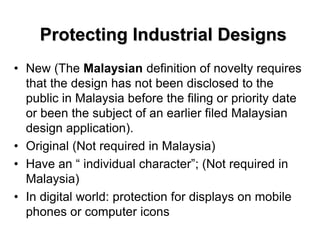
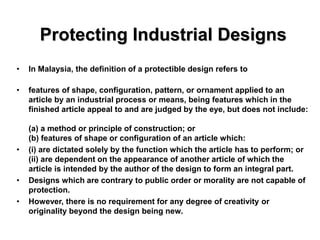
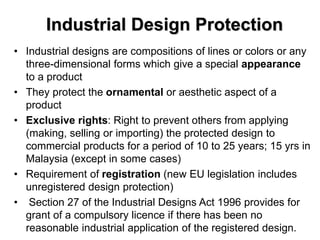
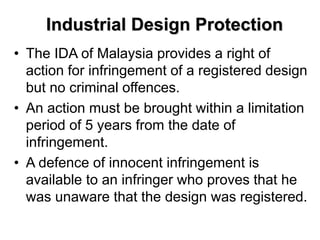
that the defendant should have carried out a trademark search at the Registry](https://image.slidesharecdn.com/wiposmeskul06www68916-230131135710-c457710a/85/wipo_smes_kul_06_www_68916-ppt-62-320.jpg)



![Honda Case Study
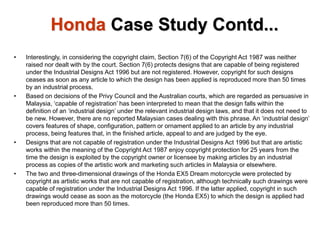
• In Honda Giken Kogyo Kabushiki Kaisha v Allied Pacific Motor ([2005] 3 MLJ 30) Honda applied for an interlocutory
injunction against the defendant based on the alleged infringement of:
• • five industrial design registrations owned by Honda for the Honda Wave 125 motorcycle by the defendant’s Comel
Manja JMP 125 motorcycle; and
• • Honda’s copyright in two and three-dimensional drawings of the Honda EX5 Dream motorcycle by the defendant’s
Comel Manja JMP 100 motorcycle.
• The designs were registered on December 7, 2000. The drawings were created by Honda in Japan and first published in
Thailand.
• In dismissing the defendant’s contention that the designs were not new as vehicles of a similar design had been sold in
Thailand prior to the plaintiff’s application to register the designs in Malaysia, the High Court ruled that the novelty
requirement in the Industrial Designs Act 1996 is territorial. Therefore, prior disclosure of designs outside Malaysia is
irrelevant. The court also applied the statutory presumption under Section 114(e) of the Evidence Act 1950 that official
acts have been correctly carried out. Therefore, the court held that the designs were valid, ruling that there were many
similarities between the Honda Wave 125 and the defendant’s JMP 125.
• In dealing with the copyright claim, the court applied the Copyright (Application to Other Countries) Regulations 1990
and held that the drawings first published in Thailand were entitled to copyright protection in Malaysia (subject to
eligibility under the Copyright Act 1987). The court stated that the drawings were protected by copyright as artistic works
in Malaysia and were similar to the eventual product of the JMP 100 motorcycle.
• Although the court concluded that there were serious questions to be tried, it stated that the balance of convenience
tilted in favour of refusal of the grant of an interlocutory injunction. The court found that the grant of an injunction
pending final disposal of the suit would have a negative and perhaps irreversible impact on the defendant, as an
injunction would affect third parties and the government.](https://image.slidesharecdn.com/wiposmeskul06www68916-230131135710-c457710a/85/wipo_smes_kul_06_www_68916-ppt-77-320.jpg)
![Concept of Novelty in Malaysia
• The recent Malaysian decision of CKE Marketing Sdn Bhd v Virtual Century Sdn Bhd [2006] 1 MLJ 767, set out that
the design concerned must be looked at as a whole, when comparisons are made with the prior art and that any
evidence of prior art has to be strictly proven.
•
• The facts of the case
•
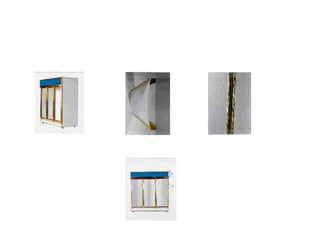
• In this case, the first defendant’s industrial design which was filed on 12 August, 1999 pertained to the design of a glass
door display chiller / freezer sold under the brand name of LINDEN, termed as “Refrigeration Apparatus” under the
provision of the Industrial Designs Act 1996.
•
• The First Defendant’s Design
• The plaintiff applied for rectifying the Register of Industrial Designs contending that the Defendant’s industrial design
registration had wrongfully remained on the Designs Register due to disclosure made to the Malaysian public prior to the
said 12 August, 1999 priority date due to the existence of other designs differing only in immaterial details.
•
• The first defendant claimed that the existing models and design features of the refrigeration apparatus that existed prior
to the date of the defendants’ design application were old and unappealing in appearance and, therefore, based on their
background knowledge of the industry, the first defendant developed novel design features and applied it to its product
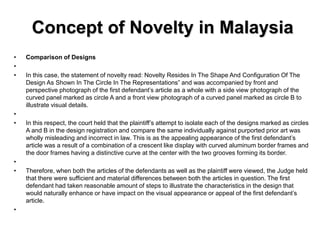
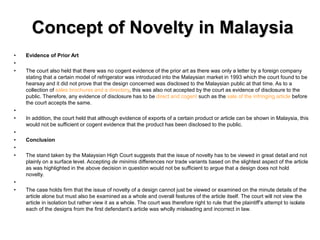
and sold its new product in the market. The main features, which the first defendant contended were novel, were a
curved crescent like shape, display panel with aluminum frames and curved aluminum doorframes. The defendant’s
design registration was further bolstered by a registered design, which the defendant had obtained under the UK
Registered Design’s Act 1949.
•](https://image.slidesharecdn.com/wiposmeskul06www68916-230131135710-c457710a/85/wipo_smes_kul_06_www_68916-ppt-79-320.jpg)
![Concept of Novelty in Malaysia
• The findings of the court
•
• The High Court followed the requirements of novelty as set out in the English Court of Appeal decision
of AMP Incorporated v Utilux Pty Ltd [1970] RPC 397 which held that there must be substantial novelty
or originality having regard to the nature of the article before it is registrable, and differences from the
prior art in details which are immaterial are not enough reason to expunge a design registration. The
question of differences in a particular case would depend on the nature of the article, the extent of the
prior art, and the number of previous designs in the field in question.
•
• In view of the above, the court held that the question of novelty is dependent on the nature of the
article and that a relevant consideration would be whether the article is a generic product that is
commonly used by members of the public. In such circumstances, it is likely that the design features
applied to an article are already individually in existence or in use prior to the formation of the said
article. The paramount consideration for the court will be the totality of the design features taken as a
whole and the overall appearance of the common article as compared with the articles that were
disclosed to the public earlier.
•
• The court also held that in relation to generic and common products the standard of novelty must be
construed in accordance with the circumstances and followed the English decision of D Sebel & co Ltd
v National Art Metal Pty Ltd [1965] 10 FLR 224.
•](https://image.slidesharecdn.com/wiposmeskul06www68916-230131135710-c457710a/85/wipo_smes_kul_06_www_68916-ppt-81-320.jpg)

This document discusses strategies for marketing, branding, and business success through the use of trademarks and industrial designs. It provides case studies of the Malaysian textile industry and brands like Zara. The key points made are: - Malaysia relies heavily on contract manufacturing and is weak in design/marketing capabilities and original brand development. It produces mainly for major international brands. - Differentiation, branding, and intellectual property protections like trademarks, industrial designs, and patents are important for business success and preventing free-riding. - Building trust and brand equity requires continuous investment in the brand over many years through consistent strategy and legal protections.


![Branding[1]](https://cdn.slidesharecdn.com/ss_thumbnails/branding1-101216045229-phpapp01-thumbnail.jpg?width=640&height=640&fit=bounds)


