The 7 Habits of Highly
Effective People
Powerful Lessons in Personal
Change
Session 1:
Problems and Solutions
I had a problem, a big one
 I had a well paid job. My boss is
really nice. I saw a bright career path
in front of me.
 I lived out of my own country and far
from my family.
 I failed multiple times in
relationships. I felt lonely after I went
home. I wanted to have my own
family.
 I am not happy!
In fact, everybody had one
 I am having tremendous professional
success, but it’s cost me personal and
family life.
 I know I’m overweight. I tried all the ways
without success.
 My employees are always waiting for me to
give them orders. I am tired of that.
 I am too busy. I feel pressured and hassled
all day, every day, seven days a week.
 My kid won’t listen to me anymore
 There is no love in my marriage. We don’t
feel it anymore.
What’s the biggest problem
you are facing?
 At work
 In family
 Relationship
 Health
 Time
 Meaning of life
 Death
What to do with the problem?
 Put it aside, try not to think
about it
 Worry about it
 Talk about it
Work on it!
Deal with the problem
 Acknowledge the problem
 A problem cannot be solved if we
pretend that it doesn’t exist
 A real problem cannot be hidden
 A real problem won’t go away
 Define the problem
 What’s bothering me most? Why?
 Write it down
 Solve the problem
How?
New Level of Thinking
“The significant
problems we face
cannot be solved at
the same level of
thinking we were at
when we created
them”
– Albert Einstein
The way we see the problem
is the problem
 It’s “out there”. It’s the problem of the
others.
 We look at the symptoms and ignore the
root cause
 We expect some magic techniques and
quick fixes. The real solution may be a long
process and require significant efforts
 Examples:
 Employees lack of loyalty
 Marriage without love
 Always busy, but little accomplished
How to see differently?
Paradigm - How do we “see”
things?
 The “lens” we all wear
 We all see things through our own “Paradigms”,
which are our own ways of thinking.
 We may not know the paradigm exists, like
contact lens. We think what we see is objective.
But it may not be.
 Two people can see the same thing, disagree
and yet both be right.
 Our unique experience creates the “lens”
 Family
 Education
 Environment
 Culture
Power of the Paradigm
 Paradigm is our map
 Reality, the way things are, where are we now.
 Value, the way things should be, where do we
want to be
 Paradigm determines
 Our attitudes
 Our behaviors
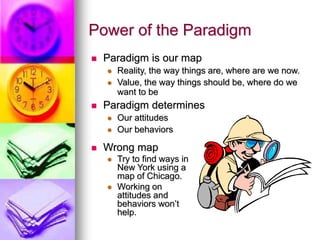
 Wrong map
 Try to find ways in
New York using a
map of Chicago.
 Working on
attitudes and
behaviors won’t
help.
What to do with our
Paradigms?
 Be aware of them
 Take responsibilities of them,
examine them, test them against
reality
 Listen to others, be open to their
perspectives
 Get the large picture
Paradigm shift - “See” things
differently
 Paradigm shift is powerful
 Fundamentally change our attitudes and
behaviors
 The only way for us to make
significant and quantum changes
 Science
 From Earth center to Sun center
 From bloodletting to gem theory
 Society
 From Kings to Democracy
 Life
 Life threaten crisis
 Step into a new role
Solve our problems
 What are the “maps” we are using?
 The way we “see” things
 The way we “handle” things
 Are the “maps” correct?
 Can they explain our current situation?
 Can we get to the destination using
them?
 Are we lost using the current map?
 Change the map
Thoughts about my own
problem
 My old paradigms
 There is only successful career path for me. I
rely on my boss to promote me in the company
ladder. To be successful in career, I have to live
in United States.
 My perfect partner will fall into my life from
heaven. We will fall in love immediately and be
happy ever after. I just need to wait.
 Love is sweet and all about happiness.
 As long as I have a family, every problem will be
resolved.
 My attitude and behaviors are solely based
on those paradigms.
 Are they correct?
What’s the “correct map”?
 Principles
 Real, unchanging,
unarguable and self-
evident as natural laws
 Universally applicable
among different
societies and religions
 Examples
 Only if you are trustworthy, you can earn
long term trust
 Principles determine the results
 “Correct map” are Principle-Centered
Principles, Practices and
Values
 Principles vs. Practices
 Guidelines vs. Activities
 Universal application vs.
Situation Specific
 Always true vs. Work in
some circumstances
 Principle empowers
people to create variety of
practices to deal with
different situations
 Principles vs. Value
 Objective territory vs. Map
How to change the “map”?
 Inside-out
 Start with yourself
 Paradigms
 Characters
 Motives
 Private victory precedes public victory
 Keep Promise to ourselves before to others
 Improve ourselves before improve the
relationships
 Work on our characters before work on
personalities
 Continuing renewal process
Inside-out examples
 To have a good marriage
 Generate positive energy
 Sidestep negative energy
 To have a pleasant, cooperative teenager
 More understanding
 Empathic
 Consistent
 Loving
 To have more freedom, more latitude in
your job
 Be more responsible
 More helpful
 More contributing
 To be trusted
 Be trustworthy
Put the “map” inside us,
permanently
 Characters
 Relatively permanent
 Distinguishing features
 Manifest when relates to
others and reacts to various
kinds of challenges
 Examples
 Courage
 Honesty
 Loyalty
 Characters determine our destiny
 Determine our actions and reactions
 Determine how people see us and treat us
Characters Ethic vs.
Personalities Ethic
 Characters Ethic
 The foundation of success
come from the Characters
like Integrity, Humility,
Courage…
 Personalities Ethic
 Human and Public
Relationship techniques
 Positive Mental Attitude
 Characters vs.
Personalities
 Inside-out vs. Outside-in
 Permanent vs.
Inconsistent
 Natural vs. Artificial
The New Paradigm
 The new level of thinking
 Principle-centered
 Character-based
 Inside-out
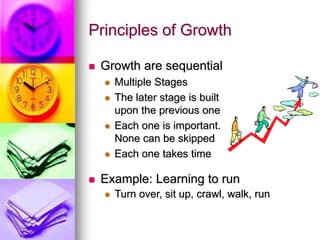
Principles of Growth
 Growth are sequential
 Multiple Stages
 The later stage is built
upon the previous one
 Each one is important.
None can be skipped
 Each one takes time
 Example: Learning to run
 Turn over, sit up, crawl, walk, run
The Paradigm Change
Process
 It’s a continuing
renewal process
 Learn the principles
 Build the characters
 Start with ourselves
 Emotional Development Level
 Listening to others requires Patience,
Openness, Desire to understand
 No quick fixes. No shortcut
Conclusion
Solution to your problem
Change the way you see the it
What’s next?
 We learned
 Our significant problems are the fruits of
our own paradigms, the “lens” we wear
and the “maps” we use
 Our problems can only be solved by
paradigm shifts.
 A correct paradigm is Principle-
Centered, Character-based, Inside-out
 Paradigm shift takes a continuing
renewal process
 What’s missing
 A actionable process to guide us in
making the paradigm shift
Next Session
Session 2
The Overview of The 7 Habits

the-7-habits-of-highly-effective-people-session-1.ppt

  • 1.
    The 7 Habitsof Highly Effective People Powerful Lessons in Personal Change
  • 2.
  • 3.
    I had aproblem, a big one  I had a well paid job. My boss is really nice. I saw a bright career path in front of me.  I lived out of my own country and far from my family.  I failed multiple times in relationships. I felt lonely after I went home. I wanted to have my own family.  I am not happy!
  • 4.
    In fact, everybodyhad one  I am having tremendous professional success, but it’s cost me personal and family life.  I know I’m overweight. I tried all the ways without success.  My employees are always waiting for me to give them orders. I am tired of that.  I am too busy. I feel pressured and hassled all day, every day, seven days a week.  My kid won’t listen to me anymore  There is no love in my marriage. We don’t feel it anymore.
  • 5.
    What’s the biggestproblem you are facing?  At work  In family  Relationship  Health  Time  Meaning of life  Death
  • 6.
    What to dowith the problem?  Put it aside, try not to think about it  Worry about it  Talk about it Work on it!
  • 7.
    Deal with theproblem  Acknowledge the problem  A problem cannot be solved if we pretend that it doesn’t exist  A real problem cannot be hidden  A real problem won’t go away  Define the problem  What’s bothering me most? Why?  Write it down  Solve the problem How?
  • 8.
    New Level ofThinking “The significant problems we face cannot be solved at the same level of thinking we were at when we created them” – Albert Einstein
  • 9.
    The way wesee the problem is the problem  It’s “out there”. It’s the problem of the others.  We look at the symptoms and ignore the root cause  We expect some magic techniques and quick fixes. The real solution may be a long process and require significant efforts  Examples:  Employees lack of loyalty  Marriage without love  Always busy, but little accomplished
  • 10.
    How to seedifferently?
  • 11.
    Paradigm - Howdo we “see” things?  The “lens” we all wear  We all see things through our own “Paradigms”, which are our own ways of thinking.  We may not know the paradigm exists, like contact lens. We think what we see is objective. But it may not be.  Two people can see the same thing, disagree and yet both be right.  Our unique experience creates the “lens”  Family  Education  Environment  Culture
  • 12.
    Power of theParadigm  Paradigm is our map  Reality, the way things are, where are we now.  Value, the way things should be, where do we want to be  Paradigm determines  Our attitudes  Our behaviors  Wrong map  Try to find ways in New York using a map of Chicago.  Working on attitudes and behaviors won’t help.
  • 13.
    What to dowith our Paradigms?  Be aware of them  Take responsibilities of them, examine them, test them against reality  Listen to others, be open to their perspectives  Get the large picture
  • 14.
    Paradigm shift -“See” things differently  Paradigm shift is powerful  Fundamentally change our attitudes and behaviors  The only way for us to make significant and quantum changes  Science  From Earth center to Sun center  From bloodletting to gem theory  Society  From Kings to Democracy  Life  Life threaten crisis  Step into a new role
  • 15.
    Solve our problems What are the “maps” we are using?  The way we “see” things  The way we “handle” things  Are the “maps” correct?  Can they explain our current situation?  Can we get to the destination using them?  Are we lost using the current map?  Change the map
  • 16.
    Thoughts about myown problem  My old paradigms  There is only successful career path for me. I rely on my boss to promote me in the company ladder. To be successful in career, I have to live in United States.  My perfect partner will fall into my life from heaven. We will fall in love immediately and be happy ever after. I just need to wait.  Love is sweet and all about happiness.  As long as I have a family, every problem will be resolved.  My attitude and behaviors are solely based on those paradigms.  Are they correct?
  • 17.
    What’s the “correctmap”?  Principles  Real, unchanging, unarguable and self- evident as natural laws  Universally applicable among different societies and religions  Examples  Only if you are trustworthy, you can earn long term trust  Principles determine the results  “Correct map” are Principle-Centered
  • 18.
    Principles, Practices and Values Principles vs. Practices  Guidelines vs. Activities  Universal application vs. Situation Specific  Always true vs. Work in some circumstances  Principle empowers people to create variety of practices to deal with different situations  Principles vs. Value  Objective territory vs. Map
  • 19.
    How to changethe “map”?  Inside-out  Start with yourself  Paradigms  Characters  Motives  Private victory precedes public victory  Keep Promise to ourselves before to others  Improve ourselves before improve the relationships  Work on our characters before work on personalities  Continuing renewal process
  • 20.
    Inside-out examples  Tohave a good marriage  Generate positive energy  Sidestep negative energy  To have a pleasant, cooperative teenager  More understanding  Empathic  Consistent  Loving  To have more freedom, more latitude in your job  Be more responsible  More helpful  More contributing  To be trusted  Be trustworthy
  • 21.
    Put the “map”inside us, permanently  Characters  Relatively permanent  Distinguishing features  Manifest when relates to others and reacts to various kinds of challenges  Examples  Courage  Honesty  Loyalty  Characters determine our destiny  Determine our actions and reactions  Determine how people see us and treat us
  • 22.
    Characters Ethic vs. PersonalitiesEthic  Characters Ethic  The foundation of success come from the Characters like Integrity, Humility, Courage…  Personalities Ethic  Human and Public Relationship techniques  Positive Mental Attitude  Characters vs. Personalities  Inside-out vs. Outside-in  Permanent vs. Inconsistent  Natural vs. Artificial
  • 23.
    The New Paradigm The new level of thinking  Principle-centered  Character-based  Inside-out
  • 24.
    Principles of Growth Growth are sequential  Multiple Stages  The later stage is built upon the previous one  Each one is important. None can be skipped  Each one takes time  Example: Learning to run  Turn over, sit up, crawl, walk, run
  • 25.
    The Paradigm Change Process It’s a continuing renewal process  Learn the principles  Build the characters  Start with ourselves  Emotional Development Level  Listening to others requires Patience, Openness, Desire to understand  No quick fixes. No shortcut
  • 26.
    Conclusion Solution to yourproblem Change the way you see the it
  • 27.
    What’s next?  Welearned  Our significant problems are the fruits of our own paradigms, the “lens” we wear and the “maps” we use  Our problems can only be solved by paradigm shifts.  A correct paradigm is Principle- Centered, Character-based, Inside-out  Paradigm shift takes a continuing renewal process  What’s missing  A actionable process to guide us in making the paradigm shift
  • 28.
    Next Session Session 2 TheOverview of The 7 Habits