Macro Outlook, The Baltic Region, November 2008 HANSABANK MARKETS
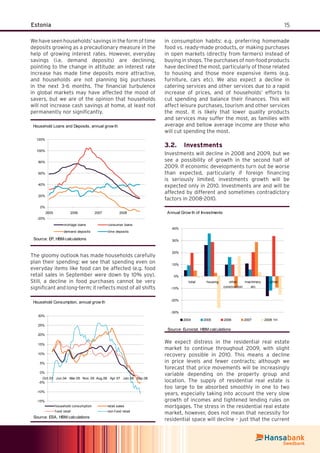
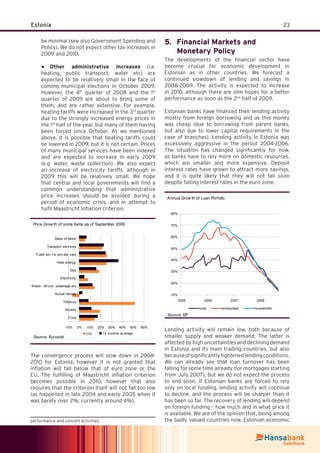
The Baltic
Outlook
Freezing up
Table of contents
Summary page 3
General Assumptions page 5
Global economy heads to recession, uncertainty high
Global developments make things worse for Baltics
Estonia page 11
Economy in recession for 2008-2009, hopes for 2010
Misbalances – CAD, inflation, debt burden – retreat
Hopes for euro if budget deficit will not increase too much
Latvia page 25
Latvian economy is in a deep recession, unemployment will rise
External imbalances and inflation are shrinking rapidly
Exports expected to be the best performing part of the economy throughout the cycle
Lithuania page 37
Economic growth will stall during 2009-2010
Drivers of domestic demand are already exhausted
Inflation remains on high level, but on downturn
Abbreviations:
CB– central bank
CEE – Central and Eastern Europe
CPI- consumer price index
CSBL - Central Statistical Bureau of Latvia
ECB - European Central Bank
EKI - Estonian Institute of Economic Research
EP – Eesti Pank (central bank)
ESA– Estonian Statistical Office
EU – European Union
HBM – Hansabank Markets
HICP – harmonized index of consumer prices
LaB – Latvias Banka (central bank)
LDS – Lithuanian Department of Statistics
LiB – Lietuvos Bankas (central bank)
MoF – Ministry of Finance
PPI – producer price index
REER – real effective exchange rate
Photo by: Risto Hunt
3Summary
Summary
The global economy is heading towards a recession.
However, it is not yet clear how deep it will be and
how long it will last, as it is not clear whether the
coordinated action of global economic powers will
have a lasting effect on markets or not. In addition,
we do not know what the consequences of the recent
troubles are. Hence it is quite difficult to formulate
a forecast now for every country. It might easily
happen that current expectations prove to be too
optimistic, and that global economic developments
may turn out to be worse than currently expected.
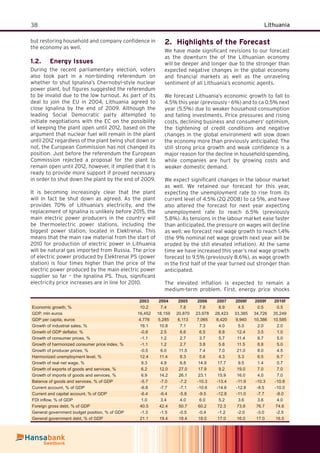
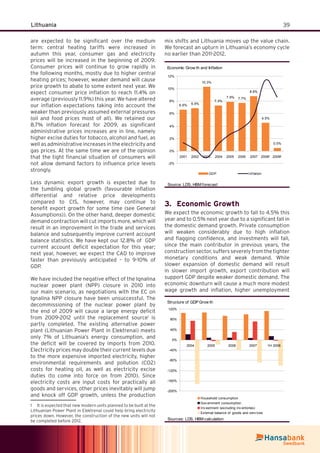
We have made revisions of our forecast for the
Baltic economies, taking into account the changes
in the global economy and in the Baltic countries
themselves (data revisions, policy changes etc). The
Baltic economies were heading towards recession
without the recent troubles in the global financial
market, and the worsened economic situation
and outlook in the financial world have made our
forecast significantly gloomier, as all three countries
are subject to global economic developments. It
would be very difficult to show improving growth
rates in the Baltic economies at a time where the
global economy and particularly their main trading
partners are in a recession; however, whether
recovery will come at the same time as in partner
countries and how strong it will be depends on the
local economies.
Weak global demand will negatively affect the
export possibilities of Baltic companies. The only
factor, which may help, is that production costs
here are still significantly lower than in most of the
export destination countries in the EU. There is also
ample room from gaining productivity growth (the
productivity gap is big between Baltic countries and
their main trading partners). There is still some room
for gaining from Russian economic developments,
but since risks in Russia have increased more than in
developed countries, this might be too risky option
for many companies.
Lower prices, particularly energy prices, will help
local inflation to recede. That should smooth the
burden of local economic distress on consumers
and encourage earlier recovery of consumption
(or at least keep the decline smaller). It also should

help the Baltic economies to remain competitive
in global markets, as many businesses are rather
energy consuming.
The strongest negative effect is expected from
the financial markets, where the Baltic countries
are now considered to be among the most risky.
This has made foreign financing significantly more
difficult and expensive as risk margins have grown
strongly. Hence, the lowering of policy rates has had
no effect on the cost of new borrowing in the Baltic
countries. Still, the falling money market rates have
already eased the situation of those who have
already taken loans, as the majority of loans have
flexible interest rates, which are bound to Euribor
rates. The Baltic economies have to rely more
on domestic finances, which, however, are more
expensive and less available (due to lower saving
rate) than cheap foreign loan money, which poured
into the economies in 2004-2007. This means that
investing has become more expensive, and thus the
urgently needed change in the economic structure
cannot be fast. Although the Baltic countries can
expect generous money flows from different EU
funds (estimated ca 3-4% of GDP every year in the
2007-13 budgetary period), those funds will not
save the Baltic countries from a prolonged period of
economic stress, as it can hardly be expected that
the use of those funds will not be without troubles.
Also, they will not cover the needs of the private
sector.
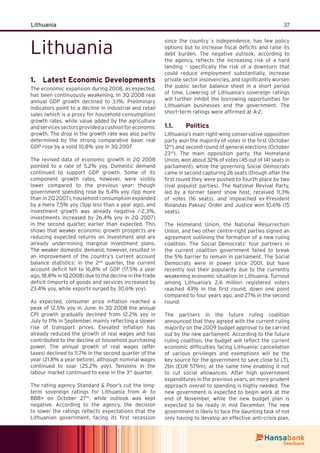
Taking into account all the abovementioned factors,
we have cut our growth expectations for the
Baltic countries and expect negative GDP growth
in Estonia and Latvia in 2008 (the countries have
already entered formal recession as they had two
consecutive quarters of negative quarterly growth),
while Lithuania will still note positive annual
growth figures in 2009 (though well below previous
expectations). The year 2009 is expected to be the
most difficult for all three countries: we forecast a
fall of around 2% in Estonia, 4% in Latvia and only
minor growth in Lithuania. 2010 should bring slow
recovery in Estonia and Latvia, with 2% and 1%
growth respectively, but the Lithuanian economy
is about to suffer from the closure of the Ignalina
nuclear power station and followed that sharp
increase in electricity prices.
Economic growth is mostly affected by very weak
domestic demand – household and investments – as
unemployment will increase, wage growth will stall
and investments fall. Although external demand
will be weak and we have cut exports growth
expectations, we also see that the three countries
will be able to at least partly use their production
advantages. The very weak domestic demand will
also mean a sharply smaller imports flow, and hence
we expect a rapid decline of trade and current
account deficits. It is likely that the Estonian and
Latvian current and capital account deficits will fall
below 5% of GDP by the end of 2009. Weak domestic
demand is already containing inflation rates, and we
expect inflation to retreat rather rapidly. Estonia will
see single-digit annual growth rates already in the
4 Summary
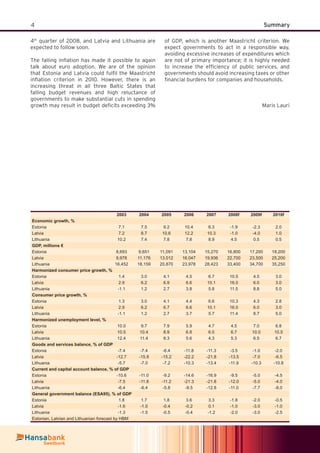
2003 2004 2005 2006 2007 2008f 2009f 2010f
Economic growth, %
Estonia 7.1 7.5 9.2 10.4 6.3 -1.9 -2.3 2.0
Latvia 7.2 8.7 10.6 12.2 10.3 -1.0 -4.0 1.0
Lithuania 10.2 7.4 7.8 7.8 8.9 4.5 0.5 0.5
GDP, millions €
Estonia 8,693 9,651 11,091 13,104 15,270 16,800 17,200 18,200
Latvia 9,978 11,176 13,012 16,047 19,936 22,700 23,500 25,200
Lithuania 16,452 18,159 20,870 23,978 28,423 33,400 34,700 35,250
Harmonized consumer price growth, %
Estonia 1.4 3.0 4.1 4.5 6.7 10.5 4.5 3.0
Latvia 2.9 6.2 6.9 6.6 10.1 16.0 6.0 3.0
Lithuania -1.1 1.2 2.7 3.8 5.8 11.5 8.8 5.0
Consumer price growth, %
Estonia 1.3 3.0 4.1 4.4 6.6 10.3 4.3 2.8
Latvia 2.9 6.2 6.7 6.6 10.1 16.0 6.0 3.0
Lithuania -1.1 1.2 2.7 3.7 5.7 11.4 8.7 5.0
Harmonized unemployment level, %
Estonia 10.0 9.7 7.9 5.9 4.7 4.5 7.0 6.8
Latvia 10.5 10.4 8.9 6.8 6.0 6.7 10.0 10.5
Lithuania 12.4 11.4 8.3 5.6 4.3 5.3 6.5 6.7
Goods and services balance, % of GDP
Estonia -7.4 -7.4 -6.4 -11.8 -11.3 -3.5 -1.0 -2.0
Latvia -12.7 -15.8 -15.2 -22.2 -21.8 -13.5 -7.0 -6.5
Lithuania -5.7 -7.0 -7.2 -10.3 -13.4 -11.9 -10.3 -10.8
Current and capital account balance, % of GDP
Estonia -10.6 -11.0 -9.2 -14.6 -16.9 -9.5 -5.0 -4.5
Latvia -7.5 -11.8 -11.2 -21.3 -21.8 -12.0 -5.0 -4.0
Lithuania -6.4 -6.4 -5.8 -9.5 -12.8 -11.0 -7.7 -8.0
General government balance (ESA95), % of GDP
Estonia 1.8 1.7 1.8 3.6 3.3 -1.8 -2.0 -0.5
Latvia -1.6 -1.0 -0.4 -0.2 0.1 -1.0 -3.0 -1.0
Lithuania -1.3 -1.5 -0.5 -0.4 -1.2 -2.0 -3.0 -2.5
Estonian, Latvian and Lithuanian forecast by HBM
4th
quarter of 2008, and Latvia and Lithuania are
expected to follow soon.
The falling inflation has made it possible to again
talk about euro adoption. We are of the opinion
that Estonia and Latvia could fulfil the Maastricht
inflation criterion in 2010. However, there is an
increasing threat in all three Baltic States that
falling budget revenues and high reluctance of
governments to make substantial cuts in spending
growth may result in budget deficits exceeding 3%
of GDP, which is another Maastricht criterion. We
expect governments to act in a responsible way,
avoiding excessive increases of expenditures which
are not of primary importance; it is highly needed
to increase the efficiency of public services, and
governments should avoid increasing taxes or other
financial burdens for companies and households.
Maris Lauri
5General Assumptions
General
Assumptions
The global economy is heading toward recession, if
not crisis. This should be clear to everybody after the
beginning of a second round of the current financial
sector crisis in September (the first was a year ago,
known as the sub-prime crisis). However, it is not
yet clear how deep it will be and how long it will last,
as it is not clear whether the coordinated action of
the global economic powers has had a lasting effect
on the markets or not. In addition, we do not know
what the consequences of the recent troubles will
be. Hence it is quite difficult to formulate a forecast
now, but based on the IMF’s expectations1
, Reuters
consensus2
and other recently published analysis
and comments in the media we have formed our
view about the global environment in which the
Baltic economies are expected to operate in the
next two years. Nevertheless, the risks are high that
global economic developments may turn out to be
worse than currently expected.
Global Economic Growth1.
Global economic growth is set to slow sharply
in 2008 and in 2009-2010 as well. Advanced
economies are expected to grow at best by 0.5% in
2009 (2.6% in 2007), with several of them falling
into recession (e.g. Italy, Spain, the UK, the USA) and
many showing barely positive growth rates if at all
(e.g. Germany, France, Japan). Even the so far well-
performing Nordic economies are expected to show
only minimal growth rates. It is expected that 2010
will be better than 2009, however it is increasingly
possible that the recovery in 2010 will be very slow.
It is clear that the global economy has entered its
deepest and longest recession/crisis in decades.
The US economy is expected to continue in recession
– according to the latest Reuters consensus forecast
positive growth is anticipated only in the 2nd
quarter
of 2009 (a forecast 5 week earlier suggested the
low-point would be in the 4th
quarter of 2008 with
0.2% growth). But the most pessimistic forecasts
are expecting positive growth figures only in 2010.
The same consensus suggests that in the euro zone
annual GDP growth will be negative in the 1st
quarter
of 2009 (quarterly in the 3rd
quarter of 2008), but
pessimists expect recovery only in 2010. Germany
1 World Economic Outlook Database, October 2008 (http://
www.imf.org)
2 From October 16th
is expected to show negative yearly growth rates in
the 1st
half of 2009, France in the 1st
quarter of 2009
and Italy will continue with negative growth rates
till the 2nd
half of 2009. The UK economy is also
expected to decline until the 2nd
half of 2009 and
to show negative growth in full year 2009. We are
in line with the pessimists (but maybe not with the
radical ones) expecting at best slight improvement
in the 2nd
half of 2009 and even then it might be an
improvement from worst to bad.
Distress in advanced economies will also affect
developing and emerging economies, where
growth is set to slow. Although many analysts are
expecting relatively strong growth rates in emerging
markets, explaining it with smaller than previous
dependence on exports and bigger domestic
markets, an increasing number of analysts, and
we agree with them, are pointing to the fact that
severe stress in advanced economies will still have
a strong impact on those markets. There is not only
demand (i.e. exports), but also prices, interest rates,
investments, which will negatively affect rapidly
growing economies like China, India and Russia,
(although with a time lag). Hence the IMF’s 6.1%
growth expectation for 2009 is too optimistic for
those countries. As of early October the IMF has
slashed China’s growth rate from 9.8% to 9.3%,
India’s from 8% to 6.9% and Russia’s from 7.3% to
5.5%. This was before the most severe falls in the
financial markets in October. So it is highly probable
that 2009-10 will turn out to be much gloomier than
the current IMF forecast for developing economies.
The recession in those big developing countries
will start later than in the advanced economies, as
they have had very high growth rates. However, the
recession in those countries may be deeper and
longer due to the general weakness of economic
structures and systems. It is likely that political
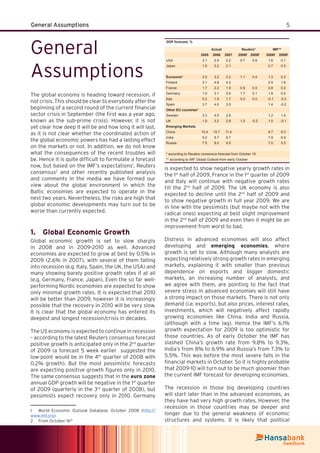
GDP forecast, %
Actual Reuters* IMF**
2005 2006 2007 2008f 2009f 2008f 2009f
USA 3.1 2.9 2.2 0.7 0.8 1.6 0.1
Japan 1.9 2.2 2.1 0.7 0.5
Eurozone* 2.0 3.2 2.2 1.1 0.4 1.3 0.2
Finland 3.1 4.8 4.3 2.5 1.6
France 1.7 2.2 1.9 0.9 0.5 0.8 0.2
Germany 1.0 3.1 2.6 1.7 0.1 1.8 0.0
Italy 0.2 1.9 1.7 0.0 0.0 -0.1 -0.2
Spain 3.7 4.0 3.5 1.4 -0.2
Other EU countries*
Sweden 3.3 4.5 2.8 1.2 1.4
UK 1.9 3.2 2.8 1.0 -0.2 1.0 -0.1
Emerging Markets
China 10.4 10.7 11.4 9.7 9.3
India 9.2 9.7 8.7 7.9 6.9
Russia 7.5 8.0 9.5 7.0 5.5
* according to Reuters consensus forecast from October 16
** according to IMF Global Outlook from early October
6 General Assumptions
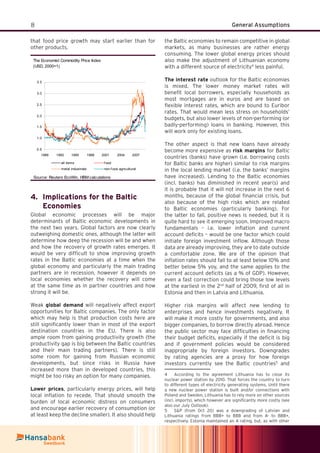
EUR/USD exchange rate
0.8
1
1.2
1.4
1.6
1.8
2000 2002 2004 2006 2008
Source: Reuters EcoWin
tensions may increase in many developing countries,
thus creating additional stress on the economy.
Thefallingdomesticdemandindevelopedeconomies
willaffectnotonlylocalproducers,butalsoexporters
from emerging economies and cause commodity
prices to fall, thus creating additional stress to
countries dependent on exports of raw materials
(that includes Russia and oil producing countries).
Financial sector troubles will not only destroy the
financial assets of many countries (through their
private or public sector investments into financial
institutions), but will also bring high interest rates
and low liquidity in the markets, which will worsen
the financial institutions’ access to loans and to
much smaller investments, and create additional
problems in domestic financial sectors (e.g. the
growing debt cost will cut the spending of current
debtors and create higher risks for creditors).
Interest and Exchange Rates2.
Financial markets troubles have had a serious
impact on interest rates: as confidence fell
sharply, interest rates in the money markets rose.
Coordinated interest rate cuts by major central
banks did not help – the money markets stayed
frozen and only strong efforts by the central
banks and governments to increase confidence
via guarantees, money injections, and the creation
of financial crisis plans etc have finally started to
bring down market interest rates. However, liquidity
in the markets is expected to remain low and the
difference between policy rates (central banks’ rates)
and money market rates big, albeit slowly declining.
Hence we can expect money market rates to fall in
line with restoring confidence in markets. Still, as
the possibility of setbacks exists, interest rates in
the money markets may temporarily increase.
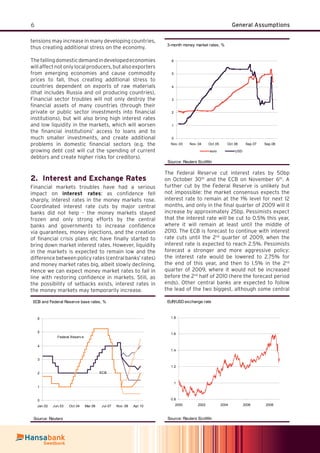
3-month money market rates, %
0
1
2
3
4
5
6
Nov .03 Nov .04 Oct.05 Oct.06 Sep.07 Sep.08
euro USD
Source: Reuters EcoWin
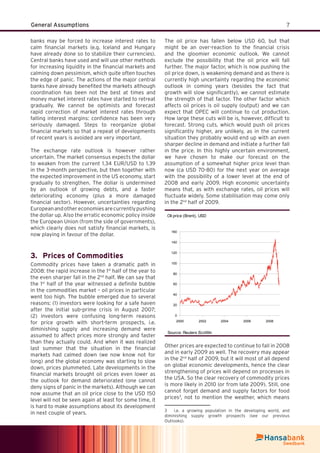
The Federal Reserve cut interest rates by 50bp
on October 30th
and the ECB on November 6th
. A
further cut by the Federal Reserve is unlikely but
not impossible: the market consensus expects the
interest rate to remain at the 1% level for next 12
months, and only in the final quarter of 2009 will it
increase by approximately 25bp. Pessimists expect
that the interest rate will be cut to 0.5% this year,
where it will remain at least until the middle of
2010. The ECB is forecast to continue with interest
rate cuts until the 2nd
quarter of 2009, when the
interest rate is expected to reach 2.5%. Pessimists
forecast a stronger and more aggressive policy:
the interest rate would be lowered to 2.75% for
the end of this year, and then to 1.5% in the 2nd
quarter of 2009, where it would not be increased
before the 2nd
half of 2010 (here the forecast period
ends). Other central banks are expected to follow
the lead of the two biggest, although some central
ECB and Federal Reserve base rates, %
0
1
2
3
4
5
6
Jan.02 Jun.03 Oct.04 Mar.06 Jul.07 Nov .08 Apr.10
Source: Reuters
Federal Reserv e
ECB
7General Assumptions
banks may be forced to increase interest rates to
calm financial markets (e.g. Iceland and Hungary
have already done so to stabilize their currencies).
Central banks have used and will use other methods
for increasing liquidity in the financial markets and
calming down pessimism, which quite often touches
the edge of panic. The actions of the major central
banks have already benefited the markets although
coordination has been not the best at times and
money market interest rates have started to retreat
gradually. We cannot be optimists and forecast
rapid correction of market interest rates through
falling interest margins: confidence has been very
seriously damaged. Steps to reorganize global
financial markets so that a repeat of developments
of recent years is avoided are very important.
The exchange rate outlook is however rather
uncertain. The market consensus expects the dollar
to weaken from the current 1.34 EUR/USD to 1.39
in the 3-month perspective, but then together with
the expected improvement in the US economy, start
gradually to strengthen. The dollar is undermined
by an outlook of growing debts, and a faster
deteriorating economy (plus a more damaged
financial sector). However, uncertainties regarding
Europeanandothereconomiesarecurrentlypushing
the dollar up. Also the erratic economic policy inside
the European Union (from the side of governments),
which clearly does not satisfy financial markets, is
now playing in favour of the dollar.
Prices of Commodities3.
Commodity prices have taken a dramatic path in
2008: the rapid increase in the 1st
half of the year to
the even sharper fall in the 2nd
half. We can say that
the 1st
half of the year witnessed a definite bubble
in the commodities market – oil prices in particular
went too high. The bubble emerged due to several
reasons: (1) investors were looking for a safe haven
after the initial sub-prime crisis in August 2007;
(2) investors were confusing long-term reasons
for price growth with short-term prospects, i.e.
diminishing supply and increasing demand were
assumed to affect prices more strongly and faster
than they actually could. And when it was realized
last summer that the situation in the financial
markets had calmed down (we now know not for
long) and the global economy was starting to slow
down, prices plummeted. Late developments in the
financial markets brought oil prices even lower as
the outlook for demand deteriorated (one cannot
deny signs of panic in the markets). Although we can
now assume that an oil price close to the USD 150
level will not be seen again at least for some time, it
is hard to make assumptions about its development
in next couple of years.
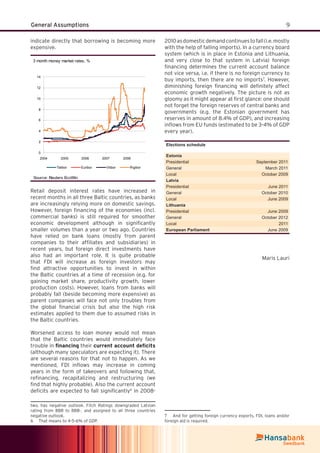
The oil price has fallen below USD 60, but that
might be an over-reaction to the financial crisis
and the gloomier economic outlook. We cannot
exclude the possibility that the oil price will fall
further. The major factor, which is now pushing the
oil price down, is weakening demand and as there is
currently high uncertainty regarding the economic
outlook in coming years (besides the fact that
growth will slow significantly), we cannot estimate
the strength of that factor. The other factor which
affects oil prices is oil supply (output) and we can
expect that OPEC will continue to cut production.
How large these cuts will be is, however, difficult to
forecast. Strong cuts, which would push oil prices
significantly higher, are unlikely, as in the current
situation they probably would end up with an even
sharper decline in demand and initiate a further fall
in the price. In this highly uncertain environment,
we have chosen to make our forecast on the
assumption of a somewhat higher price level than
now (ca USD 70-80) for the next year on average
with the possibility of a lower level at the end of
2008 and early 2009. High economic uncertainty
means that, as with exchange rates, oil prices will
fluctuate widely. Some stabilisation may come only
in the 2nd
half of 2009.
Oil price (Brent), USD
0
20
40
60
80
100
120
140
160
2000 2002 2004 2006 2008
Source: Reuters EcoWin
Other prices are expected to continue to fall in 2008
and in early 2009 as well. The recovery may appear
in the 2nd
half of 2009, but it will most of all depend
on global economic developments, hence the clear
strengthening of prices will depend on processes in
the USA. So the clear recovery of commodity prices
is more likely in 2010 (or from late 2009). Still, one
cannot forget demand and supply factors for food
prices3
, not to mention the weather, which means
3 i.e. a growing population in the developing world, and
diminishing supply growth prospects (see our previous
Outlooks).
8 General Assumptions
that food price growth may start earlier than for
other products.
The Economist Commodity Price Index
(USD, 2000=1)
0.5
1.0
1.5
2.0
2.5
3.0
3.5
1989 1992 1995 1998 2001 2004 2007
all items f ood
metal industrials non-f ood agricultural
Source: Reuters EcoWin, HBM calculations
Implications for the Baltic4.
Economies
Global economic processes will be major
determinants of Baltic economic developments in
the next two years. Global factors are now clearly
outweighing domestic ones, although the latter will
determine how deep the recession will be and when
and how the recovery of growth rates emerges. It
would be very difficult to show improving growth
rates in the Baltic economies at a time when the
global economy and particularly the main trading
partners are in recession, however it depends on
local economies whether the recovery will come
at the same time as in partner countries and how
strong it will be.
Weak global demand will negatively affect export
opportunities for Baltic companies. The only factor
which may help is that production costs here are
still significantly lower than in most of the export
destination countries in the EU. There is also
ample room from gaining productivity growth (the
productivity gap is big between the Baltic countries
and their main trading partners). There is still
some room for gaining from Russian economic
developments, but since risks in Russia have
increased more than in developed countries, this
might be too risky an option for many companies.
Lower prices, particularly energy prices, will help
local inflation to recede. That should smooth the
burden of local economic distress on consumers
and encourage earlier recovery of consumption (or
at least keep the decline smaller). It also should help
the Baltic economies to remain competitive in global
markets, as many businesses are rather energy
consuming. The lower global energy prices should
also make the adjustment of Lithuanian economy
with a different source of electricity4
less painful.
The interest rate outlook for the Baltic economies
is mixed. The lower money market rates will
benefit local borrowers, especially households as
most mortgages are in euros and are based on
flexible interest rates, which are bound to Euribor
rates. That would mean less stress on households’
budgets, but also lower levels of non-performing (or
badly-performing) loans in banking. However, this
will work only for existing loans.
The other aspect is that new loans have already
become more expensive as risk margins for Baltic
countries (banks) have grown (i.e. borrowing costs
for Baltic banks are higher) similar to risk margins
in the local lending market (i.e. the banks’ margins
have increased). Lending to the Baltic economies
(incl. banks) has diminished in recent year(s) and
it is probable that it will not increase in the next 6
months, because of the global financial crisis, but
also because of the high risks which are related
to Baltic economies (particularly banking). For
the latter to fall, positive news is needed, but it is
quite hard to see it emerging soon. Improved macro
fundamentals – i.e. lower inflation and current
account deficits – would be one factor which could
initiate foreign investment inflow. Although those
data are already improving, they are to date outside
a comfortable zone. We are of the opinion that
inflation rates should fall to at least below 10% and
better below 5% yoy, and the same applies to the
current account deficits (as a % of GDP). However,
even a fast correction could bring those low levels
at the earliest in the 2nd
half of 2009, first of all in
Estonia and then in Latvia and Lithuania.
Higher risk margins will affect new lending to
enterprises and hence investments negatively. It
will make it more costly for governments, and also
bigger companies, to borrow directly abroad. Hence
the public sector may face difficulties in financing
their budget deficits, especially if the deficit is big
and if government policies would be considered
inappropriate by foreign investors. Downgrades
by rating agencies are a proxy for how foreign
investors currently see the Baltic countries5
and
4 According to the agreement Lithuania has to close its
nuclear power station by 2010. That forces the country to turn
to different types of electricity generating systems. Until there
a new nuclear power station is built and/or connections with
Poland and Sweden, Lithuania has to rely more on other sources
(incl. imports), which however are significantly more costly (see
also our July Outlook).
5 S&P (from Oct 20) was a downgrading of Latvian and
Lithuania ratings from BBB+ to BBB and from A- to BBB+,
respectively. Estonia maintained an A rating, but, as with other
9General Assumptions
indicate directly that borrowing is becoming more
expensive.
3 month money market rates, %
0
2
4
6
8
10
12
14
2004 2005 2006 2007 2008
Talibor Euribor Vilibor Rigibor
Source: Reuters EcoWin
Retail deposit interest rates have increased in
recent months in all three Baltic countries, as banks
are increasingly relying more on domestic savings.
However, foreign financing of the economies (incl.
commercial banks) is still required for smoother
economic development although in significantly
smaller volumes than a year or two ago. Countries
have relied on bank loans (mostly from parent
companies to their affiliates and subsidiaries) in
recent years, but foreign direct investments have
also had an important role. It is quite probable
that FDI will increase as foreign investors may
find attractive opportunities to invest in within
the Baltic countries at a time of recession (e.g. for
gaining market share, productivity growth, lower
production costs). However, loans from banks will
probably fall (beside becoming more expensive) as
parent companies will face not only troubles from
the global financial crisis but also the high risk
estimates applied to them due to assumed risks in
the Baltic countries.
Worsened access to loan money would not mean
that the Baltic countries would immediately face
trouble in financing their current account deficits
(although many speculators are expecting it). There
are several reasons for that not to happen. As we
mentioned, FDI inflows may increase in coming
years in the form of takeovers and following that,
refinancing, recapitalizing and restructuring (we
find that highly probable). Also the current account
deficits are expected to fall significantly6
in 2008-
two, has negative outlook. Fitch Ratings downgraded Latvian
rating from BBB to BBB-, and assigned to all three countries
negative outlook.
6 That means to 4-5-6% of GDP.
2010asdomesticdemandcontinuestofall(i.e.mostly
with the help of falling imports). In a currency board
system (which is in place in Estonia and Lithuania,
and very close to that system in Latvia) foreign
financing determines the current account balance
not vice versa, i.e. if there is no foreign currency to
buy imports, then there are no imports7
. However,
diminishing foreign financing will definitely affect
economic growth negatively. The picture is not as
gloomy as it might appear at first glance: one should
not forget the foreign reserves of central banks and
governments (e.g. the Estonian government has
reserves in amount of 8.4% of GDP), and increasing
inflows from EU funds (estimated to be 3-4% of GDP
every year).
Elections schedule
Estonia
Presidential September 2011
General March 2011
Local October 2009
Latvia
Presidential June 2011
General October 2010
Local June 2009
Lithuania
Presidential June 2009
General October 2012
Local 2011
European Parliament June 2009
Maris Lauri
7 And for getting foreign currency exports, FDI, loans and/or
foreign aid is required.
10 General Assumptions
11Estonia
Estonia
Recent Economic1.
Developments
The Estonian economy has entered into recession.
Quarterly growth rates have been negative during
two consecutive quarters1
: -0.9% in the 1st
and
-0.8% the 2nd
quarter (s.a. data). Annual growth
has been negative so far only in the 2nd
quarter
(-1% s.a.), but however, economic growth is likely
to be negative in the 3rd
quarter as well (according
to preliminary data the fall was 1% qoq (s.a) and
3.3% yoy). First, domestic demand continues to fall
due to deteriorating household consumption and
investment. The proxy of household consumption,
retail sales, fell by 5% in the 3rd
quarter (preliminary
data), and a further decline is expected with growing
unemployment (4.2% according to harmonized
figures in September and 3.5% according to
official figures in October2
), falling wage growth
(estimated ca 9-10% yoy in the 3rd
quarter) and
increasing pessimism. Housing construction is the
main contributor to weak investments (the total
area of finalized residential buildings was down by
27.5% yoy in the 3rd
quarter), but construction of
non-residential buildings and engineering probably
continued to grow, in support of finalizing projects
and EU funds. Investments declined in vehicle
purchases, while investments in machinery and
equipment probably did not grow (at least not much).
Government spending has continued to increase,
however, we are of opinion that growth has slowed
significantly in the 3rd
quarter.
Exports have performed surprisingly strongly in the
3rd
quarter: according to preliminary data, exports
grew by 10.8%. Imports however have shown
much weaker performance as domestic demand
is deteriorating (imports were up only by 5.6%).
The trade and services balance has continued to
improve in the 3rd
quarter – according to preliminary
data it was ca 6.8% of GDP (a year before -10.2%).
Those developments greatly benefit the current
1 Estonian Statistics revised GDP time series from 2000 until
2Q08 in early September in the process of introducing chain-
linked volume calculation (reference year 2000), and regular
revision of preliminary data. Most of the data were downgraded,
the biggest exception being the 1st
quarter of 2008 (from -1.9%
qoq s.a. to -0.9%). See chart on the next page.
2 Harmonized unemployment is published by Eurostat and
the rate decreased from 4.4% the year before and increased vs.
July’s 3.9% and May-June’s 3.8%. The data will be revised once a
quarter. Official data is covering those people who make a contact
with the Estonian Labour Board. Unemployment increased from
1.6% a year earlier and 3.1% in September. Those figures are not
seasonally adjusted.
and capital account balance, which has continued
to decline despite rather poor inflows from the EU
in recent months. The net inflow of FDI improved
significantly in the 3rd
quarter (EEK 5bn vs. EEK
1.5bn a year before), while net inflow of other
investments is declining (EEK 2.5bn vs. EEK 14.3bn
a year before).
Inflation has started to retreat – from 11.4% yoy in
June to 9.8% in October, with a high probability of
further decline in the coming months. Weakening
domestic demand, the end of administrative price
increases and falling global prices (food, energy etc)
are the reasons behind declining inflation rates.
Poor domestic demand is seriously hitting budget
revenues,whicharemostlysufferingfromweakretail
sales and investments: VAT collection is strongly
below expectations and down in yoy comparison
by 4.7% (9 month results). Other tax revenues are
affected as well. Although the government has
limitedspending,thereislittleroomformanoeuvring
due to many fixed revenue-spending rules and
recently increased social allowances. Nevertheless,
at the end of the 3rd
quarter the state budget was in
a surplus of 0.2% of expected annual GDP.
Highlights of the Forecast2.
We have downgraded our growth expectations for
Estonia taking into account revised GDP data and
a worsened global outlook. We expect close to
2% decline of Estonian GDP this year, with over
2% decline in 2009. We acknowledge the current
high uncertainties regarding global economic
developments, particularly in the global financial
system, and see a high probability that we have to
downgrade our expectations more if the situation
turns out to be worse than assumed now (see
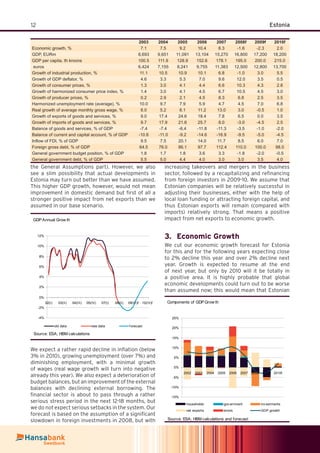
Confidence Indices, s.a.
-50
-40
-30
-20
-10
0
10
20
30
40
50
60
2002 2003 2004 2005 2006 2007 2008
industry consumers construction
retail trade serv ices
Source: EKI; HBM calculations
12 Estonia
the General Assumptions part). However, we also
see a slim possibility that actual developments in
Estonia may turn out better than we have assumed.
This higher GDP growth, however, would not mean
improvement in domestic demand but first of all a
stronger positive impact from net exports than we
assumed in our base scenario.
GDP Annual Grow th
-4%
-2%
0%
2%
4%
6%
8%
10%
12%
02(I) 03(II) 04(III) 05(IV) 07(I) 08(II) 09(III)f 10(IV)f
old data new data f orecast
Source: ESA; HBM calculations
We expect a rather rapid decline in inflation (below
3% in 2010), growing unemployment (over 7%) and
diminishing employment, with a minimal growth
of wages (real wage growth will turn into negative
already this year). We also expect a deterioration of
budget balances, but an improvement of the external
balances with declining external borrowing. The
financial sector is about to pass through a rather
serious stress period in the next 12-18 months, but
we do not expect serious setbacks in the system. Our
forecast is based on the assumption of a significant
slowdown in foreign investments in 2008, but with
increasing takeovers and mergers in the business
sector, followed by a recapitalizing and refinancing
from foreign investors in 2009-10. We assume that
Estonian companies will be relatively successful in
adjusting their businesses, either with the help of
local loan funding or attracting foreign capital, and
thus Estonian exports will remain (compared with
imports) relatively strong. That means a positive
impact from net exports to economic growth.
Economic Growth3.
We cut our economic growth forecast for Estonia
for this and for the following years expecting close
to 2% decline this year and over 2% decline next
year. Growth is expected to resume at the end
of next year, but only by 2010 will it be totally in
a positive area. It is highly probable that global
economic developments could turn out to be worse
than assumed now; this would mean that Estonian
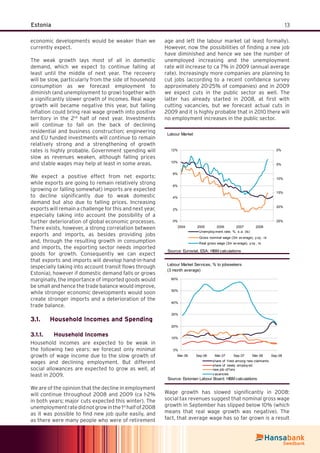
2003 2004 2005 2006 2007 2008f 2009f 2010f
Economic growth, % 7.1 7.5 9.2 10.4 6.3 -1.6 -2.3 2.0
GDP, EURm 8,693 9,651 11,091 13,104 15,270 16,800 17,200 18,200
GDP per capita, th kroons 100.5 111.9 128.9 152.6 178.1 195.0 200.0 215.0
euros 6,424 7,155 8,241 9,755 11,383 12,500 12,800 13,700
Growth of industrial production, % 11.1 10.5 10.9 10.1 6.8 -1.0 3.0 5.5
Growth of GDP deflator, % 4.6 3.3 5.3 7.0 9.6 12.0 3.5 0.5
Growth of consumer prices, % 1.3 3.0 4.1 4.4 6.6 10.3 4.3 2.8
Growth of harmonized consumer price index, % 1.4 3.0 4.1 4.5 6.7 10.5 4.5 3.0
Growth of producer prices, % 0.2 2.9 2.1 4.5 8.3 6.8 2.5 3.5
Harmonized unemployment rate (average), % 10.0 9.7 7.9 5.9 4.7 4.5 7.0 6.8
Real growth of average monthly gross wage, % 8.0 5.2 6.1 11.2 13.0 3.0 -0.5 1.0
Growth of exports of goods and services, % 9.0 17.4 24.6 18.4 7.8 6.5 0.0 3.5
Growth of imports of goods and services, % 9.7 17.9 21.6 25.7 8.0 -3.0 -4.5 2.5
Balance of goods and services, % of GDP -7.4 -7.4 -6.4 -11.8 -11.3 -3.5 -1.0 -2.0
Balance of current and capital account, % of GDP -10.6 -11.0 -9.2 -14.6 -16.9 -9.5 -5.0 -4.5
Inflow of FDI, % of GDP 9.5 7.5 20.1 14.0 11.7 8.5 6.0 7.0
Foreign gross debt, % of GDP 64.5 76.0 86.1 97.7 112.4 110.0 100.0 98.0
General government budget position, % of GDP 1.8 1.7 1.8 3.6 3.3 -1.8 -2.0 -0.5
General government debt, % of GDP 5.5 5.0 4.4 4.0 3.0 3.0 3.5 4.0
Components of GDP Grow th
-15%
-10%
-5%
0%
5%
10%
15%
20%
25%
2002 2003 2004 2005 2006 2007 2008f 2009f 2010f
households gov ernment inv estments
net exports errors GDP growth
Source: ESA; HBM calculations and forecast
13Estonia
economic developments would be weaker than we
currently expect.
The weak growth lays most of all in domestic
demand, which we expect to continue falling at
least until the middle of next year. The recovery
will be slow, particularly from the side of household
consumption as we forecast employment to
diminish (and unemployment to grow) together with
a significantly slower growth of incomes. Real wage
growth will became negative this year, but falling
inflation could bring real wage growth into positive
territory in the 2nd
half of next year. Investments
will continue to fall on the back of declining
residential and business construction; engineering
and EU funded investments will continue to remain
relatively strong and a strengthening of growth
rates is highly probable. Government spending will
slow as revenues weaken, although falling prices
and stable wages may help at least in some areas.
We expect a positive effect from net exports:
while exports are going to remain relatively strong
(growing or falling somewhat) imports are expected
to decline significantly due to weak domestic
demand but also due to falling prices. Increasing
exports will remain a challenge for this and next year,
especially taking into account the possibility of a
further deterioration of global economic processes.
There exists, however, a strong correlation between
exports and imports, as besides providing jobs
and, through the resulting growth in consumption
and imports, the exporting sector needs imported
goods for growth. Consequently we can expect
that exports and imports will develop hand-in-hand
(especially taking into account transit flows through
Estonia), however if domestic demand falls or grows
marginally, the importance of imported goods would
be small and hence the trade balance would improve,
while stronger economic developments would soon
create stronger imports and a deterioration of the
trade balance.
Household Incomes and Spending3.1.
Household Incomes3.1.1.
Household incomes are expected to be weak in
the following two years: we forecast only minimal
growth of wage income due to the slow growth of
wages and declining employment. But different
social allowances are expected to grow as well, at
least in 2009.
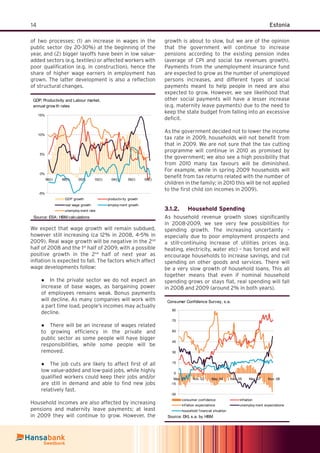
We are of the opinion that the decline in employment
will continue throughout 2008 and 2009 (ca 1-2%
in both years; major cuts expected this winter). The
unemploymentratedidnotgrowinthe1st
halfof2008
as it was possible to find new job quite easily, and
as there were many people who were of retirement
age and left the labour market (at least formally).
However, now the possibilities of finding a new job
have diminished and hence we see the number of
unemployed increasing and the unemployment
rate will increase to ca 7% in 2009 (annual average
rate). Increasingly more companies are planning to
cut jobs (according to a recent confidence survey
approximately 20-25% of companies) and in 2009
we expect cuts in the public sector as well. The
latter has already started in 2008, at first with
cutting vacancies, but we forecast actual cuts in
2009 and it is highly probable that in 2010 there will
no employment increases in the public sector.
Labour Market
0%
2%
4%
6%
8%
10%
12%
2004 2005 2006 2007 2008
0%
5%
10%
15%
20%
25%
Unemploy ment rate, %, s.a. (ls)
Gross nominal wage (3m av erage), y oy , rs
Real gross wage (3m av erage), y oy , rs
Source: Eurostat, ESA; HBM calculations
Labour Market Services, % to jobseekers
(3 month average)
0%
10%
20%
30%
40%
50%
60%
Mar.06 Sep.06 Mar.07 Sep.07 Mar.08 Sep.08
share of f ired among new claimants
share of newly employ ed
new job of f ers
v acancies
Source: Estonian Labour Board, HBM calculations
Wage growth has slowed significantly in 2008:
social tax revenues suggest that nominal gross wage
growth in September has slipped below 10% (which
means that real wage growth was negative). The
fact, that average wage has so far grown is a result
14 Estonia
of two processes: (1) an increase in wages in the
public sector (by 20-30%) at the beginning of the
year, and (2) bigger layoffs have been in low value-
added sectors (e.g. textiles) or affected workers with
poor qualification (e.g. in construction), hence the
share of higher wage earners in employment has
grown. The latter development is also a reflection
of structural changes.
GDP, Productivity and Labour market,
annual grow th rates
-5%
0%
5%
10%
15%
96(I) 98(I) 00(I) 02(I) 04(I) 06(I) 08(I)
GDP growth productiv ity growth
real wage growth employ ment growth
unemploy ment rate
Source: ESA; HBM calculations
We expect that wage growth will remain subdued,
however still increasing (ca 12% in 2008, 4-5% in
2009). Real wage growth will be negative in the 2nd
half of 2008 and the 1st
half of 2009, with a possible
positive growth in the 2nd
half of next year as
inflation is expected to fall. The factors which affect
wage developments follow:
In the private sector we do not expect an●
increase of base wages, as bargaining power
of employees remains weak. Bonus payments
will decline. As many companies will work with
a part time load, people’s incomes may actually
decline.
There will be an increase of wages related●
to growing efficiency in the private and
public sector as some people will have bigger
responsibilities, while some people will be
removed.
The job cuts are likely to affect first of all●
low value-added and low-paid jobs, while highly
qualified workers could keep their jobs and/or
are still in demand and able to find new jobs
relatively fast.
Household incomes are also affected by increasing
pensions and maternity leave payments; at least
in 2009 they will continue to grow. However, the
growth is about to slow, but we are of the opinion
that the government will continue to increase
pensions according to the existing pension index
(average of CPI and social tax revenues growth).
Payments from the unemployment insurance fund
are expected to grow as the number of unemployed
persons increases, and different types of social
payments meant to help people in need are also
expected to grow. However, we see likelihood that
other social payments will have a lesser increase
(e.g. maternity leave payments) due to the need to
keep the state budget from falling into an excessive
deficit.
As the government decided not to lower the income
tax rate in 2009, households will not benefit from
that in 2009. We are not sure that the tax cutting
programme will continue in 2010 as promised by
the government; we also see a high possibility that
from 2010 many tax favours will be diminished.
For example, while in spring 2009 households will
benefit from tax returns related with the number of
children in the family; in 2010 this will be not applied
to the first child (on incomes in 2009).
Household Spending3.1.2.
As household revenue growth slows significantly
in 2008-2009, we see very few possibilities for
spending growth. The increasing uncertainty –
especially due to poor employment prospects and
a still-continuing increase of utilities prices (e.g.
heating, electricity, water etc) – has forced and will
encourage households to increase savings, and cut
spending on other goods and services. There will
be a very slow growth of household loans. This all
together means that even if nominal household
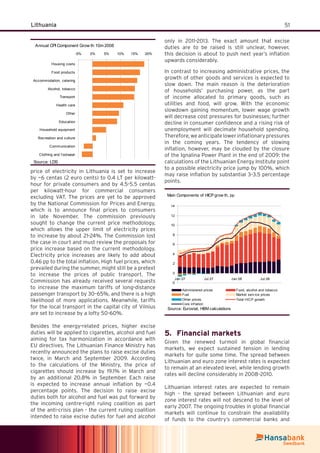
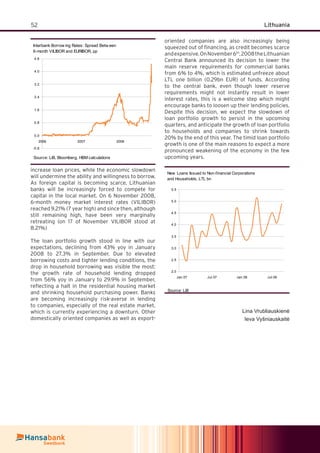
spending grows or stays flat, real spending will fall
in 2008 and 2009 (around 2% in both years).
Consumer Confidence Survey, s.a.
-30
-15
0
15
30
45
60
75
90
May .01 Nov .02 May .04 Nov .05 May .07 Nov .08
consumer conf idence inf lation
inf lation expectations unemploy ment expectations
household f inancial situation
Source: EKI, s.a. by HBM
15Estonia
We have seen households’ savings in the form of time
deposits growing as a precautionary measure in the
help of growing interest rates. However, everyday
savings (i.e. demand deposits) are declining,
pointing to the change in attitude: an interest rate
increase has made time deposits more attractive,
and households are not planning big purchases
in the next 3-6 months. The financial turbulence
in global markets may have affected the mood of
savers, but we are of the opinion that households
will not increase cash savings at home, at least not
permanently nor significantly.
Household Loans and Deposits, annual grow th
-20%
0%
20%
40%
60%
80%
100%
120%
2005 2006 2007 2008
mortage loans consumer loans
demand deposits time deposits
Source: EP, HBM calculations
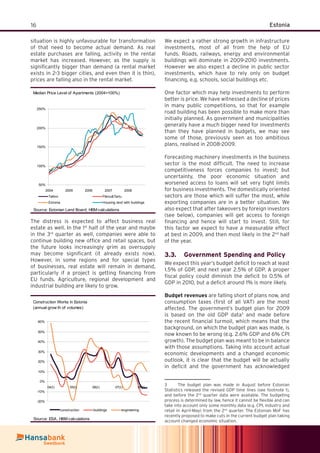
The gloomy outlook has made households carefully
plan their spending: we see that spending even on
everyday items like food can be affected (e.g. food
retail sales in September were down by 10% yoy).
Still, a decline in food purchases cannot be very
significant and long-term; it reflects most of all shifts
in consumption habits: e.g. preferring homemade
food vs. ready-made products, or making purchases
in open markets (directly from farmers) instead of
buying in shops. The purchases of non-food products
have declined the most, particularly of those related
to housing and those more expensive items (e.g.
furniture, cars etc). We also expect a decline in
catering services and other services due to a rapid
increase of prices, and of households’ efforts to
cut spending and balance their finances. This will
affect leisure purchases, tourism and other services
the most. It is likely that lower quality products
and services may suffer the most, as families with
average and bellow average income are those who
will cut spending the most.
Investments3.2.
Investments will decline in 2008 and 2009, but we
see a possibility of growth in the second half of
2009. If economic developments turn out be worse
than expected, particularly if foreign financing
is seriously limited, investments growth will be
expected only in 2010. Investments are and will be
affected by different and sometimes contradictory
factors in 2008-2010.
Annual Grow th of Investments
-30%
-20%
-10%
0%
10%
20%
30%
40%
total housing other
construction
machinery
etc
other
2004 2005 2006 2007 2008 1H
Source: Eurostat, HBM calculations
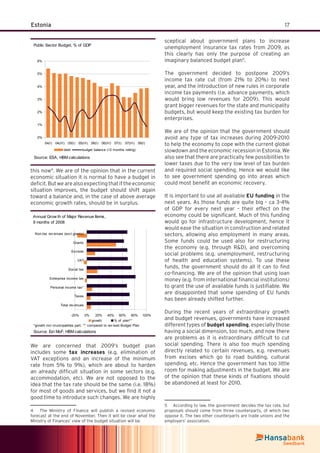
We expect distress in the residential real estate
market to continue throughout 2009, with slight
recovery possible in 2010. This means a decline
in price levels and fewer contracts; although we
forecast that price movements will be increasingly
variable depending on the property group and
location. The supply of residential real estate is
too large to be absorbed smoothly in one to two
years, especially taking into account the very slow
growth of incomes and tightened lending rules on
mortgages. The stress in the residential real estate
market, however, does not mean that necessity for
residential space will decline – just that the current
Household Consumption, annual grow th
-15%
-10%
-5%
0%
5%
10%
15%
20%
25%
30%
Oct.03 Jun.04 Mar.05 Nov .05 Aug.06 Apr.07 Jan.08 Sep.08
household consumption retail sales
f ood retail non-f ood retail
Source: ESA, HBM calculations
16 Estonia
situation is highly unfavourable for transformation
of that need to become actual demand. As real
estate purchases are falling, activity in the rental
market has increased. However, as the supply is
significantly bigger than demand (a rental market
exists in 2-3 bigger cities, and even then it is thin),
prices are falling also in the rental market.
Median Price Level of Apartments (2004=100%)
50%
100%
150%
200%
250%
2004 2005 2006 2007 2008
Tallinn Pärnu&Tartu
Estonia Housing land with buildings
Source: Estonian Land Board; HBM calculations
The distress is expected to affect business real
estate as well. In the 1st
half of the year and maybe
in the 3rd
quarter as well, companies were able to
continue building new office and retail spaces, but
the future looks increasingly grim as oversupply
may become significant (it already exists now).
However, in some regions and for special types
of businesses, real estate will remain in demand,
particularly if a project is getting financing from
EU funds. Agriculture, regional development and
industrial building are likely to grow.
We expect a rather strong growth in infrastructure
investments, most of all from the help of EU
funds. Roads, railways, energy and environmental
buildings will dominate in 2009-2010 investments.
However we also expect a decline in public sector
investments, which have to rely only on budget
financing, e.g. schools, social buildings etc.
One factor which may help investments to perform
better is price. We have witnessed a decline of prices
in many public competitions, so that for example
road building has been possible to make more than
initially planned. As government and municipalities
generally have a much bigger need for investments
than they have planned in budgets, we may see
some of those, previously seen as too ambitious
plans, realised in 2008-2009.
Forecasting machinery investments in the business
sector is the most difficult. The need to increase
competitiveness forces companies to invest; but
uncertainty, the poor economic situation and
worsened access to loans will set very tight limits
for business investments. The domestically oriented
sectors are those which will suffer the most, while
exporting companies are in a better situation. We
also expect that after takeovers by foreign investors
(see below), companies will get access to foreign
financing and hence will start to invest. Still, for
this factor we expect to have a measurable effect
at best in 2009, and then most likely in the 2nd
half
of the year.
Government Spending and Policy3.3.
We expect this year’s budget deficit to reach at least
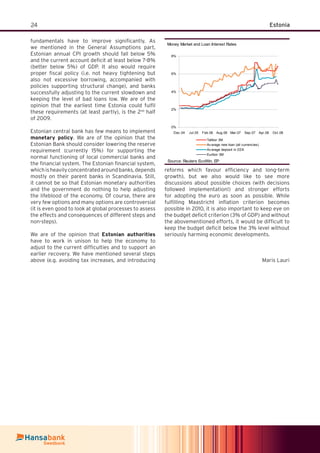
1.5% of GDP, and next year 2.5% of GDP. A proper
fiscal policy could diminish the deficit to 0.5% of
GDP in 2010, but a deficit around 1% is more likely.
Budget revenues are falling short of plans now, and
consumption taxes (first of all VAT) are the most
affected. The government’s budget plan for 2009
is based on the old GDP data3
and made before
the recent financial turmoil, which means that the
background, on which the budget plan was made, is
now known to be wrong (e.g. 2.6% GDP and 6% CPI
growth). The budget plan was meant to be in balance
with those assumptions. Taking into account actual
economic developments and a changed economic
outlook, it is clear that the budget will be actually
in deficit and the government has acknowledged
3 The budget plan was made in August before Estonian
Statistics released the revised GDP time lines (see footnote 1),
and before the 2nd
quarter data were available. The budgeting
process is determined by law, hence it cannot be flexible and can
take into account only some monthly data (e.g. CPI, industry and
retail in April-May) from the 2nd
quarter. The Estonian MoF has
recently proposed to make cuts in the current budget plan taking
account changed economic situation.
Construction Works in Estonia
(annual grow th of volumes)
-20%
-10%
0%
10%
20%
30%
40%
50%
60%
04(I) 05(I) 06(I) 07(I) 08(I)
construction buildings engineering
Source: ESA, HBM calculations
17Estonia
this now4
. We are of the opinion that in the current
economic situation it is normal to have a budget in
deficit.Butwearealsoexpectingthatiftheeconomic
situation improves, the budget should shift again
toward a balance and, in the case of above average
economic growth rates, should be in surplus.
Annual Grow th of Major Revenue Items,
9 months of 2008
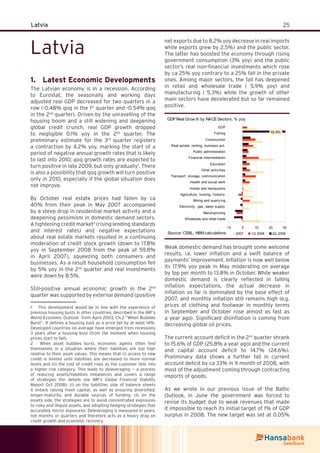
-20% 0% 20% 40% 60% 80% 100%
Total rev enues
Taxes
Personal income tax*
Enterprise income tax
Social tax
VAT
Excises
Grants
Non-tax rev enues (excl.grants)
growth % of plan**
Source: Est MoF; HBM calculations
*growth incl municipalities part; ** compared to rev ised Budget Plan
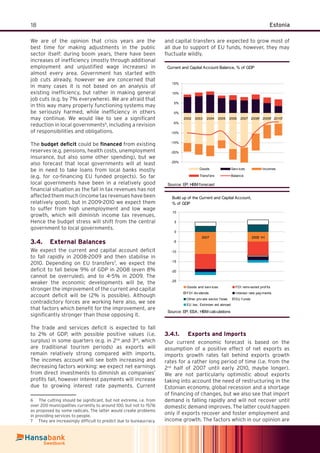
We are concerned that 2009’s budget plan
includes some tax increases (e.g. elimination of
VAT exceptions and an increase of the minimum
rate from 5% to 9%), which are about to harden
an already difficult situation in some sectors (e.g.
accommodation, etc). We are not opposed to the
idea that the tax rate should be the same (i.e. 18%)
for most of goods and services, but we find it not a
good time to introduce such changes. We are highly
4 The Ministry of Finance will publish a revised economic
forecast at the end of November. Then it will be clear what the
Ministry of Finances’ view of the budget situation will be.
sceptical about government plans to increase
unemployment insurance tax rates from 2009, as
this clearly has only the purpose of creating an
imaginary balanced budget plan5
.
The government decided to postpone 2009’s
income tax rate cut (from 21% to 20%) to next
year, and the introduction of new rules in corporate
income tax payments (i.e. advance payments, which
would bring low revenues for 2009). This would
grant bigger revenues for the state and municipality
budgets, but would keep the existing tax burden for
enterprises.
We are of the opinion that the government should
avoid any type of tax increases during 2009-2010
to help the economy to cope with the current global
slowdown and the economic recession in Estonia. We
also see that there are practically few possibilities to
lower taxes due to the very low level of tax burden
and required social spending. Hence we would like
to see government spending go into areas which
could most benefit an economic recovery.
It is important to use all available EU funding in the
next years. As those funds are quite big – ca 3-4%
of GDP for every next year – their effect on the
economy could be significant. Much of this funding
would go for infrastructure development, hence it
would ease the situation in construction and related
sectors, allowing also employment in many areas.
Some funds could be used also for restructuring
the economy (e.g. through R&D), and overcoming
social problems (e.g. unemployment, restructuring
of health and education systems). To use these
funds, the government should do all it can to find
co-financing. We are of the opinion that using loan
money (e.g. from international financial institutions)
to grant the use of available funds is justifiable. We
are disappointed that some spending of EU funds
has been already shifted further.
During the recent years of extraordinary growth
and budget revenues, governments have increased
different types of budget spending, especially those
having a social dimension, too much, and now there
are problems as it is extraordinary difficult to cut
social spending. There is also too much spending
directly related to certain revenues, e.g. revenues
from excises which go to road building, cultural
spending, etc. Hence the government has too little
room for making adjustments in the budget. We are
of the opinion that these kinds of fixations should
be abandoned at least for 2010.
5 According to law, the government decides the tax rate, but
proposals should come from three counterparts, of which two
oppose it. The two other counterparts are trade unions and the
employers’ association.
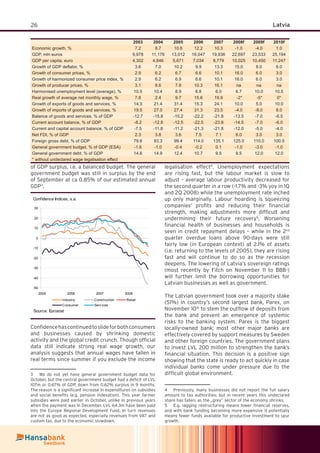
Public Sector Budget, % of GDP
0%
1%
2%
3%
4%
5%
6%
04(I) 04(III) 05(I) 05(III) 06(I) 06(III) 07(I) 07(III) 08(I)
debt budget balance (12 months rolling)
Source: ESA, HBM calculations
18 Estonia
We are of the opinion that crisis years are the
best time for making adjustments in the public
sector itself: during boom years, there have been
increases of inefficiency (mostly through additional
employment and unjustified wage increases) in
almost every area. Government has started with
job cuts already, however we are concerned that
in many cases it is not based on an analysis of
existing inefficiency, but rather in making general
job cuts (e.g. by 7% everywhere). We are afraid that
in this way many properly functioning systems may
be seriously harmed, while inefficiency in others
may continue. We would like to see a significant
reduction in local governments6
, including a revision
of responsibilities and obligations.
The budget deficit could be financed from existing
reserves (e.g. pensions, health costs, unemployment
insurance, but also some other spending), but we
also forecast that local governments will at least
be in need to take loans from local banks mostly
(e.g. for co-financing EU funded projects). So far
local governments have been in a relatively good
financial situation as the fall in tax revenues has not
affected them much (income tax revenues have been
relatively good), but in 2009-2010 we expect them
to suffer from high unemployment and low wage
growth, which will diminish income tax revenues.
Hence the budget stress will shift from the central
government to local governments.
External Balances3.4.
We expect the current and capital account deficit
to fall rapidly in 2008-2009 and then stabilise in
2010. Depending on EU transfers7
, we expect the
deficit to fall below 9% of GDP in 2008 (even 8%
cannot be overruled), and to 4-5% in 2009. The
weaker the economic developments will be, the
stronger the improvement of the current and capital
account deficit will be (2% is possible). Although
contradictory forces are working here also, we see
that factors which benefit for the improvement, are
significantly stronger than those opposing it.
The trade and services deficit is expected to fall
to 2% of GDP, with possible positive values (i.e.
surplus) in some quarters (e.g. in 2nd
and 3rd
, which
are traditional tourism periods) as exports will
remain relatively strong compared with imports.
The incomes account will see both increasing and
decreasing factors working: we expect net earnings
from direct investments to diminish as companies’
profits fall, however interest payments will increase
due to growing interest rate payments. Current
6 The cutting should be significant, but not extreme, i.e. from
over 200 municipalities currently to around 100, but not to 15/16
as proposed by some radicals. The latter would create problems
in providing services to people.
7 They are increasingly difficult to predict due to bureaucracy.
and capital transfers are expected to grow most of
all due to support of EU funds, however, they may
fluctuate wildly.
Current and Capital Account Balance, % of GDP
-25%
-20%
-15%
-10%
-5%
0%
5%
10%
15%
2002 2003 2004 2005 2006 2007 2008f 2009f 2010f
Goods Serv ices Incomes
Transf ers Balance
Source: EP; HBM forecast
Build up of the Current and Capital Account,
% of GDP
-25
-20
-15
-10
-5
0
5
10
2007 2008 1H
Goods and serv ices FDI reinv ested prof its
FDI div idends Interest rate pay ments
Other priv ate sector f lows EU f unds
EU tax, Estonian aid abroad
Source: EP, ESA; HBM calculations
Exports and Imports3.4.1.
Our current economic forecast is based on the
assumption of a positive effect of net exports as
imports growth rates fall behind exports growth
rates for a rather long period of time (i.e. from the
2nd
half of 2007 until early 2010, maybe longer).
We are not particularly optimistic about exports
taking into account the need of restructuring in the
Estonian economy, global recession and a shortage
of financing of changes, but we also see that import
demand is falling rapidly and will not recover until
domestic demand improves. The latter could happen
only if exports recover and foster employment and
income growth. The factors which in our opinion are
19Estonia
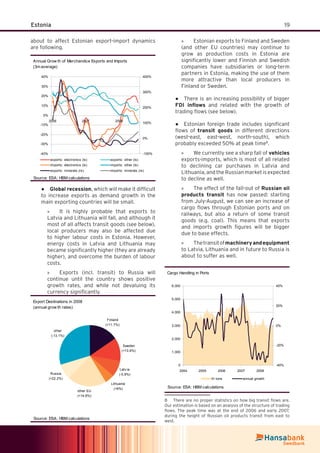
about to affect Estonian export-import dynamics
are following.
Annual Grow th of Merchandice Exports and Imports
(3m average)
-40%
-30%
-20%
-10%
0%
10%
20%
30%
40%
2006 2007 2008
-100%
0%
100%
200%
300%
400%
exports: electronics (ls) exports: other (ls)
imports: electronics (ls) imports: other (ls)
exports: minerals (rs) imports: minerals (rs)
Source: ESA; HBM calculations
Global recession● , which will make it difficult
to increase exports as demand growth in the
main exporting countries will be small.
It is highly probable that exports to»
Latvia and Lithuania will fall, and although it
most of all affects transit goods (see below),
local producers may also be affected due
to higher labour costs in Estonia. However,
energy costs in Latvia and Lithuania may
became significantly higher (they are already
higher), and overcome the burden of labour
costs.
Exports (incl. transit) to Russia will»
continue until the country shows positive
growth rates, and while not devaluing its
currency significantly.
Estonian exports to Finland and Sweden»
(and other EU countries) may continue to
grow as production costs in Estonia are
significantly lower and Finnish and Swedish
companies have subsidiaries or long-term
partners in Estonia, making the use of them
more attractive than local producers in
Finland or Sweden.
There is an increasing possibility of bigger●
FDI inflows and related with the growth of
trading flows (see below).
Estonian foreign trade includes significant●
flows of transit goods in different directions
(west-east, east-west, north-south), which
probably exceeded 50% at peak time8
.
We currently see a sharp fall of» vehicles
exports-imports, which is most of all related
to declining car purchases in Latvia and
Lithuania, and the Russian market is expected
to decline as well.
The effect of the fall-out of» Russian oil
products transit has now passed: starting
from July-August, we can see an increase of
cargo flows through Estonian ports and on
railways, but also a return of some transit
goods (e.g. coal). This means that exports
and imports growth figures will be bigger
due to base effects.
Thetransitof» machineryandequipment
to Latvia, Lithuania and in future to Russia is
about to suffer as well.
8 There are no proper statistics on how big transit flows are.
Our estimation is based on an analysis of the structure of trading
flows. The peak time was at the end of 2006 and early 2007,
during the height of Russian oil products transit from east to
west.
Export Destinations in 2008
(annual grow th rates)
Finland
(+11.7%)
Sweden
(+13.6%)
Lithuania
(+6%)
other EU
(+14.8%)
Russia
(+22.2%)
other
(-13.1%)
Latv ia
(-5.8%)
Source: ESA; HBM calculations
Cargo Handling in Ports
0
1,000
2,000
3,000
4,000
5,000
6,000
2004 2005 2006 2007 2008
-40%
-20%
0%
20%
40%
th tons annual growth
Source: ESA; HBM calculations
20 Estonia
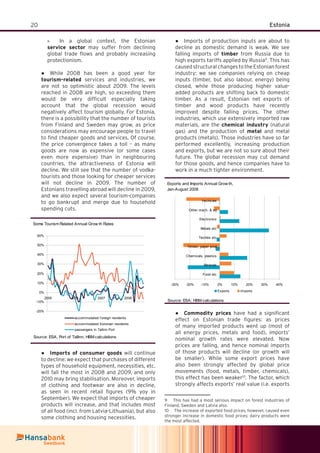
In a global context, the Estonian»
service sector may suffer from declining
global trade flows and probably increasing
protectionism.
While 2008 has been a good year for●
tourism-related services and industries, we
are not so optimistic about 2009. The levels
reached in 2008 are high, so exceeding them
would be very difficult especially taking
account that the global recession would
negatively affect tourism globally. For Estonia,
there is a possibility that the number of tourists
from Finland and Sweden may grow, as price
considerations may encourage people to travel
to find cheaper goods and services. Of course,
the price convergence takes a toll – as many
goods are now as expensive (or some cases
even more expensive) than in neighbouring
countries, the attractiveness of Estonia will
decline. We still see that the number of vodka-
tourists and those looking for cheaper services
will not decline in 2009. The number of
Estonians travelling abroad will decline in 2009,
and we also expect several tourism-companies
to go bankrupt and merge due to household
spending cuts.
Some Tourism Related Annual Grow th Rates
-20%
-10%
0%
10%
20%
30%
40%
50%
60%
2005 2006 2007 2008
accommodated f oreign residents
accommodated Estonian residents
passengers in Tallinn Port
Source: ESA, Port of Tallinn; HBM calculations
Imports of consumer goods● will continue
to decline: we expect that purchases of different
types of household equipment, necessities, etc.
will fall the most in 2008 and 2009, and only
2010 may bring stabilisation. Moreover, imports
of clothing and footwear are also in decline,
as seen in recent retail figures (9% yoy in
September). We expect that imports of cheaper
products will increase, and that includes most
of all food (incl. from Latvia-Lithuania), but also
some clothing and housing necessities.
Imports of production inputs are about to●
decline as domestic demand is weak. We see
falling imports of timber from Russia due to
high exports tariffs applied by Russia9
. This has
caused structural changes to the Estonian forest
industry: we see companies relying on cheap
inputs (timber, but also labour, energy) being
closed, while those producing higher value-
added products are shifting back to domestic
timber. As a result, Estonian net exports of
timber and wood products have recently
improved despite falling prices. The other
industries, which use extensively imported raw
materials, are the chemical industry (natural
gas) and the production of metal and metal
products (metals). Those industries have so far
performed excellently, increasing production
and exports, but we are not so sure about their
future. The global recession may cut demand
for those goods, and hence companies have to
work in a much tighter environment.
Exports and Imports Annual Grow th,
Jan-August 2008
-30% -20% -10% 0% 10% 20% 30% 40%
Food etc
Minerals
Chemicals, plastics
Timber, paper prod
Textiles etc
Metals etc
Electronics
Other mach. & eq
Vechicles
Exports Imports
Source: ESA; HBM calculations
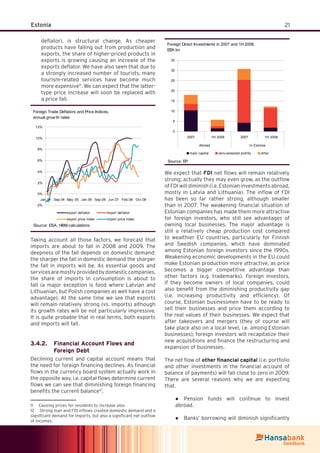
Commodity prices● have had a significant
effect on Estonian trade figures: as prices
of many imported products went up (most of
all energy prices, metals and food), imports’
nominal growth rates were elevated. Now
prices are falling, and hence nominal imports
of those products will decline (or growth will
be smaller). While some export prices have
also been strongly affected by global price
movements (food, metals, timber, chemicals),
this effect has been weaker10
. The factor, which
strongly affects exports’ real value (i.e. exports
9 This has had a most serious impact on forest industries of
Finland, Sweden and Latvia also.
10 The increase of exported food prices, however, caused even
stronger increase in domestic food prices; dairy products were
the most affected.
21Estonia
deflator), is structural change. As cheaper
products have falling out from production and
exports, the share of higher-priced products in
exports is growing causing an increase of the
exports deflator. We have also seen that due to
a strongly increased number of tourists, many
tourism-related services have become much
more expensive11
. We can expect that the latter-
type price increase will soon be replaced with
a price fall.
Foreign Trade Deflators and Price Indices,
annual grow th rates
-2%
0%
2%
4%
6%
8%
10%
12%
Jan.04 Sep.04 May .05 Jan.06 Sep.06 Jun.07 Feb.08 Oct.08
export def lator import def lator
export price index import price index
Source: ESA; HBM calculations
Taking account all those factors, we forecast that
imports are about to fall in 2008 and 2009. The
deepness of the fall depends on domestic demand:
the sharper the fall in domestic demand the sharper
the fall in imports will be. As essential goods and
servicesaremostlyprovidedbydomesticcompanies,
the share of imports in consumption is about to
fall (a major exception is food where Latvian and
Lithuanian, but Polish companies as well have a cost
advantage). At the same time we see that exports
will remain relatively strong (vs. imports) although
its growth rates will be not particularly impressive.
It is quite probable that in real terms, both exports
and imports will fall.
Financial Account Flows and3.4.2.
Foreign Debt
Declining current and capital account means that
the need for foreign financing declines. As financial
flows in the currency board system actually work in
the opposite way, i.e. capital flows determine current
flows we can see that diminishing foreign financing
benefits the current balance12
.
11 Causing prices for residents to increase also.
12 Strong loan and FDI inflows created domestic demand and a
significant demand for imports, but also a significant net outflow
of incomes.
Foreign Direct Investments in 2007 and 1H 2008,
EEK bn
0
5
10
15
20
25
30
35
2007 1H 2008 2007 1H 2008
Abroad In Estonia
main capital reinv estested prof its other
Source: EP
We expect that FDI net flows will remain relatively
strong; actually they may even grow, as the outflow
of FDI will diminish (i.e. Estonian investments abroad,
mostly in Latvia and Lithuania). The inflow of FDI
has been so far rather strong, although smaller
than in 2007. The weakening financial situation of
Estonian companies has made them more attractive
for foreign investors, who still see advantages of
owning local businesses. The major advantage is
still a relatively cheap production cost compared
to wealthier EU countries, particularly for Finnish
and Swedish companies, which have dominated
among Estonian foreign investors since the 1990s.
Weakening economic developments in the EU could
make Estonian production more attractive, as price
becomes a bigger competitive advantage than
other factors (e.g. trademarks). Foreign investors,
if they become owners of local companies, could
also benefit from the diminishing productivity gap
(i.e. increasing productivity and efficiency). Of
course, Estonian businessmen have to be ready to
sell their businesses and price them according to
the real values of their businesses. We expect that
after takeovers and mergers (they of course will
take place also on a local level, i.e. among Estonian
businesses), foreign investors will recapitalize their
new acquisitions and finance the restructuring and
expansion of businesses.
The net flow of other financial capital (i.e. portfolio
and other investments in the financial account of
balance of payments) will fall close to zero in 2009.
There are several reasons why we are expecting
that.
Pension funds will continue to invest●
abroad.
Banks’ borrowing will diminish significantly●
22 Estonia
(including both loans and deposits). They will
diminish their assets abroad.
The government is expected to use its●
foreign assets (i.e. reserves) and/or take loans
to finance the budget deficit.
Bigger companies and companies with●
significant foreign ownership will increase
borrowing abroad, directly or through their
owners.
As foreign borrowing will diminish, particularly by
banks, we expect foreign debt to decline in 2008
and 2009, and probably in 2010 as well. Although
that could diminish interest payments, we do not
expect that to happen as increased risk margins will
make borrowing more costly, and hence the interest
rate payments will not decrease in 2008 and 2009,
until Estonian country risk margins fall. We are of
the opinion that this may happen at best in the
2nd
half of 2009, but more likely in 2010. The clear
prospect of euro adoption could be the trigger for
falling risk margins.
Inflation4.
We expect inflation to slow rapidly in 2008-2009
due to contracting demand, falling global prices and
the end of the period of excessive administrative
price increases. We expect this year an average
consumer price inflation to be ca 10.4% (annual
growth in December to fall below 8%), in 2009
ca 4.5% and in 2010 less than 3%. Sharper price
corrections are expected in construction, the retail
sector and some other industries. Factors which
will affect price developments in 2008-2010 are
following.
Declining domestic demand● will force
many companies to cut their prices. Price
cuts are expected in construction (ca 40%
of companies), services and manufacturing
according to a recent confidence survey; only
the retail sector is still of the opinion they can
increase prices, but the retail sector has so far
been very reluctant to accept problems13
. We
are of the opinion that at least in next year retail
prices will fall (for some goods it has already
started).
13 For example, retail sales have been falling since March, but
confidence started to fall only in July. One reason may be that
they look at turnover, which is in current prices, and due to very
strong price increases in the 2nd
half of 2007 and early 2008 they
did not realize immediately that the situation was weakening.
The other reason is that competition in the retail sector has
fallen due to consolidation, and the third is that competition in
wholesales is very weak due to a very high concentration in some
sub-sectors (e.g. there are 1-2 wholesalers, which supply 40-60%
of total sales of particular types of good).
Weakening pressure from● global prices
will lower production costs, and allow cutting
of sales prices in Estonia. Of course, much
will depend on competition. We have seen a
significant decline in gasoline and diesel prices
in October (our estimates suggest ca 20% fall
from mid-September), and that should also
affect prices of transport services. We are
sceptical that regulated public transport tariffs
will be lowered, but expect that increases
might not be not very strong. It is currently
unclear whether heating tariffs will be lowered
in 2009 when natural gas prices fall. There is
a political will to force the cut, however the
legal ramifications remain unclear, and due to
the monopoly in supply (Gazprom to Estonian
Gas, where it has ownership), it might be rather
difficult. Still, we are of the opinion that some
cut will happen at least in the next heating
period (2009-2010) due to public pressure and
competition (consumers will shift to cheaper
heating options – it cannot be done promptly,
but requires some investment14
).
The period of extensive● tax increases is
over with the last increases of excise rates on
tobacco and alcohol in July 2008 (the actual
increaseofpricestookplaceinAugust-October).
Although some VAT rates will be increased from
200915
, their effect on the overall price level will
14 We see this investment area as one with possible growth
prospects. Taking into account the need to cut energy
consumption and increase the efficient use of energy in the long
term, the government should make this process easier through
financial support (e.g. guarantees). The use of EU funding could
be one option for encouraging housing societies to make such
types of changes.
15 A preferable rate will be applied on books, school workbooks,
medicines, printed media and accommodation (tax rate
increase from 5% to 9%). A common 18% rate will be applied
to funeral services and goods, waste and garbage handling, and
Annual Grow th of Harmonized Index of
Consumer Prices
-5%
0%
5%
10%
15%
20%
25%
30%
35%
2004 2005 2006 2007 2008
HICP Food
Base inf lation Energy
Source: Eurostat
23Estonia
be minimal (see also Government Spending and
Policy). We do not expect other tax increases in
2009 and 2010.
Other administrative increases● (i.e.
heating, public transport, water etc) are
expected to be relatively small in the face of
coming municipal elections in October 2009.
However, the 4th
quarter of 2008 and the 1st
quarter of 2009 are about to bring some of
them, and are rather extensive. For example,
heating tariffs were increased in the 3rd
quarter
due to the strongly increased energy prices in
the 1st
half of the year, but many of them having
been forced since October. As we mentioned
above, it is possible that heating tariffs could
be lowered in 2009, but it is not certain. Prices
of many municipal services have been indexed
and are expected to increase in early 2009
(e.g. water, waste collection). We also expect
an increase of electricity tariffs, although in
2009 this will be relatively small. We hope
that central and local governments will find a
common understanding that administrative
price increases should be avoided during a
period of economic crisis, and in attempt to
fulfil Maastricht inflation criterion.
Price Grow th of some items as of September 2008
-10% 0% 10% 20% 30% 40% 50% 60%
Food
Alcohol
Tobacco
Actual rentals
Water, ref uce, sewerage etc
Electricity
Gas
Heat energy
Fuels etc f or priv ate cars
Transport serv ices
Base inf lation
y oy 12 months av erage
Source: Eurostat
The convergence process will slow down in 2008-
2010 for Estonia, however it is not granted that
inflation will fall below that of euro zone or the
EU. The fulfilling of Maastricht inflation criterion
becomes possible in 2010, however that also
requires that the criterion itself will not fall too low
(as happened in late 2004 and early 2005 when it
was barely over 2%; currently around 4%).
performance and concert activities.
Financial Markets and5.
Monetary Policy
The developments of the financial sector have
become crucial for economic development in
Estonian as in other countries. We forecast a
continued slowdown of lending and savings in
2008-2009. The activity is expected to increase
in 2010, although there are slim hopes for a better
performance as soon as the 2nd
half of 2009.
Estonian banks have financed their lending activity
mostly from foreign borrowing and as this money
was cheap (due to borrowing from parent banks,
but also due to lower capital requirements in the
case of branches). Lending activity in Estonia was
excessively aggressive in the period 2004-2006.
The situation has changed significantly for now,
as banks have to rely more on domestic resources,
which are smaller and more expensive. Deposit
interest rates have grown to attract more savings,
and it is quite likely that they will not fall soon
despite falling interest rates in the euro zone.
Annual Grow th of Loan Porfolio
10%
20%
30%
40%
50%
60%
70%
80%
2005 2006 2007 2008
total enterprises households
Source: EP
Lending activity will remain low, both because of
smaller supply and weaker demand. The latter is
affected by high uncertainties and declining demand
in Estonia and its main trading countries, but also
becauseofsignificantlytightenedlendingconditions.
We can already see that loan turnover has been
falling for some time already (for mortgages starting
from July 2007), but we do not expect the process
to end soon. If Estonian banks are forced to rely
only on local funding, lending activity will continue
to decline, and the process will be sharper than it
has been so far. The recovery of lending will depend
on foreign funding – how much and in what price it
is available. We are of the opinion that, being among
the badly valued countries now, Estonian economic
24 Estonia
fundamentals have to improve significantly. As
we mentioned in the General Assumptions part,
Estonian annual CPI growth should fall below 5%
and the current account deficit at least below 7-8%
(better below 5%) of GDP. It also would require
proper fiscal policy (i.e. not heavy tightening but
also not excessive borrowing, accompanied with
policies supporting structural change), and banks
successfully adjusting to the current slowdown and
keeping the level of bad loans low. We are of the
opinion that the earliest time Estonia could fulfil
these requirements (at least partly), is the 2nd
half
of 2009.
Estonian central bank has few means to implement
monetary policy. We are of the opinion that the
Estonian Bank should consider lowering the reserve
requirement (currently 15%) for supporting the
normal functioning of local commercial banks and
the financial system. The Estonian financial system,
whichisheavilyconcentratedaroundbanks,depends
mostly on their parent banks in Scandinavia. Still,
it cannot be so that Estonian monetary authorities
and the government do nothing to help adjusting
the lifeblood of the economy. Of course, there are
very few options and many options are controversial
(it is even good to look at global processes to assess
the effects and consequences of different steps and
non-steps).
We are of the opinion that Estonian authorities
have to work in unison to help the economy to
adjust to the current difficulties and to support an
earlier recovery. We have mentioned several steps
above (e.g. avoiding tax increases, and introducing
reforms which favour efficiency and long-term
growth), but we also would like to see more
discussions about possible choices (with decisions
followed implementation!) and stronger efforts
for adopting the euro as soon as possible. While
fulfilling Maastricht inflation criterion becomes
possible in 2010, it is also important to keep eye on
the budget deficit criterion (3% of GDP) and without
the abovementioned efforts, it would be difficult to
keep the budget deficit below the 3% level without
seriously harming economic developments.
Maris Lauri
Money Market and Loan Interest Rates
0%
2%
4%
6%
8%
Dec.04 Jul.05 Feb.06 Aug.06 Mar.07 Sep.07 Apr.08 Oct.08
Talibor 3M
Av erage new loan (all currencies)
Av erage deposit in EEK
Euribor 3M
Source: Reuters EcoWin, EP
25Latvia
Latvia
Latest Economic Developments1.
The Latvian economy is in a recession. According
to Eurostat, the seasonally and working days
adjusted real GDP decreased for two quarters in a
row (-0.48% qoq in the 1st
quarter and -0.54% qoq
in the 2nd
quarter). Driven by the unravelling of the
housing boom and a still widening and deepening
global credit crunch, real GDP growth dropped
to negligible 0.1% yoy in the 2nd
quarter. The
preliminary estimate for the 3rd
quarter registers
a contraction by 4.2% yoy, marking the start of a
period of negative annual growth rates that is likely
to last into 2010; qoq growth rates are expected to
turn positive in late 2009, but only gradually1
. There
is also a possibility that qoq growth will turn positive
only in 2010, especially if the global situation does
not improve.
By October real estate prices had fallen by ca
40% from their peak in May 2007 accompanied
by a steep drop in residential market activity and a
deepening pessimism in domestic demand sectors.
A tightening credit market2
(rising lending standards
and interest rates) and negative expectations
about real estate markets resulted in a continuing
moderation of credit stock growth (down to 17.8%
yoy in September 2008 from the peak of 59.8%
in April 2007), squeezing both consumers and
businesses. As a result household consumption fell
by 5% yoy in the 2nd
quarter and real investments
were down by 8.5%.
Still-positive annual economic growth in the 2nd
quarter was supported by external demand (positive
1 This development would be in line with the experience of
previous housing busts in other countries, described in the IMF’s
World Economic Outlook from April 2003, Ch.2 “When Bubbles
Burst”. It defines a housing bust as a price fall by at least 14%.
Developed countries on average have emerged from recessions
3 years after a housing bust (from the moment when housing
prices start to fall).
2 When asset bubbles burst, economic agents often find
themselves in a situation where their liabilities are too high
relative to their asset values. This means that (i) access to new
credit is limited until liabilities are decreased to more normal
levels and (ii) the cost of credit rises as the customer falls into
a higher risk category. This leads to deleveraging — a process
of reducing assets/liabilities imbalances and covers a range
of strategies (for details see IMF’s Global Financial Stability
Report Oct 2008): (i) on the liabilities side of balance sheets
it entails raising fresh capital, as well as ensuring diversified,
longer-maturity, and durable sources of funding; (ii) on the
assets side, the strategies are to avoid concentrated exposures
to risky and illiquid assets, and adopting hedging strategies that
accurately mirror exposures. Deleveraging is measured in years,
not months or quarters and therefore acts as a heavy drag on
credit growth and economic recovery.
net exports due to 8.2% yoy decrease in real imports
while exports grew by 2.5%) and the public sector.
The latter has boosted the economy through rising
government consumption (3% yoy) and the public
sector’s real non-financial investments which rose
by ca 25% yoy contrary to a 25% fall in the private
ones. Among major sectors, the fall has deepened
in retail and wholesale trade ( 5.9% yoy) and
manufacturing ( 5.3%) while the growth of other
main sectors have decelerated but so far remained
positive.
GDP Real Grow th by NACE Sectors, % yoy
-10 0 10 20 30
Wholesale and retail trade
Manuf acturing
Electricity , gas, water supply
Mining and quarry ing
Agriculture, hunting, f orestry
Hotels and restaurants
Health and social work
Transport, storage, communication
Other activ ities
Education
Financial intermediation
Public administration
Real estate, renting, business act.
Construction
Fishing
GDP
2007 1Q 2008 2Q 2008Source: CSBL; HBM calculations
42.9%
Weak domestic demand has brought some welcome
results, i.e. lower inflation and a swift balance of
payments’ improvement. Inflation is now well below
its 17.9% yoy peak in May moderating on average
by 1pp per month to 13.8% in October. While weaker
domestic demand is clearly reflected in falling
inflation expectations, the actual decrease in
inflation so far is dominated by the base effect of
2007, and monthly inflation still remains high (e.g.
prices of clothing and footwear in monthly terms
in September and October rose almost as fast as
a year ago). Significant disinflation is coming from
decreasing global oil prices.
The current account deficit in the 2nd
quarter shrank
to 15.6% of GDP (25.8% a year ago) and the current
and capital account deficit to 14.7% (24.6%).
Preliminary data shows a further fall in current
account deficit by ca 33% in 9 month of 2008, with
most of the adjustment coming through contracting
imports of goods.
As we wrote in our previous issue of the Baltic
Outlook, in June the government was forced to
revise its budget due to weak revenues that made
it impossible to reach its initial target of 1% of GDP
surplus in 2008. The new target was set at 0.05%
26 Latvia
of GDP surplus, i.e. a balanced budget. The general
government budget was still in surplus by the end
of September at ca 0.85% of our estimated annual
GDP3
.
Confidence Indices, s.a.
-50
-40
-30
-20
-10
0
10
20
30
2005 2006 2007 2008
Industry Construction Retail
Consumer Serv ices
Source: Eurostat
Confidencehascontinuedtoslideforbothconsumers
and businesses caused by shrinking domestic
activity and the global credit crunch. Though official
data still indicate strong real wage growth, our
analysis suggests that annual wages have fallen in
real terms since summer if you exclude the income
3 We do not yet have general government budget data for
October, but the central government budget had a deficit of LVL
107m or 0.67% of GDP, down from 0.62% surplus in 9 months.
The reason is a significant increase in expenditures on subsidies
and social benefits (e.g. pension indexation). This year farmer
subsidies were paid earlier in October, unlike in previous years
when the payment was in December. LVL 64.3m have been paid
into the Europe Regional Development Fund. In turn revenues
are not as good as expected, especially revenues from VAT and
custom tax, due to the economic slowdown.
legalisation effect4
. Unemployment expectations
are rising fast, but the labour market is slow to
adjust – average labour productivity decreased for
the second quarter in a row (-1.7% and -3% yoy in 1Q
and 2Q 2008) while the unemployment rate inched
up only marginally. Labour hoarding is squeezing
companies’ profits and reducing their financial
strength, making adjustments more difficult and
undermining their future recovery5
. Worsening
financial health of businesses and households is
seen in credit repayment delays – while in the 2nd
quarter overdue loans above 90-days were still
fairly low (in European context) at 2.1% of assets
(i.e. returning to the levels of 2005), they are rising
fast and will continue to do so as the recession
deepens. The lowering of Latvia’s sovereign ratings
(most recently by Fitch on November 11 to BBB-)
will further limit the borrowing opportunities for
Latvian businesses as well as government.
The Latvian government took over a majority stake
(51%) in country’s second largest bank, Parex, on
November 10th
to stem the outflow of deposits from
the bank and prevent an emergence of systemic
risks to the banking system. Parex is the biggest
locally-owned bank; most other major banks are
effectively covered by support measures by Sweden
and other foreign countries. The government plans
to invest LVL 200 million to strengthen the bank’s
financial situation. This decision is a positive sign
showing that the state is ready to act quickly in case
individual banks come under pressure due to the
difficult global environment.
4 Previously, many businesses did not report the full salary
amount to tax authorities, but in recent years this undeclared
share has fallen, as the „grey” sector of the economy shrinks.
5 E.g. lagging restructuring means lower financial reserves,
and with bank funding becoming more expensive it potentially
means fewer funds available for productive investment to spur
growth.
2003 2004 2005 2006 2007 2008f 2009f 2010f
Economic growth, % 7.2 8.7 10.6 12.2 10.3 -1.0 -4.0 1.0
GDP, mln euros 9,978 11,176 13,012 16,047 19,936 22,697 23,533 25,194
GDP per capita, euro 4,302 4,846 5,671 7,034 8,779 10,025 10,450 11,247
Growth of GDP deflator, % 3.6 7.0 10.2 9.9 13.3 15.0 8.0 6.0
Growth of consumer prices, % 2.9 6.2 6.7 6.6 10.1 16.0 6.0 3.0
Growth of harmonized consumer price index, % 2.9 6.2 6.9 6.6 10.1 16.0 6.0 3.0
Growth of producer prices, % 3.1 8.6 7.8 10.3 16.1 na na na
Harmonised unemployment level (average), % 10.5 10.4 8.9 6.8 6.0 6.7 10.0 10.5
Real growth of average net monthly wage, % 7.8 2.4 9.7 15.6 19.9 -2* -5* 0*
Growth of exports of goods and services, % 14.3 21.4 31.4 15.3 24.1 10.0 5.0 10.0
Growth of imports of goods and services, % 19.5 27.0 27.4 31.3 23.5 -4.0 -8.0 8.0
Balance of goods and services, % of GDP -12.7 -15.8 -15.2 -22.2 -21.8 -13.5 -7.0 -6.5
Current account balance, % of GDP -8.2 -12.8 -12.5 -22.5 -23.8 -14.5 -7.0 -6.0
Current and capital account balance, % of GDP -7.5 -11.8 -11.2 -21.3 -21.8 -12.0 -5.0 -4.0
Net FDI, % of GDP 2.3 3.8 3.6 7.5 7.1 6.0 3.0 3.0
Foreign gross debt, % of GDP 79.6 93.3 99.4 114.0 135.1 125.0 110.0 100.0
General government budget, % of GDP (ESA) -1.6 -1.0 -0.4 -0.2 0.1 -1.0 -3.0 -1.0
General government debt, % of GDP 14.6 14.9 12.4 10.7 9.5 9.5 12.0 12.0
* without undeclared wage legalisation effect
27Latvia
Highlights of the Forecast2.
Since the previous Baltic Outlook global financial
and economic environment has gone from worrying
to bad, with an ever-faster deepening and widening
of the liquidity squeeze in financial markets, and
resulting in a largely inevitable protracted recession
in major advanced economies (see General
Assumptions). Even if the credit crunch is alleviated
by the gigantic efforts of major central banks and
governments, demand in Latvia’s main export
markets is expected to be very weak throughout
2009. Via indirect (e.g. significantly more expensive
external funding) and direct (e.g. weaker export
growth and lower profit margins) linkages, the global
backdrop will force the slowdown in the Latvian
economy to be sharper, deeper, and longer; the
subsequent pick up in growth will be significantly
weaker than previously expected. Along with export
dynamics, developments in the real estate sector will
be the main determinants of the depth and length of
recession. In 2008 we forecast GDP to contract by
ca 1% yoy. The recession is expected to run through
2009 with GDP contracting by ca 2-5%. It is very
likely that the actual result will be in the lower end
of the interval at ca 4%. We maintain our earlier
warning that with weakening growth and currently
observed revenue shortfalls, the 2008 budget is
likely to slip into deficit by 1-2% of GDP.
We see a strong downside risk for an even deeper
contraction if developments in global financial
markets and economies are worse than expected.
The situation in the Latvian economy may become
more complicated if local financial institutions
become extremely cautious and cut lending heavily,
as this would deepen the drop in consumption and
investments even more.
Our baseline scenario forecasts a stabilization in
2010 with GDP growth in the range of -1% to 2%
yoy. The recovery in growth is expected to be
export-driven as domestic demand will be slowed
down by deleveraging and flow of resources away
from non-tradable to tradable sectors. Household
consumption is expected to contract throughout
2008-2009 along with falling real wages and rising
unemployment – from the current 6.5% to 11-12%.
In quarterly terms household consumption might
start to grow in 2010, but it will decrease or stay
flat for the year as a whole. Investment is expected
to contract throughout 2009 as uncertainty and
borrowing costs remain high and profit margins low;
activity is forecast to revive in early 2010, as the
advanced EU economies start to recover from their
recessions.
Real Grow th of GDP, % yoy
-20
-10
0
10
20
30
2004 2005 2006 2007 2008f 2009f 2010f
GDP Households consumption
Gov ernment consumption Gross f ixed capital f ormation
Exports Imports
Source: CSBL; HBM calculations and forecast
On the positive side, the current account deficit is
forecast to improve and inflation to retreat faster.
Though a global slowdown will cut into export
growth, a drop in imports due to domestic demand
contraction will be sharper and the current account
deficit is expected to improve from ca 14.5% in 2008
to 6-7% in 2009–2010. We cautiously estimate EU
structural funds inflows to be ca 2-3% of GDP per
annum and a net FDI ca 2% of GDP. Thus additional
external loan financing necessity decreases from ca
6% of GDP in 2008 to only 1-2% in 2009–2010. From
ca 16% in 2008, average annual consumer price
inflation in 2009 is expected to moderate to ca 6%,
slipping to ca 3% yoy by the end of the year, but it
could also come close to zero. The main reasons are
deeper domestic demand contraction, and lower
global energy and food prices. After heating and
gas costs rise in October, monthly inflation will fall
to very low levels; the seasonal deflation in summer
will be longer and deeper in 2009. In 2010 average
consumer price inflation is forecast to remain at ca
3%, but deflation is not a distant possibility.
Economic Growth3.
Now it is clear that the adjustment process will take
more time than expected previously. Household
consumption – the former main driver of the
economy – is contracting very rapidly and will
continue to do so, thus forcing restructuring in
internal demand sectors. The impetuses for shifting
from non-tradable sectors to tradable ones are not
yet strong enough to restart economic growth. The
labour market is slow to adjust, hiring opportunities
are still limited, and while the global demand
environment is worsening, limiting investments
through higher costs of borrowing and impairing
external demand puts export growth opportunities
under a question mark. The global turmoil will lead
28 Latvia
to a sharper slowdown and slower recovery in the
shadow of high uncertainty. The turbulence in
financial markets in September-October suggests
global instability is a long-term concern.
The future development of the Latvian economy
largely depends on productivity growth. Until now
economic growth was mainly extensive, i.e. based on
employing more capital and people, but the increase
of efficiency, i.e. using capital and labour better,
using more productive machinery and equipment
has been relatively small6
. So there might be
inefficiencies that can be eliminated relatively easily.
It will largely depend on managerial competence,
including how successful companies are in using
existing capacities for different purposes than
initially planned (e.g. shifting focus from domestic
market to external one). The increasing cost of
capital and a more difficult business environment
could be reasons for changes in the production.
Layoffs in previously overheated sectors will lead to
a temporary unemployment surge to double-digit
levels, thus enabling growing enterprises to attract
qualified employees – a very difficult task just a year
ago.
Household Consumption and3.1.
Incomes
We have revised our forecasts downwards for real
household consumption growth. The contraction
in the last two quarters of the year is expected to
be steep, at ca 7-9% yoy, which would lead to a
decrease of ca 3.5% overall in 2008. The decrease
6 The “smart” part of growth or more efficient use of capital
and labour is known as “total factor productivity (TFP)” growth.
It has been relatively small in Latvia; the share of TFP growth
in total GDP growth has been the lowest among new member
states.
is expected to extend until mid-2010. In 2009 the
contraction is expected to be in the range of 5-9%
(in the previous forecast a decrease of 1-3%) with
the outcome depending on the global situation;
currently we lean towards the lower side of the range
(ca 8%). The 2nd
half of 2010 might bring a slight
recovery but overall for 2010 we expect a slight
decrease or no change in annual terms (-2 to 0%),
however, as indicated before, qoq growth might turn
positive. Thus the share of household consumption
in GDP will gradually return to the pre-boom average
of 65% (the housing boom was most pronounced
between 2005 and 2007).
Households' Consumption, % of GDP
55%
60%
65%
70%
75%
2000
2001
2002
2003
2004
2005
2006
2007
2008f
2009f
2010f
Source: CSBL; HBM calculations and forecasts
The main reasons for decreasing households’
consumption will remain the same but they will
certainly grow stronger in late 2008 and 2009:
Real wage contraction● : as nominal wage
growth falls rapidly while inflation still remains
high in 2008, we expect the real average net
wages to decrease by ca 3-5%. This is our
forecast for wages that excludes the income
legalization effect (an overall shift towards
full declaration of income to tax authorities)
while official statistics will likely show still-high
nominal wage growth rates, thus increasing
real income. For 2009 we expect real wages
to contract further by 3-6% as nominal
wage growth is virtually absent, but average
inflation will fall to about a third of this year’s
level. If businesses are just now starting to
adapt to the changing environment by cutting
expenses, then next year this process will be in
full swing and will affect a bigger part of the
working population. Along with a recovery in
the economy and a further decrease in the
inflation rate we expect real income to grow
again slightly (by up to ca 2%) in 2010.
Capital / Labour Ratio and Total Factor Productivity,
yoy %
-4
-2
0
2
4
6
8
10
12
1997 1998 1999 2000 2001 2002 2003 2004 2005 2006 2007 1H
2008
Av erage labour productiv ity Capital / labour
Total f actor productiv ity
Source: CSBL, Eurostat; HBM calculations
29Latvia
Labour Market Indicators
-8%
-4%
0%
4%
8%
12%
16%
20%
24%
02 (I) 03 (I) 04 (I) 05 (I) 06 (I) 07 (I) 08 (I)
0%
2%
4%
6%
8%
10%
12%
14%
Harmonised unemploy ment rate, n.s.a. (r.s.)
Labour productiv ity growth, y oy (l.s.)
Of f icial real net wage growth, y oy (l.s.)
Source: CSBL, Eurostat; HBM calculations
Rising unemployment:● we expect
unemployment to continue to grow reaching
ca 7% by the end of this year i.e., 6.7% on
average in 2008. In 2009 unemployment is
expected to grow faster, reaching on average
ca 10% and peaking at 11-12% in late 2009 or
early 2010. In 2010 it will gradually retreat but
the annual average will still remain high, at
ca 11%. For companies the overall economic
slowdown means smaller profits resulting in
slower job creation. We can already see this in
falling number of vacancies – in annual terms
vacancies have been falling since 4Q 2007. This
process will go on further as companies face a
decrease in productivity and are anxious to cut
expenses including labour costs. Job creation
in export sectors is likely to decrease as well –
interest rates are growing, thus increasing costs
along with the global slowdown limits export
sales. So far the participation rate has been
rising as the number of economically inactive
people has decreased, boosting employment
growth. Yet, as more and more companies
are announcing layoffs, we can expect a
rather sharp rise in unemployment that will
directly put downward pressure on wages and
consumption, thus creating a risk of a further
increase in unemployment — i.e., a downward
spiral in internal demand sectors.
Debt reduction:● As interest rates rise and
credit standards tighten due to the global credit
crunch, consumers’ ability and willingness
to get credit will fade away rapidly, putting a
strong downward pressure on consumption.
The effect of higher interest rates is intensified
by deepening uncertainty regarding the future
economic situation and possible timing of a
recovery, making banks more cautious about
the earnings prospects of their clients. The
ratio of household credit to GDP is expected to
decrease in 2008 and also in 2009, despite an
almost stagnant GDP in nominal terms. Thus
household spending will fall more rapidly than
real income, helping to stabilise the financial
situation of many households, but at the
expense of an additional drag on an already
weak economy.
Resident Households' Credit vs. Savings, % of GDP
-10
0
10
20
30
40
50
2000 2001 2002 2003 2004 2005 2006 2007 1H
2008
Credit Sav ings
Source: FCMC, Eurostat; HBM calculations
Slowdown in emigrants’ countries:● The
main emigrant destinations – the economies
of Ireland and the UK – are facing very bleak
prospects due to bursting housing bubbles
and the strong reliance of these countries
on financial sector export revenues. There
is anecdotal evidence of Latvian workers
in Ireland loosing jobs, a high proportion of
which were in construction. This will result in
lower remittances to families in Latvia. We do
not expect large scale emigration due to the
diminished employment opportunities in Latvia
as it will be much more difficult to find jobs also
in Western Europe.
Government Spending and Policy3.2.
The Latvian government has to achieve two
contradictory goals in next year’s budget. On one
hand, it would be desirable, if during the recession,
fiscal policy could turn more expansionary to
maintain internal demand. On the other hand, a
budget deficit may increase the private sector’s
cost of borrowing, thus deepening the recession.
Given the conditions in financial markets, the cost of
borrowing even for the government would be high.
We think that the right balance would be keeping
the budget deficit below, but close to, 3% of GDP, as
this would improve the chances of joining the euro
30 Latvia
earlier if inflation goes down rapidly as we indeed
expect it will. 3% is also a psychologically important
threshold for financial markets.
General Budget, Annual Growth Rates %
2005 2006 2007 9M
2008
9M of
annual
plan
Net revenues 26.7 25.7 33.5 15.6 69.8
Tax revenues 26.3 30.3 34.4 16.5 72.6
Personal income tax 16.9 29.1 35.1 19.9 73.0
Social tax 17.1 28.1 37.7 25.4 74.0
Corporate income tax 41.3 40.5 57.5 27.9 74.0
VAT 39.1 37.4 29.3 -0.7 69.4
Excises 31.2 16.6 22.3 23.4 75.1
Customs 12.2 7.6 34.4 -2.1 65.0
Non-tax revenues 19.3 13.1 21.7 10.8 73.8
Net expenditures 25.7 24.4 28.0 23.4 65.5
Current expenditures 21.9 23.3 27.5 26.9 67.3
Capital expenditures 53.8 39.3 40.6 14.2 52.9
Budget balance, % of GDP -0.4 -0.2 0.1 0.9 -
Source: State Treasury, State Revenue Service; HBM calculations
The government has submitted a budget draft
for 2009 with a 1.85% deficit of GDP, based on
an extremely optimistic GDP forecast (+2%) and
exaggerated inflation (9.8%) that is also “good”
for revenues. However the Minister of Finance
has already committed to cutting spending and to
work on the assumption that the Latvian economy
will be in recession, with real GDP growing by -1%,
which is more reasonable but still quite optimistic.
We think that the budget should be balanced if this
assumption is used, to create room for manoeuvre
in case the situation deteriorates.
At the same time cutting expenditures important
for long term growth (like co-financing EU funds and
export payment guarantee fund) must be avoided.
The biggest deficit reduction opportunities lay in
current expenditure items (89.9% of total planned
budget outlays in 2008) by boosting efficiency.
Currently, employment in the government sector
is significantly higher than the EU average.
Cutting public sector employment, and not only by
eliminating vacancies, would free up more resources
than lowering investment.
Althoughitisdifficulttoseeincurrentcircumstances
how to finance the promised tax cuts aimed at
stimulatinginvestment–theexemptionofreinvested
profits from corporate tax, for example – this goal
should not be abandoned as the overall tax burden
has increased from 27.2% in 2004 to 31.3% in 2007
and has remained high in 2008.
Investment3.3.
If in the 4th
quarter of 2007 and the 1st
quarter of
2008 investments shrank through a decline in
stocks, the 2nd
quarter 2008’s contraction also came
from gross fixed capital formation (-6.8% yoy).
Unexpectedly strong growth in gross fixed capital
formation in the 1st
quarter was followed by a fall in
the 2nd
and thus did not fulfil our expectations of a
moderate overall decrease in 2008. Hence we have
lowered our gross fixed capital formation forecast
substantially, expecting a decrease of 8-10% in
2008. A similar fall in annual terms will continue
further in 2009 with a wider range of 6-10% due to
rising uncertainty.
InvestmentasashareofGDPhasbeenunsustainably
high in Latvia (gross fixed capital formation was
32.5% of GDP in 2007) and it will fall during the
recession due to its inherently pro-cyclical nature.
We expect that investment will shrink rapidly in
certain internal demand sectors like trade, personal
and business services, and housing construction.
Prospects are much better in road construction,
the supply of heat, water and electricity, agriculture
and export manufacturing, partly (in case of road
construction – largely) thanks to EU funds.
The more specific reasons will be a sharp drop in
corporate profits (these grew extremely rapidly
during the upswing) and the increasing cost of
financing. The decline in investment will make raising
productivity a more difficult but not impossible
task.
A recovery in investment is expected in 2010,
showing a growth of 2-4% which is slower than was
expected before (4-6%). Recovery will be slowed
down by rising costs of borrowing and a stronger
global slowdown that will limit sales and profits,
thus reducing its own funding for investments.
There could be upside surprises if the availability
of workers and low wages attract investments by
manufacturing companies.
General Government Revenues and Expenditures,
% of GDP
25
30
35
40
45
2000 2001 2002 2003 2004 2005 2006 2007 2008f 2009f
Total rev enues Tax rev enues Expenditures
Source: MoF
31Latvia
External Demand and Balance of3.4.
Payments
Although imports are falling more rapidly than
expected while nominal exports continue to grow
(thus improving the current account balance), lower
than expected GDP will keep the current account
deficit as a percent of GDP higher than in our
summer forecasts. We have increased the current
account deficit forecast range to 14-16% of GDP in
2008 from 13-15% before. 2009 is expected to bring
swifter improvement in the current account with a
deficit shrinking to 6-9% of GDP with continuing
improvement in 2010 to 5-8%. A faster decrease
in external imbalances is expected, due to a faster
improvement in the trade balance as contracting
domestic demand and decreasing global prices will
cut imports significantly. Even though the outlook
for exports is quite uncertain, it is clear that exports
will perform better than imports as the decrease of
domestic demand will be deep, but export demand
will be relatively stable.
Current Account, % of GDP
-30
-25
-20
-15
-10
-5
0
5
10
1996
1997
1998
1999
2000
2001
2002
2003
2004
2005
2006
2007
2008f
2009f
2010f
Trade in goods and serv ices Compensation of employ ees
Interest (debt and portf olio) Div idends
Transf ers Current account
Source: LaB; HBM calculations and forecast
The growth of the nominal export of goods and
services is forecasted to reach 10 11% in 2008, in
turn imports will contract by 3 5%. It has to be noted
that imports have fallen across the board, except
for mineral products (mostly energy) and food that
rose only due to price, not volume increase. In the
coming quarters price and volume trends for these
goods will complement each other in a downward
direction. On the contrary, most export sectors
saw gains, except for timber due to troubles in the
construction sector, and for textiles due to a long-
term structural decline. The research of the Bank
of Latvia also shows that market shares in major
export destinations (with the exception of the UK)
have continued to rise, despite the problematic real
exchange rate trends and unit labour costs. Latvian
businesses have kept their market share through
increasing the value added.
Unit Labour Cost and Real Effective Exchange Rate,
1Q 2004 = 100
60
100
140
180
220
260
2004 (I) 2005 (I) 2006 (I) 2007 (I) 2008 (I)
ULC REER (CPI based)
Source: LaB, CSBL; HBM calculations
Latvia's Share in Countries Imports, 2001-
2007, 1H 2008, %
0,0
0,1
0,2
0,3
0,4
0,5
European
Union
Germany
Sweden
Denmark
United
Kingdom
Finland
Poland
Russia
Source: LaB
0
2
4
6
8
Estonia
Lithuania
Due to the worsening global environment, exports
might shrink in real terms but perhaps grow in
nominal terms, at least for 2009 as a whole, if not
in all quarters. The fall in imports will deepen to
5-9% as domestic demand contracts swiftly. 2010 is
expected to bring a recovery with exports growing
by 9-11% and imports by 8-10%. Exports growth will
be largely dependent on the pace of global recovery
while imports will be on investment growth.
Unlike in 2005-2007 when external borrowing
increased by up to 20% of GDP annually, in 2009
little debt financing is expected or indeed needed.
We believe that EU funds and (an admittedly
reduced) FDI will cover most external financing
needs, leaving a gap of ca 1-2% of GDP that can be
32 Latvia
covered by government borrowing, bank borrowing
or selling foreign assets (72.2% of GDP in June
2008, excluding FDI).
Financing of Current Account Deficit, % of GDP
-20
-10
0
10
20
30
40
1996
1997
1998
1999
2000
2001
2002
2003
2004
2005
2006
2007
2008f
2009f
2010f
Capital account Financing shortf all
FDI retained earnings FDI new capital
Short-term MFI's capital Short-term others capital
Long-term MFI's capital Long-term others capital
LaB reserv es Current account def icit
Source: LaB; HBM calculations and forecast
The factors with a positive impact on exports are:
Exports to countries other than the EU●
and CIS since April have been growing at a
much higher pace and, in particular months,
have ensured a positive annual nominal growth
for total exports of goods. The share of these
markets increased from 9.4% in 1Q to 13.3%
in 3Q, or from LVL 100.9 to 153.7 million in
absolute terms. This is a sign that exporters are
trying harder to find markets7
while demand
is still high, to compensate for the weakening
demand in EU countries. Economic cycles are
not synchronised all over the world, therefore
demand decrease in main partner countries
can be offset by growing demand elsewhere.
Exports supporting measures● of the
macroeconomic stabilization plan (e.g. export
credit guarantee system, investment in trade
missions abroad and others) are expected to
give first results in 2009.
Despite rapid wage increases in recent●
years, salaries in manufacturing are still
lower in Latvia compared to northern and
western Europe; the difference is still typically
measured in times, not percentages. For
manufacturing companies able to achieve at
least similar productivity levels, this promises
very good profitability.
In 2008● productivity has declined due to
7 Latvian exports to “exotic” markets can fluctuate very
rapidly. In 2008 Peru emerges almost from nowhere, buying
1.8% of total Latvian exports in 8M or 10% of metal exports.
cyclical factors but recent history shows that
the Latvian economy is able to sustain rapid
(5-7%) annual productivity growth rates.
Growth rates of service exports and imports have
moderated; however exports still grow faster
than imports keeping the services balance at
surplus. Export growth so far has been mostly
driven by transportation (mainly railroad and road
transportation) and other services (the major
contribution came from business services: legal
services, consulting, accounting, advertising and
trade-related services). Although their growth rates
will moderate as overall economic activity shrinks,
we still see the export potential of these services
continue to grow as:
Latvia will continue to benefit from its●
favourable geographic position. We think
that Russia will maintain or even increase the
Imports of Goods, LVLm
0 300 600 900 1200
Machines, equipment
Mineral products
Food, agricultural prod.
Metal etc.
Transport
Chemical products
Textiles, wearing, leather
Plastics
Pulp and paper
Building materials
Wood, etc.
Furniture
Optical instruments
Other
9M 2007 9M 2008Source: CSBL
-50 0 50 100
Annual Grow th, %
Exports of Goods, LVLm
0 200 400 600
Metal etc.
Wood, etc.
Food, agricultural prod.
Machines, equipment
Chemical products
Transport
Textiles, wearing, leather
Mineral products
Plastics
Furniture
Building materials
Pulp and paper
Other
Optical instruments
9M 2007 9M 2008Source: CSBL
-20 0 20 40 60
Annual Grow th, %
33Latvia
amount of raw material exports to offset the
impact of price falls.
Foreign companies may find it cheaper to●
use Latvian outsourcing services for particular
activities, so saving on labour costs.
The future of leisure travel exports looks less
favourable as this sector will most likely feel
consumers’ willingness to cut spending on non-
essential services.
The service import dynamics will be mostly
dependent on:
travel services: the demand for leisure●
travel will be cut by consumer pessimism; the
impact of business travel will perhaps be close
to neutral.
business services will most likely grow as●
Latvian companies strive to increase their
efficiency
construction, which in turn will likely lose its●
significance as demand decreases further.
The decrease in current transfer outflows continues
as expected, but inflows have weakened, therefore
we have lowered our current transfers’ surplus
forecast. For 2009 we expect a decrease in both
inflows and outflows to continue as the major
part of transfers are “undisclosed transfers of the
private sector” that might largely be transfers
from long term migrants. As Latvia’s economy
slips into recession and global activity slows, the
ability of migrants to transfer money home will
be lower. Yet the transfers account will still be in
surplus as inflows exceed outflows significantly.
We have marginally lowered the deficit in income
account forecast due to the lower outflow. Rising
interest rates will increase debt servicing costs, but
decreasing economic activity will reduce profits
and thus the outflow of dividends. The forecast of
the capital account for 2008 is raised to ca 2.4%
of GDP (from 1.7% previously) thanks to continuing
inflows of EU funds as projects planned during the
previous Financial Framework (2004-2006) are
being completed. We retain the forecast of 1-2% of
GDP for 2009-2010.
We have raised our net FDI forecast for 2008 to ca
6% of GDP (4.5% before) as the data of the 1st
half
of the year showed stable net FDI inflow, of which
28.4% are retained earnings. For 2009-2010 we
expect the net FDI to decrease to ca 3% of GDP (4.5%
in summer forecasts) as the decrease in economic
activity will reduce profits. There could be pleasant
surprises if foreign manufacturers are attracted by
theavailabilityandlowcostoflocallabour.Theglobal
recession could also have a positive effect through
forcing companies in western and northern Europe
to cut costs more actively, thus shifting production
location. However, assuming that net FDI stands at
3% and inflow of EU funds is ca 2.5% of GDP, the
remaining shortfall in current account financing
is expected to stand at ca 5.5% of GDP in 2008
and decrease to ca 1.5% in 2009 and 1% in 2010.
This shortfall can be financed either by decreasing
foreign assets, increasing liabilities (government
and bank borrowing) or decreasing foreign reserves
of the central bank (18.4% of annual GDP in June 30,
2008). Any method will increase net foreign debt,
but very slowly, compared to recent trends. As the
nominal GDP will change very little, the debt-to-GDP
levels will stay broadly the same.
If the adjustment is not sufficiently fast and
convincing to creditors, there is a risk that financing
will be very limited, leading to a faster contraction
of internal demand, imports and GDP. We do not
expect rapid capital outflow from Latvia, as the
external liability structure includes a high share
of long-term capital – FDI and long-term loans,
which cannot be withdrawn rapidly. The amount of
short term liabilities of Latvian commercial banks
is manageable and the liquidity and solvency of
the banking system by far exceeds the minimum
requirements; liquidity at the end of 2Q, 2008
was 50.7% (it has to be at least 30%) and capital
adequacy was 12.7% (vs. 8% required).
Monetary Issues4.
Inflation4.1.
We retain our average consumer price inflation
forecast for 2008 at ca 16%, forecasting a slowdown
to 6% and 3% on average for following years. The
annual inflation has been decreasing gradually
since May 2008 when a peak was reached. Inflation
will continue to decrease due to decreasing inflation
expectations, weakening purchasing power of
consumers and resulting in lower demand pressures,
and global financial instability (decreasing oil prices).
For 2009 we have lowered our previous forecast
to ca 6% as domestic demand and global price
pressures weaken more rapidly. As the economy
enters deeper into recession, opportunities to raise
prices will be limited and in some sectors attempts
to maintain sales may even lead to deflation. In 2010
price growth is expected to stabilize; we lower our
previous average inflation forecast to ca 3% due
to a very slow emergence from recession locally
and global deflationary pressures. At that moment
the pricing power of companies and labour will be
very weak. There is a significant probability that the
Latvian economy will sink into a deflationary spiral,
which is a dangerous prospect given the overall
level of debt8
.
8 Economists sometimes speak about “good” and “bad”
deflation, the good being driven by technological change and
34 Latvia
Contributions to CPI Average Annual Grow th, pp
-2
0
2
4
6
8
10
12
14
16
18
20
2002 2003 2004 2005 2006 2007 2008
(I)
2008
(II)
2008
(III)
Food, bev erages Housing
Transport Alcohol, tobacco
Hotels, restaurants Communications
Other Core inf lation
Total inf lation, qoq growth
Source: CSBL, LaB; HBM calculations
There have been widespread suspicions about
the growing pricing power in areas with high or
increasing market concentration, like the supply of
energy, retailing of food and fuel. However, the most
“unexplainable” price rises have often occurred in
areas with many small players – sales of clothing,
catering, and personal services. This suggests that
companies were simply maximising profit in an
overheating economy and/or forced to raise prices
by exploding labour costs. Whatever the reasons
are for earlier “excessive” price rises, it is clear that
the pricing power of both labour and companies is
disappearing fast.
The annual growth of producer prices in the first 9
months of 2008 remained stable, slightly fluctuating
around 12%. Annual price growth for locally sold
and exported products, starting from the vastly
different levels of 19% and 2.3% respectively
in April, has converged sharply, reaching 14.3%
and 8.8% respectively in September. Previously
producers were able to raise prices more in local
markets due to strong domestic demand, thus
compensating rising costs. This year decreasing
domestic demand forces producers to keep the
price growth more moderate (in July and September
there was even monthly deflation), therefore the
annual price growth has slowed down substantially.
In turn prices on exported products until August
2008 grew faster than in the previous year, leading
to swift rise in annual growth rates from May 2008.
Such a strong growth might be explained by growing
world prices. Yet the opportunity to keep high price
growth for exported products soon will fade as other
countries experience a decrease in price growth
as well and the threat of deflation increases. The
strong competition. However, there is no such thing as good
deflation for a debtor (thus often also for his lender) as it raises
the credit risk.
monthly export price decrease in September 2008
shows that external demand cannot absorb the
price growth anymore. As demand pressures will
weaken substantially both domestic and external
markets, we expect a continuos and rapid decrease
in producer price inflation.
Exchange Rate, Interest Rates4.2.
and Credit Growth
The Bank of Latvia continues to ease the
monetary policy. Starting from October 24, reserve
requirements have been cut for liabilities over
2 years from 6% to 5% and for other liabilities
from 8% to 7%.9
On November 13 the central
bank decreed that both these requirements will be
lowered again on November 24 and December 24 by
1 pp each time. A further easing of monetary policy
is very likely as domestic demand retreats and the
economy needs additional stimulus. Nevertheless,
the situation in the financial market remains volatile.
The lats interest rates have risen sharply since the
end of September (to 11.5% 3M RIGIBOR in October
from the average level of previous 3 months of ca
6%) due to money outflows (e.g. caused by debt
service) and uncertainty related to foreign exchange
intervention. Consequently a 3-month Euribor and
Rigibor spread jumped to more than 600bp as euro
rates remained stable.
EUR/LVL Spot Rate and LaB Interventions
0.691
0.694
0.697
0.700
0.703
0.706
0.709
0.712
0.715
Jan.06 Jul.06 Feb.07 Aug.07 Mar.08 Sep.08
-150
-100
-50
0
50
100
150
Interv ention, m LVL (r.s.) EUR/LVL (l.s.)
Higher/Lower band (l.s.)
Source: LaB, Reuters
However, a successful speculative attack on
currency is impossible as financial markets are tiny
even for the size of the economy. This was evident
in February and May 2007 when speculative attacks
on LVL/EUR rate failed. The lats touched the upper
band on October 1 and The Bank of Latvia had to
intervene by selling ca EUR 335m (i.e. ca. 7% of
the reserves) by the end of October. Furthermore,
9 In 2008 LaB cut reserve requirement from 8% to 7%
effective from February 24 and to 6% from April 24.
35Latvia
part of this amount has been exchanged through
currency forward deals. If the forwards are not
rolled over, some counterparties may be forced to
buy LVL back. This had been the case also in 2007,
as in times of turbulence the LVL forward market
shuts down completely.
In theory, devaluation as a policy tool could be
used to reduce imports and to cut wages in foreign
currency terms to restore competitiveness of
exporters. However, there is no need to restore
competitiveness now as external imbalances and
cost growth are already slowing. These trends are
already described elsewhere in this document, but
the most important points are summarised below:
goods imports are already contracting●
rapidly (by ca 15% in real terms in 3Q),
export competitiveness remains good.●
Latvia has retained and even boosted its share
in key trade partners’ imports despite the
growing unit labour cost and real effective
exchange rate.
the bargaining power of employees and●
pricing power of companies is weakening
rapidly so there is no risk of the erosion of
competitiveness in the near future
Any benefits would be overshadowed by negative
consequences, e.g. a strong inflationary effect.
Devaluation would also produce a deep negative
shock on households and businesses as the amount
of foreign currency denominated loans stands at ca
80% of GDP (ca 90% of domestic credit), and lats
denominated deposits at ca 21% of GDP.
Interbank Interest Rates, %
-2
0
2
4
6
8
10
12
14
Jul.06 Nov .06 Mar.07 Jul.07 Nov .07 Mar.08 Jul.08 Nov .08
3m Rigibor-Euribor spread
RIGIBOR on
RIGIBOR 3m
EURIBOR 3m
LaB ref inancing rate
LaB marginal deposit f acility rate
Source: LaB, Reuters
The cost of borrowing continued to rise, pushing the
average weighted euro loan interest rate up to 7.8%
in September from 6.5% in January. Rising interest
rates along with lower real income growth, rising
unemployment, higher uncertainty regarding future,
as well as expectations of a real estate price fall
make a further credit growth slowdown inevitable.
The amount of loans issued to resident households
increased only by 12% yoy in September (35.6% in
January), the respective numbers for non-financial
institutions were 22.9% (35.4%). The growth of
loans to households is moderating faster than that
to non-financial institutions.
Grow th of Loans to Households and Non-financial
Institutions
0%
10%
20%
30%
40%
50%
60%
70%
80%
90%
Jan.06 Jul.06 Jan.07 Jul.07 Jan.08 Jul.08
0%
1%
2%
3%
4%
5%
6%
7%
Households, mom (r.s.)
Non-f inancial institutions, mom (r.s.)
Households, y oy (l.s.)
Non-f inancial institutions, y oy (l.s.)
Source: LaB; HBM calculations
The outlook for credit growth remains unchanged
– credit growth will continue to moderate in 2008,
slipping into negative numbers in 2009. This will
decrease credit stock as a percentage of GDP.
The adjustment in the economy is likely to go
through higher real interest rates as nominal rates
will continue to grow while inflation will retreat.
ECB policy rates and Euribor are expected to fall
significantly, but Latvia’s risk premiums most likely
will continue to grow. Real interest rates are at the
core of the adjustment mechanism, as higher real
rates will lower consumption and thus will help to
shift the economy from non-tradable to tradable
sectors.
Mārtiņš Kazāks
Ivonna Slapiņa
Dainis Stikuts
Pēteris Strautiņš
36 Latvia
37Lithuania
Lithuania
Latest Economic Developments1.
The economic expansion during 2008, as expected,
has been continuously weakening. In 3Q 2008 real
annual GDP growth declined to 3.1%. Preliminary
indicators point to a decline in industrial and retail
sales (which is a proxy for household consumption)
growth rates, while value added by the agriculture
andservicessectorsprovidedacushionforeconomic
growth. The drop in the growth rate was also partly
determined by the strong comparative base: real
GDP rose by a solid 10.8% yoy in 3Q 2007.
The revised data of economic growth in 2Q 2008
pointed to a rate of 5.2% yoy. Domestic demand
continued to support GDP growth. Some of its
component growth rates, however, were visibly
lower compared to the previous year: though
government spending rose by 5.4% yoy (1pp more
than in 2Q 2007), household consumption expanded
by a mere 7.5% yoy (5pp less than a year ago), and
investment growth was already negative (-2.3%,
investments increased by 26.4% yoy in 2Q 2007)
in the second quarter, earlier than expected. This
shows that weaker economic growth prospects are
reducing expected returns on investment and are
already undermining marginal investment plans.
The weaker domestic demand, however, resulted in
an improvement of the country’s current account
balance statistics: in the 2nd
quarter, the current
account deficit fell to 16.8% of GDP (17.5% a year
ago, 18.8% in 1Q 2008) due to the decline in the trade
deficit (imports of goods and services increased by
23.4% yoy, while exports surged by 30.6% yoy).
As expected, consumer price inflation reached a
peak of 12.5% yoy in June. In 3Q 2008 the annual
CPI growth gradually declined from 12.2% yoy in
July to 11% in September, mainly reflecting a slower
rise of transport prices. Elevated inflation has
already reduced the growth of real wages and has
contributed to the decline of household purchasing
power. The annual growth of real wages (after
taxes) declined to 11.7% in the second quarter of the
year (21.8% a year before), although nominal wages
continued to soar (25.2% yoy). Tensions in the
labour market continued to ease in the 3rd
quarter.
The rating agency Standard & Poor’s cut the long-
term sovereign ratings for Lithuania from A- to
BBB+ on October 27th
, while outlook was kept
negative. According to the agency, the decision
to lower the ratings reflects expectations that the
Lithuanian government, facing its first recession
since the country´s independence, has few policy
options but to increase fiscal deficits and raise its
debt burden. The negative outlook, according to
the agency, reflects the increasing risk of a hard
landing – specifically the risk of a downturn that
could reduce employment substantially, increase
private sector insolvencies, and significantly worsen
the public sector balance sheet in a short period
of time. Lowering of Lithuania’s sovereign ratings
will further inhibit the borrowing opportunities for
Lithuanian businesses and the government. The
short–term ratings were affirmed at A-2.
Politics1.1.
Lithuania’s main right-wing conservative opposition
party won the majority of votes in the first (October
12th
) and second round of general elections (October
23rd
). The main opposition party, the Homeland
Union, won about 32% of votes (45 out of 141 seats in
parliament), while the governing Social Democrats
came in second capturing 26 seats (though after the
first round they were pushed to fourth place by two
rival populist parties). The National Revival Party,
led by a former talent show host, received 11.3%
of votes (16 seats), and impeached ex-President
Rolandas Paksas’ Order and Justice won 10.6% (15
seats).
The Homeland Union, the National Resurrection
Union, and two other centre-right parties signed an
agreement outlining the formation of a new ruling
coalition. The Social Democrats’ four partners in
the current coalition government failed to break
the 5% barrier to remain in parliament. The Social
Democrats were in power since 2001, but have
recently lost their popularity due to the currently
weakening economic situation in Lithuania. Turnout
among Lithuania’s 2.6 million registered voters
reached 43% in the first round, down one point
compared to four years ago, and 27% in the second
round.
The partners in the future ruling coalition
announced that they agreed with the current ruling
majority on the 2009 budget approval to be carried
out by the new parliament. According to the future
ruling coalition, the budget will reflect the current
economic difficulties facing Lithuania: cancellation
of various privileges and exemptions will be the
key source for the government to save close to LTL
2bn (EUR 579m), at the same time enabling it not
to cut social allowances. After high government
expenditures in the previous years, an more prudent
approach overall to spending is highly needed. The
new government is expected to begin work at the
end of November, while the new budget plan is
expected to be ready in mid December. The new
government is likely to face the daunting task of not
only having to develop an effective anti-crisis plan,
38 Lithuania
but restoring household and company confidence in
the economy as well.
Energy Issues1.2.
During the recent parliamentary election, voters
also took part in a non-binding referendum on
whether to shut Ignalina’s Chernobyl-style nuclear
power plant, but figures suggested the referendum
to be invalid due to the low turnout. As part of its
deal to join the EU in 2004, Lithuania agreed to
close Ignalina by the end of 2009. Although the
leading Social Democratic party attempted to
initiate negotiations with the EC on the possibility
of keeping the plant open until 2012, based on the
argument that nuclear fuel will remain in the plant
until 2012 regardless of the plant being shut down or
not, the European Commission has not changed its
position. Just before the referendum the European
Commission rejected a proposal for the plant to
remain open until 2012, however, it implied that it is
ready to provide more support if proved necessary
in order to shut down the plant by the end of 2009.
It is becoming increasingly clear that the plant
will in fact be shut down as agreed. As the plant
provides 70% of Lithuania’s electricity, and the
replacement of Ignalina is unlikely before 2015, the
main electric power producers in the country will
be thermoelectric power stations, including the
biggest power station, located in Elektrenai. This
means that the main raw material from the start of
2010 for production of electric power in Lithuania
will be natural gas imported from Russia. The price
of electric power produced by Elektrenai PS (power
station) is four times higher than the price of the
electric power produced by the main electric power
supplier so far – the Ignalina PS. Thus, significant
electricity price increases are in line for 2010.
Highlights of the Forecast2.
We have made significant revisions to our forecast
as the downturn the of the Lithuanian economy
will be deeper and longer due to the stronger than
expected negative changes in the global economy
and financial markets as well as the unraveling
sentiment of all Lithuania’s economic agents.
We forecast Lithuania’s economic growth to fall to
4.5% this year (previously - 6%) and to ca 0.5% next
year (5.5%) due to weaker household consumption
and falling investments. Price pressures and rising
costs, declining business and consumers’ optimism,
the tightening of credit conditions and negative
changes in the global environment will slow down
the economy more than previously anticipated. The
still strong price growth and weak confidence is a
major reason for the decline in household spending,
while companies are hurt by growing costs and
weaker domestic demand.
We expect significant changes in the labour market
as well. We retained our forecast for this year,
expecting the unemployment rate to rise from its
current level of 4.5% (2Q 2008) to ca 5%, and have
also altered the forecast for next year expecting
unemployment rate to reach 6.5% (previously
5.8%). As tensions in the labour market ease faster
than anticipated, the pressure on wages will decline
as well: we forecast real wage growth to reach 1.4%
(the 9% nominal net wage growth next year will be
eroded by the still elevated inflation). At the same
time we have increased this year’s real wage growth
forecast to 9.5% (previously 8.6%), as wage growth
in the first half of the year turned out stronger than
anticipated.
The elevated inflation is expected to remain a
medium-term problem. First, energy price shocks
2003 2004 2005 2006 2007 2008f 2009f 2010f
Economic growth, % 10.2 7.4 7.8 7.8 8.9 4.5 0.5 0.5
GDP, mln euros 16,452 18,159 20,870 23,978 28,423 33,385 34,726 35,249
GDP per capita, euros 4,776 5,285 6,113 7,065 8,420 9,940 10,386 10,585
Growth of industrial sales, % 16.1 10.8 7.1 7.3 4.0 5.0 2.0 2.0
Growth of GDP deflator, % -0.8 2.5 6.6 6.5 8.8 12.4 3.5 1.0
Growth of consumer prices, % -1.1 1.2 2.7 3.7 5.7 11.4 8.7 5.0
Growth of harmonized consumer price index, % -1.1 1.2 2.7 3.8 5.8 11.5 8.8 5.0
Growth of producer prices, % -0.5 6.0 11.5 7.4 7.0 21.0 8.0 4.5
Harmonized unemployment level, % 12.4 11.4 8.3 5.6 4.3 5.3 6.5 6.7
Growth of real net wage, % 9.3 4.9 6.8 14.9 17.7 9.5 1.4 0.7
Growth of exports of goods and services, % 6.2 12.0 27.0 17.9 9.2 19.0 7.0 7.0
Growth of imports of goods and services, % 6.9 14.2 26.1 23.1 15.9 16.0 4.0 7.0
Balance of goods and services, % of GDP -5.7 -7.0 -7.2 -10.3 -13.4 -11.9 -10.3 -10.8
Current account, % of GDP -6.8 -7.7 -7.1 -10.6 -14.6 -12.8 -9.5 -10.0
Current and capital account, % of GDP -6.4 -6.4 -5.8 -9.5 -12.8 -11.0 -7.7 -8.0
FDI inflow, % of GDP 1.0 3.4 4.0 6.0 5.2 3.6 3.6 4.0
Foreign gross debt, % of GDP 40.5 42.4 50.7 60.2 72.3 73.8 76.7 74.6
General government budget position, % of GDP -1.3 -1.5 -0.5 -0.4 -1.2 -2.0 -3.0 -2.5
General government debt, % of GDP 21.1 19.4 18.4 18.0 17.0 16.0 17.0 16.5
39Lithuania
are expected to be significant over the medium
term: central heating tariffs were increased in
autumn this year, consumer gas and electricity
prices will be increased in the beginning of 2009.
Consumer prices will continue to grow rapidly in
the following months, mostly due to higher central
heating prices; however, weaker demand will cause
price growth to abate to some extent next year. We
expect consumer price inflation to reach 11.4% on
average (previously 11.9%) this year. We have altered
our inflation expectations taking into account the
weaker than previously assumed external pressures
(oil and food prices most of all). We retained our
8.7% inflation forecast for 2009, as significant
administrative prices increases are in line, namely
higher excise duties for tobacco, alcohol and fuel, as
well as administrative increases in the electricity and
gas prices. At the same time we are of the opinion
that the tight financial situation of consumers will
not allow demand factors to influence price levels
strongly.
Less dynamic export growth is expected due to
the tumbling global growth (favourable inflation
differential and relative price developments
compared to CIS, however, may continue to
benefit export growth for some time (see General
Assumptions)). On the other hand, deeper domestic
demand contraction will cut imports more, which will
result in an improvement in the trade and services
balance and subsequently improve current account
balance statistics. We have kept our 12.8% of GDP
current account deficit expectation for this year;
next year, however, we expect the CAD to improve
faster than previously anticipated – to 9-10% of
GDP.
We have included the negative effect of the Ignalina
nuclear power plant (NPP) closure in 2010 into
our main scenario, as negotiations with the EC on
Ignalina NPP closure have been unsuccessful. The
decommissioning of the nuclear power plant by
the end of 2009 will cause a large energy deficit
from 2009-2012 until the replacement source1
is
partly completed. The existing alternative power
plant (Lithuanian Power Plant in Elektrenai) meets
only 7% of Lithuania’s energy consumption, and
the deficit will be covered by imports from 2010.
Electricity prices may double their current levels due
to the more expensive imported electricity, higher
environmental requirements and pollution (CO2)
costs for heating oil, as well as electricity excise
duties (to come into force on from 2010). Since
electricity costs are input costs for practically all
goods and services, other prices inevitably will jump
and knock off GDP growth, unless the production
1 It is expected that new modern units planned to be built at the
Lithuanian Power Plant in Elektrenai could help bring electricity
prices down. However, the construction of the new units will not
be completed before 2012.
mix shifts and Lithuania moves up the value chain.
We forecast an upturn in Lithuania’s economy cycle
no earlier than 2011-2012.
Economic Grow th and Inflation
6.6% 6.9%
10.3%
7.3%
7.9% 7.7%
8.8%
4.5%
0.5%
-2%
0%
2%
4%
6%
8%
10%
12%
2001 2002 2003 2004 2005 2006 2007 2008f 2009f
GDP Inf lation
Source: LDS, HBM forecast
Economic Growth3.
We expect the economic growth to fall to 4.5% this
year and to 0.5% next year due to a significant fall in
the domestic demand growth. Private consumption
will weaken considerably due to high inflation
and flagging confidence, and investments will fall,
since the main contributor in previous years, the
construction sector, suffers severely from the tighter
monetary conditions and weak demand. While
slower expansion of domestic demand will result
in slower import growth, export contribution will
support GDP despite weaker domestic demand. The
economic downturn will cause a much more modest
wage growth and inflation, higher unemployment
Structure of GDP Grow th
-200%
-160%
-120%
-80%
-40%
0%
40%
80%
120%
2004 2005 2006 2007 1H 2008
Household consumption
Gov ernment consumption
Inv estment (excluding inv entories)
External balance of goods and serv ices
Sources: LDS, HBM calculation
40 Lithuania
as well as a hike in the budget deficit. We expect a
small but positive economic growth on average next
year; however, we do not exclude the possibility that
the economic growth might turn slightly negative in
some quarters over the next two years.
Over the past few years Lithuania’s GDP has been
driven by domestic demand growth. Next year we
expect an opposite picture: the domestic demand
growth rate is about to fall below that of exports. The
drivers of domestic demand are already exhausted;
currently a switch towards exports is necessary,
however the global situation is not making it easy.
Economic developments will be shaped by the
following factors as well:
First, economic sentiment indicators are●
unravelling quickly. Lately exuberant optimism
led to the recent domestic demand boom,
while currently economic sentiment indicators
work in the opposite way, as the sharp fall
in confidence may deepen and prolong the
economic downturn. The overall sentiment
indicator has been on a downward slide since
April 2007 (although rebounding slightly in the
first three months of this year) and stood at -13
in October. The retail confidence index dropped
by 16 pp compared with a month before; the
construction confidence indicator decreased
by 12 pp in monthly terms, consumer – by 9 pp,
industrial – by 7 pp and services confidence – by
2 pp. In annual terms, all indexes deteriorated
substantially, and the overall measure indicator
declined by 23 pp. We expect confidence
to remain increasingly weaker in upcoming
months.
Confidence Indicators
-40
-20
0
20
40
60
2004 2005 2006 2007 2008
Ov erall sentiment Industry
Construction Retail trade
Serv ices
Source: LDS
Tighter monetary conditions will be the●
main contributor to the forecasted economic
slowdown. In the face of tighter liquidity and the
poor economic outlook, banks have tightened
their lending policies. Simultaneously, the
slowdown of domestic and global growth has
made potential borrowers more cautious about
their spending and investment decisions, while
the still high inflation and slowing income
growth have made consumers pessimistic. The
growth of credit is gradually slowing. At the end
of September for instance, the annual growth
rate of the domestic credit slowed to 24.8%
from 43.2% a year before. Looking forward, we
expect a further, more pronounced, slowdown.
Household Credit Grow th, yoy
20%
40%
60%
80%
100%
120%
2004 2005 2006 2007 2008
Credit to other residents
of which to households
Source: LiB
Economic developments will largely depend●
on how companies adapt to the negative
changes in their environment – the fact that
they were able to be flexible in the past gives
us some reason for optimism. We are not sure,
however, that this ability won’t end at some
Sentiment vs GDP Grow th
70
80
90
100
110
120
130
1996
1997
1998
1999
2000
2001
2002
2003
2004
2005
2006
2007
2008
-5
0
5
10
15
Economic sentiment indicator, s.a. (ls)
GDP growth (rs)
Sources: Eurostat, LDS
41Lithuania
point as the adjustments required are large and
there might not be enough resources to finance
them.
Contributions to GDP Grow th, 1H 2008
Transport,
1.0%
Financial
interm., real
estate, 1.0%
Public sector,
0.4%
Manuf acturing
, 1.6%
Construction,
0.7%
Trade, 1.5%
Source: LDS, HBM calculation
Industrial production growth declined in the●
recent months (excluding results of “Mazeikiu
Nafta”). The contribution of the industry (esp.
orientedtoforeignmarkets)toeconomicgrowth
is ca 20%. So far, the industry was one of the
main economy drivers after sectors oriented
to domestic consumption. Over the first three
quarters of this year industrial sales grew by
5.7% yoy (4% over the whole 2007), while
industrial output excluding refined petroleum
products declined by 1.6% yoy. The reason
for the fall are probably growing production
costs, which made Lithuanian companies
less competitive in the domestic and foreign
markets, and weakening demand. We forecast
industrial sales growth to be ~5% this year and
grow from inertia by ca 2% next year. Looming
electricity price increases starting 2010 are a
great concern for future positive developments
in the Lithuanian industry.
The risks to economic growth are firmly anchored on
the downside, as the slowdown of domestic demand
may appear more extensive than forecasted and
exports might be decimated by negative changes
in the main export markets as well as a decline
in competitiveness due to more rapidly growing
costs. A significant risk to economic growth is
the considerable pessimism, which may induce a
sharp drop in investments and consumer spending
triggering a spiral of pessimism and contracting
growth.
Domestic Demand3.1.
Domestic demand is expected to be flat or even
negative in some quarters as weak household
consumption and government spending will just
compensateforfallinginvestment.Domesticdemand
will not be the main driver of the economy and will
give away this position to net exports. The growth
will be hampered more than previously assumed
by timid investments, the growth of which already
declined in 2Q and is expected to contract further
next year. Household consumption will be hurt by
the still elevated inflation (esp. administratively
regulatedpriceincreases)andhigherunemployment
(i.e. weaker economic activity), which will hold down
real income growth. At the same time government
expenditure growth will remain at the similar level
as in previous years.
Domestic Demand (12 month rolling real grow th)
0%
5%
10%
15%
20%
25%
2003 2004 2005 2006 2007 2008
Households
Gov ernment
Inv estments (excl. Inv entories)
Source: LDS, HBM calculation
Household Consumption and3.1.1.
Incomes
Elevated inflation (especially for food and energy)
would hit consumption of other goods, as consumers
Industrial Production Grow th, yoy
-15%
-10%
-5%
0%
5%
10%
15%
20%
25%
2004 2005 2006 2007 2008
Industrial production
Manuf acture (ref ined petroleum products excluded)
Source: LDS
42 Lithuania
are forced to buy the most necessary products due
to diminishing growth of real incomes. This will hurt
domestic demand sectors, causing unemployment
to rise, which will subsequently have a negative
effect on incomes and consumption. Given that
wage and credit growth are retreating from their
previous unsustainable levels, and unemployment
and inflation are rising, we forecast the consumption
to be almost flat or even fall in some quarters, i.e.
decelerate from 12.3% growth last year and ca 7%
increase in 2008. Although in 2009 household
consumption is expected to remain flat or increase
slightly, the risk of negative growth is relatively high.
The major factors that will discourage consumption
are the following:
Confidence● is the main factor, which
currently influences consumer decisions. The
confidence index has hit the lowest level in
more than seven years. Consumer pessimism
(consumer confidence indicators are down by
31pts compared with a year before) is related
to the country’s poor economic perspectives,
especially unfavourable developments in
unemployment over the coming year, and a
decline in expectations of households` financial
situation (affected by inflation first of all).
Taking into account the fast slowdown in the
economy and the growth of layoffs, consumer
confidence will not recover soon.
Consumer Confidence Indicator
-40
-30
-20
-10
0
10
2004 2005 2006 2007 2008
Source: LDS
Lithuania’s consumers’ pessimism about their
financial future could be observed in the
sociologic survey ordered by Hansabankas and
carried out by Spinter at the end of the summer.
According to this survey, 55% of interviewees
maintained that in the next three years the
financial situation (“spare money”) will not
change, 18.4% of the population forecasted that
the amount of spare money will fall, and 13.2%
of respondents considered that there will be
no spare money left. Only 7.2% of respondents
expect the amount of spare money to grow.
The fact that inflation destroys an increase in
wages was recognized by the respondents (in
other words, despite a rise in wages, the “spare
money” amount does not increase). Moreover,
only ca 32% of respondents affirmed that their
wages increased in the last 12 months.
Household Financial Situation ("spare" money) in
coming 3 years, according to "Spinter" survey
There will
be no
current
"spare"
money; 13%
There will
be no
"spare"
money as it
is now; 35%
No opinion,
7%
"Spare"
money will
increase; 7%
"Spare"
money will
not change;
20%
"Spare"
money will
decrease;
18%
Source: Spinter survey
In our opinion, the decline in the●
unemployment rate during 2Q was
temporary. In 2H of this year and next year a
more pronounced increase in unemployment
is expected due to the cooling economy
and a decline in new job places. We expect
unemployment to start rising in the 3rd
quarter
of 2008. We retain the expectation of the
Consumer Confidence Indices
-60
-40
-20
0
20
40
2004 2005 2006 2007 2008
Financial situation ov er the next 12 months
General economic situation ov er the next 12 months
Unemploy ment expectations ov er the next 12 months
Sav ings ov er the next 12 months
Source: Eurostat
43Lithuania
unemployment rate rising from the current
level of 4.5% towards ca 5% on average in
2008 and have revised the forecast from the
previously anticipated 5.8% to 6.5% in 2009
as the economy cools. Such an increase in
unemployment rate means ca 20 thousand new
unemployed. The negative effect on spending
will be more significant, as some workers will
become discouraged and decide to exit the
labour market, while some will start saving
money, expecting more difficult times ahead.
First layoffs will occur in the sectors that
profited most from the domestic demand boom
and where wage growth was excessive (e.g.
residential construction and related industries),
as well as sectors which used to rely on cheap
energy and labour (e.g. textile industry). The
qualification mismatch will limit mobility across
sectors in the short run as such process will
take time. The labour market will contract due
to continuously weakening domestic demand
and companies’ profits falling to lower levels. As
more people lose their jobs, domestic demand
will weaken even more and cause additional
lay-offs. The critical situation in the labour
market might cause a bigger outflow of labour
from the country, although the economic
situation in emigrants’ demanded countries
(Ireland, Great Britain, and Spain) might limit
the process (actually people might return from
those countries, as those economies are facing
a sharp economic downturn).
Employment and Unemployment
11,4%
8,3%
5,6%
4,3%
4,9% 4,5%
5,3%
6,5%
0,0
0,3
0,6
0,9
1,2
1,5
1,8
2004 2005 2006 2007 1Q
2008
2Q
2008
2008f 2009f
0%
3%
6%
9%
12%
15%
18%
Employ ed, m. persons (l.s) Unemploy ed, m. persons (l.s.)
Unemploy ment rate (r.s.)
Sources: LDS, HBM forecast
Slowing economic growth and rising●
unemployment will limit wage growth. This
will be evident next year in particular. But due
to the 1H results and continuing mismatch of
labour demand and supply we have revised the
real net wage growth for this year upwards.
Nominal wage growth (23.2% yoy on average)
was strong in 1H 2008 due to bonuses paid for
2007, the increase of minimum monthly wages
to LTL 800, the personal income tax rate cut
from 27% to 24% and a strong increase in public
sector salaries (the raise of the official base
for calculating wages) since the 1st
of January.
Wage developments are also clearly lagging
from employment shifts, which means that
wage growth will slow only next year. We expect
~19% net wage growth in 2008 and ~9% in
2009, which translates into 9.5% and 1.4% real
wage growth, respectively. The structural shift
in wage earners – the increasing employment
of higher-paid workers and layoffs of low-wage
workers – is a major reason for expecting a
still rather strong nominal wage growth during
2009. Next year, however, wages are likely
to grow faster than inflation, if only by a few
percentage points. Hence the situation in the
labour market is weakening workers’ bargain
power, especially in the private sector.
Wages, annual grow th rates
0%
4%
8%
12%
16%
20%
24%
04(I) 04(III) 05(I) 05(III) 06(I) 06(III) 07(I) 07(III) 08(I) 08(III)f
Gross nominal wage Neto real wage
From 2006 3Q real net
growth was stipulated by
lower tax rate, gross wage -
by legalization ef ect
Sources: LDS, HBM forecast
Companies’ budgets,● due to economic
slowdown and increasing competition, are
unlikely to have sufficient resources to raise
wages further. Many producers might try to
reduce production costs at the expense of
salaries. This year the profits of Lithuanian
companies already showed the signs of
weakening. In 2Q 2008 the average profitability,
measured as a ratio of pre-tax profits to
revenues, decreased to 7.2% in 2Q 2008 from
8.7% in 2Q 2007. Revenue growth remained
strong at 25% yoy in the second quarter of
2008, but rising costs reduced the increase
of aggregate pre-tax earnings to only 3% yoy.
Profit growth is expected to ease further in
response to weaker demand.
44 Lithuania
The significantly weaker household●
consumption growth might be corrosive to
many domestic demand-driven industries and
importers. For instance, retail sales, which are
a good indicator of household spending, grew
only by 1% (in real terms) yoy in 3Q of this year.
In the first three quarters of this year, they
increased by 9.1%, while the growth of retail
sales excluding the motor-related sector was
8.2% yoy. We expect much lower retail sales
growth (and fall of sales is likely) for the next
year, as inflation and the economic outlook
will curtail consumer purchasing power and
increase pessimism.
Retail Sales, real grow th, yoy
-5%
0%
5%
10%
15%
20%
25%
30%
2004 2005 2006 2007 2008
Source: LDS
The growth of● borrowing continues to
slow, but figures are still high. At the end of
September the annual growth rate of lending
for house purchase slowed down to 32.8%
from 63.3% the same time a year before. It was
mainly stipulated by the stagnating residential
real estate sector (fewer transactions, falling
prices),whichreducedwealtheffects,andtighter
bank policies, which cut demand for credit.
Moreover, as excessive optimism disappears and
uncertainty rises, households are becoming less
willing to build up their leverage, which used to
be the key driver of consumption growth. So far,
all loans to households increased by 29.9%, and
still strongly outpace the increase in deposits.
Household Credit and Deposits Grow th, yoy
0%
20%
40%
60%
80%
100%
120%
2004 2005 2006 2007 2008
Credit Deposits
Source: LiB
In the situation of stock markets fluctuation●
and uncertainty, less risky savings were chosen,
which can increase the deposits. Thus, we would
not be surprised if household consumption
growth were still smaller than income growth
(i.e. households will not use their savings). On
the other hand, the slowing economy and falling
income growth as well as rising unemployment
Household Finances (transactions), LTL bn
0
1
2
3
4
5
6
7
8
9
10
2001 2002 2003 2004 2005 2006 2007 2008
9m
Credit Deposits
Source: LiB
Lithuania's Companies Average Profitability
8.8%
7.2%
6.2%
5.4%
4.9%
3.8%
1.5%
1.1%
5.0%
3.7%
6.0%
5.2%
0%
1%
2%
3%
4%
5%
6%
7%
8%
9%
10%
1998 1999 2000 2001 2002 2003 2004 2005 2006 2007 1Q
2008
2Q
2008
Source: LDS
45Lithuania
push some of bank clients to use their savings,
and thereby can reduce deposits. In this case,
the deposits would start to shrink, as savings
could prevent in short periods of smaller
incomes.
Rising prices● is the very important
factor that has already significantly affected
household spending in 2007 and this year, and
will not lose its importance. As prices of first
necessities have increased the most (energy,
food), households have been forced to cut their
spending on other items. Prices of secondary
items thus might start to fall, but the effect of
falling demand could be seen not earlier than
in the middle of next year. Overall, however, the
times of booming consumption are definitely
over for some years now.
Government3.1.2.
The economic policy of the government is one of
the most significant factors that will determined the
future course of economic development in Lithuania.
We have changed our expectations regarding the
budget deficit for 2008 (~2% of GDP) as it is now
clear that budget revenues will not be collected in
full. The deficits of the social security (Sodra) and
Mandatory Health Insurance Fund will account for
the largest part of the overall deficit. We also expect
a big deficit to emerge next year (~3% of GDP). The
fiscal deficit (should be no more than 3% of GDP) and
debt (60% GDP) is among data closely monitored by
the EC and belongs to the Maastricht criteria (which
have to be fulfilled in order to be accepted into the
euro zone). Government consumption accelerated
to 5.4% yoy growth in 2Q 2008, but we expect it
to ease slightly in the following quarters as the
government is about to feel the squeeze from tax
revenues. Therefore, the Government will be forced
to look closely at expenditure.
The economic slowdown and particularly the
slowdown in domestic consumption will result
in smaller than budgeted tax revenues this year
already. During 1H Lithuania’s general government
fiscal deficit accounted for 0.8% of this year’s
projected GDP. The central government sector at
the end of September also recorded a 0.8% deficit
of our expected annual GDP for the first three
quarters of 2008. In the first three quarters the
actual collection of the state budget (excluding
EU funds) turns out to be poorer than expected
(preliminary revenues are 19% higher than at the
same period of last year, though collection stands
at 71.8% of annual plan). Both income tax revenues
and corporate profit tax revenues during 2008
were significantly below those planned, helping to
increase the deficit. The collection of VAT (18.6%
yoy) and excise duties (22.9% yoy) is already fading.
In the first quarter the revenues on VAT increased
by 27.7% yoy, yet the growth slowed down to 18.9%
in 2Q and further down to 10% in 3Q. The slowdown
of tax revenues is expected to continue next year
as VAT (40% of total state budget revenues) and
excise collection are expected to dry out due to
weaker consumption. At the same time we can also
expect revenues from the income taxes to be lower,
as wage growth is slowing down, unemployment is
increasing, and companies’ profits are falling.
EU funds will provide some momentum to Lithuania’s
economic growth. Lithuania is likely to receive EUR
6.7bn in EU structural funds in 2007-2013 (this is
equivalent to an additional annual state budget).
The actual implementation, however, will mostly take
place in 2009-20152
. It is estimated that the largest
part of the funds (46%) will be allocated to the
Operational programme for Economic Growth. 10%
will be allocated to scientific research, technological
development of competitiveness, and growth of the
economy. EU funding will result in improvements in
the public infrastructure as well as higher production
capacities. This year, the implementation of EU’s
Structural Funds from the 2004–2006 budget
periods ended successfully. For this period almost
LTL 3.1bn were granted to Lithuania, and ~92% or
LTL 2.8bn (EUR 0.8bn) of the total were spent by
the end of October 2008.
The previous government delivered the 2009 deficit
budget draft to parliament. According to the draft,
the deficit will total LTL 2.6bn (EUR 765m) in 2009
or exceed 2% of our projected GDP. Excluding EU
assistance, the revenues would be LTL 200m or 1%
lower compared with the revenue amount planned
for 2008, while public expenditures would increase
2 Rules for the use of EU assistance require that funds have to
be spent within two years of the signing of a contract.
General Government Finances, % of GDP
-3.2%
-2.8%
-2.4%
-2.0%
-1.6%
-1.2%
-0.8%
-0.4%
0.0%
0.4%
2002 2003 2004 2005 2006 2007 2008f 2009f 2010f
0%
5%
10%
15%
20%
25%
Debt (rs) Budget position (ls)
Source: Lithuanian MoF, HBM forecast
46 Lithuania
next year. EU funds inflow to budget will be LTL
5.3bn.
Together with the 2009 budget project, the
government offers to raise excise duties for
cigarettes by 72% from the current LTL 129 for
1000 units to LTL 221.9 in two increases (1st
of March
and 1st
of September) the next year. That will be
the last increase to comply with EU regulations to
achieve the minimum European Union rate. It will
push the retail price of the most popular category
of cigarettes upwards by some 2 litas (EUR 0.58) or
38.3% from current LTL 5.20 to LTL 7.19 (EUR 2.08)
per pack.
Absorption of EU Structural Funds, LTL m
1.4%
9.6%
30.3%
61.7%
92.1%
0
400
800
1,200
1,600
2,000
2,400
2,800
3,200
2004 2005 2006 2007 2008 10m
Annual
Cumulativ e f rom 2004
Granted EU structural f unds
Source: Lithuanian MoF
The budget draft will be revised significantly by the
new government. After the election (in the middle
of October 2008), the leaders of the conservative
Homeland Union, the Lithuanian Christian
Democrats party, which won the most seats in
the general election, and three other parties, the
National Resurrection Party, the Liberal Movement,
and the Liberal and Centrist Union, have signed a
declaration on forming a ruling coalition. The four-
party coalition will have at least 80 votes in the
parliament of 141 seats.
The coalition leaders stated that their first job is
to audit the current situation, and that the second
necessary step is to have an anti-crisis action plan.
In their words, the current situation demands
immediate changes and formation of responsible
political powers from the country in order to prepare
and implement an anti-crisis action plan. Hence the
budget draft will be reconsidered with the target
to overcome the crisis´ consequences soon. The
partners in the future coalition said they had agreed
with the current ruling majority that the 2009
budget would be approved by the new parliament.
They indicated cancelling privileges and exemptions
as one of the sources to save funds. That alone
would allow save up to LTL 2bn (EUR 579m), while
social allowances will not be cut. The 2009 budget
expenditure for investments will be tolerated if it
stimulates further economy developments in these
hard times. Budget expenditure will be limited by a
shrinking bureaucratic apparatus and diminishing
funds for the renovation of governmental buildings.
The ruling coalition stated that they aim to lower
personal income tax rate, but they did not state
when this change is to take place.
We would be glad to see a more responsible
government spending plan and most of all a more
responsible attitude. Having a clear action plan to
ensure the rapid reaction of government to the
upcoming adverse economic developments gives
a good signal to economic agents and foreign
investors. The new budget plan is expected to be
ready by the middle of December.
Investment3.1.3.
Investments (excl. inventories) will register a
moderate, yet still satisfactory, 4% growth in
2008. Investment growth, however, is bound to
turn negative in 2009 – we forecast investments
to contract by ca 4% next year before rebounding
slightly, but still remaining modest at 3% in 2010.
As financial markets are still fragile and volatile,
debt and credit conditions will stay far from benign
for some time. Shrinking corporate revenues and
worsening economic development expectations will
also cut business spending in the upcoming years.
The retrenchment of investment growth appears
to already be under way. After showing a meager,
though still positive growth in 1Q 2008 (1.6% yoy,
30.7% in 1Q 2007), investments (excl. inventories)
fell by 2.3% yoy in 2Q of this year (26.4% in 1Q
2007). The negative growth of investments occurred
earlier than we expected and reinforced the gloomier
outlook for investment growth during the upcoming
few years. Despite record company profitability in
2007, 2Q results clearly show that weaker economic
growth prospects are reducing expected returns on
investments and are already undermining marginal
investment plans.
Due to inertia all construction works rose by 6% yoy
(29% yoy during 2Q 2007) during 2Q - engineering
construction works rose by 12%, while building
construction rose by 1%. Even though companies
continued to build, although timidly, new spaces this
year, such activity levels are unlikely to continue for
very much longer, especially regarding residential
construction. Some types of construction, however,
such as infrastructure, industrial projects, and
47Lithuania
projects related to regional development are likely
to remain relatively stable due to financing provided
by EU funds. Recently, however, some speculations
arose that for some investments EU fund absorption
might decline: as EU funds usually cover up to 50-
70% of business investment, companies might find
it increasingly difficult to find financing to cover the
other 30-50% due to a more cautious lending policy,
expensive credits and shrinking revenues (which will
result in less funding available from companies’ own
sources).
Real Grow th of Investments and Construction
-10%
0%
10%
20%
30%
40%
50%
05(I) 06(I) 07(I) 08(I)
Inv estments in tangible f ixed assets Construction
Source: LDS
-20%
0%
20%
40%
60%
80%
100%
120%
2005 2006 2007 2008
All construction units Residential buildings
Non-residential buildings Civ il engineering works
Grow th in Construction Works , yoy
Source: LDS
After a couple of years of generally rapid price
increases, the Lithuanian housing market is now
clearly struggling. The majority of forward looking
housing market indicators, namely transaction
volumes and mortgage approvals, has been
consistently falling and point to further weakening
in the sector. During September, mortgage lending
slowed to 32.8% yoy. A decline in transaction
volumes has also been significant: during the month
of July, the transaction volumes fell by 34.7%
yoy; during January–July 2008, they declined by
34.5%. Mortgage lending growth fell in a similar
manner as all lending, which shows that currently
restricted credit supply might be the main driver
to weaker transactions (weak demand could also
still be playing a role: the common factor though
is expectations for weaker income growth, fear of
increasing unemployment rate, etc). Prospects of
further price falls might lead buyers to put in very
low offers. If sellers were not yet willing to accept
such a drop in price, transactions would fall sharply
and observed house prices would adjust sluggishly.
Prices have indeed fallen only marginally up to
now. In the capital city of Vilnius as well as its
surroundings, prices increased by 1.6% on average,
new construction house prices fell only by 0.3%,
while old construction house prices increased by
5.3% during 2Q of this year. According to the registry
centre, the price increases were influenced by the
fact that flats are currently being sold fully finished.
Developers are also starting to increasingly disguise
the actual prices by offering discounts that are hard
to value (such as suggestions to try out living in a flat
for a few months, adding a garage, furniture, or even
buying a new car as part of the deal). These presents
are nothing but a drop in prices in disguise; however,
the desperate attempt to hide a weak activity in
the housing sector is doing nothing to stabilize the
sector as soon as possible. In addition, as restricted
credit is increasingly playing the most significant
role in acquiring property, developers themselves
are beginning to offer credit to buyers, although
in the majority of cases such credit mitigates
only short term financing shortage (up to 1 year).
Rising inventories of unsold residential properties
Investments in Tangible Fixed Assets, current
prices, yoy
-20
%
-10
%
0% 10% 20% 30% 40% 50%
Agriculture, hunting etc.
Manuf acturing
Construction
Wholesale and retail trade; repair of
motor v ehicles etc.
Hotels and restaurants
Transport, storage and
communications
Financial intermediation
Real estate etc.
Public administration and def ence
2007 1H 2008
Source: LiB
48 Lithuania
and weak transaction volumes suggest that house
prices and homebuilding will continue to contract
in the coming months, thus further price falls are
expected. Some estimates suggested an overall fall
in house prices of 20-30% was plausible.
The contrast between forward and current indicators
became even more pronounced in the housing
market during the 2Q. The projects, started when
optimistic expectations prevailed a couple of years
ago, were still being completed (although sometimes
reluctantly). Residential real estate construction
volumes increased by a strong 46%, mostly driven
by construction of apartment houses in major cities.
Because of this lag in construction and imperfect
foresight about future demand, supply may still
continue to rise for a few more quarters. Since the
developers may not be able to keep the properties
unsold for long, they might be forced to start
lowering prices more significantly than observed up
to now, which could foster the faster stabilization in
the real estate market.
External Balance3.2.
We retained our previous forecast for the
Lithuanian current account deficit of ~12.8% GDP
in 2008 and expect a faster improvement in CAD
in the upcoming years: CAD will fall to ~9.5% GDP
(previously expected 11%) and increase close to
10% of GDP (previously expected 10.6%) in 2009
and 2010, respectively. The improvement is mostly
due to the falling foreign trade deficit. Imports
during the forecast period will grow more slowly
as the expansion of consumer demand in Lithuania
weakens;in2010,however,importgrowthwilloutpace
export growth due to significant jump in fossil fuel
imports: after the closure of the Ignalina nuclear
power plant, a considerable increase in gas imports
will be needed to ensure that the thermoelectric
power stations, which will be the main providers
of electricity, can work at full capacity. Growth in
export volumes during the forecast period is also
expected to slow considerably due to weaker than
previously expected demand in the key Lithuanian
export markets. A boost from mineral product
exports will last through 2008, but the effect will
fade, starting in 2009. We continue to expect the
services account to remain in surplus this and next
year, however the demand for transport services
and tourism is set to gradually weaken. Rising
inflows of EU structural funds should maintain the
surplus on current transfers, however, an increase
in workers’ remittances will be considerably less
than accustomed to during previous years.
Current Account and Goods and Services Balance,
% of GDP
-15%
-13%
-11%
-9%
-7%
-5%
1997 1999 2001 2003 2005 2007 2009f
Current account balance
Goods and serv ices balance
Source: LiB, HBM calculations
After escalating to 18.8% of GDP in 1Q 2008, the
current account deficit started to decline starting
in 2Q, mainly due to an improvement in foreign
trade deficit. During 2Q of this year, the current
account deficit stood at LTL 4.8bn (EUR 1.3m) and
accounted for 16.8% of GDP; in the first 8 months
of this year the Lithuanian current account deficit
further improved to 14.6% of our projected GDP. At
the beginning of the year, imports were driven by
the still strong domestic demand, which started to
show first signs in fatigue at the beginning of 2Q.
A boost to mineral product exports during 2008
comes from the return of Mazeikiu Nafta oil refinery
to full production (it creates related imports as well).
The trend of a declining services surplus balance
that started in 1Q continued in 2Q and 3Q due to
a jump in travel services imports, i.e. the growth of
expenditurebycountryresidentsduringtheirforeign
leisure and business trips. The income balance kept
on increasing, due to the sudden rise in dividends
paid to non-residents for direct investment, which
went up by LTL 1.12 billion (EUR 0.32 billion), while
Current and Capital Account (CCA), % of GDP
-20%
-15%
-10%
-5%
0%
5%
10%
2000 2001 2002 2003 2004 2005 2006 2007 2008f 2009f 2010
Goods Serv ices Incomes
Current transf ers Capital account CCA balance
49Lithuania
reinvestment went down by LTL 810.3 million (EUR
234.67 million).
Goods and Services Exports, yoy
-6%
5%
15%
25%
35%
45%
04(II) 04(IV) 05(II) 05(IV) 06(II) 06(IV) 07(II) 07(IV) 08(II)
Exports (serv ices) Exports (goods)
Source: LiB
Services Balance, LTL m
-300
-200
-100
0
100
200
300
400
04(I) 04(III) 05(I) 05(III) 06(I) 06(III) 07(I) 07(III) 08(I)
0
100
200
300
400
500
600
700
800
Tourism (ls) Other (ls) Transport (rs)
Source: LiB
The outlook for Lithuanian exports has deteriorated
considerably since the publication of our previous
Baltic Outlook in July, as the downturn in main
Lithuanianexportsmarketswillbelongeranddeeper
than previously anticipated. The other Baltic States,
which are important destinations for Lithuanian
exports (17% share of total exports in the first 9
months of this year), are facing a sharp correction.
We still maintain that growth in other export markets
to CIS and Russia, although slowing, is expected to
remain fairly robust, limiting the impact that the
global slowdown has on Lithuanian exports for some
time. Nevertheless, the risks in the region, especially
Russia, are firmly anchored on the downside, which
will affect exports from Lithuania in due course. The
geographical structure of Lithuanian exports (as
well as imports) has been changing towards more
goods and services exported to the CIS countries
and especially Russia3
, therefore, the loss or even a
significant decline of the Russian market would be
detrimental to the Lithuanian exporters as it would
be nearly impossible to diversify exports in a short
period of time (even if this were possible, Latin
America, Persian gulf countries, Southeast Asia are
also feeling consequences from the global financial
turmoil). Restoring competitiveness (which has
been eroded somewhat due to high wage growth
recently) might mitigate the impact of the sharper
than expected slowdown in the main Lithuanian
export markets. Exports so far this year held up
fairly well: in January-September 2008 Lithuanian
exports advanced by 33.8% yoy; however, data is
severely skewed to the upside by the “Mazeikiu oil”
refinery production surge this year. It is also, given
events in the past months, currently out of the
limelight, and cannot be taken as a good predictor
for future trends.
We previously maintained that certain sectors
(such as chemicals, plastics and food products)
are less affected by cyclical fluctuations and will
still see a solid growth in demand in the upcoming
years. Nevertheless, given the fall in expectations
for the global economic outlook since our previous
publication, these industries seem likely to be
affected by the global slowdown as well, and
more severely than previously anticipated. Transit
activities, especially those of Western goods to
Russia, will continue to grow slower, which will
negatively affect Lithuanian service providers,
first of all the transport sector. A large drop will
undoubtedly be quickly observed in timber products
and other related sectors (furniture, production
of building materials) that are directly connected
with the global decline in the construction market.
The fact that certain goods from Lithuania are
usually exported to specific markets usually based
on desirable product-mix and long-standing trade
relationships might mitigate the effects of the
global economic slowdown. Trade of investment
goods (both export and import), will see a fall in
volumes, as economic growth slows everywhere in
the world, and demand for such goods is weakening
in Lithuania as well. As household spending is
expected to weaken significantly compared to 2007
and the first half of 2008, import growth, first of all
for durables (although non-durables are likely to be
affected as well), will slow considerably.
FDI flow to Lithuania has been notoriously low
for quite some time, and the year 2008 was no
3 The part of export going to the EU member states decreased
from 65.5% in the first three quarters of 2007 to 61.1% in the
same period of this year. The part going to the Commonwealth of
Independent States advanced from 23.4% to 24.5% and that to
other countries from 11.1% to 14.4%.
50 Lithuania
exception. FDI flow amounted to a meager 3.3%
of the GDP in 1H of the year. The afore-mentioned
large amount of dividends paid out added fuel to
the fire: as reinvested earnings has lately been a
significant source of investment, a pull–out of funds
signals about relentlessly worsening expectations
for future Lithuanian economic developments.
Main Commodity Export and Import Groups,
9 m 2008
0% 10% 20% 30%
Other
Transport equipment
Machinery and equipment
Textiles, f ootwear
Plastics, rubber, wood and metals
Chemicals
Mineral products
Animals, f oodstuf f s, bev erages and
tobacco
Exports Imports
Source: SD, HBM calculations
Main Trade Partners,
9 m 2008
5.2%
5.7%
11.5%
5.8%
7.2%
15.4%
2.8%
3.0%
5.1%
9.9%
11.8%
31.2%
0% 5% 10% 15% 20% 25% 30%
France
Estonia
Latv ia
Poland
Germany
Russia
Exports Imports
Source: SD, HBM calculations
It is necessary to note that after continuous
expansion since 2004, FDI to all new member
states (EU10) appeared to be losing steam,
despite high rates of growth at that time and
improving conditions of doing business. FDI inflows
undoubtedly face a further setback in 2008 in all
parts of the region, including Lithuania, as the
tightening of global liquidity is inevitably slowing
the flow of funds. Since the largest share of FDI to
Lithuania is related to banking, the housing market
(needless to say, these type of investments, which
constitute a significant part of FDI (~10% of all FDI
in 1H 2008), are particularly vulnerable) and trade,
more weakening can be expected in these areas in
the upcoming years.
On the other hand, export oriented FDI need not be
as adversely affected for the following one reason:
true, if demand declines and company profits shrink,
less can be spend on new investments abroad,
however, external competitiveness of European
producers can be maintained only if they are able
to cut costs. One of the ways to reduce costs is
to outsource to low-cost locations, thus Lithuania
(despite the fact that competitiveness in terms of
lower costs has been eroded to certain extent due
to rapidly increasing wages in current years) will
remain a relatively favourable location for export-
oriented activities.
FDI Inflow to Lithuania by Componets, LTL m
-1,000
0
1,000
2,000
3,000
4,000
5,000
6,000
2000 2001 2002 2003 2004 2005 2006 2007 1H
2008
The sale of "Mazeikiu Naf ta" stake
Reinv ested earnings
Equity and other capital
Source: LiB
Inflation4.
We have altered our inflation forecast to 11.4% from
previous 11.9% for this year as a recent sharp drop in
world oil prices and stabilization of food prices will
result in a slightly lower inflation than forecasted
and retained our forecast of 8.7% for 2009.
Inflation in Lithuania peaked in June, reaching 12.5%
yoy, and gradually retreated to 10.5% in September.
The last quarter of the year, however, will push
CPI growth upwards as the new heating season
starts with significantly higher (about 40%) prices
of central heating. According to our estimations,
higher heating energy prices will contribute about
1.5 percentage points to total inflation. Next year
will see further administrative price raises. First of
all, “Gazprom”, the only gas importer to Lithuania,
alluded to a gas price increase from 2009, although
more exact figures are yet unknown. Secondly, the
51Lithuania
price of electricity in Lithuania is set to increase
by ~6 centas (2 euro cents) to 0.4 LT per kilowatt-
hour for private consumers and by 4.5-5.5 centas
per kilowatt-hour for commercial consumers
excluding VAT. The prices are yet to be approved
by the National Commission for Prices and Energy,
which is to announce final prices to consumers
in late November. The commission previously
sought to change the current price methodology,
which allows the upper limit of electricity prices
to increase by about 21-24%. The Commission lost
the case in court and must review the proposals for
price increase based on the current methodology.
Electricity price increases are likely to add about
0.46 pp to the total inflation. High fuel prices, which
prevailed during the summer, might still be a pretext
to increase the prices of public transport. The
Commission has already received several requests
to increase the maximum tariffs of long-distance
passenger transport by 30–65%, and there is a high
likelihood of more applications. Meanwhile, tariffs
for the local transport in the capital city of Vilnius
are set to increase by a lofty 50-60%.
Besides the energy-related prices, higher excise
duties will be applied to cigarettes, alcohol and fuel
aiming for tax harmonization in accordance with
EU directives. The Lithuanian Finance Ministry has
recently announced the plans to raise excise duties
twice, in March and September 2009. According
to the calculations of the Ministry, the price of
cigarettes should increase by 19.1% in March and
by an additional 20.8% in September. Each raise
is expected to increase annual inflation by ~0.4
percentage points. The decision to raise excise
duties both for alcohol and fuel was put forward by
the incoming centre-right ruling coalition as part
of the anti-crisis plan - the current ruling coalition
intended to raise excise duties for fuel and alcohol
only in 2011-2013. The exact amount that excise
duties are to be raised is still unclear, however,
this decision is about to push next year’s inflation
upwards considerably.
In contrast to increasing administrative prices, the
growth of other goods and services is expected to
slow down. The main reason is the deterioration
of households’ purchasing power, as the part
of income allocated to primary goods, such as
utilities and food, will grow. With the economic
slowdown gaining momentum, lower wage growth
will decrease cost pressures for businesses; further
decline in consumer confidence and a rising risk of
unemployment will decimate household spending.
Therefore,weanticipatelowerinflationarypressures
in the coming years. The tendency of slowing
inflation, however, may be clouded by the closure
of the Ignalina Power Plant in the end of 2009: the
calculations of the Lithuanian Energy Institute point
to a possible electricity price jump by 100%, which
may raise inflation by substantial 3–3.5 percentage
points.
Main Components of HICP grow th, pp
-2
0
2
4
6
8
10
12
14
Jan.07 Jul.07 Jan.08 Jul.08
Administered prices Food, alcohol and tobacco
Fuel Market serv ice prices
Other prices Total HICP growth
Core inf lation
Source: Eurostat, HBM calculations
Financial markets5.
Given the renewed turmoil in global financial
markets, we expect sustained tension in lending
markets for quite some time. The spread between
Lithuanian and euro zone interest rates is expected
to remain at an elevated level, while lending growth
rates will decline considerably in 2008–2010.
Lithuanian interest rates are expected to remain
high - the spread between Lithuanian and euro
zone interest rates will not descend to the level of
early 2007. The ongoing troubles in global financial
markets will continue to constrain the availability
of funds to the country’s commercial banks and
Annual CPI Component Grow th 10m 2008
-5% 0% 5% 10% 15% 20%
Housing costs
Food products
Accommodation, catering
Alcohol, tobacco
Transport
Health care
Other
Education
Household equipment
Recreation and culture
Communication
Clothing and f ootwear
Source: LDS
52 Lithuania
increase loan prices, while the economic slowdown
will undermine the ability and willingness to borrow.
As foreign capital is becoming scarce, Lithuanian
banks will be increasingly forced to compete for
capital in the local market. On 6 November 2008,
6-month money market interest rates (VILIBOR)
reached 9.21% (7 year high) and since then, although
still remaining high, have been very marginally
retreating (on 17 of November VILIBOR stood at
8.21%)
The loan portfolio growth stood in line with our
expectations, declining from 43% yoy in January
2008 to 27.3% in September. Due to elevated
borrowing costs and tighter lending conditions, the
drop in household borrowing was visible the most:
the growth rate of household lending dropped
from 56% yoy in January to 29.9% in September,
reflecting a halt in the residential housing market
and shrinking household purchasing power. Banks
are becoming increasingly risk-averse in lending
to companies, especially of the real estate market,
which is currently experiencing a downturn. Other
domestically oriented companies as well as export-
oriented companies are also increasingly being
squeezed out of financing, as credit becomes scarce
andexpensive.OnNovember6th
,2008theLithuanian
Central Bank announced its decision to lower the
main reserve requirements for commercial banks
from 6% to 4%, which is estimated unfreeze about
LTL one billion (0.29bn EUR) of funds. According
to the central bank, even though lower reserve
requirements might not instantly result in lower
interest rates, this is a welcome step which might
encourage banks to loosen up their lending policies.
Despite this decision, we expect the slowdown of
loan portfolio growth to persist in the upcoming
quarters, and anticipate the growth of loan portfolio
to households and companies to shrink towards
20% by the end of this year. The timid loan portfolio
growth is one of the main reasons to expect a more
pronounced weakening of the economy in the few
upcoming years.
New Loans Issued to Non-financial Corporations
and Households, LTL bn
2.0
2.5
3.0
3.5
4.0
4.5
5.0
5.5
Jan.07 Jul.07 Jan.08 Jul.08
Source: LiB
Lina Vrubliauskienė
Ieva Vyšniauskaitė
Interbank Borrow ing Rates: Spread Betw een
6-month VILIBOR and EURIBOR, pp
-0.8
0.0
0.8
1.6
2.4
3.2
4.0
4.8
2006 2007 2008
Source: LiB, Bloomberg, HBM calculations
53
54
Contacts
Hansabank Markets
Hansabank Markets Research
Estonia
Senior Macro Analyst Maris Lauri +372 888 1202 maris.lauri@swedbank.ee
Macro Analyst Elina Allikalt +372 888 1989 elina.allikalt@swedbank.ee
Macro Analyst Annika Paabut +372 888 5440 annika.paabut@swedbank.ee
Equity Analyst Pavel Lupandin +372 888 1535 pavel.lupandin@swedbank.ee
Equity Analyst Marko Daljajev +372 888 1246 marko.daljajev@swedbank.ee
Equity Analyst Risto Hunt +372 888 6796 risto.hunt@swedbank.ee
Latvia
Chief Economist Mārtiņš Kazāks +371 67 445 859 martins.kazaks@swedbank.lv
Senior Economist Dainis Stikuts +371 67 445 844 dainis.stikuts@swedbank.lv
Principal Expert on Socioeconomic Issues Pēteris Strautiņš +371 67 444 163 peteris.strautins@swedbank.lv
Economist Ivonna Slapiņa +371 67 445 930 ivonna.slapina@swedbank.lv
Economist Jurijs Māsāns +371 67 445 855 jurijs.masans@swedbank.lv
Economist Kristiāna Rozīte +371 67 445 875 kristiana.rozite@swedbank.lv
Lithuania
Macro Analyst Lina Vrubliauskienė +370 5 268 4275 lina.vrubliauskiene@swedbank.lt
Macro Analyst Ieva Vyšniauskaitė +370 5 268 4156 ieva.vysniauskaite@swedbank.lt
Equity Analyst Donatas Užkurėlis +370 5 268 4395 donatas.uzkurelis@swedbank.lt
Hansabank Markets
Head of Hansabank Markets, Estonia Allan Marnot +372 6 131 678 allan.marnot@swedbank.ee
Head of Hansabank Markets, Lithuania Tomas Andrejauskas +370 5 268 4355 tomas.andrejauskas@swedbank.lt
Head of Hansabank Markets, Latvia Renārs Rūsis +371 67 444 228 renars.rusis@swedbank.lv
Hansabank Markets Equities Desk
Estonia
Head of Equities Lauri Lind +372 6 131 355 lauri.lind@swedbank.ee
Trading Kristiina Vassilkova +372 6 131 663 kristiina.vassilkova@swedbank.ee
Trading Andrus Silbaum +372 6 131 631 andrus.silbaum@swedbank.ee
Trading Andres Suimets +372 6 131 657 andres.suimets@swedbank.ee
Equity Capital Markets Mihkel Torim +372 6 131 564 mihkel.torim@swedbank.ee
Latvia
Head of Securities Brokerage Jānis Ogsts +371 67 444 154 janis.ogsts@swedbank.lv
Lithuania
Head of Equities Linas Grinevičius +370 5 268 4533 linas.grinevicius@swedbank.lt
Hansabank Markets Sales
Estonia
Sales Art Lestberg +372 6 131 653 art.lestberg@swedbank.ee
Latvia
Head of Sales Igors Meļņikovs +371 67 444 158 igors.melnikovs@swedbank.lv
Lithuania
Head of S&T Vytautas Eidukaitis +370 5 268 4851 vytautas.eidukaitis@swedbank.lt
Hansabank Markets Fixed Income & Derivatives Desk
Estonia
Fixed Income Allan Marnot +372 6 131 678 allan.marnot@swedbank.ee
Derivatives Simmo Sommer +372 6 131 605 simmo.sommer@swedbank.ee
Latvia
Fixed Income Jekaterina Komkova +371 67 444 145 jekaterina.komkova@swedbank.lv
Lithuania
Head of Derivatives subdepartment Rolandas Kaupys +370 5 268 4853 rolandas.kaupys@swedbank.lt
Hansabank Markets FX Desk
Estonia
Head of FX Desk Art Lestberg +372 6 131 653 art.lestberg@swedbank.ee
FX - Trading Darius Gecevičius +372 6 131 655 darius.gecevicius@swedbank.ee
Latvia
Head of FX Egons Strazdiņš +371 67 444 140 egons.strazdins@swedbank.lv
Senior FX Dealer Pēteris Strazdiņš +371 67 444 143 peteris.strazdins@swedbank.lv
Lithuania
Head of FX Trading Desk Andrius Bakanas +370 5 268 4535 andrius.bakanas@swedbank.lt
Hansabank Treasury Products
Estonia
Head of Treasury Meelis Paakspuu +372 6 131 739 meelis.paakspuu@swedbank.ee
Latvia
Head of Treasury Liene Kūle +371 67 444 162 liene.kule@swedbank.lv
Manager of Liquidity Jānis Štekels +371 67 444 181 janis.stekels@swedbank.lv
Lithuania
Head of Treasury Viktoras Baltuškonis +370 5 268 4487 viktoras.baltuskonis@swedbank.lt
Hansabank Asset Management
Equity & Balanced Funds
Head of HAM Robert Kitt +372 888 2784 robert.kitt@swedbank.ee
Hansabank Private Wealth Management
Head of PWM Kristel Meos +372 613 1881 kristel.meos@swedbank.ee
Hansabank Securities and Correspondent Banking Services
Estonia
Head of Securities and Correspondent Banking Tiina Norberg +372 6 131 809 tiina.norberg@swedbank.ee
Latvia
Head of Securities and Correspondent relationship depart-
ment
Gatis Simsons +371 67 444 142 gatis.simsons@swedbank.lv
Lithuania
Head of Custody Services Jonė Ščeponavičiūtė +370 5 268 4742 jone.sceponaviciute@swedbank.lt
Disclaimer
Hansabank Markets a brokerage division of AS Hansapank in Estonia, AS Hansabanka in Latvia and AB Bankas Hansabankas in Lithuania
(hereinafter the above banks and any of their division or affiliate collectively referred to as Hansabank Group) is responsible for
preparation of research reports. The opinions contained within this report are the opinions of the persons responsible for preparation
of this report and may differ from those of Hansabank Group. Hansabank Group is regulated by the Financial Supervision Authorities
in Estonia, Latvia and Lithuania.
Hansabank Group may make a market in, or may, as principal or agent, buy or sell securities or derivatives of the companies mentioned
in this report. Hansabank Group or its officers and employees may serve or have served as an officer, director or in an advisory capacity
for any company mentioned in this report and from time to time, solicit, perform or have performed investment banking, underwriting
or other services (including acting as an adviser, manager, underwriter or lender) within last 12 months for any company referred
to in this report. Hansabank Group may receive or intend to seek compensation from investment banking services in the next three
months from any issuer mentioned in this report. Hansabank Group may also perform or seek to perform banking services for those
companies
Neither Hansabank Group nor any of their directors, officers or employees will accept responsibility for any direct or indirect losses
arising from the use of this report without limitation any loss of profits even if Hansabank Group has expressly advised of the possibility
or likelihood of such loss. Hansabank Group or its directors, officers or employees may have financial interest in the companies
mentioned in this report, including a long or short positions in their securities, and/or options, futures or other derivative instruments
based thereon.
Hansabank Group draws your attention to the fact that past performance does not necessarily indicate the future performance and the
indications of future performance are based on assumptions, which may not be realized. The value of and income from your investment
may change due to the changes of interest rates, changes of foreign exchange rates, securities prices or market indexes or other
factors that may change the conditions of the securities market.
This report is not a tender to buy or sell, nor is it a solicitation to buy or sell any securities. This report has been prepared without
regard to the individual financial circumstances and objectives of persons who receive this report. Therefore, the report does not
provide individual investment advice. The securities referred to in this report may not be suitable for all investors. Investors should
independently and carefully evaluate every particular investment and seek the advice of financial adviser, if needed. The distribution
of this report may be restricted in certain jurisdictions and persons into whose possession this report comes should inform themselves
about and act pursuant to such restrictions.
This report is based upon information available to the public. The information contained within this report has been compiled from
sources deemed to be both expert and reliable, however no statement is made which guarantees the accuracy, completeness, nor
the timeless of this information and this information should not be relied upon as such. Any opinions expressed herein reflect a
professional judgement at the date of publication and are subject to change. Any company mentioned in this report may have an
position in Hansabank Group. Also, any company mentioned in this report may have been provided with section of this report prior to
its publication in order to verify its factual accuracy and the report may have been amended after that, if necessary. Hansabank Group
may to the extent permitted by law, have acted upon or used the information contained herein, or the research or analysis on which it
was based, before its publication.
In preparation of this report different valuation methods have been used including but not limited to discounted free cash-flow and
comparative analysis. The selection of methods depends on different circumstances. This report is amended periodically, once a
month/quarter or more often if required.
The research analysts responsible for the preparation of this report receive compensation, based upon various factors, including
quality and accuracy of the research, client feedback, competitive factors and overall Hansabank Group revenues. Hansabank Group’s
overall revenues include revenues from its investment banking and fixed income business units. The analysts do not own securities
mentioned in this report.
Maris Lauri
+372 888 1202
maris.lauri@swedbank.ee
Mārtiņš Kazāks
+371 7 445 859
martins.kazaks@swedbank.lv
Lina Vrubliauskienė
+370 5 268 4275
lina.vrubliauskiene@swedbank.lt
Hansabank Markets
Tel.+372 6 131 670 , Fax. +372 6 132 099
Liivalaia 8, 15040, Tallinn, Estonia

Baltic Outlook November 2008

  • 1.
    Macro Outlook, TheBaltic Region, November 2008 HANSABANK MARKETS The Baltic Outlook Freezing up
  • 2.
    Table of contents Summarypage 3 General Assumptions page 5 Global economy heads to recession, uncertainty high Global developments make things worse for Baltics Estonia page 11 Economy in recession for 2008-2009, hopes for 2010 Misbalances – CAD, inflation, debt burden – retreat Hopes for euro if budget deficit will not increase too much Latvia page 25 Latvian economy is in a deep recession, unemployment will rise External imbalances and inflation are shrinking rapidly Exports expected to be the best performing part of the economy throughout the cycle Lithuania page 37 Economic growth will stall during 2009-2010 Drivers of domestic demand are already exhausted Inflation remains on high level, but on downturn Abbreviations: CB– central bank CEE – Central and Eastern Europe CPI- consumer price index CSBL - Central Statistical Bureau of Latvia ECB - European Central Bank EKI - Estonian Institute of Economic Research EP – Eesti Pank (central bank) ESA– Estonian Statistical Office EU – European Union HBM – Hansabank Markets HICP – harmonized index of consumer prices LaB – Latvias Banka (central bank) LDS – Lithuanian Department of Statistics LiB – Lietuvos Bankas (central bank) MoF – Ministry of Finance PPI – producer price index REER – real effective exchange rate Photo by: Risto Hunt
  • 3.
    3Summary Summary The global economyis heading towards a recession. However, it is not yet clear how deep it will be and how long it will last, as it is not clear whether the coordinated action of global economic powers will have a lasting effect on markets or not. In addition, we do not know what the consequences of the recent troubles are. Hence it is quite difficult to formulate a forecast now for every country. It might easily happen that current expectations prove to be too optimistic, and that global economic developments may turn out to be worse than currently expected. We have made revisions of our forecast for the Baltic economies, taking into account the changes in the global economy and in the Baltic countries themselves (data revisions, policy changes etc). The Baltic economies were heading towards recession without the recent troubles in the global financial market, and the worsened economic situation and outlook in the financial world have made our forecast significantly gloomier, as all three countries are subject to global economic developments. It would be very difficult to show improving growth rates in the Baltic economies at a time where the global economy and particularly their main trading partners are in a recession; however, whether recovery will come at the same time as in partner countries and how strong it will be depends on the local economies. Weak global demand will negatively affect the export possibilities of Baltic companies. The only factor, which may help, is that production costs here are still significantly lower than in most of the export destination countries in the EU. There is also ample room from gaining productivity growth (the productivity gap is big between Baltic countries and their main trading partners). There is still some room for gaining from Russian economic developments, but since risks in Russia have increased more than in developed countries, this might be too risky option for many companies. Lower prices, particularly energy prices, will help local inflation to recede. That should smooth the burden of local economic distress on consumers and encourage earlier recovery of consumption (or at least keep the decline smaller). It also should help the Baltic economies to remain competitive in global markets, as many businesses are rather energy consuming. The strongest negative effect is expected from the financial markets, where the Baltic countries are now considered to be among the most risky. This has made foreign financing significantly more difficult and expensive as risk margins have grown strongly. Hence, the lowering of policy rates has had no effect on the cost of new borrowing in the Baltic countries. Still, the falling money market rates have already eased the situation of those who have already taken loans, as the majority of loans have flexible interest rates, which are bound to Euribor rates. The Baltic economies have to rely more on domestic finances, which, however, are more expensive and less available (due to lower saving rate) than cheap foreign loan money, which poured into the economies in 2004-2007. This means that investing has become more expensive, and thus the urgently needed change in the economic structure cannot be fast. Although the Baltic countries can expect generous money flows from different EU funds (estimated ca 3-4% of GDP every year in the 2007-13 budgetary period), those funds will not save the Baltic countries from a prolonged period of economic stress, as it can hardly be expected that the use of those funds will not be without troubles. Also, they will not cover the needs of the private sector. Taking into account all the abovementioned factors, we have cut our growth expectations for the Baltic countries and expect negative GDP growth in Estonia and Latvia in 2008 (the countries have already entered formal recession as they had two consecutive quarters of negative quarterly growth), while Lithuania will still note positive annual growth figures in 2009 (though well below previous expectations). The year 2009 is expected to be the most difficult for all three countries: we forecast a fall of around 2% in Estonia, 4% in Latvia and only minor growth in Lithuania. 2010 should bring slow recovery in Estonia and Latvia, with 2% and 1% growth respectively, but the Lithuanian economy is about to suffer from the closure of the Ignalina nuclear power station and followed that sharp increase in electricity prices. Economic growth is mostly affected by very weak domestic demand – household and investments – as unemployment will increase, wage growth will stall and investments fall. Although external demand will be weak and we have cut exports growth expectations, we also see that the three countries will be able to at least partly use their production advantages. The very weak domestic demand will also mean a sharply smaller imports flow, and hence we expect a rapid decline of trade and current account deficits. It is likely that the Estonian and Latvian current and capital account deficits will fall below 5% of GDP by the end of 2009. Weak domestic demand is already containing inflation rates, and we expect inflation to retreat rather rapidly. Estonia will see single-digit annual growth rates already in the
  • 4.
    4 Summary 2003 20042005 2006 2007 2008f 2009f 2010f Economic growth, % Estonia 7.1 7.5 9.2 10.4 6.3 -1.9 -2.3 2.0 Latvia 7.2 8.7 10.6 12.2 10.3 -1.0 -4.0 1.0 Lithuania 10.2 7.4 7.8 7.8 8.9 4.5 0.5 0.5 GDP, millions € Estonia 8,693 9,651 11,091 13,104 15,270 16,800 17,200 18,200 Latvia 9,978 11,176 13,012 16,047 19,936 22,700 23,500 25,200 Lithuania 16,452 18,159 20,870 23,978 28,423 33,400 34,700 35,250 Harmonized consumer price growth, % Estonia 1.4 3.0 4.1 4.5 6.7 10.5 4.5 3.0 Latvia 2.9 6.2 6.9 6.6 10.1 16.0 6.0 3.0 Lithuania -1.1 1.2 2.7 3.8 5.8 11.5 8.8 5.0 Consumer price growth, % Estonia 1.3 3.0 4.1 4.4 6.6 10.3 4.3 2.8 Latvia 2.9 6.2 6.7 6.6 10.1 16.0 6.0 3.0 Lithuania -1.1 1.2 2.7 3.7 5.7 11.4 8.7 5.0 Harmonized unemployment level, % Estonia 10.0 9.7 7.9 5.9 4.7 4.5 7.0 6.8 Latvia 10.5 10.4 8.9 6.8 6.0 6.7 10.0 10.5 Lithuania 12.4 11.4 8.3 5.6 4.3 5.3 6.5 6.7 Goods and services balance, % of GDP Estonia -7.4 -7.4 -6.4 -11.8 -11.3 -3.5 -1.0 -2.0 Latvia -12.7 -15.8 -15.2 -22.2 -21.8 -13.5 -7.0 -6.5 Lithuania -5.7 -7.0 -7.2 -10.3 -13.4 -11.9 -10.3 -10.8 Current and capital account balance, % of GDP Estonia -10.6 -11.0 -9.2 -14.6 -16.9 -9.5 -5.0 -4.5 Latvia -7.5 -11.8 -11.2 -21.3 -21.8 -12.0 -5.0 -4.0 Lithuania -6.4 -6.4 -5.8 -9.5 -12.8 -11.0 -7.7 -8.0 General government balance (ESA95), % of GDP Estonia 1.8 1.7 1.8 3.6 3.3 -1.8 -2.0 -0.5 Latvia -1.6 -1.0 -0.4 -0.2 0.1 -1.0 -3.0 -1.0 Lithuania -1.3 -1.5 -0.5 -0.4 -1.2 -2.0 -3.0 -2.5 Estonian, Latvian and Lithuanian forecast by HBM 4th quarter of 2008, and Latvia and Lithuania are expected to follow soon. The falling inflation has made it possible to again talk about euro adoption. We are of the opinion that Estonia and Latvia could fulfil the Maastricht inflation criterion in 2010. However, there is an increasing threat in all three Baltic States that falling budget revenues and high reluctance of governments to make substantial cuts in spending growth may result in budget deficits exceeding 3% of GDP, which is another Maastricht criterion. We expect governments to act in a responsible way, avoiding excessive increases of expenditures which are not of primary importance; it is highly needed to increase the efficiency of public services, and governments should avoid increasing taxes or other financial burdens for companies and households. Maris Lauri
  • 5.
    5General Assumptions General Assumptions The globaleconomy is heading toward recession, if not crisis. This should be clear to everybody after the beginning of a second round of the current financial sector crisis in September (the first was a year ago, known as the sub-prime crisis). However, it is not yet clear how deep it will be and how long it will last, as it is not clear whether the coordinated action of the global economic powers has had a lasting effect on the markets or not. In addition, we do not know what the consequences of the recent troubles will be. Hence it is quite difficult to formulate a forecast now, but based on the IMF’s expectations1 , Reuters consensus2 and other recently published analysis and comments in the media we have formed our view about the global environment in which the Baltic economies are expected to operate in the next two years. Nevertheless, the risks are high that global economic developments may turn out to be worse than currently expected. Global Economic Growth1. Global economic growth is set to slow sharply in 2008 and in 2009-2010 as well. Advanced economies are expected to grow at best by 0.5% in 2009 (2.6% in 2007), with several of them falling into recession (e.g. Italy, Spain, the UK, the USA) and many showing barely positive growth rates if at all (e.g. Germany, France, Japan). Even the so far well- performing Nordic economies are expected to show only minimal growth rates. It is expected that 2010 will be better than 2009, however it is increasingly possible that the recovery in 2010 will be very slow. It is clear that the global economy has entered its deepest and longest recession/crisis in decades. The US economy is expected to continue in recession – according to the latest Reuters consensus forecast positive growth is anticipated only in the 2nd quarter of 2009 (a forecast 5 week earlier suggested the low-point would be in the 4th quarter of 2008 with 0.2% growth). But the most pessimistic forecasts are expecting positive growth figures only in 2010. The same consensus suggests that in the euro zone annual GDP growth will be negative in the 1st quarter of 2009 (quarterly in the 3rd quarter of 2008), but pessimists expect recovery only in 2010. Germany 1 World Economic Outlook Database, October 2008 (http:// www.imf.org) 2 From October 16th is expected to show negative yearly growth rates in the 1st half of 2009, France in the 1st quarter of 2009 and Italy will continue with negative growth rates till the 2nd half of 2009. The UK economy is also expected to decline until the 2nd half of 2009 and to show negative growth in full year 2009. We are in line with the pessimists (but maybe not with the radical ones) expecting at best slight improvement in the 2nd half of 2009 and even then it might be an improvement from worst to bad. Distress in advanced economies will also affect developing and emerging economies, where growth is set to slow. Although many analysts are expecting relatively strong growth rates in emerging markets, explaining it with smaller than previous dependence on exports and bigger domestic markets, an increasing number of analysts, and we agree with them, are pointing to the fact that severe stress in advanced economies will still have a strong impact on those markets. There is not only demand (i.e. exports), but also prices, interest rates, investments, which will negatively affect rapidly growing economies like China, India and Russia, (although with a time lag). Hence the IMF’s 6.1% growth expectation for 2009 is too optimistic for those countries. As of early October the IMF has slashed China’s growth rate from 9.8% to 9.3%, India’s from 8% to 6.9% and Russia’s from 7.3% to 5.5%. This was before the most severe falls in the financial markets in October. So it is highly probable that 2009-10 will turn out to be much gloomier than the current IMF forecast for developing economies. The recession in those big developing countries will start later than in the advanced economies, as they have had very high growth rates. However, the recession in those countries may be deeper and longer due to the general weakness of economic structures and systems. It is likely that political GDP forecast, % Actual Reuters* IMF** 2005 2006 2007 2008f 2009f 2008f 2009f USA 3.1 2.9 2.2 0.7 0.8 1.6 0.1 Japan 1.9 2.2 2.1 0.7 0.5 Eurozone* 2.0 3.2 2.2 1.1 0.4 1.3 0.2 Finland 3.1 4.8 4.3 2.5 1.6 France 1.7 2.2 1.9 0.9 0.5 0.8 0.2 Germany 1.0 3.1 2.6 1.7 0.1 1.8 0.0 Italy 0.2 1.9 1.7 0.0 0.0 -0.1 -0.2 Spain 3.7 4.0 3.5 1.4 -0.2 Other EU countries* Sweden 3.3 4.5 2.8 1.2 1.4 UK 1.9 3.2 2.8 1.0 -0.2 1.0 -0.1 Emerging Markets China 10.4 10.7 11.4 9.7 9.3 India 9.2 9.7 8.7 7.9 6.9 Russia 7.5 8.0 9.5 7.0 5.5 * according to Reuters consensus forecast from October 16 ** according to IMF Global Outlook from early October
  • 6.
    6 General Assumptions EUR/USDexchange rate 0.8 1 1.2 1.4 1.6 1.8 2000 2002 2004 2006 2008 Source: Reuters EcoWin tensions may increase in many developing countries, thus creating additional stress on the economy. Thefallingdomesticdemandindevelopedeconomies willaffectnotonlylocalproducers,butalsoexporters from emerging economies and cause commodity prices to fall, thus creating additional stress to countries dependent on exports of raw materials (that includes Russia and oil producing countries). Financial sector troubles will not only destroy the financial assets of many countries (through their private or public sector investments into financial institutions), but will also bring high interest rates and low liquidity in the markets, which will worsen the financial institutions’ access to loans and to much smaller investments, and create additional problems in domestic financial sectors (e.g. the growing debt cost will cut the spending of current debtors and create higher risks for creditors). Interest and Exchange Rates2. Financial markets troubles have had a serious impact on interest rates: as confidence fell sharply, interest rates in the money markets rose. Coordinated interest rate cuts by major central banks did not help – the money markets stayed frozen and only strong efforts by the central banks and governments to increase confidence via guarantees, money injections, and the creation of financial crisis plans etc have finally started to bring down market interest rates. However, liquidity in the markets is expected to remain low and the difference between policy rates (central banks’ rates) and money market rates big, albeit slowly declining. Hence we can expect money market rates to fall in line with restoring confidence in markets. Still, as the possibility of setbacks exists, interest rates in the money markets may temporarily increase. 3-month money market rates, % 0 1 2 3 4 5 6 Nov .03 Nov .04 Oct.05 Oct.06 Sep.07 Sep.08 euro USD Source: Reuters EcoWin The Federal Reserve cut interest rates by 50bp on October 30th and the ECB on November 6th . A further cut by the Federal Reserve is unlikely but not impossible: the market consensus expects the interest rate to remain at the 1% level for next 12 months, and only in the final quarter of 2009 will it increase by approximately 25bp. Pessimists expect that the interest rate will be cut to 0.5% this year, where it will remain at least until the middle of 2010. The ECB is forecast to continue with interest rate cuts until the 2nd quarter of 2009, when the interest rate is expected to reach 2.5%. Pessimists forecast a stronger and more aggressive policy: the interest rate would be lowered to 2.75% for the end of this year, and then to 1.5% in the 2nd quarter of 2009, where it would not be increased before the 2nd half of 2010 (here the forecast period ends). Other central banks are expected to follow the lead of the two biggest, although some central ECB and Federal Reserve base rates, % 0 1 2 3 4 5 6 Jan.02 Jun.03 Oct.04 Mar.06 Jul.07 Nov .08 Apr.10 Source: Reuters Federal Reserv e ECB
  • 7.
    7General Assumptions banks maybe forced to increase interest rates to calm financial markets (e.g. Iceland and Hungary have already done so to stabilize their currencies). Central banks have used and will use other methods for increasing liquidity in the financial markets and calming down pessimism, which quite often touches the edge of panic. The actions of the major central banks have already benefited the markets although coordination has been not the best at times and money market interest rates have started to retreat gradually. We cannot be optimists and forecast rapid correction of market interest rates through falling interest margins: confidence has been very seriously damaged. Steps to reorganize global financial markets so that a repeat of developments of recent years is avoided are very important. The exchange rate outlook is however rather uncertain. The market consensus expects the dollar to weaken from the current 1.34 EUR/USD to 1.39 in the 3-month perspective, but then together with the expected improvement in the US economy, start gradually to strengthen. The dollar is undermined by an outlook of growing debts, and a faster deteriorating economy (plus a more damaged financial sector). However, uncertainties regarding Europeanandothereconomiesarecurrentlypushing the dollar up. Also the erratic economic policy inside the European Union (from the side of governments), which clearly does not satisfy financial markets, is now playing in favour of the dollar. Prices of Commodities3. Commodity prices have taken a dramatic path in 2008: the rapid increase in the 1st half of the year to the even sharper fall in the 2nd half. We can say that the 1st half of the year witnessed a definite bubble in the commodities market – oil prices in particular went too high. The bubble emerged due to several reasons: (1) investors were looking for a safe haven after the initial sub-prime crisis in August 2007; (2) investors were confusing long-term reasons for price growth with short-term prospects, i.e. diminishing supply and increasing demand were assumed to affect prices more strongly and faster than they actually could. And when it was realized last summer that the situation in the financial markets had calmed down (we now know not for long) and the global economy was starting to slow down, prices plummeted. Late developments in the financial markets brought oil prices even lower as the outlook for demand deteriorated (one cannot deny signs of panic in the markets). Although we can now assume that an oil price close to the USD 150 level will not be seen again at least for some time, it is hard to make assumptions about its development in next couple of years. The oil price has fallen below USD 60, but that might be an over-reaction to the financial crisis and the gloomier economic outlook. We cannot exclude the possibility that the oil price will fall further. The major factor, which is now pushing the oil price down, is weakening demand and as there is currently high uncertainty regarding the economic outlook in coming years (besides the fact that growth will slow significantly), we cannot estimate the strength of that factor. The other factor which affects oil prices is oil supply (output) and we can expect that OPEC will continue to cut production. How large these cuts will be is, however, difficult to forecast. Strong cuts, which would push oil prices significantly higher, are unlikely, as in the current situation they probably would end up with an even sharper decline in demand and initiate a further fall in the price. In this highly uncertain environment, we have chosen to make our forecast on the assumption of a somewhat higher price level than now (ca USD 70-80) for the next year on average with the possibility of a lower level at the end of 2008 and early 2009. High economic uncertainty means that, as with exchange rates, oil prices will fluctuate widely. Some stabilisation may come only in the 2nd half of 2009. Oil price (Brent), USD 0 20 40 60 80 100 120 140 160 2000 2002 2004 2006 2008 Source: Reuters EcoWin Other prices are expected to continue to fall in 2008 and in early 2009 as well. The recovery may appear in the 2nd half of 2009, but it will most of all depend on global economic developments, hence the clear strengthening of prices will depend on processes in the USA. So the clear recovery of commodity prices is more likely in 2010 (or from late 2009). Still, one cannot forget demand and supply factors for food prices3 , not to mention the weather, which means 3 i.e. a growing population in the developing world, and diminishing supply growth prospects (see our previous Outlooks).
  • 8.
    8 General Assumptions thatfood price growth may start earlier than for other products. The Economist Commodity Price Index (USD, 2000=1) 0.5 1.0 1.5 2.0 2.5 3.0 3.5 1989 1992 1995 1998 2001 2004 2007 all items f ood metal industrials non-f ood agricultural Source: Reuters EcoWin, HBM calculations Implications for the Baltic4. Economies Global economic processes will be major determinants of Baltic economic developments in the next two years. Global factors are now clearly outweighing domestic ones, although the latter will determine how deep the recession will be and when and how the recovery of growth rates emerges. It would be very difficult to show improving growth rates in the Baltic economies at a time when the global economy and particularly the main trading partners are in recession, however it depends on local economies whether the recovery will come at the same time as in partner countries and how strong it will be. Weak global demand will negatively affect export opportunities for Baltic companies. The only factor which may help is that production costs here are still significantly lower than in most of the export destination countries in the EU. There is also ample room from gaining productivity growth (the productivity gap is big between the Baltic countries and their main trading partners). There is still some room for gaining from Russian economic developments, but since risks in Russia have increased more than in developed countries, this might be too risky an option for many companies. Lower prices, particularly energy prices, will help local inflation to recede. That should smooth the burden of local economic distress on consumers and encourage earlier recovery of consumption (or at least keep the decline smaller). It also should help the Baltic economies to remain competitive in global markets, as many businesses are rather energy consuming. The lower global energy prices should also make the adjustment of Lithuanian economy with a different source of electricity4 less painful. The interest rate outlook for the Baltic economies is mixed. The lower money market rates will benefit local borrowers, especially households as most mortgages are in euros and are based on flexible interest rates, which are bound to Euribor rates. That would mean less stress on households’ budgets, but also lower levels of non-performing (or badly-performing) loans in banking. However, this will work only for existing loans. The other aspect is that new loans have already become more expensive as risk margins for Baltic countries (banks) have grown (i.e. borrowing costs for Baltic banks are higher) similar to risk margins in the local lending market (i.e. the banks’ margins have increased). Lending to the Baltic economies (incl. banks) has diminished in recent year(s) and it is probable that it will not increase in the next 6 months, because of the global financial crisis, but also because of the high risks which are related to Baltic economies (particularly banking). For the latter to fall, positive news is needed, but it is quite hard to see it emerging soon. Improved macro fundamentals – i.e. lower inflation and current account deficits – would be one factor which could initiate foreign investment inflow. Although those data are already improving, they are to date outside a comfortable zone. We are of the opinion that inflation rates should fall to at least below 10% and better below 5% yoy, and the same applies to the current account deficits (as a % of GDP). However, even a fast correction could bring those low levels at the earliest in the 2nd half of 2009, first of all in Estonia and then in Latvia and Lithuania. Higher risk margins will affect new lending to enterprises and hence investments negatively. It will make it more costly for governments, and also bigger companies, to borrow directly abroad. Hence the public sector may face difficulties in financing their budget deficits, especially if the deficit is big and if government policies would be considered inappropriate by foreign investors. Downgrades by rating agencies are a proxy for how foreign investors currently see the Baltic countries5 and 4 According to the agreement Lithuania has to close its nuclear power station by 2010. That forces the country to turn to different types of electricity generating systems. Until there a new nuclear power station is built and/or connections with Poland and Sweden, Lithuania has to rely more on other sources (incl. imports), which however are significantly more costly (see also our July Outlook). 5 S&P (from Oct 20) was a downgrading of Latvian and Lithuania ratings from BBB+ to BBB and from A- to BBB+, respectively. Estonia maintained an A rating, but, as with other
  • 9.
    9General Assumptions indicate directlythat borrowing is becoming more expensive. 3 month money market rates, % 0 2 4 6 8 10 12 14 2004 2005 2006 2007 2008 Talibor Euribor Vilibor Rigibor Source: Reuters EcoWin Retail deposit interest rates have increased in recent months in all three Baltic countries, as banks are increasingly relying more on domestic savings. However, foreign financing of the economies (incl. commercial banks) is still required for smoother economic development although in significantly smaller volumes than a year or two ago. Countries have relied on bank loans (mostly from parent companies to their affiliates and subsidiaries) in recent years, but foreign direct investments have also had an important role. It is quite probable that FDI will increase as foreign investors may find attractive opportunities to invest in within the Baltic countries at a time of recession (e.g. for gaining market share, productivity growth, lower production costs). However, loans from banks will probably fall (beside becoming more expensive) as parent companies will face not only troubles from the global financial crisis but also the high risk estimates applied to them due to assumed risks in the Baltic countries. Worsened access to loan money would not mean that the Baltic countries would immediately face trouble in financing their current account deficits (although many speculators are expecting it). There are several reasons for that not to happen. As we mentioned, FDI inflows may increase in coming years in the form of takeovers and following that, refinancing, recapitalizing and restructuring (we find that highly probable). Also the current account deficits are expected to fall significantly6 in 2008- two, has negative outlook. Fitch Ratings downgraded Latvian rating from BBB to BBB-, and assigned to all three countries negative outlook. 6 That means to 4-5-6% of GDP. 2010asdomesticdemandcontinuestofall(i.e.mostly with the help of falling imports). In a currency board system (which is in place in Estonia and Lithuania, and very close to that system in Latvia) foreign financing determines the current account balance not vice versa, i.e. if there is no foreign currency to buy imports, then there are no imports7 . However, diminishing foreign financing will definitely affect economic growth negatively. The picture is not as gloomy as it might appear at first glance: one should not forget the foreign reserves of central banks and governments (e.g. the Estonian government has reserves in amount of 8.4% of GDP), and increasing inflows from EU funds (estimated to be 3-4% of GDP every year). Elections schedule Estonia Presidential September 2011 General March 2011 Local October 2009 Latvia Presidential June 2011 General October 2010 Local June 2009 Lithuania Presidential June 2009 General October 2012 Local 2011 European Parliament June 2009 Maris Lauri 7 And for getting foreign currency exports, FDI, loans and/or foreign aid is required.
  • 10.
  • 11.
    11Estonia Estonia Recent Economic1. Developments The Estonianeconomy has entered into recession. Quarterly growth rates have been negative during two consecutive quarters1 : -0.9% in the 1st and -0.8% the 2nd quarter (s.a. data). Annual growth has been negative so far only in the 2nd quarter (-1% s.a.), but however, economic growth is likely to be negative in the 3rd quarter as well (according to preliminary data the fall was 1% qoq (s.a) and 3.3% yoy). First, domestic demand continues to fall due to deteriorating household consumption and investment. The proxy of household consumption, retail sales, fell by 5% in the 3rd quarter (preliminary data), and a further decline is expected with growing unemployment (4.2% according to harmonized figures in September and 3.5% according to official figures in October2 ), falling wage growth (estimated ca 9-10% yoy in the 3rd quarter) and increasing pessimism. Housing construction is the main contributor to weak investments (the total area of finalized residential buildings was down by 27.5% yoy in the 3rd quarter), but construction of non-residential buildings and engineering probably continued to grow, in support of finalizing projects and EU funds. Investments declined in vehicle purchases, while investments in machinery and equipment probably did not grow (at least not much). Government spending has continued to increase, however, we are of opinion that growth has slowed significantly in the 3rd quarter. Exports have performed surprisingly strongly in the 3rd quarter: according to preliminary data, exports grew by 10.8%. Imports however have shown much weaker performance as domestic demand is deteriorating (imports were up only by 5.6%). The trade and services balance has continued to improve in the 3rd quarter – according to preliminary data it was ca 6.8% of GDP (a year before -10.2%). Those developments greatly benefit the current 1 Estonian Statistics revised GDP time series from 2000 until 2Q08 in early September in the process of introducing chain- linked volume calculation (reference year 2000), and regular revision of preliminary data. Most of the data were downgraded, the biggest exception being the 1st quarter of 2008 (from -1.9% qoq s.a. to -0.9%). See chart on the next page. 2 Harmonized unemployment is published by Eurostat and the rate decreased from 4.4% the year before and increased vs. July’s 3.9% and May-June’s 3.8%. The data will be revised once a quarter. Official data is covering those people who make a contact with the Estonian Labour Board. Unemployment increased from 1.6% a year earlier and 3.1% in September. Those figures are not seasonally adjusted. and capital account balance, which has continued to decline despite rather poor inflows from the EU in recent months. The net inflow of FDI improved significantly in the 3rd quarter (EEK 5bn vs. EEK 1.5bn a year before), while net inflow of other investments is declining (EEK 2.5bn vs. EEK 14.3bn a year before). Inflation has started to retreat – from 11.4% yoy in June to 9.8% in October, with a high probability of further decline in the coming months. Weakening domestic demand, the end of administrative price increases and falling global prices (food, energy etc) are the reasons behind declining inflation rates. Poor domestic demand is seriously hitting budget revenues,whicharemostlysufferingfromweakretail sales and investments: VAT collection is strongly below expectations and down in yoy comparison by 4.7% (9 month results). Other tax revenues are affected as well. Although the government has limitedspending,thereislittleroomformanoeuvring due to many fixed revenue-spending rules and recently increased social allowances. Nevertheless, at the end of the 3rd quarter the state budget was in a surplus of 0.2% of expected annual GDP. Highlights of the Forecast2. We have downgraded our growth expectations for Estonia taking into account revised GDP data and a worsened global outlook. We expect close to 2% decline of Estonian GDP this year, with over 2% decline in 2009. We acknowledge the current high uncertainties regarding global economic developments, particularly in the global financial system, and see a high probability that we have to downgrade our expectations more if the situation turns out to be worse than assumed now (see Confidence Indices, s.a. -50 -40 -30 -20 -10 0 10 20 30 40 50 60 2002 2003 2004 2005 2006 2007 2008 industry consumers construction retail trade serv ices Source: EKI; HBM calculations
  • 12.
    12 Estonia the GeneralAssumptions part). However, we also see a slim possibility that actual developments in Estonia may turn out better than we have assumed. This higher GDP growth, however, would not mean improvement in domestic demand but first of all a stronger positive impact from net exports than we assumed in our base scenario. GDP Annual Grow th -4% -2% 0% 2% 4% 6% 8% 10% 12% 02(I) 03(II) 04(III) 05(IV) 07(I) 08(II) 09(III)f 10(IV)f old data new data f orecast Source: ESA; HBM calculations We expect a rather rapid decline in inflation (below 3% in 2010), growing unemployment (over 7%) and diminishing employment, with a minimal growth of wages (real wage growth will turn into negative already this year). We also expect a deterioration of budget balances, but an improvement of the external balances with declining external borrowing. The financial sector is about to pass through a rather serious stress period in the next 12-18 months, but we do not expect serious setbacks in the system. Our forecast is based on the assumption of a significant slowdown in foreign investments in 2008, but with increasing takeovers and mergers in the business sector, followed by a recapitalizing and refinancing from foreign investors in 2009-10. We assume that Estonian companies will be relatively successful in adjusting their businesses, either with the help of local loan funding or attracting foreign capital, and thus Estonian exports will remain (compared with imports) relatively strong. That means a positive impact from net exports to economic growth. Economic Growth3. We cut our economic growth forecast for Estonia for this and for the following years expecting close to 2% decline this year and over 2% decline next year. Growth is expected to resume at the end of next year, but only by 2010 will it be totally in a positive area. It is highly probable that global economic developments could turn out to be worse than assumed now; this would mean that Estonian 2003 2004 2005 2006 2007 2008f 2009f 2010f Economic growth, % 7.1 7.5 9.2 10.4 6.3 -1.6 -2.3 2.0 GDP, EURm 8,693 9,651 11,091 13,104 15,270 16,800 17,200 18,200 GDP per capita, th kroons 100.5 111.9 128.9 152.6 178.1 195.0 200.0 215.0 euros 6,424 7,155 8,241 9,755 11,383 12,500 12,800 13,700 Growth of industrial production, % 11.1 10.5 10.9 10.1 6.8 -1.0 3.0 5.5 Growth of GDP deflator, % 4.6 3.3 5.3 7.0 9.6 12.0 3.5 0.5 Growth of consumer prices, % 1.3 3.0 4.1 4.4 6.6 10.3 4.3 2.8 Growth of harmonized consumer price index, % 1.4 3.0 4.1 4.5 6.7 10.5 4.5 3.0 Growth of producer prices, % 0.2 2.9 2.1 4.5 8.3 6.8 2.5 3.5 Harmonized unemployment rate (average), % 10.0 9.7 7.9 5.9 4.7 4.5 7.0 6.8 Real growth of average monthly gross wage, % 8.0 5.2 6.1 11.2 13.0 3.0 -0.5 1.0 Growth of exports of goods and services, % 9.0 17.4 24.6 18.4 7.8 6.5 0.0 3.5 Growth of imports of goods and services, % 9.7 17.9 21.6 25.7 8.0 -3.0 -4.5 2.5 Balance of goods and services, % of GDP -7.4 -7.4 -6.4 -11.8 -11.3 -3.5 -1.0 -2.0 Balance of current and capital account, % of GDP -10.6 -11.0 -9.2 -14.6 -16.9 -9.5 -5.0 -4.5 Inflow of FDI, % of GDP 9.5 7.5 20.1 14.0 11.7 8.5 6.0 7.0 Foreign gross debt, % of GDP 64.5 76.0 86.1 97.7 112.4 110.0 100.0 98.0 General government budget position, % of GDP 1.8 1.7 1.8 3.6 3.3 -1.8 -2.0 -0.5 General government debt, % of GDP 5.5 5.0 4.4 4.0 3.0 3.0 3.5 4.0 Components of GDP Grow th -15% -10% -5% 0% 5% 10% 15% 20% 25% 2002 2003 2004 2005 2006 2007 2008f 2009f 2010f households gov ernment inv estments net exports errors GDP growth Source: ESA; HBM calculations and forecast
  • 13.
    13Estonia economic developments wouldbe weaker than we currently expect. The weak growth lays most of all in domestic demand, which we expect to continue falling at least until the middle of next year. The recovery will be slow, particularly from the side of household consumption as we forecast employment to diminish (and unemployment to grow) together with a significantly slower growth of incomes. Real wage growth will became negative this year, but falling inflation could bring real wage growth into positive territory in the 2nd half of next year. Investments will continue to fall on the back of declining residential and business construction; engineering and EU funded investments will continue to remain relatively strong and a strengthening of growth rates is highly probable. Government spending will slow as revenues weaken, although falling prices and stable wages may help at least in some areas. We expect a positive effect from net exports: while exports are going to remain relatively strong (growing or falling somewhat) imports are expected to decline significantly due to weak domestic demand but also due to falling prices. Increasing exports will remain a challenge for this and next year, especially taking into account the possibility of a further deterioration of global economic processes. There exists, however, a strong correlation between exports and imports, as besides providing jobs and, through the resulting growth in consumption and imports, the exporting sector needs imported goods for growth. Consequently we can expect that exports and imports will develop hand-in-hand (especially taking into account transit flows through Estonia), however if domestic demand falls or grows marginally, the importance of imported goods would be small and hence the trade balance would improve, while stronger economic developments would soon create stronger imports and a deterioration of the trade balance. Household Incomes and Spending3.1. Household Incomes3.1.1. Household incomes are expected to be weak in the following two years: we forecast only minimal growth of wage income due to the slow growth of wages and declining employment. But different social allowances are expected to grow as well, at least in 2009. We are of the opinion that the decline in employment will continue throughout 2008 and 2009 (ca 1-2% in both years; major cuts expected this winter). The unemploymentratedidnotgrowinthe1st halfof2008 as it was possible to find new job quite easily, and as there were many people who were of retirement age and left the labour market (at least formally). However, now the possibilities of finding a new job have diminished and hence we see the number of unemployed increasing and the unemployment rate will increase to ca 7% in 2009 (annual average rate). Increasingly more companies are planning to cut jobs (according to a recent confidence survey approximately 20-25% of companies) and in 2009 we expect cuts in the public sector as well. The latter has already started in 2008, at first with cutting vacancies, but we forecast actual cuts in 2009 and it is highly probable that in 2010 there will no employment increases in the public sector. Labour Market 0% 2% 4% 6% 8% 10% 12% 2004 2005 2006 2007 2008 0% 5% 10% 15% 20% 25% Unemploy ment rate, %, s.a. (ls) Gross nominal wage (3m av erage), y oy , rs Real gross wage (3m av erage), y oy , rs Source: Eurostat, ESA; HBM calculations Labour Market Services, % to jobseekers (3 month average) 0% 10% 20% 30% 40% 50% 60% Mar.06 Sep.06 Mar.07 Sep.07 Mar.08 Sep.08 share of f ired among new claimants share of newly employ ed new job of f ers v acancies Source: Estonian Labour Board, HBM calculations Wage growth has slowed significantly in 2008: social tax revenues suggest that nominal gross wage growth in September has slipped below 10% (which means that real wage growth was negative). The fact, that average wage has so far grown is a result
  • 14.
    14 Estonia of twoprocesses: (1) an increase in wages in the public sector (by 20-30%) at the beginning of the year, and (2) bigger layoffs have been in low value- added sectors (e.g. textiles) or affected workers with poor qualification (e.g. in construction), hence the share of higher wage earners in employment has grown. The latter development is also a reflection of structural changes. GDP, Productivity and Labour market, annual grow th rates -5% 0% 5% 10% 15% 96(I) 98(I) 00(I) 02(I) 04(I) 06(I) 08(I) GDP growth productiv ity growth real wage growth employ ment growth unemploy ment rate Source: ESA; HBM calculations We expect that wage growth will remain subdued, however still increasing (ca 12% in 2008, 4-5% in 2009). Real wage growth will be negative in the 2nd half of 2008 and the 1st half of 2009, with a possible positive growth in the 2nd half of next year as inflation is expected to fall. The factors which affect wage developments follow: In the private sector we do not expect an● increase of base wages, as bargaining power of employees remains weak. Bonus payments will decline. As many companies will work with a part time load, people’s incomes may actually decline. There will be an increase of wages related● to growing efficiency in the private and public sector as some people will have bigger responsibilities, while some people will be removed. The job cuts are likely to affect first of all● low value-added and low-paid jobs, while highly qualified workers could keep their jobs and/or are still in demand and able to find new jobs relatively fast. Household incomes are also affected by increasing pensions and maternity leave payments; at least in 2009 they will continue to grow. However, the growth is about to slow, but we are of the opinion that the government will continue to increase pensions according to the existing pension index (average of CPI and social tax revenues growth). Payments from the unemployment insurance fund are expected to grow as the number of unemployed persons increases, and different types of social payments meant to help people in need are also expected to grow. However, we see likelihood that other social payments will have a lesser increase (e.g. maternity leave payments) due to the need to keep the state budget from falling into an excessive deficit. As the government decided not to lower the income tax rate in 2009, households will not benefit from that in 2009. We are not sure that the tax cutting programme will continue in 2010 as promised by the government; we also see a high possibility that from 2010 many tax favours will be diminished. For example, while in spring 2009 households will benefit from tax returns related with the number of children in the family; in 2010 this will be not applied to the first child (on incomes in 2009). Household Spending3.1.2. As household revenue growth slows significantly in 2008-2009, we see very few possibilities for spending growth. The increasing uncertainty – especially due to poor employment prospects and a still-continuing increase of utilities prices (e.g. heating, electricity, water etc) – has forced and will encourage households to increase savings, and cut spending on other goods and services. There will be a very slow growth of household loans. This all together means that even if nominal household spending grows or stays flat, real spending will fall in 2008 and 2009 (around 2% in both years). Consumer Confidence Survey, s.a. -30 -15 0 15 30 45 60 75 90 May .01 Nov .02 May .04 Nov .05 May .07 Nov .08 consumer conf idence inf lation inf lation expectations unemploy ment expectations household f inancial situation Source: EKI, s.a. by HBM
  • 15.
    15Estonia We have seenhouseholds’ savings in the form of time deposits growing as a precautionary measure in the help of growing interest rates. However, everyday savings (i.e. demand deposits) are declining, pointing to the change in attitude: an interest rate increase has made time deposits more attractive, and households are not planning big purchases in the next 3-6 months. The financial turbulence in global markets may have affected the mood of savers, but we are of the opinion that households will not increase cash savings at home, at least not permanently nor significantly. Household Loans and Deposits, annual grow th -20% 0% 20% 40% 60% 80% 100% 120% 2005 2006 2007 2008 mortage loans consumer loans demand deposits time deposits Source: EP, HBM calculations The gloomy outlook has made households carefully plan their spending: we see that spending even on everyday items like food can be affected (e.g. food retail sales in September were down by 10% yoy). Still, a decline in food purchases cannot be very significant and long-term; it reflects most of all shifts in consumption habits: e.g. preferring homemade food vs. ready-made products, or making purchases in open markets (directly from farmers) instead of buying in shops. The purchases of non-food products have declined the most, particularly of those related to housing and those more expensive items (e.g. furniture, cars etc). We also expect a decline in catering services and other services due to a rapid increase of prices, and of households’ efforts to cut spending and balance their finances. This will affect leisure purchases, tourism and other services the most. It is likely that lower quality products and services may suffer the most, as families with average and bellow average income are those who will cut spending the most. Investments3.2. Investments will decline in 2008 and 2009, but we see a possibility of growth in the second half of 2009. If economic developments turn out be worse than expected, particularly if foreign financing is seriously limited, investments growth will be expected only in 2010. Investments are and will be affected by different and sometimes contradictory factors in 2008-2010. Annual Grow th of Investments -30% -20% -10% 0% 10% 20% 30% 40% total housing other construction machinery etc other 2004 2005 2006 2007 2008 1H Source: Eurostat, HBM calculations We expect distress in the residential real estate market to continue throughout 2009, with slight recovery possible in 2010. This means a decline in price levels and fewer contracts; although we forecast that price movements will be increasingly variable depending on the property group and location. The supply of residential real estate is too large to be absorbed smoothly in one to two years, especially taking into account the very slow growth of incomes and tightened lending rules on mortgages. The stress in the residential real estate market, however, does not mean that necessity for residential space will decline – just that the current Household Consumption, annual grow th -15% -10% -5% 0% 5% 10% 15% 20% 25% 30% Oct.03 Jun.04 Mar.05 Nov .05 Aug.06 Apr.07 Jan.08 Sep.08 household consumption retail sales f ood retail non-f ood retail Source: ESA, HBM calculations
  • 16.
    16 Estonia situation ishighly unfavourable for transformation of that need to become actual demand. As real estate purchases are falling, activity in the rental market has increased. However, as the supply is significantly bigger than demand (a rental market exists in 2-3 bigger cities, and even then it is thin), prices are falling also in the rental market. Median Price Level of Apartments (2004=100%) 50% 100% 150% 200% 250% 2004 2005 2006 2007 2008 Tallinn Pärnu&Tartu Estonia Housing land with buildings Source: Estonian Land Board; HBM calculations The distress is expected to affect business real estate as well. In the 1st half of the year and maybe in the 3rd quarter as well, companies were able to continue building new office and retail spaces, but the future looks increasingly grim as oversupply may become significant (it already exists now). However, in some regions and for special types of businesses, real estate will remain in demand, particularly if a project is getting financing from EU funds. Agriculture, regional development and industrial building are likely to grow. We expect a rather strong growth in infrastructure investments, most of all from the help of EU funds. Roads, railways, energy and environmental buildings will dominate in 2009-2010 investments. However we also expect a decline in public sector investments, which have to rely only on budget financing, e.g. schools, social buildings etc. One factor which may help investments to perform better is price. We have witnessed a decline of prices in many public competitions, so that for example road building has been possible to make more than initially planned. As government and municipalities generally have a much bigger need for investments than they have planned in budgets, we may see some of those, previously seen as too ambitious plans, realised in 2008-2009. Forecasting machinery investments in the business sector is the most difficult. The need to increase competitiveness forces companies to invest; but uncertainty, the poor economic situation and worsened access to loans will set very tight limits for business investments. The domestically oriented sectors are those which will suffer the most, while exporting companies are in a better situation. We also expect that after takeovers by foreign investors (see below), companies will get access to foreign financing and hence will start to invest. Still, for this factor we expect to have a measurable effect at best in 2009, and then most likely in the 2nd half of the year. Government Spending and Policy3.3. We expect this year’s budget deficit to reach at least 1.5% of GDP, and next year 2.5% of GDP. A proper fiscal policy could diminish the deficit to 0.5% of GDP in 2010, but a deficit around 1% is more likely. Budget revenues are falling short of plans now, and consumption taxes (first of all VAT) are the most affected. The government’s budget plan for 2009 is based on the old GDP data3 and made before the recent financial turmoil, which means that the background, on which the budget plan was made, is now known to be wrong (e.g. 2.6% GDP and 6% CPI growth). The budget plan was meant to be in balance with those assumptions. Taking into account actual economic developments and a changed economic outlook, it is clear that the budget will be actually in deficit and the government has acknowledged 3 The budget plan was made in August before Estonian Statistics released the revised GDP time lines (see footnote 1), and before the 2nd quarter data were available. The budgeting process is determined by law, hence it cannot be flexible and can take into account only some monthly data (e.g. CPI, industry and retail in April-May) from the 2nd quarter. The Estonian MoF has recently proposed to make cuts in the current budget plan taking account changed economic situation. Construction Works in Estonia (annual grow th of volumes) -20% -10% 0% 10% 20% 30% 40% 50% 60% 04(I) 05(I) 06(I) 07(I) 08(I) construction buildings engineering Source: ESA, HBM calculations
  • 17.
    17Estonia this now4 . Weare of the opinion that in the current economic situation it is normal to have a budget in deficit.Butwearealsoexpectingthatiftheeconomic situation improves, the budget should shift again toward a balance and, in the case of above average economic growth rates, should be in surplus. Annual Grow th of Major Revenue Items, 9 months of 2008 -20% 0% 20% 40% 60% 80% 100% Total rev enues Taxes Personal income tax* Enterprise income tax Social tax VAT Excises Grants Non-tax rev enues (excl.grants) growth % of plan** Source: Est MoF; HBM calculations *growth incl municipalities part; ** compared to rev ised Budget Plan We are concerned that 2009’s budget plan includes some tax increases (e.g. elimination of VAT exceptions and an increase of the minimum rate from 5% to 9%), which are about to harden an already difficult situation in some sectors (e.g. accommodation, etc). We are not opposed to the idea that the tax rate should be the same (i.e. 18%) for most of goods and services, but we find it not a good time to introduce such changes. We are highly 4 The Ministry of Finance will publish a revised economic forecast at the end of November. Then it will be clear what the Ministry of Finances’ view of the budget situation will be. sceptical about government plans to increase unemployment insurance tax rates from 2009, as this clearly has only the purpose of creating an imaginary balanced budget plan5 . The government decided to postpone 2009’s income tax rate cut (from 21% to 20%) to next year, and the introduction of new rules in corporate income tax payments (i.e. advance payments, which would bring low revenues for 2009). This would grant bigger revenues for the state and municipality budgets, but would keep the existing tax burden for enterprises. We are of the opinion that the government should avoid any type of tax increases during 2009-2010 to help the economy to cope with the current global slowdown and the economic recession in Estonia. We also see that there are practically few possibilities to lower taxes due to the very low level of tax burden and required social spending. Hence we would like to see government spending go into areas which could most benefit an economic recovery. It is important to use all available EU funding in the next years. As those funds are quite big – ca 3-4% of GDP for every next year – their effect on the economy could be significant. Much of this funding would go for infrastructure development, hence it would ease the situation in construction and related sectors, allowing also employment in many areas. Some funds could be used also for restructuring the economy (e.g. through R&D), and overcoming social problems (e.g. unemployment, restructuring of health and education systems). To use these funds, the government should do all it can to find co-financing. We are of the opinion that using loan money (e.g. from international financial institutions) to grant the use of available funds is justifiable. We are disappointed that some spending of EU funds has been already shifted further. During the recent years of extraordinary growth and budget revenues, governments have increased different types of budget spending, especially those having a social dimension, too much, and now there are problems as it is extraordinary difficult to cut social spending. There is also too much spending directly related to certain revenues, e.g. revenues from excises which go to road building, cultural spending, etc. Hence the government has too little room for making adjustments in the budget. We are of the opinion that these kinds of fixations should be abandoned at least for 2010. 5 According to law, the government decides the tax rate, but proposals should come from three counterparts, of which two oppose it. The two other counterparts are trade unions and the employers’ association. Public Sector Budget, % of GDP 0% 1% 2% 3% 4% 5% 6% 04(I) 04(III) 05(I) 05(III) 06(I) 06(III) 07(I) 07(III) 08(I) debt budget balance (12 months rolling) Source: ESA, HBM calculations
  • 18.
    18 Estonia We areof the opinion that crisis years are the best time for making adjustments in the public sector itself: during boom years, there have been increases of inefficiency (mostly through additional employment and unjustified wage increases) in almost every area. Government has started with job cuts already, however we are concerned that in many cases it is not based on an analysis of existing inefficiency, but rather in making general job cuts (e.g. by 7% everywhere). We are afraid that in this way many properly functioning systems may be seriously harmed, while inefficiency in others may continue. We would like to see a significant reduction in local governments6 , including a revision of responsibilities and obligations. The budget deficit could be financed from existing reserves (e.g. pensions, health costs, unemployment insurance, but also some other spending), but we also forecast that local governments will at least be in need to take loans from local banks mostly (e.g. for co-financing EU funded projects). So far local governments have been in a relatively good financial situation as the fall in tax revenues has not affected them much (income tax revenues have been relatively good), but in 2009-2010 we expect them to suffer from high unemployment and low wage growth, which will diminish income tax revenues. Hence the budget stress will shift from the central government to local governments. External Balances3.4. We expect the current and capital account deficit to fall rapidly in 2008-2009 and then stabilise in 2010. Depending on EU transfers7 , we expect the deficit to fall below 9% of GDP in 2008 (even 8% cannot be overruled), and to 4-5% in 2009. The weaker the economic developments will be, the stronger the improvement of the current and capital account deficit will be (2% is possible). Although contradictory forces are working here also, we see that factors which benefit for the improvement, are significantly stronger than those opposing it. The trade and services deficit is expected to fall to 2% of GDP, with possible positive values (i.e. surplus) in some quarters (e.g. in 2nd and 3rd , which are traditional tourism periods) as exports will remain relatively strong compared with imports. The incomes account will see both increasing and decreasing factors working: we expect net earnings from direct investments to diminish as companies’ profits fall, however interest payments will increase due to growing interest rate payments. Current 6 The cutting should be significant, but not extreme, i.e. from over 200 municipalities currently to around 100, but not to 15/16 as proposed by some radicals. The latter would create problems in providing services to people. 7 They are increasingly difficult to predict due to bureaucracy. and capital transfers are expected to grow most of all due to support of EU funds, however, they may fluctuate wildly. Current and Capital Account Balance, % of GDP -25% -20% -15% -10% -5% 0% 5% 10% 15% 2002 2003 2004 2005 2006 2007 2008f 2009f 2010f Goods Serv ices Incomes Transf ers Balance Source: EP; HBM forecast Build up of the Current and Capital Account, % of GDP -25 -20 -15 -10 -5 0 5 10 2007 2008 1H Goods and serv ices FDI reinv ested prof its FDI div idends Interest rate pay ments Other priv ate sector f lows EU f unds EU tax, Estonian aid abroad Source: EP, ESA; HBM calculations Exports and Imports3.4.1. Our current economic forecast is based on the assumption of a positive effect of net exports as imports growth rates fall behind exports growth rates for a rather long period of time (i.e. from the 2nd half of 2007 until early 2010, maybe longer). We are not particularly optimistic about exports taking into account the need of restructuring in the Estonian economy, global recession and a shortage of financing of changes, but we also see that import demand is falling rapidly and will not recover until domestic demand improves. The latter could happen only if exports recover and foster employment and income growth. The factors which in our opinion are
  • 19.
    19Estonia about to affectEstonian export-import dynamics are following. Annual Grow th of Merchandice Exports and Imports (3m average) -40% -30% -20% -10% 0% 10% 20% 30% 40% 2006 2007 2008 -100% 0% 100% 200% 300% 400% exports: electronics (ls) exports: other (ls) imports: electronics (ls) imports: other (ls) exports: minerals (rs) imports: minerals (rs) Source: ESA; HBM calculations Global recession● , which will make it difficult to increase exports as demand growth in the main exporting countries will be small. It is highly probable that exports to» Latvia and Lithuania will fall, and although it most of all affects transit goods (see below), local producers may also be affected due to higher labour costs in Estonia. However, energy costs in Latvia and Lithuania may became significantly higher (they are already higher), and overcome the burden of labour costs. Exports (incl. transit) to Russia will» continue until the country shows positive growth rates, and while not devaluing its currency significantly. Estonian exports to Finland and Sweden» (and other EU countries) may continue to grow as production costs in Estonia are significantly lower and Finnish and Swedish companies have subsidiaries or long-term partners in Estonia, making the use of them more attractive than local producers in Finland or Sweden. There is an increasing possibility of bigger● FDI inflows and related with the growth of trading flows (see below). Estonian foreign trade includes significant● flows of transit goods in different directions (west-east, east-west, north-south), which probably exceeded 50% at peak time8 . We currently see a sharp fall of» vehicles exports-imports, which is most of all related to declining car purchases in Latvia and Lithuania, and the Russian market is expected to decline as well. The effect of the fall-out of» Russian oil products transit has now passed: starting from July-August, we can see an increase of cargo flows through Estonian ports and on railways, but also a return of some transit goods (e.g. coal). This means that exports and imports growth figures will be bigger due to base effects. Thetransitof» machineryandequipment to Latvia, Lithuania and in future to Russia is about to suffer as well. 8 There are no proper statistics on how big transit flows are. Our estimation is based on an analysis of the structure of trading flows. The peak time was at the end of 2006 and early 2007, during the height of Russian oil products transit from east to west. Export Destinations in 2008 (annual grow th rates) Finland (+11.7%) Sweden (+13.6%) Lithuania (+6%) other EU (+14.8%) Russia (+22.2%) other (-13.1%) Latv ia (-5.8%) Source: ESA; HBM calculations Cargo Handling in Ports 0 1,000 2,000 3,000 4,000 5,000 6,000 2004 2005 2006 2007 2008 -40% -20% 0% 20% 40% th tons annual growth Source: ESA; HBM calculations
  • 20.
    20 Estonia In aglobal context, the Estonian» service sector may suffer from declining global trade flows and probably increasing protectionism. While 2008 has been a good year for● tourism-related services and industries, we are not so optimistic about 2009. The levels reached in 2008 are high, so exceeding them would be very difficult especially taking account that the global recession would negatively affect tourism globally. For Estonia, there is a possibility that the number of tourists from Finland and Sweden may grow, as price considerations may encourage people to travel to find cheaper goods and services. Of course, the price convergence takes a toll – as many goods are now as expensive (or some cases even more expensive) than in neighbouring countries, the attractiveness of Estonia will decline. We still see that the number of vodka- tourists and those looking for cheaper services will not decline in 2009. The number of Estonians travelling abroad will decline in 2009, and we also expect several tourism-companies to go bankrupt and merge due to household spending cuts. Some Tourism Related Annual Grow th Rates -20% -10% 0% 10% 20% 30% 40% 50% 60% 2005 2006 2007 2008 accommodated f oreign residents accommodated Estonian residents passengers in Tallinn Port Source: ESA, Port of Tallinn; HBM calculations Imports of consumer goods● will continue to decline: we expect that purchases of different types of household equipment, necessities, etc. will fall the most in 2008 and 2009, and only 2010 may bring stabilisation. Moreover, imports of clothing and footwear are also in decline, as seen in recent retail figures (9% yoy in September). We expect that imports of cheaper products will increase, and that includes most of all food (incl. from Latvia-Lithuania), but also some clothing and housing necessities. Imports of production inputs are about to● decline as domestic demand is weak. We see falling imports of timber from Russia due to high exports tariffs applied by Russia9 . This has caused structural changes to the Estonian forest industry: we see companies relying on cheap inputs (timber, but also labour, energy) being closed, while those producing higher value- added products are shifting back to domestic timber. As a result, Estonian net exports of timber and wood products have recently improved despite falling prices. The other industries, which use extensively imported raw materials, are the chemical industry (natural gas) and the production of metal and metal products (metals). Those industries have so far performed excellently, increasing production and exports, but we are not so sure about their future. The global recession may cut demand for those goods, and hence companies have to work in a much tighter environment. Exports and Imports Annual Grow th, Jan-August 2008 -30% -20% -10% 0% 10% 20% 30% 40% Food etc Minerals Chemicals, plastics Timber, paper prod Textiles etc Metals etc Electronics Other mach. & eq Vechicles Exports Imports Source: ESA; HBM calculations Commodity prices● have had a significant effect on Estonian trade figures: as prices of many imported products went up (most of all energy prices, metals and food), imports’ nominal growth rates were elevated. Now prices are falling, and hence nominal imports of those products will decline (or growth will be smaller). While some export prices have also been strongly affected by global price movements (food, metals, timber, chemicals), this effect has been weaker10 . The factor, which strongly affects exports’ real value (i.e. exports 9 This has had a most serious impact on forest industries of Finland, Sweden and Latvia also. 10 The increase of exported food prices, however, caused even stronger increase in domestic food prices; dairy products were the most affected.
  • 21.
    21Estonia deflator), is structuralchange. As cheaper products have falling out from production and exports, the share of higher-priced products in exports is growing causing an increase of the exports deflator. We have also seen that due to a strongly increased number of tourists, many tourism-related services have become much more expensive11 . We can expect that the latter- type price increase will soon be replaced with a price fall. Foreign Trade Deflators and Price Indices, annual grow th rates -2% 0% 2% 4% 6% 8% 10% 12% Jan.04 Sep.04 May .05 Jan.06 Sep.06 Jun.07 Feb.08 Oct.08 export def lator import def lator export price index import price index Source: ESA; HBM calculations Taking account all those factors, we forecast that imports are about to fall in 2008 and 2009. The deepness of the fall depends on domestic demand: the sharper the fall in domestic demand the sharper the fall in imports will be. As essential goods and servicesaremostlyprovidedbydomesticcompanies, the share of imports in consumption is about to fall (a major exception is food where Latvian and Lithuanian, but Polish companies as well have a cost advantage). At the same time we see that exports will remain relatively strong (vs. imports) although its growth rates will be not particularly impressive. It is quite probable that in real terms, both exports and imports will fall. Financial Account Flows and3.4.2. Foreign Debt Declining current and capital account means that the need for foreign financing declines. As financial flows in the currency board system actually work in the opposite way, i.e. capital flows determine current flows we can see that diminishing foreign financing benefits the current balance12 . 11 Causing prices for residents to increase also. 12 Strong loan and FDI inflows created domestic demand and a significant demand for imports, but also a significant net outflow of incomes. Foreign Direct Investments in 2007 and 1H 2008, EEK bn 0 5 10 15 20 25 30 35 2007 1H 2008 2007 1H 2008 Abroad In Estonia main capital reinv estested prof its other Source: EP We expect that FDI net flows will remain relatively strong; actually they may even grow, as the outflow of FDI will diminish (i.e. Estonian investments abroad, mostly in Latvia and Lithuania). The inflow of FDI has been so far rather strong, although smaller than in 2007. The weakening financial situation of Estonian companies has made them more attractive for foreign investors, who still see advantages of owning local businesses. The major advantage is still a relatively cheap production cost compared to wealthier EU countries, particularly for Finnish and Swedish companies, which have dominated among Estonian foreign investors since the 1990s. Weakening economic developments in the EU could make Estonian production more attractive, as price becomes a bigger competitive advantage than other factors (e.g. trademarks). Foreign investors, if they become owners of local companies, could also benefit from the diminishing productivity gap (i.e. increasing productivity and efficiency). Of course, Estonian businessmen have to be ready to sell their businesses and price them according to the real values of their businesses. We expect that after takeovers and mergers (they of course will take place also on a local level, i.e. among Estonian businesses), foreign investors will recapitalize their new acquisitions and finance the restructuring and expansion of businesses. The net flow of other financial capital (i.e. portfolio and other investments in the financial account of balance of payments) will fall close to zero in 2009. There are several reasons why we are expecting that. Pension funds will continue to invest● abroad. Banks’ borrowing will diminish significantly●
  • 22.
    22 Estonia (including bothloans and deposits). They will diminish their assets abroad. The government is expected to use its● foreign assets (i.e. reserves) and/or take loans to finance the budget deficit. Bigger companies and companies with● significant foreign ownership will increase borrowing abroad, directly or through their owners. As foreign borrowing will diminish, particularly by banks, we expect foreign debt to decline in 2008 and 2009, and probably in 2010 as well. Although that could diminish interest payments, we do not expect that to happen as increased risk margins will make borrowing more costly, and hence the interest rate payments will not decrease in 2008 and 2009, until Estonian country risk margins fall. We are of the opinion that this may happen at best in the 2nd half of 2009, but more likely in 2010. The clear prospect of euro adoption could be the trigger for falling risk margins. Inflation4. We expect inflation to slow rapidly in 2008-2009 due to contracting demand, falling global prices and the end of the period of excessive administrative price increases. We expect this year an average consumer price inflation to be ca 10.4% (annual growth in December to fall below 8%), in 2009 ca 4.5% and in 2010 less than 3%. Sharper price corrections are expected in construction, the retail sector and some other industries. Factors which will affect price developments in 2008-2010 are following. Declining domestic demand● will force many companies to cut their prices. Price cuts are expected in construction (ca 40% of companies), services and manufacturing according to a recent confidence survey; only the retail sector is still of the opinion they can increase prices, but the retail sector has so far been very reluctant to accept problems13 . We are of the opinion that at least in next year retail prices will fall (for some goods it has already started). 13 For example, retail sales have been falling since March, but confidence started to fall only in July. One reason may be that they look at turnover, which is in current prices, and due to very strong price increases in the 2nd half of 2007 and early 2008 they did not realize immediately that the situation was weakening. The other reason is that competition in the retail sector has fallen due to consolidation, and the third is that competition in wholesales is very weak due to a very high concentration in some sub-sectors (e.g. there are 1-2 wholesalers, which supply 40-60% of total sales of particular types of good). Weakening pressure from● global prices will lower production costs, and allow cutting of sales prices in Estonia. Of course, much will depend on competition. We have seen a significant decline in gasoline and diesel prices in October (our estimates suggest ca 20% fall from mid-September), and that should also affect prices of transport services. We are sceptical that regulated public transport tariffs will be lowered, but expect that increases might not be not very strong. It is currently unclear whether heating tariffs will be lowered in 2009 when natural gas prices fall. There is a political will to force the cut, however the legal ramifications remain unclear, and due to the monopoly in supply (Gazprom to Estonian Gas, where it has ownership), it might be rather difficult. Still, we are of the opinion that some cut will happen at least in the next heating period (2009-2010) due to public pressure and competition (consumers will shift to cheaper heating options – it cannot be done promptly, but requires some investment14 ). The period of extensive● tax increases is over with the last increases of excise rates on tobacco and alcohol in July 2008 (the actual increaseofpricestookplaceinAugust-October). Although some VAT rates will be increased from 200915 , their effect on the overall price level will 14 We see this investment area as one with possible growth prospects. Taking into account the need to cut energy consumption and increase the efficient use of energy in the long term, the government should make this process easier through financial support (e.g. guarantees). The use of EU funding could be one option for encouraging housing societies to make such types of changes. 15 A preferable rate will be applied on books, school workbooks, medicines, printed media and accommodation (tax rate increase from 5% to 9%). A common 18% rate will be applied to funeral services and goods, waste and garbage handling, and Annual Grow th of Harmonized Index of Consumer Prices -5% 0% 5% 10% 15% 20% 25% 30% 35% 2004 2005 2006 2007 2008 HICP Food Base inf lation Energy Source: Eurostat
  • 23.
    23Estonia be minimal (seealso Government Spending and Policy). We do not expect other tax increases in 2009 and 2010. Other administrative increases● (i.e. heating, public transport, water etc) are expected to be relatively small in the face of coming municipal elections in October 2009. However, the 4th quarter of 2008 and the 1st quarter of 2009 are about to bring some of them, and are rather extensive. For example, heating tariffs were increased in the 3rd quarter due to the strongly increased energy prices in the 1st half of the year, but many of them having been forced since October. As we mentioned above, it is possible that heating tariffs could be lowered in 2009, but it is not certain. Prices of many municipal services have been indexed and are expected to increase in early 2009 (e.g. water, waste collection). We also expect an increase of electricity tariffs, although in 2009 this will be relatively small. We hope that central and local governments will find a common understanding that administrative price increases should be avoided during a period of economic crisis, and in attempt to fulfil Maastricht inflation criterion. Price Grow th of some items as of September 2008 -10% 0% 10% 20% 30% 40% 50% 60% Food Alcohol Tobacco Actual rentals Water, ref uce, sewerage etc Electricity Gas Heat energy Fuels etc f or priv ate cars Transport serv ices Base inf lation y oy 12 months av erage Source: Eurostat The convergence process will slow down in 2008- 2010 for Estonia, however it is not granted that inflation will fall below that of euro zone or the EU. The fulfilling of Maastricht inflation criterion becomes possible in 2010, however that also requires that the criterion itself will not fall too low (as happened in late 2004 and early 2005 when it was barely over 2%; currently around 4%). performance and concert activities. Financial Markets and5. Monetary Policy The developments of the financial sector have become crucial for economic development in Estonian as in other countries. We forecast a continued slowdown of lending and savings in 2008-2009. The activity is expected to increase in 2010, although there are slim hopes for a better performance as soon as the 2nd half of 2009. Estonian banks have financed their lending activity mostly from foreign borrowing and as this money was cheap (due to borrowing from parent banks, but also due to lower capital requirements in the case of branches). Lending activity in Estonia was excessively aggressive in the period 2004-2006. The situation has changed significantly for now, as banks have to rely more on domestic resources, which are smaller and more expensive. Deposit interest rates have grown to attract more savings, and it is quite likely that they will not fall soon despite falling interest rates in the euro zone. Annual Grow th of Loan Porfolio 10% 20% 30% 40% 50% 60% 70% 80% 2005 2006 2007 2008 total enterprises households Source: EP Lending activity will remain low, both because of smaller supply and weaker demand. The latter is affected by high uncertainties and declining demand in Estonia and its main trading countries, but also becauseofsignificantlytightenedlendingconditions. We can already see that loan turnover has been falling for some time already (for mortgages starting from July 2007), but we do not expect the process to end soon. If Estonian banks are forced to rely only on local funding, lending activity will continue to decline, and the process will be sharper than it has been so far. The recovery of lending will depend on foreign funding – how much and in what price it is available. We are of the opinion that, being among the badly valued countries now, Estonian economic
  • 24.
    24 Estonia fundamentals haveto improve significantly. As we mentioned in the General Assumptions part, Estonian annual CPI growth should fall below 5% and the current account deficit at least below 7-8% (better below 5%) of GDP. It also would require proper fiscal policy (i.e. not heavy tightening but also not excessive borrowing, accompanied with policies supporting structural change), and banks successfully adjusting to the current slowdown and keeping the level of bad loans low. We are of the opinion that the earliest time Estonia could fulfil these requirements (at least partly), is the 2nd half of 2009. Estonian central bank has few means to implement monetary policy. We are of the opinion that the Estonian Bank should consider lowering the reserve requirement (currently 15%) for supporting the normal functioning of local commercial banks and the financial system. The Estonian financial system, whichisheavilyconcentratedaroundbanks,depends mostly on their parent banks in Scandinavia. Still, it cannot be so that Estonian monetary authorities and the government do nothing to help adjusting the lifeblood of the economy. Of course, there are very few options and many options are controversial (it is even good to look at global processes to assess the effects and consequences of different steps and non-steps). We are of the opinion that Estonian authorities have to work in unison to help the economy to adjust to the current difficulties and to support an earlier recovery. We have mentioned several steps above (e.g. avoiding tax increases, and introducing reforms which favour efficiency and long-term growth), but we also would like to see more discussions about possible choices (with decisions followed implementation!) and stronger efforts for adopting the euro as soon as possible. While fulfilling Maastricht inflation criterion becomes possible in 2010, it is also important to keep eye on the budget deficit criterion (3% of GDP) and without the abovementioned efforts, it would be difficult to keep the budget deficit below the 3% level without seriously harming economic developments. Maris Lauri Money Market and Loan Interest Rates 0% 2% 4% 6% 8% Dec.04 Jul.05 Feb.06 Aug.06 Mar.07 Sep.07 Apr.08 Oct.08 Talibor 3M Av erage new loan (all currencies) Av erage deposit in EEK Euribor 3M Source: Reuters EcoWin, EP
  • 25.
    25Latvia Latvia Latest Economic Developments1. TheLatvian economy is in a recession. According to Eurostat, the seasonally and working days adjusted real GDP decreased for two quarters in a row (-0.48% qoq in the 1st quarter and -0.54% qoq in the 2nd quarter). Driven by the unravelling of the housing boom and a still widening and deepening global credit crunch, real GDP growth dropped to negligible 0.1% yoy in the 2nd quarter. The preliminary estimate for the 3rd quarter registers a contraction by 4.2% yoy, marking the start of a period of negative annual growth rates that is likely to last into 2010; qoq growth rates are expected to turn positive in late 2009, but only gradually1 . There is also a possibility that qoq growth will turn positive only in 2010, especially if the global situation does not improve. By October real estate prices had fallen by ca 40% from their peak in May 2007 accompanied by a steep drop in residential market activity and a deepening pessimism in domestic demand sectors. A tightening credit market2 (rising lending standards and interest rates) and negative expectations about real estate markets resulted in a continuing moderation of credit stock growth (down to 17.8% yoy in September 2008 from the peak of 59.8% in April 2007), squeezing both consumers and businesses. As a result household consumption fell by 5% yoy in the 2nd quarter and real investments were down by 8.5%. Still-positive annual economic growth in the 2nd quarter was supported by external demand (positive 1 This development would be in line with the experience of previous housing busts in other countries, described in the IMF’s World Economic Outlook from April 2003, Ch.2 “When Bubbles Burst”. It defines a housing bust as a price fall by at least 14%. Developed countries on average have emerged from recessions 3 years after a housing bust (from the moment when housing prices start to fall). 2 When asset bubbles burst, economic agents often find themselves in a situation where their liabilities are too high relative to their asset values. This means that (i) access to new credit is limited until liabilities are decreased to more normal levels and (ii) the cost of credit rises as the customer falls into a higher risk category. This leads to deleveraging — a process of reducing assets/liabilities imbalances and covers a range of strategies (for details see IMF’s Global Financial Stability Report Oct 2008): (i) on the liabilities side of balance sheets it entails raising fresh capital, as well as ensuring diversified, longer-maturity, and durable sources of funding; (ii) on the assets side, the strategies are to avoid concentrated exposures to risky and illiquid assets, and adopting hedging strategies that accurately mirror exposures. Deleveraging is measured in years, not months or quarters and therefore acts as a heavy drag on credit growth and economic recovery. net exports due to 8.2% yoy decrease in real imports while exports grew by 2.5%) and the public sector. The latter has boosted the economy through rising government consumption (3% yoy) and the public sector’s real non-financial investments which rose by ca 25% yoy contrary to a 25% fall in the private ones. Among major sectors, the fall has deepened in retail and wholesale trade ( 5.9% yoy) and manufacturing ( 5.3%) while the growth of other main sectors have decelerated but so far remained positive. GDP Real Grow th by NACE Sectors, % yoy -10 0 10 20 30 Wholesale and retail trade Manuf acturing Electricity , gas, water supply Mining and quarry ing Agriculture, hunting, f orestry Hotels and restaurants Health and social work Transport, storage, communication Other activ ities Education Financial intermediation Public administration Real estate, renting, business act. Construction Fishing GDP 2007 1Q 2008 2Q 2008Source: CSBL; HBM calculations 42.9% Weak domestic demand has brought some welcome results, i.e. lower inflation and a swift balance of payments’ improvement. Inflation is now well below its 17.9% yoy peak in May moderating on average by 1pp per month to 13.8% in October. While weaker domestic demand is clearly reflected in falling inflation expectations, the actual decrease in inflation so far is dominated by the base effect of 2007, and monthly inflation still remains high (e.g. prices of clothing and footwear in monthly terms in September and October rose almost as fast as a year ago). Significant disinflation is coming from decreasing global oil prices. The current account deficit in the 2nd quarter shrank to 15.6% of GDP (25.8% a year ago) and the current and capital account deficit to 14.7% (24.6%). Preliminary data shows a further fall in current account deficit by ca 33% in 9 month of 2008, with most of the adjustment coming through contracting imports of goods. As we wrote in our previous issue of the Baltic Outlook, in June the government was forced to revise its budget due to weak revenues that made it impossible to reach its initial target of 1% of GDP surplus in 2008. The new target was set at 0.05%
  • 26.
    26 Latvia of GDPsurplus, i.e. a balanced budget. The general government budget was still in surplus by the end of September at ca 0.85% of our estimated annual GDP3 . Confidence Indices, s.a. -50 -40 -30 -20 -10 0 10 20 30 2005 2006 2007 2008 Industry Construction Retail Consumer Serv ices Source: Eurostat Confidencehascontinuedtoslideforbothconsumers and businesses caused by shrinking domestic activity and the global credit crunch. Though official data still indicate strong real wage growth, our analysis suggests that annual wages have fallen in real terms since summer if you exclude the income 3 We do not yet have general government budget data for October, but the central government budget had a deficit of LVL 107m or 0.67% of GDP, down from 0.62% surplus in 9 months. The reason is a significant increase in expenditures on subsidies and social benefits (e.g. pension indexation). This year farmer subsidies were paid earlier in October, unlike in previous years when the payment was in December. LVL 64.3m have been paid into the Europe Regional Development Fund. In turn revenues are not as good as expected, especially revenues from VAT and custom tax, due to the economic slowdown. legalisation effect4 . Unemployment expectations are rising fast, but the labour market is slow to adjust – average labour productivity decreased for the second quarter in a row (-1.7% and -3% yoy in 1Q and 2Q 2008) while the unemployment rate inched up only marginally. Labour hoarding is squeezing companies’ profits and reducing their financial strength, making adjustments more difficult and undermining their future recovery5 . Worsening financial health of businesses and households is seen in credit repayment delays – while in the 2nd quarter overdue loans above 90-days were still fairly low (in European context) at 2.1% of assets (i.e. returning to the levels of 2005), they are rising fast and will continue to do so as the recession deepens. The lowering of Latvia’s sovereign ratings (most recently by Fitch on November 11 to BBB-) will further limit the borrowing opportunities for Latvian businesses as well as government. The Latvian government took over a majority stake (51%) in country’s second largest bank, Parex, on November 10th to stem the outflow of deposits from the bank and prevent an emergence of systemic risks to the banking system. Parex is the biggest locally-owned bank; most other major banks are effectively covered by support measures by Sweden and other foreign countries. The government plans to invest LVL 200 million to strengthen the bank’s financial situation. This decision is a positive sign showing that the state is ready to act quickly in case individual banks come under pressure due to the difficult global environment. 4 Previously, many businesses did not report the full salary amount to tax authorities, but in recent years this undeclared share has fallen, as the „grey” sector of the economy shrinks. 5 E.g. lagging restructuring means lower financial reserves, and with bank funding becoming more expensive it potentially means fewer funds available for productive investment to spur growth. 2003 2004 2005 2006 2007 2008f 2009f 2010f Economic growth, % 7.2 8.7 10.6 12.2 10.3 -1.0 -4.0 1.0 GDP, mln euros 9,978 11,176 13,012 16,047 19,936 22,697 23,533 25,194 GDP per capita, euro 4,302 4,846 5,671 7,034 8,779 10,025 10,450 11,247 Growth of GDP deflator, % 3.6 7.0 10.2 9.9 13.3 15.0 8.0 6.0 Growth of consumer prices, % 2.9 6.2 6.7 6.6 10.1 16.0 6.0 3.0 Growth of harmonized consumer price index, % 2.9 6.2 6.9 6.6 10.1 16.0 6.0 3.0 Growth of producer prices, % 3.1 8.6 7.8 10.3 16.1 na na na Harmonised unemployment level (average), % 10.5 10.4 8.9 6.8 6.0 6.7 10.0 10.5 Real growth of average net monthly wage, % 7.8 2.4 9.7 15.6 19.9 -2* -5* 0* Growth of exports of goods and services, % 14.3 21.4 31.4 15.3 24.1 10.0 5.0 10.0 Growth of imports of goods and services, % 19.5 27.0 27.4 31.3 23.5 -4.0 -8.0 8.0 Balance of goods and services, % of GDP -12.7 -15.8 -15.2 -22.2 -21.8 -13.5 -7.0 -6.5 Current account balance, % of GDP -8.2 -12.8 -12.5 -22.5 -23.8 -14.5 -7.0 -6.0 Current and capital account balance, % of GDP -7.5 -11.8 -11.2 -21.3 -21.8 -12.0 -5.0 -4.0 Net FDI, % of GDP 2.3 3.8 3.6 7.5 7.1 6.0 3.0 3.0 Foreign gross debt, % of GDP 79.6 93.3 99.4 114.0 135.1 125.0 110.0 100.0 General government budget, % of GDP (ESA) -1.6 -1.0 -0.4 -0.2 0.1 -1.0 -3.0 -1.0 General government debt, % of GDP 14.6 14.9 12.4 10.7 9.5 9.5 12.0 12.0 * without undeclared wage legalisation effect
  • 27.
    27Latvia Highlights of theForecast2. Since the previous Baltic Outlook global financial and economic environment has gone from worrying to bad, with an ever-faster deepening and widening of the liquidity squeeze in financial markets, and resulting in a largely inevitable protracted recession in major advanced economies (see General Assumptions). Even if the credit crunch is alleviated by the gigantic efforts of major central banks and governments, demand in Latvia’s main export markets is expected to be very weak throughout 2009. Via indirect (e.g. significantly more expensive external funding) and direct (e.g. weaker export growth and lower profit margins) linkages, the global backdrop will force the slowdown in the Latvian economy to be sharper, deeper, and longer; the subsequent pick up in growth will be significantly weaker than previously expected. Along with export dynamics, developments in the real estate sector will be the main determinants of the depth and length of recession. In 2008 we forecast GDP to contract by ca 1% yoy. The recession is expected to run through 2009 with GDP contracting by ca 2-5%. It is very likely that the actual result will be in the lower end of the interval at ca 4%. We maintain our earlier warning that with weakening growth and currently observed revenue shortfalls, the 2008 budget is likely to slip into deficit by 1-2% of GDP. We see a strong downside risk for an even deeper contraction if developments in global financial markets and economies are worse than expected. The situation in the Latvian economy may become more complicated if local financial institutions become extremely cautious and cut lending heavily, as this would deepen the drop in consumption and investments even more. Our baseline scenario forecasts a stabilization in 2010 with GDP growth in the range of -1% to 2% yoy. The recovery in growth is expected to be export-driven as domestic demand will be slowed down by deleveraging and flow of resources away from non-tradable to tradable sectors. Household consumption is expected to contract throughout 2008-2009 along with falling real wages and rising unemployment – from the current 6.5% to 11-12%. In quarterly terms household consumption might start to grow in 2010, but it will decrease or stay flat for the year as a whole. Investment is expected to contract throughout 2009 as uncertainty and borrowing costs remain high and profit margins low; activity is forecast to revive in early 2010, as the advanced EU economies start to recover from their recessions. Real Grow th of GDP, % yoy -20 -10 0 10 20 30 2004 2005 2006 2007 2008f 2009f 2010f GDP Households consumption Gov ernment consumption Gross f ixed capital f ormation Exports Imports Source: CSBL; HBM calculations and forecast On the positive side, the current account deficit is forecast to improve and inflation to retreat faster. Though a global slowdown will cut into export growth, a drop in imports due to domestic demand contraction will be sharper and the current account deficit is expected to improve from ca 14.5% in 2008 to 6-7% in 2009–2010. We cautiously estimate EU structural funds inflows to be ca 2-3% of GDP per annum and a net FDI ca 2% of GDP. Thus additional external loan financing necessity decreases from ca 6% of GDP in 2008 to only 1-2% in 2009–2010. From ca 16% in 2008, average annual consumer price inflation in 2009 is expected to moderate to ca 6%, slipping to ca 3% yoy by the end of the year, but it could also come close to zero. The main reasons are deeper domestic demand contraction, and lower global energy and food prices. After heating and gas costs rise in October, monthly inflation will fall to very low levels; the seasonal deflation in summer will be longer and deeper in 2009. In 2010 average consumer price inflation is forecast to remain at ca 3%, but deflation is not a distant possibility. Economic Growth3. Now it is clear that the adjustment process will take more time than expected previously. Household consumption – the former main driver of the economy – is contracting very rapidly and will continue to do so, thus forcing restructuring in internal demand sectors. The impetuses for shifting from non-tradable sectors to tradable ones are not yet strong enough to restart economic growth. The labour market is slow to adjust, hiring opportunities are still limited, and while the global demand environment is worsening, limiting investments through higher costs of borrowing and impairing external demand puts export growth opportunities under a question mark. The global turmoil will lead
  • 28.
    28 Latvia to asharper slowdown and slower recovery in the shadow of high uncertainty. The turbulence in financial markets in September-October suggests global instability is a long-term concern. The future development of the Latvian economy largely depends on productivity growth. Until now economic growth was mainly extensive, i.e. based on employing more capital and people, but the increase of efficiency, i.e. using capital and labour better, using more productive machinery and equipment has been relatively small6 . So there might be inefficiencies that can be eliminated relatively easily. It will largely depend on managerial competence, including how successful companies are in using existing capacities for different purposes than initially planned (e.g. shifting focus from domestic market to external one). The increasing cost of capital and a more difficult business environment could be reasons for changes in the production. Layoffs in previously overheated sectors will lead to a temporary unemployment surge to double-digit levels, thus enabling growing enterprises to attract qualified employees – a very difficult task just a year ago. Household Consumption and3.1. Incomes We have revised our forecasts downwards for real household consumption growth. The contraction in the last two quarters of the year is expected to be steep, at ca 7-9% yoy, which would lead to a decrease of ca 3.5% overall in 2008. The decrease 6 The “smart” part of growth or more efficient use of capital and labour is known as “total factor productivity (TFP)” growth. It has been relatively small in Latvia; the share of TFP growth in total GDP growth has been the lowest among new member states. is expected to extend until mid-2010. In 2009 the contraction is expected to be in the range of 5-9% (in the previous forecast a decrease of 1-3%) with the outcome depending on the global situation; currently we lean towards the lower side of the range (ca 8%). The 2nd half of 2010 might bring a slight recovery but overall for 2010 we expect a slight decrease or no change in annual terms (-2 to 0%), however, as indicated before, qoq growth might turn positive. Thus the share of household consumption in GDP will gradually return to the pre-boom average of 65% (the housing boom was most pronounced between 2005 and 2007). Households' Consumption, % of GDP 55% 60% 65% 70% 75% 2000 2001 2002 2003 2004 2005 2006 2007 2008f 2009f 2010f Source: CSBL; HBM calculations and forecasts The main reasons for decreasing households’ consumption will remain the same but they will certainly grow stronger in late 2008 and 2009: Real wage contraction● : as nominal wage growth falls rapidly while inflation still remains high in 2008, we expect the real average net wages to decrease by ca 3-5%. This is our forecast for wages that excludes the income legalization effect (an overall shift towards full declaration of income to tax authorities) while official statistics will likely show still-high nominal wage growth rates, thus increasing real income. For 2009 we expect real wages to contract further by 3-6% as nominal wage growth is virtually absent, but average inflation will fall to about a third of this year’s level. If businesses are just now starting to adapt to the changing environment by cutting expenses, then next year this process will be in full swing and will affect a bigger part of the working population. Along with a recovery in the economy and a further decrease in the inflation rate we expect real income to grow again slightly (by up to ca 2%) in 2010. Capital / Labour Ratio and Total Factor Productivity, yoy % -4 -2 0 2 4 6 8 10 12 1997 1998 1999 2000 2001 2002 2003 2004 2005 2006 2007 1H 2008 Av erage labour productiv ity Capital / labour Total f actor productiv ity Source: CSBL, Eurostat; HBM calculations
  • 29.
    29Latvia Labour Market Indicators -8% -4% 0% 4% 8% 12% 16% 20% 24% 02(I) 03 (I) 04 (I) 05 (I) 06 (I) 07 (I) 08 (I) 0% 2% 4% 6% 8% 10% 12% 14% Harmonised unemploy ment rate, n.s.a. (r.s.) Labour productiv ity growth, y oy (l.s.) Of f icial real net wage growth, y oy (l.s.) Source: CSBL, Eurostat; HBM calculations Rising unemployment:● we expect unemployment to continue to grow reaching ca 7% by the end of this year i.e., 6.7% on average in 2008. In 2009 unemployment is expected to grow faster, reaching on average ca 10% and peaking at 11-12% in late 2009 or early 2010. In 2010 it will gradually retreat but the annual average will still remain high, at ca 11%. For companies the overall economic slowdown means smaller profits resulting in slower job creation. We can already see this in falling number of vacancies – in annual terms vacancies have been falling since 4Q 2007. This process will go on further as companies face a decrease in productivity and are anxious to cut expenses including labour costs. Job creation in export sectors is likely to decrease as well – interest rates are growing, thus increasing costs along with the global slowdown limits export sales. So far the participation rate has been rising as the number of economically inactive people has decreased, boosting employment growth. Yet, as more and more companies are announcing layoffs, we can expect a rather sharp rise in unemployment that will directly put downward pressure on wages and consumption, thus creating a risk of a further increase in unemployment — i.e., a downward spiral in internal demand sectors. Debt reduction:● As interest rates rise and credit standards tighten due to the global credit crunch, consumers’ ability and willingness to get credit will fade away rapidly, putting a strong downward pressure on consumption. The effect of higher interest rates is intensified by deepening uncertainty regarding the future economic situation and possible timing of a recovery, making banks more cautious about the earnings prospects of their clients. The ratio of household credit to GDP is expected to decrease in 2008 and also in 2009, despite an almost stagnant GDP in nominal terms. Thus household spending will fall more rapidly than real income, helping to stabilise the financial situation of many households, but at the expense of an additional drag on an already weak economy. Resident Households' Credit vs. Savings, % of GDP -10 0 10 20 30 40 50 2000 2001 2002 2003 2004 2005 2006 2007 1H 2008 Credit Sav ings Source: FCMC, Eurostat; HBM calculations Slowdown in emigrants’ countries:● The main emigrant destinations – the economies of Ireland and the UK – are facing very bleak prospects due to bursting housing bubbles and the strong reliance of these countries on financial sector export revenues. There is anecdotal evidence of Latvian workers in Ireland loosing jobs, a high proportion of which were in construction. This will result in lower remittances to families in Latvia. We do not expect large scale emigration due to the diminished employment opportunities in Latvia as it will be much more difficult to find jobs also in Western Europe. Government Spending and Policy3.2. The Latvian government has to achieve two contradictory goals in next year’s budget. On one hand, it would be desirable, if during the recession, fiscal policy could turn more expansionary to maintain internal demand. On the other hand, a budget deficit may increase the private sector’s cost of borrowing, thus deepening the recession. Given the conditions in financial markets, the cost of borrowing even for the government would be high. We think that the right balance would be keeping the budget deficit below, but close to, 3% of GDP, as this would improve the chances of joining the euro
  • 30.
    30 Latvia earlier ifinflation goes down rapidly as we indeed expect it will. 3% is also a psychologically important threshold for financial markets. General Budget, Annual Growth Rates % 2005 2006 2007 9M 2008 9M of annual plan Net revenues 26.7 25.7 33.5 15.6 69.8 Tax revenues 26.3 30.3 34.4 16.5 72.6 Personal income tax 16.9 29.1 35.1 19.9 73.0 Social tax 17.1 28.1 37.7 25.4 74.0 Corporate income tax 41.3 40.5 57.5 27.9 74.0 VAT 39.1 37.4 29.3 -0.7 69.4 Excises 31.2 16.6 22.3 23.4 75.1 Customs 12.2 7.6 34.4 -2.1 65.0 Non-tax revenues 19.3 13.1 21.7 10.8 73.8 Net expenditures 25.7 24.4 28.0 23.4 65.5 Current expenditures 21.9 23.3 27.5 26.9 67.3 Capital expenditures 53.8 39.3 40.6 14.2 52.9 Budget balance, % of GDP -0.4 -0.2 0.1 0.9 - Source: State Treasury, State Revenue Service; HBM calculations The government has submitted a budget draft for 2009 with a 1.85% deficit of GDP, based on an extremely optimistic GDP forecast (+2%) and exaggerated inflation (9.8%) that is also “good” for revenues. However the Minister of Finance has already committed to cutting spending and to work on the assumption that the Latvian economy will be in recession, with real GDP growing by -1%, which is more reasonable but still quite optimistic. We think that the budget should be balanced if this assumption is used, to create room for manoeuvre in case the situation deteriorates. At the same time cutting expenditures important for long term growth (like co-financing EU funds and export payment guarantee fund) must be avoided. The biggest deficit reduction opportunities lay in current expenditure items (89.9% of total planned budget outlays in 2008) by boosting efficiency. Currently, employment in the government sector is significantly higher than the EU average. Cutting public sector employment, and not only by eliminating vacancies, would free up more resources than lowering investment. Althoughitisdifficulttoseeincurrentcircumstances how to finance the promised tax cuts aimed at stimulatinginvestment–theexemptionofreinvested profits from corporate tax, for example – this goal should not be abandoned as the overall tax burden has increased from 27.2% in 2004 to 31.3% in 2007 and has remained high in 2008. Investment3.3. If in the 4th quarter of 2007 and the 1st quarter of 2008 investments shrank through a decline in stocks, the 2nd quarter 2008’s contraction also came from gross fixed capital formation (-6.8% yoy). Unexpectedly strong growth in gross fixed capital formation in the 1st quarter was followed by a fall in the 2nd and thus did not fulfil our expectations of a moderate overall decrease in 2008. Hence we have lowered our gross fixed capital formation forecast substantially, expecting a decrease of 8-10% in 2008. A similar fall in annual terms will continue further in 2009 with a wider range of 6-10% due to rising uncertainty. InvestmentasashareofGDPhasbeenunsustainably high in Latvia (gross fixed capital formation was 32.5% of GDP in 2007) and it will fall during the recession due to its inherently pro-cyclical nature. We expect that investment will shrink rapidly in certain internal demand sectors like trade, personal and business services, and housing construction. Prospects are much better in road construction, the supply of heat, water and electricity, agriculture and export manufacturing, partly (in case of road construction – largely) thanks to EU funds. The more specific reasons will be a sharp drop in corporate profits (these grew extremely rapidly during the upswing) and the increasing cost of financing. The decline in investment will make raising productivity a more difficult but not impossible task. A recovery in investment is expected in 2010, showing a growth of 2-4% which is slower than was expected before (4-6%). Recovery will be slowed down by rising costs of borrowing and a stronger global slowdown that will limit sales and profits, thus reducing its own funding for investments. There could be upside surprises if the availability of workers and low wages attract investments by manufacturing companies. General Government Revenues and Expenditures, % of GDP 25 30 35 40 45 2000 2001 2002 2003 2004 2005 2006 2007 2008f 2009f Total rev enues Tax rev enues Expenditures Source: MoF
  • 31.
    31Latvia External Demand andBalance of3.4. Payments Although imports are falling more rapidly than expected while nominal exports continue to grow (thus improving the current account balance), lower than expected GDP will keep the current account deficit as a percent of GDP higher than in our summer forecasts. We have increased the current account deficit forecast range to 14-16% of GDP in 2008 from 13-15% before. 2009 is expected to bring swifter improvement in the current account with a deficit shrinking to 6-9% of GDP with continuing improvement in 2010 to 5-8%. A faster decrease in external imbalances is expected, due to a faster improvement in the trade balance as contracting domestic demand and decreasing global prices will cut imports significantly. Even though the outlook for exports is quite uncertain, it is clear that exports will perform better than imports as the decrease of domestic demand will be deep, but export demand will be relatively stable. Current Account, % of GDP -30 -25 -20 -15 -10 -5 0 5 10 1996 1997 1998 1999 2000 2001 2002 2003 2004 2005 2006 2007 2008f 2009f 2010f Trade in goods and serv ices Compensation of employ ees Interest (debt and portf olio) Div idends Transf ers Current account Source: LaB; HBM calculations and forecast The growth of the nominal export of goods and services is forecasted to reach 10 11% in 2008, in turn imports will contract by 3 5%. It has to be noted that imports have fallen across the board, except for mineral products (mostly energy) and food that rose only due to price, not volume increase. In the coming quarters price and volume trends for these goods will complement each other in a downward direction. On the contrary, most export sectors saw gains, except for timber due to troubles in the construction sector, and for textiles due to a long- term structural decline. The research of the Bank of Latvia also shows that market shares in major export destinations (with the exception of the UK) have continued to rise, despite the problematic real exchange rate trends and unit labour costs. Latvian businesses have kept their market share through increasing the value added. Unit Labour Cost and Real Effective Exchange Rate, 1Q 2004 = 100 60 100 140 180 220 260 2004 (I) 2005 (I) 2006 (I) 2007 (I) 2008 (I) ULC REER (CPI based) Source: LaB, CSBL; HBM calculations Latvia's Share in Countries Imports, 2001- 2007, 1H 2008, % 0,0 0,1 0,2 0,3 0,4 0,5 European Union Germany Sweden Denmark United Kingdom Finland Poland Russia Source: LaB 0 2 4 6 8 Estonia Lithuania Due to the worsening global environment, exports might shrink in real terms but perhaps grow in nominal terms, at least for 2009 as a whole, if not in all quarters. The fall in imports will deepen to 5-9% as domestic demand contracts swiftly. 2010 is expected to bring a recovery with exports growing by 9-11% and imports by 8-10%. Exports growth will be largely dependent on the pace of global recovery while imports will be on investment growth. Unlike in 2005-2007 when external borrowing increased by up to 20% of GDP annually, in 2009 little debt financing is expected or indeed needed. We believe that EU funds and (an admittedly reduced) FDI will cover most external financing needs, leaving a gap of ca 1-2% of GDP that can be
  • 32.
    32 Latvia covered bygovernment borrowing, bank borrowing or selling foreign assets (72.2% of GDP in June 2008, excluding FDI). Financing of Current Account Deficit, % of GDP -20 -10 0 10 20 30 40 1996 1997 1998 1999 2000 2001 2002 2003 2004 2005 2006 2007 2008f 2009f 2010f Capital account Financing shortf all FDI retained earnings FDI new capital Short-term MFI's capital Short-term others capital Long-term MFI's capital Long-term others capital LaB reserv es Current account def icit Source: LaB; HBM calculations and forecast The factors with a positive impact on exports are: Exports to countries other than the EU● and CIS since April have been growing at a much higher pace and, in particular months, have ensured a positive annual nominal growth for total exports of goods. The share of these markets increased from 9.4% in 1Q to 13.3% in 3Q, or from LVL 100.9 to 153.7 million in absolute terms. This is a sign that exporters are trying harder to find markets7 while demand is still high, to compensate for the weakening demand in EU countries. Economic cycles are not synchronised all over the world, therefore demand decrease in main partner countries can be offset by growing demand elsewhere. Exports supporting measures● of the macroeconomic stabilization plan (e.g. export credit guarantee system, investment in trade missions abroad and others) are expected to give first results in 2009. Despite rapid wage increases in recent● years, salaries in manufacturing are still lower in Latvia compared to northern and western Europe; the difference is still typically measured in times, not percentages. For manufacturing companies able to achieve at least similar productivity levels, this promises very good profitability. In 2008● productivity has declined due to 7 Latvian exports to “exotic” markets can fluctuate very rapidly. In 2008 Peru emerges almost from nowhere, buying 1.8% of total Latvian exports in 8M or 10% of metal exports. cyclical factors but recent history shows that the Latvian economy is able to sustain rapid (5-7%) annual productivity growth rates. Growth rates of service exports and imports have moderated; however exports still grow faster than imports keeping the services balance at surplus. Export growth so far has been mostly driven by transportation (mainly railroad and road transportation) and other services (the major contribution came from business services: legal services, consulting, accounting, advertising and trade-related services). Although their growth rates will moderate as overall economic activity shrinks, we still see the export potential of these services continue to grow as: Latvia will continue to benefit from its● favourable geographic position. We think that Russia will maintain or even increase the Imports of Goods, LVLm 0 300 600 900 1200 Machines, equipment Mineral products Food, agricultural prod. Metal etc. Transport Chemical products Textiles, wearing, leather Plastics Pulp and paper Building materials Wood, etc. Furniture Optical instruments Other 9M 2007 9M 2008Source: CSBL -50 0 50 100 Annual Grow th, % Exports of Goods, LVLm 0 200 400 600 Metal etc. Wood, etc. Food, agricultural prod. Machines, equipment Chemical products Transport Textiles, wearing, leather Mineral products Plastics Furniture Building materials Pulp and paper Other Optical instruments 9M 2007 9M 2008Source: CSBL -20 0 20 40 60 Annual Grow th, %
  • 33.
    33Latvia amount of rawmaterial exports to offset the impact of price falls. Foreign companies may find it cheaper to● use Latvian outsourcing services for particular activities, so saving on labour costs. The future of leisure travel exports looks less favourable as this sector will most likely feel consumers’ willingness to cut spending on non- essential services. The service import dynamics will be mostly dependent on: travel services: the demand for leisure● travel will be cut by consumer pessimism; the impact of business travel will perhaps be close to neutral. business services will most likely grow as● Latvian companies strive to increase their efficiency construction, which in turn will likely lose its● significance as demand decreases further. The decrease in current transfer outflows continues as expected, but inflows have weakened, therefore we have lowered our current transfers’ surplus forecast. For 2009 we expect a decrease in both inflows and outflows to continue as the major part of transfers are “undisclosed transfers of the private sector” that might largely be transfers from long term migrants. As Latvia’s economy slips into recession and global activity slows, the ability of migrants to transfer money home will be lower. Yet the transfers account will still be in surplus as inflows exceed outflows significantly. We have marginally lowered the deficit in income account forecast due to the lower outflow. Rising interest rates will increase debt servicing costs, but decreasing economic activity will reduce profits and thus the outflow of dividends. The forecast of the capital account for 2008 is raised to ca 2.4% of GDP (from 1.7% previously) thanks to continuing inflows of EU funds as projects planned during the previous Financial Framework (2004-2006) are being completed. We retain the forecast of 1-2% of GDP for 2009-2010. We have raised our net FDI forecast for 2008 to ca 6% of GDP (4.5% before) as the data of the 1st half of the year showed stable net FDI inflow, of which 28.4% are retained earnings. For 2009-2010 we expect the net FDI to decrease to ca 3% of GDP (4.5% in summer forecasts) as the decrease in economic activity will reduce profits. There could be pleasant surprises if foreign manufacturers are attracted by theavailabilityandlowcostoflocallabour.Theglobal recession could also have a positive effect through forcing companies in western and northern Europe to cut costs more actively, thus shifting production location. However, assuming that net FDI stands at 3% and inflow of EU funds is ca 2.5% of GDP, the remaining shortfall in current account financing is expected to stand at ca 5.5% of GDP in 2008 and decrease to ca 1.5% in 2009 and 1% in 2010. This shortfall can be financed either by decreasing foreign assets, increasing liabilities (government and bank borrowing) or decreasing foreign reserves of the central bank (18.4% of annual GDP in June 30, 2008). Any method will increase net foreign debt, but very slowly, compared to recent trends. As the nominal GDP will change very little, the debt-to-GDP levels will stay broadly the same. If the adjustment is not sufficiently fast and convincing to creditors, there is a risk that financing will be very limited, leading to a faster contraction of internal demand, imports and GDP. We do not expect rapid capital outflow from Latvia, as the external liability structure includes a high share of long-term capital – FDI and long-term loans, which cannot be withdrawn rapidly. The amount of short term liabilities of Latvian commercial banks is manageable and the liquidity and solvency of the banking system by far exceeds the minimum requirements; liquidity at the end of 2Q, 2008 was 50.7% (it has to be at least 30%) and capital adequacy was 12.7% (vs. 8% required). Monetary Issues4. Inflation4.1. We retain our average consumer price inflation forecast for 2008 at ca 16%, forecasting a slowdown to 6% and 3% on average for following years. The annual inflation has been decreasing gradually since May 2008 when a peak was reached. Inflation will continue to decrease due to decreasing inflation expectations, weakening purchasing power of consumers and resulting in lower demand pressures, and global financial instability (decreasing oil prices). For 2009 we have lowered our previous forecast to ca 6% as domestic demand and global price pressures weaken more rapidly. As the economy enters deeper into recession, opportunities to raise prices will be limited and in some sectors attempts to maintain sales may even lead to deflation. In 2010 price growth is expected to stabilize; we lower our previous average inflation forecast to ca 3% due to a very slow emergence from recession locally and global deflationary pressures. At that moment the pricing power of companies and labour will be very weak. There is a significant probability that the Latvian economy will sink into a deflationary spiral, which is a dangerous prospect given the overall level of debt8 . 8 Economists sometimes speak about “good” and “bad” deflation, the good being driven by technological change and
  • 34.
    34 Latvia Contributions toCPI Average Annual Grow th, pp -2 0 2 4 6 8 10 12 14 16 18 20 2002 2003 2004 2005 2006 2007 2008 (I) 2008 (II) 2008 (III) Food, bev erages Housing Transport Alcohol, tobacco Hotels, restaurants Communications Other Core inf lation Total inf lation, qoq growth Source: CSBL, LaB; HBM calculations There have been widespread suspicions about the growing pricing power in areas with high or increasing market concentration, like the supply of energy, retailing of food and fuel. However, the most “unexplainable” price rises have often occurred in areas with many small players – sales of clothing, catering, and personal services. This suggests that companies were simply maximising profit in an overheating economy and/or forced to raise prices by exploding labour costs. Whatever the reasons are for earlier “excessive” price rises, it is clear that the pricing power of both labour and companies is disappearing fast. The annual growth of producer prices in the first 9 months of 2008 remained stable, slightly fluctuating around 12%. Annual price growth for locally sold and exported products, starting from the vastly different levels of 19% and 2.3% respectively in April, has converged sharply, reaching 14.3% and 8.8% respectively in September. Previously producers were able to raise prices more in local markets due to strong domestic demand, thus compensating rising costs. This year decreasing domestic demand forces producers to keep the price growth more moderate (in July and September there was even monthly deflation), therefore the annual price growth has slowed down substantially. In turn prices on exported products until August 2008 grew faster than in the previous year, leading to swift rise in annual growth rates from May 2008. Such a strong growth might be explained by growing world prices. Yet the opportunity to keep high price growth for exported products soon will fade as other countries experience a decrease in price growth as well and the threat of deflation increases. The strong competition. However, there is no such thing as good deflation for a debtor (thus often also for his lender) as it raises the credit risk. monthly export price decrease in September 2008 shows that external demand cannot absorb the price growth anymore. As demand pressures will weaken substantially both domestic and external markets, we expect a continuos and rapid decrease in producer price inflation. Exchange Rate, Interest Rates4.2. and Credit Growth The Bank of Latvia continues to ease the monetary policy. Starting from October 24, reserve requirements have been cut for liabilities over 2 years from 6% to 5% and for other liabilities from 8% to 7%.9 On November 13 the central bank decreed that both these requirements will be lowered again on November 24 and December 24 by 1 pp each time. A further easing of monetary policy is very likely as domestic demand retreats and the economy needs additional stimulus. Nevertheless, the situation in the financial market remains volatile. The lats interest rates have risen sharply since the end of September (to 11.5% 3M RIGIBOR in October from the average level of previous 3 months of ca 6%) due to money outflows (e.g. caused by debt service) and uncertainty related to foreign exchange intervention. Consequently a 3-month Euribor and Rigibor spread jumped to more than 600bp as euro rates remained stable. EUR/LVL Spot Rate and LaB Interventions 0.691 0.694 0.697 0.700 0.703 0.706 0.709 0.712 0.715 Jan.06 Jul.06 Feb.07 Aug.07 Mar.08 Sep.08 -150 -100 -50 0 50 100 150 Interv ention, m LVL (r.s.) EUR/LVL (l.s.) Higher/Lower band (l.s.) Source: LaB, Reuters However, a successful speculative attack on currency is impossible as financial markets are tiny even for the size of the economy. This was evident in February and May 2007 when speculative attacks on LVL/EUR rate failed. The lats touched the upper band on October 1 and The Bank of Latvia had to intervene by selling ca EUR 335m (i.e. ca. 7% of the reserves) by the end of October. Furthermore, 9 In 2008 LaB cut reserve requirement from 8% to 7% effective from February 24 and to 6% from April 24.
  • 35.
    35Latvia part of thisamount has been exchanged through currency forward deals. If the forwards are not rolled over, some counterparties may be forced to buy LVL back. This had been the case also in 2007, as in times of turbulence the LVL forward market shuts down completely. In theory, devaluation as a policy tool could be used to reduce imports and to cut wages in foreign currency terms to restore competitiveness of exporters. However, there is no need to restore competitiveness now as external imbalances and cost growth are already slowing. These trends are already described elsewhere in this document, but the most important points are summarised below: goods imports are already contracting● rapidly (by ca 15% in real terms in 3Q), export competitiveness remains good.● Latvia has retained and even boosted its share in key trade partners’ imports despite the growing unit labour cost and real effective exchange rate. the bargaining power of employees and● pricing power of companies is weakening rapidly so there is no risk of the erosion of competitiveness in the near future Any benefits would be overshadowed by negative consequences, e.g. a strong inflationary effect. Devaluation would also produce a deep negative shock on households and businesses as the amount of foreign currency denominated loans stands at ca 80% of GDP (ca 90% of domestic credit), and lats denominated deposits at ca 21% of GDP. Interbank Interest Rates, % -2 0 2 4 6 8 10 12 14 Jul.06 Nov .06 Mar.07 Jul.07 Nov .07 Mar.08 Jul.08 Nov .08 3m Rigibor-Euribor spread RIGIBOR on RIGIBOR 3m EURIBOR 3m LaB ref inancing rate LaB marginal deposit f acility rate Source: LaB, Reuters The cost of borrowing continued to rise, pushing the average weighted euro loan interest rate up to 7.8% in September from 6.5% in January. Rising interest rates along with lower real income growth, rising unemployment, higher uncertainty regarding future, as well as expectations of a real estate price fall make a further credit growth slowdown inevitable. The amount of loans issued to resident households increased only by 12% yoy in September (35.6% in January), the respective numbers for non-financial institutions were 22.9% (35.4%). The growth of loans to households is moderating faster than that to non-financial institutions. Grow th of Loans to Households and Non-financial Institutions 0% 10% 20% 30% 40% 50% 60% 70% 80% 90% Jan.06 Jul.06 Jan.07 Jul.07 Jan.08 Jul.08 0% 1% 2% 3% 4% 5% 6% 7% Households, mom (r.s.) Non-f inancial institutions, mom (r.s.) Households, y oy (l.s.) Non-f inancial institutions, y oy (l.s.) Source: LaB; HBM calculations The outlook for credit growth remains unchanged – credit growth will continue to moderate in 2008, slipping into negative numbers in 2009. This will decrease credit stock as a percentage of GDP. The adjustment in the economy is likely to go through higher real interest rates as nominal rates will continue to grow while inflation will retreat. ECB policy rates and Euribor are expected to fall significantly, but Latvia’s risk premiums most likely will continue to grow. Real interest rates are at the core of the adjustment mechanism, as higher real rates will lower consumption and thus will help to shift the economy from non-tradable to tradable sectors. Mārtiņš Kazāks Ivonna Slapiņa Dainis Stikuts Pēteris Strautiņš
  • 36.
  • 37.
    37Lithuania Lithuania Latest Economic Developments1. Theeconomic expansion during 2008, as expected, has been continuously weakening. In 3Q 2008 real annual GDP growth declined to 3.1%. Preliminary indicators point to a decline in industrial and retail sales (which is a proxy for household consumption) growth rates, while value added by the agriculture andservicessectorsprovidedacushionforeconomic growth. The drop in the growth rate was also partly determined by the strong comparative base: real GDP rose by a solid 10.8% yoy in 3Q 2007. The revised data of economic growth in 2Q 2008 pointed to a rate of 5.2% yoy. Domestic demand continued to support GDP growth. Some of its component growth rates, however, were visibly lower compared to the previous year: though government spending rose by 5.4% yoy (1pp more than in 2Q 2007), household consumption expanded by a mere 7.5% yoy (5pp less than a year ago), and investment growth was already negative (-2.3%, investments increased by 26.4% yoy in 2Q 2007) in the second quarter, earlier than expected. This shows that weaker economic growth prospects are reducing expected returns on investment and are already undermining marginal investment plans. The weaker domestic demand, however, resulted in an improvement of the country’s current account balance statistics: in the 2nd quarter, the current account deficit fell to 16.8% of GDP (17.5% a year ago, 18.8% in 1Q 2008) due to the decline in the trade deficit (imports of goods and services increased by 23.4% yoy, while exports surged by 30.6% yoy). As expected, consumer price inflation reached a peak of 12.5% yoy in June. In 3Q 2008 the annual CPI growth gradually declined from 12.2% yoy in July to 11% in September, mainly reflecting a slower rise of transport prices. Elevated inflation has already reduced the growth of real wages and has contributed to the decline of household purchasing power. The annual growth of real wages (after taxes) declined to 11.7% in the second quarter of the year (21.8% a year before), although nominal wages continued to soar (25.2% yoy). Tensions in the labour market continued to ease in the 3rd quarter. The rating agency Standard & Poor’s cut the long- term sovereign ratings for Lithuania from A- to BBB+ on October 27th , while outlook was kept negative. According to the agency, the decision to lower the ratings reflects expectations that the Lithuanian government, facing its first recession since the country´s independence, has few policy options but to increase fiscal deficits and raise its debt burden. The negative outlook, according to the agency, reflects the increasing risk of a hard landing – specifically the risk of a downturn that could reduce employment substantially, increase private sector insolvencies, and significantly worsen the public sector balance sheet in a short period of time. Lowering of Lithuania’s sovereign ratings will further inhibit the borrowing opportunities for Lithuanian businesses and the government. The short–term ratings were affirmed at A-2. Politics1.1. Lithuania’s main right-wing conservative opposition party won the majority of votes in the first (October 12th ) and second round of general elections (October 23rd ). The main opposition party, the Homeland Union, won about 32% of votes (45 out of 141 seats in parliament), while the governing Social Democrats came in second capturing 26 seats (though after the first round they were pushed to fourth place by two rival populist parties). The National Revival Party, led by a former talent show host, received 11.3% of votes (16 seats), and impeached ex-President Rolandas Paksas’ Order and Justice won 10.6% (15 seats). The Homeland Union, the National Resurrection Union, and two other centre-right parties signed an agreement outlining the formation of a new ruling coalition. The Social Democrats’ four partners in the current coalition government failed to break the 5% barrier to remain in parliament. The Social Democrats were in power since 2001, but have recently lost their popularity due to the currently weakening economic situation in Lithuania. Turnout among Lithuania’s 2.6 million registered voters reached 43% in the first round, down one point compared to four years ago, and 27% in the second round. The partners in the future ruling coalition announced that they agreed with the current ruling majority on the 2009 budget approval to be carried out by the new parliament. According to the future ruling coalition, the budget will reflect the current economic difficulties facing Lithuania: cancellation of various privileges and exemptions will be the key source for the government to save close to LTL 2bn (EUR 579m), at the same time enabling it not to cut social allowances. After high government expenditures in the previous years, an more prudent approach overall to spending is highly needed. The new government is expected to begin work at the end of November, while the new budget plan is expected to be ready in mid December. The new government is likely to face the daunting task of not only having to develop an effective anti-crisis plan,
  • 38.
    38 Lithuania but restoringhousehold and company confidence in the economy as well. Energy Issues1.2. During the recent parliamentary election, voters also took part in a non-binding referendum on whether to shut Ignalina’s Chernobyl-style nuclear power plant, but figures suggested the referendum to be invalid due to the low turnout. As part of its deal to join the EU in 2004, Lithuania agreed to close Ignalina by the end of 2009. Although the leading Social Democratic party attempted to initiate negotiations with the EC on the possibility of keeping the plant open until 2012, based on the argument that nuclear fuel will remain in the plant until 2012 regardless of the plant being shut down or not, the European Commission has not changed its position. Just before the referendum the European Commission rejected a proposal for the plant to remain open until 2012, however, it implied that it is ready to provide more support if proved necessary in order to shut down the plant by the end of 2009. It is becoming increasingly clear that the plant will in fact be shut down as agreed. As the plant provides 70% of Lithuania’s electricity, and the replacement of Ignalina is unlikely before 2015, the main electric power producers in the country will be thermoelectric power stations, including the biggest power station, located in Elektrenai. This means that the main raw material from the start of 2010 for production of electric power in Lithuania will be natural gas imported from Russia. The price of electric power produced by Elektrenai PS (power station) is four times higher than the price of the electric power produced by the main electric power supplier so far – the Ignalina PS. Thus, significant electricity price increases are in line for 2010. Highlights of the Forecast2. We have made significant revisions to our forecast as the downturn the of the Lithuanian economy will be deeper and longer due to the stronger than expected negative changes in the global economy and financial markets as well as the unraveling sentiment of all Lithuania’s economic agents. We forecast Lithuania’s economic growth to fall to 4.5% this year (previously - 6%) and to ca 0.5% next year (5.5%) due to weaker household consumption and falling investments. Price pressures and rising costs, declining business and consumers’ optimism, the tightening of credit conditions and negative changes in the global environment will slow down the economy more than previously anticipated. The still strong price growth and weak confidence is a major reason for the decline in household spending, while companies are hurt by growing costs and weaker domestic demand. We expect significant changes in the labour market as well. We retained our forecast for this year, expecting the unemployment rate to rise from its current level of 4.5% (2Q 2008) to ca 5%, and have also altered the forecast for next year expecting unemployment rate to reach 6.5% (previously 5.8%). As tensions in the labour market ease faster than anticipated, the pressure on wages will decline as well: we forecast real wage growth to reach 1.4% (the 9% nominal net wage growth next year will be eroded by the still elevated inflation). At the same time we have increased this year’s real wage growth forecast to 9.5% (previously 8.6%), as wage growth in the first half of the year turned out stronger than anticipated. The elevated inflation is expected to remain a medium-term problem. First, energy price shocks 2003 2004 2005 2006 2007 2008f 2009f 2010f Economic growth, % 10.2 7.4 7.8 7.8 8.9 4.5 0.5 0.5 GDP, mln euros 16,452 18,159 20,870 23,978 28,423 33,385 34,726 35,249 GDP per capita, euros 4,776 5,285 6,113 7,065 8,420 9,940 10,386 10,585 Growth of industrial sales, % 16.1 10.8 7.1 7.3 4.0 5.0 2.0 2.0 Growth of GDP deflator, % -0.8 2.5 6.6 6.5 8.8 12.4 3.5 1.0 Growth of consumer prices, % -1.1 1.2 2.7 3.7 5.7 11.4 8.7 5.0 Growth of harmonized consumer price index, % -1.1 1.2 2.7 3.8 5.8 11.5 8.8 5.0 Growth of producer prices, % -0.5 6.0 11.5 7.4 7.0 21.0 8.0 4.5 Harmonized unemployment level, % 12.4 11.4 8.3 5.6 4.3 5.3 6.5 6.7 Growth of real net wage, % 9.3 4.9 6.8 14.9 17.7 9.5 1.4 0.7 Growth of exports of goods and services, % 6.2 12.0 27.0 17.9 9.2 19.0 7.0 7.0 Growth of imports of goods and services, % 6.9 14.2 26.1 23.1 15.9 16.0 4.0 7.0 Balance of goods and services, % of GDP -5.7 -7.0 -7.2 -10.3 -13.4 -11.9 -10.3 -10.8 Current account, % of GDP -6.8 -7.7 -7.1 -10.6 -14.6 -12.8 -9.5 -10.0 Current and capital account, % of GDP -6.4 -6.4 -5.8 -9.5 -12.8 -11.0 -7.7 -8.0 FDI inflow, % of GDP 1.0 3.4 4.0 6.0 5.2 3.6 3.6 4.0 Foreign gross debt, % of GDP 40.5 42.4 50.7 60.2 72.3 73.8 76.7 74.6 General government budget position, % of GDP -1.3 -1.5 -0.5 -0.4 -1.2 -2.0 -3.0 -2.5 General government debt, % of GDP 21.1 19.4 18.4 18.0 17.0 16.0 17.0 16.5
  • 39.
    39Lithuania are expected tobe significant over the medium term: central heating tariffs were increased in autumn this year, consumer gas and electricity prices will be increased in the beginning of 2009. Consumer prices will continue to grow rapidly in the following months, mostly due to higher central heating prices; however, weaker demand will cause price growth to abate to some extent next year. We expect consumer price inflation to reach 11.4% on average (previously 11.9%) this year. We have altered our inflation expectations taking into account the weaker than previously assumed external pressures (oil and food prices most of all). We retained our 8.7% inflation forecast for 2009, as significant administrative prices increases are in line, namely higher excise duties for tobacco, alcohol and fuel, as well as administrative increases in the electricity and gas prices. At the same time we are of the opinion that the tight financial situation of consumers will not allow demand factors to influence price levels strongly. Less dynamic export growth is expected due to the tumbling global growth (favourable inflation differential and relative price developments compared to CIS, however, may continue to benefit export growth for some time (see General Assumptions)). On the other hand, deeper domestic demand contraction will cut imports more, which will result in an improvement in the trade and services balance and subsequently improve current account balance statistics. We have kept our 12.8% of GDP current account deficit expectation for this year; next year, however, we expect the CAD to improve faster than previously anticipated – to 9-10% of GDP. We have included the negative effect of the Ignalina nuclear power plant (NPP) closure in 2010 into our main scenario, as negotiations with the EC on Ignalina NPP closure have been unsuccessful. The decommissioning of the nuclear power plant by the end of 2009 will cause a large energy deficit from 2009-2012 until the replacement source1 is partly completed. The existing alternative power plant (Lithuanian Power Plant in Elektrenai) meets only 7% of Lithuania’s energy consumption, and the deficit will be covered by imports from 2010. Electricity prices may double their current levels due to the more expensive imported electricity, higher environmental requirements and pollution (CO2) costs for heating oil, as well as electricity excise duties (to come into force on from 2010). Since electricity costs are input costs for practically all goods and services, other prices inevitably will jump and knock off GDP growth, unless the production 1 It is expected that new modern units planned to be built at the Lithuanian Power Plant in Elektrenai could help bring electricity prices down. However, the construction of the new units will not be completed before 2012. mix shifts and Lithuania moves up the value chain. We forecast an upturn in Lithuania’s economy cycle no earlier than 2011-2012. Economic Grow th and Inflation 6.6% 6.9% 10.3% 7.3% 7.9% 7.7% 8.8% 4.5% 0.5% -2% 0% 2% 4% 6% 8% 10% 12% 2001 2002 2003 2004 2005 2006 2007 2008f 2009f GDP Inf lation Source: LDS, HBM forecast Economic Growth3. We expect the economic growth to fall to 4.5% this year and to 0.5% next year due to a significant fall in the domestic demand growth. Private consumption will weaken considerably due to high inflation and flagging confidence, and investments will fall, since the main contributor in previous years, the construction sector, suffers severely from the tighter monetary conditions and weak demand. While slower expansion of domestic demand will result in slower import growth, export contribution will support GDP despite weaker domestic demand. The economic downturn will cause a much more modest wage growth and inflation, higher unemployment Structure of GDP Grow th -200% -160% -120% -80% -40% 0% 40% 80% 120% 2004 2005 2006 2007 1H 2008 Household consumption Gov ernment consumption Inv estment (excluding inv entories) External balance of goods and serv ices Sources: LDS, HBM calculation
  • 40.
    40 Lithuania as wellas a hike in the budget deficit. We expect a small but positive economic growth on average next year; however, we do not exclude the possibility that the economic growth might turn slightly negative in some quarters over the next two years. Over the past few years Lithuania’s GDP has been driven by domestic demand growth. Next year we expect an opposite picture: the domestic demand growth rate is about to fall below that of exports. The drivers of domestic demand are already exhausted; currently a switch towards exports is necessary, however the global situation is not making it easy. Economic developments will be shaped by the following factors as well: First, economic sentiment indicators are● unravelling quickly. Lately exuberant optimism led to the recent domestic demand boom, while currently economic sentiment indicators work in the opposite way, as the sharp fall in confidence may deepen and prolong the economic downturn. The overall sentiment indicator has been on a downward slide since April 2007 (although rebounding slightly in the first three months of this year) and stood at -13 in October. The retail confidence index dropped by 16 pp compared with a month before; the construction confidence indicator decreased by 12 pp in monthly terms, consumer – by 9 pp, industrial – by 7 pp and services confidence – by 2 pp. In annual terms, all indexes deteriorated substantially, and the overall measure indicator declined by 23 pp. We expect confidence to remain increasingly weaker in upcoming months. Confidence Indicators -40 -20 0 20 40 60 2004 2005 2006 2007 2008 Ov erall sentiment Industry Construction Retail trade Serv ices Source: LDS Tighter monetary conditions will be the● main contributor to the forecasted economic slowdown. In the face of tighter liquidity and the poor economic outlook, banks have tightened their lending policies. Simultaneously, the slowdown of domestic and global growth has made potential borrowers more cautious about their spending and investment decisions, while the still high inflation and slowing income growth have made consumers pessimistic. The growth of credit is gradually slowing. At the end of September for instance, the annual growth rate of the domestic credit slowed to 24.8% from 43.2% a year before. Looking forward, we expect a further, more pronounced, slowdown. Household Credit Grow th, yoy 20% 40% 60% 80% 100% 120% 2004 2005 2006 2007 2008 Credit to other residents of which to households Source: LiB Economic developments will largely depend● on how companies adapt to the negative changes in their environment – the fact that they were able to be flexible in the past gives us some reason for optimism. We are not sure, however, that this ability won’t end at some Sentiment vs GDP Grow th 70 80 90 100 110 120 130 1996 1997 1998 1999 2000 2001 2002 2003 2004 2005 2006 2007 2008 -5 0 5 10 15 Economic sentiment indicator, s.a. (ls) GDP growth (rs) Sources: Eurostat, LDS
  • 41.
    41Lithuania point as theadjustments required are large and there might not be enough resources to finance them. Contributions to GDP Grow th, 1H 2008 Transport, 1.0% Financial interm., real estate, 1.0% Public sector, 0.4% Manuf acturing , 1.6% Construction, 0.7% Trade, 1.5% Source: LDS, HBM calculation Industrial production growth declined in the● recent months (excluding results of “Mazeikiu Nafta”). The contribution of the industry (esp. orientedtoforeignmarkets)toeconomicgrowth is ca 20%. So far, the industry was one of the main economy drivers after sectors oriented to domestic consumption. Over the first three quarters of this year industrial sales grew by 5.7% yoy (4% over the whole 2007), while industrial output excluding refined petroleum products declined by 1.6% yoy. The reason for the fall are probably growing production costs, which made Lithuanian companies less competitive in the domestic and foreign markets, and weakening demand. We forecast industrial sales growth to be ~5% this year and grow from inertia by ca 2% next year. Looming electricity price increases starting 2010 are a great concern for future positive developments in the Lithuanian industry. The risks to economic growth are firmly anchored on the downside, as the slowdown of domestic demand may appear more extensive than forecasted and exports might be decimated by negative changes in the main export markets as well as a decline in competitiveness due to more rapidly growing costs. A significant risk to economic growth is the considerable pessimism, which may induce a sharp drop in investments and consumer spending triggering a spiral of pessimism and contracting growth. Domestic Demand3.1. Domestic demand is expected to be flat or even negative in some quarters as weak household consumption and government spending will just compensateforfallinginvestment.Domesticdemand will not be the main driver of the economy and will give away this position to net exports. The growth will be hampered more than previously assumed by timid investments, the growth of which already declined in 2Q and is expected to contract further next year. Household consumption will be hurt by the still elevated inflation (esp. administratively regulatedpriceincreases)andhigherunemployment (i.e. weaker economic activity), which will hold down real income growth. At the same time government expenditure growth will remain at the similar level as in previous years. Domestic Demand (12 month rolling real grow th) 0% 5% 10% 15% 20% 25% 2003 2004 2005 2006 2007 2008 Households Gov ernment Inv estments (excl. Inv entories) Source: LDS, HBM calculation Household Consumption and3.1.1. Incomes Elevated inflation (especially for food and energy) would hit consumption of other goods, as consumers Industrial Production Grow th, yoy -15% -10% -5% 0% 5% 10% 15% 20% 25% 2004 2005 2006 2007 2008 Industrial production Manuf acture (ref ined petroleum products excluded) Source: LDS
  • 42.
    42 Lithuania are forcedto buy the most necessary products due to diminishing growth of real incomes. This will hurt domestic demand sectors, causing unemployment to rise, which will subsequently have a negative effect on incomes and consumption. Given that wage and credit growth are retreating from their previous unsustainable levels, and unemployment and inflation are rising, we forecast the consumption to be almost flat or even fall in some quarters, i.e. decelerate from 12.3% growth last year and ca 7% increase in 2008. Although in 2009 household consumption is expected to remain flat or increase slightly, the risk of negative growth is relatively high. The major factors that will discourage consumption are the following: Confidence● is the main factor, which currently influences consumer decisions. The confidence index has hit the lowest level in more than seven years. Consumer pessimism (consumer confidence indicators are down by 31pts compared with a year before) is related to the country’s poor economic perspectives, especially unfavourable developments in unemployment over the coming year, and a decline in expectations of households` financial situation (affected by inflation first of all). Taking into account the fast slowdown in the economy and the growth of layoffs, consumer confidence will not recover soon. Consumer Confidence Indicator -40 -30 -20 -10 0 10 2004 2005 2006 2007 2008 Source: LDS Lithuania’s consumers’ pessimism about their financial future could be observed in the sociologic survey ordered by Hansabankas and carried out by Spinter at the end of the summer. According to this survey, 55% of interviewees maintained that in the next three years the financial situation (“spare money”) will not change, 18.4% of the population forecasted that the amount of spare money will fall, and 13.2% of respondents considered that there will be no spare money left. Only 7.2% of respondents expect the amount of spare money to grow. The fact that inflation destroys an increase in wages was recognized by the respondents (in other words, despite a rise in wages, the “spare money” amount does not increase). Moreover, only ca 32% of respondents affirmed that their wages increased in the last 12 months. Household Financial Situation ("spare" money) in coming 3 years, according to "Spinter" survey There will be no current "spare" money; 13% There will be no "spare" money as it is now; 35% No opinion, 7% "Spare" money will increase; 7% "Spare" money will not change; 20% "Spare" money will decrease; 18% Source: Spinter survey In our opinion, the decline in the● unemployment rate during 2Q was temporary. In 2H of this year and next year a more pronounced increase in unemployment is expected due to the cooling economy and a decline in new job places. We expect unemployment to start rising in the 3rd quarter of 2008. We retain the expectation of the Consumer Confidence Indices -60 -40 -20 0 20 40 2004 2005 2006 2007 2008 Financial situation ov er the next 12 months General economic situation ov er the next 12 months Unemploy ment expectations ov er the next 12 months Sav ings ov er the next 12 months Source: Eurostat
  • 43.
    43Lithuania unemployment rate risingfrom the current level of 4.5% towards ca 5% on average in 2008 and have revised the forecast from the previously anticipated 5.8% to 6.5% in 2009 as the economy cools. Such an increase in unemployment rate means ca 20 thousand new unemployed. The negative effect on spending will be more significant, as some workers will become discouraged and decide to exit the labour market, while some will start saving money, expecting more difficult times ahead. First layoffs will occur in the sectors that profited most from the domestic demand boom and where wage growth was excessive (e.g. residential construction and related industries), as well as sectors which used to rely on cheap energy and labour (e.g. textile industry). The qualification mismatch will limit mobility across sectors in the short run as such process will take time. The labour market will contract due to continuously weakening domestic demand and companies’ profits falling to lower levels. As more people lose their jobs, domestic demand will weaken even more and cause additional lay-offs. The critical situation in the labour market might cause a bigger outflow of labour from the country, although the economic situation in emigrants’ demanded countries (Ireland, Great Britain, and Spain) might limit the process (actually people might return from those countries, as those economies are facing a sharp economic downturn). Employment and Unemployment 11,4% 8,3% 5,6% 4,3% 4,9% 4,5% 5,3% 6,5% 0,0 0,3 0,6 0,9 1,2 1,5 1,8 2004 2005 2006 2007 1Q 2008 2Q 2008 2008f 2009f 0% 3% 6% 9% 12% 15% 18% Employ ed, m. persons (l.s) Unemploy ed, m. persons (l.s.) Unemploy ment rate (r.s.) Sources: LDS, HBM forecast Slowing economic growth and rising● unemployment will limit wage growth. This will be evident next year in particular. But due to the 1H results and continuing mismatch of labour demand and supply we have revised the real net wage growth for this year upwards. Nominal wage growth (23.2% yoy on average) was strong in 1H 2008 due to bonuses paid for 2007, the increase of minimum monthly wages to LTL 800, the personal income tax rate cut from 27% to 24% and a strong increase in public sector salaries (the raise of the official base for calculating wages) since the 1st of January. Wage developments are also clearly lagging from employment shifts, which means that wage growth will slow only next year. We expect ~19% net wage growth in 2008 and ~9% in 2009, which translates into 9.5% and 1.4% real wage growth, respectively. The structural shift in wage earners – the increasing employment of higher-paid workers and layoffs of low-wage workers – is a major reason for expecting a still rather strong nominal wage growth during 2009. Next year, however, wages are likely to grow faster than inflation, if only by a few percentage points. Hence the situation in the labour market is weakening workers’ bargain power, especially in the private sector. Wages, annual grow th rates 0% 4% 8% 12% 16% 20% 24% 04(I) 04(III) 05(I) 05(III) 06(I) 06(III) 07(I) 07(III) 08(I) 08(III)f Gross nominal wage Neto real wage From 2006 3Q real net growth was stipulated by lower tax rate, gross wage - by legalization ef ect Sources: LDS, HBM forecast Companies’ budgets,● due to economic slowdown and increasing competition, are unlikely to have sufficient resources to raise wages further. Many producers might try to reduce production costs at the expense of salaries. This year the profits of Lithuanian companies already showed the signs of weakening. In 2Q 2008 the average profitability, measured as a ratio of pre-tax profits to revenues, decreased to 7.2% in 2Q 2008 from 8.7% in 2Q 2007. Revenue growth remained strong at 25% yoy in the second quarter of 2008, but rising costs reduced the increase of aggregate pre-tax earnings to only 3% yoy. Profit growth is expected to ease further in response to weaker demand.
  • 44.
    44 Lithuania The significantlyweaker household● consumption growth might be corrosive to many domestic demand-driven industries and importers. For instance, retail sales, which are a good indicator of household spending, grew only by 1% (in real terms) yoy in 3Q of this year. In the first three quarters of this year, they increased by 9.1%, while the growth of retail sales excluding the motor-related sector was 8.2% yoy. We expect much lower retail sales growth (and fall of sales is likely) for the next year, as inflation and the economic outlook will curtail consumer purchasing power and increase pessimism. Retail Sales, real grow th, yoy -5% 0% 5% 10% 15% 20% 25% 30% 2004 2005 2006 2007 2008 Source: LDS The growth of● borrowing continues to slow, but figures are still high. At the end of September the annual growth rate of lending for house purchase slowed down to 32.8% from 63.3% the same time a year before. It was mainly stipulated by the stagnating residential real estate sector (fewer transactions, falling prices),whichreducedwealtheffects,andtighter bank policies, which cut demand for credit. Moreover, as excessive optimism disappears and uncertainty rises, households are becoming less willing to build up their leverage, which used to be the key driver of consumption growth. So far, all loans to households increased by 29.9%, and still strongly outpace the increase in deposits. Household Credit and Deposits Grow th, yoy 0% 20% 40% 60% 80% 100% 120% 2004 2005 2006 2007 2008 Credit Deposits Source: LiB In the situation of stock markets fluctuation● and uncertainty, less risky savings were chosen, which can increase the deposits. Thus, we would not be surprised if household consumption growth were still smaller than income growth (i.e. households will not use their savings). On the other hand, the slowing economy and falling income growth as well as rising unemployment Household Finances (transactions), LTL bn 0 1 2 3 4 5 6 7 8 9 10 2001 2002 2003 2004 2005 2006 2007 2008 9m Credit Deposits Source: LiB Lithuania's Companies Average Profitability 8.8% 7.2% 6.2% 5.4% 4.9% 3.8% 1.5% 1.1% 5.0% 3.7% 6.0% 5.2% 0% 1% 2% 3% 4% 5% 6% 7% 8% 9% 10% 1998 1999 2000 2001 2002 2003 2004 2005 2006 2007 1Q 2008 2Q 2008 Source: LDS
  • 45.
    45Lithuania push some ofbank clients to use their savings, and thereby can reduce deposits. In this case, the deposits would start to shrink, as savings could prevent in short periods of smaller incomes. Rising prices● is the very important factor that has already significantly affected household spending in 2007 and this year, and will not lose its importance. As prices of first necessities have increased the most (energy, food), households have been forced to cut their spending on other items. Prices of secondary items thus might start to fall, but the effect of falling demand could be seen not earlier than in the middle of next year. Overall, however, the times of booming consumption are definitely over for some years now. Government3.1.2. The economic policy of the government is one of the most significant factors that will determined the future course of economic development in Lithuania. We have changed our expectations regarding the budget deficit for 2008 (~2% of GDP) as it is now clear that budget revenues will not be collected in full. The deficits of the social security (Sodra) and Mandatory Health Insurance Fund will account for the largest part of the overall deficit. We also expect a big deficit to emerge next year (~3% of GDP). The fiscal deficit (should be no more than 3% of GDP) and debt (60% GDP) is among data closely monitored by the EC and belongs to the Maastricht criteria (which have to be fulfilled in order to be accepted into the euro zone). Government consumption accelerated to 5.4% yoy growth in 2Q 2008, but we expect it to ease slightly in the following quarters as the government is about to feel the squeeze from tax revenues. Therefore, the Government will be forced to look closely at expenditure. The economic slowdown and particularly the slowdown in domestic consumption will result in smaller than budgeted tax revenues this year already. During 1H Lithuania’s general government fiscal deficit accounted for 0.8% of this year’s projected GDP. The central government sector at the end of September also recorded a 0.8% deficit of our expected annual GDP for the first three quarters of 2008. In the first three quarters the actual collection of the state budget (excluding EU funds) turns out to be poorer than expected (preliminary revenues are 19% higher than at the same period of last year, though collection stands at 71.8% of annual plan). Both income tax revenues and corporate profit tax revenues during 2008 were significantly below those planned, helping to increase the deficit. The collection of VAT (18.6% yoy) and excise duties (22.9% yoy) is already fading. In the first quarter the revenues on VAT increased by 27.7% yoy, yet the growth slowed down to 18.9% in 2Q and further down to 10% in 3Q. The slowdown of tax revenues is expected to continue next year as VAT (40% of total state budget revenues) and excise collection are expected to dry out due to weaker consumption. At the same time we can also expect revenues from the income taxes to be lower, as wage growth is slowing down, unemployment is increasing, and companies’ profits are falling. EU funds will provide some momentum to Lithuania’s economic growth. Lithuania is likely to receive EUR 6.7bn in EU structural funds in 2007-2013 (this is equivalent to an additional annual state budget). The actual implementation, however, will mostly take place in 2009-20152 . It is estimated that the largest part of the funds (46%) will be allocated to the Operational programme for Economic Growth. 10% will be allocated to scientific research, technological development of competitiveness, and growth of the economy. EU funding will result in improvements in the public infrastructure as well as higher production capacities. This year, the implementation of EU’s Structural Funds from the 2004–2006 budget periods ended successfully. For this period almost LTL 3.1bn were granted to Lithuania, and ~92% or LTL 2.8bn (EUR 0.8bn) of the total were spent by the end of October 2008. The previous government delivered the 2009 deficit budget draft to parliament. According to the draft, the deficit will total LTL 2.6bn (EUR 765m) in 2009 or exceed 2% of our projected GDP. Excluding EU assistance, the revenues would be LTL 200m or 1% lower compared with the revenue amount planned for 2008, while public expenditures would increase 2 Rules for the use of EU assistance require that funds have to be spent within two years of the signing of a contract. General Government Finances, % of GDP -3.2% -2.8% -2.4% -2.0% -1.6% -1.2% -0.8% -0.4% 0.0% 0.4% 2002 2003 2004 2005 2006 2007 2008f 2009f 2010f 0% 5% 10% 15% 20% 25% Debt (rs) Budget position (ls) Source: Lithuanian MoF, HBM forecast
  • 46.
    46 Lithuania next year.EU funds inflow to budget will be LTL 5.3bn. Together with the 2009 budget project, the government offers to raise excise duties for cigarettes by 72% from the current LTL 129 for 1000 units to LTL 221.9 in two increases (1st of March and 1st of September) the next year. That will be the last increase to comply with EU regulations to achieve the minimum European Union rate. It will push the retail price of the most popular category of cigarettes upwards by some 2 litas (EUR 0.58) or 38.3% from current LTL 5.20 to LTL 7.19 (EUR 2.08) per pack. Absorption of EU Structural Funds, LTL m 1.4% 9.6% 30.3% 61.7% 92.1% 0 400 800 1,200 1,600 2,000 2,400 2,800 3,200 2004 2005 2006 2007 2008 10m Annual Cumulativ e f rom 2004 Granted EU structural f unds Source: Lithuanian MoF The budget draft will be revised significantly by the new government. After the election (in the middle of October 2008), the leaders of the conservative Homeland Union, the Lithuanian Christian Democrats party, which won the most seats in the general election, and three other parties, the National Resurrection Party, the Liberal Movement, and the Liberal and Centrist Union, have signed a declaration on forming a ruling coalition. The four- party coalition will have at least 80 votes in the parliament of 141 seats. The coalition leaders stated that their first job is to audit the current situation, and that the second necessary step is to have an anti-crisis action plan. In their words, the current situation demands immediate changes and formation of responsible political powers from the country in order to prepare and implement an anti-crisis action plan. Hence the budget draft will be reconsidered with the target to overcome the crisis´ consequences soon. The partners in the future coalition said they had agreed with the current ruling majority that the 2009 budget would be approved by the new parliament. They indicated cancelling privileges and exemptions as one of the sources to save funds. That alone would allow save up to LTL 2bn (EUR 579m), while social allowances will not be cut. The 2009 budget expenditure for investments will be tolerated if it stimulates further economy developments in these hard times. Budget expenditure will be limited by a shrinking bureaucratic apparatus and diminishing funds for the renovation of governmental buildings. The ruling coalition stated that they aim to lower personal income tax rate, but they did not state when this change is to take place. We would be glad to see a more responsible government spending plan and most of all a more responsible attitude. Having a clear action plan to ensure the rapid reaction of government to the upcoming adverse economic developments gives a good signal to economic agents and foreign investors. The new budget plan is expected to be ready by the middle of December. Investment3.1.3. Investments (excl. inventories) will register a moderate, yet still satisfactory, 4% growth in 2008. Investment growth, however, is bound to turn negative in 2009 – we forecast investments to contract by ca 4% next year before rebounding slightly, but still remaining modest at 3% in 2010. As financial markets are still fragile and volatile, debt and credit conditions will stay far from benign for some time. Shrinking corporate revenues and worsening economic development expectations will also cut business spending in the upcoming years. The retrenchment of investment growth appears to already be under way. After showing a meager, though still positive growth in 1Q 2008 (1.6% yoy, 30.7% in 1Q 2007), investments (excl. inventories) fell by 2.3% yoy in 2Q of this year (26.4% in 1Q 2007). The negative growth of investments occurred earlier than we expected and reinforced the gloomier outlook for investment growth during the upcoming few years. Despite record company profitability in 2007, 2Q results clearly show that weaker economic growth prospects are reducing expected returns on investments and are already undermining marginal investment plans. Due to inertia all construction works rose by 6% yoy (29% yoy during 2Q 2007) during 2Q - engineering construction works rose by 12%, while building construction rose by 1%. Even though companies continued to build, although timidly, new spaces this year, such activity levels are unlikely to continue for very much longer, especially regarding residential construction. Some types of construction, however, such as infrastructure, industrial projects, and
  • 47.
    47Lithuania projects related toregional development are likely to remain relatively stable due to financing provided by EU funds. Recently, however, some speculations arose that for some investments EU fund absorption might decline: as EU funds usually cover up to 50- 70% of business investment, companies might find it increasingly difficult to find financing to cover the other 30-50% due to a more cautious lending policy, expensive credits and shrinking revenues (which will result in less funding available from companies’ own sources). Real Grow th of Investments and Construction -10% 0% 10% 20% 30% 40% 50% 05(I) 06(I) 07(I) 08(I) Inv estments in tangible f ixed assets Construction Source: LDS -20% 0% 20% 40% 60% 80% 100% 120% 2005 2006 2007 2008 All construction units Residential buildings Non-residential buildings Civ il engineering works Grow th in Construction Works , yoy Source: LDS After a couple of years of generally rapid price increases, the Lithuanian housing market is now clearly struggling. The majority of forward looking housing market indicators, namely transaction volumes and mortgage approvals, has been consistently falling and point to further weakening in the sector. During September, mortgage lending slowed to 32.8% yoy. A decline in transaction volumes has also been significant: during the month of July, the transaction volumes fell by 34.7% yoy; during January–July 2008, they declined by 34.5%. Mortgage lending growth fell in a similar manner as all lending, which shows that currently restricted credit supply might be the main driver to weaker transactions (weak demand could also still be playing a role: the common factor though is expectations for weaker income growth, fear of increasing unemployment rate, etc). Prospects of further price falls might lead buyers to put in very low offers. If sellers were not yet willing to accept such a drop in price, transactions would fall sharply and observed house prices would adjust sluggishly. Prices have indeed fallen only marginally up to now. In the capital city of Vilnius as well as its surroundings, prices increased by 1.6% on average, new construction house prices fell only by 0.3%, while old construction house prices increased by 5.3% during 2Q of this year. According to the registry centre, the price increases were influenced by the fact that flats are currently being sold fully finished. Developers are also starting to increasingly disguise the actual prices by offering discounts that are hard to value (such as suggestions to try out living in a flat for a few months, adding a garage, furniture, or even buying a new car as part of the deal). These presents are nothing but a drop in prices in disguise; however, the desperate attempt to hide a weak activity in the housing sector is doing nothing to stabilize the sector as soon as possible. In addition, as restricted credit is increasingly playing the most significant role in acquiring property, developers themselves are beginning to offer credit to buyers, although in the majority of cases such credit mitigates only short term financing shortage (up to 1 year). Rising inventories of unsold residential properties Investments in Tangible Fixed Assets, current prices, yoy -20 % -10 % 0% 10% 20% 30% 40% 50% Agriculture, hunting etc. Manuf acturing Construction Wholesale and retail trade; repair of motor v ehicles etc. Hotels and restaurants Transport, storage and communications Financial intermediation Real estate etc. Public administration and def ence 2007 1H 2008 Source: LiB
  • 48.
    48 Lithuania and weaktransaction volumes suggest that house prices and homebuilding will continue to contract in the coming months, thus further price falls are expected. Some estimates suggested an overall fall in house prices of 20-30% was plausible. The contrast between forward and current indicators became even more pronounced in the housing market during the 2Q. The projects, started when optimistic expectations prevailed a couple of years ago, were still being completed (although sometimes reluctantly). Residential real estate construction volumes increased by a strong 46%, mostly driven by construction of apartment houses in major cities. Because of this lag in construction and imperfect foresight about future demand, supply may still continue to rise for a few more quarters. Since the developers may not be able to keep the properties unsold for long, they might be forced to start lowering prices more significantly than observed up to now, which could foster the faster stabilization in the real estate market. External Balance3.2. We retained our previous forecast for the Lithuanian current account deficit of ~12.8% GDP in 2008 and expect a faster improvement in CAD in the upcoming years: CAD will fall to ~9.5% GDP (previously expected 11%) and increase close to 10% of GDP (previously expected 10.6%) in 2009 and 2010, respectively. The improvement is mostly due to the falling foreign trade deficit. Imports during the forecast period will grow more slowly as the expansion of consumer demand in Lithuania weakens;in2010,however,importgrowthwilloutpace export growth due to significant jump in fossil fuel imports: after the closure of the Ignalina nuclear power plant, a considerable increase in gas imports will be needed to ensure that the thermoelectric power stations, which will be the main providers of electricity, can work at full capacity. Growth in export volumes during the forecast period is also expected to slow considerably due to weaker than previously expected demand in the key Lithuanian export markets. A boost from mineral product exports will last through 2008, but the effect will fade, starting in 2009. We continue to expect the services account to remain in surplus this and next year, however the demand for transport services and tourism is set to gradually weaken. Rising inflows of EU structural funds should maintain the surplus on current transfers, however, an increase in workers’ remittances will be considerably less than accustomed to during previous years. Current Account and Goods and Services Balance, % of GDP -15% -13% -11% -9% -7% -5% 1997 1999 2001 2003 2005 2007 2009f Current account balance Goods and serv ices balance Source: LiB, HBM calculations After escalating to 18.8% of GDP in 1Q 2008, the current account deficit started to decline starting in 2Q, mainly due to an improvement in foreign trade deficit. During 2Q of this year, the current account deficit stood at LTL 4.8bn (EUR 1.3m) and accounted for 16.8% of GDP; in the first 8 months of this year the Lithuanian current account deficit further improved to 14.6% of our projected GDP. At the beginning of the year, imports were driven by the still strong domestic demand, which started to show first signs in fatigue at the beginning of 2Q. A boost to mineral product exports during 2008 comes from the return of Mazeikiu Nafta oil refinery to full production (it creates related imports as well). The trend of a declining services surplus balance that started in 1Q continued in 2Q and 3Q due to a jump in travel services imports, i.e. the growth of expenditurebycountryresidentsduringtheirforeign leisure and business trips. The income balance kept on increasing, due to the sudden rise in dividends paid to non-residents for direct investment, which went up by LTL 1.12 billion (EUR 0.32 billion), while Current and Capital Account (CCA), % of GDP -20% -15% -10% -5% 0% 5% 10% 2000 2001 2002 2003 2004 2005 2006 2007 2008f 2009f 2010 Goods Serv ices Incomes Current transf ers Capital account CCA balance
  • 49.
    49Lithuania reinvestment went downby LTL 810.3 million (EUR 234.67 million). Goods and Services Exports, yoy -6% 5% 15% 25% 35% 45% 04(II) 04(IV) 05(II) 05(IV) 06(II) 06(IV) 07(II) 07(IV) 08(II) Exports (serv ices) Exports (goods) Source: LiB Services Balance, LTL m -300 -200 -100 0 100 200 300 400 04(I) 04(III) 05(I) 05(III) 06(I) 06(III) 07(I) 07(III) 08(I) 0 100 200 300 400 500 600 700 800 Tourism (ls) Other (ls) Transport (rs) Source: LiB The outlook for Lithuanian exports has deteriorated considerably since the publication of our previous Baltic Outlook in July, as the downturn in main Lithuanianexportsmarketswillbelongeranddeeper than previously anticipated. The other Baltic States, which are important destinations for Lithuanian exports (17% share of total exports in the first 9 months of this year), are facing a sharp correction. We still maintain that growth in other export markets to CIS and Russia, although slowing, is expected to remain fairly robust, limiting the impact that the global slowdown has on Lithuanian exports for some time. Nevertheless, the risks in the region, especially Russia, are firmly anchored on the downside, which will affect exports from Lithuania in due course. The geographical structure of Lithuanian exports (as well as imports) has been changing towards more goods and services exported to the CIS countries and especially Russia3 , therefore, the loss or even a significant decline of the Russian market would be detrimental to the Lithuanian exporters as it would be nearly impossible to diversify exports in a short period of time (even if this were possible, Latin America, Persian gulf countries, Southeast Asia are also feeling consequences from the global financial turmoil). Restoring competitiveness (which has been eroded somewhat due to high wage growth recently) might mitigate the impact of the sharper than expected slowdown in the main Lithuanian export markets. Exports so far this year held up fairly well: in January-September 2008 Lithuanian exports advanced by 33.8% yoy; however, data is severely skewed to the upside by the “Mazeikiu oil” refinery production surge this year. It is also, given events in the past months, currently out of the limelight, and cannot be taken as a good predictor for future trends. We previously maintained that certain sectors (such as chemicals, plastics and food products) are less affected by cyclical fluctuations and will still see a solid growth in demand in the upcoming years. Nevertheless, given the fall in expectations for the global economic outlook since our previous publication, these industries seem likely to be affected by the global slowdown as well, and more severely than previously anticipated. Transit activities, especially those of Western goods to Russia, will continue to grow slower, which will negatively affect Lithuanian service providers, first of all the transport sector. A large drop will undoubtedly be quickly observed in timber products and other related sectors (furniture, production of building materials) that are directly connected with the global decline in the construction market. The fact that certain goods from Lithuania are usually exported to specific markets usually based on desirable product-mix and long-standing trade relationships might mitigate the effects of the global economic slowdown. Trade of investment goods (both export and import), will see a fall in volumes, as economic growth slows everywhere in the world, and demand for such goods is weakening in Lithuania as well. As household spending is expected to weaken significantly compared to 2007 and the first half of 2008, import growth, first of all for durables (although non-durables are likely to be affected as well), will slow considerably. FDI flow to Lithuania has been notoriously low for quite some time, and the year 2008 was no 3 The part of export going to the EU member states decreased from 65.5% in the first three quarters of 2007 to 61.1% in the same period of this year. The part going to the Commonwealth of Independent States advanced from 23.4% to 24.5% and that to other countries from 11.1% to 14.4%.
  • 50.
    50 Lithuania exception. FDIflow amounted to a meager 3.3% of the GDP in 1H of the year. The afore-mentioned large amount of dividends paid out added fuel to the fire: as reinvested earnings has lately been a significant source of investment, a pull–out of funds signals about relentlessly worsening expectations for future Lithuanian economic developments. Main Commodity Export and Import Groups, 9 m 2008 0% 10% 20% 30% Other Transport equipment Machinery and equipment Textiles, f ootwear Plastics, rubber, wood and metals Chemicals Mineral products Animals, f oodstuf f s, bev erages and tobacco Exports Imports Source: SD, HBM calculations Main Trade Partners, 9 m 2008 5.2% 5.7% 11.5% 5.8% 7.2% 15.4% 2.8% 3.0% 5.1% 9.9% 11.8% 31.2% 0% 5% 10% 15% 20% 25% 30% France Estonia Latv ia Poland Germany Russia Exports Imports Source: SD, HBM calculations It is necessary to note that after continuous expansion since 2004, FDI to all new member states (EU10) appeared to be losing steam, despite high rates of growth at that time and improving conditions of doing business. FDI inflows undoubtedly face a further setback in 2008 in all parts of the region, including Lithuania, as the tightening of global liquidity is inevitably slowing the flow of funds. Since the largest share of FDI to Lithuania is related to banking, the housing market (needless to say, these type of investments, which constitute a significant part of FDI (~10% of all FDI in 1H 2008), are particularly vulnerable) and trade, more weakening can be expected in these areas in the upcoming years. On the other hand, export oriented FDI need not be as adversely affected for the following one reason: true, if demand declines and company profits shrink, less can be spend on new investments abroad, however, external competitiveness of European producers can be maintained only if they are able to cut costs. One of the ways to reduce costs is to outsource to low-cost locations, thus Lithuania (despite the fact that competitiveness in terms of lower costs has been eroded to certain extent due to rapidly increasing wages in current years) will remain a relatively favourable location for export- oriented activities. FDI Inflow to Lithuania by Componets, LTL m -1,000 0 1,000 2,000 3,000 4,000 5,000 6,000 2000 2001 2002 2003 2004 2005 2006 2007 1H 2008 The sale of "Mazeikiu Naf ta" stake Reinv ested earnings Equity and other capital Source: LiB Inflation4. We have altered our inflation forecast to 11.4% from previous 11.9% for this year as a recent sharp drop in world oil prices and stabilization of food prices will result in a slightly lower inflation than forecasted and retained our forecast of 8.7% for 2009. Inflation in Lithuania peaked in June, reaching 12.5% yoy, and gradually retreated to 10.5% in September. The last quarter of the year, however, will push CPI growth upwards as the new heating season starts with significantly higher (about 40%) prices of central heating. According to our estimations, higher heating energy prices will contribute about 1.5 percentage points to total inflation. Next year will see further administrative price raises. First of all, “Gazprom”, the only gas importer to Lithuania, alluded to a gas price increase from 2009, although more exact figures are yet unknown. Secondly, the
  • 51.
    51Lithuania price of electricityin Lithuania is set to increase by ~6 centas (2 euro cents) to 0.4 LT per kilowatt- hour for private consumers and by 4.5-5.5 centas per kilowatt-hour for commercial consumers excluding VAT. The prices are yet to be approved by the National Commission for Prices and Energy, which is to announce final prices to consumers in late November. The commission previously sought to change the current price methodology, which allows the upper limit of electricity prices to increase by about 21-24%. The Commission lost the case in court and must review the proposals for price increase based on the current methodology. Electricity price increases are likely to add about 0.46 pp to the total inflation. High fuel prices, which prevailed during the summer, might still be a pretext to increase the prices of public transport. The Commission has already received several requests to increase the maximum tariffs of long-distance passenger transport by 30–65%, and there is a high likelihood of more applications. Meanwhile, tariffs for the local transport in the capital city of Vilnius are set to increase by a lofty 50-60%. Besides the energy-related prices, higher excise duties will be applied to cigarettes, alcohol and fuel aiming for tax harmonization in accordance with EU directives. The Lithuanian Finance Ministry has recently announced the plans to raise excise duties twice, in March and September 2009. According to the calculations of the Ministry, the price of cigarettes should increase by 19.1% in March and by an additional 20.8% in September. Each raise is expected to increase annual inflation by ~0.4 percentage points. The decision to raise excise duties both for alcohol and fuel was put forward by the incoming centre-right ruling coalition as part of the anti-crisis plan - the current ruling coalition intended to raise excise duties for fuel and alcohol only in 2011-2013. The exact amount that excise duties are to be raised is still unclear, however, this decision is about to push next year’s inflation upwards considerably. In contrast to increasing administrative prices, the growth of other goods and services is expected to slow down. The main reason is the deterioration of households’ purchasing power, as the part of income allocated to primary goods, such as utilities and food, will grow. With the economic slowdown gaining momentum, lower wage growth will decrease cost pressures for businesses; further decline in consumer confidence and a rising risk of unemployment will decimate household spending. Therefore,weanticipatelowerinflationarypressures in the coming years. The tendency of slowing inflation, however, may be clouded by the closure of the Ignalina Power Plant in the end of 2009: the calculations of the Lithuanian Energy Institute point to a possible electricity price jump by 100%, which may raise inflation by substantial 3–3.5 percentage points. Main Components of HICP grow th, pp -2 0 2 4 6 8 10 12 14 Jan.07 Jul.07 Jan.08 Jul.08 Administered prices Food, alcohol and tobacco Fuel Market serv ice prices Other prices Total HICP growth Core inf lation Source: Eurostat, HBM calculations Financial markets5. Given the renewed turmoil in global financial markets, we expect sustained tension in lending markets for quite some time. The spread between Lithuanian and euro zone interest rates is expected to remain at an elevated level, while lending growth rates will decline considerably in 2008–2010. Lithuanian interest rates are expected to remain high - the spread between Lithuanian and euro zone interest rates will not descend to the level of early 2007. The ongoing troubles in global financial markets will continue to constrain the availability of funds to the country’s commercial banks and Annual CPI Component Grow th 10m 2008 -5% 0% 5% 10% 15% 20% Housing costs Food products Accommodation, catering Alcohol, tobacco Transport Health care Other Education Household equipment Recreation and culture Communication Clothing and f ootwear Source: LDS
  • 52.
    52 Lithuania increase loanprices, while the economic slowdown will undermine the ability and willingness to borrow. As foreign capital is becoming scarce, Lithuanian banks will be increasingly forced to compete for capital in the local market. On 6 November 2008, 6-month money market interest rates (VILIBOR) reached 9.21% (7 year high) and since then, although still remaining high, have been very marginally retreating (on 17 of November VILIBOR stood at 8.21%) The loan portfolio growth stood in line with our expectations, declining from 43% yoy in January 2008 to 27.3% in September. Due to elevated borrowing costs and tighter lending conditions, the drop in household borrowing was visible the most: the growth rate of household lending dropped from 56% yoy in January to 29.9% in September, reflecting a halt in the residential housing market and shrinking household purchasing power. Banks are becoming increasingly risk-averse in lending to companies, especially of the real estate market, which is currently experiencing a downturn. Other domestically oriented companies as well as export- oriented companies are also increasingly being squeezed out of financing, as credit becomes scarce andexpensive.OnNovember6th ,2008theLithuanian Central Bank announced its decision to lower the main reserve requirements for commercial banks from 6% to 4%, which is estimated unfreeze about LTL one billion (0.29bn EUR) of funds. According to the central bank, even though lower reserve requirements might not instantly result in lower interest rates, this is a welcome step which might encourage banks to loosen up their lending policies. Despite this decision, we expect the slowdown of loan portfolio growth to persist in the upcoming quarters, and anticipate the growth of loan portfolio to households and companies to shrink towards 20% by the end of this year. The timid loan portfolio growth is one of the main reasons to expect a more pronounced weakening of the economy in the few upcoming years. New Loans Issued to Non-financial Corporations and Households, LTL bn 2.0 2.5 3.0 3.5 4.0 4.5 5.0 5.5 Jan.07 Jul.07 Jan.08 Jul.08 Source: LiB Lina Vrubliauskienė Ieva Vyšniauskaitė Interbank Borrow ing Rates: Spread Betw een 6-month VILIBOR and EURIBOR, pp -0.8 0.0 0.8 1.6 2.4 3.2 4.0 4.8 2006 2007 2008 Source: LiB, Bloomberg, HBM calculations
  • 53.
  • 54.
    54 Contacts Hansabank Markets Hansabank MarketsResearch Estonia Senior Macro Analyst Maris Lauri +372 888 1202 maris.lauri@swedbank.ee Macro Analyst Elina Allikalt +372 888 1989 elina.allikalt@swedbank.ee Macro Analyst Annika Paabut +372 888 5440 annika.paabut@swedbank.ee Equity Analyst Pavel Lupandin +372 888 1535 pavel.lupandin@swedbank.ee Equity Analyst Marko Daljajev +372 888 1246 marko.daljajev@swedbank.ee Equity Analyst Risto Hunt +372 888 6796 risto.hunt@swedbank.ee Latvia Chief Economist Mārtiņš Kazāks +371 67 445 859 martins.kazaks@swedbank.lv Senior Economist Dainis Stikuts +371 67 445 844 dainis.stikuts@swedbank.lv Principal Expert on Socioeconomic Issues Pēteris Strautiņš +371 67 444 163 peteris.strautins@swedbank.lv Economist Ivonna Slapiņa +371 67 445 930 ivonna.slapina@swedbank.lv Economist Jurijs Māsāns +371 67 445 855 jurijs.masans@swedbank.lv Economist Kristiāna Rozīte +371 67 445 875 kristiana.rozite@swedbank.lv Lithuania Macro Analyst Lina Vrubliauskienė +370 5 268 4275 lina.vrubliauskiene@swedbank.lt Macro Analyst Ieva Vyšniauskaitė +370 5 268 4156 ieva.vysniauskaite@swedbank.lt Equity Analyst Donatas Užkurėlis +370 5 268 4395 donatas.uzkurelis@swedbank.lt Hansabank Markets Head of Hansabank Markets, Estonia Allan Marnot +372 6 131 678 allan.marnot@swedbank.ee Head of Hansabank Markets, Lithuania Tomas Andrejauskas +370 5 268 4355 tomas.andrejauskas@swedbank.lt Head of Hansabank Markets, Latvia Renārs Rūsis +371 67 444 228 renars.rusis@swedbank.lv Hansabank Markets Equities Desk Estonia Head of Equities Lauri Lind +372 6 131 355 lauri.lind@swedbank.ee Trading Kristiina Vassilkova +372 6 131 663 kristiina.vassilkova@swedbank.ee Trading Andrus Silbaum +372 6 131 631 andrus.silbaum@swedbank.ee Trading Andres Suimets +372 6 131 657 andres.suimets@swedbank.ee Equity Capital Markets Mihkel Torim +372 6 131 564 mihkel.torim@swedbank.ee Latvia Head of Securities Brokerage Jānis Ogsts +371 67 444 154 janis.ogsts@swedbank.lv Lithuania Head of Equities Linas Grinevičius +370 5 268 4533 linas.grinevicius@swedbank.lt Hansabank Markets Sales Estonia Sales Art Lestberg +372 6 131 653 art.lestberg@swedbank.ee Latvia Head of Sales Igors Meļņikovs +371 67 444 158 igors.melnikovs@swedbank.lv Lithuania Head of S&T Vytautas Eidukaitis +370 5 268 4851 vytautas.eidukaitis@swedbank.lt Hansabank Markets Fixed Income & Derivatives Desk Estonia Fixed Income Allan Marnot +372 6 131 678 allan.marnot@swedbank.ee Derivatives Simmo Sommer +372 6 131 605 simmo.sommer@swedbank.ee Latvia Fixed Income Jekaterina Komkova +371 67 444 145 jekaterina.komkova@swedbank.lv Lithuania Head of Derivatives subdepartment Rolandas Kaupys +370 5 268 4853 rolandas.kaupys@swedbank.lt Hansabank Markets FX Desk Estonia Head of FX Desk Art Lestberg +372 6 131 653 art.lestberg@swedbank.ee FX - Trading Darius Gecevičius +372 6 131 655 darius.gecevicius@swedbank.ee Latvia Head of FX Egons Strazdiņš +371 67 444 140 egons.strazdins@swedbank.lv Senior FX Dealer Pēteris Strazdiņš +371 67 444 143 peteris.strazdins@swedbank.lv Lithuania Head of FX Trading Desk Andrius Bakanas +370 5 268 4535 andrius.bakanas@swedbank.lt Hansabank Treasury Products Estonia Head of Treasury Meelis Paakspuu +372 6 131 739 meelis.paakspuu@swedbank.ee Latvia Head of Treasury Liene Kūle +371 67 444 162 liene.kule@swedbank.lv Manager of Liquidity Jānis Štekels +371 67 444 181 janis.stekels@swedbank.lv Lithuania Head of Treasury Viktoras Baltuškonis +370 5 268 4487 viktoras.baltuskonis@swedbank.lt Hansabank Asset Management Equity & Balanced Funds Head of HAM Robert Kitt +372 888 2784 robert.kitt@swedbank.ee Hansabank Private Wealth Management Head of PWM Kristel Meos +372 613 1881 kristel.meos@swedbank.ee Hansabank Securities and Correspondent Banking Services Estonia Head of Securities and Correspondent Banking Tiina Norberg +372 6 131 809 tiina.norberg@swedbank.ee Latvia Head of Securities and Correspondent relationship depart- ment Gatis Simsons +371 67 444 142 gatis.simsons@swedbank.lv Lithuania Head of Custody Services Jonė Ščeponavičiūtė +370 5 268 4742 jone.sceponaviciute@swedbank.lt
  • 55.
    Disclaimer Hansabank Markets abrokerage division of AS Hansapank in Estonia, AS Hansabanka in Latvia and AB Bankas Hansabankas in Lithuania (hereinafter the above banks and any of their division or affiliate collectively referred to as Hansabank Group) is responsible for preparation of research reports. The opinions contained within this report are the opinions of the persons responsible for preparation of this report and may differ from those of Hansabank Group. Hansabank Group is regulated by the Financial Supervision Authorities in Estonia, Latvia and Lithuania. Hansabank Group may make a market in, or may, as principal or agent, buy or sell securities or derivatives of the companies mentioned in this report. Hansabank Group or its officers and employees may serve or have served as an officer, director or in an advisory capacity for any company mentioned in this report and from time to time, solicit, perform or have performed investment banking, underwriting or other services (including acting as an adviser, manager, underwriter or lender) within last 12 months for any company referred to in this report. Hansabank Group may receive or intend to seek compensation from investment banking services in the next three months from any issuer mentioned in this report. Hansabank Group may also perform or seek to perform banking services for those companies Neither Hansabank Group nor any of their directors, officers or employees will accept responsibility for any direct or indirect losses arising from the use of this report without limitation any loss of profits even if Hansabank Group has expressly advised of the possibility or likelihood of such loss. Hansabank Group or its directors, officers or employees may have financial interest in the companies mentioned in this report, including a long or short positions in their securities, and/or options, futures or other derivative instruments based thereon. Hansabank Group draws your attention to the fact that past performance does not necessarily indicate the future performance and the indications of future performance are based on assumptions, which may not be realized. The value of and income from your investment may change due to the changes of interest rates, changes of foreign exchange rates, securities prices or market indexes or other factors that may change the conditions of the securities market. This report is not a tender to buy or sell, nor is it a solicitation to buy or sell any securities. This report has been prepared without regard to the individual financial circumstances and objectives of persons who receive this report. Therefore, the report does not provide individual investment advice. The securities referred to in this report may not be suitable for all investors. Investors should independently and carefully evaluate every particular investment and seek the advice of financial adviser, if needed. The distribution of this report may be restricted in certain jurisdictions and persons into whose possession this report comes should inform themselves about and act pursuant to such restrictions. This report is based upon information available to the public. The information contained within this report has been compiled from sources deemed to be both expert and reliable, however no statement is made which guarantees the accuracy, completeness, nor the timeless of this information and this information should not be relied upon as such. Any opinions expressed herein reflect a professional judgement at the date of publication and are subject to change. Any company mentioned in this report may have an position in Hansabank Group. Also, any company mentioned in this report may have been provided with section of this report prior to its publication in order to verify its factual accuracy and the report may have been amended after that, if necessary. Hansabank Group may to the extent permitted by law, have acted upon or used the information contained herein, or the research or analysis on which it was based, before its publication. In preparation of this report different valuation methods have been used including but not limited to discounted free cash-flow and comparative analysis. The selection of methods depends on different circumstances. This report is amended periodically, once a month/quarter or more often if required. The research analysts responsible for the preparation of this report receive compensation, based upon various factors, including quality and accuracy of the research, client feedback, competitive factors and overall Hansabank Group revenues. Hansabank Group’s overall revenues include revenues from its investment banking and fixed income business units. The analysts do not own securities mentioned in this report.
  • 56.
    Maris Lauri +372 8881202 maris.lauri@swedbank.ee Mārtiņš Kazāks +371 7 445 859 martins.kazaks@swedbank.lv Lina Vrubliauskienė +370 5 268 4275 lina.vrubliauskiene@swedbank.lt Hansabank Markets Tel.+372 6 131 670 , Fax. +372 6 132 099 Liivalaia 8, 15040, Tallinn, Estonia