Cross-Cultural Communication


           Communication Styles in South America:
         Maximize Your Cultural Understanding Potential


                                                  Presented by:


                                            Andrés Traslaviña


                                                  October, 2009.


Copyright © 2009 Proyecto ñ | Lincoln, Nebraska
Cross-Cultural Communication


                                                  INTRODUCTION
        Organization and Trainer:

           It has been eight years since the catastrophic events of September 11th.
        Organizations across the United States have experienced a steady decline in the
        number of international employees coming especially from Latin America. Latinos who
        are here and were surveyed have shown discontent with limited opportunities for
        employment, and if they do obtain a job, dissatisfaction with their supervisors’
        communication skills. Latino employees have suggested that cultural
        misunderstandings when communicating were the main source of challenges, followed
        by low enthusiasm and poor productivity. This is a proposal to conduct an intensive
        cross-cultural communication training program to prepare supervisors and hiring
        managers to communicate effectively with Latino employees.

            Because of my experience working with cross-cultural communication issues and my
        understanding of the Latin culture, I was asked by the Human Resource office to
        develop a comprehensive training program to improve the overall communication
        between Latin employees and supervisors. I have spent many years working with
        international affair issues and with employees coming from Latin America, and have
        done extensive research on the impact of the Latino culture in the United States. I grew
        up in Bogotá, Colombia and moved to the United States at the age of sixteen. Since
        then, I completed my B.S. degree in Business Administration and a M.A degree in
        Education. Currently, I serve as the Director of Latin American Operations at talent Plus
        Inc.
            According to Albert (1996) (1), for someone to understand and teach cultural
        differences, a person must be bilingual, must have extensive experience living in two
        cultures, and must be able to read and critique social science research. The goal is to
        be aware of specific cultural differences and as a trainer, I can understand these
        differences from the perspective of an "insider."

        Training Program:

        Cross-Cultural Communication in Higher Education is a two-hour workshop for
        supervisors working with Latin American employees at UNMC. During the workshop,
        participants will have an opportunity to learn and practice the following cross-cultural
        communication topics:

            Defining Cross-cultural Communication
            High Context vs. Low Context Cultures
            Latin American Communication Styles
            Cross-cultural Non-verbal Communication


Copyright © 2009 Proyecto ñ | Lincoln, Nebraska
Cross-Cultural Communication


        Program Objectives:

           After completing this cross-cultural communication workshop, participants will be
        able to:

            A. Explain the difference between high context and low context cultures.
            B. Apply learned communication styles to cultures similar in context.
            C. List five different non-verbal communication techniques used to effectively
               communicate with Latin American employees.
            D. Demonstrate the use of non-verbal cross-cultural techniques.
            E. Identify and explain sources of conflict;

             One of the favorable aspects of diversity in the workplace is the learning opportunity
        it fosters between people of different backgrounds with various perspectives. Institutions
        recognize this value and wish to attract a diverse body of employees. With more
        personnel training in understanding cross-cultural communication, organizations will
        benefit from improved relations with employees coming from Latin countries. My
        extensive travel experiences, Latin American background, desire to learn more about
        this area, and professional interests, are all reason why I am interested in this topic.

        Training Audience:

            This training program is targeted to supervisors and management personnel at
        UNMC who interact frequently with Latin American employees. Work supervisors are
        influential to the development and integral success of employees. By training work
        supervisors in cross-cultural communication topics, UNMC will not only see a positive
        shift in Latin American employee's recruitment and retention, but also these employees
        will be more productive, efficient and willing to adapt to a new culture that offers great
        opportunities.

        Supervisors will benefit from this workshop as these interactions with Latin American
        employees will keep increasing steadily, as indicated in the most current demographic.


Copyright © 2009 Proyecto ñ | Lincoln, Nebraska
Cross-Cultural Communication


                                                  QUESTIONNAIRE

        Cross-cultural Communication in Higher Education UNMC participants: Please read and
        answer the following questions. Your feedback will be extremely helpful in planning your
        Cross-cultural Communication workshop. The answers will help us to develop
        appropriate training needs for your future interactions with Latino employees. All the
        answers are confidential and will remain anonymous.

        1. How long have you been interacting with Latino employees?
        Less than 1 year ( ) 1-2 Years ( ) 5-10 Years ( ) More than 10 years ( )

        2. Have you ever traveled outside of the United States?
        If yes, please indicate in what capacity.
        NO ( ) YES ( )

        If yes in what capacity?
        Tourism () Exchange program abroad ( ) Business ( ) Other ( )

        3. Are you fluent in Spanish or Portuguese?
        NO ( ) YES ( )

        4. I believe people who are not on time are lazy.
        NO ( ) YES ( )

        5. Do you agree with the following statement: All countries in South America speak
        Spanish.
        NO ( ) YES ( )

        6. Have you ever worked under a Latin American supervisor?
        NO ( ) YES ( )

        7. In your department, what is the largest group of multicultural employees?
        Eastern Asian ( )                           Western Asian             ()
        Central or South American ( )               Middle Eastern         ()
        African ( )                                 Western European ( )
        Eastern European ( )                             Other                     ()
        Not sure ( )

        8. In your opinion, how would rate your ability to communicate with Latino
        employees?

        Excellent ( ) Satisfactory ( ) Poor ( ) Unknown ( )


Copyright © 2009 Proyecto ñ | Lincoln, Nebraska
Cross-Cultural Communication


        9. Can you briefly describe your overall impression of the performance and
        effectiveness of
        Latino employees in your department?

        10. What areas do you feel are most important when communicating with Latino
        employees? (Check all that apply.)

        Learning other languages _____________________________________________ ( )
        Non-verbal interaction skills __________________________________________ ( )
        Experience role-playing as an international supervisor in a different country _____ ( )
        Understanding the students’ cultural backgrounds __________________________ ( )
        Working with employees who have limited English skills ____________________ ( )
        Conflict prevention skills_______________________________________________ ( )
        Other ______________________________________________________________ ( )


Copyright © 2009 Proyecto ñ | Lincoln, Nebraska
Cross-Cultural Communication


                                                  LOGISTICS CHECKLIST

        Cross-cultural Communication in Higher Education.

        Location: UNMC

        Furniture Arrangements:
        The room will be arranged for twenty five people distributed in five tables of five. Once
        people are registered, the table on the southwest will be used as the water and coffee
        station. In addition, there also will be a basket where participants can drop questions
        anytime during the program. During the wrap up module, the trainer and the participants
        will reviewed the questions asked.

        Available at participant’s seats: Participants Packet & Pens.

        Location and temperature controls:
        Temperature is regulated by the building's main thermostat.

        Registration Information:
        RSVP should be sent to:

        Audiovisual Aids: Overhead projector, multimedia cart, screen, easel and speakers

        Trainer Brings:
        USB Flash drive with the content of the power point.
        Participant's packet.

        Participants Bring: Enthusiasm and willingness to step out of their "comfort zone.


Copyright © 2009 Proyecto ñ | Lincoln, Nebraska
Cross-Cultural Communication


                                                  AGENDA
        TBO

        Cross-cultural Communication in Higher Education.

        8:30 Workshop Introduction
           Check-In
           Ice Breaker
           Introduction to Cross-cultural Communication

        8:45 The Latin American Communication Way
           Statistical Review of UNMC Demographics
           High Context vs. Low Context Cultures
           Latin American Communication Styles

        9:10 Cross-cultural Non-verbal Communication
           Differences Between Non-Verbal Communication Styles

        9:30 BREAK 5 minutes

        9:35 Cross-cultural Non-verbal Communication
           Polychronic vs. Monochronic

        9:50 Cross-Cultural Conflict Resolution
           How Would You Respond Activity
           Thomas, K. Conflict Resolution Model

        10:10 Wrap Up
           Rehearsal Pairs
           On the Job Practical Tools
           In-Basket and Other Questions
           Final Evaluations

        10:30 Adjourn


Copyright © 2009 Proyecto ñ | Lincoln, Nebraska
Cross-Cultural Communication


                                                  SUGGESTED READINGS

        Blink: The Power of Thinking Without Thinking
        by Malcolm Gladwel:
          This book contains excellent exercises that will make you think about your own biases
        and views of people in terms of gender, ethnicity, age, and economic status. Gladwell
        starts by explaining the natural reactions we as humans have within the first five to ten
        seconds of being exposed to another person or to any situation. The book covers the
        functions of the brain and how each part plays a role when we interact with others.

        Latino Advantage in the Workplace: Using Who You Are to Get Where You Want to Be
        by Mariela Dabbah and Arturo Poire:
           This book uses insightful commentary and context while providing actionable tools to
        really strengthen our communication skills when working with employees from Latin
        America. The content offers tips and insight on the advantage of being Latino in the
        United States. Many Latinos, whether they speak Spanish or not, are often not aware
        that they do indeed have an advantage that comes from their heritage and roots, and, if
        they are bilingual, the book emphasizes how Spanish is becoming one of the most
        important languages in the world right now.

        The Trouble with Diversity: How We Learned to Love Identity and Ignore Inequality
        by Walter Benn Michaels:
           In a nutshell, the book discuses how lately the U.S. in general tends to put too much
        emphasis in race and class, our discussions around these topics have shifted many
        away from just doing one thing: "working." The topics of race and class are discussed
        throughout this book from the perspective of a modern college professor.


Copyright © 2009 Proyecto ñ | Lincoln, Nebraska
Cross-Cultural Communication


                   MODULE ONE
               Introductions/Overview


Copyright © 2009 Proyecto ñ | Lincoln, Nebraska
Cross-Cultural Communication


        Start time: 8:00 am
        I. MODULE ONE: Introductions/Overview (with Icebreaker) (35 minutes)

        Objective: By the end of this module, the participants will: (1) Learn each other’s
        names; (2) Feel more comfortable with their surroundings; and (3) Discuss the need for
        cross-cultural communication training.

        Power Point Slide:
        Title of Workshop: Cross-cultural Communication in Higher Education.
        Trainer’s Name: Andrés Traslaviña
        Contact:           traslavina@me.com

        Introduction:
           Greet each participant as they arrive.
           Introduce myself and provide information on how to contact trainer.
           Make sure all participants have a copy of the Participants Packet (PP).

        A. Trainer’s informal presentation: (10 minutes)
        Smile and begin with enthusiasm, thank participants for their presence.
        Provide information about restrooms, guidelines on the use of cell phones and testing
        during the workshop. Share with participants my background and experience working
        with cross-cultural communication topics in the past. Encourage participants to drop
        questions in the program's "basket of questions" located by the coffee station.

        B. Exercise/Activity title and description: “Ask someone if…?” (25 minutes)

        Rationale: Allow participants to get to know each other and find interesting facts about
        one another. The first part of the exercise allows people to move around and identify
        where other participants are located in the room.

        Handout and Directions: Participants will be given a handout and will be instructed to
        take 5 minutes to fill in the blanks. Refer to the Participants Packet (PP) handout A p-
        1.

        Points:
           1. To set a dynamic tone for the rest of the workshop.
           2. To learn each other’s names and identify one trait that will help each other
              remember participant’s names.
           3. To make participants think about what makes them unique and different from the
              rest of the group.
           4. To introduce the rest of the workshop in a non-intrusive way.

        Source: This exercise is an adaptation of “Find someone who…” from: Silc, K.F (1990)


Copyright © 2009 Proyecto ñ | Lincoln, Nebraska
Cross-Cultural Communication


        A Cross-cultural training manual. Virginia State Department of Education, Virginia
        Workplace Literacy grant. ED 339, 255. Retrieved September 7, 2007, from SAGE
        database.

        Transition:
        The last exercise allowed us to get to more about each other and learn our names. For
        the remaining of the workshop, please refer to each person by their name. The rest of
        the workshop will follow a dynamic format and perhaps you will be asked to step out of
        your comfort zone to share your experiences when working with Latino employees. The
        more you put into these exercises, the more you will get out of them. Our common goal
        is to be as knowledgeable as possible about the Latin American culture as this will
        facilitate our cross-cultural interactions with students and also with people you know
        outside of your workplace. The next part of the workshop will cover the concept of
        cross-cultural communication and how we can use these tool to understand some of the
        differences described above.


Copyright © 2009 Proyecto ñ | Lincoln, Nebraska
Cross-Cultural Communication


                         MODULE TWO
                       The Latin American
                       Communication Way


Copyright © 2009 Proyecto ñ | Lincoln, Nebraska
Cross-Cultural Communication


        Start time: 8:35 am
        II. MODULE TWO: The Latin American Communication Way (70 minutes)

        Objective: By the end of this module, the participants will: (1) Identify their cultural
        context, (2) explain the five most effective ways to communicate with Latino employees,
        (3) initiate discussions on issues of cross-cultural communication among participants
        and (4) list 12 Latin American countries.

        A. Interactive Lecture/Activity: Cross-cultural communication. (15 minutes)

        Power Point Slide: UNMC Statistical Data.

        Rationale:
        By introducing the workshop and refereeing to the needs assessment, participants will
        understand why it is important to address cross-cultural communication. During the
        needs assessment participants reported having more interactions Latino employees
        than with any other group and indicate interest in non-verbal communication skills,
        implementing successful disciplinary actions and learning about the communication
        styles characteristic of Latino employees.
        Points:
            1. To establish rapport by talking about my knowledge of the topic.
            2. To introduce the workshop by addressing the topic of cross-cultural
               communication in general terms.
            3. To make participants aware of the importance of practicing effective cross-
               cultural communication techniques in the workplace.
            4. Provide statistical data on the Latino population in our community.

        Source:
           Wenderspahn, G.M. (2001). Cross-cultural communication between Latin
        American and U.S managers. Retrieved September 13 from Global Leadership
        Solutions Web-Site: http://grovewell.com/pub-Latin+US-mgrs.html

           Albert, R.D. (1996). A Framework and model for understanding Latin American and
        Latino/Hispanic cultural patterns. Handbook of Intercultural Training. Ed. Dan Landes
        and Rudy Bhagat. Thousand Oaks: Retrieved October 3, 2007 from NISSI portal.


        Start time: 8:50 am


Copyright © 2009 Proyecto ñ | Lincoln, Nebraska
Cross-Cultural Communication


        B. Exercise/Activity Title and Description: High Context vs. Low Context Cultures:
        Which one do you belong to? (20 minutes)

        Rationale: Allow participants to determine whether they belong to a high context or low
        context cultural category. According to Bennett (1999), Latinos fall under the high
        context group, while most White-European American groups fall under the low context
        group. These distinctions might account for discrepancies between the communication
        patterns between European-Americans and Latinos.

        Handout and Directions: Participants will take the cultural category test and will score
        their answers to determine their grouping. Refer to participant's packet (PP) handout A
        p-2, 3. Following the text exercise, participants will fill their guided notes on p. 4.

        Power Point Slide: Cultural context differences.

        Points:
        1. It is important to know the participants cultural category and to customize the training
        program accordingly.
        2. Recognize sources of potential conflict when working with Latino employees.
        3. To make participants understand that Latino employees naturally communicate using
        characteristics distinctive of a high context culture.
        5. To inform participants of their own cultural context and how that impacts their
        communication skills.

        Source:
            Bennett, C. (1999) A comprehensive multicultural education (4th ed.). Boston, MA:
        Allyn and Bacon.

           Hall, E.T. (1976). Beyond Culture. New York, NY: Anchor Press/Doubleday.
        Start time: 9:10 am.
        C. Interactive Lecture/Activity: Brief lecture over the two cultural context categories.

        Power Point Slide: Cultural context differences.

        Rationale: The cultural context categories will provide a framework of reference for the
        remaining of the workshop. Latino employees belong to a high cultural context group,
        therefore, other groups that feel associated with cultural traits characteristics of Latinos,
        will feel identify with high context cultural traits. The same applies for cultures low in
        context.


Copyright © 2009 Proyecto ñ | Lincoln, Nebraska
Cross-Cultural Communication


        Points:
           1. To identify participant's cultural context.
           2. To associate cultural context with groups other than in Latin or North America.
           3. To establish credibility using a study by Edward Hall well know in the cross-
              cultural communication field.

        Source:
            Bennett, C. (1999) A comprehensive multicultural education (4th ed.). Boston, MA:
        Allyn and Bacon.

            Hall, E.T. (1976). Beyond Culture. New York, NY: Anchor Press/Doubleday.

        D. Interactive Lecture/Activity: Interactive lecture over the five different unique
        communication styles commonly used by Latino employees. (25 minutes)

        Power Point Slide: Indigenous Languages on the Americas
        Power Point Slide: Five communication styles characteristic of Latin American
        students.

        Rationale: It is important for supervisors to know how they communicate so that they
        can use it to their advantage and also be aware of possible shortcomings. Neither the
        Latino style or the American communication style is better than the other, they are just
        different, and they respond to cultural patterns (Dabbah & Poire, 2006). The handout
        provides an easy mnemonics method of remembering the five communication styles
        characteristic of Latino employees. Once participants have learned the main concepts,
        they will be able to teach others.

        Handout and Directions: Ask participants to complete the exercise “The Face of the
        latino employee exercise” (PP) handout B p-4 in their packets. Participants will be
        asked to list the five most common communication styles used by Latino employees.

        Power Point Slide: The face of the Latino employee exercise.

        Points:
        1. The most common communication styles used by Latino employees are:
        Indirectness, informality, justifying mistakes, humility and offering excessive context
        (Dabahh & Poire, 2006).
        2. By identifying unique communication styles used by Latino employees, supervisors
        and co-workers will be able to relate better and design appropriate training guides.

        Source:
          Dabbah, M. Poire, A. (2006) The Latino advantage in the workplace. Naperville, IL:
        Sphinx.


Copyright © 2009 Proyecto ñ | Lincoln, Nebraska
Cross-Cultural Communication


        Start time: 9:35 am
        E. Exercise/Activity Title and Description: Mental Imagery Exercise. (15 minutes)

        Rationale: Latino Employees as well as from other cultures have come to the United
        States to learn about a culture different than theirs. Supervisors and co-workers can
        assist Latino employees by making them aware of their own communication styles and
        by explaining the differences between the two cultural communication styles.

        Handout and Directions: Refer the participants to the (PP) handout C p-5 and
        describe the travel journey. Divide participants in two groups. Participants will take an
        imaginary trip to 12 countries in Central and South America; their mission will be to
        make several stops and pick up one student from each country and bring them back to
        their community. Their assignment is to teach the Latino employees what they have
        learned about their communication styles and how this will help them during their
        interactions.

        Points:
        1. Reinforcement of the five different communication styles used by Latino employees.
        2. Educate participants of the geographic positions of Latin American countries.
        3. Prepare participants for the rest of their workshop.
        4. Relax participants and provide them with information about Latino employees so they
        can better understand and appreciate their viewpoint.

        Expectations: Participants are expected to actively participate by following the
        exercise and “picturing” themselves as if they were really traveling on a plain.

        Source:
        Google Earth Tour. Created by Andres Traslaviña on September 30, 2007.

        End Time: 9:50 am
        Transition
        We have covered the core material that will assist you with your communication and
        training needs with Latino employees. We have learned that the United States belongs
        to a low context culture and Latin American countries have the characteristics of a high
        context culture. The face of the Latino employee's exercise will help you remember the
        five most common styles of communication of Latino employees. Now we will take a ten
        minute break, and will return to learn about the non-verbal communication style
        differences and ways for you to become an effective non-verbal communicator when
        working with Latino employees.


Copyright © 2009 Proyecto ñ | Lincoln, Nebraska
Cross-Cultural Communication


                                 MODULE II: LECTURETTE I OUTLINE
        -
        Through ten years of academic study on Latino employees and having been brought up
        and traveled in Central and South America, I have discovered many ways in which
        Latino employees and U.S. supervisors tend to misunderstand each other. Based on
        the pre-workshop assessment, there is clear need for addressing cross-cultural
        communication issues in your areas of work. This workshop offers tools for improving
        interactions among cultures and for closing communication gaps.

        Power Point Slide: Why Study Latin American employees?
          • The Amazon rain forest produces 50% of the oxygen in the world;
          • Latin America is the second fastest growing economic region in the world;
          • Latin American it is the fastest growing market for U.S. exports; and
          • Latinos are the largest minority group in the U.S.

        Cross-cultural communication:
        Communication between people of different cultural backgrounds involves much more
        than overcoming the language barrier. Hidden cultural differences often cause a great
        deal of misunderstanding and friction. These differences are a serious problem
        because they are mostly invisible and inaudible but they affect the true meaning of the
        messages sent and received by business counterparts, South and North. Being aware
        of the cultural factors that create “static” will help businesspeople in the hemisphere
        understand each other better. However, to accomplish this goal, it is necessary to
        identify the specific roots of misunderstanding (Wederspahn, 2000).

        Understanding Cultural Differences:
        Modernization in Latin America makes it important to the rest of the world. A researcher
        explains how the uniqueness of Latin American and Latino culture can be studied and
        understood.

        What is unique about Latin American and Latino/Hispanic culture?
        Although cultural differences exist between Latinos and Latin Americans, among
        different Latin American countries (especially Brazil), and among groups within each
        country, researcher Rosita Daskal Albert says that Latin Americans tend to perceive,
        think, and behave in ways different from North Americans and Europeans.

        What Makes Latin America Unique?
        Much of Latin America's similarity to and differences from Anglo culture comes from the
        period of European colonization. Although each country has different colonial histories,
        Albert says that the general result has been:
        a mixture of European, African, and Native American peoples that, unlike the U.S.,
        tends to make race less important than class; a major role for the Catholic Church,
        sometimes mixed with African and Native American religions; a common language


Copyright © 2009 Proyecto ñ | Lincoln, Nebraska
Cross-Cultural Communication


        (except for Brazil, where Portuguese is spoken instead of Spanish). Albert also notes
        that countries like Mexico have long pre-colonial histories. North Americans and
        Europeans should not let a shared past blind them to basic differences that too often
        are hidden by common stereotypes. Latin Americans are eager to forge ties with the
        U.S., but also are very sensitive to "any hint of North American superiority."

        Sources:
           Albert, R.D. (1996). A Framework and model for understanding Latin American and
        Latino/Hispanic cultural patterns. Handbook of Intercultural Training. Ed. Dan Landes
        and Rudy Bhagat. Thousand Oaks: Retrieved October 3, 2007 from NISSI portal.

           Wenderspahn, G.M. (2001). Cross-cultural communication between Latin
        American and U.S managers. Retrieved September 13 from Global Leadership
        Solutions Web-Site: http://grovewell.com/pub-Latin+US-mgrs.html

        Discussion questions:
           1. What specific knowledge do you expect to gain during this workshop?
           2. Let’s discuss some of the current communication challenges you have with your
              Latino employees and co-workers.
           3. Why are the numbers revealing such a drastic increase in the number of Latino
              employees?

                                       MODULE II: LECTURETTE II OUTLINE

        Power Point Slide: High and low cultural context categories.

        In a classical study in cross-cultural communication, Edward T. Hall analyzed the
        communication styles of cultural groups throughout the world and grouped them in two
        categories: high context and low context cultures (Hall, 1976). The communication style of the
        high context group is highly contextualized. The meaning is generally understood in terms of the
        situation or the setting in which the communication is taking place. For the second group, low
        context, the communicative context is not as important. Instead, the communication relies almost
        exclusively on the verbal or written message by itself. Bennett (1999) summarizes these
        differences as follows:


Copyright © 2009 Proyecto ñ | Lincoln, Nebraska
Cross-Cultural Communication


              High Context Cultures                 Low Context Cultures
            • Strong cohesive group               • Weaker group identity
               identity
            • Strong human collective             •   More individualistic
               support network                        approach
            • Individuals gain identity           •   Gain identity based on
               through group association              individual efforts and
                                                      accomplishments
            •    Closed society with clear        •   Open society with weaker
                 distinctions between                 distinctions between
                 insiders and outsiders               insiders and outsiders
            •    Behavior is regulated by         •   Greater personal freedom
                 rigid code
            •    Tendency to be                   •   More individual choice
                 bureaucratic

        According to Bennett, Latinos, Native Americans, African Americans and rural Appalachians
        fall under the high context group, while most White European American groups fall under the
        low context group (1999). These distinctions might account for the discrepancy between the
        communication patterns of European Americans and Latinos; however, it does not explain the
        reason for the communication problems Latinos experience with African American groups.
        Hall's ideas have opened discussion and brought to the surface issues that can affect cross-
        cultural communication.

        Latino employees characteristics based on cultural context.

        Speaking: Albert's research shows that Latinos talk louder than Anglos but tend to be
        less rowdy in restaurants and at parties.

        Eye contact: Albert also found that Latinos avoid making eye contact with superiors
        such as teachers which Anglos may take as a sign of disrespect.

        Gestures: Latin Americans use gestures to express feelings, to answer questions, to
        greet people or send them away much more frequently than North Americans.

        Personal space: Albert says that Latin Americans usually sit and stand much closer to
        each other than do North Americans, Northern Europeans, and Asians. The result
        according to a 1959 study is that Anglos may see Latino closeness as sexual or hostile,
        while Latinos may find Anglo distance unfriendly and cold.

        Touch: Latin Americans touch much more frequently than North Americans according
        to Albert. Touch is a way of establishing rapport, but can be highly specific to the


Copyright © 2009 Proyecto ñ | Lincoln, Nebraska
Cross-Cultural Communication


        relationship and situation. She says that "the rules governing touch are subtle and
        complex and the wrong kind of touch can be interpreted negatively." Such rules seem to
        vary by country as well. Albert notes that a 1976 study found that Costa Ricans interact
        closer and more directly than Panamanians or Colombians, while Colombians had a
        lower contact score (touching and holding) than Costa Ricans or Panamanians. Advice
        participants that we will cover communication styles more in-depth later during the
        program.

        Source:
           Albert, R.D. (1996). A Framework and model for understanding Latin American and
        Latino/Hispanic cultural patterns. Handbook of Intercultural Training. Ed. Dan Landes
        and Rudy Bhagat. Thousand Oaks: Retrieved October 3, 2007 from NISSI portal.

            Bennett, C. (1999) A comprehensive multicultural education (4th ed.). Boston, MA:
        Allyn and Bacon.

            Hall, E.T. (1976). Beyond Culture. New York, NY: Anchor Press/Doubleday.

        Discussion Questions:
        Which cultural context applies to you?
        What is your cultural background?
        Can you have characteristics from two cultural context groups? Why?


                                      MODULE II: LECTURETTE III OUTLINE

        Start by explaining that Latino employees come from many different countries and each
        has its unique cultural characteristics. As the United States there are different
        subcultures in various regions within each country.

        Example: I was born and raised in Bogotá, Colombia, and my ancestors came from


Copyright © 2009 Proyecto ñ | Lincoln, Nebraska
Cross-Cultural Communication


        Spain. People from Bogotá differ from people in other cities and regions within
        Colombia. Even within Bogotá, there are many subcultures that define every individual.
        The safest ways to approach cultural traits is by analyzing every individual as a person
        and derive conclusions based on their unique experiences.

        Despite these variances we can determine some general characteristics that are
        particular to Latino employees' cultures. Historically, countries in Latin America were
        influenced primarily by Spanish and indigenous cultural traits. The interactions between
        natives and the conquistadores created some consistent cultural patterns among
        countries in Latin America.

        Power Point Slide: Indigenous Languages in the Americas
        Briefly explain the language differences between countries in Latin America.

        Power Point Slide: Five communication styles characteristic of Latino employees.

        Indirectness: In an attempt to avoid confrontation, Latinos tend to have an indirect style
        of communication. Latinos find it easier and more polite to "beat around the bush"
        instead of stating what they think. Many Latinos not only act like this towards others, but
        they also expect others to do the same for them (Dabbah & Poire, 2006).
        Example: Advise students to be concise in their answers and to work on their
        assertiveness. In an interview scenario, it will be very important to stay on topic and
        answer questions in a diligent and concise manner.

        Informality: In Latin America, it is common to visit your relatives' or friend's homes
        without calling ahead, and you will be well received. They will set a place at the table for
        you and they will be glad you joined them for lunch or dinner (Dabbah & Poire, 2006).
        Example: For employment references, advice your co-workers to let the people they
        have chosen know, they cannot assume that people will be ok with it. Latino employees
        must clarify the expectations as to what the references can say about them.

        Humility:
        Latino parents and grandparents teach their children to be humble and to respect their
        elders and superiors. Given the influence of the Catholic Church in Latin Countries, a
        humble attitude has always been valued.
        Example: During the first few seconds of an interaction with supervisors Latino
        employees may come across as not being confident by not offering a strong handshake,
        keeping a good posture or lack of a smile.

        Justifying Mistakes:
        One of characteristics that most clearly distinguish Latinos from North Americans is in
        the way they handle mistakes. Most Latinos tend to make up excuses to explain whey
        the mistake was made, or they look to others to distribute the responsibility (Dabbah &
        Poire, 2006).


Copyright © 2009 Proyecto ñ | Lincoln, Nebraska
Cross-Cultural Communication


        Example: Compare the Latin American political news to a political event in North
        America when someone accepted their mistake in public. Use President's Clinton's or
        the governor of California's recent example.

        Offering excessive context:
        The language logic in standard English progresses in a linear fashion without the
        possibility for digressing from the main topic (Tinarejo & Ada, 1993). Speakers of
        English are expected to progress from point A to point B with minimal deviation from the
        topic. Spanish and Romance languages in general have a linear structure, but the story
        grammar allows for greater digression in formal and informal interactions (Tinarejo &
        Ada, 1993). For example, the use of double negatives is illogical and non-standard in
        English while in Spanish double negatives are required (Coe, 1992).
        Example: Ask participants if they have ever found themselves listening to someone tell
        a story while you think, "please get to the point!." Often when a Latino student tells a
        story, he or she feels compelled to explain who is married to whom, who knew whom,
        etc. Latinos have a hard time making a long story short. These details provided in the
        longs stories are extremely valuable in the Latino culture (Dabbah & Poire, 2006).

        Sources:
           Coe, N. (1992) Learner English: A teacher guide to interference and other problems
        (72-89). Cambridge, Great Britain: Cambridge University Press.

          Dabbah, M, Poire, A. (2006) The Latino advantage in the workplace. Naperville, IL:
        Sphinx.

            Tinarejo, J.V, Ada, A.F. (1993). The Power of two languages: Literacy and biliteracy
        for Spanish speaking students (pp. 220-233). New your: McMillan/McGrraw-Hill.

        Discussion questions:
        What is your preferred communication style?
        Identify the style or styles you can relate with to the communication styles commonly
        used by Latino employees?
        What advantages do you see in being indirect? Justifying mistakes? Being humble?
        Being informal? Offering excessive context?
        As a supervisor, how can you take advantage of these communication styles?

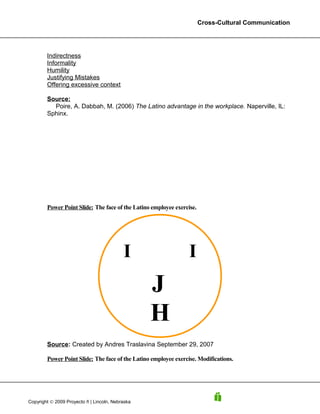
        The Face of the Latino employee exercise:
        This simple mnemonics exercise will help you remembering the five most common
        communication styles characteristic of Latino employees.
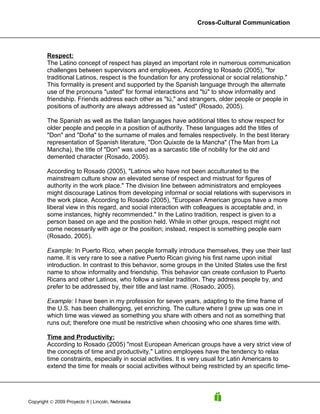
        The main elements of our face consist of eyes, ears, noose, mouth, eyebrows, and
        forehead. This exercise will test your creativity. Refer participant to handout p-2.

        Exercise Ideas.
        Ask participants to share their exercise with a partner and the experiences working with


Copyright © 2009 Proyecto ñ | Lincoln, Nebraska
Cross-Cultural Communication


        someone who evidently uses these communication styles.


Copyright © 2009 Proyecto ñ | Lincoln, Nebraska
Cross-Cultural Communication


              MODULE THREE
          Cross-cultural Non-verbal
               Communication


        Start time: 10:00 am
        III. MODULE THREE: Cross-cultural Non-verbal Communication (90 minutes)

        Objective: By the end of this module, the participants will: (1) Identify non-verbal
        communication styles characteristic of Latino employees; (2) Explain four differences in
        non-verbal communication between cultures in the U.S. and Latin America; and (3)
        Demonstrate these differences during a "fish bowl" exercise.


Copyright © 2009 Proyecto ñ | Lincoln, Nebraska
Cross-Cultural Communication


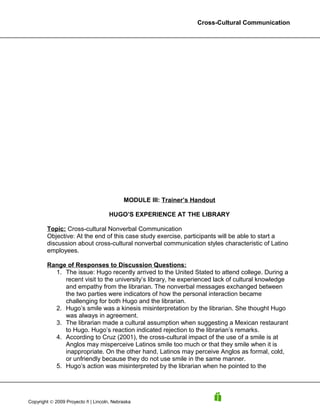
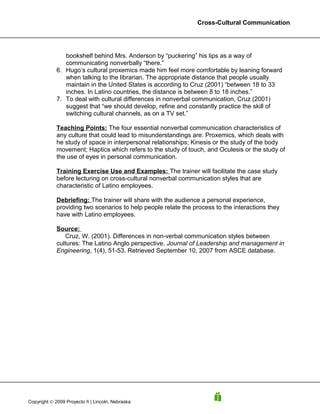
        A. Exercise/Activity Title and Description: Case Study. (20 minutes)

        Rationale: Participants will have an opportunity to analyze a case where non-verbal
        communication plays a determinant role in the outcome of the conversation. This case
        study will allow interaction among the participants as they discuss the proposed
        questions. .

        Handout and Directions: Participants will take five minutes to read the case study
        followed by an open group discussion. Refer to participant's packet (PP) handout D,
        p6.

        Points:
           1. The four essential non-verbal communication characteristic of any culture that
              could lead to misunderstandings are: proxemics, (which deals with the study of
              space), kinesis (the study of the body movements), haptics (which refers to the
              study of touch), and oculesis (the study of the use of eyes in personal
              communication).

            2. Latino employees, in general, get very concerned when they come to a new
               environment and feel that their colleagues or supervisors do not respect them.
               The use of beckoning to call children in public school is generally used in the
               Unites States. However, beckoning and finger pointing can have cultural
               implications when used with adults. For some Latino groups, beckoning implies
               certain levels of subordination, and it is used mostly to call children. Beckoning
               might be offensive for Latinos, but finger pointing might be a natural way to call
               people. While beckoning is normal for mainstream groups, finger pointing can be
               offensive (Rosado 2005.)

        Source:
            Rosado, L. A. (2005). Cross-cultural Communications: A Latino Perspective. AE-
        Extra. January. Retrieved October 8, 2007 from AE-Extra Web-site:
        http://asstudents.unco.edu/students/AE-Extra/2005/1/Art-1.html

          Zanger V.V. (1985). Face to Face: the Cross-cultural Workbook. Rowley, MA:
        Newbury House.


        Start time: 10:20
        B. Interactive Lecture/Activity: Interactive lecture over the four differences between
        non-verbal cross-cultural communication styles. (15 minutes)

        Power Point Slide: Differences between non-verbal communication styles.


Copyright © 2009 Proyecto ñ | Lincoln, Nebraska
Cross-Cultural Communication


        Rationale: Participants will learn essential differences in non-verbal communication
        styles. This is important as communication between people of different cultural
        backgrounds involves much more than overcoming the language barrier. Non-verbal
        cultural differences often cause a great deal of misunderstanding and friction. These
        differences are a serious problem because they are mostly subtle and inaudible but they
        affect the true meaning of the messages. (Wederspahn, 2001).
        -
        Points:
        The four essential non-verbal communication characteristic of any culture that could
        lead to misunderstandings are: proxemics, which deals with the study of space, kinesis
        or the study of the body movements, haptics which refers to the study of touch, and
        oculesis or the study of the use of eyes in personal communication.

        Source:
          Cruz, W. (2001). Differences in non-verbal communication styles between cultures:
        The Latino-Anglo perspective. Journal of Leadership and Management in Engineering,
        1(4), 51-53. Retrieved September 10, 2007 from ASCE database.

           Wederspahn, G.M. (2001). Cross-Cultural Communication Between Latin American
        and U.S. Managers. Grovewell leadership solutions. http://www.grovewell.com/pub-
        Latin+US-mgrs.html

        BREAK: 15 minutes.

        Start time: 10:50
        C. Exercise/Activity Title and Description: "Fish bowl" exercise. (20 minutes)

        Rationale:
        Participants will discuss the outcomes of the exercise and that, following this activity,
        participants will have an opportunity to develop their own option reflecting their own
        views about what they have observed. Explain that this discussion will take place in a
        "fish bowl." At any one time some of the duration of participants will interact in a
        discussion while others are observing silently from the outside. Those on the outside will
        be looking for ideas about the nonverbal communication


        Directions:
        Volunteers please move to the center while the others remain outside the circle. The
        group inside the fishbowl will not be able to talk.
        Directions for inside group:
        Part A:


Copyright © 2009 Proyecto ñ | Lincoln, Nebraska
Cross-Cultural Communication


           1. Pick a partner (you should end up with three couples)
           2. Turn your backs to each other and get as close as possible.
           3. Take a small step (only 8 inches)
           4. Count to ten
           5. Turn around
           6. The outside group will count to twenty
           7. You are free to stand at a distance you consider appropriate.
        After 1 minute partners should switch and repeat the same exercise.
       Part B:
           1. Shake your partner's hand
           2. Vigorously shake it and hold the gesture for at least 8 seconds.
           3. Release hands
           4. Stand in front of each other
           5. Outside group counts to twenty. Outside the "Fish Bowl"—Participants on the outside of
              the circle should be observing carefully to the non-verbal reactions.
        Points:
           1. To introduce the next lecture on the characteristic non-verbal communication
              styles based on cultural context.
           2. To have participants experience first hand how different our non-verbal
              communication styles are.
           3. To allow discussion on the advantages of becoming aware of non-verbal
              communication styles particular of Latino employees.

        Source: Created by Andres Traslavina October 3, 2007.

        Expectations:
        Participants inside the fishbowl may feel uncomfortable as these non-verbal signs are
        characteristic of cultures which are high in context. The outside group should be able to
        clearly observe non-verbal communication signs, thus allowing for an open discussion.
        Discussion Questions:
               1. How did you feel about the space you kept between you and your partner?
               2. Was this difficult or easy?
               3. What were some non-verbal communication styles you have seen when
                  working with employees from Latin America?
               4. What other connotation can you give to these non-verbal gestures?
               5. Would you rather be inside or outside of the fishbowl?

        Start time: 11:10


Copyright © 2009 Proyecto ñ | Lincoln, Nebraska
Cross-Cultural Communication


        B. Interactive Lecture/Activity: Multitasking vs. Monotasking

        Power Point Slide: Polychronic vs. Monochronic styles.

        Rationale:
        It is important for participants to be aware of their own style and to determine how they
        can better use the abilities of Latino employees.

        Points:
           1. Groups from high context cultures tend to be people oriented and polychronic,
              while groups from low context groups tend to be more monochronic and task
              oriented.
           2. To teach the difference between Polychronic and Monochronic styles.
           3. To find similarities between communication styles across cultures.

        Source:
         Bennett, C. (1999) A comprehensive multicultural education (4th ed.). Boston: Allyn
        and Bacon.

          Hall, E. T. (1966) The hidden dimensions. New York: The Anchor Book/Random
        House, Inc.

            Morales-Jones, C. (summer, 1998) Understanding Hispanic culture: From tolerance
        to acceptance. The Delta Kappa Gamma Bulletin, 64 (4), 13-17.

        End Time: 11:30
        Transition
        We have covered essential information on cross-cultural non-verbal communication.
        Being aware of your unique communication style will assist you when interacting with
        Latino employees. Now we will enjoy a wonderful three course authentic lunch. After
        lunch, please return to this same room as we will begin our discussion on the cross-
        cultural adaptive stages characteristic of Latino employees.


        LUNCH BREAK: 90 Minutes


                                       MODULE III: LECTURETTE I OUTLINE

        In Latin America, there is less physical distance between people, softer handshakes,
        more touching and abrazos, and greater use of hand and arm gestures. Business dress
        tends to be more fashionable and, in some cases, more colorful.

        Nonverbal language is very important in face-to-face communications because it


Copyright © 2009 Proyecto ñ | Lincoln, Nebraska
Cross-Cultural Communication


        conveys feelings, intentions, and reactions. Latin Americans may seem emotional and
        excitable to their U.S. counterparts, while U.S. Americans may come across as cold and
        distant. Even in non-face-to-face communications such as via e-mail, fax, or telephone,
        the absence of nonverbal signals may create a problem. Not being able to see each
        other, the parties may misinterpret the true meaning or tone of written messages.
        (Wederspahn, 2001).

        Power Point Slide: Differences between non-verbal communication styles.

        Proxemics:
        Refers to the use of space in interpersonal relationships. This is the inviolable distance
        people maintain between one another when speaking. This distance for Anglos and for
        people in northern Europe is between 18 and 33 inches. In Latino countries, the
        distance is between 8 and 18 inches. (Cruz, 2001).
        Example: In communication with Latino employees, they may feel others are too far
        away and would take a step closer to establish the culturally learned comfort distance.
        Latinos may misperceive others as being cold, aloof, or uninterested.

        Kinesics:
        Refers to the study of body movements and facial expressions as systematic part of
        communication. As in our case study, Latinos will point with puckered lips as a way of
        communicating nonverbally "there", "that one over there", or "him or her." Latinos may
        point their lips as someone and smile, which can mean "check him or her out", or "listen
        to that." In the case of our librarian, she could have perceived Hugo's signaling as a
        sexual invitation. The use of smiles constitutes another non-verbal difference in
        kinesics. Latinos tend to smile in any situation as oppose to Anglos as they may not
        consider smiling in serious situations.
        Example: In the Latin American culture the smile takes place of many verbal
        expressions. For example, a person may smile instead of saying, "Hi. How are you?" A
        clerk may smile at a customer rather than say, "May I help you." And a customer may
        smile at a clerk rather then say, "Thank you." Friends who express thanks verbally may
        be perceived as rejecting others or distancing themselves. (Cruz, 2001).


        Haptics:
        Is the study of touch in nonverbal communication. Among Latinos, there is a great deal
        of physical contact. The cross-cultural effect of the differences in haptics is that Anglos
        feel Latinos touch to a degree that is uncomfortable, threatening, or insulting. Latino
        employees may feel others are cold, unfriendly, dismissive, or insulting. It will be
        appropriate to address these issues as soon as you start interacting with employees
        from Latin America.
        Example: It is common for Latino women who are friends to kiss each other on the


Copyright © 2009 Proyecto ñ | Lincoln, Nebraska
Cross-Cultural Communication


        check to say hello and to touch or grab each other's arms while talking. It is common for
        Latino men to hug each other, to shake hands, to grab the arm of the other, and to
        place their hand on their friends' shoulder while communicating.

        Oculesis:
        Oculesis is the study of the use of eyes in personal communication. Latinos will look into
        the eyes of the person to whom they are speaking, but only in a fleeting way. Anglos
        may misinterpret this difference in culturally learned eye contact as betraying a lack of
        confidence, certainty, or truthfulness. This is particularly crucial in cases where Anglos
        are interviewing Latinos (Cruz, 2001). In the Latino culture direct, prolonged eye contact
        means you are challenging the person, that you are angry, or that you have a romantic
        interest in the person.
        Example: During an interview, Latino employees will tend to wonder around with their
        eyes; this does not mean they are distracted, but as a sign of respect they would prefer
        not to establish direct eye contact. As I grew up, it was understood in our family to
        respect our elders by showing politeness and not looking at people straight into their
        eyes.

        Sources:

          Cruz, W. (2001). Differences in non-verbal communication styles between cultures:
        The Latino Anglo perspective. Journal of Leadership and management in Engineering,
        1(4), 51-53. Retrieved September 10, 2007 from ASCE database.

           Wederspahn, G.M. (2001). Cross-Cultural Communication Between Latin American
        and U.S. Managers. Grovewell leadership solutions http://www.grovewell.com/pub-
        Latin+US-mgrs.html

        Discussion questions:
           1. What is your preferred non-verbal communication style?
           2. What is the effect on communication of non-verbal out-of-awareness behavior?
           3. What advantages do you see in maintaining a closer distance when talking?
           4. Can you think about ways of advising employees on sexual harassment issues
              based on non-verbal communication?


                                      MODULE III: LECTURETTE II OUTLINE

        Power Point Slide: Multitask Vs. Monotask.

        Nonverbal language is very important in face-to-face communications because it


Copyright © 2009 Proyecto ñ | Lincoln, Nebraska
Cross-Cultural Communication


        conveys feelings, intentions, and reactions. Latin Americans may seem emotional and
        excitable to their U.S. counterparts, while U.S. Americans may come across as cold and
        distant.
        In order to overcome non-verbal communication challenges, it is necessary to first see
        them clearly and objectively; this skill can be learned by using gestures and body
        language understood across cultures, and matching voice tone, volume, and pacing.

        Two fundamental attitudes toward time and activity according to one researcher are
        whether people do many things at once (polychronic) or one thing at a time
        (monochronic). Taking turns, seeing people privately, scheduling appointments are
        more important to those on monochromatic time. Albert says that Anglos need to
        remember that polychronic Latin Americans tend to value family and friends over
        schedules and may "see North Americans as slaves to the clock."

        Example: Start the lecture by role playing someone who is displays multitasking skills.
        As you talk, pick up your cell phone, sit by a participant, write in their handout, take a
        drink of water, fix your collar and tie your shoes. This exaggerated exercise will
        introduce our next topic.

        Polychronic vs. Monochronic
        Polychronic refers to the ability and the willingness to handle multiple tasks at the same
        time, e.g., watching television, reading a book and talking to people at the same time
        (Bennett, 1999; Hall, 1966). Monochronic is the preference for handling one task at a
        time. Monochronic people are time and schedule oriented, and they may show low
        tolerance for individuals who do not abide by their interaction style. At the same time,
        their preference to handle one thing at a time can send the wrong message to
        polychronic people who will perceive their attitude as rude and insensitive. They might
        feel insulted when the monochronic person ignores or gives them an ugly look for
        violations of interaction maxims.

        Groups from high context cultures tend to be people oriented and polychronic, while
        groups from low context groups tend to be more monochronic and task oriented
        (Bennett, 1999). In most Latino cultures, when two adults are conversing and a third
        one approaches the group with the intent to ask a question or to join the conversation,
        the speakers will normally interrupt the conversation to attend the needs of the
        newcomer (Morales-Jones, 1998). This behavior shows politeness, and most Latinos
        will abide by this unstated norm. However, individuals from low context cultures might
        not welcome the intrusion of the newcomer and will not allow the person into the
        conversation until they reach a closure point in the conversation. These differences in
        interaction style can create animosity and negative feelings between the two groups.

        Geography and the historical development of the groups seem to play a role in these
        preferences. African Americans and European American Southern groups appear to be
        more polychronic than their counterparts from the Northeast. A large number of Latinos,


Copyright © 2009 Proyecto ñ | Lincoln, Nebraska
Cross-Cultural Communication


        Native Americans and Southern Europeans on the other hand appear to be more
        polychronic (Bennett, 1999). The best way to investigate differences is by seeking
        contacts with the groups in question and by discussing these differences.

        Sources:
          Bennett, C. (1999). A comprehensive multicultural education (4th ed.). Boston: Allyn
        and Bacon.

          Hall, E. T. (1966). The hidden dimensions. New York: The Anchor Book/Random
        House, Inc.

           Morales-Jones, C. (1998). Understanding Hispanic culture: From tolerance to
        acceptance. The Delta Kappa Gamma Bulletin, 64 (4), 13-17.

        Discussion questions:
           1. What is your preferred communication style? Polychronic or monochronic?
           2. What is your perception of people who multitask?
           3. What advantages do you see in being able to multitask?
           4. What task would you assign to someone who is more comfortable multitasking?


Copyright © 2009 Proyecto ñ | Lincoln, Nebraska
Cross-Cultural Communication


                 MODULE FOUR
            Closing The Gap Between
                  Two Cultures


        Start time 1:00 pm
        IV. MODULE FOUR: Closing the gap between two cultures. (85 minutes)

        Objective: By the end of this module, the participants will: (1) list and explain three
        attitudinal differences between Latino employees and North American supervisors; (2)
        explain the patterns of acting and thinking of Latino employees; (3) utilize the concepts
        of respect and time during a role play exercise; and (4) implement the techniques
        learned to improve their interactions with Latino employees.

        A. Interactive Lecture/Activity: Attitudinal differences: (25 minutes)

        Power Point Slide: Three common attitudinal differences between the two
        cultures.


Copyright © 2009 Proyecto ñ | Lincoln, Nebraska
Cross-Cultural Communication


        Rationale: It is important to highlight some distinct differences between Latino
        employees and North American supervisors. When supervisors and co-workers
        understand these differences, they will minimize conflict and will know how to take
        preventative measures, establish open communication, and implement disciplinary
        practices.

         Points:
           1. To make supervisors and co-workers aware of natural attitudinal differences
              between them and their Latino employees
           2. To demonstrate how Latinos express the significance of family in their lives.
           3. To explain the general perceptions of men and women in Latino cultures.

        Source:
           Albert, R.D. (1996). A Framework and model for understanding Latin American and
        Latino/Hispanic cultural patterns. Handbook of Intercultural Training. Ed. Dan Landes
        and Rudy Bhagat. Thousand Oaks: Retrieved October 3, 2007 from NISSI portal.

        Start time: 1:25pm
        B. Exercise/Activity Title and Description: Cross-cultural sensitivity temperature test
        (20 Minutes)

        Rationale: Participants will be allowed to assess their cultural perceptions after having
        been exposed to a lecture on the differences of perception between the two cultures.
        The hope is that participants will answer positively to all the statements as a result of
        their participation throughout the workshop.

        Handout and Directions: Refer participants to the packet handout A p. 9. Assure
        participants that there are no right or wrong answers. Ask them to work quickly and to
        record their first impression by indicating the degree to which they agree or disagree
        with the statement.

        Points:
           1. To make participants feel good about future interactions with Latino employees.
           2. To reveal negative feelings participants may still have about interacting with
              Latino employees.
           3. To address any possible issues for conflict based on their answers.
           4. To open discussions about cultural stereotypes.

        Source:
           This exercise is a modification of Chen, G.M., Starosta, W.J. (2000).The
        development and validation of the intercultural sensitivity scale. Human Communication,
        3 (1), 3-14.


Copyright © 2009 Proyecto ñ | Lincoln, Nebraska
Cross-Cultural Communication


        BREAK: 10 minutes

        Start time: 1:55 pm
        C. Interactive Lecture/Activity: Patterns of thinking and action in Latin America: (20
        minutes)

        Power Point Slide: Patterns of thinking & Patterns of action.

        Rationale: This module will examine the differences in patterns of thinking and patterns
        of action between supervisors and Latino employees. The lecture serves as a preamble
        to open discussion based on participants’ previous experiences.

        Handout and Directions: Guided note taking on the patterns of thinking and acting in
        Latin America. Refer participants to handout B, p. 9. (10 minutes)

        Source:
           Albert, R.D. (1996). A framework and model for understanding Latin American and
        Latino/Hispanic cultural patterns. Handbook of Intercultural Training. Ed. Dan Landes
        and Rudy Bhagat. Thousand Oaks: Retrieved October 3, 2007 from NISSI portal.

        Points:
           1. To provide concrete examples of the patterns of thinking of Latin American
              employees.
           2. To identify what is most important for Latino employees when undertaking a task
              at work.
           3. To open a discussion about the possibility of creating a hostile situation if any of
              these patterns are disrupted.
           4. To open a discussion on the difference in thinking and acting patterns between
              the two different cultural context groups.


        Start time: 2:25
        D. Exercise/Activity Title and Description: Jigsaw learning: (20 minutes)

        Rationale: Participants will have an opportunity to practice the patterns of
        communication in high context cultures.

        Handout and Directions: Divide participants into seven different groups. Assign each
        table with a topic selected from the lecture on the patterns of thinking and action. Each
        group will read, discuss and learn the material assigned to them. Refer participants to
        handout C, p. 10. Allow five minutes for this part of the exercise.


Copyright © 2009 Proyecto ñ | Lincoln, Nebraska
Cross-Cultural Communication


        Points:
           1. To practice the concepts learned during the lecture.
           2. To open a discussion about differences between the communication patterns in
              the U.S. and the learned material.
           3. To promote collaboration between groups.

        Source: This activity is an adaptation from "Jigsaw Learning" in "101 Ways to Make
        Training Active" (Silberman, 2005, p. 178).

        BREAK: 10 minutes


                                      MODULE IV: LECTURETTE I OUTLINE

           As we have learned, compared to North American and some European cultures,
        Latin Americans tend to be more authority-oriented, family-oriented, spontaneous,
        expressive, and focused on the present instead of the future.

        1. Differences in perceiving.
        Perceptions of power and authority: Studies of the workplace have found that Latin
        Americans are more likely to expect and accept that power in organizations will be
        distributed unequally. According to Albert (1996), "Latino students are more authority
        oriented than their Anglo peers."


Copyright © 2009 Proyecto ñ | Lincoln, Nebraska
Cross-Cultural Communication


        Perceptions of men and women: There is much controversy on the importance given
        to machismo, or manliness, in Latin American cultures. According to Albert (1996), "The
        Anglo stereotype of aggressive machismo obscures the Latin American's broader image
        of male dignity, honor, and care for one's family."

        According to Albert (1996), "Latin American women often have ruled the household
        staff, influenced their sons, and been active in public affairs. And as more Latinas enter
        the workforce, they have gained rights such as maternity leave and legalized divorce."
        For example my mother worked fulltime at a demanding position, and has the respect of
        her entire family. Her commitment to our family and her professional career were stellar.
        She taught me that work is enjoyable when there is room for family and personal time.

        2. Differences in Thinking.
        Attitudes toward society: According to Albert (1996), "a study of fifty three countries
        found that the U.S., Australia, and Great Britain were the most individualistic, while five
        Latin American countries were the most collectivistic. Latin Americans are more likely to
        define themselves as part of the group, sacrifice personal goals, observe social norms
        and obligations, and maintain relationships at any cost." These studies confirm that
        Latinos fall into the high context group based on Hall's research.

        According to Albert (1996), "A fundamental cognitive shift is required for Anglos
        interacting with Latinos. Though they value individuality, Latin Americans may interpret
        individualistic behaviors as selfish and egotistical."

        Attitudes toward family: The extended family is the most important social circle in
        Latin America. My family comes first, and I take pride in acknowledging them as my
        primary reason for success.


        Attitudes toward work: Latinos place value on work ethic, persistence, status, and a
        sense of shame. In contrast and according to Albert (1996), "U.S. students were more
        likely to value reciprocity, personal steadiness, protecting one's ego, and respect for
        tradition. This finding contradicts the stereotypical assumption of Latin Americans as
        people who do not work hard."

        3. Differences in Acting.
        Living with nature: Cultures can view themselves as a product of nature, in harmony with
        nature, as the dominating nature. Latin American countries have seen themselves as nature's
        product.

        Being instead of doing: According to Albert (1996), "Latin Americans prefer
        spontaneous, being activities (such as fiesta), while North Americans prefer planned,


Copyright © 2009 Proyecto ñ | Lincoln, Nebraska
Cross-Cultural Communication


        doing activities (such as tennis). This difference has led to the stereotype of the lazy
        Latino, who in turn may see Anglos as "Always rushing to do more and more things
        without stopping long enough to reflect on the ultimate meaning and purpose of all this
        activity." Although Latino employees have a tremendous work ethic, they do not identify
        with their jobs like North Americans. According to Albert (1996), "work for Latinos is
        more of a means to provide for their families, although the economic development is
        changing this being orientation at a time when the U.S. appears to be discovering its
        worth."

        Showing how you feel: According to Albert (1996), "Latin Americans tend to be more
        expressive and emotional (Dionysian) than North Americans, who value stoicism and
        control (Apollonian). Latinos prefer communication that involves the free expression of
        emotion."

        Avoiding uncertainty: Latin American employees are characterized for carrying high
        levels of job stress, desire for rigid company rules, and intention to stay with the
        company for a long time.

        According to Albert (1996), "Although Latin Americans have suffered much economic and
        political uncertainty. Latin Americans tend to be very flexible in terms of interpersonal relations,
        especially when dealing with those of equal or higher status, rules in organizations and
        bureaucracies, and plans."

        Source:
           Albert, R.D. (1996). A framework and model for understanding Latin American and
        Latino/Hispanic cultural patterns. Handbook of Intercultural Training. Ed. Dan Landes
        and Rudy Bhagat. Thousand Oaks: Retrieved October 3, 2007 from NISSI portal.

        Discussion Questions:
           1. Do you agree that Latino employees tend to be more sensitive or emotional?
           2. If Latino employees have the desire for rigid company rules, can you list your
              departmental rules?
           3. How can you, as a supervisor, take advantage of an employee that is flexible in
              terms of interpersonal relations?
           4. What roles do you see most fitting to the personality of a typical Latino
              employee?

                                      MODULE IV: LECTURETTE II OUTLINE

        1. Patterns of Thinking in Latin America
        Respect and dignity: According to Albert (1996), "Latin Americans equate personal dignity
        with equal treatment and respect. This makes them more sensitive to criticism or insults."

        Loyalty: Latinos are loyal by nature. Marketing research shows that Latinos stick to


Copyright © 2009 Proyecto ñ | Lincoln, Nebraska
Cross-Cultural Communication


        brand names for longer periods of time than people in the United States. For Latinos,
        the value of someone's "word" is as a document has been signed and sealed. Latinos
        expect others to be loyal to them.

        Simpatía: According to Albert (1996), "A person is simpático/a when he or she is open,
        warm, friendly, empathetic, and enthusiastic.” As we learned, Latinos tend to avoid
        conflict in efforts to reflect "simpatía."

        2. Patterns of Action in Latin America.
        Cooperation: According to Albert (1996),"Latin Americans are less competitive than
        North Americans. She notes that, unlike self-reliant and assertive Anglos, Latin
        American and Latino children are trained for cooperation, harmony in interpersonal
        relations, and sensitivity to the needs and feelings of others.”

        Interpersonal connections: Albert's (1996) own studies found in Colombia found that
        "palanca" (a "lever" or a "connection") is common in myth and reality. Relationships
        among unequals are part of a person's identity and provide a means for the less
        powerful to transcend rules and obtain scarce resources as a "favor" or even an
        "obligation" of the "palanca." Being from Colombia, I can testify that the "palanca" can
        be more influential than educational degrees themselves.

        Personal attention: According to Albert (1996), "Latin Americans expect and often
        prefer personalized, individualized attention. This may be true since they place more
        emphasis on class and status in relationships than do Anglo Americans."

        Source:
           Albert, R.D. (1996). A framework and model for understanding Latin American and
        Latino/Hispanic cultural patterns. Handbook of Intercultural Training. Ed. Dan Landes
        and Rudy Bhagat. Thousand Oaks: Retrieved October 3, 2007 from NISSI portal.


        Discussion Questions:
        1. Are your communication patterns different from the ones we have covered?
        2. When working with Latino employees, can you think about specific examples when
        you have observed these patterns?
        3. Have the use of the cultural communication patterns been beneficial to cover? Why?


Copyright © 2009 Proyecto ñ | Lincoln, Nebraska
Cross-Cultural Communication


Copyright © 2009 Proyecto ñ | Lincoln, Nebraska
Cross-Cultural Communication


                                 MODULE FIVE
            Addressing Cross-cultural Conflict


        Start time: 2:45
        V. MODULE FIVE: Addressing Cross-cultural Conflict (45 minutes)

        A. Interactive Lecture/Activity: Addressing Cross-cultural Conflict (15 minutes)

        Rationale: This module will provide the necessary framework for supervisors and co-
        workers to use when dealing with conflict. It is important to translate all the cross-
        cultural differences between two cultures into a concise plan of action for when conflict
        arises. Many of the workshop participants expressed interest in learning effective ways
        of dealing with conflict.

        Power Point Slide: Conflict handling modes.


Copyright © 2009 Proyecto ñ | Lincoln, Nebraska
Cross-Cultural Communication


        Points:
           1. To provide a general framework of reference as a resource for cross-cultural
              conflict resolution.
           2. To make participants aware that conflict resolution techniques are universal.
           3. To emphasize the importance of learning cultural communication styles as a
              conflict prevention techniques.

        Source:
           Dos Santos, P. , Gabrielidis, C. , Villareal, L. , Stephan, W. , Ybarra, V. (1997).
        Preferred styles of conflict resolution: Mexico and the United States. Journal of Cross-
        cultural Psychology, 21, 661. Retrieved November 4, 2007 from ASCE database.

          Thomas, K. W. (1974). Making conflict management a strategic advance. Retrieved
        November 11, 2007 from the CPP, Inc, web site: http://www.cpp.com/

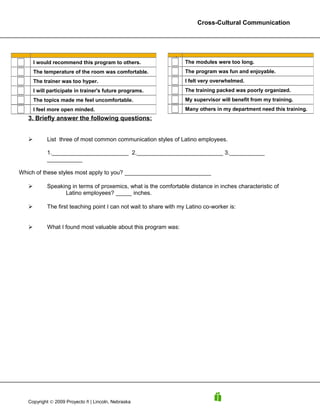
        B. Exercise/Activity Title and Description: How would you respond? (15 minutes)

        Rationale:
        Participants will become aware of their own ways of dealing with conflict. Every
        individual has a unique way of confronting difficult situations. Our own personal
        experiences, cultural background and overall attitude, affect the way we handle conflict.
        According to the dual-concern model, individuals' styles of conflict resolution are
        determined by concern for their own outcomes as well as the outcomes of others (Dos
        Santos, Gabrielidis, Villareal, Stephan, & Ybarra, 1997).

        Handout and Directions: Divide the group into five different tables. Assign each table
        one case scenario from handout A, p 11. Each participant will write an answer to the
        assigned scenario. I will select five volunteers from each table and will ask them to
        collect the participants’ written answers in the flipchart will classify them into the
        following categories: negative or passive responses, aggressive or violent responses,
        and responses offering possibilities of democratic conflict resolution. Then ach volunteer
        will present to the class the classified responses written on the flipchart, and all
        participants will comment on them.

        Points:
           1. To learn that conflicts can be viewed as viewed opportunities to learn about how
              to manage difficult situations?
           2. By becoming a positive conflict solver, participants can apply these techniques to
              many areas in their own lives.
           3. We all have a way to react to difficult situations; the key is to learn how to look for
              win-win alternatives as we learned during the first part of the module.

        Source:


Copyright © 2009 Proyecto ñ | Lincoln, Nebraska
Cross-Cultural Communication


           International Peace Research Association (IRPA). , UNESCO. (1994). Handbook
        Resource and Teaching Material in Conflict Resolution, Education for Human Rights,
        Peace and Democracy. Paris, France.

           Dos Santos, P. , Gabrielidis, C. , Villareal, L. , Stephan, W. , Ybarra, V. (1997).
        Preferred styles of conflict resolution: Mexico and the United States. Journal of Cross-
        cultural Psychology, 21, 661. Retrieved November 4, 2007 from ASCE database.

        C. Interactive Lecture/Activity: Respect and Time (15 minutes)

        Rationale: To expose participants to two of the most critical differences between
        cultures. These two cultural elements will serve as the closing remarks before wrapping
        up the workshop.

        Power Point Slide: Respect & Time.

        Points:
           1. To conceptualize the value of time for Latino employees.
           2. To conceptualize the importance of respect in the Latino culture.

        Source:
            Rosado, L. A. (2005). Cross-cultural Communications: A Latino Perspective. AE-
        Extra. January. Retrieved October 8, 2007 from AE-Extra Web-site:
        http://asstudents.unco.edu/students/AE-Extra/2005/1/Art-1.html

            Stewart, E. C. (1985). American cultural patterns (13th ed.). Yarmouth, Maine:
        Intercultural Press.


        D. Exercise/Activity Title and Description: Guided note taking about respect and
        time.

        Handout and Directions:
        Refer participants to the packet, handout B, p. 12.

        Source:
            Rosado, L. A. (2005). Cross-cultural Communications: A Latino Perspective. AE-
        Extra. January. Retrieved October 8, 2007 from AE-Extra Web-site:
        http://asstudents.unco.edu/students/AE-Extra/2005/1/Art-1.html

        End Time: 3:30 pm
        Transition
        Our program is coming to an end. Reiterate being thankful to participants for remaining


Copyright © 2009 Proyecto ñ | Lincoln, Nebraska
Cross-Cultural Communication


        active and attentive. Assure participants that the knowledge gained will contribute
        tremendously to their interactions with Latino employees. Also, many of the
        communication styles learned today will apply to employees that belong to cultures high
        in context as we have learned during the first module. During module five we have
        reviewed a conflict resolution model and the concepts of time and respect as being
        critical when interacting with Latino employees. Now, let's pick a partner as we will wrap
        up the training program with some useful activities you can take back to your work
        places.

        BREAK: 10 Minutes


                                       MODULE V: LECTURETTE I OUTLINE

        Start by stating that conflict resolution can be an entire program on its own; however,
        the cross-cultural topics addressed during this workshop are all applicable to preventing
        conflict. The following module will serve as a guide to apply when participants are faced
        with a difficult situation. The most important part when addressing conflict is opening
        communication channels, and being in a position where you can culturally understand
        others' points of views.

        Ways of Dealing with Conflict: (2A4C Useful acronym).
        Avoidance:
        When a supervisor employs this option, he/she is ignoring the conflict and letting it be.
        For whatever reason, the supervisor may feel that the conflict is not worth the effort to


Copyright © 2009 Proyecto ñ | Lincoln, Nebraska
Cross-Cultural Communication


        resolve. This could be complete avoidance Avoiding conflict does not deal with the
        issues at hand. This is a lose-lose strategy. When one person avoids a conflict, neither
        person has an opportunity to resolve it. Both people lose (Thomas, 1974).

        Accommodation:
        Accommodation is agreement through yielding or conforming to the positions of others;
        it is cooperation in an effort to create harmony, even at the expense of your own ideas
        and values, and agreement in the name of peace and tranquility, knowing full well that
        you do not entirely buy into it. For Latinos employees, and as we have studied before,
        this approach will probably be the one that would accommodate to their communication
        style. Accommodators may not always be famous for their creativity, but can often be
        relied upon for social tact and diplomacy. This is a lose-win strategy. People lose
        because their needs are not met. The other person’s needs are met, but the relationship
        suffers because supervisors or employees eventually become resentful and unsatisfied
        (Thomas, 1974).

        Compromise:
        Compromise involves a search for a solution, which is mutually acceptable.
        Compromise involves two or more parties coming together and reaching to an
        agreement. With compromise, there will be give and take. Everybody seems to gain
        something, but not to gain everything. Supervisors and employees who compromise
        settle for the best they can get, as opposed to reaching a decision that everyone wants.
        According to Thomas (1974), this is a lose-lose strategy. Both the supervisor and the
        employee give up something they need just to make the conflict disappear. Most likely,
        supervisors and employees will come back to the same issues later (Thomas, 1974).

        Competition:
        This is the offensive aggressive approach to conflict resolution. It is especially attractive
        to those in power and authority who like to accomplish and maintain total control. In a
        competitive situation, there is no room for listening, little information sharing, and little
        interpersonal reasoning. Supervisors who fall into this area often make decisions
        without any input from their employees. Employees in a team often view competitive
        leadership as inappropriate and destructive. This is a win-lose/lose-win strategy. Either
        supervisors win and employees lose, or supervisors lose and employees wins.
        (Thomas, 1974).

        Collaboration:
        According to Thomas (1974), collaboration is a dual membership approach to conflict
        resolution. In the collaborative mode, employees and supervisors:
            Accept the fact that there is conflict.
            Take time for sharing of values, needs, interests, and resource; in other words,
               people will seek to understand before being understood.
            Discovers many possible solutions and weighs the consequences of each.
            Selects the alternative that best meets the needs and concerns of each member.


Copyright © 2009 Proyecto ñ | Lincoln, Nebraska
Cross-Cultural Communication


             Forms a team plan, implements and evaluates the outcomes.

        According to Thomas (1974), Collaboration is the vehicle which:
            Generates the most creative solutions.
            Sets the greatest membership support.
            Produces the greatest amount of personal growth.

        This is a win-win strategy. Both the supervisors and the employees have the chance to
        express their needs and resolve the conflict in a mutually acceptable way. While this
        strategy may sound simple, it’s actually the most difficult to use. It requires each of the
        parties to articulate, prioritize, and satisfy their own needs while also addressing others’
        needs (Thomas, 1974).

        Source:
           Dos Santos, P. , Gabrielidis, C. , Villareal, L. , Stephan, W. , Ybarra, V. (1997).
        Preferred styles of conflict resolution: Mexico and the United States. Journal of Cross-
        cultural Psychology, 21, 661. Retrieved November 4, 2007, from ASCE database.

          Thomas, K. W. (1974). Making conflict management a strategic advance. Retrieved
        November 11, 2007 from the CPP, Inc. web site: http://www.cpp.com/

        Discussion questions:
           1. Based on the conflict resolution model, which of these five methods would you
              feel more inclined to use?
           2. Can you describe a time when you have used one or more of the five methods
              describe in the conflict resolution model?
           3. Based on the conflict resolution model, what methods do you think Latinos would
              prefer to use?


        Debriefing:
        As we have learned from the communication styles, and according to Dos Santos,
        Gabrielidis, Villareal, Stephan, and Ybarra, Latino employees belong to collectivistic
        cultures and they will strive to maintain harmonious relationships with others while
        would seek for pursuing personal goals. Because Americans are individualistic, they
        would be expected to put their own needs above others, and this should be reflected in
        preferences for competitive and collaborative styles of conflict resolution. (Dos Santos,
        Gabrielidis, Villareal, Stephan, & Ybarra, 1997).

                                      MODULE V: LECTURETTE II OUTLINE

        In my view as a trainer the concepts of respect and time are two cultural topics that, if
        understood, can assist with your work interactions with Latino employees.


Copyright © 2009 Proyecto ñ | Lincoln, Nebraska
Cross-Cultural Communication


        Respect:
        The Latino concept of respect has played an important role in numerous communication
        challenges between supervisors and employees. According to Rosado (2005), "for
        traditional Latinos, respect is the foundation for any professional or social relationship."
        This formality is present and supported by the Spanish language through the alternate
        use of the pronouns "usted" for formal interactions and "tú" to show informality and
        friendship. Friends address each other as "tú," and strangers, older people or people in
        positions of authority are always addressed as "usted" (Rosado, 2005).

        The Spanish as well as the Italian languages have additional titles to show respect for
        older people and people in a position of authority. These languages add the titles of
        "Don" and "Doña" to the surname of males and females respectively. In the best literary
        representation of Spanish literature, "Don Quixote de la Mancha" (The Man from La
        Mancha), the title of "Don" was used as a sarcastic title of nobility for the old and
        demented character (Rosado, 2005).

        According to Rosado (2005), "Latinos who have not been acculturated to the
        mainstream culture show an elevated sense of respect and mistrust for figures of
        authority in the work place." The division line between administrators and employees
        might discourage Latinos from developing informal or social relations with supervisors in
        the work place. According to Rosado (2005), "European American groups have a more
        liberal view in this regard, and social interaction with colleagues is acceptable and, in
        some instances, highly recommended." In the Latino tradition, respect is given to a
        person based on age and the position held. While in other groups, respect might not
        come necessarily with age or the position; instead, respect is something people earn
        (Rosado, 2005).

        Example: In Puerto Rico, when people formally introduce themselves, they use their last
        name. It is very rare to see a native Puerto Rican giving his first name upon initial
        introduction. In contrast to this behavior, some groups in the United States use the first
        name to show informality and friendship. This behavior can create confusion to Puerto
        Ricans and other Latinos, who follow a similar tradition. They address people by, and
        prefer to be addressed by, their title and last name. (Rosado, 2005).

        Example: I have been in my profession for seven years, adapting to the time frame of
        the U.S. has been challenging, yet enriching. The culture where I grew up was one in
        which time was viewed as something you share with others and not as something that
        runs out; therefore one must be restrictive when choosing who one shares time with.

        Time and Productivity:
        According to Rosado (2005) "most European American groups have a very strict view of
        the concepts of time and productivity." Latino employees have the tendency to relax
        time constraints, especially in social activities. It is very usual for Latin Americans to
        extend the time for meals or social activities without being restricted by an specific time-


Copyright © 2009 Proyecto ñ | Lincoln, Nebraska
Cross-Cultural Communication


        line.

        Cultures can place different emphasis on the past, the present, or the future. While the
        U.S. is thought to be future-oriented, according to Albert (1996), "Latin Americans have
        been characterized as focusing on the present. This may be due to the economic and
        political instability of many Latin American countries. With economic development,
        however, the middle-class Latinos are becoming more future-oriented (Albert, 1996).

        Source:
           Albert, R.D. (1996). A framework and model for understanding Latin American and
        Latino/Hispanic cultural patterns. Handbook of Intercultural Training. Ed. Dan Landes
        and Rudy Bhagat. Thousand Oaks: Retrieved October 3, 2007 from NISSI portal.

            Rosado, L. A. (2005). Cross-cultural Communications: A Latino Perspective. AE-
        Extra. January. Retrieved October 8, 2007 from AE-Extra Web-site:
        http://asstudents.unco.edu/students/AE-Extra/2005/1/Art-1.html

            Stewart, E. C. (1985). American cultural patterns (13th ed.). Yarmouth, Maine:
        Intercultural Press.

        Discussion Questions:
         1. Do you consider yourself a time-keeper?
         2. What would you choose to do if you had one more hour to spare everyday?
         3. In terms of respect, how would you feel if someone shows up late to a work
           appointment?
         4. In terms of respect, how would you feel if someone shows up late to a family
           gathering?


Copyright © 2009 Proyecto ñ | Lincoln, Nebraska
Cross-Cultural Communication


                              MODULE SIX
                             Wrap Up & Final
                               Evaluation


Copyright © 2009 Proyecto ñ | Lincoln, Nebraska
Cross-Cultural Communication


        Start time: 3:40 pm
        VI. MODULE SIX: Wrap Up & Final Evaluation (30 minutes)

        Objective: By the end of this module, the participants will: (1) Rehearse the five
        communication styles characteristic of Latino employees, (2) Explain the four
        differences in non-verbal communication styles among cultures, (3) answer the
        questions left by participants in the basket throughout the workshop, and (4) evaluate
        the program and provide a follow up plan for participants to stay in touch among
        themselves and with the trainer.

        1. Reviewing the program:

        Rehearsing exercise: "Rehearsal pairs."

                 Exercise/Activity description:
                 The group will be divided in pairs and each person will take one of the two
                 following roles: (1) explainer and (2) checker. Once we have divided the group in
                 pairs, the explainer will go over the five communication styles characteristic of


Copyright © 2009 Proyecto ñ | Lincoln, Nebraska
Cross-Cultural Communication


                 Latino employees. The checker verifies that the explanation is correct and will
                 provide coaching to his or her partner if needed.
                 When the pairs have completed the exercise, the trainers will ask for two
                 volunteers to perform the demonstration in front of the group.

                 Rationale:
                 This is a fun strategy for practicing the five communication styles characteristic of
                 Latino employees. Participants must master the learning of these communication
                 styles.

                 Materials: The "checker" will be allowed to use his or her handout.

                 Variations:
                 Switch the participant's roles and practice the same exercise using the four non-
                 verbal communication differences in styles among cultures.

                 Source: This activity is an adaptation from "Practice-Rehearsal Pairs" in "101
                 Ways to Make Training Active" (Silberman, 2005, p. 237).

        2. Obtaining final questions and concerns:

                 Exercise/Activity title: "Basket of questions wrap-up."

                 Materials: Questions found in the participant's basket.

                 Handout and Directions: Participants were asked to write questions relevant to
                 the content of the workshop and drop them in the basket located by the coffee
                 station. The trainer will call volunteers and ask to read the questions out loud.
                 Rather than monopolizing the answering session, the trainer will ask other
                 participants to answer the questions.

                 Source:
                 Gathered from the participant's questions.

        3. Promoting self-assessment:

                 Exercise/Activity description: "Cross-cultural self -monitoring."

                 Materials: Handout A in participant's packet p.13.

                 Rationale: Establish a plan to follow-up with the skills participants gained during
                 the training program. This will also serve as a way of staying aware of cross-
                 cultural differences when working with Latino employees.


Copyright © 2009 Proyecto ñ | Lincoln, Nebraska
Cross-Cultural Communication


                 Handout and Directions: In the handout provided in the participant's packet, p-
                 13, ask participants to check the list of reminders that feel suitable to them.

                 Please check those cross-cultural reminders applicable to you.

                 When I return to my workplace, I will most likely do the following:

                     1. Avoid over-protection or over-exposure to Latino employees.
                     2. Give assignments that provide an opportunity to demonstrate competence
                         and to take risk, but not beyond the employee's capabilities.
                     3. Give Latino employees an opportunity at a non-stereotypical task.
                     4. Understand that Latino employees may be under more pressure than my
                         traditional employees.
                     5. Avoid drawing too much attention to Latino employees.
                     6. Do not force Latino employees together if it isolates them from the rest of
                         the employees or administrators.
                     7. Encourage others not to make jokes about Latino employees.
                     8. Focus employees' attention on what their communication styles may have
                         in common with each other.
                     9. Use every opportunity to open and sustain dialogue.
                     10. Be aware of my own non-verbal communication styles when working with
                         Latino employees.

                 Source:
                 This exercise is an adaptation from "A Tale of O: On being different in an
                 organization," in "Beyond the Buzzwords" (Cornell, 1994 p. 14).

        4. On on-the job applications:

                 Exercise/Activity title and description: Blog.

                 Materials: Blog created at http://www.UNMCOMAHA.blogspot.com/

                 Handout and Directions: Participants will be given a user name and a
                 password to log into the program's blog. Instruct participants as to how to make a
                 posting and create discussions using the blog. Encourage participants to write
                 one posting a week for the following four weeks. The trainer will serve as a
                 mediator of the blog. The postings will include answers to the following
                 questions:

                 1. What immediate changes did you noticed in your behavior when interaction
                    with Latino employees?
                 2. Write specific non-verbal gestures displayed by Latino employees during
                    work.


Copyright © 2009 Proyecto ñ | Lincoln, Nebraska
Cross-Cultural Communication


                 3. Based on the concepts we learned in module four, what specific signs
                    displayed by Latino employees clarified the questions you had about the
                    employees' attitudes towards time, attitudes towards family and attitude
                    towards work itself.
                 4. Write about conflicts with Latino employees you encountered shortly after this
                    program.

                 Teaching Points:
                 1. Participants will learn to use a new tool to communicate with other in the
                    group while on-the job.
                 2. The concepts of the workshop will be constantly raised by the trainer, forcing
                    participants to recall the concepts learned and more importantly, to practice
                    and teach other what they have mastered.

                 Source:
                 Blog created by Andres Traslaviña on September 3, 2007.
                 http://www.UNMCOMAHA.blogspot.com/

        5. Expressing final sentiments:
              Exercise/Activity title and description: "Win/Win Negotiation"

                 Materials: Easel and markers.

                 Handout and Directions: The trainer will select two teams of 12 players each.
                 Have each team select a negotiator leader. Their goal will be to win the same
                 designated space only by using non-verbal gestures. Participants will write the
                 positive or negative reactions in the easel for further discussion.

                 Source:
                 This exercise is an adaptation from "LOSE/LOSE negotiation," in "Beyond the
                 Buzzwords" (Cornell, 1994 p. 13).

        6. Final Evaluation Form:
               Exercise/Activity title and description: "Program Feedback."

                 Rationale:
                 Participants will leave comments useful for the preparation of future workshops.
                 Based on a rating scale, the trainer will assess the effectiveness of the program
                 and will report findings to university administrators.

                 Materials: Handout, pens.

                 Handout and Directions:
                 Feedback forms can be found at the end of the participant's packet. Reiterate


Copyright © 2009 Proyecto ñ | Lincoln, Nebraska
Cross-Cultural Communication


                   that the evaluations can be made anonymously and that the trainer will report a
                   summary of the results.

                   Points:
                   This evaluation form is an easy alternative for quick valuable feedback. The
                   trainer will ask questions covering cognitive, behavioral and affective objectives.

                   Source:
                   Program evaluation created by Andres Traslavina on January 4, 2008.

          This training program is designed to serve as a resource guide for implementing
          meaningful cross-cultural communication methods when working with Latino
          employees. The tools, exercises and the participants' packet should provide concrete
          techniques to better understand Latino employees in the workplace. Awareness never
          ends and cross-cultural communication is an asset that will maximize the potential each
          of you have as supervisors.

          End time 4:20 pm

          THE END


                                             PROGRAM EVALUATION

  1. Please note that all data is collected anonymously and there is no link to your
         identity.
Use the scale to rate each of the following statements:       Poor    Fair   Average   Good   Very good   E Excellent

Explanation of the program's objectives
Teaching methods were and interaction with participants.
Workshop participant's packet and/or visuals.
Trainer's preparation and knowledge of the topic.
Trainer established an open learning atmosphere.
The theoretical content of the modules were.
Debriefing after exercises and activities.


  2. Check the statements that describe your reactions to the training program:


  Copyright © 2009 Proyecto ñ | Lincoln, Nebraska
Cross-Cultural Communication


                                                             9
                                                             9
       I would recommend this program to others.                     The modules were too long.
       The temperature of the room was comfortable.                  The program was fun and enjoyable.
       The trainer was too hyper.                                    I felt very overwhelmed.
       I will participate in trainer's future programs.              The training packed was poorly organized.
       The topics made me feel uncomfortable.                        My supervisor will benefit from my training.
       I feel more open minded.                                      Many others in my department need this training.
   3. Briefly answer the following questions:


            List three of most common communication styles of Latino employees.

             1.________________________ 2.___________________________ 3.___________
             ___________

Which of these styles most apply to you? ___________________________

            Speaking in terms of proxemics, what is the comfortable distance in inches characteristic of
                   Latino employees? _____ inches.

            The first teaching point I can not wait to share with my Latino co-worker is:


            What I found most valuable about this program was:


   Copyright © 2009 Proyecto ñ | Lincoln, Nebraska
Cross-Cultural Communication


                                                  REFERENCE LIST

            Adrian, R., Noels, K.A, Tischler, K. (2007). Conflict between international graduate
        students and faculty Supervisors: Toward effective conflict prevention and management
        strategies. Journal of Studies in International Education, 11, 90. Retrieved September
        11, 2007, from SAGE database.

           Albert, R.D. (1996). A Framework and model for understanding Latin American and
        Latino/Hispanic cultural patterns. Handbook of Intercultural Training. Ed. Dan Landes
        and Rudy Bhagat. Thousand Oaks: Retrieved October 3, 2007 from NISSI portal.

           Bennett, C. (1999). A comprehensive multicultural education (4th ed.). Boston, MA:
        Allyn and Bacon.

           Branton, R. (2007). Latino attitude toward various areas of public policy: The
        importance of acculturation. Journal of Political Research, 60, 293. Retrieved
        September 14, 2007 from SAGE database.

             Evans, N.J (1998). Student development in college (1rs Ed.) San Francisco, CA:


Copyright © 2009 Proyecto ñ | Lincoln, Nebraska
Cross-Cultural Communication


        John Wiley & Sons.

            Chen, G.M., Starosta, W.J.(2000). The development and validation of the
        intercultural sensitivity scale. Human Communication, 3 (1), 3-14. Retrieved October 2,
        2007 from ASCE database.

           Cruz, W. (2001). Differences in non-verbal communication styles between cultures:
        The Latino-Anglo perspective. Journal of Leadership and Management in Engineering,
        1(4), 51-53. Retrieved September 10, 2007 from ASCE database.

            Deardorff, D.K. (2006). Identification and assessment of intercultural competence as
        a student outcome of internationalization identification and asses. Journal of Studies in
        International Education, 10, 241. Retrieved September 7, 2007, from SAGE database.

           Dos Santos, P., Gabrielidis, C., Villareal, L., Stephan, W., Ybarra, V. (1997).
        Preferred styles of conflict resolution: Mexico and the United Status. Journal of Cross-
        cultural Psychology, 21, 661. Retrieved November 4, 2007 from ASCE database.

           Gladwell, M. (2005). Blink: The power of thinking without thinking. New York, NY:
        Time Warner.

            Harrison, L.E. (1997). The pan-american dream. Boulder, CO: Westview.

          Hall, E. T. (1966). The hidden dimensions. New York: The Anchor Book/Random
        House, Inc.
          Hall, E.T. (1976). Beyond culture. New York, NY: Anchor Press/Doubleday.

          International Peace Research Association (IRPA). , UNESCO. (1994). Handbook
        Resource and Teaching Material in Conflict Resolution, Education for Human Rights,
        Peace and Democracy. Paris, France.

          Morales, J. (1998). Understanding Hispanic culture: From tolerance to acceptance.
        The Delta Kappa Gamma Bulletin, 64 (4), 13-17.

            Pekerti, A.A., & Thomas, D.C. (2003). Communication styles In Intercultural
        Interaction: An Empirical Investigation of Idiocentric and Sociocentric. Journal of Cross-
        Cultural Psychology, 34, 3. Retrieved September 7, 2007, from SAGE database.

          Peterson, N. Gonzalez, R.C. (2000). The role of work in people’s lives. Belmont:
        Thomson Learning. Kincaid, R. (1996) Student Employment: Linking College and the
        Workplace. South Carolina: University of South Carolina.

          Poire, A. Dabbah, M. (2006) The Latino advantage in the workplace. Naperville, IL:
        Sphinx.


Copyright © 2009 Proyecto ñ | Lincoln, Nebraska
Cross-Cultural Communication


          Wederspahn, G.M. (2001). Cross-Cultural Communication Between Latin American
        and U.S. Managers. Retrieved October 10, 2007 from Grovewell leadership solutions
        web site: http://www.grovewell.com/pub-Latin+US-mgrs.html

            Rosado, L. A. (2005). Cross-cultural Communications: A Latino Perspective. AE-
        Extra. January. Retrieved October 8, 2007 from AE-Extra Web-site:
        http://asstudents.unco.edu/students/AE-Extra/2005/1/Art-1.html

           Silc, K.F (1990). A Cross-cultural training manual. Virginia State Department of
        Education, Virginia Workplace Literacy grant. ED 339, 255. Retrieved September 7,
        2007, from SAGE database.

           Silberman, M. (2005). 101 ways to make training active (2nd ed.). San Francisco:
        John Wiley & Sons.

            Stewart, E. C. (1985). American cultural patterns (13th ed.). Yarmouth, Maine:
        Intercultural Press.

          Thomas, K. W. (1974). Making Conflict Management a Strategic Advance. Retrieved
        November 11, 2007 from the CPP, inc web site: http://www.cpp.com/.

          Zanger V.V (1985). Face to Face: the Cross-cultural Workbook. Rowley, MA:
        Newbury House.


Copyright © 2009 Proyecto ñ | Lincoln, Nebraska
Cross-Cultural Communication


            TRAINER’S HANDOUTS


Copyright © 2009 Proyecto ñ | Lincoln, Nebraska
Cross-Cultural Communication


                                         MODULE ONE: Trainer’s Handout

        Workshop topic: Introduction Icebreaker.
        Title of activity: Ask someone if…
        Source: This exercise is an adaptation of “Find someone who…” from: Silc, K.F (1990)
        A Cross-cultural training manual. Virginia State Department of Education, Virginia
        Workplace Literacy grant. ED 339, 255. Retrieved September 7, 2007, from SAGE
        database.

        Objective: At the end of this module participants will be able to (1) Interact with other’s
        in the group; (2) Repeat each other’s names; (3) Relax and focus on the topic; and (4)
        Develop cultural sensitivity.

        Procedures for trainer(s): Introduce the idea behind the exercise (Ask someone if)
        and announce that participants will only be given five minutes to complete the exercise.
        I will call “time’s up” and the group will begin with the discussion.

        Directions for participants: Have all participants walk around the room asking others
        if the can answer yes” to any of the questions on the handout. When a person can
        answer “yes” his or her name is written in the space provided. Discourage participants


Copyright © 2009 Proyecto ñ | Lincoln, Nebraska
Cross-Cultural Communication


        from asking the same people every single question. At the end of the activity,
        participants will be asked to partner with someone in the room and to exchange
        handouts. Participants will read one question and one name until all the names are
        called. There will be questions that will fit more than one participant.

        Materials needed: Handout 1A found in the participants packet. Pens.

        Expectations: Participants are expected to move around and interact with as many
        people as possible. They will be encouraged to move quickly and share the findings of
        the exercise at the end of the workshop.

        Teaching Points:
        This exercise is designed to orient participants to the differences in backgrounds and
        knowledge among the group. Every individual has unique cultural traits based on where
        they grew up, their family influences and the environment where they live. When we are
        encouraged to share a positive trait that distinguishes our personalities, we immediately
        feel included and that others care about what we have accomplished. Employees need
        to experience the same feelings of inclusiveness and belonging.

        Debriefing:
        As you answered the questions and when comparing both cultures, people in Latin
        America tend to be more family oriented, spontaneous, expressive and more centered
        in the present than in the future. People feel naturally inclined to perceive others based
        on first impressions. As you observed, we all have our own characteristic set and the
        only way to find this out is by becoming an active listener and by developing curiosity for
        what makes other unique. The same would apply for when you work with your students.
        Let’s work in developing successful cross-cultural skills.

        Variation: This exercise can be modified to a Bingo format where participants will be
        given questions on a Bingo panel. They will have to find other participants that fulfill the
        criteria until they complete a row for “Bingo”.


Copyright © 2009 Proyecto ñ | Lincoln, Nebraska
Cross-Cultural Communication


                                           MODULE III: Trainer’s Handout

                                     HUGO’S EXPERIENCE AT THE LIBRARY

        Topic: Cross-cultural Nonverbal Communication
        Objective: At the end of this case study exercise, participants will be able to start a
        discussion about cross-cultural nonverbal communication styles characteristic of Latino
        employees.

        Range of Responses to Discussion Questions:
          1. The issue: Hugo recently arrived to the United Stated to attend college. During a
             recent visit to the university’s library, he experienced lack of cultural knowledge
             and empathy from the librarian. The nonverbal messages exchanged between
             the two parties were indicators of how the personal interaction became
             challenging for both Hugo and the librarian.
          2. Hugo’s smile was a kinesis misinterpretation by the librarian. She thought Hugo
             was always in agreement.
          3. The librarian made a cultural assumption when suggesting a Mexican restaurant
             to Hugo. Hugo’s reaction indicated rejection to the librarian’s remarks.
          4. According to Cruz (2001), the cross-cultural impact of the use of a smile is at
             Anglos may misperceive Latinos smile too much or that they smile when it is
             inappropriate. On the other hand, Latinos may perceive Anglos as formal, cold,
             or unfriendly because they do not use smile in the same manner.
          5. Hugo’s action was misinterpreted by the librarian when he pointed to the


Copyright © 2009 Proyecto ñ | Lincoln, Nebraska
Cross-Cultural Communication


               bookshelf behind Mrs. Anderson by “puckering” his lips as a way of
               communicating nonverbally “there.”
            6. Hugo’s cultural proxemics made him feel more comfortable by leaning forward
               when talking to the librarian. The appropriate distance that people usually
               maintain in the United States is according to Cruz (2001) “between 18 to 33
               inches. In Latino countries, the distance is between 8 to 18 inches.”
            7. To deal with cultural differences in nonverbal communication, Cruz (2001)
               suggest that “we should develop, refine and constantly practice the skill of
               switching cultural channels, as on a TV set.”

            Teaching Points: The four essential nonverbal communication characteristics of
            any culture that could lead to misunderstandings are: Proxemics, which deals with
            he study of space in interpersonal relationships; Kinesis or the study of the body
            movement; Haptics which refers to the study of touch, and Oculesis or the study of
            the use of eyes in personal communication.

            Training Exercise Use and Examples: The trainer will facilitate the case study
            before lecturing on cross-cultural nonverbal communication styles that are
            characteristic of Latino employees.

            Debriefing: The trainer will share with the audience a personal experience,
            providing two scenarios to help people relate the process to the interactions they
            have with Latino employees.

            Source:
               Cruz, W. (2001). Differences in non-verbal communication styles between
            cultures: The Latino Anglo perspective. Journal of Leadership and management in
            Engineering, 1(4), 51-53. Retrieved September 10, 2007 from ASCE database.


Copyright © 2009 Proyecto ñ | Lincoln, Nebraska
Cross-Cultural Communication


                                           MODULE IV: Trainer’s Handout

        Workshop topic: Cross-cultural communication.

        Title of activity: " Jigsaw Learning"

        Source: This activity is an adaptation from "Jigsaw Learning" in "101 Ways to Make
        Training Active" (Silberman, 2005, p. 178).

        Objective: At the end of this exercise participants will be able to: (1) explain to each
        other the patterns of thinking characteristic of Latino employees; (2) explain to each
        other the patterns of action characteristic of Latino employees; and (3) demonstrate the
        use of these patterns by using role play.

        Directions for participants:
        1. Divide participants in seven different groups. Assign each table with a topic selected
        from the lecture on the patterns of thinking and action. Each group will read, discuss
        and learn the material assigned to them. Allow five minutes for this portion of the
        exercise.

        2. After the study period from "cooperative learning," each of the seven groups will
        assign a representative who will move to another table and will share the learned
        material with the rest of the new group members.


Copyright © 2009 Proyecto ñ | Lincoln, Nebraska
Cross-Cultural Communication


        3. Assign another group representative and ask them to move to a different table to
        share the learned material with the new group.

        4. Each group should have covered at least three communication patterns. Ask groups
        to review the learned concepts and allow three minutes for further discussion.

        5. The groups will assign one representatives to explain to the whole group the first
        pattern covered during the jigsaw interaction.

        The groups will be divided as follows:

        Patterns of thinking:
        Group 1.
        Respect and dignity: Studies have found that Latin Americans and Latinos equate
        personal dignity with equal treatment and respect. This makes them more sensitive to
        criticism or insults, although Albert warns that this standard does not hold for superiors
        or subordinates.


        Group 2.
        Loyalty: Unlike non-Latinos, studies have found that Latinos define "showing loyalty" as
        being honest, friendly, obedient, defensive, and respectful.

        Group 3.
        Simpatía: South Americans, Cubans, Mexican Americans, and Puerto Ricans "show a
        strong cultural preference for simpatía," Albert writes. She says that a person is
        simpático/a when he or she is seen to be open, warm, friendly, empathetic, and
        enthusiastic. Hispanics avoid negative interactions more than non-Hispanics.

        Patterns of action:
        Group 4.
        Cooperation: Albert says that many studies have found that, among equals, Latin
        Americans and Latinos are less competitive than North Americans. She notes that,
        unlike self-reliant and assertive Anglos, "Latin American and Latino children are trained
        for cooperation, harmony in interpersonal relations, and sensitivity to the needs and
        feelings of others." Mexican Americans tend to be more like Anglo Americans.

        Group 5.
        Avoiding criticism: Studies and Albert’s own observations show that Latinos and Latin
        Americans value and expect positive relationships and avoid criticizing, insulting, and
        fighting. This seems to vary from situation to situation.

        Group 6.
        Interpersonal connections: A study in Colombia found that palanca (a "lever" or a


Copyright © 2009 Proyecto ñ | Lincoln, Nebraska
Cross-Cultural Communication


        "connection") is common in myth and reality, Albert reports. Relationships among
        unequals are part of a person's identity and provide a means for the less powerful to
        transcend rules and obtain scarce resources as a "favor" or even an "obligation" of the
        palanca.

        Group 7.
        Personal attention: Based on her own research and observations, Albert says that
        Latin Americans and Latinos expect and often prefer personalized, individualized
        attention. This may be true since they place more emphasis on class and status in
        relationships than do Anglo Americans.

        Materials needed: None.

        Variations: Groups can participate by using "role play" and cover of the patterns by
        creating a situation and acting out as if they were Latino employees.


        Expectations:
        Participants are expected to explain the material learned to the other groups. As the
        workshop comes to and end, participants are expected to stay active and to participate.

        Discussion Questions:
        1. Are your communication patterns different from the ones we have covered?
        2. When working with Latino employees, can you think about specific examples when
        you have observed these patterns?
        3. Have the use of the cultural communication patterns been beneficial to cover? Why?

        Teaching Points:
           1. Participants will be able to explain the cultural communication patterns of thinking
              characteristic of Latino employees.
           2. Participants will be able to explain the cultural communication patterns of action
              characteristic of Latino employees.

        Debriefing:
        By being aware of these cultural patterns, supervisors and co-workers will be able to
        customize resources to apply directly when interacting with Latino employees. People
        will appreciate the knowledge and the awareness and will demonstrate satisfaction
        while at work.


Copyright © 2009 Proyecto ñ | Lincoln, Nebraska
Cross-Cultural Communication


                                            MODULE V: Trainer’s Handout

        Workshop topic: Cross-cultural communication and conflict resolution.

        Title of activity: "How would you respond?"

        Source: This activity is an adaptation from "What Would Be Your Response" in the
        "Handbook Resource and Teaching Material in Conflict Resolution, Education for
        Human Rights, Peace and Democracy International Peace Research Association."
        (IRPA & UNESCO, 1994, p. 26).

        Objectives: At the end of this activity participants will be able to: (1) identify immediate
        responses in certain cross-cultural conflict situations; (2) assess the “speech” or “words"
        participants use when facing conflict; (3) generate new words and reactions which serve
        the purposes of conflict management in a democratic and efficient way, and (4)
        demonstrate their own approach in treating cross-cultural conflict.

        Directions for participants:
        Divide the group in five tables. Assign each table one case scenario from handout A, p
        11. Each participant will write an answer to the assigned scenario. I will select one
        volunteer from each table and will ask them to collect the participants’ written answers
        in the flipchart will classify them into three categories as follows: negative or passive
        responses, aggressive or violent responses, and responses offering possibilities of
        democratic conflict resolution. Then each volunteer will present to the class the


Copyright © 2009 Proyecto ñ | Lincoln, Nebraska
Cross-Cultural Communication


        classified responses written on the flipchart, and all participants will comment on them.

        Materials needed: Large pieces of paper, colored pens and a flip-chart.

        Variations: Each table can be assigned all the scenarios. At the end, the group can
        engage in discussion about how every scenario was handled differently from table to
        table. This could potentially create a hostile environment among tables that disagree.

        Expectations:
        Comments may be limited to general impressions, interpreting the point of view of one
        of the participants, or concerning the way one of the participants presents their point of
        view in response to a certain conflict.

        Discussion Questions:
        1. Would you agree that our own personal circumstances may affect the way we react
        to a challenging situation?
        2. Would these issues matter a year from now?
        3. What have you learned during this workshop about preventing cross-cultural conflict?
        Teaching Points:
          1. Conflict should be viewed as an opportunity to learn about how to manage difficult
              situations.
          2. By becoming a positive conflict solver, participants can apply these techniques to
              many areas in their own lives.
          3. We all have a way to react to difficult situations; the key is to learn how to look for
              win-win alternatives, as we learned during the first part of the module.

        Debriefing:
        I will comment on the results in relation to the objectives of the exercise. Clarify to
        participants that they are not alone in a conflict, for there are at least two parties to any
        conflict. It is therefore necessary to take into consideration the feelings, needs and
        goals of each party in order to settle the conflict. Participants will be asked to discuss
        the alternatives to the case scenarios and they will be noted on the board as models for
        application. Only choose one of the answers given for a conflict really experienced by
        one of the participants whose response was negative, aggressive or violent.


Copyright © 2009 Proyecto ñ | Lincoln, Nebraska
Cross-Cultural Communication


                                      WRAP-UP MODULE: Trainer’s Handout

        Workshop topic: Wrap up. Expressing final sentiments.

        Title of activity: "Win/Win Negotiation"

        Source: This exercise is an adaptation from "LOSE/LOSE negotiation," in "Beyond the
        Buzzwords" (Cornell, 1994 p. 13).

        Objective: At the end of this exercise participants will be able to: (1) demonstrate the
        barriers to effective and fair communication when one group is hampered by cultural,
        racial, or other barriers, and (2) create awareness of the frustration that other groups
        experience when they are unable to "compete on a level playing field."

        Directions for participants:
        Select two teams of 12 players each. Have each team select a negotiator leader. Their
        goal will be to win the same designated space. Allow one team to take over the space.
        The second pair will have to convince the competing team to give then the space
        without making any eye contact whatsoever. Their instructions should include the
        adoption of subservient behavior, such as addressing the others by their first names
        prefaced by Mr./Mrs./Dr/Sir/ma'am before making any statement.


Copyright © 2009 Proyecto ñ | Lincoln, Nebraska
Cross-Cultural Communication


        Materials needed: None.

        Variations: Increase the barriers to communication by the second team by blind-folding
        them, placing them in seats which place them at a lower level than their competitors, or
        some other formats for diminishing their ability to communicate at the same level.

        Expectations: Participants on the team that wants to win space should experience a
        certain level of uncomforting frustration.

        Discussion Questions:
           1. How did you feel when you were unable to look directly at the other teams? Did
              this give a loss of power?
           2. Which factor in the negotiation was most frustrating to you?
           3. Did you believe you had an opportunity to obtain the desired space? If not, did
              you begin to loose your desire to try?


        Teaching Points:
           1.) Allow participants to understand that when it comes to cross-cultural interactions,
               Latino employees may have to adjust to the new work atmosphere. Often times
               the adjustment process can make Latino employees feel at a disadvantage.
           2.) Although the playing fields could be uneven in different circumstances, what is
               important to understand is that you can help Latino employees overcome any
               possible disadvantages by promoting a feeling of belonging to their work place.

        Debriefing:
        The notion that a playing field must be level in order for Latino employees to be
        successful could be challenging. This program wants to teach participants to ensure
        their employees have the tools they needs to negotiate the uneven terrain, ensure that
        they know how to use those tools, and ensure that they have the self-awareness of their
        communication styles that may play positively or may harm them during interactions at
        the workplace.


Copyright © 2009 Proyecto ñ | Lincoln, Nebraska
Cross-Cultural Communication


           PARTICIPANTS' PACKET
Copyright © 2009 Proyecto ñ | Lincoln, Nebraska
Cross-Cultural Communication


                                            MODULE ONE
        HANDOUT A: Ask someone if…
        Walk around the room asking others if the can answer yes” to any of the questions on
        this exercise. When a person can answer “yes” write his or her name in the space
        provided. Try not to ask the same person every single question.

                          Ask someone if…:                                Write their name:

        1. They have been to any country in Latin America.

        2. They know the meaning of “Todos tenemos 24 horas en el dia.”

        3. They have a relative who was born in Latin America.

        4. They like soccer.

        5. They know the capital of Bolivia.

        6. They know someone from Latin America.

        7. They know how to dance “merengue.”

        8. They watch any of the Spanish channels on TV.

        9. They have dated someone from a different country.

        10. They speak a different language.

        11. They have been supervised by a foreign person.


Copyright © 2009 Proyecto ñ | Lincoln, Nebraska
Cross-Cultural Communication


        12. They take a two-hour lunch.

        13. They have worked with someone from another country.

        14. They can multi-task.

        15. They have taken the public bus.

        16. They know who Simon Bolivar is.
        Source: This exercise is an adaptation of “Find someone who…” from: Silc, K.F (1990)
        A Cross-cultural training manual. Virginia State Department of Education, Virginia
        Workplace Literacy grant. ED 339, 255. Retrieved September 7, 2007, from SAGE
        database.
                               MODULE TWO
                                                                              A     B
        HANDOUT A: Cultural context test.
        Directions: In front of every question write the write the letter A or B in
        the appropriate column according to what you are most likely to do:

        1. When making plans to go out with your family:                                   ____     ____
            A. I usually call ahead and agree on a date and time
            B. Randomly show up at their door to discuss the plan

        2. When you accomplish a goal who do you give most credit to?:                     ____     ____
            A. Myself
            B. My family or support network

        3. If you were planning a weekend trip and you had the money and the time;         ____     ____
        What may prevent you from actually doing it?
             B. Safety will be a concern
             A. Nothing. I will most likely go

        4. Do you spend most of your time with people who share your interests and         ____     ____
        think almost like you?
            B. NO
            A. YES

        5. When it comes to relationships:                                                   ____   ____
            B. It is easy for me to get to know people and I have an extensive network of friends
            A. It is easy for me to get to know people, but I only have few friends

        6. In previous interviews when you were asked a question, you answers were:        ____     ____
             B. Direct and to the point


Copyright © 2009 Proyecto ñ | Lincoln, Nebraska
Cross-Cultural Communication


            C. Indirect and offered excessive context

        7. When you make a mistake do you:                                          ____   ____
            A. Admit the my mistake and move on
            B. Have a hard time admitting my mistake and will try to make someone
            or something else responsible

        8. Which statement sounds better to you?                                    ____   ____
            A. As a supervisor I would like to delegate and empower.
            B. As a supervisor I would like to have control.

        9. Do you think deadlines and commitments are firm?                         ____   ____
            a. Yes
            b. No


        10. Which of these McDonals ads is more effective to you?                    A     B
        B.


              ____      ____
        Source:
        Indian website (late 2003) (http://www.mcdonaldsindia.com)


Copyright © 2009 Proyecto ñ | Lincoln, Nebraska
Cross-Cultural Communication


        A.


        Source:
        Swiss website, (http://www.mcdonalds.ch)

        Source: Created by Andres Traslavina January 4, 2008

                                                                 TOTAL?         ____     ____
        Communication styles based on cultural context:
            In a classical study in cross-cultural communication, Edward T. Hall analyzed the
        communication styles of cultural groups throughout the world and grouped them in two
        categories: high context and low context cultures (Hall, 1976). The communication style
        of the high context group is highly contextualized. The meaning is generally understood
        in terms of the situation or the setting in which the communication is taking place. For
        the second group, low context, the communicative context is not as important. Instead,
        the communication relies almost exclusively on the verbal or written message by itself.
        Bennett (1999) summarizes these differences as follows:

        Cultural context differences:

        Individuals belonging to__________ context cultures are described as follows:
           Strong Cohesive group identity
           Strong human ____________ support network
           Individuals gain identity through group association
           Closed society with clear distinctions between insiders and outsiders
           Behavior is regulated by r_____ code
           Tendency to be bureaucratic

        Individuals belonging to ___________context cultures are described as follow:
           Weaker group identity
           More i______________ approach
           Gain identity based on individual efforts and accomplishments


Copyright © 2009 Proyecto ñ | Lincoln, Nebraska
Cross-Cultural Communication


           O______ society with weaker distinctions between i________ and o_________
           Greater personal f______________

        Sources:
            Bennett, C. (1999). A comprehensive multicultural education (4th ed.). Boston, MA:
        Allyn and Bacon.

            Hall, E.T. (1976). Beyond culture. New York, NY: Anchor Press/Doubleday.


        HANDOUT B: The face of the Latino employee exercise

        Directions: This simple mnemonics exercise will help you remembering the five most common
              communication styles characteristic of Latino employees.
        The main elements of our face consist of eyes, ears, noose, mouth, eyebrows, and forehead. This exercise
              will test your creativity.
        1. Draw a face by using the following letters: I H J I O. Think of every letter as an element of our face.


Copyright © 2009 Proyecto ñ | Lincoln, Nebraska
Cross-Cultural Communication


        2. Now let's get in groups of two and share your exercise.
        Source: Created by Andres Traslavina September 29, 2008


        HANDOUT C: Imaginary Exercise: Traveling to Latin America.

        For the next part of the workshop you will receive a complimentary tour to twelve
        countries in Latin America in our private jet. Your mission will be to make one stop in
        every country and to bring back a prospective employee. During your flight back you will
        interact with the employee and will teach him or her what you have learned about the
        different communication styles characteristic of Latino employees. These directions will
        help you enjoy your tour:

        B. Since we are leaving in three minutes, please take a paper and pen as you will need
        to write down the name of the cities we will visit.

        C. You will only need this boarding pass. Tear here:
        ------------------------------------------------------------------------------------------------------------


Copyright © 2009 Proyecto ñ | Lincoln, Nebraska
Cross-Cultural Communication


        ------------------------------------------------------------------------------------------------------------
        B. We will take off from Omaha's Eppley airfield and will make our first stop in Houston,
        Texas to refuel. On our way back, we will flight over the Atlantic Ocean making a fuel
        stop in Miami and ending our journey back here in our classroom.


        C. The average roundtrip airplane ticket to or from Latin America costs nine hundred
        dollars ($900). This complimentary trip is given to you as part of the workshop. Please
        enjoy your flight, take some good notes and allow yourself to appreciate the greatness
        of Latin America.
                                           MODULE THREE

        HANDOUT A: Case Study.
        Work in groups of two. You will have five minutes to read the case and five minutes to
        answer the proposed questions. Be prepared to share the answers with your
        colleagues.

                                                       Case Study

        Hugo Ferreira, a student from Ecuador, often visited the UNMC library to read. One day
        he found a book he wanted to read at home. So he decided to approach the librarian for
        help.

        Hugo: “Excuse me, may I borrow this book?”
        Mrs. Anderson (librarian): “Why, of course. I just need your UNMC ID card.”
        Hugo: smiled at her and nodded his head.
        Mrs. Anderson: "That book is wonderful. Isn’t that author great? Do you understand?”
        Hugo had never read anything by the author. But Hugo smiled and nodded again.


Copyright © 2009 Proyecto ñ | Lincoln, Nebraska
Cross-Cultural Communication


        Mrs. Anderson: "I know of a very good Mexican restaurant, you will enjoy it. It is very
        close to our campus."
        Hugo: Smiled and nodded his head negatively.
        Hugo: “I would like to borrow this book today”
        Mrs. Anderson: "Can you tell me where you found this book?"
        Hugo: Puckering his lips pointed at the librarian.
        Mrs. Anderson: "I am confused, are you here to talk to me or to check out this book?"
        Hugo: Smiled and leaned closer to her, touching her shoulder he replied, “could you
        please tell me how to apply for a UNMC ID card?”
        Mrs. Anderson: Took one step back. “Oh, I though you were a student at UNMC”.
        Hugo: “I am”.
        Mrs. Anderson: “Come right this way and I will show you how to obtain an ID card.” The
        librarian held out her hand, palm up, moving only her index finger to get Hugo to follow
        her.
        Hugo: Seemed confused. He smiled and walked away.

        Discussion Questions:
           1. Underline all words in this case study which describe gestures made by Mrs.
              Anderson and Hugo.
           2. Why did Hugo continue smiling and nodding his head?
           3. Why did the librarian mention the Mexican restaurant?
           4. What do you think the librarian thought Hugo meant when puckering his lips?
           5. Why did Hugo seem confused?

        Source: This case study is adapted from: Zanger V.V (1985) Face to Face: the Cross-
        cultural Workbook. Rowley, MA: Newbury House.

                                                  MODULE IV

        HANDOUT A: The Cross-cultural Sensitivity Scale.
        Below is a series of statements concerning intercultural communication.
        There are no right or wrong answers. Please work quickly and record your first
        impression by indicating the degree to which you agree or disagree with the statement.

        5 =strongly agree 4 =agree 3 =uncertain 2 =disagree 1 =strongly disagree

        Please put the number corresponding to your answer in the blank after the statement

        1. I enjoy interacting with people from different cultures. ____
        2. I think people from other cultures are narrow-minded. ____
        3. I am pretty sure of myself in interacting with people from different cultures. ____
        4. I find it very hard to talk in front of people from different cultures. ____
        5. I always know what to say when interacting with people from different cultures. ____
        6. I can be as sociable as I want to be when interacting with people from different


Copyright © 2009 Proyecto ñ | Lincoln, Nebraska
Cross-Cultural Communication


        cultures. ____
        7. I don’t like to be with people from different cultures. ____
        8. I respect the values of people from different cultures. ____
        9. I get upset easily when interacting with people from different cultures. ____
        10. I feel confident when interacting with people from different cultures. ____
        11. I tend to wait before forming an impression of culturally distinct counterparts. ____
        12. I often get discouraged when I am with people from different cultures. ____
        13. I am open-minded to people from different cultures. ____
        14. I am very observant when interacting with people from different cultures. ____
        15. I often feel useless when interacting with people from different cultures. ____
        16. I respect the ways people from different cultures behave. ____
        17. I try to obtain as much information as I can when interacting with people from
        different cultures. ____
        18. I would not accept the opinions of people from different cultures. ____
        19. I am sensitive to my culturally distinct counterpart’s subtle meanings during our
        interaction. ____
        20. I think my culture is better than other cultures. ____
        21. I often give positive responses to my culturally different counterpart during our
        interaction. ____
        22. I avoid those situations where I will have to deal with culturally distinct persons. ___
        23. I often show my culturally distinct counterpart my understanding through verbal or
        nonverbal cues. ____

        Source:
        This exercise is a modification of: Chen, G.M., Starosta, W. J. (2000).The development
        and validation of the intercultural sensitivity scale. Human Communication, 3(1), 3-14.

        HANDOUT B: Guided note taking.

        1. Patterns of Thinking in Latin America:

        R_________ and dignity: Studies have found that Latin Americans and Latinos equate personal
        dignity with equal treatment and respect. This makes them more s____________ to criticism or
        insults.

        L___________: Unlike non-Latinos, studies have found that Latinos define "showing
        loyalty" as being honest, friendly, obedient, defensive, and respectful.

        S____________: South Americans, Cubans, Mexican Americans, and Puerto Ricans
        "show a strong cultural preference for Simpatía," Albert writes. She says that a person
        is simpático/a when he or she is seen to be open, w________, f__________,
        e____________, and enthusiastic. Latinos avoid n______________ interactions more
        than non-Latinos.


Copyright © 2009 Proyecto ñ | Lincoln, Nebraska
Cross-Cultural Communication


        2. Patterns of Action in Latin America:
        C_____________: Albert says that many studies have found that, among equals, Latin
        Americans and Latinos are less competitive than North Americans. She notes that,
        unlike self-reliant and assertive Anglos, "Latin American and Latino children are trained
        for co________________, h_____________ in interpersonal relations, and
        s______________ to the needs and feelings of others." Mexican Americans tend to be
        more like Anglo Americans.

        A______________ c______________ : Studies and Albert’s own observations show
        that Latinos and Latin Americans value and expect positive relationships and avoid
        criticizing, insulting, and fighting. This seems to vary from situation to situation.

        I________________ c_________________ : A study in Colombia found that palanca (a
        "lever" or a "connection") is common in myth and reality, Albert reports. Relationships
        among unequals are part of a person's identity and provide a means for the less
        powerful to transcend rules and obtain scarce resources as a "favor" or even an
        "obligation" of the palanca.

        P_____________ a_____________: Based on her own research and observations,
        Albert says that Latin Americans and Latinos expect and often prefer personalized,
        individualized attention.

        Source:
           Albert, R.D. (1996). A Framework and model for understanding Latin American and
        Latino/Hispanic cultural patterns. Handbook of Intercultural Training. Ed. Dan Landes
        and Rudy Bhagat. Thousand Oaks: Retrieved October 3, 2007 from NISSI portal.


        HANDOUT C: Jigsaw Learning
        Make groups of seven. Each table has an assigned topic selected from the lecture.
        Please read, discuss and learn the material assigned to your table.

        Patterns of thinking:

        Group 1. Respect and dignity: Studies have found that Latin Americans and Latinos
        equate personal dignity with equal treatment and respect. This makes them more
        sensitive to criticism or insults, although Albert warns that this standard does not hold
        for superiors or subordinates.

        Group 2. Loyalty: Unlike non-Hispanics, studies have found that Hispanics define
        "showing loyalty" as being honest, friendly, obedient, defensive, and respectful.

        Group 3. Simpatía: South Americans, Cubans, Mexican Americans, and Puerto Ricans
        "show a strong cultural preference for Simpatía," Albert writes. She says that a person


Copyright © 2009 Proyecto ñ | Lincoln, Nebraska
Cross-Cultural Communication


        is simpático/a when he or she is seen to be open, warm, friendly, empathetic, and
        enthusiastic. Hispanics avoid negative interactions more than non-Hispanics.

        Patterns of action:

        Group 4. Cooperation: Albert says that many studies have found that, among equals,
        Latin Americans and Latinos are less competitive than North Americans. She notes that,
        unlike self-reliant and assertive Anglos, "Latin American and Latino children are trained
        for cooperation, harmony in interpersonal relations, and sensitivity to the needs and
        feelings of others." Mexican Americans tend to be more like Anglo Americans.

        Group 5. Avoiding criticism: Studies and Albert’s own observations show that Latinos
        and Latin Americans value and expect positive relationships and avoid criticizing,
        insulting, and fighting. This seems to vary from situation to situation.

        Group 6. Interpersonal connections: A study in Colombia found that palanca (a
        "lever" or a "connection") is common in myth and reality. Relationships among unequals
        are part of a person's identity and provide a means for the less powerful to transcend
        rules and obtain scarce resources as a "favor" or even an "obligation" of the palanca.

        Group 7. Personal attention: Based on her own research and observations, Albert
        says that Latin Americans and Latinos expect and often prefer personalized,
        individualized attention. This may be true since they place more emphasis on class and
        status in relationships than do Anglo Americans.


                                                  MODULE V

        HANDOUT A: How would your respond?
        In your assigned tables, please write down your reaction to the following case
        scenarios:

        1. You are engaged in a university as a monitor of the biology lab classes on the basis
        of working only five days per week. The first day of classes, you are surprised when the
        Dean tells you and the other monitors that you have to work even on Saturdays. What is
        your response? (knowing that you do not want this!)

        2. You bought a sweater from a shop and did not see that there was a small hole in it.
        Three days later, while you were putting it on, you were surprised and angry. You went
        back to the shop and told the shopkeeper about it. He told you that you might have
        damaged it yourself. What was your response?

        3. On your way back to your house, you noticed that a number of students were writing


Copyright © 2009 Proyecto ñ | Lincoln, Nebraska
Cross-Cultural Communication


        political slogans on the wall of the building (where your house is). You did not
        appreciate this because they were confessionally provocative regarding the residents of
        the quarter you live in. What was your response?

        4. You are a member of an association the statutes of which stipulate that the president,
        the vice-president and the presidents of the committees are specially entitled to take
        decisions and represent the society. You do not like the hierarchical mode of working
        but you became a member of the association because you liked its activities. It
        happened that you were responsible for undertaking a certain action but a president of
        one of the committees undertook it without consulting you, what was your response?

        5. You are student worker at a university department. It so happened that you were in a
        bad psychological condition and you could not tell your boss about it. You were asked to
        prepare work and present it at a certain date but you did not manage to respect the
        deadline. Your boss angrily asked about it. What was your response?


        Source: This activity is an adaptation from "What Would Be Your Response" in the
        "Handbook Resource and Teaching Material in Conflict Resolution, Education for
        Human Rights, Peace and Democracy International Peace Research Association"
        (IRPA & UNESCO, 1994, p. 26).


        HANDOUT B: Respect and time and productivity.

        Respect:
        The Latino concept of respect has played an important role in numerous communication
        problems between parents and school officials (Rosado, 1994). For traditional Latinos,
        "Respect is the f______________ for any professional or social relationship" (Rosado,
        1994). This formality is present and supported by the Spanish language through the
        alternate use of the pronouns "u_________" for formal interactions and "t__" to show
        i______________ and f_______________. Friends address each other as "t_," and
        strangers, older people or people in positions of authority are always addressed as
        "u________."

        Spanish as well as Italian have additional markings to show respect for older people and people
        in a position of authority. These languages add the titles of "D_____" and "D______" to the
        surname of males and females respectively. In the best literary representation of Spanish
        literature, "Don Quixote de la Mancha" (The Man from La Mancha), the title of "D____" was
        used as a sarcastic title of nobility for the old and demented character. In the movie "The


Copyright © 2009 Proyecto ñ | Lincoln, Nebraska
Cross-Cultural Communication


        Godfather," the title was also used to show respect for the character played by Marlon Brandon,
        "Don Corleone." This title is still present in most traditional Latino cultures as a symbol of the
        r________ that older and influential people receive in the Spanish tradition.

        Time and Productivity:
        Most European American groups have a very s___________ view of the concepts of
        time and productivity. The popular sayings "T_______ ____ _________" and "Idle
        hands are the devil's w____________" summarize the view of these groups in regard to
        the importance of being on time and the level of productivity expected in the work place
        (Stewart, 1985). Both of these ideas represent the Puritan work ethic that has guided
        the way we conduct business in the United States. Conversely, there are a large
        number of Latino and African American groups that do not share these views. Latinos
        and African American groups have the tendency to r_______________ time constraints,
        especially in s______________ activities.


        Source:

            Rosado, L. A. (2005). Cross-cultural Communications: A Latino Perspective. AE-
        Extra. January. Retrieved October 8, 2007 from AE-Extra Web-site:
        http://asstudents.unco.edu/students/AE-Extra/2005/1/Art-1.html

            Stewart, E. C. (1985). American cultural patterns (13th ed.). Yarmouth, Maine:
        Intercultural Press.


                                                  WRAP UP MODULE

        HANDOUT A: Cross-cultural self -monitoring.

        Please check those cross-cultural reminders applicable to you.
        When I return to my workplace I will most likely do the following:

                     1. Avoid over protection or over exposure of Latino employees.
                     2. Give assignments that provide an opportunity to demonstrate competence
                        and to take risk- but not beyond the employee's capabilities.
                     3. Give Latino employees an opportunity at non-stereotypical task.
                     4. Understand that Latino employees can be more under pressure than my
                        traditional employees.
                     5. Avoid drawing too much attention to Latino employees.
                     6. Do not force the few Latino employees together if it isolates them from the
                        rest.


Copyright © 2009 Proyecto ñ | Lincoln, Nebraska
Cross-Cultural Communication


                       7. Encourage others not to make jokes about Latino employees.
                       8. Focus all employees the attention on what their communication styles may
                           have in common with each other.
                       9. Use every opportunity to open and sustain dialogue.
                       10. Be aware of my own non-verbal communication styles when working with
                           Latino employees.
          Source:
          This exercise is an adaptation from "A tale of O: On being Different in an Organization,"
          in "Beyond the buzzwords" (Cornell, 1994 p. 14).


                                 PROGRAM EVALUATION Version 2
        Please note that all data is collected anonymously and there is no link to your
         identity.
Use the scale to rate each of the following statements:     Poor    Fair   Average   Good   Very good   E Excellent

Explanation of the program's objectives
Teaching methods were interactive.
Workshop participant's packet and/or visuals.
Trainer's preparation and knowledge of the topic.
Trainer established an open learning atmosphere.
The theoretical content of the modules were.
Debriefing after exercises and activities.


        Check the statements that describe your reactions to the training program:


  Copyright © 2009 Proyecto ñ | Lincoln, Nebraska
Cross-Cultural Communication


     I would recommend this program to others.                       The modules were too long.
     The room temperature was comfortable.                           The program was fun and enjoyable.
     The trainer was too hyper.                                      I felt very overwhelmed.
     I will participate in trainer's future programs.                The training packed was poorly organized.
     The topics made me feel uncomfortable.                          My supervisor will benefit from my training.
     I feel more open minded.                                        Many others in my department need this training.
   Short Answer: Briefly answer the following questions:

   A.      During the needs assessment were the data collection methods accurate and unbiased? YES____ NO___

   B.      List the five most common communication styles of Latino employees.

   1.__________ 2.__________ 3.___________ 4.______________ 5. __________________

Which of these styles most apply to you? _______________

   C.      Speaking in terms of proxemics, what is the comfortable distance in inches characteristic of
           Latino employees? _____ Inches.


   D.      The first teaching point I can not wait to share with our Latino employees is:


   E.      What I found most valuable about this program was:
                                                        POWER POINT SLIDES

           Power Point Slide:

           Title of Workshop:               Cross-cultural Communication in Higher Education:
                                      Supervising    and working effectively with Latin American student
                                      workers.
           Trainer’s Name:            Andrés Traslaviña.
           Contact:                   www.actiontrainer.com

           Power Point Slide: Why Study Latin American employees?
             • The Amazon rain forest produces 50% of the oxygen in the world;
             • Latin America is the second fastest growing economic region in the world;
             • Latin American it is the fastest growing market for U.S. exports; and
             • Latinos are the largest minority group in the U.S.

           Power Point Slide : Cultural context differences.


   Copyright © 2009 Proyecto ñ | Lincoln, Nebraska
Cross-Cultural Communication


                       High Context Cultures                          Low Context Cultures
            •    Strong cohesive group identity            •   Weaker group identity
            •    Strong human collective support           •   More individualistic approach
                 network
            •    Individuals gain identity through group   •   Gain identity based on individual efforts and
                 association                                   accomplishments
            •    Closed society with clear distinctions    •   Open society with weaker distinctions
                 between insiders and outsiders                between insiders and outsiders
            •    Behavior is regulated by rigid code       •   Greater personal freedom
            •    Tendency to be bureaucratic               •   More individual choice

        Source:
            Bennett, C. (1999) A comprehensive multicultural education (4th ed.). Boston, MA:
        Allyn and Bacon.


        Power Point Slide : Indigenous Languages on the Americas


        Source: http://en.wikipedia.org/wiki/Latin_America

        Power Point Slide : Five communication styles characteristic of Latino
        employees.


Copyright © 2009 Proyecto ñ | Lincoln, Nebraska
Cross-Cultural Communication


        Indirectness
        Informality
        Humility
        Justifying Mistakes
        Offering excessive context

        Source:
          Poire, A. Dabbah, M. (2006) The Latino advantage in the workplace. Naperville, IL:
        Sphinx.


        Power Point Slide: The face of the Latino employee exercise.


                                           I                     I
                                                  J
                                                  H
        Source: Created by Andres Traslavina September 29, 2007

        Power Point Slide: The face of the Latino employee exercise. Modifications.


Copyright © 2009 Proyecto ñ | Lincoln, Nebraska
Cross-Cultural Communication


                                           I      ndirectedness     I   nformality


                                                        J    ustifying Mistakes


                                                        H         umility
                                                                             ffering Excessive Context

        Source: Created by Andres Traslavina September 29, 2007

        Power Point Slide Differences between non-verbal communication styles.

        Power Point Slide: Multitask Vs. Monotaks.

        Power Point Slide: Three common attitudinal differences between the two
        cultures.
        Differences in perception.
        Differences in thinking.
        Differences in acting.

        Power Point Slide:
                                  Patterns of thinking:
                                      • Respect and Dignity
                                      • Loyalty
                                      • Simpatia

                             Patterns of Action:
                                 • Cooperation
                                 • Avoiding criticism
                                 • Interpersonal connections
                                 • Personal attention
        Power Point Slide: Conflict handling modes.


Copyright © 2009 Proyecto ñ | Lincoln, Nebraska
Cross-Cultural Communication


        Power Point Slide: Respect & Time.


Copyright © 2009 Proyecto ñ | Lincoln, Nebraska

Crosscultural Comunication

  • 1.
    Cross-Cultural Communication Communication Styles in South America: Maximize Your Cultural Understanding Potential Presented by: Andrés Traslaviña October, 2009. Copyright © 2009 Proyecto ñ | Lincoln, Nebraska
  • 2.
    Cross-Cultural Communication INTRODUCTION Organization and Trainer: It has been eight years since the catastrophic events of September 11th. Organizations across the United States have experienced a steady decline in the number of international employees coming especially from Latin America. Latinos who are here and were surveyed have shown discontent with limited opportunities for employment, and if they do obtain a job, dissatisfaction with their supervisors’ communication skills. Latino employees have suggested that cultural misunderstandings when communicating were the main source of challenges, followed by low enthusiasm and poor productivity. This is a proposal to conduct an intensive cross-cultural communication training program to prepare supervisors and hiring managers to communicate effectively with Latino employees. Because of my experience working with cross-cultural communication issues and my understanding of the Latin culture, I was asked by the Human Resource office to develop a comprehensive training program to improve the overall communication between Latin employees and supervisors. I have spent many years working with international affair issues and with employees coming from Latin America, and have done extensive research on the impact of the Latino culture in the United States. I grew up in Bogotá, Colombia and moved to the United States at the age of sixteen. Since then, I completed my B.S. degree in Business Administration and a M.A degree in Education. Currently, I serve as the Director of Latin American Operations at talent Plus Inc. According to Albert (1996) (1), for someone to understand and teach cultural differences, a person must be bilingual, must have extensive experience living in two cultures, and must be able to read and critique social science research. The goal is to be aware of specific cultural differences and as a trainer, I can understand these differences from the perspective of an "insider." Training Program: Cross-Cultural Communication in Higher Education is a two-hour workshop for supervisors working with Latin American employees at UNMC. During the workshop, participants will have an opportunity to learn and practice the following cross-cultural communication topics: Defining Cross-cultural Communication High Context vs. Low Context Cultures Latin American Communication Styles Cross-cultural Non-verbal Communication Copyright © 2009 Proyecto ñ | Lincoln, Nebraska
  • 3.
    Cross-Cultural Communication Program Objectives: After completing this cross-cultural communication workshop, participants will be able to: A. Explain the difference between high context and low context cultures. B. Apply learned communication styles to cultures similar in context. C. List five different non-verbal communication techniques used to effectively communicate with Latin American employees. D. Demonstrate the use of non-verbal cross-cultural techniques. E. Identify and explain sources of conflict; One of the favorable aspects of diversity in the workplace is the learning opportunity it fosters between people of different backgrounds with various perspectives. Institutions recognize this value and wish to attract a diverse body of employees. With more personnel training in understanding cross-cultural communication, organizations will benefit from improved relations with employees coming from Latin countries. My extensive travel experiences, Latin American background, desire to learn more about this area, and professional interests, are all reason why I am interested in this topic. Training Audience: This training program is targeted to supervisors and management personnel at UNMC who interact frequently with Latin American employees. Work supervisors are influential to the development and integral success of employees. By training work supervisors in cross-cultural communication topics, UNMC will not only see a positive shift in Latin American employee's recruitment and retention, but also these employees will be more productive, efficient and willing to adapt to a new culture that offers great opportunities. Supervisors will benefit from this workshop as these interactions with Latin American employees will keep increasing steadily, as indicated in the most current demographic. Copyright © 2009 Proyecto ñ | Lincoln, Nebraska
  • 4.
    Cross-Cultural Communication QUESTIONNAIRE Cross-cultural Communication in Higher Education UNMC participants: Please read and answer the following questions. Your feedback will be extremely helpful in planning your Cross-cultural Communication workshop. The answers will help us to develop appropriate training needs for your future interactions with Latino employees. All the answers are confidential and will remain anonymous. 1. How long have you been interacting with Latino employees? Less than 1 year ( ) 1-2 Years ( ) 5-10 Years ( ) More than 10 years ( ) 2. Have you ever traveled outside of the United States? If yes, please indicate in what capacity. NO ( ) YES ( ) If yes in what capacity? Tourism () Exchange program abroad ( ) Business ( ) Other ( ) 3. Are you fluent in Spanish or Portuguese? NO ( ) YES ( ) 4. I believe people who are not on time are lazy. NO ( ) YES ( ) 5. Do you agree with the following statement: All countries in South America speak Spanish. NO ( ) YES ( ) 6. Have you ever worked under a Latin American supervisor? NO ( ) YES ( ) 7. In your department, what is the largest group of multicultural employees? Eastern Asian ( ) Western Asian () Central or South American ( ) Middle Eastern () African ( ) Western European ( ) Eastern European ( ) Other () Not sure ( ) 8. In your opinion, how would rate your ability to communicate with Latino employees? Excellent ( ) Satisfactory ( ) Poor ( ) Unknown ( ) Copyright © 2009 Proyecto ñ | Lincoln, Nebraska
  • 5.
    Cross-Cultural Communication 9. Can you briefly describe your overall impression of the performance and effectiveness of Latino employees in your department? 10. What areas do you feel are most important when communicating with Latino employees? (Check all that apply.) Learning other languages _____________________________________________ ( ) Non-verbal interaction skills __________________________________________ ( ) Experience role-playing as an international supervisor in a different country _____ ( ) Understanding the students’ cultural backgrounds __________________________ ( ) Working with employees who have limited English skills ____________________ ( ) Conflict prevention skills_______________________________________________ ( ) Other ______________________________________________________________ ( ) Copyright © 2009 Proyecto ñ | Lincoln, Nebraska
  • 6.
    Cross-Cultural Communication LOGISTICS CHECKLIST Cross-cultural Communication in Higher Education. Location: UNMC Furniture Arrangements: The room will be arranged for twenty five people distributed in five tables of five. Once people are registered, the table on the southwest will be used as the water and coffee station. In addition, there also will be a basket where participants can drop questions anytime during the program. During the wrap up module, the trainer and the participants will reviewed the questions asked. Available at participant’s seats: Participants Packet & Pens. Location and temperature controls: Temperature is regulated by the building's main thermostat. Registration Information: RSVP should be sent to: Audiovisual Aids: Overhead projector, multimedia cart, screen, easel and speakers Trainer Brings: USB Flash drive with the content of the power point. Participant's packet. Participants Bring: Enthusiasm and willingness to step out of their "comfort zone. Copyright © 2009 Proyecto ñ | Lincoln, Nebraska
  • 7.
    Cross-Cultural Communication AGENDA TBO Cross-cultural Communication in Higher Education. 8:30 Workshop Introduction Check-In Ice Breaker Introduction to Cross-cultural Communication 8:45 The Latin American Communication Way Statistical Review of UNMC Demographics High Context vs. Low Context Cultures Latin American Communication Styles 9:10 Cross-cultural Non-verbal Communication Differences Between Non-Verbal Communication Styles 9:30 BREAK 5 minutes 9:35 Cross-cultural Non-verbal Communication Polychronic vs. Monochronic 9:50 Cross-Cultural Conflict Resolution How Would You Respond Activity Thomas, K. Conflict Resolution Model 10:10 Wrap Up Rehearsal Pairs On the Job Practical Tools In-Basket and Other Questions Final Evaluations 10:30 Adjourn Copyright © 2009 Proyecto ñ | Lincoln, Nebraska
  • 8.
    Cross-Cultural Communication SUGGESTED READINGS Blink: The Power of Thinking Without Thinking by Malcolm Gladwel: This book contains excellent exercises that will make you think about your own biases and views of people in terms of gender, ethnicity, age, and economic status. Gladwell starts by explaining the natural reactions we as humans have within the first five to ten seconds of being exposed to another person or to any situation. The book covers the functions of the brain and how each part plays a role when we interact with others. Latino Advantage in the Workplace: Using Who You Are to Get Where You Want to Be by Mariela Dabbah and Arturo Poire: This book uses insightful commentary and context while providing actionable tools to really strengthen our communication skills when working with employees from Latin America. The content offers tips and insight on the advantage of being Latino in the United States. Many Latinos, whether they speak Spanish or not, are often not aware that they do indeed have an advantage that comes from their heritage and roots, and, if they are bilingual, the book emphasizes how Spanish is becoming one of the most important languages in the world right now. The Trouble with Diversity: How We Learned to Love Identity and Ignore Inequality by Walter Benn Michaels: In a nutshell, the book discuses how lately the U.S. in general tends to put too much emphasis in race and class, our discussions around these topics have shifted many away from just doing one thing: "working." The topics of race and class are discussed throughout this book from the perspective of a modern college professor. Copyright © 2009 Proyecto ñ | Lincoln, Nebraska
  • 9.
    Cross-Cultural Communication MODULE ONE Introductions/Overview Copyright © 2009 Proyecto ñ | Lincoln, Nebraska
  • 10.
    Cross-Cultural Communication Start time: 8:00 am I. MODULE ONE: Introductions/Overview (with Icebreaker) (35 minutes) Objective: By the end of this module, the participants will: (1) Learn each other’s names; (2) Feel more comfortable with their surroundings; and (3) Discuss the need for cross-cultural communication training. Power Point Slide: Title of Workshop: Cross-cultural Communication in Higher Education. Trainer’s Name: Andrés Traslaviña Contact: traslavina@me.com Introduction:  Greet each participant as they arrive.  Introduce myself and provide information on how to contact trainer.  Make sure all participants have a copy of the Participants Packet (PP). A. Trainer’s informal presentation: (10 minutes) Smile and begin with enthusiasm, thank participants for their presence. Provide information about restrooms, guidelines on the use of cell phones and testing during the workshop. Share with participants my background and experience working with cross-cultural communication topics in the past. Encourage participants to drop questions in the program's "basket of questions" located by the coffee station. B. Exercise/Activity title and description: “Ask someone if…?” (25 minutes) Rationale: Allow participants to get to know each other and find interesting facts about one another. The first part of the exercise allows people to move around and identify where other participants are located in the room. Handout and Directions: Participants will be given a handout and will be instructed to take 5 minutes to fill in the blanks. Refer to the Participants Packet (PP) handout A p- 1. Points: 1. To set a dynamic tone for the rest of the workshop. 2. To learn each other’s names and identify one trait that will help each other remember participant’s names. 3. To make participants think about what makes them unique and different from the rest of the group. 4. To introduce the rest of the workshop in a non-intrusive way. Source: This exercise is an adaptation of “Find someone who…” from: Silc, K.F (1990) Copyright © 2009 Proyecto ñ | Lincoln, Nebraska
  • 11.
    Cross-Cultural Communication A Cross-cultural training manual. Virginia State Department of Education, Virginia Workplace Literacy grant. ED 339, 255. Retrieved September 7, 2007, from SAGE database. Transition: The last exercise allowed us to get to more about each other and learn our names. For the remaining of the workshop, please refer to each person by their name. The rest of the workshop will follow a dynamic format and perhaps you will be asked to step out of your comfort zone to share your experiences when working with Latino employees. The more you put into these exercises, the more you will get out of them. Our common goal is to be as knowledgeable as possible about the Latin American culture as this will facilitate our cross-cultural interactions with students and also with people you know outside of your workplace. The next part of the workshop will cover the concept of cross-cultural communication and how we can use these tool to understand some of the differences described above. Copyright © 2009 Proyecto ñ | Lincoln, Nebraska
  • 12.
    Cross-Cultural Communication MODULE TWO The Latin American Communication Way Copyright © 2009 Proyecto ñ | Lincoln, Nebraska
  • 13.
    Cross-Cultural Communication Start time: 8:35 am II. MODULE TWO: The Latin American Communication Way (70 minutes) Objective: By the end of this module, the participants will: (1) Identify their cultural context, (2) explain the five most effective ways to communicate with Latino employees, (3) initiate discussions on issues of cross-cultural communication among participants and (4) list 12 Latin American countries. A. Interactive Lecture/Activity: Cross-cultural communication. (15 minutes) Power Point Slide: UNMC Statistical Data. Rationale: By introducing the workshop and refereeing to the needs assessment, participants will understand why it is important to address cross-cultural communication. During the needs assessment participants reported having more interactions Latino employees than with any other group and indicate interest in non-verbal communication skills, implementing successful disciplinary actions and learning about the communication styles characteristic of Latino employees. Points: 1. To establish rapport by talking about my knowledge of the topic. 2. To introduce the workshop by addressing the topic of cross-cultural communication in general terms. 3. To make participants aware of the importance of practicing effective cross- cultural communication techniques in the workplace. 4. Provide statistical data on the Latino population in our community. Source: Wenderspahn, G.M. (2001). Cross-cultural communication between Latin American and U.S managers. Retrieved September 13 from Global Leadership Solutions Web-Site: http://grovewell.com/pub-Latin+US-mgrs.html Albert, R.D. (1996). A Framework and model for understanding Latin American and Latino/Hispanic cultural patterns. Handbook of Intercultural Training. Ed. Dan Landes and Rudy Bhagat. Thousand Oaks: Retrieved October 3, 2007 from NISSI portal. Start time: 8:50 am Copyright © 2009 Proyecto ñ | Lincoln, Nebraska
  • 14.
    Cross-Cultural Communication B. Exercise/Activity Title and Description: High Context vs. Low Context Cultures: Which one do you belong to? (20 minutes) Rationale: Allow participants to determine whether they belong to a high context or low context cultural category. According to Bennett (1999), Latinos fall under the high context group, while most White-European American groups fall under the low context group. These distinctions might account for discrepancies between the communication patterns between European-Americans and Latinos. Handout and Directions: Participants will take the cultural category test and will score their answers to determine their grouping. Refer to participant's packet (PP) handout A p-2, 3. Following the text exercise, participants will fill their guided notes on p. 4. Power Point Slide: Cultural context differences. Points: 1. It is important to know the participants cultural category and to customize the training program accordingly. 2. Recognize sources of potential conflict when working with Latino employees. 3. To make participants understand that Latino employees naturally communicate using characteristics distinctive of a high context culture. 5. To inform participants of their own cultural context and how that impacts their communication skills. Source: Bennett, C. (1999) A comprehensive multicultural education (4th ed.). Boston, MA: Allyn and Bacon. Hall, E.T. (1976). Beyond Culture. New York, NY: Anchor Press/Doubleday. Start time: 9:10 am. C. Interactive Lecture/Activity: Brief lecture over the two cultural context categories. Power Point Slide: Cultural context differences. Rationale: The cultural context categories will provide a framework of reference for the remaining of the workshop. Latino employees belong to a high cultural context group, therefore, other groups that feel associated with cultural traits characteristics of Latinos, will feel identify with high context cultural traits. The same applies for cultures low in context. Copyright © 2009 Proyecto ñ | Lincoln, Nebraska
  • 15.
    Cross-Cultural Communication Points: 1. To identify participant's cultural context. 2. To associate cultural context with groups other than in Latin or North America. 3. To establish credibility using a study by Edward Hall well know in the cross- cultural communication field. Source: Bennett, C. (1999) A comprehensive multicultural education (4th ed.). Boston, MA: Allyn and Bacon. Hall, E.T. (1976). Beyond Culture. New York, NY: Anchor Press/Doubleday. D. Interactive Lecture/Activity: Interactive lecture over the five different unique communication styles commonly used by Latino employees. (25 minutes) Power Point Slide: Indigenous Languages on the Americas Power Point Slide: Five communication styles characteristic of Latin American students. Rationale: It is important for supervisors to know how they communicate so that they can use it to their advantage and also be aware of possible shortcomings. Neither the Latino style or the American communication style is better than the other, they are just different, and they respond to cultural patterns (Dabbah & Poire, 2006). The handout provides an easy mnemonics method of remembering the five communication styles characteristic of Latino employees. Once participants have learned the main concepts, they will be able to teach others. Handout and Directions: Ask participants to complete the exercise “The Face of the latino employee exercise” (PP) handout B p-4 in their packets. Participants will be asked to list the five most common communication styles used by Latino employees. Power Point Slide: The face of the Latino employee exercise. Points: 1. The most common communication styles used by Latino employees are: Indirectness, informality, justifying mistakes, humility and offering excessive context (Dabahh & Poire, 2006). 2. By identifying unique communication styles used by Latino employees, supervisors and co-workers will be able to relate better and design appropriate training guides. Source: Dabbah, M. Poire, A. (2006) The Latino advantage in the workplace. Naperville, IL: Sphinx. Copyright © 2009 Proyecto ñ | Lincoln, Nebraska
  • 16.
    Cross-Cultural Communication Start time: 9:35 am E. Exercise/Activity Title and Description: Mental Imagery Exercise. (15 minutes) Rationale: Latino Employees as well as from other cultures have come to the United States to learn about a culture different than theirs. Supervisors and co-workers can assist Latino employees by making them aware of their own communication styles and by explaining the differences between the two cultural communication styles. Handout and Directions: Refer the participants to the (PP) handout C p-5 and describe the travel journey. Divide participants in two groups. Participants will take an imaginary trip to 12 countries in Central and South America; their mission will be to make several stops and pick up one student from each country and bring them back to their community. Their assignment is to teach the Latino employees what they have learned about their communication styles and how this will help them during their interactions. Points: 1. Reinforcement of the five different communication styles used by Latino employees. 2. Educate participants of the geographic positions of Latin American countries. 3. Prepare participants for the rest of their workshop. 4. Relax participants and provide them with information about Latino employees so they can better understand and appreciate their viewpoint. Expectations: Participants are expected to actively participate by following the exercise and “picturing” themselves as if they were really traveling on a plain. Source: Google Earth Tour. Created by Andres Traslaviña on September 30, 2007. End Time: 9:50 am Transition We have covered the core material that will assist you with your communication and training needs with Latino employees. We have learned that the United States belongs to a low context culture and Latin American countries have the characteristics of a high context culture. The face of the Latino employee's exercise will help you remember the five most common styles of communication of Latino employees. Now we will take a ten minute break, and will return to learn about the non-verbal communication style differences and ways for you to become an effective non-verbal communicator when working with Latino employees. Copyright © 2009 Proyecto ñ | Lincoln, Nebraska
  • 17.
    Cross-Cultural Communication MODULE II: LECTURETTE I OUTLINE - Through ten years of academic study on Latino employees and having been brought up and traveled in Central and South America, I have discovered many ways in which Latino employees and U.S. supervisors tend to misunderstand each other. Based on the pre-workshop assessment, there is clear need for addressing cross-cultural communication issues in your areas of work. This workshop offers tools for improving interactions among cultures and for closing communication gaps. Power Point Slide: Why Study Latin American employees? • The Amazon rain forest produces 50% of the oxygen in the world; • Latin America is the second fastest growing economic region in the world; • Latin American it is the fastest growing market for U.S. exports; and • Latinos are the largest minority group in the U.S. Cross-cultural communication: Communication between people of different cultural backgrounds involves much more than overcoming the language barrier. Hidden cultural differences often cause a great deal of misunderstanding and friction. These differences are a serious problem because they are mostly invisible and inaudible but they affect the true meaning of the messages sent and received by business counterparts, South and North. Being aware of the cultural factors that create “static” will help businesspeople in the hemisphere understand each other better. However, to accomplish this goal, it is necessary to identify the specific roots of misunderstanding (Wederspahn, 2000). Understanding Cultural Differences: Modernization in Latin America makes it important to the rest of the world. A researcher explains how the uniqueness of Latin American and Latino culture can be studied and understood. What is unique about Latin American and Latino/Hispanic culture? Although cultural differences exist between Latinos and Latin Americans, among different Latin American countries (especially Brazil), and among groups within each country, researcher Rosita Daskal Albert says that Latin Americans tend to perceive, think, and behave in ways different from North Americans and Europeans. What Makes Latin America Unique? Much of Latin America's similarity to and differences from Anglo culture comes from the period of European colonization. Although each country has different colonial histories, Albert says that the general result has been: a mixture of European, African, and Native American peoples that, unlike the U.S., tends to make race less important than class; a major role for the Catholic Church, sometimes mixed with African and Native American religions; a common language Copyright © 2009 Proyecto ñ | Lincoln, Nebraska
  • 18.
    Cross-Cultural Communication (except for Brazil, where Portuguese is spoken instead of Spanish). Albert also notes that countries like Mexico have long pre-colonial histories. North Americans and Europeans should not let a shared past blind them to basic differences that too often are hidden by common stereotypes. Latin Americans are eager to forge ties with the U.S., but also are very sensitive to "any hint of North American superiority." Sources: Albert, R.D. (1996). A Framework and model for understanding Latin American and Latino/Hispanic cultural patterns. Handbook of Intercultural Training. Ed. Dan Landes and Rudy Bhagat. Thousand Oaks: Retrieved October 3, 2007 from NISSI portal. Wenderspahn, G.M. (2001). Cross-cultural communication between Latin American and U.S managers. Retrieved September 13 from Global Leadership Solutions Web-Site: http://grovewell.com/pub-Latin+US-mgrs.html Discussion questions: 1. What specific knowledge do you expect to gain during this workshop? 2. Let’s discuss some of the current communication challenges you have with your Latino employees and co-workers. 3. Why are the numbers revealing such a drastic increase in the number of Latino employees? MODULE II: LECTURETTE II OUTLINE Power Point Slide: High and low cultural context categories. In a classical study in cross-cultural communication, Edward T. Hall analyzed the communication styles of cultural groups throughout the world and grouped them in two categories: high context and low context cultures (Hall, 1976). The communication style of the high context group is highly contextualized. The meaning is generally understood in terms of the situation or the setting in which the communication is taking place. For the second group, low context, the communicative context is not as important. Instead, the communication relies almost exclusively on the verbal or written message by itself. Bennett (1999) summarizes these differences as follows: Copyright © 2009 Proyecto ñ | Lincoln, Nebraska
  • 19.
    Cross-Cultural Communication High Context Cultures Low Context Cultures • Strong cohesive group • Weaker group identity identity • Strong human collective • More individualistic support network approach • Individuals gain identity • Gain identity based on through group association individual efforts and accomplishments • Closed society with clear • Open society with weaker distinctions between distinctions between insiders and outsiders insiders and outsiders • Behavior is regulated by • Greater personal freedom rigid code • Tendency to be • More individual choice bureaucratic According to Bennett, Latinos, Native Americans, African Americans and rural Appalachians fall under the high context group, while most White European American groups fall under the low context group (1999). These distinctions might account for the discrepancy between the communication patterns of European Americans and Latinos; however, it does not explain the reason for the communication problems Latinos experience with African American groups. Hall's ideas have opened discussion and brought to the surface issues that can affect cross- cultural communication. Latino employees characteristics based on cultural context. Speaking: Albert's research shows that Latinos talk louder than Anglos but tend to be less rowdy in restaurants and at parties. Eye contact: Albert also found that Latinos avoid making eye contact with superiors such as teachers which Anglos may take as a sign of disrespect. Gestures: Latin Americans use gestures to express feelings, to answer questions, to greet people or send them away much more frequently than North Americans. Personal space: Albert says that Latin Americans usually sit and stand much closer to each other than do North Americans, Northern Europeans, and Asians. The result according to a 1959 study is that Anglos may see Latino closeness as sexual or hostile, while Latinos may find Anglo distance unfriendly and cold. Touch: Latin Americans touch much more frequently than North Americans according to Albert. Touch is a way of establishing rapport, but can be highly specific to the Copyright © 2009 Proyecto ñ | Lincoln, Nebraska
  • 20.
    Cross-Cultural Communication relationship and situation. She says that "the rules governing touch are subtle and complex and the wrong kind of touch can be interpreted negatively." Such rules seem to vary by country as well. Albert notes that a 1976 study found that Costa Ricans interact closer and more directly than Panamanians or Colombians, while Colombians had a lower contact score (touching and holding) than Costa Ricans or Panamanians. Advice participants that we will cover communication styles more in-depth later during the program. Source: Albert, R.D. (1996). A Framework and model for understanding Latin American and Latino/Hispanic cultural patterns. Handbook of Intercultural Training. Ed. Dan Landes and Rudy Bhagat. Thousand Oaks: Retrieved October 3, 2007 from NISSI portal. Bennett, C. (1999) A comprehensive multicultural education (4th ed.). Boston, MA: Allyn and Bacon. Hall, E.T. (1976). Beyond Culture. New York, NY: Anchor Press/Doubleday. Discussion Questions: Which cultural context applies to you? What is your cultural background? Can you have characteristics from two cultural context groups? Why? MODULE II: LECTURETTE III OUTLINE Start by explaining that Latino employees come from many different countries and each has its unique cultural characteristics. As the United States there are different subcultures in various regions within each country. Example: I was born and raised in Bogotá, Colombia, and my ancestors came from Copyright © 2009 Proyecto ñ | Lincoln, Nebraska
  • 21.
    Cross-Cultural Communication Spain. People from Bogotá differ from people in other cities and regions within Colombia. Even within Bogotá, there are many subcultures that define every individual. The safest ways to approach cultural traits is by analyzing every individual as a person and derive conclusions based on their unique experiences. Despite these variances we can determine some general characteristics that are particular to Latino employees' cultures. Historically, countries in Latin America were influenced primarily by Spanish and indigenous cultural traits. The interactions between natives and the conquistadores created some consistent cultural patterns among countries in Latin America. Power Point Slide: Indigenous Languages in the Americas Briefly explain the language differences between countries in Latin America. Power Point Slide: Five communication styles characteristic of Latino employees. Indirectness: In an attempt to avoid confrontation, Latinos tend to have an indirect style of communication. Latinos find it easier and more polite to "beat around the bush" instead of stating what they think. Many Latinos not only act like this towards others, but they also expect others to do the same for them (Dabbah & Poire, 2006). Example: Advise students to be concise in their answers and to work on their assertiveness. In an interview scenario, it will be very important to stay on topic and answer questions in a diligent and concise manner. Informality: In Latin America, it is common to visit your relatives' or friend's homes without calling ahead, and you will be well received. They will set a place at the table for you and they will be glad you joined them for lunch or dinner (Dabbah & Poire, 2006). Example: For employment references, advice your co-workers to let the people they have chosen know, they cannot assume that people will be ok with it. Latino employees must clarify the expectations as to what the references can say about them. Humility: Latino parents and grandparents teach their children to be humble and to respect their elders and superiors. Given the influence of the Catholic Church in Latin Countries, a humble attitude has always been valued. Example: During the first few seconds of an interaction with supervisors Latino employees may come across as not being confident by not offering a strong handshake, keeping a good posture or lack of a smile. Justifying Mistakes: One of characteristics that most clearly distinguish Latinos from North Americans is in the way they handle mistakes. Most Latinos tend to make up excuses to explain whey the mistake was made, or they look to others to distribute the responsibility (Dabbah & Poire, 2006). Copyright © 2009 Proyecto ñ | Lincoln, Nebraska
  • 22.
    Cross-Cultural Communication Example: Compare the Latin American political news to a political event in North America when someone accepted their mistake in public. Use President's Clinton's or the governor of California's recent example. Offering excessive context: The language logic in standard English progresses in a linear fashion without the possibility for digressing from the main topic (Tinarejo & Ada, 1993). Speakers of English are expected to progress from point A to point B with minimal deviation from the topic. Spanish and Romance languages in general have a linear structure, but the story grammar allows for greater digression in formal and informal interactions (Tinarejo & Ada, 1993). For example, the use of double negatives is illogical and non-standard in English while in Spanish double negatives are required (Coe, 1992). Example: Ask participants if they have ever found themselves listening to someone tell a story while you think, "please get to the point!." Often when a Latino student tells a story, he or she feels compelled to explain who is married to whom, who knew whom, etc. Latinos have a hard time making a long story short. These details provided in the longs stories are extremely valuable in the Latino culture (Dabbah & Poire, 2006). Sources: Coe, N. (1992) Learner English: A teacher guide to interference and other problems (72-89). Cambridge, Great Britain: Cambridge University Press. Dabbah, M, Poire, A. (2006) The Latino advantage in the workplace. Naperville, IL: Sphinx. Tinarejo, J.V, Ada, A.F. (1993). The Power of two languages: Literacy and biliteracy for Spanish speaking students (pp. 220-233). New your: McMillan/McGrraw-Hill. Discussion questions: What is your preferred communication style? Identify the style or styles you can relate with to the communication styles commonly used by Latino employees? What advantages do you see in being indirect? Justifying mistakes? Being humble? Being informal? Offering excessive context? As a supervisor, how can you take advantage of these communication styles? The Face of the Latino employee exercise: This simple mnemonics exercise will help you remembering the five most common communication styles characteristic of Latino employees. The main elements of our face consist of eyes, ears, noose, mouth, eyebrows, and forehead. This exercise will test your creativity. Refer participant to handout p-2. Exercise Ideas. Ask participants to share their exercise with a partner and the experiences working with Copyright © 2009 Proyecto ñ | Lincoln, Nebraska
  • 23.
    Cross-Cultural Communication someone who evidently uses these communication styles. Copyright © 2009 Proyecto ñ | Lincoln, Nebraska
  • 24.
    Cross-Cultural Communication MODULE THREE Cross-cultural Non-verbal Communication Start time: 10:00 am III. MODULE THREE: Cross-cultural Non-verbal Communication (90 minutes) Objective: By the end of this module, the participants will: (1) Identify non-verbal communication styles characteristic of Latino employees; (2) Explain four differences in non-verbal communication between cultures in the U.S. and Latin America; and (3) Demonstrate these differences during a "fish bowl" exercise. Copyright © 2009 Proyecto ñ | Lincoln, Nebraska
  • 25.
    Cross-Cultural Communication A. Exercise/Activity Title and Description: Case Study. (20 minutes) Rationale: Participants will have an opportunity to analyze a case where non-verbal communication plays a determinant role in the outcome of the conversation. This case study will allow interaction among the participants as they discuss the proposed questions. . Handout and Directions: Participants will take five minutes to read the case study followed by an open group discussion. Refer to participant's packet (PP) handout D, p6. Points: 1. The four essential non-verbal communication characteristic of any culture that could lead to misunderstandings are: proxemics, (which deals with the study of space), kinesis (the study of the body movements), haptics (which refers to the study of touch), and oculesis (the study of the use of eyes in personal communication). 2. Latino employees, in general, get very concerned when they come to a new environment and feel that their colleagues or supervisors do not respect them. The use of beckoning to call children in public school is generally used in the Unites States. However, beckoning and finger pointing can have cultural implications when used with adults. For some Latino groups, beckoning implies certain levels of subordination, and it is used mostly to call children. Beckoning might be offensive for Latinos, but finger pointing might be a natural way to call people. While beckoning is normal for mainstream groups, finger pointing can be offensive (Rosado 2005.) Source: Rosado, L. A. (2005). Cross-cultural Communications: A Latino Perspective. AE- Extra. January. Retrieved October 8, 2007 from AE-Extra Web-site: http://asstudents.unco.edu/students/AE-Extra/2005/1/Art-1.html Zanger V.V. (1985). Face to Face: the Cross-cultural Workbook. Rowley, MA: Newbury House. Start time: 10:20 B. Interactive Lecture/Activity: Interactive lecture over the four differences between non-verbal cross-cultural communication styles. (15 minutes) Power Point Slide: Differences between non-verbal communication styles. Copyright © 2009 Proyecto ñ | Lincoln, Nebraska
  • 26.
    Cross-Cultural Communication Rationale: Participants will learn essential differences in non-verbal communication styles. This is important as communication between people of different cultural backgrounds involves much more than overcoming the language barrier. Non-verbal cultural differences often cause a great deal of misunderstanding and friction. These differences are a serious problem because they are mostly subtle and inaudible but they affect the true meaning of the messages. (Wederspahn, 2001). - Points: The four essential non-verbal communication characteristic of any culture that could lead to misunderstandings are: proxemics, which deals with the study of space, kinesis or the study of the body movements, haptics which refers to the study of touch, and oculesis or the study of the use of eyes in personal communication. Source: Cruz, W. (2001). Differences in non-verbal communication styles between cultures: The Latino-Anglo perspective. Journal of Leadership and Management in Engineering, 1(4), 51-53. Retrieved September 10, 2007 from ASCE database. Wederspahn, G.M. (2001). Cross-Cultural Communication Between Latin American and U.S. Managers. Grovewell leadership solutions. http://www.grovewell.com/pub- Latin+US-mgrs.html BREAK: 15 minutes. Start time: 10:50 C. Exercise/Activity Title and Description: "Fish bowl" exercise. (20 minutes) Rationale: Participants will discuss the outcomes of the exercise and that, following this activity, participants will have an opportunity to develop their own option reflecting their own views about what they have observed. Explain that this discussion will take place in a "fish bowl." At any one time some of the duration of participants will interact in a discussion while others are observing silently from the outside. Those on the outside will be looking for ideas about the nonverbal communication Directions: Volunteers please move to the center while the others remain outside the circle. The group inside the fishbowl will not be able to talk. Directions for inside group: Part A: Copyright © 2009 Proyecto ñ | Lincoln, Nebraska
  • 27.
    Cross-Cultural Communication 1. Pick a partner (you should end up with three couples) 2. Turn your backs to each other and get as close as possible. 3. Take a small step (only 8 inches) 4. Count to ten 5. Turn around 6. The outside group will count to twenty 7. You are free to stand at a distance you consider appropriate. After 1 minute partners should switch and repeat the same exercise. Part B: 1. Shake your partner's hand 2. Vigorously shake it and hold the gesture for at least 8 seconds. 3. Release hands 4. Stand in front of each other 5. Outside group counts to twenty. Outside the "Fish Bowl"—Participants on the outside of the circle should be observing carefully to the non-verbal reactions. Points: 1. To introduce the next lecture on the characteristic non-verbal communication styles based on cultural context. 2. To have participants experience first hand how different our non-verbal communication styles are. 3. To allow discussion on the advantages of becoming aware of non-verbal communication styles particular of Latino employees. Source: Created by Andres Traslavina October 3, 2007. Expectations: Participants inside the fishbowl may feel uncomfortable as these non-verbal signs are characteristic of cultures which are high in context. The outside group should be able to clearly observe non-verbal communication signs, thus allowing for an open discussion. Discussion Questions: 1. How did you feel about the space you kept between you and your partner? 2. Was this difficult or easy? 3. What were some non-verbal communication styles you have seen when working with employees from Latin America? 4. What other connotation can you give to these non-verbal gestures? 5. Would you rather be inside or outside of the fishbowl? Start time: 11:10 Copyright © 2009 Proyecto ñ | Lincoln, Nebraska
  • 28.
    Cross-Cultural Communication B. Interactive Lecture/Activity: Multitasking vs. Monotasking Power Point Slide: Polychronic vs. Monochronic styles. Rationale: It is important for participants to be aware of their own style and to determine how they can better use the abilities of Latino employees. Points: 1. Groups from high context cultures tend to be people oriented and polychronic, while groups from low context groups tend to be more monochronic and task oriented. 2. To teach the difference between Polychronic and Monochronic styles. 3. To find similarities between communication styles across cultures. Source: Bennett, C. (1999) A comprehensive multicultural education (4th ed.). Boston: Allyn and Bacon. Hall, E. T. (1966) The hidden dimensions. New York: The Anchor Book/Random House, Inc. Morales-Jones, C. (summer, 1998) Understanding Hispanic culture: From tolerance to acceptance. The Delta Kappa Gamma Bulletin, 64 (4), 13-17. End Time: 11:30 Transition We have covered essential information on cross-cultural non-verbal communication. Being aware of your unique communication style will assist you when interacting with Latino employees. Now we will enjoy a wonderful three course authentic lunch. After lunch, please return to this same room as we will begin our discussion on the cross- cultural adaptive stages characteristic of Latino employees. LUNCH BREAK: 90 Minutes MODULE III: LECTURETTE I OUTLINE In Latin America, there is less physical distance between people, softer handshakes, more touching and abrazos, and greater use of hand and arm gestures. Business dress tends to be more fashionable and, in some cases, more colorful. Nonverbal language is very important in face-to-face communications because it Copyright © 2009 Proyecto ñ | Lincoln, Nebraska
  • 29.
    Cross-Cultural Communication conveys feelings, intentions, and reactions. Latin Americans may seem emotional and excitable to their U.S. counterparts, while U.S. Americans may come across as cold and distant. Even in non-face-to-face communications such as via e-mail, fax, or telephone, the absence of nonverbal signals may create a problem. Not being able to see each other, the parties may misinterpret the true meaning or tone of written messages. (Wederspahn, 2001). Power Point Slide: Differences between non-verbal communication styles. Proxemics: Refers to the use of space in interpersonal relationships. This is the inviolable distance people maintain between one another when speaking. This distance for Anglos and for people in northern Europe is between 18 and 33 inches. In Latino countries, the distance is between 8 and 18 inches. (Cruz, 2001). Example: In communication with Latino employees, they may feel others are too far away and would take a step closer to establish the culturally learned comfort distance. Latinos may misperceive others as being cold, aloof, or uninterested. Kinesics: Refers to the study of body movements and facial expressions as systematic part of communication. As in our case study, Latinos will point with puckered lips as a way of communicating nonverbally "there", "that one over there", or "him or her." Latinos may point their lips as someone and smile, which can mean "check him or her out", or "listen to that." In the case of our librarian, she could have perceived Hugo's signaling as a sexual invitation. The use of smiles constitutes another non-verbal difference in kinesics. Latinos tend to smile in any situation as oppose to Anglos as they may not consider smiling in serious situations. Example: In the Latin American culture the smile takes place of many verbal expressions. For example, a person may smile instead of saying, "Hi. How are you?" A clerk may smile at a customer rather than say, "May I help you." And a customer may smile at a clerk rather then say, "Thank you." Friends who express thanks verbally may be perceived as rejecting others or distancing themselves. (Cruz, 2001). Haptics: Is the study of touch in nonverbal communication. Among Latinos, there is a great deal of physical contact. The cross-cultural effect of the differences in haptics is that Anglos feel Latinos touch to a degree that is uncomfortable, threatening, or insulting. Latino employees may feel others are cold, unfriendly, dismissive, or insulting. It will be appropriate to address these issues as soon as you start interacting with employees from Latin America. Example: It is common for Latino women who are friends to kiss each other on the Copyright © 2009 Proyecto ñ | Lincoln, Nebraska
  • 30.
    Cross-Cultural Communication check to say hello and to touch or grab each other's arms while talking. It is common for Latino men to hug each other, to shake hands, to grab the arm of the other, and to place their hand on their friends' shoulder while communicating. Oculesis: Oculesis is the study of the use of eyes in personal communication. Latinos will look into the eyes of the person to whom they are speaking, but only in a fleeting way. Anglos may misinterpret this difference in culturally learned eye contact as betraying a lack of confidence, certainty, or truthfulness. This is particularly crucial in cases where Anglos are interviewing Latinos (Cruz, 2001). In the Latino culture direct, prolonged eye contact means you are challenging the person, that you are angry, or that you have a romantic interest in the person. Example: During an interview, Latino employees will tend to wonder around with their eyes; this does not mean they are distracted, but as a sign of respect they would prefer not to establish direct eye contact. As I grew up, it was understood in our family to respect our elders by showing politeness and not looking at people straight into their eyes. Sources: Cruz, W. (2001). Differences in non-verbal communication styles between cultures: The Latino Anglo perspective. Journal of Leadership and management in Engineering, 1(4), 51-53. Retrieved September 10, 2007 from ASCE database. Wederspahn, G.M. (2001). Cross-Cultural Communication Between Latin American and U.S. Managers. Grovewell leadership solutions http://www.grovewell.com/pub- Latin+US-mgrs.html Discussion questions: 1. What is your preferred non-verbal communication style? 2. What is the effect on communication of non-verbal out-of-awareness behavior? 3. What advantages do you see in maintaining a closer distance when talking? 4. Can you think about ways of advising employees on sexual harassment issues based on non-verbal communication? MODULE III: LECTURETTE II OUTLINE Power Point Slide: Multitask Vs. Monotask. Nonverbal language is very important in face-to-face communications because it Copyright © 2009 Proyecto ñ | Lincoln, Nebraska
  • 31.
    Cross-Cultural Communication conveys feelings, intentions, and reactions. Latin Americans may seem emotional and excitable to their U.S. counterparts, while U.S. Americans may come across as cold and distant. In order to overcome non-verbal communication challenges, it is necessary to first see them clearly and objectively; this skill can be learned by using gestures and body language understood across cultures, and matching voice tone, volume, and pacing. Two fundamental attitudes toward time and activity according to one researcher are whether people do many things at once (polychronic) or one thing at a time (monochronic). Taking turns, seeing people privately, scheduling appointments are more important to those on monochromatic time. Albert says that Anglos need to remember that polychronic Latin Americans tend to value family and friends over schedules and may "see North Americans as slaves to the clock." Example: Start the lecture by role playing someone who is displays multitasking skills. As you talk, pick up your cell phone, sit by a participant, write in their handout, take a drink of water, fix your collar and tie your shoes. This exaggerated exercise will introduce our next topic. Polychronic vs. Monochronic Polychronic refers to the ability and the willingness to handle multiple tasks at the same time, e.g., watching television, reading a book and talking to people at the same time (Bennett, 1999; Hall, 1966). Monochronic is the preference for handling one task at a time. Monochronic people are time and schedule oriented, and they may show low tolerance for individuals who do not abide by their interaction style. At the same time, their preference to handle one thing at a time can send the wrong message to polychronic people who will perceive their attitude as rude and insensitive. They might feel insulted when the monochronic person ignores or gives them an ugly look for violations of interaction maxims. Groups from high context cultures tend to be people oriented and polychronic, while groups from low context groups tend to be more monochronic and task oriented (Bennett, 1999). In most Latino cultures, when two adults are conversing and a third one approaches the group with the intent to ask a question or to join the conversation, the speakers will normally interrupt the conversation to attend the needs of the newcomer (Morales-Jones, 1998). This behavior shows politeness, and most Latinos will abide by this unstated norm. However, individuals from low context cultures might not welcome the intrusion of the newcomer and will not allow the person into the conversation until they reach a closure point in the conversation. These differences in interaction style can create animosity and negative feelings between the two groups. Geography and the historical development of the groups seem to play a role in these preferences. African Americans and European American Southern groups appear to be more polychronic than their counterparts from the Northeast. A large number of Latinos, Copyright © 2009 Proyecto ñ | Lincoln, Nebraska
  • 32.
    Cross-Cultural Communication Native Americans and Southern Europeans on the other hand appear to be more polychronic (Bennett, 1999). The best way to investigate differences is by seeking contacts with the groups in question and by discussing these differences. Sources: Bennett, C. (1999). A comprehensive multicultural education (4th ed.). Boston: Allyn and Bacon. Hall, E. T. (1966). The hidden dimensions. New York: The Anchor Book/Random House, Inc. Morales-Jones, C. (1998). Understanding Hispanic culture: From tolerance to acceptance. The Delta Kappa Gamma Bulletin, 64 (4), 13-17. Discussion questions: 1. What is your preferred communication style? Polychronic or monochronic? 2. What is your perception of people who multitask? 3. What advantages do you see in being able to multitask? 4. What task would you assign to someone who is more comfortable multitasking? Copyright © 2009 Proyecto ñ | Lincoln, Nebraska
  • 33.
    Cross-Cultural Communication MODULE FOUR Closing The Gap Between Two Cultures Start time 1:00 pm IV. MODULE FOUR: Closing the gap between two cultures. (85 minutes) Objective: By the end of this module, the participants will: (1) list and explain three attitudinal differences between Latino employees and North American supervisors; (2) explain the patterns of acting and thinking of Latino employees; (3) utilize the concepts of respect and time during a role play exercise; and (4) implement the techniques learned to improve their interactions with Latino employees. A. Interactive Lecture/Activity: Attitudinal differences: (25 minutes) Power Point Slide: Three common attitudinal differences between the two cultures. Copyright © 2009 Proyecto ñ | Lincoln, Nebraska
  • 34.
    Cross-Cultural Communication Rationale: It is important to highlight some distinct differences between Latino employees and North American supervisors. When supervisors and co-workers understand these differences, they will minimize conflict and will know how to take preventative measures, establish open communication, and implement disciplinary practices. Points: 1. To make supervisors and co-workers aware of natural attitudinal differences between them and their Latino employees 2. To demonstrate how Latinos express the significance of family in their lives. 3. To explain the general perceptions of men and women in Latino cultures. Source: Albert, R.D. (1996). A Framework and model for understanding Latin American and Latino/Hispanic cultural patterns. Handbook of Intercultural Training. Ed. Dan Landes and Rudy Bhagat. Thousand Oaks: Retrieved October 3, 2007 from NISSI portal. Start time: 1:25pm B. Exercise/Activity Title and Description: Cross-cultural sensitivity temperature test (20 Minutes) Rationale: Participants will be allowed to assess their cultural perceptions after having been exposed to a lecture on the differences of perception between the two cultures. The hope is that participants will answer positively to all the statements as a result of their participation throughout the workshop. Handout and Directions: Refer participants to the packet handout A p. 9. Assure participants that there are no right or wrong answers. Ask them to work quickly and to record their first impression by indicating the degree to which they agree or disagree with the statement. Points: 1. To make participants feel good about future interactions with Latino employees. 2. To reveal negative feelings participants may still have about interacting with Latino employees. 3. To address any possible issues for conflict based on their answers. 4. To open discussions about cultural stereotypes. Source: This exercise is a modification of Chen, G.M., Starosta, W.J. (2000).The development and validation of the intercultural sensitivity scale. Human Communication, 3 (1), 3-14. Copyright © 2009 Proyecto ñ | Lincoln, Nebraska
  • 35.
    Cross-Cultural Communication BREAK: 10 minutes Start time: 1:55 pm C. Interactive Lecture/Activity: Patterns of thinking and action in Latin America: (20 minutes) Power Point Slide: Patterns of thinking & Patterns of action. Rationale: This module will examine the differences in patterns of thinking and patterns of action between supervisors and Latino employees. The lecture serves as a preamble to open discussion based on participants’ previous experiences. Handout and Directions: Guided note taking on the patterns of thinking and acting in Latin America. Refer participants to handout B, p. 9. (10 minutes) Source: Albert, R.D. (1996). A framework and model for understanding Latin American and Latino/Hispanic cultural patterns. Handbook of Intercultural Training. Ed. Dan Landes and Rudy Bhagat. Thousand Oaks: Retrieved October 3, 2007 from NISSI portal. Points: 1. To provide concrete examples of the patterns of thinking of Latin American employees. 2. To identify what is most important for Latino employees when undertaking a task at work. 3. To open a discussion about the possibility of creating a hostile situation if any of these patterns are disrupted. 4. To open a discussion on the difference in thinking and acting patterns between the two different cultural context groups. Start time: 2:25 D. Exercise/Activity Title and Description: Jigsaw learning: (20 minutes) Rationale: Participants will have an opportunity to practice the patterns of communication in high context cultures. Handout and Directions: Divide participants into seven different groups. Assign each table with a topic selected from the lecture on the patterns of thinking and action. Each group will read, discuss and learn the material assigned to them. Refer participants to handout C, p. 10. Allow five minutes for this part of the exercise. Copyright © 2009 Proyecto ñ | Lincoln, Nebraska
  • 36.
    Cross-Cultural Communication Points: 1. To practice the concepts learned during the lecture. 2. To open a discussion about differences between the communication patterns in the U.S. and the learned material. 3. To promote collaboration between groups. Source: This activity is an adaptation from "Jigsaw Learning" in "101 Ways to Make Training Active" (Silberman, 2005, p. 178). BREAK: 10 minutes MODULE IV: LECTURETTE I OUTLINE As we have learned, compared to North American and some European cultures, Latin Americans tend to be more authority-oriented, family-oriented, spontaneous, expressive, and focused on the present instead of the future. 1. Differences in perceiving. Perceptions of power and authority: Studies of the workplace have found that Latin Americans are more likely to expect and accept that power in organizations will be distributed unequally. According to Albert (1996), "Latino students are more authority oriented than their Anglo peers." Copyright © 2009 Proyecto ñ | Lincoln, Nebraska
  • 37.
    Cross-Cultural Communication Perceptions of men and women: There is much controversy on the importance given to machismo, or manliness, in Latin American cultures. According to Albert (1996), "The Anglo stereotype of aggressive machismo obscures the Latin American's broader image of male dignity, honor, and care for one's family." According to Albert (1996), "Latin American women often have ruled the household staff, influenced their sons, and been active in public affairs. And as more Latinas enter the workforce, they have gained rights such as maternity leave and legalized divorce." For example my mother worked fulltime at a demanding position, and has the respect of her entire family. Her commitment to our family and her professional career were stellar. She taught me that work is enjoyable when there is room for family and personal time. 2. Differences in Thinking. Attitudes toward society: According to Albert (1996), "a study of fifty three countries found that the U.S., Australia, and Great Britain were the most individualistic, while five Latin American countries were the most collectivistic. Latin Americans are more likely to define themselves as part of the group, sacrifice personal goals, observe social norms and obligations, and maintain relationships at any cost." These studies confirm that Latinos fall into the high context group based on Hall's research. According to Albert (1996), "A fundamental cognitive shift is required for Anglos interacting with Latinos. Though they value individuality, Latin Americans may interpret individualistic behaviors as selfish and egotistical." Attitudes toward family: The extended family is the most important social circle in Latin America. My family comes first, and I take pride in acknowledging them as my primary reason for success. Attitudes toward work: Latinos place value on work ethic, persistence, status, and a sense of shame. In contrast and according to Albert (1996), "U.S. students were more likely to value reciprocity, personal steadiness, protecting one's ego, and respect for tradition. This finding contradicts the stereotypical assumption of Latin Americans as people who do not work hard." 3. Differences in Acting. Living with nature: Cultures can view themselves as a product of nature, in harmony with nature, as the dominating nature. Latin American countries have seen themselves as nature's product. Being instead of doing: According to Albert (1996), "Latin Americans prefer spontaneous, being activities (such as fiesta), while North Americans prefer planned, Copyright © 2009 Proyecto ñ | Lincoln, Nebraska
  • 38.
    Cross-Cultural Communication doing activities (such as tennis). This difference has led to the stereotype of the lazy Latino, who in turn may see Anglos as "Always rushing to do more and more things without stopping long enough to reflect on the ultimate meaning and purpose of all this activity." Although Latino employees have a tremendous work ethic, they do not identify with their jobs like North Americans. According to Albert (1996), "work for Latinos is more of a means to provide for their families, although the economic development is changing this being orientation at a time when the U.S. appears to be discovering its worth." Showing how you feel: According to Albert (1996), "Latin Americans tend to be more expressive and emotional (Dionysian) than North Americans, who value stoicism and control (Apollonian). Latinos prefer communication that involves the free expression of emotion." Avoiding uncertainty: Latin American employees are characterized for carrying high levels of job stress, desire for rigid company rules, and intention to stay with the company for a long time. According to Albert (1996), "Although Latin Americans have suffered much economic and political uncertainty. Latin Americans tend to be very flexible in terms of interpersonal relations, especially when dealing with those of equal or higher status, rules in organizations and bureaucracies, and plans." Source: Albert, R.D. (1996). A framework and model for understanding Latin American and Latino/Hispanic cultural patterns. Handbook of Intercultural Training. Ed. Dan Landes and Rudy Bhagat. Thousand Oaks: Retrieved October 3, 2007 from NISSI portal. Discussion Questions: 1. Do you agree that Latino employees tend to be more sensitive or emotional? 2. If Latino employees have the desire for rigid company rules, can you list your departmental rules? 3. How can you, as a supervisor, take advantage of an employee that is flexible in terms of interpersonal relations? 4. What roles do you see most fitting to the personality of a typical Latino employee? MODULE IV: LECTURETTE II OUTLINE 1. Patterns of Thinking in Latin America Respect and dignity: According to Albert (1996), "Latin Americans equate personal dignity with equal treatment and respect. This makes them more sensitive to criticism or insults." Loyalty: Latinos are loyal by nature. Marketing research shows that Latinos stick to Copyright © 2009 Proyecto ñ | Lincoln, Nebraska
  • 39.
    Cross-Cultural Communication brand names for longer periods of time than people in the United States. For Latinos, the value of someone's "word" is as a document has been signed and sealed. Latinos expect others to be loyal to them. Simpatía: According to Albert (1996), "A person is simpático/a when he or she is open, warm, friendly, empathetic, and enthusiastic.” As we learned, Latinos tend to avoid conflict in efforts to reflect "simpatía." 2. Patterns of Action in Latin America. Cooperation: According to Albert (1996),"Latin Americans are less competitive than North Americans. She notes that, unlike self-reliant and assertive Anglos, Latin American and Latino children are trained for cooperation, harmony in interpersonal relations, and sensitivity to the needs and feelings of others.” Interpersonal connections: Albert's (1996) own studies found in Colombia found that "palanca" (a "lever" or a "connection") is common in myth and reality. Relationships among unequals are part of a person's identity and provide a means for the less powerful to transcend rules and obtain scarce resources as a "favor" or even an "obligation" of the "palanca." Being from Colombia, I can testify that the "palanca" can be more influential than educational degrees themselves. Personal attention: According to Albert (1996), "Latin Americans expect and often prefer personalized, individualized attention. This may be true since they place more emphasis on class and status in relationships than do Anglo Americans." Source: Albert, R.D. (1996). A framework and model for understanding Latin American and Latino/Hispanic cultural patterns. Handbook of Intercultural Training. Ed. Dan Landes and Rudy Bhagat. Thousand Oaks: Retrieved October 3, 2007 from NISSI portal. Discussion Questions: 1. Are your communication patterns different from the ones we have covered? 2. When working with Latino employees, can you think about specific examples when you have observed these patterns? 3. Have the use of the cultural communication patterns been beneficial to cover? Why? Copyright © 2009 Proyecto ñ | Lincoln, Nebraska
  • 40.
    Cross-Cultural Communication Copyright ©2009 Proyecto ñ | Lincoln, Nebraska
  • 41.
    Cross-Cultural Communication MODULE FIVE Addressing Cross-cultural Conflict Start time: 2:45 V. MODULE FIVE: Addressing Cross-cultural Conflict (45 minutes) A. Interactive Lecture/Activity: Addressing Cross-cultural Conflict (15 minutes) Rationale: This module will provide the necessary framework for supervisors and co- workers to use when dealing with conflict. It is important to translate all the cross- cultural differences between two cultures into a concise plan of action for when conflict arises. Many of the workshop participants expressed interest in learning effective ways of dealing with conflict. Power Point Slide: Conflict handling modes. Copyright © 2009 Proyecto ñ | Lincoln, Nebraska
  • 42.
    Cross-Cultural Communication Points: 1. To provide a general framework of reference as a resource for cross-cultural conflict resolution. 2. To make participants aware that conflict resolution techniques are universal. 3. To emphasize the importance of learning cultural communication styles as a conflict prevention techniques. Source: Dos Santos, P. , Gabrielidis, C. , Villareal, L. , Stephan, W. , Ybarra, V. (1997). Preferred styles of conflict resolution: Mexico and the United States. Journal of Cross- cultural Psychology, 21, 661. Retrieved November 4, 2007 from ASCE database. Thomas, K. W. (1974). Making conflict management a strategic advance. Retrieved November 11, 2007 from the CPP, Inc, web site: http://www.cpp.com/ B. Exercise/Activity Title and Description: How would you respond? (15 minutes) Rationale: Participants will become aware of their own ways of dealing with conflict. Every individual has a unique way of confronting difficult situations. Our own personal experiences, cultural background and overall attitude, affect the way we handle conflict. According to the dual-concern model, individuals' styles of conflict resolution are determined by concern for their own outcomes as well as the outcomes of others (Dos Santos, Gabrielidis, Villareal, Stephan, & Ybarra, 1997). Handout and Directions: Divide the group into five different tables. Assign each table one case scenario from handout A, p 11. Each participant will write an answer to the assigned scenario. I will select five volunteers from each table and will ask them to collect the participants’ written answers in the flipchart will classify them into the following categories: negative or passive responses, aggressive or violent responses, and responses offering possibilities of democratic conflict resolution. Then ach volunteer will present to the class the classified responses written on the flipchart, and all participants will comment on them. Points: 1. To learn that conflicts can be viewed as viewed opportunities to learn about how to manage difficult situations? 2. By becoming a positive conflict solver, participants can apply these techniques to many areas in their own lives. 3. We all have a way to react to difficult situations; the key is to learn how to look for win-win alternatives as we learned during the first part of the module. Source: Copyright © 2009 Proyecto ñ | Lincoln, Nebraska
  • 43.
    Cross-Cultural Communication International Peace Research Association (IRPA). , UNESCO. (1994). Handbook Resource and Teaching Material in Conflict Resolution, Education for Human Rights, Peace and Democracy. Paris, France. Dos Santos, P. , Gabrielidis, C. , Villareal, L. , Stephan, W. , Ybarra, V. (1997). Preferred styles of conflict resolution: Mexico and the United States. Journal of Cross- cultural Psychology, 21, 661. Retrieved November 4, 2007 from ASCE database. C. Interactive Lecture/Activity: Respect and Time (15 minutes) Rationale: To expose participants to two of the most critical differences between cultures. These two cultural elements will serve as the closing remarks before wrapping up the workshop. Power Point Slide: Respect & Time. Points: 1. To conceptualize the value of time for Latino employees. 2. To conceptualize the importance of respect in the Latino culture. Source: Rosado, L. A. (2005). Cross-cultural Communications: A Latino Perspective. AE- Extra. January. Retrieved October 8, 2007 from AE-Extra Web-site: http://asstudents.unco.edu/students/AE-Extra/2005/1/Art-1.html Stewart, E. C. (1985). American cultural patterns (13th ed.). Yarmouth, Maine: Intercultural Press. D. Exercise/Activity Title and Description: Guided note taking about respect and time. Handout and Directions: Refer participants to the packet, handout B, p. 12. Source: Rosado, L. A. (2005). Cross-cultural Communications: A Latino Perspective. AE- Extra. January. Retrieved October 8, 2007 from AE-Extra Web-site: http://asstudents.unco.edu/students/AE-Extra/2005/1/Art-1.html End Time: 3:30 pm Transition Our program is coming to an end. Reiterate being thankful to participants for remaining Copyright © 2009 Proyecto ñ | Lincoln, Nebraska
  • 44.
    Cross-Cultural Communication active and attentive. Assure participants that the knowledge gained will contribute tremendously to their interactions with Latino employees. Also, many of the communication styles learned today will apply to employees that belong to cultures high in context as we have learned during the first module. During module five we have reviewed a conflict resolution model and the concepts of time and respect as being critical when interacting with Latino employees. Now, let's pick a partner as we will wrap up the training program with some useful activities you can take back to your work places. BREAK: 10 Minutes MODULE V: LECTURETTE I OUTLINE Start by stating that conflict resolution can be an entire program on its own; however, the cross-cultural topics addressed during this workshop are all applicable to preventing conflict. The following module will serve as a guide to apply when participants are faced with a difficult situation. The most important part when addressing conflict is opening communication channels, and being in a position where you can culturally understand others' points of views. Ways of Dealing with Conflict: (2A4C Useful acronym). Avoidance: When a supervisor employs this option, he/she is ignoring the conflict and letting it be. For whatever reason, the supervisor may feel that the conflict is not worth the effort to Copyright © 2009 Proyecto ñ | Lincoln, Nebraska
  • 45.
    Cross-Cultural Communication resolve. This could be complete avoidance Avoiding conflict does not deal with the issues at hand. This is a lose-lose strategy. When one person avoids a conflict, neither person has an opportunity to resolve it. Both people lose (Thomas, 1974). Accommodation: Accommodation is agreement through yielding or conforming to the positions of others; it is cooperation in an effort to create harmony, even at the expense of your own ideas and values, and agreement in the name of peace and tranquility, knowing full well that you do not entirely buy into it. For Latinos employees, and as we have studied before, this approach will probably be the one that would accommodate to their communication style. Accommodators may not always be famous for their creativity, but can often be relied upon for social tact and diplomacy. This is a lose-win strategy. People lose because their needs are not met. The other person’s needs are met, but the relationship suffers because supervisors or employees eventually become resentful and unsatisfied (Thomas, 1974). Compromise: Compromise involves a search for a solution, which is mutually acceptable. Compromise involves two or more parties coming together and reaching to an agreement. With compromise, there will be give and take. Everybody seems to gain something, but not to gain everything. Supervisors and employees who compromise settle for the best they can get, as opposed to reaching a decision that everyone wants. According to Thomas (1974), this is a lose-lose strategy. Both the supervisor and the employee give up something they need just to make the conflict disappear. Most likely, supervisors and employees will come back to the same issues later (Thomas, 1974). Competition: This is the offensive aggressive approach to conflict resolution. It is especially attractive to those in power and authority who like to accomplish and maintain total control. In a competitive situation, there is no room for listening, little information sharing, and little interpersonal reasoning. Supervisors who fall into this area often make decisions without any input from their employees. Employees in a team often view competitive leadership as inappropriate and destructive. This is a win-lose/lose-win strategy. Either supervisors win and employees lose, or supervisors lose and employees wins. (Thomas, 1974). Collaboration: According to Thomas (1974), collaboration is a dual membership approach to conflict resolution. In the collaborative mode, employees and supervisors:  Accept the fact that there is conflict.  Take time for sharing of values, needs, interests, and resource; in other words, people will seek to understand before being understood.  Discovers many possible solutions and weighs the consequences of each.  Selects the alternative that best meets the needs and concerns of each member. Copyright © 2009 Proyecto ñ | Lincoln, Nebraska
  • 46.
    Cross-Cultural Communication  Forms a team plan, implements and evaluates the outcomes. According to Thomas (1974), Collaboration is the vehicle which:  Generates the most creative solutions.  Sets the greatest membership support.  Produces the greatest amount of personal growth. This is a win-win strategy. Both the supervisors and the employees have the chance to express their needs and resolve the conflict in a mutually acceptable way. While this strategy may sound simple, it’s actually the most difficult to use. It requires each of the parties to articulate, prioritize, and satisfy their own needs while also addressing others’ needs (Thomas, 1974). Source: Dos Santos, P. , Gabrielidis, C. , Villareal, L. , Stephan, W. , Ybarra, V. (1997). Preferred styles of conflict resolution: Mexico and the United States. Journal of Cross- cultural Psychology, 21, 661. Retrieved November 4, 2007, from ASCE database. Thomas, K. W. (1974). Making conflict management a strategic advance. Retrieved November 11, 2007 from the CPP, Inc. web site: http://www.cpp.com/ Discussion questions: 1. Based on the conflict resolution model, which of these five methods would you feel more inclined to use? 2. Can you describe a time when you have used one or more of the five methods describe in the conflict resolution model? 3. Based on the conflict resolution model, what methods do you think Latinos would prefer to use? Debriefing: As we have learned from the communication styles, and according to Dos Santos, Gabrielidis, Villareal, Stephan, and Ybarra, Latino employees belong to collectivistic cultures and they will strive to maintain harmonious relationships with others while would seek for pursuing personal goals. Because Americans are individualistic, they would be expected to put their own needs above others, and this should be reflected in preferences for competitive and collaborative styles of conflict resolution. (Dos Santos, Gabrielidis, Villareal, Stephan, & Ybarra, 1997). MODULE V: LECTURETTE II OUTLINE In my view as a trainer the concepts of respect and time are two cultural topics that, if understood, can assist with your work interactions with Latino employees. Copyright © 2009 Proyecto ñ | Lincoln, Nebraska
  • 47.
    Cross-Cultural Communication Respect: The Latino concept of respect has played an important role in numerous communication challenges between supervisors and employees. According to Rosado (2005), "for traditional Latinos, respect is the foundation for any professional or social relationship." This formality is present and supported by the Spanish language through the alternate use of the pronouns "usted" for formal interactions and "tú" to show informality and friendship. Friends address each other as "tú," and strangers, older people or people in positions of authority are always addressed as "usted" (Rosado, 2005). The Spanish as well as the Italian languages have additional titles to show respect for older people and people in a position of authority. These languages add the titles of "Don" and "Doña" to the surname of males and females respectively. In the best literary representation of Spanish literature, "Don Quixote de la Mancha" (The Man from La Mancha), the title of "Don" was used as a sarcastic title of nobility for the old and demented character (Rosado, 2005). According to Rosado (2005), "Latinos who have not been acculturated to the mainstream culture show an elevated sense of respect and mistrust for figures of authority in the work place." The division line between administrators and employees might discourage Latinos from developing informal or social relations with supervisors in the work place. According to Rosado (2005), "European American groups have a more liberal view in this regard, and social interaction with colleagues is acceptable and, in some instances, highly recommended." In the Latino tradition, respect is given to a person based on age and the position held. While in other groups, respect might not come necessarily with age or the position; instead, respect is something people earn (Rosado, 2005). Example: In Puerto Rico, when people formally introduce themselves, they use their last name. It is very rare to see a native Puerto Rican giving his first name upon initial introduction. In contrast to this behavior, some groups in the United States use the first name to show informality and friendship. This behavior can create confusion to Puerto Ricans and other Latinos, who follow a similar tradition. They address people by, and prefer to be addressed by, their title and last name. (Rosado, 2005). Example: I have been in my profession for seven years, adapting to the time frame of the U.S. has been challenging, yet enriching. The culture where I grew up was one in which time was viewed as something you share with others and not as something that runs out; therefore one must be restrictive when choosing who one shares time with. Time and Productivity: According to Rosado (2005) "most European American groups have a very strict view of the concepts of time and productivity." Latino employees have the tendency to relax time constraints, especially in social activities. It is very usual for Latin Americans to extend the time for meals or social activities without being restricted by an specific time- Copyright © 2009 Proyecto ñ | Lincoln, Nebraska
  • 48.
    Cross-Cultural Communication line. Cultures can place different emphasis on the past, the present, or the future. While the U.S. is thought to be future-oriented, according to Albert (1996), "Latin Americans have been characterized as focusing on the present. This may be due to the economic and political instability of many Latin American countries. With economic development, however, the middle-class Latinos are becoming more future-oriented (Albert, 1996). Source: Albert, R.D. (1996). A framework and model for understanding Latin American and Latino/Hispanic cultural patterns. Handbook of Intercultural Training. Ed. Dan Landes and Rudy Bhagat. Thousand Oaks: Retrieved October 3, 2007 from NISSI portal. Rosado, L. A. (2005). Cross-cultural Communications: A Latino Perspective. AE- Extra. January. Retrieved October 8, 2007 from AE-Extra Web-site: http://asstudents.unco.edu/students/AE-Extra/2005/1/Art-1.html Stewart, E. C. (1985). American cultural patterns (13th ed.). Yarmouth, Maine: Intercultural Press. Discussion Questions: 1. Do you consider yourself a time-keeper? 2. What would you choose to do if you had one more hour to spare everyday? 3. In terms of respect, how would you feel if someone shows up late to a work appointment? 4. In terms of respect, how would you feel if someone shows up late to a family gathering? Copyright © 2009 Proyecto ñ | Lincoln, Nebraska
  • 49.
    Cross-Cultural Communication MODULE SIX Wrap Up & Final Evaluation Copyright © 2009 Proyecto ñ | Lincoln, Nebraska
  • 50.
    Cross-Cultural Communication Start time: 3:40 pm VI. MODULE SIX: Wrap Up & Final Evaluation (30 minutes) Objective: By the end of this module, the participants will: (1) Rehearse the five communication styles characteristic of Latino employees, (2) Explain the four differences in non-verbal communication styles among cultures, (3) answer the questions left by participants in the basket throughout the workshop, and (4) evaluate the program and provide a follow up plan for participants to stay in touch among themselves and with the trainer. 1. Reviewing the program: Rehearsing exercise: "Rehearsal pairs." Exercise/Activity description: The group will be divided in pairs and each person will take one of the two following roles: (1) explainer and (2) checker. Once we have divided the group in pairs, the explainer will go over the five communication styles characteristic of Copyright © 2009 Proyecto ñ | Lincoln, Nebraska
  • 51.
    Cross-Cultural Communication Latino employees. The checker verifies that the explanation is correct and will provide coaching to his or her partner if needed. When the pairs have completed the exercise, the trainers will ask for two volunteers to perform the demonstration in front of the group. Rationale: This is a fun strategy for practicing the five communication styles characteristic of Latino employees. Participants must master the learning of these communication styles. Materials: The "checker" will be allowed to use his or her handout. Variations: Switch the participant's roles and practice the same exercise using the four non- verbal communication differences in styles among cultures. Source: This activity is an adaptation from "Practice-Rehearsal Pairs" in "101 Ways to Make Training Active" (Silberman, 2005, p. 237). 2. Obtaining final questions and concerns: Exercise/Activity title: "Basket of questions wrap-up." Materials: Questions found in the participant's basket. Handout and Directions: Participants were asked to write questions relevant to the content of the workshop and drop them in the basket located by the coffee station. The trainer will call volunteers and ask to read the questions out loud. Rather than monopolizing the answering session, the trainer will ask other participants to answer the questions. Source: Gathered from the participant's questions. 3. Promoting self-assessment: Exercise/Activity description: "Cross-cultural self -monitoring." Materials: Handout A in participant's packet p.13. Rationale: Establish a plan to follow-up with the skills participants gained during the training program. This will also serve as a way of staying aware of cross- cultural differences when working with Latino employees. Copyright © 2009 Proyecto ñ | Lincoln, Nebraska
  • 52.
    Cross-Cultural Communication Handout and Directions: In the handout provided in the participant's packet, p- 13, ask participants to check the list of reminders that feel suitable to them. Please check those cross-cultural reminders applicable to you. When I return to my workplace, I will most likely do the following: 1. Avoid over-protection or over-exposure to Latino employees. 2. Give assignments that provide an opportunity to demonstrate competence and to take risk, but not beyond the employee's capabilities. 3. Give Latino employees an opportunity at a non-stereotypical task. 4. Understand that Latino employees may be under more pressure than my traditional employees. 5. Avoid drawing too much attention to Latino employees. 6. Do not force Latino employees together if it isolates them from the rest of the employees or administrators. 7. Encourage others not to make jokes about Latino employees. 8. Focus employees' attention on what their communication styles may have in common with each other. 9. Use every opportunity to open and sustain dialogue. 10. Be aware of my own non-verbal communication styles when working with Latino employees. Source: This exercise is an adaptation from "A Tale of O: On being different in an organization," in "Beyond the Buzzwords" (Cornell, 1994 p. 14). 4. On on-the job applications: Exercise/Activity title and description: Blog. Materials: Blog created at http://www.UNMCOMAHA.blogspot.com/ Handout and Directions: Participants will be given a user name and a password to log into the program's blog. Instruct participants as to how to make a posting and create discussions using the blog. Encourage participants to write one posting a week for the following four weeks. The trainer will serve as a mediator of the blog. The postings will include answers to the following questions: 1. What immediate changes did you noticed in your behavior when interaction with Latino employees? 2. Write specific non-verbal gestures displayed by Latino employees during work. Copyright © 2009 Proyecto ñ | Lincoln, Nebraska
  • 53.
    Cross-Cultural Communication 3. Based on the concepts we learned in module four, what specific signs displayed by Latino employees clarified the questions you had about the employees' attitudes towards time, attitudes towards family and attitude towards work itself. 4. Write about conflicts with Latino employees you encountered shortly after this program. Teaching Points: 1. Participants will learn to use a new tool to communicate with other in the group while on-the job. 2. The concepts of the workshop will be constantly raised by the trainer, forcing participants to recall the concepts learned and more importantly, to practice and teach other what they have mastered. Source: Blog created by Andres Traslaviña on September 3, 2007. http://www.UNMCOMAHA.blogspot.com/ 5. Expressing final sentiments: Exercise/Activity title and description: "Win/Win Negotiation" Materials: Easel and markers. Handout and Directions: The trainer will select two teams of 12 players each. Have each team select a negotiator leader. Their goal will be to win the same designated space only by using non-verbal gestures. Participants will write the positive or negative reactions in the easel for further discussion. Source: This exercise is an adaptation from "LOSE/LOSE negotiation," in "Beyond the Buzzwords" (Cornell, 1994 p. 13). 6. Final Evaluation Form: Exercise/Activity title and description: "Program Feedback." Rationale: Participants will leave comments useful for the preparation of future workshops. Based on a rating scale, the trainer will assess the effectiveness of the program and will report findings to university administrators. Materials: Handout, pens. Handout and Directions: Feedback forms can be found at the end of the participant's packet. Reiterate Copyright © 2009 Proyecto ñ | Lincoln, Nebraska
  • 54.
    Cross-Cultural Communication that the evaluations can be made anonymously and that the trainer will report a summary of the results. Points: This evaluation form is an easy alternative for quick valuable feedback. The trainer will ask questions covering cognitive, behavioral and affective objectives. Source: Program evaluation created by Andres Traslavina on January 4, 2008. This training program is designed to serve as a resource guide for implementing meaningful cross-cultural communication methods when working with Latino employees. The tools, exercises and the participants' packet should provide concrete techniques to better understand Latino employees in the workplace. Awareness never ends and cross-cultural communication is an asset that will maximize the potential each of you have as supervisors. End time 4:20 pm THE END PROGRAM EVALUATION 1. Please note that all data is collected anonymously and there is no link to your identity. Use the scale to rate each of the following statements: Poor Fair Average Good Very good E Excellent Explanation of the program's objectives Teaching methods were and interaction with participants. Workshop participant's packet and/or visuals. Trainer's preparation and knowledge of the topic. Trainer established an open learning atmosphere. The theoretical content of the modules were. Debriefing after exercises and activities. 2. Check the statements that describe your reactions to the training program: Copyright © 2009 Proyecto ñ | Lincoln, Nebraska
  • 55.
    Cross-Cultural Communication 9 9 I would recommend this program to others. The modules were too long. The temperature of the room was comfortable. The program was fun and enjoyable. The trainer was too hyper. I felt very overwhelmed. I will participate in trainer's future programs. The training packed was poorly organized. The topics made me feel uncomfortable. My supervisor will benefit from my training. I feel more open minded. Many others in my department need this training. 3. Briefly answer the following questions:  List three of most common communication styles of Latino employees. 1.________________________ 2.___________________________ 3.___________ ___________ Which of these styles most apply to you? ___________________________  Speaking in terms of proxemics, what is the comfortable distance in inches characteristic of Latino employees? _____ inches.  The first teaching point I can not wait to share with my Latino co-worker is:  What I found most valuable about this program was: Copyright © 2009 Proyecto ñ | Lincoln, Nebraska
  • 56.
    Cross-Cultural Communication REFERENCE LIST Adrian, R., Noels, K.A, Tischler, K. (2007). Conflict between international graduate students and faculty Supervisors: Toward effective conflict prevention and management strategies. Journal of Studies in International Education, 11, 90. Retrieved September 11, 2007, from SAGE database. Albert, R.D. (1996). A Framework and model for understanding Latin American and Latino/Hispanic cultural patterns. Handbook of Intercultural Training. Ed. Dan Landes and Rudy Bhagat. Thousand Oaks: Retrieved October 3, 2007 from NISSI portal. Bennett, C. (1999). A comprehensive multicultural education (4th ed.). Boston, MA: Allyn and Bacon. Branton, R. (2007). Latino attitude toward various areas of public policy: The importance of acculturation. Journal of Political Research, 60, 293. Retrieved September 14, 2007 from SAGE database. Evans, N.J (1998). Student development in college (1rs Ed.) San Francisco, CA: Copyright © 2009 Proyecto ñ | Lincoln, Nebraska
  • 57.
    Cross-Cultural Communication John Wiley & Sons. Chen, G.M., Starosta, W.J.(2000). The development and validation of the intercultural sensitivity scale. Human Communication, 3 (1), 3-14. Retrieved October 2, 2007 from ASCE database. Cruz, W. (2001). Differences in non-verbal communication styles between cultures: The Latino-Anglo perspective. Journal of Leadership and Management in Engineering, 1(4), 51-53. Retrieved September 10, 2007 from ASCE database. Deardorff, D.K. (2006). Identification and assessment of intercultural competence as a student outcome of internationalization identification and asses. Journal of Studies in International Education, 10, 241. Retrieved September 7, 2007, from SAGE database. Dos Santos, P., Gabrielidis, C., Villareal, L., Stephan, W., Ybarra, V. (1997). Preferred styles of conflict resolution: Mexico and the United Status. Journal of Cross- cultural Psychology, 21, 661. Retrieved November 4, 2007 from ASCE database. Gladwell, M. (2005). Blink: The power of thinking without thinking. New York, NY: Time Warner. Harrison, L.E. (1997). The pan-american dream. Boulder, CO: Westview. Hall, E. T. (1966). The hidden dimensions. New York: The Anchor Book/Random House, Inc. Hall, E.T. (1976). Beyond culture. New York, NY: Anchor Press/Doubleday. International Peace Research Association (IRPA). , UNESCO. (1994). Handbook Resource and Teaching Material in Conflict Resolution, Education for Human Rights, Peace and Democracy. Paris, France. Morales, J. (1998). Understanding Hispanic culture: From tolerance to acceptance. The Delta Kappa Gamma Bulletin, 64 (4), 13-17. Pekerti, A.A., & Thomas, D.C. (2003). Communication styles In Intercultural Interaction: An Empirical Investigation of Idiocentric and Sociocentric. Journal of Cross- Cultural Psychology, 34, 3. Retrieved September 7, 2007, from SAGE database. Peterson, N. Gonzalez, R.C. (2000). The role of work in people’s lives. Belmont: Thomson Learning. Kincaid, R. (1996) Student Employment: Linking College and the Workplace. South Carolina: University of South Carolina. Poire, A. Dabbah, M. (2006) The Latino advantage in the workplace. Naperville, IL: Sphinx. Copyright © 2009 Proyecto ñ | Lincoln, Nebraska
  • 58.
    Cross-Cultural Communication Wederspahn, G.M. (2001). Cross-Cultural Communication Between Latin American and U.S. Managers. Retrieved October 10, 2007 from Grovewell leadership solutions web site: http://www.grovewell.com/pub-Latin+US-mgrs.html Rosado, L. A. (2005). Cross-cultural Communications: A Latino Perspective. AE- Extra. January. Retrieved October 8, 2007 from AE-Extra Web-site: http://asstudents.unco.edu/students/AE-Extra/2005/1/Art-1.html Silc, K.F (1990). A Cross-cultural training manual. Virginia State Department of Education, Virginia Workplace Literacy grant. ED 339, 255. Retrieved September 7, 2007, from SAGE database. Silberman, M. (2005). 101 ways to make training active (2nd ed.). San Francisco: John Wiley & Sons. Stewart, E. C. (1985). American cultural patterns (13th ed.). Yarmouth, Maine: Intercultural Press. Thomas, K. W. (1974). Making Conflict Management a Strategic Advance. Retrieved November 11, 2007 from the CPP, inc web site: http://www.cpp.com/. Zanger V.V (1985). Face to Face: the Cross-cultural Workbook. Rowley, MA: Newbury House. Copyright © 2009 Proyecto ñ | Lincoln, Nebraska
  • 59.
    Cross-Cultural Communication TRAINER’S HANDOUTS Copyright © 2009 Proyecto ñ | Lincoln, Nebraska
  • 60.
    Cross-Cultural Communication MODULE ONE: Trainer’s Handout Workshop topic: Introduction Icebreaker. Title of activity: Ask someone if… Source: This exercise is an adaptation of “Find someone who…” from: Silc, K.F (1990) A Cross-cultural training manual. Virginia State Department of Education, Virginia Workplace Literacy grant. ED 339, 255. Retrieved September 7, 2007, from SAGE database. Objective: At the end of this module participants will be able to (1) Interact with other’s in the group; (2) Repeat each other’s names; (3) Relax and focus on the topic; and (4) Develop cultural sensitivity. Procedures for trainer(s): Introduce the idea behind the exercise (Ask someone if) and announce that participants will only be given five minutes to complete the exercise. I will call “time’s up” and the group will begin with the discussion. Directions for participants: Have all participants walk around the room asking others if the can answer yes” to any of the questions on the handout. When a person can answer “yes” his or her name is written in the space provided. Discourage participants Copyright © 2009 Proyecto ñ | Lincoln, Nebraska
  • 61.
    Cross-Cultural Communication from asking the same people every single question. At the end of the activity, participants will be asked to partner with someone in the room and to exchange handouts. Participants will read one question and one name until all the names are called. There will be questions that will fit more than one participant. Materials needed: Handout 1A found in the participants packet. Pens. Expectations: Participants are expected to move around and interact with as many people as possible. They will be encouraged to move quickly and share the findings of the exercise at the end of the workshop. Teaching Points: This exercise is designed to orient participants to the differences in backgrounds and knowledge among the group. Every individual has unique cultural traits based on where they grew up, their family influences and the environment where they live. When we are encouraged to share a positive trait that distinguishes our personalities, we immediately feel included and that others care about what we have accomplished. Employees need to experience the same feelings of inclusiveness and belonging. Debriefing: As you answered the questions and when comparing both cultures, people in Latin America tend to be more family oriented, spontaneous, expressive and more centered in the present than in the future. People feel naturally inclined to perceive others based on first impressions. As you observed, we all have our own characteristic set and the only way to find this out is by becoming an active listener and by developing curiosity for what makes other unique. The same would apply for when you work with your students. Let’s work in developing successful cross-cultural skills. Variation: This exercise can be modified to a Bingo format where participants will be given questions on a Bingo panel. They will have to find other participants that fulfill the criteria until they complete a row for “Bingo”. Copyright © 2009 Proyecto ñ | Lincoln, Nebraska
  • 62.
    Cross-Cultural Communication MODULE III: Trainer’s Handout HUGO’S EXPERIENCE AT THE LIBRARY Topic: Cross-cultural Nonverbal Communication Objective: At the end of this case study exercise, participants will be able to start a discussion about cross-cultural nonverbal communication styles characteristic of Latino employees. Range of Responses to Discussion Questions: 1. The issue: Hugo recently arrived to the United Stated to attend college. During a recent visit to the university’s library, he experienced lack of cultural knowledge and empathy from the librarian. The nonverbal messages exchanged between the two parties were indicators of how the personal interaction became challenging for both Hugo and the librarian. 2. Hugo’s smile was a kinesis misinterpretation by the librarian. She thought Hugo was always in agreement. 3. The librarian made a cultural assumption when suggesting a Mexican restaurant to Hugo. Hugo’s reaction indicated rejection to the librarian’s remarks. 4. According to Cruz (2001), the cross-cultural impact of the use of a smile is at Anglos may misperceive Latinos smile too much or that they smile when it is inappropriate. On the other hand, Latinos may perceive Anglos as formal, cold, or unfriendly because they do not use smile in the same manner. 5. Hugo’s action was misinterpreted by the librarian when he pointed to the Copyright © 2009 Proyecto ñ | Lincoln, Nebraska
  • 63.
    Cross-Cultural Communication bookshelf behind Mrs. Anderson by “puckering” his lips as a way of communicating nonverbally “there.” 6. Hugo’s cultural proxemics made him feel more comfortable by leaning forward when talking to the librarian. The appropriate distance that people usually maintain in the United States is according to Cruz (2001) “between 18 to 33 inches. In Latino countries, the distance is between 8 to 18 inches.” 7. To deal with cultural differences in nonverbal communication, Cruz (2001) suggest that “we should develop, refine and constantly practice the skill of switching cultural channels, as on a TV set.” Teaching Points: The four essential nonverbal communication characteristics of any culture that could lead to misunderstandings are: Proxemics, which deals with he study of space in interpersonal relationships; Kinesis or the study of the body movement; Haptics which refers to the study of touch, and Oculesis or the study of the use of eyes in personal communication. Training Exercise Use and Examples: The trainer will facilitate the case study before lecturing on cross-cultural nonverbal communication styles that are characteristic of Latino employees. Debriefing: The trainer will share with the audience a personal experience, providing two scenarios to help people relate the process to the interactions they have with Latino employees. Source: Cruz, W. (2001). Differences in non-verbal communication styles between cultures: The Latino Anglo perspective. Journal of Leadership and management in Engineering, 1(4), 51-53. Retrieved September 10, 2007 from ASCE database. Copyright © 2009 Proyecto ñ | Lincoln, Nebraska
  • 64.
    Cross-Cultural Communication MODULE IV: Trainer’s Handout Workshop topic: Cross-cultural communication. Title of activity: " Jigsaw Learning" Source: This activity is an adaptation from "Jigsaw Learning" in "101 Ways to Make Training Active" (Silberman, 2005, p. 178). Objective: At the end of this exercise participants will be able to: (1) explain to each other the patterns of thinking characteristic of Latino employees; (2) explain to each other the patterns of action characteristic of Latino employees; and (3) demonstrate the use of these patterns by using role play. Directions for participants: 1. Divide participants in seven different groups. Assign each table with a topic selected from the lecture on the patterns of thinking and action. Each group will read, discuss and learn the material assigned to them. Allow five minutes for this portion of the exercise. 2. After the study period from "cooperative learning," each of the seven groups will assign a representative who will move to another table and will share the learned material with the rest of the new group members. Copyright © 2009 Proyecto ñ | Lincoln, Nebraska
  • 65.
    Cross-Cultural Communication 3. Assign another group representative and ask them to move to a different table to share the learned material with the new group. 4. Each group should have covered at least three communication patterns. Ask groups to review the learned concepts and allow three minutes for further discussion. 5. The groups will assign one representatives to explain to the whole group the first pattern covered during the jigsaw interaction. The groups will be divided as follows: Patterns of thinking: Group 1. Respect and dignity: Studies have found that Latin Americans and Latinos equate personal dignity with equal treatment and respect. This makes them more sensitive to criticism or insults, although Albert warns that this standard does not hold for superiors or subordinates. Group 2. Loyalty: Unlike non-Latinos, studies have found that Latinos define "showing loyalty" as being honest, friendly, obedient, defensive, and respectful. Group 3. Simpatía: South Americans, Cubans, Mexican Americans, and Puerto Ricans "show a strong cultural preference for simpatía," Albert writes. She says that a person is simpático/a when he or she is seen to be open, warm, friendly, empathetic, and enthusiastic. Hispanics avoid negative interactions more than non-Hispanics. Patterns of action: Group 4. Cooperation: Albert says that many studies have found that, among equals, Latin Americans and Latinos are less competitive than North Americans. She notes that, unlike self-reliant and assertive Anglos, "Latin American and Latino children are trained for cooperation, harmony in interpersonal relations, and sensitivity to the needs and feelings of others." Mexican Americans tend to be more like Anglo Americans. Group 5. Avoiding criticism: Studies and Albert’s own observations show that Latinos and Latin Americans value and expect positive relationships and avoid criticizing, insulting, and fighting. This seems to vary from situation to situation. Group 6. Interpersonal connections: A study in Colombia found that palanca (a "lever" or a Copyright © 2009 Proyecto ñ | Lincoln, Nebraska
  • 66.
    Cross-Cultural Communication "connection") is common in myth and reality, Albert reports. Relationships among unequals are part of a person's identity and provide a means for the less powerful to transcend rules and obtain scarce resources as a "favor" or even an "obligation" of the palanca. Group 7. Personal attention: Based on her own research and observations, Albert says that Latin Americans and Latinos expect and often prefer personalized, individualized attention. This may be true since they place more emphasis on class and status in relationships than do Anglo Americans. Materials needed: None. Variations: Groups can participate by using "role play" and cover of the patterns by creating a situation and acting out as if they were Latino employees. Expectations: Participants are expected to explain the material learned to the other groups. As the workshop comes to and end, participants are expected to stay active and to participate. Discussion Questions: 1. Are your communication patterns different from the ones we have covered? 2. When working with Latino employees, can you think about specific examples when you have observed these patterns? 3. Have the use of the cultural communication patterns been beneficial to cover? Why? Teaching Points: 1. Participants will be able to explain the cultural communication patterns of thinking characteristic of Latino employees. 2. Participants will be able to explain the cultural communication patterns of action characteristic of Latino employees. Debriefing: By being aware of these cultural patterns, supervisors and co-workers will be able to customize resources to apply directly when interacting with Latino employees. People will appreciate the knowledge and the awareness and will demonstrate satisfaction while at work. Copyright © 2009 Proyecto ñ | Lincoln, Nebraska
  • 67.
    Cross-Cultural Communication MODULE V: Trainer’s Handout Workshop topic: Cross-cultural communication and conflict resolution. Title of activity: "How would you respond?" Source: This activity is an adaptation from "What Would Be Your Response" in the "Handbook Resource and Teaching Material in Conflict Resolution, Education for Human Rights, Peace and Democracy International Peace Research Association." (IRPA & UNESCO, 1994, p. 26). Objectives: At the end of this activity participants will be able to: (1) identify immediate responses in certain cross-cultural conflict situations; (2) assess the “speech” or “words" participants use when facing conflict; (3) generate new words and reactions which serve the purposes of conflict management in a democratic and efficient way, and (4) demonstrate their own approach in treating cross-cultural conflict. Directions for participants: Divide the group in five tables. Assign each table one case scenario from handout A, p 11. Each participant will write an answer to the assigned scenario. I will select one volunteer from each table and will ask them to collect the participants’ written answers in the flipchart will classify them into three categories as follows: negative or passive responses, aggressive or violent responses, and responses offering possibilities of democratic conflict resolution. Then each volunteer will present to the class the Copyright © 2009 Proyecto ñ | Lincoln, Nebraska
  • 68.
    Cross-Cultural Communication classified responses written on the flipchart, and all participants will comment on them. Materials needed: Large pieces of paper, colored pens and a flip-chart. Variations: Each table can be assigned all the scenarios. At the end, the group can engage in discussion about how every scenario was handled differently from table to table. This could potentially create a hostile environment among tables that disagree. Expectations: Comments may be limited to general impressions, interpreting the point of view of one of the participants, or concerning the way one of the participants presents their point of view in response to a certain conflict. Discussion Questions: 1. Would you agree that our own personal circumstances may affect the way we react to a challenging situation? 2. Would these issues matter a year from now? 3. What have you learned during this workshop about preventing cross-cultural conflict? Teaching Points: 1. Conflict should be viewed as an opportunity to learn about how to manage difficult situations. 2. By becoming a positive conflict solver, participants can apply these techniques to many areas in their own lives. 3. We all have a way to react to difficult situations; the key is to learn how to look for win-win alternatives, as we learned during the first part of the module. Debriefing: I will comment on the results in relation to the objectives of the exercise. Clarify to participants that they are not alone in a conflict, for there are at least two parties to any conflict. It is therefore necessary to take into consideration the feelings, needs and goals of each party in order to settle the conflict. Participants will be asked to discuss the alternatives to the case scenarios and they will be noted on the board as models for application. Only choose one of the answers given for a conflict really experienced by one of the participants whose response was negative, aggressive or violent. Copyright © 2009 Proyecto ñ | Lincoln, Nebraska
  • 69.
    Cross-Cultural Communication WRAP-UP MODULE: Trainer’s Handout Workshop topic: Wrap up. Expressing final sentiments. Title of activity: "Win/Win Negotiation" Source: This exercise is an adaptation from "LOSE/LOSE negotiation," in "Beyond the Buzzwords" (Cornell, 1994 p. 13). Objective: At the end of this exercise participants will be able to: (1) demonstrate the barriers to effective and fair communication when one group is hampered by cultural, racial, or other barriers, and (2) create awareness of the frustration that other groups experience when they are unable to "compete on a level playing field." Directions for participants: Select two teams of 12 players each. Have each team select a negotiator leader. Their goal will be to win the same designated space. Allow one team to take over the space. The second pair will have to convince the competing team to give then the space without making any eye contact whatsoever. Their instructions should include the adoption of subservient behavior, such as addressing the others by their first names prefaced by Mr./Mrs./Dr/Sir/ma'am before making any statement. Copyright © 2009 Proyecto ñ | Lincoln, Nebraska
  • 70.
    Cross-Cultural Communication Materials needed: None. Variations: Increase the barriers to communication by the second team by blind-folding them, placing them in seats which place them at a lower level than their competitors, or some other formats for diminishing their ability to communicate at the same level. Expectations: Participants on the team that wants to win space should experience a certain level of uncomforting frustration. Discussion Questions: 1. How did you feel when you were unable to look directly at the other teams? Did this give a loss of power? 2. Which factor in the negotiation was most frustrating to you? 3. Did you believe you had an opportunity to obtain the desired space? If not, did you begin to loose your desire to try? Teaching Points: 1.) Allow participants to understand that when it comes to cross-cultural interactions, Latino employees may have to adjust to the new work atmosphere. Often times the adjustment process can make Latino employees feel at a disadvantage. 2.) Although the playing fields could be uneven in different circumstances, what is important to understand is that you can help Latino employees overcome any possible disadvantages by promoting a feeling of belonging to their work place. Debriefing: The notion that a playing field must be level in order for Latino employees to be successful could be challenging. This program wants to teach participants to ensure their employees have the tools they needs to negotiate the uneven terrain, ensure that they know how to use those tools, and ensure that they have the self-awareness of their communication styles that may play positively or may harm them during interactions at the workplace. Copyright © 2009 Proyecto ñ | Lincoln, Nebraska
  • 71.
    Cross-Cultural Communication PARTICIPANTS' PACKET Copyright © 2009 Proyecto ñ | Lincoln, Nebraska
  • 72.
    Cross-Cultural Communication MODULE ONE HANDOUT A: Ask someone if… Walk around the room asking others if the can answer yes” to any of the questions on this exercise. When a person can answer “yes” write his or her name in the space provided. Try not to ask the same person every single question. Ask someone if…: Write their name: 1. They have been to any country in Latin America. 2. They know the meaning of “Todos tenemos 24 horas en el dia.” 3. They have a relative who was born in Latin America. 4. They like soccer. 5. They know the capital of Bolivia. 6. They know someone from Latin America. 7. They know how to dance “merengue.” 8. They watch any of the Spanish channels on TV. 9. They have dated someone from a different country. 10. They speak a different language. 11. They have been supervised by a foreign person. Copyright © 2009 Proyecto ñ | Lincoln, Nebraska
  • 73.
    Cross-Cultural Communication 12. They take a two-hour lunch. 13. They have worked with someone from another country. 14. They can multi-task. 15. They have taken the public bus. 16. They know who Simon Bolivar is. Source: This exercise is an adaptation of “Find someone who…” from: Silc, K.F (1990) A Cross-cultural training manual. Virginia State Department of Education, Virginia Workplace Literacy grant. ED 339, 255. Retrieved September 7, 2007, from SAGE database. MODULE TWO A B HANDOUT A: Cultural context test. Directions: In front of every question write the write the letter A or B in the appropriate column according to what you are most likely to do: 1. When making plans to go out with your family: ____ ____ A. I usually call ahead and agree on a date and time B. Randomly show up at their door to discuss the plan 2. When you accomplish a goal who do you give most credit to?: ____ ____ A. Myself B. My family or support network 3. If you were planning a weekend trip and you had the money and the time; ____ ____ What may prevent you from actually doing it? B. Safety will be a concern A. Nothing. I will most likely go 4. Do you spend most of your time with people who share your interests and ____ ____ think almost like you? B. NO A. YES 5. When it comes to relationships: ____ ____ B. It is easy for me to get to know people and I have an extensive network of friends A. It is easy for me to get to know people, but I only have few friends 6. In previous interviews when you were asked a question, you answers were: ____ ____ B. Direct and to the point Copyright © 2009 Proyecto ñ | Lincoln, Nebraska
  • 74.
    Cross-Cultural Communication C. Indirect and offered excessive context 7. When you make a mistake do you: ____ ____ A. Admit the my mistake and move on B. Have a hard time admitting my mistake and will try to make someone or something else responsible 8. Which statement sounds better to you? ____ ____ A. As a supervisor I would like to delegate and empower. B. As a supervisor I would like to have control. 9. Do you think deadlines and commitments are firm? ____ ____ a. Yes b. No 10. Which of these McDonals ads is more effective to you? A B B. ____ ____ Source: Indian website (late 2003) (http://www.mcdonaldsindia.com) Copyright © 2009 Proyecto ñ | Lincoln, Nebraska
  • 75.
    Cross-Cultural Communication A. Source: Swiss website, (http://www.mcdonalds.ch) Source: Created by Andres Traslavina January 4, 2008 TOTAL? ____ ____ Communication styles based on cultural context: In a classical study in cross-cultural communication, Edward T. Hall analyzed the communication styles of cultural groups throughout the world and grouped them in two categories: high context and low context cultures (Hall, 1976). The communication style of the high context group is highly contextualized. The meaning is generally understood in terms of the situation or the setting in which the communication is taking place. For the second group, low context, the communicative context is not as important. Instead, the communication relies almost exclusively on the verbal or written message by itself. Bennett (1999) summarizes these differences as follows: Cultural context differences: Individuals belonging to__________ context cultures are described as follows:  Strong Cohesive group identity  Strong human ____________ support network  Individuals gain identity through group association  Closed society with clear distinctions between insiders and outsiders  Behavior is regulated by r_____ code  Tendency to be bureaucratic Individuals belonging to ___________context cultures are described as follow:  Weaker group identity  More i______________ approach  Gain identity based on individual efforts and accomplishments Copyright © 2009 Proyecto ñ | Lincoln, Nebraska
  • 76.
    Cross-Cultural Communication  O______ society with weaker distinctions between i________ and o_________  Greater personal f______________ Sources: Bennett, C. (1999). A comprehensive multicultural education (4th ed.). Boston, MA: Allyn and Bacon. Hall, E.T. (1976). Beyond culture. New York, NY: Anchor Press/Doubleday. HANDOUT B: The face of the Latino employee exercise Directions: This simple mnemonics exercise will help you remembering the five most common communication styles characteristic of Latino employees. The main elements of our face consist of eyes, ears, noose, mouth, eyebrows, and forehead. This exercise will test your creativity. 1. Draw a face by using the following letters: I H J I O. Think of every letter as an element of our face. Copyright © 2009 Proyecto ñ | Lincoln, Nebraska
  • 77.
    Cross-Cultural Communication 2. Now let's get in groups of two and share your exercise. Source: Created by Andres Traslavina September 29, 2008 HANDOUT C: Imaginary Exercise: Traveling to Latin America. For the next part of the workshop you will receive a complimentary tour to twelve countries in Latin America in our private jet. Your mission will be to make one stop in every country and to bring back a prospective employee. During your flight back you will interact with the employee and will teach him or her what you have learned about the different communication styles characteristic of Latino employees. These directions will help you enjoy your tour: B. Since we are leaving in three minutes, please take a paper and pen as you will need to write down the name of the cities we will visit. C. You will only need this boarding pass. Tear here: ------------------------------------------------------------------------------------------------------------ Copyright © 2009 Proyecto ñ | Lincoln, Nebraska
  • 78.
    Cross-Cultural Communication ------------------------------------------------------------------------------------------------------------ B. We will take off from Omaha's Eppley airfield and will make our first stop in Houston, Texas to refuel. On our way back, we will flight over the Atlantic Ocean making a fuel stop in Miami and ending our journey back here in our classroom. C. The average roundtrip airplane ticket to or from Latin America costs nine hundred dollars ($900). This complimentary trip is given to you as part of the workshop. Please enjoy your flight, take some good notes and allow yourself to appreciate the greatness of Latin America. MODULE THREE HANDOUT A: Case Study. Work in groups of two. You will have five minutes to read the case and five minutes to answer the proposed questions. Be prepared to share the answers with your colleagues. Case Study Hugo Ferreira, a student from Ecuador, often visited the UNMC library to read. One day he found a book he wanted to read at home. So he decided to approach the librarian for help. Hugo: “Excuse me, may I borrow this book?” Mrs. Anderson (librarian): “Why, of course. I just need your UNMC ID card.” Hugo: smiled at her and nodded his head. Mrs. Anderson: "That book is wonderful. Isn’t that author great? Do you understand?” Hugo had never read anything by the author. But Hugo smiled and nodded again. Copyright © 2009 Proyecto ñ | Lincoln, Nebraska
  • 79.
    Cross-Cultural Communication Mrs. Anderson: "I know of a very good Mexican restaurant, you will enjoy it. It is very close to our campus." Hugo: Smiled and nodded his head negatively. Hugo: “I would like to borrow this book today” Mrs. Anderson: "Can you tell me where you found this book?" Hugo: Puckering his lips pointed at the librarian. Mrs. Anderson: "I am confused, are you here to talk to me or to check out this book?" Hugo: Smiled and leaned closer to her, touching her shoulder he replied, “could you please tell me how to apply for a UNMC ID card?” Mrs. Anderson: Took one step back. “Oh, I though you were a student at UNMC”. Hugo: “I am”. Mrs. Anderson: “Come right this way and I will show you how to obtain an ID card.” The librarian held out her hand, palm up, moving only her index finger to get Hugo to follow her. Hugo: Seemed confused. He smiled and walked away. Discussion Questions: 1. Underline all words in this case study which describe gestures made by Mrs. Anderson and Hugo. 2. Why did Hugo continue smiling and nodding his head? 3. Why did the librarian mention the Mexican restaurant? 4. What do you think the librarian thought Hugo meant when puckering his lips? 5. Why did Hugo seem confused? Source: This case study is adapted from: Zanger V.V (1985) Face to Face: the Cross- cultural Workbook. Rowley, MA: Newbury House. MODULE IV HANDOUT A: The Cross-cultural Sensitivity Scale. Below is a series of statements concerning intercultural communication. There are no right or wrong answers. Please work quickly and record your first impression by indicating the degree to which you agree or disagree with the statement. 5 =strongly agree 4 =agree 3 =uncertain 2 =disagree 1 =strongly disagree Please put the number corresponding to your answer in the blank after the statement 1. I enjoy interacting with people from different cultures. ____ 2. I think people from other cultures are narrow-minded. ____ 3. I am pretty sure of myself in interacting with people from different cultures. ____ 4. I find it very hard to talk in front of people from different cultures. ____ 5. I always know what to say when interacting with people from different cultures. ____ 6. I can be as sociable as I want to be when interacting with people from different Copyright © 2009 Proyecto ñ | Lincoln, Nebraska
  • 80.
    Cross-Cultural Communication cultures. ____ 7. I don’t like to be with people from different cultures. ____ 8. I respect the values of people from different cultures. ____ 9. I get upset easily when interacting with people from different cultures. ____ 10. I feel confident when interacting with people from different cultures. ____ 11. I tend to wait before forming an impression of culturally distinct counterparts. ____ 12. I often get discouraged when I am with people from different cultures. ____ 13. I am open-minded to people from different cultures. ____ 14. I am very observant when interacting with people from different cultures. ____ 15. I often feel useless when interacting with people from different cultures. ____ 16. I respect the ways people from different cultures behave. ____ 17. I try to obtain as much information as I can when interacting with people from different cultures. ____ 18. I would not accept the opinions of people from different cultures. ____ 19. I am sensitive to my culturally distinct counterpart’s subtle meanings during our interaction. ____ 20. I think my culture is better than other cultures. ____ 21. I often give positive responses to my culturally different counterpart during our interaction. ____ 22. I avoid those situations where I will have to deal with culturally distinct persons. ___ 23. I often show my culturally distinct counterpart my understanding through verbal or nonverbal cues. ____ Source: This exercise is a modification of: Chen, G.M., Starosta, W. J. (2000).The development and validation of the intercultural sensitivity scale. Human Communication, 3(1), 3-14. HANDOUT B: Guided note taking. 1. Patterns of Thinking in Latin America: R_________ and dignity: Studies have found that Latin Americans and Latinos equate personal dignity with equal treatment and respect. This makes them more s____________ to criticism or insults. L___________: Unlike non-Latinos, studies have found that Latinos define "showing loyalty" as being honest, friendly, obedient, defensive, and respectful. S____________: South Americans, Cubans, Mexican Americans, and Puerto Ricans "show a strong cultural preference for Simpatía," Albert writes. She says that a person is simpático/a when he or she is seen to be open, w________, f__________, e____________, and enthusiastic. Latinos avoid n______________ interactions more than non-Latinos. Copyright © 2009 Proyecto ñ | Lincoln, Nebraska
  • 81.
    Cross-Cultural Communication 2. Patterns of Action in Latin America: C_____________: Albert says that many studies have found that, among equals, Latin Americans and Latinos are less competitive than North Americans. She notes that, unlike self-reliant and assertive Anglos, "Latin American and Latino children are trained for co________________, h_____________ in interpersonal relations, and s______________ to the needs and feelings of others." Mexican Americans tend to be more like Anglo Americans. A______________ c______________ : Studies and Albert’s own observations show that Latinos and Latin Americans value and expect positive relationships and avoid criticizing, insulting, and fighting. This seems to vary from situation to situation. I________________ c_________________ : A study in Colombia found that palanca (a "lever" or a "connection") is common in myth and reality, Albert reports. Relationships among unequals are part of a person's identity and provide a means for the less powerful to transcend rules and obtain scarce resources as a "favor" or even an "obligation" of the palanca. P_____________ a_____________: Based on her own research and observations, Albert says that Latin Americans and Latinos expect and often prefer personalized, individualized attention. Source: Albert, R.D. (1996). A Framework and model for understanding Latin American and Latino/Hispanic cultural patterns. Handbook of Intercultural Training. Ed. Dan Landes and Rudy Bhagat. Thousand Oaks: Retrieved October 3, 2007 from NISSI portal. HANDOUT C: Jigsaw Learning Make groups of seven. Each table has an assigned topic selected from the lecture. Please read, discuss and learn the material assigned to your table. Patterns of thinking: Group 1. Respect and dignity: Studies have found that Latin Americans and Latinos equate personal dignity with equal treatment and respect. This makes them more sensitive to criticism or insults, although Albert warns that this standard does not hold for superiors or subordinates. Group 2. Loyalty: Unlike non-Hispanics, studies have found that Hispanics define "showing loyalty" as being honest, friendly, obedient, defensive, and respectful. Group 3. Simpatía: South Americans, Cubans, Mexican Americans, and Puerto Ricans "show a strong cultural preference for Simpatía," Albert writes. She says that a person Copyright © 2009 Proyecto ñ | Lincoln, Nebraska
  • 82.
    Cross-Cultural Communication is simpático/a when he or she is seen to be open, warm, friendly, empathetic, and enthusiastic. Hispanics avoid negative interactions more than non-Hispanics. Patterns of action: Group 4. Cooperation: Albert says that many studies have found that, among equals, Latin Americans and Latinos are less competitive than North Americans. She notes that, unlike self-reliant and assertive Anglos, "Latin American and Latino children are trained for cooperation, harmony in interpersonal relations, and sensitivity to the needs and feelings of others." Mexican Americans tend to be more like Anglo Americans. Group 5. Avoiding criticism: Studies and Albert’s own observations show that Latinos and Latin Americans value and expect positive relationships and avoid criticizing, insulting, and fighting. This seems to vary from situation to situation. Group 6. Interpersonal connections: A study in Colombia found that palanca (a "lever" or a "connection") is common in myth and reality. Relationships among unequals are part of a person's identity and provide a means for the less powerful to transcend rules and obtain scarce resources as a "favor" or even an "obligation" of the palanca. Group 7. Personal attention: Based on her own research and observations, Albert says that Latin Americans and Latinos expect and often prefer personalized, individualized attention. This may be true since they place more emphasis on class and status in relationships than do Anglo Americans. MODULE V HANDOUT A: How would your respond? In your assigned tables, please write down your reaction to the following case scenarios: 1. You are engaged in a university as a monitor of the biology lab classes on the basis of working only five days per week. The first day of classes, you are surprised when the Dean tells you and the other monitors that you have to work even on Saturdays. What is your response? (knowing that you do not want this!) 2. You bought a sweater from a shop and did not see that there was a small hole in it. Three days later, while you were putting it on, you were surprised and angry. You went back to the shop and told the shopkeeper about it. He told you that you might have damaged it yourself. What was your response? 3. On your way back to your house, you noticed that a number of students were writing Copyright © 2009 Proyecto ñ | Lincoln, Nebraska
  • 83.
    Cross-Cultural Communication political slogans on the wall of the building (where your house is). You did not appreciate this because they were confessionally provocative regarding the residents of the quarter you live in. What was your response? 4. You are a member of an association the statutes of which stipulate that the president, the vice-president and the presidents of the committees are specially entitled to take decisions and represent the society. You do not like the hierarchical mode of working but you became a member of the association because you liked its activities. It happened that you were responsible for undertaking a certain action but a president of one of the committees undertook it without consulting you, what was your response? 5. You are student worker at a university department. It so happened that you were in a bad psychological condition and you could not tell your boss about it. You were asked to prepare work and present it at a certain date but you did not manage to respect the deadline. Your boss angrily asked about it. What was your response? Source: This activity is an adaptation from "What Would Be Your Response" in the "Handbook Resource and Teaching Material in Conflict Resolution, Education for Human Rights, Peace and Democracy International Peace Research Association" (IRPA & UNESCO, 1994, p. 26). HANDOUT B: Respect and time and productivity. Respect: The Latino concept of respect has played an important role in numerous communication problems between parents and school officials (Rosado, 1994). For traditional Latinos, "Respect is the f______________ for any professional or social relationship" (Rosado, 1994). This formality is present and supported by the Spanish language through the alternate use of the pronouns "u_________" for formal interactions and "t__" to show i______________ and f_______________. Friends address each other as "t_," and strangers, older people or people in positions of authority are always addressed as "u________." Spanish as well as Italian have additional markings to show respect for older people and people in a position of authority. These languages add the titles of "D_____" and "D______" to the surname of males and females respectively. In the best literary representation of Spanish literature, "Don Quixote de la Mancha" (The Man from La Mancha), the title of "D____" was used as a sarcastic title of nobility for the old and demented character. In the movie "The Copyright © 2009 Proyecto ñ | Lincoln, Nebraska
  • 84.
    Cross-Cultural Communication Godfather," the title was also used to show respect for the character played by Marlon Brandon, "Don Corleone." This title is still present in most traditional Latino cultures as a symbol of the r________ that older and influential people receive in the Spanish tradition. Time and Productivity: Most European American groups have a very s___________ view of the concepts of time and productivity. The popular sayings "T_______ ____ _________" and "Idle hands are the devil's w____________" summarize the view of these groups in regard to the importance of being on time and the level of productivity expected in the work place (Stewart, 1985). Both of these ideas represent the Puritan work ethic that has guided the way we conduct business in the United States. Conversely, there are a large number of Latino and African American groups that do not share these views. Latinos and African American groups have the tendency to r_______________ time constraints, especially in s______________ activities. Source: Rosado, L. A. (2005). Cross-cultural Communications: A Latino Perspective. AE- Extra. January. Retrieved October 8, 2007 from AE-Extra Web-site: http://asstudents.unco.edu/students/AE-Extra/2005/1/Art-1.html Stewart, E. C. (1985). American cultural patterns (13th ed.). Yarmouth, Maine: Intercultural Press. WRAP UP MODULE HANDOUT A: Cross-cultural self -monitoring. Please check those cross-cultural reminders applicable to you. When I return to my workplace I will most likely do the following: 1. Avoid over protection or over exposure of Latino employees. 2. Give assignments that provide an opportunity to demonstrate competence and to take risk- but not beyond the employee's capabilities. 3. Give Latino employees an opportunity at non-stereotypical task. 4. Understand that Latino employees can be more under pressure than my traditional employees. 5. Avoid drawing too much attention to Latino employees. 6. Do not force the few Latino employees together if it isolates them from the rest. Copyright © 2009 Proyecto ñ | Lincoln, Nebraska
  • 85.
    Cross-Cultural Communication 7. Encourage others not to make jokes about Latino employees. 8. Focus all employees the attention on what their communication styles may have in common with each other. 9. Use every opportunity to open and sustain dialogue. 10. Be aware of my own non-verbal communication styles when working with Latino employees. Source: This exercise is an adaptation from "A tale of O: On being Different in an Organization," in "Beyond the buzzwords" (Cornell, 1994 p. 14). PROGRAM EVALUATION Version 2 Please note that all data is collected anonymously and there is no link to your identity. Use the scale to rate each of the following statements: Poor Fair Average Good Very good E Excellent Explanation of the program's objectives Teaching methods were interactive. Workshop participant's packet and/or visuals. Trainer's preparation and knowledge of the topic. Trainer established an open learning atmosphere. The theoretical content of the modules were. Debriefing after exercises and activities. Check the statements that describe your reactions to the training program: Copyright © 2009 Proyecto ñ | Lincoln, Nebraska
  • 86.
    Cross-Cultural Communication I would recommend this program to others. The modules were too long. The room temperature was comfortable. The program was fun and enjoyable. The trainer was too hyper. I felt very overwhelmed. I will participate in trainer's future programs. The training packed was poorly organized. The topics made me feel uncomfortable. My supervisor will benefit from my training. I feel more open minded. Many others in my department need this training. Short Answer: Briefly answer the following questions: A. During the needs assessment were the data collection methods accurate and unbiased? YES____ NO___ B. List the five most common communication styles of Latino employees. 1.__________ 2.__________ 3.___________ 4.______________ 5. __________________ Which of these styles most apply to you? _______________ C. Speaking in terms of proxemics, what is the comfortable distance in inches characteristic of Latino employees? _____ Inches. D. The first teaching point I can not wait to share with our Latino employees is: E. What I found most valuable about this program was: POWER POINT SLIDES Power Point Slide: Title of Workshop: Cross-cultural Communication in Higher Education: Supervising and working effectively with Latin American student workers. Trainer’s Name: Andrés Traslaviña. Contact: www.actiontrainer.com Power Point Slide: Why Study Latin American employees? • The Amazon rain forest produces 50% of the oxygen in the world; • Latin America is the second fastest growing economic region in the world; • Latin American it is the fastest growing market for U.S. exports; and • Latinos are the largest minority group in the U.S. Power Point Slide : Cultural context differences. Copyright © 2009 Proyecto ñ | Lincoln, Nebraska
  • 87.
    Cross-Cultural Communication High Context Cultures Low Context Cultures • Strong cohesive group identity • Weaker group identity • Strong human collective support • More individualistic approach network • Individuals gain identity through group • Gain identity based on individual efforts and association accomplishments • Closed society with clear distinctions • Open society with weaker distinctions between insiders and outsiders between insiders and outsiders • Behavior is regulated by rigid code • Greater personal freedom • Tendency to be bureaucratic • More individual choice Source: Bennett, C. (1999) A comprehensive multicultural education (4th ed.). Boston, MA: Allyn and Bacon. Power Point Slide : Indigenous Languages on the Americas Source: http://en.wikipedia.org/wiki/Latin_America Power Point Slide : Five communication styles characteristic of Latino employees. Copyright © 2009 Proyecto ñ | Lincoln, Nebraska
  • 88.
    Cross-Cultural Communication Indirectness Informality Humility Justifying Mistakes Offering excessive context Source: Poire, A. Dabbah, M. (2006) The Latino advantage in the workplace. Naperville, IL: Sphinx. Power Point Slide: The face of the Latino employee exercise. I I J H Source: Created by Andres Traslavina September 29, 2007 Power Point Slide: The face of the Latino employee exercise. Modifications. Copyright © 2009 Proyecto ñ | Lincoln, Nebraska
  • 89.
    Cross-Cultural Communication I ndirectedness I nformality J ustifying Mistakes H umility ffering Excessive Context Source: Created by Andres Traslavina September 29, 2007 Power Point Slide Differences between non-verbal communication styles. Power Point Slide: Multitask Vs. Monotaks. Power Point Slide: Three common attitudinal differences between the two cultures. Differences in perception. Differences in thinking. Differences in acting. Power Point Slide: Patterns of thinking: • Respect and Dignity • Loyalty • Simpatia Patterns of Action: • Cooperation • Avoiding criticism • Interpersonal connections • Personal attention Power Point Slide: Conflict handling modes. Copyright © 2009 Proyecto ñ | Lincoln, Nebraska
  • 90.
    Cross-Cultural Communication Power Point Slide: Respect & Time. Copyright © 2009 Proyecto ñ | Lincoln, Nebraska