Pilar Quirós Iniesta
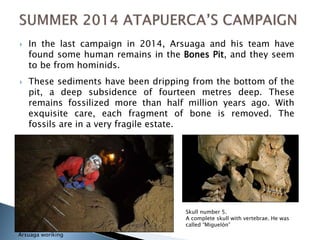
 In the last campaign in 2014, Arsuaga and his team have 
found some human remains in the Bones Pit, and they seem 
to be from hominids. 
 These sediments have been dripping from the bottom of the 
pit, a deep subsidence of fourteen metres deep. These 
remains fossilized more than half million years ago. With 
exquisite care, each fragment of bone is removed. The 
fossils are in a very fragile estate. 
Arsuaga woriking 
Skull number 5. 
A complete skull with vertebrae. He was 
called “Miguelón”
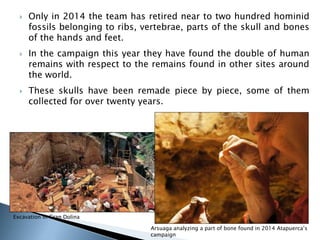
 Only in 2014 the team has retired near to two hundred hominid 
fossils belonging to ribs, vertebrae, parts of the skull and bones 
of the hands and feet. 
 In the campaign this year they have found the double of human 
remains with respect to the remains found in other sites around 
the world. 
 These skulls have been remade piece by piece, some of them 
collected for over twenty years. 
Excavation in Gran Dolina 
Arsuaga analyzing a part of bone found in 2014 Atapuerca’s 
campaign
 But, who were those hominids? We could consider them as 
Neanderthals’ grandparents. They could be Homo 
Heidelbergensis. 
 Those hominids lived in a warmer later period, but those 
previous circumstances so hard conditioned their evolution. 
They look like Neanderthals, with teeth (particularly the front) 
and robust jaws, nose projected forward, the familiar ring 
above the eyes, lack of chin ... but with smaller brains. 
 The site promises to shed new fossils in the coming years. 
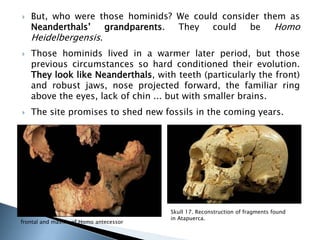
Skull 17. Reconstruction of fragments found 
in Atapuerca. 
frontal and maxilla of Homo antecessor
 A cave in Gibraltar has the first 
abstract design done intentionally 
by Neanderthals that has been 
found until now. 
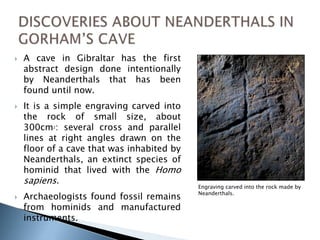
 It is a simple engraving carved into 
the rock of small size, about 
300cm2: several cross and parallel 
lines at right angles drawn on the 
floor of a cave that was inhabited by 
Neanderthals, an extinct species of 
hominid that lived with the Homo 
sapiens. 
 Archaeologists found fossil remains 
from hominids and manufactured 
instruments. 
Engraving carved into the rock made by 
Neanderthals.
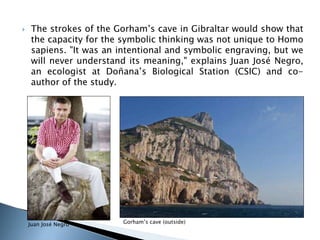
 The strokes of the Gorham’s cave in Gibraltar would show that 
the capacity for the symbolic thinking was not unique to Homo 
sapiens. "It was an intentional and symbolic engraving, but we 
will never understand its meaning," explains Juan José Negro, 
an ecologist at Doñana’s Biological Station (CSIC) and co-author 
of the study. 
Juan José Negro Gorham’s cave (outside)
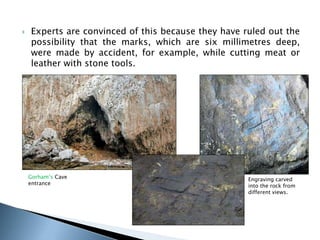
 Experts are convinced of this because they have ruled out the 
possibility that the marks, which are six millimetres deep, 
were made by accident, for example, while cutting meat or 
leather with stone tools. 
Gorham’s Cave 
entrance 
Engraving carved 
into the rock from 
different views.
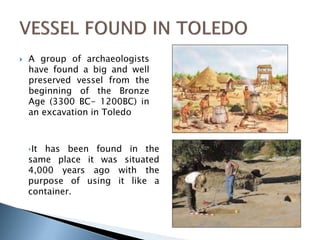
 A group of archaeologists 
have found a big and well 
preserved vessel from the 
beginning of the Bronze 
Age (3300 BC- 1200BC) in 
an excavation in Toledo 
‣It has been found in the 
same place it was situated 
4,000 years ago with the 
purpose of using it like a 
container.
 Archaeologists Juan Manuel Rojas, Alejandro Vicente and their team 
found that vessel last spring during an excavation in one neighbourhood 
in Toledo. 
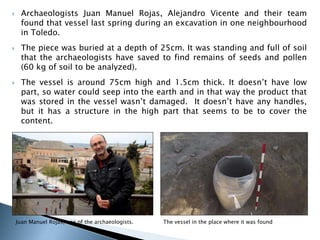
 The piece was buried at a depth of 25cm. It was standing and full of soil 
that the archaeologists have saved to find remains of seeds and pollen 
(60 kg of soil to be analyzed). 
 The vessel is around 75cm high and 1.5cm thick. It doesn’t have low 
part, so water could seep into the earth and in that way the product that 
was stored in the vessel wasn’t damaged. It doesn’t have any handles, 
but it has a structure in the high part that seems to be to cover the 
content. 
Juan Manuel Rojas, one of the archaeologists. The vessel in the place where it was found
 Sites from the beginning of the Bronze Age are not very 
common in Toledo. 
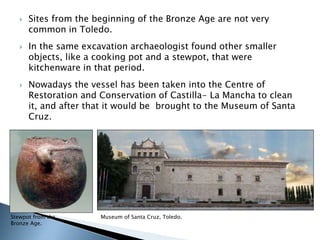
 In the same excavation archaeologist found other smaller 
objects, like a cooking pot and a stewpot, that were 
kitchenware in that period. 
 Nowadays the vessel has been taken into the Centre of 
Restoration and Conservation of Castilla- La Mancha to clean 
it, and after that it would be brought to the Museum of Santa 
Cruz. 
Stewpot from the Museum of Santa Cruz, Toledo. 
Bronze Age.
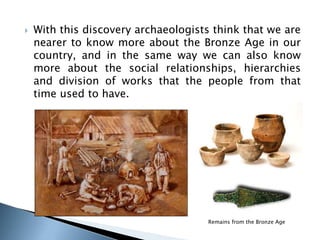
 With this discovery archaeologists think that we are 
nearer to know more about the Bronze Age in our 
country, and in the same way we can also know 
more about the social relationships, hierarchies 
and division of works that the people from that 
time used to have. 
Remains from the Bronze Age
 http://elpais.com/elpais/2014/08/20/eps/1408535436_57079 
3.html 
 http://www.abc.es/toledo/ciudad/20140914/abci-hallan-vasija- 
edad-bronce-201409142037.html 
 http://www.elmundo.es/ciencia/2014/09/01/5404ad8de2704e 
490f8b458e.html 
 http://www.diariocero.com.ar/info/arte-y-cultura/atribuyen-los- 
neandertales-expresion-abstracta-por-rastros-en-roca 
 http://www.efe.com/efe/noticias/espana/cultura/hallan-toledo-una- 
gran-vasija-almacenaje-primera-edad-bronce/ 
1/7/2413758

Last Discoveries from Prehistory in the Iberian Peninsula (PQI)

  • 1.
  • 2.
     In thelast campaign in 2014, Arsuaga and his team have found some human remains in the Bones Pit, and they seem to be from hominids.  These sediments have been dripping from the bottom of the pit, a deep subsidence of fourteen metres deep. These remains fossilized more than half million years ago. With exquisite care, each fragment of bone is removed. The fossils are in a very fragile estate. Arsuaga woriking Skull number 5. A complete skull with vertebrae. He was called “Miguelón”
  • 3.
     Only in2014 the team has retired near to two hundred hominid fossils belonging to ribs, vertebrae, parts of the skull and bones of the hands and feet.  In the campaign this year they have found the double of human remains with respect to the remains found in other sites around the world.  These skulls have been remade piece by piece, some of them collected for over twenty years. Excavation in Gran Dolina Arsuaga analyzing a part of bone found in 2014 Atapuerca’s campaign
  • 4.
     But, whowere those hominids? We could consider them as Neanderthals’ grandparents. They could be Homo Heidelbergensis.  Those hominids lived in a warmer later period, but those previous circumstances so hard conditioned their evolution. They look like Neanderthals, with teeth (particularly the front) and robust jaws, nose projected forward, the familiar ring above the eyes, lack of chin ... but with smaller brains.  The site promises to shed new fossils in the coming years. Skull 17. Reconstruction of fragments found in Atapuerca. frontal and maxilla of Homo antecessor
  • 5.
     A cavein Gibraltar has the first abstract design done intentionally by Neanderthals that has been found until now.  It is a simple engraving carved into the rock of small size, about 300cm2: several cross and parallel lines at right angles drawn on the floor of a cave that was inhabited by Neanderthals, an extinct species of hominid that lived with the Homo sapiens.  Archaeologists found fossil remains from hominids and manufactured instruments. Engraving carved into the rock made by Neanderthals.
  • 6.
     The strokesof the Gorham’s cave in Gibraltar would show that the capacity for the symbolic thinking was not unique to Homo sapiens. "It was an intentional and symbolic engraving, but we will never understand its meaning," explains Juan José Negro, an ecologist at Doñana’s Biological Station (CSIC) and co-author of the study. Juan José Negro Gorham’s cave (outside)
  • 7.
     Experts areconvinced of this because they have ruled out the possibility that the marks, which are six millimetres deep, were made by accident, for example, while cutting meat or leather with stone tools. Gorham’s Cave entrance Engraving carved into the rock from different views.
  • 8.
     A groupof archaeologists have found a big and well preserved vessel from the beginning of the Bronze Age (3300 BC- 1200BC) in an excavation in Toledo ‣It has been found in the same place it was situated 4,000 years ago with the purpose of using it like a container.
  • 9.
     Archaeologists JuanManuel Rojas, Alejandro Vicente and their team found that vessel last spring during an excavation in one neighbourhood in Toledo.  The piece was buried at a depth of 25cm. It was standing and full of soil that the archaeologists have saved to find remains of seeds and pollen (60 kg of soil to be analyzed).  The vessel is around 75cm high and 1.5cm thick. It doesn’t have low part, so water could seep into the earth and in that way the product that was stored in the vessel wasn’t damaged. It doesn’t have any handles, but it has a structure in the high part that seems to be to cover the content. Juan Manuel Rojas, one of the archaeologists. The vessel in the place where it was found
  • 10.
     Sites fromthe beginning of the Bronze Age are not very common in Toledo.  In the same excavation archaeologist found other smaller objects, like a cooking pot and a stewpot, that were kitchenware in that period.  Nowadays the vessel has been taken into the Centre of Restoration and Conservation of Castilla- La Mancha to clean it, and after that it would be brought to the Museum of Santa Cruz. Stewpot from the Museum of Santa Cruz, Toledo. Bronze Age.
  • 11.
     With thisdiscovery archaeologists think that we are nearer to know more about the Bronze Age in our country, and in the same way we can also know more about the social relationships, hierarchies and division of works that the people from that time used to have. Remains from the Bronze Age
  • 12.
     http://elpais.com/elpais/2014/08/20/eps/1408535436_57079 3.html  http://www.abc.es/toledo/ciudad/20140914/abci-hallan-vasija- edad-bronce-201409142037.html  http://www.elmundo.es/ciencia/2014/09/01/5404ad8de2704e 490f8b458e.html  http://www.diariocero.com.ar/info/arte-y-cultura/atribuyen-los- neandertales-expresion-abstracta-por-rastros-en-roca  http://www.efe.com/efe/noticias/espana/cultura/hallan-toledo-una- gran-vasija-almacenaje-primera-edad-bronce/ 1/7/2413758