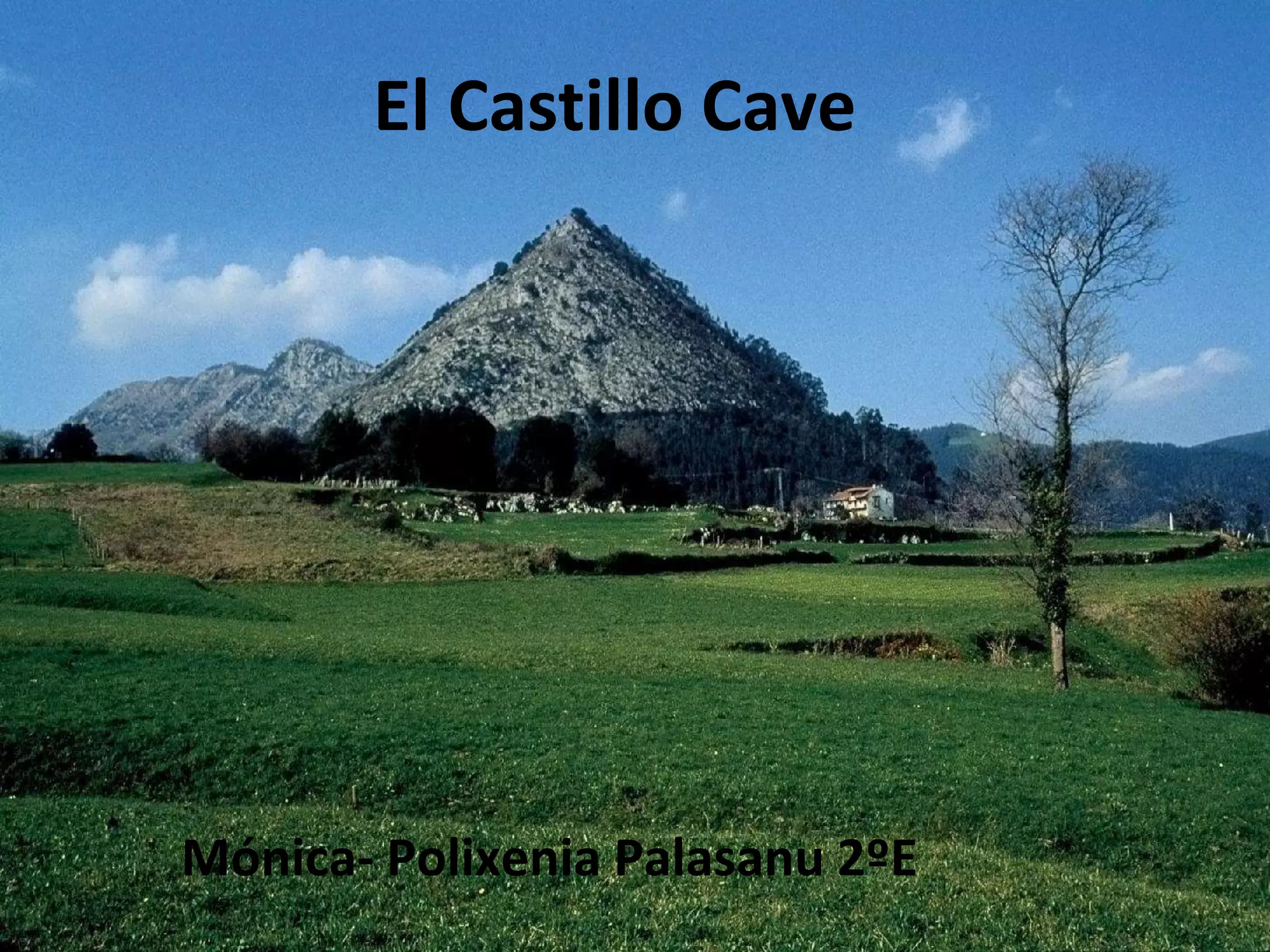
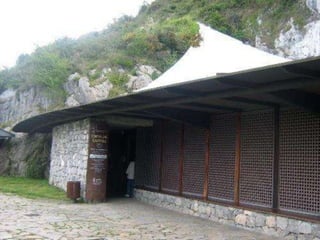
El Castillo Cave 
Mónica- Polixenia Palasanu 2ºE
1.Location 
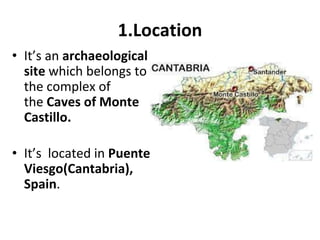
• It’s an archaeological 
site which belongs to 
the complex of 
the Caves of Monte 
Castillo. 
• It’s located in Puente 
Viesgo(Cantabria), 
Spain.
2.Features and description 
• It hosts the oldest known cave art in the world(120,000 years) 
• It was discovered in 1903 by H. Alcalde del Río. 
• The archaeological site was located in the lobby and contains 
human activity of the last 150,000 years. 
• On the walls of the cave there are paintings of hands, bisons, 
deer, horses, enigmatic symbols… 
• It is noted for its techniques, themes and styles. 
• El Castillo has remains from the Lower Paleolithic to the Bronze 
Age. 
• The archeologists found clues that the cave was inhabited by 
Neanderthals and Homo Sapiens 
• This cave is very important for its level of stratification, it has 25 
different levels. 
• Archeologists thought that there was living the modern humans 
and the Neanderthals.
4.Life in the Paleolithic 
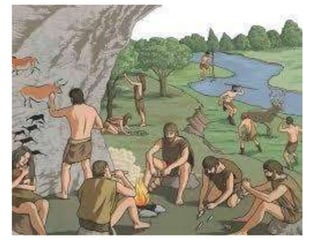
We can know the animals that lived with the 
humans, because they are painted on the walls 
of the cave (bisons, deer, horses...) and were 
hunted by them. They also painted their hands 
and geometric shapes. Thanks to the paintings 
and the objects there we can know a little of 
their mentality.
3.PHOTOGRAPHS AND EXAMPLES
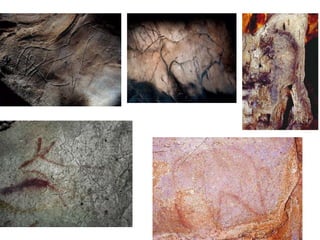
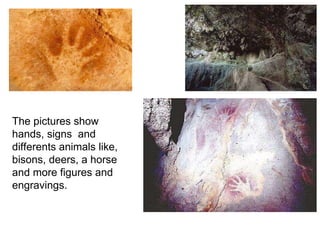
The pictures show 
hands, signs and 
differents animals like, 
bisons, deers, a horse 
and more figures and 
engravings.
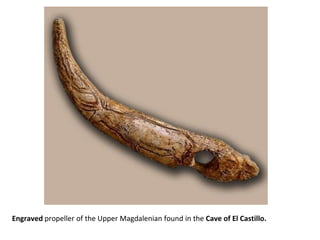
Engraved propeller of the Upper Magdalenian found in the Cave of El Castillo.
5.Resources 
http://www.turismodecantabria.com/disfrutala/que-visitar/18-cueva-de-el- 
castillo/buscador-aWRab25hPTkmaWRNdW5pY2lwaW89NDAm 
http://es.wikipedia.org/wiki/Cueva_de_El_Castillo 
http://cuevas.culturadecantabria.com/castillo.asp 
https://www.youtube.com/watch?v=t0j9NC1hID0 
http://www.regiocantabrorum.es/publicaciones/cueva_castillo 
http://culturadecantabria.viavox.com/ficha_patrimonio.asp?idmonumento=17

El castillo cave

  • 1.
    El Castillo Cave Mónica- Polixenia Palasanu 2ºE
  • 2.
    1.Location • It’san archaeological site which belongs to the complex of the Caves of Monte Castillo. • It’s located in Puente Viesgo(Cantabria), Spain.
  • 3.
    2.Features and description • It hosts the oldest known cave art in the world(120,000 years) • It was discovered in 1903 by H. Alcalde del Río. • The archaeological site was located in the lobby and contains human activity of the last 150,000 years. • On the walls of the cave there are paintings of hands, bisons, deer, horses, enigmatic symbols… • It is noted for its techniques, themes and styles. • El Castillo has remains from the Lower Paleolithic to the Bronze Age. • The archeologists found clues that the cave was inhabited by Neanderthals and Homo Sapiens • This cave is very important for its level of stratification, it has 25 different levels. • Archeologists thought that there was living the modern humans and the Neanderthals.
  • 5.
    4.Life in thePaleolithic We can know the animals that lived with the humans, because they are painted on the walls of the cave (bisons, deer, horses...) and were hunted by them. They also painted their hands and geometric shapes. Thanks to the paintings and the objects there we can know a little of their mentality.
  • 7.
  • 9.
    The pictures show hands, signs and differents animals like, bisons, deers, a horse and more figures and engravings.
  • 10.
    Engraved propeller ofthe Upper Magdalenian found in the Cave of El Castillo.
  • 11.
    5.Resources http://www.turismodecantabria.com/disfrutala/que-visitar/18-cueva-de-el- castillo/buscador-aWRab25hPTkmaWRNdW5pY2lwaW89NDAm http://es.wikipedia.org/wiki/Cueva_de_El_Castillo http://cuevas.culturadecantabria.com/castillo.asp https://www.youtube.com/watch?v=t0j9NC1hID0 http://www.regiocantabrorum.es/publicaciones/cueva_castillo http://culturadecantabria.viavox.com/ficha_patrimonio.asp?idmonumento=17