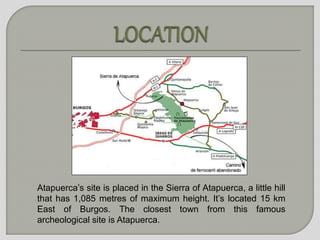
Atapuerca’s site is placed in the Sierra of Atapuerca, a little hill 
that has 1,085 metres of maximum height. It’s located 15 km 
East of Burgos. The closest town from this famous 
archeological site is Atapuerca.
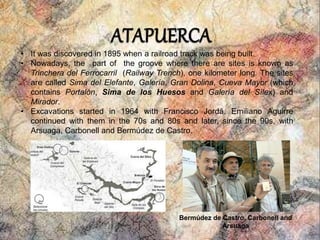
• It was discovered in 1895 when a railroad track was being built. 
• Nowadays, the part of the groove where there are sites is known as 
Trinchera del Ferrocarril (Railway Trench), one kilometer long. The sites 
are called Sima del Elefante, Galería, Gran Dolina, Cueva Mayor (which 
contains Portalón, Sima de los Huesos and Galería del Sílex) and 
Mirador. 
• Excavations started in 1964 with Francisco Jordá. Emiliano Aguirre 
continued with them in the 70s and 80s and later, since the 90s, with 
Arsuaga, Carbonell and Bermúdez de Castro. 
Bermúdez de Castro, Carbonell and 
Arsuaga
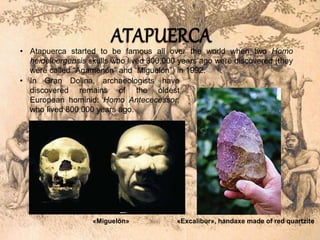
• Atapuerca started to be famous all over the world when two Homo 
heidelbergensis skulls who lived 300,000 years ago were discovered (they 
were called “Agamenón” and “Miguelón”) in 1992. 
• In Gran Dolina, archaeologists have 
discovered remains of the oldest 
European hominid: Homo Antececessor, 
who lived 800,000 years ago. 
«Miguelón» «Excalibur», handaxe made of red quartzite
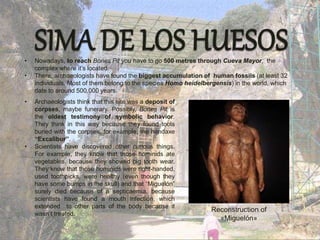
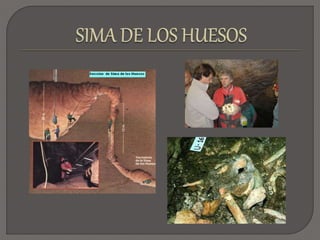
• Nowadays, to reach Bones Pit you have to go 500 metres through Cueva Mayor, the 
complex where it’s located. 
• There, archaeologists have found the biggest accumulation of human fossils (at least 32 
individuals. Most of them belong to the species Homo heidelbergensis) in the world, which 
date to around 500,000 years. 
• Archaeologists think that this site was a deposit of 
corpses, maybe funerary. Possibly, Bones Pit is 
the oldest testimony of symbolic behavior. 
They think in this way because they found tools 
buried with the corpses, for example, the handaxe 
“Excalibur”. 
• Scientists have discovered other curious things. 
For example, they know that those hominids ate 
vegetables, because they showed big tooth wear. 
They know that those hominids were right-handed, 
used toothpicks, were healthy (even though they 
have some bumps in the skull) and that “Miguelón” 
surely died because of a septicaemia, because 
scientists have found a mouth infection, which 
extended to other parts of the body because it 
wasn’t treated. 
Reconstruction of 
«Miguelón»
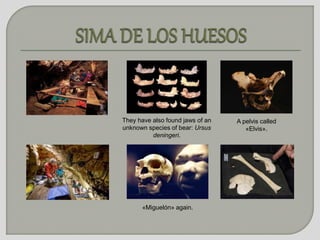
They have also found jaws of an 
unknown species of bear: Ursus 
deningeri. 
«Miguelón» again. 
A pelvis called 
«Elvis».
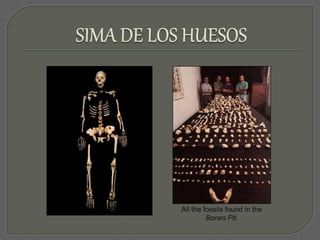
All the fossils found in the 
Bones Pit.
• http://atapuerca.evoluciona.org/documents/00/es/gral_foto/content/i 
nici/04_sima_de_los_huesos.html 
• http://www.atapuerca.tv/atapuerca/yacimiento_huesos 
• http://www.atapuerca.org/huesos.htm# 
• http://conoceatapuerca.blogspot.com.es/2012/07/sumergiendose-en- 
la-sima-de-los-huesos.html 
• http://es.wikipedia.org/wiki/Sierra_de_Atapuerca#Situaci.C3.B3n_g 
eogr.C3.A1fica 
• http://www.atapuerca.tv/atapuerca/localizacion 
• http://www.nationalgeographic.com.es/articulo/historia/secciones/80 
21/atapuerca_cuna_los_humanos_mas_antiguos_europa.html?_pa 
ge=2
PRESENTATION MADE BY 
SALVADOR FUENTES LUCAS-TORRES 
2푛푑 OF BACHILLERATO 
2푛푑 OCTOBER 2014

Bones Pit (Atapuerca)

  • 2.
    Atapuerca’s site isplaced in the Sierra of Atapuerca, a little hill that has 1,085 metres of maximum height. It’s located 15 km East of Burgos. The closest town from this famous archeological site is Atapuerca.
  • 3.
    • It wasdiscovered in 1895 when a railroad track was being built. • Nowadays, the part of the groove where there are sites is known as Trinchera del Ferrocarril (Railway Trench), one kilometer long. The sites are called Sima del Elefante, Galería, Gran Dolina, Cueva Mayor (which contains Portalón, Sima de los Huesos and Galería del Sílex) and Mirador. • Excavations started in 1964 with Francisco Jordá. Emiliano Aguirre continued with them in the 70s and 80s and later, since the 90s, with Arsuaga, Carbonell and Bermúdez de Castro. Bermúdez de Castro, Carbonell and Arsuaga
  • 4.
    • Atapuerca startedto be famous all over the world when two Homo heidelbergensis skulls who lived 300,000 years ago were discovered (they were called “Agamenón” and “Miguelón”) in 1992. • In Gran Dolina, archaeologists have discovered remains of the oldest European hominid: Homo Antececessor, who lived 800,000 years ago. «Miguelón» «Excalibur», handaxe made of red quartzite
  • 5.
    • Nowadays, toreach Bones Pit you have to go 500 metres through Cueva Mayor, the complex where it’s located. • There, archaeologists have found the biggest accumulation of human fossils (at least 32 individuals. Most of them belong to the species Homo heidelbergensis) in the world, which date to around 500,000 years. • Archaeologists think that this site was a deposit of corpses, maybe funerary. Possibly, Bones Pit is the oldest testimony of symbolic behavior. They think in this way because they found tools buried with the corpses, for example, the handaxe “Excalibur”. • Scientists have discovered other curious things. For example, they know that those hominids ate vegetables, because they showed big tooth wear. They know that those hominids were right-handed, used toothpicks, were healthy (even though they have some bumps in the skull) and that “Miguelón” surely died because of a septicaemia, because scientists have found a mouth infection, which extended to other parts of the body because it wasn’t treated. Reconstruction of «Miguelón»
  • 7.
    They have alsofound jaws of an unknown species of bear: Ursus deningeri. «Miguelón» again. A pelvis called «Elvis».
  • 8.
    All the fossilsfound in the Bones Pit.
  • 9.
    • http://atapuerca.evoluciona.org/documents/00/es/gral_foto/content/i nici/04_sima_de_los_huesos.html • http://www.atapuerca.tv/atapuerca/yacimiento_huesos • http://www.atapuerca.org/huesos.htm# • http://conoceatapuerca.blogspot.com.es/2012/07/sumergiendose-en- la-sima-de-los-huesos.html • http://es.wikipedia.org/wiki/Sierra_de_Atapuerca#Situaci.C3.B3n_g eogr.C3.A1fica • http://www.atapuerca.tv/atapuerca/localizacion • http://www.nationalgeographic.com.es/articulo/historia/secciones/80 21/atapuerca_cuna_los_humanos_mas_antiguos_europa.html?_pa ge=2
  • 10.
    PRESENTATION MADE BY SALVADOR FUENTES LUCAS-TORRES 2푛푑 OF BACHILLERATO 2푛푑 OCTOBER 2014