
Light Amplification by Stimulated Emission of Radiation
It is a device that emits light(Electromagnetic Radiation) Through the process
called OPTICAL AMPLIFICATION based on the stimulated emission of photons

The laser light is notable for its high degree of spatial and temporal coherence


LOSER
“Light Oscillation by Stimulated Emission of Radiation”
the FIRST and more CORRECT term for LASER
   Charles H. Townes, James P. Gordon, and H. J. Zeiger built the
    first ammonia maser at Columbia University in 1953. This device
    used Stimulated Emission in a stream of energized ammonia molecules to
    produce amplification of microwaves at a frequency of about 24.0
    GHertz.
   Townes later worked with Arthur L. Schawlow to describe the principle
    of the optical maser, or LASER, which Theodore Maiman created the first
    working model of in 1960. For their research in the field of stimulated
    emission, Townes, Basov and Prokhorov were awarded the Nobel Prize
    in Physics in 1964.
   Developed by Theodore H. Maiman in 1960
   Creates a beam at λ = 694 nm (deep red).
    Metastable state of ~3ms
   Has efficiency of less than 1% but creates a diameter
   ranging from 1 mm to about 25 mm, so a large energy
   density is achieved in the laser beam.
   Used by rangefinders in 1960, until the more efficient Nd:YAG
    came a Decade later
   It is now used for drilling holes in diamonds
   It is the first laser made functional
   • Monochromaticity – same λ or frequency
   • Directivity
   • Highly correlated photons for long distances.
   • High energy-density
   • Polarization
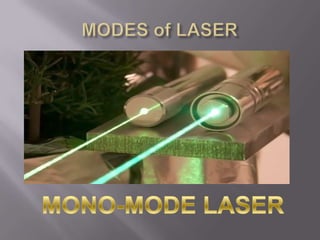
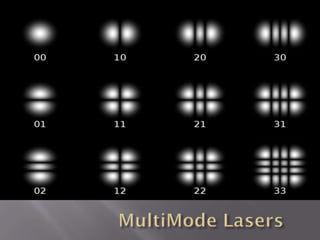
   • Modes
   • Gaseous laser :
   - atomic gaseous lasers (e.g. HeNe)
   - molecular laser (e.g. CO2)
   • Dye laser (e.g. N2
   - rhodamine)
   • Electronic laser (uses the acceleration of
    electrons)
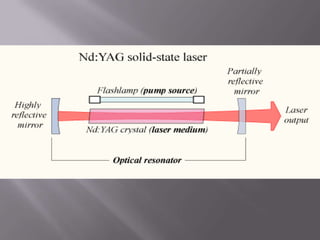
   • Solid laser – semiconductor (YAG-Nd laser
   Neodymium:Yttrium Aluminium Garnet)
   • Atomic laser – Bose-Einstein condensate.
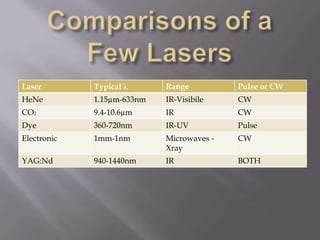
Laser        Typical λ      Range          Pulse or CW
HeNe         1.15µm-633nm   IR-Visibile    CW
CO2          9.4-10.6µm     IR             CW
Dye          360-720nm      IR-UV          Pulse
Electronic   1mm-1nm        Microwaves -   CW
                            Xray
YAG:Nd       940-1440nm     IR             BOTH
   Science – precise measurements, spectroscopy
   Medicine – laser scalpel, eye surgery
   Industry – cutting and welding, guidance
    systems
   Arts – etching
   Telecommunications (fiber optics)
   Radars
   Precise measurement of long distances (e.g.
    Moon)
    Consumer – CDs, DVDs, laser lights
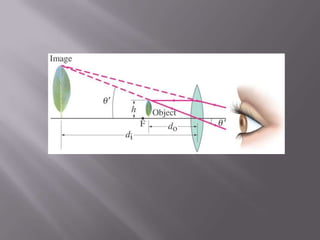
   A magnifying glass (simple magnifier) is a
    converging lens. It allows us to focus on objects
    closer than the near point, so that they make a
    larger, and therefore clearer, image on the
    retina.
   A refracting telescope consists of two lenses at
    opposite ends of a long tube. The objective lens
    is closest to the object, and the eyepiece is
    closest to the eye.
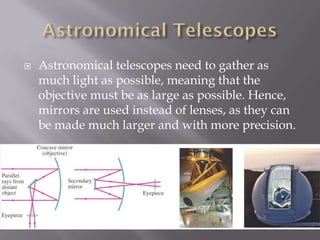
   Astronomical telescopes need to gather as
    much light as possible, meaning that the
    objective must be as large as possible. Hence,
    mirrors are used instead of lenses, as they can
    be made much larger and with more precision.
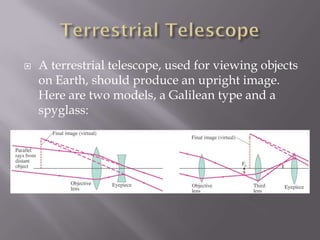
   A terrestrial telescope, used for viewing objects
    on Earth, should produce an upright image.
    Here are two models, a Galilean type and a
    spyglass:
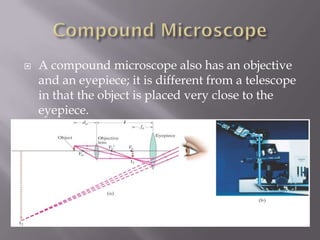
   A compound microscope also has an objective
    and an eyepiece; it is different from a telescope
    in that the object is placed very close to the
    eyepiece.
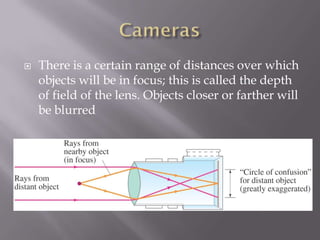
   There is a certain range of distances over which
    objects will be in focus; this is called the depth
    of field of the lens. Objects closer or farther will
    be blurred

Lasers and Other Optical Devices

  • 2.
    Light Amplification byStimulated Emission of Radiation It is a device that emits light(Electromagnetic Radiation) Through the process called OPTICAL AMPLIFICATION based on the stimulated emission of photons The laser light is notable for its high degree of spatial and temporal coherence LOSER “Light Oscillation by Stimulated Emission of Radiation” the FIRST and more CORRECT term for LASER
  • 3.
    Charles H. Townes, James P. Gordon, and H. J. Zeiger built the first ammonia maser at Columbia University in 1953. This device used Stimulated Emission in a stream of energized ammonia molecules to produce amplification of microwaves at a frequency of about 24.0 GHertz.  Townes later worked with Arthur L. Schawlow to describe the principle of the optical maser, or LASER, which Theodore Maiman created the first working model of in 1960. For their research in the field of stimulated emission, Townes, Basov and Prokhorov were awarded the Nobel Prize in Physics in 1964.
  • 5.
    Developed by Theodore H. Maiman in 1960  Creates a beam at λ = 694 nm (deep red).  Metastable state of ~3ms  Has efficiency of less than 1% but creates a diameter  ranging from 1 mm to about 25 mm, so a large energy  density is achieved in the laser beam.  Used by rangefinders in 1960, until the more efficient Nd:YAG came a Decade later  It is now used for drilling holes in diamonds  It is the first laser made functional
  • 6.
    • Monochromaticity – same λ or frequency  • Directivity  • Highly correlated photons for long distances.  • High energy-density  • Polarization  • Modes
  • 9.
    • Gaseous laser :  - atomic gaseous lasers (e.g. HeNe)  - molecular laser (e.g. CO2)  • Dye laser (e.g. N2  - rhodamine)  • Electronic laser (uses the acceleration of electrons)  • Solid laser – semiconductor (YAG-Nd laser  Neodymium:Yttrium Aluminium Garnet)  • Atomic laser – Bose-Einstein condensate.
  • 16.
    Laser Typical λ Range Pulse or CW HeNe 1.15µm-633nm IR-Visibile CW CO2 9.4-10.6µm IR CW Dye 360-720nm IR-UV Pulse Electronic 1mm-1nm Microwaves - CW Xray YAG:Nd 940-1440nm IR BOTH
  • 17.
    Science – precise measurements, spectroscopy  Medicine – laser scalpel, eye surgery  Industry – cutting and welding, guidance systems  Arts – etching  Telecommunications (fiber optics)  Radars  Precise measurement of long distances (e.g. Moon)  Consumer – CDs, DVDs, laser lights
  • 19.
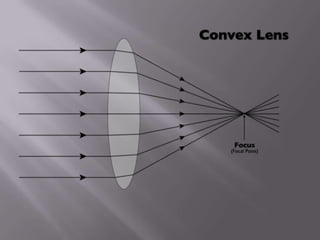
    A magnifying glass (simple magnifier) is a converging lens. It allows us to focus on objects closer than the near point, so that they make a larger, and therefore clearer, image on the retina.
  • 21.
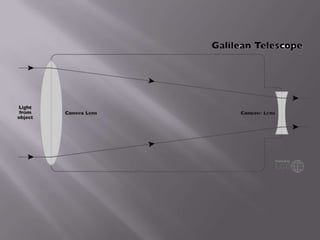
    A refracting telescope consists of two lenses at opposite ends of a long tube. The objective lens is closest to the object, and the eyepiece is closest to the eye.
  • 24.
    Astronomical telescopes need to gather as much light as possible, meaning that the objective must be as large as possible. Hence, mirrors are used instead of lenses, as they can be made much larger and with more precision.
  • 25.
    A terrestrial telescope, used for viewing objects on Earth, should produce an upright image. Here are two models, a Galilean type and a spyglass:
  • 26.
    A compound microscope also has an objective and an eyepiece; it is different from a telescope in that the object is placed very close to the eyepiece.
  • 27.
    There is a certain range of distances over which objects will be in focus; this is called the depth of field of the lens. Objects closer or farther will be blurred