Laser Doppler Anemometry
Introduction to principles and applications
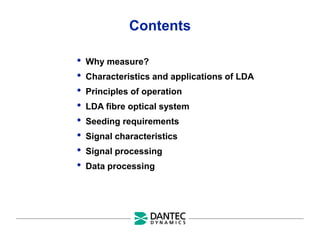
Contents
• Why measure?
• Characteristics and applications of LDA
• Principles of operation
• LDA fibre optical system
• Seeding requirements
• Signal characteristics
• Signal processing
• Data processing
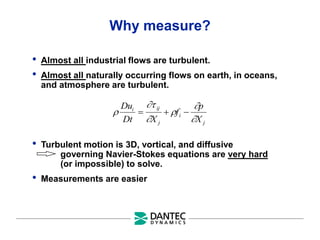
Why measure?
• Almost all industrial flows are turbulent.
• Almost all naturally occurring flows on earth, in oceans,
and atmosphere are turbulent.
• Turbulent motion is 3D, vortical, and diffusive
governing Navier-Stokes equations are very hard
(or impossible) to solve.
• Measurements are easier






Du
Dt X
f
p
X
i ij
j
i
j
  
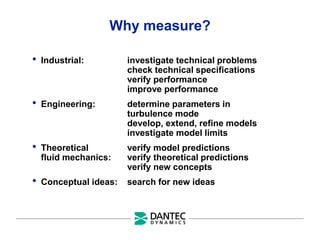
Why measure?
• Industrial: investigate technical problems
check technical specifications
verify performance
improve performance
• Engineering: determine parameters in
turbulence mode
develop, extend, refine models
investigate model limits
• Theoretical verify model predictions
fluid mechanics: verify theoretical predictions
verify new concepts
• Conceptual ideas: search for new ideas
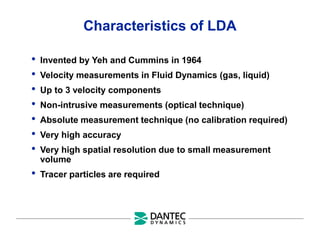
Characteristics of LDA
• Invented by Yeh and Cummins in 1964
• Velocity measurements in Fluid Dynamics (gas, liquid)
• Up to 3 velocity components
• Non-intrusive measurements (optical technique)
• Absolute measurement technique (no calibration required)
• Very high accuracy
• Very high spatial resolution due to small measurement
volume
• Tracer particles are required
Applications of LDA
• Laminar and turbulent flows
• Investigations on aerodynamics
• Supersonic flows
• Turbines, automotive etc.
• Liquid flows
• Surface velocity and vibration measurement
• Hot environments (flames, plasma etc.)
• Velocity of particles
• ...etc., etc., etc.
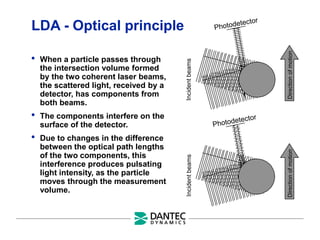
LDA - Optical principle
• When a particle passes through
the intersection volume formed
by the two coherent laser beams,
the scattered light, received by a
detector, has components from
both beams.
• The components interfere on the
surface of the detector.
• Due to changes in the difference
between the optical path lengths
of the two components, this
interference produces pulsating
light intensity, as the particle
moves through the measurement
volume. Incident
beams
Direction
of
motion
Incident
beams
Direction
of
motion
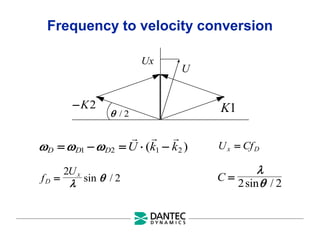
Frequency to velocity conversion
Ux
U
K2
 / 2
K1
  
D D D U k k
    
1 2 1 2
  
( )
f
U
D
x

2
2
 
sin /
U Cf
x D

C 


2 2
sin /
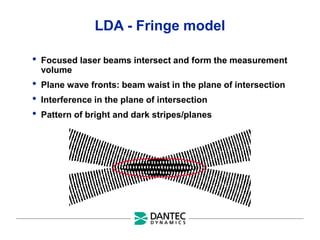
LDA - Fringe model
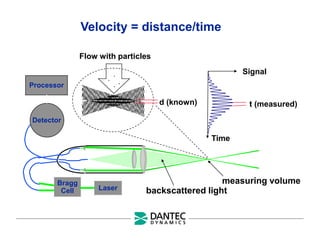
• Focused laser beams intersect and form the measurement
volume
• Plane wave fronts: beam waist in the plane of intersection
• Interference in the plane of intersection
• Pattern of bright and dark stripes/planes
Flow with particles
d (known)
Velocity = distance/time
t (measured)
Signal
Time
Laser
Bragg
Cell backscattered light
measuring volume
Detector
Processor
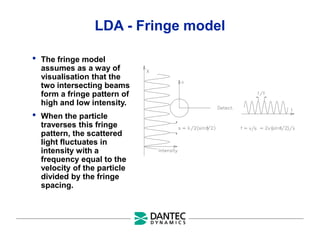
LDA - Fringe model
• The fringe model
assumes as a way of
visualisation that the
two intersecting beams
form a fringe pattern of
high and low intensity.
• When the particle
traverses this fringe
pattern, the scattered
light fluctuates in
intensity with a
frequency equal to the
velocity of the particle
divided by the fringe
spacing.
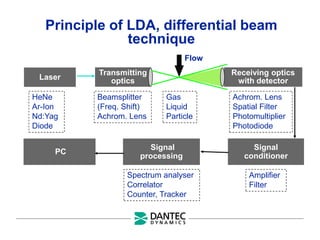
Principle of LDA, differential beam
technique
Laser
Signal
processing
Transmitting
optics
Receiving optics
with detector
Signal
conditioner
Flow
HeNe
Ar-Ion
Nd:Yag
Diode
Beamsplitter
(Freq. Shift)
Achrom. Lens
Gas
Liquid
Particle
Achrom. Lens
Spatial Filter
Photomultiplier
Photodiode
Spectrum analyser
Correlator
Counter, Tracker
Amplifier
Filter
PC
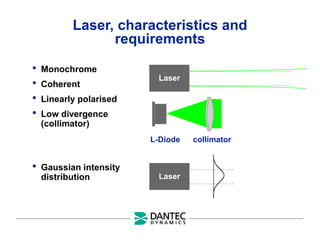
Laser, characteristics and
requirements
• Monochrome
• Coherent
• Linearly polarised
• Low divergence
(collimator)
• Gaussian intensity
distribution
Laser
L-Diode collimator
Laser
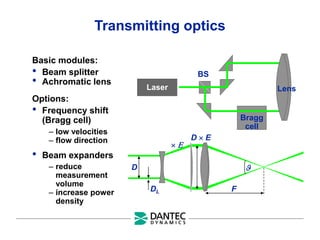
Transmitting optics
Laser
Bragg
cell
BS
F
D E


D
DL
Lens
Basic modules:
• Beam splitter
• Achromatic lens
Options:
• Frequency shift
(Bragg cell)
– low velocities
– flow direction
• Beam expanders
– reduce
measurement
volume
– increase power
density
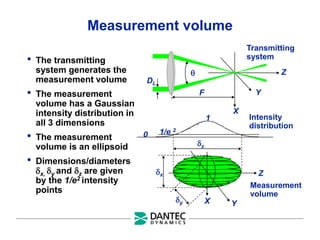
Measurement volume
• The transmitting
system generates the
measurement volume
• The measurement
volume has a Gaussian
intensity distribution in
all 3 dimensions
• The measurement
volume is an ellipsoid
• Dimensions/diameters
x, y and z are given
by the 1/e2 intensity
points
F

DL
Y
Z
X
Transmitting
system
Measurement
volume
Intensity
distribution
0 1/e 2
1
z
x
y X
Z
Y
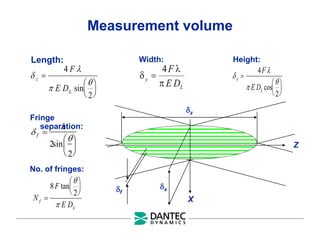
Measurement volume
Length:

Width: Height:
No. of fringes:




z
L
F
E D







4
2
sin



y
L
F
E D

4




x
L
F
E D







4
2
cos
N
F
E D
f
L







8
2
tan


z
x
X
Z
f
Fringe
separation:



f 






2
2
sin
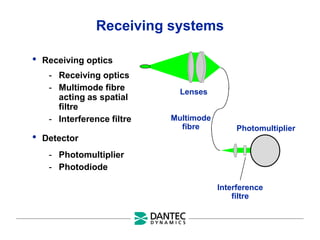
Lenses
Interference
filtre
Photomultiplier
Receiving systems
• Receiving optics
- Receiving optics
- Multimode fibre
acting as spatial
filtre
- Interference filtre
• Detector
- Photomultiplier
- Photodiode
Multimode
fibre
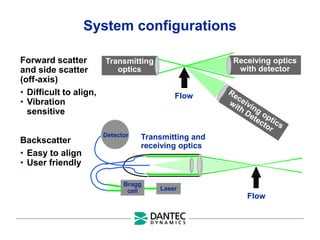
System configurations
Forward scatter
and side scatter
(off-axis)
• Difficult to align,
• Vibration
sensitive
Backscatter
• Easy to align
• User friendly
Receiving optics
with detector
Transmitting
optics
Flow
Flow
Laser
Bragg
cell
Detector Transmitting and
receiving optics
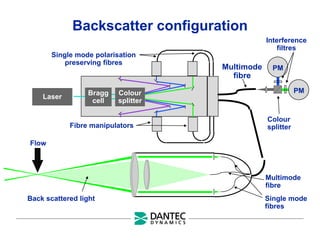
Backscatter configuration
Laser
Bragg
cell
Colour
splitter
PM
PM
Fibre manipulators
Single mode polarisation
preserving fibres
Flow
Back scattered light
Multimode
fibre
Multimode
fibre
Interference
filtres
Colour
splitter
Single mode
fibres
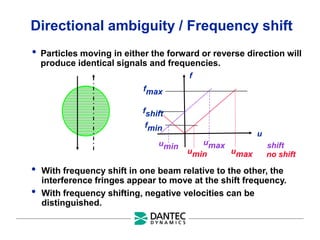
• Particles moving in either the forward or reverse direction will
produce identical signals and frequencies.
Directional ambiguity / Frequency shift
fmax
fshift
fmin
f
u
umin umax
umin umax
• With frequency shift in one beam relative to the other, the
interference fringes appear to move at the shift frequency.
• With frequency shifting, negative velocities can be
distinguished.
no shift
shift
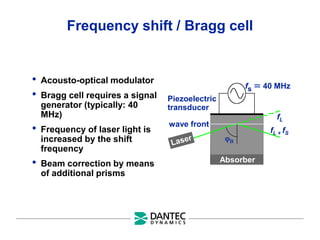
Frequency shift / Bragg cell
• Acousto-optical modulator
• Bragg cell requires a signal
generator (typically: 40
MHz)
• Frequency of laser light is
increased by the shift
frequency
• Beam correction by means
of additional prisms
Piezoelectric
transducer
fs40 MHz
Absorber
wave front

fL
fL + fS
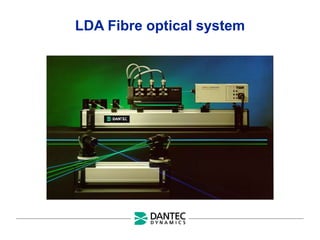
LDA Fibre optical system
LDA instrumentation from
Dantec Dynamics
• FlowLite
- HeNe laser
- 1 velocity component
- With frequency shift
- Wide selection of accessories
• FiberFlow optics/transmitter
- Ar-Ion laser required
- 1, 2 or 3 velocity components
- With frequency shift
- Wide selection of probes and
accessories
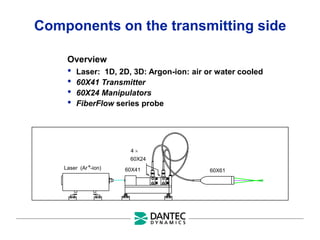
Components on the transmitting side
Overview
• Laser: 1D, 2D, 3D: Argon-ion: air or water cooled
• 60X41 Transmitter
• 60X24 Manipulators
• FiberFlow series probe
Laser (Ar -ion)
+
60X41
4
60X24
60X61
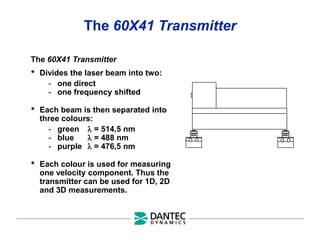
The 60X41 Transmitter
• Divides the laser beam into two:
- one direct
- one frequency shifted
• Each beam is then separated into
three colours:
- green  = 514,5 nm
- blue  = 488 nm
- purple  = 476,5 nm
• Each colour is used for measuring
one velocity component. Thus the
transmitter can be used for 1D, 2D
and 3D measurements.
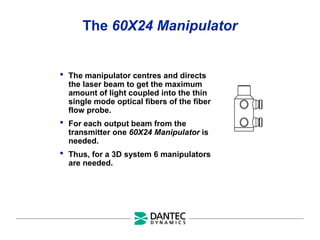
The 60X24 Manipulator
• The manipulator centres and directs
the laser beam to get the maximum
amount of light coupled into the thin
single mode optical fibers of the fiber
flow probe.
• For each output beam from the
transmitter one 60X24 Manipulator is
needed.
• Thus, for a 3D system 6 manipulators
are needed.
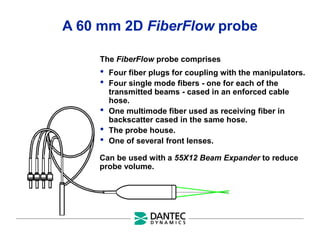
A 60 mm 2D FiberFlow probe
The FiberFlow probe comprises
• Four fiber plugs for coupling with the manipulators.
• Four single mode fibers - one for each of the
transmitted beams - cased in an enforced cable
hose.
• One multimode fiber used as receiving fiber in
backscatter cased in the same hose.
• The probe house.
• One of several front lenses.
Can be used with a 55X12 Beam Expander to reduce
probe volume.
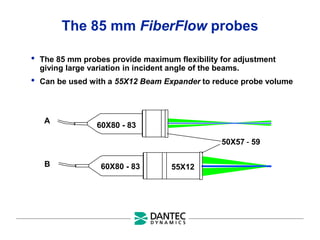
The 85 mm FiberFlow probes
60X80 - 83
55X12
50X57 - 59
A
B
• The 85 mm probes provide maximum flexibility for adjustment
giving large variation in incident angle of the beams.
• Can be used with a 55X12 Beam Expander to reduce probe volume
60X80 - 83
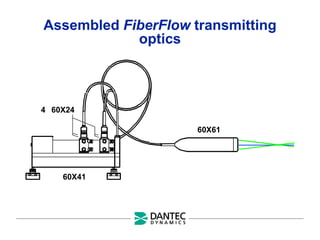
Assembled FiberFlow transmitting
optics
60X41
4 60X24
60X61
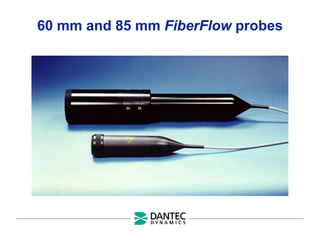
60 mm and 85 mm FiberFlow probes
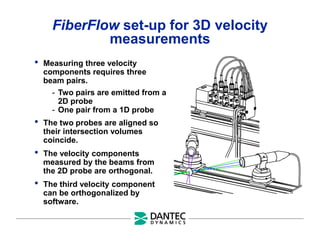
FiberFlow set-up for 3D velocity
measurements
• Measuring three velocity
components requires three
beam pairs.
- Two pairs are emitted from a
2D probe
- One pair from a 1D probe
• The two probes are aligned so
their intersection volumes
coincide.
• The velocity components
measured by the beams from
the 2D probe are orthogonal.
• The third velocity component
can be orthogonalized by
software.
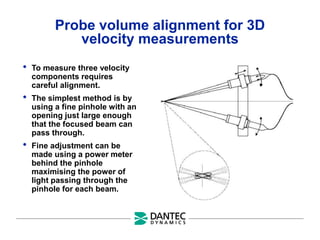
Probe volume alignment for 3D
velocity measurements
• To measure three velocity
components requires
careful alignment.
• The simplest method is by
using a fine pinhole with an
opening just large enough
that the focused beam can
pass through.
• Fine adjustment can be
made using a power meter
behind the pinhole
maximising the power of
light passing through the
pinhole for each beam.
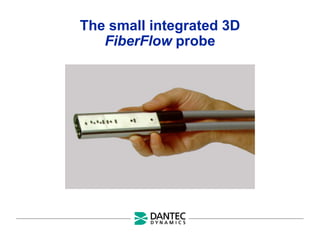
The small integrated 3D
FiberFlow probe
3D LDA Applications
• Measurements of boundary layer separation in wind
tunnels
• Turbulent mixing and flame investigations in combustors
• Studies of boundary layer-wake interactions and
instabilities in turbines
• Investigations of flow structure, heat transfer, and
instabilities in heat exchangers
• Studies of convection and forced cooling in nuclear
reactor models
• Measurements around ship models in towing tanks
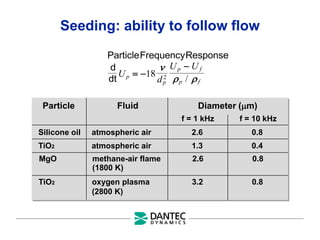
Particle Fluid Diameter (m)
f = 1 kHz f = 10 kHz
Silicone oil atmospheric air 2.6 0.8
TiO2 atmospheric air 1.3 0.4
TiO2 oxygen plasma 3.2 0.8
(2800 K)
MgO methane-air flame 2.6 0.8
(1800 K)
Seeding: ability to follow flow
ParticleFrequencyResponse
d
dt
U
d
U U
p
p
p f
p f
 

18 2

 
/
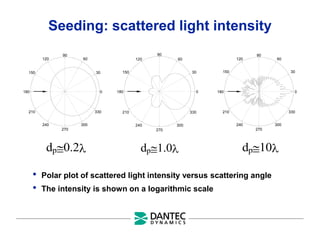
Seeding: scattered light intensity
180 0
90
270
210
150
240
120
300
60
330
30
180 0
330
210
240 300
270
150
120
90
60
30
180 0
210
150
240
120
270
90
60
300
30
330
dp0.2 dp1.0 dp10
• Polar plot of scattered light intensity versus scattering angle
• The intensity is shown on a logarithmic scale
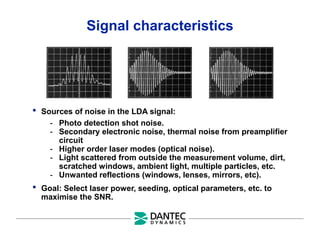
Signal characteristics
• Sources of noise in the LDA signal:
- Photo detection shot noise.
- Secondary electronic noise, thermal noise from preamplifier
circuit
- Higher order laser modes (optical noise).
- Light scattered from outside the measurement volume, dirt,
scratched windows, ambient light, multiple particles, etc.
- Unwanted reflections (windows, lenses, mirrors, etc).
• Goal: Select laser power, seeding, optical parameters, etc. to
maximise the SNR.
Data processing specifications
What is important to know about an LDA software package?
• What functions does it perform?
- data acquisition?
- instrument control?
- data processing?
- graphics output?
• What is the Input/Output?
• How much Flexibility is there?
- ST(f)unbiased, ST(f)biased
- ST(f)cov, ST(f)FFT
• Is it EASY to use?
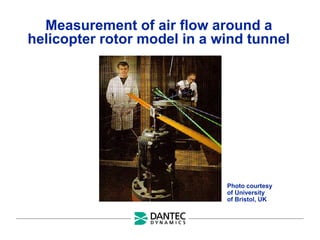
Measurement of air flow around a
helicopter rotor model in a wind tunnel
Photo courtesy
of University
of Bristol, UK
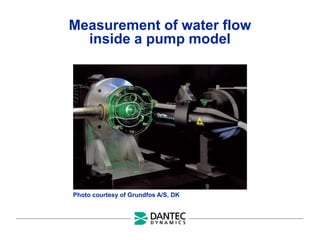
Measurement of water flow
inside a pump model
Photo courtesy of Grundfos A/S, DK
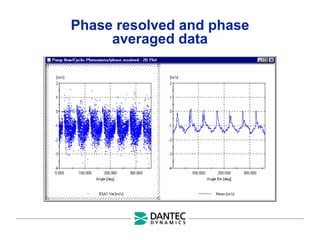
Phase resolved and phase
averaged data
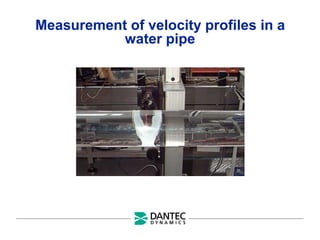
Measurement of velocity profiles in a
water pipe
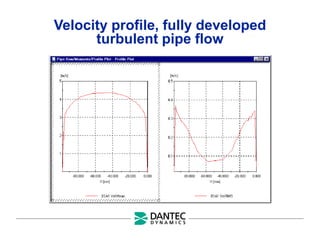
Velocity profile, fully developed
turbulent pipe flow
Measurement of flow field around a
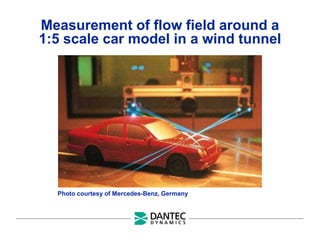
1:5 scale car model in a wind tunnel
Photo courtesy of Mercedes-Benz, Germany
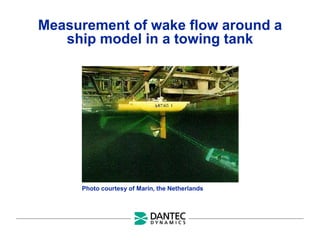
Measurement of wake flow around a
ship model in a towing tank
Photo courtesy of Marin, the Netherlands
Measurement of air flow field around
a ship model in a wind tunnel
Photo courtesy of University of Bristol, UK
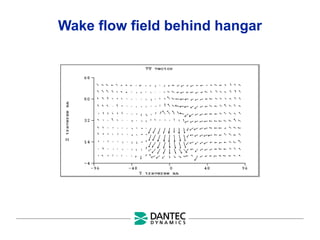
Wake flow field behind hangar
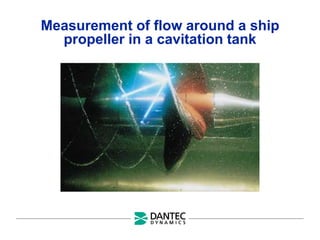
Measurement of flow around a ship
propeller in a cavitation tank
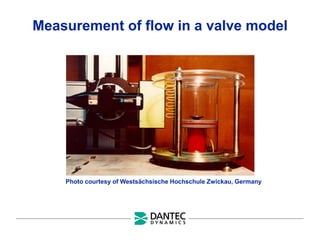
Measurement of flow in a valve model
Photo courtesy of Westsächsische Hochschule Zwickau, Germany
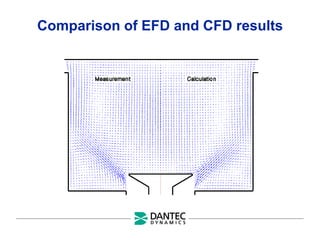
Comparison of EFD and CFD results

Laser Doppler Anemometry Dantec 199.PPT

  • 1.
    Laser Doppler Anemometry Introductionto principles and applications
  • 2.
    Contents • Why measure? •Characteristics and applications of LDA • Principles of operation • LDA fibre optical system • Seeding requirements • Signal characteristics • Signal processing • Data processing
  • 3.
    Why measure? • Almostall industrial flows are turbulent. • Almost all naturally occurring flows on earth, in oceans, and atmosphere are turbulent. • Turbulent motion is 3D, vortical, and diffusive governing Navier-Stokes equations are very hard (or impossible) to solve. • Measurements are easier       Du Dt X f p X i ij j i j   
  • 4.
    Why measure? • Industrial:investigate technical problems check technical specifications verify performance improve performance • Engineering: determine parameters in turbulence mode develop, extend, refine models investigate model limits • Theoretical verify model predictions fluid mechanics: verify theoretical predictions verify new concepts • Conceptual ideas: search for new ideas
  • 5.
    Characteristics of LDA •Invented by Yeh and Cummins in 1964 • Velocity measurements in Fluid Dynamics (gas, liquid) • Up to 3 velocity components • Non-intrusive measurements (optical technique) • Absolute measurement technique (no calibration required) • Very high accuracy • Very high spatial resolution due to small measurement volume • Tracer particles are required
  • 6.
    Applications of LDA •Laminar and turbulent flows • Investigations on aerodynamics • Supersonic flows • Turbines, automotive etc. • Liquid flows • Surface velocity and vibration measurement • Hot environments (flames, plasma etc.) • Velocity of particles • ...etc., etc., etc.
  • 7.
    LDA - Opticalprinciple • When a particle passes through the intersection volume formed by the two coherent laser beams, the scattered light, received by a detector, has components from both beams. • The components interfere on the surface of the detector. • Due to changes in the difference between the optical path lengths of the two components, this interference produces pulsating light intensity, as the particle moves through the measurement volume. Incident beams Direction of motion Incident beams Direction of motion
  • 8.
    Frequency to velocityconversion Ux U K2  / 2 K1    D D D U k k      1 2 1 2    ( ) f U D x  2 2   sin / U Cf x D  C    2 2 sin /
  • 9.
    LDA - Fringemodel • Focused laser beams intersect and form the measurement volume • Plane wave fronts: beam waist in the plane of intersection • Interference in the plane of intersection • Pattern of bright and dark stripes/planes
  • 10.
    Flow with particles d(known) Velocity = distance/time t (measured) Signal Time Laser Bragg Cell backscattered light measuring volume Detector Processor
  • 11.
    LDA - Fringemodel • The fringe model assumes as a way of visualisation that the two intersecting beams form a fringe pattern of high and low intensity. • When the particle traverses this fringe pattern, the scattered light fluctuates in intensity with a frequency equal to the velocity of the particle divided by the fringe spacing.
  • 12.
    Principle of LDA,differential beam technique Laser Signal processing Transmitting optics Receiving optics with detector Signal conditioner Flow HeNe Ar-Ion Nd:Yag Diode Beamsplitter (Freq. Shift) Achrom. Lens Gas Liquid Particle Achrom. Lens Spatial Filter Photomultiplier Photodiode Spectrum analyser Correlator Counter, Tracker Amplifier Filter PC
  • 13.
    Laser, characteristics and requirements •Monochrome • Coherent • Linearly polarised • Low divergence (collimator) • Gaussian intensity distribution Laser L-Diode collimator Laser
  • 14.
    Transmitting optics Laser Bragg cell BS F D E   D DL Lens Basicmodules: • Beam splitter • Achromatic lens Options: • Frequency shift (Bragg cell) – low velocities – flow direction • Beam expanders – reduce measurement volume – increase power density
  • 15.
    Measurement volume • Thetransmitting system generates the measurement volume • The measurement volume has a Gaussian intensity distribution in all 3 dimensions • The measurement volume is an ellipsoid • Dimensions/diameters x, y and z are given by the 1/e2 intensity points F  DL Y Z X Transmitting system Measurement volume Intensity distribution 0 1/e 2 1 z x y X Z Y
  • 16.
    Measurement volume Length:  Width: Height: No.of fringes:     z L F E D        4 2 sin    y L F E D  4     x L F E D        4 2 cos N F E D f L        8 2 tan   z x X Z f Fringe separation:    f        2 2 sin
  • 17.
    Lenses Interference filtre Photomultiplier Receiving systems • Receivingoptics - Receiving optics - Multimode fibre acting as spatial filtre - Interference filtre • Detector - Photomultiplier - Photodiode Multimode fibre
  • 18.
    System configurations Forward scatter andside scatter (off-axis) • Difficult to align, • Vibration sensitive Backscatter • Easy to align • User friendly Receiving optics with detector Transmitting optics Flow Flow Laser Bragg cell Detector Transmitting and receiving optics
  • 19.
    Backscatter configuration Laser Bragg cell Colour splitter PM PM Fibre manipulators Singlemode polarisation preserving fibres Flow Back scattered light Multimode fibre Multimode fibre Interference filtres Colour splitter Single mode fibres
  • 20.
    • Particles movingin either the forward or reverse direction will produce identical signals and frequencies. Directional ambiguity / Frequency shift fmax fshift fmin f u umin umax umin umax • With frequency shift in one beam relative to the other, the interference fringes appear to move at the shift frequency. • With frequency shifting, negative velocities can be distinguished. no shift shift
  • 21.
    Frequency shift /Bragg cell • Acousto-optical modulator • Bragg cell requires a signal generator (typically: 40 MHz) • Frequency of laser light is increased by the shift frequency • Beam correction by means of additional prisms Piezoelectric transducer fs40 MHz Absorber wave front  fL fL + fS
  • 22.
  • 23.
    LDA instrumentation from DantecDynamics • FlowLite - HeNe laser - 1 velocity component - With frequency shift - Wide selection of accessories • FiberFlow optics/transmitter - Ar-Ion laser required - 1, 2 or 3 velocity components - With frequency shift - Wide selection of probes and accessories
  • 24.
    Components on thetransmitting side Overview • Laser: 1D, 2D, 3D: Argon-ion: air or water cooled • 60X41 Transmitter • 60X24 Manipulators • FiberFlow series probe Laser (Ar -ion) + 60X41 4 60X24 60X61
  • 25.
    The 60X41 Transmitter The60X41 Transmitter • Divides the laser beam into two: - one direct - one frequency shifted • Each beam is then separated into three colours: - green  = 514,5 nm - blue  = 488 nm - purple  = 476,5 nm • Each colour is used for measuring one velocity component. Thus the transmitter can be used for 1D, 2D and 3D measurements.
  • 26.
    The 60X24 Manipulator •The manipulator centres and directs the laser beam to get the maximum amount of light coupled into the thin single mode optical fibers of the fiber flow probe. • For each output beam from the transmitter one 60X24 Manipulator is needed. • Thus, for a 3D system 6 manipulators are needed.
  • 27.
    A 60 mm2D FiberFlow probe The FiberFlow probe comprises • Four fiber plugs for coupling with the manipulators. • Four single mode fibers - one for each of the transmitted beams - cased in an enforced cable hose. • One multimode fiber used as receiving fiber in backscatter cased in the same hose. • The probe house. • One of several front lenses. Can be used with a 55X12 Beam Expander to reduce probe volume.
  • 28.
    The 85 mmFiberFlow probes 60X80 - 83 55X12 50X57 - 59 A B • The 85 mm probes provide maximum flexibility for adjustment giving large variation in incident angle of the beams. • Can be used with a 55X12 Beam Expander to reduce probe volume 60X80 - 83
  • 29.
  • 30.
    60 mm and85 mm FiberFlow probes
  • 31.
    FiberFlow set-up for3D velocity measurements • Measuring three velocity components requires three beam pairs. - Two pairs are emitted from a 2D probe - One pair from a 1D probe • The two probes are aligned so their intersection volumes coincide. • The velocity components measured by the beams from the 2D probe are orthogonal. • The third velocity component can be orthogonalized by software.
  • 32.
    Probe volume alignmentfor 3D velocity measurements • To measure three velocity components requires careful alignment. • The simplest method is by using a fine pinhole with an opening just large enough that the focused beam can pass through. • Fine adjustment can be made using a power meter behind the pinhole maximising the power of light passing through the pinhole for each beam.
  • 33.
    The small integrated3D FiberFlow probe
  • 34.
    3D LDA Applications •Measurements of boundary layer separation in wind tunnels • Turbulent mixing and flame investigations in combustors • Studies of boundary layer-wake interactions and instabilities in turbines • Investigations of flow structure, heat transfer, and instabilities in heat exchangers • Studies of convection and forced cooling in nuclear reactor models • Measurements around ship models in towing tanks
  • 35.
    Particle Fluid Diameter(m) f = 1 kHz f = 10 kHz Silicone oil atmospheric air 2.6 0.8 TiO2 atmospheric air 1.3 0.4 TiO2 oxygen plasma 3.2 0.8 (2800 K) MgO methane-air flame 2.6 0.8 (1800 K) Seeding: ability to follow flow ParticleFrequencyResponse d dt U d U U p p p f p f    18 2    /
  • 36.
    Seeding: scattered lightintensity 180 0 90 270 210 150 240 120 300 60 330 30 180 0 330 210 240 300 270 150 120 90 60 30 180 0 210 150 240 120 270 90 60 300 30 330 dp0.2 dp1.0 dp10 • Polar plot of scattered light intensity versus scattering angle • The intensity is shown on a logarithmic scale
  • 37.
    Signal characteristics • Sourcesof noise in the LDA signal: - Photo detection shot noise. - Secondary electronic noise, thermal noise from preamplifier circuit - Higher order laser modes (optical noise). - Light scattered from outside the measurement volume, dirt, scratched windows, ambient light, multiple particles, etc. - Unwanted reflections (windows, lenses, mirrors, etc). • Goal: Select laser power, seeding, optical parameters, etc. to maximise the SNR.
  • 38.
    Data processing specifications Whatis important to know about an LDA software package? • What functions does it perform? - data acquisition? - instrument control? - data processing? - graphics output? • What is the Input/Output? • How much Flexibility is there? - ST(f)unbiased, ST(f)biased - ST(f)cov, ST(f)FFT • Is it EASY to use?
  • 39.
    Measurement of airflow around a helicopter rotor model in a wind tunnel Photo courtesy of University of Bristol, UK
  • 40.
    Measurement of waterflow inside a pump model Photo courtesy of Grundfos A/S, DK
  • 41.
    Phase resolved andphase averaged data
  • 42.
    Measurement of velocityprofiles in a water pipe
  • 43.
    Velocity profile, fullydeveloped turbulent pipe flow
  • 44.
    Measurement of flowfield around a 1:5 scale car model in a wind tunnel Photo courtesy of Mercedes-Benz, Germany
  • 45.
    Measurement of wakeflow around a ship model in a towing tank Photo courtesy of Marin, the Netherlands
  • 46.
    Measurement of airflow field around a ship model in a wind tunnel Photo courtesy of University of Bristol, UK
  • 47.
    Wake flow fieldbehind hangar
  • 48.
    Measurement of flowaround a ship propeller in a cavitation tank
  • 49.
    Measurement of flowin a valve model Photo courtesy of Westsächsische Hochschule Zwickau, Germany
  • 50.
    Comparison of EFDand CFD results