Annual Repor t | 2010
Interactive Annual Report 2010


Content
Key Figures                                    3

To our Shareholders                            5
Letter to the Shareholders                     5
Report of the Supervisory Board                8


The Balda Group                                11
MobileCom                                      12
Electronic Products                            14
Medical                                        16
Balda USA                                      19


Management Report                              20
General Conditions                             20
         Overall Economy                       20
         Sector Situation                      22
         Share and IR                          23
Balda in 2010                                  25
         Organisation                          25
         Business Development                  27
         Financial Structure                   29
         Corporate Governance                  32
         Objectives, Corporate Control         35
         Employees                             37
         Environment                           39
Result, Financial and Asset Situation          41
         Result situation – Group              41
         Result situation – Balda AG           45
         Cash Flow Group                       46
         Cash Flow AG                          48
         Investments                           49
         Group Balance Sheet Structure         50
         AG Balance Sheet Structure            52
Supplementary Report                           53
Internal Control System                        54
Risk Report                                    56
Forecast                                       63


Year-end Tables                                66

Notes                                          82

Independent Auditors’ Report                   172

Financial Calendar, Masthead                   174


                                                                          |2
Interactive Annual Report 2010


Key Figures 2010

Continued operations

Previous year without TPK


in million euros                                                              2010                  2009

Group revenues                                                                141.4                 134.1

Total operating performance                                                   156.4                 140.3

EBITDA                                                                           0.4                  14.7

EBIT                                                                        - 37.4                     4.5

EBIT margin (in percent)                                                       -23.9                   3.2

EBT                                                                             93.3                  47.3

Net income                                                                      94.4                  48.9

Cash flow from operating activities                                            -11.2                  20.6

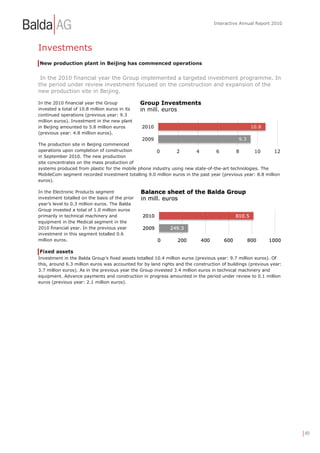
Investments                                                                     10.8                   9.3

Employees as of 31.12.                                                        2,445                 3,713

Earnings per share (in euros)                                                   1.61                  0.90

Dividend                                                                             0                   0

Year-end share price (in euros)                                                 6.90                  3.49

Equity                                                                        749.7                 159.2

Equity ratio (in percent)                                                       92.5                  63.9


 Earnings before special effects: -8,7

 refers to dividend-entitled number of shares as of 31.12.2010: 58.890.636 (2009: 54.156.672)


                                                                                                              |3
Interactive Annual Report 2010


Quality, technology, outstanding products
Our mission is to provide superior engineered products of the highest quality and a fast, flexible service to our
customers at a competitive price. Our success is achieved through continual investment in R&D and by the
application of the latest cost-efficient, state-of-the-art technology. We will continue our investment in
innovative new technologies and in the skills of our employees.

Our dedicated staff from many diverse countries and continents will aim to perfect the quality of our products
as well as keeping response time to a minimum. Doing business with us is easy and we work closely with all our
customers ensuring maximum value for our employees, business partners and stockholders.


                                                                                                                    |4
Interactive Annual Report 2010


Letter to the Shareholders


Dear Shareholders,

the financial year 2010 turned out to be an up-and-
down year for your Company. We were unable to
build on the positive operating result trend achieved
in 2009. On the one hand, as a result of only a
slight increase in sales revenues, the Balda Group
fell way short of expectations with a result pre
exceptionals of minus EUR 8.7 million, including
exceptionals of EUR 37.5 million. On the other hand,
the initial public offering of Balda’s holding in TPK
Holding Co. Ltd. on 29 October 2010 set the
enterprise value of the newly listed company in line
with our expectations. Since the initial public
offering end of October 2010 the value of the
holding in TPK remains at a constant high level. As a
result, your company is fortunately benefiting from
a considerable asset. The conversion of the
valuation leads to significantly positive earnings
before tax and annual net profit for the Group.
Furthermore it significantly strengthens the equity
of your Company.

The positive influence of the holding in TPK on the
financial statements of your Company cannot
however hide the following fact: we were unable to
achieve our operational targets during the previous
financial year. There are mainly the following
reasons for this:                                                                                              Rainer Mohr

Firstly, the declining business volumes of EUR 78.6                                   Sole Member of the Board of Directors
million sales and the negative operating result of
EUR 23.5 million including exceptionals in the MobileCom segment. Secondly, the contribution to earnings of
the Electronic Products segment of minus EUR 18,1 million including exceptionals, which fell way short of
expectations with respect to the planned significant growth in sales of EUR 35.4 million. This includes the high
level of extraordinary depreciation stated in the losses mentioned above, but which were non-cash, in the
MobileCom and Electronic Products segments. By contrast, the Medical segment was fortunately able to post a
positive operating result of EUR 1.9 million in line despite an expected decline in sales revenues.
The negative performance of the MobileCom segment is not the only thing that I need to consider. The key
question is now whether we can actually return this segment to profitable growth or not. If we cannot convince
ourselves of this then I am prepared to make tough decisions and take decisive action.

On the one hand I am prepared to make allowances for the MobileCom segment as a result of the exceptionally
difficult situation it has found itself in since May 2010. The integration of technical capacities at the Suzhou site
as well as the gradual relocation to the Beijing plant through new projects were all burdens. The delayed order
call-offs also impeded the production processes. They had a negative influence on the course of the operational
business. The continuing pressure on prices which remains unchanged was and continues to be another
negative factor.

On the other hand, MobileCom was yet again unable to participate in the growth seen in the mobile phone
market in 2010. It is debatable as to whether the segment will be able to participate in future as a niche player
in the growth of this industry. If it is, then growth shall need to fall more in terms of value rather than in terms
of increasing unit quantities. On the positive side, there are the newly acquired customers, as well as the
technical innovations of the segment.

However the order volume at the start of the financial year 2011 is still not showing any significant growth.
There are a number of clear conclusions to be drawn from the assessment of this situation, and I will provide


                                                                                                                              |5
Interactive Annual Report 2010


the operational business in Beijing with all of the resources that are available to me. I currently
estimate, that the segment MobileCom reaches its defined performance until the middle of the year.

I am more confident about the Electronic Products segment, although some criticism still remains. I was not
expecting any miracles following the strategic realignment that now concentrates on the production of complete
electronic products. But however satisfied I was with the dynamic sales trend of the segment in the financial
year 2010, I am not satisfied at all with the earnings situation. On the one hand the Product Development team
worked extremely hard, in particular regarding the Tablet Computer. In addition we are also well represented
within the market for Bluetooth products. On the other hand, the competition among customers in the global
market leaves little room for manoeuvre for the necessary structuring of prices. We plan to do our homework
on this during the financial year 2011. I plan to focus above all on economies of scale and the efficient
reduction of costs as a result. In addition I ought to acknowledge the excellent chances of the second
generation Tablet Computers which have been significantly improved. This is especially the case as the
segment has entered into a very promising sales partnership with a Japanese brand company that distributes
worldwide. The Group will provide all of the support it can in order to advance the segment.

You are of course entitled to ask what sort of future your Board of Directors sees for the Balda Group. Does the
Board of Directors intend to separate, where possible, from a segment that had been part of the core business
of the Group for a long time? What will remain in terms of the operational business? How will Balda continue?
You are of course entitled to ask all of these questions.

We are currently presiding over a radical and fundamental change in the equity story of the Balda Group. In
2011, it is likely that the MobileCom segment will no longer provide the greatest contribution to Group sales
revenues.

We must take a look at the clean-up work carried out in 2010. As promised last year, I sold off a loss maker
with respect to the end of the investment in Balda Motherson Solution in India. The Group has closed most
parts of the production site in Suzhou. Both of these measures underline the willingness of the Board of
Directors to not only make difficult decisions but also to implement them.

Irrespective of the decision on our production site in Beijing, our strategic planning has a much more extensive
perspective.

Despite the scheduled revenue loss, the Medical segment was profitable in the financial year 2010. The medical
technology business is one that is more long-term, reliable and displays growth potential in the medium-term.
A key reason for this positive opinion is the significant increase in the number of elderly people in Western
industrialised countries, as well as the steadily growing global population. Balda expects to see continuous
growth within the medical technology, pharmaceuticals and cosmetics markets. According to market research,
people are expected to spend even more on health and beauty in future. As a result I can see stronger growth
opportunities in these market segments than in the highly competitive, traditional markets that Balda has
participated in recent years. This is something that I want to concentrate on even more in future.

Since the middle of 2010, Balda has announced strategic growth in medical technology. Acquisitions are a
central element of the corporate strategy of the Group. We are pleased with our progress on this plan. Your
Board of Directors will continue their specific work on a transaction.

Despite the slowdown seen in the operational business in 2010, you can nevertheless be happy with the
development of Balda shares. The quotation gained more than 90 percent in 2010 and surpassed all other
German indices by a long way. As a shareholder, you will benefit from the growing enterprise value.

The Balda Group will also allow you as shareholders to participate in the success of the Group thanks to a
dividend payout following a possible partial or complete sale of the TPK shares. The Board of Directors is doing
everything possible to achieve the ability to pay dividends. The release of capital reserves for tax loss carry
forwards sets the course for an acceptable dividend.

The Balda Group anticipates the sales volume on the same level like the previous financial year for the
producing segments MobileCom, Electronic Products and Medical, subject to the final analyses by mid-year. The
Board of Directors assumes that the Group will cause a new orientation after a successful acquisition and
strategic growth in the Medical segment. The Board of Directors anticipates a slightly positive operating result
for the financial year 2011.

In conclusion, I would like to make the following statements. We shall make a decision on the future of the
MobileCom segment in the next few months. The Electronic Products segment will continue to be monitored


                                                                                                                   |6
Interactive Annual Report 2010


closely. The Medical segment is expected to achieve a strong double-digit rise in sales thanks to organic
growth. If successful, an acquisition will make a positive contribution towards the consolidated result.

I would like to thank you, our shareholders, for the confidence placed in the Board of Directors during the
financial year 2010. I would also like to thank the Supervisory Board and all Group employees for your
dedication and efforts during the past financial year. I am convinced that the strategy that has been initiated as
well as the strict criteria for the success of the operational business of the Balda Group will help us to get back
on track and grow once again. The Balda Group has the financial resources available in order to systematically
implement the planned projects. I would appreciate it if you continue to provide Balda with constructive
criticism in the future as well. I will do everything I possibly can to ensure the enterprise value of Balda AG also
increases in future.


Rainer Mohr
(Sole Member of the Board of Directors)


                                                                                                                       |7
Interactive Annual Report 2010


Report of the Supervisory Board
Dear Shareholders,

the financial year 2010 was characterised once again by a number of trend-setting decisions and events for
Balda AG. During the reporting year, the Supervisory Board advised on the management of the Company and
monitored the running of the business. It was involved in all decisions that were strategically important. The
Board has fully embraced the various duties that it is required to undertake according to the law and articles of
association, whilst also observing the Corporate Governance Code insofar as it does not deviate from the
Declaration of Compliance for the Corporate Governance Code.

Cooperation between the Board of Directors and the Supervisory Board
Cooperation between the Board of Directors and the Supervisory Board was also characterised by a pleasant
and responsible atmosphere during this reporting year. The meetings of the Supervisory Board as well as oral
and written reports from the Board of Directors formed the basis of such work. The Board of Directors informed
the Supervisory Board several times a month on certain occasions with both written and oral updates on all
important business development issues and extraordinary events within the Company, and on a quarterly basis
on the overall business development and any changes in risk situations. Significant business transactions were
discussed in detail in the Supervisory Board based on reports from the Board of Directors. As a result, the
Board of Directors fulfilled its reporting obligations to the Supervisory Board in accordance with § 90 of the
German Stock Corporation Act.

The Supervisory Board held a total of ten meetings during the reporting year, of which eight were done via
telephone conference. Each member of the Supervisory Board took part in all of the Board meetings. The Board
used the circulation procedure to make six decisions. A number of transactions that required approval were
presented to the Supervisory Board for their consent, and the individual transactions were approved by it
following their consideration and assessment. The Chairman of the Supervisory Board made regular contact
with the Board of Directors in addition to the regular meetings and was informed about the current business
situation as well as any significant events.

Within the framework of its monitoring activities, the Supervisory Board discussed the organisation of the
Company and the Group with the Board of Directors, and was then able to ascertain the capacity of the internal
organisational structure.

The Supervisory Board informed itself in detail about the internal accounting control systems and the internal
risk management in detail and inspected the effectiveness of the system. In addition a number of opportunities
were discussed with the Board of Directors regarding the continuous development of risk management. The
current monthly reporting was also optimised in this context in accordance with the specific risk management
requirements.

The Supervisory Board was able to get a comprehensive idea of the efficiency of the Company's management,
especially the measures to strengthen profitability by expanding and developing markets in all segments that
are relevant to the Company. In addition, the regular review of segment products and the optimisation of the
cost structure and the development of corporate participation also played an important role.

As a result of the expansion of the Supervisory Board from three to six members, the Supervisory Board also
dealt with issues surrounding the efficiency of its own activities in various meetings on 24 June 2010, 13
September 2010 and 10 December 2010. It repeatedly discussed whether its activities, its organisation and
communication, and therefore its working procedures, are designed efficiently enough and whether there is
potential for improvement. It also examined whether a formal procedure should be initiated in future or not.
However, given that the efficiency inspection was characterised by a trusting and open atmosphere, the
Supervisory Board decided to refrain from formalising the procedure.

Focus of activity
The Supervisory Board was once again involved in the reorganisation of the Balda Group in the financial year
2010. The financial position of Balda AG remained on the agenda. The nature and scope of investment in TPK,
in particular the successful initial public offering of the touchscreen producer in October 2010, was part of this
subject as well. Other topics included the concentration on production activities in the MobileCom segment to
Beijing and the ongoing conversion of the Electronic Products business unit. The Board advised on all subjects
regarding the new strategic direction of the Company in a comprehensive manner.


                                                                                                                     |8
Interactive Annual Report 2010


Over the entire length of the reporting year, the supervisory body followed and monitored the development of
the Group’s business based on the budget and target/actual comparisons. Furthermore, the early warning
system and the course of risks, as well as the current financing status were all under close scrutiny.

During the meeting of 2 March 2010, the Supervisory Board approved the 2010 budget. The strategic
realignment of the Group and the initiation of the first restructuring measures in China was one of the subjects
discussed in the controlling body meeting of 14 April 2010. Under these measures the Board approved the
cutbacks at the plant in Suzhou and the concentration of production activities in Beijing in the circulation
procedure. On 24 June 2010, the Board approved the start of the M&A process within the Medical segment.
Following the reintegration of the Medical segment into the continued operations in 2009, this division will play
a key role in the future direction of the Group. The planned initial public offering of the touchscreen producer
TPK formed part of the meeting of the Supervisory Board on 26 August 2010. Due to the high demand for TPK
shares in the book-building phase, the Board approved a Greenshoe option. Thanks to this process, owners
make available additional securities that they own at the offering price for new issues. Balda participated with
380,000 shares in this process. The Supervisory Board has yet to make a decision on the possible sale of
further shares held by Balda AG in TPK. The holding period for the first fifty percent of the Balda holding in TPK
shall terminate at the end of April 2011.

Furthermore, the current relationships with major customers, sales activities, the progress of the newly
established EU holding in the Netherlands and the examination of an acquisition in the Medical segment were all
on the agenda of the conference call of 13 September 2010.

On 22 October 2010, the Supervisory Board approved the premature conversion of profit-participation rights
(nominal amount) totalling EUR 34.2 million into shares, meaning therefore that Balda AG was practically
almost debt free. The Board appointments and contracts were also extended in October 2010, which should
ensure continuity and increase existing customer loyalty. An important subject discussed in the last regular
meeting of the controlling body of 2010 on 10 December 2010 was the ongoing sluggish business activity and
burdensome conditions seen in the MobileCom division. The order call-offs were just as unsatisfactory as
before. Competition remained fierce and there was still a high pressure on prices. A number of further
restructuring options were discussed. The Supervisory Board confirmed the ongoing search for acquisition
opportunities for the planned strategic expansion of the Medical segment at its last meeting in 2010.

Extended Supervisory Board
With an amendment of the Company's articles of association, the 2010 annual general meeting expanded the
Supervisory Board from three to six members. The following were new members of the Company body: Dr.
Michael Naschke, lawyer and partner of the Aubel & Partner law firm in Berlin. Yu-Sheng Kai, Managing Director
of Eternal Union International Limited, Hong Kong, residing in Taipei, Taiwan, and Chun-Chen Chen, Chairman
of the Board of Directors of TVM Corporation and Touch Video Monitor Corporation, Taipei, Taiwan. In its
constituent meeting on 24 June 2010, the newly formed Board appointed Dr. Michael Naschke as Chairman.
Furthermore, Dino Kitzinger is the representative for accounting practice and issues in the new Supervisory
Board of Balda AG.

The Supervisory Board of Balda AG therefore comprises of Dr. Michael Naschke (Chairman), Mark Littlefield
(Deputy Chairman), Thomas J. Leonard, Dino Kitzinger, Yu-Sheng Kai and Chun-Chen Chen.

Composition of the Board of Directors
With effect from 16 February 2011, the Supervisory Board of Balda AG and the Chairman of the Board of
Directors (CEO), Michael Sienkiewicz, have agreed that Mr. Sienkiewicz will step down from the Board of
Directors of Balda AG as a result of different ideas about the development of Asian activities. Once again, the
Supervisory Board wishes to thank Mr. Sienkiewicz, who will continue to work in future as a consultant of Balda
Solutions USA, for the work he has done. The current Chief Financial Officer (CFO), Rainer Mohr, whose
contract and appointment is due to run until 31 December 2012 following a successful extension, has taken
over the duties of the Chief Executive Officer (CEO) of the Board of Directors and is now the sole member of
the Board of Directors of Balda AG.

Corporate Governance Code
On 10 December 2010, the Supervisory Board decided on the Declaration of Compliance for the German
Corporate Governance Code that shall apply for 2011 according to § 161 of the German Stock Corporation Act
in the version of 26 May 2010. Both the Board of Directors and the Supervisory Board agreed on the
Declaration of Compliance for the German Corporate Governance Code, including any exceptions that are
illustrated, that can be accessed from the Balda website under Investor Relations / Publications / Corporate
Governance. Both bodies have once again expressly reaffirmed their commitment to a responsible and value-
added management and control of the Company.


                                                                                                                     |9
Interactive Annual Report 2010


More details on the current Declaration of Compliance and the Corporate Governance Report are referred to in
the Annual Report.

Conflicts of Interest
During the reporting period there were no case-related conflicts of interest. Although the Supervisory Board
does not see any conflict of interest, in order to prevent any misunderstandings, it should be noted that the
Supervisory Board approved to mandate the law firm VAN AUBEL & Partners, for whom Dr. Michael Naschke is
a partner, at its meeting on 26 August 2010. Dr. Michael Naschke abstained from advising as part of the
Supervisory Board and the subsequent decision-making.

Annual financial statements and consolidated financial statements
The accounting firm, Deloitte & Touche GmbH, which was appointed as the auditor during the annual general
meeting of 25 May 2010, was commissioned by the Supervisory Board to audit the 2010 financial statements
and the 2010 consolidated financial statements of Balda AG. The annual financial statements of Balda AG were
produced in accordance with the principles of §§ 242 to 256 of the German Commercial Code, §§ 264 et seq of
the German Commercial Code and the German Stock Corporation Act. The consolidated financial statements
were produced in accordance with International Financial Reporting Standards (IFRS) as adopted by the EU, the
interpretations of the International Financial Reporting Interpretations Committee (IFRIC) and the various
provisions under commercial law that are to be applied in addition to § 315a (1) of the German Commercial
Code. The auditor has audited the 2010 financial statements and the 2010 consolidated financial statements
along with the combined management report of Balda AG, including the book-keeping and early warning
system, and issued an unqualified auditor’s opinion.

The Supervisory Board examined the annual financial statement documents, comprising of the annual financial
statements, the combined management report and the consolidated financial statements, as well as the audit
reports from the auditor. These documents were discussed by the Supervisory Board along with the Board of
Directors and the auditor in its meeting of 15 March 2011. The necessary documents were sent to the
Supervisory Board members in a timely manner. The auditor reported on the key findings of its reports in the
meeting and was on hand to answer any questions from the Board. In preparation for the meeting, on 25
February 2011 the Chairman of the Supervisory Board, Dr. Michael Naschke and the Supervisory Board
member responsible for accounting practice and issues, Dino Kitzinger, together with the auditor and the
Board of Directors, dealt with the annual financial statement documents and explained the results to the rest of
the Supervisory Board members prior to the meeting on 15 March 2011.

Following the completion of their own inspections, the Supervisory Board came to the following conclusions:

•   The Supervisory Board concludes that the development of the Company and the Group in the management
    report and Group management report has been correctly shown by the Board of Directors and that the
    information contained in the combined management report is in line with the internal assessments of the
    Supervisory Board.
•   The annual financial statements and consolidated financial statements, including any associated annexes,
    were produced in accordance with the principles of the International Financial Reporting Standards (IFRS)
    and the various provisions under commercial law that are to be applied in addition. The statements comply
    with the various statutory requirements and contain all necessary information.
•   Based on its own inspections, the Supervisory Board stated that the annual financial statements and
    consolidated financial statements have been produced in accordance with the various statutory provisions.
•   The Supervisory Board approved the findings from the audit carried out by the auditor and was satisfied
    that it has been carried out in accordance with the various statutory requirements.
•   After completing its inspections, the Supervisory Board raised no objections and therefore approved the
    annual financial statements and consolidated financial statements produced by the Board of Directors for
    the financial year 2010. The annual financial statements were established on 15 March 2011.


The Supervisory Board would like to thank the Board of Directors as well as all employees and worker
representation bodies for their diligent work during the financial year 2010. The Supervisory Board would also
like to thank our shareholders for their interest in our Company and the trust placed in us.

Bad Oeynhausen, 15. March 2011

For the Supervisory Board

Dr. Michael Naschke
(Chairman of the Supervisory Board)


                                                                                                                   | 10
Interactive Annual Report 2010


The Balda Group
The value-added contribution of the following segments: Innovation, Technology,
Quality, Processes and Employees

The value-added contribution of certain competencies and competitive advantages is rarely assessed or
quantified in detail. In this respect, the relevant values are also not included in the balance sheet or an
equivalent informative system at Balda. However, the success of the Balda Group depends very much on the
advancement of these value drivers.

The business administration refers to these company skills as soft assets. They are also consolidated under the
term Intellectual Capital. Like the majority of companies, the Balda Group does not have a system in place to
quantify these values. In addition, a method for forming approximate units for indexes is not yet available.

Getting closer to Intellectual Capital
The continuous monitoring of innovation by way of a year-on-year comparison nevertheless provides
information on the progress of the Group. Criteria include expenses for research and development, patenting
and the expansion of core competencies. There is also the launch of new products in new markets as and when
required, as well as the revenue share of new products. This applies to the same extent for the use of
technologies developed in-house or enhanced, purchased technologies.

Quality is something, which is taken for granted nowadays. But it is however very important as without quality
there is nothing. The quality concept extends over and above the product quality through to the overall process
in which the customer participates in an active or passive manner, right from when the order is placed through
to the end of the supply chain, the correct delivery and after-sales service.

The various processes form the basis of customised quality levels. They themselves constitute a value. Their
design and implementation are decisive over and above quality levels, cost efficiency and the degree of
competitiveness. All of the above values directly result from the work carried out by employees. Their skill and
performance form the basis for added value within the Balda Group. The structure and skills of employees for
internal and external training are all indicators for the development of employees.

As a result of the upheaval seen during the financial year 2010, none of the stated criteria were achieved to a
satisfactory level. A number of trends did however emerge.

Conclusion: Intellectual Capital Statement
The following can be summarised for the Balda Group: The MobileCom segment mainly stagnated during the
financial year 2010. There was more positive news for Glass Injection Moulding, a production technology that
was developed in-house. The processes and quality levels did not make any progress during the specific
upheaval that was seen. This was attributed to a number of staff changes within directorial and managerial
positions. The earnings situation of the segment fell accordingly in 2010. It was a burden on the overall
performance of the Balda Group.

The Electronic Products segment drove innovation and technology forward strongly during the financial year
2010 thanks to the launch of the Tablet Computer. The quality criterion shifted to a positive level. There is
however the potential to make further improvements. The process chain can still be improved with respect to
costs. The skills potential of employees in Malaysia is mainly good to very good. The segment achieved its
strategic targets for 2010 with the exception of overall results.

During the past financial year, Balda Medical was able to successfully develop all of the value drivers. Despite
lower sales, the segment nevertheless ended the period with a positive result.

The subsidiary in the United States serves customers of the Group for the design and development of new
products. In addition, the U.S. company takes over sales functions for the Balda Group in the North American
market. Balda USA is part of the Central Services segment.

New chapter for Equity Story
A further change in strategic direction for the Balda Group has come into consideration following 2010. The
equity story of the Balda Group may see a completely new chapter in 2011. This option does not depend on the
return of the MobileCom and Electronic Products segments, which both need to improve, to profitable growth.
The Board has announced strategic growth either in or around the Medical segment. An acquisition is expected
to significantly shift the focus of the product portfolio and any added value.


                                                                                                                   | 11
Interactive Annual Report 2010


MobileCom segment: Complex plastic assemblies
The MobileCom segment of the Balda Group develops and produces components,
assemblies and systems that are made out of high-performance plastics. Its customers
are global brand manufacturers of mobile phones.

The Balda Group has been the system supplier of choice for the global mobile phone industry since the start of
the dynamic growth that was seen in the late 1990s. The Group has continued to accompany the industry as it
has progressed and has also helped to design as well as provide solutions for plastics. In its position as the first
supplier partner, the company was able to provide a number of solutions to the geometrics for tool-making that
were deemed to be impossible at the time, as well as to the moulding process for industrial production. Balda
has played a leading role in the innovation of composite materials for plastics, such as metal, leather or
textiles. There are hardly any other companies within the plastics industry that have such a wealth of
experience and competencies for mobile devices as Balda, which seek to apply such as in the development of
smartphones.

Difficult financial year 2010
The MobileCom segment was confronted with a number of particular challenges during the financial year 2010.
They made it difficult for the Company to achieve its usual level of performance in its entirety. There were three
difficult complex situations at the fore:

•   The integration of technical equipment and machinery as well as projects at the Suzhou production site in
    the Beijing plant starting in May 2010;
•   The gradual relocation or installation of existing and new machinery and equipment, along with employees
    for the new projects in the Beijing plant starting in August 2010;
•   The shifting of projects between customers and the job schedules that were characterised by significant
    intervals.
The ramifications of the extensive closure of the
plant in Suzhou along with the shifting of
machinery, equipment and projects to Beijing
caused significant problems. It required a larger
deployment of core staff than expected during June
and July. This exceptional involvement, which could
only be provided by experts placed a great burden
on production processes in the Beijing plant as well.

From August there were gradually implemented
new projects to the new plant close to the Beijing
Airport. The preparation for this, such as monitoring
the installation of cranes for tools and the supply of
plastic pellets for injection moulding machines, was
expensive. The setting up of machines, process
stations as well as measuring and test equipment
required the use of production managers. The
overall quality of processes continued to suffer right
up to the end of the year. Following completion of
the first building phase, an additional 13,700 sqm of additional production space is now available in Beijing.
Since the end of the previous financial year, Balda has had 31,100 sqm of production space in Beijing.

In addition to the negative influences on production processes thanks to the Suzhou and Beijing relocations,
requests for production orders that were frequently cancelled or delayed by customers also placed a burden on
the regular course of production. In daily practice, this meant the termination of the injection moulding of a
product on several machines. Following this, there was the disconnection of used tools and the installation of
new ones. Projects typically run up to a planned end. Employees in the plastics manufacturing team therefore
had to get their bearings once again in the same way as assembly employees. These changes posed an
enormous challenge as well as a significant cost burden for the quality management.

These difficulties posed a number of problems during the past financial year for both the MobileCom segment
as well as its customers.


                                                                                                                       | 12
Interactive Annual Report 2010


MobileCom product portfolio
The range of services of the MobileCom segment covers all areas involved in the production of high precision
plastics. Alongside developing and designing products, Balda also offers injection moulding, all modern surface
engineering and assembly. The product portfolio of the MobileCom segment includes the manufacture of
individual components and complete assemblies for single battery packs and mobile phones, as well as for
specially decorated mobile phones and technically sophisticated smartphones. Mobile phones that are
particularly environmentally friendly which are made from recyclable plastics, and which only have water-
soluble coatings for the surfaces, also formed part of the segment product programme for 2010. More
specifically, the Beijing plant produces A, B and C covers, displays, keypads, antennas, camera lenses and
other components for mobile phones. The surfaces are coated or processed with various technologies such as
silkscreen printing. The assembly team puts together complete systems from the various components and
individual assemblies.

Employees
The number of employees working at the production sites in Beijing and Suzhou, was reduced significantly by
the end of the financial year 2010 to 1,344 employees (previous year: 2,534 employees). The declining
business volumes and the extensive relocation of capacities from the Suzhou site to Beijing were all causes of
the reduction in workforce. This relocation led to the redundancy of approximately 650 workers in Suzhou. For
more information on the subject of employees please see “Management Report / The Company / Employees“.

The ongoing implementation of the "flexible production" and "learning organisation" projects largely stagnated
during the financial year 2010 because of the afore-mentioned specific situation and the associated difficulties.
There was no significant progress in the advancement of the organisation and skills of employees in the light of
the upheaval in Suzhou and the new Beijing plant.

Quality in MobileCom segment
The planned continuous improvement process (CIP) within production also suffered from these burdening
influences during 2010. The product quality remained below the level of previous years in light of these
burdens. The rejection rate of individual projects also increased as well. This meant that the timeliness of
deliveries also suffered.

The Management team was aware of these issues and took appropriate action. The first steps shall come into
effect during Q1 2011.

Technology and Innovation
The MobileCom segment has an outstanding portfolio of technologies. Balda provides its customers with the
most modern machines, equipment and processes for both injection moulding as well as surface engineering.

In 2010, "Glass Injection Moulding" came to the fore. The products made from this process, which uses plastic
and glass composites, generated a great deal of interest from customers in the mobile phone industry. The
patent-pending production method ensures that the housing of mobile phones and other mobile devices does
not have any cracks, gaps and recesses. These weaknesses seen in conventional housing can lead to a lack of
stability if it falls on hard surfaces or collides in any other way. In addition they are annoying traps of mud and
dirt for users. Expensive devices address these weaknesses by curving the housing from a block of material.
This is however very elaborate and expensive. The solution developed by the MobileCom segment will achieve
the same solid results but at a much lower cost. This innovative process should be deployed during the financial
year 2011.


                                                                                                                      | 13
Interactive Annual Report 2010


Electronic Products segment: Complete electronic
products from one source
The Malaysia segment develops and produces the most modern electronic products by
order of its customers. Its customers are manufacturers and distributors of
communications and consumer electronics.

During the financial year 2010, the Electronic Products segment managed to enter the communications and
consumer electronics market after only two years of probing. The doubling of revenues during the previous
financial year documents the positive business performance. The negative EBIT was however an issue in 2010
as well. The causes of the earnings situation were and continue to be thoroughly analysed. Causes, which must
be considered, include lower unit quantities and the lower prices for expensive electronic components due to
pressure from competitors. In addition, processes, which can be optimised, are not sufficient enough for the
steep learning curve for the production of new products.

Core competencies
The Malaysian production site of Ipoh provides 30, 000 m2 of production space. The segment produces plastic
components and systems using the most modern machines and equipment. The service portfolio ranges from
the design, tool-making and injection moulding right through to the current surface engineering. In addition to
this, Electronic Products builds semi-conductors,
speakers and microphones as part of the
electromagnetic assembly process. Research and
development activities also form part of the core
competencies by order of the customers. They
include the design of the hardware as well as the
development of semi-conductors and software. The
tests carried out in our own laboratory for acoustics
in line with the various standards are a particular
competitive advantage for the segment. Along with
the purchase of electronic components, the
Company in Ipoh is also capable of producing an
impressive range of products. The Company
produces in a cost-effective and efficient manner
according to the "Lean Sigma Method" concept.

Product portfolio
The Balda subsidiary successfully implemented its
diversification strategy during the previous financial year. During 2010, the segment demonstrated its skill and
competitive advantages in an impressive manner. Firstly, the Engineering team from Ipoh in Malaysia
developed and produced a complex electronic product, the Tablet Computer, along with Japanese partners. The
device is operated using a touchscreen panel. In addition to that, the Company developed, manufactured and
sold a number of successful innovations in the mobile phone headset product category.

The Tablet Computer is similar in function to the iPad. It provides mobile access to Internet content, such as
media, e-books, photographs, video and music. Since the middle of 2010, Balda has sold 25,000 Tablet
Computers. As a result, the mini-computer provided a significant contribution to sales growth for the segment.
An extensively revised and improved version of the Tablet Computer is currently in the industrialisation phase
following completion of its development. The segment also produces

•   Stereo headsets for mobile phones and MP3 players with Bluetooth connectivity, new audio engineering
    and a significantly longer battery life
•   Headsets with dual microphones and integrated signal processors that can filter out background noise to a
    great extent
•   Hands-free equipment for automobiles to be retrofitted
•   Portable wireless high-performance wireless with Bluetooth connectivity
•   Digital camera housing for the global brand manufacturer, Canon
•   Tablet Computers with touchscreen operation


                                                                                                                   | 14
Interactive Annual Report 2010


During the financial year 2010, the Company generated approximately 20 percent of its revenues from the
production of digital cameras. Bluetooth headsets contributed to more than 30 percent. Tablet Computers,
radio frequency modules and mobile phone accessories accounted for approximately 40 percent of segment
sales.

Technology and Innovation
The Government of Malaysia has classified the Electronic Products segment as a research firm. It is exempt
from paying corporate taxes.

The research topics of the segment are as follows:

•   Advancement of acoustic technology and the miniaturisation of components
•   Bluetooth technology as a wireless connection technology
•   Touchscreen operation technology
•   Semi-conductors
•   Software for own products
•   Software produced in-house to control machines and equipment
•   Development of competitive, cost-efficient production processes: tool-making, injection moulding, surface
    engineering, assembling
•   Project management, including with external partners


Employees
As of the end of the previous financial year, the Electronic Products segment employed 874 employees
(previous year: 949 employees). 131 engineers were actively working on the site in Ipoh. 37 engineers were
working in research and development, 47 engineers were working in production and 25 engineers were working
in sales. They all emphasise the above-average engineering potential of the site in Ipoh. Further information on
the workforce can be found in the "Employees" chapter in the Management Report.

Quality management
The wishes and demands of customers all help to determine the quality of products that are developed and
produced by the Electronic Products segment. The planning of quality and its parameters on behalf of the
customer order begins with the concept and project planning. Once this is done then the actual development of
the product begins. The performance specifications help to set the focus on quality. Customers and specialists
from the Electronic Products segment are in close contact with each other throughout the entire development
and production phase. This helps to prevent any mistakes. The various Electronic Products processes are
certified according to ISO 9000 standards.

The majority of customers provided a number of quality requirements in 2010 for the design, durability,
longevity and self-explanatory operation of the product. In addition to this, the shortest possible time-to-
market phase (period from placing the order to the placing of the product on the market), timely deliveries and
very competitive prices are also important. The Electronic Products quality management system integrates
these essential requirements in the overall process as cornerstones that need to be controlled. On numerous
occasions, globally operating customers have designated the Company as an outstanding supplier partner, the
"Supplier of the Year".


                                                                                                                   | 15
Interactive Annual Report 2010


Medical segment: With solid growth comes success
Balda Medical from the East Westphalia Bad Oeynhausen represents the Medical segment. Since its formation
in 2002, the technology and product expertise has been the driving force for the success of the Medical
segment. Even after only eight years, the company is one of the leading manufacturers of complex plastic
products and system solutions and focuses on innovative solutions for the international healthcare markets. In
its position as an established system provider, the company develops and produces plastic products by order of
its customers. The renowned customers come from the pharmaceutical, diagnostics and medical technology
market segments.

The healthcare market is a global growth market, thanks to the continuous medical advances of growing age-
related customer groups. Balda Medical is consequently making use of these opportunities to expand further.
During the financial year 2010, employees from the Medical segment completed a significant amount of
preliminary work for projects for 2011. The Company is expecting significant organic growth within the double-
digit percentage range for the current financial year. In addition, the Board planned for strategic growth in
2011 through an acquisition within the medical sector.

Developing products according to customer demands
The highest demands within the healthcare market require an integrated response regarding the product
lifecycle. The range of services provided by Balda Medical includes designing, developing, industrialising and
producing high-quality assemblies, systems and packaging. Alongside being both creative and user-friendly, the
products also impress in their reliability and quality.

The company gives each phase of the product life cycle its own project status. After the order is placed, the
project management carefully fine-tunes both internal as well as external processes and interests. As a result,
the experts implement the product successfully both from a technical as well as a financial perspective. This
approach is not determined just by the project, but also by the customer as well.

High-value product programme
The product portfolio of the company primarily includes medical devices, pharmaceutical packaging and
disposable products. Based on the design, the specialists integrate the various requirements regarding
functionality, feel and ease of use into the development phase. This demanding task requires creativity and
extensive knowledge of the complex field of medical technology. The result is deemed to be a key indicator and
measure of the quality and reliability, such as the therapeutic benefits of the products.

The following belong to the Balda Medical product programme:

•   Various handheld devices (lancets, inhalers, glucometers, setting aids and tablet dispensers)
•   Various disposable items (pipettes, cuvettes, veterinary tubes, racks etc.)
•   Packaging (childproof tubes) and
•   Specialised, functional assemblies


                                                                                                                   | 16
Interactive Annual Report 2010


Competent and motivated employees
As of the end of the previous financial year, the Balda Medical workforce comprised of 204 employees (previous
year: 205 employees). For more information on the
segment workforce please refer to the "Employees"
chapter of the Management Report.

Innovative technologies
The company already has a state-of-the-art
portfolio of know-how processes, machines and
equipment, as well as technologies. The insertion
moulding, decoration, assembly and cleanroom
engineering are all “state-of-the-art“. The overall
expertise of Balda Medical demonstrates proven
know-how regarding the material properties of
various plastics. It can indicate the opportunities
and limitations of a product design and the
mechanical interactions of the material at an early
stage. In addition the experts are in control of
medical precision measurement techniques.

Their extensive medical and pharmaceutical
knowledge constitutes a significant competitive advantage of the company.

The most modern production methods
The production of high-precision components in high unit quantities during the insertion moulding process is
one of the original core competencies of Balda Medical. Alongside traditional injection moulding methods, the
Medical segment also carried out multi-component injection moulding, the particularly complicated injection of
film (IMD, IMF) as well as assembly injection moulding during the financial year 2010. All production methods
are carried out with the maximum possible levels of efficiency and economy.

The segment is looking to achieve the maximum level of value-added. As a result Balda Medical also carried out
a number of assembly services. The company builds the complete product including the installation of
purchased parts. If requested, the company can assemble, package and sterilise the products in an integrated
process right up to the point of sale.

Decoration of surfaces
The company has all modern techniques available to decorate surfaces. Balda Medical uses pad printing as an
indirect method for printing symbols and scales. The embossing process is used for highly decorated surfaces.
The company treats flat surfaces during the hot embossing process. IMD technology is the appropriate process
for curved geometrics and transparent, scratch-resistant surfaces.

Innovations 2010
During the past financial year, Balda Medical successfully completed the development of a new drug dispenser
on behalf of a global pharmaceutical client. The device assures the effects of drugs by ensuring they are taken
regularly at a precise time. The innovative product includes both mechanical components and electronic
assistance systems. Balda Medical was responsible for the full implementation both in terms of hardware and
software. The German subsidiary of the Balda Group has registered the tablet dispenser under its own name for
the European market (CE mark). The development of the product that is also intended for the American market
was done in accordance with the various requirements of the U.S. Food & Drug Administration (FDA).

Balda Medical is following a number of significant market trends with the drug dispenser in two ways. The
significantly increased self-care of patients through handheld devices is done increasingly by using electronic
support. The timely and controlled taking of medication also allows for a significantly improved success of
treatment. It also helps to reduce healthcare costs.

Maximum quality medical technology
The various Balda Medical products are subject to continuous checks within the healthcare market and fulfil
stringent quality requirements. The quality policy of Balda Medical is not just a documented procedure; it is also
shown in the quality of our actions. The synergies of product quality, timeliness and efficiency are the key
factors for success of the German Balda Group subsidiary.

Balda Medical works exclusively on behalf of its customers. The company does not tackle any new projects
under its own initiative. Balda Medical also integrates the complex requirements of its end customers alongside


                                                                                                                     | 17
Interactive Annual Report 2010


the various technical and statutory provisions that apply. Every product is of course subject to testing for
maximum quality. Within the company itself, Balda Medical structures its quality assurance within the quality
planning and control departments. At the beginning of a project, the quality-planning department defines the
relevant planning objectives. These parameters are subject to current quality control procedures in the
production process.

The company has created customised assembly and packaging concepts for camera-based inspections of
quality control in automation. Balda Medical is certified in accordance with ISO 9001 and ISO 13485. For many
years the company has provided its customers with a proven quality management system for medical
technology products.

Based on the requirements of new orders received, Balda Medical has enhanced the quality management
system in 2010. The Company has successfully received certification in accordance with the primary packaging
material standard DIN EN ISO 15378. The primary packaging standard DIN EN ISO 15378 is a combination of
classic ISO requirements for packaging material together with the various Good Manufacturing Practice (GMP)
regulations from the pharmaceutical industry. Thanks to this step, Balda Medical will strengthen its market
position as an expert packaging and system supplier in the pharmaceutical market.

The segment is expecting double-digit growth for the financial year 2011. In addition, the medical technology
specialists also have an above-average chance of achieving good levels of organic growth.


                                                                                                                 | 18
Interactive Annual Report 2010


Balda USA: Important support for product innovations
in the Balda Group
The subsidiary in the United States intensified in 2010 the sales activities for the
subsidiaries of the Balda Group in the North American market.

The company of the Balda Group in Morrisville, North Carolina, USA, specializes in the design and complete
development of new products including the electronics. The service portfolio ranges from monitoring of new
market trends to the construction of functional prototypes. On one hand, the integration of design and function
and on the other hand new technologies are one of the essential strengths of the subsidiary. Balda USA
accomplishes an important contribution to the development of innovative products in all three producing
segments of the Group.

The experts at Balda USA monitored in fiscal 2010 the trends for new products in the world's leading North
American market. They are also in close contact with companies from the innovative Silicon Valley. On the
basis of this information and database, Balda USA reports continuously to the responsible persons for
development in the Group segments of MobileCom, Electronic Products and Medical. The company supports
more and more the development tasks in the three producing business segments.

The overall collaboration of the Group shortens the time-to-market of new products and creates added value for
customers. The subsidiary of the Group will develop its expertise selectively in fiscal 2011. The sales activities
will also be further intensified in 2011.


                                                                                                                     | 19
Interactive Annual Report 2010


Global economy recovering
The global economy has stabilised in the
past year due to monetary and fiscal
measures. In particular in the first half of
2010 global gross domestic product grew
strongly. Impetus came primarily from the
growth in international trade, from which in
particular the German economy benefited
greatly. During the course of the year the
economic recovery slowed down. Overall
global gross domestic product (GDP)
increased by 5 percent in 2010 after
decreasing by 0.8 percent the year before.

Eurozone
In the eurozone economic recovery was largely restrained. In particular private and public consumption and
higher exports contributed towards the growth. Overall economic development in the eurozone was divided.
Countries suffering from a burst in the property-price bubble and very high national deficits only had low or
even negative growth rates.

Gross domestic product (GDP) rose overall
by 1.7 percent in 2010. The previous year it
had fallen by 4.0 percent. Incoming orders
in industry in EMU states were 2.1 percent
above the previous month’s level in
November 2010.

The annual inflation rate rose to 2.2 percent
in December 2010 compared to 1.9 percent
in November. The average annual inflation
rate in the eurozone was 1.6 percent in the
period under review compared to 0.3 percent in the previous year. The unemployment rate in the past financial
year was around 10 percent (previous year: 9.6 percent).

German economy in impressive comeback
By contrast the German economy developed very positively. In particular in the second quarter the German
economy recorded its highest growth rates
since reunification thanks to higher exports
and increased investment. This dynamic
growth resulted in German gross domestic
product rising overall by around 3.6 percent
in 2010. In 2009 German gross domestic
product had fallen due to the recession by
5.0 percent. German industry recorded a
significant rise in incoming orders. The
decisive factors were the high number of
major orders and strong demand from
outside of the eurozone. Compared to the previous year, incoming orders rose by 20.6 percent. Analysts had
expected a rise of only 1.0 percent.

According to the Federal Bureau of Statistics, new public borrowing amounted to around 88.6 billion euros in
2010 (previous year: 79.3 billion euros). This equates to 3.5 percent of GDP.

The situation in the German labour market eased with the economic recovery. The average unemployment rate
in the period under review was 7.7 percent (2009: 8.2 percent). In 2010 the inflation rate in Germany was 1.1
percent (previous year: 0.5 percent). These good figures underpin the current strong state of the German
economy.


                                                                                                                  | 20
Interactive Annual Report 2010


Mixed signals from the US economy
At first sight the economic indicators point
to a recovery. However, in the past year
mixed economic signals have been coming
from the USA. After a good start to the year
the US economy only expanded slowly. In
spite of huge economic stimulus
programmes and the US government’s zero
interest rate policy, investors fled to the
dollar out of fear of the debt crisis in
Europe. The upward revaluation of the
currency put a brake on US exports. The US
economy also rose quarter on quarter by just half a percent. Consumption also did not rise as expected.

Gross domestic product grew by 2.9 percent in the period under review thanks to government economic
stimulus programmes. The previous year the USA recorded a fall in economic output of 2.6 percent. Exports
and capital investment were positive again after the drop in the previous year. Private consumption, the
mainstay of the US economy, provided only moderate impetus for growth due to continuing high
unemployment and lower increases in income and lower property prices.

The trade balance deficit rose from 1,3 billion US dollars to 1.48 billion US dollars in the 2010 budget year.

The US labour market did not recover as quickly as hoped from the crisis. The average unemployment rate in
the past year was 9.4 percent (previous year: 9.3 percent).

Emerging countries
The greatest growth rates in 2010 were seen in the emerging countries. Around 80 percent of the Balda
Group's sales are made with production
sites in these countries. The emerging
countries experienced strong growth in the
past year. The Chinese economy expanded
strongly particularly in the first half of the
year due to high public investment and an
increase in private consumption. During the
course of the year the rate of growth
declined somewhat due to the government's
tighter monetary policy to counter inflation.
China recorded growth of 10.3 percent in
2010 following 9.1 percent in the previous year.

The other BRIC countries, in particular India and Brazil, also reported a high rise in economic output.


                                                                                                                    | 21
Interactive Annual Report 2010


Sector Situation
MobileCom: Increasing demand for web-enabled mobiles
As a result of the recovery in the global economy, mobile phone users are more willing to spend. The number of
mobile phones sold worldwide increased in the third quarter of 2010 according to the market research institute
Gartner by 35 percent to 417 million units. This is the third double-figure rise in a row in 2010 following 13.8
percent in the second and around 17 percent in the first quarter. Smartphones remain the drivers of growth in
the mobile phone market with an increase of around 96 percent over the third quarter of 2009. Web-enabled
mobile phones make it easy to surf the internet anywhere and are becoming more attractive. An enormous
development among smartphone producers was the launch of Apple’s iPhone 4 in 2010. In the third quarter
alone the American technology company sold according to Gartner around 13.5 million units. Experts attribute
this boom in sales to its design, an easy-to-operate menu and its large number of applications.

The search engine giant Google also achieved significant market success with its new smartphone and the
Android operating system. According to the market research institute Canalis, the free software for
smartphones had a market share of around 25 percent in the third quarter of 2010 (previous year: around 3.5
percent).

The rapid growth of high-margin smartphones is placing suppliers of older mobile phone models under
increasing pressure. In the fourth quarter Sony Ericsson sold around 23 percent fewer mobile phones compared
to the same period for the previous year. The average price of the phones fell to 136 euros per unit following
154 euros in the third quarter of 2010. Nokia remains the market leader among mobile phone producers with a
market share of around 28 percent (same period for the previous year: 36.7 percent).

Innovative devices driving the market for consumer electronics
Tablet computers such as the iPad from Apple with touchscreen operation revolutionised the market for
electronic products in 2010 and encouraged consumers to spend. The Tablet PC from Apple has had a brilliant
career. According to the technology company from Cupertino, in the first six months after sales began in April
2010 it sold more than 7 million iPads. Stationary computers are also becoming increasingly attractive.
According to the trade association BITKOM, PC sales reached a record of 13.7 million units in Germany in 2010
(previous year: 12.1 million computers), an increase of around 13 percent compared to 2009. According to
market experts, new, high-quality devices contributed towards this growth.

Demand for German medical technology remains steady at a high level
Following a fall of around 4.3 percent to 18.3 billion euros in the crisis year of 2009, the German medical
technology industry experienced a significant upswing. According to the trade association SPECTARIS the
German medical technology producers recorded revenues in 2010 in the amount of 10 percent compared to
2009. In an earlier forecast they were expecting an increase of 6 percent. The double-figure growth is
attributable to the rise in demand for German medical technology abroad. Steady domestic orders have also
contributed towards the market success of German medical technology manufacturers.


                                                                                                                   | 22
Interactive Annual Report 2010


Balda Share
Balda share outperforms the indexes again


The 2010 trading year closed with price gains in the most important indexes in Europe,
America and Asia. The national debt crises, particularly in Europe and the USA, and
concerns about inflation in the emerging countries occasionally resulted in the share
markets being highly volatile in 2010. During the course of the economic upswing, the
DAX recovered from its low of 5,434 points at the start of the year. The leading German
index recorded a new high of 7,068 points shortly before the year closed. The Balda
share again outperformed all comparable Deutsche Börse indexes in 2010 with a gain of
92 percent.

In spite of all of the concerns surrounding Europe’s debt-ridden countries, the mood among investors improved
steadily in the 2010 trading year. DAX companies impressed with good quarterly results and pushed up the
leading index. Many companies reported record figures. The DAX recorded an annual gain of around 16
percent. In particular the small and mid caps dominated the heavyweights from the DAX, EuroStoxx and Dow
Jones in the 2010 trading year. The MDax, the index for 50 mid-size stock exchange values, even rose by 34
percent. The SDax, in which the share certificates of Balda AG are listed, recorded a very positive annual
balance with a 12-month gain of 43 percent.

Balda AG’s share opened the 2010 trading year with a price of 3.60 euros. Its 52-week high was 7.98 euros on
13 October 2010. Its low of 2.02 euros was recorded on 25 May 2010. It closed on 30 December 2010 at 6.90
euros. The Balda share almost doubled in value in the year under review with a significant gain of around 92
percent. Its increase again outperformed all indexes. The securities benefited from a significant price gain
above all in the third quarter after the initial public offering of the touchscreen manufacturer TPK Holding Co.,
Ltd. (TPK) on the Taipei stock exchange.


The listing of TPK, in which Balda has a 16.1 percent holding, stabilised after the issue price of 220 Taiwanese
dollars (around 5.30 euros) and a closing price on the first trading day (29 October 2010) of 505 Taiwanese
dollars (12.16 euros) primarily at a price above 500 Taiwanese dollars (12.04 euros). The value of Balda
Group’s holding in TPK reached around 627 million euros at the end of the year.

The average trading volume of the Balda share (Xetra and Frankfurt) was 558,205 shares per day on the 256
trading days in 2010 (previous year: 191,346 shares per day). The annual volume was 142.92 million shares
following 46.8 million shares in the previous year. The daily average reached a value of around 2 million euros


                                                                                                                    | 23
Interactive Annual Report 2010


(previous year: 338,283 euros) As a result of the significant price gain, Balda AG’s market capitalisation based
on 58,890,636 million shares was 406.3 million euros at the end of 2010 (2009: 189.0 million euros).

Balda returns to the SDax
After the exceptional price gain of the Balda share in 2009, the meeting of Deutsche Börse on 3 March 2010
decided to include Balda’s shares again in the SDax small caps index.

Capital increase
All holders of the convertible profit-participation certificates, which were issued in November 2007 in the
amount of 34.2 million euros with an original term to the end of 2013 have, effective 29 October 2010,
exercised their conversion rights. The investors received 4,733,964 shares in Balda AG; these shares are
entitled to a divided for the 2010 financial year. As a result, Balda AG’s registered capital increased by
4,733,964.00 euros to 58,890,636.00 euros.

Shareholder structure expanded
In view of the value and the positive price development of Balda’s holding in TPK, the attractiveness of and
interest in the Balda share also increased. Since September 2010 the Hong Kong based Senrigan Capital Group
Limited has held 4.91 percent of the shares in Balda AG. During the course of the fourth quarter two further
major shareholders have been added. Access Industries LLC of New York, USA, holds 3.53 percent of the voting
rights. Kingdon Capital Management LLC, also based in New York, USA, holds 3.04 percent of the shares in
Balda AG. Yield Return Investments is with 27.6 percent of the shares still one of Balda AG’s largest
shareholders. The freefloat as of 31 December 2010 was around 54.55 percent.


Shareholder structure as of year-end 2010

 Freefloat                                                                     54.55 percent

 Yield Return Investments                                                      27.6 percent

 Senrigan Capital                                                              4.91 percent

 Access Industries                                                             3.53 percent

 Soros Fund Management                                                         3.23 percent

 Octavian Advisors                                                             3.14 percent

 Kingdon Capital                                                               3.04 percent


At the annual general meeting on 25 May 2010 the shareholders of Balda AG unanimously agreed to all of the
company’s proposals. The 200 shareholders represented accounted for around 40 percent of the capital with
voting rights.

Investor relations
The Balda Group’s communication with participants of the capital market in the period under review was open
and up-to-date. The Board of Directors has continuously and comprehensively informed financial analysts, fund
managers and economic analysts of the business development and prospects at the annual analyst and balance
sheet press conference and in three teleconferences upon the publication of quarterly figures. In the past
financial year the company has increased its dialogue with institutional investors. The Board of Directors has in
the past financial year actively sought discussion with the editorial teams of financial and business media.
Various one-to-one meetings and interviews with national media and agencies have taken place. Balda also
presented itself at roadshows in New York, Copenhagen, London and Frankfurt and at the investor conferences
of UBJ, the Small Cap Conference of DVFA and the German Equity Forum of Deutsche Börse. In the second half
of 2010 the company started its communication offensive in various social media channels such as Twitter,
Facebook, Slideshare and YouTube. After three months Balda achieved a reach of around 34,000 participants in
these media.


                                                                                                                    | 24
Interactive Annual Report 2010


Organisation and Corporate Legal Structure
Balda offloads loss making items


In the year under review Balda AG, based in Bad Oeynhausen, Germany also performed
the holding functions for all of the Group’s subsidiaries. With Balda Investments
Netherlands B.V. (BIN), based in Amsterdam, Netherlands, a new company was
established. The company acts as a further intermediate holding company between Balda
AG and Balda Investments Singapore (BIS) in Singapore. BIN will monitor and manage
the activities of Balda’s foreign companies. Together with the new Dutch company and
BIS, the holding company manages all of the Group’s shareholdings.

In the 2010 financial year the investment portfolio experienced several changes. Balda AG has sold its shares in
Balda Solutions Hungaria. Balda also sold the shareholding in the Indian company Balda Motherson Solution in
the year under report. Two loss-makers have therefore left the Group.

The Balda Group had already contractually agreed the sale of up to 18.75 percent of the shares in the
touchscreen manufacturer TPK Holding Co., Ltd. (TPK) at the end of 2009. Shares from this package in the
amount of 1.625 percent were paid for and transferred in the 2010 financial year. Within the scope of the initial
public offering on 29 October 2010, there was a capital-raising exercise for TPK, in which the Balda Group did
not participate. With its simultaneous share in a Greenshoe, the Balda Group now holds 16.1 percent of the
shares in the touchscreen manufacturer. The Balda Group lost its significant influence in TPK at the time of the
initial public offering. This change in shareholder position resulted in a change in the method for reporting the
TPK shares in the balance sheet. The as a financial investment classified holding in TPK is now valued at fair
value (market value). The valuation of the TPK-shares on 29 October 2010 at an issue price of 220 Taiwanese
dollars (NTD) resulted in a one-off impact on earnings in the income statement of around 186 million euros,
which is compared to the end-consolidation from the equity valuation of around 124.6 million euros.

Segments, products and markets
The segment structure of the Balda Group’s business changed in 2010 compared to the 2009 financial year.
After the sale of the shares in the Indian production site Balda Motherson, the Balda Group is now structured in
the following four segments:

    •    MobileCom – complete plastic assemblies for the mobile phone market,
    •    Electronic Products – electronic products including injection moulding of plastic parts,
    •    Medical – products for the pharmaceutical, diagnostics and medical technology and
    •    Central Services – including financing of the operational units and the management of the property in
         Bad Oeynhausen and the control of Balda USA.
The customers of the Balda Group are leading manufacturers and users in the mobile phone, consumer
electronics, electronic communications, pharmaceutical, medical technology and other related markets.

Significant locations
The Group was internationally positioned in 2010 with production sites in China, Malaysia and Germany. Balda
USA in Morrisville North Carolina, USA, serves the Group’s customers in the design and development of new
products. The US company also performs sales activities for the Balda Group in the North American market.

During the restructuring of the business in the MobileCom segment, Balda largely relocated production from
Suzhou to the plant in Beijing in the business year 2010.

Due to it’s holding of 16.1 percent in the world-leading manufacturer of small-format, touch-sensitive screens,
TPK, the Balda Group continues to participate in the dynamic development of the touchscreen market.

Regional responsibility
The operational segments were again responsible for achieving their targets in the 2010 financial year. The
Balda Group has production sites in the following countries:

    •    China
    •    Malaysia and
    •    Germany


                                                                                                                    | 25
Interactive Annual Report 2010


The Group concentrates with its three productions sites in the MobileCom segment in Beijing and Suzhou on
producing assemblies for mobile phones. In the period under review the Balda Group completed construction of
the new production site in Beijing. In September 2010 the first new projects in the new domain commenced.
With the new production facility the Group is now more geared to mass production in the MobileCom segment.

The Electronic Products segment, with the site in Malaysia, focuses on the development and production of
electronic products and plastics processing. The portfolio of services also includes the almost complete
assembly of electronic cameras.

The Medical segment develops and produces in Bad Oeynhausen plastic systems with electronic components for
the pharmaceutical, diagnostics and medical technology market segments.

Expanded Supervisory Board
At the company’s annual general meeting on 25 May 2010 the shareholders elected, after the articles had been
amended accordingly, three new members to the Supervisory Board of Balda AG. The new members were: Dr.
Michael Naschke, attorney and partner of the van Aubel law firm in Berlin, Yu-Sheng Kai, Managing Director of
Eternal Union International Limited, Hong Kong, and Chun-Chen Chen, Chairman of the Board of Directors of
TVM Corporation and Touch Video Monitor Corporation, Taipeh, Taiwan. The Board also includes the existing
members Dino Kitzinger, Munich, Mark Littlefield, San José, California and Thomas J. Leonard, Holland,
Michigan, USA, who are elected until the annual general meeting, which decides on the discharge for fiscal year
2010.

In its constituent meeting on 24 June 2010 the members of the Supervisory Board of Balda AG elected Dr.
Michael Naschke as Chairman of the Supervisory Board. He takes over as Chairman from Dino Kitzinger.

Dino Kitzinger continues to serve on the Supervisory Board as the expert for accounting and balance sheet
issues.

The responsibilities of Balda AG’s Board of Directors have not changed in 2010: According to the Board of
Directors’ new rules of procedure, the Chief Executive Officer (CEO) Michael Sienkiewicz was responsible for the
Balda Group’s strategic planning, global sales and purchasing. He was also responsible for the subsidiaries,
public relations, marketing, Group personnel and technology. As Chief Financial Officer (CFO), Rainer Mohr is
responsible for the departments finance and controlling, legal affairs/insurance/tax, investor relations,
information technology, internal audit and Balda AG personnel.

The company extended the management contracts with Michael Sienkiewicz (CEO) and Rainer Mohr (CFO) early
on 26 October 2010 to 31 December 2012 (see also Supplementary Report).

The Chief Executive Officers (CEO) of the segments continue to be responsible for the implementation of the
strategies specified for their divisions by the Board of Directors in the relevant markets, for the entire
operational business and results. They report directly to the Board of Directors of the holding company.

The current declaration on corporate governance can be accessed on Balda’s website under Investor Relations /
Corporate Governance.


                                                                                                                   | 26
Interactive Annual Report 2010


Business Development
Diversification continued
The Balda Group concentrated in the 2010 financial year on the diversification of core competences with the
goal of product innovations for new markets and new customers.

The assets in the present income statement are adjusted for the effects on earnings from discontinued
operations. The earnings after tax of the discontinued operations are reported in one separate item in
accordance with IFRS. The Group’s total earnings are the result of both.

In the 2010 financial year the Balda Group is reporting the earnings after tax as well as the earnings after
deconsolidation of the sold shares in Balda Motherson Solution India Ltd. and Balda Solutions Hungaria Kft. In
the final results of the discontinued operations, the previous year’s figure was adjusted accordingly.

Since October 2008 the share held in the touchscreen manufacturer TPK Holding Co., Ltd. (TPK) has been
valued according to the equity method, due to due to the existence of a significant influence as associated
company. The proportionate earnings of the associated companies were reported up until the third quarter of
2010 under earnings of associated companies.

In the 2010 financial year the Balda Group reduced its holding in TPK based on a sale contract agreed at the
end of 2009 by a further 1.625 percent. After a capital-raising exercise and a contribution towards the
Greenshoe within the scope of the initial public offering on 29 October 2010, the Balda Group now holds 16.1
percent of the shares in TPK. The loss of its significant influence after the initial opening price eliminates the
evaluation under the equity method. The holding is evaluated at fair value. The income of the accounting
change at this time amounting to 124.6 million euros has a significant impact on earnings before tax in the
2010 financial year. The current earnings from the holding in TPK will no longer be recorded in the consolidated
income statement. The Balda Group generated sales revenues of 141.4 million euros in continued operations in
the period under review. The sales volume is therefore above the previous year's level of 134.1 million euros
(without India). Both values have been adjusted by the proceeds from the share in the Indian joint venture
Balda Motherson Solution, which was sold in 2010.

The annual net profit was 94.4 million euros after special items due to the new valuation method for the
holding in TPK and special depreciation in the amount of minus 28.6 million euros. Further information on the
economic development is provided in the chapters on the earnings situation and asset situation.

Significant events, contingent for business performance
The Balda Group continued its realignment in the 2010 financial year.

The MobileCom segment failed to meet expectations for sales revenues or earnings. The acquisition of new
customers was pleasing. Pilot projects, which have started production in the new plant in Beijing will mainly not
impact on sales until 2011. The reorganisation of the MobileCom division continued. It will be completed in the
first half of 2011.

The Electronic Products segment has implemented the strategic alignment with the development and
production of innovative products for communication and consumer electronics for new and existing customers.
The segment has more than doubled its sales revenues. However, its earnings situation was not able to keep
pace with this revenue performance. Higher start-up costs for new projects squeezed margins tighter than
expected.

The Balda Medical segment realised the strategy of diversification into new products for new customers in the
2010 financial year. The segment developed as planned with a fall in revenues. The earnings situation remains
positive, though at a lower level. The segment has done considerable preliminary work for new projects. These
efforts will impact sales during the course of the 2011 financial year.

The Central Services segment developed positively in 2010 due to one-off effects. Repayments relating to
claims for compensation for incorrect advice resulted in income of 4.7 million euros. Proportionate earnings in
the operational business of TPK were only considered up to the initial public offering of TPK at the end of
October 2010. The change in the valuation method with the TPK investment now being reported at market
value resulted in a one-off impact on earnings in the amount of 124.6 million euros when the method was
applied for the first time.


                                                                                                                     | 27
Interactive Annual Report 2010


Reduced liabilities
The Balda Group further reduced its liabilities with the early conversion of convertible profit-participation
certificates issued in the amount of 34.2 million euros in the 2007 financial year. With effect of 29 October
2010 the holders of the convertible profit-participation certificates obtained 4,733,964 shares in Balda AG with
profit entitlement for the 2010 financial year.

Expansion of the Supervisory Board
The shareholders of Balda AG passed an amendment to the articles at the company's annual general meeting
on 25 May 2010 to expand the Supervisory Board to six members. In addition to the existing board members
Dino Kitzinger, Munich / Germany, Mark Littlefield, San José, California/USA and Thomas J. Leonard, Holland,
Michigan/USA, the shareholders elected three new members to the Supervisory Board: Dr. Michael Naschke,
attorney and partner of the van Aubel law firm in Berlin, Yu-Sheng Kai, Managing Director of Eternal Union
International Limited, Hong Kong, and Chun-Chen Chen, Chairman of the Board of Directors of TVM Corporation
and Touch Video Monitor Corporation, Taipeh, Taiwan. The board members elected Dr. Michael Naschke as
Chairman of the Supervisory Board in its constituent meeting.

Comparison between the actual business performance and the one forecasted in the
previous year
The Group’s annual financial statements fell below the forecast declared at the start of the year in terms of
sales revenues by up to 20 million euros. Earnings before interest and tax (EBIT) were also far below the level
forecasted in 2009. However, earnings before tax (EBT) and the annual net profit were well above expectations
due to the new reporting method for TPK.


                                                                                                                   | 28
Interactive Annual Report 2010


Financial Structure, Board of Directors and Change of
Control
Conversion of profit-participation certificates and amendments to the articles
Balda AG has to make the following additional disclosures in the management report in accordance with the
regulations of § 289 paragraph 4 and § 315 paragraph 4 of the German Commercial Code (HGB):

Composition of subscribed capital
Balda AG’s registered capital has increased as of the end of 2010. By exercising their conversion rights,
investors have converted their profit-participation certificates (nominal value: 34.2 million euros) into
4,733,964 shares in Balda AG. As of 31 December 2010 the company's registered capital amounted to
58,890,636.00 euros and was dispersed in 58,890,636 individual share certificates with a proportional value of
the registered capital of 1.00 euro per share. Each individual share is granted a vote at the company's annual
general meeting.

Voting right restrictions or the assignment of shares
All of the company's shares are freely assignable in accordance with the articles. The company's Board of
Directors is unaware of restrictions on voting rights or restrictions affecting the assignment of shares as of the
reporting date.

Shareholdings surpassing ten percent of the capital
As of 31 December 2010 the following shareholders held direct or indirect shareholdings in the company's
registered capital that entitled them to more than 10 percent of voting rights:

    •    Yield Return Investments, Apia, Samoa: 27.60 percent of the capital and voting rights, direct
         ownership
    •    Yun-Ling Chiang, Richmond, Canada: 27.60 percent of the capital and voting rights, indirect ownership


Shareholders with privileges
There are no shares with privileges that grant control authority.

Separate control of voting rights for employees
To the Board of Directors’ knowledge, employees who hold shares in the company exercise their voting rights
directly.

Amendment of articles
With regard to the articles, amendments were made at the annual general meeting of Balda AG on 25 May
2010. The law on the implementation of shareholder guidelines of 30 July 2009 (ARUG) has reformed the
deadline regime for annual general meetings in the German Stock Corporation Act (AktG). The provisions in
Balda AG’s articles relating to the annual general meeting needed to be amended as a result of the new legal
regulations. The annual general meeting, which according to § 179 of the AktG is responsible for amendments
to the articles, therefore passed revised versions of § 15 number 1, § 16, § 18 number 2 clause 3 and § 21 (for
further information please see www.balda.de/investor relations/publications/statute.php)

Board of Directors' authority

  Authorised capital

With the consent of the Supervisory Board, the Board of Directors is authorised to increase the registered
capital in the period up to 8 August 2012 by issuing new share certificates once or several times, overall again
by a maximum amount of 16,923,960 euros for cash and/or investments in kind (authorised capital 2007).

The Board of Directors is authorised, with the consent of the Supervisory Board, to eliminate the shareholders’
purchasing options,

    •    in order to exclude peak amounts from the purchasing option,
    •    in as far as is necessary, in order to grant a purchasing right to the holders of convertible or option
         bonds, as well as those holding profit-participation rights with exchange and purchase options, which
         were granted by the company or member companies of the Corporate Group on company shares, to


                                                                                                                     | 29
Interactive Annual Report 2010


         the extent that they would be entitled to after exercising their exchange or purchase option or fulfilling
         a conversion obligation, or
    •    with this authorisation taking effect and according to the resolution on exercising authority, if the
         proportionate amount of registered capital allocated to the new shares does not exceed 10 percent of
         the available registered capital, and the issuing price is not significantly below the trading price. The
         amount of 10 percent of the registered capital is to be credited to the amount which is allocated to
         shares and which is issued and sold based on the authorisation, excluding the purchasing option, in
         direct or appropriate application of § 186 paragraph 3 clause 4 of the German Stock Corporation Act
         (AktG). For the purpose of this authorisation, if the new shares are bought out by an agent, the issue
         price for the transfer of the new shares corresponds to the amount paid by the agent or a third party,
         if the agent is committed to offering the new shares to one or more third parties determined by the
         company. The issue price otherwise corresponds to the face value.
The Board of Directors is furthermore authorised, with the consent of the Supervisory Board, to eliminate the
purchasing option on capital increased against fixed assets if the purchase of the non-cash benefit is in the
company’s overwhelming interest and the value of the non-cash benefit is not significantly below the stock-
exchange price.

The Board of Directors is also authorised, with the consent of the Supervisory Board, to define the further
content of the share rights and the conditions for the issuing of shares.

  Conditional capital

The company’s registered capital has been conditionally increased in accordance with § 192 paragraph 2
number 1 of the AktG after the conversion of profit-participation certificates into shares in Balda AG in the
scope of 4,733,964 shares on 29 October 2010 by up to 14,943,285 euros through the issuing of up to
14,943,285 new individual share certificates with profit entitlement as of the beginning of the financial year in
which they were issued (conditional capital 2007).

The conditional capital increase serves

    •    the granting of shares to the holders of profit-participation certificates with conversion and option
         rights issued by the company or one of its subordinate allied companies to 8 August 2012 on the basis
         of the authorisation resolution contained under agenda item 6 of the annual general meeting of 9
         August 2007.

  Profit-participation rights

Furthermore, the Board of Directors is authorised, with the consent of the Supervisory Board, to grant profit-
participation rights once or several times, until 8 August 2012. The total nominal amount of the profit-
participation rights granted may not be greater than 500 million euros.

The profit-participation rights can also be granted against non-cash benefits, in as far as the value of the non-
cash benefit corresponds to the issuing price. They may also be granted in the legal currency of an OECD
country, except in euros, under consideration of the permissible total nominal amount. Profit-participation
rights may be issued to the bearer or registered in the holder’s name.

Profit-participation rights may be combined with conversion and option rights up to 14,943,285 company no-
par value bearer shares. The number of shares is to be credited against the maximum number of shares for
which conversion or option rights may be issued on the basis of profit-participation rights in accordance with
this authorisation, for which conversion or option rights were issued on the basis of the existing authorisation in
accordance with the resolutions of the annual general meetings of 29 April 2004 and 1 June 2006 and, as the
case may be, are still to be issued.

If the profit-participation rights are combined with conversion and option rights on company shares, the
exchange or subscription price to be determined for a share is equal to at least 80 percent of the average
closing price of the company share in Xetra trading on the last five stock exchange trading days before the day
on which the Board of Directors adopts the resolution on the issuing of profit-participation rights.

If the profit-participation rights issued by the company are combined with conversion and option rights on
company shares and the company increases the registered capital during the term of these profit-participation
rights while granting a purchasing option to its shareholders, or issues further bonds, including income bonds or
profit-participation bonds, with exchange or purchasing options on company shares, without granting the
owners of the profit-participation rights, issued on the basis of this resolution, a purchasing option at the same
time, as is their right after exercising their conversion or purchasing option, the fixed exchange or purchase
price is reduced irrespective of § 9 paragraph 1 of the AktG in accordance with the further conditions of the
respective profit-participation rights (dilution protection clause).


                                                                                                                      | 30
Interactive Annual Report 2010


In each case, the proportional amount of registered capital of the shares to be purchased per profit-
participation right may not be greater than the nominal amount of the profit-participation rights.

If profit-participation rights are issued with conversion rights and option rights on company shares, the term of
the profit-participation rights issued may not be longer than 20 years.

Upon issuing profit-participation rights, the Board of Directors is authorised, with the consent of the
Supervisory Board, to eliminate the shareholders’ purchasing option,

    •    in order to offer the profit-participation rights that are combined with exchange or purchasing rights to
         individual investors for tender, providing the issue prices is not significantly below the exchange price
         and the proportion of the shares issued in conjunction with these profit-participation rights is not
         greater than 10 percent of the existing registered capital. The amount of 10 percent of the registered
         capital is to be credited to the amount which is allocated to shares and which is issued and sold based
         on the authorisation, excluding the purchasing option, in direct or appropriate application of § 186
         paragraph 3 clause 4 of the AktG.
    •    in order to offer the profit-participation rights to individual investors for tender, providing the issue
         price is not significantly below the exchange price, and providing the profit-participation rights are
         merely set obligatorily. This means that neither member rights nor conversion or option rights
         constitute company shares, no participation in liquidation proceeds is granted, and the amount of
         dividend payout is not aligned according to the amount of the annual net profit, the balance sheet
         profit or the dividends,
    •    in order to exclude peak amounts from the purchasing option,
    •    where required, in order to issue a purchasing option to the holders of exchange and purchasing
         options issued by the company, to the extent that they are entitled to after exercising their conversion
         or option rights, or fulfilling any conversion obligation, or
    •    if profit-participation rights are issued against non-cash benefits and the exclusion of the purchasing
         option is in the company’s overwhelming interest.
The Board of Directors is furthermore authorised, with the consent of the Supervisory Board, to define further
details on the issuing and terms of the profit-participation rights, in particular the issue rate, denomination,
term, amount of annual dividend payout, cancellation, and participation in the distribution of profit and
liquidation proceeds, and for the issuing of profit-participation rights with conversion or purchasing rights, the
exercise periods and any conversion obligations.

Compensation agreements in the case of a takeover bid
No compensation agreements exist with the employees of the Balda Group in the case of a takeover bid. The
contracts of the members of the Board of Directors include a financial compensation agreement in the case of a
takeover bid if they resign within a limited, short period.


                                                                                                                      | 31
Interactive Annual Report 2010


Corporate Governance Report
Corporate Governance at Balda


Corporate Governance stands for responsible management and monitoring of companies,
in line with long-term value creation. Good Corporate Governance is a requirement which
encompasses all areas of the company and has been an integral part of the corporate
culture at Balda ever since it became an "Aktiengesellschaft" (public limited company).

The Board of Directors and Supervisory Board of Balda AG again worked intensively in the year under review
2010 on meeting the specifications of the German Corporate Governance Code, in particular on the
amendments passed by the Code Commission on 26 May 2010. On this basis the Board of Directors and the
Supervisory Board renewed in the Supervisory Board meeting of 10 December 2010 the compliance statement
in accordance with § 161 of the AktG and made it permanently accessible, together with previous compliance
statements, to shareholders and the public on the Balda website.

The Balda Group is currently not able to meet the provisions of Clause 4.1.5 relating to the diversity of the
occupation of the Board of Directors and Clause 5.1.2 relating to the diversity of the composition of the
Supervisory Board in view of the membership of a woman. At the time of its effectiveness of the
aforementioned provisions of the Code, the two positions of the Board of Directors of Balda AG were occupied
with final contracts. The changeover of the position of the CEO in February 2011 led to the position of a sole
member of the Board of Directors. The Supervisory Board of Balda AG was completed by the election of three
new members on 25 May 2010, one day before the new version of the Code was applied. In this respect an
appropriate inclusion of women could not yet be considered at the time of the appointment of the Board
members of Balda AG.

The current declaration on corporate governance can be accessed on Balda’s website under Investor Relations /
Publications / Corporate Governance.

Supervisory Board
As a German stock corporation (Aktiengesellschaft, AG), Balda is subject to German statutory regulations
relating to stock corporations. In accordance with the articles of the association and on the grounds of the
resolution of the annual general meeting since 25 May 2010, the Group therefore has in 2010 a two-tier
management and control structure, consisting of two boards of directors and six members of the Supervisory
Board.

As in previous years, Mr. Dino Kitzinger executes on the supervisory board the function of the "Financial Expert
" (member with expertise in the areas of financial reporting or auditing). The Supervisory Board of Balda AG
has formed no committees in the year under report.

Supervisory Board: Remuneration report
The members of the Supervisory Board received the following remuneration for the 2010 financial year:

2010

in EUR                                   Fixed               Attendance            Variable       Total income
                                  remuneration                     fees        remuneration

Dr. Michael Naschke                     13.125                    7.500               21.315             41.940

Yu-Sheng Kai                              6.701                   7.500               10.849             25.050

Chun-Chen Chen                            6.701                   7.500               10.849             25.050

Dino Kitzinger                          18.333                   15.000               29.480             62.813

Mark Littlefield                        18.750                   15.000               30.000             63.750

Thomas J. Leonard                       12.500                   15.000               20.000             47.500

Total:                                  76.110                   67.500             122.493            266.103


                                                                                                                   | 32
Interactive Annual Report 2010


2009

in EUR                                  Fixed               Attendance             Variable         Total income
                                 remuneration                     fees         remuneration

Richard Roy                             12.500                    3.000               20.164             35.664

Dr. Axel Bauer                           5.208                    3.000                8.274             16.482

Michael Sienkiewicz                      9.375                    3.000               15.123             27.498

Dino Kitzinger                          12.500                    7.500               19.836             39.836

Mark Littlefield                         9.375                    7.500               14.877             31.752

Thomas J. Leonard                        6.250                    7.500                9.918             23.668

Total:                                  55.208                   31.500               88.192            174.900


The remuneration of the Supervisory Board is determined by the annual general meeting and includes a
performance-related and a non-performance-related component. The variable remuneration is geared towards
the development of the price of the Balda share in comparison to the SDax. The Balda share price, viewed over
the year, performed well above the SDax in 2010. The Balda share developed better than the SDax by around
37 percentage points by the end of the year. In the year under review the company did not grant any
consultancy or mediation mandates to the members of the Supervisory Board during their term. Exceptions
were contracts expressly approved by the Supervisory Board for the van Aubel law firm, to which the Chairman
of the Supervisory Board belongs. Balda did not pay any other separate remuneration (Code item 5.4.4).

No conflicts of interest were identified for the board or its members in the period under review.

Board of Directors and remuneration report
The composition of the Board of Directors of Balda AG did not change during the year under review. On 25
October 2010 the Supervisory Board of Balda AG extended the appointment and contracts with the Chief
Executive Officer (CEO) Michael Sienkiewicz and the Chief Financial Officer (CFO) Rainer Mohr early in each
case to 31 December 2012.

The remuneration of the members of the Board of Directors in 2010 consisted of the following (Remuneration
report - Code item 4.2.5): The remuneration of members of the Board of Directors comprised monetary
remuneration components, consisting of fixed and variable components (Code item 4.2.3), as well as fringe
benefits. The fringe benefits include contributions or allowances for health insurance, the use of a company car
or alternatively compensation for non-use of a company car, the arrangement of a direct insurance policy or
comparable retirement pension and a group accident insurance policy. No further contractual pension
commitments were made. The members of the Board of Directors did not receive any benefits from third
parties promised to them or granted to them in the 2010 financial year in consideration of their Board activities
(Code item 4.2.3).

Aside from the fixed remuneration, the remuneration of the members of the Board of Directors in 2010 includes
also variable components as well as fringe benefits. In principle, the variable remuneration of the Board of
Directors comprises components that are linked to the company’s business and economic performance
(performance-related remuneration).

The component linked to the business performance is calculated for the Board of Directors based on the Balda
Group’s earnings before interest and tax (EBIT). For the 2010 financial year a one-off bonus was agreed due to
the volatile market development and the difficult environment.

An additional remuneration component with long-term incentive effect is not provided due to the short-term
contracts of the Board of Directors.

Board of Directors remuneration report
The members of the Board of Directors received the following remuneration across the Group for the 2010
financial year:


                                                                                                                    | 33
Interactive Annual Report 2010


                             Fixed       Performance-      Fringe benefits      Remuneration               Total
                      remuneration             related                         with long-term
2010 in euros                            remuneration                         incentive effect


M. Sienkiewicz             334.183            189.574             59.802                        0      583.559

R. Mohr                    263.549            150.000               4.902                       0      418.451

Gesamtsumme:              597.732            339.574              64.704                        0    1.002.010


2009 in euros               Fixed       Performance-     Fringe benefits       Remuneration              Total
                     remuneration             related                         with long-term
                                        remuneration                         incentive effect

                       1.967.282            253.877             90.400                     0        2.311.559


M. Sienkiewicz*           149.240            104.750             13.524                    0          267.515

R. Mohr*                  103.696             78.563              2.262                    0          184.520

* Since mid-2009


With regard to further information on the earnings and other employment of the Board of Directors and the
Supervisory Board, the information in the notes to the consolidated financial statements, chapter III g
Executive bodies of Balda AG and in the notes of Balda AG, chapter III Other disclosures is referred to.

Accounting and audit of financial statements
Following the principles of transparency and comparability of business development (Code item 7.1), Balda
prepared the consolidated financial statements and interim reports in the 2010 financial year in accordance with
International Financial Reporting Standards (IFRS) and the annual financial statements of Balda AG in
accordance with the applicable regulations of the German Commercial Code (HGB). The audit of Balda AG and
the Group’s annual financial statements was assigned to the independent Deloitte & Touche GmbH
Wirtschaftsprüfungsgesellschaft AG in accordance with the resolution of the annual general meeting of 25 May
2010 (Code item 7.2.1). There was continual coordination between the Supervisory Board and the auditors
during the preparation of the annual financial statements in accordance with the recommendations of the Code
(Code items 7.2.1 and 7.2.3)

Report on Dependency
Yield Return Investments Ltd., Apia, Samoa, was the largest shareholder in Balda AG with a share of voting
rights of 27.6 percent up to 31 December 2010. Yield Return Investments Ltd. is a holding company that is 100
percent held by Ms. Yun-Ling Chiang, Canada. With its share of voting rights of 27.6 percent, Yield Return
Investments Ltd had the actual majority of votes in the annual general meeting of 25 May 2010, just as it did in
previous years. Balda AG has consulted with external legal advisors to examine whether it would need to
submit a report on dependency for the financial year 2010 in accordance with § 312 of the German Stock
Corporation Act (AktG), and has rejected this on the basis of the following considerations:

The obligation to submit a report on dependency in accordance with § 312 of the German Stock Corporation Act
would only exist if Balda AG was dependent on another company within the meaning of § 17 of the German
Stock Corporation Act. The existence of a form of dependency therefore assumes these corporate
characteristics alongside the exercising of controlling influence by the shareholder. Neither Yield Return
Investments Ltd. as a direct shareholder, nor Ms. Yun-Ling Chiang as an indirect shareholder, are deemed to be
a company within the meaning of § 17 of the German Stock Corporation Act according to information that
currently exists within the company and which was made available on request. As a result, there is no
obligation by Balda AG to provide a report on dependency.


                                                                                                                   | 34
Interactive Annual Report 2010


Objectives, Corporate Control and Strategy
Achievement of plan and strategic development
The Balda Group only partly achieved its objective of significant growth in the 2010 financial year. Only the
Electronic Products segment met the positive expectations. While the fall in sales revenues in the Medical
division was as planned, the MobileCom segment clearly failed to meet its planned targets due to the drop it
suffered in sales.

The conversion of the core competences into new products for new customers and new markets was the
declared goal of the Board of Directors. With the strategy it implemented in 2009, the Balda Group intended to
concentrate on diversification and to make use of new opportunities for growth. The Electronic Products and
Medical segments achieved this strategic alignment in 2010. The Electronic Products segment increased the
volume of its business in the past financial year with new products. In the past financial year Medical completed
the groundwork for growth in 2011.

Sustainable growth
These goals are the result of careful planning based on thorough analyses of markets and customers as well as
assessments of ongoing negotiations with existing and new customers.

Continuation of the Group’s new alignment
The annual planning is based on the strategy for the Group and the individual strategies for the regions. The
significant decisions made by management in 2010 were:

    •    Initiate the strategic expansion of Balda Medical with the acquisition of suitable companies
    •    Continue the reorganisation of the MobileCom segment
    •    Reorganisation of Group Sales
    •    Further diversification of the product portfolio
    •    Press ahead with synergies within the Group, in particular in development and production
The implementation of the individual strategies specified by the Board of Directors of Balda AG for the three
segments MobileCom, Electronic Products and Medical lies within the responsibility of the respective Chief
Executive Officers.

Significant features of the internal control system in terms of the accounting process
The Board of Directors is responsible for implementing and maintaining proper internal accounting controls. The
internal control framework of the Balda Group is structured in order to provide the Board of Directors and the
Supervisory Board with sufficient certainty concerning the reliability of the financial reporting and the
preparation of the consolidated balance sheet for external purposes.

The employment of suitable personnel, the use of suitable software and clear legal and company-specific
guidelines represent the basis for a proper, consistent and continuous accounting process. The clear separation
of responsibilities and various control and checking mechanisms, in particular plausibility checks and the four-
eyes principle, ensure correct accounting. In particular business transactions are recorded, processed,
documented promptly and correctly in the accounts in accordance with legal regulations, the articles and
internal guidelines. At the same time care is taken to ensure that assets and liabilities in the annual financial
statements and consolidated financial statements are valued, reported and assessed accurately and that
reliable and relevant information is provided in full and in a timely manner.

Control of the Balda Group
The Balda Group’s holding company performs the Group’s essential control functions. Standard guidelines apply
across the Group for accounting, bookkeeping and controlling and are laid out in the Group's Accounting
Manual. The Accounting Manual is updated continuously to take into account current legal regulations.

Reporting, controlling and audit
Using a standard ERP system throughout the Group, the operating companies supply the Balda AG’s Group
Finance division with fixed reports on a monthly basis. The finance systems that are deployed are protected
against unauthorised access. An internal access authorisation system ensures that no unauthorised access can
be made. The external IT providers were regularly controlled by the internal IT department. Standard software
is deployed for the finance systems that are in use to the greatest extent possible. To further support the
Group's financial sector more professional and thus to further optimise the processes, in the year 2010 a new


                                                                                                                    | 35
Interactive Annual Report 2010


software was purchased as the basis of a new management information system and for consolidation and
reporting.

The Group Finance division aggregates the figures by segment and prepares them for the Board of Directors. In
particular, these comprise the key performance indicators of sales volume, EBIT and EBT, investments,
segment assets (quarterly) and the number of employees. Aggregated Group reporting is also conducted on a
quarterly basis with the income statement, balance sheet, investments and cash flow. The Board of Directors
reports to the Supervisory Board on a monthly basis.

The Chief Financial Officer is responsible for controlling group finances. Besides enquiries with the persons
responsible for accounting and bookkeeping in the operational regions, in particular plausibility checks and
analyses in the form of period and time-series comparisons as well as analyses of individual items in the
consolidated income statement are used. The holding company’s Controlling department discusses differences
with the Controlling departments located in the regions. The local Controlling department is responsible for the
bookkeeping and controlling of the operating companies. It prepares data relevant for decision-making for the
persons responsible for the segments.

The Group's Internal Audit department is supported by external consultants and reports to the Supervisory
Board. It carries out at least two audits each year of all significant operating companies. The audit is based on
the American SOX system.

The departments involved in the accounting process are suitably equipped in terms of both quantity and
quality. In the event of any shortages, external service providers are used.

Accounting data that is received or forwarded is routinely checked for completeness and accuracy, e.g. with
spot checks.

The four-eyes principle is applied in all accounting processes.

Control
A key parameter for Controlling is the comparison against the planning data. In the event of significant
deviations from the plan, the Board of Directors of Balda AG immediately implements control measures on the
basis of trend analyses.

The internal control system in terms of the accounting process, the main features of which were described
above, ensures that business transactions are always correctly recorded, prepared and assessed and included
in the financial reporting.


                                                                                                                    | 36
Interactive Annual Report 2010


Employees
Fall in the number of employees


The number of employees in the Balda Group’s continued operations fell as of the end of
2010. Personnel expenditure fell in spite of severance payments in China. Personnel
expenditure ratio of 22.7 percent.

Group
The Balda Group has changed the recording of the number of employees during the course of 2010. There are
now recognized as the employees actually physically present and not as before as the equivalent of full-time
employees. The Balda Group had 2,445 employees as of the end of 2010. As of the end of 2009 the Group had
3,713 employees. The number of employees in the Group therefore fell in 2010 by 1,268 or 34,2 percent. The
prior year figures have been adjusted in order to reflect the new recording method.

These figures also include agency workers, temporary personnel and trainees. The number of people employed
at the production site in India, which was sold in May 2010, has been deducted from the comparison figures as
of the end of the previous year.

The much lower number of employees is
attributable in particular to the lower level
of sales and the concentration of production
in the MobileCom segment in Beijing. The
extensive relocation of production capacity
from Suzhou to the new plant in Beijing
reduced the number of employees by 650.
The further reduction in the number of
employees was a result of the firm
adjustment of personnel capacity to the
order situation.

As of the end of the financial year 1,151 salaried and industrial employees (previous year: 1,909) and 1,294
agency workers (previous year: 1,804) were employed in the Balda Group.

On average 3,416 people were employed in the Group in the period under review (previous year: 4,297
employees).

MobileCom segment
The number of employees in the MobileCom
segment fell as of the end of 2010 to 1,344
(previous year: 2,534 employees). The
reduction of 1,190 employees or 47.0
percent compared to the 2009 financial year
is primarily the result of the fall in volume of
business and the concentration of
production in Beijing.

The share of agency staff employed as of
the end of the year was 929 (previous year: 1,480 agency staff) or around 69.1 percent. Permanent staff
comprised 415 employees (previous year: 1,054 employees) or around 30.9 percent.


                                                                                                                 | 37
Interactive Annual Report 2010


Electronic Products segment
The plants in the Electronic Products
segment employed a total of 874 people as
of the end of 2010 (previous year: 949
employees). The almost constant number of
employees is primarily the result of the
stable volume of business in this segment.
The company has made significant progress
in relation to its strategic realignment of
concentrating on the production of complete
electronics products.

The high share of research and development activities in this segment is shown by the above average number
of employees active in technology areas. 131 engineers are employed at the site, representing around 15.0
percent of the total workforce. 47 engineers are responsible for operations and optimisation of production
processes. 37 engineers concentrate on the development of innovative products. They work on circuit boards,
hardware and software, test programmes, design and mechanical design. The engineering team in Malaysia
develops together with Balda USA innovative products in order to speed up the diversification of the portfolio.

Medical segment
The number of employees in this segment as of the end of the year under review was 204 (previous year: 205
employees).

The segment employed 57 commercial and
technical staff in the period under review as
well as 125 industrial staff. On top of this 20
agency workers and 2 trainees and interns
were employed. The segment has a highly
qualified workforce for a plastics-processing
company. The company again held regular
training courses and seminars on state-of-
the-art technology and on strict regulatory
requirements for its salaried and industrial
employees in 2010.

Central Services segment
The Central Services segment comprises the employees of Balda AG, which is based in Bad Oeynhausen and
acts as the parent company and holding company, the employees of the intermediate holding companies in
Amsterdam and Singapore and the employees of Balda USA in Morrisville, North Carolina. In the 2010 financial
year a total of 23 people were employed in this segment (previous year: 25 employees).

Personnel expenditure
The Balda Group’s personnel expenditure
fell from 37.3 million euros to 35.5 million
euros in the period under review. This
includes severance payments of around 2.1
million euros in connection with the
personnel reductions in Suzhou. The
personnel expenditure ratio measured
against the Group's total output was 22.7
percent following 26.6 percent in the
previous year. In particular the overall
increased volume of business as well as the
reduced personnel expenditures due to staff cutbacks was responsible for this fall. A further reduction in
personnel expenditure was prevented by the provision of employees in the MobileCom segment for order call-
offs planned jointly with customers. The start-up phase for a new product in the third quarter of 2010 required
additional employees for quality assurance.

Costs of training and further education
The Balda Group spent 0.3 million euros on the training and further education of its employees in the past
financial year (previous year: 0.4 million euros). The Board of Directors of Balda AG thanks all of the employees
for their excellent performance and commitment in the 2010 financial year.


                                                                                                                    | 38
Interactive Annual Report 2010


Environment
Responsible environmental and climate protection


Efficient use of resources and energy

The efficient and climate-friendly use of resources is a key component of the Balda Group’s corporate strategy.
At all of the Balda Group’s production sites, Group managers coordinate economic, social and environmental
aspects in a balanced manner. The environmental management system at all of the Balda production sites is
certified in accordance with ISO 14001 and ensures compliance with local laws. The Group also makes use of its
own accord of every economically-viable opportunity to sustainably protect the environment.

The Balda Group considers the protection of natural habitats and the sustained conservation of resources to be
a core responsibility. The requirement throughout the Group that waste is handled responsibly and that used
materials are recycled makes an important contribution to the efficient use of resources.

The Balda Group’s environmental policy focuses on the effective use of energy sources and all raw materials.
The prevention of rejects and waste is just as important as their recycling or cost-efficient disposal. The Group
pursues the goal of generating the lowest possible emissions and immissions at every production site.

Recycling and use of residual material
The Balda Group systematically recycles waste produced in the production process. Balda systematically
employs recycling particularly in plastic injection moulding processes. The Group disposes of non-reusable
plastics without further environmental impact by means of thermal recycling. The company generates additional
energy with thermal recycling. The measures used by the Group to prevent further environmental impact
include the environmentally-friendly and responsible use of water.

The use of paint and dyes is subject to strict controls. In the paint facilities at the production sites in Beijing
and Ipoh the Group mainly uses water-soluble paints. The companies provide separate and secure storage
facilities for these highly flammable substances. With continuous monitoring of filter systems, Balda ensures
low-odour and low-pollutant emissions. The employees in these areas wear safe protective clothing.

Particular attention is paid to the handling and careful storage of hazardous substances. Particular emphasis is
placed on risk-prevention measures. Environmental pollution is considered a hazard risk in the same way as
explosion or fire hazards.

Efficient energy management
The environmental programme of the Group includes strict requirements for all of the Group’s sites concerning
the effective and efficient use of energy. The optimisation of energy consumption, with the provison of
implementing noticeable reductions, helps to protect the environment and promote cost efficiency. The Group’s
production sites again found new ways of improving their overall balance in this area in the 2010 financial year
and further reduced their energy consumption.

Local environmental protection
At all of the Balda Group’s sites, compliance with laws, regulations and measures is the responsibility of the
respective managers. They are personally responsible for the monitoring and achievement of predefined
environmental goals. They are also responsible for thoroughly reviewing the environmental measures practiced.
They are measured based on efficiency the degree to which the goals are achieved. The managers report
directly to the CEO of the segment.

Internal environmental audits and the annual recording of key figures serve the strict control of the
effectiveness of the measures. The results form the basis for the further optimisation of the most important
goals, programmes and measures. The local environmental officers also report on the basis of an internal
comparison of targets and actual results to their management at the site. The environmental officer is also
responsible for the instruction and training of employees in the Group’s production sites.

Environmental policy set together with customers
The Balda Group’s corporate policy focuses on the customer, and this is also the case with environmental
protection. Customers have been integrating the system partner Balda into their environmental programmes for
years. The Group considers legal regulations to be minimum requirements. It should be noted that after a
stringent audit, one major customer awarded the Group the award of Green Partner.


                                                                                                                      | 39
Interactive Annual Report 2010


Balda also constantly examines the product quality of external suppliers from the viewpoint of environmental
protection. With regular auditing and assessment procedures in the quality management system the Group
ensures the goods and products from suppliers are of a stable and high quality. This ensures that purchased
products meet the Group’s environmental standards in every respect.

Malaysia with EU standards
As a developer and manufacturer of electronics components, the production site in Ipoh, Malaysia, has, since
the 2007 financial year, complied with the stricter European environmental directives (EC Directive 2002 / 95 /
EC) in accordance with RoHS (Restriction of the use of certain hazardous substances in electrical and electronic
equipment). The new production site also uses state-of-the-art environmental technologies and meets the
strictest environmental standards.

The Group therefore complies with the most demanding environmental standards in the world for production,
product design and the products themselves. Sustainable environmental protection is in keeping with the
Group's global competitiveness.


                                                                                                                   | 40
Interactive Annual Report 2010


Balda Group - Consolidated Income Statement
EBIT negative


The business development of the Balda Group was characterised in the 2010 financial
year by the restructuring in China and increasing diversification in the Electronic Products
and Medical segments. Overall the Group did not achieve its goals for sales and EBIT.

The four segments MobileCom, Electronic Products, Balda Medical and Central Services achieved varying results
in the 2010 financial year. The MobileCom segment did not achieve the budget set either for sales or earnings.
Electronic Products met its sales target, but failed to meet its earnings target. The Medical and Central Services
segments performed as planned.

After the initial public offering of the touchscreen manufacturer TPK on 29 October 2010, the holding in TPK
previously reported at book value based on the at equity method will in future be recorded at fair value (market
value). The shares were revalued on the basis of the initial listing (220 Taiwanese dollars). This resulted in a
one-off impact on net earnings in 2010 of 124.6 million euros. Since the reclassification of the TPK shares as
financial assets, a share of profits is no longer shown and only dividend payments are recorded in the income
statement. The subsequent valuation of TPK shares at stock exchange price as of 31 December 2010 further
increased the Group’s equity (441 million euros), but had no impact on the Group’s income statement.

Due to the above-mentioned one-off impact on earnings from the revaluation of the TPK holding, the Balda
Group recorded a significantly positive EBT in continued operations in the 2010 financial year.

The Balda Group generated sales revenues
of 141.4 million euros in continued
operations in the 2010 financial year
(previous year: 134.1 million euros). Sales
revenues in 2010 were above those of the
previous year. The Group did not though
achieve the significant increase in sales
over the previous year forecasted at the
start of 2010.

Above all the negative business
performance in the MobileCom segment with a drop in sales of around 15 percent was responsible for the sales
volume being below target.

Special items
These consolidated financial statements include a significant depreciation of fixed assets and business or
goodwill. These exceptional charges distort the informative value of the operational business. The Balda Group
is therefore reporting these special items in a separate line.

Development of sales in the segments
The MobileCom segment recorded with sales
of 78.6 million euros in 2010 a significant
fall compared to the previous year’s figure
of 84.2 million euros. Supply industries for
mobile phone companies were not able to
participate in the positive development of
end device manufacturers, as this growth is
largely the result of significant pricing
pressure on the supply industry. This
development was possible as suppliers face
increasingly intense competition. Sales and
margins have suffered from this development. The new production plant in Beijing commenced operations with
pilot projects in September. The company managed to acquire new customers in the last quarter. New orders
were received only sporadically in 2010. The intended diversification therefore did not progress as planned in
the period under review.


                                                                                                                     | 41
Interactive Annual Report 2010


The Electronic Products segment increased
its business volume significantly in 2010.
With sales revenues of 35.4 million euros in
the 2010 financial year, Malaysia more than
doubled the previous year's figure of 15.8
million euros. The segment took a big step
towards its planned strategic diversification
with new products and new customers.

The Medical segment generated as planned
with sales revenues of 27.4 million euros in
the 2010 financial year less than the
previous year’s figure of 34.1 million euros.
Due to the previous intention to sell, there
were no orders in 2009, which would have
had an impact on sales in 2010. The Medical
segment did considerable preliminary work
for new projects in 2010. Production of most
of the new projects will start in the current
financial year.

The Central Services segment does not generate any significant sales revenues, but covers holding and
financial services within the Group, Balda Grundstück with the property in Bad Oeynhausen and development
services of the subsidiary in the USA.

Earnings situation of continued operations
Other operating income in the Group was 15.7 million euros compared to 4.5 million euros in the previous year
(without India). In particular the revenue from the out-of-court settlement in the legal dispute concerning
incorrect tax advice, higher foreign exchange gains and higher book gains on disposal of fixed assets resulted in
this increase.

The reduction in inventories of work in progress and finished goods amounted to 0.7 million euros in the period
under review. In the previous year the Group reported an increase of 1.3 million euros (without India).

Total output
Total output is the balance of sales revenues including other operating income and the change in the inventory
of work in progress and finished goods. In the 2010 financial year the Balda Group achieved a total output of
156.4 million euros. Compared to the previous year (without India) this was an increase of 16.1 million euros.
The reasons for this are the higher sales revenues and other operating income.

Cost of materials
The cost of materials and services in the continued operations increased significantly in 2010, by 28.0 million
euros to 90.9 million euros. In particular the increase in expensive bought-in electronic components in the
MobileCom and Electronic Products segments were responsible for this increase. The cost of materials ratio
measured against the Group’s total output increased from 44.8 percent in the previous year to 58.1 percent in
2010. Cause of this increase was in addition to the previously mentioned changes in product mix also the
strong price competition on the sales side, particularly in the segment MobileCom.

Personnel expenditure
The Balda Group’s personnel expenditure fell in the year under review from 37.3 million euros to 35.5 million
euros. The personnel expenditure includes severance payments in the amount of around 2.1 million euros for
employees released in Suzhou. In particular the much lower number of employees in the MobileCom segment
after the relocation of a large part of product from Suzhou to Beijing has been responsible for the fall in
personnel expenditure, which was achieved despite the rise in wages in China. The personnel expenditure ratio
measured against the Group's total output was 22.7 percent following 26.6 percent in the previous year.

Depreciation
Depreciation fell in the year under review from 10.2 million euros in the previous year (without India) to 9.2
million euros. This figure concerns the scheduled depreciation of fixed assets and intangible assets. For
impairment depreciation we refer to the comments below on special items.


                                                                                                                    | 42
Interactive Annual Report 2010


Other operating expenditure
The Group’s other operating expenditure was at 29.5 million euros in 2010 slightly above the previous year's
level of 25.4 million euros (without India). The other operating expenditure is by nature primarily fixed. Its
share of total output increased slightly to 18.9 percent compared to 18.1 percent in the previous year.

Earnings development
The Balda Group generated an EBIT before special items of minus 8.7 million euros in the 2010 financial year
(previous year: plus 4.5 million euros, without India). In particular the below-target sales revenues, the
significant increase in cost of materials and restructuring costs had a negative impact on the EBIT before
special items.

The results achieved by the segments in the Balda Group varied again in the 2010 financial year with regard to
the EBIT. The MobileCom segment recorded earnings excluding special items of minus 9.0 million euros
(previous year: plus 7.3 million euros). The EBIT before special items for the Electronic Products segment was
minus 4.0 million euros in the period under review (previous year: minus 3.3 million euros). The Medical
segment achieved as planned an EBIT of 1.9 million euros (previous year: 5.2 million euros). The Central
Services segment (previously: Others) recorded an EBIT of 2.3 million euros (previous year: minus 4.2 million
euros).

Special items
Competition in the MobileCom segment continues to intensify and there remains pressure on prices. Good
margins can only be achieved with efficient production processes. In the Electronic Products segment earnings
margins are affected by expensive bought-in parts. The outlook of lower margins resulted in the depreciation of
fixed assets and goodwill based on impairment tests. Furthermore, due to the closure of the site in Suzhou,
China, it was no longer possible to use all of the technical equipment and installations. Depreciation and loss of
disposals of fixed assets totalled 28.6 million euros. The MobileCom segment accounted for 14.1 million euros
and the Electronic Products segment for 14.5 million euros.

The EBIT (after special depreciation) is minus 37.4 million euros was distributed as follows on the segments:


                                      Earnings before special items     Special items                          EBIT

MobileCom segment                                              - 9.0            - 14.5                       - 23.5

Electronic Products segment                                    - 4.0            - 14.1                       - 18.1

Medical segment                                                  1.9                 0                          1.9

Central Services                                                 2.3                 0                          2.3

Group                                                          - 8.7            - 28.6                       - 37.4


In the financial result, interest income improved significantly at minus 3.4 million euros in the year under
review compared to the previous year at minus 7.2 million euros (without India). The reason for this is
primarily that Balda AG no longer has to pay interest on bank liabilities, which were repaid at the end of 2009.
Due to the conversion of the profit-participation certificates at the end of 2010, the Group will in future save ca.
2.7 million euros in interest p.a.

The change in the reporting method for the shares in TPK, from the book value based on the at equity method
to being recorded as a financial instrument at market value, resulted in a one-off impact on net earnings of
124.6 million euros. Since their reclassification as financial assets, a share of profits has no longer been shown
recorded.

The item earnings of associated companies includes the profit share from the operational business of TPK to the
end of October 2010, the accounting profit from the sale of shares in TPK and the accounting loss from the
revaluation of TPK shares.

The Balda Group recorded extremely positive earnings before tax (EBT) in continued operations in the 2010
financial year of 93.3 million euros. In the previous year the Group posted a plus of 47.3 million euros (without
India).


                                                                                                                       | 43
Interactive Annual Report 2010


After the deduction of taxes, the Balda Group’s continued operations recorded earnings of plus 95.8 million
euros. In the previous year the net profit was 48.5 million euros (without India).

Earnings in discontinued operations totalled minus 1.4 million euros after plus 0.4 million euros the previous
year.

The Group recorded a net profit of 94.4 million euros. In the previous year the Group’s net profit amounted to
48.9 million euros.

Earnings per share are, with 58,890,636 shares as of the end of the 2010 financial year, plus 1,606 euros
(previous year: 0.910 euros).

After allowing for the earnings from the subsequent valuation of the share in TPK at market value and from
currency changes allocated directly to equity, the total earnings for the 2010 financial year amounted to plus
559.7 million euros (previous year: 58.4 million euros).


                                                                                                                   | 44
Interactive Annual Report 2010


Balda AG Income Statement
Balda AG has 5.8 million euros loss
Balda AG, whose registered office is in Bad Oeynhausen, Germany, performs the function of holding company
within the Balda Group. The Board of Directors controls and directs the operational group companies in China,
Malaysia, the US and Germany. Newly founded was the Balda Investment Netherlands B.V. (BIN) based in
Amsterdam, Netherlands. The company acts as another intermediate holding company between Balda AG and
Balda Investments Singapore (BIS) in Singapore. The core business of Balda AG are personnel-related services
and consultancy services in the areas of financing, accounting, legal and personnel services as well as the
provision of external IT services for the companies of the Group.

Balda AG’s sales dropped to 3.2 million euros in the 2010 financial year (previous year: 3.6 million euros). The
fall of 0.4 million euros is the result of fewer group allocations.

Other operating income of Balda AG in the
reporting period rose from 4.1 million euros
to 7.9 million euros. This represents an
increase of 3.8 million euros. The increase
is mainly due to the appreciation in value of
the share in Balda Solutions Deutschland
and Balda Investment Mauritius and the
release of Other provisions.

Personnel expenses in Balda AG fell from
2.3 million euros to 1.9 million euros.
Compared to the previous year, this followed the reduction in average number of personnel from 16 to 13
employees, as well as in the previous year accrued severance pay.

Other operating expenses rose in the reporting period from 12.2 million euros to 14.1 million euros. The
increase of 1.9 million euros is above all the results of higher expenses relating to exchange rate differences
and value adjustment of receivables. Other financial expenses for the cancellation of bank debt did not occur in
the reporting period (previous year: 2.6 million euros).

Income from shares in associated companies fell from 15.4 million euros to 1.5 million euros. The 2010 annual
report reflects only the profit share for Balda Medical, whereas that of the previous year also incorporated
distribution of profit from Balda Investments Singapore (10.9 million euros). Other interest and similar income
were considerably lower, at 0.3 million euros at the end of the reporting period, compared to 0.8 million euros
the previous year.

Interest and similar expenses were at a similar level compared to the previous year. Refinancing through the
Group company in Singapore enabled Balda AG to cancel its bank debt at the end of 2009. The measure was a
departure from third party financing by banks and led to higher interest expense with regard to affiliated
companies (approximately 3.2 million euros).

The result of ordinary operations totalled minus 10.5 million euros due to lower income from investments in the
reporting period. The same figure in the previous year was plus 1.8 million euros. Adjusting investment income
the previous year points out a lower result by about 1.5 million euros.

Exceptional income totalled 12.8 million euros for the financial year. This item comprises of the release of
provisions for interest on the profit-participation rights in the amount of 8.1 million euros and a received out-of-
court settlement for damages in relation to incorrect legal advice in the amount of 4.7 million euros.
Conversely, there were exceptional expenses in the form of compensation payments to holders of profit-
participation rights with regard to premature conversion of rights in the amount of 8.1 million euros.

After deduction of income tax and other taxes, the annual loss for the financial year 2010 was 5.7 million euros.
The previous year had seen a profit of 2.5 million euros.

Taking into account the loss of 142.2 million euros carried forward from 2009, Balda AG's accumulated loss was
148 million euros. The Board of Directors decided to cover the accumulated loss by releasing capital reserves in
the same amount.


                                                                                                                       | 45
Interactive Annual Report 2010


Cash Flow
Cash and cash equivalents augmented


The sale of a further 1.625 percent of the shares in the associated company TPK and the
sale in a Greenshoe have allowed the Balda Group to attain a cash inflow of 11.7 million
euros in the 2010 financial year. The Group also received interest from investments in
TPK in the reporting period in the amount of 6.9 million euros.

Cash flow
The cash flows of 2010 and the comparison year of 2009 are analysed in the following. The statement of cash
flows has been prepared according to IFRS and is intended to support the evaluation of the financial capacity of
the Balda Group. The statement of cash flows is divided into cash flows from operating, investment and
financing activities. Each of these areas is described below.

Cash flow from operating activities
The cash flow from operating activities amounts to minus 11.2 million euros in the reporting period (previous
year: plus 20.6 million euros). Considering the increase in working capital in the fiscal year compared to the
previous year, the decline is mainly due to significantly higher cash outflows used for production factors.

Cash flow from investing activities
Cash inflow from investing activities of 7.2 million euros (previous year: 82.0 million euros) is the result of the
sale of shares in TPK Holding and in the Indian business Balda Motherson India. However expenses relating to
fixed assets counteract these cash inflows.

Cash inflow from the sale of shares in TPK was 11.7 million euros in 2010. During the previous year, the sale of
shares in the company produced a cash inflow of 92.3 million euro. During the financial year Balda received
income from investment in TPK in the amount of 6.9 million euros.

Cash-relevant payments for tangible and intangible assets amounted to 12.3 million euros, in contrast to 11.9
million the previous year.

Cash flow from financing activities
The cash inflow from financing activities in the reporting period was 4.2 million euros and resulted from the
take-up of credit lines in the amount of 12.7 million euros. In contrast stands a cash outflow in connection with
the early conversion of the profit-participation rights of 8.1 million euros.

The previous year’s cash outflow of 96.5 million euros was mainly the result of the repayment of credit lines
(74.0 million euros) as well as the syndicated loan by Balda AG (22.5 million euros).

During the reporting year no significant new lease contracts were signed that fulfilled the criteria of a financing
lease. Repayments of these liabilities were 0.4 million euros (previous year: 0.1 million euros).

Cash-relevant change in liquid funds
Cash and cash equivalents in the continuing business areas stood at 48.9 million euros at the end of the
financial year (previous year: 44.2 million euros including discontinued companies). After the sale of shares in
India and Hungary in the reporting period, no cash or cash equivalents remained in the discontinued business
areas by the end of 2010.

Funding and liquidity requirements
The funding of Balda Group is currently composed of short-term financial instruments only. These are mainly
credit lines from financial institutions. Further sources of liquidity are currencies and the future cash inflows
from operating activities.

Credit lines totalling 20.6 million euros are currently available to the Group. At 31 December 2010, 20.6 million
euros thereof had been drawn down. In addition, the Group has bank guarantees in the amount of 7.5 million
euros, which were used at the balance sheet date, with 6.7 million euros.

The liquidity requirements include, among other things, the scheduled servicing of financial debts and the
ongoing coverage of operating activities.


                                                                                                                      | 46
Interactive Annual Report 2010


Financing of the individual Group companies is decentralised. The Group minimises the exchange rate risk by
taking loans in the operational currency of the Group company. The interest rate risk is rated as low due to the
short maturity of the loans.

In the previous year the Group reported profit-participation rights under long-term liabilities. Due to the
conversion of profit-participation rights in 2010, the Board of Directors was able to improve the financing
structure. This measure has allowed the Group to save future interest and repayment costs of approximately 42
million euros. The net financial assets (total of current assets minus current liabilities) amounted to 44.0 million
euros in the business year (previous year: 33.8 million euros).


                                                                                                                       | 47
Interactive Annual Report 2010


Balda AG - Financial position and cash flow
Cash flow from operating activities
Net cash inflow from operating activities amounted to minus 4.7 million euros in the reporting period after a
positive 6.2 million euros in the pevous year. The net cash outflow concern the financing the ordinary activities
of Balda AG. In addition, the company accrued proceeds from claims for damages to (4.8 million euros).
However, there were no dividends from affiliated companies in the year 2010. They amounted to 10.9 million
euros in the previous year.

Cash flow from investing activities
Cash flow from investing activities decreased to 2.6 million euros (previous year: 3.1 million euros).

Cash flow from financing activities
The cash flow from financing activities of Balda AG has improved significantly to 5.3 million euros (previous
year: minus 12.4 million euros). The inflow of funds from deposits by subsidiaries exceeded the cash outflow in
2010 in connection to the compensation payment to the holders of profit-participation rights in the amount of
8.1 million euros.

Cash and cash equivalents
The liquid assets of Balda AG have increased at the balance sheet date in 2010 to 6.1 million euros (previous
year: 2.9 million euros). Especially the exceptional proceeds from the claims for damages led to the higher
inventory.

The positive cash flow during the year resulted solely from the cash inflows in connection with the grant of
short-term loans by Balda Investments Singapore. Without this, the change of funding in the fiscal year
amounts to minus 9.6 million euros. It should be noted that Balda AG as a pure holding company generates its
main cash from the dividends of the subsidiaries. In this respect, the internal financing power of Balda AG
depends directly on the dividend payment ability of the subsidiaries.


                                                                                                                    | 48
Interactive Annual Report 2010


Investments
New production plant in Beijing has commenced operations


 In the 2010 financial year the Group implemented a targeted investment programme. In
the period under review investment focused on the construction and expansion of the
new production site in Beijing.

In the 2010 financial year the Group
invested a total of 10.8 million euros in its
continued operations (previous year: 9.3
million euros). Investment in the new plant
in Beijing amounted to 5.8 million euros
(previous year: 4.8 million euros).

The production site in Beijing commenced
operations upon completion of construction
in September 2010. The new production
site concentrates on the mass production of
systems produced from plastic for the mobile phone industry using new state-of-the-art technologies. The
MobileCom segment recorded investment totalling 9.0 million euros in the past year (previous year: 8.8 million
euros).

In the Electronic Products segment
investment totalled on the basis of the prior
year’s level to 0.3 million euros. The Balda
Group invested a total of 1.0 million euros
primarily in technical machinery and
equipment in the Medical segment in the
2010 financial year. In the previous year
investment in this segment totalled 0.6
million euros.

Fixed assets
Investment in the Balda Group’s fixed assets totalled 10.4 million euros (previous year: 9.7 million euros). Of
this, around 6.3 million euros was accounted for by land rights and the construction of buildings (previous year:
3.7 million euros). As in the previous year the Group invested 3.4 million euros in technical machinery and
equipment. Advance payments and construction in progress amounted in the period under review to 0.1 million
euros (previous year: 2.1 million euros).


                                                                                                                    | 49
Interactive Annual Report 2010


Balance Sheet Structure Group
Significant improvement in balance sheet ratios

  Increased equity and further reduction in liabilities

The balance sheet of the Balda Group as of the end of the 2010 financial year is affected greatly by the
revaluation of the holding in the touchscreen manufacturer TPK Holding Co., Ltd. (TPK) at the time of the loss
of significant influence and from the subsequent valuation at the balance sheet date (see also Business
Development). The balance sheet total of the Balda Group rose as of 31 December 2010 to 810.5 million euros
from 249.3 million euros in the previous year. The equity ratio of the Balda Group recorded a massive rise as of
the 2010 balance sheet date of 28.6 percent to 92.5 percent (previous year: 63.9 percent).

Balance sheet structure: Assets

  Increase in long-term assets

On the assets side, the value of long-term assets increased as of the 2010 balance sheet date to 711.7 million
euros (31 December 2009: 161.9 million euros). This sharp rise is primarily attributable to the new valuation
method for the TPK shares as well as of positive foreign exchange rate effects of the foreign subsidiaries in the
Group currency.

As of 31 December 2010 the value of fixed assets fell to 61.6 million euros (2009 balance sheet date: 63.9
million euros). Scheduled depreciation and investments in fixed assets were nearly at the same level. Write-
downs in the value of machinery and expenses from the scrapping off of machinery in the year under review
reduced fixed assets by 7.1 million euros and exceeded the revaluation of foreign currency effects.

Capitalized goodwill values have declined over the previous year by 24.3 million euros. This decline is due to
the impairment charges made in the year under review in the amount of 19.7 million euros as well as the
clearing of the TPK-goodwill in the context of the revaluation. Exchange rates had opposing effects. Overall
financial assets increased as of 31 December 2010 by 579.8 million euros to 627.3 million euros (previous
year: 47.5 million euros). This increase results essentially from the valuation of TPK shares as a financial
shareholding at fair value on the balance sheet date This subsequent valuation as of 31 December 2010 at
stock exchange price (670 Taiwanese dollars) resulted in a value of 626.8 million euros.

  Increase in short-term assets

Short-term assets increased as of 31 December 2010 by 11.4 million euros to 98.8 million euros (previous
year: 87.4 million euros). Expensive bought-in parts and electronic components resulted in inventories
increasing to 18.6 million euros (31 December 2009: 14.5 million euros). Trade accounts receivable increased
as of 31 December 2010 to 25.8 million euros (previous year: 21.2 million euros).

Liquid assets increased by 4.7 million euros to 48.9 million euros.

Balance sheet structure: Liabilities
On the liabilities side, equity increased as of the 2010 balance sheet date to 749.7 million euros (31 December
2009: 159.2 million euros). With the conversion of profit-participation certificates, 4.7 million new shares were
issued from conditional capital. As of the end of the period under review, the Group’s subscribed capital is 58.9
million euros (2009 balance sheet date: 54.2 million euros).

The change in the reporting method for the TPK shares was recognised in the income statement as of the time
of the change. In subsequent balance sheets adjustments to the value of the shares as of the balance sheet
date after deduction of deferred tax will be recognised in reserves with no effect on the income statement. The
amount of the adjustment in the 2010 financial year was 440.8 million euros. Currency effects have also
contributed to the increase in reserves. In order to compensate the balance sheet loss of Balda AG, the Board
decided to write off the capital reserves in the amount of 148.0 million euros.

As a result of the high annual profit and an allocation from the write off of the paid-in capital of Balda AG, the
balance sheet loss as of 31 December 2009 (57.7 million euros) has turned into a balance sheet profit of 184.9
million euros.

Due to the deconsolidation of the Indian company Balda Motherson Solution India Ltd., minority interests in
shareholders' equity are no longer reported.


                                                                                                                     | 50
Interactive Annual Report 2010


The equity ratio rose as of 31 December 2010 to 92.5 percent. The previous year the ratio was 63.9 percent.

Long-term liabilities reduced significantly
Long-term liabilities reduced significantly as of 31 December 2010 to 5.9 million euros (31 December 2009:
36.5 million euros). With the conversion of profit-participation rights, the value of profit-participation
certificates in the amount of 32.9 million euros has been reclassified under equity.

Due to the conversion of the profit-participation rights, the interest-bearing liabilities decreased. The slight
increase in cash and cash equivalents results in a surplus of cash above the interest-bearing liabilities in the
amount of 23.5 million euros. In the previous year, the net debt liabilities amounted to 2.4 million euros. The
Group’s ratio of net financial liabilities to equity lead to a negative net gearing of 3.5 percent.

Increase in short-term liabilities
Short-term liabilities increased slightly as of
the 2010 balance sheet date to 54.9 million
euros (31 December 2009: 53.6 million
euros). Developments within short-term
liabilities varied. Trade accounts payable
increased due to the increase in inventories.
The item “other short-term liabilities” fell
sharply to 6.0 million euros as of the end of
the 2010 from 14.9 million euros as of 31
December 2009. The fall is primarily due to
ceased accrued interest upon conversion of
the profit-participation rights and lower personnel-related liabilities.

In order to finance the operational business, the Chinese companies used credit lines in the amount of 13.3
million euros. The Group’s short-term liabilities amount to 19.8 million euros.

Tax liabilities fell significantly to 2.3 million euros (31 December 2009: 8.6 million euros). This was due to the
tax liabilities which were payable based on the audit completed for 2003-2006.


                                                                                                                     | 51
Interactive Annual Report 2010


Balance Sheet Structure Balda AG
Significant improvement in equity


Balda AG’s balance sheet figure had increased to 203.5 million euros at the 2010
balance sheet date 198.6 million euros.
The assets of Balda AG are mainly from investments in subsidiaries and hence from long-term assets. In
contrast, the liability side consists mainly of short-term liabilities. In particular, the existing short-term liabilities
to the subsidiary Balda Investments Singapore have an impact here. With these credit funds received in 2009
Balda AG was able to pay off the syndicated loan and the promissory note bond. Overall, Balda AG shows net
financial assets (calculated as the sum of short-term assets less current liabilities) of minus 95.1 million euros.
The financing of Balda AG is therefore not matching maturities.

On the assets side, the value of fixed assets
rose from 184.1 million euros in 2009 to
188.9 million euros at the 2010 balance
sheet date. The increase is attributable to
shares in associated companies in
particular. Shares, which had lost in value
in previous years, were valued at 5.1
million euros due to the inflow of assets for
the in previous years written off and
inactive subsidiaries Balda Solutions
Deutschland and Balda Investments
Mauritius.

Current assets, at 14.5 million euros, remained at a similar level to the previous year. Receivables from
associated companies fell from 11 million euros to 8 million euros as a result of payments received and the
application of specific debt provisions. Cash in hand and at banks and credit institutions increased from 2.9
million euros to 6.1 million euros, mainly because of payments of damages for incorrect tax advice.

On the liabilities side, equity had increased significantly from 64.8 million euros to 93.7 million euros at the
2010 closing date. Holders of profit participation rights in the 34.2 million euros loan converted their rights to
shares with effect from 29 October 2010. Subscribed capital consequently increased by approximately 4.7
million euros. A share premium of 29.5 million euros was transferred to capital reserves. In order to
compensate for the accumulated loss in 2009 and for the net loss in 2010, the Board of Directors decided on a
release from the capital reserves (148 million euros).

The conversion of profit participation rights allowed for the termination of interest payments in this regard.
During the reporting year, the Board of Directors and the financial administration agreed on the tax liabilities
arising from the 2003-2006 audit. Overall, reserves fell considerably from 15.6 million euros the previous year
to 3 million euros.

Liabilities fell from 118.1 million euros at the end of the year 2009 to 106.9 million euros. Some opposing
effects are apparent here. Following conversion of profit-participation rights totalling 34.2 million euros, this
item is no longer reflected. Due to a lack of dividend payments, Balda AG drew finance from its subsidiaries.
Liabilities to associated companies rose from 83 million euros to 106 million euros as a result of the loans and
of exchange rate adjustments.


                                                                                                                             | 52
Interactive Annual Report 2010


Supplementary Report
At the start of the 2011 financial year Balda AG gained in the New York investor and fund owner Richard
Hurowitz a new major shareholder with a shareholding of 3.07 percent. Richard Hurowitz increased its voting
rights in Balda AG on 22 February to 5.09 percent.

On 26 January 2011 BenQ‘s insolvency administrator announced a further payment from the remaining assets
of BenQ. Approximately 2 million euros are envisaged for Balda, depending on the decision at the creditors’
meeting.

At the beginning of February 2011, the segment Medical received a further order from a global pharmaceutical
company. The order volume is of a medium size. Production time is expected to extend to the year 2013. Two
of the three individual orders will impact sales in 2011.

In the middle of February 2011 the Supervisory Board and the CEO, Michael Sienkiewicz agreed on the
departure of Michael Sienkiewicz from Balda AG’s Board of Directors with immediate effect. He continues to be
available as a consultant to BALDA solutions USA, Inc. Rainer Mohr, currently the Company’s CFO, was
appointed by the Supervisory Board as Chief Executive Officer (CEO) of the Board of Directors and holds both
offices simultaneously. Rainer Mohr has taken over the directorial work and all tasks previously performed by
Michael Sienkiewicz.

The major shareholder Soros Fund Management reduced its share in Balda AG to just below 3 percent on 11
February 2011. Soros Fund Management had owned 3.23 percent in Balda AG since October 2010.

On 28 February 2011 the voting rights of Access Industries LLC in Balda AG fell below the threshold of
3 percent and amount to 2.96 percent of the voting rights.

On 3 March 2011 the voting rights of Kingdon Capital Management, LLC fell below the threshold
of 3 percent and now amount to 2.81 per cent of the voting rights.

With a trade volume of 92.8 million euros, Balda AG was the best-selling title of the SDax in February. With a
trade volume of 84.1 million euros, the Balda share was as well the most traded stock in January in the Small
Cap Index.

Beyond this, there are currently no internal changes of significance for the earnings, financial and asset
situation of the Balda Group.


                                                                                                                   | 53
Interactive Annual Report 2010


Internal Control System (ICS) relating to Accounting
The main objective of Balda’s internal control system (control system) is to ensure
proper accounting in terms of compliance of the consolidated financial statements and
management report with all relevant laws, regulations and standards.

Systems working together
The control system of the Balda Group is linked to the risk management system. The two systems complement
each another. On the one hand deficiencies in the control system can be revealed by identifying new risks.
Additional controls can eliminate these shortcomings. On the other hand the monitoring of the control system
can result in certain risks needing to be managed more effectively.

Balda has established a standard process for monitoring the effectiveness of the control system across the
Group. It defines necessary controls, sets uniform standards for this in the documentation and ensures regular
testing.

Balda AG’s Board of Directors is responsible for setting up and effectively maintaining appropriate controls via
financial reporting. The Supervisory Board assesses at the close of every financial year the appropriateness and
effectiveness of the control system. As of 31 December 2010 the Supervisory Board of Balda AG has
conclusively assessed and established the effectiveness of the internal controls via financial reporting. Every
control system is subject though to limitations with regard to its effectiveness. No control system is able to
exclude or reveal every incorrect piece of information.

Structures, processes and control
The Group Finance division of Balda AG, together with the Accounting and Controlling departments, manages
the Group’s accounting processes. Standard guidelines apply across the Group for accounting, bookkeeping and
controlling and are laid out in the Group's Accounting Manual. The chart of accounts also acts as a basis. The
Group Accounting division constantly analyses new laws, the applicable accounting standards in accordance
with IFRS and other statements with regard to their relevance for and impact on the consolidated financial
statements and the management report. Relevant requirements are entered into the guidelines for Group
accounting. These regulations are communicated in a timely manner to the Group’s segments. They form in
conjunction with the Balda AG financial statements calendar which is applicable throughout the Group the basis
for the process of preparing the annual financial statements.

In addition, at Balda complementary procedural requirements, standardised reporting formats, an identical IT
system throughout the Group and IT-supported reporting and consolidation processes support standard and
proper accounting in the Group. Accounting data that is received or forwarded is routinely checked for
completeness and accuracy, e.g. with spot checks.

The reporting in the Group is based on a standard ERP system throughout the Group. The financial information
reported by Balda AG and its segments form the data basis for preparing the consolidated financial statements.
It is based on the postings recorded in the Group companies. The segments supply Balda AG’s Group
controlling department with fixed reports on a monthly basis. The reports are based on a standard chart of
accounts. The reports contain pre-programmed plausibility checks. Beyond that, suitable processes ensure the
Group-wide and consistent implementation of reporting requirements.

Besides enquires with the persons responsible for accounting and bookkeeping in the operational units, in
particular plausibility checks and analyses in the form of period and time series comparisons as well as analyses
of individual items in the income statement are used. The holding company’s controlling department discusses
differences with the responsible departments located in the segments. Local accounts departments are
responsible for the proper bookkeeping and accounting of the operational companies. The causes of any
validation message or warning are to be corrected by the supplying segments before final approval of the
financial statement information.

The Group Controlling department aggregates the figures by segment and prepares them for the key decision
maker, the Board of Directors. In particular, these comprise the key performance indicators of sales volume,
EBIT and EBT, investments, segment assets (quarterly) and the number of employees. Aggregated Group
reporting is also conducted on a quarterly basis with the income statement, balance sheet, investments and
cash flow. The Board of Directors reports to the Supervisory Board on a monthly basis.

The employees who are involved in the accounting process of the Balda Group are suitable in terms of
professional expertise and undergo training on a regular basis. The Group companies in the segments are


                                                                                                                    | 54
Interactive Annual Report 2010


responsible for compliance with the guidelines and procedures that are applicable across the entire Group and
for the proper and timely processing of their accounting processes and systems. The local companies are
supported throughout the accounting process by central contact persons in the holding company.

Internal controls that have been determined in terms of risk considerations are built into the accounting process
of the Balda Group. Balda’s control system includes preventive and detection control elements. They comprise a
systematic separation of functions and IT-based and manual coordination. Furthermore, Balda’s ICS works in
accordance with the four-eyes principle and with general IT controls. The finance systems that are deployed are
protected against unauthorised access. An internal access authorisation system and constant monitoring of this
system ensure that no unauthorised access can be made.

The departments involved in the accounting process are suitably equipped in terms of both quantity and
quality. In the event of any shortages, qualified external consultants are used. The four-eyes principle is
applied in all accounting processes.

The involvement of the Supervisory Board
In particular the Supervisory Board’s elected representative for accounting, Dino Kitzinger, is involved in the
control system. First of all he monitors the accounting process, the effectiveness of the control system and the
internal audit system as well as the audit of financial statements. He is also responsible for the preliminary
examination of documents for Balda AG’s annual financial statements and for the consolidated financial
statements. He and the rest of the Supervisory Board also discuss the annual financial statements of Balda AG,
the consolidated financial statements and the consolidated management report for these financial statements
with the Board of Directors and the auditor.

Internal auditing system
As a further element of the control system, the Balda Group’s legally required audit is responsible for
compliance of the guidelines, the independent examination of the effectiveness and the quality assurance of the
control system. It is closely involved throughout all levels of the procedure. The planning and checking
performed by Audit includes the consideration of risks in the consolidated financial statements and in the
accounting process. The Audit department possesses extensive information, examination and access rights in
order to perform its duties. It carries out at least one audit every year of all of the operating companies. The
audit is based on the American Sarbanes-Oxley Act. Inasmuch as local needs require, external consultants
support Balda’s Audit department.

Accounting-related internal control system of Balda AG
Balda AG is involved as the parent company of the Balda Group in the Group-wide accounting-related internal
control system described above. The information provided above also applies to the individual financial
statements of Balda AG prepared in accordance with the German Commercial Code (HGB). However, these are
extended for financial statement purposes of Balda AG in the sense that the information contained herein, such
as policies, procedures and measures to ensure the regularity of the statutory accounts are specially adapted to
local requirements. To this end, Balda AG regularly analyzes laws, standards and other pronouncements with
regard to their impact on the statutory accounts. The employees of the accounting system will be trained at
regular intervals.

For Balda AG, the conceptual framework described above is supplemented by a mandatory HGB directive
applicable to financial statements and a HGB chart of accounts.

There have been no significant changes to the control system between the 2010 balance sheet date and the
time when the management report was prepared.


                                                                                                                    | 55
Interactive Annual Report 2010


Opportunities and Risk Report
Risk management in the Balda Group


The Balda Group specifically developed its comprehensive risk management system in
the past financial year. The transparent treatment of individual risks enables appropriate
control of the risk situation.

The Balda Group is confronted with various internal and external opportunities and risks. Entrepreneurial
activity always involves risks. The task of taking advantage of opportunities while managing the risks
associated with them is a priority for Balda’s management. The company’s risk management department
systematically identifies, assesses and tracks the development of relevant risks. The Group can also identify
opportunities in risks. The key elements for the opportunity and risk management system are planning
processes, controlling, the internal Group regulations and the Group reporting.

As an international company the Balda Group is exposed to various risk areas. The cause of the risks to be
considered can be found in actions and failure to act. These can threaten the company’s success or its
existence. There are currently no indications of risks, including in conjunction with other risks, which may
threaten the continued existence of the Balda Group.

The principles of the Balda Group’s risk management are documented in a new manual. The company has
appointed risk managers and persons responsible at management level in the individual Group companies in
order to ensure an efficient risk management system. In regular business development meetings the
opportunities and risks which are qualitatively and quantitavely assessed in the strategies of the segments are
updated and goals and control measures are agreed.

Balda has established measures for the early identification, monitoring and control of risks and consolidated
these in a risk management system. The company carries out regular deviation and trend analyses with the
relevant markets, with among other things customer surveys and periodical coordination with customers and
project reviews for the early identification of operational risks. The emphasis here is on continual monitoring of
the relevant sales markets and trends and constant coordination with customers on future order volumes. If the
early warning indicators and evaluated results reveal negative trends, the regional management and Group
management immediately introduce measures to counteract these. The identification, knowledge of progress,
monitoring and possible control of risks is a high priority for the company’s Board of Directors.

Group Audit is responsible for regularly reviewing the risk management system and consists of an internal
department supported by external consultants. It reports periodically on its results to the Board of Directors.
The audit is in line with the US Sarbanes-Oxley Act.

The Balda Group’s principle of regional management is also established in the risk management system, with
the companies and managers in the Group’s regions being actively involved in the tracking and assessing of
relevant risks. As part of the planning, control and reporting process in the Balda Group, monthly reports by
region are presented to the Board of Directors of the holding company. The Board of Directors promptly forward
information about significant risks to the Supervisory Board. If necessary, early discussions take place between
the Board of Directors and the Supervisory Board. The reports of the regions are consolidated in the holding
company and analyse in addition to deviations from the budget and previous assessments, the outlooks for
customers and decision-making trends in the markets relevant for Balda. The probability of risks occurring and
the chances of them being influenced by suitable measures are also an aspect of the reporting. After the risks
have been assessed, the Board of Directors is responsible for decisions to reduce and prevent relevant risks.

Risks

  Risk situation

As an international company the Balda Group is exposed to various risk areas. The cause of the risks to be
considered can be found in actions and failure to act. The Balda Group takes out insurance giving consideration
to economic aspects in order to minimise the financial consequences of a possible loss. The company reviews
the scope and amount of this insurance regularly.

Risks which are significant for the company are described in the following chapters. The order does not reflect
the probability of occurrence or the potential loss.


                                                                                                                     | 56
Interactive Annual Report 2010


Environment and sector risks

  General economic opportunities and risks

General economic conditions may result in risks for the Balda Group as an international company.

The future development of the global economy is a significant factor for the opportunity and risk position of
Balda as an international company. After the global recession in the 2009 financial year, demand picked up
significantly in 2010. The revival in the past financial year was dominated in particular by the emerging
countries. The BRIC countries of Brazil, Russia, India and China will continue to be the drivers of the global
economy. The revival in the global economy will continue in 2011. Due to the discontinuation of numerous
economic stimulus programmes and pressure to consolidate many public budgets, economic growth might
decline more sharply than previously expected. The future development of the global economy may also
generate risks for the company. After global gross domestic product rose by around 5.0 percent in 2010, the
Institute for the World Economy is forecasting that global economic output will increase by 3.6 percent in 2011.
There remain though risks relating to a decline in the economy and negative rebound effects. Tax increases,
central banks raising interest rates too quickly or rising unemployment rates might also have a long-term
negative effect on growth opportunities. Due to these uncertainties, the occurrence of risks relating to the
general economic environment cannot be ruled out in 2011.

  Sales risks

Balda constantly monitors economic developments in individual countries and trade flows in order to minimise
sales risks. When necessary the Group reacts by adjusting its production capacity. An adverse economic
development might reduce demand from private households and business, industry and trade for mobile
phones and electronic products. This risk factor might have a negative impact on Balda’s sales volumes.

The international presence of the Balda Group in various business areas lessens the risks to the Group from
regional crises. The increasingly differentiated product and customer structure of the three segments also
restricts sales risks to submarkets.

  Standard rate of exchange

Risks could arise if the standard rate of exchange between the euro and the US dollar changes. The Balda
Group’s sales invoiced in the American currency could diminish if the US dollar weakens.

Likewise risks could arise in view of the holding in TPK if the standard rate of exchange for the Taiwanese dollar
changes, for example in the event of any sale of shares.

Rising inflation due to the increased amount of money in circulation worldwide in 2009 represents a further
risk. It could make the purchase of raw materials, and in particular bought-in electronics parts and plastics
more expensive for the company. If the company is unable to implement higher prices in the market, the
margins would fall.

  Political risks

Globally active companies are constantly exposed to risk factors relating to the global political situation. The
high national debts of countries worldwide, in conjunction with possible tax increases, could hinder the further
global development of consumption and reduce sales for the Balda Group.

Examples here include the military conflicts in Afghanistan, Iraq and the Middle East and the smouldering
conflicts between India and Pakistan and between the United Nations and Iran or the current unrest in the Arab
world. If these areas of conflict worsened, they would make the price of crude oil and other raw materials more
expensive. They put a strain on stock exchanges across the world, make it more difficult to acquire capital and
have a negative impact on consumption. In particular, sales of mobile phones and other end devices could be
threatened.

Restrictive EU or German laws for mobile phone frequencies and for mobile phones in general due to possible
health risks could have a negative impact on the sales situation of the Balda Group.

Furthermore, higher wages, incidental wage costs and taxes, as well as restrictive national laws, for example in
the area of environment, could occur at any Balda production location. The resultant risks could also affect the
Group’s competitors.


                                                                                                                     | 57
Interactive Annual Report 2010


  Market risks

As an international Group, Balda is dependent on the development of markets worldwide. The company
counters these market risks with a bundle of measures. In order to keep sales risks to a minimum, the
company flexibly adjusts its capacity. Balda’s international presence makes it less dependent on regional
market developments.

The development of demand in the global market for mobile phones represents a particular risk factor for Balda
AG. The Group achieved around 55 percent of its sales in the MobileCom segment in 2010. The company is
expecting moderate growth in the global mobile phone market in 2011. Attractive products from Balda’s
customers in lower-price segments, successful innovation and additional performance features in high-quality
mobile phones are necessary for growth. While demand for low-price mobile phones is largely saturated in
Western Europe, in particular the emerging countries of Brazil, Russia, India and China are offering
opportunities for growth with sales of low-price products in 2011.

  Price risks

More intense competition among manufacturers and suppliers in the communications and mobile phone sectors
again represents a risk for Balda AG in the 2011 financial year. A possible fall in sales could intensify
competition. This could squeeze both the Group’s sales and margins, in particular in the MobileCom segment.

The mobile phone manufacturers could place increased pressure on suppliers if prices continue to fall due to
competitive sales markets. Depending on the market situation, purchase prices for raw materials and energy
may fluctuate considerably. It is likely that Balda will be able to pass on higher costs of raw materials and
purchased components to customers.

A key risk is represented by the market acceptance of the products for which the Group supplies components
and subassemblies. Balda only has limited influence, particularly in the MobileCom segment, on the success of
new products launched on the sales market. The company is completely reliant on the expertise of its
customers here.

  Competitive risks in the sector

The market for suppliers and system partners in the mobile phone and communications sector is likely to
remain intensely competitive in 2011. Worldwide overcapacity is putting pressure particularly on prices in the
MobileCom segment. The resultant risks have an effect not only on the number of orders placed but also on the
sales and margins of the Balda Group.

Corporate strategy risks

  Further diversifications

Every case of diversification is associated with risks. Balda’s product portfolio includes accessories for mobile
phones such as headsets, hands-free sets and portable high-performance speakers. The company also
produces digital cameras and devices with touchscreen control for the consumer electronics market on behalf of
customers. The management and R&D department in Malaysia continue to develop the product programme in a
selective and targeted manner. The development of new markets with new products and the associated
acquisition of new customers always contain risks.

    •    Risks relating to foreign activities
There are risks relating to the international cooperation between the different Group locations due to possible
differences in specific individual interests, different goals and strategies. Balda’s holding company maintains
open and intensive dialogue with its subsidiaries. The Group limits risks relating to its foreign commitments by
using international legal advisors and lawyers who specialise in international contract law. Regular strategy
meetings ensure actuality.

  Technology risks

Uncalculated cost fluctuations in production and development could represent a risk. This risk is reduced by the
increasingly customised handling of orders. Balda is involved intensively in the customer’s development process
and the requirements of customers are identified comparatively early on. The Group is also cooperating in
development with external partners. As a result the Group can better assess technological developments and
minimise the resultant risks.


                                                                                                                    | 58
Interactive Annual Report 2010


Operating risks

  Customer risks

The success of the Group depends, as explained above, largely on the market success of Balda’s customers.
The situation of being dependent on only a few customers is likely to improve in the MobileCom segment in
2011. With the successful acquisition of Samsung, Panasonic and Sanyo and its existing customers, the
MobileCom segment has a customer portfolio which reduces these dependencies.

The Group will continue to be dependent on the economy and the global sales situation. The market success of
customers determines the volume of order call-offs and therefore the number of system units to be produced
by Balda. The growing complexity of products and rising customer requirements increase the default risk of
major customers. The possible non-acceptance of new end products sold by Balda's customers and possible
losses of market shares by these customers can have a direct impact on the Group's order and sales volumes.

In the Medical segment one customer is responsible for a substantial share of sales. This contribution to sales
will fall as the business continues to grow in 2011.

In principle, the loss of a major customer may have a negative impact on the further development of the
Group.

  Supplier and procurement risks

The major global manufacturers in the area of consumer electronics largely determine from which producers
their suppliers procure the raw materials and components they require. This is the case for example with plastic
granulates and paint. If there are delivery difficulties with one of these suppliers, the Balda Group typically does
not have a liability obligation towards the manufacturer. On the other hand, there is a risk that such delivery
difficulties could result in lost revenue. In this event, the Balda Group can recommend alternative suppliers. For
critical assemblies there are always two sources of supply. Balda carefully audits its suppliers concerning the
quality of the products supplied and on-time delivery. Consignment stores belonging to suppliers close to the
production sites further reduce storage risk for the Group. Balda largely secures prices for purchased goods
with individual customer agreements. If there are any price increases, the major customers also bear the
additional costs.

The individual regions are responsible for controlling the supplier and procurement risks. Relevant
developments are included in the Group risk report.

  Capacity utilisation risks

The mobile phone industry and the consumer electronics market are basically exposed to seasonal fluctuations.
Balda’s customers expect large quantities to be delivered within a very short lead time without guaranteed
purchase quantities. The provision of production capacity and qualified staff is capital intensive. Herein lies a
risk for the Balda Group. The Group employs temporary workers in peak periods. Fluctuations in demand are
controlled by this flexibility of employing temporary workers, therefore minimising the risk of default. Balda also
counters this risk by planning as precisely as possible and adjusting capacity in constant consultation with the
customer, taking into account general market developments.

  Risks relating to the new production plant

The new production site in Beijing, part of which started production in September 2010 with new projects,
provides together with the existing plant in Beijing greater production capacity. The complete start-up of the
new production plant for the processing of high-performance plastics for smaller product formats might result in
an increased capacity utilisation risk. This risk may remain beyond 2011.

  Personnel risks

Committed and competent employees and managers are a key factor for Balda’s success. The Balda Group has
a constant requirement for international experts and managers with technical and sector-specific know-how.
There is a risk that specialist experts and managers in key positions will leave the company. International
managers and well-educated specialist experts are sought across sectors and to some extent across countries
due to the revival in the global economy and in particular in Asia. The Balda Group is facing increasingly intense
competition. The Group counters these risks with specific personnel policy measures and positions itself as an
attractive local and international employer.


                                                                                                                       | 59
Interactive Annual Report 2010


Financial risks

  Capital market and financing risks

The Group converted early 32.9 million euros of long-term liabilities relating to profit-participation certifications
at the end of 2010.

The credit lines granted to the Group abroad, particularly in China, might represent a repayment risk. Currently
no risks have been identified relating to financing and capital procurement.

A risk on the net assets of the Group could arise due to fluctuations in the price of the TPK share (please see
also the possible risks mentioned above under Standard rate of exchange).

  Foreign currency risks

As a Group with a global presence, the Balda Group is also exposed to currency risks. The holding company and
the controlling departments of the regions constantly monitor relevant market developments. The risks are
limited by consolidating the payment flows in foreign currencies. The Group also hedges itself with cash and
forward exchange transactions relating to underlying transactions. These transactions relate to existing
incoming or outgoing invoices. These hedges primarily concern the US dollar and currently only occur in
Malaysia. The existing foreign exchange contracts are of minor importance to the Group and are not a
significant risk.

On the other hand there is the subsequent risk of not being able to make use of a positive currency
development for Balda.

  Legal risks

Legal risks may result from the many regulations and laws which concern the company. In order to prevent
possible risks, the decisions and transactions of Balda AG are based on extensive international legal advice.

  Risks relating to the holding structure

Balda overcomes the differences between national legal systems in the Group regions with international legal
advisors. For key procedures relevant to the company, Balda employs its own in-house lawyers in Europe and
Asia. External specialists support them if necessary. There were no significant legal disputes in the period under
review.

  Litigation risks

The company was successful in 2010 in its claim pursued in the courts for compensation due to incorrect tax
advice. After a positive first-instance ruling in February 2010, Balda then agreed after intensive out-of-court
negotiations an out-of-court settlement in May 2010 and ended the appeal process instigated by the other
party. There are currently no further relevant litigation risks.

  Liability risks

The Group covers risks relating to product liability or product recall campaigns with insurance.

  Default risk

The collection of receivables is monitored regularly by the respective units. The risk of potential loan losses is
accounted for by completion of the equivalent insurances. Furthermore, the respective units of the Group have
a uniform demand note reminder system installed.

Other risks

  Environmental risks

The Balda Group minimises environmental risks with quality assurance and environmental protection measures.
Comprehensive production and environmental protection measures ensure that the company produces the
products as environmentally-friendly as possible and complies with environmental regulations.

All of the companies in the Balda Group have a certified environmental management system in accordance with
DIN EN ISO 14001. There were no significant environmental risks as of the end of 2010 (see also the chapter
Environment).


                                                                                                                        | 60
Interactive Annual Report 2010


  IT risks

The use of the indispensable instruments of information technology can represent a risk. Technical breakdowns
or unauthorised internal and external access to IT systems can create risks. By outsourcing parts of the
infrastructure to an internationally active computer centre, the Group has prevented the systems from failing.
Security systems and firewalls protect the Group’s IT systems from being accessed by unauthorised third
parties. The compatibility of systems in the Balda Group is ensured by the implementation of a standard ERP
system throughout almost the entire Group. Responsibility for the management of information technology lies
almost exclusively in the Group’s segments.

  Organisational risks

Under the umbrella of Balda AG, CEOs have been established in the segments of China, Malaysia and Germany;
they are responsible for operational management and results in their own segments. The development of the
structures and responsibilities in the segments has considerably strengthened Balda’s proximity to its
customers. With the principle of a regional organisation by segment, the Group is pursuing the responsibilities
and needs of its customers. There are currently no noticeable risks in the present form of organisation.

  Overall risk

Like any internationally active company, Balda has to deal with various risks in addition to numerous
opportunities. The maintenance of the earning power of the MobileCom business in Asia and the increasing of
the customer base and turnover volume are of crucial importance for the further development of the Balda
Group. The Group confronts these risk factors with the systematic and further development of the technologies
and capacities currently available. The internal tasks and processes only carried a low risk in the past and this
will also be the case in the future. Balda has taken sufficient precautions against normal business risks which
might have a negative impact on the development of the Group.

Overall there are no risks that threaten the existence of the Balda Group as of the end of the 2010 financial
year. Effective and customised control of all of the risk categories contributes towards the overall minimising of
the risks in the Group. The overall risk situation therefore remains manageable.

Opportunities report
In summary, the new strategic alignment of Balda AG with separately operating, yet closely linked strategic
business units provides not only risks but also considerable opportunities.

Balda Medical strengthens the new positioning. The German medical technology market has proven itself
according to the industry association for German medical manufacturers, SPECTARIS, to be a particularly high-
growth market. The association assesses the prospects for 2011 as positive.

The diversification into Bluetooth technology and new electronics products also provides the company with
additional opportunities for growth.

The Balda Group is taking the opportunity to manage customer risks efficiently. The Balda Group has been
pursuing a strategy of technological diversification since 2009. The Group minimises the risk of dependency
with the development and marketing of its own products for new customers in new markets in the Electronic
Products and Medical segments.

Since September 2010 the Balda Group has had around 31,000 sqm of production space with state-of-the-art
production technology in Beijing. The MobileCom segment is therefore vigorously following the changes in
market conditions. The new production plant has capacity for mass production.

The risks of competition also provide Balda with opportunities. The cost situation and the competitiveness of
the MobileCom segment has improved considerably with the relocation of the production of plastic systems
produced to the new plant in Beijing. Here state-of-the-art production facilities and newly structured processes
generate noticeable competitive advantages for customers.

Risks of Balda AG
A risk of Balda AG could be the value of the shares in affiliated companies and the value of its receivables from
associated enterprises. They main value of the share of Balda AG is the share in the touch screen manufacturer
TPK Holding Co. Ltd, held through the intermediate holding companies. A distribution to shareholders in form of
dividends from the sale of TPK-shares could immediately reduce the value of Balda AG. Indirect effects on the
value of the subsidiaries of Balda AG are likely to occur also as a result.


                                                                                                                     | 61
Interactive Annual Report 2010


A depreciation of the shares or even a liquidation or insolvency of an affiliated company could be a risk to the
financial position of Balda AG.

The declining value of receivables up to the failure of receivables from affiliated companies carries a risk at
Balda AG. This typical business risk is subject to the risk management of the operative business within the
Group. The Board of Directors of Balda AG addresses this risk through an integrated Group-wide-monthly
reporting. This enables the Board of Directors to identify negative trends early and to take corresponding
measures.

Interest rate risk and currency fluctuation risks are considered further risks. The AG could be exposed to
currency fluctuations due to the US-dollar credit provided by the intermediate holding Balda Investments
Singapore to the AG.

The interest rate risk of the AG is currently classified as low.

Another risk of Balda AG is the lack of timely financing of the company. The long-term assets are financed
mainly short term. This can result in a payment risk for the society. The Board of Directors considers this risk
as rather low, as that the short-term funds were taken by the subsidiary Balda Investments Singapore.

Furthermore, Balda AG is exposed to a liquidity risk in such a way that their internal financing as a pure holding
company is mainly dependent of the dividend pay outs of its subsidiaries.

Management counters this risk with an optimized cash flow management across the Group. Balda AG currently
has no separate lines of credit with banks.


                                                                                                                     | 62
Interactive Annual Report 2010


Forecast
Global growth slowing down
The global economy is likely to continue growing in 2011, though at a slower pace. Global economic growth
will, according to economists, not be as strong in the current year as in the previous year in particular due to
the discontinuation of economic stimulus programmes. The World Bank is forecasting global growth of 3.3
percent for 2011 and growth of 3.6 percent for 2012. The experts from the International Monetary Fund (IMF)
are even expecting global growth of 4.4 percent after 5 percent in the past year. The emerging countries will
remain the drivers of the global economy in 2011.

On the other hand there are also risks. The continuing endemic debt crisis in some western countries, a
possible slow-down in the US economy and rising raw materials and food prices will determine the development
of global financial markets in 2011. The high write-off requirements of banks and the threat of overheating in
emerging and developing countries due to massive inflows of capital represent a risk to global economic
development.

Eurozone remains economically divided
The escalating debt of some European countries will have a negative impact on economic output in the
eurozone in 2011. The economists of Commerzbank are forecasting a moderate growth for the gross domestic
product (GDP) in the eurozone of 1.2 percent. The IMF is expecting growth of around 1.5 percent following 1.7
percent in the previous year. The EU Commission believes the inflation rate in EMU states will be around 1.8
percent in the current year following 1.6 in the previous year. The financing deficit of the eurozone is estimated
at 6.1 percent of GDP for 2011. In 2010 the deficit rose to 6.6 percent. There is no sign of an increase in the
base rate of the European Central Bank in view of the fragile economic situation in the eurozone in the first half
of 2011.

Germany following a path of consolidation
Germany’s economy will expand by 2.4 percent in 2011 according to forecasts by the Ifo Institute. The IMF is
expecting GDP to grow by around 2.2 percent. Employment levels are expected to continue to rise with
government experts predicting average unemployment of 7.0 percent in the current year following 7.7 percent
in the previous year. The drivers of this recovery are foreign trade and rising domestic demand. Increasing
domestic investment is also contributing towards this development. The revival experienced by German
industry has been further consolidated by the rise in incoming orders. The need for consolidation in public
finances in Europe and the prospect of a more restrictive monetary policy in China are risk factors for
Germany's foreign trade. The Ifo Institute is expecting German exports to increase significantly in 2011.

Moderate growth in the USA
In view of the continuing uncertainty concerning the development of the property and labour markets, the IMF
is expecting only moderate growth for the economy in the USA of around 3 percent in 2011. The investment
bank Goldman Sachs is forecasting growth of 2.7 percent for 2011. The recovery in industry will, according to
economists, be countered by a further decline in the home market. The USA’s rising national debt represents a
risk factor. At around 11 percent of GDP, the USA’s national deficit is on average twice as high as in the
eurozone. If there is no fiscal stabilisation in the world’s largest economy, this may, according to the IMF,
significantly threaten the recovery of the global economy.

Emerging countries – drivers of growth for the global economy
The outlook for economic development in the leading emerging countries remains positive. Brazil is benefiting
from high prices for raw materials and strong domestic demand. China’s and India’s economies are also
booming in the current year. According to the IMF, Chinese growth is expected to be around 9 percent in 2011
following 10.3 percent in 2001. The US investment bank JP Morgan is also expecting GDP to rise by 9 percent.
The reason for the moderate fall is the more restrictive monetary and financial policy of the government in light
of the threat of the economy overheating. Experts from the Asian Development Bank are expecting the inflation
rate in China to be between 3.3 and 5 percent in 2011.

The IMF reaffirmed its growth forecast for India of 8.4 percent for 2011. This will be supported in particular by
stronger domestic demand, the relatively low dependency on exports and the strong flow of capital into the
country.


                                                                                                                     | 63
Interactive Annual Report 2010


Development of Balda’s markets

  MobileCom

According to the market researchers of IDC, the smartphone share of mobile phone sales in Europe will be
around 49 percent in 2011. In the previous year the percentage share was 35 percent.

According to the trade association BITKOM, the number of web-enabled mobiles sold in Germany is expected to
reach the 10 million mark for the first time in 2011. Smartphone sales are therefore likely to rise by 39 percent
in the coming year (2010: 23 percent). Experts attribute this boom in sales to their falling prices and
favourable tariffs for internet use.

The global mobile phone market will, according to the market research institute Canalis, continue to increase in
2011. This development is also confirmed by the experts from Gartner.

  Electronic Products

The market for tablet PCs is growing rapidly. According to estimates by the market researchers of IDC,
manufacturers sold 17 million tablet PCs worldwide in the past year. American market researchers are
expecting sales of large-display mobile multimedia devices to grow significantly in the next few years. Annual
sales are expected to more than double in 2011, with the IDC expecting around 44.6 million units to be sold.
Gartner is even estimating that 54.78 million units will be sold in the current year and that over 100 million will
be sold in 2012.

Further highlights previously announced in the electronics sector are 3D televisions, high-end compact cameras
with first-class image quality and devices for 3D filming. They will, according to experts, fuel consumer
spending in the current year.

  Medical

There is a feeling of confidence in the medical industry. The German medical technology market will remain a
high-growth market in the coming year. The reason for this is increased wealth in emerging countries, which
also enables access to modern technology. On the other hand, the age of people in industrial countries is rising,
and with this the willingness to spend more on modern medical technology as well. According to a study by the
Hamburg Institute of International Economics (HWWI), the demand for medical technology in emerging
countries will increase annually by on average between 9 and 16 percent. Experts are expecting growth of
around 3 to 4 percent in industrial countries in the coming year. The trade association SPECTARIS also views
the outlook for 2011 positively. Based on a recent survey of German medical technology producers, the
association is expecting in 2011 sales volumes at the same level as the previous year.

Future corporate situation
The management of the Balda Group have decided not to make an estimated forecast for the 2011 business
year, but will only give a trend. The Board of Directors will evaluate the likelihood of continuing operations for
the MobileCom segment. If no definitive turnaround appears likely by the completion of accounts for the first
half-year of 2011, other options will be considered.

After a practical doubling of sales, there is a real chance that operations in the Electronic Products segment,
which in 2010 were still loss-making, will break even. New products and scaling effects during the current
accounting year promise a positive outcome for 2011.

In 2011 the Medical segment will achieve a clear two-figure sales growth and a steadily improving positive
operating result. Targeted strategic growth through a potential acquisition will further strengthen the Medical
segment and the Balda Group as a whole.

For the current year, the Balda Group anticipates sales volumes at the same level as the previous year - not
taking into account the final analyses by mid-year 2011 - based upon existing business in the three segments
of MobileCom, Electronic Products and Medical.

The Board of Directors expects a slightly positive operating result (EBIT) for the 2011 financial year. An
estimate of earnings before taxes (EBT) depends on the potential sale of TPK shares. At present no statement
about the EBT for the year 2011 is possible, since no concrete decision has yet been made on the possible
timing or the size of the sale. Without consideration of a potential sale of TPK-shares, the Board of Directors
expects - against the background of a balanced financial result - the (EBT) at the same level of earnings from
the operative business.


                                                                                                                      | 64
Interactive Annual Report 2010


For the business years 2012 and 2013 the Balda Group is planning for a steady growth in revenues of at least
five percent. Operating income and earnings before taxes should be positive. A more concrete forecast will not
be possible until after finalization of an analysis and evaluation of the situation in the MobileCom segment by
mid-year 2011. At the same time activities connected with the efforts for strategic growth of the Medical
segment are awaited.

The Board of Directors proceed on the assumption that the Balda Group will achieve a new alignment with both
a successful acquisition and strategic growth in the Medical segment.

Forecast Balda AG
As a holding company Balda AG earn income primarily from dividend distributions of its subsidiaries by
providing financing and service functions. In this respect, the above presented developments should have an
impact on the company and contribute to reach positive earnings.

The goal is to minimize the burden of interest and to facilitate the payment of a reasonable dividend to the
shareholders of Balda AG.

Balda AG wants to satisfy the expectations of its shareholders. The Board of Directors is doing everything
possible to make a dividend payment of the company possible. In this respect the existing losses carried
forward were cleared by a corresponding release of the capital reserves in the presented annual statements.


                                                                                                                  | 65
Interactive Annual Report 2010


Year-end Tables 2010

Balda Group


                                                        | 66
Year-end Tables – Balance Sheet


Balda Group – Balance Sheet as of 31 December 2010


                                                                          Notes    31.12.2010   31.12.2009
ASSETS                                                             TEUR      II.        KEUR         KEUR

A. Long-term assets

    I.    Tangible assets                                                   5.a.       61,601      63,868

          1. Land and buildings                                                        29,586      26,600
          2. Machinery and equipment                                                   29,317      31,422
          3. Fixtures, furniture and office equipment                                   2,676       3,536
          4. Advance payments and construction in progress                                 22       2,310

    II.   Goodwill                                                          5.b.       15,705      39,984
    III. Intangible assets                                                  5.c.         900        3,110

    IV. Financial assets                                                    5.d.      627,293      47,495

          1. Investments                                                                    1           1
          2. Shares in associated companies                                                 0      46,208
          3. Financial Investments                                                    626,812           0
          4. Other financial assets                                                       480       1,286

    V.    Deferred taxes                                                    5.e.        6,168       7,460

    Long-term assets                                                                 711,667     161,917

B. Current assets

    I.    Inventories                                                       5.f.       18,616      14,477

          1. Raw materials and supplies                                                 5,357       4,472
          2. Work in progress and finished goods and merchandise                       10,399       9,608
          3. Advance payments                                                           2,860         397

    II.   Trade accounts receivable                                         5.g.       25,772      21,181

    III. Other current assets                                               5.h.        4,830       6,962

    IV. Tax refund                                                          5.i.         648          443

    V.    Cash and cash equivalents                                         5.j.       48,937      44,194

    VI. Assets classified as held for sale                                  5.k.           0          153

    Current assets                                                                    98,803       87,410

Total assets                                                                         810,470     249,327


                                                                                                             | 67
Notes    31.12.2010   31.12.2009
TOTAL LIABILITIES AND SHAREHOLDERS’ EQUITY                            TEUR      II.        KEUR         KEUR

A. Shareholders’ equity

    I.      Subscribed share capital                                                      58,891      54,157

    II.     Reserves                                                                     505,944     160,543

    III.    Net profit/ -loss                                                            184,885     -57,669

            1. Earnings                                                                   94,584      49,257
            2. Retained earnings                                                          90,301    -106,926

    Group shareholders’ equity                                                 5.l.      749,720     157,031

    Minority Interest                                                         5.m.            0        2,204

    Total shareholders’ equity                                                          749,720     159,235

B. Long-term liabilities

    I.      Long-term debt                                                     5.n.         440       33,617

            1. Loans                                                                          0       32,525
            2. Bank loans                                                                   440        1,092

    II.     Long-term finance lease obligations                                5.o.         222          363

    III.    Deferred taxes                                                     5.p.        5,172       2,445

    IV.     Long-term provisions/pension accruals                              5.q.          69           75

    Long-term liabilities                                                                 5,903       36,500

C. Current liabilities

    I.      Trade accounts payable                                             5.r.       21,643      17,370

    II.     Other current liabilities                                          5.s.        6,038      14,869

    III.    Advance payments received                                          5.t.        4,768       5,666

    IV.     Short-term debts and current portion of long-term debts            5.u.       19,819       6,484

    V.      Current portion of finance lease obligation                        5.v.         179          459

    VI.     Tax liabilities                                                   5.w.         2,307       8,619

    VII.    Short-term provisions                                              5.x.          93          109

    VIII.   Liabilities classified as held for sale                            5.y.           0           16

    Current liabilities                                                                  54,847       53,592

Total liabilities and shareholders’ equity                                              810,470     249,327


                                                                                                                | 68
Year-end Tables – Income statement


Balda Group – Income statement for the fiscal year 2010


                                                                Notes     2010      2009
                                                                   II.    KEUR      KEUR

Revenues                                                          6.a.   141,432   134,082

Other operating income                                            6.b.    15,678     4,880

Changes in inventories of finished goods and work in progress     6.c.      -735     1,334

Total income                                                             156,375   140,296

Material expenses                                                 6.d.    90,921    62,912
                                                                           58.1%     44.8%

Personnel expenses                                                6.e.    35,511    37,321
    a) Wages and salaries and social contribution                         27,480    29,661
    b) Expenses for temporary workers                                      8,031     7,660
                                                                          22.7%     26.6%

Depreciations                                                     6.f.     9,159    10,169

Other operating expense                                           6.g.    29,522    25,350

Impairments                                                       6.h.    28,640        0
                    (1)
Operating income                                                         -37,378    4,544

Financial costs                                                   6.i.    -3,437    -7,153

Other financial costs                                             6.j.    -7,660      -982

Result of transitional consolidation of TPK shares                6.k.   124,628        0

Earnings from affiliated companies                                6.l.    17,191    50,915

Earnings before income taxes                                             93,344    47,324

Taxes on income and on earnings                                  6.m.      2,495     1,128

Net income – continued operations                                 6.n.   95.839    48,452

Earnings discontinued operations                                  6.o.    -1,449      420

Group result                                                             94,390    48,872

Earnings of Balda Group - attributable to:                        6.p.
    Shareholder of Balda AG                                               94,584    49,257
    - thereof from continued operations                                   96,033    48,837
    - thereof from discontinued operations                                -1,449       420

    Minority interests                                                      -194      -385
    - thereof from continued operations                                        0         0
    - thereof from discontinued operations                                  -194      -385

    Earnings per share:                                           6.q.
    Number of shares – undiluted                                          54,961    54,157
    Earnings per share (EUR) – undiluted                                   1.721     0.910

    Number of shares – diluted                                            54,961    54,182
    Earnings per share (EUR) – diluted                                     1.721     0.909

(1) Operating income before impairment                                    -8,738    4,544


                                                                                             | 69
Year-end Tables – Group Total Income Statement


Balda Group – Group Total Income Statement
1 January - 31 December 2010


                                                                                                 2010               2009
                                                                                                 KEUR               KEUR

1.   Annual result total Group                                                                  94,390             48,872

2.   Other result                                                                              465,278              9,529

     1. Discrepancy contribution from currancy conversion                                       30,213              9,496
     2. Share of other result of at equity balabecd associated companies                           859                 33
     3. Subsequent measurement of financial instruments                                        434,206                  0

3. Total result of the period                                                                 559,668             58,401

     Total result of the period attributable to:

     Shareholder of Balda AG                                                                   559,862             58,678

     Share of other associates                                                                    -194               -277


                                                                                                                            | 70
Year-end Tables – Segment reporting


Balda Group – Segment reporting 2010
(Part of Balda Group notes)


Fiscal year 2010

in KEUR                                                                                     MobileCom                Electronic Products                              Medical
Revenues external                                                                                 78,609                              35,395                          27,362
Revenues internal                                                                                         0                                   0                           70
Revenues total                                                                                    78,609                              35,395                          27,432
Changes to last year                                                                               -6.6%                              124.2%                          -19.5%
EBIT                                                                                             -23,519                             -18,117                            1,942
Interest income                                                                                        117                                 244                             1
Interest expenses                                                                                    1,018                                 145                           193
Result of transitional consolidation of TPK shares                                                        0                                   0                            0
Contributions to earnings by associated companies                                                         0                                   0                            0
Other financial costs                                                                                     0                                   0                            0
EBT                                                                                              -24,420                             -18,018                            1,750
Investments                                                                                          9,006                                 327                           985
Depreciations                                                                                        4,112                               3,123                          1,328
thereof reduction in value / (-) appreciation in value)                                                   0                                   0                             0
Impairment                                                                                         14,516                              14,124                              0
                    (1)/(2)
Segment assets                                                                                     79,861                              38,654                          12,830
Number of employees as of 31.12. (3)                                                                 1,344                                 874                           204


Fiscal year 2009

in KEUR                                                                                     MobileCom                Electronic Products                              Medical
Revenues external                                                                                 84,191                              15,785                          34,097
Revenues internal                                                                                         2                                   0                            0
Revenues total                                                                                    84,193                              15,785                          34,097
EBIT                                                                                                5.678                             17.078                           -6.685
Interest income                                                                                        115                                 319                           156
Interest expenses                                                                                      780                                 289                           306
Contributions to earnings by associated companies                                                         0                                   0                            0
EBT                                                                                                 6,587                              -3,323                           5,016
Investments                                                                                          8,777                                 262                           634
Depreciations                                                                                        5,360                               3,059                          1,194
thereof reduction in value / (-) appreciation in value)                                                   0                                   0                            0
Segment assets (1)/(2)                                                                             87,546                              47,527                          19,846
Numbers of employees as of 31.12. (3)                                                                2,534                                 949                           205


(1)   Segment assets = Long-term assets plus current assets except deferred taxes and tax refund
(2)   Assets of the segment "Central Services" include KEUR 627.923 (previous year: KEUR 46.208) of the stake valuation of TPK.
(3)   Numbers of employees as of 31.12. = including loan workers, temporary workers and apprentices - only continued operations
(4)   The figures shown under reconciliation present the classification to the discontinued operation.
(5)   The Inter-Segment-Corrections present the sales revenues earned between segments, intercompany receivables and the elimination of intercompany distributions.


                                                                                                                                                                                | 71
Year-end Tables – Segment reporting


      Total
operational                                           Inter-Segment-
  segments    Central Services   Reconciliation (4)     Corrections (5)                Group
   141,366                 66                    0                   0                141,432
        70              1,285                    0             -1,355                       0
   141,436              1,351                    0             -1,355                 141,432
      5.5%              58.9%                                                            5.5%
   -39,694              2,316                    0                   0                -37,378
       362                390                    0                -257                    495
      1,356             2,833                    0                -257                   3,932
         0            124,628                    0                   0                124,628
         0             17,191                    0                   0                 17,191
         0              -7,660                   0                   0                  -7,660
   -40,688           134,032                     0                   0                 93,344
     10,318               477                    0                   0                 10,795
      8,563               596                    0                   0                   9,159
         0               -831                    0                   0                    -831
     28,640                 0                    0                   0                 28,640
    131,345           682,834                    0             -10,525                803,654
      2,422                23                    0                   0                   2,445


      Total
operational                                           Inter-Segment-
  segments    Central Services   Reconciliation (4)     Corrections (5)                Group
   134,073                  9                    0                   0                134,082
         2                841                    0                -843                      0
   134,075                850                    0                -843                134,082
     2.741             18.812              13.748                    0                 32.560
       590                367                    0                -416                    541
      1,375             6,737                    0                -416                   7,696
         0             50,915                    0                   0                 50,915
     8,280             56,568                -326             -17,198                  47,324
      9,673               122                    0                   0                   9,795
      9,613               557                    0                   0                 10,170
         0              -1,015                   0                   0                  -1,015
    154,919           108,222                  153             -27,801                235,493
      3,688                25                    0                   0                   3,713


                                                                                                  | 72
Year-end Tables – Cash flow


Balda Group – Cash flow for the fiscal year 2010


                                                                                          Notes     2010       2009
                                                                                             II.    KEUR       KEUR
      Net loss/income before income tax and financing costs – continued operations                 -37,378     4,544
      Net loss/income before income tax and financing costs – discontinued operations               -1,255       825
+     Income from interest                                                                            479        697
-     Interest payments                                                                             -1,190    -6,555
+/-   Payments on tax on income and earnings                                                          118     -1,724
+/-   Write-offs/write-ups on long-term assets (excluding deferred taxes)                           36,057    12,203
+/-   Other non-cash affecting expenses and earnings                                                 2,548    -2,495
+/-   Increase/decrease in tax refund and tax liabilities                                           -6,688    -3,202
+/-   Increase/decrease in provisions                                                                  -22      -611
-/+   Increase/decrease in inventories, trade accounts receivable and other assets not
      itemised within investment or financing activities                                            -6,263    15,089
+/-   Increase/decrease in accounts payable and other liabilities not itemised
      within investment or financing activities                                                      2,410     1,821
=     Cash flow from operating activities                                                   4.a.   -11,184   20,592
      thereof discontinued operations                                                                  313      512
      Cash flow from investing activities
-     Payments in intangible and tangible assets affecting payment                                 -12,321   -11,912
+     Cash inflow from sale of intangible and tangible assets                                         277        670
+     Cash inflow from financial assets affecting payment                                            6,908     1,700
+     Cash inflow from the sales of shares of the group                                             12,318    92,081
--    Expenditure from the acquisition of shares of the group                                           0       -500
=     Cash flow from investing activities                                                   4.b.    7,182    82,039
      thereof discontinued operations                                                                 655        -42
      Cash flow from financing activities
+     Proceeds from liabilities financial institutions                                              13,333         0
-     Repayments of liabilities to financial institutions                                             -650   -74,003
-     Payments from the amortization of bonded loans                                                    0    -22,500
-     Payments relating to conversion of convertible participation rights                           -8,105         0
-     Change in finance lease obligations affecting payment                                           -421      -123
=     Cash flow from financing activities                                                   4.c.    4,157    -96,626
      thereof discontinued operations                                                                 420        -321
      Change in cash and cash equivalents affecting payment                                 4.d.      155      6,005
+     Cash and cash equivalents at the beginning of the fiscal year
      including discontinued operations                                                            44,249    37,415
+/-   Impact of exchange rate differences on cash held in foreign currencies                         4,533       829
=     Cash and cash equivalents at the beginning of the fiscal year
      including discontinued operations                                                            48,937    44,249
      Cash and cash equivalents at the end of the fiscal year – discontinued operations                 0      1,165
      Cash and cash equivalents at the end of the fiscal year – continued operations               48,937    43,084
      Total financial resources at end of the fiscal year
      Cash funds                                                                                   48,937    43,084


                                                                                                                        | 73
Year-end Tables – Changes to shareholders' equity


Balda Group –
Changes to shareholders' equity in the fiscal year 2010


                                                     Subscribed      Capital   Revenue    Revaluation
in KEUR                                             share capital   reserves   reserves       reserve

Balance on 01.01.2009                                     54,157    154,245        560         1,321

Net income after taxes 2009                                     -          -         -              -
Other earnings                                                  -          -       416           -416

Total earnings                                                  -          -       416          -416

Employee stock option plan                                      -       187           -             -

Balance on 31.12.2009                                     54,157    154,432        976           905


Balance on 01.01.2010                                     54,157    154,432        976           905

Net income after taxes 2010                                     -          -         -              -
Other earnings                                                  -          -       905           -905

Total earnings                                                  -          -       905           -905

Conversion of profit-sharing rights                        4,734      28,093          -             -

Release of capital reserve                                      -   -147,970          -             -

Retirement of non controlling shares                            -          -          -             -

Balance on 31.12.2010                                     58,891     34,555      1,881              -


                                                                                                        | 74
Year-end Tables – Changes to shareholders' equity


Available-for-                                                                          Total
sale financial   Currency   Retained       Balda AG            Minority         shareholders´
        assets   reserves   earnings   shareholders            interest               equity

             -     -5,191   -106,926        98,166                2,481              100,647

                        -     49,257         49,257                 -385               48,872
             -      9,421                     9,421                  108                9,529

             -      9,421    49,257         58,678                 -277                58,401

             -          -          -           187                     -                  187

             -      4,230    -57,669        157,031                2,204              159,235


             -      4,230    -57,669       157,031                2,204              159,235

            -           -     94,584         94,584                 -194               94,390
      434,206      31,072          -        465,278                    -              465,278

      434,206      31,072     94,584        559,862                 -194              559,668

             -          -          -         32,827                    -               32,827

             -          -    147,970              -                    -                     -

             -          -          -              -               -2,010                -2,010

     434,206      35,302    184,885        749,720                     -             749,720


                                                                                                  | 75
Interactive Annual Report 2010


Year-end Tables 2010

Balda AG


                                                        | 76
Year-end Tables – Balance Sheet


Balda AG – Balance Sheet as of 31 December 2010


                                                             Notes    31. 12. 2010   31. 12. 2009
ASSETS                                                          II.          KEUR          KEUR

A. Long-term assets                                            2.a.

    I.    Intangible assets

          Software                                                            205            247

                                                                              205           247

    I.    Tangible assets

          Fixtures, furniture and office equipment1104                        104            402

                                                                              104           402

    III. Financial assets

          1. Shares in affiliated companies                               188,500       183,410

          2. Loans to affiliated companies                                    135             68

          3. Investments                                                        1              1

                                                                         188,636        183,479

                                                                         188,945        184,128

B. Current assets

    I.    Receivables and other current assets                 2.b.

          1. Trade accounts receivable                                          0             22
          2. Accounts receivable from affiliated companies                  7,969         11,049
          3. Other current assets                                             431            489

                                                                            8,400        11,560

    lI.   Cash and cash equivalents                            2.c.         6,070          2,875

                                                                           14,470        14,435

C. Prepaid Expenses                                                           131             33

Total assets                                                             203,546        198,596


                                                                                                    | 77
Notes    31. 12. 2010   31. 12. 2009
TOTAL LIABILITIES AND SHAREHOLDERS’ EQUITY                                  II.          KEUR          KEUR

A. Shareholders’ equity                                                    2.d.

    I.    Subscribed share capital                                                     58,891         54,157

    II.   Capital reserves                                                             34,820       152,873

    III. Revenue reserves                                                                   2              2

    IV. Net loss                                                                            0       -142,210

                                                                                       93,713        64,822

B. Provisions                                                              2.e.

          1. Tax provisions                                                               733          6,367
          2. Other provisions                                                           2,235          9,278

                                                                                        2,968        15,645

C. Liabilities                                                             2.f.

          1. Bonds                                                                          0         34,200
          2. Trade accounts payable                                                       435            434
          3. Liabilities to affiliated companies                                      105,962         83,005
          4. Other liabilities                                                            468            490
              - thereof from taxes: KEUR 119 (previous year: KEUR 115)
              - thereof from social security: KEUR 3
                (previous year: KEUR 3)

                                                                                     106,865        118,129

Total liabilities and shareholders’ equity                                           203,546        198,596


                                                                                                                | 78
Year-end Tables – Income statement


Balda AG –
Income statement for the fiscal year 2010


                                                                            Notes      2010         2009
                                                                               II.     KEUR        KEUR

1.    Revenues                                                                3.a.     3,172       3,578

2.    Other operating income                                                  3.b.     7,862       4,056

3.    Personnel expenses                                                               -1,869     -2,274
      a) Wages and salaries                                                            -1,736     -2,072
      b) Social security contributions, expenses for pensions and support                -133       -202

4.    Depreciation on intangible and tangible assets
                                                                                        -480        -670

5.    Other operating expenses                                                3.c.    -14,149    -12,220

6.    Income from participating interests                                     3.d.     1,527      15,394
      - thereof from affiliated companies: KEUR 15.394
         (previous year: KEUR 15.053)

7.    Sonstige Zinsen und ähnliche Erträge                                               253        770
      - davon aus verbundenen Unternehmen: TEUR 728
        (Vorjahr: TEUR 1.072)

8.    Interest and other expenses                                             3.e.     -6,838     -6,876
      - thereof from affiliated companies: KEUR 709
         (previous year: KEUR 797)

9.    Result of ordinary operations                                                  -10,522      1,758

10.   Extraordinary income                                                            12,838          0

11.   Extraordinary expenses                                                           -8,105         0

12. Extraordinary income                                                      3.f.     4,733          0

13.   Taxes on income and earnings (earnings; previous year: expenses)                    30        752

14.   Other taxes                                                                          -1         -1

15. Net profit / Net loss                                                             -5,760      2,509

16.   Loss carried forward from previous fiscal year                                 -142,210   -144,719

17.   Withdrawal of capital reserve                                                  147,970          0

18.   Retained earnings                                                                    0    -142,210


                                                                                                           | 79
Development of fixed assets in the fiscal year 2010


Balda AG –
Development of fixed assets in the fiscal year 2010


                                                                                                                                     ACQUISITION COSTS

KEUR                                                                                             01.01.10                   Accruals           Disposals   31.12.10

INTANGIBLE ASSETS
Software                                                                                             1,645                          133               0      1,778

TANGIBLE ASSETS
Fixtures, furniture and office equipment (1) (1)                                                     1,568                           6               62      1,512

FINANCIAL ASSETS

1. Shares in affiliated companies                                                                 215,624                    169,506            173,150    211,980

2. Loans to affiliated companies                                                                       728                          67              660        135
                          (2)
3. Investments (2)                                                                                 15,146                                        15,145          1

                                                                                                 231,498                    169,573            188,955     212,116

                                                                                                 234,711                    169,712            189,017     215,406

(1)   The values in position technical fixtures from 2009 are shown in position fixtures, furniture and office equipment in 2010.
(2)   The disposal of aquisition costs and depreciations is a correction of year 2009 and concerns Balda Lumberg.


                                                                                                                                                                      | 80
Development of fixed assets in the fiscal year 2010


                      DEPRECIATIONS                                           BOOK VALUES

01.01.10   Accruals   Write-ups       Disposals      31.12.10           31.12.10           31.12.09


  1,398        175           0               0          1,573                205                247


  1,165        305           0              62          1,408                104                403


 32,214          0        5,071          3,663         23,480            188,500            183,410

    660          0           0             660              0                135                 68

 15,145          0           0          15,145              0                  1                  1

 48,019          0       5,071          19,468        23,480            188,636            183,479

 50,582        480       5,071          19,530        26,461            188,945            184,129


                                                                                                        | 81
Interactive Annual Report 2010


Notes to the consolidated financial statements of Balda
AG as of 31 December 2010 (Notes)


    I. General information

    1. General information about Balda

    2. Details of Balda AG Consolidated Financial Statements

    3. Information about the consolidation

    II. Details of the Consolidated Financial Statements of Balda AG

    1. Details regarding new and amended standards and interpretations

    2. Accounting and assessment principles

    3. Segment reporting

    4. Application of funds statement

    5. Notes on individual items on the consolidated balance sheet

    6. Notes on individual items in the consolidated profit and loss statement

    III. Other information

    a. Average number of employees

    b. Contingent liabilities

    c. Other financial commitments

    d. Contingent loans and contingent receivables

    e. Further information on finance leases

    f. List of shareholdings

    g. Executive bodies of Balda AG

    h. Relationships with associated companies and persons

    i. Post-balance sheet events

    j. Auditor’s fee

    k. Application of statutory exemption provisions per § 264 para. 3 HGB and § 264
       b HGB


                                                                                                | 82
Interactive Annual Report 2010


I. General explanations


1. General information about Balda
The Balda Aktiengesellschaft (also: Balda AG or BAG) has its registered office at Bergkirchener Straße 228 in
32549 Bad Oeynhausen, Germany.

The Balda Group develops and produces complete plastic assemblies, electronic products and products for the
medical technology industry. Balda customers are leading companies in the mobile radio, consumer electronics,
electronic communications, pharmaceutical and medical technology markets. The Group is internationally
positioned with production units in China, Malaysia and Germany. A subsidiary in the USA serves North
American customers for product design and development. Within the scope of its shareholding in a leading
touch screen manufacturer in China, Balda is participating in the dynamic development of the touch screen
display market.

The Board of Directors approved the consolidated financial statements for publication on 7 March 2011.


                                                                                                                 | 83
Interactive Annual Report 2010


2. Notes to the Balda AG consolidated financial
statements
The consolidated financial statements of Balda AG as of 31 December 2010 were prepared in accordance with §
315 a of the German Commercial Code (HGB) and the provisions applicable on the reporting date and approved
by the European Union of the International Financial Reporting Standards (IFRS) of the International
Accounting Standards Board (IASB), London, as well as the interpretations of the International Financial
Reporting Interpretations Committee (IFRIC).

The Board of Directors of Balda AG prepared the consolidated financial statements on 7 March 2011. The
Supervisory Board of Balda AG dealt with the consolidated financial statements in its meeting on 25 February
2011.

The consolidated financial statements were prepared in Euro. Unless stated otherwise, all figures are specified
in thousand Euro (TEUR). This can result in rounding differences. The individual financial statements of the
consolidated companies were prepared on the reporting date of the consolidated financial statements.

In accordance with IAS 1, Balda prepared the consolidated balance sheet according to the maturities. All asset
and liability items with a residual period of over one year are classified as long-term.

The profit and loss statement has been prepared according to the total expense format.

The financial statements of the companies included in the consolidated financial statements are based on
uniform accounting and valuation principles that comply with the IFRS.


                                                                                                                  | 84
Interactive Annual Report 2010


3. Information about the consolidation
3. a.     Scope of consolidation

The consolidated financial statements include the financial statements of Balda AG and of the companies in
which it holds a majority stake (its subsidiaries) as of 31 December of each year. Balda AG is considered to
hold majority stakes if it has the possibility to define the financial and managerial policy of a company to gain
economically from it.

Apart from Balda AG, the consolidated financial statements include 6 domestic (previous year: 6) and 13
foreign (previous year: 15) subsidiaries by way of full consolidation. A stake in a foreign associated company
that together with its 13 subsidiaries was valued at equity up to 29 October 2010, will be valued thereafter as
financial holding at market value.

On 07 October 2010 Balda AG established Balda Investments Netherlands B.V. It is responsible for handling the
Balda investments outside Germany.

With effect from 07 June 2010, Balda sold its shares in the Indian company, Balda Motherson Solution India
Ltd. In addition, the Group sold its shares in the Hungarian Balda Solutions Hungaria Kft. on 30 April 2010.

The disposal of the following assets and liabilities of the divested companies resulted in a deconsolidation gain
as follows:

in TEUR                                                                                       Scope of consolidation
                                                                                                        Losses from
                                                                                                  divestments 2010

Short-terms assets                                                                                             -3,654

Short-terms assets                                                                                             -3,176

Short-term liabilities                                                                                         2,380

Long-term liabilities                                                                                              48

Minority shares in equity capital                                                                              2,010

Foreign currency translation                                                                                   -1,319

Disposal proceeds                                                                                              2,553

Deconsolidation gain                                                                                           1,158


3. b.     Consolidation method and equity valuation

The capital consolidation is done according to the acquisition method. On the acquisition of a company, the
assets and liabilities of the corresponding subsidiaries are valued at their fair value at the time of acquisition. If
the acquisition costs of the company exceed the fair value of the identifiable assets and liabilities acquired, the
company shows this capitalised difference as goodwill. If negative goodwill remains, Balda immediately enters it
against profits. The shares of minority shareholders are shown to the extent of the minority share in the fair
value of the reported assets and liabilities.

The income and expenditure of subsidiaries sold during the course of the year are included in the consolidated
profit and loss statement until the end of control.

Receivables and corresponding liabilities and provisions between the Group companies are offset against each
other.

Revenue from inter-company sales of goods and services and other intra-group income are offset against the
appropriate expenditure. Interim profits from intra-group trading are eliminated.


                                                                                                                         | 85
Interactive Annual Report 2010


The shares in associated companies are valued in these consolidated financial statements by applying the
equity method. In the initial consolidation, shares in associated companies are shown at acquisition cost in the
balance sheet. In the subsequent accounting, the value of holdings changes to the extent of the Group's share
in the profit for the period of the associated company. Distributed dividends reduce the holding value. Losses
due to depreciation reduce the holding value. Losses that exceed the Group's share in associated companies are
not reported.


3. c.    Currency conversion

All the foreign companies of the Balda Group operate the financial, economic and organisational aspects of their
business independently. The incorporated financial statements of these Group companies are prepared in the
respective functional currency.

Within the scope of the consolidation, the assets and liabilities of the Group's foreign companies are translated
at the exchange rate at the reporting date. Income and expenditure are translated at the average rate for the
period. The Group recognises the differences compared with the exchange rate at the reporting date directly in
the equity separately under the foreign currency translation. The differences recorded in the foreign currency
translation are reapportioned in the profit and loss statement if returns from the sale of a subsidiary are
recorded.

Exchange rate differences from the consolidation of debts and income and expenditure are offset in revenue.

Goodwill resulting from the acquisition of foreign subsidiaries is treated by the Group as assets of the financially
independent subsidiary and translated at the spot rate on the reporting date (IAS 21.47). The resulting
exchange rate differences are recorded in the foreign currency translation.

Transactions in foreign currency are converted at the exchange rate at the time of the transaction.

The exchange rates taken as basis for the foreign exchange translation related to Euro 1 developed as follows:

                                                 Average spot-exchange rate          Annual average exchange
                                                      on balance sheet date                              rate

                                                                   31 December                         Fiscal year


Currencies             ISO Code                       2010                   2009        2010                 2009

US Dollar              USD                          1.3252                 1.4333      1.3247               1.3905

Chinese Renminbi       CNY                          8.7336                 9.7752      8.9558               9.4850

Malaysian Ringgit      MYR                          4.0800                 4.9068      4.2483               4.8883

Indian Rupee           INR                        60.0601                67.0241     60.5694              67.3401


                                                                                                                       | 86
Interactive Annual Report 2010


II. Information on the consolidated financial statements
of Balda AG


1. Information on new and amended standards and
interpretations

The new and amended standards and new interpretations that apply for reporting periods beginning on or after
1 January 2010 are listed below. All IFRS and IFRIC applicable on the reporting date and mandatory for the
fiscal year 2010 have been applied.


Standard or             Title (1 January 2010)
Interpretation          -Application for financial years commencing at the date that they became effective or
                        later -

IFRS 1                  New version and amendments to the first-time application of the International Financial
                        Reporting Standards

IFRS 2                  Amendments in relation to the accounting of share-based remuneration made in cash
                        in the Group. Amendments to the scope of application through introduction of basic
                        principles

IFRS 3/IAS 27           Corporate mergers: Extensive revision with regard to application of the acquisition
(revised 2008)          method

IFRS 5                  Non-current assets held for sale and discontinued operations
(Improvements
2008)

IAS 32                  Classification of subscription rights and similar rights. Amendment with regard to
                        classification of subscription rights

IAS 39                  Financial instruments: Recognition and measurement. Amendments concerning risk
                        positions that qualify for hedge accounting, amendments concerning suitable
                        underlying transactions.

IFRIC 12                Service concession agreements.

IFRIC 15                Agreements for the construction of real estate

IFRIC 16                Hedges of a net investment in a foreign operation

IFRIC 17                Distributions of non-cash assets to owners

IFRIC 18                Transfers of assets from customers

IFRIC 19                Extinguishing financial liabilities with equity instruments


There were no significant impacts on the assets, financial and profit situation and the cash flow of Balda AG
from the first time adoption of the regulations and from the first time adoption of these revised IFRS.

New and amended standards and recently published interpretations that have not yet come into force, but may
however already be applied by companies from an earlier date but are not yet being applied by the company:


                                                                                                                       | 87
Interactive Annual Report 2010


Standard or           Title (date of coming into effect)
Interpretation        -Application for financial years commencing at the date that they became effective or
                      later -


IFRS 1                First time adoption of IFRS, presentation of the financial statement: Amendments
                      following improvements of May 2010, amendments for limited exemption with regard to
                      comparative IFRS 7 disclosures (1 January 2011)

IFRS 1                Amendment for severe hyperinflation (01 July 2011)

IFRS 7                Financial instruments: Disclosures, amendment for enhancing disclosures about transfers
                      of financial assets (01 July 2011)

IFRS 9                Financial instruments: Amendment concerning recognition and measurement of financial
                      assets. (01 January 2013)

IAS 12                Income taxes: Limited amendment to recovery of underlying assets (01 January 2012)

IAS 24                Disclosures of related party transactions. Amendment to definitions of related parties. (1
                      January 2011 - not yet adopted in European Law by the European Union)

IAS 34                Interim financial reporting: Amendments following annual improvements to the IFRS of
                      May 2010 (01 January 2011)

IFRIC 14              Amendment to IFRIC 14: Limit on a defined benefit asset, minimum funding
                      requirements and their interaction (1 January 2011)


As part of another "Annual Improvement Project", in May 2010 the IASB published another collective standard
for the amendment of the various IFRS, which was partially adopted in European Law only in the subsequent
years.

There were no significant impacts on the assets, financial and profit situation and the cash flow of Balda AG
from the first time adoption of these amended standards and regulations.


                                                                                                                   | 88
Interactive Annual Report 2010


2. Accounting and assessment principles
The fundamental financial and assessment methods used in the preparation of these consolidated financial
statements are described in the following sections. The accounting methods in general, have not changed as
compared to the previous year.

All estimates and arbitrary decisions are continually reassessed and are based on historic experience and
other factors, including expectations regarding future events that appear reasonable under the given
circumstances. The most important statements regarding the future and the main sources of uncertainty
regarding estimates that could result in a significant risk so that it may require a material adjustment to the
reported assets and liabilities within the next financial year are shown below in the relevant passages of the
notes.

These mainly pertain to the goodwill. To determine a potential impairment it is necessary to determine the
value in use of the cash-generating entity to which the goodwill has been allocated. The calculation of value in
use requires an estimate of the future cash flows from the cash-generating entity and an appropriate discount
rate for the present cash value calculation. We refer to our general explanations below and the details on the
calculation under Point II.5.b. "Goodwill".

The valuation of tangible and intangible fixed assets is associated with estimates of the expected useful life
of these assets. At the end of each financial year, Balda checks the estimated useful life and if necessary
revises it. No revisions have been made in the reporting year.

The inventories are valued at the lower acquisition or manufacturing cost determined on the basis of the
weighted average method and the expected net sales value, i.e. the sales income achievable in normal business
operations less the estimated costs of completion and selling.

The maturity structure of the balances of receivables and customers' creditworthiness as well as changes in
payment terms have been taken into account in the assessment of the adequacy of the provisions for
doubtful debts. The extent of actual write-offs to be made may exceed the extent of the expected write-offs if
the customers' financial situation deteriorates.

Assessments must be made during the calculation of current and deferred taxes. Deferred tax assets are
reported if it is likely that they can actually be used. Various other factors such as the past financial situation
and tax planning are to be taken into account in assessing the likelihood of their future use. If the actual results
vary from these estimates, it could have a negative impact on the asset, financial and profit situation.

The accounting and valuation methods were applied in a uniform manner in the Group and in comparison
with the previous year.


Financial instruments

The financial instruments reported in the balance sheet (financial assets and liabilities) as defined in IAS 32 and
IAS 39 include certain liquid funds, receivables and payables for goods and services, long-term liabilities, loans
and credits and certain other receivables and payables based on contractual agreements.

Financial assets are divided into the following categories:

    •    Financial assets at fair value through profit and loss.
    •    Loans and receivables,
    •    Held to maturity
    •    Available for sale.


The classification depends on the purpose for which the financial assets were acquired. The management
determines the classification of the financial assets when they are first reported and examines the classification
at each reporting date. An assessment is made on each balance sheet reporting date as to whether or not
objective indications suggest that there is impairment of a financial asset or group of financial assets.


                                                                                                                       | 89
Interactive Annual Report 2010


At the end of the reporting year, the Group holds financial instruments from the loans and receivables (LaR),
available for sale (AfS) and financial liabilities at amortised cost (FLAC) and financial assets are measured at
fair value (FAHfT).

Financial instruments are reported in the balance sheet if the company bears the risk associated with the
financial instrument. The reporting always takes place on the trading date. The Group will write off a financial
asset only if the contractual rights to the cash flows from a financial instrument expire or if it substantially
transfers all the financial assets and risks and opportunities associated with the ownership of the asset to a
third party. Financial liabilities are written off if the liabilities mentioned in the contract are settled or waived or
if they expire.

Upon first recording in the accounts, these financial assets or liabilities are reported at fair value plus any
transaction costs. Exceptions are financial assets that have been characterised as assets "at fair value affecting
the net income". In this category, assets are reported at fair value without considering the transaction costs.
The subsequent valuation varies for the various categories of financial assets or liabilities and is described in
detail in the context of the accounting methods concerning each balance sheet item.

In principle, loans and receivables, assets held to maturity and other financial liabilities (excluding derivatives
and liabilities designated as affecting the net income at fair value) are valued at their amortised cost. All other
original and derivative financial instruments are valued at fair value. Profits or losses are recorded in the
periodic result respectively not affecting net income in .in equity (AfS).

The valuations of the original and derivative financial instruments will be valued according to the following
levels:

Level 1 Valuations at fair value are those that are produced from the quoted prices (unadjusted) on active
markets for identical financial assets or liabilities.

Level 2 Valuations at fair value are those that are based on parameters that correspond to non-quoted prices
for assets and liabilities, as in level 1 (data), either derived directly, (i.e. as prices) or indirectly (i.e. derived
from prices).

Level 3 Valuations at fair value are those that are produced from models as to which parameters used for the
valuation of assets and liabilities are not based on observable market data (non-observable parameters,
assumptions).

The amortised cost of a financial asset or liability is defined as the amount at which a financial asset or
liability was valued when first reported, less redemptions, plus or minus the accumulated amortisation of any
difference between the original amount and the amount repayable upon maturity, taking into account the
effective interest rate method and less any reduction for write-offs or impairments.

The fair value is the amount at which an asset could be exchanged or a debt settled between expert, willing
and independent business partners.

Balda AG uses derivative financial instruments to hedge currency risks resulting from operational activities.
Derivative financial instruments are not held or issued for speculative purposes. The derivative financial
instruments are recorded in accordance with IFRS in the "Financial assets and liabilities at fair value affecting
the net income" category. Accordingly, they are stated at fair value when first reported. The fair values are also
relevant to subsequent valuations. The fair value of traded derivative financial instruments corresponds to the
market value. This value may be positive or negative. If there are no market values, the fair values must be
calculated using recognised financial mathematical models. On the reporting date 31.12.2010, the Group was
holding derivatives with a fair value of TEUR 20 (previous year: 0 TEUR).

Receivables and other assets are reported at purchase cost, which corresponds to the current value of the
payment made in consideration, including transaction costs, for fair values not reported against the results.
Sufficient allowance has been made with regard to estimated irrecoverable amounts for all risks discernible at
the time the balance time was drawn up by applying specific bad and doubtful debt provisions. Short-term
foreign currency receivables were translated at the sport rate on the reporting date.

The inventories have been valued at the purchase or manufacturing costs or at the lower expected net sales
proceeds. Purchase or manufacturing costs are calculated using the weighted average method or the First-In-
First-Out procedure.


                                                                                                                           | 90
Interactive Annual Report 2010


The manufacturing costs consider all manufacturing-related expenses.

The tangible and intangible fixed assets are valued at acquisition and manufacturing cost, less planned
straight-line depreciation and where applicable, write-off charges. The depreciation is essentially based on the
following useful economic life:

                                                                                                               Years

Buildings                                                                                                   33 to 50

Machinery and equipment                                                                                      3 to 10

Fixtures, furniture and office equipment                                                                     3 to 10

Intangible assets                                                                                              3 to 8


The depreciation begins on completion of the asset and on becoming ready for operation.

The manufacturing costs consider all manufacturing-related expenses.

Leases are classified as finance leases if all the opportunities and risks associated with ownership are
substantially transferred to the lessee by the lease agreement. All other leases are classified as operating
leases.

If the business ownership of the leased objects lies with the lessor (operating lease), the lease instalments in
the company are recorded in the profit and loss account during the period of the lease.

Assets held as part of a finance lease are recorded as the Group's assets at the lower of the fair value at the
start of the lease period and the minimum lease payments at present value. The lessor is shown on the balance
sheet as a liability arising from a finance lease.

The leasing payments are divided into interest expense and capital repayment in such a way that a constant
rate of interest on the outstanding liability is achieved. Interest expense is charged directly to the profit and
loss unless it can clearly be classified to a qualifying asset. Tangible fixed assets held under finance leases are
depreciated over the shorter of the following two periods: the useful economic life of the asset or the lease
term.

The life of all intangible assets, except goodwill, is limited.

As long as required by IAS 36, a write-off to the lower recoverable amount is applied to tangible and
intangible fixed assets.

On each balance sheet date, the Group reviews the book values of its tangible and intangible fixed assets to
determine where there is a need for impairment with regard to these assets. If such a need is evident, the
recoverable amount of the asset value is estimated to determine the scale of any depreciation expense. If the
recoverable amount cannot be estimated for an individual asset, the recoverable amount of the cash-generating
entity to which the asset belongs is estimated.

The recoverable amount is the greater of the fair value minus selling costs and the value in use. When
determining the value in use, the estimated future payments are discounted to their present value by the
current pre-tax interest rate which reflects the specific risks of the asset not taken into account in the cash
flows.

If the estimated recoverable amount of an asset (or cash-generating entity) falls below the book value, the
book value of the asset (the cash-generating entity) is reduced to the recoverable amount. The write-off costs
are immediately recorded against the results as depreciation expenses.

On subsequent reversal of impairment losses, the book value of the asset (cash-generating entity) is
increased to the re-estimated recoverable amount. The increase in the book value here is limited to the value
that could have been determined if no depreciation expense had been reported for the asset (cash-generating
entity) in previous years. A reversal of impairment losses is immediately reported as income.


                                                                                                                        | 91
Interactive Annual Report 2010


The holdings shown as financial assets are capitalised as acquisition cost. These holdings have no significant
influence. Holdings from associated companies are valued at equity. Financial investments are valued at fair
value and are classified as AfS (also see page 9 Financial instruments). The other financial investments are
capitalised at their acquisition costs.

Goodwill represents the surplus of the acquisition costs of the company over the fair value of the share in the
identifiable net assets of the acquired company at the time of its acquisition, in so far as positive differences
could not be attributed to the individual assets. The capitalised goodwill is subjected to an annual impairment
test and is valued at its original acquisition cost minus accumulated write-offs. Appreciations in value are not
permitted. If a company is sold, the goodwill part allocated to this entity will be included while determining the
profit on disposal. The goodwill is allocated to cash-generating entities for the purpose of the impairment test.
This allocation is made between those cash-generating entities or groups of cash-generating entities that can
be expected to derive benefit from the merger that created the goodwill. At Balda the individual subsidiaries
represent the cash-generating entity.

Long-term assets (or groups of assets and liabilities) are classified as held for sale and are valued at the
lower of the book value or fair value minus selling costs if their book value is essentially realised by a sale
instead of by continued operating use.

Differed taxes are the expected tax charges and reliefs arising from the differences of the book values of
financial assets and liabilities in the consolidated balance sheet and the value stated in the tax balance sheet.
The balance sheet oriented liability method is applied here. Deferred tax liabilities and assets are reported for
all temporary taxable differences if it is likely that taxable profits for which the deductible temporary differences
may be used are available. Deferred taxes in temporary differences arising from goodwill are not stated.

If tax reduction claims are made in subsequent years due to the expected use of any loss carry forwards,
deferred taxes will be formed thereupon. Deferred taxes must be activated only when a realisation seems
apparent. The calculation is based on the tax rates applicable in the relevant country at the time of realisation.
The applicable and retired tax regulations on the balance sheet reporting date are authoritative.

The book value of the deferred tax assets is reviewed each year on the reporting date and reduced if it is no
longer likely that sufficient taxable income will be available to realise the claim fully or partially.

The expected income tax burden at the time of realising the differences is taken as the basis for the temporary
differences pursuant to IAS 12 when valuing the deferred taxes. Deferred taxes are generally recorded as
revenue apart from those terms that are directly booked to equity.

Provisions are formed for legal or actual obligations that originated in the past if it is likely that honouring the
obligation will produce an outflow of Group resources and the obligation amount can be reliably estimated.

The provision is reported at present value if a significant interest effect results from the time when the
obligation is honoured.

Provisions for warranty obligations are reported at the time when the relevant product is sold. The amount
is based on the best estimate by the management of the expense required to honour the Group's obligation.

Pursuant to IAS 39 financial liabilities are reported at market value at the time of acquisition. Costs directly
attributable to the acquisition (transaction costs) are taken into account. Subsequently they are valued
according to amortised cost, applying the effective interest rate method so that the repayment amount is
generated by the final date. Monetary foreign currency liabilities are translated at the spot rate on the reporting
date.

The Group established share-based remuneration schemes that can be settled by the issue of shares or
cash payment. The fair value of the work performed by the employees in return for the grant of options is
shown as an expense. The entire expense is recorded over the period until the non-forfeit ability of the options
is determined from the attributable market value of the options granted.

Revenues are recorded if it is likely that the commercial benefit associated with the corresponding transaction
will flow into the company and the revenue amount can be reliably assessed. Revenues are recorded minus any
sales tax or price discounts and volume rebates if the delivery has been made and the major risks and
opportunities associated with the ownership have been transferred (completed contract method).

If the service has not yet been rendered in full, the service that is valued at manufacturing cost is shown on the
balance sheet under inventories.


                                                                                                                        | 92
Interactive Annual Report 2010


Income from services is always recorded at pro rata over the periods when the services were provided.

Research costs are recorded as expenses in the period when they were incurred.

Intangible assets resulting from the development of a product will only be reported if the Group can
demonstrate the technical feasibility of the realisation of the intangible asset so that it becomes available for
internal use or sale, as well as the intention of realising the intangible asset for use or sale. Moreover, the
Group must demonstrate the generation of a future economic benefit of the asset, the availability of resources
for realising this asset and the capability to reliably identify the costs attributable to the intangible asset during
its development.

Income from interest is recorded on the basis of the actual interest receivable on the assets.

Subsidies from public funds are recorded at fair value if the Group fulfils the necessary conditions for
receiving the subsidy. Public authority grants are recorded over the period when the corresponding costs for
which the subsidy was granted were incurred. Subsidies from public funds for capital investment are offset
against the acquisition costs of the corresponding asset. No essential subsidies have been granted to the Group
in the financial year.

Contingent liabilities and receivables are possible liabilities or assets that result from events in the past
and the existence of which is subject to the occurrence or non-occurrence of one or more uncertain future
events that are not fully under the control of Balda AG. Contingent liabilities are also current liabilities resulting
from events in the past for which the outflow of resources that embody economic benefits is unlikely or for
which the extent of the liability cannot be reliably estimated. Contingent liabilities are reported at their fair
value if they have been taken over as part of a company acquisition. Contingent receivables are not reported. If
an outflow of economic benefits is not unlikely, information regarding contingent liabilities is provided in the
consolidated notes. This also applies to contingent receivables, if their recovery is likely.


                                                                                                                         | 93
Interactive Annual Report 2010


3. Segment reporting
The composition of the segments obligated to report is shown in a separate "Group segment reporting for the
financial year 2010". The previous year’s figures are adjusted according to the amended segment structure
explained below.

The resource allocation and the evaluation of the earning power of the Balda business segments are perceived
by the Board of Directors as the main deciding factors. The segment demarcation and the choice of the figures
shown have been made in line with the internal management and reporting systems ("Management Approach")
and the additional statements required by the IFRS standards.

Until now, Balda presented the Group according to geographical regions. The Group of companies used the
divestment of the Indian segment as an opportunity to divide the Group into the four segments below since
2010:

    •   MobileCom (earlier: China)
    •   Electronic Products (earlier: Malaysia)
    •   Medical (earlier: Germany)
    •   Central Services (earlier: Others)


It was not necessary to re-divide individual companies or parts of the companies between the individual
segments.

The EBIT and EBT are monitored by segment separately by the Board of Directors of Balda AG to estimate their
earning power and to be able to decide resource allocation.

According to the internal reporting, the MobileCom, Electronic Products, Medical and Central Services business
segments are considered as operational segments and therefore are obligated to reporting. On selling its shares
in Balda Motherson Solution India Ltd. in June 2010, the Group of companies shows the former Indian segment
in the discontinued operations.

The "Central Services" segment above all includes income from intra-group allocations, rental income,
reimbursements from damage claims and the incurred and recharged holding company charges. As the
investment in TPK is managed from the holding company in Singapore, the income and expenditure from this
holding is also shown under the "Central Services" segment.

The segment reporting is carried out in accordance with the Balda AG standard accounting rules laid down in
Point II.2 "Accounting and valuation principles". The segment results correspond to the result achieved in the
relevant period.

The transfer prices between business segments are calculated based on the usual market conditions between
third parties. Segment income and expenditure are shown in gross and also include the transfers between the
business segments. These transfers are eliminated on the consolidation. These transfers are shown as inter-
segment corrections in the segment report.

The companies classified as discontinued business operations do not form business segments in terms of IFRS 8
and are of little significance for Balda AG. Therefore, the Board of Directors of Balda AG no longer monitors the
operating results separately. No further allocation of resources was undertaken for these companies in 2010.

The sales revenue in the MobileCom segment was essentially achieved with the sale of plastic articles for
mobile industry. In the Electronic Products segment first and foremost, complete products for the
communication and consumer electronics are sold. In the Medical segment the sales revenue is generated from
the sale of medical articles.

The sales revenue from external customers relates mainly to the following segments:


                                                                                                                    | 94
Interactive Annual Report 2010


in TEUR                                                           2010                                   2009
                                                                                               (without India)

Medical                                                          27,362                                   34,097

MobileCom                                                        78,609                                   84,191

Electronic Products                                              35,395                                   15,785

Central Services                                                       66                                      9

Total                                                         141,432                                  134,082


From the sales revenue in the business segment MobileCom of TEUR 78,609. (previous year: TEUR 84,191)
TEUR 71.014 (previous year: TEUR 66,554) is allocated to the biggest customer of the Balda Group.

The sales revenue and long-term assets are attributed to the following geographical regions (in TEUR):

                                                       Sales revenue                            Long-term assets

                                   2010                      2009              2010                       2009
                                                   (without India)                              (without India)

Germany                        23,044                         20,216          15,088                       15,240

Foreign*                        118,388                      113,866          47,253                       47,660

Group-wide                     141,432                      134,082          62,341                       62,900

*including in

China                            82,230                       69,859          34,788                       32,353

Malaysia                       20,282                          4,612          12,465                       16,390


The criterion for the allocation of sales revenue to the geographical regions is the respective country where the
companies of our external customers have their registered offices.

The long-term assets shown consist of the tangible and intangible fixed assets of the companies that are
allocated to the corresponding countries. The deferred tax assets are not included.

A value appreciation of TEUR 831 was made to a property in the Central Services segment based on the
expected future rental income. Even after the value appreciation, the book value of the property is below the
original amortised purchase and manufacturing costs. The value appreciation was recorded in the depreciation
costs.

In the MobileCom segment an impairment of TEUR 3,449 was made to the tangible fixed assets and of TEUR
9,334 to relevant goodwill.

In the Electronic Products segment an impairment of TEUR 2,000 was made to the tangible fixed assets and of
TEUR 10,042 to relevant goodwill.

Another impairment of TEUR 2,082 concerned the capitalised customer relationships for the intangible fixed
assets that are allocated to the Electronic Products segment.

The profit shown in the income statement according to EBIT of associated companies of TEUR 17,191 (previous
year: profit of TEUR 50,915) refers to the touch screen company, TPK and is allocated to the Central Services
segment. On the other hand, we have the result of the transition consolidation of TEUR 124,628 through the re-
evaluation of the holding in the TPK as financial investment (we refer to our explanations under II 5.d Financial
investments).


                                                                                                                    | 95
Interactive Annual Report 2010


4. Cash flow statement
The cash flow statement has been prepared according to the IAS 7 Cash-flow-Statements. The cash flows are
divided into operating, investing and financing activities.

The movement and composition of the cash flows are shown in the cash flow statement (Appendix).

The individual items of the cash flow statement are as follows:


4.a. Cash flow from current business activities

The cash flow from operating activities amounted to minus TEUR 11,184 (previous year: plus TEUR 20,592) in
the financial year 2010.

The decrease resulted mainly from the clearly increased cash outflows for employed production factors in the
previous year’s comparison by considering the increased working capital in the financial year as against the
previous year.


4.b. Cash flow from investment activities

The cash flow from investing activities of TEUR 7,182 total (previous year: TEUR 82,039) resulted in part from
the sale of shares in TPK Holding and in the Indian business Balda Motherson Solution India. However these
inflows were offset mainly by expenditure on tangible fixed assets.

The cash flow from the sale of shares in TPK and Balda Motherson Solution India, in 2010, amounted to TEUR
12,318, including liquid funds. Especially in the previous year, the sale of shares in TPK produced a cash inflow
of TEUR 92,081. During the financial year Balda received income from investment in TPK to the amount of
TEUR 6,908 (previous year: TEUR 1.700).

The payoffs for investments in tangible and intangible fixed assets amounted to TEUR 12,321 after TEUR
11,912 in the previous year. The sale of tangible and intangible fixed assets yielded liquid funds of TEUR 277
for the Group (previous year: TEUR 670).


4.c. Cash flow from financing activities

The cash inflow from financing activities was TEUR 13,333 and resulted from credit lines drawn upon and paid
off liabilities to banks in the amount of TEUR 650. The previous year's cash outflow of TEUR 96,503 was mainly
the result of repayment of the syndicated loan and bonded loan by Balda AG. Cash outflows of TEUR 8,105
resulted from the early conversion of the participation rights.

During the reporting year no significant new lease contracts that fulfilled the criteria of a financing lease were
signed. Repayments of these liabilities were TEUR 421 (previous year: TEUR 123).


4.d. Cash-relevant change in liquid funds

Cash and cash equivalents in the continuing business areas stood at TEUR 48,937 at the end of the financial
year (previous year: TEUR 44,294 including the discontinued operations). After the sale of shares in India and
Hungary in the reporting period, no cash or cash equivalents remained in the discontinued business areas at
the end of year 2010 (previous year: TEUR 1.165).


                                                                                                                     | 96
Interactive Annual Report 2010


5. Notes to individual items of the consolidated balance
sheet
Long-term assets

With regard to the changes in the individual sectors in long-term assets (excluding deferred tax assets), we
refer to our presentation of the movement in long-term assets attached as Appendix to the Notes.


5. a.     Tangible fixed assets

The balance sheet values in the consolidated balance sheet reflect the fair value at the time of initial
consolidation or acquisition or manufacturing costs at the time of first inclusion in the balance sheet, reduced
by planned and unplanned depreciation.

The movement of fixed assets is as follows:

                                                                                            Advance
                                                                          Fixtures,    payments and
in TEUR                                                              furniture and         machinery
                                      Land and     Machinery and              office           under        Tangible
                                      buildings       equipment         equipment        construction   assets total

Acquisition or manufacturing costs

As of 1.1.2010                          53,457            79,798            14,043             2,310        149,608

Currency differences                      2,461            8,132             1,140               259         11,992

Additions                                 6,299            3,447               673                22         10,441

Disposals                                 8,160           18,260             1,387             2,569         30,376

Reorganisations                           3,818            6,923               157                 0         10,898

Disposals from
endconsolidation                          4,471            8,383               468                 0         13,322

As of 31.12.2010                        53,404            71,657            14,158                22        139,241


Cumulated depreciations


As of 1.1.2010                          26,857            48,376            10,507                 0         85,740

Currency differences                        633            3,926               782                 0          5,341

Additions                                 2,160            4,514             1,498                 0          8,172

Value decreases                                0           5,449                  0                0          5,449

Value increases                             814                13                 4                0               831

Disposals                                 3,755           12,235             1,041                 0         17,031

Reorganisations                               18            -171               153                 0                0

Disposals from
endconsolidation                          1,281            7,506               413                 0          9,200

As of 31.12.2010                        23,818            42,340            11,482                 0         77,640


                                                                                                                         | 97
Interactive Annual Report 2010


Net book values

As of 1.1.2010                         26,600          31,422             3,536             2,310         63,868

As of 31.12.2010                       29,586          29,317             2,676                22         61,601


                                                                                         Advance
                                                                       Fixtures,    payments and
in TEUR                                                           furniture and         machinery
                                    Land and    Machinery and              office           under        Tangible
                                    buildings      equipment         equipment        construction   assets total

Acquisition or manufacturing costs

As of 01.01.2009                       14,009          69,288           12,980                468         96,745

Currency differences                      -16             -431               -67               11           -503

Additions                               3,729            3,419              413             2,145          9,706

Disposals                                 427            3,077              940                40          4,484

Reorganisations                           190             115                  8             -313               0

Reorganisation acc. to IFRS 5          35,972          10,484             1,649                39         48,144

As of 31.12.2009                       53,457          79,798           14,043              2,310        149,608


Cumulated depreciations


As of 01.01.2009                        1,397          36,488             8,708                 0         46,593

Currency differences                      -48              -49               -19                0           -116

Additions                                 822            8,573            1,685                 0         11,080

Disposals                                 380            2,957              642                 0          3,979

Reorganisations                             0                0                 0                0               0

Reorganisation acc. to IFRS 5          25,066            6,321              775                 0         32,162

As of 31.12.2009                       26,857          48,376           10,507                  0         85,740


Net book values

As of 01.01.2009                       12,612          32,800             4,272               468         50,152

As of 31.12.2009                       26,600          31,422             3,536             2,310         63,868


The rental situation of the real estate in Bad Oeynhausen has improved further in 2010. Based on the expected
future rental income, a value increase of TEUR 831 (previous year: TEUR 1,015) was made. Even after the
value appreciation, the book value of the property is below the original amortised purchase and manufacturing
costs. The intensifying margin pressure in the mobile radio and electronics markets as part of the impairment
test resulted in value decreases in production plants in the MobileCom (TEUR 3,449) and Electronic Products


                                                                                                                    | 98
Interactive Annual Report 2010


(TEUR 2,000) segments. Moreover, in the MobileCom segment, machinery and equipment were scrapped due
to the concentration in the production in Peking to the amount of TEUR 1,734.

For value decreases and other devaluations in tangible and intangible assets, we refer to the notes under 6.h.
special depreciations.

Loans, guarantee lines and lease agreements are secured by mortgages and chattel mortgages of around TEUR
10,823. (previous year: TEUR 475).

The book value of the leased assets – shown in "Land and buildings" and in "Machinery and equipment" - is
composed as follows:

in TEUR                                                                         31.12.2010          31.12.2009

Land and buildings

                                                      Acquisition costs                 963                 801

                                             Cumulated depreciations                     46                   28

Book value                                                                              917                 773

Machinery and equipment

                                                      Acquisition costs               1,542               1,361

                                             Cumulated depreciations                    602                 377

Book value                                                                              940                 984


The leasing agreements were essentially made in Malaysia and concern a very small part of the buildings and
machinery used for the production. There are no other obligations from the lease agreements.


5. b.     Goodwill

The goodwill as of 31 December 2010 amounted to TEUR 15,705 (previous year: TEUR 39,984) and developed
as follows:

Cost of acquisition


in TEUR
                                                                                              Goodwill

As of 1.1.2010                                                                                 39,984

Exchange differences                                                                            5,132

Disposals                                                                                      10,035

As of 31.12.2010                                                                               35,081


Accumulated depreciation

As of 1.1.2010                                                                                       0

Impairment                                                                                     19,376

As of 31.12.2010                                                                               19,376


                                                                                                                   | 99
Interactive Annual Report 2010


Net book value

As of 1.1.2010                                                                                    39,984

As of 31.12.2010                                                                                  15,705


Cost of acquisition

in TEUR                                                                                          Goodwill

As of 1.1.2009                                                                                    46,678

Exchange differences                                                                                1,062

Disposals                                                                                           7,756

As of 31.12.2009                                                                                  39,984


Accumulated depreciation

As of 1.1.2009                                                                                          0

As of 31.12.2009                                                                                        0


Net book value

As of 1.1.2009                                                                                    46,678

As of 31.12.2009                                                                                  39,984


Due to the change in the valuation approach of shares in TPK, the goodwill decreased by TEUR 9,713. We refer
to our explanations under Point II.5.d "Financial investments".

Due to the transfer of business from Balda Solutions (Suzhou) to Balda Solutions (Beijing), goodwill of TEUR
2,680 was transferred from Balda Solutions (Suzhou) to Balda Solutions (Beijing). In Balda Solutions (Suzhou),
the goodwill was reduced together with the business shift by total TEUR 9,334.

The companies and the allocated goodwill are shown in the following summary and at the reporting date,
amounted to TEUR 15,705 (previous year: TEUR 39,984):

•         Balda Solutions (Beijing) - Sale of plastic articles in mobile radio industry (TEUR 8.458; previous year:
          TEUR 5.163)

•         Balda Solutions (Suzhou) - Sale of plastic articles in mobile radio industry (TEUR 0; previous year:
          TEUR 10,734)

•         Balda Solutions Malaysia - Sale of products for the communication and consumer electronics industry
          TEUR 7.245); previous year: TEUR 14,374)

•         TPK Holding – associated company until 29 October 2010 (TEUR 0; previous year: TEUR 9,712)

•         Balda Grundstücksvermietung (TEUR 2; previous year: TEUR 2)


                                                                                                                      | 100
Interactive Annual Report 2010


The goodwill valuation was done with the help of the criteria presented below:

Balda Solutions (Beijing):
In the reporting year, the business was transferred from Balda Solutions (Suzhou) to Balda Solutions (Beijing).
A reallocation of goodwill was undertaken during this restructuring. Based on the income consideration,
goodwill of TEUR 2,680 has been overlooked and included in the impairment test of Balda Solutions (Beijing)
described below. The recoverable amount was determined based on the value in use. The valuation was made
by discounting the company's future cash flows. The detailed plan period includes the years 2011 to 2013 and
is based on assumptions about future sales prices and sales volumes and costs, by considering the economic
conditions. For the period after the detailed plan period, perpetuity with an overall growth rate of 1.0 percent
was determined as in the previous year. The underlying weighted average cost of capital before tax was 11.12
percent (previous year: 11.56 percent). The value in use determined in this manner was greater than the book
value as of 31 December 2010. There would have been no devaluation even if future cash flows had differed by
41.35 percent.

Balda Solutions (Suzhou):
The goodwill was reallocated as part of reorganisation (we refer to the explanations on the impairment test of
Balda Solutions (Beijing). After transferring the main business to Balda Solutions (Beijing), Balda Solutions
(Suzhou) had no future positive earning prospects. At the year end, this cash generating entity could no longer
be allocated any value. The remaining goodwill allocated to Balda Solutions (Suzhou) was impaired to zero.

Balda Solutions Malaysia:
The recoverable amount was determined based on the value in use. The valuation was made by discounting the
company's future cash flows. The detailed plan period includes the years 2011 to 2013 and is based on
assumptions about future sales prices and sales volumes and costs, by considering the economic conditions.
Because of the company's tax exemption until 2015, the plan was extended for this period. The underlying
weighted average cost of capital without considering taxes was 9.85 percent. For the period after the detailed
plan period, perpetuity with an overall growth rate of 1.0 percent was determined as in the previous year. The
underlying weighted average cost of capital before tax was 12.79 percent (previous year: 13.63 percent). The
value in use determined in this way was greater than the book value as of 31 December 2010 and consequently
resulted in goodwill reduction of TEUR 7,129.

TPK Holding
With the loss of the authoritative influence owing to the IPO of the TPK Holding, an accounting as associated
company was no longer possible. As part of the revaluation of the associated companies on TPK, the pertinent
goodwill was recorded against income under the financial income item.


5. c.     Intangible assets

The intangible fixed assets consisted mainly of software purchased for consideration.

The movement of intangible fixed assets is as follows:


Acquisition or manufacturing costs


                                                           Software and           Capitalised      Intangible
in TEUR                                                  other intangible           customer      fixed assets
                                                             fixed assets        relationships           total

As of 1.1.2010                                                     5,990                4,262         10,252

Currency differences                                                -520                  863             343

Additions                                                            354                    0             354

Disposals                                                          2,196                5,125           2,196

As of 31.12.2010                                                   3,628                    0           8,753


                                                                                                                    | 101
Interactive Annual Report 2010


Cumulated depreciations

As of 1.1.2010                                 5,144           1,998           7,142

Currency differences                             160            -430            -270

Additions                                        372             615             987

Value decreases                                    0           2,082           2,082

Disposals                                      2,628           5,125           2,628

As of 31.12.2010                               2,728               0           7,853


Net book values

As of 1.1.2010                                   846           2,264           3,110

As of 31.12.2010                                 900               0             900


Acquisition or manufacturing costs


                                       Software and      Capitalised      Intangible
in TEUR                              other intangible      customer      fixed assets
                                         fixed assets   relationships           total

As of 01.01.2009                               6,220           4,113         10,333

Currency differences                             -92             149              57

Additions                                        118               0             118

Disposals                                        390               0             390

Disposals from endconsolidation                 -134               0            -134

As of 31.12.2009                               5,990           4,262         10,252


Cumulated depreciations

As of 01.01.2009                               4,743           1,472           6,215

Currency differences                             -77               9             -68

Additions                                        588             535           1,123

Disposals                                        364               0             364

Disposals from endconsolidation                 -100               0            -100

As of 31.12.2009                               5,144           1,998           7,142


                                                                                           | 102
Interactive Annual Report 2010


Net book values

As of 01.01.2009                                                  1,477                 2,641            4,118

As of 31.12.2009                                                     846                2,264            3,110


The development costs and intangible fixed assets generated by the company itself may be capitalised pursuant
to the requirements of IAS 38. The total research and development cost in the financial year 2010 was about
TEUR 3,796 (previous year: about TEUR 2,672). The greater part of this was for development costs. The
development costs were not capitalised, as there was no reliable means of defining and allocating the
manufacturing costs in accordance with IAS 38.51.

The capitalised customer relationships arising from the acquisition of Balda Solutions Malaysia Sdn. Bhd. were
written off completely in the reporting period. During the impairment test, the total amortised cost of TEUR
2,082 was decreased in value, as in future no business is planned with the customer to whom the capitalised
customer relationship is apportioned.


5. d.     Financial assets

At the beginning of 2010, 1.625 percent of shares in TPK were sold. As part of the TPK IPO on 29 October
2010, Balda sold 380,000 additional shares (Greenshoe). With the TPK IPO, there was a capital increase that
did not involve Balda. The subsequent diluted share of the Balda subsidiary, Balda Investment Singapore in TPK
amounted to 16.1 percent since then. In the previous year Balda AG still held 20.875 percent of shares. With
the TPK IPO, the Balda Group lost its authoritative influence. The TPK is no longer considered an associated
company and the accounting is not done according to the equity method anymore.

Investments in associated companies in the previous year occurred exclusively in TPK Holding and the
subsidiaries of TPK Holding.

The investments in the previous year were as follows:

In TEUR                                                                                                       2009

Share of net assets                                                                                         24,213

Goodwill                                                                                                    10,186

Customer relationships                                                                                      11,809

As of 31 December                                                                                           46,208


The customer relationships capitalised at a Group level were subjected to a systematic depreciation until the
time of deconsolidation with an original useful life over a period of seven years. During the sale of shares in the
financial year 2010, partial disposal was taken into account. The following tables contain summary financial
information of the previous year's statement on the investment in TPK Holding:

In TEUR                                                                                                       2009

Share in net assets of the associated company

Short-terms assets                                                                                          18,419

Short-terms assets                                                                                          30,615

Short-term liabilities                                                                                      21,969

Long-term liabilities                                                                                        2,852

Share of net asset                                                                                          24,213


                                                                                                                      | 103
Interactive Annual Report 2010


The movement in the shares in associated companies is as follows:

in TEUR

As of 1 January 2010                                                                                   46,208

Share of result 2010                                                                                   11,075

Distributions 2010                                                                                      -6,908

Sale of shares in TPK                                                                                   -4,256

Currency differences                                                                                     2,475

As of 29 October 2010                                                                                  48,594

Reorganisation during transition consolidation                                                        -48,594

As of 29 October 2010 after stock listing                                                                    0


From 29 October 2010, the remaining TPK stake is valued as financial investment at fair value. The valuation is
done at the market rate as on the balance sheet date. The Group classifies the holding as assets available for
sale (AfS). The initial valuation on 29 October 2010 was for the first quotation of Taiwan Dollar (TWD) 220 and
is recorded in the profit and loss statement affecting net income. The market price on 31 December 2010 was
TWD 670. The change in the initial valuation was shown directly in the equity capital under reserves not
affecting net income.

The financial investments in the financial year have developed as follows:

in TEUR

Fair value at time of transition consolidation                                                        186,038

Amount entered directly in equity capital not affecting net income from subsequent valuation          440,774
on 31 December 2010

As of 31 December 2010                                                                                626,812


5. e.     Deferred taxes

The following amounts for temporary differences were reported under deferred tax assets in the financial year
2010 and 2009:

                                                                    Recognised in      Recognised
                                                                    the profit and         in other
                                                                     loss account       results not
                                                                     affecting net    affecting net
                                                                           income           income

                                                          2009                                           2010

                                                       in TEUR                                         in TEUR

Temporary differences

Tax losses (losses brought forward)                      5,223               -1,495              0       3,728


Provisions                                                  55                  38               0          93


                                                                                                                  | 104
Interactive Annual Report 2010


Intangible assets                                           246                275              29             550

Inventories                                                 216                 19              26             261

Receivables                                                 835                404                  1         1240

Tangible assets                                             760               -500                  8          268

Other                                                       125               -110              14              29

                                                         7,460             -1,370              78            6,168


Differed tax receivables for tax losses carried forward are shown only to the extent that future taxable profits
were considered likely at the balance sheet date. The valuation is based on projected tax results. The Group did
not record deferred tax assets of about TEUR 30,512 (previous year: TEUR 35,207). The losses shown consist
of TEUR 83,127 for German Trade Tax, TEUR 82,060 for German Corporation Tax and foreign tax on income
and with TEUR 21,540 for interest carried forward. However, it is assumed that these losses carried forward can
be offset by future profits. But as these profits are expected in periods that are not included in the projected
tax results, they were not capitalised.

As in the previous year, a tax rate of 29.8 percent was applied.


Current assets


5. f.     Inventories

Provisions for depreciation are formed for inventories reported as on the balance sheet date. For 2010,
expenditure amounted to TEUR 598 (previous year: expenditure of TEUR 435). The change in write-offs against
inventories is due to value increases and the use of write-offs.


5. g.     Trade receivables

The trade receivables as on the balance sheet date was TEUR 25,772 (previous year: TEUR 21,181).

All accounts receivables have a residual term of less than a year.

The provisions against trade receivables have been as follows:

in TEUR                                                                                    2010              2009

Provisions as of 1 January                                                                   813              519

Reclassification from/to discontinued operations                                                0            2,125

Additions                                                                                       0              902

Use                                                                                          775         -2,720

Exchange rate differences                                                                       0              -13

Provisions as of 31 December                                                                  38              813


We also refer to our explanations regarding credit risk under II.5.ac. 'Management of risks from financial
instruments and capital management'.


                                                                                                                     | 105
Interactive Annual Report 2010


The trade receivables not impaired have the following maturity term:

in TEUR                       Book         Including:     Including: Not impaired on reporting date and overdue
                              value           Neither                                  in the following time span
                                         impaired nor
                                          overdue on       Up to     Between      Between          Between          More
                                       reporting date    30 days       31 and       61 and           91 and     than 120
                                                                      60 days      90 days         120 days         days


Trade receivables as of      25,772           20,431       3,671         774             713           125           58
31.12. 2010

Trade receivables as of      21,181           18,350       2,390         356                 4          11            7
31.12. 2009


With regard to the trade account that are neither impaired nor in arrears, there was no indication on the
financial statement date that the debtors would not fulfil their payment obligations. The maximum credit risk
from trade receivables for the current and previous financial year corresponds to the book value of the
receivables.


5. h.     Other current assets

Other current assets include, among other things, reimbursement claims for VAT of TEUR 2,287 (previous year:
TEUR 462) and advance rents of TEUR 990. The previous year's statement contained receivables from security
deposits of TEUR 4,019. The movement of other current assets is as follows:

                                                        31.12.2010                                            31.12.2009

in TEUR                            Total        Including: current               Total                Including: current

Other receivables                 4,810                         4,810           6,962                              6,962

Derivatives                           20                           20               0                                  0

Total                             4,830                         4,830           6,962                              6,962


The trade receivables not impaired have the following maturity terms:

in TEUR                   Book        Including:        Including: Not impaired on reporting date and overdue in
                          value          Neither                                          the following time span
                                    impaired nor
                                     overdue on       Up to       Between       Between          Between       More than
                                  reporting date    30 days         31 and        61 and           91 and       120 days
                                                                   60 days       90 days         120 days

31. 12 2010

Other receivables

Residual term up          4,830            4,709           94           17               0             0             11
to 1 year

31. 12 2009

Other receivables

Residual term up          6,962            6,810           82            0           26                0             44
to 1 year


                                                                                                                           | 106
Interactive Annual Report 2010


With regard to the receivables and loans granted that are neither impaired nor in arrears, there was no
indication on the financial statement date that the debtors would not fulfil their payment obligations.


5. i.    Income tax refund claims

The income tax refund claims relate exclusively to refund claims for income taxes in accordance with IAS 12.


5. j.    Liquid assets

The liquid assets of TEUR 48,937 (previous year: TEUR 44,194) comprise of cash in hand and credit balances
with credit institutions. With regard to the movement of 'liquid assets', we refer to our explanations on the cash
flow statement under 'II.4. Cash flow statement'.

Of the liquid assets, cash stocks with restriction of disposal amounting to TEUR 841 were included:


5. k.    Assets held for sale

The previous year's statement still contains receivables of Balda Solutions Hungaria Kft. that was sold in April
2010. As of 31 December 2010, there were no assets and liabilities for sale.


5. l.    Group equity

The movement in the equity of the Balda Group is given in the Equity movement statement (Appendix).

The subscribed capital of the parent company increased at the year end 2010. By exercising their conversion
rights, investors of the conversion participation right converted their participation rights into 4,733,964 shares
of Balda AG. The subscribed capital was TEUR 58,891 on the balance sheet date. It is divided into 58,890,636
bearer shares which are fully entitled to dividends. The individual share represents a proportionate amount of
the share capital of Euro 1.00.

On 9 August 2007, the Annual General Meeting decided that the Board of Directors could, until 8 August 2012,
with the consent of the Supervisory Board and without a further resolution by the Annual General Meeting,
issue participation rights once or several times with a maximum nominal value of TEUR 500,000. The
participation rights may be associated with conversion or option rights in up to 19,677,249 bearer shares in the
company.

After the conversion of participation rights into shares in Balda AG in the scope of 4,733,964 shares on 29
October 2010 the share capital of Balda increased by up to Euro 14,943,285 through the issuing of up to
14,943,285 new individual shares with profit entitlement as of the beginning of the financial year in which they
were issued (conditional capital 2007).

At the Annual General Meeting, it was also decided that the Board of Directors could, until 8 August 2012, with
the consent of the Supervisory Board and without a further resolution by the Annual General Meeting,
implement an increase in equity of up to TEUR 23,694 (authorised capital). Following the capital increase in
2007, the capital authorised in 2007 not yet utilised amounts to TEUR 16,924.

The capital reserves arise primarily from premiums by issuing new shares of Balda AG. The capital reserves
increased by TEUR 28,093 from the premium from the conversion of participation rights made on 29 October
2010. To compensate for the loss of Balda AG, capital reserves of TEUR 147,970 were liquidated.

The surplus reserves result from the customer relationships disclosed in the year 2006 under the successive
acquisition of shares of Balda Solutions Malaysia Sdn. Bhd. The amount allocated to the first 50 percent share
has been adjusted in the revaluation reserves minus deferred taxes not affecting net income. With complete
depreciation of the capitalized customer relationship (see also Chapter 5.c.) the entire statement was made
under the surplus reserves.

The transitional consolidation of TPK shares was done at the transition point through the profit and loss
statement affecting the net income. In the subsequent accounting, the adjustment was made from the
valuation of shares at the balance sheet date by considering deferred tax not affecting net income through the
reverses for financial assets available for sale. The adjustment amount in the fiscal year 2010 was TEUR
434,206.


                                                                                                                     | 107
Interactive Annual Report 2010


The differences from the currency translation for the balance sheets and profit and loss statements of the
foreign companies prepared in foreign currencies have been adjusted to the exchange rate provision in
accordance with IAS 21 without any effect on the profit and loss.

Balda has taken into account exchange rate differences of TEUR -123 from the translation of assets and
liabilities at the spot rates on the reporting date. The change in the exchange rate provision shown in other
income and expenditure is made up as follows:

                                                                                                               TEUR

Change in the translation reserve shown in 2010 not affecting net income                                     25,875

Loss from transition consolidation                                                                             3,660

Loss from sales                                                                                                1,537

Change in translation reserves                                                                               31,027


The net loss (TEUR 57,669) as of 31 December 2009 turned due to the high annual surplus and an allocation
from the release of the capital reserves of Balda AG with a net profit of TEUR 184,885.


5. m. Minority shares

There are no minority shares at the balance sheet date. In the previous year, here TEUR 2,204 was shown as
minority shares in an Indian company. This company was sold in May 2010.

Long-term liabilities


5. n. Long-term loans

In November 2007, the company issued subordinate convertible participation rights with a nominal value of
TEUR 34,200. These bearer instruments with a dividend of 8 percent p.a. on the nominal amount mature at the
end of 2013. In the reporting year, interests paid have amounted to TEUR 2,264. The loan amounts will be
repaid at par unless the bearers have already converted them into Balda shares. Thereby, up to 4,734 million
new Balda shares can be issued from the capital authorised by the Annual General Meeting of 9 August 2007.
The conversion price is Euro 7.22.

The fair value of the liability component and the equity conversion component was determined as of the date
on which the convertible participation rights were issued. To determine the fair value of the liability component,
a market interest rate (8.6 percent) was established, which is comparable to similar non-convertible
debentures. Discounting the cash flows at the market rate of interest results in a residual value that represents
the option right. By considering the pro rata transaction costs and the deferred taxes, an amount of TEUR 552
was transferred to the capital reserve. Using the effective interest rate method with an interest rate of 9.52
percent, compound interest was applied to the liability component over its lifetime. Interest costs of TEUR 301
were incurred for the reporting year.

With effect from 29 October 2010, all investors converted the participation rights into Balda AG shares. With
that, an amount of TEUR 4,734 was to be adjusted in the capital and the agio of TEUR 28,093 in the capital
reserve.


5. o. Long-term finance lease liabilities

The long-term finance lease liabilities of TEUR 222 (previous year: TEUR 363) refer to the capital repayment
amounts of the liabilities from the "Finance Lease". All liabilities are due after one year and before five years.

We also refer to our explanations under III.e. 'Further information on finance leases'.


                                                                                                                       | 108
Interactive Annual Report 2010


5. p. Deferred taxes

In the fiscal year 2010, deferred tax liabilities developed as follows:


                                                         Recognised in the              Recognised in
                                                            profit and loss          other results not
                                                      account affecting net              affecting net
                                                 2009               income                     income           2010

                                            in TEUR                                                          in TEUR

Temporary differences

Tangible assets                                  1,451                    -813                    290             928

Convertible participation rights                   501                    -501                      0               0

Capitalised customer relationships                 421                    -421                      0               0

Financial assets                                     0                    2,220                 6,568           3,766

Other                                               72                     440                    -34             478

                                                 2,445                     925                 6,824           5,172


5. q.     Long-term provisions

Provisions developed as follows:

in TEUR                As of    Exchange rate            Use    Release           Disposal    Addition          As of
                   1.1.2010        differences                                     acc. to                31.12.2010
                                                                                   IFRS 5

Long-term                 75                 0            0          21                28          42              68
provisions


Current liabilities


5. r.     Trade payables

These liabilities result mainly from material supplies and services and have increased by TEUR 4,426 compared
to the previous year.


                                                                                                                         | 109
Interactive Annual Report 2010


5. s.     Other current assets

The other current liabilities mainly concern:

in TEUR                                                                                                  2010          2009

Interest payable                                                                                             0        5,824

Other personnel liabilities (holiday, service bonus/premiums, etc.)                                     1,894         3,706

Wages and salaries incl. social security                                                                1,887         1,670

Sales, payroll and church taxes                                                                           348           801

Miscellaneous other current liabilities                                                                 1,899         2,868

Total                                                                                                   6,038       14,869


5. t.     Advance payments received

The advance payments received relate primarily to the receipt of payments for orders for assembly units and
tools already in production.


5. u.     Current liabilities due to credit institutions and current part of long-term loans

In addition to the drawn credit lines, the current part of long-term loans relates

 to the instalments due on medium and long-term loans within the next 12 months. All these amounts are
therefore due within a year.


5. v.     Current part of finance lease liabilities

The current liabilities from lease contracts as on the balance sheet date is TEUR 179 (previous year: TEUR 459)
and refers to the amounts due for finance leases within one year.

We also refer to our explanations under III.e. 'Further information on finance leases'


5. w.     Tax liabilities

The tax liabilities relate exclusively to liabilities for income tax liabilities according to IAS 12.


5. x.     Short-term provisions

The short-term provisions are made up as follows:

in TEUR                As of        Currency          Use      Release                 Re-      Addition               As of
                   1.1.2009       differences                                classification                      31.12.2010

Short-term              109                 0          16              0                  0              0               93
provisions


5. y.     Liabilities held for sale

The item in the previous year's reporting date consisted of liabilities of the discontinued operation. We refer to
our explanations under II 5. k. "Assets held for sale".


5. aa. Share-based remuneration


                                                                                                                               | 110
Interactive Annual Report 2010


The share option scheme implemented by the company in the financial year 2006 expired as scheduled on
30 June 2009. Since then, no more share options may be granted.

On the balance sheet date, there were outstanding options of 310,000 shares (previous year: 405,000 shares).
These were issued on 27 May 2007. The exercise price is Euro 10.33. Prerequisite for the exercise is that the
Xetra closing price exceeds the exercise price by 20 percent within the qualifying period (retention period) of
two years. As this condition did not occur within the qualifying period, the still outstanding options cannot be
exercised.

From the subsequent valuation of the share options issued in previous years, no more expenses were incurred
in 2010 (previous year: TEUR 187).


5. ab. Additional information on financial instruments

The book values, valuations and current values according to the valuation categories of continued operations
are shown in the table below:

                                                               Valuation Balance sheet acc. to IAS 39

                                                                                                Fair value
                                                                                                    not
                                          Valuation   Book value                   Fair value   affecting    Fair value as
          31.12.2010 in TEUR
                                          category     as of 31     Continued      affecting    profit and       of 31
                                           acc. to    December      acquisition    profit and      loss       December
                                           IAS 39       2010          costs           loss                       2010

 Assets

Liquid funds                                LaR           48,937        48,937             0            0          48,937

                                                                                                        0
Trade receivables                           LaR           25,772        25,772             0                       25,772

Other current assets                        LaR            4,810         4,810             0            0           4,810

Financial investments                       AfS         626,812               0            0     626,812         626,812

Other financial investments                 LaR              480           480             0            0             480

Derivative financial assets                FAHfT               20             0           20            0              20


 Liabilities

Trade payables                              FLAC          21,643        21,643             0            0          21,643

                                                                                                        0
Current liabilities due to credit
institutions and current part of long-
term loans                                  FLAC          19,819        19,819             0                       19,819

Long-term loans                             FLAC             440           440             0            0             440

Other current liabilities                   FLAC           6,038         6,038             0            0           6,038

Other long-term liabilities                 FLAC                0             0            0            0                0

Financial lease liabilities                 FLAC             400           400             0            0             400


                                                                                                                             | 111
Interactive Annual Report 2010


of which aggregated acc. to
valuation categories in IAS 39:

Loans and Receivables (LaR)                LaR          80,019        80,019             0            0          80,019

Assets available for sale (AfS)                                                               626,812

                                           AfS         626,812              0            0                    626,812

Financial Assets Held for Trading                                                                     0
(FAHfT)                                   FAHfT              20             0           20                          20

Financial Liabilities Measured at                                                             626,812
Amortised Cost (FLAC)                      FLAC         48,340        48,340             0                       48,340


                                                                  Valuation Balance sheet
                                                                      acc. to IAS 39


                                         Valuation                               Fair value
           31.12.09 in TEUR
                                         category    Book value   Continued      affecting
                                          acc. to       as of     acquisition    profit and   Fair value as
                                          IAS 39      31.12.09      costs           loss      of 31.12.09

Assets

Liquid funds                               LaR          44,194        44,194             0         44,194


Trade receivables                          LaR          21,181        21,181             0         21,181

Other current assets                       LaR           6,962         6,962             0          6,962

Financial investments                      AfS                0             0            0                0

Other financial investments                LaR           1,286         1,286             0          1,286

Derivative financial assets               FAHfT               0             0            0                0


Liabilities

Trade payables                             FLAC         17,370        17,370             0         17,370


Current liabilities due to credit
institutions and current part of long-
term loans                                 FLAC          6,484         6,484             0          6,484

Long-term loans                            FLAC         33,617        33,617             0         33,617

Other current liabilities                  FLAC         14,869        14,869             0         14,869

Other long-term liabilities                FLAC               0             0            0                0

Financial lease liabilities                FLAC            822           822             0             822


                                                                                                                          | 112
Interactive Annual Report 2010


of which aggregated acc. to
valuation categories in IAS 39:

Loans and Receivables (LaR)                   LaR         73,623          73,623                   0       73,623

Financial Assets Held for Trading
(FAHfT)                                       FAHfT                0               0               0            0

Financial Liabilities Measured at
Amortised Cost (FLAC)                         FLAC        73,162          73,162                   0       73,162


The net results for the continued operations according to valuation categories are as follows:


                                                                              From            From                Net
                             From the subsequent valuation                interests        disposal             result
  31.12.2010 in TEUR

                               At fair      Exchange        Value
                                value            rate adjustme nt                                               2010


Loans and Receivables
(LaR)                                   0      -2,177              0               495                 0       -1,682


Financial Assets (AfS)       124,628                  0            0                   0               0      124,628

Financial Assets Held for
Trading (FAHfT)                         0             0            0                   0               0             0

Financial Liabilities
Measured at Amortised
Cost (FLAC)                             0            16                      -3,934           -8,105          -12,023

Total                       124,628           -2,161               0         -3,439          -8,105          110,428


                                        From the subsequent                From           From                    Net
                                                   valuation           interests       disposal                 result
   31.12.09 in TEUR

                            At fair     Exchange       Value
                             value           rate adjustment                                                   2009


Loans and Receivables
(LaR)                               0         -265          -57             413                0                    91


Financial Assets (AfS)              0           0              0              0                0                     0

Financial Assets Held for
Trading (FAHfT)                     0           0              0              0                0                     0

Financial Liabilities
Measured at Amortised
Cost (FLAC)                         0           5                        -7,673            -982                -8,650

Total                               0        -260          -57           -7,260            -982               -8,547


                                                                                                                         | 113
Interactive Annual Report 2010


As of 31 December 2010 there were no valuations for discontinued operations. The book values, valuations and
current values according to the valuation categories of discontinued operations as of 31 December 2009 are
shown in the table below:


                                                               Valuation Balance sheet
                                                                   acc. to IAS 39


                                     Valuation                                   Fair value
          31.12.09 in TEUR
                                     category    Book value    Continued         affecting    Fair value
                                      acc. to       as of      acquisition       profit and     as of
                                      IAS 39      31.12.09       costs              loss      31.12.09

 Assets

Liquid funds                           LaR              100            100                          100


Trade receivables                      LaR               41             41                            41

Other current assets                   LaR               12             12                            12


 Liabilities

Trade payables                         FLAC              10             10                            10


Current liabilities due to credit
institutions and current part of
long-term loans                        FLAC               0                  0                         0

Other current liabilities              FLAC               1                  1                         1

Other long-term liabilities            FLAC               0                  0                         0


of which aggregated acc. to
valuation categories in IAS 39:

Loans and Receivables (LaR)            LaR              153            153               0          153

Financial Liabilities Measured at
Amortised Cost (FLAC)                  FLAC              11             11               0            11


                                                                                                                  | 114
Interactive Annual Report 2010


The net results for the discontinued operations according to valuation categories are as follows:


                                      From the subsequent                From        From
                                                 valuation           interests    disposal           Net result

         in TEUR

                            At fair   Exchange       Value
                             value         rate adjustment                                     2010       2009


Loans and Receivables
(LaR)                             0            0              0               0           0         0         -77

Financial Liabilities
Measured at Amortised
Cost (FLAC)                       0            0              0               0           0         0         -34

Total                            0             0              0               0           0         0      -111


5. ac. Management of risks from financial instruments and capital management

Currency risks
Currency risks arise in the Group primarily from the shareholding of TPK. TPK is traded on the Taiwanese stock
market in Taiwan dollars.

But even from the operating business, risks exist, but are not assessed as high, as the Group companies
conduct their activities primarily in their relevant functional currencies. With foreign currency transactions,
currency swaps are sometimes used to provide a hedge for the cash flow. Due to the minimal basic risk and
taking into account the hedging activities on the reporting date, the Group was not exposed to any significant
currency risks in the operating division. To represent market risks, IFRS 7 requires sensitivity analyses that
demonstrate the effects of hypothetical changes of relevant risk variable on the results and equity. Besides
currency risks, the Group is subject to interest rate change risks. The periodic effects are determined by basing
the hypothetical changes to the risk variables on the stock of financial instruments on the reporting date. It is
assumed that the stock on the reporting date is representative of the full year.

Currency risks under the terms of IFRS 7 arise through financial instruments that are denominated in a
currency other than one of the functional currencies and are monetary in nature. Exchange rate related
differences resulting from the translation of financial reports into the Group currency are not taken into
account. In general, all non-functional currencies in which the Group has financial instruments are seen as
relevant risk variables.

Foreign currency transactions are processed primarily in USD for the operational division. The following table
shows from the Group's point of view, the sensitivity of a rise or fall of the EURO against the respective foreign
currency. The sensitivity analysis includes only outstanding monetary items denominated in foreign currency
and adjusts their translation at period end according to a 5% change in exchange rates. The sensitivity analysis
includes transactions from business operations if the transactions are denominated in currencies other than the
functional currency of the company. It also includes the effects of an exchange rate change on financial
investments held. If the Euro appreciated (depreciated) against all currencies by 5 percent on 31 December
2010, the overall result of the Group would be approximately TEUR 31,676 lower (higher).


                                                                                                                     | 115
Interactive Annual Report 2010


in TEUR                                                                                       2010               2009

Effects on the total result

From TWD                                                                                    31,444                    0

From USD                                                                                        232                125

From other currencies                                                                              0                  0

Total                                                                                       31,676                 125

Basically, hedge accounting for foreign currency items are completed within the Group to limit the exchange
risk. No hedging was done for the investment as of 31.12.2010, as a possible time and sales volume could not
be determined at the balance sheet date.

Value change risk
The interest in TPK particularly is subject to a risk from exchange rate fluctuations of the stock. A deviation of
the stock price (as of 31 December 2010) by 5 percent would result in an effect on the overall consolidated
result of TEUR 31,340.

Credit risk
Active decentralised debtor management should ensure that companies all around the world obtain information
on the creditworthiness of business partners from relevant credit agencies and insurers in advance. Moreover,
the past payment behaviour of customers can provide additional insight. As far as possible, the Group ensures
the receivables through credit insurance. Arrears in the operational activities are continuously monitored
locally. The company covers default risks with individual bad and doubtful debt provisions. Due to these policies
prescribed across the Group, defaults on assets not impaired are assessed as minimal.

Interest risk
The Balda Group is exposed to interest rate risk primarily in the European and Asian regions. Balda AG is
increasingly trying to decentralise financing to the operational units. The effects of interest rates changes on
financial liabilities are presented using sensitivity analyses. There are no interest rate change risks for financial
instruments with fixed interest rates. If there are changes to the market interest rates for the financial
instruments with variable interest, these have a direct effect on interest payments, interest transactions and
therefore on equity. If interest rates on the variable interest financial liabilities had increased (decreased) by 10
percent, this would have had a negative (positive) effect on the financial results of approximately TEUR 14.

Liquidity risk
Liquidity risk, more specifically, means risk of insufficient availability of financial resources to fulfil all payment
obligations on time.

In a broader sense, liquidity risk for the Balda Group means any restriction in borrowing or capital acquisition
capabilities (e.g. rating) that might affect the implementation of corporate strategies or restrict the financial
scope. The main factors affecting the liquidity risk (economic development, assessment of creditworthiness by
third parties) lie outside the scope of influence of the finance management.

Therefore, liquidity risk management means the risk analysis and the use of financial instruments (e.g.
agreement of sufficient credit, diversification of creditors, fixing the capital commitment) to limit the risk within
the scope of the non-influenceable environment.


                                                                                                                          | 116
Interactive Annual Report 2010


The following table shows the contractually agreed (undiscounted) interest and capital payments for the original
financial liabilities and derivative financial instruments:

                        Book                                                            Cash flow 2013-         Cash flow 2016
                        value  Cash flow 2011               Cash flow 2012                         2015                     ff.
      in TEUR
                       31.12.
                        2010 Interest Capital             Interest      Capital      Interest      Capital    Interest    Capital

Original
financial
liabilities

Liabilities owed to
credit institutions
and loans             20,260        1,467      19,819              28         84           12           356           0        0

Other liabilities     12,302               0   12,302               0          0            0             0           0        0

Finance lease
liabilities               400          12         306               2         94            0             0           0        0


Derivative
financial
instruments                20              0       20               0          0            0             0           0        0


The underlying interest rates for variable interest rates are 6.99 percent p.a. and vary for fixed interest rates
between 4.5 percent and 7.0 percent p.a.

The previous year is as follows:

                                                                                   Cash-flow 2012 -       Cash-flow 2014
                       Book Cash-flow 2010              Cash-flow 2011                        2014                    ff.
      in TEUR          value
                      31.12. Interest Amorti                        Amorti                  Amorti                  Amorti
                       2009           sation            Interest    sation     Interest      sation      Interest   sation

Primary
financial
liabilities

Liabilities to
credit institutions
and loans             40,101       3,016       6,495      2,780         725        5,483    32,881             0          0

Other liabilities     15,541          0        9,717          0           0            0        5,824          0          0

Finance lease-
liabilities              822         39         459          13         324            1           39          0          0


Derivative
Financial

instruments                 0         0           0           0           0            0            0          0          0


                                                                                                                                    | 117
Interactive Annual Report 2010


Capital management
The main objective of the capital management of the Group is to ensure the Group's ability to repay its debts
and its healthy equity and borrowing structure.

Important performance indicators of the company's capital management are the net financial liabilities and net
gearing. The net financial liabilities consist of all the liabilities to banks, lease liabilities and advance payments
received offset by the liquid funds. Due to the conversion of the participation rights, the interest bearing
liabilities decreased. The slight increase in cash flow produced a surplus of liquid funds over the interest bearing
liabilities of TEUR 23,509. In the previous year, the net financial liabilities were EUR 2,396. The ratio of the net
financial liabilities to equity resulted in a negative net gearing of 3.5 percent (previous year: plus 1.5 percent).


                                                                                                                         | 118
Interactive Annual Report 2010


6. Explanations on individual items of the consolidated
profit and loss statement
Items in the present profit and loss statement cleared of the result influences of the discontinued operations.
The earnings after tax of the discontinued operations are reported in a separate item in accordance with IFRS.
The income of the Group is the result of both results.


6. a. Sales revenue

The sales revenue of the Balda Group in the financial year amounts to TEUR 23,044 (previous year: TEUR
20,216) of domestic sales and TEUR 118,388 (previous year: TEUR 113,866) of foreign sales. The sales
revenue is fully generated from the sale of goods. The turnover refers to the continued operation, the previous
year's figures are adjusted accordingly.


6. b. Other operating income

The other operating income in the consolidated financial statements is made up as follows:

in TEUR                                                                                        2010           2009

Exchange rate gains                                                                           2,694           1,070

Income from recharges                                                                         1,137            800

Income from release of provisions against receivables                                           603            471

Rental income                                                                                   292            379

Book profits on the disposal of fixed assets                                                  1,461            310

Material sales                                                                                  488            167

Income from the release of provisions                                                             21            93

Income from sale of title retention                                                             737               0

Income from calculation of service fees                                                         626               0

Compensatory damage claims                                                                    4,750               0

Other                                                                                         2,869           1,844

Total                                                                                        15,678        5,134


The figures in the other operating income refer to the continued operation, the previous year's figures are
adjusted accordingly.


6. c. Changes in inventories of finished and unfinished goods

The item concerns changes in inventories of produced manufactured by the Group, in particular production
plants, tools and injection moulding articles.


6. d. Cost of materials

The material costs of the Balda Group increased in comparison with the previous year by TEUR 28,009 to TEUR
90,921. The material usage ratio that is the ratio of the material cost to total output value was 58.1 percent in
the financial year 2010 (previous year: 44.8 percent)


6. e. Personnel expenses

                                                                                                                      | 119
Interactive Annual Report 2010


The personnel expenses in the Group fell by TEUR 1,810 from TEUR 37,321 to TEUR 35,511. The personnel
usage ratio that is the ratio of the personnel cost to total output value in the reporting year was 22.7 percent
(previous year: 26.6 percent). The personnel expenses include compensations to former employees of about
TEUR 2,111 due to the business shift from Balda Solutions (Suzhou) to Balda Solutions (Beijing) and the
associated downsizing in Suzhou.


6. f. Depreciations

Depreciations fell from TEUR 10,169 to TEUR 9,159.

Due to impairment tests, no unplanned depreciations were made in the reporting year. For better comparability
with the previous year, these special depreciations are shown in a separate item in the profit and loss
statement (refer to chapter II. 6. h.)

In 2010, a value appreciation of TEUR 831 was made to a property in the Central Services segment based on
the expected future rental income. TEUR 1,015).


6. g. Other operating expenses

The other operating expenses mainly concern:

in TEUR                                                                              2010             2009

Premises, maintenance and overhead expenses                                          4,725           4,895

Energy costs                                                                         4,002           3,604

IT costs                                                                             1,734           2,200

Travel/car/advertising expenses and investor relations                               2,014           2,159

Training / employee benefit costs                                                    1,716           2,174

Rental and lease costs                                                               1,507           1,632

Administration costs                                                                   903           1,430

Legal and consultancy costs                                                          2,070           1,247

Outward freight and storage costs                                                      822             819

Losses on the disposal of fixed assets                                               1,748             829

Exchange rate costs                                                                  1,684             793

Insurances                                                                             332             537

Provisions for bad and doubtful debts and loss of receivables                          192             528

Other taxes                                                                            498             222

Costs for recharges                                                                  1,609           1,142

Other                                                                                3,966           1,076

Total                                                                              29,522          25,287


6. h. Special deprecations

The special depreciations result from the anticipated weaker business situation in the MobileCom segment or
from expected reduced margins in the Electronic Products segment. Impairment losses resulted from the
regular impairment tests at the end of 2010. In addition, due to the discontinuation of the unit in Suzhou,
China, all machinery and equipment could not be supplied for further use. Overall, impairments and losses on


                                                                                                                   | 120
Interactive Annual Report 2010


disposal of fixed assets for the MobileCom segment amounted to TEUR 14,517 and for the Electronic Products
segment amounted to TEUR 14,123.


Influence of special depreciations on the operating result:
In TEUR                                      Result before special       Special depreciations                  EBIT
                                                    depreciations

MobileCom segment                                          - 9,002                    - 14,517               - 23,519

Electronic Products segment                                - 3,834                    - 14,123               - 18,117

Medical segment                                               1,942                            0               1,942

Central Services                                              2,316                            0               2,316

Group                                                      - 8,738                    - 28,640               - 37,378


6. i. Interest result

The interest result consists of the following:

in TEUR                                                                           2010                          2009

Interest paid                                                                    3,932                         7,719

Interest earned                                                                    495                           566

Interest result                                                                  3,437                         7,153


The interest paid in the previous year still contains interests of Balda AG from syndicated loans and bonded
loans brought back at the year end 2009.


6. j. Other financial results

The other financial results consist of the following:

in TEUR                                                                                              2010       2009

Expenses from currency differences                                                                  7,643             0

Income from resolution of accrued interest of convertible bonds                                     8,088             0

Expenses from compensation payments from conversion of participation rights                         8,105             0

Expenses from the repayment of a syndicated loan and bonded loan                                         0       982

Total                                                                                               7,660        982


6. k. Earnings from transitional consolidation of TPK shares

With the TPK Holding IPO on 29 October 2010, the Group lost its authoritative influence. Consequently, the
accounting is done according to the equity method. The valuation of the TPK holding as financial investment at
fair value resulted in a profit as part of the transitional consolidation. The book value of holdings in associated
companies, the goodwill allocated to TPK and the accrued currency differences on the other hand resulted in
expense.

The earnings from the transitional consolidation of the TPK shares consist of the following:


                                                                                                                          | 121
Interactive Annual Report 2010


in TEUR                                                                                        2010           2009

Fair value of TPK share as of 29 October 2010                                               186,039              0

Book value of holding in associated companies                                                 48,594             0

Book value of attributable goodwill                                                            9,157             0

Book value of attributable currency differences                                                3,660             0

Earnings from transitional consolidation of TPK shares                                      124,628              0


For more information, we refer to our explanations under Point II.5.d. "Financial investments" and II.5.b.
"Goodwill".


6.l. Earnings from associated companies

The earnings from associated companies of TEUR 17,191 (previous year: TEUR 50,915) refers fully to the
investment in TPK Holding and its consolidated subsidiaries.

The earnings from associated companies consist of the following:

in TEUR                                                                                      2010             2009

Share of net profit of holding (2010: up to 29 October)                                    11,075         14,578

Profit from sale of shares                                                                  6,116         36,337

Earnings from associated companies                                                         17,191         50,915


For more information, we refer to our explanations under Point II.5.d. "Financial investments" and II.5.b.
"Goodwill".


6. m. Taxes on income

The income tax expense in the profit and loss statement consists of the following:

in TEUR                                                                                         2010          2009

Actual income tax expense                                                                         302        2,495

Tax expense of previous years                                                                       -38      -1,066

Deferred tax revenue from development or reversal of temporary differences                     -4,254        -1,023

Change in deferred tax assets To losses                                                        -1,595        -1,534

Total income tax expense, -income (-)                                                         -2,495      -1,128


The tax on earnings before taxes of the Group deviates from the theoretical amount produced on applying the
theoretical income tax rate of 29.8 percent (previous year: 29.8 percent) on the EBT, as follows:


                                                                                                                      | 122
Interactive Annual Report 2010


in TEUR                                                                                    2010         2009

EBT                                                                                      93,344       45,280

Theoretical tax expense 2010: 29.8% (previous year: 29.8%)                               27,817       13,493

Tax rate differences                                                                       -381         -469

Non-deductible expenses and income                                                        3,379          273

Non-deductible impairment charges                                                         8,967            0

Tax effect of equity accounting                                                          -4,340       -15,173

Tax effect on transitional consolidation                                                -37,139            0

Realization of tax loss carry forwards                                                   -2,292          226

Tax losses for which no deferred tax receivable has been capitalised                      1,862          964

Taxes of previous years                                                                     -38        -1,066

Other                                                                                      -330          624

Current tax expense                                                                     -2,495        -1,128


6. n. Earnings from continued operations

The earnings from continued operations of TEUR 95,839 are apportioned to the shareholders of Balda.


6. o. Earnings from discontinued operations

The earnings from discontinued operations consist of the following:

in TEUR                                                                                    2010         2009

Sales revenue                                                                             2,311        5,542

Other operating income                                                                      332        6,698

Changes in inventories of finished and unfinished goods                                      37         -618

Other capitalized items                                                                        0           0

Material expense                                                                          1,699        3,210

Personnel expense                                                                           237          648

Depreciation expense                                                                        510        2,735

Other operating expenses                                                                    776        4,652

Financing result                                                                             57          182

EBT                                                                                        -485          559

Income taxes                                                                                   0         524

Earnings from discontinued operations                                                      -485           35

incl. profit share of other shareholders                                                   -194         -385


                                                                                                                | 123
Interactive Annual Report 2010


Group's share of earnings from discontinued operations                                        -291          420

Deconsolidation from the sale                                                               -1,158               0

Overall results of discontinued operations                                                  -1,449               0


The overall results of discontinued operations in 2010 result from the operations of Balda Solutions Motherson
India and the deconsolidation from the sale of Balda Motherson Solution India and Balda Solutions Hungaria
Kft.

The undiluted earnings per share for the discontinued operations were as follows:

                                                                                             2010          2009

Earnings from discontinued operations after tax (TEUR)                                     -1,449           420

Weighted average of issued shares (units in thousands)                                     54,961        54,157

Undiluted earnings per share according to IAS 33 (EUR)                                     -0.026         0.002


Diluted earnings per share for the discontinued operations were as follows:

                                                                                                2010       2009

Group share of net profit after tax according to profit and loss account (TEUR)               -1,449        420

Weighted average of issued shares (units in thousands)                                        54,961     54,182

Diluted earnings per share according to IAS 33 (EUR)                                          -0.026      0.002


Relating to the transfer of the common shares used for the diluted earnings, please refer to our explanations
under point II.6.n. "Earnings per share - undiluted and diluted".


6. p. Earnings of the entire group

The result of the entire Group amounting to TEUR 94,390 is apportioned at TEUR 94,584 to the shareholders of
Balda AG and at TEUR - 194 to other shareholders.


6. q. Earnings per share - undiluted and diluted

The undiluted earnings per share are as follows:

                                                                                                2010       2009

Group share of net profit after tax according to profit and loss account (TEUR)               94,584     49,257

Weighted average of issued shares (units in thousands)                                        54,961     54,157

Undiluted earnings per share according to IAS 33 (EUR)                                         1.721      0.910


                                                                                                                     | 124
Interactive Annual Report 2010


The diluted earnings per share are as follows:


                                                                                            2010       2009

Group share of net profit after tax according to profit and loss account (TEUR)           94,584     49,257

Weighted average of issued shares (units in thousands)                                    54,961     54,182

Diluted earnings per share according to IAS 33 (EUR)                                        1.721     0.909


The weighted average number of ordinary shares, which was used for the calculation of diluted earnings per
share can be derived as follows from the weighted average number of ordinary shares, which was used for the
calculation of undiluted earnings per share:

(In thousand units)                                                                        2010        2009

Weighted average number of shares for the calculation of undiluted                       54,961      54,157
earnings per share was used

Stock options that have a positive intrinsic value                                            0           25

Weighted average number of common shares used for the calculation of                     54,961      54,182
diluted earnings per share:


                                                                                                               | 125
Interactive Annual Report 2010


III. Other information


a. Average number of employees
The Balda Group has changed the recording of number of employees in the course of 2010. Now only
employees actually present physically are recorded and not like before as equivalent of full-time employees.
The following information relates to the employees hired at the Balda Group, including agency temporary
workers and trainees of the continued division. The previous year figures have been adjusted according to the
new recording method.

                                                                                          2010              2009

Board                                                                                         2                 2

Business employees                                                                          234              288

Technical and commercial workers                                                          1,279            1,781

Agency temporary workers                                                                  1,843            2,186

Sub-total                                                                                 3,358            4,257

Temporary workers, trainees                                                                  58               40

Total                                                                                    3,416            4,297


For further information, refer to our explanations on the staff in the annual report.


                                                                                                                    | 126
Interactive Annual Report 2010


b. Contingencies
At the balance sheet date, the Group had no contingent liabilities.


                                                                                                       | 127
Interactive Annual Report 2010


c. Other financial obligations
Minimum lease payments in TEUR                                                            2010               2009

< 1 year                                                                                   909              1,955

2 to 5 years                                                                                31              1,640

> 5 years                                                                                     0                  4

Total amount                                                                               940             3,599


The payments of TEUR 1,955 (previous year: TEUR 2,109) recorded in the reporting period as expense only
concern minimum lease payments.

The commitments for investments in fixed assets that will be paid in full in 2011 amounted to TEUR 625
(previous year: TEUR 2,816).

The obligations from rental and leasing contracts are those contracts where the Group companies in accordance
with IFRS are not the beneficial owner (operating lease). The rental and lease obligations relate primarily to the
building. There are no contractual purchase options at the end of the term.


                                                                                                                     | 128
Interactive Annual Report 2010


d. Contingent liabilities and contingent assets
At the balance sheet date, the Group had no contingent liabilities.

On 26 January 2011, the insolvency administrator of BenQ published that another quota from the BenQ
insolvency estate will be made available for payment. Another Euro 2 million is available for Balda as contingent
asset, still dependent on the consent of the creditors' meeting.


                                                                                                                    | 129
Interactive Annual Report 2010


e. More information on finance leases
The reconciliation of future minimum lease payments at their cash value is shown in the following table:

31.12.2010                                       Maturities

in TEUR                                 Total      Up to 1 year         Between 1 and            More than 5
                                                                              5 years                  years

Minimum lease payments                    414                 318                     96                   0

Interest portion                            14                12                       2                   0

Cash value                                400                 306                     94                   0


31.12.2009                                                                                         Maturities

in TEUR                                 Total       Up to 1 year        Between 2 and            More than 5
                                                                              5 years                  years

Minimum lease payments                    875                 498                    377                   0

Interest portion                            53                 39                     14                   0

Cash value                                822                 459                    363                   0


                                                                                                                 | 130
Interactive Annual Report 2010


f. Investment holdings
Below we present the investment holdings of the Balda Group as of 31 December 2010:

Company                           Registered office    Holding     Investment         Equity    Annual
                                                                    proportion                  result

                                                                                      TEUR       TEUR

Balda Grundstücks-                Bad Oeynhausen        direct      100.00%           14,312     1,613
Vermietungs GmbH & Co. KG

Balda Grundstücks-                Bad Oeynhausen        direct      100.00%            26         -1
Verwaltungs GmbH

Balda Medical Verwaltungs-        Bad Oeynhausen        direct      100.00%            12         -1
gesellschaft mbH

Balda Medical GmbH & Co.          Bad Oeynhausen        direct      100.00%            115        15
KG

Balda Solutions Deutschland       Bad Oeynhausen        direct      100.00%           6,498      1,073
GmbH

Balda Werkzeug- und               Bad Oeynhausen        direct      100.00%            623       -150
Vorrichtungsbau GmbH

Balda Solutions USA, Inc.            Morrisville        direct      100.00%            261        118
                                    (N.C./USA)

Balda Investments                    Mauritius          direct      100.00%           2,390      3,415
Mauritius Ltd.

Balda Investments                   Amsterdam           direct      100.00%       212,847         -84
Netherlands B.V.                   (Netherlands)

Balda Investments                    Singapore         indirect     100.00%       206,415       16,625
Singapore Pte. Ltd.

Balda Solutions (Suzhou)          Suzhou (China)       indirect     100.00%           8,210     -9,066
Ltd. through Balda
Investments Singapore Pte.
Ltd.

BSSU Sales and Finance Ltd.        (British Virgin     indirect     100.00%            163        163
through Balda Investments             Islands)
Singapore Pte. Ltd.

Balda Solutions (Beijing)          Beijing (China)     indirect     100.00%           22,021    -1,238
Ltd. through Balda
Investments Singapore Pte.
Ltd.

BTO Technology(Beijing)            Beijing (China)     indirect     100.00%           4,947      -313
Ltd through Balda
Investments Singapore Pte.
Ltd. and Balda
Solutions(Beijing) Ltd.

Balda Solutions Malaysia          Ipoh (Malaysia)      indirect     100.00%           25,332    -4,708
Sdn. Bhd. through Balda
Investments Singapore Pte.
Ltd.


                                                                                                             | 131
Interactive Annual Report 2010


Balda Technology MSC Sdn.                               indirect      100.00%          0            66
Bhd through Balda
Investments Singapore Pte.
Ltd. and Balda Solutions
Malaysia Sdn. Bhd.

BSM Sales and Finance Ltd.          (British Virgin     indirect      100.00%          0            0
through Balda Investments              Islands)
Singapore Pte. Ltd.

Balda Solutions(Xiamen)            Xiamen (China)       indirect      100.00%         348          -244
Ltd. through Balda
Investments Singapore Pte.
Ltd.

Balda Capital Singapore Pte           Singapore         indirect      100.00%          0            0
Ltd. through Balda
Investments Singapore Pte.
Ltd.


Moreover, the TPK Holding Co. Ltd., George Town (Cayman Islands) indirectly with 16.1% belongs to the
Group.


                                                                                                              | 132
Interactive Annual Report 2010


g. Executive Bodies of Balda AG
Supervisory Board of Balda AG

    •   Dr. M. Naschke, Berlin, (Chairman, since 24 June 2010)
        Partner and Lawyer of Van Aubel Law firm, Berlin
        since 17 June 2010
    •   Dino Kitzinger, Munich, (Chairman, until 23 June 2010)
        Company Consultant
    •   Mark Littlefield, San Jose, California/USA, (Vice-Chairman)
        Managing Partner at BluePoint Controls, Inc
    •   Thomas J. Leonard, Holland, Michigan/USA,
        President of Optera Inc.
    •   Chun-Chen Chen, Taipei, Taiwan (since 17 June 2010)
        Chairman of TVM Corp and Touch Video Monitor Corp.
    •   Yu-Sheng Kai, Hong Kong, Director of Eternal Union International Ltd. (since 17 June 2010)


Dr. Michael Naschke is also:

    •   Chairman of the Supervisory Board of the Trust Versicherungsmakler AG, Berlin
    •   Chairman of the Advisory Board of NP Lighting GmbH, Warburg
    •   Chairman of the Supervisory Board of Enligna AG, Berlin


Besides their commitment to Balda AG, Dino Kitzinger, Mark Littlefield, Chun-Chen Chen, Yu-Sheng Kai and
Thomas J. Leonard had no other supervisory or executive board duties in 2010.

Dino Kitzinger possesses special knowledge and experience in the application of financial accounting principles
in the Supervisory Board.


    Board of Directors of Balda AG

    •   Michael Sienkiewicz, San Francisco; USA, (Chairman of the Board) (until 16 February 2011)
        Foreign companies, Human Resources Balda Group, Public Relations, Sales, Marketing, Technology,
        Purchasing


    •   Rainer Mohr (Chief Financial Officer) (since 17 February 2011 Sole Director)
        Domestic companies, Finances, Controlling, IT, Law/Insurance/Taxes, Investor Relations, Internal
        Audit, Human Resources Balda AG


    Michael Sienkiewicz is also:

    •   Chairman of the Board of Directors of
        Balda Investments Singapore Pte. Ltd., Singapore/Singapore
        Balda Solutions Malaysia Sdn. Bhd., Ipoh/Malaysia
    •   Member of Board of Directors of
        Balda Solutions (Suzhou) Ltd., Suzhou/China
        Balda Solutions (Beijing) Ltd., Peking/China
        Balda Investments Mauritius Ltd., Mauritius
        TPK Holding Co. Ltd., Cayman Islands/Cayman Islands
        Balda Capital Singapore Pte. Ltd.
        BTO Technology Beijing Ltd., China (since May 2010)


                                                                                                                  | 133
Interactive Annual Report 2010


Rainer Mohr is also:

    •    Member of Board of Directors of
         Balda Investments Singapore Pte. Ltd., Singapore/Singapore
         Balda Solutions Malaysia Sdn. Bhd., Ipoh/Malaysia
         Balda Solutions (Suzhou) Ltd., Suzhou/China
         Balda Solutions (Beijing) Ltd., Peking/China
         Balda Investments Mauritius Ltd., Mauritius
         Balda Solutions USA Inc., Raleigh/USA
         BTO Technology Beijing Ltd, China (since May 2010)


Remuneration of the Board of Directors and the Supervisory Board

Remuneration of the Supervisory Board
As a German stock corporation ("AG"), Balda is subject to the German stock corporation law. Therefore, the
company has a split management and governance structure consisting of two directors and in accordance with
the memorandum and articles, six Supervisory Board members.

The shareholders of Balda AG elected three new members to the Supervisory Board of the company at the
Annual General Meeting on 25 May 2010 in Bielefeld:

Dr. Michael Naschke, Lawyer and Partner of the firm Van Aubel, Berlin, Yu Sheng Kai, Managing Director of
Eternal Union International Limited, Hong Kong and Chun-Chen Chen, CEO of TVM Corporation and Touch Video
Monitor Corporation, Taipei, Taiwan.

Furthermore, to the committee also belong the existing members Dino Kitzinger, Munich, Mark Littlefield, San
José, California/USA and Thomas J. Leonard, Holland, Michigan/USA, who are elected up to the annual general
meeting, which decides on the resolution on the approval for fiscal year 2010.


Supervisory Board and remuneration report
The members of the Supervisory Board received the following remuneration:


in EUR

2010                                 Fixed           Attendance                  Variable             Total
                              remuneration                 fees              remuneration           income

Dr. Michael                           13,125               7,500                     21,315          41,940
Naschke

Yu-Sheng Kai                            6,701              7,500                     10,849          25,050

Chun-Chen Chen                          6,701              7,500                     10,849          25,050

Dino Kitzinger                        18,333              15,000                     29,480          62,813

Mark Littlefield                      18,750              15,000                     30,000          63,750

Thomas J. Leonard                     12,500              15,000                     20,000          47,500

Total:                                76,110             67,500                    122,493         266,103


                                                                                                               | 134
Interactive Annual Report 2010


in EUR

2009                                   Fixed           Attendance                    Variable               Total
                                remuneration                 fees                remuneration             income

Richard Roy                             12,500                3,000                       20,164           35,664

Dr. Axel Bauer                           5,208                3,000                        8,274           16,482

Michael                                  9,375                3,000                       15,123           27,498
Sienkiewicz

Dino Kitzinger                          12,500                7,500                       19,836           39,836

Mark Littlefield                         9,375                7,500                       14,877           31,752

Thomas J. Leonard                        6,250                7,500                        9,918           23,668

Total:                                 55,208               31,500                       88,192          174,900


The remuneration of the Supervisory Board is determined by the Annual General Meeting and contains a profit-
related component and a profit-unrelated component. The variable remuneration is based on the movement in
share price of Balda compared with SDax. The Supervisory Board will receive a variable remuneration, provided
the development of the Balda stock is beyond the SDax development. If the Balda stock exceeds the SDax
performance by more than 10%, the Supervisory Board receives the full variable remuneration. If the
development of the Balda stock exceeds the SDax development, but not more than 10%, the Supervisory
Board gets only half the variable remuneration. In 2010, the Balda share price moved clearly beyond the SDax
performance observed over the year. At the end of the year, the Balda stock developed better than SDax by
about 37 percentage points.

In the reporting year, the van Aubel law firm, belonging to the Chairman of the Supervisory Board provided
consulting services to the amount of TEUR 82. At its meeting on 13 September 2010, the Supervisory Board
confirmed that the law firm may provide consulting services to the Group up to a volume of TEUR 100 in the
year 2010.

There were no apparent conflicts of interest in the board or its members in the reporting period.

At various meetings, namely on 24 June 2010, 13 September 2010 and 10 December 2010, the Supervisory
Board dealt with the efficiency of its own affairs particularly due to the expansion of the Board from three to six
members. The Supervisory Board discussed repeatedly, whether its activity, its organization and
communication, and therefore its work processes are designed efficiently and whether there is potential for
improvement. The Supervisory Board also examined whether in future a formal procedure should be initiated.
However, as the efficiency audit was characterized by a trusting and open atmosphere, the Supervisory Board
refrained from a formalisation.

Board of directors and remuneration report
The composition of the Board of Directors of Balda AG did not change during the reporting year. On 25 October
2010, the Supervisory Board of Balda AG extended the appointment and contracts with the CEO, Michael
Sienkiewicz and the CFO, Rainer Mohr ahead of time until 31 December 2012.

The remuneration of the members of the Board of Directors in 2010 was composed as below (remuneration
report – Code Article 4.2.5):

The remuneration of the Board of Directors comprised monetary elements made up of fixed and variable
components (Code Article 4.2.3) as well as ancillary benefits. The ancillary benefits include the use of company
cars or compensation for waiver of a company car and the provision of a direct insurance policy or comparable
pension and group accident insurance. No other contractually guaranteed pension commitments were made.
The members of the Board of Directors received no services from third parties that were promised with regard
to their Board activities or granted in the financial year 2010 (Code Article 4.2.3).

Basically the variable remuneration of the Board of Directors comprised both components that are connected
with the company's business and economic success (performance-related remuneration) and components with
a long-term incentive.


                                                                                                                      | 135
Interactive Annual Report 2010


The component linked to the business performance is calculated for the Board of Directors based on the EBIT of
the Balda Group. For the financial year 2010, owing to the volatile market movement and the difficult
environment, a one-time bonus was agreed upon together with the Board of Directors.

An additional remuneration component with long-term incentives is not provided onwards due to the time
barred Board contracts.


Remuneration of Board of directors
The members of the Board of Directors across the Group received the following remuneration for the fiscal year
2010:

in EUR

2010                              Fixed     Profit-related    Ancillary       Remuneration with            Total
                           remuneration     remuneration      benefits       long-term incentive

Michael Sienkiewicz             334,183           189,574       59,802                         0         583,559


Rainer Mohr                     263,549           150,000           4,902                      0         418,451

Total:                         597,732           339,574       64,704                          0       1,002,010


in EUR

2009                                Fixed    Profit-related    Ancillary       Remuneration with           Total
                            remuneration     remuneration      benefits       long-term incentive
                                      and
                              settlements

Total:                         1,967,282           253,877          90,400                         0   2,311,559

of which:

Michael Sienkiewicz*              149,240           104,750         13,524                         0     267,515

Rainer Mohr*                      103,696            78,563          2,262                         0     184,520


* since mid-2009


TEUR 1,500 of the fixed remuneration and settlements consisted of settlements for the year 2009.

Shareholdings of executive bodies


                                                     31.12.2010                31.12.2009              Amendment

M. Sienkiewicz                                                  0                       0                      0

R. Mohr                                                         0                       0                      0

Board of directors Total                                        0                       0                      0

D. Kitzinger                                             49,000                    14,000                 35,000

M. Littlefield                                                  0                       0                      0

T. Leonard                                                      0                       0                      0


                                                                                                                    | 136
Interactive Annual Report 2010


Chun-Chen Chen1)                                               0                     0                      0

Yu-Sheng Kai1)                                                 0                     0                      0

Dr. M. Naschke1)                                        21,0002)                     0                 21,000

Supervisory Board Total                                 70,000                  14,000                56,000


 Elected as Member of Supervisory Board on 25 May 2010

  The shares were acquired by Dr. M. Naschke prior to assuming any duties within the Supervisory Board.


The executive bodies made no other significant acquisitions or sales in 2010.


                                                                                                                 | 137
Interactive Annual Report 2010


h. Relationships with associated companies and persons
Affiliated companies and persons as defined in IAS 24 are legal or natural persons who can influence the Balda
AG and its subsidiaries or are subject to the control or significant influence by Balda AG and its subsidiaries. In
particular, this includes associated companies.

Relationships with associated companies of the Group
Until the final consolidation of TPK on 29 October 2010, the following transactions were made with associated
companies of the Group in 2010:

In TEUR                                                                                2010                  2009

Sale of goods                                                                          5,629                   325

Rent for buildings                                                                          0                   86

Purchase of services                                                                     135                    85

Sale of fixed assets                                                                        0                   23

Interest expense                                                                            0                     5

Purchase of material (Touch screens)                                                  21,723                      7


In fiscal year 2010, Balda placed two projects in the field of smart phones. Balda was requested by the
customer to buy the touch screens for these projects from TPK. As TPK is already facing capacity constraints,
these projects generated additional costs. Balda used this opportunity to enter the market of smart phones.

The Yield Return Investments, Apia, Samoa in 2010 held 29.99 percent (until 2 November 2010) or 27.6
percent (from 2 November 2010) of shares of Balda AG. There were no business relations between Yield Return
Investments and a Balda company during the reporting year.

Relationships with persons of the executive body are shown in the remuneration report.

There are no other transactions with related persons and companies.


                                                                                                                      | 138
Interactive Annual Report 2010


i. Post-balance sheet events
On 26 January 2011, the insolvency administrator of BenQ published that another allocation from the BenQ
insolvency estate will be provided for payment. Another EUR 2 million is available for Balda, depending on the
consent of the creditors’ meeting.

There are no other noteworthy events affecting the financial position and results of the balance sheet date.

On 16 February 2011, the Supervisory Board and the CEO, Michael Sienkiewicz agreed that Michael Sienkiewicz
will resign from the Board of Balda AG with immediate effect. He will continue as consultant with Balda
Solutions USA, Inc. Rainer Mohr, already Chief Financial Officer of the Company, was appointed Chairman of
the Supervisory Board and conducts both two offices in personal union.


                                                                                                                  | 139
Interactive Annual Report 2010


j. Auditor’s fees
With regard to the auditor, the following fees are recorded as expenses in the fiscal year:

in TEUR                                                                                 2010                 2009

Audit services                                                                           302                   160

Other assurance services                                                                 146                     0

Tax advisory services                                                                         0                  0

Other services                                                                           138                    29

Total                                                                                    586                  189


The fees for audit services primarily consist of the fees for the Group audit and the audit of the accounts of the
Balda AG and its domestic subsidiaries. Fees for other assurance services primarily relate to the audit review of
interim financial statements and audits of the internal control system.

Balda Medical GmbH & Co. KG, Bad Oeynhausen has exercised the exemption provisions pursuant to § 264b
HGB.


                                                                                                                     | 140
Interactive Annual Report 2010


k. Application of exemptions under § 264 a HGB in
conjunction with § 264 b HGB
Balda Medical GmbH & Co. KG, Bad Oeynhausen has exercised the exemption provisions pursuant to § 264b
HGB.


Corporate Governance
Balda follows the recommendations and suggestions of the Corporate Governance Code as amended on 26 May
2010 with certain exceptions. The declaration of compliance 2010 according to § 161 of the German Stock
Corporation Act (AktG) is permanently accessible to shareholders and the public together earlier declarations of
compliance on the Balda website under Investor Relations / Corporate Governance (www.balda.de). Even the
current statement of the company management is accessible on the Balda website in the Corporate Governance
area.


Bad Oeynhausen, 07 March 2011


The Board of Directors


Rainer Mohr


Statement of assurance by legal representatives
"I declare that, to the best of my knowledge, according to the applicable principles of corporate accounting, the
consolidated financial statements give a true and fair view of the actual asset, financial and profit situation of
the Group and the activities of the business including the financial results of the Balda Group and the situation
of Balda AG are presented in the summary management report in such a way that they give a true and fair
view of the situation and of the major opportunities and risks of the anticipated development of the Balda
Group and Balda AG."


Bad Oeynhausen, 07 March 2011


The Board of Directors


Rainer Mohr


                                                                                                                     | 141
Interactive Annual Report 2010


Balda Aktiengesellschaft, Bad Oeynhausen

Notes for the 2010 financial year


    I. General Information

    II. Balda AG financial year-end report

    1. Financial reporting and evaluation principles

    2. Notes on individual items of the balance sheet

    3. Notes on the items of the Income Statement

    III. Other Infomation

    Average number of employees

    Executive bodies

    Affiliated companies and holding companies (shareholdings)

    Business transactions with associated companies and persons

    Disclosure pursuant to § 26 para. 1 German Securities Trading Act (WpHG)

    Corporate Governance

    Declaration by the Board of Directors


                                                                                            | 142
Interactive Annual Report 2010


I. General Information

Balda Aktiengesellschaft has its headquarters in Bad Oeynhausen, Germany, and exclusively assumes the
function of a holding company.

The Balda Group develops and produces complete plastic assemblies, electronic products and products for the
medical technology industry. Balda's customers are leading companies in the mobile phone, consumer
electronics, electronic communications, pharmaceutical and medical technology markets. The Group is
internationally positioned with production sites in China, Malaysia and Germany. A subsidiary in the USA serves
North American customers in product design and development. Within the scope of its shareholding in a leading
touchscreen manufacturer in Taiwan, Balda is participating in the dynamic development of the touchscreen
displays market.


                                                                                                                  | 143
Interactive Annual Report 2010


II. Information on the annual financial statements of
Balda AG

Balda AG is a large corporation in accordance with § 267 (3) (2) of the German Commercial Code in conjunction
with § 264d of the German Commercial Code.

All information stated is in thousands of EUR (EUR k), unless noted otherwise.


                                                                                                                  | 144
Interactive Annual Report 2010


1. Accounting and valuation methods, currency
translation

The annual financial statements were compiled on the basis of the German Commercial Code, as amended by
the Accounting Law Reform Act (Bilanzrechtsmodernisierungsgesetz, BilMoG) of 25 May 2009.

Other than that, the accounting and valuation methods have remained the same as the previous year.
Following the application of the Accounting Law Reform Act, this resulted in no changes compared to the
previous year, meaning that the previous year's figures were applied without any change.

Intangible fixed assets have been valued at acquisition cost less scheduled linear depreciation. The following
terms of use which were determined according to the official depreciation tables underlie the depreciation in
principle:


                                                                                                               Year

Software                                                                                                      3 to 5

Other facilities, operating and office equipment                                                             4 to 10


Low-value assets up to EUR 150.00 are written off completely in the year of acquisition.

A compound item was created for low-value assets whose values were between EUR 150.00 and EUR 1,000.00.
They are also written off over a period of five years.

Financial assets are reflected at acquisition cost or the lower attributable value.

If the attributable value on the balance sheet date is lower than the acquisition cost due to a permanent write-
down, then the financial assets are written off at the lower attributable value on the deadline date.

Receivables and other assets are valued at acquisition cost whilst taking into account any value adjustments.
Short-term foreign currency receivables are translated at the spot exchange rate on the balance sheet date.

Cash and cash equivalents in EUR are reflected at their nominal value. Cash and cash equivalents in foreign
currencies are translated at the spot exchange rate on the balance sheet date.

Deferred taxes are calculated from 2010 onwards for any temporary differences between commercial and fiscal
law values of assets, liabilities and prepayments and accrued income. Any influences in partnerships in which
Balda AG is involved as a shareholder are also taken into account. Tax loss carry forwards are also taken into
account in addition to any temporal accounting differences. The calculation of deferred taxes is based on the
combined corporate income tax rate of Balda AG, which is currently 29.8%. The combined corporate income tax
rate includes corporate income tax, business tax and a solidarity surcharge.

By way of derogation from this, any deferred taxes arising from temporal accounting differences for
shareholdings in the form of a partnership are calculated based on a combined corporate income tax rate that
only includes corporate income tax and a solidarity surcharge; this is currently 15.8%.

Other provisions are reflected at the level of the performance amount, which is deemed to be prudent according
to commercial assessment.

Liabilities are reflected at their performance amount. Short-term foreign currency receivables are translated at
the spot exchange rate on the balance sheet date.


                                                                                                                       | 145
Interactive Annual Report 2010


2. Explanatory notes on the individual items in the
balance sheet


2.a. Fixed assets

In 2010, an EU holding company, Balda Investments Netherlands B.V, was formed in Amsterdam. Alongside a
cash contribution of EUR 18k, Balda AG also invested shares from its following shareholdings in the new
Company at book value:

Balda Investments Singapore Ltd.             EUR k 166,892

•   Balda Solutions USA Inc.                 EUR k       24
•   Balda Investment Mauritius Ltd.          EUR k    2,571


Further details are referred to in the part attached to the Annex regarding the performance of fixed assets as
well as in the list of shareholdings.


2.b. Receivables and other assets


Trade account receivables of EUR 2,000k (previous year: EUR 4,040k) are included in the receivables against
associated companies of EUR 7,969k (previous year: EUR 11,049k). In addition the position also includes a
receivable from the offset account against Balda Medical GmbH & Co. KG, Bad Oeynhausen, totalling
EUR 5,695k. All receivables have a remaining term of less than one year as in the previous year.

Other assets include tax receivables totalling EUR 336k (previous year: EUR 415k), of which EUR 284k
(previous year: EUR 323k) have a remaining term of more than one year.


2.c. Cash in hand, cash at banks and credit institutions


In addition to cash in hand, this also refers to cash in current business accounts.


2.d. Deferred taxes


Exercising of options
In accordance with § 274 (1) (2) of the German Commercial Code, the option not to reflect active deferred
taxes in the balance sheet was exercised.


Basis of valuation
The valuation of temporary differences and tax loss carry forwards that are to be accounted for within the next
five years is done at the tax rates that are applicable for the financial year in question (see Point II.1.)


                                                                                                                       | 146
Interactive Annual Report 2010


The following deferred taxes result from the tax differences and tax loss carry forwards:


                                                                    Basis of       % rate    Active deferred
                                                                 calculation                           taxes

                                                                         EUR                            EUR

Tax loss carry forwards for shareholdings                             10,772          15.8             1,702
in the form of a partnership

Tax loss carry forwards for Balda AG                                  20,500          29.8             6,109

Tax difference between the book value of a shareholding in              2,631         15.8               416
the form of a partnership

Tax difference for Balda AG provisions                                    535         29.8               159

As of 31 December 2010                                                                                 8,386


                                                                                                                  | 147
Interactive Annual Report 2010


2.e. Equity


The equity of Balda AG has developed as follows:

                               Subscribed            Capital         Legal     Accumulated              Equity
                                   capital          reserve       reserves            loss

                                      EURk            EURk            EURk              EURk             EURk

As of 1 January 2010                 54,157         152,873               2          -142,210           64,822

2010 accrual                          4,734          29,917               0                  0          34,651

Resolution of capital                              -147,970                           147,970                0
reserves

2010 annual loss                           0               0              0            -5,760           -5,760

As of 31 December 2010               58,891          34,820               2                  0          93,713


The subscribed capital of Balda AG increased in the 2010 annual financial statements. By exercising their
conversion privileges, investors converted their profit participation certificates into 4,733,964 shares of Balda
AG. The subscribed capital totalled EUR 58,891k on the balance sheet date. It is divided in 58,890,636 bearer
shares that are fully dividend-paying. Each share represents a proportionate amount of the registered capital of
EUR 1.00.

On 9 August 2007, the annual general meeting passed a resolution that the Board of Directors, along with the
approval of the Supervisory Board and without any further resolution, would be able to issue profit participation
certificates on one or more occasions with a maximum nominal amount of EUR 500,000k until 8 August 2012.
The profit participation certificates may be associated with conversion or option rights to up to 19,677,249
bearer shares of the Company. Following the conversion of profit-participation certificates into shares in Balda
AG in the scope of 4,733,964 shares on 29 October 2010, this can lead to an increase of up to EUR 14,943,285
through the issuing of up to 14,943,285 new individual share certificates with profit entitlement as of the
beginning of the financial year in which they were issued (conditional capital 2007).

Furthermore, on 9 August 2007, the annual general meeting passed a resolution that the Board of Directors,
along with the approval of the Supervisory Board and without any further resolution, would be able to execute
an increase in equity of up to EUR 23,694k (authorised capital 2007). Following the capital increase in 2007,
the previously unused 2007 authorised capital amounted to EUR 16, 924k.

The increase in capital reserves to EUR 29,917k results primarily from the share premium from the conversion
of profit-participation certificates that took place on 29 October 2010.


2.f. Provisions


The tax provision of EUR 733k (previous year: EUR 6,367k) was reduced by paying for the various facts
determined in the 2003-2006 audit and the agreement reached with the financial administration in February
2010.

Other provisions mainly include amounts for premiums, bonuses and holiday pay totalling EUR 392k (previous
year: EUR 1,099k), and outstanding invoices and other items totalling EUR 2,235k (previous year: EUR
2,355k). All provisions are short term.


                                                                                                                    | 148
Interactive Annual Report 2010


2.g. Liabilities


The remaining terms of the liabilities as at 31 December 2010 are as follows:


                                       Up to       Between 1        More than              Total            of which
                                      1 year           and 5          5 years                               ensured
                                                       years

                                       EURk             EURk              EURk             EURk                   EURk

Trade accounts payable

                                         435                0                 0             435                      0

Liabilities to associated
companies
                                    105,962                 0                 0         105,962                      0

Other liabilities                        468                0                 0             468                      0

Total                              106,865                  0                 0         106,865                     0


With respect to the profit participation certificates, please refer to the details stated in Point 2.e. Equity.

Previous year’s figures: The remaining terms of the liabilities as at 31 December 2009 are as follows:

                                          Up to         Between 1        More than              Total       of which
                                         1 year               and          5 years                          ensured
                                                           5 years

                                           EURk                 EURk            EURk               EURk           EURk

Convertible profit participation               0             34,200                 0         34,200                 0
certificates

Trade accounts payable

                                            434                    0                0               434              0

Liabilities to associated
companies
                                         83,005                    0                0         83,005                 0

Other liabilities                           490                    0                0               490              0

Total                                   83,929              34,200                  0       118,129                 0


Trade accounts payable of EUR 251k (previous year: EUR 103k) are included in the liabilities to associated
companies of EUR 105,962k (previous year: EUR 83,005k).

The value of EUR 89,651k of liabilities to associated companies (previous year: EUR 71,941k) mainly includes
loans from Balda Investments Singapore Pte. Ltd., Singapore. The increase resulted from the new addition of
loans from Balda Investments Singapore Ltd, and from the valuation of the loans given in USD on the balance
sheet date.


                                                                                                                         | 149
Interactive Annual Report 2010


Guarantees and other financial commitments, including information on off-balance sheet
transactions


The guarantees in Balda AG arise as follows:


                                                      31 December 2010                        31 December 2010

                                                                      EURk                                  EURk

Suretyship                                                           6,657                                       0


This relates to an indemnity bond via a bank for the issuing of guarantees in favour of a subsidiary. No claim is
to be expected on the basis of the planned income of the subsidiary. The advantage here is that the subsidiary
does not need to provide a cash deposit for guarantees issued by the bank.

There are a number of other financial commitments from fixed contracts that arise exclusively for Balda AG for
rental, leasing and purchasing commitments totalling:


                                                      31 December 2010                        31 December 2010

                                                                     EURk                                   EURk

Total amount                                                         1,000                                 1,604


of which relating to associated                                        183                                   183
companies


The commitments to associated companies totalling EUR 183k per year resulted from an indefinite building
lease agreement with Balda Grundstücks-Vermietungs GmbH & Co. KG.


                                                                                                                     | 150
Interactive Annual Report 2010


3. Explanatory notes on the individual items in the
profit and loss account


3.a. Revenues

Revenues consist mainly of income from employee-related services. The costs for key holding functions are
allocated to the subsidiaries with the aid of a revenue-based ratio. A breakdown by sector of activity is not
required in view of the homogeneous sales structure. Geographically speaking, the share of costs were
accounted for domestic (EUR 731k) and in Asia (EUR 2,441k).


3.b. Other operating income


Other operating income (EUR 7,862k, previous year: EUR 4,056k) includes income from the reversal of
impairment losses of shareholdings (EUR 5,071k) and income not relating to the period under review from the
reversal of provisions (EUR 842k). During the previous year, the income consisted mainly of income from the
payment of adjusted receivables (EUR 2,116k).

Other operating income includes the following income from currency translation.

•   Realised price gains                    EURk     10
•   Unrealised gains on the valuation       EURk     237


3.c. Other operating expenses

Other operating expenses (EUR 14,149k; previous year: EUR 12,220k) resulted mainly from:


                                                                                      2010                  2009

Exchange rate differences                                                   EURk      5,955        EURk     2,632

Valuation allowances                                                        EURk      1,535       EURk          0

Legal and consultancy expenses, financial expenses                          EURk      1,555        EURk     4,564

IT costs                                                                    EURk      1,652        EURk     2,333


Other operating expenses include the following expenses from currency translation:

•   Realised price losses                   EURk     136
•   Unrealised expenses on the valuation    EURk     5,819


3.d. Income from shareholdings

Income from shareholdings (EURk 1.527), relate solely to profit shares in Balda Medical GmbH & Co. KG.


                                                                                                                    | 151
Interactive Annual Report 2010


3.e. Interest and other expenses

Interest for profit participation certificates of EURk 2,264 (previous year: EURk 2,736) are included in the
interest and other expenses (EURk 6,838; previous year: EURk 6,876). The remaining part is apportioned to
interest for short term liabilities to associated companies.


3.f. Extraordinary expenditure and income

Exceptional income totalled EURk 12,838 for the financial year. This item comprises of the release of provisions
for interest on the profit participation certificates in the amount of EURk 8,088 and an out-of-court settlement
for damages in relation to incorrect legal advice in the amount of EURk 4,750. Conversely, there were
exceptional expenses in the form of compensation payments to holders of profit participation rights with regard
to premature conversion of profit participation certificates.


                                                                                                                   | 152
Interactive Annual Report 2010


III. Other information


Average number of employees

During the financial year 2010, Balda AG employed an average of 13 employees (previous year 16 employees)
as members of staff.


                                                                                                             | 153
Interactive Annual Report 2010


Executive bodies

Supervisory Board of Balda AG


•   Dr. Michael Naschke, Berlin (Chairman since 24 June 2010)
    Partner and lawyer of the van Aubel law firm, Berlin
    (since 17 June 2010)


•   Mr Mark Littlefield, San Jose, USA, (Deputy Chairman), Managing Partner of BluePoint Controls Inc.


•   Mr Dino Kitzinger, Munich (Chairman up to 23 June 2010), Management Consultant


•   Mr Thomas J. Leonard, Holland, USA, President of Optera Inc.


•   Mr Yu-Sheng Kai, Taipei, Managing Director of Time Asia Capital Resources Ltd.
    (since 17 June 2010)


•   Mr Chun-Chen Chen, Taipei, Chairman of the Board of Directors of TVM Corp. and Touch Video Corp.
    (since 17 June 2010)


Dr. Michael Naschke is also

•   Chairman of the Supervisory Board of
    TRUST Versicherungsmakler AG, Berlin, and
    ENGLIGNA AG, Berlin (since 30 August 2010)
•   Chairman of the Advisory Board of
    NP Lighting GmbH, Warburg


Board of Directors of Balda AG

•   Mr Michael Sienkiewicz, San Francisco (USA), Chairman of the Board of Directors
    up to 16 February 2011

    Foreign Companies, Balda Group Human Resources, Public Relations, Sales, Marketing, Engineering,
    Purchasing


•   Mr Rainer Mohr, Mülheim an der Ruhr, Chief Financial Officer (sole member of the Board of Directors since
    17 February 2011)

    Finance, Controlling, IT, Legal/Insurance/Tax, Investor Relations, Internal Audit, Balda AG Human
    Resources


                                                                                                                | 154
Interactive Annual Report 2010


Mr Michael Sienkiewicz is also

•   Chairman of the Board of Directors of
    Balda Investments Singapore Pte. Ltd., Singapore/Singapore
    Balda Solutions Malaysia Sdn. Bhd., Ipoh/Malaysia


•   Member of the Board of Directors of
    Balda Solutions (Suzhou) Ltd., Suzhou/China
    Balda Solutions (Beijing) Ltd., Beijing/China
    Balda Investements Mauritius Ltd., Mauritius
    TPK Holding Co. Ltd., Cayman Islands/Cayman Islands
    Balda Capital Singapore Pte. Ltd., Singapore/Singapore
    BTO Technology Beijing Ltd., Beijing/China (since May 2010)


Mr Rainer Mohr is also

•   Member of the Board of Directors of
    Balda Investments Singapore Pte. Ltd., Singapore/Singapore
    Balda Solutions Malaysia Sdn. Bhd., Ipoh/Malaysia
    Balda Solutions (Suzhou) Ltd., Suzhou/China
    Balda Solutions (Beijing) Ltd., Beijing/China
    Balda Investments Mauritius Ltd., Mauritius
    Balda Solutions USA Inc., Raleigh/USA
    BTO Technology Beijing Ltd., Beijing/China (since May 2010)


Earnings of the Board of Directors and the Supervisory Board

Remuneration of the Supervisory Board
As a German stock corporation (“AG“), Balda is subject to the German Stock Corporation Act. As a result, the
Group has a two-tier management and control structure consisting of two Boards of Directors and, in
accordance with the articles of association, six Members of the Supervisory Board since the annual general
meeting on 25 May 2010.

At the company’s annual general meeting on 25 May 2010 the shareholders elected three new members to the
Supervisory Board of Balda AG: Dr. Michael Naschke, attorney and partner of the van Aubel law firm in Berlin,
Yu-Sheng Kai, Managing Director of Eternal Union International Limited, Hong Kong, and Chun-Chen Chen,
Chairman of the Board of Directors of TVM Corporation and Touch Video Monitor Corporation, Taipeh, Taiwan.
The Board also includes the existing members Dino Kitzinger, Munich, Mark Littlefield, San Jose, California and
Thomas J. Leonard, Holland, Michigan, USA, who are elected until the annual general meeting, which decides
on the discharge for fiscal year 2010.


                                                                                                                  | 155
Interactive Annual Report 2010


Supervisory Board and remuneration report
Members of the Supervisory Board were remunerated as follows for the financial year 2010:

in EUR

2010                                  Fixed           Attendance                   Variable               Total
                               remuneration                 fees               remuneration            earnings

Dr. Michael                            13,125                7,500                     21,315            41,940
Naschke

Mark Littlefield                       18,750               15,000                     30,000            63,750

Dino Kitzinger                         18,333               15,000                     29,480            62,813

Thomas J. Leonard                      12,500               15,000                     20,000            47,500

Yu-Sheng Kai                             6,701               7,500                     10,849            25,050

Chun-Chen Chen                           6,701               7,500                     10,849            25,050

Total amount:                          76,110               67,500                    122,493           266,103


in EUR

2009                                 Fixed            Attendance                   Variable               Total
                              remuneration                  fees               remuneration            earnings

Richard Roy                            12,500                3,000                     20,164            35,664

Dr. Axel Bauer                          5,208                3,000                      8,274            16,482

Michael                                 9,375                3,000                     15,123            27,498
Sienkiewicz

Dino Kitzinger                         12,500                7,500                     19,836            39,836

Mark Littlefield                        9,375                7,500                     14,877            31,752

Thomas J. Leonard                       6,250                7,500                      9,918            23,668

Total amount:                          55,208              31,500                      88,192           174,900


The remuneration of the Supervisory Board is determined by the annual general meeting and contains both a
non-performance and performance-related component. The variable remuneration is based on the development
of the Balda share price in relation to the SDax. The Supervisory Board shall receive a variable remuneration
provided that the development of the Balda share price is greater than the SDax development. If the Balda
share price exceeds the SDax performance by more than 10%, the Supervisory Board shall receive the full
variable remuneration. If the Balda share price exceeds the SDax performance, but by no more than 10%, then
the Supervisory Board shall receive half of the variable remuneration. In 2010, the Balda share price moved
significantly above the SDax performance throughout the year. By the end of the year, Balda shares were
almost 37 percentage points higher than the SDax.

During the reporting year, the Company did not issue any consulting and placement mandates to the members
of the Supervisory Board during their term of office, with the exception of contracts for the van Aubel law firm,
which belongs to the Chairman of the Supervisory Board, which were expressly approved by the Supervisory
Board. Balda did not pay out any other form of remuneration.


                                                                                                                    | 156
Interactive Annual Report 2010


During the reporting year, the Company made use of consultancy services from the van Aubel law firm totalling
EUR 82k. In its meeting of 13 September 2010, the Supervisory Board approved the fact that the law firm
could provide consultancy services to the Group for a volume totalling EUR 100k during 2010. There were no
visible conflicts of interest for the Board or its members during the reporting period.

As a result of the expansion of the Supervisory Board from three to six members, the Supervisory Board also
dealt with issues surrounding the efficiency of its own activities in various meetings on 24 June 2010, 13
September 2010 and 10 December 2010. It repeatedly discussed whether its activities, its organisation and
communication, and therefore its working procedures, are designed efficiently enough and whether there is
potential for improvement. It also examined whether a formal procedure should be initiated in future or not.
However, given that the efficiency inspection was characterised by a trusting and open atmosphere, the
Supervisory Board decided to refrain from formalising the procedure.

Board of Directors and remuneration report
The composition of the Board of Directors of Balda AG did not change during the reporting year. On 25 October
2010, the Supervisory Board of Balda AG extended the contracts of the Chairman of the Board of Directors
(CEO), Michael Sienkiewicz, and the Chief Financial Officer (CFO), Rainer Mohr, in advance until 31 December
2012.

The remuneration of members of the Board of Directors was done as follows for 2010 (remuneration report –
Code Section 4.2.5):

The remuneration of members of the Board of Directors included monetary remuneration components that
typically consisted of fixed and variable components (Code Section 4.2.3) and fringe benefits. The fringe
benefits include contributions or subsidies for health insurance, the use of a company car or compensation for
the waiver of a company car and the arrangement of direct insurance or a similar pension plan and group
accident insurance. Additional contractually guaranteed pension commitments were not made.

The members of the Board of Directors did not receive any benefits from third parties that were either promised
to them in view of their Board activities or granted during the financial year 2010 (Code Section 4.2.3).

The variable remuneration of the Board of Directors in principle contains both components that are linked to the
commercial and economic success of the Company (performance-related remuneration) as well as components
with long-term incentives.

The component linked to the business performance is calculated for the Board of Directors based on the Balda
Group's earnings before interest and tax (EBIT). Due to the volatile development of the market and the difficult
environment that the Board of Directors faced, the payment of a one-off premium was agreed for the financial
year 2010.

As a result of the temporary nature of employment contracts within the Board of Directors, no provision was
made for an additional remuneration component with long-term incentives.

Remuneration report for the Board of Directors
Members of the Board of Directors were remunerated as follows for the financial year 2010:

2010 in EUR                     Fixed        Performance-           Fringe        Remuneration             Total
                         remuneration              related         benefits       with long-term
                                             remuneration                              incentives


M. Sienkiewicz                334,183              189,574          59,802                      0       583,559

R. Mohr                       263,549              150,000           4,902                      0       418,451

Total amount:                 597,732              339,574          64,704                      0     1,002,010


                                                                                                                   | 157
Interactive Annual Report 2010


2009 in EUR                        Fixed     Performance-             Fringe        Remuneration          Total
                           remuneration            related           benefits       with long-term
                           and gratuities    remuneration                                incentives

Total amount:                 1,967,282           253,877             90,400                     0    2,311,559

of which:

M. Sienkiewicz                  149,240           104,750             13,524                     0     267,515

R. Mohr                         103,696            78,563               2,262                    0     184,520


Out of the fixed remuneration and gratuities during 2009, EUR 1,500k was attributed to gratuities.


Shareholdings of executive bodies


                                            31 December 2010         31 December 2009                   Change

M. Sienkiewicz                                               0                         0                     0

R. Mohr                                                      0                         0                     0

Board of Directors total                                     0                         0                     0


D. Kitzinger                                          49,000                     14,000                 35,000

M. Littlefield                                               0                         0                     0

T. Leonard                                                   0                         0                     0

Chun-Chen Chen                                               0                         0                     0

Yu-Sheng Kai                                                 0                         0                     0

Dr. M. Naschke                                     21,000                              0                21,000

Supervisory Board total                              70.000                      14.000                 56.000


  Appointed on 25 May 2010 as member of the Supervisory Board.

  The shares were acquired by Dr. M. Naschke prior to assuming any duties within the Supervisory Board.

No other significant acquisitions or divestitures took place between the executive bodies in 2010.


                                                                                                                  | 158
Interactive Annual Report 2010


Affiliated companies and holding companies
(shareholdings)
The following is an illustration of the shareholding of Balda AG in its subsidiaries as at 31 December 2010.


Company                          Head office        Shareholding      Amount of        Equity       Annual profit
                                                                       holding         capital        or loss
                                                                                        EURk           EURk

Balda Grundstücks-            Bad Oeynhausen            direct         100.00%         13,280           611
Vermietungs GmbH &
Co. KG

Balda Grundstücks-            Bad Oeynhausen            direct         100.00%           26              -1
Verwaltungs GmbH

Balda Medical                 Bad Oeynhausen            direct         100.00%           12              -1
Verwaltungs-
gesellschaft mbH

Balda Medical GmbH &          Bad Oeynhausen            direct         100.00%           100              0
Co. KG

Balda Solutions               Bad Oeynhausen            direct         100.00%          6,498          1,073
Deutschland GmbH

Balda Werkzeug- und           Bad Oeynhausen            direct         100.00%           623            -150
Vorrichtungsbau
GmbH

Balda Solutions USA,              Morrisville           direct         100.00%           261            118
Inc.                             (N.C./USA)

Balda Investments                 Mauritius             direct         100.00%          2,390          3,415
Mauritius Ltd.

Balda Investments               Amsterdam               direct         100.00%        212,847            -84
Netherlands B.V.               (Netherlands)

Balda Investments                Singapore              direct         100.00%        206,415          16,625
Singapore Pte. Ltd.

Balda Solutions               Suzhou (China)           indirect        100.00%          8,210          -9,066
(Suzhou) Ltd. via
Balda Investments
Singapore Pte. Ltd.

BSSU Sales and                 (British Virgin         indirect        100.00%           163            163
Finance Ltd. via Balda            Islands)
Investments
Singapore Pte. Ltd.

Balda Solutions                Beijng (China)          indirect        100.00%         22,021          -1,238
(Beijing) Ltd. via
Balda Investments
Singapore Pte. Ltd.

BTO Technology                 Beijng (China)          indirect        100.00%          4,947           -313
(Beijing) Ltd via Balda
Investments


                                                                                                                    | 159
Interactive Annual Report 2010


Singapore Pte. Ltd.
and Balda Solutions
(Beijing) Ltd.

Balda Solutions             Ipoh (Malaysia)        indirect       100.00%        25,332         -4,708
Malaysia Sdn. Bhd. via
Balda Investments
Singapore Pte. Ltd.

Balda Technology MSC        Ipoh (Malaysia)        indirect       100.00%           0             66
Sdn. Bhd via Balda
Investments
Singapore Pte. Ltd.
and Balda Solutions
Malaysia Sdn. Bhd.

BSM Sales and Finance        (British Virgin       indirect       100.00%           0             0
Ltd. via Balda                  Islands)
Investments
Singapore Pte. Ltd.

Balda                       Xiamen (China)         indirect       100.00%          348           -244
Solutions(Xiamen)
Ltd. via Balda
Investments
Singapore Pte. Ltd.

Balda Capital                  Singapore           indirect       100.00%           0             0
Singapore Pte Ltd. via
Balda Investments
Singapore Pte. Ltd.


In accordance with § 285 (11) (4) of the German Commercial Code, Balda AG has a shareholding in TPK
Holding Co. Ltd., George Town (Cayman Islands), and has 16.1% of voting rights.


                                                                                                             | 160
Interactive Annual Report 2010


Business transactions with associated companies and
persons

Related parties are legal entities or individuals who can influence Balda AG, or are subject to control or
significant influence by Balda AG.

Related party transactions are in particular concluded with subsidiaries. This relates to IT, service and financial
transactions. All transactions are concluded based on market conditions.


                                                                                                                      | 161
Interactive Annual Report 2010


Reproduction of notifications in accordance with § 26
(1) of the German Securities Trading Act

In the following part, notifications are reproduced in accordance with § 26 (1) of the German Securities Trading
Act regarding the existence of a shareholding that was notified according to § 21 (1) of the German Securities
Trading Act:


Balda AG/Publication of notification according to § 21 (1) of the German Securities Trading Act
(shares)

On 6 January 2010, Max Gain Management Ltd. notified in accordance with § 21 (1) of the German Securities
Trading Act that its share of voting rights in Balda AG was below the thresholds of 3, 5, 10, 15, 20 and 25
percent on 5 January 2010, and totalled 0 percent on that day. Balda AG, a Company that is quoted in the
Prime Standard of the Frankfurt Stock Exchange, published this voting rights notification in accordance with
§26 (1) of the German Securities Trading Act. In the course of this voting rights notification, the shareholder
Max Gain Management Ltd., which previously held 29.99 percent of shares in Balda AG, has transferred its
shareholding to Yield Return Investments Limited. Balda AG points out that this is an exclusive Group-based
transfer within the Chiang family. The members of the Chiang family that are behind Yield Return Investments
Limited are also the same ones that had indirect control of Max Gain Management Ltd.

The transfer therefore has no effect on the existing percentage ownership of the Chiang family in Balda AG.

Bad Oeynhausen, January 2010

Balda AG, Bergkirchener Str. 228, 32549 Bad Oeynhausen


Balda AG/Publication of notification according to § 21 (1) of the German Securities Trading Act
(shares)

On 6 January 2010, Max Gain Management Ltd., Apia, Samoa, notified in accordance with § 21 (1) of the
German Securities Trading Act that its share of voting rights in Balda AG, Bergkirchener Str. 228, 32549 Bad
Oeynhausen, was below the thresholds of 3, 5, 10, 15, 20 and 25 percent on 5 January 2010, and totalled 0
percent (0 share certificates) on that day.

Bad Oeynhausen, January 2010

Balda AG, Bergkirchener Str. 228, 32549 Bad Oeynhausen


Balda AG/Publication of notification according to § 26 (1) of the German Securities Trading Act
(shares)

On 22 September 2010, Senrigan Capital Group Ltd., 20 Pedder Street, Central, Hong Kong, notified us in
accordance with § 21 (1) of the German Securities Trading Act that its share of voting rights in Balda AG,
Bergkirchener Str. 228, 32549 Bad Oeynhausen, ISIN: DE0005215107, WKN: 521510, had exceeded the
threshold of 3% of voting rights on 10 September 2010, totalling 3.18% on that day (corresponding to
1,703,365 voting rights).

Bad Oeynhausen, September 2010

Balda AG, Bergkirchner Str. 228, 32549 Bad Oeynhausen


                                                                                                                   | 162
Interactive Annual Report 2010


Balda AG/Publication of notification according to § 26 (1) of the German Securities Trading Act
(shares)

On 28 September 2010, Senrigan Capital Group Ltd., 20 Pedder Street, Central, Hong Kong, notified us in
accordance with § 21 (1) of the German Securities Trading Act that its share of voting rights in Balda AG,
Bergkirchener Str. 228, 32549 Bad Oeynhausen, ISIN: DE0005215107, WKN: 521510, had exceeded the
threshold of 5% of voting rights on 17 September 2010, totalling 5.34% on that day (corresponding to
2,892,844 voting rights).

Bad Oeynhausen, September 2010

Balda AG, Bergkirchner Str. 228, 32549 Bad Oeynhausen


Balda AG/Publication of notification according to § 26 (1) of the German Securities Trading Act
(shares)

On 5 October 2010, Kofler Ventures S.a.r.l., Luxembourg, Luxembourg, notified us in accordance with § 21 (1)
of the German Securities Trading Act that its share of voting rights in Balda AG, Bergkirchener Str. 228, 32549
Bad Oeynhausen, ISIN: DE0005215107, WKN: 521510, had fallen short of the threshold of 5% of voting rights
on 23 September 2010, totalling 4.74% on that day (corresponding to 2,564,499 voting rights).

Bad Oeynhausen, October 2010

Balda AG, Bergkirchner Str. 228, 32549 Bad Oeynhausen


Balda AG/Publication of notification according to § 26 (1) of the German Securities Trading Act
(shares)

On 5 October 2010, Gruppe Georg Kofler GmbH, Munich, Germany, notified us in accordance with § 21 (1) of
the German Securities Trading Act that its share of voting rights in Balda AG, Bergkirchener Str. 228, 32549
Bad Oeynhausen, ISIN: DE0005215107, WKN: 521510, had fallen short of the threshold of 5% of voting rights
on 23 September 2010, totalling 4.74% on that day (corresponding to 2,564,499 voting rights). As a result,
4.74% (2,564,499 voting rights) shall be attributed to Gruppe Georg Kofler GmbH according to § 22 (1) (1) (1)
of the German Securities Trading Act. By doing this, the attributed voting rights are held via Kofler Ventures
S.a.r.l., Luxembourg.

Bad Oeynhausen, October 2010

Balda AG, Bergkirchner Str. 228, 32549 Bad Oeynhausen


Balda AG/Publication of notification according to § 26 (1) of the German Securities Trading Act
(shares)

On 5 October 2010, Dr. Georg Kofler, Germany, notified us in accordance with § 21 (1) of the German
Securities Trading Act that his share of voting rights in Balda AG, Bergkirchener Str. 228, 32549 Bad
Oeynhausen, ISIN: DE0005215107, WKN: 521510, had fallen short of the threshold of 5% of voting rights on
23 September 2010, totalling 4.74% on that day (corresponding to 2,564,499 voting rights). As a result,
4.74% (2,564,499 voting rights) shall be attributed to Dr. Georg Kofler according to § 22 (1) (1) (1) of the
German Securities Trading Act. The attributed voting rights are held by the following companies controlled by
Dr. Georg Kofler, whose share of voting rights amounts to 3% or more: Kofler Ventures S.a.r.l., Luxembourg,
and

Gruppe Georg Kofler GmbH, Munich, Germany.

Bad Oeynhausen, October 2010

Balda AG, Bergkirchner Str. 228, 32549 Bad Oeynhausen


                                                                                                                  | 163
Interactive Annual Report 2010


Balda AG/Publication of notification according to § 26 (1) of the German Securities Trading Act
(shares)

On 5 October 2010, Kofler Ventures S.a.r.l., Luxembourg, Luxembourg, notified us in accordance with § 21 (1)
of the German Securities Trading Act that its share of voting rights in Balda AG, Bergkirchener Str. 228, 32549
Bad Oeynhausen, ISIN: DE0005215107, WKN: 521510, had fallen short of the threshold of 3% of voting rights
on 1 October 2010, totalling 2.29% on that day (corresponding to 1,238,615 voting rights).


On 5 October 2010, Gruppe Georg Kofler GmbH, Munich, Germany, notified us in accordance with § 21 (1) of
the German Securities Trading Act that its share of voting rights in Balda AG, Bergkirchener Str. 228, 32549
Bad Oeynhausen, ISIN: DE0005215107, WKN: 521510, had fallen short of the threshold of 3% of voting rights
on 1 October 2010, totalling 2.29% on that day (corresponding to 1,238,615 voting rights). As a result, 2.29%
(1,238,615 voting rights) shall be attributed to Gruppe Georg Kofler GmbH according to § 22 (1) (1) (1) of the
German Securities Trading Act.

On 5 October 2010, Dr. Georg Kofler, Germany, notified us in accordance with § 21 (1) of the German
Securities Trading Act that his share of voting rights in Balda AG, Bergkirchener Str. 228, 32549 Bad
Oeynhausen, ISIN: DE0005215107, WKN: 521510, had fallen short of the threshold of 3% of voting rights on 1
October 2010, totalling 2.29% on that day (corresponding to 1,238,615 voting rights). As a result, 2.29%
(1,238,615 voting rights) shall be attributed to Dr. Georg Kofler according to § 22 (1) (1) (1) of the German
Securities Trading Act.

Bad Oeynhausen, October 2010

Balda AG, Bergkirchner Str. 228, 32549 Bad Oeynhausen


Balda AG/Correction of publication of notification according to § 26 (1) of the German Securities
Trading Act (shares) dated 8 October 2010 at 3:04 p.m.

On 5 October 2010, Dr. Georg Kofler, Germany, notified us in accordance with § 21 (1) of the German
Securities Trading Act that his share of voting rights in Balda AG, Bergkirchener Str. 228, 32549 Bad
Oeynhausen, ISIN: DE0005215107, WKN: 521510, had fallen short of the threshold of 5% of voting rights on
23 September 2010, totalling 4.74% on that day (corresponding to 2,564,499 voting rights). As a result,
4.74% (2,564,499 voting rights) shall be attributed to Dr. Georg Kofler according to § 22 (1) (1) (1) of the
German Securities Trading Act. The attributed voting rights are held by the following companies controlled by
Dr. Georg Kofler, whose share of voting rights amounts to 3% or more: Kofler Ventures S.a.r.l., Luxembourg,
and Gruppe Georg Kofler GmbH, Munich.

On 5 October 2010, Dr. Georg Kofler, Germany, notified us in accordance with § 21 (1) of the German
Securities Trading Act that his share of voting rights in Balda AG, Bergkirchener Str. 228, 32549 Bad
Oeynhausen, ISIN: DE0005215107, WKN: 521510, had fallen short of the threshold of 3% of voting rights on 1
October 2010, totalling 2.29% on that day (corresponding to 1,238,615 voting rights). As a result, 2.29%
(1,238,615 voting rights) shall be attributed to Dr. Georg Kofler according to § 22 (1) (1) (1) of the German
Securities Trading Act.

Bad Oeynhausen, October 2010

Balda AG, Bergkirchner Str. 228, 32549 Bad Oeynhausen


Balda AG/Publication of notification according to § 26 (1) of the German Securities Trading Act
(shares)

On 12 December 2010, Quercus GmbH, Berlin, Germany, notified us in accordance with § 21 (1) of the German
Securities Trading Act that its share of voting rights in Balda AG, Bergkirchener Str. 228, 32549 Bad
Oeynhausen, ISIN: DE0005215107, WKN: 521510, had fallen short of the threshold of 3% of voting rights on
12 December 2010, totalling 2.95% on that day (corresponding to 1,598,218 voting rights).


                                                                                                                  | 164
Interactive Annual Report 2010


On 12 December 2010, Dr. Thomas van Aubel, Germany, notified us in accordance with § 21 (1) of the German
Securities Trading Act that his share of voting rights in Balda AG, Bergkirchener Str. 228, 32549 Bad
Oeynhausen, ISIN: DE0005215107, WKN: 521510, had fallen short of the threshold of 3% of voting rights on
12 December 2010, totalling 2.95% on that day (corresponding to 1,598,218 voting rights). As a result, 2.95%
of voting rights shall be attributed to him via Quercus GmbH, Berlin, Germany, according to § 22 (1) (1) (1) of
the German Securities Trading Act.

Bad Oeynhausen, October 2010

Balda AG, Bergkirchner Str. 228, 32549 Bad Oeynhausen


Balda AG/Publication of notification according to § 26 (1) of the German Securities Trading Act
(shares)

On 13 October 2010, Gruppe Georg Kofler GmbH, Munich, Germany, notified us in accordance with § 21 (1) of
the German Securities Trading Act that its share of voting rights in Balda AG, Bergkirchener Str. 228, 32549
Bad Oeynhausen, ISIN: DE0005215107, WKN: 521510, had exceeded the thresholds of 3% and 5% of voting
rights on 3 September 2008, totalling 5.54% on that day (corresponding to 3,000,000 voting rights).

As a result, 5.54% (3,000,000 voting rights) shall be attributed to Gruppe Georg Kofler GmbH according to §
22 (1) (1) (1) of the German Securities Trading Act. The attributed voting rights are held by the following
companies controlled by Georg Kofler Gruppe GmbH, whose share of voting rights in Balda AG amounts to 3%
or more:

Kofler Ventures S.a.r.l., Luxembourg

Kofler Ventures S.a.r.l. (previously: Fernseh Holding S.à.r.l.) was integrated into the Gruppe Georg Kofler
GmbH. The difference in the share of voting rights (6.33%) notified by Kofler Ventures S.a.r.l. results from the
fact that Balda AG increased its registered capital from EUR 47,387,088.00 to EUR 54,156,672.00 with effect
from 20 December 2007 (date of entry in the commercial register). The total number of voting rights remains
the same (3,000,000). Prior to the capital increase, the total of 3,000,000 voting rights corresponded to a
share of voting rights of 6.33%; and corresponds to a share of voting rights of 5.54% following the capital
increase.

Bad Oeynhausen, October 2010

Balda AG, Bergkirchner Str. 228, 32549 Bad Oeynhausen


Balda AG/Correction of publication of notification according to § 26 (1) of the German Securities
Trading Act (shares) dated 15 October 2010 at 4:24 p.m.

On 8 October 2010, Gruppe Georg Kofler GmbH, Munich, Germany, notified us in accordance with § 21 (1) of
the German Securities Trading Act that its share of voting rights in Balda AG, Bergkirchener Str. 228, 32549
Bad Oeynhausen, ISIN: DE0005215107, WKN: 521510, had exceeded the thresholds of 3% and 5% of voting
rights on 3 September 2008, totalling 5.54% on that day (corresponding to 3,000,000 voting rights). As a
result, 5.54% (3,000,000 voting rights) shall be attributed to Gruppe Georg Kofler GmbH according to § 22 (1)
(1) (1) of the German Securities Trading Act. The attributed voting rights are held by the following company
controlled by Georg Kofler Gruppe GmbH, whose share of voting rights in Balda AG amounts to 3% or more:

Kofler Ventures S.a.r.l., Luxembourg Kofler Ventures S.a.r.l. (previously: Fernseh Holding S.à.r.l.) was
integrated into the Gruppe Georg Kofler GmbH. The difference in the share of voting rights (6.33%) notified by
Kofler Ventures S.a.r.l. results from the fact that Balda AG increased its registered capital from EUR
47,387,088.00 to EUR 54,156,672.00 with effect from 20 December 2007 (date of entry in the commercial
register). The total number of voting rights remains the same (3,000,000). Prior to the capital increase, the
total of 3,000,000 voting rights corresponded to a share of voting rights of 6.33%; and corresponds to a share
of voting rights of 5.54% following the capital increase.

Bad Oeynhausen, October 2010

Balda AG, Bergkirchner Str. 228, 32549 Bad Oeynhausen


                                                                                                                   | 165
Interactive Annual Report 2010


Balda AG/Publication of notification according to § 21 (1) of the German Securities Trading Act
(shares)

Balda AG hereby notifies that the total number of voting rights at the end of October 2010 totalled 58,890,636
voting rights.

Bad Oeynhausen, November 2010

Balda AG, Bergkirchner Str. 228, 32549 Bad Oeynhausen


Balda AG/Publication of notification according to § 21 (1) of the German Securities Trading Act
(shares)

On 3 November 2010, Access Industries Holdings LLC, New York, USA, notified us in accordance with § 21 (1)
in conjunction with § 22 (1) (1) (1) of the German Securities Trading Act that its share of voting rights in Balda
AG, Bergkirchener Str. 228, 32549 Bad Oeynhausen, ISIN: DE0005215107, WKN: 521510, had exceeded the
threshold of 3% of voting rights on 29 October 2010, totalling 3.53% on that day (2,076,300 voting rights out
of approximately 58,890,636 voting rights). These voting rights are held directly by Access Industries Holdings
LLC (§ 21 (1) of the German Securities Trading Act).

On 3 November 2010, Access Industries LLC, New York, USA, notified us in accordance with § 21 (1) in
conjunction with § 22 (1) (1) (1) of the German Securities Trading Act that its share of voting rights in Balda
AG, Bergkirchener Str. 228, 32549 Bad Oeynhausen, ISIN: DE0005215107, WKN: 521510, had exceeded the
threshold of 3% of voting rights on 29 October 2010, totalling 3.53% on that day (2,076,300 voting rights out
of approximately 58,890,636 voting rights). All voting rights shall be attributed to Access Industries LLC by
Access Industries Holdings LLC, according to § 22 (1) (1) (1) of the German Securities Trading Act.

On 3 November 2010, Len Blavatnik, London, Great Britain, notified us in accordance with § 21 (1) in
conjunction with § 22 (1) (1) (1) of the German Securities Trading Act that his share of voting rights in Balda
AG, Bergkirchener Str. 228, 32549 Bad Oeynhausen, ISIN: DE0005215107, WKN: 521510, had exceeded the
threshold of 3% of voting rights on 29 October 2010, totalling 3.53% on that day (2,076,300 voting rights out
of approximately 58,890,636 voting rights). All voting rights shall be attributed to him according to § 22 (1) (1)
(1) of the German Securities Trading Act. The attributed voting rights are held by him, via the following
companies controlled by him: Access Industries LLC and Access Industries Holdings LLC is controlled by Access
Industries LLC. Access Industries LLC is controlled by him.


Bad Oeynhausen, November 2010

Balda AG, Bergkirchner Str. 228, 32549 Bad Oeynhausen


Balda AG/Correction of publication of notification according to § 26 (1) of the German Securities
Trading Act (shares) dated 5 November 2010 at 2:57 p.m.

Correction of voting rights notification according to § 21 (1) of the German Securities Trading Act (shares)
dated 5 November 2010

On 3 November 2010, Access Industries LLC, New York, USA, notified us in accordance with § 21 (1) in
conjunction with § 22 (1) (1) (1) of the German Securities Trading Act that its share of voting rights in Balda
AG, Bergkirchener Str. 228, 32549 Bad Oeynhausen, ISIN: DE0005215107, WKN: 521510, had exceeded the
threshold of 3% of voting rights on 29 October 2010, totalling 3.53% on that day (2,076,300 voting rights out
of approximately 58,890,636 voting rights). All voting rights shall be attributed to Access Industries LLC by
Access Industries Holdings LLC according to § 22 (1) (1) (1) of the German Securities Trading Act. Access
Industries Holdings LLC is controlled by Access Industries LLC.

Bad Oeynhausen, November 2010

Balda AG, Bergkirchner Str. 228, 32549 Bad Oeynhausen


                                                                                                                     | 166
Interactive Annual Report 2010


Balda AG/Correction: Publication of total number of voting rights in accordance with § 26a of the
German Securities Trading Act

Balda AG hereby notifies that the total number of voting rights at the end of October 2010 totalled 58,198,536
voting rights.

Additional (voluntary) details:

This notice is a correction of the publication dated 2 November 2010

Bad Oeynhausen, December 2010

Balda AG, Bergkirchner Str. 228, 32549 Bad Oeynhausen


Balda AG/Publication of total number of voting rights in accordance with § 26a of the German
Securities Trading Act

Balda AG hereby notifies that the total number of voting rights at the end of November 2010 totalled
58,890,636 voting rights.

Bad Oeynhausen, December 2010

Balda AG, Bergkirchner Str. 228, 32549 Bad Oeynhausen


Balda AG/Publication of notification according to § 21 (1) of the German Securities Trading Act
(shares)

On 3 January 2011, Octavian Advisors, LP, New York, USA, notified us in accordance with § 21 (1) in
conjunction with § 22 (1) (1) (1) of the German Securities Trading Act that its share of voting rights in Balda
AG, Bergkirchener Str. 228, 32549 Bad Oeynhausen, ISIN: DE0005215107, WKN: 521510, had exceeded the
threshold of 3% of voting rights on 29 December 2010, totalling 3.14% on that day (1,846,891 voting rights
out of approximately 58,890,636 voting rights). As a result, 3.14% (1,846,891 voting rights) shall be attributed
to it according to § 22 (1) (1) (6) of the German Securities Trading Act.

Bad Oeynhausen, January 2011

Balda AG, Bergkirchner Str. 228, 32549 Bad Oeynhausen


Balda AG/Publication of notification according to § 21 (1) of the German Securities Trading Act
(shares)

On 3 January 2011, Richard Hurowitz, New York, USA, notified us in accordance with § 21 (1) in conjunction
with § 22 (1) (1) (1) of the German Securities Trading Act that his share of voting rights in Balda AG,
Bergkirchener Str. 228, 32549 Bad Oeynhausen, ISIN: DE0005215107, WKN: 521510, had exceeded the
threshold of 3% of voting rights on 29 December 2010, totalling 3.14% on that day (1,846,891 voting rights
out of approximately 58,890,636 voting rights). As a result, 3.14% (1,846,891 voting rights) shall be attributed
to him according to § 22 (1) (1) (6) of the German Securities Trading Act.

Bad Oeynhausen, January 2011

Balda AG, Bergkirchner Str. 228, 32549 Bad Oeynhausen


                                                                                                                   | 167
Interactive Annual Report 2010


Balda AG/Correction of publication of notification according to § 21 (1) of the German Securities
Trading Act (shares)

Correction of publication dated 5 January 2011 in accordance with § 26 (1) of the German Securities Trading
Act (regarding the voting rights notification of Octavian Advisors, LP). On 3 January 2011, Octavian Advisors,
LP, New York, USA, notified us in accordance with § 21 (1) in conjunction with § 22 (1) (1) (1) of the German
Securities Trading Act that its share of voting rights in Balda AG, Bergkirchener Str. 228, 32549 Bad
Oeynhausen, ISIN: DE0005215107, WKN: 521510, had exceeded the threshold of 3% of voting rights on 29
December 2010, totalling 3.14% on that day (1,846,891 voting rights out of approximately 58,890,636 voting
rights). The aforementioned share of voting rights shall be attributed to Octavian Advisors, LP in accordance
with § 22 (1) (1) (6) of the German Securities Trading Act.

Bad Oeynhausen, January 2011

Balda AG, Bergkirchner Str. 228, 32549 Bad Oeynhausen


Balda AG/Publication of notification according to § 21 (1) of the German Securities Trading Act
(shares)

On 7 January 2011, Octavian Global Partners, LLC, New York, USA, notified us in accordance with § 21 (1), §
22 (1) (1) (6) and § 22 (1) (2) of the German Securities Trading Act that its share of voting rights in Balda AG,
Bergkirchener Str. 228, 32549 Bad Oeynhausen, ISIN: DE0005215107, WKN: 521510, had exceeded the
threshold of 3% of voting rights on 29 December 2010, totalling 3.14% on that day (1,846,891 voting rights
out of approximately 58,890,636 voting rights). The aforementioned share of voting rights shall be attributed to
Octavian Global Partners, LLC in accordance with § 22 (1) (1) (6) in conjunction with § 22 (1) (2) of the
German Securities Trading Act.

Bad Oeynhausen, January 2011

Balda AG, Bergkirchner Str. 228, 32549 Bad Oeynhausen


Balda AG/Correction of publication of notification according to § 21 (1) of the German Securities
Trading Act (shares)

Correction of publication dated 5 January 2011 in accordance with § 26 (1) of the German Securities Trading
Act (regarding the voting rights notification of Mr Richard Hurowitz). On 5 January 2011, Mr Richard Hurowitz,
USA, notified us in accordance with § 21 (1), § 22 (1) (1) (6) and § 22 (1) (2) of the German Securities Trading
Act that his share of voting rights in Balda AG, Bergkirchener Str. 228, 32549 Bad Oeynhausen, ISIN:
DE0005215107, WKN: 521510, had exceeded the threshold of 3% of voting rights on 29 December 2010,
totalling 3.14% on that day (1,846,891 voting rights out of approximately 58,890,636 voting rights). The
aforementioned share of voting rights shall be attributed to Mr Hurowitz in accordance with § 22 (1) (1) (6) in
conjunction with § 22 (1) (2) of the German Securities Trading Act.

Bad Oeynhausen, January 2011

Balda AG, Bergkirchner Str. 228, 32549 Bad Oeynhausen


Balda AG/Publication of notification according to § 21 (1) of the German Securities Trading Act
(shares)

On 18 January 2011, Octavian Special Master Fund, LP, New York, USA, notified us in accordance with § 21 (1)
of the German Securities Trading Act that its share of voting rights in Balda AG, Bergkirchener Str. 228, 32549
Bad Oeynhausen, ISIN: DE0005215107, WKN: 521510, had exceeded the threshold of 3% of voting rights on
13 January 2011, totalling 3.14% on that day (1,810,332 voting rights out of approximately 58,890,636 voting
rights).

Octavian Special Master Fund, LP also stated in its notification that the aforementioned share of voting rights
shall be attributed to Octavian Advisors, LP in accordance with § 22 (1) (1) (6) of the German Securities


                                                                                                                    | 168
Interactive Annual Report 2010


Trading Act, to Octavian Global Partners, LLC (who controls Octavian Advisors) in accordance with § 22 (1) (1)
(6) in conjunction with § 22 (1) (2) of the German Securities Trading Act, and to Mr Richard Hurowitz (who
controls Octavian Global Partners, LLC) in accordance with § 22 (1) (1) (6) in conjunction with § 22 (1) (2) of
the German Securities Trading Act. Mr Hurowitz, Octavian Global Partners, LLC and Octavian Advisors, LP have
already notified the exceeding of the 3% threshold in separate notifications during the first week of January
2011.

Bad Oeynhausen, January 2011

Balda AG, Bergkirchner Str. 228, 32549 Bad Oeynhausen


Balda AG/Publication in accordance with § 26 (1) of the German Securities Trading Act (shares)

On 22 February 2011, Octavian Advisors, LP, New York, USA, notified us in accordance with § 21 (1) and § 22
(1) (1) (6) of the German Securities Trading Act that its share of voting rights in Balda AG, Bergkirchener Str.
228, 32549 Bad Oeynhausen, ISIN: DE0005215107, WKN: 521510, had exceeded the threshold of 5% of
voting rights on 18 February 2011, totalling 5.09% on that day (3,000,000 voting rights). The aforementioned
share of voting rights shall be attributed to Octavian Advisors, LP in accordance with § 22 (1) (1) (6) of the
German Securities Trading Act. The voting rights attributed to Octavian Advisors, LP are directly held by
Octavian Special Master Fund, LP, New York, USA.

On 22 February 2011, Octavian Global Partners, LLC, New York, USA, notified us in accordance with § 21 (1), §
22 (1) (1) (6) and § 22 (1) (2) of the German Securities Trading Act that its share of voting rights in Balda AG,
Bergkirchener Str. 228, 32549 Bad Oeynhausen, ISIN: DE0005215107, WKN: 521510, had exceeded the
threshold of 5% of voting rights on 18 February 2011, totalling 5.09% on that day (3,000,000 voting rights).
The aforementioned share of voting rights shall be attributed to Octavian Global Partners, LLC in accordance
with § 22 (1) (1) (6) in conjunction with § 22 (1) (2) of the German Securities Trading Act. The voting rights
attributed to Octavian Global Partners, LLC are directly held by Octavian Special Master Fund, LP, New York,
USA.

On 22 February 2011, Mr Richard Hurowitz, USA, notified us in accordance with § 21 (1), § 22 (1) (1) (6) and §
22 (1) (2) of the German Securities Trading Act that his share of voting rights in Balda AG, Bergkirchener Str.
228, 32549 Bad Oeynhausen, ISIN: DE0005215107, WKN: 521510, had exceeded the threshold of 5% of
voting rights on 18 February 2011, totalling 5.09% on that day (3,000,000 voting rights). The aforementioned
share of voting rights shall be attributed to Mr Hurowitz in accordance with § 22 (1) (1) (6) in conjunction with
§ 22 (1) (2) of the German Securities Trading Act. The voting rights attributed to Mr Hurowitz are directly held
by Octavian Special Master Fund, LP, New York, USA.

Bad Oeynhausen, February 2011

Balda AG, Bergkirchner Str. 228, 32549 Bad Oeynhausen


                                                                                                                    | 169
Interactive Annual Report 2010


Corporate Governance

The Declaration of Compliance for the German Corporate Governance Code that shall apply according to § 161
of the German Stock Corporation Act has been issued and has been made permanently available to
shareholders along with the Company Management Declaration according to § 289a of the German Commercial
Code. It is available to download at http://www.balda.de.

The management report of Balda AG for 2010 was combined with the management report of the Balda Group
by applying § 315 (3) in conjunction with § 298 (3) of the German Commercial Code.

With respect to the auditor’s fees, please refer to the notes to the consolidated financial statements of Balda AG
under Point III.j.


Bad Oeynhausen, 8 March 2011


The Board of Directors


Rainer Mohr


                                                                                                                     | 170
Interactive Annual Report 2010


Declaration by the board of directors

"To the best of my knowledge, and in accordance with the applicable reporting principles, the annual financial
statements give a true and fair view of the asset, financial and earnings position of the Company and the
management report includes a fair review of the development and performance of the business and the position
of the Balda Group and Balda AG, together with a description of the significant opportunities and risks
associated with the expected development of the Balda Group and Balda AG."


Bad Oeynhausen, 8 March 2011


The Board of Directors


Rainer Mohr


                                                                                                                 | 171
Interactive Annual Report 2010


Independent Auditors' Report


We have audited the consolidated financial statements prepared by Balda Aktiengesellschaft, Bad Oeynhausen,
- comprising the balance sheet, the income statement and statement of comprehensive income, the cash flow
statement, the statement of changes in equity, segment report and the notes to the consolidated financial
statements - and the group management report which has been combined with the management report of the
parent company for the business year from 1 January to 31 December 2010. The preparation of the
consolidated financial statements and the group management report in accordance with IFRS, as adopted by
the European Union (EU), and the additional requirements of German commercial law pursuant to § 315a
Abs. 1 HGB ("German Commercial Code") are the responsibility of the Company's board of Directors. Our
responsibility is to express an opinion on the consolidated financial statements and on the group management
report based on our audit.

We conducted our audit of the consolidated financial statements in accordance with § 317 HGB and German
generally accepted standards for the audit of financial statements promulgated by the Institut der
Wirtschaftsprüfer. Those standards require that we plan and perform the audit such that misstatements
materially affecting the presentation of the net assets, financial position and results of operations in the
consolidated financial statements in accordance with the applicable financial reporting framework and in the
group management report are detected with reasonable assurance. Knowledge of the business activities and
the economic and legal environment of the group and expectations as to possible misstatements are taken into
account in the determination of audit procedures. The effectiveness of the accounting-related internal control
system and the evidence supporting the disclosures in the consolidated financial statements and the group
management report are examined primarily on a test basis within the framework of the audit. The audit
includes assessing the annual financial statements of those entities included in consolidation, the determination
of entities to be included in consolidation, the accounting and consolidation principles used and significant
estimates made by the Company's board of Directors, as well as evaluating the overall presentation of the
consolidated financial statements and the group management report. We believe that our audit provides a
reasonable basis for our opinion.

Our audit has not led to any reservations.

In our opinion, based on the findings of our audit, the consolidated financial statements of Balda
Aktiengesellschaft, Bad Oeynhausen, comply with IFRS, as adopted by the EU, the additional requirements of
German commercial law pursuant to § 315a Abs. 1 HGB and give a true and fair view of the net assets,
financial position and results of operations of the group in accordance with these requirements. The group
management report which has been combined with the management report of the parent company is consistent
with the consolidated financial statements and as a whole provides a suitable view of the group's position and
suitably presents the opportunities and risks of future development.


Frankfurt am Main, March 11, 2011


Deloitte & Touche GmbH

Wirtschaftsprüfungsgesellschaft


      signed                                        signed

    (J. Wegner)                                  (R. Wegner)

  Wirtschaftsprüfer                            Wirtschaftsprüfer

(German Public Auditor)                      (German Public Auditor)


                                                                                                                    | 172
Interactive Annual Report 2010


Independent Auditors' Report


We have audited the annual financial statements - comprising the balance sheet, the income statement and the
notes to the financial statements - together with the bookkeeping system, and the management report which
has been combined with the group management report of Balda Aktiengesellschaft, Bad Oeynhausen, for the
business year from 1 January to 31 December 2010. The maintenance of the books and records and the
preparation of the annual financial statements and management report which has been combined with the
group management report in accordance with German commercial law are the responsibility of the Company's
management. Our responsibility is to express an opinion on the annual financial statements, together with the
bookkeeping system, and on the management report based on our audit.

We conducted our audit of the annual financial statements in accordance with § 317 HGB ("German Commercial
Code") and German generally accepted standards for the audit of financial statements promulgated by the
Institut der Wirtschaftsprüfer. Those standards require that we plan and perform the audit such that
misstatements materially affecting the presentation of the net assets, financial position and results of
operations in the annual financial statements in accordance with German principles of proper accounting and in
the management report are detected with reasonable assurance. Knowledge of the business activities and the
economic and legal environment of the Company and expectations as to possible misstatements are taken into
account in the determination of audit procedures. The effectiveness of the accounting-related internal control
system and the evidence supporting the disclosures in the books and records, the annual financial statements
and the management report are examined primarily on a test basis within the framework of the audit. The audit
includes assessing the accounting principles used and significant estimates made by management, as well as
evaluating the overall presentation of the annual financial statements and management report. We believe that
our audit provides a reasonable basis for our opinion.

Our audit has not led to any reservations.

In our opinion, based on the findings of our audit, the annual financial statements of Balda Aktiengesellschaft,
Bad Oeynhausen comply with the legal requirements and give a true and fair view of the net assets, financial
position and results of operations of the Company in accordance with German principles of proper accounting.
The management report which has been combined with the group management report is consistent with the
annual financial statements and as a whole provides a suitable view of the Company's position and suitably
presents the opportunities and risks of future development.


Frankfurt am Main, 11 March 2011


Deloitte & Touche GmbH

Wirtschaftsprüfungsgesellschaft


      signed                                       signed

    (J. Wegner)                                 (R. Wegner)

  Wirtschaftsprüfer                            Wirtschaftsprüfer

(German Public Auditor)                      (German Public Auditor)


                                                                                                                   | 173
Interactive Annual Report 2010


Financial Calendar
17.03.2011           Annual press conference 2010

05.05.2011           Publication of first quarter results

27.05.2011           Annual general meeting in Bielefeld

04.08.2011           Publication of half-year results

03.11.2011           Publication of third quarter results


                                                                               | 174
Interactive Annual Report 2010


IR Contacts
Clas Röhl

Telephone: +49 (0) 5734 / 922-2728

Fax: +49 (0) 5734 / 922-2604

croehl@balda.de


                                                                      | 175
Interactive Annual Report 2010


Imprint
Publisher

Balda AG Bergkirchener Straße 228 D - 32549 Bad Oeynhausen


Concept and editorial department

PR Partner Societät für Öffentlichkeitsarbeit GmbH

Photography

Balda AG


                                                                                              | 176
Balda Aktiengesellschaft • Bergkirchener Str. 228 • D-32549 Bad Oeynhausen
Telephone +49 (0)5734 922-0 • Fax +49 (0)5734 922-2604 • www.balda.de • E-mail info@balda.de

Balda Annual Report 2010

  • 1.
  • 2.
    Interactive Annual Report2010 Content Key Figures 3 To our Shareholders 5 Letter to the Shareholders 5 Report of the Supervisory Board 8 The Balda Group 11 MobileCom 12 Electronic Products 14 Medical 16 Balda USA 19 Management Report 20 General Conditions 20 Overall Economy 20 Sector Situation 22 Share and IR 23 Balda in 2010 25 Organisation 25 Business Development 27 Financial Structure 29 Corporate Governance 32 Objectives, Corporate Control 35 Employees 37 Environment 39 Result, Financial and Asset Situation 41 Result situation – Group 41 Result situation – Balda AG 45 Cash Flow Group 46 Cash Flow AG 48 Investments 49 Group Balance Sheet Structure 50 AG Balance Sheet Structure 52 Supplementary Report 53 Internal Control System 54 Risk Report 56 Forecast 63 Year-end Tables 66 Notes 82 Independent Auditors’ Report 172 Financial Calendar, Masthead 174 |2
  • 3.
    Interactive Annual Report2010 Key Figures 2010 Continued operations Previous year without TPK in million euros 2010 2009 Group revenues 141.4 134.1 Total operating performance 156.4 140.3 EBITDA 0.4 14.7 EBIT - 37.4 4.5 EBIT margin (in percent) -23.9 3.2 EBT 93.3 47.3 Net income 94.4 48.9 Cash flow from operating activities -11.2 20.6 Investments 10.8 9.3 Employees as of 31.12. 2,445 3,713 Earnings per share (in euros) 1.61 0.90 Dividend 0 0 Year-end share price (in euros) 6.90 3.49 Equity 749.7 159.2 Equity ratio (in percent) 92.5 63.9 Earnings before special effects: -8,7 refers to dividend-entitled number of shares as of 31.12.2010: 58.890.636 (2009: 54.156.672) |3
  • 4.
    Interactive Annual Report2010 Quality, technology, outstanding products Our mission is to provide superior engineered products of the highest quality and a fast, flexible service to our customers at a competitive price. Our success is achieved through continual investment in R&D and by the application of the latest cost-efficient, state-of-the-art technology. We will continue our investment in innovative new technologies and in the skills of our employees. Our dedicated staff from many diverse countries and continents will aim to perfect the quality of our products as well as keeping response time to a minimum. Doing business with us is easy and we work closely with all our customers ensuring maximum value for our employees, business partners and stockholders. |4
  • 5.
    Interactive Annual Report2010 Letter to the Shareholders Dear Shareholders, the financial year 2010 turned out to be an up-and- down year for your Company. We were unable to build on the positive operating result trend achieved in 2009. On the one hand, as a result of only a slight increase in sales revenues, the Balda Group fell way short of expectations with a result pre exceptionals of minus EUR 8.7 million, including exceptionals of EUR 37.5 million. On the other hand, the initial public offering of Balda’s holding in TPK Holding Co. Ltd. on 29 October 2010 set the enterprise value of the newly listed company in line with our expectations. Since the initial public offering end of October 2010 the value of the holding in TPK remains at a constant high level. As a result, your company is fortunately benefiting from a considerable asset. The conversion of the valuation leads to significantly positive earnings before tax and annual net profit for the Group. Furthermore it significantly strengthens the equity of your Company. The positive influence of the holding in TPK on the financial statements of your Company cannot however hide the following fact: we were unable to achieve our operational targets during the previous financial year. There are mainly the following reasons for this: Rainer Mohr Firstly, the declining business volumes of EUR 78.6 Sole Member of the Board of Directors million sales and the negative operating result of EUR 23.5 million including exceptionals in the MobileCom segment. Secondly, the contribution to earnings of the Electronic Products segment of minus EUR 18,1 million including exceptionals, which fell way short of expectations with respect to the planned significant growth in sales of EUR 35.4 million. This includes the high level of extraordinary depreciation stated in the losses mentioned above, but which were non-cash, in the MobileCom and Electronic Products segments. By contrast, the Medical segment was fortunately able to post a positive operating result of EUR 1.9 million in line despite an expected decline in sales revenues. The negative performance of the MobileCom segment is not the only thing that I need to consider. The key question is now whether we can actually return this segment to profitable growth or not. If we cannot convince ourselves of this then I am prepared to make tough decisions and take decisive action. On the one hand I am prepared to make allowances for the MobileCom segment as a result of the exceptionally difficult situation it has found itself in since May 2010. The integration of technical capacities at the Suzhou site as well as the gradual relocation to the Beijing plant through new projects were all burdens. The delayed order call-offs also impeded the production processes. They had a negative influence on the course of the operational business. The continuing pressure on prices which remains unchanged was and continues to be another negative factor. On the other hand, MobileCom was yet again unable to participate in the growth seen in the mobile phone market in 2010. It is debatable as to whether the segment will be able to participate in future as a niche player in the growth of this industry. If it is, then growth shall need to fall more in terms of value rather than in terms of increasing unit quantities. On the positive side, there are the newly acquired customers, as well as the technical innovations of the segment. However the order volume at the start of the financial year 2011 is still not showing any significant growth. There are a number of clear conclusions to be drawn from the assessment of this situation, and I will provide |5
  • 6.
    Interactive Annual Report2010 the operational business in Beijing with all of the resources that are available to me. I currently estimate, that the segment MobileCom reaches its defined performance until the middle of the year. I am more confident about the Electronic Products segment, although some criticism still remains. I was not expecting any miracles following the strategic realignment that now concentrates on the production of complete electronic products. But however satisfied I was with the dynamic sales trend of the segment in the financial year 2010, I am not satisfied at all with the earnings situation. On the one hand the Product Development team worked extremely hard, in particular regarding the Tablet Computer. In addition we are also well represented within the market for Bluetooth products. On the other hand, the competition among customers in the global market leaves little room for manoeuvre for the necessary structuring of prices. We plan to do our homework on this during the financial year 2011. I plan to focus above all on economies of scale and the efficient reduction of costs as a result. In addition I ought to acknowledge the excellent chances of the second generation Tablet Computers which have been significantly improved. This is especially the case as the segment has entered into a very promising sales partnership with a Japanese brand company that distributes worldwide. The Group will provide all of the support it can in order to advance the segment. You are of course entitled to ask what sort of future your Board of Directors sees for the Balda Group. Does the Board of Directors intend to separate, where possible, from a segment that had been part of the core business of the Group for a long time? What will remain in terms of the operational business? How will Balda continue? You are of course entitled to ask all of these questions. We are currently presiding over a radical and fundamental change in the equity story of the Balda Group. In 2011, it is likely that the MobileCom segment will no longer provide the greatest contribution to Group sales revenues. We must take a look at the clean-up work carried out in 2010. As promised last year, I sold off a loss maker with respect to the end of the investment in Balda Motherson Solution in India. The Group has closed most parts of the production site in Suzhou. Both of these measures underline the willingness of the Board of Directors to not only make difficult decisions but also to implement them. Irrespective of the decision on our production site in Beijing, our strategic planning has a much more extensive perspective. Despite the scheduled revenue loss, the Medical segment was profitable in the financial year 2010. The medical technology business is one that is more long-term, reliable and displays growth potential in the medium-term. A key reason for this positive opinion is the significant increase in the number of elderly people in Western industrialised countries, as well as the steadily growing global population. Balda expects to see continuous growth within the medical technology, pharmaceuticals and cosmetics markets. According to market research, people are expected to spend even more on health and beauty in future. As a result I can see stronger growth opportunities in these market segments than in the highly competitive, traditional markets that Balda has participated in recent years. This is something that I want to concentrate on even more in future. Since the middle of 2010, Balda has announced strategic growth in medical technology. Acquisitions are a central element of the corporate strategy of the Group. We are pleased with our progress on this plan. Your Board of Directors will continue their specific work on a transaction. Despite the slowdown seen in the operational business in 2010, you can nevertheless be happy with the development of Balda shares. The quotation gained more than 90 percent in 2010 and surpassed all other German indices by a long way. As a shareholder, you will benefit from the growing enterprise value. The Balda Group will also allow you as shareholders to participate in the success of the Group thanks to a dividend payout following a possible partial or complete sale of the TPK shares. The Board of Directors is doing everything possible to achieve the ability to pay dividends. The release of capital reserves for tax loss carry forwards sets the course for an acceptable dividend. The Balda Group anticipates the sales volume on the same level like the previous financial year for the producing segments MobileCom, Electronic Products and Medical, subject to the final analyses by mid-year. The Board of Directors assumes that the Group will cause a new orientation after a successful acquisition and strategic growth in the Medical segment. The Board of Directors anticipates a slightly positive operating result for the financial year 2011. In conclusion, I would like to make the following statements. We shall make a decision on the future of the MobileCom segment in the next few months. The Electronic Products segment will continue to be monitored |6
  • 7.
    Interactive Annual Report2010 closely. The Medical segment is expected to achieve a strong double-digit rise in sales thanks to organic growth. If successful, an acquisition will make a positive contribution towards the consolidated result. I would like to thank you, our shareholders, for the confidence placed in the Board of Directors during the financial year 2010. I would also like to thank the Supervisory Board and all Group employees for your dedication and efforts during the past financial year. I am convinced that the strategy that has been initiated as well as the strict criteria for the success of the operational business of the Balda Group will help us to get back on track and grow once again. The Balda Group has the financial resources available in order to systematically implement the planned projects. I would appreciate it if you continue to provide Balda with constructive criticism in the future as well. I will do everything I possibly can to ensure the enterprise value of Balda AG also increases in future. Rainer Mohr (Sole Member of the Board of Directors) |7
  • 8.
    Interactive Annual Report2010 Report of the Supervisory Board Dear Shareholders, the financial year 2010 was characterised once again by a number of trend-setting decisions and events for Balda AG. During the reporting year, the Supervisory Board advised on the management of the Company and monitored the running of the business. It was involved in all decisions that were strategically important. The Board has fully embraced the various duties that it is required to undertake according to the law and articles of association, whilst also observing the Corporate Governance Code insofar as it does not deviate from the Declaration of Compliance for the Corporate Governance Code. Cooperation between the Board of Directors and the Supervisory Board Cooperation between the Board of Directors and the Supervisory Board was also characterised by a pleasant and responsible atmosphere during this reporting year. The meetings of the Supervisory Board as well as oral and written reports from the Board of Directors formed the basis of such work. The Board of Directors informed the Supervisory Board several times a month on certain occasions with both written and oral updates on all important business development issues and extraordinary events within the Company, and on a quarterly basis on the overall business development and any changes in risk situations. Significant business transactions were discussed in detail in the Supervisory Board based on reports from the Board of Directors. As a result, the Board of Directors fulfilled its reporting obligations to the Supervisory Board in accordance with § 90 of the German Stock Corporation Act. The Supervisory Board held a total of ten meetings during the reporting year, of which eight were done via telephone conference. Each member of the Supervisory Board took part in all of the Board meetings. The Board used the circulation procedure to make six decisions. A number of transactions that required approval were presented to the Supervisory Board for their consent, and the individual transactions were approved by it following their consideration and assessment. The Chairman of the Supervisory Board made regular contact with the Board of Directors in addition to the regular meetings and was informed about the current business situation as well as any significant events. Within the framework of its monitoring activities, the Supervisory Board discussed the organisation of the Company and the Group with the Board of Directors, and was then able to ascertain the capacity of the internal organisational structure. The Supervisory Board informed itself in detail about the internal accounting control systems and the internal risk management in detail and inspected the effectiveness of the system. In addition a number of opportunities were discussed with the Board of Directors regarding the continuous development of risk management. The current monthly reporting was also optimised in this context in accordance with the specific risk management requirements. The Supervisory Board was able to get a comprehensive idea of the efficiency of the Company's management, especially the measures to strengthen profitability by expanding and developing markets in all segments that are relevant to the Company. In addition, the regular review of segment products and the optimisation of the cost structure and the development of corporate participation also played an important role. As a result of the expansion of the Supervisory Board from three to six members, the Supervisory Board also dealt with issues surrounding the efficiency of its own activities in various meetings on 24 June 2010, 13 September 2010 and 10 December 2010. It repeatedly discussed whether its activities, its organisation and communication, and therefore its working procedures, are designed efficiently enough and whether there is potential for improvement. It also examined whether a formal procedure should be initiated in future or not. However, given that the efficiency inspection was characterised by a trusting and open atmosphere, the Supervisory Board decided to refrain from formalising the procedure. Focus of activity The Supervisory Board was once again involved in the reorganisation of the Balda Group in the financial year 2010. The financial position of Balda AG remained on the agenda. The nature and scope of investment in TPK, in particular the successful initial public offering of the touchscreen producer in October 2010, was part of this subject as well. Other topics included the concentration on production activities in the MobileCom segment to Beijing and the ongoing conversion of the Electronic Products business unit. The Board advised on all subjects regarding the new strategic direction of the Company in a comprehensive manner. |8
  • 9.
    Interactive Annual Report2010 Over the entire length of the reporting year, the supervisory body followed and monitored the development of the Group’s business based on the budget and target/actual comparisons. Furthermore, the early warning system and the course of risks, as well as the current financing status were all under close scrutiny. During the meeting of 2 March 2010, the Supervisory Board approved the 2010 budget. The strategic realignment of the Group and the initiation of the first restructuring measures in China was one of the subjects discussed in the controlling body meeting of 14 April 2010. Under these measures the Board approved the cutbacks at the plant in Suzhou and the concentration of production activities in Beijing in the circulation procedure. On 24 June 2010, the Board approved the start of the M&A process within the Medical segment. Following the reintegration of the Medical segment into the continued operations in 2009, this division will play a key role in the future direction of the Group. The planned initial public offering of the touchscreen producer TPK formed part of the meeting of the Supervisory Board on 26 August 2010. Due to the high demand for TPK shares in the book-building phase, the Board approved a Greenshoe option. Thanks to this process, owners make available additional securities that they own at the offering price for new issues. Balda participated with 380,000 shares in this process. The Supervisory Board has yet to make a decision on the possible sale of further shares held by Balda AG in TPK. The holding period for the first fifty percent of the Balda holding in TPK shall terminate at the end of April 2011. Furthermore, the current relationships with major customers, sales activities, the progress of the newly established EU holding in the Netherlands and the examination of an acquisition in the Medical segment were all on the agenda of the conference call of 13 September 2010. On 22 October 2010, the Supervisory Board approved the premature conversion of profit-participation rights (nominal amount) totalling EUR 34.2 million into shares, meaning therefore that Balda AG was practically almost debt free. The Board appointments and contracts were also extended in October 2010, which should ensure continuity and increase existing customer loyalty. An important subject discussed in the last regular meeting of the controlling body of 2010 on 10 December 2010 was the ongoing sluggish business activity and burdensome conditions seen in the MobileCom division. The order call-offs were just as unsatisfactory as before. Competition remained fierce and there was still a high pressure on prices. A number of further restructuring options were discussed. The Supervisory Board confirmed the ongoing search for acquisition opportunities for the planned strategic expansion of the Medical segment at its last meeting in 2010. Extended Supervisory Board With an amendment of the Company's articles of association, the 2010 annual general meeting expanded the Supervisory Board from three to six members. The following were new members of the Company body: Dr. Michael Naschke, lawyer and partner of the Aubel & Partner law firm in Berlin. Yu-Sheng Kai, Managing Director of Eternal Union International Limited, Hong Kong, residing in Taipei, Taiwan, and Chun-Chen Chen, Chairman of the Board of Directors of TVM Corporation and Touch Video Monitor Corporation, Taipei, Taiwan. In its constituent meeting on 24 June 2010, the newly formed Board appointed Dr. Michael Naschke as Chairman. Furthermore, Dino Kitzinger is the representative for accounting practice and issues in the new Supervisory Board of Balda AG. The Supervisory Board of Balda AG therefore comprises of Dr. Michael Naschke (Chairman), Mark Littlefield (Deputy Chairman), Thomas J. Leonard, Dino Kitzinger, Yu-Sheng Kai and Chun-Chen Chen. Composition of the Board of Directors With effect from 16 February 2011, the Supervisory Board of Balda AG and the Chairman of the Board of Directors (CEO), Michael Sienkiewicz, have agreed that Mr. Sienkiewicz will step down from the Board of Directors of Balda AG as a result of different ideas about the development of Asian activities. Once again, the Supervisory Board wishes to thank Mr. Sienkiewicz, who will continue to work in future as a consultant of Balda Solutions USA, for the work he has done. The current Chief Financial Officer (CFO), Rainer Mohr, whose contract and appointment is due to run until 31 December 2012 following a successful extension, has taken over the duties of the Chief Executive Officer (CEO) of the Board of Directors and is now the sole member of the Board of Directors of Balda AG. Corporate Governance Code On 10 December 2010, the Supervisory Board decided on the Declaration of Compliance for the German Corporate Governance Code that shall apply for 2011 according to § 161 of the German Stock Corporation Act in the version of 26 May 2010. Both the Board of Directors and the Supervisory Board agreed on the Declaration of Compliance for the German Corporate Governance Code, including any exceptions that are illustrated, that can be accessed from the Balda website under Investor Relations / Publications / Corporate Governance. Both bodies have once again expressly reaffirmed their commitment to a responsible and value- added management and control of the Company. |9
  • 10.
    Interactive Annual Report2010 More details on the current Declaration of Compliance and the Corporate Governance Report are referred to in the Annual Report. Conflicts of Interest During the reporting period there were no case-related conflicts of interest. Although the Supervisory Board does not see any conflict of interest, in order to prevent any misunderstandings, it should be noted that the Supervisory Board approved to mandate the law firm VAN AUBEL & Partners, for whom Dr. Michael Naschke is a partner, at its meeting on 26 August 2010. Dr. Michael Naschke abstained from advising as part of the Supervisory Board and the subsequent decision-making. Annual financial statements and consolidated financial statements The accounting firm, Deloitte & Touche GmbH, which was appointed as the auditor during the annual general meeting of 25 May 2010, was commissioned by the Supervisory Board to audit the 2010 financial statements and the 2010 consolidated financial statements of Balda AG. The annual financial statements of Balda AG were produced in accordance with the principles of §§ 242 to 256 of the German Commercial Code, §§ 264 et seq of the German Commercial Code and the German Stock Corporation Act. The consolidated financial statements were produced in accordance with International Financial Reporting Standards (IFRS) as adopted by the EU, the interpretations of the International Financial Reporting Interpretations Committee (IFRIC) and the various provisions under commercial law that are to be applied in addition to § 315a (1) of the German Commercial Code. The auditor has audited the 2010 financial statements and the 2010 consolidated financial statements along with the combined management report of Balda AG, including the book-keeping and early warning system, and issued an unqualified auditor’s opinion. The Supervisory Board examined the annual financial statement documents, comprising of the annual financial statements, the combined management report and the consolidated financial statements, as well as the audit reports from the auditor. These documents were discussed by the Supervisory Board along with the Board of Directors and the auditor in its meeting of 15 March 2011. The necessary documents were sent to the Supervisory Board members in a timely manner. The auditor reported on the key findings of its reports in the meeting and was on hand to answer any questions from the Board. In preparation for the meeting, on 25 February 2011 the Chairman of the Supervisory Board, Dr. Michael Naschke and the Supervisory Board member responsible for accounting practice and issues, Dino Kitzinger, together with the auditor and the Board of Directors, dealt with the annual financial statement documents and explained the results to the rest of the Supervisory Board members prior to the meeting on 15 March 2011. Following the completion of their own inspections, the Supervisory Board came to the following conclusions: • The Supervisory Board concludes that the development of the Company and the Group in the management report and Group management report has been correctly shown by the Board of Directors and that the information contained in the combined management report is in line with the internal assessments of the Supervisory Board. • The annual financial statements and consolidated financial statements, including any associated annexes, were produced in accordance with the principles of the International Financial Reporting Standards (IFRS) and the various provisions under commercial law that are to be applied in addition. The statements comply with the various statutory requirements and contain all necessary information. • Based on its own inspections, the Supervisory Board stated that the annual financial statements and consolidated financial statements have been produced in accordance with the various statutory provisions. • The Supervisory Board approved the findings from the audit carried out by the auditor and was satisfied that it has been carried out in accordance with the various statutory requirements. • After completing its inspections, the Supervisory Board raised no objections and therefore approved the annual financial statements and consolidated financial statements produced by the Board of Directors for the financial year 2010. The annual financial statements were established on 15 March 2011. The Supervisory Board would like to thank the Board of Directors as well as all employees and worker representation bodies for their diligent work during the financial year 2010. The Supervisory Board would also like to thank our shareholders for their interest in our Company and the trust placed in us. Bad Oeynhausen, 15. March 2011 For the Supervisory Board Dr. Michael Naschke (Chairman of the Supervisory Board) | 10
  • 11.
    Interactive Annual Report2010 The Balda Group The value-added contribution of the following segments: Innovation, Technology, Quality, Processes and Employees The value-added contribution of certain competencies and competitive advantages is rarely assessed or quantified in detail. In this respect, the relevant values are also not included in the balance sheet or an equivalent informative system at Balda. However, the success of the Balda Group depends very much on the advancement of these value drivers. The business administration refers to these company skills as soft assets. They are also consolidated under the term Intellectual Capital. Like the majority of companies, the Balda Group does not have a system in place to quantify these values. In addition, a method for forming approximate units for indexes is not yet available. Getting closer to Intellectual Capital The continuous monitoring of innovation by way of a year-on-year comparison nevertheless provides information on the progress of the Group. Criteria include expenses for research and development, patenting and the expansion of core competencies. There is also the launch of new products in new markets as and when required, as well as the revenue share of new products. This applies to the same extent for the use of technologies developed in-house or enhanced, purchased technologies. Quality is something, which is taken for granted nowadays. But it is however very important as without quality there is nothing. The quality concept extends over and above the product quality through to the overall process in which the customer participates in an active or passive manner, right from when the order is placed through to the end of the supply chain, the correct delivery and after-sales service. The various processes form the basis of customised quality levels. They themselves constitute a value. Their design and implementation are decisive over and above quality levels, cost efficiency and the degree of competitiveness. All of the above values directly result from the work carried out by employees. Their skill and performance form the basis for added value within the Balda Group. The structure and skills of employees for internal and external training are all indicators for the development of employees. As a result of the upheaval seen during the financial year 2010, none of the stated criteria were achieved to a satisfactory level. A number of trends did however emerge. Conclusion: Intellectual Capital Statement The following can be summarised for the Balda Group: The MobileCom segment mainly stagnated during the financial year 2010. There was more positive news for Glass Injection Moulding, a production technology that was developed in-house. The processes and quality levels did not make any progress during the specific upheaval that was seen. This was attributed to a number of staff changes within directorial and managerial positions. The earnings situation of the segment fell accordingly in 2010. It was a burden on the overall performance of the Balda Group. The Electronic Products segment drove innovation and technology forward strongly during the financial year 2010 thanks to the launch of the Tablet Computer. The quality criterion shifted to a positive level. There is however the potential to make further improvements. The process chain can still be improved with respect to costs. The skills potential of employees in Malaysia is mainly good to very good. The segment achieved its strategic targets for 2010 with the exception of overall results. During the past financial year, Balda Medical was able to successfully develop all of the value drivers. Despite lower sales, the segment nevertheless ended the period with a positive result. The subsidiary in the United States serves customers of the Group for the design and development of new products. In addition, the U.S. company takes over sales functions for the Balda Group in the North American market. Balda USA is part of the Central Services segment. New chapter for Equity Story A further change in strategic direction for the Balda Group has come into consideration following 2010. The equity story of the Balda Group may see a completely new chapter in 2011. This option does not depend on the return of the MobileCom and Electronic Products segments, which both need to improve, to profitable growth. The Board has announced strategic growth either in or around the Medical segment. An acquisition is expected to significantly shift the focus of the product portfolio and any added value. | 11
  • 12.
    Interactive Annual Report2010 MobileCom segment: Complex plastic assemblies The MobileCom segment of the Balda Group develops and produces components, assemblies and systems that are made out of high-performance plastics. Its customers are global brand manufacturers of mobile phones. The Balda Group has been the system supplier of choice for the global mobile phone industry since the start of the dynamic growth that was seen in the late 1990s. The Group has continued to accompany the industry as it has progressed and has also helped to design as well as provide solutions for plastics. In its position as the first supplier partner, the company was able to provide a number of solutions to the geometrics for tool-making that were deemed to be impossible at the time, as well as to the moulding process for industrial production. Balda has played a leading role in the innovation of composite materials for plastics, such as metal, leather or textiles. There are hardly any other companies within the plastics industry that have such a wealth of experience and competencies for mobile devices as Balda, which seek to apply such as in the development of smartphones. Difficult financial year 2010 The MobileCom segment was confronted with a number of particular challenges during the financial year 2010. They made it difficult for the Company to achieve its usual level of performance in its entirety. There were three difficult complex situations at the fore: • The integration of technical equipment and machinery as well as projects at the Suzhou production site in the Beijing plant starting in May 2010; • The gradual relocation or installation of existing and new machinery and equipment, along with employees for the new projects in the Beijing plant starting in August 2010; • The shifting of projects between customers and the job schedules that were characterised by significant intervals. The ramifications of the extensive closure of the plant in Suzhou along with the shifting of machinery, equipment and projects to Beijing caused significant problems. It required a larger deployment of core staff than expected during June and July. This exceptional involvement, which could only be provided by experts placed a great burden on production processes in the Beijing plant as well. From August there were gradually implemented new projects to the new plant close to the Beijing Airport. The preparation for this, such as monitoring the installation of cranes for tools and the supply of plastic pellets for injection moulding machines, was expensive. The setting up of machines, process stations as well as measuring and test equipment required the use of production managers. The overall quality of processes continued to suffer right up to the end of the year. Following completion of the first building phase, an additional 13,700 sqm of additional production space is now available in Beijing. Since the end of the previous financial year, Balda has had 31,100 sqm of production space in Beijing. In addition to the negative influences on production processes thanks to the Suzhou and Beijing relocations, requests for production orders that were frequently cancelled or delayed by customers also placed a burden on the regular course of production. In daily practice, this meant the termination of the injection moulding of a product on several machines. Following this, there was the disconnection of used tools and the installation of new ones. Projects typically run up to a planned end. Employees in the plastics manufacturing team therefore had to get their bearings once again in the same way as assembly employees. These changes posed an enormous challenge as well as a significant cost burden for the quality management. These difficulties posed a number of problems during the past financial year for both the MobileCom segment as well as its customers. | 12
  • 13.
    Interactive Annual Report2010 MobileCom product portfolio The range of services of the MobileCom segment covers all areas involved in the production of high precision plastics. Alongside developing and designing products, Balda also offers injection moulding, all modern surface engineering and assembly. The product portfolio of the MobileCom segment includes the manufacture of individual components and complete assemblies for single battery packs and mobile phones, as well as for specially decorated mobile phones and technically sophisticated smartphones. Mobile phones that are particularly environmentally friendly which are made from recyclable plastics, and which only have water- soluble coatings for the surfaces, also formed part of the segment product programme for 2010. More specifically, the Beijing plant produces A, B and C covers, displays, keypads, antennas, camera lenses and other components for mobile phones. The surfaces are coated or processed with various technologies such as silkscreen printing. The assembly team puts together complete systems from the various components and individual assemblies. Employees The number of employees working at the production sites in Beijing and Suzhou, was reduced significantly by the end of the financial year 2010 to 1,344 employees (previous year: 2,534 employees). The declining business volumes and the extensive relocation of capacities from the Suzhou site to Beijing were all causes of the reduction in workforce. This relocation led to the redundancy of approximately 650 workers in Suzhou. For more information on the subject of employees please see “Management Report / The Company / Employees“. The ongoing implementation of the "flexible production" and "learning organisation" projects largely stagnated during the financial year 2010 because of the afore-mentioned specific situation and the associated difficulties. There was no significant progress in the advancement of the organisation and skills of employees in the light of the upheaval in Suzhou and the new Beijing plant. Quality in MobileCom segment The planned continuous improvement process (CIP) within production also suffered from these burdening influences during 2010. The product quality remained below the level of previous years in light of these burdens. The rejection rate of individual projects also increased as well. This meant that the timeliness of deliveries also suffered. The Management team was aware of these issues and took appropriate action. The first steps shall come into effect during Q1 2011. Technology and Innovation The MobileCom segment has an outstanding portfolio of technologies. Balda provides its customers with the most modern machines, equipment and processes for both injection moulding as well as surface engineering. In 2010, "Glass Injection Moulding" came to the fore. The products made from this process, which uses plastic and glass composites, generated a great deal of interest from customers in the mobile phone industry. The patent-pending production method ensures that the housing of mobile phones and other mobile devices does not have any cracks, gaps and recesses. These weaknesses seen in conventional housing can lead to a lack of stability if it falls on hard surfaces or collides in any other way. In addition they are annoying traps of mud and dirt for users. Expensive devices address these weaknesses by curving the housing from a block of material. This is however very elaborate and expensive. The solution developed by the MobileCom segment will achieve the same solid results but at a much lower cost. This innovative process should be deployed during the financial year 2011. | 13
  • 14.
    Interactive Annual Report2010 Electronic Products segment: Complete electronic products from one source The Malaysia segment develops and produces the most modern electronic products by order of its customers. Its customers are manufacturers and distributors of communications and consumer electronics. During the financial year 2010, the Electronic Products segment managed to enter the communications and consumer electronics market after only two years of probing. The doubling of revenues during the previous financial year documents the positive business performance. The negative EBIT was however an issue in 2010 as well. The causes of the earnings situation were and continue to be thoroughly analysed. Causes, which must be considered, include lower unit quantities and the lower prices for expensive electronic components due to pressure from competitors. In addition, processes, which can be optimised, are not sufficient enough for the steep learning curve for the production of new products. Core competencies The Malaysian production site of Ipoh provides 30, 000 m2 of production space. The segment produces plastic components and systems using the most modern machines and equipment. The service portfolio ranges from the design, tool-making and injection moulding right through to the current surface engineering. In addition to this, Electronic Products builds semi-conductors, speakers and microphones as part of the electromagnetic assembly process. Research and development activities also form part of the core competencies by order of the customers. They include the design of the hardware as well as the development of semi-conductors and software. The tests carried out in our own laboratory for acoustics in line with the various standards are a particular competitive advantage for the segment. Along with the purchase of electronic components, the Company in Ipoh is also capable of producing an impressive range of products. The Company produces in a cost-effective and efficient manner according to the "Lean Sigma Method" concept. Product portfolio The Balda subsidiary successfully implemented its diversification strategy during the previous financial year. During 2010, the segment demonstrated its skill and competitive advantages in an impressive manner. Firstly, the Engineering team from Ipoh in Malaysia developed and produced a complex electronic product, the Tablet Computer, along with Japanese partners. The device is operated using a touchscreen panel. In addition to that, the Company developed, manufactured and sold a number of successful innovations in the mobile phone headset product category. The Tablet Computer is similar in function to the iPad. It provides mobile access to Internet content, such as media, e-books, photographs, video and music. Since the middle of 2010, Balda has sold 25,000 Tablet Computers. As a result, the mini-computer provided a significant contribution to sales growth for the segment. An extensively revised and improved version of the Tablet Computer is currently in the industrialisation phase following completion of its development. The segment also produces • Stereo headsets for mobile phones and MP3 players with Bluetooth connectivity, new audio engineering and a significantly longer battery life • Headsets with dual microphones and integrated signal processors that can filter out background noise to a great extent • Hands-free equipment for automobiles to be retrofitted • Portable wireless high-performance wireless with Bluetooth connectivity • Digital camera housing for the global brand manufacturer, Canon • Tablet Computers with touchscreen operation | 14
  • 15.
    Interactive Annual Report2010 During the financial year 2010, the Company generated approximately 20 percent of its revenues from the production of digital cameras. Bluetooth headsets contributed to more than 30 percent. Tablet Computers, radio frequency modules and mobile phone accessories accounted for approximately 40 percent of segment sales. Technology and Innovation The Government of Malaysia has classified the Electronic Products segment as a research firm. It is exempt from paying corporate taxes. The research topics of the segment are as follows: • Advancement of acoustic technology and the miniaturisation of components • Bluetooth technology as a wireless connection technology • Touchscreen operation technology • Semi-conductors • Software for own products • Software produced in-house to control machines and equipment • Development of competitive, cost-efficient production processes: tool-making, injection moulding, surface engineering, assembling • Project management, including with external partners Employees As of the end of the previous financial year, the Electronic Products segment employed 874 employees (previous year: 949 employees). 131 engineers were actively working on the site in Ipoh. 37 engineers were working in research and development, 47 engineers were working in production and 25 engineers were working in sales. They all emphasise the above-average engineering potential of the site in Ipoh. Further information on the workforce can be found in the "Employees" chapter in the Management Report. Quality management The wishes and demands of customers all help to determine the quality of products that are developed and produced by the Electronic Products segment. The planning of quality and its parameters on behalf of the customer order begins with the concept and project planning. Once this is done then the actual development of the product begins. The performance specifications help to set the focus on quality. Customers and specialists from the Electronic Products segment are in close contact with each other throughout the entire development and production phase. This helps to prevent any mistakes. The various Electronic Products processes are certified according to ISO 9000 standards. The majority of customers provided a number of quality requirements in 2010 for the design, durability, longevity and self-explanatory operation of the product. In addition to this, the shortest possible time-to- market phase (period from placing the order to the placing of the product on the market), timely deliveries and very competitive prices are also important. The Electronic Products quality management system integrates these essential requirements in the overall process as cornerstones that need to be controlled. On numerous occasions, globally operating customers have designated the Company as an outstanding supplier partner, the "Supplier of the Year". | 15
  • 16.
    Interactive Annual Report2010 Medical segment: With solid growth comes success Balda Medical from the East Westphalia Bad Oeynhausen represents the Medical segment. Since its formation in 2002, the technology and product expertise has been the driving force for the success of the Medical segment. Even after only eight years, the company is one of the leading manufacturers of complex plastic products and system solutions and focuses on innovative solutions for the international healthcare markets. In its position as an established system provider, the company develops and produces plastic products by order of its customers. The renowned customers come from the pharmaceutical, diagnostics and medical technology market segments. The healthcare market is a global growth market, thanks to the continuous medical advances of growing age- related customer groups. Balda Medical is consequently making use of these opportunities to expand further. During the financial year 2010, employees from the Medical segment completed a significant amount of preliminary work for projects for 2011. The Company is expecting significant organic growth within the double- digit percentage range for the current financial year. In addition, the Board planned for strategic growth in 2011 through an acquisition within the medical sector. Developing products according to customer demands The highest demands within the healthcare market require an integrated response regarding the product lifecycle. The range of services provided by Balda Medical includes designing, developing, industrialising and producing high-quality assemblies, systems and packaging. Alongside being both creative and user-friendly, the products also impress in their reliability and quality. The company gives each phase of the product life cycle its own project status. After the order is placed, the project management carefully fine-tunes both internal as well as external processes and interests. As a result, the experts implement the product successfully both from a technical as well as a financial perspective. This approach is not determined just by the project, but also by the customer as well. High-value product programme The product portfolio of the company primarily includes medical devices, pharmaceutical packaging and disposable products. Based on the design, the specialists integrate the various requirements regarding functionality, feel and ease of use into the development phase. This demanding task requires creativity and extensive knowledge of the complex field of medical technology. The result is deemed to be a key indicator and measure of the quality and reliability, such as the therapeutic benefits of the products. The following belong to the Balda Medical product programme: • Various handheld devices (lancets, inhalers, glucometers, setting aids and tablet dispensers) • Various disposable items (pipettes, cuvettes, veterinary tubes, racks etc.) • Packaging (childproof tubes) and • Specialised, functional assemblies | 16
  • 17.
    Interactive Annual Report2010 Competent and motivated employees As of the end of the previous financial year, the Balda Medical workforce comprised of 204 employees (previous year: 205 employees). For more information on the segment workforce please refer to the "Employees" chapter of the Management Report. Innovative technologies The company already has a state-of-the-art portfolio of know-how processes, machines and equipment, as well as technologies. The insertion moulding, decoration, assembly and cleanroom engineering are all “state-of-the-art“. The overall expertise of Balda Medical demonstrates proven know-how regarding the material properties of various plastics. It can indicate the opportunities and limitations of a product design and the mechanical interactions of the material at an early stage. In addition the experts are in control of medical precision measurement techniques. Their extensive medical and pharmaceutical knowledge constitutes a significant competitive advantage of the company. The most modern production methods The production of high-precision components in high unit quantities during the insertion moulding process is one of the original core competencies of Balda Medical. Alongside traditional injection moulding methods, the Medical segment also carried out multi-component injection moulding, the particularly complicated injection of film (IMD, IMF) as well as assembly injection moulding during the financial year 2010. All production methods are carried out with the maximum possible levels of efficiency and economy. The segment is looking to achieve the maximum level of value-added. As a result Balda Medical also carried out a number of assembly services. The company builds the complete product including the installation of purchased parts. If requested, the company can assemble, package and sterilise the products in an integrated process right up to the point of sale. Decoration of surfaces The company has all modern techniques available to decorate surfaces. Balda Medical uses pad printing as an indirect method for printing symbols and scales. The embossing process is used for highly decorated surfaces. The company treats flat surfaces during the hot embossing process. IMD technology is the appropriate process for curved geometrics and transparent, scratch-resistant surfaces. Innovations 2010 During the past financial year, Balda Medical successfully completed the development of a new drug dispenser on behalf of a global pharmaceutical client. The device assures the effects of drugs by ensuring they are taken regularly at a precise time. The innovative product includes both mechanical components and electronic assistance systems. Balda Medical was responsible for the full implementation both in terms of hardware and software. The German subsidiary of the Balda Group has registered the tablet dispenser under its own name for the European market (CE mark). The development of the product that is also intended for the American market was done in accordance with the various requirements of the U.S. Food & Drug Administration (FDA). Balda Medical is following a number of significant market trends with the drug dispenser in two ways. The significantly increased self-care of patients through handheld devices is done increasingly by using electronic support. The timely and controlled taking of medication also allows for a significantly improved success of treatment. It also helps to reduce healthcare costs. Maximum quality medical technology The various Balda Medical products are subject to continuous checks within the healthcare market and fulfil stringent quality requirements. The quality policy of Balda Medical is not just a documented procedure; it is also shown in the quality of our actions. The synergies of product quality, timeliness and efficiency are the key factors for success of the German Balda Group subsidiary. Balda Medical works exclusively on behalf of its customers. The company does not tackle any new projects under its own initiative. Balda Medical also integrates the complex requirements of its end customers alongside | 17
  • 18.
    Interactive Annual Report2010 the various technical and statutory provisions that apply. Every product is of course subject to testing for maximum quality. Within the company itself, Balda Medical structures its quality assurance within the quality planning and control departments. At the beginning of a project, the quality-planning department defines the relevant planning objectives. These parameters are subject to current quality control procedures in the production process. The company has created customised assembly and packaging concepts for camera-based inspections of quality control in automation. Balda Medical is certified in accordance with ISO 9001 and ISO 13485. For many years the company has provided its customers with a proven quality management system for medical technology products. Based on the requirements of new orders received, Balda Medical has enhanced the quality management system in 2010. The Company has successfully received certification in accordance with the primary packaging material standard DIN EN ISO 15378. The primary packaging standard DIN EN ISO 15378 is a combination of classic ISO requirements for packaging material together with the various Good Manufacturing Practice (GMP) regulations from the pharmaceutical industry. Thanks to this step, Balda Medical will strengthen its market position as an expert packaging and system supplier in the pharmaceutical market. The segment is expecting double-digit growth for the financial year 2011. In addition, the medical technology specialists also have an above-average chance of achieving good levels of organic growth. | 18
  • 19.
    Interactive Annual Report2010 Balda USA: Important support for product innovations in the Balda Group The subsidiary in the United States intensified in 2010 the sales activities for the subsidiaries of the Balda Group in the North American market. The company of the Balda Group in Morrisville, North Carolina, USA, specializes in the design and complete development of new products including the electronics. The service portfolio ranges from monitoring of new market trends to the construction of functional prototypes. On one hand, the integration of design and function and on the other hand new technologies are one of the essential strengths of the subsidiary. Balda USA accomplishes an important contribution to the development of innovative products in all three producing segments of the Group. The experts at Balda USA monitored in fiscal 2010 the trends for new products in the world's leading North American market. They are also in close contact with companies from the innovative Silicon Valley. On the basis of this information and database, Balda USA reports continuously to the responsible persons for development in the Group segments of MobileCom, Electronic Products and Medical. The company supports more and more the development tasks in the three producing business segments. The overall collaboration of the Group shortens the time-to-market of new products and creates added value for customers. The subsidiary of the Group will develop its expertise selectively in fiscal 2011. The sales activities will also be further intensified in 2011. | 19
  • 20.
    Interactive Annual Report2010 Global economy recovering The global economy has stabilised in the past year due to monetary and fiscal measures. In particular in the first half of 2010 global gross domestic product grew strongly. Impetus came primarily from the growth in international trade, from which in particular the German economy benefited greatly. During the course of the year the economic recovery slowed down. Overall global gross domestic product (GDP) increased by 5 percent in 2010 after decreasing by 0.8 percent the year before. Eurozone In the eurozone economic recovery was largely restrained. In particular private and public consumption and higher exports contributed towards the growth. Overall economic development in the eurozone was divided. Countries suffering from a burst in the property-price bubble and very high national deficits only had low or even negative growth rates. Gross domestic product (GDP) rose overall by 1.7 percent in 2010. The previous year it had fallen by 4.0 percent. Incoming orders in industry in EMU states were 2.1 percent above the previous month’s level in November 2010. The annual inflation rate rose to 2.2 percent in December 2010 compared to 1.9 percent in November. The average annual inflation rate in the eurozone was 1.6 percent in the period under review compared to 0.3 percent in the previous year. The unemployment rate in the past financial year was around 10 percent (previous year: 9.6 percent). German economy in impressive comeback By contrast the German economy developed very positively. In particular in the second quarter the German economy recorded its highest growth rates since reunification thanks to higher exports and increased investment. This dynamic growth resulted in German gross domestic product rising overall by around 3.6 percent in 2010. In 2009 German gross domestic product had fallen due to the recession by 5.0 percent. German industry recorded a significant rise in incoming orders. The decisive factors were the high number of major orders and strong demand from outside of the eurozone. Compared to the previous year, incoming orders rose by 20.6 percent. Analysts had expected a rise of only 1.0 percent. According to the Federal Bureau of Statistics, new public borrowing amounted to around 88.6 billion euros in 2010 (previous year: 79.3 billion euros). This equates to 3.5 percent of GDP. The situation in the German labour market eased with the economic recovery. The average unemployment rate in the period under review was 7.7 percent (2009: 8.2 percent). In 2010 the inflation rate in Germany was 1.1 percent (previous year: 0.5 percent). These good figures underpin the current strong state of the German economy. | 20
  • 21.
    Interactive Annual Report2010 Mixed signals from the US economy At first sight the economic indicators point to a recovery. However, in the past year mixed economic signals have been coming from the USA. After a good start to the year the US economy only expanded slowly. In spite of huge economic stimulus programmes and the US government’s zero interest rate policy, investors fled to the dollar out of fear of the debt crisis in Europe. The upward revaluation of the currency put a brake on US exports. The US economy also rose quarter on quarter by just half a percent. Consumption also did not rise as expected. Gross domestic product grew by 2.9 percent in the period under review thanks to government economic stimulus programmes. The previous year the USA recorded a fall in economic output of 2.6 percent. Exports and capital investment were positive again after the drop in the previous year. Private consumption, the mainstay of the US economy, provided only moderate impetus for growth due to continuing high unemployment and lower increases in income and lower property prices. The trade balance deficit rose from 1,3 billion US dollars to 1.48 billion US dollars in the 2010 budget year. The US labour market did not recover as quickly as hoped from the crisis. The average unemployment rate in the past year was 9.4 percent (previous year: 9.3 percent). Emerging countries The greatest growth rates in 2010 were seen in the emerging countries. Around 80 percent of the Balda Group's sales are made with production sites in these countries. The emerging countries experienced strong growth in the past year. The Chinese economy expanded strongly particularly in the first half of the year due to high public investment and an increase in private consumption. During the course of the year the rate of growth declined somewhat due to the government's tighter monetary policy to counter inflation. China recorded growth of 10.3 percent in 2010 following 9.1 percent in the previous year. The other BRIC countries, in particular India and Brazil, also reported a high rise in economic output. | 21
  • 22.
    Interactive Annual Report2010 Sector Situation MobileCom: Increasing demand for web-enabled mobiles As a result of the recovery in the global economy, mobile phone users are more willing to spend. The number of mobile phones sold worldwide increased in the third quarter of 2010 according to the market research institute Gartner by 35 percent to 417 million units. This is the third double-figure rise in a row in 2010 following 13.8 percent in the second and around 17 percent in the first quarter. Smartphones remain the drivers of growth in the mobile phone market with an increase of around 96 percent over the third quarter of 2009. Web-enabled mobile phones make it easy to surf the internet anywhere and are becoming more attractive. An enormous development among smartphone producers was the launch of Apple’s iPhone 4 in 2010. In the third quarter alone the American technology company sold according to Gartner around 13.5 million units. Experts attribute this boom in sales to its design, an easy-to-operate menu and its large number of applications. The search engine giant Google also achieved significant market success with its new smartphone and the Android operating system. According to the market research institute Canalis, the free software for smartphones had a market share of around 25 percent in the third quarter of 2010 (previous year: around 3.5 percent). The rapid growth of high-margin smartphones is placing suppliers of older mobile phone models under increasing pressure. In the fourth quarter Sony Ericsson sold around 23 percent fewer mobile phones compared to the same period for the previous year. The average price of the phones fell to 136 euros per unit following 154 euros in the third quarter of 2010. Nokia remains the market leader among mobile phone producers with a market share of around 28 percent (same period for the previous year: 36.7 percent). Innovative devices driving the market for consumer electronics Tablet computers such as the iPad from Apple with touchscreen operation revolutionised the market for electronic products in 2010 and encouraged consumers to spend. The Tablet PC from Apple has had a brilliant career. According to the technology company from Cupertino, in the first six months after sales began in April 2010 it sold more than 7 million iPads. Stationary computers are also becoming increasingly attractive. According to the trade association BITKOM, PC sales reached a record of 13.7 million units in Germany in 2010 (previous year: 12.1 million computers), an increase of around 13 percent compared to 2009. According to market experts, new, high-quality devices contributed towards this growth. Demand for German medical technology remains steady at a high level Following a fall of around 4.3 percent to 18.3 billion euros in the crisis year of 2009, the German medical technology industry experienced a significant upswing. According to the trade association SPECTARIS the German medical technology producers recorded revenues in 2010 in the amount of 10 percent compared to 2009. In an earlier forecast they were expecting an increase of 6 percent. The double-figure growth is attributable to the rise in demand for German medical technology abroad. Steady domestic orders have also contributed towards the market success of German medical technology manufacturers. | 22
  • 23.
    Interactive Annual Report2010 Balda Share Balda share outperforms the indexes again The 2010 trading year closed with price gains in the most important indexes in Europe, America and Asia. The national debt crises, particularly in Europe and the USA, and concerns about inflation in the emerging countries occasionally resulted in the share markets being highly volatile in 2010. During the course of the economic upswing, the DAX recovered from its low of 5,434 points at the start of the year. The leading German index recorded a new high of 7,068 points shortly before the year closed. The Balda share again outperformed all comparable Deutsche Börse indexes in 2010 with a gain of 92 percent. In spite of all of the concerns surrounding Europe’s debt-ridden countries, the mood among investors improved steadily in the 2010 trading year. DAX companies impressed with good quarterly results and pushed up the leading index. Many companies reported record figures. The DAX recorded an annual gain of around 16 percent. In particular the small and mid caps dominated the heavyweights from the DAX, EuroStoxx and Dow Jones in the 2010 trading year. The MDax, the index for 50 mid-size stock exchange values, even rose by 34 percent. The SDax, in which the share certificates of Balda AG are listed, recorded a very positive annual balance with a 12-month gain of 43 percent. Balda AG’s share opened the 2010 trading year with a price of 3.60 euros. Its 52-week high was 7.98 euros on 13 October 2010. Its low of 2.02 euros was recorded on 25 May 2010. It closed on 30 December 2010 at 6.90 euros. The Balda share almost doubled in value in the year under review with a significant gain of around 92 percent. Its increase again outperformed all indexes. The securities benefited from a significant price gain above all in the third quarter after the initial public offering of the touchscreen manufacturer TPK Holding Co., Ltd. (TPK) on the Taipei stock exchange. The listing of TPK, in which Balda has a 16.1 percent holding, stabilised after the issue price of 220 Taiwanese dollars (around 5.30 euros) and a closing price on the first trading day (29 October 2010) of 505 Taiwanese dollars (12.16 euros) primarily at a price above 500 Taiwanese dollars (12.04 euros). The value of Balda Group’s holding in TPK reached around 627 million euros at the end of the year. The average trading volume of the Balda share (Xetra and Frankfurt) was 558,205 shares per day on the 256 trading days in 2010 (previous year: 191,346 shares per day). The annual volume was 142.92 million shares following 46.8 million shares in the previous year. The daily average reached a value of around 2 million euros | 23
  • 24.
    Interactive Annual Report2010 (previous year: 338,283 euros) As a result of the significant price gain, Balda AG’s market capitalisation based on 58,890,636 million shares was 406.3 million euros at the end of 2010 (2009: 189.0 million euros). Balda returns to the SDax After the exceptional price gain of the Balda share in 2009, the meeting of Deutsche Börse on 3 March 2010 decided to include Balda’s shares again in the SDax small caps index. Capital increase All holders of the convertible profit-participation certificates, which were issued in November 2007 in the amount of 34.2 million euros with an original term to the end of 2013 have, effective 29 October 2010, exercised their conversion rights. The investors received 4,733,964 shares in Balda AG; these shares are entitled to a divided for the 2010 financial year. As a result, Balda AG’s registered capital increased by 4,733,964.00 euros to 58,890,636.00 euros. Shareholder structure expanded In view of the value and the positive price development of Balda’s holding in TPK, the attractiveness of and interest in the Balda share also increased. Since September 2010 the Hong Kong based Senrigan Capital Group Limited has held 4.91 percent of the shares in Balda AG. During the course of the fourth quarter two further major shareholders have been added. Access Industries LLC of New York, USA, holds 3.53 percent of the voting rights. Kingdon Capital Management LLC, also based in New York, USA, holds 3.04 percent of the shares in Balda AG. Yield Return Investments is with 27.6 percent of the shares still one of Balda AG’s largest shareholders. The freefloat as of 31 December 2010 was around 54.55 percent. Shareholder structure as of year-end 2010 Freefloat 54.55 percent Yield Return Investments 27.6 percent Senrigan Capital 4.91 percent Access Industries 3.53 percent Soros Fund Management 3.23 percent Octavian Advisors 3.14 percent Kingdon Capital 3.04 percent At the annual general meeting on 25 May 2010 the shareholders of Balda AG unanimously agreed to all of the company’s proposals. The 200 shareholders represented accounted for around 40 percent of the capital with voting rights. Investor relations The Balda Group’s communication with participants of the capital market in the period under review was open and up-to-date. The Board of Directors has continuously and comprehensively informed financial analysts, fund managers and economic analysts of the business development and prospects at the annual analyst and balance sheet press conference and in three teleconferences upon the publication of quarterly figures. In the past financial year the company has increased its dialogue with institutional investors. The Board of Directors has in the past financial year actively sought discussion with the editorial teams of financial and business media. Various one-to-one meetings and interviews with national media and agencies have taken place. Balda also presented itself at roadshows in New York, Copenhagen, London and Frankfurt and at the investor conferences of UBJ, the Small Cap Conference of DVFA and the German Equity Forum of Deutsche Börse. In the second half of 2010 the company started its communication offensive in various social media channels such as Twitter, Facebook, Slideshare and YouTube. After three months Balda achieved a reach of around 34,000 participants in these media. | 24
  • 25.
    Interactive Annual Report2010 Organisation and Corporate Legal Structure Balda offloads loss making items In the year under review Balda AG, based in Bad Oeynhausen, Germany also performed the holding functions for all of the Group’s subsidiaries. With Balda Investments Netherlands B.V. (BIN), based in Amsterdam, Netherlands, a new company was established. The company acts as a further intermediate holding company between Balda AG and Balda Investments Singapore (BIS) in Singapore. BIN will monitor and manage the activities of Balda’s foreign companies. Together with the new Dutch company and BIS, the holding company manages all of the Group’s shareholdings. In the 2010 financial year the investment portfolio experienced several changes. Balda AG has sold its shares in Balda Solutions Hungaria. Balda also sold the shareholding in the Indian company Balda Motherson Solution in the year under report. Two loss-makers have therefore left the Group. The Balda Group had already contractually agreed the sale of up to 18.75 percent of the shares in the touchscreen manufacturer TPK Holding Co., Ltd. (TPK) at the end of 2009. Shares from this package in the amount of 1.625 percent were paid for and transferred in the 2010 financial year. Within the scope of the initial public offering on 29 October 2010, there was a capital-raising exercise for TPK, in which the Balda Group did not participate. With its simultaneous share in a Greenshoe, the Balda Group now holds 16.1 percent of the shares in the touchscreen manufacturer. The Balda Group lost its significant influence in TPK at the time of the initial public offering. This change in shareholder position resulted in a change in the method for reporting the TPK shares in the balance sheet. The as a financial investment classified holding in TPK is now valued at fair value (market value). The valuation of the TPK-shares on 29 October 2010 at an issue price of 220 Taiwanese dollars (NTD) resulted in a one-off impact on earnings in the income statement of around 186 million euros, which is compared to the end-consolidation from the equity valuation of around 124.6 million euros. Segments, products and markets The segment structure of the Balda Group’s business changed in 2010 compared to the 2009 financial year. After the sale of the shares in the Indian production site Balda Motherson, the Balda Group is now structured in the following four segments: • MobileCom – complete plastic assemblies for the mobile phone market, • Electronic Products – electronic products including injection moulding of plastic parts, • Medical – products for the pharmaceutical, diagnostics and medical technology and • Central Services – including financing of the operational units and the management of the property in Bad Oeynhausen and the control of Balda USA. The customers of the Balda Group are leading manufacturers and users in the mobile phone, consumer electronics, electronic communications, pharmaceutical, medical technology and other related markets. Significant locations The Group was internationally positioned in 2010 with production sites in China, Malaysia and Germany. Balda USA in Morrisville North Carolina, USA, serves the Group’s customers in the design and development of new products. The US company also performs sales activities for the Balda Group in the North American market. During the restructuring of the business in the MobileCom segment, Balda largely relocated production from Suzhou to the plant in Beijing in the business year 2010. Due to it’s holding of 16.1 percent in the world-leading manufacturer of small-format, touch-sensitive screens, TPK, the Balda Group continues to participate in the dynamic development of the touchscreen market. Regional responsibility The operational segments were again responsible for achieving their targets in the 2010 financial year. The Balda Group has production sites in the following countries: • China • Malaysia and • Germany | 25
  • 26.
    Interactive Annual Report2010 The Group concentrates with its three productions sites in the MobileCom segment in Beijing and Suzhou on producing assemblies for mobile phones. In the period under review the Balda Group completed construction of the new production site in Beijing. In September 2010 the first new projects in the new domain commenced. With the new production facility the Group is now more geared to mass production in the MobileCom segment. The Electronic Products segment, with the site in Malaysia, focuses on the development and production of electronic products and plastics processing. The portfolio of services also includes the almost complete assembly of electronic cameras. The Medical segment develops and produces in Bad Oeynhausen plastic systems with electronic components for the pharmaceutical, diagnostics and medical technology market segments. Expanded Supervisory Board At the company’s annual general meeting on 25 May 2010 the shareholders elected, after the articles had been amended accordingly, three new members to the Supervisory Board of Balda AG. The new members were: Dr. Michael Naschke, attorney and partner of the van Aubel law firm in Berlin, Yu-Sheng Kai, Managing Director of Eternal Union International Limited, Hong Kong, and Chun-Chen Chen, Chairman of the Board of Directors of TVM Corporation and Touch Video Monitor Corporation, Taipeh, Taiwan. The Board also includes the existing members Dino Kitzinger, Munich, Mark Littlefield, San José, California and Thomas J. Leonard, Holland, Michigan, USA, who are elected until the annual general meeting, which decides on the discharge for fiscal year 2010. In its constituent meeting on 24 June 2010 the members of the Supervisory Board of Balda AG elected Dr. Michael Naschke as Chairman of the Supervisory Board. He takes over as Chairman from Dino Kitzinger. Dino Kitzinger continues to serve on the Supervisory Board as the expert for accounting and balance sheet issues. The responsibilities of Balda AG’s Board of Directors have not changed in 2010: According to the Board of Directors’ new rules of procedure, the Chief Executive Officer (CEO) Michael Sienkiewicz was responsible for the Balda Group’s strategic planning, global sales and purchasing. He was also responsible for the subsidiaries, public relations, marketing, Group personnel and technology. As Chief Financial Officer (CFO), Rainer Mohr is responsible for the departments finance and controlling, legal affairs/insurance/tax, investor relations, information technology, internal audit and Balda AG personnel. The company extended the management contracts with Michael Sienkiewicz (CEO) and Rainer Mohr (CFO) early on 26 October 2010 to 31 December 2012 (see also Supplementary Report). The Chief Executive Officers (CEO) of the segments continue to be responsible for the implementation of the strategies specified for their divisions by the Board of Directors in the relevant markets, for the entire operational business and results. They report directly to the Board of Directors of the holding company. The current declaration on corporate governance can be accessed on Balda’s website under Investor Relations / Corporate Governance. | 26
  • 27.
    Interactive Annual Report2010 Business Development Diversification continued The Balda Group concentrated in the 2010 financial year on the diversification of core competences with the goal of product innovations for new markets and new customers. The assets in the present income statement are adjusted for the effects on earnings from discontinued operations. The earnings after tax of the discontinued operations are reported in one separate item in accordance with IFRS. The Group’s total earnings are the result of both. In the 2010 financial year the Balda Group is reporting the earnings after tax as well as the earnings after deconsolidation of the sold shares in Balda Motherson Solution India Ltd. and Balda Solutions Hungaria Kft. In the final results of the discontinued operations, the previous year’s figure was adjusted accordingly. Since October 2008 the share held in the touchscreen manufacturer TPK Holding Co., Ltd. (TPK) has been valued according to the equity method, due to due to the existence of a significant influence as associated company. The proportionate earnings of the associated companies were reported up until the third quarter of 2010 under earnings of associated companies. In the 2010 financial year the Balda Group reduced its holding in TPK based on a sale contract agreed at the end of 2009 by a further 1.625 percent. After a capital-raising exercise and a contribution towards the Greenshoe within the scope of the initial public offering on 29 October 2010, the Balda Group now holds 16.1 percent of the shares in TPK. The loss of its significant influence after the initial opening price eliminates the evaluation under the equity method. The holding is evaluated at fair value. The income of the accounting change at this time amounting to 124.6 million euros has a significant impact on earnings before tax in the 2010 financial year. The current earnings from the holding in TPK will no longer be recorded in the consolidated income statement. The Balda Group generated sales revenues of 141.4 million euros in continued operations in the period under review. The sales volume is therefore above the previous year's level of 134.1 million euros (without India). Both values have been adjusted by the proceeds from the share in the Indian joint venture Balda Motherson Solution, which was sold in 2010. The annual net profit was 94.4 million euros after special items due to the new valuation method for the holding in TPK and special depreciation in the amount of minus 28.6 million euros. Further information on the economic development is provided in the chapters on the earnings situation and asset situation. Significant events, contingent for business performance The Balda Group continued its realignment in the 2010 financial year. The MobileCom segment failed to meet expectations for sales revenues or earnings. The acquisition of new customers was pleasing. Pilot projects, which have started production in the new plant in Beijing will mainly not impact on sales until 2011. The reorganisation of the MobileCom division continued. It will be completed in the first half of 2011. The Electronic Products segment has implemented the strategic alignment with the development and production of innovative products for communication and consumer electronics for new and existing customers. The segment has more than doubled its sales revenues. However, its earnings situation was not able to keep pace with this revenue performance. Higher start-up costs for new projects squeezed margins tighter than expected. The Balda Medical segment realised the strategy of diversification into new products for new customers in the 2010 financial year. The segment developed as planned with a fall in revenues. The earnings situation remains positive, though at a lower level. The segment has done considerable preliminary work for new projects. These efforts will impact sales during the course of the 2011 financial year. The Central Services segment developed positively in 2010 due to one-off effects. Repayments relating to claims for compensation for incorrect advice resulted in income of 4.7 million euros. Proportionate earnings in the operational business of TPK were only considered up to the initial public offering of TPK at the end of October 2010. The change in the valuation method with the TPK investment now being reported at market value resulted in a one-off impact on earnings in the amount of 124.6 million euros when the method was applied for the first time. | 27
  • 28.
    Interactive Annual Report2010 Reduced liabilities The Balda Group further reduced its liabilities with the early conversion of convertible profit-participation certificates issued in the amount of 34.2 million euros in the 2007 financial year. With effect of 29 October 2010 the holders of the convertible profit-participation certificates obtained 4,733,964 shares in Balda AG with profit entitlement for the 2010 financial year. Expansion of the Supervisory Board The shareholders of Balda AG passed an amendment to the articles at the company's annual general meeting on 25 May 2010 to expand the Supervisory Board to six members. In addition to the existing board members Dino Kitzinger, Munich / Germany, Mark Littlefield, San José, California/USA and Thomas J. Leonard, Holland, Michigan/USA, the shareholders elected three new members to the Supervisory Board: Dr. Michael Naschke, attorney and partner of the van Aubel law firm in Berlin, Yu-Sheng Kai, Managing Director of Eternal Union International Limited, Hong Kong, and Chun-Chen Chen, Chairman of the Board of Directors of TVM Corporation and Touch Video Monitor Corporation, Taipeh, Taiwan. The board members elected Dr. Michael Naschke as Chairman of the Supervisory Board in its constituent meeting. Comparison between the actual business performance and the one forecasted in the previous year The Group’s annual financial statements fell below the forecast declared at the start of the year in terms of sales revenues by up to 20 million euros. Earnings before interest and tax (EBIT) were also far below the level forecasted in 2009. However, earnings before tax (EBT) and the annual net profit were well above expectations due to the new reporting method for TPK. | 28
  • 29.
    Interactive Annual Report2010 Financial Structure, Board of Directors and Change of Control Conversion of profit-participation certificates and amendments to the articles Balda AG has to make the following additional disclosures in the management report in accordance with the regulations of § 289 paragraph 4 and § 315 paragraph 4 of the German Commercial Code (HGB): Composition of subscribed capital Balda AG’s registered capital has increased as of the end of 2010. By exercising their conversion rights, investors have converted their profit-participation certificates (nominal value: 34.2 million euros) into 4,733,964 shares in Balda AG. As of 31 December 2010 the company's registered capital amounted to 58,890,636.00 euros and was dispersed in 58,890,636 individual share certificates with a proportional value of the registered capital of 1.00 euro per share. Each individual share is granted a vote at the company's annual general meeting. Voting right restrictions or the assignment of shares All of the company's shares are freely assignable in accordance with the articles. The company's Board of Directors is unaware of restrictions on voting rights or restrictions affecting the assignment of shares as of the reporting date. Shareholdings surpassing ten percent of the capital As of 31 December 2010 the following shareholders held direct or indirect shareholdings in the company's registered capital that entitled them to more than 10 percent of voting rights: • Yield Return Investments, Apia, Samoa: 27.60 percent of the capital and voting rights, direct ownership • Yun-Ling Chiang, Richmond, Canada: 27.60 percent of the capital and voting rights, indirect ownership Shareholders with privileges There are no shares with privileges that grant control authority. Separate control of voting rights for employees To the Board of Directors’ knowledge, employees who hold shares in the company exercise their voting rights directly. Amendment of articles With regard to the articles, amendments were made at the annual general meeting of Balda AG on 25 May 2010. The law on the implementation of shareholder guidelines of 30 July 2009 (ARUG) has reformed the deadline regime for annual general meetings in the German Stock Corporation Act (AktG). The provisions in Balda AG’s articles relating to the annual general meeting needed to be amended as a result of the new legal regulations. The annual general meeting, which according to § 179 of the AktG is responsible for amendments to the articles, therefore passed revised versions of § 15 number 1, § 16, § 18 number 2 clause 3 and § 21 (for further information please see www.balda.de/investor relations/publications/statute.php) Board of Directors' authority Authorised capital With the consent of the Supervisory Board, the Board of Directors is authorised to increase the registered capital in the period up to 8 August 2012 by issuing new share certificates once or several times, overall again by a maximum amount of 16,923,960 euros for cash and/or investments in kind (authorised capital 2007). The Board of Directors is authorised, with the consent of the Supervisory Board, to eliminate the shareholders’ purchasing options, • in order to exclude peak amounts from the purchasing option, • in as far as is necessary, in order to grant a purchasing right to the holders of convertible or option bonds, as well as those holding profit-participation rights with exchange and purchase options, which were granted by the company or member companies of the Corporate Group on company shares, to | 29
  • 30.
    Interactive Annual Report2010 the extent that they would be entitled to after exercising their exchange or purchase option or fulfilling a conversion obligation, or • with this authorisation taking effect and according to the resolution on exercising authority, if the proportionate amount of registered capital allocated to the new shares does not exceed 10 percent of the available registered capital, and the issuing price is not significantly below the trading price. The amount of 10 percent of the registered capital is to be credited to the amount which is allocated to shares and which is issued and sold based on the authorisation, excluding the purchasing option, in direct or appropriate application of § 186 paragraph 3 clause 4 of the German Stock Corporation Act (AktG). For the purpose of this authorisation, if the new shares are bought out by an agent, the issue price for the transfer of the new shares corresponds to the amount paid by the agent or a third party, if the agent is committed to offering the new shares to one or more third parties determined by the company. The issue price otherwise corresponds to the face value. The Board of Directors is furthermore authorised, with the consent of the Supervisory Board, to eliminate the purchasing option on capital increased against fixed assets if the purchase of the non-cash benefit is in the company’s overwhelming interest and the value of the non-cash benefit is not significantly below the stock- exchange price. The Board of Directors is also authorised, with the consent of the Supervisory Board, to define the further content of the share rights and the conditions for the issuing of shares. Conditional capital The company’s registered capital has been conditionally increased in accordance with § 192 paragraph 2 number 1 of the AktG after the conversion of profit-participation certificates into shares in Balda AG in the scope of 4,733,964 shares on 29 October 2010 by up to 14,943,285 euros through the issuing of up to 14,943,285 new individual share certificates with profit entitlement as of the beginning of the financial year in which they were issued (conditional capital 2007). The conditional capital increase serves • the granting of shares to the holders of profit-participation certificates with conversion and option rights issued by the company or one of its subordinate allied companies to 8 August 2012 on the basis of the authorisation resolution contained under agenda item 6 of the annual general meeting of 9 August 2007. Profit-participation rights Furthermore, the Board of Directors is authorised, with the consent of the Supervisory Board, to grant profit- participation rights once or several times, until 8 August 2012. The total nominal amount of the profit- participation rights granted may not be greater than 500 million euros. The profit-participation rights can also be granted against non-cash benefits, in as far as the value of the non- cash benefit corresponds to the issuing price. They may also be granted in the legal currency of an OECD country, except in euros, under consideration of the permissible total nominal amount. Profit-participation rights may be issued to the bearer or registered in the holder’s name. Profit-participation rights may be combined with conversion and option rights up to 14,943,285 company no- par value bearer shares. The number of shares is to be credited against the maximum number of shares for which conversion or option rights may be issued on the basis of profit-participation rights in accordance with this authorisation, for which conversion or option rights were issued on the basis of the existing authorisation in accordance with the resolutions of the annual general meetings of 29 April 2004 and 1 June 2006 and, as the case may be, are still to be issued. If the profit-participation rights are combined with conversion and option rights on company shares, the exchange or subscription price to be determined for a share is equal to at least 80 percent of the average closing price of the company share in Xetra trading on the last five stock exchange trading days before the day on which the Board of Directors adopts the resolution on the issuing of profit-participation rights. If the profit-participation rights issued by the company are combined with conversion and option rights on company shares and the company increases the registered capital during the term of these profit-participation rights while granting a purchasing option to its shareholders, or issues further bonds, including income bonds or profit-participation bonds, with exchange or purchasing options on company shares, without granting the owners of the profit-participation rights, issued on the basis of this resolution, a purchasing option at the same time, as is their right after exercising their conversion or purchasing option, the fixed exchange or purchase price is reduced irrespective of § 9 paragraph 1 of the AktG in accordance with the further conditions of the respective profit-participation rights (dilution protection clause). | 30
  • 31.
    Interactive Annual Report2010 In each case, the proportional amount of registered capital of the shares to be purchased per profit- participation right may not be greater than the nominal amount of the profit-participation rights. If profit-participation rights are issued with conversion rights and option rights on company shares, the term of the profit-participation rights issued may not be longer than 20 years. Upon issuing profit-participation rights, the Board of Directors is authorised, with the consent of the Supervisory Board, to eliminate the shareholders’ purchasing option, • in order to offer the profit-participation rights that are combined with exchange or purchasing rights to individual investors for tender, providing the issue prices is not significantly below the exchange price and the proportion of the shares issued in conjunction with these profit-participation rights is not greater than 10 percent of the existing registered capital. The amount of 10 percent of the registered capital is to be credited to the amount which is allocated to shares and which is issued and sold based on the authorisation, excluding the purchasing option, in direct or appropriate application of § 186 paragraph 3 clause 4 of the AktG. • in order to offer the profit-participation rights to individual investors for tender, providing the issue price is not significantly below the exchange price, and providing the profit-participation rights are merely set obligatorily. This means that neither member rights nor conversion or option rights constitute company shares, no participation in liquidation proceeds is granted, and the amount of dividend payout is not aligned according to the amount of the annual net profit, the balance sheet profit or the dividends, • in order to exclude peak amounts from the purchasing option, • where required, in order to issue a purchasing option to the holders of exchange and purchasing options issued by the company, to the extent that they are entitled to after exercising their conversion or option rights, or fulfilling any conversion obligation, or • if profit-participation rights are issued against non-cash benefits and the exclusion of the purchasing option is in the company’s overwhelming interest. The Board of Directors is furthermore authorised, with the consent of the Supervisory Board, to define further details on the issuing and terms of the profit-participation rights, in particular the issue rate, denomination, term, amount of annual dividend payout, cancellation, and participation in the distribution of profit and liquidation proceeds, and for the issuing of profit-participation rights with conversion or purchasing rights, the exercise periods and any conversion obligations. Compensation agreements in the case of a takeover bid No compensation agreements exist with the employees of the Balda Group in the case of a takeover bid. The contracts of the members of the Board of Directors include a financial compensation agreement in the case of a takeover bid if they resign within a limited, short period. | 31
  • 32.
    Interactive Annual Report2010 Corporate Governance Report Corporate Governance at Balda Corporate Governance stands for responsible management and monitoring of companies, in line with long-term value creation. Good Corporate Governance is a requirement which encompasses all areas of the company and has been an integral part of the corporate culture at Balda ever since it became an "Aktiengesellschaft" (public limited company). The Board of Directors and Supervisory Board of Balda AG again worked intensively in the year under review 2010 on meeting the specifications of the German Corporate Governance Code, in particular on the amendments passed by the Code Commission on 26 May 2010. On this basis the Board of Directors and the Supervisory Board renewed in the Supervisory Board meeting of 10 December 2010 the compliance statement in accordance with § 161 of the AktG and made it permanently accessible, together with previous compliance statements, to shareholders and the public on the Balda website. The Balda Group is currently not able to meet the provisions of Clause 4.1.5 relating to the diversity of the occupation of the Board of Directors and Clause 5.1.2 relating to the diversity of the composition of the Supervisory Board in view of the membership of a woman. At the time of its effectiveness of the aforementioned provisions of the Code, the two positions of the Board of Directors of Balda AG were occupied with final contracts. The changeover of the position of the CEO in February 2011 led to the position of a sole member of the Board of Directors. The Supervisory Board of Balda AG was completed by the election of three new members on 25 May 2010, one day before the new version of the Code was applied. In this respect an appropriate inclusion of women could not yet be considered at the time of the appointment of the Board members of Balda AG. The current declaration on corporate governance can be accessed on Balda’s website under Investor Relations / Publications / Corporate Governance. Supervisory Board As a German stock corporation (Aktiengesellschaft, AG), Balda is subject to German statutory regulations relating to stock corporations. In accordance with the articles of the association and on the grounds of the resolution of the annual general meeting since 25 May 2010, the Group therefore has in 2010 a two-tier management and control structure, consisting of two boards of directors and six members of the Supervisory Board. As in previous years, Mr. Dino Kitzinger executes on the supervisory board the function of the "Financial Expert " (member with expertise in the areas of financial reporting or auditing). The Supervisory Board of Balda AG has formed no committees in the year under report. Supervisory Board: Remuneration report The members of the Supervisory Board received the following remuneration for the 2010 financial year: 2010 in EUR Fixed Attendance Variable Total income remuneration fees remuneration Dr. Michael Naschke 13.125 7.500 21.315 41.940 Yu-Sheng Kai 6.701 7.500 10.849 25.050 Chun-Chen Chen 6.701 7.500 10.849 25.050 Dino Kitzinger 18.333 15.000 29.480 62.813 Mark Littlefield 18.750 15.000 30.000 63.750 Thomas J. Leonard 12.500 15.000 20.000 47.500 Total: 76.110 67.500 122.493 266.103 | 32
  • 33.
    Interactive Annual Report2010 2009 in EUR Fixed Attendance Variable Total income remuneration fees remuneration Richard Roy 12.500 3.000 20.164 35.664 Dr. Axel Bauer 5.208 3.000 8.274 16.482 Michael Sienkiewicz 9.375 3.000 15.123 27.498 Dino Kitzinger 12.500 7.500 19.836 39.836 Mark Littlefield 9.375 7.500 14.877 31.752 Thomas J. Leonard 6.250 7.500 9.918 23.668 Total: 55.208 31.500 88.192 174.900 The remuneration of the Supervisory Board is determined by the annual general meeting and includes a performance-related and a non-performance-related component. The variable remuneration is geared towards the development of the price of the Balda share in comparison to the SDax. The Balda share price, viewed over the year, performed well above the SDax in 2010. The Balda share developed better than the SDax by around 37 percentage points by the end of the year. In the year under review the company did not grant any consultancy or mediation mandates to the members of the Supervisory Board during their term. Exceptions were contracts expressly approved by the Supervisory Board for the van Aubel law firm, to which the Chairman of the Supervisory Board belongs. Balda did not pay any other separate remuneration (Code item 5.4.4). No conflicts of interest were identified for the board or its members in the period under review. Board of Directors and remuneration report The composition of the Board of Directors of Balda AG did not change during the year under review. On 25 October 2010 the Supervisory Board of Balda AG extended the appointment and contracts with the Chief Executive Officer (CEO) Michael Sienkiewicz and the Chief Financial Officer (CFO) Rainer Mohr early in each case to 31 December 2012. The remuneration of the members of the Board of Directors in 2010 consisted of the following (Remuneration report - Code item 4.2.5): The remuneration of members of the Board of Directors comprised monetary remuneration components, consisting of fixed and variable components (Code item 4.2.3), as well as fringe benefits. The fringe benefits include contributions or allowances for health insurance, the use of a company car or alternatively compensation for non-use of a company car, the arrangement of a direct insurance policy or comparable retirement pension and a group accident insurance policy. No further contractual pension commitments were made. The members of the Board of Directors did not receive any benefits from third parties promised to them or granted to them in the 2010 financial year in consideration of their Board activities (Code item 4.2.3). Aside from the fixed remuneration, the remuneration of the members of the Board of Directors in 2010 includes also variable components as well as fringe benefits. In principle, the variable remuneration of the Board of Directors comprises components that are linked to the company’s business and economic performance (performance-related remuneration). The component linked to the business performance is calculated for the Board of Directors based on the Balda Group’s earnings before interest and tax (EBIT). For the 2010 financial year a one-off bonus was agreed due to the volatile market development and the difficult environment. An additional remuneration component with long-term incentive effect is not provided due to the short-term contracts of the Board of Directors. Board of Directors remuneration report The members of the Board of Directors received the following remuneration across the Group for the 2010 financial year: | 33
  • 34.
    Interactive Annual Report2010 Fixed Performance- Fringe benefits Remuneration Total remuneration related with long-term 2010 in euros remuneration incentive effect M. Sienkiewicz 334.183 189.574 59.802 0 583.559 R. Mohr 263.549 150.000 4.902 0 418.451 Gesamtsumme: 597.732 339.574 64.704 0 1.002.010 2009 in euros Fixed Performance- Fringe benefits Remuneration Total remuneration related with long-term remuneration incentive effect 1.967.282 253.877 90.400 0 2.311.559 M. Sienkiewicz* 149.240 104.750 13.524 0 267.515 R. Mohr* 103.696 78.563 2.262 0 184.520 * Since mid-2009 With regard to further information on the earnings and other employment of the Board of Directors and the Supervisory Board, the information in the notes to the consolidated financial statements, chapter III g Executive bodies of Balda AG and in the notes of Balda AG, chapter III Other disclosures is referred to. Accounting and audit of financial statements Following the principles of transparency and comparability of business development (Code item 7.1), Balda prepared the consolidated financial statements and interim reports in the 2010 financial year in accordance with International Financial Reporting Standards (IFRS) and the annual financial statements of Balda AG in accordance with the applicable regulations of the German Commercial Code (HGB). The audit of Balda AG and the Group’s annual financial statements was assigned to the independent Deloitte & Touche GmbH Wirtschaftsprüfungsgesellschaft AG in accordance with the resolution of the annual general meeting of 25 May 2010 (Code item 7.2.1). There was continual coordination between the Supervisory Board and the auditors during the preparation of the annual financial statements in accordance with the recommendations of the Code (Code items 7.2.1 and 7.2.3) Report on Dependency Yield Return Investments Ltd., Apia, Samoa, was the largest shareholder in Balda AG with a share of voting rights of 27.6 percent up to 31 December 2010. Yield Return Investments Ltd. is a holding company that is 100 percent held by Ms. Yun-Ling Chiang, Canada. With its share of voting rights of 27.6 percent, Yield Return Investments Ltd had the actual majority of votes in the annual general meeting of 25 May 2010, just as it did in previous years. Balda AG has consulted with external legal advisors to examine whether it would need to submit a report on dependency for the financial year 2010 in accordance with § 312 of the German Stock Corporation Act (AktG), and has rejected this on the basis of the following considerations: The obligation to submit a report on dependency in accordance with § 312 of the German Stock Corporation Act would only exist if Balda AG was dependent on another company within the meaning of § 17 of the German Stock Corporation Act. The existence of a form of dependency therefore assumes these corporate characteristics alongside the exercising of controlling influence by the shareholder. Neither Yield Return Investments Ltd. as a direct shareholder, nor Ms. Yun-Ling Chiang as an indirect shareholder, are deemed to be a company within the meaning of § 17 of the German Stock Corporation Act according to information that currently exists within the company and which was made available on request. As a result, there is no obligation by Balda AG to provide a report on dependency. | 34
  • 35.
    Interactive Annual Report2010 Objectives, Corporate Control and Strategy Achievement of plan and strategic development The Balda Group only partly achieved its objective of significant growth in the 2010 financial year. Only the Electronic Products segment met the positive expectations. While the fall in sales revenues in the Medical division was as planned, the MobileCom segment clearly failed to meet its planned targets due to the drop it suffered in sales. The conversion of the core competences into new products for new customers and new markets was the declared goal of the Board of Directors. With the strategy it implemented in 2009, the Balda Group intended to concentrate on diversification and to make use of new opportunities for growth. The Electronic Products and Medical segments achieved this strategic alignment in 2010. The Electronic Products segment increased the volume of its business in the past financial year with new products. In the past financial year Medical completed the groundwork for growth in 2011. Sustainable growth These goals are the result of careful planning based on thorough analyses of markets and customers as well as assessments of ongoing negotiations with existing and new customers. Continuation of the Group’s new alignment The annual planning is based on the strategy for the Group and the individual strategies for the regions. The significant decisions made by management in 2010 were: • Initiate the strategic expansion of Balda Medical with the acquisition of suitable companies • Continue the reorganisation of the MobileCom segment • Reorganisation of Group Sales • Further diversification of the product portfolio • Press ahead with synergies within the Group, in particular in development and production The implementation of the individual strategies specified by the Board of Directors of Balda AG for the three segments MobileCom, Electronic Products and Medical lies within the responsibility of the respective Chief Executive Officers. Significant features of the internal control system in terms of the accounting process The Board of Directors is responsible for implementing and maintaining proper internal accounting controls. The internal control framework of the Balda Group is structured in order to provide the Board of Directors and the Supervisory Board with sufficient certainty concerning the reliability of the financial reporting and the preparation of the consolidated balance sheet for external purposes. The employment of suitable personnel, the use of suitable software and clear legal and company-specific guidelines represent the basis for a proper, consistent and continuous accounting process. The clear separation of responsibilities and various control and checking mechanisms, in particular plausibility checks and the four- eyes principle, ensure correct accounting. In particular business transactions are recorded, processed, documented promptly and correctly in the accounts in accordance with legal regulations, the articles and internal guidelines. At the same time care is taken to ensure that assets and liabilities in the annual financial statements and consolidated financial statements are valued, reported and assessed accurately and that reliable and relevant information is provided in full and in a timely manner. Control of the Balda Group The Balda Group’s holding company performs the Group’s essential control functions. Standard guidelines apply across the Group for accounting, bookkeeping and controlling and are laid out in the Group's Accounting Manual. The Accounting Manual is updated continuously to take into account current legal regulations. Reporting, controlling and audit Using a standard ERP system throughout the Group, the operating companies supply the Balda AG’s Group Finance division with fixed reports on a monthly basis. The finance systems that are deployed are protected against unauthorised access. An internal access authorisation system ensures that no unauthorised access can be made. The external IT providers were regularly controlled by the internal IT department. Standard software is deployed for the finance systems that are in use to the greatest extent possible. To further support the Group's financial sector more professional and thus to further optimise the processes, in the year 2010 a new | 35
  • 36.
    Interactive Annual Report2010 software was purchased as the basis of a new management information system and for consolidation and reporting. The Group Finance division aggregates the figures by segment and prepares them for the Board of Directors. In particular, these comprise the key performance indicators of sales volume, EBIT and EBT, investments, segment assets (quarterly) and the number of employees. Aggregated Group reporting is also conducted on a quarterly basis with the income statement, balance sheet, investments and cash flow. The Board of Directors reports to the Supervisory Board on a monthly basis. The Chief Financial Officer is responsible for controlling group finances. Besides enquiries with the persons responsible for accounting and bookkeeping in the operational regions, in particular plausibility checks and analyses in the form of period and time-series comparisons as well as analyses of individual items in the consolidated income statement are used. The holding company’s Controlling department discusses differences with the Controlling departments located in the regions. The local Controlling department is responsible for the bookkeeping and controlling of the operating companies. It prepares data relevant for decision-making for the persons responsible for the segments. The Group's Internal Audit department is supported by external consultants and reports to the Supervisory Board. It carries out at least two audits each year of all significant operating companies. The audit is based on the American SOX system. The departments involved in the accounting process are suitably equipped in terms of both quantity and quality. In the event of any shortages, external service providers are used. Accounting data that is received or forwarded is routinely checked for completeness and accuracy, e.g. with spot checks. The four-eyes principle is applied in all accounting processes. Control A key parameter for Controlling is the comparison against the planning data. In the event of significant deviations from the plan, the Board of Directors of Balda AG immediately implements control measures on the basis of trend analyses. The internal control system in terms of the accounting process, the main features of which were described above, ensures that business transactions are always correctly recorded, prepared and assessed and included in the financial reporting. | 36
  • 37.
    Interactive Annual Report2010 Employees Fall in the number of employees The number of employees in the Balda Group’s continued operations fell as of the end of 2010. Personnel expenditure fell in spite of severance payments in China. Personnel expenditure ratio of 22.7 percent. Group The Balda Group has changed the recording of the number of employees during the course of 2010. There are now recognized as the employees actually physically present and not as before as the equivalent of full-time employees. The Balda Group had 2,445 employees as of the end of 2010. As of the end of 2009 the Group had 3,713 employees. The number of employees in the Group therefore fell in 2010 by 1,268 or 34,2 percent. The prior year figures have been adjusted in order to reflect the new recording method. These figures also include agency workers, temporary personnel and trainees. The number of people employed at the production site in India, which was sold in May 2010, has been deducted from the comparison figures as of the end of the previous year. The much lower number of employees is attributable in particular to the lower level of sales and the concentration of production in the MobileCom segment in Beijing. The extensive relocation of production capacity from Suzhou to the new plant in Beijing reduced the number of employees by 650. The further reduction in the number of employees was a result of the firm adjustment of personnel capacity to the order situation. As of the end of the financial year 1,151 salaried and industrial employees (previous year: 1,909) and 1,294 agency workers (previous year: 1,804) were employed in the Balda Group. On average 3,416 people were employed in the Group in the period under review (previous year: 4,297 employees). MobileCom segment The number of employees in the MobileCom segment fell as of the end of 2010 to 1,344 (previous year: 2,534 employees). The reduction of 1,190 employees or 47.0 percent compared to the 2009 financial year is primarily the result of the fall in volume of business and the concentration of production in Beijing. The share of agency staff employed as of the end of the year was 929 (previous year: 1,480 agency staff) or around 69.1 percent. Permanent staff comprised 415 employees (previous year: 1,054 employees) or around 30.9 percent. | 37
  • 38.
    Interactive Annual Report2010 Electronic Products segment The plants in the Electronic Products segment employed a total of 874 people as of the end of 2010 (previous year: 949 employees). The almost constant number of employees is primarily the result of the stable volume of business in this segment. The company has made significant progress in relation to its strategic realignment of concentrating on the production of complete electronics products. The high share of research and development activities in this segment is shown by the above average number of employees active in technology areas. 131 engineers are employed at the site, representing around 15.0 percent of the total workforce. 47 engineers are responsible for operations and optimisation of production processes. 37 engineers concentrate on the development of innovative products. They work on circuit boards, hardware and software, test programmes, design and mechanical design. The engineering team in Malaysia develops together with Balda USA innovative products in order to speed up the diversification of the portfolio. Medical segment The number of employees in this segment as of the end of the year under review was 204 (previous year: 205 employees). The segment employed 57 commercial and technical staff in the period under review as well as 125 industrial staff. On top of this 20 agency workers and 2 trainees and interns were employed. The segment has a highly qualified workforce for a plastics-processing company. The company again held regular training courses and seminars on state-of- the-art technology and on strict regulatory requirements for its salaried and industrial employees in 2010. Central Services segment The Central Services segment comprises the employees of Balda AG, which is based in Bad Oeynhausen and acts as the parent company and holding company, the employees of the intermediate holding companies in Amsterdam and Singapore and the employees of Balda USA in Morrisville, North Carolina. In the 2010 financial year a total of 23 people were employed in this segment (previous year: 25 employees). Personnel expenditure The Balda Group’s personnel expenditure fell from 37.3 million euros to 35.5 million euros in the period under review. This includes severance payments of around 2.1 million euros in connection with the personnel reductions in Suzhou. The personnel expenditure ratio measured against the Group's total output was 22.7 percent following 26.6 percent in the previous year. In particular the overall increased volume of business as well as the reduced personnel expenditures due to staff cutbacks was responsible for this fall. A further reduction in personnel expenditure was prevented by the provision of employees in the MobileCom segment for order call- offs planned jointly with customers. The start-up phase for a new product in the third quarter of 2010 required additional employees for quality assurance. Costs of training and further education The Balda Group spent 0.3 million euros on the training and further education of its employees in the past financial year (previous year: 0.4 million euros). The Board of Directors of Balda AG thanks all of the employees for their excellent performance and commitment in the 2010 financial year. | 38
  • 39.
    Interactive Annual Report2010 Environment Responsible environmental and climate protection Efficient use of resources and energy The efficient and climate-friendly use of resources is a key component of the Balda Group’s corporate strategy. At all of the Balda Group’s production sites, Group managers coordinate economic, social and environmental aspects in a balanced manner. The environmental management system at all of the Balda production sites is certified in accordance with ISO 14001 and ensures compliance with local laws. The Group also makes use of its own accord of every economically-viable opportunity to sustainably protect the environment. The Balda Group considers the protection of natural habitats and the sustained conservation of resources to be a core responsibility. The requirement throughout the Group that waste is handled responsibly and that used materials are recycled makes an important contribution to the efficient use of resources. The Balda Group’s environmental policy focuses on the effective use of energy sources and all raw materials. The prevention of rejects and waste is just as important as their recycling or cost-efficient disposal. The Group pursues the goal of generating the lowest possible emissions and immissions at every production site. Recycling and use of residual material The Balda Group systematically recycles waste produced in the production process. Balda systematically employs recycling particularly in plastic injection moulding processes. The Group disposes of non-reusable plastics without further environmental impact by means of thermal recycling. The company generates additional energy with thermal recycling. The measures used by the Group to prevent further environmental impact include the environmentally-friendly and responsible use of water. The use of paint and dyes is subject to strict controls. In the paint facilities at the production sites in Beijing and Ipoh the Group mainly uses water-soluble paints. The companies provide separate and secure storage facilities for these highly flammable substances. With continuous monitoring of filter systems, Balda ensures low-odour and low-pollutant emissions. The employees in these areas wear safe protective clothing. Particular attention is paid to the handling and careful storage of hazardous substances. Particular emphasis is placed on risk-prevention measures. Environmental pollution is considered a hazard risk in the same way as explosion or fire hazards. Efficient energy management The environmental programme of the Group includes strict requirements for all of the Group’s sites concerning the effective and efficient use of energy. The optimisation of energy consumption, with the provison of implementing noticeable reductions, helps to protect the environment and promote cost efficiency. The Group’s production sites again found new ways of improving their overall balance in this area in the 2010 financial year and further reduced their energy consumption. Local environmental protection At all of the Balda Group’s sites, compliance with laws, regulations and measures is the responsibility of the respective managers. They are personally responsible for the monitoring and achievement of predefined environmental goals. They are also responsible for thoroughly reviewing the environmental measures practiced. They are measured based on efficiency the degree to which the goals are achieved. The managers report directly to the CEO of the segment. Internal environmental audits and the annual recording of key figures serve the strict control of the effectiveness of the measures. The results form the basis for the further optimisation of the most important goals, programmes and measures. The local environmental officers also report on the basis of an internal comparison of targets and actual results to their management at the site. The environmental officer is also responsible for the instruction and training of employees in the Group’s production sites. Environmental policy set together with customers The Balda Group’s corporate policy focuses on the customer, and this is also the case with environmental protection. Customers have been integrating the system partner Balda into their environmental programmes for years. The Group considers legal regulations to be minimum requirements. It should be noted that after a stringent audit, one major customer awarded the Group the award of Green Partner. | 39
  • 40.
    Interactive Annual Report2010 Balda also constantly examines the product quality of external suppliers from the viewpoint of environmental protection. With regular auditing and assessment procedures in the quality management system the Group ensures the goods and products from suppliers are of a stable and high quality. This ensures that purchased products meet the Group’s environmental standards in every respect. Malaysia with EU standards As a developer and manufacturer of electronics components, the production site in Ipoh, Malaysia, has, since the 2007 financial year, complied with the stricter European environmental directives (EC Directive 2002 / 95 / EC) in accordance with RoHS (Restriction of the use of certain hazardous substances in electrical and electronic equipment). The new production site also uses state-of-the-art environmental technologies and meets the strictest environmental standards. The Group therefore complies with the most demanding environmental standards in the world for production, product design and the products themselves. Sustainable environmental protection is in keeping with the Group's global competitiveness. | 40
  • 41.
    Interactive Annual Report2010 Balda Group - Consolidated Income Statement EBIT negative The business development of the Balda Group was characterised in the 2010 financial year by the restructuring in China and increasing diversification in the Electronic Products and Medical segments. Overall the Group did not achieve its goals for sales and EBIT. The four segments MobileCom, Electronic Products, Balda Medical and Central Services achieved varying results in the 2010 financial year. The MobileCom segment did not achieve the budget set either for sales or earnings. Electronic Products met its sales target, but failed to meet its earnings target. The Medical and Central Services segments performed as planned. After the initial public offering of the touchscreen manufacturer TPK on 29 October 2010, the holding in TPK previously reported at book value based on the at equity method will in future be recorded at fair value (market value). The shares were revalued on the basis of the initial listing (220 Taiwanese dollars). This resulted in a one-off impact on net earnings in 2010 of 124.6 million euros. Since the reclassification of the TPK shares as financial assets, a share of profits is no longer shown and only dividend payments are recorded in the income statement. The subsequent valuation of TPK shares at stock exchange price as of 31 December 2010 further increased the Group’s equity (441 million euros), but had no impact on the Group’s income statement. Due to the above-mentioned one-off impact on earnings from the revaluation of the TPK holding, the Balda Group recorded a significantly positive EBT in continued operations in the 2010 financial year. The Balda Group generated sales revenues of 141.4 million euros in continued operations in the 2010 financial year (previous year: 134.1 million euros). Sales revenues in 2010 were above those of the previous year. The Group did not though achieve the significant increase in sales over the previous year forecasted at the start of 2010. Above all the negative business performance in the MobileCom segment with a drop in sales of around 15 percent was responsible for the sales volume being below target. Special items These consolidated financial statements include a significant depreciation of fixed assets and business or goodwill. These exceptional charges distort the informative value of the operational business. The Balda Group is therefore reporting these special items in a separate line. Development of sales in the segments The MobileCom segment recorded with sales of 78.6 million euros in 2010 a significant fall compared to the previous year’s figure of 84.2 million euros. Supply industries for mobile phone companies were not able to participate in the positive development of end device manufacturers, as this growth is largely the result of significant pricing pressure on the supply industry. This development was possible as suppliers face increasingly intense competition. Sales and margins have suffered from this development. The new production plant in Beijing commenced operations with pilot projects in September. The company managed to acquire new customers in the last quarter. New orders were received only sporadically in 2010. The intended diversification therefore did not progress as planned in the period under review. | 41
  • 42.
    Interactive Annual Report2010 The Electronic Products segment increased its business volume significantly in 2010. With sales revenues of 35.4 million euros in the 2010 financial year, Malaysia more than doubled the previous year's figure of 15.8 million euros. The segment took a big step towards its planned strategic diversification with new products and new customers. The Medical segment generated as planned with sales revenues of 27.4 million euros in the 2010 financial year less than the previous year’s figure of 34.1 million euros. Due to the previous intention to sell, there were no orders in 2009, which would have had an impact on sales in 2010. The Medical segment did considerable preliminary work for new projects in 2010. Production of most of the new projects will start in the current financial year. The Central Services segment does not generate any significant sales revenues, but covers holding and financial services within the Group, Balda Grundstück with the property in Bad Oeynhausen and development services of the subsidiary in the USA. Earnings situation of continued operations Other operating income in the Group was 15.7 million euros compared to 4.5 million euros in the previous year (without India). In particular the revenue from the out-of-court settlement in the legal dispute concerning incorrect tax advice, higher foreign exchange gains and higher book gains on disposal of fixed assets resulted in this increase. The reduction in inventories of work in progress and finished goods amounted to 0.7 million euros in the period under review. In the previous year the Group reported an increase of 1.3 million euros (without India). Total output Total output is the balance of sales revenues including other operating income and the change in the inventory of work in progress and finished goods. In the 2010 financial year the Balda Group achieved a total output of 156.4 million euros. Compared to the previous year (without India) this was an increase of 16.1 million euros. The reasons for this are the higher sales revenues and other operating income. Cost of materials The cost of materials and services in the continued operations increased significantly in 2010, by 28.0 million euros to 90.9 million euros. In particular the increase in expensive bought-in electronic components in the MobileCom and Electronic Products segments were responsible for this increase. The cost of materials ratio measured against the Group’s total output increased from 44.8 percent in the previous year to 58.1 percent in 2010. Cause of this increase was in addition to the previously mentioned changes in product mix also the strong price competition on the sales side, particularly in the segment MobileCom. Personnel expenditure The Balda Group’s personnel expenditure fell in the year under review from 37.3 million euros to 35.5 million euros. The personnel expenditure includes severance payments in the amount of around 2.1 million euros for employees released in Suzhou. In particular the much lower number of employees in the MobileCom segment after the relocation of a large part of product from Suzhou to Beijing has been responsible for the fall in personnel expenditure, which was achieved despite the rise in wages in China. The personnel expenditure ratio measured against the Group's total output was 22.7 percent following 26.6 percent in the previous year. Depreciation Depreciation fell in the year under review from 10.2 million euros in the previous year (without India) to 9.2 million euros. This figure concerns the scheduled depreciation of fixed assets and intangible assets. For impairment depreciation we refer to the comments below on special items. | 42
  • 43.
    Interactive Annual Report2010 Other operating expenditure The Group’s other operating expenditure was at 29.5 million euros in 2010 slightly above the previous year's level of 25.4 million euros (without India). The other operating expenditure is by nature primarily fixed. Its share of total output increased slightly to 18.9 percent compared to 18.1 percent in the previous year. Earnings development The Balda Group generated an EBIT before special items of minus 8.7 million euros in the 2010 financial year (previous year: plus 4.5 million euros, without India). In particular the below-target sales revenues, the significant increase in cost of materials and restructuring costs had a negative impact on the EBIT before special items. The results achieved by the segments in the Balda Group varied again in the 2010 financial year with regard to the EBIT. The MobileCom segment recorded earnings excluding special items of minus 9.0 million euros (previous year: plus 7.3 million euros). The EBIT before special items for the Electronic Products segment was minus 4.0 million euros in the period under review (previous year: minus 3.3 million euros). The Medical segment achieved as planned an EBIT of 1.9 million euros (previous year: 5.2 million euros). The Central Services segment (previously: Others) recorded an EBIT of 2.3 million euros (previous year: minus 4.2 million euros). Special items Competition in the MobileCom segment continues to intensify and there remains pressure on prices. Good margins can only be achieved with efficient production processes. In the Electronic Products segment earnings margins are affected by expensive bought-in parts. The outlook of lower margins resulted in the depreciation of fixed assets and goodwill based on impairment tests. Furthermore, due to the closure of the site in Suzhou, China, it was no longer possible to use all of the technical equipment and installations. Depreciation and loss of disposals of fixed assets totalled 28.6 million euros. The MobileCom segment accounted for 14.1 million euros and the Electronic Products segment for 14.5 million euros. The EBIT (after special depreciation) is minus 37.4 million euros was distributed as follows on the segments: Earnings before special items Special items EBIT MobileCom segment - 9.0 - 14.5 - 23.5 Electronic Products segment - 4.0 - 14.1 - 18.1 Medical segment 1.9 0 1.9 Central Services 2.3 0 2.3 Group - 8.7 - 28.6 - 37.4 In the financial result, interest income improved significantly at minus 3.4 million euros in the year under review compared to the previous year at minus 7.2 million euros (without India). The reason for this is primarily that Balda AG no longer has to pay interest on bank liabilities, which were repaid at the end of 2009. Due to the conversion of the profit-participation certificates at the end of 2010, the Group will in future save ca. 2.7 million euros in interest p.a. The change in the reporting method for the shares in TPK, from the book value based on the at equity method to being recorded as a financial instrument at market value, resulted in a one-off impact on net earnings of 124.6 million euros. Since their reclassification as financial assets, a share of profits has no longer been shown recorded. The item earnings of associated companies includes the profit share from the operational business of TPK to the end of October 2010, the accounting profit from the sale of shares in TPK and the accounting loss from the revaluation of TPK shares. The Balda Group recorded extremely positive earnings before tax (EBT) in continued operations in the 2010 financial year of 93.3 million euros. In the previous year the Group posted a plus of 47.3 million euros (without India). | 43
  • 44.
    Interactive Annual Report2010 After the deduction of taxes, the Balda Group’s continued operations recorded earnings of plus 95.8 million euros. In the previous year the net profit was 48.5 million euros (without India). Earnings in discontinued operations totalled minus 1.4 million euros after plus 0.4 million euros the previous year. The Group recorded a net profit of 94.4 million euros. In the previous year the Group’s net profit amounted to 48.9 million euros. Earnings per share are, with 58,890,636 shares as of the end of the 2010 financial year, plus 1,606 euros (previous year: 0.910 euros). After allowing for the earnings from the subsequent valuation of the share in TPK at market value and from currency changes allocated directly to equity, the total earnings for the 2010 financial year amounted to plus 559.7 million euros (previous year: 58.4 million euros). | 44
  • 45.
    Interactive Annual Report2010 Balda AG Income Statement Balda AG has 5.8 million euros loss Balda AG, whose registered office is in Bad Oeynhausen, Germany, performs the function of holding company within the Balda Group. The Board of Directors controls and directs the operational group companies in China, Malaysia, the US and Germany. Newly founded was the Balda Investment Netherlands B.V. (BIN) based in Amsterdam, Netherlands. The company acts as another intermediate holding company between Balda AG and Balda Investments Singapore (BIS) in Singapore. The core business of Balda AG are personnel-related services and consultancy services in the areas of financing, accounting, legal and personnel services as well as the provision of external IT services for the companies of the Group. Balda AG’s sales dropped to 3.2 million euros in the 2010 financial year (previous year: 3.6 million euros). The fall of 0.4 million euros is the result of fewer group allocations. Other operating income of Balda AG in the reporting period rose from 4.1 million euros to 7.9 million euros. This represents an increase of 3.8 million euros. The increase is mainly due to the appreciation in value of the share in Balda Solutions Deutschland and Balda Investment Mauritius and the release of Other provisions. Personnel expenses in Balda AG fell from 2.3 million euros to 1.9 million euros. Compared to the previous year, this followed the reduction in average number of personnel from 16 to 13 employees, as well as in the previous year accrued severance pay. Other operating expenses rose in the reporting period from 12.2 million euros to 14.1 million euros. The increase of 1.9 million euros is above all the results of higher expenses relating to exchange rate differences and value adjustment of receivables. Other financial expenses for the cancellation of bank debt did not occur in the reporting period (previous year: 2.6 million euros). Income from shares in associated companies fell from 15.4 million euros to 1.5 million euros. The 2010 annual report reflects only the profit share for Balda Medical, whereas that of the previous year also incorporated distribution of profit from Balda Investments Singapore (10.9 million euros). Other interest and similar income were considerably lower, at 0.3 million euros at the end of the reporting period, compared to 0.8 million euros the previous year. Interest and similar expenses were at a similar level compared to the previous year. Refinancing through the Group company in Singapore enabled Balda AG to cancel its bank debt at the end of 2009. The measure was a departure from third party financing by banks and led to higher interest expense with regard to affiliated companies (approximately 3.2 million euros). The result of ordinary operations totalled minus 10.5 million euros due to lower income from investments in the reporting period. The same figure in the previous year was plus 1.8 million euros. Adjusting investment income the previous year points out a lower result by about 1.5 million euros. Exceptional income totalled 12.8 million euros for the financial year. This item comprises of the release of provisions for interest on the profit-participation rights in the amount of 8.1 million euros and a received out-of- court settlement for damages in relation to incorrect legal advice in the amount of 4.7 million euros. Conversely, there were exceptional expenses in the form of compensation payments to holders of profit- participation rights with regard to premature conversion of rights in the amount of 8.1 million euros. After deduction of income tax and other taxes, the annual loss for the financial year 2010 was 5.7 million euros. The previous year had seen a profit of 2.5 million euros. Taking into account the loss of 142.2 million euros carried forward from 2009, Balda AG's accumulated loss was 148 million euros. The Board of Directors decided to cover the accumulated loss by releasing capital reserves in the same amount. | 45
  • 46.
    Interactive Annual Report2010 Cash Flow Cash and cash equivalents augmented The sale of a further 1.625 percent of the shares in the associated company TPK and the sale in a Greenshoe have allowed the Balda Group to attain a cash inflow of 11.7 million euros in the 2010 financial year. The Group also received interest from investments in TPK in the reporting period in the amount of 6.9 million euros. Cash flow The cash flows of 2010 and the comparison year of 2009 are analysed in the following. The statement of cash flows has been prepared according to IFRS and is intended to support the evaluation of the financial capacity of the Balda Group. The statement of cash flows is divided into cash flows from operating, investment and financing activities. Each of these areas is described below. Cash flow from operating activities The cash flow from operating activities amounts to minus 11.2 million euros in the reporting period (previous year: plus 20.6 million euros). Considering the increase in working capital in the fiscal year compared to the previous year, the decline is mainly due to significantly higher cash outflows used for production factors. Cash flow from investing activities Cash inflow from investing activities of 7.2 million euros (previous year: 82.0 million euros) is the result of the sale of shares in TPK Holding and in the Indian business Balda Motherson India. However expenses relating to fixed assets counteract these cash inflows. Cash inflow from the sale of shares in TPK was 11.7 million euros in 2010. During the previous year, the sale of shares in the company produced a cash inflow of 92.3 million euro. During the financial year Balda received income from investment in TPK in the amount of 6.9 million euros. Cash-relevant payments for tangible and intangible assets amounted to 12.3 million euros, in contrast to 11.9 million the previous year. Cash flow from financing activities The cash inflow from financing activities in the reporting period was 4.2 million euros and resulted from the take-up of credit lines in the amount of 12.7 million euros. In contrast stands a cash outflow in connection with the early conversion of the profit-participation rights of 8.1 million euros. The previous year’s cash outflow of 96.5 million euros was mainly the result of the repayment of credit lines (74.0 million euros) as well as the syndicated loan by Balda AG (22.5 million euros). During the reporting year no significant new lease contracts were signed that fulfilled the criteria of a financing lease. Repayments of these liabilities were 0.4 million euros (previous year: 0.1 million euros). Cash-relevant change in liquid funds Cash and cash equivalents in the continuing business areas stood at 48.9 million euros at the end of the financial year (previous year: 44.2 million euros including discontinued companies). After the sale of shares in India and Hungary in the reporting period, no cash or cash equivalents remained in the discontinued business areas by the end of 2010. Funding and liquidity requirements The funding of Balda Group is currently composed of short-term financial instruments only. These are mainly credit lines from financial institutions. Further sources of liquidity are currencies and the future cash inflows from operating activities. Credit lines totalling 20.6 million euros are currently available to the Group. At 31 December 2010, 20.6 million euros thereof had been drawn down. In addition, the Group has bank guarantees in the amount of 7.5 million euros, which were used at the balance sheet date, with 6.7 million euros. The liquidity requirements include, among other things, the scheduled servicing of financial debts and the ongoing coverage of operating activities. | 46
  • 47.
    Interactive Annual Report2010 Financing of the individual Group companies is decentralised. The Group minimises the exchange rate risk by taking loans in the operational currency of the Group company. The interest rate risk is rated as low due to the short maturity of the loans. In the previous year the Group reported profit-participation rights under long-term liabilities. Due to the conversion of profit-participation rights in 2010, the Board of Directors was able to improve the financing structure. This measure has allowed the Group to save future interest and repayment costs of approximately 42 million euros. The net financial assets (total of current assets minus current liabilities) amounted to 44.0 million euros in the business year (previous year: 33.8 million euros). | 47
  • 48.
    Interactive Annual Report2010 Balda AG - Financial position and cash flow Cash flow from operating activities Net cash inflow from operating activities amounted to minus 4.7 million euros in the reporting period after a positive 6.2 million euros in the pevous year. The net cash outflow concern the financing the ordinary activities of Balda AG. In addition, the company accrued proceeds from claims for damages to (4.8 million euros). However, there were no dividends from affiliated companies in the year 2010. They amounted to 10.9 million euros in the previous year. Cash flow from investing activities Cash flow from investing activities decreased to 2.6 million euros (previous year: 3.1 million euros). Cash flow from financing activities The cash flow from financing activities of Balda AG has improved significantly to 5.3 million euros (previous year: minus 12.4 million euros). The inflow of funds from deposits by subsidiaries exceeded the cash outflow in 2010 in connection to the compensation payment to the holders of profit-participation rights in the amount of 8.1 million euros. Cash and cash equivalents The liquid assets of Balda AG have increased at the balance sheet date in 2010 to 6.1 million euros (previous year: 2.9 million euros). Especially the exceptional proceeds from the claims for damages led to the higher inventory. The positive cash flow during the year resulted solely from the cash inflows in connection with the grant of short-term loans by Balda Investments Singapore. Without this, the change of funding in the fiscal year amounts to minus 9.6 million euros. It should be noted that Balda AG as a pure holding company generates its main cash from the dividends of the subsidiaries. In this respect, the internal financing power of Balda AG depends directly on the dividend payment ability of the subsidiaries. | 48
  • 49.
    Interactive Annual Report2010 Investments New production plant in Beijing has commenced operations In the 2010 financial year the Group implemented a targeted investment programme. In the period under review investment focused on the construction and expansion of the new production site in Beijing. In the 2010 financial year the Group invested a total of 10.8 million euros in its continued operations (previous year: 9.3 million euros). Investment in the new plant in Beijing amounted to 5.8 million euros (previous year: 4.8 million euros). The production site in Beijing commenced operations upon completion of construction in September 2010. The new production site concentrates on the mass production of systems produced from plastic for the mobile phone industry using new state-of-the-art technologies. The MobileCom segment recorded investment totalling 9.0 million euros in the past year (previous year: 8.8 million euros). In the Electronic Products segment investment totalled on the basis of the prior year’s level to 0.3 million euros. The Balda Group invested a total of 1.0 million euros primarily in technical machinery and equipment in the Medical segment in the 2010 financial year. In the previous year investment in this segment totalled 0.6 million euros. Fixed assets Investment in the Balda Group’s fixed assets totalled 10.4 million euros (previous year: 9.7 million euros). Of this, around 6.3 million euros was accounted for by land rights and the construction of buildings (previous year: 3.7 million euros). As in the previous year the Group invested 3.4 million euros in technical machinery and equipment. Advance payments and construction in progress amounted in the period under review to 0.1 million euros (previous year: 2.1 million euros). | 49
  • 50.
    Interactive Annual Report2010 Balance Sheet Structure Group Significant improvement in balance sheet ratios Increased equity and further reduction in liabilities The balance sheet of the Balda Group as of the end of the 2010 financial year is affected greatly by the revaluation of the holding in the touchscreen manufacturer TPK Holding Co., Ltd. (TPK) at the time of the loss of significant influence and from the subsequent valuation at the balance sheet date (see also Business Development). The balance sheet total of the Balda Group rose as of 31 December 2010 to 810.5 million euros from 249.3 million euros in the previous year. The equity ratio of the Balda Group recorded a massive rise as of the 2010 balance sheet date of 28.6 percent to 92.5 percent (previous year: 63.9 percent). Balance sheet structure: Assets Increase in long-term assets On the assets side, the value of long-term assets increased as of the 2010 balance sheet date to 711.7 million euros (31 December 2009: 161.9 million euros). This sharp rise is primarily attributable to the new valuation method for the TPK shares as well as of positive foreign exchange rate effects of the foreign subsidiaries in the Group currency. As of 31 December 2010 the value of fixed assets fell to 61.6 million euros (2009 balance sheet date: 63.9 million euros). Scheduled depreciation and investments in fixed assets were nearly at the same level. Write- downs in the value of machinery and expenses from the scrapping off of machinery in the year under review reduced fixed assets by 7.1 million euros and exceeded the revaluation of foreign currency effects. Capitalized goodwill values have declined over the previous year by 24.3 million euros. This decline is due to the impairment charges made in the year under review in the amount of 19.7 million euros as well as the clearing of the TPK-goodwill in the context of the revaluation. Exchange rates had opposing effects. Overall financial assets increased as of 31 December 2010 by 579.8 million euros to 627.3 million euros (previous year: 47.5 million euros). This increase results essentially from the valuation of TPK shares as a financial shareholding at fair value on the balance sheet date This subsequent valuation as of 31 December 2010 at stock exchange price (670 Taiwanese dollars) resulted in a value of 626.8 million euros. Increase in short-term assets Short-term assets increased as of 31 December 2010 by 11.4 million euros to 98.8 million euros (previous year: 87.4 million euros). Expensive bought-in parts and electronic components resulted in inventories increasing to 18.6 million euros (31 December 2009: 14.5 million euros). Trade accounts receivable increased as of 31 December 2010 to 25.8 million euros (previous year: 21.2 million euros). Liquid assets increased by 4.7 million euros to 48.9 million euros. Balance sheet structure: Liabilities On the liabilities side, equity increased as of the 2010 balance sheet date to 749.7 million euros (31 December 2009: 159.2 million euros). With the conversion of profit-participation certificates, 4.7 million new shares were issued from conditional capital. As of the end of the period under review, the Group’s subscribed capital is 58.9 million euros (2009 balance sheet date: 54.2 million euros). The change in the reporting method for the TPK shares was recognised in the income statement as of the time of the change. In subsequent balance sheets adjustments to the value of the shares as of the balance sheet date after deduction of deferred tax will be recognised in reserves with no effect on the income statement. The amount of the adjustment in the 2010 financial year was 440.8 million euros. Currency effects have also contributed to the increase in reserves. In order to compensate the balance sheet loss of Balda AG, the Board decided to write off the capital reserves in the amount of 148.0 million euros. As a result of the high annual profit and an allocation from the write off of the paid-in capital of Balda AG, the balance sheet loss as of 31 December 2009 (57.7 million euros) has turned into a balance sheet profit of 184.9 million euros. Due to the deconsolidation of the Indian company Balda Motherson Solution India Ltd., minority interests in shareholders' equity are no longer reported. | 50
  • 51.
    Interactive Annual Report2010 The equity ratio rose as of 31 December 2010 to 92.5 percent. The previous year the ratio was 63.9 percent. Long-term liabilities reduced significantly Long-term liabilities reduced significantly as of 31 December 2010 to 5.9 million euros (31 December 2009: 36.5 million euros). With the conversion of profit-participation rights, the value of profit-participation certificates in the amount of 32.9 million euros has been reclassified under equity. Due to the conversion of the profit-participation rights, the interest-bearing liabilities decreased. The slight increase in cash and cash equivalents results in a surplus of cash above the interest-bearing liabilities in the amount of 23.5 million euros. In the previous year, the net debt liabilities amounted to 2.4 million euros. The Group’s ratio of net financial liabilities to equity lead to a negative net gearing of 3.5 percent. Increase in short-term liabilities Short-term liabilities increased slightly as of the 2010 balance sheet date to 54.9 million euros (31 December 2009: 53.6 million euros). Developments within short-term liabilities varied. Trade accounts payable increased due to the increase in inventories. The item “other short-term liabilities” fell sharply to 6.0 million euros as of the end of the 2010 from 14.9 million euros as of 31 December 2009. The fall is primarily due to ceased accrued interest upon conversion of the profit-participation rights and lower personnel-related liabilities. In order to finance the operational business, the Chinese companies used credit lines in the amount of 13.3 million euros. The Group’s short-term liabilities amount to 19.8 million euros. Tax liabilities fell significantly to 2.3 million euros (31 December 2009: 8.6 million euros). This was due to the tax liabilities which were payable based on the audit completed for 2003-2006. | 51
  • 52.
    Interactive Annual Report2010 Balance Sheet Structure Balda AG Significant improvement in equity Balda AG’s balance sheet figure had increased to 203.5 million euros at the 2010 balance sheet date 198.6 million euros. The assets of Balda AG are mainly from investments in subsidiaries and hence from long-term assets. In contrast, the liability side consists mainly of short-term liabilities. In particular, the existing short-term liabilities to the subsidiary Balda Investments Singapore have an impact here. With these credit funds received in 2009 Balda AG was able to pay off the syndicated loan and the promissory note bond. Overall, Balda AG shows net financial assets (calculated as the sum of short-term assets less current liabilities) of minus 95.1 million euros. The financing of Balda AG is therefore not matching maturities. On the assets side, the value of fixed assets rose from 184.1 million euros in 2009 to 188.9 million euros at the 2010 balance sheet date. The increase is attributable to shares in associated companies in particular. Shares, which had lost in value in previous years, were valued at 5.1 million euros due to the inflow of assets for the in previous years written off and inactive subsidiaries Balda Solutions Deutschland and Balda Investments Mauritius. Current assets, at 14.5 million euros, remained at a similar level to the previous year. Receivables from associated companies fell from 11 million euros to 8 million euros as a result of payments received and the application of specific debt provisions. Cash in hand and at banks and credit institutions increased from 2.9 million euros to 6.1 million euros, mainly because of payments of damages for incorrect tax advice. On the liabilities side, equity had increased significantly from 64.8 million euros to 93.7 million euros at the 2010 closing date. Holders of profit participation rights in the 34.2 million euros loan converted their rights to shares with effect from 29 October 2010. Subscribed capital consequently increased by approximately 4.7 million euros. A share premium of 29.5 million euros was transferred to capital reserves. In order to compensate for the accumulated loss in 2009 and for the net loss in 2010, the Board of Directors decided on a release from the capital reserves (148 million euros). The conversion of profit participation rights allowed for the termination of interest payments in this regard. During the reporting year, the Board of Directors and the financial administration agreed on the tax liabilities arising from the 2003-2006 audit. Overall, reserves fell considerably from 15.6 million euros the previous year to 3 million euros. Liabilities fell from 118.1 million euros at the end of the year 2009 to 106.9 million euros. Some opposing effects are apparent here. Following conversion of profit-participation rights totalling 34.2 million euros, this item is no longer reflected. Due to a lack of dividend payments, Balda AG drew finance from its subsidiaries. Liabilities to associated companies rose from 83 million euros to 106 million euros as a result of the loans and of exchange rate adjustments. | 52
  • 53.
    Interactive Annual Report2010 Supplementary Report At the start of the 2011 financial year Balda AG gained in the New York investor and fund owner Richard Hurowitz a new major shareholder with a shareholding of 3.07 percent. Richard Hurowitz increased its voting rights in Balda AG on 22 February to 5.09 percent. On 26 January 2011 BenQ‘s insolvency administrator announced a further payment from the remaining assets of BenQ. Approximately 2 million euros are envisaged for Balda, depending on the decision at the creditors’ meeting. At the beginning of February 2011, the segment Medical received a further order from a global pharmaceutical company. The order volume is of a medium size. Production time is expected to extend to the year 2013. Two of the three individual orders will impact sales in 2011. In the middle of February 2011 the Supervisory Board and the CEO, Michael Sienkiewicz agreed on the departure of Michael Sienkiewicz from Balda AG’s Board of Directors with immediate effect. He continues to be available as a consultant to BALDA solutions USA, Inc. Rainer Mohr, currently the Company’s CFO, was appointed by the Supervisory Board as Chief Executive Officer (CEO) of the Board of Directors and holds both offices simultaneously. Rainer Mohr has taken over the directorial work and all tasks previously performed by Michael Sienkiewicz. The major shareholder Soros Fund Management reduced its share in Balda AG to just below 3 percent on 11 February 2011. Soros Fund Management had owned 3.23 percent in Balda AG since October 2010. On 28 February 2011 the voting rights of Access Industries LLC in Balda AG fell below the threshold of 3 percent and amount to 2.96 percent of the voting rights. On 3 March 2011 the voting rights of Kingdon Capital Management, LLC fell below the threshold of 3 percent and now amount to 2.81 per cent of the voting rights. With a trade volume of 92.8 million euros, Balda AG was the best-selling title of the SDax in February. With a trade volume of 84.1 million euros, the Balda share was as well the most traded stock in January in the Small Cap Index. Beyond this, there are currently no internal changes of significance for the earnings, financial and asset situation of the Balda Group. | 53
  • 54.
    Interactive Annual Report2010 Internal Control System (ICS) relating to Accounting The main objective of Balda’s internal control system (control system) is to ensure proper accounting in terms of compliance of the consolidated financial statements and management report with all relevant laws, regulations and standards. Systems working together The control system of the Balda Group is linked to the risk management system. The two systems complement each another. On the one hand deficiencies in the control system can be revealed by identifying new risks. Additional controls can eliminate these shortcomings. On the other hand the monitoring of the control system can result in certain risks needing to be managed more effectively. Balda has established a standard process for monitoring the effectiveness of the control system across the Group. It defines necessary controls, sets uniform standards for this in the documentation and ensures regular testing. Balda AG’s Board of Directors is responsible for setting up and effectively maintaining appropriate controls via financial reporting. The Supervisory Board assesses at the close of every financial year the appropriateness and effectiveness of the control system. As of 31 December 2010 the Supervisory Board of Balda AG has conclusively assessed and established the effectiveness of the internal controls via financial reporting. Every control system is subject though to limitations with regard to its effectiveness. No control system is able to exclude or reveal every incorrect piece of information. Structures, processes and control The Group Finance division of Balda AG, together with the Accounting and Controlling departments, manages the Group’s accounting processes. Standard guidelines apply across the Group for accounting, bookkeeping and controlling and are laid out in the Group's Accounting Manual. The chart of accounts also acts as a basis. The Group Accounting division constantly analyses new laws, the applicable accounting standards in accordance with IFRS and other statements with regard to their relevance for and impact on the consolidated financial statements and the management report. Relevant requirements are entered into the guidelines for Group accounting. These regulations are communicated in a timely manner to the Group’s segments. They form in conjunction with the Balda AG financial statements calendar which is applicable throughout the Group the basis for the process of preparing the annual financial statements. In addition, at Balda complementary procedural requirements, standardised reporting formats, an identical IT system throughout the Group and IT-supported reporting and consolidation processes support standard and proper accounting in the Group. Accounting data that is received or forwarded is routinely checked for completeness and accuracy, e.g. with spot checks. The reporting in the Group is based on a standard ERP system throughout the Group. The financial information reported by Balda AG and its segments form the data basis for preparing the consolidated financial statements. It is based on the postings recorded in the Group companies. The segments supply Balda AG’s Group controlling department with fixed reports on a monthly basis. The reports are based on a standard chart of accounts. The reports contain pre-programmed plausibility checks. Beyond that, suitable processes ensure the Group-wide and consistent implementation of reporting requirements. Besides enquires with the persons responsible for accounting and bookkeeping in the operational units, in particular plausibility checks and analyses in the form of period and time series comparisons as well as analyses of individual items in the income statement are used. The holding company’s controlling department discusses differences with the responsible departments located in the segments. Local accounts departments are responsible for the proper bookkeeping and accounting of the operational companies. The causes of any validation message or warning are to be corrected by the supplying segments before final approval of the financial statement information. The Group Controlling department aggregates the figures by segment and prepares them for the key decision maker, the Board of Directors. In particular, these comprise the key performance indicators of sales volume, EBIT and EBT, investments, segment assets (quarterly) and the number of employees. Aggregated Group reporting is also conducted on a quarterly basis with the income statement, balance sheet, investments and cash flow. The Board of Directors reports to the Supervisory Board on a monthly basis. The employees who are involved in the accounting process of the Balda Group are suitable in terms of professional expertise and undergo training on a regular basis. The Group companies in the segments are | 54
  • 55.
    Interactive Annual Report2010 responsible for compliance with the guidelines and procedures that are applicable across the entire Group and for the proper and timely processing of their accounting processes and systems. The local companies are supported throughout the accounting process by central contact persons in the holding company. Internal controls that have been determined in terms of risk considerations are built into the accounting process of the Balda Group. Balda’s control system includes preventive and detection control elements. They comprise a systematic separation of functions and IT-based and manual coordination. Furthermore, Balda’s ICS works in accordance with the four-eyes principle and with general IT controls. The finance systems that are deployed are protected against unauthorised access. An internal access authorisation system and constant monitoring of this system ensure that no unauthorised access can be made. The departments involved in the accounting process are suitably equipped in terms of both quantity and quality. In the event of any shortages, qualified external consultants are used. The four-eyes principle is applied in all accounting processes. The involvement of the Supervisory Board In particular the Supervisory Board’s elected representative for accounting, Dino Kitzinger, is involved in the control system. First of all he monitors the accounting process, the effectiveness of the control system and the internal audit system as well as the audit of financial statements. He is also responsible for the preliminary examination of documents for Balda AG’s annual financial statements and for the consolidated financial statements. He and the rest of the Supervisory Board also discuss the annual financial statements of Balda AG, the consolidated financial statements and the consolidated management report for these financial statements with the Board of Directors and the auditor. Internal auditing system As a further element of the control system, the Balda Group’s legally required audit is responsible for compliance of the guidelines, the independent examination of the effectiveness and the quality assurance of the control system. It is closely involved throughout all levels of the procedure. The planning and checking performed by Audit includes the consideration of risks in the consolidated financial statements and in the accounting process. The Audit department possesses extensive information, examination and access rights in order to perform its duties. It carries out at least one audit every year of all of the operating companies. The audit is based on the American Sarbanes-Oxley Act. Inasmuch as local needs require, external consultants support Balda’s Audit department. Accounting-related internal control system of Balda AG Balda AG is involved as the parent company of the Balda Group in the Group-wide accounting-related internal control system described above. The information provided above also applies to the individual financial statements of Balda AG prepared in accordance with the German Commercial Code (HGB). However, these are extended for financial statement purposes of Balda AG in the sense that the information contained herein, such as policies, procedures and measures to ensure the regularity of the statutory accounts are specially adapted to local requirements. To this end, Balda AG regularly analyzes laws, standards and other pronouncements with regard to their impact on the statutory accounts. The employees of the accounting system will be trained at regular intervals. For Balda AG, the conceptual framework described above is supplemented by a mandatory HGB directive applicable to financial statements and a HGB chart of accounts. There have been no significant changes to the control system between the 2010 balance sheet date and the time when the management report was prepared. | 55
  • 56.
    Interactive Annual Report2010 Opportunities and Risk Report Risk management in the Balda Group The Balda Group specifically developed its comprehensive risk management system in the past financial year. The transparent treatment of individual risks enables appropriate control of the risk situation. The Balda Group is confronted with various internal and external opportunities and risks. Entrepreneurial activity always involves risks. The task of taking advantage of opportunities while managing the risks associated with them is a priority for Balda’s management. The company’s risk management department systematically identifies, assesses and tracks the development of relevant risks. The Group can also identify opportunities in risks. The key elements for the opportunity and risk management system are planning processes, controlling, the internal Group regulations and the Group reporting. As an international company the Balda Group is exposed to various risk areas. The cause of the risks to be considered can be found in actions and failure to act. These can threaten the company’s success or its existence. There are currently no indications of risks, including in conjunction with other risks, which may threaten the continued existence of the Balda Group. The principles of the Balda Group’s risk management are documented in a new manual. The company has appointed risk managers and persons responsible at management level in the individual Group companies in order to ensure an efficient risk management system. In regular business development meetings the opportunities and risks which are qualitatively and quantitavely assessed in the strategies of the segments are updated and goals and control measures are agreed. Balda has established measures for the early identification, monitoring and control of risks and consolidated these in a risk management system. The company carries out regular deviation and trend analyses with the relevant markets, with among other things customer surveys and periodical coordination with customers and project reviews for the early identification of operational risks. The emphasis here is on continual monitoring of the relevant sales markets and trends and constant coordination with customers on future order volumes. If the early warning indicators and evaluated results reveal negative trends, the regional management and Group management immediately introduce measures to counteract these. The identification, knowledge of progress, monitoring and possible control of risks is a high priority for the company’s Board of Directors. Group Audit is responsible for regularly reviewing the risk management system and consists of an internal department supported by external consultants. It reports periodically on its results to the Board of Directors. The audit is in line with the US Sarbanes-Oxley Act. The Balda Group’s principle of regional management is also established in the risk management system, with the companies and managers in the Group’s regions being actively involved in the tracking and assessing of relevant risks. As part of the planning, control and reporting process in the Balda Group, monthly reports by region are presented to the Board of Directors of the holding company. The Board of Directors promptly forward information about significant risks to the Supervisory Board. If necessary, early discussions take place between the Board of Directors and the Supervisory Board. The reports of the regions are consolidated in the holding company and analyse in addition to deviations from the budget and previous assessments, the outlooks for customers and decision-making trends in the markets relevant for Balda. The probability of risks occurring and the chances of them being influenced by suitable measures are also an aspect of the reporting. After the risks have been assessed, the Board of Directors is responsible for decisions to reduce and prevent relevant risks. Risks Risk situation As an international company the Balda Group is exposed to various risk areas. The cause of the risks to be considered can be found in actions and failure to act. The Balda Group takes out insurance giving consideration to economic aspects in order to minimise the financial consequences of a possible loss. The company reviews the scope and amount of this insurance regularly. Risks which are significant for the company are described in the following chapters. The order does not reflect the probability of occurrence or the potential loss. | 56
  • 57.
    Interactive Annual Report2010 Environment and sector risks General economic opportunities and risks General economic conditions may result in risks for the Balda Group as an international company. The future development of the global economy is a significant factor for the opportunity and risk position of Balda as an international company. After the global recession in the 2009 financial year, demand picked up significantly in 2010. The revival in the past financial year was dominated in particular by the emerging countries. The BRIC countries of Brazil, Russia, India and China will continue to be the drivers of the global economy. The revival in the global economy will continue in 2011. Due to the discontinuation of numerous economic stimulus programmes and pressure to consolidate many public budgets, economic growth might decline more sharply than previously expected. The future development of the global economy may also generate risks for the company. After global gross domestic product rose by around 5.0 percent in 2010, the Institute for the World Economy is forecasting that global economic output will increase by 3.6 percent in 2011. There remain though risks relating to a decline in the economy and negative rebound effects. Tax increases, central banks raising interest rates too quickly or rising unemployment rates might also have a long-term negative effect on growth opportunities. Due to these uncertainties, the occurrence of risks relating to the general economic environment cannot be ruled out in 2011. Sales risks Balda constantly monitors economic developments in individual countries and trade flows in order to minimise sales risks. When necessary the Group reacts by adjusting its production capacity. An adverse economic development might reduce demand from private households and business, industry and trade for mobile phones and electronic products. This risk factor might have a negative impact on Balda’s sales volumes. The international presence of the Balda Group in various business areas lessens the risks to the Group from regional crises. The increasingly differentiated product and customer structure of the three segments also restricts sales risks to submarkets. Standard rate of exchange Risks could arise if the standard rate of exchange between the euro and the US dollar changes. The Balda Group’s sales invoiced in the American currency could diminish if the US dollar weakens. Likewise risks could arise in view of the holding in TPK if the standard rate of exchange for the Taiwanese dollar changes, for example in the event of any sale of shares. Rising inflation due to the increased amount of money in circulation worldwide in 2009 represents a further risk. It could make the purchase of raw materials, and in particular bought-in electronics parts and plastics more expensive for the company. If the company is unable to implement higher prices in the market, the margins would fall. Political risks Globally active companies are constantly exposed to risk factors relating to the global political situation. The high national debts of countries worldwide, in conjunction with possible tax increases, could hinder the further global development of consumption and reduce sales for the Balda Group. Examples here include the military conflicts in Afghanistan, Iraq and the Middle East and the smouldering conflicts between India and Pakistan and between the United Nations and Iran or the current unrest in the Arab world. If these areas of conflict worsened, they would make the price of crude oil and other raw materials more expensive. They put a strain on stock exchanges across the world, make it more difficult to acquire capital and have a negative impact on consumption. In particular, sales of mobile phones and other end devices could be threatened. Restrictive EU or German laws for mobile phone frequencies and for mobile phones in general due to possible health risks could have a negative impact on the sales situation of the Balda Group. Furthermore, higher wages, incidental wage costs and taxes, as well as restrictive national laws, for example in the area of environment, could occur at any Balda production location. The resultant risks could also affect the Group’s competitors. | 57
  • 58.
    Interactive Annual Report2010 Market risks As an international Group, Balda is dependent on the development of markets worldwide. The company counters these market risks with a bundle of measures. In order to keep sales risks to a minimum, the company flexibly adjusts its capacity. Balda’s international presence makes it less dependent on regional market developments. The development of demand in the global market for mobile phones represents a particular risk factor for Balda AG. The Group achieved around 55 percent of its sales in the MobileCom segment in 2010. The company is expecting moderate growth in the global mobile phone market in 2011. Attractive products from Balda’s customers in lower-price segments, successful innovation and additional performance features in high-quality mobile phones are necessary for growth. While demand for low-price mobile phones is largely saturated in Western Europe, in particular the emerging countries of Brazil, Russia, India and China are offering opportunities for growth with sales of low-price products in 2011. Price risks More intense competition among manufacturers and suppliers in the communications and mobile phone sectors again represents a risk for Balda AG in the 2011 financial year. A possible fall in sales could intensify competition. This could squeeze both the Group’s sales and margins, in particular in the MobileCom segment. The mobile phone manufacturers could place increased pressure on suppliers if prices continue to fall due to competitive sales markets. Depending on the market situation, purchase prices for raw materials and energy may fluctuate considerably. It is likely that Balda will be able to pass on higher costs of raw materials and purchased components to customers. A key risk is represented by the market acceptance of the products for which the Group supplies components and subassemblies. Balda only has limited influence, particularly in the MobileCom segment, on the success of new products launched on the sales market. The company is completely reliant on the expertise of its customers here. Competitive risks in the sector The market for suppliers and system partners in the mobile phone and communications sector is likely to remain intensely competitive in 2011. Worldwide overcapacity is putting pressure particularly on prices in the MobileCom segment. The resultant risks have an effect not only on the number of orders placed but also on the sales and margins of the Balda Group. Corporate strategy risks Further diversifications Every case of diversification is associated with risks. Balda’s product portfolio includes accessories for mobile phones such as headsets, hands-free sets and portable high-performance speakers. The company also produces digital cameras and devices with touchscreen control for the consumer electronics market on behalf of customers. The management and R&D department in Malaysia continue to develop the product programme in a selective and targeted manner. The development of new markets with new products and the associated acquisition of new customers always contain risks. • Risks relating to foreign activities There are risks relating to the international cooperation between the different Group locations due to possible differences in specific individual interests, different goals and strategies. Balda’s holding company maintains open and intensive dialogue with its subsidiaries. The Group limits risks relating to its foreign commitments by using international legal advisors and lawyers who specialise in international contract law. Regular strategy meetings ensure actuality. Technology risks Uncalculated cost fluctuations in production and development could represent a risk. This risk is reduced by the increasingly customised handling of orders. Balda is involved intensively in the customer’s development process and the requirements of customers are identified comparatively early on. The Group is also cooperating in development with external partners. As a result the Group can better assess technological developments and minimise the resultant risks. | 58
  • 59.
    Interactive Annual Report2010 Operating risks Customer risks The success of the Group depends, as explained above, largely on the market success of Balda’s customers. The situation of being dependent on only a few customers is likely to improve in the MobileCom segment in 2011. With the successful acquisition of Samsung, Panasonic and Sanyo and its existing customers, the MobileCom segment has a customer portfolio which reduces these dependencies. The Group will continue to be dependent on the economy and the global sales situation. The market success of customers determines the volume of order call-offs and therefore the number of system units to be produced by Balda. The growing complexity of products and rising customer requirements increase the default risk of major customers. The possible non-acceptance of new end products sold by Balda's customers and possible losses of market shares by these customers can have a direct impact on the Group's order and sales volumes. In the Medical segment one customer is responsible for a substantial share of sales. This contribution to sales will fall as the business continues to grow in 2011. In principle, the loss of a major customer may have a negative impact on the further development of the Group. Supplier and procurement risks The major global manufacturers in the area of consumer electronics largely determine from which producers their suppliers procure the raw materials and components they require. This is the case for example with plastic granulates and paint. If there are delivery difficulties with one of these suppliers, the Balda Group typically does not have a liability obligation towards the manufacturer. On the other hand, there is a risk that such delivery difficulties could result in lost revenue. In this event, the Balda Group can recommend alternative suppliers. For critical assemblies there are always two sources of supply. Balda carefully audits its suppliers concerning the quality of the products supplied and on-time delivery. Consignment stores belonging to suppliers close to the production sites further reduce storage risk for the Group. Balda largely secures prices for purchased goods with individual customer agreements. If there are any price increases, the major customers also bear the additional costs. The individual regions are responsible for controlling the supplier and procurement risks. Relevant developments are included in the Group risk report. Capacity utilisation risks The mobile phone industry and the consumer electronics market are basically exposed to seasonal fluctuations. Balda’s customers expect large quantities to be delivered within a very short lead time without guaranteed purchase quantities. The provision of production capacity and qualified staff is capital intensive. Herein lies a risk for the Balda Group. The Group employs temporary workers in peak periods. Fluctuations in demand are controlled by this flexibility of employing temporary workers, therefore minimising the risk of default. Balda also counters this risk by planning as precisely as possible and adjusting capacity in constant consultation with the customer, taking into account general market developments. Risks relating to the new production plant The new production site in Beijing, part of which started production in September 2010 with new projects, provides together with the existing plant in Beijing greater production capacity. The complete start-up of the new production plant for the processing of high-performance plastics for smaller product formats might result in an increased capacity utilisation risk. This risk may remain beyond 2011. Personnel risks Committed and competent employees and managers are a key factor for Balda’s success. The Balda Group has a constant requirement for international experts and managers with technical and sector-specific know-how. There is a risk that specialist experts and managers in key positions will leave the company. International managers and well-educated specialist experts are sought across sectors and to some extent across countries due to the revival in the global economy and in particular in Asia. The Balda Group is facing increasingly intense competition. The Group counters these risks with specific personnel policy measures and positions itself as an attractive local and international employer. | 59
  • 60.
    Interactive Annual Report2010 Financial risks Capital market and financing risks The Group converted early 32.9 million euros of long-term liabilities relating to profit-participation certifications at the end of 2010. The credit lines granted to the Group abroad, particularly in China, might represent a repayment risk. Currently no risks have been identified relating to financing and capital procurement. A risk on the net assets of the Group could arise due to fluctuations in the price of the TPK share (please see also the possible risks mentioned above under Standard rate of exchange). Foreign currency risks As a Group with a global presence, the Balda Group is also exposed to currency risks. The holding company and the controlling departments of the regions constantly monitor relevant market developments. The risks are limited by consolidating the payment flows in foreign currencies. The Group also hedges itself with cash and forward exchange transactions relating to underlying transactions. These transactions relate to existing incoming or outgoing invoices. These hedges primarily concern the US dollar and currently only occur in Malaysia. The existing foreign exchange contracts are of minor importance to the Group and are not a significant risk. On the other hand there is the subsequent risk of not being able to make use of a positive currency development for Balda. Legal risks Legal risks may result from the many regulations and laws which concern the company. In order to prevent possible risks, the decisions and transactions of Balda AG are based on extensive international legal advice. Risks relating to the holding structure Balda overcomes the differences between national legal systems in the Group regions with international legal advisors. For key procedures relevant to the company, Balda employs its own in-house lawyers in Europe and Asia. External specialists support them if necessary. There were no significant legal disputes in the period under review. Litigation risks The company was successful in 2010 in its claim pursued in the courts for compensation due to incorrect tax advice. After a positive first-instance ruling in February 2010, Balda then agreed after intensive out-of-court negotiations an out-of-court settlement in May 2010 and ended the appeal process instigated by the other party. There are currently no further relevant litigation risks. Liability risks The Group covers risks relating to product liability or product recall campaigns with insurance. Default risk The collection of receivables is monitored regularly by the respective units. The risk of potential loan losses is accounted for by completion of the equivalent insurances. Furthermore, the respective units of the Group have a uniform demand note reminder system installed. Other risks Environmental risks The Balda Group minimises environmental risks with quality assurance and environmental protection measures. Comprehensive production and environmental protection measures ensure that the company produces the products as environmentally-friendly as possible and complies with environmental regulations. All of the companies in the Balda Group have a certified environmental management system in accordance with DIN EN ISO 14001. There were no significant environmental risks as of the end of 2010 (see also the chapter Environment). | 60
  • 61.
    Interactive Annual Report2010 IT risks The use of the indispensable instruments of information technology can represent a risk. Technical breakdowns or unauthorised internal and external access to IT systems can create risks. By outsourcing parts of the infrastructure to an internationally active computer centre, the Group has prevented the systems from failing. Security systems and firewalls protect the Group’s IT systems from being accessed by unauthorised third parties. The compatibility of systems in the Balda Group is ensured by the implementation of a standard ERP system throughout almost the entire Group. Responsibility for the management of information technology lies almost exclusively in the Group’s segments. Organisational risks Under the umbrella of Balda AG, CEOs have been established in the segments of China, Malaysia and Germany; they are responsible for operational management and results in their own segments. The development of the structures and responsibilities in the segments has considerably strengthened Balda’s proximity to its customers. With the principle of a regional organisation by segment, the Group is pursuing the responsibilities and needs of its customers. There are currently no noticeable risks in the present form of organisation. Overall risk Like any internationally active company, Balda has to deal with various risks in addition to numerous opportunities. The maintenance of the earning power of the MobileCom business in Asia and the increasing of the customer base and turnover volume are of crucial importance for the further development of the Balda Group. The Group confronts these risk factors with the systematic and further development of the technologies and capacities currently available. The internal tasks and processes only carried a low risk in the past and this will also be the case in the future. Balda has taken sufficient precautions against normal business risks which might have a negative impact on the development of the Group. Overall there are no risks that threaten the existence of the Balda Group as of the end of the 2010 financial year. Effective and customised control of all of the risk categories contributes towards the overall minimising of the risks in the Group. The overall risk situation therefore remains manageable. Opportunities report In summary, the new strategic alignment of Balda AG with separately operating, yet closely linked strategic business units provides not only risks but also considerable opportunities. Balda Medical strengthens the new positioning. The German medical technology market has proven itself according to the industry association for German medical manufacturers, SPECTARIS, to be a particularly high- growth market. The association assesses the prospects for 2011 as positive. The diversification into Bluetooth technology and new electronics products also provides the company with additional opportunities for growth. The Balda Group is taking the opportunity to manage customer risks efficiently. The Balda Group has been pursuing a strategy of technological diversification since 2009. The Group minimises the risk of dependency with the development and marketing of its own products for new customers in new markets in the Electronic Products and Medical segments. Since September 2010 the Balda Group has had around 31,000 sqm of production space with state-of-the-art production technology in Beijing. The MobileCom segment is therefore vigorously following the changes in market conditions. The new production plant has capacity for mass production. The risks of competition also provide Balda with opportunities. The cost situation and the competitiveness of the MobileCom segment has improved considerably with the relocation of the production of plastic systems produced to the new plant in Beijing. Here state-of-the-art production facilities and newly structured processes generate noticeable competitive advantages for customers. Risks of Balda AG A risk of Balda AG could be the value of the shares in affiliated companies and the value of its receivables from associated enterprises. They main value of the share of Balda AG is the share in the touch screen manufacturer TPK Holding Co. Ltd, held through the intermediate holding companies. A distribution to shareholders in form of dividends from the sale of TPK-shares could immediately reduce the value of Balda AG. Indirect effects on the value of the subsidiaries of Balda AG are likely to occur also as a result. | 61
  • 62.
    Interactive Annual Report2010 A depreciation of the shares or even a liquidation or insolvency of an affiliated company could be a risk to the financial position of Balda AG. The declining value of receivables up to the failure of receivables from affiliated companies carries a risk at Balda AG. This typical business risk is subject to the risk management of the operative business within the Group. The Board of Directors of Balda AG addresses this risk through an integrated Group-wide-monthly reporting. This enables the Board of Directors to identify negative trends early and to take corresponding measures. Interest rate risk and currency fluctuation risks are considered further risks. The AG could be exposed to currency fluctuations due to the US-dollar credit provided by the intermediate holding Balda Investments Singapore to the AG. The interest rate risk of the AG is currently classified as low. Another risk of Balda AG is the lack of timely financing of the company. The long-term assets are financed mainly short term. This can result in a payment risk for the society. The Board of Directors considers this risk as rather low, as that the short-term funds were taken by the subsidiary Balda Investments Singapore. Furthermore, Balda AG is exposed to a liquidity risk in such a way that their internal financing as a pure holding company is mainly dependent of the dividend pay outs of its subsidiaries. Management counters this risk with an optimized cash flow management across the Group. Balda AG currently has no separate lines of credit with banks. | 62
  • 63.
    Interactive Annual Report2010 Forecast Global growth slowing down The global economy is likely to continue growing in 2011, though at a slower pace. Global economic growth will, according to economists, not be as strong in the current year as in the previous year in particular due to the discontinuation of economic stimulus programmes. The World Bank is forecasting global growth of 3.3 percent for 2011 and growth of 3.6 percent for 2012. The experts from the International Monetary Fund (IMF) are even expecting global growth of 4.4 percent after 5 percent in the past year. The emerging countries will remain the drivers of the global economy in 2011. On the other hand there are also risks. The continuing endemic debt crisis in some western countries, a possible slow-down in the US economy and rising raw materials and food prices will determine the development of global financial markets in 2011. The high write-off requirements of banks and the threat of overheating in emerging and developing countries due to massive inflows of capital represent a risk to global economic development. Eurozone remains economically divided The escalating debt of some European countries will have a negative impact on economic output in the eurozone in 2011. The economists of Commerzbank are forecasting a moderate growth for the gross domestic product (GDP) in the eurozone of 1.2 percent. The IMF is expecting growth of around 1.5 percent following 1.7 percent in the previous year. The EU Commission believes the inflation rate in EMU states will be around 1.8 percent in the current year following 1.6 in the previous year. The financing deficit of the eurozone is estimated at 6.1 percent of GDP for 2011. In 2010 the deficit rose to 6.6 percent. There is no sign of an increase in the base rate of the European Central Bank in view of the fragile economic situation in the eurozone in the first half of 2011. Germany following a path of consolidation Germany’s economy will expand by 2.4 percent in 2011 according to forecasts by the Ifo Institute. The IMF is expecting GDP to grow by around 2.2 percent. Employment levels are expected to continue to rise with government experts predicting average unemployment of 7.0 percent in the current year following 7.7 percent in the previous year. The drivers of this recovery are foreign trade and rising domestic demand. Increasing domestic investment is also contributing towards this development. The revival experienced by German industry has been further consolidated by the rise in incoming orders. The need for consolidation in public finances in Europe and the prospect of a more restrictive monetary policy in China are risk factors for Germany's foreign trade. The Ifo Institute is expecting German exports to increase significantly in 2011. Moderate growth in the USA In view of the continuing uncertainty concerning the development of the property and labour markets, the IMF is expecting only moderate growth for the economy in the USA of around 3 percent in 2011. The investment bank Goldman Sachs is forecasting growth of 2.7 percent for 2011. The recovery in industry will, according to economists, be countered by a further decline in the home market. The USA’s rising national debt represents a risk factor. At around 11 percent of GDP, the USA’s national deficit is on average twice as high as in the eurozone. If there is no fiscal stabilisation in the world’s largest economy, this may, according to the IMF, significantly threaten the recovery of the global economy. Emerging countries – drivers of growth for the global economy The outlook for economic development in the leading emerging countries remains positive. Brazil is benefiting from high prices for raw materials and strong domestic demand. China’s and India’s economies are also booming in the current year. According to the IMF, Chinese growth is expected to be around 9 percent in 2011 following 10.3 percent in 2001. The US investment bank JP Morgan is also expecting GDP to rise by 9 percent. The reason for the moderate fall is the more restrictive monetary and financial policy of the government in light of the threat of the economy overheating. Experts from the Asian Development Bank are expecting the inflation rate in China to be between 3.3 and 5 percent in 2011. The IMF reaffirmed its growth forecast for India of 8.4 percent for 2011. This will be supported in particular by stronger domestic demand, the relatively low dependency on exports and the strong flow of capital into the country. | 63
  • 64.
    Interactive Annual Report2010 Development of Balda’s markets MobileCom According to the market researchers of IDC, the smartphone share of mobile phone sales in Europe will be around 49 percent in 2011. In the previous year the percentage share was 35 percent. According to the trade association BITKOM, the number of web-enabled mobiles sold in Germany is expected to reach the 10 million mark for the first time in 2011. Smartphone sales are therefore likely to rise by 39 percent in the coming year (2010: 23 percent). Experts attribute this boom in sales to their falling prices and favourable tariffs for internet use. The global mobile phone market will, according to the market research institute Canalis, continue to increase in 2011. This development is also confirmed by the experts from Gartner. Electronic Products The market for tablet PCs is growing rapidly. According to estimates by the market researchers of IDC, manufacturers sold 17 million tablet PCs worldwide in the past year. American market researchers are expecting sales of large-display mobile multimedia devices to grow significantly in the next few years. Annual sales are expected to more than double in 2011, with the IDC expecting around 44.6 million units to be sold. Gartner is even estimating that 54.78 million units will be sold in the current year and that over 100 million will be sold in 2012. Further highlights previously announced in the electronics sector are 3D televisions, high-end compact cameras with first-class image quality and devices for 3D filming. They will, according to experts, fuel consumer spending in the current year. Medical There is a feeling of confidence in the medical industry. The German medical technology market will remain a high-growth market in the coming year. The reason for this is increased wealth in emerging countries, which also enables access to modern technology. On the other hand, the age of people in industrial countries is rising, and with this the willingness to spend more on modern medical technology as well. According to a study by the Hamburg Institute of International Economics (HWWI), the demand for medical technology in emerging countries will increase annually by on average between 9 and 16 percent. Experts are expecting growth of around 3 to 4 percent in industrial countries in the coming year. The trade association SPECTARIS also views the outlook for 2011 positively. Based on a recent survey of German medical technology producers, the association is expecting in 2011 sales volumes at the same level as the previous year. Future corporate situation The management of the Balda Group have decided not to make an estimated forecast for the 2011 business year, but will only give a trend. The Board of Directors will evaluate the likelihood of continuing operations for the MobileCom segment. If no definitive turnaround appears likely by the completion of accounts for the first half-year of 2011, other options will be considered. After a practical doubling of sales, there is a real chance that operations in the Electronic Products segment, which in 2010 were still loss-making, will break even. New products and scaling effects during the current accounting year promise a positive outcome for 2011. In 2011 the Medical segment will achieve a clear two-figure sales growth and a steadily improving positive operating result. Targeted strategic growth through a potential acquisition will further strengthen the Medical segment and the Balda Group as a whole. For the current year, the Balda Group anticipates sales volumes at the same level as the previous year - not taking into account the final analyses by mid-year 2011 - based upon existing business in the three segments of MobileCom, Electronic Products and Medical. The Board of Directors expects a slightly positive operating result (EBIT) for the 2011 financial year. An estimate of earnings before taxes (EBT) depends on the potential sale of TPK shares. At present no statement about the EBT for the year 2011 is possible, since no concrete decision has yet been made on the possible timing or the size of the sale. Without consideration of a potential sale of TPK-shares, the Board of Directors expects - against the background of a balanced financial result - the (EBT) at the same level of earnings from the operative business. | 64
  • 65.
    Interactive Annual Report2010 For the business years 2012 and 2013 the Balda Group is planning for a steady growth in revenues of at least five percent. Operating income and earnings before taxes should be positive. A more concrete forecast will not be possible until after finalization of an analysis and evaluation of the situation in the MobileCom segment by mid-year 2011. At the same time activities connected with the efforts for strategic growth of the Medical segment are awaited. The Board of Directors proceed on the assumption that the Balda Group will achieve a new alignment with both a successful acquisition and strategic growth in the Medical segment. Forecast Balda AG As a holding company Balda AG earn income primarily from dividend distributions of its subsidiaries by providing financing and service functions. In this respect, the above presented developments should have an impact on the company and contribute to reach positive earnings. The goal is to minimize the burden of interest and to facilitate the payment of a reasonable dividend to the shareholders of Balda AG. Balda AG wants to satisfy the expectations of its shareholders. The Board of Directors is doing everything possible to make a dividend payment of the company possible. In this respect the existing losses carried forward were cleared by a corresponding release of the capital reserves in the presented annual statements. | 65
  • 66.
    Interactive Annual Report2010 Year-end Tables 2010 Balda Group | 66
  • 67.
    Year-end Tables –Balance Sheet Balda Group – Balance Sheet as of 31 December 2010 Notes 31.12.2010 31.12.2009 ASSETS TEUR II. KEUR KEUR A. Long-term assets I. Tangible assets 5.a. 61,601 63,868 1. Land and buildings 29,586 26,600 2. Machinery and equipment 29,317 31,422 3. Fixtures, furniture and office equipment 2,676 3,536 4. Advance payments and construction in progress 22 2,310 II. Goodwill 5.b. 15,705 39,984 III. Intangible assets 5.c. 900 3,110 IV. Financial assets 5.d. 627,293 47,495 1. Investments 1 1 2. Shares in associated companies 0 46,208 3. Financial Investments 626,812 0 4. Other financial assets 480 1,286 V. Deferred taxes 5.e. 6,168 7,460 Long-term assets 711,667 161,917 B. Current assets I. Inventories 5.f. 18,616 14,477 1. Raw materials and supplies 5,357 4,472 2. Work in progress and finished goods and merchandise 10,399 9,608 3. Advance payments 2,860 397 II. Trade accounts receivable 5.g. 25,772 21,181 III. Other current assets 5.h. 4,830 6,962 IV. Tax refund 5.i. 648 443 V. Cash and cash equivalents 5.j. 48,937 44,194 VI. Assets classified as held for sale 5.k. 0 153 Current assets 98,803 87,410 Total assets 810,470 249,327 | 67
  • 68.
    Notes 31.12.2010 31.12.2009 TOTAL LIABILITIES AND SHAREHOLDERS’ EQUITY TEUR II. KEUR KEUR A. Shareholders’ equity I. Subscribed share capital 58,891 54,157 II. Reserves 505,944 160,543 III. Net profit/ -loss 184,885 -57,669 1. Earnings 94,584 49,257 2. Retained earnings 90,301 -106,926 Group shareholders’ equity 5.l. 749,720 157,031 Minority Interest 5.m. 0 2,204 Total shareholders’ equity 749,720 159,235 B. Long-term liabilities I. Long-term debt 5.n. 440 33,617 1. Loans 0 32,525 2. Bank loans 440 1,092 II. Long-term finance lease obligations 5.o. 222 363 III. Deferred taxes 5.p. 5,172 2,445 IV. Long-term provisions/pension accruals 5.q. 69 75 Long-term liabilities 5,903 36,500 C. Current liabilities I. Trade accounts payable 5.r. 21,643 17,370 II. Other current liabilities 5.s. 6,038 14,869 III. Advance payments received 5.t. 4,768 5,666 IV. Short-term debts and current portion of long-term debts 5.u. 19,819 6,484 V. Current portion of finance lease obligation 5.v. 179 459 VI. Tax liabilities 5.w. 2,307 8,619 VII. Short-term provisions 5.x. 93 109 VIII. Liabilities classified as held for sale 5.y. 0 16 Current liabilities 54,847 53,592 Total liabilities and shareholders’ equity 810,470 249,327 | 68
  • 69.
    Year-end Tables –Income statement Balda Group – Income statement for the fiscal year 2010 Notes 2010 2009 II. KEUR KEUR Revenues 6.a. 141,432 134,082 Other operating income 6.b. 15,678 4,880 Changes in inventories of finished goods and work in progress 6.c. -735 1,334 Total income 156,375 140,296 Material expenses 6.d. 90,921 62,912 58.1% 44.8% Personnel expenses 6.e. 35,511 37,321 a) Wages and salaries and social contribution 27,480 29,661 b) Expenses for temporary workers 8,031 7,660 22.7% 26.6% Depreciations 6.f. 9,159 10,169 Other operating expense 6.g. 29,522 25,350 Impairments 6.h. 28,640 0 (1) Operating income -37,378 4,544 Financial costs 6.i. -3,437 -7,153 Other financial costs 6.j. -7,660 -982 Result of transitional consolidation of TPK shares 6.k. 124,628 0 Earnings from affiliated companies 6.l. 17,191 50,915 Earnings before income taxes 93,344 47,324 Taxes on income and on earnings 6.m. 2,495 1,128 Net income – continued operations 6.n. 95.839 48,452 Earnings discontinued operations 6.o. -1,449 420 Group result 94,390 48,872 Earnings of Balda Group - attributable to: 6.p. Shareholder of Balda AG 94,584 49,257 - thereof from continued operations 96,033 48,837 - thereof from discontinued operations -1,449 420 Minority interests -194 -385 - thereof from continued operations 0 0 - thereof from discontinued operations -194 -385 Earnings per share: 6.q. Number of shares – undiluted 54,961 54,157 Earnings per share (EUR) – undiluted 1.721 0.910 Number of shares – diluted 54,961 54,182 Earnings per share (EUR) – diluted 1.721 0.909 (1) Operating income before impairment -8,738 4,544 | 69
  • 70.
    Year-end Tables –Group Total Income Statement Balda Group – Group Total Income Statement 1 January - 31 December 2010 2010 2009 KEUR KEUR 1. Annual result total Group 94,390 48,872 2. Other result 465,278 9,529 1. Discrepancy contribution from currancy conversion 30,213 9,496 2. Share of other result of at equity balabecd associated companies 859 33 3. Subsequent measurement of financial instruments 434,206 0 3. Total result of the period 559,668 58,401 Total result of the period attributable to: Shareholder of Balda AG 559,862 58,678 Share of other associates -194 -277 | 70
  • 71.
    Year-end Tables –Segment reporting Balda Group – Segment reporting 2010 (Part of Balda Group notes) Fiscal year 2010 in KEUR MobileCom Electronic Products Medical Revenues external 78,609 35,395 27,362 Revenues internal 0 0 70 Revenues total 78,609 35,395 27,432 Changes to last year -6.6% 124.2% -19.5% EBIT -23,519 -18,117 1,942 Interest income 117 244 1 Interest expenses 1,018 145 193 Result of transitional consolidation of TPK shares 0 0 0 Contributions to earnings by associated companies 0 0 0 Other financial costs 0 0 0 EBT -24,420 -18,018 1,750 Investments 9,006 327 985 Depreciations 4,112 3,123 1,328 thereof reduction in value / (-) appreciation in value) 0 0 0 Impairment 14,516 14,124 0 (1)/(2) Segment assets 79,861 38,654 12,830 Number of employees as of 31.12. (3) 1,344 874 204 Fiscal year 2009 in KEUR MobileCom Electronic Products Medical Revenues external 84,191 15,785 34,097 Revenues internal 2 0 0 Revenues total 84,193 15,785 34,097 EBIT 5.678 17.078 -6.685 Interest income 115 319 156 Interest expenses 780 289 306 Contributions to earnings by associated companies 0 0 0 EBT 6,587 -3,323 5,016 Investments 8,777 262 634 Depreciations 5,360 3,059 1,194 thereof reduction in value / (-) appreciation in value) 0 0 0 Segment assets (1)/(2) 87,546 47,527 19,846 Numbers of employees as of 31.12. (3) 2,534 949 205 (1) Segment assets = Long-term assets plus current assets except deferred taxes and tax refund (2) Assets of the segment "Central Services" include KEUR 627.923 (previous year: KEUR 46.208) of the stake valuation of TPK. (3) Numbers of employees as of 31.12. = including loan workers, temporary workers and apprentices - only continued operations (4) The figures shown under reconciliation present the classification to the discontinued operation. (5) The Inter-Segment-Corrections present the sales revenues earned between segments, intercompany receivables and the elimination of intercompany distributions. | 71
  • 72.
    Year-end Tables –Segment reporting Total operational Inter-Segment- segments Central Services Reconciliation (4) Corrections (5) Group 141,366 66 0 0 141,432 70 1,285 0 -1,355 0 141,436 1,351 0 -1,355 141,432 5.5% 58.9% 5.5% -39,694 2,316 0 0 -37,378 362 390 0 -257 495 1,356 2,833 0 -257 3,932 0 124,628 0 0 124,628 0 17,191 0 0 17,191 0 -7,660 0 0 -7,660 -40,688 134,032 0 0 93,344 10,318 477 0 0 10,795 8,563 596 0 0 9,159 0 -831 0 0 -831 28,640 0 0 0 28,640 131,345 682,834 0 -10,525 803,654 2,422 23 0 0 2,445 Total operational Inter-Segment- segments Central Services Reconciliation (4) Corrections (5) Group 134,073 9 0 0 134,082 2 841 0 -843 0 134,075 850 0 -843 134,082 2.741 18.812 13.748 0 32.560 590 367 0 -416 541 1,375 6,737 0 -416 7,696 0 50,915 0 0 50,915 8,280 56,568 -326 -17,198 47,324 9,673 122 0 0 9,795 9,613 557 0 0 10,170 0 -1,015 0 0 -1,015 154,919 108,222 153 -27,801 235,493 3,688 25 0 0 3,713 | 72
  • 73.
    Year-end Tables –Cash flow Balda Group – Cash flow for the fiscal year 2010 Notes 2010 2009 II. KEUR KEUR Net loss/income before income tax and financing costs – continued operations -37,378 4,544 Net loss/income before income tax and financing costs – discontinued operations -1,255 825 + Income from interest 479 697 - Interest payments -1,190 -6,555 +/- Payments on tax on income and earnings 118 -1,724 +/- Write-offs/write-ups on long-term assets (excluding deferred taxes) 36,057 12,203 +/- Other non-cash affecting expenses and earnings 2,548 -2,495 +/- Increase/decrease in tax refund and tax liabilities -6,688 -3,202 +/- Increase/decrease in provisions -22 -611 -/+ Increase/decrease in inventories, trade accounts receivable and other assets not itemised within investment or financing activities -6,263 15,089 +/- Increase/decrease in accounts payable and other liabilities not itemised within investment or financing activities 2,410 1,821 = Cash flow from operating activities 4.a. -11,184 20,592 thereof discontinued operations 313 512 Cash flow from investing activities - Payments in intangible and tangible assets affecting payment -12,321 -11,912 + Cash inflow from sale of intangible and tangible assets 277 670 + Cash inflow from financial assets affecting payment 6,908 1,700 + Cash inflow from the sales of shares of the group 12,318 92,081 -- Expenditure from the acquisition of shares of the group 0 -500 = Cash flow from investing activities 4.b. 7,182 82,039 thereof discontinued operations 655 -42 Cash flow from financing activities + Proceeds from liabilities financial institutions 13,333 0 - Repayments of liabilities to financial institutions -650 -74,003 - Payments from the amortization of bonded loans 0 -22,500 - Payments relating to conversion of convertible participation rights -8,105 0 - Change in finance lease obligations affecting payment -421 -123 = Cash flow from financing activities 4.c. 4,157 -96,626 thereof discontinued operations 420 -321 Change in cash and cash equivalents affecting payment 4.d. 155 6,005 + Cash and cash equivalents at the beginning of the fiscal year including discontinued operations 44,249 37,415 +/- Impact of exchange rate differences on cash held in foreign currencies 4,533 829 = Cash and cash equivalents at the beginning of the fiscal year including discontinued operations 48,937 44,249 Cash and cash equivalents at the end of the fiscal year – discontinued operations 0 1,165 Cash and cash equivalents at the end of the fiscal year – continued operations 48,937 43,084 Total financial resources at end of the fiscal year Cash funds 48,937 43,084 | 73
  • 74.
    Year-end Tables –Changes to shareholders' equity Balda Group – Changes to shareholders' equity in the fiscal year 2010 Subscribed Capital Revenue Revaluation in KEUR share capital reserves reserves reserve Balance on 01.01.2009 54,157 154,245 560 1,321 Net income after taxes 2009 - - - - Other earnings - - 416 -416 Total earnings - - 416 -416 Employee stock option plan - 187 - - Balance on 31.12.2009 54,157 154,432 976 905 Balance on 01.01.2010 54,157 154,432 976 905 Net income after taxes 2010 - - - - Other earnings - - 905 -905 Total earnings - - 905 -905 Conversion of profit-sharing rights 4,734 28,093 - - Release of capital reserve - -147,970 - - Retirement of non controlling shares - - - - Balance on 31.12.2010 58,891 34,555 1,881 - | 74
  • 75.
    Year-end Tables –Changes to shareholders' equity Available-for- Total sale financial Currency Retained Balda AG Minority shareholders´ assets reserves earnings shareholders interest equity - -5,191 -106,926 98,166 2,481 100,647 - 49,257 49,257 -385 48,872 - 9,421 9,421 108 9,529 - 9,421 49,257 58,678 -277 58,401 - - - 187 - 187 - 4,230 -57,669 157,031 2,204 159,235 - 4,230 -57,669 157,031 2,204 159,235 - - 94,584 94,584 -194 94,390 434,206 31,072 - 465,278 - 465,278 434,206 31,072 94,584 559,862 -194 559,668 - - - 32,827 - 32,827 - - 147,970 - - - - - - - -2,010 -2,010 434,206 35,302 184,885 749,720 - 749,720 | 75
  • 76.
    Interactive Annual Report2010 Year-end Tables 2010 Balda AG | 76
  • 77.
    Year-end Tables –Balance Sheet Balda AG – Balance Sheet as of 31 December 2010 Notes 31. 12. 2010 31. 12. 2009 ASSETS II. KEUR KEUR A. Long-term assets 2.a. I. Intangible assets Software 205 247 205 247 I. Tangible assets Fixtures, furniture and office equipment1104 104 402 104 402 III. Financial assets 1. Shares in affiliated companies 188,500 183,410 2. Loans to affiliated companies 135 68 3. Investments 1 1 188,636 183,479 188,945 184,128 B. Current assets I. Receivables and other current assets 2.b. 1. Trade accounts receivable 0 22 2. Accounts receivable from affiliated companies 7,969 11,049 3. Other current assets 431 489 8,400 11,560 lI. Cash and cash equivalents 2.c. 6,070 2,875 14,470 14,435 C. Prepaid Expenses 131 33 Total assets 203,546 198,596 | 77
  • 78.
    Notes 31. 12. 2010 31. 12. 2009 TOTAL LIABILITIES AND SHAREHOLDERS’ EQUITY II. KEUR KEUR A. Shareholders’ equity 2.d. I. Subscribed share capital 58,891 54,157 II. Capital reserves 34,820 152,873 III. Revenue reserves 2 2 IV. Net loss 0 -142,210 93,713 64,822 B. Provisions 2.e. 1. Tax provisions 733 6,367 2. Other provisions 2,235 9,278 2,968 15,645 C. Liabilities 2.f. 1. Bonds 0 34,200 2. Trade accounts payable 435 434 3. Liabilities to affiliated companies 105,962 83,005 4. Other liabilities 468 490 - thereof from taxes: KEUR 119 (previous year: KEUR 115) - thereof from social security: KEUR 3 (previous year: KEUR 3) 106,865 118,129 Total liabilities and shareholders’ equity 203,546 198,596 | 78
  • 79.
    Year-end Tables –Income statement Balda AG – Income statement for the fiscal year 2010 Notes 2010 2009 II. KEUR KEUR 1. Revenues 3.a. 3,172 3,578 2. Other operating income 3.b. 7,862 4,056 3. Personnel expenses -1,869 -2,274 a) Wages and salaries -1,736 -2,072 b) Social security contributions, expenses for pensions and support -133 -202 4. Depreciation on intangible and tangible assets -480 -670 5. Other operating expenses 3.c. -14,149 -12,220 6. Income from participating interests 3.d. 1,527 15,394 - thereof from affiliated companies: KEUR 15.394 (previous year: KEUR 15.053) 7. Sonstige Zinsen und ähnliche Erträge 253 770 - davon aus verbundenen Unternehmen: TEUR 728 (Vorjahr: TEUR 1.072) 8. Interest and other expenses 3.e. -6,838 -6,876 - thereof from affiliated companies: KEUR 709 (previous year: KEUR 797) 9. Result of ordinary operations -10,522 1,758 10. Extraordinary income 12,838 0 11. Extraordinary expenses -8,105 0 12. Extraordinary income 3.f. 4,733 0 13. Taxes on income and earnings (earnings; previous year: expenses) 30 752 14. Other taxes -1 -1 15. Net profit / Net loss -5,760 2,509 16. Loss carried forward from previous fiscal year -142,210 -144,719 17. Withdrawal of capital reserve 147,970 0 18. Retained earnings 0 -142,210 | 79
  • 80.
    Development of fixedassets in the fiscal year 2010 Balda AG – Development of fixed assets in the fiscal year 2010 ACQUISITION COSTS KEUR 01.01.10 Accruals Disposals 31.12.10 INTANGIBLE ASSETS Software 1,645 133 0 1,778 TANGIBLE ASSETS Fixtures, furniture and office equipment (1) (1) 1,568 6 62 1,512 FINANCIAL ASSETS 1. Shares in affiliated companies 215,624 169,506 173,150 211,980 2. Loans to affiliated companies 728 67 660 135 (2) 3. Investments (2) 15,146 15,145 1 231,498 169,573 188,955 212,116 234,711 169,712 189,017 215,406 (1) The values in position technical fixtures from 2009 are shown in position fixtures, furniture and office equipment in 2010. (2) The disposal of aquisition costs and depreciations is a correction of year 2009 and concerns Balda Lumberg. | 80
  • 81.
    Development of fixedassets in the fiscal year 2010 DEPRECIATIONS BOOK VALUES 01.01.10 Accruals Write-ups Disposals 31.12.10 31.12.10 31.12.09 1,398 175 0 0 1,573 205 247 1,165 305 0 62 1,408 104 403 32,214 0 5,071 3,663 23,480 188,500 183,410 660 0 0 660 0 135 68 15,145 0 0 15,145 0 1 1 48,019 0 5,071 19,468 23,480 188,636 183,479 50,582 480 5,071 19,530 26,461 188,945 184,129 | 81
  • 82.
    Interactive Annual Report2010 Notes to the consolidated financial statements of Balda AG as of 31 December 2010 (Notes) I. General information 1. General information about Balda 2. Details of Balda AG Consolidated Financial Statements 3. Information about the consolidation II. Details of the Consolidated Financial Statements of Balda AG 1. Details regarding new and amended standards and interpretations 2. Accounting and assessment principles 3. Segment reporting 4. Application of funds statement 5. Notes on individual items on the consolidated balance sheet 6. Notes on individual items in the consolidated profit and loss statement III. Other information a. Average number of employees b. Contingent liabilities c. Other financial commitments d. Contingent loans and contingent receivables e. Further information on finance leases f. List of shareholdings g. Executive bodies of Balda AG h. Relationships with associated companies and persons i. Post-balance sheet events j. Auditor’s fee k. Application of statutory exemption provisions per § 264 para. 3 HGB and § 264 b HGB | 82
  • 83.
    Interactive Annual Report2010 I. General explanations 1. General information about Balda The Balda Aktiengesellschaft (also: Balda AG or BAG) has its registered office at Bergkirchener Straße 228 in 32549 Bad Oeynhausen, Germany. The Balda Group develops and produces complete plastic assemblies, electronic products and products for the medical technology industry. Balda customers are leading companies in the mobile radio, consumer electronics, electronic communications, pharmaceutical and medical technology markets. The Group is internationally positioned with production units in China, Malaysia and Germany. A subsidiary in the USA serves North American customers for product design and development. Within the scope of its shareholding in a leading touch screen manufacturer in China, Balda is participating in the dynamic development of the touch screen display market. The Board of Directors approved the consolidated financial statements for publication on 7 March 2011. | 83
  • 84.
    Interactive Annual Report2010 2. Notes to the Balda AG consolidated financial statements The consolidated financial statements of Balda AG as of 31 December 2010 were prepared in accordance with § 315 a of the German Commercial Code (HGB) and the provisions applicable on the reporting date and approved by the European Union of the International Financial Reporting Standards (IFRS) of the International Accounting Standards Board (IASB), London, as well as the interpretations of the International Financial Reporting Interpretations Committee (IFRIC). The Board of Directors of Balda AG prepared the consolidated financial statements on 7 March 2011. The Supervisory Board of Balda AG dealt with the consolidated financial statements in its meeting on 25 February 2011. The consolidated financial statements were prepared in Euro. Unless stated otherwise, all figures are specified in thousand Euro (TEUR). This can result in rounding differences. The individual financial statements of the consolidated companies were prepared on the reporting date of the consolidated financial statements. In accordance with IAS 1, Balda prepared the consolidated balance sheet according to the maturities. All asset and liability items with a residual period of over one year are classified as long-term. The profit and loss statement has been prepared according to the total expense format. The financial statements of the companies included in the consolidated financial statements are based on uniform accounting and valuation principles that comply with the IFRS. | 84
  • 85.
    Interactive Annual Report2010 3. Information about the consolidation 3. a. Scope of consolidation The consolidated financial statements include the financial statements of Balda AG and of the companies in which it holds a majority stake (its subsidiaries) as of 31 December of each year. Balda AG is considered to hold majority stakes if it has the possibility to define the financial and managerial policy of a company to gain economically from it. Apart from Balda AG, the consolidated financial statements include 6 domestic (previous year: 6) and 13 foreign (previous year: 15) subsidiaries by way of full consolidation. A stake in a foreign associated company that together with its 13 subsidiaries was valued at equity up to 29 October 2010, will be valued thereafter as financial holding at market value. On 07 October 2010 Balda AG established Balda Investments Netherlands B.V. It is responsible for handling the Balda investments outside Germany. With effect from 07 June 2010, Balda sold its shares in the Indian company, Balda Motherson Solution India Ltd. In addition, the Group sold its shares in the Hungarian Balda Solutions Hungaria Kft. on 30 April 2010. The disposal of the following assets and liabilities of the divested companies resulted in a deconsolidation gain as follows: in TEUR Scope of consolidation Losses from divestments 2010 Short-terms assets -3,654 Short-terms assets -3,176 Short-term liabilities 2,380 Long-term liabilities 48 Minority shares in equity capital 2,010 Foreign currency translation -1,319 Disposal proceeds 2,553 Deconsolidation gain 1,158 3. b. Consolidation method and equity valuation The capital consolidation is done according to the acquisition method. On the acquisition of a company, the assets and liabilities of the corresponding subsidiaries are valued at their fair value at the time of acquisition. If the acquisition costs of the company exceed the fair value of the identifiable assets and liabilities acquired, the company shows this capitalised difference as goodwill. If negative goodwill remains, Balda immediately enters it against profits. The shares of minority shareholders are shown to the extent of the minority share in the fair value of the reported assets and liabilities. The income and expenditure of subsidiaries sold during the course of the year are included in the consolidated profit and loss statement until the end of control. Receivables and corresponding liabilities and provisions between the Group companies are offset against each other. Revenue from inter-company sales of goods and services and other intra-group income are offset against the appropriate expenditure. Interim profits from intra-group trading are eliminated. | 85
  • 86.
    Interactive Annual Report2010 The shares in associated companies are valued in these consolidated financial statements by applying the equity method. In the initial consolidation, shares in associated companies are shown at acquisition cost in the balance sheet. In the subsequent accounting, the value of holdings changes to the extent of the Group's share in the profit for the period of the associated company. Distributed dividends reduce the holding value. Losses due to depreciation reduce the holding value. Losses that exceed the Group's share in associated companies are not reported. 3. c. Currency conversion All the foreign companies of the Balda Group operate the financial, economic and organisational aspects of their business independently. The incorporated financial statements of these Group companies are prepared in the respective functional currency. Within the scope of the consolidation, the assets and liabilities of the Group's foreign companies are translated at the exchange rate at the reporting date. Income and expenditure are translated at the average rate for the period. The Group recognises the differences compared with the exchange rate at the reporting date directly in the equity separately under the foreign currency translation. The differences recorded in the foreign currency translation are reapportioned in the profit and loss statement if returns from the sale of a subsidiary are recorded. Exchange rate differences from the consolidation of debts and income and expenditure are offset in revenue. Goodwill resulting from the acquisition of foreign subsidiaries is treated by the Group as assets of the financially independent subsidiary and translated at the spot rate on the reporting date (IAS 21.47). The resulting exchange rate differences are recorded in the foreign currency translation. Transactions in foreign currency are converted at the exchange rate at the time of the transaction. The exchange rates taken as basis for the foreign exchange translation related to Euro 1 developed as follows: Average spot-exchange rate Annual average exchange on balance sheet date rate 31 December Fiscal year Currencies ISO Code 2010 2009 2010 2009 US Dollar USD 1.3252 1.4333 1.3247 1.3905 Chinese Renminbi CNY 8.7336 9.7752 8.9558 9.4850 Malaysian Ringgit MYR 4.0800 4.9068 4.2483 4.8883 Indian Rupee INR 60.0601 67.0241 60.5694 67.3401 | 86
  • 87.
    Interactive Annual Report2010 II. Information on the consolidated financial statements of Balda AG 1. Information on new and amended standards and interpretations The new and amended standards and new interpretations that apply for reporting periods beginning on or after 1 January 2010 are listed below. All IFRS and IFRIC applicable on the reporting date and mandatory for the fiscal year 2010 have been applied. Standard or Title (1 January 2010) Interpretation -Application for financial years commencing at the date that they became effective or later - IFRS 1 New version and amendments to the first-time application of the International Financial Reporting Standards IFRS 2 Amendments in relation to the accounting of share-based remuneration made in cash in the Group. Amendments to the scope of application through introduction of basic principles IFRS 3/IAS 27 Corporate mergers: Extensive revision with regard to application of the acquisition (revised 2008) method IFRS 5 Non-current assets held for sale and discontinued operations (Improvements 2008) IAS 32 Classification of subscription rights and similar rights. Amendment with regard to classification of subscription rights IAS 39 Financial instruments: Recognition and measurement. Amendments concerning risk positions that qualify for hedge accounting, amendments concerning suitable underlying transactions. IFRIC 12 Service concession agreements. IFRIC 15 Agreements for the construction of real estate IFRIC 16 Hedges of a net investment in a foreign operation IFRIC 17 Distributions of non-cash assets to owners IFRIC 18 Transfers of assets from customers IFRIC 19 Extinguishing financial liabilities with equity instruments There were no significant impacts on the assets, financial and profit situation and the cash flow of Balda AG from the first time adoption of the regulations and from the first time adoption of these revised IFRS. New and amended standards and recently published interpretations that have not yet come into force, but may however already be applied by companies from an earlier date but are not yet being applied by the company: | 87
  • 88.
    Interactive Annual Report2010 Standard or Title (date of coming into effect) Interpretation -Application for financial years commencing at the date that they became effective or later - IFRS 1 First time adoption of IFRS, presentation of the financial statement: Amendments following improvements of May 2010, amendments for limited exemption with regard to comparative IFRS 7 disclosures (1 January 2011) IFRS 1 Amendment for severe hyperinflation (01 July 2011) IFRS 7 Financial instruments: Disclosures, amendment for enhancing disclosures about transfers of financial assets (01 July 2011) IFRS 9 Financial instruments: Amendment concerning recognition and measurement of financial assets. (01 January 2013) IAS 12 Income taxes: Limited amendment to recovery of underlying assets (01 January 2012) IAS 24 Disclosures of related party transactions. Amendment to definitions of related parties. (1 January 2011 - not yet adopted in European Law by the European Union) IAS 34 Interim financial reporting: Amendments following annual improvements to the IFRS of May 2010 (01 January 2011) IFRIC 14 Amendment to IFRIC 14: Limit on a defined benefit asset, minimum funding requirements and their interaction (1 January 2011) As part of another "Annual Improvement Project", in May 2010 the IASB published another collective standard for the amendment of the various IFRS, which was partially adopted in European Law only in the subsequent years. There were no significant impacts on the assets, financial and profit situation and the cash flow of Balda AG from the first time adoption of these amended standards and regulations. | 88
  • 89.
    Interactive Annual Report2010 2. Accounting and assessment principles The fundamental financial and assessment methods used in the preparation of these consolidated financial statements are described in the following sections. The accounting methods in general, have not changed as compared to the previous year. All estimates and arbitrary decisions are continually reassessed and are based on historic experience and other factors, including expectations regarding future events that appear reasonable under the given circumstances. The most important statements regarding the future and the main sources of uncertainty regarding estimates that could result in a significant risk so that it may require a material adjustment to the reported assets and liabilities within the next financial year are shown below in the relevant passages of the notes. These mainly pertain to the goodwill. To determine a potential impairment it is necessary to determine the value in use of the cash-generating entity to which the goodwill has been allocated. The calculation of value in use requires an estimate of the future cash flows from the cash-generating entity and an appropriate discount rate for the present cash value calculation. We refer to our general explanations below and the details on the calculation under Point II.5.b. "Goodwill". The valuation of tangible and intangible fixed assets is associated with estimates of the expected useful life of these assets. At the end of each financial year, Balda checks the estimated useful life and if necessary revises it. No revisions have been made in the reporting year. The inventories are valued at the lower acquisition or manufacturing cost determined on the basis of the weighted average method and the expected net sales value, i.e. the sales income achievable in normal business operations less the estimated costs of completion and selling. The maturity structure of the balances of receivables and customers' creditworthiness as well as changes in payment terms have been taken into account in the assessment of the adequacy of the provisions for doubtful debts. The extent of actual write-offs to be made may exceed the extent of the expected write-offs if the customers' financial situation deteriorates. Assessments must be made during the calculation of current and deferred taxes. Deferred tax assets are reported if it is likely that they can actually be used. Various other factors such as the past financial situation and tax planning are to be taken into account in assessing the likelihood of their future use. If the actual results vary from these estimates, it could have a negative impact on the asset, financial and profit situation. The accounting and valuation methods were applied in a uniform manner in the Group and in comparison with the previous year. Financial instruments The financial instruments reported in the balance sheet (financial assets and liabilities) as defined in IAS 32 and IAS 39 include certain liquid funds, receivables and payables for goods and services, long-term liabilities, loans and credits and certain other receivables and payables based on contractual agreements. Financial assets are divided into the following categories: • Financial assets at fair value through profit and loss. • Loans and receivables, • Held to maturity • Available for sale. The classification depends on the purpose for which the financial assets were acquired. The management determines the classification of the financial assets when they are first reported and examines the classification at each reporting date. An assessment is made on each balance sheet reporting date as to whether or not objective indications suggest that there is impairment of a financial asset or group of financial assets. | 89
  • 90.
    Interactive Annual Report2010 At the end of the reporting year, the Group holds financial instruments from the loans and receivables (LaR), available for sale (AfS) and financial liabilities at amortised cost (FLAC) and financial assets are measured at fair value (FAHfT). Financial instruments are reported in the balance sheet if the company bears the risk associated with the financial instrument. The reporting always takes place on the trading date. The Group will write off a financial asset only if the contractual rights to the cash flows from a financial instrument expire or if it substantially transfers all the financial assets and risks and opportunities associated with the ownership of the asset to a third party. Financial liabilities are written off if the liabilities mentioned in the contract are settled or waived or if they expire. Upon first recording in the accounts, these financial assets or liabilities are reported at fair value plus any transaction costs. Exceptions are financial assets that have been characterised as assets "at fair value affecting the net income". In this category, assets are reported at fair value without considering the transaction costs. The subsequent valuation varies for the various categories of financial assets or liabilities and is described in detail in the context of the accounting methods concerning each balance sheet item. In principle, loans and receivables, assets held to maturity and other financial liabilities (excluding derivatives and liabilities designated as affecting the net income at fair value) are valued at their amortised cost. All other original and derivative financial instruments are valued at fair value. Profits or losses are recorded in the periodic result respectively not affecting net income in .in equity (AfS). The valuations of the original and derivative financial instruments will be valued according to the following levels: Level 1 Valuations at fair value are those that are produced from the quoted prices (unadjusted) on active markets for identical financial assets or liabilities. Level 2 Valuations at fair value are those that are based on parameters that correspond to non-quoted prices for assets and liabilities, as in level 1 (data), either derived directly, (i.e. as prices) or indirectly (i.e. derived from prices). Level 3 Valuations at fair value are those that are produced from models as to which parameters used for the valuation of assets and liabilities are not based on observable market data (non-observable parameters, assumptions). The amortised cost of a financial asset or liability is defined as the amount at which a financial asset or liability was valued when first reported, less redemptions, plus or minus the accumulated amortisation of any difference between the original amount and the amount repayable upon maturity, taking into account the effective interest rate method and less any reduction for write-offs or impairments. The fair value is the amount at which an asset could be exchanged or a debt settled between expert, willing and independent business partners. Balda AG uses derivative financial instruments to hedge currency risks resulting from operational activities. Derivative financial instruments are not held or issued for speculative purposes. The derivative financial instruments are recorded in accordance with IFRS in the "Financial assets and liabilities at fair value affecting the net income" category. Accordingly, they are stated at fair value when first reported. The fair values are also relevant to subsequent valuations. The fair value of traded derivative financial instruments corresponds to the market value. This value may be positive or negative. If there are no market values, the fair values must be calculated using recognised financial mathematical models. On the reporting date 31.12.2010, the Group was holding derivatives with a fair value of TEUR 20 (previous year: 0 TEUR). Receivables and other assets are reported at purchase cost, which corresponds to the current value of the payment made in consideration, including transaction costs, for fair values not reported against the results. Sufficient allowance has been made with regard to estimated irrecoverable amounts for all risks discernible at the time the balance time was drawn up by applying specific bad and doubtful debt provisions. Short-term foreign currency receivables were translated at the sport rate on the reporting date. The inventories have been valued at the purchase or manufacturing costs or at the lower expected net sales proceeds. Purchase or manufacturing costs are calculated using the weighted average method or the First-In- First-Out procedure. | 90
  • 91.
    Interactive Annual Report2010 The manufacturing costs consider all manufacturing-related expenses. The tangible and intangible fixed assets are valued at acquisition and manufacturing cost, less planned straight-line depreciation and where applicable, write-off charges. The depreciation is essentially based on the following useful economic life: Years Buildings 33 to 50 Machinery and equipment 3 to 10 Fixtures, furniture and office equipment 3 to 10 Intangible assets 3 to 8 The depreciation begins on completion of the asset and on becoming ready for operation. The manufacturing costs consider all manufacturing-related expenses. Leases are classified as finance leases if all the opportunities and risks associated with ownership are substantially transferred to the lessee by the lease agreement. All other leases are classified as operating leases. If the business ownership of the leased objects lies with the lessor (operating lease), the lease instalments in the company are recorded in the profit and loss account during the period of the lease. Assets held as part of a finance lease are recorded as the Group's assets at the lower of the fair value at the start of the lease period and the minimum lease payments at present value. The lessor is shown on the balance sheet as a liability arising from a finance lease. The leasing payments are divided into interest expense and capital repayment in such a way that a constant rate of interest on the outstanding liability is achieved. Interest expense is charged directly to the profit and loss unless it can clearly be classified to a qualifying asset. Tangible fixed assets held under finance leases are depreciated over the shorter of the following two periods: the useful economic life of the asset or the lease term. The life of all intangible assets, except goodwill, is limited. As long as required by IAS 36, a write-off to the lower recoverable amount is applied to tangible and intangible fixed assets. On each balance sheet date, the Group reviews the book values of its tangible and intangible fixed assets to determine where there is a need for impairment with regard to these assets. If such a need is evident, the recoverable amount of the asset value is estimated to determine the scale of any depreciation expense. If the recoverable amount cannot be estimated for an individual asset, the recoverable amount of the cash-generating entity to which the asset belongs is estimated. The recoverable amount is the greater of the fair value minus selling costs and the value in use. When determining the value in use, the estimated future payments are discounted to their present value by the current pre-tax interest rate which reflects the specific risks of the asset not taken into account in the cash flows. If the estimated recoverable amount of an asset (or cash-generating entity) falls below the book value, the book value of the asset (the cash-generating entity) is reduced to the recoverable amount. The write-off costs are immediately recorded against the results as depreciation expenses. On subsequent reversal of impairment losses, the book value of the asset (cash-generating entity) is increased to the re-estimated recoverable amount. The increase in the book value here is limited to the value that could have been determined if no depreciation expense had been reported for the asset (cash-generating entity) in previous years. A reversal of impairment losses is immediately reported as income. | 91
  • 92.
    Interactive Annual Report2010 The holdings shown as financial assets are capitalised as acquisition cost. These holdings have no significant influence. Holdings from associated companies are valued at equity. Financial investments are valued at fair value and are classified as AfS (also see page 9 Financial instruments). The other financial investments are capitalised at their acquisition costs. Goodwill represents the surplus of the acquisition costs of the company over the fair value of the share in the identifiable net assets of the acquired company at the time of its acquisition, in so far as positive differences could not be attributed to the individual assets. The capitalised goodwill is subjected to an annual impairment test and is valued at its original acquisition cost minus accumulated write-offs. Appreciations in value are not permitted. If a company is sold, the goodwill part allocated to this entity will be included while determining the profit on disposal. The goodwill is allocated to cash-generating entities for the purpose of the impairment test. This allocation is made between those cash-generating entities or groups of cash-generating entities that can be expected to derive benefit from the merger that created the goodwill. At Balda the individual subsidiaries represent the cash-generating entity. Long-term assets (or groups of assets and liabilities) are classified as held for sale and are valued at the lower of the book value or fair value minus selling costs if their book value is essentially realised by a sale instead of by continued operating use. Differed taxes are the expected tax charges and reliefs arising from the differences of the book values of financial assets and liabilities in the consolidated balance sheet and the value stated in the tax balance sheet. The balance sheet oriented liability method is applied here. Deferred tax liabilities and assets are reported for all temporary taxable differences if it is likely that taxable profits for which the deductible temporary differences may be used are available. Deferred taxes in temporary differences arising from goodwill are not stated. If tax reduction claims are made in subsequent years due to the expected use of any loss carry forwards, deferred taxes will be formed thereupon. Deferred taxes must be activated only when a realisation seems apparent. The calculation is based on the tax rates applicable in the relevant country at the time of realisation. The applicable and retired tax regulations on the balance sheet reporting date are authoritative. The book value of the deferred tax assets is reviewed each year on the reporting date and reduced if it is no longer likely that sufficient taxable income will be available to realise the claim fully or partially. The expected income tax burden at the time of realising the differences is taken as the basis for the temporary differences pursuant to IAS 12 when valuing the deferred taxes. Deferred taxes are generally recorded as revenue apart from those terms that are directly booked to equity. Provisions are formed for legal or actual obligations that originated in the past if it is likely that honouring the obligation will produce an outflow of Group resources and the obligation amount can be reliably estimated. The provision is reported at present value if a significant interest effect results from the time when the obligation is honoured. Provisions for warranty obligations are reported at the time when the relevant product is sold. The amount is based on the best estimate by the management of the expense required to honour the Group's obligation. Pursuant to IAS 39 financial liabilities are reported at market value at the time of acquisition. Costs directly attributable to the acquisition (transaction costs) are taken into account. Subsequently they are valued according to amortised cost, applying the effective interest rate method so that the repayment amount is generated by the final date. Monetary foreign currency liabilities are translated at the spot rate on the reporting date. The Group established share-based remuneration schemes that can be settled by the issue of shares or cash payment. The fair value of the work performed by the employees in return for the grant of options is shown as an expense. The entire expense is recorded over the period until the non-forfeit ability of the options is determined from the attributable market value of the options granted. Revenues are recorded if it is likely that the commercial benefit associated with the corresponding transaction will flow into the company and the revenue amount can be reliably assessed. Revenues are recorded minus any sales tax or price discounts and volume rebates if the delivery has been made and the major risks and opportunities associated with the ownership have been transferred (completed contract method). If the service has not yet been rendered in full, the service that is valued at manufacturing cost is shown on the balance sheet under inventories. | 92
  • 93.
    Interactive Annual Report2010 Income from services is always recorded at pro rata over the periods when the services were provided. Research costs are recorded as expenses in the period when they were incurred. Intangible assets resulting from the development of a product will only be reported if the Group can demonstrate the technical feasibility of the realisation of the intangible asset so that it becomes available for internal use or sale, as well as the intention of realising the intangible asset for use or sale. Moreover, the Group must demonstrate the generation of a future economic benefit of the asset, the availability of resources for realising this asset and the capability to reliably identify the costs attributable to the intangible asset during its development. Income from interest is recorded on the basis of the actual interest receivable on the assets. Subsidies from public funds are recorded at fair value if the Group fulfils the necessary conditions for receiving the subsidy. Public authority grants are recorded over the period when the corresponding costs for which the subsidy was granted were incurred. Subsidies from public funds for capital investment are offset against the acquisition costs of the corresponding asset. No essential subsidies have been granted to the Group in the financial year. Contingent liabilities and receivables are possible liabilities or assets that result from events in the past and the existence of which is subject to the occurrence or non-occurrence of one or more uncertain future events that are not fully under the control of Balda AG. Contingent liabilities are also current liabilities resulting from events in the past for which the outflow of resources that embody economic benefits is unlikely or for which the extent of the liability cannot be reliably estimated. Contingent liabilities are reported at their fair value if they have been taken over as part of a company acquisition. Contingent receivables are not reported. If an outflow of economic benefits is not unlikely, information regarding contingent liabilities is provided in the consolidated notes. This also applies to contingent receivables, if their recovery is likely. | 93
  • 94.
    Interactive Annual Report2010 3. Segment reporting The composition of the segments obligated to report is shown in a separate "Group segment reporting for the financial year 2010". The previous year’s figures are adjusted according to the amended segment structure explained below. The resource allocation and the evaluation of the earning power of the Balda business segments are perceived by the Board of Directors as the main deciding factors. The segment demarcation and the choice of the figures shown have been made in line with the internal management and reporting systems ("Management Approach") and the additional statements required by the IFRS standards. Until now, Balda presented the Group according to geographical regions. The Group of companies used the divestment of the Indian segment as an opportunity to divide the Group into the four segments below since 2010: • MobileCom (earlier: China) • Electronic Products (earlier: Malaysia) • Medical (earlier: Germany) • Central Services (earlier: Others) It was not necessary to re-divide individual companies or parts of the companies between the individual segments. The EBIT and EBT are monitored by segment separately by the Board of Directors of Balda AG to estimate their earning power and to be able to decide resource allocation. According to the internal reporting, the MobileCom, Electronic Products, Medical and Central Services business segments are considered as operational segments and therefore are obligated to reporting. On selling its shares in Balda Motherson Solution India Ltd. in June 2010, the Group of companies shows the former Indian segment in the discontinued operations. The "Central Services" segment above all includes income from intra-group allocations, rental income, reimbursements from damage claims and the incurred and recharged holding company charges. As the investment in TPK is managed from the holding company in Singapore, the income and expenditure from this holding is also shown under the "Central Services" segment. The segment reporting is carried out in accordance with the Balda AG standard accounting rules laid down in Point II.2 "Accounting and valuation principles". The segment results correspond to the result achieved in the relevant period. The transfer prices between business segments are calculated based on the usual market conditions between third parties. Segment income and expenditure are shown in gross and also include the transfers between the business segments. These transfers are eliminated on the consolidation. These transfers are shown as inter- segment corrections in the segment report. The companies classified as discontinued business operations do not form business segments in terms of IFRS 8 and are of little significance for Balda AG. Therefore, the Board of Directors of Balda AG no longer monitors the operating results separately. No further allocation of resources was undertaken for these companies in 2010. The sales revenue in the MobileCom segment was essentially achieved with the sale of plastic articles for mobile industry. In the Electronic Products segment first and foremost, complete products for the communication and consumer electronics are sold. In the Medical segment the sales revenue is generated from the sale of medical articles. The sales revenue from external customers relates mainly to the following segments: | 94
  • 95.
    Interactive Annual Report2010 in TEUR 2010 2009 (without India) Medical 27,362 34,097 MobileCom 78,609 84,191 Electronic Products 35,395 15,785 Central Services 66 9 Total 141,432 134,082 From the sales revenue in the business segment MobileCom of TEUR 78,609. (previous year: TEUR 84,191) TEUR 71.014 (previous year: TEUR 66,554) is allocated to the biggest customer of the Balda Group. The sales revenue and long-term assets are attributed to the following geographical regions (in TEUR): Sales revenue Long-term assets 2010 2009 2010 2009 (without India) (without India) Germany 23,044 20,216 15,088 15,240 Foreign* 118,388 113,866 47,253 47,660 Group-wide 141,432 134,082 62,341 62,900 *including in China 82,230 69,859 34,788 32,353 Malaysia 20,282 4,612 12,465 16,390 The criterion for the allocation of sales revenue to the geographical regions is the respective country where the companies of our external customers have their registered offices. The long-term assets shown consist of the tangible and intangible fixed assets of the companies that are allocated to the corresponding countries. The deferred tax assets are not included. A value appreciation of TEUR 831 was made to a property in the Central Services segment based on the expected future rental income. Even after the value appreciation, the book value of the property is below the original amortised purchase and manufacturing costs. The value appreciation was recorded in the depreciation costs. In the MobileCom segment an impairment of TEUR 3,449 was made to the tangible fixed assets and of TEUR 9,334 to relevant goodwill. In the Electronic Products segment an impairment of TEUR 2,000 was made to the tangible fixed assets and of TEUR 10,042 to relevant goodwill. Another impairment of TEUR 2,082 concerned the capitalised customer relationships for the intangible fixed assets that are allocated to the Electronic Products segment. The profit shown in the income statement according to EBIT of associated companies of TEUR 17,191 (previous year: profit of TEUR 50,915) refers to the touch screen company, TPK and is allocated to the Central Services segment. On the other hand, we have the result of the transition consolidation of TEUR 124,628 through the re- evaluation of the holding in the TPK as financial investment (we refer to our explanations under II 5.d Financial investments). | 95
  • 96.
    Interactive Annual Report2010 4. Cash flow statement The cash flow statement has been prepared according to the IAS 7 Cash-flow-Statements. The cash flows are divided into operating, investing and financing activities. The movement and composition of the cash flows are shown in the cash flow statement (Appendix). The individual items of the cash flow statement are as follows: 4.a. Cash flow from current business activities The cash flow from operating activities amounted to minus TEUR 11,184 (previous year: plus TEUR 20,592) in the financial year 2010. The decrease resulted mainly from the clearly increased cash outflows for employed production factors in the previous year’s comparison by considering the increased working capital in the financial year as against the previous year. 4.b. Cash flow from investment activities The cash flow from investing activities of TEUR 7,182 total (previous year: TEUR 82,039) resulted in part from the sale of shares in TPK Holding and in the Indian business Balda Motherson Solution India. However these inflows were offset mainly by expenditure on tangible fixed assets. The cash flow from the sale of shares in TPK and Balda Motherson Solution India, in 2010, amounted to TEUR 12,318, including liquid funds. Especially in the previous year, the sale of shares in TPK produced a cash inflow of TEUR 92,081. During the financial year Balda received income from investment in TPK to the amount of TEUR 6,908 (previous year: TEUR 1.700). The payoffs for investments in tangible and intangible fixed assets amounted to TEUR 12,321 after TEUR 11,912 in the previous year. The sale of tangible and intangible fixed assets yielded liquid funds of TEUR 277 for the Group (previous year: TEUR 670). 4.c. Cash flow from financing activities The cash inflow from financing activities was TEUR 13,333 and resulted from credit lines drawn upon and paid off liabilities to banks in the amount of TEUR 650. The previous year's cash outflow of TEUR 96,503 was mainly the result of repayment of the syndicated loan and bonded loan by Balda AG. Cash outflows of TEUR 8,105 resulted from the early conversion of the participation rights. During the reporting year no significant new lease contracts that fulfilled the criteria of a financing lease were signed. Repayments of these liabilities were TEUR 421 (previous year: TEUR 123). 4.d. Cash-relevant change in liquid funds Cash and cash equivalents in the continuing business areas stood at TEUR 48,937 at the end of the financial year (previous year: TEUR 44,294 including the discontinued operations). After the sale of shares in India and Hungary in the reporting period, no cash or cash equivalents remained in the discontinued business areas at the end of year 2010 (previous year: TEUR 1.165). | 96
  • 97.
    Interactive Annual Report2010 5. Notes to individual items of the consolidated balance sheet Long-term assets With regard to the changes in the individual sectors in long-term assets (excluding deferred tax assets), we refer to our presentation of the movement in long-term assets attached as Appendix to the Notes. 5. a. Tangible fixed assets The balance sheet values in the consolidated balance sheet reflect the fair value at the time of initial consolidation or acquisition or manufacturing costs at the time of first inclusion in the balance sheet, reduced by planned and unplanned depreciation. The movement of fixed assets is as follows: Advance Fixtures, payments and in TEUR furniture and machinery Land and Machinery and office under Tangible buildings equipment equipment construction assets total Acquisition or manufacturing costs As of 1.1.2010 53,457 79,798 14,043 2,310 149,608 Currency differences 2,461 8,132 1,140 259 11,992 Additions 6,299 3,447 673 22 10,441 Disposals 8,160 18,260 1,387 2,569 30,376 Reorganisations 3,818 6,923 157 0 10,898 Disposals from endconsolidation 4,471 8,383 468 0 13,322 As of 31.12.2010 53,404 71,657 14,158 22 139,241 Cumulated depreciations As of 1.1.2010 26,857 48,376 10,507 0 85,740 Currency differences 633 3,926 782 0 5,341 Additions 2,160 4,514 1,498 0 8,172 Value decreases 0 5,449 0 0 5,449 Value increases 814 13 4 0 831 Disposals 3,755 12,235 1,041 0 17,031 Reorganisations 18 -171 153 0 0 Disposals from endconsolidation 1,281 7,506 413 0 9,200 As of 31.12.2010 23,818 42,340 11,482 0 77,640 | 97
  • 98.
    Interactive Annual Report2010 Net book values As of 1.1.2010 26,600 31,422 3,536 2,310 63,868 As of 31.12.2010 29,586 29,317 2,676 22 61,601 Advance Fixtures, payments and in TEUR furniture and machinery Land and Machinery and office under Tangible buildings equipment equipment construction assets total Acquisition or manufacturing costs As of 01.01.2009 14,009 69,288 12,980 468 96,745 Currency differences -16 -431 -67 11 -503 Additions 3,729 3,419 413 2,145 9,706 Disposals 427 3,077 940 40 4,484 Reorganisations 190 115 8 -313 0 Reorganisation acc. to IFRS 5 35,972 10,484 1,649 39 48,144 As of 31.12.2009 53,457 79,798 14,043 2,310 149,608 Cumulated depreciations As of 01.01.2009 1,397 36,488 8,708 0 46,593 Currency differences -48 -49 -19 0 -116 Additions 822 8,573 1,685 0 11,080 Disposals 380 2,957 642 0 3,979 Reorganisations 0 0 0 0 0 Reorganisation acc. to IFRS 5 25,066 6,321 775 0 32,162 As of 31.12.2009 26,857 48,376 10,507 0 85,740 Net book values As of 01.01.2009 12,612 32,800 4,272 468 50,152 As of 31.12.2009 26,600 31,422 3,536 2,310 63,868 The rental situation of the real estate in Bad Oeynhausen has improved further in 2010. Based on the expected future rental income, a value increase of TEUR 831 (previous year: TEUR 1,015) was made. Even after the value appreciation, the book value of the property is below the original amortised purchase and manufacturing costs. The intensifying margin pressure in the mobile radio and electronics markets as part of the impairment test resulted in value decreases in production plants in the MobileCom (TEUR 3,449) and Electronic Products | 98
  • 99.
    Interactive Annual Report2010 (TEUR 2,000) segments. Moreover, in the MobileCom segment, machinery and equipment were scrapped due to the concentration in the production in Peking to the amount of TEUR 1,734. For value decreases and other devaluations in tangible and intangible assets, we refer to the notes under 6.h. special depreciations. Loans, guarantee lines and lease agreements are secured by mortgages and chattel mortgages of around TEUR 10,823. (previous year: TEUR 475). The book value of the leased assets – shown in "Land and buildings" and in "Machinery and equipment" - is composed as follows: in TEUR 31.12.2010 31.12.2009 Land and buildings Acquisition costs 963 801 Cumulated depreciations 46 28 Book value 917 773 Machinery and equipment Acquisition costs 1,542 1,361 Cumulated depreciations 602 377 Book value 940 984 The leasing agreements were essentially made in Malaysia and concern a very small part of the buildings and machinery used for the production. There are no other obligations from the lease agreements. 5. b. Goodwill The goodwill as of 31 December 2010 amounted to TEUR 15,705 (previous year: TEUR 39,984) and developed as follows: Cost of acquisition in TEUR Goodwill As of 1.1.2010 39,984 Exchange differences 5,132 Disposals 10,035 As of 31.12.2010 35,081 Accumulated depreciation As of 1.1.2010 0 Impairment 19,376 As of 31.12.2010 19,376 | 99
  • 100.
    Interactive Annual Report2010 Net book value As of 1.1.2010 39,984 As of 31.12.2010 15,705 Cost of acquisition in TEUR Goodwill As of 1.1.2009 46,678 Exchange differences 1,062 Disposals 7,756 As of 31.12.2009 39,984 Accumulated depreciation As of 1.1.2009 0 As of 31.12.2009 0 Net book value As of 1.1.2009 46,678 As of 31.12.2009 39,984 Due to the change in the valuation approach of shares in TPK, the goodwill decreased by TEUR 9,713. We refer to our explanations under Point II.5.d "Financial investments". Due to the transfer of business from Balda Solutions (Suzhou) to Balda Solutions (Beijing), goodwill of TEUR 2,680 was transferred from Balda Solutions (Suzhou) to Balda Solutions (Beijing). In Balda Solutions (Suzhou), the goodwill was reduced together with the business shift by total TEUR 9,334. The companies and the allocated goodwill are shown in the following summary and at the reporting date, amounted to TEUR 15,705 (previous year: TEUR 39,984): • Balda Solutions (Beijing) - Sale of plastic articles in mobile radio industry (TEUR 8.458; previous year: TEUR 5.163) • Balda Solutions (Suzhou) - Sale of plastic articles in mobile radio industry (TEUR 0; previous year: TEUR 10,734) • Balda Solutions Malaysia - Sale of products for the communication and consumer electronics industry TEUR 7.245); previous year: TEUR 14,374) • TPK Holding – associated company until 29 October 2010 (TEUR 0; previous year: TEUR 9,712) • Balda Grundstücksvermietung (TEUR 2; previous year: TEUR 2) | 100
  • 101.
    Interactive Annual Report2010 The goodwill valuation was done with the help of the criteria presented below: Balda Solutions (Beijing): In the reporting year, the business was transferred from Balda Solutions (Suzhou) to Balda Solutions (Beijing). A reallocation of goodwill was undertaken during this restructuring. Based on the income consideration, goodwill of TEUR 2,680 has been overlooked and included in the impairment test of Balda Solutions (Beijing) described below. The recoverable amount was determined based on the value in use. The valuation was made by discounting the company's future cash flows. The detailed plan period includes the years 2011 to 2013 and is based on assumptions about future sales prices and sales volumes and costs, by considering the economic conditions. For the period after the detailed plan period, perpetuity with an overall growth rate of 1.0 percent was determined as in the previous year. The underlying weighted average cost of capital before tax was 11.12 percent (previous year: 11.56 percent). The value in use determined in this manner was greater than the book value as of 31 December 2010. There would have been no devaluation even if future cash flows had differed by 41.35 percent. Balda Solutions (Suzhou): The goodwill was reallocated as part of reorganisation (we refer to the explanations on the impairment test of Balda Solutions (Beijing). After transferring the main business to Balda Solutions (Beijing), Balda Solutions (Suzhou) had no future positive earning prospects. At the year end, this cash generating entity could no longer be allocated any value. The remaining goodwill allocated to Balda Solutions (Suzhou) was impaired to zero. Balda Solutions Malaysia: The recoverable amount was determined based on the value in use. The valuation was made by discounting the company's future cash flows. The detailed plan period includes the years 2011 to 2013 and is based on assumptions about future sales prices and sales volumes and costs, by considering the economic conditions. Because of the company's tax exemption until 2015, the plan was extended for this period. The underlying weighted average cost of capital without considering taxes was 9.85 percent. For the period after the detailed plan period, perpetuity with an overall growth rate of 1.0 percent was determined as in the previous year. The underlying weighted average cost of capital before tax was 12.79 percent (previous year: 13.63 percent). The value in use determined in this way was greater than the book value as of 31 December 2010 and consequently resulted in goodwill reduction of TEUR 7,129. TPK Holding With the loss of the authoritative influence owing to the IPO of the TPK Holding, an accounting as associated company was no longer possible. As part of the revaluation of the associated companies on TPK, the pertinent goodwill was recorded against income under the financial income item. 5. c. Intangible assets The intangible fixed assets consisted mainly of software purchased for consideration. The movement of intangible fixed assets is as follows: Acquisition or manufacturing costs Software and Capitalised Intangible in TEUR other intangible customer fixed assets fixed assets relationships total As of 1.1.2010 5,990 4,262 10,252 Currency differences -520 863 343 Additions 354 0 354 Disposals 2,196 5,125 2,196 As of 31.12.2010 3,628 0 8,753 | 101
  • 102.
    Interactive Annual Report2010 Cumulated depreciations As of 1.1.2010 5,144 1,998 7,142 Currency differences 160 -430 -270 Additions 372 615 987 Value decreases 0 2,082 2,082 Disposals 2,628 5,125 2,628 As of 31.12.2010 2,728 0 7,853 Net book values As of 1.1.2010 846 2,264 3,110 As of 31.12.2010 900 0 900 Acquisition or manufacturing costs Software and Capitalised Intangible in TEUR other intangible customer fixed assets fixed assets relationships total As of 01.01.2009 6,220 4,113 10,333 Currency differences -92 149 57 Additions 118 0 118 Disposals 390 0 390 Disposals from endconsolidation -134 0 -134 As of 31.12.2009 5,990 4,262 10,252 Cumulated depreciations As of 01.01.2009 4,743 1,472 6,215 Currency differences -77 9 -68 Additions 588 535 1,123 Disposals 364 0 364 Disposals from endconsolidation -100 0 -100 As of 31.12.2009 5,144 1,998 7,142 | 102
  • 103.
    Interactive Annual Report2010 Net book values As of 01.01.2009 1,477 2,641 4,118 As of 31.12.2009 846 2,264 3,110 The development costs and intangible fixed assets generated by the company itself may be capitalised pursuant to the requirements of IAS 38. The total research and development cost in the financial year 2010 was about TEUR 3,796 (previous year: about TEUR 2,672). The greater part of this was for development costs. The development costs were not capitalised, as there was no reliable means of defining and allocating the manufacturing costs in accordance with IAS 38.51. The capitalised customer relationships arising from the acquisition of Balda Solutions Malaysia Sdn. Bhd. were written off completely in the reporting period. During the impairment test, the total amortised cost of TEUR 2,082 was decreased in value, as in future no business is planned with the customer to whom the capitalised customer relationship is apportioned. 5. d. Financial assets At the beginning of 2010, 1.625 percent of shares in TPK were sold. As part of the TPK IPO on 29 October 2010, Balda sold 380,000 additional shares (Greenshoe). With the TPK IPO, there was a capital increase that did not involve Balda. The subsequent diluted share of the Balda subsidiary, Balda Investment Singapore in TPK amounted to 16.1 percent since then. In the previous year Balda AG still held 20.875 percent of shares. With the TPK IPO, the Balda Group lost its authoritative influence. The TPK is no longer considered an associated company and the accounting is not done according to the equity method anymore. Investments in associated companies in the previous year occurred exclusively in TPK Holding and the subsidiaries of TPK Holding. The investments in the previous year were as follows: In TEUR 2009 Share of net assets 24,213 Goodwill 10,186 Customer relationships 11,809 As of 31 December 46,208 The customer relationships capitalised at a Group level were subjected to a systematic depreciation until the time of deconsolidation with an original useful life over a period of seven years. During the sale of shares in the financial year 2010, partial disposal was taken into account. The following tables contain summary financial information of the previous year's statement on the investment in TPK Holding: In TEUR 2009 Share in net assets of the associated company Short-terms assets 18,419 Short-terms assets 30,615 Short-term liabilities 21,969 Long-term liabilities 2,852 Share of net asset 24,213 | 103
  • 104.
    Interactive Annual Report2010 The movement in the shares in associated companies is as follows: in TEUR As of 1 January 2010 46,208 Share of result 2010 11,075 Distributions 2010 -6,908 Sale of shares in TPK -4,256 Currency differences 2,475 As of 29 October 2010 48,594 Reorganisation during transition consolidation -48,594 As of 29 October 2010 after stock listing 0 From 29 October 2010, the remaining TPK stake is valued as financial investment at fair value. The valuation is done at the market rate as on the balance sheet date. The Group classifies the holding as assets available for sale (AfS). The initial valuation on 29 October 2010 was for the first quotation of Taiwan Dollar (TWD) 220 and is recorded in the profit and loss statement affecting net income. The market price on 31 December 2010 was TWD 670. The change in the initial valuation was shown directly in the equity capital under reserves not affecting net income. The financial investments in the financial year have developed as follows: in TEUR Fair value at time of transition consolidation 186,038 Amount entered directly in equity capital not affecting net income from subsequent valuation 440,774 on 31 December 2010 As of 31 December 2010 626,812 5. e. Deferred taxes The following amounts for temporary differences were reported under deferred tax assets in the financial year 2010 and 2009: Recognised in Recognised the profit and in other loss account results not affecting net affecting net income income 2009 2010 in TEUR in TEUR Temporary differences Tax losses (losses brought forward) 5,223 -1,495 0 3,728 Provisions 55 38 0 93 | 104
  • 105.
    Interactive Annual Report2010 Intangible assets 246 275 29 550 Inventories 216 19 26 261 Receivables 835 404 1 1240 Tangible assets 760 -500 8 268 Other 125 -110 14 29 7,460 -1,370 78 6,168 Differed tax receivables for tax losses carried forward are shown only to the extent that future taxable profits were considered likely at the balance sheet date. The valuation is based on projected tax results. The Group did not record deferred tax assets of about TEUR 30,512 (previous year: TEUR 35,207). The losses shown consist of TEUR 83,127 for German Trade Tax, TEUR 82,060 for German Corporation Tax and foreign tax on income and with TEUR 21,540 for interest carried forward. However, it is assumed that these losses carried forward can be offset by future profits. But as these profits are expected in periods that are not included in the projected tax results, they were not capitalised. As in the previous year, a tax rate of 29.8 percent was applied. Current assets 5. f. Inventories Provisions for depreciation are formed for inventories reported as on the balance sheet date. For 2010, expenditure amounted to TEUR 598 (previous year: expenditure of TEUR 435). The change in write-offs against inventories is due to value increases and the use of write-offs. 5. g. Trade receivables The trade receivables as on the balance sheet date was TEUR 25,772 (previous year: TEUR 21,181). All accounts receivables have a residual term of less than a year. The provisions against trade receivables have been as follows: in TEUR 2010 2009 Provisions as of 1 January 813 519 Reclassification from/to discontinued operations 0 2,125 Additions 0 902 Use 775 -2,720 Exchange rate differences 0 -13 Provisions as of 31 December 38 813 We also refer to our explanations regarding credit risk under II.5.ac. 'Management of risks from financial instruments and capital management'. | 105
  • 106.
    Interactive Annual Report2010 The trade receivables not impaired have the following maturity term: in TEUR Book Including: Including: Not impaired on reporting date and overdue value Neither in the following time span impaired nor overdue on Up to Between Between Between More reporting date 30 days 31 and 61 and 91 and than 120 60 days 90 days 120 days days Trade receivables as of 25,772 20,431 3,671 774 713 125 58 31.12. 2010 Trade receivables as of 21,181 18,350 2,390 356 4 11 7 31.12. 2009 With regard to the trade account that are neither impaired nor in arrears, there was no indication on the financial statement date that the debtors would not fulfil their payment obligations. The maximum credit risk from trade receivables for the current and previous financial year corresponds to the book value of the receivables. 5. h. Other current assets Other current assets include, among other things, reimbursement claims for VAT of TEUR 2,287 (previous year: TEUR 462) and advance rents of TEUR 990. The previous year's statement contained receivables from security deposits of TEUR 4,019. The movement of other current assets is as follows: 31.12.2010 31.12.2009 in TEUR Total Including: current Total Including: current Other receivables 4,810 4,810 6,962 6,962 Derivatives 20 20 0 0 Total 4,830 4,830 6,962 6,962 The trade receivables not impaired have the following maturity terms: in TEUR Book Including: Including: Not impaired on reporting date and overdue in value Neither the following time span impaired nor overdue on Up to Between Between Between More than reporting date 30 days 31 and 61 and 91 and 120 days 60 days 90 days 120 days 31. 12 2010 Other receivables Residual term up 4,830 4,709 94 17 0 0 11 to 1 year 31. 12 2009 Other receivables Residual term up 6,962 6,810 82 0 26 0 44 to 1 year | 106
  • 107.
    Interactive Annual Report2010 With regard to the receivables and loans granted that are neither impaired nor in arrears, there was no indication on the financial statement date that the debtors would not fulfil their payment obligations. 5. i. Income tax refund claims The income tax refund claims relate exclusively to refund claims for income taxes in accordance with IAS 12. 5. j. Liquid assets The liquid assets of TEUR 48,937 (previous year: TEUR 44,194) comprise of cash in hand and credit balances with credit institutions. With regard to the movement of 'liquid assets', we refer to our explanations on the cash flow statement under 'II.4. Cash flow statement'. Of the liquid assets, cash stocks with restriction of disposal amounting to TEUR 841 were included: 5. k. Assets held for sale The previous year's statement still contains receivables of Balda Solutions Hungaria Kft. that was sold in April 2010. As of 31 December 2010, there were no assets and liabilities for sale. 5. l. Group equity The movement in the equity of the Balda Group is given in the Equity movement statement (Appendix). The subscribed capital of the parent company increased at the year end 2010. By exercising their conversion rights, investors of the conversion participation right converted their participation rights into 4,733,964 shares of Balda AG. The subscribed capital was TEUR 58,891 on the balance sheet date. It is divided into 58,890,636 bearer shares which are fully entitled to dividends. The individual share represents a proportionate amount of the share capital of Euro 1.00. On 9 August 2007, the Annual General Meeting decided that the Board of Directors could, until 8 August 2012, with the consent of the Supervisory Board and without a further resolution by the Annual General Meeting, issue participation rights once or several times with a maximum nominal value of TEUR 500,000. The participation rights may be associated with conversion or option rights in up to 19,677,249 bearer shares in the company. After the conversion of participation rights into shares in Balda AG in the scope of 4,733,964 shares on 29 October 2010 the share capital of Balda increased by up to Euro 14,943,285 through the issuing of up to 14,943,285 new individual shares with profit entitlement as of the beginning of the financial year in which they were issued (conditional capital 2007). At the Annual General Meeting, it was also decided that the Board of Directors could, until 8 August 2012, with the consent of the Supervisory Board and without a further resolution by the Annual General Meeting, implement an increase in equity of up to TEUR 23,694 (authorised capital). Following the capital increase in 2007, the capital authorised in 2007 not yet utilised amounts to TEUR 16,924. The capital reserves arise primarily from premiums by issuing new shares of Balda AG. The capital reserves increased by TEUR 28,093 from the premium from the conversion of participation rights made on 29 October 2010. To compensate for the loss of Balda AG, capital reserves of TEUR 147,970 were liquidated. The surplus reserves result from the customer relationships disclosed in the year 2006 under the successive acquisition of shares of Balda Solutions Malaysia Sdn. Bhd. The amount allocated to the first 50 percent share has been adjusted in the revaluation reserves minus deferred taxes not affecting net income. With complete depreciation of the capitalized customer relationship (see also Chapter 5.c.) the entire statement was made under the surplus reserves. The transitional consolidation of TPK shares was done at the transition point through the profit and loss statement affecting the net income. In the subsequent accounting, the adjustment was made from the valuation of shares at the balance sheet date by considering deferred tax not affecting net income through the reverses for financial assets available for sale. The adjustment amount in the fiscal year 2010 was TEUR 434,206. | 107
  • 108.
    Interactive Annual Report2010 The differences from the currency translation for the balance sheets and profit and loss statements of the foreign companies prepared in foreign currencies have been adjusted to the exchange rate provision in accordance with IAS 21 without any effect on the profit and loss. Balda has taken into account exchange rate differences of TEUR -123 from the translation of assets and liabilities at the spot rates on the reporting date. The change in the exchange rate provision shown in other income and expenditure is made up as follows: TEUR Change in the translation reserve shown in 2010 not affecting net income 25,875 Loss from transition consolidation 3,660 Loss from sales 1,537 Change in translation reserves 31,027 The net loss (TEUR 57,669) as of 31 December 2009 turned due to the high annual surplus and an allocation from the release of the capital reserves of Balda AG with a net profit of TEUR 184,885. 5. m. Minority shares There are no minority shares at the balance sheet date. In the previous year, here TEUR 2,204 was shown as minority shares in an Indian company. This company was sold in May 2010. Long-term liabilities 5. n. Long-term loans In November 2007, the company issued subordinate convertible participation rights with a nominal value of TEUR 34,200. These bearer instruments with a dividend of 8 percent p.a. on the nominal amount mature at the end of 2013. In the reporting year, interests paid have amounted to TEUR 2,264. The loan amounts will be repaid at par unless the bearers have already converted them into Balda shares. Thereby, up to 4,734 million new Balda shares can be issued from the capital authorised by the Annual General Meeting of 9 August 2007. The conversion price is Euro 7.22. The fair value of the liability component and the equity conversion component was determined as of the date on which the convertible participation rights were issued. To determine the fair value of the liability component, a market interest rate (8.6 percent) was established, which is comparable to similar non-convertible debentures. Discounting the cash flows at the market rate of interest results in a residual value that represents the option right. By considering the pro rata transaction costs and the deferred taxes, an amount of TEUR 552 was transferred to the capital reserve. Using the effective interest rate method with an interest rate of 9.52 percent, compound interest was applied to the liability component over its lifetime. Interest costs of TEUR 301 were incurred for the reporting year. With effect from 29 October 2010, all investors converted the participation rights into Balda AG shares. With that, an amount of TEUR 4,734 was to be adjusted in the capital and the agio of TEUR 28,093 in the capital reserve. 5. o. Long-term finance lease liabilities The long-term finance lease liabilities of TEUR 222 (previous year: TEUR 363) refer to the capital repayment amounts of the liabilities from the "Finance Lease". All liabilities are due after one year and before five years. We also refer to our explanations under III.e. 'Further information on finance leases'. | 108
  • 109.
    Interactive Annual Report2010 5. p. Deferred taxes In the fiscal year 2010, deferred tax liabilities developed as follows: Recognised in the Recognised in profit and loss other results not account affecting net affecting net 2009 income income 2010 in TEUR in TEUR Temporary differences Tangible assets 1,451 -813 290 928 Convertible participation rights 501 -501 0 0 Capitalised customer relationships 421 -421 0 0 Financial assets 0 2,220 6,568 3,766 Other 72 440 -34 478 2,445 925 6,824 5,172 5. q. Long-term provisions Provisions developed as follows: in TEUR As of Exchange rate Use Release Disposal Addition As of 1.1.2010 differences acc. to 31.12.2010 IFRS 5 Long-term 75 0 0 21 28 42 68 provisions Current liabilities 5. r. Trade payables These liabilities result mainly from material supplies and services and have increased by TEUR 4,426 compared to the previous year. | 109
  • 110.
    Interactive Annual Report2010 5. s. Other current assets The other current liabilities mainly concern: in TEUR 2010 2009 Interest payable 0 5,824 Other personnel liabilities (holiday, service bonus/premiums, etc.) 1,894 3,706 Wages and salaries incl. social security 1,887 1,670 Sales, payroll and church taxes 348 801 Miscellaneous other current liabilities 1,899 2,868 Total 6,038 14,869 5. t. Advance payments received The advance payments received relate primarily to the receipt of payments for orders for assembly units and tools already in production. 5. u. Current liabilities due to credit institutions and current part of long-term loans In addition to the drawn credit lines, the current part of long-term loans relates to the instalments due on medium and long-term loans within the next 12 months. All these amounts are therefore due within a year. 5. v. Current part of finance lease liabilities The current liabilities from lease contracts as on the balance sheet date is TEUR 179 (previous year: TEUR 459) and refers to the amounts due for finance leases within one year. We also refer to our explanations under III.e. 'Further information on finance leases' 5. w. Tax liabilities The tax liabilities relate exclusively to liabilities for income tax liabilities according to IAS 12. 5. x. Short-term provisions The short-term provisions are made up as follows: in TEUR As of Currency Use Release Re- Addition As of 1.1.2009 differences classification 31.12.2010 Short-term 109 0 16 0 0 0 93 provisions 5. y. Liabilities held for sale The item in the previous year's reporting date consisted of liabilities of the discontinued operation. We refer to our explanations under II 5. k. "Assets held for sale". 5. aa. Share-based remuneration | 110
  • 111.
    Interactive Annual Report2010 The share option scheme implemented by the company in the financial year 2006 expired as scheduled on 30 June 2009. Since then, no more share options may be granted. On the balance sheet date, there were outstanding options of 310,000 shares (previous year: 405,000 shares). These were issued on 27 May 2007. The exercise price is Euro 10.33. Prerequisite for the exercise is that the Xetra closing price exceeds the exercise price by 20 percent within the qualifying period (retention period) of two years. As this condition did not occur within the qualifying period, the still outstanding options cannot be exercised. From the subsequent valuation of the share options issued in previous years, no more expenses were incurred in 2010 (previous year: TEUR 187). 5. ab. Additional information on financial instruments The book values, valuations and current values according to the valuation categories of continued operations are shown in the table below: Valuation Balance sheet acc. to IAS 39 Fair value not Valuation Book value Fair value affecting Fair value as 31.12.2010 in TEUR category as of 31 Continued affecting profit and of 31 acc. to December acquisition profit and loss December IAS 39 2010 costs loss 2010 Assets Liquid funds LaR 48,937 48,937 0 0 48,937 0 Trade receivables LaR 25,772 25,772 0 25,772 Other current assets LaR 4,810 4,810 0 0 4,810 Financial investments AfS 626,812 0 0 626,812 626,812 Other financial investments LaR 480 480 0 0 480 Derivative financial assets FAHfT 20 0 20 0 20 Liabilities Trade payables FLAC 21,643 21,643 0 0 21,643 0 Current liabilities due to credit institutions and current part of long- term loans FLAC 19,819 19,819 0 19,819 Long-term loans FLAC 440 440 0 0 440 Other current liabilities FLAC 6,038 6,038 0 0 6,038 Other long-term liabilities FLAC 0 0 0 0 0 Financial lease liabilities FLAC 400 400 0 0 400 | 111
  • 112.
    Interactive Annual Report2010 of which aggregated acc. to valuation categories in IAS 39: Loans and Receivables (LaR) LaR 80,019 80,019 0 0 80,019 Assets available for sale (AfS) 626,812 AfS 626,812 0 0 626,812 Financial Assets Held for Trading 0 (FAHfT) FAHfT 20 0 20 20 Financial Liabilities Measured at 626,812 Amortised Cost (FLAC) FLAC 48,340 48,340 0 48,340 Valuation Balance sheet acc. to IAS 39 Valuation Fair value 31.12.09 in TEUR category Book value Continued affecting acc. to as of acquisition profit and Fair value as IAS 39 31.12.09 costs loss of 31.12.09 Assets Liquid funds LaR 44,194 44,194 0 44,194 Trade receivables LaR 21,181 21,181 0 21,181 Other current assets LaR 6,962 6,962 0 6,962 Financial investments AfS 0 0 0 0 Other financial investments LaR 1,286 1,286 0 1,286 Derivative financial assets FAHfT 0 0 0 0 Liabilities Trade payables FLAC 17,370 17,370 0 17,370 Current liabilities due to credit institutions and current part of long- term loans FLAC 6,484 6,484 0 6,484 Long-term loans FLAC 33,617 33,617 0 33,617 Other current liabilities FLAC 14,869 14,869 0 14,869 Other long-term liabilities FLAC 0 0 0 0 Financial lease liabilities FLAC 822 822 0 822 | 112
  • 113.
    Interactive Annual Report2010 of which aggregated acc. to valuation categories in IAS 39: Loans and Receivables (LaR) LaR 73,623 73,623 0 73,623 Financial Assets Held for Trading (FAHfT) FAHfT 0 0 0 0 Financial Liabilities Measured at Amortised Cost (FLAC) FLAC 73,162 73,162 0 73,162 The net results for the continued operations according to valuation categories are as follows: From From Net From the subsequent valuation interests disposal result 31.12.2010 in TEUR At fair Exchange Value value rate adjustme nt 2010 Loans and Receivables (LaR) 0 -2,177 0 495 0 -1,682 Financial Assets (AfS) 124,628 0 0 0 0 124,628 Financial Assets Held for Trading (FAHfT) 0 0 0 0 0 0 Financial Liabilities Measured at Amortised Cost (FLAC) 0 16 -3,934 -8,105 -12,023 Total 124,628 -2,161 0 -3,439 -8,105 110,428 From the subsequent From From Net valuation interests disposal result 31.12.09 in TEUR At fair Exchange Value value rate adjustment 2009 Loans and Receivables (LaR) 0 -265 -57 413 0 91 Financial Assets (AfS) 0 0 0 0 0 0 Financial Assets Held for Trading (FAHfT) 0 0 0 0 0 0 Financial Liabilities Measured at Amortised Cost (FLAC) 0 5 -7,673 -982 -8,650 Total 0 -260 -57 -7,260 -982 -8,547 | 113
  • 114.
    Interactive Annual Report2010 As of 31 December 2010 there were no valuations for discontinued operations. The book values, valuations and current values according to the valuation categories of discontinued operations as of 31 December 2009 are shown in the table below: Valuation Balance sheet acc. to IAS 39 Valuation Fair value 31.12.09 in TEUR category Book value Continued affecting Fair value acc. to as of acquisition profit and as of IAS 39 31.12.09 costs loss 31.12.09 Assets Liquid funds LaR 100 100 100 Trade receivables LaR 41 41 41 Other current assets LaR 12 12 12 Liabilities Trade payables FLAC 10 10 10 Current liabilities due to credit institutions and current part of long-term loans FLAC 0 0 0 Other current liabilities FLAC 1 1 1 Other long-term liabilities FLAC 0 0 0 of which aggregated acc. to valuation categories in IAS 39: Loans and Receivables (LaR) LaR 153 153 0 153 Financial Liabilities Measured at Amortised Cost (FLAC) FLAC 11 11 0 11 | 114
  • 115.
    Interactive Annual Report2010 The net results for the discontinued operations according to valuation categories are as follows: From the subsequent From From valuation interests disposal Net result in TEUR At fair Exchange Value value rate adjustment 2010 2009 Loans and Receivables (LaR) 0 0 0 0 0 0 -77 Financial Liabilities Measured at Amortised Cost (FLAC) 0 0 0 0 0 0 -34 Total 0 0 0 0 0 0 -111 5. ac. Management of risks from financial instruments and capital management Currency risks Currency risks arise in the Group primarily from the shareholding of TPK. TPK is traded on the Taiwanese stock market in Taiwan dollars. But even from the operating business, risks exist, but are not assessed as high, as the Group companies conduct their activities primarily in their relevant functional currencies. With foreign currency transactions, currency swaps are sometimes used to provide a hedge for the cash flow. Due to the minimal basic risk and taking into account the hedging activities on the reporting date, the Group was not exposed to any significant currency risks in the operating division. To represent market risks, IFRS 7 requires sensitivity analyses that demonstrate the effects of hypothetical changes of relevant risk variable on the results and equity. Besides currency risks, the Group is subject to interest rate change risks. The periodic effects are determined by basing the hypothetical changes to the risk variables on the stock of financial instruments on the reporting date. It is assumed that the stock on the reporting date is representative of the full year. Currency risks under the terms of IFRS 7 arise through financial instruments that are denominated in a currency other than one of the functional currencies and are monetary in nature. Exchange rate related differences resulting from the translation of financial reports into the Group currency are not taken into account. In general, all non-functional currencies in which the Group has financial instruments are seen as relevant risk variables. Foreign currency transactions are processed primarily in USD for the operational division. The following table shows from the Group's point of view, the sensitivity of a rise or fall of the EURO against the respective foreign currency. The sensitivity analysis includes only outstanding monetary items denominated in foreign currency and adjusts their translation at period end according to a 5% change in exchange rates. The sensitivity analysis includes transactions from business operations if the transactions are denominated in currencies other than the functional currency of the company. It also includes the effects of an exchange rate change on financial investments held. If the Euro appreciated (depreciated) against all currencies by 5 percent on 31 December 2010, the overall result of the Group would be approximately TEUR 31,676 lower (higher). | 115
  • 116.
    Interactive Annual Report2010 in TEUR 2010 2009 Effects on the total result From TWD 31,444 0 From USD 232 125 From other currencies 0 0 Total 31,676 125 Basically, hedge accounting for foreign currency items are completed within the Group to limit the exchange risk. No hedging was done for the investment as of 31.12.2010, as a possible time and sales volume could not be determined at the balance sheet date. Value change risk The interest in TPK particularly is subject to a risk from exchange rate fluctuations of the stock. A deviation of the stock price (as of 31 December 2010) by 5 percent would result in an effect on the overall consolidated result of TEUR 31,340. Credit risk Active decentralised debtor management should ensure that companies all around the world obtain information on the creditworthiness of business partners from relevant credit agencies and insurers in advance. Moreover, the past payment behaviour of customers can provide additional insight. As far as possible, the Group ensures the receivables through credit insurance. Arrears in the operational activities are continuously monitored locally. The company covers default risks with individual bad and doubtful debt provisions. Due to these policies prescribed across the Group, defaults on assets not impaired are assessed as minimal. Interest risk The Balda Group is exposed to interest rate risk primarily in the European and Asian regions. Balda AG is increasingly trying to decentralise financing to the operational units. The effects of interest rates changes on financial liabilities are presented using sensitivity analyses. There are no interest rate change risks for financial instruments with fixed interest rates. If there are changes to the market interest rates for the financial instruments with variable interest, these have a direct effect on interest payments, interest transactions and therefore on equity. If interest rates on the variable interest financial liabilities had increased (decreased) by 10 percent, this would have had a negative (positive) effect on the financial results of approximately TEUR 14. Liquidity risk Liquidity risk, more specifically, means risk of insufficient availability of financial resources to fulfil all payment obligations on time. In a broader sense, liquidity risk for the Balda Group means any restriction in borrowing or capital acquisition capabilities (e.g. rating) that might affect the implementation of corporate strategies or restrict the financial scope. The main factors affecting the liquidity risk (economic development, assessment of creditworthiness by third parties) lie outside the scope of influence of the finance management. Therefore, liquidity risk management means the risk analysis and the use of financial instruments (e.g. agreement of sufficient credit, diversification of creditors, fixing the capital commitment) to limit the risk within the scope of the non-influenceable environment. | 116
  • 117.
    Interactive Annual Report2010 The following table shows the contractually agreed (undiscounted) interest and capital payments for the original financial liabilities and derivative financial instruments: Book Cash flow 2013- Cash flow 2016 value Cash flow 2011 Cash flow 2012 2015 ff. in TEUR 31.12. 2010 Interest Capital Interest Capital Interest Capital Interest Capital Original financial liabilities Liabilities owed to credit institutions and loans 20,260 1,467 19,819 28 84 12 356 0 0 Other liabilities 12,302 0 12,302 0 0 0 0 0 0 Finance lease liabilities 400 12 306 2 94 0 0 0 0 Derivative financial instruments 20 0 20 0 0 0 0 0 0 The underlying interest rates for variable interest rates are 6.99 percent p.a. and vary for fixed interest rates between 4.5 percent and 7.0 percent p.a. The previous year is as follows: Cash-flow 2012 - Cash-flow 2014 Book Cash-flow 2010 Cash-flow 2011 2014 ff. in TEUR value 31.12. Interest Amorti Amorti Amorti Amorti 2009 sation Interest sation Interest sation Interest sation Primary financial liabilities Liabilities to credit institutions and loans 40,101 3,016 6,495 2,780 725 5,483 32,881 0 0 Other liabilities 15,541 0 9,717 0 0 0 5,824 0 0 Finance lease- liabilities 822 39 459 13 324 1 39 0 0 Derivative Financial instruments 0 0 0 0 0 0 0 0 0 | 117
  • 118.
    Interactive Annual Report2010 Capital management The main objective of the capital management of the Group is to ensure the Group's ability to repay its debts and its healthy equity and borrowing structure. Important performance indicators of the company's capital management are the net financial liabilities and net gearing. The net financial liabilities consist of all the liabilities to banks, lease liabilities and advance payments received offset by the liquid funds. Due to the conversion of the participation rights, the interest bearing liabilities decreased. The slight increase in cash flow produced a surplus of liquid funds over the interest bearing liabilities of TEUR 23,509. In the previous year, the net financial liabilities were EUR 2,396. The ratio of the net financial liabilities to equity resulted in a negative net gearing of 3.5 percent (previous year: plus 1.5 percent). | 118
  • 119.
    Interactive Annual Report2010 6. Explanations on individual items of the consolidated profit and loss statement Items in the present profit and loss statement cleared of the result influences of the discontinued operations. The earnings after tax of the discontinued operations are reported in a separate item in accordance with IFRS. The income of the Group is the result of both results. 6. a. Sales revenue The sales revenue of the Balda Group in the financial year amounts to TEUR 23,044 (previous year: TEUR 20,216) of domestic sales and TEUR 118,388 (previous year: TEUR 113,866) of foreign sales. The sales revenue is fully generated from the sale of goods. The turnover refers to the continued operation, the previous year's figures are adjusted accordingly. 6. b. Other operating income The other operating income in the consolidated financial statements is made up as follows: in TEUR 2010 2009 Exchange rate gains 2,694 1,070 Income from recharges 1,137 800 Income from release of provisions against receivables 603 471 Rental income 292 379 Book profits on the disposal of fixed assets 1,461 310 Material sales 488 167 Income from the release of provisions 21 93 Income from sale of title retention 737 0 Income from calculation of service fees 626 0 Compensatory damage claims 4,750 0 Other 2,869 1,844 Total 15,678 5,134 The figures in the other operating income refer to the continued operation, the previous year's figures are adjusted accordingly. 6. c. Changes in inventories of finished and unfinished goods The item concerns changes in inventories of produced manufactured by the Group, in particular production plants, tools and injection moulding articles. 6. d. Cost of materials The material costs of the Balda Group increased in comparison with the previous year by TEUR 28,009 to TEUR 90,921. The material usage ratio that is the ratio of the material cost to total output value was 58.1 percent in the financial year 2010 (previous year: 44.8 percent) 6. e. Personnel expenses | 119
  • 120.
    Interactive Annual Report2010 The personnel expenses in the Group fell by TEUR 1,810 from TEUR 37,321 to TEUR 35,511. The personnel usage ratio that is the ratio of the personnel cost to total output value in the reporting year was 22.7 percent (previous year: 26.6 percent). The personnel expenses include compensations to former employees of about TEUR 2,111 due to the business shift from Balda Solutions (Suzhou) to Balda Solutions (Beijing) and the associated downsizing in Suzhou. 6. f. Depreciations Depreciations fell from TEUR 10,169 to TEUR 9,159. Due to impairment tests, no unplanned depreciations were made in the reporting year. For better comparability with the previous year, these special depreciations are shown in a separate item in the profit and loss statement (refer to chapter II. 6. h.) In 2010, a value appreciation of TEUR 831 was made to a property in the Central Services segment based on the expected future rental income. TEUR 1,015). 6. g. Other operating expenses The other operating expenses mainly concern: in TEUR 2010 2009 Premises, maintenance and overhead expenses 4,725 4,895 Energy costs 4,002 3,604 IT costs 1,734 2,200 Travel/car/advertising expenses and investor relations 2,014 2,159 Training / employee benefit costs 1,716 2,174 Rental and lease costs 1,507 1,632 Administration costs 903 1,430 Legal and consultancy costs 2,070 1,247 Outward freight and storage costs 822 819 Losses on the disposal of fixed assets 1,748 829 Exchange rate costs 1,684 793 Insurances 332 537 Provisions for bad and doubtful debts and loss of receivables 192 528 Other taxes 498 222 Costs for recharges 1,609 1,142 Other 3,966 1,076 Total 29,522 25,287 6. h. Special deprecations The special depreciations result from the anticipated weaker business situation in the MobileCom segment or from expected reduced margins in the Electronic Products segment. Impairment losses resulted from the regular impairment tests at the end of 2010. In addition, due to the discontinuation of the unit in Suzhou, China, all machinery and equipment could not be supplied for further use. Overall, impairments and losses on | 120
  • 121.
    Interactive Annual Report2010 disposal of fixed assets for the MobileCom segment amounted to TEUR 14,517 and for the Electronic Products segment amounted to TEUR 14,123. Influence of special depreciations on the operating result: In TEUR Result before special Special depreciations EBIT depreciations MobileCom segment - 9,002 - 14,517 - 23,519 Electronic Products segment - 3,834 - 14,123 - 18,117 Medical segment 1,942 0 1,942 Central Services 2,316 0 2,316 Group - 8,738 - 28,640 - 37,378 6. i. Interest result The interest result consists of the following: in TEUR 2010 2009 Interest paid 3,932 7,719 Interest earned 495 566 Interest result 3,437 7,153 The interest paid in the previous year still contains interests of Balda AG from syndicated loans and bonded loans brought back at the year end 2009. 6. j. Other financial results The other financial results consist of the following: in TEUR 2010 2009 Expenses from currency differences 7,643 0 Income from resolution of accrued interest of convertible bonds 8,088 0 Expenses from compensation payments from conversion of participation rights 8,105 0 Expenses from the repayment of a syndicated loan and bonded loan 0 982 Total 7,660 982 6. k. Earnings from transitional consolidation of TPK shares With the TPK Holding IPO on 29 October 2010, the Group lost its authoritative influence. Consequently, the accounting is done according to the equity method. The valuation of the TPK holding as financial investment at fair value resulted in a profit as part of the transitional consolidation. The book value of holdings in associated companies, the goodwill allocated to TPK and the accrued currency differences on the other hand resulted in expense. The earnings from the transitional consolidation of the TPK shares consist of the following: | 121
  • 122.
    Interactive Annual Report2010 in TEUR 2010 2009 Fair value of TPK share as of 29 October 2010 186,039 0 Book value of holding in associated companies 48,594 0 Book value of attributable goodwill 9,157 0 Book value of attributable currency differences 3,660 0 Earnings from transitional consolidation of TPK shares 124,628 0 For more information, we refer to our explanations under Point II.5.d. "Financial investments" and II.5.b. "Goodwill". 6.l. Earnings from associated companies The earnings from associated companies of TEUR 17,191 (previous year: TEUR 50,915) refers fully to the investment in TPK Holding and its consolidated subsidiaries. The earnings from associated companies consist of the following: in TEUR 2010 2009 Share of net profit of holding (2010: up to 29 October) 11,075 14,578 Profit from sale of shares 6,116 36,337 Earnings from associated companies 17,191 50,915 For more information, we refer to our explanations under Point II.5.d. "Financial investments" and II.5.b. "Goodwill". 6. m. Taxes on income The income tax expense in the profit and loss statement consists of the following: in TEUR 2010 2009 Actual income tax expense 302 2,495 Tax expense of previous years -38 -1,066 Deferred tax revenue from development or reversal of temporary differences -4,254 -1,023 Change in deferred tax assets To losses -1,595 -1,534 Total income tax expense, -income (-) -2,495 -1,128 The tax on earnings before taxes of the Group deviates from the theoretical amount produced on applying the theoretical income tax rate of 29.8 percent (previous year: 29.8 percent) on the EBT, as follows: | 122
  • 123.
    Interactive Annual Report2010 in TEUR 2010 2009 EBT 93,344 45,280 Theoretical tax expense 2010: 29.8% (previous year: 29.8%) 27,817 13,493 Tax rate differences -381 -469 Non-deductible expenses and income 3,379 273 Non-deductible impairment charges 8,967 0 Tax effect of equity accounting -4,340 -15,173 Tax effect on transitional consolidation -37,139 0 Realization of tax loss carry forwards -2,292 226 Tax losses for which no deferred tax receivable has been capitalised 1,862 964 Taxes of previous years -38 -1,066 Other -330 624 Current tax expense -2,495 -1,128 6. n. Earnings from continued operations The earnings from continued operations of TEUR 95,839 are apportioned to the shareholders of Balda. 6. o. Earnings from discontinued operations The earnings from discontinued operations consist of the following: in TEUR 2010 2009 Sales revenue 2,311 5,542 Other operating income 332 6,698 Changes in inventories of finished and unfinished goods 37 -618 Other capitalized items 0 0 Material expense 1,699 3,210 Personnel expense 237 648 Depreciation expense 510 2,735 Other operating expenses 776 4,652 Financing result 57 182 EBT -485 559 Income taxes 0 524 Earnings from discontinued operations -485 35 incl. profit share of other shareholders -194 -385 | 123
  • 124.
    Interactive Annual Report2010 Group's share of earnings from discontinued operations -291 420 Deconsolidation from the sale -1,158 0 Overall results of discontinued operations -1,449 0 The overall results of discontinued operations in 2010 result from the operations of Balda Solutions Motherson India and the deconsolidation from the sale of Balda Motherson Solution India and Balda Solutions Hungaria Kft. The undiluted earnings per share for the discontinued operations were as follows: 2010 2009 Earnings from discontinued operations after tax (TEUR) -1,449 420 Weighted average of issued shares (units in thousands) 54,961 54,157 Undiluted earnings per share according to IAS 33 (EUR) -0.026 0.002 Diluted earnings per share for the discontinued operations were as follows: 2010 2009 Group share of net profit after tax according to profit and loss account (TEUR) -1,449 420 Weighted average of issued shares (units in thousands) 54,961 54,182 Diluted earnings per share according to IAS 33 (EUR) -0.026 0.002 Relating to the transfer of the common shares used for the diluted earnings, please refer to our explanations under point II.6.n. "Earnings per share - undiluted and diluted". 6. p. Earnings of the entire group The result of the entire Group amounting to TEUR 94,390 is apportioned at TEUR 94,584 to the shareholders of Balda AG and at TEUR - 194 to other shareholders. 6. q. Earnings per share - undiluted and diluted The undiluted earnings per share are as follows: 2010 2009 Group share of net profit after tax according to profit and loss account (TEUR) 94,584 49,257 Weighted average of issued shares (units in thousands) 54,961 54,157 Undiluted earnings per share according to IAS 33 (EUR) 1.721 0.910 | 124
  • 125.
    Interactive Annual Report2010 The diluted earnings per share are as follows: 2010 2009 Group share of net profit after tax according to profit and loss account (TEUR) 94,584 49,257 Weighted average of issued shares (units in thousands) 54,961 54,182 Diluted earnings per share according to IAS 33 (EUR) 1.721 0.909 The weighted average number of ordinary shares, which was used for the calculation of diluted earnings per share can be derived as follows from the weighted average number of ordinary shares, which was used for the calculation of undiluted earnings per share: (In thousand units) 2010 2009 Weighted average number of shares for the calculation of undiluted 54,961 54,157 earnings per share was used Stock options that have a positive intrinsic value 0 25 Weighted average number of common shares used for the calculation of 54,961 54,182 diluted earnings per share: | 125
  • 126.
    Interactive Annual Report2010 III. Other information a. Average number of employees The Balda Group has changed the recording of number of employees in the course of 2010. Now only employees actually present physically are recorded and not like before as equivalent of full-time employees. The following information relates to the employees hired at the Balda Group, including agency temporary workers and trainees of the continued division. The previous year figures have been adjusted according to the new recording method. 2010 2009 Board 2 2 Business employees 234 288 Technical and commercial workers 1,279 1,781 Agency temporary workers 1,843 2,186 Sub-total 3,358 4,257 Temporary workers, trainees 58 40 Total 3,416 4,297 For further information, refer to our explanations on the staff in the annual report. | 126
  • 127.
    Interactive Annual Report2010 b. Contingencies At the balance sheet date, the Group had no contingent liabilities. | 127
  • 128.
    Interactive Annual Report2010 c. Other financial obligations Minimum lease payments in TEUR 2010 2009 < 1 year 909 1,955 2 to 5 years 31 1,640 > 5 years 0 4 Total amount 940 3,599 The payments of TEUR 1,955 (previous year: TEUR 2,109) recorded in the reporting period as expense only concern minimum lease payments. The commitments for investments in fixed assets that will be paid in full in 2011 amounted to TEUR 625 (previous year: TEUR 2,816). The obligations from rental and leasing contracts are those contracts where the Group companies in accordance with IFRS are not the beneficial owner (operating lease). The rental and lease obligations relate primarily to the building. There are no contractual purchase options at the end of the term. | 128
  • 129.
    Interactive Annual Report2010 d. Contingent liabilities and contingent assets At the balance sheet date, the Group had no contingent liabilities. On 26 January 2011, the insolvency administrator of BenQ published that another quota from the BenQ insolvency estate will be made available for payment. Another Euro 2 million is available for Balda as contingent asset, still dependent on the consent of the creditors' meeting. | 129
  • 130.
    Interactive Annual Report2010 e. More information on finance leases The reconciliation of future minimum lease payments at their cash value is shown in the following table: 31.12.2010 Maturities in TEUR Total Up to 1 year Between 1 and More than 5 5 years years Minimum lease payments 414 318 96 0 Interest portion 14 12 2 0 Cash value 400 306 94 0 31.12.2009 Maturities in TEUR Total Up to 1 year Between 2 and More than 5 5 years years Minimum lease payments 875 498 377 0 Interest portion 53 39 14 0 Cash value 822 459 363 0 | 130
  • 131.
    Interactive Annual Report2010 f. Investment holdings Below we present the investment holdings of the Balda Group as of 31 December 2010: Company Registered office Holding Investment Equity Annual proportion result TEUR TEUR Balda Grundstücks- Bad Oeynhausen direct 100.00% 14,312 1,613 Vermietungs GmbH & Co. KG Balda Grundstücks- Bad Oeynhausen direct 100.00% 26 -1 Verwaltungs GmbH Balda Medical Verwaltungs- Bad Oeynhausen direct 100.00% 12 -1 gesellschaft mbH Balda Medical GmbH & Co. Bad Oeynhausen direct 100.00% 115 15 KG Balda Solutions Deutschland Bad Oeynhausen direct 100.00% 6,498 1,073 GmbH Balda Werkzeug- und Bad Oeynhausen direct 100.00% 623 -150 Vorrichtungsbau GmbH Balda Solutions USA, Inc. Morrisville direct 100.00% 261 118 (N.C./USA) Balda Investments Mauritius direct 100.00% 2,390 3,415 Mauritius Ltd. Balda Investments Amsterdam direct 100.00% 212,847 -84 Netherlands B.V. (Netherlands) Balda Investments Singapore indirect 100.00% 206,415 16,625 Singapore Pte. Ltd. Balda Solutions (Suzhou) Suzhou (China) indirect 100.00% 8,210 -9,066 Ltd. through Balda Investments Singapore Pte. Ltd. BSSU Sales and Finance Ltd. (British Virgin indirect 100.00% 163 163 through Balda Investments Islands) Singapore Pte. Ltd. Balda Solutions (Beijing) Beijing (China) indirect 100.00% 22,021 -1,238 Ltd. through Balda Investments Singapore Pte. Ltd. BTO Technology(Beijing) Beijing (China) indirect 100.00% 4,947 -313 Ltd through Balda Investments Singapore Pte. Ltd. and Balda Solutions(Beijing) Ltd. Balda Solutions Malaysia Ipoh (Malaysia) indirect 100.00% 25,332 -4,708 Sdn. Bhd. through Balda Investments Singapore Pte. Ltd. | 131
  • 132.
    Interactive Annual Report2010 Balda Technology MSC Sdn. indirect 100.00% 0 66 Bhd through Balda Investments Singapore Pte. Ltd. and Balda Solutions Malaysia Sdn. Bhd. BSM Sales and Finance Ltd. (British Virgin indirect 100.00% 0 0 through Balda Investments Islands) Singapore Pte. Ltd. Balda Solutions(Xiamen) Xiamen (China) indirect 100.00% 348 -244 Ltd. through Balda Investments Singapore Pte. Ltd. Balda Capital Singapore Pte Singapore indirect 100.00% 0 0 Ltd. through Balda Investments Singapore Pte. Ltd. Moreover, the TPK Holding Co. Ltd., George Town (Cayman Islands) indirectly with 16.1% belongs to the Group. | 132
  • 133.
    Interactive Annual Report2010 g. Executive Bodies of Balda AG Supervisory Board of Balda AG • Dr. M. Naschke, Berlin, (Chairman, since 24 June 2010) Partner and Lawyer of Van Aubel Law firm, Berlin since 17 June 2010 • Dino Kitzinger, Munich, (Chairman, until 23 June 2010) Company Consultant • Mark Littlefield, San Jose, California/USA, (Vice-Chairman) Managing Partner at BluePoint Controls, Inc • Thomas J. Leonard, Holland, Michigan/USA, President of Optera Inc. • Chun-Chen Chen, Taipei, Taiwan (since 17 June 2010) Chairman of TVM Corp and Touch Video Monitor Corp. • Yu-Sheng Kai, Hong Kong, Director of Eternal Union International Ltd. (since 17 June 2010) Dr. Michael Naschke is also: • Chairman of the Supervisory Board of the Trust Versicherungsmakler AG, Berlin • Chairman of the Advisory Board of NP Lighting GmbH, Warburg • Chairman of the Supervisory Board of Enligna AG, Berlin Besides their commitment to Balda AG, Dino Kitzinger, Mark Littlefield, Chun-Chen Chen, Yu-Sheng Kai and Thomas J. Leonard had no other supervisory or executive board duties in 2010. Dino Kitzinger possesses special knowledge and experience in the application of financial accounting principles in the Supervisory Board. Board of Directors of Balda AG • Michael Sienkiewicz, San Francisco; USA, (Chairman of the Board) (until 16 February 2011) Foreign companies, Human Resources Balda Group, Public Relations, Sales, Marketing, Technology, Purchasing • Rainer Mohr (Chief Financial Officer) (since 17 February 2011 Sole Director) Domestic companies, Finances, Controlling, IT, Law/Insurance/Taxes, Investor Relations, Internal Audit, Human Resources Balda AG Michael Sienkiewicz is also: • Chairman of the Board of Directors of Balda Investments Singapore Pte. Ltd., Singapore/Singapore Balda Solutions Malaysia Sdn. Bhd., Ipoh/Malaysia • Member of Board of Directors of Balda Solutions (Suzhou) Ltd., Suzhou/China Balda Solutions (Beijing) Ltd., Peking/China Balda Investments Mauritius Ltd., Mauritius TPK Holding Co. Ltd., Cayman Islands/Cayman Islands Balda Capital Singapore Pte. Ltd. BTO Technology Beijing Ltd., China (since May 2010) | 133
  • 134.
    Interactive Annual Report2010 Rainer Mohr is also: • Member of Board of Directors of Balda Investments Singapore Pte. Ltd., Singapore/Singapore Balda Solutions Malaysia Sdn. Bhd., Ipoh/Malaysia Balda Solutions (Suzhou) Ltd., Suzhou/China Balda Solutions (Beijing) Ltd., Peking/China Balda Investments Mauritius Ltd., Mauritius Balda Solutions USA Inc., Raleigh/USA BTO Technology Beijing Ltd, China (since May 2010) Remuneration of the Board of Directors and the Supervisory Board Remuneration of the Supervisory Board As a German stock corporation ("AG"), Balda is subject to the German stock corporation law. Therefore, the company has a split management and governance structure consisting of two directors and in accordance with the memorandum and articles, six Supervisory Board members. The shareholders of Balda AG elected three new members to the Supervisory Board of the company at the Annual General Meeting on 25 May 2010 in Bielefeld: Dr. Michael Naschke, Lawyer and Partner of the firm Van Aubel, Berlin, Yu Sheng Kai, Managing Director of Eternal Union International Limited, Hong Kong and Chun-Chen Chen, CEO of TVM Corporation and Touch Video Monitor Corporation, Taipei, Taiwan. Furthermore, to the committee also belong the existing members Dino Kitzinger, Munich, Mark Littlefield, San José, California/USA and Thomas J. Leonard, Holland, Michigan/USA, who are elected up to the annual general meeting, which decides on the resolution on the approval for fiscal year 2010. Supervisory Board and remuneration report The members of the Supervisory Board received the following remuneration: in EUR 2010 Fixed Attendance Variable Total remuneration fees remuneration income Dr. Michael 13,125 7,500 21,315 41,940 Naschke Yu-Sheng Kai 6,701 7,500 10,849 25,050 Chun-Chen Chen 6,701 7,500 10,849 25,050 Dino Kitzinger 18,333 15,000 29,480 62,813 Mark Littlefield 18,750 15,000 30,000 63,750 Thomas J. Leonard 12,500 15,000 20,000 47,500 Total: 76,110 67,500 122,493 266,103 | 134
  • 135.
    Interactive Annual Report2010 in EUR 2009 Fixed Attendance Variable Total remuneration fees remuneration income Richard Roy 12,500 3,000 20,164 35,664 Dr. Axel Bauer 5,208 3,000 8,274 16,482 Michael 9,375 3,000 15,123 27,498 Sienkiewicz Dino Kitzinger 12,500 7,500 19,836 39,836 Mark Littlefield 9,375 7,500 14,877 31,752 Thomas J. Leonard 6,250 7,500 9,918 23,668 Total: 55,208 31,500 88,192 174,900 The remuneration of the Supervisory Board is determined by the Annual General Meeting and contains a profit- related component and a profit-unrelated component. The variable remuneration is based on the movement in share price of Balda compared with SDax. The Supervisory Board will receive a variable remuneration, provided the development of the Balda stock is beyond the SDax development. If the Balda stock exceeds the SDax performance by more than 10%, the Supervisory Board receives the full variable remuneration. If the development of the Balda stock exceeds the SDax development, but not more than 10%, the Supervisory Board gets only half the variable remuneration. In 2010, the Balda share price moved clearly beyond the SDax performance observed over the year. At the end of the year, the Balda stock developed better than SDax by about 37 percentage points. In the reporting year, the van Aubel law firm, belonging to the Chairman of the Supervisory Board provided consulting services to the amount of TEUR 82. At its meeting on 13 September 2010, the Supervisory Board confirmed that the law firm may provide consulting services to the Group up to a volume of TEUR 100 in the year 2010. There were no apparent conflicts of interest in the board or its members in the reporting period. At various meetings, namely on 24 June 2010, 13 September 2010 and 10 December 2010, the Supervisory Board dealt with the efficiency of its own affairs particularly due to the expansion of the Board from three to six members. The Supervisory Board discussed repeatedly, whether its activity, its organization and communication, and therefore its work processes are designed efficiently and whether there is potential for improvement. The Supervisory Board also examined whether in future a formal procedure should be initiated. However, as the efficiency audit was characterized by a trusting and open atmosphere, the Supervisory Board refrained from a formalisation. Board of directors and remuneration report The composition of the Board of Directors of Balda AG did not change during the reporting year. On 25 October 2010, the Supervisory Board of Balda AG extended the appointment and contracts with the CEO, Michael Sienkiewicz and the CFO, Rainer Mohr ahead of time until 31 December 2012. The remuneration of the members of the Board of Directors in 2010 was composed as below (remuneration report – Code Article 4.2.5): The remuneration of the Board of Directors comprised monetary elements made up of fixed and variable components (Code Article 4.2.3) as well as ancillary benefits. The ancillary benefits include the use of company cars or compensation for waiver of a company car and the provision of a direct insurance policy or comparable pension and group accident insurance. No other contractually guaranteed pension commitments were made. The members of the Board of Directors received no services from third parties that were promised with regard to their Board activities or granted in the financial year 2010 (Code Article 4.2.3). Basically the variable remuneration of the Board of Directors comprised both components that are connected with the company's business and economic success (performance-related remuneration) and components with a long-term incentive. | 135
  • 136.
    Interactive Annual Report2010 The component linked to the business performance is calculated for the Board of Directors based on the EBIT of the Balda Group. For the financial year 2010, owing to the volatile market movement and the difficult environment, a one-time bonus was agreed upon together with the Board of Directors. An additional remuneration component with long-term incentives is not provided onwards due to the time barred Board contracts. Remuneration of Board of directors The members of the Board of Directors across the Group received the following remuneration for the fiscal year 2010: in EUR 2010 Fixed Profit-related Ancillary Remuneration with Total remuneration remuneration benefits long-term incentive Michael Sienkiewicz 334,183 189,574 59,802 0 583,559 Rainer Mohr 263,549 150,000 4,902 0 418,451 Total: 597,732 339,574 64,704 0 1,002,010 in EUR 2009 Fixed Profit-related Ancillary Remuneration with Total remuneration remuneration benefits long-term incentive and settlements Total: 1,967,282 253,877 90,400 0 2,311,559 of which: Michael Sienkiewicz* 149,240 104,750 13,524 0 267,515 Rainer Mohr* 103,696 78,563 2,262 0 184,520 * since mid-2009 TEUR 1,500 of the fixed remuneration and settlements consisted of settlements for the year 2009. Shareholdings of executive bodies 31.12.2010 31.12.2009 Amendment M. Sienkiewicz 0 0 0 R. Mohr 0 0 0 Board of directors Total 0 0 0 D. Kitzinger 49,000 14,000 35,000 M. Littlefield 0 0 0 T. Leonard 0 0 0 | 136
  • 137.
    Interactive Annual Report2010 Chun-Chen Chen1) 0 0 0 Yu-Sheng Kai1) 0 0 0 Dr. M. Naschke1) 21,0002) 0 21,000 Supervisory Board Total 70,000 14,000 56,000 Elected as Member of Supervisory Board on 25 May 2010 The shares were acquired by Dr. M. Naschke prior to assuming any duties within the Supervisory Board. The executive bodies made no other significant acquisitions or sales in 2010. | 137
  • 138.
    Interactive Annual Report2010 h. Relationships with associated companies and persons Affiliated companies and persons as defined in IAS 24 are legal or natural persons who can influence the Balda AG and its subsidiaries or are subject to the control or significant influence by Balda AG and its subsidiaries. In particular, this includes associated companies. Relationships with associated companies of the Group Until the final consolidation of TPK on 29 October 2010, the following transactions were made with associated companies of the Group in 2010: In TEUR 2010 2009 Sale of goods 5,629 325 Rent for buildings 0 86 Purchase of services 135 85 Sale of fixed assets 0 23 Interest expense 0 5 Purchase of material (Touch screens) 21,723 7 In fiscal year 2010, Balda placed two projects in the field of smart phones. Balda was requested by the customer to buy the touch screens for these projects from TPK. As TPK is already facing capacity constraints, these projects generated additional costs. Balda used this opportunity to enter the market of smart phones. The Yield Return Investments, Apia, Samoa in 2010 held 29.99 percent (until 2 November 2010) or 27.6 percent (from 2 November 2010) of shares of Balda AG. There were no business relations between Yield Return Investments and a Balda company during the reporting year. Relationships with persons of the executive body are shown in the remuneration report. There are no other transactions with related persons and companies. | 138
  • 139.
    Interactive Annual Report2010 i. Post-balance sheet events On 26 January 2011, the insolvency administrator of BenQ published that another allocation from the BenQ insolvency estate will be provided for payment. Another EUR 2 million is available for Balda, depending on the consent of the creditors’ meeting. There are no other noteworthy events affecting the financial position and results of the balance sheet date. On 16 February 2011, the Supervisory Board and the CEO, Michael Sienkiewicz agreed that Michael Sienkiewicz will resign from the Board of Balda AG with immediate effect. He will continue as consultant with Balda Solutions USA, Inc. Rainer Mohr, already Chief Financial Officer of the Company, was appointed Chairman of the Supervisory Board and conducts both two offices in personal union. | 139
  • 140.
    Interactive Annual Report2010 j. Auditor’s fees With regard to the auditor, the following fees are recorded as expenses in the fiscal year: in TEUR 2010 2009 Audit services 302 160 Other assurance services 146 0 Tax advisory services 0 0 Other services 138 29 Total 586 189 The fees for audit services primarily consist of the fees for the Group audit and the audit of the accounts of the Balda AG and its domestic subsidiaries. Fees for other assurance services primarily relate to the audit review of interim financial statements and audits of the internal control system. Balda Medical GmbH & Co. KG, Bad Oeynhausen has exercised the exemption provisions pursuant to § 264b HGB. | 140
  • 141.
    Interactive Annual Report2010 k. Application of exemptions under § 264 a HGB in conjunction with § 264 b HGB Balda Medical GmbH & Co. KG, Bad Oeynhausen has exercised the exemption provisions pursuant to § 264b HGB. Corporate Governance Balda follows the recommendations and suggestions of the Corporate Governance Code as amended on 26 May 2010 with certain exceptions. The declaration of compliance 2010 according to § 161 of the German Stock Corporation Act (AktG) is permanently accessible to shareholders and the public together earlier declarations of compliance on the Balda website under Investor Relations / Corporate Governance (www.balda.de). Even the current statement of the company management is accessible on the Balda website in the Corporate Governance area. Bad Oeynhausen, 07 March 2011 The Board of Directors Rainer Mohr Statement of assurance by legal representatives "I declare that, to the best of my knowledge, according to the applicable principles of corporate accounting, the consolidated financial statements give a true and fair view of the actual asset, financial and profit situation of the Group and the activities of the business including the financial results of the Balda Group and the situation of Balda AG are presented in the summary management report in such a way that they give a true and fair view of the situation and of the major opportunities and risks of the anticipated development of the Balda Group and Balda AG." Bad Oeynhausen, 07 March 2011 The Board of Directors Rainer Mohr | 141
  • 142.
    Interactive Annual Report2010 Balda Aktiengesellschaft, Bad Oeynhausen Notes for the 2010 financial year I. General Information II. Balda AG financial year-end report 1. Financial reporting and evaluation principles 2. Notes on individual items of the balance sheet 3. Notes on the items of the Income Statement III. Other Infomation Average number of employees Executive bodies Affiliated companies and holding companies (shareholdings) Business transactions with associated companies and persons Disclosure pursuant to § 26 para. 1 German Securities Trading Act (WpHG) Corporate Governance Declaration by the Board of Directors | 142
  • 143.
    Interactive Annual Report2010 I. General Information Balda Aktiengesellschaft has its headquarters in Bad Oeynhausen, Germany, and exclusively assumes the function of a holding company. The Balda Group develops and produces complete plastic assemblies, electronic products and products for the medical technology industry. Balda's customers are leading companies in the mobile phone, consumer electronics, electronic communications, pharmaceutical and medical technology markets. The Group is internationally positioned with production sites in China, Malaysia and Germany. A subsidiary in the USA serves North American customers in product design and development. Within the scope of its shareholding in a leading touchscreen manufacturer in Taiwan, Balda is participating in the dynamic development of the touchscreen displays market. | 143
  • 144.
    Interactive Annual Report2010 II. Information on the annual financial statements of Balda AG Balda AG is a large corporation in accordance with § 267 (3) (2) of the German Commercial Code in conjunction with § 264d of the German Commercial Code. All information stated is in thousands of EUR (EUR k), unless noted otherwise. | 144
  • 145.
    Interactive Annual Report2010 1. Accounting and valuation methods, currency translation The annual financial statements were compiled on the basis of the German Commercial Code, as amended by the Accounting Law Reform Act (Bilanzrechtsmodernisierungsgesetz, BilMoG) of 25 May 2009. Other than that, the accounting and valuation methods have remained the same as the previous year. Following the application of the Accounting Law Reform Act, this resulted in no changes compared to the previous year, meaning that the previous year's figures were applied without any change. Intangible fixed assets have been valued at acquisition cost less scheduled linear depreciation. The following terms of use which were determined according to the official depreciation tables underlie the depreciation in principle: Year Software 3 to 5 Other facilities, operating and office equipment 4 to 10 Low-value assets up to EUR 150.00 are written off completely in the year of acquisition. A compound item was created for low-value assets whose values were between EUR 150.00 and EUR 1,000.00. They are also written off over a period of five years. Financial assets are reflected at acquisition cost or the lower attributable value. If the attributable value on the balance sheet date is lower than the acquisition cost due to a permanent write- down, then the financial assets are written off at the lower attributable value on the deadline date. Receivables and other assets are valued at acquisition cost whilst taking into account any value adjustments. Short-term foreign currency receivables are translated at the spot exchange rate on the balance sheet date. Cash and cash equivalents in EUR are reflected at their nominal value. Cash and cash equivalents in foreign currencies are translated at the spot exchange rate on the balance sheet date. Deferred taxes are calculated from 2010 onwards for any temporary differences between commercial and fiscal law values of assets, liabilities and prepayments and accrued income. Any influences in partnerships in which Balda AG is involved as a shareholder are also taken into account. Tax loss carry forwards are also taken into account in addition to any temporal accounting differences. The calculation of deferred taxes is based on the combined corporate income tax rate of Balda AG, which is currently 29.8%. The combined corporate income tax rate includes corporate income tax, business tax and a solidarity surcharge. By way of derogation from this, any deferred taxes arising from temporal accounting differences for shareholdings in the form of a partnership are calculated based on a combined corporate income tax rate that only includes corporate income tax and a solidarity surcharge; this is currently 15.8%. Other provisions are reflected at the level of the performance amount, which is deemed to be prudent according to commercial assessment. Liabilities are reflected at their performance amount. Short-term foreign currency receivables are translated at the spot exchange rate on the balance sheet date. | 145
  • 146.
    Interactive Annual Report2010 2. Explanatory notes on the individual items in the balance sheet 2.a. Fixed assets In 2010, an EU holding company, Balda Investments Netherlands B.V, was formed in Amsterdam. Alongside a cash contribution of EUR 18k, Balda AG also invested shares from its following shareholdings in the new Company at book value: Balda Investments Singapore Ltd. EUR k 166,892 • Balda Solutions USA Inc. EUR k 24 • Balda Investment Mauritius Ltd. EUR k 2,571 Further details are referred to in the part attached to the Annex regarding the performance of fixed assets as well as in the list of shareholdings. 2.b. Receivables and other assets Trade account receivables of EUR 2,000k (previous year: EUR 4,040k) are included in the receivables against associated companies of EUR 7,969k (previous year: EUR 11,049k). In addition the position also includes a receivable from the offset account against Balda Medical GmbH & Co. KG, Bad Oeynhausen, totalling EUR 5,695k. All receivables have a remaining term of less than one year as in the previous year. Other assets include tax receivables totalling EUR 336k (previous year: EUR 415k), of which EUR 284k (previous year: EUR 323k) have a remaining term of more than one year. 2.c. Cash in hand, cash at banks and credit institutions In addition to cash in hand, this also refers to cash in current business accounts. 2.d. Deferred taxes Exercising of options In accordance with § 274 (1) (2) of the German Commercial Code, the option not to reflect active deferred taxes in the balance sheet was exercised. Basis of valuation The valuation of temporary differences and tax loss carry forwards that are to be accounted for within the next five years is done at the tax rates that are applicable for the financial year in question (see Point II.1.) | 146
  • 147.
    Interactive Annual Report2010 The following deferred taxes result from the tax differences and tax loss carry forwards: Basis of % rate Active deferred calculation taxes EUR EUR Tax loss carry forwards for shareholdings 10,772 15.8 1,702 in the form of a partnership Tax loss carry forwards for Balda AG 20,500 29.8 6,109 Tax difference between the book value of a shareholding in 2,631 15.8 416 the form of a partnership Tax difference for Balda AG provisions 535 29.8 159 As of 31 December 2010 8,386 | 147
  • 148.
    Interactive Annual Report2010 2.e. Equity The equity of Balda AG has developed as follows: Subscribed Capital Legal Accumulated Equity capital reserve reserves loss EURk EURk EURk EURk EURk As of 1 January 2010 54,157 152,873 2 -142,210 64,822 2010 accrual 4,734 29,917 0 0 34,651 Resolution of capital -147,970 147,970 0 reserves 2010 annual loss 0 0 0 -5,760 -5,760 As of 31 December 2010 58,891 34,820 2 0 93,713 The subscribed capital of Balda AG increased in the 2010 annual financial statements. By exercising their conversion privileges, investors converted their profit participation certificates into 4,733,964 shares of Balda AG. The subscribed capital totalled EUR 58,891k on the balance sheet date. It is divided in 58,890,636 bearer shares that are fully dividend-paying. Each share represents a proportionate amount of the registered capital of EUR 1.00. On 9 August 2007, the annual general meeting passed a resolution that the Board of Directors, along with the approval of the Supervisory Board and without any further resolution, would be able to issue profit participation certificates on one or more occasions with a maximum nominal amount of EUR 500,000k until 8 August 2012. The profit participation certificates may be associated with conversion or option rights to up to 19,677,249 bearer shares of the Company. Following the conversion of profit-participation certificates into shares in Balda AG in the scope of 4,733,964 shares on 29 October 2010, this can lead to an increase of up to EUR 14,943,285 through the issuing of up to 14,943,285 new individual share certificates with profit entitlement as of the beginning of the financial year in which they were issued (conditional capital 2007). Furthermore, on 9 August 2007, the annual general meeting passed a resolution that the Board of Directors, along with the approval of the Supervisory Board and without any further resolution, would be able to execute an increase in equity of up to EUR 23,694k (authorised capital 2007). Following the capital increase in 2007, the previously unused 2007 authorised capital amounted to EUR 16, 924k. The increase in capital reserves to EUR 29,917k results primarily from the share premium from the conversion of profit-participation certificates that took place on 29 October 2010. 2.f. Provisions The tax provision of EUR 733k (previous year: EUR 6,367k) was reduced by paying for the various facts determined in the 2003-2006 audit and the agreement reached with the financial administration in February 2010. Other provisions mainly include amounts for premiums, bonuses and holiday pay totalling EUR 392k (previous year: EUR 1,099k), and outstanding invoices and other items totalling EUR 2,235k (previous year: EUR 2,355k). All provisions are short term. | 148
  • 149.
    Interactive Annual Report2010 2.g. Liabilities The remaining terms of the liabilities as at 31 December 2010 are as follows: Up to Between 1 More than Total of which 1 year and 5 5 years ensured years EURk EURk EURk EURk EURk Trade accounts payable 435 0 0 435 0 Liabilities to associated companies 105,962 0 0 105,962 0 Other liabilities 468 0 0 468 0 Total 106,865 0 0 106,865 0 With respect to the profit participation certificates, please refer to the details stated in Point 2.e. Equity. Previous year’s figures: The remaining terms of the liabilities as at 31 December 2009 are as follows: Up to Between 1 More than Total of which 1 year and 5 years ensured 5 years EURk EURk EURk EURk EURk Convertible profit participation 0 34,200 0 34,200 0 certificates Trade accounts payable 434 0 0 434 0 Liabilities to associated companies 83,005 0 0 83,005 0 Other liabilities 490 0 0 490 0 Total 83,929 34,200 0 118,129 0 Trade accounts payable of EUR 251k (previous year: EUR 103k) are included in the liabilities to associated companies of EUR 105,962k (previous year: EUR 83,005k). The value of EUR 89,651k of liabilities to associated companies (previous year: EUR 71,941k) mainly includes loans from Balda Investments Singapore Pte. Ltd., Singapore. The increase resulted from the new addition of loans from Balda Investments Singapore Ltd, and from the valuation of the loans given in USD on the balance sheet date. | 149
  • 150.
    Interactive Annual Report2010 Guarantees and other financial commitments, including information on off-balance sheet transactions The guarantees in Balda AG arise as follows: 31 December 2010 31 December 2010 EURk EURk Suretyship 6,657 0 This relates to an indemnity bond via a bank for the issuing of guarantees in favour of a subsidiary. No claim is to be expected on the basis of the planned income of the subsidiary. The advantage here is that the subsidiary does not need to provide a cash deposit for guarantees issued by the bank. There are a number of other financial commitments from fixed contracts that arise exclusively for Balda AG for rental, leasing and purchasing commitments totalling: 31 December 2010 31 December 2010 EURk EURk Total amount 1,000 1,604 of which relating to associated 183 183 companies The commitments to associated companies totalling EUR 183k per year resulted from an indefinite building lease agreement with Balda Grundstücks-Vermietungs GmbH & Co. KG. | 150
  • 151.
    Interactive Annual Report2010 3. Explanatory notes on the individual items in the profit and loss account 3.a. Revenues Revenues consist mainly of income from employee-related services. The costs for key holding functions are allocated to the subsidiaries with the aid of a revenue-based ratio. A breakdown by sector of activity is not required in view of the homogeneous sales structure. Geographically speaking, the share of costs were accounted for domestic (EUR 731k) and in Asia (EUR 2,441k). 3.b. Other operating income Other operating income (EUR 7,862k, previous year: EUR 4,056k) includes income from the reversal of impairment losses of shareholdings (EUR 5,071k) and income not relating to the period under review from the reversal of provisions (EUR 842k). During the previous year, the income consisted mainly of income from the payment of adjusted receivables (EUR 2,116k). Other operating income includes the following income from currency translation. • Realised price gains EURk 10 • Unrealised gains on the valuation EURk 237 3.c. Other operating expenses Other operating expenses (EUR 14,149k; previous year: EUR 12,220k) resulted mainly from: 2010 2009 Exchange rate differences EURk 5,955 EURk 2,632 Valuation allowances EURk 1,535 EURk 0 Legal and consultancy expenses, financial expenses EURk 1,555 EURk 4,564 IT costs EURk 1,652 EURk 2,333 Other operating expenses include the following expenses from currency translation: • Realised price losses EURk 136 • Unrealised expenses on the valuation EURk 5,819 3.d. Income from shareholdings Income from shareholdings (EURk 1.527), relate solely to profit shares in Balda Medical GmbH & Co. KG. | 151
  • 152.
    Interactive Annual Report2010 3.e. Interest and other expenses Interest for profit participation certificates of EURk 2,264 (previous year: EURk 2,736) are included in the interest and other expenses (EURk 6,838; previous year: EURk 6,876). The remaining part is apportioned to interest for short term liabilities to associated companies. 3.f. Extraordinary expenditure and income Exceptional income totalled EURk 12,838 for the financial year. This item comprises of the release of provisions for interest on the profit participation certificates in the amount of EURk 8,088 and an out-of-court settlement for damages in relation to incorrect legal advice in the amount of EURk 4,750. Conversely, there were exceptional expenses in the form of compensation payments to holders of profit participation rights with regard to premature conversion of profit participation certificates. | 152
  • 153.
    Interactive Annual Report2010 III. Other information Average number of employees During the financial year 2010, Balda AG employed an average of 13 employees (previous year 16 employees) as members of staff. | 153
  • 154.
    Interactive Annual Report2010 Executive bodies Supervisory Board of Balda AG • Dr. Michael Naschke, Berlin (Chairman since 24 June 2010) Partner and lawyer of the van Aubel law firm, Berlin (since 17 June 2010) • Mr Mark Littlefield, San Jose, USA, (Deputy Chairman), Managing Partner of BluePoint Controls Inc. • Mr Dino Kitzinger, Munich (Chairman up to 23 June 2010), Management Consultant • Mr Thomas J. Leonard, Holland, USA, President of Optera Inc. • Mr Yu-Sheng Kai, Taipei, Managing Director of Time Asia Capital Resources Ltd. (since 17 June 2010) • Mr Chun-Chen Chen, Taipei, Chairman of the Board of Directors of TVM Corp. and Touch Video Corp. (since 17 June 2010) Dr. Michael Naschke is also • Chairman of the Supervisory Board of TRUST Versicherungsmakler AG, Berlin, and ENGLIGNA AG, Berlin (since 30 August 2010) • Chairman of the Advisory Board of NP Lighting GmbH, Warburg Board of Directors of Balda AG • Mr Michael Sienkiewicz, San Francisco (USA), Chairman of the Board of Directors up to 16 February 2011 Foreign Companies, Balda Group Human Resources, Public Relations, Sales, Marketing, Engineering, Purchasing • Mr Rainer Mohr, Mülheim an der Ruhr, Chief Financial Officer (sole member of the Board of Directors since 17 February 2011) Finance, Controlling, IT, Legal/Insurance/Tax, Investor Relations, Internal Audit, Balda AG Human Resources | 154
  • 155.
    Interactive Annual Report2010 Mr Michael Sienkiewicz is also • Chairman of the Board of Directors of Balda Investments Singapore Pte. Ltd., Singapore/Singapore Balda Solutions Malaysia Sdn. Bhd., Ipoh/Malaysia • Member of the Board of Directors of Balda Solutions (Suzhou) Ltd., Suzhou/China Balda Solutions (Beijing) Ltd., Beijing/China Balda Investements Mauritius Ltd., Mauritius TPK Holding Co. Ltd., Cayman Islands/Cayman Islands Balda Capital Singapore Pte. Ltd., Singapore/Singapore BTO Technology Beijing Ltd., Beijing/China (since May 2010) Mr Rainer Mohr is also • Member of the Board of Directors of Balda Investments Singapore Pte. Ltd., Singapore/Singapore Balda Solutions Malaysia Sdn. Bhd., Ipoh/Malaysia Balda Solutions (Suzhou) Ltd., Suzhou/China Balda Solutions (Beijing) Ltd., Beijing/China Balda Investments Mauritius Ltd., Mauritius Balda Solutions USA Inc., Raleigh/USA BTO Technology Beijing Ltd., Beijing/China (since May 2010) Earnings of the Board of Directors and the Supervisory Board Remuneration of the Supervisory Board As a German stock corporation (“AG“), Balda is subject to the German Stock Corporation Act. As a result, the Group has a two-tier management and control structure consisting of two Boards of Directors and, in accordance with the articles of association, six Members of the Supervisory Board since the annual general meeting on 25 May 2010. At the company’s annual general meeting on 25 May 2010 the shareholders elected three new members to the Supervisory Board of Balda AG: Dr. Michael Naschke, attorney and partner of the van Aubel law firm in Berlin, Yu-Sheng Kai, Managing Director of Eternal Union International Limited, Hong Kong, and Chun-Chen Chen, Chairman of the Board of Directors of TVM Corporation and Touch Video Monitor Corporation, Taipeh, Taiwan. The Board also includes the existing members Dino Kitzinger, Munich, Mark Littlefield, San Jose, California and Thomas J. Leonard, Holland, Michigan, USA, who are elected until the annual general meeting, which decides on the discharge for fiscal year 2010. | 155
  • 156.
    Interactive Annual Report2010 Supervisory Board and remuneration report Members of the Supervisory Board were remunerated as follows for the financial year 2010: in EUR 2010 Fixed Attendance Variable Total remuneration fees remuneration earnings Dr. Michael 13,125 7,500 21,315 41,940 Naschke Mark Littlefield 18,750 15,000 30,000 63,750 Dino Kitzinger 18,333 15,000 29,480 62,813 Thomas J. Leonard 12,500 15,000 20,000 47,500 Yu-Sheng Kai 6,701 7,500 10,849 25,050 Chun-Chen Chen 6,701 7,500 10,849 25,050 Total amount: 76,110 67,500 122,493 266,103 in EUR 2009 Fixed Attendance Variable Total remuneration fees remuneration earnings Richard Roy 12,500 3,000 20,164 35,664 Dr. Axel Bauer 5,208 3,000 8,274 16,482 Michael 9,375 3,000 15,123 27,498 Sienkiewicz Dino Kitzinger 12,500 7,500 19,836 39,836 Mark Littlefield 9,375 7,500 14,877 31,752 Thomas J. Leonard 6,250 7,500 9,918 23,668 Total amount: 55,208 31,500 88,192 174,900 The remuneration of the Supervisory Board is determined by the annual general meeting and contains both a non-performance and performance-related component. The variable remuneration is based on the development of the Balda share price in relation to the SDax. The Supervisory Board shall receive a variable remuneration provided that the development of the Balda share price is greater than the SDax development. If the Balda share price exceeds the SDax performance by more than 10%, the Supervisory Board shall receive the full variable remuneration. If the Balda share price exceeds the SDax performance, but by no more than 10%, then the Supervisory Board shall receive half of the variable remuneration. In 2010, the Balda share price moved significantly above the SDax performance throughout the year. By the end of the year, Balda shares were almost 37 percentage points higher than the SDax. During the reporting year, the Company did not issue any consulting and placement mandates to the members of the Supervisory Board during their term of office, with the exception of contracts for the van Aubel law firm, which belongs to the Chairman of the Supervisory Board, which were expressly approved by the Supervisory Board. Balda did not pay out any other form of remuneration. | 156
  • 157.
    Interactive Annual Report2010 During the reporting year, the Company made use of consultancy services from the van Aubel law firm totalling EUR 82k. In its meeting of 13 September 2010, the Supervisory Board approved the fact that the law firm could provide consultancy services to the Group for a volume totalling EUR 100k during 2010. There were no visible conflicts of interest for the Board or its members during the reporting period. As a result of the expansion of the Supervisory Board from three to six members, the Supervisory Board also dealt with issues surrounding the efficiency of its own activities in various meetings on 24 June 2010, 13 September 2010 and 10 December 2010. It repeatedly discussed whether its activities, its organisation and communication, and therefore its working procedures, are designed efficiently enough and whether there is potential for improvement. It also examined whether a formal procedure should be initiated in future or not. However, given that the efficiency inspection was characterised by a trusting and open atmosphere, the Supervisory Board decided to refrain from formalising the procedure. Board of Directors and remuneration report The composition of the Board of Directors of Balda AG did not change during the reporting year. On 25 October 2010, the Supervisory Board of Balda AG extended the contracts of the Chairman of the Board of Directors (CEO), Michael Sienkiewicz, and the Chief Financial Officer (CFO), Rainer Mohr, in advance until 31 December 2012. The remuneration of members of the Board of Directors was done as follows for 2010 (remuneration report – Code Section 4.2.5): The remuneration of members of the Board of Directors included monetary remuneration components that typically consisted of fixed and variable components (Code Section 4.2.3) and fringe benefits. The fringe benefits include contributions or subsidies for health insurance, the use of a company car or compensation for the waiver of a company car and the arrangement of direct insurance or a similar pension plan and group accident insurance. Additional contractually guaranteed pension commitments were not made. The members of the Board of Directors did not receive any benefits from third parties that were either promised to them in view of their Board activities or granted during the financial year 2010 (Code Section 4.2.3). The variable remuneration of the Board of Directors in principle contains both components that are linked to the commercial and economic success of the Company (performance-related remuneration) as well as components with long-term incentives. The component linked to the business performance is calculated for the Board of Directors based on the Balda Group's earnings before interest and tax (EBIT). Due to the volatile development of the market and the difficult environment that the Board of Directors faced, the payment of a one-off premium was agreed for the financial year 2010. As a result of the temporary nature of employment contracts within the Board of Directors, no provision was made for an additional remuneration component with long-term incentives. Remuneration report for the Board of Directors Members of the Board of Directors were remunerated as follows for the financial year 2010: 2010 in EUR Fixed Performance- Fringe Remuneration Total remuneration related benefits with long-term remuneration incentives M. Sienkiewicz 334,183 189,574 59,802 0 583,559 R. Mohr 263,549 150,000 4,902 0 418,451 Total amount: 597,732 339,574 64,704 0 1,002,010 | 157
  • 158.
    Interactive Annual Report2010 2009 in EUR Fixed Performance- Fringe Remuneration Total remuneration related benefits with long-term and gratuities remuneration incentives Total amount: 1,967,282 253,877 90,400 0 2,311,559 of which: M. Sienkiewicz 149,240 104,750 13,524 0 267,515 R. Mohr 103,696 78,563 2,262 0 184,520 Out of the fixed remuneration and gratuities during 2009, EUR 1,500k was attributed to gratuities. Shareholdings of executive bodies 31 December 2010 31 December 2009 Change M. Sienkiewicz 0 0 0 R. Mohr 0 0 0 Board of Directors total 0 0 0 D. Kitzinger 49,000 14,000 35,000 M. Littlefield 0 0 0 T. Leonard 0 0 0 Chun-Chen Chen 0 0 0 Yu-Sheng Kai 0 0 0 Dr. M. Naschke 21,000 0 21,000 Supervisory Board total 70.000 14.000 56.000 Appointed on 25 May 2010 as member of the Supervisory Board. The shares were acquired by Dr. M. Naschke prior to assuming any duties within the Supervisory Board. No other significant acquisitions or divestitures took place between the executive bodies in 2010. | 158
  • 159.
    Interactive Annual Report2010 Affiliated companies and holding companies (shareholdings) The following is an illustration of the shareholding of Balda AG in its subsidiaries as at 31 December 2010. Company Head office Shareholding Amount of Equity Annual profit holding capital or loss EURk EURk Balda Grundstücks- Bad Oeynhausen direct 100.00% 13,280 611 Vermietungs GmbH & Co. KG Balda Grundstücks- Bad Oeynhausen direct 100.00% 26 -1 Verwaltungs GmbH Balda Medical Bad Oeynhausen direct 100.00% 12 -1 Verwaltungs- gesellschaft mbH Balda Medical GmbH & Bad Oeynhausen direct 100.00% 100 0 Co. KG Balda Solutions Bad Oeynhausen direct 100.00% 6,498 1,073 Deutschland GmbH Balda Werkzeug- und Bad Oeynhausen direct 100.00% 623 -150 Vorrichtungsbau GmbH Balda Solutions USA, Morrisville direct 100.00% 261 118 Inc. (N.C./USA) Balda Investments Mauritius direct 100.00% 2,390 3,415 Mauritius Ltd. Balda Investments Amsterdam direct 100.00% 212,847 -84 Netherlands B.V. (Netherlands) Balda Investments Singapore direct 100.00% 206,415 16,625 Singapore Pte. Ltd. Balda Solutions Suzhou (China) indirect 100.00% 8,210 -9,066 (Suzhou) Ltd. via Balda Investments Singapore Pte. Ltd. BSSU Sales and (British Virgin indirect 100.00% 163 163 Finance Ltd. via Balda Islands) Investments Singapore Pte. Ltd. Balda Solutions Beijng (China) indirect 100.00% 22,021 -1,238 (Beijing) Ltd. via Balda Investments Singapore Pte. Ltd. BTO Technology Beijng (China) indirect 100.00% 4,947 -313 (Beijing) Ltd via Balda Investments | 159
  • 160.
    Interactive Annual Report2010 Singapore Pte. Ltd. and Balda Solutions (Beijing) Ltd. Balda Solutions Ipoh (Malaysia) indirect 100.00% 25,332 -4,708 Malaysia Sdn. Bhd. via Balda Investments Singapore Pte. Ltd. Balda Technology MSC Ipoh (Malaysia) indirect 100.00% 0 66 Sdn. Bhd via Balda Investments Singapore Pte. Ltd. and Balda Solutions Malaysia Sdn. Bhd. BSM Sales and Finance (British Virgin indirect 100.00% 0 0 Ltd. via Balda Islands) Investments Singapore Pte. Ltd. Balda Xiamen (China) indirect 100.00% 348 -244 Solutions(Xiamen) Ltd. via Balda Investments Singapore Pte. Ltd. Balda Capital Singapore indirect 100.00% 0 0 Singapore Pte Ltd. via Balda Investments Singapore Pte. Ltd. In accordance with § 285 (11) (4) of the German Commercial Code, Balda AG has a shareholding in TPK Holding Co. Ltd., George Town (Cayman Islands), and has 16.1% of voting rights. | 160
  • 161.
    Interactive Annual Report2010 Business transactions with associated companies and persons Related parties are legal entities or individuals who can influence Balda AG, or are subject to control or significant influence by Balda AG. Related party transactions are in particular concluded with subsidiaries. This relates to IT, service and financial transactions. All transactions are concluded based on market conditions. | 161
  • 162.
    Interactive Annual Report2010 Reproduction of notifications in accordance with § 26 (1) of the German Securities Trading Act In the following part, notifications are reproduced in accordance with § 26 (1) of the German Securities Trading Act regarding the existence of a shareholding that was notified according to § 21 (1) of the German Securities Trading Act: Balda AG/Publication of notification according to § 21 (1) of the German Securities Trading Act (shares) On 6 January 2010, Max Gain Management Ltd. notified in accordance with § 21 (1) of the German Securities Trading Act that its share of voting rights in Balda AG was below the thresholds of 3, 5, 10, 15, 20 and 25 percent on 5 January 2010, and totalled 0 percent on that day. Balda AG, a Company that is quoted in the Prime Standard of the Frankfurt Stock Exchange, published this voting rights notification in accordance with §26 (1) of the German Securities Trading Act. In the course of this voting rights notification, the shareholder Max Gain Management Ltd., which previously held 29.99 percent of shares in Balda AG, has transferred its shareholding to Yield Return Investments Limited. Balda AG points out that this is an exclusive Group-based transfer within the Chiang family. The members of the Chiang family that are behind Yield Return Investments Limited are also the same ones that had indirect control of Max Gain Management Ltd. The transfer therefore has no effect on the existing percentage ownership of the Chiang family in Balda AG. Bad Oeynhausen, January 2010 Balda AG, Bergkirchener Str. 228, 32549 Bad Oeynhausen Balda AG/Publication of notification according to § 21 (1) of the German Securities Trading Act (shares) On 6 January 2010, Max Gain Management Ltd., Apia, Samoa, notified in accordance with § 21 (1) of the German Securities Trading Act that its share of voting rights in Balda AG, Bergkirchener Str. 228, 32549 Bad Oeynhausen, was below the thresholds of 3, 5, 10, 15, 20 and 25 percent on 5 January 2010, and totalled 0 percent (0 share certificates) on that day. Bad Oeynhausen, January 2010 Balda AG, Bergkirchener Str. 228, 32549 Bad Oeynhausen Balda AG/Publication of notification according to § 26 (1) of the German Securities Trading Act (shares) On 22 September 2010, Senrigan Capital Group Ltd., 20 Pedder Street, Central, Hong Kong, notified us in accordance with § 21 (1) of the German Securities Trading Act that its share of voting rights in Balda AG, Bergkirchener Str. 228, 32549 Bad Oeynhausen, ISIN: DE0005215107, WKN: 521510, had exceeded the threshold of 3% of voting rights on 10 September 2010, totalling 3.18% on that day (corresponding to 1,703,365 voting rights). Bad Oeynhausen, September 2010 Balda AG, Bergkirchner Str. 228, 32549 Bad Oeynhausen | 162
  • 163.
    Interactive Annual Report2010 Balda AG/Publication of notification according to § 26 (1) of the German Securities Trading Act (shares) On 28 September 2010, Senrigan Capital Group Ltd., 20 Pedder Street, Central, Hong Kong, notified us in accordance with § 21 (1) of the German Securities Trading Act that its share of voting rights in Balda AG, Bergkirchener Str. 228, 32549 Bad Oeynhausen, ISIN: DE0005215107, WKN: 521510, had exceeded the threshold of 5% of voting rights on 17 September 2010, totalling 5.34% on that day (corresponding to 2,892,844 voting rights). Bad Oeynhausen, September 2010 Balda AG, Bergkirchner Str. 228, 32549 Bad Oeynhausen Balda AG/Publication of notification according to § 26 (1) of the German Securities Trading Act (shares) On 5 October 2010, Kofler Ventures S.a.r.l., Luxembourg, Luxembourg, notified us in accordance with § 21 (1) of the German Securities Trading Act that its share of voting rights in Balda AG, Bergkirchener Str. 228, 32549 Bad Oeynhausen, ISIN: DE0005215107, WKN: 521510, had fallen short of the threshold of 5% of voting rights on 23 September 2010, totalling 4.74% on that day (corresponding to 2,564,499 voting rights). Bad Oeynhausen, October 2010 Balda AG, Bergkirchner Str. 228, 32549 Bad Oeynhausen Balda AG/Publication of notification according to § 26 (1) of the German Securities Trading Act (shares) On 5 October 2010, Gruppe Georg Kofler GmbH, Munich, Germany, notified us in accordance with § 21 (1) of the German Securities Trading Act that its share of voting rights in Balda AG, Bergkirchener Str. 228, 32549 Bad Oeynhausen, ISIN: DE0005215107, WKN: 521510, had fallen short of the threshold of 5% of voting rights on 23 September 2010, totalling 4.74% on that day (corresponding to 2,564,499 voting rights). As a result, 4.74% (2,564,499 voting rights) shall be attributed to Gruppe Georg Kofler GmbH according to § 22 (1) (1) (1) of the German Securities Trading Act. By doing this, the attributed voting rights are held via Kofler Ventures S.a.r.l., Luxembourg. Bad Oeynhausen, October 2010 Balda AG, Bergkirchner Str. 228, 32549 Bad Oeynhausen Balda AG/Publication of notification according to § 26 (1) of the German Securities Trading Act (shares) On 5 October 2010, Dr. Georg Kofler, Germany, notified us in accordance with § 21 (1) of the German Securities Trading Act that his share of voting rights in Balda AG, Bergkirchener Str. 228, 32549 Bad Oeynhausen, ISIN: DE0005215107, WKN: 521510, had fallen short of the threshold of 5% of voting rights on 23 September 2010, totalling 4.74% on that day (corresponding to 2,564,499 voting rights). As a result, 4.74% (2,564,499 voting rights) shall be attributed to Dr. Georg Kofler according to § 22 (1) (1) (1) of the German Securities Trading Act. The attributed voting rights are held by the following companies controlled by Dr. Georg Kofler, whose share of voting rights amounts to 3% or more: Kofler Ventures S.a.r.l., Luxembourg, and Gruppe Georg Kofler GmbH, Munich, Germany. Bad Oeynhausen, October 2010 Balda AG, Bergkirchner Str. 228, 32549 Bad Oeynhausen | 163
  • 164.
    Interactive Annual Report2010 Balda AG/Publication of notification according to § 26 (1) of the German Securities Trading Act (shares) On 5 October 2010, Kofler Ventures S.a.r.l., Luxembourg, Luxembourg, notified us in accordance with § 21 (1) of the German Securities Trading Act that its share of voting rights in Balda AG, Bergkirchener Str. 228, 32549 Bad Oeynhausen, ISIN: DE0005215107, WKN: 521510, had fallen short of the threshold of 3% of voting rights on 1 October 2010, totalling 2.29% on that day (corresponding to 1,238,615 voting rights). On 5 October 2010, Gruppe Georg Kofler GmbH, Munich, Germany, notified us in accordance with § 21 (1) of the German Securities Trading Act that its share of voting rights in Balda AG, Bergkirchener Str. 228, 32549 Bad Oeynhausen, ISIN: DE0005215107, WKN: 521510, had fallen short of the threshold of 3% of voting rights on 1 October 2010, totalling 2.29% on that day (corresponding to 1,238,615 voting rights). As a result, 2.29% (1,238,615 voting rights) shall be attributed to Gruppe Georg Kofler GmbH according to § 22 (1) (1) (1) of the German Securities Trading Act. On 5 October 2010, Dr. Georg Kofler, Germany, notified us in accordance with § 21 (1) of the German Securities Trading Act that his share of voting rights in Balda AG, Bergkirchener Str. 228, 32549 Bad Oeynhausen, ISIN: DE0005215107, WKN: 521510, had fallen short of the threshold of 3% of voting rights on 1 October 2010, totalling 2.29% on that day (corresponding to 1,238,615 voting rights). As a result, 2.29% (1,238,615 voting rights) shall be attributed to Dr. Georg Kofler according to § 22 (1) (1) (1) of the German Securities Trading Act. Bad Oeynhausen, October 2010 Balda AG, Bergkirchner Str. 228, 32549 Bad Oeynhausen Balda AG/Correction of publication of notification according to § 26 (1) of the German Securities Trading Act (shares) dated 8 October 2010 at 3:04 p.m. On 5 October 2010, Dr. Georg Kofler, Germany, notified us in accordance with § 21 (1) of the German Securities Trading Act that his share of voting rights in Balda AG, Bergkirchener Str. 228, 32549 Bad Oeynhausen, ISIN: DE0005215107, WKN: 521510, had fallen short of the threshold of 5% of voting rights on 23 September 2010, totalling 4.74% on that day (corresponding to 2,564,499 voting rights). As a result, 4.74% (2,564,499 voting rights) shall be attributed to Dr. Georg Kofler according to § 22 (1) (1) (1) of the German Securities Trading Act. The attributed voting rights are held by the following companies controlled by Dr. Georg Kofler, whose share of voting rights amounts to 3% or more: Kofler Ventures S.a.r.l., Luxembourg, and Gruppe Georg Kofler GmbH, Munich. On 5 October 2010, Dr. Georg Kofler, Germany, notified us in accordance with § 21 (1) of the German Securities Trading Act that his share of voting rights in Balda AG, Bergkirchener Str. 228, 32549 Bad Oeynhausen, ISIN: DE0005215107, WKN: 521510, had fallen short of the threshold of 3% of voting rights on 1 October 2010, totalling 2.29% on that day (corresponding to 1,238,615 voting rights). As a result, 2.29% (1,238,615 voting rights) shall be attributed to Dr. Georg Kofler according to § 22 (1) (1) (1) of the German Securities Trading Act. Bad Oeynhausen, October 2010 Balda AG, Bergkirchner Str. 228, 32549 Bad Oeynhausen Balda AG/Publication of notification according to § 26 (1) of the German Securities Trading Act (shares) On 12 December 2010, Quercus GmbH, Berlin, Germany, notified us in accordance with § 21 (1) of the German Securities Trading Act that its share of voting rights in Balda AG, Bergkirchener Str. 228, 32549 Bad Oeynhausen, ISIN: DE0005215107, WKN: 521510, had fallen short of the threshold of 3% of voting rights on 12 December 2010, totalling 2.95% on that day (corresponding to 1,598,218 voting rights). | 164
  • 165.
    Interactive Annual Report2010 On 12 December 2010, Dr. Thomas van Aubel, Germany, notified us in accordance with § 21 (1) of the German Securities Trading Act that his share of voting rights in Balda AG, Bergkirchener Str. 228, 32549 Bad Oeynhausen, ISIN: DE0005215107, WKN: 521510, had fallen short of the threshold of 3% of voting rights on 12 December 2010, totalling 2.95% on that day (corresponding to 1,598,218 voting rights). As a result, 2.95% of voting rights shall be attributed to him via Quercus GmbH, Berlin, Germany, according to § 22 (1) (1) (1) of the German Securities Trading Act. Bad Oeynhausen, October 2010 Balda AG, Bergkirchner Str. 228, 32549 Bad Oeynhausen Balda AG/Publication of notification according to § 26 (1) of the German Securities Trading Act (shares) On 13 October 2010, Gruppe Georg Kofler GmbH, Munich, Germany, notified us in accordance with § 21 (1) of the German Securities Trading Act that its share of voting rights in Balda AG, Bergkirchener Str. 228, 32549 Bad Oeynhausen, ISIN: DE0005215107, WKN: 521510, had exceeded the thresholds of 3% and 5% of voting rights on 3 September 2008, totalling 5.54% on that day (corresponding to 3,000,000 voting rights). As a result, 5.54% (3,000,000 voting rights) shall be attributed to Gruppe Georg Kofler GmbH according to § 22 (1) (1) (1) of the German Securities Trading Act. The attributed voting rights are held by the following companies controlled by Georg Kofler Gruppe GmbH, whose share of voting rights in Balda AG amounts to 3% or more: Kofler Ventures S.a.r.l., Luxembourg Kofler Ventures S.a.r.l. (previously: Fernseh Holding S.à.r.l.) was integrated into the Gruppe Georg Kofler GmbH. The difference in the share of voting rights (6.33%) notified by Kofler Ventures S.a.r.l. results from the fact that Balda AG increased its registered capital from EUR 47,387,088.00 to EUR 54,156,672.00 with effect from 20 December 2007 (date of entry in the commercial register). The total number of voting rights remains the same (3,000,000). Prior to the capital increase, the total of 3,000,000 voting rights corresponded to a share of voting rights of 6.33%; and corresponds to a share of voting rights of 5.54% following the capital increase. Bad Oeynhausen, October 2010 Balda AG, Bergkirchner Str. 228, 32549 Bad Oeynhausen Balda AG/Correction of publication of notification according to § 26 (1) of the German Securities Trading Act (shares) dated 15 October 2010 at 4:24 p.m. On 8 October 2010, Gruppe Georg Kofler GmbH, Munich, Germany, notified us in accordance with § 21 (1) of the German Securities Trading Act that its share of voting rights in Balda AG, Bergkirchener Str. 228, 32549 Bad Oeynhausen, ISIN: DE0005215107, WKN: 521510, had exceeded the thresholds of 3% and 5% of voting rights on 3 September 2008, totalling 5.54% on that day (corresponding to 3,000,000 voting rights). As a result, 5.54% (3,000,000 voting rights) shall be attributed to Gruppe Georg Kofler GmbH according to § 22 (1) (1) (1) of the German Securities Trading Act. The attributed voting rights are held by the following company controlled by Georg Kofler Gruppe GmbH, whose share of voting rights in Balda AG amounts to 3% or more: Kofler Ventures S.a.r.l., Luxembourg Kofler Ventures S.a.r.l. (previously: Fernseh Holding S.à.r.l.) was integrated into the Gruppe Georg Kofler GmbH. The difference in the share of voting rights (6.33%) notified by Kofler Ventures S.a.r.l. results from the fact that Balda AG increased its registered capital from EUR 47,387,088.00 to EUR 54,156,672.00 with effect from 20 December 2007 (date of entry in the commercial register). The total number of voting rights remains the same (3,000,000). Prior to the capital increase, the total of 3,000,000 voting rights corresponded to a share of voting rights of 6.33%; and corresponds to a share of voting rights of 5.54% following the capital increase. Bad Oeynhausen, October 2010 Balda AG, Bergkirchner Str. 228, 32549 Bad Oeynhausen | 165
  • 166.
    Interactive Annual Report2010 Balda AG/Publication of notification according to § 21 (1) of the German Securities Trading Act (shares) Balda AG hereby notifies that the total number of voting rights at the end of October 2010 totalled 58,890,636 voting rights. Bad Oeynhausen, November 2010 Balda AG, Bergkirchner Str. 228, 32549 Bad Oeynhausen Balda AG/Publication of notification according to § 21 (1) of the German Securities Trading Act (shares) On 3 November 2010, Access Industries Holdings LLC, New York, USA, notified us in accordance with § 21 (1) in conjunction with § 22 (1) (1) (1) of the German Securities Trading Act that its share of voting rights in Balda AG, Bergkirchener Str. 228, 32549 Bad Oeynhausen, ISIN: DE0005215107, WKN: 521510, had exceeded the threshold of 3% of voting rights on 29 October 2010, totalling 3.53% on that day (2,076,300 voting rights out of approximately 58,890,636 voting rights). These voting rights are held directly by Access Industries Holdings LLC (§ 21 (1) of the German Securities Trading Act). On 3 November 2010, Access Industries LLC, New York, USA, notified us in accordance with § 21 (1) in conjunction with § 22 (1) (1) (1) of the German Securities Trading Act that its share of voting rights in Balda AG, Bergkirchener Str. 228, 32549 Bad Oeynhausen, ISIN: DE0005215107, WKN: 521510, had exceeded the threshold of 3% of voting rights on 29 October 2010, totalling 3.53% on that day (2,076,300 voting rights out of approximately 58,890,636 voting rights). All voting rights shall be attributed to Access Industries LLC by Access Industries Holdings LLC, according to § 22 (1) (1) (1) of the German Securities Trading Act. On 3 November 2010, Len Blavatnik, London, Great Britain, notified us in accordance with § 21 (1) in conjunction with § 22 (1) (1) (1) of the German Securities Trading Act that his share of voting rights in Balda AG, Bergkirchener Str. 228, 32549 Bad Oeynhausen, ISIN: DE0005215107, WKN: 521510, had exceeded the threshold of 3% of voting rights on 29 October 2010, totalling 3.53% on that day (2,076,300 voting rights out of approximately 58,890,636 voting rights). All voting rights shall be attributed to him according to § 22 (1) (1) (1) of the German Securities Trading Act. The attributed voting rights are held by him, via the following companies controlled by him: Access Industries LLC and Access Industries Holdings LLC is controlled by Access Industries LLC. Access Industries LLC is controlled by him. Bad Oeynhausen, November 2010 Balda AG, Bergkirchner Str. 228, 32549 Bad Oeynhausen Balda AG/Correction of publication of notification according to § 26 (1) of the German Securities Trading Act (shares) dated 5 November 2010 at 2:57 p.m. Correction of voting rights notification according to § 21 (1) of the German Securities Trading Act (shares) dated 5 November 2010 On 3 November 2010, Access Industries LLC, New York, USA, notified us in accordance with § 21 (1) in conjunction with § 22 (1) (1) (1) of the German Securities Trading Act that its share of voting rights in Balda AG, Bergkirchener Str. 228, 32549 Bad Oeynhausen, ISIN: DE0005215107, WKN: 521510, had exceeded the threshold of 3% of voting rights on 29 October 2010, totalling 3.53% on that day (2,076,300 voting rights out of approximately 58,890,636 voting rights). All voting rights shall be attributed to Access Industries LLC by Access Industries Holdings LLC according to § 22 (1) (1) (1) of the German Securities Trading Act. Access Industries Holdings LLC is controlled by Access Industries LLC. Bad Oeynhausen, November 2010 Balda AG, Bergkirchner Str. 228, 32549 Bad Oeynhausen | 166
  • 167.
    Interactive Annual Report2010 Balda AG/Correction: Publication of total number of voting rights in accordance with § 26a of the German Securities Trading Act Balda AG hereby notifies that the total number of voting rights at the end of October 2010 totalled 58,198,536 voting rights. Additional (voluntary) details: This notice is a correction of the publication dated 2 November 2010 Bad Oeynhausen, December 2010 Balda AG, Bergkirchner Str. 228, 32549 Bad Oeynhausen Balda AG/Publication of total number of voting rights in accordance with § 26a of the German Securities Trading Act Balda AG hereby notifies that the total number of voting rights at the end of November 2010 totalled 58,890,636 voting rights. Bad Oeynhausen, December 2010 Balda AG, Bergkirchner Str. 228, 32549 Bad Oeynhausen Balda AG/Publication of notification according to § 21 (1) of the German Securities Trading Act (shares) On 3 January 2011, Octavian Advisors, LP, New York, USA, notified us in accordance with § 21 (1) in conjunction with § 22 (1) (1) (1) of the German Securities Trading Act that its share of voting rights in Balda AG, Bergkirchener Str. 228, 32549 Bad Oeynhausen, ISIN: DE0005215107, WKN: 521510, had exceeded the threshold of 3% of voting rights on 29 December 2010, totalling 3.14% on that day (1,846,891 voting rights out of approximately 58,890,636 voting rights). As a result, 3.14% (1,846,891 voting rights) shall be attributed to it according to § 22 (1) (1) (6) of the German Securities Trading Act. Bad Oeynhausen, January 2011 Balda AG, Bergkirchner Str. 228, 32549 Bad Oeynhausen Balda AG/Publication of notification according to § 21 (1) of the German Securities Trading Act (shares) On 3 January 2011, Richard Hurowitz, New York, USA, notified us in accordance with § 21 (1) in conjunction with § 22 (1) (1) (1) of the German Securities Trading Act that his share of voting rights in Balda AG, Bergkirchener Str. 228, 32549 Bad Oeynhausen, ISIN: DE0005215107, WKN: 521510, had exceeded the threshold of 3% of voting rights on 29 December 2010, totalling 3.14% on that day (1,846,891 voting rights out of approximately 58,890,636 voting rights). As a result, 3.14% (1,846,891 voting rights) shall be attributed to him according to § 22 (1) (1) (6) of the German Securities Trading Act. Bad Oeynhausen, January 2011 Balda AG, Bergkirchner Str. 228, 32549 Bad Oeynhausen | 167
  • 168.
    Interactive Annual Report2010 Balda AG/Correction of publication of notification according to § 21 (1) of the German Securities Trading Act (shares) Correction of publication dated 5 January 2011 in accordance with § 26 (1) of the German Securities Trading Act (regarding the voting rights notification of Octavian Advisors, LP). On 3 January 2011, Octavian Advisors, LP, New York, USA, notified us in accordance with § 21 (1) in conjunction with § 22 (1) (1) (1) of the German Securities Trading Act that its share of voting rights in Balda AG, Bergkirchener Str. 228, 32549 Bad Oeynhausen, ISIN: DE0005215107, WKN: 521510, had exceeded the threshold of 3% of voting rights on 29 December 2010, totalling 3.14% on that day (1,846,891 voting rights out of approximately 58,890,636 voting rights). The aforementioned share of voting rights shall be attributed to Octavian Advisors, LP in accordance with § 22 (1) (1) (6) of the German Securities Trading Act. Bad Oeynhausen, January 2011 Balda AG, Bergkirchner Str. 228, 32549 Bad Oeynhausen Balda AG/Publication of notification according to § 21 (1) of the German Securities Trading Act (shares) On 7 January 2011, Octavian Global Partners, LLC, New York, USA, notified us in accordance with § 21 (1), § 22 (1) (1) (6) and § 22 (1) (2) of the German Securities Trading Act that its share of voting rights in Balda AG, Bergkirchener Str. 228, 32549 Bad Oeynhausen, ISIN: DE0005215107, WKN: 521510, had exceeded the threshold of 3% of voting rights on 29 December 2010, totalling 3.14% on that day (1,846,891 voting rights out of approximately 58,890,636 voting rights). The aforementioned share of voting rights shall be attributed to Octavian Global Partners, LLC in accordance with § 22 (1) (1) (6) in conjunction with § 22 (1) (2) of the German Securities Trading Act. Bad Oeynhausen, January 2011 Balda AG, Bergkirchner Str. 228, 32549 Bad Oeynhausen Balda AG/Correction of publication of notification according to § 21 (1) of the German Securities Trading Act (shares) Correction of publication dated 5 January 2011 in accordance with § 26 (1) of the German Securities Trading Act (regarding the voting rights notification of Mr Richard Hurowitz). On 5 January 2011, Mr Richard Hurowitz, USA, notified us in accordance with § 21 (1), § 22 (1) (1) (6) and § 22 (1) (2) of the German Securities Trading Act that his share of voting rights in Balda AG, Bergkirchener Str. 228, 32549 Bad Oeynhausen, ISIN: DE0005215107, WKN: 521510, had exceeded the threshold of 3% of voting rights on 29 December 2010, totalling 3.14% on that day (1,846,891 voting rights out of approximately 58,890,636 voting rights). The aforementioned share of voting rights shall be attributed to Mr Hurowitz in accordance with § 22 (1) (1) (6) in conjunction with § 22 (1) (2) of the German Securities Trading Act. Bad Oeynhausen, January 2011 Balda AG, Bergkirchner Str. 228, 32549 Bad Oeynhausen Balda AG/Publication of notification according to § 21 (1) of the German Securities Trading Act (shares) On 18 January 2011, Octavian Special Master Fund, LP, New York, USA, notified us in accordance with § 21 (1) of the German Securities Trading Act that its share of voting rights in Balda AG, Bergkirchener Str. 228, 32549 Bad Oeynhausen, ISIN: DE0005215107, WKN: 521510, had exceeded the threshold of 3% of voting rights on 13 January 2011, totalling 3.14% on that day (1,810,332 voting rights out of approximately 58,890,636 voting rights). Octavian Special Master Fund, LP also stated in its notification that the aforementioned share of voting rights shall be attributed to Octavian Advisors, LP in accordance with § 22 (1) (1) (6) of the German Securities | 168
  • 169.
    Interactive Annual Report2010 Trading Act, to Octavian Global Partners, LLC (who controls Octavian Advisors) in accordance with § 22 (1) (1) (6) in conjunction with § 22 (1) (2) of the German Securities Trading Act, and to Mr Richard Hurowitz (who controls Octavian Global Partners, LLC) in accordance with § 22 (1) (1) (6) in conjunction with § 22 (1) (2) of the German Securities Trading Act. Mr Hurowitz, Octavian Global Partners, LLC and Octavian Advisors, LP have already notified the exceeding of the 3% threshold in separate notifications during the first week of January 2011. Bad Oeynhausen, January 2011 Balda AG, Bergkirchner Str. 228, 32549 Bad Oeynhausen Balda AG/Publication in accordance with § 26 (1) of the German Securities Trading Act (shares) On 22 February 2011, Octavian Advisors, LP, New York, USA, notified us in accordance with § 21 (1) and § 22 (1) (1) (6) of the German Securities Trading Act that its share of voting rights in Balda AG, Bergkirchener Str. 228, 32549 Bad Oeynhausen, ISIN: DE0005215107, WKN: 521510, had exceeded the threshold of 5% of voting rights on 18 February 2011, totalling 5.09% on that day (3,000,000 voting rights). The aforementioned share of voting rights shall be attributed to Octavian Advisors, LP in accordance with § 22 (1) (1) (6) of the German Securities Trading Act. The voting rights attributed to Octavian Advisors, LP are directly held by Octavian Special Master Fund, LP, New York, USA. On 22 February 2011, Octavian Global Partners, LLC, New York, USA, notified us in accordance with § 21 (1), § 22 (1) (1) (6) and § 22 (1) (2) of the German Securities Trading Act that its share of voting rights in Balda AG, Bergkirchener Str. 228, 32549 Bad Oeynhausen, ISIN: DE0005215107, WKN: 521510, had exceeded the threshold of 5% of voting rights on 18 February 2011, totalling 5.09% on that day (3,000,000 voting rights). The aforementioned share of voting rights shall be attributed to Octavian Global Partners, LLC in accordance with § 22 (1) (1) (6) in conjunction with § 22 (1) (2) of the German Securities Trading Act. The voting rights attributed to Octavian Global Partners, LLC are directly held by Octavian Special Master Fund, LP, New York, USA. On 22 February 2011, Mr Richard Hurowitz, USA, notified us in accordance with § 21 (1), § 22 (1) (1) (6) and § 22 (1) (2) of the German Securities Trading Act that his share of voting rights in Balda AG, Bergkirchener Str. 228, 32549 Bad Oeynhausen, ISIN: DE0005215107, WKN: 521510, had exceeded the threshold of 5% of voting rights on 18 February 2011, totalling 5.09% on that day (3,000,000 voting rights). The aforementioned share of voting rights shall be attributed to Mr Hurowitz in accordance with § 22 (1) (1) (6) in conjunction with § 22 (1) (2) of the German Securities Trading Act. The voting rights attributed to Mr Hurowitz are directly held by Octavian Special Master Fund, LP, New York, USA. Bad Oeynhausen, February 2011 Balda AG, Bergkirchner Str. 228, 32549 Bad Oeynhausen | 169
  • 170.
    Interactive Annual Report2010 Corporate Governance The Declaration of Compliance for the German Corporate Governance Code that shall apply according to § 161 of the German Stock Corporation Act has been issued and has been made permanently available to shareholders along with the Company Management Declaration according to § 289a of the German Commercial Code. It is available to download at http://www.balda.de. The management report of Balda AG for 2010 was combined with the management report of the Balda Group by applying § 315 (3) in conjunction with § 298 (3) of the German Commercial Code. With respect to the auditor’s fees, please refer to the notes to the consolidated financial statements of Balda AG under Point III.j. Bad Oeynhausen, 8 March 2011 The Board of Directors Rainer Mohr | 170
  • 171.
    Interactive Annual Report2010 Declaration by the board of directors "To the best of my knowledge, and in accordance with the applicable reporting principles, the annual financial statements give a true and fair view of the asset, financial and earnings position of the Company and the management report includes a fair review of the development and performance of the business and the position of the Balda Group and Balda AG, together with a description of the significant opportunities and risks associated with the expected development of the Balda Group and Balda AG." Bad Oeynhausen, 8 March 2011 The Board of Directors Rainer Mohr | 171
  • 172.
    Interactive Annual Report2010 Independent Auditors' Report We have audited the consolidated financial statements prepared by Balda Aktiengesellschaft, Bad Oeynhausen, - comprising the balance sheet, the income statement and statement of comprehensive income, the cash flow statement, the statement of changes in equity, segment report and the notes to the consolidated financial statements - and the group management report which has been combined with the management report of the parent company for the business year from 1 January to 31 December 2010. The preparation of the consolidated financial statements and the group management report in accordance with IFRS, as adopted by the European Union (EU), and the additional requirements of German commercial law pursuant to § 315a Abs. 1 HGB ("German Commercial Code") are the responsibility of the Company's board of Directors. Our responsibility is to express an opinion on the consolidated financial statements and on the group management report based on our audit. We conducted our audit of the consolidated financial statements in accordance with § 317 HGB and German generally accepted standards for the audit of financial statements promulgated by the Institut der Wirtschaftsprüfer. Those standards require that we plan and perform the audit such that misstatements materially affecting the presentation of the net assets, financial position and results of operations in the consolidated financial statements in accordance with the applicable financial reporting framework and in the group management report are detected with reasonable assurance. Knowledge of the business activities and the economic and legal environment of the group and expectations as to possible misstatements are taken into account in the determination of audit procedures. The effectiveness of the accounting-related internal control system and the evidence supporting the disclosures in the consolidated financial statements and the group management report are examined primarily on a test basis within the framework of the audit. The audit includes assessing the annual financial statements of those entities included in consolidation, the determination of entities to be included in consolidation, the accounting and consolidation principles used and significant estimates made by the Company's board of Directors, as well as evaluating the overall presentation of the consolidated financial statements and the group management report. We believe that our audit provides a reasonable basis for our opinion. Our audit has not led to any reservations. In our opinion, based on the findings of our audit, the consolidated financial statements of Balda Aktiengesellschaft, Bad Oeynhausen, comply with IFRS, as adopted by the EU, the additional requirements of German commercial law pursuant to § 315a Abs. 1 HGB and give a true and fair view of the net assets, financial position and results of operations of the group in accordance with these requirements. The group management report which has been combined with the management report of the parent company is consistent with the consolidated financial statements and as a whole provides a suitable view of the group's position and suitably presents the opportunities and risks of future development. Frankfurt am Main, March 11, 2011 Deloitte & Touche GmbH Wirtschaftsprüfungsgesellschaft signed signed (J. Wegner) (R. Wegner) Wirtschaftsprüfer Wirtschaftsprüfer (German Public Auditor) (German Public Auditor) | 172
  • 173.
    Interactive Annual Report2010 Independent Auditors' Report We have audited the annual financial statements - comprising the balance sheet, the income statement and the notes to the financial statements - together with the bookkeeping system, and the management report which has been combined with the group management report of Balda Aktiengesellschaft, Bad Oeynhausen, for the business year from 1 January to 31 December 2010. The maintenance of the books and records and the preparation of the annual financial statements and management report which has been combined with the group management report in accordance with German commercial law are the responsibility of the Company's management. Our responsibility is to express an opinion on the annual financial statements, together with the bookkeeping system, and on the management report based on our audit. We conducted our audit of the annual financial statements in accordance with § 317 HGB ("German Commercial Code") and German generally accepted standards for the audit of financial statements promulgated by the Institut der Wirtschaftsprüfer. Those standards require that we plan and perform the audit such that misstatements materially affecting the presentation of the net assets, financial position and results of operations in the annual financial statements in accordance with German principles of proper accounting and in the management report are detected with reasonable assurance. Knowledge of the business activities and the economic and legal environment of the Company and expectations as to possible misstatements are taken into account in the determination of audit procedures. The effectiveness of the accounting-related internal control system and the evidence supporting the disclosures in the books and records, the annual financial statements and the management report are examined primarily on a test basis within the framework of the audit. The audit includes assessing the accounting principles used and significant estimates made by management, as well as evaluating the overall presentation of the annual financial statements and management report. We believe that our audit provides a reasonable basis for our opinion. Our audit has not led to any reservations. In our opinion, based on the findings of our audit, the annual financial statements of Balda Aktiengesellschaft, Bad Oeynhausen comply with the legal requirements and give a true and fair view of the net assets, financial position and results of operations of the Company in accordance with German principles of proper accounting. The management report which has been combined with the group management report is consistent with the annual financial statements and as a whole provides a suitable view of the Company's position and suitably presents the opportunities and risks of future development. Frankfurt am Main, 11 March 2011 Deloitte & Touche GmbH Wirtschaftsprüfungsgesellschaft signed signed (J. Wegner) (R. Wegner) Wirtschaftsprüfer Wirtschaftsprüfer (German Public Auditor) (German Public Auditor) | 173
  • 174.
    Interactive Annual Report2010 Financial Calendar 17.03.2011 Annual press conference 2010 05.05.2011 Publication of first quarter results 27.05.2011 Annual general meeting in Bielefeld 04.08.2011 Publication of half-year results 03.11.2011 Publication of third quarter results | 174
  • 175.
    Interactive Annual Report2010 IR Contacts Clas Röhl Telephone: +49 (0) 5734 / 922-2728 Fax: +49 (0) 5734 / 922-2604 croehl@balda.de | 175
  • 176.
    Interactive Annual Report2010 Imprint Publisher Balda AG Bergkirchener Straße 228 D - 32549 Bad Oeynhausen 
 
 Concept and editorial department PR Partner Societät für Öffentlichkeitsarbeit GmbH Photography Balda AG | 176
  • 177.
    Balda Aktiengesellschaft •Bergkirchener Str. 228 • D-32549 Bad Oeynhausen Telephone +49 (0)5734 922-0 • Fax +49 (0)5734 922-2604 • www.balda.de • E-mail info@balda.de