
LARGE- SCALE FEATURES
ACCUMULATE ON
DEPOSITIONAL COAST.
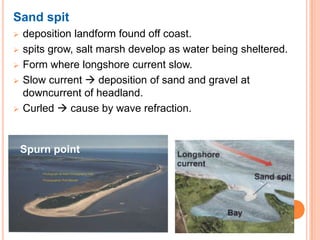
Sand spit
   deposition landform found off coast.
   spits grow, salt marsh develop as water being sheltered.
   Form where longshore current slow.
   Slow current  deposition of sand and gravel at
    downcurrent of headland.
   Curled  cause by wave refraction.


    Spurn point
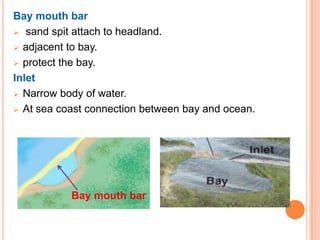
Bay mouth bar
 sand spit attach to headland.

 adjacent to bay.

 protect the bay.

Inlet
 Narrow body of water.

 At sea coast connection between bay and ocean.


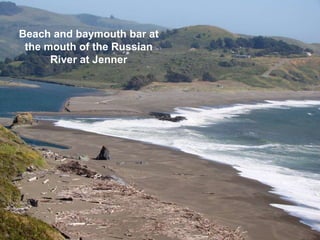
           Bay mouth bar
Beach and baymouth bar at
 the mouth of the Russian
      River at Jenner
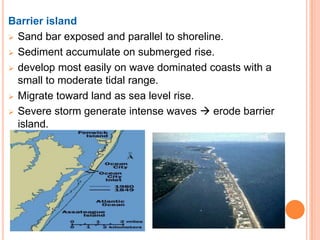
Barrier island
 Sand bar exposed and parallel to shoreline.

 Sediment accumulate on submerged rise.

 develop most easily on wave dominated coasts with a
  small to moderate tidal range.
 Migrate toward land as sea level rise.

 Severe storm generate intense waves  erode barrier
  island.
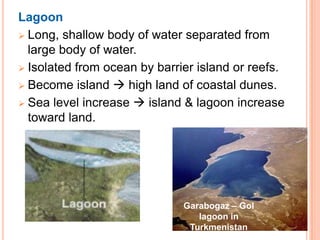
Lagoon
 Long, shallow body of water separated from
  large body of water.
 Isolated from ocean by barrier island or reefs.

 Become island  high land of coastal dunes.

 Sea level increase  island & lagoon increase
  toward land.


                              Garabogaz – Gol
                                 lagoon in
                               Turkmenistan
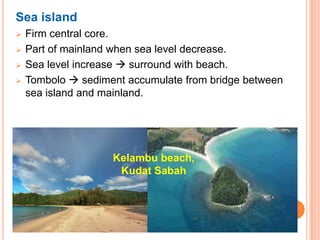
Sea island
   Firm central core.
   Part of mainland when sea level decrease.
   Sea level increase  surround with beach.
   Tombolo  sediment accumulate from bridge between
    sea island and mainland.


                    Kelambu beach,
                     Kudat Sabah
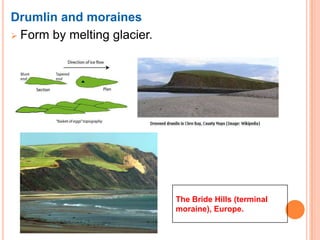
Drumlin and moraines
 Form by melting glacier.


                             The Bride Hills (terminal
                             moraine), Europe.
Deltas
   Deposition of sediment found at river mouth.
   Broad continental shelf present  as a platform
   Condition :
       -river transporting a large amount of sediment.
       -sea have a small tidal range and weak currents.
       -shallow at the river mouth.
   Shape represent balance between erosion and deposition.
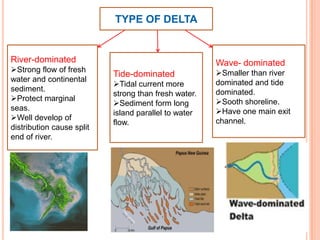
TYPE OF DELTA


River-dominated                                       Wave- dominated
Strong flow of fresh                                 Smaller than river
                           Tide-dominated
water and continental                                 dominated and tide
                           Tidal current more
sediment.                                             dominated.
                           strong than fresh water.
Protect marginal                                     Sooth shoreline.
                           Sediment form long
seas.                                                 Have one main exit
                           island parallel to water
Well develop of                                      channel.
                           flow.
distribution cause split
end of river.
-THE END-
-THANK YOU-

Large scale features accumulate on depositional coast

  • 1.
    LARGE- SCALE FEATURES ACCUMULATEON DEPOSITIONAL COAST.
  • 2.
    Sand spit  deposition landform found off coast.  spits grow, salt marsh develop as water being sheltered.  Form where longshore current slow.  Slow current  deposition of sand and gravel at downcurrent of headland.  Curled  cause by wave refraction. Spurn point
  • 3.
    Bay mouth bar sand spit attach to headland.  adjacent to bay.  protect the bay. Inlet  Narrow body of water.  At sea coast connection between bay and ocean. Bay mouth bar
  • 4.
    Beach and baymouthbar at the mouth of the Russian River at Jenner
  • 5.
    Barrier island  Sandbar exposed and parallel to shoreline.  Sediment accumulate on submerged rise.  develop most easily on wave dominated coasts with a small to moderate tidal range.  Migrate toward land as sea level rise.  Severe storm generate intense waves  erode barrier island.
  • 6.
    Lagoon  Long, shallowbody of water separated from large body of water.  Isolated from ocean by barrier island or reefs.  Become island  high land of coastal dunes.  Sea level increase  island & lagoon increase toward land. Garabogaz – Gol lagoon in Turkmenistan
  • 7.
    Sea island  Firm central core.  Part of mainland when sea level decrease.  Sea level increase  surround with beach.  Tombolo  sediment accumulate from bridge between sea island and mainland. Kelambu beach, Kudat Sabah
  • 8.
    Drumlin and moraines Form by melting glacier. The Bride Hills (terminal moraine), Europe.
  • 9.
    Deltas  Deposition of sediment found at river mouth.  Broad continental shelf present  as a platform  Condition : -river transporting a large amount of sediment. -sea have a small tidal range and weak currents. -shallow at the river mouth.  Shape represent balance between erosion and deposition.
  • 10.
    TYPE OF DELTA River-dominated Wave- dominated Strong flow of fresh Smaller than river Tide-dominated water and continental dominated and tide Tidal current more sediment. dominated. strong than fresh water. Protect marginal Sooth shoreline. Sediment form long seas. Have one main exit island parallel to water Well develop of channel. flow. distribution cause split end of river.
  • 11.