Enterprise Agile
Transformation
A journey not a destination
About me
• Pooja Wandile
• A pragmatic agilist
• Team player
• Learner
• Adventurer
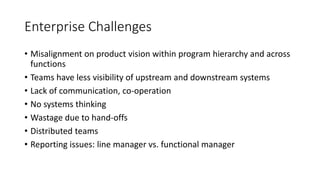
Enterprise Challenges
• Misalignment on product vision within program hierarchy and across
functions
• Teams have less visibility of upstream and downstream systems
• Lack of communication, co-operation
• No systems thinking
• Wastage due to hand-offs
• Distributed teams
• Reporting issues: line manager vs. functional manager
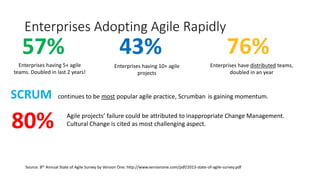
Enterprises Adopting Agile Rapidly
57%
Enterprises having 5+ agile
teams. Doubled in last 2 years!
43%
Enterprises having 10+ agile
projects
76%
Enterprises have distributed teams,
doubled in an year
SCRUM continues to be most popular agile practice, Scrumban is gaining momentum.
Agile projects’ failure could be attributed to inappropriate Change Management.
Cultural Change is cited as most challenging aspect.80%
Source: 8th Annual State of Agile Survey by Version One: http://www.versionone.com/pdf/2013-state-of-agile-survey.pdf
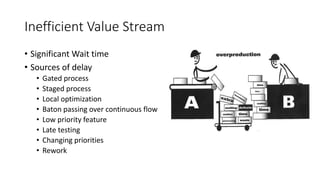
Inefficient Value Stream
• Significant Wait time
• Sources of delay
• Gated process
• Staged process
• Local optimization
• Baton passing over continuous flow
• Low priority feature
• Late testing
• Changing priorities
• Rework
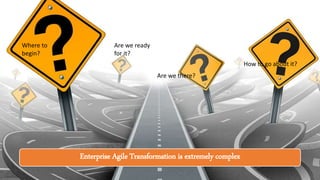
Enterprise Agile Transformation is extremely complex
Where to
begin?
How to go about it?
Are we there?
Are we ready
for it?
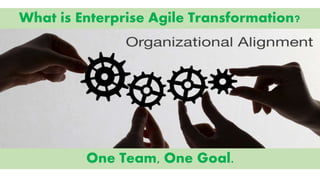
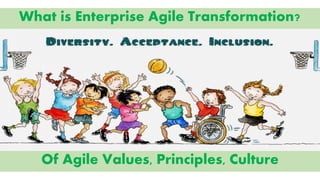
What is Enterprise Agile Transformation?
One Team, One Goal.
What is Enterprise Agile Transformation?
Of Agile Values, Principles, Culture
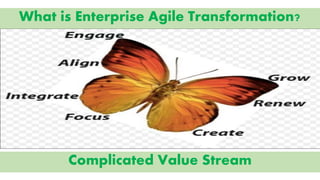
What is Enterprise Agile Transformation?
Complicated Value Stream
What is Enterprise Agile Transformation?
Redefined Ability Of An Enterprise To Innovate, Respond To
Change And Opportunities
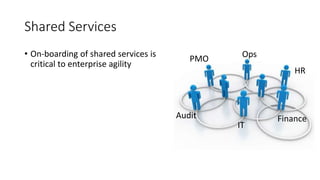
Shared Services
• On-boarding of shared services is
critical to enterprise agility
HR
FinanceAudit
IT
PMO Ops
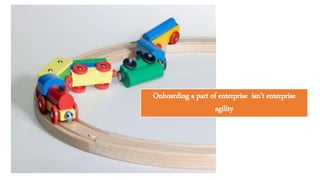
Onboarding a part of enterprise isn’t enterprise
agility
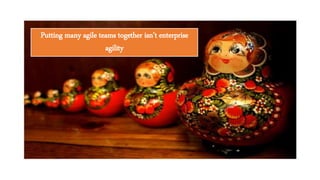
Putting many agile teams together isn’t enterprise
agility
Stepping On The Journey
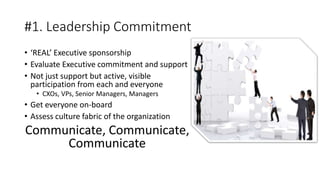
#1. Leadership Commitment
• ‘REAL’ Executive sponsorship
• Evaluate Executive commitment and support
• Not just support but active, visible
participation from each and everyone
• CXOs, VPs, Senior Managers, Managers
• Get everyone on-board
• Assess culture fabric of the organization
Communicate, Communicate,
Communicate
#2. Budget
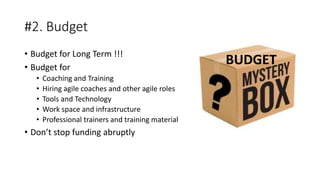
• Budget for Long Term !!!
• Budget for
• Coaching and Training
• Hiring agile coaches and other agile roles
• Tools and Technology
• Work space and infrastructure
• Professional trainers and training material
• Don’t stop funding abruptly
BUDGET
#3. Transformation Team
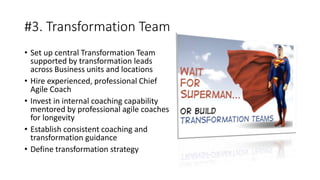
• Set up central Transformation Team
supported by transformation leads
across Business units and locations
• Hire experienced, professional Chief
Agile Coach
• Invest in internal coaching capability
mentored by professional agile coaches
for longevity
• Establish consistent coaching and
transformation guidance
• Define transformation strategy
#4. Operating Model
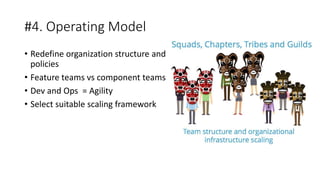
• Redefine organization structure and
policies
• Feature teams vs component teams
• Dev and Ops = Agility
• Select suitable scaling framework
#5. Coaching Alliance
• Define objectives
• Identify pilot projects
• Get commitment from leaders and
teams
• Plan and review with leaders and teams
• Be honest and transparent
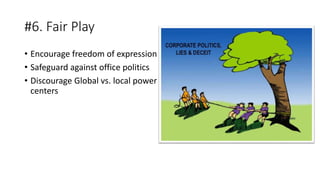
#6. Fair Play
• Encourage freedom of expression
• Safeguard against office politics
• Discourage Global vs. local power
centers
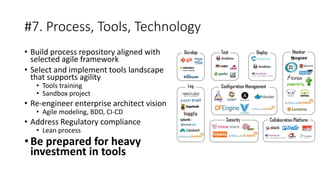
#7. Process, Tools, Technology
• Build process repository aligned with
selected agile framework
• Select and implement tools landscape
that supports agility
• Tools training
• Sandbox project
• Re-engineer enterprise architect vision
• Agile modeling, BDD, CI-CD
• Address Regulatory compliance
• Lean process
• Be prepared for heavy
investment in tools
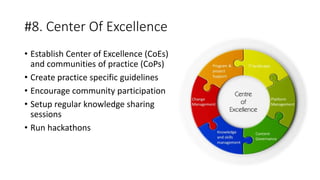
#8. Center Of Excellence
• Establish Center of Excellence (CoEs)
and communities of practice (CoPs)
• Create practice specific guidelines
• Encourage community participation
• Setup regular knowledge sharing
sessions
• Run hackathons
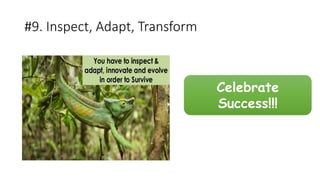
#9. Inspect, Adapt, Transform
Celebrate
Success!!!
Wrapping Up
• Leadership commitment is essential
• Culture change is vital
• Breaking silos
• Not just IT
• Needs patience and courage
•It’s a journey of Continual Improvement
@poojawk
pooja.wandile@gmail.com

Enterprise Agile Transformation

  • 1.
  • 2.
    About me • PoojaWandile • A pragmatic agilist • Team player • Learner • Adventurer
  • 4.
    Enterprise Challenges • Misalignmenton product vision within program hierarchy and across functions • Teams have less visibility of upstream and downstream systems • Lack of communication, co-operation • No systems thinking • Wastage due to hand-offs • Distributed teams • Reporting issues: line manager vs. functional manager
  • 7.
    Enterprises Adopting AgileRapidly 57% Enterprises having 5+ agile teams. Doubled in last 2 years! 43% Enterprises having 10+ agile projects 76% Enterprises have distributed teams, doubled in an year SCRUM continues to be most popular agile practice, Scrumban is gaining momentum. Agile projects’ failure could be attributed to inappropriate Change Management. Cultural Change is cited as most challenging aspect.80% Source: 8th Annual State of Agile Survey by Version One: http://www.versionone.com/pdf/2013-state-of-agile-survey.pdf
  • 8.
    Inefficient Value Stream •Significant Wait time • Sources of delay • Gated process • Staged process • Local optimization • Baton passing over continuous flow • Low priority feature • Late testing • Changing priorities • Rework
  • 10.
    Enterprise Agile Transformationis extremely complex Where to begin? How to go about it? Are we there? Are we ready for it?
  • 11.
    What is EnterpriseAgile Transformation? One Team, One Goal.
  • 12.
    What is EnterpriseAgile Transformation? Of Agile Values, Principles, Culture
  • 13.
    What is EnterpriseAgile Transformation? Complicated Value Stream
  • 14.
    What is EnterpriseAgile Transformation? Redefined Ability Of An Enterprise To Innovate, Respond To Change And Opportunities
  • 15.
    Shared Services • On-boardingof shared services is critical to enterprise agility HR FinanceAudit IT PMO Ops
  • 16.
    Onboarding a partof enterprise isn’t enterprise agility
  • 17.
    Putting many agileteams together isn’t enterprise agility
  • 18.
  • 19.
    #1. Leadership Commitment •‘REAL’ Executive sponsorship • Evaluate Executive commitment and support • Not just support but active, visible participation from each and everyone • CXOs, VPs, Senior Managers, Managers • Get everyone on-board • Assess culture fabric of the organization Communicate, Communicate, Communicate
  • 20.
    #2. Budget • Budgetfor Long Term !!! • Budget for • Coaching and Training • Hiring agile coaches and other agile roles • Tools and Technology • Work space and infrastructure • Professional trainers and training material • Don’t stop funding abruptly BUDGET
  • 21.
    #3. Transformation Team •Set up central Transformation Team supported by transformation leads across Business units and locations • Hire experienced, professional Chief Agile Coach • Invest in internal coaching capability mentored by professional agile coaches for longevity • Establish consistent coaching and transformation guidance • Define transformation strategy
  • 22.
    #4. Operating Model •Redefine organization structure and policies • Feature teams vs component teams • Dev and Ops = Agility • Select suitable scaling framework
  • 23.
    #5. Coaching Alliance •Define objectives • Identify pilot projects • Get commitment from leaders and teams • Plan and review with leaders and teams • Be honest and transparent
  • 24.
    #6. Fair Play •Encourage freedom of expression • Safeguard against office politics • Discourage Global vs. local power centers
  • 25.
    #7. Process, Tools,Technology • Build process repository aligned with selected agile framework • Select and implement tools landscape that supports agility • Tools training • Sandbox project • Re-engineer enterprise architect vision • Agile modeling, BDD, CI-CD • Address Regulatory compliance • Lean process • Be prepared for heavy investment in tools
  • 26.
    #8. Center OfExcellence • Establish Center of Excellence (CoEs) and communities of practice (CoPs) • Create practice specific guidelines • Encourage community participation • Setup regular knowledge sharing sessions • Run hackathons
  • 27.
    #9. Inspect, Adapt,Transform Celebrate Success!!!
  • 28.
    Wrapping Up • Leadershipcommitment is essential • Culture change is vital • Breaking silos • Not just IT • Needs patience and courage •It’s a journey of Continual Improvement
  • 29.

Editor's Notes

  • #12 Alignment across org to improve cust satisfaction, employee satisfaction, morale, retention Enterprise agile applies agile values and principles to all elements of the business in order to ensure continual alignment, collaboration and synchronization. Across every facet of the business, then, an agile enterprise values: Individuals and interactions Working software Responsiveness to change Customer collaboration Enterprise agile is anchored in the same core principles and values that make teams successful. But because it involves all aspects of the business, and because agile enterprises often involve complex “systems of systems,” enterprise agile transformation is rarely easy. Let’s take a look at the common questions we hear with respect to enterprise agile, and at the practices and processes that have helped our customers be more successful in their transformations.
  • #15 Redefined ability of an organization to react more effectively to change and opportunities
  • #16 Difficult to get these ppl on-boarded. Invite those outside of the agile enterprise to planning meetings, daily standups, reviews, and retrospectives. This can be very effective in establishing common ground and influencing the culture. Agree on mutual “organizational interfaces” between areas of the organization that need to exchange information, but where the methods of obtaining and expressing that information are different. This can be very important in the communication of metrics.
  • #20 Corporate culture & strategy: values history competition customer confidence Processes and Oversight: SDLC, Audit, regulations, COEs, procurement, finance, testing, release mgmt. People & Org: Org structure, local values, people: exes, Sr.Leaders, mgrs.,teams Other: budget, space, etc. Evaluate Executive Involvement and Support PLEASE NOTE: DO NOT PASS THIS STEP UNTIL THERE IS A FULL COMMITMENT TO AGILE BY THE V.P. TIER AND ABOVE – there are numerous barriers organizationally that have to be removed or mitigated by the Executive Tier for Agile to be successful. Executive involvement is the 2nd most crucial step to success. (This is also why many bottom up initiatives stall or fail.) This is involvement not just Support. Support is talk where involvement is action. Involvement is a commitment where the Executive Team is fully committed and participates entirely in the processes (where involvement is deemed necessary).
  • #22 Do not by pass this step, xforamtions are complex and may fail if this step is not followed
  • #26 But we’re agile!” is not an acceptable excuse when auditors come around. Offering up such a defense is one of the surest ways to have the plug pulled on your agile transformation.