Masaryk University School of Medicine and Brno University Hospital  Department of Obstetrics and Gynecology  Head : Prof.  Pavel Ventruba, MD, DSc. Emergency situations  in Obstetrics and Gynecology VSPO011p First Aid - lecures podzim 2007 Department of Obstetrics and Gynecology LF MU and FN Brno  M. Huser
The conduct of labour    – present and future Gerychová Romana Janků Petr 2004/2005
1. Definition expeling fetus, placenta, umbilical cord, amniotic fluid from the mother body during labour delivered fetus – newborn child with signs of life ( heart rate, spontaneous breathing, movements, pulsate umbilical cord ) of any weight or without signs of life with weight 1000g and more
Premature labour  24 – 36 gestational weeks  Term labour 38 – 42 gestational week Post term labour  after 42 gestational week until 24 gestational week - abortion
2. Labour date estimated data of the labour  average pregnancy duration: - 40 weeks ( 280 days )  from the last date of the menstrual period - 38 weeks ( 266 days ) from the conception
Estimating labour date according first fetal movement date of the conception ultrasound measurement date of the last menstrual period
3. Clasification spontaneous labour medicamental labour ( spontaneous beggining ) induced labour operative labour physiologiacal labour pathological labour
4. „ Delivery tract „  hard „ delivery tract „ - pelvis soft „ delivery tract „ low segment  cervix vagina external pelvic floor
5. Labour force uterine contractions - frequency,intensity syntocinon, prostaglandins (E2, F2 alpha) abdominal press gravitation
6. Fetus The most freqent fetus presentation – cephalic. Fetus head- the biggest problem during delivery ( size, shape ) – influence on conduct of labour, labour outcome  Skull: two frontal bones, two parietal bones, two temporal bones, one occipital bone Joints- frontal, saggital, lambdoid, occipital Fontanelle – big and small
Good prognosis - during delivery fetus head is coming into the pelvis with small oblique diameter  ( middle of the big fontanelle -  9 cm )
7. Delivery progress 7.1. Preparatory stadium dolores praesagientes preparing of uterine muscles going down uterus cervical slimy secretion Delivery beginning - regular uterine contractions - rupture of membranes Expectant and active conduct of labour
7.2. I.labour stage ( openig ) latens – cervical rippening active – cervical dilatation to 8 cm transitory – 8 cm and more  7.3. II labour stage   ( expeling )  fetus expeling, episiotomy  Fetus head delivery –  flexis, internal  rotation, deflexis, external rotation  Fetus shoulders delivery
7.4. III. labour stage expeling placenta and fetal membranes  7.5. IV.labour stage 2-3 hours after delivery Delivery duration 6 – 12 hours ( primipara ) 3 – 9 hours ( multipara ) 60 minutes and less …..precipitous delivery
8. Delivery room incoming anamnesis, external examination, obstetric examination  nonstress test, amnioscopy, ultrasound  Doppler sonography blood presure, pulse, body temperature blood and urine testing, vaginal cultivation delivery preparing ( shower, bath )
9. Labour monitoring women status –  blood presure, pulse, body temperature, pain, psychical status uterine contractions – external examination and monitoring labour progression – internal examination fetus status – fetal heart rate, cardiotocography, amniotic fluid quality bleeding and coagulability
10. Fetal monitoring cardiotocography ( external, internal ) intrapartal fetal pulse oxymetry S – T analysis ( fetal EKG ) ultrasound examination - presentation,  estimated  fetal weigt  Doppler ultrasound examination – umbilical cord, haematoma
11. Conduct of labour doctors and midwifes role paediatrician and nurse neonatus examination and treatment II. and IV. stage of labour  injury, blood loss, umbilical cord testing  genitals hygiene, blood presure and pulse, urination, hydratation, psychic status, rest, transfer to the rest room
forceless delivery accompanied father home delivery mother position during delivery water birth elective Caesarean Section induced delivery analgesis during delivery
relaxing technic musicotherapy aromatherapy  backbone and perineal massage prelabour preparation  basic enlarged breast feeding neonatal care
Obstetrics bleeding Jelínek, J., Hudeček, R.
Obstetrics bleeding - introduction Spectrum ranges from small show with little clinical significance to a catastrofic haemorrhage which qiuckly causes to death. Bleeding can occur at any stage of pregnancy or labour.
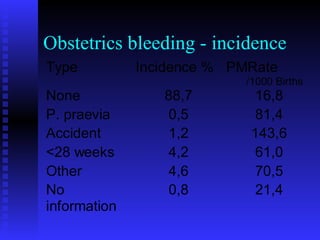
Obstetrics bleeding - incidence
Obstetrics bleeding - summary Ectopic pregnancy Second trimester Placenta praevia Vasa praevia Placental abruption Other conditions Unexplained  Postpartum haemorrhage Retained placenta  Coagulopathy Uterine atony trauma - rupture  long-term complications
Ectopic pregnancy - risk factors High risk: tubal surgery, prevoius ectopic pregnancy, use of IUD, tubal patology Moderate risk: infertility, previous genital infection Slight risk: cigarete smoking, previous abdominal surgery
Ectopic pregnancy - symptoms Abdominal pain Vaginal bleeding Abdominal and Adnexal tenderness History of infertility  Use of an IUD Previous ectopic pregnancy
Ectopic pregnancy - diagnosis 5 - 9 weeks of amenorrhoea Pelvic pain  Vaginal bleeding Positiv pregnacy test  hCG No dunling time of hCG elevation  US - no suc is seen within the uterus  Laparoscopy
Ectopic pregnancy - treatment Surgical radical - salpingectomy  konzervative - longitudinal incision  Medical  MTX Prostaglandins, hyperosmolar glucose Expectant monitoring of hCG levels
Ectopic pregnancy - risk factors High risk: tubal surgery, prevoius ectopic pregnancy, use of IUD, tubal patology Moderate risk: infertility, previous genital infection Slight risk: cigarete smoking, previous abdominal surgery
Děkuji za pozornost www.fnbrno.cz/gpk

FA: Gyn

  • 1.
    Masaryk University Schoolof Medicine and Brno University Hospital Department of Obstetrics and Gynecology Head : Prof. Pavel Ventruba, MD, DSc. Emergency situations in Obstetrics and Gynecology VSPO011p First Aid - lecures podzim 2007 Department of Obstetrics and Gynecology LF MU and FN Brno M. Huser
  • 2.
    The conduct oflabour – present and future Gerychová Romana Janků Petr 2004/2005
  • 3.
    1. Definition expelingfetus, placenta, umbilical cord, amniotic fluid from the mother body during labour delivered fetus – newborn child with signs of life ( heart rate, spontaneous breathing, movements, pulsate umbilical cord ) of any weight or without signs of life with weight 1000g and more
  • 4.
    Premature labour 24 – 36 gestational weeks Term labour 38 – 42 gestational week Post term labour after 42 gestational week until 24 gestational week - abortion
  • 5.
    2. Labour dateestimated data of the labour average pregnancy duration: - 40 weeks ( 280 days ) from the last date of the menstrual period - 38 weeks ( 266 days ) from the conception
  • 6.
    Estimating labour dateaccording first fetal movement date of the conception ultrasound measurement date of the last menstrual period
  • 7.
    3. Clasification spontaneouslabour medicamental labour ( spontaneous beggining ) induced labour operative labour physiologiacal labour pathological labour
  • 8.
    4. „ Deliverytract „ hard „ delivery tract „ - pelvis soft „ delivery tract „ low segment cervix vagina external pelvic floor
  • 9.
    5. Labour forceuterine contractions - frequency,intensity syntocinon, prostaglandins (E2, F2 alpha) abdominal press gravitation
  • 10.
    6. Fetus Themost freqent fetus presentation – cephalic. Fetus head- the biggest problem during delivery ( size, shape ) – influence on conduct of labour, labour outcome Skull: two frontal bones, two parietal bones, two temporal bones, one occipital bone Joints- frontal, saggital, lambdoid, occipital Fontanelle – big and small
  • 11.
    Good prognosis -during delivery fetus head is coming into the pelvis with small oblique diameter ( middle of the big fontanelle - 9 cm )
  • 12.
    7. Delivery progress7.1. Preparatory stadium dolores praesagientes preparing of uterine muscles going down uterus cervical slimy secretion Delivery beginning - regular uterine contractions - rupture of membranes Expectant and active conduct of labour
  • 13.
    7.2. I.labour stage( openig ) latens – cervical rippening active – cervical dilatation to 8 cm transitory – 8 cm and more 7.3. II labour stage ( expeling ) fetus expeling, episiotomy Fetus head delivery – flexis, internal rotation, deflexis, external rotation Fetus shoulders delivery
  • 14.
    7.4. III. labourstage expeling placenta and fetal membranes 7.5. IV.labour stage 2-3 hours after delivery Delivery duration 6 – 12 hours ( primipara ) 3 – 9 hours ( multipara ) 60 minutes and less …..precipitous delivery
  • 15.
    8. Delivery roomincoming anamnesis, external examination, obstetric examination nonstress test, amnioscopy, ultrasound Doppler sonography blood presure, pulse, body temperature blood and urine testing, vaginal cultivation delivery preparing ( shower, bath )
  • 16.
    9. Labour monitoringwomen status – blood presure, pulse, body temperature, pain, psychical status uterine contractions – external examination and monitoring labour progression – internal examination fetus status – fetal heart rate, cardiotocography, amniotic fluid quality bleeding and coagulability
  • 17.
    10. Fetal monitoringcardiotocography ( external, internal ) intrapartal fetal pulse oxymetry S – T analysis ( fetal EKG ) ultrasound examination - presentation, estimated fetal weigt Doppler ultrasound examination – umbilical cord, haematoma
  • 18.
    11. Conduct oflabour doctors and midwifes role paediatrician and nurse neonatus examination and treatment II. and IV. stage of labour injury, blood loss, umbilical cord testing genitals hygiene, blood presure and pulse, urination, hydratation, psychic status, rest, transfer to the rest room
  • 19.
    forceless delivery accompaniedfather home delivery mother position during delivery water birth elective Caesarean Section induced delivery analgesis during delivery
  • 20.
    relaxing technic musicotherapyaromatherapy backbone and perineal massage prelabour preparation basic enlarged breast feeding neonatal care
  • 21.
  • 22.
    Obstetrics bleeding -introduction Spectrum ranges from small show with little clinical significance to a catastrofic haemorrhage which qiuckly causes to death. Bleeding can occur at any stage of pregnancy or labour.
  • 23.
  • 24.
    Obstetrics bleeding -summary Ectopic pregnancy Second trimester Placenta praevia Vasa praevia Placental abruption Other conditions Unexplained Postpartum haemorrhage Retained placenta Coagulopathy Uterine atony trauma - rupture long-term complications
  • 25.
    Ectopic pregnancy -risk factors High risk: tubal surgery, prevoius ectopic pregnancy, use of IUD, tubal patology Moderate risk: infertility, previous genital infection Slight risk: cigarete smoking, previous abdominal surgery
  • 26.
    Ectopic pregnancy -symptoms Abdominal pain Vaginal bleeding Abdominal and Adnexal tenderness History of infertility Use of an IUD Previous ectopic pregnancy
  • 27.
    Ectopic pregnancy -diagnosis 5 - 9 weeks of amenorrhoea Pelvic pain Vaginal bleeding Positiv pregnacy test hCG No dunling time of hCG elevation US - no suc is seen within the uterus Laparoscopy
  • 28.
    Ectopic pregnancy -treatment Surgical radical - salpingectomy konzervative - longitudinal incision Medical MTX Prostaglandins, hyperosmolar glucose Expectant monitoring of hCG levels
  • 29.
    Ectopic pregnancy -risk factors High risk: tubal surgery, prevoius ectopic pregnancy, use of IUD, tubal patology Moderate risk: infertility, previous genital infection Slight risk: cigarete smoking, previous abdominal surgery
  • 30.
    Děkuji za pozornostwww.fnbrno.cz/gpk