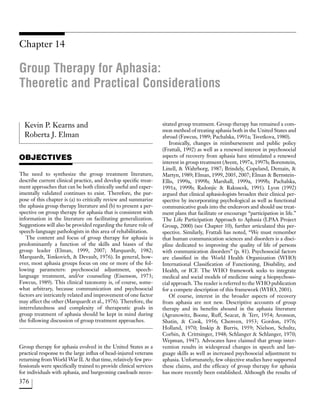
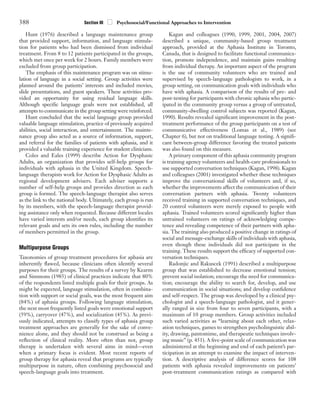
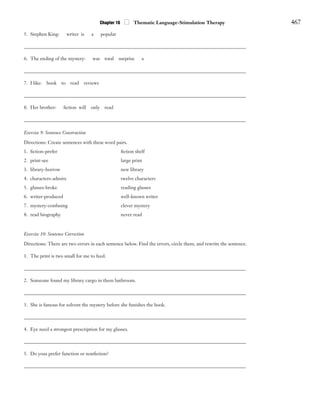
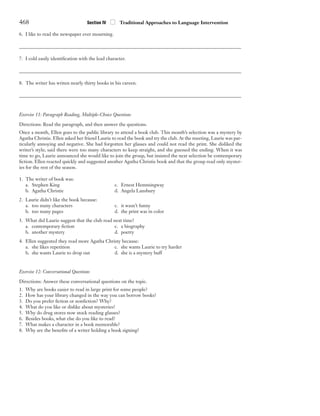
This document provides information about the fifth edition of the book "Language Intervention Strategies in Aphasia and Related Neurogenic Communication Disorders". It discusses the organization and contents of the book, which covers various approaches to assessing and treating language disorders in adults caused by conditions such as aphasia and stroke. The preface expresses the editor's belief that language is cognitively based and socially constructed, and interventions should focus on functional communication and quality of life. It is intended to be a resource for students and clinicians in fields related to speech language pathology.

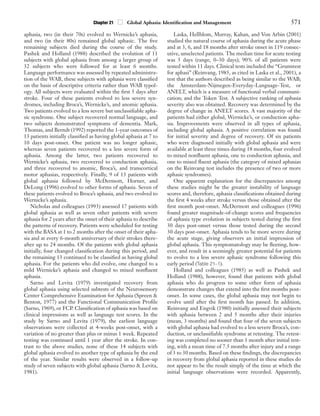
![F I F T H E D I T I O N
Language Intervention
Strategies in
Aphasia and
Related Neurogenic
Communication Disorders
GRBQ344-3513G-FM[i-xviii]qxd 02-13-2008 07:47 AM Page i APTARA(GRG QUARK)](https://image.slidesharecdn.com/languageinterventionstrategies-230911091830-54ea67ad/85/Language_Intervention_Strategies-pdf-3-320.jpg)
![GRBQ344-3513G-FM[i-xviii]qxd 02-13-2008 07:47 AM Page ii APTARA(GRG QUARK)](https://image.slidesharecdn.com/languageinterventionstrategies-230911091830-54ea67ad/85/Language_Intervention_Strategies-pdf-4-320.jpg)
![F I F T H E D I T I O N
Editor
Roberta Chapey, Ed.D.
Professor
Department of Speech Communication Arts and Sciences
Brooklyn College
The City University of New York
Brooklyn, New York
Language Intervention
Strategies in
Aphasia and
Related Neurogenic
Communication Disorders
GRBQ344-3513G-FM[i-xviii]qxd 02-13-2008 07:47 AM Page iii APTARA(GRG QUARK)](https://image.slidesharecdn.com/languageinterventionstrategies-230911091830-54ea67ad/85/Language_Intervention_Strategies-pdf-5-320.jpg)
![Editor: Peter Sabatini
Managing Editor: Lisa Koepenick / Kevin C. Dietz
Marketing Manager: Allison Noplock
Compositor: Aptara, Inc.
Printer: RRD-Willard
Copyright © 2008 Lippincott Williams & Wilkins
351 West Camden Street
Baltimore, Maryland 21201-2436 USA
227 East Washington Square
Philadelphia, PA 19106
All rights reserved. This book is protected by copyright. No part of this book may be reproduced in any
form or by any means, including photocopying, or utilized by any information storage and retrieval system
without written permission from the copyright owner.
The publisher is not responsible (as a matter of product liability, negligence or otherwise) for any injury
resulting from any material contained herein. This publication contains information relating to general
principles of medical care, which should not be construed as specific instructions for individual patients.
Manufacturers’ product information and package inserts should be reviewed for current information,
including contraindications, dosages and precautions.
Printed in the United States of America
First Edition, 1981
Second Edition, 1986
Third Edition, 1994
Fourth Edition, 2001
Library of Congress Cataloging-in-Publication Data
Language intervention strategies in aphasia and related neurogenic
communication disorders / editor, Roberta Chapey. — 5th ed.
p. ; cm.
Includes bibliographical references and indexes.
ISBN-13: 978-0-7817-6981-5 (hardcover)
ISBN-10: 0-7817-6981-7 (hardcover)
1. Aphasia—Treatment. 2. Language disorders—Treatment. I. Chapey,
Roberta.
[DNLM: 1. Aphasia—therapy. 2. Language Disorders—therapy. 3.
Language Therapy—methods. 4. Speech Disorders—therapy. WL 340.5
L2872 2008]
RC425.L37 2008
616.85'5206—dc22
2007038506
The publishers have made every effort to trace the copyright holders for borrowed material. If they have
inadvertently overlooked any, they will be pleased to make the necessary arrangements at the first
opportunity.
To purchase additional copies of this book, call our customer service department at (800) 638-3030 or fax
orders to (301) 824-7390. International customers should call (301) 714-2324.
GRBQ344-3513G-FM[i-xviii]qxd 02-13-2008 07:47 AM Page iv APTARA(GRG QUARK)](https://image.slidesharecdn.com/languageinterventionstrategies-230911091830-54ea67ad/85/Language_Intervention_Strategies-pdf-6-320.jpg)
![To the memory of my dad,
Robert (Bob) Chapey,
for his boundless generosity, kindness, love,
understanding, tolerance, support, humanness,
and humor—and for his truly brilliant strategies
for living. He was a super parent.
R.C.
GRBQ344-3513G-FM[i-xviii]qxd 02-13-2008 07:47 AM Page v APTARA(GRG QUARK)](https://image.slidesharecdn.com/languageinterventionstrategies-230911091830-54ea67ad/85/Language_Intervention_Strategies-pdf-7-320.jpg)
![GRBQ344-3513G-FM[i-xviii]qxd 02-13-2008 07:47 AM Page vi APTARA(GRG QUARK)](https://image.slidesharecdn.com/languageinterventionstrategies-230911091830-54ea67ad/85/Language_Intervention_Strategies-pdf-8-320.jpg)
![Preface
human health for all individuals are living a life of purpose
and quality connection to others.
The fifth edition contains 36 chapters organized into five
sections. Section I covers basic considerations such as defi-
nitions of aphasia and stroke, incidence of stroke, the neural
basis of language disorders, medical aspects of stroke, and
the assessment of language disorders in adults.
Section II contains five chapters on principles of lan-
guage intervention such as research methods appropriate to
our field, treatment recovery, prognosis, and clinical effec-
tiveness, teams and partnerships in clinical practice, as well
as treatment of bilingual and bicultrurally diverse individu-
als. A number of issues related to service delivery are dis-
cussed.
Section III contains five chapters on psychosocial and
functional approaches to intervention—models that focus
on improving ability to perform communication activities of
daily living. Such approaches consider the impact of aphasia
on the well-being of the individual, their family, and the
environment.
Section IV, the largest section, covers ‘Traditional
Approaches to Language Intervention.’ It is divided into four
units containing seven stimulation approaches, four cogni-
tive neuropsycological and four neurolinguistic approaches,
and three ‘specialized’ interventions.
Section V provides suggestions for remediation of disor-
ders that frequently accompany aphasia or are related to or
confused with aphasia; namely, traumatic brain injury, right
hemisphere damage, dementia, apraxia, and dysarthria.
The chapters can be read in any order. In addition, all the
chapters do not need to be read at one time. For example,
when I teach our graduate course in adult aphasia, I typically
use about 12 to 15 chapters as a core, and then refer to other
chapters as they come up in class discussions, presentations
or term papers, and/or when students ask questions about a
specific individual that they are observing or working with in
clinical practicum. I use the remaining chapters to give addi-
tional options, depth, and resources for actual work with
individuals affected by aphasia.
Language Intervention Strategies in Aphasia and Related
Neurogenic Communication Disorders—Fifth Edition can be
used in classes for advanced undergraduate and graduate
students in speech language pathology. Clinical aphasiolo-
gists who are no longer formal students, but who desire to
Welcome to the fifth edition of Language Intervention
Strategies in Aphasia and Related Neurogenic Communication
Disorders. The first edition of this book was published in
1981, the second in 1986, the third in 1994, and the fourth
in 2001. All four editions grew out of the realization that the
discussion of aphasia therapy had become a major theme in
clinical aphasiology literature but that the specification of
numerous types or strategies of intervention was of fairly
recent origin.
All five texts grew out of the belief that there continues to
be a substantial number of approaches applicable to the
remediation of language-disordered adults that should be
brought together and shared. The five texts are also grounded
in the realization that a variety of different therapeutic prin-
ciples and approaches need to be articulated, assembled,
applied, and critiqued in order to strengthen the quality of
future work in our field.
The major purpose of the fifth edition is to bring
together significant thoughts on intervention and to stimu-
late further developments in the remediation of adults with
aphasia. It should be noted that some of the models pre-
sented in this text still need to be supported by controlled
studies and long-term clinical application.
Each edition of this text is increasingly informed by the
view that language is cognitively based (Chapey, 2008) and
socially constructed by participants communicating with
someone, about something, for some reason; and that judg-
ments of competence/incompetence involve evaluations
about issues such as role, context, intent, timing, volume,
movements, intonation, gender, age, taste, group member-
ship, etc. (Bloom and Lahey, 1988; Kovarsky, Duchan, and
Maxwell, 1999). In addition, the dual goals of communica-
tion—that of transaction or the exchange of information
and that of interaction or the fulfillment of social needs
(such as affiliation with other people, assertion of individual-
ity, demonstration of competence, gaining and maintaining
membership in social circles, etc. (Simmons-Mackie, 2008)
are increasingly reflected in the texts.
Further, the texts increasingly reflect the fact that we have
a responsibility to individuals with aphasia and their signifi-
cant others to foster their membership in a communicating
society and their participation in personally relevant activi-
ties (Simmons-Mackie, 2008). The texts also emphasize the
belief that two of the most important factors in positive
vii
GRBQ344-3513G-FM[i-xviii]qxd 02-13-2008 07:47 AM Page vii APTARA(GRG QUARK)](https://image.slidesharecdn.com/languageinterventionstrategies-230911091830-54ea67ad/85/Language_Intervention_Strategies-pdf-9-320.jpg)
![keep abreast of new ideas in their field will also find the
material of interest. Further, the material will be valuable to
students and professionals in nursing, medicine, and other
health-related disciplines.
Roberta Chapey,
Ed.D. Professor
References
Bloom, L., and Lahey, M. (1988), Language Disorders and Language
Development. New York: Macmillan.
Chapey, R. (2008). Cognitive Stimulation: Stimulation of Recognition/
Comprehension, Memory, Convergent Thinking, Divergent and Evaluative
Thinking. In R. Chapey (Ed.)., Language Intervention Strategies in Aphasia
and Related Neurogenic Communication Disorders—Fifth Ed. Baltimore, MD.:
Lippincot Williams and Wilkins.
Kovarsky, D., Duchan, J. and Maxwell, M. (1999). Constructing (In)
Competence. Disabling Evaluations in Clinical and Social Interaction. Mahwah,
NJ: Lawrence Erlbaum.
Simmons-Mackie, N. (2008). Social approaches to aphasia intervention.
In R. Chapey (Ed.)., Language Intervention Strategies in Aphasia and Related
Neurogenic Communication Disorders—Fifth Ed. Baltimore, MD.: Lippincott
Williams and Wilkins.
viii Preface
GRBQ344-3513G-FM[i-xviii]qxd 02-13-2008 07:47 AM Page viii APTARA(GRG QUARK)](https://image.slidesharecdn.com/languageinterventionstrategies-230911091830-54ea67ad/85/Language_Intervention_Strategies-pdf-10-320.jpg)
![ix
Acknowledgments
this text a kaleidoscope of enriching and rewarding experi-
ences for me as well as for each of our patients. I am deeply
appreciative of their caring and support and for many “one
and only moments” of connection.
I am also thankful to the staff of Lippincott Williams &
Wilkins for their dedication to making this a first rate text
and for facilitating so many relentless details of this project.
For the tireless support and help, I thank Peter Sabatini,
Acquisitions Editor; Lisa Koepenick, Managing Editor; and
Susan Katz, Vice President, Health Professions.
To those who have contributed to my personal life and pro-
fessional career, past and present, I express my deep appreci-
ation. I am also grateful to the authors and publishers who
granted me permission to quote from their works.
Many concerned and dedicated people have helped bring
this textbook to fruition. Sincere appreciation is extended to
each. Special thanks are extended to Argye E. (Beth) Hillis
for her professionalism and enthusiasm in organizing the
section on cognitive neuropsychology. As editor, I would
especially like to thank each contributor for helping to make
GRBQ344-3513G-FM[i-xviii]qxd 02-13-2008 07:47 AM Page ix APTARA(GRG QUARK)](https://image.slidesharecdn.com/languageinterventionstrategies-230911091830-54ea67ad/85/Language_Intervention_Strategies-pdf-11-320.jpg)
![GRBQ344-3513G-FM[i-xviii]qxd 02-13-2008 07:47 AM Page x APTARA(GRG QUARK)](https://image.slidesharecdn.com/languageinterventionstrategies-230911091830-54ea67ad/85/Language_Intervention_Strategies-pdf-12-320.jpg)
![xi
Contributors
Carl A. Coelho, PhD
Professor and Head
Communication Sciences
University of Connecticut
Storrs, Connecticut
Hanna Damasio, MD
Dana Dornsife Professor of Neuroscience and
Director, Dana & David Dornsife Cognitive Neuroscience
Imaging Center,
University of Southern California
Los Angeles
Judith F. Duchan, PhD, CCC
Professor
Department of Communicative Disorders
and Sciences
State University of New York at Buffalo
Buffalo, New York
Joseph R. Duffy, PhD
Professor
Consultant and Head
Division of Speech Pathology
Department of Neurology
Mayo Clinic College of Medicing
Rochester, Minnesota
Roberta J. Elman, PhD, CCC-SLP, BC-ANCDS
President/Founder
Aphasia Center of California
Oakland, California
Timothy J. Feeney, PhD
School of Community Supports
Project Director
NYS Neurobehavioral Resource Project
New York, New York
Linda J. Garcia, PhD
Associate Professor and Chair
Audiology and Speech-Language Pathology
Program
University of Ottawa
Ottawa, Ontario, Canada
Donna L. Bandur, MCISc
Profession Leader
Speech-Language Pathology
London Health Sciences Centre
London, Ontario, Canada
Kathryn A. Bayles, PhD
Professor-Emerita
Department of Speech, Language and Hearing Sciences
The University of Arizona
Pelagie M. Beeson, PhD, CCC-SLP
Associate Professor
Department of Speech, Language, and Hearing Sciences
Department of Neurology
The University of Arizona
Tucson, Arizona
Rita Sloan Berndt, PhD
Professor
Department of Neurology
University of Maryland School of Medicine
Baltimore, Maryland
Margaret Lehman Blake, PhD
Assistant Professor
Department of Communication Sciences and Disorders
University of Houston
Houston, Texas
Roberta Chapey, EdD
Professor
Department of Speech Communication Arts and Sciences
Brooklyn College
City University of New York
Brooklyn, New York
Leora R. Cherney, PhD, BC-ANCDS
Associate Professor
Physical Medicine and Rehabilitation
Northwestern University, Feinberg School of Medicine
Clinical Research Scientist
Center for Aphasia Research
Rehabilitation Institute of Chicago
Chicago, Illinois
GRBQ344-3513G-FM[i-xviii]qxd 02-13-2008 07:47 AM Page xi APTARA(GRG QUARK)](https://image.slidesharecdn.com/languageinterventionstrategies-230911091830-54ea67ad/85/Language_Intervention_Strategies-pdf-13-320.jpg)
![April Gibbs Scott, MS, CCC-SLP
PhD Student
Department of Communication Science and
Disorders
University of Pittsburgh
Pittsburgh, Pennsylvania
Lee Ann C. Golper, PhD
Associate Professor
Department of Hearing and Speech Sciences
Vanderbilt University
Nashville, Tennessee
Brooke Hallowell, PhD
Director
School of Hearing, Speech and Language Sciences
Associate Dean
College of Health and Human Services
Ohio University
Athens, Ohio
Maya L. Henry, MS, CCC-SLP
Department of Speech, Language, and Hearing
Sciences
University of Arizona, Tucson, AZ
Argye Elizabeth Hillis, MD, MA
Professor of Neurology, Physical Medicine and
Rehabilitation, and Cognitive Science
Executive Vice Chair, Department of Neurology
Director, Neurology Residency Program
Co-Director, Cerebrovascular Division
Johns Hopkins University School of Medicine
Baltimore, Maryland
Tammy Hopper, PhD
Assistant Professor
Department of Speech Pathology and Audiology
University of Alberta
Edmonton, Alberta, Canada
Karen Hux, PhD
Associate Professor
Special Education and Communication Disorders
University of Nebraska at Lincoln
Lincoln, Nebraska
Aura Kagan, PhD, Reg CASLPO, S-LP (C)
Program, Research, and Education Director
The Aphasia Institute
Toronto, Ontario, Canada
Richard C. Katz, PhD
Chair
Audiology and Speech Pathology Department
Carl T. Hayden VA Medical Center
Phoenix, Arizona
Adjunct Professor
Department of Speech and Hearing Science
Arizona State University
Tempe, Arizona
Kevin P. Kearns, PhD
Professor and Director
Communication Sciences and Disorders
Massachusetts General Hospital Institute of Health
Professions
Boston, Massachusetts
Rosemary B. Lubinski, EdD
Professor
Department of Communication Disorders and Sciences
University of Buffalo
Buffalo, New York
Jon G. Lyon, PhD, CCC-SLP
Director
Living with Aphasia, Inc
Mazomanie, Wisconsin
Robert C. Marshall, PhD
Professor
Rehabilitation Sciences
University of Kentucky
Lexington, Kentucky
Malcolm R. McNeil, PhD
Distinguished Service Professor and Chair
Department of Communication Science
and Disorders
University of Pittsburgh
Research Scientist
Speech Motor, Aphasia, Cognition Laboratory
(SMAC)
VA Pittsburgh Healthcare System
Pittsburgh, Pennsylvania
E. Jeffrey Metter, MD
Medical Officer
Clinical Research Branch
National Institute On Aging
National Institutes of Health
Gerontology Research Center
Baltimore, Maryland
xii Contributors
GRBQ344-3513G-FM[i-xviii]qxd 02-13-2008 07:47 AM Page xii APTARA(GRG QUARK)](https://image.slidesharecdn.com/languageinterventionstrategies-230911091830-54ea67ad/85/Language_Intervention_Strategies-pdf-14-320.jpg)
![Charlotte C. Mitchum, MS, CCC-SLP
Research Associate
Department of Neurology
University of Maryland School of Medicine
Baltimore, Maryland
Anthony G. Mlcoch, PhD
Speech-Language Pathologist
Audiology and Speech Pathology Service
Hines Veterans Affairs Hospital
Hines, Illinois
and
Adjunct Professor of Neurology
Speech Pathology and Audiology
Stricht School of Medicine, Loyola University
Shirley Morganstein, MA, CCC-SLP
Partner
Speaking of Aphasia, LLC
Montclair, New Jersey
Penelope S. Myers, PhD
Speech Pathologist
Rochester, Minnesota
Stephen E. Nadeau, MD
Professor
Department of Neurology
University of Florida College of Medicine
Staff Neurologist
Geriatric Research, Education and Clinic
Malcolm Randall VA Medical Center
Gainesville, Florida
Melissa Newhart, BS
Research Assistant
Stroke and Cognitive Disorders Laboratory
Janet P. Pattersion, PhD
Associate Professor
Department of Communicative Sciences and Disorders
California State University East Bay
Hayward, California
Research Associate
Center for Aphasia and Related Diseases
VA Northern California
Martinez, California
Richard K. Peach, PhD
Professor
Otolaryngology, Neurological Sciences and
Communication Disorders and Sciences
Rush University Medical Center
Chicago, Illinois
Bruce Earl Porch, PhD
Associate Professor
Speech and Hearing Sciences and Neurology
University of New Mexico
Albuquerque, New Mexico
Anastasia M. Raymer, PhD
Professor
Department of Early Childhood, Speech Pathology and
Special Education
Old Dominion University
Norfolk, Virginia
Patricia M. Roberts, PhD
Associate Professor
Department of Health Sciences
University of Ottawa
Ottawa, Ontario, Canada
Randall R. Robey, PhD
Director
Communication Disorders Program
University of Virginia
Charlottesville, Virginia
John C. Rosenbek, PhD
Professor and Chair
Department of Communicative Disorders
University of Florida
Gainesville FL
Leslie J. Gonzalez Rothi, PhD
Professor
Department of Neurology
University of Florida
Program Director and Career Research
Scientist
Brain Rehabilitation Research Center
Malcolm Randall VA Medical Center
Gainesville, Florida
Victoria L. Scharp, MS, CCC-SLP
PhD Student
Department of Communication Science and
Disorders
University of Pittsburgh
Pittsburgh, Pennsylvania
Cynthia M. Shewan, PhD, CCC
Director, Research and Scientific Affairs
Department
American Academy of Orthopaedic
Surgeons
Rosemont, Illinois
Contributors xiii
GRBQ344-3513G-FM[i-xviii]qxd 02-13-2008 07:47 AM Page xiii APTARA(GRG QUARK)](https://image.slidesharecdn.com/languageinterventionstrategies-230911091830-54ea67ad/85/Language_Intervention_Strategies-pdf-15-320.jpg)
![Linda I. Shuster, PhD, CCC/SLP
Associate Professor
Department of Speech Pathology and Audiology
West Virginia University
Nina Simmons-Mackie, PhD
Professor and Scholar in Residence
Department of Communication Sciences and Disorders
Southeastern Louisiana University
Hammond, Louisiana
Michele Page Sinotte, MS, CCC-SLP
Communication Sciences Department
University of Connecticut
Storrs, Connecticut 06269-1085
Marilyn Certner Smith, MA, CCC-SLP
Partner
Speaking of Aphasia, LLC
Robert W. Sparks, MSc
Chief, Speech Pathology/Audiology (retired)
Veterans Affairs Medical Center
Boston, Massachusetts
Shirley F. Szekeres, PhD
Dean of Health and Human Services
Professor
Speech and Language Pathology
Nazareth College
Rochester, New York
Cynthia K. Thompson, PhD
Professor
Department of Communication Sciences and Disorders,
and Neurology
Northwestern University
Evanston, Illinois
Connie A. Tompkins, PhD
Professor
Department of Communication Science and Disorders
University of Pittsburgh
Pittsburgh, Pennsylvania
Mark Ylvisaker, PhD
Professor
Department of Communication Sciences and
Disorders
College of Saint Rose
Albany, New York
Sarah Wallace, MA, CCC-SLP
Doctoral Student
Special Education and Communication
Disorders
University of Nebraska at Lincoln
Lincoln, Nebraska
Speech-Language Pathologist
Quality Living, Inc
Omaha, Nebraska
Julie L. Wambaugh, PhD, CCC/SLP
Associate Professor
Deptartment of Communication Sciences and
Disorders
University of Utah
Researcher
VA Salt Lake City Healthcare System
Salt Lake City, UT, USA
Kristy S.E. Weissling, SLPD, CCC-SLP
Lecturer
Department of Special Education and Communication
Disorders
University of Nebraska at Lincoln
Lincoln, Nebraska
xiv Contributors
GRBQ344-3513G-FM[i-xviii]qxd 02-13-2008 07:47 AM Page xiv APTARA(GRG QUARK)](https://image.slidesharecdn.com/languageinterventionstrategies-230911091830-54ea67ad/85/Language_Intervention_Strategies-pdf-16-320.jpg)
![xv
Contents
Section III. PSYCHOSOCIAL/FUNCTIONAL APPROACHES TO
INTERVENTION: FOCUS ON IMPROVING ABILITY TO
PERFORM COMMUNICATION ACTIVITIES OF DAILY
LIVING 277
10 Life-Participation Approach to Aphasia:
A Statement of Values for the Future . . . . . . . . . . . 279
Roberta Chapey, Judith F. Duchan, Roberta J.
Elman, Linda J. Garcia, Aura Kagan,
Jon G. Lyon, and Nina Simmons-Mackie
11 Social Approaches to Aphasia Intervention . . . . . . 290
Nina Simmons-Mackie
APPENDIX 11.1 Examples of Strategies for
Communication-Partners of People with Aphasia . . . 318
APPENDIX 11.2 Advocacy Strategies for
Supporting Participation of the Person
with Aphasia . . . . . . . . . . . . . . . . . . . . . . . . . . . . . . . 318
12 Environmental Approach to Adult Aphasia . . . . . . 319
Rosemary Lubinski
13 Focusing on the Consequences of Aphasia:
Helping Individuals Get What They Need . . . . . . 349
Linda J. Garcia
APPENDIX 13.1 Interview Guidelines for
Looking at Functioning . . . . . . . . . . . . . . . . . . . . . . 374
14 Group Therapy for Aphasia: Theoretical and
Practical Considerations . . . . . . . . . . . . . . . . . . . . . 376
Kevin P. Kearns and Roberta J. Elman
Section IV. TRADITIONAL APPROACHES TO LANGUAGE
INTERVENTION 401
A. STIMULATION APPROACHES
15 Schuell’s Stimulation Approach to Rehabilitation . . . 403
Carl A. Coelho, Michele P. Sinotte, and Joseph R. Duffy
16 Thematic Language-Stimulation Therapy . . . . . . . 450
Shirley Morganstein and Marilyn Certner-Smith
APPENDIX 16.1 Thematic Language
Stimulation (TLS) Unit on Books with
Instructions for Creating TLS Units . . . . . . . . . . . 461
Section I. BASIC CONSIDERATIONS 1
1 Introduction to Language Intervention
Strategies in Adult Aphasia . . . . . . . . . . . . . . . . . . . . . 3
Brooke Hallowell and Roberta Chapey
2 Neural Basis of Language Disorders . . . . . . . . . . . . . 20
Hanna Damasio
3 Medical Aspects of Stroke Rehabilitation . . . . . . . . . 42
Anthony G. Mlcoch and E. Jeffrey Metter
4 Assessment of Language Disorders in Adults . . . . . . 64
Janet P. Patterson and Roberta Chapey
APPENDIX 4.1 Pre-interview or Referral
Form for Collecting Family and Medical
History and Status Information . . . . . . . . . . . . . . . . 153
APPENDIX 4.2 Examples of Auditory
Retention and Comprehension Tasks . . . . . . . . . . . 158
APPENDIX 4.3 Various Tasks Used to Assess
Auditory Comprehension of Syntax . . . . . . . . . . . . 160
Section II. PRINCIPLES OF LANGUAGE INTERVENTION 161
5 Research Principles for the Clinician . . . . . . . . . . . 163
Connie A. Tompkins, April Gibbs Scott, and Victoria L. Scharp
6 Aphasia Treatment: Recovery, Prognosis,
and Clinical Effectiveness . . . . . . . . . . . . . . . . . . . . 186
Leora R. Cherney and Randall R. Robey
7 Delivering Language Intervention Services to
Adults with Neurogenic Communication
Disorders . . . . . . . . . . . . . . . . . . . . . . . . . . . . . . . . . 203
Brooke Hallowell and Roberta Chapey
8 Teams and Partnerships in Aphasia Intervention . . 229
Lee Ann C. Golper
9 Issues in Assessment and Treatment for
Bilingual and Culturally Diverse Patients . . . . . . . . 245
Patricia M. Roberts
APPENDIX 9.1 Addresses for Ordering Tests . . . 275
GRBQ344-3513G-FM[i-xviii]qxd 02-13-2008 07:47 AM Page xv APTARA(GRG QUARK)](https://image.slidesharecdn.com/languageinterventionstrategies-230911091830-54ea67ad/85/Language_Intervention_Strategies-pdf-17-320.jpg)
![17 Cognitive Stimulation: Stimulation of Recognition/
Comprehension, Memory, and Convergent,
Divergent, and Evaluative Thinking . . . . . . . . . . . . 469
Roberta Chapey
18 Early Management of Wernicke’s Aphasia:
A Context-Based Approach . . . . . . . . . . . . . . . . . . . 507
Robert C. Marshall
19 Rehabilitation of Subcortical Aphasia . . . . . . . . . . . 530
Stephen E. Nadeau and Leslie J. Gonzalez Rothi
20 Primary Progressive Aphasia and Apraxia of
Speech . . . . . . . . . . . . . . . . . . . . . . . . . . . . . . . . . . . 543
Joseph R. Duffy and Malcolm R. McNeil
APPENDIX 20.1 Information Resources . . . . . . . 564
21 Global Aphasia: Indentification and Management . . 565
Richard K. Peach
B. COGNITIVE NEUROPSYCHOLOGICAL APPROACHES TO
TREATMENT OF LANGUAGE DISORDERS
22 Cognitive Neuropsychological Approaches to
Treatment of Language Disorders:
Introduction . . . . . . . . . . . . . . . . . . . . . . . . . . . . . . . 595
Argye E. Hillis and Melissa Newhart
APPENDIX 22.1 Selected Interdisciplinary
Centers for Aphasia Research and
Rehabilitation . . . . . . . . . . . . . . . . . . . . . . . . . . . . . . 605
APPENDIX 22.2 Glossary . . . . . . . . . . . . . . . . . . . 606
23 Impairments of Word Comprehension and
Production . . . . . . . . . . . . . . . . . . . . . . . . . . . . . . . . 607
Anastasia M. Raymer and Leslie J. Gonzalez Rothi
APPENDIX 23.1 Stimuli from the Florida
Semantics Battery . . . . . . . . . . . . . . . . . . . . . . . . . . 630
APPENDIX 23.2 Glossary . . . . . . . . . . . . . . . . . . . 631
24 Comprehension and Production of
Sentences . . . . . . . . . . . . . . . . . . . . . . . . . . . . . . . . . 632
Charlotte C. Mitchum and Rita Sloan Berndt
25 Comprehension and Production of Written
Words . . . . . . . . . . . . . . . . . . . . . . . . . . . . . . . . . . . .654
Pelagie M. Beeson and Maya L. Henry
APPENDIX 25.1 Johns Hopkins University
Dyslexia and Dysgraphia Batteries . . . . . . . . . . . . . 678
APPENDIX 25.2 Rank Order of Phoneme
Occurrences in Word Corpus and the Common
Associated Graphemic Representations . . . . . . . . . 687
APPENDIX 25.3 Glossary . . . . . . . . . . . . . . . . . . . 688
C. COGNITIVE NEUROLINGUISTIC APPROACHES TO
THE TREATMENT OF LANGUAGE DISORDERS
26 Language Rehabilitation from a Neural
Perspective . . . . . . . . . . . . . . . . . . . . . . . . . . . . . . . . 689
Stephen E. Nadeau, Leslie J. Gonzalez Rothi, and
Jay Rosenbek
27 Treatment of Syntactic and Morphologic
Deficits in Agrammatic Aphasia: Treatment
of Underlying Forms . . . . . . . . . . . . . . . . . . . . . . . . 735
Cynthia K. Thompson
APPENDIX 27.1 Treatment Protocols . . . . . . . . . 754
28 Language-Oriented Treatment: A Psycholinguistic
Approach to Aphasia . . . . . . . . . . . . . . . . . . . . . . . . 756
Donna L. Bandur and Cynthia M. Shewan
APPENDIX 28.1 Language-Oriented
Treatment Goals Form . . . . . . . . . . . . . . . . . . . . . . 798
APPENDIX 28.2 Language-Oriented
Treatment Data Record Form . . . . . . . . . . . . . . . . . 799
29 Treatment of Aphasia Subsequent to the Porch
Index of Communicative Ability (PICA) . . . . . . . . . 800
Bruce E. Porch
D. SPECIALIZED INTERVENTIONS FOR PATIENTS
WITH APHASIA
30 Communication-Based Interventions: Augmented
and Alternative Communication for People
with Aphasia . . . . . . . . . . . . . . . . . . . . . . . . . . . . . . . 814
Karen Hux, Kristy Weissling, and Sarah Wallace
31 Melodic Intonation Therapy . . . . . . . . . . . . . . . . . . 837
Robert W. Sparks
32 Computer Applications in Aphasia Treatment . . . . 852
Richard C. Katz
APPENDIX 32.1 Clinical Examples . . . . . . . . . . . 874
APPENDIX 32.2 Sources for Software and
Other Relevant Technology . . . . . . . . . . . . . . . . . . 875
APPENDIX 32.3 Web Sites of Interest . . . . . . . . . 876
xvi Contents
GRBQ344-3513G-FM[i-xviii]qxd 02-13-2008 07:47 AM Page xvi APTARA(GRG QUARK)](https://image.slidesharecdn.com/languageinterventionstrategies-230911091830-54ea67ad/85/Language_Intervention_Strategies-pdf-18-320.jpg)
![Section V. THERAPY FOR ASSOCIATED NEUROPATHOLOGIES
OF SPEECH- AND LANGUAGE-RELATED FUNCTIONS 877
33 Communication Disorders Associated with
Traumatic Brain Injury . . . . . . . . . . . . . . . . . . . . . . 879
Mark Ylvisaker, Shirley F. Szekeres, and Timothy Feeney
APPENDIX 33.1 Aspects of Cognition . . . . . . . . . 955
APPENDIX 33.2 Conventional Versus Functional
Approaches to Intervention after Brain Injury:
Communication, Behavior, and Cognition . . . . . . . 956
APPENDIX 33.3 Examples of Compensatory
Strategies for Individuals with Cognitive
Impairments . . . . . . . . . . . . . . . . . . . . . . . . . . . . . . . 958
APPENDIX 33.4 Rationale for Collaborative
Relationships with Everyday People . . . . . . . . . . . . 960
APPENDIX 33.5 Communication-Partner
Competencies for Supporting and Improving
Cognition in Individuals with Cognitive
Impairment . . . . . . . . . . . . . . . . . . . . . . . . . . . . . . . 961
34 Communication Disorders Associated with
Right-Hemisphere Damage . . . . . . . . . . . . . . . . . . 963
Penelope S. Myers and Margaret Lehman Blake
35 Management of Neurogenic Communication
Disorders Associated with Dementia . . . . . . . . . . . 988
Tammy Hopper and Kathryn A. Bayles
36 The Nature and Management of Neuromotor
Speech Disorders Accompanying Aphasia . . . . . . 1009
Julie Wambaugh and Linda Shuster
APPENDIX 36.1 Consonant-Production
Probe . . . . . . . . . . . . . . . . . . . . . . . . . . . . . . . . . . . 1035
APPENDIX 36.2 Example of Lists of Balanced
Multisyllabic Words . . . . . . . . . . . . . . . . . . . . . . . . 1036
APPENDIX 36.3 Examples of Sentence-
Completion Items . . . . . . . . . . . . . . . . . . . . . . . . . 1037
APPENDIX 36.4 Metronome and
Hand-tapping Treatment . . . . . . . . . . . . . . . . . . . . 1039
APPENDIX 36.5 Eight-Step Continuum . . . . . . 1040
APPENDIX 36.6 Original Sound-Production
Treatment Hierarchy . . . . . . . . . . . . . . . . . . . . . . . 1040
APPENDIX 36.7 Modified Sound-Production
Treatment . . . . . . . . . . . . . . . . . . . . . . . . . . . . . . . . 1041
APPENDIX 36.8 Modified Response Elaboration
Training . . . . . . . . . . . . . . . . . . . . . . . . . . . . . . . . . 1042
Author Index . . . . . . . . . . . . . . . . . . . . . . . . . . . . . 1043
Subject Index . . . . . . . . . . . . . . . . . . . . . . . . . . . . . 1073
Contents xvii
GRBQ344-3513G-FM[i-xviii]qxd 02-13-2008 07:47 AM Page xvii APTARA(GRG QUARK)](https://image.slidesharecdn.com/languageinterventionstrategies-230911091830-54ea67ad/85/Language_Intervention_Strategies-pdf-19-320.jpg)
![GRBQ344-3513G-FM[i-xviii]qxd 02-13-2008 07:47 AM Page xviii APTARA(GRG QUARK)](https://image.slidesharecdn.com/languageinterventionstrategies-230911091830-54ea67ad/85/Language_Intervention_Strategies-pdf-20-320.jpg)
![Section I
Basic Considerations
GRBQ344-3513G-C01[01-19]qxd 1/21/08 11:11 AM Page 1 Aptara Inc.](https://image.slidesharecdn.com/languageinterventionstrategies-230911091830-54ea67ad/85/Language_Intervention_Strategies-pdf-21-320.jpg)
![GRBQ344-3513G-C01[01-19]qxd 1/21/08 11:11 AM Page 2 Aptara Inc.](https://image.slidesharecdn.com/languageinterventionstrategies-230911091830-54ea67ad/85/Language_Intervention_Strategies-pdf-22-320.jpg)
![The present text grew out of a desire to bring researchers
and practitioners together in adult neurogenic communica-
tion disorders to present an accurate and coherent picture of
current practice in language assessment and intervention
and to make it available in useful form. Foremost is the
desire to coalesce significant thoughts on language interven-
tion, while stimulating further study concerning the effec-
tiveness of the approaches presented.
Before proceeding with the discussion of specific interven-
tion strategies, we will consider several general issues that are
relevant to clinical aphasiology. In this chapter we consider a
brief definition of aphasia; ways to refer to people with apha-
sia; frameworks for conceptualizing aphasia; etiology and epi-
demiology; the interdisciplinary nature of aphasia; the impor-
tance of appreciating the life-changing effects of aphasia; a
rationale for intervention; and future trends in aphasiology.
APHASIA BRIEFLY DEFINED
The study of aphasia is complex because of the variable man-
ifestations of aphasia, the heterogeneity of its underlying
neurologicsubstrates, and the sophistication required to
understand the mechanisms behind its associated sympto-
matology. Therefore, there are many ways of conceptualiz-
ing it. However, students and professionals interested in
exploring the world of neurogenic communication disorders
often need to be able to articulate a clear and concise defin-
ition of aphasia. Such a definition might be “aphasia” is
an acquired communication disorder caused by brain
damage, characterized by an impairment of language
modalities: speaking, listening, reading, and writing; it
is not the result of a sensory or motor deficit, a general
intellectual deficit, confusion, or a psychiatric disorder
(e.g., Brookshire, 1992; Darley, 1982; Goodglass, 1993).
What is critical to an adequate definition is the mention
of four primary facts: it is neurogenic; it is acquired; it affects
language; and it excludes general sensory and mental
deficits.
1. Aphasia is neurogenic. Aphasia always results from
some form of damage to the brain. The specific struc-
tures affected vary among cases, as do the means by
which the damage may occur. Still, the underlying cause
of aphasia is always neurologic. Aphasia is most often
caused by stroke, but may also arise from head trauma,
surgical removal of brain tissue, growth of brain tumors,
or infections.
2. Aphasia is acquired. Aphasia is not characterized as a
developmental disorder; an individual is not born with
it. Rather, it is characterized by the partial or complete
loss of language function in a person who had previously
developed some language ability. It is important to note
that most people with aphasia retain many linguistic
abilities; many experience problems of reduced efficiency
of formulation and/or production, reduced access to lin-
guistic information still stored in the brain, and reduced
retention of new linguistic information, not necessarily
a complete lack of ability in any given area of language
processing.
The term “childhood aphasia” refers to an acquired
language problem in children; it is not, by definition,
Chapter 1
Introduction to Language Intervention
Strategies in Adult Aphasia
Brooke Hallowell and
Roberta Chapey
3
OBJECTIVES
The objectives of this chapter are to present a concise and
comprehensive definition of aphasia, consider appropriate
ways to refer to individuals with aphasia, explore conceptual
frameworks for study and clinical practice in aphasia, review
key etiologic and epidemiological factors related to aphasia,
highlight the interdisciplinary nature of aphasiology, pre-
sent a rationale for language intervention for adults with
neurogenic communication disorders, and address future
trends in aphasiology.
GRBQ344-3513G-C01[01-19]qxd 1/21/08 11:11 AM Page 3 Aptara Inc.](https://image.slidesharecdn.com/languageinterventionstrategies-230911091830-54ea67ad/85/Language_Intervention_Strategies-pdf-23-320.jpg)
![applicable to children who never had language abilities
to lose. (Childhood aphasia is not discussed in this text.)
It should be noted, though, that children who have suf-
fered neurologic incidents such as gunshot wounds,
surgical removal of tumors, or even stroke, may develop
a true form of “aphasia” if those incidents cause them
to lose communication abilities they had gained earlier
in life.
3. Aphasia involves language problems. Aphasia is
often described as symbolic processing disorders, a mul-
timodal problem of formulation and interpretation of
linguistic symbols. In defining aphasia it is important to
recognize that any or all modalities of symbolic commu-
nication may be affected: speaking, listening, reading,
writing, and receptive and expressive use of sign lan-
guage. Most cases involve at least some impairment in
all language modalities.
4. Aphasia is not a problem of sensation, motor func-
tion, or intellect. Aphasia excludes general sensory
and mental deficits. By definition, aphasia does not
involve a problem of sight, touch, smell, hearing, or
taste. Although aphasia may be accompanied by any num-
ber of other deficits in perceptual acuity, its definition
excludes such deficits. Further, aphasia is not a result of
general intellectual deterioration, mental slowing, or
psychiatric disturbance. Aphasia is also not due to motor
impairment. The exclusionary characteristics of the def-
inition of aphasia are especially critical in the differen-
tial diagnosis of a wide array of neurogenic language,
speech, cognitive, motor, and perceptual disorders.
A NOTE ON REFERRING TO
PEOPLE WITH APHASIA
Before progressing with further study of aphasia and its
management, it is important to note that the term “aphasic”
is not a noun but an adjective, just as are most of the words
we use to describe disabilities. While one might defend the
stylistic use of the adjectival form as a label for a person who
has aphasia (“an aphasic”), such labeling may convey a lack
of respect for, and sensitivity toward, individuals who have
aphasia (Brookshire, 2007).
Indeed, the World Health Organization (WHO) has
launched worldwide efforts to modify the ways in which we
refer to persons with disabilities, as discussed later in this
and other chapters. The WHO classification emphasizes
that disablement is not considered an attribute of an individ-
ual, but rather the complex interactions of conditions
involving a person in the context of his or her social envi-
ronment (WHO, 2001). Health-care professionals and
researchers throughout the world are following suit by
deemphasizing the reference to individuals according to
medically based diagnostic categories, focusing instead on
their holistic functional concerns and what might be done to
address them (Hallowell. 2007).
While, occasionally, the term “aphasic” may be used to
refer to an “individual with aphasia” in the writings of
diverse authors, there is a widespread movement among
health care professionals to heighten sensitivity to individu-
als served by choosing terminology that does not objectify
and label people primarily through their impairments or dis-
abilities. Readers are encouraged to join this movement, and
to help sensitize others to the importance of using person-
first language. Guidelines for writing and talking about per-
sons with aphasia and related disorders are summarized in
Table 1–1.
CONCEPTUAL FRAMEWORKS OF APHASIA
Although it is simple to define the term “aphasia,” there are
a number of in-depth definitions or frameworks for studying
the nature of aphasia. An understanding of basic differences
among ways of conceptualizing aphasia is essential to devel-
oping a solid theoretical framework of one’s own.
Propositional Language Framework
According to Hughling Jackson, aphasia is an impairment in
one’s ability to make propositions, or to convey the intent of
an utterance (Jackson, 1878). In referring to the “proposi-
tional” aspects of language, Jackson emphasizes the intellec-
tual, volitional, and rational aspects of language that involve
the use of linguistic symbols for the communication of
highly specific and appropriate ideas and relationships. In a
proposition, both the words and the manner in which they
are related to one another are important. Jackson contrasts
propositional aspects of language with subpropositional
aspects, which he characterizes as inferior, automatic, highly
learned responses (Goodglass & Wingfield, 1997; Head,
1915; Jackson, 1878).
Within this framework, a person with aphasia is seen as
having difficulty communicating specific meaning and inte-
grating words into particular contexts to express specific
ideas and relationships. Patients may know words, but may
habitually use them incorrectly, and often fail at embedding
words in a variety of sentence forms. Jackson noted that even
when propositional language is impaired, many patients
retain automatic language. For example, even with severe
propositional deficits, an individual may be able to name the
days of the week, complete sentences such as “The grass
is _____,” or produce highly learned responses such as “Hi.
How are you?”
According to proponents of the framework, an individual
with aphasia has an impairment in the use of spontaneous
language to communicate specific meaning. The more propo-
sitional language required in a particular communication
context, the more difficulty the patient has communicating.
4 Section I ■
■ Basic Considerations
GRBQ344-3513G-C01[01-19]qxd 1/21/08 11:11 AM Page 4 Aptara Inc.](https://image.slidesharecdn.com/languageinterventionstrategies-230911091830-54ea67ad/85/Language_Intervention_Strategies-pdf-24-320.jpg)
![Chapter 1 ■
■ Introduction to Language Intervention Strategies in Adult Aphasia 5
TABLE 1–1
Guidelines for Writing and Talking about Persons with Aphasia and Related Disorders
Recognize the importance of currency and context There are always variances in the terms that particular consumers or
in referring to individuals with disabilities. readers prefer, and it is essential to stay current regarding changes in
accepted terminology as well as to be sensitive to preferences for referents
within a given communicative context.
Consider reference to “disabilities”. Although the very term “disability” may be considered offensive to some
(with its inherent focus on a lack of ability), it is currently generally
preferred over the term “handicap” in reference to persons with physical,
cognitive, and/or psychological challenges or “disabilities”.
Avoid using condition labels as nouns. Many words conveying information about specific disabilities exist in both
noun and adjectival forms, yet should primarily be used only as
adjectives, or even better, modified into nouns corresponding to conditions.
For example, it is not appropriate to call an individual with aphasia “an
aphasic”.1
Likewise, it is not appropriate to call an individual with
paraplegia “a paraplegic,” or to call persons with disabilities “the disabled”.
Use person-first language. Person-first language helps emphasize the importance of the individuals
mentioned rather than their disabilities. Although the term “an aphasic
individual” would be preferred to the use of “an aphasic”, such labeling
still conveys a disability-focused identity. It is more appropriate, for
example, to refer to a “person with anomia” or an “individual with
dementia,” than to an “anomic person” or a “demented individual”.
Consider use of the term “individual” or Consistent with the aim of focusing on individuals and their broad life
“person” rather than “patient”. contexts, rather than on people being treated in a medical context, use of
the word “person” or “individual” is generally preferable to use of the
term “patient”. In some contexts, such as in academic texts and articles,
when people with and without language disorders are being discussed,
use of the term “patient” may help to provide clarity of referents and to
simplify explanations. In some contexts, the term “client” or “consumer”
may be preferred to “patient” when referring to a person who is receiving
professional services.
Avoid language of victimization. Do not use language suggesting that clients are “victims” or people who
“suffer” from various forms of disability. For example, say, “the client
had a stroke” rather than “the client is a stroke victim.” Say, “She uses a
wheelchair,” rather than “she is confined to a wheelchair.” Say “her leg
was amputated . . . ” instead of, “the client suffered an amputation of the leg”.
Avoid words with negative connotations. Words that evoke derogatory connotations should be avoided in every
context. These include such words and phrases as affliction, crazy,
crippled, defective, deformed, dumb, insane, invalid, lame, maimed, mute,
retard, and withered.
Encourage others in appropriate language use. By modeling appropriate language in writing about persons with disabilities,
including those with language disorders, students, clinicians and researchers
take an important step in helping others to improve in this area. It is vital
to help others learn to implement guidelines such as these directly through
course work and other educational experiences. Likewise, polite and
constructive corrections of others using inaccurate language helps
encourage more positive communication as well as more enabling positive
societal attitudes, widening the arena for empowering persons with
disabilities.
1
Brookshire, R.H. (2007). An introduction to neurogenic communications disorders. St. Louis: Mosby – Year Book.
(Adapted from Hallowell, in press).
GRBQ344-3513G-C01[01-19]qxd 1/21/08 11:11 AM Page 5 Aptara Inc.](https://image.slidesharecdn.com/languageinterventionstrategies-230911091830-54ea67ad/85/Language_Intervention_Strategies-pdf-25-320.jpg)
![Assessment involves an analysis of the patient’s ability to use
spontaneous speech to express specific ideas. Intervention
focuses on stimulation of the patient’s ability to use proposi-
tional language.
Concrete-Abstract Framework
Goldstein and Scheerer (1948) observed that having an
“abstract attitude” implies an ability to react to things in a
conceptual manner. This attitude is necessary to isolate
properties that are common to several objects, and for the
formulation of concepts as opposed to sensory impressions
of individual objects. It is also used to comprehend relation-
ships between objects and events in the world. An abstract
attitude gives the individual the power to inhibit actions or
reactions and to use past experiences. These experiences
help the individual organize perceptual rules and therefore
to create and continue interactions with other people.
Language that reflects an abstract attitude is propositional
language. In contrast, the individual in the concrete attitude
passively responds to reality and is bound to the immediate
experience of objects and situations. Concrete language con-
sists of speech automations, emotional utterances, sounds,
words, and series of words (Goldstein & Scheerer, 1948).
In general, impairment in abstract attitude is reflected in
propositional language. If one cannot abstract, one cannot
symbolize or embed symbols in appropriate contexts. An
individual who is impaired in abstract attitude, then, is
unable to consider things that are possibilities rather than
actualities, to keep in mind simultaneously various aspects of
a situation, to react to two stimuli that do not belong intrin-
sically together, to inhibit reactions, and to ideationally iso-
late parts of a whole.
Goldstein and Scheerer (1948) developed a number of
tests of ability to assume the abstract attitude. These tests
include object-sorting tasks involving form, color, and com-
bined color and form sorting. When observing sorting test
results, one may ask: Is the sort concrete (perceptual) or
abstract (conceptual)? Can the individual verbally account
for the type of sort presented by the examiner (abstract)?
The intervention implications of this framework would be
to stimulate the patient to comprehend and produce lan-
guage that is increasingly more abstract.
Thought Process Framework
Wepman (1972a) suggested that aphasia may be a thought
process disorder in which impairment of semantic expres-
sion is the result of an impairment of thought processes that
“serve as the catalyst for verbal expression” (p. 207). He
noted that patients with aphasia frequently substitute words
that are associated with words they are attempting to pro-
duce, and that the remainder of the individual’s commu-
nicative effort appears to relate to the approximated rather
than the intended word. An inaccurate verbal formulation
may lead to interference with thought processes, as there is
a drive to establish consonance between the thought
process and the actual utterance. For example, if a patient is
trying to say “circle” and instead utters “square,” the con-
cept of circle may be modified to be consistent with the
utterance, and the patient may begin to think of a circle as a
square.
Individuals who cannot retrieve the most appropriate lex-
ical symbol for a context are impaired in their ability to com-
municate a number and variety of specific propositional
ideas. When the continued efforts relate to the approxi-
mated rather than the intended word, spontaneous language
becomes even more impaired.
Within a framework in which aphasia is seen primarily as
a disorder of thought process, assessment involves determin-
ing whether individuals can follow a train of thought in their
communication or spontaneous language, and whether they
can expand on topics and ideas. For Wepman (1972b, 1976),
the first stage of therapy is thought-centered or content-
centered discussion in which patients are stimulated to
attend to their thoughts and remain on topic. During the
second stage of therapy, patients are encouraged to elaborate
on various topics.
Unidimensional Framework
A unidimensional view of aphasia relates language behaviors
to a single common denominator. The expressive and recep-
tive, as well as the semantic and syntactic components of
language are considered to be inseparable. This view sug-
gests that damage to the language mechanism results in gen-
eral language impairment in which there is an effect on all
aspects of language. Aphasiologists who subscribe to this
framework do not promote the use of Broca’s-Wernicke’s,
fluent-nonfluent, sensory-motor, receptive-expressive, or
input-output dichotomies in aphasia.
One of the most popular and in-depth unidimensional
theories, proposed by Schuell and her colleagues (Schuell,
Jenkins, & Jimenez-Pabon, 1964), regards aphasia as a gen-
eral language impairment that crosses all language modali-
ties: speaking, listening, reading, and writing. These authors
noted that the behaviors impaired in aphasia involve inte-
grations that cannot be attributed merely to organization of
motor responses or to events in outgoing pathways; rather,
they involve use of an ability that is dependent on higher-
level integrations.
According to proponents of this framework, aphasia is
not modality-specific. Rather, it involves the inability to
access or retrieve words and rules of an acquired language
for communication (Schuell et al., 1964). The person with
aphasia has lost functional spontaneous language, or the
ability to use connected language units to communicate
according to the established conventions of the language.
6 Section I ■
■ Basic Considerations
GRBQ344-3513G-C01[01-19]qxd 1/21/08 11:11 AM Page 6 Aptara Inc.](https://image.slidesharecdn.com/languageinterventionstrategies-230911091830-54ea67ad/85/Language_Intervention_Strategies-pdf-26-320.jpg)
![Schuell’s concept of the cause of this general language
breakdown reflects a broad and dynamic view of the lan-
guage process.
The assessment implications of the unidimensional frame-
work involve an analysis of the patient’s ability to compre-
hend and produce language within all four modalities, and in
contexts ranging from single words to spontaneous discourse.
Schuell’s test, the Minnesota Test for Differential Diagnosis
of Aphasia (MTDDA) (Schuell, 1973) is based on this model
(see Chapters 4 and 17).
The intervention applications are similarly unidimen-
sional and multimodal. Treatment focus is on stimulation:
the use of strong, controlled, and intensive auditory activa-
tion of the impaired symbol system to maximize patient
reorganization of language. The clinician manipulates and
controls specific dimensions of stimuli to make complex
events happen in the brain, thus aiding the patient in making
maximal responses (see Chapter 17).
Microgenetic View
Several authors challenge the notion that language pro-
duction can be explained by an array of cortical speech
centers and connecting pathways that convey memories
and images from one processing center to another. Brown
(1972, 1977, 1979) proposes a conceptual framework in
which language processing is conceived as an event that
emerges over different levels of the brain corresponding to
different levels of evolutionary development, not across
specific cortical areas. Phylogenetically older limbic mech-
anisms are thought to mediate early stages in cognition
and linguistic representation, while the more recently
evolved left lateralized neocortex (encompassing Broca’s
and Wernicke’s areas) mediates the final stages in cogni-
tion and linguistic processing. Having evolved from com-
mon limbic structures, the anterior and posterior language
zones are considered to be fundamentally united. Lang-
uage is considered to be processed simultaneously by com-
plementary systems in the anterior and posterior part of
the brain, rather than sequentially from one component to
the next. The function of cerebral pathways is considered
to be the coordination of different regions of the brain
rather than the mere conveyance of information between
regions.
According to this view, varying forms of aphasia corre-
spond to lesions of brain structures that have emerged at
varying stages of evolution. A lesion in one of the language
areas of the brain gives rise to the relative prominence of an
earlier stage of language processing. Thus, the symptoms of
aphasia serve to magnify the processing events that, in nor-
mal language, would be mediated by the lesioned area.
Adherents to this framework envision treatment as facilitat-
ing the transition from one stage to the next in the microge-
netic sequence.
Multidimensional Frameworks
Proponents of a multidimensional framework conceptualize
aphasia as having multiple forms, each corresponding to a dif-
ferent underlying site of lesion and having a characteristic list
of hallmark features. For individuals who hold a multidimen-
sional view of aphasia, assessment involves determining what
symptomatology is present and subsequently classifying a
patient in one category or another. Some conceptualize apha-
sia dichotomously, for example, as Broca’s versus Wernicke’s,
fluent versus nonfluent, semantic versus syntactic, or anterior
versus posterior. Usually, such dichotomies are associated
with the cerebral localization of the lesions that result in apha-
sia. The Boston Diagnostic Aphasia Examination (BDAE)
(Goodglass, Kaplan, & Baressi, 2001), the Western Aphasia
Battery (Kertesz, 1982; Kertesz & Poole, 1974), and the
Language Modalities Test for Aphasia (Wepman & Jones,
1961) reflect such classification systems. Intervention, accord-
ing to this framework, is oriented toward specific deficits.
That is, the clinician attempts to rehabilitate a specific lan-
guage modality (such as speaking) or behavior (such as con-
frontation naming or phonemic production) that is found to
be impaired (c.f., Cubelli, Foresti, & Consolini, 1988).
Classification of Multidimensional Types of Aphasia
For the sake of simplicity and presentation of basic terminol-
ogy, one may consider the basic subtypes of aphasia across dif-
ferent multidimensional classification schemes to fall into the
categories of “fluent,” “nonfluent,” and “other” aphasias. The
reader should be aware, though, that the terms fluent and non-
fluent are not highly descriptive terms in and of themselves. It
is important to specify what is meant by the use of these terms
when describing the language of any individual patient. An
individual may appear to be nonfluent for any of a variety of
reasons, or according to any of a large array of measures.
Generally, persons with aphasia are considered fluent if they
are able to speak in spontaneous conversation without abnor-
mal pauses, abundant nonmeaningful filler phrases, or long
periods of silence. Nonfluent patients tend to have a reduced
rate of speech and to express less communicative content per
unit of time than normal speakers do. Of course, patients who
are completely nonverbal are nonfluent. Damasio (1998) pre-
sents an excellent synopsis of the various categorical terms
used throughout the history of the study of aphasia. A more
thorough discussion of the classification of aphasia according
to neuroanatomic substrates is presented in the next chapter.
Fluent Aphasias
There are three basic types of fluent aphasia: conduction
aphasia, Wernicke’s aphasia, and transcortical sensory aphasia.
Wernicke’s Aphasia. The critical features of Wernicke’s
aphasia are impaired auditory and reading comprehension
and fluently articulated but paraphasic speech (Goodglass
Chapter 1 ■
■ Introduction to Language Intervention Strategies in Adult Aphasia 7
GRBQ344-3513G-C01[01-19]qxd 1/21/08 11:11 AM Page 7 Aptara Inc.](https://image.slidesharecdn.com/languageinterventionstrategies-230911091830-54ea67ad/85/Language_Intervention_Strategies-pdf-27-320.jpg)
![et al., 2001) in which syntactic structure is relatively pre-
served. In many cases, patients with Wernicke’s aphasia pre-
sent with logorrhea, or press of speech, characterized by
excessive verbal production. Paraphasias are most often in
the form of sound transpositions and word substitutions
(Goodglass, Quadfasel, & Timberlake, 1964). Patients with
Wernicke’s aphasia experience naming difficulty that is
severe in relation to their fluent spontaneous speech
(Goodglass et al., 1964). Neologisms are frequent. Those
who produce frequent neologistic expressions are often
unintelligible and are sometimes referred to as having “jar-
gon aphasia” (Wepman & Jones, 1961). Patients with
Wernicke’s aphasia also have difficulty reading, writing, and
repeating words (Damasio, 1998). They often demonstrate a
lack of awareness of their deficits, especially compared to
patients with other types of aphasia. Some authors and many
clinicians use the term “receptive aphasia” to refer to the
disability of patients with Wernicke’s aphasia because of
their primary deficit in the area of linguistic comprehension.
Likewise, because lesions that lead to this form of aphasia
tend to be located in the temporal lobe, Wernicke’s aphasia
represents a classic form of “posterior” aphasia.
Conduction Aphasia. The speech of persons with conduc-
tion aphasia is fluent, although generally less abundant than
the speech of those with Wernicke’s aphasia (Damasio,
1998). A hallmark feature is impaired repetition of words
and sentences relative to fluency in spontaneous speech,
which is often normal or near normal. Auditory comprehen-
sion is also relatively spared (Goodglass et al., 2001). Most
patients “repeat words with phonemic paraphasias, but often
they will omit or substitute words, and they may fail to
repeat anything at all if function words rather than nouns are
requested” (Damasio, 1998, p. 35). Literal paraphasias
repeatedly interfere with speech.
Transcortical Sensory Aphasia (TSA). Individuals with
TSA have fluent, well-articulated speech with frequent para-
phasias and neologisms (Goodglass et al., 2001). Global
paraphasias occur more frequently than phonemic para-
phasias (Damasio, 1998). A key feature that differentiates
TSA from conduction aphasia is intact repetition ability.
Auditory comprehension is generally poor. Confrontation
naming is impaired, and the patient may offer an irrelevant
response or echo the words of the examiner (Goodglass
et al., 2001).
Nonfluent Aphasias
There are three basic types of nonfluent aphasia: Broca’s,
transcortical motor, and global aphasia.
Broca’s Aphasia. Broca’s aphasia is the most classic form of
nonfluent aphasia. It is often considered the “opposite” of
Wernicke’s aphasia (Damasio, 1998, p. 35). The essential
characteristics of Broca’s aphasia include awkward articula-
tion, restricted vocabulary, agrammatism, and relatively
intact auditory and reading comprehension (Goodglass
et al., 2001). Typically, writing is at least as severely impaired
as speech. Persons with Broca’s aphasia are usually aware of
their communicative deficits, and are more prone to depres-
sion and sometimes catastrophic reactions than are patients
with other forms of aphasia. Some authors and clinicians use
the term “expressive aphasia” to refer to the disability of
patients with Broca’s aphasia because of their primary deficit
in the area of language formulation and production. Likewise,
because lesions that lead to this form of aphasia tend to be
located in the frontal lobe, Broca’s aphasia represents a clas-
sic form of “anterior” aphasia.
Transcortical Motor Aphasia (TMA). In patients with
TMA, repetition is intact relative to “otherwise limited
speech” (Goodglass et al., 2001). Such patients exhibit
phonemic and global paraphasias, syntactic errors, persever-
ation, and difficulty imitating and organizing responses
in conversation (Damasio, 1998; Goodglass et al., 2001).
Confrontation naming is usually preserved, but auditory
comprehension is impaired.
Global Aphasia. Global aphasia is a disorder of language
characterized by impaired linguistic comprehension and
expression. It is often considered a combination of both
Wernicke’s and Broca’s aphasia. Patients with global aphasia
tend to produce few utterances and have a highly restricted
lexicon. They have little or no understanding in any
modality and little or no ability to communicate effectively
(Wepman & Jones, 1961).
Other Forms of Aphasia
Anomic Aphasia. Anomic aphasia is a form of aphasia
characterized primarily by significant word retrieval prob-
lems (Damasio, 1998; Goodglass, 1993; Goodglass &
Wingfield, 1997). It is differentiated from the symptom of
anomia, or dysnomia, which is typical in most forms of apha-
sia. Speech is generally fluent except for the hesitancies and
pauses associated with word- finding deficits. Grammar is
generally intact.
Primary Progressive Aphasia. Primary progressive apha-
sia is a type of aphasia that has an insidious rather than an
acute onset. The term “primary” refers to the fact that
deficits in language are the primary symptoms noted, with
cognitive skills remaining intact relative to linguistic skills.
The term “progressive” refers to the fact that the condition
is degenerative, with communication skills worsening over
time. The underlying etiology for progressive aphasia may
be any of a number of degenerative diseases affecting the
brain. Many patients with this form of aphasia eventually
8 Section I ■
■ Basic Considerations
GRBQ344-3513G-C01[01-19]qxd 1/21/08 11:11 AM Page 8 Aptara Inc.](https://image.slidesharecdn.com/languageinterventionstrategies-230911091830-54ea67ad/85/Language_Intervention_Strategies-pdf-28-320.jpg)
![present with significant cognitive deficits as part of a
syndrome of dementia (Ceccaldi, Soubrouillard, Poncet, &
Lecours, 1996; Damasio, 1998).
Alexia and Agraphia. Alexia, a deficit in reading ability,
occurs in most forms of aphasia, especially in those forms
involving significant auditory comprehension deficits, such
as Wernicke’s aphasia or TSA. Consequently, it is infre-
quently considered a form of aphasia in and of itself. There
are some rare patients, though, who present with deficits in
reading that are markedly more severe than other commu-
nicative deficits, such as auditory comprehension and
speech. Such forms of alexia may occur with or without
agraphia, a deficit in writing ability. Forms of aphasia involv-
ing alexia with and without agraphia are described in formi-
dable detail by Damasio and Damasio (1983), Goodglass
(1993), and Geschwind (1965).
Exceptions to Multidimensional Aphasia Subtypes
Numerous systems for the multidimensional categorization
of aphasia have been proposed. Further, most textbooks
addressing aphasia offer creative means of categorizing the
various subtypes of aphasia based on derivations of previous
authors’ suggestions. Acknowledging the diversity in diag-
nostic criteria and nomenclature used throughout the his-
tory of the study of aphasia, Damasio (1998) refers to the
task of classifying the subtypes of aphasia as a “necessary
evil” (p. 32). Most aphasiologists might agree with Damasio
that “attempting to review the classification systems of
aphasia is probably foolhardy” (p. 32). Most clinical aphasi-
ologists attest to the fact that it is common to meet patients
with forms of aphasia that do not fit neatly into any one cat-
egory described according to a known multidimensional
classification scheme (c.f., Caplan & Chertkow, 1989). Even
an individual with a form of aphasia that fits a particular
classification at one point in time may demonstrate a differ-
ent form of aphasia as his or her condition evolves. Patients
with right or bilateral cerebral dominance for language
functions, subcortical lesions, degenerative conditions,
traumatic brain injury, and multiple or unknown sites of
lesion often present further challenges to the classification
of aphasia subtypes, as explored in other chapters of this
book. Still, it is essential that those studying aphasia and
working with people who have aphasia understand tradi-
tional multidimensional models of classification. Such an
understanding helps ensure improved communication
among clinicians and researchers, improve the validity and
reliability of diagnostic reporting, clarify theoretic differ-
ences in how experts differ in their ways of conceptualizing
aphasia, and highlight the similarities and distinctions
between one’s idealized concept of any subtype of aphasia
compared to the actual manifestations of aphasia in an indi-
vidual patient.
Psycholinguistic/Problem Solving/Information
Processing Framework
Psycholinguistic approaches to language recognize its three
integrated and interrelated components: cognition, lan-
guage, and communication (Muma, 1978), as well as the
integration of language content, form, and use (Bloom &
Lahey, 1978). Content involves meaning. Language refers
to the structures of language or the rule-based systems
of phonology, morphology, syntax, and semantics. Comm-
unication involves the use, purpose, or function that a par-
ticular utterance or gesture serves at any one time and its
contextual realization. Cognition involves the acquisition of
knowledge of the world, and the continued processing of
this knowledge. Cognition refers to all of the mental
processes by which information is transformed, reduced,
elaborated, stored, recovered, and used (Neisser, 1967).
Cognition can be operationally defined as the mental opera-
tions in the Guilford (1967) Structure-of-Intellect Model,
namely, recognition/understanding; memory; and conver-
gent, divergent, and evaluative thinking (see Chapter 17).
In a psycholinguistic framework, aphasia may be defined
as an acquired impairment in language content, form, and
use and the cognitive processes that underlie language, such
as memory and thinking (convergent, divergent, and evalua-
tive thinking). The impairment may be manifested in listen-
ing, speaking, reading, writing, and sign language, although
not necessarily to the same degree in each.
Aphasia may be seen as an impairment in problem solving
and information processing. Problem-solving and informa-
tion processing both involve the use of all five cognitive
operations (recognition/understanding; memory; and con-
vergent, divergent and, evaluative thinking); the four types
of content (figural, symbolic, semantic [content, form, and
use], and behavioral [use/pragmatics]; and the five products
or associations [units, classes, relations, systems, and trans-
formations] of the Guilford (1967) model (see Chapter 17).
The specific components that are used depend upon the
problem presented and/or the information being processed.
Within this model, assessment of individuals with aphasia
centers on an analysis of the cognitive, linguistic, and com-
municative strengths and weaknesses of each individual.
Intervention focuses on the stimulation of these abilities, but
especially on the stimulation of the cognitive processes
underlying language comprehension and production (see
Chapter 17).
Body Structure and Function, Activity,
and Participation Framework
The WHO has launched a worldwide effort to redefine
functioning and disability in an effort to heighten awareness
of its holistic components and the complex interaction of
conditions within each individual and in the environment
Chapter 1 ■
■ Introduction to Language Intervention Strategies in Adult Aphasia 9
GRBQ344-3513G-C01[01-19]qxd 1/21/08 11:11 AM Page 9 Aptara Inc.](https://image.slidesharecdn.com/languageinterventionstrategies-230911091830-54ea67ad/85/Language_Intervention_Strategies-pdf-29-320.jpg)
![that affects each individual’s functioning. An earlier classifi-
cation scheme proposed by the WHO, the International
Classification of Impairments, Disabilities and Handicaps
(ICIDH) employed the general terms “impairment,” “dis-
ability,” and “handicap,” while a more recent scheme, the
ICIDH-2, employed the terms “impairment,” “activity,”
and “participation,” to refer to the various contextual aspects
of disabling conditions one might experience. The two pri-
mary levels within the most recent WHO International
Classification of Functioning, Disability and Health (ICF)
are (1) body structure and function and (2) activity and par-
ticipation (WHO, 2001).
For individuals with aphasia, body structure and func-
tion refers to impairments of brain and brain functions.
Activity limitations primarily involve the four language
modalities: speaking, listening, reading, and writing as well
as tasks necessary for daily living, such as conversing with
the nurse or family member, writing a check, making a
phone call, reading a paper or menu, and so forth. These
modalities have been the traditional focus of assessment and
intervention in aphasia. During the past 20 years, such tasks
have increasingly been the focus of care.
The constructs of activities and participation capture
the notion of engagement in daily life and realizing immedi-
ate and long-term real-life goals. This might include playing
golf, shopping for clothes, getting a job, going on vacation,
participating in clubs and organizations, and so forth. We
may discuss limitations of “activities” in a similar way to our
use of the term disability. We may discuss limitations of
“participation” in a similar way to our use of the term hand-
icap. For people with aphasia, these constructs represent the
ability to use language in context. Environment is another
key construct in the ICF. It includes the assistive technology,
relationships with and support from others, support services,
policies and regulations, physical environmental factors, and
the attitudes of individuals with aphasia and their significant
others.
The WHO classification schemes provide a framework
for moving away from the classic biomedical model and take
into consideration the organic and the complex functional
consequences of disease. Viewing aphasia in this framework
helps us consider social exclusion and inclusion as funda-
mental to the context in which people with aphasia commu-
nicate and engage in daily life activities. People with aphasia
are not seen as solely responsible for the social consequences
of their aphasia. The framework highlights the dynamic
interaction of important variables such as social support, risk
factors, causes, genetics, capabilities, environmental factors,
and life habits of social participation in examining health,
handicap, and disability. For example, consistent and depend-
able support from friends and family will likely decrease the
impact of impairment; a depressed, uninvolved spouse may
increase it. All individuals in the environment—and the
environment itself—impact functioning and participation in
life (see Chapter 10). Therefore, assessment and treatment
focus not just on the restoration of language functions, but
also on individual communication of wants and needs and
the social and environmental supports that might contribute
to full participation. Assessment and treatment target all
major areas in the classification scheme from day one.
This framework also helps clinicians and researchers
focus on the core features of health and well-being. It
encourages us to focus on seeing aphasia as a contextualized
life-affecting condition requiring resources and compen-
satory and adaptive services for full life participation (Parr,
Byng, & Gilpin, 1997). Health, well-being, and quality of
life are considered essential to understanding aphasia and in
helping those affected by it. Vitally related to a focus on life
participation is the Life Participation Approach to Aphasia
(LPAA Project Group, 2000) (see Chapter 10).
ETIOLOGY AND EPIDEMIOLOGY
OF STROKE AND APHASIA
Stroke
Stroke, or cerebrovascular accident (CVA), is the most preva-
lent cause of aphasia. A stroke occurs when blood flow to an
area of the brain is interrupted by the blockage of a blood ves-
sel or artery, or by the rupturing of an artery. Blood carries
essentialnutrients,especiallyglucoseandoxygen,tobraincells.
Since brain cells do not have the capacity to store these nutri-
ents, they are in need of constant blood supply. Even brief peri-
ods of interruption in blood supply to the brain can have lasting
devastating effects on brain tissue (see Chapters 2 and 3).
Stroke is the third leading cause of death in the United
States and the most common cause of adult disability
(American Heart Association, 2006). In the United States
alone, approximately 700,000 individuals experience a stroke
each year (Centers for Disease Control and Prevention,
Division for Heart Disease and Stroke Prevention, 2006).
According to Zivin and Choi (1991), roughly 30 percent of
those who have a stroke die, and “20 to 30 percent become
severely and permanently disabled” (p. 56). For at least 40
percent of those who survive, stroke is a seriously disabling
disease. Many survivors have lasting problems with move-
ment and motor control of the body, perceptual deficits, cog-
nitive problems, and swallowing disorders, as well as prob-
lems of speech and language.
There are several types of stroke. Chapters 2 and 3 con-
tain a discussion of the most common forms of stroke lead-
ing to aphasia, namely thrombotic, embolic, and hemor-
rhagic strokes.
Incidence of Aphasia
Statistics regarding the incidence of aphasia and of the vari-
ous subtypes of aphasia are variable, owing to subject
10 Section I ■
■ Basic Considerations
GRBQ344-3513G-C01[01-19]qxd 1/21/08 11:11 AM Page 10 Aptara Inc.](https://image.slidesharecdn.com/languageinterventionstrategies-230911091830-54ea67ad/85/Language_Intervention_Strategies-pdf-30-320.jpg)
![sampling and description methods (c.f., Scarpa, Colombo,
Sorgato, & DeRenzi, 1987). Marquardsen (1969) estimates
that approximately one-third of patients who survive the
first week of stroke have aphasia. Pedersen, Jorgensen,
Nakayama, Raaschou, & Olsen (1995) report incidences as
high as 40% in patients evaluated within the first three days
of stroke. Scarpa et al. (1987) estimate that about 55% of
patients with strokes affecting the left hemisphere have
aphasia when examined 15 to 30 days after a stroke.
Approximately 80,000 Americans develop aphasia each
year, and about one million people in the United States—
about one in 300 people—currently have aphasia (National
Institute for Deafness and Other Communication Disorders,
2006).
Risk Factors for Stroke and Aphasia
Diagnoses of hypertension, heart disease, diabetes, and
high cholesterol are factors that increase an individual’s
likelihood of experiencing stroke and aphasia, as are
lifestyle factors of smoking, stress, inactivity, excessive
consumption of alcohol, and dietary intake high in choles-
terol, fat and sodium (NIDCD, 2006; Silvestrelli et al.,
2006).
Although some studies have reported gender differences
in the incidence of aphasia and in the location of associated
lesions (Kertesz & Sheppard, 1981; Kimura, 1980;
McGlone, 1980; Wyller, 1999), other researchers have dis-
counted such findings (Hier et al., 1994; Pedersen et al.,
1995; Scarpa et al., 1987). The prevalence of stroke is
higher among men up to the age of approximately 80 years,
after which it becomes higher in women. Women are, on
average, six years older than men when they experience a
first stroke (Roquer, Rodríguez-Campello, & Gomis,
2003). A majority of studies indicate that the case-fatality
rate is higher in female than in male stroke patients; there is
also some evidence, albeit relatively weak, indicating a bet-
ter functional outcome in men (Roquer et al., 2003).
Gender differences in risk factor profile and treatment
response appear to be weak.
Handedness does not appear to be significantly associ-
ated with stroke incidence or severity (Pedersen et al.,
1995). Given the low incidence of left- compared to right-
handed individuals, the heterogeneity of left-handed people
in terms of cerebral dominance for language, and also the
fact that researchers commonly exclude left-handed indi-
viduals from aphasia studies, data are lacking as to the etio-
logic and epidemiologic associations between handedness
and aphasia.
While advancing age is consistently associated with
stroke (Stegmayr, Asplund, & Wester, 1994), reports of the
influence of age on the incidence of aphasia within stroke
patient populations have not been substantiated in studies
employing controlled sampling and subject description
methods (Habib, Ali-Cherif, Poncet, & Salamon, 1987;
Miceli, Caltagirone, Gainotti, Masullo, Silveri, & Villa,
1981). Although the risk of acquiring aphasia increases with
age, it is important to note that age has not been causally
linked to aphasia.
Data from the 42-year-long Framingham Study con-
ducted by the National Institutes of Health (Willich, 1987)
suggest that strokes are twice as likely to occur between
6:00 a.m. and noon than at any other time of the day and
that more than half (especially hemorrhagic strokes) occur
on Mondays. Other studies have confirmed this finding,
attributing it to the fact that those times correspond to peri-
ods when the body’s supply and demand for oxygen is at its
greatest level of imbalance—that is, when there is an
increase in oxygen requirements simultaneous with reduced
levels of blood flow (Flack & Yunis, 1997).
Racial, Ethnic, and Cultural Factors Influencing
Incidence of Stroke and Aphasia
Many researchers report an influence of racial and ethnic
origins on the incidence of stroke and aphasia. Stroke mor-
tality is generally reported to be substantially higher in
African American and Hispanic populations than in
Caucasians (Gaines, 1997; Hoyert, Heron, Murphy, & Kung,
2006; Sacco et al., 1998). Discrepancies among reports on
the relationship of race and ethnicity to stroke and aphasia
may be attributable to sampling methods and to the sophisti-
cation and accuracy of diagnostic methods (c.f., Gillum,
1994, 1995). Most of the racial differences in the incidence of
stroke and aphasia may be accounted for by differences in
cultural influences on such lifestyle factors as diet, exercise,
smoking, and access to health care services (Kuller, 1995).
Persons of lower socioeconomic status also have higher risk
factors for stroke, further influencing epidemiologic studies
of stroke and aphasia (Centers for Disease Control and
Prevention, 2006; Feigin, 2005; Feigin et al., 2006).
The role of race, ethnicity, socioeconomic status, and cul-
ture have important implications not only for the incidence
of aphasia, but also for its diagnosis and treatment. It is for
this reason that an entire chapter of this book and several
components of other chapters are devoted to multicultural
issues pertinent to intervention in adult aphasia.
Geographic location appears to play an important role in
the prevalence and incidence rates of stroke and aphasia. For
example, the southeastern region of the United States has
been labeled by many as the “Stroke Belt” because of higher
stroke mortality rates than other geographic areas, even
when researchers account for age, gender, and race.
Regional differences appear to be primarily influenced by
the levels of risk factors such as high blood pressure, obesity,
poor diet, and smoking, not on the physical properties of the
areas involved (Casper et al., 1995; Centers for Disease
Control and Prevention, 2006; Gaines, 1997).
Chapter 1 ■
■ Introduction to Language Intervention Strategies in Adult Aphasia 11
GRBQ344-3513G-C01[01-19]qxd 1/21/08 11:11 AM Page 11 Aptara Inc.](https://image.slidesharecdn.com/languageinterventionstrategies-230911091830-54ea67ad/85/Language_Intervention_Strategies-pdf-31-320.jpg)
![Prevention
Data pertaining to risk factors enable researchers, clinicians,
and laypersons to better reduce the likelihood of any indi-
vidual experiencing the life-altering consequences of stroke
and aphasia. A summary of strategies to prevent stroke at the
individual level is provided in Table 1–2. Of course, public
health programs to support health and wellness and access
to health care are critical factors in prevention, as well as in
recovery through medical and rehabilitative treatment fol-
lowing stroke (Centers for Disease Control and Prevention,
Division for Heart Disease and Stroke Prevention, 2006).
Recognizing the tremendous cost-saving advantages of pre-
venting stroke, many health insurance companies have
launched programs to promote wellness and help reduce
consumers’ risk of stroke (Thomas, 1997). Key lifestyle
changes to reduce the risk of stroke and aphasia include
dietary modification (e.g., reduced cholesterol and sodium
intake, increased dietary fiber, vitamin therapy, moderation
of consumption of caffeine and alcohol, and weight reduc-
tion in overweight patients), increased physical activity,
smoking cessation, and stress reduction (He & Whelton,
1997; Gottlieb, 2006; Khaw, 1996; Labarthe, Biggers, Goff,
& Houston, 2005; Shinton, 1997).
Numerous pharmacologic treatments reduce the risk of
stroke by helping to control hypertension and blood lipids
(Centers for Disease Control and Prevention, 1999). In light
of the increased risk of stroke in the early morning hours
and on Mondays, scheduling of stressful tasks at times other
than these is advised, as is the careful timing of the daily
administration of antihypertensive medications (Flack &
Yunis, 1997; Metoki, 2006).
Many preventive health programs focus on the core fea-
tures of positive human health, well-being and quality of
life, namely, leading a life of purpose, quality connection to
others, positive self-regard, and a sense of mastery and
accomplishment (Kahneman, Diener, & Schwarz, 1999).
Active intervention programs focusing on these factors is
especially important for patients and their significant others
to prevent further illness such as additional strokes in indi-
viduals with aphasia (see section “Impairment, Activities,
Participation in Life”) and disease in their significant others.
Etiologies Other Than Stroke
Much of the empirical literature on aphasia is based on the
study of patients who acquired aphasia because of a cere-
brovascular accident. There are two good reasons for this.
First, the majority of patients who have a clear and definite
diagnosis of aphasia have had a stroke. Second, because
stroke patients tend to have well-defined, localizable focal
lesions, the etiologies associated with their manifestations of
aphasia can be documented in research reports and con-
trolled for in experimental paradigms, making such patients
attractive research participants. Still, it is important to
acknowledge that many other etiologies may be associated
with aphasia. For example, patients who have experienced
traumatic brain injury, brain surgery, infections, tumors,
degenerative conditions, or exposure to neurotoxic agents
may present with aphasia. The diffuse brain damage and fre-
quently ill-defined sites of lesion associated with such etiolo-
gies preclude a large volume of controlled research pertain-
ing specifically to aphasia in these complex populations. It is
nonetheless important to recognize and treat patients who
have aphasia regardless of the underlying cause. The
Centers for Disease Control and Prevention, Division for
Heart Disease and Prevention (2006) report that approxi-
mately 1.4 million adults per year in the United States expe-
rience a traumatic brain injury, far exceeding the number
who have strokes. Approximately 43,800 new cases of brain
and central nervous system tumors are diagnosed annually
in the United States (Central Brain Tumor Registry of the
United States, 2005). Millions more are diagnosed each year
with other neurologic disorders affecting language abilities
(e.g., dementia, Parkinson’s disease, multiple sclerosis).
While the nature of aphasia is not always best studied
with non-stroke populations, there is a growing body of
treatment research pertaining to such populations. This
12 Section I ■
■ Basic Considerations
Summary of Strategies to Prevent Stroke
• If you are overweight, lose weight. Maintain proper weight.
• Lower intake of salt or maintain low salt intake.
• Eat fruits and vegetables daily.
• Take in sufficient amounts of potassium.
• Keep cholesterol intake low.
• Maintain a low-fat diet.
• Engage in no more than moderate alcohol consumption.
• Be physically active. Exercise regularly. Engage in regular
resistance training.
• Drink several glasses of water daily.
• Develop and nurture a calm, relaxed, optimistic, and even-
tempered attitude.
• Get a flu shot.
• If you smoke, quit.
• Reduce exposure to second-hand smoke.
• Seek medical treatment for disorders that increase risk of
stroke, including diabetes, atrial fibrillation, sickle cell
disease, carotid artery disease, and heart failure.
• Seek medical advice. A doctor may recommend
andarterectomy, aspirin or other blood-thinning therapy,
medicines that help lower blood pressure, or alternatives to
drugs known to raise blood pressure.
• Know the warning signs of stroke; seek medical attention as
soon as symptoms occur.
TABLE 1–2
GRBQ344-3513G-C01[01-19]qxd 1/21/08 11:11 AM Page 12 Aptara Inc.](https://image.slidesharecdn.com/languageinterventionstrategies-230911091830-54ea67ad/85/Language_Intervention_Strategies-pdf-32-320.jpg)
![book includes several chapters that address issues especially
relevant to intervention with patients with traumatic brain
injury and varied forms of dementia. Additionally, much of
what has been learned about the treatment of aphasia in
stroke patients may be applied to the treatment of acquired
neurogenic communication problems in other patient
populations.
Other Acquired Neurogenic Disorders
The study of aphasia is vitally related to the study of other
acquired neurogenic communication disorders. Clinical
aphasiologists are ideally trained in the diagnosis and treat-
ment of a host of neurogenic conditions and have a solid
understanding of their underlying neuropathologies. Academic
knowledge and clinical expertise in the areas of dementia and
other cognitive disorders, right-brain damage, traumatic
brain injury, motor-speech disorders, confusional states, dys-
phagia, and normal aging are essential to excellence in clini-
cal aphasiology. Also essential is competence in interdiscipli-
nary research and clinical collaboration, given that individuals
who experience any acquired neurogenic communication
disorder are likely to also experience multiple additional con-
comitant disorders and medical conditions.
Aging and Communication
The past three decades have brought an increasing interest
in age-related changes in adults. Toward this end, numerous
professionals have measured cognition, perception, sensa-
tion, mobility, communication, and other neurologic and
psychological systems in an attempt to identify key variables
that may or may not change with age. Although an increase
in incidence with age is reported for many diseases and other
problems affecting the cardiovascular, pulmonary, gastroin-
testinal, genitourinary, hematologic, musculoskeletal, meta-
bolic, and endocrine systems (Abrams & Berko, 1990), some
research has focused on positive changes and functioning in
the elderly. The “myth . . . that to be old is to be sick, sexless
and senile” (Frady, Gerdau, Lennon, Sherman, & Singer,
1985) is being countered by many vigorous and independent
aging adults. In fact, gradual improvement has been seen in
the overall health of elderly people (Manton, Stallard, &
Corder, 1998; National Academy on an Aging Society and
Merck Institute of Aging and Health, 2004; Philip, 2004).
The majority of those who are over 85 are continuing to
care for themselves (Elias, 1992; U.S. General Accounting
Office, 2002).
Studies suggesting relationships between age and health
or cognitive factors are often confounded by concomitant
problems faced by elderly individuals. For example, those
who perform poorly on mental ability tests may have other
problems, such as depression, amnesia, dementia, vitamin
deficiencies, or alcoholism. Additionally, they may be
hindered by medications, including sedatives and/or nons-
teroidal anti-inflammatory drugs, or by environmental insults
such as pollution and stress.
New neuroimaging and behavioral methods, as well as
evolving technology for the molecular study of the nervous
system, have allowed researchers to conclude that, despite
the loss of neurons with aging, the brain undergoes contin-
uous adaptation as it ages. Evidence of neurobiologic
changes that may come with age can be derived from animal
research, which suggests that elderly animals are as capable
of growing new connections between brain cells as are
younger animals (van Praag, Shubert, Zhao, & Gage,
2005; Wu, Zou, Rajan, & Cline, 1999). This also appears to
be true in humans (Abrous, Koehl, & Le Moal, 2005;
Eriksson et al., 1998; Jin et al., 2006; Saurwein-Teissl,
Schonitzer, & Grubeck-Loebenstein, 1998). Mesulam
(1987) claims that age-related changes may underlie “wis-
dom,” suggesting that the progressive death of neurons and
the sprouting of new connections may actually be healthy
and a sign of maturity in the most positive sense.
INTERDISCIPLINARY APPROACHES
TO APHASIOLOGY
The study of aphasia and related neurogenic communica-
tion disorders is inherently interdisciplinary (see Chapter 8).
Although clinical practice in intervention for patients with
aphasia requires specific training, certification, and/or licen-
sure in much of the world, the study of aphasia does not fall
within the bounds of any single discipline. Disciplines that
help understand the nature of neurogenic communication
disorders and provide the most effective intervention include
speech-language pathology, audiology, neuroscience, cogni-
tive science, biology, engineering, physics, psychology,
pharmacology, linguistics, communication, social work,
counseling, anthropology, sociology, multiculturalism, math-
ematics, rehabilitation, physiatry, neurology, gerontology,
physical therapy, occupational therapy, music therapy, and
health care administration. This list is far from exhaustive. It
is interesting to note that many of the disciplines just men-
tioned are also hybrid ones, drawing from basic science, the-
ory, and practice in a variety of content areas. Thus, the stu-
dent or professional who is truly committed to the study of
aphasia must also be committed to lifelong learning across
disciplinary boundaries.
LIFE-CHANGING EFFECTS OF APHASIA
Within a matter of minutes, the lives of individuals who have
aphasia change completely. They may feel that they are
prisoners in their own minds. Many, through the effects of
neurologic impairments, may feel that they are prisoners in
their own bodies as well. Some want to move and walk but
Chapter 1 ■
■ Introduction to Language Intervention Strategies in Adult Aphasia 13
GRBQ344-3513G-C01[01-19]qxd 1/21/08 11:11 AM Page 13 Aptara Inc.](https://image.slidesharecdn.com/languageinterventionstrategies-230911091830-54ea67ad/85/Language_Intervention_Strategies-pdf-33-320.jpg)
![cannot; many have much to say but are significantly limited
in their ability to express themselves. Persons who were
employed prior to acquiring aphasia may be unable to main-
tain employment, leading not only to financial stress but also
to feelings of isolation, frustration, and worthlessness. Some
people with aphasia are lonely and desperate. Others toler-
ate the condition remarkably well.
Despite worldwide efforts to improve the ways that individ-
uals with disabilities are treated and regarded, negative atti-
tudes toward and discomfort with persons with communica-
tive and physical disabilities remain. Individuals with stroke
and aphasia are susceptible to attitudinal barriers, lack of
important information, loss of companionship with loved
ones, marginal social status, rejection, distrust, stigmatization,
and loss of esteem (Boone & Zraik, 1991; Croteau & LeDorze,
2006; Love, 1981; Murphy, 2006; Post & Leith, 1983).
Patients’ significant others are usually dramatically
affected by the onset of aphasia in a friend, colleague, or
loved one. The onset of acquired aphasia, so life-changing in
practically every dimension of daily living, inspires many to
appreciate just how central communicative ability is to being
and feeling human.
Language: The Human Essence
The need for socialization is the core of human existence,
and the ability to communicate with others is the essence of
that socialization. Language is basic to what Chomsky
(1972) calls the “human essence.” More than any other
attribute, language distinguishes humans from other ani-
mals. It is the most basic characteristic of the intellect and
the very means through which the mind matures and devel-
ops. Language enables individuals to describe and clarify
their thoughts for themselves and others.
Human experience and interaction are welded to lan-
guage. According to Goodman (1971), the ability to share
experience through language is a means of homeostasis that
enables human beings to maintain and/or restore an equilib-
rium in which they can survive. Goodman also observes that
language is the basis of personality, revealing our innate
being and our psychic ties with the world.
Language is also the essence of maturity, which is defined
as an ability to relate warmly to and intimately with others —
with their goals, aspirations, and hopes. It involves a “fitting
in,” carrying one’s share of personal and social responsibility,
and conveying one’s seasoned intelligence. Thus, definitions
of maturity involve and revolve around the ability to use lan-
guage effectively.
Insofar as persons with aphasia are impaired in their abil-
ity to use language, they are impaired in their human
essence. Part of the personality often appears lost, and the
ability to maintain interpersonal relationships, to convey
wants and needs, and to be a mature self-reliant, self-
actualized person is impaired.
There is tremendous variability in how aphasia affects an
individual’s sense of self and social ability. The effects may
be disproportionate to the degree of neurologic impairment.
Even mild deficits may be traumatizing to persons who
closely identify with their active roles as communicators.
Others with severe neurologic impairments and language
deficits tolerate the effects of their condition with remark-
able serenity.
EVIDENCE-BASED PRACTICE
Evidence-based practice is a construct receiving increasing
attention from researchers, clinicians, patients, and health
insurance companies, as well as agencies that rate quality of
care in a wide array of health care contexts. As with many
other health-related disciplines, the frequency of use of the
term in the neurogenic communication disorders literature
has expanded dramatically over the past decade. It refers to
the skilled use of empirical support to make diagnostic and
intervention decisions (c.f., Sackett, Rosenberg, Gray,
Hayes, & Richardson, 1996; Sackett, Straus, Richardson,
Rosenberg, & Haynes, 2000). The concept of using evi-
dence to inform practice is not a new one. However, it has
become a growing focal point due to: the expansion of our
knowledge base; the increased accessibility of data and other
information via recent advances in print- and web-based
publishing; the growing demand for accountability from
consumers, employers and insurance companies; and the
continuous quality improvement- and outcomes-focused
programs in which we engage as clinicians to ensure that we
provide the best services we can. The “evidence” we use to
inform our clinical decisions may come in the form of expert
opinion, or from research involving a variety of methods,
including case studies, randomized clinical studies, and ran-
domized controlled clinical trials (c.f., Frattali & Worral,
2001; Robey, 1998; Robey & Schultz, 1998). The way we
incorporate the evidence is ideally influenced by our careful
consideration of the methodologic quality and validity of
specific research studies, our own clinical judgment about
the relevance and importance of research findings to a spe-
cific patient, the values of the patient, the feasibility of
applying research findings in a given intervention context,
and our own and others’ expert opinion (c.f., Woolf, Grol,
Hutchinson, Eccles, & Grimshaw, 1999).
The Academy of Neurologic Communication Disorders
and Sciences (ANCDS) has developed evidence-based
practice guidelines founded on careful literature reviews
and analysis by teams of clinical researchers in specialty
areas within neurogenic communication disorders.
Examples of guidelines published to date include those on
cognitive-communicative disorders resulting from trau-
matic brain injury (Turkstra, Ylvisaker, Coelho, Kennedy,
Sohlberg, & Avery, 2005). ANCDS writing groups are now
developing guidelines for additional areas, including aphasia
14 Section I ■
■ Basic Considerations
GRBQ344-3513G-C01[01-19]qxd 1/21/08 11:11 AM Page 14 Aptara Inc.](https://image.slidesharecdn.com/languageinterventionstrategies-230911091830-54ea67ad/85/Language_Intervention_Strategies-pdf-34-320.jpg)
![and dementia. The American Speech-Language-Hearing
Association (ASHA) has supported the development of evi-
dence-based clinical practice guidelines based on reviews of
the research literature in several areas of clinical practice,
and has recently initiated the National Center for Evidence-
Based Practice in Communication Disorders. Information
about related initiatives is updated regularly online (ASHA,
2007).
As clinicians we require a basic knowledge of the
processes used to engage in and document evidence-based
clinical practice. We must also keep abreast of the literature
regarding which assessment and therapeutic techniques are
effective with specific types of patients and under what con-
ditions. It is critical that we continuously find, document,
and evaluate our practices and test whether our therapeutic
techniques are effective.
RATIONALE FOR LANGUAGE
INTERVENTION IN APHASIA
A rationale for language intervention in persons who have
aphasia is based on the belief that language is vital to one’s
human essence and that treatment can affect a change in a
patient’s communicative performance. Aphasia is not con-
sidered by most to be a disorder that can be cured. Still,
skilled intervention enables many individuals to be able to
comprehend and produce language and to communicate
more effectively. Through intervention, aphasiologists attempt
to heighten each patient’s potential to function maximally
within his or her environment, to facilitate meaningful rela-
tionships, and to restore self-esteem, dignity, and indepen-
dence (Wepman, 1972a).
It is unfortunate that many posttrauma and poststroke
patients with good potential for rehabilitation are left
untreated. Many individuals have the capacity to commu-
nicate more effectively and yet are not enabled to do so
(Wepman, 1972a). Quality health care means going
beyond the provision of basic physical care and meeting
the holistic needs of patients with high standards and dig-
nity. Individuals should be granted the right to be treated
by qualified clinicians providing the best techniques
known. Not to allow persons to communicate to the best
of their ability is to deprive them of their own human
essence.
FUTURE TRENDS
The explosion of new knowledge and new technology is
leading scientists to a progressively greater understanding of
the brain’s biology. Molecular answers are now increasingly
available for questions we have addressed only indirectly.
New and evolving imaging methods provide promise for
richer information about the nature of neurogenic disor-
ders in adults, and about their treatment. New approaches
to pharmacologic intervention are producing promising
preliminary results related to facilitation of cerebrovascu-
lar recovery following stroke or brain injury, as well as
cognitive improvement through neurotrophic factors. Biol-
ogic interventions hold promise for stimulating or repairing
injured brain areas. The future may also bring tissue trans-
plantation, perhaps using stem cells, and electronic prosthe-
ses, perhaps using cortical electrode grids to facilitate func-
tion (Wineburgh & Small, 2004). Emerging technology will
continue to expand our alternatives as aphasiologists for
assessment and treatment.
Research in all the areas related to the study of aphasia
will continue to illuminate our understanding of neuro-
genic communication disorders. Many of these research
areas are explored further in this book. It is important that
aphasiologists continue to learn about how the brain orga-
nizes language and to reflect on how this kind of knowl-
edge can affect the growth and development of new
approaches to treatment. The more we know about how
intervention changes brain function, the more effective we
can make our intervention approaches. The accelerated
emphasis on evidence-based practice within our profession
and the emergence of additional collaborative efforts
among researchers and clinicians to enhance the evidence
base in our discipline bode well for improved efficacy, effi-
ciency, outcomes, accountability, and quality in our ser-
vices.
Demographic characteristics of patient populations
will continue to stimulate new development in adult lan-
guage intervention. Increased life expectancies and the
progressive aging of the world’s population will continue
to influence the nature of the patients served by clinical
aphasiologists, as will the growth of multilingual and
multicultural populations. Other important influences
will include the increased incidence of certain relevant
etiologic and associated risk factors such as obesity,
hepatitis, and HIV and AIDS (ASHA, 1989a; Centers for
Disease Control and Prevention, 2006; Larsen, 1998;
Flower & Sooy, 1987).
RATIONALE FOR THIS TEXT
The primary purpose of the present text is the presentation
of various models of intervention for adult patients with
aphasia and for patients with related disorders. Such models
can provide a framework with which to focus therapy, to
generate intervention tasks, and to analyze empirically the
efficiency of rehabilitation efforts. Some of these strategies
have appeared in part or in whole in previous literature; oth-
ers have not. It should be recognized, however, that it is not
the purpose of this text to assess any of the models or to
resolve the inconsistencies in these approaches. These
Chapter 1 ■
■ Introduction to Language Intervention Strategies in Adult Aphasia 15
GRBQ344-3513G-C01[01-19]qxd 1/21/08 11:11 AM Page 15 Aptara Inc.](https://image.slidesharecdn.com/languageinterventionstrategies-230911091830-54ea67ad/85/Language_Intervention_Strategies-pdf-35-320.jpg)
![functions are better performed in appropriate professional
journals.
It is hoped that this text will provoke theoretic specula-
tion and that those chapters that are rich conceptually will
prompt the collection of further data and generate the pro-
duction of new approaches. The readings are organized into
sections to help shape the reader’s perspective on the field.
However, the sections of the book—and its chapters—may
be used in any order.
Acknowledgment—This work was supported in part by
grant DC00153-01A1 from the National Institute on
Deafness and Other Communication Disorders. Thanks to
Meggan Moore for editorial assistance.
▼
16 Section I ■
■ Basic Considerations
KEY POINTS
1. Therearefouressentialfeaturestoadefinitionofaphasia.
2. The term “aphasic” is an adjective, not a noun.
3. Varied theoretic frameworks influence the way one
conceptualizes aphasia and therefore may influence
the diagnosis and treatment of aphasia.
4. Multiple etiological factors are associated with apha-
sia, the most common of which is stroke.
5. Traditional classification schemes help to elucidate
various manifestations of aphasia, but are often lim-
ited in terms of characterizing the conditions of indi-
vidual patients.
6. The study of aphasia is interdisciplinary.
7. A solid rationale for language intervention in adult
aphasia is based on the notion that language is essential
to one’s human essence and that treatment can affect a
change in a patient’s communicative competence.
1. Write your own definition of the term “aphasia,”
employing each of the four components mentioned for
an ideal definition. Compare your definition with those
of your colleagues. How might the way one conceptual-
izes aphasia influence one’s choice of words in defining
aphasia?
2. Create an interactive exercise for students and clini-
cians to practice the use of appropriate terms to refer
to individuals with a variety of neurogenic language
disorders.
ACTIVITIES FOR REFLECTION AND DISCUSSION
3. Review the means of reducing stroke risk in Table 1–2.
Considering yourself a role model for an individual at
risk of stroke (and repeat strokes), what specific steps
would be important for you to undertake to demon-
strate a lower stroke risk in your own life style?
Develop a personal action plan for reducing your own
stroke risk.
4. A background in basic terminology used in the study of
communication disorders is assumed by the authors of
this book. Reviewing terminology as presented in other
texts may be helpful. Define in your own words the fol-
lowing terms used to describe the symptoms associated
with aphasia:
• agraphia
• alexia
• anomia
• catastrophic reaction
• logorrhea
• neologism
• paraphasia (including the terms literal, phonemic,
semantic, verbal, and global paraphasia)
• perseveration
• press of speech
• transposition
Note that some authors use the prefix dys- rather than a-
for many of these terms, referring, for example, to dysno-
mia, dyslexia, dysgraphia, and even dysphasia rather than
using the corresponding terms anomia, alexia, agraphia,
and aphasia. What is the literal semantic distinction
between terms beginning with dys- as compared to a-? The
choice of prefixes in the usage of such terms among apha-
siologists appears to be a function of stylistic convention
more than a function of the literal significance of the pre-
fixes in question.
5. Explain why many patients with “fluent” aphasia are
also considered to have “receptive” aphasia.
6. Describe the hallmark features of each of the classic sub-
types of aphasia described: Wernicke’s aphasia, transcor-
tical motor aphasia, conduction aphasia, Broca’s aphasia,
global aphasia, transcortical sensory aphasia, anomic
aphasia, alexia, and primary progressive aphasia. As you
read the upcoming chapter, it will be helpful to continue
to reflect on how these hallmark symptoms are associ-
ated with the underlying neuropathologies of aphasia. As
you consider diagnostic issues in aphasia as discussed
further in this text, it will be helpful to consider further
how the way in which one conceptualizes aphasia is rele-
vant to the diagnostic process.
7. How might the way you conceptualize the nature of apha-
sia, and classify its subtypes, influence your own assessment
of an individual with aphasia? How might it influence
treatment?
GRBQ344-3513G-C01[01-19]qxd 1/21/08 11:11 AM Page 16 Aptara Inc.](https://image.slidesharecdn.com/languageinterventionstrategies-230911091830-54ea67ad/85/Language_Intervention_Strategies-pdf-36-320.jpg)
![References
Abrams, W., & Berko, R. (1990). The Merck manual of geriatrics.
Rahway, NJ: Merck, Sharp & Dohme Research Laboratories.
Abrous, D. N., Koehl, M., & Le Moal, M. (2005). Adult neuroge-
nesis: From precursors to network and physiology. Physiology
Review, 85, 523–569.
America Speech-Language-Hearing Association (2007). Evidence-
based practice. Retrieved September 28, 2007, from http://www.
asha.org/members/ebp/default.
American Heart Association. (2006). Heart disease and stroke statis-
tics: 2006 Update. Dallas: American Heart Association.
Bloom, L., & Lahey, M. (1978). Language development and language
disorders. New York: Wiley.
Boone, R. R., & Zraik, R. I. (1991). Spouse attitudes toward the person
with aphasia. Journal of Speech and Hearing Research, 34, 123–128.
Brookshire, R. H. (2007). An introduction to neurogenic communica-
tions disorders. St. Louis: Mosby-Year Book.
Brown, J. W. (1972). Aphasia, apraxia and agnosia: Clinical and theo-
retical aspects. Springfield, IL: Charles C Thomas.
Brown, J. W. (1977). Mind, brain and consciousness. New York:
Academic Press.
Brown, J. W. (1979). Language representation in the brain. In H.
Steklis & M. Raleigh (Eds.), Neurobiology of social communication
in primates. New York: Academic Press.
Caplan, D., & Chertkow, H. (1989). Neurolinguistics. In D. P.
Kuehn, M. L. Lemme, & J. M. Baumgartner (Eds.), Neural bases
of speech, hearing, and language (292–302). Austin, TX: Pro-Ed.
Casper, M. L., Wing, S., Anda, R. F., Knowles M., & Polland
R. A. (1995). The shifting stroke belt: Changes in the geo-
graphic pattern of stroke mortality in the United States, 1962 to
1988. Stroke, 26(5), 755–760.
Ceccaldi, M., Soubrouillard, C., Poncet, M., & Lecours, A. R.
(1996). A case reported by Serieux: The first description of a
“primary progressive word deafness”? In C. Code, C. W.
Wallesch, Y. Joanette, & A. Roch (Eds.), Classic cases in neuropsy-
chology (pp. 45–52). East Sussex, UK: Psychology Press.
Centers for Disease Control and Prevention. (1999, August).
Achievements in public health, 1900–1999. Morbidity and
Mortality Weekly Report, 48(30), 1283–1286.
Centers for Disease Control and Prevention (2006). Epidemiology
of HIV/AIDS-United States, 1981–2005. Morbidity and
Mortality Weekly Report, 55(21), 589–592.
Centers for Disease Control and Prevention, Division for Heart
Disease and Stroke Prevention. (2006). Fact sheets and at-a-glance
reports. Retrieved October 10, 2006, from http://www.cdc.gov/
dhdsp/library/fs_stroke.htm.
Central Brain Tumor Registry of the United States. (2005–2006).
Fact sheet. Retrieved October 10, 2006, from http://www.cbtrus.org/
factsheet/factsheet.html.
Chomsky, N. (1972). Language and mind. New York: Harcourt,
Brace & World.
Croteau, C., & LeDorze, G. (2006). Overprotection, “speaking
for,” and conversational participation: A study of couples with
aphasia. Aphasiology, 20(10–04), 327–336.
Cubelli, R., Foresti, A., & Consolini, T. (1988). Reeducation strate-
gies in conduction aphasia. Journal of Communication Disorders, 21,
239–249.
Damasio, A. (1998). Signs of aphasia. In M. T. Sarno (Ed.),
Acquired aphasia (25–41). New York: Academic Press.
Damasio, A., & Damasio, H. (1983). The anatomic basis of pure
alexia. Neurology, 33, 1573–1583.
Darley, F. L. (1982). Aphasia. Philadelphia: W.B. Saunders.
Elias, S. (1992). What is independence? Generations, 16(1), 49–52.
Eriksson, P. S., Perfilieva E., Bjork-Eriksson T., Alborn A. M.,
Nordborg C., Peterson D. A., et al. (1998). Neurogenesis in the
adult human hippocampus. Nature Medicine, 4(11), 1313–1317.
Feigin, V. L. (2005). Stroke epidemiology in the developing world.
Lancet, 365(9478), 2160–2161.
Feigin, V., Carter, K., Hackett, M., Barber, A. P., McNaughton, H.,
Dyall, L., et al. (2006). Ethnic disparities in incidence of stroke
subtypes: Auckland Regional Community Stroke Study. Lancet,
Neurology, 5(2), 130–139.
Flack, J. M., & Yunis, C. (1997). Therapeutic implications of the
epidemiology and timing of myocardial infarction and other
cardiovascular diseases. Journal of Human Hypertension, 11,
23–28.
Flower, W., & Sooy, D. (1987). AIDS: An introduction for speech-
language pathologists and audiologists. ASHA, 29, 25–30.
Frady, M., Gerdau, R., Lennon, T., Sherman, W., & Singer, S.
(1985, December 28). Growing old in America. ABC News
Close-Up.
Frattali, C., & Worral, L. E. (2001). Evidence-based practice:
Applying science to the art of clinical care. Journal of Medical
Speech-Language Pathology, 9, ix-xiv.
Gaines, K. (1997). Regional and ethnic differences in stroke in the
southeastern United States population. Ethnicity and Disease, 7,
150–264.
Geschwind, N. (1965). Disconnexion syndromes in animals and
man. Brain, 88, 237–294, 585–644.
Gillum, R. F. (1994). Epidemiology of stroke in Native Americans.
Stroke, 26(3), 514–521.
Gillum, R. F. (1995). Epidemiology of stroke in Hispanic
Americans. Stroke, 26(9), 1707–1712.
Goldstein, K., & Scheerer, M. (1948). Abstract and concrete
behavior in experimental study with special tests. Psychological
Monograph, 53, 2.
Goodglass, H. (1993). Understanding aphasia. San Diego: Academic
Press.
Goodglass, H., Kaplan, E. & Baressi, B. (2001). The Assessment of
aphasia and related disorders (3rd ed.). Philadelphia: Lea &
Febiger.
Goodglass, H., Quadfasel, F., & Timberlake, W. (1964). Phrase
length and type and severity of aphasia. Cortex, 1, 133–153.
Goodglass, H., & Wingfield, A. (1997). Anatomical and theoretical
considerations in anomia. In H. Goodglass & A. Wingfield
(Eds.), Anomia: neuroanatomical and cognitive correlates (pp. 20–29).
San Diego: Academic Press.
Goodman, P. (1971). Speaking and language: Defense of poetry. New
York: Random House.
Gottlieb, S. H. (2006). Stroke. Feared but preventable. Diabetes
Forecast, 59(9), 39–41.
Guilford, J. P. (1967). The nature of human intelligence. New York:
McGraw-Hill.
Habib, M., Ali-Cherif, A., Poncet, M., & Salamon, G. (1987). Age-
related changes in aphasia type and stroke location. Brain and
Language, 31(2), 245–251.
Chapter 1 ■
■ Introduction to Language Intervention Strategies in Adult Aphasia 17
GRBQ344-3513G-C01[01-19]qxd 1/21/08 11:11 AM Page 17 Aptara Inc.](https://image.slidesharecdn.com/languageinterventionstrategies-230911091830-54ea67ad/85/Language_Intervention_Strategies-pdf-37-320.jpg)
![Hallowell, B. (2007). Using NSF-sponsored projects to enrich stu-
dents’ written communication skills. In J. Enderle &
B. Hallowell (Eds.), 2006 Annual review of engineering design pro-
jects to aid persons with disabilities. Mansfield Center, CT:
Creative Learning Press/National Science Foundation.
He, J., & Whelton, P. K. (1997). Epidemiology and prevention of
hypertension. Medical Clinics of North America, 81(5), 1077–1097.
Head, H. (1915). Hughlings Jackson on aphasia and kindred affec-
tions of speech. Brain, 38, 1–27.
Hier, D. B., Yoon, W. B., Mohr, J. P., Price, T. R., & Wolf, P. A.
(1994). Gender and aphasia in the stroke data bank. Brain and
Language, 47, 155–167.
Hoyert, D. L., Heron, M. P., Murphy, S. L., & Kung, H. (2006).
Deaths: Final data for 2003. National Vital Statistics Reports,
54 (13), 1–20. Hyattsville, MD: National Center for Health
Statistics.
Jackson, H. H. (1878). On affectations of speech from disease of
the brain. Brain, 1, 304–330.
Jin, K., Wang, X., Xie, L., Mao, X. O., Zhu, W., Wang, Y., et al.
(2006). Evidence for stroke-induced neurogenesis in the human
brain. Proceedings of the National Academy of Sciences of the United
States of America, 103(35), 13198–13202.
Kahneman, D., Diener, E., & Schwarz, N. (1999). Well-being. New
York: Russell Sage Foundation.
Kertesz, A. (1982). Western aphasia battery. New York: Grune &
Stratton.
Kertesz, A., & Poole, E. (1974). The aphasia quotient: The taxo-
nomic approach to the measurement of aphasic disability.
Canadian Journal of Neurological Science, 1, 7–16.
Kertesz, A., & Sheppard, A. (1981). The epidemiology of aphasic
and cognitive impairment in stroke: Age, sex, aphasia type and
laterality differences. Brain, 104, 117–128.
Khaw, K. (1996). Epidemiology of stroke. Journal of Neurology,
Neurosurgery, and Psychiatry, 61, 333–338.
Kimura, D. (1980). Sex differences in intrahemispheric organiza-
tion of speech. Behavioral and Brain Sciences, 3, 240–241.
Kuller, L. H. (1995). Stroke and diabetes. In National Diabetes
Data Group (Eds.), Diabetes in America. (2nd ed., pp. 449–456).
Bethesda, MD: National Institutes of Health.
Labarthe, D. R., Biggers, A., Goff, D. C., & Houston, M. (2005)
Translating a plan into action: A public health action plan to
prevent heart disease and stroke. American Journal of Preventive
Medicine, 29(1), 146–151.
Larsen, C. (1998). HIV-1 and communication disorders: What speech
and hearing professionals need to know. San Diego: Singular.
Love, R. J. (1981). The forgotten minority: The communicatively
disabled. ASHA, 23, 485–490.
LPAA Project Group (in alphabetical order: Roberta Chapey,
Judith F. Duchan, Roberta J. Elman, Linda J. Garcia, Aura
Kagan, Jon Lyon, & Nina Simmons-Mackie) (February, 2000).
Life participation approach to aphasia: A statement of values for
the future. The ASHA Leader, 5, 3.
Manton, K. G., Stallard, E., & Corder, L. S. (1998). The dynamics
of dimensions of age-related disability 1982 to 1994 in the U.S.
elderly population. Journals of Gerontology: Series A: Biological
Sciences and Medical Sciences, 53A(1), B59–B70.
Marquardsen, J. (1969). The natural history of acute cerebrovascu-
lar disease: A retrospective study of 769 patients. Acta
Neurologica Scandinavica, 45 (supplement 38).
McGlone, J. (1980). Sex difference in human brain asymmetry: A
critical survey. Behavioral and Brain Sciences, 3, 215–263.
Mesulam, M. M. (1987). Involutional and developmental implica-
tions of age-related neuronal changes: In search of an engram
for wisdom. Neurobiology of Aging, 8(6), 581–583.
Metoki, H. (2006). Prognostic significance of night-time, early
morning, and daytime blood pressures on the risk of cere-
brovascular and cardiovascular mortality: The Ohasama Study.
Journal of Hypertension, 24(9), 1841.
Miceli, G., Caltagirone, C., Gainotti, G., Masullo, C., Silveri, M.
C., & Villa, G. (1981). Influence of age, sex, literacy and patho-
logic lesion on incidence, severity and type of aphasia. Acta
Neurologica Scandinavica, 64(5), 370–382.
Muma, J. (1978). Language handbook: Concepts, assessment and inter-
vention. Englewood Cliffs, NJ: Prentice-Hall.
Murphy, J. (2006). Perceptions of communication between people
with communication disability and general practice staff. Health
Expectations, 9, 49–59.
National Academy on an Aging Society and Merck Institute of
Aging and Health (2004). The state of aging and health in America.
Retrieved December 4, 2006, from http://www.agingsociety. org/
agingsociety/publications/state/index.html.
National Institute for Deafness and Other Communication
Disorders. (2006). Aphasia. Retrieved December 4, 2006, from
http://www.nidcd.nih.gov/health/voice/aphasia.asp.
Neisser, U. (1967). Cognitive psychology. New York: Appleton-
Century Crofts.
Parr, S., Byng, S., & Gilpin, S. (1997). Talking about aphasia.
Buckingham, UK: Open University Press.
Pedersen, P. M., Jorgensen, H. S., Nakayama, H., Raaschou, H. O.,
& Olsen, T. S. (1995). Aphasia in acute stroke: Incidence, deter-
minants, and recovery. Annals of Neurology, 38(4), 659–666.
Philip, I. (2004). Better health in old age. United Kingdom:
Department of Health.
Post, J., & Leith, W. (1983). I’d rather tell a story than be one.
ASHA, 25, 23–26.
Robey, R. (1998). A meta-analysis of clinical outcomes in the treat-
ment of aphasia. Journal of Speech, Language, and Hearing
Research, 41, 172–187.
Robey, R. R., & Schultz, M. C. (1998). A model for conducting
clinical outcome research: An adaptation of the standard proto-
col for use in aphasiology. Aphasiology, 12, 787–810.
Roquer, J., Rodríguez-Campello, A., & Gomis, M. (2003). Sex dif-
ferences in first-ever acute stroke. Stroke, 34, 1841.
Sacco, R. L., Boden-Albala, B., Gan, R., Chen, X., Kargman., D.
E., Shea, S., et al. (1998, Feb). Stroke incidence among white,
black, and Hispanic residents of an urban community: The
Northern Manhattan Stroke Study. American Journal of
Epidemiology, 147(3), 259–268.
Sackett, D. L., Rosenberg, W. M. C., Gray, J. A. M., Hayes, R. B.,
& Richardson, W. S. (1996). Evidence based medicine: What it
is and what it isn’t. British Medical Journal, 312, 71–72.
Sackett, D. L., Straus, S. E., Richardson, W. S., Rosenberg, W., &
Haynes, R. B. (2000). Evidence-based medicine: How to practice and
teach EBM. London: Churchill Livingstone.
Saurwein-Teissl, M., Schonitzer, D., & Grubeck-Loebenstein, B.
(1998). Dendritic cell responsiveness to stimulation with
influenza vaccine is unimpaired in old age. Experimental
Gerontology, 33(6), 625–631.
18 Section I ■
■ Basic Considerations
GRBQ344-3513G-C01[01-19]qxd 1/21/08 11:11 AM Page 18 Aptara Inc.](https://image.slidesharecdn.com/languageinterventionstrategies-230911091830-54ea67ad/85/Language_Intervention_Strategies-pdf-38-320.jpg)
![Scarpa, M., Colombo, P., Sorgato, P., & DeRenzi, E. (1987). The
incidence of aphasia and global aphasia in left brain-damaged
patients. Cortex, 23, 331–336.
Schuell, H. (revised by J. Sefer) (1973). Differential diagnosis of apha-
sia with the Minnesota Test. Minneapolis, MN: University of
Minnesota Press.
Schuell, H., Jenkins, J. J., & Jiminez-Pabon, E. (1964). Aphasia in
adults. New York: Harper Medical Division.
Shinton, R. (1997). Lifelong exposures and the potential for stroke
prevention: The contribution of cigarette smoking, exercise,
and body fat. Journal of Epidemiology and Community Health,
51(2), 138–143.
Silvestrelli, G., Paciaroni, M., Caso, V., Milia, P., Palmerini, F.,
Venti, M., et al (2006). Risk factors and stroke subtypes: results
of five consecutive years of the perugia stroke registry. Clinical &
Experimental Hypertension, 28(3/4), 279–286.
Sohlberg, M., Avery, J., Kennedy, M. R. T., Coelho, C., Ylvisaker,
M., Turkstra, L., et al. (2003). Practice guidelines for direct
attention training. Journal of Medical Speech-Language Pathology,
11, 3, xix-xxxix.
Stegmayr, B., Asplund, K., & Wester, P. O. (1994). Trends in inci-
dence, case-fatality rate, and severity of stroke in northern
Sweden. Stroke, 25(9), 1738–1745.
Thomas, T. N. (1997). The medical economics of stroke. Drugs,
54(3), 51–58.
Turkstra, L., Ylvisaker, M., Coelho, C., Kennedy, M. R. T.,
Sohlberg, M. M., & Avery, J. (2005). Practice guidelines for
standardized assessment for persons with traumatic brain
injury. Journal of Medical Speech-Language Pathology, 13(2),
ix–xviii.
U.S. General Accounting Office (2002). Aging baby boom generation
will increase demand and burden on Federal and state budgets.
Report GAO-02-544Y. Washington, D.C.: U.S. General
Accounting Office.
van Praag, H., Shubert, T., Zhao, C., & Gage, F. H. (2005).
Exercise enhances learning and hippocampal neurogenesis in
aged mice. Journal of Neuroscience, 25, 8680–8685.
Wepman, J. (1972a). Aphasia therapy: A new look. Journal of Speech
and Hearing Disorders, 37, 203–214.
Wepman, J. (1972b). Aphasia therapy: Some relative comments
and some purely personal prejudices. In M. Sarno (Ed.),
Aphasia: Selected readings. New York: Appleton-Century-Crofts.
Wepman, J. (1976). Aphasia: Language without thought or
thought without language. ASHA, 18, 131–136.
Wepman, J., & Jones, L. (1961). Studies in aphasia: An approach to
testing: The Language Modalities Test for Aphasia. Chicago:
Education-Industry Service.
Willich, S. N., Levy, D., Rocco M. B., Tofler, G. H., Stone, P. H.,
& Muller, J. E. (1987, Oct.). Circadian variation in the inci-
dence of sudden cardiac death in the Framingham Heart Study
population. American Journal of Cardiology, 60(10), 801–806.
Wineburgh, L., & Small, S. (2004). Aphasia treatment at the cross-
roads: A biological perspective. The ASHA Leader, 9(8), 6–7, 18–19.
Woolf, S. H., Grol, R., Hutchinson, A., Eccles, M., & Grimshaw, J.
(1999). Potential benefits, limitations, and harms of clinical
guidelines. British Medical Journal, 318, 527–530.
World Health Organization (2001). ICF: International Classification of
Functioning, Disability, and Health. Geneva, Switzerland: Author.
Wu, G. Y., Zou, D. J., Rajan, I., & Cline, H. (1999). Dendritic
dynamics in vivo change during neuronal maturation. Journal of
Neuroscience, 19(11), 4472–4483.
Wyller, T. B. (1999). Stroke and gender. Journal of Gender-Specific
Medicine, 2(3), 41–45.
Yusuf, H. R., Giles, W. H, Croft, J. B., Anda, R. F., & Casper, M.
L. (1998). Impact of risk factor profiles on determining cardio-
vascular disease risk. Preventive Medicine, 27(1), 1–9.
Zivin, J., & Choi, D. (1991, July). Stroke therapy. Scientific
American, 265(1), 56–63.
Chapter 1 ■
■ Introduction to Language Intervention Strategies in Adult Aphasia 19
GRBQ344-3513G-C01[01-19]qxd 1/21/08 11:11 AM Page 19 Aptara Inc.](https://image.slidesharecdn.com/languageinterventionstrategies-230911091830-54ea67ad/85/Language_Intervention_Strategies-pdf-39-320.jpg)
![Chapter 2
Hanna Damasio
20
Aphasia is a defect in language processing and not a defect of
perception or movement or thought. Deafness, even when
due to central processes, precludes comprehension of lan-
guage through the auditory channel but not through the
visual channel. Incoordination of speech movements causes
dysarthria but not a linguistic breakdown of speech output.
A thought disorder such as schizophrenia does not cause
aphasia but rather produces a correct linguistic translation
of a deranged thought process. As discussed in other chap-
ters of this text, aphasia can compromise varied aspects of
language processing (e.g., syntax, the lexicon, the phonemic
and morphemic morphology of a word). In each individual
patient several or even all of these aspects can be compro-
mised, but the emphasis of the defect can also fall on one
particular aspect only.
Aphasia is not the exclusive province of auditory-based
languages. Languages based on visuomotor communication,
such as American Sign Language (ASL), can also be
compromised following focal brain damage, along similar
symptom clusters (Bellugi, Poizner, & Klima, 1983).
Most often aphasia is the result of cerebrovascular disease
leading to stroke, but it can also appear following head
injury, cerebral tumors, and degenerative diseases such as
Alzheimer’s or Pick’s. The constellation of defects does not
really depend on the underlying pathologic process but
rather on the specific brain region that becomes affected.
The differences one might witness between aphasias caused
by some of these pathologic processes, or others, have more
to do with the way the process affects the underlying brain
tissue than with a specific effect on the language dysfunc-
tion. (For example, see Anderson, Damasio, & Tranel, 1988,
1990; Damasio, 1987a.)
Most aphasic syndromes are seen in disease processes
affecting the left hemisphere given that the vast majority of
individuals share a left-hemisphere language dominance,
even when they are left-handed. However, in some
instances, some left-handers develop aphasia after lesions of
the right hemisphere (or may fail to show aphasia after
lesions in language areas of the left hemisphere), possibly
because both hemispheres are more involved in language
processing than is standard. Even more rarely, we can wit-
ness either the presence of aphasia with a right-hemisphere
lesion in a right-handed person, or conversely, the absence
of aphasia with a typical left-hemisphere insult also in a
right-handed subject. These cases are known as “crossed
aphasia” and “crossed non-aphasia,” respectively.
HISTORICAL OVERVIEW
The history of aphasia and the history of neuroscience share
the same starting point: neuroscience began with the
description, in 1861, of a patient who had lost the ability to
communicate through the spoken word because of damage
to the left frontal operculum. The original description was
outlined by Paul Broca (1861), and it formed the basis for
what was later coined Broca’s aphasia, a severe disruption of
language output which far exceeded a difficulty in language
comprehension. About a decade later Carl Wernicke was to
Neural Basis of Language Disorders
OBJECTIVES
This chapter considers the neural basis of abnormal lan-
guage processing and is based on the study of pathologic
neuroanatomy in patients with aphasia due to focal brain
damage. Aphasia refers to a compromise in the process of
comprehending language, formulating language, or both,
which occurs in a language-competent and intellectually
competent individual. Specifically, aphasia is a breakdown
in a two-way translation process that establishes the relation
between thought and language. As a consequence, individu-
als with aphasia have an inability to translate, with reason-
able fidelity, a nonverbal set of images (thoughts) into
linguistic symbols and grammatical relationships (or they
have the inverse problem, translating a received language
message into thought).
GRBQ344-3513G-C02[20-41].qxd 1/21/08 11:14 AM Page 20 Aptara Inc.](https://image.slidesharecdn.com/languageinterventionstrategies-230911091830-54ea67ad/85/Language_Intervention_Strategies-pdf-40-320.jpg)
![describe another seminal patient with aphasia (Wernicke,
1874, 1886). The cause was another lesion of the left hemi-
sphere but this time in the posterior temporal region rather
than in the frontal lobe. So began what was later termed
Wernicke’s aphasia, in which the deficit in language com-
prehension far exceeded the disruption of language output.
It did not take long to transform these observations of spe-
cific language deficits, which occurred after circumscribed
areas of left-hemisphere damage, into generalizations about
the neural basis of language. The idea that the left hemi-
sphere was the site of human spoken language became
accepted. With it came the idea that there were brain “cen-
ters” responsible for this function—an anterior center
responsible for the production of language located in the
frontal operculum or Broca’s area and a posterior center
responsible for language comprehension, located in the
posterior half of the superior temporal gyrus or Wernicke’
s
area. Further studies of patients with differently placed
lesions and slight variations of the presenting deficits
helped cement the traditional view, which mapped lan-
guage-related brain areas to Broca’s and Wernicke’s areas,
and their anatomic connection through a unidirectional
fiber tract, the arcuate fasciculus, which carried speech sig-
nals from Wernicke’s area to Broca’s area. This cartoon of
the key set of structures necessary to receive and produce
language still pervades most textbooks and monographs on
the subject, and even some modern texts on cognitive sci-
ence and linguistics continue to use this phrenologic picture
of the language brain despite their otherwise non-phreno-
logic models of the processes of thought and language. In
the meantime, however, much has occurred in the history of
aphasia. This includes a major backlash against localization-
ism that occurred along with the advent of behaviorisms in
psychology, an approach that led to the opposite point of
view—namely, that nothing but the whole brain was
responsible for cognition. During the heyday of this
approach, virtually all and any part of the brain was seen as
equipotential, and language processes were no longer local-
ized. The other initial historical development occurred
when Norman Geschwind, working in the mid-1960s,
struck a healthy balance between the excesses of phrenology
and those of behavioristic theories. With his landmark arti-
cles on disconnection syndromes (Geschwind, 1965) he
placed the classical observations on the anatomy of aphasia
in a new functional perspective. He also went further in the
anatomic explanations he provided for some of the previ-
ously described aphasic syndromes and enlarged the
original set of language-related areas to include the left
supramarginal gyrus and the left. angular gyrus, both
located in the inferior sector of the parietal lobe (see also
Geschwind, 1971). At about the same time, detailed evalua-
tion of aphasic patients was beginning to be performed with
measurement tools that considered the linguistic and cognitive
aspects of language processing. Modern test batteries and
classifications of the aphasias started in earnest in the 1960s.
Over the years numerous other aphasia classifications have
appeared, all having their origin in the difficulties encoun-
tered by previous classifications in the accommodation to the
unavoidable variability in the presentation of patients with
aphasia. I will not discuss the several available classification
systems of aphasia, or their respective advantages and disad-
vantages. This topic is covered in other chapters in this book.
In general, I will follow the separation of aphasic syndromes
associated with the Boston and Iowa schools (Benton &
Hamsher, 1978; Goodglass & Kaplan, 1982).
The availability of MR imaging and more recently 3-D
reconstruction of the human brain has empowered the
human lesion method and made way for a new wave of cog-
nitive experiments. (For more on the lesion method see
Damasio, 2000; Damasio & Damasio, 1989.) The results of
these studies have shown that language processing is not
“centered” on Broca and Wernicke’s areas, but rather on sys-
tems composed of many neural sites working in close coop-
eration. Two of these sites include Broca’s and Wernicke’s
areas. Language processing will, for instance, engage several
regions of left temporal and prefrontal/premotor cortices in
the left hemisphere, which lie outside the classical language
areas (Damasio, 1990; Damasio, Damasio, Tranel, & Brandt,
1990; Damasio & Tranel, 1993; Goodglass, Wingfield,
Hyde, & Theurkauf, 1986). It has also been shown that
structures in the left basal ganglia, thalamus, and supple-
mentary motor areas are engaged in language production
(Damasio, Damasio, Rizzo, Varney, & Gersh, 1982; Graff-
Radford, Damasio, Yamada, Eslinger, & Damasio, 1985;
Graff-Radford, Schelper, Ilinsky, & Damasio, 1985; Naeser,
Alexander, Helm-Estabrooks, Levine, Laughlin, and
Geschwind, 1982).
The literature on language processing in normal subjects
has grown immensely in recent years due to the availability
of functional magnetic resonance (fMR), as well as, earlier
on, developments such as positron emission tomography
(PET) and several aspects of electrophysiology. Functional
studies do address language processing and its neural under-
pinnings, but do so mostly on the basis of normal language
in normal subjects. Given that this chapter is meant to
address the neural basis of language disorders, I will not
review the extensive literature on functional studies in nor-
mal language processing, but will rather concentrate on the
“aphasias.”
ANATOMICAL OVERVIEW
Sulci, Gyri and Cytoarchitectonic Fields
To understand the neural underpinnings of the aphasias, we
must begin with an understanding of normal brain anatomy.
Chapter 2 ■
■ Neural Basis of Language Disorders 21
GRBQ344-3513G-C02[20-41].qxd 1/21/08 11:14 AM Page 21 Aptara Inc.](https://image.slidesharecdn.com/languageinterventionstrategies-230911091830-54ea67ad/85/Language_Intervention_Strategies-pdf-41-320.jpg)
![Knowledge of neuroanatomy has been gathered over the
years mostly through the study of brains at the autopsy table,
although today it is possible to study macroscopic anatomy
at the computer screen, thanks to the technique of magnetic
resonance (MR) imaging and to programs that manipulate
MRI information and allow for 3-dimensional (3-D) recon-
struction of brain tissue viewed at the computer screen. The
brain anatomy reviewed in this chapter is based on normal
brains, that is, brains of normal individuals without any neu-
rologic or psychiatric disease. The brains I use have been
reconstructed in 3-D from thin MR slices (1.5-mm thick).
The slices are contiguous, T1-weighted, and obtained in the
coronal direction. A collection of about 124 such coronal
slices is stripped of scalp, meninges, blood vessels, cerebel-
lum, and brainstem, and reconstructed in 3-D on the com-
puter screen (of silicon graphics workstation, personal com-
puters, or Apple workstations) using Brainvox (Damasio &
Frank, 1992; Frank, Damaio, & Grabowski, 1997). Brainvox
is a family of programs developed to analyze normal and
lesioned brains at the computer screen. It allows us to iden-
tify and color code sulci, gyri, lesions, or any structure on
the 3-D rendered volume, on the original coronal slices, or
on any slice obtained by slicing through the 3-D volume.
Any such markings are immediately available on any 2-D
view intersecting the marked structure and on the 3-D
reconstructed brain. The 3-D reconstructed brain can be
viewed in any direction, can be split into smaller regions,
and can be measured volumetrically. Surface and linear mea-
surements can also be obtained.
Figure 2–1 shows the left hemisphere of such a recon-
structed normal brain seen from the lateral and mesial views.
Some major sulci that divide the hemispheres into their
basic constituents, the lobes and the gyri, are marked. (See
also Damasio, 2005; Duvernoy, 1991; Ono, Kubik, &
Abernathey, 1990; among others, for more anatomic infor-
mation.) On the lateral surface the most prominent sulcus is
22 Section I ■
■ Basic Considerations
Figure 2–1. A. Lateral and mesial views
of the left hemisphere of a brain recon-
structed in 3-D from thin MRI slices using
Brainvox. The major sulci are identified.
Abbreviations are as mentioned in the text.
B. The same lateral and mesial views of
the left hemisphere, with the different gyri
and their sulcal limits as seen in A (dark
lines). The light gray lines show the remain-
der of the gyri limits (some are sulci, others
are arbitrary lines). C. The same lateral and
mesial views seen in A and B, here with
Brodmann’s cytoarchitectonic fields
marked. (For more details on sulcal, gyral
and cytoarchitectonic fields see Damasio,
2005.)
GRBQ344-3513G-C02[20-41].qxd 1/21/08 11:14 AM Page 22 Aptara Inc.](https://image.slidesharecdn.com/languageinterventionstrategies-230911091830-54ea67ad/85/Language_Intervention_Strategies-pdf-42-320.jpg)
![the sylvian fissure (SF), a mostly horizontal sulcus running
anteroposteriorly. The SF separates the temporal lobe,
below, from the frontal and parietal lobes, above. The poste-
rior end of the SF usually shows an asymmetric course when
the right and left hemispheres are compared (Damasio,
2005). It tends to be longer and lower on the left, and
shorter and turning upward on the right. The other promi-
nent sulcus, usually continuous, on the lateral surface of the
hemispheres is the central sulcus (CS). It runs from the
interhemispheric fissure (the separation between the two
hemispheres) above, toward the SF, below, taking a pos-
teroanterior course. It may or may not reach the sylvian fis-
sure proper. This sulcus separates the frontal lobe, in front,
from the parietal lobe (behind). Parallel to the central sulcus
are two other sulci, which are more often than not subdi-
vided into more than one segment. They are, anteriorly, the
pre-central sulcus (preCS), and posteriorly, the post-central
sulcus (postCS). Together with the central sulcus they define
the pre-central and post-central gyri (preCG, postCG),
respectively, the most posterior sector of the frontal lobe,
often designated as the motor cortex (where the primary
motor cortex or Brodmann’s field 4 can be found), and the
most anterior sector of the parietal lobe, the sensory cortex
(where primary sensory cortices or Brodmann’s fields 3, 1,
and 2 are seen). Very often we speak of these two gyri as the
“sensorimotor” cortices. There are two other prominent
sulci to consider in the dorsolateral surface of the frontal
lobe, namely the superior frontal sulcus (SFS) and the infe-
rior frontal sulcus (IFS). Both run anteroposteriorly from
the pre-central sulcus toward the polar region of the frontal
lobe, usually stopping before reaching the pole. In relation
to “language,” the inferior frontal sulcus is probably the
more important of the two, given that it forms the superior
limit of the inferior frontal gyrus (IFG), in which we find the
frontal operculum. The inferior frontal gyrus comprises dis-
tinct subdivisions corresponding to Brodmann’s fields 44,
45, and 47. The combination of field 44 and 45 on the left is
traditionally called Broca’s area. Between the inferior frontal
sulcus and the superior frontal sulcus lies the middle frontal
gyrus (MFG) occupied by Brodmann’s fields 46, 9, 8, and 6.
The superior frontal sulcus constitutes the lateral and infe-
rior limit of the superior frontal gyrus (SFG), which contin-
ues into the mesial surface of the hemisphere. On this dor-
solateral aspect of the gyrus we find Brodmann’s fields 9, 8,
and 6. The most anterior sector of the frontal lobe, the polar
region just in front of the three horizontal frontal gyri just
described, also known as the frontal pole, is occupied by
Brodmann’
s field 10.
In the temporal lobe there is one consistent sulcus, more
or less parallel to the sylvian fissure, the superior temporal
sulcus (STS). Together with the sylvian fissure it delineates
the superior temporal gyrus (STG), which corresponds to
Brodmann’s field 22. Another sulcus, also parallel, can be
seen on the lateral surface, the inferior temporal sulcus
(ITS). This sulcus is constituted, more often than not, by
several small segments and can be difficult to recognize. It
creates the separation between the middle temporal gyrus
(MTG) containing Brodmann’s field 21, above, and the infe-
rior temporal gyrus (ITG) containing Brodmann’s field 20,
below. The posterior sector of both these gyri contain
Brodmann’s field 37, which continues into the inferomesial
surface of the temporal lobe.
The parietal lobe is also subdivided by a prominent
anteroposteriorly running sulcus, the intraparietal sulcus
(IPS), starting at the post-central sulcus and going in the
direction of the occipital lobe. This sulcus is more easily
seen when looking at the brain from above (Fig. 2–2), and it
separates the inferior parietal lobule (IPL), containing
Brodmann’s field 40 and 39, from the superior parietal lob-
ule (SPL), containing Brodmann’s field 5 and 7. The inferior
parietal lobule is itself subdivided into two major gyri, namely
the supramarginal gyrus (SMG), anteriorly (Brodmann’s area
40), sitting on top of the sylvian fissure and around its poste-
rior end, and the angular gyrus (AnG), or Brodmann’s field
39, sitting behind and below the former, around the poste-
rior end of the superior temporal sulcus.
No sulcal demarcation exists between the parietal, tem-
poral, and occipital lobes on the lateral surface of the hemi-
spheres.
On the mesial surface of the hemispheres, several major
sulci are to be considered. One is the cingulate sulcus (CingS),
continuous or subdivided into several segments, more or less
parallel to the contour of the corpus callosum (CC). The cor-
pus callosum is the midline white-matter structure containing
the fibers connecting the cortices of the two hemispheres.
Together with the pericallosal sulcus, directly around the cor-
pus callosum, it creates the limit of the cingulate gyrus
(CingG), containing prominently Brodmann’s fields 23 and
24, plus several other regions buried within the sulcus itself.
At its posterior end, the cingulate sulcus turns upward in what
is known as the ascending branch of the cingulate sulcus.
In the mesial aspect of the temporal lobe there is one con-
sistent sulcus, parallel to the long axis of the temporal lobe,
the collateral sulcus (Col1S), which separates the fifth or
parahippocampal gyrus (parahipG), containing Brodmann’s
field 28, from the inferotemporal region, the name often
given to the temporal cortices between the collateral sulcus
and the superior temporal sulcus described earlier (see also
Fig. 2–2 for a better view of this sulcus). This inferotempo-
ral region also includes the inferior temporal gyrus (ITG)
and the fourth temporal gyrus (4thTG), containing both
Brodmann’s fields 20 and 37.
Mesially, the parietal lobe, the sector behind the ascend-
ing branch of the cingulate sulcus, is clearly separated from
the occipital lobe by a sulcus running superoinferiorly and
slightly posteroanteriorly, the occipitoparietal sulcus (OPS).
The parietal region in front of this sulcus is also known as
the precuneus (preCu) or Brodmann’s field 7.
Chapter 2 ■
■ Neural Basis of Language Disorders 23
GRBQ344-3513G-C02[20-41].qxd 1/21/08 11:14 AM Page 23 Aptara Inc.](https://image.slidesharecdn.com/languageinterventionstrategies-230911091830-54ea67ad/85/Language_Intervention_Strategies-pdf-43-320.jpg)
![No distinct sulcus separates the occipital from the tem-
poral lobe. However, in the mesial aspect of the occipital
lobe itself there is a distinct and consistent sulcus, running
anteroposteriorly—the calcarine fissure (CF)—whose two
lips contain the primary visual cortex or Brodmann’s field
17. The calcarine fissure separates the mesial aspect of the
occipital lobe into two sectors: the supracalcarine region
(sCR), or cuneus (CU), containing Brodmann’s fields 18 and
19, and the infracalcarine region (iCR), also containing
Brodmann’s fields 18 and 19.
Typically, the occipitoparietal sulcus and the calcarine
sulcus join just behind the posterior end of the corpus callo-
sum, which is also known as the splenium. The cortex
between the splenium and the juncture of the occipitopari-
etal and calcarine sulci is usually referred to as the “retros-
plenial” area, which contains several different cytoarchitec-
tonic areas.
Most of the cerebral cortex is actually not readily visible
in any of the views we have been dealing with but rather are
hidden within the hemispheric sulci, something that can be
more easily appreciated if we look at coronal cuts throughout
the hemispheres (Fig. 2–3). Furthermore, two surfaces of cor-
tex are completely hidden from view when we look only at lat-
eral, mesial, inferior, or superior views. These are the insula
(In) and the Heschl’s gyrus (HG), the latter also known as pri-
mary auditory cortex containing Brodmann’s fields 41 and 42
(Fig. 2–3). Heschl’s gyrus occupies the superior surface of the
superior temporal gyrus. This structure divides the superior
temporal gyrus into two distinct segments, one anterior and
one posterior to it, both containing Brodmann’s field 22. The
posterior sector is also known as the planum temporale, which
typically shows a marked asymmetry between the right and
the left hemispheres, being usually larger on the left, where it
constitutes the major portion of the classical Wernicke’s area.
The insula is also completely hidden. It can be found by open-
ing up the sylvian fissure, separating the temporal lobe from
the frontoparietal operculum. (See Damasio, 2005, for images
depicting all these hidden structures.)
24 Section I ■
■ Basic Considerations
Figure 2–2. A. The inferior and superior views of the
brain with markings of the most important sulci seen in
those views. B. The same views as in A, here with
identification of the gyri. It is important to note that
these views show a very large surface of brain, some-
thing that viewing only the lateral and mesial aspects,
as in Figure 2–1, may not be evident.
GRBQ344-3513G-C02[20-41].qxd 1/21/08 11:14 AM Page 24 Aptara Inc.](https://image.slidesharecdn.com/languageinterventionstrategies-230911091830-54ea67ad/85/Language_Intervention_Strategies-pdf-44-320.jpg)
![Chapter 2 ■
■ Neural Basis of Language Disorders 25
Figure 2–3. Two coronal cuts
through the same brain seen in
Figures 2–1 and 2–2, and whose
left hemisphere is depicted on the
right. The lines on the 3-D-
reconstructed hemisphere repre-
sent the placement of the cuts
seen on the left. Note that most of
the cortical rim is actually not on
the visible surface of the hemi-
sphere but rather buried within the
sulci. The ventricles appear as
clearly delineated black struc-
tures. The subcortical gray areas,
as well as the insula, can easily be
identified in these cuts.
Abbreviations are those used in
the text. (The coronal slices are
presented according to the radio-
logic convention, with the right
hemisphere on the left and the left
hemisphere on the right. This con-
vention is respected in all illustra-
tions. Brain slices are always pre-
sented from anterior to posterior or
from the most inferior view to the
most superior view.)
Figure 2–4. 3-D reconstruction of the
brain of a patient with stroke. Acutely
the patient had Broca’s aphasia and
mild right-arm and facial paresis as a
result of an infarction in a middle branch
of the MCA (pre-central artery).
Recovery was fairly quick. In the chronic
epoch there were no motor defects and
language had improved remarkably.
The lesion occupies the anterior half
(lower two-thirds) of the pre-central
gyrus, not damaging the motor cortex in
the central sulcus (arrows) in the left
hemisphere. The lesion also damages
the posterior sector of the inferior frontal
gyrus (the pars opercularis of the frontal
operculum). It does not damage insula
or basal ganglia, which can be seen to
be intact in the coronal slices. In sum-
mary, it is a lesion that partially dam-
ages premotor cortices 6 and 44, but
leaves most of Broca’s area intact.
GRBQ344-3513G-C02[20-41].qxd 1/21/08 11:14 AM Page 25 Aptara Inc.](https://image.slidesharecdn.com/languageinterventionstrategies-230911091830-54ea67ad/85/Language_Intervention_Strategies-pdf-45-320.jpg)
![We should also refer briefly to some of the more impor-
tant subcortical gray matter structures (Fig. 2–3). Within
the temporal lobe, in the depth of the parahippocampal
gyrus, we find the hippocampus proper (Hip) and the amyg-
dala (Amy). Within the frontal lobe we find the basal ganglia
(BG) with its separate constituents, the caudate nucleus and
the lenticular nucleus.
Vascular Supply of the Cerebral Hemispheres
Before we begin our discussion about the neurologic under-
pinnings of the aphasias, we need one more aside, namely, a
very brief overview of the brain’s vascular supply. This is
important as the most common cause of aphasia is a vascular
lesion, and because the vascular lesions causing aphasia have
allowed us to use the lesion method efficiently to find the
neural underpinnings of language disorders.
The brain’s vascular supply comes from the internal
carotid artery (the external carotid giving blood supply to the
extracranial tissues). (See also Day, 1987; Damasio, 1987b;
Lazorthes, Gouaze, & Salamon, 1976; Szilda, Bouvier, Hori,
& Petrov, 1977; and Waddington, 1974 , for more detail of
the vascular supply of the brain.)
The blood supply for each hemisphere comes mostly
from the internal carotid artery (ICA), which is subdivided
into two major branches: the anterior cerebral artery (ACA)
mesially, and the middle cerebral artery (MCA) laterally.
The ACA supplies most of the mesial and orbital sectors of
the frontal lobe and the mesial sector of the parietal lobe.
The MCA provides the blood supply for most of the inferior
and lateral sectors of the temporal lobe, and the lateral sec-
tor of the frontal, parietal, and occipital lobes. The blood
supply for the mesial occipital and temporal lobes comes
from the posterior cerebral artery (PCA), a branch of the
basilar artery.
The mesial aspect of the most anterior sector of the tem-
poral lobe gets its blood supply from the anterior choroidal
artery (antChA), a branch of the internal carotid artery
before the internal carotid subdivides into middle and ante-
rior cerebral arteries. The three main vascular territories
mentioned, the ACA, MCA, and PCA, are interconnected in
each hemisphere and to the opposite hemisphere by smaller
vessels, the communicating arteries, forming what is called
the circle of Willis.
The area at the edges of each of the three main territories
receives capillaries from the three arterial territories as they
meet. This “horseshoe” region occupies a sector on the
superior frontal gyrus, the superior parietal lobule and the
angular gyrus, and the posterolateral aspect of the occipital
lobe, continuing on the inferior surface of the temporal lobe
toward the temporal pole. It is normally designated as the
watershed area. It is important to have an idea about this
region for two specific reasons. First, because of its dual
blood supply, this region is more resistant to infarction.
Second, because its supply is achieved by terminal, thinner
vessels, the region is more vulnerable to severe decreases in
arterial blood pressure. In such events, as, for example, in
cases of cardiac arrest, this is one of the regions that suffers
the most intense deprivation of oxygen. In a stroke caused
by a severe and sustained drop in blood pressure, these areas
may be compromised. When this happens in the left hemi-
sphere the consequence can be an aphasia of the transcorti-
cal type.
Another region is supplied by terminal arteries, but does
not have dual blood supply: the region of the basal ganglia.
This region gets its blood supply from. multiple, thin, and
fragile perforating vessels that leave the stem of the middle
cerebral artery at almost right angles. This configuration
makes them very vulnerable to sudden decreases in blood
pressure in the main supplying vessel as well as to arterial
blockage by emboli. Damage in these territories in the left
hemisphere may lead to infarcts in the basal ganglia causing
“atypical aphasias.”
Because the blood supply to the brain is carried out by
small vessels that penetrate the hemispheres through the
cortex in the direction of the underlying white matter, an
obstruction of any of the major supply vessels tends to create
an area of infarct that is broader on the surface than in the
depth. It is the reason for the well-known and traditional
description of the image of a stroke as a wedge-shaped form
with the base turned toward the cortex.
NEUROANATOMICAL CORRELATES
OF THE APHASIAS
Classic Aphasias
Broca’s Aphasia
Broca’s description of the language impairment seen in his
patient Leborgne suggests that the condition was worse than
what we associate today with a typical Broca’s aphasia. The
speech output was so sparse that it was largely confined to
the word “tant,” and comprehension of spoken language was
also severely compromised (Broca, 1861). In modern terms,
the disorder that began the history of aphasiology and whose
lesion became associated with Broca’s aphasia, would proba-
bly be described as a global aphasia. Usually, Broca’s aphasia
is characterized by sparse agrammatical discourse, but not
by complete absence of speech.
Even today, there are still unresolved issues about the
anatomical underpinnings of Broca’s aphasia. For instance,
in 1978 Mohr and collaborators pointed out that infarctions
confined to the inferior frontal gyrus cause only a brief
period of mutism, which resolves into effortful speech but
generally does not cause significant linguistic deficits (Mohr,
Pessin, Finkelstein, Funkenstein, Duncan, & Davis, 1978).
They claimed that such lesions do not cause a Broca’s apha-
sia in the proper sense. The same investigators suggested
26 Section I ■
■ Basic Considerations
GRBQ344-3513G-C02[20-41].qxd 1/21/08 11:14 AM Page 26 Aptara Inc.](https://image.slidesharecdn.com/languageinterventionstrategies-230911091830-54ea67ad/85/Language_Intervention_Strategies-pdf-46-320.jpg)
![that the lesion necessary to produce the more severe lan-
guage disturbance usually classified as Broca’s aphasia is far
larger, requiring the involvement of all of the frontal oper-
culum and of the insula. In our experience, chronic and
long-lasting language deficits conforming to the characteris-
tics of a Broca’s aphasia in the chronic epoch do indeed
require damage of a sizable area of the frontal operculum
and surrounding tissue. However, in the acute epoch of the
condition, a small and circumscribed infarct of the frontal
operculum can also produce a nonfluent language deficit
with all the characteristics of a typical Broca’s aphasia (Fig.
2–4). Similar findings have been described by Tonkonogy
and Goodglass (1981). These authors pointed out that a
small lesion involving the frontal operculum had caused lin-
guistic deficits in the acute epoch, although the deficits were
not long-lasting. In the same study, the authors showed that
an equally small lesion placed in an immediately posterior
position, in the rolandic operculum, did not cause any
phonemic, lexical, or syntactical processing difficulties, but
rather dysarthric and dysprosodic speech output (see also
Schiff, Alexander, Naeser, & Galaburda, 1983).
When language deficits are classified as a Broca’s aphasia
in the acute phase and when they persist for months, it is
usually the case that damage in a large sector of the inferior
frontal gyrus is found, as seen in Figure 2–5, for example.
(See also Alexander, Naeser, & Palumbo., 1990, and Naeser
& Hayward, 1978.) In other cases, the infarct may be in the
territory of most of the anterior branches of the MCA and
will have damaged not just the cortex of the frontal opercu-
lum (Brodmann’s fields 44 and 45), but also have extended
into the underlying white matter and involved the insula and
the basal ganglia, as well as the inferior sector of the pre-
central gyrus. Other such chronic Broca’s aphasias will have
started as a global aphasia in the acute period. (See also the
section on Global Aphasia, below, and Fig. 2–9.)
Wernicke’s Aphasia
There has never been the same degree of controversy in
relation to the symptom complex or to the anatomical cor-
relate of the prototypical fluent aphasia: Wernicke’s apha-
sia. Wernicke’s original description of the language impair-
ment and of its underlying brain damage (Wernicke, 1886)
is consonant with contemporary investigations (Damasio,
1981, 1987a; Kertesz, 1979; Kertesz, Harlock, & Coates,
1979; Kertesz, Lau, & Polk, 1993; Knopman, Selnes,
Chapter 2 ■
■ Neural Basis of Language Disorders 27
Figure 2–5. 3-D reconstruction of the brain of a patient who acutely also had Broca’s aphasia
together with facial and arm paresis as a result of an infarction in the territories of the anterior and
middle branches of the MCA (pre-frontal and pre-central arteries). Compared to the image in
Figure 2–4 the damage is larger anteriorly. This patient also recovered but was left with mild weak-
ness in the right arm and with language deficits that were still classified as a mild Broca’s aphasia.
The lesion occupies the inferior third of the entire pre-central gyrus, involving the central sulcus
region in the left hemisphere (Brodmann’s fields 6 and 4). It also involves the posterior two-thirds of
the inferior frontal gyrus corresponding to the entire frontal operculum (pars opercularis and trian-
gularis and even part of pars orbitalis); all of Broca’s area is involved (fields 44, 45, and part of 47).
It is only the outer rim of the inferior frontal gyrus that is spared (arrows). The lesion also extends
further into the underlying white matter than in the previous case (Fig. 2-4). It damages insula but
does not damage the basal ganglia (see the two lower coronal cuts on the right).
GRBQ344-3513G-C02[20-41].qxd 1/21/08 11:14 AM Page 27 Aptara Inc.](https://image.slidesharecdn.com/languageinterventionstrategies-230911091830-54ea67ad/85/Language_Intervention_Strategies-pdf-47-320.jpg)
![Niccum, & Rubens, 1984; Mazzocchi & Vignolo, 1979;
Naeser & Hayward, 1978; and Selnes et al., 1983; 1984;
1985, among others). A typical case of Wernicke’s aphasia
due to an infarct of the temporal arteries is depicted in
Figure 2–6. The lesion is seen in the posterior sector of the
superior temporal gyrus (Brodmann’s field 22). This region
is the core of Wernicke’s area. The lesion also extends into
the posterior region of the middle and inferior temporal
gyri (part of Brodmann’s fields 37, 20, and 21), and into
part of the inferior parietal lobule, destroying the lower
sector of the supramarginal and the angular gyri
(Brodmann’s fields 40 and 39). In such cases, recovery is
limited and a severe fluent aphasia may persist for months.
A noticeable aphasia may persist for years.
Conduction Aphasia
When damage is limited to the supramarginal gyrus
(Brodmann’s field 40) the result is a fluent aphasia, distinct
from Wernicke’s aphasia, known as “conduction aphasia.”
The fundamental clinical characteristic of conduction
aphasia is a severe inability to repeat verbatim a heard sen-
tence. In severe cases, even single words are not repeated.
This repetition deficit is disproportionately severe in com-
parison to the ability to produce spontaneous speech or to
understand speech. (See Benson, Sheremata, Bouchard,
Segarra, Price, & Geschwind, 1973; Geschwind, 1965;
Konorski, Kozniewska, & Stepien, 1961; Liepmann &
Pappenheim, 1914, for the early descriptions of the syn-
drome and its underlying brain damage, and Damasio &
Damasio, 1980; Kertesz et al., 1979; Naeser & Hayward,
1978; Rubens & Selnes, 1986, among others, for later
descriptions.)
Typical cases of conduction aphasia are often caused by
damage to the supramarginal gyrus (see Fig. 2–7 for an
example). This is the case of a patient who, at age 33, suf-
fered an intracerebral hemorrhage to the left parietal lobe
that lead to the diagnosis of an intracerebral arteriovenous
malformation (AVM). To excise the entire malformation,
the neurosurgeon had to remove the entire supramarginal
gyrus, while being able to spare the entire superior tempo-
ral gyrus. After surgery this patient presented with a
28 Section I ■
■ Basic Considerations
Figure 2–6. 3-D reconstruction of the brain of a patient who acutely presented with Wernicke’s
aphasia and right hemianopsia as a result of an infarction in the territory of the temporal
branches of the MCA. The visual field persisted in the chronic epoch as did the aphasia. The
lesion involves most of the dorsolateral aspect of the left temporal lobe. The superior and mid-
dle temporal gyri are completely occupied by damaged tissue (Brodmann’s fields 22, 21, and
part of 37), as well as the inferior sector of the supramarginal gyrus (field 40), and the anterior
sector of the angular gyrus (field 39). The damage extends deep into the underlying white mat-
ter, destroying the posterior segment of the insula and reaching the ventricle in the posterior
cuts (see coronal slices 2 and 3). Cortical areas that are destroyed beyond the insula include
the primary auditory cortices in the transverse gyrus of Heschl (fields 41 and 42) and all of the
surrounding superior temporal gyrus (field 22), which in the posterior portion forms Wernicke’s
area (also seen in the coronal slices on the right).
GRBQ344-3513G-C02[20-41].qxd 1/21/08 11:14 AM Page 28 Aptara Inc.](https://image.slidesharecdn.com/languageinterventionstrategies-230911091830-54ea67ad/85/Language_Intervention_Strategies-pdf-48-320.jpg)
![typical conduction aphasia. She was unable to repeat even
short sentences, for example, “Take this home.” As is typ-
ical of conduction aphasia, comprehension of the
sentences to be repeated was preserved. For example,
asked to repeat “The orchestra played and the audience
applauded,” verbatim, the patient failed entirely. Yet,
when asked about the meaning of the sentence she para-
phrased it as “There was music and they liked it, they
clapped.” Even today, almost 20 years after the onset of
her aphasia, this patient has difficulty in repeating sen-
tences longer than three or four words, although her other
acute deficits, for example, her naming impairment, have
improved remarkably.
Damage to the cortex of the supramarginal gyrus and to its
underlying white matter compromises the arcuate fasciculus,
the pathway that connects posterior and anterior language
areas as first described by Dejerine (1906). Geschwind
(1965) proposed that the inability to repeat was a result of
damage to the pathway and although the essence of this
explanation may well be correct for some cases of conduc-
tion aphasia, it may not be adequate for all. It is certainly the
case that conduction aphasia can result from somewhat dif-
ferent lesion patterns. In 1980 we described patients with
lesions in left auditory cortex and insula, without involve-
ment of supramarginal gyrus, who presented with a typical
conduction aphasia (Damasio & Damasio, 1980). Rubens
and Selnes (1986) also described a similar presentation with
exclusively left insular damage. Interestingly, the arcuate fas-
ciculus seems not to course exclusively in the depth of the
supramarginal gyrus as described by Dejerine but may instead
Chapter 2 ■
■ Neural Basis of Language Disorders 29
Figure 2–7. 3-D reconstruction (in this
instance from a thin-cut CT scan) of the
brain of a patient with conduction aphasia
resulting from an arteriovenous malforma-
tion that ruptured and bled. The condition
required the subsequent surgical removal
of most of the supramarginal gyrus. In the
chronic epoch this patient continues to dis-
play a mild conduction aphasia. The lesion
involves the supramarginal gyrus
(Brodmann’s field 40). Wernicke’s area is
mostly intact.
GRBQ344-3513G-C02[20-41].qxd 1/21/08 11:14 AM Page 29 Aptara Inc.](https://image.slidesharecdn.com/languageinterventionstrategies-230911091830-54ea67ad/85/Language_Intervention_Strategies-pdf-49-320.jpg)
![be a large sheath of white matter whose lower segment
courses under the insula (Galaburda & Pandya, 1983).
Global Aphasia
While occlusion of some of the anterior branches of the
middle cerebral artery causes a nonfluent Broca’s type of
aphasia, and occlusion of posterior temporal and parietal
branches causes a fluent, Wernicke’s type of aphasia, occlu-
sion of the middle cerebral artery itself, prior to its branching,
causes extensive damage to frontal, parietal, and temporal
regions, and results in a more severe language deficit known
as “global aphasia.” As the description indicates, the ensuing
deficits involve both production and comprehension of lan-
guage, and patients may be left with little speech other than
for stereotyped and automated words and stock sentences.
This sort of stroke also causes a severe restriction of move-
ment in the right side of the body, a right hemiplegia. A typ-
ical image of the brain lesion of such a patient is shown in
Figure 2–8. The signs of global aphasia—namely, little lan-
guage output, severe comprehension deficits in both oral
and written form, inability to repeat, and inability to write—
may appear in association with more restricted lesions. A
large left frontal-lobe lesion, involving not only Broca’s area
but extending into other frontal gyri, the pre- and post-cen-
tral gyri, the supramarginal gyrus, the insula, and the basal
ganglia, sparing the temporal lobe altogether, may present
as a severe global aphasia. Such an “acute” global aphasia
may resolve into a less severe albeit remarkable language
deficit and be eventually classified as a severe Broca’s aphasia
(see Fig. 2–9 for an example).
One other anatomical presentation of global aphasia
deserves mention. The severe and pervasive linguistic deficit
of global aphasia, which is usually accompanied by a right
hemiplegia, may, on occasion, present without any motor
deficits (see Legatt, Rubin, Kaplan, Healton, & Brust, 1987,
and Tranel, Biller, Damasio, Adams, & Cornell, 1987). Such
a presentation is the consequence of two separate lesions
due, for instance, to multiple emboli causing infarctions in
both anterior and posterior branches of the middle cerebral
artery. In other words, instead of a blockage of the main
trunk of the artery, at the level of the stem, resulting in one
30 Section I ■
■ Basic Considerations
Figure 2–8. MAP-3 of the brain of a patient with a large left MCA infarct resulting in severe
global aphasia and right hemiparesis. (MAP-3 is a technique that allows the 3-D visualization of
lesions of individual subjects in a common normal target brain. For details about the technique
see Damasio, 2000, 2005, and Frank et al., 1997). The lesion involves most of the frontal-lobe
structures in the territory of the anterior branches of the MCA, including the inferior frontal gyrus
with Broca’s area (Brodmann’s fields 44, 45, and 47), most of the sensorimotor cortices in the
pre-central and post-central gyri (fields 6, and 4, and 3, 1, and 2), and the supramarginal gyrus
(field 40), as well as all of the superior temporal gyrus (fields 22, 41, and42), including
Wernicke’s area (W). The insula and the basal ganglia, as well as the white matter in the frontal
and parietal lobes, are also damaged.
GRBQ344-3513G-C02[20-41].qxd 1/21/08 11:14 AM Page 30 Aptara Inc.](https://image.slidesharecdn.com/languageinterventionstrategies-230911091830-54ea67ad/85/Language_Intervention_Strategies-pdf-50-320.jpg)
![large lesion, more peripheral blockages occur and thus result
in more than one lesion. As described in Tranel et al. (1987),
there may be an area of infarct in the left prefrontal/premo-
tor cortices, and then another in the left posterior temporal-
parietal region, sparing the sensorimotor cortices in
between (Fig. 2–10). As is to be expected from the lesion
placement, patients with this form of global aphasia recover
faster and better than do those with classic global aphasia.
Transcortical Aphasias
The transcortical aphasias are characterized by normal word
and sentence repetition. Transcortical sensory aphasia is
diagnosed when a patient presents with fluent paraphasic
speech and with poor auditory comprehension but with
intact word and sentence repetition. There is a practical
value in recognizing this type of aphasia as separate from
Wernicke’s aphasia because it indicates to the clinician that
both the primary auditory cortices (Brodmann’s fields 41
and 42 in the transverse gyrus of Heschl) and the posterior
sector of the superior temporal gyrus (Wernicke’s area
proper) are spared. In transcortical sensory aphasia, the
damage is posterior and inferior to the above-mentioned
regions. It may involve the angular gyrus (Brodmann’s field
39) and the posterior sector of the middle temporal gyrus
(Brodmann’s field 37).
Chapter 2 ■
■ Neural Basis of Language Disorders 31
Figure 2–9. 3-D reconstruction of the brain of a patient with a large infarct in the territory of the
anterior frontal branches of the left MCA as well as the anterior-temporal branches. This patient
also presented acutely with a right hemiparesis and global aphasia. In the chronic epoch, how-
ever, language had improved enough to have the aphasia reclassified as a severe Broca’s
aphasia. The infarct involves prefrontal cortices in both the inferior and part of the middle-
frontal gyri (Brodmann’s fields 45, 47, and part of 46 and 9), premotor regions in the same gyri
(Brodmann’s fields 44 and 6), sensorimotor regions in the pre- and post-central gyri
(Brodmann’s fields 4, 3, 1, and 2), the anterior sector of the superior temporal gyrus
(Brodmann’s field 22), and the dorsolateral sector of the temporal pole (Brodmann’s field 38).
The insula is equally damaged and the infarct extends deep into the subcortical structures,
damaging the basal ganglia (caudate and putamen), as seen in the coronal cuts on the right.
The important feature to note is that the primary auditory cortex (Brodmann’s fields 41 and 42)
in Heschl’s gyrus is only partially damaged (see cut 4) and that both Wernicke’s area (posterior
Brodmann’s field 22) and the supramarginal gyrus (Brodmann’s field 40) are spared, as can be
seen in the two cuts in the bottom row and in the 3-D-reconstructed hemisphere on the left.
GRBQ344-3513G-C02[20-41].qxd 1/21/08 11:14 AM Page 31 Aptara Inc.](https://image.slidesharecdn.com/languageinterventionstrategies-230911091830-54ea67ad/85/Language_Intervention_Strategies-pdf-51-320.jpg)
![On occasion the lesions may extend into the lateral aspect
of the occipital lobe (Brodmann’s fields 19 and 18) or into
more anterior sectors of the middle temporal gyrus
(Brodmann’s field 21) See Alexander, Hiltbronner, & Fischer,
1989b; Damasio, 1981, 1987a; Freedman, Alexander, &
Naeser, 1984; and Kertesz et al., 1979, among others.) In
some instances, this same type of aphasia can be detected
with exclusively subcortical lesions underlying the cortical
regions mentioned above, as described in Damasio (1987a).
See Figure 2–11 for an example of a transcortical sensory
aphasia.
When patients present with a nonfluent language deficit
and preserved repetition, we talk about a transcortical
motor aphasia. The location of the lesions responsible for
this type of aphasia is less consistent than for the transcor-
tical sensory type. We may find transcortical motor aphasia
in patients with small subcortical lesions located immedi-
ately anterior to the frontal horn of the left lateral ventricle,
a part of the so-called anterior watershed area (Fig. 2–12).
We also may find transcortical motor aphasia with lesions
in the left frontal lobe involving prefrontal and premo-
tor cortices (Brodmann’s fields 10, 9, 46, 8, and 6, respec-
tively).
Isolation of the Speech Areas
The combinations of the lesions described for transcorti-
cal motor aphasia with those responsible for transcortical
sensory aphasia may result in an extensive lesion that iso-
lates the “speech area.” Patients with such lesions have a
32 Section I ■
■ Basic Considerations
Figure 2–10. T2-weighted MR image and
MAP-3 of the brain of another patient who
acutely presented with global aphasia, but
this time without hemiparesis. This patient
improved rapidly and was eventually left
with only a mild language deficit. Note the
two separate areas of infarction in the left
hemisphere: the more anterior lesion is in
the territory of the anterior branches of the
MCA, damaging the superior sector of the
frontal operculum in the inferior frontal gyrus
(Brodmann’s field 45), and the posterior
sector of the middle frontal gyrus (field 6);
the more posterior lesion is in the territory of
the posterior branches of the MCA, damag-
ing the supramarginal gyrus (field 40) and
probably a portion of the posterior sector of
the superior temporal gyrus (field 22). The
sensorimotor cortices in the pre- and post-
central gyri, the insula, and the basal gan-
glia are intact, as is most of the frontal oper-
culum and most of Wernicke’s area (which,
however, is not completely spared).
GRBQ344-3513G-C02[20-41].qxd 1/21/08 11:14 AM Page 32 Aptara Inc.](https://image.slidesharecdn.com/languageinterventionstrategies-230911091830-54ea67ad/85/Language_Intervention_Strategies-pdf-52-320.jpg)
![severe dual deficit in language comprehension and inten-
tional language formulation, associated with a remarkably
preserved capacity for aural repetition of even long sen-
tences, devoid of any proper comprehension of sentence
meaning. The repetition is achieved with so much ease
that it is best described as echolalia, the immediate and
rather accurate repetition of any verbal material received
auditorily. When asked a question the patient may actually
repeat the question verbatim instead of providing an
answer. Geschwind described one of these rare cases,
which was due to severe carbon monoxide poisoning
(Geschwind, Quadfaset, & Segarra, 1968). The underly-
ing pathology was a watershed infarction nearly occupying
the totality of the watershed region between the anterior
and middle cerebral arteries and the posterior and middle
cerebral arteries.
Crossed Aphasia
As mentioned earlier, the diagnosis of crossed aphasia
applies when a fully right-handed subject has a lesion in the
right hemisphere and becomes aphasic as a consequence of
that lesion (Fig. 2–13). The incidence of such cases is low
(Alexander, Fischette, & Fischer, 1989a; Castro-Caldas,
Confraria, & Poppe, 1987). The same sort of individuals
may fail to develop aphasia following lesions located in “lan-
guage-related” areas of the left hemisphere, a situation
known as “crossed non-aphasia” (Fig. 2–14).
Atypical Aphasias
With the advent of the modern neuroimaging techniques,
beginning with early CT scans in 1972 and then with MRI
Chapter 2 ■
■ Neural Basis of Language Disorders 33
Figure 2–11. 3-D reconstruc-
tion of the brain of a patient
who presented with a fluent
aphasia but intact repetition.
This is a typical presentation of
transcortical sensory aphasia.
The cause of the syndrome
was an acute intracerebral
hemorrhage in the left hemi-
sphere. In the chronic epoch,
after resolution of the hemor-
rhage, we see an area of
encephalomalacia in the left
angular gyrus (Brodmann’s
field 39) and underlying white
matter but no damage to the
posterior sector of the superior
temporal gyrus. There is also
evidence of some enlargement
in the anterior sector of the syl-
vian fissure, possibly due to
atrophy in the frontal gyri.
However, no brain-tissue dam-
age can be detected in these
regions.
GRBQ344-3513G-C02[20-41].qxd 1/21/08 11:14 AM Page 33 Aptara Inc.](https://image.slidesharecdn.com/languageinterventionstrategies-230911091830-54ea67ad/85/Language_Intervention_Strategies-pdf-53-320.jpg)
![scans since the early 1980s, it became possible to identify
the neural underpinnings of some aphasic presentations
that were classified as “atypical”. The atypicality was usu-
ally the result of a mixture of features of nonfluent and
fluent aphasias that produced a blend quite distinctive
from the severe and all-encompassing deficits of a global
aphasia.
In the early 1980s several authors provided anatomical
evidence for the connection between such a mixture of
symptoms and infarcts in the basal ganglia. More specifi-
cally, the infarcts were located in the left hemisphere, in
the head of the caudate nucleus, and in the putamen (Aran,
Rose, Rekate, & Whiteaker, 1983; Brunner, Kornhuber,
Seemiuller, Suger, & Wallesch, 1982; Damasio et al.,
1982; Damasio, Eslinger, & Adams, 1984; Fromm,
Holland, Swindell, & Reinmuth, 1985; Naeser et al.,
1982). No aphasia at all is seen when the damage occurs in
the right hemisphere. The vascular territory affected here
was that of the striate arteries, a set of small terminal
arteries arising from the stem of the middle cerebral
artery. When infarcts are placed more laterally, involving
only the lateral aspect of the putamen and the external and
extreme capsules, and even the anterior insula, no aphasia
is observed although the patient may show dysarthria and
dysprosodia.
The early reports, based on relatively low-resolution
scans of the 1970s, raised the possibility that there might be
undetected damage in cortical regions. In a postmortem
study, however, Barat and colleagues demonstrated that
there was no damage outside the basal ganglia (Barat,
Mazaux, Bioulac, Giroire, Vital, & Arne, 1981). Under the
microscope, no area of abnormality could be seen in the cor-
tical language areas. Modern, high-resolution MR scans
confirm that this syndrome does occur as a result of damage
to the left basal ganglia without involvement of the cortical
language regions (Fig. 2–15).
34 Section I ■
■ Basic Considerations
Figure 2–12. 3-D reconstruc-
tion of the brain of a patient
who suffered a relatively small
infarct in the left hemisphere,
in the region of the anterior
watershed territory. The exter-
nal surface of the brain is
intact, including all of the corti-
cal mantle in Broca’s and
Wernicke’s areas. The area of
damage can only be seen in
the coronal slices as an area
of decreased signal in the
white matter just anterior to the
frontal horn of the left ventricle
(see the first coronal cut). It
extends posteriorly lateral to
the lateral ventricle. It does not
damage the caudate nucleus
or the insula. This patient
showed the typical presenta-
tion of transcortical motor
aphasia.
GRBQ344-3513G-C02[20-41].qxd 1/21/08 11:14 AM Page 34 Aptara Inc.](https://image.slidesharecdn.com/languageinterventionstrategies-230911091830-54ea67ad/85/Language_Intervention_Strategies-pdf-54-320.jpg)
![The occurrence of aphasia with damage in the left thal-
amus has been noted with vascular lesions (Alexander &
Loverme, 1980; Cappa & Vignolo, 1979; McFarling
Rothi, & Heilman, 1982; Mohr, Wafters, & Duncan,
1975), and with thalamic tumors (Arseni, 1958; Cheek &
Taveras, 1966). The modern neuroimaging techniques
have helped establish a precise anatomical basis for these
aphasias (Archer, Ilinsky, Goldfader, & Smith, 1981;
Cohen, Gelfer, & Sweet, 1980; Graff-Radford &
Damasio, 1984; Graff-Radford, Damasio, et al., 1985;
Graff-Radford, Schelper, et al., 1985). Lesions in the ante-
rior nuclei of the left thalamus, involving mostly the lat-
eroventral and anteroventral nuclei were related to
aphasias of the transcortical type (Fig. 2–16). Lesions of
the left thalamus that spare the anterior nuclei, and lesions
of the right thalamus, result in sensory and motor deficits
but not in aphasia.
Anomic Aphasia
Difficulty in producing the words that denote concrete entities
presented visually, the most typical situation of “confronta-
tion naming,” is often present in most types of aphasia. On
occasion, however, such a deficit is disproportionate in rela-
tion to other language deficits, or can even occur in isola-
tion, something that was noted as early as 1898 by Pities
(Pitres, 1898). In such situations, it may be reasonable to use
the label “anomic aphasia” or “amnesic aphasia.”
In 1986 Goodglass called attention to the fact that a disso-
ciation between the production of words denoting actions and
those denoting concrete entities could be found in patients
with both nonfluent and fluent aphasia, respectively
(Goodglass et al., 1986; see also Daniele, Giustolisi, Silveri,
Colosimo, & Gainotti, 1994). In 1984 Warrington and
Shallice had called attention to the presentation of different
Chapter 2 ■
■ Neural Basis of Language Disorders 35
Figure 2–13. T1-weighted MR image and MAP-3 of a right-handed patient with an infarct in the
territory of the right anterior branches of the MCA (pre-frontal, pre-central, and central) and the
territory of the anterior and middle temporal arteries. He presented with a left hemiparesis,
visual neglect, anosognosia, visuospatial deficits, and severe atypical aphasia—a typical pre-
sentation for a “crossed aphasia.” There is damage to the right hemisphere in the frontal oper-
culum of the inferior frontal gyrus (part of Brodmann’s fields 44, 45, and 47), the sensorimotor
cortices in the lower tier of the pre- and post-central gyri (fields 6 and 4, and 3, 1, and 2), the
inferior sector of the supramarginal gyrus (field 40), most of the anterior sectors of the superior
temporal gyrus (field 22), the auditory cortices in Heschl’s gyrus (fields 41 and 42), as well as
extension into insula and deep structures such as the basal ganglia. There is no sign of dam-
age in the left hemisphere.
GRBQ344-3513G-C02[20-41].qxd 1/21/08 11:14 AM Page 35 Aptara Inc.](https://image.slidesharecdn.com/languageinterventionstrategies-230911091830-54ea67ad/85/Language_Intervention_Strategies-pdf-55-320.jpg)
![36 Section I ■
■ Basic Considerations
A
B
Figure 2–15. A. T1-weighted MR
image of a patient who presented
acutely with a left basal gan-
glionic hemorrhage and an atypi-
cal aphasia. This scan, obtained
in the chronic epoch, shows a
lesion in the head of the caudate
nucleus and the putamen, as well
as the internal capsule. However,
there is no damage to cortical
regions in the frontal operculum,
nor to posterior temporal cortices.
B. T2-weighted MR image of a
patient who presented acutely
with dysarthria, but no aphasia,
as a result of a ventriculostriatal
infarct affecting the posterior sec-
tor of the putamen. Most of the
putamen is, however, spared, as
is the caudate nucleus.
Figure 2–14. CT scan and MAP-3 of the brain of a right-handed patient with a very large left
MCA infarct followed by a partial frontotemporal brain resection. Neither the infarct nor the sub-
sequent surgery resulted in aphasia; there was only mild dysarthria. The patient, however, did
present severe impairment of visual memory, visuoconstructional abilities, and some degree of
anosognosia. These symptoms are suggestive of a lesion in the nondominant hemisphere, sug-
gesting reversed language dominance in this right-handed subject. We would talk about a
“crossed non-aphasia.”
GRBQ344-3513G-C02[20-41].qxd 1/21/08 11:14 AM Page 36 Aptara Inc.](https://image.slidesharecdn.com/languageinterventionstrategies-230911091830-54ea67ad/85/Language_Intervention_Strategies-pdf-56-320.jpg)
![Chapter 2 ■
■ Neural Basis of Language Disorders 37
Figure 2–16. CT scan of a patient who presented acutely with an atypical aphasia due to an
infarct of the anterior thalamic arteries. There is a low-density lesion in the anteromesial region
of the left thalamus.
patients with category-specific semantic impairments (Hart,
Berndt, & Caramazza, 1985; Hillis & Caramazza, 1991;
Semenza & Zettin, 1989; Silveri & Gainotti, 1988; Warrington
& McCarthy, 1994; Warrington & Shallice, 1984).
The possible anatomical underpinnings for such cate-
gory-specific word retrieval deficits only began to be eluci-
dated over the past decade. Today there is ample evidence
that the inferotemporal cortex of the left cerebral hemi-
sphere can be segregated into distinct areas whose damage
causes category-specific word retrieval defects for visually
presented concrete entities (Caramazza & Hillis, 1991;
Damasio et al., 1990; Damasio & Tranel, 1993; Damasio,
Grabowski, Tranel, Hichwa, & Damasio, 1996; Hillis &
Caramazza, 1991; Miozzo, Soardi, & Cappa; 1994; Perani,
Cappa, Bettinardi, Bressi, Gorno-Tempini, Matarrese, &
Fazio, 1995; Tranel, Damasio, & Damasio, 1997; Tranel,
Logan, Frank, & Damasio, 1997). Convergent findings have
come through functional studies of nonlesioned brains
(Buchel et al., 1998; Bunn et al., 1998; Damasio et al., 1996;
Frith, Friston, Liddle, & Frackowiak, 1991; Martin et al.,
1996; Mazoyer et al., 1993; Nobre et al., 1994; Ojemann,
1983; 1991; Petersen et al., 1988; Schlaghecken, 1998).
Work from our laboratory has shown that lesions
located exclusively in the left temporal pole can cause
deficits in the retrieval of proper names for unique persons,
in the presence of normal recognition of those persons
(Damasio et al., 1996; Damasio, Tranel, Grabowski,
Adolphs, & Damasio, 2004). Such deficits are not seen
with lesions in the temporal pole of the nondominant
hemisphere although damage to the right temporal pole
may result in a deficient recognition of unique persons
(Tranel, Logan, et al., 1997). (See Damasio et al., 1996;
2004, and Tranel, Logan, et al., 1997, for details of the test-
ing procedures required to separate the processes of recog-
nition and name retrieval.) When the lesion extends into
the left anterior sector of the inferior temporal lobe, in
addition to damaging the temporal pole, the deficit encom-
passes not only the retrieval of words denoting unique per-
sons but also those of nonunique animals. If the lesion
spares the temporal pole but damages the anterior sector of
the IT region, the deficit may be limited to the retrieval of
words denoting animals alone. Again, recognition is not
affected (in order for recognition of animals to be affected,
the lesions must involve the mesial occipitotemporal cor-
tices, especially those in the right hemisphere). When the
retrieval of words denoting nonunique manipulable tools is
the predominant feature of a naming deficit, the lesion
usually involves the left posterior IT region at the level of
the lateral occipitotemporal junction. See Figure 2–17 for a
summary of lesions producing category-specific deficits.
We should consider here another group of patients who
often present with pure naming deficits in the early stages
of disease, the so-called “progressive aphasias.” The term
refers to subjects who show a progressive impairment in
language performance, usually starting with a deficit in
unique name retrieval, later proceeding to encompass
deficits in the retrieval of words denoting nonunique enti-
ties, and finally encompassing more typical features of
aphasia. The underlying damage is usually found in the left
temporal lobe in the form of atrophy. The atrophy usually
starts in the polar region and gradually comes to involve
more of the temporal region, especially in IT regions.
Many of these patients have a progressive degenerative dis-
ease, for example, a variant of Pick’s disease. On occasion,
the disease may affect first the frontal lobe, with particular
atrophy in the inferior frontal gyrus. In such cases, the pre-
senting signs are those of difficulty retrieving words denot-
ing actions and words denoting relationship of entities.
Mutism
Mutism is a condition that is not strictly an aphasia but is
often taken as such. For instance, patients with akinetic
mutism do not have abnormal language: they simply do not
GRBQ344-3513G-C02[20-41].qxd 1/21/08 11:14 AM Page 37 Aptara Inc.](https://image.slidesharecdn.com/languageinterventionstrategies-230911091830-54ea67ad/85/Language_Intervention_Strategies-pdf-57-320.jpg)
![communicate in any form or fashion. They do not speak
spontaneously; they do not speak when spoken to; and they
fail to show any intention to communicate with the interlocu-
tor. This attitude is in sharp contrast with that of the patients
discussed so far. A hallmark of patients with aphasia is the
intent to communicate albeit with incorrectly found language.
Akinetic mute patients are usually immobile, in body and
speech. Akinetic mutism occurs with lesions of the anterior
cingulate gyrus, either bilateral or unilateral, usually as a
result of infarcts of the anterior branches of the anterior cere-
bral artery. Rupture of an anterior communicating aneurysm
can produce vascular spasm in both anterior cerebral arteries
and also cause such infarcts. The patients may remain akinetic
and mute for weeks or months and eventually recover without
language deficits. Predictably, the recovery is speedier with
unilateral infarcts. See Figure 2–18 for an example of such a
lesion. When the lesion occurs only in the supplementary
motor area (mesial section of Brodmann’s field 6), the condi-
tion is restricted to mutism, with only minor akinesia. During
the recovery of the latter sort of patient, the condition may
resemble a transcortical motor aphasia.
Acknowledgment—This work was supported by NIH
Program Project Grant P01NS19632.
▼
38 Section I ■
■ Basic Considerations
A
C D
B
Figure 2–17. 3-D reconstruction (A, C, D) and MAP-3 (B) of the brains of four different patients
with anomia. A. A subject with left temporal lobectomy who after surgery was left with severe
impairment.of naming of unique persons whom the patient could, however, recognize. The
excised area was limited to the temporopolar region (Brodmann’s field 38). B. A subject with a
resection of an arteriovenous malformation in the anterior sector of the left temporal lobe. After
surgery there was a lesion in the anterior sector of the middle and inferior temporal gyri (fields
21 and 20) without extensive damage to the temporal pole. This subject showed a deficit in
retrieval of words denoting living entities such as animals, which he could, however, recognize.
There were no other aphasic symptoms, nor were there deficits in the retrieval of unique names.
C. A subject with left temporal lobectomy, more extensive than the one depicted in A. In this
case the excision included the temporopolar region (field 38) as well as the most anterior sec-
tor of the middle and inferior temporal gyri (fields 21 and 20). This subject not only showed
impairment in retrieving the name of unique persons he still recognized, but also showed
deficits in retrieving words denoting animals. Once again there were no other language deficits.
The damage in this patient could be described as a sum of the damage seen in A and B. D. A
subject with a lesion in the posterior sector of the left middle and inferior temporal gyri and the
anterior sector of the occipital gyri (Brodmann’s fields 37 and 19). This subject showed deficits
in the retrieval of words denoting manipulable tools, in the setting of some further cognitive
deficits that would characterize her as having a transcortical sensory aphasia. (For more details
about lesions causing naming deficits see Damasio et al. 2004.)
GRBQ344-3513G-C02[20-41].qxd 1/21/08 11:14 AM Page 38 Aptara Inc.](https://image.slidesharecdn.com/languageinterventionstrategies-230911091830-54ea67ad/85/Language_Intervention_Strategies-pdf-58-320.jpg)
![References
Alexander, M. P., Fischette, M. R., & Fischer, R. S. (1989a). Crossed
aphasia can be mirror image or anomalous. Brain, 112, 953–973.
Alexander, M. P., Hiltbronner, B., & Fischer, R. (1989b). The dis-
tributed anatomy of transcortical sensory aphasia. Archives of
Neurology, 46, 885–892.
Alexander, M. P., & Loverme, S. R., Jr. (1980). Aphasia after left hemi-
spheric intracerebral hemorrhage. Neurology, 30, 1193– 1202.
Alexander, M. P., Naeser, M. A., & Palumbo, C. (1990). Broca’s
area aphasia. Neurology, 40, 353–362.
Anderson, S. W., Damasio, H., & Tranel, D. (1988). The use of tumor
and stroke patients in neuropsychological research: A method-
ological critique. Clinical and Experimental Neurpsychology, 10, 32.
Anderson, S. W., Damasio, H., & Tranel, D. (1990). Neuro-
psychological impairments associated with lesions caused by
tumor or stroke. Archives of Neurology, 47, 397–405.
Aran, D. M., Rose, D. F., Rekate, H. L., & Whiteaker, A. (1983).
Acquired capsular/striatal aphasia in childhood. Archives of
Neurology, 40, 614–617.
Archer, C. R., Ilinsky, I. A., Goldfader, P. R., & Smith, K. R. (1981).
Aphasia in thalamic stroke: CT stereotactic localization. I.
Computer Assisted Tomography, 5, 427–432.
Chapter 2 ■
■ Neural Basis of Language Disorders 39
Figure 2–18. CT scan and MAP-3 (mesial view of the left hemisphere) of a patient who suffered the rupture of an ante-
rior communicating aneurysm and had, as a result, an infarct in the territory of the middle branches of the ACA (inter-
nal-frontal and paracentral arteries). The patient presented suddenly with what was thought to be right hemiplegia and
mutism. The infarcted region occupies the anterior cingulate gyrus (Brodmann’s field 24 and part of field 23), and the
mesial aspect of the superior frontal gyrus, including the supplementary motor area (field 6) and part of the mesial
motor region (field 4). It was soon recognized that in fact there were some motor deficits in the right leg but that there
were no motor deficits in the right arm. The patient was simply akinetic. The patient improved over a period of a few
weeks and began using sparse, non-aphasic language that in time became completely normal.
KEY POINTS
1. The anatomical descriptions of classic Broca’s and
Wernicke’s aphasias have stood the test of time. The
location of the lesions that can produce those
aphasias is, in essence, the same that was proposed
originally.
2. The notion of “language centers” derived from those
early anatomical studies did not prevail. All aspects of
language performance depend on the concerted func-
tioning of multi-component systems. The deficits
caused by a lesion in a specific location correspond to
the removal of the contribution of a particular
anatomical component toward the overall function of
the system.
3. The traditional Broca’s and Wernicke’s “language
areas” are not sufficient to explain all that goes on in
language production and comprehension. Many other
areas must be added to the list if we are to explain nor-
mal language processing and account for the language
deficits due to focal brain lesions.
GRBQ344-3513G-C02[20-41].qxd 1/21/08 11:14 AM Page 39 Aptara Inc.](https://image.slidesharecdn.com/languageinterventionstrategies-230911091830-54ea67ad/85/Language_Intervention_Strategies-pdf-59-320.jpg)
![Arseni, C. (1958). Tumors of the basal ganglia. Archives of
Neurology and Psychiatry, 80, 18–26.
Barat, M., Mazaux, J. M., Bioulac, B., Giroire, J. M., Vital, C., &
Arne, L. (1981). Troubles du langage de type aphasique et lesions
putamino-caudees. Revista de Neurologica (Paris), 137, 343–356.
Bellugi, V., Poizner, H., & Klima, E. S. (1983). Sign language apha-
sia. Human Neurobiology, 2, 155–170.
Benson, D. F., Sheremata, W. A., Bouchard, R., Segarra, J. M., Price,
D. L., & Geschwind, N. (1973). Conduction aphasia: A clinico-
pathological study. Archives of Neurology (Chicago), 28, 339–346.
Benton, A. L., & Hamsher, K. (1978). Multilingual aphasia exami-
nation. Iowa City: Benton Laboratory of Neuropsychology.
Broca, P. (1861). Remarques sur le siege de la faculte de langage
articule, suivie d’une observation d’aphemie (perte de la parole).
Bulletin de La Societe Anatomie, 36, 330–357.
Brunner, R. J., Kornhuber, H. H., Seemiuller, E., Suger, G., &
Wallesch, C. W. (1982). Basal ganglia participation in language
pathology. Brain and Language, 16, 281–299.
Buchel, C., Price, C., & Friston, K.: A multimodal language region
in the ventral visual pathway. Nature, 394, 272–277, 1998.
Bunn, E. M., Tyler, L. K., & Moss, H. E.: Category-specific
semanticdeficits: The role of familiarity and property type reex-
amined. Neuropsychology, 12, 367–379, 1998.
Cappa, S. F., & Vignolo, L. A. (1979). “Transcortical” features of
aphasia following left thalamic hemorrhage. Cortex, 15, 121–130.
Caramazza, A., & Hillis, A. (1991). Lexical organization of nouns
and verbs in the brain. Nature, 349, 788–790.
Castro-Caldas, A., Confraria, A., & Poppe, P. (1987). Nonverbal
disturbances in crossed aphasia. Aphasiology, 1, 403–413.
Cheek, W. R., & Taveras, J. (1966). Thalamic tumors. Journal of
Neurosurgery, 24, 505–513.
Cohen, J. A., Gelfer, C. E., & Sweet, R. D. (1980). Thalamic
infarction producing aphasia. Mount Sinai ]ournal of Medicine
(NY), 47, 398–404.
Damasio, A., Damasio, H., Rizzo, M., Varney, N., & Gersh, F.
(1982). Aphasia with nonhemorrhagic lesions in the basal gan-
glia and internal capsule. Archives of Neurology, 39, 15–20.
Damasio, A. R. (1990). Category-related recognition defects as a clue to
the neural substrates of knowledge. Trends in Neuroscience, 13, 95–98.
Damasio, A. R., Damasio, H., Tranel, D., & Brandt, J. P. (1990).
Neural regionalization of knowledge access. Symposia on
Quantitative Biology, 55, 1039–1947. New York: Cold Spring
Harbor Laboratory Press.
Damasio, A. R., & Tranel, D. (1993). Nouns and verbs are retrieved
with differently distributed neural systems. Proceedings of the
National Academy Of Sciences USA, 90, 4957–4960.
Damasio, H. (1981). Cerebral localization of the aphasias. In M. T.
Sarno (Ed.), Acquired aphasia. New York: Academic Press.
Damasio, H. (1987a). Anatomical and neuroimaging contribu-
tions to the study of aphasia. In H. Goodglass (Ed.), Handbook
of neuropsychology: Vol. I. Language. Amsterdam: Elsevier.
Damasio, H. (1987b). Vascular territories defined by computer
tomography. In J. H. Wood (Ed.), Cerebral blood flow: Physiologic
and clinical aspects (pp. 324–332). New York: McGraw-Hill.
Damasio, H. (2000). The lesion method in cognitive neuroscience. In
J. Grafman (Ed.), Handbook of neuropsychology, Vol. 1. Amsterdam:
Elsevier.
Damasio, H. (2005). Human brain anatomy in computerized images
(2nd ed.). New York: Oxford University Press.
Damasio, H., & Damasio, A. (1989). Lesion analysis in neuropsychol-
ogy. New York: Oxford University Press.
Damasio, H., & Damasio, A. R. (1980). The anatomical basis of
conduction aphasia. Brain, 103, 337–350.
Damasio, H., Eslinger, P., & Adams, H. P. (1984). Aphasia follow-
ing basal ganglia lesions: New evidence. Seminars in Neurology,
4, 151–161.
Damasio, H., & Frank, R. (1992). Three-dimensional in vivo map-
ping of brain lesions in humans. Archives of Neurology, 49, 137–143.
Damasio, H., Grabowski, T. J., Tranel, D., Hichwa, R. D., & Damasio,
A. (1996). A neural basis for lexical retrieval. Nature, 380, 499–505.
Damasio, H., Tranel, D., Grabowski, T., Adolphs, R., & Damasio,
A. (2004). Neural systems behind word and concept retrieval.
Cognition, 92, 179–229.
Daniele, A., Giustolisi, L., Silveri, M. C., Colosimo, C., & Gainotti,
G. (1994). Evidence for a possible neuroanatomical basis for lexical
processing of nouns and verbs. Neuropsychologia, 32, 1325–1341.
Day, A. L. (1987). Arterial distributions and variants. In J. H. Wood
(Ed.), Cerebral blood flow: Physiologic and clinical aspects (pp. 19–36).
New York: McGraw-Hill.
Dejerine, J. (1906). L’aphasie sensorielle et 1’aphasie motrice.
Presse Medicale, 14, 437–439, 453–457. From Dejerine, J. (1901).
Anatomie des centres nerveux. Paris: Reuff.
Dejerine, J., & Marie, P. (1971). Society of Neurology of Paris,
Meeting of June 11, 1908: Discussion on aphasia. Revue
Neurologique, 16, 1–611. In M. F. Cole & M. Cole (Eds.), Pierre
Marie’s papers on speech disorders. New York: Hafner.
Duvernoy, H. (1991). The human brain: Surface, three-dimensional
sectional anatomy and MRI. Vienna: Springer-Verlag.
Frank, R J., Damasio, H., & Grabowski, T. J. (1997). Brainvox: an
inter-active, multimodal, visualization and analysis system for
neuroanatomical imaging. Neuroimage, 5, 13–30.
Freedman, M., Alexander, I. M. P., & Naeser, M. A. (1984). Anatomic
basis of transcortical motor aphasia. Neurology, 34, 409–417.
Frith, C. D., Friston, K. J., Liddle, P. F., & Frackowiak, R. S. J.
(1991). A PET study of word finding. Neuropsychologia, 29,
1137–1148.
Fromm, D., Holland, A. L., Swindell, C. S., & Reinmuth, O. M.
(1985). Various consequences of subcortical stroke. Archives of
Neurology, 42, 943–950.
Galaburda, A. M., & Pandya, D. N. (1983). The intrinsic architectonic
andconnectionalorganizationofthesuperiortemporalregionofthe
rhesusmonkey.JournalofComprehensiveNeurology,221, 169–184.
Geschwind, N. (1965). Disconnexion syndromes in animals and
man. Brain, 88, 237–294.
Geschwind, N. (1971). Aphasia. New England Journal of Medicine,
284, 654–656.
Geschwind, N., Quadfaset, F. A., & Segarra, J. M. (1968). Isolation
of the speech area. Neuropsychologia, 6, 327–340.
Goodglass, H., & Kaplan, E. (1982). The Assessment of aphasia and
related disorders. Philadelphia: Lea & Febiger.
Goodglass, H., Wingfield, A., Hyde, M. R., & Theurkauf, J.
(1986). Category specific dissociations in naming and recogni-
tion by aphasic patients. Cortex, 22, 87–102.
Graff-Radford, N., & Damasio, A. (1984). Disturbances of speech
and language associated with thalamic dysfunction. Seminars in
Neurology, 4, 162–168.
Graff-Radford, N., Damasio, H., Yamada, T., Eslinger, P., &
Damasio, A. (1985). Nonhemorrhagic thalamic infarctions:
Clinical, neurophysiological and electrophysiological findings
in four anatomical groups defined by CT. Brain, 108, 485–516.
Graff-Radford, N., Schelper, R. L., Ilinsky, I., & Damasio, H.
(1985). Computed tomography and post mortem study of a
40 Section I ■
■ Basic Considerations
GRBQ344-3513G-C02[20-41].qxd 1/21/08 11:14 AM Page 40 Aptara Inc.](https://image.slidesharecdn.com/languageinterventionstrategies-230911091830-54ea67ad/85/Language_Intervention_Strategies-pdf-60-320.jpg)
![nonhemorrhagic thalamic infarction. Archives of Neurology
(Chicago), 42, 761–763.
Hart, J., Berndt, R. S., & Caramazza, A. (1985). Category-specific
naming deficit following cerebral infarction. Nature, 316, 439–440.
Hillis, A. E., & Caramazza, A. (1991). Category-specific naming
and comprehension impairment: A double dissociation. Brain,
114, 2081–2094.
Kertesz, A. (1979). Aphasia and associated disorders. New York:
Grune & Stratton.
Kertesz, A., Harlock, W., & Coates, R. (1979). Computer tomo-
graphic localization, lesion size, and prognosia in aphasia and
nonverbal impairment. Brain and Language, 8, 34–50.
Kertesz,A.,Lau,W.K.,&Polk,M.(1993).Thestructuraldeterminants
of recovery in Wernicke’s aphasia. Brain and Language, 44, 153–164.
Knopman, D. S., Seines, O. A., Niccum, N., & Rubens, A. B.
(1984). Recovery of naming in aphasia: Relationship to fluency,
comprehension and CT findings. Neurology, 34, 1461–1470.
Konorski, J., Kozniewska, H., & Stepien, L. (1961). Analysis of symp-
toms and cerebral localization of audio-verbal aphasia. Proceedings
of the VIIth International Congress on Neurology, 2, 234–235.
Lazorthes, G., Gouaze, A., & Salamon, G. (1976). Vascularisation et
circulation de i’encephale. Paris: Masson.
Legatt, A. D., Rubin, A. J., Kaplan, L. R., Healton, E. B., & Brust, J. C.
(1987). Global aphasia without hemiparesis. Neurology, 37, 201–205.
Liepmann, H., & Pappenheim, M. (1914). Uber einem fall von soge-
nannter leitungsaphasie mit anatomischem befund. Zentralblatt
der Neuroanatomie und Psychiatrie, 27, 111.
Mazzocchi, F., & Vignolo, L. A. (1979). Localization of lesions of
aphasia: Clinical CT scan correlations in stroke patients. Cortex,
15, 627–654.
Martin, A., Wiggs, C. L., Ungerleider, L. G., & Haxby, J. V.
(1996). Neural correlates of category-specific knowledge.
Nature, 379:649–652.
Mazoyer, B. M., Tzourio, N., Frak, V., Syrota, A., Murayama, N.,
Levrier,O.,Salamon,G.,Dehaene,S.,Cohen,L.,&Mehler,J.:The
cortical representation of speech. J. Cog. Neurosci., 5, 467–479, 1993.
McFarling, D., Rothi, L. J., & Heilman, K. M. (1982).
Transcortical aphasia from ischemic infarcts of the thalamus.
Journal of Neurology, Neurosurgery, and Psychiatry, 45, 107–112.
Miozzo, A., Soardi, S., & Cappa, S. E. (1994). Pure anomia with
spared action naming due to a left temporal lesion.
Neuropsychologia, 32, 1101–1109.
Mohr, J. P., Pessin, M. S., Finkelstein, S., Funkenstein, H. H.,
Duncan, G.. W., & Davis, K. R. (1978). Broca’s aphasia:
Pathologic and clinical. Neurology, 28, 311–324.
Mohr, J. P., Wafters, W. C., & Duncan, G. W. (1975). Thalamic
hemorrhage and aphasia. Brain and Language, 2, 3–17.
Naeser, M. A., Alexander, M. P., Helm-Estabrooks, N., Levine, H.
L., Laughlin, S. A., & Geschwind, N. (1982). Aphasia with pre-
dominantly subcortical lesion sites. Archives of Neurology, 39, 2–14.
Naeser, M. A., & Hayward, R. W. (1978). Lesion localization in
aphasia with cranial computed tomography and the Boston
Diagnostic Aphasia Exam. Neurology, 28, 545–551.
Nobre, A. C., Allison, T. & McCarthy, G. (1994). Word recogni-
tion in the human inferior temporal lobe. Nature, 372:260–263.
Ojemann, G. A.: Brain organization for language from the perspective
of electrical stimulation mapping. Behav. Brain Sci., 189, 230, 1983.
Ojemann, G. A. (1991). Cortical organization of language. Journal
of Neuroscience, 11:2281–2287.
Ono, M., Kubik, S., & Abernathey, C. D. (1990). Atlas of the cerebral
sulci. Stuttgart: George Thieme Verlag.
Perani, D., Cappa, S. F., Bettinardi, V., Bressi, S., Gorno-Tempini,
M., Matarrese, M., & Fazio, F. (1995). Different neural systems
for the recognition of animals and man-made tools. Neurology
Report, 6, 1637–1641.
Petersen, S. E., Fox, P. T., Posner, M. I., Mintun, M., Raichle, M. E.:
Positron emission tomographic studies of the cortical anatomy
of single-word processing. Nature, 331, 585–589, 1988.
Pitres, A. (1898). L’aphasic amnesique et ses varietes cliniques.
Frog. Med., 28, 17–23.
Rubens, A., & Selnes, O. (1986). Aphasia with insular cortex infarc-
tion. Proceedings of the Academy of Aphasia Meeting, Nashville,
TN.
Schiff, H. B., Alexander, M. P., Naeser, M. A., & Galaburda, A. M.
(1983). Aphemia: Clinical-anatomic correlations. Archives of
Neurology, 40, 720–727.
Schlaghecken, F.: On processing BEASTS and BIRDS: An events-
related potential study on the representation of taxonomic
structure. Brain & Lang., 64, 53–82, 1998.
Selnes, O. A., Knopman, D. S., Niccum, N., & Rubens, A. B.
(1985). The critical role of Wernicke’s area in sentence repeti-
tion. Archives of Neurology, 17, 549–557.
Selnes, O. A., Knopman, D. S., Niccum, N., Rubens, A. B., &
Larson, D. (1983). Computed tomographic scan correlates of
auditory comprehension deficits in aphasia: A prospective
recovery study. Archives of Neurology, 13, 558–566.
Selnes, O. A., Niccum, N., Knopman, D. S., & Rubens, A.B.
(1984). Recovery of single word comprehension: CT scan cor-
relates. Brain and Language, 21, 72–84.
Semenza, C., & Zettin, M. (1989). Evidence from aphasia for the
role of proper names as pure referring expressions. Nature, 342,
678–679.
Silveri, M. C., & Gainotti, G. B. (1988). Interaction between vision
and language in category specific semantic access impairment.
Cognitive Neuropsychology, 5, 677–709.
Szilda, G., Bouvier, G., Hori, T., & Petrov, V. (1977). Angiography
of the human brain cortex. Berlin: Springer-Verlag.
Tonkonogy, J., & Goodglass, H. (1981). Language function, foot of
the third frontal gyrus, and rolandic operculum. Archives of
Neurology, 38, 486–490.
Tranel, D., Biller, J., Damasio, H., Adams, H., & Cornell, S.
(1987). Global aphasia without hemiparesis. Archives of
Neurology, 44, 304–308.
Tranel, D., Damasio, D., & Damasio, A. R. (1997). On the neurol-
ogy of naming. In H. Goodglass & A. Wingfield (Eds.), Anomia:
Neuroanatomical and cognitive correlates (pp. 67–92). New York:
Academic Press.
Tranel, D., Logan, C. G., Frank, R. J., & Damasio, A. R. (1997).
Explaining category-related effects in the retrieval of conceptual
and lexical knowledge for concrete entities: Operationalization
and analysis of factors. Neuropsychologia, 35, 1329–1339.
Waddington, M. M. (1974). Atlas of cerebral angiography with
anatomic correlation. Boston: Little, Brown & Co.
Warrington, E. K., & McCarthy, R. A. (1994). Multiple meaning
systems in the brain: A case for visual semantics. Neuropsychologia,
32, 1465–1473.
Warrington, E. K., & Shallice, T. (1984). Category specific seman-
tic impairments. Brain, 107, 829–853.
Wernicke, C. (1874). Der aphasische symptomen-komplex. Breslau:
Cohn & Weigert.
Wernicke, C. (1886). Einige neuere arbeiten fiber aphasie.
Fortschritte der Medizen 4, 377–463.
Chapter 2 ■
■ Neural Basis of Language Disorders 41
GRBQ344-3513G-C02[20-41].qxd 1/21/08 11:14 AM Page 41 Aptara Inc.](https://image.slidesharecdn.com/languageinterventionstrategies-230911091830-54ea67ad/85/Language_Intervention_Strategies-pdf-61-320.jpg)
![EPIDEMIOLOGY
Stroke ranks third behind heart disease and cancer as cause
of death in the United States. Approximately 158,000 deaths
occur per year in the United States, which is 1 in every 15
deaths (Thom et al., 2006). The annual incidence is approx-
imately 2 per 1,000, with about 1.7 per 1000 being first
events, while the prevalence rates are between 4 and 8 per
1000 (Thom et al., 2006). These numbers imply that for
2003 approximately 2.4 million individuals were living after
suffering from a stroke, with 700,000 individuals having suf-
fered from a stroke, and about 20% having died related to
the stroke. The event rates are higher for men and African
Americans. The overall cost of stroke is estimated at 58 bil-
lion dollars for 2006. Costs will continue to rise as more
individuals survive a stroke, as can be seen with the increase
prevalence of noninstitutionalized stroke suviviors, which
has risen from 1.5 million in the early 1970s to 2.4 million in
the early 1990s (Thom et al., 2006).
The incidence of stroke increases exponentially with age
and is primarily a disorder of the elderly. For example, for
white females the incidence rate increases from 0.8 per 1000
women for 45 to 54 year olds to 16.5 per 1000 women at
ages greater than 85 years (Thom et al., 2006). About 1 in 4
men and 1 in 5 women aged 45 will have a stroke if they live
to an age of 85 (Bonita, 1992).
Chapter 3
Medical Aspects of Stroke Rehabilitation
Anthony G. Mlcoch and
E. Jeffrey Metter
42
OBJECTIVES
Stroke is a leading cause of death and disability. Each year,
it is estimated that nearly 731,000 individuals will suffer
from the sequelae of stroke, including death, paralysis, sen-
sory loss, mental status changes, and speech and language
disturbances (Broderick et al., 1998). By definition stroke is
a “. . . sudden and severe attack . . . ” implying that the
signs of stroke occur abruptly with little warning and are
usually persistent (Dorland’s Illustrated Medical
Dictionary, 1994). The etiology of stroke is vascular in ori-
gin and is due to an interruption of blood flow to various
brain regions or to bleeding within the brain or spinal cord.
The term “cerebrovascular accident” (CVA) is used syn-
onymously with the term “stroke” to denote this vascular
etiology. Keeping in mind the sudden onset, the persistent
nature, and the vascular origins, the World Health
Organization (1989) defines stroke as a series of
“. . . rapidly developing clinical signs of focal (or global)
disturbance of cerebral function, with symptoms lasting 24
hours or longer or leading to death with no apparent cause
other than of vascular origin.”
It is important for the health-care professional to know
the warning signs of stroke, how strokes are manifested,
diagnosed, and treated for several reasons. First, the
nurse, physical therapist, occupational therapist, or
speech pathologist may be the first to recognize that a
stroke is occurring. As will be reviewed in this chapter,
early detection of the signs of stroke are critically impor-
tant since acute treatment may minimize the effects that a
stroke will have on the individual. Second, these profes-
sionals will be working with others or within a dedicated
team of stroke professionals. A command of the stroke
vernacular is necessary to communicate effectively with
these professionals and to develop and participate in a
plan of treatment for the stroke victim. Lastly, the health-
care professional will be responsible for counseling the
patient and his or her family, providing information per-
taining to the prognosis, treatment, and outcome of
stroke. An understanding of the pathogenesis, diagnostic
procedures, and the purpose of various treatments is
obviously needed.
The purpose of this chapter is to provide the information
outlined above. It will review the risk factors (epidemiol-
ogy), the etiology and diagnosis of stroke including the
major neuroimaging procedures, and the current acute and
chronic stroke treatments. In addition, future research
directions for treatments and their effect on stroke recovery
will be reviewed.
GRBQ344-3513G-C03[42-63].qxd 06/02/2008 15:20 Page 42 Aptara Inc.](https://image.slidesharecdn.com/languageinterventionstrategies-230911091830-54ea67ad/85/Language_Intervention_Strategies-pdf-62-320.jpg)
![Chapter 3 ■
■ Medical Aspects of Stroke Rehabilitation 43
Epidemiologic studies (see Whisnant, 1983) demon-
strated that the annual incidence of strokes declined from
the 1950s through the 1970s. However, from 1980 the
rates have been increasing. For example, in Rochester,
Minnesota, the incidence of stroke increased from 1980
to 1984 (Broderick, Phillips, Whisnant, O’Fallon, &
Bergstralh, 1989) and from 1985 to 1989 (Brown,
Whisnant, Sicks, O’Fallon, & Wiebers, 1996). The
increases are likely due to improved diagnostic methods
caused by the introduction of CT scanning and better
identification of hemorrhagic strokes (Mayo, Goldberg,
Leve, Danys, & Bitensky, 1991). More recently, the stroke
death rate has been declining and went down by 18.5%
from 1993 to 2003 (Thom et al., 2006).
Preventive measures may contribute to lowering the inci-
dence of major disability and mortality as well. Table 3–1 lists
factors that have been associated with increased risk for
stroke. Many of these factors can be altered by life style
changes, proper counseling, and earlier recognition of
changes in patient health status. Improved recognition and
treatment of such factors have helped to reduce the incidence
of stroke. As an example, the improved treatment of hyper-
tension by lowering blood pressure has been shown to
decrease the incidence of stroke and myocardial infarctions
(Veteran’s Administration Cooperative Study Group on
Antihypertensive Agents, 1970; SHEP Cooperative Research
Group, 1991). The recognition of transient ischemic attacks
(described below) can also forewarn of impending disaster
and appropriate referral becomes critical. Improved recogni-
tion and treatment of such factors have helped to reduce the
incidence of stroke.
Stroke-related mortality results from the stroke itself and
from other vascular diseases, particularly coronary artery
disease and associated heart attacks. Early mortality varies
between 17% and 34% during the first month post stroke
(Bonita, 1992), with 7.3% mortality for ischemic and 33.1%
for hemorrhagic stroke observed in the Atherosclerotic Risk
in Communities (ARIC) Cohorts (Rosamond, 1999). The
most significant factors associated with early mortality have
been alteration in consciousness, which implies a greater
and more extensive stroke, and increasing age (Truscott,
Kretschmann, Toole, & Pajak, 1974). Myocardial infarction,
congestive heart failure, and hypertension have been corre-
lated with early mortality in some studies (Ford & Katz,
1966). Late mortality occurs after the initial hospitalization
and is much higher than for the general age-adjusted popu-
lation.
The scope of the problem becomes more clear when
examining what becomes of stroke survivors. In the
Framingham Heart Study Cohort, 43% of elderly stroke
survivors had moderate to severe disabilities that were more
prevalent in the oldest individuals (Kelly-Hayes, et al.,
2003). Marquardsen (1969), in an extensive review of the lit-
erature, noted that of unselected stroke survivors, 1% to
25% were able to return to work, 50% to 75% were able to
walk unaided and discharged home, and 20% to 30%
required continued institutionalization. Held (1975) notes,
“the percentage of patients who can resume their capability
to earn wages is lower than in virtually all other handicaps,
physical or intellectual.” From these observations it is appar-
ent that stroke can have a devastating effect on the patient
and the entire family.
STROKE ETIOLOGY
The most common cause of stroke-like illnesses are related
to vascular disease. A partial differential diagnosis for stroke
is shown in Table 3–2. The two main mechanisms are related
to either loss of blood circulation to parts of the brain
through thrombosis with infarction or to hemorrhage of
blood into or surrounding the brain. Both mechanisms
result in rapid disruption of the ability of neurons to func-
tion properly, and if severe and persistent, to the death of
neuronal tissue. Resulting symptoms depend on the area of
the brain damaged, and the effect that the damaged region
has on the remainder of the brain.
The circulation to the brain arises from two pairs of
arteries: the internal carotids and the vertebrals. The carotid
arteries course in the anterior aspects of the neck and divide
into an external and internal branch. The internal carotid
artery proceeds to enter the cranium and supply much of the
forebrain. The internal carotid artery bifurcates into the
anterior and middle cerebral arteries, which supply the cere-
bral hemispheres over the anterior and much of the lateral
surfaces of the cerebral hemisphere (Williams, 1995; Parent,
1996).
The vertebral artery is the first branch of the subclavian
artery and proceeds into the cranium through the foramen
Risk Factors Associated with Ischemic and
Hemorrhagic Stroke
Hypertension
Hypercholesterolemia
Cigarette smoking
Cardiac disease
Diabetes mellitus
Alcohol
Obesity
Homocysteinemia
Sickle cell disease
Male sex
African-American race
Hyperviscosity
Lack of physical activity
Transient ischemic attacks
TABLE 3–1
GRBQ344-3513G-C03[42-63].qxd 06/02/2008 15:20 Page 43 Aptara Inc.](https://image.slidesharecdn.com/languageinterventionstrategies-230911091830-54ea67ad/85/Language_Intervention_Strategies-pdf-63-320.jpg)
![44 Section I ■
■ Basic Considerations
magnum. The two vertebral arteries unite to form the basi-
lar artery. The basilar artery continues along the midline of
the pons. At the upward end of the pons, the artery divides
into two posterior cerebral arteries, which proceed posteri-
orly to the inferior medial surfaces of the hemispheres to the
occipital lobes. The artery supplies blood to those regions
including the brain stem, inferior and medial aspects of the
hemispheres, and the occipital area.
At the base of the brain, interconnections occur between
the carotid and vertebral arteries, forming a circular passage
that allows for mixing of blood from the anterior and poste-
rior circulations. This interconnection is called the circle of
Willis. Collateral circulation, which refers to the ability of
blood from separate brain arteries to redistribute to other
brain areas, is extensive, including the circle of Willis, con-
nections between the external and internal carotids, between
the left and right anterior cerebral arteries via the anterior
communicating artery, and connections between the three
cerebral artery systems. Collateral circulation is particularly
important when the principle artery to a region becomes
compromised. If collateral circulation is adequate, no brain
damage may occur. This is accounted for by the ability of
collateral arteries to take over and supply an adequate blood
supply to the affected internal carotid (Gillilan, 1980).
Ischemic Strokes
Ischemic strokes occur with the complete or partial occlu-
sion of arteries. When blood flow to a region falls below a
critical level needed to maintain cellular function and to
remove accumulating toxic waste (e.g., lactic acid), cells
begin to die and an infarct develops with necrosis and loss of
tissue bulk (Plum & Posner, 1980; Raichle, 1983). Typically,
in ischemic regions, there will be an inner zone of infarction
with a surrounding zone of ischemia called the penumbra
(Schlaug et al., 1999). The goals of treatment are to prevent
the infarction by early intervention and to protect the
ischemic zone by preventing the infarct from getting larger
and thus limit functional disability.
The most common causes of ischemic strokes are throm-
botic and/or embolic occlusion of the artery related to ath-
erosclerosis. Atherosclerosis is a proliferation of the smooth
muscle cells in the intima of the arterial wall with an expan-
sion and deposition of lipid within the associated connective
tissue (Ross & Glomset, 1973; Ross, 1980). Atheroma depo-
sition within the arterial wall results in narrowing or steno-
sis of the artery. If the stenosis reaches a critical level, usually
considered greater than about 70%, changes occur in distal
blood flow. As stenosis increases and flow becomes stagnate,
the likelihood of thrombosis within the artery increases. A
second change results from injury to the friable and easily
damaged atherosclerotic lesion, with the development of an
ulcer. The blood system responds to the ulcer as it would to
any other injury within the arterial wall with the laying
down of fibrin material, platelet adhesion, and trapping of
blood cells. This deposition is called a “thrombus.” It can
either occlude the blood vessel, which is called a thrombosis,
or break apart and be released into the bloodstream as an
embolus, which can occlude a distal artery. Embolism can
result from thrombus formed for any reason, not just from
ulcerated arterial lesions. Other sites of embolic material
include the atria of the heart, with embolus formation in
relationship to the presence of atrial fibrillation, and the left
ventricle of the heart when the chamber has been signifi-
cantly damaged by a myocardial infarction. These two
mechanisms—thrombosis and embolus—are the principle
causes of ischemic strokes. The clinical picture with
ischemic stroke, as with any neurologic disorder, depends on
Partial Differential Diagnosis for Stroke
Vascular Pathology
Hemorrhage
Intracranial hemorrhage
Subarachnoid hemorrhage
Aneurysm
Arteriovenous malformation
Subdural hematoma
Epidural hematoma
Infarction
Thrombotic
Embolism
Etiology
Hypertension
Atherosclerosis
Heart disease
Rheumatic valvular disease
Atrial fibrillation
Prosthetic valve
Infectious endocarditis
Infectious
Trauma
Drugs
Anticoagulants
Antiplatelets
Heparin
Arterial dissection
Cocaine
Congenital absence or atresia of artery
Radiation fibrosis
Trauma
Vasculitis
HIV
Fibromuscular hyperplasia
Moyamoya disease
Hypertensive encephalopathy
Sickle cell disease
TABLE 3–2
GRBQ344-3513G-C03[42-63].qxd 06/02/2008 15:20 Page 44 Aptara Inc.](https://image.slidesharecdn.com/languageinterventionstrategies-230911091830-54ea67ad/85/Language_Intervention_Strategies-pdf-64-320.jpg)
![Chapter 3 ■
■ Medical Aspects of Stroke Rehabilitation 45
the regions of the brain damaged and the involved artery
(Table 3–3).
Hemorrhagic Strokes
A hemorrhagic stroke results from the rupture of a blood
vessel within the intracranium. The hemorrhage can occur
within three different spaces: the parenchyma of the brain,
the subarachnoid space, or the subdural space. The most
frequent type of hemorrhage that would result in consul-
tation with a speech-language pathologist would be an
intraparenchymal hemorrhage. Such hemorrhages occur
secondary to rupture of a small artery within the brain, or
occasionally by bleeding from a complex of abnormally
formed blood vessels, called an arteriovenous malforma-
tion. Intracerebral hemorrhage causes symptomatology by
mass displacement of brain tissue, increased pressure in
adjacent and distal brain regions, and tissue destruction at
the site of bleeding. Current imaging techniques allow for
the identification of even small hemorrhages, which have a
good prognosis.
Clinical features are relatively distinct depending on type
and location of the hemorrhage. The onset frequently
occurs during activity or exertion. The patient has the sud-
den onset of a severe headache, with rapid development of
alteration of consciousness. Neurologic symptoms are simi-
lar to corresponding strokes resulting from infarctions
(Table 3–3).
Transient Ischemic Attacks
Transient ischemic attacks (TIA) are particularly important
for the speech-language pathologist to understand because
an individual who has such an attack is at a high risk of hav-
ing a stroke. In fact, there is a 10% to 20% chance of having
a stroke within one year, and a 30% to 60% chance of hav-
ing one in five years. Half of the strokes occur within 24 to
48 hours after the TIA (Albers et al., 2002).
Because of the high risk associated with TIA, it is impor-
tant to understand clearly what does and does not constitute
an attack. A TIA is a brief focal cerebral event in which the
symptoms develop rapidly. The duration of an attack ranges
from 2 to 30 minutes, to as long as 24 hours, while most are
less than 2 to 3 hours in duration. The patient may have two
or more such attacks over a variable period of time (Joint
Committee for Stroke Facilities, 1974). During a TIA, part
of the brain has temporarily become ischemic, resulting in
the clinical symptoms. With resolution of the ischemia, the
symptoms disappear. Recently, an emphasis has been put on
the fact that the vast majority of TIAs resolve in less than an
hour (Albers et al., 2002). This focus on the short-term tran-
sient nature of TIAs is important as the use of thrombolytic
therapy for ischemic stroke is most successful within 3 hours
of onset. The ability to separate the two related conditions
maximizes the therapeutic potential of the treatment.
Carotid territory TIAs show one or more of the following
(Joint Committee, 1974): (1) Hemiparesis—muscular weak-
ness or clumsiness of an arm and/or leg on one side of the
body; (2) hemisensory changes; (3) transient aphasia;
(4) amaurosis fugax—transient loss of vision in one eye;
and/or (5) homonymous hemianopsia—transient loss of
vision with an inability to see one side of the visual field.
Vertebrobasilar TIAs show a different combination of
symptoms determined by the structures that receive the
blood flow from this arterial complex. Symptoms include
one or more of the following: (1) motor dysfunction involv-
ing one or more extremities; (2) sensory changes involving
one or more extremities, usually including the face; (3) visual
loss, both total or partial; (4) gait or posture instability with
Focal Neurologic Findings in Stroke
Middle cerebral artery distribution
Hemiplegia/hemiparesis
Hemisensory loss
Homonymous hemianopsia
Perceptual dysfunction
Aphasia
Anterior cerebral artery distribution
Hemiparesis, legs more than arms
Hemisensory loss, legs more than arms
Mutism
Decreased spontaneity
Bradyphrenia
Apraxia
Abulia
Akinetic mutism
Posterior cerebral artery distribution
Coma
Hemiplegia
Ataxia
Tremor
Hemiballismus
Sensory loss
Intractable pain
Vision loss (uni or bilateral hemianopsia)
Prosopagnosia
Vertebral-basilar artery distribution
Paresis
Sensory loss
Cranial nerve
Ataxia
Diplopia
Dysarthria
Vertigo
Coma
TABLE 3–3
GRBQ344-3513G-C03[42-63].qxd 06/02/2008 15:20 Page 45 Aptara Inc.](https://image.slidesharecdn.com/languageinterventionstrategies-230911091830-54ea67ad/85/Language_Intervention_Strategies-pdf-65-320.jpg)
![46 Section I ■
■ Basic Considerations
ataxia, imbalance, or unsteadiness but not vertigo; and/or
(5) double vision (diplopia), swallowing problems (dyspha-
gia), dysarthria, or vertigo occurring in combination with
the above.
The following are not considered as TIAs since each of
the symptoms commonly occur and are not associated
with stroke: (1) altered conscious or faints; (2) dizziness;
(3) amnesia alone; (4) confusion alone; (5) seizure activity;
(6) progression of motor or sensory symptoms; (7) vertigo
alone; (8) diplopia alone; (9) dysphagia alone; (10) dysarthria
alone; or (11) symptoms associated with migraine, such as
scintillating scotomata ( Joint Committee, 1974).
Diagnosis of TIAs is based on the transient clinical pre-
sentation, the absence of other explanations for the event,
and the absence of evidence for ischemia on CT or MRI.
MRI with diffusion-weighted images is the most sensitive in
demonstrating the presence of small subtle infarctions that
could be missed by CT.
Treatment for TIAs is successful at decreasing the risk of
impending strokes. It attempts to prevent the formation of
thrombus and the release of emboli. Two major approaches
are being used (Sacco et al., 2006). The surgical approach is
to remove the atheromatous material from within the
carotid artery (i.e., endarterectomy). Recent cooperative
studies have shown that carotid endarterectomies are bene-
ficial to patients with recent hemispheric or retinal transient
ischemic attacks (Barnett et al., 1991; Mayberg, et al., 1991;
European Carotid Trialists’ Collaborative Group, 1991).
Patients with stenosis greater than 70% of the vessel lumen
to their symptomatic carotid artery were less likely to incur
a stroke after undergoing an endarterectomy than if they
had received only antiplatelet treatment (e.g., aspirin).
Patients with stenoses in the 50% to 69% range showed less
consistent benefits (Barnett et al., 1998). However, there is a
risk from the arteriogram required to define the anatomy of
the blood vessels, and from the surgical procedure itself
(Whisnant, Sandok, & Sundt, 1983). Endarterectomy seems
warranted only when overall morbidity and mortality from
the angiogram and surgical procedure are less than 5%
(Sundt, Sandok, & Whisnant, 1975). Under the right cir-
cumstances, carotid endarterectomy can lead to a greater
reduction of stroke risk than medical treatment (Sacco et al.,
2006).
The second treatment approach is medical and consists of
preventing thrombus formation. The main medical treat-
ment has been antiplatelet agents such as aspirin. Aspirin
decreases the stickiness of platelets so that they will not
adhere to the atheromatous lesions. A number of studies
have shown that the use of aspirin lowers the risk of subse-
quent TIA, strokes, and death, particularly in males (Fields,
Lemak, Frankoski, & Hardy, 1977; Canadian Cooperative
Study Group, 1978; Antiplatelet Trialists Collaboration,
1994). At present, the optimal dose of aspirin has not been
determined and no dose has been shown to be definitely
most efficacious (Dalen, 2006). The low risk of complica-
tions other than gastrointestinal symptoms make this an
appealing treatment.
Other antiplatelet medications may prove to be more
beneficial either alone or in combination with aspirin, while
having less risk of hemorrhage (Lutsep, 2006; Leonardi-Bee
et al., 2005). It is unclear whether using these other medica-
tions is superior to aspirin, but frequently a combination
with aspirin may give some further reduction in risk.
Other recommendations for stroke prevention address
many current public-health policies for improved cardiovas-
cular health. Hypertension, diabetes mellitus, lipid abnor-
malities, obesity, cigarette smoking, and inadequate physical
activity are associated with increased risk for stroke. Each of
these can be addressed to lower the risk for vascular events
including stroke (Sacco et al., 2006).
In subjects with atrial fibrillation, rapidly irregular beat-
ing of the heart not associated with rheumatic heart disease,
anticoagulation has been found to be a better treatment than
antiplatelet therapy (Koudstaal, 2006). Anticoagulants pre-
vent the formation of the thrombus, thus preventing the
release of emboli, and can reduce the risk of subsequent
stroke by almost 70%. The risk of anticoagulants is bleed-
ing, and this can be a high risk. In using these medications,
bleeding parameters of the blood, primarily the prothrom-
bin time, need to be followed carefully and adjusted. In gen-
eral, the physician attempts to keep the value at 2.0 to 3.0
International Normalized Ratio (INR) for atrial fibrillation,
which minimizes the bleeding risk (Sacco et al., 2006). In
general, treatments for TIAs can reduce the risk of subse-
quent strokes by 20% to 40%.
Other Causes
A large number of other disorders can result in stroke-like
syndromes (Table 3–2). Such illnesses include brain tumors,
chronic subdural hematomas, infections of the brain, multi-
ple sclerosis, residual of head trauma, and so on. At times
clinical clues suggest that what appears to be a stroke may be
something else. Recognition of such differences in clinical
course suggest that something is occurring other than a
“simple stroke.” The key is that over time the patient is not
showing normal recovery, but rather is becoming worse.
This can appear as slowly increasing weakness, seizures,
increasing confusion, aphasia, or the development of new
signs or symptoms that were not noted previously.
DIAGNOSIS
A diagnosis is made based on a history, physical examination,
and diagnostic studies. The history is the most important
part of the evaluation. Without adequate information, the
physician typically does not know what to look for. The pur-
pose of the physical examination is to confirm the history.
GRBQ344-3513G-C03[42-63].qxd 06/02/2008 15:20 Page 46 Aptara Inc.](https://image.slidesharecdn.com/languageinterventionstrategies-230911091830-54ea67ad/85/Language_Intervention_Strategies-pdf-66-320.jpg)
![Chapter 3 ■
■ Medical Aspects of Stroke Rehabilitation 47
In making a neurologic diagnosis, answers are needed to
several key questions. The first question is whether the
problem is based on a nervous system dysfunction. For
example, a patient being seen because of a sudden episode of
loss of consciousness lasting two to three minutes, could
have had a seizure which is of neurologic origin, or a synco-
pal episode (faint), which is usually not neurologic but more
likely of cardiovascular origin. The second question asks
where in the nervous system does the dysfunction occur?
Can the clinical picture be explained by a single or multiple
lesion. The third question is what is the etiology of the
lesion. The answer to these three questions dictates the
nature and extent of intervention.
DIAGNOSTIC STUDIES
The role of diagnostic studies in stroke patients is to help
identify the location, etiology, and pathophysiology of the
problem. Stroke is associated with disease in a number of
other body organs and caused by other medical condi-
tions.
Laboratory Evaluation
A variety of non-atherosclerotic causes of stroke syndromes
can occur (Table 3–2). Routine tests are usually done to
define hematologic, connective tissue, and inflammatory dis-
orders. Typically blood studies include counts of the red and
white blood cells. A screening panel is done that examines
blood electrolytes (sodium, potassium, chloride, bicarbonate,
and calcium), glucose level, and liver and kidney function.
Other blood tests include syphilis serology, as well as screen-
ing tests for connective tissue diseases. Routine studies also
include an electrocardiogram to evaluate the heart. Additional
cardiac studies are frequently done, including 24-hour ambu-
latory monitoring of the heart and transthoracic or trans-
esophageal echocardiography. These tests are done because
of their low cost, safety, and high return of information that
may not be available from other sources.
Noninvasive Carotid Studies
Since carotid endarterectomy has become an appropriate
therapy for non-hemorrhagic strokes related to atheroscle-
rotic disease, techniques are needed to evaluate the extent
of disease at the carotid bifurcation. The ideal would be to
have a procedure that would be 100% accurate in detecting
the extent of disease, and would carry no risk. The
accepted procedure to evaluate this area is cerebral angiog-
raphy, but this carries a definite risk. Other tests have been
developed that can evaluate the carotid bifurcation and
intracranial arterial structure with 80% to 90% accuracy
and far less risk, with 3% to 5% false-positives in experi-
enced laboratories.
Ultrasound approaches are used to study the carotid
bifurcation. The first is based on the doppler effect, that
is, a sound source that moves towards you has a higher
pitch than if it is standing still, and a lower pitch if it is
moving away from you (Evans, McDicken, Skidmore, &
Woodcock, 1989). Doppler imaging registers echoes of
ultrasound waves in relation to the velocity of blood flow.
It presents an image of the vessel lumen and in particular
the blood column. The second approach uses B-scan
mode ultrasonography, which registers echoes related to
variations in the acoustical carrying properties of tissues.
It images the vessel wall instantaneously as a real-time
image.
Doppler techniques have been applied to the study of
intracranial arteries. The procedures allow for the estima-
tion of whether intracranial arterial stenosis, aneurysm, or
arteriovenous malformations are present. The procedure is
valuable in assisting the physician in understanding the
blood-flow dynamics in patients with complex cerebrovas-
cular problems (Asslid, 1992).
Cerebral Angiography
Cerebral angiography represents the “gold standard” for
determining the nature and extent of the vascular abnormal-
ity in cerebral blood vessels. Angiography is particularly
necessary when considerations are being made to do a surgi-
cal procedure, or when clinical diagnosis is uncertain.
Typically, the procedure is carried out by placing a small-
bore tube into the femoral artery in the groin and passing it
up the artery to the aortic arch and into the appropriate
arteries, including both carotid arteries and a vertebral
artery. When in place, contrast medium is forced through
the tube and into the arterial circulation, while x-ray pic-
tures are taken in rapid sequence over a 10- to 20-second
period. Pictures are taken in several planes, resulting in
three-dimensional reconstruction of the arteries. In the
hands of a good angiographer, the risk is typically less than
1% morbidity and mortality. The major risk from this pro-
cedure is the development of a stroke during or shortly after
the procedure.
Magnetic resonance angiography has been developed; it
takes advantage of the power of magnetic resonance imaging
(MRI) (see below) and has become the most common
approach for studying the cerebral arteries. This technique
offers the advantage of imaging carotid and intracerebral
circulation without the use of injected contrast media
(Ruggieri, Masayk, & Ross, 1991).
Brain Imaging
The techniques examined so far have studied what occurs
within the blood vessel. An important issue for the physician is
the kind and extent of the brain damage that has occurred.
GRBQ344-3513G-C03[42-63].qxd 06/02/2008 15:20 Page 47 Aptara Inc.](https://image.slidesharecdn.com/languageinterventionstrategies-230911091830-54ea67ad/85/Language_Intervention_Strategies-pdf-67-320.jpg)
![48 Section I ■
■ Basic Considerations
This can be studied by several imaging technologies. T
wo types
of neuroimaging methods have emerged that enable the physi-
cian to obtain three-dimensional images of the central nervous
system; those that measure the transmission of energy through
tissue such as computed transmission tomography, and those
producing images from natural or introduced energy sources,
which include magnetic resonance imaging, positron emission
tomography, and single photon emission tomography.
Transmission tomography examines differential tissue
absorption of externally administered energy and includes
standard radiography and computer tomography (CT). In
standard radiography, the brain is irradiated by x-ray. The
x-rays that are unabsorbed or transmitted through the
brain are recorded by sensitive film or a video image device
(fluoroscopy). This provides a planar or two-dimensional
image that has excellent spacial but poor contrast resolu-
tion (i.e., the ability to distinguish white matter from gray
matter). CT obtains three-dimensional images of the
brain by measuring the amount of transmitted radiation
using multiple detectors placed around the head. The
amount of transmitted radiation at each integral point
(pixel) is then calculated using a dedicated computer. A
three-dimensional image of the brain is constructed using
this information.
CT studies brain structure, pathology, and anatomy.
Contrast between structures depends on the amount of
x-ray absorbed and the thickness, density, and atomic num-
ber of the structures. For example, bone, which contains a
high concentration of calcium, absorbs x-ray much more
readily than other tissues, and is clearly delineated by both
conventional radiography and CT. Distinctive structures
within the brain are more difficult to see because specific
gravity differences between adjacent structures are small.
CT is capable of differentiating tissues with small absorp-
tion differences. With standard x-ray, resolution is basically
continuous, while with CT it is dependent on pixel size,
since each pixel represents an average value of transmitted
radiation within its borders (Oldendorf, 1981; Ketonen,
1997). CT is commonly used when a patient first presents
with an acute event, and is being considered for immediate
treatment to identify an intracerebral hemorrhage or other
potential causes for a stroke-like presentation (Moonis &
Fisher, 2001; Bonaffini, Altieri, Rocca, & Di Piero, 2002).
Emission tomography produces images utilizing data
from internal energy sources. Such sources include mag-
netic, radionuclides injected intravenously, intraarterially, or
by inhalation, and the electrophysiologic characteristics of
the brain. Emission techniques include MRI, positron emis-
sion tomography (PET), and single photon emission com-
puted tomography (SPECT).
MRI does not use radioactive substances but examines the
response of selected elements in response to a large magnetic
field. Current techniques are primarily concerned with the
study of proton distribution—water. The resolution of MRI
is on the order of CT, but has better contrast in distinguishing
gray from white matter. The technique is particularly useful
in studying the posterior fossa, where CT has difficulty.
MRI utilizes a very different set of physical properties,
taking advantage of the behavior of nuclei as small dipoles or
very weak magnets. Under normal circumstances, the axes
of the nuclei point in random directions. In a strong mag-
netic field, the nuclei line up so that their dipoles are either
parallel or antiparallel with the field. The nuclei can flip
back and forth between the parallel and antiparallel posi-
tions, which requires energy absorption and the emission of
a radiowave. MRI uses this property, by applying a radiofre-
quency wave, to the fixed magnetic field, encouraging nuclei
to flip back and forth (resonate) between parallel and
antiparallel positions and measuring the radiowaves emitted
in the process (Bradley, 1982).
Each element in a magnetic field resonates at specific
frequencies, making the physical properties of the fields
specific to a given element. Hydrogen is most commonly
scanned because of its excellent resonating ability and
abundance in tissue as a component of water and all
organic molecules. Two measures usually studied are mag-
netic relaxation times “T1” and “T2,” and are dependent
on nuclear density and environment. T1 is the “thermal
relation” or “spin-lattice” reaction time and represents the
time for the nuclei to become aligned and magnetized
when placed in a magnetic field. T1 depends on the physi-
cal properties of the sample, for example, liquids are held
together by looser forces than are solids, and will become
magnetized more quickly than solids, and will have a
shorter T1.
T2 is the “spin-spin” or “transverse” relaxation time.
Nuclei tend to spin much as a top does. As a top spins it
points perpendicular to the ground when under stable con-
ditions. If a second energy source is applied (as by touching
it with a finger), it begins to wobble. The wobble represents
a torque, which describes a second axis of rotation for the
top. Nuclei in a strong magnetic field when pulsed by a
radiofrequency wave behave in a similar manner. T2 is a
measure of how well and how long this wobble is main-
tained, following the radiofrequency pulse. For solids, T2 is
very short, because of the fixed rigid structure of the mole-
cules, while it is long for liquids (Bradley, 1982).
In ischemic strokes, MRI is more sensitive than CT.
Recent techniques have added new methods to the standard
T1 and T2 imaging. A diffusion-weighted image (DWI)
applies two gradients across the radiofrequency pulse that
leads to an image with hyperintensity in an ischemic region
due to the accumulation of intracellular water early in the
process. DWI can be useful in differentiating stroke sub-
types, extent of the damage, and appropriateness for specific
acute therapy (Moonis & Fisher, 2001; Bonaffini et al.,
2002), but it is not necessarily better than other approaches
(Hand et al., 2006). Perfusion weighted images show
GRBQ344-3513G-C03[42-63].qxd 06/02/2008 15:20 Page 48 Aptara Inc.](https://image.slidesharecdn.com/languageinterventionstrategies-230911091830-54ea67ad/85/Language_Intervention_Strategies-pdf-68-320.jpg)
![Chapter 3 ■
■ Medical Aspects of Stroke Rehabilitation 49
changes in ischemic regions outside the area of primary
infarction. When PWI is used with DWI, PWI abnormali-
ties outside those shown by DWI represent the penumbra,
which is brain tissue potentially salvageable (Schlaug et al.,
1999). MRI can be useful with acute brain attacks in making
the decision for thrombolytic therapy. The limitation is that
the decision for therapy has to be made quickly, which typi-
cally precludes time for MRI, and favors the use of CT.
MRI can be used to study blood flow. Such applications
are being used to study how the brain responds to specific
tasks.
PET and SPECT are two tomographic techniques
based on the technology of detecting gamma-ray emis-
sions from intravenous injected radioisotopes. PET and
SPECT are designed to measure functional changes such
as regional cerebral blood flow (rCBF), metabolism, and
neurotransmitters. These methods are distinguished by
the type of radiopharmaceuticals and equipment each
employs. The half-lives of these isotopes are usually
short, necessitating the availability of a cyclotron, which
adds considerable expense to the procedure. These iso-
topes are also unique since the annihilation of their elec-
trons produces two gamma photons that discharge at 180
degrees from each other. Detection of both photons is
made by a gamma camera with a series of parallel gamma-
ray detectors. Using a dedicated computer, the site at
which the dual photons were emitted is located with
excellent accuracy.
SPECT also employs isotopes that are injected intra-
venously. At present only two SPECT radioisotopes are
approved by the Federal Food and Drug Administration for
clinical use: N-isopropyl-p-iodoamphetamine (IMP) and
99mTc hexamethylpropylene amine oxide (HMPAO).
These radiotracers have relatively long half-lives and do not
require an on-site cyclotron. They are either made from kits
or are shipped directly from the manufacturer. They also
differ from those isotopes used by PET in that they emit one
gamma photon. The site at which the photon was emitted is
located by using a collimator, which is a lead shield with a
series of holes cut into it. The collimator is mounted on the
head of the gamma camera. Spatial resolution is less than the
other imaging methods.
SPECT has not been used extensively in the diagnosis of
stroke. The reason is that while SPECT detects focal and
diffuse changes of cerebral blood flow (CBF), it is insensitive
to the specific etiology, such as discerning whether the
observed behavioral changes are ischemic, neoplastic, or
metabolic. At best the physician requests a SPECT scan in
those cases where the CT and MRI are negative and the
patient exhibits mental status changes that are stroke-like. In
these cases SPECT might be helpful in determining
whether these changes are secondary to a progressive
dementia or to neuropsychiatric disease (Talbot, Lloyd,
Snowden, Neary, & Testa, 1998).
Brain Imaging in the Study of Aphasia
X-ray Computed Tomography
CT has been a powerful tool in correlating brain structural
abnormalities with speech and language pathology. Within
the past 10 to 15 years, CT has been supplanted by MRI
serving the same role. However, CT studies were the first to
describe the relationship between lesion site and type of
aphasia (Hayward, Naeser, & Zatz, 1977; Naeser &
Hayward, 1978; Kertesz, Harlock, & Coates, 1979;
Mazzocchi & Vignolo, 1979; Noel, Bain, Collard, &
Huvelle, 1980). Specific lesions have resulted in specific
aphasia syndromes in a manner consistent with classical
descriptions. The pre-rolandic/post-rolandic separation of
nonfluent and fluent aphasias seems well supported by CT
(Naeser & Hayward, 1978; Kertesz et al., 1979). A number of
cases do not fit within the model (Mazzocchi & Vignolo,
1979; Metter, Wasterlain, Kuhl, Hanson, & Phelps, 1981).
For example, investigations using CT have demonstrated
that the location of brain lesions can be predicted from apha-
sia type with reasonable accuracy; however, the reverse does
not appear to be true (Noel et al., 1980). In general, larger
lesions result in poorer outcome and more severe aphasia
than do small single lesions (Kertesz et al., 1979; Yarnell,
Monroe, & Sobel, 1976). Lesion localization independent of
size may also be critical for recovery, as noted by the poor
prognosis of patients with lesions involving the posterior
superior temporal and infrasylvian supramarginal regions,
which are associated with poor comprehension (Selnes,
Knopman, Niccum, Rubens, & Larson, 1983). Some large
lesions are less devastating than very critically placed smaller
lesions. The value of knowing the site of brain lesions in pre-
dicting the recovery potential of patients with aphasia has
been demonstrated (Selnes et al., 1983). Such information
may be of value in planning language therapy for aphasic
patients. Patients without lesions in specific areas may bene-
fit from early intensive therapy to facilitate recovery.
CT has been particularly valuable in the identification of
subcortical lesions and their correlation to language distur-
bance. Subcortical infarctions of the dominant hemisphere
with basal ganglia involvement have resulted in aphasia that
is characterized by word-finding difficulties, phonemic para-
phasia, intact repetition, and rapid recovery (Brunner,
Kornhuber, Seemuller, Suger, & Wallesch, 1982). A specific
type of “thalamic speech” has also been recognized that
characterizes the aphasia associated with thalamic CT
lesions, with paucity of spontaneous speech, hypophonia,
anomia, perseveration, and neologisms with intact compre-
hension and word repetition (Alexander & LoVerme, 1980).
Positron Emission Computed Tomography
Glucose is the main substrate used by the brain to produce
the energy required for it to function. Normal brain function
GRBQ344-3513G-C03[42-63].qxd 06/02/2008 15:20 Page 49 Aptara Inc.](https://image.slidesharecdn.com/languageinterventionstrategies-230911091830-54ea67ad/85/Language_Intervention_Strategies-pdf-69-320.jpg)
![50 Section I ■
■ Basic Considerations
is dependent on the availability and utilization of glucose.
Flourodeoxyglucose (FDG) positron emission tomography
(PET) studies have demonstrated decreased cerebral glu-
cose metabolism (hypometabolism) in the brains of stroke
patients that extends beyond the zone of infarction as deter-
mined by CT (Kuhl, et al., 1980; Metter et al., 1981; Metter
et al., 1985). Similar changes remote from the site of infarc-
tion have been found in many stroke cases (Kuhl et al., 1980;
Metter et al., 1981; Lenzi, Frackowiak, & Jones, 1981;
Baron et al., 1981; Martin & Raichle, 1983; Metter et al.,
1987). Distant regions of hypometabolism suggest that the
function in undamaged tissue may be aberrant, and might
account for some aspects of the aphasic language distur-
bance and in the recovery process (Metter, Jackson,
Kempler, & Hanson, 1992). Furthermore, functional activa-
tion studies in aphasia have shown changing brain organiza-
tion with increasing activity in the right hemisphere (Muller
et al., 1999; Heiss, Kessler, Thiel, Ghaemi, & Karbe, 1999;
Cappa & Vallar, 1992).
Studies that examine brain regional blood flow and
metabolism demonstrate that focal brain regions have clear
effects on other parts of the brain. Such observations appear
to allow for more unifying concepts regarding the develop-
ment of aphasia following stroke. For example, it has been
found that essentially all patients with aphasia studied by
FDG PET demonstrated metabolic abnormalities in the left
temporoparietal regions independent of where the struc-
tural lesion causing the aphasia is located (Metter et al.,
1990). Furthermore, differences between Wernicke’s, Broca’s,
and conduction aphasias were found to differ on the extent
of metabolic abnormalities in the prefrontal cortex, a part of
the brain not believed to be directly responsible for most
aphasias (Metter et al., 1989). The data also suggested that
language function may not be attributable only to the struc-
tural lesion, but rather to what occurs in other brain areas
when the perisylvian region (which functions as a unit
involved with language function) is structurally damaged.
Studying brain metabolism has also demonstrated aspects
of the role of subcortical brain structures in aphasia (Metter,
1992). Differences in the location of subcortical structural
damage are associated with differences in the location
changes in overlying cortex. For most middle cerebral artery
distribution strokes, the presence of subcortical extension of
the infarct will be associated with frontal lobe hypometabo-
lism. These metabolic changes and the associated subcorti-
cal structural changes are associated with the expressive
aspects of the aphasia (Metter, Riege, Hanson, Phelps, &
Kuhl, 1988).
Single Photon Emission Computed Tomography
Like PET, single photon emission computed tomography
(SPECT) often detects areas of reduced cerebral blood flow
larger than and remote from the ischemic lesion identified
on CT and MRI. These areas include subcortical infarcts
resulting in cortical hypoperfusion, and cortical frontopari-
etal infarcts resulting in contralateral cerebellar diaschisis
(Bogousslavsky, Miklossy, & Regli, 1988; Vallar et al., 1988;
Megens, van Loon, Goffin, & Gybels, 1992; Okuda, Tanaka,
Tachibana, Kawabata, & Sugita, 1994; Halkar, Sisterhen,
Ammons, Galt, & Alazraki, 1997; Abe, Ukita, Yorifu,
&Yanagihara, 1997). The behavior associated with this phe-
nomenon (i.e., ataxia and aphasia) often resolves as perfusion
returns to the remote region (Vallar et al., 1988; Megens
et al., 1992). In addition to the distant effects associated with
cerebral infarction, the size of the cerebral blood-flow defect
is inversely correlated with stroke recovery (Lee, Hillman,
& Holman, 1984; Defer, Moretti, & Cesaro, 1987; Bushnell
et al., 1989; Giulibei, Lenzi, & Dipiero, 1990; Limburg,
Royen, Hijdra, & Verbeeten, 1990; Gupta et al., 1991). That
is, the larger the defect the less likely the patient will exhibit
good recovery. Using SPECT, Yamaguchi, Meyer, Sakai, &
Yamamoto (1980) showed that poor recovery from aphasia
was associated with failure of increased cerebral blood flow
in the frontotemporal regions in both cerebral hemispheres
in response to counting, conversational speech, and listen-
ing to music. Similarly Knopman, Rubens, & Selnes (1983)
and Cardebat et al. (1994) found that good recovery from
aphasia was associated with increases of cerebral blood flow
in the right inferior frontal region and the right middle tem-
poral cortex, respectively, in response to a listening task.
Good recovery appeared to be associated with reduced but
not absent cerebral blood flow activity in the language
region in the left cerebral hemisphere early following the
stroke and with improvement in flow with recovery. The
language regions remained hypoperfused during recovery in
patients with poor language recovery (Tikofsky et al., 1985;
Mlcoch, Bushnell, Gupta, & Milo, 1994).
Functional MRI (fMRI)
MRI offers an opportunity to study brain activity, as esti-
mated by regional changes in blood flow, during the perfor-
mance of specific activities, thus examining how brain
regions are selectively responding to specific tasks.
Currently, fMRI represents the most dynamic approach to
understanding the impact of brain damage on language
function in health and with aphasia, and during recovery
from stroke (Wise 2003; Price & Crinion, 2005). Recent
work suggests a sequential but complex response by the
brain to aphasia resulting from an ischemic stroke. One
study (Saur et al., 2006) suggests a sequential response by
the brain to an ischemic stroke in a select group of aphasic
subjects. During the acute phase immediately following the
onset of the stroke, little activity is found in noninfarcted left
hemisphere language areas. This is followed subacutely by
increased activity in the left and activation of homologous
regions in the right hemispheres. In the chronic phase, a
GRBQ344-3513G-C03[42-63].qxd 06/02/2008 15:20 Page 50 Aptara Inc.](https://image.slidesharecdn.com/languageinterventionstrategies-230911091830-54ea67ad/85/Language_Intervention_Strategies-pdf-70-320.jpg)
![shift occurs back towards the left hemisphere. Others have
noted persistent changes in the response in the right hemi-
sphere to both speech production and to comprehension
tasks (Price & Crinion, 2005). The reorganization with
increasing activity in the contralateral hemisphere leads to
an alternate strategy for language processing and communi-
cation. The new strategies can result in improved communi-
cation and language. The resulting improvements in lan-
guage likely reflect the extent of damage and functional loss
in the dominant language areas, and the ability of both the
dominant and nondominant hemispheres to adapt.
TREATMENT
The treatment of a patient who has developed a stroke can
be divided into two parts. The initial or acute therapy is
directed to the preservation of life and to preventing expan-
sion of the disability associated with the stroke. The second
part or, chronic therapy, is directed towards rehabilitation
with the reestablishment of as normal a life style as possible.
Acute Therapy
With ischemic strokes a region of infarction is surrounded
by a zone whose tissue can either recover or progress to
infarction. This zone is called the “ischemic penumbra” and
extensive efforts have been made to develop methods to pro-
tect and improve blood flow to this region during the early
stages of stroke. These include the use of vasodilators to
increase cerebral blood flow and to increase arterial pressure
in an attempt to force blood into the zone, and the use of
corticosteriods, drugs aimed at reducing the swelling of the
brain associated with the acute stage of stroke. Unfortunately,
none of these neuroprotective methods have proved to be
beneficial and until recently the medical treatment of
acute ischemic stroke has been limited to the preservation
of life.
In 1995 the National Institute of Neurological Disorders
and Stroke Study Group (NINDS) reported a double-blind
study to determine the efficacy of recombinant tissue plas-
minogen activator (t-PA) for the treatment of acute ischemic
stroke. t-PA is a drug delivered intravenenously and is essen-
tially a “clot buster” in that it breaks the embolism apart,
allowing blood flow to return to the deprived region of the
brain. The NINDS found that patients who had received t-
PA within 3 hours of onset of stroke symptoms demon-
strated significantly better recovery at 3 months post-onset.
As compared with a placebo control group, patients treated
with t-PA were at least 30% more likely to have minimal or
no disability at three months poststroke onset. The one neg-
ative result was that at 36 hours after onset there was a
higher incidence of symptomatic intracerebral hemorrhage
in the t-PA group (6.4% vs. 0.6%). However mortality was
lower for the t-PA group at three months (17% vs. 21%).
Based on the findings of the NINDS study, t-PA received
formal Food and Drug Administration approval in 1996 for
the treatment of patients with acute ischemic stroke. To be
eligible for this drug, the patient must have had the onset of
symptoms of an ischemic stroke within 3 hours of taking the
drug; had a CT scan showing no evidence of intracranial
hemorrhage; had not had another stroke or serious head
trauma within the preceding 3 months; had not undergone
major surgery within 14 days; had no history of subarach-
noid or intracranial hemorrhage; showed no evidence of sig-
nificant hypertension; did not have a history of gastrointesti-
nal or urinary tract hemorrhage within 21 days; and were
not taking anticoagulants. Since approval t-PA has been
shown to be an effective treatment of ischemic stroke in
community hospitals as well large medical centers (Chui et
al., 1998; Grand et al., 1998). However, since FDA approval
t-PA has been substantially underused (Bambauer, Johnson,
Bambauer, & Zivin, 2006), for three primary reasons. First,
the population as a whole has not been educated as to the
signs and symptoms of stroke and the importance of getting
to the hospital immediately when they occur. Second, owing
to the relatively high incidence of intracerebral bleeding,
physicians have been reluctant to provide t-PA due to possi-
ble liability. Third, the t-PA procedure has not been ade-
quately reimbursed. Hopefully, with better education of the
population, physicians, and third-party payers, t-PA will be
better utilized in the future.
For those patients who do not meet the above stringent
criteria and cannot take t-PA, treatment is dependent on
identifying the etiology, or where the stroke-producing
emboli is formed; primarily from the internal carotid artery
or the heart. Treatment of the former is by either removing
the thrombus from the artery by a surgical procedure called
a “carotid endarterectomy,” or by providing antiplatelets
such as aspirin. CEA has been shown to significantly reduce
the chances of having a second stroke (North American
Symptomatic Carotid Endarterectomy Trial Collaborators,
1991a, 1991b; Mayberg et al., 1991; Haynes et al., 1994;
Gasecki et al., 1994; Moore et al., 1995). The relative risk of
having a second symptomatic stroke within 3 years is
reduced as much as 50% after undergoing a CEA when
compared to medically treated patients (ECSTC, 1991). On
the other hand, if the etiology is cardiogenic, anticoagulants
such as heparin and warfarin (coumadin) are given to pre-
vent further embolization. Evidence suggests that such
treatment reduces overall morbidity and mortality (Easton
& Sherman, 1977; Ezekowitz & Levine, 1999).
Chronic Therapy
Chronic therapy begins as soon as the patient is medically
stable. The goals of treatment are rehabilitative at this stage
and are generally aimed at teaching or providing the means
whereby the patient can walk, communicate, and carry out
Chapter 3 ■
■ Medical Aspects of Stroke Rehabilitation 51
GRBQ344-3513G-C03[42-63].qxd 06/02/2008 15:20 Page 51 Aptara Inc.](https://image.slidesharecdn.com/languageinterventionstrategies-230911091830-54ea67ad/85/Language_Intervention_Strategies-pdf-71-320.jpg)
![activities of daily living (ADLs). Initially, this might be as
simple as preventing contractures and decubiti (breakdowns
and ulcerations of the skin) from forming, especially in seri-
ously disabled patients. This entails passive ranging of a
hemiparetic arm and/or leg and rotating the patient in his or
her bed routinely. Another goal is to provide stimulation by
either talking to the patient or having him or her actively
participate in their ADLs and gradually getting the patient
into a lounging or wheelchair for progressively longer peri-
ods each day. Early mobilization is advocated whenever pos-
sible (U.S. Department of Health and Human Services,
1995). This will help the patient actively participate in a
rehabilitative program by preventing her or him from
becoming deconditioned.
Formal rehabilitation entails the disciplines of physiatry;
nursing; social services; psychology; and physical, occupa-
tional, speech-language, and vocational therapy. Rehabilitation
programs can be conducted in a number of settings. There is
evidence that patients do better in a dedicated stroke unit.
Stroke care can be provided in a rehabilitation unit, nursing
facility, outpatient clinic, or in the home. At present, recom-
mendations are that rehabilitation units should be used for
patients with multiple disabilities and those who can tolerate
at least 3 hours of physical activity each day (U.S.
Department of Health & Human Services, 1995; Duncan
et al., 2005).
The goals and techniques utilized by each type of therapy
are beyond the scope of this chapter. The extent and inten-
sity of rehabilitation is still unclear (Kwakkel, Wagenaar,
Koelman, Lankhorse, & Koetsier, 1997). Furthermore, the
time of recovery varies. For example, continued improve-
ment in language performance can be observed for many
years following the onset of aphasia (Hanson, Metter, &
Riege, 1989). An American Heart Association panel has
stated that there are six major areas of focus in stroke reha-
bilitation: (1) dealing with co-morbid illnesses and compli-
cations; (2) maximizing independence; (3) maximizing psy-
chosocial coping for both patient and family; (4) promotion
of societal reintegration; (5) improving quality of life; and
(6) preventing recurrent vascular events (Gresham et al.,
1997; U.S. Department of Health & Human Services,
1995). However, it is important to note which factors affect
overall stroke rehabilitation or outcome.
The severity of the neurologic impairment has been
shown to have the most effect on the outcome of stroke
recovery (Lorenze, DeRosa, & Keenan, 1958; Gersten,
Ager, Anderson, & Cenkovich, 1970). Patients demonstrat-
ing severe to profound neurologic impairment and/or hemi-
plegia (vs. hemiparesis) tend to stay longer in the hospital
and become less functional (Harvey et al., 1998). Degree of
communication deficit also plays a role in the stroke recov-
ery. Patients with global aphasia or hemineglect tend to
respond poorly to rehabilitative efforts aimed at teaching
ADLs and improving mobility (Paolucci et al., 1998).
Patients with these deficits are likely to be less independent
than those with other types of aphasia (with better compre-
hension of spoken language) or without sensory neglect (the
ability to attend to events in the left or right hemispace)
(Paolucci et al., 1996). Lastly, the effects of psychiatric dis-
orders such as depression and apathy may also have a nega-
tive effect on stroke recovery. Surprisingly, poststroke
depression has not been found to be consistently correlated
with outcome or length of stay on a rehabilitative unit
(Eastwood, Rifat, Nobbs, & Ruderman, 1989; Sinyor et al.,
1986). Stroke patients with depression are not less function-
ally competent but tend to have less active life styles than
patients without depression (Clark & Smith, 1998). In
contrast, patients demonstrating an “apathy syndrome” or
“negative symptom complex” tend to stay longer in rehabili-
tation and are less functionally competent and independent at
the end of treatment (Galynker et al., 1997; Clark & Smith,
1998). This type of patient is indifferent to the surrounding
environment. He or she expresses no concerns about the
effect of the stroke has on others, often explaining lack of
motivation as being tired. He or she shows little or no ambi-
tion and makes feeble efforts at achieving independence.
These patients respond poorly to rehabilitation regardless of
their degree of physical disability (Dombovy, Sandok, &
Basford, 1986; Schmel’kov, 1982). However, the clinician
should not assume that this behavior is purposeful. It is often
the sequela of brain damage such as “abulia” (lack of willful-
ness) associated with frontal lobe disease or “anasognosia”
(lack of awareness of disability) resulting from right cerebral
hemisphere or left temporal lobe damage.
RESTORATIVE NEUROLOGY
For many years it was believed that the brain was a static
organ, hard-wired after puberty and immutable. Subsequently,
brain damage resulted in a loss of function, and recovery
from brain damage, such as from a stroke, was a result of a
reorganizational process within the brain. In the past 20 to
30 years this concept has undergone a radical change. We
now know that the brain is capable of and does produce new
cells that have the ability to take over the function of dam-
aged brain regions and that after a stroke the remaining neu-
rons are capable under certain circumstances to either par-
tially or completely take over the lost function. The term
used to refer to the brain’s ability to undergo structural and
functional modifications is brain plasticity or neuroplasticity.
These modifications happen as a result of neurologic injury
and/or external stimulation (i.e., behavioral management
such as the stimulation provided in speech and language
therapy). These changes occur at all levels including the
cortex, the subcortex—the level at which neurons network
and communicate—the cellular, and the biochemical. What
precipitates these changes has been of particular interest to
researchers as well as to clinicians who treat stroke victims.
52 Section I ■
■ Basic Considerations
GRBQ344-3513G-C03[42-63].qxd 06/02/2008 15:20 Page 52 Aptara Inc.](https://image.slidesharecdn.com/languageinterventionstrategies-230911091830-54ea67ad/85/Language_Intervention_Strategies-pdf-72-320.jpg)
![Specifically, research has concentrated on what can be
done to enhance the brain’s ability to learn after a brain
injury, thus enhancing recovery. The term used to
describe those treatments that modify or enhance brain
plasticity is restorative neurology (Druback, Makely, &
Dodd, 2004).
In the past 10 to 15 years researchers have concentrated
on three methods to potentiate the brain: electrical cortical
stimulation, transcortical magnetic stimulation, and neu-
ropharmaceutical stimulation. While much of the work has
been done with animal models, human translation studies
have begun to emerge.
Electrical cortical stimulation (ECS) is a method by which
subthreshold electrical impulses are applied to target corti-
cal areas. “Subthreshold” refers to a level of brain stimula-
tion that does not result in a motor or cognitive action such
as stimulating the hand area of the motor cortex, resulting in
the movement of that appendage. The thrust of the research
has been to determine whether the application of ECS
concurrently with rehabilitative therapy results in better
recovery of function. That is, whether undamaged cortical
regions can be enhanced or positively potentiated by sub-
threshold electrical stimulation.
Atkins-Mair and Jones (2003) studied both the behav-
ioral and dendritic effects of combining ECS with motor-
skill training in rats with induced motor cortex infarcts. In
this study rats were trained on a skilled forelimb-reaching
task and then underwent an operation that induced
ischemic lesions to the sensorimotor cortex. Ten to 14 days
later electrodes were implanted in the perilesional cortex.
The rats then began 10 days of rehabilitative training at
which time they either received 50-Hz (subthreshold) stim-
ulation, 250-Hz stimulation, or no stimulation. Of the
three groups, the subthreshold group demonstrated a sig-
nificantly greater rate of improvement of forelimb move-
ment. In addition, they showed a greater density of den-
dritic processes in the perilesional cortex, indicating that
the structural cortical changes were associated with the pos-
itive potentiation of the brain.
In a similar study, Klein et al. (2003) investigated whether
ECS with rehabilitative training enlarges the cortical region
responsible for forelimb movement after focal ischemic
infarct. To answer this question, cortical maps were made
after rats underwent 2 weeks of a food-pellet task. An infarct
to the forelimb cortical region was then induced and cortical
electrodes were placed around the lesion. As might be
expected the cortical region surrounding the infarcted area
that represented forelimb movement was larger for rats
receiving ECS than those found in rats receiving no stimu-
lation during postinfarct training. Teskey, Flynn, Goertzen,
Monfils, & Young (2003) in a nearly identical investigation
found that rats receiving stimulation during retraining had
larger polysynaptic potentials. They conjectured that train-
ing with ECS most likely results in “strengthened synaptic
efficacy,” which in turn involves long-term cortical potenti-
ation associated with learning.
ECS combined with motor training has also been studied
in nonhuman primates. Plautz et al. (2003) found that mon-
keys receiving hand-movement training with subthreshold
ECS 3.5 to 5 months after incurring an induced infarct to
the motor hand cortical region demonstrated a significant
improvement in addition to having a larger peri-infarct
region representing the hand. Importantly, this study
showed that poststroke interventions are not limited to the
period immediately after the brain insult but can be success-
ful after the period associated with spontaneous recovery.
ECS has been also studied on a limited basis with human
subjects. Brown, Lutsep, Cramer, & Weinand (2003) pre-
sented a case report of a 65-year-old patient who had a right
spastic hemiparesis secondary to a subcortical infarct . The
infarct occurred 19 months prior to undergoing a combina-
tion of subthreshold epidural (electrodes placed on the dura
above the cortical region of interest) motor ECS and occu-
pational therapy for 3 weeks. Before treatment the patient
was unable to flex or extend his fingers; after treatment he
could pick up a pencil, print letters, and pick up ball bear-
ings. Cramer et al. (2005) employed the same protocol on 13
patients with infarcts to the brain stem, cortex, subcortex,
and subcortical/cortical regions. The strokes had occurred 9
to 68 months before receiving 3 weeks of physical therapy
combined with epidural ECS to the motor cortex. In com-
parison to a sham group those patients who received ECS
showed significant improvement of arm motion. Brown,
Lutsep, Weinand, & Cramer (2006) used a protocol identi-
cal to that used by Cramer et al. (2005). In this study patients
were limited to those who had cortical and/or subcortical
strokes that resulted in upper extremity paresis. Like that
found in the previous study, patients in the active treatment
group improved significantly better than patients receiving
rehabilitation treatment only. These studies tend to show
that regardless of the infarcted region ECS of the motor
cortex will enhance arm recovery even after the period of
spontaneous recovery has ended.
Although more extensive large sample studies are needed,
several observations were made with the above investiga-
tions. First, the combination of ECS and rehabilitative ther-
apy appears to enhance recovery from stroke . Second, the
behavioral changes induced by ECS appear to be correlated
with changes in cortical representation as well as structural
cortical changes (i.e., increased dendritic density). In turn
this most likely represents the long-term potentiation of the
brain. Last, ECS and epidural ECS appear to be well-tolerated
and safe.
To date no studies have looked at the combination of
ECS (cortical or epidural) and language treatment for
patients with aphasia. However, as of this writing a project is
ongoing at the Rehabilitation Institute of Chicago and the
University of Chicago, looking at the effectiveness and
Chapter 3 ■
■ Medical Aspects of Stroke Rehabilitation 53
GRBQ344-3513G-C03[42-63].qxd 06/02/2008 15:20 Page 53 Aptara Inc.](https://image.slidesharecdn.com/languageinterventionstrategies-230911091830-54ea67ad/85/Language_Intervention_Strategies-pdf-73-320.jpg)
![54 Section I ■
■ Basic Considerations
safety in combining epidural ECS and aphasia therapy. It
is called the “Northstar project.” In this investigation sub-
threshold epidural ECS is applied to the language region
in the left cerebral hemisphere while the patient receives
language treatment, 3 hours a day, 5 days a week, for 6
weeks. We anticipate the results from this study in the
near future.
Transcranial magnetic stimulation (TMS) is another
method that has been shown to be an effective way of poten-
tiating as well as depotentiating the brain. TMS entails plac-
ing a figure-eight coil on the scalp and delivering a magnetic
pulse to the underlying brain region. Slow pulses (1 Hz)
reduce excitability of the region while rapid pulses (3Hz)
increase the excitability or potentiates the brain region of
interest (Pascual-Leone et al., 1998; Hoffman Cavus,
2002; Fraser et al., 2002). One area of TMS research has
been to identify those intact cortical regions that may con-
tribute to stroke recovery.
To determine whether the intact (undamaged) motor cor-
tex has a role in recovery, Werhahn, Conforta, Kadon,
Hallet, Cohen (2003) applied TMS to the motor cortex of
the intact and damaged cerebral hemispheres of chronic
stroke patients with a paretic hand. In normal subjects, stim-
ulating the motor cortex on one side of the brain results in
abnormal motor performance in the contralateral hand and
arm, but not by the ipsilateral hand and arm. When TMS
was applied to the stroke patients, the stimulation of the
intact cortex was associated with delayed reaction times of
the contralateral nonparetic hand and not the paretic hand,
while TMS to the damaged hemisphere resulted in delayed
reaction times to the paretic hand and not the nonparetic
hand. The pattern of response was similar in the healthy and
the subjects with stroke. The investigators concluded that
recovery of motor function was primarily due to the reorga-
nization of the intact motor cortex of the damaged cerebral
hemisphere.
Fridman et al. (2004) also found that the intact motor
cortex of the affected hemisphere was capable of reorganiz-
ing impaired movement. TMS was applied to the primary
motor cortex, dorsal premotor cortex, and ventral premotor
cortex of the affected and intact cerebral hemispheres. TMS
applied to the dorsal premotor cortex of the damaged hemi-
sphere resulted in delays in the reaction times of the paretic
hand.
In a treatment study, Takeuchi, Chuma, Matsuo, Watanabe,
Ikoma (2005) applied slow TMS (1 Hz) to the contrale-
sional brain to determine whether deactivating this region
would result in better motor improvement for patients with
stroke. Using a double-blind method, they found that those
patients receiving slow TMS to the contralateral region had
a greater pinch acceleration than patients receiving sham
TMS. This suggests that the contralesional region of the
intact hemisphere actually inhibits rather than promotes
recovery.
TMS has also been used to study the clinical recovery
from aphasia. Specifically, it has been used to determine the
relative importance of the right cerebral hemisphere of
patients with aphasia. In a unique investigation, Naeser et al.
(2005) administered slow TMS to the right Broca’s area for
10 days in four patients with aphasia who were 5 to 11 years
post-onset of a left middle cerebral artery stroke. As a group
these patients were able to name significantly more pictured
objects and at significantly reduced reaction times. This
improvement was maintained for 2 months for one patient
and 8 months for three patients. These researchers inter-
preted their results to indicate that activation patterns seen
in the intact right cerebral hemisphere are “maladaptive.”
That is, activation or hyperexcitability of regions on the
intact right cerebral hemisphere often seen in PET and
fMRI poststroke studies may interfere rather than promote
aphasia recovery (such as that found in the use of slow TMS
and hemiparetic recovery). In a study combining PET with
fast TMS (4 Hz) Winhuisen et al. (2005) found that of 11
patients with aphasia, three demonstrated PET activation of
the left inferior frontal gyrus (IFG), while the remaining
eight patients showed activation of the IFG in both hemi-
spheres. When fast TMS was applied to each of these
regions, stimulation of the right IFG resulted in increased
reaction times on a semantic task for five patients, while six
patients showed a similar response when TMS was applied
to the left IFG. However, lower verbal scores were associ-
ated without the right-sided TMS effect, indicating that
while the right IFG may be important for language function
in some patients, its compensatory value is more limited.
That is, the left IFG may be better suited to assist language
recovery.
In conclusion, more stroke recovery and treatment stud-
ies involving TMS are needed, especially studies that are
double-blinded and employ a large patient sample size.
However, the above investigations demonstrate several
important trends that deserve further study, including the
identification of cortical regions affecting recovery, those
that inhibit recovery and thereby might be a maladaptive
response of the brain to damage, and those that enhance
recovery indicating that these regions are more predisposed
to assisting recovery. In the future TMS may be an impor-
tant adjunct to language treatment of stroke patients with
aphasia. As we found with ECS, TMS may enhance recovery
from aphasia, not as a monotherapy but in combination with
language therapy.
The effects of pharmaceuticals on stroke recovery had
also been studied. Much of this research has stemmed from
the stroke patient’s need for drugs for the treatment of
complications that may compromise his or her health and
overall recovery. These include seizures, hyperanxiety,
depression, and hypertension. Many of these drugs have
been shown to impede recovery in laboratory animals and
the motor recovery of patients with stroke (Table 3–4)
GRBQ344-3513G-C03[42-63].qxd 06/02/2008 15:20 Page 54 Aptara Inc.](https://image.slidesharecdn.com/languageinterventionstrategies-230911091830-54ea67ad/85/Language_Intervention_Strategies-pdf-74-320.jpg)
![Chapter 3 ■
■ Medical Aspects of Stroke Rehabilitation 55
(Goldstein, Matchar, Morganlander, Davis, 1990;
Goldstein, 1995; also see Goldstein, 1997, 1998a, 1998b for
a review).
Essentially these retrospective studies have shown that
patients taking commonly prescribed drugs, including the
antihypertensives clonodine and prazosin, dopamine-receptor
antagonists, anxiolytics, and the antiseizure agent pheny-
toin, tend to demonstrate significantly poorer motor recov-
ery and were less independent in their performance of
ADLs. However, the major drawback to these retrospective
studies is that it is difficult to determine whether the nega-
tive effect was due to the drugs or the disorders treated by
the drugs (e.g., depression, anxiety, etc.). A double-blind
prospective investigation of a specific drug or class of drugs
is needed to determine their effect on stroke recovery.
Pharmacologic agents that specifically act on the central
nervous system have been studied as to whether they
enhance stroke recovery. These agents can be classified
according to whether they increase production or retard
metabolism (agonists), or impede production or enhance the
metabolism (antagonists) of specific neurotransmitters
such as norepinephrine (NE), gamma-aminobutyric-acid
(GABA), serotonin (5-HT), and dopamine (DA). Of these
only the effects of NE and DA agonists have been exten-
sively studied in both animals and human beings after brain
injury.
Norepinephrine is produced within the pons and the lat-
eral tegmental areas of the midbrain and is projected to all
areas of the cerebral cortex, and to specific thalamic and sub-
thalamic nuclei. It acts on the sympathetic nervous system in
TABLE 3–4
Common Drugs and Their Effect on Stroke Recovery in Laboratory Animals
and Human Beings
Effects
Neurotransmitter Action Clinical Use Animal Human
Norepinephrine agonists
Amphetamine Stimulant
Methylphenidate (Ritalin) Stimulant
Norepinephrine antagonists
Prazosin Antihypertensive ID
Clonidine Antihypertensive ID
Propranolol Antihypertensive NE NE
Dopamine agonists
Bromocriptine Stimulant ND ID
Apomorphine Stimulant ND
Dopamine antagonists
Halperidol (Haldol) Tranquilizer ID
Spiroperidol Tranquilizer ND
GABA agonists
Diazepam Anxiolytic ID
Phenytoin (Dilantin) Anti-seizure ID
Phenobarbital Anti-seizure ID
Carbamazepine (Tegretol) Anti-seizure NE ID
Serotonin (5-HT) agonists
Trazodone Antidepressant
Desipramine Antidepressant ND
Fluoxitine Antidepressant NE
Amitriptyline (Elavil) Antidepressant NE NE
Nortriptyline (Pamelor) Antidepressant ND NE
Key: positive effect; NE negative effect; ID insufficient data; ND no data.
GRBQ344-3513G-C03[42-63].qxd 06/02/2008 15:20 Page 55 Aptara Inc.](https://image.slidesharecdn.com/languageinterventionstrategies-230911091830-54ea67ad/85/Language_Intervention_Strategies-pdf-75-320.jpg)
![56 Section I ■
■ Basic Considerations
that it prepares the brain to cope with stressful situations
and is associated with wakefulness and alertness. A reduction
of NE has been found in rat and cat brain stems after cere-
bral infarction (Cohen, Waltz, Jacobson, 1975). Based on
the assumption that motor deficits secondary to cerebral
injury might be reversed by increasing the production of
NE, several investigations have looked at the effect that
amphetamine, a powerful NE agonist, has on the motor
recovery in laboratory animals (Feeney, Gonzalez, Law,
1982; Boyeson Feeney, 1984; Hovda Feeney, 1984).
The common finding of these studies is that amphetamine
tends to accelerate the motor recovery in rats and cats after
cerebral injury is induced and that the improvement is
enduring. Also common to these studies is that improve-
ment only occurred when amphetamine was given in con-
junction with motor training. Amphetamine treatment
alone did not accelerate recovery, indicating that this psy-
chostimulant is a “performance-enhancing” drug.
Similar findings have been found in human beings.
Crisostomo, Duncan, Propst, Dawson, Davis (1988)
showed that patients with stroke who took amphetamine
with physical therapy demonstrated a rate of improvement
40% greater than patients who received physical therapy
and a placebo. Walker-Batson, Smith, Curtis, Unwin,
Greenlee (1995) also showed that this accelerated recovery
continues after the patient stops taking amphetamine and
well past the period of spontaneous recovery. Hemiplegic
patients who received 10 mg of amphetamine every fourth
day for 10 sessions paired with physical therapy demon-
strated continued accelerated motor recovery up to 12
months after the onset of stroke. Methylphenidate (Ritalin),
another NE agonist, has also been shown to have a positive
effect on stroke recovery (Grade, Redford, Chrotowski,
Toussaint, Blackwell, 1998). Patients with acute stroke
receiving this drug exhibited significant improvements in
mood, ability to carry out ADLs, and motor functioning. In
addition the effects of combining motor training with
amphetamine has also been shown to result in motor plastic-
ity (i.e., the recruitment of brain tissue surrounding the
infarcted region) (Tegenthoff, Cornelius, Pleger, Malin,
Schwenkries, 2004).
Combining amphetamine with language treatment of
patients with aphasia has also been studied in open-labeled
and double-blind placebo-controlled studies. Using a simi-
lar experimental paradigm, Walker-Batson and her col-
leagues (1991, 1992) studied six patients within 30 days of
their strokes. Each was given 10 to 15 mg of amphetamine
followed by a 1-hour session of intensive speech and lan-
guage therapy every fourth day for 10 sessions. The Porch
Index of Communicative Ability (PICA) was administered
3 days prior to initiation of treatment, 1 week after the treat-
ment was terminated, then again at 3 months post-stroke
onset. Comparisons of their 3-month PICA overall scores
and their 6-month predicted overall PICA scores were
made. Of the six patients, four had achieved over 94% of their
projected 6-month score at the end of the d-amphetamine
and language therapy sessions. At 3- months post-onset, five
of the six patients with aphasia demonstrated over 100% of
their 6-month predicted score. Using a nearly identical
treatment paradigm but this time in a double-bind placebo-
controlled study, Walker-Batson et al. (2001) demonstrated
again that combining amphetamine with language treatment
accelerates aphasia recovery. Twenty-one patients with acute
onset of aphasia were randomly assigned to either receive a
10-mg dose of dextroamphetamine or a placebo, combined
with language therapy. One week after the 10 sessions of
combined treatment, the amphetamine group demonstrated
significantly greater language improvement. At 6 months
the differences between the groups continued to increase
but were found to be insignificant. Regardless, the two stud-
ies show that amphetamine can be a powerful adjunct to
aphasia therapy. However, large sample, controlled studies,
addressing the safety, the amount of dosage, and the dosing
schedule, are needed before this psychostimulant can be
prescribed as a “standard of care” for stroke patients with
aphasia.
The neurotransmitter dopamine (DA) is produced in the
substantia nigra and the ventral segmental regions and pro-
jected to the caudate nucleus, putamen, globus pallidus, and
mesial frontal cortex. Dopaminergic agents such as Sinemet
and bromocriptine have been used for many years to
improve the initiation and ease of movement of patients
with Parkinson’s disease. Other uses include the treatment
of akinetic mutism (Echiverri, Tatum, Merens, Coker,
1988) and apathy due to bilateral thalamic strokes
(Catsman-Berrevoets Harskamp, 1988).
The effect of bromocriptine on stroke recovery from
aphasia has been studied. Early studies were promising,
indicating that this drug may improve the speech fluency of
patients with nonfluent aphasia secondary to stroke (Albert,
Bachman, Morgan, Helm-Estabrook, 1988; Bachman
Morgan, 1988; Gupta Mlcoch, 1992; MacLennan,
Nicholas, Morley, Brookshire, 1991; Sabe, Leiguarda,
Starkstein, 1992; Gold, VanDam, Silman, 2000; Raymer
et al., 2001). However, the data from these studies were
generally episodal, employing a single-subject test-retest
design without adequate experimental controls, such as
including a placebo condition and blinding the patient and
the examiner.
Four group double-blind, placebo-controlled investiga-
tions have been since undertaken (Gupta, Mlcoch, Scolaro,
Moritz, 1995; Sabe, Salverezza, Cuerva, Leiguarda,
Starkstein, 1995; Bragoni et al., 2000; Ashtry, Janghorbani,
Chitsaz, Reisi, Bahrami, 2006). The studies by Gupta and
her colleagues (1991, 1992, 1995) and Sabe et al. recruited
patients with chronic, nonfluent aphasia. In each study the
patients took a daily dose (15 mg and 60 mg, respectively) of
bromocriptine and after a wash-out period were placed on
GRBQ344-3513G-C03[42-63].qxd 06/02/2008 15:20 Page 56 Aptara Inc.](https://image.slidesharecdn.com/languageinterventionstrategies-230911091830-54ea67ad/85/Language_Intervention_Strategies-pdf-76-320.jpg)
![Chapter 3 ■
■ Medical Aspects of Stroke Rehabilitation 57
placebo tablets. Language skills were measured before and
after each phase (drug and placebo trials). Regardless of the
dosage given in each study, bromocriptine had no effect on
the patient’s ability to speak fluently, to name objects, to
write, and to understand spoken and printed language when
compared to the placebo condition. Bromocriptine did not
prove to be an effective treatment of chronic nonfluent
aphasia. The third study, conducted by Bragoni et al. (2000)
was different in that each patient was given a 60-mg dose of
bromocriptine combined with aphasia therapy, though
information pertaining to the type and intensity of treat-
ment was not given. Of the eleven patients, six dropped out
due to secondary side effects. The remaining five patients
showed significant language improvement. High doses of
bromocriptine were not found to be a reasonable treatment
due to significant side effects. The last study by Ashtry et al.
(2006) employed 38 patients with acute nonfluent aphasia
who were randomly assigned to either a group receiving a
10-mg dose of bromocriptine or a placebo. At 4 months no
difference was seen between the groups’ verbal fluency, ges-
ture to command, naming, or overall global language score,
though each group had significantly improved from base-
line.
Interestingly, the question of whether bromocriptine (or
DA agonists in general) may be performance-enhancing
drugs, like amphetamine, was not tested. Three studies used
patients with chronic nonfluent aphasia while one used
patients with acute-onset of aphasia in which drug adminis-
tration was not tightly coupled with language therapy. In
fact, three of the four studies did not provide language treat-
ment to their patients. To date there has been no investiga-
tion of whether bromocriptine is performance-enhancing
drug in either laboratory animals or human beings.
Obviously a study of this type is needed.
FUTURE TRENDS
Since the fourth edition of this book was printed in 2000,
some things have changed but much is unchanged in the
diagnosis and treatment of stroke. For the most part, stroke
remains a neurologic disease of prevention. The physician’s
responsibility is to identify those risk factors associated with
stroke and to eliminate or minimize their potential effects by
educating patients regarding the risks and associated dis-
eases. Areas that need to be considered by the health-care
provider include recommendations for implementing life
style changes that can reduce the associated risks, by man-
agement of established diseases, and by treating the patient
surgically (i.e., carotid endarterectomy) and/or pharmaceu-
tically (i.e., antiplatelet, antihypertensive, and anticoagula-
tion therapy) as needed based on the specific needs of the
individual patient.
In the past 15 years much effort has been directed at
reducing the extent of functional brain damage resulting
from stroke. In an attempt to save the tissue surrounding
the infarct (i.e., ischemic penumbra) many potential neuro-
protective agents have been studied. Unfortunately, except
for t-PA, none have been found to be effective in stopping
the cascade of events resulting in brain-cell death. As
reviewed, t-PA has the potential to reduce the degree of
brain damage by quickly returning blood flow to the
affected region. This will hopefully enhance the stroke
patient’s overall recovery.
The future of stroke treatment lies in how we view the
brain. In the past we considered the brain as a “static organ,”
one that is “hard-wired” and changes little after puberty. We
now understand that the brain is a “dynamic structure,” one
that is constantly changing as the environment requires and
is continually adding new cells that may have the power to
enhance the cognitive skills of the individual. It is this view
that has lead researchers to the implantation of fetal brain-
stem cells into the brains of patients with Parkinson’s disease
as well as adult brain-stem cells created by specialized
tumors into patients with stroke. In addition, as was
reviewed in the last section of this chapter, many new thera-
pies are on the horizon that have the potential to enhance
the brain’s ability to learn, thereby increasing the effective-
ness of stroke treatments such as language therapy. The
importance of speech–language pathologists will lie in their
ability to select the appropriate treatments. While the pre-
liminary results (published and unpublished) from this
research are mixed and in their infancy, it may potentally
lead to an effective treatment of brain disorders, including
stroke, within the near future.
KEY POINTS
1. Stroke is a neurologic disorder manifested by sudden
changes in the patient’s sensory, motor, cognitive,
and/or speech and language skills.
2. Stroke is a neurologic disease of prevention and
depends on eliminating or minimizing those risk fac-
tors associated with cerebrovascular disease.
3. Strokes are secondary to vascular disease including
embolic, thrombotic, and hemorrhagic etiology.
4. Patients with transient ischemic attacks are at a high
risk of having a major stroke within 5 years.
5. The initial examination of the patient with stroke
should include procedures designed to identify
where the vascular etiology emanates. These include
noninvasive and invasive cerebral angiography and
echocardiography.
6. Acute treatment is directed toward the preservation
of life and limiting the area of cerebral infarction,
GRBQ344-3513G-C03[42-63].qxd 06/02/2008 15:20 Page 57 Aptara Inc.](https://image.slidesharecdn.com/languageinterventionstrategies-230911091830-54ea67ad/85/Language_Intervention_Strategies-pdf-77-320.jpg)
![58 Section I ■
■ Basic Considerations
References
Abe, K., Ukita, N., Yorifuji, S., Yanagihara, T. (1997). Crossed
cerebellar diaschisis in chronic Broca’s aphasia. Neuroradiology,
39, 624–626.
Albers, G. W., Caplan, L. R., Easton, J. D., Fayad, P. B., Mohr, J.
P., Saver, J. L., et al. (2002). Transient ischemic attack—
Proposal for a new definition. New England Journal of Medicine,
347, 1713–1716.
Albert, M. L., Bachman, D. L., Morgan, A., Helm-Estabrook,
N. (1988). Pharmacotherapy for aphasia. Neurology, 38,
877–879.
Alexander, M., LoVerme, S. R. (1980). Aphasia after left hemi-
spheric intracerebral hemorrhage. Neurology, 30, 1193–1202.
American Heart Association (1992). Heart and stroke facts. Dallas,
American Heart Association.
Antiplatelet Trialists Collaboration (1994). Collaborative overview
of randomized trials of antiplatelet therapy. Prevention of
death, myocardial infarction and stroke by prolonged
antiplatelet therapy in various categories of patients. British
Medical Journal, 308, 81–106.
Ashtry, F., Janghorbani, M., Chitsaz, A., Reisi, A., Bahrami, A.
(2006). A randomized, double-blind trial of bromocriptine efficacy
after stroke. Neurology, 66, 914–916.
Asslid, R. (1992). Transcranial Doppler sonography. New York:
Springer-Verlag.
Atkins-Mair, D. L., Jones, J. A. (2003). Cortical electrical stimu-
lation combined with rehabilitative training: Enhanced func-
tional recovery and dendritic plasticity following focal ischemia
in rats. Neurological Research, 25, 780–788.
Bachman, D. L., Morgan, A. (1988). The role of pharmacother-
apy in the treatment of aphasia: Preliminary results. Aphasiology,
2, 225–228.
Bambauer, K. Z., Johnson, S. C., Bambauer, D. E., Zivin, J. A.
(2006) Reasons why few patients with acute stroke receive tissue
plasminogen activator. Archives of Neurology, 63, 661–664.
Barnett, H. J. M., Taylor, D. W., Haynes, R. B., Sackett, D. L.,
Peerless, S. J., Ferguson, G. G. (1991). Beneficial effect of
carotid endartectomy in symptomatic patients with high-grade
carotid stenosis. New England Journal of Medicine, 325, 445–453.
Barnett H. J., Taylor, D. W., Eliasziw, M., Fox A. J., Ferguson, G. G.,
Haynes, R. B., Rankin, R. N., Claqett, G. P., Hachinski, V. C.,
Sackett, D. L., Thorpe, K. E., Heldrum, H. E., Spence, J. D.
(1998). Benefit of cartoid endarterectomy in patients with
symptomatic moderate or severe stenosis. North American
symptomatic cartoid endarterectomy trial collaborators. New
England Journal of Medicine 339, 1415–1425.
Baron, J. C., Bousser, M. G., Comar, D., Duquesnoy, N., Sastre, J.,
Castaigne, P. (1981). Crossed cerebellar diaschisis: A remote
functional depression secondary to supratentorial infarction in
man. Journal of Cerebral Blood Flow Metabolism, 1(Suppl 1),
S500–S501.
Bogousslavsky, J., Miklossy, J., Regli, F. (1988). Subcortical
neglect: Neuropsychological correlations with anterior choroidal
artery territory infarction. Annals of Neurology, 23, 448–452.
Bonaffini, N., Altieri, M., Rocca, A., Di Piero, V. (2002).
Functional neuroimaging in acute stroke. Clinical and
Experimental Hypertension, 24, 6476–657.
Bonita, R. (1992). Epidemiology of stroke. Lancet, 339, 342–344.
Boyeson, M. G., Feeney, D. (1984). The role of norepinephrine in
recovery from brain injury. Society of Neuroscience Abstracts, 10, 638.
Bradley, W. G. (1982). NMR tomography. Diasonic Interactive
Education Program. Diasonics, Militas, CA.
Bragoni, M., Altieri, M., DiPiero, V., Padovani, A., Mostardini, C.,
Lenzi, G. L. (2000). Bromocriptine and speech therapy in
non-fluent chronic aphasia after stroke. Neurological Science 21,
19–22.
Broderick, J., Brott, T., Kathari, R., Miller, R., Khoury, J., Pancoli,
A., et al. (1998). The Greater Cincinnati/Northern Kentucky
Stroke Study: Preliminary first-ever and total incidence rates of
strokes among blacks. Stroke, 29, 415–421.
Broderick, J. P., Phillips, S. J., Whisnant, J. P., O’Fallon, W. M.,
Bergstralh, E. J. (1989). Incidence rates of stroke in the eighties:
The end of the decline in stroke. Stroke, 20, 577–582.
Brown, J. A., Lutsep, H., Cramer, S. C., Weinand, M. (2003).
Motro cortex stimulation for enhancement of recovery after
stroke: Case report. Neurological Research, 25, 815–818.
Brown, J. A., Lutsep, H. L., Weinand, M., Cramer, S. C.
(2006). Motor stimulation for enhancement of recovery from
stroke: A prospective, multicenter safety study. Neurosurgery,
58, 1–8.
Brown R. D., Whisnant J. P., Sicks J. D., O’Fallon W. M.,
Wiebers D. O. (1996). Stroke incidence, prevalence, and sur-
vival: Secular trends in Rochester, Minnesota, through 1989.
Stroke, 27, 373–380.
Brunner, R. J., Kornhuber, H. H., Seemuller, E., Suger, G.,
Wallesch, C. W. (1982). Basal ganglia participation in language
pathology. Brain and Language, 16, 281–299.
Bushnell, D. L., Gupta, S., Mlcoch, A. G., Barnes, E. (1989)
Prediction of language and neurologic recovery after cerebral
infarction with SPECT imaging using N-isopropyl-p-(I123)
iodoamphetamine. Archives of Neurology, 46, 665–669.
Canadian Cooperative Study Group. (1978). A randomized trial of
asp sulfinpyrazone in threatened stroke. New England Journal of
Medicine, 299, 53–59.
thereby preventing the expansion of disability associ-
ated with stroke.
7. Chronic therapy begins as soon as the patient with
stroke is medically stable and is directed at his or her
rehabilitation.
8. Commonly prescribed drugs can have a detrimental
effect on stroke recovery.
9. The brain is a “dynamic structure” that is constantly
adapting and adding new cells that may have the abil-
ity to enhance the cognitive skills of the individual.
10. In the future, electrical cortical, transcranial mag-
netic, and pharmaceutical stimulation of the brain
may be used as adjuncts to behavioral stroke treat-
ments, thereby enhancing the effectiveness of these
therapies.
GRBQ344-3513G-C03[42-63].qxd 06/02/2008 15:20 Page 58 Aptara Inc.](https://image.slidesharecdn.com/languageinterventionstrategies-230911091830-54ea67ad/85/Language_Intervention_Strategies-pdf-78-320.jpg)
![Chapter 3 ■
■ Medical Aspects of Stroke Rehabilitation 59
Cappa S. F., Vallar G. (1992). The role of the left and right hemi-
spheres in recovery from aphasia. Aphasiology, 6, 359–372.
Cardebat, D., Demonet, J. F., Celsis, P., Puel, M., Vaillord, G.,
Marc-Vergnes, J. P. (1994). Right temporal compensatory
mechanism in a deep dysphasic patient: A case report with acti-
vation study by SPECT. Neuropsychologia, 32, 97–103.
Catsman-Berrevoets, C. E., Harskamp, F. V. (1988). Compulsive
pre-sleep behavior and apathy due to bilateral thalamic stroke.
Neurology, 38, 647–649.
Chui, D., Krieger, D., Villar-Cordova, C., Kasner, S. E.,
Morgenstern, L. B., Brantina, P. L., et al. (1998). Intravenous
tissue plasminogen activator for acute ischemic stroke:
Feasibility, safety, and efficacy in the first year of clinical prac-
tice. Stroke, 29, 18–22.
Clark, M. S., Smith, D. S. (1998). The effects of depression and
abnormal illness behavior on outcome following rehabilitation
from stroke. Clinical Rehabilitation, 12, 73–80.
Cohen, M. P., Waltz, A. G., Jacobson, R. L. (1975).
Catecholamine content of cerebral tissue after occlusion or
manipulation of the middle cerebral artery in cats. Journal of
Neurosurgery, 43, 32–36.
Cramer, S. C., Bensen, R. R., Himes, B. S., Burra, V. C.,
Janowsky, J. S., Weinand, M. E., et al. (2005). Use of func-
tional MRI to guide decisions in a clinical stroke trial. Stroke,
36, e50–e52.
Crisostomo, E. A., Duncan, P. W., Propst, M. A., Dawson, D. V.,
Davis, J. N. (1988). Evidence that amphetamine with physical
therapy promotes recovery of motor function in stroke patients.
Annals of Neurology, 23, 94–97.
Dalen, J. E. (2006). Aspirin to prevent heart attack and stroke:
What’s the right dose? American Journal of Medicine, 119,
198–202.
Defer, G., Moretti, J. L., Cesaro P. (1987). Early and delayed
SPECT using N-isopropyl-p-iodoamphetamine iodine 123 in
cerebral ischemia: A prognostic index for clinical recovery.
Archives of Neurology, 44, 715–718.
Dombovy, M. L., Bach-y-Rita, P. (1988). Clinical observations
on recovery from stroke. Advances in Neurology, 47, 265–
276.
Dorland’s Illustrated Medical Dictionary, 26th Edition. Saunders,
Philadelphia, 1994.
Druback, D. A., Makely, M., Dodd, M. L. (2004). Central
nervous system plasticity: A new dimension in the car of neu-
rologically impaired patients. Mayo Clinic Proceedings, 79, 796–
800.
Dumbovy, M. L., Sandok, B. A., Basford, J. R. (1986).
Rehabilitation for stroke: A review. Stroke, 17, 363–369.
Duncan, P. W., Zorowitz, R., Bates, B., Choi, J. Y., Glasberg, J. J.,
Graham, G. D., et al. (2005). Management of adult stroke reha-
bilitation care: A clinical practice guideline. Stroke, 36,
e100–e143.
Easton, J. D., Sherman, D. G. (1977). Stroke and mortality rate
in carotid endarterectomy: 228 consecutive operations. Stroke,
8, 565–568.
Eastwood, M. R., Rifat, S. L., Nobbs, H., Ruderman, J. (1989).
Mood disorders following CVA. British Journal of Psychiatry,
154, 195–200.
Echiverri, H. C., Tatum, W. O., Merens, T. A., Coker, S. B.
(1988). Akinetic mutism: Pharmacologic probe of dopminergic
mesencephalofrontal activating system. Pediatric Neurology, 4,
228–230.
ECSTC (1991). MRC European carotid surgery trial: Interim
results for symptomatic patients with severe (70–90%) or with
(0-29%) carotid stenosis. Lancet, 337, 1235–1243.
European Carotid Trialists’ Collaborative Group MRC /European
Carotid Surgery Trial. (1991). Interim results for symptomatic
patients with severe (70–99%) or with mild (0–29%) carotid
stenosis. Lancet, 1, 1235–1245.
Evans D. H., McDicken W. N., Skidmore R., Woodcock J. P.
(1989). Doppler ultrasound physics, instrumentation, and clinical
applications. Chichester: John Wiley Sons.
Ezekowitz, M. D., Levine, J. A. (1999). Preventing strokes in
patients with atrial fibrillation. JAMA, 281, 1830–1835.
Feeney, D., Gonzales, J., Law, W. (1982). Amphetamine,
haloperidol and experience interact to affect rate of recovery
after motor cortex injury. Science, 217, 855–857.
Feeney, D., Hovda, D. A. (1983). Amphetamine and apomor-
phine restore tactile placing after motor cortex injury in the cat.
Psychopharmacology, 79, 67–71.
Feigenson, J. S., McCarthy, M. L., Meese, P. D., Feigenson, W.
D., Greenberg, S. D., Rubin, E., et al. (1977). Stroke reha-
bilitation. I. Factors predicting outcome and length of stay-
an overview. New York State Journal of Medicine, 77,
1426–1434.
Fields, W. S., Lemak, N. A., Frankoski, R. F., Hardy, R. J. (1977).
Controlled trial of aspirin in cerebral ischemia. Stroke, 8,
301–315.
Ford, A. B., Katz, S. (1966). Prognosis after strokes. Medicine
(Baltimore), 45, 223–246.
Fraser, C., Power, M., Hamdy, S., Rothwell, J., Hobday, D.,
Hollander, I., et al. (2002). Driving plasticity in adult motor
cortex is associated with improved motor function after brain
injury. Neuron, 34, 831–840.
Fridman, E. A., Hanakowa, T., Chung, M., Hummel, F.,
Leiguarda, R. C., Cohen, L. G. (2004). Reorganization of the
human ipsilateral premotor cortex after stroke. Brain, 127,
747–758.
Galynker, I., Prikhojan, A., Phllips, E., Facsenseanu, M., Ieronimo,
C., Rosenthal, R. (1997). Negative symptoms in stroke
patients and length of hospital stay. Journal of Nervous and
Mental Disease, 185, 616–621.
Gasecki, A. P., Ferguson, G. G., Eliasziw, M., Cagett, G. P., Fox, A.
J., Hachinski, V., et al. (1994). Early endarterectomy for severe
carotid artery stenosis after a nondisabling stroke: Results from
the North American Symptomatic Carotid Endarterectomy
Trial. Journal of Vascular Surgery, 288–295.
Gersten, J. W., Ager, C., Anderson, K., Cenkovich, F. (1970).
Relation of muscle strength and range of motion to activities of
daily living. Archives of Physical Medicine and Rehabilitation, 51,
137–142.
Gillilan, L. A. (1980). Anatomy of the blood supply to the brain and
spinal cord. In Cerebrovascular Survey Report for Joint Council
Subcommittee on Cerebrovascular Disease National Institute
of Neurological and Communicative Disorders and Stroke and
National Heart and Lung Institute.
Giubilei, F., Lenzi, G. L., Dipiero, V. (1990). Predictive value of
brain perfusion single photon emission computed tomography
in acute ischemic stroke. Stroke, 21, 895–900.
GRBQ344-3513G-C03[42-63].qxd 06/02/2008 15:20 Page 59 Aptara Inc.](https://image.slidesharecdn.com/languageinterventionstrategies-230911091830-54ea67ad/85/Language_Intervention_Strategies-pdf-79-320.jpg)
![Gold, M., VanDam, A., Sillman, E. R. (2000). An open-label trial
of bromocriptine in nonfluent aphasia: A qualitative analysis of
word storage and retrieval. Brain and Language, 74, 141–156.
Goldstein, L. B. (1995). Common drugs may influence motor
recovery after stroke. Neurology, 45, 865–871.
Goldstein, L. B. (1997). Influence of common drugs and related
factors on stroke outcome. Current Opinion in Neurology, 10,
52–57.
Goldstein, L. B. (1998a). Restorative neurology: Advances in pharma-
cotherapy for recovery after stroke. Armonk, NY: Futura.
Goldstein, L. B. (1998b). Potential effects of common drugs on
stroke recovery. Archives of Neurology, 55, 454–456.
Goldstein, L. B., Matchar, D. B., Morganlander, J. C., Davis, J.
N. (1990). The influence of drugs on the recovery of sensori-
motor function after stroke. Journal of Neurological Rehabilitation,
4, 137–144.
Grade, C., Redford, B., Chrotowski, J., Toussaint, L., Blackwell,
B. (1998). Methlphenidate in early poststroke recovery: A dou-
ble-blind placebo controlled study. Archives of Physical and
Medical Rehabilitation, 79, 1047–1050.
Grand, M., Stenzel, C., Schmullins, S., Rudolf, J., Neveling, M.,
Lechleuthner, A., et al. (1998). Early intravenous thrombolysis
for acute stroke in a community-based approach. Stroke, 29,
1544–1549.
Gresham G. E., Alexander D., Bishop D. S., Giuliani C., Goldberg
G., Holland A., et al. (1997). Rehabilitation. Stroke, 28,
1522–1526.
Gupta, S., Bushnell, D., Mlcoch, A. G., Eastman, G., Barnes, W.
E., Fisher, S. G. (1991). Utility of late N-isopropyl-p-(I 123)-
iodoamphetamine brain distribution in the predictive recovery/
outcome following cerebral infarction. Stroke, 22, 1512–
1518.
Gupta, S. R., Mlcoch, A. G. (1992). Bromocriptine treatment of
nonfluent aphasia. Archives of Physical and Medical Rehabilitation,
73, 373–376.
Gupta, S. R., Mlcoch, A. G., Scolaro, C., Moritz, T. (1995).
Bromocriptine treatment of nonfluent aphasia. Neurology, 45,
2170–2173.
Halkar, R. K., Sisterhen, C., Ammons, J., Galt, J. R., Alazraki,
N. P. (1997). Tc-99m ECD SPECT imaging in aphasia caused
by subcortical infarct. Clinical Nuclear Medicine, 22, 850–851.
Hand, P. J., Wardlaw, J. M., Rivers, C. S., Armitage, P. A., Bastin,
M. E., Lindley, R. I., et al. (2006). MR diffusion-weighted imag-
ing and outcome prediction after ischemic stroke. Neurology, 66,
1159–1163.
Hanson, W. R., Metter, E. J., Riege, W. H. (1989). The course
of chronic aphasia. Aphasiology, 3, 19–29.
Harvey, R. L., Roth, E. J., Heinemann, A. W., Lovell, L. L.,
McGuire, J. R., Diaz, S. (1998). Stroke rehabilitation:
Clinical predictors of resource utilization. Archives of Physical
and Medical Rehabilitation, 79, 1349–1355.
Haynes, R. B., Taylor, D. W., Sackett, D. L., Thorpe, K.,
Ferguson, G. G., Barnett, H. J. (1994). Prevention of func-
tional impairment by endarterectomy for symptomatic high-
grade carotid stenosis. Journal of the American Medical
Association, 271, 1256–1259.
Hayward, R. W., Naeser, M. A., Zatz, L. M. (1977). Cranial
computed tomography in aphasia. Radiology, 123, 653–660.
Heiss W. D., Kessler J., Thiel A., Ghaemi M., Karbe H. (1999).
Differential capacity of left and right hemispheric areas for
compensation of poststroke aphasia. Annals of Neurology, 45,
430–438.
Held, J. P. (1975). The natural history of stroke. In S. Licht (ed.),
Stroke and its rehabilitation. Baltimore: 1975.
Henry, J. M., Barnett, D., Taylor, W., Eliasziw, M., Fox, A. J.,
Ferguson, G. C., et al. for the North American Symptomatic
Carotid Endarterectomy Trial Collaborators (1998). Benefit of
carotid endarterectomy in patients with symptomatic moderate
or severe stenosis. New England Journal of Medicine, 339,
1415–1425.
Hoffman, R. E., Cavus, I. (2002). Slow transcranial magnetic
stimulation, long term potentiation, and brain hyperexcitability
disorders. American Journal of Psychiatry, 161, 928.
Hovda, D. A., Feeney, D. (1984). Amphetamine and experience
promotes recovery of locomotor function after unilateral
frontal cortex injury in the cat. Brain Research, 298, 358–361.
Joint Committee for Stroke Facilities. (1974). XI. Transient focal
cerebral ischemia: Epidemiological and clinical aspects. Stroke,
5, 276–287.
Kelly-Hayes, M., Beiser, A., Kase, C. S., Scaramucci, A.,
D’Agostino R. B., Wolf, P. A. (2003). The influence of gender
and age on disability following ischemic stroke: The
Framingham Study. Journal of Stroke and Cerebrovascular Disease,
12, 119–126.
Kertesz, A., Harlock, W., Coates, R. (1979). Computer tomo-
graphic localization, lesion size and prognosis in aphasia and
nonverbal impairment. Brain and Language, 8, 34–50.
Ketonen L. (1997). Computerized tomography in clinical neurol-
ogy. In R. J. Joynt R. C. Griggs (Ed.), Clinical Neurology.
Philadelphia: Lippincott Williams Wilkins.
Klein, J. A., Bruneau, R., Vandenberg, P., MacDonald, E.,
Mulrooney, R., Pocock, D. (2003). Motor cortex stimulation
enhances motor recovery and reduces infarct dysfunction fol-
lowing ischemic insult. Neurological Research, 25, 789–793.
Knopman, D. S., Rubens, A. B., Selnes, O. (1983). Right hemi-
sphere participation in recovery from aphasia: Evidence from
xenon-133 inhalation rCBF studies. Journal of Cerebral Blood
Flow Metabolism, 3(Suppl 1), S250–S251.
Koudstaal, S. R. (2006). Anticoagulants versus antiplatelet therapy
for preventing stroke in patients with nonrheumatic atrial fibril-
lation and a history of stroke or transient ischemic attack.
Cochrane Library, Issue 2.
Kuhl, D. E., Phelps, M. E., Kowell, A. P., Metter, E. J., Selin, C.,
Winter, J. (1980). Effects of stroke on local cerebral metabolism
and perfusion: Mapping by emission computed tomography of
18FDG and 13NH3. Annals of Neurology, 8, 47–60.
Kwakkel, G., Wagenaar, R. C., Koelman, T. W., Lankhorst, G. J.,
Koetsier, J. C. (1997). Effects of intensity of rehabilitation after
stroke a research synthesis. Stroke, 28, 1550–1556.
Lee, R. G., Hillman, T. C., Holman, B. L. (1984). Predictive
value of perfusion defect size using N-isopropyl-(I-123)-p-
iodoamphetamine emission tomography in acute stroke.
Journal of Neurosurgery, 61, 449–452.
Lenzi, G. L., Frackowiak, R. S., Jones, T. (1981). Regional
cerebral blood flow (rCBF), oxygen utilization (CMRO2) and
oxygen extraction ratio (OER) in acute hemispheric stroke.
60 Section I ■
■ Basic Considerations
GRBQ344-3513G-C03[42-63].qxd 06/02/2008 15:20 Page 60 Aptara Inc.](https://image.slidesharecdn.com/languageinterventionstrategies-230911091830-54ea67ad/85/Language_Intervention_Strategies-pdf-80-320.jpg)
![Journal of Cerebral Blood Flow Metabolism, 1(Suppl 1), S504–
S505.
Leonardi-Bee, J., Bath, P. M. W., Bousser M., Davalos, A., Diener
H., Guiraud-Chaumeil, B., et al. (2005). Dipyridamole for pre-
venting recurrent ischemic stroke and other vascular events: A
meta-analysis of individual patient data from randomized con-
trolled trials. Stroke, 36, 162–168.
Limburg, M., Royen, E. A., Hijdra, A., Verbeeten, B. (1991).
RCBF-SPECT in brain infarction: When does it predict out-
come? Journal of Nuclear Medicine, 32, 382–387.
Lorenze, E. J., DeRosa, A. J., Keenan, E. L. (1958) Ambulation
problems in hemiplegia. Archives of Physical Medicine and
Rehabilitation, 39, 366–370.
Lutsep, H. L. (2006). MATCH results: Implications for the
internist. American Journal of Medicine, 119, 526.e1–526.e7.
MacLennan, D. L., Nicholas, L. E., Morley, G. K., Brookshire,
R. H. (1991). The effects of bromocriptine on speech and lan-
guage function in a with transcortical motor aphasia. In T. E.
Prescott (Ed.), Clinical aphasiology, Vol. 20 (pp. 145–156).
Boston: College Hill.
Marquardsen, J. (1969). The natural history of acute cerebrovascu-
lar disease. Acta Neurologica Scandinavica, 45 (suppl 38), 1–192.
Martin, W. R. W., Raichle, M. E. (1983). Cerebellar blood flow
and metabolism in cerebral hemisphere infarction. Annals of
Neurology, 14, 168–176.
Mayberg, M. R., Wilson, S. E., Yatsu, F., Weiss, D. G., Messina,
L., Colling, C. (1991). Carotid endarterectomy and
prevention of cerebral ischemia in symptomatic carotid
stenosis. Journal of the American Medical Association, 266,
3289–3294.
Mayo, N.E. Goldberg, M. S., Leve, A. R., Danys, I., Korner-
Bitensky, N. (1991). Changing rates of stroke in the province of
Quebec, Canada. Stroke, 22, 590–595.
Mazzocchi, F., Vignolo, L. A. (1979). Localization of lesions in
aphasia: Clinical-CT scan correlation in stroke patients. Cortex,
15, 627–653.
Megens, J., van Loon, J. Goffin, J., Gybels, J. (1992). Subcortical
aphasia from a thalamic abscess. Journal of Neurology and
Neurosurgery, 55, 319–321.
Metter, E. J. (1992). Role of subcortical structures in aphasia:
Evidence from resting cerebral glucose metabolism. In G.
Vallar, S. F. Cappa, C. W. Walesch (Eds.), Neuropsychological
disorders associated with subcortical lesions (pp. 478–500). New
York: Oxford University Press.
Metter, E. J., Hanson, W. R. (1985). Brain imaging as related to
speech and language. In J. Darby (Ed.), Speech evaluation in neu-
rology (pp. 123–160). New York: Grune and Stratton.
Metter, E. J., Hanson, W. R., Jackson, C. A., Kempler, D., Van
Lancker, D., Mazziotta, J. C. (1990) Temporoparietal cortex
in aphasia, evidence from positron emission tomography.
Archives of Neurology, 47, 1235–1238.
Metter, E. J., Jackson C. A., Kempler D., Hanson W. R. (1992).
Temporoparietal cortex and the recovery of language compre-
hension in aphasia. Aphasiology, 6, 349–358.
Metter, E. J., Kempler, D. Jackson, C., Hanson, W. R., Mazziotta,
J. C., Phelps, M. E. (1989). Cerebral glucose metabolism in
Wernicke’s, Broca’s, and conduction aphasias. Archives of
Neurology, 46, 27–34.
Metter, E. J., Kempler, D., Jackson, C. A., Hanson, W. R., Riege,
W. H., Camras, L. R. (1987). Cerebral glucose metabolism in
chronic aphasia. Neurology, 37, 1599–1606.
Metter, E. J., Mazziotta, J. C., Itabashi, H. H., Mankovich, N. J.,
Phelps, M. E., Kuhl, D. E. (1985). Comparison of x-ray CT,
glucose metabolism and postmortem data in a patient with mul-
tiple infarctions. Neurology, 35, 1695–1701.
Metter, E. J., Riege, W. H., Hanson, W. R., Phelps, M. E., Kuhl,
D. E. (1988). Evidence for a caudate role in aphasia from FDG
positron computed tomography. Aphasiology, 2, 33–43.
Metter, E. J., Wasterlain, C. G., Kuhl, D. E., Hanson, W. R.,
Phelps, M. E. (1981) 18FDG positron emission computed
tomography in a study of aphasia. Annals of Neurology, 10, 173–
183.
Mlcoch, A. G., Bushnell, D. L., Gupta, S., Milo, T. J. (1994).
Speech fluency in aphasia: Regional cerebral blood flow corre-
lates of recovery using Single photon emission computed
tomography. Journal of Neuroimaging, 4, 6–10.
Moonis, M., Fisher, M. (2001). Imaging of acute stroke.
Cerebrovascular Diseases, 11, 143–150.
Moore, W. S., Barnett, H. J., Beebe, H. G., Bernstein, E. F.,
Brener, B. J., Brott, T., et al. (1995). A multidiscipline consensus
statement for the Ad Hoc Committee, American Heart
Association. Stroke, 26, 188–201.
Muller R. A., Tothermel R. D., Behen M. E., Muzik O.,
Chakraborty P. K., Chugani H. T. (1999). Language organi-
zation in patients with early and late left-hemispheric lesion: A
PET study. Neuropsychologia, 37, 545–557.
Naeser, M. A., Hayward, R. W. (1978). Lesion localization in
aphasia with cranial computed tomography and the Boston
Diagnostic Aphasia Exam. Neurology, 28, 545–551.
Naeser, M. A., Helm-Esterbrooks, N. (1985). CT scan lesion
localization and response to melodic intonation therapy with
nonfluent aphasia cases. Cortex, 21, 203–223.
Naeser, M. A., Martin, P. I., Nicholas, M., Baker, E. H., Seeking,
H., Kobayashi, M., et al. (2005). Improved picture naming in
chronic aphasia after TMS to part of the right Broca’s area: An
open-protocol. Brain and Language, 93, 95–105.
National Institute of Neurological Disorders and Stroke Study
Group (1995). Tissue plasminogen activator for the acute
ischemic stroke. New England Journal of Medicine, 333, 1581–
1587.
Noel, G., Bain, H., Collard, M., Huvelle, R. (1980).
Clinicopathological correlations in aphasiology by means of
computerized axial tomography: Interest of using printout and
prospective considerations. Neuropsychobiology, 6, 190–200.
North American Symptomatic Carotid Endarterectomy Trial
Collaborators (1991a). Beneficial effect of carotid endarterec-
tomy in symptomatic patients with high-grade carotid stenosis.
New England Journal of Medicine, 325, 445–453.
North American Symptomatic Carotid Endarterectomy Trial
Collaborators (1991b). North American Symptomatic carotid
endarterectomy trial. Methods, patient characteristics, and
progress. Stroke, 22, 11–20.
Okuda, B., Tanaka, H., Tachibana, H., Kawabata, K., Sugita, M.
(1994). Cerebral blood flow in subcortical global aphasia.
Perisylivian cortical hypoperfusion as a crucial role. Stroke, 25,
1495–1499.
Chapter 3 ■
■ Medical Aspects of Stroke Rehabilitation 61
GRBQ344-3513G-C03[42-63].qxd 06/02/2008 15:20 Page 61 Aptara Inc.](https://image.slidesharecdn.com/languageinterventionstrategies-230911091830-54ea67ad/85/Language_Intervention_Strategies-pdf-81-320.jpg)
![Oldendorf, W. H. (1981). Nuclear medicine in clinical neurology:
An update. Annals of Neurology, 10, 207–213.
Paolucci, S., Antonucci, G., Gialloret, L. E., Traballes, M., Lubich,
S., Pratesi, L., et al. (1996). Predicting stroke inpatient rehabil-
itation outcome: The prominent role of neuropsychological
disorders. European Neurology, 36, 385–390.
Paolucci, S., Antonucci, G., Pratesi, L., Traballesi, M., Lubich, S.,
Grasso, M. G. (1998). Functional outcome in stroke inpatient
rehabilitation: predicting no, low, and high response patients.
Cerebrovascular Diseases, 8, 228–234.
Parent A. (1996). Carpenter’s Human Neuroanatomy, 9th ed.
Baltimore: Williams Williams.
Pascual-Leone, A., Tormos, J. M., Keenan, J., Tarazona, F., Canete,
C., Catalaba, M. D. (1998). Study of modulation of human
cortical excitability with transcranial magnetic stimulation.
Journal of Clinical Neurophysiology, 15, 333–343.
Plautz, E. J., Narbay, S., Frost, S. B., Friel, K. M., Dancause, N.,
Zoubina, E. V., et al. (2003). Post-infarct cortical plasticity and
behavioral recovery using concurrent cortical stimulation and
rehabilitation. Neurological Research, 8, 801–810.
Plum, F., Posner, J. B. (1980). The diagnosis of stupor and coma,
(3rd ed.). Philadelphia: Davis.
Porch, B. (1982). The Porch index of communicative abilities. Palo
Alto, CA: Consulting Psychologists Press.
Price, C. J., Crinion, J. (2005). The latest on functional imaging
studies of aphasic stroke. Current Opinion in Neurology, 18,
429–434.
Raichle, M. E. (1983). The pathophysiology of brain ischemia.
Annals of Neurology, 13, 2–10.
Raymer, A. M., Bandy, D., Adair, J. C., Schwartz, R. L.,
Williamson, D. J., Gonzalez-Rothi, L. J., et al. (2001). Effects of
bromocriptine in a patient with crossed nonfluent aphasia: Case
report. Archives of Physical Medicine and Rehabilitation, 82,
139–144.
Rosamond, W. D., Folson, A. R., Chambless, L. E., Wang, C.,
McGovern, P. G., Howard, G., et al. (1999). Stroke incidence
and survival among middle-aged adults: 9-year follow-up of the
Atherosclerosis Risk in Communities (ARIC) Cohort. Stroke,
30, 736–743.
Ross, R. (1980). Atherosclerosis. In Cerebrovascular Survey Report
for Joint Council Subcommittee on Cerebrovascular Disease National
Institute of Neurological and Communicative Disorders and Stroke
and National Heart and Lung Institute.
Ross, R., Glomset, J. A. (1973). Atherosclerosis and the arterial
smooth muscle cell. Science, 180, 1332–1339.
Ruggieri, P. M., Masayk, T. J., Ross, J. S. (1991). Magnetic reso-
nance angiography: Cerebrovascular applications. Current
Concepts of Cerebrovascular Disease and Stroke. 26, 29–36.
Sabe, L., Leiguarda, R., Starkstein, S. E. (1992). An open-label
trial of bromocriptine in nonfluent aphasia. Neurology, 42,
1637–1638.
Sabe, L., Salverezza, F., Cuerva, A. G., Leiguarda, R., Starkstein,
S. (1995). A randomized double-blind, placebo-controlled study
of bromocriptine in nonfluent aphasia. Neurology, 45, 2272–2274.
Sacco, R. L., Adams, R., Albers, G., Alberts, M. J., Benavente, O.,
Furie, K., et al. (2006). Guidelines for prevention of stroke in
patients with ischemic stroke or transient ischemic attack: A
statement for healthcare professionals from the American Heart
Association/American Stroke Association Council on Stroke:
Co-sponsored by the Council on Cardiovascular Radiology and
Intervention: The American Academy of Neurology affirms the
value of this guideline. Stroke, 37, 577–617.
Saur, D., Lange R., Baumgaertner, A., Schraknepper, V., Willmes,
K., Rijntjes, M., et al. (2006). Dynamics of language reorganiza-
tion after stroke. Brain, 129, 1371–1384.
Schlaug, G., Benfield, A., Baird, A. E., Siewert, B., Lövblad, K. O.,
Parker, R. A., et al. (1999). The ischemic penumbra:
Operationally defined by diffusion and perfusion MRI.
Neurology, 22, 1528–1537.
Schmel’kov, V. N. (1982). Restoration of motor function in stroke
patients: Peculiarities relating to damage of the right or left
hemisphere. Neuroscience and Behavioral Psychology, 12, 96–100.
Selnes, O. A., Knopman, D. S., Niccums, N., Rubens, A. B.,
Larson, D. (1983). Computed tomographic scan correlates of
auditory comprehension deficits in aphasia: A prospective
recovery study. Annals of Neurology, 5, 558–566.
SHEP Cooperative Research Group (1991). Prevention of stroke
by antihypertensive drug treatment in older persons with iso-
lated systolic hypertension—Final results of the systolic hyper-
tension in the elderly program (SHEP). Journal of the American
Medical Association, 265, 3255–3264.
Sherman, D. G., Goldman, L., Whiting, R. B., Jurgensen, K.,
Kaste, M., Easton, D. (1984). Thromboembolism in patients
with atrial fibrillation. Archives of Neurology, 41, 708–710.
Sinyor, D., Amato, P., Kaloupek, D. G., Becker, R., Goldenberg,
M., Coopersmith, H. (1986). Post-stroke depression:
Relationship to functional impairment, coping strategies, and
rehabilitative outcome. Stroke, 17, 1102–1107.
Sundt, T. M., Sandok, B. A., Whisnant, J. P. (1975). Carotid
endarterectomy: Complications and preoperative assessment of
risk. Mayo Clinic Proceedings, 50, 301–306.
Takeuchi, N., Chuma, T., Matsuo, Y., Watanabe, I., Ikoma, K.
(2005). Repetative transcortical magnetic stimulation of con-
tralesional primary motor cortex improves hand function in
stroke. Stroke, 36, 2681–2690.
Talbot, P. R., Lloyd, J. J., Snowden, J. S., Neary, D., Testa, H. J.
(1998). A clinical role for 99m Tc-HMPAO SPECT in the
investigation of dementia? Journal of Neurosurgery and
Psychiatry, 64, 306–313.
Tegenthoff, M., Cornelius, B., Pleger, B., Malin., J. P.,
Schwenkries, P. (2004). Amphetamine enhances training-
induced motor cortex plasticity. Acta Neurology Scandinavica,
109, 330–336.
Teskey, G. C., Flynn, C. D., Goertzen, C. D., Monfils, M. H.,
Young, N. A. (2003). Cortical stimulation improves skilled fore-
limb use following a focal ischemic infarct in the rat.
Neurological Research, 8, 794–800.
Thom, T., Haase, N., Rosamond, W., Howard, V. J., Rumsfield, J.,
Manilio, T., et al. (2006). Heart disease and stroke-2006 update.
Circulation, 105, 1–69.
Tikofsky, R. S., Collier, B. D., Hellman, R. S., Sapena, V. K.,
Zielonka, J. S., Krohn, L., et al. (1985). Cerebral blood flow pat-
terns determined by SPECT I-123 iodoamphetamine (IMP) imag-
ing and WAB AQs in chronic aphasia: A preliminary report.
Poster presented at the Academy of Aphasia, Nashville,
Tennessee.
Truscott, B. L., Kretschmann, C. M., Toole, J. F., Pajak, T. F.
(1974). Early rehabilitative care in community hospitals: Effect
62 Section I ■
■ Basic Considerations
GRBQ344-3513G-C03[42-63].qxd 06/02/2008 15:20 Page 62 Aptara Inc.](https://image.slidesharecdn.com/languageinterventionstrategies-230911091830-54ea67ad/85/Language_Intervention_Strategies-pdf-82-320.jpg)
![Walker-Batson, D., Unwin, H., Curtis, S., Allen, E., Wood, M.,
Smith, P. (1992). Use of amphetamine in the treatment of apha-
sia. Restorative Neurology and Neurosciences, 4, 47–50.
Werhahn, K. J., Conforta, A. B., Kadon, N., Hallett, M., Cohen,
L. G. (2003). Contribution of the ipsilateral motor cortex to
recovery after chronic stroke, 54, 464–472.
Whisnant, J. P. (1983). The role of the neurologist in the decline of
stroke. Annals of Neurology, 14, 1–7.
Whisnant, J. P., Sandok, B. A., Sundt, T. M. (1983). Carotid
endarterectomy for unilateral carotid system transient cerebral
ischemia. Mayo Clinic Proceedings, 58, 171–175.
Williams, P. L. (Ed) (1995). Gray’s anatomy. Edinburgh: Churchill
Livingstone.
Winhuisen, L., Theil, A., Schumackher, B., Kessler, J., Rudolf, J.,
Haupt, W. F., et al. (2005). Role of the contralateral inferior
frontal gyrus in recovery of language function in poststroke
aphasia: A combined repetitive transcranial magnetic stimula-
tion and positron emission tomographic study. Stroke, 36,
1759–1763.
Wise, R. J. S. (2003). Language systems in normal and aphasic
human subjects: Functional imaging studies and inferences
from animal studies. British Medical Bulletin, 65, 95–119.
World Health Organization (1989). Stroke 1989: Recommendations
on stroke prevention, diagnosis, and therapy: Report of the
WHO task force and other cerebrovascular disorders. Stroke, 20,
1407–1431.
Yamaguchi, F., Meyer, J. S., Sakai, F., Yamamoto, M., (1980).
Case reports of three dysphasic patients to illustrate rCBF
responses during behavioral activation. Brain and Language, 9,
145–148.
Yarnell, P., Monroe, P., Sobel, L. (1976). Aphasic outcome in
stroke: A clinical neuroradiological correlation. Stroke, 7.
Chapter 3 ■
■ Medical Aspects of Stroke Rehabilitation 63
on quality of survivorship following a stroke. Stroke, 5,
623–629.
U.S. Department of Health and Human Services (1995). Clinical
practice guidelines, number 16, post-stroke rehabilitation.
Rockville, MD: Public Health Service, AHCPR Publication
95-0662.
Vallar, G., Perani, D., Cappa, S., Messa, C., Lenzi, G. L., Fazio, F.,
(1988). Recovery from aphasia and neglect after subcortical
stroke: Neuropsychological and cerebral perfusion study. Journal
of Neurological and Neurosurgical Psychiatry, 51,1269–1276.
Veteran’s Administration Cooperative Study Group on
Antihypertensive Agents. (1967). Effect of treatment on mor-
bidity in hypertension. I. Results in patients with diastolic blood
pressure averaging 115 through 129 mm Hg. Journal of the
American Medical Association, 202, 116–122.
Veteran’s Administration Cooperative Study Group on
Antihypertensive Agents. (1970). Effect of treatment on mor-
bidity in hypertension. II. Results in patients with diastolic
blood pressure averaging 90 through 114 mm Hg. Journal of the
American Medical Association, 213, 1143–1152.
Walker-Batson, D., Curtis, S., Natajan, R., Ford, J., Dronkers, N.,
Salmoron, E., et al. (2001). A double-blind, placebo-controlled
study of the use of amphetamine in the treatment of aphasia.
Stroke, 32, 2093–2098.
Walker-Batson, D., Devous, M. D., Curtis, S. S., Unwin, H.,
Greenlee, R. G. (1991). Response to amphetamine to facilitate
recovery from aphasia subsequent to stroke. In T.E. Prescott
(Ed.), Clinical aphasiology, Vol. 20. Boston: College Hill.
Walker-Batson, D., Smith, P., Curtis, S., Unwin, H., Greenlee,
R. (1995). Amphetamine paired with physical therapy acceler-
ates motor recovery after stroke: Further evidence. Stroke, 26,
2254–2259.
GRBQ344-3513G-C03[42-63].qxd 06/02/2008 15:20 Page 63 Aptara Inc.](https://image.slidesharecdn.com/languageinterventionstrategies-230911091830-54ea67ad/85/Language_Intervention_Strategies-pdf-83-320.jpg)
![64
1. Describe the dynamic process of assessment of adults
with neurogenic communication disorders, considering
the three interrelated components of cognitive abilities,
linguistic skills, and pragmatic behavior.
2. Identify several instruments and procedures that
assess an individual’s communication abilities and
deficits within the World Health Organization’s
International Classification of Functioning, Disability
and Health.
3. State the theoretic foundation and practical application
of several models of assessment of language and com-
munication abilities, such as a cognitive neuropsycho-
logical model, a psycholinguistic model, or a functional
communication model.
4. Identify standardized and nonstandardized assessment
instruments and procedures that can be used during the
differential diagnosis of persons with neurogenic com-
munication disorders, such as aphasia, dementia, a
motor speech disorder, and right hemisphere communi-
cation disorder.
5. Describe several instruments and procedures that can
be used to assess an individual’s functional communica-
tion abilities through structured testing and an observa-
tional profile.
6. Identify several variables, such as biographic variables,
medical variables, or environmental variables, that
influence assessment decisions and contribute to prog-
nostic statements.
7. Define quality of life (QOL) as a concept; identify sev-
eral measures to assess QOL in persons with neurogenic
communication disorders, and describe how QOL con-
tributes to the assessment process.
LANGUAGE
Language has three highly interrelated and integrated com-
ponents: cognitive, linguistic, and pragmatic (Muma, 1978)
(Fig. 4–1). The cognitive component refers to the manner in
which individuals acquire knowledge about the world and in
which they continue to process this knowledge. It refers to
all of the processes by which sensory input is transformed,
reduced, elaborated, stored, recovered, and used (Neisser,
1967). Through the use of cognitive processes we achieve
knowledge and command of our world; that is, we process
information and use it to influence people and events in our
environment. High-level cognitive processing activities such
as planning and organizing are governed by the executive
function system (Hillis, 2005). According to Chapey (1986)
these processes can be defined operationally within the five
mental operations in the Guilford (1967) Structure of
Intellect (SOI) model: recognition/understanding/compre-
hension (attention/perception), memory, convergent think-
ing, divergent thinking, and evaluative thinking.
The linguistic component refers to language form and
content. Language form consists of three rule systems that
dictate the structure of an utterance in order to convey
meaning: phonology, morphology, and syntax. Language
content, or semantics, is the meaning, topic, or subject mat-
ter involved in an utterance (Plante Beeson, 2004).
The pragmatic component refers to the system of rules
and knowledge that guides the use of language in social set-
tings (Bates, 1976). It includes knowledge of how to con-
verse with, and what to say to, different partners in different
contexts, and how to initiate, maintain, and terminate dis-
course events such as conversation and narrative (Craig,
1983). It also refers to the use, function, or purpose that a
particular utterance serves. For example, the same form and
Chapter 4
Assessment of Language Disorders
in Adults
Janet P. Patterson and
Roberta Chapey
OBJECTIVES
As a result of reading this chapter, reviewing the key points,
and completing the learning activities, the reader will be
able to:
GRBQ344-3513G-C04[64-160].qxd 1/21/08 11:20 AM Page 64 Aptara Inc.](https://image.slidesharecdn.com/languageinterventionstrategies-230911091830-54ea67ad/85/Language_Intervention_Strategies-pdf-84-320.jpg)
![Chapter 4 ■
■ Assessment of Language Disorders in Adults 65
content, “It is cold in this room” can be used to report an
observation or to indirectly request an action to turn up the
thermostat.
Within this model of language, adult aphasia is defined
as an acquired impairment in language production, compre-
hension, or cognitive processes that underlie language.
Aphasia is secondary to brain damage and most frequently
caused by stroke (LaPointe, 2005). It is characterized by a
reduction or impairment in the ability to access language
form or structure, language content or meaning, language
use or function, and the cognitive processes that underlie
and interact with language such as attention, memory, and
thinking (Murray Chapey, 2001). Aphasia is a multi-
modality disorder, since it may affect listening, speaking,
reading, writing, and gesturing, although not necessarily to
the same degree.
Aphasia does not refer to single modality deficits includ-
ing perceptual impairments such as agnosia, or motor
impairments such as apraxia of speech or a dysarthria.
Agnosia refers to an inability to imitate, copy, or recognize
the significance of incoming sensory information in the
absence of sensory deficit in the affected sensory modality
(Bauer, 2006). For example, in auditory agnosia an individ-
ual would be unable to recognize an incoming auditory sig-
nal as the word “table” even though the auditory sensation is
intact. Apraxia of speech is a motoric impairment that dis-
rupts central motor planning and consequently, voluntary
positioning of the speech musculature and sequencing of
muscular movements. This disruption is in the absence of
impairment in muscular control (Duffy, 2005; Darley,
Aronson, Brown, 1975). Dysarthria is a group of motor
speech deficits caused by impaired strength, speed, or coor-
dination of the speech musculature (Duffy, 2005; Darley et
al., 1975). Agnosia, apraxia of speech, and dysarthria can co-
occur in an individual with aphasia. Therefore, an important
part of assessment involves determining which, if any, of
these disorders exist and subsequently defining the nature
and extent of each particular disorder and its interaction
with the aphasia.
Body Functions and Structures, Activities, and
Participation in Life
Aphasia can also be defined within the context of the World
Health Organization’s International Classification of
Functioning, Disability and Health (International
Classification of Functioning, Disability and Health: ICF,
2001; Towards a Common Language for Functioning,
Disability and Health, 2002). The model classifies an indi-
vidual’s functioning and disability as they are associated with
health conditions. Functioning refers to body functions and
activities and participation in life events; disability refers to
impairments, activity limitations, and participation restric-
tions that prevent an individual from participating fully in
Cognitive component
Recognition and understanding
• Attention
• Perception
• Comprehension
Memory
• Working memory
• Long-term memory
Executive function
• Self-awareness
• Inhibition
• Judgment
• Planning
• Monitoring
Linguistic component
Content
• Semantics
Form and Structure
• Phonology
• Morphology
• Syntax
Pragmatic component
Discourse
• Cohesion
• Coherence
• Topic navigation
Problem-solving abstract reasoning
• Recognition and comprehension
• Memory
• Convergent thinking
• Divergent thinking
• Evaluative thinking
Figure 4–1. Modified from Murray
Chapey, 2001; Chapey 1994; Muma,
1978.
GRBQ344-3513G-C04[64-160].qxd 1/21/08 11:20 AM Page 65 Aptara Inc.](https://image.slidesharecdn.com/languageinterventionstrategies-230911091830-54ea67ad/85/Language_Intervention_Strategies-pdf-85-320.jpg)
![assessment and intervention in aphasia. In recent years,
however, functional tasks have increasingly become the
focus of diagnosis. This focus includes participation in daily
life and the realization of immediate and long-term real-life
goals (Chapey et al., 2001) such as playing golf, shopping for
clothes, getting a job, volunteering, or participating in clubs
and organizations. The effect of aphasia on an individual’s
pursuit and enjoyment of these activities is the concern of
classifications such as ICF and the Handicap Creation
Process.
The literature on aphasia and life participation supports
the notion that the core features of positive human health or
well-being involve leading a life of purpose, quality connec-
tion to others (zest for life comes from such interactions),
positive self-regard, and mastery (Byng Duchan, 2005;
Kahneman, Diner, Schwartz, 1999; Ryff Singer, 1998).
Subsequent to the loss of language due to stroke, all of these
areas may be affected not only for the person with aphasia
but also for significant individuals in that person’s environ-
ment. This, in turn, has an impact on the health, well-being,
and quality of life for the person with aphasia, as the rela-
tionship between an individual with aphasia and his or her
family and friends is interactive with each influencing the
other.
Further, without a reason or a cause to communicate
there is no practical need for communication. Therefore,
within this definition of aphasia as related to body functions
and structures, activity, and participation, assessment and
treatment must target all three areas from the outset and
focus on a reason for the individual to communicate as much
as on communication skills and ability to repair faulty com-
munication. A result of using classifications such as these is
an increased focus on the social and physical environmental
factors that contribute to full participation in life (Chapey
et al., 2001; Elman, 2005).
Assessment Defined
Assessment is an organized, goal-directed evaluation of the
interrelated, integrated components of communication: cog-
nitive, linguistic, and pragmatic. It also includes evaluation of
an individual’s quality of life, communicative interactions
within the family or social unit, and role in the larger unit of
society. An evaluation is carried out to determine a patient’s
language strengths and weaknesses and the degree to which
language strengths can be fortified and language weaknesses
modified (Chapey, 1994; Lahey, 1988; Murray Chapey,
2001; Murray Clark, 2006). Ideally, evaluation explores
“the nature of the language impairment and indicate(s) what
aspects of language performance are more appropriate for
treatment” (Byng et al., 1990, p. 67). This type of in-depth
assessment may seem contrary to current health-care philos-
ophy, which underscores frugality and efficiency (Holland
Hinckley, 2002). However, it is essential that clinicians
66 Section I ■
■ Basic Considerations
his or desired life activities. This classification system pro-
poses four levels, namely, (1) health condition (disorder or
disease), (2) body functions and structures, (3) activity, and
(4) participation. Figure 4–2 shows the WHO ICF model
and illustrates the interrelatedness of the levels of the model
as well as the environmental and personal factors that influ-
ence an individual’s state.
One purpose of this model is to heighten awareness of the
holistic components of functioning and participation in life
activities, and the very complex interaction of conditions
between an individual and his or her environment that
affects functioning. That is, the WHO model takes into
consideration both the organic and the functional conse-
quences of the health condition. Fougeyrollas et al. (1997)
expanded on this definition and attempted to show the
dynamic interaction of important variables such as organic
systems and capabilities, environmental factors, and life
habits of social participation that contribute to functioning
in what they termed the “Handicap Creation Process.”
Included in an assessment of aphasia should be examination
of the aspects of an individual’s life that may overtly or unin-
tentionally lead to creating a handicapping situation and
preventing full participation in life.
For individuals with aphasia, body functions and struc-
tures refer to impairments of brain and brain functions.
Activity limitations primarily involve the four language
modalities of speaking, listening, reading, and writing, as
well as tasks necessary for daily living such as conversing
with a heath-care provider or family member, writing a
check, making a phone call, or reading a paper or a menu.
Traditionally, the four language modalities, at the levels of
impairment and activity limitations, have been the focus of
Health condition
(disorder or disease)
Participation
Body functions
and structures
Environmental
factors
Personal
factors
Activity
Figure 4–2. World Health Organization International
Classification of Functioning Disability and Health (ICF, 2001)
GRBQ344-3513G-C04[64-160].qxd 1/21/08 11:20 AM Page 66 Aptara Inc.](https://image.slidesharecdn.com/languageinterventionstrategies-230911091830-54ea67ad/85/Language_Intervention_Strategies-pdf-86-320.jpg)
![advocate for the best-quality services for their patients, which
includes requesting sufficient time and funding to complete a
sensitive, valid, and reliable assessment from which to
develop the most appropriate treatment goals and proce-
dures. A thorough, specific, and detailed assessment is essen-
tial if one is to see patterns of a patient’s communicative and
cognitive behavior, describe the complexity of the behavior,
and develop a hierarchy of therapeutic goals that are appro-
priate for the individual with a neurogenic communication
disorder and his or her family. That is, there should be a
strong connection between a clinician’s definition of lan-
guage and communication, the description of a patient’s lan-
guage and communication abilities, and the goals that are
established for treatment (Chapey, 1994; Murray Chapey,
2001). Indeed, as Brookshire (2003) states, clinicians “must
work to ensure that gains in economy and efficiency do not
come at the expense of their patients’ impairments and do
not compromise their ability to provide the most efficacious
treatment for those impairments” (p. 206).
Assessment Goals
Assessment of communicative and cognitive abilities in a
person with a neurogenic communication disorder is multi-
faceted and involves the person with aphasia as well as his or
her family or caregiver. The purposes are: (1) to describe
language behavior in terms of both strengths and weak-
nesses; (2) to identify existing problems; (3) to determine
intervention goals; and (4) to define factors that facilitate the
comprehension, production, and use of language (Chapey,
1994; Murray Chapey, 2001). Within these general goals,
specific assessment goals vary according to factors such as
the stage of the disorder (i.e., acute or chronic), the setting
in which the assessment occurs (i.e., a hospital, residential
facility, outpatient facility, or patient’s home), the severity of
the communication disorder, and concomitant physical,
emotional, or psychosocial disorders that may be present.
Consideration should be given to identifying a patient’s cur-
rent communicative environment and needs, the modality of
communication (i.e., verbal speech, gesture, writing, or
another augmentative or alternative communication
method (Buzolich, 1995; Garrett Lasker, 2005) and any
factors that may interfere with communication. Specific
goals are divided into etiologic goals, cognitive/linguistic/
pragmatic/life goals, and treatment goals (Table 4–1)
(Chapey, 1986, 1994; Murray Chapey, 2001).
Hallmarks of a Quality Assessment
The nature of the language or communication deficit in the
patient with aphasia dictates the need to perform a high-
quality and thorough assessment. Some of the characteris-
tics that typify a quality evaluation include the following. (1)
A current knowledge of significant characteristics and
Chapter 4 ■
■ Assessment of Language Disorders in Adults 67
patterns of the patient’s language impairment, as well as
restrictions to personal activities and participation in life
based both on first-hand experiences with patients with
aphasia as well as a dedicated review of the aphasia language
and disability literature. (2) A collection of comprehensive
and detailed language samples of a patient performing tasks
at varying levels of difficulty. (3) Repeated observation of
communicative behavior, abstraction of behavior patterns,
and formulation of hypotheses to account for the language
and communicative deficit. (4) A quantitative and qualitative
description of performance to generate information regard-
ing the course, extent, and scope of treatment. (5) Respect
for each and every individual patient, including a patient’s
history and accomplishments as well as his or her future
contributions to the family unit and to society.
THE ASSESSMENT PROCESS
Assessment in aphasia and related neurogenic communica-
tion disorders involves three interrelated components: data
collection, hypothesis formation, and hypothesis testing
(Chapey, 1994; Murray Chapey, 2001; Whitworth,
Webster, Howard, 2005). Data collection is the process
of obtaining information that is linked directly or indirectly
to the language strengths and weaknesses of the patient
Specific Goals of Assessment
Etiologic Goals
1. Determine the presence or absence of aphasia.
2. Identify and definition of complicating conditions that
have precipitated or are maintaining the communication
deficit to determine whether they can be eliminated,
reduced, or changed.
Cognitive, Linguistic, Pragmatic, or Life Goals
(For each of the following goals, behaviors are analyzed to
specify the nature and extent of the strengths and weaknesses
in that particular behavior.)
3. Cognitive abilities.
4. The ability to comprehend language content.
5. The ability to comprehend language form.
6. The ability to produce language content.
7. The ability to produce language form.
8. Pragmatic abilities.
9. Quality of life with aphasia.
Treatment Goals
10. Determination of candidacy for and prognosis in
treatment.
11. Specification and prioritization of treatment goals.
TABLE 4–1
GRBQ344-3513G-C04[64-160].qxd 1/21/08 11:20 AM Page 67 Aptara Inc.](https://image.slidesharecdn.com/languageinterventionstrategies-230911091830-54ea67ad/85/Language_Intervention_Strategies-pdf-87-320.jpg)
![(Lahey, 1988). Information should be obtained from the
individual with aphasia, family members, caregivers, and
other persons within the individual’s social network
(Blackstone Berg, 2003). Hypothesis formation involves
categorizing the data or forming taxonomies based on regu-
larities in the data or similarities observed in the collected
information. Furthermore, it requires interpreting the data
and making decisions regarding the presence of aphasia,
candidacy for treatment, prognosis and appropriate treat-
ment goals. Hypothesis testing is the third component
germane to the assessment process, involving the ongoing
assessment and analysis of target behaviors, treatment goals,
procedures, and patient progress (Lahey, 1988; Whitworth
et al., 2005).
Data Collection
The data collected during the assessment process are based
upon reported observations of a patient’s language and com-
munication abilities as well as on direct observation of the
individual during language tasks and communicative inter-
action (Lahey, 1988).
Reported Observations
Reported observations are those data gathered from persons
who have assessed the patient or who are familiar with the
patient’s current communicative abilities and communicative,
vocational, or social history. These observations may be col-
lected via interviews and written correspondence as well as in
a review of the patient’s pertinent medical records. For exam-
ple, the clinician may interview professional workers or
review the written reports of physicians, nurses, nursing assis-
tants, occupational therapists, physical therapists, neuropsy-
chologists, and social workers who have already assessed or
treated the patient. When possible, the patient’s perceptions
of his or her current language and communication strengths
and weaknesses should also be explored. Likewise, family
members, friends, and/or members of the community who
live with or who have frequent contact with the patient can
provide valuable information concerning the patient’s current
language skills, activities, and participation in life. These
friends and relatives may be asked to keep a diary or log, or to
complete checklists or rating scales that relate their percep-
tion of the patient’s language abilities. For example, a spouse
might compile a diary of how her husband typically makes his
needs and wants known in different contexts or with different
communication partners throughout the day.
One tool for gathering such information is the
Communicative Effectiveness Index (Lomas et al., 1989).
This index requires a respondent to rate the patient’s current
performance in communication skills in specific daily com-
municative situations, using a continuum from “not at all
able” to “as able as before the stroke” (Table 4–2). The
68 Section I ■
■ Basic Considerations
respondent places a mark on a 100- mm line for each item.
Comparison of multiple response opportunities across time
can be used to examine changes in perception about an indi-
vidual’s communicative abilities.
Social Network Theory provides another means of gath-
ering information about the communication needs and abil-
ities of an individual and his or her communication partners
(Blackstone Berg, 2003). In Social Network Theory an
individual is at the center of a series of concentric circles,
each of which represents a communication partner. The
partners in the circles nearest to the center have the closet
relationship to the patient (Fig. 4–3). The partners in the
outside circles represent communication partners who are
unfamiliar with the patient but who may have a specific role
in communicative interactions (e.g., transportation workers
or wait staff at a restaurant). Using an interview procedure,
the clinician discovers the communication needs of the
interaction between the individual and these partners.
The Sixteen Items of the Communicative
Effectiveness Index (CETI)a
Please rate _________’s performance for that particular
communication situation.
1. Getting somebody’s attention.
2. Getting involved in group conversations that are about
him or her.
3. Giving yes and no answers appropriately.
4. Communicating his or her emotions.
5. Indicating that he or she understands what is being said to
him or her.
6. Having coffee-time visits and conversations with friends
and neighbors (around the bedside or at home).
7. Having a one-to-one conversation with you.
8. Saying the name of someone whose face is in front of him
or her.
9. Communicating physical problems such as aches and
pains.
10. Having a spontaneous conversation (e.g., starting the
conversation and/or changing the subject).
11. Responding to or communicating anything (including yes
and no) without words.
12. Starting a conversation with people who are not close
family.
13. Understanding writing.
14. Being part of a conversation when it is fast and a number
of people are involved.
15. Participating in a conversation with strangers.
16. Describing or discussing something in-depth.
(From Lomas J., Pickard, L., Bester, S., Elbard, H., Finlayson, A., Zoghaib, C.
(1989). The Communicative Effectiveness Index: Development and psychometric
evaluation of a functional communication measure for adult aphasia. Journal of
Speech and Hearing Disorders, 54, 113–124.)
TABLE 4–2
GRBQ344-3513G-C04[64-160].qxd 1/21/08 11:20 AM Page 68 Aptara Inc.](https://image.slidesharecdn.com/languageinterventionstrategies-230911091830-54ea67ad/85/Language_Intervention_Strategies-pdf-88-320.jpg)
![Chapter 4 ■
■ Assessment of Language Disorders in Adults 69
Time, reliability and validity may present barriers to
reported observations. For example, if an individual does not
quickly and easily interact with a clinician, and the time allot-
ted for observation is short, the data collected in the observa-
tion may be insufficient to allow the clinician to draw reliable
conclusions about a patient’s behavior. While acknowledging
the importance of reported observations, professionals and
paraprofessionals working in medical settings may not have
the time to complete lengthy interviews or questionnaires.
Holland and Hinckley (2002) discuss the importance to the
diagnostic process of the information gathered from
reported observations and describe several methods of gath-
ering this information, such as conversational analysis and
streamlined functional communication checklists. This
information is particularly important for diagnosis of prag-
matic functioning. Boles and Bombard (1998) provide sug-
gestions for accomplishing conversational analysis that is
efficient yet generates sufficient data for diagnosis.
Direct Observations
During direct observation, the clinician observes the
patient, preferably over several sessions. Repeated observa-
tions are important to maximize the patient’s ability to
respond and to minimize fatigue, stress, and possible failure.
Multiple samples are also essential because qualitative and
quantitative aspects of the language abilities of patients with
aphasia vary across different communication contexts, con-
tents, tasks, and partners (Murray Chapey, 2001). In addi-
tion, the communicative success of a person with aphasia
may also vary despite identical communication conditions
(Boyle, Coelho, Kimbarow, 1991), since “an inconsistent
response is one of the most striking results produced by a
lesion of the cerebral cortex” (Head, 1920). Therefore the
clinician should elicit language in several contexts, such as
unstructured, moderately structured, and highly structured
contexts, and appraise the effect of sampling methodology
on the language elicited (Davidson, Worrall, Hickson,
2003; Lahey, 1988; Murray Chapey, 2001; Murray
Clark, 2006).
Unstructured Observation
In unstructured observation, the clinician describes the
patient’s cognitive, linguistic, and pragmatic behaviors in a
natural setting when there is a minimum of control or
circle
position
Family: Person’s life partners. Family members and
others with whom individual resides or is related. For
children typically parents/guardians; grandparents; siblings.
For adults, spouse, domestic partner, parent, resides
in group home.
Close friends: Individuals spend leisure time, share
mutual interests, confides, plays. Degree of closeness
and familiarity in these relationships.
Paid workers: People who are generally being paid
during times they are interacting with the person. Even
though some paid workers may become “friends” as
long as they are being paid, they are listed in this circle.
Unfamiliar partners: “Everyone else.” Identify categories
of individuals who are potential interactants.
Acquaintances: People with whom individual is
acquainted but does not socialize regularly.
Activity 1: Circles of communication partners
Directions: Please fill out your circle of communication partners.
1. Who is in your 1st, 2nd, 3rd, 4th, 5th circle?
2. Write initials/role of each person on the appropriate circle.
For circle 5, write categories.
3. Raise your hand when you are finished.
1st
5th
3rd
4th
2nd
Figure 4–3. Blackstone, S., Berg, M. (2003). Social Networks: A Communication Inventory
for Individuals with Complex Communication Needs and Their Communication Partners.
Monterey CA: Augmentative Communication, Inc. Reprinted with Permission.
GRBQ344-3513G-C04[64-160].qxd 1/21/08 11:20 AM Page 69 Aptara Inc.](https://image.slidesharecdn.com/languageinterventionstrategies-230911091830-54ea67ad/85/Language_Intervention_Strategies-pdf-89-320.jpg)
![interference. The setting should be familiar to the client and
provide the opportunity for the individual to interact ver-
bally with others. For example, a clinician working in a
home-health setting may spend part of a session early in the
treatment program observing the spontaneous communica-
tive interactions among the patient and spouse or other fam-
ily members during a meal. In this observation the clinician
may be able to identify maladaptive behavior strategies (e.g.,
a spouse who pretends to understand the aphasia jargon pro-
duced by his or her partner) that lead to communicative
interference or breakdown. The clinician may also observe
positive strategies (e.g. an individual with aphasia who
requests repetitions, or a spouse who accompanies his or her
speech with gesture) that the patient or spouse currently use
to facilitate communication interaction (Kagan et al., 2004;
LeDorze Brassard, 1995). In a medical setting a clinician
might observe how the patient communicates with the
reception area staff, again observing maladaptive or facilita-
tive strategies used by both the staff and the patient.
Moderately Structured Observation
At times, the clinician may take a moderately active role in
structuring observations and use predetermined questions
or tasks to observe comprehension of and to elicit produc-
tion of spontaneous communicative interaction (speech and
language) (Croteau et al., 2004). For example, a client may
be asked to retell a story, describe pictures, or answer direct
requests, such as, “How do you change a tire?” or “How do
you make scrambled eggs?” The clinician and patient may
also role play specific situations such as (a) ordering in a
restaurant and paying the bill, (b) relating the date and time
of a doctor’s appointment, or (c) answering the telephone
and relaying a message (Chapey, 1994; Murray Chapey,
2001). When possible, descriptive, narrative, procedural,
and conversational types of discourse should be elicited
since several studies have documented that type of discourse
may significantly affect quantitative and qualitative aspects
of a patient’s language (Armstrong, 2000; Cherney,
Shadden, Coelho, 1998; Li et al., 1996; Penn, 1999;
Shadden et al., 1991). The use of moderately structured
observations allows the clinician to collect and observe a
larger and more varied sample of communicative behavior
than otherwise might be possible in an unstructured obser-
vation. In addition, this observation style fosters exploration
of specific aspects of spontaneous language production and
comprehension that may not have emerged during an
unstructured observation (Chapey, 1994; Holland
Hinckley, 2002; Lahey, 1988; Murray Chapey, 2001).
Highly Structured Observation
The language and communication assessment also includes
highly structured observations based on results of bedside
and screening assessment tools, comprehensive aphasia
batteries, and/or tests of specific language functions. The
American Speech-Language-Hearing Association publishes
a list of speech-language assessments that can be accessed by
ASHA members (Directory of Speech-Language Pathology
Assessment Instruments, 2006).
Screening Tests. Screening tests provide an efficient
means to determine the presence or absence of aphasia and
to develop ideas for further assessment and initial treatment
procedures (Al-Khawaja, Wade, Collin, 1996; Salter et al.,
2006). However, since they are short in length and sample a
limited amount of language and communicative behavior,
they do not provide a detailed description of the patient’s
language ability. Screening tests are most useful in three sit-
uations: in the early post-acute stages of recovery when
patients may be too ill to complete a lengthy aphasia evalua-
tion; in certain clinical settings where the length of stay in
the facility is brief; or when the cost containment necessi-
tates fast clinical information without extensive testing.
Spreen and Risser (2003) describe three screening proce-
dures relevant to aphasia diagnosis: the bedside clinical
examination, published screening instruments, and stan-
dardized tests that are limited to a specific aspect of language
function. Bedside tests are rooted in classic neurology eval-
uation where interaction between the patient and examiner
provides diagnostic data, and ranges from unstructured con-
versations to structured task sets (Spreen Risser, 2003).
Spreen and Risser (2003), Davis (2000), and Brookshire
(2003) agree that an experienced clinician is able to make
maximal use of patient responses and obtain a satisfactory
aphasia screening under almost any set of clinical circum-
stances. Brookshire (2003) cautions however, that “...an
unsystematic approach may lead the examiner to miss
important signs, and may invalidate comparisons of the
patient’s performance with that of other patients or with the
same patient on subsequent visits.” (p. 165).
There are several frequently used aphasia screening
instruments (Table 4–3), such as the Aphasia Language
Performance Scales (Keenan Brassell, 1975). This instru-
ment consists of four scales (i.e., Listening, Talking,
Reading, and Writing), each of which has 10 items of
increasing difficulty. The screening requires minimal
administration and scoring time and is suitable for patients
regardless of aphasia severity or type. A Spanish version is
also currently available. The Frenchay Aphasia Screening
Test (Enderby Crow, 1996; Enderby, Wood, Wade,
2006; Enderby et al., 1987) was designed for use by individ-
uals who are not trained speech-language pathologists, to
screen for language disturbances in persons with aphasia.
There are four sections to this test (i.e., Comprehension,
Expression, Reading, and Writing). The test is short and
easy to administer, and provides excellent value (Salter et al.,
2006). Nkase-Thompson et al. (2005) introduced the
Mississippi Aphasia Screening Test (MAST) as a screening
70 Section I ■
■ Basic Considerations
GRBQ344-3513G-C04[64-160].qxd 1/21/08 11:20 AM Page 70 Aptara Inc.](https://image.slidesharecdn.com/languageinterventionstrategies-230911091830-54ea67ad/85/Language_Intervention_Strategies-pdf-90-320.jpg)
![Chapter 4 ■
■ Assessment of Language Disorders in Adults 71
test designed to detect changes in language abilities over
time. It was developed by a team of neuropsychologists,
physiatrists, and speech-language pathologists, and has nine
subtests designed to measure receptive and expressive lan-
guage abilities. The Multimodal Communication Screening
Task for Persons with Aphasia (Garrett Lasker, 2005) is a
cognitive-linguistic and behavioral assessment protocol for
communicators with aphasia who may benefit from
Augmentative or Alternative Communication Systems
(AAC). This tool consists of eight tasks presented in picture
format and designed to communicate a specific message.
Responses are rated for accuracy in conveying the message,
number of cues provided, number of attempts, and the
examiners rating of message adequacy. Scores are summa-
rized to determine whether the patient is an independent or
partner-dependent communicator.
Shortened versions of several comprehensive tests of apha-
sia are also available to be used for screening purposes. These
include the Minnesota Test for Differential Diagnosis of
Aphasia (Powell, Bailey, Clark, 1980) and the Porch Index of
Communicative Ability (PICA; DiSimoni, Keith, Darley,
1980). DiSimoni, Keith, and Darley report that shortened
PICA scores accurately predict full PICA scores. However,
Holtzapple and colleagues (1989) suggest using the shortened
version of the PICA with caution as it may not always provide
the same results. The third edition of the Boston Diagnostic
Aphasia Examination (Goodglass, Kaplan, Baressi, 2001)
contains a short form that is valid for a constrained assessment
session. The WAB-E (Kertesz, 2006) also contains a shortened
version meant to be administered at the bedside.
Tests for specific aspects of language functioning have also
been shortened to serve as screening tools. For example, The
Token Test (Spellacy Spreen, 1969) and the Boston Naming
Test (Fastenau, Denburg, Mauer, 1998) both have short
forms. The reliability and validity of the shortened versions, as
compared to the original tests, have been demonstrated and
these tests should prove useful as screening instruments.
Several scales exist to screen, very briefly, for aphasia and
other physical and neuropsychological sequelae that may
accompany stroke (NIH Stroke Scales, 2003; Stroke Scales,
2006). These scales are primarily intended for use by physi-
cians at the first sign of stroke in an individual. Some include
only one or two items to assess speech, language, and men-
tal status (i.e., Miami Emergency Neurologic Deficit
(MEND) Prehospital Checklist (Miami Emergency
Neurologic Deficit (MEND) Prehospital Checklist, 2001)),
while others have several items to examine speech and lan-
guage (NIH Stroke Scale, 2003).
Comprehensive Aphasia Tests. In many instances clini-
cians rely on comprehensive aphasia batteries to provide the
major portion of their highly structured observations. These
tests are designed to obtain a diverse sampling of perfor-
mance at different levels of task difficulty (Spreen Risser,
2003) and to evaluate language input and output modalities
along a continuum of complexity (Brookshire, 2003). Many
comprehensive aphasia batteries are available, each of which
differs in terminology, internal organization, and the num-
ber of modalities tested, and each is associated with particu-
lar administration and interpretation of strengths and weak-
nesses (Lezak, Howieson, Loring, 2004). Five tests that
are commonly used in North America are the Minnesota
Test for the Differential Diagnosis of Aphasia (MTDDA;
Schuell, 1965), the Boston Diagnostic Aphasia Examination
(BDAE; Goodglass et al., 2001), the Western Aphasia
Battery (WAB; Kertesz, 1982; 2006), the Aphasia Diagnostic
Profiles (ADP; Helm-Estabrooks, 1992), and the Porch
Index of Communicative Ability (PICA; Porch, 1967, 1981).
One of the oldest and most comprehensive test batteries
for aphasia is the MTDDA (Schuell, 1965). It consists of
TABLE 4–3
Screening or Bedside Tests of Aphasia
Instrument Source
Acute Aphasia Screening Protocol (AASP) Crary et al. (1989)
Aphasia Language Performance Scales (ALPS) Keenan Brassell (1975)
Bedside Evaluation Screening Test, 2nd ed. (BEST-2) Fitch-West Sands (1998)
Frenchay Aphasia Screening Test, 2nd ed. Enderby et al. (2006);
Enderby Crow (1996)
Reitan-Indiana Aphasia Screening Test Reitan (1991)
ScreeLing Doesborgh et al. (2003)
Sheffield Screening Test for Acquired Syder et al. (1993)
Language Disorders
Sklar Aphasia Scale (SAS) Sklar (1983)
The Aphasia Screening Test (AST) Whurr (1996)
Quick Assessment for Aphasia Tanner Culbertson (1999)
GRBQ344-3513G-C04[64-160].qxd 1/21/08 11:20 AM Page 71 Aptara Inc.](https://image.slidesharecdn.com/languageinterventionstrategies-230911091830-54ea67ad/85/Language_Intervention_Strategies-pdf-91-320.jpg)
![46 subtests that are designed to assess a patient’s strengths
and weaknesses in speaking, listening, reading, and writing.
A plus/minus scoring is used for most subtests. In addition,
a severity rating scale from 0 to 6 can be used to quantify
performance in the four assessed language modalities. The
test provides a classification system based on Schuell’s view
that aphasia is a unidimensional, multi-modality impair-
ment. This system categorizes an individual’s performance
according to whether the patient presents with aphasia
alone, or whether he or she presents with aphasia plus sen-
sory and/or motor deficits. For example, a patient may have
a diagnosis of simple aphasia, aphasia with sensorimotor
involvement, or aphasia with visual impairment. The test
manual provides guidelines for the prediction of recovery
based on Schuell’s extensive clinical experience.
The third edition of the BDAE-3 (Goodglass et al., 2001)
provides a comprehensive exploration of a range of commu-
nicative abilities. The results of the BDAE are used to clas-
sify patient’s language profiles into one of the localization-
based classifications of aphasia: Broca’s, Wernicke’s, anomic,
conduction, transcortical motor, transcortical sensory, and
global aphasia syndromes. The BDAE contains 34 subtests
that assess conversational and narrative speech, auditory
comprehension, oral expression, repetition, reading, and
writing. The test provides for detailed scoring of conversa-
tional and narrative speech using a five-level aphasia severity
rating scale, and several seven-point rating scales that com-
prise a profile of speech characteristics: melodic line, phrase
length, articulatory agility, grammatical form, paraphasia in
running speech, repetition, word-finding, and auditory
comprehension. Raw scores on the subtests vary from a
plus/minus scoring procedure, to rating scales, to frequency
counts. These scores are converted to percentiles and regis-
tered on the Subject Summary Profile. The pattern of scores
can be compared to examplar profiles to help determine
aphasia classification. The BDAE-3 consists of an Extended
Standard Form for in-depth study of aphasia symptoms,
including grammar and syntax, and a Short Form that takes
only 30 to 45 minutes to complete. The Boston Naming
Test and the Visuospatial Quantitative Battery are included
as part of the BDAE-3. They are designed to assess visual
confrontation naming (BNT) and visuospatial skills sensi-
tive to parietal-lobe lesion. New to this edition is a videotape
in which the authors demonstrate assessment and scoring
procedures with individuals with aphasia.
Like the BDAE-3, the WAB (and WAB-Enhanced
(WAB-E)) (Kertesz, 1982; 2006) is designed to diagnose
localization-based aphasic syndromes. However, unlike the
BDAE, the WAB identifies syndromes on the basis of specific
test scores, and provides summary scores that allow docu-
mentation of progress. The oral language abilities portion of
the WAB contains 10 subtests that assess spontaneous speech
(i.e., content and fluency), auditory comprehension, repeti-
tion, and naming. The seven subtests of visual language and
the other subtest portions examine reading, writing, praxis,
and construction abilities. Three summary scores can be cal-
culated from WAB performances: (a) an Aphasia Quotient
(AQ), which is derived from performance on the oral lan-
guage subtests; (b) a Language Quotient (LQ), which is
derived from performance on all language subtests (i.e., oral
language abilities subtests as well as reading and writing sub-
tests) (Shewan Kertesz, 1984), and (c) a Cortical Quotient
(CQ), which is derived from performance on all subtests.
The WAB-E (Kertesz, 2006) contains 32 tasks within
eight subtests, and measures spontaneous speech (content
and fluency), auditory comprehension, repetition, and nam-
ing, as well as reading and writing. Supplemental tests mea-
sure drawing, calculation, block design, and praxis. In addi-
tion, two new supplemental tasks (reading and writing of
irregular words and nonwords) were included to aid in dis-
tinguishing between surface, deep, and visual dyslexia. The
WAB-E provides six criterion quotient scores: Aphasia
Quotient, Cortical Quotient, Auditory Comprehension
Quotient, Oral Expression Quotient, Reading Quotient,
and Writing Quotient. The WAB-E has revised administra-
tion instructions for each subtest and expanded scoring
guidelines, and can be purchased with or without the manip-
ulatives required for administration. In addition, the test
battery contains a Bedside WAB-E that can be administered
in approximately 15 minutes to assess briefly a patient’s level
of functioning.
The ADP (Helm-Estabrooks, 1992) provides for docu-
mentation of the nature and severity of aphasia, the commu-
nicative value of a patient’s responses, and information con-
cerning the general social-emotional status of a patient. The
test contains nine subtests that assess speaking, listening,
reading, writing, and gesture modalities (the reading and
writing portions are short and therefore may require follow-
up testing in some patients with aphasia). The ADP is
designed to emphasize conversational interaction with the
patient. The scoring methods vary across subtests, from a
four-point scale and plus/minus scoring, to calculation of
the number of correct information units and phrase length
for verbal fluency tasks. Subtest raw scores are converted to
standard scores and percentiles and used to create composite
scores for five profiles: Aphasia Classification Profile,
Aphasia Severity Profile, Alternative Communication
Profile, Error Profile, and Behavioral Profile. Like the
WAB, subtest and summary standard scores are used to
determine aphasia type in terms of the Boston classification
of aphasia. In addition to these nonfluent and fluent types of
aphasia classifications, the ADP includes a borderline fluent
aphasia type. Clinicians can also plot confidence ranges (i.e.,
standard error of measurement intervals) for each subtest
and summary standard scores that can be used to determine
patient progress over time.
The PICA (Porch, 1967; 1981) is a standardized test
designed to provide a reliable measure of deficit severity and
72 Section I ■
■ Basic Considerations
GRBQ344-3513G-C04[64-160].qxd 1/21/08 11:20 AM Page 72 Aptara Inc.](https://image.slidesharecdn.com/languageinterventionstrategies-230911091830-54ea67ad/85/Language_Intervention_Strategies-pdf-92-320.jpg)
![Chapter 4 ■
■ Assessment of Language Disorders in Adults 73
recovery progress. It contains 18 subtests that assess verbal,
gestural, and graphic modalities through the use of 10 com-
mon objects. It does not, however, contain any tasks that
assess spontaneous production of connected speech in dis-
course tasks. Performance on items in each subtest is scored
using an elaborate 16-point multidimensional scoring sys-
tem that encodes five dimensions of behavior: completeness,
accuracy, promptness, responsiveness, and efficiency (see
Table 4–4). The numbers assigned to a patient’s responses are
averaged to provide individual subtest scores, overall perfor-
mance scores, and scores for each of six modalities: pan-
tomime, reading, auditory, visual, writing, and copying. In
the 1981 revision, Porch added diacritical markings to the
scoring system to provide a greater degree of specific and
sensitive response characterization. For example, an intelli-
gible response that was rated a 5 would be augmented by a
diacritical “p” if it was a preservative response. The PICA
scoring system is highly informative; however, it requires a
recommended 40 hours of formal training for skillful use
(Martin, 1977; McNeil, Prescott, Chang, 1975).
The batteries described above are among the most fre-
quently used by clinicians. In addition, several other com-
prehensive aphasia tests are available. The Comprehensive
Aphasia Test (CAT; Swinburn, Porter, Howard, 2004)
contains a cognitive screen, language battery, and disability
questionnaire, and can be used to assess performance across
a range of tasks. The Neurosensory Center Comprehensive
Examination for Aphasia (Spreen Benton, 1977; Spreen
Strauss, 1998) assesses language comprehension, language
production, reading, and writing in 20 subtests. Examining
for Aphasia (Eisenson, 1994) assesses oral and written recep-
tive and expressive language functions, agnosia (visual, audi-
tory, and tactile), and simple mathematic skills.
For patients whose first language is not English or who
do not speak English, aphasia batteries are available in other
languages (Kennedy Chiou, 2005), such as the Aachen
Aphasia Test (Huber, Poeck, , Willmes, 1984; Huber et al.,
1983; Kusunoki, 1985; Miller, Willmes, DeBleser, 2000).
Aphasia batteries originally written in English have been
translated to other languages; two examples are the BDAE
(Laine et al., 1993; Mazaux Orgogozo, 1981) and the
WAB (Sugishita, 1988). In addition, a few aphasia batteries
such as the Multilingual Aphasia Examination (Benton et al.,
1994; Rey Benton, 1991), and the Bilingual Aphasia Tests
(Paradis Libben, 1987; 1993) assess various language abil-
ities of patients who are bilingual or multilingual. These
tests provide different language versions (e.g., Spanish,
Arabic, Chinese, Swedish) that appear functionally and cul-
turally equivalent in content and not simply direct transla-
tions of stimulus items from one version to the next.
Two other comprehensive batteries, the Boston
Assessment of Severe Aphasia (BASA: Helm-Estabrooks
TABLE 4–4
Multidimensional Scoring System of the Porch Index of Communicative Ability
Score Level Description
16 Complex Accurate, responsive, complex, immediate, elaborative response to test item
15 Complete Accurate, responsive, complete, immediate response to test item
14 Distorted Accurate, responsive, complete response to test item, but with reduced facility of production
13 Complete-delayed Accurate, responsive, complete response to test item that is significantly slow or delayed
12 Incomplete Accurate, responsive response to test item that is lacking in completeness
11 Incomplete-delayed Accurate, responsive, incomplete response to test item that is significantly slowed or delayed
10 Corrected Accurate response to test item self-correcting a previous error without request or after a
prolonged delay
9 Repetition Accurate response to test item after a repetition of the instructions by request or after a
prolonged delay
8 Cued Accurate response to test item stimulated by a cue, additional information, or another test item
7 Related Inaccurate response to test item that is clearly related to or suggestive of an accurate response
6 Error Inaccurate response to test item
5 Intelligible Intelligible response that is not associated with the test item; for example, perseverative or
automatic responses or an expressed indication of inability to respond
4 Unintelligible Unintelligible or incomprehensible response that can be differentiated from other responses
3 Minimal Unintelligible response that cannot be differentiated from other responses
2 Attention Patient attends to test item but gives no response
1 No response Patient exhibits no awareness of test item
(From Porch, B. (1971). Multidimensional scoring in aphasia testing. Journal of Speech and Hearing Research, 14, 776–792.)
GRBQ344-3513G-C04[64-160].qxd 1/21/08 11:20 AM Page 73 Aptara Inc.](https://image.slidesharecdn.com/languageinterventionstrategies-230911091830-54ea67ad/85/Language_Intervention_Strategies-pdf-93-320.jpg)
![et al., 1989) and the Assessment of Communication
Effectiveness in Severe Aphasia (Cunningham et al., 1995)
have been developed for patients with severe language prob-
lems. Because these batteries are designed to measure the
language abilities of patients who are severely aphasic, their
test procedures differ from those of traditional aphasia tests.
For example, the BASA probes for spared language abilities
across a variety of tasks and modalities including auditory,
visual, and gestural expression and comprehension, as well
as visuospatial and praxis tasks. The scoring system on this
measure includes the identification of affect and persevera-
tion, as well as partial verbal and gestural responses.
Consequently, clinicians can acquire more explicit informa-
tion regarding the communication strengths and weaknesses
of their patients who have severe aphasia than can typically
be obtained using one of the traditional aphasia batteries.
Tests of Specific Language Functions. Clinicians may
need to supplement or substitute comprehensive aphasia
batteries with tests of specific language functions to allow
more in-depth quantification and/or qualification of abilities
in a specific language modality than can be obtained from a
general assessment battery, or to include a greater range of
item difficulty. This testing may be particularly important
when a person with aphasia scores at either a basal (very low)
or ceiling (very high) level on an aphasia battery. In either of
these cases little information is obtained with respect to
areas of relative strength or weakness in a patient’s commu-
nicative abilities. Such information is valuable for treatment
diagnosis as well as treatment planning. Table 4–5 contains a
list of some of the tests available for measuring auditory
comprehension, verbal expression, reading comprehension,
writing, and gestural abilities of patients with aphasia.
For many of these tests, normative data are provided in
the test manual so that the performance of a person with
aphasia may be compared with those of brain-damaged or
non-brain-damaged peers. For other tests, clinicians must
look to the empirical literature to find the appropriate nor-
mative data. For example, several studies have been con-
ducted to extend the normative sample of the Boston
Naming Test (Goodglass et al., 2001) to individuals who (a)
live in institutionalized or community settings (Neils et al.,
1995), (b) represent a wide age range (Henderson et al.,
1998; Tombaugh Hubley, 1997; Welch et al., 1996), and
(c) represent diverse educational, racial, and socioeconomic
backgrounds (Henderson et al., 1998; Kohnert, Hernandez,
Bates, 1998; Neils et al., 1995; Tombaugh Hubley,
1997). Likewise, expanded normative data for verbal fluency
tests such as the Controlled Oral Word Association Test
(Benton et al., 1994) and the Thurstone Word Fluency Test
(Thurstone Thurstone, 1962) are also available in the
research literature (Heaton, Grant, Matthews, 1992;
Ivnik et al., 1996; Kempler et al., 1998). Further expansion
of norms for many published language tests is needed since
the demographic characteristics of the population of indi-
viduals with aphasia who live in North America is slowly
changing over time (Neils-Strunjas, 1998).
Nonstandard Observation
Nonstandardized observations are useful in diagnosing the
presence and severity of aphasia. Indeed, some tests of apha-
sia and some measures of specific language function rely pri-
marily on nonstandard observations. These observations can
be moderately or highly structured and typically do not have
published norms (Lahey, 1988). They may be cited as tasks
in empirical research studies or in doctoral dissertations or
master’s theses. These tasks can easily be adopted for assess-
ment purposes and often lend valuable insight into the lan-
guage, communication, or cognitive abilities and impair-
ments of individuals with aphasia.
One example of a nonstandard observation is the Shewan
Spontaneous Language Analysis (Shewan, 1988a, 1988b).
The SSLA is a comprehensive and in-depth method for ana-
lyzing samples of spontaneous connected speech in picture
description tasks. The SSLA contains several scoring
dimensions, such as time of utterances, melody, and error
analysis. Another example is divergent semantic naming
tasks (Chapey, 1983; Murray Chapey, 2001). For example,
a clinician might ask a client to “Name as many objects as
you can that can be folded,” or “Name as many objects as
you can that will break if they are dropped,” or “Name as
many ways as you can think of to use a hammer.” The client’s
responses can be scored on several dimensions: fluency (the
number of responses), flexibility (the variety of responses),
originality, or elaboration. These tasks, while useful in diag-
nosis, do not have published norms for comparison.
Luria (Christensen, 1975) approached aphasia diagnosis
through nonstandard observation across a variety of modali-
ties and functions. He developed a series of bedside tasks, and
recorded and rated a patient’s responses according to level of
performance. For example, the functions of reading and writ-
ing were examined through analysis of responses on letter
identification and production tasks, reading words, reading
phrases, and copying simple and complex forms. Performance
pattern was related to site of lesion. Christensen (1975) for-
malized the tasks for use in clinical settings.
Qualitative assessment approaches the assessment
process from a discovery perspective, using authentic, func-
tional, and descriptive measures (Tetnowski Franklin,
2003). Tetnowski and Franklin reviewed several principles of
qualitative analysis: collect holistic data, focus on data in
authentic settings, engage in a rich description of the com-
munication phenomenon, approach assessment with an
open stance to data collection, and collect data from the per-
spective of the individual being evaluated. Damico and col-
leagues (1999) illustrated these principles in qualitative
analysis of communication skills in persons with aphasia.
74 Section I ■
■ Basic Considerations
GRBQ344-3513G-C04[64-160].qxd 1/21/08 11:20 AM Page 74 Aptara Inc.](https://image.slidesharecdn.com/languageinterventionstrategies-230911091830-54ea67ad/85/Language_Intervention_Strategies-pdf-94-320.jpg)
![Chapter 4 ■
■ Assessment of Language Disorders in Adults 75
TABLE 4–5
Tests of Specific Language Functions That May Be Used to Augment or Replace Comprehensive
Aphasia Batteries
Language Function Instrument Source
Auditory Auditory Comprehension Test for Sentences Shewan (1979)
comprehension Functional Auditory Comprehension Task LaPointe Horner (1978)
Discourse Comprehension Test Brookshire Nicholas (1997)
Peabody Picture Vocabulary Test-3 Dunn Dunn (1997)
Psycholinguistic Assessments of Language Processing in Aphasia Kay et al. (1992)
Pyramids and Palm Trees Howard Patterson (1992)
Revised Token Test McNeil Prescott (1978)
Test for Reception of Grammar – 2nd Version Bishop (2003)
Test for Reception of Grammar - Electronic Bishop (2005)
Test of Adolescent and Adult Language Hammill et al. (1994)
Naming Action Naming Test Obler Albert (1979)
An Object and Action Naming Test Druks Masterson (2000)
Boston Naming Test Goodglass et al. (2001)
Comprehensive Assessment of Spoken Language Woolfolk (1999)
Comprehensive Receptive and Expressive Vocabulary Wallace Hammill (2002)
Test-Adult – 2nd Version
Controlled Oral Word Association Test Benton et al. (1994); Ruff et al. (1996)
Florida Semantics Battery Raymer et al. (1990)
Object Naming Test Newcombe et al. (1971)
Psycholinguistic Assessments of Language Processing in Aphasia Kay et al. (1992)
Test of Adolescent/Adult Word-Finding German (1990)
The Naming Test Williams (2000)
The Word Test-Adolescent Bowers et al. (2005)
Syntax Northwestern Syntax Screening Test Lee (1971)
Shewan Spontaneous Language Analysis Shewan (1988a, 1988b)
Test of Adolescent and Adult Language Hammill et al. (1994)
The Reporter’s Test DeRenzi Ferrari (1978)
The SOAP (A Test of Syntactic Complexity) Love Oster (2003)
Reading American NART Grober Sliwinski (1991)
comprehension Gates-MacGinitie Reading Tests – 4th ed. MacGinitie et al. (2000)
Gray Oral Reading Tests - 3 Wiederholt Bryant (2002)
Johns Hopkins University Dyslexia Battery Goodman Caramazza (1986b)
National Adult Reading Test Nelson Willison (1991)
North American Adult Reading Test Blair Spreen (1989)
Peabody Individual Achievement Test -Revised Markwardt (1998)
Psycholinguistic Assessments of Language Processing in Aphasia Kay et al. (1992)
Reading Comprehension Battery for Aphasia-2 LaPointe Horner (1998)
Reading subset of the Kaufman Functional Academic Skills Kaufman Kaufman (1994)
Test (K-FAST)
Test of Adolescent and Adult Language Hammill et al. (1994)
Test of Reading Comprehension-3 Brown et al. (1995)
Wechsler Test of Adult Reading Wechsler (2001)
Wide Range Achievement Test-3 Wilkinson (1993)
Writing Johns Hopkins University Dysgraphia Battery Goodman Caramazza (1986a)
Psycholinguistic Assessments of Language Processing in Aphasia Kay et al. (1992)
Test of Adolescent and Adult Language Hammill et al. (1994)
Test of Written Language-3 Hammill Larson (1996)
Thurstone Word Fluency Test Thurstone Thurstone (1962)
Wide Range Achievement Test-3 Wilkinson (1993)
GRBQ344-3513G-C04[64-160].qxd 1/21/08 11:20 AM Page 75 Aptara Inc.](https://image.slidesharecdn.com/languageinterventionstrategies-230911091830-54ea67ad/85/Language_Intervention_Strategies-pdf-95-320.jpg)
![76 Section I ■
■ Basic Considerations
Nonstandardized observation must be reliable to be of
greatest value in a clinical setting (Cordes, 1994; Tetnowski
Franklin, 2003). Cordes described the theoretic founda-
tion for observation and four common methods of measur-
ing reliability: correlation based on classical test theory,
interjudge percent agreement calculations, analysis of data
from more than one observer, and generalizability theory,
which is a method of estimating reliability from sources of
error. Regardless of the method selected for measuring reli-
ability in nonstandardized observation, the success of the
measurement depends largely on the careful description of
the behavior to be observed and the assurance that results
were not influenced by error, which is inherent in human
judgment (Dollaghan Campbell, 1992).
Psychometric Considerations
Clinicians should be knowledgeable about the basic psycho-
metric properties of aphasia batteries or tests used to assess an
individual with a neurogenic or cognitive communication dis-
order. Specifically, each test or procedure used should be eval-
uated in terms of its validity, reliability, and standardization
(Carmines Zeller, 1979). In addition, when selecting a test
clinicians should also consider the social and ethical conse-
quences of using the test in terms of costs and benefits as well
as possible side effects as a result of using the test, and conse-
quences that might arise as a result of using the data from the
test. Messick (1980) labeled the consideration of psychomet-
ric properties of a test as the evidential bias of test interpre-
tation, and consideration of social and ethical consequences as
the consequential bias. Skenes and McCauley (1985)
reviewed nine tests for use with persons with aphasia and
found several to be lacking in one or more categories of psy-
chometric factors. Clinicians are cautioned to carefully review
test manuals prior to administration to be assured that the test
selected is psychometrically rigorous and addresses the goals
of the evaluation (McCauley Swisher, 1984).
Validity
Three categories of validity are important in language sci-
ences: content, construct, and criterion-related validity.
Each of the categories has several subtypes of validity that
allow a fine-grained analysis of a test procedure (Messick,
1980). Content validity involves determining whether the
test contains items that adequately represent the full domain
of behaviors that should be measured. In aphasia assessment
a test should contain language and communication behav-
iors that are perceived as being theoretically and function-
ally germane for successful communication (Carmines
Zeller, 1979; Spreen Risser, 2003). A fine-grained analysis
of content validity might include examination of the range
and diversity of the content. Construct validity refers to
determination of the extent to which a test relates to other
measures of the same construct. In the case of aphasia assess-
ment those constructs would be aphasia characteristics or
language abilities. Spreen and Risser (2003) suggest that few
aphasia tests have known validity; thus, to demonstrate con-
struct validity test administrators may use factor-analytic
statistical techniques. These techniques demonstrate
whether test items contribute to one or more major factors
that represent language or communication function.
Criterion-related validity refers to the hypothesis about
the relationship between a test and the criterion to which it
is to be compared (Messick, 1980). In aphasia assessment,
criterion validity refers to the accuracy with which a test can
determine whether or not a patient meets the criterion for a
diagnosis of aphasia. Concurrent and predictive validity are
two types of criterion-related validity. Aphasia tests with
good concurrent validity should be able to discriminate
between the presence or absence of aphasia in an individual.
Ideally an aphasia test should be able to discriminate not
only between individuals with aphasia and non-brain-dam-
aged individuals, but also between individuals with aphasia
and other neurogenic communication disorders, such as
TABLE 4–5
Tests of Specific Language Functions That May Be Used to Augment or Replace Comprehensive Aphasia
Batteries (continued)
Language Function Instrument Source
Writing Process Test Warden Hutchinson (1993)
Written Language Assessment Grill Kirwin (1989)
Gesture Florida Apraxia Screening Test – Revised (FAST-R) Rothi, Raymer et al. (1997)
Florida Action Recall Test (FLART) Schwartz et al. (2000)
Pantomime Recognition Test Benton et al. (1993)
Test of Apraxia van Heutgen et al. (1999)
Test of Oral and Limb Apraxia Helm-Estabrooks (1991)
15 item battery of movement to imitation Haaland Flaherty (1984)
GRBQ344-3513G-C04[64-160].qxd 1/21/08 11:20 AM Page 76 Aptara Inc.](https://image.slidesharecdn.com/languageinterventionstrategies-230911091830-54ea67ad/85/Language_Intervention_Strategies-pdf-96-320.jpg)
![Chapter 4 ■
■ Assessment of Language Disorders in Adults 77
right hemisphere disorder or dementia (Spreen Risser,
2003; Strauss, Sherman, Spreen, 2006). A test with good
predictive validity should be suitable for measurement of
change over time. A single aphasia test may not be appropri-
ate for both concurrent and predictive validity purposes.
Unfortunately, aphasia batteries have been questioned on
the basis of all forms of validity. Spreen and Risser (2003),
and Strauss, Sherman, and Spreen (2006) note that although
an aphasia test may have strong criterion-related validity,
analysis often does not indicate whether trivial test items are
responsible for discriminating performance of individuals
with aphasia from non-brain-damaged individuals. The con-
tent and construct validity of some aphasia tests are also sus-
pect because they include no clear operational definition of
what is being assessed and/or fail to stipulate the specific
model of language on which test construction was based
(Byng et al., 1990; Chapey, 1986; 1994; David, 1990; David
Skilbeck, 1984; Kay et al., 1990; Martin, 1977; Murray
Chapey, 2001; Weniger, 1990). For example, the conceptual
schemata underlying aphasia tests have often ignored the
complexity factor in language (Chapey, 1986; 1994; Murray
Chapey, 2001). Tests have not reflected the fact that the
communication of meaning is the essence of language
(Goodman, 1971), and results do not supply enough infor-
mation about the content, context, intent, structure, rele-
vance, and meaningfulness of utterances (Chapey, 1994).
Furthermore, most aphasia batteries do not provide a
description of the patient’s language impairment in relation
to recently advanced cognitive neuropsychologic models of
language (Ellis Young, 1988; Hillis, 2002a; Patterson,
Coltheart, Marshall, 1985; Raymer Rothi, 2000) and
consequently fail to yield information concerning the nature
of the underlying disorder. As Byng et al. (1990) suggest,
“most standardized tests neither clarify what is wrong with
the patient, nor specify what treatment should be provided”
(p. 67). Lastly, many tasks in aphasia batteries assess com-
posite abilities or more than one linguistic and/or cognitive
ability at a time. For example, instructing a patient to “Put
the pen on top of the book, then give it to me” (WAB item)
engages linguistic processing abilities as well as attention,
memory, initiation, and limb praxis abilities. Because lin-
guistic and cognitive skills are both composite abilities and
because they are highly interrelated processes, testing one
particular aspect of language (e.g., confrontation written
naming) without directly or indirectly involving associated
processes (e.g., visuoperception or graphomotor construc-
tional abilities) involves at best sophisticated clinical skill
and acumen to provide an accurate diagnosis.
Reliability
Reliability refers to the consistency, stability, and accuracy of
a test’s sores during repeated administration under similar test-
ing conditions (Anastasi Urbani, 1996; Murray Chapey,
2001). Spreen and Risser (2003) suggest that three types of
reliability are most relevant for aphasia tests: the internal con-
sistency of the test, test-retest stability, and interrater
reliability. Aphasia test manuals should report correlation
coefficients of at least 0.80 for these measures of reliability.
The standard error of measurement for the test should also be
reported. Although measuring any phenomenon is always
associated with some degree of chance error, a test should con-
tain detailed administration and scoring instructions as well as
examples of correct and incorrect responses in order to mini-
mize intra- and inter-examiner measurement error that can
affect test reliability as well as validity.
Because of the extensive physiologic changes that typi-
cally occur during the early, acute phases of recovery, the
reliability of aphasia tests can be poor (Murray Chapey,
2001). To improve reliability, Spreen and Risser (2003) sug-
gest that “. . . reliability is best demonstrated with normal,
healthy subjects, since the measurement error in patient
populations and the likelihood of change in performance
due to changes in the patient’s condition are high.” Many
aphasia tests demonstrate reliability using patients who have
chronic aphasia rather than patients with acute aphasia,
because language and communication deficits related to
aphasia are considered to be stable. Considering only time
post-onset of aphasia, these individuals are likely to show
less variability and thus better reliability than individuals
with acute aphasia. Clinicians should carefully examine the
standardization sample on which reliability data are
reported and examine the reliability of both overall test
scores and individual scores (Cordes, 1994; Meline, 2005).
Standardization
Test administration procedures should be standardized
(Cronbach, 1990; Spreen Risser, 2003) to minimize mea-
surement error and to allow valid and reliable comparison of
patient performance to published norms. Standardization
procedures reflect both test structure and administration
instructions. The test structure should allow for minor vari-
ations in administration that routinely occur (i.e., variations
related to individual clinical settings) but indicate deviations
that may result in incorrect interpretation of test results.
Test administration and scoring instructions must be clearly
stated. Three areas where clarity of administration and scor-
ing instructions are particularly important are (a) clarifying
the range of scoring options left to the judgment of the clin-
ician (i.e., use of an equivalent vocabulary term); (b) deter-
mining whether repetition of instruction is permitted; and
(c) limiting stimulus and response format to that specified in
the test (i.e., not allowing extra time for a response, or giv-
ing cues to elicit a response). Permitting variations in proce-
dures may provide valuable diagnostic information; how-
ever, they render comparison to standardization norms
inappropriate (Spreen Risser, 2003).
GRBQ344-3513G-C04[64-160].qxd 1/21/08 11:20 AM Page 77 Aptara Inc.](https://image.slidesharecdn.com/languageinterventionstrategies-230911091830-54ea67ad/85/Language_Intervention_Strategies-pdf-97-320.jpg)
![To establish norms for comparison, standardized tests are
administered to a large number of individuals who represent
a cross-section of the population to whom the test will be
administered in clinical practice. In addition, many test
authors revise their tests in an attempt to improve sampling
procedures and to expand normative data to a greater variety
of reference groups (e.g., increased age range, or improved
minority representation in the normative sample). When
selecting a test for use with individuals with aphasia, clini-
cians are advised to examine carefully the characteristics of
the standardization sample (i.e., age, education, time post-
onset), the details of administration instructions, the para-
meters of scoring principles, reliability and validity data, and
information about test revision (Jackson Tompkins, 1991;
Strauss, Spreen, Hunter, 2000).
Predictive Considerations
In addition to meeting psychometric criteria, tests designed
for use with persons with aphasia should allow for measure-
ment of recovery or progress in treatment. Several
researchers have noted that standardized tests are clearly
unsuitable measures of language change or recovery (David,
1990; Kay et al., 1990). For example, the subtests of most
aphasia batteries include too few items to provide a sensitive
and reliable measure of a particular language modality or
dimension. Likewise, real change made by a patient in a spe-
cific area of language functioning may not be represented in
the overall test score. It is possible that a treatment protocol
for a patient might result in real and meaningful change in
the patient’s language performance in daily communication
activities; however, the potential lack of corresponding
change in test scores would obscure a determination of
treatment effectiveness. During the course of treatment an
individual is expected to relearn language behavior or
develop compensatory behaviors to replace the deficit.
Traditional language tests measure current levels of func-
tioning but do not reflect learning that occurred over time
(Spreen Risser, 2003). Furthermore, standardized lan-
guage tests typically do not allow cueing or probing to “test
the limits” of performance or examine learning styles.
Ethnocultural Considerations
It is well regarded that society is becoming increasingly
diverse. As such there is an increasing number of patients on
speech-language pathologists’ caseloads for whom English
is not the first or primary language, and Eurocentric culture
is not the primary culture. Evaluating these individuals for
the presence of a neurogenic communication disorder pre-
sents a challenge to clinicians who are not bilingual or mul-
tilingual (Baker, 2000). Speen and Risser (2003) suggest that
evaluation should include testing in all premorbidly spoken
languages of a patient and ideally be conducted by a clinician
who is fluent in those languages. Evaluation of ability in one
language only may lead to errors in diagnosis, such as failing
to detect symptoms that appear in one language but not the
other, or assessment bias introduced by using a translator to
administer a test. Clearly it may not always be possible for a
clinician to evaluate a patient in all languages in which that
patient may be fluent; however, it is incumbent upon the
clinician to be at least aware of the multilingual nature of a
client and to plan as sensitive and thorough an assessment
session as possible. Additionally, attitudes on the part of the
patient toward the testing process, the clinical setting, or a
question-and-answer format may be threats to successful
assessment (Baker, 2000).
Culture is “a system of shared beliefs, values, customs,
behaviors, and artifacts that members of a group use to cope
with their world and one another, and that are transmitted
from one generation to another through learning” (Bates
Plog, 1990). Appreciating cultural differences and using cul-
turally competent assessment practices is important to a suc-
cessful assessment interaction (Mahendra et al., 2005). They
describe one framework for achieving cultural competence
used by the National Faculty Center at the University of
Arizona (National Faculty Center, 2006) that incorporates
three stages: awareness, application, and advocacy. As one
moves through these stages in one’s professional develop-
ment, one becomes better able to plan and implement an
assessment session that is appropriate to the disorder as well
as being sensitive to the cultural and linguistic traits of a
client.
Ethnocultural considerations have a distinctive role in
test selection for a client whose culture or language differs
from that of the clinician. Spreen and Risser (2003) suggest
that geographic, cultural, and regional considerations
should guide test selection for individuals whose first lan-
guage is not English. Although adaptations of a test may be
available (i.e., a Spanish version of the WAB), it is preferable
to use tests developed in the country consistent with the pre-
morbid language of the patient (Paradis, 2004). For exam-
ple, the Aachen Aphasia Test (Huber et al., 1983) would
likely be more appropriate for individuals whose native lan-
guage is German than a German translation of a test written
in English (Baker, 2000). However, a client may be from a
different geographic region than that in which the test was
developed, and thus produce errors that are related to a cul-
tural or linguistic difference rather than a communication
disorder. Regional differences, particularly in vocabulary,
may induce artificial errors (Barker-Collo, 2001). For exam-
ple, the Psycholinguistic Assessments of Language
Processing in Aphasia (Kay, Lesser, Coltheart, 1992) con-
tains several items (such as pram) that while recognized in
the English language per se, may be unfamiliar to English-
speaking individuals living in the United States. Kennedy
Chiou (2005) described 33 assessment tools in languages
other than English that are available for use with individuals
with communication disorders. They reported that their
78 Section I ■
■ Basic Considerations
GRBQ344-3513G-C04[64-160].qxd 1/21/08 11:20 AM Page 78 Aptara Inc.](https://image.slidesharecdn.com/languageinterventionstrategies-230911091830-54ea67ad/85/Language_Intervention_Strategies-pdf-98-320.jpg)
![enthusiasm for the number of available assessment tools was
tempered by the lack of adherence to psychometric test-
construction principles in many of these tools.
Recently, investigators have begun to examine more
closely relationships among test procedures in African-
American individuals with aphasia. Ulatowsa et al. (2001)
examined performance by African-Americans who were neu-
rologically unimpaired and who had aphasia. They found that
using fable and proverb interpretation tasks improved the
quality of assessment because those communication items fos-
tered greater communication interaction than standardized
tests or functional communication measures. Ulatowska et al.
(2001) suggested that the stimuli supported familiar text and
discourse styles in the participants’ cultures and thus encour-
aged a quick yet sensitive assessment of natural language.
Results from Molrine and Pierce (2002) provided support for
this conclusion. Molrine and Pierce administered the
Minnesota Test for the Differential Diagnosis of Aphasia
(Schuell, 1965), the Western Aphasia Battery (Kertesz, 1982),
and the Boston Diagnostic Aphasia Examination (Goodglass
Kaplan, 1983) to 48 individuals who were black or
Caucasian and compared group scores. Across all the subtests
of the three batteries, only three subtests showed a significant
difference between the two groups. Those three subtests
required less structured responses and emphasized variety,
quantity, and relevance of information. Molrine and Pierce
reported that the three test batteries (MTDDA, WAB, and
BDAE) are unlikely to yield performance that is influenced by
group membership, while the less structured discourse tasks
may show performance differences.
Studies of demographic, cultural, and linguistic influ-
ences on test performance in individuals without neurologic
impairment and with aphasia have also appeared for persons
living outside the United States. For example, Kohnert,
Hernandez, and Bates (1998) and Pineda et al., (2000) exam-
ined cultural and linguistic influences in Spanish versions of
the Boston Naming Test and the BDAE. Mansur and col-
leagues (2005) and Radanovic and Mansur (2002) studied
similar influences in Portuguese. While the studies report
individual differences according to the dependent variables
examined, lessons to clinicians are similar about the impor-
tance of considering ethnocutural influences on the assess-
ment process and diagnostic product.
Ethnocutural considerations apply not only to aphasia
and language tests administered by clinicians but also to
those tests regularly administered by other team members
(Garcia Desrochers, 1997; Tower, 2004). Chapey and Lu
(1998) suggested that such important differences in lan-
guage and the value that a given culture places upon differ-
ent tasks and priorities are critical considerations for both
assessment and intervention. In addition, values such as the
duration of residency in the United States, English profi-
ciency, and the value that a given culture places upon differ-
ent language and cognitive abilities, test stimuli, and tasks all
influence an individual’s performance (Ardilla, 1995; Jacobs
et al., 1997; Kempler et al., 1998; Payne-Johnson, 1992).
Consequently, clinicians must be aware of how salient and
suitable stimuli and procedures are to individuals from par-
ticular cultural groups. Likewise, assessment findings will be
more accurate and valid if the normative group for a given
aphasia test is representative of the ethnocultural or linguis-
tic group to which a person with aphasia belongs (Spreen
Risser, 2003).
Body Functions and Structure, Activity, and
Participation Considerations
The World Health Organization’s framework for health and
disability (Towards a Common Language for Functioning,
Disability and Health, 2002) influences how aphasia is con-
ceptualized and consequently assessed and treated
(Simmons-Mackie, 2004; Threats, 2004; Threats Worrall,
2004). In the ICF, functioning and disability are associated
with an individual’s health condition (disease or disorder);
however, health condition is not the only consideration in
assessment. In aphasia or other neurogenic communication
disorders, an individual’s performance in his or her usual
environment will be influenced not only by the degree and
nature of impairment in body structure or function and in
language, but also by limitations in personal activities and
restrictions to participation in society. Therefore, the ICF
involves consideration of contextual factors that influence
performance, such as social and physical-environmental fac-
tors (e.g., social attitudes of individuals in the patient’s com-
munity, or architectural design of the patient’s home) and
personal factors (e.g., age, education, or co-existing physical
or mental health conditions) that may interact with impair-
ment, activity, and participation. Within ICF, clinicians
appraise each of the factors that influence performance since
there is not a one-to-one correspondence among these fac-
tors and levels of the ICF (Frattali, 1992, 1998a; Ross
Wertz, 1999; 2005; Threats Worrall, 2004). Estimating
the nature and extent of activity and participation assets and
limitations, or predicting functional outcome and social rein-
tegration solely on the basis of body functioning and struc-
ture is difficult at best (Towards a Common Language for
Functioning, Disability and Health, 2002).
Body Functions and Structure
Impairment in body functions and/or structure refers to a
loss or anomaly in anatomical, physiologic, or psychological
structure or function. Examples of conditions at the impair-
ment level of the ICF include aphasia, hemiparesis, hemi-
anopsia, and dysphagia.
Activity
Within the activity level of ICF, aphasia may impose limita-
tions on the four language modalities of speaking, listening,
Chapter 4 ■
■ Assessment of Language Disorders in Adults 79
GRBQ344-3513G-C04[64-160].qxd 1/21/08 11:20 AM Page 79 Aptara Inc.](https://image.slidesharecdn.com/languageinterventionstrategies-230911091830-54ea67ad/85/Language_Intervention_Strategies-pdf-99-320.jpg)
![reading, and writing, as well as tasks necessary for daily liv-
ing. Such limitations in language-related activities of daily
living refer to any communication difficulties that arise in
everyday contexts (e.g., using the telephone, writing checks,
or reading the newspaper). Therefore, assessment at the
activity level can involve the use of comprehensive aphasia
tests and tests of specific language functions (e.g., naming or
productive syntax ability) as well as functional status mea-
sures to assess the extent and type of language with which a
person with aphasia may present (Baines, Heeringa,
Martin, 1999; Frattali, 1998b). Additionally, analysis of
spontaneous language and communication within the con-
text of activities of daily living (ADLs) and personally mean-
ingful activities is an essential component of assessment
(Armstrong, 2000).
The emphasis on functional communication requires
clinicians to summarize patient data, often on scales such as
the Functional Independence Measure (The FIM System,,
2006; Granger et al., 1993). The Functional Independence
Measure (FIM) is a tool for measuring an individual’s func-
tional ability across motor, cognitive, and self-care domains
and is part of The FIM System®
. FIM uses a seven-point
rating scale (1, which equals “Total Assist,” to 7, which
equals “Complete Independence (Timely, Safely.)” The
FIM was originally designed to assist in setting reimburse-
ment rates in response to medical cost-containment efforts
and to document a patient’s performance on a minimum set
of skills at intake and discharge (Ottenbacher et al., 1996)
and continues to be frequently used, although it is now part
of a subscription system (The FIM System, 2006).
A serious drawback to the FIM is the limited number of
items used to summarize language abilities. Consequently
the brevity of description of communication skills on this
rudimentary scale makes it an instrument of questionable
reliability, validity, and sensitivity for assessment of persons
with aphasia (Bunch Dvonch, 1994; Gallagher, 1998;
Murray Chapey, 2001; Ravaud, Delcey, Yelnik, 1999).
In fact, Ottenbacher et al., (1996) found the poorest rating
reliability for the comprehension item. Although other
scales such as the Functional Assessment Measure (Hall,
1997; Wright, 2000), Frenchay Activities Index (Holbrook
Skilbeck, 1983) and the Functional Communication
Measure (Functional Communication Measure, 1995) con-
tain more communication-related information, they also are
limited in terms of content, sensitivity and/or validity
(Golper, 1996; Odell et al., 1997).
Rather than rely on these scales to summarize communi-
cation-related activity limitations, clinicians may adopt
other longer but more precise functional language invento-
ries. Several commonly used inventories are the
Communicative Effectiveness Index (Lomas et al., 1989),
the Functional Assessment of Communication Skills for
Adults (Ferketic et al., 1995), the Communicative Activities
of Daily Living-2 (Holland, Frattali, Fromm, 1999), the
Amsterdam-Nijmegan Everyday Language Test (Blomert
et al., 1994), or the Assessment of Language-Related
Functional Activities (Baines et al., 1999).
Participation in Society
Sustained life participation in personally, culturally, and
intrinsically valued tasks and goals enhances individual well-
being for all human beings (Cantor Sanderson, 1999).
Such participation and concomitant well-being depend in
part upon social, personal, and tangible resources that
increase or decrease an individual’s likelihood of participat-
ing in various tasks. These resources should be assessed and
when necessary, supported or augmented to facilitate and
motivate “continued participation (even) in the face of
threat or frustration” (Cantor Sanderson, 1999) in order
to keep individuals “vigilant as they find new ways to partic-
ipate in life” (p. 230) and thereby gain renewed health and
well-being.
Activity and participation often appear together in assess-
ment tasks and cover a full range of life areas (ICF, 2001).
They can be examined in terms of performance (a person’s
activities in his or her current environment) and capacity (a
person’s ability to act in a uniform environment).
Participation restrictions refer to obstacles that limit an
individual from fulfilling his or her social, occupational, or
personal role or goals. They reflect the difference between
an individual’s observed and expected performance. For
example, persons with aphasia may be unable to return to
work, may become socially isolated, and may undergo role
changes (i.e., from provider to dependent). These changes
may be the result of aphasia or functional communication
problems, or because of transportation and access barriers in
the community.
To assess participation and any restrictions to participa-
tion, clinicians may use measures of psychosocial status or
wellness measures. Two psychosocial scales with a linguistic
basis are the Stroke Aphasia Depression Questionnaire
(SADQ; Sutcliffe Lincoln, 1998) and the Geriatric
Depression Scale (GDS; Yesavage et al., 1983). Visual-ana-
logue mood scales were created to circumvent linguistic
requirements in evaluating psychosocial status and detecting
depression symptoms. These scales are 100-mm lines
anchored by faces representing mood states; clients mark on
the lines to indicate their current mood states. Two scales
often used with persons with aphasia are the Visual
Analogue Dyspohric Scale (VADS; Stern Bachman, 1991)
and the Visual Analogue Mood Scale (VAMS; Stern et al.,
1997). Another measure, the Visual Analogue Self-Esteem
Scale (VASES; Brumfitt Sheeran, 1999), assesses psy-
chosocial status from the perspective of self-esteem.
Another approach to assessing activity and participation
levels and/or restrictions is through the use of wellness mea-
sures. Two examples of such scales are the Sickness Impact
80 Section I ■
■ Basic Considerations
GRBQ344-3513G-C04[64-160].qxd 1/21/08 11:20 AM Page 80 Aptara Inc.](https://image.slidesharecdn.com/languageinterventionstrategies-230911091830-54ea67ad/85/Language_Intervention_Strategies-pdf-100-320.jpg)
![Profile (Bergner et al., 1981) and the Duke-UNC Health
Profile (Parkerson, Gehlbach, Wagner, 1981). Doyle and
colleagues (2003) developed the Burden of Stroke Scale
(BOSS) to measure communication difficulty and psycho-
logical distress in persons following a stroke. The BOSS is a
health-status assessment instrument and measures patient-
reported functioning and well-being.
Hypothesis Formation
The information obtained during data collection must be
organized, systematized, and condensed in a meaningful way
(Murray Chapey, 2001; Nickels, 2005). In this decision-
making component of assessment, the clinician sifts through
all the information obtained, delicately balancing and blend-
ing the data to arrive at a penetrating understanding of a
patient’s total behavior. Hypothesis formation is a sophisti-
cated clinical judgment applied to the information collected
(Lahey, 1988). It is an evaluation of the type, frequency, and
pattern of behaviors produced by the patient as well as an
exploration of the interrelatedness of various behaviors
observed throughout the assessment period. A synthesis of
diagnostic findings will aid not only in determining the suit-
ability of the patient for treatment but also in indicating pri-
orities and specific plans for a program of intervention.
Hypothesis formation is also part of the process of evi-
dence-based practice (EBP). One of the steps in EBP is cre-
ation of a clinical question to be answered with evidence. A
good clinical question should be patient-oriented and prac-
tical, and guide an evidence search (Shlonsky Gibbs,
2004). The question should lead to constructive action that
will benefit the patient and his or her family. Three forms of
evidence are important to gather to formulate an hypothesis,
gather information, and answer the clinical question: pub-
lished data that represent the best evidence gathered from
research; information about assessment values and expecta-
tions gleaned from the patent and his or her family; and a
clinician’s individual experience (Evidence-based practice in
communication disorders [Position Statement], 2005;
Shlonsky Gibbs, 2004). Among the hypotheses that may
be formed during the assessment process are those about
aphasia classification, aphasia severity, and the locus of
deficit derived from a model of language processing.
Aphasia Classification
Many classification systems have been developed to charac-
terize adults with aphasia (Basso, 2003; Kertesz, 1979).
Some clinicians use one of the dichotomous classifications
systems (e.g., fluent vs. nonfluent aphasia, or receptive vs.
expressive aphasia), while others use one of the anatomically
based classification systems (e.g., Broca’s, Wernicke’s, or
conduction aphasia). Still others use the classification system
developed by Schuell and colleagues (Schuell, Jenkins,
Jimenez-Pabon, 1964) to organize and label the results of
their assessment. However, there is still no universally
acceptable classification system (Holland, Fromm,
Swindell, 1986).
The validity of aphasia classification systems has been
called into question for several reasons (Byng et al., 1990;
Caplan, 1993; Crary, Wertz, Deal, 1992; Gordon, 1998;
McNeil Kimelman, 2001; Schwartz, 1984; Varney, 1998;
Wertz, Deal, Robinson, 1984): (1) the language profile of
many patients cannot be fit into one of the categories (esti-
mates range from 25% to as many as 70% of patients with
aphasia who cannot be successfully classified); (2) patients in
these categories cannot be said to be homogeneously
impaired; (3) certain aphasia classifications such as receptive/
expressive or sensory/motor are misleading since most if not
all patients with aphasia display some degree of impairment
in both language comprehension and production abilities;
(4) a patient can evolve from one classification to another
during the course of recovery; (5) the inclusionary criteria
for the different aphasia types frequently overlap (e.g., all
aphasia types include anomia as a symptom); (6) classifica-
tion of aphasia type may vary as a function of the aphasia
battery used (e.g., BDAE vs. WAB results); (7) discrepancies
in interjudge reliability can possibly stem from a lack of
agreement about how to assign and weight specific responses;
(8) categories convey little information concerning the
nature of the underlying language impairment (e.g., which
particular level [semantic vs. phonologic] of language pro-
cessing is impaired); and (9) syndrome classification in itself
does not provide the basis for any comprehensive treatment
program. Despite these concerns, the use of aphasia classifi-
cations remains a common and often useful means of describ-
ing language deficits in both clinical and research settings.
For example, for some patients, a particular aphasia type
may succinctly describe their language profile, and conse-
quently the label may, at times, be useful to include in a
medical chart note, clinical report, or research paper. Aphasia
types are a clinical “shorthand” system of identifying patient
characteristics among clinicians (Bartlett Pashek, 1994),
for scientific inquiry and organizing thinking about aphasia;
however, their limitations must be kept in mind.
Severity Classification
Determining the severity of the language impairment in a
person with aphasia may guide the clinician in selecting
appropriate testing materials. For example, for patients with
severe language impairments, clinicians may wish to avoid a
frustrating assessment experience for themselves and their
patients by selecting shorter tests for the initial assessment
or only one test or procedure. Ross and Wertz (1999)
reported that severity ratings on two standardized impair-
ment measures, the WAB and PICA, and a standard measure
of disability, the CADL, were strongly correlated. Scores on
Chapter 4 ■
■ Assessment of Language Disorders in Adults 81
GRBQ344-3513G-C04[64-160].qxd 1/21/08 11:20 AM Page 81 Aptara Inc.](https://image.slidesharecdn.com/languageinterventionstrategies-230911091830-54ea67ad/85/Language_Intervention_Strategies-pdf-101-320.jpg)
![82 Section I ■
■ Basic Considerations
these measures were also strongly correlated to measures of
connected speech. The measures are not replacements for
one another in terms of content; however, Ross and Wertz
(1999) suggested that perhaps administering more than one
measure to determine severity of aphasia may be redundant.
In addition to standardized tests other instruments that
may be useful in determining aphasia severity are clinical
judgment supported by observation, severity rating scales,
or a severity score, such as that included on the BDAE.
Regardless of the measure used to determine or index
overall aphasia severity, clinicians will want to be certain
that the measure has been examined with respect to valid-
ity and reliability. For example, Lezak et al., (2004) noted
that the severity estimate derived from a standardized bat-
tery, even the CADL, may underestimate a patient’s ability
to communicate in everyday situations. Several personal
and environmental factors (ICF, 2001) such as contextual
cues, routines, familiarity with vocabulary, and well-
known communication partner styles, may contribute to
underestimation. These factors are unique qualities to
everyday interaction and are difficult to replicate in a stan-
dardized examination. Aphasia severity rating may also
provide a useful guide for assigning patients to language
treatment groups (Beeson Holland, 1994) or selecting
treatment goals.
Models of Language Processing: Cognitive
Neuropsychological, and Psycholinguistic
Information Processing
Rather than summarizing assessment results with two or three
test or procedure scores clinicians may use cognitive neu-
ropsychological, psycholinguistic or information processing
models to guide assessment and describe clinical findings
(Byng et al., 1990; Caplan, 1993; Hillis, 1993, 2002a, 2005;
Kay, Lesser, Coltheart, 1996). Davis (2000) differentiated
core aspects of these models in terms of their origin, domain,
and principal method of evaluation (p. 70). For example, the
origin of cognitive neuropsychological models is the field of
cognitive psychology; the domain is mental representation and
processes in cognition; and the principle method of assessment
is case studies of brain-damaged persons. In these models a
particular language behavior (e.g., picture naming or sentence
production) is conceptualized as a sequence of operations (e.g.,
for picture naming: analyze visuoperceptual or auditory input,
access semantic stores, access phonologic output lexicon).
Figure 4–4 is a cognitive neuropsychological model of the lan-
guage processing system proposed by Kay, Lesser, and
Coltheart (1996). The clinician’s task in employing models is
to determine the integrity of each of the language operations
or components within each language modality in order to
localize the level or levels at which the language behavior
breaks down. In addition, a model-based approach allows clin-
icians to assess the types of errors made and the manner in
which a patient completes each language task. For example,
according to information-processing approaches, clinicians
analyze the underlying processing mechanisms that may be
impaired and thus causing surface-level symptoms, in order to
understand the nature of the language deficit. Examples of
these processes are memory, attention, and executive func-
tions. Using a model of language approach acknowledges that
similar behaviors shown by a person with aphasia (i.e., anomia)
may result from different underlying processing problems. For
example, one patient may have difficulty with written naming
because of a breakdown at the semantic level whereas another
patient may also be unable to write the name of a target item,
but due to a different cause—an inability to access information
from the orthographic output lexicon.
Summary
The assessment process supports the need for clinicians to go
beyond administering aphasia batteries and labeling aphasia
type and severity to describe and summarize the actual cogni-
tive, linguistic (content and form), and pragmatic strengths
and weaknesses of each person with aphasia and to hypothesize
about contributing factors (Murray Chapey, 2001; Murray
Clark, 2006). These types of information are essential in
clarifying the language and communication breakdown and in
guiding the determination of treatment goals and activities.
The information can also yield descriptive summaries that
indicate the level at which language performance (a) is com-
pletely accurate, (b) begins to break down, and (c) breaks down
completely. Additionally, such summaries can identify factors
that facilitate or impede the patient’s language use, help clini-
cians determine initial goals of therapy, and guide reassess-
ment to monitor progress. The assessment process that results
in descriptive language summaries that are accurately written,
well-organized, easy to understand, and free of professional
jargon, slang, and vague terminology are an asset to hypothe-
sis formation and patient management.
Hypothesis Testing and Reporting
The results of hypothesis formation, and, specifically, the
treatment goals that are established, should be considered
tentative and flexible enough to change as new evidence
emerges (Lahey, 1988; Murray Chapey, 2001; Whitworth
et al., 2005). Hypothesis testing continues throughout a
patient’s treatment program and enables the clinician to con-
tinue to secure additional data about language abilities and
impairments in order to determine the validity, accuracy, and
appropriateness of the hypotheses that were formulated.
Separation of assessment and intervention activities allows
for the initial presentation of information in an organized
manner in order to begin treatment. However, assessment
should be an ongoing part of treatment and occur at every
phase of rehabilitation (Murray Chapey, 2001).
GRBQ344-3513G-C04[64-160].qxd 1/21/08 11:20 AM Page 82 Aptara Inc.](https://image.slidesharecdn.com/languageinterventionstrategies-230911091830-54ea67ad/85/Language_Intervention_Strategies-pdf-102-320.jpg)
![Chapter 4 ■
■ Assessment of Language Disorders in Adults 83
At various points during the assessment process—the ini-
tial assessment session and other evaluation and/or treat-
ment sessions—a clinician must report the results of the
hypothesis testing to other individuals on the assessment
team, as well as the patient, family, and significant others.
Assessment findings are usually presented when all of the
data have been assembled (e.g., unstructured and structured
observations, case history, and reports from other team
members). The findings may be conveyed verbally at family
and/or staff conferences, as well as in the form of a short,
concise written report. Frequently, visual illustrations (e.g., a
diagram of the brain to assist in describing anatomic areas
that have been affected by the patient’s stroke or brain
injury) help patients, caregivers, and other professionals
comprehend the information provided (Shipley McAfee,
2004). When presenting information it is important to avoid
overloading the patient and family with too much informa-
tion at one time. Clinicians should be prepared to repeat
and/or paraphrase information across several sessions to
assure that the patient and family understand the assessment
results (Avent et al., 2005; Luterman, 1996).
A widely used written format for reporting information
in a patient’s file is the SOAP note. SOAP notes are part of
the Problem Oriented Medical Records system of reporting
and orienting information in a client’s file according to spe-
cific problems or deficits a patient demonstrates. In this type
of reporting format the “S” stands for subjective. Comments
in this section are the clinician’s subjective comments, non-
measureable observations about the patient or the session,
historical information, any other information that is perti-
nent to the session, or an aspect of the assessment session.
“O” stands for objective and this section contains data from
the assessment activities. This section presents the findings
from the assessment session, without interpretation. The
Auditory
phonological
analysis
Phonological
input
buffer
Phonological
input
lexicon
Orthographic
input
lexicon
Letter-to-
sound
rules
Semantic
system
Acoustic-to-
phonological
conversion
Abstract
letter
identification
Visual object
recognition
system
Sound-to-
letter
rules
Phonological
output
lexicon
Orthographic
output
lexicon
Phonological
output
buffer
Orthographic
output
lexicon
Speech Print
Speech Print
Pictures/seen objects
Figure 4–4. A Cognitive
Neuropsychological Model of
Assessment of Naminga
a
Kay, J., Lesser, R., Coltheart, M. (1996). Psycholinguistic Assessments of Language Processing in Aphasia (PALPA): An
introduction. Aphasiology, 10, 159–215. Reprinted with Permission.
GRBQ344-3513G-C04[64-160].qxd 1/21/08 11:20 AM Page 83 Aptara Inc.](https://image.slidesharecdn.com/languageinterventionstrategies-230911091830-54ea67ad/85/Language_Intervention_Strategies-pdf-103-320.jpg)
![84 Section I ■
■ Basic Considerations
“A” section of a SOAP note stands for assessment and con-
tains the clinician’s interpretation of the assessment data
and findings, as well as the session performance. The
fourth section is “P”, which stands for plan. In this section
the clinician writes the direction—or plan—for future
assessment or treatment. A sample of a SOAP note appears
in Figure 4–5. SOAP notes, or other clinical or chart notes,
are usually written in as succinct a manner as possible. As
Golper (1996) noted, “brief notes get read and long narra-
tives do not” (p. 69).
It is important that data are included in a report of assess-
ment sessions as they lay the foundation for the diagnosis.
Equally as important is a statement of functional communi-
cation, which is derived from the data as well as the patient’s
overall performance during the session. The WHO ICF
provides a useful tool for framing this statement, as does the
Life Participation Approach to Aphasia (Chapey et al., 2001;
Elman, 2005). A statement of functional communication
skills, particularly including interaction with family mem-
bers and significant others, is particularly useful in setting
and prioritizing treatment goals.
GOALS OF ASSESSMENT
Goal 1: Determination of the Presence of Aphasia
One goal of the assessment process is to determine whether
a patient presents with aphasia, or a related neurogenic
S
O
A
P
S
O
P
A
% correct
Mr. S was attentive to all tasks and cooperative throughout the session. He demonstrated and commented about
frustration with word-finding difficulties.
Picture naming: nouns
Sentence-completion naming
Description naming
Picture naming: verbs
Category naming
Total naming
Comprehension
Average item response time
Reporting Assessment results: two examples of a SOAP note
The test of adolescent/adult word finding was administered. Mr. S achieved the following scores:
Mr. S presented with severe (below the first percentile rank) word-finding difficulty across a variety of word types
(i.e., nouns and verbs) and word-finding tasks. Additionally, Mr. S. required substantial time to produce the names
of the test items.
Bi-weekly, 1-hour therapy sessions to be scheduled. The focus of therapy should be to increase the accuracy and
speech of Mr. S’s word-finding abilities at the isolated word level and using a cueing hierarchy approach.
72 yr female sustained LCVA 15 days ago. ST at hosp; referred for Tx upon dc. Pt’s daughter reported good
progress c word retrieval. Pt. coop during eval and reported frustration with word retrieval difficulties.
50% accuracy for confrontation naming. BNT 30/60. Y/N response 100% in questions with concrete and
familiar elements. Cognition, reading and writing WFL.
Speech therapy 3x/week x 5 weeks to address following goals: 1: word-retrieval success in structured tasks
and conf naming to 80%. 2: word-retrieval success in conv speech to 50%. Excellent prognosis considering
the patient’s cognitive status, motivation and stimulability.
Dx: mod-sev anomic aphasia.
Subtest
28%
19%
8%
5%
19%
17%
90%
12 secs
Figure 4–5. Two examples of SOAP notes
GRBQ344-3513G-C04[64-160].qxd 1/21/08 11:20 AM Page 84 Aptara Inc.](https://image.slidesharecdn.com/languageinterventionstrategies-230911091830-54ea67ad/85/Language_Intervention_Strategies-pdf-104-320.jpg)
![language disorder (e.g.,. right hemisphere disorder or
dementia), or whether his or her language and communica-
tion skills are within normal limits when compared to peers.
Frequently the presence or absence of aphasia can be deter-
mined relatively quickly during the initial observation or
interaction with the patient. For example, when the lan-
guage impairment is severe or moderate the presence of
aphasia is obvious and a diagnosis can be made quickly. In
this case the remainder of the session can be devoted to
specifying the nature and extent of the disorder. In contrast,
when aphasia symptoms are mild, it may be more difficult to
confirm the presence of language or communication impair-
ment. That is, language problems may not be immediately
apparent when conversational time is limited and when the
responses during conversation are conventional, expected,
or routine. In such cases, despite the presence of aphasia as
identified by the patient, family, or physician, a person with
aphasia may be so mildly impaired that he or she achieves
perfect or near-perfect scores on traditional test batteries. In
this case, assessment must continue on many levels (e.g.,
ICF) and include information about cognitive, linguistic,
and communicative skills to provide a comprehensive and
detailed description of language and communication
strengths and weaknesses.
Determining the presence of aphasia may be challenging
for many reasons. For example, test norms may not accu-
rately reflect a patient’s peer group in terms of age, language,
cultural background, linguistic preference, or educational
background (Garcia Desrochers, 1997; Neils-Strunjas,
1998; Spreen Risser, 2003). The limited range of tasks on
some aphasia test batteries may not detect subtle differences
in language abilities. For example, Wertz and colleagues
(1984) found that using the Western Aphasia Battery, five
out of 45 patients were diagnosed with normal language
skills; however, using the Boston Diagnostic Aphasia
Examination, all 45 patients were diagnosed with aphasia.
Language disorders may only appear at complex levels (e.g.,
employment-related discourse) and/or be a result of impair-
ment in executive functioning skills, such as immediate
memory (Davis, 2000). Therefore, at times, the final deci-
sion regarding the presence of aphasia in individuals who are
mildly impaired may be tentative and must be based on care-
fully documented observation and clinical judgment
(Chapey, 1986).
In addition to determining the presence of aphasia it is
often the clinician’s responsibility to differentiate between
language impairment in aphasia and language impairment
that results from a different etiology. Careful analysis of the
case history will aid in confirming whether the language
symptoms reflect the presence of aphasia or related neuro-
genic communication disorders of right hemisphere syn-
drome, dementia, primary progressive aphasia, traumatic
brain injury, a neurologic deficit (e.g., schizophrenia), a
pharmacologic disorder, a metabolic disorder, or an emo-
Chapter 4 ■
■ Assessment of Language Disorders in Adults 85
tional disorder (e.g., depression). The language impairments
associated with these disorders have different underlying
sources of disturbance and follow different clinical courses.
Consequently they demand different treatment approaches.
However, it is important to note that having aphasia does
not exempt an individual from also presenting with one or
more of the above conditions. Careful observation and dif-
ferential diagnosis will aid in determining the contribution
of any disorders to current language functioning within the
communication environment and personal environment of
the individual (ICF, 2001; LaPointe, 2005).
Right Hemisphere Syndrome
The communication problems that appear in individuals
with right hemisphere syndrome (RHD) are not exclusively
language-based. Blake (2005) divided deficits associated
with RHD into three general categories: communication,
attention/perception, and cognition. Although diagnosis of
RHD from the perspective of etiology may be easily evident,
diagnosis of the behavior deficit is not often easy for several
reasons: there may be overlap among deficits in an individ-
ual patient; cognitive deficits may interfere with language
performance; no clear definition of RHD exists (Blake,
2005; Blake et al., 2003; Myers, 2001); no clear boundaries
separate normal and abnormal behavior for the pragmatic
and cognitive deficits often observed in persons with RHD
(Blake, 2005); and patients with RHD represent a heteroge-
neous population in terms of extent and type of deficits
(Murray Chapey, 2001; Myers, 2005). Several test batter-
ies that are appropriate for use with persons with RHD are
listed in Table 4–6.
Communication Disorders
The communicative deficits that are common among
patients with RHD do not resemble those of patients with
aphasia, and become most apparent in prolonged conversa-
tion and other open-ended or sophisticated communication
tasks (Bartels-Tobin Hinckley, 2005; Brookshire, 2003;
Tests for Right Hemisphere Syndrome
Right Hemisphere Language Bryan (1994)
Battery -2
The Mini Inventory of Right Pimentel Knight (2000)
Brain Injury -2
Rehabilitation Institute of Halper et al. (1996)
Chicago Clinical
Management of Right
Hemisphere
Dysfunction, 2nd ed.
TABLE 4–6
GRBQ344-3513G-C04[64-160].qxd 1/21/08 11:20 AM Page 85 Aptara Inc.](https://image.slidesharecdn.com/languageinterventionstrategies-230911091830-54ea67ad/85/Language_Intervention_Strategies-pdf-105-320.jpg)
![Brownell et al., 1995; Marini et al., 2005; Myers, 1999;
Tompkins, 1995). As communicative tasks or contexts
become increasingly abstract or complex patients with RHD
are likely to manifest some or all of the following compre-
hension and production deficits: (a) difficulty organizing and
summarizing information in an efficient, meaningful way;
(b) a tendency to produce impulsive answers that are tan-
gential and/or provide unnecessary detail; (c) difficulty dis-
tinguishing between information that is relevant and irrele-
vant; (d) an inability to generate and interpret inference; (e)
problems in assimilating and using contextual cues; (f) diffi-
culty conveying information in a cohesive and coherent
manner; (g) a tendency to overpersonalize external events;
(h) a tendency to lend a literal or superficial interpretation to
figurative language (e.g., idioms, metaphors, indirect
requests); (i) a reduced sensitivity to communicative context
and partners, and to the pragmatic or extralinguistic aspects
of communication (e.g., turn-taking, topic maintenance,
topic shifting); (j) difficulty organizing and maintaining dis-
course structure (e.g., macrostructure such as main ideas or
themes); (k) an inability to comprehend successfully or to
produce cohesive ties in discourse; (l) difficulty compre-
hending or producing prosody in conversational context;
and (m) reduced appreciation or altered expression of emo-
tion. Many researchers hypothesize that the variety of per-
ceptual, affective, and/or cognitive deficits that patients with
RHD may experience underlie or at least contribute to their
higher level of communication disorders (Blake, 2005;
Blonder et al., 2005; Myers, 1999; Tompkins et al., 1994).
Attention/Perception Disorders
A number of deficits in attention and/or perception can
appear in a person with RHD. These deficits may manifest
themselves in several ways, including contributing to a com-
munication deficit. Among the symptoms a person with
RHD may experience are (a) anosognosia (denial of illness);
(b) inability to focus on internal or external stimuli due to
reduced attentional capacity or inability to effectively allo-
cate attentional resources; (c) visuospatial neglect (left
hemispatial neglect); (d) visuoperception deficits; (e)
prosopagnosia (inability to recognize familiar faces); (f)
topographic orientation deficit (inability to relate to the sur-
rounding space); (g) visuoconstruction deficits; (h) verbal or
nonverbal memory deficit; (i) executive functioning deficits;
and (j) similar auditory perceptual problems (e.g., auditory
agnosia, amusia, sound-localization deficits, impaired dis-
crimination of prosody, and music perception difficulty).
These perceptual problems are associated with difficulties in
appreciating the external context in which the stimulus is
embedded and with problems integrating the stimulus with
the internal associations. Recent research suggests that the
deficits underlying these symptoms may not be straightfor-
ward. For example, persons with RHD may not have access
to certain types of contextual information, even under
reduced processing conditions, and therefore may not be
able to use that information sucessfully to comprehend com-
plex linguistic content (Cherney, 2002; Leonard Baum,
2005). Although many of the problems and agnosias
observed in persons with RHD are primarily associated with
bilateral lesions, some of them may occur following unilat-
eral right hemisphere brain damage.
Cognitive Deficit
Approximately half of the patients with RHD admitted to
rehabilitation centers have cognitive deficits (Blake et al.,
2002); however, the pattern of deficits observed is not well-
explained, for several reasons. Cognitive abilities are inter-
related and cannot often be tested independently
(McDonald, 2000a; Monetta Joanette, 2003). In the gen-
eral population as well as in the population of persons with
RHD there is a range of cognitive abilities, and the manner
in which cognitive deficits manifest themselves to interfere
with communication varies with the type and severity of
RHD. Potentially all cognitive domains (e.g., memory and
attention) may be disrupted in RHD; however, it is unlikely
that all persons with RHD will display deficits in all areas
(Murdoch, 2006). In conducting a thorough evaluation of
the cognitive deficits in patients with RHD, as well as the
deficits’ contribution to communication difficulties, clini-
cians should use assessment procedures (e.g., RHD battery
or memory testing), close observation of behavior, and con-
sultation with family members and significant others to
compare current and premorbid levels of functioning.
Dementia
Course of the Disease
Dementia is a condition of acquired, progressive degenera-
tion of intellectual abilities affecting several cognitive
domains such as language, memory, visuospatial skills, emo-
tion or personality, and executive functions such as reason-
ing or abstraction (Disease Definition, Natural History, and
Epidemiology, 2006). The diagnosis requires impairment in
short- and long-term memory, abstract thinking, judgment,
and higher cortical function and intellect, which cause sig-
nificant social and occupational impairment, and which are
not related to delirium. Symptomatology varies from subtle
changes during the early stages of the dementing illness that
may not be noticeable during daily activities, to profound
changes during the later stages that may render the patient
unable to function socially or occupationally. Dementia may
result from a variety of reversible and irreversible disorders
(Kaufer Cummings, 1997). Table 4–7 lists examples of eti-
ologies of reversible and irreversible dementias. Cognitive
symptoms associated with reversible dementias can be reme-
diated by treating the underlying medical condition. The
86 Section I ■
■ Basic Considerations
GRBQ344-3513G-C04[64-160].qxd 1/21/08 11:20 AM Page 86 Aptara Inc.](https://image.slidesharecdn.com/languageinterventionstrategies-230911091830-54ea67ad/85/Language_Intervention_Strategies-pdf-106-320.jpg)
![subcortical structures such as the thalamus and basal ganglia;
examples are Parkinson’s disease, Huntington’s disease, and
progressive supranuclear palsy. When both cortical and sub-
cortical brain tissue is affected by the disease process, the
result is a mixed dementia. An example of a mixed dementia
is dementia with Lewy bodies. Vascular dementias arise as a
result of thrombotic or embolic occlusions that cause focal
neurologic symptoms. Three subgroups are multi-infarct
dementia, lacunar state (multiple small infarcts in the sub-
cortex, midbrain, or brain stem), and Binswanger’s disease.
Some differences exist among the symptom profiles associ-
ated with each of these dementia classifications. For exam-
ple, in terms of communication profiles, patients with corti-
cal dementia may demonstrate logorrhea, empty speech,
verbal paraphasias, impaired comprehension, relatively pre-
served repetition, and topic digression; in contrast, patients
with subcortical dementia tend to have decreased output on
verbal fluency tests (divergent thinking), agraphia, and
motor-speech disturbances such as slow rate, hypophonia,
and articulation and intonation difficulties.
Stage of Dementia
Yet another way of understanding dementia and its accom-
panying behavioral symptoms is in terms of staging over
time. Dementia progresses through three stages: early, mid-
dle, and late. Despite some differences in symptomatology
among patients with varying dementia etiologies (Snowden,
1999), there are similarities in behavior as the dementing
disease progresses over time (Bayles Kaszniak, 1987;
Cohan, 1997; Hart Semple, 1990). Typically, in the early
stages of dementia, patients are forgetful and disoriented for
time but generally not for place or person. Both their short-
and long-term memory abilities are typically already
affected. In terms of language abilities, patients may still
appear to be successful communicators, especially during
casual conversations; however, they may sometimes digress
from the topic and ramble at length during conversation.
During these stages, patients with dementia may also display
periodic word-finding problems and difficulty interpreting
higher-level language forms such as humor or sarcasm.
During the middle stages of dementia, patients become
further disoriented and have difficulty with both time and
place information. Memory abilities become further
impaired and patients can no longer manage personal
finances, employment, or medication. Conversational prob-
lems are now prominent, with patients having difficulty
adhering to conversational rules such as turn-taking, topic
maintenance, and topic shifting. Language output becomes
vague, empty, perseverative, and often irrelevant. Patients
will frequently produce semantic paraphasias and may mis-
use syntactic forms that affect the meaning of an utterance.
Problems with auditory and reading comprehension also
become prominent during this stage of dementia.
Chapter 4 ■
■ Assessment of Language Disorders in Adults 87
prevalence of reversible dementias is much lower than pre-
viously thought (Clarfield, 2003). A meta-analysis by
Clarfield (2003) showed that potentially reversible demen-
tias comprised only 9% of all dementias, and less than 1% of
dementia cases were actually reversed. Nonetheless, it is
very important that reversible causes of dementia be ruled
out prior to diagnosing a patient with irreversible dementia.
In contrast, researchers have yet to identify treatments that
will reduce or eliminate the cognitive symptoms associated
with irreversible dementing diseases. The most commonly
occurring dementias are irreversible: Alzheimer’s disease
(56% of all dementias) and vascular dementia (20%).
Site of Lesion
Dementia may also be categorized on the basis of neu-
roanatomic location of the causative lesion (Bourgeois,
2005; Brookshire, 2003; Lezak et al., 2004; Ripich, 1995). In
the cortical dementias the pathophysiology affects primarily
the cortical brain tissue; examples are Alzheimer’s disease,
Pick’s disease, and frontotemporal dementia. Subcortical
dementias are those in which the pathology primarily affects
Examples of Reversible and Irreversible Causes
of Dementia
Reversible Causes that Can Resemble Dementia
Depression (pseudodementia)
Drug use (e.g., anticholinergic side effects)
Infection (e.g., meningitis, encephalitis)
Hearing loss
Neoplasm
Normal pressure hydrocephalus
Mental and/or sensory deprivation
Renal failure (dialysis dementia)
Thyroid disease
Toxin exposure (e.g., lead poisoning)
Vitamin deficiency (e.g., pellagra, Wernicke-Korsakoff
syndrome)
Irreversible Causes
Alzheimer’s disease
Creutzfeld-Jakob disease
Human immunodeficiency virus encephalopathy
Huntington’s disease
Multi-infarct dementia
Multiple sclerosis
Parkinson’s disease
Pick’s disease
Progressive supranuclear palsy
Traumatic brain injury (e.g., dementia pugilistica)
Vascular dementia
TABLE 4–7
GRBQ344-3513G-C04[64-160].qxd 1/21/08 11:20 AM Page 87 Aptara Inc.](https://image.slidesharecdn.com/languageinterventionstrategies-230911091830-54ea67ad/85/Language_Intervention_Strategies-pdf-107-320.jpg)
![88 Section I ■
■ Basic Considerations
In the later stages of dementia, the patient becomes dis-
oriented for time, place, and person, and is now dependent
for most activities of daily living. Language output may be
completely void of meaning, and many patients eventually
become mute; language comprehension abilities are simi-
larly devastated (Bayles et al., 2000).
Recent research is exploring the notion that there are
subtypes of dementia (e.g., Kertesz, 2005) and continuing
the process of differential diagnosis among dementia,
aphasia, and other progressive disorders. While these dis-
orders are different, a review of the linguistic and cognitive
changes that occur in dementia indicates that there are
some similarities between patients with aphasia and those
with dementia, particularly patients with anomic aphasia
and patients in early stages of dementia (Nicholas et al.,
1985). However, several linguistic and cognitive features
may help distinguish individuals with aphasia from individ-
uals with dementia. For example, errors in language form
(i.e., morphology and syntax) are less common in the lan-
guage output of patients with dementia, whereas persever-
ation of ideas is less common in the language output of
patients with aphasia (Bayles Kaszniak, 1987). In terms
of cognitive symptoms, Bayles and colleagues (1989)
reported that patients with mild and moderate dementia
performed significantly more poorly on delayed recall
compared with their immediate recall performance; in
contrast, no such disparity was seen between the delayed
and immediate recall performances of patients with apha-
sia. Patients with dementia also displayed much greater
difficulty on memory tests of delayed spatial and verbal
recognition than did patients with aphasia. Three assess-
ment measures designed for patients with dementia are the
Arizona Battery for Communication Disorders in
Dementia (Bayles Tomoeda, 1993), the Alzheimer’s
Quick Test (Wiig et al., 2004), and the Functional
Linguistic Communication Inventory (Bayles Tomoeda,
1994).
Traumatic Brain Injury
Traumatic brain injury (TBI) is the result of an external
force applied to the head. Brain-tissue damage in a TBI may
be discrete and focal; typically, however, injury is diffuse and
includes cortical and subcortical structures in multiple lobes
of the brain. Patients who sustain discrete lesions may dis-
play language impairments that are similar to those that
appear in individuals with aphasia following a stroke.
Patients with diffuse damage may display cognitive-commu-
nicative deficits, perceptual deficits, and disorders of execu-
tive functioning. Traumatic brain injury can range from
mild to severe, as determined by neurologic findings (e.g.,
length of loss of consciousness) and by behavioral deficits in
one or more of the following areas: attention, perception
and recognition, short- or long-term memory, working
memory, problem-solving, conceptual organization, abstract
reasoning, self-monitoring, and learning as well as compre-
hension and production of speech and language
(Adamovich, 2005; Brookshire, 2003; Davis, 2000;
McCullagh Feinstein, 2005; Murdoch Theodoros,
2001; Stierwalt, 2002).
Generally, patients who survive their TBI are less likely
to present with frank aphasia; instead, they show cognitive-
communicative problems that affect multiple aspects of
functioning. However, clinicians should plan assessments
that examine behavior resulting from both focal and diffuse
brain lesions. Few specific assessment tools exist exclusively
for patients with TBI (e.g., the Brief Test of Head Injury
(Helm-Estabrooks Hotz, 1991); the Scales of Cognitive
Ability for Traumatic Brain Injury (Adamovich
Henderson, 1992)); however, many tests designed to assess
language or cognitive function are well suited for use with
individuals who sustain a TBI. Sohlberg Mateer (2001)
identified several tests that may be useful in assessing cogni-
tive-communicative behavior in four performance cate-
gories: attention; memory/new learning; executive func-
tions; and behavior, adjustment, and outcome measures.
Hartley (1995) identified tests in ten categories: attention;
memory; visuospatial perception and construction; motor
functioning; intelligence; executive functioning; auditory
comprehension; verbal learning; oral expression; and verbal
integration and reasoning with language (Hartley, 1995, pp.
82–85). Murray and Clark (2006) listed tests in six cate-
gories: (1) attention; (2) neglect; (3) nonverbal memory; (4)
verbal memory; (5) verbal and nonverbal memory; and (6)
executive function (Murray Clark, 2006, pp. 194–195).
Recent evidence reviews have discussed procedures and
tools for standardized and nonstandardized assessment of
persons with TBI (Coelho et al., 2005; Turkstra, Coelho,
Ylvisaker, 2005; Turkstra et al., 2005). Practice guidelines
for standardized assessment as well as tables listing com-
monly used tests, including detailed reviews, psychometric
properties, and expert opinion, can be found in Turkstra,
Coelho and Ylvisaker (2005); Turkstra et al., (2005) and
Turkstra et al. (2003).
In contrast to the difficulties with content and form fre-
quently observed in patients with aphasia, individuals with
cognitive-communicative impairments as a result of TBI
display difficulties in pragmatic aspects of language.
Examples of these deficits include difficulty organizing ver-
bal and written output so that it is coherent, cohesive, and
concise; problems selecting and maintaining appropriate
conversational topics; and the frequent production of irrele-
vant, tangential, or confabulatory verbal and written output
(Coelho, 2002; Coelho et al., 2005; Davis, 2000; Hartley,
1995; McDonald, 2000b; Sohlberg Mateer, 2001). Other
higher-level language difficulties seen in patients with TBI,
such as problems attending to, comprehending, and/or
retaining complex or abstract information (e.g., commands,
GRBQ344-3513G-C04[64-160].qxd 1/21/08 11:20 AM Page 88 Aptara Inc.](https://image.slidesharecdn.com/languageinterventionstrategies-230911091830-54ea67ad/85/Language_Intervention_Strategies-pdf-108-320.jpg)
![stories, or other linguistic material) are usually secondary to
cognitive impairments of attention, memory, or executive
functions (Whyte et al., 2000; Youse Coelho, 2005).
Although both patients with aphasia and patients with TBI
may have word-retrieval problems, there are often some
qualitative differences between the types of errors produced
by these two patient populations (Boles, 1997; Holland,
1982; Holland et al., 1986). Specifically, in addition to the
circumlocutions, semantic paraphasias, and reduced word
fluency that are typical of both groups, patients with TBI
may make naming errors that are related to their personal
situation or to the nature of the stimulus, that are errors of
confabulation, or that are a product of visual misperception.
Individuals with cognitive-communicative disorders fol-
lowing TBI vary considerably in behavior, and this must be
taken into consideration when planning assessment.
Sohlberg and Mateer (2001) suggest that eight variables
contribute to variability in behavior: (1) nature of brain
injury; (2) patient’s preinjury history; (3) current demands
on the patient’s life; (4) environmental supports; (5) premor-
bid personality; (6) emotional response to injury; (7) coping
skills; and (8) patient and family expectations (Sohlberg
Mateer, 2001, p. 89). Paterson and Scott-Findlay (2002)
suggest that interviewing individuals with cognitive-
communicative disorders following TBI may be difficult if
language and cognitive impairments interfere with effective
recall and reflection. Given the complex nature of commu-
nicative and cognitive deficits in a person following a TBI,
clinicians are challenged to create assessment protocols that
will reflect typical and traditional assessment practices as
well as the individual variability of patients and their families
(Hanks, Ricker, Millis, 2004; Larkins, Worrall,
Hickson, 2000).
Primary Progressive Aphasia
Primary progressive aphasia (PPA) is a clinical syndrome in
which patients suffer progressive language deterioration
despite unidentifiable stroke, tumor, infection, or metabolic
disease, and by the presence of relative preservation of cog-
nition and independence in activities of daily living, at least
in the early years of the disease process (Mesulam et al.,
2003; Mesulam Weintraub, 1992; Weintraub, Rubin,
Mesulam, 1990). In addition, Weintraub and colleagues
(1990) suggest that patients should present with at least a 2-
year history of isolated and progressive language impair-
ment before being diagnosed with PPA. Currently, there is
some debate about whether PPA is a separate clinical entity,
or a precursor or variant of more generalized dementias
such as Alzheimer’s or Pick’s disease (Clark et al., 2005;
Kertesz et al., 2003; Kertesz et al., 1994; Knibb Hodges,
2005). Subgroups of PPA have been identified on the basis of
clinical features such as phonologic disorders and language
deficits (Grossman Ash, 2004; LeRhun, Richard,
Pasquier, 2005). Grossman and colleagues (2004) suggested
that converging evidence supports distinct subgroups of
nonfluent PPA and semantic dementia, but not other sub-
groups.
Although distinguishing PPA from the language impair-
ments caused by progressive dementing diseases remains
controversial, differentiating PPA from traditional aphasia
can be made on the bases of etiology (i.e., unknown or dif-
fuse versus focal brain damage) and course of the disorder
(i.e., progressive versus relatively static presentation of
symptoms). The language symptoms of patients with PPA
may be quite variable. Aphasia types such as anomic aphasia,
Broca’s aphasia, conduction aphasia, pure word deafness,
nonfluent aphasia, mixed transcortical aphasia, and global
aphasia have been reported in persons with PPA (Duffy
Petersen, 1992; Grossman Ash, 2004; Rogers Alarcon,
1998; Westbury Bub, 1997). Despite this variability, the
incidence of nonfluent PPA is reported more frequently in
the literature than fluent PPA. For patients with nonfluent
PPA, specific language symptoms appear to be similar to
those associated with traditional aphasia and most fre-
quently include word- finding deficits (the most common
initial symptom as well), a semantic interference effect
(Vandenberghe et al., 2005), repetition difficulties, and audi-
tory comprehension problems (Westbury Bub, 1997).
Interestingly, in their review of 112 published cases of PPA,
Westbury and Bub noted that both reading and writing
modalities tended to remain relatively strong for years after
the onset of the disorder. Hillis, Oh, and Ken (2004) and
Hillis, Tuffiash, and Caramazza (2002) also reported rela-
tively preserved writing abilities and a double differentiating
pattern in naming deterioration in patients with PPA.
Patients with nonfluent PPA showed greater deterioration
on production of verbs than nouns, while patients with flu-
ent PPA showed greater deterioration on nouns.
Psychiatric Disorders
Several psychiatric disorders can negatively affect an indi-
vidual’s communication abilities (Frank, 1998). Of these,
schizophrenia generally receives the most attention in the
speech and language pathology literature. Schizophrenia is a
relatively common, chronic psychotic disorder that most
frequently manifests in late adolescence or early adulthood.
However, a form of schizophrenia with onset of symptoms
in the second half of life has also been reported (Keefe
Harvey, 1994). This disorder is associated with both positive
(i.e., the presence of abnormal behavior) and negative (i.e.,
the absence of normal behavior) symptoms. Positive symp-
toms include thought disorder, delusions, and hallucina-
tions; negative symptoms include flat affect, apathy, and
social withdrawal. Individuals with schizophrenia also pre-
sent with a variety of neuropsychological problems includ-
ing memory and attention deficits, and executive function
Chapter 4 ■
■ Assessment of Language Disorders in Adults 89
GRBQ344-3513G-C04[64-160].qxd 1/21/08 11:20 AM Page 89 Aptara Inc.](https://image.slidesharecdn.com/languageinterventionstrategies-230911091830-54ea67ad/85/Language_Intervention_Strategies-pdf-109-320.jpg)
![impairments such as anosognosia (i.e., lack of awareness of
deficits), perseveration, and difficulties with planning and
problem solving (Elliott et al., 1998).
Communication impairment in individuals with schizo-
phrenia may include word-finding difficulties, language out-
put characterized by reduced content, disturbed affective
prosody, perseveration, irrelevance, divergent thinking
skills, cohesion, and organizational problems (DiSimoni,
Darley, Aronson, 1977; Goren, Tucker, Ginsberg,
1996; Murdoch, 2006; Nemoto, Mizuno, Kashima, 2005).
Productive morphosyntactic abilities and basic auditory and
reading comprehension abilities are typically spared.
Although the communication problems of patients with
aphasia are generally sufficiently different from those of
patients with schizophrenia, difficulty distinguishing
between the two may arise in some cases, such as patients
with aphasia who presented with premorbid psychotic
disorders.
Goal 2: Identification of Complicating Conditions
Many individuals with aphasia and related neurogenic com-
munication disorders also manifest other physiologic or psy-
chosocial deficits that may contribute to, precipitate, or
maintain a language problem, or interfere with treatment
planning. The diagnosis of a language and communication
disorder must be viewed within the context of these compli-
cating conditions. An efficient method of identifying these
conditions is through a comprehensive case history and
thorough interview of the patient, his or her caregivers, and
other individuals who are important in the patient’s life (i.e.,
co-workers and friends).
Case History and Interviews
To identify the precipitating and maintaining factors that
affect language and communication deficits, the clinician
should complete a thorough and systematic review of a
patient’s demographic, medical, and behavioral information
including a detailed history in several areas: educational,
medical, family, mental health, and occupation, as well as
past, present, and future communication environments and
goals. This information can be gathered by reviewing the
patient’s medical chart and by asking the patient, family, and
significant others to complete pre-interviews or referral
forms. It is preferable, but not always possible, for a clinician
to obtain a significant amount of information regarding the
patient’s history before the initial patient contact. Prior
knowledge will enable the clinician to formulate an opinion
concerning the possible areas that need greater specificity
during testing and plan accordingly.
One method for gathering information prior to the initial
assessment session is through the use of a patient-history
questionnaire. Most textbooks on diagnosis in speech-
language pathology or neurogenic communication disorders
contain examples of case-history forms or pre-interview
questionnaires (Shipley McAfee, 2004). Individual work
settings often develop a form that reflects the needs of the
institution (e.g., acute-care facility or rehabilitation hospi-
tal). Using the patient history, clinicians can often save time,
provide a systematic method for obtaining additional infor-
mation, and provide a focus and direction for subsequent
interviews. An example of a case history appears in Appendix
4-1.
During subsequent interviews and treatment sessions,
specific areas that seem unclear from the case history or ini-
tial interview, or that need greater specificity, can be
explored. Interviews provide an opportunity to verify and
clarify information obtained on the referral forms, and to
pursue data that may be pertinent to the nature of the
patient’s communication problem but that were not
included on the form. For example, the clinician may
attempt to determine the degree to which the verbal and
nonverbal behaviors of individuals in the patient’s environ-
ment facilitate or impede language recovery. Other areas
that may be described are the relationships between and
among persons in the environment, the social role change of
the client and family subsequent to aphasia, patient and fam-
ily understanding of and attitudes toward aphasia, needs and
expectations concerning treatment and treatment outcome,
and the realistic or unrealistic nature of these expectations.
Families can quickly experience information overload dur-
ing interview sessions so it is better to uncover information
at a pace to match families’ needs rather than to “over-help”
by presenting an abundance of information at one time
(Avent, 2005).
In addition, information can be gained by interviewing or
reviewing the reports of other assessment and/or interven-
tion team members who have evaluated some aspect of the
patient’s physical, psychological, emotional, social, or occu-
pational functioning. Such a team may be composed of the
attending physician and nursing staff, a neurologist, a physi-
atrist, a geriatrician, an occupational therapist, a physical
therapist, a neuropsychologist, a social worker, a therapeutic
recreational specialist, a dietitian, a rehabilitation counselor,
and family members. It is crucial to have good communica-
tion among team members, particularly in those clinical
settings in which others such as the neuropsychologist or
occupational therapist may share the responsibility of deter-
mining the cognitive and linguistic abilities of patients with
aphasia.
Complicating Conditions
During testing of the patient with aphasia, the clinician
should be alert for signs of dysfunction in areas that do not
appear to be generally equivalent in severity with overall lan-
guage or cognitive performance. This is done to determine
90 Section I ■
■ Basic Considerations
GRBQ344-3513G-C04[64-160].qxd 1/21/08 11:20 AM Page 90 Aptara Inc.](https://image.slidesharecdn.com/languageinterventionstrategies-230911091830-54ea67ad/85/Language_Intervention_Strategies-pdf-110-320.jpg)
![whether any complicating conditions may interfere with
treatment and recovery. Detailed assessment of these areas
should be completed prior to the in-depth evaluation of lan-
guage abilities, as soon as the clinician becomes aware of
their presence. Testing included in this category would be
procedures designed to discern auditory and visual sensitiv-
ity, auditory and visual agnosia, behaviors frequently associ-
ated with right hemisphere functions, motoric impairments,
medical conditions, and post-stroke psychobehavioral disor-
ders such as clinical depression.
Auditory and Visual Sensitivity
Assessment of auditory sensitivity should include hearing
screening at WHO ICF (ICF, 2001) levels of impairment
and activity/participation (Guidelines for audiologic screen-
ing, 1997). Screening procedures include a case history
regarding hearing difficulties or pain in the ear, visual
inspection of the outer ear, otoscopic inspection as appro-
priate, pure-tone hearing screening, and screening tympa-
nometry. While not all these procedures may be available or
appropriate in specific circumstances, at the least the clini-
cian should have access to information concerning a
patient’s threshold for the awareness of sound (impairment
level) and reported difficulties in hearing. If an audiologist is
part of the assessment team the data that should minimally
be available to the clinician are (a) threshold for awareness of
sound, (b) pure tone air and bone thresholds, and (c) speech
discrimination scores.
Although aphasia is not a problem of auditory sensitivity,
hearing loss can negatively affect a patient’s auditory com-
prehension abilities. The necessity of testing hearing sensi-
tivity is made even more obvious by the fact that many
patients with aphasia are older and therefore at high risk for
hearing disorders (Gates et al., 1990; Yueh et al., 2003).
However, testing the hearing acuity of some patients may be
difficult if they are severely language-impaired and therefore
unable to understand test instructions or to grasp the nature
of the response requirements (Wilson, Fowler, Shanks,
1981; Kelly, 2006). Accordingly, collaboration between the
clinician and the audiologist is necessary to assure a valid
assessment of hearing abilities. Additionally, for those
patients with aphasia who wear hearing aids or rely upon
other assistive listening devices, it is important for the clini-
cian to check whether these devices are in working order
(e.g., no buildup of cerumen, functional batteries) prior to
the language evaluation.
It is equally important to determine that the patient’s
visual acuity and visual fields are functionally intact so as not
to significantly impede assessment and treatment proce-
dures. Examples of disorders that might impede visual acu-
ity are cataracts and myopia, and an example of a visual-field
dysfunction is right homonymous hemianopia. Assuring
adequate vision is particularly important for clinicians work-
ing with older patients with aphasia since at least one-third
of the elderly have some degree of vision loss (Quillen,
1999). When a visual defect is suspected, the patient should
be referred to an ophthalmologist for testing. For patients
with aphasia who have been identified as having visual acuity
problems, clinicians should ensure that any assistive devices
(e.g., glasses, contact lenses, magnifying glass) are available
and in appropriate condition (e.g., clean, most recent pre-
scription) when completing the language assessment. For
patients with aphasia who have identified visual-field cuts,
the clinician can arrange visual stimuli in a vertical presenta-
tion to avoid eliciting visual-based versus language-based
errors.
Auditory and Visual Agnosia
Occasionally, patients with aphasia, particularly those who
have suffered bilateral brain damage, may present with audi-
tory or visual agnosia (Bauer Demery, 2003; Burns, 2004;
Cummings Trimble, 2002; Stringer, 1996). Patients with
auditory agnosia have difficulties recognizing auditory stim-
uli even though they may recognize the same stimuli in
other modalities and even though they have adequate hear-
ing sensitivity (Bauer Demery, 2003; Bauer Zawacki,
1997). Patients with aphasia may demonstrate one or more
of the following types of auditory agnosia (Bauer Demery,
2003; Burns, 2004; Vignolo, 2005): (a) amusia, or the inabil-
ity to recognize music rhythms, or forms; (b) auditory sound
agnosia, or the inability to recognize nonverbal sounds; and
(c) pure word deafness, or the inability to recognize and
repeat spoken language with a relatively preserved ability to
recognize nonverbal sounds.
Visual agnosia refers to impairment in the recognition of
visual stimuli despite adequate visual sensitivity (Farah,
2004). Several types of visual agnosia can occur with aphasia
(Burns, 2004; DeRenzi, 1997; Farah, 2004; Stringer, 1996):
(a) prosopagnosia, or a difficulty in recognizing familiar
faces; (b) autopagnosia, or difficulty in recognizing body
parts; or (c) visual object agnosia, or a difficulty in recogniz-
ing actual or pictured objects. In diagnosing auditory or
visual agnosia, it is important to exclude sensory deficits in
the affected modality, comprehension deficits, expressive
disturbances, and unfamiliarity with the test stimuli
(Stringer, 1996).
Right Hemisphere Function
Patients with aphasia may demonstrate nonverbal impairments
that are more frequently associated with right hemisphere
brain damage and that may directly or indirectly interfere with
the therapeutic process. For example, some patients with
aphasia present with an apraxia, such as constructional
apraxia or difficulties copying or composing drawings of
two- or three-dimensional figures (Georgopoulos, 2004;
Rothi Heilman, 1997). Such patients might construct
Chapter 4 ■
■ Assessment of Language Disorders in Adults 91
GRBQ344-3513G-C04[64-160].qxd 1/21/08 11:20 AM Page 91 Aptara Inc.](https://image.slidesharecdn.com/languageinterventionstrategies-230911091830-54ea67ad/85/Language_Intervention_Strategies-pdf-111-320.jpg)
![drawings that are oversimplified and reduced in size but
that improve with repetition. Therefore, several aphasia
batteries (e.g., WAB, PICA) include subtests that examine
for the presence of constructional impairments and other
apraxias.
Patients with aphasia may also display inattention or
neglect to the right side of space. Although neglect is more
frequently associated with right hemisphere brain damage,
recent research indicates that it is also quite common fol-
lowing left hemisphere brain damage, with incidence rates
of between 15% to 65% (Karnath, Milner, Vallar, 2002;
Pedersen et al., 1997). Therefore, during assessment, clini-
cians may use published tests such as the Behavioral
Inattention Test (Wilson, Cockburn Halligan, 1987), or
may develop cancellation, line bisection, copying, and other
pencil-and-paper tasks to identify neglect in their aphasic
patients. In addition, since neglect may affect any modality,
testing should be in other modalities as well.
Motoric Impairments
It is not uncommon for patients with aphasia to present with
a variety of motoric impairments that may directly or indi-
rectly affect their functional communicative abilities.
Specifically, motoric deficits may impair the speed and accu-
racy of a patient’s motor speech, gestural, and graphomotor
abilities. Three frequently co-occurring motoric impair-
ments are apraxia, dysarthria, and hemiparesis.
Apraxia. Apraxia generally refers to impairment in the
capacity to position muscles and to plan and sequence mus-
cle movements for volitional purposes (Darley et al., 1975;
Duffy, 2005). This motoric performance problem cannot be
attributed to muscular weakness, slowness, or incoordina-
tion as these same muscles may be used without difficulty in
reflexive or automatic motor acts. Likewise, patients who
have difficulties performing skilled and purposeful motor
acts because of cognitive or motivational problems would
not be considered apraxic. Two common forms of apraxia
that may co-occur with aphasia and that may negatively
impact a patient’s communication abilities are apraxia of
speech and limb apraxia.
In patients with apraxia of speech, the apraxia involves the
speech musculature, resulting in difficulty with the voli-
tional production of phonemes and phoneme sequences
(Ballard, Granier, Robin, 2000; McNeil, Doyle,
Wambaugh, 2000; Ogar et al., 2005; Ogar et al., 2006;
Peach, 2004). Consequently, these patients demonstrate
articulatory breakdown in the form of variable and inconsis-
tent articulatory substitutions, distortions, omissions, repe-
titions, or additions. These patients also present with
prosodic alterations including abnormal stress patterns, slow
speech rate, and pauses that are inappropriate or of
increased duration. Some of the speech symptom variability
in apraxia of speech is related to the context in which the
utterance is produced, such as word or utterance length,
word frequency, the phonetic complexity of the word or
utterance, and the nature of the task being performed (e.g.,
repetition vs. spontaneous production). Since this disorder is
frequently associated with damage to premotor cortex or
insular regions of the left hemisphere (Dronkers, 1996;
Duffy, 2005; Ogar et al., 2006), it is commonly associated
with aphasia.
Considering the potential interference of apraxia of
speech and its frequent coexistence with aphasia, many
aphasia batteries (e.g., BDAE) include subtests to examine
for the presence of apraxia of speech. In addition, clinicians
may also choose to further examine the motor speech abili-
ties of their patients with aphasia using standardized tests
such as the Apraxia Battery for Adults- 2 (Dabul, 2000) or
the Comprehensive Apraxia Test (DiSimoni, 1989), or a
procedure such as Tasks for Assessing Motor Speech
Planning or Programming Capacity (Duffy, 2005).
Limb Apraxia. Limb apraxia refers to an inability to exe-
cute acquired and volitional movements of the fingers, wrist,
elbow, or shoulder that is unrelated to motoric, sensory, or
cognitive deficits (Heilman, Watson, Rothi, 2006; Maher
Rothi, 2001; Neiman et al., 2000; Ochipa, Rothi,
Leslie, 2000; Rose Douglas, 2003). Limb apraxia is
another frequent correlate of aphasia but may often remain
undiagnosed, particularly in patients with hemiparesis who
must attempt to perform skilled movements with their non-
dominant arm (i.e., their difficulty is attributed to using
their nonpreferred arm versus an apraxic disorder).
Generally, patients with limb apraxia have more difficulty
performing distal versus proximal movements, and transitive
(i.e., involving a tool or instrument) versus intransitive
movements. Patients with this disorder may make the fol-
lowing types of errors (Rothi et al., 1988): (a) content errors,
in which they perform the wrong movement or action (e.g.,
when asked to show how they brush their teeth, they show
how to comb their hair); and (b) production errors, in which
the spatial or temporal organization of the movement or
action is incorrect (e.g., pantomiming brushing one’s teeth
by holding the toothbrush vertically versus horizontally).
The assessment of ideomotor praxis should occur prior to
administering any language or cognitive tests (Helm-
Estabrooks Albert, 1991). Failure to do so may result in
patients with limb apraxia being mistakenly diagnosed with
comprehension or other neuropsychological deficits (e.g.,
memory, attention) because they have difficulty completing
commands that require purposeful movements, and also
possibly because of problems providing a reliable pointing
or yes/no head movement response. Clinicians may assess
the presence or absence of limb apraxia by developing a bat-
tery of tasks that represent a range of difficulty and com-
plexity (Belanger, Duffy, Coelho, 1996; Rothi, Raymer,
92 Section I ■
■ Basic Considerations
GRBQ344-3513G-C04[64-160].qxd 1/21/08 11:20 AM Page 92 Aptara Inc.](https://image.slidesharecdn.com/languageinterventionstrategies-230911091830-54ea67ad/85/Language_Intervention_Strategies-pdf-112-320.jpg)
![Chapter 4 ■
■ Assessment of Language Disorders in Adults 93
Heilman, 1997) or by using one of the commercially
available apraxia tests such as the Test of Oral and Limb
Apraxia (Helm-Estabrooks, 1991) or the Apraxia Battery for
Adults- 2 (Dabul, 2000).
Dysarthria. Dysarthria refers to a group of neurologic
motor speech disorders that result from impaired control or
changes in the tone (i.e., weakness, slowness, imprecision,
and/or incoordination) of the speech musculature (Darley et
al., 1975; Duffy, 2005; Freed, 2000). Patients with dysarthria
have difficulty with one or more of the basic subsystems of
motor speech production, including respiration, phonation,
resonance, articulation, and prosody. Motor speech symp-
toms of individual patients tend to be relatively consistent
across speaking contexts. However, motor speech symptoms
may vary considerably among patients with this disorder due
to different etiologies and different muscular involvement.
Persistent dysarthria is most likely to be present in patients
with aphasia who have suffered bilateral brain damage, since
the speech musculature is innervated bilaterally (Duffy,
2005).
Clinicians may use a variety of published tools to quantify
and qualify dysarthric speech disturbances, including the
Assessment of Intelligibility of Dysarthric Speech (Yorkston,
Beukelman, Traynor, 1984), the Frenchay Dysarthria
Assessment (Enderby, 1983), and the Dysarthria Examination
Battery (Drummond, 1993). Another assessment option is
the word-intelligibility test developed by Kent et al. (1989).
This test is “designed to examine 19 acoustic-phonetic
contrasts that are likely to (a) be sensitive to dysarthric
impairment, and (b) contribute significantly to speech
intelligibility” (p. 482). Table 4–8 lists items of paired-word
intelligibility from Kent et al. (1989). Importantly, Kent and
colleagues provide a discussion of the therapeutic implica-
tions of their test.
Hemiparesis. Many patients with aphasia may present with
hemiparesis or muscular weakness of the right side of their
body. If the motoric impairment is so severe that the entire
side of the body is paralyzed, the term hemiplegia may be
used. Weakness of the right hand or a reliance on their non-
dominant, left hand may compromise the speed and preci-
sion of many patients’ writing, typing, drawing, and/or ges-
turing.
Medical Conditions
Individuals with aphasia may also have a variety of medical
conditions that may interfere with assessment and treatment
of aphasia. These conditions are not the etiology of aphasia
but may contribute to an individual’s ability to respond to
assessment activities. Examples of such conditions are a vit-
amin or mineral deficiency, learning disability, high or low
blood pressure leading to additional strokes or to loss of
consciousness, high cholesterol level, and diabetes.
Information about the presence of these disorders should be
TABLE 4–8
Items of Paired-Word Intelligibility Test Listed by Phonetic Contrast
Category of Feature Pair 1 Pair 2 Pair 3
Initial voicing bee-pea do-two goo-coo
Final voicing add-at buzz-bus need-neat
Vowel duration eat-it gas-guess pop-pup
Stop vs. fricative see-tea sew-toe do-zoo
Glottal vs. null high-eye hit-it has-as
Fricative vs. affricate shoe-chew shop-chop ship-chip
Stop vs. nasal dough-no bee-me buy-my
Alveolar vs. palatal see-she sew-show sip-ship
Tongue height eat-at soup-soap eat-eight
Tongue advancement hat-hot tea-two day-dough
Stop place pan-can dough-go bow-go
Diphthong buy-boy high-how aisle-oil
r/l ray-lay rip-lip raw-law
w/r way-ray row-woe won-run
Liquid vs. vowel string-stirring spring-spurring bring-burring
Cluster with one intrusive vowel blow-below plight-polite claps-collapse
(From Kent, R. D., Weismer, J. F., Kent, J. C., Rosenbek, J. (1989). Toward phonetic intelligibility testing in dysarthria.
Journal of Speech and Hearing Disorders, 54 (4), 493.)
GRBQ344-3513G-C04[64-160].qxd 1/21/08 11:20 AM Page 93 Aptara Inc.](https://image.slidesharecdn.com/languageinterventionstrategies-230911091830-54ea67ad/85/Language_Intervention_Strategies-pdf-113-320.jpg)
![discussed as part of the history and interview with the
patient and family member. Clinicians should be aware of
treatment for these disorders and be mindful of any symp-
toms that may appear as assessment and treatment sessions
continue.
Post-Stroke Psychobehavioral Disorders
Many patients suffer from post-stroke psychobehavioral dis-
orders including depression, anxiety, catastrophic reactions,
mania, psychosis, adjustment disorder, and behavioral prob-
lems such as aggressiveness and sexual inappropriateness
(Bishop Pet, 1995; Craig Cummings, 1995; Frank,
1998). These psychobehavioral disorders may be the result
of one or more of the following (Gupta, Pansari, Shetty,
2002; Koenig, 1997; Whyte, 2002): a premorbid mood dis-
order, medications (e.g., depression is a common side effect
of certain antihypertensives), brain damage, or a psycholog-
ical reaction to the stress associated with acquiring commu-
nication, as well as other possible cognitive and physical
impairments. Such psychobehavioral disorders are viewed as
serious medical problems that can compromise the overall
assessment and rehabilitative process, including speech and
language evaluation and treatment (Patterson, 2002;
Swindell Hammons, 1991).
Because it is the most commonly observed mood disorder
subsequent to brain damage, research has focused primarily
on issues relating to depression in aphasia. Post-stroke
depression (PSD) is a broadly descriptive term (Spencer,
Tompkins, Schultz, 1997) applied to persons who experi-
ence depression following left or right hemisphere stroke.
PSD occurring in persons with aphasia following left hemi-
sphere stroke has been described as situational depression
(Lyon, 1998), mood disorder (Code, Hemsley,
Herrmann, 1999; Craig Cummings, 1995), part of the
grief response (Tanner, Gerstenberger, Keller, 1989), and
reactive (Goldstein, 1948; Währborg, 1991). Hermann and
Wallesch (1993) identified three stages of PSD that occur as
the rehabilitation process unfolds: primary depression
resulting from structural neural change; secondary depres-
sion from neuropsychological sequelae of stroke; and ter-
tiary depression arising from maladaptive coping strategies
for long-term social change. The variation in these descrip-
tions alludes to the importance of careful assessment and
description of depression in persons with aphasia, and
appropriate referral to a mental-health professional.
Client self-report, clinical observation, and report by a
caregiver are three methods of noting the presence of
depression symptoms in patients with aphasia (Swindell
Hammons, 1991; Währborg, 1991). Self-report using a
behavior rating scale or through interview is appropriate for
clients with mild aphasia who have language and cognitive
abilities sufficient to complete the tasks. As aphasia severity
increases self-report becomes unreliable and depression
symptoms must be identified through clinical observation or
report by a caregiver.
Rating Scales. Rating scales are used to judge a client’s
mood state. Some scales have a heavy linguistic basis, while
others present information in pictorial format to avoid the
diagnostic dilemma created by using a linguistically based
diagnostic task with a person who has moderate to severe
aphasia.
Two scales with a linguistic basis are the Stroke Aphasia
Depression Questionnaire (Sutcliffe Lincoln, 1998) and
the Geriatric Depression Scale (Yesavage Brink, 2006;
Yesavage et al., 1983). The Stroke Aphasia Depression
Questionnaire (SADQ) uses predominantly caregiver-
report and, if needed, client report, and was validated with
persons with mild and severe aphasia. An advantage of the
SADQ is that it was designed for use with persons with
aphasia and can be completed by a caregiver; however, it has
a heavy linguistic bias. The Geriatric Depression Scale
(GDS) uses client self-report. Both the long and short forms
of the GDS are internally consistent, sensitive, and predic-
tive instruments, and are used to detect depression (Agrell
Dehlin, 1989). The major disadvantage to the GDS is also
its heavy reliance on the linguistic abilities of the client.
Visual-analogue mood scales were created to circumvent
linguistic requirements in detecting depression symptoms.
These scales are 100-mm lines anchored by faces represent-
ing mood states, and clients mark on the lines to indicate
their current mood states. Two scales used with persons with
aphasia are the Visual Analogue Dyspohric Scale (Stern
Bachman, 1991) and the Visual Analogue Mood Scale (Stern
et al., 1997). The Visual Analogue Dyspohric Scale (VADS)
is anchored by two poles, happy and sad, and is a valid indi-
cator of mood state in clients with aphasia, even those with
severe auditory comprehension deficits (Stern Bachman,
1991). The Visual Analogue Mood Scale (VAMS) has eight
scales, each anchored with a neutral face and a mood face
(sad, happy, tense, afraid, confused, tired, energetic, and
angry). The VAMS has normative data and cutoff scores to
indicate pathologic mood state, and studies have validated
the VAMS for use with many types of clients, including per-
sons with aphasia. The Aphasic Depression Rating Scale
(Benaim et al., 2004) was created in part from items on the
Visual Analogue Mood Scale to examine depression in per-
sons with severe aphasia or those in a hospital setting.
In contrast, the Visual Analogue Self-Esteem Scale
(Brumfitt Sheeran, 1999) assesses mood state from the
perspective of self-esteem. Self-esteem is a global character-
istic rather than a specific attribute (e.g., sadness) that is
related to but not synonymous with depression, and is
thought to be consistent over time in contrast to specific
attributes that may easily change. The Visual Analogue Self-
Esteem Scale has 10 items, each of which contains two pic-
tures and a corresponding descriptor (e.g., pessimistic and
94 Section I ■
■ Basic Considerations
GRBQ344-3513G-C04[64-160].qxd 1/21/08 11:20 AM Page 94 Aptara Inc.](https://image.slidesharecdn.com/languageinterventionstrategies-230911091830-54ea67ad/85/Language_Intervention_Strategies-pdf-114-320.jpg)
![optimistic). Clients use a five-point scale to represent their
views of themselves.
The Challenge of Identifying Depression Symptoms.
Several challenges present themselves when describing
depression symptoms in persons with aphasia. The most
notable, described by Starkstein and Robinson (1988, p.1) is
the “. . . fundamental paradox of studying a problem (i.e.
emotional disorder) when the basic method for assessing the
problem (i.e. language) is disturbed.” Depression in persons
with aphasia may be underestimated in the literature on
post-stroke depression because most studies exclude partici-
pants with severely impaired linguistic skills.
Client-related factors also pose challenges to identifying
depression symptoms. Clients who have compromised cog-
nitive abilities may be unable to reflect on their current
mood states, or judge their levels of functioning or outlooks
on life, as required by some assessment methods. The pres-
ence of neurobehavioral sequelae of stroke such as anosog-
nosia, dysprosodia, apathy, or amnesia can confound, mask,
or lead to misdiagnosis of depression (Stern, 1999). Age-
related factors, such as sensory changes that may limit the
ability to read or hear questions, dementia, memory loss,
pseudodementia, and increased use of medication may alter
responsivity. Changes in body image or presence of physical
disability may also confound the diagnosis of depression
after stroke (Dunkle, 1984). Changes in the family or envi-
ronmental support structure may induce social isolation,
functional dependence, or fatigue, further complicating the
identification of depression symptoms, particularly in
elderly clients with aphasia (King, 1996).
The presence and course of depression symptoms is diffi-
cult to predict. No consistent relationship has been observed
between PSD and lesion site or size, or type of aphasia. PSD
is likely to be both a psychological reaction to life-changing
events and a neurochemical result of cortical or subcortical
lesion.
Goal 3. Analysis of Cognitive Ability
Cognition is a generic term for any process whereby an
organism becomes aware of or obtains knowledge of an
object (English English, 1958). It “refers to all the
processes by which sensory input is transformed, reduced,
elaborated, stored, recovered, and used” (Neisser, 1967, p.
4). It is a group of processes that we use in a coordinated and
integrated manner in order to achieve knowledge and com-
mand of our world. That is, cognition is our means of pro-
cessing and handling information.
Mental Operations
A multitude of specific processes contribute to our overall
cognitive proficiency. According to Chapey (1994) these
processes of cognition can be operationally defined as the
five mental operations of the Guilford Structure of Intellect
model (Guilford, 1967, 1988) — namely, recognition/
understanding/comprehension (including perception and
attention), memory, and thinking (convergent, divergent,
and evaluative).
Recognition/Understanding
Recognition/understanding/comprehension involves know-
ing, awareness, immediate discovery or rediscovery, recog-
nition of information in various forms, perception, atten-
tion, and comprehension or understanding. Recognition
involves acknowledgment that something has been seen or
perceived previously (Guilford, 1967). Several attentional
behaviors have been identified and can be assessed, includ-
ing (a) sustained attention, or the ability to maintain atten-
tion and therefore produce consistent performance over a
long period; (b) focused or selective attention, or the ability
to focus on and prioritize part of our external or internal
environment in the presence of competing stimuli; and (c)
divided attention, or the ability to attend to and complete
more than one task, or to attend and process multiple stim-
uli simultaneously (Lezak et al., 2004; Murray, 2002; Spreen
Strauss, 1998). Several neuropsychological tests serve to
assess perception (Lezak et al., 2004). The area of compre-
hension has been well researched in terms of assessment
procedures and tools (see Goals 4 and 5).
Memory
Memory is the power, act, or process of fixing newly gained
information in storage as well as retaining and retrieving this
new information at a later time (Guilford, 1967; Klatzky,
1980; Squire, 1987). Memory is both short-term or working
memory and long-term. Short-term memory is a capacity-
limited arena, and is usually thought to hold seven items plus
or minus two (Clark et al., 2005; Miller, 1956). Information
is processed in short-term memory and temporarily stored
(Baddeley, 1986). This memory structure is hypothesized to
contain buffers (e.g., phonologic loop, visuospatial sketch-
pad) that briefly hold incoming information, as well as an
executive component that controls what information is
processed and stored. Memory is also long-term, and the
repository of factual and relational information stored over
one’s lifetime.
Impairments of both working memory and long-term
memory have been observed in patients with aphasia
(Murray, Ramage, Hopper, 2001). In fact, Allport (1986)
proposed that “the dysphasias...are a class of memory disor-
der” (p. 32). Patients with aphasia demonstrate working
memory deficits when completing verbal as well as visuospa-
tial and other nonverbal memory tasks (Tompkins et al.,
1994). Additionally, some evidence suggests that there is a
relation between patients’ working memory and language
Chapter 4 ■
■ Assessment of Language Disorders in Adults 95
GRBQ344-3513G-C04[64-160].qxd 1/21/08 11:20 AM Page 95 Aptara Inc.](https://image.slidesharecdn.com/languageinterventionstrategies-230911091830-54ea67ad/85/Language_Intervention_Strategies-pdf-115-320.jpg)
![96 Section I ■
■ Basic Considerations
abilities (Caspar et al., 1998; Tompkins et al., 1994). Wright
and Shisler (2005) reviewed several theories of working
memory and described how elements of those theories may
pertain to aphasia. They concluded that assessing and treat-
ing working memory in persons with aphasia is an important
area of future research, as current results relating aphasia
and working memory, while promising, are inconclusive.
Long-term memory contains Guilford’s entire Structure
of Intellect (SOI) cube: operations, contents, and products
(Chapey, 2001). Information is hypothesized to be stored in
different sites or in a different manner depending on the
type of memory, rather than in a unitary storage system.
Research has identified long-term memory deficits among
patients with both verbal and nonverbal information
(Beeson et al., 1993; Burgio Basso, 1997; Ween,
Verfaellie, Alexander, 1996). Although minimal research
has been completed to examine the relation between long-
term memory deficits and language abilities in aphasia, there
is some evidence from other patient populations (e.g.,
patients having undergone temporal lobectomy) that
impairments to certain long-term memory stores may nega-
tively affect vocabulary acquisition skills as well as pragmatic
language abilities (Gabrieli, Cohen, Corkin, 1988; Wilson
Wearing, 1995).
Thinking
There are three types of thinking: convergent thinking,
divergent thinking, and evaluative thinking. Convergent
thinking is the generation of logical conclusions from given
information, in which emphasis is on achieving the conven-
tionally best outcomes. Usually, the information given fully
determines the outcome (Guilford Hoepfner, 1971).
Convergent production leads to logical deductions or com-
pelling inferences and requires the generation of logical
necessities.
Divergent thinking involves the generation of logical
alternatives from a set of given information, in which
emphasis is on variety, quantity, and relevance of output
from one source. Divergent thinking fosters generation of
logical possibilities, with the ready flow of ideas, the flexibil-
ity to change the direction of one’s responses (Guilford,
1967), and suggestion of ideas in situations where a prolifer-
ation of ideas on a specific topic is required. Such behavior
necessitates the use of a broad search of memory storage,
and the production of multiple possible solutions to a prob-
lem. It is the ability to extend previous experience and
knowledge or to widen existing concepts (Cropley, 1967).
Divergent behavior is directed toward new responses — new
in the sense that the thinker was not aware of the response
before beginning the particular line of thought (Gowan,
Demos, Torrence, 1967). Divergent questions are open-
ended and do not have a single correct answer. Responses
are scored according to the number of ideas produced (flu-
ency), and the variety of ideas suggested (flexibility). They
can also be scored according to the originality, frequency, or
unusualness of the response, and/or the elaboration or the
ability to specify numerous details in planning an event or
making a decision (Guilford, 1967). Purdy (2006) examined
cognitive flexibility in persons with aphasia and showed that
individuals with greater cognitive flexibility are more likely
to be successful using compensatory strategies during func-
tional communication tasks than individuals with less flexi-
bility.
According to Guilford (1967), evaluative thinking or
judgment involves the ability of the individual to use knowl-
edge to make appraisals or comparisons or to formulate
evaluations in terms of known specifications or criteria, such
as correctness, completeness, identity, relevance, adequacy,
utility, safety, consistency, logical feasibility, practical feasi-
bility, or social custom.
Executive-Function Abilities
Various researchers use the term “executive functions” to
refer to a collection of cognitive abilities (or composite abil-
ities) that enable us to successfully complete independent,
deliberate, and novel behaviors (Dugbartey et al., 1999;
Murray, 2002; Purdy, 2002; Ylvisaker Feeney, 1998).
These behaviors allow us to generate, choose, plan, and
monitor responses that are goal-directed and adaptive
(Borkowski Burke, 1996; Denckla, 1996; Ylvisaker
Feeney, 1998). Such functions include (a) self-awareness of
one’s strengths and weaknesses and level of task difficulty
(which involves recognition/understanding); (b) inhibition
of incompatible responses; and (c) reasoning, problem-
solving, strategic thinking, and decision-making. Within the
Guilford model, problem-solving, decision-making, and
learning are composite abilities that involve many or all of
these executive functions. The specific aspects of function-
ing that are used depend on the problem presented, the
decision to be made, the reasoning required, and/or the
information to be learned.
Individuals with aphasia may have executive-function dif-
ficulties such as problem-solving and decision-making
deficits (Chapey, 2001; Purdy, 2002; Ramsberger, 2005;
Tatemichi et al., 1994) and preservation or failure to inhibit
or shift a response (Albert Sandson, 1986; Glosser
Goodglass, 1990; Purdy, 2006). Some individuals with apha-
sia also present with executive-function difficulties thought
to be characteristic of sequelae of right hemisphere brain
damage, such as lack of awareness or anosognosia (Marshall
et al., 1998; Paquier, 2005; Stone, Halligan, Greenwood,
1993).
Contents of the Guilford SOI Model
According to Guilford (1967, 1988), in the Structure of
Intellect model there are five broad, substantive, basic types
GRBQ344-3513G-C04[64-160].qxd 1/21/08 11:20 AM Page 96 Aptara Inc.](https://image.slidesharecdn.com/languageinterventionstrategies-230911091830-54ea67ad/85/Language_Intervention_Strategies-pdf-116-320.jpg)
![ability to produce semantic and behavioral units, classes
(concepts), systems, relations, transformations, and implica-
tions under all mental operations (recognition/understand-
ing, memory, thinking, and executive functions) are
explored. Tests developed by Guilford and colleagues can be
used for this purpose (Chapey, 2001). Many other published
tests also tap these abilities (Lezak et al., 2004; Spreen
Strauss, 1998). In addition, recognition/understanding and
convergent thinking are assessed on many standard tests of
aphasia.
Assessing Attention
The status of the attention abilities in a person with aphasia
is evaluated in both unstructured and structured contexts in
an attempt to provide information about if and how such
problems interfere with activities of daily living (Coslett,
2000). In unstructured observations, the clinician can deter-
mine whether the individual appears alert and able to main-
tain attention over a specific length of time. Patient ability to
resist distraction by either external or internal stimuli is also
noted. These and other aspects of attention may also be
assessed using published tests such as those listed in Table 4–9
and in Lezak et al. (2004), Murray and Clark (2006), and van
Zomeren and Spikman (2005). For example, the Test of
Everyday Attention (Robertson et al., 1994) contains real-
life materials and tasks that target a variety of attentional
processes: sustained attention, focused attention, divided
attention, and attentional switching skills. The Wisconsin
Card Sorting Test (Grant Berg, 1993) tests abstract
behavior and the ability to “shift set.” Clinicians may also
use rating scales such as the one developed by Ponsford and
Kinsella (1991), which are completed by both the clinician
and the patient (Fig. 4–6).
Assessing Memory
Unstructured observations may provide some information
about patient memory abilities such as whether or not the
individual is oriented to place, time, and person. For struc-
tured assessment, many commercially available tests of
memory are accessible. However, relatively few tests are
appropriate for persons with aphasia, since most of the tests
rely heavily upon processing of linguistic stimuli, verbal
responses, or both (Table 4–9). The Rivermead Behavioral
Memory Test (RBMT; Wilson, Cockburn, Baddeley,
2003) represents an exception and includes subtests such as
remembering an appointment or a short route. Cockburn
and colleagues (1990) demonstrated that most RBMT sub-
tests can be validly administered to patients with aphasia,
since performance of only a few subtests are significantly
affected by language impairment. Other appropriate struc-
tured evaluations include the Visual Memory Span subtest
of the Wechsler Memory Scale-3 (Wechsler, 1997b) to
assess working memory abilities (particularly the Backward
Chapter 4 ■
■ Assessment of Language Disorders in Adults 97
of information or content that the organism discriminates:
visual, auditory, symbolic, semantic, and behavioral (in the
original model visual and auditory contents were subsumed
under the term “figural”). The two that are most relevant to
language are semantic content and behavioral content.
Semantic content pertains to “information in the form of
conceptions or mental constructs to which words are often
applied.” Therefore, it involves thinking and verbal commu-
nication; however, it need not necessarily be dependent on
words (Guilford Hoepfner, 1971). Behavioral content
pertains to the psychological aspects of human interactions
or to information that is essentially nonfigural and nonver-
bal: the attitudes, needs, desires, moods, intentions, percep-
tions, and thoughts of others and of ourselves. This content
pertains to the cues that the human organism obtains about
the attention, perception, thinking, feeling, emotions, and
intentions of others that come indirectly through nonverbal
means.
Products of the Guilford SOI Model
There are six products in the Guilford model. According to
Guilford and Hoepfner (1971), products are the manner in
which things are associated in the mind and the depth to
which they are related. Products are considered on a contin-
uum from simple to complex, or concrete to abstract
(Chapey, 2001). The continuum of products begins with
units, which combine to enter into classes. Classes then enter
into relations, which enter into systems, which enter into
transformations, which ultimately enter into implications, the
most complex product in the model.
Guilford and Hoepfner (1971) describe the products in
the following manner. Units are relatively “segregated or cir-
cumscribed items” or “chunks” of information having
“thing” character. They are items to which nouns are often
applied. Classes are “conceptions underlying sets of items of
information grouped by virtue of their common properties”
and involve common properties within sets. Relations are
meaningful connections “between items of information
based upon variables or points of contact that apply to
them.” Systems are organized patterns of information or
“complexes of interrelated or interacting parts.”
Transformations are changes of various kinds (such as redefi-
nitions, shifts, transitions, or modifications) in existing
information. Implications are “circumstantial connections
between items of information, as by virtue of contiguity, or
any condition that promotes “belongingness.” Implications
involve information expected, anticipated, suggested, or
predicted by other information.
Assessment of Cognition
Since cognition is the process by which language is learned
and used, each of the cognitive processes identified in the
SOI model should assessed (Wade, 2005). Specifically, the
GRBQ344-3513G-C04[64-160].qxd 1/21/08 11:20 AM Page 97 Aptara Inc.](https://image.slidesharecdn.com/languageinterventionstrategies-230911091830-54ea67ad/85/Language_Intervention_Strategies-pdf-117-320.jpg)
![98 Section I ■
■ Basic Considerations
Tapping portion), and the Rey Complex Figure Test
(Meyers Meyers, 1995) to examine long-term visuospatial
recall. Although performance is usually quantified in terms
of the number and length of items remembered or the
length of time items can be retained, responses may also be
analyzed to identify patterns of impairment (such as remem-
bering only the beginning or end of the material or the pro-
duction of random errors).
Assessing Thinking
Common methods of assessing convergent thinking skills
are confrontation naming tasks, matching tasks, sentence-
completion tasks, and question-and-answer tasks that oblig-
ate a specific response. These tasks appear in comprehensive
aphasia test batteries (e.g., WAB), tests of specific function
(e.g., TAWF), and in tasks created by clinicians. Several
measures also exist to assess divergent thinking skills. These
TABLE 4–9
Tests to Assess Cognitive Processes and Mental Operations in Persons with Aphasia
Cognitive Function Instrument Source
Comprehensive Burns Brief Inventory of Communication and Cognition Burns (1997)
Cognitive Linguistic Quick Test Helm-Estabrooks (2003)
Cognistat Kiernan et al. (1995)
Mini-Mental Status Examination Folstein et al. (1975)
Ross Information Processing Assessment-2 Ross-Swain (1996)
Attention Behavioral Inattention Test Wilson et al. (1987)
Color Trails Test D’Elia et al. (1996)
Connors Continuous Performance Test Connors (2000)
Criterion-Oriented Test of Attention Williams (1994)
d2 Test of Attention Brickencamp Zillmer (1998)
Paced Auditory Serial Addition Test Gronwall Sampson (1974)
SCAN-A: A Test for Auditory Processing Disorders in Keith (1993)
Adolescents and Adults
Symbol Search subtest of the WAIS-3 Wechsler (1997a)
Test of Everyday Attention Robertson et al. (1994)
Memory Benton Visual Retention Test Sivan (1992)
Continuous Visual Memory Test Trahan Larrabee (1988)
Figural Memory subtest of the WMS-3 Wechsler (1997b)
Rey Complex Figure Test and Recognition Trial Meyers Meyers (1995)
Rivermead Behavioral Memory Test (RBMT-II) Wilson et al. (2003)
Spatial Span subtest of the WMS-3 Wechsler (1997b)
Visual Memory Span subtest of the WMS-3 Wechsler (1997b)
Visual Reproduction subtests of the WMS-3 Wechsler (1997b)
Executive functions Behavioral Assessment of the Dysexecutive Syndrome Wilson et al. (1996)
Behavior Rating Inventory of Executive Function Gioia et al. (2000)
BNVR: The Butt Non-Verbal Reasoning Test Butt Bucks (2004)
Comprehensive Test of Nonverbal Intelligence Hammill et al. (1996)
Delis-Kaplan Executive Function System Delis et al. (2001)
Executive Control Battery Goldberg et al. (2002)
Functional Assessment of Verbal Reasoning and Executive Strategies MacDonald (1998)
Matrix Reasoning subtest of the WAIS-3 Wechsler (1997a)
Picture Arrangement subtest of the WAIS-3 Wechsler (1997a)
Porteus Maze Test Porteus (1959)
Rapid Assessment of Problem Solving (RAPS) Marshall et al. (2003)
Raven’s Coloured Progressive Matrices Raven et al. (1995)
Test of Nonverbal Intelligence-3 Brown et al. (1997)
Williams Inhibition Test Williams (2006)
Wisconsin Card Sorting Test Grant Berg (1993)
GRBQ344-3513G-C04[64-160].qxd 1/21/08 11:20 AM Page 98 Aptara Inc.](https://image.slidesharecdn.com/languageinterventionstrategies-230911091830-54ea67ad/85/Language_Intervention_Strategies-pdf-118-320.jpg)
![Chapter 4 ■
■ Assessment of Language Disorders in Adults 99
Could you please answer the following questions about by checking the box which most nearly
applies to their behavior now:
Has he/she recently?
1- Seemed lethargic
(i.e., lacking energy)
2- Tired easily
3- Been slow in movement
4- Been slow to respond
verbally
5- Performed slowly on
mental tasks
6- Needed prompting
to get on with things
7- Stared into space for
long periods
8- Had difficulty
concentrating
9- Been easily distracted
10- Been unable to pay
attention to more than
one thing at a time
11- Made mistakes because
he/she wasn’t paying
attention properly
12- Missed important details
in what he/she is doing
13- Been restless
14- Been unable to stick at
an activity for very long
Questionnaire
Therapist:
Not at all
(0)
Occasionally
(1)
Sometimes
(2)
Almost always
(3)
Always
(4)
Discipline:
Total:
Score:
Date:
Figure 4–6. Rating Scale of Attentional Behavioura
a
Ponsford, J., Kinsella, G. (1991). The use of a rating scale of attentional behaviour.
Neuropsychological Rehabilitation, 1(4), 241–257. Reprinted with Permission.
GRBQ344-3513G-C04[64-160].qxd 1/21/08 11:20 AM Page 99 Aptara Inc.](https://image.slidesharecdn.com/languageinterventionstrategies-230911091830-54ea67ad/85/Language_Intervention_Strategies-pdf-119-320.jpg)
![measures have in common the lack of a predetermined
response. Examples of tests that assess divergent thinking
skills are word-fluency tasks (e.g., FAS test), creativity tests
(Torrance, 1966), tasks requiring a patient to suggest cre-
ative uses for common objects (e.g., how many uses can be
created for a hammer), or narrative storytelling tasks (e.g.,
spontaneous speech elicited from the “Cookie Theft” pic-
ture in the BDAE). Evaluative thinking can be assessed by
asking a patient to predict the outcome of an event (e.g., a
television situation comedy or a story), judge the appropri-
ateness of a correct and an incorrect response to a situation
(e.g., what to do if one finds a wallet), or self-reflect on pre-
vious behavior.
Assessing Executive Functions
The assessment of executive functions also includes observa-
tions as well as the administration of psychometrically rigor-
ous tests (see Table 4–9). For example, the Test of Problem
Solving (TOPS; Bowers et al., 1991) may be used to explore
processes such as explaining inferences, determining causes,
answering negative questions, determining solutions, and
avoiding problems (note that norms for TOPS are only pro-
vided for children). Sohlberg and colleagues’ (Braswell et al.,
1993) Profile of Executive Control System involves both
observation of the individual performing daily tasks as well
as a patient interview. Other examples are the Test of
Nonverbal Intelligence-3 (Brown, Sherbenou, Johnson,
1997) and the Williams Inhibition Test (Williams, 2006).
Goal 4: Analysis of Ability to Comprehend
Language Content
Language content is the meaning, topic, or subject matter of
individual words, individual utterances, and/or conversation
(Lahey, 1988; McCauley, 2001). Content also refers to the
characterization or conceptualization of topics according to
how they relate or are similar to one another in different
messages. A topic is the particular idea expressed in a mes-
sage, such as comments about a specific object (e.g., a pipe);
a particular action (e.g., eating lunch); or a specific relation
(e.g., the relation between Harry and his wand, or a patient
and his shoes) (Lahey, 1988). It is important to note that the
meaning of words and concepts may change over time and
across cultures, and may depend on the social and experien-
tial context in which they are used.
The ability to comprehend the content of language is
always impaired in aphasia (e.g., Webb Love, 1983) but
may not always be evident in connected-speech tasks
because of the influence of context (Whitworth et al., 2005).
Patients with mild aphasia may successfully use contextual
cues and predictable communicative sequences (e.g., greet-
ing) and produce responses that appear to demonstrate com-
prehension, yet are not derived from full comprehension of
language content. A deficit in content comprehension
involves assigning meaning to incoming auditory or written
messages and/or to understanding words as they relate to
objects, persons, actions, ideas, and experiences. For many
patients with aphasia, this impairment is confounded by
deficiencies in cognitive abilities such as perception (e.g.,
visual or auditory discrimination), memory, and thinking.
Assessment, therefore, centers on analyzing not only the
patient’s comprehension of language content but also on
perceptual and cognitive abilities that may interfere with
comprehension. Comprehension of content should be
assessed in both the auditory and reading modalities, and at
multiple levels of performance: single words, connected
speech (short and long utterances), and gestural communi-
cation. These assessments are necessary since in many
patients auditory comprehension is better than reading
comprehension, some patients display better reading skills
than auditory comprehension skills, and for others compre-
hension at one performance level is better than at other lev-
els (see Appendix 4-2).
Comprehension of Content in Isolated Words
Receptive vocabulary is assessed by asking patients with
aphasia to point to real or pictured objects, actions, attrib-
utes, and relationships, and categories of objects, actions,
numbers, and letters (e.g., “Point to car,” “Point to drink-
ing,” “Show me yellow”). Knowledge of language categories
is assessed by requiring the patient to point to objects, pic-
tures, or words that belong to a specific class or group of
words (e.g., “Show me the words that are the names of
fruit”), and to identify rhyme words, synonyms, and
antonyms. Most aphasia batteries include subtests to exam-
ine word-level comprehension of objects, actions, and so
forth. However, few of them include subtests to examine
understanding of word relationships and categories.
Therefore, clinicians must rely upon probe tasks to assess
this aspect of word comprehension (see Appendix 4-2).
Another option is to use tests such as the Pyramids and Palm
Trees test (Howard Patterson, 1992). During administra-
tion of this instrument, patients are asked to match pictures
on the basis of a semantic association (e.g., for the target
“pyramid,” the response choices are “palm tree” and “pine
tree”). The six versions of this test allow the clinician to
determine whether the patient has a general semantic deficit
or a modality-specific problem.
Assessment of content may be difficult to ascertain as the
patient may rely on strategies other than meaning compre-
hension to respond (Raymer Rothi, 2000). For example, a
patient may attend to a superficial feature and use a sophis-
ticated guessing strategy to produce the correct response.
Generally, pointing tasks to assess comprehension can be
made more difficult by increasing the number of items or
words from which the patient must select the target (e.g.,
100 Section I ■
■ Basic Considerations
GRBQ344-3513G-C04[64-160].qxd 1/21/08 11:20 AM Page 100 Aptara Inc.](https://image.slidesharecdn.com/languageinterventionstrategies-230911091830-54ea67ad/85/Language_Intervention_Strategies-pdf-120-320.jpg)
![increase from two to six distractor items), by increasing the
similarity of the target and distractor items (e.g., for the tar-
get word “car,” printed distractors could be changed from
“lemon,” “glass,” and “toe,” to “cab,” “bus,” and “bar”), or
both. The influence of other variables such as word fre-
quency or familiarity, length, and imageability on a patient’s
understanding can also be examined.
Comprehension of Content in Connected Language
Comprehension of labels for objects, actions, attributes, and
relationships and categories of objects, actions, and relation-
ships should be assessed in connected language at both the
sentence and discourse levels. At the sentence level, the clin-
ician evaluates the patient’s ability to point to common
objects by description (e.g., “Read this sentence and point to
the object that it describes”) or by function (e.g., “Point to
something that cuts”), and/or the patient’s ability to follow
directions or commands (e.g., “Write your address and then
underline the name of your street”). Testing also includes
assessment of the patient’s ability to understand concrete
and abstract sentences. For example, in evaluating concrete
sentences, the clinician might ask, “Is this a cup?” Items that
evaluate more abstract comprehension abilities typically
assess the patient’s understanding of complex relationships,
such as comparative (e.g., “Are grapefruits larger than
lemons?”), spatial (e.g., “Is California west of Arizona?”),
temporal (e.g., “Does November come before October?”),
inferential (e.g., “The man cut the steak. Did the man use a
knife?”), cause-and-effect (“Can smoke cause a fire?”), or
synonymy (e.g., “Does sob mean the same as cry?”) (Wiig
Semel, 1984). Additional examples appear in Appendix 4-2.
In addition to manipulating vocabulary characteristics (e.g.,
word frequency or imageability), clinicians alter variables
such as sentence length and/or relational complexity to
increase or decrease the difficulty of sentence-level compre-
hension tasks.
During highly structured assessment of both language
content and form, response requirements are carefully con-
trolled to be sure that success or failure is dependent on the
stimulus characteristics and not on an inability to respond.
For example, requiring a patient to gesture a response (e.g.,
“Pretend to use a hammer”) may be complicated by a co-
existing limb apraxia. Therefore, this patient may be
required to respond by pointing to a word or picture, or by
saying or pointing to a one-word answer such as yes/no,
true/false, or right/wrong. Abilities and impairments can
then be confidently ascribed to the specific input parameter
that is being systematically controlled.
Comprehension of discourse-length spoken or written
material is also to be assessed since there may be a difference
between sentence-level and discourse-level comprehension
abilities (Armstrong, 2000; Brownell Friedman, 2000;
Larfeuil LeDorze, 1997; Nicholas, MacLennan,
Brookshire, 1986). Most aphasia batteries include subtests
designed to assess auditory and reading comprehension abil-
ities at the discourse level. However, research has revealed
that patients with aphasia were able to answer more than
half of the reading items from several popular aphasia bat-
teries correctly (e.g., BDAE, WAB) at a significantly greater
rate than by chance. This suggests that their responses show
relatively low passage dependency and instead are based on
some other comprehension strategy. Consequently, when
clinicians use these materials they may be assessing reading
comprehension levels of information other than those which
were planned. In comparison to the reading subtests of
aphasia batteries, the Nelson Reading Skills Test (Hanna,
Schell, Schreiner, 1977) was found to have more accept-
able passage dependency. That is, patients with aphasia and
adults with no brain damage had to read the paragraphs to
answer the test questions correctly (Nicholas Brookshire,
1987) rather than rely on other, unknown strategies to
respond. Another assessment option, the Discourse
Comprehension Test (Brookshire Nicholas, 1997), is
designed to examine understanding of information that
varies in terms of salience (main ideas vs. detailed informa-
tion), as well as directness (explicitly stated information vs.
implied information). Therefore, it can be administered as
either a test of listening or reading comprehension.
Lastly, the aphasic patient’s ability to understand meaning
in unstructured, spontaneous language is determined. This
is done by noting the type and amount of content that
appears to be understood, as demonstrated by appropriate
responses to conversation. For example, if a patient hears
the statements “No, this belongs to the nurse. Is this hers?”
and “This is mine. Please give it to me” and responds appro-
priately, the clinician may begin to hypothesize that the
patient comprehends the relationship of possession.
However, it is important to be cautious when basing judg-
ments about discourse-level abilities on the basis of general
conversational speech since patients with aphasia frequently
nod or gesture appropriately as a response to social or
prosodic cues and may not be comprehending the language
content.
Gesture
Clinicians also assess the ability to comprehend gestures or
pantomime since, for some patients with severe aphasia, ges-
tures may represent a patent modality for comprehension
(Daniloff et al., 1986; Daniloff et al., 1982; Marshall, 2006;
Power Code, 2006; Rose, 2006; Varney, 1982). In par-
ticular, patients with severe auditory comprehension
impairments but relatively minimal or mild reading
impairments have been found to display better gestural
recognition abilities than those patients with severe audi-
tory and reading comprehension impairments (Goodwin,
2002). This finding has led some researchers to suggest
Chapter 4 ■
■ Assessment of Language Disorders in Adults 101
GRBQ344-3513G-C04[64-160].qxd 1/21/08 11:20 AM Page 101 Aptara Inc.](https://image.slidesharecdn.com/languageinterventionstrategies-230911091830-54ea67ad/85/Language_Intervention_Strategies-pdf-121-320.jpg)
![102 Section I ■
■ Basic Considerations
that reading-comprehension abilities may be a better indi-
cator of the ability to communicate effectively via gestures
than of overall aphasia severity (Daniloff et al., 1982; Rose
Douglas, 2003). In contrast, other studies have found a rela-
tionship between praxis and pantomime-recognition
impairments (Bell, 1994; Wang Goodglass, 1992). With
respect to gestural codes, iconic gestures (e.g., pantomiming
the function of objects), and AmerInd signs (i.e., a modifica-
tion of American Indian hand talk) are easier for naive view-
ers to discern than American Sign Language (ASL) and con-
sequently may be more suitable for use in assessing and
treating aphasia (Campbell Jackson, 1995; Daniloff et al.,
1986; Power Code, 2006).
Gestural recognition abilities are not typically tested as
part of most aphasia batteries. Therefore, clinicians may use
a subtest of an aphasia battery, one of the nonstandardized
tasks described in the literature (Bell, 1994; Daniloff et al.,
1982; Rothi et al., 1997), or a probe task developed by them-
selves. Generally, gestural comprehension is assessed with
videotaped or live presentation of gestures, and the patient
points to the correct picture in a multiple-choice format. In
addition to assessing gesture comprehension abilities in iso-
lation, clinicians may also examine the effect of providing
gestural information in concert with auditory information
(Marshall, 2005; Records, 1994; Rose, 2006). That is, clini-
cians can determine whether gestural information aids audi-
tory comprehension.
Influential Variables
A variety of variables may positively or negatively influ-
ence aphasic patients’ abilities to comprehend language
content as well as language form (see Goal 5 for further
information about assessing comprehension of language
form). Research indicates that comprehension of both
content and form are inversely proportional to the level
of intellectual complexity (Shewan Canter, 1971;
Siegel, 1959), length (Shewan Canter, 1971; Weidner
Lasky, 1976), and degree of semantic similarity among
response choices (Baker, Blumstein, Goodglass, 1981;
Duffy Watkins, 1984; Howland Pierce, 2004). In
contrast, there is believed to be a positive relationship
between comprehension abilities and other stimulus vari-
ables, such as:
• word frequency (Gerratt Jones, 1987; Marshall et al.,
2001; Nickels Howard, 1995; Pashek Tompkins,
2002; Schuell, Jenkins, Landis, 1961),
• age of acquisition (Hirsch Ellis, 1994),
• imageability (Cole-Virtue Nickels, 2004; Kay et al.,
1990; Luzzatti et al., 2001),
• emotional content (Boller et al., 1979),
• salience (i.e., main ideas vs. details),
• directness (i.e., stated vs. implied) (Cole-Virtue
Nickels, 2004; Ernest-Baron, Brookshire, Nicholas,
1987; Laiacona et al., 2000; Nicholas Brookshire, 1986,
1995a; Nickels Howard, 1995),
• sentence constraint (Faust Kravetz, 1998; Puskaric
Pierce, 1997),
• redundancy (Gardner, Albert, Weintraub, 1975;
Huntley, Pindzola, Weidner, 1986; Stachowiak et al.,
1977),
• context (Cannito, Vogel, Pierce, 1989; Hough et al.,
1997; Howland Pierce, 2004; Nickels Howard,
1995), and
• personal significance of the material.
Additionally, for some patients with aphasia, the grammati-
cal class or part of speech (e.g., verbs vs. nouns) can influ-
ence their comprehension abilities (Berndt, Handiges et al.,
2002; Carramazza Hillis, 1991; Daniloff et al., 1982).
However, the effect of these variables is neither consistent
nor predictable. Recent research is attempting to tease apart
the individual effects of variables (e.g., Berndt, Haendiges
et al., 2002), and beginning to suggest that other factors
(e.g., age of acquisition) are of greater importance (Hirsch
Ellis, 1994).
Several factors (listed below) related to the presentation
of the verbal stimuli also contribute to a patient’s success or
failure in comprehension (Blumstein et al., 1985; Gardner et
al., 1975; Hough et al., 1997; Kimelman McNeil, 1989;
Lasky, Weidner, Johnson, 1976; Murray, Holland,
Beeson, 1997; Records, 1994; Toppin Brookshire, 1978).
Consequently, the degree to which a patient’s comprehen-
sion is facilitated or impeded by tone of voice, intensity,
stress, attentional demands (e.g., focused vs. divided atten-
tion tasks), concomitant gestures or pictorial cues, presenta-
tion rate, pauses at intervals, prolongation of words, and
imposed response delays can be determined.
Goal 5: Analysis of the Ability to Comprehend
Language Form
Language form includes syntax, a system of rules used to
order words and relate them to one another in order to
express ideas, and morphology, a system of rules used to
construct words (Nelson, 1998). In aphasia, impairments in
the ability to understand syntax or grammatical morphology
are common. Consequently, assessment involves an analysis
of the patient’s ability to understand language form at both
the word and sentence levels (see Appendix 4-3).
Comprehension of Form Words and Morphology
Form words can be of two types: substantive or open-class
words (e.g., verbs, nouns, adjectives, adverbs) and relational
or closed-class words (e.g., prepositions, conjunctions, and
articles) (Allen Badecker, 2001; Saffran, Berndt,
Schwartz, 1989). Because most aphasia batteries focus pri-
marily on examining comprehension of nouns, clinicians
GRBQ344-3513G-C04[64-160].qxd 1/21/08 11:20 AM Page 102 Aptara Inc.](https://image.slidesharecdn.com/languageinterventionstrategies-230911091830-54ea67ad/85/Language_Intervention_Strategies-pdf-122-320.jpg)
![may devise tests of their own or borrow from nonstandard-
ized measures to conduct a broad-based assessment of com-
prehension of form words. The ability to comprehend the
meaning of both substantive and relational words can be
assessed through the use of picture-verification tasks in
which the patient with aphasia sees a picture, hears or reads
a word or phrase, and points to the best picture for that word
or phrase. For example, a picture-verification task to evalu-
ate comprehension of prepositions might include stimuli
such as “Point to (a) The cup is on the table; (b) The cup is
under the table; or (c) The cup is near the table.” Because of
interest in the patient’s ability to comprehend prepositions,
the clinician may first ensure that the patient can accurately
recognize the substantive words within the test stimuli (e.g.,
“cup,” “table”) (see Appendix 4-3). In each instance,
responses are analyzed to determine the type and frequency
of words the patient is able to understand, the length of the
stimulus that can be understood, and the latency or length of
time needed to comprehend the material and respond.
In attempts to understand further the nature of form
words, researchers are examining aspects of them and how
they are compromised in persons with aphasia. For example,
some studies have examined the relationship between the
phonologic and morphologic forms (Braber et al., 2005;
Miceli, Capasso, Caramazza, 2004) and found inconsis-
tent results regarding the influence of phonologic form on
morphologic form. Saffran et al. (1989) developed a proce-
dure for quantitative analysis of narrative speech to examine
morphologic and syntactic structure, and reported that
aspects of grammatical morphology may dissociate in
agrammatism. Kim and Thompson (2000) and Shapiro,
Shelton, and Caramazza (2000) suggested that one dimen-
sion of lexical organization is by word-form class (nouns or
verbs, and verb-argument structure).
Morphology involves the rules used to form words into
other words (Caplan, 1993). More specifically, in English,
word formation is accomplished via affixing derivational or
inflectional morphemes. Addition of a derivational mor-
pheme changes a word into a different form word (e.g.,
“pain” into “painful”), whereas addition of an inflectional
morpheme signifies a certain syntactic relationship (e.g.,
subject-verb agreement of “read” for “She reads.”). Deficits
comprehending both types of morphology are observed in
patients with aphasia (Badecker Caramazza, 1987; Braber
et al., 2005). However, few assessment tools have been
developed to examine such abilities. Two exceptions are the
commercially available Psycholinguistic Assessments of
Language Processing in Aphasia (Kay et al., 1992), and, in
the research literature, a test developed by Caplan and Bub
(1990). Caplan and Bub’s test includes subtests to assess
recognition and comprehension of morphologically com-
plex words. The recognition subtest contains real, affixed
words (e.g., “runs”) and nonwords (e.g., “runned”), and
patients with aphasia make a lexical decision regarding
whether the item heard or read was a real or made-up word.
In the comprehension subtest, patients complete a word-
picture matching task and a similarity judgment task.
Comprehension of Syntactic Constructions
Processing syntactic structures involves the knowledge of
how one orders words within an utterance and how to con-
struct various sentence types, such as active, passive, negative,
and negative–passive. To comprehend syntactic information,
patients with aphasia need adequate knowledge of syntactic
rules (i.e., the ability to parse the structures that organize
phrase elements into hierarchically translatable constituents
such as subject NP, or object NP). They also need to be able
to process quickly a transient auditory signal (if it is a listening
situation) and to retain a memory representation of the signal
to assure that sentential elements are not missed or misinter-
preted (Berndt, 1998; Caplan, 1993; Schwartz, Fink,
Saffran, 1995). Disruption to this temporal aspect of syntactic
processing will likely result in slow, labored reading abilities,
although in reading there may be multiple opportunities to
extract syntactic information from the written material.
Patients with aphasia may have difficulty comprehending
the syntactic structure of spoken or written language that
range from minimal difficulty, to very selective deficits (i.e.,
problems interpreting only certain sentence types such as
cleft-object sentences), to profound impairments (i.e., patients
must rely on semantic and pragmatic knowledge to compre-
hend sentences) (Chatterjee Maher, 2000; Dick et al., 2001;
Grodzinsky, 2000). Research in recent years has examined syn-
tactic deficits in persons with aphasia from several perspec-
tives: syntactic structure (Friedmann, 2005), availability of
word class during syntactic comprehension (Park, McNeil,
Doyle, 2002; ter Keurs, Brown, Hagoort, 2002), and differ-
ences in time post-onset of aphasia (Springer et al., 2000).
In assessing syntactic comprehension abilities and
deficits, patients are often asked to respond to basic sentence
types. However, aphasia batteries rarely include items that
assess a range of syntactic comprehension abilities. Further,
other tests have been criticized because they do not allow
differentiation between disorders of syntactic comprehen-
sion or short-term or working memory limitations (Caplan,
1993; Martin Miller, 2002). Lacking this distinction, clin-
icians may make an incorrect diagnosis and potentially plan
inappropriate treatment. Three tests assess syntactic deficits
in detail: the PALPA (Kay et al., 1992), the Verb and
Sentence Test (Bastiaanse et al., 2003), and the Sentence
Processing Resource Pack (Marshall et al., 1998). Clinicians
may also probe the syntactic processing abilities of their
patients with aphasia using commercially available tests such
as the Revised Token Test (McNeil Prescott, 1978), tests
from the research literature (Caplan Bub, 1990; Caplan,
Waters, Hildebrandt, 1997), or probes developed based
on these test procedures.
Chapter 4 ■
■ Assessment of Language Disorders in Adults 103
GRBQ344-3513G-C04[64-160].qxd 1/21/08 11:20 AM Page 103 Aptara Inc.](https://image.slidesharecdn.com/languageinterventionstrategies-230911091830-54ea67ad/85/Language_Intervention_Strategies-pdf-123-320.jpg)
![104 Section I ■
■ Basic Considerations
Assessment often takes the form of a picture-sentence
verification task in which the patient decides whether a spo-
ken or written phrase or sentence is true or false or if it
answers the question “yes” or “no”. For example, the patient
might be presented with a picture of a boy pushing a girl.
Subsequently, he would point to the printed word “true” or
“false” after each of the following sentences: “The boy is
pushing the girl”; “The girl is pushing the boy”; “The boy is
being pushed by the girl,” and so forth. Caplan and col-
leagues (1997) also have patients demonstrate or act out sen-
tence stimuli using the objects provided. The stimuli are
constructed so that sentences cannot be interpreted solely
on the basis of semantic processing or word knowledge, and
so that distractor items represent plausible sentence inter-
pretations (Beretta et al., 1999; Berndt, 1998). During analy-
sis of responses, clinicians attend to accuracy of response as
well as to error types.
In determining the complexity of structures that the
patient can comprehend, clinicians attend to the following
syntactic features of a sentence: (a) canonicity of thematic
role order (canonical order refers to sentences with the
structure of subject-verb-object), (b) the number of verbs in
a sentence, (c) the verb argument structure, and (d) the
number of propositions or thematic roles played by
nouns around a given verb. Table 4–10 contains a list of the
sentence types (as well as possible foils) in an order of
increasing complexity. Patients with aphasia and comprehen-
sion deficits (Caplan et al., 1993; 1997) should respond more
TABLE 4–10
Sentence Types that May Be Used to Probe Syntactic Comprehension
Number of
Canonicity of
Sentence Structure Words Propositions Thematic Roles Thematic Roles
Active
The lion kicked the elephant 5 1 2 Canonical
(Foil: The elephant kicked the lion)
Active Conjoined Theme
The pig chased the lion and the cow 8 1 2 Canonical
(Foil: The lion chased the pig and the cow)
Active with Adjunct
The elephant pulled the dog to the horse 8 1 3 Canonical
(Foil: The dog pulled the elephant to the horse)
Passive with Adjunct
The dog was pulled to the horse by the elephant 9 1 3 Noncanonical
(Foil:The horse pulled the dog to the elephant)
Truncated Passive (TP)
The pig was touched 4 1 2 Noncanonical
(Foil: The animal that was depicted as touching the pig was touched)
Passive (P)
The elephant was pushed by the cow 7 1 2 Noncanonical
(Foil: The cow pushed the elephant)
Cleft Object (CO)
It was the dog that the horse passed 8 1 2 Noncanonical
(Foil: The dog passed the horse)
Conjoined (C)
The elephant followed the lion and pulled the dog 9 2 4 Canonical
(Foil: The elephant followed the lion that pulled the dog)
Object-Subject (OS)
The horse kicked the elephant that touched the dog 9 2 4 Canonical
(Foil: The horse kicked the elephant and touched the dog)
Subject-Object (SO)
The dog that the pig followed touched the horse 9 2 4 Noncanonical
(Foil: The pig that followed the dog touched the horse)
(From Caplan, D., Waters, G. S., Hildebrandt, N. (1997). Determinants of sentence comprehension in aphasic patients in sentence-picture matching tasks. Journal of Speech,
Language, and Hearing Research, 40, 542–555.)
GRBQ344-3513G-C04[64-160].qxd 1/21/08 11:20 AM Page 104 Aptara Inc.](https://image.slidesharecdn.com/languageinterventionstrategies-230911091830-54ea67ad/85/Language_Intervention_Strategies-pdf-124-320.jpg)
![Chapter 4 ■
■ Assessment of Language Disorders in Adults 105
accurately and more quickly to sentence types at the top ver-
sus the bottom of the list of items in this table. A clinician can
compare his or her patient’s understanding of sentence types
of active versus truncated passive, active conjoined versus
cleft object, active with adjunct versus passive with adjunct,
object-subject versus subject-object, and conjoined versus
subject-object. This hierarchy of sentence types serves as a
possible framework to identify the approximate level at
which a patient is functioning and to describe the syntactic
features that the patient with aphasia can comprehend.
Goal 6: Analysis of the Ability to Produce
Language Content
Impairments in the ability to produce language content are
always part of aphasia (Benson, 1979; Goodglass, 1993).
Deficiencies are observed in the appropriate selection or use
of vocabulary words relating to objects, events, relation-
ships, and content. The person with aphasia may have diffi-
culty in word finding, labeling, and categorizing, and/or in
the spontaneous selection or substitution of one appropriate
word for another. Therefore, assessment involves an analysis
of the ability to provide the spoken and written label or
name of objects, actions, events, attributes, and relationships
in response to highly structured tasks as well as during con-
nected and spontaneous language. Importantly, clinicians
should not assume that a patient’s writing deficits will paral-
lel his or her spoken language deficits. Indeed, writing dis-
turbances may differ both quantitatively and qualitatively
from disturbances in spoken language (Varney, 1998).
Production of Content in Highly Structured Tasks
An important component of content assessment involves
determining the patient’s ability to provide the verbal and
written label of objects, actions, events, attributes, and rela-
tionships at various levels of task and stimulus difficulty.
Clinicians routinely use several common, structured word-
finding tasks that vary in terms of difficulty to assess produc-
tion of content: (a) defining referents, (b) superordinate or
category naming, (c) verbal fluency, (d) confrontation nam-
ing, (e) automatic closure naming, (f) automatic serial nam-
ing, (g) recognition naming, and (h) repetition naming
(Murray Chapey, 2001). For each task, a variety of psy-
cholinguistic variables such as word frequency, picturability,
length, imageability, age of acquisition, and concreteness
can be varied to enable the clinician to specify the nature and
extent of the word-finding impairment (Deloche et al.,
1997; Nickels, 1995; Nickels Howard, 1995; Snodgrass
Vanderwoort, 1980; Wilshire Coslett, 2000). Most apha-
sia batteries and tests of spoken or written naming, such as
the Test of Adolescent and Adult Word Finding (German,
1990), include subtests that examine several if not all of these
types of word-finding abilities (see Table 4–5).
Defining Referents
A patient’s ability to define words is assessed by asking the
patient questions such as “What does anchor mean?” or
“What does robin mean?” Responses are analyzed to deter-
mine the type of explanation produced, such as definition by
usage, by location, or by classification. The ability to name
words that are defined can also be explored further with fol-
low-up questions that solicit either more detailed informa-
tion, or a response that is in a different category (e.g., “A
kind of plant that grows in a garden is _________.” as a fol-
low up to “What does garden mean?).
Category Naming
The ability to classify semantically related words and con-
cepts is assessed through tasks that require responses at var-
ious levels and types of categories. The patient’s ability to
categorize in his or her own language can be scored accord-
ing to (a) perceptual categories: classifying on the basis of
a relevant sensory quality of a stimulus such as shape, size,
or color (e.g., banana, lemon, grapefruit are all yellow); (b)
conceptual or semantic categories: classifying on the
basis of a generalized idea of a class of objects (e.g., banana,
lemon, grapefruit are all fruit); and (c) functional cate-
gories: classifying on the basis of an action or function
associated with a class of objects (e.g., banana, lemon,
grapefruit are all for eating) (Goldstein, 1948). The clini-
cian may also examine the degree of concreteness or
abstractness of a patient’s category responses. For example,
grouping items on the basis of perceptual categories would
be considered a more concrete response than grouping on
the basis of semantic or functional category. Further, cate-
gory naming may be examined according to the semantic
level of words (Baker Goodglass, 1976). Objects can be
categorized at the superordinate level (e.g., animal), the
basic object level (e.g., dog), or the exemplar level (e.g.,
Labrador Retriever).
To explore the ability to decipher categories, patients may
be asked to (a) provide the verbal or written name of an
object category (e.g., “Rose, tulip, and carnation are all a
type of _______.”), (b) name as many words as possible that
belong to a certain category (e.g., “Write down the names of
as many animals as you can.”) (a divergent semantic task), (c)
produce word associations (e.g., “What is the first word that
you think of when I say school?”), and (d) sort objects into
categories and explain the rationale for their sort (e.g.,
Goldstein’s [1948] sort task).
Verbal Fluency
Verbal fluency tasks are category-naming tasks that obligate
divergent thinking within one’s semantic space. These tasks
require patients to name as many words as they can think of
within a certain category (as described above) or starting with
GRBQ344-3513G-C04[64-160].qxd 1/21/08 11:20 AM Page 105 Aptara Inc.](https://image.slidesharecdn.com/languageinterventionstrategies-230911091830-54ea67ad/85/Language_Intervention_Strategies-pdf-125-320.jpg)
![a particular letter such as P, R, F, or C (Benton et al., 1994). For
the letter task, patients are instructed not to use proper nouns.
A time limit of at least 60 seconds is typically imposed, and the
patient is given more than one test trial. Normative data for
these types of naming tasks are available in the research litera-
ture (Heaton et al., 1992; Spreen Strauss, 1998).
Confrontation Naming
Verbal and written naming in response to visual presentation
is assessed by presenting objects, actions, events, and rela-
tionships, or pictures of these items, that vary in frequency,
imageability, degree of abstractness, and type of category.
For example, in an assessment of content-production ability,
oral and written naming of objects, geometric forms, letters,
animals, colors, body parts, and actions is almost always
evaluated. For patients with right hemiparesis or other
motoric impairments that may affect legibility of a written
response, it may also be beneficial to assess writing skills
with block letters that can be ordered to spell words (e.g., for
a picture of a circle, the clinician gives the patient blocks
with the letters “I,” “R,” “C,” “E,” “C,” and “L” and asks
him or her to spell the name of this picture); to make this
task more difficult, distractor letter blocks could be added.
Confrontation naming has been criticized for its potential
lack of relationship to daily communication activities (Mayer
Murray, 2003). Although confrontation naming is not
always a part of conversational exchange, it is a communica-
tive response that is a frequent and regular part of successful
communication between individuals. For example, many
communication exchanges contain short questions that fur-
ther the intent of the exchange (e.g., Q: “Where do you want
to go for dinner?” R: “Spinnaker”). To address this reasonable
criticism, a clinician might carefully select the target items to
include some that are familiar to the patient and frequently
used by his or her family. Confrontation naming can also be
assessed during connected speech tasks (Allchin Patterson,
2000; Mayer Murray, 2003; Patterson Hinnach, 2005).
Automatic-Closure Naming
The capacity to complete an open-ended sentence or phrase
stem such as “The sky is _____” is often a component of
assessment. These sentence or phrase stems can be varied in
terms of constraint or the degree to which a stem generates
a particular response (Fischler Bloom, 1979;
Schwanenflugel Shoben, 1985). For example, the stimulus
“It’s raining cats and _____” would be considered highly
constrained because only one response, “dogs,” is appropri-
ate, given the nonliteral interpretation of the sentence. In
contrast, the stimulus “He ate the _____” would be mini-
mally constrained because there are numerous plausible
responses. For both adults with aphasia and non-brain-dam-
aged adults, automatic-closure naming is facilitated when
the sentence or phrase stem is highly constrained or conver-
gent, and there is a limited number, or closed set, of
response choices (Breen Warrington, 1994; McCall et al.,
1997; Treisman, 1965).
Automatic Serial Naming
The ability to produce rote or over-learned material may
also be appraised. For example, the patient may be asked to
count to 20, name the days of the week, write out the letters
of the alphabet, and/or recite well-known prayers, nursery
rhymes, or poems. It has often been assumed that this ability
is intact when other naming abilities are not; however, this is
not always the case.
Recognition Naming
When patients are unable to name an item, the correct word
can be offered to them to determine whether they are capa-
ble of recognizing words they cannot name. For example,
for the target stimulus “elephant,” a patient may be required
to indicate which of three verbal or written choices is the
appropriate label (e.g., “giraffe,” “elephant,” or “tele-
phone”). To increase the difficulty of this task, distractor
items can be manipulated to be semantically (e.g., “giraffe”)
and/or phonologically or orthographically (e.g., “tele-
phone”) similar to the target. The most recent version of the
Boston Naming Test includes this testing component.
Repetition Naming
Repetition or copying of words is assessed to determine
whether the patient can repeat or copy words that he or she
cannot verbally name or write, respectively (e.g., the clini-
cian says “Now repeat: elephant.”).
Production of Content in Connected Language
The ability to retrieve precise words for objects, events, rela-
tionships, and ideas during unstructured, spontaneous lan-
guage production is important to the communication of
meaning. In addition, the ability of a person with aphasia to
produce content during highly structured tasks may differ
from his or her abilities during less structured communica-
tion activities that require greater amounts of verbal or writ-
ten output and more thinking to prepare the response.
Therefore, clinicians analyze samples of their patients’ spo-
ken or written connected language to determine the accu-
racy, responsiveness, completeness, promptness, and effi-
ciency of the content.
Picture description tasks are often used to elicit spoken
and written discourse. The data generated can provide a
controlled source for analyzing parameters of language con-
tent, form, and use (Armstrong, 2000; Shadden, 1998b).
Although several aphasia test batteries include spoken and
written picture-description tasks, eliciting larger samples
using other connected language tasks should improve the
106 Section I ■
■ Basic Considerations
GRBQ344-3513G-C04[64-160].qxd 1/21/08 11:20 AM Page 106 Aptara Inc.](https://image.slidesharecdn.com/languageinterventionstrategies-230911091830-54ea67ad/85/Language_Intervention_Strategies-pdf-126-320.jpg)
![Chapter 4 ■
■ Assessment of Language Disorders in Adults 107
reliability and validity of assessment results. In addition, to
assure adequate test-retest stability for measures of con-
nected language, clinicians may wish to use at least four or
five stimuli to collect language samples that are at least 300
to 400 words in length (Armstrong, 2000; Brookshire
Nicholas, 1994). The stimuli should include more than pic-
ture-description tasks since these tend to elicit labeling
behavior and potentially limit the number and variety of lex-
ical and pragmatic behaviors produced as well as the com-
plexity of morphosyntactic structures generated by patients
(Armstrong, 2000; Armstrong, 2002; Davis, 2000; Li et al.,
1996; Olness et al., 2002; Shadden, 1998b; Shadden et al.,
1991). Other language tasks that may be used to elicit spo-
ken or written language samples include conversational
discourse, sequential events illustrated through multiple
pictures, story-retelling, video-narration, providing inter-
pretation of fables or stories, or procedural description tasks
(e.g., “How do you change a tire?”) (Cherney et al., 1998;
Shadden et al., 1991; Ulatowska, Doyel, Freedman-Stern et
al., 1983; Ulatowska, Freedman-Stern, Doyel et al., 1983).
However, the usefulness of data from these tasks may be
moderated by the presence of interfering variables such as
motor-speech disorders.
Numerous methods are available to analyze content in
connected-language samples (Armstrong, 2000; Shadden,
1998a). For example, one popular scoring system, developed
by Yorkston and Beukelman (1980), requires the clinician to
determine the number of content units or “grouping of
information that was always expressed as a unit” (p. 30), per
unit of time. These researchers provided a list of content
units for the “cookie theft” picture-description task of the
BDAE (Table 4–11). One limitation of this system, however,
is that it only provides responses to this picture.
Consequently, Nicholas and Brookshire (1993) expanded on
this idea and created a scoring system to analyze content in
language samples derived from a variety of stimuli. In their
system, rules are provided to help the clinician determine
the number of words and “correct information units”
(CIUs), or words that are “accurate, relevant and informa-
tive relative to the eliciting stimulus” (p. 340). Nicholas and
Brookshire recommend that clinicians calculate both words
per minute and the percentage of CIUs (i.e., number of
CIUs/number of words) to obtain the most information
about both the content and efficiency of their patients’ con-
nected language. Nicholas and Brookshire (1995b) also
described a rule-based system for scoring the presence,
completeness, and accuracy of content pertaining to the
main concepts or gist in the connected language of patients
with aphasia. In addition, they listed the main concepts con-
sistently identified by non-brain-damaged adults in response
to the “cookie theft” picture from the BDAE (Nicholas
Brookshire, 1995b) and to their stimulus “the birthday party
TABLE 4–11
Concepts Elicited from Normal Speakers Describing the “Cookie Theft” Picture
two little mother in the kitchen (indoors)
children girl woman (lady) general statement about disaster
little sister children behind her
boy standing standing by sink lawn
brother by boy washing (doing) sidewalk
standing reaching up dishes house next door
on stool asking for drying open windows
wobbling (off balance) cookie faucet on curtains
3-legged has finger to mouth full blast
falling over saying “shhh” ignoring (daydreaming)
on the floor (keeping him quiet) water
hurt himself trying to help (not trying to overflowing
reaching up help) onto floor
taking (stealing) laughing feet getting wet
cookies dirty dishes left
for himself puddle
for his sister
from the jar
on the high shelf
in the cupboard
with the open door
handing to sister
(From Yorkston, K. Beukelman, D. (1980). An analysis of connected speech samples of aphasic and normal speakers. Journal of Speech and Hearing Disorders, 45, 27–36.)
GRBQ344-3513G-C04[64-160].qxd 1/21/08 11:20 AM Page 107 Aptara Inc.](https://image.slidesharecdn.com/languageinterventionstrategies-230911091830-54ea67ad/85/Language_Intervention_Strategies-pdf-127-320.jpg)
![picture” (Nicholas Brookshire, 1992). These content
measures are excellent predictors of how informative
patients with aphasia are as perceived by unfamiliar listeners
(Doyle et al., 1996). In addition, changes on these measures
over time correlate positively with unfamiliar listeners’ per-
ceptions of socially relevant changes in the communicative
ability of patients with aphasia (Ross Wertz, 1999). Doyle,
Goda, and Spencer (1995) compared the performance of
persons with aphasia on structured-discourse tasks and con-
versation and noted significant differences in contexts. They
reported that despite differences, performance on the struc-
tured tasks predicted performance in conversation. This
observation is helpful in planning an assessment session in
that the time-consuming task of conversational analysis may
not be required during an early session in order to deter-
mine a diagnosis. Instead, structured-discourse tasks can be
included in the initial assessment and conversational analysis
(Boles Bombard, 1998) completed at a later date.
Other measures available to analyze production of con-
tent in connected language are described as structural or
functional in nature. Examples of structural-content analysis
measures are word class, grammatical complexity, semantic
diversity, and error pattern. Examples of functional-content
analysis measures are speech acts (Searle, 1969), transitional
elements, cohesion, and coherence.
Production of Content in Gesture
Although gestural abilities are often impaired in aphasia due
to linguistic, cognitive, and/or apraxic deficits, many patients,
even those with severe and global aphasia, have been able to
acquire simple forms of gestural communication (Helm-
Estabrooks, Fitzpatrick, Barresi, 1982; Lott, 1999; Skelly,
1979). With respect to gestural codes, iconic (e.g., demon-
strating how to use a toothbrush), symbolic (e.g., showing
how to salute), and AmerInd gestures are often more suitable
than American Sign Language (ASL) signs as assessment and
treatment stimuli because they can be discerned more easily
by unfamiliar viewers, and because they have been created or
adapted for one-handed gesturing (Campbell Jackson,
1995; Daniloff et al., 1982; Skelly, 1979).
Most aphasia batteries (e.g., ADP, PICA) include a sub-
test that examines ability to produce a limited number of
iconic gestures, common symbolic gestures, or both.
Another option is to assess the gestural-production skills
using one of the several nonstandardized procedures
described in the research literature (Alexander Loverso,
1993; Conlon McNeil, 1989; Rothi, Raymer et al., 1997;
Rose, 2006).
Drawing
For some severely impaired patients with aphasia, it may be
useful to examine their ability to reproduce or sponta-
neously produce drawings in order to communicate content
(Lyon Helm-Estabrooks, 1987; Ward-Lonergan
Nicholas, 1995). However, before communicative drawing
is adapted as a viable option, Lyon and Helm-Estabrooks
(1987) suggest that the following abilities be considered as
prerequisites: (a) an intact visuosemantic system for the con-
cepts to be drawn, (b) adequate access to the symbols within
this visuosemantic system, (c) adequate motoric and praxic
abilities to draw these symbols, and (d) the ability to manip-
ulate or augment drawn output “in a communicatively inter-
active and problem-solving manner” (p. 62). Therefore,
assessment may involve determining the integrity of the
patient’s abilities in each of these areas via probes such as
copying and drawing from memory, and via an evaluation of
hand and limb motoric and praxic skills. The Daily Mishaps
Test, which requires the patient to draw enacted scenarios
that contain one- to three-part scenes, may also be used to
evaluate patients’ drawing abilities (Helm-Estabrooks
Albert, 1991). Although no formal scoring procedures are
provided, clinicians can develop their own or borrow from
scoring criteria described in the research literature (Murray,
1998). Sacchett (2002) reviewed approaches to the use of
drawing in aphasia, and suggested three principles to include
in evaluation and treatment: draw economically rather than
perfectly; allow the communication partner to contribute to
the drawing; and use interactive drawing within natural con-
texts.
Cognitive Neuropsychological and Neurolinguistic
Approaches to Assessment of Content Production
Clinicians who adhere to a neuropsychological or a neurolin-
guistic approach to assessment attempt to determine the
nature of their aphasic patients’ language impairment with
respect to models of language (Caplan, 1993; Hillis, 2002a,
2005; Kay et al., 1996; Nadeau, Rothi, Crosson, 2000).
That is, the clinician attempts to localize which particular
component(s) of the model are impaired (see Fig. 4–4). In
terms of word-finding abilities, for example, patients with
aphasia have been found to have breakdowns in the word-
retrieval process at the semantic and/or phonologic or
graphemic output lexicon levels. These symptoms are most
frequently characterized as impairments of access to or
egress from memory, rather than loss of these respective lin-
guistic representations (Raymer, 2005; Raymer Rothi,
2002; Wilshire Coslett, 2000). Patients with aphasia may
also display difficulties at the articulatory/graphic planning
stage or with the motor realization of that plan, but these dif-
ficulties are often viewed as a motoric (e.g., apraxia of speech,
apractic agraphia), rather than a linguistic problem.
The research literature contains many articles that pro-
vide guidance for performing a neuropsychological or neu-
rolinguistic assessment of disorders of content production
(Rothi et al., 1991; Hillis, 1998). Rothi et al. (1991) and
Hillis (1998) described how cognitive neuropsychological
108 Section I ■
■ Basic Considerations
GRBQ344-3513G-C04[64-160].qxd 1/21/08 11:20 AM Page 108 Aptara Inc.](https://image.slidesharecdn.com/languageinterventionstrategies-230911091830-54ea67ad/85/Language_Intervention_Strategies-pdf-128-320.jpg)
![Chapter 4 ■
■ Assessment of Language Disorders in Adults 109
models guided their assessments of word-retrieval deficits
across modalities, tasks, and sessions in order to distinguish
impaired access/egress from degradation of linguistic
knowledge. Rothi et al. (1991), suggested that access/egress
word-retrieval deficits are associated with inconsistent
errors, and knowledge impairments are associated with con-
sistent errors. Hillis demonstrated how the pattern of per-
formance in a series of word-retrieval tasks can be used to
identify the loci of damaged cognitive mechanisms that
underlie the deficit. Raymer (2005), Raymer and Rothi
(2002), and Murray and Clark (2006) described several tasks
that would be helpful in this type of assessment. For exam-
ple, an evaluation might vary the stimuli according to psy-
cholinguistic factors (e.g., age of acquisition or imageabil-
ity), explore error analysis (e.g., paraphasias or neologisms),
rate the informativeness of responses, or compare oral and
written responses.
Three test batteries also are available that adopt a neu-
ropsychological or neurolinguistic approach to the assess-
ment of aphasia: the Psycholinguistic Assessments of
Language Processing in Aphasia (PALPA; Kay et al., 1996),
the Psycholinguistic Assessment of Aphasia (PAL; Caplan
Bub, 1990), and LeMo (DeBleser et al., 1997). LeMo is a
computer-assisted, expert system for assessment of word-
processing impairments; however, it is currently only avail-
able in a German version. These batteries include a variety
of tasks to help the clinician identify the locus or loci of
impairments in producing spoken or written language con-
tent and form at the word level. However, only the PAL
includes subtests to determine language-production skills at
the sentence level; none of these batteries examines lan-
guage skills at the discourse level. In addition, the batteries
are not standardized and do not provide comprehensive nor-
mative data.
Error Analysis in Production of Language Content
In addition to observing the accuracy and quantity of content
in aphasic patients’ verbal and written output, clinicians can
analyze the nature and pattern of errors made (Goodglass
et al., 1997; Kulke Blanken, 2001; Schwartz Brecher,
2000; Wilshire, 2002). In terms of types of paraphasias or
naming errors, patients with aphasia frequently produce one
or more of the following: (a) phonemic or literal paraphasia:
the response contains substitution, addition, omission, and/or
rearrangement of the target word’s phonemes (e.g., “skoon”
for the target “spoon”); (b) semantic paraphasia: the substi-
tuted word is semantically related to the target word (e.g.,
“fork” for the target “spoon”); (c) random paraphasia: the
substituted word has no apparent semantic relation to the
target word (e.g., “tractor” for the target “spoon”); (d) cir-
cumlocution: the response is a description or definition of
the target word (e.g., “it’s metallic and is used to eat soup” for
the target “spoon”); (e) neologism: the response is a non-
sense word (e.g., “clumpter” for the target “spoon”); (f)
indefinite substitution: the response is a nonspecific word
or description (e.g., “a thing for doing stuff” for the target
“spoon”); and (g) no response.
Several researchers have developed detailed coding sys-
tems to describe the word-finding errors of patients with
aphasia (Brookshire Nicholas, 1993; Cuetos, Aguado,
Caramazza, 2000; Kemmerer Tranel, 2000; Mitchum et
al., 1990; Zingeser Berndt, 1988). For example,
Kemmerer and Tranel coded verbs in five categories: verb
errors, phrasal errors, nominal errors, adpositional errors,
and other errors. Cuetos et al. (2000) coded nouns in six cat-
egories: semantic, formal, mixed, unrelated, nonword, and
other. Brookshire and Nicholas (1995) described a set of cat-
egories to quantify and qualify performance deviations in
language output that could not be scored as real words or
correct information units (Table 4–12) (see also Nicholas
Brookshire, 1993). These authors used this system to ana-
lyze the language of their patients with aphasia and found
that they produced a significantly greater proportion of
inaccurate words, false starts, and part-words or unintelligi-
ble words in comparison to their non-brain-damaged peers.
Error analysis may also be a prognostic factor in recovery
from stroke-induced aphasia (Davis Majesky, 2005).
Cohesion Analysis
Cohesion is defined as the relations of meaning that “tie” or
“glue” linguistic items together (such as one main clause and
all subordinate clausal and nonclausal elements attached or
embedded in it), thereby creating meaningful interdepen-
dencies among the words in a text or within a discourse sam-
ple. Cohesion is achieved linguistically through a variety of
cohesive devices that contribute to the overall coherence of
the verbal or written output. Various researchers recom-
mend exploring semantic cohesion in the spontaneous con-
nected speech of patients with aphasia (Glosser Deser,
1990; Glosser, Wiener, Kaplan, 1988; Liles, 1985; Liles
Coelho, 1998; Lock Armstrong, 1997). In contrast,
Bloom et al., (1996) reported that while coherence was dis-
rupted in their patients with left hemisphere damage, cohe-
sion was not.
Of the numerous types of cohesive devices (Halliday
Hasan, 1976), the following types are most frequently exam-
ined in the language of patients with aphasia (Glosser
Deser, 1990; Lemme, Hedberg, Bottenberg, 1984): (a)
reference: terms such as personal pronouns (e.g., “he,”
“us”) and demonstrative pronouns (e.g., “these,” “here”) are
used to refer to a previously stated or written, unambiguous
antecedent (Armstrong, 2000); (b) lexical ties: vocabulary is
selected to exemplify previously stated or written informa-
tion (e.g., repetition of nouns, provision of a synonym or
superordinate); (c) conjunction: conjunctive devices such as
“and” and “then” are included; and (d) ellipsis: certain items
GRBQ344-3513G-C04[64-160].qxd 1/21/08 11:20 AM Page 109 Aptara Inc.](https://image.slidesharecdn.com/languageinterventionstrategies-230911091830-54ea67ad/85/Language_Intervention_Strategies-pdf-129-320.jpg)
![are omitted because they can be presupposed from the pre-
vious stated or written text.
During assessment, clinicians may explore the relation-
ship between the clarity of a message and the amount of
cohesion it contains (Armstrong, 1987). This is accom-
plished by identifying the occurrence of these cohesive
devices in connected language and determining the degree
and accuracy of their use, which may be either appropriate
(Coelho et al., 1994), inappropriate (Glosser Deser, 1990;
Liles Coelho, 1998), complete (the antecedent is easily
identified), incomplete ( the antecedent was not provided),
or inaccurate (an ambiguous antecedent) (Liles, 1985).
Influential Variables
Many variables may facilitate or impede production of lan-
guage content. Assessment should include analysis of these
variables in order to specify the nature and extent of the
word-finding impairment. Such analyses yield valuable
information not only about patient functioning but also
about potential treatment activities and stimuli. Three cate-
gories of influential variables are item-related, task-related,
and patient-related. Examples of item-related variables that
may influence content production are the target words’ fre-
quency (Deloche et al., 1996), age of acquisition (Bird,
Franklin, Howard, 2001; Deloche et al., 1997; Hirsch
Ellis, 1994), length (Nickels Howard, 2004), concreteness
(Nickels, 1995), semantic category (Goodglass et al., 1966),
grammatical class (Berndt, Haendiges et al., 2002), degree of
certainty (Mills et al., 1979), and operativity (Nickels
Howard, 1995). Examples of task-related influential vari-
ables are type of sensory input (Benton, Smith, Lang,
1972), stimulus novelty (Faber Aten, 1979), length of trial
and intertrial time (Brookshire, 1971; Fridriksson et al.,
2005), type of naming task (Berndt et al., 2002), concomi-
tant gesturing (Cunningham Ward, 2003; Hanlon,
Brown, Gerstman, 1990; Rose Douglas, 2001), verbal
reinforcement (Stoicheff, 1960), attention condition
(Murray, 1996), and word-retrieval success rate (Brookshire,
1972; Nickels Best, 1996). It is important to note that
these variables may not only influence the content produced
by patients with aphasia during word-level or structured lan-
guage, but also during connected language. Therefore, dur-
ing assessment clinicians should introduce conversational
topics that vary in terms of abstraction, intellectual com-
plexity, length, and familiarity in order to examine which
topics facilitate and which impede the amount of meaning-
ful content, jargon, and/or word-finding errors in their
patients’ spoken or written language.
Evaluation also includes an analysis of patient-related
variables. Examples of these are skills of the communication
partner (Hickey Rondeau, 2005; Linebaugh et al., 2006),
and the ability of a patient to use clinician-produced and/or
self-generated cues (Freed, Marshall, Nippold, 1995;
Marshall et al., 2002; Pease Goodglass, 1978). Pease and
Goodglass (1978) described a differential effect of cues on
production of language content. They demonstrated that
cues have potency as aids to word retrieval, but that the
110 Section I ■
■ Basic Considerations
TABLE 4–12
Categories of Performance Deviations That May Be Examined in Samples of Connected Language*
Category Definition Examples
Nonword
Part-word or unintelligible Word fragments or productions that are intelligible in context . . . on a st . . sk . . . stool
production . . . on a frampi
Nonword filler Utterances such as “uh” or “um” . . . on a . . um . . stool . . uh. . .
Non-CIU
Inaccurate Not accurate with regard to the stimulus, and no attempt to correct . . . on a chair (for stool)
False start False start or abandoned utterance . . . on a chair . . no, a stool
Unnecessary exact Exact repetition of words, unless used purposefully for emphasis . . . on a . . on a stool
or cohesion
Nonspecific or vague Nonspecific or vague words lacking an unambiguous referent . . . on a thing
Filler Empty words that do not communicate information about the stimulus . . . on a . . you know . . stool
And All occurrences of the word and . . . a boy and a stool
Off-task or irrelevant Commentary on the task or the speaker’s performance I’ve seen this one before.
I can’t say it.
*In the examples, only nonwords and words printed in italics were scored as performance deviations.
(From Brookshire, R.H. Nicholas, L.E. (1995). Performance deviations in the connected speech of adults with no brain damage and adults with aphasia. American Journal
of Speech-Language Pathology, 4, 118–123.)
GRBQ344-3513G-C04[64-160].qxd 1/21/08 11:20 AM Page 110 Aptara Inc.](https://image.slidesharecdn.com/languageinterventionstrategies-230911091830-54ea67ad/85/Language_Intervention_Strategies-pdf-130-320.jpg)
![Chapter 4 ■
■ Assessment of Language Disorders in Adults 111
potency varies for individuals with aphasia. Cueing hierar-
chies, such as that displayed in Table 4–13, can be explored to
examine word-finding stimulability and to determine what
type of self-correction strategies a patient uses (Linebaugh
Lehner, 1977; Linebaugh, Shisler, Lehner, 2005;
Patterson, 2001).
Goal 7: Analysis of Ability to Produce Language Form
Linguistic form includes morphology, syntax, and phonol-
ogy. Morphology refers to the set of rules that govern the
structure of words and the construction of word forms from
the basic elements of meaning (i.e., morphemes). Syntax
refers to the rule system for ordering words into sentences.
Phonology refers to the sound system as well as the rules
used to combine those sounds (Nelson, 1998). Aphasia may
result in difficulties producing one or more aspects of form;
consequently, each should be assessed during an in-depth
language evaluation.
Production of Form Words and Morphology
Morphologic and syntactic impairments in verbal produc-
tion are common in patients with aphasia. Such deficits
are observed in the use of relational words such as arti-
cles, prepositions, conjunctions, and personal pronouns
(Goodglass, Christiansen, Gallagher, 1993; Kohn
Melvold, 2000). In addition, morphologic inflections such as
the plural /-s/, possessive /-s/, or present progressive /-ing/
are frequently omitted or inappropriately used. In aphasia,
the occurrence of morphologic and phonological errors is
not necessarily correlated (Miceli et al., 2004). Persons with
aphasia who make morphologic errors are likely to produce
phonologic errors, but the reverse is not the case. A hierar-
chy of difficulty for producing these various morphemes has
been found to be a function of grammatical rather than
phonologic complexity (Goodglass Berko, 1960;
Haarmann Kolk, 1992; Miceli et al., 2004). Specifically,
patients with aphasia tend to display relatively greater diffi-
culty as they shift from producing determiners to preposi-
tions to pronouns to auxiliary verbs for form words, and as
they shift from producing plural to adjective to verb inflec-
tions for grammatical morphemes.
Most traditional aphasia batteries do not assess this aspect
of language. However, both the PALPA (Kay et al., 1997)
and the PAL (Caplan Bub, 1990) include subtests to assess
production of morphology. For example, on the PAL,
patients are given a word that they insert into a given sen-
tence (e.g., “courage” must be affixed to fit into the sentence
“If a man is brave, we say he is _____.”). Goodglass and
Berko’s (1960) sentence-completion test examines a patient’s
ability to affix several types of grammatical morphemes. For
example, to examine the regular past tense /-ed/ morpheme,
the clinician reads the stimuli aloud and the patient then
supplies the final word with the target morphologic inflec-
tion: “He is using the fly swatter to swat flies. Yesterday, sev-
eral flies were _____.”
The above tests elicit form words and morphology via
relatively structured or constrained, highly structured
tasks. In addition, a number of scoring systems described
in the aphasia literature may be used to examine these
syntactic features in connected-language samples (Menn,
Ramsberger, Helm-Estabrooks, 1994; Saffran et al., 1989;
Thompson et al., 1995). For example, Menn and colleagues
developed an Index of Grammatical Support to examine the
average number of form words and grammatical morphemes
that are correctly used in the spoken output of patients with
aphasia.
Production of Syntactic Constructions
Persons with aphasia may experience difficulty in combining
words into both simple and complex constructions in order
to express relationships (Chatterjee Maher, 2000). More
specifically, patients demonstrate restricted use of syntactic
forms and therefore produce incomplete syntactic struc-
tures, simple syntactic structures, or both (Bird Franklin,
1996; Cappa et al., 2000; Edwards, 1998). They may also
produce few complex syntactic structures or sentence forms
and commit more errors when attempting them.
The goal of assessment of production of syntactic con-
struction is to determine the specific syntactic structures
that are available to each patient with aphasia. To examine
the production of spoken and written sentences in highly
structured contexts, clinicians may choose from one of the
few structured tests (see Table 4–5) or subtests that are
designed to elicit a variety of syntactic forms (e.g., passives,
An Example of a Cueing Hierarchy
1. The clinician imposes a delay or the patient requests
additional time to produce the word
2. The clinician provides a semantically related word or the
patient generates one or more words that are semantically
related to the target (e.g., “sugar” or “tea” for the target
“coffee”)
3. The clinician provides a phonemic cue (e.g., “/k / for the
target “coffee”) or the patient produces one or more words
that are phonetically similar to the target (e.g., “cost,” or
“caddy”)
4. The clinician or the patient provides a description of the
target word (e.g., “I drink this every morning.” For the
target “coffee”).
5. The clinician provides a carrier phrase for the target word
(e.g., “A cup of ______.”).
TABLE 4–13
GRBQ344-3513G-C04[64-160].qxd 1/21/08 11:20 AM Page 111 Aptara Inc.](https://image.slidesharecdn.com/languageinterventionstrategies-230911091830-54ea67ad/85/Language_Intervention_Strategies-pdf-131-320.jpg)
![112 Section I ■
■ Basic Considerations
datives, relative clauses). For example, on the PAL (Caplan
Bub, 1990), patients are asked to describe a picture with
the constraint that they must begin their description with a
certain word such as “bicycle” (e.g., the intent is to elicit the
passive sentence, “The bicycle is being pushed by the
man.”).
Another assessment option is to examine connected, spo-
ken, or written language samples using one of the several
syntactic scoring systems described in the aphasia literature
(Curtiss et al., 2004; Edwards, 1995; Goodglass,
Christiansen, Gallagher, 1994; Rochon et al., 1998;
Saffran et al., 1989; Thompson et al., 1995) (Table 4–14).
Although some of these analysis systems were developed to
characterize agrammatic language output (e.g., Saffran et al.,
1989), other systems were aimed at characterizing structural
aspects of fluent or paragrammatic language output (e.g.,
Edwards, 1995). Most of these scoring systems provide
detailed procedures for collecting language samples (typi-
cally using picture-description or story retelling tasks), sep-
arating samples into utterances or T-units (i.e., an indepen-
dent main clause and any dependent clauses modifying it),
and identifying a variety of syntactic forms and relationships
(e.g., proportion of grammatical sentences, proportion of
simple vs. complex grammatical sentences, number and type
of sentential constituents). Because the procedures are so
explicit, researchers report good inter-rater reliability.
Analysis of Production of Word Forms, Morphology,
and Syntactic Construction
Analysis of production responses is typically completed in
two broad categories: error analysis, and analysis of fre-
quency and consistency of production. Error analysis typi-
cally takes the form of whether the morphologic or syntactic
errors are a substitution or omission of target structures.
Substitution errors might involve the interchangeability of
constituents. For example, the patient might confuse nouns
with verbs, or affix the inappropriate morphologic inflection.
Substitutions may be further examined to determine whether
errors are within-category (e.g., “in” for “with”) or across-
category (e.g., “her” for “with”) substitutions (Haarman
Kolk, 1992). Omission errors might, for example, involve
production of verbs in their infinitive form (e.g., without per-
son or number agreement or tense endings), or the omission
Examples of Syntactic Constructions
Construction Examples
Noun phrase cookies; the boss
Verb stealing; hurry up
Adjective big; warm
Prepositional phrase in the basket
Expanded noun phrase cookies in the jar
Expanded verb get up in the morning
Expanded adjective sick of the office
Expanded prepositional phrase in bed in the morning
Subject auxiliary so is the woman; aren’t they? (tag question)
Subject-verb the man’s running
Subject predicate he’s the president
Verb-object dry the dishes
Subject-object the dog . . . chicken
Topic-comment boy . . . off stool; burglar . . . policeman
Expanded subject-verb the guy’s running to work
Expanded subject predicate the woman’s angry with her husband
Expanded verb-object grab the chicken quickly/from the basket
Expanded subject-object dog . . . chicken in basket
Expanded topic-comment burglar policeman outside
Subject-verb-object the dog stole the chicken
Expanded subject-verb-object the mother’s washing dishes in the kitchen
Complex I hope he gets to work on time
Multicomplex he picks the corn to see if it’s ripe
Aborted utterance this boy has . . .
Abandoned utterance the sink is overflowing on to the . . .
TABLE 4–14
GRBQ344-3513G-C04[64-160].qxd 1/21/08 11:20 AM Page 112 Aptara Inc.](https://image.slidesharecdn.com/languageinterventionstrategies-230911091830-54ea67ad/85/Language_Intervention_Strategies-pdf-132-320.jpg)
![of a whole group of words such as relational words or auxil-
iary verbs. Intelligibility analysis is a part of error analysis as
it involves determining whether sentences are understand-
able in spite of omissions and substitutions. Interestingly, in
English, word-order violations are relatively uncommon
among patients with aphasia (Bates et al., 1988; Menn
Obler, 1990); therefore, identifying word-order violations is
not typically a major focus of error analysis.
The frequency and consistency of production of various
syntactic structures is evaluated to determine which struc-
tures are frequently, infrequently, or never used and which
are consistently or inconsistently used correctly. For exam-
ple, some patients with fluent types of aphasia may produce
a variety of syntactic forms but produce complex syntactic
forms at a reduced frequency compared with their non-
brain-damaged peers (Edwards, 1995; 1998). When patients
with aphasia inconsistently use form words, morphologic
inflections, or syntactic forms, the clinician tries to identify
whether or not there are any influential linguistic or task
variables. For example, for some patients with aphasia, a
relationship exists between the degree of structure or task
constraint (e.g., sentence-completion vs. conversational
activities) and the number and type of grammatical errors
produced (Hofstede Kolk, 1994).
Production of Phonology
Phonology refers to the set of sounds in a language as well
as the rules used to distribute and sequence those sounds
into words (Owens, 2004). Speech and language patholo-
gists typically assess two components of phonology: a seg-
mental component that consists of phonemes and syllables,
and a suprasegmental component that includes intonation,
stress, and pauses.
Segmental Phonology
Aphasia is frequently accompanied by a segmental phono-
logic disorder or an impairment in the ability to produce the
distinctive sound elements of a word or syllable in the stan-
dard manner. In fact, Blumstein (1998) concluded that
“nearly all aphasic patients produce phonological errors in
their speech output” (p. 162). Often, segmental phonologic
disorders are associated with dysarthria or apraxia of speech
(Dogil Mayer, 1998) and consequently with breakdown in
terms of phonetic implementation (Aichert Ziegler,
2004). Both of these disorders are frequent accompaniments
of aphasia and have been described above under Goal 2.
When either or both of them are present, phonology should
be assessed in detail. The data collected should include (a)
phonemic errors produced during unstructured sponta-
neous language and the phonologic context of those errors,
(b) errors produced on a standard articulation test, (c) results
of stimulability testing or the patient’s ability to modify his
or her production of error phonemes following auditory and
visual stimulation, (d) a phonetic inventory, and (e) results of
an evaluation of the patient’s peripheral speech mechanism.
Suprasegmental Phonology
The production of suprasegmental components of phonol-
ogy may also be problematic for some patients with aphasia
(den Ouden Bastiaanse, 2003; Seddoh, 2000). There are
many suprasegmental components, but two that are com-
monly affected in aphasia are intonation and stress
Intonation refers to modulations of the pitch or musical
flow of an utterance and is primarily dependent upon laryn-
geal control (Blumstein, 1998). Ability to produce typical
melodic intonation or prosodic quality is assessed to deter-
mine whether the patient has problems using pitch varia-
tions to indicate grammatical segmentation or complexity
(Goodglass, 1968), such as at the end of a phrase or sen-
tence. Difficulties in the production of intonation have been
reported, particularly in patients with Broca’s aphasia or
anterior left hemisphere lesions (Seddoh, 2004) and may
contribute to difficultly in word comprehension.
Stress refers to the force or accentuation of a particular
sound or syllable (Blumstein, 1998). In evaluating a patient’s
ability to produce appropriate stress patterns a clinician
determines whether the patient with aphasia uses stress pat-
terns that are typical of his or her linguistic peer group and
predictable within linguistic context, or if he or she mani-
fests incorrect stress placement that results in subsequent
reduction or omission of vowels or morphemes that would
normally have been stressed. Stress is assessed at both the
phrase and sentence level (Goodglass, 1968).
A goal of assessment is to determine the specific
suprasegmental phonologic variables that the patient with
aphasia can produce, or that he or she can be stimulated to
produce. This can be accomplished during moderately
structured observations or by administering aphasia batter-
ies (e.g., WAB, BDAE) that contain tasks in which supraseg-
mental features of spoken output are examined, such as tasks
that require the clinician to rate the fluency of connected
speech. Additionally, those suprasegmental features that can
be used to improve the intelligibility of spontaneous speech
or the communication of meaning should be identified and
incorporated into therapeutic goals.
Goal 8: Analysis of the Ability to Comprehend
and Produce Pragmatic Aspects of
Communication Interaction
Communication is the reciprocal act of sending and receiv-
ing information, and is profoundly influenced by the context
in which it is used and the partners who are involved. That
is, both the communication environment and the partners
are dynamic components of the communication itself.
Therefore, language (including content and form) varies
Chapter 4 ■
■ Assessment of Language Disorders in Adults 113
GRBQ344-3513G-C04[64-160].qxd 1/21/08 11:20 AM Page 113 Aptara Inc.](https://image.slidesharecdn.com/languageinterventionstrategies-230911091830-54ea67ad/85/Language_Intervention_Strategies-pdf-133-320.jpg)
![The WHO ICF (ICF, 2001) provides a useful framework
for assessing pragmatic comprehension and production. In
particular, the activity and participation levels of the ICF
guide clinicians to look beyond a patient’s abilities and
deficits in language content and form, and assess the
patient’s ability to convey meaning and to communicate in a
manner that is functional for that individual (Elman
Bernstein-Ellis, 1999; Holland Thompson, 1998).
“Functional” has a different meaning for each individual
with aphasia, and can best be assessed using multiple mea-
sures such as direct observation, conversational analysis, and
discourse analysis, as well as published tools (Holland
Hinckley, 2002).
Communication Environment
Various communication settings and activities may affect the
length, morphosyntactic complexity (e.g., anaphoric pro-
nouns), redundancy, fluency, responsiveness (e.g., elabora-
tions of comments), semantic relatedness, and lexical selec-
tions (e.g., technical jargon) of the language that is produced
or that is understood (Labov, 1970; Lyon, 1992). For exam-
ple, clinicians frequently observe variations in production
and comprehension of spoken and written language when
comparing communicative performance in the therapy
room to that observed in more natural environments (Egolf
Chester, 1977). Also, Glosser et al. (1988) found that ver-
bal complexity and language errors vary significantly with
different contents and contexts of communication. For
example, in conditions that restrict visual contact between
the speaker and listener (e.g., communicating over the tele-
phone or through an opaque barrier), patients with aphasia,
like non-brain-damaged adults, produce fewer communica-
tive gestures and more complex verbalizations. Hofstede
and Kolk (1994) also observed changes in the morphosyn-
tactic output of patients with aphasia across different speak-
ing conditions (e.g., conversation, formal interview, picture
description). Further, “aphasic patients show appropriate
and predictable linguistic changes in response to nonlinguis-
tic social contextual variables” (Glosser et al., 1988, p. 115).
Therefore, assessment involves an analysis of whether or not
the patient’s linguistic behavior changes with various con-
texts, and if so, how specific contexts facilitate or hinder the
number and variety of his or her communicative behaviors.
Communication Partners
Specific communication partners may also affect the form,
content, and intent of language that is produced (Gallagher,
1983). Partner characteristics such as age, sex, familiarity,
and authoritative status, as well as internal variables such as
world knowledge, values, previous experiences, and emo-
tional status, affect communication (Davis, 2000).
Frequently the burden of communication between a person
with aphasia and his or her communication partners will
114 Section I ■
■ Basic Considerations
with each context and partner (Joanette, Ansaldo,
Stemmer, 1999). Indeed, the language produced or com-
prehended by an individual at any point in time will be an
interactive product of contextual variables and the indi-
vidual’s structural linguistic knowledge (Gallagher, 1983).
Communicative competence is the successful interaction of
comprehension of language content, language form, and
pragmatics (Lahey, 1988).
Pragmatics refers to the system of rules that regulate the
use of language in context (Bates, 1976). It involves the
interactional aspects of communication and the use of lan-
guage for communication (Prutting Kirchner, 1983). The
emphasis is not on sentence structure but rather on how
meaning is communicated—how units of language function
in discourse and as authentic communication within social
contexts (Holland Hinckley, 2002). Pragmatics is a
knowledge of who can say what to whom, in what way,
where, when, why, and by what means (Prutting, 1979). It is
the knowledge of how to converse with different partners
and in different contexts, as well as the knowledge of the
rights, obligations, and expectations underlying the initia-
tion, maintenance, and termination of discourse.
Pragmatic abilities include a communicator’s proficiency
in constantly adjusting the content, form, and acceptability
of his or her message, in switching or shifting sets of refer-
ence as in topic changes, and in being sensitive to the influ-
ence of the communication partner’s social status and com-
municative abilities and to the physical context in which
communication occurs (Penn, 1999). It also refers to the
ability to use language for a variety of functions or intents
such as requesting, greeting, warning, and protesting
(Lucas, 1980). Penn (1999) identified three knowledge areas
that comprise pragmatic competence: (1) knowledge—of
language and its structure, of the world and its contents, and
social knowledge; (2) adaptation—the speed and ease with
which reaction to environment occurs; and (3) processing
variables—the “real-time” behaviors required to engage in
successful interaction, such as attention and memory.
Pragmatic aspects of language often remain an area of rel-
ative strength for many patients with aphasia (Wulfeck et al.,
1989). Indeed, most patients with aphasia can communicate
better than they can speak. However, “pragmatic skills cer-
tainly can be affected by focal brain damage” (Holland, 1996).
Consequently, clinicians assess pragmatic skills to determine
whether these abilities are an area of strength that may be cap-
italized upon during treatment, or whether they are problem-
atic and need to be remediated during treatment. Specifically,
it is important to examine the comprehension and production
of several sources of knowledge about pragmatics and pat-
terns of use, such as speech acts and intents, and discourse
rules that govern conversational skills such as turn-taking and
topic selection, maintenance, and code switching. It is also
important to determine how these factors are influenced by
various contexts and partners (Murray Chapey 2001).
GRBQ344-3513G-C04[64-160].qxd 1/21/08 11:20 AM Page 114 Aptara Inc.](https://image.slidesharecdn.com/languageinterventionstrategies-230911091830-54ea67ad/85/Language_Intervention_Strategies-pdf-134-320.jpg)
![Chapter 4 ■
■ Assessment of Language Disorders in Adults 115
shift following aphasia (Linebaugh et al., 2006). Clinicians
must analyze such partner variability and note patterns of
performance.
Part of successful communication involves having the
opportunity to communicate highly personal thoughts and
emotions to those who are judged to be important partners,
as well as feeling the fulfillment associated with sending and
receiving messages (Armstrong, 2005; Denman, 1998;
Lubinski, 1995). That is, successful communication gives
the individual the feeling of social connectedness to others,
the ability to influence other’s thoughts and actions, and a
means of establishing shared reference (Hengst, 2003).
Unfortunately, some patients with aphasia may have few
opportunities for successful, meaningful communication
due to a lack of sensitivity to the value of interpersonal com-
munication, few reasons to talk, lack of privacy, excessive
background noise, no viable communication partner, nega-
tive perceptions of their communicative competence, and/or
lack of stimulation in general (Kagan, 1995; Lubinski, 1995;
McCooey, Toffolo, Code, 2000; Parr Byng, 2000; Parr,
Byng, Gilpin, 1997). Therefore, the aphasia assessment
should include an evaluation of the communication oppor-
tunities afforded the patient and the barriers to such com-
munication using tools such as the Profile of the
Communication Environment of the Adult Aphasic
(Lubinski, 2001), or Pragmatic Protocol (Prutting
Kirchner, 1987). Part of the assessment is the determination
of whether a patient has anyone with whom to talk, the
names and relationship to the patient of the frequent and
infrequent communicative partners, and how their presence
and communication style affect the patient’s communicative
behavior and the communicative interaction.
Other nonstandardized tools such as the Family
Interaction Analysis (Florance, 1981) (Table 4–15) or obser-
vational measures of a conversational partner’s support and
level of participants (Kagan et al., 2004) may also help the
clinician identify the psychosocial factors that promote suc-
cessful communication interaction and those that contribute
to a communication-impaired environment. The informa-
tion gained from these types of analyses may help provide
information about the caregivers’ and significant others’
sensitivity to the patient’s communication difficulties, as well
as about their successful and unsuccessful strategies for com-
municating with the patient (Simmons-Mackie Kagan,
1999). Subsequently, the clinician can help the patient, and
significant communication partners, create a positive and
rewarding communication environment that contains stim-
ulating activities and a variety of interesting communication
partners (Elman, 2005).
Speech Acts and Communicative Intent
Pragmatics is the rule-governed, social use of language and
represents the speaker’s method of conveying intended
meaning. Speech acts are the instantiations of pragmatics.
Austin (1962) and Searle (1969) described speech acts as the-
oretic units of communication between a speaker and lis-
tener that are performed in the course of verbal and written
interaction, and carry with them an intention on the part of
the speaker. According to Searle (1969), the speech act
includes what the message-sender means, what the message
means, what the message-sender intends, what the message-
receiver intends, what the message-receiver understands,
and what the rules are governing the linguistic utterance. In
Searle’s theory, the proposition is the words or sentences
produced, and the illocutionary force of this proposition is
the message-sender’s intent in producing the utterance.
A number of taxonomies have been developed to describe
the variety of intentions that can be used in communicating
(Austin, 1962; Dore, 1974; Searle, 1969). Frequently identi-
fied intents include (a) response: the intention to attend to
and respond to another’s utterance or question; (b) request:
the intention to address another for help, whether it be to
solicit information, action, or perhaps acknowledgment; (c)
greeting: the intention to convey a conventional greeting;
(d) protesting: the intention to object to another person’s
behavior, or to reject or resist the action, statement, or com-
mand of another; (e) description/comment: the intention
to give a mental image of something seen or heard; (f) asser-
tion: the intention to point out to another that some state-
ment or proposition is true; this intent includes a subset
called affirmation, which includes instances in which the
speaker is agreeing with or confirming a proposition; and (g)
informing: the intention to report on present and past expe-
riences.
Many of these intents are used in one or more of the fol-
lowing four communication categories proposed by Lomas
et al. (1989) (see Table 4–2): (a) basic need: communication
skills that are needed to accomplish basic needs such as eat-
ing and daily hygiene; (b) health threat: communication skills
that are needed to maintain physical well-being or health
(e.g., calling for assistance after falling, telephoning 911 for
emergency help); (c) life skill: communication skills that sup-
port the ability to provide or understand information needed
to complete daily activities such as shopping, home mainte-
nance, and driving; and (d) social need: communication skills
that are needed to participate in social activities such as play-
ing cards, going to church, or writing a letter to a friend.
Intents may be communicated and comprehended
through semantic-syntactic utterances and/or by previous or
subsequent utterances. In addition, they may be expressed
(and comprehended) through facial expression or accompa-
nying actions, gestures, or tone of voice. What is not said
may also communicate intent. Further, one can say one
thing and mean another. That is, individuals frequently use
their knowledge of the communication environment and
their partners to help them decipher between what is said
and what is meant.
GRBQ344-3513G-C04[64-160].qxd 1/21/08 11:20 AM Page 115 Aptara Inc.](https://image.slidesharecdn.com/languageinterventionstrategies-230911091830-54ea67ad/85/Language_Intervention_Strategies-pdf-135-320.jpg)
![116 Section I ■
■ Basic Considerations
Patients with aphasia often have a relatively preserved
ability to interpret a variety of speech acts and intents,
including the ability to respond correctly to indirect
requests (Foldi, 1987; Wilcox, Davis, Leonard, 1978). In
terms of production, some patients maintain the ability to
produce a variety of speech acts or intents, including
requests for clarification, responses to requests for clarifica-
tion, and greetings (Newhoff et al., 1985; Prinz, 1980;
Ulatowska et al., 1992). Despite these preserved pragmatic
abilities, however, impairments in other aspects of pragmat-
ics are reported. First, patients with aphasia use a restricted
range of speech acts and intents (Armstrong, 2001; Prutting,
1979; Wilcox et al., 1978). For example, Doyle and col-
leagues (1994) found that patients with aphasia primarily
produced responses to direct requests. In contrast, asser-
tions predominated the verbal output of non-brain-dam-
aged adults. Second, different pragmatic impairments are
observed among patients with different types of aphasia and
different sites of brain damage (Murray Holland, 1995;
Prutting Kirchner, 1987). Because of these possible
Family Interaction Analysis: Scoring Form
Significant-Other Behaviors S U R
Nonfacilitative
1. Inattentive posture _____________ _____________ _____________
2. Incongruent affect _____________ _____________ _____________
3. Lengthy response _____________ _____________ _____________
4. Self-focus _____________ _____________ _____________
5. Inappropriate topic change _____________ _____________ _____________
6. Advice-giving _____________ _____________ _____________
7. Judgmental response _____________ _____________ _____________
8. Premature confrontation _____________ _____________ _____________
9. Interrupting _____________ _____________ _____________
10. Guessing _____________ _____________ _____________
11. Repeating _____________ _____________ _____________
12. Simple language _____________ _____________ _____________
13. Loud voice _____________ _____________ _____________
14. Abrupt topic change _____________ _____________ _____________
15. Speaking for patient _____________ _____________ _____________
Facilitative
16. Closed question _____________ _____________ _____________
17. Verbal following _____________ _____________ _____________
18. Minimal encouragers _____________ _____________ _____________
19. Open question _____________ _____________ _____________
20. Paraphrasing content _____________ _____________ _____________
21. Reflecting feeling _____________ _____________ _____________
22. Summarizing content _____________ _____________ _____________
23. Summarizing feeling _____________ _____________ _____________
24. Sharing _____________ _____________ _____________
25. Confrontation _____________ _____________ _____________
26. Interpretation _____________ _____________ _____________
27. Verbal cueing _____________ _____________ _____________
28. Gesturing _____________ _____________ _____________
29. Instruction _____________ _____________ _____________
30. Labeling _____________ _____________ _____________
31. Modeling _____________ _____________ _____________
32. Physical cue _____________ _____________ _____________
33. Request for attention _____________ _____________ _____________
Key: S successful; U unsuccessful; R rejection.
(From Florance, C. (1981). Methods of communication analysis used in family interaction therapy. Clinical
Aphasiology, 11, 204–211.)
TABLE 4–15
GRBQ344-3513G-C04[64-160].qxd 1/21/08 11:20 AM Page 116 Aptara Inc.](https://image.slidesharecdn.com/languageinterventionstrategies-230911091830-54ea67ad/85/Language_Intervention_Strategies-pdf-136-320.jpg)
![pragmatic limitations, examining patients’ abilities to com-
municate and comprehend various speech acts or intents is
an important part of a comprehensive aphasia assessment.
Discourse Skills
The pragmatic nature of communicative interaction appears
in discourse in the form of verbal and nonverbal speech acts
that initiate or maintain a topic, shift topic, repair or revise a
previous speech act, or terminate a topic. These speech acts
are intended to establish cooperative discourse participation to
achieve a mutual communication goal. Grice (1975) proposed
that successful discourse is achieved when (a) the message-
sender provides a sufficient amount of information (i.e., not
too much and not too little); (b) the messages being shared are
truthful; (c) the vocabulary used is relevant to the topic and is
cohesively related; and (d) the manner in which messages are
shared is concise and avoids ambivalence and obscurity.
Initiation of the speech act (as the message-sender)
includes topic selection, introduction, and/or change of
topic. This communicative act should contain new, relevant,
and what is judged to be sincerely wanted information. The
message-sender therefore needs to determine what, if any,
information is shared by the various message-receivers.
Thus, topical or referential identification involves searching
one’s long-term memory for information that is judged to be
relevant, interesting, and wanted or already known by the
partner. For some patients with aphasia, inappropriate initi-
ation has been observed (Avent, Wertz, Auther, 1998;
Patterson Fahey, 1994). Despite this, persons with apha-
sia have been reported to be relatively good at being sensi-
tive to their partners’ interests and previous knowledge
(Penn, 1988).
Maintenance of communication involves turn-taking or
the variation of roles as message-sender and message-
receiver in order to serve the pragmatic function of sustain-
ing the communicative exchange. The role of the message-
receiver is to comprehend the message that is
communicated. Comprehension can be indicated by one or
a combination of the following: nonverbal responses (e.g.,
nodding the head, leaning forward), a short and usually affir-
mative verbal response such as “yes,” and visual orientation
rather than gaze avoidance (Davis, 1981). To assist the mes-
sage-sender, the message-receiver must also monitor and
evaluate the message and provide feedback concerning the
effectiveness and acceptability of the communication
exchange.
The message-sender may use gaze and hand posture to
signal control of the interaction. To retain his or her role,
the message-sender may use gaze-avoidance and a hand ges-
ture that is not maintained or not returned to a resting state
through a phonetic clause juncture (Rosenfeld, 1978). When
a message-sender wants a reaction or response, he or she sig-
nals “with a pause between clauses” or “with a rising or
falling pitch at the end of a phonemic clause” (Davis, 1981,
p. 171). The message-receiver also uses gaze to signal con-
trol in an interaction. The message-receiver maintains his or
her role by visually orienting toward the message-sender.
Nonverbal cues are usually used by partners to signal a
wish to maintain or change roles (Rosenfeld, 1978). Because
role-switching typically occurs as a result of the message-
sender’s desire to relinquish the role, the message-receiver
needs to formulate a judgment concerning the message-
sender’s willingness to switch roles. When role-switching
occurs in the absence of the speaker’s readiness to switch, it
may be accompanied by overloudness and a shift of the head
away from the speaker.
Successful maintenance of turn and turn-taking behavior
results in a mutually satisfying interaction. When one of the
communication partners has aphasia the nature of the turn
may change, with the partner who does not have aphasia
assuming more of the conversational burden than the part-
ner with aphasia. Maintenance and turn-taking must be
appropriate for the communication partners and not
attempt to adhere to standards appropriate for conversations
when neither partner has aphasia.
As the person with aphasia takes turns in a conversation,
the turn may be successful; however, the overall commu-
nicative event may be altered. For example, although the
pause time in turn-taking may be lengthened for a person
with aphasia participating in conversation (Lesser Milroy,
1993; Prutting Kirchner, 1987), most patients with apha-
sia continue to display appropriate turn-taking skills, often
relying primarily upon the use of nonverbal behaviors such
as nodding or eye gaze (Penn, 1988; Schienberg Holland,
1980).
Repair and revision are an integral part of discourse
maintenance and regulation, and reflect a message-sender’s
sensitivity to a message-receiver’s state of comprehension.
Moves by both communication partners identify communi-
cation sequences that were unsuccessful and apply repair
strategies to assure comprehension of the communicative
message. Discourse regulatory devices such as requests for
clarification are essential to the maintenance of communica-
tion (Fey Leonard, 1983; Schegloff, Jefferson, Sacks,
1977). The most common form of repair in normal interac-
tions is the self-initiated self-repair, and it typically occurs
within the turn in which the communication breakdown has
transpired.
Because of the well-documented difficulties persons with
aphasia have in conveying accurate and nonambiguous
information (a product of their language-content and form
deficits), repair and revision strategies are important and fre-
quently used when communicating with patients with apha-
sia (Ferguson, 1994; Milroy Perkins, 1992). Furthermore,
the linguistic impairments of patients with aphasia may limit
their ability to identify communication breakdowns, to
repair them, or both. Although some patients with aphasia
Chapter 4 ■
■ Assessment of Language Disorders in Adults 117
GRBQ344-3513G-C04[64-160].qxd 1/21/08 11:20 AM Page 117 Aptara Inc.](https://image.slidesharecdn.com/languageinterventionstrategies-230911091830-54ea67ad/85/Language_Intervention_Strategies-pdf-137-320.jpg)
![retain the ability to initiate and make repairs (Klippi, 1996)
this process typically takes longer to resolve than during
interactions among non-brain-damaged individuals, and
may be accomplished collaboratively rather than solely by
one partner (Laasko, 2003). The type of repair used varies in
interactions between the person with aphasia and his or her
family, and between the person with aphasia and the clini-
cian (Lindsay Wilkinson, 1999), and among types of dis-
course activity (Heeschen Schegloff, 1999). However,
some types of repair can be detrimental to communication
interactions. For example, the partner may, in a good faith
attempt to help the patient with aphasia, use repairs exces-
sively to correct conversational errors, even if these errors
have not obscured the meaning of the patient’s message
(Booth Perkins, 1999; Murray, 1998). This strategy can
foster the perception that the patient with aphasia is not a
competent partner as well as change the interactional roles
from that of partners to that of a student-teacher or patient-
clinician.
Maintenance of communication interaction may also
involve a response that sustains a topic. For example, a con-
tingent utterance shares the same topic as the preceding
utterance and adds information to the prior communication
act. Thus, sequential organization of topics is also a compo-
nent of communication maintenance (Beeke, Wilkinson,
Maxim, 2001). For example, in procedural and narrative dis-
course, a sufficient number of steps and episodes, respec-
tively, must be elaborated on or communicated in a logical
order (Ulatowska, Doyel et al., 1983) in order to ensure sat-
isfactory exchange of information.
Individuals with aphasia have been shown to demonstrate
a variety of difficulties in maintaining communication inter-
actions. Although patients with mild aphasia frequently
demonstrate appropriate discourse maintenance skills,
patients with more severe language impairments use fewer
contingent utterances than do non-brain-damaged adults
(Ulatowska et al., 1992). They have also been found to pro-
duce somewhat lengthy and digressive or tangential
responses (Penn, 1988). In terms of sequential organization,
fewer complete episodes and more missing episodes are
observed in story retellings by patients with aphasia com-
pared to responses of non-brain-damaged adults (Uryase,
Duffy, Liles, 1991). Although Ulatowska et al. (1983a,
1983b) found that patients with aphasia omitted story
episodes and procedural steps, and included some inaccurate
information, they also noted that those episodes and steps
that were conveyed were those considered essential to the
story or procedure. Furthermore, most of these episodes
and events were presented in the correct sequence.
In summary, although patients with aphasia show many
pragmatic strengths in terms of their ability to communicate
successfully in discourse activities, they may also display a
variety of impairments that may negatively affect the effi-
ciency and success of their discourse interactions.
Consequently, assessment in adult aphasia involves an analy-
sis of the patient’s ability to initiate and maintain discourse
in various contexts and with various partners. This is partic-
ularly important given the highly individualized role of con-
text in many communicative exchanges.
Assessing Pragmatic Skills and
Functional Communication
Although assessing pragmatic abilities and assessing func-
tional communication skills are often viewed as one and the
same, there are some notable distinctions between the two
assessment approaches (Elman Bernstein-Ellis, 1999;
Lyon, 2000; Manochiopinig, Sheard, Reed, 1992; Worral,
1995). Pragmatic skills encompass the use of the rules that
govern social interaction in a language and culture, while
functional communication refers to the ability to operate
and interact in real-life situations in response to specific
communicative demands. Both reflect the summation of an
individual’s linguistic, pragmatic, and cognitive skills. Table
4–16 lists a variety of tests and observational profiles that can
be used to examine pragmatic abilities, functional communi-
cation skills, or both.
Pragmatics
Pragmatic abilities are primarily assessed using observa-
tional profiles or checklists in which the clinician identifies
the presence and appropriateness of various pragmatic
behaviors. Typically these observations are based upon dis-
course samples, since this level of communication interac-
tion illuminates “the complex associations across linguistic,
pragmatic, and cognitive processes as well as the potential
dissociations (of) either across or within clinical popula-
tions” (Chapman, Highley, Thompson, 1998, p. 56).
Although some clinicians and payors view such analysis as
time-consuming, Boles and Bombard (1998) found that such
behaviors could be reliably analyzed with 5- to 10-minute
discourse samples of patients when these behaviors occurred
at a rate of approximately three times per minute. Tools for
pragmatic analysis, such as direct observation, discourse
analysis, and conversational analysis, offer important infor-
mation in the assessment process and should be included
(Armstrong, 2000; Boles Bombard, 1998; Holland
Hinckley, 2002).
Tools such as the Pragmatic Protocol (Prutting
Kirchner, 1987), the Communication Profile (Gurland
Gerber, 1982), the Revised Edinburgh Functional
Communication Profile (Wirz et al., 1990), and the Profile
of Communicative Appropriateness (Penn, 1988) can be
used to rate a patient’s use of specific pragmatic skills. For
example, the clinician can use approximately 15 minutes of
conversation between the patient with aphasia and a familiar
partner to complete the Pragmatic Protocol and to rate the
appropriateness of 30 pragmatic parameters covering a
118 Section I ■
■ Basic Considerations
GRBQ344-3513G-C04[64-160].qxd 1/21/08 11:20 AM Page 118 Aptara Inc.](https://image.slidesharecdn.com/languageinterventionstrategies-230911091830-54ea67ad/85/Language_Intervention_Strategies-pdf-138-320.jpg)
![Chapter 4 ■
■ Assessment of Language Disorders in Adults 119
range of speech acts (e.g., requests, comments) and dis-
course abilities (e.g., topic maintenance, repair/revision
skills) across verbal, nonverbal, and paralinguistic domains.
When the clinician summarizes Pragmatic Protocol results,
he or she compares the overall number of appropriate and
inappropriate pragmatic behaviors (i.e., calculates a percent-
age of appropriate behaviors). These results are interpreted
with respect to the number of pragmatic behaviors for which
there was no opportunity to observe in the language sample.
Such assessment tools clearly provide information that is not
obtained from more traditional standardized tests. However,
some of the pragmatic tools may have specific psychometric
limitations and should be used with caution (Armstrong,
2000; Ball et al., 1991; Hux et al., 1997; Manochiopinig et
al., 1992; Penn, 1999; Perkins, Crisp, Walshaw, 1999).
Functional Communication
Generally two methodologic approaches are used to exam-
ine functional communication skills: structured tests, in
which performance of test items is evaluated, and observa-
tional profiles, based on unstructured or moderately struc-
tured communication interactions. Of the structured tests
available (see Table 4–16), the Communication Activities of
Daily Living-2 (CADL-2; Holland et al., 1999) is probably
the best known. The CADL-2 examines a patient’s ability to
recognize and produce a variety of speech acts and interac-
tions across both spoken and written language modalities.
Evaluation of communicative success is based on both verbal
and nonverbal responses. The CADL-2 differs from the ear-
lier version of the CADL in that it is slightly shorter (i.e., 50
Tests of Pragmatic and Functional Language Abilities
Instruments Source
Structured Tests
Assessment of Language-Related Functional Abilities Baines et al. (1999)
Communication Activities of Daily Living-2 Holland et al. (1999)
Functional Communication Therapy Planner Worral (1999)
The Amsterdam-Nijmegan Everyday Language Test Blomert et al. (1994)
The ‘dice’ game McDonald Pearce (1995)
Rating Scales and Inventories
A Questionnaire for Surveying Personal and Swindell et al. (1982)
Communicative Style
ASHA Functional Assessment of Communication Frattali et al. (1995)
Skills For Adults (ASHA FACS)
Assessment Protocol of Pragmatic-Linguistic Skills Gerber Gurland (1989)
Communication Profile Gurland et al. (1982)
Communicative Competence Evaluation Instrument Houghton et al. (1982)
Communicative Effectiveness Index Lomas et al. (1989)
Communicative Profiling System Simmons-Mackie Damico
(1996)
Everyday Communicative Needs Assessment Worrall (1992)
Functional Communication Profile Klein (1994)
Functional Communication Profile Sarno (1969)
Functional Outcome Questionnaire for Aphasia Glueckauf et al. (2003)
Inpatient Functional Communication Interview O’Halloran et al. (2004)
LaTrobe Communication Questionnaire Douglas et al. (2000)
Pragmatic Protocol Prutting Kirchner (1987)
Profile of Communicative Appropriateness Penn (1988)
Revised Edinburgh Functional Communication Profile Wirz et al. (1990)
Social Networks: A Communication Inventory For Blackstone Berg (2003)
Individuals With Complex Communication Needs
And Their Communication Partners
The Communication Profile: A Functional Skills Survey Payne (1994)
The Speech Questionnaire Lincoln (1982)
TABLE 4–16
GRBQ344-3513G-C04[64-160].qxd 1/21/08 11:20 AM Page 119 Aptara Inc.](https://image.slidesharecdn.com/languageinterventionstrategies-230911091830-54ea67ad/85/Language_Intervention_Strategies-pdf-139-320.jpg)
![120 Section I ■
■ Basic Considerations
items that take about 25 minutes to complete versus 68
items that take about 35 minutes to complete), and does not
include role-playing items.
Strengths of standardized tests of functional communi-
cation include their documented reliability and their use in
noting change over time. However, this approach and these
tests have been criticized because of the restricted view of
the manner in which patients with aphasia spontaneously
interact in real-life functional communication situations
(Lomas et al., 1989; Manochiopinig et al., 1992) and
because administering one of these tests is more time-con-
suming than completing a rating protocol (Crockford
Lesser, 1994).
A number of observational profiles and rating protocols are
available to examine the functional communication abilities of
patients with aphasia (see Table 4–16). This group of measures
includes the Functional Communication Profile (Sarno,
1969), Communicative Effectiveness Index (Lomas et al.,
1989), ASHA Functional Assessment of Communication
Skills for Adults (ASHA FACS; Frattali et al., 1995), the
Communication Profile: A Functional Skills Survey (Payne,
1994), and the Inpatient Functional Communication
Interview (O’Halloran et al., 2004). The ASHA FACS has
both qualitative and quantitative scales for scoring a patient’s
ability to complete a variety of everyday communication activ-
ities across four domains: social communication (e.g.,
“exchanges information on the telephone”), communication
of basic needs (e.g., “responds in an emergency”), reading,
writing, and number concepts (e.g., “understands simple
signs”), and daily planning (e.g., “follows a map”). Unlike sev-
eral of the other observational profiles, this test has undergone
extensive standardization and has good reliability and validity.
Another notable rating scale is Payne’s (1994)
Communication Profile: A Functional Skills Survey. This
protocol uses an interview approach in which the patient
rates the relative importance of 26 communication behaviors
in his or her daily life related to his or her basic, present
health-care and social needs. The normative sample for this
instrument includes patients of varying ethnicity, living
accommodations, employment history, and income levels,
and is therefore culturally sensitive. Several other ratings
scales have been created, some of which are widely available
and frequently used and others that are available only in
research papers. Also, many methods of conversational
analysis have been published (Armstrong, 2000; Penn, 1999).
Some follow previously published methods of analysis (e.g.,
Nicholas Brookshire, 1995a) and others were created anew
with respect to a theoretic model (O’Halloran et al., 2004).
Several researchers propose that clinicians should not
rely on the results of a single test or observational profile for
the assessment of functional communication abilities
(Worrall et al., 2002). Within the context of the WHO ICF
(ICF, 2001), Worrall et al. (2002) reviewed several measures
of functional communication and observed patients with
aphasia in functional communication situations. They sug-
gested that the ICF is a valuable model to guide assessment
but may oversimplify the real-life communication needs of
individuals with aphasia. They proposed that three types of
functional communication should be considered in assess-
ment of persons with aphasia: (a) generic (e.g., speech acts
for social greeting), (b) population-specific (e.g., for individ-
uals with a specific impairment or communicating within a
specific setting), and (c) individualized (particular needs of
an individual). Worrall (1995, p. 53) suggested that “the
concept of functional communication is too complex for a
single test administration” and developed the Everyday
Communicative Needs Assessment (Worrall, 1992). This
contains a series of tasks, including an interview, to evaluate
a patient’s communicative needs (Table 4–17); a question-
naire to assess the individual’s social-support system; and
observations and ratings of the patient’s interactions in his or
her natural environment and with his or her daily commu-
nicative partners. The Communicative Profiling System,
developed by Simmons-Mackie and Damico (1996), is simi-
lar and also represents a multi-method approach to examin-
ing the conversational abilities of patients with aphasia, and
the way these skills are influenced by daily communication
partners and environments. Social Network Theory
(Blackstone Berg, 2003) examines functional communica-
tion within the structure of an individual’s communication
needs and abilities, and within an expanding circle of family,
acquaintances, and unfamiliar partners; it is built upon the
model of communication as joint interaction.
Irwin, Wertz, and Avent (2002) compared results of mea-
sures of language impairment (PICA; Porch, 1981), func-
tional communication (Rating of Functional Performance;
Wertz et al., 1981), and a measure of pragmatic abilities
(Pragmatic Protocol; Prutting Kirchner, 1987) over the
course of a year. They reported that severity of language
impairment was related to severity of functional communi-
cation and pragmatic performance, but the latter two mea-
sures were only related in patients in the acute stage of
aphasia, not the chronic stage. This work highlights the
utility of using multiple tools on multiple assessment dates
to assess different aspects of aphasia to obtain a well-
rounded assessment.
It is likely that the number of tools for assessing func-
tional communication will increase and become ever more
sophisticated (Hartley, 1995). It is unlikely, however, that
any one tool will adequately measure the functional com-
munication skills for all patients with aphasia and other
neurogenic communication disorders. For many of the
tools developed recently, and those that will be created in
the future, research is needed to determine whether they
possess the following attributes: “sensitivity to change over
time; reliability within and across raters, and over time; suffi-
cient range of performance measured to prevent threshold
effects; usefulness across different methods of administration;
GRBQ344-3513G-C04[64-160].qxd 1/21/08 11:20 AM Page 120 Aptara Inc.](https://image.slidesharecdn.com/languageinterventionstrategies-230911091830-54ea67ad/85/Language_Intervention_Strategies-pdf-140-320.jpg)
![Chapter 4 ■
■ Assessment of Language Disorders in Adults 121
Goal 9: Analysis of Quality of Life in
Persons with Aphasia
Quality of life, (QOL) is related to an individual’s activity
and participation in society, and his or her satisfaction with
their physical, emotional and social environment. QOL is
defined as “an individual’s perception of their position in life
in the context of the culture and value systems in which they
live and in relation to their goals, expectations, standards
and concerns. It is a broad ranging concept affected in a
complex way by the person’s physical health, psychological
state, personal beliefs, social relationships and their relation-
ship to salient features of their environment.”(WHOQOL:
Measuring Quality of Life, 1997.) QOL has several dimen-
sions, including physical problems, body image, communi-
cation, and interpersonal issues (Code, 2003; LaPointe,
1996; Madden, Oelshlaeger, Damico, 2002; Rolnick
Hoops, 1969) and is typically measured with a self-report.
Threats (2005) described the complex interrelationship
between QOL and ICF. Both instruments were developed
by the World Health Organization and show overlap in their
perspectives yet serve different purposes. The ICF is
intended to be used to report observations of an individual’s
behavior, including the perspective of the person being eval-
uated. ICF measures list behaviors in categories, and as the
assessment progresses the behaviors should be prioritized as
to importance in an individual’s life. QOL is a perceptual
rating that presents an individual’s subjective opinions about
his or her status or position in life. Several researchers and
clinicians support the use of the WHO ICF in assessment of
QOL (e.g., Ross Wertz, 2005), yet there are points of dis-
agreement (Worral Cruice, 2005).
Cruice and colleagues (2003), using the ICF as a frame-
work, sought to determine which aspects of communication
predicted participants’ QOL. They reported that in addition
to emotional and psychosocial well-being, functional com-
munication was a contributor to positive QOL. They pro-
posed the communication-related QOL (CRQOL) model
as an enhanced version of QOL that incorporated functional
communication. The CRQOL (Cruice et al., 2003)
describes the language and communication behaviors that
may be associated with the ICF levels as well as personal and
environmental factors that may influence communication,
and can be used as a guide when assessing QOL in persons
with aphasia.
Another QOL assessment measure designed for use with
persons with aphasia is the Stroke and Aphasia Quality of
Life Scale (SAQOL and SAQOL-39) (Hilari Byng, 2001;
Hilari et al., 2003). The authors adapted this scale from the
Stroke-Specific Quality of Life Scale (SS-QOL) (Williams
et al., 1999) in part because they believed the SS-QOL and
other QOL scales were difficult for some persons with
aphasia to use given the linguistic requirements of the scales.
The SAQOL measures QOL in four subdomains: physical,
Example of an Interview Guide, One Aspect of
Worrall's (1992) Everyday Communicative
Needs Assessment
1. Finances
— checking and paying bills
— writing checks
— reading bank statements
— balancing accounts/budgeting
— organizing payment of rent/mortgage
— reading literature (e.g., Social Security/Veterans Affairs)
— filling in forms (e.g., Social Security, Veterans Affairs,
Medicare)
— using an automatic teller machine
2. Using the Phone
— looking up numbers in phone book
— using Yellow Pages
— dialing emergency numbers
— writing down phone messages
— making appointments/business calls
— making social calls
3. Preparing Food
— reading labels on food packets
— measuring ingredients
— reading sell by/use by dates and calculating food freshness
— following recipes
— making choices at mealtimes
— using the microwave and oven
4. General Household Activities
— following washing and ironing instructions on clothes
— following instruction leaflets for household appliances
— setting washing machine
— directing workmen (e.g., plumber)
— dealing with people who come to door (e.g., meter-reader)
— following written instruction re DIY jobs (e.g., shelves)
— writing note for milkman, home help, etc.
— caring for pets
— following instructions for use of gardening products
— gardening
Coding for reasons:
1. immobility
2. aphasia
3. other stroke-related problems
4. other
(From Worrall, L. (1995). The functional communication perspective. In C. Code
D. J. Muller (Eds.), The treatment of aphasia: From theory to practice (pp. 47–69). San
Diego, CA: Singular Publishing. Reprinted with permission.)
TABLE 4–17
usefulness during different phases of rehabilitation and rel-
evance to function outside the clinical setting” (Frattali,
1992). Considering the trend for health care to focus on
functional outcomes and measures, this task should be one
of our highest priorities.
GRBQ344-3513G-C04[64-160].qxd 1/21/08 11:20 AM Page 121 Aptara Inc.](https://image.slidesharecdn.com/languageinterventionstrategies-230911091830-54ea67ad/85/Language_Intervention_Strategies-pdf-141-320.jpg)
![122 Section I ■
■ Basic Considerations
psychosocial, communication, and energy. It was reported to
be reliable and valid, but requires additional investigation for
successful use in assessment. Finally, the Communication
Quality of Life Scale (ASHA CQL) (Paul et al., 1997) pro-
vides information about the psychosocial, vocational, and
educational effects of a having a communication impairment.
Ross Wertz (2003) compared responses on three QOL
measures: WHOQOL Instrument (WHOQOL, 1997),
WHOQOL-BREF (World Health Organization Quality of
Life – BREF, 2004), and the Psychosocial Well-Being Index
(Lyon et al., 1997). These measures were selected to be con-
sistent with the WHO recommendation of assesing QOL
with both general and disease-specific instruments. Ross and
Wertz found that three domains—level of independence,
social relationships, and environment—were best at distin-
guishing QOL in persons with and without aphasia. They
empahized two considerations that should guide measure-
ment of QOL in persons with aphasia in the future. First,
there is no current single meausre that will best capture
QOL for all patients with aphasia, and, given the individual
variation in patients, finding one best instrument for all
patients may be an unrealistic goal. Second, the importance
of measuring QOL does not diminish the importance of
assessing impairment-based functions, such as comprehen-
sion and producion of language form and content.
One difficulty associated with QOL measures is that they
frequently have heavy reliance on linguistic skills in order
for an individual to complete the measure (Cruice et al.,
2003). Cruice et al. devised an iconic tool to assess QOL in
individuals with aphasia to avoid this problem.
QOL can also be examined in terms of burden on a
patient and his or her family. Doyle and colleagues (Doyle et
al., 2003; Doyle et al., 2004) developed the Burden of Stroke
Scale to quantify physical, cognitive, and psychological
aspects of the burden of stroke, as reported by the patient.
Reponses to a series of questions in several domains provide
a clinician with an expansive picture of the effect of stroke
on a patient, with or without a communication disorder.
Linebaugh et al. (2006) examined burden from the point of
view of communication between a person with aphasia and
his or her communication partner. They reported that com-
munication burden was indeed reapportioned between a
person with aphasia and his or her communication partner,
and that factors such as amount of functional communica-
tion evinced by the patient influenced the degree of shift.
QOL Reported by Family Members
Cruice and colleagues (2005) examined the relationship
between responses about patients’ QOL from the patients
themselves and proxy respondents. They discovered biases
in responding across aspects of the survey tools they used,
and called for the development of measures that are accessi-
ble to all patients with aphasia. Another example of a QOL
measure developed for completion by a family member as
well as the person with a communication disorder is the
LaTrobe Communication Questionnaire (Douglas,
O’Flaherty, Snow, 2000). This tool examines communica-
tive behaviors in several conversational domains from the
perspectives of the patient and his or her family members.
Similar to Cruice et al. (2003), Douglas et al. (2000) found
disagreement between rating of patients and of family mem-
bers. Glueckauf et al. (2003) developed a questionnaire
designed to assess functional outcome of treatment in per-
sons with aphasia, as reported by caregivers. Of note with
this instrument is that it does not appear to be heavily biased
by caregiver strain, which is caused by the daily responsibil-
ities of caring for a person with aphasia and by the compro-
mise to communicative interactions.
Engell and colleagues (2003) examined responses from
persons with aphasia and their family members using a pic-
torial and a written version of the Aachen Life Quality
Inventory. The tool examined responses in the physical and
psychosocial domains, and the pictorial version used icons
(e.g., person on a bench to indicate loneliness, and thumb up
or down to indicate opinion) for both the stimulus items and
responses. Engell et al. (2003) reported success with this
instrument in measuring QOL. Similar to other studies,
they found differences between the ratings of patients and
family members for many of the items. These results high-
light the importance of creatively measuring QOL in indi-
viduals with aphasia, particularly those with severe aphasia
who likely may be unable to comprehend complex written
material or verbally respond in connected speech. In addi-
tion, it supports the need to examine psychosocial factors as
well as physical factors that influence QOL.
The literature is inconsistent in reporting the reliability
and accuracy of informants’ rating of communication abili-
ties of their significant other with aphasia. This inconsis-
tency is related both to conditions surrounding the assess-
ment process (e.g., length of questionnaire or method of
analysis in the study) as well as observer characteristics (e.g.,
emotional influence or clarity of observation). The effort to
refine instruments and procedures for assessment of QOL
by proxy report continues to be of importance, although a
single instrument is unlikely to be effective for all patients
with aphasia and their families.
Relationship among QOL and ICF Impairment and
Activity-Based Measures
A question of interest to clinicians is the degree of relation-
ship of communication disorder among measures of lan-
guage impairment (such as word-retrieval assessments),
measure of activity (such as the CADL-2; Holland et al.,
1999), and measures of QOL (such as the CRQOL; Cruice
et al., 2003). Ross and Wertz (2002) administered six assess-
ment tools to individuals with chronic aphasia. Two were
GRBQ344-3513G-C04[64-160].qxd 1/21/08 11:20 AM Page 122 Aptara Inc.](https://image.slidesharecdn.com/languageinterventionstrategies-230911091830-54ea67ad/85/Language_Intervention_Strategies-pdf-142-320.jpg)
![Chapter 4 ■
■ Assessment of Language Disorders in Adults 123
measures of impairment (WAB; Kertesz, 1982, and PICA;
Porch, 1967), two were measures of communication-activity
limitation (CADL-2; Holland et al., 1999, and ASHA FACS;
Ferketic et al., 1995), and two were measures of QOL
(WHOQOL-BREF, 2004, and Personal Wellness
Inventory; Lyon et al., 1997). In contrast to the notion that
individuals with aphasia might show different results on the
three types of measures, Ross and Wertz found no system-
atic significant relationships. One interpretation of these
results is at face value, and suggests no relationship; how-
ever, Ross and Wertz chose to look more closely at several
factors that might have influenced results, such as experi-
mental method (e.g., sample size) and nature of the instru-
ments (e.g., range of test items). They concluded that at
best, the relationship among these levels of measurement is
unclear but the importance of QOL and the contribution of
communication skills to QOL deserves continued study.
Sarno (1997) examined the performance changes on three
measures in two groups of persons with aphasia. The mea-
sures were a language-based tool, Neurosensory Center
Comprehensive Examination for Aphasia (Spreen Benton,
1977; Spreen Strauss, 1998); an activity-based tool, the
Functional Communication Profile (Sarno, 1969); and a
quality-of-life measure, The Functional Life Scale (Sarno,
Sarno, Levita, 1973). Participants in this study were
divided into younger and older age groups; however, age was
not a factor in the results. Sarno et al. (1997) reported that
improved QOL in persons with aphasia in the first year post-
stroke was related to aphasia rehabilitation services that
included language, communication, and psychosocial goals.
In their editorial on QOL, Worrall and Holland (2003)
laid out the importance of measuring QOL in persons who
live with aphasia, and also suggested that the challenge in
the future would be to refine QOL measurements to capture
those elements of an individual’s life that reflect quality.
Worrall and Holland identified areas of consensus in consid-
ering QOL in persons with aphasia and areas about which
more information is required to creatively assess and ulti-
mately treat QOL in individuals with aphasia. Assessing
QOL and participation in society is of ever-increasing
importance as individuals adjust and accommodate to life
with aphasia (LaPointe, 1996; Ross Wertz, 2005).
Goal 10: Determination of Candidacy for
Prognosis in Therapy
Formulating prognoses for recovery from aphasia is one of
the primary tasks of the speech-language pathologist
(Tompkins, Jackson, Shulz, 1990) and is one of the first
questions usually asked by patients with aphasia, their care-
givers, and family. Although relevant and reliable predictors
and optimal methods of measuring prognoses are still lim-
ited, some of the prognostic indicators commonly suggested
in the literature include biographical variables such as age,
gender, education, premorbid intelligence, support systems,
usual/necessary activities, and level and type of life partici-
pation; medical variables such as etiology and duration of
aphasia, site and extent of brain lesion, and concomitant
physical and mental-health problems; and language and
cognitive variables such as type and severity of aphasia and
language stimulability.
Biographical Variables
Age
Many authors note that age and outcome correlate signifi-
cantly (Holland Bartlett, 1985; Marshall, Tompkins,
Phillips, 1982; Sands, Sarno, Shankwilder, 1969); that is,
younger patients with aphasia typically demonstrate greater
language recovery than older patients. Ogrezeanu and col-
leagues (1994) showed such a correlation for patients
younger than 71 years of age. However, several researchers
have failed to identify a meaningful relationship between age
and aphasia recovery (Basso, 1992; de Riesthal Wertz,
2004; Wertz et al., 1981). Basso (1992) suggested that demo-
graphic variables such as age and education play a minor role
in prognosis, whereas neurologic factors, such as severity of
aphasia, play a major role. Consequently, there are most
likely many variables such as personal attitude, available sup-
port systems, level and type of life participation, learning
style, pharmacologic treatment, and general medical health
that confound the influence of age on recovery (Berthier,
2005; Crosson et al., 2005; Darley, 1977; Johnson, George,
Hinckley, 1998; Laganaro, DiPietro, Schnider, 2006).
Indeed, Tompkins et al. (1990) note that physiologic charac-
teristics such as activity level or general health indicators and
“psychosocial factors like personality, social involvement, or
life satisfaction . . . are more predictive of cognitive ability, life
adaptation, and morale than is chronological age” (p. 399).
Gender
Some studies show that gender and outcome correlate sig-
nificantly, favoring males (Holland et al., 1989). Other stud-
ies report mixed findings with respect to the influence of
gender on prognosis (Sarno, Buonaguro, Levita, 1985).
Basso (1992) found better recovery of spoken language in
female as opposed to male patients with aphasia but did not
observe this differential recovery in auditory comprehension
skills. However, other researchers have failed to observe any
significant differences in the recovery of female and male
patients (Ogrezeanu et al., 1994). Consequently, future
research is necessary to shed light on the exact nature of
gender as a prognostic indicator in language recovery.
Education and Premorbid Intelligence
Although many clinicians use education level as a prognostic
factor in aphasia, Tompkins et al. (1990) point out that years
GRBQ344-3513G-C04[64-160].qxd 1/21/08 11:20 AM Page 123 Aptara Inc.](https://image.slidesharecdn.com/languageinterventionstrategies-230911091830-54ea67ad/85/Language_Intervention_Strategies-pdf-143-320.jpg)
![recovered well. As technology to support neural imaging
increases in accuracy and efficiency, increasingly finer-
grained relationships may be made between site and extent
of lesion and prediction for recovery, such as the studies
reviewed by Cappa (2005) and by Hillis (2002b).
Physical and Mental Health Problems
The presence of other physical and mental-health problems
in addition to aphasia often results in a poor prognosis
(Jorgensen et al., 1995). For example, concomitant motor-
speech disorders (e.g., apraxia of speech) have been shown to
have a negative influence on aphasia recovery (Keenan
Brassell, 1974; Ogrezeanu et al., 1994). In terms of mental
health, depression, anxiety, and other psychological prob-
lems may negatively affect outcome (Code et al., 1999; Code
Hermann, 2005). In addition, patients with aphasia who
have few medical problems tend to have a shorter length of
hospital stay, which has also been associated with better
recovery (Holland et al., 1989).
Medications
Certain drugs can adversely affect the ability of a person
with aphasia to respond to tasks. For example, dysarthria
and stuttering are common adverse reactions to certain anti-
depressants and anticonvulsant medications (Murray
Clark, 2006; O’Sullivan Fagan, 1998). Likewise, many
anticonvulsant medications may produce undesirable side
effects such as confusion, fatigue, and decreased arousal lev-
els, which can affect patient ability to complete language
activities (Vogel, Carter, Carter, 1999). Therefore, the
clinician needs to know what medication a patient takes and
the impact of each, separately and in combination.
Neuropsychological and Language Variables
Neuropsychological Variables
Although in recent years many studies have described the
relationship between cognitive functioning and language
deficit in aphasia, most have been with respect to a particu-
lar skill or treatment program (Purdy, 2002). Currently, only
minimal research has examined the relation between neu-
rocognitive status and language recovery. Results of this
research are mixed. That is, some studies, such as that by
Goldenberg and Spatt (1994), show a positive relationship
between initial neurocognitive test scores and language
recovery (Bailey, Powell, Clark, 1981; Messerli, Tissot,
Rodriguez, 1976). These researchers found that tem-
porobasal lesions are associated with poor aphasia recovery
because such lesions cause a disconnection between deep
temporal lobe structures associated with memory abilities
and cortical areas associated with language abilities. That is,
these lesions result in problems in learning language as well
as in acquiring compensatory strategies. In contrast, other
124 Section I ■
■ Basic Considerations
of formal education do not necessarily correspond to pre-
morbid intellectual ability. Instead, these authors recom-
mend the use of estimates of premorbid intelligence that
weigh and enter standard demographic data including age,
education, gender, occupational category, and race into
specifically developed equations (Barona, Reynolds,
Chastain, 1984; Griffin et al., 2002; Lynch McCaffrey,
1997; Spreen Strauss, 1998). These estimates of premor-
bid functioning may have more predictive power than edu-
cational level alone, except in cases in which the patient had
been illiterate (Lecours et al., 1988).
Medical Variables
Etiology/Type of Stroke
Prognosis in aphasia is more positive in cases resulting from
traumatic as opposed to vascular etiology (Basso, 1992;
Kertesz McCabe, 1977). In terms of the type of stroke, if
the patient survives a hemorrhagic stroke, he or she is likely
to experience more recovery than the patient who had an
ischemic (i.e., thrombotic or embolic) stroke (Holland et al.,
1989; Laasko, 2003), and the recovery pattern is often dif-
ferent (Brookshire, 2003).
Time Since Onset
The fastest rate of recovery is typically observed during the
first few months post-onset when spontaneous physiologic
recovery processes are taking place. However, research and
clinical experiences indicate that patients with aphasia can,
and do, continue to make measurable progress for many,
many years following the onset of aphasia (Davis, 2000).
Although Sands et al. (1969) found that the longer the time
between the onset of aphasia and the beginning of interven-
tion the poorer the prognosis, more recent research suggests
that deferred treatment is not necessarily detrimental to lan-
guage recovery (Wertz et al., 1987). Indeed, clinical research
studies frequently include participants who are many
months, even years, post-onset, and many of these partici-
pants show change as a result of treatment.
Site and Extent of Lesion
In general, patients with larger dominant-hemisphere
lesions or multiple lesions have a poor prognosis (Kertesz,
1979). Relations between site of lesion and aphasia outcome
have also been identified. For example, lesions of the central
core of the dominant-hemisphere language area, served by
the middle cerebral artery, even when they are small, fre-
quently result in severe aphasias (Hillis et al., 2000). Lesions
to left temporobasal areas are also associated with less recov-
ery compared to lesions outside of this region (Goldenberg
Spatt, 1994; Naeser Palumbo, 1994; Thompson, 2000).
Darley (1982) noted that some patients with poor prognosis
because of the site and extent of lesion have nevertheless
GRBQ344-3513G-C04[64-160].qxd 1/21/08 11:20 AM Page 124 Aptara Inc.](https://image.slidesharecdn.com/languageinterventionstrategies-230911091830-54ea67ad/85/Language_Intervention_Strategies-pdf-144-320.jpg)
![Chapter 4 ■
■ Assessment of Language Disorders in Adults 125
studies fail to observe a significant correlation between ini-
tial cognitive status and subsequent recovery (Basso, 1987;
David Skilbeck, 1984). Despite some null findings, many
clinicians believe that the presence of concomitant atten-
tion, memory, and/or executive-function deficits negatively
affect patients’ ability to attend to and remember language,
to problem solve, to learn to develop compensatory strate-
gies, and to generalize learned behavior to new communica-
tive situations (de Riesthal Wertz, 2004; Helm-
Estabrooks, 2002). More importantly, clinical research is
attempting to identify those neuropsychological factors that
may facilitate (or impede) progress in treatment (Purdy,
2006; Ramsberger, 2005; Shuster, 2004).
Aphasia Characteristics
Severity. The initial severity of aphasia is one of the
strongest predictors of outcome (Kertesz McCabe, 1977;
Ogrezeanu et al., 1994; Pedersen, Vinter, Olsen, 2004);
that is, patients with severe language impairments tend to
show poorer recovery than those with milder language
deficits. More specifically, initial ability to speak has been
found to share a relationship to the eventual speech perfor-
mance of the individual with aphasia (Keenan Brassell,
1974). Similarly, patients who are severely impaired in audi-
tory recognition and comprehension have an unfavorable
prognosis compared with those who are less affected in these
language areas (Davis, 2000; Robey, 1998).
Language Profile. Type of aphasia may be predictive of the
amount of recovery and the residual pattern of language
impairment. For example, patients with global aphasia are
expected to have the poorest outcome, particularly those
who continue to present with global aphasia beyond 3
months post-onset (Laska et al., 2001; Ogrezeanu et al.,
1994; Paolucci et al., 1998). In contrast, patients with
anomic aphasia are expected to have the best outcome such
that approximately half of these patients experience com-
plete recovery by 1 year post-onset (Kertesz, 1979).
The language improvement that most patients experience
often results in a change of aphasia type over time. For exam-
ple, many patients with global aphasia eventually present
with Broca’s aphasia as their auditory comprehension and
language-production abilities recover (Holland, Swindell,
Forbes, 1985). In contrast, Broca’s, Wernicke’s, conduction,
and transcortical (sensory, motor, or mixed) aphasias fre-
quently resolve toward anomic aphasia over time (Goodglass,
1992; Ogrezeanu et al., 1994; Rapcsak Rubens, 1994).
Stimulability
Self-correction. A patient’s awareness of his or her speech
difficulty as well as his or her ability to self-correct relate
positively to improvements in speaking abilities (Keenan
Brassell, 1974; Oomen, Postma, Kolk, 2001; Wepman,
1958). That is, patients who have insight into their language
disorder as well as an awareness of situations that either
enhance or degrade their communication ability have a bet-
ter prognosis (Marshall Tompkins, 1982; van Harskamp
Visch-Brink, 1991).
Cuing. Insight into the prognosis for a patient with aphasia
may also be gained from examining the degree to which his
or her language behaviors can be easily modified. For exam-
ple, Keenan and Brassell (1974) observe that aphasic patients
whose spoken language is initially stimulable to prompts and
cues display better recovery of spoken language than do
those patients for whom prompting is ineffective. Clinicians
might expect that those patients with aphasia who can learn
to produce their own cues would have better language out-
comes or demonstrate better generalization of target lan-
guage behaviors than patients who are dependent upon oth-
ers to provide cues (Freed et al., 1995; Marshall Freed,
2006; Marshall et al., 2002).
Personality/Social Variables
Personal Attitude
The desire of a patient with aphasia to improve his or her
level of motivation, self-efficacy, and determination may
influence the course and outcome of aphasia therapy (Darley,
1977; Murray Chapey, 2001; Rosenbek, LaPointe,
Wertz, 1989; Shill, 1979). As van Harskamp and Visch-Brink
(1991) proposed, the “kernal” of therapy is the stimulation of
the patient’s willingness to participate actively in the learning
process and to practice learned skills at every opportunity.
These researchers further stated that “the patient’s motiva-
tion is of utmost importance: patients need to exert them-
selves to make progress” (p. 533). In addition, the level and
type of participation in everyday activities and in life may
well have a profound effect on prognosis since patients need
something to talk about and since such participation can have
a positive effect on motivation (Chapey et al., 2000). Indeed,
research indicates that personality variables and social sup-
port are linked to health generally, to morbidity and mortal-
ity, as well as to prognosis in treatment in a variety of health
conditions such as stroke (Tompkins et al., 1990). An excel-
lent example of the supportive effects of personal variables is
humor in treatment (Simmons-Mackie Schultz, 2003).
Tompkins and colleagues (1990) suggested that using valid
and reliable psychosocial scales to measure a patient’s person-
ality variables has the potential for enriching our understand-
ing of patients’ responses to treatment and for facilitating
prognoses.
Family Attitude
Family interest in the patient with aphasia and their desire to
see improvement in language and communication abilities
GRBQ344-3513G-C04[64-160].qxd 1/21/08 11:20 AM Page 125 Aptara Inc.](https://image.slidesharecdn.com/languageinterventionstrategies-230911091830-54ea67ad/85/Language_Intervention_Strategies-pdf-145-320.jpg)
![126 Section I ■
■ Basic Considerations
will also contribute to a determination of candidacy for
treatment and influence the progress made during interven-
tion. For example, a committed support network is needed
to help the patient’s treatment attendance as well as to
encourage the patient’s use of treated language behaviors in
his or her daily environment (Blackstone Berg, 2003;
Patterson Wells, 1995; Payne, 1997; Wells, 1999). Indeed,
in an article assessing factors that predict optimal post-
stroke progress, Evans et al. (1991) found that a patient does
significantly better when the primary support person is not
depressed, is married, is knowledgeable about stroke care,
and is from a functional rather than dysfunctional family.
These authors suggest that caregiver-related problems can
have a collective effect on rehabilitation outcome and that
treatment should therefore reduce caregiver depression,
perhaps through participation in activities and in life
(Chapey et al., 2000), minimize family dysfunction, and
increase the family’s knowledge about stroke care. These
goals are often difficult to achieve in modern times with
family structures that vary and in the presence of multifac-
eted, busy lives. Tompkins and colleagues (Tompkins et al.,
1990; 1987) also stress the importance of developing more
reliable and valid measures of social networks and support
resources to facilitate statements concerning prognosis.
Paramount in helping families support their significant
others with aphasia is education. Families need differing
amounts and types of information at different stages in the
course of aphasia (Avent, 2005; Avent et al., 2005; Purdy
Hindenlang, 2005). Families with an adequate amount and
type of information will be better able to support assessment
and treatment activities, and to learn to live with aphasia
within a productive family network.
In summary, it should be noted that no one factor dis-
cussed above consistently determines a patient’s progress
and success in therapy, and despite the best intentions, the
optimal recovery environment may not be easily created.
Clinicians and families should work cooperatively to con-
struct a positive support network for treatment. If a patient
seems to have reached a performance plateau, perhaps
changing an element of treatment for a trial period would be
appropriate before a final decision is reached about termina-
tion or postponement of intervention.
Goal 11: Specification and Prioritization
of Intervention Goals
In an excellent chapter entitled “From Assessment to
Intervention: Problems and Solutions,” Snyder (1983) pro-
poses that making the transition from assessment to inter-
vention is like trying to solve a puzzle. Specifically, she stated
that “success in solving puzzles seems to require that we
have . . . only the correct pieces” (p. 160). Snyder also noted
that the assessment process may be lengthy as “. . . it takes
time and effort to identify and discard the wrong pieces.
Further we need to be able to conceptualize how the pieces
fit together and operate as a whole. The puzzle is not really
solved unless it fits together and works” (p. 160). There is no
one solution to the assessment-intervention puzzle, particu-
larly when working with patients with aphasia for whom
variability is the norm.
The transition from assessment to treatment must be
viewed from several perspectives, one of which is the theo-
retic model that underlies the communication deficit or the
approach to treatment. Four recently published books guide
clinicians through the process of assessment and treatment
from theoretic bases: Hillis (2002a), Murray Clark (2006),
Nadeau et al. (2000), and Whitworth et al. (2005). Each of
these books is written from a different theoretic perspective;
however, each considers the transition from assessment to
treatment as a dynamic process that is driven by a theoretic
model and by data.
During the data-collection phase of assessment, the puz-
zle pieces are gathered and subsequently assembled into the
puzzle frame during attempts to organize, systematize, and
condense the data in a meaningful way. The “assembly”
phase of assessment involves a sophisticated clinical judg-
ment that is applied to the information collected. It is an
evaluation of the type, frequency, and pattern of behaviors
produced by the patient, an identification of influential bio-
graphic, medical, and social variables, and an exploration of
the interrelatedness of these various behaviors and variables
to specify and prioritize intervention goals.
Within the context of the WHO ICF (ICF, 2001), both
the data-collection and hypothesis-formation phases of
assessment target the three components of body structure
and function, activities, and participation. Indeed, all three
areas are the focus of both assessment and intervention from
the onset of a clinician’s acquaintance with a patient and
should not be viewed merely as carryover goals (Chapey
et al., 2000). Treatment goals should be created to address
any language deficit, but in addition must assist a person
with aphasia in progressing toward his or her life goals
(Duchan Black, 2001). Byng and Duchan (2005) discussed
the social model of disability and how it might apply to
aphasia therapy. The social model of therapy can be used in
conjunction with other treatment models as it is intended to
relate to the beliefs and attitudes of the clinician and foster a
positive rehabilitation environment between the clinician
and the patient. Siegert and Taylor (2004) suggested that
recognition of theories of goals and motivation should be
part of the rehabilitation planning process in an effort to
maximize any treatment gains.
For all three WHO ICF levels, aphasia treatment is a
multidimensional process that often requires a succession of
treatment techniques and methods (Duchan Black, 2001;
Murray Chapey, 2001; van Harskamp Visch-Brink,
1991). However, the usual focus of treatment is on auditory
comprehension and spoken-language production since these
GRBQ344-3513G-C04[64-160].qxd 1/21/08 11:20 AM Page 126 Aptara Inc.](https://image.slidesharecdn.com/languageinterventionstrategies-230911091830-54ea67ad/85/Language_Intervention_Strategies-pdf-146-320.jpg)
![are the most essential components of daily communication
for most people. Reading and writing may be used to facili-
tate or to cue listening and speaking skills but may not typi-
cally be the central focus of therapy. Regardless of the lan-
guage modality to be targeted in treatment, emphasis is
primarily focused on improving comprehension and pro-
duction of meaning and informational content by the
patient with aphasia, and on improving functional use of lan-
guage in everyday communication activities and environ-
ments. Language forms become the focus of therapy only
when they are needed to increase the meaning of language
and the functions for which language can be used. Indeed,
too much attention to the formal linguistic aspects of lan-
guage may impede the communicative act (van Harskamp
Visch-Brink, 1991). Although a typical session may integrate
cognitive, linguistic, and pragmatic goals, the facilitation of
meaning, of functional language, of activities, and of life par-
ticipation should be viewed as the core of language treat-
ment (Murray Chapey 2001).
Specific treatment goals are formulated by analyzing
descriptions of the patient’s language and life and determin-
ing the area that is most in need of intervention (Chapey et
al., 2000). Patterns of strengths and weaknesses are identi-
fied to determine behaviors that might be used as a base on
which to build more functional and more complex responses
(Chapey, 1994). For example, in the activities area, treat-
ment may be initiated at the level at which the patient just
begins to experience difficulty in one or more of the follow-
ing: accuracy, responsiveness, completeness, promptness,
and efficiency of behavior (Brookshire, 1972; 1976; Murray
Chapey, 2001). An alternate approach to treatment has
been suggested by Kiran and Thompson (2003), who
showed that training complex items in treatment facilitated
generalization to untrained items that were less complex.
Additional research is expanding the goals to which this
technique may be applied.
In addition to setting target responses, the stimulus vari-
ables and response conditions that facilitate increasingly
accurate responses should be defined so that they may be
used during therapy (Murray Chapey, 2001). For exam-
ple, during assessment, the clinician may note that the
patient responds more accurately to visual rather than audi-
tory stimuli, or responds more quickly and accurately when
using gestures rather than speech; consequently, the clini-
cian can capitalize upon this information when developing
treatment goals and activities. In treatment, the clinician
may begin with and build on the patient’s strengths to opti-
mize initial success (Chapey, 1986; 1994). As Rosenbek and
colleagues (1989) note, once the persons with aphasia’s
“strengths have been enhanced, they can be used in combi-
nation with weaknesses” (p. 138).
Goals and strategies, then, are selected on the basis of
assessment results that show communicative behaviors that
the patient with aphasia can already produce either consis-
tently or inconsistently, behaviors that he or she can be stim-
ulated to produce, behaviors at the point where he or she
begins to have difficulty, or communicative behaviors and
activities that he or she values and will need on a daily basis
to participate in activities and in life. A task hierarchy is then
developed (e.g., recognition of familiar one-word utter-
ances, recognition of less familiar one-word utterances,
recognition of two- to three-word familiar phrases and com-
mands, etc.), and specific tasks and stimuli are chosen so that
they are simple enough to ensure success and yet complex
enough to stimulate learning, and so that they pertain to the
patient’s daily needs and activities (Chapey, 1986; 1994;
Murray Chapey, 2001).
The actual type of treatment that is selected will depend
on what is most appropriate for a specific patient’s language
and communication deficits, and what is compatible with a
clinician’s definition of aphasia (Chapey, 1994; Nadeau et al.,
2000). By far, the largest number of approaches and the most
widely accepted approaches to aphasia therapy can be
described as stimulation approaches (Duffy Coelho,
2001). This concept, first suggested by Schuell et al. (1955),
emphasizes that the recovery process is a reorganization and
retrieval of disrupted language processes rather than the
relearning of highly specific language responses. Specific
examples of various approaches to aphasia treatment are
presented in subsequent chapters of this text. In many
instances, an eclectic, multidimensional approach involving
two or perhaps three of these approaches may be used (Byng
et al., 1990; Chapey, 1994; Holland Thompson, 1998;
Murray Chapey, 2001). This viewpoint recognizes the
importance of the expertise, the competence, and the judg-
ment of the clinician in using existing knowledge and appro-
priate tools, and in establishing an individualized regimen
for each of his or her patients with aphasia. This viewpoint
also acknowledges that patients with aphasia and their care-
givers and families may present with a variety of difficulties,
and that treatment must not only address language impair-
ments, but also the social, emotional, and vocational activity
limitations and participation restrictions that may accom-
pany these language impairments (ICF, 2001; Simmons-
Mackie, 2001).
Regardless of approach, the main objective of treatment
is to increase a patient’s success in using language and related
behaviors (e.g., drawing, gestures) to exchange information
and ultimately to improve communication and participation
in real life (Chapey et al., 2000; van Harskamp Visch-
Brink, 1991). That is, the objective is to enable patients with
aphasia to regain as much language and communication as
possible, and to accommodate or compensate for their lan-
guage and communication impairments as best they can, so
that they can participate in their daily personal, social, and
vocational activities to the fullest extent to which they are
capable. The objective of the rehabilitative process, then, is
to increase the productive use of cognitive, linguistic, and
Chapter 4 ■
■ Assessment of Language Disorders in Adults 127
GRBQ344-3513G-C04[64-160].qxd 1/21/08 11:20 AM Page 127 Aptara Inc.](https://image.slidesharecdn.com/languageinterventionstrategies-230911091830-54ea67ad/85/Language_Intervention_Strategies-pdf-147-320.jpg)
![128 Section I ■
■ Basic Considerations
pragmatic skills in spontaneous communication, activities,
and life participation to the optimum level possible.
Future Trends
Development of Assessment Tools
We still have a great deal to learn about assessment. We can
begin this journey by developing more assessment tools
(tests, protocols, and coding systems for evaluating behav-
ior) that are psychometrically rigorous, accurate, in-depth,
efficient, and clinically relevant. These tools should be stan-
dardized and nonstandardized; unstructured, moderately
structured, and highly structured; and reliable and modifi-
able. With respect to the WHO framework (ICF, 2001), the
majority of existing assessment tools focus on examining the
four language modalities of aphasia at the impairment level;
new tests and protocols should include assessment of the
activity and participation levels as well. Over the past decade
several new aphasia measures have been developed that have
the aim of identifying personal activity abilities and limita-
tions, and quantifying and qualifying the consequences of
aphasia at the society participation level (Chapey et al.,
2001; Holland Thompson, 1998; Simmons-Mackie,
2001; Simmons-Mackie Damico, 1996; Worrall et al.,
2002). Many of these instruments, although theoretically
well-founded, lack demonstrated psychometric rigor, such
as that obtained from validity and reliability studies.
Consequently, there is a need for further development of
tools to assess activity and participation-level abilities and
restrictions among patients with aphasia. In addition, refine-
ment and continued development of tools to evaluate the
adjustment to aphasia by family members and caregivers is
important. Development and use of these tools should take
into account the psychosocial status and communication
patterns and needs of these individuals as well as their per-
ceptions of their quality of life, and the degree of their role
limitations while living with an individual with aphasia
(Warren, 1999; Zemva, 1999).
Developing and field-testing an assessment measure is a
resource-intensive task (Chapey, 1992; Murray Chapey,
2001). Several factors present obstacles to test development,
such as lack of time within a full-time professional position,
funding for development, and pressure for accountability
brought about by public and insurance funding of habilita-
tion and rehabilitation (Chapey, 1994). The term “account-
ability” comes from the words “to account” and means “to
furnish a justifying analysis or explanation” (Webster’s New
Collegiate Dictionary, 1977). Being accountable for one’s
work is laudable. However, the system of accountability that
appears to have emerged is “cost accounting,” which does
not foster meaningful, functional communication, or reflect
current definitions of language, communication, learning,
and activities and life participation.
Emphasis on economy rather than therapy effectiveness
affects current clinical practice. Specifically, government
and private health-care agencies designate that the behaviors
that will be produced by the patient in treatment must be
specified in writing in advance (Murray Chapey, 2001).
That is, goals are usually operationally written, such as “By
the end of this session, John will name three kinds of fruit.”
This leads to what Frattali (1992) called a deficit-oriented
approach to intervention. Current accountability, then,
often involves assessing whether the patient reached crite-
rion, or the expected level of performance. Within this
framework of accountability, assessment and intervention
target specific language modalities that are discrete, highly
measurable, surface-structure behaviors that can be pre-
dicted in advance and that primarily reflect short-term out-
comes (Chapey, 1994). Consequently, this practice encour-
ages a “skills approach” (Chapey, 1992; 1994; Frattali, 1992)
to treatment rather than targeting functional communica-
tion within a meaningful context and/or activity, or rather
than addressing changes in patients’ and caregivers’ life par-
ticipation, or perceptions and expectations of themselves
and their communicative interactions. All of the latter may
be more difficult to measure via long-term outcomes but are
far more important to the patient and family.
Tools to Reflect Different Perspectives
of Communication Needs
It is clear that future development of assessment instruments
must include several perspectives of an individual’s commu-
nication needs: ICF levels of impairment and activity/partic-
ipation; functional communication in multiple communica-
tion situations; quality-of-life measurements for an
individual with aphasia and for his or her family members
and /or caregivers; and cognitive deficits underlying com-
munication deficits. There will likely be many assessment
tools developed in the coming years (Worrall et al., 2002).
Two challenges to the field of speech-language pathology,
and to related fields of study such as cognitive neuropsy-
chology, present themselves to persons who accept the chal-
lenges of creating new assessment tools. The first challenge
is to create a tool that is psychometrically rigorous yet can be
easily used in a clinical environment. As discussed previ-
ously, many tools are well-constructed yet do not lend them-
selves to efficient use in a clinical setting. Examples of efforts
in this direction are studies that correlate behavior from dif-
ferent tools in an attempt to find the best predictor of behav-
ior that is also most efficient (e.g., Doyle, Goda, Spencer,
1995).
The second challenge is for clinicians to apply rigorous
criteria when evaluating and selecting tools for use in assess-
ment. Clinicians should consider the needs of the patient,
constraints of the practice setting (e.g., acute-care facility or
home care) and consequences to the patient and to the
GRBQ344-3513G-C04[64-160].qxd 1/21/08 11:20 AM Page 128 Aptara Inc.](https://image.slidesharecdn.com/languageinterventionstrategies-230911091830-54ea67ad/85/Language_Intervention_Strategies-pdf-148-320.jpg)
![diagnostic outcome of using the tool (Messick, 1980). Many
sources describe psychometric properties and how to use
them to evaluate a test (Shipley McAfee, 2004), and it will
be important for clinicians to use these sources.
Tools to Differentiate Disorders and Levels of Performance
Several current tools differentiate types of aphasia (e.g.,
BDAE); however, disagreement exists among them. Tools to
better differentially diagnose aphasia as well as to describe
observed behavior in more depth than is often currently
possible will be important contributions to clinical practice.
Studies that investigate the use of current assessment tools
in creative ways will further assist clinicians in conducting
appropriate and meaningful assessments. In addition,
improved tools to assess cognitive deficits that underlie
communication deficits will aid clinicians in understanding
and relating the linguistic and nonlinguistic aspects of per-
formance. These activities will lead to increased sensitivity
and specificity during assessment, and ultimately assist in
treatment planning.
Evidence-Based Practice
Evidence-based practice (EBP) is a method of clinical deci-
sion-making that incorporates information from three
sources: current, high-quality research literature; clinical
experience; and patient values and preferences (Evidence-
based practice, 2005; Sackett et al., 1996). It is important to
acknowledge that any one of these three areas independently
cannot provide sufficient evidence for clinical decisions. The
combination of information from three areas viewed as a
unit will support clinical decision-making.
Two primary activities contribute to efforts in the first
piece of EBP: reading systematic reviews in topic areas and
reading individual research articles. Several groups and indi-
viduals have published systematic reviews or meta-analyses
of topics in neurogenic communication disorders. Four
examples of efforts in this direction are the published guide-
lines from the National Center for Evidence-Based Practice
in Communication Disorders, which is part of the American
Speech-Language-Hearing Association (The N-CEP
Registry of Clinical Practice Guidelines and Systematic
Reviews, 2005), practice guidelines from the Academy of
Neurologic Communication Disorders and Sciences
(Frattali et al., 2003), the Royal College of Speech Language
Therapists (Royal College of Speech and Language
Therapists: Clinical Guidelines, 2005), and Robey (1998).
Using these resources as a starting point allows the clinician
to be efficient in finding evidence to support clinical deci-
sions. Currently most of the systematic reviews relate to
treatment of communication disorders rather than assess-
ment. Systematic reviews of the various assessment tools
used with different populations and in various clinical set-
tings will be important to develop in the future. A caution-
ary note is appropriate as there is often more evidence avail-
able than is published (Elman, 2006; Robey, 1998).
The second piece of EBP is observation from clinical
practice. Clinicians recognize the importance to accurate
diagnosis of observing and documenting a patient’s perfor-
mance across several activities. Systematically documenting
specific aspects of patients’ behavior during assessment
activities across multiple patients, clinicians, and clinical set-
tings, and collectively sharing this information, will result in
a database of clinical opinion that complements published
research studies.
Finally, the third piece of EBP is opinions and perspec-
tives from patients and their families. While the manner in
which a clinician conducts assessments may remain rela-
tively consistent across patients, data from an individual
assessment will be patient-specific. These data will be valu-
able in further assessment activities for a patient and in
treatment planning. Further, any anecdotal information
exchanged between clinicians will contribute to the shared
knowledge base.
Taken together, the three pieces of evidence-based prac-
tice are critical to guide future practices in assessment of
persons with aphasia and other neurogenic communication
disorders. However, clinicians have reported that obstacles,
such as lack of time, may prevent the use of EBP principles
(Dollaghan, 2004; Zipolo Kennedy, 2005).
Functional Communication, Quality of
Life, and Living with Aphasia
Future efforts in assessment must continue to refine methods
of examining functional communication skills in persons with
aphasia as they communicate with family members and others
in their environment. While assessment activities at the ICF
level of impairment are important to the assessment process,
defining language and communication only in terms of mea-
surable and specific surface structures seems to miss the very
core of what constitutes language and communication.
Meaning is the essence of language, and language and com-
munication are like an iceberg—much of what is meant and
communicated is below the surface; only a small portion of
the communication is spoken or written or heard or read
(Chapey, 1992; 1994). Likewise, this approach to aphasia
assessment and treatment minimizes or ignores the many
societal factors (e.g., perceptions and actions of family,
friends, or co-workers) that may interact with the patient’s
language and communication abilities, and, consequently, the
degree of participation restriction they experience (Simmons-
Mackie, 2001; Simmons-Mackie Damico, 1996).
A positive QOL is an important factor in a person’s life.
Perceptions of the patients and their caregivers are legiti-
mate outcome measures, and future efforts aimed at refining
the measures currently used to quantify and qualify the
Chapter 4 ■
■ Assessment of Language Disorders in Adults 129
GRBQ344-3513G-C04[64-160].qxd 1/21/08 11:20 AM Page 129 Aptara Inc.](https://image.slidesharecdn.com/languageinterventionstrategies-230911091830-54ea67ad/85/Language_Intervention_Strategies-pdf-149-320.jpg)
![130 Section I ■
■ Basic Considerations
effects of aphasia on the societal participation of our patients
and their families, as well as developing new measures, are
important clinical research activities. As a field, we must
continue to search for a consensus of which core elements
constitute functional communication and contribute to
QOL, and create assessment tools that have relevance to
communicative functioning in a variety of clinical settings as
well as outside clinical settings in daily communicative envi-
ronments (Frattali, 1998b). Of particular value in achieving
this goal is the development of multi-dimensional assess-
ment protocols that are thorough (and therefore measure a
range of performance and outcomes), reliable, and sensitive
to changes over time.
When a person is diagnosed with aphasia, he or she and
his or her family members will live with aphasia. An impor-
tant direction in developing assessment tools is to advance
the notion that it is critical to determine the effects of apha-
sia and, subsequently, treatments for aphasia, on the com-
municative abilities of patients with aphasia and their fami-
lies, as well as on the social well-being of patients and their
caregivers. Clinicians must be committed to conveying this
message to political and fiscal policy-makers so that we can
deliver the first-rate care that our patients with aphasia
deserve.
KEY POINTS
1. A thorough assessment of language and communica-
tion should include evaluation of an individual’s cog-
nitive, linguistic, and pragmatic abilities, and quality
of life for the patient and his or her family or care-
givers.
2. The goal of assessment is typically multifold in that
etiologic (e.g., the determination of the presence of
aphasia and concomitant problems), cognitive/lin-
guistic/pragmatic (e.g., the identification of spe-
cific language strengths and weaknesses), commu-
nicative facilitators and obstacles (e.g., events and
persons who support or inhibit communication),
social aspects of living with aphasia (e.g., activity
and participation limitations or restrictions), qual-
ity of life (e.g., life satisfaction for a patient and
family), and treatment goals (e.g., the provision of
insight into possible treatment candidacy and treat-
ment procedures) should be specified and accom-
plished.
3. During assessment data should be obtained through
reported observations and direct observations, which
may be unstructured (e.g., conversation), moderately
structured (e.g., procedural discourse task), highly
structured (e.g., a traditional aphasia battery) and
nonstandardized (e.g., experimental protocols).
4. Prior to administering any test or procedure clini-
cians should examine its psychometric adequacy in
terms of reliability and validity.
5. The integrity of cognitive and executive-function
abilities should be determined because deficits in
these areas may negatively affect production of lan-
guage and communication skills as well as acquisition
of new knowledge.
6. Comprehension and production of language content
(i.e., meaning) and language form (i.e., phonology,
morphology, and syntax) must be assessed using
stimuli that vary in length, complexity, and familiar-
ity. Listening, speaking, reading, writing, and use of
alternative or augmentative communication systems
(e.g., drawing, gesturing, or using an electronic
device) must be assessed.
7. Pragmatic abilities across a variety of communica-
tion contexts and partners and with differing
amounts of support must be assessed. Functional
communication skills should be assessed to deter-
mine the interaction of a patient’s cognitive, linguis-
tic, and pragmatic abilities during communication in
daily life activities.
8. Factors that contribute to successful or unsuc-
cessful communication activities should be identi-
fied in assessment (e.g., medical, neuropsycho-
logical, or social supports or hindrances). This
evaluation should include quality of life-assessment
for both patients and their family members and
caregivers.
9. Following data collection, clinicians must synthesize
the assessment data to form hypotheses concerning
the nature and extent of the patient’s language and
communication deficits. In particular, clinicians
should be able to summarize the nature and extent of
a patient’s language impairment, personal-activity
limitations, and societal-participation restrictions
within the context of the WHO model of function-
ing and disability.
10. Future trends in assessment should focus on devel-
oping tools that are psychometrically rigorous and
clinically relevant, that reflect different perspec-
tives of communication needs, and that differenti-
ate neurogenic communication disorders and levels
of performance. Clinicians should also engage in
the principles of evidence-based practice. Finally,
as assessment activities become increasingly
refined, they should encompass all levels of the
WHO ICF to assess the nature and extent of the
language impairment as well as the effect on activi-
ties and life participation for a patient and his or
her family.
GRBQ344-3513G-C04[64-160].qxd 1/21/08 11:20 AM Page 130 Aptara Inc.](https://image.slidesharecdn.com/languageinterventionstrategies-230911091830-54ea67ad/85/Language_Intervention_Strategies-pdf-150-320.jpg)
![Chapter 4 ■
■ Assessment of Language Disorders in Adults 131
References
Adamovich, B. L. B. (2005). Traumatic brain injury. In L. L.
LaPointe (Ed.), Aphasia and related neurogenic language disorders
(pp. 225–236). New York: Thieme.
Adamovich, B. L. B., Henderson, J. (1992). Scales for Cognitive
Ability for Traumatic Brain Injury. Chicago: Riverside.
Agrell, B., Dehlin, O. (1989). Comparison of six depression
rating scales in geriatric stroke patients. Stroke, 20, 1190–
1194.
Aichert, I., Ziegler, W. (2004). Segmental and metrical encod-
ing in aphasia: Two case reports. Aphasiology, 18(12),
1201–1211.
Albert, M. L., Sandson, J. (1986). Perseveration in aphasia.
Cortex, 22, 103–115.
Alexander, M. P., Loverso, F. (1993). A specific treatment for
global aphasia. Clinical Aphasiology, 21, 277–289.
Al–Khawaja, I., Wade, D. T., Collin, C. F. (1996). Bedside
screening for aphasia: A comparison of two methods. Journal of
Neurology, 243(2), 201–204.
Allchin, J., Patterson, J. P. (2000). Effects of a semantic based treat-
ment strategy on naming and discourse skills. Paper presented at the
American Speech-Language-Hearing Association, Washington,
D.C.
Allen, M., Badecker, W. (2001). Morphology: The internal
structure of words. In B. Rapp (Ed.), The handbook of cognitive
neuropsychology: What deficits reveal about the human mind (pp.
211–232). New York: Psychological Press.
Allport, D. A. (1986). Distributed memory, modular subsystems
and dysphasia. In S. Newman R. Epstein (Eds.), Current
perspectives in dysphasia (pp. 32–60). New York: Churchill
Livingstone.
Anastasi, A., Urbani, F. (1996). Psychological testing (7th ed.). New
York: Prentice-Hall.
Ardilla, A. (1995). Directions of research in cross-cultural neuropsy-
chology. Journal of Clinical and Experimental Neuropsychology,
17, 143–150.
Armstrong, E. (1987). Cohesive harmony in aphasic discourse and
its significance to listener perception of coherence. Clinical
Aphasiology, 17, 210–215.
Armstrong, E. (2000). Aphasia discourse analysis: The story so far.
Aphasiology, 14(9), 875–892.
Armstrong, E. (2001). Connecting lexical patterns of verb usage
with discourse meanings in aphasia. Aphasiology, 15(10–11),
1029–1045.
Armstrong, E. (2002). Variation in the discourse of non-brain-
damaged speakers on a clinical task. Aphasiology, 16(4–6),
647–658.
Armstrong, E. (2005). Expressing opinions and feelings in aphasia:
Linguistic options. Aphasiology, 19(3–5), 285–295.
Austin, J. (1962). How to do things with words. Oxford: Oxford
University Press.
Avent, J. (2005). Validation of the importance of information about apha-
sia. Paper presented at the Clinical Aphasiology Conference,
Sanibel, FL.
Avent, J., Glista, S., Wallace, S., Jackson, J., Nishioka, J., Yip, W.
(2005). Family information needs about aphasia. Aphasiology,
19(3–5), 365–375.
1. Pretend that you have been hired to develop a speech-lan-
guage pathology department in a rehabilitation hospital.
In particular, your department will specialize in serving
adults with acquired language disorders. Keeping in mind
that you have a limited budget to purchase assessment
tools and materials, list which unstructured, moderately-
structured, highly-structured, and nonstandard observa-
tional tools you will purchase. Justify your selection. How
and why might this list differ if your department was
located in an acute-care hospital or a skilled-nursing facil-
ity, or if you were working in home health care?
2. Describe and justify what the assessment battery might
be for assessing the cognitive, linguistic, and pragmatic
abilities, and quality of life for a patient who was
described as “mildly aphasic with reading and writing
difficulties” as a result of a bedside evaluation.
3. Imagine you have been given a referral to assess the lan-
guage and communication abilities of an individual who
is 79 years old, who was previously diagnosed with
aphasia, and who has a history of bilateral strokes. What
complicating conditions might be expected, and how
will the assessment process take into consideration their
possible effects?
4. Using the WHO ICF model as a guide, design and justify
an assessment battery to evaluate the nature and extent of
language and communication abilities and quality of life
for a person with global aphasia and who is a resident in a
skilled-nursing facility. How might this battery differ if
the patient lived at home with a spouse who was able to
provide appropriate care and companionship?
5. Describe how you would measure outcome of treatment
and justify treatment recommendations using data from
unstructured, moderately-structured, highly-structured,
and nonstandardized observational tools.
6. Review the research literature, consult with colleagues,
and review anecdotal information from your clinical
practice or experience to determine the presence (or
absence) of evidence supporting the use of an assess-
ment tool in the following areas:
(a) oral naming
(b) written word finding
(c) production of spoken morphosyntax
(d) oral discourse production (conversational and pro-
cedural)
(e) written narrative production
(f) reading comprehension
(g) production of speech acts
(h) depression
(i) visual neglect
(j) executive functioning
(k) quality of life
ACTIVITIES FOR REFLECTION AND DISCUSSION
GRBQ344-3513G-C04[64-160].qxd 1/21/08 11:20 AM Page 131 Aptara Inc.](https://image.slidesharecdn.com/languageinterventionstrategies-230911091830-54ea67ad/85/Language_Intervention_Strategies-pdf-151-320.jpg)
![132 Section I ■
■ Basic Considerations
Avent, J., Wertz, R. T., Auther, L. L. (1998). Relationship
between language impairment and pragmatic behavior in apha-
sic adults. Journal of Neurolinguistics, 11, 207–221.
Baddeley, A. D. (1986). Working memory. New York: Oxford
University Press.
Badecker, W., Caramazza, A. (1987). The analysis of morpho-
logical errors in a case of acquired dyslexia. Brain and Language,
32, 278–305.
Bailey, S., Powell, G., Clark, E. (1981). A note on intelligence
and recovery from aphasia: The relationship between Raven’s
Matrices scores and change on the Schuell aphasia test. British
Journal of Disorders of Communication, 16, 193–203.
Baines, K. A., Heeringa, H. M., Martin, A. W. (1999). Assessment
of Language-related Functional Activities. Austin, TX: Pro-Ed.
Baker, E., Blumstein, S. E., Goodglass, H. (1981). Interaction
between phonological and semantic factors in auditory compre-
hension. Neuropsychologia, 19, 1–15.
Baker, E., Goodglass, H. (1976). Semantic field, naming, and
auditory comprehension in aphasia. Brain and Language, 3(3),
359–374.
Baker, R. (2000). The assessment of functional communication in
culturally and linguistically diverse populations. In L. E.
Worrall C. M. Frattali (Eds.), Neurogenic communication disor-
ders: A functional approach (pp. 81–100). New York: Thieme.
Ball, M., Davies, E., Duckworth, M., Middlehurst, R. (1991).
Assessing the assessments: A comparison of two clinical prag-
matic profiles. Journal of Communication Disorders, 24, 367–379.
Ballard, K. J., Granier, J. P., Robin, D. A. (2000). Understanding
the nature of apraxia of speech: Theory, analysis and treatment.
Aphasiology, 14(10), 969–995.
Barker-Collo, S. L. (2001). The 60-item Boston Naming Test:
Cultural bias and possible adaptations for New Zealand.
Aphasiology, 15, 85–92.
Barona, A., Reynolds, C., Chastain, R. (1984). A demographi-
cally based index of premorbid intelligence for the WAIS-R.
Journal of Clinical and Consulting Psychology, 52, 885–887.
Bartels-Tobin, L. R., Hinckley, J. J. (2005). Cognition and dis-
course production in right hemisphere disorder. Journal of
Neurolinguistics, 18(6), 461–477.
Bartlett, C. L., Pashek, G. V. (1994). Taxonomic theory and
practical implications in aphasia classification. Aphasiology, 8(2),
103–126.
Basso, A. (1987). Approaches to neuropsychological rehabilitation:
Language disorders. In M. Meier, A. L. Benton, L. Diller
(Eds.), Neuropsychological rehabilitation (pp. 294–314). London:
Churchill Livingstone.
Basso, A. (1992). Prognostic factors in aphasia. Aphasiology, 6(4),
337–348.
Basso, A. (2003). Aphasia and its therapy. Oxford: Oxford University
Press.
Bastiaanse, R., Edwards, S., Mas, E., Rispens, J. (2003). Assessing
comprehension and production of verbs and sentences: The
Verb and Sentence Test (VAST). Aphasiology, 17(1), 49–73.
Bates, D. G., Plog, F. (1990). Cultural anthropology (3rd ed.). New
York: Macgraw Hill.
Bates, E. (1976). Language in context. New York: Academic Press.
Bates, E., Friederici, A., Wulfeck, B., Juarez, L. (1988). On the
preservation of syntax in aphasia: Cross-linguistic evidence.
Brain and Language, 33, 323–364.
Bauer, R. M. (2006). The agnosias. In P. Snyder, P. Nussbaum,
D. Robins (Eds.), Clinical neuropsychology: A pocket handbook for
assessment (2nd ed.). Washington, DC: American Psychological
Association.
Bauer, R. M., Demery, J. A. (2003). Agnosia. In K. M. Heilman
E. Valenstein (Eds.), Clinical neuropsychology (pp. 236–295).
New York: Oxford University Press.
Bauer, R. M., Zawacki, T. (1997). Auditory agnosia and amusia.
In T. E. Feinberg M. J. Farah (Eds.), Behavioral neurology and
neuropsychology (pp. 267–276). New York: McGraw-Hill.
Bayles, K. A., Boone, D. R., Tomoeda, C. K., Slauson, T. J.,
Kaszniak, A. W. (1989). Differentiating Alzheimer’s patients
from the normal elderly and stroke patients with aphasia.
Journal of Speech and Hearing Disorders, 54, 74–87.
Bayles, K. A., Kaszniak, A. W. (1987). Communication and cogni-
tion in normal aging and dementia. San Diego: College-Hill Press.
Bayles, K. A., Kim, E., Mahendra, N., McKnight, P., Rackley, A.,
Tomoeda, C. K., et al. (2005). Summary technical report number 1
- Systematic review and practice recommendations for use of spaced
retrieval training with individuals with dementia. Retrieved July
11, 2006, from http://www.ancds.org/practice.html
Bayles, K. A., Tomoeda, C. K. (1993). Arizona Battery for
Communication Disorders of Dementia (ABCD). Austin, TX: Pro-
Ed.
Bayles, K. A., Tomoeda, C. K. (1994). Functional Linguistic
Communication Inventory. Tucson, AZ: Canyonlands.
Bayles, K. A., Tomoeda, C. K., Cruz, R. F., Mahendra, N.
(2000). Communication abilities of individuals with late-stage
Alzheimer disease. Alzheimer Disease and Associated Disorders,
14(3), 176–181.
Beeke, S., Wilkinson, R., Maxim, J. (2001). Context as a resource
for the construction of turns at talk in aphasia. Clinical
Linguistics and Phonetics, 15(1–2), 79–83.
Beeson, P., Bayles, K. A., Rubens, A. B., Kaszniak, A. W. (1993).
Memory impairment and executive control in individuals with
stroke-induced aphasia. Brain and Language, 45, 253–275.
Beeson, P., Holland, A. L. (1994). Aphasia groups: An approach to
long-term rehabilitation. Telerounds 19. Tucson, AZ: National
Center for Neurogenic Communication Disorders.
Belanger, S. A., Duffy, R. J., Coelho, C. A. (1996). The assess-
ment of limb apraxia: An investigation of task effects and their
cause. Brain and Cognition, 32, 384–404.
Bell, B. D. (1994). Pantomime recognition impairment in aphasia:
An analysis of error types. Brain and Language, 47, 269–278.
Benaim, C., Bruno, C., Perennou, D., Pelissier, J. (2004).
Validation of the Aphasic Depression Rating Scale. Stroke, 35,
1692–1696.
Benson, F. (1979). Neurologic correlates of anomia. In H.
Whitaker H. A. Whitaker (Eds.), Studies in neurolinguistics
(Vol. 4, pp. 292–328). New York: Academic Press.
Benton, A. L., Hamsher, K., Rey, G. J., Sivan, A. B. (1994).
Multilingual Aphasia Examination (3rd ed.). San Antonio, TX:
The Psychological Corporation.
Benton, A. L., Hamsher, K., Varney, N. R., Spreen, O. (1993).
Contributions to neuropsychological assessment. New York: Oxford
University Press.
Benton, A. L., Smith, K., Lang, M. (1972). Stimulus characteris-
tics and object naming in aphasic patients. Journal of
Communication Disorders, 5, 19–24.
GRBQ344-3513G-C04[64-160].qxd 1/21/08 11:20 AM Page 132 Aptara Inc.](https://image.slidesharecdn.com/languageinterventionstrategies-230911091830-54ea67ad/85/Language_Intervention_Strategies-pdf-152-320.jpg)
![Chapter 4 ■
■ Assessment of Language Disorders in Adults 133
Beretta, A., Pinango, M., Patterson, J. P., Harford, C. (1999).
Recruiting comparative cross-linguistic evidence to address
competing accounts of agrammatic aphasia. Brain and Language,
67(3), 149–168.
Bergner, M., Bobbitt, R., Carter, W., Gilson, B. (1981). The
sickness impact profile: Development and final revision of a
health status measure. Medical Care, 19, 787–805.
Berndt, R. S. (1998). Sentence processing in aphasia. In M. T.
Sarno (Ed.), Acquired aphasia (3rd ed., pp. 229–268). New York:
Academic Press.
Berndt, R. S., Burton, M. W., Haendiges, A. N., Mitchum, C. C.
(2002). Production of nouns and verbs in aphasia: Effects of
elicitation context. Aphasiology, 16(1–2), 83–106.
Berndt, R. S., Haendiges, A. N., Burton, M. W., Mitchum, C. C.
(2002). Grammatical class and imageability in aphasia word pro-
duction: Their effects are independent. Journal of Neurolinguistics,
15(3–5), 353–371.
Berthier, M. (2005). Post-stroke aphasia: Epidemiology, patho-
physiology and treatment. Drugs Aging, 22(2), 163–182.
Bird, H., Franklin, S. (1996). Cinderella revisited: A comparison
of fluent and non-fluent aphasic speech. Journal of Neurolingustics,
9, 187–206.
Bird, H., Franklin, S., Howard, D. (2001). Age of acquisition and
imageability ratings for a large set of words, including verbs and
function words. Behavior Research Methods, Instruments and
Computers, 33(1), 73–79.
Bishop, D. S., Pet, R. (1995). Psychobehavioral problems other
than depression in stroke. Topics in Stroke Rehabilitation, 2, 56–58.
Bishop, D. V. M. (2003). Test for Reception of Grammar (TROG-2)
(2nd ed.). San Antonio, TX: Harcourt Assessment.
Bishop, D. V. M. (2005). Test for Reception of Grammar-Electronic
(TROG–E). San Antonio, TX: Harcourt Assessment.
Blackstone, S., Berg, M. (2003). Social networks: A communication
inventory for individuals with complex communication needs and
their communication partners. Monterey CA: Augmentative
Communication.
Blair, J. R., Spreen, O. (1989). Predicting premorbid IQ: A revision
of the National Adult Reading Test. The Clinical Neuropsychologist,
3, 129–136.
Blake, M. L. (2005). Right hemisphere syndrome. In L. L.
LaPointe (Ed.), Aphasia and related neurogenic language disorders
(3rd ed., pp. 213–224). New York: Thieme.
Blake, M. L., Duffy, J. R., Myers, P. S., Tompkins, C. A. (2002).
Prevalence and patterns of right hemisphere cognitive/commu-
nicative deficits: Retrospective data from an inpatient rehabili-
tation unit. Aphasiology, 16, 537–548.
Blake, M. L., Duffy, J. R., Tompkins, C. A., Myers, P. S. (2003).
Right hemisphere syndrome is in the eye of the beholder.
Aphasiology, 17(5), 423–432.
Blomert, L., Kean, M. L., Koster, C., Schokker, J. (1994).
Amsterdam-Nijmegen Everyday Language Test: Construction,
reliability, and validity. Aphasiology, 8, 381–407.
Blonder, L. X., Heilman, K. M., Ketterson, T., Rosenbek, J.,
Raymer, A. M., Crosson, B., et al. (2005). Affective facial expres-
sion and lexical expression in aprosodic versus aphasic stroke
patients. Journal of the International Neuropsychological Society,
11(6), 677–685.
Bloom, R. L., Borod, J. C., Santschi-Haywood, C., Pick, L. H.,
Obler, L. K. (1996). Left and right hemisphere contributions to
discourse coherence and cohesion. International Journal of
Neuroscience, 88(1–2), 125–140.
Blumstein, S. E. (1998). Phonological aspects of aphasia. In M. T.
Sarno (Ed.), Acquired Aphasia (3rd ed., pp. 129–151). New York:
Academic Press.
Blumstein, S. E., Katz, B., Goodglass, H., Shrier, R., Dworetsky,
B. (1985). The effects of slowed speech on auditory compre-
hension in aphasia. Brain and Language, 24, 246–265.
Boles, L. (1997). A comparison of naming errors in individuals with
mild naming impairment following post-stroke aphasia,
Alzheimer disease, and traumatic brain injury. Aphasiology, 11,
1043–1056.
Boles, L., Bombard, T. (1998). Conversational discourse analysis:
Appropriate and useful sample sizes. Aphasiology, 12, 547–560.
Boller, F., Cole, M., Virtunski, P. B., Patterson, M., Kim, Y.
(1979). Paralinguistic aspects of auditory comprehension in
aphasia. Brain and Language, 7, 164–174.
Booth, S., Perkins, L. (1999). The use of conversation analysis to
guide individualized advice to carers and evaluate change in
aphasia: A case study. Aphasiology, 13, 283–304.
Borkowski, J. G., Burke, J. E. (1996). Theories, models, and
measurements of executive functioning. In G. R. Lyon N. A.
Krasnegor (Eds.), Attention, memory, and executive function (pp.
235–261). Baltimore, MD: Paul H. Brookes.
Bourgeois, M. S. (2005). Dementia. In L. L. LaPointe (Ed.),
Aphasia and related neurogenic language disorders (3rd ed., pp.
199–212). New York: Thieme.
Bowers, L., Barrett, M., Huisingh, R., Orman, J., LoGuidice, C.
(1991). TOPS-Adolescent: Test of Problem Solving. East Moline,
IL: LinguiSystems.
Bowers, L., Huisingh, R., LoGiudice, C., Orman, J. (2005). The
Word Test-2: Adolescent. Austin, TX: Pro-Ed.
Boyle, M., Coelho, C. A., Kimbarow, M. L. (1991). Word flu-
ency tasks: A preliminary analysis of variability. Aphasiology, 5,
171–182.
Braber, N., Patterson, K., Ellis, K., Ralph, M. A. L. (2005). The
relationship between phonological and morphological deficits
in Broca’s aphasia: Further evidence from errors on verb inflec-
tion. Brain and Language, 92(3), 278–287.
Braswell, D., Hartry, A., Noornbeek, S., Johansen, A., Johnson, L.,
Schultz, J., et al. (1993). Profile of executive control system.
Puyallup, WA: Association for Neuropsychological Research
and Development.
Breen, K., Warrington, E. K. (1994). A study of anomia:
Evidence for a distinction between nominal and propositional
language. Cortex, 30, 231–245.
Brickencamp, R., Zillmer, E. (1998). d2 Test of attention. Lutz,
FL: Psychological Assessment Resources.
Brookshire, R. H. (1971). Effects of trial time and inter-trial inter-
val on naming by aphasic subjects. Journal of Communication
Disorders, 3, 289–301.
Brookshire, R. H. (1972). Effects of task difficulty on naming per-
formance of aphasic subjects. Journal of Speech and Hearing
Research, 15, 551–558.
Brookshire, R. H. (1976). Effects of task difficulty on sentence
comprehension performance of aphasic subjects. Journal of
Communication Disorders, 9, 167–173.
Brookshire, R. H. (2003). Introduction to neurogenic communication
disorders (6th ed.). St. Louis: Mosby.
GRBQ344-3513G-C04[64-160].qxd 1/21/08 11:20 AM Page 133 Aptara Inc.](https://image.slidesharecdn.com/languageinterventionstrategies-230911091830-54ea67ad/85/Language_Intervention_Strategies-pdf-153-320.jpg)
![134 Section I ■
■ Basic Considerations
Brookshire, R. H., Nicholas, L. E. (1993). A system for quanti-
fying the informativeness and efficiency of the connected
speech of adults with aphasia. Journal of Speech and Hearing
Research, 28(4), 405–410.
Brookshire, R. H., Nicholas, L. E. (1994). Speech sample size
and test-retest stability of connected speech measures for
adults with aphasia. Journal of Speech and Hearing Research, 37,
399–407.
Brookshire, R. H., Nicholas, L. E. (1995). Performance devia-
tions in the connected speech of adults with no brain damage
and adults with aphasia. American Journal of Speech-Language
Pathology, 4, 118–123.
Brookshire, R. H., Nicholas, L. E. (1997). The Discourse
Comprehension Test. Minneapolis, MN: BRK.
Brown, L., Sherbenou, R. J., Johnsen, S. K. (1997). Test of
Nonverbal Intelligence (3rd ed.). Austin, TX: Pro-Ed.
Brown, V. L., Hammill, D. D., Wiederholt, J. L. (1995). Test of
Reading Comprehension (3rd ed.). Austin, TX: Pro-Ed.
Brownell, H. H., Friedman, O. (2000). Discourse ability in
patients with unilateral left and right hemisphere brain damage.
In R. S. Berndt (Ed.), Language and aphasia (2nd ed., Vol. 3, pp.
157–172). Amsterdam: Elsevier.
Brownell, H. H., Gardner, H., Prather, P., Martino, G. (1995).
Language, communication, and the right hemisphere. In H. S.
Kirshner (Ed.), Handbook of neurological speech and language disor-
ders (pp. 325–349). New York: Marcel Dekker.
Brumfitt, S. M., Sheeran, P. (1999). The development and vali-
dation of the Visual Analogue Self-Esteem Scale (VASES).
British Journal of Clinical Psychology, 38, 387–400.
Bryan, K. L. (1994). The Right Hemisphere Language Battery (2nd
ed.). Chichester: Wiley.
Bunch, W. H., Dvonch, V. M. (1994). The “value” of functional
independence measure scores. American Journal of Medical
Rehabilitation, 73(1), 40–43.
Burgio, F., Basso, A. (1997). Memory and aphasia. Neuropsychologia,
35, 759–766.
Burns, M. (1997). Burns Brief Inventory of Communication and
Cognition. San Antonio, TX: The Psychological Corporation.
Burns, M. (2004). Clinical management of agnosia. Topics in Stroke
Rehabilitation, 11(1), 1–9.
Butt, P., Bucks, R. (2004). BNVR: The Butt Non-Verbal Reasoning
Test. Bicester, UK: Speechmark.
Buzolich, M. (1995). Empowering system users in peer training.
Augmentative and Alternative Communication, 11(1), 37–48.
Byng, S., Duchan, J. (2005). Social model philosophies and prin-
ciples: Their applications to therapies for aphasia. Aphasiology,
19(10–11), 906–922.
Byng, S., Kay, J., Edmundson, A., Scott, C. (1990). Aphasia tests
reconsidered. Aphasiology, 4, 67–91.
Campbell, C. R., Jackson, S. T. (1995). Transparency of one-
handed AmerInd hand signals to nonfamiliar viewers. Journal of
Speech and Hearing Research, 38, 1284–1289.
Cannito, M. P., Vogel, D., Pierce, R. S. (1989). Sentence com-
prehension in context: Influence of prior visual stimulation.
Clinical Aphasiology, 18, 432–443.
Cantor, N., Sanderson, C. (1999). Life task participation and
well-being: The importance of taking part in daily life. In D.
Kahneman, E. Diener N. Schwarz (Eds.), Well-being (pp.
230–243). New York: Russell Sage Foundation.
Caplan, D. (1993). Toward a psycholinguistic approach to acquired
neurogenic language disorders. American Journal of Speech-
Language Pathology, 2, 59–83.
Caplan, D., Bub, D. (1990). Psycholinguistic assessment of aphasia.
Paper presented at the American Speech-Language-Hearing
Association, Seattle, WA.
Caplan, D., Waters, G. S., Hildebrandt, N. (1997). Determinants
of sentence comprehension in aphasic patients in sentence-pic-
ture matching tasks. Journal of Speech, Language and Hearing
Research, 40, 542–555.
Cappa, S. F. (2005). Neuroimaging recovery from aphasia.
Neuropsychological Rehabilitation, 10(3), 365–376.
Cappa, S. F., Moro, A., Perani, D., Piatelli-Palmarini, M. (2000).
Broca’s aphasia, Broca’s area, and syntax: A complex relation-
ship. Behavioral and Brain Sciences, 23, 27–28.
Carmines, E. G., Zeller, R. A. (1979). Reliability and validity
assessment. Newbury Park, CA: Sage.
Carramazza, A., Hillis, A. (1991). Lexical organization of nouns
and verbs in the brain. Nature (London), 349, 788–790.
Caspari, I., Parkinson, S. R., LaPointe, L. L., Katz, R. C. (1998).
Working memory and aphasia. Brain and Cognition, 37, 205–223.
Chapey, R. (1983). Language-based cognitive abilities in adult
aphasia: Rationale for intervention. Journal of Communication
Disorders, 16, 405–424.
Chapey, R. (1986). Assessment of language disorders in adults. In
R. Chapey (Ed.), Language intervention strategies in adult aphasia
(2nd ed., pp. 81–140). Baltimore: Williams Wilkins.
Chapey, R. (1992). Functional communication assessment and
intervention: Some thoughts on state of the art. Aphasiology,
6(1), 85–93.
Chapey, R. (1994). Assessment of language disorders in adults. In
R. Chapey (Ed.), Language intervention strategies in aphasia (3
ed., pp. 80–120). Baltimore: Williams Wilkins.
Chapey, R. (2001). Cognitive stimulation: Stimulation of recog-
nition/comprehension, memory, and convergent, divergent
and evaluative thinking. In R. Chapey (Ed.), Language inter-
vention strategies in aphasia and related neurogenic communication
disorders (pp. 397–434). Philadelphia: Lippincott Williams
Wilkins.
Chapey, R., Duchan, J., Elman, R., Garcia, J., Kagan, A., Lyon, L.,
et al. (2001). Life participation approaches to adult aphasia: A
statement of values for the future. In R. Chapey (Ed.), Language
intervention strategies in aphasia and related neurogenic communica-
tion disorders (4th ed., pp. 235–245). Philadelphia: Lippincott
Williams Wilkins.
Chapey, R., Elman, R., Duchan, J., Garcia, J., Kagan, A., Lyon, L.,
et al. (2000). Life participation approaches to adult aphasia: A
statement of values for the future. ASHA Leader, 5, 3.
Chapey, R., Lu, S. (1998). Intercultural variations of specific
pragmatic aspects of language: Implications for the assessment
and treatment of aphasia: Unpublished document.
Chapman, S., Highley, A. P., Thompson, J. L. (1998).
Discourse in fluent aphasia and Alzheimer’s disease: Linguistic
and pragmatic considerations. Journal of Neurolinguistics, 11,
55–78.
Chatterjee, A., Maher, L. M. (2000). Grammar and agramma-
tism. In S. E. Nadeau, L. J. Rothi, B. Crosson (Eds.), Aphasia
and language: Theory to practice (pp. 133–156). New York:
Guilford Press.
GRBQ344-3513G-C04[64-160].qxd 1/21/08 11:20 AM Page 134 Aptara Inc.](https://image.slidesharecdn.com/languageinterventionstrategies-230911091830-54ea67ad/85/Language_Intervention_Strategies-pdf-154-320.jpg)
![Chapter 4 ■
■ Assessment of Language Disorders in Adults 135
Cherney, L. R. (2002). Unilateral neglect: A disorder of attention.
Seminars in Speech and Language, 23(2), 117–128.
Cherney, L. R., Shadden, B. B., Coelho, C. A. (1998). Analyzing
discourse in communicatively impaired adults. Gaithersburg, MD:
Aspen.
Christensen, A. L. (1975). Luria’s neuropsychological investigation.
New York: Spectrum.
Clarfield, A. M. (2003). The decreasing prevalence of reversible
dementias: An updated meta-analysis. Archives of Internal
Medicine, 163(18), 2219–2229.
Clark, D. G., Charuvastra, A., Miller, B., Shapira, J. S., Mendex,
M. F. (2005). Fluent versus nonfluent primary progressive apha-
sia: A comparison of clinical and functional neuroimaging fea-
tures. Brain and Language, 94(1), 54–60.
Cockburn, J., Wilson, B., Baddeley, A., Hieorns, R. (1990).
Assessing everyday memory in patients with dysphasia. British
Journal of Clinical Psychology, 29, 353–360.
Code, C. (2003). The quantity of life for people with chronic apha-
sia. Neuropsychological Rehabilitation, 13(3), 379–390.
Code, C., Hemsley, G., Herrmann, M. (1999). The emotional
impact of aphasia. Seminars in Speech and Language, 20,
19–31.
Code, C., Hermann, M. (2005). The relevance of emotional and
psychosocial factors in aphasia to rehabilitation. Neuropsychological
Rehabilitation, 13(1/2), 109–132.
Coelho, C. (2002). Story narratives of adults with closed head
injury and non-brain-injured adults. Journal of Speech, Language
and Hearing Research, 45, 1232–1248.
Coelho, C., Grela, B., Corso, M., Gamble, A., Feinn, R. (2005).
Microlingustic deficits in the narrative discourse of adults with
traumatic brain injury. Brain Injury, 19(13), 1139–1145.
Coelho, C., Liles, B. Z., Duffy, R. J., Clarkson, J. V., Elia, D.
(1994). Longitudinal assessment of narrative discourse in a
mildly aphasic adult. Clinical Aphasiology, 22, 145–155.
Coelho, C., Ylvisaker, M., Turkstra, L. (2005). Nonstandardized
assessment approaches for individuals with traumatic brain
injuries. Seminars in Speech and Language, 26(4), 223–241.
Cohan, M. (1997). Stages of dementia: An overview. In C. R.
Kovach (Ed.), Late-stage dementia care: A basic guide (pp. 3–11).
Philadelphia: Taylor Francis.
Cole-Virtue, J., Nickels, L. (2004). Why cabbage and not
carrot?: An investigation of factors affecting performance
on spoken word to picture matching. Aphasiology, 18(2),
153–179.
Conlon, C. P., McNeil, M. R. (1989). The efficacy of treatment
for two globally aphasic adults using visual action therapy.
Clinical Aphasiology, 19, 185–195.
Connors, C. K. (2000). Connor’s Continuous Performance Test-II.
Toronto, Canada: Multi-Health Systems.
Cordes, A. K. (1994). The reliability of observational data: I.
Theories and methods for speech-language pathology. Journal
of Speech and Hearing Research, 37, 264–278.
Coslett, H. B. (2000). Language and attention. In R. S. Berndt
(Ed.), Language and aphasia (2nd ed., Vol. 3, pp. 257–268).
Amsterdam: Elsevier.
Craig, A. H., Cummings, J. L. (1995). Neuropsychiatric aspects
of aphasia. In H. S. Kirshner (Ed.), Handbook of neurological
speech and language disorders (pp. 483–498). New York: Marcel
Dekker.
Craig, H. (1983). Applications of pragmatic language models for
intervention. In T. Gallagher C. Prutting (Eds.), Pragmatic
assessment and intervention issues in language (pp. 101–129). San
Diego, CA: College Hill Press.
Crary, M. A., Haak, N. J., Malinsky, A. E. (1989). Preliminary
psychometric evaluation of an acute aphasia screening protocol.
Aphasiology, 3, 611–618.
Crary, M. A., Wertz, R. T., Deal, J. L. (1992). Classifying aphasias:
Cluster analysis of Western Aphasia Battery and Boston
Diagnostic Aphasia Examination. Aphasiology, 6(1), 29–36.
Crockford, C., Lesser, R. (1994). Assessing functional communica-
tion in aphasia: Clinical utility and time demands of three meth-
ods. European Journal of Disorders of Communication, 29(2),
165–182.
Cronbach, L. J. (1990). Essentials of psychological testing (4th ed.).
New York: Harper and Row.
Cropley, A. (1967). Creativity. London: Longman.
Crosson, B., Moore, A., Gopinath, K., White, K., Wierenga, C.,
Gaiefsky, M., et al. (2005). Role of right and left hemispheres in
recovery of function during treatment of intention in aphasia.
Journal of Cognitive Neuroscience, 17, 392–406.
Croteau, C., Vychytil, A. M., Larfeuil, C., LeDorze, G. (2004).
“Speaking for” behaviors in spouses of people with aphasia: A
descriptive study of six couples in an interview situation.
Aphasiology, 18(4), 291–312.
Cruice, M., Worrall, L., Hickson, L., Murison, R. (2003).
Finding a focus for quality of life with aphasia: Social and emo-
tional health, and psychological well-being. Aphasiology, 17(4),
333–353.
Cruice, M., Worral, L., Hickson, L., Murison, R. (2005).
Measuring quality of life: Comparing family members’ and
friends’ ratings with those of their aphasic partners. Aphasiology,
19(2), 111–129.
Cuetos, F., Aguado, G., Caramazza, A. (2000). Dissociation of
semantic and phonological errors in naming. Brain and
Language, 75, 451–460.
Cummings, J. L., Trimble, M. R. (2002). Concise guide to neu-
ropsychiatry and behavioral neurology. Arlington, VA: American
Psychiatric Association.
Cunningham, R., Farrow, V., Davies, C., Lincoln, N. (1995).
Reliability of the assessment of communicative effectiveness in
severe aphasia. European Journal of Disorders of Communication,
30, 1–16.
Cunningham, R., Ward, C. D. (2003). Evaluation of a training
programme to facilitate conversation between people with
aphasia and their partners. Aphasiology, 17(8), 687–707.
Curtiss, S., MacSwan, J., Schaeffer, J., Kural, M., Sano, T.
(2004). GCS: A grammatical coding system for natural language
data. Behavior Research Methods, Instruments and Computers,
36(3), 459–480.
Dabul, B. (2000). Apraxia Battery for Adults (ABA-2) (2nd ed.).
Austin, TX: Pro-Ed.
Damico, J. S., Simmons-Mackie, N., Oelshlaeger, M., Elman, R.,
Armstrong, E. (1999). Qualitative methods in aphasia
research: Basic issues. Aphasiology, 13, 651–666.
Daniloff, J. K., Fritelli, G., Buckingham, H. W., Hoffman, P. R.,
Daniloff, R. G. (1986). AmerInd versus ASL: Recognition
and imitation in aphasic subjects. Brain and Language, 28,
95–1131.
GRBQ344-3513G-C04[64-160].qxd 1/21/08 11:20 AM Page 135 Aptara Inc.](https://image.slidesharecdn.com/languageinterventionstrategies-230911091830-54ea67ad/85/Language_Intervention_Strategies-pdf-155-320.jpg)
![136 Section I ■
■ Basic Considerations
Daniloff, J. K., Noll, J. D., Fristoe, M., Lloyd, L. L. (1982).
Gesture recognition in patients with aphasia. Journal of Speech
and Hearing Disorders, 47, 43–49.
Darley, F. (1977). A retrospective view: Aphasia. Journal of Speech
and Hearing Disorders, 42, 161–169.
Darley, F. (1982). Aphasia. Philadelphia: W.B. Saunders.
Darley, F., Aronson, A. E., Brown, J. R. (1975). Motor speech dis-
orders. Philadelphia: Saunders.
David, R. M. (1990). Aphasia assessment: The acid test. Aphasiology,
4, 103–107.
David, R. M., Skilbeck, C. E. (1984). Raven IQ and language
recovery following stroke. Journal of Clinical Neuropsychology, 6,
302–308.
Davidson, B., Worrall, L. E., Hickson, L. (2003). Identifying the
communication activities of older people with aphasia:
Evidence from naturalistic observation. Aphasiology, 17(3),
243–264.
Davis, C., Majesky, S. (2005). Are speech errors produced initially
prognostically significant at 8 months post stroke? Paper presented at
the Clinical Aphasiology Conference, Sanibel, FL.
Davis, G. A. (1981). Incorporating parameters of natural conversa-
tion in aphasia treatment. In R. Chapey (Ed.), Language inter-
vention strategies in adult aphasia. Baltimore, MD: Williams
Wilkins.
Davis, G. A. (2000). Aphasiology: Disorders and clinical practice.
Needham Heights, MA: Allyn Bacon.
DeBleser, R., Cholewa, N., Stadie, N., Tabatabaie, S. (1997).
LeMo, an expert system for single case assessment of word pro-
cessing impairments in aphasic patients. Neuropsychological
Rehabilitation, 7(4), 339–365.
D’Elia, L. F., Satz, P., Uchiyama, C. L., White, T. (1996). Color
Trails Test. Lutz, FL: Psychological Assessment Resources.
Delis, D. C., Kaplan, E., Kramer, J. H. (2001). Delis-Kaplan
Executive Function System. San Antonio, TX: Harcourt
Assessment.
Deloche, G., Hannequin, D., Dordain, M., Perrier, D., Cardebat,
D., Metz-Lutz, M. N., et al. (1997). Picture written naming:
Performance parallels and divergencies between aphasic
patients and normal subjects. Aphasiology, 11, 219–234.
Deloche, G., Hannequin, D., Dordain, M., Perrier, D., Pichard,
B., Quint, S., et al. (1996). Picture confrontation oral naming:
Performance differences between aphasics and normals. Brain
and Language, 53, 105–120.
Denckla, M. B. (1996). A theory and model of executive function:
A neuropsychological perspective. In G. R. Lyon N. A.
Krasnegor (Eds.), Attention, memory, and executive function (pp.
263–278). Baltimore, MD: Paul H. Brookes.
Denman, A. (1998). Determining the needs of spouses caring
for aphasic partners. Disability and Rehabilitation, 20(11),
411–423.
den Ouden, D. B., Bastiaanse, R. (2003). Syllable structure at
different levels in the speech production process: Evidence
from aphasia. In J. van deWeijer, V. J. van Hueven, H. van
derr Hulst (Eds.), The phonological spectrum (Vol. II:
Suprasegmental Structure, pp. 81–109). Amsterdam: John
Benjamins.
DeRenzi, E. (1997). Visuospatial and constructional disorders. In
T. E. Feinberg M. J. Farah (Eds.), Behavioral neurology and
neuropsychology (pp. 297–307). New York: McGraw-Hill.
DeRenzi, E., Ferrari, C. (1978). The Reporter’s Test: A sensitive
test to detect expressive disturbances in aphasics. Cortex, 14,
279–293.
de Riesthal, M., Wertz, R. T. (2004). Prognosis for aphasia:
Relationship between selected biographical and behavioural
variables and outcome and improvement. Aphasiology, 18(10),
899–915.
Development of the World Health Organization WHOQOL-
BREF Quality of life assessment. (1998). Psychological Medicine
(Vol. 28): The WHOQOL Group.
Dick, F., Bates, E., Wulfeck, B., Utman, J., Dronkers, N. F.,
Gernsbacher, M. A. (2001). Language deficits, localization, and
grammar: Evidence for a distributive model of language break-
down in aphasic patients and neurologically intact individuals.
Psychological Review, 108(4), 759–788.
Directory of speech-language pathology assessment instruments. (2006).
Retrieved May 1, 2006, from http://www.asha.org/members/
slp/assessment-directory.htm
Disease definition, natural history, and epidemiology. (2006). Retrieved
January 7, 2006, from http://www.psych.org/psych_pract/
treatg/pg/pg_dementia_2.cfm
DiSimoni, F. (1989). Comprehensive Apraxia Test. Dalton, PA: Praxis
House.
DiSimoni, F., Darley, F. L., Aronson, A. E. (1977). Patterns of
dysfunction in schizophrenic patients on an aphasia test battery.
Journal of Speech and Hearing Disorders, 42, 498–513.
DiSimoni, F., Keith, R., Darley, F. (1980). Prediction of PICA
overall score by short versions of the test. Journal of Speech and
Hearing Research, 23, 511–516.
Doesborgh, S. J. C., van de Koenderman, W. M. E., Dippel, D. W.
J., van Harskamp, F., Koudstaal, P. J., Visch-Brink, E. G.
(2003). Linguistic deficits in the acute phase of stroke. Journal of
Neurology, 250(8), 977–982.
Dogil, G., Mayer, J. (1998). Selective phonological impairment:
A case of apraxia of speech. Phonology, 15, 143–188.
Dollaghan, C. (2004). Evidence-based practice in communication
disorders: What do we know, and when do we know it? Journal
of Communication Disorders, 37(5), 391–400.
Dollaghan, C. A., Campbell, T. F. (1992). A procedure for clas-
sifying disruptions in spontaneous language samples. Topics in
Language Disorders, 12(2), 56–68.
Dore, J. (1974). A pragmatic description of early language develop-
ment. Journal of Psycholinguistic Research, 3, 343–350.
Douglas, J. M., O’Flaherty, C. A., Snow, P. A. (2000). Measuring
perception of communicative ability: The development and
evaluation of the La Trobe communication questionnaire.
Aphasiology, 14(3), 251–268.
Doyle, P. J., Goda, A. J., Spencer, K. A. (1995). The communi-
cation informativeness and efficiency of connected discourse by
adults with aphasia under structured and conversational sam-
pling conditions. American Journal of Speech-Language Pathology,
4, 130–134.
Doyle, P. J., McNeil, M. R., Hula, W. D., Mikolic, J. M. (2003).
The Burden of Stroke Scale (BOSS): Validating patient-
reported communication difficulty and associated psychological
distress in stroke survivors. Aphasiology, 17(3), 291–304.
Doyle, P. J., McNeil, M. R., Mikolic, J. M., Prieto, L., Hula, W. D.,
Lustig, A., et al. (2004). The Burden of Stroke Scale (BOSS)
provides valid and reliable score estimates of functioning and
GRBQ344-3513G-C04[64-160].qxd 1/21/08 11:20 AM Page 136 Aptara Inc.](https://image.slidesharecdn.com/languageinterventionstrategies-230911091830-54ea67ad/85/Language_Intervention_Strategies-pdf-156-320.jpg)
![Chapter 4 ■
■ Assessment of Language Disorders in Adults 137
well-being in stroke survivors with and without communication
disorders. Journal of Clinical Epidemiology, 57(10), 997–1997.
Doyle, P. J., Thompson, C. K., Oleyar, K., Wambaugh, J.,
Jackson, A. (1994). The effects of setting variables on conversa-
tional discourse in normal and aphasic adults. Clinical
Aphasiology, 22, 135–144.
Doyle, P. J., Tsironas, D., Goda, A. J., Kalinyak, M. (1996). The
relationship between objective measures and listeners’ judg-
ments of the communicative informativeness of the connected
discourse of adults with aphasia. American Journal of Speech-
Language Pathology, 5, 53–60.
Dronkers, N. F. (1996). A new brain region for coordinating
speech articulation. Nature, 384, 159–161.
Druks, J., Masterson, J. (2000). An object and action naming battery.
New York: Psychology Press.
Drummond, S. (1993). Dysarthria Examination Battery. San
Antonio, TX: Harcourt Assessment.
Duchan, J., Black, M. (2001). Progressing toward life goals: A
person-centered approach to evaluating therapy. Topics in
Language Disorders, 22(1), 37–49.
Duffy, J. R. (2005). Motor speech disorders: Substrates, differential
diagnosis, and management (2nd ed.). Philadelphia: Elsevier.
Duffy, J. R., Coelho, C. (2001). Schuell’s stimulation approach to
rehabilitation. In R. Chapey (Ed.), Language intervention strategies
in aphasia and related neurogenic communication disorders (4th ed.,
pp. 341–382). Philadelphia: Lippincott, Williams Wilkins.
Duffy, J. R., Petersen, R. C. (1992). Primary progressive aphasia.
Aphasiology, 6, 1–15.
Duffy, J. R., Watkins, L. B. (1984). The effect of response choice
relatedness on pantomime and verbal recognition ability in
aphasic patients. Brain and Language, 21, 291–306.
Dugbartey, A. T., Rosenbaum, J. G., Sanchez, P. N., Townes, B.
D. (1999). Neuropsychological assessment of executive func-
tions. Seminars in Clinical Neuropsychiatry, 4, 5–12.
Dunkle, R. E. (1984). Differential diagnosis: The key to appropri-
ate treatment. In C. R. Hooper R. E. Dunkle (Eds.), The older
aphasic person (pp. 69–127). Rockville, MD: Aspen.
Dunn, L. M., Dunn, E. S. (1997). Peabody Picture Vocabulary Test
III. Circle Pines, MN: American Guidance Service.
Edwards, S. (1995). Profiling fluent aphasic spontaneous speech: A
comparison of two methodologies. European Journal of Disorders
of Communication, 30(3), 333–345.
Edwards, S. (1998). Diversity in the lexical and syntactic abilities of
fluent aphasic speakers. Aphasiology, 12, 99–117.
Egolf, D. B., Chester, S. L. (1977). A comparison of aphasics’
verbal performance in the language clinic with their verbal per-
formance in other program areas of a comprehensive rehabilita-
tion center. Rehabilitation Literature, 38(1), 9–11.
Eisenson, J. (1994). Examining for aphasia (3rd ed.). Austin, TX:
Pro-Ed.
Elliott, R., McKenna, P. J., Robbins, T. W., Sahakian, B. I. (1998).
Specific neuropsychological deficits in schizophrenic patients
with preserved intellectual function. Cognitive Neuropsychiatry,
3, 45–70.
Ellis, A., Young, A. (1988). Human cognitive neuropsychology.
Hillsdale, NJ: Erlbaum.
Elman, R. (2005). Social and life participation approaches to aphasia
intervention. In L. L. LaPointe (Ed.), Aphasia and related neuro-
genic language disorders (3rd ed., pp. 39–50). New York: Thieme.
Elman, R. (2006). Evidence-based practice: What evidence is miss-
ing? Aphasiology, 20(2/3/4), 103–109.
Elman, R., Bernstein-Ellis, E. (1999). What is functional?
American Journal of Speech-Language Pathology, 4, 115–117.
Enderby, P. (1983). Frenchay Dysarthria Assessment. San Diego:
College Hill Press.
Enderby, P., Crow, E. (1996). Frenchay Aphasia Screening Test:
Validity and comparability. Disability and Rehabilitation, 18,
238–240.
Enderby, P., Wood, V., Wade, D. (2006). Frenchay Aphasia
Screening Test (2nd ed.). Hoboken, NJ: John Wiley Sons.
Enderby, P., Wood, V., Wade, D., Langton Hewer, R. (1987).
The Frenchay Aphasia Screening Test: A short simple test
appropriate for non-specialists. International Journal of
Rehabilitation Medicine, 8, 166–170.
Engell, B., Hutter, B. O., Willmes, K., Huber, W. (2003).
Quality of life in aphasia: Validation of a pictorial self-rating
procedure. Aphasiology, 17(4), 383–396.
English, H. B., English, A. C. (1958). Comprehensive dictionary of
psychological and psychoanalytic terms. New York: McKay.
Ernest-Baron, C., Brookshire, R. H., Nicholas, L. E. (1987).
Story structure and retelling of narrative by aphasic and non-
brain-damaged adults. Journal of Speech and Hearing Research,
30, 44–49.
Evans, R., Bishop, D., Haselkorn, J. (1991). Factors predicting
satisfactory home care after stroke. Archives of Physical Medicine
and Rehabilitation, 10, 144–147.
Evidence-based practice in communication disorders [Position Statement].
(2005). Retrieved March 1, 2006, from http://www.asha.org/
members/deskref-journals/deskref/default
Faber, M., Aten, J. L. (1979). Verbal performance in aphasic
patients in response to intact and altered pictorial stimuli.
Clinical Aphasiology, 10, 177–186.
Farah, M. J. (2004). Visual agnosia (2nd ed.). Cambridge, MA: The
MIT Press.
Fastenau, P. S., Denburg, N. L., Mauer, B. A. (1998). Parallel
short forms for the Boston Naming Test: Psychometric proper-
ties and norms for older adults. Journal of Clinical and
Experimental Neuropsychology, 20(6), 828–834.
Faust, M., Kravetz, S. (1998). Levels of sentence constraint and
lexical decision in the two hemispheres. Brain and Language, 2,
149–162.
Ferguson, A. (1994). The influence of aphasia, familiarity and
activity on conversational repair. Aphasiology, 8, 143–157.
Ferketic, M., Frattali, C. M., Holland, A. L., Thompson, C. K.,
Wohl, C. (1995). Functional assessment of communication skills for
adults. Rockville, MD: American Speech-Language-Hearing
Association.
Fey, M., Leonard, L. (1983). Pragmatic skills of children with
specific language impairment. In T. Gallagher C. Prutting
(Eds.), Pragmatic assessment and intervention issues in language
(pp. 65–83). San Diego: College Hill Press.
The FIM System. (2006). Retrieved January 10, 2006, from
http://www.udsmr.org/fim2_subinfo.php
Fischler, I., Bloom, P. (1979). Automatic and attentional
processes in the effect of sentence contexts on word recogni-
tion. Journal of Verbal Learning and Verbal Behavior, 18, 1–20.
Fitch-West, J., Sands, E. S. (1998). Bedside Evaluation Screening
Test (BEST-2) (2nd ed.). Austin, TX: Pro-Ed.
GRBQ344-3513G-C04[64-160].qxd 1/21/08 11:20 AM Page 137 Aptara Inc.](https://image.slidesharecdn.com/languageinterventionstrategies-230911091830-54ea67ad/85/Language_Intervention_Strategies-pdf-157-320.jpg)
![Florance, C. (1981). Methods of communication analysis used in
family interaction therapy. Clinical Aphasiology, 11, 204–211.
Foldi, N. S. (1987). Appreciation of pragmatic interpretations of
indirect commands: Comparison of right and left hemisphere
brain-damaged patients. Brain and Language, 31, 88–108.
Folstein, M. F., Folstein, S. E., McHugh, P. B. (1975). Mini-
Mental Status Examination. Lutz, Fl: Psychological Assessment
Resources.
Fougeyrollas, P., Cloutier, R., Bergeron, H., Cote, J., Cote, M.,
St. Michel, G. (1997). Revision of the Quebec Classification:
Handicap creation process. Quebec: International Network on the
Handicap Creation Process.
Frank, C. (1998). Overview of psychiatric disease for the speech-
language pathologist. In A. F. Johnson B. H. Jacobson
(Eds.), Medical speech-language pathology: A practitioner’s guide
(pp. 637–654). New York: Thieme.
Frattali, C. (1992). Functional assessment of communication:
Merging public policy with clinical views. Aphasiology, 6, 63–83.
Frattali, C. (1998a). Measuring modality-specific behaviors, func-
tional abilities, and quality of life. In C. M. Frattali (Ed.),
Measuring outcomes in speech-language pathology (pp. 55–88). New
York: Thieme.
Frattali, C. (1998b). Outcomes assessment in speech-language
pathology. In A. F. Johnson B. H. Jacobson (Eds.), Medical
speech-language pathology: A practitioner’s guide (pp. 685–709).
New York: Thieme.
Frattali, C., Bayles, K. A., Beeson, P. M., Kennedy, M. R. T.,
Wambaugh, J., Yorkston, K. M. (2003). Development of
evidence-based practice guidelines: Committee update. Journal
of Medical Speech Language Pathology, 11(3), ix–xvii.
Frattali, C., Thompson, C. K., Holland, A. L., Wohl, C. B.,
Ferketic, M. M. (1995). American Speech-Language-Hearing
Association Functional Assessment of Communication Skills for
Adults. Rockville, MD: American Speech-Language-Hearing
Association.
Freed, D. B. (2000). Motor speech disorders: Diagnosis and treatment.
San Diego: Singular.
Freed, D. B., Marshall, R. C., Nippold, M. (1995). Comparison
of personalized cueing and provided cueing on the facilitation
of verbal labeling by aphasic subjects. Journal of Speech,
Language, and Hearing Research, 38, 1081–1090.
Fridriksson, J., Holland, A. L., Beeson, P. M., Morrow, L.
(2005). Spaced retrieval treatment of anomia. Aphasiology, 19(2),
99–109.
Friedmann, N. (2005). Degrees of severity and recovery in agram-
matism: Climbing up the syntactic tree. Aphasiology, 19(10/11),
1037–1051.
Functional Communication Measure. (1995). Rockville, MD:
American Speech-Language-Hearing Association.
Gabrieli, J. D., Cohen, N. J., Corkin, S. (1988). The impaired
learning of semantic knowledge following bilateral medial tem-
poral lobe resection. Brain and Cognition, 7, 157–177.
Gallagher, T. (1983). Pre-assessment: A procedure for accommo-
dating language variability. In T. Gallagher, M., C. Prutting
(Eds.), Pragmatic assessment and intervention issues in language
(pp. 1–29). San Diego, CA: College-Hill Press.
Gallagher, T. (1998). National initiatives in outcome measurement.
In C. M. Frattali (Ed.), Measuring outcomes in speech-language
pathology (pp. 527–545). New York: Thieme.
Garcia, L. J., Desrochers, A. (1997). Assessment of language and
speech disorders in Francophone adults. Journal of Speech-
Language Pathology and Audiology, 21, 217–293.
Gardner, H., Albert, M. L., Weintraub, S. (1975).
Comprehending a word: The influence of speed and redundancy
on auditory comprehension in aphasia. Cortex, 11, 155–162.
Garrett, K., Lasker, J. (2005). Multimodal communication screening
task for persons with aphasia. Lincoln, NE: AAC Lab.
Gates, G. A., Cooper, J. C., Kannel, W. B., Miller, N. J. (1990).
Hearing in the elderly: The Framingham cohort. Ear and
Hearing, 11, 247–256.
Georgopoulos, A. P. (2004). Brain mechanisms of praxis. In M. S.
Gazzaniga (Ed.), The cognitive neurosciences (3rd ed., pp.
475–484). Cambridge, MA: The MIT Press.
Gerber, S., Gurland, G. B. (1989). Applied pragmatics in the
assessment of aphasia. Seminars in Speech and Language, 10,
270–281.
German, D. J. (1990). Test of Adolescent and Adult Word-Finding.
Austin, TX: Pro-Ed.
Gerratt, B. R., Jones, D. (1987). Aphasic performance on a lexi-
cal decision task: Multiple meanings and word frequency. Brain
and Language, 30(1), 106–115.
Gioia, G., Isquith, P., Guy, S., Kenworthy, L. (2000). Behavior
Rating Inventory of Executive Function (BRIEF). Lutz, FL:
Harcourt Assessment.
Glosser, G., Deser, T. (1991). Patterns of discourse production
among neurological patients with fluent language disorders.
Brain and Language, 40, 67–88.
Glosser, G., Goodglass, H. (1990). Disorders in executive con-
trol functions among aphasic and other brain-damaged patients.
Neuropsychology, 12, 485–501.
Glosser, G., Wiener, M., Kaplan, E. (1988). Variations in apha-
sic language behaviors. Journal of Speech and Hearing Disorders,
53, 115–124.
Glueckauf, R., Blonder, L., Ecklund-Johnson, E., Maher, L.,
Crosson, B., Rothi, L. (2003). Functional outcome question-
naire for aphasia: Overview and preliminary psychometric eval-
uation. NeuroRehabilitation, 18(4), 281–290.
Goldberg, E., Podell, K., Bilder, R., Jaeger, J. (2002). Executive
Control Battery. Melbourne, AU: Psych Press.
Goldenberg, G., Spatt, J. (1994). Influence of size and site of
cerebral lesions on spontaneous recovery of aphasia and on suc-
cess of language therapy. Brain and Language, 47(4), 684–698.
Goldstein, K. (1948). Language and language disturbance. New York:
Grune and Stratton.
Golper, L. C. (1996). Language assessment. In G. L. Wallace (Ed.),
Adult aphasia rehabilitation (pp. 57–86). Boston: Butterworth-
Heinemann.
Goodglass, H. (1968). Studies on the grammar of aphasics. In S.
Rosenberg J. Koplin (Eds.), Developments in applied psycholin-
guistic research (pp. 177–208). New York: MacMillan.
Goodglass, H. (1992). Diagnosis of conduction aphasia. In S. Kohn
(Ed.), Conduction aphasia (pp. 39–50). Hillsdale, NJ: Lawrence
Erlbaum.
Goodglass, H. (1993). Understanding aphasia. San Diego: Academic
Press.
Goodglass, H., Berko, J. (1960). Agrammatism and inflectional
morphology in English. Journal of Speech and Hearing Research,
3, 257–267.
138 Section I ■
■ Basic Considerations
GRBQ344-3513G-C04[64-160].qxd 1/21/08 11:20 AM Page 138 Aptara Inc.](https://image.slidesharecdn.com/languageinterventionstrategies-230911091830-54ea67ad/85/Language_Intervention_Strategies-pdf-158-320.jpg)
![Chapter 4 ■
■ Assessment of Language Disorders in Adults 139
Goodglass, H., Christiansen, J. A., Gallagher, R. (1993).
Comparison of morphology and syntax in free narrative and
structured tests: Fluent vs. nonfluent aphasics. Cortex, 29,
377–407.
Goodglass, H., Christiansen, J. A., Gallagher, R. (1994). Syntactic
constructions used by agrammatic speakers: Comparison with
conduction aphasics and normals. Neuropsychology, 8(4), 598–613.
Goodglass, H., Kaplan, E. (1983). Boston Diagnostic Aphasia
Examination (2nd ed.). Philadelphia: Lea Febiger.
Goodglass, H., Kaplan, E., Baressi, B. (2001). Boston Diagnostic
Aphasia Examination (3rd ed.). Baltimore: Lippincott, Williams
Wilkins.
Goodglass, H., Klein, B., Carey, P., Jones, K. J. (1966). Specific
semantic word categories in aphasia. Cortex, 2, 74–89.
Goodglass, H., Wingfield, A., Hyde, M., Berko Gleason, J., Bowles,
N. L., Gallagher, R. (1997). The importance of word-initial
phonology: Error patterns in prolonged naming efforts by apha-
sic patients. Journal of the International Neuropsychological Society,
3, 128–138.
Goodman, P. (1971). Speaking and language: Defense of poetry. New
York: Random House.
Goodman, R. A., Caramazza, A. (1986a). The Johns Hopkins
University Dysgraphia Battery. Baltimore, MD: The Johns
Hopkins University.
Goodman, R. A., Caramazza, A. (1986b). The Johns Hopkins
University Dyslexia Battery. Baltimore, MD: The Johns Hopkins
University.
Goodwin, C. (2002). Conversational frameworks for the accom-
plishment of meaning in aphasia. In C. Goodwin (Ed.),
Conversation and brain damage (pp. 90–116). Oxford: Oxford
University Press.
Gordon, J. K. (1998). The fluency dimension in aphasia.
Aphasiology, 12, 673–688.
Goren, A. R., Tucker, G., Ginsberg, G. M. (1996). Language
dysfunction in schizophrenia. European Journal of Disorders of
Communication, 31, 153–170.
Gorno-Tempini, M. L., Dronkers, N., Rankin, K. P., Ogar, J.,
Phengrasamy, L., Rosen, H., et al. (2004). Cognition and
anatomy in three variants of primary progressive aphasia. Annals
of Neurology, 55(3), 335–346.
Gowan, J., Demos, G., Torrence, E. (1967). Creativity: Its educa-
tional implications. New York: John Wiley and Sons.
Granger, C. V., Hamilton, B. B., Linacre, J. M., Heinemann, A. W.,
Wright, B. D. (1993). Performance profiles of the functional
independence measure. American Journal of Medical Rehabilitation,
72(2), 84–89.
Grant, D. A., Berg, E. A. (1993). Wisconsin Card Sorting Test.
Lutz, FL: Psychological Assessment Resources.
Grice, H. P. (1975). Logic and conversation. In P. Cole J.
Morgan (Eds.), Studies in syntax and semantics (Vol. 3: Speech
Acts, pp. 41–58). New York: Academic Press.
Griffin, S., Rivera Mindt, M., Rankin, E., Ritchie, A., Scott, J.
(2002). Estimating premorbid intelligence: Comparison of tra-
ditional and contemporary methods across the intelligence con-
tinuum. Archives of Clinical Neuropsychology, 17(5), 497–507.
Grill, J. J., Kirwin, M. M. (1989). Written language assessment.
Novato, CA: Academic Therapy.
Grober, E., Sliwinski, M. (1991). Development and validation of
a model for estimating premorbid verbal intelligence in the
elderly. Journal of Clinical and Experimental Neuropsychology, 13,
933–949.
Grodzinsky, Y. (2000). The neurology of syntax: Language use
without Broca’s area. Behavioral and Brain Sciences, 23, 1–21.
Gronwall, D. M. A., Sampson, H. (1974). Paced Auditory Serial
Additions Test. Victoria, BC: Neuropsychology Laboratory,
University of Victoria.
Grossman, M., Ash, S. (2004). Primary progressive aphasia: A
review. Neurocase, 10(1), 3–18.
Guidelines for audiologic screening. (1997). Retrieved November 2,
2005, from http://www.asha.org/NR/rdonlyres/A13D0ECC-
684B-4E33-BA0E-CAF6681CEDEB/0/v4GLAudScreening.pdf
Guilford, J. P. (1967). The nature of human intelligence. New York:
McGraw-Hill.
Guilford, J. P. (1988). Some changes in the structure-of-intellect
model. Educational and Psychological Measurement, 48(1), 1–4.
Guilford, J. P., Hoepfner, R. (1971). The analysis of intelligence.
New York: McGraw-Hill.
Gupta, A., Pansari, K., Shetty, H. (2002). Post-stroke depres-
sion. International Journal of Clinical Practice, 56(7), 532–537.
Gurland, G., Chwat, S. E., Wollner, S. G. (1982). Establishing a
communication profile in adult aphasia: Analysis of commu-
nicative acts and conversation sequences. Clinical Aphasiology,
12, 18–27.
Haaland, K. Y., Flaherty, D. (1984). The different types of limb
apraxia error made by patients with left vs. right hemisphere
damage. Brain and Cognition, 3, 370–384.
Haarmann, H. J., Kolk, H. H. J. (1992). The production of
grammatical morphology in Broca’s and Wernicke’s aphasias:
Speed and accuracy factors. Cortex, 28, 97–112.
Hall, K. M. (1997). The Functional Assessment Measure. Journal of
Rehabilitation Outcomes Measurement, 1(3), 63–65.
Halliday, M., Hasan, R. (1976). Cohesion in English. London:
Longman.
Halper, A. S., Cherney, L. R., Burns, M. S. (1996). Rehabilitation
Institute of Chicago Clinical Management of Right Hemisphere
Dysfunction (2nd ed.). Gaithersburg, MD: Aspen.
Hammill, D. D., Brown, V. L., Larsen, S., Wiederholt, J. L.
(1994). Test of Adolescent and Adult Language (3rd ed.). Circle
Pines, MN: AGS.
Hammill, D. D., Larson, S. C. (1996). Test of Written Language
(3rd ed.). Austin, TX: Pro-Ed.
Hammill, D. D., Pearson, N. A., Widerholt, J. L. (1996).
Comprehensive Test of Nonverbal Intelligence. Lutz, FL:
Psychological Assessment Resources.
Hanks, R. A., Ricker, J. H., Millis, S. R. (2004). Empirical evi-
dence regarding the neuropsychological assessment of moder-
ate and severe traumatic brain injury. In J. H. Ricker (Ed.),
Differential diagnosis in adult neuropsychological assessment (pp.
218–242). New York: Springer.
Hanlon, R. E., Brown, J. W., Gerstman, L. J. (1990).
Enhancement of naming in nonfluent aphasia through gesture.
Brain and Language, 38, 298–314.
Hanna, G., Schell, L. M., Schreiner, R. (1977). The Nelson
Reading Skills Test. Chicago, IL: Riverside.
Hart, S., Semple, J. M. (1990). Neuropsychology and the dementias.
New York: Taylor Francis.
Hartley, L. L. (1995). Cognitive-communicative abilities following
brain injury. San Diego, CA: Singular.
GRBQ344-3513G-C04[64-160].qxd 1/21/08 11:20 AM Page 139 Aptara Inc.](https://image.slidesharecdn.com/languageinterventionstrategies-230911091830-54ea67ad/85/Language_Intervention_Strategies-pdf-159-320.jpg)
![140 Section I ■
■ Basic Considerations
Head, H. (1920). Aphasia and kindred disorders of speech. Brain,
43, 87–165.
Heaton, R. K., Grant, I., Matthews, C. G. (1992). Comprehensive
norms for an expanded Halstead-Reitan Battery: Demographic cor-
rections, research findings and clinical applications with a supplement
for the Wechsler Adult Intelligence Scale–Revised. Lutz, FL:
Psychological Assessment Resources.
Heeschen, C., Schegloff, E. A. (1999). Agrammatism, adaptation
theory, conversation analysis: On the role of so-called tele-
graphic style in talk-in-interaction. Aphasiology, 13, 365–406.
Heilman, K. M., Rothi, L. J. G. (2003). Apraxia. In K. M.
Heilman E. Valenstein (Eds.), Clinical neuropsychology (4th ed.,
pp. 215–235). New York: Oxford University Press.
Heilman, K. M., Watson, R. T., Rothi, L. J. G. (2006). Limb
apraxias. In P. Snyder, P. D. Nussaum D. L. Robins (Eds.),
Clinical neuropsychology: A pocket handbook for assessment (2nd ed.,
pp. 534–546). Washington, DC: American Psychological
Association.
Helm-Estabrooks, N. (1991). Test of Oral and Limb Apraxia. Austin,
TX: Pro-Ed.
Helm-Estabrooks, N. (1992). Aphasia Diagnostic Profiles. Austin,
TX: Pro-Ed.
Helm-Estabrooks, N. (2002). Cognition and aphasia: A discussion
and a study. Journal of Communication Disorders, 35(2), 171–186.
Helm-Estabrooks, N. (2003). Cognitive Linguisic Quick Test. San
Antonio: PsychCorp.
Helm-Estabrooks, N., Albert, M. L. (1991). Manual of aphasia
therapy. Austin, TX: Pro-Ed.
Helm-Estabrooks, N., Fitzpatrick, P. M., Barresi, B. (1982).
Visual action therapy for global aphasia. Journal of Speech and
Hearing Disorders, 47, 385–389.
Helm-Estabrooks, N., Hotz, G. (1991). Brief Test of Head Injury.
Chicago: Riverside.
Helm-Estabrooks, N., Ramsberger, G., Morgan, A. R.,
Nicholas, M. (1989). Boston Assessment of Severe Aphasia.
Chicago: Riverside.
Henderson, L. W., Frank, E. M., Pigatt, T., Abramson, R. K.,
Houston, M. (1998). Race, gender, and educational level effects
on Boston Naming Test scores. Aphasiology, 12, 901–911.
Hengst, J. A. (2003). Collaborative referencing between individuals
with aphasia and routine communication partners. Journal of
Speech, Language and Hearing Research, 46, 831–848.
Herrmann, M., Wallesch, C. W. (1993). Depressive changes in
stroke patients. Disability and Rehabilitation, 150, 55–66.
Hickey, E. M., Rondeau, G. (2005). Social validation in aphasi-
ology: Does judges’ knowledge of aphasiology matter?
Aphasiology, 19(3–5), 389–398.
Hilari, K., Byng, S. (2001). Measuring quality of life in people
with aphasia: The Stroke Specific Quality of Life Scale.
International Journal of Language and Communication Disorders,
36 Supplement, 86–91.
Hilari, K., Byng, S., Lamping, D., Smith, S. (2003). Stroke and
Aphasia Quality of Life Scale-39 (SAQOL-39): Evaluation of
acceptability, reliability, and validity. Stroke, 34, 1944–1950.
Hillis, A. E. (1993). The role of models of language processing in
rehabilitation of language impairment. Aphasiology, 7(1), 5–26.
Hillis, A. E. (1998). Treatment of naming disorders: New issues
regarding old therapies. Journal of the International
Neuropsychological Society, 4(6), 648–660.
Hillis, A. E. (2002a). The handbook of adult language disorders:
Integrating cognitive neuropsychology, neurology and rehabilitation.
New York: Psychology Press.
Hillis, A. E. (2002b). Mechanisms of early aphasia recovery.
Aphasiology, 16(9), 885–895.
Hillis, A. E. (2005). For a theory of cognitive rehabilitation:
Progress in the decade of the brain. In P. W. Halligan D. T.
Wade (Eds.), Effectiveness of rehabilitation for cognitive deficits (pp.
271–279). New York: Oxford University Press.
Hillis, A. E., Barker, P., Beauchamp, N., Gordon, B., Wityk, R.
(2000). MR perfusion imaging reveals regions of hypoperfusion
associated with aphasia and neglect. American Academy of
Neurology, 55, 782–788.
Hillis, A. E., Oh, S., Ken, L. (2004). Deterioration of naming
nouns versus verbs in primary progressive aphasia. Annals of
Neurology, 55(2), 268–275.
Hillis, A. E., Tuffiash, E., Caramazza, A. (2002). Modality-spe-
cific deterioration in naming verbs in nonfluent primary pro-
gressive aphasia. Journal of Cognitive Neuroscience, 14, 1099.
Hirsch, K. W., Ellis, A. (1994). Age of acquisition and lexical
processing in aphasia: A case study. Cognitive Neuropsychiatry,
11(4), 435–358.
Hofstede, B. T. M., Kolk, H. H. J. (1994). The effects of task vari-
ation on the production of grammatical morphology in Broca’s
aphasia: A multiple case study. Brain and Language, 46, 278–328.
Holbrook, M., Skilbeck, C. E. (1983). An activities index for use
with stroke patients. Age and Aging, 12, 166–170.
Holland, A. L. (1982). When is aphasia aphasia? The problem of
closed head injury. Clinical Aphasiology, 11, 345–349.
Holland, A. L. (1996). Pragmatic assessment and treatment for
aphasia. In G. L. Wallace (Ed.), Adult aphasia rehabilitation (pp.
161–174). Boston: Butterworth-Heinemann.
Holland, A. L., Bartlett, C. L. (1985). Some differential effects of
age on stroke-produced aphasia. In H. K. Ulatowska (Ed.), The
aging brain: Communication in the elderly (pp.141–155). San
Diego, CA: College-Hill Press.
Holland, A. L., Frattali, C. M., Fromm, D. (1999). Communication
Activities of Daily Living-2 (2nd ed.). Austin, TX: Pro-Ed.
Holland, A. L., Fromm, D., Swindell, C. (1986). The labeling
problem in aphasia: An illustrative case. Journal of Speech and
Hearing Disorders, 51, 176–180.
Holland, A. L., Greenhouse, J., Fromm, D., Swindell, C. S.
(1989). Predictors of language restitution following stroke: A
multivariate analysis. Journal of Speech and Hearing Research, 32,
232–238.
Holland, A. L., Hinckley, J. J. (2002). Assessment and treatment
of pragmatic aspects of communication in aphasia. In A. Hillis
(Ed.), The handbook of adult language disorders: Integrating cogni-
tive neuropsychology, neurology and rehabilitation (pp. 413–427).
New York: Psychology Press.
Holland, A. L., Swindell, S., Forbes, M. (1985). The evolution of
initial global aphasia: Implications for prognosis. Clinical
Aphasiology, 15, 169–175.
Holland, A. L., Thompson, C. K. (1998). Outcomes measure-
ment in aphasia. In C. M. Frattali (Ed.), Measuring outcomes in
speech-language pathology (pp. 245–266). New York: Thieme.
Holtzapple, P., Pohlman, K., LaPointe, L. L., Graham, L. F.
(1989). Does SPICA mean PICA? Clinical Aphasiology, 18,
131–144.
GRBQ344-3513G-C04[64-160].qxd 1/21/08 11:20 AM Page 140 Aptara Inc.](https://image.slidesharecdn.com/languageinterventionstrategies-230911091830-54ea67ad/85/Language_Intervention_Strategies-pdf-160-320.jpg)
![Chapter 4 ■
■ Assessment of Language Disorders in Adults 141
Hough, M. S., Vogel, D., Cannito, M. P., Pierce, R. S. (1997).
Influence of prior pictorial context on sentence comprehension
in older versus younger aphasic subjects. Aphasiology, 11,
235–247.
Houghton, P., Pettit, J. M., Towey, M. P. (1982). Measuring com-
munication competence in global aphasia. Clinical Aphasiology,
12, 28–39.
Howard, D., Patterson, K. E. (1992). Pyramids and Palm Trees.
Bury St. Edmunds: Thames Valley Test Company.
Howland, J., Pierce, R. S. (2004). Influence of semantic related-
ness and array size on single-word reading comprehension in
aphasia. Aphasiology, 18(11), 1005–1013.
Huber, W., Poeck, K., Weniger, D., Willmes, K. (1983). Der
Aachener Aphasie Test. Gottingen: Hogrefe.
Huber, W., Poeck, K., Willmes, K. (1984). The Aachen Aphasia
Test. In F. C. Rose (Ed.), Progress in aphasiology (pp. 291–303).
New York: Raven Press.
Huntley, R. A., Pindzola, R. H., Weidner, W. E. (1986). The
effectiveness of simultaneous cues on naming disturbance in
aphasia. Journal of Communication Disorders, 19(4), 261–270.
Hux, K., Sanger, D., Reid, R., Maschka, A. (1997). Discourse
analysis procedures: Reliability issues. Journal of Communication
Disorders, 30, 133–150.
International Classification of Functioning, Disability and Health: ICF.
(2001). Geneva: World Health Organization.
Irwin, W., Wertz, R., Avent, J. (2002). Relationships among lan-
guage impairment, functional communication, and pragmatic
performance in aphasia. Aphasiology, 16(8), 823–835.
Ivnik, R. J., Malec, J. F., Smith, G. E., Tangalos, E. G., Petersen,
R. C. (1996). Neuropsychological test norms above age 55:
COWAT, BNT, MAE Token, WRAT-R Reading, AMNART,
STROOP, TMT, and JLO. The Clinical Neuropsychologist, 10,
262–278.
Jackson, S. T., Tompkins, C. A. (1991). Supplemental aphasia
tests: Frequency of use and psychometric properties. Clinical
Aphasiology, 20, 91–99.
Jacobs, D. M., Sano, M., Albert, S., Schofield, P., Dooneief, G.,
Stern, Y. (1997). Cross cultural neuropsychological assess-
ment: A comparison of randomly selected, demographically
matched cohorts of English and Spanish-speaking older
adults. Journal of Clinical and Experimental Neuropsychology, 19,
331–339.
Joanette, Y., Ansaldo, A., Stemmer, B. (1999). Acquired prag-
matic impairments and aphasia. Brain and Language, 68(3),
529–534.
Johnson, A. F., George, K. P., Hinckley, J. (1998). Assessment
and diagnosis in neurogenic communication disorders. In A. F.
Johnson B. H. Jacobson (Eds.), Medical speech-language pathol-
ogy: A practitioner’s guide (pp. 337–353). New York: Thieme.
Jorgensen, H. S., Nakayama, H., Raaschou, H. O., Vive-Larsen, J.,
Stoier, M., Olsen, T. S. (1995). Outcome and time course of
recovery in stroke. Part 1: Outcome: The Copenhagen stroke
study. Archives of Physical Medicine and Rehabilitation, 76,
399–405.
Kagan, A., Winckel, J., Black, S., Duchan, J. F., Simmons-Mackie,
N., Square, P., et al. (2004). A set of observational measures for
rating support and participation in conversation between adults
with aphasia and their conversation partners. Topics in Stroke
Rehabilitation, 11(1), 67–83.
Kahneman, D., Diner, E., Schwartz, N. (1999). Well-being. New
York: Russell Sage Foundation.
Karnath, H. O., Milner, A. D., Vallar, G. (2002). The cognitive
and neural bases of spatial neglect. Oxford, UK: Oxford University
Press.
Kaufer, D. I., Cummings, J. L. (1997). Dementia and delirium:
An overview. In T. E. Feinberg M. J. Farah (Eds.), Behavioral
neurology and neuropsychology (pp. 499–520). New York:
McGraw-Hill.
Kaufman, A. S., Kaufman, N. L. (1994). Kaufman Functional
Academic Skills Test. Circle Pines, MN: American Guidance
Service.
Kay, J., Byng, S., Edmundson, A., Scott, C. (1990). Missing the
wood and the trees: A reply to David, Kertesz, Goodglass and
Weniger. Aphasiology, 4, 115–122.
Kay, J., Lesser, R., Coltheart, M. (1996). Psycholinguistic
Assessments of Language Processing in Aphasia (PALPA): An
introduction. Aphasiology, 10, 159–215.
Kay, J., Lesser, R., Coltheart, R. M. (1992). Psycholinguistic
Assessments of Language Processing in Aphasia. Hove, East Sussex,
UK: Lawrence Erlbaum.
Keefe, R. S. E., Harvey, P. D. (1994). Understanding schizophre-
nia: A guide to the new research on causes and treatment. New York:
Free Press.
Keenan, J. S., Brassell, E. G. (1974). A study of factors related to
prognosis for individual aphasic patients. Journal of Speech and
Hearing Disorders, 39, 257–269.
Keenan, J. S., Brassell, E. G. (1975). Aphasia Language
Performance Scales. Murfreesboro, TN: Pinnacle Press.
Keith, R. W. (1993). SCANA: A test for auditory processing disorders in
adolescents and adults. San Antonio, TX: The Psychological
Corporation.
Kelly, R. J. (2006). A model for assessing hearing loss in older
adults with neurogenic communication disorders. Perspectives on
Neurophysiology and Neurogenic Speech and Language Disorders,
16(3), 22–25.
Kemmerer, D., Tranel, D. (2000). Verb retrieval in brain-dam-
aged subjects: 2. Analysis of errors. Brain and Language, 73,
393–420.
Kempler, D., Teng, E. L., Dick, M., Taussig, I. M., Davis, D. S.
(1998). The effects of age, education, and ethnicity on verbal
fluency. Journal of the International Neuropsychological Society, 4,
531–538.
Kennedy, M. R. T., Chiou, H. H. (2005). Assessment tools for
adolescents and adults in languages other than English.
Perspectives on Neurophysiology and Neurogenic Speech and
Language Disorders, 15(2), 20–23.
Kent, R. D., Weismer, J. F., Kent, J. C., Rosenbek, J. (1989).
Toward phonetic intelligibility testing in dysarthria. Journal of
Speech and Hearing Disorders, 54(4), 482–499.
Kertesz, A. (1979). Aphasia and associated disorders: Taxonomy, local-
ization, and recovery. New York: Grune and Stratton.
Kertesz, A. (1982). Western Aphasia Battery. New York: Grune and
Stratton.
Kertesz, A. (2005). Frontotemporal dementia: One disease, or
many? Probably one, possibly two. Alzheimer Disease and
Associated Disorders, 19(Supplement 1), S19–24.
Kertesz, A. (2006). Western Aphasia Battery–Enhanced. San Antonio,
TX: Psychological Corporation.
GRBQ344-3513G-C04[64-160].qxd 1/21/08 11:20 AM Page 141 Aptara Inc.](https://image.slidesharecdn.com/languageinterventionstrategies-230911091830-54ea67ad/85/Language_Intervention_Strategies-pdf-161-320.jpg)
![Kertesz, A., Davidson, W., McCabe, P., Takagi, K., Munoz, D.
(2003). Primary progressive aphasia: Diagnosis, varieties, evolu-
tion. Journal of the International Neuropsychological Society, 9,
710–719.
Kertesz, A., Hudson, L., Mackenzie, I. R. A., Munoz, D. G.
(1994). The pathology and nosology of primary progressive
aphasia. Neurology, 44, 2065–2072.
Kertesz, A., McCabe, P. (1977). Recovery patterns and progno-
sis in aphasia. Brain, 100, 1–18.
Kiernan, R. J., Mueller, J., Langston, J. W. (2006). Cognistat.
Fairfax, CA: NCNG.
Kim, M., Thompson, C. K. (2000). Patterns of comprehension
and production of nouns and verbs in agrammatism:
Implications for lexical organization. Brain and Language, 74,
1–25.
Kimelman, M. D. Z., McNeil, M. R. (1989). Contextual influ-
ences on the auditory comprehension of normally stressed tar-
gets by aphasic listeners. Clinical Aphasiology, 18, 407–419.
King, R. B. (1996). Quality of life after stroke. Stroke, 27,
467–1472.
Kiran, S., Thompson, C. K. (2003). The role of semantic com-
plexity in treatment of naming deficits: Training semantic cate-
gories in fluent aphasia by controlling exemplar typicality.
Journal of Speech, Language and Hearing Research, 46 (5),
773–787.
Klatzky, R. L. (1980). Human memory: Structures and Processes (2nd
ed.). San Francisco: W.H. Freeman Co.
Klein, L. (1994). Functional Communication Profile. East Moline, IL:
LinguiSystems.
Klippi, A. (1996). Conversation as an achievement in aphasia.
Helsinki: Finnish Literature Society.
Knibb, J. A., Hodges, J. R. (2005). Semantic dementia and pri-
mary progressive aphasia: A problem of categorization?
Alzheimer Disease and Associated Disorders, 19 (Supplement 1),
S7–S14.
Koenig, H. G. (1997). Mood disorders. In P. D. Nussbaum (Ed.),
Handbook of neuropsychology and aging (pp. 63–79). New York:
Plenum Press.
Kohn, S., Melvold, J. (2000). Effects of morphological complex-
ity on phonological output deficits in fluent and nonfluent
aphasia. Brain and Language, 73(3), 323–346.
Kohnert, K. J., Hernandez, A. E., Bates, E. (1998). Bilingual per-
formance on the Boston Naming Test: Preliminary norms in
Spanish and English. Brain and Language, 65(3), 422–440.
Kulke, F., Blanken, G. (2001). Phonological and syntactic influ-
ences on semantic misnamings in aphasia. Aphasiology, 15(1),
3–15.
Kusunoki, T. (1985). A study on scaling of Standard Language Test
of Aphasia (SLTA): A practical scale based on a three-factor
structure. Japanese Journal of Behaviormetrics, 12(23), 8–12.
Laasko, M. (2003). Collaborative construction of repair in aphasic
conversation: An interactive view on the extended speaking
turns of persons with Wernicke’s aphasia. In C. Goodwin (Ed.),
Conversation and brain damage (pp. 163–188). Oxford: Oxford
University Press.
Labov, W. (1970). The study of language in its social context.
Studium Generale, 23, 30–87.
Laganaro, M., DiPietro, M., Schnider, A. (2006). What does
recovery from anomia tell us about the underlying impairment:
The case of similar anomic patterns and different recovery.
Neuropsychologia, 44(4), 534–545.
Lahey, M. (1988). Language disorders and language development. New
York: MacMillan.
Laiacona, M., Luzzatti, C., Zonca, G., Guarnaschelli, A.,
Capitani, E. (2000). Lexical and semantic factors influencing pic-
ture naming in aphasia. Brain and Cognition, 46(1–2), 184–187.
Laine, M., Koivuselka-Sallinen, P., Hanninen, R., Neimi, J.
(1993). Bostonian nimentatestin suomenkielinen versio. Helsinki:
Psykologien Kustannus.
LaPointe, L. L. (1996). Quality of life with aphasia. Seminars in
Speech and Language, 20(1), 5–16.
LaPointe, L. L. (2005). Foundations: Adaptation, accommoda-
tion, aristos. In L. L. LaPointe (Ed.), Aphasia and related neu-
rogenic language disorders (3rd ed., pp. 1–18). New York:
Thieme.
LaPointe, L. L., Horner, J. (1978). The Functional Auditory
Comprehension Test (FACT): Protocol and test format.
FLASHA Journal, Spring, 27–33.
LaPointe, L. L., Horner, J. (1998). Reading Comprehension
Battery for Aphasia (2nd ed.). Austin, TX: Pro-Ed.
Larfeuil, C., LeDorze, G. (1997). An analysis of the word-finding
difficulties and of the content of the discourse of recent and
chronic aphasia speakers. Aphasiology, 11(8), 783–811.
Larkins, B. M., Worrall, L., Hickson, L. (2000). Functional
communication in cognitive communication disorders follow-
ing traumatic brain injury. In L. Worrall C. Frattali (Eds.),
Neurogenic communication disorders: A functional approach (pp.
206–219). New York: Thieme.
Laska, A., Hellblom, A., Murray, V., Kahan, T., Von Arbin, M.
(2001). Aphasia in acute stroke and relation to outcome. Journal
of Internal Medicine, 249, 413–422.
Lasky, E. Z., Weidner, W. E., Johnson, J. P. (1976). Influence of
linguistic complexity, rate of presentation, and interphrase
pause time on auditory-verbal comprehension of adult aphasic
patients. Brain and Language, 3, 386–395.
Lecours, A. R., Mehler, J., Parente, M. A., Beltrami, M. C.
(1988). Illiteracy and brain damage: III. A contribution to the
study of speech and language disorders in illiterates with unilat-
eral brain damage. Neuropsychologia, 26, 575–589.
LeDorze, G., Brassard, C. (1995). A description of the conse-
quences of aphasia on aphasic persons and their relatives and
friends, based on the WHO model of chronic diseases.
Aphasiology, 9(3), 239–256.
Lee, L. (1971). Northwestern Syntax Screening Test. Evanston, IL:
Northwestern University Press.
Lemme, M., Hedberg, N., Bottenberg, D. (1984). Cohesion in
narratives of aphasic adults. Clinical Aphasiology, 14, 215–222.
Leonard, C. L., Baum, S. R. (2005). Research note: The ability
of individuals with right-hemisphere damage to use context
under conditions of focused and divided attention. Journal of
Neurolinguistics, 18(6), 427–441.
LeRhun, E., Richard, F., Pasquier, F. (2005). Natural history of
primary progressive aphasia. Neurology, 65(6), 887–891.
Lesser, R., Milroy, L. (1993). Linguistics and aphasia: Psycholinguistic
and pragmatic aspects of intervention. London: Longman.
Lezak, M. D., Howieson, D. B., Loring, D. W. (2004).
Neuropsychological assessment (4th ed.). Oxford: Oxford University
Press.
142 Section I ■
■ Basic Considerations
GRBQ344-3513G-C04[64-160].qxd 1/21/08 11:20 AM Page 142 Aptara Inc.](https://image.slidesharecdn.com/languageinterventionstrategies-230911091830-54ea67ad/85/Language_Intervention_Strategies-pdf-162-320.jpg)
![Chapter 4 ■
■ Assessment of Language Disorders in Adults 143
Li, E. C., Ritterman, S., Delta Volpe, A., Williams, S. E. (1996).
Variation in grammatic complexity across three types of dis-
course. Journal of Speech-Language Pathology and Audiology, 20,
180–186.
Liles, B. Z. (1985). Narrative ability in normal and language disor-
dered children. Journal of Speech and Hearing Research, 28,
123–133.
Liles, B. Z., Coelho, C. A. (1998). Cohesion analysis. In L. R.
Cherney, B. Shadden, C. Coelho (Eds.), Analyzing discourse in
communicatively impaired adults (pp. 65–84). Gaithersburg, MD:
Aspen.
Lincoln, N. (1982). The speech questionnaire: An assessment of
functional language ability. International Rehabilitation Medicine,
4, 114–117.
Lindsay, J., Wilkinson, R. (1999). Repair sequences in aphasic
talk: A comparison of aphasic-speech language therapist and
aphasic-spouse conversations. Aphasiology, 13(4–5), 305–325.
Linebaugh, C., Kryzer, K. M., Oden, S., Myers, P. S. (2006).
Reapportionment of communicative burden in aphasia: A study
of narrative interaction. Aphasiology, 20(1), 84–96.
Linebaugh, C., Lehner, L. (1977). Cueing hierarchies and
word retrieval: A therapy program. Clinical Aphasiology, 7,
19–31.
Linebaugh, C., Shisler, R. J., Lehner, L. (2005). CAC Classics:
Cueing hierarchies and word retrieval: A therapy program.
Aphasiology, 19(1), 77–92.
Linscott, R. J. (1996). The Profile of Functional Impairment in
Communication (PFIC): A measure of communication impair-
ment for clinical use. Aphasiology, 10(6), 397–412.
Lock, S., Armstrong, E. (1997). Cohesion analysis of the expos-
itory discourse of normal, fluent aphasic and demented adults: A
role in differential diagnosis? Clinical Linguistics and Phonetics,
11, 299–317.
Lomas, J., Pickard, L., Bester, S., Elbard, H., Finlayson, A.,
Zoghaib, C. (1989). The communicative effectiveness index:
Development and psychometric evaluation of functional com-
munication. Journal of Speech and Hearing Disorders, 54,
113–124.
Lott, P. (1999). Gesture and aphasia. New York: Peter Lang.
Love, T., Oster, E. (2003). On the categorization of aphasic
typololgies: The SOAP (A test of syntactic complexity). Journal
of Psycholinguistic Research, 31(5), 503–529.
Lubinski, R. (1995). Environmental considerations for elderly
patients. In R. Lubinski (Ed.), Dementia and communication (pp.
257–278). San Diego: Singular.
Lubinski, R. (2001). Environmental systems approach to adult
aphasia. In R. Chapey (Ed.), Language intervention strategies in
adult aphasia (3rd ed., pp. 269–296). Philadelphia: Williams
Wilkins.
Lucas, E. (1980). Semantic and pragmatic language disorders:
Assessment and remediation. Rockville, MD: Aspen.
Luterman, D. M. (1996). Counseling persons with communication dis-
orders and their families. Austin, TX: Pro-Ed.
Luzzatti, C., Raggi, R., Zonca, G., Pistarini, A., Contardi, A.,
Pinna, G. D. (2001). On the nature of the selective impairment
of verb and noun retrieval. Cortex, 37(5), 724–726.
Lynch, J., McCaffrey, R. (1997). Premorbid intellectual func-
tioning and the determination of cognitive loss. In R.
McCaffrey, A. Williams, J. Fisher L. Laing (Eds.), The practice
of forensic neuropsychology: Meeting challenges in the courtroom (pp.
91–116). New York: Plenum Press.
Lyon, J. (1992). Communication use and participation in life for
adults with aphasia in natural settings. American Journal of
Speech-Language Pathology, 1, 7–14.
Lyon, J. (1998). Coping with aphasia. San Diego: Singular Press.
Lyon, J. (2000). Finding, defining, and refining functionality in real
life for people confronting aphasia. In L. Worral C. Frattali
(Eds.), Neurogenic communication disorders: A functional approach
(pp. 137–161). New York: Thieme.
Lyon, J., Cariski, D., Keisler, L., Rosenbek, J., Levine, R.,
Kumpala, J., et al. (1997). Communication partners: Enhancing
participation in life and communication for adults with aphasia
in natural settings. Aphasiology, 11, 693–708.
Lyon, J., Helm-Estabrooks, N. (1987). Drawing: Its commu-
nicative significance for expressively restricted aphasic adults.
Topics in Language Disorders, 8, 61–71.
MacDonald, S. (1998). Functional assessment of verbal reasoning and
executive strategies. Guleph, Canada: Clinical Publishing.
MacGinitie, W. H., MacGinitie, R. K., Maria, K., Dreyer, L. G.
(2000). Gates-MacGinitie Reading Tests (4th ed.). Itasca, IL:
Riverside.
Madden, M., Oelshlaeger, M., Damico, J. (2002). The conversa-
tional value of laughter for a person with aphasia. Aphasiology,
16(12), 119–121.
Mahendra, N., Ribera, J., Sevcik, R., Adler, R., Cheng, L. R. L.,
Davis-McFarland, E., et al. (2005). Why is yogurt good for
you? Because it has live cultures. Perspectives on Neurophysiology
and Neurogenic Speech and Language Disorders, 15(1), 3–7.
Maher, L. M., Rothi, L. J. G., (2001). Disorders of skilled move-
ment. In R. S. Berndt (Ed.), Handbook of neuropsychology (2nd ed.,
Vol. 3 Language and aphasia, pp. 269–283). Amsterdam,
Netherlands: Elsevier Science.
Manochiopinig, S., Sheard, C., Reed, V. A. (1992). Pragmatic
assessment in adult aphasia: A clinical review. Aphasiology, 6,
519–533.
Mansur, L. L., Radanovic, M., Taquemori, L., Greco, L., Araujo,
G. C. (2005). A study of the abilities in oral language comprehen-
sion of the Boston Diagnostic Aphasia Examination–Portuguese
version: A reference guide for the Brazilian population. Brazilian
Journal of Medical and Biological Research, 38(2), 277–292.
Marini, A., Carlomagno, S., Caltagirone, C., Nocentini, U. (2005).
The role played by the right hemisphere in the organization of
complex textual structures. Brain and Language, 93(1), 46–54.
Markwardt, F. C. (1998). Peabody Individual Achievement
Test–Revised. Circle Pines, MN: American Guidance Service.
Marshall, J. (2005). Aphasia in a bilingual user of British sign lan-
guage and English: Effects of cross-linguistic cues. Cognitive
Neuropsychology, 22(6), 719–736.
Marshall, J. (2006). The role of gesture in aphasia therapy. Advances
in Speech-Language Pathology, 8(2), 110–114.
Marshall, J., Black, M., Byng, S., Chiat, S., Pring, T. (1998). The
sentence processing resource pack. Bicester, UK: Speechmark.
Marshall, J., Pring, T., Chiat, S., Robson, J. (2001). When
ottoman is easier than chair: An inverse frequency effect in jar-
gon aphasia. Cortex, 37(1), 33–53.
Marshall, J., Robson, J., Pring, T., Chiat, S. (1998). Why does
monitoring fail in jargon aphasia?: Comprehension, judgment,
and therapy evidence. Brain and Language, 63, 79–107.
GRBQ344-3513G-C04[64-160].qxd 1/21/08 11:20 AM Page 143 Aptara Inc.](https://image.slidesharecdn.com/languageinterventionstrategies-230911091830-54ea67ad/85/Language_Intervention_Strategies-pdf-163-320.jpg)
![144 Section I ■
■ Basic Considerations
Marshall, R. C., Freed, D. B. (2006). The personalized cueing
method: From the laboratory to the clinic. American Journal of
Speech-Language Pathology, 15, 103–111.
Marshall, R. C., Karow, C. M., Freed, D. B., Babcock, P. (2002).
Effects of personalized cue form on the learning of subordinate
category names by aphasic and non-brain-damaged subjects.
Aphasiology, 16, 763–771.
Marshall, R. C., Karow, C. M., Morelli, C. A., Iden, K. K.,
Dixon, J. (2003). A clinical measure for the assessment of prob-
lem solving in brain injured adults. American Journal of Speech-
Language Pathology, 12(3), 333–348.
Marshall, R. C., Tompkins, C. (1982). Verbal self-correction
behaviors of fluent and nonfluent aphasic subjects. Brain and
Language, 15, 292–306.
Marshall, R. C., Tompkins, C., Phillips, D. (1982). Improvement
in treated aphasia: Examination of selected prognostic factors.
Folia Phoniatrica, 34(6), 305–315.
Martin, A. D. (1977). Aphasia testing: A second look at the Porch
Index of Communicative Ability. Journal of Speech and Hearing
Disorders, 42, 547–561.
Martin, R. C., Miller, M. (2002). Sentence comprehension
deficits: Independence and interaction of syntax, semantics and
working memory. In A. Hillis (Ed.), The handbook of adult lan-
guage disorders: Integrating cognitive neuropsychology, neurology,
and rehabilitation (pp. 295–310). New York: Psychology Press.
Mayer, J. F., Murray, L. L. (2003). Functional measures of nam-
ing in aphasia: Word retrieval in confrontation naming versus
connected speech. Aphasiology, 17(5), 481–497.
Mazaux, J. M., Orgogozo, J. M. (1981). Boston Diagnostic Aphasia
Examination: Échelle Française. Paris: Éditions Scientifiques et
Psychologiques.
McCall, D., Cox, D. M., Shelton, J. R., Weinrich, M. (1997). The
influence of syntactic and semantic information on picture-nam-
ing performance in aphasic patients. Aphasiology, 11, 581–600.
McCauley, R. J. (2001). Assessment of language disorders in children.
Mahwah, NJ: Lawrence Erlbaum.
McCauley, R. J., Swisher, L. (1984). Use and misuse of norm-
referenced tests in clinical assessment: A hypothetical case.
Journal of Speech and Hearing Disorders, 49, 338–348.
McCooey, R., Toffolo, D., Code, C. (2000). A socioenvironmen-
tal approach to functional communication in hospital in-patients.
In L. Worrall C. Frattali (Eds.), Neurogenic communication disor-
ders: A functional approach (pp. 295–311). New York: Thieme.
McCullagh, S., Feinstein, A. (2005). Cognitive changes. In J.
Silver T. Y. McAlliser, S.C. (Eds.), Textbook of traumatic brain
injury (pp. 321–335). Washington, DC: American Psychiatric.
McDonald, S. (2000a). Exploring the cognitive basis of right-
hemisphere pragmatic language disorders. Brain and Language,
75(1), 82–107.
McDonald, S. (2000b). Putting communication disorders in con-
text after traumatic brain injury. Aphasiology, 14(4), 339–347.
McDonald, S., Pearce, S. (1995). The ‘dice’ game: A new test of
pragmatic language skills after closed-head injury. Brain Injury,
9(3), 255–271.
McNeil, M. R., Doyle, P. J., Wambaugh, J. L. (2000). Apraxia of
speech: A treatable disorder of motor planning and program-
ming. In S. E. Nadeau, L. J. G. Rothi, B. Crosson (Eds.),
Aphasia and language: Theory to practice (pp. 221–266). New
York: Guilford Press.
McNeil, M. R., Kimelman, M. D. Z. (2001). Darley and the
nature of aphasia: The defining and classifying controversies.
Aphasiology, 15(3), 221–229.
McNeil, M. R., Prescott, T. E. (1978). Revised Token Test. Austin,
TX: Pro-Ed.
McNeil, M. R., Prescott, T. E., Chang, E. C. (1975). A measure
of PICA ordinality. Clinical Aphasiology, 4, 113–124.
Meline, T. (2005). Research in communication sciences and disorders:
Methods, applications, evaluation. Upper Saddle Rive NJ: Pearson
Education.
Menn, L., Obler, L. K. (1990). Agrammatic aphasia. Amsterdam:
Benjamins.
Menn, L., Ramsberger, G., Helm-Estabrooks, N. (1994). A lin-
guistic communication measure for aphasic narratives.
Aphasiology, 8, 343–359.
Messerli, P., Tissot, A., Rodriguez, R. (1976). Recovery from
aphasia: Some factors for prognosis. In Y. Lebrun R. Hoops
(Eds.), Recovery in aphasics (pp. 124–135). Amsterdam: Swets and
Zeitlinger.
Messick, S. (1980). Test validity and the ethics of assessment.
American Psychologist, 35(11), 1012–1027.
Mesulam, M. M., Grossman, M., Hillis, A. E., Kertesz, A.,
Weintraub, S. (2003). The core and halo of primary progressive
aphasia and semantic dementia. Annals of Neurology, 54(S5),
S11–S14.
Mesulam, M. M., Weintraub, S. (1992). Primary progressive
aphasia. In F. Boller (Ed.), Heterogeneity of Alzheimer’s disease (pp.
43–66). Berlin: Springer-Verlag.
Meyers, J., Meyers, K. (1995). Rey Complex Figure Test and
Recognition Trial. Lutz, FL: Par Resources.
Miami Emergency Neurologic Deficit (MEND) prehospital checklist.
(2001). Retrieved April 22, 2006, from
http://www.strokeassociation.org/downloadable/stroke/5166_
prehospital_chklist.pdf
Miceli, G., Capasso, R., Caramazza, A. (2004). The relationship
between morphological and phonological errors in aphasic
speech: Data from a word repetition task. Neuropsychologia,
42(3), 273–287.
Miller, G. (1956). The magical number seven, plus or minus two:
Some limits on our capacity for processing information.
Psychological Review, 63, 81–97.
Miller, N., Willmes, K., DeBleser, R. (2000). The psychometric
properties of the English language version of the Aachen
Aphasia Test (EAAT). Aphasiology, 14(7), 683–722.
Mills, R., Knox, A., Juola, J., McFarland, W. (1979). Cognitive
loci of impairments of picture naming by aphasic subjects.
Journal of Speech and Hearing Research, 22, 73–87.
Milroy, L., Perkins, L. (1992). Repair strategies in aphasic dis-
course: Towards a collaborative model. Clinical Linguistics and
Phonetics, 6, 27–40.
Mitchum, C. C., Ritgert, B. A., Sandson, J., Berndt, R. S. (1990).
The use of response analysis in confrontation naming.
Aphasiology, 4, 261–280.
Molrine, C. J., Pierce, R. S. (2002). Black and White adults’
expressive language performance on three tests of aphasia.
American Journal of Speech-Language Pathology, 11(2), 139–
150.
Monetta, L., Joanette, Y. (2003). Specificity of the right hemi-
sphere’s contributions to verbal communication: The cognitive
GRBQ344-3513G-C04[64-160].qxd 1/21/08 11:20 AM Page 144 Aptara Inc.](https://image.slidesharecdn.com/languageinterventionstrategies-230911091830-54ea67ad/85/Language_Intervention_Strategies-pdf-164-320.jpg)
![Chapter 4 ■
■ Assessment of Language Disorders in Adults 145
resources hypothesis. Journal of Medical Speech-Language
Pathology, 11(4), 203–211.
Muma, J. (1978). Language handbook: Concepts, assessment, interven-
tion. Englewood Cliffs, NJ: Prentice-Hall.
Murdoch, B. (2006). Neurogenic disorders of language: Theory driven
clinical practice. Clifton Park, NY: Thompson Delmar Learning.
Murdoch, B., Theodoros, D. G. (2001). Traumatic brain injury:
Associated speech, language, and swallowing disorders. San Diego,
CA: Singular Thomson Learning.
Murray, L. (1996). Relation between resource allocation and word-find-
ing in aphasia. Paper presented at the American Speech-
Language-Hearing Association, Seattle, WA.
Murray, L. (1998). Longitudinal treatment of primary progressive
aphasia: A case study. Aphasiology, 12, 651–672.
Murray, L. (2002). Attention deficits in aphasia: Presence, nature,
assessment and treatment. Seminars in Speech and Language,
23(2), 107–116.
Murray, L., Chapey, R. (2001). Assessment of language disorders
in adults. In R. Chapey (Ed.), Language intervention strategies in
aphasia and related neurogenic communication disorders (pp.
55–126). Philadelphia: Williams Wilkins.
Murray, L., Clark, H. (2006). Neurogenic disorders of language.
Clifton Park, NJ: Thompson Delmar Learning.
Murray, L., Holland, A. L. (1995). The language recovery of
acutely aphasic patients receiving different therapy regimens.
Aphasiology, 9, 397–405.
Murray, L., Holland, A. L., Beeson, P. M. (1997). Auditory pro-
cessing in individuals with mild aphasia: A study of resource
allocation. Journal of Speech, Language, and Hearing Research, 40,
792–809.
Murray, L., Ramage, A. E., Hopper, T. (2001). Memory impair-
ments in adults with neurogenic communication disorders.
Seminars in Speech and Language, 22, 129–138.
Myers, P. (1999). Right hemisphere damage: Disorders of communica-
tion and cognition. San Diego, CA: Singular.
Myers, P. (2001). Toward a definition of RHD syndrome.
Aphasiology, 15(10/11), 913–918.
Myers, P. (2005). CAC Classics: Profiles of communication
deficits in patients with right cerebral hemisphere damage:
Implications for diagnosis and treatment. Aphasiology, 19(12),
1147–1460.
Nadeau, S. E., Rothi, L. J. G., Crosson, B. (Eds.). (2000). Aphasia
and language: Theory to practice. New York: Guilford Press.
Naeser, M. A., Palumbo, C. L. (1994). Neuroimaging and lan-
guage recovery in stroke. Journal of Clinical Neurophysiology, 11,
150–174.
National Faculty Center. (2006). Retrieved February 20, 2006, from
http://nfc.arizona.edu/
The N-CEP registry of clinical practice guidelines and systematic reviews.
(2005). Retrieved April 27, 2006, from http://www.asha.org/
members/ebp/registry/N-CEP-Registry.htm
Neils, J., Baris, J. M., Carter, C., Dellaira, A. L., Nordloh, S.,
Weiler, E., et al. (1995). Effects of age, education, and living
environment on Boston Naming Test performance. Journal of
Speech and Hearing Research, 38, 1143–1149.
Neils-Strunjas, J. (1998). Clinical assessment strategies: Evaluation
of language comprehension and production by formal test bat-
teries. In B. Stemmer H. Whitaker (Eds.), Handbook of neu-
rolinguistics (pp. 71–82). New York: Academic Press.
Neiman, M. R., Duffy, R. J., Belanger, S. A., Coelho, C. (2000).
The assessment of limb apraxia: Relationship between perfor-
mances on single- and multiple- object tasks by left hemisphere
damaged patients. Neuropsychological Rehabilitation, 10(4),
429–448.
Neisser, U. (1967). Cognitive psychology. New York: Appleton-
Century-Crofts.
Nelson, H., Willison, J. (1991). National Adult Reading Test (2nd
ed.). London: NFER Nelson.
Nelson, N. W. (1998). Childhood language disorders in context: Infancy
through adolescence (2nd ed.). Needham Heights., MA: Allyn
Bacon.
Nemoto, T., Mizuno, M., Kashima, H. (2005). Qualitative eval-
uation of divergent thinking in patiens with schizophrenia.
Behavioral Neurology, 16(4), 217–224.
Newcombe, F., Oldfield, R. C., Ratcliff, G. G., Wingfield, A.
(1971). Recognition and naming of object-drawing by men with
focal brain wounds. Journal of Neurosurgery and Psychiatry, 34,
329–340.
Newhoff, M., Tonkovich, J. D., Schwartz, S. L., Burgess, E. K.
(1985). Revision strategies in aphasia. Clinical Aphasiology, 12,
83–84.
Nicholas, L. E., Brookshire, R. H. (1986). Consistency of the
effects of rate of speech on brain-damaged adult’s comprehen-
sion of narrative discourse. Journal of Speech and Hearing
Research, 29, 462–470.
Nicholas, L. E., Brookshire, R. H. (1987). Error analysis and
passage dependency of test items from a standardized test of
multiple-sentence reading comprehension for aphasic and non-
brain-damaged adults. Journal of Speech and Hearing Disorders,
52, 358–366.
Nicholas, L. E., Brookshire, R. H. (1992). A system for scoring
main concepts in the discourse of non-brain-damaged and
aphasic speakers. Clinical Aphasiology, 21, 87–99.
Nicholas, L. E., Brookshire, R. H. (1993). A system for quanti-
fying the informativeness and efficiency of the connected
speech of adults with aphasia. Journal of Speech and Hearing
Research, 36, 338–350.
Nicholas, L. E., Brookshire, R. H. (1995a). Comprehension of
spoken narrative discourse by adults with aphasia, right-hemi-
sphere brain damage, or traumatic brain injury. American
Journal of Speech-Language Pathology, 4, 69–81.
Nicholas, L. E., Brookshire, R. H. (1995b). Presence, complete-
ness, and accuracy of main concepts in the connected speech of
non-brain-damaged adults and adults with aphasia. Journal of
Speech and Hearing Research, 38, 145–156.
Nicholas, L. E., MacLennan, D. L., Brookshire, R. H. (1986).
Validity of multiple-sentence reading comprehension tests for
aphasic adults. Journal of Speech and Hearing Disorders, 51, 82–87.
Nicholas, M., Obler, L. K., Albert, M. L., Helm-Estabrooks, N.
(1985). Empty speech in Alzheimer’s disease and fluent aphasia.
Journal of Speech and Hearing Research, 28, 405–410.
Nickels, L. A. (1995). Getting it right? Using aphasic naming
errors to evaluate theoretical models of spoken word produc-
tion. Language and Cognitive Processes, 10, 13–45.
Nickels, L. A. (2005). Tried, tested and trusted?: Language assess-
ment for rehabilitation. In P. Halligan D. Wade (Eds.),
Effectiveness of rehabilitation for cognitive deficits (chap. 16). New
York: Oxford University Press.
GRBQ344-3513G-C04[64-160].qxd 1/21/08 11:20 AM Page 145 Aptara Inc.](https://image.slidesharecdn.com/languageinterventionstrategies-230911091830-54ea67ad/85/Language_Intervention_Strategies-pdf-165-320.jpg)
![146 Section I ■
■ Basic Considerations
Nickels, L. A., Best, W. (1996). Therapy for naming deficits
(part I): Principles, puzzles and practices. Aphasiology, 10(1),
21–47.
Nickels, L. A., Howard, D. (1995). Aphasia naming: What mat-
ters? Neuropsychologia, 33(10), 1281–1303.
Nickels, L. A., Howard, D. (2004). Dissociating effects of num-
ber of phonemes, number of syllables, and syllabic complexity
on word production in aphasia: It’s the number of phonemes
that counts. Cognitive Neuropsychology, 21(1), 57–78.
NIH Stroke Scale. (2003). Retrieved April 22, 2006, from
http://ninds.nih.gov/doctors/NIHStrokeScale.pdf
Nkase-Thompson, R., Manning, E., Sherer, M., Yablon, S. A.,
Gontkovsky, S. L., Vickery, C. (2005). Brief assessment of
severe language impairments: Initial validation of the Mississippi
Aphasia Screening Test. Brain Injury, 19(9), 685–691.
Obler, L. K., Albert, M. L. (1979). The Action Naming Test.
Boston: VA Medical Center.
Ochipa, C., Rothi, L. J. G., Leslie, J. (2000). Limb apraxia. In S.
E. Nadeau, L. J. G. Rothi, B. Crosson (Eds.), Aphasia and lan-
guage: Theory to practice (pp. 267–283). New York: Guilford
Press.
Odell, K. H., Bair, S., Flynn, M., Workinger, M., Osborne, D.,
Chial, M. (1997). Retrospective study of treatment outcome for
individuals with aphasia. Aphasiology, 45, 415–432.
Ogar, J., Slama, H., Dronkers, N. F., Amici, S., Gorno-Tempini,
M. L. (2005). Apraxia of speech: An overview. Neurocase, 11(6),
427–432.
Ogar, J., Willock, S., Baldo, J., Wilkins, D., Ludy, C., Dronkers,
N. F. (2006). Clinical and anatomical correlates of apraxia of
speech. Brain and Language, 97(3), 343–350.
Ogrezeanu, V., Voinescu, I., Mihailescu, L., Jipescu, I. (1994).
“Spontaneous” recovery in aphasics after single ischaemic
stroke. Romanian Journal of Neurology and Psychiatry, 32, 77–90.
O’Halloran, R., Worrall, L., Toffolo, D., Code, C., Hickson, L.
(2004). IFCI: Inpatient Functional Communication Interview.
Bicester, UK: Speechmark.
Olness, G. S., Ulatowska, H. K., Wertz, R. T., Thompson, J. L.,
Auther, L. L. (2002). Discourse elicitation with pictorial stimuli
in African Americans and Caucasians with and without aphasia.
Aphasiology, 16(4–6), 623–633.
Oomen, C., Postma, A., Kolk, H. (2001). Prearticulatory and
postarticulatory self-monitoring in Broca’s aphasia. Cortex,
37(5), 627–641.
O’Sullivan, T., Fagan, S. C. (1998). Drug-induced communica-
tion and swallowing disorders. In A. F. Johnson B. H.
Jacobson (Eds.), Medical speech-language pathology: A practitioner’s
guide (pp. 176–191). New York: Thieme.
Ottenbacher, K. J., Hsu, Y., Granger, C. V., Fiedler, R. C. (1996).
The reliability of the Functional Independence Measure: A
quantitative review. Archives of Physical Medicine and
Rehabilitation, 77, 1226–1232.
Owens, R. (2004). Language development (6th ed.). Boston: Allyn
Bacon.
Paolucci, S., Antonucci, G., Pratesi, L., Traballesi, M., Lubich, S.,
Grasso, M. G. (1998). Functional outcome in stroke inpatient
rehabilitation: Predicting no, low, and high response patients.
Cerebrovascular Diseases, 8, 228–234.
Paquier, P. F. (2005). A synthesis of the role of the cerebellum in
cognition. Aphasiology, 19(1), 3–19.
Paradis, M. (2004). A neurolinguistic theory of bilingualism.
Philadelphia: John Benjamins.
Paradis, M., Libben, G. (1987). The assessment of bilingual apha-
sia. Hillsdale, NJ: Erlbaum.
Paradis, M., Libben, G. (1993). Evaluacion de la afasia en los
bilingues. Barcelona, Spain: Masson.
Park, G. H., McNeil, M. R., Doyle, P. J. (2002). Lexical access
rate of closed-class elements during auditory sentence compre-
hension in adults with aphasia. Aphasiology, 16(8), 801–814.
Parkerson, G. R., Gehlbach, S. H., Wagner, E. H. (1981). The
Duke-UNC Health Profile: An adult health status measure.
Medical Care, 19, 787–805.
Parr, S., Byng, S. (2000). Perspectives and priorities: Accessing
user views in functional communication assessment. In L.
Worrall C. Frattali (Eds.), Neurogenic communication disorders:
A functional approach (pp. 55–66). New York: Thieme.
Parr, S., Byng, S., Gilpin, S. (1997). Talking about aphasia.
Buckingham: Open University Press.
Pashek, G. V., Tompkins, C. A. (2002). Context and word class
influences on lexical retrieval in aphasia. Aphasiology, 16(3),
261–286.
Paterson, B., Scott-Findlay, S. (2002). Critical issues in inter-
viewing people with traumatic brain injury. Qualitative Health
Research, 12(3), 399–409.
Patterson, J. (2001). The effectiveness of cueing hierarchies as a
treatment for word retrieval impairment. Perspectives on
Neurophysiology and Neurogenic Speech and Language Disorders,
11(2), 11–18.
Patterson, J. (2002). Post stroke depression in persons with chronic
aphasia. Perspectives on Gerontology, 15(3), 7–10.
Patterson, J., Delton, C., McIntire, C., Lloyd, C., Craney, J.
(2003). Semantic therapy: Treatment effeciveness and generalization
to connected speech. Paper presented at the California Speech-
Language-Hearing Association, Long Beach, CA.
Patterson, J., Fahey, K. B. (1994). Design, implementation, and
evaluation of a treatment program to improve initiating skills in
persons with language impairment. Rocky Mountain Journal of
Communication Disorders, 10, 19–26.
Patterson, J., Hinnach, S. E. (2005). Word familiarity effects dur-
ing naming and discourse production in aphasia. Paper presented at
the American Speech-Language-Hearing Association, San
Diego.
Patterson, K., Coltheart, M., Marshall, J. C. (1985). Surface
dyslexia. London, England: Erlbaum.
Patterson, R., Wells, A. (1995). Involving the family in planning
for life with aphasia. Topics in Stroke Rehabilitation, 2, 39–46.
Paul, D. R., Frattali, C., Holland, A. L., Thompson, C. K.,
Caperton, C. J., Slater, S. Quality of Communication Life Scale
(ASHA-QCL). Rockville, MD: American Speech-Language-
Hearing Association.
Payne, J. C. (1994). Communication profile: A functional skills survey.
San Antonio, TX: Communication Skill Builders.
Payne, J. C. (1997). Adult neurogenic language disorders: Assessment
and treatment: A comprehensive ethnobiological approach. San
Diego: Singular.
Payne-Johnson, J. C. (1992). An ethnocentric perspective on
African American elderly persons and functional communica-
tion assessment. The Howard Journal of Communication, 3,
194–203.
GRBQ344-3513G-C04[64-160].qxd 1/21/08 11:20 AM Page 146 Aptara Inc.](https://image.slidesharecdn.com/languageinterventionstrategies-230911091830-54ea67ad/85/Language_Intervention_Strategies-pdf-166-320.jpg)
![Chapter 4 ■
■ Assessment of Language Disorders in Adults 147
Peach, R. K. (2004). Acquired apraxia of speech: Features,
accounts, and treatment. Topics in Stroke Rehabilitation, 11(1),
49–58.
Pease, D. M., Goodglass, H. (1978). Effects of cueing on picture
naming in aphasia. Cortex, 14, 178–189.
Pedersen, P., Jorgensen, H. S., Nakayama, H., Raaschou, H. O.,
Olsen, T. S. (1997). Hemineglect in acute stroke: Incidence and
prognostic implications. American Journal of Physical Medicine
and Rehabilitation, 76, 122–127.
Pedersen, P., Vinter, K., Olsen, T. (2004). Aphasia after stroke:
Type, severity and prognosis. Cerebrovascular Diseases, 17,
35–43.
Penn, C. (1988). The profiling of syntax and pragmatics in aphasia.
Clinical Linguistics and Phonetics, 2, 179–207.
Penn, C. (1999). Pragmatic assessment and therapy for persons
with brain damage: What have clinicians gleaned in two
decades? Brain and Language, 68(3), 535–522.
Perkins, L., Crisp, J., Walshaw, D. (1999). Exploring conversa-
tion analysis as an assessment tool for aphasia: The issue of reli-
ability. Aphasiology, 13(4–5), 259–281.
Pimentel, P. A., Knight, J. A. (2000). The Mini Inventory of Right
Brain Injury (2nd ed.). Austin, TX: Pro-Ed.
Pineda, D. A., Roselli, M., Ardila, A., Meija, S. E., Romero, M.,
Perez, C. (2000). The Boston Diagnostic Aphasia Examination
–Spanish version: The influence of demographic variables.
Journal of the International Neuropsychological Society, 6, 802–814.
Plante, E., Beeson, P. (2004). Communication and communication
disorders: A clinical introduction (2nd ed.). Boston: Allyn and Bacon.
Ponsford, J., Kinsella, G. (1991). The use of a rating scale of
attentional behaviour. Neuropsychological Rehabilitation, 1(4),
241–257.
Porch, B. E. (1967). Porch Index of Communicative Ability. (Vol. 1)
Theory and development. Palo Alto, CA: Consulting Psychologists
Press.
Porch, B. E. (1971). Multidimensional scoring in aphasia testing.
Journal of Speech and Hearing Research, 14(4), 776–792.
Porch, B. E. (1981). Porch Index of Communicative Ability. (Vol. 2)
Administration, scoring, and interpretation (3rd ed.). Palo Alto,
CA: Consulting Psychologists Press.
Porteus, S. D. (1959). The Maze Test and clinical psychology. Palo
Alto, CA: Pacific Books.
Powell, G. E., Bailey, S., Clark, E. (1980). A very short form of
the Minnesota Aphasia Test. British Journal of Social and Clinical
Psychology, 19, 189–194.
Power, E., Code, C. (2006). Waving not drowning: Utilizing
gesture in the treatment of aphasia. Advances in Speech-Language
Pathology, 8(2), 115–119.
Prinz, P. (1980). A note on requesting strategies in adult aphasics.
Journal of Communication Disorders, 13, 65–73.
Prutting, C. (1979). Process/pra/ses/n: The action of moving for-
ward progressively from one point to another on the way to
completion. Journal of Speech and Hearing Research, 14, 776–792.
Prutting, C., Kirchner, D. (1983). Applied pragmatics. In T.
Gallagher C. Prutting (Eds.), Pragmatic assessment and inter-
vention issues in language (pp. 29–64). San Diego, CA: College-
Hill Press.
Prutting, C., Kirchner, D. (1987). A clinical appraisal of the
pragmatic aspects of language. Journal of Speech and Hearing
Disorders, 52, 105–119.
Purdy, M. (2002). Executive function ability in persons with apha-
sia. Aphasiology, 16(4–6), 549–557.
Purdy, M. (2006). Prediction of strategy use by adults with aphasia.
Aphasiology, 20(2–4), 337–348.
Purdy, M., Hindenlang, J. (2005). Educating and training care-
givers of persons with aphasia. Aphasiology, 19(3–5), 377–388.
Puskaric, N. J., Pierce, R. S. (1997). Effects of constraint and
expectation on reading comprehension in aphasia. Aphasiology,
11, 249–261.
Quillen, D. A. (1999). Common causes of vision loss in elderly
patients. American Family Physician, 60(1), 99–108.
Radanovic, M., Mansur, L. L. (2002). Performance of a Brazilian
population sample in the Boston Diagnostic Aphasia
Examination: A pilot study. Brazilian Journal of Medical and
Biological Research, 35(3), 305–317.
Ramsberger, G. (2005). Achieving conversational success in apha-
sia by focusing on non-linguistic cognitive skills: A potential
promising new approach. Aphasiology, 19(1011), 1066–1073.
Rapcsak, S. Z., Rubens, A. B. (1994). Localization of lesions in
transcortical aphasia. In A. Kertesz (Ed.), Localization and neu-
roimaging in neuropsychology (pp. 297–329). San Diego:
Academic Press.
Ravaud, J. F., Delcey, M., Yelnik, A. (1999). Construct validity of
the Functional Independence Measure (FIM): Questioning the
unidimensionality of the scale and the “value” of FIM scores.
Scandinavian Journal of Rehabilitation Medicine, 31(1), 31–41.
Raven, J., Raven, J. C., Court, J. H. (1995). Raven’s Colored
Progressive Matrices. San Antonio, TX: Harcourt Assessment.
Raymer, A. M. (2005). Naming and word-retrieval problems. In L.
L. LaPointe (Ed.), Aphasia and related neurogenic language
Disorders (pp. 68–82). New York: Thieme.
Raymer, A. M., Maher, L. M., Greenwald, M. L., Morris, M.,
Rothi, L. J. G., Heilman, K. M. (1990). The Florida Semantics
Battery: Experimental edition. Gainesville, FL: University of
Florida Department of Neurology.
Raymer, A. M., Rothi, L. J. G. (2000). The semantic system. In
S. E. Nadeau, L. J. G. Rothi, B. Crosson (Eds.), Aphasia and
language: Theory to practice (pp. 108–132). New York: The
Guilford Press.
Raymer, A. M., Rothi, L. J. G. (2002). Clinical diagnosis and
treatment of naming disorders. In A. E. Hillis (Ed.), The hand-
book of adult language disorders: Integrating cognitive neuropsychol-
ogy, neurology and rehabilitation (pp. 163–182). New York:
Psychology Press.
Records, N. L. (1994). A measure of the contribution of a gesture
to the perception of speech in listeners with aphasia. Journal of
Speech and Hearing Research, 37, 1086–1099.
Reitan, R. M. (1991). Reitan-Indiana Aphasia Screening Test. Tucson,
AZ: Reitan Neuropsychology Laboratory.
Rey, G. J., Benton, A. L. (1991). Examen de Afasia Multilingue:
Manual de instrucciones. Iowa City, IA: AJA Associates.
Ripich, D. N. (1995). Differential diagnosis and assessment. In R.
Lubinski (Ed.), Dementia and communication (pp. 188–222). San
Diego: Singular.
Robertson, I. H., Ward, T., Ridgeway, V., Nimmo-Smith, I.
(1994). The Test of Everyday Attention. San Antonio, TX: Harcourt.
Robey, R. (1998). A meta-analysis of clinical outcomes in the treat-
ment of aphasia. Journal of Speech, Language and Hearing
Research, 41, 172–187.
GRBQ344-3513G-C04[64-160].qxd 1/21/08 11:20 AM Page 147 Aptara Inc.](https://image.slidesharecdn.com/languageinterventionstrategies-230911091830-54ea67ad/85/Language_Intervention_Strategies-pdf-167-320.jpg)
![148 Section I ■
■ Basic Considerations
Rochon, E., Saffran, E., Berndt, R., Schwartz, M. (1998).
Quantitative production analysis: Norming and reliability data.
Brain and Language, 65, 10–13.
Rogers, M. A., Alarcon, N. B. (1998). Dissolution of spoken lan-
guage in primary progressive aphasia. Aphasiology, 12(7/8),
635–650.
Rolnick, M., Hoops, H. (1969). Aphasia as seen by the aphasic.
Journal of Speech and Hearing Research, 34, 48–53.
Rose, M. (2006). The utility of arm and hand gestures in the treat-
ment of aphasia. Advances in Speech-Language Pathology, 8(2),
92–109.
Rose, M., Douglas, J. M. (2001). The differential facilitatory
effects of gesture and visualization processes on object naming
in aphasia. Aphasiology, 15(10–11), 977–990.
Rose, M., Douglas, J. M. (2003). Limb apraxia, pantomime, and
lexical gesture in aphasic speakers: Preliminary findings.
Aphasiology, 17(5), 453–464.
Rosenbek, J., LaPointe, L., Wertz, R. (1989). Aphasia: A clinical
approach. Austin, TX: Pro-Ed.
Rosenfeld, N. (1978). Conversational control function of non-
verbal behavior. In A. Siegman S. Feldstein (Eds.),
Nonverbal behavior and communication. Hillsdale, NJ:
Lawrence Erlbaum.
Ross, K. B., Wertz, R. T. (1999). Comparison of impairment and
disability measures for assessing severity of, and improvement
in, aphasia. Aphasiology, 13, 113–124.
Ross, K. B., Wertz, R. T. (2002). Relationships between lan-
guage-based disability and quality of life in chronically aphasic
adults. Aphasiology, 16(8), 791–800.
Ross, K. B., Wertz, R. T. (2003). Quality of life with and without
aphasia. Aphasiology, 17(4), 355–364.
Ross, K. B., Wertz, R. T. (2005). Advancing appraisal: Aphasia
and the WHO. Aphasiology, 19(9), 860–900.
Ross-Swain, D. (1996). Ross Information Processing Assessment (2nd
ed.). Austin, TX: Pro-Ed.
Rothi, L. J. G., Heilman, K. M. (1997). Apraxia: The neuropsy-
chology of action (pp. 61–73). Hove, UK: Psychology
Press/Erlbaum.
Rothi, L. J. G., Mack, L., Verfaellie, M., Brown, P., Heilman,
K. M. (1988). Ideomotor apraxia: Error pattern analysis.
Aphasiology, 2, 381–387.
Rothi, L. J. G., Raymer, A. M., Heilman, K. M. (1997). Limb
praxis assessment. In L. J. G. Rothi K. M. Heilman (Eds.),
Apraxia: The neuropsychology of action. Hove, UK: Psychology
Press/Erlbaum.
Rothi, L. J.G, Raymer, A. M., Maher, L., Greenwald, M., Morris,
M. (1991). Assessment of naming failures in neurological com-
munication disorders. Clinics in Communication Disorders, 1, 7–20.
Royal College of Speech and Language Therapists: Clinical Guidelines.
(2005). Retrieved April 20, 2006, from http://www.rcslt.org/
resources/clinicalguidelines
Ruff, R. M., Light, R. H., Parker, S. B., Levin, H. S. (1996).
Benton Controlled Oral Word Association Test: Reliability and
updated norms. Archives of Neuropsychology, 11(4), 329–338.
Ryff, C., Singer, B. (1998). The contours of positive human
health. Psychological Inquiry, 9(1), 1–29.
Sacchett, C. (2002). Drawing in aphasia: Moving towards the inter-
active. International Journal of Human-Computer Studies, 57(4),
263–277.
Sackett, D. L., Rosenberg, W. M., Gray, J. A. M., Haynes, R. B.,
Richardson, W. S. (1996). Evidence-based medicine: What it is
and what it isn’t. British Medical Journal, 312, 71–72.
Saffran, E. M., Berndt, R. S., Schwartz, M. F. (1989). The quan-
titative analysis of agrammatic production: Procedure and data.
Brain and Language, 37, 440–479.
Salter, K., Jutai, J., Foley, N., Hellings, C., Teasel, R. (2006).
Identification of aphasia post stroke: A review of screening
assessment tools. Brain Injury, 2(6), 559–568.
Sands, E., Sarno, M., Shankwilder, D. (1969). Long term assess-
ment of language function in aphasia due to stroke. Archives of
Physical Medicine and Rehabilitation, 50, 202–207.
Sarno, J., Sarno, M., Levita, E. (1973). The functional life
scale. Archives of Physical Medicine and Rehabilitation, 54(5),
214–220.
Sarno, M. (1969). The Functional Communication Profile: Manual of
directions. New York: Institute of Rehabilitation Medicine.
Sarno, M. (1997). Quality of life in aphasia in the first post-stroke
year. Aphasiology, 11(7), 665–679.
Sarno, M., Buonaguro, A., Levita, E. (1985). Gender and recov-
ery from aphasia after stroke. Journal of Nervous and Mental
Disorders, 173(10), 605–609.
Schegloff, E., Jefferson, G., Sacks, H. (1977). The preference for
self-correction in the organization of repair in conversation.
Language and Cognitive Processes, 53, 361–382.
Schienberg, S., Holland, A. L. (1980). Conversational turn-
taking in Wernicke’s aphasia. Clinical Aphasiology, 10,
106–110.
Schuell, H. (1965). The Minnesota Test for Differential Diagnosis of
Aphasia. Minneapolis, MN: University of Minnesota Press.
Schuell, H., Carroll, V., Street, B. (1955). Clinical treatment of
aphasia. Journal of Speech and Hearing Disorders, 20, 43–53.
Schuell, H., Jenkins, J., Jimenez-Pabon, E. (1964). Aphasia in
adults. New York: Harper and Row.
Schuell, H., Jenkins, J., Landis, L. (1961). Relationship between
auditory comprehension and word frequency in aphasia. Journal
of Speech and Hearing Research, 4, 30–36.
Schwanenflugel, P., Shoben, E. (1985). The influence of sen-
tence constraint on the scope of facilitation for upcoming
words. Journal of Memory and Language, 24, 232–252.
Schwartz, M. F. (1984). What the classical aphasia categories can’t
do for us, and why. Brain and Language, 21(1), 3–8.
Schwartz, M. F., Brecher, A. (2000). A model-driven analysis of
severity, response characteristics, and partial recovery in apha-
sics’ picture naming. Brain and Language, 73(1), 62–91.
Schwartz, M. F., Fink, R. B., Saffran, E. M. (1995). The modu-
lar treatment of agrammatism. Neuropsychological Rehabilitation,
5(97), 127.
Schwartz, R. L., Adair, J. C., Raymer, A. M. (2000). Conceptual
apraxia in probable Alzheimer’s disease as demonstrated on the
Florida Action Recall Test. Journal of the International
Neuropsychological Society, 6, 265–270.
Searle, J. (1969). Speech acts: An essay in the philosophy of language.
London: Cambridge University Press.
Seddoh, S. (2000). Basis of intonation disturbance in aphasia:
Production. Aphasiology, 14(11), 1105–1126.
Seddoh, S. (2004). Prosodic disturbance in aphasia: Speech timing
versus intonation production. Clinical Linguistics and Phonetics,
18(1), 17–38.
GRBQ344-3513G-C04[64-160].qxd 1/21/08 11:20 AM Page 148 Aptara Inc.](https://image.slidesharecdn.com/languageinterventionstrategies-230911091830-54ea67ad/85/Language_Intervention_Strategies-pdf-168-320.jpg)
![Chapter 4 ■
■ Assessment of Language Disorders in Adults 149
Shadden, B. (1998a). Information analysis. In L. R. Cherney, B. B.
Shadden, C. Coelho (Eds.), Analyzing discourse in communica-
tively impaired adults (pp. 85–114). Gaithersburg, MD: Aspen.
Shadden, B. (1998b). Obtaining the discourse sample. In L. R.
Cherney, B. B. Shadden, C. Coelho (Eds.), Analyzing discourse
in communicatively impaired adults (pp. 9–34). Gaithersburg,
MD: Aspen.
Shadden, B., Burnette, R., B., Eikenberry, B. R., DiBrezzo, R.
(1991). All discourse tasks are not created equal. In T. Prescott
(Ed.), Clinical Aphasiology (Vol. 20, pp. 327–241). Austin, TX:
Pro-Ed.
Shapiro, K., Shelton, J., Caramazza, A. (2000). Grammatical class
in lexical production and morphological processing: Evidence
from a case of fluent aphasia. Cognitive Neuropsychology, 17(8),
665–682.
Shewan, C. M. (1979). Auditory Comprehension Test for Sentences.
Chicago: Biolinguistics Clinical Institutes.
Shewan, C. M. (1988a). Expressive language recovery in aphasia
using the Shewan Spontaneous Language Analysis (SSLA) sys-
tem. Journal of Communication Disorders, 21, 155–169.
Shewan, C. M. (1988b). The Shewan Spontaneous Language
Analysis (SSLA) system for aphasic adults: Description, reliabil-
ity, and validity. Journal of Communication Disorders, 21, 103–138.
Shewan, C. M., Canter, G. (1971). Effects of vocabulary, syntax
and sentence length on auditory comprehension in aphasic
patients. Cortex, 7, 209–226.
Shewan, C. M., Kertesz, A. (1984). Effects of speech and lan-
guage treatment on recovery from aphasia. Brain and Language,
23, 272–299.
Shill, M. (1979). Motivational factors in aphasia therapy: Research
suggestions. Journal of Communication Disorders, 12(6), 503–517.
Shipley, J. G., McAfee, J. G. (2004). Assessment in speech-language
pathology (3rd ed.). Clifton Park, NY: Thompson Delmar
Learning.
Shlonsky, A., Gibbs, L. (2004). Will the real evidence-based
practice please stand up? Teaching the process of evidence-
based practice to the helping professions. Brief Treatment and
Crisis Intervention, 4, 137–153.
Shuster, L. (2004). Resource theory and aphasia reconsidered:
Why alternative theories can better guide our research.
Aphasiology, 18(9), 811–830.
Siegel, G. (1959). Dysphasic speech responses to visual word stim-
uli. Journal of Speech and Hearing Research, 2, 152–160.
Siegert, R., Taylor, W. (2004). Theoretical aspects of goal-setting
and motivation in rehabilitation. Disability and Rehabilitation,
26(1), 1–8.
Simmons-Mackie, N. (2001). Social approaches to intervention. In
R. Chapey (Ed.), Language intervention strategies in aphasia and
related neurogenic communication disorders (4th ed., pp. 246–268).
Philadelphia: Lippincott Williams Wilkins.
Simmons-Mackie, N. (2004). Using the ICF framework to define
outcomes. Perspectives on Neurophysiology and Neurogenic Speech
and Language Disorders, 14, 9–11.
Simmons-Mackie, N., Damico, J. S. (1996). Accounting for hand-
icaps in aphasia: Communicative assessment from an authentic
social perspective. Disability and Rehabilitation, 18, 540–549.
Simmons-Mackie, N., Kagan, A. (1999). Communication strate-
gies used by ‘good’ versus ‘poor’ speaking partners of individu-
als with aphasia. Aphasiology, 13(9–11), 807–820.
Simmons-Mackie, N., Schultz, M. (2003). The role of humor in
therapy for aphasia. Aphasiology, 17(8), 751–766.
Sivan, A. B. (1992). Benton Visual Retention Test (5th ed.). Lutz, FL:
Psychological Assessment Resources.
Skelly, M. (1979). AmerInd gestural code based on universal American
Indian hand talk. New York: Elsevier.
Skenes, L., McCauley, R. (1985). Psychometric review of nine
aphasia tests. Journal of Communication Disorders, 18(6),
461–474.
Sklar, M. (1983). Sklar Aphasia Scale. Los Angeles, CA: Western
Psychological Services.
Snodgrass, J., Vanderwoort, M. (1980). A standardized set of 260
pictures: Norms for name agreement, image agreement, famil-
iarity, and visual complexity. Journal of Experimental Psychology:
Human Learning and Memory, 6, 174–215.
Snowden, J. S. (1999). Neuropsychological evaluation and the
diagnosis and differential diagnosis of dementia. Reviews in
Clinical Gerontology, 9, 65–72.
Snyder, L. S. (1983). From assessment to intervention: Problems
and solutions. In J. Miller, D. Yoder, R. Schiefelbush
(Eds.), Contemporary issues in language intervention (pp.147–
164). Rockville, MD: American Speech-Language-Hearing
Association.
Sohlberg, M. M., Mateer, C. A. (2001). Cognitive rehabilitation:
An integrative neuropsychological approach. New York: The
Guilford Press.
Spellacy, F. J., Spreen, O. (1969). A short form of the Token Test.
Cortex, 5(4), 391–397.
Spencer, K. A., Tompkins, C. A., Schultz, R. (1997). Assessment
of depression in patients with brain pathology: The case of
stroke. Psychological Bulletin, 122, 132–152.
Spreen, O., Benton, A. L. (1977). Neurosensory center comprehen-
sive examination for aphasia. Victoria, BC: University of Victoria,
Neuropsychology Laboratory.
Spreen, O., Risser, A. H. (2003). Assessment of aphasia. Oxford:
Oxford University Press.
Spreen, O., Strauss, E. (1998). A compendium of neuropsychological
tests (2nd ed.). New York: Oxford University Press.
Springer, L., Huber, W., Schlenck, K. J., Schlenk, C. (2000).
Agrammatism: Deficit or compensation? Consequences for
therapy. Neuropsychological Rehabilitation, 10(3), 279–309.
Squire, L. R. (1987). Memory and brain. New York: Oxford
University Press.
Stachowiak, F. J., Huber, W., Poeck, K., Kerschensteiner, M.
(1977). Text comprehension in aphasia. Brain and Language, 4,
177–195.
Starkstein, S. E., Robinson, R. G. (1988). Aphasia and depres-
sion. Aphasiology, 2, 1–20.
Stern, R. (1999). Assessment of mood states in aphasia. Seminars in
Speech and Language, 20, 33–49.
Stern, R., Arruda, J. E., Hooper, C. R., Wolfner, G. D., Morey,
C. E. (1997). Visual analogue mood scales to measure internal
mood state in neurologically impaired patients: Description and
initial validity studies. Aphasiology, 11(1), 40–59.
Stern, R., Bachman, D. L. (1991). Depressive symptoms follow-
ing stroke. American Journal of Psychiatry, 148, 351–356.
Stierwalt, J. A. G. (2002). Attention impairment following trau-
matic brain injury. Seminars in Speech and Language, 23(2),
129–138.
GRBQ344-3513G-C04[64-160].qxd 1/21/08 11:20 AM Page 149 Aptara Inc.](https://image.slidesharecdn.com/languageinterventionstrategies-230911091830-54ea67ad/85/Language_Intervention_Strategies-pdf-169-320.jpg)
![150 Section I ■
■ Basic Considerations
Stoicheff, M. L. (1960). Motivating instructions and language per-
formance of dysphasic subjects. Journal of Speech and Hearing
Research, 3, 75–85.
Stone, S. P., Halligan, P. W., Greenwood, R. J. (1993). The inci-
dence of neglect phenomena and related disorders in patients
with an acute right or left hemisphere stroke. Age and Ageing,
22, 46–52.
Strauss, E., Sherman, E. M. S., Spreen, O. (2006). A compendium
of neuropsychological tests (3rd ed.). Oxford: Oxford University
Press.
Strauss, E., Spreen, O., Hunter, M. (2000). Implications of test
revisions for research. Psychological Assessment, 12, 237–244.
Stringer, A. Y. (1996). A guide to adult neuropsychological diagnosis.
Philadelphia, PA: F.A. Davis.
Stroke scales. (2006). Retrieved April 22, 2006, from http://
www.stroke-site.org/stroke_scale/stroke_scales.html
Sugishita, M. (1988). WAB Aphasia Test in Japanese. Tokyo: Igaku
Shoin.
Sutcliffe, L. M., Lincoln, N. B. (1998). The assessment of depres-
sion in aphasic stroke patients: The development of the Stroke
Aphasic Depression Questionnaire. Clinical Rehabilitation,
12, 506–513.
Swinburn, K., Porter, G., Howard, D. (2004). Comprehensive
Aphasia Test. Hove, East Sussex, UK: Psychology Press.
Swindell, C. S., Hammons, J. (1991). Post-stroke depression:
Neurologic, physiologic, diagnostic, and treatment implica-
tions. Journal of Speech and Hearing Research, 34, 325–333.
Swindell, C. S., Pashek, G. V., Holland, A. L. (1982). A ques-
tionnaire for surveying personal and communicative style.
Clinical Aphasiology, 12, 50–63.
Syder, D., Body, R., Parker, M., Boddy, M. (1993). Sheffield
Screening Test for Acquired Language Disorders. Windsor: NFER-
NELSON.
Tanner, D., Culbertson, W. (1999). Quick Assessment for Aphasia.
Oceanside, CA: Academic Communication Associates.
Tanner, D., Gerstenberger, D. L., Keller, C. S. (1989).
Guidelines for treatment of chronic depression in the aphasic
patient. Rehabilitation Nursing, 14, 77–80.
Tatemichi, T. K., Desmond, D. W., Stern, Y., Paik, M., Sano, M.,
Bagiella, E. (1994). Cognitive impairment after stroke:
Frequency, patterns, and relationship to functional abilities.
Journal of Neurology, Neurosurgery, and Psychiatry, 57, 202–207.
ter Keurs, M., Brown, C. M., Hagoort, P. (2002). Lexical pro-
cessing of vocabulary class in patients with Broca’s aphasia: An
event-related brain potential study on agrammatic comprehen-
sion. Neuropsychologia, 40(9), 1547–1561.
Tetnowski, J. A., Franklin, T. C. (2003). Qualitative research:
Implications for description and assessment. American Journal of
Speech-Language Pathology, 12, 155–164.
Thompson, C. (2000). The neurobiology of language recovery in
aphasia. Brain and Language, 71, 245–248.
Thompson, C., Shapiro, L. P., Tait, M. E., Jacobs, B. J., Schneider,
S. L., Ballard, K. J. (1995). A system for the linguistic analy-
sis of agrammatic language production. Brain and Language, 51,
124–129.
Threats, T. (2004). The use of the ICF in intervention for persons
with neurogenic communication disorders. Perspectives on
Neurophysiology and Neurogenic Speech and Language Disorders,
14, 1–8.
Threats, T. (2005). ICF and QOL: A partnership. Perspectives on
Neurophysiology and Neurogenic Speech and Language Disorders, 15
(4), 4–6.
Threats, T., Worrall, L. (2004). Classifying communication dis-
ability using the ICF. Advances in Speech-Language Pathology,
6(1), 53–62.
Thurstone, L. L., Thurstone, T. G. (1962). Primary mental abil-
ities–Revised. Chicago: Science Research Associates.
Tombaugh, T. N., Hubley, A. M. (1997). The 60-item Boston
Naming Test: Norms for cognitively intact adults aged 25 to 88
years. Journal of Clinical and Experimental Neuropsychology, 19,
922–932.
Tompkins, C. A. (1995). Right hemisphere communication disorders:
Theory and management. San Diego: Singular.
Tompkins, C. A., Bloise, C. G. R., Timko, M. L., Baumgaertner,
A. (1994). Working memory and inference revision in brain-
damaged and normally aging adults. Journal of Speech and
Hearing Research, 37, 896–912.
Tompkins, C. A., Jackson, S., Shulz, R. (1990). On prognostic
research in adult neurologic disorders. Journal of Speech and
Hearing Research, 33, 398–401.
Tompkins, C. A., Rau, M., Schulz, R., Rhyne, C. (1987). Post-
stroke depression in primary support persons: Predicting those
at risk. ASHA, 29, 79.
Toppin, C. J., Brookshire, R. H. (1978). Effects of response delay
and token relocation on Token Test performance of aphasic
subjects. Journal of Communication Disorders, 2, 57–68.
Torrance, E. P. (1966). Torrance Test of Creative Thinking. Princeton,
NJ: Personnel Press.
Towards a common language for functioning, disability and health.
(2002). Retrieved February 2, 2006, from
http://www.designfor21st.org/documents/who_icf_2002.pdf
Tower, C. D. (2004). Disability through the lens of culture. Journal
of Social Work in Disability and Rehabilitation, 2(2/3), 5–22.
Trahan, D. E., Larrabee, G. J. (1988). Continuous Visual Memory
Test. Lutz, FL: Psychological Assessment Resources.
Treisman, A. (1965). Effect of verbal context on latency of word
selection. Nature, 206, 218–219.
Turkstra, L., Coelho, C., Ylvisaker, M. (2005). The use of stan-
dardized tests for individuals with cognitive-communication
disorders. Seminars in Speech and Language, 26(4), 215–222.
Turkstra, L., Coelho, C., Ylvisaker, M., Kennedy, M., Sohlberg, M.
M., Avery, J., et al. (2005). Practice guidelines for standardized
assessment for persons with traumatic brain injury. Journal of
Medical Speech Language Pathology, 13(2), ix–xxviii.
Turkstra, L., Ylvisaker, M., Coelho, C., Kennedy, M., Sohlberg, M.
M., Avery, J., et al. (2003). Standardized assessment for persons with
traumatic brain injury. Retrieved February 12, 2006, from
http://www.ancds.org/pdf/CogComStandardized_Tech_report.
pdf
Ulatowska, H. K., Allard, L., Reyes, B. A., Ford, J., Chapman, S.
(1992). Conversational discourse in aphasia. Aphasiology, 6,
325–331.
Ulatowska, H. K., Doyel, A. W., Freedman-Stern, R. F., Macaluso-
Haynes, S., North, A. J. (1983). Production of procedural dis-
course in aphasia. Brain and Language, 18, 315–341.
Ulatowska, H. K., Freedman-Stern, R. F., Doyel, A. W., Macaluso-
Haynes, S., North, A. J. (1983). Production of narrative dis-
course in aphasia. Brain and Language, 19, 317–334.
GRBQ344-3513G-C04[64-160].qxd 1/21/08 11:20 AM Page 150 Aptara Inc.](https://image.slidesharecdn.com/languageinterventionstrategies-230911091830-54ea67ad/85/Language_Intervention_Strategies-pdf-170-320.jpg)
![Chapter 4 ■
■ Assessment of Language Disorders in Adults 151
Ulatowska, H. K., Wertz, R. T., Chapman, S. B., Hill, C. L.,
Thompson, J., L., Keebler, M. W., et al. (2001). Interpretation of
fables and proverbs by African Americans with and without apha-
sia. American Journal of Speech-Language Pathology, 10, 40–50.
Uryase, D., Duffy, R. J., Liles, B. Z. (1991). Analysis and descrip-
tion of narrative discourse in right-hemisphere-damaged adults:
A comparison with neurologically normal and left-hemisphere-
damaged aphasic adults. Clinical Aphasiology, 19, 125–137.
Vandenberghe, R. R., Vandenbulcke, M., Weintraub, S., Johnson,
N., Porke, K., Thompson, C. K., et al. (2005). Paradoxical fea-
tures of word finding difficulty in primary progressive aphasia.
Annals of Neurology, 57(2), 204–209.
van Harskamp, F., Visch-Brink, E. (1991). Goal recognition in
aphasia therapy. Aphasiology, 5, 529–539.
van Heutgen, C. M., Dekker, J., Deelman, B. G. (1999). A diag-
nostic test for apraxia with stroke patients: Internal consistency
and diagnostic value. The Clinical Neuropsychologist, 13, 182–192.
van Zomeren, A. H., Spikman, J. M. (2005). Testing speech and
control: The assessment of attentional impairments. In P.
Halligan D. Wade (Eds.), Effectiveness of rehabilitation for cog-
nitive deficits (chap. 8). New York: Oxford University Press.
Varney, N. R. (1982). Pantomime recognition defect in aphasia:
Implications for the concept of asymbolia. Brain and Language,
15, 32–39.
Varney, N. R. (1998). Neuropsychological assessment of aphasia.
In G. Goldstein, P. D. Nussbaum S. R. Beers (Eds.),
Neuropsychology (pp. 357–378). New York: Plenum Press.
Vignolo, L. A. (2005). Music agnosia and auditory agnosia:
Dissociations in stroke patients. In A. Guiliano, C. Faienza,
D. Minciacchi, L. Lopez M. Manjo (Eds.), The neurosciences
and music (pp. 50–57). New York: New York Academy of
Sciences.
Vogel, D., Carter, P., Carter, J. (1999). Effects of drugs on commu-
nication disorders (2nd ed.). Clifton Park, NJ: Thomson Delmar
Learning.
Wade, D. T. (2005). Applying the WHO ICF framework to the
rehabilitation of patients with cognitive deficits. In P. W.
Halligan D. T. Wade (Eds.), Effectiveness of rehabilitation for
cognitive deficits (chap. 5). New York: Oxford University Press.
Währborg, P. (1991). Assessment and management of emotional and
psychosocial reactions to brain damage and aphasia. San Diego:
Singular.
Wallace, G., Hammill, D. D. (2002). Comprehensive Receptive and
Expressive Vocabulary Test-Adult (2nd ed.). Austin, TX: Pro-Ed.
Wang, L., Goodglass, H. (1992). Pantomime, praxis, and apha-
sia. Brain and Language, 42, 402–418.
Warden, M. R., Hutchinson, T. J. (1993). The Writing Process
Test. Austin, TX: Pro-Ed.
Ward-Lonergan, J., Nicholas, M. (1995). Drawing to communi-
cate: A case report of an adult with global aphasia. European
Journal of Disorders of Communication, 30, 475–491.
Warren, R. G. (1999). Creating value with measurement: Moving
toward the patient. Topics in Stroke Rehabilitation, 5, 17–37.
Webb, W. G., Love, R. J. (1983). Reading problems in chronic
aphasia. Journal of Speech and Hearing Disorders, 48, 164–171.
Webster’s New Collegiate Dictionary. (1977). Springfield: Merriam-
Webster.
Wechsler, D. (1997a). Wechsler Adult Intelligence Scale (3rd ed.). San
Antonio, TX: The Psychological Corporation.
Wechsler, D. (1997b). Wechsler Memory Scale (3rd ed.). San
Antonio, TX: The Psychological Corporation.
Wechsler, D. (2001). Wechsler Test of Adult Reading. San Antonio
TX: Harcourt Assessment.
Ween, J. E., Verfaellie, M., Alexander, M. P. (1996). Verbal
memory function in mild aphasia. Neurology, 47, 795–801.
Weidner, W. E., Lasky, E. Z. (1976). The interaction of rate and
complexity of stimulus on the performance of adult aphasic sub-
jects. Brain and Language, 3, 34–40.
Weintraub, S., Rubin, N. P., Mesulam, M. M. (1990). Primary
progressive aphasia: Longitudinal course, neuropsychological
profile, and language features. Archives of Neurology, 47,
1329–1335.
Welch, L. W., Doineau, D., Johnson, S., King, D. (1996).
Educational and gender normative data for the Boston Naming
Test in a group of older adults. Brain and Language, 53,
260–266.
Wells, A. (1999). Family support systems: Their role in aphasia.
Aphasiology, 13(12), 911–914.
Weniger, D. (1990). Diagnostic tests as tools of assessment and
models of information processing: A gap to bridge. Aphasiology,
4, 109–113.
Wepman, J. (1958). The relationship between self-correction and
recovery from aphasia. Journal of Speech and Hearing Disorders,
23, 302–305.
Wertz, R. T., Collins, M., Weiss, D., Kurtzke, J., Friden, T.,
Brookshire, R., et al. (1981). Veterans Administration coop-
erative study on aphasia: A comparison of individual and
group treatment. Journal of Speech and Hearing Research, 2,
580–594.
Wertz, R. T., Deal, J. L., Robinson, A. J. (1984). Classifying the
aphasias: A comparison of the Boston Diagnostic Aphasia
Examination and the Western Aphasia Battery. Clinical
Aphasiology, 14, 40–47.
Wertz, R. T., Weiss, D., Aten, J., Brookshire, R. H., Garcia-
Bunuel, L., Holland, A. L., et al. (1987). A comparison of clinic,
home and deferred language treatment for aphasia: A VA coop-
erative study. Archives of Neurology, 43, 653–658.
Westbury, C., Bub, D. (1997). Primary progressive aphasia: A
review of 112 cases. Brain and Language, 60, 381–406.
Whitworth, A., Webster, J., Howard, D. (2005). Assessment and
intervention in aphasia. Hove and New York: Psychology
Press.
WHOQOL: Measuring quality of life. (1997). Retrieved January 29,
2006, from http://www.who.int/mental/media/68.pdf
Whurr, R. (1996). The Aphasia Screening Test (2nd ed.). San Diego:
Singular.
Whyte, E. M. (2002). Post stroke depression: Epidemiology,
pathophysiology, and biological treatment. Biological Psychiatry,
52(3), 253–264.
Whyte, J., Schuster, K., Polansky, M., Adams, J., Coslett, H.
B. (2000). Frequency and duration of inattentive behavior
after traumatic brain injury: Effects of distraction, task and
practice. Journal of the International Neuropsychological Society,
6, 1–11.
Wiederholt, J. L., Bryant, B. R. (2002). Gray Oral Reading Tests
(4th ed.). Austin, TX: Pro-Ed.
Wiig, E., Neilsen, N. P., Minthorn, L., Warkentin, S. (2004).
Alzheimer’s Quick Test. San Antonio, TX: PsychCorp.
GRBQ344-3513G-C04[64-160].qxd 1/21/08 11:20 AM Page 151 Aptara Inc.](https://image.slidesharecdn.com/languageinterventionstrategies-230911091830-54ea67ad/85/Language_Intervention_Strategies-pdf-171-320.jpg)
![152 Section I ■
■ Basic Considerations
Wiig, E., Semel, E. (1984). Language assessment and intervention
for the learning disabled (2nd ed.). Columbus, OH: Charles E.
Merrill.
Wilcox, M. J., Davis, G. A., Leonard, L. L. (1978). Aphasic’s
comprehension of contextually conveyed meaning. Brain and
Language, 6, 362–377.
Wilkinson, G. S. (1993). Wide Range Achievement Test (3rd ed.).
Wilmington, DE: Wide Range.
Williams, J. M., Shane, B. (1986). The Reitan-Indiana Aphasia
Screening Test: Scoring and factor analysis. Journal of Clinical
Psychology, 42(1), 156–160.
Williams, L. S., Weinberger, M., Harris, L., Clark, D., Biller, J.
(1999). Development of a stroke-specific quality of life scale.
Stroke, 30, 1362–1369.
Williams, M. (1994). Criterion-Oriented Test of Attention. Woodsboro,
MD: Cool Spring Software.
Williams, M. (2000). The Naming Test. Drexel Hill, PA:
BrainMetric.
Williams, M. (2006). Williams Inhibition Test. Retrieved April 10, 2006,
from http://digibuy.com/cgi-bin/product.html?97736441415
Wilshire, C. E. (2002). Where do aphasic phonological errors
come from? Evidence from phoneme movement errors in pic-
ture naming. Aphasiology, 16(1–2), 169–197.
Wilshire, C. E., Coslett, H. B. (2000). Disorders of word
retrieval in aphasia: Theories and potential applications. In S. E.
Nadeau, L. J. G. Rothi, B. Crosson (Eds.), Aphasia and lan-
guage: Theory to practice (pp. 82–107). New York: The Guilford
Press.
Wilson, B. A., Alderman, N., Burgess, P., Emslie, H., Evans, J. J.
(1996). Behavioral Assessment of the Dysexecutive Syndrome.
Gaylord, MI: Northern Rehabilitation Services.
Wilson, B. A., Cockburn, J., Baddeley, A. D. (2003). Rivermead
Behavioral Memory Test (RBMT-II). San Antonio, TX: Harcourt
Assessment.
Wilson, B. A., Cockburn, J., Halligan, P. (1987). The Behavioral
Inattention Test. Gaylord, MI: Northern Rehabilitation Services.
Wilson, B. A., Wearing, D. (1995). Prisoner of consciousness: A
state of just awakening following herpes simplex encephalitis. In
R. Campbell M. A. Conway (Eds.), Broken memories: Case
studies of memory impairment (pp. 14–30). Cambridge, MA:
Blackwell.
Wilson, R. H., Fowler, C. G., Shanks, J. E. (1981). Audiological
assessment of the aphasic patients. Seminars in Speech, Language,
and Hearing, 2, 299–300.
Wirz, S., Skinner, C., Dean, E. (1990). Revised Edinburgh
Functional Communication Profile. Tucson, AZ: Communication
Skill Builders.
Woolfolk, E. (1999). Comprehensive Assessment of Spoken Language.
Austin, TX: Pro-Ed.
World Health Organization Quality of Life (WHOQOL-BREF).
(2004). Retrieved March 17, 2006, from
http://www.who.int/mental_health/evidence/who_gol_user_
manual_98.pdf.
Worrall, L. (1992). Functional communication assessment: An
Australian perspective. Aphasiology, 6, 105–110.
Worrall, L. (1995). The functional communication perspective. In
C. Code Muller, D (Eds.), The treatment of aphasia: From the-
ory to practice (pp. 47–69). San Diego: Singular.
Worrall, L. (1999). Functional communication therapy planner.
Bicester, England: Speechmark.
Worrall, L., Cruice, M. (2005). Why the WHO ICF and QOL
constructs do not lend themselves to programmatic appraisal
for planning therapy for aphasia: A commentary on Ross and
Wertz, “Advancing appraisal: Aphasia and the WHO”.
Aphasiology, 19(9), 885–893.
Worrall, L., Holland, A. L. (2003). Editorial: Quality of life in
aphasia. Aphasiology, 17(4), 329–332.
Worrall, L., McCooey, R., Davidson, B., Larkins, B., Hickson,
L. (2002). The validity of functional assessment of communica-
tion and the activity/participation components of the ICIDH-2:
Do they reflect what really happens in real life? Journal of
Communication Disorders, 35(2), 107–137.
Wright, H. H., Shisler, R. J. (2005). Working memory and apha-
sia: Theory, measures, and clinical implications. American
Journal of Speech-Language Pathology, 14, 107–118.
Wright, J. (2000). The Functional Assessment Measure. Retrieved
January 10, 2006, from http://www.tbims.org/combi/FAM
Wulfeck, B., Bates, E., Juaraez, L., Opie, M., Friederici, A.,
MacWhinney, B., et al. (1989). Pragmatics in aphasia: Cross-
linguistic evidence. Language and Speech, 32, 315–336.
Yesavage, J. A., Brink, T. L. (2006). Geriatric Depression Scale.
Retrieved March 31, 2006, from http://www.stanford.edu/
yesavage/GDS.html
Yesavage, J. A., Brink, T. L., Rose, T. L., Lunn, O., Huang, V.,
Adey, M., et al. (1983). Development and validation of a geri-
atric depression screening scale: A preliminary report. Journal of
Psychiatric Research, 17, 37–49.
Ylvisaker, M., Feeney, T. J. (1998). Collaborative brain injury
intervention: Positive everyday routines. San Diego: Singular.
Yorkston, K. M., Beukelman, D. (1980). An analysis of con-
nected speech samples of aphasic and normal speakers. Journal
of Speech and Hearing Disorders, 45, 27–36.
Yorkston, K. M., Beukelman, D. R., Traynor, C. (1984). Assessment
of Intelligibility of Dysarthric Speech. Austin, TX: Pro-Ed.
Youse, K., Coelho, C. (2005). Working memory and discourse
production abilities following closed-head injury. Brain Injury,
19(12), 1001–1009.
Yueh, B., Shapiro, N., MacLean, C. H., Shekelle, P. G. (2003).
Screening and management of adult hearing loss in primary
care: Scientific review. Journal of the American Medical
Association, 289(15), 1976–1985.
Zemva, N. (1999). Aphasic patients and their families: Wishes and
limits. Aphasiology, 13, 219–224.
Zingeser, L. B., Berndt, R. S. (1988). Grammatical class and con-
text effects in a case of pure anomia: Implications for models of
language production. Cognitive Neuropsychology, 5, 473–516.
Zipoli, R. P., Kennedy, M. (2005). Evidence-based practice
among speech-language pathologists: Attitudes, utilization, and
barriers. American Journal of Speech-Language Pathology, 14,
208–220.
GRBQ344-3513G-C04[64-160].qxd 1/21/08 11:20 AM Page 152 Aptara Inc.](https://image.slidesharecdn.com/languageinterventionstrategies-230911091830-54ea67ad/85/Language_Intervention_Strategies-pdf-172-320.jpg)
![Chapter 4 ■
■ Assessment of Language Disorders in Adults 153
APPENDIX 4.1
Pre-interview or Referral Form for Collecting Family and Medical
History and Status Information
Information About the Respondent
Name __________________________________ Date of Report
Phone number___________________________ e-mail
Relationship to patient ______________________________
Information About the Patient
Name _________________________________ Birth place
Address ________________________________ Birth date
Phone Number _________________________ e-mail
Dear Respondent:
We are asking you the following questions to help us understand the above person, and to plan assessment and
treatment activities. Please answer them as fully as possible. If you need more space, use the back of the sheet.
Thank you in advance for your time and assistance.
1. What do you feel is the patient’s problem?
2. What caused the aphasia (head injury, stroke, illness)?
3. What was the date of injury or of the onset of the illness (head injury, stroke, illness)?
4. Who is the patient’s physician?
What is the physician’s address?
What is the physician’s phone number ? ( )
5. What was the patient’s handedness (before stroke or disease onset)? Right
Left Ambidextrous
6. Does the patient wear glasses?
Can the patient see well enough to read?
with glasses without glasses
Does the patient have any other visual problems, such as right or left visual-field cut or
cataracts?
7. Does the patient have a hearing loss?
Does the patient wear a hearing aid? .
If yes, in the right ear , left ear , or both ?
GRBQ344-3513G-C04[64-160].qxd 1/21/08 11:20 AM Page 153 Aptara Inc.](https://image.slidesharecdn.com/languageinterventionstrategies-230911091830-54ea67ad/85/Language_Intervention_Strategies-pdf-173-320.jpg)
![154 Section I ■
■ Basic Considerations
8. How would you describe the patient’s general health?
9. Please list the patient’s current medications and dosages (if known):
10. Does the patient have a history of any of the following?
Onset Date and Current Status
Stroke Yes No
Aphasia Yes No
Other communication disorder Yes No
Right- or left-sided weakness Yes No
Dementia (e.g., Alzheimer’s disease) Yes No
Memory impairment Yes No
Other neurologic disease Yes No
Head injury Yes No
Seizure disorder Yes No
Clinical depression Yes No
Psychiatric problems Yes No
Alcohol abuse/problems Yes No
Other substance abuse Yes No
Other major illness Yes No
11. List members of the immediate family:
Check if living in
same environment
Name Age Relationship Phone number as patient
12. If the patient is living at home, are there others living in the home besides the immediate family?
If the patient is not living at home, where does he or she live?
13. Are there relatives on the patient’s side of the family who have had a similar problem with speech and
language? If so, who?
GRBQ344-3513G-C04[64-160].qxd 1/21/08 11:20 AM Page 154 Aptara Inc.](https://image.slidesharecdn.com/languageinterventionstrategies-230911091830-54ea67ad/85/Language_Intervention_Strategies-pdf-174-320.jpg)
![Chapter 4 ■
■ Assessment of Language Disorders in Adults 155
14. What is the patient’s native language?
If not English, at what age did the patient learn English?
What other languages does the patient speak?
What is the preferred language in the home?
15. What is the patient’s highest level of education?
16. What (is/was) the patient’s primary occupation?
Who (is/was) the patient’s employer?
Is the patient presently working?
Describe the patient’s work history (for example, kind of employment and approximate dates).
17. Patient’s mother’s name Living Deceased
Patient’s father’s name Living Deceased
18. Marital status: single widowed separated
married divorced remarried
19. Does the patient have children or grandchildren ?
Children Name City of residence Age
Grandchildren
20. (Answer Question 20 if appropriate.) What is the spouse’s name?
What (is/was) the spouse’s occupation?
Who (is/was) the spouse’s employer?
Is the spouse presently working?
What is the spouse’s native language?
If not English, when did the spouse learn English?
What other languages does the spouse speak?
What is the preferred language to communicate with the spouse?
21. Does the patient need to be taken care of at all times?
If so, who performs this function?
22. To what extent can the patient care for himself (dress, feed, and wash himself)?
23. Has the patient’s speech and language problem affected the family in any way? If so, how?
GRBQ344-3513G-C04[64-160].qxd 1/21/08 11:20 AM Page 155 Aptara Inc.](https://image.slidesharecdn.com/languageinterventionstrategies-230911091830-54ea67ad/85/Language_Intervention_Strategies-pdf-175-320.jpg)
![156 Section I ■
■ Basic Considerations
24. Describe the patient’s ability to communicate in general and with family members.
25. When did you first notice that the patient had difficulty talking or understanding?
26. How much does he or she talk or write now?
27. How much of this speech or writing does the family understand?
28. To what degree do other adults understand the patient’s communication?
29. How do you think he or she feels about his or her communication abilities?
30. What strategies have you found useful to help with the patient’s communication?
31. Is he or she attempting to communicate verbally? Yes No
Is he or she attempting to communicate in writing? Yes No
Is he or she attempting to communicate using gestures? Yes No
Can he or she tell you his or her name and address? Yes No
Can he or she write his or her name and address? Yes No
Is his or her speech intelligible? Yes No
Is his or her writing intelligible? Yes No
Can he or she say short sentences? Yes No
Can he or she write short sentences? Yes No
Can he or she repeat or copy words? Yes No
Is there automatic speech (e.g., “Hello,” “Thank you,” “I’m fine.”)? Yes No
Can he or she understand conversational speech? Yes No
Can he or she read and understand the newspaper? Yes No
32. Below are words that describe a person’s personality and behavior. Circle those words that you feel apply
to the patient’s present status.
happy fights often sad enthusiastic patient
very friendly warm independent energetic intense
moody critical dependent prefers to be alone jealous
authoritarian supportive impatient shy receptive
bossy at ease responsive cooperative relaxed
active indifferent distractible outgoing directive
tense listless cold can’t sleep affectionate
even-tempered quarrelsome vigorous easily fatigued curious
has temper tantrums exhibits control of emotions
follows the lead of others exhibits self-help
waits for recognition has many fears
has few fears initiates activities
walks in sleep seeks social relationships
demands attention willing to try unknown
stays with an activity
33. In general, the (spouse-patient) or (family-patient) relationship is (circle one):
comfortable strained hostile indifferent
GRBQ344-3513G-C04[64-160].qxd 1/21/08 11:20 AM Page 156 Aptara Inc.](https://image.slidesharecdn.com/languageinterventionstrategies-230911091830-54ea67ad/85/Language_Intervention_Strategies-pdf-176-320.jpg)
![Chapter 4 ■
■ Assessment of Language Disorders in Adults 157
34. Have you read or heard anything about aphasia/head injury/illness? If yes, what
did you hear and where did you hear it?
What has your doctor talked to you about aphasia/head injury/illness?
What kind of information do you think you need about aphasia/head injury/illness?
35. What are the patient’s interests or favorite activities?
Can the patient engage in these activities as he or she did before aphasia/head injury/illness?
Does the patient show the same interest level in these activities?
Are the patient’s favorite activities the same now or different than before the aphasia/head injury/illness?
36. Does the patient watch TV? If so, what are his or her favorite programs?
37. Does the patient read much? If so, what type of reading material does he or she
enjoy?
Did the patient like to read before the aphasia/head injury/illness?
Is his or her level of reading the same now or different than it was before the aphasia/head injury/illness?
38. Does the patient write notes or letters? If so, how much writing does he or she do?
Did the patient like to write before the aphasia/head injury/illness?
Is his or her level of writing the same now or different than it was before the aphasia/head injury/illness?
39. Has the patient been seen for:
Dates Agency Address
a. Speech therapy
b. Audiology
c. Physical therapy
d. Occupational therapy
e. Psychological counseling
f. Other rehabilitation
GRBQ344-3513G-C04[64-160].qxd 1/21/08 11:20 AM Page 157 Aptara Inc.](https://image.slidesharecdn.com/languageinterventionstrategies-230911091830-54ea67ad/85/Language_Intervention_Strategies-pdf-177-320.jpg)
![158 Section I ■
■ Basic Considerations
APPENDIX 4.2
Examples of Auditory Retention and Comprehension Tasks
Task Example Inputa
Output
Auditory Retention Tasks
Recognition or repetition of digits Point to: 8, 4, 2 A G
Say after me: 9, 3, 7 A V
Recognition or repetition of words Touch the red square and blue circle A G
Say after me: man, cup, hat, dog A V
Recognition or repetition of noun phrases Point to: The man A G
Say after me: The man A V
Recognition or repetition of verb phrases Point to: Ate the lunch A G
Say after me: Ate the lunch A V
Recognition or repetition of sentences Point to: The man ate the sandwich. A G
Say after me: The man ate the sandwich. A V
Auditory Comprehension Tasks
Recognition of objects named Point to the hat A G
Recognition of events named Point to running A G
Recognition of relationships named Point to family A G
Recognition of two or more objects, two or Point to the quarter and the comb A G
more events, or two or more relationships
named
Point to washing and to eating
Point to family and to in front of
Recognition of categories named Point to fruit A G
Recognition of two or more categories named Point to clothing and to food A G
Recognition of objects when given the function Point to the one that is used for writing A G
of the object
Recognition of two objects when given the Point to the one that is used to buy things A G
function of the objects and the one that is used to comb hair
Recognition of an event described Point to the one that shows what we do every A G
night (sleep)
Recognition of two events described Point to the one that shows food being prepared A G
and the one that shows going to work
Recognition of semantically similar objects, Point to the ones that go together: shopping, A G
events, relationships (2, 3, 4) walking, cooking
Recognition of rhyme words Point to a picture that rhymes with the A G
word peas
Recognition of antonyms Point to the opposite of up A G
Recognition of synonyms Point to a word that means the same as sob A G
Following directions Ring the bell A G
Understanding concrete sentences Is this a cup? A G
Understanding abstract sentences Will a stone sink in water? A G
Understanding complex or abstract relationships in sentences (adapted from Wiig and Semel [1976])
a. Comparative relationship Are towns larger than cities? A G/V
b. Possessive relationship Does the hat belong to the girl? A G/V
c. Spatial relationship Is the man walking in front of the cat? A G/V
d. Temporal relationship Does lunch come before breakfast? A G/V
e. Inferential relationship The man cut the steak. Did the man use a knife? A G/V
f. Familial relationship Is your mother’s brother your aunt? A G/V
g. Part-whole relationship Does milk come from cows? A G/V
GRBQ344-3513G-C04[64-160].qxd 1/21/08 11:20 AM Page 158 Aptara Inc.](https://image.slidesharecdn.com/languageinterventionstrategies-230911091830-54ea67ad/85/Language_Intervention_Strategies-pdf-178-320.jpg)
![Chapter 4 ■
■ Assessment of Language Disorders in Adults 159
Task Example Inputa
Output
h. Object-to-action relationship Can a car be driven? A G/V
i. Cause-effect relationship Can smoke cause fire? A G/V
j. Sequential relationship Were the Indians in this country before the A G/V
white men came?
k. Degree relationship Are inches larger than feet? A G/V
l. Antonym relationship Is day the opposite of night? A G/V
m. Synonym relationship Does sob mean the same as cry? A G/V
Comprehension of Content Categories
a. Existence Point to the hat A G/V
b. Nonexistence Point to: “The pie is all gone” A G/V
c. Recurrence Point to: “The man returns” A G/V
d. Rejection Point to: “He doesn’t want a bath” A G/V
e. Denial Point to: “The cup is not yellow” A G/V
f. Possession Point to the woman’s coat A G/V
g. Attribution Point to the large red circle A G/V
Understanding paragraphs (Read paragraph) Questions: A G/V
In this story, did Lucky find a bird?
Key: A auditory; G gestural; V verbal.
(From Chapey, 1994; Murray Chapey, 2001)
GRBQ344-3513G-C04[64-160].qxd 1/21/08 11:20 AM Page 159 Aptara Inc.](https://image.slidesharecdn.com/languageinterventionstrategies-230911091830-54ea67ad/85/Language_Intervention_Strategies-pdf-179-320.jpg)
![160 Section I ■
■ Basic Considerations
APPENDIX 4.3
Various Tasks Used to Assess Auditory Comprehension of Syntax
Task Example Input Output
Understanding Substantive Words
Pronouns
a. Personal Point to: “She ate the cake.” A G
b. Reflexive personal Point to: “She kept it to herself.” A G
c. Indefinite Point to: “Is there any left?” A G
d. Demonstrative Point to: “This is the cake.” A G
e. Interrogative Point to: “Which one won the race?” A G
f. Negative Point to: “Nobody is interested.” A G
Adjectives (attribution)
a. Color Point to the blue one A G
b. Size Point to the large one A G
c. Shape Point to the square one A G
d. Length Point to the short one A G
e. Height Point to the tall one A G
f. Width Point to the narrow one A G
g. Age Point to the new one A G
h. Taste Point to the sour one A G
i. Speed Point to the slow one A G
j. Temperature Point to the cold one A G
k. Distance Point to the one that is near A G
l. Comparatives Point to the larger one A G
m. Superlatives Point to the largest one A G
Adverbs
a. ‘ly’ adverbs Point to the friendly one A G
Understanding Relational Words
Prepositions
a. Locative Put the hat in the box A G
b. Directional Push the book under the table A G
c. Temporal Do you go to church on Sunday? A G
Conjunctions Point to ice cream and cake A G
Articles Point to a cake A G
(Picture of a boy hitting a girl)
a. Active declarative The boy has hit the girl. A G/V
b. Yes/no question Did the boy hit the girl? A G/V
c. Who question Whom has the boy hit? A G/V
d. Negative The boy has not hit the girl. A G/V
e. Negative question Has the boy not hit the girl? A G/V
f. Passive The girl has been hit by the boy. A G/V
g. Passive question Has the girl been hit by the boy? A G/V
h. Negative passive The girl has not been hit by the boy. A G/V
i. Negative passive question Has the girl not been hit by the boy? A G/V
j. Complex sentences Is this sentence complete or incomplete: A G/V
“The nurse who comes in the morning”
Key: A auditory; G gestural; V verbal.
(From Chapey, R., (1994). Assessment of language disorders in adults. In R. Chapey (Ed.),
Language intervention strategies in aphasia (3rd ed., pp. 80-120). Baltimore: Williams Wilkins.)
GRBQ344-3513G-C04[64-160].qxd 1/21/08 11:20 AM Page 160 Aptara Inc.](https://image.slidesharecdn.com/languageinterventionstrategies-230911091830-54ea67ad/85/Language_Intervention_Strategies-pdf-180-320.jpg)
![Section II
Principles of Language
Intervention
GRBQ344-3513G-C05[161-185].qxd 1/21/08 11:30 AM Page 161 Aptara Inc.](https://image.slidesharecdn.com/languageinterventionstrategies-230911091830-54ea67ad/85/Language_Intervention_Strategies-pdf-181-320.jpg)
![GRBQ344-3513G-C05[161-185].qxd 1/21/08 11:30 AM Page 162 Aptara Inc.](https://image.slidesharecdn.com/languageinterventionstrategies-230911091830-54ea67ad/85/Language_Intervention_Strategies-pdf-182-320.jpg)
![OBJECTIVES
document performance, these or related indicators (e.g., paral-
lel/alternate-forms reliability) should be reported and evalu-
ated. Standard error has an important role in the measurement
of reliability. Standard error reflects the precision of any par-
ticular statistic (mean, median, correlation, proportion, differ-
ence between means, etc.) by estimating the random fluctua-
tions that would be obtained if that same index were derived
on repeated occasions. A statistic called the “standard error of
measurement” estimates the consistency with which a particu-
lar test would measure performance on repeated administra-
tions. The larger the standard error relative to the magnitude
of obtained scores, the more difficult it is to tell whether any
single score is truly different from some other score (e.g.,
whether there is a change after treatment). It is beyond the
scope of this chapter to elaborate on the calculation and inter-
pretation of standard error statistics, but Kerlinger (1973) is a
good source for those who want more information.
Two less familiar forms of reliability also require brief
mention. The first, internal consistency reliability, reflects
the homogeneity of test items, and by inference, the extent
to which those items measure the same construct. Items that
are summed to generate a “total score” index of a single con-
struct, such as “word-finding ability” or “communicative
adequacy,” should have acceptable levels of internal consis-
tency. If the items that are added together do not measure
the same thing, combining them into a single score is like
comparing the proverbial apples and oranges. Second, proce-
dural reliability data reflect the consistency of implementa-
tion of the experimental conditions or treatment procedures
in a research study. Also known as “reliability of the indepen-
dent variable,” procedural reliability is often neglected in the
language intervention literature. We will return to this con-
cept in another section of the chapter.
Validity refers to “truth” of measurement. The definition
of validity is illustrated by the following question: Are we
measuring what we think we are measuring? Although many
assume that validity is a fixed property of tests and measures,
inferences about a measure’s validity will vary with its appli-
cation. That is, claims of validity for any particular measure
will be influenced by factors such as the conclusions one
wishes to draw, the individuals who are tested, and the pro-
cedures that are employed.
Chapter 5
Research Principles for the Clinician
Connie A. Tompkins, April Gibbs Scott,
and Victoria L. Scharp
163
Most clinicians value the intuitive, artistic nature of their
endeavors. Most also recognize that effective clinical man-
agement cannot proceed by intuition alone. As Kearns
(1993) suggests, “failure to apply scientific thinking and
measurement during the clinical process is surely as mis-
guided as leaving our empathy, clinical intuition, and caring
attitudes behind as we enter the clinical arena” (p.71). This
chapter advocates a scientific approach to clinical decision-
making, emphasizing primarily the clinician’s role as a con-
sumer of research information. Other sections recount the
advantages of a systematic approach to treatment planning
and implementation, and suggest ways in which clinicians
can contribute to the professional evidence base. Finally,
some future trends are considered in the application of
research principles to clinical intervention.
PERSPECTIVES AND DEFINITIONS
Setting the Stage: Some Key Concepts and Terms
The Research Process
For the purposes of this chapter, research can be viewed as
a process of asking and answering questions, which is struc-
tured by a set of criteria and procedures for maximizing the
probability of attaining reliability, validity, and generality
of results (Silverman, 1985). Each of these factors affects the
confidence one can have in the findings and conclusions of a
research effort.
Reliability refers to the stability, consistency, or repeatabil-
ity of results. Among the most well-known types are inter- and
intra-observer reliability, and test-retest reliability. When
standardized instruments or nonstandard probes are used to
GRBQ344-3513G-C05[161-185].qxd 1/21/08 11:30 AM Page 163 Aptara Inc.](https://image.slidesharecdn.com/languageinterventionstrategies-230911091830-54ea67ad/85/Language_Intervention_Strategies-pdf-183-320.jpg)
![For tests and other measurement instruments, the famil-
iar types of validity are content, criterion (predictive and
concurrent), and construct validity. Two other validity con-
cepts are important for designing and evaluating research.
Internal validity reflects how confidently one can attribute
observed changes to the experimental treatments or condi-
tions themselves, rather than to artifacts or confounding
variables (Campbell Stanley, 1966). External validity
involves the generality or representativeness of results and
conclusions (Campbell Stanley, 1966), and concerns the
extent to which findings can be expected to apply to particu-
lar populations, settings, or measurement and treatment
variables.1
It is important to remember that reliability is nec-
essary for, but does not guarantee, validity. Ventry and
Schiavetti (1980) give an example of a scale that is consis-
tently off by 1/2 pound: it is a reliable (consistent) instru-
ment, but not a valid one.
Treatment Outcomes and Their Measurement
In recent years, outcomes measurement has seen increasing
emphasis on the multi-dimensional consequences of health
problems and health-care provision. The idea is that a posi-
tive outcome (which can be defined simply as the result of any
intervention) encompasses social, psychological, and attitu-
dinal changes in addition to the traditional concerns with
physical and physiologic improvements (Donabedian,
1980). Probably the best-known working framework for
outcomes measurement is the World Health Organization’s
(WHO) International Classification of Functioning,
Disability and Health (WHO, 2001). This framework dis-
tinguishes among three levels of functioning: body structure
and function (formerly, “impairment”), activity (formerly,
“disability”); and participation (formerly, “handicap”).
Measurement at the level of body structure and function
addresses specific anatomical, physiologic, or psychological
impairments, such as agrammatic output in aphasia. The
activity level is concerned with the influence of an impair-
ment on an individual’s activities and daily-life skills (e.g.,
agrammatism, apraxia of speech, and dysarthria may affect
the ability to talk on the phone, to order a meal in a restau-
rant, or to read aloud to grandchildren). And assessment of
participation reflects the effects of a health condition on social
roles and life situations—for example, severely dysarthric
speech restricts a teacher’s ability to perform his or her job or
diminishes a grandmother’s ability to bond with her grand-
children.
According to Frattali (1998a), both efficacy research and
outcomes research contribute to outcomes measurement.
Efficacy research uses rigorously specified, well-controlled
protocols to evaluate a treatment under optimal conditions,
whereas outcomes research is conducted in typical or rou-
tine circumstances. Because well-designed efficacy research
minimizes potential confounds, its internal validity can be
strong, rendering a high degree of confidence in its results.
Outcomes research yields a lesser degree of confidence but
may provide insights into processes and phenomena that
cannot easily or validly be isolated and controlled.
Finishing this terminological survey, outcomes measure-
ment can be aimed at documenting the efficacy, efficiency,
effectiveness, and/or effects of treatment (see Frattali,
1998a, for a full discussion). There is little consensus about
the meanings of these terms. Some link the terms “treat-
ment effectiveness” and “treatment efficacy” with the condi-
tions under which the data are gathered, suggesting that
outcomes research yields evidence on the effectiveness of
treatment, and only efficacy research can meet the standard
for treatment efficacy data (see Frattali, 1998a). Robey and
Schultz (1998) fold in another distinction, using the term
“efficacy” to refer to the benefits derived from treating an
individual patient (under ideal conditions), and “effective-
ness” to indicate the benefits for a broader population
(under typical conditions). So, for Robey and Schultz,
demonstrating treatment efficacy is a prerequisite for estab-
lishing treatment effectiveness. However, in this chapter we
follow Frattali and others in using the term treatment
effectiveness as a higher-order concept concerning
whether a treatment works (Kendall Norton-Ford, 1982),
regardless of the research method used to generate the evi-
dence. From this perspective, both efficacy and outcomes
research can be used to investigate treatment effectiveness,
but with different degrees of control and consequent confi-
dence in results (Frattali, 1998a).
Science as a State of Mind
Knowledge of methods used to maximize reliability and
validity is essential for conducting and evaluating
research, and a later section of this chapter examines some
reliability and validity concerns related to language inter-
vention studies. But as Chial (1985) reminds us, a commit-
ment to science is also a state of mind. Some principles at
the heart of a scientific orientation are summarized in
Table 5–1.
An additional principle, central to a discipline such as
clinical aphasiology, is a concern for practical or clinical
significance, which calls for evaluating the relevance or
meaningfulness of changes that are reported for research
and treatment efforts. Is a statistically significant pre-post
treatment change of 5% a clinically important difference?
What about a two-fold increase in the number of times a
client initiates a conversation with an unfamiliar person?
There is no easy answer, as the importance of a change
depends on factors such as the specific processes or behaviors
164 Section II ■
■ Principles of Language Intervention
1
The factors that compromise internal and external validity in research
also affect the validation of a test instrument; for examples, consult
Franzen (1989).
GRBQ344-3513G-C05[161-185].qxd 1/21/08 11:30 AM Page 164 Aptara Inc.](https://image.slidesharecdn.com/languageinterventionstrategies-230911091830-54ea67ad/85/Language_Intervention_Strategies-pdf-184-320.jpg)
![being targeted, the client’s needs and level of functioning,
and the nature of the treatment goals.
The question of clinical significance can be formalized
to some extent with reference to the WHO model
(WHO, 2001). Improvements at the level of activity or par-
ticipation are more relevant, meaningful, and important
than changes that are limited to the level of body structure
and function. We return to these issues later in the chapter.
Science and Clinical Decision-Making
While some clinicians may shudder at the thought of “doing
research,” effective diagnosis and treatment are modeled on
the principles that guide scientific inquiry. Silverman (1985)
emphasizes four principles in a scientific approach to clinical
management: specifying clear objectives; posing answerable
hypotheses and questions; observing systematically; and
remaining aware of the tentative nature of the findings. We
add a fifth: justifying the choice of measures and treatments
as appropriate to clients’ needs and clinical goals.
Parallels often have been drawn between research and
clinical processes (e.g., Kent, 1985b; Silverman, 1985;
Warren, 1986). For example, Nation and Aram (1984) sug-
gest that careful diagnosis is like conducting a “mini
research project” (p. 54). Table 5–2 illustrates the scientific
nature of the diagnostic process (after Nation Aram) by
Chapter 5 ■
■ Research Principles for the Clinician 165
TABLE 5–1
Some Key Principles and Values of Science
Testability: Propositions and questions are specific enough to be evaluated
Replicability: Procedural specificity and detail are sufficient to allow findings to be
reproduced
Objectivity: Dogmatism and bias are rejected; counterevidence and alternative
interpretations are sought
Systematicity: Theories and experiments are evaluated and developed in a logical, orderly
way
Tentativeness: The possibility and sources of error are recognized; the elusiveness of
answers is understood
Concern for protection of human subjects: The welfare of those participating in research
projects is paramount
TABLE 5–2
Some Useful Descriptive Information About Neurologically
Impaired Persons
Brookshire (1983): Age Etiology
Education Time post-onset
Gender Severity of aphasia
Premorbid handedness Type of aphasia
Source of subjects Lesion location
Rosenbek (1987): Risk factors Other medical factors
Smoking Medications
Drinking Seizures
Obesity
Diabetes
Hypertension
Rosenbek et al. (1989): Willingness to practice
Ability to learn
Ability to generalize
Ability to retain
Tompkins et al. (1990): Physiologic indices of aging Personality/attitudinal
Estimated premorbid intelligence variables
Auditory processing abilities Social integration/social
support
GRBQ344-3513G-C05[161-185].qxd 1/21/08 11:30 AM Page 165 Aptara Inc.](https://image.slidesharecdn.com/languageinterventionstrategies-230911091830-54ea67ad/85/Language_Intervention_Strategies-pdf-185-320.jpg)
![setting out the chain of diagnostic steps that correlate with
scientific problem-solving. The diagnostic literature has
underscored this theme for decades. Johnson, Darley, and
Spriestersbach (1963), for instance, emphasized diagnosis as
a hypothesis-testing process, guided by principles of critical
thinking, special observation skills, and impartial, precise,
and reliable observation.
Clinically accountable treatment, which can be docu-
mented as efficacious and/or effective, is guided by these
same procedures and principles. Using a hypothesis-testing
model we would postulate what can be done to ameliorate a
client’s weaknesses and/or to compensate, modify, or accom-
modate other communicative obstacles the client may face.
Then we would test and refine these clinical hypotheses as
we evaluate our client’s progress. Evidence-based practice
(EBP), a recent emphasis in clinical practice, provides one
framework and a set of procedures to help us make the best
possible clinical decisions. EBP has been defined as “the
conscientious, explicit, and judicious use of current best evi-
dence in making decisions about the care of individual
patients . . . [by] integrating individual clinical expertise with
the best available external clinical evidence from systematic
research” (Sackett, Rosenberg, Muir Gray, Haynes,
Richardson, 1996). Individual client characteristics, prefer-
ences, and values are part of the EBP framework as well
(Sackett, Straus, Richardson, Rosenberg, Haynes, 2000).
As the definition implies, clinicians need to learn how to
locate, evaluate, and apply the available research in order to
engage in EBP. This further underscores the value of science
to clinicians, a topic we elaborate next.
The Value of Science to Clinicians
So why should clinicians care about research and science? At
least five reasons are immediately evident. First, as discussed
just above, the principles and skills of science are essential to
accountable clinical practice, including EBP. Second, all of
us must think critically to be wise consumers in life. For the
purposes of this chapter, the need for critical thinking
applies to the published data and continuing-education
information that we consume professionally, and to the
information we find on the Internet. Without critical evalu-
ation, it is too easy to accept at face value anything that is
published or presented at a professional conference, or
located in an Internet search, especially when the author or
presenter is known as an authority. Third, clinicians always
have had an ethical responsibility to evaluate the impact of
their services. In this vein, Rosenbek, LaPointe, and Wertz
(1989) assert that “untested treatments are immoral, there-
fore clinical practice must include clinical experimentation”
(p. 12). Fourth, and relatedly, clinicians can make important
contributions to the evidence base that should form the
foundation of diagnostic and treatment activities. Research
is sorely needed to evaluate the effects, effectiveness, and
efficiency of various assessment and treatment approaches,
with results documented at multiple outcome levels.
Drastic reductions in reimbursement for services and
increasing requirements to collect and report outcomes data
(e.g., HCFA Outcomes and Assessment Information Set
[OASIS] for home-care patients; JCAHO ORYX initiative
for the accreditation of hospitals and long-term-care facili-
ties, and for collecting core performance data and hospital
quality measures) only underscore the urgency of generating
a solid evidence base to justify clinical interventions. Finally,
a scientific approach kindles informed curiosity, and keeps
us thinking and growing professionally. A scientific attitude
may help to stave off “burnout”; searching for another ques-
tion or pursuing a different hypothesis definitely help to
keep life interesting. The next sections of this chapter will
highlight clinicians as both consumers and potential produc-
ers of research.
THE CLINICIAN AS RESEARCH CONSUMER
As clinicians, the research-consumer role is one of the most
important that we can adopt. Participating in continuing-
education efforts or scouring the Internet for the latest devel-
opments, while laudable, are worth little if we simply soak up
or disseminate the information without critical evaluation.
Some Questions to Ask in Evaluating Research
The literature is replete with contributions that describe
general principles for evaluating published material and pre-
sentations. Some of the most important considerations are
recapitulated here, in the form of 12 questions for the con-
sumer, with examples and elaboration specific to neurologic
or aging populations. Most of these questions can be asked
of both “basic” and “treatment efficacy” research. They are
culled primarily from Kent (1985a), Silverman (1985), and
Ventry and Schiavetti (1980),2
but are represented in similar
form in contemporary writings on the subject of research
evaluation (e.g., Schiavetti Metz, 2005). The order of the
questions reflects the order in which a research consumer
could answer them, when reading a research article. The
American Speech-Language-Hearing Association (ASHA)
Web site also provides excellent information about how to
assess both the level and quality of evidence provided by any
single study (www.asha.org/members/ebp/assessing.htm).
1. Are rationales and hypotheses provided, and are they
convincing? The weight one gives to rationales and
hypotheses will vary depending on their sources,
which can include critical examination of literature,
166 Section II ■
■ Principles of Language Intervention
2
Some of these issues have been elaborated further by Tompkins (1992).
GRBQ344-3513G-C05[161-185].qxd 1/21/08 11:30 AM Page 166 Aptara Inc.](https://image.slidesharecdn.com/languageinterventionstrategies-230911091830-54ea67ad/85/Language_Intervention_Strategies-pdf-186-320.jpg)
![knowledge of normal and disordered processes, and clin-
ical observation and intuition. Sound rationales and
hypotheses most often originate from more than one of
these roots. A rationale such as “I wonder what would
happen if...” is, on its own, far from substantial and needs
support and development from other sources. In most
other instances, though, the value of a rationale will not
be so clear-cut. Each of us must decide whether a con-
vincing case is made for the study questions or hypothe-
ses, whether they are explicitly posed or implied.
2. Are the research questions answerable? From the per-
spective of research evaluation, an answerable question
is one that is explicitly specified. A well-specified ques-
tion is like an appropriately written behavioral objec-
tive. There is an obvious difference between clinical
goals such as “improving auditory comprehension”
and “achieving 85% comprehension of Yes/No ques-
tions about implied main ideas in spoken eighth-grade
level paragraphs.” The latter is measurable. To take
another example, the generic efficacy question, “Does
aphasia treatment work?” lacks operational specificity,
and is impossible to answer in any one or even several
studies. A more answerable question would indicate
the nature of the treatment, the characteristics of
patients to whom it is to be applied, and the criteria for
determining if it has “worked.”
3. Do the participants represent the group(s) they are
meant to represent? Using an example from aphasia,
Darley (1972) emphasized long ago that researchers
must define and operationalize what they mean by
“aphasia.” The occurrence of one or more dominant
hemisphere “strokes” certainly is not sufficient evi-
dence to render the diagnosis of aphasia. Neither, alone
or in combination with etiologic information, is poor
performance on an aphasia test; low scores could reflect
a number of other pre- or post-morbid conditions.
Damage to the central nervous system also causes sev-
eral varieties of non-aphasic language disturbance (e.g.,
language of confusion; language of generalized intel-
lectual impairment in dementia; Wertz, 1985). This
diagnostic distinction is more than a simple semantic
one. We would not expect traditional aphasia treat-
ments to benefit someone with an isolated dysarthria,
or someone whose language impairments are embed-
ded in an assortment of other cognitive problems such
as confusion and severe memory disorder. To address
this question, a research report should describe the cri-
teria, rationales, and reliability for judgments about the
essential communicative diagnoses and client charac-
teristics. For qualitative or subjective judgments in par-
ticular, it is desirable to have independent verification
by someone who is unaware of, or “blind” to, each par-
ticipant’s specific status, and who does not have a stake
in the outcome of the study.
4. Are the participants sufficiently described for the
reader to assess the believability, replicability, and gen-
eralizability of results? Again drawing on aphasia to
illustrate, a number of variables may influence results
in treatment studies, such as duration of aphasia,
severity of deficits, aphasia type, etiology, prior neuro-
logic and psychiatric history, sensory and motor status,
and literacy (Rosenbek et al., 1989; Shewan, 1986).
Similar sets of factors affect research with other neuro-
logically impaired populations, and some of the same
variables are relevant for characterizing communica-
tion behaviors of normally aging adults. Of course, it is
also important that component skills or prerequisites
for processing and responding to treatment or probe
stimuli (e.g., visual and auditory perceptual abilities)
are specified and measured.
Brookshire (1983) suggests a minimum list of
descriptors for clients with aphasia in his treatise on
the subject of subjects. Others (e.g., Rosenbek,1987;
Rosenbek et al., 1989; Tompkins, Jackson, Schulz,
1990) have offered additional possibilities and dis-
cussed novel ways to operationalize some of the tried-
and-true descriptors (see Table 5–3). It is not practical,
or even necessary, to expect all of these variables to be
described in every study. However, having a greater
number of well-operationalized descriptors such as
these may make it easier for consumers to determine
how to apply results, and for investigators to attempt
replication and extension of reported findings. As
Brookshire (1983) notes, including characteristics such
as those discussed here also is important for the inter-
nal validity of a study. If such factors are not reported,
readers cannot rule out the possibility that the results
have been influenced in unintended ways. Detailed
subject information is critical as well to begin formu-
lating hypotheses about why certain participants do
not respond as expected, or about which individuals
might benefit most from particular interventions.
Chapter 5 ■
■ Research Principles for the Clinician 167
Scientific Steps in the Diagnostic Process
1. Define and delimit the problem
2. Develop hypotheses to be tested; know what evidence
is needed to evaluate them
3. Develop procedures to test hypotheses systematically
4. Collect the data: minimize bias and maximize validity
5. Analyze the data: score and organize objectively
6. Interpret the data: evaluate meaningfulness and sup-
port or reject hypotheses
7. Generalize from data: reason from the evidence to
draw tentative conclusions
TABLE 5–3
GRBQ344-3513G-C05[161-185].qxd 1/21/08 11:30 AM Page 167 Aptara Inc.](https://image.slidesharecdn.com/languageinterventionstrategies-230911091830-54ea67ad/85/Language_Intervention_Strategies-pdf-187-320.jpg)
![5. Are the procedures, conditions, and variables adequately
specified? This question most obviously refers to the
issue of replicability, but inadequate specification also
may raise internal-validity concerns that diminish confi-
dence in the results. Research reports should clearly pre-
sent the essential aspects of procedures and conditions,
and the operational definitions of the dependent (out-
come) and independent (predictor) variables. For apha-
sia treatment trials, some important characteristics of the
independent variable (the treatment) include the type
and training of the clinician, amount and frequency of
treatment, type of treatment, intensity of treatment, and
nature of the no-treatment comparison condition
(Rosenbek et al., 1989; Shewan, 1986). Treatment pro-
cedures, criteria or decision rules, and responses also
should be described as precisely as possible. In addition,
if several conditions are contrasted, clear operational dis-
tinctions should be provided and validated.
6. Are the procedures, conditions, and variables reliable
and valid? Let us focus first on reliability issues. As
noted earlier, the reliability (and validity) question can
be asked of standardized measures. But often, psycho-
metrically sound measures are not appropriate or avail-
able, and investigators develop or modify dependent
measures of their own. When these specialized mea-
sures are used, researchers should provide the best data
they can to address reliability concerns. Test-retest and
standard-error information are crucial. Without them,
it is impossible to determine whether changes on an
outcome measure might be due to unstable (unreliable)
measurements rather than an intervention. An estimate
of test-retest characteristics can be made from multiple
assessments taken in a baseline (pre-intervention)
phase of single-subject experiments, and repeated mea-
sures can be taken for a similar purpose prior to imple-
menting experimental procedures or treatments in a
group study. The appropriate standard-error statistic
can be calculated and evaluated as well.
Just as crucial are inter-observer and intra-observer
reliability for dependent and independent variables, to
be assessed in each phase of a study. Dependent-variable
reliability data are needed to ensure that the scoring of
outcome measures is objective and repeatable. Without
evidence of acceptable agreement between independent
judges, and of consistent scoring by the same judge, the
research consumer has to question whether idiosyn-
cratic decisions or unintentional bias could have
affected the results. Independent-variable reliability
data also are essential, to demonstrate that all aspects of
the independent variable (in this case, the treatment)
have been delivered consistently and as intended. Thus,
research reports should document evidence of proce-
dural reliability for various aspects of an intervention,
such as the timing and selection of cues or prompts, and
the accuracy and delivery of feedback (see examples in
Bourgeois, 1992; Massaro Tompkins, 1993).
A variety of issues and procedures in observer relia-
bility assessment have been discussed by Kearns and his
colleagues (Kearns, 1990, 1992; Kearns Simmons,
1988; McReynolds Kearns, 1983). One caveat is that
certain well-known correlation coefficients that often
are reported to document reliability (e.g., Pearson r,
Spearman ) are not the best choices for this purpose.
These statistics only index the degree of association
between two sets of scores, without taking into account
exact score agreement. But two sets of scores can be
highly associated (i.e., people who score high one time
also score high the second time) and still be significantly
different (see, e.g., Wertz, Shubitowski, Dronkers,
Lemme, Deal, 1985). If exact score agreement is of
concern, as would be the case for reliability assessment,
several other correlations are appropriate, including
variants of the intraclass correlation coefficient (Shrout
Fleiss, 1979). Some other points to keep in mind are
that levels of chance agreement should be considered
when evaluating the acceptability of reliability indices
(see Kearns, 1990, 1992), and that ceiling effects can
skew reliability results.
We turn now to validity issues to continue illustrat-
ing Question 6. One specific concern relates again to
the abundance of specially designed, nonstandardized
measures in aphasiology research and treatment. It is
unreasonable to expect such measures to have known
validity, but readers should expect at minimum some
evidence and logical arguments about the choice of
items included, and about their internal-consistency
reliability. From a broader perspective, a validity
assessment should ask whether the reported observa-
tions were appropriate for answering the questions
asked, and whether the investigator observed and
described what he or she wished to3
(Silverman, 1985).
Along these lines, readers should scrutinize the choice
of outcome measures in light of the stated research
goals. For example, if the goal of a study is to assess
knowledge of particular syntactic constructions in
aphasia, how appropriate would it be to rely on a test
that requires spoken production of those construc-
tions? The answer depends on a lot of factors, but one
might question the validity of this plan because prob-
lems of response formulation and execution could
mask intact syntactic knowledge. The validity of the
connection between treatment and outcome measures
also is paramount. As a hypothetical example, one
might question whether reading comprehension, as an
168 Section II ■
■ Principles of Language Intervention
3
Under these guidelines, it should be clear that Question 3 above bears
on the validity of subject selection.
GRBQ344-3513G-C05[161-185].qxd 1/21/08 11:30 AM Page 168 Aptara Inc.](https://image.slidesharecdn.com/languageinterventionstrategies-230911091830-54ea67ad/85/Language_Intervention_Strategies-pdf-188-320.jpg)
![outcome goal, would be expected to improve after a
treatment that focused on oral reading of single words.
Readers should look for investigators to justify the link
between their independent and dependent variables.
Let us return for a moment to an earlier maxim:
reliability is necessary (though not sufficient) to ensure
validity. The validity of a treatment also depends in
part on demonstrating procedural reliability, or com-
pliance with the experimental protocol.4
Wertz (1992)
raises the issue of compliance in treatment studies, but
his point applies to other kinds of research as well.
Deviations from a protocol part way through a study,
such as modifying selection criteria to include more
participants, relaxing the amount of treatment or prac-
tice provided, or changing the clinician, can vitiate the
validity of a research effort.5
A special validity problem in studies of people with
aphasia and related impairments is how to account for
“spontaneous recovery” in evaluating treatment out-
come. This is discussed in Question 9 below.
7. Is the behavior sample adequate? Four senses of “ade-
quacy” are considered here. The first concerns
repeated measurement with the same instrument or
task, which was emphasized above. Typically, one-shot
measurement is not sufficient. Repeated measurements
may be needed to assess the stability of the participants’
pre-treatment baseline performance, to gather data to
approximate test-retest reliability before initiating a
treatment or experimental manipulation, and/or to
observe the timing or pattern of changes over the
course of a study. The second sense of adequacy refers
to the number of observations in each task. Generally,
the more observations or items included in a measure,
the more reliable that measurement will be. Brookshire
and Nicholas (1994) demonstrate this point, showing
that discourse measures based on single (short) speech
samples are less stable than those based on a combina-
tion of samples. The third sense of adequacy refers to
collecting multiple indicators at each measurement
occasion, including measures that index treated behav-
iors and conditions as well as untreated behaviors and
conditions. For example, multiple measurements are
needed in treatment studies to assess whether an effect
has generalized beyond that which is specifically
trained (and perhaps as a control for “spontaneous
recovery”; see Question 9). Finally, comprehensive
assessments in multiple environments or contexts will
enhance the generalizability of results.
8. Are precautions taken to reduce potential, even
unknowing, bias? It is well-documented that both
examiners’ and participants’ expectations can intro-
duce critical biases in a research investigation. Hence
the emphasis in medical research on “double-blind”
studies, which keep both investigators and participants
unaware of whether any individual participant is
assigned to a treatment or control group. In language
intervention studies, beyond keeping investigators
blind to each participant’s group (and even diagnosis)
whenever possible, another control for experimenter
bias is to have different examiners provide treatment
and evaluate treatment data. An additional check on
examiner bias is achieved when independent inter-
observer reliability is demonstrated to be high for
selecting participants, adhering to procedures, scoring
outcomes, and judging the existence and magnitude of
treatment effects. The influence of participant expec-
tations (“placebo effects”) can be evaluated through
simultaneous measurement of treated and untreated
“control” behaviors. If all behaviors respond similarly
over the course of treatment, it is possible that some-
thing other than the treatment was responsible for the
changes. Question 9 elaborates on this approach as a
check on the influence of spontaneous recovery.
9. Are the data interpreted appropriately? Two facets of
this question are considered. One element concerns
whether the results could be due to something other
than the factors that interest the investigator. This is
an issue of internal validity. Threats to internal validity
probably can never be ruled out entirely, but an inves-
tigator should acknowledge and discuss their possible
influence, and be appropriately cautious in providing
interpretations and conclusions.
It is beyond the scope of this chapter to review all
threats to internal validity (see discussions in Campbell
Stanley, 1966; Ventry Schiavetti, 1980; and
Schiavetti Metz, 2005; and for a more general refer-
ence on alternative interpretations, see Huck
Sandler, 1979). However, several major internal-valid-
ity threats are discussed here from the perspective of
language-intervention research. One that is important
in group-treatment trials is the composition of no-
treatment control groups. A randomly assigned con-
trol group is essential for demonstrating efficacy in
group studies (Wertz, 1992). But since it has generally
been believed that it is unethical to deny treatment,
this crucial condition is rarely met.6
Rather, control
Chapter 5 ■
■ Research Principles for the Clinician 169
4
Assessing procedural reliability also would be important for studies
comparing treatments; treatment delivery would need to be monitored
to ensure that the treatments retained their intended distinctions.
5
But a later section of this chapter will point out the flexibility of single-
subject experimental designs, as long as modifications are analytically
motivated and systematically applied.
6
Wertz et al. (1986) solved this dilemma by including a deferred treatment
group, whose progress during the no-treatment phase could be analyzed as
control data. Elman and Bernstein-Ellis (1999) used a similar approach in a
study of the efficacy of group treatment for aphasia.
GRBQ344-3513G-C05[161-185].qxd 1/21/08 11:30 AM Page 169 Aptara Inc.](https://image.slidesharecdn.com/languageinterventionstrategies-230911091830-54ea67ad/85/Language_Intervention_Strategies-pdf-189-320.jpg)
![groups typically are self-selected, consisting of patients
who, for example, live in remote areas without access
to treatment, elect not to participate, or cannot pay for
treatment. A self-selected control group may differ
from the treatment group in critical ways that are rel-
evant to the response to treatment. The consequence
is that differences in outcome between treatment and
control groups may be attributable to these pre-treat-
ment inequalities and not to the treatment per se. A
related difficulty centers around differential dropout
from a study. There are a variety of reasons that clients
drop out of treatment studies: they may be too ill or
too severely impaired to participate; they may have
improved enough that they no longer want treatment;
they may not be aware of a continued need for treat-
ment; they may not like the treatment they are receiv-
ing. Any of these sorts of factors may make the groups
unequal, biasing the results of the study.
Another difficult problem for the internal validity
of language intervention research is a possibility of
concurrent other treatments and/or prior treatments
interacting with the treatment of interest. Perhaps the
other treatments paved the way, bringing the client to
the point at which he or she was ready to profit from
the intervention under study. This is one example of an
order effect. More generally, the order and sequence
with which conditions are applied in a study may influ-
ence the reported results. Sequence and order effects
may even affect results on a day-to-day basis. For
example, if conditions are arranged in a fixed order or
sequence, fatigue or warm-up effects may adversely
affect some performances and not others. Conditions
should be randomized or counterbalanced in group
studies, and in across-subject replications of single-
subject experimental designs.
The influence of spontaneous or physiologic recov-
ery is nature’s version of an “interacting treatments”
problem. Physiologic improvement brings about
behavior changes that can be extremely difficult to sep-
arate from changes we would like to attribute to our
treatments. Some researchers have tried to skirt the
issue by conducting their treatment investigations in
neurologically stable patients, years beyond the pre-
sumed effects of spontaneous recovery. One limitation
of this approach is that no one knows the duration and
timeline of spontaneous recovery (particularly for
those with traumatic brain injuries). Another concern
is that most language and communication treatment is
delivered in the period shortly after onset of the dis-
abling condition, so it is imperative to evaluate inter-
ventions for those who may still be undergoing neuro-
logic restitution.
For a large group-treatment trial, random assign-
ment to treatment and control groups is one solution.
Then the effects of spontaneous recovery are assumed
not to differ between groups (Wertz, 1992). However,
random assignment does not ensure group equality,
particularly for the small sample studies that tend to
populate the literature on aphasia and related disor-
ders. Another approach is to measure several “control
behaviors” that are approximately equal in difficulty to
the target behaviors, but that the treatment is not
expected to influence. If the recovery curve is steeper
for treated than for untreated functions, treatment
may be responsible for the changes.7
Multiple baseline
designs (McReynolds Kearns, 1983), which track
untreated behaviors while others are treated, can pro-
vide evidence of this sort for individual participants.
Each time treatment is applied to a previously
untreated behavior, the slope of change for that behav-
ior should accelerate if treatment is exceeding the
influence of spontaneous recovery. Single-subject
experimental designs that allow reversal and reinstitu-
tion of treatment effects for the same behavior in the
same individuals (McReynolds Kearns, 1983) also
can provide convincing evidence of the influence of
treatment over spontaneous recovery.
A related issue in interpreting the results of inter-
vention studies is that apparent treatment effects
might have resulted from the time and attention given
to the client, rather than from the content and/or
process of treatment. Again, the simultaneous mea-
surement of treated and untreated behaviors can help
to address this issue. This problem also can be diluted
by taking repeated measurements in a pre-treatment
baseline phase, where participants are being given time
and attention.
Another set of potential problems in attributing
results to the experimental conditions involves the
influence of factors that have demonstrated relation-
ships to language and cognitive performance in non-
neurologically-impaired individuals. Some of these
include age, hearing ability, medical risk factors, edu-
cation/premorbid intelligence, and literacy (see
Tompkins, 1992, for elaboration). It is important to
remember that not all “errors” are due to a patient’s
neurologic condition. A good example of this point
comes from Yorkston and her colleagues (Yorkston,
Farrier, Zeches, Uomoto, 1990; Yorkston, Zeches,
Farrier, Uomoto, 1993), who demonstrated that cer-
tain measures of word usage and grammatical com-
plexity differed according to socioeconomic status in
170 Section II ■
■ Principles of Language Intervention
7
However, another dilemma is that it is not known whether the rate, tim-
ing, or extent of spontaneous recovery is comparable for different behaviors
or functions. Lesser change in an untreated function may simply represent
a difference in the “recovery schedule,” or in the complexity of the treated
and untreated behaviors.
GRBQ344-3513G-C05[161-185].qxd 1/21/08 11:30 AM Page 170 Aptara Inc.](https://image.slidesharecdn.com/languageinterventionstrategies-230911091830-54ea67ad/85/Language_Intervention_Strategies-pdf-190-320.jpg)
![non-brain-damaged adults. Similarly, Tompkins et al.
(1993) reported that several connected speech attrib-
utes thought to characterize adults with right hemi-
sphere brain damage did not distinguish their speech
samples from those of normally aging adults. And, in a
study of 180 normal native Spanish speakers, Ardila
and Rosseli (1996) found significant relationships
between performance on a picture-description task
and the variables of age, gender, and education. The
lesson is that findings for people with neurologic
impairments must be evaluated against the appropriate
control data and expectations.
The last statement exemplifies the second facet of
Question 9: given what we already know, does the inter-
pretation ring true? Evaluating interpretations at this
level requires knowledge of or access to current theory
and data, and a sense of their validity and replicability.
10. Are maintenance and generalization programmed and
probed in treatment studies? This question is related to
issues of adequate behavior samples and multi-dimen-
sional outcomes. It is important to plan treatments to
maximize the likelihood of their generalizing (see
Kearns, 1989; Thompson, 1989), and to assess whether
treatment effects in fact do generalize to untrained
exemplars and to other ecologically valid measures, sit-
uations, and conversational partners. Kearns (1993)
indicates that generalization planning involves “com-
prehensive, multifaceted evaluation; the establishment
of generalization criteria; incorporation of treatment
strategies that might facilitate generalization; continu-
ous measurement and probing for functional, general-
ized improvements; and, when necessary, extending
treatments to additional settings, people and condi-
tions until targeted levels of generalization occur”
(p.71). If generalization beyond the treated tasks is not
apparent, the practical significance of treatment effects
is in doubt. Similarly, maintenance of treatment gains
should be assessed. It is rare for long-term maintenance
data, much more than a few weeks after the end of
treatment, to be provided in language-intervention
studies. One exception is found in Freed, Marshall,
Frazier (1997), who monitored maintenance of inter-
vention gains for 13 weeks after the end of treatment
(see also Marshall Freed, 2006). Evaluating mainte-
nance of gains over extended time intervals should
become a priority.
11. Are individual participant characteristics related to
the reported outcomes? Individual performance can
be analyzed in group data, and factors that appear to
contribute to success or failure can be evaluated. Most
clinical manipulations, such as inserting pauses to
improve a client’s auditory language comprehension,
affect some individuals and not others (e.g., Nicholas
Brookshire, 1986). In order to apply findings to
other individuals, it is important to try to identify
what characterizes those with good and poor
response.
12. Is there some attempt to evaluate the meaningfulness
or importance of changes attributed to the experimen-
tal manipulations? We return to the issue of practical
significance here, and raise the related concept of
“effect size.” Metter (1985) suggested that some neu-
rologists’ skepticism about aphasia treatment stems
from concerns about the relevance of specific
improvements in treated deficits to real-life, functional
goals. Goldstein (1990) reviews several approaches for
examining clinical significance, including normative
comparisons of target performance, and subjective
evaluations of changes effected. Results of these types
of assessments currently appear in some language
intervention research. For example, normative com-
parison data in the aphasia literature have been gath-
ered by assessing the frequency of requests for infor-
mation by neurologically intact adults in conversations
with unfamiliar partners (Doyle, Goldstein,
Bourgeois, Nakles, 1989), and by examining non-
brain-damaged adults’ usage of social conventions
(Thompson Byrne, 1984). Studies by Doyle,
Goldstein, and Bourgeois (1987) and Massaro and
Tompkins (1993) exemplify two varieties of subjective
evaluation, assessing listeners’ ratings of the adequacy
of selected communication parameters following lan-
guage intervention. Whitney and Goldstein (1989)
used a hybrid approach, in which subjective evalua-
tions were made of aphasic adults’ speech samples
intermixed with samples from non-brain-damaged
control speakers.
When a research procedure or clinical intervention
is not expected to lead directly to a functional out-
come, several other measures of “importance” can be
reported. Analysis of effect size has a precise statistical
meaning (e.g., Cohen, 1977), but the idea is to deter-
mine how “large” or meaningful some statistically sig-
nificant difference really is. Wertz (1991) suggests
evaluating the size of a difference between groups of
scores by examining their distributions for overlap or
separation. This could be done by calculating the 95%
confidence intervals for each set of scores, using stan-
dard-error estimates. Another way to assess the
importance or strength of an experimental effect is to
set a predetermined difference criterion; for example,
designating a change of at least one standard-devia-
tion unit, or a doubling or tripling of baseline perfor-
mance, as clinically meaningful. To convey some indi-
cation of the strength of an observed group effect,
researchers can report the number or percentage of
participants in a group study whose performance con-
forms to the overall, average pattern, and/or who
Chapter 5 ■
■ Research Principles for the Clinician 171
GRBQ344-3513G-C05[161-185].qxd 1/21/08 11:30 AM Page 171 Aptara Inc.](https://image.slidesharecdn.com/languageinterventionstrategies-230911091830-54ea67ad/85/Language_Intervention_Strategies-pdf-191-320.jpg)
![achieve the designated criterion for meaningful
change.
THE CLINICIAN AS INVESTIGATOR
As a prelude to this section, it is important to acknowledge
that recent changes in the service-delivery climate have
made it virtually impossible for most clinicians to participate
in research efforts. But despite some very real practical lim-
itations, we think there is value in the perspective and infor-
mation that follows. We are convinced that the most impor-
tant thing we can do as a discipline to garner both credibility
and reimbursement for our services is to appeal to the
soundest evidence base possible to justify their efficacy and
effectiveness. While it is clearly necessary to collect out-
comes data for treatments as they are typically delivered, it
also is critical to conduct treatment research that goes
beyond what is dictated by the current clinical climate, as a
means to determine what would be possible under less con-
strained circumstances (e.g., with more intense treatment,
or more sessions to establish overlearning). The small num-
ber of researchers in our discipline simply cannot tackle
these problems alone. Thus we hope that clinicians who
read this will be inspired to take part, at some level, in these
crucial evidence-gathering efforts.
Contributing to the Scientific Data base
Clinicians can contribute meaningfully to their professional
literature, although there will almost certainly be obstacles
along the way (see, e.g., Schumacher Nicholas, 1991;
Warren, Gabriel, Johnston, Gaddie, 1987). A collabora-
tive relationship with established investigators will be a cru-
cial source of guidance and support. One goal of ASHA’s
focused initiative on evidence-based practice (EBP) is to
provide a Web-based environment to link clinicians and
researchers for collaborative investigations (www.asha.org/
members/ebp/fi-06-ebp.htm). Exploring such connections,
clinicians might, for example, find an opportunity to become
an important part of a data-gathering team for a relatively
large investigation initiated by someone other than them-
selves. Interested clinicians also may be able to initiate col-
laborative investigations on topics of their own choosing.
For example, with the support of established researchers,
clinicians may be able to evaluate the outcomes of their own
interventions—in some cases through efficacy research but
more likely by collecting outcomes data. Alternatively, clin-
icians may be able to contribute more generally to informa-
tion in the field, helping to provide much-needed data
through original studies or replications and extensions of
existing work. The next sections of this chapter focus on
clinician-initiated research, but the information is also rele-
vant for interested clinicians who would rather assume a
more peripheral research role.
Clinicians Evaluating Their Own Interventions
Treatment-Efficacy Investigations
Single-subject or within-subject experimental designs (e.g.,
McReynolds Kearns, 1983) are probably the most appro-
priate designs for clinicians who wish to become involved in
evaluating the efficacy of their own treatments. While the
EBP movement emphasizes evidence from systematic
research and large randomized controlled trials, single-sub-
ject experimental designs will remain important whenever
sufficient evidence is lacking (e.g., for atypical or rare client
profiles, for understudied populations such as individuals
with bilingual/multilingual aphasia, for newer service-deliv-
ery models such as telerehabilitation, or for relatively new
additions to the scope of practice such as right hemisphere
language disorders).
Derived from behavioral psychology, single-subject
experimental designs are not glorified case studies. Well-
conceived single-subject experimental designs are built
around important components of scientific inquiry, such as
operational definitions, attention to reliability and validity,
and control of extraneous variables. The designs incorporate
repeated measurements of observable, operationally-defined
target behaviors, with independent scoring of a portion of
those behaviors by more than one examiner, to demonstrate
objectivity and consistency. Stable pre-intervention baseline
data, collected on the clearly specified dependent variables,
are used as reference points for evaluating the efficacy of
replicable interventions conducted with well-defined partic-
ipants. The effects of these interventions are evaluated con-
tinuously within and across design phases (e.g., baseline,
treatment, return to baseline or maintenance); across behav-
iors; and/or across patients. Although tightly controlled and
well suited to maximize internal validity, the designs allow
flexibility in treatment when a need for modification
becomes apparent (Connell Thompson, 1986; Kearns,
1986a; McReynolds Thompson, 1986).
Those unfamiliar with single-subject experimental
designs may equate them with pretest-posttest studies, but
the two are quite dissimilar. In a pretest-posttest design, a
target behavior (e.g., some aspect of reading comprehen-
sion) is assessed once prior to treatment, an intervention is
applied, and then the target behavior is measured again.
While this design often is used to gather “outcomes data,” it
generates only a weak form of evidence about a treatment’s
effects because of inherent threats to internal validity; any
number of factors other than the treatment of interest could
have caused a change from the first measurement to the sec-
ond. In fact, some would not grant the status of “evidence”
to the results of pretest-posttest studies (for further discus-
sion, see Campbell Stanley, 1966; Ventry Schiavetti,
1980).
Single-subject experimental designs are discussed in
detail in a number of sources (e.g., Connell Thompson,
172 Section II ■
■ Principles of Language Intervention
GRBQ344-3513G-C05[161-185].qxd 1/21/08 11:30 AM Page 172 Aptara Inc.](https://image.slidesharecdn.com/languageinterventionstrategies-230911091830-54ea67ad/85/Language_Intervention_Strategies-pdf-192-320.jpg)
![1986; Kearns, 1986a; McReynolds Kearns, 1983;
McReynolds Thompson, 1986). Kent (1985a) provides a
useful table illustrating a variety of research questions, along
with some of the single-subject designs that are appropriate
for addressing those questions. Examples of studies using
these designs with neurologically-impaired adults also are
available in the aphasiology literature (e.g., Ballard
Thompson, 1999; Doyle, Oleyar, Goldstein, 1991;
Edmonds Kiran, 2006; Feeney Ylvisaker, 2003; Freed
et al., 1997; Garrett Huth, 2002; Kearns Potechin
Scher, 1989; Kiran Thompson, 2003; Massaro
Tompkins, 1993; McNeil et al., 1998; Moss Nicholas,
2006; Thompson Shapiro, 1995; Whitney Goldstein,
1989; Yoshihata, Toshiko, Chujo, Kaori, 1998).
Despite the strengths of these designs, there remain rela-
tively few published examples. The difficulty of implement-
ing controlled research in a clinical environment is no doubt
largely responsible for this situation. In describing their
efforts to evaluate a treatment approach for a patient with
fluent aphasia, clinicians Schumacher and Nicholas (1991)
recount a variety of problems that they faced when conduct-
ing research in their clinical setting. They question the fea-
sibility of single-subject research in the clinical arena, unless
a clinician is provided with release time for research, or with
assistance for collecting and analyzing data. Warren et al.
(1987) suggest that the major difference between typical
clinical procedure and rigorous study is the time required to
conduct behavior probes for no-treatment tasks and phases.
In addition, designing and implementing generalization
probes outside the treatment setting takes time and plan-
ning. Beyond feasibility problems, the often highly-specific
treatments used in single-subject research do not necessarily
generalize to the needs of other clients (e.g., Franklin,
1997).
These barriers notwithstanding, we agree with
Schumacher and Nicholas (1991) and Warren et al. (1987),
who clearly believe that clinicians can generate worthwhile
research in certain conditions. Those who have the drive to
tackle a research problem, and who consult with knowledge-
able researchers before starting, could probably evaluate a
number of questions in their clinical settings, particularly if
they enlist assistance in scoring, checking scoring reliability,
and the like. If several clinicians in one location are inter-
ested, they can share these tasks, or graduate students from
local university programs can be recruited and trained to
assist. Some of the kinds of studies that clinicians can prob-
ably implement most readily are described below.
Treatment-Outcomes Research
In an ideal world, ethical considerations would motivate and
support the collection of credible evidence about treatment
effectiveness. In the real world, emerging regulations and
accreditation requirements will ensure the accumulation of
at least some level of treatment-outcomes data. ASHA’s
National Outcomes Measurement System (NOMS) has
provided one vehicle for collecting and analyzing outcomes
data. With a goal of developing a national database for
speech-language pathologists and audiologists, the NOMS
project advocated the use of 11 pre- and post-treatment
functional measures, scored on 7-point scales, to provide
some estimate of treatment effectiveness. Demographic and
consumer satisfaction data also have been collected. The
NOMS database was intended to serve as a resource for
selecting interventions and advocating for or justifying
reimbursement for clinical services. ASHA’s recent EBP ini-
tiative (www.asha.org/members/ebp/default) has in large
part subsumed these goals, bringing ASHA practices in line
with those in the broader community of clinical service
providers around the world.
As indicated above, treatment outcome studies are con-
ducted in the typical setting without stringent controls,
yielding less confidence in results than would rigorously-
designed studies. However, clinicians can enhance the rigor
of their treatments, their data-gathering efforts, and the
resultant outcomes data by attending to the scientific princi-
ples discussed thus far.8
To recapitulate, these include oper-
ationally specifying the nature of the client’s abilities and the
treatment plans; maximizing reliability and validity of mea-
surement and treatment implementation; collecting an ade-
quate behavior sample, including repeated measurements;
attempting to control or account for extraneous factors such
as spontaneous recovery; programming for and measuring
generalization to untreated behaviors and settings; assessing
the maintenance of behavior change after treatment ends;
examining potential factors related to success or failure; and
assessing social validity to determine whether any changes
effected have “made a difference.”
Clinicians Contributing More Generally
to the Professional Literature
Several avenues are probably most feasible for clinicians
who wish to contribute to our clinical evidence base: evalu-
ating outcomes (or efficacy) related to established treatment
programs; replicating or extending existing studies; analyz-
ing factors that may be important in interpreting assessment
data or in implementing treatments; and gathering compar-
ative performance data from persons without neurologic
impairments. Each of these is considered briefly below.
Evaluating Outcomes of Established Programs
Numerous treatment programs exist, and are recommended
to clinicians, with only a cursory evidence base, if any.
Chapter 5 ■
■ Research Principles for the Clinician 173
8
Of course, as Kent and Fair (1985) warn, equating science with effective
clinical problem-solving may dilute or trivialize the meaning of the former,
and misrepresent or overlook some of what occurs in the latter.
GRBQ344-3513G-C05[161-185].qxd 1/21/08 11:30 AM Page 173 Aptara Inc.](https://image.slidesharecdn.com/languageinterventionstrategies-230911091830-54ea67ad/85/Language_Intervention_Strategies-pdf-193-320.jpg)
![Clinicians are well-situated to evaluate these sorts of pro-
grams. One model of this kind of work is provided by
Conlon and McNeil (1991), who examined the efficacy of
Visual Action Therapy (Helm-Estabrooks, Fitzpatrick,
Barresi, 1982) for adults with global phasia. Another exam-
ple comes from Freed and colleagues (1997), who assessed
the long-term effectiveness of PROMPT treatment
(Chumpelik, 1984) for a client with apraxia of speech and
aphasia. When attempting to evaluate these kinds of pro-
grams, clinicians may note that the specification of treat-
ment procedures is inadequate to allow consistent treatment
delivery. In this case, a good deal of planning and work must
go into the project up front to specify stimulus choices, cue-
ing/prompting criteria and hierarchies, scoring procedures,
and the like. However, after that it becomes a much simpler
matter to carry out the treatment program and to use it with
other potential candidates. An example of this approach can
be found in Massaro and Tompkins (1993), who opera-
tionalized a Feature Analysis treatment program (Szekeres,
Ylvisaker, Cohen, 1987) that has been recommended for
traumatically brain-injured patients, and gathered some data
about the program’s efficacy with two patients.
Conducting Replication and Extension Studies
Replication and extension studies are particularly lacking in
the speech-language pathology research base. But they are
important in part because so much of our research has been
done on small samples of participants, who exhibit a limited
range of characteristics. Attempting to replicate the findings
from an already published project with another sample of
participants, or to extend the study using different partici-
pants, stimuli, or settings, is an excellent way for a clinical
researcher to begin. Some examples of replication and
extension studies can be found in Beard and Prescott (1991);
Bloise and Tompkins (1993); and Kimelman and McNeil
(1987). Bastiaanse, Bosje, Franssen (1996) also reported a
study replicating a treatment approach used in two previous
investigations for word-finding problems. The work of
Kearns and Potechin Scher (1989) and Byng, Nickels, and
Black (1994) presents an even less-frequent phenomenon:
replication and extension by the original investigators.
Typically, page limits on publications preclude researchers
from providing complete methodological detail, so anyone
who wishes to replicate a study would need to contact the
original authors for specific materials and procedures.
Analyzing Factors that Influence Delivery and Interpretation
of Assessments of Treatments
Questions about the content, procedures, or interpretation
of assessment tools have motivated a variety of clinical
research. These kinds of questions typically stem from clin-
ical observation; as such, they are good candidates for the
interested clinical investigator. In one example, Nicholas,
MacLennan, and Brookshire (1986) evaluated a number of
reading-comprehension batteries, and documented the
extent to which the comprehension questions could be
answered without reading the associated passages. In other
work, Nicholas, Brookshire, MacLennan, Schumacher,
Porazzo (1989) revised and standardized the administration
and scoring procedures for the Boston Naming Test, to
improve their specification. The authors reported extended
normative data for their revision as well. Investigations also
have focused on determining the psychometric properties of
abbreviated versions of standardized assessment instru-
ments, such as DiSimoni, Keith, Darley’s (1980) evalua-
tion of a shortened form of the Porch Index of
Communicative Ability (Porch, 1981). Another set of
inquiries has focused on whether hypothetically important
elements of treatment programs have an effect in practice.
For example, several studies have examined whether the
“new information” principle of PACE therapy (Promoting
Aphasics’ Communicative Effectiveness; Davis Wilcox,
1985) has observable effects on narratives elicited from
adults with aphasia (Bottenberg Lemme, 1991; Brenneise-
Sarshad, Nicholas, Brookshire, 1991).
Gathering Normal Comparison Data
Judgments of our clients’ abilities and performance should
be made against a backdrop of knowledge about the non-
neurologic factors that may influence performance on lan-
guage and cognitive tasks. Among the possible influences,
noted earlier, are factors such as age, education, literacy,
socioeconomic status, physical health, or hearing impair-
ment; however, few relevant data are available. Clinicians
can design protocols to gather group data as a partial
response to this need. Some examples are provided by Parr
(1992), who examined everyday reading and writing prac-
tices of normal adults; Hansen and McNeil (1986), who
studied writing with the nondominant hand; Elman,
Roberts, Wertz (1991), who documented the influence of
education on judgments of non-neurologically-impaired
adults’ writing and drawing samples; Tompkins et al. (1993),
who assessed some characteristics of performance in nor-
mally aging adults’ picture descriptions; and Yorkston et al.
(1990; 1993) who reported on the discourse performance of
non-brain-damaged participants who were similar in terms
of socioeconomic status to the “typical” traumatically brain-
injured patient.
In any context, practical concerns affect the kinds of
questions or problem areas that one can study. Time-
demands and the need for consultation and support person-
nel have already been emphasized; having equipment and
facilities on hand also is important. For group data-collec-
tion, the availability of appropriate participants is a major
issue. Funding also is a likely concern, but it may be possible
to run some studies, particularly those evaluating established
174 Section II ■
■ Principles of Language Intervention
GRBQ344-3513G-C05[161-185].qxd 1/21/08 11:30 AM Page 174 Aptara Inc.](https://image.slidesharecdn.com/languageinterventionstrategies-230911091830-54ea67ad/85/Language_Intervention_Strategies-pdf-194-320.jpg)
![treatments, as part of routine clinical practice (see, e.g.,
Kearns, 1986b; and Massaro Tompkins, 1993)—particu-
larly if the clinician is willing and able to spend some extra
time in the workplace. In the end, personal interests and the
perceived value of the research may be the most important
motivators for clinicians deciding to embark on the research
enterprise.
Some Competencies for Researching Clinicians
With assistance from expert collaborators as needed, a
clinician-investigator should be able to formulate answer-
able questions that have practical significance, and to make
the necessary observations — with acceptable levels of valid-
ity and reliability — to offer tentative answers. These skills
presume current knowledge in the content area (e.g., the
nature of neurologic disorders and their treatment; the
nature of normal language and cognition) as well as familiar-
ity with guidelines for evaluating research. Persistence and
tolerance for imperfection are important personality charac-
teristics, because, as Warren (1986) reminds us, there is no
perfect design for any study. Compromises are always neces-
sary, in research as well as in clinical endeavors.
Initiating a Research Project
When clinicians decide that they have the appropriate inter-
ests, competencies, and supports, they can begin developing
a research project. The first step is to hone the idea that
sparked interest in the investigation. This can be accom-
plished by consulting with experts and by reviewing the
available literature, to see what aspects of the research prob-
lem have not been addressed adequately, or at all.
Computerized databases such as PsycLIT, PsychINFO, and
Medline, and abstract journals such as Psychological Abstracts
and Index Medicus will help interested readers locate the rel-
evant literature. Google Scholar (http://scholar.google.com)
is also a good source for a discerning eye; the National
Institutes of Health’s CRISP database (http://crisp.cit.
nih.gov) provides abstracts of funded research projects;
and the ASHA Web site (www.asha.org/default.htm)
allows ASHA members to search the main speech-lan-
guage pathology and audiology journals. For those who
wish to study neurologic disorders of language and com-
munication, particularly in adults, publications from the
Clinical Aphasiology Conference (e.g., Lemme, 1993;
Prescott, 1989, 1991a, 1991b; and more recently in dedi-
cated issues of the journal Aphasiology) are all available at
http://aphasiology.pitt.edu, and are particularly valuable ref-
erences. Aphasiology (www.ingentaconnect.com/con-
tent/02687038/) also periodically dedicates an entire issue to
a feature called a “Forum”, which presents a lead article on a
topic, and subsequent commentary by other investigators.
This format alerts readers to subject matter and questions of
current interest. Gaps in the evidence-base can also be iden-
tified by searching current compendia of treatment evidence
and/or treatment guidelines. For aphasiology and related
disorders, some such information resides at the ANCDS
Web site (www.ancds.org/practice.html). ASHA’s National
Center for Evidence-Based Practice also provides a search-
able registry of systematic evidence reviews (www.asha.org/
members/ebp/compendium) and links to other relevant sites
(e.g., the Royal College of Speech-Language Therapists
site, www.rcslt.org). It is worth noting that some relevant
evidence will be overlooked in such compendia, due to vari-
ous potential biases in the EBP review process (e.g., publica-
tion bias, funding bias; Elman, 2006).
While reviewing the relevant literature, the reader should
try to determine what factors point to the need for further
investigation in an area of interest. For example, the quality
of the study may be at issue: control for spontaneous recov-
ery or examiner bias may be in doubt; the operationalization
of the dependent measures may be debatable; the findings
may have limited generalizability given the size and charac-
teristics of the participant sample; or the durability and mean-
ingfulness of results may not be addressed. A project can be
developed to rectify particular issues of concern, or to repli-
cate and extend findings in research that is essentially sound.
Planning can proceed by focusing on the questions that
have been outlined above, for research consumers.
Brainstorming with others about the best ways to opera-
tionalize and measure variables, or about how to minimize
factors that might confound the results, is a valuable activity.
And again, it is probably wise to check preliminary ideas and
plans with someone who has research expertise. Doing so
before a study is initiated can help avoid later problems of
interpretation. It is also recommended that the methods be
pilot-tested on at least a few people before the actual data
collection begins. Even experienced investigators generally
identify wrinkles that remain to be ironed out during initial
feasibility testing.
Finally, in the planning phase, clinician-investigators
should ascertain the requirements and procedures of their
institution’s Research and Human Rights Committee,
Institutional Review Board, or similar committee. These
committees are responsible for reviewing all planned
research protocols in order to protect the rights of research
participants and to minimize research risk in relation to pro-
jected benefits. Typically, these committees ask for a
description of the aims, procedures, and risks and benefits of
the proposed research, along with specific precautions taken
to protect participants’ research rights and the privacy of
their personal information and research data. A detailed
consent form, spelling out these elements for the partici-
pants, also is essential.
Often an investigator has to make modifications to a
research protocol after the research committee’s initial
review, and in general, it can take quite a while for such
Chapter 5 ■
■ Research Principles for the Clinician 175
GRBQ344-3513G-C05[161-185].qxd 1/21/08 11:30 AM Page 175 Aptara Inc.](https://image.slidesharecdn.com/languageinterventionstrategies-230911091830-54ea67ad/85/Language_Intervention_Strategies-pdf-195-320.jpg)
![committees to grant final approval. As a result, an investiga-
tor’s goals may have to be modified to some extent unless
and until there is an already-approved research protocol.
For example, it may not be possible to investigate changes
for an individual client during the typical period of sponta-
neous recovery from stroke. With help from a research col-
laborator, the clinician-investigator may be able to frame a
research question and appropriate methods prospectively, in
a way that can be applied to the next patient(s) who fit the
study criteria.
Opportunities for Funding and
Consultation Assistance
Funding may be an important consideration, either for par-
tial salary coverage in order to obtain release time to plan
and conduct a project, or for paying research assistants or
participants. A variety of funding opportunities may be
available for clinician-investigators, depending on their level
of expertise. Several are outlined below.
1. The American Speech-Language-Hearing Foundation
(ASHF) has for a number of years sponsored New
Investigator research grants for those who have recently
completed their latest degree program. ASHF also
awards New Century Scholars grants, which have two
funding elements: one for doctoral students who plan to
work in an academic setting in the United States after
graduation, and one for teacher-investigators.
Information about each of these opportunities is avail-
able at http://www.asha.org/foundation/grants/.
2. ASHA provides a range of information, and even some
funding. For example, (a) the ASHA Research Listserv
(www.asha.org/members/research/reports/research_list
.htm) gives a weekly update on opportunities for fund-
ing, fellowships, conferences, and workshops. Requests
to subscribe to this on-line mailing list can be sent to
asha-research-digest-request@lists.asha.org. (b) A sec-
tion of the ASHA Web site called “Grants and Funding
for Researchers” (www.asha.org/members/research/
grants/) includes topics such as “Grants and
Grantsmanship,” which primarily gives information
about grants available from the National Institutes of
Health (NIH), including those for new investigators;
and “Resources for Grantwriting and Funding,” which
provides a directory of grants, foundations, and agencies
that have funded clinical-research efforts in communi-
cation disorders, as well as a list of relevant publications
and Web sites. (c) ASHA’s Special Interest Division 2
(Neurophysiology and Neurogenic Disorders) offers a
small grant to supplement ASHF New Investigator
awards. (d) For students of all levels, ASHA publishes a
manual called “Funding Sources: A Guide for Future
Audiologists, Speech-Language Pathologists, and
Speech, Language, and Hearing Scientists.” This man-
ual provides information on funding assistance and is
sold in ASHA’s on-line store (www.asha.org/shop).
3. Governmental funding may be available, as well,
through highly competitive grants. For example, the
NIH offers a variety of opportunities. The NIH Small
Grants Program (R03; www.nidcd.nih.gov/funding/
types/researchgrants.asp) provides 2 years of funding to
support pilot projects and feasibility research for inves-
tigators with limited research experience. NIH Career
Development Awards, or K-awards, are intended for
people who hold a doctoral degree, but who have
primarily clinical training (http://grants1.nih.gov
training/careerdevelopmentawards.htm). For predoc-
toral or postdoctoral student-investigators, the NIH
also funds individual fellowship grants (F31, F32 awards,
http://grants1.nih.gov/grants/funding/funding_program.
htm). Language researchers would most likely apply for
NIH funding from the National Institute on Deafness
and Other Communication Disorders (NIDCD,
www.nidcd.nih.gov/index.asp), but some projects
might be fundable by the National Institute on Aging
(NIA, www.nia.nih.gov) or the National Institute of
Mental Health (NIMH, www.nimh.nih.gov). For those
who wish to have more information about the grants
process, the NIH offers regional seminars on program
funding and grants (see http://grants1.nih.gov/grants
seminars.htm). Other governmental sources of funding
include (a) the U.S. Department of Veteran’s Affairs
Merit Review program (www1.va.gov/resdev/funding/
professional_ dev.cfm), which provides funds for initiat-
ing research efforts to new investigators both inside and
outside that system; and (b) the Canadian Institutes of
Health Research (http://www. cihr-irsc.gc.ca/e/780.html,
formerly Medical Research Council of Canada), which
lists opportunities for research in Canada and supports
training awards for clinician-scientists and new-investiga-
tor salary awards, among others.
4. Internal institutional funding may be available in some
cases. Some hospitals and rehabilitation centers sponsor
competitions for funding, or release time, to encourage
staff research efforts. Many universities grant seed
monies for pilot projects that are expected to lead to
larger efforts; a clinician-investigator’s project, spon-
sored by a faculty member, might be partially fundable
in this way. Universities also may have funds to help
support dissertation research. Universities also offer
courses on grantsmanship.
5. Individual grant support may be available from private
foundations associations and foundations, such as the
Alzheimer’s Disease and Related Disorders Association
(www.alz.org/professionals_and_researchers_research
ers.asp), the American Association of University
176 Section II ■
■ Principles of Language Intervention
GRBQ344-3513G-C05[161-185].qxd 1/21/08 11:30 AM Page 176 Aptara Inc.](https://image.slidesharecdn.com/languageinterventionstrategies-230911091830-54ea67ad/85/Language_Intervention_Strategies-pdf-196-320.jpg)
![Women (www.aauw.org/education/fgaindex.cfm), and
the Sigma Xi Research Society (www.sigmaxi.org/pro-
grams/giar/index.shtml).
The value of consulting assistance has been emphasized
repeatedly in this chapter. The way to get the most out of a
consultative relationship is to consult before beginning a
project, rather than trying to salvage mistakes later. But
best-laid plans being what they are, a good consultant also
may be able to help rescue some elements of an errant pro-
ject after the fact. A clinician-investigator should not be
afraid to seek help with a project by contacting people with
the appropriate expertise.
There are a variety of avenues for identifying potential
consultants. As noted previously, ASHA is creating an
Internet resource to link clinicians and researchers
for collaborative research (www.asha.org/members/ebp/
fi-06-ebp.htm). Conferences and workshops provide another
venue. The AHSF has put on several workshops on treat-
ment-efficacy research, and in recent years, ASHA has spon-
sored travel fellowships that give new and minority investiga-
tors the opportunity to present research, completed or in
progress, at the Science and Research Career Forum and the
Research Symposium that coincide with ASHA’s annual con-
vention. The Academy of Neurologic Communication
Disorders and Sciences (ANCDS, www.ancds.org) provides
its members with opportunities to exchange information and
ideas, and with an annual education and scientific meeting
the day before the ASHA convention. A clinician-investiga-
tor who is the first author on a research effort can secure an
invitation to the Clinical Aphasiology Conference
(www.clinicalaphasiology.org) by submitting a research
abstract for evaluation by the program committee, whether
or not the paper is accepted for presentation; two authors can
attend if the paper is accepted. Student investigators also
have an opportunity to compete for funding to attend the
Clinical Aphasiology conference, thanks to a conference
grant from the NIDCD. Attending such conferences is valu-
able for both continuing education and networking purposes,
but simply reading published conference proceedings or con-
sensus reports can also point clinicians towards experts who
might be willing to serve as research consultants.
University faculty members or master clinicians who
publish their work would be good contacts as well. Other
sources of possible expert consultants are professional jour-
nals, which list their authors and reviewers, and Web sites
associated with specific disorders (e.g., www.aphasia.org;
www.strokeassociation.org; www.parkinson.org) that pro-
vide information and links about relevant research.
Information and consultants for interdisciplinary investiga-
tions also can be culled from the national and international
governing bodies for related disciplines (e.g., occupational
therapy: http://www.aota.org/; physical therapy: http://
www.apta.org/; neurology: http://www.aan.com/). The
ASHA Web site provides its members with helpful informa-
tion for establishing interdisciplinary collaborations
(www.asha.org), which applies to initiating and sustaining
any types of collaborative relationships.
Selling the Administration on Your Research Plans
Investigators in most clinical settings would need adminis-
trative approval and support for their research efforts.
Silverman (1985) provides arguments related to increasing
the institution’s accountability to various consumers, such as
clients, payers, and the community; maximizing the effec-
tiveness of service delivery; and garnering recognition and
grant support. Warren (Warren et al., 1987), a clinician and
an administrator, also points out the value of efficacy data for
demonstrating accountability to quality-assurance evalua-
tors and third-party payers. The costs involved are justifi-
able with relation to the enhanced confidence with which
outcomes can be linked to treatments provided.
FUTURE TRENDS IN THE CLINICAL
APPLICATION OF RESEARCH PRINCIPLES
Level of Outcome and Clinical Significance
Clinical significance and meaningfulness of outcomes have
been recurrent themes in this chapter. Third-party payers’
requirements for functional treatment goals indicate that
these concerns are paramount from a reimbursement per-
spective as well. It is anticipated that the future will see
much more attention to documenting the clinical impor-
tance of changes effected by interventions.
To date, research and clinical intervention in aphasia and
related disorders has focused most often at the level of body
structure and function (impairment) rather than on social
communicative functioning (but see, e.g., Brown et al.,
2006). As suggested earlier, this may have contributed to the
poor opinion of our profession held by some neurologists
and other medical personnel. It is certainly critical to imple-
ment and evaluate interventions that target more ecologi-
cally valid outcomes, such as conversational proficiency,
whenever possible. But one obvious dilemma in doing so is
that there are almost assuredly intermediate or prerequisite
steps to clinically-relevant outcomes. As such, it is probably
legitimate to focus for some period of time on the impair-
ment level, especially in the initial stages of treatment.
When treatments are not intended or expected to result
immediately in clinically significant gains, it will be incum-
bent upon investigators to specify the eventual pathway
from their treatment focus to the desired end result, indicat-
ing why or how their treatment goal should be an important
step along the way to some meaningful outcome.
Another problem in targeting ecologically valid outcomes
is that they can be difficult to operationalize, and consequently
Chapter 5 ■
■ Research Principles for the Clinician 177
GRBQ344-3513G-C05[161-185].qxd 1/21/08 11:30 AM Page 177 Aptara Inc.](https://image.slidesharecdn.com/languageinterventionstrategies-230911091830-54ea67ad/85/Language_Intervention_Strategies-pdf-197-320.jpg)
![to measure. A variety of generic rating scales have been used
to quantify “functional outcome” (see Frattali, 1998b), but in
many cases, their reliability, validity, and sensitivity to change
have been questioned. The ASHA-FACS (Functional
Assessment of Communication Skills; Frattali, Thompson,
Holland, Wohl, Ferketic, 1995), which provides a more
extensive and specific evaluation of communicative disability
for adults with aphasia and traumatic brain injury, is a good
supplement to these general assessments. Recent research
has expanded the value of the ASHA-FACS Social
Communication Scale (Donovan, Rosenbek, Ketterson,
Velozo, 2006). Donovan and colleagues found that a 4-point
rating could be substituted for the original 7-point rating;
that caregivers could rate items reliably on this subscale; and
that the Key form can be used to demonstrate treatment
progress. These investigators also cautioned that the Social
Communication subscale measures two constructs (under-
standing and conversing) instead of just one. The
Communicative Activities in Daily Living (CADL-2;
Holland, Frattali, Fromm, 1999) is another option for
assessing functional communication. More recently, the
Burden of Stroke Scale (BOSS; Doyle, 2002; Doyle, McNeil,
Hula, Mikolic, 2003) was established as a valid and reliable
patient self-report measure of function and well-being
(Doyle et al., 2004). The BOSS allows assessment of com-
munication difficulty and distress, among other measures.
T
wo additional means for demonstrating the functionality of
treatment outcomes are to achieve generalization to everyday
settings and tasks and to document the social validity of treat-
ment outcomes. And if effects that are generalized and mean-
ingful can be shown to have staying power, so much the better.
T
o examine the durability of clinically important changes,
investigators should begin to assess clinical significance or
social validity using data from several phases of treatment stud-
ies, including that collected during maintenance probes.
Social-validity assessments are relatively new and infre-
quently used, so standards and criteria for conducting them
are still evolving. The future should see more attempts to
develop a rigorous technology for determining social valid-
ity. The concerns of reliability, validity, and generalizability
are paramount here as they are in any measurement effort.
Questionnaires and rating scales should be constructed so
that the resulting data are sound.
Silverman (1985) discusses several other critical factors
such as the design of the social validity tasks; numbers and
characteristics of raters, including their knowledge of sub-
ject group or time of sample; and selection of the scaling
method. One of the salient questions (Campbell
Dollaghan, 1992; Goldstein, 1990; Tompkins, 1992) has to
do with the choice of the “gold standard” for a normative
comparison approach to determining clinical significance.
When patients are severely impaired, an appropriate stan-
dard might be one that approximates the communicative
performance of a milder, but functional, aphasic communi-
cator. For mildly involved patients, a normal criterion may
be appropriate. Whatever the comparison group, though,
we foresee more care in specifying individual participant
variables that should be relevant, including some of those
identified above. The common practice of matching com-
parison and treatment subjects only for chronologic age and
gender will be recognized as insufficient.
As procedural issues are being sorted out, much more
work also will be needed to assess the correspondence
between these sorts of social-validity data and other measures
of communication performance in natural environments.
The assessment of real-life behaviors, experiences, and phe-
nomena is at the core of a nontraditional research approach
that complements the scientific orientation described earlier
in this chapter. This “qualitative research” approach (see,
e.g., Denzin Lincoln, 1998; Strauss Corbin, 1998)
involves detailed data-gathering through extensive inter-
viewing and observation of communicative behaviors and
social interactions in a variety of authentic contexts. The
investigator relies on “disciplined subjectivity” (Heron, 1996,
p. 143) to interpret the accumulated information and gener-
ate hypotheses about processes that are at work. Simmons-
Mackie Damico (1996) emphasize the goodness-of-fit
between the qualitative research perspective and the assess-
ment of “participation” (WHO, 2001) in aphasia. They
describe a Communicative Profiling System that uses quali-
tative methods to evaluate communication behaviors and
strategies, contextual influences on communication, and the
available network of communication partners. Conversation
Analysis (Goodwin Heritage, 1990; Shiffrin, 1994), a qual-
itative research method derived from discourse studies, pro-
vides another frame of reference for evaluating communica-
tive success in aphasia. This approach has been used in
several investigations (e.g., Ferguson, 1993; Milroy
Perkins, 1992) to explore dynamic aspects of conversational
collaboration, and has been adapted for clinical use in such
programs as SPPARC: Supporting Partners of People with
Aphasia in Relationships and Conversation (Lock, Wilkinson,
Bryan, Maxim, Edmundson, Bruce, et al., 2001). Some treat-
ment studies (e.g., Perkins, 1995; Perkins, Crisp, Walshaw,
1999) have combined quantitative and qualitative methods in
an effort to establish a more complete clinical picture than
would be obtained by either approach alone. While lacking
elements of rigor identified earlier in this chapter and partic-
ularly susceptible to (unintended) examiner bias, qualitative
approaches can provide a rich source of ideas for those who
are interested in documenting, describing, and characteriz-
ing meaningful outcomes.
Developing the Evidence Base in
Bilingual/Multilingual Aphasia
Growing numbers of people across the United States have
diverse language backgrounds, and more than half of the
178 Section II ■
■ Principles of Language Intervention
GRBQ344-3513G-C05[161-185].qxd 1/21/08 11:30 AM Page 178 Aptara Inc.](https://image.slidesharecdn.com/languageinterventionstrategies-230911091830-54ea67ad/85/Language_Intervention_Strategies-pdf-198-320.jpg)
![world’s population is at least bilingual. Yet there are very
few systematic, theoretically, and methodologically sound
studies that examine within- and across-language treatment
for bilingual/multilingual aphasia. Edmonds and Kiran
(2006) recently published an admirable investigation with a
single-subject experimental design that provides a useful
model for future work. The difficulties in this area of study
are many: e.g., a lack of conceptual models of bilingual/
multilingual language processing, of assessment tools with
adequate psychometric properties, of clinicians with diverse
language backgrounds, and of access to interpreters.
Nonetheless, this area of clinical investigation is vital, and is
fully expected to receive increasing attention in the future.
Evaluating Effectiveness of Nontraditional
Treatment Approaches
Even before funding pressures prompted increasing explo-
ration of alternatives to direct individual language treat-
ment, some interest in nontraditional options was evident.
We expect to see heightened attention to establishing the
effectiveness of nontraditional intervention approaches,
including those that involve communication partners, pro-
vide therapy in a group context, rely on computerized treat-
ment delivery, involve telerehabilitation, or incorporate
pharmacotherapy.
Targeting communication-partner behaviors, instead of or
in addition to those of the individuals with communication
disorders, remains a relatively untapped but potentially
important direction in treatment research (see Turner
Whitworth, 2006, for a recent review). After all, communica-
tion is an interactive process, and its success hinges on the
interplay between participants. Turning some attention to the
neurologically intact member of a communicative dyad would
have considerable ecological validity. And with clients receiv-
ing less direct treatment, it will become more imperative to
rely on communication partners as intervention agents.
Some research has already explored interventions that
focus on the communication partner rather than the person
with aphasia (e.g., Kagan, Black, Duchan, Simmons-Mackie,
Square, 2001; Purdy Hindenlang, 2005; Simmons-
Mackie, Kearns, Potechin, 2005). For example, Simmons,
Kearns, and Potechin (1987; see also Simmons-Mackie
et al., 2005) evaluated an intervention to diminish inappro-
priate partner behaviors, such as interrupting before the
participant with aphasia has time to respond. Additionally,
Flowers and Peizer (1984), and Simmons-Mackie Kagan
(1999) reported systems designed to quantify partner strate-
gies and to identify those that were more or less successful in
communicative exchanges, so that they could be addressed
in treatment. Measures of conversational burden (e.g.,
Marshall, Freed, Phillips, 1997; Packard Hinckley,
1999) also have been used to describe dynamic partner
interactions, and to isolate variables such as topic initiation
that can be manipulated in therapy. In their recent review,
Turner and Whitworth (2006) underscore in particular the
limited available information about the influence of a con-
versation partner on the outcomes of a person with aphasia.
And in a twist on this theme that emphasizes the level of par-
ticipation, Cruice, Worrall, and Hickson (2006) recommend
training the friends of people with aphasia on how to main-
tain social relationships with their aphasic friends. In short,
the area of conversation-partner training remains ripe for
further investigation and evaluation.
Relatedly, the future also may see more efforts to train
communication partners as intervention agents (e.g.,
Bourgeois, 1991; Burgio et al., 2001; Kagan et al., 2001).
This approach may accomplish several goals simultaneously:
it can bring the intervention to the natural environment,
free some of the clinician’s time, and allow more treatment
to be delivered than would otherwise be feasible or afford-
able. It also may empower communication partners by giv-
ing them some specific things to do in the event of commu-
nication breakdown. One such model, Supported
Conversation for Adults with Aphasia (SCA), has been
developed by Kagan (1995, 1998). SCA offers individuals,
including those with severe aphasia, the opportunity to
interact with volunteer partners who are trained to support
conversational-level communication using a range of meth-
ods and expressive modalities. In a randomized, single-
blind, controlled study, Kagan et al. (2001) demonstrated
the effectiveness of SCA in improving the conversational
skills of trained communication partners. After training, the
adults with aphasia who conversed with these trained part-
ners were also improved, on both information transfer and
interactional variables.
Obviously, either of these approaches can have a number
of pitfalls. A clinician would have to invest time to train the
communication partners, and to monitor delivery of treat-
ment and/or evaluation of responses. Personalities and prior
patterns of interaction between communication partners
also may mitigate against these methods, or diminish their
effectiveness. In addition, it may be difficult to get reim-
bursement for services that target communication partners,
unless creative outcome measures are employed or until suf-
ficient high-quality evidence is available. And of course, rig-
orous evaluation of effectiveness will be necessary, as it is for
any language-intervention approach. Despite these possible
drawbacks, the potential benefits of interventions that
involve the neurologically-intact communication partner
are likely to spur further exploration in the future.
Another nontraditional intervention approach, group treat-
ment, has the potential to enhance generalization of treatment
gains because the group context provides a relatively natural
setting within which to target both linguistic and communica-
tive goals. Group therapy for aphasia is increasingly being con-
sidered a viable adjunct to individual treatment, and in many
cases may serve as the primary therapeutic milieu. This
Chapter 5 ■
■ Research Principles for the Clinician 179
GRBQ344-3513G-C05[161-185].qxd 1/21/08 11:30 AM Page 179 Aptara Inc.](https://image.slidesharecdn.com/languageinterventionstrategies-230911091830-54ea67ad/85/Language_Intervention_Strategies-pdf-199-320.jpg)
![undoubtedly is due in part to reimbursement constraints, but
evidence is emerging that group aphasia therapy can effect
positive outcomes. The seminal Veteran’s Administration
cooperative study comparing the effects of individual and
group aphasia treatment (Wertz et al., 1981) as well as other
more recent studies (e.g., Avent, 1997; Bollinger, Musson,
Holland, 1993; Elman Bernstein-Ellis, 1999; Marshall,
1993) have demonstrated improvements on both standardized
and referential language measures, as well as in functional
communication abilities, for individuals at all severity levels in
various group-treatment approaches. Kearns (1994) reviews
factors to be considered in providing and evaluating group
therapy for individuals with aphasia, and a number of other
current references discuss methods for delivering and assess-
ing group treatment of patients with aphasia (e.g., Elman,
1999; Marshall, 1999). Group-treatment approaches have also
been used with the relatives of people with aphasia, with or
without the aphasic partners in attendance. A few recent exam-
ples are provided by Hinckley and Packard (2001) and van der
Gaag et al., (2005). These studies have demonstrated improve-
ments for the person with aphasia at the levels of impairment
(communication skills), (van der Gaag et al., 2005), functional
activities (Hinckley Packard, 2001), and family relation-
ships/quality of life (Hinckley Packard, 2001; van der Gaag
et al., 2005). Group treatment also has been evaluated in other
populations, such as traumatic brain injury (Rath, Simon,
Langenbahn, Sherr, Diller, 2003). One obstacle to analyz-
ing the effectiveness of group treatment specifically is the
complexity of implementing rigorous data-collection for mul-
tiple participants, who may have multiple goals.
Computer-aided approaches to language treatment are
also burgeoning, and the future promises to see expansion of
efforts in this area as well. The accumulating evidence in
aphasia (e.g., Fink, Brecher, Schwartz, Robey, 2002; Katz
Wertz, 1997; Laganaro, Di Pietro, Schnider, 2003;
Raymer, Kohen, Saffell, 2006; Wallesch Johannsen-
Horbach, 2004) shows some promise of improvements in
language performance with computer-delivered therapy, as
well as generalization of learned skills to noncomputer lan-
guage contexts, mostly when a clinician is also involved. The
potential advantages of group treatment, such as cost-effec-
tiveness and the opportunity to tailor tasks for individual
patients, must be weighed against possible disadvantages
such as a lack of procedural flexibility and limited opportu-
nities for communicative interaction and exchange for the
person with aphasia. A more complete discussion of the
merits and drawbacks of computer-aided aphasia rehabilita-
tion was published by Roth and Katz (1998). As with the
other nontraditional treatment approaches that are dis-
cussed here, computer-delivered aphasia therapy must be
subjected to rigorous evaluation over time to establish its
effectiveness and efficacy. Wertz Katz (2004) recently
provided an evaluation of selected studies in the area, along
with their thoughts about improving the evidence base.
T
elerehabilitation is another clinical service model that is on
the rise (see, e.g., www.atmeda.org, the Web site of the
American T
elemedicine Association). ASHA recently held a
grant competition for model telepractice programs as part of its
initiative to increase Web-based service delivery
(www.asha.org/about/publications/leader-online/archives/
2003/q2/030415d.htm). This initiative was designed to facili-
tate the delivery of quality health-related information and clin-
ical services to those who face access barriers, such as lack of
availability of clinicians with appropriate and specialized exper-
tise. The aphasiology literature is beginning to include some
examples of studies that use telepractice methods to measure
performance in aphasia and related disorders (e.g., Brennan,
Georgeadis, Baron, Barker, 2004), but there is a long way to
go to document the effectiveness and efficacy of treatment thus
delivered. T
o the extent that specific telepractice models and
methods can be conceptualized as subsets of the area of com-
puter-assisted intervention, recommendations for improving
the evidence base on computer-aided treatment (e.g., Wertz
Katz, 2004) will be highly relevant to telerehabilitation as well.
Lastly, two forms of biologic intervention may have
promise as nontraditional approaches to treating aphasia.
One, still in its infancy, involves artificially implanting tissue
into the brain to increase the number of synaptic connections
among or between residual intact regions. Research that uses
tissue or cell transplantation aims to reorganize neural cir-
cuitry to help the recipient regain function (Small, 2004).
Pharmacotherapy is another biologic approach for which
definitive benefits remain unknown. Some critical reviews of
pharmacotherapy in aphasia (e.g., Small, 1994; Small, 2004)
document the spectrum of its use and reported effectiveness,
which ranges from no benefit to some positive results when
administered as an adjunct to traditional language therapy.
Pharmacologic intervention has been investigated for several
decades now, but further research is necessary to determine
its value for aphasia and related language disorders.
180 Section II ■
■ Principles of Language Intervention
KEY POINTS
1. Research and clinical decision-making processes
have a number of parallels.
2. A scientific orientation to clinical management has
value for a variety of reasons; among these are that
clinical accountability is enhanced by following the
hypothesis-testing approach that guides scientific
inquiry, and that reimbursement decisions for treat-
ment will rest increasingly on a clinician’s knowledge
and application of high-quality evidence.
3. Clinicians should become critical consumers of the
relevant evidence base, regardless of the format in
which it is provided (e.g., EBP reviews, individual
studies, conference presentations, continuing-educa-
tion coursework).
GRBQ344-3513G-C05[161-185].qxd 1/21/08 11:30 AM Page 180 Aptara Inc.](https://image.slidesharecdn.com/languageinterventionstrategies-230911091830-54ea67ad/85/Language_Intervention_Strategies-pdf-200-320.jpg)
![References
Ardila, A., Rosselli, M. (1996). Spontaneous language produc-
tion and aging: Sex and educational effects. International Journal
of Neuroscience, 87(1–2), 71–78.
Avent, J. (1997). Group treatment in aphasia using cooperative
learning methods. Journal of Medical Speech-Language Pathology,
5, 9–26.
Ballard, K. J., Thompson, C. K. (1999). Treatment and general-
ization of complex sentence production in agrammatism.
Journal of Speech, Language, and Hearing Research, 42, 690–707.
Bastiaanse, R., Bosje, M., Franssen, M. (1996). Deficit-oriented
treatment of word-finding problems: Another replication.
Aphasiology, 10, 363–383.
Beard, L. C., Prescott, T. E. (1991). Replication of a treatment
protocol for repetition deficit in conduction aphasia. Clinical
Aphasiology, 19, 197–208.
Bloise, C. G. R., Tompkins, C. A. (1993). Right brain damage and
inference revision, revisited. Clinical Aphasiology, 21, 145–155.
Bollinger, R. L., Musson, N. D., Holland, A. L. (1993). A study
of group communication intervention with chronically aphasic
persons. Aphasiology, 7, 301–313.
Bottenberg, D., Lemme, M. L. (1991). Effect of shared and
unshared listener knowledge on narratives of normal and apha-
sic adults. Clinical Aphasiology, 19, 109–116.
Bourgeois, M. S. (1991). Communication treatment for adults with
dementia. Journal of Speech and Hearing Research, 34, 831–844.
Bourgeois, M. S. (1992). Evaluating memory wallets in conversa-
tions with patients with dementia. Journal of Speech and Hearing
Research, 35, 1344–1357.
Brennan, D. M., Georgeadis, A. C., Baron, C. R., Barker, L. M.
(2004). The effect of videoconference-based telerehabilitation
on story retelling performance by brain-injured subjects and its
implications for remote speech-language therapy. Telemedicine
and E-Health Journal, 10(2), 147–154.
Chapter 5 ■
■ Research Principles for the Clinician 181
4. Reliability, validity, and generalizability of results are
important concepts in the evaluation of research.
Clinical significance should be addressed as well in
evaluating research and treatment efforts.
5. Outcomes measurement comprises both “efficacy
research,” which involves rigorous, controlled exper-
imental documentation of the effects of treatment,
and “outcomes research,” which documents the
results of treatment in typical circumstances.
Outcomes research yields less confidence in results
but is important for evaluating phenomena that can-
not easily be isolated or controlled.
6. As used in this chapter, the term “treatment efficacy”
refers to evidence that is generated from efficacy
research, while “treatment effectiveness” refers more
broadly to evidence about how well a treatment
works, regardless of the rigor of the research method.
7. Outcomes assessment also can be characterized with
reference to a multi-dimensional model of the conse-
quences of health conditions, such as the World
Health Organization classification scheme of body
structure and function, activity limitation, and partic-
ipation restriction.
8. A set of principles, reviewed and illustrated in the
chapter, can be used to evaluate both basic and
applied research. These focus on issues germane to
study rationale, design, and interpretation.
9. Clinicians can satisfy empirical, ethical, and practical
concerns by becoming involved in clinical research,
and their participation in this process is crucial to the
development of a sufficient evidentiary basis for
treatment. Clinicians may best be able to contribute
by collecting treatment-outcomes data, participating
in treatment-efficacy studies, replicating and extend-
ing existing studies, evaluating published assessment
tools and treatment approaches, and/or gathering
normative comparison data.
10. Several public and private funding resources are
available to both new and experienced clinician-
investigators.
11. Established researchers can offer valuable consulta-
tion and collaboration to support clinician-investiga-
tors in their research endeavors.
12. The future is expected to see increasing emphasis
on evaluating the functional and social conse-
quences of treatment, increasing the evidence base
in bilingual/multilingual aphasia, and document-
ing the effectiveness of nontraditional treatment
approaches involving communication/conversa-
tion partners, group treatment, computer-based
interventions, telerehabilitation, and pharma-
cotherapy.
ACTIVITIES FOR REFLECTION AND DISCUSSION
1. Discuss the benefits of a scientific approach to clinical
decision-making. Are there any drawbacks?
2. Debate Rosenbek, LaPointe, Wertz’s (1989) opinion
that “untested treatments are immoral. . .” (p. 12).
3. Which of the threats to internal validity of a treatment
study would be the easiest to solve or avoid? Why?
Which would be the most difficult, and why?
4. (a) Evaluate a published treatment study, using the 12
criteria in this chapter. (b) Keeping in mind that no
research effort can be, or is, perfect, and using your
treatment-study evaluation as a guide, discuss how your
confidence in the outcome has been affected.
5. Discuss how the concepts related to internal validity
could be applied to improve your clinical work.
6. Can you see yourself contributing to the scientific data
base in some way? Why or why not? And if “Yes,” how?
GRBQ344-3513G-C05[161-185].qxd 1/21/08 11:30 AM Page 181 Aptara Inc.](https://image.slidesharecdn.com/languageinterventionstrategies-230911091830-54ea67ad/85/Language_Intervention_Strategies-pdf-201-320.jpg)
![182 Section II ■
■ Principles of Language Intervention
Brenneise-Sarshad, R., Nicholas, L. E., Brookshire, R. H.
(1991). Effects of apparent listener knowledge and picture stim-
uli on aphasic and non-brain-damaged speakers’ narrative dis-
course. Journal of Speech and Hearing Research, 34, 168–176.
Brookshire, R. H. (1983). Subject description and generality of
results in experiments with aphasic adults. Journal of Speech and
Hearing Disorders, 48, 342–346.
Brookshire, R. H., Nicholas, L. E. (1994). Test-retest stability of
measures of connected speech in aphasia. Clinical Aphasiology,
22, 119–134.
Brown, K., McGahan, L., Alkhaledi, M., Seah, D., Howe, T.,
Worrall, L. (2006). Environmental factors that influence the
community participation of adults with aphasia: The per-
spective of service industry workers. Aphasiology, 20(7),
595–615.
Burgio, L D., Allen-Burge, R., Roth, D. L., Bourgeois, M. S.,
Dijkstra, K., Gerstle, J., et al. (2001). Come talk with me:
Improving communication between nursing assistants and
nursing home residents during care routines. Gerontologist,
41(4), 449–460.
Byng, S., Nickels, L., Black, M. (1994). Replicating therapy for
mapping deficits in agrammatism: Remapping the deficit?
Aphasiology, 8, 315–341.
Campbell, D. T., Stanley, J. C. (1966). Experimental and quasi-
experimental designs for research. Chicago: Rand McNally.
Campbell, T. F., Dollaghan, C. (1992). A method for obtaining
listener judgments of spontaneously produced language: Social
validation through direct magnitude estimation. Topics in
Language Disorders, 12, 42–55.
Chial, M. R. (1985). Scholarship as process: A task analysis of the-
sis and dissertation research. Seminars in Speech and Language, 6,
35–54.
Chumpelik, D. (1984). The PROMPT system of therapy:
Theoretical framework and applications for developmental
apraxia of speech. Seminars in Speech and Language, 5, 139–156.
Cohen, J. (1977). Statistical power analysis for the behavioral sciences.
New York: Academic Press.
Conlon, C. P., McNeil, M. R. (1991). The efficacy of treatment
for two globally aphasic adults using visual action therapy.
Clinical Aphasiology, 19, 185–195.
Connell, P. J., Thompson, C. K. (1986). Flexibility of single-subject
experimental designs. Part III: Using flexibility to design or modify
experiments. Journal of Speech and Hearing Disorders, 51, 214–225.
Cruice, M., Worrall, L., Hickson, L. (2006). Perspectives of
quality of life by people with aphasia and their family:
Suggestions for successful living. Topics in Stroke Rehabilitation,
13(1), 14–21.
Darley, F. L. (1972). The efficacy of language rehabilitation in
aphasia. Journal of Speech and Hearing Disorders, 37, 3–21.
Davis, G. A., Wilcox, M. J. (1985). Adult aphasia rehabilitation:
Applied pragmatics. San Diego: College-Hill.
Denzin, N. K., Lincoln, Y. S. (Eds.) (1998). The landscape of qual-
itative research: Theories and issues. Thousand Oaks: Sage.
DiSimoni, F. G., Keith, R. L., Darley, F. L. (1980). Prediction of
PICA overall score by short versions of the test. Journal of Speech
and Hearing Research, 23, 511–516.
Donabedian, A. (1980). Explorations in quality assessment and moni-
toring. Volume 1: The definition of quality and approaches to its
assessment. Ann Arbor, MI: Health Administration Press.
Donovan, N. J., Rosenbek, J. C., Ketterson, T. U., Velozo, C. A.
(2006). Adding meaning to measurement: Initial Rasch analysis
of the ASHA FACS Social Communication subtest. Aphasiology,
20(2–4), 362–373.
Doyle, P. J. (2002). Measuring health outcomes in stroke survivors.
Archives of Physical Medicine and Rehabilitation, 83(12 Suppl 2),
39–43.
Doyle, P. J., Goldstein, H., Bourgeois, M. S. (1987).
Experimental analysis of syntax training in Broca’s aphasia: A
generalization and social validation study. Journal of Speech and
Hearing Disorders, 52, 143–155.
Doyle, P. J., Goldstein, H., Bourgeois, M. S., Nakles, K. (1989).
Facilitating generalized requesting behavior in Broca’s aphasia:
An experimental analysis of a generalization training procedure.
Journal of Applied Behavior Analysis, 22, 157–170.
Doyle, P. J., McNeil, M. R., Hula, W. D., Mikolic, J. M.
(2003). The Burden of Stroke Scale (BOSS): Validating
patient-reported communication difficulty and associated
psychological distress in stroke survivors. Aphasiology, 17(3),
291–304.
Doyle, P. J., McNeil, M. R., Mikolic, J. M., Prieto, L., Hula, W.,
Lustig, A., et al. (2004). The Burden of Stroke Scale (BOSS)
provides valid and reliable score estimates of functioning and
well-being in stroke survivors with and without communica-
tion disorders. Journal of Clinical Epidemiology, 57(10),
997–1007.
Doyle, P. J., Oleyar, K. S., Goldstein, H. (1991). Facilitating
functional conversational skills in aphasia: An experimental
analysis of a generalization training procedure. Clinical Aphasiology,
19, 229–241.
Edmonds, L., Kiran, S. (2006). Effect of semantic naming treat-
ment on cross-linguistic generalization in bilingual aphasia.
Journal of Speech, Language, and Hearing Research, 49, 729–748.
Elman, R. (1999). Group treatment of neurogenic communication disor-
ders: The expert clinician’s approach. Boston: Butterworth-
Heinemann.
Elman, R. (2006). Evidence-based practice: What evidence is miss-
ing? Aphasiology, 20(2–4), 103–109.
Elman, R. J., Bernstein-Ellis, E. (1999). The efficacy of group
treatment in adults with chronic aphasia. Journal of Speech,
Language, and Hearing Research, 42, 411–419.
Elman, R. J., Roberts, J. A., Wertz, R. T. (1991). The effect of
education on diagnosis of aphasia from writing and drawing
performance by mildly aphasic and non-brain-damaged adults.
Clinical Aphasiology, 20, 101–110.
Feeney, T., Ylvisaker, M. (2003). Context-sensitive behavioral
supports for young children with TBI: Short-term effects and
long-term outcome. The Journal of Head Trauma Rehabilitation,
18(1), 33–51.
Ferguson, A. (1993). Conversational repair of word-finding diffi-
culty. Clinical Aphasiology, 21, 299–310.
Fink, R. B., Brecher, A., Schwartz, M. F., Robey, R. R. (2002). A
computer-implemented protocol for treatment of naming dis-
orders: Evaluation of clinician-guided and partially self-guided
instruction. Aphasiology, 16(10–11), 1061–1086.
Flowers, C. R., Peizer, E. R. (1984). Strategies for obtaining
information from aphasic persons. In R. H. Brookshire (Ed.),
Clinical aphasiology: Conference proceedings 1984. Minneapolis:
BRK.
GRBQ344-3513G-C05[161-185].qxd 1/21/08 11:30 AM Page 182 Aptara Inc.](https://image.slidesharecdn.com/languageinterventionstrategies-230911091830-54ea67ad/85/Language_Intervention_Strategies-pdf-202-320.jpg)
![Franklin, S. (1997). Designing single case treatment studies for
aphasic patients. Neuropsychological Rehabilitation, 7, 401–418.
Franzen, M. D. (1989). Reliability and validity in neuropsychological
assessment. New York: Plenum.
Frattali, C. M. (1998a). Outcomes measurement: Definitions,
dimensions, and perspectives. In C. M. Frattali (Ed.), Measuring
outcomes in speech-language pathology (pp. 1–27). New York:
Thieme.
Frattali, C. M. (1998b). Measuring modality-specific behaviors,
functional abilities, and quality of life. In C. M. Frattali (Ed.),
Measuring outcomes in speech-language pathology (pp. 55–88). New
York: Thieme.
Frattali, C. M., Thompson, C. K., Holland, A. L., Wohl, C. B.,
Ferketic, M. M. (1995). Functional assessment of communication
skills for adults. Rockville, MD: American Speech-Language
Hearing Association.
Freed, D. B., Marshall, R. C., Frazier, K. E. (1997). Long-term
effectiveness of PROMPT treatment in a severely apractic-
aphasia speaker. Aphasiology, 11, 365–372.
Garrett, K. L., Huth, C. (2002). The impact of graphic contextual
information and instruction on the conversational behaviours of
a person with severe aphasia. Aphasiology, 6(4–6), 523–536.
Goldstein, H. (1990). Assessing clinical significance. In L. B.
Olswang, C. K. Thompson, S. F. Warren, N. J. Minghetti
(Eds.), Treatment efficacy research in communication disorders (pp.
91–98). Rockville, MD: American Speech-Language-Hearing
Foundation.
Goodwin, C., Heritage, J. (1990). Conversation analysis. Annual
Review of Anthropology, 19, 283–307.
Hansen, A. M., McNeil, M. R. (1986). Differences between
writing with the dominant and nondominant hand by normal
geriatric subjects on a spontaneous writing task: Twenty percep-
tual and computerized measures. Clinical Aphasiology, 16,
116–122.
Helm-Estabrooks, N., Fitzpatrick, P. M., Barresi, B. (1982).
Visual action therapy for global aphasia. Journal of Speech and
Hearing Disorders, 47, 385–389.
Heron, J. (1996). Cooperative inquiry: Research into the human condi-
tion. London: Sage.
Hinckley, J. J., Packard, M. E. (2001). Family education semi-
nars and social functioning of adults with chronic aphasia.
Journal of Communication Disorders, 34(3), 241–254.
Holland, A., Frattali, C., Fromm, D. (1999). Communication
activities of daily living (2nd
ed.). Austin, TX: Pro-Ed.
Huck, S. W., Sandler, H. M. (1979). Rival hypotheses: Alternative
interpretations of data based conclusions. New York: Harper Row.
Johnson, W., Darley, F. L., Spriestersbach, D. C. (1963).
Diagnostic methods in speech pathology. New York: Harper Row.
Kagan, A. (1995). Revealing the competence of aphasic adults
through conversation: A challenge to health professionals. Topics
in Stroke Rehabilitation, 2, 15–28.
Kagan, A. (1998). Supported conversation for adults with aphasia:
Methods and resources for training conversational partners.
Aphasiology, 12, 816–830.
Kagan, A., Black, S. E., Duchan, F. J., Simmons-Mackie, N.,
Square, P. (2001). Training volunteers as conversation partners
using “Supported Conversation for Adults with Aphasia”
(SCA): A controlled trial. Journal of Speech Language Hearing
Research, 44(3), 624–638.
Katz, R. C., Wertz, R. T. (1997). The efficacy of computer-pro-
vided reading treatment for chronic aphasic adults. Journal of
Speech Hearing Research, 40, 493–507.
Kearns, K. P. (1986a). Flexibility of single-subject experimental
designs. Part II: Design selection and arrangements of experi-
mental phases. Journal of Speech and Hearing Disorders, 51,
204–214.
Kearns, K. P. (1986b). Systematic programming of verbal elabora-
tion skills in chronic Broca’s aphasia. In R. C. Marshall (Ed.),
Case studies in aphasia rehabilitation (pp. 225–244). Austin, TX:
Pro-Ed.
Kearns, K. P. (1989). Methodologies for studying generalization. In
McReynolds, L. V. Spradlin, J. (Eds.), Generalization strategies
in the treatment of communication disorders. Toronto: B. C. Decker.
Kearns, K. P. (1990). Reliability of procedures and measures. In L.
Olswang, C. Thompson S. Warren (Eds.), Treatment efficacy
research in communication disorders (pp. 71–90). Rockville, MD:
American Speech-Language-Hearing Foundation.
Kearns, K. P. (1992). Methodological issues in treatment research:
A single-subject perspective. Aphasia treatment: Current
approaches and research opportunities (pp. 7–16). Washington, D.C.:
National Institute on Deafness and Other Communication
Disorders.
Kearns, K. P. (1993). Functional outcome: Methodological consid-
erations. Clinical Aphasiology, 21, 67–72.
Kearns, K. P. (1994). Group therapy for aphasia: Theoretical and
practical considerations. In R. Chapey (Ed.), Language interven-
tion strategies in adult aphasia (3rd
ed., pp. 304–321). Baltimore:
Williams Wilkins.
Kearns, K. P., Potechin Scher, G. (1989). The generalization of
response elaboration training effects. Clinical Aphasiology, 18,
223–245.
Kearns, K. P., Simmons, N. N. (1988). Interobserver reliability
and perceptual ratings: More than meets the ear. Journal of
Speech and Hearing Research, 31, 131–136.
Kendall, P., Norton-Ford, J. (1982). Therapy outcome research
methods. In P. Kendall J. Butcher (Eds.), Handbook of research
methods in clinical psychology (pp. 429–460). New York: John
Wiley and Sons.
Kent, R. D. (1985a). Science and the clinician: The practice of sci-
ence and the science of practice. In R. D. Kent (Ed.), Seminars
in speech and language: Vol. 6. Application of research to assessment
and therapy (pp. 1–12). New York: Thieme-Stratton.
Kent, R. D. (Ed.). (1985b). Seminars in speech and language: Vol. 6.
Application of research to assessment and therapy. New York:
Thieme-Stratton.
Kent, R. D., Fair, J. (1985). Clinical research: Who, where, and
how? In R. D. Kent (Ed.), Seminars in speech and language: Vol. 6.
Application of research to assessment and therapy (pp. 23–34). New
York: Thieme-Stratton.
Kerlinger, F. N. (1973). Foundations of behavioral research (2nd
ed.).
New York: Holt, Rinehart Winston.
Kimelman, M. D. Z., McNeil, M. R. (1987). An investigation of
emphatic stress comprehension in adult aphasia: A replication.
Journal of Speech and Hearing Research, 30, 295–300.
Kiran, S., Thompson, C. K. (2003). The role of semantic com-
plexity in treatment of naming deficits: Training semantic cate-
gories in fluent aphasia by controlling exemplar typicality,
Journal of Speech Language and Hearing Research, 46, 773–787.
Chapter 5 ■
■ Research Principles for the Clinician 183
GRBQ344-3513G-C05[161-185].qxd 1/21/08 11:30 AM Page 183 Aptara Inc.](https://image.slidesharecdn.com/languageinterventionstrategies-230911091830-54ea67ad/85/Language_Intervention_Strategies-pdf-203-320.jpg)
![Laganaro, M., Di Pietro, M., Schnider, A. (2003). Effects of
phonological neighbourhood in recovery from word-finding
impairment: A case study. Brain and Language, 87(1), 169–170.
Lemme, M. L. (Ed.). (1993). Clinical aphasiology (pp. 21). Austin,
TX: Pro-Ed.
Lock, S., Wilkinson, R., Bryan, K., Maxim, J., Edmundson, A., Bruce,
C., et al. (2001). Supporting partners of people with Aphasia in
relationships and conversation (SPPARC). International Journal of
Language and Communication Disorders, 36, 24–30.
Marshall, R. C. (1993). Problem-focused group treatment for
clients with mild aphasia. American Journal of Speech-Language
Pathology, 3, 31–37.
Marshall, R. C. (1999). Introduction to group treatment for aphasia:
Design and management. Boston: Butterworth-Heinemann.
Marshall, R. C., Freed, D. B. (2006). The personalized cueing
method: From the laboratory to the clinic. American Journal of
Speech-Language Pathology, 15, 103–111.
Marshall, R. C, Freed, D. B, Phillips, D. S. (1997). Communicative
efficiency in severe aphasia. Aphasiology, 11, 373–384.
Massaro, M., Tompkins, C. A. (1993). Feature analysis for treat-
ment of communication disorders in traumatically brain-
injured patients: An efficacy study. Clinical Aphasiology, 22,
245–256.
McNeil, M. R., Doyle, P. J., Spencer, K. A., Goda, A. J., Flores, D.,
Small, S. L. (1998). Effects of training multiple form classes
on acquisition, generalization and maintenance of word
retrieval in a single subject. Aphasiology, 12, 561–574.
McReynolds, L., Kearns, K. P. (1983). Single-subject experimental
design in communicative disorders. Baltimore: University Park
Press.
McReynolds, L. V., Thompson, C. K. (1986). Flexibility of single-
subject experimental designs. Part I: Review of the basics of sin-
gle-subject designs. Journal of Speech and Hearing Disorders, 51,
194–203.
Metter, E. J. (1985). Issues and directions for the future: Speech
pathology: A physician’s perspective. Clinical Aphasiology, 15,
22–28.
Milroy, L., Perkins, L. (1992). Repair strategies in aphasic dis-
course: Towards a collaborative model. Clinical Linguistics
Phonetics, 6, 27–40.
Moss, A., Nicholas, M. (2006). Language rehabilitation in
chronic aphasia and time postonset: A review of single-subject
data. Stroke, 37(12), 3043–3051.
Nation, J. E., Aram, D. M. (1984). Diagnosis of speech and language
disorders (2nd ed.). Boston: College-Hill.
Nicholas, L. E., Brookshire, R. H. (1986). Consistency of the
effects of rate of speech on brain-damaged adults’ comprehen-
sion of narrative discourse. Journal of Speech and Hearing
Research, 29, 462–470.
Nicholas, L. E., Brookshire, R. H., MacLennan, D. L.,
Schumacher, J. G., Porazzo, S. A. (1989). Revised adminis-
tration and scoring procedures for the Boston Naming Test and
norms for non-brain-damaged adults. Aphasiology, 3, 569–580.
Nicholas, L. E., MacLennan, D. L., Brookshire, R. H. (1986).
Validity of multiple-sentence reading comprehension tests for
aphasic adults. Journal of Speech and Hearing Disorders, 51, 82–87.
Packard, M., Hinckley, J. J. (1999). Measuring conversational bur-
den in adults with moderate and severe aphasia. Poster presenta-
tion, Clinical Aphasiology Conference, Key West, FL.
Parr, S. (1992). Everyday reading and writing practices of normal
adults: Implications for aphasia assessment. Aphasiology, 3,
273–284.
Perkins, L. (1995). Applying conversation analysis to aphasia: Clinical
implications and analytic issues. European Journal of Disorders of
Communication, 30, 372–383.
Perkins, L., Crisp, J., Walshaw, D. (1999). Exploring conversa-
tion analysis as an assessment tool for aphasia: The issue of reli-
ability. Aphasiology, 13, 259–281.
Porch, B. (1981). The Porch index of communicative ability. Palo Alto:
Consulting Psychological Press.
Prescott, T. E. (Ed.). (1989). Clinical aphasiology, 18. Boston: College-
Hill.
Prescott, T. E. (Ed.). (1991a). Clinical aphasiology, 19. Austin, TX:
Pro-Ed.
Prescott, T. E. (Ed.). (1991b). Clinical aphasiology, 20. Austin, TX:
Pro-Ed.
Purdy, M., Hindenlang, J. (2005). Educating and training care-
givers of persons with aphasia. Aphasiology, 19(3–5), 377–388.
Rath, J. F., Simon, D., Langenbahn, D. M., Sherr, R. L., Diller,
L. (2003). Group treatment of problem-solving deficits in out-
patients with traumatic brain injury: A randomised outcome
study. Neuropsychological Rehabilitation 13(4), 461–488.
Raymer, A. M., Kohen, F. P., Saffell, D. (2006). Computerised
training for impairments of word comprehension and retrieval
in aphasia. Aphasiology, 20 (02–04), 257–268.
Robey, R. R., Schultz, M. C. (1998). A model for conducting
clinical-outcome research: An adaptation of the standard proto-
col for use in aphasiology. Aphasiology, 12, 787–810.
Rosenbek, J. C. (1987). Unusual aphasias: Some criteria for evaluat-
ing case studies in aphasiology. Clinical Aphasiology, 17, 357–361.
Rosenbek, J. C., LaPointe, L. L., Wertz, R. T. (1989). Aphasia: A
clinical approach. Austin, TX: Pro-Ed.
Roth, V. M., Katz, R. C. (1998). The role of computers in aphasia
rehabilitation. In B. Stemmer H.A. Whitaker (Eds.), Handbook
of neurolinguistics (pp.585–596). San Diego: Academic Press.
Sackett, D. L., Rosenberg, W., Muir Gray, J. A., Haynes, R. B.,
Richardson, W. S. (1996). Evidence based medicine: What it is
and what it isn’t. British Medical Journal, 312, 71–72.
Sackett. D. L., Straus, S., Richardson, W. L., Rosenberg, W.,
Haynes, R. B. (2000). Evidence-based medicine: How to practice and
teach EBM (2nd ed.). New York: Churchill Livingstone.
Schiavetti, N., Metz, D. E. (2005). Evaluating research in commu-
nicative disorders (5th Ed.). Boston: Allyn and Bacon.
Schumacher, J. G., Nicholas, L. E. (1991). Conducting research
in a clinical setting against all odds: Unusual treatment of fluent
aphasia. Clinical Aphasiology, 19, 267–277.
Shewan, C. M. (1986). The history and efficacy of aphasia treat-
ment. In R. Chapey (Ed.), Language intervention strategies in adult
aphasia (2nd ed.), (pp. 28–43). Baltimore: Williams Wilkins.
Shiffrin, D. (1994). Approaches to discourse. Oxford: Blackwell.
Shrout, P. E., Fleiss, J. L. (1979). Intraclass correlations: Uses in
assessing rater reliability. Psychological Bulletin, 86, 420–428.
Silverman, F. H. (1985). Research design and evaluation in speech-lan-
guage pathology and audiology (2nd ed.). Englewood Cliffs, NJ:
Prentice-Hall.
Simmons, N. N., Kearns, K. P., Potechin, G. (1987). Treatment
of aphasia through family member training. Clinical Aphasiology,
17, 106–116.
184 Section II ■
■ Principles of Language Intervention
GRBQ344-3513G-C05[161-185].qxd 1/21/08 11:30 AM Page 184 Aptara Inc.](https://image.slidesharecdn.com/languageinterventionstrategies-230911091830-54ea67ad/85/Language_Intervention_Strategies-pdf-204-320.jpg)
![Wallesch, C. W., Johannsen-Horbach, H. (2004). Computers in
aphasia therapy: Effects and side-effects. Aphasiology, 18(3),
223–228.
Warren, R. L. (1986). Research design: Considerations for the clin-
ician. In R. Chapey (Ed.), Language intervention strategies in adult
aphasia (2nd ed., pp. 66–80). Baltimore: Williams Wilkins.
Warren, R. L., Gabriel, C., Johnston, A., Gaddie, A. (1987).
Efficacy during acute rehabilitation. Clinical Aphasiology, 17, 1–11.
Wertz, R. T. (1985). Neuropathologies of speech and language: An
introduction to patient management. In D. F. Johns (Ed.),
Clinical Management of Neurogenic Communication Disorders (2nd
ed., pp. 1–96). Boston: Little-Brown.
Wertz, R. T. (1991). Predictability: Greater than p .05. Clinical
Aphasiology, 19, 21–30.
Wertz, R. T. (1992). A single case for group treatment studies in
aphasia. Aphasia treatment: Current approaches and research oppor-
tunities (pp. 25–36). Washington, D.C.: National Institute on
Deafness and Other Communication Disorders.
Wertz, R. T., Collins, M. J., Weiss, D., Kurtzke, J. F., Friden, T.,
Brookshire, R.H., et al. (1981). Veterans Administration coop-
erative study on Aphasia: A comparison of individual and
group treatment. Journal of Speech and Hearing Research, 24,
580–594.
Wertz, R. T., Katz, R. C. (2004). Outcomes of computer-pro-
vided treatment for aphasia. Aphasiology, 18(4), 229–244.
Wertz, R. T., Shubitowski, Y., Dronkers, N. F., Lemme, M. L.,
Deal, J. L. (1985). Word fluency measure reliability in normal
and brain damaged adults. Paper presented at the American
Speech-Language-Hearing Association convention,
Washington, DC.
Wertz, R. T., Weiss, D. G., Aten, J. L., Brookshire, R. H., Garcia-
Bunuel, L., Holland, A., et al. (1986). Comparison of clinic,
home, and deferred language treatment for aphasia: A Veterans
Administration cooperative study. Archives of Neurology, 43,
653–658.
Whitney, J. L., Goldstein, H. (1989). Using self-monitoring to
reduce disfluencies in speakers with mild aphasia. Journal of
Speech and Hearing Disorders, 54, 576–586.
World Health Organization (2001). International Classification of
Functioning, Disability and Health: ICF. Geneva.
Yorkston, K. M., Farrier, L., Zeches, J., Uomoto, J. M. (1990).
Discourse patterns in traumatically brain injured and control subjects.
Paper presented at the American Speech-Language-Hearing
Association convention, Washington, DC.
Yorkston, K. M., Zeches, J., Farrier, L., Uomoto, J. M. (1993).
Lexical pitch as a measure of word choice in narratives of
traumatically brain injured and control subjects. Clinical
Aphasiology, 21, 165–172.
Yoshihata, H., Toshiko, W., Chujo, T., Kaori, M. (1998).
Acquisition and generalization of mode interchange skills in
people with severe aphasia. Aphasiology, 12, 1035–1045.
Chapter 5 ■
■ Research Principles for the Clinician 185
Simmons-Mackie, N., Damico, J. S. (1996). Accounting for hand-
icaps in aphasia: Communicative assessment from an authentic
social perspective. Disability Rehabilitation, 18, 540–549.
Simmons-Mackie, N., Kagan, A. (1999). Communication strate-
gies used by ‘good’ versus ‘poor’ speaking partners of individu-
als with aphasia. Aphasiology, 9–11, 807–820.
Simmons-Mackie, N. N., Kearns, K.P., Potechin, G. (2005).
Treatment of aphasia through family member training,
Aphasiology, 19(6), 583–593.
Small, S. L. (1994). Pharmacotherapy of aphasia. A critical review.
Stroke, 25(6), 1282–1289.
Small, S. L. (2004). A biological model of aphasia rehabilitation:
Pharmacological perspectives. Aphasiology, 18(5/6/7), 473–492.
Strauss, A., Corbin, J. (1998). Basics of qualitative research: Techniques
and procedures for developing grounded theory. Thousand Oaks: Sage.
Szekeres, S. F., Ylvisaker, M., Cohen, S. B. (1987). A framework
for cognitive rehabilitation therapy. In M. Ylvisaker E. R.
Gobble (Eds.), Community re-entry for head injured adults (pp.
87–136). Boston: College Hill Press.
Thompson, C. K. (1989). Generalization research in aphasia: A
review of the literature. Clinical Aphasiology, Vol. 18, 195–222.
Thompson, C. K., Byrne, M. E. (1984). Across setting general-
ization of social conventions in aphasia: An experimental analy-
sis of “loose training.” In R. H. Brookshire (Ed.), Clinical apha-
siology: Conference proceedings 1984 (pp. 132–144). Minneapolis:
BRK.
Thompson, C. K., Shapiro, L. P. (1995). Training sentence pro-
duction in agrammatism: Implications for normal and disor-
dered language. Brain Language, 50, 201–224.
Tompkins, C. A. (1992). Improving aphasia treatment research: Some
methodological considerations. In Aphasia treatment: Current
approaches and research opportunities (pp. 37–46). Washington, D.C.:
National Institute on Deafness and Other Communication
Disorders.
Tompkins, C. A., Boada, R., McGarry, K., Jones, J., Rahn, A. E.,
Ranier, S. (1993). Connected speech characteristics of right
hemisphere damaged adults: A re-examination. Clinical
Aphasiology, 21, 113–122.
Tompkins, C. A., Jackson, S. T., Schulz, R. (1990). On prognos-
tic research in adult neurogenic disorders. Journal of Speech and
Hearing Research, 33, 398–401.
Turner, S., Whitworth, A. (2006). Conversational partner train-
ing programmes in aphasia: A review of key themes and partici-
pants’ roles. Aphasiology, 20(6), 483–510.
van der Gaag, A., Smith, L., Davis, S., Moss, B., Cornelius, V.,
Laing, S., et al. (2005). Therapy and support services for people
with long-term stroke and aphasia and their relatives: A six-
month follow-up study. Clinical Rehabilitation. 19(4), 372–80.
Ventry, I. M., Schiavetti, N. (1980). Evaluating research in speech
pathology and audiology: A guide for clinicians and students. Reading,
MA: Addison-Wesley.
GRBQ344-3513G-C05[161-185].qxd 1/21/08 11:30 AM Page 185 Aptara Inc.](https://image.slidesharecdn.com/languageinterventionstrategies-230911091830-54ea67ad/85/Language_Intervention_Strategies-pdf-205-320.jpg)
![RECOVERY
Time Course of Recovery
Two stages in the recovery of function have been differenti-
ated, an early stage and a late stage (Kertesz, 1988). The
early stage, when maximum language recovery takes place,
coincides with the period of spontaneous recovery, and is
considered by investigators to occur within 1 to 3 months
post-onset of aphasia (Kertesz McCabe, 1977; Vignolo,
1964). Spontaneous recovery drops precipitously by 6 to 7
months post-onset (Vignolo, 1964), with little or no sponta-
neous recovery occurring after 1 year (Kertesz, Harlock,
Coates, 1979; Kertesz McCabe, 1977). Therefore, spon-
taneous recovery has a decelerating curve, steepest in the
first month post-onset, subsequently flattening out, and
finally reaching a plateau between 6 and 12 months post-
onset (Basso, 1992; Benson Ardila, 1996).
A prospective study of 330 patients with aphasia supports
a pattern of recovery from aphasia consistent with that of
spontaneous recovery (Pederson, Jorgensen, Nakayama,
Raaschou, Olsen, 1995). Patients with aphasia were eval-
uated on admission to the hospital, weekly during their
Chapter 6
Aphasia Treatment: Recovery, Prognosis,
and Clinical Effectiveness
Leora R. Cherney and
Randall R. Robey
186
OBJECTIVES
The objectives of this chapter are to (1) describe the typical
time course and pattern of recovery in individuals with
aphasia; (2) review current information regarding the neu-
roanatomical and neurophysiologic mechanisms underlying
recovery and rehabilitation; (3) identify neurologic and per-
sonal factors affecting prognosis; and (4) review scientific
evidence regarding clinical outcomes of treatments provided
by speech-language pathologists.
Clinicians who treat individuals with aphasia have fre-
quently sought to uncover indicators of recovery. Reliable
information regarding factors associated with positive recov-
ery as well as factors associated with negative recovery impact
several clinical decisions and actions, including determining
prognosis, counseling significant others, and identifying can-
didates for treatment. Basso (1992) has differentiated between
neurologic factors and anagraphic factors. Neurologic factors
are related to etiology, size and site of lesion, and severity and
type of aphasia. In addition, through modern neuroimaging
technologies, there has been an increased focus on patho-
physiologic indicators of recovery, the long-term cerebral
changes related to resolving aphasia, and the neurophysio-
logic consequences of therapeutic interventions. Anagraphic
factors include personal characteristics such as age, sex, hand-
edness, and health status. One of the difficulties encountered
in research on recovery from aphasia and prognosis is that
many of these factors are interrelated. For example, site of
lesion determines to some extent the type of aphasia; size of
lesion and type of aphasia have some implications for severity;
and type of aphasia may not be independent of age. Nonethe-
less, clinicians have relied on the extensive literature examin-
ing the effects of these factors on recovery to guide their
clinical decision-making.
The range of clinical decisions extends beyond prognosis
and candidate identification. Once the decision to treat is
warranted, clinicians must settle on justifiable treatment(s),
a weekly schedule of treatment, and the duration of treatment.
The purpose of this chapter is to review the information
base underpinning the broad range of clinical decisions,
from prognosis to treatment schedules. The chapter pro-
ceeds in two major sections. First, studies related to recovery
are summarized, with particular emphasis on the factors that
may be considered when determining prognosis. Second,
the scientific base underlying treatment-related decisions is
reviewed. However, the sectioning has been imposed merely
for organization purposes and it will be readily apparent that
these topics are not mutually exclusive, and, in fact, interact
with one another.
GRBQ344-3513G-C06[186-202].qxd 1/21/08 11:32 AM Page 186 Aptara Inc.](https://image.slidesharecdn.com/languageinterventionstrategies-230911091830-54ea67ad/85/Language_Intervention_Strategies-pdf-206-320.jpg)
![Chapter 6 ■
■ Aphasia Treatment: Recovery, Prognosis, and Clinical Effectiveness 187
hospital stay, and then at 6 months post-discharge. The
investigators found that stationary language function was
reached in 84% of the patients within 2 weeks, and in 95%
of the patients within 6 weeks from onset of stroke. Similarly,
Pashek and Holland (1988), in their longitudinal study of 43
individuals with aphasia, noted that improvement most
frequently began at about 1 to 2 weeks post-onset; further-
more, by 3 months, the clinical status of most of the patients
approximated the clinical status that was measured at
12 months.
Late or long-term recovery may take place months or
even years after onset of stroke. However, the degree of
recovery can vary greatly from patient to patient. For exam-
ple, Hanson, Metter, and Riege (1989) conducted a retro-
spective study that followed 35 males with aphasia from 3 to
55 months post-onset. Patients were evaluated with the
Porch Index of Communicative Abilities (PICA) on five fac-
tors—speaking, writing, comprehension, gesturing, and
copying. Language performance continued to evolve over
years, with some patients improving significantly, others sta-
bilizing, and others (10 of 35) regressing. No medical factor
could be found to account for the regression, but it was
noted that language decline occurred in those patients with
relatively milder aphasia.
Pattern of Recovery
Despite individual variation in rate and extent of recovery,
there seem to be some general patterns of recovery that have
been identified for each type of aphasia. Kertesz and
McCabe (1977) studied the evolution of aphasia using the
Western Aphasia Battery aphasia quotients obtained serially
at 45 days, and at 3, 6, and 12 months. They found that 39 of
93 patients (41.9%) changed aphasia type as they recovered.
Similarly, Pashek and Holland (1988) followed 43 subjects
from the acute stage (within 5 days post-onset) and subse-
quently at 3, 6, and 12 months post-onset. Using descriptive
criteria to define aphasia type, they found that approxi-
mately 60% of the sample evolved and were reclassified,
with each type of aphasia showing a pattern of evolution.
They noted that change most frequently began at about 2
weeks post-onset, with most types of aphasia evolving within
the first month (except conduction aphasia, which typically
showed a change at about 6 months post-onset) to that of
anomic aphasia. Patients who presented initially with a flu-
ent aphasia continued to demonstrate a fluent type of apha-
sia. Anomic aphasia was often the end-point attained by
patients regardless of whether they initially presented with
fluent or nonfluent aphasia (Kertesz McCabe, 1977;
Pashek Holland, 1988).
McDermott, Horner, and DeLong (1996) have provided
further information about the evolution of the different
aphasia types. They followed 39 patients and evaluated them
regularly with the Western Aphasia Battery. They confirmed
that the direction of evolution appears to operate under
some constraints, and that aphasia subtypes differ in their
evolution. Like Pashek and Holland (1988), they found that
patients who presented initially with a fluent aphasia contin-
ued to demonstrate a fluent type of aphasia.
The investigators also noted that aphasia severity may
interact with the evolution of aphasia (McDermott et al.,
1996). Patients with nonfluent or fluent aphasia who evolved
from one aphasia type to another were less severely affected
than those who did not evolve. However, magnitude of
change, and not initial severity, was the critical variable
underlying aphasia evolution. Those patients who evolved
from one aphasia type to another had greater aphasia quo-
tient changes from the first test session to the second than
those who did not, suggesting that improvement in language
performance is a necessary condition for evolution of apha-
sia type. Specifically, it was found that an aphasia quotient
change of 20 points or more predicated aphasia type evolu-
tion in about two-thirds of the patients with both fluent and
nonfluent aphasia.
Several studies have investigated the evolution of typology
in patients with severe or global aphasia. Pashek and Holland
(1988) found that age was a factor in the evolution from
global aphasia. There was a trend for younger patients to
evolve to a Broca’s aphasia, while older patients remained
global or evolved to a Wernicke’s aphasia.
Nicholas, Helm-Estabrooks, Ward-Lonergan, and Morgan
(1993) followed 24 subjects with severe aphasia, of which 17
were global. Patients were evaluated with the Boston
Assessment of Severe Aphasia (BASA) at 1 to 2 months, 6,
12, 18, and 24 months post-onset. The greatest amount of
improvement occurred in the first 6 months. While most of
the patients with global aphasia showed improvements on
the BASA, they did not change classification and remained
global.
From a study of 54 patients with global aphasia, Ferro
(1992) concluded that there are five different types of global
aphasia, depending on the site of lesion, and that each type
has a different outcome. Patients with global aphasia resulting
from large fronto-temporoparietal lesions with or without
subcortical damage had the poorest prognosis and remained
global at follow-up. In contrast, the best prognosis was
found for those patients with large subcortical infarcts.
None of these patients remained global; one patient was not
aphasic at follow-up, while the others evolved to transcorti-
cal motor aphasia or anomic aphasia. The other three possi-
ble localizations for the infarcts that cause acute global
aphasia are (a) frontal lesions with or without subcortical
involvement; (b) posterior parietal infarct, with or without
subcortical involvement; and (c) a double lesion composed
of a frontal and temporal cortical infarct. These patients
showed a variable degree of recovery, improving to Broca’s
or transcortical aphasia. Ferro (1992) also found that the
first 3 months was the crucial period for improvement, in
GRBQ344-3513G-C06[186-202].qxd 1/21/08 11:32 AM Page 187 Aptara Inc.](https://image.slidesharecdn.com/languageinterventionstrategies-230911091830-54ea67ad/85/Language_Intervention_Strategies-pdf-207-320.jpg)
![contrast to the findings of Sarno and Levita (1971), who sug-
gested that the greatest changes for global aphasia were evi-
dent in the 6- to 12-month period post-stroke.
Several longitudinal studies have considered the pattern of
recovery as it relates to the individual language modalities,
and a consistent trend has emerged. Typically, a higher per-
centage of patients improve in comprehension as opposed to
production, and a higher percentage improve in oral as
opposed to written language (Hanson Cicciarelli, 1978;
Kenin Swisher, 1972; Lomas Kertesz, 1978; Prins,
Snow, Wagenaar, 1978). Basso, Capitani, and Moraschini
(1982) found that improvements of oral and written compre-
hension and production were usually associated. However, in
some patients who do not receive rehabilitation, comprehen-
sion may be the only modality to improve.
These results are supported by Mazzoni et al. (1992), who
assessed a selected sample of 45 patients, none of whom
received language therapy, over a 7-month period. The in-
vestigators found that comprehension had the best recovery,
independent of type and severity of aphasia. In addition, dif-
ferences in language recovery were evident in relation to
type of aphasia. For patients with fluent aphasia, oral expres-
sion and written expression improved steadily throughout
the 7 months. Auditory comprehension improved for 4
months, while reading comprehension improved over the
first month. For patients with nonfluent aphasia, significant
improvement was evident in auditory comprehension over a
4-month period. Expression showed less recovery, often
because it was negatively influenced by the presence of oral
apraxia, while no significant changes were evident in written
language. Similarly, Hanson et al. (1989) contend that
recovery of language modalities may be dependent on the
category of the aphasia. However, they caution that differ-
ences in recovery between aphasia categories may become
apparent only after 2 years post-onset.
Severity of Aphasia
The initial severity of the aphasia is an important factor to
consider in the recovery from aphasia, not only because of its
direct impact on outcome (Basso, 1992; Marshall Phillips,
1983; Marshall, Tompkins, Phillips, 1982, Paolucci et al.,
1996), but also because of its interaction with other factors
affecting recovery. Indeed, Pederson et al. (1995) have stated
that initial aphasia severity is the single most important fac-
tor for ultimate language function. In their investigation of
the time course of recovery, they found that patients with
more severe aphasia demonstrated a longer period of lan-
guage recovery than patients with less severe aphasia. More
specifically, 95% of patients with severe aphasia reached
maximum function within 10 weeks; 95% of patients with
moderate aphasia reached maximum function within 6
weeks; while only 2 weeks was required for 95% of those
with a mild aphasia to achieve maximum function.
Mazzoni et al. (1992) also found that initial severity was
related to outcome of each language modality. For a moder-
ately severe group of 21 patients, both oral expression and
written expression improved uniformly over 7 months; audi-
tory and reading comprehension showed no significant
improvement, because performance on these modalities was
initially at a near normal level. For a severely impaired
group of 24 patients, auditory comprehension and, to a
lesser extent, reading comprehension improved signifi-
cantly, while no significant improvement was observed for
oral or written expression. Similarly, Mark, Thomas, and
Berndt (1992) found that initial severity as measured by
performance on language tests, rather than neuroradiologic
characteristics, correlated strongly with outcome for a group
of patients with global aphasia.
Neural Mechanisms of Recovery
The preceding discussion has focused primarily on descrip-
tive accounts of the behavioral changes that occur during
recovery from aphasia. However, it is important to consider,
also, the neuroanatomical and neurophysiologic mecha-
nisms contributing to recovery. While these are not com-
pletely understood, technologic advances in the area of brain
imaging have allowed researchers to address those factors
that play a role in early and long-term recovery.
Spontaneous recovery, which occurs naturally without
special treatment, may be due, in part, to the resolution of
local factors such as the reduction of cerebral edema, the
absorption of damaged tissue, and improvement of local cir-
culation. However, these factors probably do not play a role
in long-term recovery of function (Bach-Y-Rita, 1990).
Rather, of greater interest to the rehabilitation profes-
sional, are those factors associated with brain plasticity. Brain
plasticity, which permits enduring functional changes to
occur, refers to the capacity to modify structural organization
and functioning. According to Bach-Y-Rita (1990), several
mechanisms may contribute to brain plasticity: (1) Diaschisis
refers to depressed function or hypometabolism of struc-
turally normal cortical regions remote from the lesion, due to
the sudden interruption of synaptic connections with the
region. Diaschisis may occur within the damaged left hemi-
sphere as well as in the contralateral right hemisphere
(Andrews, 1991; Feeney Baron, 1986). Some long-term
recovery may occur with the dissipation of diaschisis, although
its mechanisms are not well understood. (2) Regenerative
and collateral sprouting refers to changes in connections
between neurons from intact cells to denervated regions.
Collateral sprouting has been demonstrated in some neural
structures, including the thalamus and the cerebellum.
While collateral sprouting may be a mechanism of functional
recovery, it also may be a maladaptive response, leading to
abnormal function. Further studies are needed to clarify its
importance to recovery from central-nervous-system lesions.
188 Section II ■
■ Principles of Language Intervention
GRBQ344-3513G-C06[186-202].qxd 1/21/08 11:32 AM Page 188 Aptara Inc.](https://image.slidesharecdn.com/languageinterventionstrategies-230911091830-54ea67ad/85/Language_Intervention_Strategies-pdf-208-320.jpg)
![(3) Unmasking of preexisting but functionally depressed
pathways or substitution may be the most important mecha-
nism for recovery. This cortical reorganization occurs when
axons and synapses that are present but not used for the par-
ticular function under study can be called on when the usu-
ally dominant system fails.
Hillis and Heidler (2002) also hypothesize that functional
recovery from aphasia involves at least three overlapping
stages. The acute stage, occurring in the first few days after
stroke, involves the recovery of transiently impaired neural
tissue in the ischemic penumbra, the area of the brain sur-
rounding the core infarct. Although this area receives suffi-
cient blood to survive, it is not enough to function.
Restoration of function occurs only following increased blood
flow to this area. The second stage of recovery begins within
days of the stroke, continues for weeks, months, or possibly
years after onset, and involves reorganization of structure and
function relationships. When the reorganization is complete,
further recovery (the third stage) depends on establishing new
pathways for processing components that were “cut off” by
the brain damage as well as learning compensatory strate-
gies to facilitate more effective communication.
Neuroanatomical Factors: Lesion Size and Site
A basic assumption about recovery from aphasia has been
that lesion size exerts a negative influence on recovery
(Demeurisse Capon, 1987; Ferro, 1992; Goldenberg
Spatt, 1994; Kertesz et al., 1979; Kertesz, Lau, Polk,
1993; Ludlow et al., 1986; Mazzoni et al., 1992; Selnes et
al., 1983). Furthermore, lesion size may affect each modal-
ity differentially. For example, Selnes, Knopman, Niccum,
Rubens, Larson (1983) found that there was a significant
negative correlation between lesion volume and recovery of
comprehension for large but not smaller lesions. According
to Mazzoni et al. (1992), patients with small lesions demon-
strated significant recovery in oral and written expression;
comprehension changes were not significant because com-
prehension was relatively unimpaired initially. Patients with
medium-sized lesions improved significantly in all modali-
ties except written expression, while those with large lesions
demonstrated improvement in auditory comprehension
only. However, Basso (1992) asserts that while the negative
effect of extent of lesion on initial severity of aphasia is
unquestionable, once initial severity has been taken into
account, the effect of lesion size on recovery is not clear-
cut.
In a series of studies that looked at location and extent of
lesion on CT scans and the severity of impairment in dif-
ferent groups of individuals with aphasia, Naeser and col-
leagues (1987, 1989, 1990) indicated that rather than total
lesion size, it is the size of the lesion within specific areas
that may affect recovery from aphasia. In their study of 10
patients with Wernicke’s aphasia (Naeser et al., 1987), there
was no correlation between total temporoparietal lesion size
and severity of auditory comprehension. However, a corre-
lation was found between the amount of temporal-lobe
damage within Wernicke’s area and severity of auditory
comprehension. If the damage was in half or less of
Wernicke’s area, patients exhibited good comprehension at
6 months post-onset. If the lesion involved more than half of
Wernicke’s area, patients exhibited poor comprehension,
even at 1 year post-onset. Furthermore, anterior-inferior
temporal-lobe extension into the middle temporal gyrus
area was associated with particularly poor recovery.
Similarly, Kertesz et al. (1993) correlated outcome mea-
sures of aphasia severity and comprehension with lesion
extent in 22 patients with Wernicke’s aphasia. Like Naeser
et al. (1987), they found that the extent of involvement within
specific structures, rather than overall lesion size, con-
tributed to the prediction of language recovery. The angular
gyrus and the anterior mid-temporal area were important
for overall language recovery, while the extent of involve-
ment of the angular gyrus contributed most significantly to
recovery of auditory comprehension at 1 year. With regard
to rate of recovery, involvement of the supramarginal gyrus
was associated with poor recovery rates of both overall lan-
guage and auditory comprehension. Partial sparing of the
posterior superior temporal gyrus was associated signifi-
cantly with the highest recovery rates for comprehension.
The importance of lesion extent within specific structures
has also been demonstrated with regard to spontaneous lan-
guage output (Naeser et al., 1989). Twenty-seven patients
with aphasia were divided into two groups based on the
severity of their spontaneous speech. The more severe
group presented with no speech or only stereotypes in
which no meaningful verbal information was conveyed; the
less severe group presented with Broca’s aphasia character-
ized by reduced, hesitant, poorly articulated, agrammatic
speech. CT scan analysis revealed no single neuroanatomi-
cal area that contained an extensive lesion that could be used
to distinguish the more-severe from the less-severe group.
However, the two groups were separable on the basis of the
CT scan when extent of lesions in two subcortical white-
matter areas were combined. The two subcortical white-
matter pathway areas which, when damaged, severely limited
spontaneous speech were the most medial and rostral por-
tion of the subcallosal fasciculus, and the periventricular
white matter near the body of the lateral ventricle, deep to
the lower motor/sensory cortex area for the mouth.
The involvement of Wernicke’s area is also an important
factor to consider in recovery from global aphasia. Naeser
et al. (1990) examined CT scans of 14 patients with global
aphasia. Based on the CT scan information, patients were
divided into two groups. One group had large cortical/
subcortical frontal, parietal, and temporal lobe lesions that
included more than half of Wernicke’s area. The other
group had large cortical/subcortical frontal and parietal
Chapter 6 ■
■ Aphasia Treatment: Recovery, Prognosis, and Clinical Effectiveness 189
GRBQ344-3513G-C06[186-202].qxd 1/21/08 11:32 AM Page 189 Aptara Inc.](https://image.slidesharecdn.com/languageinterventionstrategies-230911091830-54ea67ad/85/Language_Intervention_Strategies-pdf-209-320.jpg)
![lesions; Wernicke’s area was spared, although the lesion
extended to the subcortical temporal lobe including the tem-
poral isthmus. Language assessment was conducted initially
at 1 to 4 months post-onset and then again 1 year post-
onset. Significantly more recovery in auditory comprehen-
sion had taken place at 1 to 2 years post-onset for the group
that did not have lesions involving Wernicke’s area. There
was no significant difference between the two groups in
recovery of spontaneous speech, word repetition, and nam-
ing, where severe deficits continued.
None of the studies discussed above have examined the
effects of lesion size in patients who are more than 3 years
post-onset. However, two studies have shown that in some
patients with aphasia, a visible expansion in lesion size can be
observed on CT scans after at least 3 years (Naeser et al.,
1998; Van Zagten, Boiten, Kessels, Lodder, 1996). The
increase in lesion size in the left hemisphere had no adverse
effect on language, as long as the expansion was unilateral
and gradual (Naeser et al., 1998). While the physiologic
mechanisms underlying the lesion expansion are not under-
stood, these results provide further support for the con-
tention that lesion size alone is not necessarily an important
factor to consider for recovery (Heiss, Kessler, Karbe, Fink,
Pawlik, 1993; Heiss, Kessler, Thiel, Ghaemi, Karbe,
1999).
Most studies on the effects of lesion size and location
have not considered how these factors impact language ther-
apy outcome. However, Goldenberg Spatt (1994) investi-
gated whether size and site of lesion had differential effects
during spontaneous recovery as compared to a period of
intensive treatment (since language therapy may employ
mechanisms that are different from those at work during
spontaneous recovery). They followed 18 patients with
aphasia across a period of 8 weeks of spontaneous recovery,
8 weeks of intensive language therapy, and a follow-up
period of 8 weeks without treatment. Consistent with previ-
ous findings, they found that lesion size negatively influ-
enced recovery in all phases, but lesion location was more
important to consider. Patients with lesions to the tem-
porobasal regions showed a similar amount of spontaneous
recovery than patients without such lesions, but less
improvement during therapy and less total recovery.
Neurophysiologic Studies of Recovery
The neuroimaging CT and MRI studies discussed previ-
ously have allowed quantification of site and size of lesions,
focusing primarily on the structural damage related to the
aphasia. More recently, technologic advances such as PET,
SPECT, and functional MRI (fMRI) have permitted investi-
gators to focus on the functional consequences of the lesion.
Results of these neurophysiologic studies are not always
comparable because of differences in the imaging tech-
niques and the task paradigms that are used. For example,
task paradigms have included reading sentences (Thulborn,
Carpenter, Just, 1999), verb retrieval (Warburton, Price,
Swinburn, Wise, 1999), and word repetition (Ohyama
et al., 1996). Furthermore, patient differences in the size and
location of the lesion, and variability in time post-onset and
type and severity of aphasia also prevent direct comparison
of study results (Cherney Small, 2006). Despite the
rapidly accumulating body of literature, understanding of
the complex process of cortical reorganization of language-
related brain regions during recovery from aphasia remains
limited. More poorly understood is the way in which thera-
peutic interventions change brain systems responsible for
language.
A critical issue relates to whether language improvement
during recovery and rehabilitation is supported by left hemi-
sphere zones spared by the lesion, by recruitment of homol-
ogous right hemisphere regions, or both. Several studies in
patients recovering from aphasia have reported shifts in acti-
vation to the contralateral undamaged right hemisphere and
have interpreted these as a compensatory function (Buckner,
Corbetta, Schatz, Raichle, Petersen., 1996; Cardebat
et al., 1994; Ohyama et al., 1996; Thulborn et al., 1999;
Weiller et al., 1995). However, more recently, it has been
suggested that right hemisphere homologous activation is a
maladaptive response reflecting loss of active transcallosal
inhibition (Belin et al., 1996; Blank, Bird, Turkheimer,
Wise, 2003; Rosen et al., 2000) and that it stands in the way
of more complete recovery.
Evidence supporting an anomalous role for the right
hemisphere during recovery comes from several sources.
Naeser and colleagues (2005) demonstrated improved nam-
ing in four subjects with chronic nonfluent aphasia when
slow rTMS was used to inhibit activation in the anterior
portion of right Broca’s homologue. They postulated that
suppression of this maladaptive right-hemisphere response
with subsequent reduction of hyperactivity had a beneficial
effect on the more widespread bi-hemispheric neural net-
work for naming, promoting better modulation in both the
right hemisphere and the remaining left hemisphere tem-
poroparietal language structures important for picture nam-
ing. Other studies have demonstrated that the levels of
activation in the right homologous regions do not correlate
with measures of verbal production (Fernandez et al., 2004;
Naeser et al., 2004; Perani et al., 2003; Rosen et al., 2000) or
comprehension (Breier et al., 2004; Fernandez et al., 2004).
Rather, better recovery has been associated with greater left-
hemisphere activation (Karbe et al., 1998a, 1998b; Miura
et al., 1999; Warburton et al., 1999).
The relative contribution of right and left hemisphere
activity to language recovery may depend on the length of
time following stroke onset. Several imaging studies support
the notion that right-hemisphere activation occurs early
during recovery (Fernandez et al 2004; Xu et al., 2004).
However, Heiss et al. (1999) showed that activation in the
190 Section II ■
■ Principles of Language Intervention
GRBQ344-3513G-C06[186-202].qxd 1/21/08 11:32 AM Page 190 Aptara Inc.](https://image.slidesharecdn.com/languageinterventionstrategies-230911091830-54ea67ad/85/Language_Intervention_Strategies-pdf-210-320.jpg)
![right inferior frontal gyrus was temporary and decreased
within 8 weeks after stroke onset. In contrast, perilesional
left-hemisphere activation may represent sparing or restora-
tion of normal function in tissue around the infarction that
was inactive early on after injury (Heiss et al., 1999; Heiss,
Thiel, Kessler, Herholz, 2003; Rosen et al., 2000).
Further support for a pattern of increased right-hemi-
sphere activation followed by reshifting of activation to the
left hemisphere is provided by Saur and colleagues (2006).
Fourteen patients with aphasia were studied using fMRI and
an auditory comprehension task at three time points after
left-hemisphere stroke: in the acute phase (mean 1.8 days
after stroke onset); in the subacute phase (mean 12.1 days post
stroke onset; and in the chronic phase (mean 321 days post
stroke). Distinct patterns of activation were apparent at each
time point, with strongly reduced activation of remaining
left language areas in the acute phase, followed by an up-
regulation with recruitment of homologous right-hemisphere
language zones. Thereafter, when language comprehension
had mostly recovered, there was a return to the normal pat-
tern of activation, with greatest activation in the left hemi-
sphere, particularly Wernicke’s area.
The extent to which right-hemisphere activation occurs
during early recovery may depend on the site and size of the
left-hemisphere lesion. Abo et al. (2004) observed right
frontal activation during repetition in a patient with a left
frontal lesion; right inferior parietal activation occurred in a
patient with left temporoparietal damage. Similarly Xu et al.
(2004) observed right inferior frontal activation during a
covert word-generation task in a patient with left frontal
damage, but not in two patients with left temporoparietal
damage. These observations suggest that the site of the
right-hemisphere activation depends on the site of the
lesion, at least for the types of tasks used in these functional
imaging studies. Other investigations have suggested that
right-hemisphere participation is present when there is
greater damage to the left-hemisphere language areas (Cao,
Vikingstad, George, Johnson, Welch, 1999; Heiss et al.,
1999; Karbe et al., 1998a, 1998b).
Neurophysiologic Studies Following Rehabilitation
Studies that directly assess the functional anatomical changes
that occur as a consequence of language therapy are begin-
ning to emerge; however, results differ across studies and
there is no consensus about our understanding of the way in
which therapeutic interventions may change brain systems
responsible for language. Even the simpler question regard-
ing the relative contributions of the intact portions of the
damaged left hemisphere versus homologous and other
regions of the right hemisphere remains unanswered. New
left-hemisphere activation may be particularly important
when a positive response to the intervention has been ob-
served. Left-sided activations have been reported following
treatment with Melodic Intonation Therapy (MIT) (Belin et
al., 1996), phonologic training via reading aloud (Small,
Flores, Noll, 1998), repetitive naming of semantically
related pictures (Cornelissen et al., 2003), and memoriza-
tion of articulatory gestures followed by repetition, reading
aloud, and picture naming of a core of words (Leger et al.,
2002).
The MIT study was particularly notable since one of the
original rationales of this therapy was that it would help the
“transfer” of language functions from the dominant but
injured left hemisphere to the musically adept right hemi-
sphere (Sparks, Helm, Albert, 1974). Yet it seemed to do
the exact opposite, increasing activation in the damaged left
hemisphere. In the study by Leger et al. (2002), not only did
left-hemisphere activation increase, but the pattern of acti-
vation following treatment was more similar to the pattern
seen in normal controls, with activations noted in Broca’s
area (left inferior frontal gyrus) and the superior part of the
left supramarginal gyrus. Interestingly, Cornelissen et al.
(2003) found that all three of their subjects behaved in a sim-
ilar way, with a single perilesional area in the left inferior
parietal area displaying statistically significant training-
induced changes.
In contrast, Musso et al. (1999) demonstrated a correla-
tion between increased activity in the right temporal cortex
and comprehension scores in four subjects with Wernicke’s
aphasia following brief intensive training of comprehension
between scanning sessions. In addition, Thompson (2000)
described changes in the right hemisphere homologues of
both Wernicke’s and Broca’s area during a sentence-picture
matching task following a sentence-processing therapy.
It should be noted that most of these studies report on
just one or two patients. Thus the caveat that must accom-
pany interpretations of all case studies in aphasia recovery is
that there is significant individual variability in anatomy and
functionality, and the patterns observed in one patient may
not be relevant to those observed in another. For example,
Cherney and Small (2006) studied two patients with chronic
aphasia and compared their functional neuroanatomical
responses to a younger control group on two tasks, an oral-
reading task involving overt speech and a “passive” audiovi-
sual story-comprehension task. Following identical therapy,
behavioral (language) and functional neuroanatomical
changes were reexamined using the same fMRI tasks. For
the participant with a frontal lesion who was most respon-
sive to therapy, brain activation increased in the right hemi-
sphere during oral reading, but decreased bilaterally in most
regions on story comprehension. The other participant with
a temporoparietal lesion showed decreased activation, par-
ticularly in the right hemisphere, during oral reading but
increased activation bilaterally on story comprehension.
Results highlight individual variability following language
therapy, with brain-activation changes depending on lesion
site and size, language skill, type of intervention, and the
Chapter 6 ■
■ Aphasia Treatment: Recovery, Prognosis, and Clinical Effectiveness 191
GRBQ344-3513G-C06[186-202].qxd 1/21/08 11:32 AM Page 191 Aptara Inc.](https://image.slidesharecdn.com/languageinterventionstrategies-230911091830-54ea67ad/85/Language_Intervention_Strategies-pdf-211-320.jpg)
![nature of the fMRI task. Combining individual differences
with task differences leads to a wide variety of possible out-
comes. Therefore, it may not be sufficient to characterize
observed changes in language-related activity patterns after
stroke as “left” or “right,” when in fact they are highly task-
dependent and individually different (Cherney Small,
2006).
Clearly, many questions remain regarding the effect of
rehabilitation on patterns of language organization. In par-
ticular, research is needed to address the various factors that
potentially influence recovery patterns, such as the type of
aphasia, the site and size of the lesion, and the focus of the
intervention; further, investigation is also needed in inter-
preting the relationship between observed changes and the
nature of the language task. In particular, the behavioral out-
comes associated with different types of treatment may be
reflected in differential reorganization of the language
network.
As further studies yield new information or confirm pre-
vious information, we will move closer to understanding the
neural mechanisms that mediate recovery and rehabilitation.
This is an important issue because better knowledge of these
mechanisms may lead to better management of the patient
with aphasia and better prediction of outcome.
Personal Factors Affecting Prognosis
Although personal and biographic factors appear to play
only a minor role in recovery from aphasia as compared to
neurological factors (Benson Ardila, 1996), these factors
should not be ignored. Indeed, factors of age, handedness,
and gender have been studied experimentally, with some
conflicting evidence regarding their effects.
Age
Some studies that have addressed the effects of age on recovery
suggest that younger patients have a more favorable outcome
than older ones (Gloning, Trappl, Heiss, Quatember, 1976;
Holland, Greenhouse, Fromm, Swindell, 1989; Marshall et
al., 1982; Sands, Sarno, Shankweiler, 1969; Vignolo, 1964).
Other studies have not found age to have a significant effect
on recovery (Basso, Capitani, Vignolo, 1979; de Riesthal
Wertz, 2004; Heiss et al., 1993; Keenan Brassell, 1974;
Kertesz McCabe, 1977; Messerli, Tissot, Rodriguez,
1976; Pederson et al., 1995; Sarno, 1992; Sarno Levita,
1971; Wertz Dronkers, 1990).
In a review of prognostic factors in aphasia, Basso (1992)
cautions that the interaction of age with type of aphasia must
be considered because patients with fluent aphasia may be
older than patients with nonfluent aphasia (Basso, Capitani,
Laiacona, Luzzatti, 1980; Code Rowley, 1987; de
Renzi, Faglioni, Ferrari, 1980; Ferro Madureira, 1997;
Miceli et al., 1981; Obler, Albert, Goodglass, Benson,
1978). Since type of aphasia may be the prognostic factor
rather than age, any studies of the effects of age on recovery
must control for type of aphasia.
Similarly, the effects of age on recovery must be consid-
ered in relation to etiology. Advanced age may be associated
with etiologic factors predicting poor outcome (Henley,
Pettit, Todd-Pokropek, Tupper, 1985). For example,
patients with aphasia resulting from open or closed head
injury appear to recover better than patients with aphasia
resulting from stroke (Kertesz McCabe, 1977; Basso
et al., 1982; Benson Ardila, 1996). This may be explained
in part by age differences, since trauma usually affects
younger individuals. Individuals with hemorrhagic strokes,
who usually are somewhat younger than patients with occlu-
sive strokes, typically have a good prognosis for language
recovery after the mass effect is eliminated; in contrast, the
prognosis for occlusive strokes is more limited depending on
the site of the infarction (Basso, 1992; Benson Ardilla,
1996; Rubens, 1977).
The effects of age on recovery should also be considered
in relation to general health status. For example, in a
prospective study of outcome following ischemic stroke,
older individuals with a more severe initial stroke demon-
strated poorer general outcome at 3 months post-onset
(Macciocchi, Diamond, Alves, Mertz, 1998). The study
also indicated that there was a correlation of age with co-
morbidities such as medical, psychosocial, and psychiatric
disorders, which may not emerge as independent predictors
of outcome. Such factors as history of prior stroke, as well as
history of hypertension, diabetes, or cardiac disease, have
been associated with poorer outcome after stroke, and the
impact of these co-morbid disorders may be greater in older
persons. These findings are consistent with those of
Marshall et al. (1982) and Marshall and Phillips (1983) who
found that general health was a predictive variable of speech
and language performance, and with Hilari, Wiggins, Roy,
Byng, and Smith (2003) who identified number of co-morbid
conditions rather than age as a significant predictor of
health-related quality of life in a large group of individuals
with chronic aphasia. Similarly, duration of hospitalization
may be related to age and general health status, and there-
fore indirectly related to language outcome (Holland et al.,
1989).
Gender
It has been proposed that gender differences may influence
the pattern of recovery in patients with aphasia (McGlone,
1977, 1980). In two studies investigating the effects of sex on
recovery from aphasia, females had a better prognosis than
males for oral expression (Basso et al., 1982) and for auditory
comprehension (Pizzamiglio, Mammucari, Razzano,
1985). However, other studies have found no significant
192 Section II ■
■ Principles of Language Intervention
GRBQ344-3513G-C06[186-202].qxd 1/21/08 11:32 AM Page 192 Aptara Inc.](https://image.slidesharecdn.com/languageinterventionstrategies-230911091830-54ea67ad/85/Language_Intervention_Strategies-pdf-212-320.jpg)
![difference in recovery for males and females (Kertesz
McCabe, 1977; Pederson et al., 1995; Pickersgill Lincoln,
1983; Sarno, Buonaguro, Levita, 1985). Therefore, at this
time, there appears to be no converging evidence favoring
either gender (Basso, 1992).
Handedness
Some authors have proposed that left-handers and ambidex-
trous and mixed-handers have a more bilateral representa-
tion for language processing, and therefore recover more
rapidly from aphasia, than right-handers (Gloning, 1977;
Luria, 1970; Subirana, 1958). Furthermore, it has been sug-
gested that recovery from aphasia is more frequent among
patients with familial sinistrality (Luria, 1970). However,
better prognosis for non-right-handers is not supported by
the data from later studies (Basso, Farabola, Grassi,
Laiacona, Zanobia, 1990; Borod, Carper, Naesser,
1990; Pickersgill Lincoln, 1983). An issue affecting the
interpretation of these studies is that handedness may be
evaluated by different methods, and that different criteria
may be adopted for considering a hand as dominant.
Therefore, like gender, the findings about the effect of
handedness on recovery are inconclusive.
Psychosocial Factors
Emotional and psychosocial changes accompany aphasia
(Hemsley Code, 1996; Hermann Wallesch, 1993;
Starkstein Robinson, 1988). For example, post-stroke
depression was found in 25% of patients with stroke during
the acute stages; this incidence rose to 31% at 3 months
post-onset, decreased to 16% by 12 months post-onset, and
then rose again over the next 2 years to 29%, a proportion
higher than that at the acute stage (Astrom, Adolfsson,
Asplund, 1993). However, little is known of the interactions
between these changes and recovery from aphasia. Many
factors, such as motivation, are not easily amenable to exper-
imental study. Nonetheless, emotional and psychosocial
well-being may play a significant role in recovery from apha-
sia, and preliminary evidence suggests a relationship
between mood state, progress in rehabilitation, and func-
tional communication (Code Muller, 1992; Fucetola
et al., 2006; Hermann Wallesch, 1993; Starkstein
Robinson, 1988). However, Hemsley and Code (1996)
found unique patterns of individual emotional and psy-
chosocial adjustment over time in patients with aphasia and
their significant others, even in patients where aphasia type
and severity were similar. Therefore, they caution that psy-
chosocial and emotional adjustment and its prognostic
impact on communication and rehabilitation progress can-
not be anticipated.
In summary, many studies have focused on the prognostic
indicators that may help predict outcome in patients with
aphasia. Several of these studies and their key findings have
been discussed. Since it appears that no single factor alone
can predict outcome, clinicians must assess the information
about each variable and make inferences about how they, in
combination, affect the extent to which language recovery
will occur. Additionally, clinicians must be cognizant of the
various ways that outcomes can be measured and, in deter-
mining prognosis, consider not only language-impairment
and functional-communication measures, but also consider
quality-of-life-measures. Clinicians also must decide if the
expectation that treatment will effect positive change is jus-
tified. The next section reviews the information base for
warranting these treatment decisions.
OUTCOMES OF TREATMENTS FOR APHASIA
The Current Context for a Review of Scientific Evidence
Three important factors influence any assay of scientific evi-
dence on clinical outcomes of treatment protocols. The first
influential factor is a logical and broadly recognized system
for assessing clinical treatments. That system begins in
Phase I, with discovery-oriented research for the purpose of
uncovering new treatment protocols. The system progresses
through Phase II research in which new protocols are devel-
oped and tested for their basic properties. A successful out-
come in Phase II may warrant a Phase III clinical trial for
testing the efficacy of a treatment. That is, Phase III research
puts to test the general expectation of benefit among persons
in a specific clinical population. A successful clinical trial jus-
tifies Phase IV research for assessing specific outcomes in
day-to-day clinical practice, which is also known as the effec-
tiveness of a treatment (Robey, 2004a; Robey Schultz,
1998). In the last phase of clinical research, Phase V, the
focus of research moves from clinical outcomes and the
decisions of speech-language pathologists to public-health
issues and the decisions of public-health analysts, econo-
mists, and policy makers.
The five phases of treatment research represent a normal
progression of development and knowledge building. For a
developing treatment protocol, one would expect to find some
Phase I and Phase II studies. Only for a mature treatment pro-
tocol is a record of Phase III, IV, and V studies a reasonable
expectation. Therefore, in the normal course of events, a
broadly recognized treatment protocol with a substantial
record of development and widespread application in general
practice is associated with a literature base that includes several
studies in each of the phases of clinical research.
In clinical aphasiology, the majority of treatment
research findings come from Phase I and Phase II studies. A
large proportion of the scientific evidence on treatment
outcomes for aphasia has been obtained through studies
having the characteristics of Phase IV treatment-effective-
ness research. A relatively small fraction of the scientific
evidence on treatments for aphasia has been obtained
Chapter 6 ■
■ Aphasia Treatment: Recovery, Prognosis, and Clinical Effectiveness 193
GRBQ344-3513G-C06[186-202].qxd 1/21/08 11:32 AM Page 193 Aptara Inc.](https://image.slidesharecdn.com/languageinterventionstrategies-230911091830-54ea67ad/85/Language_Intervention_Strategies-pdf-213-320.jpg)
![through Phase III clinical trials. That is, the distribution of
the scientific-evidence base in clinical aphasiology doesn’t
completely conform to the expected distribution when clin-
ical research unfolds in a structured developmental sequence
of clinical research.
Why the discrepancy? Although the five-phase system for
the sequential development of clinical research is recognized
in the broader clinical-outcome research community, only
within the past few years have aphasiologists been thinking
about the system for (a) conducting evidence-based reviews
(EBRs) of past research, and (b) designing and implementing
new research studies. It is not surprising, then, that the his-
torical record of research findings doesn’t conform com-
pletely with a system, that for all intents and purposes, didn’t
exist for the researchers who were making large and impor-
tant contributions.
Should the body of clinical research completed prior to
the application of a certain set of ground rules be held
strictly accountable to those ground rules? Should findings
coming from studies that do not uniformly conform to the
new structure be dismissed? For both questions, the answer
is straightforward: of course not. The fact is that many
high-quality studies inform researchers and practitioners
about the best clinical practices. Prudence and good sense
move scientists and practitioners to extract the value con-
tained in the existing body of valid scientific evidence and
then build on that record within the broadly recognized
system.
The second influential factor in reviewing clinical scien-
tific evidence is the recent advent of evidence-based practice
in speech and language pathology. EBP embraces many
research designs for investigating the effects of treatment
protocols: case studies, case series, case-control studies,
cohort studies, cross-sectional studies, parallel-groups stud-
ies, and single-subject studies, among others. These are the
research designs of Phases I and II clinical research. In a
developmental sense, they establish the basic research
underpinning the ultimate EBP research design: a clinical
trial. Sometimes, however, the scientific evidence produced
through Phase I and Phase II research designs are dis-
counted as being less scientifically valid than the evidence
produced through clinical trials that must preserve internal
validity (Cook Campbell, 1979) through rigorous experi-
mental controls such as random assignment.
The notion that inherent properties endow certain
research designs with greater or lesser degrees of scientific
validity, or value, misdirects attention from the essential
questions: (a) What form of research is most appropriate for
testing the salient hypothesis at a particular point in the
developing line of clinical research, and (b) How validly was
it carried out? Unfortunately, the practice of appraising the
value of scientific evidence based solely on the name of the
research design producing it is a natural consequence of
appraising literature only through levels-of-evidence tables
commonly found in EBP (Dollaghan, 2006).1
However, no
research design possesses inherent properties conferring (or
not) scientific validity to the observed result. The quality of
evidence produced through any research design is directly
linked to the quality of operational definitions (purposefully
determined and otherwise) for implementing that design.
Within a structured system of clinical research, certain
research designs are appropriate and essential within each
phase of experimentation and the quality of any result
derives from the experimental rigor that went into produc-
ing it.
Taken in isolation, a tabulated hierarchy of research
designs does not establish more or less scientific validity for the
findings arising out of each level in the hierarchy. Rather,
presuming scientific validity at all levels in the hierarchy,
evidence produced through a certain level may be more or less
influential for informing clinical practice (e.g., When may a
practitioner ethically provide a treatment protocol in gen-
eral practice based on best-quality evidence?). The notion
advanced here is not that experimental rigor doesn’t matter;
indeed, it is the crux of the matter. Scientific rigor is assessed
through the usual means at all levels (e.g., statistical power,
effect size, the bandwidth of confidence intervals, a lack of
bias, treatment fidelity and compliance, construct validity,
and so forth in the long and familiar listing of validity
issues). Neither is any of this to say that clinical trials are
irrelevant. Indeed, they are absolutely essential for their
purpose and render highly valued results when great care is
evident in all aspects of experimental rigor and scientific
validity.
The third factor influencing a review of scientific
evidence on clinical outcomes of treatment protocols is
directly related to EBP: the randomized controlled clinical
trial (RCT). Because RCTs nominally embody experimental
controls exceeding other research designs, they are often
thought to produce experimental results constituting the
gold standard for influencing clinical practice. Presuming
scientific validity and all other things held constant, a suc-
cessful RCT does establish the assertion of treatment effi-
cacy. However, a RCT is not always possible or desirable in
clinical research on behavioral treatments. At one time,
many clinical aphasiologists objected to randomized assign-
ment of individuals with aphasia to no-treatment control
groups on ethical grounds. As will become evident in the fol-
lowing sections, the question for researchers has moved
beyond “Is treatment better than doing nothing at all?” to
“Does protocol X bring out greater change than protocol Y?”
194 Section II ■
■ Principles of Language Intervention
1
The fundamental ideas underpinning this and the next paragraphs are
attributed to the scholarship of Dr. Christine A. Dollaghan in her roles as
Chair of the Advisory Committee on Evidence-Based Practice (American
Speech, Language, Hearing Association), and author of a forthcoming text
on evidence-based practice.
GRBQ344-3513G-C06[186-202].qxd 1/21/08 11:32 AM Page 194 Aptara Inc.](https://image.slidesharecdn.com/languageinterventionstrategies-230911091830-54ea67ad/85/Language_Intervention_Strategies-pdf-214-320.jpg)
![Basing random allocation to one of two (or more) compet-
ing treatments eliminates the original concern.
Systematic Reviews and Meta-Analyses
A review of scientific clinical evidence begins with existing
systematic reviews and meta-analyses. In the aphasia-treat-
ment literature, a small corpus of these reviews is available
for inspection.
In a Cochrane systematic review, Greener, Enderby, and
Whurr (2006a) examined pharmacologic treatments for
aphasia. Ten clinical trials met their inclusion and exclusion
criteria. The pharmacologic agents in these trials included
Piracetam, Bifemelane, Pribedil, Bromocriptine, Idebenone,
and Dextran. Greener et al. (2006a) concluded that design
constraints combined with absent or unclear information in
the manuscripts made thorough assessments of scientific
quality unattainable. That complication in a relatively small
set of studies rendered the interpretations, conclusions, and
generalizations coming out of the review equivocal on many
important points. Nonetheless, for one agent, Piracetam, a
small treatment effect was detected for improved language
performance.
In a different Cochrane systematic review, Greener,
Enderby, and Whurr (2006b) examined randomized con-
trolled trials of behavioral treatments for aphasia by
speech-language pathologists. Notably, only twelve studies
met the entrance criteria for review. Of those, several were
relatively dated, and all were characterized by limitations
in either (a) research methodology (e.g., design character-
istics, sample characteristics), or (b) the incompleteness
with which important operational definitions and out-
comes were communicated. Greener et al. (2006b) con-
cluded that randomized controlled trials have demon-
strated neither the efficacy of treatments for aphasia nor
the lack of efficacy.
The highlights of another systematic review of treat-
ments for aphasia (among other communication disorders)
was reported in Enderby (1996). Enderby found that treat-
ments were generally effective when treatment protocols
were (a) matched carefully with the characteristics of a cer-
tain clinical presentation, and (b) provided intensively.
A handful of meta-analyses have been conducted on
aphasia-treatment research findings. In a meta-analysis, esti-
mates of effect size are calculated for each study assessing a
common research hypothesis; those estimates are then aver-
aged, or synthesized, to achieve a single result that incorpo-
rates all tests of that research hypothesis. An estimate of
effect size is a quantity for measuring the degree of depar-
ture from the null state (e.g., no change from pre-treatment
to post-treatment). When an effect size equals zero, no
change is evident. As the degree of change brought about by
a treatment protocol increases, the value of the correspond-
ing effect size increases.
It is important to note that these meta-analyses have not
been restricted to clinical trials. Rather, they have included a
variety of aphasia-treatment studies. Greenhouse and col-
leagues (1990) reported the first meta-analysis of aphasia-
treatment literature. They analyzed 13 pre-post tests of
aphasia treatment and found an average weighted effect size
of 0.80, corresponding to a medium-to-large effect.
Whurr, Lorch, and Nye (1992) conducted a meta-analy-
sis of 45 aphasia-treatment studies and obtained an average
effect size of 0.59 separating treated and untreated popula-
tions. Although many studies were characterized by method-
ologic limitations, they concluded that treatments were
generally effective.
Robey (1994) conducted a meta-analysis of between-sub-
ject effects (i.e., treatment versus control) and within-sub-
jects effects (i.e., pre-test versus post-test) with time-post-
onset controlled for each set of effects. The results indicated
that the recovery of treated individuals was, on average,
nearly twice as extensive as the recovery of untreated indi-
viduals when treatment was begun before 3 months post-
onset (MPO). Furthermore, treatment brought about an
appreciable improvement in performance when begun after
the third MPO. Robey (1994) also found that the effect sizes
for treated-versus-untreated comparisons exceeded Cohen’s
(1988) criterion for a medium-sized effect when treatment
was initiated before the third MPO and exceeded the crite-
rion for a small-sized effect in the chronic stage when treat-
ment was initiated after 12 MPO.
In a meta-analysis of 55 studies, Robey (1998) obtained
results confirming the 1994 findings. Furthermore, Robey
found that, in general, (a) greater amounts of treatment
brought about larger treatment effects, (b) the average effect
size for Schuell-Wepman-Darley Multimodal-stimulation
(SWDM) was larger than the overall average, and (c) large
gains were achieved by persons with severe aphasia.
Robey, McCallum, and Francois (1999) and Robey,
Schultz, Crawford, and Sinner (1999) reported analyses of
effect sizes obtained through 12 single-subject research
studies. The estimates of effect size indicated generally large
and robust treatment effects.
The convergence of this combined evidence leads to the
conclusion that treatments for aphasia are generally effec-
tive (Albert, 1998). In the past, efficacy per se has not
always been demonstrated through valid clinical trials in
the modern sense. Nevertheless, the weight of scientific
evidence warrants the conclusion that treatments (gener-
ally considered) are effective in bringing about desired
outcomes.
As Enderby (1996) points out, historically, most depen-
dent variables in aphasia treatment research have been
improvements in impairments (WHO, 1980). More recently,
treatment studies have begun reporting essential outcomes
expressed in terms of activity limitation, social validity, and
quality of life.
Chapter 6 ■
■ Aphasia Treatment: Recovery, Prognosis, and Clinical Effectiveness 195
GRBQ344-3513G-C06[186-202].qxd 1/21/08 11:32 AM Page 195 Aptara Inc.](https://image.slidesharecdn.com/languageinterventionstrategies-230911091830-54ea67ad/85/Language_Intervention_Strategies-pdf-215-320.jpg)
![Primary Studies
In the past several decades, hundreds of research reports
have been published regarding treatments for aphasia. Many
of these papers have been considered by the Aphasia Treat-
ment Writing Committee of the Academy of Neurologic
Communication Disorders and Sciences (ANCDS), which is
conducting meta-analyses for each of several treatment-out-
come domains. Building upon the work of the Veterans
Affairs Field Advisory Council (Daniels, Stach, Maher,
2001) and Robey (1998), the committee organized studies
for which estimates of effect size were available by six clini-
cal-outcome domains: overall language performance, lexical
retrieval, syntax, speech production/fluency, language com-
prehension and reading and writing (Robey Beeson, 2005).
Table 6–1, a cross-tabulation of those clinical-outcome
domains with the number of treatment studies at each phase
of clinical research, illustrates the maturity of lines of
inquiry in aphasia-rehabilitation research.
Clearly, the line of scientific inquiry on treatment proto-
cols in which the outcome domain is overall language per-
formance (i.e., a test battery for compiling a broad spectrum
of language impairments) has advanced to clinical trials
more frequently than any of the other domains. This likely
reflects a long history of research in this outcome domain.
Just as clearly, researchers (a) have established a relatively
extensive base of pre-trial research in the remaining
domains, and (b) are beginning to take some of their treat-
ment protocols to trial. Indeed, clinical trials seem a next
logical step, particularly for treatment protocols to improve
lexical retrieval and syntax.
Specific Treatments
The next sections review a few examples of studies in each
clinical-outcome domain. These examples are certainly not
intended as exhaustive. Examples were selected for their
capacity for efficiently illustrating as much information as
possible. Indeed, with each category, some studies are asso-
ciated with greater magnitudes of effect size than those
selected for presentation, and other studies are associated
with lesser magnitudes. A full treatment of these data will
appear in the report of the ANCDS Writing Committee.
Overall Language Performance
Many studies assessing overall language performance as a
dependent variable report a general index of aphasia severity
taken from a comprehensive test of aphasia such as the
Boston Diagnostic Aphasia Examination (BDAE; Goodglass,
Kaplan, Barresi, 2001), the Porch Index of Communica-
tive Abilities (PICA; Porch, 1981), or the Western Aphasia
Battery (WAB; Kertesz, 1982). The treatment protocol is
often some variation of the Schuell-Wepman-Darley
Multimodality (SWDM) treatment (see Duffy, 1994). An
innovative exception is a clinical trial testing Computer
Reading Treatment provided over a 26-week period (Katz
Wertz, 1997). Using Cohen’s (1988) estimator of effect size
for within-subject effects (dpre,post; see Robey, 2004b, p. 315),
the magnitude of change from pre-treatment to post-treat-
ment was dpre,post .51 for the PICA Overall results and
dpre,post .21 for the WAB AQ results. Estimates of effect size
for the two corresponding control conditions, computer
stimulation and no treatment, were dpre,post .14 and dpre,post
.06 respectively. For context, these estimates of effect size
may be compared to the average effect sizes reported by
Robey (1998) for individuals with aphasia in the chronic stage
of recovery who were treated (i.e.,
_
dpre,post .66) and
untreated (i.e.,
_
dpre,post .05). In each case, the Katz and
Wertz (1997) estimates are within the confidence intervals
for the averaged values.
Syntax
Treatment protocols for improving syntactic production are
many and varied. Frequently encountered examples include
linguistic-specific treatment (Thompson, 2001) and syntac-
tic stimulation (Davis Tan, 1987). Jacobs and Thompson
(2000) tested a protocol for increasing the accuracy of
object-cleft and passive sentences with four persons with
Broca’s aphasia. Using Busk and Serlin’s (1992) first estima-
tor of effect size for single-subject data,2
dBS1, the magni-
tude of change brought about in each participant can be
quantified. Combining the estimates of effect size for each
of the direct treatment effects (i.e., response to trained
tokens) yields an average effect size of dBS1 27.73. A sim-
ilar averaging of effect sizes for untrained tokens across the
196 Section II ■
■ Principles of Language Intervention
Number of Aphasia-Treatment Studies at Each
Phase of Clinical Research
Phase of Clinical Research
Clinical Outcome Domain I II III IV V
Overall language performance 12 8 12 — —
Lexical retrieval 83 37 1 — —
Syntax 35 26 — — —
Speech production/fluency 44 11 1 — —
Language comprehension 14 — — — —
Reading 39 7 1 — —
Writing 30 8 2 — —
TABLE 6–1
2
Note that values of Cohen’s dpre,post for group data and values of dBS1 for
single-subject data are not directly comparable. The equations differ
importantly.
GRBQ344-3513G-C06[186-202].qxd 1/21/08 11:32 AM Page 196 Aptara Inc.](https://image.slidesharecdn.com/languageinterventionstrategies-230911091830-54ea67ad/85/Language_Intervention_Strategies-pdf-216-320.jpg)
![four participants provides a means for quantifying the mag-
nitude of change in terms of generalization. In this case,
dBS1 for generalization equaled 1.41. For context, in a small
meta-analysis of single-subject studies, Robey et al. (1999)
found a median effect size for direct treatments of dBS1
3.98. An average effect size for generalization effects has not
yet been established.
The grouped data for four aphasic individuals studied by
Thompson, Shapiro, Kiran, Sobecks (2003) provides
insight to another dimension of generalization. Combining
the estimates of effect size for three standardized tests
resulted in a value of dpre,post equaling 1.02. The comparison
value from extant literature is again
_
dpre,post .66 from Robey
(1998).
Word Retrieval
Treatment protocols for phonologic cueing, semantic cueing,
or combined phonologic and semantic cueing are found
throughout the research literature on improving word
retrieval. Wambaugh, Doyle, Martinez, and Kalinyak-
Fliszar (2002) studied both forms of treatment using cueing
hierarchies with each of three participants in a single-subject
research design. The magnitude of change for both treat-
ment protocols combined over all three participants was
dBS1 4.53. The corresponding magnitude of change for
generalization was dBS1 3.27. Each of these direct treat-
ment effects is referenced to the median value of dBS1
3.98 reported by Robey et al. (1999). Using a group research
design, Hickin, Best, Herbert, Howard, Osborne (2002)
studied the response of eight individuals with aphasia to a
treatment protocol combining phonologic and orthographic
cues. The direct treatment effect was dpre,post .86; the gen-
eralization effect for untreated tokens was dpre,post .18.
Once again, the comparison value is
_
dpre,post .66 from
Robey (1998).
Language Comprehension
Treatment protocols for improving language comprehen-
sion take many and varied forms. A particularly well-devel-
oped protocol by Crerar, Ellis, and Dean (1996), termed the
“Computer Based Microword” has individuals with aphasia
make decisions about a closed set of tokens and their rela-
tionships with one another. Crerar et al. measured improve-
ments in accuracy rates for prepositions and verbs among 14
participants. The resulting estimates of effect size were
_
dpre,post .81 for prepositions and
_
dpre,post 2.41 for verbs.
Both values exceed the corresponding reference value from
Robey (1998) of
_
dpre,post .66.
Speech Production or Fluency
Treatment protocols in this category comprise Response
Elaboration Training (Kearns, 1985, 1997), Constraint
Induced Therapy (Pulvermüller et al., 2001), Voluntary
Control of Involuntary Utterances (Helm-Estabrooks
Albert, 2004), and Melodic Intonation Therapy (Helm-
Estabrooks Albert, 2004), among others.
Wambaugh and Martinez (2000) conducted a single-sub-
ject study of three individuals using a variation of Response
Elaboration Training. The averaged estimate of effect size
was dBS1 5.95 for a direct treatment effect using correct
information units as the dependent variable (reference value
from Robey et al., 1999: dBS1 3.98).
Pulvermüller et al. (2001) reported a group study com-
paring the effects of Constraint-Induced Therapy (CIT)
with those of conventional treatment. The estimate of effect
size for the 10 individuals receiving CIT was dpre,post .62
using a value derived from a battery of standardized tests as
the dependent variable (reference value in Robey et al., 1999:
_
dpre,post .66). Furthermore, the comparison of the two forms
of treatment resulted in a between-subjects effect size of
dCIT vs Conventional .513. The closest value in Robey (1998) for
serving as a corresponding reference value is dTx vs No–Tx .31
for studies comparing treatment to no-treatment in post-
acute aphasic individuals.
Reading and Writing
The literature contains relatively few reports of treatment
protocols having a primary outcome of improved writing or
improved reading. An example of a treatment protocol for
improving reading comprehension is found in Cherney,
Merbitz, and Grip (1986). These authors administered Oral
Reading for Language in Aphasia (ORLA) to a heteroge-
neous group of persons with aphasia 3 to 5 times per week for
20 to 80 sessions. The estimate of effect size for reading
comprehension was dpre,post .525 (reference value is
_
dpre,post
.66).
An example of a treatment protocol for improving writ-
ing is provided by Beeson, Hirsch, Rewega (2002), who
studied four individuals with aphasia and severe agraphia.
Two participants received Anagram and Copy Treatment
(ACT) and Copy and Recall Treatment (CART), which
were completed as a home assignment. Two participants
received the CART home-assignment only. Multiple-
baseline single-subject data with the number of correctly
written words was the dependent measure. The average
effect size for the two participants receiving both forms of
treatment was
_
dBS1 24.03 (reference value:
_
dBS1 3.98).
Conclusion
Although a great portion of the external evidence for
informing clinical practice was published before the conven-
tions of evidence-based practice were broadly recognized,
the available scientific evidence supports the conclusion that
treatments for aphasia, generally considered, bring about
Chapter 6 ■
■ Aphasia Treatment: Recovery, Prognosis, and Clinical Effectiveness 197
GRBQ344-3513G-C06[186-202].qxd 1/21/08 11:32 AM Page 197 Aptara Inc.](https://image.slidesharecdn.com/languageinterventionstrategies-230911091830-54ea67ad/85/Language_Intervention_Strategies-pdf-217-320.jpg)
![large and beneficial changes. In fact, the evidence on the
general question of efficacy/effectiveness of treatments by
speech-language pathologists is compelling: treatments by
speech-language pathologists bring about desired outcomes
(Albert, 2003; Basso, 2005). Furthermore, researchers are
producing evidence that opens insight into differential
forms of treatment effects: multiple dimensions of outcome
obtained through a certain treatment protocol associated
with a certain clinical population.
Two large and important challenges confront clinical
aphasiologists. The first challenge is describing scientific
evidence more fully than has largely occurred in the past.
High-quality scientific evidence produced through high-
quality clinical research can only be recognized as such if the
manuscript contains the quality indicators required by read-
ers for rendering those assessments. Fortunately, guidance
in this regard is readily available. For instance, quality indi-
cators for manuscripts reporting randomized controlled tri-
als is the substance of the Consolidated Standards of
Reporting Trials Statement (CONSORT; http://www.
consort-statement.org/statement/revisedstatement.htm). Sim-
ilarly, for manuscripts describing non-randomized controlled
trials, quality indicators are listed and described in the
Transparent Reporting of Evaluations with Nonrandomized
Designs Statement (TREND; http://www.trend-statement.
org/asp/trend.asp). Meeting this first challenge is certainly
not beyond the means of researchers.
The second challenge is testing focused clinical-research
questions through precise experimental designs. Presently,
we are experiencing a period of transition in which increas-
ingly more focused hypotheses (e.g., a certain treatment
protocol is tested in a certain clinical population using clini-
cally relevant measures of outcome) are tested in progres-
sively more precise experiments (e.g., narrow confidence
intervals). As Greener, Enderby, and Whurr (2006a) point
out, much needs to be done in this regard, but the work is
underway.
FUTURE TRENDS
1. Progressive refinements and advancements in imaging
technology make possible ever more detailed assess-
ments of pathology, surviving anatomy, and neurophys-
iology. In large samples, those forms of information,
combined with salient history and thorough assess-
ments of communication behavior at certain points in
recovery, will undoubtedly clarify indicators and moder-
ators of recovery and rehabilitation.
2. That concert of information will enhance the clinical
decisions of aphasiologists regarding prognosis and
treatment scheduling.
3. Demonstrated efficacy and effectiveness is an impera-
tive of funding for clinical services and clinical research.
From that perspective, aphasiologists must test the
efficacy and effectiveness of well-defined treatment pro-
tocols through well-controlled experiments that are
appropriate for the particular point in the developing
line of clinical research. Documentation of quality indi-
cators in the resulting manuscripts will facilitate recog-
nition of the research as high quality.
4. The test of a certain protocol must focus not only on
changes in impairment from pre-test to post-test, but
also on the effects of certain treatment schedules, cer-
tain models of service delivery, direct comparisons of
specific treatment protocols, indications and contraindi-
cations of candidacy for a protocol, and the permanence
of change brought about by a protocol.
5. The scope of clinical experiments must continue to
broaden through assessments of treatment effects
expressed in terms of direct treatment effects, general-
ization effects, and maintenance effects, and the social
validity of change expressed in terms of activity limita-
tion, participation limitation, quality of life, consumer
satisfaction, and costs versus benefits.
6. As in all forms of scientific inquiry, initial findings will
be strengthened through independent replications of
critical tests.
198 Section II ■
■ Principles of Language Intervention
KEY POINTS
1. Despite individual variation in rate and extent of
recovery, there seem to be some general patterns of
recovery that have been identified for each type of
aphasia. Furthermore, there is a consistent trend in
the pattern of recovery as it relates to the individual
language modalities.
2. The neural mechanisms contributing to recovery
from aphasia are not completely understood. Techno-
logic advances in the area of brain imaging (e.g.,
PET, SPECT, fMRI) have moved researchers closer
to understanding the neural mechanisms that medi-
ate early and late recovery.
3. It is not clear whether language improvements dur-
ing recovery and rehabilitation are supported by left-
hemisphere regions spared by the lesion, by recruit-
ment of homologous right-hemisphere regions, or
both. Brain-activation changes during recovery and
rehabilitation show individual variability and may be
affected by several factors, including lesion size and
site, time post-onset, type of language intervention,
and fMRI task.
4. There appears to be no single factor alone that can
predict outcome in patients with aphasia. Personal
and biographical factors such as age, handedness,
and gender have been studied experimentally, with
some conflicting evidence regarding their effects.
GRBQ344-3513G-C06[186-202].qxd 1/21/08 11:32 AM Page 198 Aptara Inc.](https://image.slidesharecdn.com/languageinterventionstrategies-230911091830-54ea67ad/85/Language_Intervention_Strategies-pdf-218-320.jpg)