Language shapes the way you think
T Ashok
Founder & CEO
STAG Software Private Limited
www.stagsoftware.com
in.linkedin.com/in/AshokSTAG
ash_thiru
© 2014 Copyright T Ashok. All rights reserved. 2
Clarity of thought and clear communication.
Language has a significant role in the former too.
© 2014 Copyright T Ashok. All rights reserved. 3
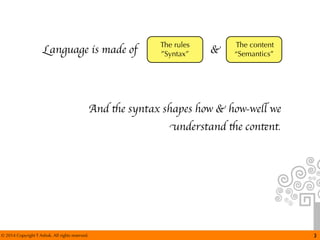
And the syntax shapes how & how-well we
understand the content.
The rules
”Syntax”Language is made of
The content
“Semantics”&
© 2014 Copyright T Ashok. All rights reserved. 4
Syntax is a great guide. A guide who provides you the rules.
Rules that enable you to stay on the path of clarity.
© 2014 Copyright T Ashok. All rights reserved.
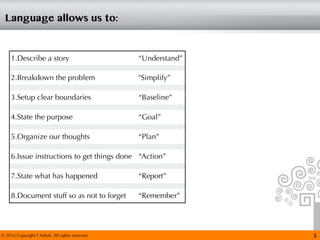
Language allows us to:
5
1.Describe a story “Understand”
2.Breakdown the problem "Simplify”
3.Setup clear boundaries “Baseline”
4.State the purpose “Goal”
5.Organize our thoughts “Plan”
6.Issue instructions to get things done “Action”
7.State what has happened “Report”
8.Document stuff so as not to forget “Remember”
© 2014 Copyright T Ashok. All rights reserved.
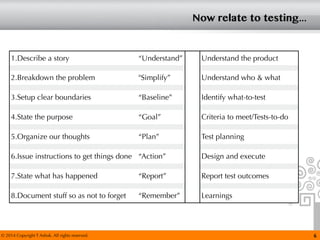
Now relate to testing...
6
1.Describe a story “Understand”
2.Breakdown the problem "Simplify”
3.Setup clear boundaries “Baseline”
4.State the purpose “Goal”
5.Organize our thoughts “Plan”
6.Issue instructions to get things done “Action”
7.State what has happened “Report”
8.Document stuff so as not to forget “Remember”
Understand the product
Understand who & what
Identify what-to-test
Criteria to meet/Tests-to-do
Test planning
Design and execute
Report test outcomes
Learnings
© 2014 Copyright T Ashok. All rights reserved.
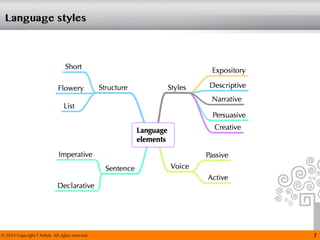
Language styles
7
© 2014 Copyright T Ashok. All rights reserved.
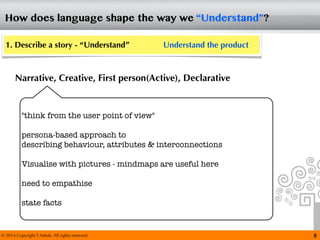
How does language shape the way we “Understand”?
8
Narrative, Creative, First person(Active), Declarative
1. Describe a story - “Understand” Understand the product
"think from the user point of view"
persona-based approach to
describing behaviour, attributes & interconnections
Visualise with pictures - mindmaps are useful here
need to empathise
state facts
© 2014 Copyright T Ashok. All rights reserved.
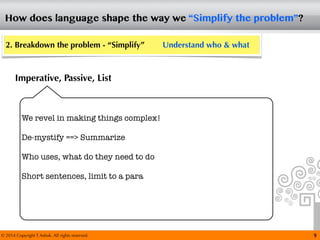
How does language shape the way we “Simplify the problem”?
9
2. Breakdown the problem - “Simplify” Understand who & what
Imperative, Passive, List
We revel in making things complex!
De-mystify ==> Summarize
Who uses, what do they need to do
Short sentences, limit to a para
© 2014 Copyright T Ashok. All rights reserved.
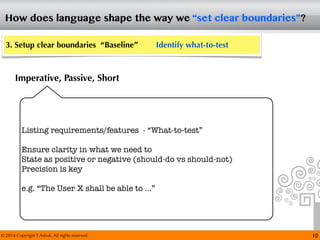
How does language shape the way we “set clear boundaries”?
10
3. Setup clear boundaries “Baseline” Identify what-to-test
Imperative, Passive, Short
Listing requirements/features - “What-to-test”
Ensure clarity in what we need to
State as positive or negative (should-do vs should-not)
Precision is key
e.g. “The User X shall be able to ...”
© 2014 Copyright T Ashok. All rights reserved.
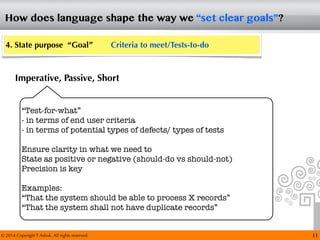
How does language shape the way we “set clear goals”?
11
4. State purpose “Goal” Criteria to meet/Tests-to-do
Imperative, Passive, Short
“Test-for-what”
- in terms of end user criteria
- in terms of potential types of defects/ types of tests
Ensure clarity in what we need to
State as positive or negative (should-do vs should-not)
Precision is key
Examples:
“That the system should be able to process X records”
“That the system shall not have duplicate records”
© 2014 Copyright T Ashok. All rights reserved.
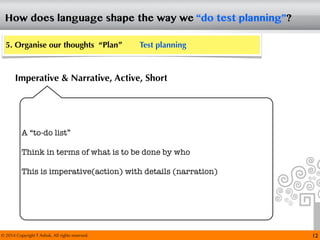
How does language shape the way we “do test planning”?
12
5. Organise our thoughts “Plan” Test planning
Imperative & Narrative, Active, Short
A “to-do list”
Think in terms of what is to be done by who
This is imperative(action) with details (narration)
© 2014 Copyright T Ashok. All rights reserved.
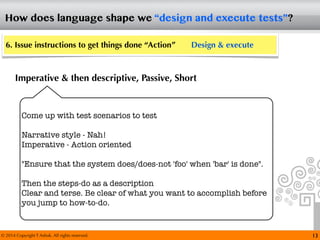
How does language shape we “design and execute tests”?
13
6. Issue instructions to get things done “Action” Design & execute
Imperative & then descriptive, Passive, Short
Come up with test scenarios to test
Narrative style - Nah!
Imperative - Action oriented
"Ensure that the system does/does-not 'foo' when 'bar' is done".
Then the steps-do as a description
Clear and terse. Be clear of what you want to accomplish before
you jump to how-to-do.
© 2014 Copyright T Ashok. All rights reserved.
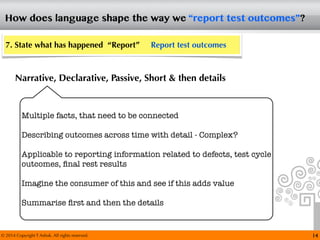
How does language shape the way we “report test outcomes”?
14
7. State what has happened “Report” Report test outcomes
Narrative, Declarative, Passive, Short & then details
Multiple facts, that need to be connected
Describing outcomes across time with detail - Complex?
Applicable to reporting information related to defects, test cycle
outcomes, final rest results
Imagine the consumer of this and see if this adds value
Summarise first and then the details
© 2014 Copyright T Ashok. All rights reserved.
How does language shape the way we “capture learnings”?
15
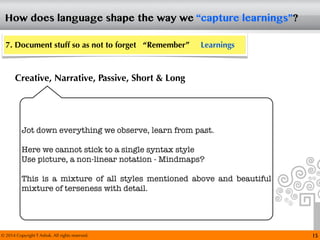
7. Document stuff so as not to forget “Remember” Learnings
Creative, Narrative, Passive, Short & Long
Jot down everything we observe, learn from past.
Here we cannot stick to a single syntax style
Use picture, a non-linear notation - Mindmaps?
This is a mixture of all styles mentioned above and beautiful
mixture of terseness with detail.
© 2014 Copyright T Ashok. All rights reserved.
Recap...
16
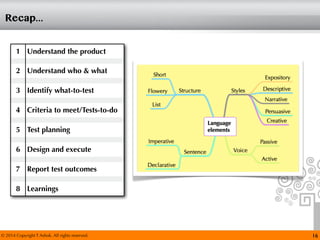
1 Understand the product
2 Understand who & what
3 Identify what-to-test
4 Criteria to meet/Tests-to-do
5 Test planning
6 Design and execute
7 Report test outcomes
8 Learnings
© 2014 Copyright T Ashok. All rights reserved.
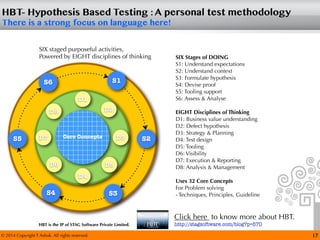
HBT- Hypothesis Based Testing : A personal test methodology
There is a strong focus on language here!
17
D1
D2
D4
D3
D5D6
D7
D8
Core Concepts
S1
S2
S3S4
S5
S6
SIX Stages of DOING
S1: Understand expectations
S2: Understand context
S3: Formulate hypothesis
S4: Devise proof
S5: Tooling support
S6: Assess & Analyse
EIGHT Disciplines of Thinking
D1: Business value understanding
D2: Defect hypothesis
D3: Strategy & Planning
D4: Test design
D5: Tooling
D6: Visibility
D7: Execution & Reporting
D8: Analysis & Management
Uses 32 Core Concepts
For Problem solving
- Techniques, Principles, Guideline
Click here to know more about HBT.
http://stagsoftware.com/blog?p=570
SIX staged purposeful activities,
Powered by EIGHT disciplines of thinking
HBT is the IP of STAG Software Private Limited.
© 2014 Copyright T Ashok. All rights reserved.
HBT is the intellectual property of STAG Software Private Limited.
STEMTM is the trademark of STAG Software Private Limited.
Thank you!
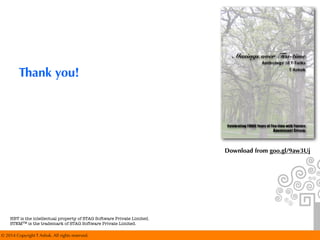
Download from goo.gl/9aw3Uj

Language shapes the way you think

  • 1.
    Language shapes theway you think T Ashok Founder & CEO STAG Software Private Limited www.stagsoftware.com in.linkedin.com/in/AshokSTAG ash_thiru
  • 2.
    © 2014 CopyrightT Ashok. All rights reserved. 2 Clarity of thought and clear communication. Language has a significant role in the former too.
  • 3.
    © 2014 CopyrightT Ashok. All rights reserved. 3 And the syntax shapes how & how-well we understand the content. The rules ”Syntax”Language is made of The content “Semantics”&
  • 4.
    © 2014 CopyrightT Ashok. All rights reserved. 4 Syntax is a great guide. A guide who provides you the rules. Rules that enable you to stay on the path of clarity.
  • 5.
    © 2014 CopyrightT Ashok. All rights reserved. Language allows us to: 5 1.Describe a story “Understand” 2.Breakdown the problem "Simplify” 3.Setup clear boundaries “Baseline” 4.State the purpose “Goal” 5.Organize our thoughts “Plan” 6.Issue instructions to get things done “Action” 7.State what has happened “Report” 8.Document stuff so as not to forget “Remember”
  • 6.
    © 2014 CopyrightT Ashok. All rights reserved. Now relate to testing... 6 1.Describe a story “Understand” 2.Breakdown the problem "Simplify” 3.Setup clear boundaries “Baseline” 4.State the purpose “Goal” 5.Organize our thoughts “Plan” 6.Issue instructions to get things done “Action” 7.State what has happened “Report” 8.Document stuff so as not to forget “Remember” Understand the product Understand who & what Identify what-to-test Criteria to meet/Tests-to-do Test planning Design and execute Report test outcomes Learnings
  • 7.
    © 2014 CopyrightT Ashok. All rights reserved. Language styles 7
  • 8.
    © 2014 CopyrightT Ashok. All rights reserved. How does language shape the way we “Understand”? 8 Narrative, Creative, First person(Active), Declarative 1. Describe a story - “Understand” Understand the product "think from the user point of view" persona-based approach to describing behaviour, attributes & interconnections Visualise with pictures - mindmaps are useful here need to empathise state facts
  • 9.
    © 2014 CopyrightT Ashok. All rights reserved. How does language shape the way we “Simplify the problem”? 9 2. Breakdown the problem - “Simplify” Understand who & what Imperative, Passive, List We revel in making things complex! De-mystify ==> Summarize Who uses, what do they need to do Short sentences, limit to a para
  • 10.
    © 2014 CopyrightT Ashok. All rights reserved. How does language shape the way we “set clear boundaries”? 10 3. Setup clear boundaries “Baseline” Identify what-to-test Imperative, Passive, Short Listing requirements/features - “What-to-test” Ensure clarity in what we need to State as positive or negative (should-do vs should-not) Precision is key e.g. “The User X shall be able to ...”
  • 11.
    © 2014 CopyrightT Ashok. All rights reserved. How does language shape the way we “set clear goals”? 11 4. State purpose “Goal” Criteria to meet/Tests-to-do Imperative, Passive, Short “Test-for-what” - in terms of end user criteria - in terms of potential types of defects/ types of tests Ensure clarity in what we need to State as positive or negative (should-do vs should-not) Precision is key Examples: “That the system should be able to process X records” “That the system shall not have duplicate records”
  • 12.
    © 2014 CopyrightT Ashok. All rights reserved. How does language shape the way we “do test planning”? 12 5. Organise our thoughts “Plan” Test planning Imperative & Narrative, Active, Short A “to-do list” Think in terms of what is to be done by who This is imperative(action) with details (narration)
  • 13.
    © 2014 CopyrightT Ashok. All rights reserved. How does language shape we “design and execute tests”? 13 6. Issue instructions to get things done “Action” Design & execute Imperative & then descriptive, Passive, Short Come up with test scenarios to test Narrative style - Nah! Imperative - Action oriented "Ensure that the system does/does-not 'foo' when 'bar' is done". Then the steps-do as a description Clear and terse. Be clear of what you want to accomplish before you jump to how-to-do.
  • 14.
    © 2014 CopyrightT Ashok. All rights reserved. How does language shape the way we “report test outcomes”? 14 7. State what has happened “Report” Report test outcomes Narrative, Declarative, Passive, Short & then details Multiple facts, that need to be connected Describing outcomes across time with detail - Complex? Applicable to reporting information related to defects, test cycle outcomes, final rest results Imagine the consumer of this and see if this adds value Summarise first and then the details
  • 15.
    © 2014 CopyrightT Ashok. All rights reserved. How does language shape the way we “capture learnings”? 15 7. Document stuff so as not to forget “Remember” Learnings Creative, Narrative, Passive, Short & Long Jot down everything we observe, learn from past. Here we cannot stick to a single syntax style Use picture, a non-linear notation - Mindmaps? This is a mixture of all styles mentioned above and beautiful mixture of terseness with detail.
  • 16.
    © 2014 CopyrightT Ashok. All rights reserved. Recap... 16 1 Understand the product 2 Understand who & what 3 Identify what-to-test 4 Criteria to meet/Tests-to-do 5 Test planning 6 Design and execute 7 Report test outcomes 8 Learnings
  • 17.
    © 2014 CopyrightT Ashok. All rights reserved. HBT- Hypothesis Based Testing : A personal test methodology There is a strong focus on language here! 17 D1 D2 D4 D3 D5D6 D7 D8 Core Concepts S1 S2 S3S4 S5 S6 SIX Stages of DOING S1: Understand expectations S2: Understand context S3: Formulate hypothesis S4: Devise proof S5: Tooling support S6: Assess & Analyse EIGHT Disciplines of Thinking D1: Business value understanding D2: Defect hypothesis D3: Strategy & Planning D4: Test design D5: Tooling D6: Visibility D7: Execution & Reporting D8: Analysis & Management Uses 32 Core Concepts For Problem solving - Techniques, Principles, Guideline Click here to know more about HBT. http://stagsoftware.com/blog?p=570 SIX staged purposeful activities, Powered by EIGHT disciplines of thinking HBT is the IP of STAG Software Private Limited.
  • 18.
    © 2014 CopyrightT Ashok. All rights reserved. HBT is the intellectual property of STAG Software Private Limited. STEMTM is the trademark of STAG Software Private Limited. Thank you! Download from goo.gl/9aw3Uj